PRESENT BY SOHAIL AKHTAR Indian Contract Act,  1872
Agreement  &  Contract “ A contract is an agreement made between two or parties which the law will enforce”  -  Section 2 (h) Agreement = Offer + Acceptance >> Promise (Promisee & Promisor) Legal Obligation should be created
What is a Contract ? An Agreement  Enforceable by law Made between atleast two parties By which rights are acquired by one, & Obligations are created on the part of another And on failure, the other party has a remedy
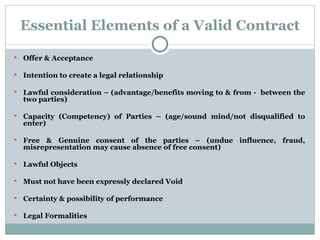
Essential Elements of a Valid Contract Offer & Acceptance Intention to create a legal relationship Lawful consideration –   (advantage/benefits moving to & from -  between the two parties) Capacity (Competency) of Parties – (age/sound mind/not disqualified to enter) Free & Genuine consent of the parties   – (undue influence, fraud, misrepresentation may cause absence of free consent) Lawful Objects Must not have been expressly declared Void Certainty & possibility of performance Legal Formalities
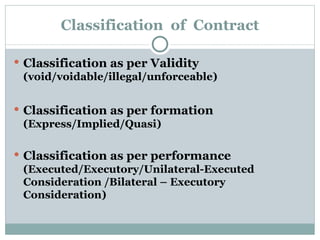
Classification  of  Contract Classification as per Validity   (void/voidable/illegal/unforceable) Classification as per formation   (Express/Implied/Quasi) Classification as per performance   (Executed/Executory/Unilateral-Executed Consideration /Bilateral – Executory Consideration)
PRESENTED BY IRFAN RAZA Offer & Acceptance
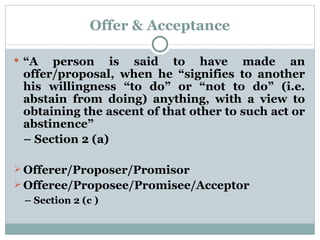
Offer & Acceptance “ A person is said to have made an offer/proposal, when he “signifies to another his willingness “to do” or “not to do” (i.e. abstain from doing) anything, with a view to obtaining the ascent of that other to such act or abstinence”  –  Section 2 (a) Offerer/Proposer/Promisor  Offeree/Proposee/Promisee/Acceptor –  Section 2 (c )
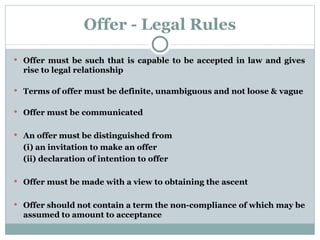
Offer - Legal Rules Offer must be such that is capable to be accepted in law and gives rise to legal relationship Terms of offer must be definite, unambiguous and not loose & vague Offer must be communicated  An offer must be distinguished from (i) an invitation to make an offer  (ii) declaration of intention to offer Offer must be made with a view to obtaining the ascent Offer should not contain a term the non-compliance of which may be assumed to amount to acceptance
Acceptance  &  Legal Rules Acceptance is the act of assenting by the Offeree to the offeror Acceptance may be express OR implied Who can accept? (only the Offeree) Acceptance must be legal & unqualified It must be communicated to the offeror It must be according to the mode prescribed It must be given within a reasonable time Showing intention to fulfill the terms of promise It cannot be implied by silence (mere mental acceptance is no acceptance) Must be given before the offer lapses
THANK YOU

Contract and its assential

  • 1.
    PRESENT BY SOHAILAKHTAR Indian Contract Act, 1872
  • 2.
    Agreement & Contract “ A contract is an agreement made between two or parties which the law will enforce” - Section 2 (h) Agreement = Offer + Acceptance >> Promise (Promisee & Promisor) Legal Obligation should be created
  • 3.
    What is aContract ? An Agreement Enforceable by law Made between atleast two parties By which rights are acquired by one, & Obligations are created on the part of another And on failure, the other party has a remedy
  • 4.
    Essential Elements ofa Valid Contract Offer & Acceptance Intention to create a legal relationship Lawful consideration – (advantage/benefits moving to & from - between the two parties) Capacity (Competency) of Parties – (age/sound mind/not disqualified to enter) Free & Genuine consent of the parties – (undue influence, fraud, misrepresentation may cause absence of free consent) Lawful Objects Must not have been expressly declared Void Certainty & possibility of performance Legal Formalities
  • 5.
    Classification of Contract Classification as per Validity (void/voidable/illegal/unforceable) Classification as per formation (Express/Implied/Quasi) Classification as per performance (Executed/Executory/Unilateral-Executed Consideration /Bilateral – Executory Consideration)
  • 6.
    PRESENTED BY IRFANRAZA Offer & Acceptance
  • 7.
    Offer & Acceptance“ A person is said to have made an offer/proposal, when he “signifies to another his willingness “to do” or “not to do” (i.e. abstain from doing) anything, with a view to obtaining the ascent of that other to such act or abstinence” – Section 2 (a) Offerer/Proposer/Promisor Offeree/Proposee/Promisee/Acceptor – Section 2 (c )
  • 8.
    Offer - LegalRules Offer must be such that is capable to be accepted in law and gives rise to legal relationship Terms of offer must be definite, unambiguous and not loose & vague Offer must be communicated An offer must be distinguished from (i) an invitation to make an offer (ii) declaration of intention to offer Offer must be made with a view to obtaining the ascent Offer should not contain a term the non-compliance of which may be assumed to amount to acceptance
  • 9.
    Acceptance & Legal Rules Acceptance is the act of assenting by the Offeree to the offeror Acceptance may be express OR implied Who can accept? (only the Offeree) Acceptance must be legal & unqualified It must be communicated to the offeror It must be according to the mode prescribed It must be given within a reasonable time Showing intention to fulfill the terms of promise It cannot be implied by silence (mere mental acceptance is no acceptance) Must be given before the offer lapses
  • 10.