INDIAN CONTRACT ACT 1872
UNIT 1
OBJECTIVE OF THE ACT
 The objective of the Contract Act is to ensure that
the rights and obligations arising out of a contract
are honoured and that legal remedies are made
available to an aggrieved party against the party
failing to honour his part of agreement. The Indian
Contract Act makes it obligatory that this is done
and compels the defaulters to honour their
commitments
EXTENT AND COMMENCEMENT
 It extends to the whole of India except the State of
Jammu and Kashmir
 It came into force on the first day of September,
1872.
 The sale of Goods was repealed from this Indian
Contract Act in 1930. Contracts relating to
partnership were repealed in 1932.
CONTRACT ACT: 1 SEPT 1872
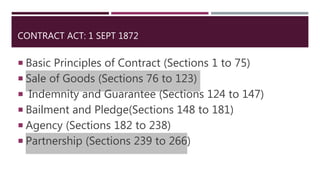
 Basic Principles of Contract (Sections 1 to 75)
 Sale of Goods (Sections 76 to 123)
 Indemnity and Guarantee (Sections 124 to 147)
 Bailment and Pledge(Sections 148 to 181)
 Agency (Sections 182 to 238)
 Partnership (Sections 239 to 266)
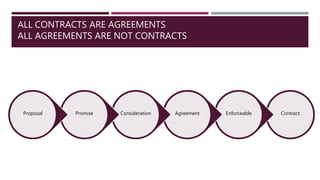
ALL CONTRACTS ARE AGREEMENTS
ALL AGREEMENTS ARE NOT CONTRACTS
Contract
Enforceable
Agreement
Consideration
Promise
Proposal
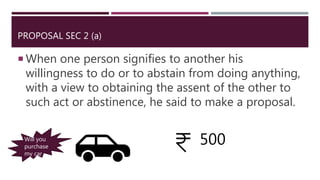
PROPOSAL SEC 2 (a)
 When one person signifies to another his
willingness to do or to abstain from doing anything,
with a view to obtaining the assent of the other to
such act or abstinence, he said to make a proposal.
500
Will you
purchase
my car
PROMISE (2(b))
 When the person to whom the proposal is made
signifies his assent thereto, the proposal is said to be
accepted. A proposal when accepted, becomes a
promise.
 The person making the proposal is called the “Promisor”
and the person accepting the proposal is called the
“Promisee
AGREEMENT
Every promise and every set of promises,
forming the consideration for each other is an
agreement.
 An agreement not enforceable by law is said
to be void
CONTRACT
An agreement enforceable
by law is a contract.
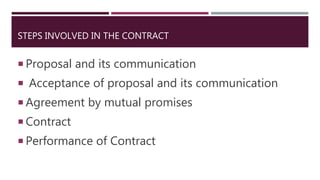
STEPS INVOLVED IN THE CONTRACT
 Proposal and its communication
 Acceptance of proposal and its communication
 Agreement by mutual promises
 Contract
 Performance of Contract
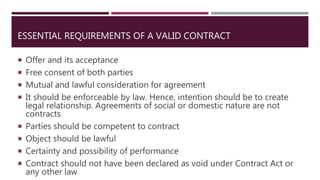
ESSENTIAL REQUIREMENTS OF A VALID CONTRACT
 Offer and its acceptance
 Free consent of both parties
 Mutual and lawful consideration for agreement
 It should be enforceable by law. Hence, intention should be to create
legal relationship. Agreements of social or domestic nature are not
contracts
 Parties should be competent to contract
 Object should be lawful
 Certainty and possibility of performance
 Contract should not have been declared as void under Contract Act or
any other law
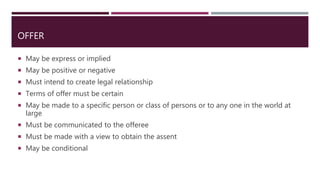
OFFER
 May be express or implied
 May be positive or negative
 Must intend to create legal relationship
 Terms of offer must be certain
 May be made to a specific person or class of persons or to any one in the world at
large
 Must be communicated to the offeree
 Must be made with a view to obtain the assent
 May be conditional
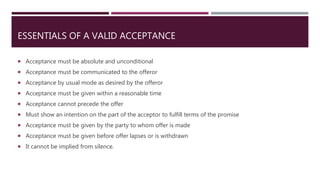
ESSENTIALS OF A VALID ACCEPTANCE
 Acceptance must be absolute and unconditional
 Acceptance must be communicated to the offeror
 Acceptance by usual mode as desired by the offeror
 Acceptance must be given within a reasonable time
 Acceptance cannot precede the offer
 Must show an intention on the part of the acceptor to fulfill terms of the promise
 Acceptance must be given by the party to whom offer is made
 Acceptance must be given before offer lapses or is withdrawn
 It cannot be implied from silence.
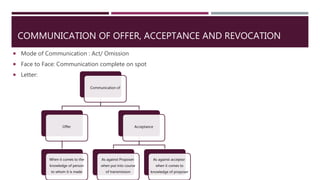
COMMUNICATION OF OFFER, ACCEPTANCE AND REVOCATION
 Mode of Communication : Act/ Omission
 Face to Face: Communication complete on spot
 Letter:
Communication of
Offer
When it comes to the
knowledge of person
to whom it is made
Acceptance
As against Proposer:
when put into course
of transmission
As against acceptor:
when it comes to
knowledge of proposer
COMMUNICATION OF OFFER, ACCEPTANCE AND REVOCATION
 Revocation : Taking back / recalling/ withdrawal
 As against the person who makes it: when it is put into course of transmission
 As against person to whom it os made: when it comes to his knowledge
 Revocation of offer valid before acceptance is given
 Revocation of acceptance before acceptance reaches proposer.
TERMINATION OF OFFER
 By notice of revocation
 By lapse of time
 By failure of the acceptor to fulfil a condition precedent to acceptance
 By failure to accept according to the mode prescribed
 By death or insanity of the offeror
 By rejection
 Counter offer
 Change of law
ESSENTIALS OF A VALID ACCEPTANCE
 Offer cannot be accepted after it was rejected unless it is
renewed
 Silence does not imply acceptance
 Acceptance must be made before the lapse or
revocation of the offer
 Acceptance of offer means acceptance of all terms
attached to the offer
LEGAL RULES REGARDING CONSIDERATION
 Consideration is required both for formation and discharge of
an agreement or contract
 Consideration may be past, present and future
 Consideration may be either positive or negative
 Consideration must be done at the desire of the promisor
 Consideration may be furnished by the promisee or any other
person
CONSIDERATION (SEC 2 (d))
 When at the desire of the promisor, the promise or any
other person has done or abstained from doing, or does
or abstains from doing, or promises to do or to abstain
from doing something, such act or abstinence or promise
is called a consideration for the promise.
LEGAL RULES REGARDING CONSIDERATION
 Consideration must move at desire of promisor
 May move from promise or any other person
 May be an act, abstinence or forbearance or a return promise
 May be past. Present or future
 Consideration must be real and not illusory
 Consideration need not be adequate
 Consideration must not be the performance of existing duties
 Consideration must be lawful

Indian contract act 1872

  • 1.
  • 2.
    OBJECTIVE OF THEACT  The objective of the Contract Act is to ensure that the rights and obligations arising out of a contract are honoured and that legal remedies are made available to an aggrieved party against the party failing to honour his part of agreement. The Indian Contract Act makes it obligatory that this is done and compels the defaulters to honour their commitments
  • 3.
    EXTENT AND COMMENCEMENT It extends to the whole of India except the State of Jammu and Kashmir  It came into force on the first day of September, 1872.  The sale of Goods was repealed from this Indian Contract Act in 1930. Contracts relating to partnership were repealed in 1932.
  • 4.
    CONTRACT ACT: 1SEPT 1872  Basic Principles of Contract (Sections 1 to 75)  Sale of Goods (Sections 76 to 123)  Indemnity and Guarantee (Sections 124 to 147)  Bailment and Pledge(Sections 148 to 181)  Agency (Sections 182 to 238)  Partnership (Sections 239 to 266)
  • 5.
    ALL CONTRACTS AREAGREEMENTS ALL AGREEMENTS ARE NOT CONTRACTS Contract Enforceable Agreement Consideration Promise Proposal
  • 6.
    PROPOSAL SEC 2(a)  When one person signifies to another his willingness to do or to abstain from doing anything, with a view to obtaining the assent of the other to such act or abstinence, he said to make a proposal. 500 Will you purchase my car
  • 7.
    PROMISE (2(b))  Whenthe person to whom the proposal is made signifies his assent thereto, the proposal is said to be accepted. A proposal when accepted, becomes a promise.  The person making the proposal is called the “Promisor” and the person accepting the proposal is called the “Promisee
  • 8.
    AGREEMENT Every promise andevery set of promises, forming the consideration for each other is an agreement.  An agreement not enforceable by law is said to be void
  • 9.
  • 10.
    STEPS INVOLVED INTHE CONTRACT  Proposal and its communication  Acceptance of proposal and its communication  Agreement by mutual promises  Contract  Performance of Contract
  • 11.
    ESSENTIAL REQUIREMENTS OFA VALID CONTRACT  Offer and its acceptance  Free consent of both parties  Mutual and lawful consideration for agreement  It should be enforceable by law. Hence, intention should be to create legal relationship. Agreements of social or domestic nature are not contracts  Parties should be competent to contract  Object should be lawful  Certainty and possibility of performance  Contract should not have been declared as void under Contract Act or any other law
  • 13.
    OFFER  May beexpress or implied  May be positive or negative  Must intend to create legal relationship  Terms of offer must be certain  May be made to a specific person or class of persons or to any one in the world at large  Must be communicated to the offeree  Must be made with a view to obtain the assent  May be conditional
  • 15.
    ESSENTIALS OF AVALID ACCEPTANCE  Acceptance must be absolute and unconditional  Acceptance must be communicated to the offeror  Acceptance by usual mode as desired by the offeror  Acceptance must be given within a reasonable time  Acceptance cannot precede the offer  Must show an intention on the part of the acceptor to fulfill terms of the promise  Acceptance must be given by the party to whom offer is made  Acceptance must be given before offer lapses or is withdrawn  It cannot be implied from silence.
  • 16.
    COMMUNICATION OF OFFER,ACCEPTANCE AND REVOCATION  Mode of Communication : Act/ Omission  Face to Face: Communication complete on spot  Letter: Communication of Offer When it comes to the knowledge of person to whom it is made Acceptance As against Proposer: when put into course of transmission As against acceptor: when it comes to knowledge of proposer
  • 17.
    COMMUNICATION OF OFFER,ACCEPTANCE AND REVOCATION  Revocation : Taking back / recalling/ withdrawal  As against the person who makes it: when it is put into course of transmission  As against person to whom it os made: when it comes to his knowledge  Revocation of offer valid before acceptance is given  Revocation of acceptance before acceptance reaches proposer.
  • 18.
    TERMINATION OF OFFER By notice of revocation  By lapse of time  By failure of the acceptor to fulfil a condition precedent to acceptance  By failure to accept according to the mode prescribed  By death or insanity of the offeror  By rejection  Counter offer  Change of law
  • 19.
    ESSENTIALS OF AVALID ACCEPTANCE  Offer cannot be accepted after it was rejected unless it is renewed  Silence does not imply acceptance  Acceptance must be made before the lapse or revocation of the offer  Acceptance of offer means acceptance of all terms attached to the offer
  • 20.
    LEGAL RULES REGARDINGCONSIDERATION  Consideration is required both for formation and discharge of an agreement or contract  Consideration may be past, present and future  Consideration may be either positive or negative  Consideration must be done at the desire of the promisor  Consideration may be furnished by the promisee or any other person
  • 21.
    CONSIDERATION (SEC 2(d))  When at the desire of the promisor, the promise or any other person has done or abstained from doing, or does or abstains from doing, or promises to do or to abstain from doing something, such act or abstinence or promise is called a consideration for the promise.
  • 22.
    LEGAL RULES REGARDINGCONSIDERATION  Consideration must move at desire of promisor  May move from promise or any other person  May be an act, abstinence or forbearance or a return promise  May be past. Present or future  Consideration must be real and not illusory  Consideration need not be adequate  Consideration must not be the performance of existing duties  Consideration must be lawful