CONTINUUM
MODEL
Submitted to: Mrs Kirti Batra
A. Matter consists of widely spaced atoms in the gas phase. However, it is
very convenient to ignore the atomic nature of matter and see it as a
continuous homogeneous substance without holes, that is, a continuum.
Continuity idealization makes it possible to treat properties as point
functions and to assume that properties vary continuously in space
without jumps.
3. In a continuous approach, fluid properties such as density, viscosity,
thermal conductivity, temperature, etc. can be expressed as continuous
functions of space and time.
1.
2.
3.
CONCEPT
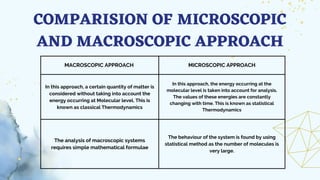
MACROSCOPIC APPROACH MICROSCOPIC APPROACH
In this approach, a certain quantity of matter is
considered without taking into account the
energy occurring at Molecular level. This is
known as classical Thermodynamics
In this approach, the energy occurring at the
molecular level is taken into account for analysis.
The values of these energies are constantly
changing with time. This is known as statistical
Thermodynamics
The analysis of macroscopic systems
requires simple mathematical formulae
The behaviour of the system is found by using
statistical method as the number of molecules is
very large.
COMPARISION OF MICROSCOPIC
AND MACROSCOPIC APPROACH
The values of the properties of system are their
average values.
Example: consider a sample of a gas in a closed
container. The pressure of the gas is the average
value of the pressure exerted by millions of
individual molecules
The properties like velocity momentum impulse
kinetic energy force of impact etc e which describe
the molecule e cannot be easily measured by y
instruments. Our senses cannot feel them.
In order to describe such a system only a
few variables are needed
Large number of variables are needed to
describe such a system So the approach is
complicated.
POINT AND
PATH FUNCTION
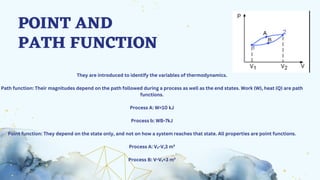
They are introduced to identify the variables of thermodynamics.
Path function: Their magnitudes depend on the path followed during a process as well as the end states. Work (W), heat (Q) are path
functions.
Process A: W=10 kJ
Process b: WB-7kJ
Point function: They depend on the state only, and not on how a system reaches that state. All properties are point functions.
Process A: V₂-V,3 m³
Process B: V-V₁=3 m³
Irreversible process: entropy increase
Entropy is a property of a thermodynamic system that expresses
the direction or outcome of spontaneous changes in the system
Reversible process: entropy change zero
ENTROPY
QUESTION
Prove that entropy of an irreversible process always
increases.
Answer

Meet The
Group
Priyansh Kashyap Priyanshu Bhardwaj Yash Kumar Lucky Bisht Aman Kumar Singh
Question
Answer
Entropy Point And
Path Function
Introduction Differences

THANK YOU

CONTINUUM MODEL PHYSICS ABCDEFGHIJKLMNOP

  • 1.
  • 2.
    A. Matter consistsof widely spaced atoms in the gas phase. However, it is very convenient to ignore the atomic nature of matter and see it as a continuous homogeneous substance without holes, that is, a continuum. Continuity idealization makes it possible to treat properties as point functions and to assume that properties vary continuously in space without jumps. 3. In a continuous approach, fluid properties such as density, viscosity, thermal conductivity, temperature, etc. can be expressed as continuous functions of space and time. 1. 2. 3. CONCEPT
  • 3.
    MACROSCOPIC APPROACH MICROSCOPICAPPROACH In this approach, a certain quantity of matter is considered without taking into account the energy occurring at Molecular level. This is known as classical Thermodynamics In this approach, the energy occurring at the molecular level is taken into account for analysis. The values of these energies are constantly changing with time. This is known as statistical Thermodynamics The analysis of macroscopic systems requires simple mathematical formulae The behaviour of the system is found by using statistical method as the number of molecules is very large. COMPARISION OF MICROSCOPIC AND MACROSCOPIC APPROACH
  • 4.
    The values ofthe properties of system are their average values. Example: consider a sample of a gas in a closed container. The pressure of the gas is the average value of the pressure exerted by millions of individual molecules The properties like velocity momentum impulse kinetic energy force of impact etc e which describe the molecule e cannot be easily measured by y instruments. Our senses cannot feel them. In order to describe such a system only a few variables are needed Large number of variables are needed to describe such a system So the approach is complicated.
  • 5.
    POINT AND PATH FUNCTION Theyare introduced to identify the variables of thermodynamics. Path function: Their magnitudes depend on the path followed during a process as well as the end states. Work (W), heat (Q) are path functions. Process A: W=10 kJ Process b: WB-7kJ Point function: They depend on the state only, and not on how a system reaches that state. All properties are point functions. Process A: V₂-V,3 m³ Process B: V-V₁=3 m³
  • 6.
    Irreversible process: entropyincrease Entropy is a property of a thermodynamic system that expresses the direction or outcome of spontaneous changes in the system Reversible process: entropy change zero ENTROPY
  • 7.
    QUESTION Prove that entropyof an irreversible process always increases.
  • 8.
  • 9.
     Meet The Group Priyansh KashyapPriyanshu Bhardwaj Yash Kumar Lucky Bisht Aman Kumar Singh Question Answer Entropy Point And Path Function Introduction Differences
  • 10.