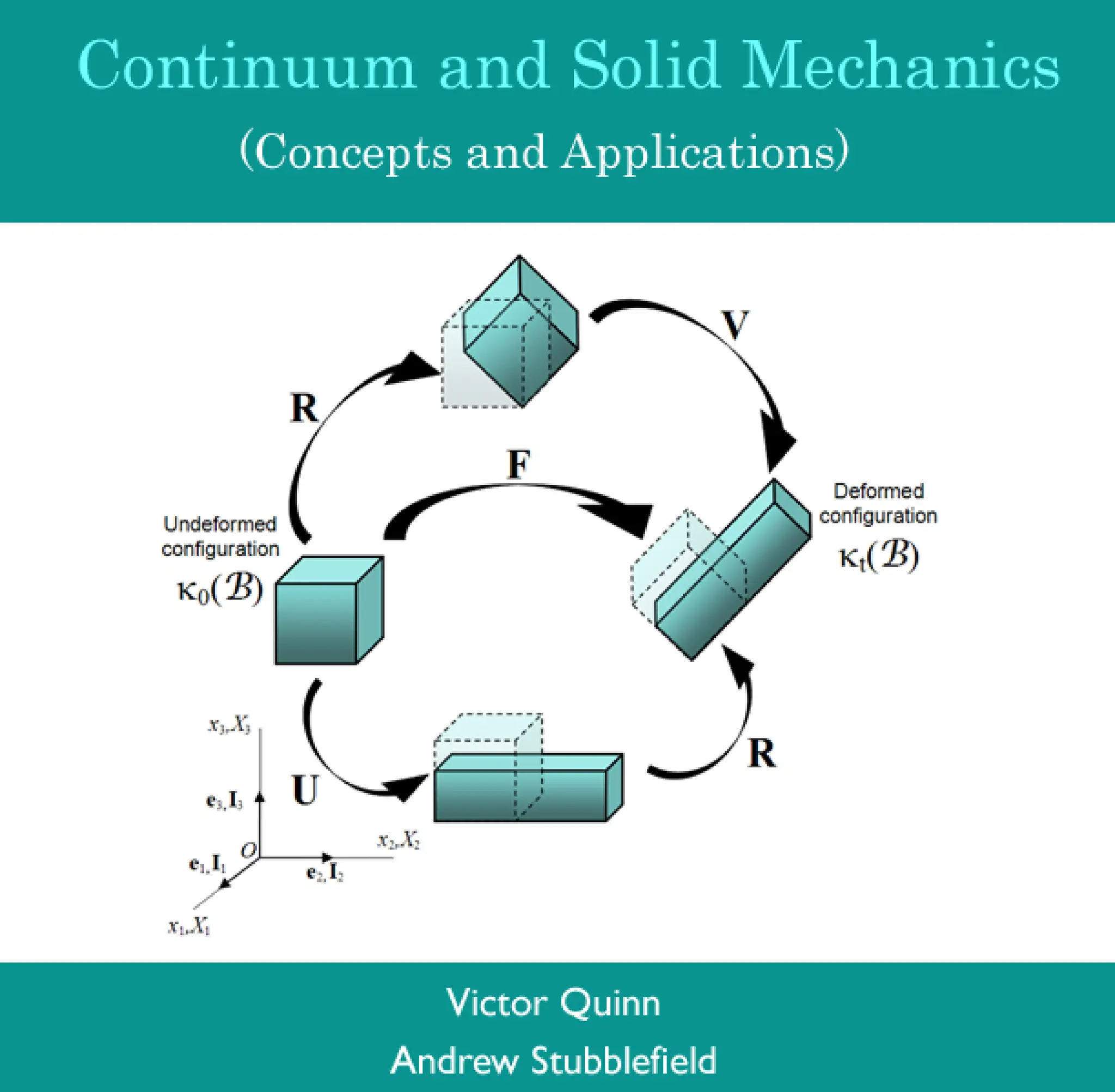
Continuum and solid mechanics concepts and
applications Victor Quinn pdf download
https://ebookgate.com/product/continuum-and-solid-mechanics-
concepts-and-applications-victor-quinn/
Get Instant Ebook Downloads – Browse at https://ebookgate.com
Get Your Digital Files Instantly: PDF, ePub, MOBI and More
Quick Digital Downloads: PDF, ePub, MOBI and Other Formats
Quantum Mechanics Concepts and Applications 1st Edition
Nouredine Zettili
https://ebookgate.com/product/quantum-mechanics-concepts-and-
applications-1st-edition-nouredine-zettili/
Soil Mechanics Concepts and Applications 2nd Edition
William Powrie
https://ebookgate.com/product/soil-mechanics-concepts-and-
applications-2nd-edition-william-powrie/
Continuum Mechanics using Mathematica Fundamentals
Applications and Scientific Computing 2006th Edition
Antonio Romano
https://ebookgate.com/product/continuum-mechanics-using-
mathematica-fundamentals-applications-and-scientific-
computing-2006th-edition-antonio-romano/
Solid Phase Organic Synthesis Concepts Strategies and
Applications 1st Edition Patrick H. Toy
https://ebookgate.com/product/solid-phase-organic-synthesis-
concepts-strategies-and-applications-1st-edition-patrick-h-toy/
Continuum Mechanics 1st Edition Andrus Koppel
https://ebookgate.com/product/continuum-mechanics-1st-edition-
andrus-koppel/
Elements of Continuum Mechanics and Thermodynamics 1st
Edition Joanne L. Wegner
https://ebookgate.com/product/elements-of-continuum-mechanics-
and-thermodynamics-1st-edition-joanne-l-wegner/
Principles of Continuum Mechanics A Study of
Conservation Principles with Applications 1st Edition
J. N. Reddy
https://ebookgate.com/product/principles-of-continuum-mechanics-
a-study-of-conservation-principles-with-applications-1st-edition-
j-n-reddy/
Adhesives Types Mechanics and Applications Types
Mechanics and Applications 1st Edition Jack S. Doyle
https://ebookgate.com/product/adhesives-types-mechanics-and-
applications-types-mechanics-and-applications-1st-edition-jack-s-
doyle/
Geometric Continuum Mechanics Advances in Mechanics and
Mathematics 42 Band 42 1 ed. 2020 Edition Reuven Segev
(Editor)
https://ebookgate.com/product/geometric-continuum-mechanics-
advances-in-mechanics-and-
mathematics-42-band-42-1-ed-2020-edition-reuven-segev-editor/
First Edition, 2012
ISBN 978-81-323-0854-6
© All rights reserved.
Published by:
Academic Studio
4735/22 Prakashdeep Bldg,
Ansari Road, Darya Ganj,
Delhi - 110002
Email: info@wtbooks.com
Table of Contents
Chapter 1 - Continuum Mechanics
Chapter 2 - Fluid Mechanics
Chapter 3 - Stress (Mechanics)
Chapter 4 - Deformation (Mechanics)
Chapter 5 - Finite Strain Theory
Chapter 6 - Peridynamics
Chapter 7 - Viscoelasticity
Chapter 8 - Plasticity
Chapter 9 - Fracture Mechanics
Chapter 10 - Bending
Chapter 11 - Failure Theory (Material)
Chapter 12 - Hooke's Law
Chapter 1
Continuum Mechanics
Continuum mechanics is a branch of mechanics that deals with the analysis of the
kinematics and the mechanical behavior of materials modeled as a continuous mass rather
than as discrete particles. The French mathematician Augustin Louis Cauchy was the first
to formulate such models in the 19th century, but research in the area continues today.
Modeling an object as a continuum assumes that the substance of the object completely
fills the space it occupies. Modeling objects in this way ignores the fact that matter is
made of atoms, and so is not continuous; however, on length scales much greater than
that of inter-atomic distances, such models are highly accurate. Fundamental physical
laws such as the conservation of mass, the conservation of momentum, and the
conservation of energy may be applied to such models to derive differential equations
describing the behavior of such objects, and some information about the particular
material studied is added through a constitutive relation.
Continuum mechanics deals with physical properties of solids and fluids which are
independent of any particular coordinate system in which they are observed. These
physical properties are then represented by tensors, which are mathematical objects that
have the required property of being independent of coordinate system. These tensors can
be expressed in coordinate systems for computational convenience.
The concept of a continuum
Materials, such as solids, liquids and gases, are composed of molecules separated by
empty space. On a macroscopic scale, materials have cracks and discontinuities.
However, certain physical phenomena can be modeled assuming the materials exist as a
continuum, meaning the matter in the body is continuously distributed and fills the
entire region of space it occupies. A continuum is a body that can be continually sub-
divided into infinitesimal elements with properties being those of the bulk material.
The validity of the continuum assumption may be verified by a theoretical analysis, in
which either some clear periodicity is identified or statistical homogeneity and ergodicity
of the microstructure exists. More specifically, the continuum hypothesis/assumption
hinges on the concepts of a representative volume element (RVE) (sometimes called
"representative elementary volume") and separation of scales based on the Hill-Mandel
condition. This condition provides a link between an experimentalist's and a theoretician's
viewpoint on constitutive equations (linear and nonlinear elastic/inelastic or coupled
fields) as well as a way of spatial and statistical averaging of the microstructure.
When the separation of scales does not hold, or when one wants to establish a continuum
of a finer resolution than that of the RVE size, one employs a statistical volume element
(SVE), which, in turn, leads to random continuum fields. The latter then provide a
micromechanics basis for stochastic finite elements (SFE). The levels of SVE and RVE
link continuum mechanics to statistical mechanics. The RVE may be assessed only in a
limited way via experimental testing: when the constitutive response becomes spatially
homogeneous.
Specifically for fluids, the Knudsen number is used to assess to what extent the
approximation of continuity can be made.
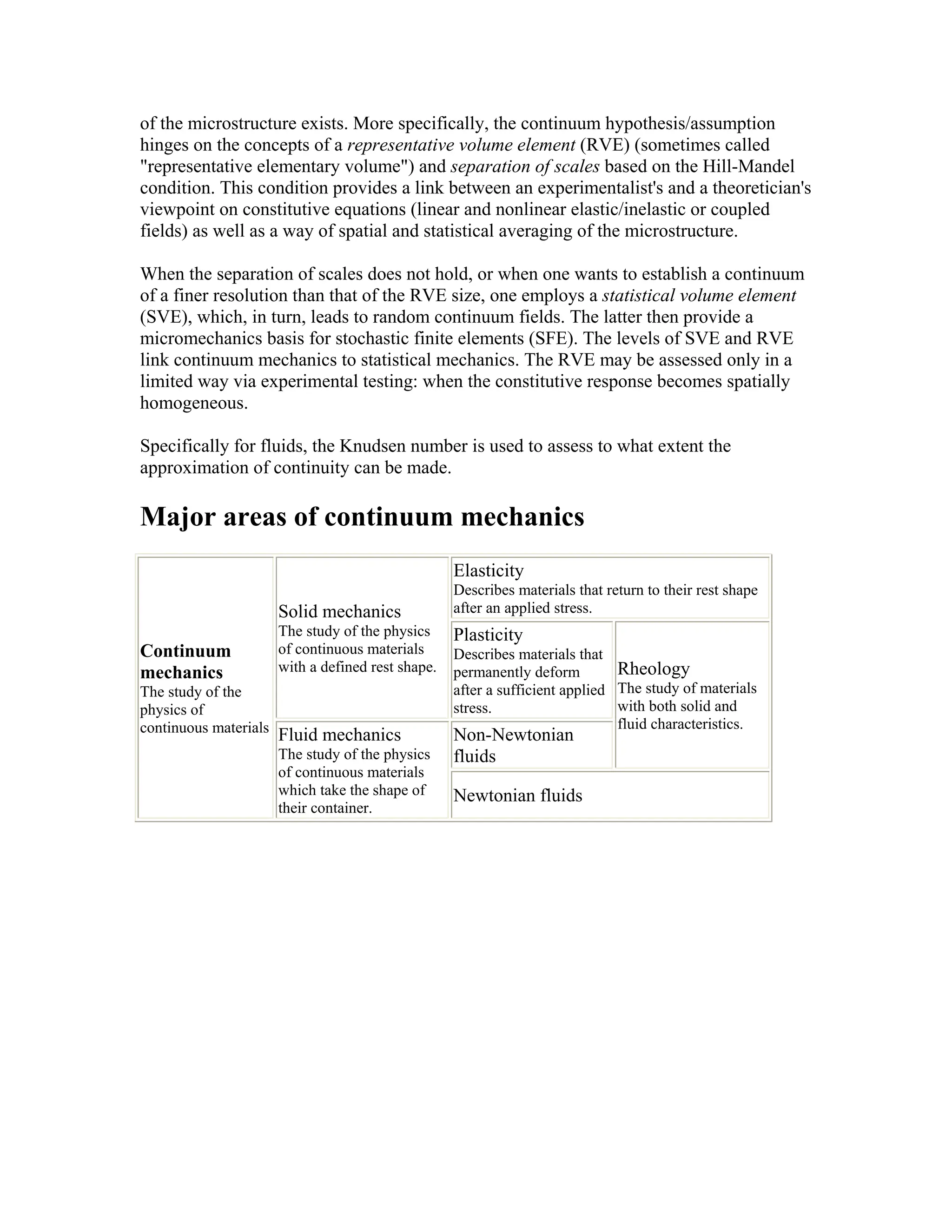
Major areas of continuum mechanics
Continuum
mechanics
The study of the
physics of
continuous materials
Solid mechanics
The study of the physics
of continuous materials
with a defined rest shape.
Elasticity
Describes materials that return to their rest shape
after an applied stress.
Plasticity
Describes materials that
permanently deform
after a sufficient applied
stress.
Rheology
The study of materials
with both solid and
fluid characteristics.
Fluid mechanics
The study of the physics
of continuous materials
which take the shape of
their container.
Non-Newtonian
fluids
Newtonian fluids
Formulation of models
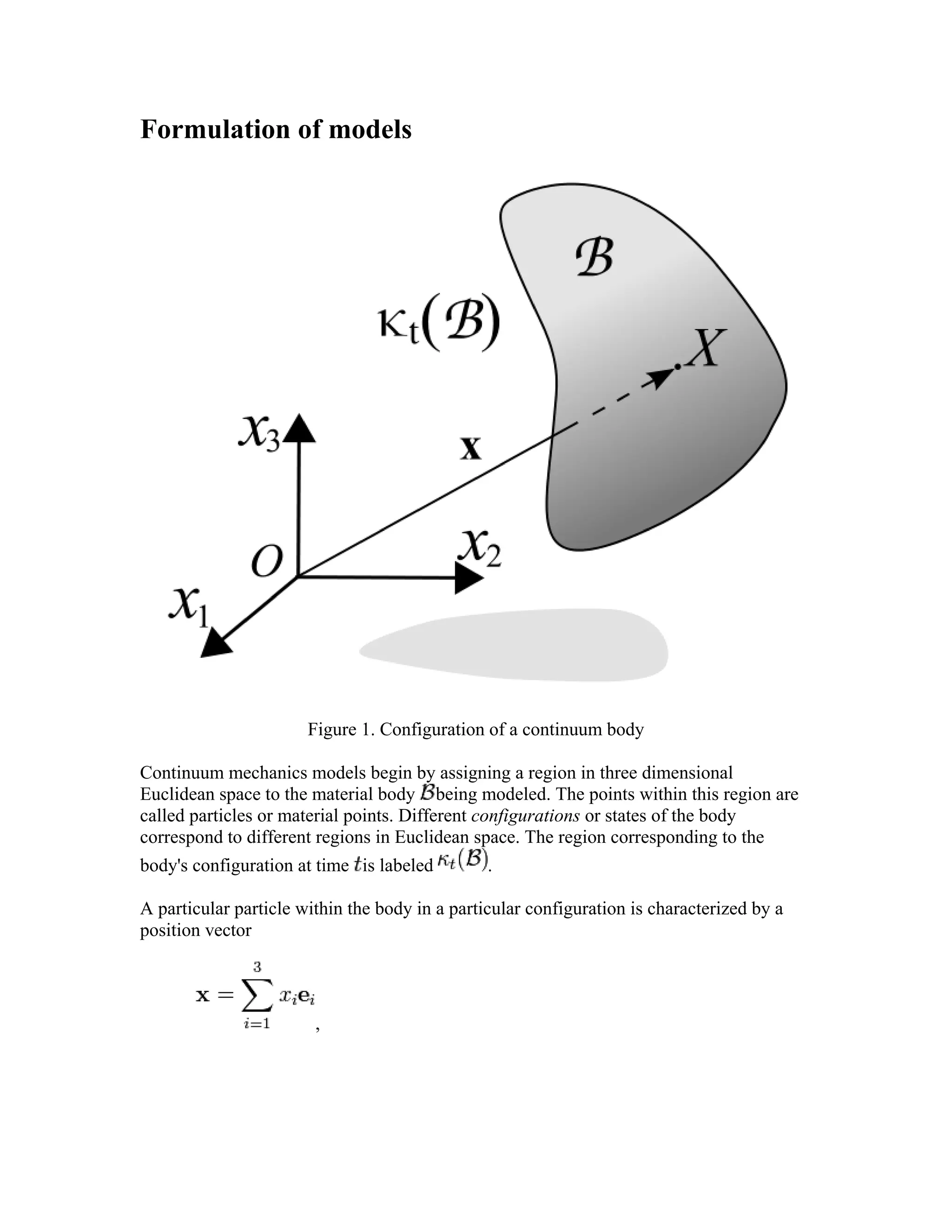
Figure 1. Configuration of a continuum body
Continuum mechanics models begin by assigning a region in three dimensional
Euclidean space to the material body being modeled. The points within this region are
called particles or material points. Different configurations or states of the body
correspond to different regions in Euclidean space. The region corresponding to the
body's configuration at time is labeled .
A particular particle within the body in a particular configuration is characterized by a
position vector
,
where are the coordinate vectors in some frame of reference chosen for the problem.
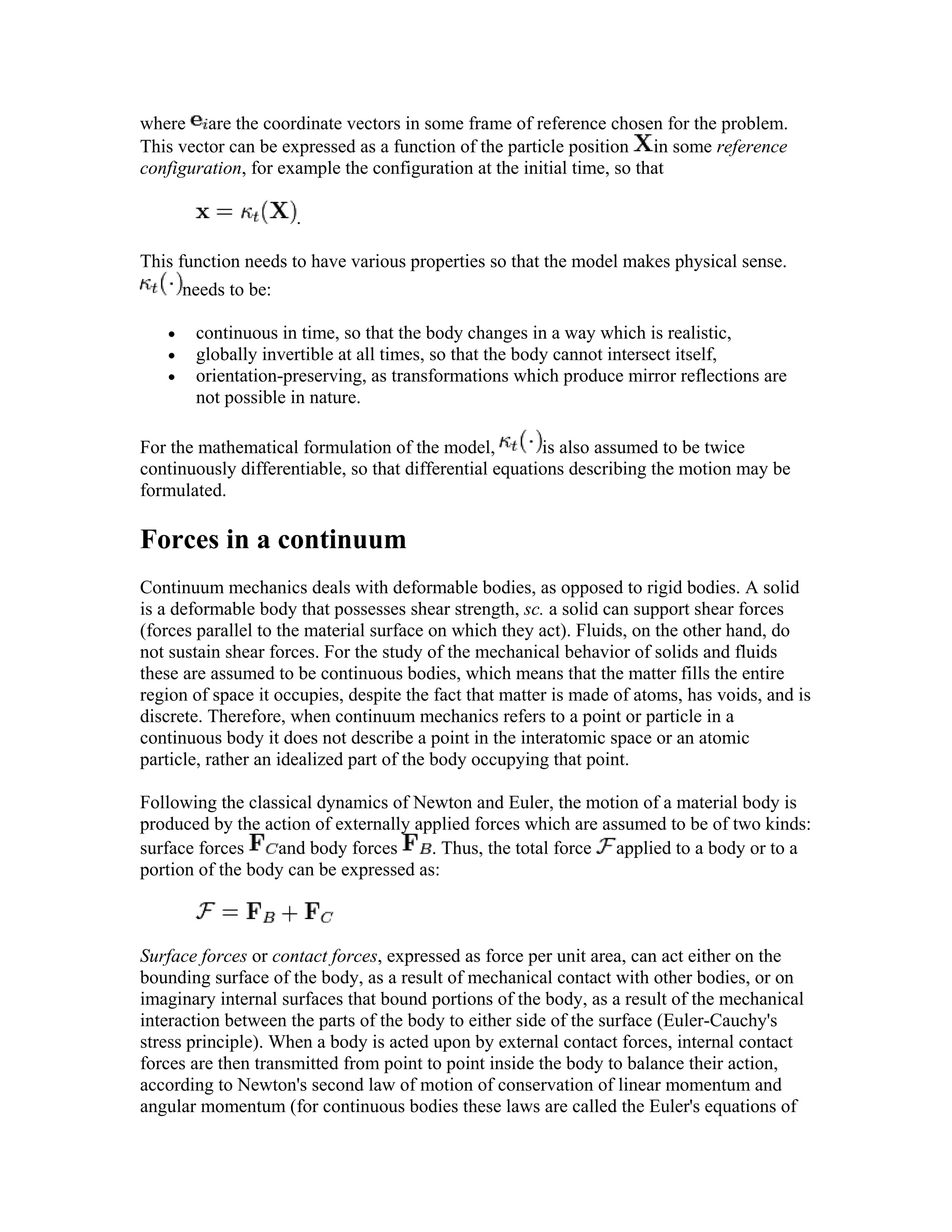
This vector can be expressed as a function of the particle position in some reference
configuration, for example the configuration at the initial time, so that
.
This function needs to have various properties so that the model makes physical sense.
needs to be:
• continuous in time, so that the body changes in a way which is realistic,
• globally invertible at all times, so that the body cannot intersect itself,
• orientation-preserving, as transformations which produce mirror reflections are
not possible in nature.
For the mathematical formulation of the model, is also assumed to be twice
continuously differentiable, so that differential equations describing the motion may be
formulated.
Forces in a continuum
Continuum mechanics deals with deformable bodies, as opposed to rigid bodies. A solid
is a deformable body that possesses shear strength, sc. a solid can support shear forces
(forces parallel to the material surface on which they act). Fluids, on the other hand, do
not sustain shear forces. For the study of the mechanical behavior of solids and fluids
these are assumed to be continuous bodies, which means that the matter fills the entire
region of space it occupies, despite the fact that matter is made of atoms, has voids, and is
discrete. Therefore, when continuum mechanics refers to a point or particle in a
continuous body it does not describe a point in the interatomic space or an atomic
particle, rather an idealized part of the body occupying that point.
Following the classical dynamics of Newton and Euler, the motion of a material body is
produced by the action of externally applied forces which are assumed to be of two kinds:
surface forces and body forces . Thus, the total force applied to a body or to a
portion of the body can be expressed as:
Surface forces or contact forces, expressed as force per unit area, can act either on the
bounding surface of the body, as a result of mechanical contact with other bodies, or on
imaginary internal surfaces that bound portions of the body, as a result of the mechanical
interaction between the parts of the body to either side of the surface (Euler-Cauchy's
stress principle). When a body is acted upon by external contact forces, internal contact
forces are then transmitted from point to point inside the body to balance their action,
according to Newton's second law of motion of conservation of linear momentum and
angular momentum (for continuous bodies these laws are called the Euler's equations of
motion). The internal contact forces are related to the body's deformation through
constitutive equations. The internal contact forces may be mathematically described by
how they relate to the motion of the body, independent of the body's material makeup.
The distribution of internal contact forces throughout the volume of the body is assumed
to be continuous. Therefore, there exists a contact force density or Cauchy traction field
that represents this distribution in a particular configuration of the body at a
given time . It is not a vector field because it depends not only on the position of a
particular material point, but also on the local orientation of the surface element as
defined by its normal vector .
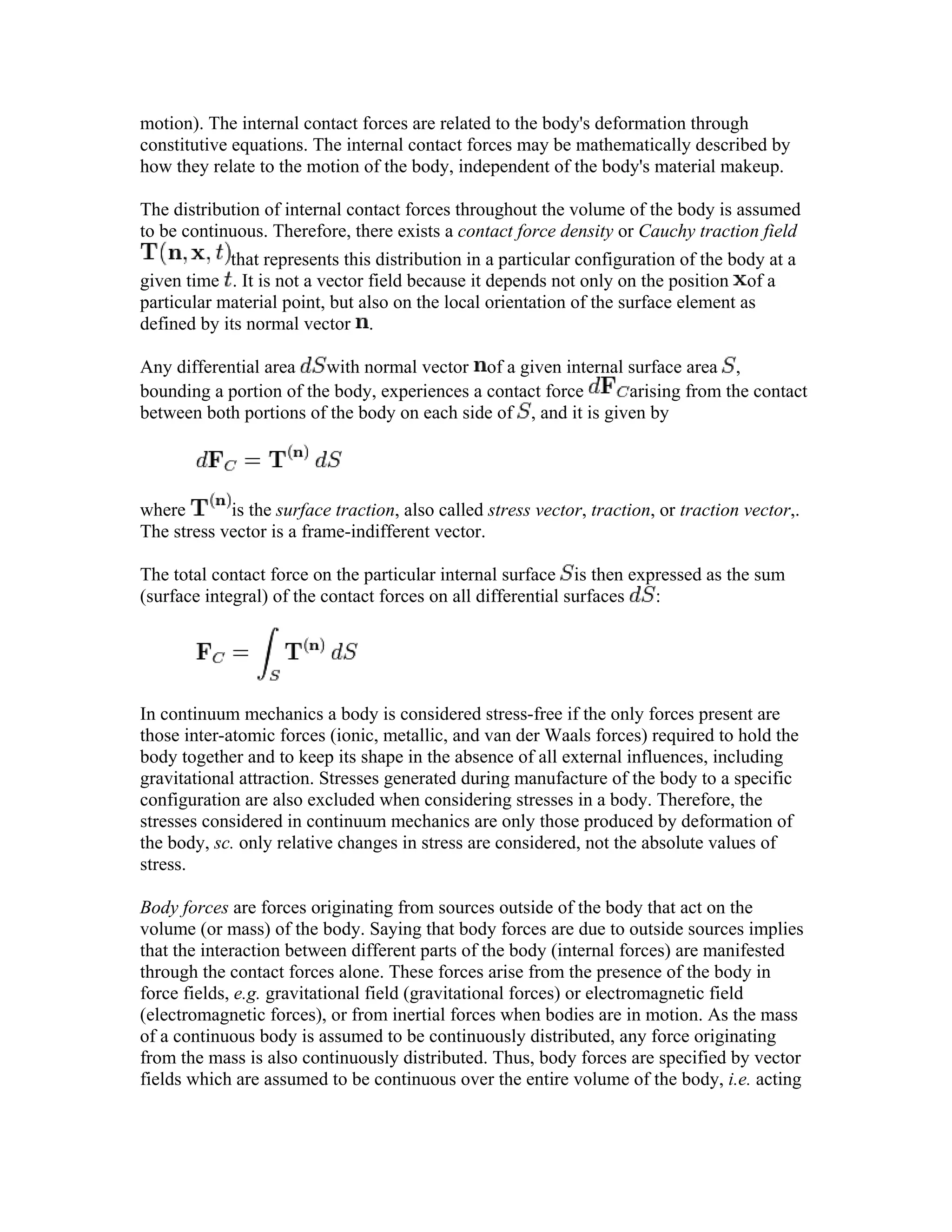
Any differential area with normal vector of a given internal surface area ,
bounding a portion of the body, experiences a contact force arising from the contact
between both portions of the body on each side of , and it is given by
where is the surface traction, also called stress vector, traction, or traction vector,.
The stress vector is a frame-indifferent vector.
The total contact force on the particular internal surface is then expressed as the sum
(surface integral) of the contact forces on all differential surfaces :
In continuum mechanics a body is considered stress-free if the only forces present are
those inter-atomic forces (ionic, metallic, and van der Waals forces) required to hold the
body together and to keep its shape in the absence of all external influences, including
gravitational attraction. Stresses generated during manufacture of the body to a specific
configuration are also excluded when considering stresses in a body. Therefore, the
stresses considered in continuum mechanics are only those produced by deformation of
the body, sc. only relative changes in stress are considered, not the absolute values of
stress.
Body forces are forces originating from sources outside of the body that act on the
volume (or mass) of the body. Saying that body forces are due to outside sources implies
that the interaction between different parts of the body (internal forces) are manifested
through the contact forces alone. These forces arise from the presence of the body in
force fields, e.g. gravitational field (gravitational forces) or electromagnetic field
(electromagnetic forces), or from inertial forces when bodies are in motion. As the mass
of a continuous body is assumed to be continuously distributed, any force originating
from the mass is also continuously distributed. Thus, body forces are specified by vector
fields which are assumed to be continuous over the entire volume of the body, i.e. acting
on every point in it. Body forces are represented by a body force density (per unit
of mass), which is a frame-indifferent vector field.
In the case of gravitational forces, the intensity of the force depends on, or is proportional
to, the mass density of the material, and it is specified in terms of force per unit
mass ( ) or per unit volume ( ). These two specifications are related through the
material density by the equation . Similarly, the intensity of electromagnetic
forces depends upon the strength (electric charge) of the electromagnetic field.
The total body force applied to a continuous body is expressed as
Body forces and contact forces acting on the body lead to corresponding moments of
force (torques) relative to a given point. Thus, the total applied torque about the origin
is given by
In certain situations, not commonly considered in the analysis of the mechanical behavior
or materials, it becomes necessary to include two other types of forces: these are body
moments and couple stresses (surface couples, contact torques). Body moments, or body
couples, are moments per unit volume or per unit mass applied to the volume of the body.
Couple stresses are moments per unit area applied on a surface. Both are important in the
analysis of stress for a polarized dielectric solid under the action of an electric field,
materials where the molecular structure is taken into consideration (e.g. bones), solids
under the action of an external magnetic field, and the dislocation theory of metals.
Materials that exhibit body couples and couple stresses in addition to moments produced
exclusively by forces are called polar materials. Non-polar materials are then those
materials with only moments of forces. In the classical branches of continuum mechanics
the development of the theory of stresses is based on non-polar materials.
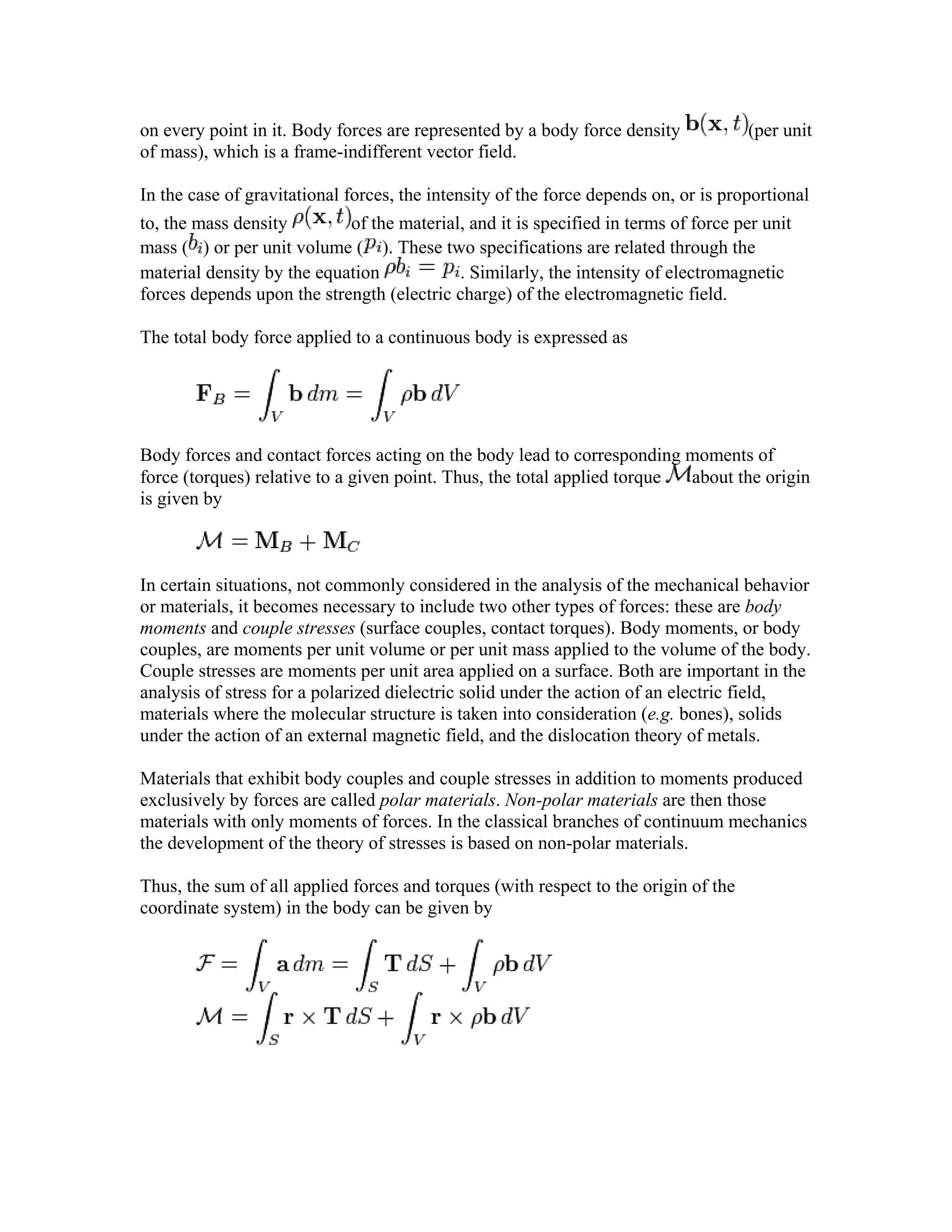
Thus, the sum of all applied forces and torques (with respect to the origin of the
coordinate system) in the body can be given by
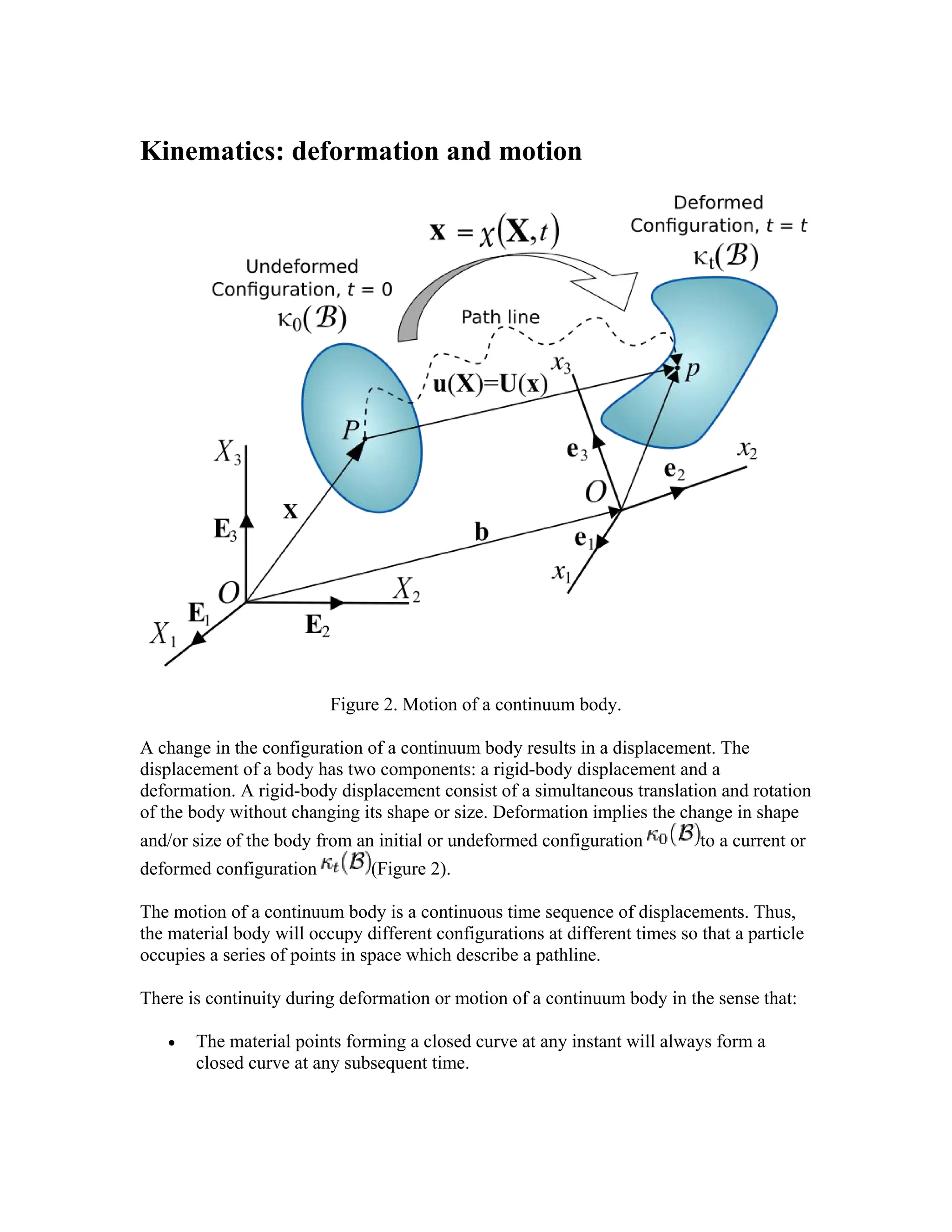
Kinematics: deformation and motion
Figure 2. Motion of a continuum body.
A change in the configuration of a continuum body results in a displacement. The
displacement of a body has two components: a rigid-body displacement and a
deformation. A rigid-body displacement consist of a simultaneous translation and rotation
of the body without changing its shape or size. Deformation implies the change in shape
and/or size of the body from an initial or undeformed configuration to a current or
deformed configuration (Figure 2).
The motion of a continuum body is a continuous time sequence of displacements. Thus,
the material body will occupy different configurations at different times so that a particle
occupies a series of points in space which describe a pathline.
There is continuity during deformation or motion of a continuum body in the sense that:
• The material points forming a closed curve at any instant will always form a
closed curve at any subsequent time.
• The material points forming a closed surface at any instant will always form a
closed surface at any subsequent time and the matter within the closed surface
will always remain within.
It is convenient to identify a reference configuration or initial condition which all
subsequent configurations are referenced from. The reference configuration need not be
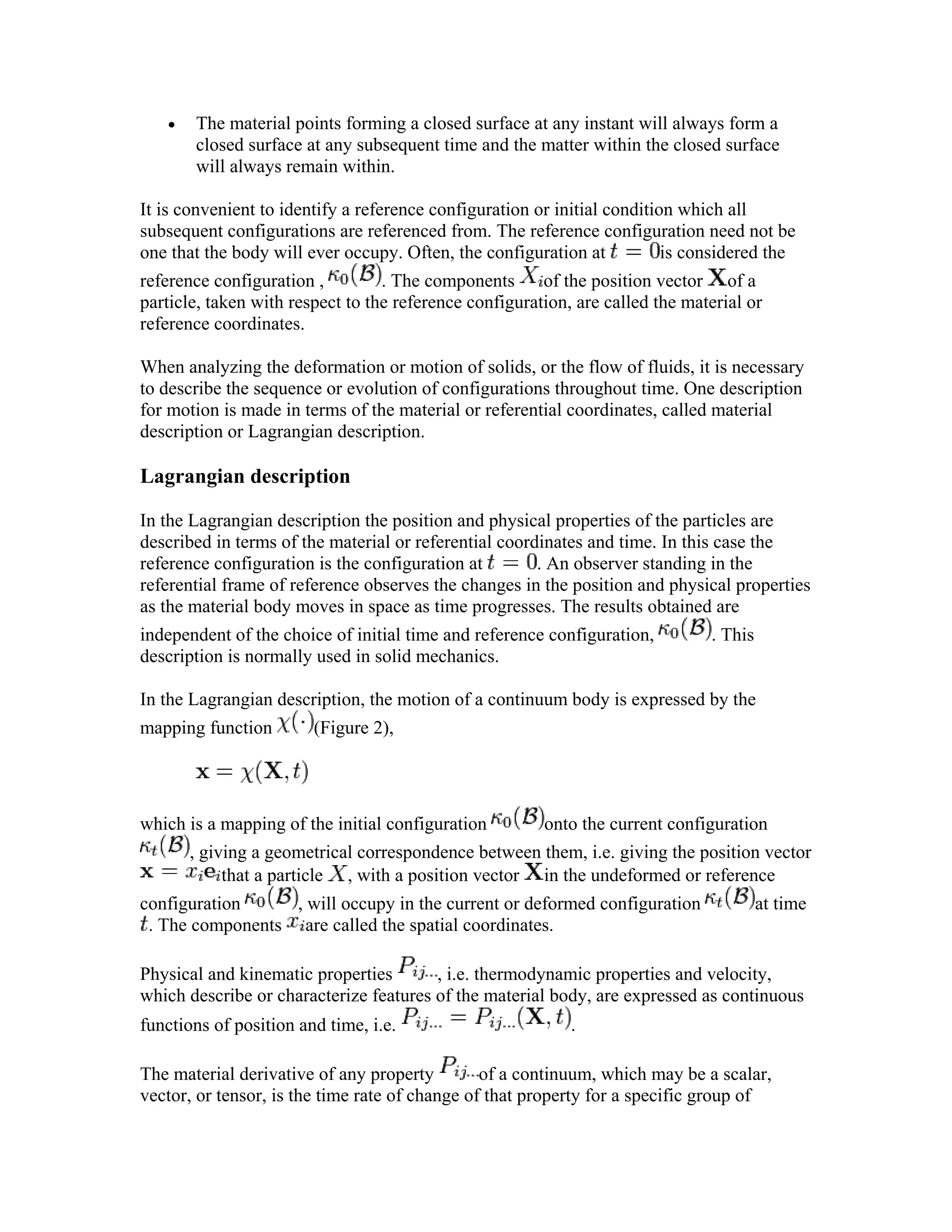
one that the body will ever occupy. Often, the configuration at is considered the
reference configuration , . The components of the position vector of a
particle, taken with respect to the reference configuration, are called the material or
reference coordinates.
When analyzing the deformation or motion of solids, or the flow of fluids, it is necessary
to describe the sequence or evolution of configurations throughout time. One description
for motion is made in terms of the material or referential coordinates, called material
description or Lagrangian description.
Lagrangian description
In the Lagrangian description the position and physical properties of the particles are
described in terms of the material or referential coordinates and time. In this case the
reference configuration is the configuration at . An observer standing in the
referential frame of reference observes the changes in the position and physical properties
as the material body moves in space as time progresses. The results obtained are
independent of the choice of initial time and reference configuration, . This
description is normally used in solid mechanics.
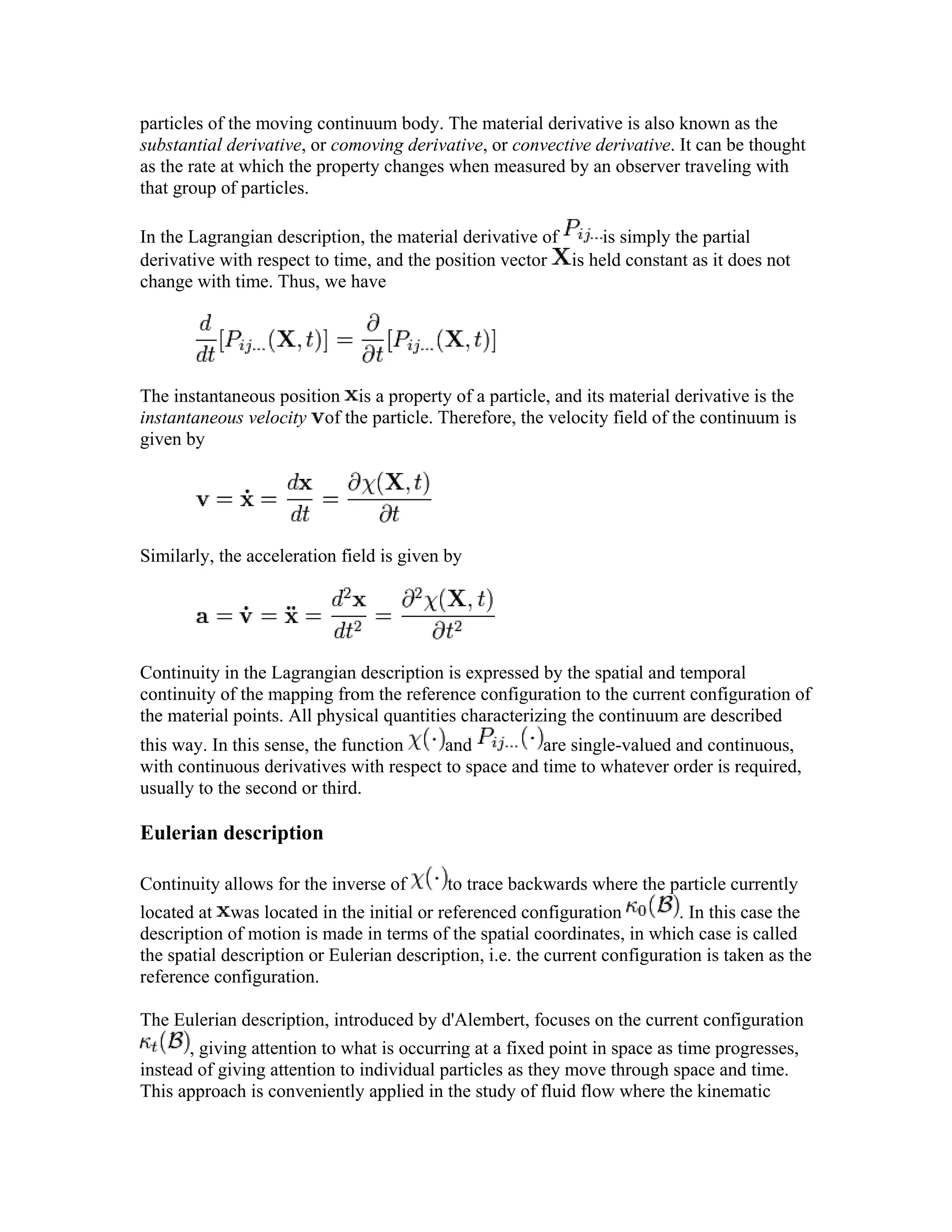
In the Lagrangian description, the motion of a continuum body is expressed by the
mapping function (Figure 2),
which is a mapping of the initial configuration onto the current configuration
, giving a geometrical correspondence between them, i.e. giving the position vector
that a particle , with a position vector in the undeformed or reference
configuration , will occupy in the current or deformed configuration at time
. The components are called the spatial coordinates.
Physical and kinematic properties , i.e. thermodynamic properties and velocity,
which describe or characterize features of the material body, are expressed as continuous
functions of position and time, i.e. .
The material derivative of any property of a continuum, which may be a scalar,
vector, or tensor, is the time rate of change of that property for a specific group of
particles of the moving continuum body. The material derivative is also known as the
substantial derivative, or comoving derivative, or convective derivative. It can be thought
as the rate at which the property changes when measured by an observer traveling with
that group of particles.
In the Lagrangian description, the material derivative of is simply the partial
derivative with respect to time, and the position vector is held constant as it does not
change with time. Thus, we have
The instantaneous position is a property of a particle, and its material derivative is the
instantaneous velocity of the particle. Therefore, the velocity field of the continuum is
given by
Similarly, the acceleration field is given by
Continuity in the Lagrangian description is expressed by the spatial and temporal
continuity of the mapping from the reference configuration to the current configuration of
the material points. All physical quantities characterizing the continuum are described
this way. In this sense, the function and are single-valued and continuous,
with continuous derivatives with respect to space and time to whatever order is required,
usually to the second or third.
Eulerian description
Continuity allows for the inverse of to trace backwards where the particle currently
located at was located in the initial or referenced configuration . In this case the
description of motion is made in terms of the spatial coordinates, in which case is called
the spatial description or Eulerian description, i.e. the current configuration is taken as the
reference configuration.
The Eulerian description, introduced by d'Alembert, focuses on the current configuration
, giving attention to what is occurring at a fixed point in space as time progresses,
instead of giving attention to individual particles as they move through space and time.
This approach is conveniently applied in the study of fluid flow where the kinematic
property of greatest interest is the rate at which change is taking place rather than the
shape of the body of fluid at a reference time.
Mathematically, the motion of a continuum using the Eulerian description is expressed by
the mapping function
which provides a tracing of the particle which now occupies the position in the current
configuration to its original position in the initial configuration .
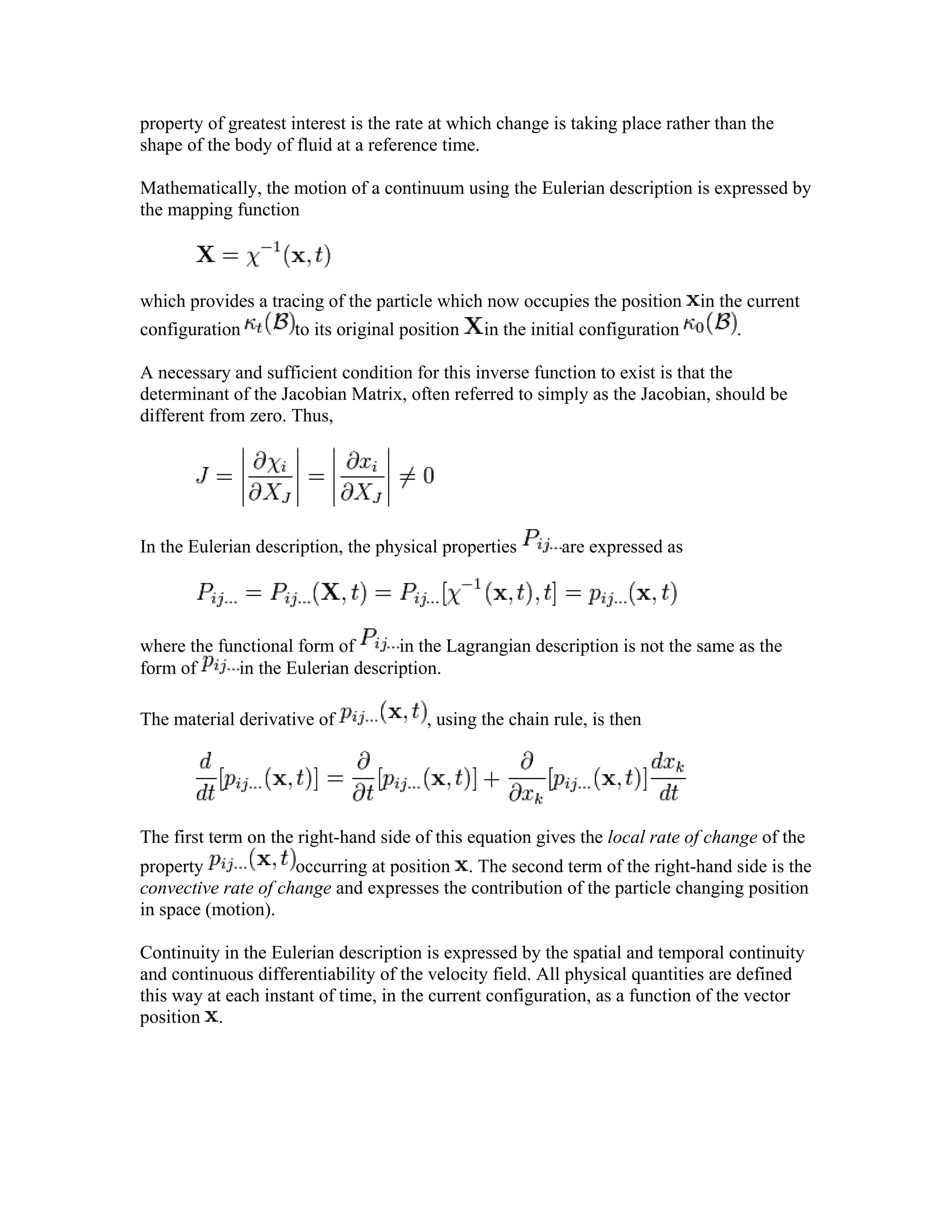
A necessary and sufficient condition for this inverse function to exist is that the
determinant of the Jacobian Matrix, often referred to simply as the Jacobian, should be
different from zero. Thus,
In the Eulerian description, the physical properties are expressed as
where the functional form of in the Lagrangian description is not the same as the
form of in the Eulerian description.
The material derivative of , using the chain rule, is then
The first term on the right-hand side of this equation gives the local rate of change of the
property occurring at position . The second term of the right-hand side is the
convective rate of change and expresses the contribution of the particle changing position
in space (motion).
Continuity in the Eulerian description is expressed by the spatial and temporal continuity
and continuous differentiability of the velocity field. All physical quantities are defined
this way at each instant of time, in the current configuration, as a function of the vector
position .
Displacement field
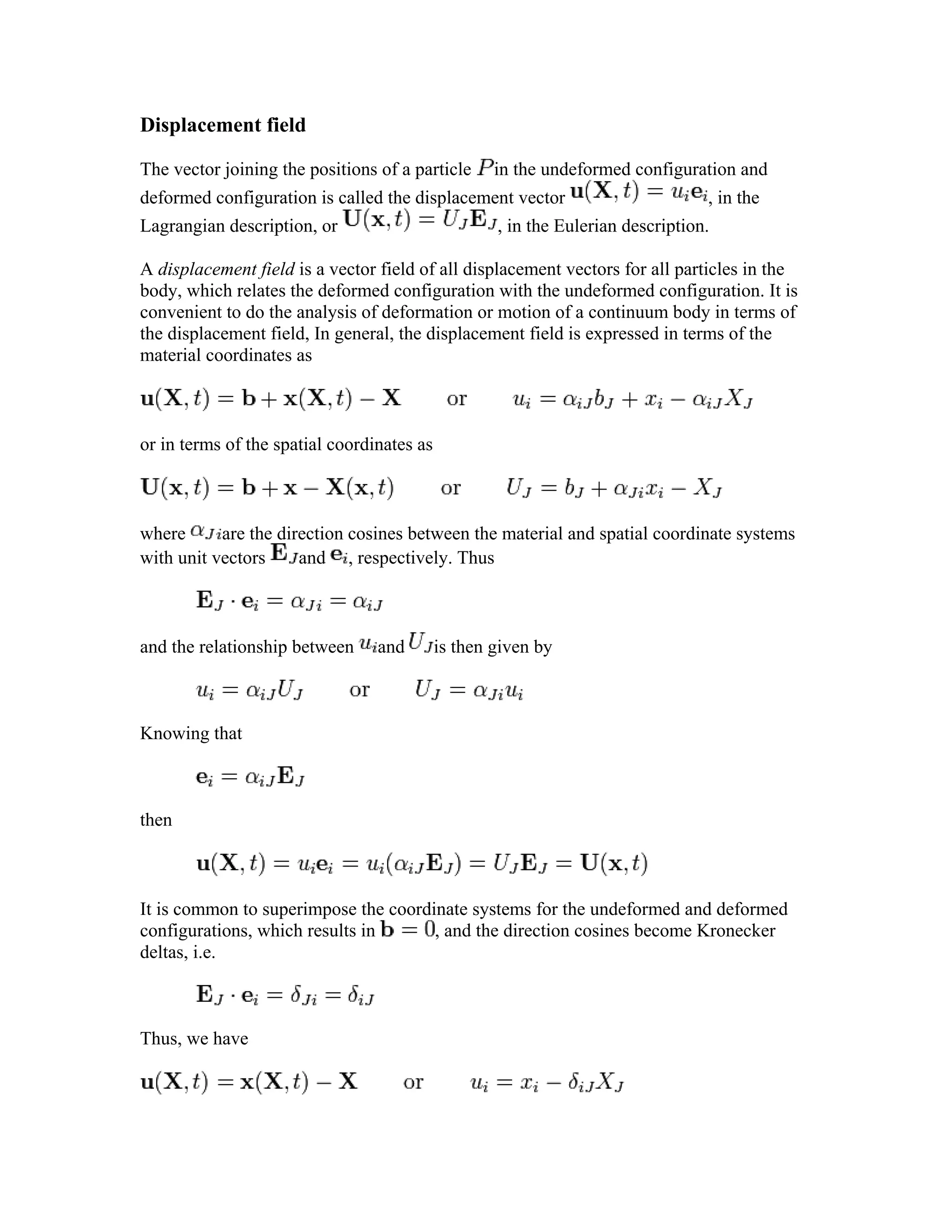
The vector joining the positions of a particle in the undeformed configuration and
deformed configuration is called the displacement vector , in the
Lagrangian description, or , in the Eulerian description.
A displacement field is a vector field of all displacement vectors for all particles in the
body, which relates the deformed configuration with the undeformed configuration. It is
convenient to do the analysis of deformation or motion of a continuum body in terms of
the displacement field, In general, the displacement field is expressed in terms of the
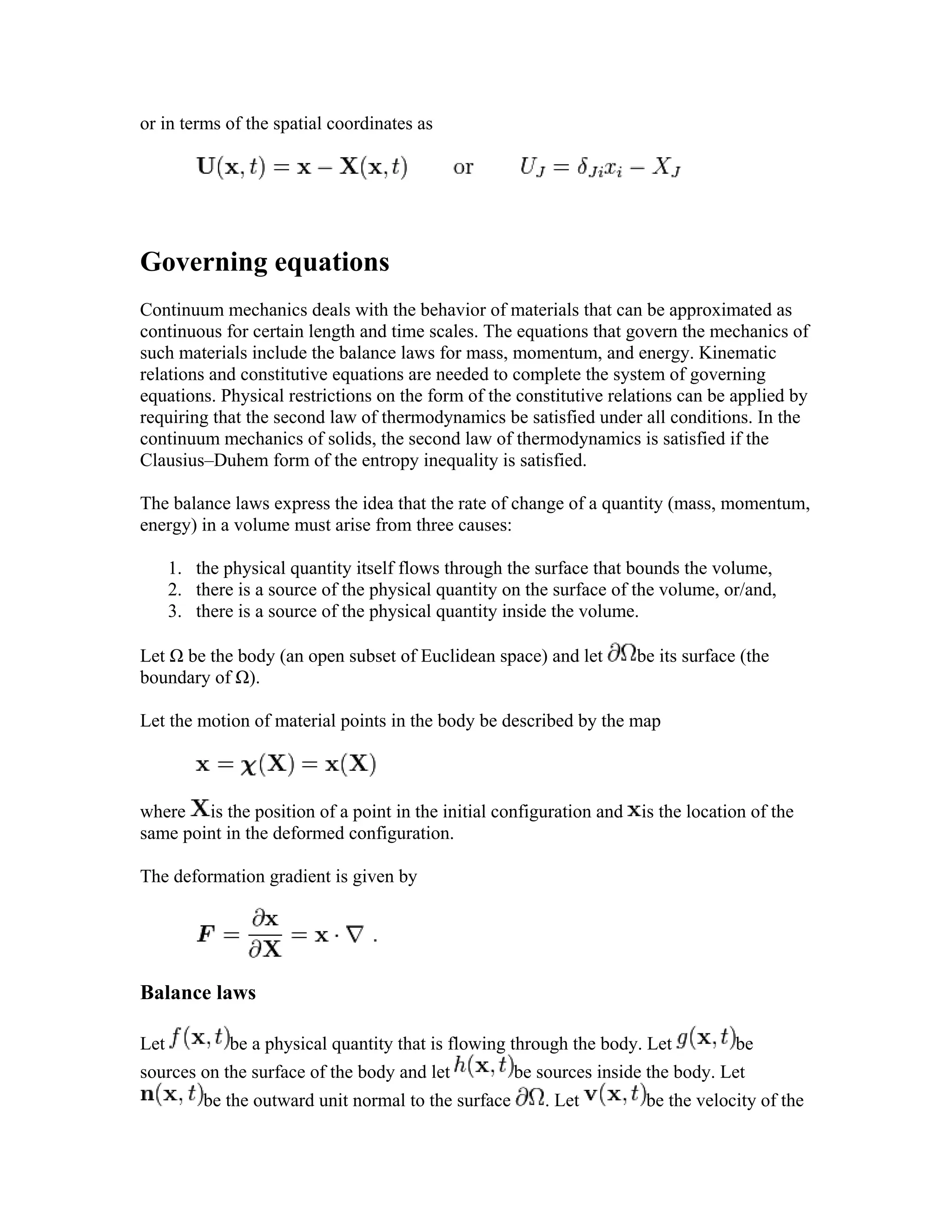
material coordinates as
or in terms of the spatial coordinates as
where are the direction cosines between the material and spatial coordinate systems
with unit vectors and , respectively. Thus
and the relationship between and is then given by
Knowing that
then
It is common to superimpose the coordinate systems for the undeformed and deformed
configurations, which results in , and the direction cosines become Kronecker
deltas, i.e.
Thus, we have
or in terms of the spatial coordinates as
Governing equations
Continuum mechanics deals with the behavior of materials that can be approximated as
continuous for certain length and time scales. The equations that govern the mechanics of
such materials include the balance laws for mass, momentum, and energy. Kinematic
relations and constitutive equations are needed to complete the system of governing
equations. Physical restrictions on the form of the constitutive relations can be applied by
requiring that the second law of thermodynamics be satisfied under all conditions. In the
continuum mechanics of solids, the second law of thermodynamics is satisfied if the
Clausius–Duhem form of the entropy inequality is satisfied.
The balance laws express the idea that the rate of change of a quantity (mass, momentum,
energy) in a volume must arise from three causes:
1. the physical quantity itself flows through the surface that bounds the volume,
2. there is a source of the physical quantity on the surface of the volume, or/and,
3. there is a source of the physical quantity inside the volume.
Let Ω be the body (an open subset of Euclidean space) and let be its surface (the
boundary of Ω).
Let the motion of material points in the body be described by the map
where is the position of a point in the initial configuration and is the location of the
same point in the deformed configuration.
The deformation gradient is given by
Balance laws
Let be a physical quantity that is flowing through the body. Let be
sources on the surface of the body and let be sources inside the body. Let
be the outward unit normal to the surface . Let be the velocity of the
physical particles that carry the physical quantity that is flowing. Also, let the speed at
which the bounding surface is moving be un (in the direction ).
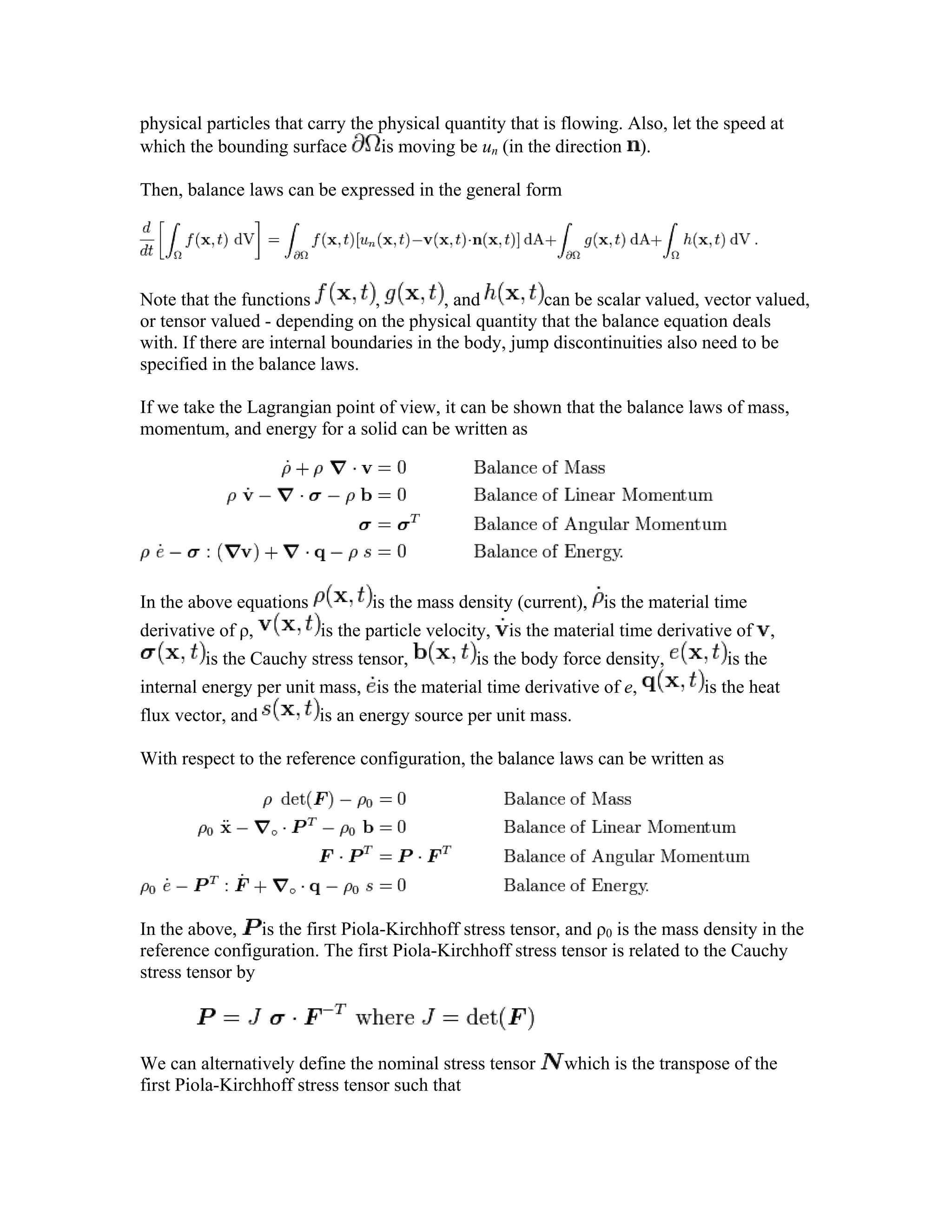
Then, balance laws can be expressed in the general form
Note that the functions , , and can be scalar valued, vector valued,
or tensor valued - depending on the physical quantity that the balance equation deals
with. If there are internal boundaries in the body, jump discontinuities also need to be
specified in the balance laws.
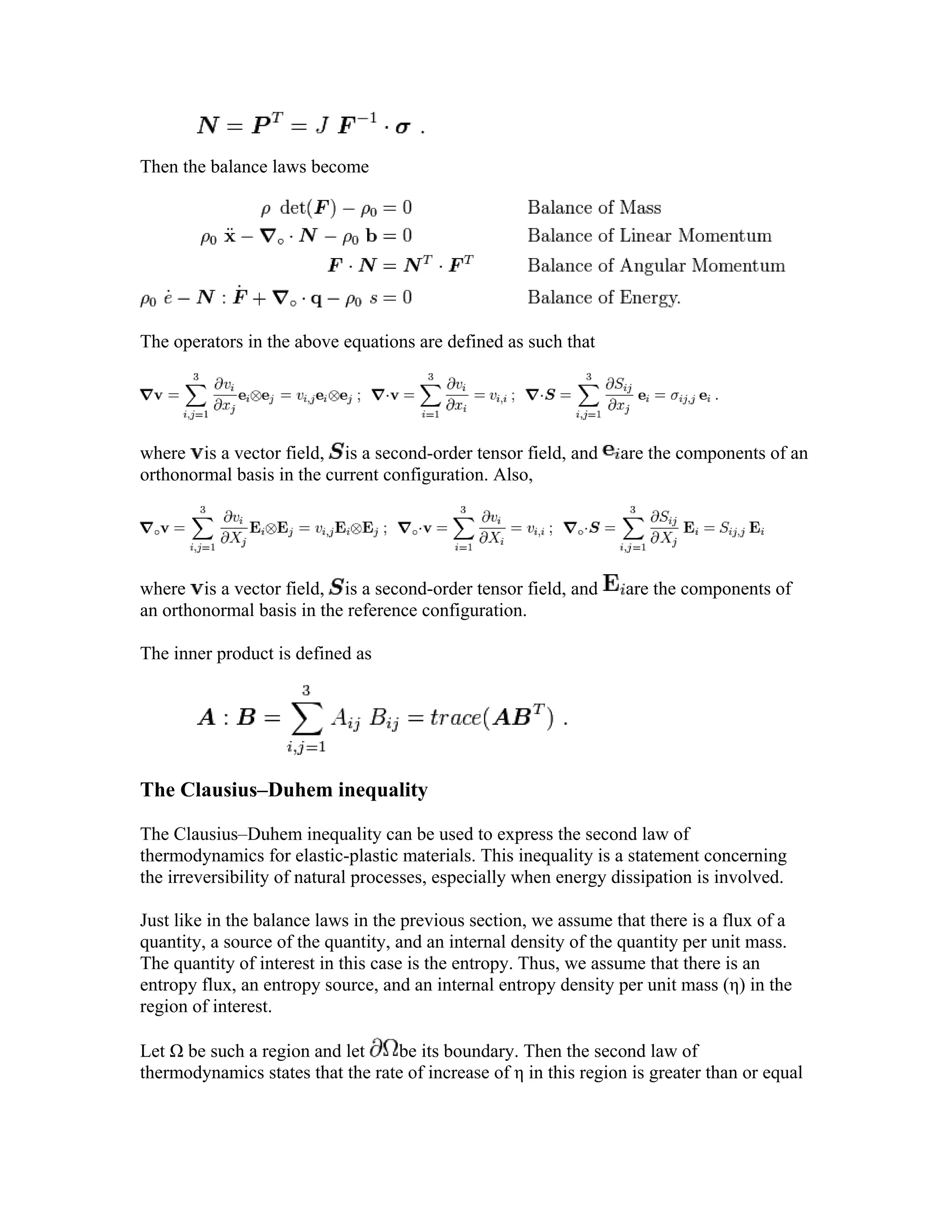
If we take the Lagrangian point of view, it can be shown that the balance laws of mass,
momentum, and energy for a solid can be written as
In the above equations is the mass density (current), is the material time
derivative of ρ, is the particle velocity, is the material time derivative of ,
is the Cauchy stress tensor, is the body force density, is the
internal energy per unit mass, is the material time derivative of e, is the heat
flux vector, and is an energy source per unit mass.
With respect to the reference configuration, the balance laws can be written as
In the above, is the first Piola-Kirchhoff stress tensor, and ρ0 is the mass density in the
reference configuration. The first Piola-Kirchhoff stress tensor is related to the Cauchy
stress tensor by
We can alternatively define the nominal stress tensor which is the transpose of the
first Piola-Kirchhoff stress tensor such that
Then the balance laws become
The operators in the above equations are defined as such that
where is a vector field, is a second-order tensor field, and are the components of an
orthonormal basis in the current configuration. Also,
where is a vector field, is a second-order tensor field, and are the components of
an orthonormal basis in the reference configuration.
The inner product is defined as
The Clausius–Duhem inequality
The Clausius–Duhem inequality can be used to express the second law of
thermodynamics for elastic-plastic materials. This inequality is a statement concerning
the irreversibility of natural processes, especially when energy dissipation is involved.
Just like in the balance laws in the previous section, we assume that there is a flux of a
quantity, a source of the quantity, and an internal density of the quantity per unit mass.
The quantity of interest in this case is the entropy. Thus, we assume that there is an
entropy flux, an entropy source, and an internal entropy density per unit mass (η) in the
region of interest.
Let Ω be such a region and let be its boundary. Then the second law of
thermodynamics states that the rate of increase of η in this region is greater than or equal
to the sum of that supplied to Ω (as a flux or from internal sources) and the change of the
internal entropy density due to material flowing in and out of the region.
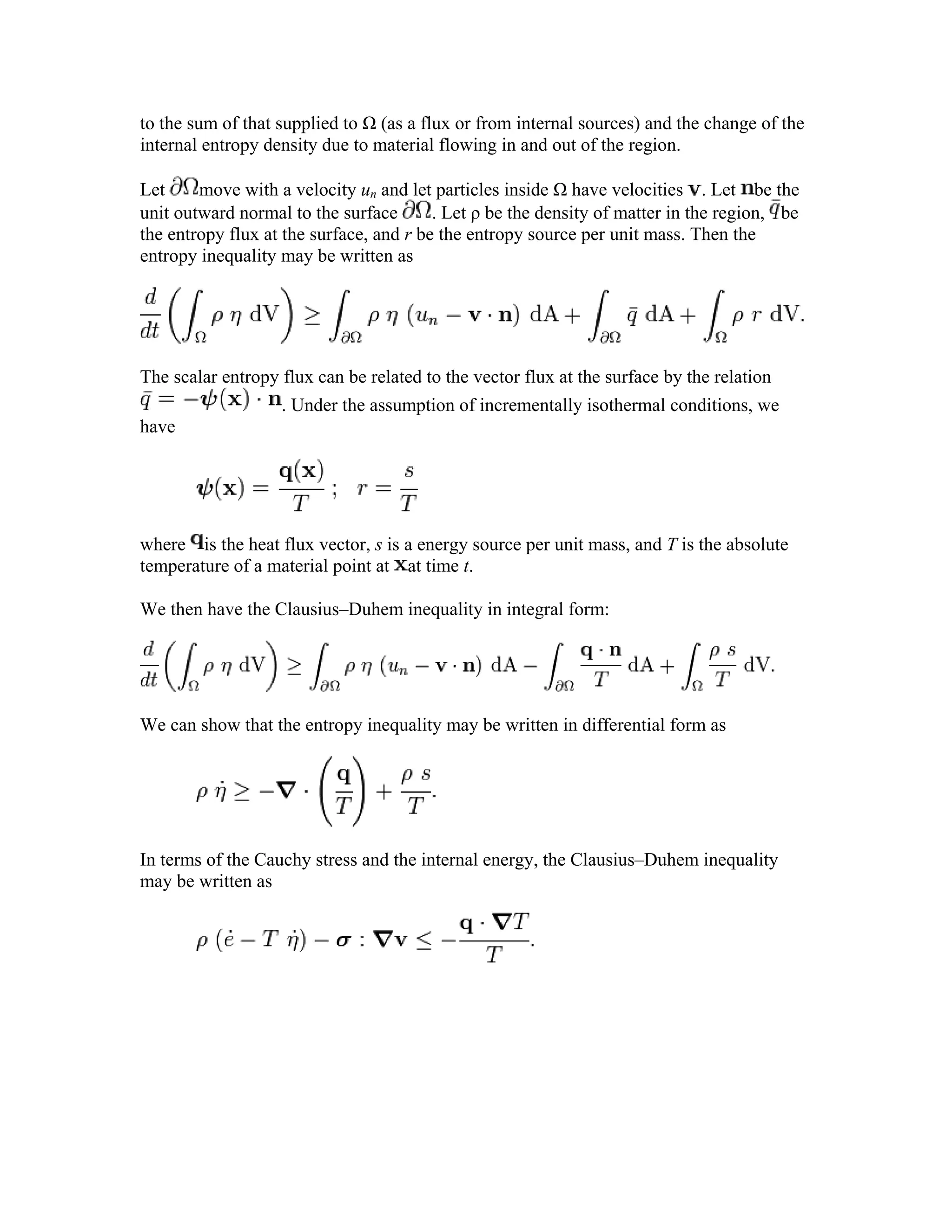
Let move with a velocity un and let particles inside Ω have velocities . Let be the
unit outward normal to the surface . Let ρ be the density of matter in the region, be
the entropy flux at the surface, and r be the entropy source per unit mass. Then the
entropy inequality may be written as
The scalar entropy flux can be related to the vector flux at the surface by the relation
. Under the assumption of incrementally isothermal conditions, we
have
where is the heat flux vector, s is a energy source per unit mass, and T is the absolute
temperature of a material point at at time t.
We then have the Clausius–Duhem inequality in integral form:
We can show that the entropy inequality may be written in differential form as
In terms of the Cauchy stress and the internal energy, the Clausius–Duhem inequality
may be written as
Chapter 2
Fluid Mechanics
Fluid mechanics is the study of fluids and the forces on them. (Fluids include liquids,
gases, and plasmas.) Fluid mechanics can be divided into fluid kinematics, the study of
fluid motion, and fluid dynamics, the study of the effect of forces on fluid motion, which
can further be divided into fluid statics, the study of fluids at rest, and fluid kinetics, the
study of fluids in motion. It is a branch of continuum mechanics, a subject which models
matter without using the information that it is made out of atoms, that is, it models matter
from a macroscopic viewpoint rather than from a microscopic viewpoint. Fluid
mechanics, especially fluid dynamics, is an active field of research with many unsolved
or partly solved problems. Fluid mechanics can be mathematically complex. Sometimes
it can best be solved by numerical methods, typically using computers. A modern
discipline, called computational fluid dynamics (CFD), is devoted to this approach to
solving fluid mechanics problems. Also taking advantage of the highly visual nature of
fluid flow is particle image velocimetry, an experimental method for visualizing and
analyzing fluid flow.
Brief history
The study of fluid mechanics goes back at least to the days of ancient Greece, when
Archimedes investigated fluid statics and buoyancy and formulated his famous law
known now as the Archimedes Principle. Rapid advancement in fluid mechanics began
with Leonardo da Vinci (observation and experiment), Evangelista Torricelli (barometer),
Isaac Newton (viscosity) and Blaise Pascal (hydrostatics), and was continued by Daniel
Bernoulli with the introduction of mathematical fluid dynamics in Hydrodynamica
(1738). Inviscid flow was further analyzed by various mathematicians (Leonhard Euler,
d'Alembert, Lagrange, Laplace, Poisson) and viscous flow was explored by a multitude
of engineers including Poiseuille and Gotthilf Heinrich Ludwig Hagen. Further
mathematical justification was provided by Claude-Louis Navier and George Gabriel
Stokes in the Navier–Stokes equations, and boundary layers were investigated (Ludwig
Prandtl), while various scientists (Osborne Reynolds, Andrey Kolmogorov, Geoffrey
Ingram Taylor) advanced the understanding of fluid viscosity and turbulence.
Relationship to continuum mechanics
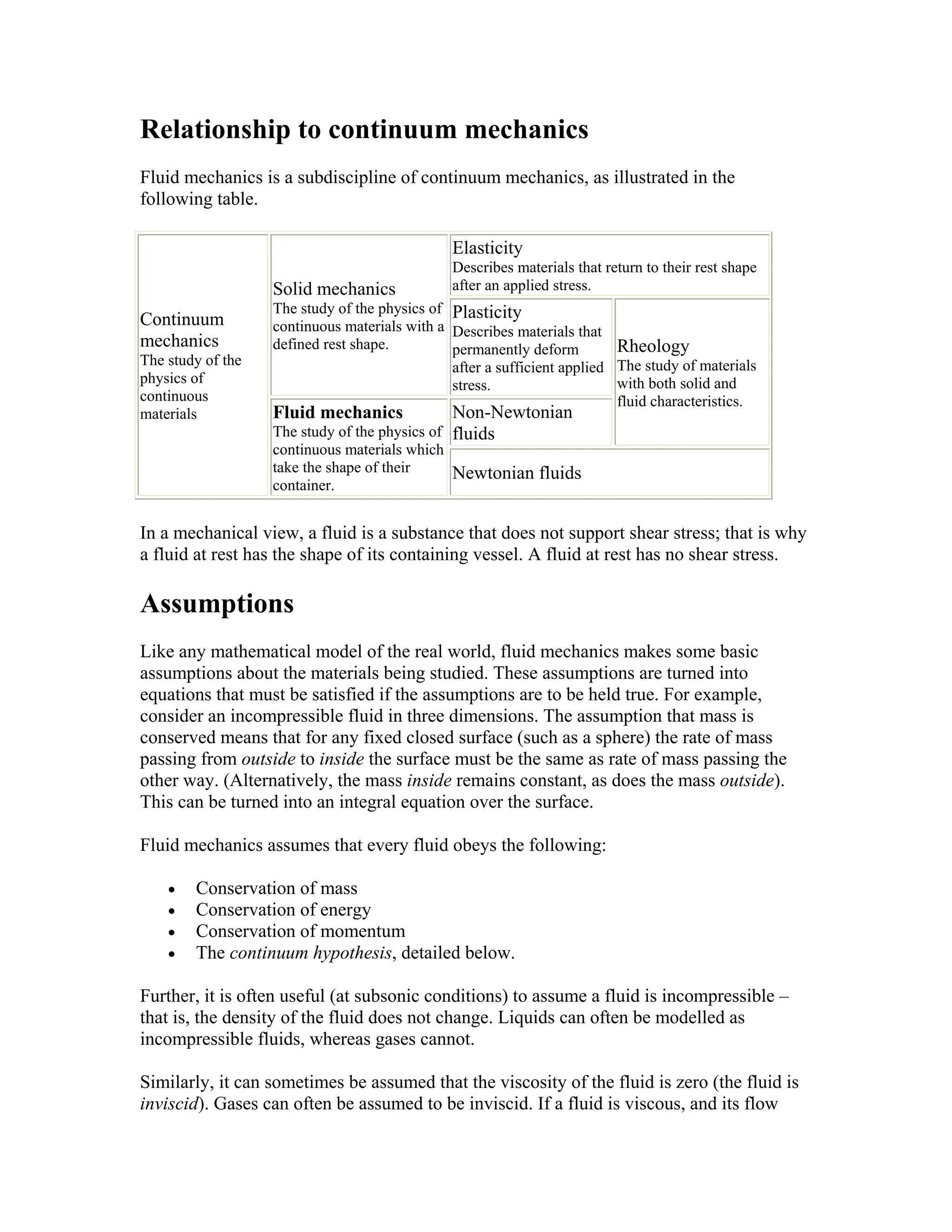
Fluid mechanics is a subdiscipline of continuum mechanics, as illustrated in the
following table.
Continuum
mechanics
The study of the
physics of
continuous
materials
Solid mechanics
The study of the physics of
continuous materials with a
defined rest shape.
Elasticity
Describes materials that return to their rest shape
after an applied stress.
Plasticity
Describes materials that
permanently deform
after a sufficient applied
stress.
Rheology
The study of materials
with both solid and
fluid characteristics.
Fluid mechanics
The study of the physics of
continuous materials which
take the shape of their
container.
Non-Newtonian
fluids
Newtonian fluids
In a mechanical view, a fluid is a substance that does not support shear stress; that is why
a fluid at rest has the shape of its containing vessel. A fluid at rest has no shear stress.
Assumptions
Like any mathematical model of the real world, fluid mechanics makes some basic
assumptions about the materials being studied. These assumptions are turned into
equations that must be satisfied if the assumptions are to be held true. For example,
consider an incompressible fluid in three dimensions. The assumption that mass is
conserved means that for any fixed closed surface (such as a sphere) the rate of mass
passing from outside to inside the surface must be the same as rate of mass passing the
other way. (Alternatively, the mass inside remains constant, as does the mass outside).
This can be turned into an integral equation over the surface.
Fluid mechanics assumes that every fluid obeys the following:
• Conservation of mass
• Conservation of energy
• Conservation of momentum
• The continuum hypothesis, detailed below.
Further, it is often useful (at subsonic conditions) to assume a fluid is incompressible –
that is, the density of the fluid does not change. Liquids can often be modelled as
incompressible fluids, whereas gases cannot.
Similarly, it can sometimes be assumed that the viscosity of the fluid is zero (the fluid is
inviscid). Gases can often be assumed to be inviscid. If a fluid is viscous, and its flow
contained in some way (e.g. in a pipe), then the flow at the boundary must have zero
velocity. For a viscous fluid, if the boundary is not porous, the shear forces between the
fluid and the boundary results also in a zero velocity for the fluid at the boundary. This is
called the no-slip condition. For a porous media otherwise, in the frontier of the
containing vessel, the slip condition is not zero velocity, and the fluid has a discontinuous
velocity field between the free fluid and the fluid in the porous media (this is related to
the Beavers and Joseph condition).
The continuum hypothesis
Fluids are composed of molecules that collide with one another and solid objects. The
continuum assumption, however, considers fluids to be continuous. That is, properties
such as density, pressure, temperature, and velocity are taken to be well-defined at
"infinitely" small points, defining a REV (Reference Element of Volume), at the
geometric order of the distance between two adjacent molecules of fluid. Properties are
assumed to vary continuously from one point to another, and are averaged values in the
REV. The fact that the fluid is made up of discrete molecules is ignored.
The continuum hypothesis is basically an approximation, in the same way planets are
approximated by point particles when dealing with celestial mechanics, and therefore
results in approximate solutions. Consequently, assumption of the continuum hypothesis
can lead to results which are not of desired accuracy. That said, under the right
circumstances, the continuum hypothesis produces extremely accurate results.
Those problems for which the continuum hypothesis does not allow solutions of desired
accuracy are solved using statistical mechanics. To determine whether or not to use
conventional fluid dynamics or statistical mechanics, the Knudsen number is evaluated
for the problem. The Knudsen number is defined as the ratio of the molecular mean free
path length to a certain representative physical length scale. This length scale could be,
for example, the radius of a body in a fluid. (More simply, the Knudsen number is how
many times its own diameter a particle will travel on average before hitting another
particle). Problems with Knudsen numbers at or above unity are best evaluated using
statistical mechanics for reliable solutions.
Navier–Stokes equations
The Navier–Stokes equations (named after Claude-Louis Navier and George Gabriel
Stokes) are the set of equations that describe the motion of fluid substances such as
liquids and gases. These equations state that changes in momentum (force) of fluid
particles depend only on the external pressure and internal viscous forces (similar to
friction) acting on the fluid. Thus, the Navier–Stokes equations describe the balance of
forces acting at any given region of the fluid.
The Navier–Stokes equations are differential equations which describe the motion of a
fluid. Such equations establish relations among the rates of change of the variables of
interest. For example, the Navier–Stokes equations for an ideal fluid with zero viscosity
states that acceleration (the rate of change of velocity) is proportional to the derivative of
internal pressure.
This means that solutions of the Navier–Stokes equations for a given physical problem
must be sought with the help of calculus. In practical terms only the simplest cases can be
solved exactly in this way. These cases generally involve non-turbulent, steady flow
(flow does not change with time) in which the Reynolds number is small.
For more complex situations, such as global weather systems like El Niño or lift in a
wing, solutions of the Navier–Stokes equations can currently only be found with the help
of computers. This is a field of sciences by its own called computational fluid dynamics.
General form of the equation
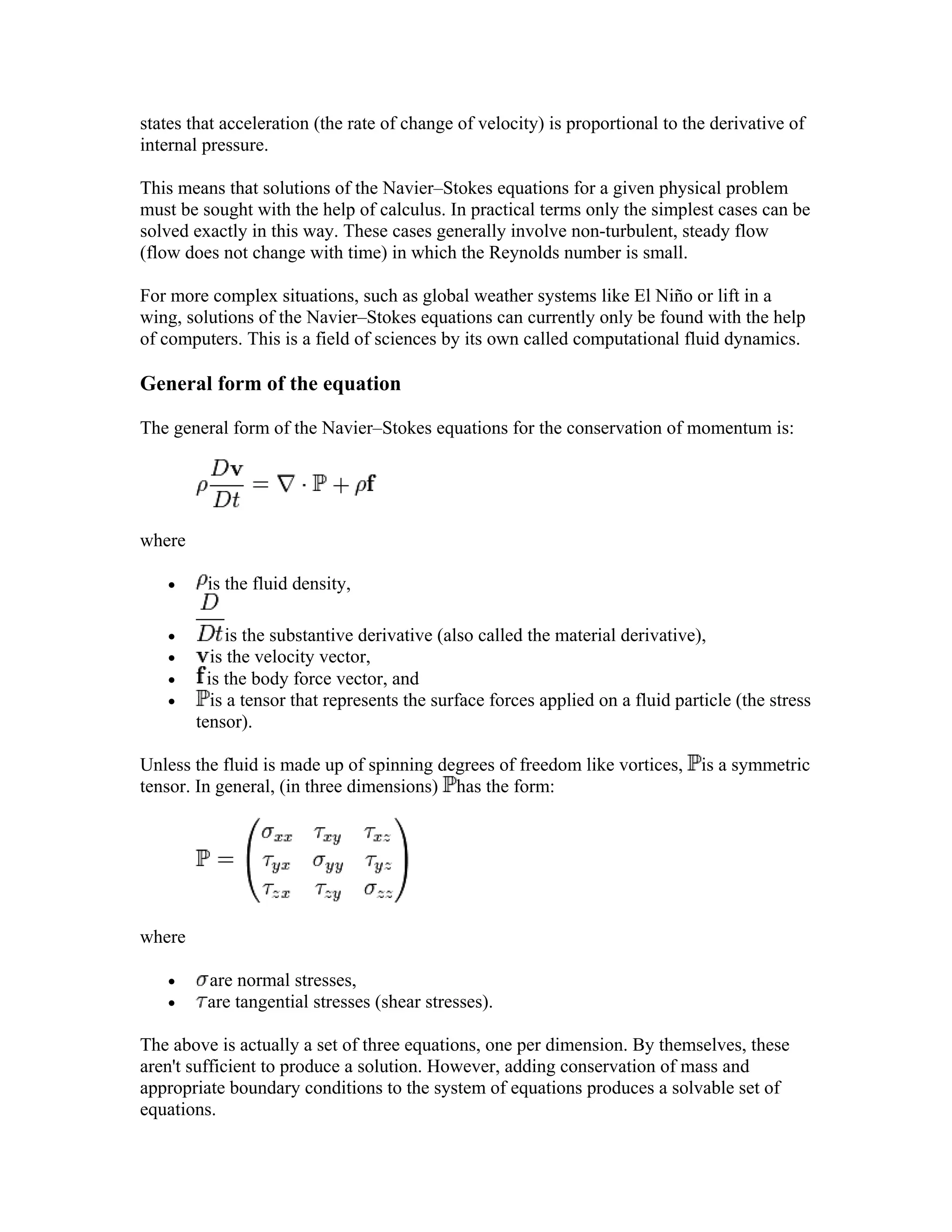
The general form of the Navier–Stokes equations for the conservation of momentum is:
where
• is the fluid density,
• is the substantive derivative (also called the material derivative),
• is the velocity vector,
• is the body force vector, and
• is a tensor that represents the surface forces applied on a fluid particle (the stress
tensor).
Unless the fluid is made up of spinning degrees of freedom like vortices, is a symmetric
tensor. In general, (in three dimensions) has the form:
where
• are normal stresses,
• are tangential stresses (shear stresses).
The above is actually a set of three equations, one per dimension. By themselves, these
aren't sufficient to produce a solution. However, adding conservation of mass and
appropriate boundary conditions to the system of equations produces a solvable set of
equations.
Newtonian versus non-Newtonian fluids
A Newtonian fluid (named after Isaac Newton) is defined to be a fluid whose shear
stress is linearly proportional to the velocity gradient in the direction perpendicular to the
plane of shear. This definition means regardless of the forces acting on a fluid, it
continues to flow. For example, water is a Newtonian fluid, because it continues to
display fluid properties no matter how much it is stirred or mixed. A slightly less rigorous
definition is that the drag of a small object being moved slowly through the fluid is
proportional to the force applied to the object. (Compare friction). Important fluids, like
water as well as most gases, behave — to good approximation — as a Newtonian fluid
under normal conditions on Earth.
By contrast, stirring a non-Newtonian fluid can leave a "hole" behind. This will gradually
fill up over time – this behaviour is seen in materials such as pudding, oobleck, or sand
(although sand isn't strictly a fluid). Alternatively, stirring a non-Newtonian fluid can
cause the viscosity to decrease, so the fluid appears "thinner" (this is seen in non-drip
paints). There are many types of non-Newtonian fluids, as they are defined to be
something that fails to obey a particular property — for example, most fluids with long
molecular chains can react in a non-Newtonian manner.
Equations for a Newtonian fluid
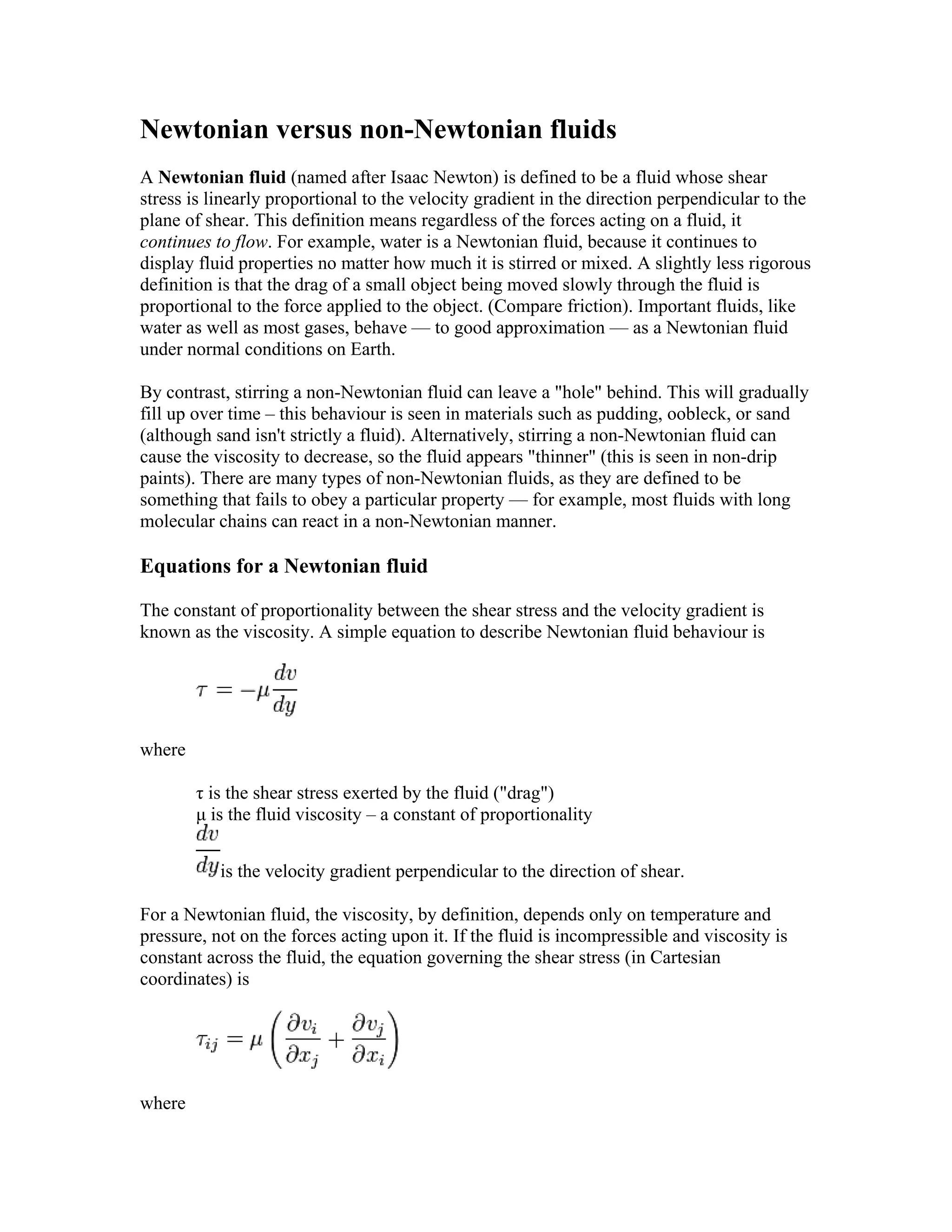
The constant of proportionality between the shear stress and the velocity gradient is
known as the viscosity. A simple equation to describe Newtonian fluid behaviour is
where
τ is the shear stress exerted by the fluid ("drag")
μ is the fluid viscosity – a constant of proportionality
is the velocity gradient perpendicular to the direction of shear.
For a Newtonian fluid, the viscosity, by definition, depends only on temperature and
pressure, not on the forces acting upon it. If the fluid is incompressible and viscosity is
constant across the fluid, the equation governing the shear stress (in Cartesian
coordinates) is
where
τij is the shear stress on the ith
face of a fluid element in the jth
direction
vi is the velocity in the ith
direction
xj is the jth
direction coordinate.
If a fluid does not obey this relation, it is termed a non-Newtonian fluid, of which there
are several types.
Among fluids, two rough broad divisions can be made: ideal and non-ideal fluids. An
ideal fluid really does not exist, but in some calculations, the assumption is justifiable. An
Ideal fluid is non viscous- offers no resistance whatsoever to a shearing force.
One can group real fluids into Newtonian and non-Newtonian. Newtonian fluids agree
with Newton's law of viscosity. Non-Newtonian fluids can be either plastic, bingham
plastic, pseudoplastic, dilatant, thixotropic, rheopectic, viscoelatic.
Chapter 3
Stress (Mechanics)
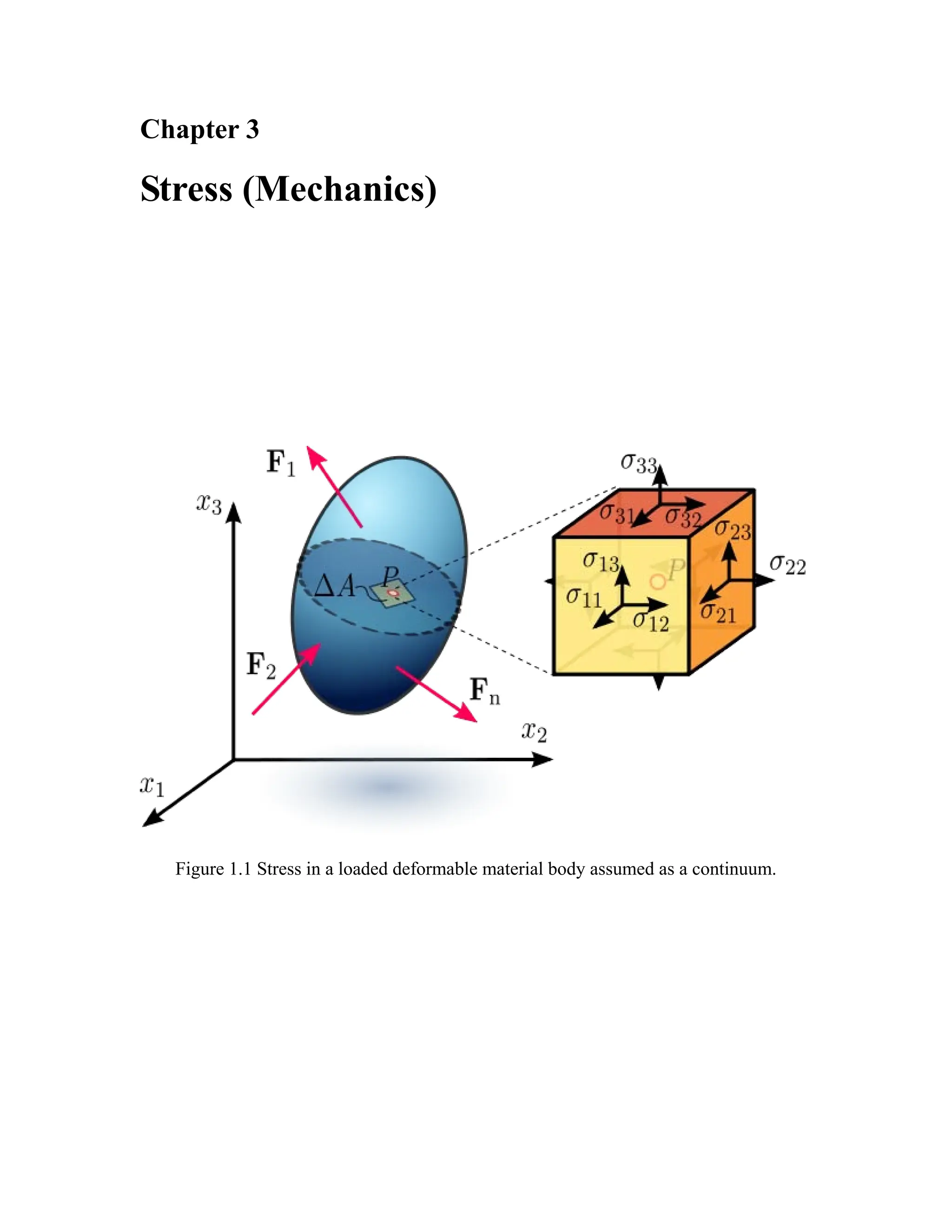
Figure 1.1 Stress in a loaded deformable material body assumed as a continuum.
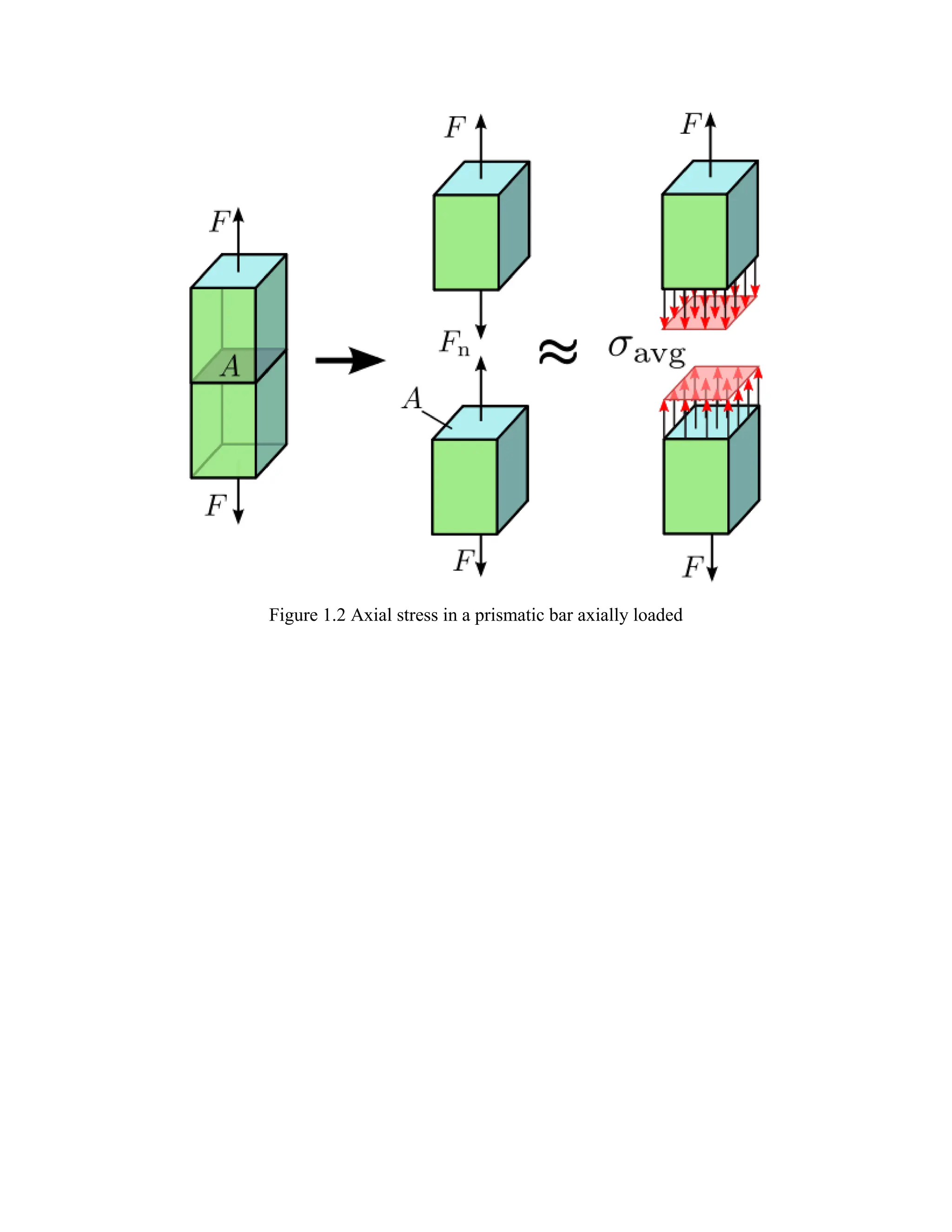
Figure 1.2 Axial stress in a prismatic bar axially loaded
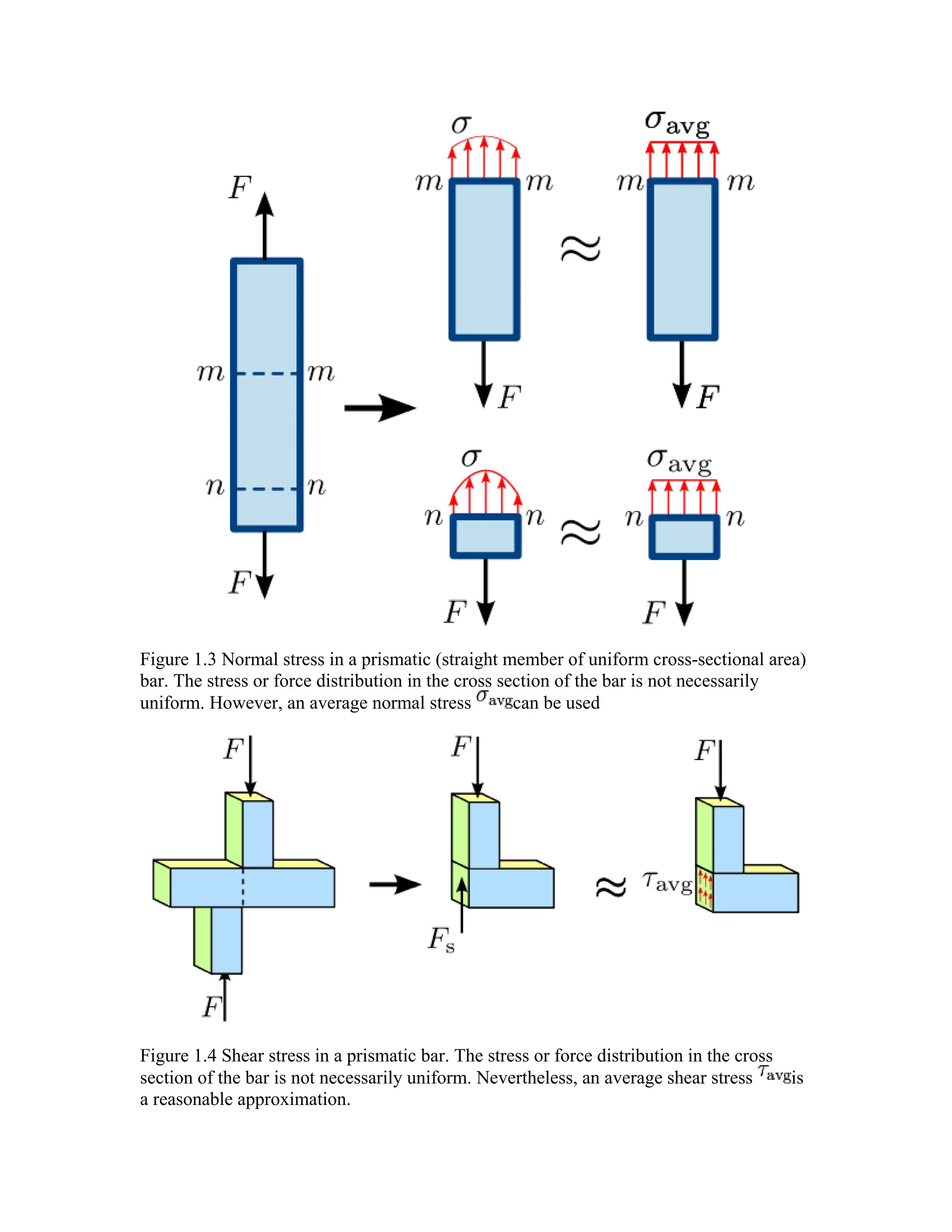
Figure 1.3 Normal stress in a prismatic (straight member of uniform cross-sectional area)
bar. The stress or force distribution in the cross section of the bar is not necessarily
uniform. However, an average normal stress can be used
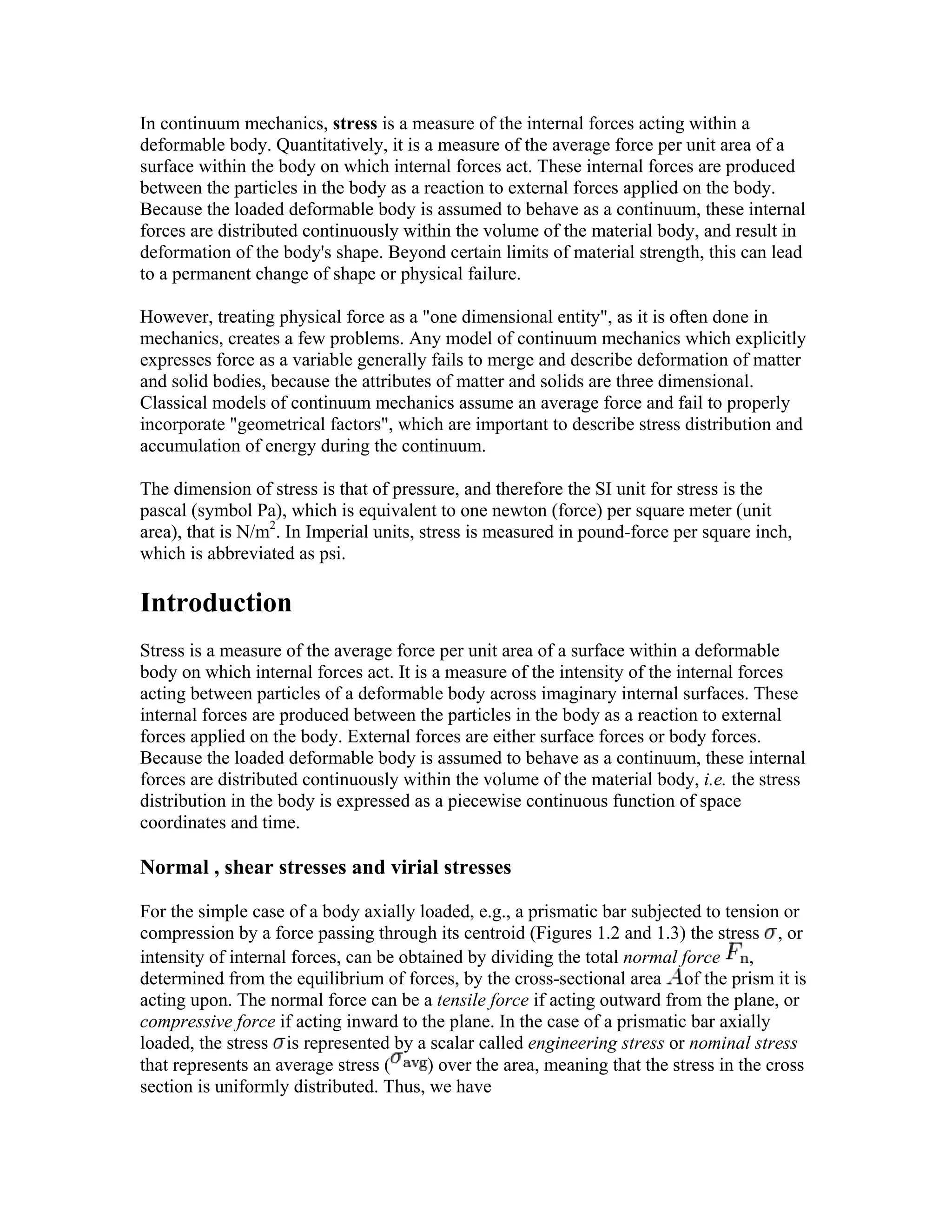
Figure 1.4 Shear stress in a prismatic bar. The stress or force distribution in the cross
section of the bar is not necessarily uniform. Nevertheless, an average shear stress is
a reasonable approximation.
In continuum mechanics, stress is a measure of the internal forces acting within a
deformable body. Quantitatively, it is a measure of the average force per unit area of a
surface within the body on which internal forces act. These internal forces are produced
between the particles in the body as a reaction to external forces applied on the body.
Because the loaded deformable body is assumed to behave as a continuum, these internal
forces are distributed continuously within the volume of the material body, and result in
deformation of the body's shape. Beyond certain limits of material strength, this can lead
to a permanent change of shape or physical failure.
However, treating physical force as a "one dimensional entity", as it is often done in
mechanics, creates a few problems. Any model of continuum mechanics which explicitly
expresses force as a variable generally fails to merge and describe deformation of matter
and solid bodies, because the attributes of matter and solids are three dimensional.
Classical models of continuum mechanics assume an average force and fail to properly
incorporate "geometrical factors", which are important to describe stress distribution and
accumulation of energy during the continuum.
The dimension of stress is that of pressure, and therefore the SI unit for stress is the
pascal (symbol Pa), which is equivalent to one newton (force) per square meter (unit
area), that is N/m2
. In Imperial units, stress is measured in pound-force per square inch,
which is abbreviated as psi.
Introduction
Stress is a measure of the average force per unit area of a surface within a deformable
body on which internal forces act. It is a measure of the intensity of the internal forces
acting between particles of a deformable body across imaginary internal surfaces. These
internal forces are produced between the particles in the body as a reaction to external
forces applied on the body. External forces are either surface forces or body forces.
Because the loaded deformable body is assumed to behave as a continuum, these internal
forces are distributed continuously within the volume of the material body, i.e. the stress
distribution in the body is expressed as a piecewise continuous function of space
coordinates and time.
Normal , shear stresses and virial stresses
For the simple case of a body axially loaded, e.g., a prismatic bar subjected to tension or
compression by a force passing through its centroid (Figures 1.2 and 1.3) the stress , or
intensity of internal forces, can be obtained by dividing the total normal force ,
determined from the equilibrium of forces, by the cross-sectional area of the prism it is
acting upon. The normal force can be a tensile force if acting outward from the plane, or
compressive force if acting inward to the plane. In the case of a prismatic bar axially
loaded, the stress is represented by a scalar called engineering stress or nominal stress
that represents an average stress ( ) over the area, meaning that the stress in the cross
section is uniformly distributed. Thus, we have
A different type of stress is obtained when transverse forces are applied to the
prismatic bar as shown in Figure 1.4. Considering the same cross-section as before, from
static equilibrium the internal force has a magnitude equal to and in opposite direction
parallel to the cross-section. is called the shear force. Dividing the shear force by
the area of the cross section we obtain the shear stress. In this case the shear stress is
a scalar quantity representing an average shear stress ( ) in the section, i.e. the stress
in the cross-section is uniformly distributed. In materials science and in engineering
aspects the average of the ""scalar"" shear force ( ) are true for crystallized materials
during brittle fracture and operates through the fractured cross-section or stress plane.
In Figure 1.3, the normal stress is observed in two planes and of the
axially loaded prismatic bar. The stress on plane , which is closer to the point of
application of the load , varies more across the cross-section than that of plane
. However, if the cross-sectional area of the bar is very small, i.e. the bar is
slender, the variation of stress across the area is small and the normal stress can be
approximated by . On the other hand, the variation of shear stress across the section
of a prismatic bar cannot be assumed to be uniform.
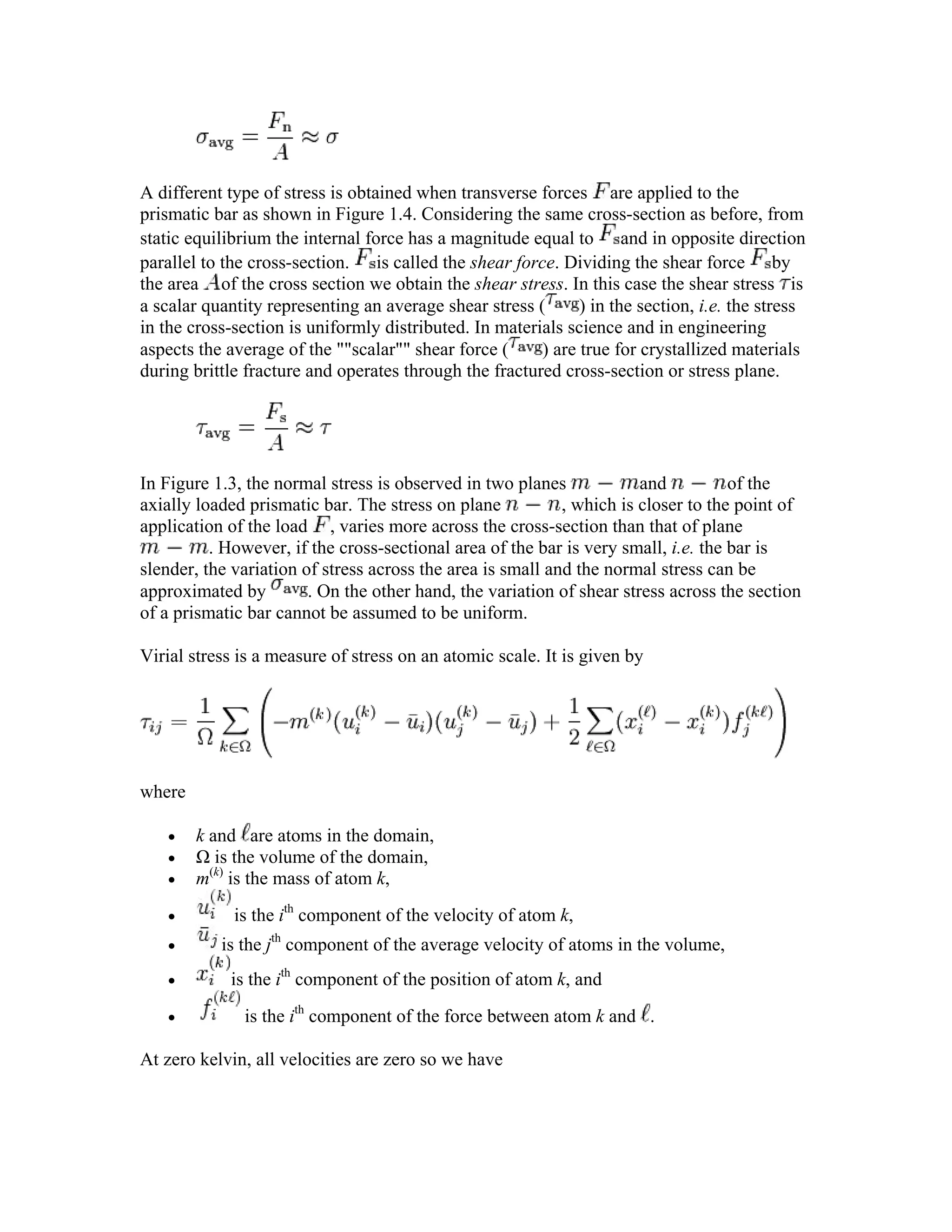
Virial stress is a measure of stress on an atomic scale. It is given by
where
• k and are atoms in the domain,
• Ω is the volume of the domain,
• m(k)
is the mass of atom k,
• is the ith
component of the velocity of atom k,
• is the jth
component of the average velocity of atoms in the volume,
• is the ith
component of the position of atom k, and
• is the ith
component of the force between atom k and .
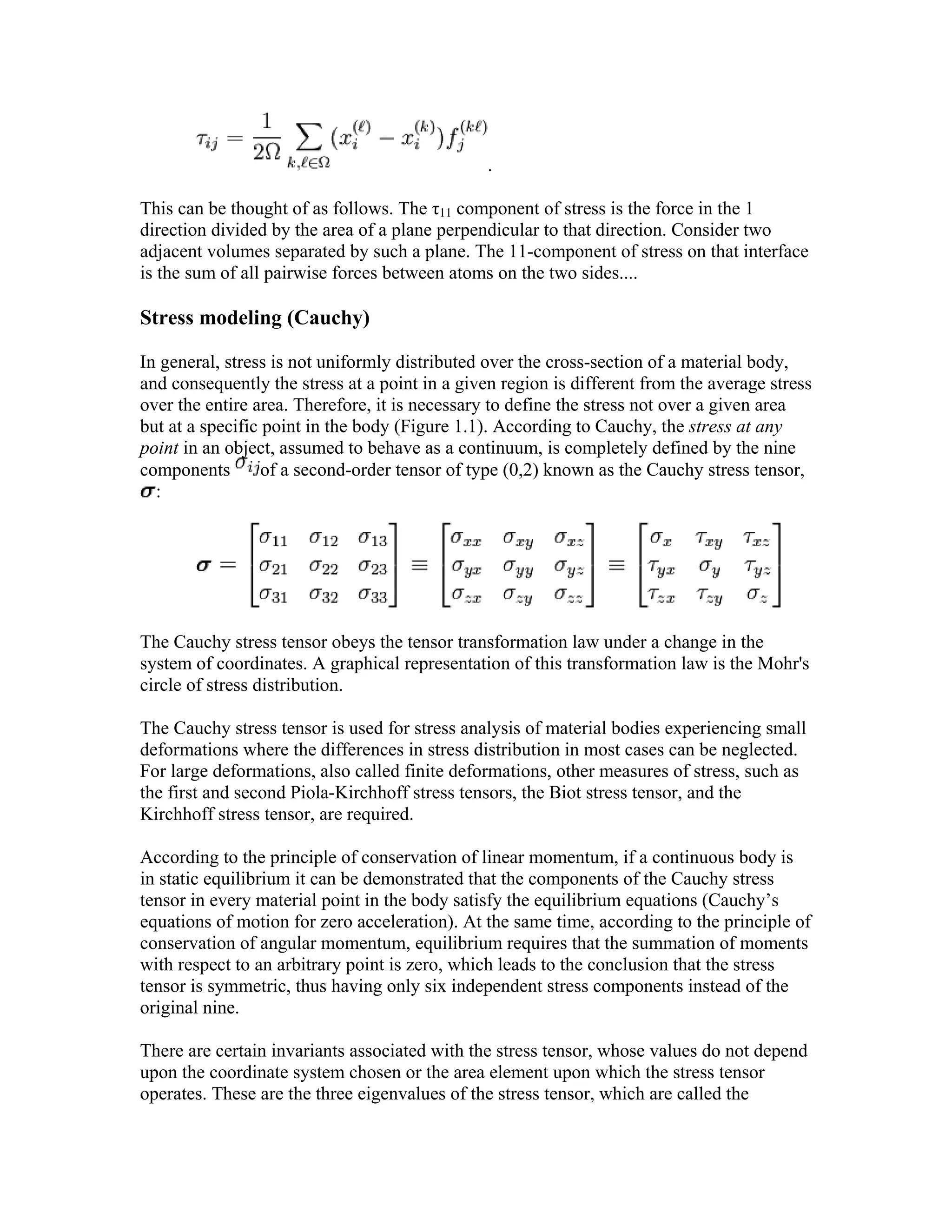
At zero kelvin, all velocities are zero so we have
.
This can be thought of as follows. The τ11 component of stress is the force in the 1
direction divided by the area of a plane perpendicular to that direction. Consider two
adjacent volumes separated by such a plane. The 11-component of stress on that interface
is the sum of all pairwise forces between atoms on the two sides....
Stress modeling (Cauchy)
In general, stress is not uniformly distributed over the cross-section of a material body,
and consequently the stress at a point in a given region is different from the average stress
over the entire area. Therefore, it is necessary to define the stress not over a given area
but at a specific point in the body (Figure 1.1). According to Cauchy, the stress at any
point in an object, assumed to behave as a continuum, is completely defined by the nine
components of a second-order tensor of type (0,2) known as the Cauchy stress tensor,
:
The Cauchy stress tensor obeys the tensor transformation law under a change in the
system of coordinates. A graphical representation of this transformation law is the Mohr's
circle of stress distribution.
The Cauchy stress tensor is used for stress analysis of material bodies experiencing small
deformations where the differences in stress distribution in most cases can be neglected.
For large deformations, also called finite deformations, other measures of stress, such as
the first and second Piola-Kirchhoff stress tensors, the Biot stress tensor, and the
Kirchhoff stress tensor, are required.
According to the principle of conservation of linear momentum, if a continuous body is
in static equilibrium it can be demonstrated that the components of the Cauchy stress
tensor in every material point in the body satisfy the equilibrium equations (Cauchy’s
equations of motion for zero acceleration). At the same time, according to the principle of
conservation of angular momentum, equilibrium requires that the summation of moments
with respect to an arbitrary point is zero, which leads to the conclusion that the stress
tensor is symmetric, thus having only six independent stress components instead of the
original nine.
There are certain invariants associated with the stress tensor, whose values do not depend
upon the coordinate system chosen or the area element upon which the stress tensor
operates. These are the three eigenvalues of the stress tensor, which are called the
principal stresses. Solids, liquids, and gases have stress fields. Static fluids support
normal stress but will flow under shear stress. Moving viscous fluids can support shear
stress (dynamic pressure). Solids can support both shear and normal stress, with ductile
materials failing under shear and brittle materials failing under normal stress. All
materials have temperature dependent variations in stress-related properties, and non-
Newtonian materials have rate-dependent variations.
Stress analysis
Stress analysis means the determination of the internal distribution of stresses in a
structure. It is needed in engineering for the study and design of structures such as
tunnels, dams, mechanical parts, and structural frames, under prescribed or expected
loads. To determine the distribution of stress in a structure, the engineer needs to solve a
boundary-value problem by specifying the boundary conditions. These are displacements
and forces on the boundary of the structure.
Constitutive equations, such as Hooke’s Law for linear elastic materials, describe the
stress-strain relationship in these calculations.
When a structure is expected to deform elastically (and resume its original shape), a
boundary-value problem based on the theory of elasticity is applied, with infinitesimal
strains, under design loads.
When the applied loads permanently deform the structure, the theory of plasticity is used.
The stress analysis can be simplified when the physical dimensions and the distribution
of loads allow the structure to be treated as one-dimensional or two-dimensional. For a
two-dimensional analysis a plane stress or a plane strain condition can be assumed.
Alternatively, experimental determination of stresses can be carried out.
Approximate computer-based solutions for boundary-value problems can be obtained
through numerical methods such as the Finite Element Method, the Finite Difference
Method, and the Boundary Element Method. Analytical or closed-form solutions can be
obtained for simple geometries, constitutive relations, and boundary conditions.
Theoretical background
Continuum mechanics deals with deformable bodies, as opposed to rigid bodies. The
stresses considered in continuum mechanics are only those produced by deformation of
the body, sc. only relative changes in stress are considered, not the absolute values. A
body is considered stress-free if the only forces present are those inter-atomic forces
(ionic, metallic, and van der Waals forces) required to hold the body together and to keep
its shape in the absence of all external influences, including gravitational attraction.
Stresses generated during manufacture of the body to a specific configuration are also
excluded.
Following the classical dynamics of Newton and Euler, the motion of a material body is
produced by the action of externally applied forces which are assumed to be of two kinds:
surface forces and body forces.
Surface forces, or contact forces, can act either on the bounding surface of the body, as a
result of mechanical contact with other bodies, or on imaginary internal surfaces that
bound portions of the body, as a result of the mechanical interaction between the parts of
the body to either side of the surface (Euler-Cauchy's stress principle). When a body is
acted upon by external contact forces, internal contact forces are then transmitted from
point to point inside the body to balance their action, according to Newton's second law
of motion of conservation of linear momentum and angular momentum (for continuous
bodies these laws are called the Euler's equations of motion). The internal contact forces
are related to the body's deformation through constitutive equations.
The concept of stress can then be thought as a measure of the intensity of the internal
contact forces acting between particles of the body across imaginary internal surfaces. In
other words, stress is a measure of the average quantity of force exerted per unit area of
the surface on which these internal forces act. The intensity of contact forces is related,
specifically in an inverse proportion, to the area of contact. For example, if a force
applied to a small area is compared to a distributed load of the same resultant magnitude
applied to a larger area, one finds that the effects or intensities of these two forces are
locally different because the stresses are not the same.
Body forces are forces originating from sources outside of the body that act on the
volume (or mass) of the body. Saying that body forces are due to outside sources implies
that the internal forces are manifested through the contact forces alone. These forces arise
from the presence of the body in force fields, (e.g., a gravitational field). As the mass of a
continuous body is assumed to be continuously distributed, any force originating from the
mass is also continuously distributed. Thus, body forces are assumed to be continuous
over the entire volume of the body.
The density of internal forces at every point in a deformable body are not necessarily
equal, i.e. there is a distribution of stresses throughout the body. This variation of internal
forces throughout the body is governed by Newton's second law of motion of
conservation of linear momentum and angular momentum, which normally are applied to
a mass particle but are extended in continuum mechanics to a body of continuously
distributed mass. For continuous bodies these laws are called Euler’s equations of
motion. If a body is represented as an assemblage of discrete particles, each governed by
Newton’s laws of motion, then Euler’s equations can be derived from Newton’s laws.
Euler’s equations can, however, be taken as axioms describing the laws of motion for
extended bodies, independently of any particle structure.
Euler–Cauchy stress principle
Figure 2.1a Internal distribution of contact forces and couple stresses on a differential
of the internal surface in a continuum, as a result of the interaction between the two
portions of the continuum separated by the surface
Figure 2.1b Internal distribution of contact forces and couple stresses on a differential
of the internal surface in a continuum, as a result of the interaction between the two
portions of the continuum separated by the surface
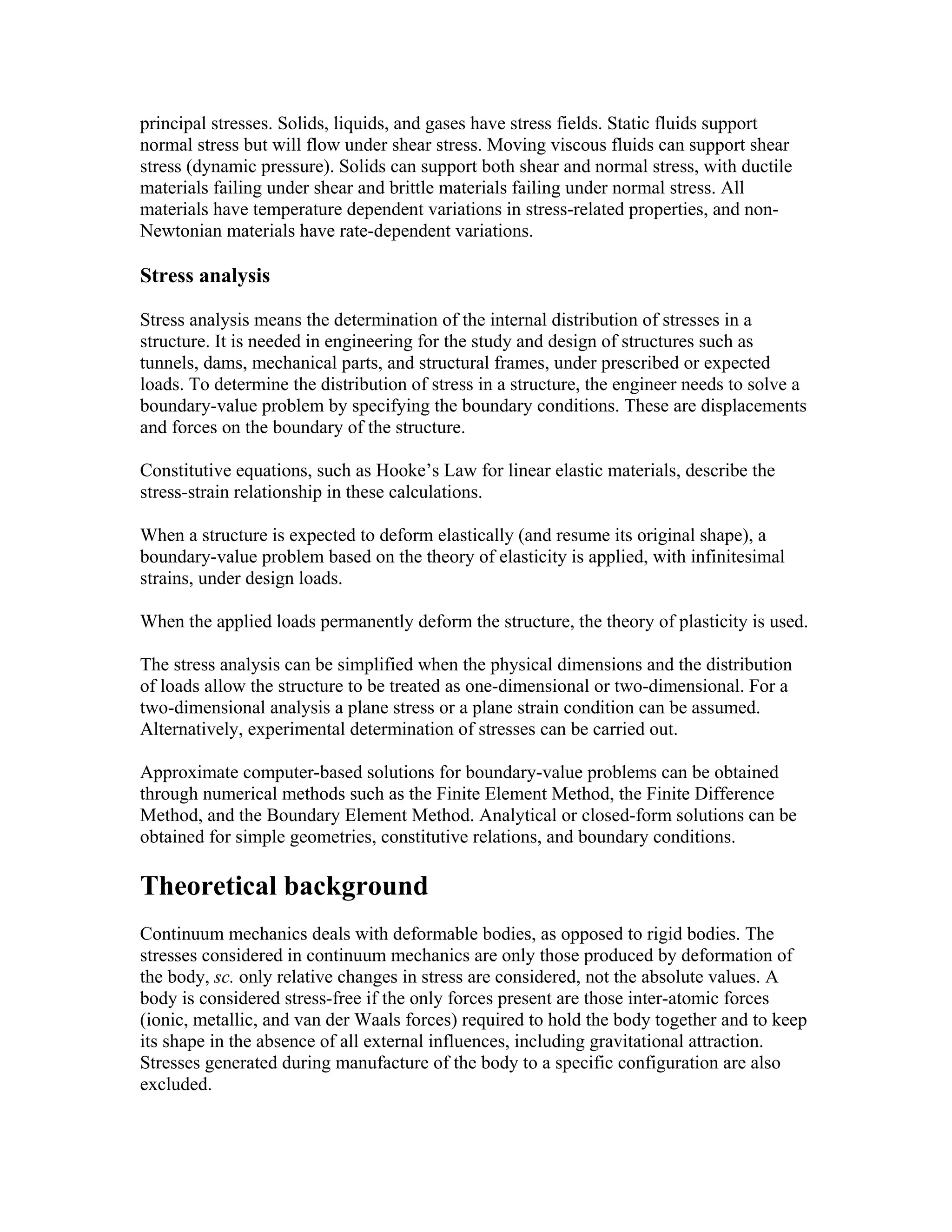
Figure 2.1c Stress vector on an internal surface S with normal vector n. Depending on the
orientation of the plane under consideration, the stress vector may not necessarily be
perpendicular to that plane, i.e. parallel to , and can be resolved into two components:
one component normal to the plane, called normal stress , and another component
parallel to this plane, called the shearing stress .
The Euler–Cauchy stress principle states that upon any surface (real or imaginary) that
divides the body, the action of one part of the body on the other is equivalent
(equipollent) to the system of distributed forces and couples on the surface dividing the
body, and it is represented by a vector field T(n)
, called the stress vector, defined on the
surface S and assumed to depend continuously on the surface's unit vector n.
To explain this principle, we consider an imaginary surface S passing through an internal
material point P dividing the continuous body into two segments, as seen in Figure 2.1a
or 2.1b (some authors use the cutting plane diagram and others use the diagram with the
arbitrary volume inside the continuum enclosed by the surface S). The body is subjected
to external surface forces F and body forces b. The internal contact forces being
transmitted from one segment to the other through the dividing plane, due to the action of
one portion of the continuum onto the other, generate a force distribution on a small area
ΔS, with a normal unit vector n, on the dividing plane S. The force distribution is
equipollent to a contact force ΔF and a couple stress ΔM, as shown in Figure 2.1a and
2.1b. Cauchy’s stress principle asserts that as ΔS becomes very small and tends to zero
the ratio ΔF/ΔS becomes dF/dS and the couple stress vector ΔM vanishes. In specific
fields of continuum mechanics the couple stress is assumed not to vanish; however, as
stated previously, in classical branches of continuum mechanics we deal with non-polar
materials which do not consider couple stresses and body moments. The resultant vector
dF/dS is defined as the stress vector or traction vector given by T(n)
= Ti
(n)
ei at the point
P associated with a plane with a normal vector n:
This equation means that the stress vector depends on its location in the body and the
orientation of the plane on which it is acting.
Depending on the orientation of the plane under consideration, the stress vector may not
necessarily be perpendicular to that plane, i.e. parallel to n, and can be resolved into two
components:
• one normal to the plane, called normal stress
where dFn is the normal component of the force dF to the differential area dS
• and the other parallel to this plane, called the shear stress
where dFs is the tangential component of the force dF to the differential surface
area dS. The shear stress can be further decomposed into two mutually
perpendicular vectors.
Cauchy’s postulate
According to the Cauchy Postulate, the stress vector T(n)
remains unchanged for all
surfaces passing through the point P and having the same normal vector n at P, i.e.
having a common tangent at P. This means that the stress vector is a function of the
normal vector n only, and it is not influenced by the curvature of the internal surfaces.
Cauchy’s fundamental lemma
A consequence of Cauchy’s postulate is Cauchy’s Fundamental Lemma, also called the
Cauchy reciprocal theorem, which states that the stress vectors acting on opposite sides
of the same surface are equal in magnitude and opposite in direction. Cauchy’s
fundamental lemma is equivalent to Newton's third law of motion of action and reaction,
and it is expressed as
Cauchy’s stress theorem – stress tensor
The state of stress at a point in the body is then defined by all the stress vectors T(n)
associated with all planes (infinite in number) that pass through that point. However,
according to Cauchy’s fundamental theorem, also called Cauchy’s stress theorem, merely
by knowing the stress vectors on three mutually perpendicular planes, the stress vector on
any other plane passing through that point can be found through coordinate
transformation equations.
Cauchy’s stress theorem states that there exists a second-order tensor field σ(x, t), called
the Cauchy stress tensor, independent of n, such that T is a linear function of n:
This equation implies that the stress vector T(n)
at any point P in a continuum associated
with a plane with normal vector n can be expressed as a function of the stress vectors on
the planes perpendicular to the coordinate axes, i.e. in terms of the components σij of the
stress tensor σ.
To prove this expression, consider a tetrahedron with three faces oriented in the
coordinate planes, and with an infinitesimal area dA oriented in an arbitrary direction
specified by a normal vector n (Figure 2.2). The tetrahedron is formed by slicing the
infinitesimal element along an arbitrary plane n. The stress vector on this plane is
denoted by T(n)
. The stress vectors acting on the faces of the tetrahedron are denoted as
T(e
1
)
, T(e
2
)
, and T(e
3
)
, and are by definition the components σij of the stress tensor σ. This
tetrahedron is sometimes called the Cauchy tetrahedron. From equilibrium of forces, i.e.
Euler’s first law of motion (Newton’s second law of motion), we have
Figure 2.2. Stress vector acting on a plane with normal vector n.
A note on the sign convention: The tetrahedron is formed by slicing a parallelepiped
along an arbitrary plane n. So, the force acting on the plane n is the reaction exerted by
the other half of the parallelepiped and has an opposite sign.
where the right-hand-side of the equation represents the product of the mass enclosed by
the tetrahedron and its acceleration: ρ is the density, a is the acceleration, and h is the
height of the tetrahedron, considering the plane n as the base. The area of the faces of the
tetrahedron perpendicular to the axes can be found by projecting dA into each face (using
the dot product):
and then substituting into the equation to cancel out dA:
To consider the limiting case as the tetrahedron shrinks to a point, h must go to 0
(intuitively, the plane n is translated along n toward O). As a result, the right-hand-side of
the equation approaches 0, so
Figure 2.3 Components of stress in three dimensions
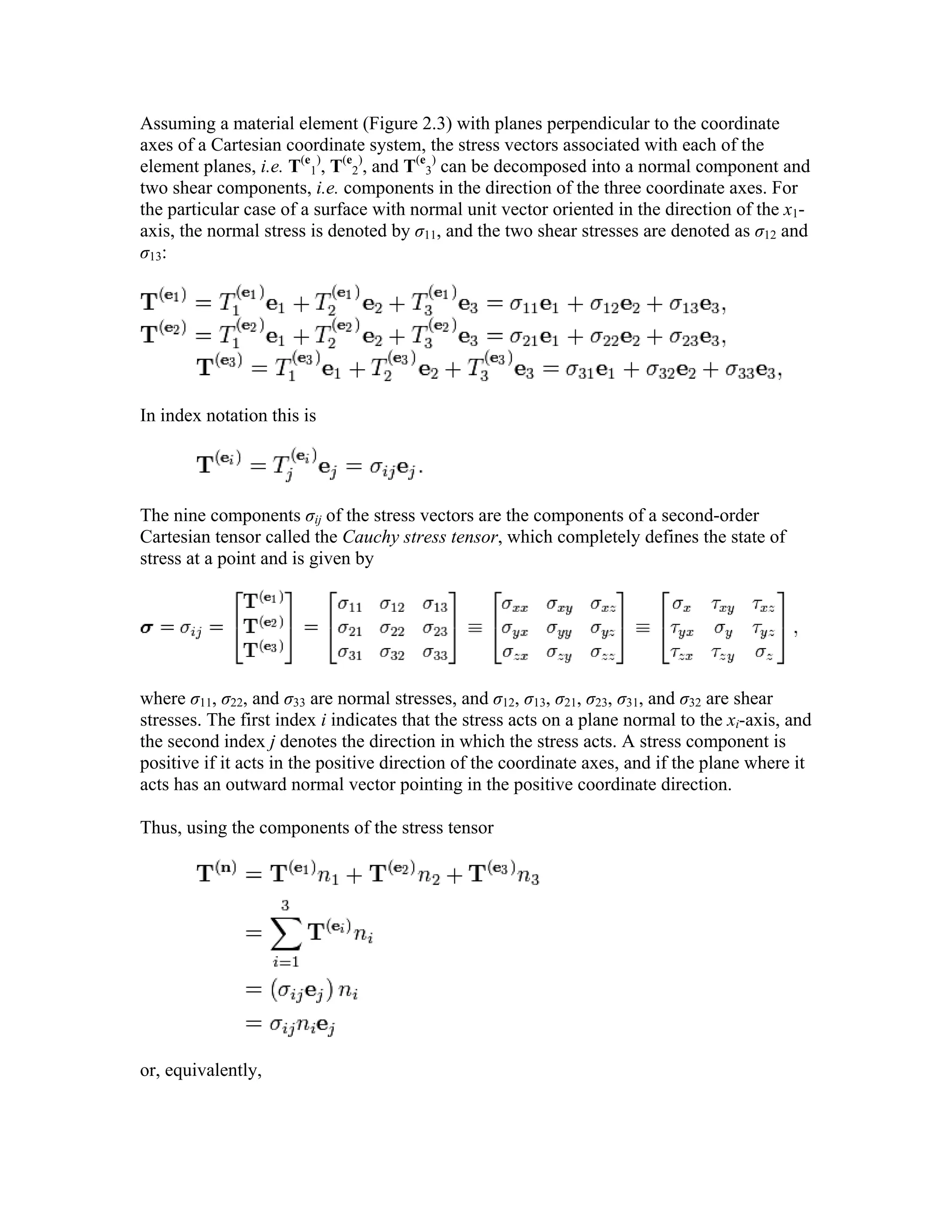
Assuming a material element (Figure 2.3) with planes perpendicular to the coordinate
axes of a Cartesian coordinate system, the stress vectors associated with each of the
element planes, i.e. T(e
1
)
, T(e
2
)
, and T(e
3
)
can be decomposed into a normal component and
two shear components, i.e. components in the direction of the three coordinate axes. For
the particular case of a surface with normal unit vector oriented in the direction of the x1-
axis, the normal stress is denoted by σ11, and the two shear stresses are denoted as σ12 and
σ13:
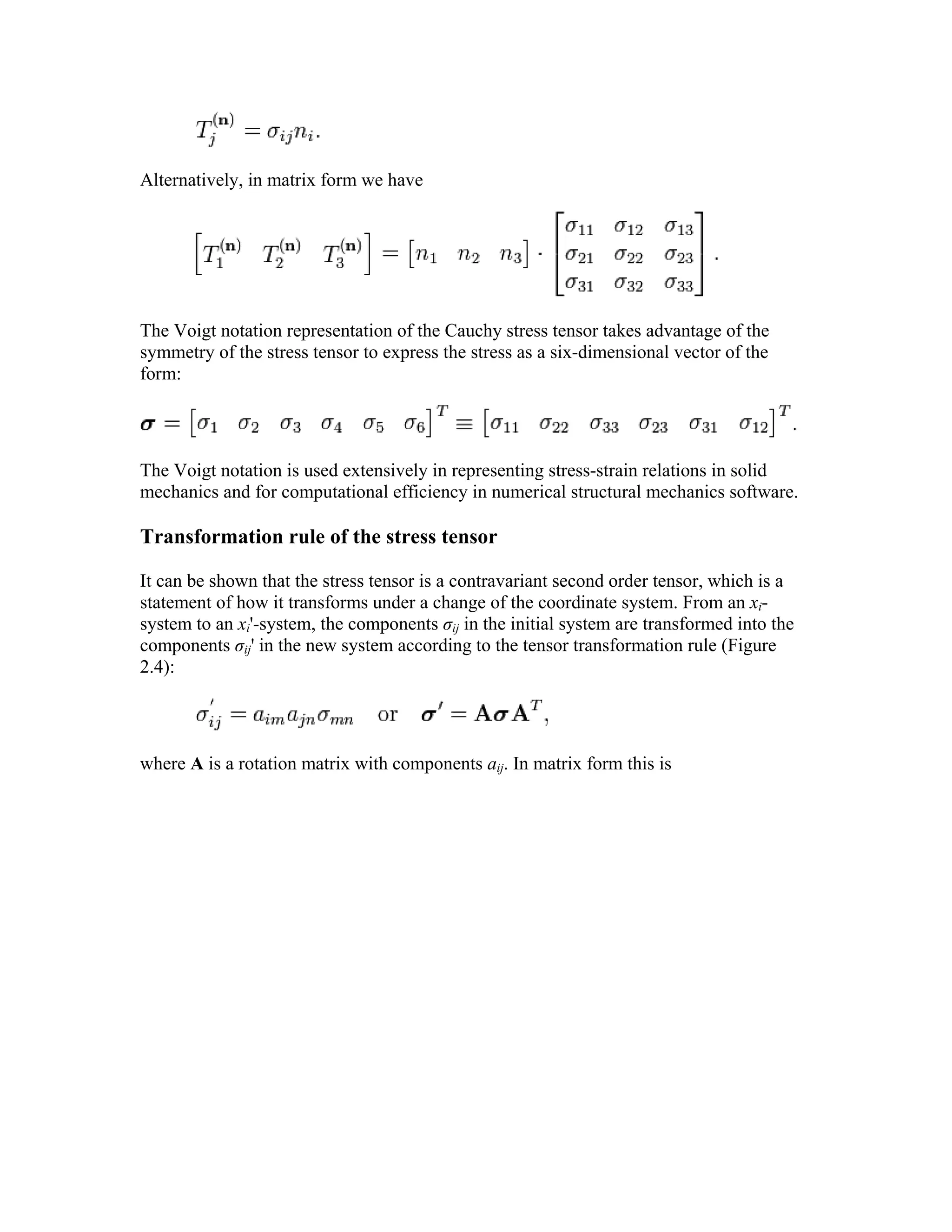
In index notation this is
The nine components σij of the stress vectors are the components of a second-order
Cartesian tensor called the Cauchy stress tensor, which completely defines the state of
stress at a point and is given by
where σ11, σ22, and σ33 are normal stresses, and σ12, σ13, σ21, σ23, σ31, and σ32 are shear
stresses. The first index i indicates that the stress acts on a plane normal to the xi-axis, and
the second index j denotes the direction in which the stress acts. A stress component is
positive if it acts in the positive direction of the coordinate axes, and if the plane where it
acts has an outward normal vector pointing in the positive coordinate direction.
Thus, using the components of the stress tensor
or, equivalently,
Alternatively, in matrix form we have
The Voigt notation representation of the Cauchy stress tensor takes advantage of the
symmetry of the stress tensor to express the stress as a six-dimensional vector of the
form:
The Voigt notation is used extensively in representing stress-strain relations in solid
mechanics and for computational efficiency in numerical structural mechanics software.
Transformation rule of the stress tensor
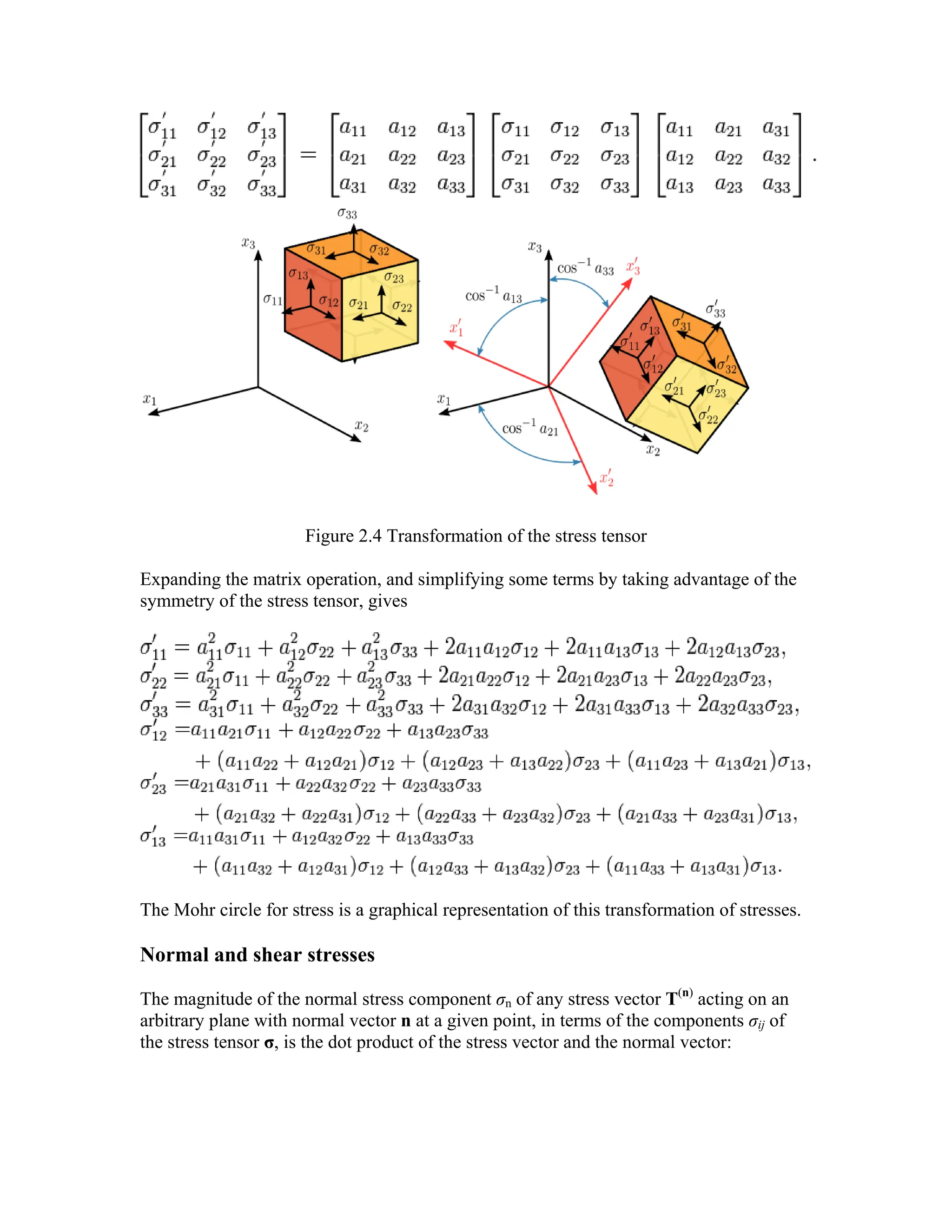
It can be shown that the stress tensor is a contravariant second order tensor, which is a
statement of how it transforms under a change of the coordinate system. From an xi-
system to an xi'-system, the components σij in the initial system are transformed into the
components σij' in the new system according to the tensor transformation rule (Figure
2.4):
where A is a rotation matrix with components aij. In matrix form this is
Figure 2.4 Transformation of the stress tensor
Expanding the matrix operation, and simplifying some terms by taking advantage of the
symmetry of the stress tensor, gives
The Mohr circle for stress is a graphical representation of this transformation of stresses.
Normal and shear stresses
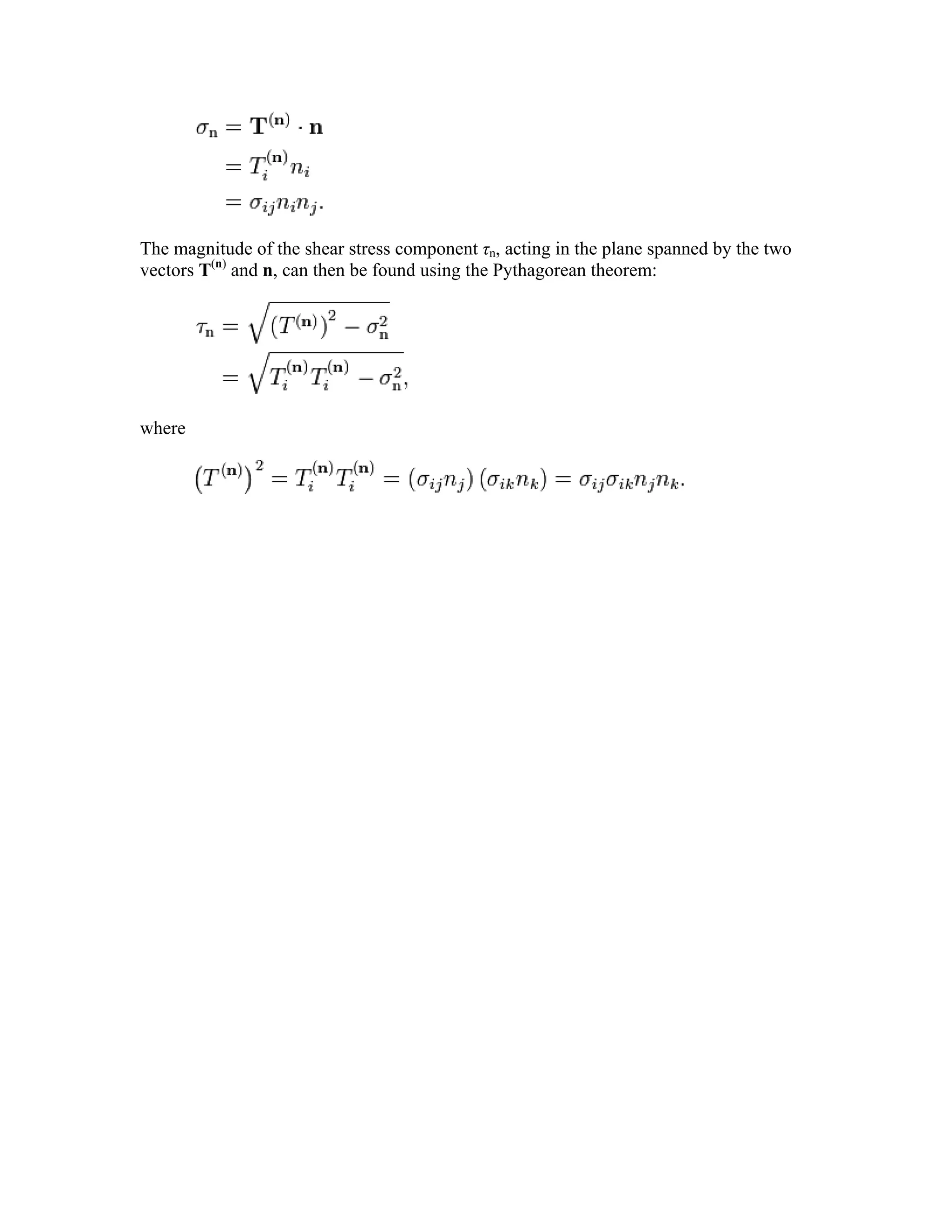
The magnitude of the normal stress component σn of any stress vector T(n)
acting on an
arbitrary plane with normal vector n at a given point, in terms of the components σij of
the stress tensor σ, is the dot product of the stress vector and the normal vector:
The magnitude of the shear stress component τn, acting in the plane spanned by the two
vectors T(n)
and n, can then be found using the Pythagorean theorem:
where
Equilibrium equations and symmetry of the stress
tensor
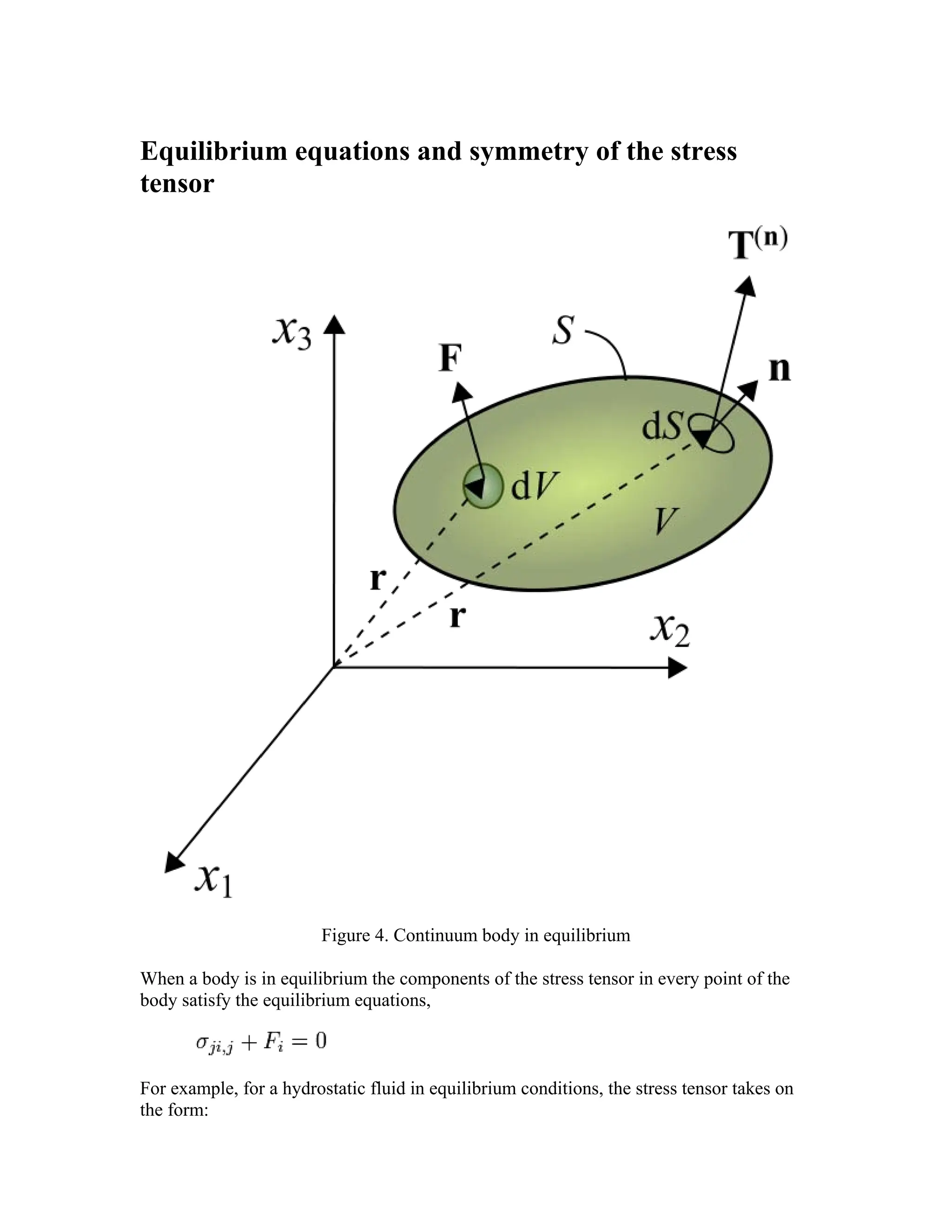
Figure 4. Continuum body in equilibrium
When a body is in equilibrium the components of the stress tensor in every point of the
body satisfy the equilibrium equations,
For example, for a hydrostatic fluid in equilibrium conditions, the stress tensor takes on
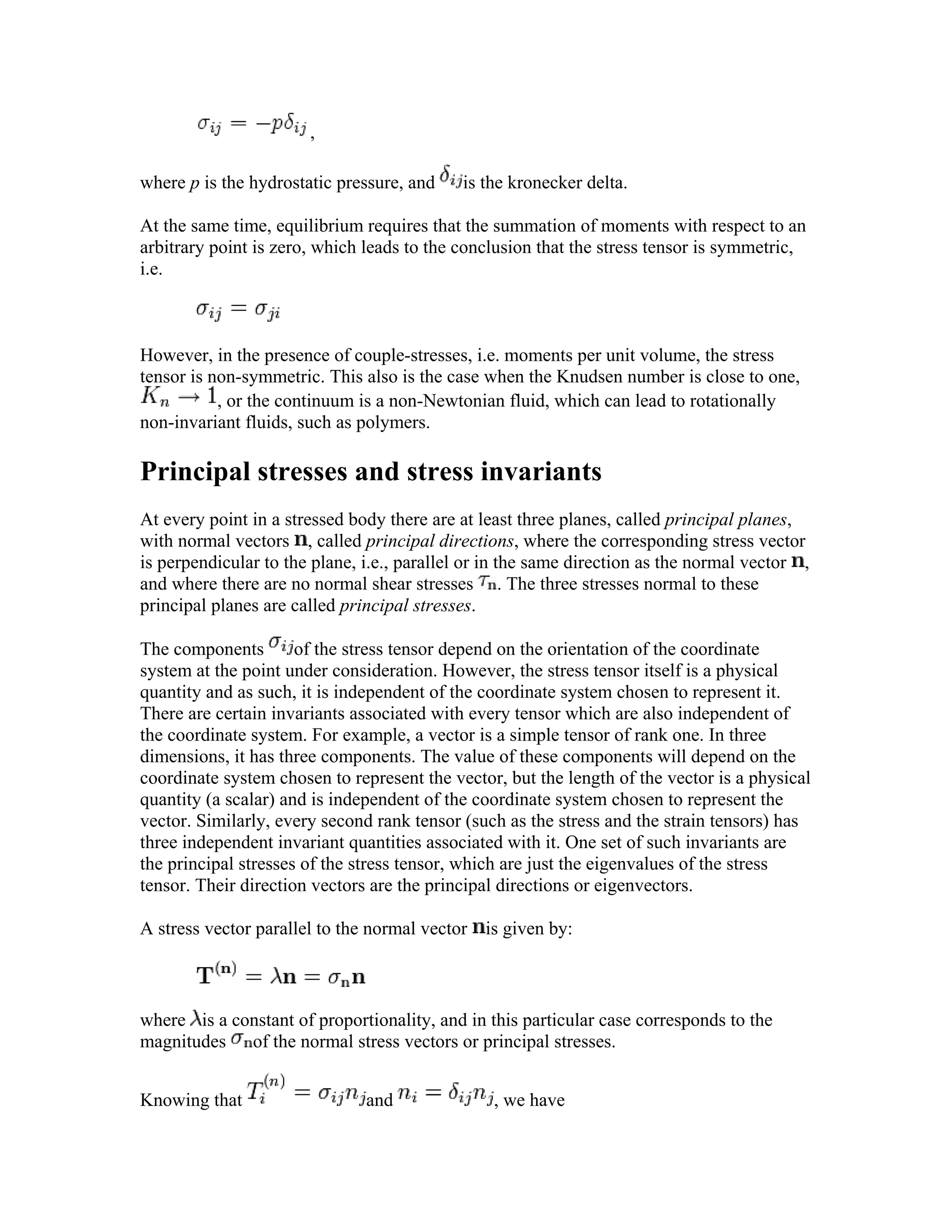
the form:
,
where p is the hydrostatic pressure, and is the kronecker delta.
At the same time, equilibrium requires that the summation of moments with respect to an
arbitrary point is zero, which leads to the conclusion that the stress tensor is symmetric,
i.e.
However, in the presence of couple-stresses, i.e. moments per unit volume, the stress
tensor is non-symmetric. This also is the case when the Knudsen number is close to one,
, or the continuum is a non-Newtonian fluid, which can lead to rotationally
non-invariant fluids, such as polymers.
Principal stresses and stress invariants
At every point in a stressed body there are at least three planes, called principal planes,
with normal vectors , called principal directions, where the corresponding stress vector
is perpendicular to the plane, i.e., parallel or in the same direction as the normal vector ,
and where there are no normal shear stresses . The three stresses normal to these
principal planes are called principal stresses.
The components of the stress tensor depend on the orientation of the coordinate
system at the point under consideration. However, the stress tensor itself is a physical
quantity and as such, it is independent of the coordinate system chosen to represent it.
There are certain invariants associated with every tensor which are also independent of
the coordinate system. For example, a vector is a simple tensor of rank one. In three
dimensions, it has three components. The value of these components will depend on the
coordinate system chosen to represent the vector, but the length of the vector is a physical
quantity (a scalar) and is independent of the coordinate system chosen to represent the
vector. Similarly, every second rank tensor (such as the stress and the strain tensors) has
three independent invariant quantities associated with it. One set of such invariants are
the principal stresses of the stress tensor, which are just the eigenvalues of the stress
tensor. Their direction vectors are the principal directions or eigenvectors.
A stress vector parallel to the normal vector is given by:
where is a constant of proportionality, and in this particular case corresponds to the
magnitudes of the normal stress vectors or principal stresses.
Knowing that and , we have
This is a homogeneous system, i.e. equal to zero, of three linear equations where are
the unknowns. To obtain a nontrivial (non-zero) solution for , the determinant matrix
of the coefficients must be equal to zero, i.e. the system is singular. Thus,
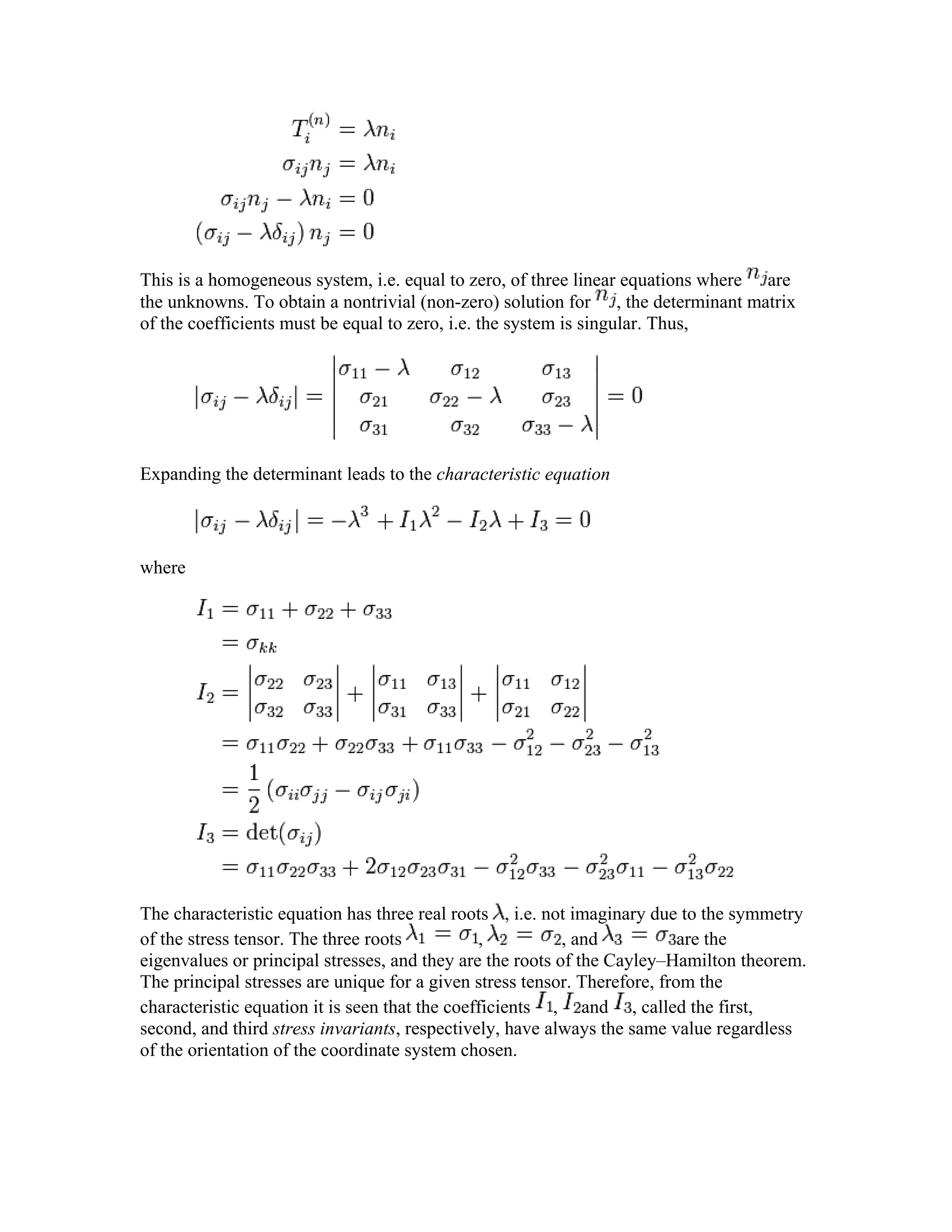
Expanding the determinant leads to the characteristic equation
where
The characteristic equation has three real roots , i.e. not imaginary due to the symmetry
of the stress tensor. The three roots , , and are the
eigenvalues or principal stresses, and they are the roots of the Cayley–Hamilton theorem.
The principal stresses are unique for a given stress tensor. Therefore, from the
characteristic equation it is seen that the coefficients , and , called the first,
second, and third stress invariants, respectively, have always the same value regardless
of the orientation of the coordinate system chosen.
For each eigenvalue, there is a non-trivial solution for in the equation
. These solutions are the principal directions or eigenvectors
defining the plane where the principal stresses act. The principal stresses and principal
directions characterize the stress at a point and are independent of the orientation of the
coordinate system.
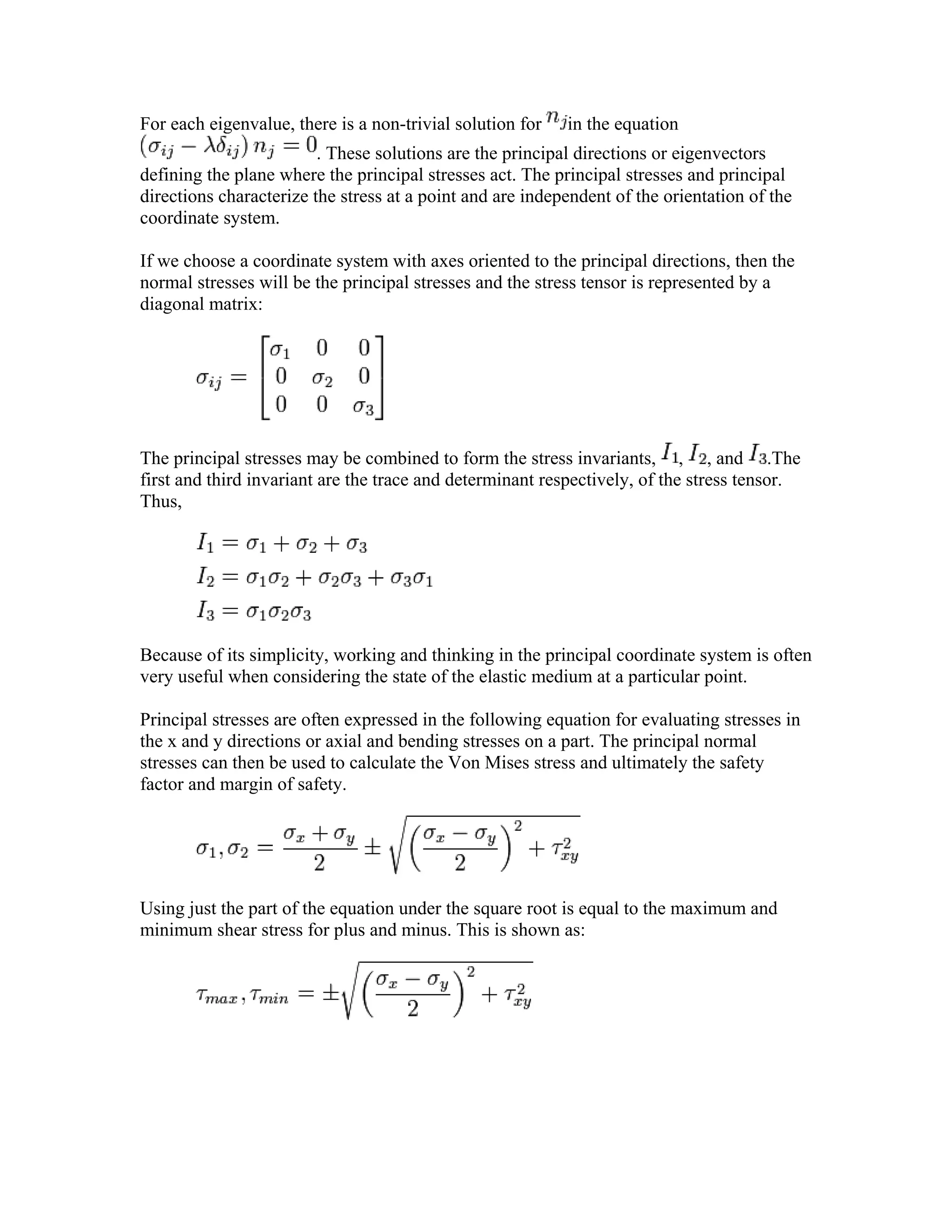
If we choose a coordinate system with axes oriented to the principal directions, then the
normal stresses will be the principal stresses and the stress tensor is represented by a
diagonal matrix:
The principal stresses may be combined to form the stress invariants, , , and .The
first and third invariant are the trace and determinant respectively, of the stress tensor.
Thus,
Because of its simplicity, working and thinking in the principal coordinate system is often
very useful when considering the state of the elastic medium at a particular point.
Principal stresses are often expressed in the following equation for evaluating stresses in
the x and y directions or axial and bending stresses on a part. The principal normal
stresses can then be used to calculate the Von Mises stress and ultimately the safety
factor and margin of safety.
Using just the part of the equation under the square root is equal to the maximum and
minimum shear stress for plus and minus. This is shown as:
Discovering Diverse Content Through
Random Scribd Documents
“I’ll say it is,” agreed Amy, a smile lighting up her quiet face.
“When Henry spoke of it to me at first I thought it was too good to
be true. I supposed he was joking.”
“Told you what?” cried Mollie Billette, in an exasperated tone. “If
you are not the most aggravating——”
“Hold your horses, old dear,” drawled Grace Ford, quietly helping
herself to another piece of candy. “Amy has the floor——”
“The deck, you mean,” murmured Amy, then added hastily, as the
girls threw impatient glances her way: “I’ll tell you just how it
happened if you give me a chance. You see, Henry,” Henry was
Amy’s older brother, “had a chance to take over an old shack near
the upper end of Rainbow Lake in part payment for a debt. And now
that he has the shack, he doesn’t know what to do with it.”
The girls leaned toward Amy eagerly.
“Then what?” asked Mollie.
“Why,” said Amy, with a smile of quiet enjoyment, “I told him I
thought we girls might help him out, for the summer, anyway. I
thought it would be a great lark to camp out there during vacation.”
“Amy, you are a wonder,” drawled Grace, but Mollie broke in
impatiently.
“Is he going to let us have it?” she demanded.
“I should say so!” laughed Amy. “Said he would be glad to put it to
some sort of use. He said it would make a mighty fine summer camp
but that was about all it was good for.”
“It will be ideal,” broke in the Little Captain, happily, as she
brushed a wind-blown strand of hair from her eyes. “Why, at the
upper end of Rainbow Lake we’ll be as much alone as if we were in
an African forest.”
“More so, I hope,” drawled Grace, adding with a little shudder:
“For in an African forest they have wild animals for company while
here——”
“We sha’n’t see anything wilder than a chipmunk,” chuckled the
Little Captain.
“Suits me fine,” said Grace heartily. “Wolves and bears may be all
right, but give me a chipmunk every time.”
“My, isn’t she brave?” said Mollie, admiringly, and the other girls
chuckled.
“Tell us more about this little shack, Amy,” said Betty, after a while.
“Is it very tiny, or is it big enough to contain us all without
squeezing?”
“Henry said it is of fair size,” replied Amy, wrinkling her forehead in
an attempt to remember details. “There are two rooms in it and the
rooms are furnished in a rough sort of way, with home-made
furniture.”
The Little Captain let go of the wheel long enough to clap her
hands gleefully.
“Great!” she cried. “This gets better every minute. Think of it. A
house ready-made for us, and furnished, at that.”
“Too much luxury,” drawled Grace.
It was the first day of July and the Outdoor Girls, never completely
happy unless they were engaged in some outdoor sport, had
embarked in their pretty motor boat Gem for a sail down the Argono
river. Although the motor boat was really Betty’s property, the
Outdoor Girls rather regarded it as their own. And indeed, when it is
considered that none of the four ever used it without the other
three, it was the same to them as though the ownership were
actually theirs. As a matter of fact, what belonged to one of the
Outdoor Girls automatically belonged to all of them.
Those who have kept in touch with Betty and her chums will need
no introduction to the Gem, but for the benefit of those who do not
know these Outdoor Girls so well, we will give a brief description of
it. For in this story the trim little motor boat plays rather an
important part.
First of all, the Gem had been given to Betty by an uncle of hers, a
retired sea captain by the name of Amos Marlin. The old fellow had
produced the best craft of its size that could be found anywhere.
There was a large cockpit in the stern, and a tiny cooking galley.
Also the little boat boasted a small trunk cabin and an unusually
powerful and efficient motor. Altogether a snappy little craft, well
meriting its name of Gem.
And now, as the girls putt-putted briskly down the river, the thrill
of summer filling them with a fresh eagerness for adventure, it is no
wonder that Amy’s suggestion of a summer camp on the banks of
Rainbow Lake was greeted with enthusiasm.
So far, having made no plans for the summer months, they had
about decided to spend a rather uneventful summer in Deepdale,
the thriving and busy little town in which they had been brought up.
It might have been supposed, since Deepdale was situated so
pleasantly on the banks of the Argono—the latter emptying some
miles below into pretty Rainbow Lake—and since the bustling
population of the town itself numbered something like fifteen
thousand, that the Outdoor Girls would have been content to spend
a summer there.
However, although they agreed that Deepdale was “the finest
place in the world,” change and adventure were what they really
hankered after, and Deepdale was too familiar a spot to offer them
either.
But there was real adventure in the idea of camping out in the
romantic little shack so recently acquired by Amy Blackford’s brother,
and they welcomed it eagerly.
“I suppose we ought to run down there and look the place over,”
said Grace, cautiously. Grace was the only one of the four Outdoor
Girls who really considered comfort where adventure was concerned,
and this trait of hers no amount of ridicule or impatience on the part
of the other girls could overcome. For Grace, who was tall and slim
and graceful, was very fond of her ease. Once she was assured that
an outing was to be “comfortable,” then she could start in to enjoy
herself.
So at this suggestion that they “run down there and look the place
over” the girls exchanged a glance of martyrdom.
“Why, of course,” said Mollie sarcastically, “Grace will have to be
sure she has a real hair mattress to sleep on and clean sheets twice
a week. Maybe we could manage to get an easy chair aboard the
Gem—one like the kind Betty’s dad uses.”
“A fine idea,” replied Grace, unabashed. “I never gave you credit
for so much thoughtfulness, Mollie dear. Have a chocolate?”
Mollie sniffed disdainfully.
“Keep your old chocolates,” she said. “The next time you offer me
one I’ve a good mind to throw the whole box overboard.”
“Just try it,” said Grace, lazily. “You’d have to toss me over, too,
you know.”
“Shouldn’t mind in the least,” said Mollie, at which the Little
Captain laughed and Amy Blackford chuckled.
“Talk about wild animals,” cried Betty, gayly. “We won’t need any
with you and Grace about, Mollie dear. Two wildcats are enough.”
“Did you hear what she called us?” asked Grace, feeling abused,
but Mollie was looking the other way.
“We’ve gone a pretty long way down the river,” she said. “Look,
Betty, isn’t that the new lake steamer, the General Pershing?”
Betty, who had been too absorbed in plans for the summer to
notice particularly where she was going, followed the direction of
Mollie’s pointing finger.
Suddenly her breath caught in a gasp and a thrill of apprehension
swept over her. The steamer was indeed the General Pershing, the
great shining new boat which plied up and down the lake and the
river, and it was coming toward them at what, to the Little Captain,
seemed an appalling rate of speed.
“Betty,” cried Mollie, leaning forward and catching Betty’s arm,
“we’re right in the path of it! For goodness’ sake, sheer over.”
“I can’t—very far!” said Betty, tight-lipped. “It’s shallow, near the
shore and—the rocks——”
Mollie took in the situation with a glance and a little groan of
dismay escaped her. At this point the river was very narrow and the
shore on either side bristled with cruel, jagged-looking rocks. A small
boat like the Gem would be dashed to pieces upon them. Betty was
right. It would be madness to encroach too far upon them.
And yet on the other hand the steamer menaced them with
destruction. Bearing down full upon them, it could not fail to meet
them squarely in the middle of that narrow channel!
Useless for Betty to stop the motor. They had no time to turn,
speeding back to the safety of the wider water. If Betty kept her
head, holding the boat away from the oncoming steamer and at the
same time far enough from the rocks—
Amy and Grace, now fully alive to the peril of the situation, were
leaning forward, their faces white, their breath coming in terrified
gasps.
The Little Captain, her hand resolutely on the wheel, a prayer for
guidance in her heart, watched the oncoming rush of the big
steamboat.
CHAPTER II
ALMOST A COLLISION
On, on came the big steamboat, looming larger as it bore down
upon them! Nearer, nearer, while the wash from its approach
reached the little motor boat in sickening undulations—a danger not
thought of before! They would be swept on to the rocks!
Closer, closer! It would strike them! It must! It was over them,
gigantic, overwhelming! The girls nerved themselves for the shock
that was to come. Grace closed her eyes—
And then—the steamer had passed. Betty had swerved at just the
right moment to escape collision. The Gem was acting like a drunken
man, swirling and reeling in the heavy wash of the great steamer.
They were heading straight toward the rocks, driven by the
agitated waves. In another moment they would be dashed upon
them—
“Betty!” screamed Grace. “We’ll be killed! The rocks!”
But the wail was drowned in the sudden roar of the motor. The
Gem leaped forward, her nose swung around to meet the oncoming
waves. Gallantly she plowed through the water which was lashed to
a froth by the progress of the steamer, just grazing a jagged edge of
rock, flinging spray over her bows, soaking the girls.
Then she was free of the channel, speeding for the safety of the
open water. Betty, looking back over her shoulder, saw that the
decks of the General Pershing were black with people who had
rushed to the rail to see the fate of the motor boat.
The steamer had slowed down and half turned around as though
intending to come to the rescue, but, seeing that this was
unnecessary, she straightened once more, continuing on her way.
Betty’s hands trembled on the wheel. The reaction left her faint
and sick. As though from a long distance she heard Mollie’s voice
saying:
“Well, if that wasn’t a narrow squeak, I never saw one!”
“It was the Little Captain saved us,” said Amy. “She knew just
what to do, as she always does.”
And this indeed was the reason for Betty Nelson’s nickname of
“Little Captain.” For this brown-haired, brown-eyed girl seemed
always to know just what to do at a critical moment and, more than
this, she always did it. She was just eighteen and the only daughter
of a rich carpet manufacturer of Deepdale. It was hard to tell which
Betty loved the more, her kindly, indulgent father or her lovely
mother.
Grace Ford, the second of the Outdoor Girls, was tall and slender,
fond of her comfort and loving candy and sodas and sweets of all
sorts. Her father was a distinguished lawyer and her mother was a
fine looking woman who spent a good deal of her time in club
activities. Grace also had a brother, Will Ford, of whom she was
passionately fond.
Then there was Mollie Billette, daughter of Mrs. Pauline Billette, a
well-to-do, sprightly little widow with more than a dash of French
blood in her veins. Perhaps her French ancestry explains Mollie’s
quick temper. Mollie also had a little brother and sister, twins and
seven years old. The latter were always in mischief, and although
Mollie loved them dearly, she sometimes found it very hard to have
patience with them.
The last of the quartette of Outdoor Girls was Amy Blackford,
whom the girls had first known as Amy Stonington. She was the
ward of John and Sarah Stonington and at one time there had been
considerable mystery regarding her real parentage. Later, when the
mystery was solved, Amy found out that not only was her real name
Blackford but that she was possessed of a splendid brother as well,
Henry Blackford. Like Mollie, Amy was seventeen, but there the
resemblance ended. She was as quiet as Mollie was hot-tempered,
and there was something sweet and appealing about her that roused
the protective instinct of the more vigorous girls.
So much for the girls. Then, there were the four boys who almost
invariably accompanied the girls on their adventures. There was, of
course, Will Ford, Grace’s brother, who, as a soldier in the World War
had distinguished himself by some clever secret service work. Will
loved quiet Amy Blackford and Amy, in turn, made no secret of her
feeling for him.
There was Allen Washburn, the clever young lawyer who thought
the Little Captain was about the nicest person in the world. Allen had
enlisted at the call of the United States to arms. He was made a
sergeant in the American Army and, although he had gone over a
sergeant, he came back with a commission as lieutenant. No wonder
the girls—and especially Betty—were proud of him!
Frank Haley was another of the boys in the little group. A splendid
young fellow, liked by all the girls, and liking them all, he had been
introduced into “the crowd” because of his friendship for Will Ford.
There was, too, Roy Anderson, jolly and full of fun, always ready
for everything that came along. Perhaps Mollie expressed the
general sentiment toward him when she said that they were fond of
Roy chiefly because he always kept them amused. And how apt we
are to love the person that amuses us!
The girls had earned their title of “Outdoor Girls” from the fact
that they almost always managed to spend their vacations in the
open. And because of this they had run into a great number of
adventures.
There was, for instance, their first tramping tour of the country,
the incidents of which are told in the first volume of the series,
entitled “The Outdoor Girls of Deepdale.” There had followed many
other adventures, at Rainbow Lake, at Ocean View, in Florida, and,
later, on an island called Pine Island where they had found many
interesting things, including a real gypsy cave.
During the war they had served in a Hostess House while the
boys, together with countless others of our fine American lads,
sailed off across the ocean to fight for liberty.
Another summer they had spent at Wild Rose Lodge, a lovely spot
hidden deep in the woods where they became interested in a poor
old man who thought his two sons had been killed in the war.
In the volume directly preceding this, entitled “The Outdoor Girls
in the Saddle,” these girls had had one of their most interesting
adventures. Mrs. Nelson, Betty’s mother, through the death of a
relative, had become the owner of a ranch.
The most important thing about this ranch—in the estimation of
the girls, at least—was the fact that it was situated right in the midst
of a great gold-mining district. How the girls with Mr. and Mrs.
Nelson went to the ranch, spending a glorious few weeks in the
saddle, and how gold was finally found on the ranch is told of in
detail in that volume.
And now we turn once more to the present with Betty Nelson, the
Little Captain, saving her chums from the peril of collision with the
great river steamer General Pershing.
As for Betty, although the girls heaped her with their praises, she
had never felt less like a heroine in her life.
Scarcely knowing what she did, she turned the nose of the little
boat back toward Deepdale. The thought was unpleasant that once
more they would be forced to pass through that narrow channel,
bounded on either side by the rocky shore.
However, this time there was no General Pershing bearing
relentlessly down upon them and they passed through the
dangerous spot without further mishap.
“Goodness, I’m glad that’s over!” said Grace, relaxing once more
in her seat, her voice still tremulous.
“We couldn’t possibly have met that old boat in a worse place,”
said Mollie, glaring resentfully after the General Pershing, whose
bulk was diminishing rapidly in the distance.
“Well,” said Betty, trying to laugh and not making a very good job
of it, “there’s no use blaming the steamer. We shouldn’t have been
there, you know.”
“Don’t you want me to take the wheel, Betty?” spoke up Amy,
suddenly. “Come back here in my place and I’ll take the Gem the
rest of the way.”
But though she smiled at her, Betty denied firmly that there was
any reason why she should give up the wheel.
“I’m all right,” she said, adding, as she rounded the curve of an
island, skirting the shore toward Deepdale: “Do you want to stay out
any longer, or shall we call it a day and go up to my house? Mother
said there was an apple pie in the refrigerator and some ginger ale
on the ice.”
“Oh, boy!” sighed Grace ecstatically. “Lead me to it.”
“So say we all of us,” said Mollie, and Amy joined in the chorus.
Strange how their terrifying experience of a few minutes before
disappeared in the distance as they thought of apple pie!
“And we can talk over our plans for camping, too,” said Amy, at
which the girls realized that they had not thought of Henry
Blackford’s shack in the woods for five whole minutes. This would
never do.
By the time they had reached the dock at Deepdale they had
nearly forgotten their encounter with the General Pershing and so
were genuinely surprised when they saw Allen hurrying toward
them.
At sight of the tall figure Betty’s heart missed a beat and her face
felt suddenly hot. If only she might stop that miserable habit of
blushing—especially when Allen was around!
CHAPTER III
ENTER THE TWINS
“Gee Christopher, but you girls gave me a scare!” exploded the
young lawyer, as soon as he came within speaking range. His words
included all the girls but his look was only for Betty.
“What do you mean, gave you a scare?” asked Mollie, her black
eyes dancing. “We haven’t seen you for almost a week.”
“Maybe Betty has,” murmured Grace, with a wicked glance at the
Little Captain.
“No, I haven’t,” said the latter, looking up demurely. The furious
color had subsided and she was just flushed enough to look
unusually pretty. As for what Allen thought—
“Look here,” he said, abruptly, his handsome young face very
serious as he searched Betty’s expression, “did Babcock tell me the
truth when he said the General Pershing almost ran you down?”
On Betty’s face was a look of bewilderment.
“How did you know?” she questioned. “It only just happened?”
“Who’s Babcock?” asked Grace, with interest.
“A lawyer I’ve met once or twice,” returned Allen, still with his
worried eyes fixed on Betty. “We ran into each other a few minutes
ago. Seems he just landed from the General Pershing and he was
full of this incident. Said it was a miracle the boat wasn’t wrecked.
The description he gave me of it sounded very much like the Gem.”
“It was the Gem,” said Mollie.
“But he was wrong about a miracle saving us,” put in Amy,
throwing an arm about the Little Captain. “It was Betty.”
Allen was on the verge of saying that Betty was a miracle,
anyhow, but, considering that there were a good many people
about, thought better of it. However, his eyes spoke for him.
“You must be more careful, Betty,” he said, taking the rope from
her with which she was making the Gem fast to the dock. “You
mustn’t take such chances when I’m not around.”
He was close to her and speaking in a low tone. Amy and Mollie
and Grace had considerately turned away and were walking slowly in
the direction of Betty’s house. Having fastened the little boat
securely, Betty and Allen turned to follow them.
“Please promise you’ll be more careful when I’m not with you,”
Allen persisted, and Betty glanced up at him with a hint of laughter
in her eyes. But the laughter hid a little hurt, for Betty was feeling a
bit neglected. Mollie was right when she said they had not seen nor
heard from Allen for several days. Of course he had been busy—he
always was—but just the same—
So said Betty:
“If I took chances only when you were around, I wouldn’t take
very many, would I?”
She tried to speak lightly but she did not quite succeed, not as far
as Allen was concerned. Looking down at her suddenly serious little
face he wished that they might be alone for just five minutes so that
he might explain. And he was in such a rush!
“That isn’t fair,” he said, gravely. “You know I wouldn’t have stayed
away if I hadn’t had to. Look here, Betty—dear,” they had come to a
corner and he had stopped, facing her. He had an appointment at
three-thirty and here it was three-twenty-five this minute. “I can’t
stay now, I’ve got to rush. Can I see you to-night?”
What perverse imp in Betty made her answer lightly:
“I have an engagement to-night, Allen.”
All at once the young lawyer looked savage. Confound that
engagement!
“Betty,” he said, desperately, “I’m coming to-night anyway, and if
you won’t see me I’ll camp on your doorstep till you do.”
With this threat he turned and hurried down the street, his back
as stiff as a ramrod, the heavy frown still on his brow. Why, he
thought, gloomily, did Betty always have to look most adorable just
when she was going to be most aggravating? How was he going to
keep his mind on business, anyway, when all he could think of was
Betty’s face?
Meanwhile, Betty had looked musingly after his retreating figure
and then, at the thought of the savage look on his face, chuckled
unfeelingly. Just the same, her eyes were a little wistful as she
hurried to catch up with the girls. She did wish his old business
wouldn’t take up so much of his time! Maybe if he had taken up
medicine, now, instead of the law—but no, that would have been
worse yet. Doctors never had any time at all to themselves. She was
still wondering whether she ought to see Allen that night—knowing
all the time that she would not miss seeing him for the world—when
the girls turned and spied her.
“Well, did we walk slowly enough?” asked Mollie, teasingly, as
together they turned the corner into the street where Betty lived.
“Is he coming to-night?” added Grace, with a chuckle.
“Since I can’t answer both of you at once,” Betty retorted, “I
sha’n’t answer you at all. There’s mother on the porch,” she added,
to change the subject.
“And now,” sighed Grace, happily, as they turned in at the walk of
Betty’s house, “just lead us to that apple pie.”
While they ate pie and drank gratefully of the ice-cold ginger ale,
Betty told her mother of Henry Blackford’s cabin in the woods and
explained to her the use they wished to make of it.
“It looks just providential to us,” she finished, eagerly. “Mother, if
you were so cruel as to say I couldn’t go, I believe I’d take a running
jump and land right in the middle of the lake.”
Mrs. Nelson’s eyes twinkled.
“Far be it from me to drive you to that, dear,” she said. “I think the
idea is a splendid one and you all ought to be very grateful to Mr.
Blackford for suggesting it.”
Whereupon Mrs. Nelson found herself promptly kissed by not only
Betty, but the other girls as well. So sudden was the onslaught that
she waved them away laughing and declaring it would take her a
week at least to get back all the breath she had lost.
A few minutes later, having finished all the apple pie and ginger
ale in sight, the girls started en masse for Mollie’s house, to gain a
like consent from Mollie’s mother, the sprightly little French widow.
“And maybe,” said Grace hopefully, as they neared the Billette
home, “your mother has something in the refrigerator for us too,
Mollie dear.”
“Your appetite does you credit, Grace,” said Mollie sarcastically.
“But in the language of our day I must beg you not to kid yourself. If
there ever was anything in the ice box, that dainty has been done
away with by Dodo and Paul long ere this. So if you feel you need
any further refreshment you’d better stop at the pastry shop and
fortify yourself.”
As they were at that moment passing the shop in question Grace
gazed longingly into the pastry-filled windows, then as the girls
watched her laughing, regretfully shook her head.
“Can’t be done,” she murmured sorrowfully. “Used up half my
allowance already and only three days of the week gone.”
“It surely gets me, Grace Ford,” said Mollie, a trifle resentfully—for
Mollie was gaining flesh a little too rapidly to suit her—“how you
manage to eat sweets all day and still keep your sylph-like form.”
“It’s a gift,” remarked Grace, with the sweet, superior smile that
always made Mollie boil. “I sha’n’t tell you the secret, Mollie darling,
even if you did gain five pounds in two weeks.”
“Didn’t,” retorted Mollie, with a frown. “It was only four and a half.
I don’t see why you always have to exaggerate everything.”
“What’s half a pound between friends?” returned Grace, airily.
Luckily they reached Mollie’s home at this minute, which fact
probably averted an exchange of blows, so Betty laughingly
declared.
Mrs. Billette was at home and she listened rather absently to the
girls’ recital of what they hoped to do during the summer. Since at
times they all talked at once it was small wonder that a rather
bewildered expression grew in her eyes.
“You want to go camping in this cabin in the woods, which belong
to Mr. Blackford, is that so?” she said at last, in her pretty accent.
“Why, yes, I think it will be all right. You have learn’ pretty well to
take care of yourselves,” she added, with an indulgent smile that for
a moment chased the worried frown from her forehead. However, a
sudden sharp sound, like the falling of a heavy body from above
stairs, brought back the harassed expression to her face.
“Those children, Dodo and Paul!” she said, wearily. “To-day they
have nearly drive me wild. I wish you would take them with you into
the woods, Mollie. It would be all right for them to run wild there.
They could break nothing but their own heads.”
“Which they would certainly do,” said Mollie, with a wry little face.
The idea of having her fun hampered by the mischievous antics of
the twins was not a pleasant one.
At that moment there came a terrific bumping and thumping down
the stairs and with one accord Mrs. Billette and the four girls rushed
to the door.
“It is done at last!” wailed Mrs. Billette. “This time they have kill
themselves!”
CHAPTER IV
MORE PLANS
But it would take more than a mere matter of falling downstairs to
put an end to the activities of Dodo and Paul. This they proved
themselves, by coming up smiling and chuckling and very much alive
at the foot of the stairs.
“Oh, you will be the death of me yet, you li’l rascals,” moaned Mrs.
Billette, picking them up and feeling carefully over their small bodies
to make sure that there were no bones broken. “I shall die of heart
failure, if nothing else. Why will you not behave yourselves? Dodo,
Paul, tell mother, are you hurt, darlings?”
Dodo and Paul regarded their mother and the girls in wide-eyed
amazement at the fuss that was being made over them.
“Course, we’re not hurt,” said the little girl, rubbing a dimpled
knee as though it had come in too hard contact with the edge of a
stair. “Paul an’ me, we was runnin’ a race to see who could get
downstairs first an’ Paul got in the way——”
“Den she pushed me,” said Paul, taking up the narrative in an
injured tone. “I would have won de race only she pushed me. Wasn’t
fair—”
“Was too,” interrupted Dodo, hotly. “You pushed me first, right up
there at the head of the stairs an’ so I pushed you too.”
“Ooh,” said Paul, his eyes wide and injured. “Dodo Billette what a
big story-teller——”
“Paul,” interrupted his mother sharply, “that will do. How many
times have I told you that you must never call your little sister
names?”
“Well, but she is,” insisted the round-eyed Paul, whereat his
exasperated parent pushed him gently but very very firmly toward
the front door.
“There, go outside, both of you,” she said. “And see if you can
stop quarreling for five minutes. What have I done to have such
terrible children!”
As the door closed upon the obstreperous twins she raised her
hands in a typically French gesture and turned to the girls,
despairingly.
“You see how it is,” she said, leading the way once more into the
cool peace of the living-room. “Not five minutes in the day do they
give me peace. Sometime I think I shall go mad.”
“Poor mother,” said Mollie, putting her arm about the little woman
and seating her in the easiest chair in the room. “I know they’re a
dreadful pest, but just think how much worse it would be if you
didn’t have them. Remember the time when they were kidnapped
——”
But Mrs. Billette stopped her with a quick gesture.
“Do not remind me of that!” she commanded, sharply. “Have I not
done my best to forget that dreadful time? But you do well to speak
of it, after all, Mollie,” she said, more gently, patting Mollie’s hand.
“It make me more contented to bear with them. They are very little
yet and it is natural for children to be always in mischief.”
Those who are familiar with the Outdoor Girls will remember when
the mischievous, adorable twins, Dodo and Paul, had been
kidnapped by a villain who demanded an outrageous sum of money
for their safe return and how the same twins had been rescued from
a ship, wrecked on the rocks of Bluff Point near the cottage where
the Outdoor Girls were summering. And it was true that whenever
Mrs. Billette or Mollie were tempted to be impatient with the twins
they remembered the despair of that dreadful time and dealt gently
with the erring Dodo and Paul, aggravating little wretches that they
could be.
“Just the same,” said Grace as, a few hours later, the girls started
for home and dinner, “I’d just as soon leave the twins behind when
we go on our vacation.”
“Poor kiddies,” said Betty, with a twinkle in her eye. “Just think
how they would enjoy themselves!”
“Yes,” retorted Grace, unmoved. “But just think how we would
enjoy ourselves.”
“Speaking of our vacation,” said Mollie, who had agreed to walk as
far as Betty’s house with her. “It seems as though things were just
about settled for one grand and glorious time.”
“How about you, Grace?” asked Amy, as they paused at the corner
before separating for their respective domiciles. “Do you suppose
your folks will give you the O.K.?”
“Amy, what slang!” chuckled Betty. “If we don’t look out, you’ll be
giving us points.”
“Impossible,” retorted Amy, at which Betty grinned still more.
“Why, yes, I guess,” said Grace, in reply to Amy’s question. “The
folks will let me go anywhere as long as Will comes along.”
“Good gracious, are we going to let the boys in on this?” asked
Mollie, wide-eyed.
Welcome to Our Bookstore - The Ultimate Destination for Book Lovers
Are you passionate about books and eager to explore new worlds of
knowledge? At our website, we offer a vast collection of books that
cater to every interest and age group. From classic literature to
specialized publications, self-help books, and children’s stories, we
have it all! Each book is a gateway to new adventures, helping you
expand your knowledge and nourish your soul
Experience Convenient and Enjoyable Book Shopping Our website is more
than just an online bookstore—it’s a bridge connecting readers to the
timeless values of culture and wisdom. With a sleek and user-friendly
interface and a smart search system, you can find your favorite books
quickly and easily. Enjoy special promotions, fast home delivery, and
a seamless shopping experience that saves you time and enhances your
love for reading.
Let us accompany you on the journey of exploring knowledge and
personal growth!
ebookgate.com

Continuum and solid mechanics concepts and applications Victor Quinn

  • 1.
    Continuum and solidmechanics concepts and applications Victor Quinn pdf download https://ebookgate.com/product/continuum-and-solid-mechanics- concepts-and-applications-victor-quinn/ Get Instant Ebook Downloads – Browse at https://ebookgate.com
  • 2.
    Get Your DigitalFiles Instantly: PDF, ePub, MOBI and More Quick Digital Downloads: PDF, ePub, MOBI and Other Formats Quantum Mechanics Concepts and Applications 1st Edition Nouredine Zettili https://ebookgate.com/product/quantum-mechanics-concepts-and- applications-1st-edition-nouredine-zettili/ Soil Mechanics Concepts and Applications 2nd Edition William Powrie https://ebookgate.com/product/soil-mechanics-concepts-and- applications-2nd-edition-william-powrie/ Continuum Mechanics using Mathematica Fundamentals Applications and Scientific Computing 2006th Edition Antonio Romano https://ebookgate.com/product/continuum-mechanics-using- mathematica-fundamentals-applications-and-scientific- computing-2006th-edition-antonio-romano/ Solid Phase Organic Synthesis Concepts Strategies and Applications 1st Edition Patrick H. Toy https://ebookgate.com/product/solid-phase-organic-synthesis- concepts-strategies-and-applications-1st-edition-patrick-h-toy/
  • 3.
    Continuum Mechanics 1stEdition Andrus Koppel https://ebookgate.com/product/continuum-mechanics-1st-edition- andrus-koppel/ Elements of Continuum Mechanics and Thermodynamics 1st Edition Joanne L. Wegner https://ebookgate.com/product/elements-of-continuum-mechanics- and-thermodynamics-1st-edition-joanne-l-wegner/ Principles of Continuum Mechanics A Study of Conservation Principles with Applications 1st Edition J. N. Reddy https://ebookgate.com/product/principles-of-continuum-mechanics- a-study-of-conservation-principles-with-applications-1st-edition- j-n-reddy/ Adhesives Types Mechanics and Applications Types Mechanics and Applications 1st Edition Jack S. Doyle https://ebookgate.com/product/adhesives-types-mechanics-and- applications-types-mechanics-and-applications-1st-edition-jack-s- doyle/ Geometric Continuum Mechanics Advances in Mechanics and Mathematics 42 Band 42 1 ed. 2020 Edition Reuven Segev (Editor) https://ebookgate.com/product/geometric-continuum-mechanics- advances-in-mechanics-and- mathematics-42-band-42-1-ed-2020-edition-reuven-segev-editor/
  • 5.
    First Edition, 2012 ISBN978-81-323-0854-6 © All rights reserved. Published by: Academic Studio 4735/22 Prakashdeep Bldg, Ansari Road, Darya Ganj, Delhi - 110002 Email: info@wtbooks.com
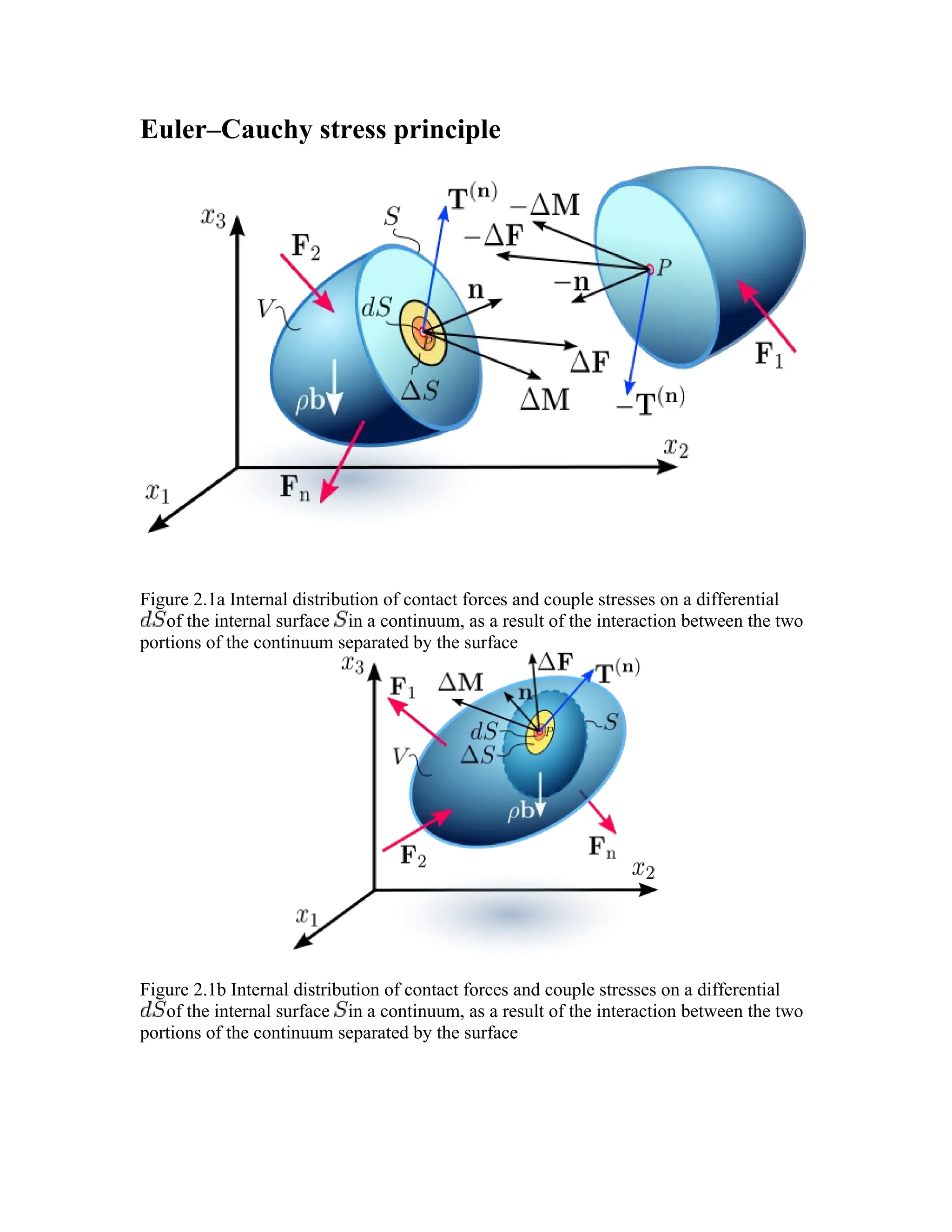
  • 6.
    Table of Contents Chapter1 - Continuum Mechanics Chapter 2 - Fluid Mechanics Chapter 3 - Stress (Mechanics) Chapter 4 - Deformation (Mechanics) Chapter 5 - Finite Strain Theory Chapter 6 - Peridynamics Chapter 7 - Viscoelasticity Chapter 8 - Plasticity Chapter 9 - Fracture Mechanics Chapter 10 - Bending Chapter 11 - Failure Theory (Material) Chapter 12 - Hooke's Law
  • 7.
    Chapter 1 Continuum Mechanics Continuummechanics is a branch of mechanics that deals with the analysis of the kinematics and the mechanical behavior of materials modeled as a continuous mass rather than as discrete particles. The French mathematician Augustin Louis Cauchy was the first to formulate such models in the 19th century, but research in the area continues today. Modeling an object as a continuum assumes that the substance of the object completely fills the space it occupies. Modeling objects in this way ignores the fact that matter is made of atoms, and so is not continuous; however, on length scales much greater than that of inter-atomic distances, such models are highly accurate. Fundamental physical laws such as the conservation of mass, the conservation of momentum, and the conservation of energy may be applied to such models to derive differential equations describing the behavior of such objects, and some information about the particular material studied is added through a constitutive relation. Continuum mechanics deals with physical properties of solids and fluids which are independent of any particular coordinate system in which they are observed. These physical properties are then represented by tensors, which are mathematical objects that have the required property of being independent of coordinate system. These tensors can be expressed in coordinate systems for computational convenience. The concept of a continuum Materials, such as solids, liquids and gases, are composed of molecules separated by empty space. On a macroscopic scale, materials have cracks and discontinuities. However, certain physical phenomena can be modeled assuming the materials exist as a continuum, meaning the matter in the body is continuously distributed and fills the entire region of space it occupies. A continuum is a body that can be continually sub- divided into infinitesimal elements with properties being those of the bulk material. The validity of the continuum assumption may be verified by a theoretical analysis, in which either some clear periodicity is identified or statistical homogeneity and ergodicity
  • 8.
    of the microstructureexists. More specifically, the continuum hypothesis/assumption hinges on the concepts of a representative volume element (RVE) (sometimes called "representative elementary volume") and separation of scales based on the Hill-Mandel condition. This condition provides a link between an experimentalist's and a theoretician's viewpoint on constitutive equations (linear and nonlinear elastic/inelastic or coupled fields) as well as a way of spatial and statistical averaging of the microstructure. When the separation of scales does not hold, or when one wants to establish a continuum of a finer resolution than that of the RVE size, one employs a statistical volume element (SVE), which, in turn, leads to random continuum fields. The latter then provide a micromechanics basis for stochastic finite elements (SFE). The levels of SVE and RVE link continuum mechanics to statistical mechanics. The RVE may be assessed only in a limited way via experimental testing: when the constitutive response becomes spatially homogeneous. Specifically for fluids, the Knudsen number is used to assess to what extent the approximation of continuity can be made. Major areas of continuum mechanics Continuum mechanics The study of the physics of continuous materials Solid mechanics The study of the physics of continuous materials with a defined rest shape. Elasticity Describes materials that return to their rest shape after an applied stress. Plasticity Describes materials that permanently deform after a sufficient applied stress. Rheology The study of materials with both solid and fluid characteristics. Fluid mechanics The study of the physics of continuous materials which take the shape of their container. Non-Newtonian fluids Newtonian fluids
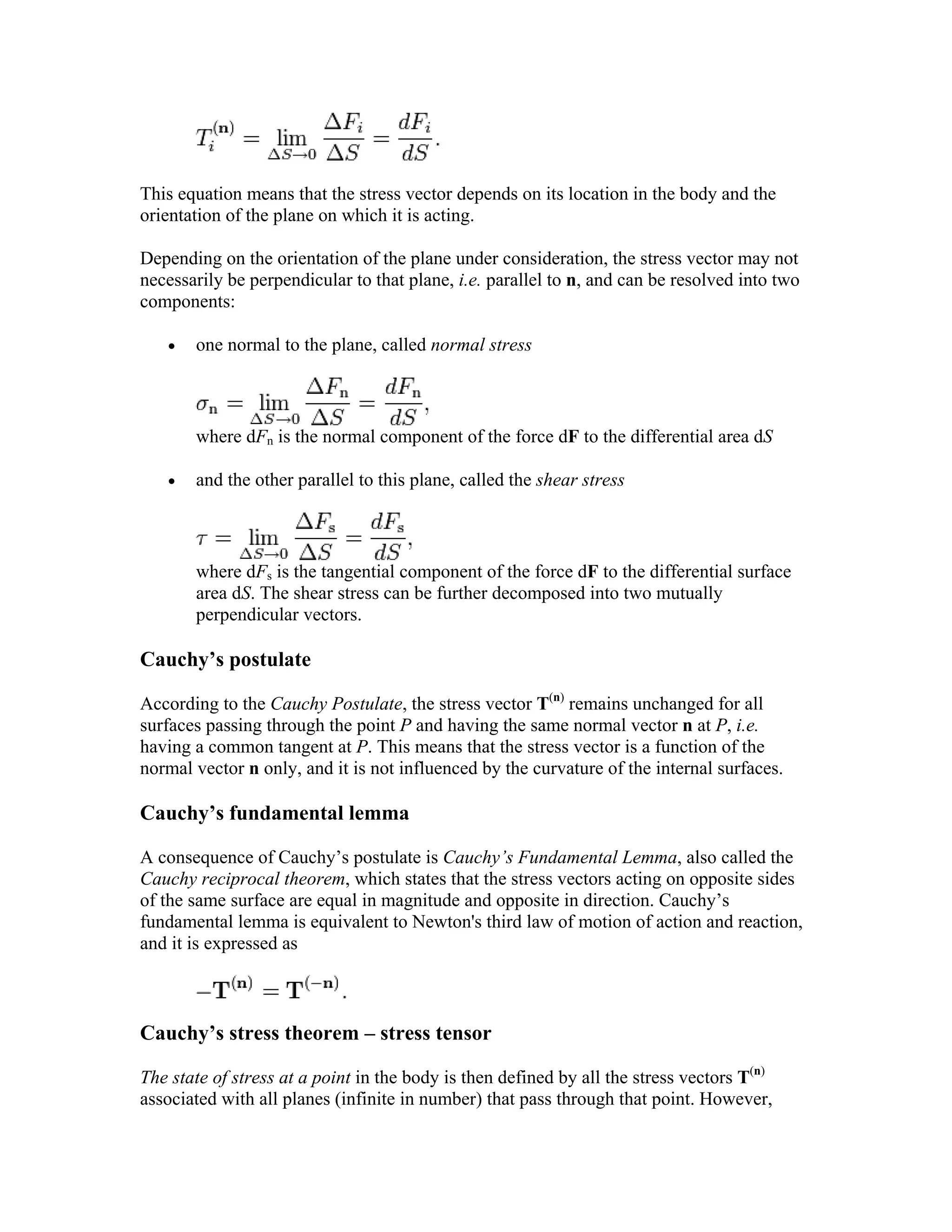
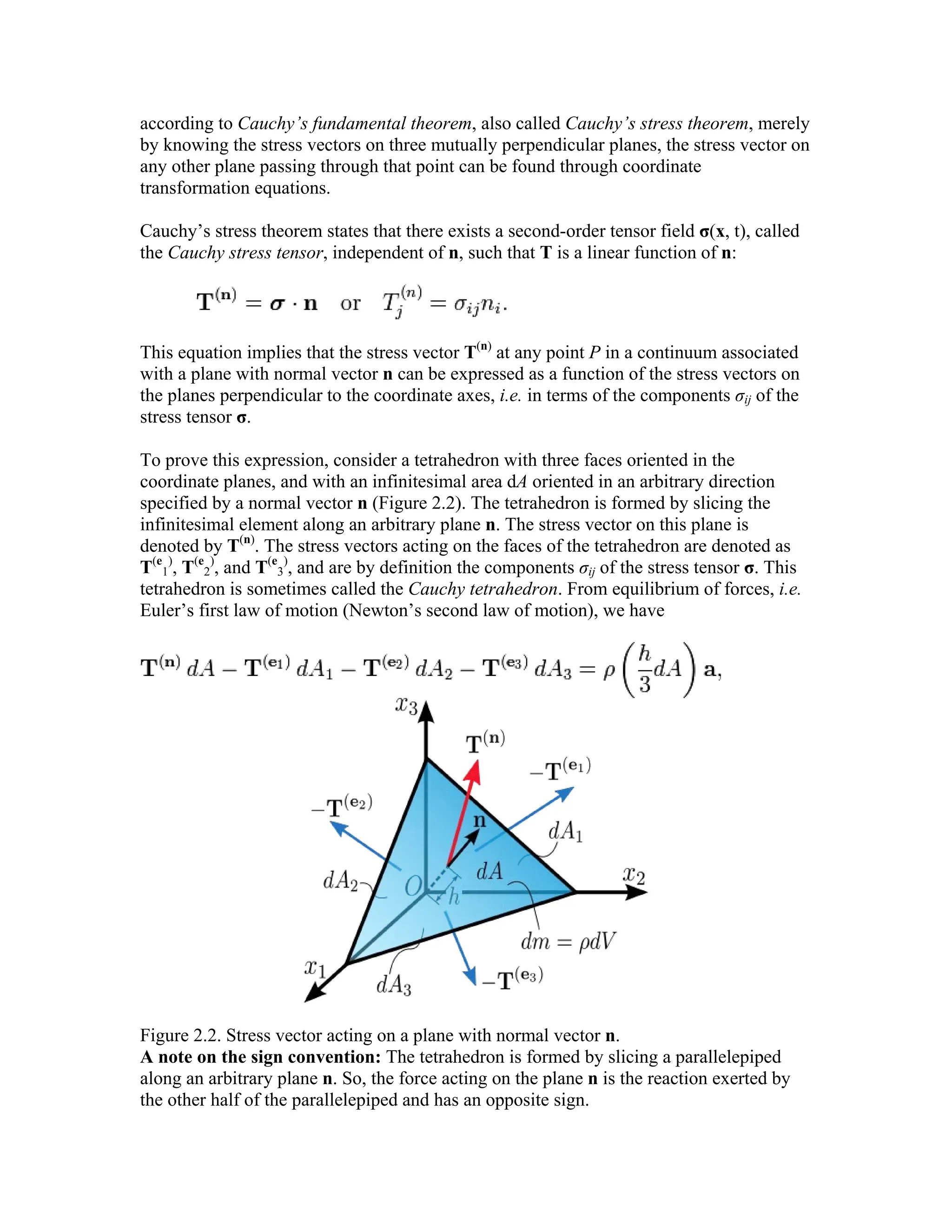
  • 9.
    Formulation of models Figure1. Configuration of a continuum body Continuum mechanics models begin by assigning a region in three dimensional Euclidean space to the material body being modeled. The points within this region are called particles or material points. Different configurations or states of the body correspond to different regions in Euclidean space. The region corresponding to the body's configuration at time is labeled . A particular particle within the body in a particular configuration is characterized by a position vector ,
  • 10.
    where are thecoordinate vectors in some frame of reference chosen for the problem. This vector can be expressed as a function of the particle position in some reference configuration, for example the configuration at the initial time, so that . This function needs to have various properties so that the model makes physical sense. needs to be: • continuous in time, so that the body changes in a way which is realistic, • globally invertible at all times, so that the body cannot intersect itself, • orientation-preserving, as transformations which produce mirror reflections are not possible in nature. For the mathematical formulation of the model, is also assumed to be twice continuously differentiable, so that differential equations describing the motion may be formulated. Forces in a continuum Continuum mechanics deals with deformable bodies, as opposed to rigid bodies. A solid is a deformable body that possesses shear strength, sc. a solid can support shear forces (forces parallel to the material surface on which they act). Fluids, on the other hand, do not sustain shear forces. For the study of the mechanical behavior of solids and fluids these are assumed to be continuous bodies, which means that the matter fills the entire region of space it occupies, despite the fact that matter is made of atoms, has voids, and is discrete. Therefore, when continuum mechanics refers to a point or particle in a continuous body it does not describe a point in the interatomic space or an atomic particle, rather an idealized part of the body occupying that point. Following the classical dynamics of Newton and Euler, the motion of a material body is produced by the action of externally applied forces which are assumed to be of two kinds: surface forces and body forces . Thus, the total force applied to a body or to a portion of the body can be expressed as: Surface forces or contact forces, expressed as force per unit area, can act either on the bounding surface of the body, as a result of mechanical contact with other bodies, or on imaginary internal surfaces that bound portions of the body, as a result of the mechanical interaction between the parts of the body to either side of the surface (Euler-Cauchy's stress principle). When a body is acted upon by external contact forces, internal contact forces are then transmitted from point to point inside the body to balance their action, according to Newton's second law of motion of conservation of linear momentum and angular momentum (for continuous bodies these laws are called the Euler's equations of
  • 11.
    motion). The internalcontact forces are related to the body's deformation through constitutive equations. The internal contact forces may be mathematically described by how they relate to the motion of the body, independent of the body's material makeup. The distribution of internal contact forces throughout the volume of the body is assumed to be continuous. Therefore, there exists a contact force density or Cauchy traction field that represents this distribution in a particular configuration of the body at a given time . It is not a vector field because it depends not only on the position of a particular material point, but also on the local orientation of the surface element as defined by its normal vector . Any differential area with normal vector of a given internal surface area , bounding a portion of the body, experiences a contact force arising from the contact between both portions of the body on each side of , and it is given by where is the surface traction, also called stress vector, traction, or traction vector,. The stress vector is a frame-indifferent vector. The total contact force on the particular internal surface is then expressed as the sum (surface integral) of the contact forces on all differential surfaces : In continuum mechanics a body is considered stress-free if the only forces present are those inter-atomic forces (ionic, metallic, and van der Waals forces) required to hold the body together and to keep its shape in the absence of all external influences, including gravitational attraction. Stresses generated during manufacture of the body to a specific configuration are also excluded when considering stresses in a body. Therefore, the stresses considered in continuum mechanics are only those produced by deformation of the body, sc. only relative changes in stress are considered, not the absolute values of stress. Body forces are forces originating from sources outside of the body that act on the volume (or mass) of the body. Saying that body forces are due to outside sources implies that the interaction between different parts of the body (internal forces) are manifested through the contact forces alone. These forces arise from the presence of the body in force fields, e.g. gravitational field (gravitational forces) or electromagnetic field (electromagnetic forces), or from inertial forces when bodies are in motion. As the mass of a continuous body is assumed to be continuously distributed, any force originating from the mass is also continuously distributed. Thus, body forces are specified by vector fields which are assumed to be continuous over the entire volume of the body, i.e. acting
  • 12.
    on every pointin it. Body forces are represented by a body force density (per unit of mass), which is a frame-indifferent vector field. In the case of gravitational forces, the intensity of the force depends on, or is proportional to, the mass density of the material, and it is specified in terms of force per unit mass ( ) or per unit volume ( ). These two specifications are related through the material density by the equation . Similarly, the intensity of electromagnetic forces depends upon the strength (electric charge) of the electromagnetic field. The total body force applied to a continuous body is expressed as Body forces and contact forces acting on the body lead to corresponding moments of force (torques) relative to a given point. Thus, the total applied torque about the origin is given by In certain situations, not commonly considered in the analysis of the mechanical behavior or materials, it becomes necessary to include two other types of forces: these are body moments and couple stresses (surface couples, contact torques). Body moments, or body couples, are moments per unit volume or per unit mass applied to the volume of the body. Couple stresses are moments per unit area applied on a surface. Both are important in the analysis of stress for a polarized dielectric solid under the action of an electric field, materials where the molecular structure is taken into consideration (e.g. bones), solids under the action of an external magnetic field, and the dislocation theory of metals. Materials that exhibit body couples and couple stresses in addition to moments produced exclusively by forces are called polar materials. Non-polar materials are then those materials with only moments of forces. In the classical branches of continuum mechanics the development of the theory of stresses is based on non-polar materials. Thus, the sum of all applied forces and torques (with respect to the origin of the coordinate system) in the body can be given by
  • 13.
    Kinematics: deformation andmotion Figure 2. Motion of a continuum body. A change in the configuration of a continuum body results in a displacement. The displacement of a body has two components: a rigid-body displacement and a deformation. A rigid-body displacement consist of a simultaneous translation and rotation of the body without changing its shape or size. Deformation implies the change in shape and/or size of the body from an initial or undeformed configuration to a current or deformed configuration (Figure 2). The motion of a continuum body is a continuous time sequence of displacements. Thus, the material body will occupy different configurations at different times so that a particle occupies a series of points in space which describe a pathline. There is continuity during deformation or motion of a continuum body in the sense that: • The material points forming a closed curve at any instant will always form a closed curve at any subsequent time.
  • 14.
    • The materialpoints forming a closed surface at any instant will always form a closed surface at any subsequent time and the matter within the closed surface will always remain within. It is convenient to identify a reference configuration or initial condition which all subsequent configurations are referenced from. The reference configuration need not be one that the body will ever occupy. Often, the configuration at is considered the reference configuration , . The components of the position vector of a particle, taken with respect to the reference configuration, are called the material or reference coordinates. When analyzing the deformation or motion of solids, or the flow of fluids, it is necessary to describe the sequence or evolution of configurations throughout time. One description for motion is made in terms of the material or referential coordinates, called material description or Lagrangian description. Lagrangian description In the Lagrangian description the position and physical properties of the particles are described in terms of the material or referential coordinates and time. In this case the reference configuration is the configuration at . An observer standing in the referential frame of reference observes the changes in the position and physical properties as the material body moves in space as time progresses. The results obtained are independent of the choice of initial time and reference configuration, . This description is normally used in solid mechanics. In the Lagrangian description, the motion of a continuum body is expressed by the mapping function (Figure 2), which is a mapping of the initial configuration onto the current configuration , giving a geometrical correspondence between them, i.e. giving the position vector that a particle , with a position vector in the undeformed or reference configuration , will occupy in the current or deformed configuration at time . The components are called the spatial coordinates. Physical and kinematic properties , i.e. thermodynamic properties and velocity, which describe or characterize features of the material body, are expressed as continuous functions of position and time, i.e. . The material derivative of any property of a continuum, which may be a scalar, vector, or tensor, is the time rate of change of that property for a specific group of
  • 15.
    particles of themoving continuum body. The material derivative is also known as the substantial derivative, or comoving derivative, or convective derivative. It can be thought as the rate at which the property changes when measured by an observer traveling with that group of particles. In the Lagrangian description, the material derivative of is simply the partial derivative with respect to time, and the position vector is held constant as it does not change with time. Thus, we have The instantaneous position is a property of a particle, and its material derivative is the instantaneous velocity of the particle. Therefore, the velocity field of the continuum is given by Similarly, the acceleration field is given by Continuity in the Lagrangian description is expressed by the spatial and temporal continuity of the mapping from the reference configuration to the current configuration of the material points. All physical quantities characterizing the continuum are described this way. In this sense, the function and are single-valued and continuous, with continuous derivatives with respect to space and time to whatever order is required, usually to the second or third. Eulerian description Continuity allows for the inverse of to trace backwards where the particle currently located at was located in the initial or referenced configuration . In this case the description of motion is made in terms of the spatial coordinates, in which case is called the spatial description or Eulerian description, i.e. the current configuration is taken as the reference configuration. The Eulerian description, introduced by d'Alembert, focuses on the current configuration , giving attention to what is occurring at a fixed point in space as time progresses, instead of giving attention to individual particles as they move through space and time. This approach is conveniently applied in the study of fluid flow where the kinematic
  • 16.
    property of greatestinterest is the rate at which change is taking place rather than the shape of the body of fluid at a reference time. Mathematically, the motion of a continuum using the Eulerian description is expressed by the mapping function which provides a tracing of the particle which now occupies the position in the current configuration to its original position in the initial configuration . A necessary and sufficient condition for this inverse function to exist is that the determinant of the Jacobian Matrix, often referred to simply as the Jacobian, should be different from zero. Thus, In the Eulerian description, the physical properties are expressed as where the functional form of in the Lagrangian description is not the same as the form of in the Eulerian description. The material derivative of , using the chain rule, is then The first term on the right-hand side of this equation gives the local rate of change of the property occurring at position . The second term of the right-hand side is the convective rate of change and expresses the contribution of the particle changing position in space (motion). Continuity in the Eulerian description is expressed by the spatial and temporal continuity and continuous differentiability of the velocity field. All physical quantities are defined this way at each instant of time, in the current configuration, as a function of the vector position .
  • 17.
    Displacement field The vectorjoining the positions of a particle in the undeformed configuration and deformed configuration is called the displacement vector , in the Lagrangian description, or , in the Eulerian description. A displacement field is a vector field of all displacement vectors for all particles in the body, which relates the deformed configuration with the undeformed configuration. It is convenient to do the analysis of deformation or motion of a continuum body in terms of the displacement field, In general, the displacement field is expressed in terms of the material coordinates as or in terms of the spatial coordinates as where are the direction cosines between the material and spatial coordinate systems with unit vectors and , respectively. Thus and the relationship between and is then given by Knowing that then It is common to superimpose the coordinate systems for the undeformed and deformed configurations, which results in , and the direction cosines become Kronecker deltas, i.e. Thus, we have
  • 18.
    or in termsof the spatial coordinates as Governing equations Continuum mechanics deals with the behavior of materials that can be approximated as continuous for certain length and time scales. The equations that govern the mechanics of such materials include the balance laws for mass, momentum, and energy. Kinematic relations and constitutive equations are needed to complete the system of governing equations. Physical restrictions on the form of the constitutive relations can be applied by requiring that the second law of thermodynamics be satisfied under all conditions. In the continuum mechanics of solids, the second law of thermodynamics is satisfied if the Clausius–Duhem form of the entropy inequality is satisfied. The balance laws express the idea that the rate of change of a quantity (mass, momentum, energy) in a volume must arise from three causes: 1. the physical quantity itself flows through the surface that bounds the volume, 2. there is a source of the physical quantity on the surface of the volume, or/and, 3. there is a source of the physical quantity inside the volume. Let Ω be the body (an open subset of Euclidean space) and let be its surface (the boundary of Ω). Let the motion of material points in the body be described by the map where is the position of a point in the initial configuration and is the location of the same point in the deformed configuration. The deformation gradient is given by Balance laws Let be a physical quantity that is flowing through the body. Let be sources on the surface of the body and let be sources inside the body. Let be the outward unit normal to the surface . Let be the velocity of the
  • 19.
    physical particles thatcarry the physical quantity that is flowing. Also, let the speed at which the bounding surface is moving be un (in the direction ). Then, balance laws can be expressed in the general form Note that the functions , , and can be scalar valued, vector valued, or tensor valued - depending on the physical quantity that the balance equation deals with. If there are internal boundaries in the body, jump discontinuities also need to be specified in the balance laws. If we take the Lagrangian point of view, it can be shown that the balance laws of mass, momentum, and energy for a solid can be written as In the above equations is the mass density (current), is the material time derivative of ρ, is the particle velocity, is the material time derivative of , is the Cauchy stress tensor, is the body force density, is the internal energy per unit mass, is the material time derivative of e, is the heat flux vector, and is an energy source per unit mass. With respect to the reference configuration, the balance laws can be written as In the above, is the first Piola-Kirchhoff stress tensor, and ρ0 is the mass density in the reference configuration. The first Piola-Kirchhoff stress tensor is related to the Cauchy stress tensor by We can alternatively define the nominal stress tensor which is the transpose of the first Piola-Kirchhoff stress tensor such that
  • 20.
    Then the balancelaws become The operators in the above equations are defined as such that where is a vector field, is a second-order tensor field, and are the components of an orthonormal basis in the current configuration. Also, where is a vector field, is a second-order tensor field, and are the components of an orthonormal basis in the reference configuration. The inner product is defined as The Clausius–Duhem inequality The Clausius–Duhem inequality can be used to express the second law of thermodynamics for elastic-plastic materials. This inequality is a statement concerning the irreversibility of natural processes, especially when energy dissipation is involved. Just like in the balance laws in the previous section, we assume that there is a flux of a quantity, a source of the quantity, and an internal density of the quantity per unit mass. The quantity of interest in this case is the entropy. Thus, we assume that there is an entropy flux, an entropy source, and an internal entropy density per unit mass (η) in the region of interest. Let Ω be such a region and let be its boundary. Then the second law of thermodynamics states that the rate of increase of η in this region is greater than or equal
  • 21.
    to the sumof that supplied to Ω (as a flux or from internal sources) and the change of the internal entropy density due to material flowing in and out of the region. Let move with a velocity un and let particles inside Ω have velocities . Let be the unit outward normal to the surface . Let ρ be the density of matter in the region, be the entropy flux at the surface, and r be the entropy source per unit mass. Then the entropy inequality may be written as The scalar entropy flux can be related to the vector flux at the surface by the relation . Under the assumption of incrementally isothermal conditions, we have where is the heat flux vector, s is a energy source per unit mass, and T is the absolute temperature of a material point at at time t. We then have the Clausius–Duhem inequality in integral form: We can show that the entropy inequality may be written in differential form as In terms of the Cauchy stress and the internal energy, the Clausius–Duhem inequality may be written as
  • 22.
    Chapter 2 Fluid Mechanics Fluidmechanics is the study of fluids and the forces on them. (Fluids include liquids, gases, and plasmas.) Fluid mechanics can be divided into fluid kinematics, the study of fluid motion, and fluid dynamics, the study of the effect of forces on fluid motion, which can further be divided into fluid statics, the study of fluids at rest, and fluid kinetics, the study of fluids in motion. It is a branch of continuum mechanics, a subject which models matter without using the information that it is made out of atoms, that is, it models matter from a macroscopic viewpoint rather than from a microscopic viewpoint. Fluid mechanics, especially fluid dynamics, is an active field of research with many unsolved or partly solved problems. Fluid mechanics can be mathematically complex. Sometimes it can best be solved by numerical methods, typically using computers. A modern discipline, called computational fluid dynamics (CFD), is devoted to this approach to solving fluid mechanics problems. Also taking advantage of the highly visual nature of fluid flow is particle image velocimetry, an experimental method for visualizing and analyzing fluid flow. Brief history The study of fluid mechanics goes back at least to the days of ancient Greece, when Archimedes investigated fluid statics and buoyancy and formulated his famous law known now as the Archimedes Principle. Rapid advancement in fluid mechanics began with Leonardo da Vinci (observation and experiment), Evangelista Torricelli (barometer), Isaac Newton (viscosity) and Blaise Pascal (hydrostatics), and was continued by Daniel Bernoulli with the introduction of mathematical fluid dynamics in Hydrodynamica (1738). Inviscid flow was further analyzed by various mathematicians (Leonhard Euler, d'Alembert, Lagrange, Laplace, Poisson) and viscous flow was explored by a multitude of engineers including Poiseuille and Gotthilf Heinrich Ludwig Hagen. Further mathematical justification was provided by Claude-Louis Navier and George Gabriel Stokes in the Navier–Stokes equations, and boundary layers were investigated (Ludwig Prandtl), while various scientists (Osborne Reynolds, Andrey Kolmogorov, Geoffrey Ingram Taylor) advanced the understanding of fluid viscosity and turbulence.
  • 23.
    Relationship to continuummechanics Fluid mechanics is a subdiscipline of continuum mechanics, as illustrated in the following table. Continuum mechanics The study of the physics of continuous materials Solid mechanics The study of the physics of continuous materials with a defined rest shape. Elasticity Describes materials that return to their rest shape after an applied stress. Plasticity Describes materials that permanently deform after a sufficient applied stress. Rheology The study of materials with both solid and fluid characteristics. Fluid mechanics The study of the physics of continuous materials which take the shape of their container. Non-Newtonian fluids Newtonian fluids In a mechanical view, a fluid is a substance that does not support shear stress; that is why a fluid at rest has the shape of its containing vessel. A fluid at rest has no shear stress. Assumptions Like any mathematical model of the real world, fluid mechanics makes some basic assumptions about the materials being studied. These assumptions are turned into equations that must be satisfied if the assumptions are to be held true. For example, consider an incompressible fluid in three dimensions. The assumption that mass is conserved means that for any fixed closed surface (such as a sphere) the rate of mass passing from outside to inside the surface must be the same as rate of mass passing the other way. (Alternatively, the mass inside remains constant, as does the mass outside). This can be turned into an integral equation over the surface. Fluid mechanics assumes that every fluid obeys the following: • Conservation of mass • Conservation of energy • Conservation of momentum • The continuum hypothesis, detailed below. Further, it is often useful (at subsonic conditions) to assume a fluid is incompressible – that is, the density of the fluid does not change. Liquids can often be modelled as incompressible fluids, whereas gases cannot. Similarly, it can sometimes be assumed that the viscosity of the fluid is zero (the fluid is inviscid). Gases can often be assumed to be inviscid. If a fluid is viscous, and its flow
  • 24.
    contained in someway (e.g. in a pipe), then the flow at the boundary must have zero velocity. For a viscous fluid, if the boundary is not porous, the shear forces between the fluid and the boundary results also in a zero velocity for the fluid at the boundary. This is called the no-slip condition. For a porous media otherwise, in the frontier of the containing vessel, the slip condition is not zero velocity, and the fluid has a discontinuous velocity field between the free fluid and the fluid in the porous media (this is related to the Beavers and Joseph condition). The continuum hypothesis Fluids are composed of molecules that collide with one another and solid objects. The continuum assumption, however, considers fluids to be continuous. That is, properties such as density, pressure, temperature, and velocity are taken to be well-defined at "infinitely" small points, defining a REV (Reference Element of Volume), at the geometric order of the distance between two adjacent molecules of fluid. Properties are assumed to vary continuously from one point to another, and are averaged values in the REV. The fact that the fluid is made up of discrete molecules is ignored. The continuum hypothesis is basically an approximation, in the same way planets are approximated by point particles when dealing with celestial mechanics, and therefore results in approximate solutions. Consequently, assumption of the continuum hypothesis can lead to results which are not of desired accuracy. That said, under the right circumstances, the continuum hypothesis produces extremely accurate results. Those problems for which the continuum hypothesis does not allow solutions of desired accuracy are solved using statistical mechanics. To determine whether or not to use conventional fluid dynamics or statistical mechanics, the Knudsen number is evaluated for the problem. The Knudsen number is defined as the ratio of the molecular mean free path length to a certain representative physical length scale. This length scale could be, for example, the radius of a body in a fluid. (More simply, the Knudsen number is how many times its own diameter a particle will travel on average before hitting another particle). Problems with Knudsen numbers at or above unity are best evaluated using statistical mechanics for reliable solutions. Navier–Stokes equations The Navier–Stokes equations (named after Claude-Louis Navier and George Gabriel Stokes) are the set of equations that describe the motion of fluid substances such as liquids and gases. These equations state that changes in momentum (force) of fluid particles depend only on the external pressure and internal viscous forces (similar to friction) acting on the fluid. Thus, the Navier–Stokes equations describe the balance of forces acting at any given region of the fluid. The Navier–Stokes equations are differential equations which describe the motion of a fluid. Such equations establish relations among the rates of change of the variables of interest. For example, the Navier–Stokes equations for an ideal fluid with zero viscosity
  • 25.
    states that acceleration(the rate of change of velocity) is proportional to the derivative of internal pressure. This means that solutions of the Navier–Stokes equations for a given physical problem must be sought with the help of calculus. In practical terms only the simplest cases can be solved exactly in this way. These cases generally involve non-turbulent, steady flow (flow does not change with time) in which the Reynolds number is small. For more complex situations, such as global weather systems like El Niño or lift in a wing, solutions of the Navier–Stokes equations can currently only be found with the help of computers. This is a field of sciences by its own called computational fluid dynamics. General form of the equation The general form of the Navier–Stokes equations for the conservation of momentum is: where • is the fluid density, • is the substantive derivative (also called the material derivative), • is the velocity vector, • is the body force vector, and • is a tensor that represents the surface forces applied on a fluid particle (the stress tensor). Unless the fluid is made up of spinning degrees of freedom like vortices, is a symmetric tensor. In general, (in three dimensions) has the form: where • are normal stresses, • are tangential stresses (shear stresses). The above is actually a set of three equations, one per dimension. By themselves, these aren't sufficient to produce a solution. However, adding conservation of mass and appropriate boundary conditions to the system of equations produces a solvable set of equations.
  • 26.
    Newtonian versus non-Newtonianfluids A Newtonian fluid (named after Isaac Newton) is defined to be a fluid whose shear stress is linearly proportional to the velocity gradient in the direction perpendicular to the plane of shear. This definition means regardless of the forces acting on a fluid, it continues to flow. For example, water is a Newtonian fluid, because it continues to display fluid properties no matter how much it is stirred or mixed. A slightly less rigorous definition is that the drag of a small object being moved slowly through the fluid is proportional to the force applied to the object. (Compare friction). Important fluids, like water as well as most gases, behave — to good approximation — as a Newtonian fluid under normal conditions on Earth. By contrast, stirring a non-Newtonian fluid can leave a "hole" behind. This will gradually fill up over time – this behaviour is seen in materials such as pudding, oobleck, or sand (although sand isn't strictly a fluid). Alternatively, stirring a non-Newtonian fluid can cause the viscosity to decrease, so the fluid appears "thinner" (this is seen in non-drip paints). There are many types of non-Newtonian fluids, as they are defined to be something that fails to obey a particular property — for example, most fluids with long molecular chains can react in a non-Newtonian manner. Equations for a Newtonian fluid The constant of proportionality between the shear stress and the velocity gradient is known as the viscosity. A simple equation to describe Newtonian fluid behaviour is where τ is the shear stress exerted by the fluid ("drag") μ is the fluid viscosity – a constant of proportionality is the velocity gradient perpendicular to the direction of shear. For a Newtonian fluid, the viscosity, by definition, depends only on temperature and pressure, not on the forces acting upon it. If the fluid is incompressible and viscosity is constant across the fluid, the equation governing the shear stress (in Cartesian coordinates) is where
  • 27.
    τij is theshear stress on the ith face of a fluid element in the jth direction vi is the velocity in the ith direction xj is the jth direction coordinate. If a fluid does not obey this relation, it is termed a non-Newtonian fluid, of which there are several types. Among fluids, two rough broad divisions can be made: ideal and non-ideal fluids. An ideal fluid really does not exist, but in some calculations, the assumption is justifiable. An Ideal fluid is non viscous- offers no resistance whatsoever to a shearing force. One can group real fluids into Newtonian and non-Newtonian. Newtonian fluids agree with Newton's law of viscosity. Non-Newtonian fluids can be either plastic, bingham plastic, pseudoplastic, dilatant, thixotropic, rheopectic, viscoelatic.
  • 28.
    Chapter 3 Stress (Mechanics) Figure1.1 Stress in a loaded deformable material body assumed as a continuum.
  • 29.
    Figure 1.2 Axialstress in a prismatic bar axially loaded
  • 30.
    Figure 1.3 Normalstress in a prismatic (straight member of uniform cross-sectional area) bar. The stress or force distribution in the cross section of the bar is not necessarily uniform. However, an average normal stress can be used Figure 1.4 Shear stress in a prismatic bar. The stress or force distribution in the cross section of the bar is not necessarily uniform. Nevertheless, an average shear stress is a reasonable approximation.
  • 31.
    In continuum mechanics,stress is a measure of the internal forces acting within a deformable body. Quantitatively, it is a measure of the average force per unit area of a surface within the body on which internal forces act. These internal forces are produced between the particles in the body as a reaction to external forces applied on the body. Because the loaded deformable body is assumed to behave as a continuum, these internal forces are distributed continuously within the volume of the material body, and result in deformation of the body's shape. Beyond certain limits of material strength, this can lead to a permanent change of shape or physical failure. However, treating physical force as a "one dimensional entity", as it is often done in mechanics, creates a few problems. Any model of continuum mechanics which explicitly expresses force as a variable generally fails to merge and describe deformation of matter and solid bodies, because the attributes of matter and solids are three dimensional. Classical models of continuum mechanics assume an average force and fail to properly incorporate "geometrical factors", which are important to describe stress distribution and accumulation of energy during the continuum. The dimension of stress is that of pressure, and therefore the SI unit for stress is the pascal (symbol Pa), which is equivalent to one newton (force) per square meter (unit area), that is N/m2 . In Imperial units, stress is measured in pound-force per square inch, which is abbreviated as psi. Introduction Stress is a measure of the average force per unit area of a surface within a deformable body on which internal forces act. It is a measure of the intensity of the internal forces acting between particles of a deformable body across imaginary internal surfaces. These internal forces are produced between the particles in the body as a reaction to external forces applied on the body. External forces are either surface forces or body forces. Because the loaded deformable body is assumed to behave as a continuum, these internal forces are distributed continuously within the volume of the material body, i.e. the stress distribution in the body is expressed as a piecewise continuous function of space coordinates and time. Normal , shear stresses and virial stresses For the simple case of a body axially loaded, e.g., a prismatic bar subjected to tension or compression by a force passing through its centroid (Figures 1.2 and 1.3) the stress , or intensity of internal forces, can be obtained by dividing the total normal force , determined from the equilibrium of forces, by the cross-sectional area of the prism it is acting upon. The normal force can be a tensile force if acting outward from the plane, or compressive force if acting inward to the plane. In the case of a prismatic bar axially loaded, the stress is represented by a scalar called engineering stress or nominal stress that represents an average stress ( ) over the area, meaning that the stress in the cross section is uniformly distributed. Thus, we have
  • 32.
    A different typeof stress is obtained when transverse forces are applied to the prismatic bar as shown in Figure 1.4. Considering the same cross-section as before, from static equilibrium the internal force has a magnitude equal to and in opposite direction parallel to the cross-section. is called the shear force. Dividing the shear force by the area of the cross section we obtain the shear stress. In this case the shear stress is a scalar quantity representing an average shear stress ( ) in the section, i.e. the stress in the cross-section is uniformly distributed. In materials science and in engineering aspects the average of the ""scalar"" shear force ( ) are true for crystallized materials during brittle fracture and operates through the fractured cross-section or stress plane. In Figure 1.3, the normal stress is observed in two planes and of the axially loaded prismatic bar. The stress on plane , which is closer to the point of application of the load , varies more across the cross-section than that of plane . However, if the cross-sectional area of the bar is very small, i.e. the bar is slender, the variation of stress across the area is small and the normal stress can be approximated by . On the other hand, the variation of shear stress across the section of a prismatic bar cannot be assumed to be uniform. Virial stress is a measure of stress on an atomic scale. It is given by where • k and are atoms in the domain, • Ω is the volume of the domain, • m(k) is the mass of atom k, • is the ith component of the velocity of atom k, • is the jth component of the average velocity of atoms in the volume, • is the ith component of the position of atom k, and • is the ith component of the force between atom k and . At zero kelvin, all velocities are zero so we have
  • 33.
    . This can bethought of as follows. The τ11 component of stress is the force in the 1 direction divided by the area of a plane perpendicular to that direction. Consider two adjacent volumes separated by such a plane. The 11-component of stress on that interface is the sum of all pairwise forces between atoms on the two sides.... Stress modeling (Cauchy) In general, stress is not uniformly distributed over the cross-section of a material body, and consequently the stress at a point in a given region is different from the average stress over the entire area. Therefore, it is necessary to define the stress not over a given area but at a specific point in the body (Figure 1.1). According to Cauchy, the stress at any point in an object, assumed to behave as a continuum, is completely defined by the nine components of a second-order tensor of type (0,2) known as the Cauchy stress tensor, : The Cauchy stress tensor obeys the tensor transformation law under a change in the system of coordinates. A graphical representation of this transformation law is the Mohr's circle of stress distribution. The Cauchy stress tensor is used for stress analysis of material bodies experiencing small deformations where the differences in stress distribution in most cases can be neglected. For large deformations, also called finite deformations, other measures of stress, such as the first and second Piola-Kirchhoff stress tensors, the Biot stress tensor, and the Kirchhoff stress tensor, are required. According to the principle of conservation of linear momentum, if a continuous body is in static equilibrium it can be demonstrated that the components of the Cauchy stress tensor in every material point in the body satisfy the equilibrium equations (Cauchy’s equations of motion for zero acceleration). At the same time, according to the principle of conservation of angular momentum, equilibrium requires that the summation of moments with respect to an arbitrary point is zero, which leads to the conclusion that the stress tensor is symmetric, thus having only six independent stress components instead of the original nine. There are certain invariants associated with the stress tensor, whose values do not depend upon the coordinate system chosen or the area element upon which the stress tensor operates. These are the three eigenvalues of the stress tensor, which are called the
  • 34.
    principal stresses. Solids,liquids, and gases have stress fields. Static fluids support normal stress but will flow under shear stress. Moving viscous fluids can support shear stress (dynamic pressure). Solids can support both shear and normal stress, with ductile materials failing under shear and brittle materials failing under normal stress. All materials have temperature dependent variations in stress-related properties, and non- Newtonian materials have rate-dependent variations. Stress analysis Stress analysis means the determination of the internal distribution of stresses in a structure. It is needed in engineering for the study and design of structures such as tunnels, dams, mechanical parts, and structural frames, under prescribed or expected loads. To determine the distribution of stress in a structure, the engineer needs to solve a boundary-value problem by specifying the boundary conditions. These are displacements and forces on the boundary of the structure. Constitutive equations, such as Hooke’s Law for linear elastic materials, describe the stress-strain relationship in these calculations. When a structure is expected to deform elastically (and resume its original shape), a boundary-value problem based on the theory of elasticity is applied, with infinitesimal strains, under design loads. When the applied loads permanently deform the structure, the theory of plasticity is used. The stress analysis can be simplified when the physical dimensions and the distribution of loads allow the structure to be treated as one-dimensional or two-dimensional. For a two-dimensional analysis a plane stress or a plane strain condition can be assumed. Alternatively, experimental determination of stresses can be carried out. Approximate computer-based solutions for boundary-value problems can be obtained through numerical methods such as the Finite Element Method, the Finite Difference Method, and the Boundary Element Method. Analytical or closed-form solutions can be obtained for simple geometries, constitutive relations, and boundary conditions. Theoretical background Continuum mechanics deals with deformable bodies, as opposed to rigid bodies. The stresses considered in continuum mechanics are only those produced by deformation of the body, sc. only relative changes in stress are considered, not the absolute values. A body is considered stress-free if the only forces present are those inter-atomic forces (ionic, metallic, and van der Waals forces) required to hold the body together and to keep its shape in the absence of all external influences, including gravitational attraction. Stresses generated during manufacture of the body to a specific configuration are also excluded.
  • 35.
    Following the classicaldynamics of Newton and Euler, the motion of a material body is produced by the action of externally applied forces which are assumed to be of two kinds: surface forces and body forces. Surface forces, or contact forces, can act either on the bounding surface of the body, as a result of mechanical contact with other bodies, or on imaginary internal surfaces that bound portions of the body, as a result of the mechanical interaction between the parts of the body to either side of the surface (Euler-Cauchy's stress principle). When a body is acted upon by external contact forces, internal contact forces are then transmitted from point to point inside the body to balance their action, according to Newton's second law of motion of conservation of linear momentum and angular momentum (for continuous bodies these laws are called the Euler's equations of motion). The internal contact forces are related to the body's deformation through constitutive equations. The concept of stress can then be thought as a measure of the intensity of the internal contact forces acting between particles of the body across imaginary internal surfaces. In other words, stress is a measure of the average quantity of force exerted per unit area of the surface on which these internal forces act. The intensity of contact forces is related, specifically in an inverse proportion, to the area of contact. For example, if a force applied to a small area is compared to a distributed load of the same resultant magnitude applied to a larger area, one finds that the effects or intensities of these two forces are locally different because the stresses are not the same. Body forces are forces originating from sources outside of the body that act on the volume (or mass) of the body. Saying that body forces are due to outside sources implies that the internal forces are manifested through the contact forces alone. These forces arise from the presence of the body in force fields, (e.g., a gravitational field). As the mass of a continuous body is assumed to be continuously distributed, any force originating from the mass is also continuously distributed. Thus, body forces are assumed to be continuous over the entire volume of the body. The density of internal forces at every point in a deformable body are not necessarily equal, i.e. there is a distribution of stresses throughout the body. This variation of internal forces throughout the body is governed by Newton's second law of motion of conservation of linear momentum and angular momentum, which normally are applied to a mass particle but are extended in continuum mechanics to a body of continuously distributed mass. For continuous bodies these laws are called Euler’s equations of motion. If a body is represented as an assemblage of discrete particles, each governed by Newton’s laws of motion, then Euler’s equations can be derived from Newton’s laws. Euler’s equations can, however, be taken as axioms describing the laws of motion for extended bodies, independently of any particle structure.
  • 36.
    Euler–Cauchy stress principle Figure2.1a Internal distribution of contact forces and couple stresses on a differential of the internal surface in a continuum, as a result of the interaction between the two portions of the continuum separated by the surface Figure 2.1b Internal distribution of contact forces and couple stresses on a differential of the internal surface in a continuum, as a result of the interaction between the two portions of the continuum separated by the surface
  • 37.
    Figure 2.1c Stressvector on an internal surface S with normal vector n. Depending on the orientation of the plane under consideration, the stress vector may not necessarily be perpendicular to that plane, i.e. parallel to , and can be resolved into two components: one component normal to the plane, called normal stress , and another component parallel to this plane, called the shearing stress . The Euler–Cauchy stress principle states that upon any surface (real or imaginary) that divides the body, the action of one part of the body on the other is equivalent (equipollent) to the system of distributed forces and couples on the surface dividing the body, and it is represented by a vector field T(n) , called the stress vector, defined on the surface S and assumed to depend continuously on the surface's unit vector n. To explain this principle, we consider an imaginary surface S passing through an internal material point P dividing the continuous body into two segments, as seen in Figure 2.1a or 2.1b (some authors use the cutting plane diagram and others use the diagram with the arbitrary volume inside the continuum enclosed by the surface S). The body is subjected to external surface forces F and body forces b. The internal contact forces being transmitted from one segment to the other through the dividing plane, due to the action of one portion of the continuum onto the other, generate a force distribution on a small area ΔS, with a normal unit vector n, on the dividing plane S. The force distribution is equipollent to a contact force ΔF and a couple stress ΔM, as shown in Figure 2.1a and 2.1b. Cauchy’s stress principle asserts that as ΔS becomes very small and tends to zero the ratio ΔF/ΔS becomes dF/dS and the couple stress vector ΔM vanishes. In specific fields of continuum mechanics the couple stress is assumed not to vanish; however, as stated previously, in classical branches of continuum mechanics we deal with non-polar materials which do not consider couple stresses and body moments. The resultant vector dF/dS is defined as the stress vector or traction vector given by T(n) = Ti (n) ei at the point P associated with a plane with a normal vector n:
  • 38.
    This equation meansthat the stress vector depends on its location in the body and the orientation of the plane on which it is acting. Depending on the orientation of the plane under consideration, the stress vector may not necessarily be perpendicular to that plane, i.e. parallel to n, and can be resolved into two components: • one normal to the plane, called normal stress where dFn is the normal component of the force dF to the differential area dS • and the other parallel to this plane, called the shear stress where dFs is the tangential component of the force dF to the differential surface area dS. The shear stress can be further decomposed into two mutually perpendicular vectors. Cauchy’s postulate According to the Cauchy Postulate, the stress vector T(n) remains unchanged for all surfaces passing through the point P and having the same normal vector n at P, i.e. having a common tangent at P. This means that the stress vector is a function of the normal vector n only, and it is not influenced by the curvature of the internal surfaces. Cauchy’s fundamental lemma A consequence of Cauchy’s postulate is Cauchy’s Fundamental Lemma, also called the Cauchy reciprocal theorem, which states that the stress vectors acting on opposite sides of the same surface are equal in magnitude and opposite in direction. Cauchy’s fundamental lemma is equivalent to Newton's third law of motion of action and reaction, and it is expressed as Cauchy’s stress theorem – stress tensor The state of stress at a point in the body is then defined by all the stress vectors T(n) associated with all planes (infinite in number) that pass through that point. However,
  • 39.
    according to Cauchy’sfundamental theorem, also called Cauchy’s stress theorem, merely by knowing the stress vectors on three mutually perpendicular planes, the stress vector on any other plane passing through that point can be found through coordinate transformation equations. Cauchy’s stress theorem states that there exists a second-order tensor field σ(x, t), called the Cauchy stress tensor, independent of n, such that T is a linear function of n: This equation implies that the stress vector T(n) at any point P in a continuum associated with a plane with normal vector n can be expressed as a function of the stress vectors on the planes perpendicular to the coordinate axes, i.e. in terms of the components σij of the stress tensor σ. To prove this expression, consider a tetrahedron with three faces oriented in the coordinate planes, and with an infinitesimal area dA oriented in an arbitrary direction specified by a normal vector n (Figure 2.2). The tetrahedron is formed by slicing the infinitesimal element along an arbitrary plane n. The stress vector on this plane is denoted by T(n) . The stress vectors acting on the faces of the tetrahedron are denoted as T(e 1 ) , T(e 2 ) , and T(e 3 ) , and are by definition the components σij of the stress tensor σ. This tetrahedron is sometimes called the Cauchy tetrahedron. From equilibrium of forces, i.e. Euler’s first law of motion (Newton’s second law of motion), we have Figure 2.2. Stress vector acting on a plane with normal vector n. A note on the sign convention: The tetrahedron is formed by slicing a parallelepiped along an arbitrary plane n. So, the force acting on the plane n is the reaction exerted by the other half of the parallelepiped and has an opposite sign.
  • 40.
    where the right-hand-sideof the equation represents the product of the mass enclosed by the tetrahedron and its acceleration: ρ is the density, a is the acceleration, and h is the height of the tetrahedron, considering the plane n as the base. The area of the faces of the tetrahedron perpendicular to the axes can be found by projecting dA into each face (using the dot product): and then substituting into the equation to cancel out dA: To consider the limiting case as the tetrahedron shrinks to a point, h must go to 0 (intuitively, the plane n is translated along n toward O). As a result, the right-hand-side of the equation approaches 0, so Figure 2.3 Components of stress in three dimensions
  • 41.
    Assuming a materialelement (Figure 2.3) with planes perpendicular to the coordinate axes of a Cartesian coordinate system, the stress vectors associated with each of the element planes, i.e. T(e 1 ) , T(e 2 ) , and T(e 3 ) can be decomposed into a normal component and two shear components, i.e. components in the direction of the three coordinate axes. For the particular case of a surface with normal unit vector oriented in the direction of the x1- axis, the normal stress is denoted by σ11, and the two shear stresses are denoted as σ12 and σ13: In index notation this is The nine components σij of the stress vectors are the components of a second-order Cartesian tensor called the Cauchy stress tensor, which completely defines the state of stress at a point and is given by where σ11, σ22, and σ33 are normal stresses, and σ12, σ13, σ21, σ23, σ31, and σ32 are shear stresses. The first index i indicates that the stress acts on a plane normal to the xi-axis, and the second index j denotes the direction in which the stress acts. A stress component is positive if it acts in the positive direction of the coordinate axes, and if the plane where it acts has an outward normal vector pointing in the positive coordinate direction. Thus, using the components of the stress tensor or, equivalently,
  • 42.
    Alternatively, in matrixform we have The Voigt notation representation of the Cauchy stress tensor takes advantage of the symmetry of the stress tensor to express the stress as a six-dimensional vector of the form: The Voigt notation is used extensively in representing stress-strain relations in solid mechanics and for computational efficiency in numerical structural mechanics software. Transformation rule of the stress tensor It can be shown that the stress tensor is a contravariant second order tensor, which is a statement of how it transforms under a change of the coordinate system. From an xi- system to an xi'-system, the components σij in the initial system are transformed into the components σij' in the new system according to the tensor transformation rule (Figure 2.4): where A is a rotation matrix with components aij. In matrix form this is
  • 43.
    Figure 2.4 Transformationof the stress tensor Expanding the matrix operation, and simplifying some terms by taking advantage of the symmetry of the stress tensor, gives The Mohr circle for stress is a graphical representation of this transformation of stresses. Normal and shear stresses The magnitude of the normal stress component σn of any stress vector T(n) acting on an arbitrary plane with normal vector n at a given point, in terms of the components σij of the stress tensor σ, is the dot product of the stress vector and the normal vector:
  • 44.
    The magnitude ofthe shear stress component τn, acting in the plane spanned by the two vectors T(n) and n, can then be found using the Pythagorean theorem: where
  • 45.
    Equilibrium equations andsymmetry of the stress tensor Figure 4. Continuum body in equilibrium When a body is in equilibrium the components of the stress tensor in every point of the body satisfy the equilibrium equations, For example, for a hydrostatic fluid in equilibrium conditions, the stress tensor takes on the form:
  • 46.
    , where p isthe hydrostatic pressure, and is the kronecker delta. At the same time, equilibrium requires that the summation of moments with respect to an arbitrary point is zero, which leads to the conclusion that the stress tensor is symmetric, i.e. However, in the presence of couple-stresses, i.e. moments per unit volume, the stress tensor is non-symmetric. This also is the case when the Knudsen number is close to one, , or the continuum is a non-Newtonian fluid, which can lead to rotationally non-invariant fluids, such as polymers. Principal stresses and stress invariants At every point in a stressed body there are at least three planes, called principal planes, with normal vectors , called principal directions, where the corresponding stress vector is perpendicular to the plane, i.e., parallel or in the same direction as the normal vector , and where there are no normal shear stresses . The three stresses normal to these principal planes are called principal stresses. The components of the stress tensor depend on the orientation of the coordinate system at the point under consideration. However, the stress tensor itself is a physical quantity and as such, it is independent of the coordinate system chosen to represent it. There are certain invariants associated with every tensor which are also independent of the coordinate system. For example, a vector is a simple tensor of rank one. In three dimensions, it has three components. The value of these components will depend on the coordinate system chosen to represent the vector, but the length of the vector is a physical quantity (a scalar) and is independent of the coordinate system chosen to represent the vector. Similarly, every second rank tensor (such as the stress and the strain tensors) has three independent invariant quantities associated with it. One set of such invariants are the principal stresses of the stress tensor, which are just the eigenvalues of the stress tensor. Their direction vectors are the principal directions or eigenvectors. A stress vector parallel to the normal vector is given by: where is a constant of proportionality, and in this particular case corresponds to the magnitudes of the normal stress vectors or principal stresses. Knowing that and , we have
  • 47.
    This is ahomogeneous system, i.e. equal to zero, of three linear equations where are the unknowns. To obtain a nontrivial (non-zero) solution for , the determinant matrix of the coefficients must be equal to zero, i.e. the system is singular. Thus, Expanding the determinant leads to the characteristic equation where The characteristic equation has three real roots , i.e. not imaginary due to the symmetry of the stress tensor. The three roots , , and are the eigenvalues or principal stresses, and they are the roots of the Cayley–Hamilton theorem. The principal stresses are unique for a given stress tensor. Therefore, from the characteristic equation it is seen that the coefficients , and , called the first, second, and third stress invariants, respectively, have always the same value regardless of the orientation of the coordinate system chosen.
  • 48.
    For each eigenvalue,there is a non-trivial solution for in the equation . These solutions are the principal directions or eigenvectors defining the plane where the principal stresses act. The principal stresses and principal directions characterize the stress at a point and are independent of the orientation of the coordinate system. If we choose a coordinate system with axes oriented to the principal directions, then the normal stresses will be the principal stresses and the stress tensor is represented by a diagonal matrix: The principal stresses may be combined to form the stress invariants, , , and .The first and third invariant are the trace and determinant respectively, of the stress tensor. Thus, Because of its simplicity, working and thinking in the principal coordinate system is often very useful when considering the state of the elastic medium at a particular point. Principal stresses are often expressed in the following equation for evaluating stresses in the x and y directions or axial and bending stresses on a part. The principal normal stresses can then be used to calculate the Von Mises stress and ultimately the safety factor and margin of safety. Using just the part of the equation under the square root is equal to the maximum and minimum shear stress for plus and minus. This is shown as:
  • 49.
    Discovering Diverse ContentThrough Random Scribd Documents
  • 50.
    “I’ll say itis,” agreed Amy, a smile lighting up her quiet face. “When Henry spoke of it to me at first I thought it was too good to be true. I supposed he was joking.” “Told you what?” cried Mollie Billette, in an exasperated tone. “If you are not the most aggravating——” “Hold your horses, old dear,” drawled Grace Ford, quietly helping herself to another piece of candy. “Amy has the floor——” “The deck, you mean,” murmured Amy, then added hastily, as the girls threw impatient glances her way: “I’ll tell you just how it happened if you give me a chance. You see, Henry,” Henry was Amy’s older brother, “had a chance to take over an old shack near the upper end of Rainbow Lake in part payment for a debt. And now that he has the shack, he doesn’t know what to do with it.” The girls leaned toward Amy eagerly. “Then what?” asked Mollie. “Why,” said Amy, with a smile of quiet enjoyment, “I told him I thought we girls might help him out, for the summer, anyway. I thought it would be a great lark to camp out there during vacation.” “Amy, you are a wonder,” drawled Grace, but Mollie broke in impatiently. “Is he going to let us have it?” she demanded. “I should say so!” laughed Amy. “Said he would be glad to put it to some sort of use. He said it would make a mighty fine summer camp but that was about all it was good for.” “It will be ideal,” broke in the Little Captain, happily, as she brushed a wind-blown strand of hair from her eyes. “Why, at the
  • 51.
    upper end ofRainbow Lake we’ll be as much alone as if we were in an African forest.” “More so, I hope,” drawled Grace, adding with a little shudder: “For in an African forest they have wild animals for company while here——” “We sha’n’t see anything wilder than a chipmunk,” chuckled the Little Captain. “Suits me fine,” said Grace heartily. “Wolves and bears may be all right, but give me a chipmunk every time.” “My, isn’t she brave?” said Mollie, admiringly, and the other girls chuckled. “Tell us more about this little shack, Amy,” said Betty, after a while. “Is it very tiny, or is it big enough to contain us all without squeezing?” “Henry said it is of fair size,” replied Amy, wrinkling her forehead in an attempt to remember details. “There are two rooms in it and the rooms are furnished in a rough sort of way, with home-made furniture.” The Little Captain let go of the wheel long enough to clap her hands gleefully. “Great!” she cried. “This gets better every minute. Think of it. A house ready-made for us, and furnished, at that.” “Too much luxury,” drawled Grace. It was the first day of July and the Outdoor Girls, never completely happy unless they were engaged in some outdoor sport, had embarked in their pretty motor boat Gem for a sail down the Argono river. Although the motor boat was really Betty’s property, the
  • 52.
    Outdoor Girls ratherregarded it as their own. And indeed, when it is considered that none of the four ever used it without the other three, it was the same to them as though the ownership were actually theirs. As a matter of fact, what belonged to one of the Outdoor Girls automatically belonged to all of them. Those who have kept in touch with Betty and her chums will need no introduction to the Gem, but for the benefit of those who do not know these Outdoor Girls so well, we will give a brief description of it. For in this story the trim little motor boat plays rather an important part. First of all, the Gem had been given to Betty by an uncle of hers, a retired sea captain by the name of Amos Marlin. The old fellow had produced the best craft of its size that could be found anywhere. There was a large cockpit in the stern, and a tiny cooking galley. Also the little boat boasted a small trunk cabin and an unusually powerful and efficient motor. Altogether a snappy little craft, well meriting its name of Gem. And now, as the girls putt-putted briskly down the river, the thrill of summer filling them with a fresh eagerness for adventure, it is no wonder that Amy’s suggestion of a summer camp on the banks of Rainbow Lake was greeted with enthusiasm. So far, having made no plans for the summer months, they had about decided to spend a rather uneventful summer in Deepdale, the thriving and busy little town in which they had been brought up. It might have been supposed, since Deepdale was situated so pleasantly on the banks of the Argono—the latter emptying some miles below into pretty Rainbow Lake—and since the bustling population of the town itself numbered something like fifteen thousand, that the Outdoor Girls would have been content to spend a summer there.
  • 53.
    However, although theyagreed that Deepdale was “the finest place in the world,” change and adventure were what they really hankered after, and Deepdale was too familiar a spot to offer them either. But there was real adventure in the idea of camping out in the romantic little shack so recently acquired by Amy Blackford’s brother, and they welcomed it eagerly. “I suppose we ought to run down there and look the place over,” said Grace, cautiously. Grace was the only one of the four Outdoor Girls who really considered comfort where adventure was concerned, and this trait of hers no amount of ridicule or impatience on the part of the other girls could overcome. For Grace, who was tall and slim and graceful, was very fond of her ease. Once she was assured that an outing was to be “comfortable,” then she could start in to enjoy herself. So at this suggestion that they “run down there and look the place over” the girls exchanged a glance of martyrdom. “Why, of course,” said Mollie sarcastically, “Grace will have to be sure she has a real hair mattress to sleep on and clean sheets twice a week. Maybe we could manage to get an easy chair aboard the Gem—one like the kind Betty’s dad uses.” “A fine idea,” replied Grace, unabashed. “I never gave you credit for so much thoughtfulness, Mollie dear. Have a chocolate?” Mollie sniffed disdainfully. “Keep your old chocolates,” she said. “The next time you offer me one I’ve a good mind to throw the whole box overboard.” “Just try it,” said Grace, lazily. “You’d have to toss me over, too, you know.”
  • 54.
    “Shouldn’t mind inthe least,” said Mollie, at which the Little Captain laughed and Amy Blackford chuckled. “Talk about wild animals,” cried Betty, gayly. “We won’t need any with you and Grace about, Mollie dear. Two wildcats are enough.” “Did you hear what she called us?” asked Grace, feeling abused, but Mollie was looking the other way. “We’ve gone a pretty long way down the river,” she said. “Look, Betty, isn’t that the new lake steamer, the General Pershing?” Betty, who had been too absorbed in plans for the summer to notice particularly where she was going, followed the direction of Mollie’s pointing finger. Suddenly her breath caught in a gasp and a thrill of apprehension swept over her. The steamer was indeed the General Pershing, the great shining new boat which plied up and down the lake and the river, and it was coming toward them at what, to the Little Captain, seemed an appalling rate of speed. “Betty,” cried Mollie, leaning forward and catching Betty’s arm, “we’re right in the path of it! For goodness’ sake, sheer over.” “I can’t—very far!” said Betty, tight-lipped. “It’s shallow, near the shore and—the rocks——” Mollie took in the situation with a glance and a little groan of dismay escaped her. At this point the river was very narrow and the shore on either side bristled with cruel, jagged-looking rocks. A small boat like the Gem would be dashed to pieces upon them. Betty was right. It would be madness to encroach too far upon them. And yet on the other hand the steamer menaced them with destruction. Bearing down full upon them, it could not fail to meet them squarely in the middle of that narrow channel!
  • 55.
    Useless for Bettyto stop the motor. They had no time to turn, speeding back to the safety of the wider water. If Betty kept her head, holding the boat away from the oncoming steamer and at the same time far enough from the rocks— Amy and Grace, now fully alive to the peril of the situation, were leaning forward, their faces white, their breath coming in terrified gasps. The Little Captain, her hand resolutely on the wheel, a prayer for guidance in her heart, watched the oncoming rush of the big steamboat.
  • 57.
    CHAPTER II ALMOST ACOLLISION On, on came the big steamboat, looming larger as it bore down upon them! Nearer, nearer, while the wash from its approach reached the little motor boat in sickening undulations—a danger not thought of before! They would be swept on to the rocks! Closer, closer! It would strike them! It must! It was over them, gigantic, overwhelming! The girls nerved themselves for the shock that was to come. Grace closed her eyes— And then—the steamer had passed. Betty had swerved at just the right moment to escape collision. The Gem was acting like a drunken man, swirling and reeling in the heavy wash of the great steamer. They were heading straight toward the rocks, driven by the agitated waves. In another moment they would be dashed upon them— “Betty!” screamed Grace. “We’ll be killed! The rocks!” But the wail was drowned in the sudden roar of the motor. The Gem leaped forward, her nose swung around to meet the oncoming waves. Gallantly she plowed through the water which was lashed to a froth by the progress of the steamer, just grazing a jagged edge of rock, flinging spray over her bows, soaking the girls. Then she was free of the channel, speeding for the safety of the open water. Betty, looking back over her shoulder, saw that the decks of the General Pershing were black with people who had rushed to the rail to see the fate of the motor boat.
  • 58.
    The steamer hadslowed down and half turned around as though intending to come to the rescue, but, seeing that this was unnecessary, she straightened once more, continuing on her way. Betty’s hands trembled on the wheel. The reaction left her faint and sick. As though from a long distance she heard Mollie’s voice saying: “Well, if that wasn’t a narrow squeak, I never saw one!” “It was the Little Captain saved us,” said Amy. “She knew just what to do, as she always does.” And this indeed was the reason for Betty Nelson’s nickname of “Little Captain.” For this brown-haired, brown-eyed girl seemed always to know just what to do at a critical moment and, more than this, she always did it. She was just eighteen and the only daughter of a rich carpet manufacturer of Deepdale. It was hard to tell which Betty loved the more, her kindly, indulgent father or her lovely mother. Grace Ford, the second of the Outdoor Girls, was tall and slender, fond of her comfort and loving candy and sodas and sweets of all sorts. Her father was a distinguished lawyer and her mother was a fine looking woman who spent a good deal of her time in club activities. Grace also had a brother, Will Ford, of whom she was passionately fond. Then there was Mollie Billette, daughter of Mrs. Pauline Billette, a well-to-do, sprightly little widow with more than a dash of French blood in her veins. Perhaps her French ancestry explains Mollie’s quick temper. Mollie also had a little brother and sister, twins and seven years old. The latter were always in mischief, and although Mollie loved them dearly, she sometimes found it very hard to have patience with them.
  • 59.
    The last ofthe quartette of Outdoor Girls was Amy Blackford, whom the girls had first known as Amy Stonington. She was the ward of John and Sarah Stonington and at one time there had been considerable mystery regarding her real parentage. Later, when the mystery was solved, Amy found out that not only was her real name Blackford but that she was possessed of a splendid brother as well, Henry Blackford. Like Mollie, Amy was seventeen, but there the resemblance ended. She was as quiet as Mollie was hot-tempered, and there was something sweet and appealing about her that roused the protective instinct of the more vigorous girls. So much for the girls. Then, there were the four boys who almost invariably accompanied the girls on their adventures. There was, of course, Will Ford, Grace’s brother, who, as a soldier in the World War had distinguished himself by some clever secret service work. Will loved quiet Amy Blackford and Amy, in turn, made no secret of her feeling for him. There was Allen Washburn, the clever young lawyer who thought the Little Captain was about the nicest person in the world. Allen had enlisted at the call of the United States to arms. He was made a sergeant in the American Army and, although he had gone over a sergeant, he came back with a commission as lieutenant. No wonder the girls—and especially Betty—were proud of him! Frank Haley was another of the boys in the little group. A splendid young fellow, liked by all the girls, and liking them all, he had been introduced into “the crowd” because of his friendship for Will Ford. There was, too, Roy Anderson, jolly and full of fun, always ready for everything that came along. Perhaps Mollie expressed the general sentiment toward him when she said that they were fond of Roy chiefly because he always kept them amused. And how apt we are to love the person that amuses us!
  • 60.
    The girls hadearned their title of “Outdoor Girls” from the fact that they almost always managed to spend their vacations in the open. And because of this they had run into a great number of adventures. There was, for instance, their first tramping tour of the country, the incidents of which are told in the first volume of the series, entitled “The Outdoor Girls of Deepdale.” There had followed many other adventures, at Rainbow Lake, at Ocean View, in Florida, and, later, on an island called Pine Island where they had found many interesting things, including a real gypsy cave. During the war they had served in a Hostess House while the boys, together with countless others of our fine American lads, sailed off across the ocean to fight for liberty. Another summer they had spent at Wild Rose Lodge, a lovely spot hidden deep in the woods where they became interested in a poor old man who thought his two sons had been killed in the war. In the volume directly preceding this, entitled “The Outdoor Girls in the Saddle,” these girls had had one of their most interesting adventures. Mrs. Nelson, Betty’s mother, through the death of a relative, had become the owner of a ranch. The most important thing about this ranch—in the estimation of the girls, at least—was the fact that it was situated right in the midst of a great gold-mining district. How the girls with Mr. and Mrs. Nelson went to the ranch, spending a glorious few weeks in the saddle, and how gold was finally found on the ranch is told of in detail in that volume. And now we turn once more to the present with Betty Nelson, the Little Captain, saving her chums from the peril of collision with the great river steamer General Pershing.
  • 61.
    As for Betty,although the girls heaped her with their praises, she had never felt less like a heroine in her life. Scarcely knowing what she did, she turned the nose of the little boat back toward Deepdale. The thought was unpleasant that once more they would be forced to pass through that narrow channel, bounded on either side by the rocky shore. However, this time there was no General Pershing bearing relentlessly down upon them and they passed through the dangerous spot without further mishap. “Goodness, I’m glad that’s over!” said Grace, relaxing once more in her seat, her voice still tremulous. “We couldn’t possibly have met that old boat in a worse place,” said Mollie, glaring resentfully after the General Pershing, whose bulk was diminishing rapidly in the distance. “Well,” said Betty, trying to laugh and not making a very good job of it, “there’s no use blaming the steamer. We shouldn’t have been there, you know.” “Don’t you want me to take the wheel, Betty?” spoke up Amy, suddenly. “Come back here in my place and I’ll take the Gem the rest of the way.” But though she smiled at her, Betty denied firmly that there was any reason why she should give up the wheel. “I’m all right,” she said, adding, as she rounded the curve of an island, skirting the shore toward Deepdale: “Do you want to stay out any longer, or shall we call it a day and go up to my house? Mother said there was an apple pie in the refrigerator and some ginger ale on the ice.” “Oh, boy!” sighed Grace ecstatically. “Lead me to it.”
  • 62.
    “So say weall of us,” said Mollie, and Amy joined in the chorus. Strange how their terrifying experience of a few minutes before disappeared in the distance as they thought of apple pie! “And we can talk over our plans for camping, too,” said Amy, at which the girls realized that they had not thought of Henry Blackford’s shack in the woods for five whole minutes. This would never do. By the time they had reached the dock at Deepdale they had nearly forgotten their encounter with the General Pershing and so were genuinely surprised when they saw Allen hurrying toward them. At sight of the tall figure Betty’s heart missed a beat and her face felt suddenly hot. If only she might stop that miserable habit of blushing—especially when Allen was around!
  • 64.
    CHAPTER III ENTER THETWINS “Gee Christopher, but you girls gave me a scare!” exploded the young lawyer, as soon as he came within speaking range. His words included all the girls but his look was only for Betty. “What do you mean, gave you a scare?” asked Mollie, her black eyes dancing. “We haven’t seen you for almost a week.” “Maybe Betty has,” murmured Grace, with a wicked glance at the Little Captain. “No, I haven’t,” said the latter, looking up demurely. The furious color had subsided and she was just flushed enough to look unusually pretty. As for what Allen thought— “Look here,” he said, abruptly, his handsome young face very serious as he searched Betty’s expression, “did Babcock tell me the truth when he said the General Pershing almost ran you down?” On Betty’s face was a look of bewilderment. “How did you know?” she questioned. “It only just happened?” “Who’s Babcock?” asked Grace, with interest. “A lawyer I’ve met once or twice,” returned Allen, still with his worried eyes fixed on Betty. “We ran into each other a few minutes ago. Seems he just landed from the General Pershing and he was full of this incident. Said it was a miracle the boat wasn’t wrecked. The description he gave me of it sounded very much like the Gem.”
  • 65.
    “It was theGem,” said Mollie. “But he was wrong about a miracle saving us,” put in Amy, throwing an arm about the Little Captain. “It was Betty.” Allen was on the verge of saying that Betty was a miracle, anyhow, but, considering that there were a good many people about, thought better of it. However, his eyes spoke for him. “You must be more careful, Betty,” he said, taking the rope from her with which she was making the Gem fast to the dock. “You mustn’t take such chances when I’m not around.” He was close to her and speaking in a low tone. Amy and Mollie and Grace had considerately turned away and were walking slowly in the direction of Betty’s house. Having fastened the little boat securely, Betty and Allen turned to follow them. “Please promise you’ll be more careful when I’m not with you,” Allen persisted, and Betty glanced up at him with a hint of laughter in her eyes. But the laughter hid a little hurt, for Betty was feeling a bit neglected. Mollie was right when she said they had not seen nor heard from Allen for several days. Of course he had been busy—he always was—but just the same— So said Betty: “If I took chances only when you were around, I wouldn’t take very many, would I?” She tried to speak lightly but she did not quite succeed, not as far as Allen was concerned. Looking down at her suddenly serious little face he wished that they might be alone for just five minutes so that he might explain. And he was in such a rush! “That isn’t fair,” he said, gravely. “You know I wouldn’t have stayed away if I hadn’t had to. Look here, Betty—dear,” they had come to a
  • 66.
    corner and hehad stopped, facing her. He had an appointment at three-thirty and here it was three-twenty-five this minute. “I can’t stay now, I’ve got to rush. Can I see you to-night?” What perverse imp in Betty made her answer lightly: “I have an engagement to-night, Allen.” All at once the young lawyer looked savage. Confound that engagement! “Betty,” he said, desperately, “I’m coming to-night anyway, and if you won’t see me I’ll camp on your doorstep till you do.” With this threat he turned and hurried down the street, his back as stiff as a ramrod, the heavy frown still on his brow. Why, he thought, gloomily, did Betty always have to look most adorable just when she was going to be most aggravating? How was he going to keep his mind on business, anyway, when all he could think of was Betty’s face? Meanwhile, Betty had looked musingly after his retreating figure and then, at the thought of the savage look on his face, chuckled unfeelingly. Just the same, her eyes were a little wistful as she hurried to catch up with the girls. She did wish his old business wouldn’t take up so much of his time! Maybe if he had taken up medicine, now, instead of the law—but no, that would have been worse yet. Doctors never had any time at all to themselves. She was still wondering whether she ought to see Allen that night—knowing all the time that she would not miss seeing him for the world—when the girls turned and spied her. “Well, did we walk slowly enough?” asked Mollie, teasingly, as together they turned the corner into the street where Betty lived. “Is he coming to-night?” added Grace, with a chuckle.
  • 67.
    “Since I can’tanswer both of you at once,” Betty retorted, “I sha’n’t answer you at all. There’s mother on the porch,” she added, to change the subject. “And now,” sighed Grace, happily, as they turned in at the walk of Betty’s house, “just lead us to that apple pie.” While they ate pie and drank gratefully of the ice-cold ginger ale, Betty told her mother of Henry Blackford’s cabin in the woods and explained to her the use they wished to make of it. “It looks just providential to us,” she finished, eagerly. “Mother, if you were so cruel as to say I couldn’t go, I believe I’d take a running jump and land right in the middle of the lake.” Mrs. Nelson’s eyes twinkled. “Far be it from me to drive you to that, dear,” she said. “I think the idea is a splendid one and you all ought to be very grateful to Mr. Blackford for suggesting it.” Whereupon Mrs. Nelson found herself promptly kissed by not only Betty, but the other girls as well. So sudden was the onslaught that she waved them away laughing and declaring it would take her a week at least to get back all the breath she had lost. A few minutes later, having finished all the apple pie and ginger ale in sight, the girls started en masse for Mollie’s house, to gain a like consent from Mollie’s mother, the sprightly little French widow. “And maybe,” said Grace hopefully, as they neared the Billette home, “your mother has something in the refrigerator for us too, Mollie dear.” “Your appetite does you credit, Grace,” said Mollie sarcastically. “But in the language of our day I must beg you not to kid yourself. If there ever was anything in the ice box, that dainty has been done
  • 68.
    away with byDodo and Paul long ere this. So if you feel you need any further refreshment you’d better stop at the pastry shop and fortify yourself.” As they were at that moment passing the shop in question Grace gazed longingly into the pastry-filled windows, then as the girls watched her laughing, regretfully shook her head. “Can’t be done,” she murmured sorrowfully. “Used up half my allowance already and only three days of the week gone.” “It surely gets me, Grace Ford,” said Mollie, a trifle resentfully—for Mollie was gaining flesh a little too rapidly to suit her—“how you manage to eat sweets all day and still keep your sylph-like form.” “It’s a gift,” remarked Grace, with the sweet, superior smile that always made Mollie boil. “I sha’n’t tell you the secret, Mollie darling, even if you did gain five pounds in two weeks.” “Didn’t,” retorted Mollie, with a frown. “It was only four and a half. I don’t see why you always have to exaggerate everything.” “What’s half a pound between friends?” returned Grace, airily. Luckily they reached Mollie’s home at this minute, which fact probably averted an exchange of blows, so Betty laughingly declared. Mrs. Billette was at home and she listened rather absently to the girls’ recital of what they hoped to do during the summer. Since at times they all talked at once it was small wonder that a rather bewildered expression grew in her eyes. “You want to go camping in this cabin in the woods, which belong to Mr. Blackford, is that so?” she said at last, in her pretty accent. “Why, yes, I think it will be all right. You have learn’ pretty well to take care of yourselves,” she added, with an indulgent smile that for
  • 69.
    a moment chasedthe worried frown from her forehead. However, a sudden sharp sound, like the falling of a heavy body from above stairs, brought back the harassed expression to her face. “Those children, Dodo and Paul!” she said, wearily. “To-day they have nearly drive me wild. I wish you would take them with you into the woods, Mollie. It would be all right for them to run wild there. They could break nothing but their own heads.” “Which they would certainly do,” said Mollie, with a wry little face. The idea of having her fun hampered by the mischievous antics of the twins was not a pleasant one. At that moment there came a terrific bumping and thumping down the stairs and with one accord Mrs. Billette and the four girls rushed to the door. “It is done at last!” wailed Mrs. Billette. “This time they have kill themselves!”
  • 71.
    CHAPTER IV MORE PLANS Butit would take more than a mere matter of falling downstairs to put an end to the activities of Dodo and Paul. This they proved themselves, by coming up smiling and chuckling and very much alive at the foot of the stairs. “Oh, you will be the death of me yet, you li’l rascals,” moaned Mrs. Billette, picking them up and feeling carefully over their small bodies to make sure that there were no bones broken. “I shall die of heart failure, if nothing else. Why will you not behave yourselves? Dodo, Paul, tell mother, are you hurt, darlings?” Dodo and Paul regarded their mother and the girls in wide-eyed amazement at the fuss that was being made over them. “Course, we’re not hurt,” said the little girl, rubbing a dimpled knee as though it had come in too hard contact with the edge of a stair. “Paul an’ me, we was runnin’ a race to see who could get downstairs first an’ Paul got in the way——” “Den she pushed me,” said Paul, taking up the narrative in an injured tone. “I would have won de race only she pushed me. Wasn’t fair—” “Was too,” interrupted Dodo, hotly. “You pushed me first, right up there at the head of the stairs an’ so I pushed you too.” “Ooh,” said Paul, his eyes wide and injured. “Dodo Billette what a big story-teller——”
  • 72.
    “Paul,” interrupted hismother sharply, “that will do. How many times have I told you that you must never call your little sister names?” “Well, but she is,” insisted the round-eyed Paul, whereat his exasperated parent pushed him gently but very very firmly toward the front door. “There, go outside, both of you,” she said. “And see if you can stop quarreling for five minutes. What have I done to have such terrible children!” As the door closed upon the obstreperous twins she raised her hands in a typically French gesture and turned to the girls, despairingly. “You see how it is,” she said, leading the way once more into the cool peace of the living-room. “Not five minutes in the day do they give me peace. Sometime I think I shall go mad.” “Poor mother,” said Mollie, putting her arm about the little woman and seating her in the easiest chair in the room. “I know they’re a dreadful pest, but just think how much worse it would be if you didn’t have them. Remember the time when they were kidnapped ——” But Mrs. Billette stopped her with a quick gesture. “Do not remind me of that!” she commanded, sharply. “Have I not done my best to forget that dreadful time? But you do well to speak of it, after all, Mollie,” she said, more gently, patting Mollie’s hand. “It make me more contented to bear with them. They are very little yet and it is natural for children to be always in mischief.” Those who are familiar with the Outdoor Girls will remember when the mischievous, adorable twins, Dodo and Paul, had been kidnapped by a villain who demanded an outrageous sum of money
  • 73.
    for their safereturn and how the same twins had been rescued from a ship, wrecked on the rocks of Bluff Point near the cottage where the Outdoor Girls were summering. And it was true that whenever Mrs. Billette or Mollie were tempted to be impatient with the twins they remembered the despair of that dreadful time and dealt gently with the erring Dodo and Paul, aggravating little wretches that they could be. “Just the same,” said Grace as, a few hours later, the girls started for home and dinner, “I’d just as soon leave the twins behind when we go on our vacation.” “Poor kiddies,” said Betty, with a twinkle in her eye. “Just think how they would enjoy themselves!” “Yes,” retorted Grace, unmoved. “But just think how we would enjoy ourselves.” “Speaking of our vacation,” said Mollie, who had agreed to walk as far as Betty’s house with her. “It seems as though things were just about settled for one grand and glorious time.” “How about you, Grace?” asked Amy, as they paused at the corner before separating for their respective domiciles. “Do you suppose your folks will give you the O.K.?” “Amy, what slang!” chuckled Betty. “If we don’t look out, you’ll be giving us points.” “Impossible,” retorted Amy, at which Betty grinned still more. “Why, yes, I guess,” said Grace, in reply to Amy’s question. “The folks will let me go anywhere as long as Will comes along.” “Good gracious, are we going to let the boys in on this?” asked Mollie, wide-eyed.
  • 74.
    Welcome to OurBookstore - The Ultimate Destination for Book Lovers Are you passionate about books and eager to explore new worlds of knowledge? At our website, we offer a vast collection of books that cater to every interest and age group. From classic literature to specialized publications, self-help books, and children’s stories, we have it all! Each book is a gateway to new adventures, helping you expand your knowledge and nourish your soul Experience Convenient and Enjoyable Book Shopping Our website is more than just an online bookstore—it’s a bridge connecting readers to the timeless values of culture and wisdom. With a sleek and user-friendly interface and a smart search system, you can find your favorite books quickly and easily. Enjoy special promotions, fast home delivery, and a seamless shopping experience that saves you time and enhances your love for reading. Let us accompany you on the journey of exploring knowledge and personal growth! ebookgate.com