What is Content
Writing ?
Defining Content Writing
• The creation of written material for digital
platforms.
• Involves research, planning, and crafting text for a
specific audience.
• Aims to inform, educate, entertain, or persuade.
• Encompasses various formats (blog posts, articles,
website copy, etc.).
• SEO knowledge is often beneficial.
• Requires strong writing skills and adaptability.
Content writing is the art of producing written
material designed specifically for online consumption.
It's about understanding your target audience and
creating content that aligns with their interests and
needs. Content writers need to be versatile and able
to adapt their writing style to suit different formats
and purposes.
Why Content Writing
Matters ?
• Builds brand awareness and trust.
• Establishes thought leadership in your industry.
• Drives traffic to your website through search engines
(SEO).
• Generates leads and boosts conversions.
• Engages your audience and builds relationships.
• Fosters a loyal customer base.
Content writing is an essential investment for businesses
and individuals. High-quality content helps you attract
and retain customers. Consistent content creation
demonstrates your expertise, enhances your search
engine ranking, and makes your brand more memorable.
Types of Content Writing
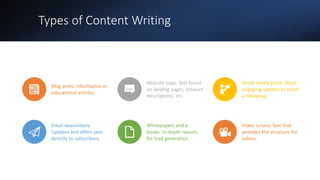
Blog posts: Informative or
educational articles.
Website copy: Text found
on landing pages, product
descriptions, etc.
Social media posts: Short,
engaging updates to build
a following.
Email newsletters:
Updates and offers sent
directly to subscribers.
Whitepapers and e-
books: In-depth reports
for lead generation.
Video scripts: Text that
provides the structure for
videos.
The Skills of a Content
Writer
• Excellent writing and grammar skills.
• Research abilities to gather accurate information.
• Adaptability to write in various styles and tones.
• Understanding of SEO (Search Engine Optimization)
principles.
• Creativity to generate engaging ideas.
• Attention to detail to ensure polished content.
While strong writing skills are a must, content writers
also need to be good researchers, able to quickly gather
information and synthesize it into compelling content.
Knowing the basics of how search engines work will
make your content more discoverable.
The Content Writing
Process
• Research: Understand the topic and target
audience.
• Planning: Create an outline and structure
your content.
• Writing: Draft the initial version.
• Editing: Revise for clarity, flow, and grammar.
• Publishing: Release your content to the
world.
Content writing follows a structured process. It
starts with thorough research, followed by an
organized plan for your content. The writing
phase is where you draft the text, followed by
the critical editing stage. The cycle ends with
publication.
Successful Content:
What Makes It Work?
• Provides value to the reader (solve a
problem, teach something)
• Well-structured and easy to read.
• Written in a clear and engaging style.
• Optimized for search with keywords.
• Includes a clear call-to-action (what to do
next).
• Promoted and shared effectively.
Content is successful when it strikes a balance.
It needs to offer something valuable to the
reader and should be enjoyable to consume.
Structure ensures coherence, while a clear call-
to-action tells the reader how to engage
further.
Content Writing & SEO
• SEO: Search Engine Optimization.
• Improves how your content ranks on search engines
like Google.
• Target relevant keywords throughout your content.
• Use clear headings and subheadings.
• Build quality backlinks to your website.
• Focus on creating valuable content that people want to
read.
SEO and content writing go hand-in-hand. Target the
words and phrases people are searching for. Good
structure also helps search engines understand and rank
your content. High-quality content that earns shares and
links from other websites naturally improves your search
ranking.
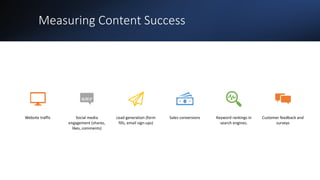
Measuring Content Success
Website traffic Social media
engagement (shares,
likes, comments)
Lead generation (form
fills, email sign-ups)
Sales conversions Keyword rankings in
search engines.
Customer feedback and
surveys
Content Marketing
Strategy
• Defines your target audience.
• Sets content goals (build awareness, generate
leads, etc.).
• Outlines the types of content you'll create.
• Creates a content calendar to plan publication.
• Identifies channels for distribution (blog, social
media, etc.).
A strong content marketing strategy ensures
you're creating and sharing the right content.
Understand who your audience is and what they
care about. Define your goals to create content
that aligns with your overall aims, and create a
calendar to stay consistent.
Content Writing Tools
• Grammarly: Helps you fix grammar and
spelling errors.
• Google Docs: For collaboration and sharing.
• Keyword research tools: (Semrush, Ahrefs,
etc.) for content ideas.
• Hemingway App: Suggests writing clarity
improvements.
• Project management tools (Trello, Asana) for
organization.
Various tools streamline the content writing
process. Grammar checkers ensure polished
work, while keyword research tools help
discover topics your audience is searching for.
Project management tools are great for
collaboration or managing a content calendar.
The Freelance
Content Writer
• Content writers can work as freelancers.
• Flexibility to choose your clients and
projects.
• Requires self-discipline and organization.
• Need to attract clients and build a
portfolio.
• Popular freelance platforms to find work
(Upwork, Fiverr).
Content writing is an excellent field for
freelancing. You'll enjoy the freedom of
working independently but will also need
to manage your own time and workload
while finding new clients to ensure a
steady income.
The Future of
Content Writing
• AI tools are evolving but cannot replace
human creativity.
• Content volume will continue to increase.
• Focus on quality and providing unique value
• Video content and interactive formats will
gain popularity
The future of content writing will require
adapting to new technologies and formats.
While AI tools are helpful, the human touch
will always be needed to generate truly
compelling content and unique ideas.
Conclusion
• Content writing is an essential skill in today's digital world.
• Impacts brand awareness, search visibility, and business success.
• Requires a combination of writing skill, strategy, and adaptability.
• Offers a fulfilling career path for both in-house and freelance writers.
Content is everywhere, and content writers are the architects. Quality
content has the power to transform businesses and connect with
audiences. Whether you're building your own brand or helping others,
content writing is an exciting and rewarding field with ever-evolving
opportunities.
Thank You !
Content Writing Course in Chandigarh
For Query Contact : 998874-1983

Content Writing Course in Chandigarh Join Now

  • 1.
  • 2.
    Defining Content Writing •The creation of written material for digital platforms. • Involves research, planning, and crafting text for a specific audience. • Aims to inform, educate, entertain, or persuade. • Encompasses various formats (blog posts, articles, website copy, etc.). • SEO knowledge is often beneficial. • Requires strong writing skills and adaptability. Content writing is the art of producing written material designed specifically for online consumption. It's about understanding your target audience and creating content that aligns with their interests and needs. Content writers need to be versatile and able to adapt their writing style to suit different formats and purposes.
  • 3.
    Why Content Writing Matters? • Builds brand awareness and trust. • Establishes thought leadership in your industry. • Drives traffic to your website through search engines (SEO). • Generates leads and boosts conversions. • Engages your audience and builds relationships. • Fosters a loyal customer base. Content writing is an essential investment for businesses and individuals. High-quality content helps you attract and retain customers. Consistent content creation demonstrates your expertise, enhances your search engine ranking, and makes your brand more memorable.
  • 4.
    Types of ContentWriting Blog posts: Informative or educational articles. Website copy: Text found on landing pages, product descriptions, etc. Social media posts: Short, engaging updates to build a following. Email newsletters: Updates and offers sent directly to subscribers. Whitepapers and e- books: In-depth reports for lead generation. Video scripts: Text that provides the structure for videos.
  • 5.
    The Skills ofa Content Writer • Excellent writing and grammar skills. • Research abilities to gather accurate information. • Adaptability to write in various styles and tones. • Understanding of SEO (Search Engine Optimization) principles. • Creativity to generate engaging ideas. • Attention to detail to ensure polished content. While strong writing skills are a must, content writers also need to be good researchers, able to quickly gather information and synthesize it into compelling content. Knowing the basics of how search engines work will make your content more discoverable.
  • 6.
    The Content Writing Process •Research: Understand the topic and target audience. • Planning: Create an outline and structure your content. • Writing: Draft the initial version. • Editing: Revise for clarity, flow, and grammar. • Publishing: Release your content to the world. Content writing follows a structured process. It starts with thorough research, followed by an organized plan for your content. The writing phase is where you draft the text, followed by the critical editing stage. The cycle ends with publication.
  • 7.
    Successful Content: What MakesIt Work? • Provides value to the reader (solve a problem, teach something) • Well-structured and easy to read. • Written in a clear and engaging style. • Optimized for search with keywords. • Includes a clear call-to-action (what to do next). • Promoted and shared effectively. Content is successful when it strikes a balance. It needs to offer something valuable to the reader and should be enjoyable to consume. Structure ensures coherence, while a clear call- to-action tells the reader how to engage further.
  • 8.
    Content Writing &SEO • SEO: Search Engine Optimization. • Improves how your content ranks on search engines like Google. • Target relevant keywords throughout your content. • Use clear headings and subheadings. • Build quality backlinks to your website. • Focus on creating valuable content that people want to read. SEO and content writing go hand-in-hand. Target the words and phrases people are searching for. Good structure also helps search engines understand and rank your content. High-quality content that earns shares and links from other websites naturally improves your search ranking.
  • 9.
    Measuring Content Success Websitetraffic Social media engagement (shares, likes, comments) Lead generation (form fills, email sign-ups) Sales conversions Keyword rankings in search engines. Customer feedback and surveys
  • 10.
    Content Marketing Strategy • Definesyour target audience. • Sets content goals (build awareness, generate leads, etc.). • Outlines the types of content you'll create. • Creates a content calendar to plan publication. • Identifies channels for distribution (blog, social media, etc.). A strong content marketing strategy ensures you're creating and sharing the right content. Understand who your audience is and what they care about. Define your goals to create content that aligns with your overall aims, and create a calendar to stay consistent.
  • 11.
    Content Writing Tools •Grammarly: Helps you fix grammar and spelling errors. • Google Docs: For collaboration and sharing. • Keyword research tools: (Semrush, Ahrefs, etc.) for content ideas. • Hemingway App: Suggests writing clarity improvements. • Project management tools (Trello, Asana) for organization. Various tools streamline the content writing process. Grammar checkers ensure polished work, while keyword research tools help discover topics your audience is searching for. Project management tools are great for collaboration or managing a content calendar.
  • 12.
    The Freelance Content Writer •Content writers can work as freelancers. • Flexibility to choose your clients and projects. • Requires self-discipline and organization. • Need to attract clients and build a portfolio. • Popular freelance platforms to find work (Upwork, Fiverr). Content writing is an excellent field for freelancing. You'll enjoy the freedom of working independently but will also need to manage your own time and workload while finding new clients to ensure a steady income.
  • 13.
    The Future of ContentWriting • AI tools are evolving but cannot replace human creativity. • Content volume will continue to increase. • Focus on quality and providing unique value • Video content and interactive formats will gain popularity The future of content writing will require adapting to new technologies and formats. While AI tools are helpful, the human touch will always be needed to generate truly compelling content and unique ideas.
  • 14.
    Conclusion • Content writingis an essential skill in today's digital world. • Impacts brand awareness, search visibility, and business success. • Requires a combination of writing skill, strategy, and adaptability. • Offers a fulfilling career path for both in-house and freelance writers. Content is everywhere, and content writers are the architects. Quality content has the power to transform businesses and connect with audiences. Whether you're building your own brand or helping others, content writing is an exciting and rewarding field with ever-evolving opportunities.
  • 15.
    Thank You ! ContentWriting Course in Chandigarh For Query Contact : 998874-1983