Container inspection
equipments in soft drinks
HIMA DEVADAS
S3 FTQA
MACFAST
INTRODUCTION
 Soft drinks are enormously popular beverages consisting primarily of carbonated water, sugar, and flavourings
 Flavoured soda water gained popularity not only for medicinal benefits but for the refreshing taste as well.
The market expanded in the 1830s when soda water was first sold in glass bottles. Filling and capping the
gaseous liquid in containers was a difficult process until 1850, when a manual filling and corking machine was
successfully designed.
 New soda flavours constantly appeared on the market. Some of the more popular flavours were ginger ale,
sarsaparilla, root beer, lemon, and other fruit flavours.
 As flavoured carbonated beverages gained popularity, manufacturers struggled to find an appropriate name for
the drinks. The most appealing name, however, was "soft drink," adapted in the hopes that soft drinks would
ultimately supplant the "hard liquor" market.
 During the following two decades automated machinery greatly increased the productivity of soft drink plants.
Probably the most important development in bottling technology occurred with the invention of the "crown
cap" in 1892, which successfully contained the carbon dioxide gas in glass bottles.
 In the late 1950s aluminium beverage cans were introduced, equipped with convenient pull-ring tabs and
later with stay-on tabs. Light-weight and break-resistant plastic bottles came into use in the 1970s, though
it was not until 1991 that the soft drink industry used plastic PET (polyethylene terephthalate) on a wide
scale.
 Carbonated water constitutes up to 94% of a soft drink. Carbon dioxide adds that special sparkle and bite to
the beverage and also acts as a mild preservative. Carbon dioxide is an uniquely suitable gas for soft drinks
because it is inert, non-toxic, and relatively inexpensive and easy to liquefy.
 The second main ingredient is sugar, which makes up 7-12% of a soft drink. Used in either dry or liquid
form, sugar adds sweetness and body to the beverage, enhancing the "mouth-feel,
 The overall flavour of a soft drink depends on an intricate balance of sweetness, tartness, and acidity (pH).
Acids add a sharpness to the background taste and enhance the thirst-quenching experience by stimulating
saliva flow. . Saponins enhance the foamy head of certain soft drinks, like cream soda and ginger beer. The
most common acid in soft drinks is citric acid, which has a lemony flavour. Acids also reduce pH levels,
mildly preserving the beverage. Very small quantities of other additives enhance taste, mouth-feel, aroma,
and appearance of the beverage. There is an endless range of flavourings, they may be natural, natural
identical (chemically synthesized imitations), or artificial (chemically unrelated to natural flavours).
Emulsions are added to soft drinks primarily to enhance "eye appeal" by serving as clouding agents.
Categories Of Soft Drinks:
1.Carbonated Soft Drinks:
Contain carbon dioxide.
e.g.: Pepsi, Coke, Fanta etc.
2.Non Carbonated Soft Drinks:
No carbon dioxide.
e.g.: Juices, Nectars, Squashes, etc.
Types of soft drinks:
1.Ready to drink(RTD): e.g., all Colas and Juices
2.Dilute-to-taste: e.g., all Syrups and Squashes
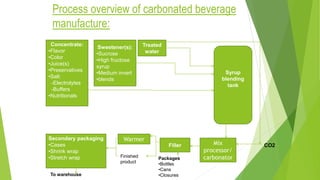
Process overview of carbonated beverage
manufacture:
Concentrate:
•Flavor
•Color
•Juice(s)
•Preservatives
•Salt:
-Electrolytes
-Buffers
•Nutritionals
Sweetener(s):
•Sucrose
•High fructose
syrup
•Medium invert
•blends
Treated
water
Syrup
blending
tank
Secondary packaging
•Cases
•Shrink wrap
•Stretch wrap
Warmer
Filler Mix
processor/
carbonator
Packages
•Bottles
•Cans
•Closures
Finished
product
To warehouse
CO2
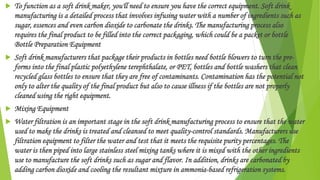
 To function as a soft drink maker, you'll need to ensure you have the correct equipment. Soft drink
manufacturing is a detailed process that involves infusing water with a number of ingredients such as
sugar, essences and even carbon dioxide to carbonate the drinks. The manufacturing process also
requires the final product to be filled into the correct packaging, which could be a packet or bottle
Bottle Preparation Equipment
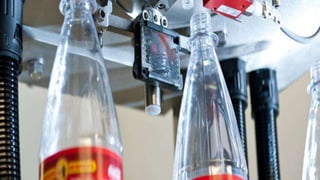
 Soft drink manufacturers that package their products in bottles need bottle blowers to turn the pre-
forms into the final plastic polyethylene terephthalate, or PET, bottles and bottle washers that clean
recycled glass bottles to ensure that they are free of contaminants. Contamination has the potential not
only to alter the quality of the final product but also to cause illness if the bottles are not properly
cleaned using the right equipment.
 Mixing Equipment
 Water filtration is an important stage in the soft drink manufacturing process to ensure that the water
used to make the drinks is treated and cleansed to meet quality-control standards. Manufacturers use
filtration equipment to filter the water and test that it meets the requisite purity percentages. The
water is then piped into large stainless steel mixing tanks where it is mixed with the other ingredients
use to manufacture the soft drinks such as sugar and flavor. In addition, drinks are carbonated by
adding carbon dioxide and cooling the resultant mixture in ammonia-based refrigeration systems.
 Filling machinery is used to automatically fill the empty bottles and packages with the soft drink. The
filling equipment is usually located in a filling room that is separate from the rest of the plant machinery to
reduce the possibility of contamination. The equipment is fully automated and manufacturers assign
minimum personnel just to ensure that the system is working properly. Filling machinery could also include
automatic capping systems that affix bottle caps onto the soft drink bottles.
 Conveyor System
 The conveyor system connects all the production stages, moving the product from one station to another
until it is packaged for shipping. Equipment such as conveyor belts, pulleys and gears move continuously
at high speeds in the plant during the manufacturing process. To enhance safety, manufacturers can add
machine-guarding equipment to reduce the hazard of falling bottles.
Maximised product safety with high-precision
bottle inspection
 The inspector checks bottles after filling and sealing. Using
highly sensitive cameras and clever detection software, it detects
even the smallest foreign bodies, particles, and contaminations.
This way, you provide your customers and your product with the
maximum safety. And you can be sure that only faultless
products reach the point of sale.
Product safety begins with empties inspection
 The inspector is installed directly on the single-lane conveyor. A two-stage non-contact
vacuum pump system takes a gas sample from the bottles as they pass by. The sample is
ionised in a quadrupole mass spectrometer and routed by way of electromagnetic fields to a
detector. There it is sequentially broken down by molecule mass in order to quantify the
various masses. In order to identify liquids with no gas phase as well, the inspector can
additionally be equipped with a CCD camera. The camera analyses the residual liquids in
parallel to the detector based on their colour and also scans the container floor for extreme
dirt contamination. Any contamination detected is evaluated on an industrial PC. If a
container exceeds the limit values defined for it, it is immediately rejected.
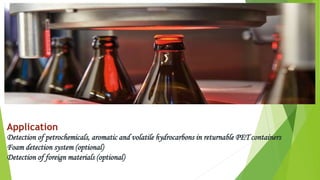
Application
Detection of petrochemicals, aromatic and volatile hydrocarbons in returnable PET containers
Foam detection system (optional)
Detection of foreign materials (optional)
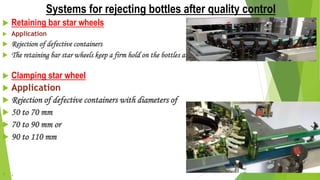
Systems for rejecting bottles after quality control
 Retaining bar star wheels
 Application
 Rejection of defective containers
 The retaining bar star wheels keep a firm hold on the bottles and ensure safe, upright rejection.
 Clamping star wheel
 Application
 Rejection of defective containers with diameters of
 50 to 70 mm
 70 to 90 mm or
 90 to 110 mm
 .
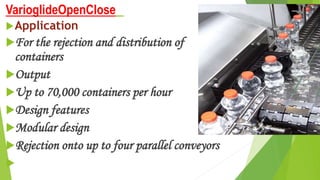
VarioglideOpenClose
Application
For the rejection and distribution of
containers
Output
Up to 70,000 containers per hour
Design features
Modular design
Rejection onto up to four parallel conveyors

 Wide area of application
 The system is suitable for PET and glass containers of a wide variety of
different shapes and sizes.
 Upright rejection
 Even problematic containers, such as PET bottles with petaloid bases, can be
safely rejected upright by the Varioglide.
 Service rejection
 The Varioglide can also be used to eject containers for analysis.
 No lane guides required
 For the two- and three-channel version, lane guides are not required.
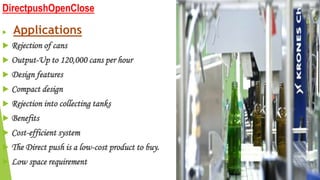
DirectpushOpenClose
 Applications
 Rejection of cans
 Output-Up to 120,000 cans per hour
 Design features
 Compact design
 Rejection into collecting tanks
 Benefits
 Cost-efficient system
 The Direct push is a low-cost product to buy.
 Low space requirement
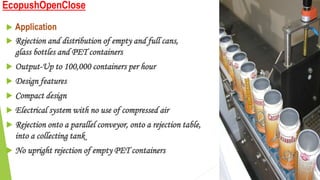
EcopushOpenClose
 Application
 Rejection and distribution of empty and full cans,
glass bottles and PET containers
 Output-Up to 100,000 containers per hour
 Design features
 Compact design
 Electrical system with no use of compressed air
 Rejection onto a parallel conveyor, onto a rejection table, or
into a collecting tank
 No upright rejection of empty PET containers
 Benefits
 Low-noise system
 The Eco push operates without compressed air, and so is very quiet.
 Low operating cost
 The pusher is economical in its energy consumption, and so offers low operating cost.
 Very low maintenance
 The reliable electric pusher is a very low maintenance solution for everyday operations.
 Service rejection
 The Eco push can also be used to eject containers for analysis
High production output with comprehensive can
inspection
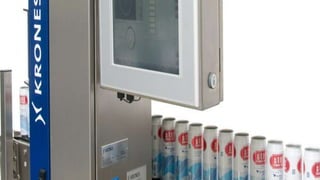
 This can inspector detects even smallest contaminations at this speed.
 The cans and the machine just profit alike from this speed: The cans, because they reach the
point of sale at best quality, the machine, because malfunctions caused by faulty cans are
excluded.
 Precise quality control
 The high-resolution basic camera detects even smallest contaminations and irregularities.
With the patented auxiliary camera you can even detect creases and dirt in the neck area
which are very hard to find.
 High line efficiency
 Damaged or deformed cans are significant safety risks for the bottling line which can lead to
machine standstills and machine damages.
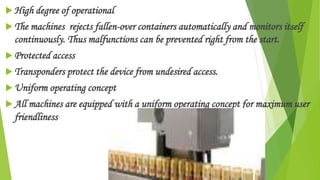
 High degree of operational
 The machines rejects fallen-over containers automatically and monitors itself
continuously. Thus malfunctions can be prevented right from the start.
 Protected access
 Transponders protect the device from undesired access.
 Uniform operating concept
 All machines are equipped with a uniform operating concept for maximum user
friendliness
High-precision empty-bottle inspection
 The highly sensitive inspection modules have a 99.9% success rate when it comes to detecting
faults and contamination. Simultaneously, they keep the number of faulty rejections down
to an absolute minimum. This is made possible by intelligent inspection software; the side-
wall inspection system,
 When changing over to other container types, no change parts need to be exchanged.
Furthermore, the parameters are changed over and the heights of the camera and of the
conveyor belts are adjusted automatically.
 Durability and microbiological safety are the two most important features of the conveyor
belts: their enclosed surfaces protect them against traces of wear and prevent them from
absorbing lubricants and liquids.
Production in the stretch blow-moulding machine through quality
control
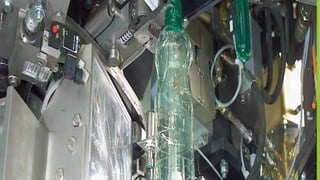
 This control system consists of five different modules, and all are integrated directly in
the stretch blow moulder. Each module performs a different quality check. And
together, they all ensure maximum process reliability, optimum container quality and
high transparency in the blow moulder
 Excellent bottle quality
 PET-View screens the discrepant bottle preforms and bottles to requirements and
ensures first class container quality in this way.
 Space-saving solution
 Unlike free-standing inspection units, the PET-View does not need any space for
setting up: The compact modules are simply integrated directly in the stretch blow
moulder.
 Process reliability
 Faulty preforms constitute a considerable hazard for the stretch blow moulder.
PET-View releases only perfect preforms for the moulding process and in this
way ensure trouble-free operation of the blow moulder.
 Data transparency
 Controlling the quality of the bases gives you dependable information about the
blow moulding process. Any errors in the settings made for the blow moulder can
thus be seen immediately and accordingly rectified.
 LED illumination
 Illumination is by LEDs in all modules. This is characterised by uniformity in
the luminescence, a long service life and the low energy consumption.
Container Inspection Equipment softdrink

Container Inspection Equipment softdrink

  • 1.
    Container inspection equipments insoft drinks HIMA DEVADAS S3 FTQA MACFAST
  • 2.
    INTRODUCTION  Soft drinksare enormously popular beverages consisting primarily of carbonated water, sugar, and flavourings  Flavoured soda water gained popularity not only for medicinal benefits but for the refreshing taste as well. The market expanded in the 1830s when soda water was first sold in glass bottles. Filling and capping the gaseous liquid in containers was a difficult process until 1850, when a manual filling and corking machine was successfully designed.  New soda flavours constantly appeared on the market. Some of the more popular flavours were ginger ale, sarsaparilla, root beer, lemon, and other fruit flavours.  As flavoured carbonated beverages gained popularity, manufacturers struggled to find an appropriate name for the drinks. The most appealing name, however, was "soft drink," adapted in the hopes that soft drinks would ultimately supplant the "hard liquor" market.  During the following two decades automated machinery greatly increased the productivity of soft drink plants. Probably the most important development in bottling technology occurred with the invention of the "crown cap" in 1892, which successfully contained the carbon dioxide gas in glass bottles.
  • 4.
     In thelate 1950s aluminium beverage cans were introduced, equipped with convenient pull-ring tabs and later with stay-on tabs. Light-weight and break-resistant plastic bottles came into use in the 1970s, though it was not until 1991 that the soft drink industry used plastic PET (polyethylene terephthalate) on a wide scale.  Carbonated water constitutes up to 94% of a soft drink. Carbon dioxide adds that special sparkle and bite to the beverage and also acts as a mild preservative. Carbon dioxide is an uniquely suitable gas for soft drinks because it is inert, non-toxic, and relatively inexpensive and easy to liquefy.  The second main ingredient is sugar, which makes up 7-12% of a soft drink. Used in either dry or liquid form, sugar adds sweetness and body to the beverage, enhancing the "mouth-feel,  The overall flavour of a soft drink depends on an intricate balance of sweetness, tartness, and acidity (pH). Acids add a sharpness to the background taste and enhance the thirst-quenching experience by stimulating saliva flow. . Saponins enhance the foamy head of certain soft drinks, like cream soda and ginger beer. The most common acid in soft drinks is citric acid, which has a lemony flavour. Acids also reduce pH levels, mildly preserving the beverage. Very small quantities of other additives enhance taste, mouth-feel, aroma, and appearance of the beverage. There is an endless range of flavourings, they may be natural, natural identical (chemically synthesized imitations), or artificial (chemically unrelated to natural flavours). Emulsions are added to soft drinks primarily to enhance "eye appeal" by serving as clouding agents.
  • 5.
    Categories Of SoftDrinks: 1.Carbonated Soft Drinks: Contain carbon dioxide. e.g.: Pepsi, Coke, Fanta etc. 2.Non Carbonated Soft Drinks: No carbon dioxide. e.g.: Juices, Nectars, Squashes, etc. Types of soft drinks: 1.Ready to drink(RTD): e.g., all Colas and Juices 2.Dilute-to-taste: e.g., all Syrups and Squashes
  • 6.
    Process overview ofcarbonated beverage manufacture: Concentrate: •Flavor •Color •Juice(s) •Preservatives •Salt: -Electrolytes -Buffers •Nutritionals Sweetener(s): •Sucrose •High fructose syrup •Medium invert •blends Treated water Syrup blending tank Secondary packaging •Cases •Shrink wrap •Stretch wrap Warmer Filler Mix processor/ carbonator Packages •Bottles •Cans •Closures Finished product To warehouse CO2
  • 7.
     To functionas a soft drink maker, you'll need to ensure you have the correct equipment. Soft drink manufacturing is a detailed process that involves infusing water with a number of ingredients such as sugar, essences and even carbon dioxide to carbonate the drinks. The manufacturing process also requires the final product to be filled into the correct packaging, which could be a packet or bottle Bottle Preparation Equipment  Soft drink manufacturers that package their products in bottles need bottle blowers to turn the pre- forms into the final plastic polyethylene terephthalate, or PET, bottles and bottle washers that clean recycled glass bottles to ensure that they are free of contaminants. Contamination has the potential not only to alter the quality of the final product but also to cause illness if the bottles are not properly cleaned using the right equipment.  Mixing Equipment  Water filtration is an important stage in the soft drink manufacturing process to ensure that the water used to make the drinks is treated and cleansed to meet quality-control standards. Manufacturers use filtration equipment to filter the water and test that it meets the requisite purity percentages. The water is then piped into large stainless steel mixing tanks where it is mixed with the other ingredients use to manufacture the soft drinks such as sugar and flavor. In addition, drinks are carbonated by adding carbon dioxide and cooling the resultant mixture in ammonia-based refrigeration systems.
  • 8.
     Filling machineryis used to automatically fill the empty bottles and packages with the soft drink. The filling equipment is usually located in a filling room that is separate from the rest of the plant machinery to reduce the possibility of contamination. The equipment is fully automated and manufacturers assign minimum personnel just to ensure that the system is working properly. Filling machinery could also include automatic capping systems that affix bottle caps onto the soft drink bottles.  Conveyor System  The conveyor system connects all the production stages, moving the product from one station to another until it is packaged for shipping. Equipment such as conveyor belts, pulleys and gears move continuously at high speeds in the plant during the manufacturing process. To enhance safety, manufacturers can add machine-guarding equipment to reduce the hazard of falling bottles.
  • 9.
    Maximised product safetywith high-precision bottle inspection  The inspector checks bottles after filling and sealing. Using highly sensitive cameras and clever detection software, it detects even the smallest foreign bodies, particles, and contaminations. This way, you provide your customers and your product with the maximum safety. And you can be sure that only faultless products reach the point of sale.
  • 10.
    Product safety beginswith empties inspection  The inspector is installed directly on the single-lane conveyor. A two-stage non-contact vacuum pump system takes a gas sample from the bottles as they pass by. The sample is ionised in a quadrupole mass spectrometer and routed by way of electromagnetic fields to a detector. There it is sequentially broken down by molecule mass in order to quantify the various masses. In order to identify liquids with no gas phase as well, the inspector can additionally be equipped with a CCD camera. The camera analyses the residual liquids in parallel to the detector based on their colour and also scans the container floor for extreme dirt contamination. Any contamination detected is evaluated on an industrial PC. If a container exceeds the limit values defined for it, it is immediately rejected.
  • 11.
    Application Detection of petrochemicals,aromatic and volatile hydrocarbons in returnable PET containers Foam detection system (optional) Detection of foreign materials (optional)
  • 12.
    Systems for rejectingbottles after quality control  Retaining bar star wheels  Application  Rejection of defective containers  The retaining bar star wheels keep a firm hold on the bottles and ensure safe, upright rejection.  Clamping star wheel  Application  Rejection of defective containers with diameters of  50 to 70 mm  70 to 90 mm or  90 to 110 mm  .
  • 13.
    VarioglideOpenClose Application For the rejectionand distribution of containers Output Up to 70,000 containers per hour Design features Modular design Rejection onto up to four parallel conveyors 
  • 14.
     Wide areaof application  The system is suitable for PET and glass containers of a wide variety of different shapes and sizes.  Upright rejection  Even problematic containers, such as PET bottles with petaloid bases, can be safely rejected upright by the Varioglide.  Service rejection  The Varioglide can also be used to eject containers for analysis.  No lane guides required  For the two- and three-channel version, lane guides are not required.
  • 15.
    DirectpushOpenClose  Applications  Rejectionof cans  Output-Up to 120,000 cans per hour  Design features  Compact design  Rejection into collecting tanks  Benefits  Cost-efficient system  The Direct push is a low-cost product to buy.  Low space requirement
  • 16.
    EcopushOpenClose  Application  Rejectionand distribution of empty and full cans, glass bottles and PET containers  Output-Up to 100,000 containers per hour  Design features  Compact design  Electrical system with no use of compressed air  Rejection onto a parallel conveyor, onto a rejection table, or into a collecting tank  No upright rejection of empty PET containers
  • 17.
     Benefits  Low-noisesystem  The Eco push operates without compressed air, and so is very quiet.  Low operating cost  The pusher is economical in its energy consumption, and so offers low operating cost.  Very low maintenance  The reliable electric pusher is a very low maintenance solution for everyday operations.  Service rejection  The Eco push can also be used to eject containers for analysis
  • 18.
    High production outputwith comprehensive can inspection  This can inspector detects even smallest contaminations at this speed.  The cans and the machine just profit alike from this speed: The cans, because they reach the point of sale at best quality, the machine, because malfunctions caused by faulty cans are excluded.  Precise quality control  The high-resolution basic camera detects even smallest contaminations and irregularities. With the patented auxiliary camera you can even detect creases and dirt in the neck area which are very hard to find.  High line efficiency  Damaged or deformed cans are significant safety risks for the bottling line which can lead to machine standstills and machine damages.
  • 20.
     High degreeof operational  The machines rejects fallen-over containers automatically and monitors itself continuously. Thus malfunctions can be prevented right from the start.  Protected access  Transponders protect the device from undesired access.  Uniform operating concept  All machines are equipped with a uniform operating concept for maximum user friendliness
  • 21.
    High-precision empty-bottle inspection The highly sensitive inspection modules have a 99.9% success rate when it comes to detecting faults and contamination. Simultaneously, they keep the number of faulty rejections down to an absolute minimum. This is made possible by intelligent inspection software; the side- wall inspection system,  When changing over to other container types, no change parts need to be exchanged. Furthermore, the parameters are changed over and the heights of the camera and of the conveyor belts are adjusted automatically.  Durability and microbiological safety are the two most important features of the conveyor belts: their enclosed surfaces protect them against traces of wear and prevent them from absorbing lubricants and liquids.
  • 23.
    Production in thestretch blow-moulding machine through quality control  This control system consists of five different modules, and all are integrated directly in the stretch blow moulder. Each module performs a different quality check. And together, they all ensure maximum process reliability, optimum container quality and high transparency in the blow moulder  Excellent bottle quality  PET-View screens the discrepant bottle preforms and bottles to requirements and ensures first class container quality in this way.  Space-saving solution  Unlike free-standing inspection units, the PET-View does not need any space for setting up: The compact modules are simply integrated directly in the stretch blow moulder.
  • 24.
     Process reliability Faulty preforms constitute a considerable hazard for the stretch blow moulder. PET-View releases only perfect preforms for the moulding process and in this way ensure trouble-free operation of the blow moulder.  Data transparency  Controlling the quality of the bases gives you dependable information about the blow moulding process. Any errors in the settings made for the blow moulder can thus be seen immediately and accordingly rectified.  LED illumination  Illumination is by LEDs in all modules. This is characterised by uniformity in the luminescence, a long service life and the low energy consumption.