CONSUMER RIGHTS
INDEX
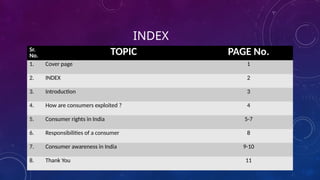
Sr.
No. TOPIC PAGE No.
1. Cover page 1
2. INDEX 2
3. Introduction 3
4. How are consumers exploited ? 4
5. Consumer rights in India 5-7
6. Responsibilities of a consumer 8
7. Consumer awareness in India 9-10
8. Thank You 11
INTRODUCTION
Who are Consumers ?
• Consumers are people or organizations that purchase products or services.
The term also refers to hiring goods and services. They are humans or other
economic entities that use a good or service. Furthermore, they do not sell on
that item that they bought.
• They are the end users in the distribution chain of goods and services. In fact,
sometimes the consumer might not be the buyer.
HOW ARE CONSUMERS EXPLOITED ?
• Consumer is the forgotten and the least organized in the modern economy.
• Adulteration, poor quality, variations in the contents of the pack, use of
deceptive or fractional weights, misleading and dishonest advertisements,
unfair monopolistic and restrictive trade practices are the ways and means by
which the consumer is exploited to the maximum extent possible.
CONSUMER RIGHTS IN INDIA
“Consumer’s Right”, by definition, is the right of a consumer to have adequate
information regarding the quality, quantity, potency, purity, price, and standard
of the commodity they are using and that they are protected against any
malpractices as a consumer.
The Consumer Protection Act (CPA) was introduced in 1986 to protect the
interests of consumers in India. The purpose of CPA was to solve customer
disputes and to help establish Consumer Councils and other authorities for the
settlement of these disputes.
Consumers have the following rights in India :
I. Right to Safety
Means right to be protected against the marketing of goods and services, which are hazardous to life and property. The
purchased goods and services availed of should not only meet their immediate needs, but also fulfil long term interests.
II. Right to be informed
Means right to be informed about the quality, quantity, potency, purity, standard and price of goods so as to protect the
consumer against unfair trade practices. Consumer should insist on getting all the information about the product or service
before making a choice or a decision.
III. Right to Choose
Means right to be assured, wherever possible of access to variety of goods and services at competitive price. In case of
monopolies, it means right to be assured of satisfactory quality and service at a fair price. It includes right to basic goods and
services.
IV. Right to be Heard
Means that consumer’s interests will receive due consideration at appropriate forums. It also includes right
to be represented in various forums formed to consider the consumer’s welfare.
V. Right to seek redressal
Means right to seek redressal against unfair trade practices or unscrupulous exploitation of consumers. It
also includes right to fair settlement of the genuine grievances of the consumer.
VI. Right to Consumer Education
Means the right to acquire the knowledge and skill to be an informed throughout life. Ignorance of
consumers, particularly of rural consumers, is mainly responsible for their exploitation. They should know
their rights and must exercise them. Only then real consumer protection can be achieved with success.
RESPONSIBILITIES OF A CONSUMER
• Be aware about various goods and services available in the market.
• But only standardized goods as they provide quality assurance.
• Learn about the risks associated with products and services.
• Be honest in your dealings and choose only legal goods and services.
• Ask for a bill on purchase of goods or services.
• File complaint in case of poor quality of good or services.
• Avoid waste, littering and contributing to pollution.
CONSUMER AWARENESS IN INDIA
What is Consumer awareness ?
Consumer awareness is a consumer’s understanding of their rights to a product or service being marketed
or sold, allowing them to get the most out of what they buy. The Parliament of India sanctioned the
Consumer Protection Act 1986 to safeguard the interests of India’s consumers.
Why is Consumer Awareness important ?
Merchants and manufacturers exploit consumers through artificial shortages, improper conditions, rude
behavior, and high prices. The protection and promotion of consumer rights is an essential function of
government in any economy. Government agencies and consumer groups regularly initiate consumer
awareness campaigns to help consumers understand new products and services on the market.
STAGES OF CONSUMER AWARENESS
Consumer awareness is a very crucial aspect of the success or failure of products. If the consumer is aware of the
products and can make informed decisions, there is a high chance that the sales of such products will be higher. There
are five stages of awareness of a potential consumer:-
• Completely unaware: a consumer who is completely unaware of the problem and hence does not know the solution
to the problem.
• Problem aware: a customer who knows they have a problem but doesn’t know there are solutions to that problem.
• Aware of the solution: the consumer knows the problem. He knows there are solutions but has not yet opted for one
and does not know the product.
• Product aware: a consumer who already knows about the goods and services but isn’t sure it will solve their
problems. In such cases, the merchant needs to work on objections.
• Fully aware: finally, the customer who knows a lot of information about your prduct is about to buy but needs one
last nudge.
consumer rights impportant presentation.pptx

consumer rights impportant presentation.pptx

  • 1.
  • 2.
    INDEX Sr. No. TOPIC PAGENo. 1. Cover page 1 2. INDEX 2 3. Introduction 3 4. How are consumers exploited ? 4 5. Consumer rights in India 5-7 6. Responsibilities of a consumer 8 7. Consumer awareness in India 9-10 8. Thank You 11
  • 3.
    INTRODUCTION Who are Consumers? • Consumers are people or organizations that purchase products or services. The term also refers to hiring goods and services. They are humans or other economic entities that use a good or service. Furthermore, they do not sell on that item that they bought. • They are the end users in the distribution chain of goods and services. In fact, sometimes the consumer might not be the buyer.
  • 4.
    HOW ARE CONSUMERSEXPLOITED ? • Consumer is the forgotten and the least organized in the modern economy. • Adulteration, poor quality, variations in the contents of the pack, use of deceptive or fractional weights, misleading and dishonest advertisements, unfair monopolistic and restrictive trade practices are the ways and means by which the consumer is exploited to the maximum extent possible.
  • 5.
    CONSUMER RIGHTS ININDIA “Consumer’s Right”, by definition, is the right of a consumer to have adequate information regarding the quality, quantity, potency, purity, price, and standard of the commodity they are using and that they are protected against any malpractices as a consumer. The Consumer Protection Act (CPA) was introduced in 1986 to protect the interests of consumers in India. The purpose of CPA was to solve customer disputes and to help establish Consumer Councils and other authorities for the settlement of these disputes.
  • 6.
    Consumers have thefollowing rights in India : I. Right to Safety Means right to be protected against the marketing of goods and services, which are hazardous to life and property. The purchased goods and services availed of should not only meet their immediate needs, but also fulfil long term interests. II. Right to be informed Means right to be informed about the quality, quantity, potency, purity, standard and price of goods so as to protect the consumer against unfair trade practices. Consumer should insist on getting all the information about the product or service before making a choice or a decision. III. Right to Choose Means right to be assured, wherever possible of access to variety of goods and services at competitive price. In case of monopolies, it means right to be assured of satisfactory quality and service at a fair price. It includes right to basic goods and services.
  • 7.
    IV. Right tobe Heard Means that consumer’s interests will receive due consideration at appropriate forums. It also includes right to be represented in various forums formed to consider the consumer’s welfare. V. Right to seek redressal Means right to seek redressal against unfair trade practices or unscrupulous exploitation of consumers. It also includes right to fair settlement of the genuine grievances of the consumer. VI. Right to Consumer Education Means the right to acquire the knowledge and skill to be an informed throughout life. Ignorance of consumers, particularly of rural consumers, is mainly responsible for their exploitation. They should know their rights and must exercise them. Only then real consumer protection can be achieved with success.
  • 8.
    RESPONSIBILITIES OF ACONSUMER • Be aware about various goods and services available in the market. • But only standardized goods as they provide quality assurance. • Learn about the risks associated with products and services. • Be honest in your dealings and choose only legal goods and services. • Ask for a bill on purchase of goods or services. • File complaint in case of poor quality of good or services. • Avoid waste, littering and contributing to pollution.
  • 9.
    CONSUMER AWARENESS ININDIA What is Consumer awareness ? Consumer awareness is a consumer’s understanding of their rights to a product or service being marketed or sold, allowing them to get the most out of what they buy. The Parliament of India sanctioned the Consumer Protection Act 1986 to safeguard the interests of India’s consumers. Why is Consumer Awareness important ? Merchants and manufacturers exploit consumers through artificial shortages, improper conditions, rude behavior, and high prices. The protection and promotion of consumer rights is an essential function of government in any economy. Government agencies and consumer groups regularly initiate consumer awareness campaigns to help consumers understand new products and services on the market.
  • 10.
    STAGES OF CONSUMERAWARENESS Consumer awareness is a very crucial aspect of the success or failure of products. If the consumer is aware of the products and can make informed decisions, there is a high chance that the sales of such products will be higher. There are five stages of awareness of a potential consumer:- • Completely unaware: a consumer who is completely unaware of the problem and hence does not know the solution to the problem. • Problem aware: a customer who knows they have a problem but doesn’t know there are solutions to that problem. • Aware of the solution: the consumer knows the problem. He knows there are solutions but has not yet opted for one and does not know the product. • Product aware: a consumer who already knows about the goods and services but isn’t sure it will solve their problems. In such cases, the merchant needs to work on objections. • Fully aware: finally, the customer who knows a lot of information about your prduct is about to buy but needs one last nudge.