1
SUBMITED TO- PROFSUBMITED TO- PROF
PAVNEETPAVNEET
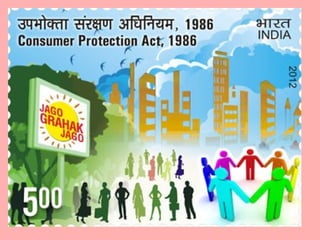
Consumer Protection Act
• Enacted by the Parliament in 1986
• To provide for better protection of interest
of consumers.
• To make provisions for the establishment
of Consumer Councils and other
authorities for the settlement of consumer
disputes.
Who is a Consumer?
• Consumer is one who
– Buys any goods for a consideration and
includes a hire-purchaser;
– Any user of such goods for consideration but
excludes one, who obtains for re-sale or for
commercial purposes;
– Hires a service for consideration and includes
a beneficiary of such service, if availed of with
the approval of the hirer.
Deficiency - Service
• ‘Deficiency’ means
– a fault, imperfection, shortcoming or inadequacy in
quality, nature, or manner of performance than is
required.
• ‘Service’ includes
– service in connection with banking, financing,
insurance, transport, processing, supply of electrical
and other energy, boarding or lodging, housing
construction, entertainment, amusement or purveying
of news and other information
– but does not include any service free of charge or
under a personal contract.
What is a Complaint?
• An allegation in writing by a complainant that:
– An unfair or restrictive trade practice is practised by
trader or service provider
– Goods bought or to be bought or services hired or to
be hired suffered from any deficiency
– Trader or service provider has charged excess price
– Goods and services are hazardous or are likely to be
hazardous to life and safety.
Who is a complainant?
• A consumer
• Any voluntary consumer association registered
under the Companies Act or any other law
• Central or State Government, if it makes a
complaint
• One or more consumers having same interest
• In case of death of a consumer, his legal heir or
representative.
A Consumer Dispute arises when a
complaint is denied or disputed.
Machinery under the Act
• Central Consumer Protection Council
– to be established by Central Government
• State Consumer Protection Council
– to be established by State Government
• District Consumer Protection Council
– to be established by State Government for
every district
Consumer Dispute Redressal
Machinery
• There are Consumer Fora at the District,
State and National level
– District Forum – At the District level
– State Commission – At the State level
– National Commission – At the National level
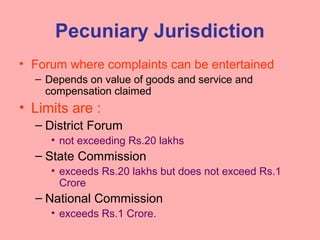
Pecuniary Jurisdiction
• Forum where complaints can be entertained
– Depends on value of goods and service and
compensation claimed
• Limits are :
– District Forum
• not exceeding Rs.20 lakhs
– State Commission
• exceeds Rs.20 lakhs but does not exceed Rs.1
Crore
– National Commission
• exceeds Rs.1 Crore.
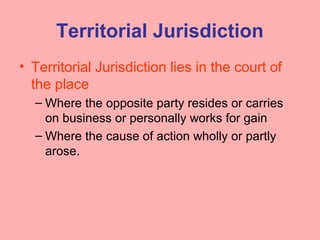
Territorial Jurisdiction
• Territorial Jurisdiction lies in the court of
the place
– Where the opposite party resides or carries
on business or personally works for gain
– Where the cause of action wholly or partly
arose.
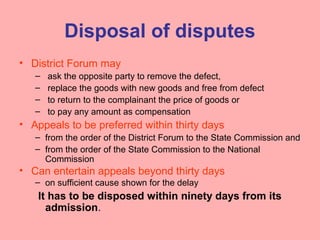
Disposal of disputes
• District Forum may
– ask the opposite party to remove the defect,
– replace the goods with new goods and free from defect
– to return to the complainant the price of goods or
– to pay any amount as compensation
• Appeals to be preferred within thirty days
– from the order of the District Forum to the State Commission and
– from the order of the State Commission to the National
Commission
• Can entertain appeals beyond thirty days
– on sufficient cause shown for the delay
It has to be disposed within ninety days from its
admission.
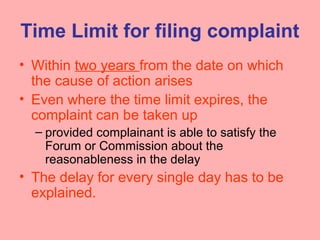
Time Limit for filing complaint
• Within two years from the date on which
the cause of action arises
• Even where the time limit expires, the
complaint can be taken up
– provided complainant is able to satisfy the
Forum or Commission about the
reasonableness in the delay
• The delay for every single day has to be
explained.
What are the rights of a
‘consumer’?
– Protection from hazardous goods and
services
– Information about the quality, quantity, purity,
standard and price
– Access to a variety of goods and services at
competitive prices.
– Assurance that his interest will be considered
at appropriate fora
– The right to consumer education
PROBLEM - 1
• A had purchased seeds from a party.
• The seeds did not germinate.
• The party which supplied seeds took the
plea that A was not a consumer.
• Is purchase of seeds for the purpose of
agriculture, a purchase for commercial
purpose?
PROBLEM - 2
• A had applied for electricity connection.
• However, power supply was not provided
to A.
• Can A seek redressal of his grievance in
Consumer Court?
PROBLEM - 3
• A’s car met with an accident.
• The insurance claim was rejected on the
ground that A’s driver was not holding
valid driving license.
• Should A approach a Consumer Court for
seeking the Insurance claim?
PROBLEM - 4
• A’s grievance is that he had registered
with the M.I.G. Scheme of the Haryana
Housing Board.
• The board had escalated the price of the
flats three times within a period of two
years.
• Does his case lie within the jurisdiction of
Consumer Fora?
PROBLEM - 5
• A registered letter sent to A was not
delivered.
• What is the liability of an employee of the
Post Office in this matter?
PROBLEM - 8
• A injured his knee in a game of football.
• It was diagnosed as ACL TEAR.
• For that, he was operated upon in the knee.
• After the operation his knee developed stiffness, which is
unusual in such cases.
• Even after undergoing physiotherapy for two months he
was unable to bend or straighten his knee.
• So after two months of operation his knee was
manipulated under anesthesia to relieve stiffness.
• A plaster was put on he knee for one month.
PROBLEM -9
• He was told to start walking.
• He used to walk with a limp.
• For about 8 months he continued to walk with a limp.
• Then, his condition deteriorated and he had to start
using crutches to move around.
• Both operations were carried out in military hospitals,
and they were done free of cost since he was serving in
army.
• Can he sue the doctors and the hospital for negligence
and deficiency of service under Consumer Protection
Act?
22
23

Consumer protection act

  • 1.
    1 SUBMITED TO- PROFSUBMITEDTO- PROF PAVNEETPAVNEET
  • 3.
    Consumer Protection Act •Enacted by the Parliament in 1986 • To provide for better protection of interest of consumers. • To make provisions for the establishment of Consumer Councils and other authorities for the settlement of consumer disputes.
  • 4.
    Who is aConsumer? • Consumer is one who – Buys any goods for a consideration and includes a hire-purchaser; – Any user of such goods for consideration but excludes one, who obtains for re-sale or for commercial purposes; – Hires a service for consideration and includes a beneficiary of such service, if availed of with the approval of the hirer.
  • 5.
    Deficiency - Service •‘Deficiency’ means – a fault, imperfection, shortcoming or inadequacy in quality, nature, or manner of performance than is required. • ‘Service’ includes – service in connection with banking, financing, insurance, transport, processing, supply of electrical and other energy, boarding or lodging, housing construction, entertainment, amusement or purveying of news and other information – but does not include any service free of charge or under a personal contract.
  • 6.
    What is aComplaint? • An allegation in writing by a complainant that: – An unfair or restrictive trade practice is practised by trader or service provider – Goods bought or to be bought or services hired or to be hired suffered from any deficiency – Trader or service provider has charged excess price – Goods and services are hazardous or are likely to be hazardous to life and safety.
  • 7.
    Who is acomplainant? • A consumer • Any voluntary consumer association registered under the Companies Act or any other law • Central or State Government, if it makes a complaint • One or more consumers having same interest • In case of death of a consumer, his legal heir or representative. A Consumer Dispute arises when a complaint is denied or disputed.
  • 8.
    Machinery under theAct • Central Consumer Protection Council – to be established by Central Government • State Consumer Protection Council – to be established by State Government • District Consumer Protection Council – to be established by State Government for every district
  • 9.
    Consumer Dispute Redressal Machinery •There are Consumer Fora at the District, State and National level – District Forum – At the District level – State Commission – At the State level – National Commission – At the National level
  • 10.
    Pecuniary Jurisdiction • Forumwhere complaints can be entertained – Depends on value of goods and service and compensation claimed • Limits are : – District Forum • not exceeding Rs.20 lakhs – State Commission • exceeds Rs.20 lakhs but does not exceed Rs.1 Crore – National Commission • exceeds Rs.1 Crore.
  • 11.
    Territorial Jurisdiction • TerritorialJurisdiction lies in the court of the place – Where the opposite party resides or carries on business or personally works for gain – Where the cause of action wholly or partly arose.
  • 12.
    Disposal of disputes •District Forum may – ask the opposite party to remove the defect, – replace the goods with new goods and free from defect – to return to the complainant the price of goods or – to pay any amount as compensation • Appeals to be preferred within thirty days – from the order of the District Forum to the State Commission and – from the order of the State Commission to the National Commission • Can entertain appeals beyond thirty days – on sufficient cause shown for the delay It has to be disposed within ninety days from its admission.
  • 13.
    Time Limit forfiling complaint • Within two years from the date on which the cause of action arises • Even where the time limit expires, the complaint can be taken up – provided complainant is able to satisfy the Forum or Commission about the reasonableness in the delay • The delay for every single day has to be explained.
  • 14.
    What are therights of a ‘consumer’? – Protection from hazardous goods and services – Information about the quality, quantity, purity, standard and price – Access to a variety of goods and services at competitive prices. – Assurance that his interest will be considered at appropriate fora – The right to consumer education
  • 15.
    PROBLEM - 1 •A had purchased seeds from a party. • The seeds did not germinate. • The party which supplied seeds took the plea that A was not a consumer. • Is purchase of seeds for the purpose of agriculture, a purchase for commercial purpose?
  • 16.
    PROBLEM - 2 •A had applied for electricity connection. • However, power supply was not provided to A. • Can A seek redressal of his grievance in Consumer Court?
  • 17.
    PROBLEM - 3 •A’s car met with an accident. • The insurance claim was rejected on the ground that A’s driver was not holding valid driving license. • Should A approach a Consumer Court for seeking the Insurance claim?
  • 18.
    PROBLEM - 4 •A’s grievance is that he had registered with the M.I.G. Scheme of the Haryana Housing Board. • The board had escalated the price of the flats three times within a period of two years. • Does his case lie within the jurisdiction of Consumer Fora?
  • 19.
    PROBLEM - 5 •A registered letter sent to A was not delivered. • What is the liability of an employee of the Post Office in this matter?
  • 20.
    PROBLEM - 8 •A injured his knee in a game of football. • It was diagnosed as ACL TEAR. • For that, he was operated upon in the knee. • After the operation his knee developed stiffness, which is unusual in such cases. • Even after undergoing physiotherapy for two months he was unable to bend or straighten his knee. • So after two months of operation his knee was manipulated under anesthesia to relieve stiffness. • A plaster was put on he knee for one month.
  • 21.
    PROBLEM -9 • Hewas told to start walking. • He used to walk with a limp. • For about 8 months he continued to walk with a limp. • Then, his condition deteriorated and he had to start using crutches to move around. • Both operations were carried out in military hospitals, and they were done free of cost since he was serving in army. • Can he sue the doctors and the hospital for negligence and deficiency of service under Consumer Protection Act?
  • 22.
  • 23.