Consumer
Chemistry
Module 1: MEDICINE: ITS PROPERTIES, MAJOR
CLASSIFICATIONS AND USES
Consumer
Chemistry
9
Consumer
Chemistry
9
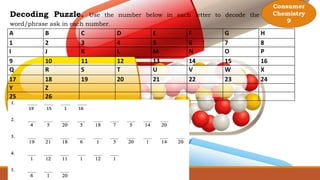
Decoding Puzzle. Use the number below in each letter to decode the
word/phrase ask in each number.
A B C D E F G H
1 2 3 4 5 6 7 8
I J K L M N O P
9 10 11 12 13 14 15 16
Q R S T U V W X
17 18 19 20 21 22 23 24
Y Z
25 26
Objectives:
1.Define medicine and trace its brief history.
2. Identify the major classification of
medicines.
Consumer
Chemistry
9
1 2
3 4
5
6 7
8 9
10
11
12
13 14
15
Medicine
 is a compound or a substance, such as a drug,
that is used in treating diseases.
 It is taken intravenously, orally or through spray
and drops.
 It is a science that focuses on keeping people
healthy and healing the sick.
 It is widely used by people – newborns, infants,
toddlers, teenager, and adults.
Consumer
Chemistry
9
History of
Medicine
Consumer
Chemistry
9
BRIEF HISTORY OF MEDICINE
1.PREHISTORIC
Prehistoric medicine refers to medicine
before humans were able to read and write.
According to an anthropologist, prehistoric
people used herbal medicines in treating
illnesses.
The medicine men during this time were
called witch doctors or shamans.
Consumer
Chemistry
9
Rosemary is a medicinal herb that people may have used
since prehistoric times.
Consumer
Chemistry
9
2. EARLY CIVILIZATIONS
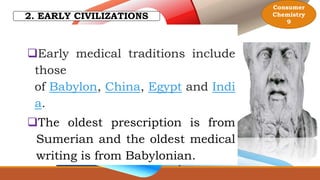
Early medical traditions include
those
of Babylon, China, Egypt and Indi
a.
The oldest prescription is from
Sumerian and the oldest medical
writing is from Babylonian.
Consumer
Chemistry
9
2. EARLY CIVILIZATIONS
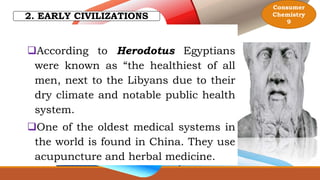
According to Herodotus Egyptians
were known as “the healthiest of all
men, next to the Libyans due to their
dry climate and notable public health
system.
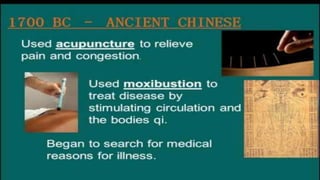
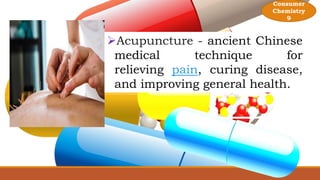
One of the oldest medical systems in
the world is found in China. They use
acupuncture and herbal medicine.
Consumer
Chemistry
9
Acupuncture - ancient Chinese
medical technique for
relieving pain, curing disease,
and improving general health.
Consumer
Chemistry
9
3. GREEK & ROMAN EMPIRE
Hippocrates was an ancient Greek doctor
known as the Father of medicine and made
thorough observations of his patients.
 Hippocrates began to categorize illnesses
as acute, chronic, endemic and epidemic.
Galen was another ancient doctor of
Pergamum who studied about human body
works.
Consumer
Chemistry
9
The first scientist who accomplished exceptional
scientific dissections of human cadavers was
Herophilus, a Greek physician and anatomist.
 One of the pioneers of human anatomy.
Erasistratus was a Greek anatomist.
 Continued to research the role of veins
and nerves.
Consumer
Chemistry
9
4. MEDIEVAL & RENAISSANCE
During this time, many excellent hospitals
were founded.
The Islamic civilization made major
contribution to the fields of: anatomy,
ophthalmology, pharmacology, pharmacy,
physiology and surgery.
Consumer
Chemistry
9
The medical thermometer was invented by an Italian
named Santorio.
Antoine van Leeuwenhock studied microorganisms but
had no idea they were responsible for the diseases.
Edward Jenner was an English Physician who pioneered
the development of the world’s first vaccine against
infectious disease.
5. 17TH - 19TH CENTURY
Consumer
Chemistry
9
Louis Pasteur created a way of sterilizing liquids such as
milk and wine. He also developed a vaccine for anthrax
and immunized a young boy bitten by a rabid dog.
Robert Koch was the first person to discover the bacteria
that causes tuberculosis and cholera.
X-rays were discovered by Wilhelm Roentgen and were
used with stethoscopes. The doctors knew that proper
handwashing and medical instruments kill germs.
Consumer
Chemistry
9
6. 20TH & 21ST CENTURY
 Insulin was first used in treating patient.
Alexander Fleming discovered Penicillin. However, it was not
commonly used until 1940.
The first artificial kidney and dialysis machine was invented
by Willem Kolf.
The laser was invented.
The first heart and kidney transplant was done in this period.
Infectious diseases are controlled through vaccines.
The deaths from heart diseases and stroke are reduced.
Family planning is practiced for healthier mothers and babies.
Consumer
Chemistry
9
MAJOR CLASSIFICATIONS OF MEDICINE
Drugs can be categorized in many ways. Generally, drugs are
classified according to:
1. Therapeutic classification
2. Pharmacologic classification
3. Chemical classification
4. Amalgamated classification
5. Legal classification
Consumer
Chemistry
9
Therapeutic Classification is a type of categorization of drugs from a
medical perspective and categorizes them by the pathology they are used
or intended to treat.
Here are some common drugs under therapeutic classifications:
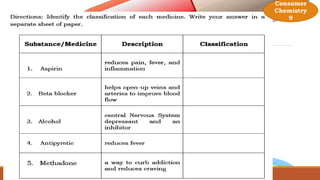
Analgesics are medicines known for their use as pain relievers.
Antibiotics, also known as antibacterial are medications that destroy
or slow down the growth of bacteria.
Antipyretic is a substance that reduces fever.
Antacids are class of drugs used for conditions caused by the acid that
is produced by the stomach to relieve indigestion and heartburn or acid
reflux.
Consumer
Chemistry
9
Pharmacologic classification. Pharmacologic classification describes
a drug’s properties in a specific way. This is necessary when
determining treatment. This includes only those drugs that have the
same or similar mechanism of action but may differ in dosages, time
action profile and availability.
Under this are:
Angiotensin-converting enzyme (ACE) Inhibitors which are
commonly prescribed to cure illnesses such as heart problems, high
blood pressure, prevents kidney damaged associated with high blood
pressure and diabetes.
Beta blocker is a class of drugs that work by blocking the action of
adrenaline, a hormone that is also called as epinephrine.
Consumer
Chemistry
9
The order reads 600 mg. The tablets
contain 200 mg. How many tablets
should be given?
Example:
Chemical classification, a classification of drug that is categorized from
their chemical perspective and structure.
Some of the common classes of drugs under this are:
 β-lactam antibiotics-these antibiotics contain a beta-lactam ring
in their molecular structure. Most of these antibiotics work by
inhibiting cell wall biosynthesis in the bacterial organism.
 Alcohol- one of the most widely abused substances throughout
the world. It is a central nervous system depressant. It causes
severe long-term damage to the liver. Alcohol creates feelings of
pleasure and lowers inhibitions.
Consumer
Chemistry
9
Amalgamated classification, this class of medicine is
formed by combining the three classifications or principles
(Therapeutic, Pharmacologic and Chemical classifications).
The class of nonsteroidal anti-inflammatory drugs
(NSAIDS) is one such example. This reduces pain,
decreases fever, prevents blood clots and in higher doses
decreases inflammation.
Consumer
Chemistry
9
Legal classification or the Controlled Drugs.
These drugs have high potential for addiction and abuse. This
classification was set under Republic Act No.9165 or The Comprehensive
Dangerous Drugs Act of 2002, to safeguard the physical and mental well-
being of the people particularly the youth, from the harmful effects of
dangerous drugs. Some of the common drugs under this class are:
 Ecstasy or a “party drug” is an illegal. It is a synthetic drug classified
as a stimulant with potentially hallucinogenic properties.
 Methadone is used as a way of controlling addiction and lowers
craving.
 Methamphetamine or “shabu” is used as stimulants. This was used
for the soldiers to endure in their battle during world war. From that
on, the abuse of methamphetamine became epidemic.
Consumer
Chemistry
9
A. Answer the Following Questions:
1. What is a medicine?
2. Give an important event of the following:
 Prehistoric
 Early Civilizations
 Greek & Roman Empire
 Medieval & Renaissance
 17th – 19th Century
 20th – 21st Century
Consumer
Chemistry
9
3. Why do we need to know about the
different classification of medicine?
4. How this medicine improves the health
of an individual? Cite an example.
Consumer
Chemistry
9
Consumer
Chemistry
9
Consumer
Chemistry
9
Trace Me!
Directions: Trace and Complete the thought of the paragraph inside the box by filling
out the blanks with the correct word/s or name/s of persons about the History of
Medicine.
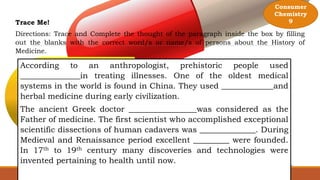
According to an anthropologist, prehistoric people used
_______________in treating illnesses. One of the oldest medical
systems in the world is found in China. They used _____________and
herbal medicine during early civilization.
The ancient Greek doctor _________________was considered as the
Father of medicine. The first scientist who accomplished exceptional
scientific dissections of human cadavers was ______________. During
Medieval and Renaissance period excellent _________ were founded.
In 17th to 19th century many discoveries and technologies were
invented pertaining to health until now.
Directions: Identify the classification and history of medicine on the following
statement. Write the letter of the best answer on a separate sheet of paper.
1. Why is it important to classify medicines?
a. All of these
b. To ensure safe use of it
c. To achieve the utmost benefit of it.
d. To formulate treatment plans based on chemically similar drugs.
2. If paracetamol is good for curing fever, what classification of medicine does it
belong?
a. Legal Classification c. Therapeutic Classification
b. Chemical Classification d. Pharmacologic Classification
Consumer
Chemistry
9
Consumer
Chemistry
9
3. A form of alternative medicine of the Chinese in which needles are inserted
to the body.
a. cupping c. moxibustion
b. acupressure d. acupuncture
4. What classification of medicine is categorized by the pathology they used or
intended to treat?
a. Legal Classification c. Therapeutic Classification
b. Chemical Classification d. Pharmacologic Classification
5. He first developed the world’s first vaccine against violent infectious disease.
a. Louis Pasteur c. Antoine van Leeuwenhock
b. Edward Jenner d. Alexander Fleming
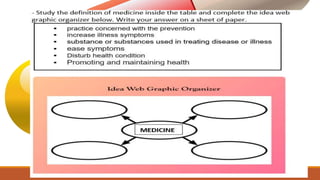
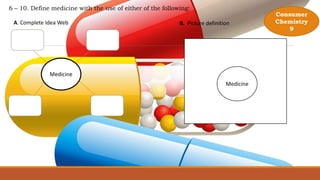
6 – 10. Define medicine with the use of either of the following:
Medicine
A. Complete Idea Web B. Picture definition
Medicine
Consumer
Chemistry
9
RUBRIC:
DESIGN ME
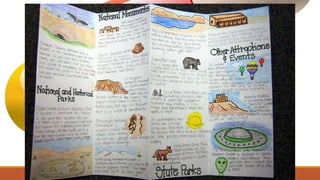
Directions: Design a science brochure pertaining to the properties of medicine and its major
classification.
consumer chemistry for grade 9 4th.1.pptx

consumer chemistry for grade 9 4th.1.pptx

  • 1.
    Consumer Chemistry Module 1: MEDICINE:ITS PROPERTIES, MAJOR CLASSIFICATIONS AND USES Consumer Chemistry 9
  • 2.
    Consumer Chemistry 9 Decoding Puzzle. Usethe number below in each letter to decode the word/phrase ask in each number. A B C D E F G H 1 2 3 4 5 6 7 8 I J K L M N O P 9 10 11 12 13 14 15 16 Q R S T U V W X 17 18 19 20 21 22 23 24 Y Z 25 26
  • 4.
    Objectives: 1.Define medicine andtrace its brief history. 2. Identify the major classification of medicines. Consumer Chemistry 9
  • 10.
    1 2 3 4 5 67 8 9 10 11 12 13 14 15
  • 11.
    Medicine  is acompound or a substance, such as a drug, that is used in treating diseases.  It is taken intravenously, orally or through spray and drops.  It is a science that focuses on keeping people healthy and healing the sick.  It is widely used by people – newborns, infants, toddlers, teenager, and adults. Consumer Chemistry 9
  • 12.
  • 13.
    BRIEF HISTORY OFMEDICINE 1.PREHISTORIC Prehistoric medicine refers to medicine before humans were able to read and write. According to an anthropologist, prehistoric people used herbal medicines in treating illnesses. The medicine men during this time were called witch doctors or shamans. Consumer Chemistry 9
  • 14.
    Rosemary is amedicinal herb that people may have used since prehistoric times. Consumer Chemistry 9
  • 15.
    2. EARLY CIVILIZATIONS Earlymedical traditions include those of Babylon, China, Egypt and Indi a. The oldest prescription is from Sumerian and the oldest medical writing is from Babylonian. Consumer Chemistry 9
  • 16.
    2. EARLY CIVILIZATIONS Accordingto Herodotus Egyptians were known as “the healthiest of all men, next to the Libyans due to their dry climate and notable public health system. One of the oldest medical systems in the world is found in China. They use acupuncture and herbal medicine. Consumer Chemistry 9
  • 17.
    Acupuncture - ancientChinese medical technique for relieving pain, curing disease, and improving general health. Consumer Chemistry 9
  • 18.
    3. GREEK &ROMAN EMPIRE Hippocrates was an ancient Greek doctor known as the Father of medicine and made thorough observations of his patients.  Hippocrates began to categorize illnesses as acute, chronic, endemic and epidemic. Galen was another ancient doctor of Pergamum who studied about human body works. Consumer Chemistry 9
  • 19.
    The first scientistwho accomplished exceptional scientific dissections of human cadavers was Herophilus, a Greek physician and anatomist.  One of the pioneers of human anatomy. Erasistratus was a Greek anatomist.  Continued to research the role of veins and nerves. Consumer Chemistry 9
  • 20.
    4. MEDIEVAL &RENAISSANCE During this time, many excellent hospitals were founded. The Islamic civilization made major contribution to the fields of: anatomy, ophthalmology, pharmacology, pharmacy, physiology and surgery. Consumer Chemistry 9
  • 21.
    The medical thermometerwas invented by an Italian named Santorio. Antoine van Leeuwenhock studied microorganisms but had no idea they were responsible for the diseases. Edward Jenner was an English Physician who pioneered the development of the world’s first vaccine against infectious disease. 5. 17TH - 19TH CENTURY Consumer Chemistry 9
  • 22.
    Louis Pasteur createda way of sterilizing liquids such as milk and wine. He also developed a vaccine for anthrax and immunized a young boy bitten by a rabid dog. Robert Koch was the first person to discover the bacteria that causes tuberculosis and cholera. X-rays were discovered by Wilhelm Roentgen and were used with stethoscopes. The doctors knew that proper handwashing and medical instruments kill germs. Consumer Chemistry 9
  • 23.
    6. 20TH &21ST CENTURY  Insulin was first used in treating patient. Alexander Fleming discovered Penicillin. However, it was not commonly used until 1940. The first artificial kidney and dialysis machine was invented by Willem Kolf. The laser was invented. The first heart and kidney transplant was done in this period. Infectious diseases are controlled through vaccines. The deaths from heart diseases and stroke are reduced. Family planning is practiced for healthier mothers and babies. Consumer Chemistry 9
  • 24.
    MAJOR CLASSIFICATIONS OFMEDICINE Drugs can be categorized in many ways. Generally, drugs are classified according to: 1. Therapeutic classification 2. Pharmacologic classification 3. Chemical classification 4. Amalgamated classification 5. Legal classification Consumer Chemistry 9
  • 25.
    Therapeutic Classification isa type of categorization of drugs from a medical perspective and categorizes them by the pathology they are used or intended to treat. Here are some common drugs under therapeutic classifications: Analgesics are medicines known for their use as pain relievers. Antibiotics, also known as antibacterial are medications that destroy or slow down the growth of bacteria. Antipyretic is a substance that reduces fever. Antacids are class of drugs used for conditions caused by the acid that is produced by the stomach to relieve indigestion and heartburn or acid reflux. Consumer Chemistry 9
  • 26.
    Pharmacologic classification. Pharmacologicclassification describes a drug’s properties in a specific way. This is necessary when determining treatment. This includes only those drugs that have the same or similar mechanism of action but may differ in dosages, time action profile and availability. Under this are: Angiotensin-converting enzyme (ACE) Inhibitors which are commonly prescribed to cure illnesses such as heart problems, high blood pressure, prevents kidney damaged associated with high blood pressure and diabetes. Beta blocker is a class of drugs that work by blocking the action of adrenaline, a hormone that is also called as epinephrine. Consumer Chemistry 9
  • 27.
    The order reads600 mg. The tablets contain 200 mg. How many tablets should be given? Example:
  • 28.
    Chemical classification, aclassification of drug that is categorized from their chemical perspective and structure. Some of the common classes of drugs under this are:  β-lactam antibiotics-these antibiotics contain a beta-lactam ring in their molecular structure. Most of these antibiotics work by inhibiting cell wall biosynthesis in the bacterial organism.  Alcohol- one of the most widely abused substances throughout the world. It is a central nervous system depressant. It causes severe long-term damage to the liver. Alcohol creates feelings of pleasure and lowers inhibitions. Consumer Chemistry 9
  • 29.
    Amalgamated classification, thisclass of medicine is formed by combining the three classifications or principles (Therapeutic, Pharmacologic and Chemical classifications). The class of nonsteroidal anti-inflammatory drugs (NSAIDS) is one such example. This reduces pain, decreases fever, prevents blood clots and in higher doses decreases inflammation. Consumer Chemistry 9
  • 30.
    Legal classification orthe Controlled Drugs. These drugs have high potential for addiction and abuse. This classification was set under Republic Act No.9165 or The Comprehensive Dangerous Drugs Act of 2002, to safeguard the physical and mental well- being of the people particularly the youth, from the harmful effects of dangerous drugs. Some of the common drugs under this class are:  Ecstasy or a “party drug” is an illegal. It is a synthetic drug classified as a stimulant with potentially hallucinogenic properties.  Methadone is used as a way of controlling addiction and lowers craving.  Methamphetamine or “shabu” is used as stimulants. This was used for the soldiers to endure in their battle during world war. From that on, the abuse of methamphetamine became epidemic. Consumer Chemistry 9
  • 31.
    A. Answer theFollowing Questions: 1. What is a medicine? 2. Give an important event of the following:  Prehistoric  Early Civilizations  Greek & Roman Empire  Medieval & Renaissance  17th – 19th Century  20th – 21st Century Consumer Chemistry 9
  • 32.
    3. Why dowe need to know about the different classification of medicine? 4. How this medicine improves the health of an individual? Cite an example. Consumer Chemistry 9
  • 33.
  • 34.
    Consumer Chemistry 9 Trace Me! Directions: Traceand Complete the thought of the paragraph inside the box by filling out the blanks with the correct word/s or name/s of persons about the History of Medicine. According to an anthropologist, prehistoric people used _______________in treating illnesses. One of the oldest medical systems in the world is found in China. They used _____________and herbal medicine during early civilization. The ancient Greek doctor _________________was considered as the Father of medicine. The first scientist who accomplished exceptional scientific dissections of human cadavers was ______________. During Medieval and Renaissance period excellent _________ were founded. In 17th to 19th century many discoveries and technologies were invented pertaining to health until now.
  • 35.
    Directions: Identify theclassification and history of medicine on the following statement. Write the letter of the best answer on a separate sheet of paper. 1. Why is it important to classify medicines? a. All of these b. To ensure safe use of it c. To achieve the utmost benefit of it. d. To formulate treatment plans based on chemically similar drugs. 2. If paracetamol is good for curing fever, what classification of medicine does it belong? a. Legal Classification c. Therapeutic Classification b. Chemical Classification d. Pharmacologic Classification Consumer Chemistry 9
  • 36.
    Consumer Chemistry 9 3. A formof alternative medicine of the Chinese in which needles are inserted to the body. a. cupping c. moxibustion b. acupressure d. acupuncture 4. What classification of medicine is categorized by the pathology they used or intended to treat? a. Legal Classification c. Therapeutic Classification b. Chemical Classification d. Pharmacologic Classification 5. He first developed the world’s first vaccine against violent infectious disease. a. Louis Pasteur c. Antoine van Leeuwenhock b. Edward Jenner d. Alexander Fleming
  • 37.
    6 – 10.Define medicine with the use of either of the following: Medicine A. Complete Idea Web B. Picture definition Medicine Consumer Chemistry 9
  • 38.
  • 39.
    DESIGN ME Directions: Designa science brochure pertaining to the properties of medicine and its major classification.