
The California Transplant Donor Network


               Consumer Behavior MKT338; Fall 2009
By: Elizabeth Kulin, Brian Louie, Jeong Ju Kim, Duangjai Teeranutranont
Acknowledgments

We would like to thank the numerous individuals who helped us conduct interviews and

surveys. Especially our community members, friends, members of the Hope Lutheran

Church & School in Daly City, the San Francisco Atheist Group, physicians Dr. Carl

Spitzer and Dr. Matt Lewin, and staff members at The California Transplant Donor

Network
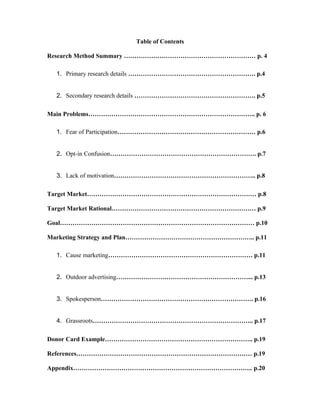
Table of Contents

Research Method Summary ……………………………………………………… p. 4

  1. Primary research details ……………………………………………………. p.4


  2. Secondary research details …………………………………………………. p.5

Main Problems…………………………………………………………………….. p. 6

  1. Fear of Participation………………………………………………………… p.6


  2. Opt-in Confusion……………………………………………………………. p.7


  3. Lack of motivation………………………………………………………….. p.8

Target Market……………………………………………………………………… p.8

Target Market Rational…………………………………………………………… p.9

Goal………………………………………………………………………………… p.10

Marketing Strategy and Plan…………………………………………………….. p.11

  1. Cause marketing…………………………………………………………… p.11


  2. Outdoor advertising………………………………………………………... p.13


  3. Spokesperson………………………………………………………………. p.16


  4. Grassroots………………………………………………………………….. p.17

Donor Card Example…………………………………………………………….. p.19

References………………………………………………………………………… p.19

Appendix………………………………………………………………………….. p.20
Research Method Summary

We conducted both primary and secondary research to get more committed donors to

understand donor’s thoughts and behaviors, and to understand the current situation of

donating and recognizing existing problems.

1. Primary research method

We interviewed a total of 19 people (13 of which were committed organ donors) in

various ways. Here are some details:

    In-depth interviews:

    We interviewed two ER physicians, Dr. Carl Spitzer and Dr. Matt Lewin via

       email to inquire about their experiences. From the interview, we learned that

       physicians do not usually speak with the family about organ donation but organ

       donation network counselors do. According to Dr. Carl Spitzer, this is because

       families want to doctor to be trying to save their family member’s life and not

       already be thinking about harvesting organs.

    We conducted face-to-face interviews with five people at the 2009 Harvest

       Carnival Health Day event at Hope Lutheran Church & School in Daly City on

       October 17, 2009 after contacting one of the outreach coordinators for California

       Transplant Donor Network. We asked these five individuals reasons why they

       were and were not donors (4 out of 5 were donors). From these interviews, we

       concluded that they become donors to help people within their abilities and there

       were no scary factors to the donors.

    We interviewed three African Americans at Berkeley to see their thoughts about

       organ donations. According to the interview, they are not committed organ

       donors because they hold misconceptions related to organ donation such as too
old to donate, not healthy enough.

    Out of the six non-organ donors we interviewed, three individuals claimed that

       they do believe organ donation is an important cause because it can save lives.

       However, they are not currently organ donors because opting-in is not viewed as

       a high priority in their everyday lives. When asked if they ever plan to become

       committed organ donors, they replied that it is something they have always

       considered but have not been, and continue to not be, motivated to take action.

    Questionnaire:

    We designed 17 questions about organ donation statuses, demographics, and

       lifestyles, and sent them to the San Francisco Atheist Group, one of the most

       active Atheist-related organizations in the Bay Area, to know why or why not

       individuals decide to become organ donors. From these questionnaires, we

       concluded that lack of information was the biggest reasons to not become an

       organ donor.

2. Secondary research method

We performed secondary research from multiple articles, government websites, journals,

and news publications. Here are some of our findings:

    We used reports from the U.S. Department of Health & Human Services based on

       donors’ age groups in California to see the average age of the demographic of

       organ donors, and those willing to be organ donors. Based on the report, we

       recognized that there is only one black donor for every 15 blacks in need,

       compared to 1:5 ratio for the white population, and 1:9 ratio for the Hispanic

       population.

    We researched Pubmed.com (U.S. National Institutes of Health) to see awareness
of donation by ethnicity groups.

    From the article “The Secret to Winning Big in the African American Market,”

        we found that African-Americans are more inclined to be involved in something

        that they know will directly benefit the African American community. 87% of

        African-Americans agree that they would be more likely to buy products from a

        company that they felt gave back to the African-American community.

    We also researched Mayoclinic.com and donatelifeny.org to know how people

        can be an organ donor and what the process of organ donation is.

From the research, the most valuable insights that we found are:

   a) The main reasons why people are hesitating to be donors are inaccurate

       information or lack of information.

   b) African Americans are also one of the lowest organ donor groups in the U.S, but

       are in high demand.

                                     Main Problems

1. Fear of Participation:

       From our insight research, our team realized some factors that hold people back

from being organ donors. One of the fundamental yet major factors is that people lack the

correct understanding of what it means to be an organ donor. A large number of people

we interviewed were misguided by inaccurate concepts that we believe they may have

gathered from pop media television shows, such as “ER” and “Grey’s Anatomy”, which

portray topic of organ donating as a one associated with death, fear and pain.

       A recent survey attempted to uncover the reasons why only 38% of drivers in the

United States are registered as organ donors, when the registration process is very simple

to complete when receiving a drivers license from the DMV. An online survey of 5,100
people, conducted by the advocacy group Donate Life America, found that the primary

fears associated with organ donation were; a fear that they were too old, or not healthy

enough, to donate (23%), concerned that doctors will not try as hard to save their life if

the doctors were to be aware they are donors (50%), and the fear of their organs would be

subject to sale on a black market (44%)(Parker, 2009).

       The largest misunderstanding is related to the most common fear (that doctors

will not try to save a patient’s life if they are an organ donor). We believe that this

misconception stems from the media, which portrays doctors in TV shows handling

organ donation procedures. In reality this is not true, and doctors do not even have direct

contact with patients regarding this topic. Two physicians whom we interviewed

supported this reality.    One doctor, Matt Lewin stated that, “Having the doctor

responsible for the patient's life and also talking about donation can cause a lot of

discomfort and, potentially, suspicion about other motives.” We learned that the topic of

organ donation is handed by organ donation organizations such as our client; The

California Transplant Donor Network, who manages all organ donors ‘ & recipients’,

profiles, and liaise with donors (or their families) for permission to perform organ

transplants.

2. Opt-in Confusion:

       During our secondary research, we learned that are three methods that individuals

can take to become committed organ donors: 1. Register with a state donor registry. 2.

Opt-in at the DMV. 3. Sign a donor card and send to the government (OrganDonor.gov).

However, during out primary research, we realized that most individuals (12 out of the 13

committed organ donors we interviewed) are aware of only the second sign up method. It

is important for our client to know that their target audience is unaware that they are also
able to register quickly and easily by also signing up via the web at www.ctdn.org or by

calling our clients hotline phone number at 888-570-9400.

3. Lack of motivation:

       From our primary research and responses from non-organ donors we learned that

there is a lack of motivation among some people to actually take action and become

committed organ donors. Although they have positive associations to organ donating, it is

not a cause of high priority to them. It is interesting to note that these individuals also did

not have a personal connection with someone in need of an organ transplant (directly or

indirectly). Research shows that such individuals are more apt to not consider becoming

an organ donor until they are about to die (Sperling, 2009). Studies show that these

people lack motivation because they do not see what they can tangibly or intangibly

benefit from by being an organ donor (Sperling, 2009). Since this group does have

positive associations to the cause of organ donating, they might be a potential target

market for our client and motivated to opt-in if they believe they could be rewarded for

taking action. Therefore, our marketing plan should include tactics that can reach such an

audience and messaging that can motivate them to take action.

                                       Target Market

       Based on primary and secondary research, it is apparent that there is a need to

increase the number of African American committed organ donors. This group is ideal

because the number of potential acquisitions is extremely high (making it a large target

market), and they are also a group that is able to be converted (unlike other groups that

may be unconvertible due to religious complications).
Target Market Rational

       African Americans are at a higher risk for hypertension, diabetes and renal

diseases, in comparison to than other ethnicities (Carolyn, 2000). This increases their

potential need for organ transplants as a demographic group. However, as mentioned

earlier in this report, they remain one of the lowest committed organ donor groups in the

U.S.   According to U.S. Department of Health & Human Services, 30,222 African

Americans (~.078% of the total U.S. black population) were on the U.S. need transplant

waiting list, compared to 47,436 whites (~.020% of the total U.S. white population) in

2008. However, during that same year, only 2,006 African Americans (~.005% of the

total U.S. black population) were committed organ donors, in contrast with 9,669 whites

(~.004% of the total U.S. white population) (OPTN data, U.S. Census Bureau, 2009).

This means that there is only 1 black donor for 15 blacks in need, compared to 1 -5 for

the white population, and 1-9 for the Hispanic population (OPTN data, 2009). This large

disparity, between needed organs and committed organ donors among the African

American population, stems from our clients three major problems (fear, confusion and

lack of motivation.

       One study on African American families revealed that only 32.8% knew about the

need for more black donors (Siminoff & Lawrence & Arnold, 2003). Another study

showed that African Americans are more likely to associate fears of death and lack of

trust in physicians, than white individuals. Actually, the study showed that 37.9% of

African Americans held this fear, compared to only 21.2% of whites in the study

(Siminoff, 1999). During our primary, 3 out of the 5 African Americans who were

interviewed were not organ donors.       These individuals claimed that they are not

committed organ donors because they hold misconceptions about organ donating. We
believe that a strong marketing campaign could change the misconceptions about organ

donating among this group, from associations of fear to associations of hope.

       According to the article “The Secret to Winning Big in the African American

Market,” 87% of African-Americans agree, “I would be more likely to buy products from

a company that I felt gave back to the African-American community.” (Muley, 2007).

Therefore African Americans are more inclined to be involved in something that they

know will directly benefit the African American community. Our client, CTDN could

leverage this information and, through education to the African American population

about the high volume of need for organ donations among their community members,

encourage them to support and help.        However, the opportunities to educate this

population about this situation must be increased, as many public opinion studies have

shown that knowledge about this particular situation has been slow to permeate the black

community (Siminoff & Arnold, 1999).

       Furthermore, this group is not limited by their religion to become organ donors, as

some individuals and groups are. Although 87% of African Americans claim to be

religious, and 59% of this group identifies as Protestant, but unlike other religions that

prohibit organ donation, Protestant churches tend to support organ donation (Michelle,

2009)(Moore W, 2008). Protestants are typically heavily involved in their churches, and

85% of black Protestants report that faith is a key component of their lives, and attend

worship services once a week or more (Wyler G, 2008).

                                          Goal

       Our goal is to develop a marketing plan that can reduce the fears associated with

organ donating, clarify opt-in confusion, and motivate African Americans to become

committed organ donors.
Marketing Strategy and Plan

       As our research shows, our client has three specific problems and our marketing

strategy/plan must address these issues. We must choose marketing tactics that can most

effectively reach the target market and create messages that can changes peoples

perception of organ donation, reduce confusion about how to become an organ donor,

and motivate the target market to take action and opt-in. The marketing tactics, the

messaging within, will support the goal of increasing the number of African-American

organ donors, is as follows:

1. Cause Marketing:

       Companies join with social causes to increase their brand equity by associating

their brand name with a cause that their consumers care about (US Fed News Service,

2009). The beneficiary should be a company with large reach among our target market,

and also with an interest in participating in cause marketing. The cell phone industry,

and specifically the cell phone service provider T-mobile, could supply both to CTDN.

       Cell phone subscription penetration rose from roughly 35% of the total U.S.

population in 2000 to an expected 90% or higher by the end of 2009. Competition in the

market has pressured carriers to offer unlimited texting and Internet access. With the vast

majority of Americans utilizing cell phone service, carriers must retain current customers

and win new ones from competitors. 4 lead competitors have 80% of subscriber

consumers and 85% of the industry revenue (Mintel, Mobile Communication Services,

2009). 69.7% (~27m people) of African Americans own a cell phone (Alleven, 2008). In

2009, Mintel research database performed a study on a sample of African American cell

phone subscribers and learned that their cell phone brand preference is 3 out of the top 4

leading service providers. Additionally, preference differences among the top 3 service
providers, AT&T (23%), the Verizon Wireless (20%), and T-Mobile (18%), is not

drastically large. Since AT&T and Verizon Wireless together account for almost 60% of

the industry’s revenue and subscribers, T-Mobile might be the most responsive to

participating in a cause-marketing campaign that could help increase their revenue and

competitive advantage (Mintel, Mobile Communication Services, 2009).

       This program will include marketing communication messaging to consumers,

and also a partnership pitch to the beneficiary. The pitch to T-Mobile will have to

convince them that promoting our cause will strengthen their brand equity among a

shared target market and help them monetarily (either through acquisitions, activation,

and/or retention). This is an example of a pitch letter to T-Mobile from CTND:

       “Joining with our social cause, The California Transplant and Organ Network,

can help you strengthen your brand image and bottom line. Research shows that cause

marketing can increase a company’s sales volume, and make consumers feel good about

buying products (US Feed News Service, 2009). Additionally, this partnership will be

low cost to you. Typically, in cause marketing partnerships, the beneficiary donates part

of their proceeds made from sales to the specific cause. However, we simply ask that you

use these proceeds to promote the benefits of becoming an organ donor to your

consumers, place an organ donation sign up button on your website, and a sign up option

on consumer invoices (a check box). We also ask that all of the smartphones that you sell

(blackberry, Sidekick, Android, and the Shadow) be installed with free organ donation

app that allows consumers to learn more about our cause, read and share personal stories

of how organ donation changed their lives, and convenient opt-in (and opt-out) access.

We believe that these measures will show consumers your dedicated support of our

cause. Additionally, as we carry out our African American targeted campaign, to help a
community that is desperate needs more committed organ donors, your brand equity

could benefit. Since research shows that a majority of African-Americans choose to buy

products from companies that they believe support the African-American community, our

partnership will enable you to build your brand equity among this demographic group.”

       This cause marketing partnership also helps CTDN overcome its main problems

and reach its goal. By partnering with T-Mobile, CTDN could leverage T-Mobiles reach

of the African American community, and their large promotional and advertising

capabilities. The support of a large brand name (T-Mobile) could translate to the target

market that this cause is of great importance. In turn, this could cause the target market

to recognize the immense need for organ donors among their community, and encourage

them to take action. Additionally, partnering with T-Mobile will enable there to be

multiple clear to understand contact methods, such as online, by phone and text, by which

the target market individuals can respond by to become committed organ donors.

2. Outdoor Advertising:

       The online publisher, Entrepreneur.com, defines outdoor advertisement as “Any

advertising done outdoors that publicizes your business's products and services.”

It is our recommendation that our client participate in this tactic by placing print

advertisements in public transportation vehicles and locations (bus stops and terminals).

       As Americans drive less due to the economic recession, they are using public

transportation more than they have in the past (Mintel, American Lifestyles, 2009). In

effort to grow brand awareness among our target market of African Americans, public

transportation outdoor advertisement could potentially reach the 37% of African

American households that do not own automobiles (Mintel, Auto Market, 2002). It is

important to note that these advertisements should be placed specifically on public
transportation vehicles in metropolitan areas for two reasons: 1. Public transportation is

more prevent in metropolitan areas (Mintel, Auto Market, 2002) and 2. According to the

US Census, 72% of African Americans live in central cities of metropolitan areas (US

Census Bureau, African American History Month, 2005).

       In the metropolitan neighborhoods that are highly populated by African American

people, research shows that the outdoor advertisements are disproportionate to that of

more affluent areas, and that advertisements of specifically alcohol and tobacco brands

are pervasive (Kwate & Lee, 2006). Therefore, we believe that the CTDN outdoor

advertisements, which are attempting to help strengthen the African American

community, will be positively accepted and supported by the neighborhood members.

From a branding perspective, this could help strengthen the organization’s brand image

among African Americans. Additionally, by placing print advertisements on vehicles and

in locations for a significant amount of time (perhaps for the entire month of February for

Black History month), they will be regularily seen by the daily public transportation

users. Therefore, this tactic would increase the chances of visibly, impressions, and also

be remembered by the audience. Therefore, this tactic could strategically build brand

awareness among the desired target market.

       The advertisements should include messaging that strongly encourages and

motivate the target market to become committed to donating. During primary research, 7

out of 13 (54%) committed donors claimed that they are donors because they want to

help save a life. The act of helping those in need was studied by James Andreoni in

1990, which claimed that people provide aid to others in need because doing so awards

them with a good emotional feeling. Since his studies, marketers have been using this

theory, called “Warm Glow Giving” to attempt to persuade audiences to respond to their
call to actions. Warm glow giving This would be an appropriate campaign to use.

Additionally, as mentioned earlier in this report, African Americans are extremely

community oriented, and are interested in helping other African Americans. Therefore, a

warm glow messaging strategy should be incorporated with messages that relate to this

desire of wanting to help strengthen the African American community. For example,

taglines such as: “Your community needs your help,” “Be hero for your community,” “In

a short moment, you could help change your community,” and “Take action for your

community.” These messages educate the audience that their help is needed, tell them

that they have the ability to do so (triggering the desire to help others), and that doing so

will help their community (triggering the desire to help strengthen their community).

These messages will encourage the target market to take action and become committed

organ donors.

        Furthermore, by associating these messages with images that show individuals of

the African American community, and specifically of individuals seemingly in need of

help, the visual component of the ads could ignite a desire to help them, and a sense of

urgency to take action, among the audience. We recommend that images of average

African American people be used in the outdoor advertisements, to enable the audience to

personally relate to them. This could increase the chances for the images to spark an

emotional response in the audience, and strengthen the ads attempt to ignite a sense of

urgency to take action. Furthermore, by including a strong call to action and clear

response method instructions, such as, “Become an organ donor now.                    Go to

www.ctdn.org OR call 888-570-9400 OR text HELP to 11222 ” constituents will be

encouraged, and understand how to become organ donors.

3. Spokesperson:
Secondary brand associations such as spokespersons can enable brand equity to

be transferred to a brand and increase its popularity and image. We recommend that

CTDN partner with NBA Basketball stars, Sean Elliott or Alonzo Mourning as a way to

reach the African American community and achieve its goal.

       Approximately 52% of all African Americans are sports fans (Mintel, Sports

Event Marketing, 2008). Additionally, both Elliott and Mourning have survived organ

donations (as recipients of organs). They are living success stories that can represent the

benefits and necessity of African Americans becoming committed organ donors.

Furthermore, their association with popular events and sports among the African

American population can be leverage to change the perceptions about organ donation,

and motivate individuals to opt-in.

       This spokesperson could be featured in our client’s promotional video addressing

African Americans, and help educate the audience about the disparity between needed

organs and availability of organs among their community, and how to become a

committed participant. Additionally, this video could trigger emotional responses from

audience viewers by adding visuals of the spokesperson organ donation experience. For

example the video could start in color, and change to black and white as images of the

basketball player being rushed to the hospital emergency room is shown. Then, as soon

as the audience believes that the player is in desperate need of help, the spokesperson will

explain how greatly affected the African American community is by the need for organ

transplants, and how ethic matches are often critical for survival. The video will then

show the spokesperson survival, and explain that an organ donor saved their life. We

believe that such a message within a video would spark emotion within African

American viewers and encourage them to become committed organ donors.
This video could be played during a live game at a sporting arena where an

audience would be present (since both athletes are retired, it would have to be during a

charity game or guest appearance). To increase motivation, and enable an easy way for

individuals to sign up to become donors, the spokesperson could led a mobile marketing

campaign for CTDN and encourage the audience to text in their opt-in to CDTN. As an

additional incentive, individuals who do opt-in could receive a limited edition item (such

as a T-shirt) signed by the spokesperson.

4. Grassroots:

       Participating in grassroots events is a great way for a brand to grow awareness

among a target market on a local level. Typically it involves a brand creating presence at

a specific time and place in which their target audience is congregating. For example, as

mentioned earlier in this report, many African Americans congregate weekly at the

Protestant church, and it is very much a community event. Therefore, our client could

participate in these services. Doing so would associate the CTDN brand name with the

target markets church, allow for donor registry cards to be passed out among attendees,

and offer an opportunity for relationships with potential new committed donors t be build.

Additionally, the reverends (Minister) of specific churches could support our mission and

promote the benefits of becoming an organ donor to the audience who respect and trust

him or her.

       Another way that CTDN could participate in grassroots events that target the

African American community is to participate in, and even potentially create, community

fairs during the Black History Month in February. The fair could include booths of other

health-related agencies, and be located in neighborhoods that are highly African

American populated. The face-to-face interaction with the target market could enable
CTDN to directly educate individuals about the need for organ donors among their

community, and motivate them to taking action by filling out a donor card.
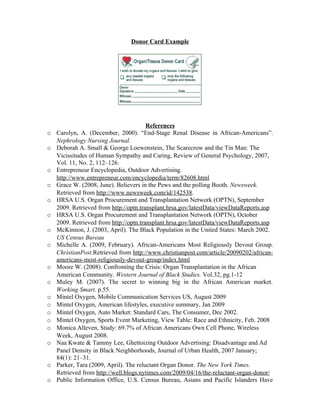
Donor Card Example


                                      References
o Carolyn, A. (December, 2000). “End-Stage Renal Disease in African-Americans”.
  Nephrology Nursing Journal.
o Deborah A. Small & George Loewenstein, The Scarecrow and the Tin Man: The
  Vicissitudes of Human Sympathy and Caring, Review of General Psychology, 2007,
  Vol. 11, No. 2, 112–126.
o Entrepreneur Encyclopedia, Outdoor Advertising.
  http://www.entrepreneur.com/encyclopedia/term/82608.html
o Grace W. (2008, June). Believers in the Pews and the polling Booth. Newsweek.
  Retrieved from http://www.newsweek.com/id/142538.
o HRSA U.S. Organ Procurement and Transplantation Network (OPTN), September
  2009. Retrieved from http://optn.transplant.hrsa.gov/latestData/viewDataReports.asp
o HRSA U.S. Organ Procurement and Transplantation Network (OPTN), October
  2009. Retrieved from http://optn.transplant.hrsa.gov/latestData/viewDataReports.asp
o McKinnon, J. (2003, April). The Black Population in the United States: March 2002.
  US Census Bureau
o Michelle A. (2009, February). African-Americans Most Religiously Devout Group.
  ChristianPost.Retrieved from http://www.christianpost.com/article/20090202/african-
  americans-most-religiously-devout-group/index.html
o Moore W. (2008). Confronting the Crisis: Organ Transplantation in the African
  American Community. Western Journal of Black Studies. Vol.32, pg.1-12
o Muley M. (2007). The secret to winning big in the African American market.
  Working Smart. p.55.
o Mintel Oxygen, Mobile Communication Services US, August 2009
o Mintel Oxygen, American lifestyles, executive summary, Jan 2009
o Mintel Oxygen, Auto Market: Standard Cars, The Consumer, Dec 2002.
o Mintel Oxygen, Sports Event Marketing, View Table: Race and Ethnicity, Feb. 2008
o Monica Alleven, Study: 69.7% of African Americans Own Cell Phone, Wireless
  Week, August 2008.
o Naa Kwate & Tammy Lee, Ghettoizing Outdoor Advertising: Disadvantage and Ad
  Panel Density in Black Neighborhoods, Journal of Urban Health, 2007 January;
  84(1): 21–31.
o Parker, Tara (2009, April). The reluctant Organ Donor. The New York Times.
  Retrieved from http://well.blogs.nytimes.com/2009/04/16/the-reluctant-organ-donor/
o Public Information Office, U.S. Census Bureau, Asians and Pacific Islanders Have
Nation’s Highest Median Household Income in 1997, Census Bureau Reports 1998.
o   Siminoff LA (April, 1999) “Increasing Organ Donation in the African-American
    Community: Altruism in the Face of an Untrustworthy System”. Annals of Internal
    Medicine, Vol 130: 7.pg.607-608.
o   Siminoff, Laura A.; Lawrence, Renee H.; Arnold, Robert M (Jan, 2003). Comparison
    of black and white families' experiences and perceptions regarding organ donation
    requests. Retrieve from
    http://journals.lww.com/ccmjournal/Abstract/2003/01000/Comparison_of_black_and
    _white_families_.23.aspx
o   Sperling, Daniel (2008). Me or Mine? On Property from Personhood, Symbolic
    Existence and Motivation to Donate Organs. Retrieved from http://public-
    policy.huji.ac.il/upload/MeorMine.pdf
o   US Census Bureau, Newsroom, Facts and Features, African American History
    Month, Feb 2005).
o    “U.S. Census Bureau, State and Country QuickFact.” Retrieve November 10, 2009
    from http://quickfacts.census.gov/qfd/states/00000.html
o    “U.S. Department of Health & Human Services.” Deceased Donors Recovered in the
    U.S. by Donor Ethnicity & Living Donors Recovered in the U.S. by Donor Ethnicity
    (November 7, 2009)[2 Data files], Retrieved from
    http://optn.transplant.hrsa.gov/latestData/rptData.asp.
o   Wyler G (2008, June). Believers in the Pews and the Polling Booth. A new study on
    the intersection of politics, religion and race. Newsweek. Retrieved from
    http://www.newsweek.com/id/142538).
APPENDIX
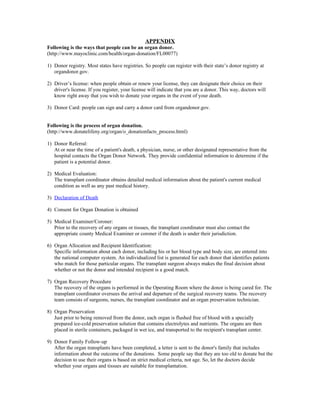
Following is the ways that people can be an organ donor.
(http://www.mayoclinic.com/health/organ-donation/FL00077)

1) Donor registry. Most states have registries. So people can register with their state’s donor registry at
   organdonor.gov.

2) Driver’s license: when people obtain or renew your license, they can designate their choice on their
   driver's license. If you register, your license will indicate that you are a donor. This way, doctors will
   know right away that you wish to donate your organs in the event of your death.

3) Donor Card: people can sign and carry a donor card from organdonor.gov.


Following is the process of organ donation.
(http://www.donatelifeny.org/organ/o_donationfacts_process.html)

1) Donor Referral:
   At or near the time of a patient's death, a physician, nurse, or other designated representative from the
   hospital contacts the Organ Donor Network. They provide confidential information to determine if the
   patient is a potential donor.

2) Medical Evaluation:
   The transplant coordinator obtains detailed medical information about the patient's current medical
   condition as well as any past medical history.

3) Declaration of Death

4) Consent for Organ Donation is obtained

5) Medical Examiner/Coroner:
   Prior to the recovery of any organs or tissues, the transplant coordinator must also contact the
   appropriate county Medical Examiner or coroner if the death is under their jurisdiction.

6) Organ Allocation and Recipient Identification:
   Specific information about each donor, including his or her blood type and body size, are entered into
   the national computer system. An individualized list is generated for each donor that identifies patients
   who match for those particular organs. The transplant surgeon always makes the final decision about
   whether or not the donor and intended recipient is a good match.

7) Organ Recovery Procedure
   The recovery of the organs is performed in the Operating Room where the donor is being cared for. The
   transplant coordinator oversees the arrival and departure of the surgical recovery teams. The recovery
   team consists of surgeons, nurses, the transplant coordinator and an organ preservation technician.

8) Organ Preservation
   Just prior to being removed from the donor, each organ is flushed free of blood with a specially
   prepared ice-cold preservation solution that contains electrolytes and nutrients. The organs are then
   placed in sterile containers, packaged in wet ice, and transported to the recipient's transplant center.

9) Donor Family Follow-up
   After the organ transplants have been completed, a letter is sent to the donor's family that includes
   information about the outcome of the donations. Some people say that they are too old to donate but the
   decision to use their organs is based on strict medical criteria, not age. So, let the doctors decide
   whether your organs and tissues are suitable for transplantation.

Consumer Behavior Towards Organ Donation

  • 1.
    The California TransplantDonor Network Consumer Behavior MKT338; Fall 2009 By: Elizabeth Kulin, Brian Louie, Jeong Ju Kim, Duangjai Teeranutranont
  • 2.
    Acknowledgments We would liketo thank the numerous individuals who helped us conduct interviews and surveys. Especially our community members, friends, members of the Hope Lutheran Church & School in Daly City, the San Francisco Atheist Group, physicians Dr. Carl Spitzer and Dr. Matt Lewin, and staff members at The California Transplant Donor Network
  • 3.
    Table of Contents ResearchMethod Summary ……………………………………………………… p. 4 1. Primary research details ……………………………………………………. p.4 2. Secondary research details …………………………………………………. p.5 Main Problems…………………………………………………………………….. p. 6 1. Fear of Participation………………………………………………………… p.6 2. Opt-in Confusion……………………………………………………………. p.7 3. Lack of motivation………………………………………………………….. p.8 Target Market……………………………………………………………………… p.8 Target Market Rational…………………………………………………………… p.9 Goal………………………………………………………………………………… p.10 Marketing Strategy and Plan…………………………………………………….. p.11 1. Cause marketing…………………………………………………………… p.11 2. Outdoor advertising………………………………………………………... p.13 3. Spokesperson………………………………………………………………. p.16 4. Grassroots………………………………………………………………….. p.17 Donor Card Example…………………………………………………………….. p.19 References………………………………………………………………………… p.19 Appendix………………………………………………………………………….. p.20
  • 4.
    Research Method Summary Weconducted both primary and secondary research to get more committed donors to understand donor’s thoughts and behaviors, and to understand the current situation of donating and recognizing existing problems. 1. Primary research method We interviewed a total of 19 people (13 of which were committed organ donors) in various ways. Here are some details: In-depth interviews:  We interviewed two ER physicians, Dr. Carl Spitzer and Dr. Matt Lewin via email to inquire about their experiences. From the interview, we learned that physicians do not usually speak with the family about organ donation but organ donation network counselors do. According to Dr. Carl Spitzer, this is because families want to doctor to be trying to save their family member’s life and not already be thinking about harvesting organs.  We conducted face-to-face interviews with five people at the 2009 Harvest Carnival Health Day event at Hope Lutheran Church & School in Daly City on October 17, 2009 after contacting one of the outreach coordinators for California Transplant Donor Network. We asked these five individuals reasons why they were and were not donors (4 out of 5 were donors). From these interviews, we concluded that they become donors to help people within their abilities and there were no scary factors to the donors.  We interviewed three African Americans at Berkeley to see their thoughts about organ donations. According to the interview, they are not committed organ donors because they hold misconceptions related to organ donation such as too
  • 5.
    old to donate,not healthy enough.  Out of the six non-organ donors we interviewed, three individuals claimed that they do believe organ donation is an important cause because it can save lives. However, they are not currently organ donors because opting-in is not viewed as a high priority in their everyday lives. When asked if they ever plan to become committed organ donors, they replied that it is something they have always considered but have not been, and continue to not be, motivated to take action. Questionnaire:  We designed 17 questions about organ donation statuses, demographics, and lifestyles, and sent them to the San Francisco Atheist Group, one of the most active Atheist-related organizations in the Bay Area, to know why or why not individuals decide to become organ donors. From these questionnaires, we concluded that lack of information was the biggest reasons to not become an organ donor. 2. Secondary research method We performed secondary research from multiple articles, government websites, journals, and news publications. Here are some of our findings:  We used reports from the U.S. Department of Health & Human Services based on donors’ age groups in California to see the average age of the demographic of organ donors, and those willing to be organ donors. Based on the report, we recognized that there is only one black donor for every 15 blacks in need, compared to 1:5 ratio for the white population, and 1:9 ratio for the Hispanic population.  We researched Pubmed.com (U.S. National Institutes of Health) to see awareness
  • 6.
    of donation byethnicity groups.  From the article “The Secret to Winning Big in the African American Market,” we found that African-Americans are more inclined to be involved in something that they know will directly benefit the African American community. 87% of African-Americans agree that they would be more likely to buy products from a company that they felt gave back to the African-American community.  We also researched Mayoclinic.com and donatelifeny.org to know how people can be an organ donor and what the process of organ donation is. From the research, the most valuable insights that we found are: a) The main reasons why people are hesitating to be donors are inaccurate information or lack of information. b) African Americans are also one of the lowest organ donor groups in the U.S, but are in high demand. Main Problems 1. Fear of Participation: From our insight research, our team realized some factors that hold people back from being organ donors. One of the fundamental yet major factors is that people lack the correct understanding of what it means to be an organ donor. A large number of people we interviewed were misguided by inaccurate concepts that we believe they may have gathered from pop media television shows, such as “ER” and “Grey’s Anatomy”, which portray topic of organ donating as a one associated with death, fear and pain. A recent survey attempted to uncover the reasons why only 38% of drivers in the United States are registered as organ donors, when the registration process is very simple to complete when receiving a drivers license from the DMV. An online survey of 5,100
  • 7.
    people, conducted bythe advocacy group Donate Life America, found that the primary fears associated with organ donation were; a fear that they were too old, or not healthy enough, to donate (23%), concerned that doctors will not try as hard to save their life if the doctors were to be aware they are donors (50%), and the fear of their organs would be subject to sale on a black market (44%)(Parker, 2009). The largest misunderstanding is related to the most common fear (that doctors will not try to save a patient’s life if they are an organ donor). We believe that this misconception stems from the media, which portrays doctors in TV shows handling organ donation procedures. In reality this is not true, and doctors do not even have direct contact with patients regarding this topic. Two physicians whom we interviewed supported this reality. One doctor, Matt Lewin stated that, “Having the doctor responsible for the patient's life and also talking about donation can cause a lot of discomfort and, potentially, suspicion about other motives.” We learned that the topic of organ donation is handed by organ donation organizations such as our client; The California Transplant Donor Network, who manages all organ donors ‘ & recipients’, profiles, and liaise with donors (or their families) for permission to perform organ transplants. 2. Opt-in Confusion: During our secondary research, we learned that are three methods that individuals can take to become committed organ donors: 1. Register with a state donor registry. 2. Opt-in at the DMV. 3. Sign a donor card and send to the government (OrganDonor.gov). However, during out primary research, we realized that most individuals (12 out of the 13 committed organ donors we interviewed) are aware of only the second sign up method. It is important for our client to know that their target audience is unaware that they are also
  • 8.
    able to registerquickly and easily by also signing up via the web at www.ctdn.org or by calling our clients hotline phone number at 888-570-9400. 3. Lack of motivation: From our primary research and responses from non-organ donors we learned that there is a lack of motivation among some people to actually take action and become committed organ donors. Although they have positive associations to organ donating, it is not a cause of high priority to them. It is interesting to note that these individuals also did not have a personal connection with someone in need of an organ transplant (directly or indirectly). Research shows that such individuals are more apt to not consider becoming an organ donor until they are about to die (Sperling, 2009). Studies show that these people lack motivation because they do not see what they can tangibly or intangibly benefit from by being an organ donor (Sperling, 2009). Since this group does have positive associations to the cause of organ donating, they might be a potential target market for our client and motivated to opt-in if they believe they could be rewarded for taking action. Therefore, our marketing plan should include tactics that can reach such an audience and messaging that can motivate them to take action. Target Market Based on primary and secondary research, it is apparent that there is a need to increase the number of African American committed organ donors. This group is ideal because the number of potential acquisitions is extremely high (making it a large target market), and they are also a group that is able to be converted (unlike other groups that may be unconvertible due to religious complications).
  • 9.
    Target Market Rational African Americans are at a higher risk for hypertension, diabetes and renal diseases, in comparison to than other ethnicities (Carolyn, 2000). This increases their potential need for organ transplants as a demographic group. However, as mentioned earlier in this report, they remain one of the lowest committed organ donor groups in the U.S. According to U.S. Department of Health & Human Services, 30,222 African Americans (~.078% of the total U.S. black population) were on the U.S. need transplant waiting list, compared to 47,436 whites (~.020% of the total U.S. white population) in 2008. However, during that same year, only 2,006 African Americans (~.005% of the total U.S. black population) were committed organ donors, in contrast with 9,669 whites (~.004% of the total U.S. white population) (OPTN data, U.S. Census Bureau, 2009). This means that there is only 1 black donor for 15 blacks in need, compared to 1 -5 for the white population, and 1-9 for the Hispanic population (OPTN data, 2009). This large disparity, between needed organs and committed organ donors among the African American population, stems from our clients three major problems (fear, confusion and lack of motivation. One study on African American families revealed that only 32.8% knew about the need for more black donors (Siminoff & Lawrence & Arnold, 2003). Another study showed that African Americans are more likely to associate fears of death and lack of trust in physicians, than white individuals. Actually, the study showed that 37.9% of African Americans held this fear, compared to only 21.2% of whites in the study (Siminoff, 1999). During our primary, 3 out of the 5 African Americans who were interviewed were not organ donors. These individuals claimed that they are not committed organ donors because they hold misconceptions about organ donating. We
  • 10.
    believe that astrong marketing campaign could change the misconceptions about organ donating among this group, from associations of fear to associations of hope. According to the article “The Secret to Winning Big in the African American Market,” 87% of African-Americans agree, “I would be more likely to buy products from a company that I felt gave back to the African-American community.” (Muley, 2007). Therefore African Americans are more inclined to be involved in something that they know will directly benefit the African American community. Our client, CTDN could leverage this information and, through education to the African American population about the high volume of need for organ donations among their community members, encourage them to support and help. However, the opportunities to educate this population about this situation must be increased, as many public opinion studies have shown that knowledge about this particular situation has been slow to permeate the black community (Siminoff & Arnold, 1999). Furthermore, this group is not limited by their religion to become organ donors, as some individuals and groups are. Although 87% of African Americans claim to be religious, and 59% of this group identifies as Protestant, but unlike other religions that prohibit organ donation, Protestant churches tend to support organ donation (Michelle, 2009)(Moore W, 2008). Protestants are typically heavily involved in their churches, and 85% of black Protestants report that faith is a key component of their lives, and attend worship services once a week or more (Wyler G, 2008). Goal Our goal is to develop a marketing plan that can reduce the fears associated with organ donating, clarify opt-in confusion, and motivate African Americans to become committed organ donors.
  • 11.
    Marketing Strategy andPlan As our research shows, our client has three specific problems and our marketing strategy/plan must address these issues. We must choose marketing tactics that can most effectively reach the target market and create messages that can changes peoples perception of organ donation, reduce confusion about how to become an organ donor, and motivate the target market to take action and opt-in. The marketing tactics, the messaging within, will support the goal of increasing the number of African-American organ donors, is as follows: 1. Cause Marketing: Companies join with social causes to increase their brand equity by associating their brand name with a cause that their consumers care about (US Fed News Service, 2009). The beneficiary should be a company with large reach among our target market, and also with an interest in participating in cause marketing. The cell phone industry, and specifically the cell phone service provider T-mobile, could supply both to CTDN. Cell phone subscription penetration rose from roughly 35% of the total U.S. population in 2000 to an expected 90% or higher by the end of 2009. Competition in the market has pressured carriers to offer unlimited texting and Internet access. With the vast majority of Americans utilizing cell phone service, carriers must retain current customers and win new ones from competitors. 4 lead competitors have 80% of subscriber consumers and 85% of the industry revenue (Mintel, Mobile Communication Services, 2009). 69.7% (~27m people) of African Americans own a cell phone (Alleven, 2008). In 2009, Mintel research database performed a study on a sample of African American cell phone subscribers and learned that their cell phone brand preference is 3 out of the top 4 leading service providers. Additionally, preference differences among the top 3 service
  • 12.
    providers, AT&T (23%),the Verizon Wireless (20%), and T-Mobile (18%), is not drastically large. Since AT&T and Verizon Wireless together account for almost 60% of the industry’s revenue and subscribers, T-Mobile might be the most responsive to participating in a cause-marketing campaign that could help increase their revenue and competitive advantage (Mintel, Mobile Communication Services, 2009). This program will include marketing communication messaging to consumers, and also a partnership pitch to the beneficiary. The pitch to T-Mobile will have to convince them that promoting our cause will strengthen their brand equity among a shared target market and help them monetarily (either through acquisitions, activation, and/or retention). This is an example of a pitch letter to T-Mobile from CTND: “Joining with our social cause, The California Transplant and Organ Network, can help you strengthen your brand image and bottom line. Research shows that cause marketing can increase a company’s sales volume, and make consumers feel good about buying products (US Feed News Service, 2009). Additionally, this partnership will be low cost to you. Typically, in cause marketing partnerships, the beneficiary donates part of their proceeds made from sales to the specific cause. However, we simply ask that you use these proceeds to promote the benefits of becoming an organ donor to your consumers, place an organ donation sign up button on your website, and a sign up option on consumer invoices (a check box). We also ask that all of the smartphones that you sell (blackberry, Sidekick, Android, and the Shadow) be installed with free organ donation app that allows consumers to learn more about our cause, read and share personal stories of how organ donation changed their lives, and convenient opt-in (and opt-out) access. We believe that these measures will show consumers your dedicated support of our cause. Additionally, as we carry out our African American targeted campaign, to help a
  • 13.
    community that isdesperate needs more committed organ donors, your brand equity could benefit. Since research shows that a majority of African-Americans choose to buy products from companies that they believe support the African-American community, our partnership will enable you to build your brand equity among this demographic group.” This cause marketing partnership also helps CTDN overcome its main problems and reach its goal. By partnering with T-Mobile, CTDN could leverage T-Mobiles reach of the African American community, and their large promotional and advertising capabilities. The support of a large brand name (T-Mobile) could translate to the target market that this cause is of great importance. In turn, this could cause the target market to recognize the immense need for organ donors among their community, and encourage them to take action. Additionally, partnering with T-Mobile will enable there to be multiple clear to understand contact methods, such as online, by phone and text, by which the target market individuals can respond by to become committed organ donors. 2. Outdoor Advertising: The online publisher, Entrepreneur.com, defines outdoor advertisement as “Any advertising done outdoors that publicizes your business's products and services.” It is our recommendation that our client participate in this tactic by placing print advertisements in public transportation vehicles and locations (bus stops and terminals). As Americans drive less due to the economic recession, they are using public transportation more than they have in the past (Mintel, American Lifestyles, 2009). In effort to grow brand awareness among our target market of African Americans, public transportation outdoor advertisement could potentially reach the 37% of African American households that do not own automobiles (Mintel, Auto Market, 2002). It is important to note that these advertisements should be placed specifically on public
  • 14.
    transportation vehicles inmetropolitan areas for two reasons: 1. Public transportation is more prevent in metropolitan areas (Mintel, Auto Market, 2002) and 2. According to the US Census, 72% of African Americans live in central cities of metropolitan areas (US Census Bureau, African American History Month, 2005). In the metropolitan neighborhoods that are highly populated by African American people, research shows that the outdoor advertisements are disproportionate to that of more affluent areas, and that advertisements of specifically alcohol and tobacco brands are pervasive (Kwate & Lee, 2006). Therefore, we believe that the CTDN outdoor advertisements, which are attempting to help strengthen the African American community, will be positively accepted and supported by the neighborhood members. From a branding perspective, this could help strengthen the organization’s brand image among African Americans. Additionally, by placing print advertisements on vehicles and in locations for a significant amount of time (perhaps for the entire month of February for Black History month), they will be regularily seen by the daily public transportation users. Therefore, this tactic would increase the chances of visibly, impressions, and also be remembered by the audience. Therefore, this tactic could strategically build brand awareness among the desired target market. The advertisements should include messaging that strongly encourages and motivate the target market to become committed to donating. During primary research, 7 out of 13 (54%) committed donors claimed that they are donors because they want to help save a life. The act of helping those in need was studied by James Andreoni in 1990, which claimed that people provide aid to others in need because doing so awards them with a good emotional feeling. Since his studies, marketers have been using this theory, called “Warm Glow Giving” to attempt to persuade audiences to respond to their
  • 15.
    call to actions.Warm glow giving This would be an appropriate campaign to use. Additionally, as mentioned earlier in this report, African Americans are extremely community oriented, and are interested in helping other African Americans. Therefore, a warm glow messaging strategy should be incorporated with messages that relate to this desire of wanting to help strengthen the African American community. For example, taglines such as: “Your community needs your help,” “Be hero for your community,” “In a short moment, you could help change your community,” and “Take action for your community.” These messages educate the audience that their help is needed, tell them that they have the ability to do so (triggering the desire to help others), and that doing so will help their community (triggering the desire to help strengthen their community). These messages will encourage the target market to take action and become committed organ donors. Furthermore, by associating these messages with images that show individuals of the African American community, and specifically of individuals seemingly in need of help, the visual component of the ads could ignite a desire to help them, and a sense of urgency to take action, among the audience. We recommend that images of average African American people be used in the outdoor advertisements, to enable the audience to personally relate to them. This could increase the chances for the images to spark an emotional response in the audience, and strengthen the ads attempt to ignite a sense of urgency to take action. Furthermore, by including a strong call to action and clear response method instructions, such as, “Become an organ donor now. Go to www.ctdn.org OR call 888-570-9400 OR text HELP to 11222 ” constituents will be encouraged, and understand how to become organ donors. 3. Spokesperson:
  • 16.
    Secondary brand associationssuch as spokespersons can enable brand equity to be transferred to a brand and increase its popularity and image. We recommend that CTDN partner with NBA Basketball stars, Sean Elliott or Alonzo Mourning as a way to reach the African American community and achieve its goal. Approximately 52% of all African Americans are sports fans (Mintel, Sports Event Marketing, 2008). Additionally, both Elliott and Mourning have survived organ donations (as recipients of organs). They are living success stories that can represent the benefits and necessity of African Americans becoming committed organ donors. Furthermore, their association with popular events and sports among the African American population can be leverage to change the perceptions about organ donation, and motivate individuals to opt-in. This spokesperson could be featured in our client’s promotional video addressing African Americans, and help educate the audience about the disparity between needed organs and availability of organs among their community, and how to become a committed participant. Additionally, this video could trigger emotional responses from audience viewers by adding visuals of the spokesperson organ donation experience. For example the video could start in color, and change to black and white as images of the basketball player being rushed to the hospital emergency room is shown. Then, as soon as the audience believes that the player is in desperate need of help, the spokesperson will explain how greatly affected the African American community is by the need for organ transplants, and how ethic matches are often critical for survival. The video will then show the spokesperson survival, and explain that an organ donor saved their life. We believe that such a message within a video would spark emotion within African American viewers and encourage them to become committed organ donors.
  • 17.
    This video couldbe played during a live game at a sporting arena where an audience would be present (since both athletes are retired, it would have to be during a charity game or guest appearance). To increase motivation, and enable an easy way for individuals to sign up to become donors, the spokesperson could led a mobile marketing campaign for CTDN and encourage the audience to text in their opt-in to CDTN. As an additional incentive, individuals who do opt-in could receive a limited edition item (such as a T-shirt) signed by the spokesperson. 4. Grassroots: Participating in grassroots events is a great way for a brand to grow awareness among a target market on a local level. Typically it involves a brand creating presence at a specific time and place in which their target audience is congregating. For example, as mentioned earlier in this report, many African Americans congregate weekly at the Protestant church, and it is very much a community event. Therefore, our client could participate in these services. Doing so would associate the CTDN brand name with the target markets church, allow for donor registry cards to be passed out among attendees, and offer an opportunity for relationships with potential new committed donors t be build. Additionally, the reverends (Minister) of specific churches could support our mission and promote the benefits of becoming an organ donor to the audience who respect and trust him or her. Another way that CTDN could participate in grassroots events that target the African American community is to participate in, and even potentially create, community fairs during the Black History Month in February. The fair could include booths of other health-related agencies, and be located in neighborhoods that are highly African American populated. The face-to-face interaction with the target market could enable
  • 18.
    CTDN to directlyeducate individuals about the need for organ donors among their community, and motivate them to taking action by filling out a donor card.
  • 19.
    Donor Card Example References o Carolyn, A. (December, 2000). “End-Stage Renal Disease in African-Americans”. Nephrology Nursing Journal. o Deborah A. Small & George Loewenstein, The Scarecrow and the Tin Man: The Vicissitudes of Human Sympathy and Caring, Review of General Psychology, 2007, Vol. 11, No. 2, 112–126. o Entrepreneur Encyclopedia, Outdoor Advertising. http://www.entrepreneur.com/encyclopedia/term/82608.html o Grace W. (2008, June). Believers in the Pews and the polling Booth. Newsweek. Retrieved from http://www.newsweek.com/id/142538. o HRSA U.S. Organ Procurement and Transplantation Network (OPTN), September 2009. Retrieved from http://optn.transplant.hrsa.gov/latestData/viewDataReports.asp o HRSA U.S. Organ Procurement and Transplantation Network (OPTN), October 2009. Retrieved from http://optn.transplant.hrsa.gov/latestData/viewDataReports.asp o McKinnon, J. (2003, April). The Black Population in the United States: March 2002. US Census Bureau o Michelle A. (2009, February). African-Americans Most Religiously Devout Group. ChristianPost.Retrieved from http://www.christianpost.com/article/20090202/african- americans-most-religiously-devout-group/index.html o Moore W. (2008). Confronting the Crisis: Organ Transplantation in the African American Community. Western Journal of Black Studies. Vol.32, pg.1-12 o Muley M. (2007). The secret to winning big in the African American market. Working Smart. p.55. o Mintel Oxygen, Mobile Communication Services US, August 2009 o Mintel Oxygen, American lifestyles, executive summary, Jan 2009 o Mintel Oxygen, Auto Market: Standard Cars, The Consumer, Dec 2002. o Mintel Oxygen, Sports Event Marketing, View Table: Race and Ethnicity, Feb. 2008 o Monica Alleven, Study: 69.7% of African Americans Own Cell Phone, Wireless Week, August 2008. o Naa Kwate & Tammy Lee, Ghettoizing Outdoor Advertising: Disadvantage and Ad Panel Density in Black Neighborhoods, Journal of Urban Health, 2007 January; 84(1): 21–31. o Parker, Tara (2009, April). The reluctant Organ Donor. The New York Times. Retrieved from http://well.blogs.nytimes.com/2009/04/16/the-reluctant-organ-donor/ o Public Information Office, U.S. Census Bureau, Asians and Pacific Islanders Have
  • 20.
    Nation’s Highest MedianHousehold Income in 1997, Census Bureau Reports 1998. o Siminoff LA (April, 1999) “Increasing Organ Donation in the African-American Community: Altruism in the Face of an Untrustworthy System”. Annals of Internal Medicine, Vol 130: 7.pg.607-608. o Siminoff, Laura A.; Lawrence, Renee H.; Arnold, Robert M (Jan, 2003). Comparison of black and white families' experiences and perceptions regarding organ donation requests. Retrieve from http://journals.lww.com/ccmjournal/Abstract/2003/01000/Comparison_of_black_and _white_families_.23.aspx o Sperling, Daniel (2008). Me or Mine? On Property from Personhood, Symbolic Existence and Motivation to Donate Organs. Retrieved from http://public- policy.huji.ac.il/upload/MeorMine.pdf o US Census Bureau, Newsroom, Facts and Features, African American History Month, Feb 2005). o “U.S. Census Bureau, State and Country QuickFact.” Retrieve November 10, 2009 from http://quickfacts.census.gov/qfd/states/00000.html o “U.S. Department of Health & Human Services.” Deceased Donors Recovered in the U.S. by Donor Ethnicity & Living Donors Recovered in the U.S. by Donor Ethnicity (November 7, 2009)[2 Data files], Retrieved from http://optn.transplant.hrsa.gov/latestData/rptData.asp. o Wyler G (2008, June). Believers in the Pews and the Polling Booth. A new study on the intersection of politics, religion and race. Newsweek. Retrieved from http://www.newsweek.com/id/142538).
  • 21.
    APPENDIX Following is theways that people can be an organ donor. (http://www.mayoclinic.com/health/organ-donation/FL00077) 1) Donor registry. Most states have registries. So people can register with their state’s donor registry at organdonor.gov. 2) Driver’s license: when people obtain or renew your license, they can designate their choice on their driver's license. If you register, your license will indicate that you are a donor. This way, doctors will know right away that you wish to donate your organs in the event of your death. 3) Donor Card: people can sign and carry a donor card from organdonor.gov. Following is the process of organ donation. (http://www.donatelifeny.org/organ/o_donationfacts_process.html) 1) Donor Referral: At or near the time of a patient's death, a physician, nurse, or other designated representative from the hospital contacts the Organ Donor Network. They provide confidential information to determine if the patient is a potential donor. 2) Medical Evaluation: The transplant coordinator obtains detailed medical information about the patient's current medical condition as well as any past medical history. 3) Declaration of Death 4) Consent for Organ Donation is obtained 5) Medical Examiner/Coroner: Prior to the recovery of any organs or tissues, the transplant coordinator must also contact the appropriate county Medical Examiner or coroner if the death is under their jurisdiction. 6) Organ Allocation and Recipient Identification: Specific information about each donor, including his or her blood type and body size, are entered into the national computer system. An individualized list is generated for each donor that identifies patients who match for those particular organs. The transplant surgeon always makes the final decision about whether or not the donor and intended recipient is a good match. 7) Organ Recovery Procedure The recovery of the organs is performed in the Operating Room where the donor is being cared for. The transplant coordinator oversees the arrival and departure of the surgical recovery teams. The recovery team consists of surgeons, nurses, the transplant coordinator and an organ preservation technician. 8) Organ Preservation Just prior to being removed from the donor, each organ is flushed free of blood with a specially prepared ice-cold preservation solution that contains electrolytes and nutrients. The organs are then placed in sterile containers, packaged in wet ice, and transported to the recipient's transplant center. 9) Donor Family Follow-up After the organ transplants have been completed, a letter is sent to the donor's family that includes information about the outcome of the donations. Some people say that they are too old to donate but the decision to use their organs is based on strict medical criteria, not age. So, let the doctors decide whether your organs and tissues are suitable for transplantation.