1
Umbrex Toolkit of
Consulting Frameworks
Comprehensive toolkit of
frameworks & templates for
Independent Management Consultants
2
About the Consulting Frameworks Toolkit
Umbrex has developed this Consulting Frameworks Toolkit that includes more than two dozen
business frameworks frequently used by independent management consultants.
This resource includes a PowerPoint deck with slide templates of each of these frameworks that
you can download and customize for your own use.
3
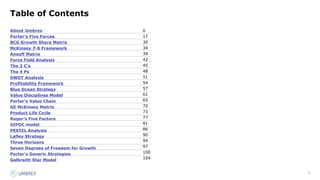
Table of Contents
About Umbrex
Porter’s Five Forces
BCG Growth Share Matrix
McKinsey 7-S Framework
Ansoff Matrix
Force Field Analysis
The 3 C’s
The 4 Ps
SWOT Analysis
Profitability Framework
Blue Ocean Strategy
Value Disciplines Model
Porter's Value Chain
GE McKinsey Matrix
Product Life Cycle
Roger’s Five Factors
SIPOC model
PESTEL Analysis
Lafley Strategy
Three Horizons
Seven Degrees of Freedom for Growth
Porter's Generic Strategies
Galbraith Star Model
6
17
30
34
39
42
45
48
51
54
57
61
65
70
73
77
81
86
90
94
97
100
104
4
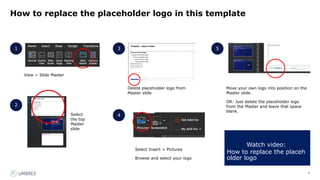
How to replace the placeholder logo in this template
Watch video:
How to replace the placeh
older logo
View > Slide Master
1
Select
the top
Master
slide
3
Delete placeholder logo from
Master slide
Select Insert > Pictures
Browse and select your logo
4
5
Move your own logo into position on the
Master slide.
OR: Just delete the placeholder logo
from the Master and leave that space
blank.
2
5
Subtitle
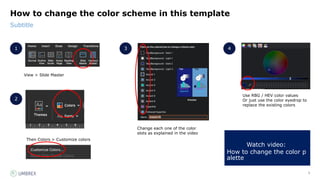
How to change the color scheme in this template
View > Slide Master
1
2
Then Colors > Customize colors
3 4
Change each one of the color
slots as explained in the video
Watch video:
How to change the color p
alette
Use RBG / HEV color values
Or just use the color eyedrop to
replace the existing colors
6
Copyright © 2023 All rights reserved. 6
About Umbrex
7
Umbrex is the fastest way to find the right
independent management consultant.
Find a consultant now
8
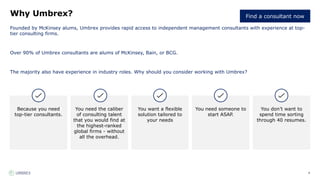
Why Umbrex?
Founded by McKinsey alums, Umbrex provides rapid access to independent management consultants with experience at top-
tier consulting firms.
Over 90% of Umbrex consultants are alums of McKinsey, Bain, or BCG.
The majority also have experience in industry roles. Why should you consider working with Umbrex?
Because you need
top-tier consultants.
You need the caliber
of consulting talent
that you would find at
the highest-ranked
global firms - without
all the overhead.
You want a flexible
solution tailored to
your needs
You need someone to
start ASAP.
You don’t want to
spend time sorting
through 40 resumes.
Find a consultant now
9
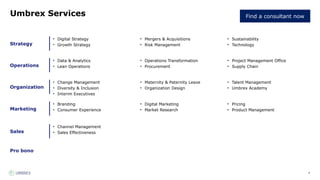
Umbrex Services
Strategy
• Digital Strategy
• Growth Strategy
• Mergers & Acquisitions
• Risk Management
• Sustainability
• Technology
Operations
• Data & Analytics
• Lean Operations
• Operations Transformation
• Procurement
• Project Management Office
• Supply Chain
Organization
• Change Management
• Diversity & Inclusion
• Interim Executives
• Maternity & Paternity Leave
• Organization Design
• Talent Management
• Umbrex Academy
Marketing
• Branding
• Consumer Experience
• Digital Marketing
• Market Research
• Pricing
• Product Management
Sales
• Channel Management
• Sales Effectiveness
Pro bono
Find a consultant now
10
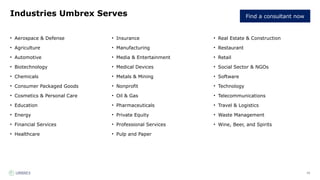
Industries Umbrex Serves
• Aerospace & Defense
• Agriculture
• Automotive
• Biotechnology
• Chemicals
• Consumer Packaged Goods
• Cosmetics & Personal Care
• Education
• Energy
• Financial Services
• Healthcare
• Insurance
• Manufacturing
• Media & Entertainment
• Medical Devices
• Metals & Mining
• Nonprofit
• Oil & Gas
• Pharmaceuticals
• Private Equity
• Professional Services
• Pulp and Paper
• Real Estate & Construction
• Restaurant
• Retail
• Social Sector & NGOs
• Software
• Technology
• Telecommunications
• Travel & Logistics
• Waste Management
• Wine, Beer, and Spirits
Find a consultant now
11
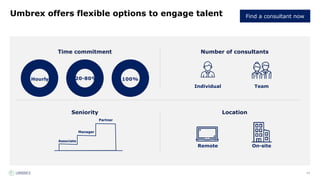
Umbrex offers flexible options to engage talent
Location
Seniority
Number of consultants
Time commitment
20-80% 100%
Hourly
Team
Individual
Associate
Manager
Partner
On-site
Remote
Find a consultant now
12
Join our community
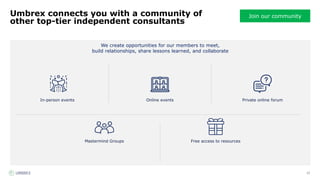
We create opportunities for our members to meet,
build relationships, share lessons learned, and collaborate
Umbrex connects you with a community of
other top-tier independent consultants
Free access to resources
Mastermind Groups
In-person events Private online forum
Online events
13
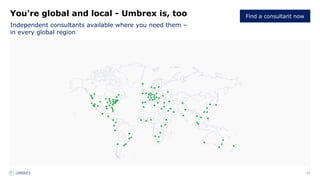
Independent consultants available where you need them –
in every global region
You're global and local - Umbrex is, too Find a consultant now
14
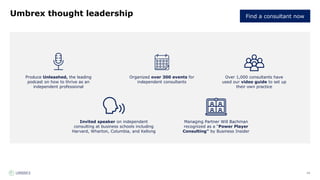
Umbrex thought leadership
Produce Unleashed, the leading
podcast on how to thrive as an
independent professional
Managing Partner Will Bachman
recognized as a “Power Player
Consulting” by Business Insider
Invited speaker on independent
consulting at business schools including
Harvard, Wharton, Columbia, and Kellong
Over 1,000 consultants have
used our video guide to set up
their own practice
Organized over 300 events for
independent consultants
Find a consultant now
15
How Umbrex can help
For Consultants
For Clients
Find a consultant now Join our community
16
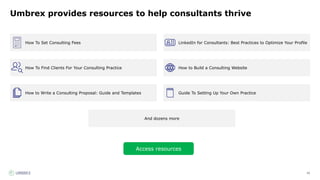
Umbrex provides resources to help consultants thrive
Guide To Setting Up Your Own Practice
How to Build a Consulting Website
How to Write a Consulting Proposal: Guide and Templates
How To Set Consulting Fees LinkedIn for Consultants: Best Practices to Optimize Your Profile
How To Find Clients For Your Consulting Practice
And dozens more
Access resources
17
Copyright © 2023 All rights reserved. 17
Porter’s Five Forces
18
Source
Description
Application
Porter’s Five Forces — Overview
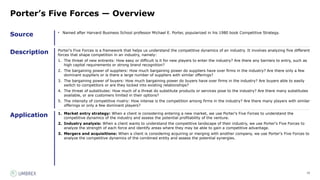
• Named after Harvard Business School professor Michael E. Porter, popularized in his 1980 book Competitive Strategy.
Porter's Five Forces is a framework that helps us understand the competitive dynamics of an industry. It involves analyzing five different
forces that shape competition in an industry, namely:
1. The threat of new entrants: How easy or difficult is it for new players to enter the industry? Are there any barriers to entry, such as
high capital requirements or strong brand recognition?
2. The bargaining power of suppliers: How much bargaining power do suppliers have over firms in the industry? Are there only a few
dominant suppliers or is there a large number of suppliers with similar offerings?
3. The bargaining power of buyers: How much bargaining power do buyers have over firms in the industry? Are buyers able to easily
switch to competitors or are they locked into existing relationships?
4. The threat of substitutes: How much of a threat do substitute products or services pose to the industry? Are there many substitutes
available, or are customers limited in their options?
5. The intensity of competitive rivalry: How intense is the competition among firms in the industry? Are there many players with similar
offerings or only a few dominant players?
1. Market entry strategy: When a client is considering entering a new market, we use Porter's Five Forces to understand the
competitive dynamics of the industry and assess the potential profitability of the venture.
2. Industry analysis: When a client wants to understand the competitive landscape of their industry, we use Porter's Five Forces to
analyze the strength of each force and identify areas where they may be able to gain a competitive advantage.
3. Mergers and acquisitions: When a client is considering acquiring or merging with another company, we use Porter's Five Forces to
analyze the competitive dynamics of the combined entity and assess the potential synergies.
19
Source:_______
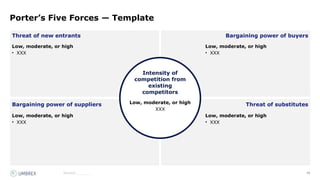
Bargaining power of suppliers
Threat of new entrants Bargaining power of buyers
Threat of substitutes
Low, moderate, or high
• XXX
Low, moderate, or high
• XXX
Low, moderate, or high
• XXX
Low, moderate, or high
• XXX
Porter’s Five Forces — Template
Intensity of
competition from
existing
competitors
Low, moderate, or high
XXX
20
Source:_______
Porter’s Five Forces Analysis
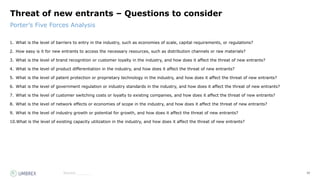
Threat of new entrants – Questions to consider
1. What is the level of barriers to entry in the industry, such as economies of scale, capital requirements, or regulations?
2. How easy is it for new entrants to access the necessary resources, such as distribution channels or raw materials?
3. What is the level of brand recognition or customer loyalty in the industry, and how does it affect the threat of new entrants?
4. What is the level of product differentiation in the industry, and how does it affect the threat of new entrants?
5. What is the level of patent protection or proprietary technology in the industry, and how does it affect the threat of new entrants?
6. What is the level of government regulation or industry standards in the industry, and how does it affect the threat of new entrants?
7. What is the level of customer switching costs or loyalty to existing companies, and how does it affect the threat of new entrants?
8. What is the level of network effects or economies of scope in the industry, and how does it affect the threat of new entrants?
9. What is the level of industry growth or potential for growth, and how does it affect the threat of new entrants?
10.What is the level of existing capacity utilization in the industry, and how does it affect the threat of new entrants?
21
Source:_______
Backup to Porter’s Five Forces Analysis
Threat of new entrants – [industry]
xxx xxxx
Factor Details
xxxx
xxxx
xxxx
xxxx
xxxx
xxxx
xxxx
xxxx
xxxx
Switching costs
Economies of scale
Brand recognition
Regulatory barriers
Capital investment
Technology barriers
Distribution channels
Patents, trademarks
Network effects
Talent availability
22
Source:_______
Porter’s Five Forces Analysis
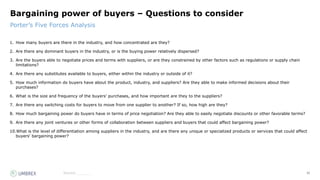
Bargaining power of buyers – Questions to consider
1. How many buyers are there in the industry, and how concentrated are they?
2. Are there any dominant buyers in the industry, or is the buying power relatively dispersed?
3. Are the buyers able to negotiate prices and terms with suppliers, or are they constrained by other factors such as regulations or supply chain
limitations?
4. Are there any substitutes available to buyers, either within the industry or outside of it?
5. How much information do buyers have about the product, industry, and suppliers? Are they able to make informed decisions about their
purchases?
6. What is the size and frequency of the buyers' purchases, and how important are they to the suppliers?
7. Are there any switching costs for buyers to move from one supplier to another? If so, how high are they?
8. How much bargaining power do buyers have in terms of price negotiation? Are they able to easily negotiate discounts or other favorable terms?
9. Are there any joint ventures or other forms of collaboration between suppliers and buyers that could affect bargaining power?
10.What is the level of differentiation among suppliers in the industry, and are there any unique or specialized products or services that could affect
buyers' bargaining power?
23
Source:_______
Bargaining power of buyers - [industry]
xxx
Factor Details
Switching costs
xxx
xx
xxx
xx
xx
xx
xx
xx
xx
Backup to Porter’s Five Forces Analysis
xxxx
xxxx
xxxx
xxxx
xxxx
xxxx
xxxx
xxxx
xxxx
xxxx
24
Source:_______
Porter’s Five Forces Analysis
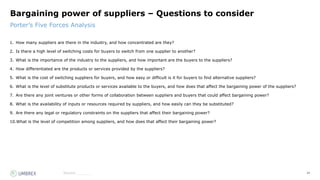
Bargaining power of suppliers – Questions to consider
1. How many suppliers are there in the industry, and how concentrated are they?
2. Is there a high level of switching costs for buyers to switch from one supplier to another?
3. What is the importance of the industry to the suppliers, and how important are the buyers to the suppliers?
4. How differentiated are the products or services provided by the suppliers?
5. What is the cost of switching suppliers for buyers, and how easy or difficult is it for buyers to find alternative suppliers?
6. What is the level of substitute products or services available to the buyers, and how does that affect the bargaining power of the suppliers?
7. Are there any joint ventures or other forms of collaboration between suppliers and buyers that could affect bargaining power?
8. What is the availability of inputs or resources required by suppliers, and how easily can they be substituted?
9. Are there any legal or regulatory constraints on the suppliers that affect their bargaining power?
10.What is the level of competition among suppliers, and how does that affect their bargaining power?
25
Source:_______
Bargaining power of suppliers - [industry]
xxx
Factor Details
# of suppliers
xxx
xxx
xxx
xxx
xxx
xxx
xxx
xxx
xxx
Backup to Porter’s Five Forces Analysis
xxxx
xxxx
xxxx
xxxx
xxxx
xxxx
xxxx
xxxx
xxxx
xxxx
26
Source:_______
Porter’s Five Forces Analysis
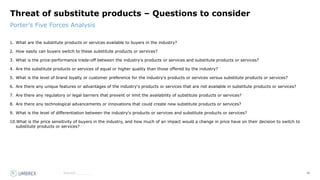
Threat of substitute products – Questions to consider
1. What are the substitute products or services available to buyers in the industry?
2. How easily can buyers switch to these substitute products or services?
3. What is the price-performance trade-off between the industry's products or services and substitute products or services?
4. Are the substitute products or services of equal or higher quality than those offered by the industry?
5. What is the level of brand loyalty or customer preference for the industry's products or services versus substitute products or services?
6. Are there any unique features or advantages of the industry's products or services that are not available in substitute products or services?
7. Are there any regulatory or legal barriers that prevent or limit the availability of substitute products or services?
8. Are there any technological advancements or innovations that could create new substitute products or services?
9. What is the level of differentiation between the industry's products or services and substitute products or services?
10.What is the price sensitivity of buyers in the industry, and how much of an impact would a change in price have on their decision to switch to
substitute products or services?
27
Source:_______
Threat of substitute products - [industry]
xxx
Factor Details
xxx
xxx
xxx
xxx
xxx
xxx
xxx
xxx
xxx
xxx
Backup to Porter’s Five Forces Analysis
xxxx
xxxx
xxxx
xxxx
xxxx
xxxx
xxxx
xxxx
xxxx
xxxx
28
Source:_______
Porter’s Five Forces Analysis
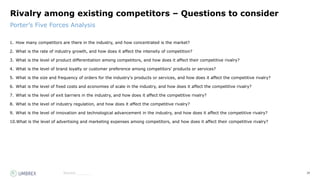
Rivalry among existing competitors – Questions to consider
1. How many competitors are there in the industry, and how concentrated is the market?
2. What is the rate of industry growth, and how does it affect the intensity of competition?
3. What is the level of product differentiation among competitors, and how does it affect their competitive rivalry?
4. What is the level of brand loyalty or customer preference among competitors' products or services?
5. What is the size and frequency of orders for the industry's products or services, and how does it affect the competitive rivalry?
6. What is the level of fixed costs and economies of scale in the industry, and how does it affect the competitive rivalry?
7. What is the level of exit barriers in the industry, and how does it affect the competitive rivalry?
8. What is the level of industry regulation, and how does it affect the competitive rivalry?
9. What is the level of innovation and technological advancement in the industry, and how does it affect the competitive rivalry?
10.What is the level of advertising and marketing expenses among competitors, and how does it affect their competitive rivalry?
29
Source:_______
Rivalry among existing competitors - [industry]
xxx
Factor Details
# competitors
Diversity
Concentration
Industry growth
Quality differences
Barriers to exit
xxx
xxx
xxx
xxx
Backup to Porter’s Five Forces Analysis
xxxx
xxxx
xxxx
xxxx
xxxx
xxxx
xxxx
xxxx
xxxx
xxxx
30
Copyright © 2023 All rights reserved. 30
BCG Growth
Share Matrix
31
Source:_______
BCG Growth Share Matrix — Overview
Source
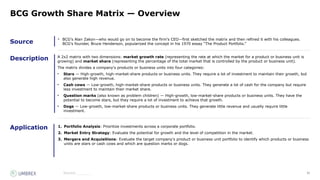
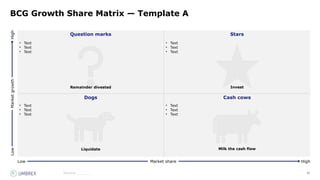
Description A 2x2 matrix with two dimensions: market growth rate (representing the rate at which the market for a product or business unit is
growing) and market share (representing the percentage of the total market that is controlled by the product or business unit).
The matrix divides a company's products or business units into four categories:
• Stars — High-growth, high-market-share products or business units. They require a lot of investment to maintain their growth, but
also generate high revenue.
• Cash cows — Low-growth, high-market-share products or business units. They generate a lot of cash for the company but require
less investment to maintain their market share.
• Question marks (also known as problem children) — High-growth, low-market-share products or business units. They have the
potential to become stars, but they require a lot of investment to achieve that growth.
• Dogs — Low-growth, low-market-share products or business units. They generate little revenue and usually require little
investment.
• BCG's Alan Zakon—who would go on to become the firm's CEO—first sketched the matrix and then refined it with his colleagues.
BCG's founder, Bruce Henderson, popularized the concept in his 1970 essay “The Product Portfolio.”
Application 1. Portfolio Analysis: Prioritize investments across a corporate portfolio.
2. Market Entry Strategy: Evaluate the potential for growth and the level of competition in the market.
3. Mergers and Acquisitions: Evaluate the target company's product or business unit portfolio to identify which products or business
units are stars or cash cows and which are question marks or dogs.
32
Source:_______
BCG Growth Share Matrix — Template A
High
Low
Market
growth
Question marks Stars
Dogs Cash cows
Low High
Market share
Remainder divested Invest
Liquidate Milk the cash flow
• Text
• Text
• Text
• Text
• Text
• Text
• Text
• Text
• Text
• Text
• Text
• Text
33
Source:_______
BCG Growth Share Matrix — Template B
High
Low
Market
growth
Question marks Stars
Dogs Cash cows
Low High
Market share
• Text
• Text
• Text
• Text
• Text
• Text
• Text
• Text
• Text
• Text
• Text
• Text
34
Copyright © 2023 All rights reserved. 34
McKinsey
7-S Framework
35
Source
Description
Application
Source:_______
McKinsey 7-S Framework — Overview
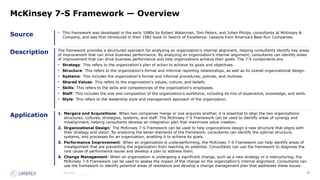
• This framework was developed in the early 1980s by Robert Waterman, Tom Peters, and Julien Philips, consultants at McKinsey &
Company, and was first introduced in their 1982 book In Search of Excellence: Lessons from America's Best-Run Companies.
The framework provides a structured approach for analyzing an organization's internal alignment, helping consultants identify key areas
of improvement that can drive business performance. By analyzing an organization's internal alignment, consultants can identify areas
of improvement that can drive business performance and help organizations achieve their goals. The 7-S components are:
• Strategy: This refers to the organization's plan of action to achieve its goals and objectives.
• Structure: This refers to the organization's formal and informal reporting relationships, as well as its overall organizational design.
• Systems: This includes the organization's formal and informal procedures, policies, and routines.
• Shared Values: This refers to the organization's values, culture, and beliefs.
• Skills: This refers to the skills and competencies of the organization's employees.
• Staff: This includes the size and composition of the organization's workforce, including its mix of experience, knowledge, and skills.
• Style: This refers to the leadership style and management approach of the organization.
1. Mergers and Acquisitions: When two companies merge or one acquires another, it is essential to align the two organizations'
structures, cultures, strategies, systems, and staff. The McKinsey 7-S Framework can be used to identify areas of synergy and
misalignment, helping consultants develop an integration plan that maximizes value creation.
2. Organizational Design: The McKinsey 7-S Framework can be used to help organizations design a new structure that aligns with
their strategy and vision. By analyzing the seven elements of the framework, consultants can identify the optimal structure,
systems, and processes for an organization, enabling it to achieve its goals.
3. Performance Improvement: When an organization is underperforming, the McKinsey 7-S Framework can help identify areas of
misalignment that are preventing the organization from reaching its potential. Consultants can use the framework to diagnose the
root cause of performance issues and develop a plan to address them.
4. Change Management: When an organization is undergoing a significant change, such as a new strategy or a restructuring, the
McKinsey 7-S Framework can be used to assess the impact of the change on the organization's internal alignment. Consultants can
use the framework to identify potential areas of resistance and develop a change management plan that addresses these issues.
36
Source:_______
McKinsey 7-S Framework — Template A
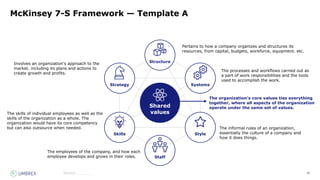
Shared
values
Structure
Staff
Strategy Systems
Skills Style
Involves an organization's approach to the
market. including its plans and actions to
create growth and profits.
Pertains to how a company organizes and structures its
resources, from capital, budgets, workforce, equipment. etc.
The processes and workflows carried out as
a part of work responsibilities and the tools
used to accomplish the work.
The organization's core values ties everything
together, where all aspects of the organization
operate under the same set of values.
The informal rules of an organization,
essentially the culture of a company and
how it does things.
The employees of the company, and how each
employee develops and grows in their roles.
The skills of individual employees as well as the
skills of the organization as a whole. The
organization would have its core competency
but can also outsource when needed.
37
Source:_______
McKinsey 7-S Framework — Template B
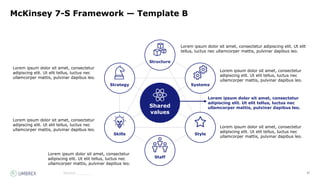
Shared
values
Structure
Staff
Strategy Systems
Skills Style
Lorem ipsum dolor sit amet, consectetur
adipiscing elit. Ut elit tellus, luctus nec
ullamcorper mattis, pulvinar dapibus leo.
Lorem ipsum dolor sit amet, consectetur adipiscing elit. Ut elit
tellus, luctus nec ullamcorper mattis, pulvinar dapibus leo.
Lorem ipsum dolor sit amet, consectetur
adipiscing elit. Ut elit tellus, luctus nec
ullamcorper mattis, pulvinar dapibus leo.
Lorem ipsum dolor sit amet, consectetur
adipiscing elit. Ut elit tellus, luctus nec
ullamcorper mattis, pulvinar dapibus leo.
Lorem ipsum dolor sit amet, consectetur
adipiscing elit. Ut elit tellus, luctus nec
ullamcorper mattis, pulvinar dapibus leo.
Lorem ipsum dolor sit amet, consectetur
adipiscing elit. Ut elit tellus, luctus nec
ullamcorper mattis, pulvinar dapibus leo.
Lorem ipsum dolor sit amet, consectetur
adipiscing elit. Ut elit tellus, luctus nec
ullamcorper mattis, pulvinar dapibus leo.
38
Source:_______
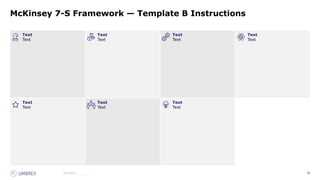
McKinsey 7-S Framework — Template B Instructions
Text
Text
Text
Text
Text
Text
Text
Text
Text
Text
Text
Text
Text
Text
39
Copyright © 2023 All rights reserved. 39
Ansoff Matrix
40
Source
Description
Application
Source:_______
Ansoff Matrix — Overview
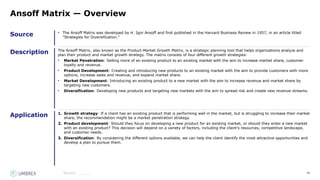
• The Ansoff Matrix was developed by H. Igor Ansoff and first published in the Harvard Business Review in 1957, in an article titled
"Strategies for Diversification."
The Ansoff Matrix, also known as the Product-Market Growth Matrix, is a strategic planning tool that helps organizations analyze and
plan their product and market growth strategy. The matrix consists of four different growth strategies:
• Market Penetration: Selling more of an existing product to an existing market with the aim to increase market share, customer
loyalty and revenue.
• Product Development: Creating and introducing new products to an existing market with the aim to provide customers with more
options, increase sales and revenue, and expand market share.
• Market Development: Introducing an existing product to a new market with the aim to increase revenue and market share by
targeting new customers.
• Diversification: Developing new products and targeting new markets with the aim to spread risk and create new revenue streams.
1. Growth strategy: If a client has an existing product that is performing well in the market, but is struggling to increase their market
share, the recommendation might be a market penetration strategy.
2. Product development: Should they focus on developing a new product for an existing market, or should they enter a new market
with an existing product? This decision will depend on a variety of factors, including the client's resources, competitive landscape,
and customer needs.
3. Diversification: By considering the different options available, we can help the client identify the most attractive opportunities and
develop a plan to pursue them.
41
Source:_______
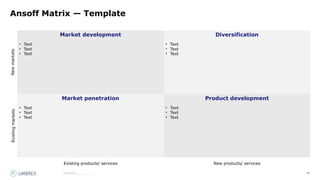
Ansoff Matrix — Template
Market development Diversification
Market penetration Product development
New
markets
Existing products/ services New products/ services
Existing
markets
• Text
• Text
• Text
• Text
• Text
• Text
• Text
• Text
• Text
• Text
• Text
• Text
42
Copyright © 2023 All rights reserved. 42
Force Field Analysis
43
Source
Description
Application
Source:_______
Force Field Analysis — Overview
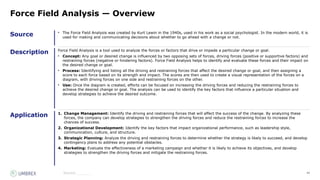
• The Force Field Analysis was created by Kurt Lewin in the 1940s, used in his work as a social psychologist. In the modern world, it is
used for making and communicating decisions about whether to go ahead with a change or not.
Force Field Analysis is a tool used to analyze the forces or factors that drive or impede a particular change or goal.
• Concept: Any goal or desired change is influenced by two opposing sets of forces, driving forces (positive or supportive factors) and
restraining forces (negative or hindering factors). Force Field Analysis helps to identify and evaluate these forces and their impact on
the desired change or goal.
• Process: Identifying and listing all the driving and restraining forces that affect the desired change or goal, and then assigning a
score to each force based on its strength and impact. The scores are then used to create a visual representation of the forces on a
diagram, with driving forces on one side and restraining forces on the other.
• Use: Once the diagram is created, efforts can be focused on increasing the driving forces and reducing the restraining forces to
achieve the desired change or goal. The analysis can be used to identify the key factors that influence a particular situation and
develop strategies to achieve the desired outcome.
1. Change Management: Identify the driving and restraining forces that will affect the success of the change. By analyzing these
forces, the company can develop strategies to strengthen the driving forces and reduce the restraining forces to increase the
chances of success.
2. Organizational Development: Identify the key factors that impact organizational performance, such as leadership style,
communication, culture, and structure.
3. Strategic Planning: Analyze the driving and restraining forces to determine whether the strategy is likely to succeed, and develop
contingency plans to address any potential obstacles.
4. Marketing: Evaluate the effectiveness of a marketing campaign and whether it is likely to achieve its objectives, and develop
strategies to strengthen the driving forces and mitigate the restraining forces.
44
Source:_______
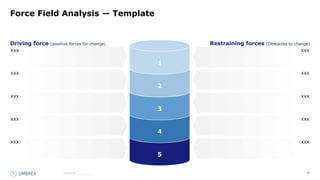
Force Field Analysis — Template
5
4
3
2
1
XXX
Driving force (positive forces for change)
XXX
XXX
XXX
XXX
XXX
XXX
XXX
XXX
XXX
Restraining forces (Obstacles to change)
45
Copyright © 2023 All rights reserved. 45
The 3 C’s
46
Source
Description
Application
Source:_______
The 3 C’s — Overview
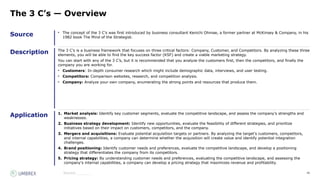
• The concept of the 3 C's was first introduced by business consultant Kenichi Ohmae, a former partner at McKinsey & Company, in his
1982 book The Mind of the Strategist.
The 3 C's is a business framework that focuses on three critical factors: Company, Customer, and Competitors. By analyzing these three
elements, you will be able to find the key success factor (KSF) and create a viable marketing strategy.
You can start with any of the 3 C’s, but it is recommended that you analyze the customers first, then the competitors, and finally the
company you are working for.
• Customers: In-depth consumer research which might include demographic data, interviews, and user testing.
• Competitors: Comparison websites, research, and competition analysis.
• Company: Analyze your own company, enumerating the strong points and resources that produce them.
1. Market analysis: Identify key customer segments, evaluate the competitive landscape, and assess the company's strengths and
weaknesses.
2. Business strategy development: Identify new opportunities, evaluate the feasibility of different strategies, and prioritize
initiatives based on their impact on customers, competitors, and the company.
3. Mergers and acquisitions: Evaluate potential acquisition targets or partners. By analyzing the target's customers, competitors,
and internal capabilities, a company can determine whether the acquisition will create value and identify potential integration
challenges.
4. Brand positioning: Identify customer needs and preferences, evaluate the competitive landscape, and develop a positioning
strategy that differentiates the company from its competitors.
5. Pricing strategy: By understanding customer needs and preferences, evaluating the competitive landscape, and assessing the
company's internal capabilities, a company can develop a pricing strategy that maximizes revenue and profitability.
47
Source:_______
The 3 C’s — Template
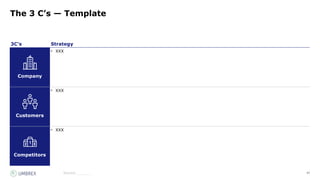
3C’s Strategy
Company
• XXX
Customers
• XXX
Competitors
• XXX
48
Copyright © 2023 All rights reserved. 48
The 4 Ps
49
Source
Description
Application
Source:_______
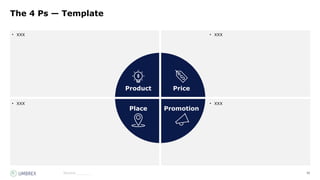
The 4 Ps — Overview
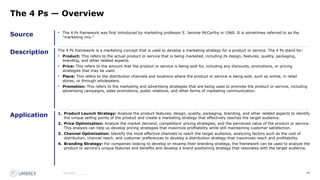
• The 4 Ps framework was first introduced by marketing professor E. Jerome McCarthy in 1960. It is sometimes referred to as the
"marketing mix."
The 4 Ps framework is a marketing concept that is used to develop a marketing strategy for a product or service. The 4 Ps stand for:
• Product: This refers to the actual product or service that is being marketed, including its design, features, quality, packaging,
branding, and other related aspects.
• Price: This refers to the amount that the product or service is being sold for, including any discounts, promotions, or pricing
strategies that may be used.
• Place: This refers to the distribution channels and locations where the product or service is being sold, such as online, in retail
stores, or through wholesalers.
• Promotion: This refers to the marketing and advertising strategies that are being used to promote the product or service, including
advertising campaigns, sales promotions, public relations, and other forms of marketing communication.
1. Product Launch Strategy: Analyze the product features, design, quality, packaging, branding, and other related aspects to identify
the unique selling points of the product and create a marketing strategy that effectively reaches the target audience.
2. Price Optimization: Analyze the market demand, competitors' pricing strategies, and the perceived value of the product or service.
This analysis can help us develop pricing strategies that maximize profitability while still maintaining customer satisfaction.
3. Channel Optimization: Identify the most effective channels to reach the target audience, analyzing factors such as the cost of
distribution, channel reach, and customer preferences to develop a distribution strategy that maximizes reach and profitability.
4. Branding Strategy: For companies looking to develop or revamp their branding strategy, the framework can be used to analyze the
product or service's unique features and benefits and develop a brand positioning strategy that resonates with the target audience.
50
Source:_______
The 4 Ps — Template
• XXX
• XXX
• XXX
• XXX
Product Price
Place Promotion
51
Copyright © 2023 All rights reserved. 51
SWOT Analysis
52
Source
Description
Application
Source:_______
SWOT Analysis — Overview
• The origin of SWOT analysis is not entirely clear, but it is believed to have been developed in the 1960s and 1970s by Albert S.
Humphrey, a management consultant at the Stanford Research Institute (SRI) in California, USA.
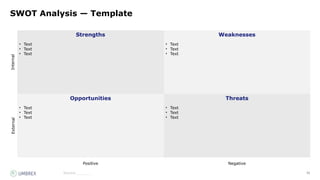
A SWOT analysis is a technique for assessing these four aspects of a business to analyze what a company does best now, and devise a
successful strategy for the future. SWOT stands for:
• Strengths: What do you do well? What unique resources can you draw on? What do others see as your strengths?
• Weaknesses: What could you improve? Where do you have fewer resources than others? What are others likely to see as
weaknesses?
• Opportunities: What opportunities are open to you? What trends could you take advantage of? How can you turn your strengths
into opportunities?
• Threats: What threats could harm you? What is your competition doing? What threats do your weaknesses expose?
1. Market Entry Strategy: Identify the internal strengths and weaknesses of the company as well as external opportunities and
threats in the new market.
2. Business Unit Strategy: Evaluate the strengths and weaknesses of a business unit within an organization, as well as external
opportunities and threats in the market. This can help the company identify areas for improvement and develop a strategic plan for
the business unit.
3. Corporate Strategy: Evaluate the strengths and weaknesses of the entire organization, as well as external opportunities and
threats in the market. This can help the company develop a corporate strategy that aligns with its strengths and takes advantage of
external opportunities while minimizing threats.
4. Mergers and Acquisitions: Evaluate the strengths and weaknesses of both companies involved in a merger or acquisition, as well
as external opportunities and threats in the market. This can help the companies identify potential synergies and risks involved in
the deal.
53
Source:_______
SWOT Analysis — Template
Strengths Weaknesses
Opportunities Threats
Internal
Positive Negative
External
• Text
• Text
• Text
• Text
• Text
• Text
• Text
• Text
• Text
• Text
• Text
• Text
54
Copyright © 2023 All rights reserved. 54
Profitability Framework
55
Source
Description
Application
Source:_______
Profitability Framework — Overview
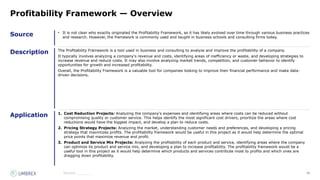
• It is not clear who exactly originated the Profitability Framework, as it has likely evolved over time through various business practices
and research. However, the framework is commonly used and taught in business schools and consulting firms today.
The Profitability Framework is a tool used in business and consulting to analyze and improve the profitability of a company.
It typically involves analyzing a company's revenue and costs, identifying areas of inefficiency or waste, and developing strategies to
increase revenue and reduce costs. It may also involve analyzing market trends, competition, and customer behavior to identify
opportunities for growth and increased profitability.
Overall, the Profitability Framework is a valuable tool for companies looking to improve their financial performance and make data-
driven decisions.
1. Cost Reduction Projects: Analyzing the company's expenses and identifying areas where costs can be reduced without
compromising quality or customer service. This helps identify the most significant cost drivers, prioritize the areas where cost
reductions would have the biggest impact, and develop a plan to reduce costs.
2. Pricing Strategy Projects: Analyzing the market, understanding customer needs and preferences, and developing a pricing
strategy that maximizes profits. The profitability framework would be useful in this project as it would help determine the optimal
price points that maximize revenue and profit.
3. Product and Service Mix Projects: Analyzing the profitability of each product and service, identifying areas where the company
can optimize its product and service mix, and developing a plan to increase profitability. The profitability framework would be a
useful tool in this project as it would help determine which products and services contribute most to profits and which ones are
dragging down profitability.
56
Source:_______
Profitability Framework — Template
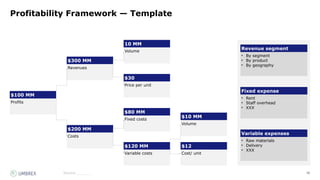
$100 MM
Profits
10 MM
Volume
$30
Price per unit
$80 MM
Fixed costs
$120 MM
Variable costs
Revenue segment
• By segment
• By product
• By geography
Fixed expense
• Rent
• Staff overhead
• XXX
Variable expenses
• Raw materials
• Delivery
• XXX
$12
Cost/ unit
$10 MM
Volume
$300 MM
Revenues
$200 MM
Costs
57
Copyright © 2023 All rights reserved. 57
Blue Ocean Strategy
58
Source
Description
Application
Source:_______
Blue Ocean Strategy — Overview
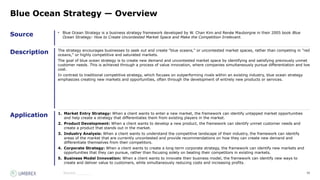
• Blue Ocean Strategy is a business strategy framework developed by W. Chan Kim and Renée Mauborgne in their 2005 book Blue
Ocean Strategy: How to Create Uncontested Market Space and Make the Competition Irrelevant.
The strategy encourages businesses to seek out and create "blue oceans," or uncontested market spaces, rather than competing in "red
oceans," or highly competitive and saturated markets.
The goal of blue ocean strategy is to create new demand and uncontested market space by identifying and satisfying previously unmet
customer needs. This is achieved through a process of value innovation, where companies simultaneously pursue differentiation and low
cost.
In contrast to traditional competitive strategy, which focuses on outperforming rivals within an existing industry, blue ocean strategy
emphasizes creating new markets and opportunities, often through the development of entirely new products or services.
1. Market Entry Strategy: When a client wants to enter a new market, the framework can identify untapped market opportunities
and help create a strategy that differentiates them from existing players in the market.
2. Product Development: When a client wants to develop a new product, the framework can identify unmet customer needs and
create a product that stands out in the market.
3. Industry Analysis: When a client wants to understand the competitive landscape of their industry, the framework can identify
areas of the market that are currently uncontested and provide recommendations on how they can create new demand and
differentiate themselves from their competitors.
4. Corporate Strategy: When a client wants to create a long-term corporate strategy, the framework can identify new markets and
opportunities that they can pursue, rather than focusing solely on beating their competitors in existing markets.
5. Business Model Innovation: When a client wants to innovate their business model, the framework can identify new ways to
create and deliver value to customers, while simultaneously reducing costs and increasing profits.
59
Source:_______
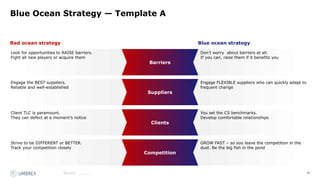
Barriers
Suppliers
Clients
Competition
Blue Ocean Strategy — Template A
Red ocean strategy Blue ocean strategy
Look for opportunities to RAISE barriers.
Fight all new players or acquire them
Engage the BEST suppliers.
Reliable and well-established
Client TLC is paramount.
They can defect at a moment’s notice
Strive to be DIFFERENT or BETTER.
Track your competition closely
Don’t worry about barriers at all.
If you can, raise them if it benefits you
Engage FLEXIBLE suppliers who can quickly adapt to
frequent change
You set the CS benchmarks.
Develop comfortable relationships
GROW FAST – so you leave the competition in the
dust. Be the big fish in the pond
60
Source:_______
Text
Text
Text
Text
Blue Ocean Strategy — Template B
XXX
• XXX
• XXX
• XXX
• XXX
• XXX
• XXX
• XXX
• XXX
• XXX
• XXX
• XXX
• XXX
XXX
• XXX
• XXX
• XXX
• XXX
• XXX
• XXX
• XXX
• XXX
• XXX
• XXX
• XXX
• XXX
61
Copyright © 2023 All rights reserved. 61
Value Disciplines Model
62
Source
Description
Application
Source:_______
Value Disciplines Model — Overview
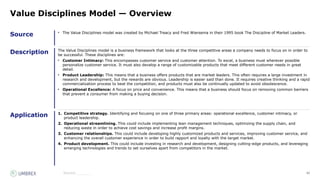
• The Value Disciplines model was created by Michael Treacy and Fred Wiersema in their 1995 book The Discipline of Market Leaders.
The Value Disciplines model is a business framework that looks at the three competitive areas a company needs to focus on in order to
be successful. These disciplines are:
• Customer Intimacy: This encompasses customer service and customer attention. To excel, a business must wherever possible
personalize customer service. It must also develop a range of customizable products that meet different customer needs in great
detail.
• Product Leadership: This means that a business offers products that are market leaders. This often requires a large investment in
research and development, but the rewards are obvious. Leadership is easier said than done. It requires creative thinking and a rapid
commercialization process to beat the competition, and products must also be continually updated to avoid obsolescence.
• Operational Excellence: A focus on price and convenience. This means that a business should focus on removing common barriers
that prevent a consumer from making a buying decision.
1. Competitive strategy. Identifying and focusing on one of three primary areas: operational excellence, customer intimacy, or
product leadership.
2. Operational streamlining. This could include implementing lean management techniques, optimizing the supply chain, and
reducing waste in order to achieve cost savings and increase profit margins.
3. Customer relationships. This could include developing highly customized products and services, improving customer service, and
enhancing the overall customer experience in order to build rapport and loyalty with the target market.
4. Product development. This could include investing in research and development, designing cutting-edge products, and leveraging
emerging technologies and trends to set ourselves apart from competitors in the market.
63
Source:_______
Value Disciplines Model — Template A
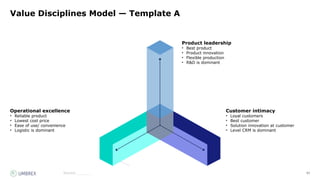
Product leadership
• Best product
• Product innovation
• Flexible production
• R&D is dominant
Customer intimacy
• Loyal customers
• Best customer
• Solution innovation at customer
• Level CRM is dominant
Operational excellence
• Reliable product
• Lowest cost price
• Ease of use/ convenience
• Logistic is dominant
64
Source:_______
Value Disciplines Model — Template B
XXX
• XXX
• XXX
• XXX
• XXX
XXX
• XXX
• XXX
• XXX
• XXX
XXX
• XXX
• XXX
• XXX
• XXX
65
Copyright © 2023 All rights reserved. 65
Porter's Value Chain
66
Source
Description
Application
Source:_______
Porter's Value Chain — Overview
• The concept of Porter's Value Chain was first introduced by renowned economist and Harvard Business School professor Michael
Porter in his 1985 book Competitive Advantage: Creating and Sustaining Superior Performance.
Porter's Value Chain is a framework that helps businesses to analyze their internal operations and identify areas where they can create
value and improve their competitive advantage. The concept of value chain refers to the various activities that a business performs to
deliver a product or service to its customers.
Porter's idea was that a business can create value by optimizing its value chain and finding ways to reduce costs or differentiate its
products or services from its competitors. The value chain is divided into two categories: primary activities and support activities.
Primary activities are those involved in the production and delivery of a product or service, such as inbound logistics, operations,
outbound logistics, marketing, and customer service. Support activities are those that support the primary activities, such as
procurement, technology development, and human resource management
1. Cost reduction: Identify areas where costs can be reduced without sacrificing quality or customer satisfaction — for example, ways
to streamline procurement or improve logistics to reduce costs.
2. Product differentiation: Identify areas where we can add value to a product or service. For example, we may look at ways to
improve customer service or product design to make a product more appealing to customers.
3. Mergers and acquisitions: Analyze the value chains of both companies to identify areas where they can combine operations to
reduce costs or improve efficiencies.
4. Supply chain optimization: Analyze the various steps in the value chain, we can identify areas where the supply chain can be
improved, such as through better inventory management or improved transportation logistics.
67
Source:_______
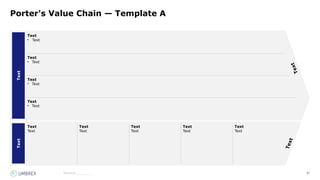
Porter's Value Chain — Template A
Text
Text
Text
• Text
Text
• Text
Text
• Text
Text
• Text
Text
Text
Text
Text
Text
Text
Text
Text
Text
Text
T
e
x
t
T
e
x
t
68
Source:_______
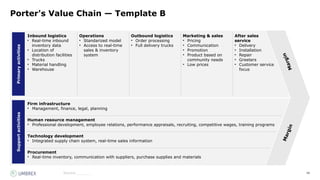
Porter's Value Chain — Template B
Primary
activities
Inbound logistics
• Real-time inbound
inventory data
• Location of
distribution facilities
• Trucks
• Material handling
• Warehouse
Operations
• Standarized model
• Access to real-time
sales & inventory
system
Outbound logistics
• Order processing
• Full delivery trucks
Marketing & sales
• Pricing
• Communication
• Promotion
• Product based on
community needs
• Low prices
After sales
service
• Delivery
• Installation
• Repair
• Greeters
• Customer service
focus
Support
activities
Firm infrastructure
• Management, finance, legal, planning
Human resource management
• Professional development, employee relations, performance appraisals, recruiting, competitive wages, training programs
Technology development
• Integrated supply chain system, real-time sales information
Procurement
• Real-time inventory, communication with suppliers, purchase supplies and materials
M
a
r
g
i
n
M
a
r
g
i
n
69
Source:_______
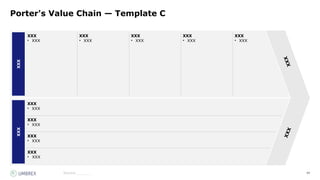
Porter's Value Chain — Template C
XXX
XXX
• XXX
XXX
• XXX
XXX
• XXX
XXX
• XXX
XXX
• XXX
XXX
XXX
• XXX
XXX
• XXX
XXX
• XXX
XXX
• XXX
X
X
X
X
X
X
70
Copyright © 2023 All rights reserved. 70
GE McKinsey Matrix
71
Source
Description
Application
Source:_______
GE McKinsey Matrix — Overview
• Developed by McKinsey & Company in collaboration with General Electric and first introduced in a 1971 report titled "The McKinsey
Approach to Business Policy," written by McKinsey consultants Tom Peters and Robert Waterman.
The GE McKinsey Matrix is a strategic management tool used to assess the performance of a business's product portfolio. "The
McKinsey Approach to Business Policy" report outlined a framework for assessing the strategic position of a business and making
decisions about resource allocation.
The nine-box matrix that assesses a business's product portfolio based on two key dimensions: market attractiveness and business
strength. Market attractiveness refers to the size and growth potential of the market for a given product, while business strength refers
to the ability of the business to compete in that market.
The matrix has become a widely used tool for strategic management, helping businesses to assess their product portfolios and make
informed decisions about resource allocation and investment.
1. Portfolio analysis: Evaluate a company's current business portfolio and identify areas of strength and weakness to determine
where to invest resources and where to divest.
2. Acquisition analysis: Evaluate the target company's business portfolio and determine how it fits with the acquiring company's
portfolio to make informed decisions about whether to pursue an acquisition.
3. Resource allocation: Determine where to allocate resources within a company's business portfolio. By assessing each business
unit's market attractiveness and competitive position, management can prioritize investments to maximize growth and profitability.
4. Strategic planning: Assess the company's current portfolio and potential growth opportunities to develop a clear and actionable
plan for achieving long-term success.
72
Source:_______
GE McKinsey Matrix — Template
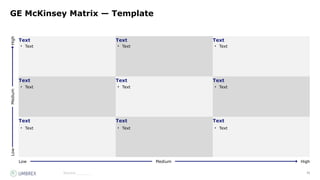
High
Low
Medium
Text
Text
Low High
Medium
Text Text
Text Text
Text Text Text
• Text • Text • Text
73
Copyright © 2023 All rights reserved. 73
Product Life Cycle
74
Source
Description
Application
Source:_______
Product Life Cycle — Overview
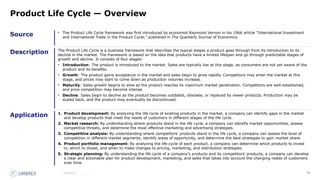
• The Product Life Cycle framework was first introduced by economist Raymond Vernon in his 1966 article "International Investment
and International Trade in the Product Cycle," published in The Quarterly Journal of Economics.
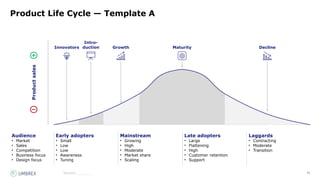
The Product Life Cycle is a business framework that describes the typical stages a product goes through from its introduction to its
decline in the market. The framework is based on the idea that products have a limited lifespan and go through predictable stages of
growth and decline. It consists of four stages:
• Introduction: The product is introduced to the market. Sales are typically low at this stage, as consumers are not yet aware of the
product and its benefits.
• Growth: The product gains acceptance in the market and sales begin to grow rapidly. Competitors may enter the market at this
stage, and prices may start to come down as production volumes increase.
• Maturity: Sales growth begins to slow as the product reaches its maximum market penetration. Competitors are well-established,
and price competition may become intense.
• Decline: Sales begin to decline as the product becomes outdated, obsolete, or replaced by newer products. Production may be
scaled back, and the product may eventually be discontinued.
1. Product development: By analyzing the life cycle of existing products in the market, a company can identify gaps in the market
and develop products that meet the needs of customers in different stages of the life cycle.
2. Market research: By understanding where products stand in the life cycle, a company can identify market opportunities, assess
competitive threats, and determine the most effective marketing and advertising strategies.
3. Competitive analysis: By understanding where competitors' products stand in the life cycle, a company can assess the level of
competition in different market segments, identify areas of opportunity, and determine the best strategies to gain market share.
4. Product portfolio management: By analyzing the life cycle of each product, a company can determine which products to invest
in, which to divest, and when to make changes to pricing, marketing, and distribution strategies.
5. Strategic planning: By understanding the life cycle of a company's products and its competitors' products, a company can develop
a clear and actionable plan for product development, marketing, and sales that takes into account the changing needs of customers
over time.
75
Source:_______
Product Life Cycle — Template A
Early adopters
• Small
• Low
• Low
• Awareness
• Tuning
Mainstream
• Growing
• High
• Moderate
• Market share
• Scaling
Late adopters
• Large
• Flattening
• High
• Customer retention
• Support
Laggards
• Contracting
• Moderate
• Transition
Audience
• Market
• Sales
• Competition
• Business focus
• Design focus
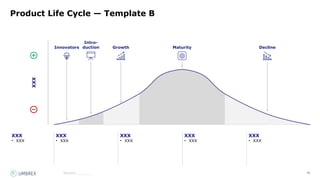
Intro-
duction Growth Maturity Decline
Product
sales
Innovators
76
Source:_______
Product Life Cycle — Template B
XXX
• XXX
XXX
• XXX
XXX
• XXX
XXX
• XXX
XXX
• XXX
Intro-
duction Growth Maturity Decline
XXX
Innovators
77
Copyright © 2023 All rights reserved. 77
Roger’s Five Factors
78
Source
Description
Application
Source:_______
Roger’s Five Factors — Overview
• The Rogers' Five Factors framework, also known as the Diffusion of Innovation theory, was developed by sociologist and
communication theorist Everett Rogers in his 1962 book Diffusion of Innovations.
Rogers' framework seeks to explain how and why new ideas, technologies, and products are adopted by people over time. Rogers
conducted extensive research on the adoption of innovations across various fields and industries, and his framework identified five key
factors that influence the rate of adoption of an innovation:
• Relative advantage: The degree to which an innovation is perceived as better than the existing solution it is replacing.
• Compatibility: The degree to which an innovation is perceived as consistent with existing values, experiences, and needs of
potential adopters.
• Complexity: The degree to which an innovation is perceived as difficult to understand or use.
• Trialability: The degree to which an innovation can be experimented with or tested before full adoption.
• Observability: The degree to which the results of an innovation are visible to others, which can influence adoption through social
proof and word of mouth.
1. New product development: Identify potential barriers to adoption and design features that address each factor. For example, a
product that is perceived to have a high relative advantage compared to existing solutions is more likely to be adopted, so the client
could design a product that offers clear benefits to the customer.
2. Marketing strategy: Identify the target audience and design messages that will resonate with them. By understanding the factors
that influence adoption, the client can develop messaging that emphasizes the benefits of the product, addresses any perceived
complexity, and highlights the social proof of others using the product.
3. Organizational change: Understand potential resistance to change and design strategies to address it. For example, if employees
perceive the change as too complex or incompatible with their current practices, the client could design training programs or pilot
programs that allow employees to experiment with the change and see its benefits firsthand.
4. Technology adoption: Identify factors that influence adoption by different segments of users. By understanding the different
adoption rates and barriers among different segments, the client can design different strategies for each group to encourage
adoption and maximize the technology's benefits.
79
Source:_______
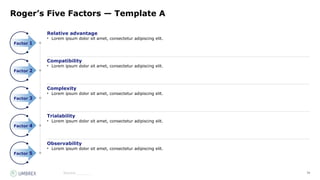
Relative advantage
• Lorem ipsum dolor sit amet, consectetur adipiscing elit.
Compatibility
• Lorem ipsum dolor sit amet, consectetur adipiscing elit.
Complexity
• Lorem ipsum dolor sit amet, consectetur adipiscing elit.
Trialability
• Lorem ipsum dolor sit amet, consectetur adipiscing elit.
Observability
• Lorem ipsum dolor sit amet, consectetur adipiscing elit.
Roger’s Five Factors — Template A
Factor 1
Factor 2
Factor 3
Factor 4
Factor 5
80
Source:_______
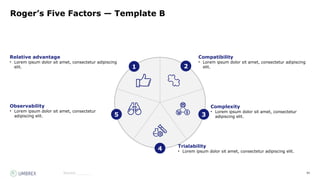
Roger’s Five Factors — Template B
1 2
5 3
4
Relative advantage
• Lorem ipsum dolor sit amet, consectetur adipiscing
elit.
Compatibility
• Lorem ipsum dolor sit amet, consectetur adipiscing
elit.
Complexity
• Lorem ipsum dolor sit amet, consectetur
adipiscing elit.
Trialability
• Lorem ipsum dolor sit amet, consectetur adipiscing elit.
Observability
• Lorem ipsum dolor sit amet, consectetur
adipiscing elit.
81
Copyright © 2023 All rights reserved. 81
SIPOC model
82
Source
Description
Application
Source:_______
SIPOC model — Overview
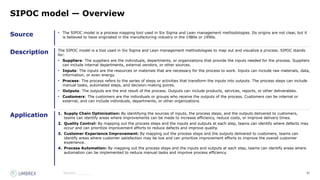
• The SIPOC model is a process mapping tool used in Six Sigma and Lean management methodologies. Its origins are not clear, but it
is believed to have originated in the manufacturing industry in the 1980s or 1990s.
The SIPOC model is a tool used in Six Sigma and Lean management methodologies to map out and visualize a process. SIPOC stands
for:
• Suppliers: The suppliers are the individuals, departments, or organizations that provide the inputs needed for the process. Suppliers
can include internal departments, external vendors, or other sources.
• Inputs: The inputs are the resources or materials that are necessary for the process to work. Inputs can include raw materials, data,
information, or even energy.
• Process: The process refers to the series of steps or activities that transform the inputs into outputs. The process steps can include
manual tasks, automated steps, and decision-making points.
• Outputs: The outputs are the end result of the process. Outputs can include products, services, reports, or other deliverables.
• Customers: The customers are the individuals or groups who receive the outputs of the process. Customers can be internal or
external, and can include individuals, departments, or other organizations.
1. Supply Chain Optimization: By identifying the sources of inputs, the process steps, and the outputs delivered to customers,
teams can identify areas where improvements can be made to increase efficiency, reduce costs, or improve delivery times.
2. Quality Control: By mapping out the process steps and the inputs and outputs at each step, teams can identify where defects may
occur and can prioritize improvement efforts to reduce defects and improve quality.
3. Customer Experience Improvement: By mapping out the process steps and the outputs delivered to customers, teams can
identify areas where customer satisfaction may be low and can prioritize improvement efforts to improve the overall customer
experience.
4. Process Automation: By mapping out the process steps and the inputs and outputs at each step, teams can identify areas where
automation can be implemented to reduce manual tasks and improve process efficiency.
83
Source:_______
SIPOC model — Template A
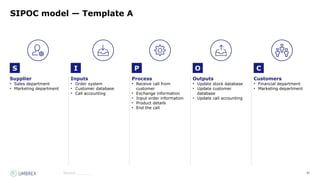
Supplier
• Sales department
• Marketing department
Inputs
• Order system
• Customer database
• Call accounting
Process
• Receive call from
customer
• Exchange information
• Input order information
• Product details
• End the call
Outputs
• Update stock database
• Update customer
database
• Update call accounting
Customers
• Financial department
• Marketing department
S I P O C
84
Source:_______
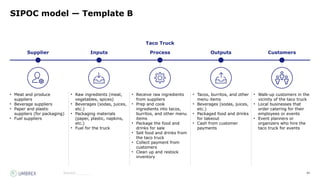
SIPOC model — Template B
• Meat and produce
suppliers
• Beverage suppliers
• Paper and plastic
suppliers (for packaging)
• Fuel suppliers
• Raw ingredients (meat,
vegetables, spices)
• Beverages (sodas, juices,
etc.)
• Packaging materials
(paper, plastic, napkins,
etc.)
• Fuel for the truck
• Receive raw ingredients
from suppliers
• Prep and cook
ingredients into tacos,
burritos, and other menu
items
• Package the food and
drinks for sale
• Sell food and drinks from
the taco truck
• Collect payment from
customers
• Clean up and restock
inventory
• Tacos, burritos, and other
menu items
• Beverages (sodas, juices,
etc.)
• Packaged food and drinks
for takeout
• Cash from customer
payments
• Walk-up customers in the
vicinity of the taco truck
• Local businesses that
order catering for their
employees or events
• Event planners or
organizers who hire the
taco truck for events
Supplier Inputs Process Outputs Customers
Taco Truck
85
Source:_______
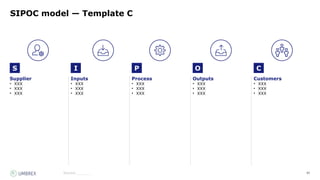
SIPOC model — Template C
Supplier
• XXX
• XXX
• XXX
Inputs
• XXX
• XXX
• XXX
Process
• XXX
• XXX
• XXX
Outputs
• XXX
• XXX
• XXX
Customers
• XXX
• XXX
• XXX
S I P O C
86
Copyright © 2023 All rights reserved. 86
PESTEL Analysis
87
Source
Description
Application
Source:_______
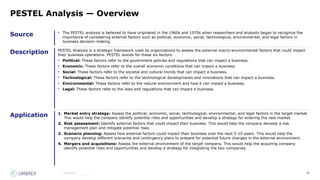
PESTEL Analysis — Overview
• The PESTEL analysis is believed to have originated in the 1960s and 1970s when researchers and analysts began to recognize the
importance of considering external factors such as political, economic, social, technological, environmental, and legal factors in
business decision-making.
PESTEL Analysis is a strategic framework used by organizations to assess the external macro-environmental factors that could impact
their business operations. PESTEL stands for these six factors:
• Political: These factors refer to the government policies and regulations that can impact a business.
• Economic: These factors refer to the overall economic conditions that can impact a business.
• Social: These factors refer to the societal and cultural trends that can impact a business.
• Technological: These factors refer to the technological developments and innovations that can impact a business.
• Environmental: These factors refer to the natural environment and how it can impact a business.
• Legal: These factors refer to the laws and regulations that can impact a business.
1. Market entry strategy: Assess the political, economic, social, technological, environmental, and legal factors in the target market.
This would help the company identify potential risks and opportunities and develop a strategy for entering the new market.
2. Risk assessment: Identify external factors that could impact their business. This would help the company develop a risk
management plan and mitigate potential risks.
3. Scenario planning: Assess how external factors could impact their business over the next 5-10 years. This would help the
company develop different scenarios and contingency plans to prepare for potential future changes in the external environment.
4. Mergers and acquisitions: Assess the external environment of the target company. This would help the acquiring company
identify potential risks and opportunities and develop a strategy for integrating the two companies.
88
Source:_______
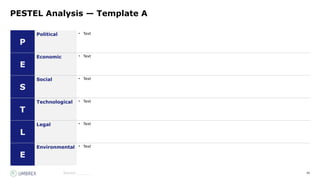
PESTEL Analysis — Template A
P
Political • Text
E
Economic • Text
S
Social • Text
T
Technological • Text
L
Legal • Text
E
Environmental • Text
89
Source:_______
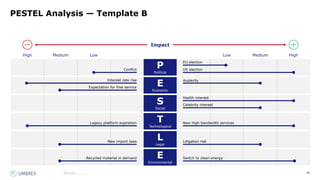
PESTEL Analysis — Template B
P
Political
E
Economic
S
Social
T
Technological
L
Legal
E
Environmental
High Medium Low High
Medium
Low
EU election
US election
Austerity
Health interest
Celebrity interest
New high-bandwidth services
Litigation risk
Switch to clean energy
Conflict
Interest rate rise
Expectation for free service
Legacy platform expiration
New import laws
Recycled material in demand
Impact
90
Copyright © 2023 All rights reserved. 90
Lafley Strategy
91
Source
Description
Application
Source:_______
Lafley Strategy — Overview
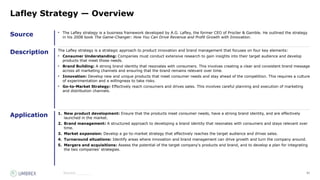
• The Lafley strategy is a business framework developed by A.G. Lafley, the former CEO of Procter & Gamble. He outlined the strategy
in his 2008 book The Game-Changer: How You Can Drive Revenue and Profit Growth with Innovation.
The Lafley strategy is a strategic approach to product innovation and brand management that focuses on four key elements:
• Consumer Understanding: Companies must conduct extensive research to gain insights into their target audience and develop
products that meet those needs.
• Brand Building: A strong brand identity that resonates with consumers. This involves creating a clear and consistent brand message
across all marketing channels and ensuring that the brand remains relevant over time.
• Innovation: Develop new and unique products that meet consumer needs and stay ahead of the competition. This requires a culture
of experimentation and a willingness to take risks.
• Go-to-Market Strategy: Effectively reach consumers and drives sales. This involves careful planning and execution of marketing
and distribution channels.
1. New product development: Ensure that the products meet consumer needs, have a strong brand identity, and are effectively
launched in the market.
2. Brand management: A structured approach to developing a brand identity that resonates with consumers and stays relevant over
time.
3. Market expansion: Develop a go-to-market strategy that effectively reaches the target audience and drives sales.
4. Turnaround situations: Identify areas where innovation and brand management can drive growth and turn the company around.
5. Mergers and acquisitions: Assess the potential of the target company's products and brand, and to develop a plan for integrating
the two companies' strategies.
92
Source:_______
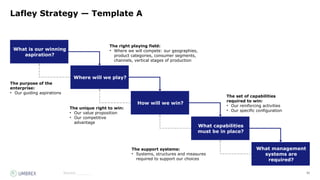
Lafley Strategy — Template A
What is our winning
aspiration?
Where will we play?
How will we win?
What capabilities
must be in place?
What management
systems are
required?
The purpose of the
enterprise:
• Our guiding aspirations
The right playing field:
• Where we will compete: our geographies,
product categories, consumer segments,
channels, vertical stages of production
The set of capabilities
required to win:
• Our reinforcing activities
• Our specific configuration
The unique right to win:
• Our value proposition
• Our competitive
advantage
The support systems:
• Systems, structures and measures
required to support our choices
93
Source:_______
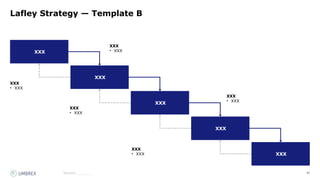
Lafley Strategy — Template B
XXX
XXX
XXX
XXX
XXX
XXX
• XXX
XXX
• XXX
XXX
• XXX
XXX
• XXX
XXX
• XXX
94
Copyright © 2023 All rights reserved. 94
Three Horizons
95
Source
Description
Application
Source:_______
Three Horizons — Overview
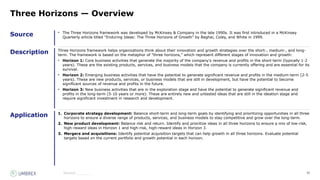
• The Three Horizons framework was developed by McKinsey & Company in the late 1990s. It was first introduced in a McKinsey
Quarterly article titled "Enduring Ideas: The Three Horizons of Growth" by Baghai, Coley, and White in 1999.
Three Horizons framework helps organizations think about their innovation and growth strategies over the short-, medium-, and long-
term. The framework is based on the metaphor of "three horizons," which represent different stages of innovation and growth:
• Horizon 1: Core business activities that generate the majority of the company's revenue and profits in the short-term (typically 1-2
years). These are the existing products, services, and business models that the company is currently offering and are essential for its
survival.
• Horizon 2: Emerging business activities that have the potential to generate significant revenue and profits in the medium-term (2-5
years). These are new products, services, or business models that are still in development, but have the potential to become
significant sources of revenue and profits in the future.
• Horizon 3: New business activities that are in the exploration stage and have the potential to generate significant revenue and
profits in the long-term (5-10 years or more). These are entirely new and untested ideas that are still in the ideation stage and
require significant investment in research and development.
1. Corporate strategy development: Balance short-term and long-term goals by identifying and prioritizing opportunities in all three
horizons to ensure a diverse range of products, services, and business models to stay competitive and grow over the long-term.
2. New product development: Balance risk and return. Identify and prioritize ideas in all three horizons to ensure a mix of low-risk,
high-reward ideas in Horizon 1 and high-risk, high-reward ideas in Horizon 3.
3. Mergers and acquisitions: Identify potential acquisition targets that can help growth in all three horizons. Evaluate potential
targets based on the current portfolio and growth potential in each horizon.
96
Source:_______
Three Horizons — Template
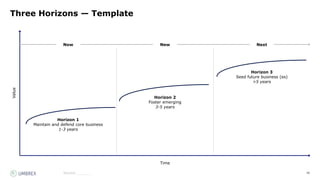
Value
Time
Horizon 1
Maintain and defend core business
1-3 years
Horizon 2
Foster emerging
3-5 years
Horizon 3
Seed future business (es)
>5 years
Now New Next
97
Copyright © 2023 All rights reserved. 97
Seven Degrees of
Freedom for Growth
98
Source
Description
Application
Source:_______
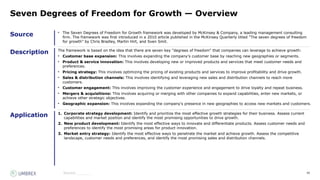
Seven Degrees of Freedom for Growth — Overview
• The Seven Degrees of Freedom for Growth framework was developed by McKinsey & Company, a leading management consulting
firm. The framework was first introduced in a 2010 article published in the McKinsey Quarterly titled "The seven degrees of freedom
for growth" by Chris Bradley, Martin Hirt, and Sven Smit.
The framework is based on the idea that there are seven key "degrees of freedom" that companies can leverage to achieve growth:
• Customer base expansion: This involves expanding the company's customer base by reaching new geographies or segments.
• Product & service innovation: This involves developing new or improved products and services that meet customer needs and
preferences.
• Pricing strategy: This involves optimizing the pricing of existing products and services to improve profitability and drive growth.
• Sales & distribution channels: This involves identifying and leveraging new sales and distribution channels to reach more
customers.
• Customer engagement: This involves improving the customer experience and engagement to drive loyalty and repeat business.
• Mergers & acquisitions: This involves acquiring or merging with other companies to expand capabilities, enter new markets, or
achieve other strategic objectives.
• Geographic expansion: This involves expanding the company's presence in new geographies to access new markets and customers.
1. Corporate strategy development: Identify and prioritize the most effective growth strategies for their business. Assess current
capabilities and market position and identify the most promising opportunities to drive growth.
2. New product development: Identify the most effective ways to innovate and differentiate products. Assess customer needs and
preferences to identify the most promising areas for product innovation.
3. Market entry strategy: Identify the most effective ways to penetrate the market and achieve growth. Assess the competitive
landscape, customer needs and preferences, and identify the most promising sales and distribution channels.
99
Source:_______
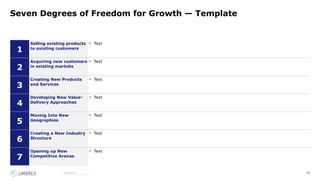
Seven Degrees of Freedom for Growth — Template
1
Selling existing products
to existing customers
• Text
2
Acquiring new customers
in existing markets
• Text
3
Creating New Products
and Services
• Text
4
Developing New Value-
Delivery Approaches
• Text
5
Moving Into New
Geographies
• Text
6
Creating a New Industry
Structure
• Text
7
Opening up New
Competitive Arenas
• Text
100
Copyright © 2023 All rights reserved. 100
Porter's Generic
Strategies
101
Source
Description
Application
Source:_______
Porter's Generic Strategies — Overview
• Porter's Generic Strategies is a framework developed by Harvard Business School professor Michael Porter and first introduced by
Michael Porter in his 1980 book Competitive Strategy: Techniques for Analyzing Industries and Competitors.
The framework describes three generic strategies that businesses can use to gain competitive advantage and achieve long-term
profitability in their industry. These strategies are:
• Cost Leadership: A focus on reducing costs in order to offer products or services at a lower price than competitors. The goal is to
become the low-cost provider in the industry while maintaining an acceptable level of quality. This strategy is particularly effective in
price-sensitive markets, where customers are primarily concerned with getting the best deal.
• Differentiation: Differentiate products or services from competitors in ways that are valued by customers. The goal is to create a
unique selling proposition that sets the company apart from its competitors and allows it to charge a premium price. This strategy is
particularly effective in markets where customers are willing to pay more for products or services that offer unique features, quality,
or performance.
• Focus: Target a specific segment of the market and tailor products or services to meet the needs of that segment. The goal is to
become the leading provider of products or services to a narrow market segment. This strategy is particularly effective in markets
where there are specific customer needs that are not being met by larger competitors.
1. Market Entry Strategy: Identify the most effective strategy based on the competitive dynamics of the target market. For example,
if the market is highly price-sensitive, the company may need to focus on a cost leadership strategy to gain market share.
2. Competitive Analysis: Assess competitive position and identify ways to differentiate from the competitors. Develop a strategy that
leverages its unique strengths and capabilities. For example, if the company has a strong brand and reputation for quality, it may
need to focus on a differentiation strategy to maintain its market position.
3. Business Unit Strategy: Develop a strategy for each unit that aligns with the overall corporate strategy. Identify competitive
position in the market and develop a strategy that leverages unique strengths and capabilities. For example, if one business unit
operates in a niche market, it may need to focus on a focus strategy to maintain its market position.
102
Source:_______
Porter's Generic Strategies — Template A
Entire
A
segment
Market
scope
What
part
of
the
market
is
being
targeted?
Costs Differentiation
Cost focus Differentiation focus
Cost leadership Differentiation
Strategy
Be the most competitive company in cost in the entire market
Differentiation
Be a distinctive company, recognized for its uniqueness, quality or
personality
Strategy
Be very competitive in cost in a particular product or niche
Differentiation
Have a differentiated product or market niche
Competitive advantage
What makes the company “strong”
103
Source:_______
Porter's Generic Strategies — Template B
XXX
XXX
XXX
XXX XXX
XXX XXX
XXX XXX
XXX XXX
XXX XXX
XXX
104
Copyright © 2023 All rights reserved. 104
Galbraith Star Model
105
Source
Description
Application
Source:_______
Galbraith Star Model — Overview
• The Galbraith Star Model was developed by Jay R. Galbraith, a professor and consultant in the field of organizational design and
development and first introduced in his 1973 book Designing Organizations: An Executive Guide to Strategy, Structure, and Process.
The Galbraith Star Model consists of five interconnected factors essential for designing an effective organizational structure:
• Strategy: This refers to the organization's mission, goals, and objectives. The strategy defines what the organization is trying to
achieve and the direction it wants to take.
• Structure: This refers to the organization's hierarchy and reporting lines, and how it is divided into departments or units. The
structure should be designed to support the organization's strategy and goals.
• Processes: This refers to the way work is carried out within the organization, including the workflows, procedures, and systems
used to manage and execute tasks. Processes should be designed to be efficient and effective, supporting the organization's goals
and strategy.
• Rewards: This refers to the way the organization motivates and incentivizes its employees to achieve its goals. Rewards can include
compensation, benefits, recognition, and other forms of recognition and appreciation.
• People: This refers to the organization's workforce, including their skills, capabilities, and experience. The organization must ensure
it has the right people in the right positions to achieve its goals and support its strategy.
1. Organizational design: By analyzing the five factors of the model, we can help the client design a structure that is aligned with
their strategy, has efficient processes, and rewards their employees effectively.
2. Strategy execution: By ensuring that the strategy, structure, processes, rewards, and people are all aligned, we can help the client
execute their strategy more effectively and achieve their goals.
3. Performance improvement: By optimizing the five factors of the model, we can help the client improve their performance and
achieve their goals.
4. Merger or acquisition integration: By aligning the five factors of the model across the two organizations, we can help the client
integrate their operations and achieve their strategic objectives.
106
Source:_______
Galbraith Star Model — Template
Lorem ipsum dolor sit amet, consectetur
adipiscing elit.
Strategy
Structure
People
Process
Rewards
Star
model
Lorem ipsum dolor sit amet, consectetur
adipiscing elit.
Lorem ipsum dolor sit amet, consectetur
adipiscing elit.
Lorem ipsum dolor sit amet, consectetur
adipiscing elit.
Lorem ipsum dolor sit amet,
consectetur adipiscing elit.
107
Source:_______
Subtitle
01 02 03
01 02 03
01 02 03
Template - Elements
Text box title
Text box text box
Text box
with grey
background
Text box
with Blue
background
108
Source:_______
Subtitle
Template - Elements
1
3
2
4 CONSIDERATION
xxx xxx xxx xxx

Consulting Frameworks Toolkit v3.7 4-7-23.pptx

  • 1.
    1 Umbrex Toolkit of ConsultingFrameworks Comprehensive toolkit of frameworks & templates for Independent Management Consultants
  • 2.
    2 About the ConsultingFrameworks Toolkit Umbrex has developed this Consulting Frameworks Toolkit that includes more than two dozen business frameworks frequently used by independent management consultants. This resource includes a PowerPoint deck with slide templates of each of these frameworks that you can download and customize for your own use.
  • 3.
    3 Table of Contents AboutUmbrex Porter’s Five Forces BCG Growth Share Matrix McKinsey 7-S Framework Ansoff Matrix Force Field Analysis The 3 C’s The 4 Ps SWOT Analysis Profitability Framework Blue Ocean Strategy Value Disciplines Model Porter's Value Chain GE McKinsey Matrix Product Life Cycle Roger’s Five Factors SIPOC model PESTEL Analysis Lafley Strategy Three Horizons Seven Degrees of Freedom for Growth Porter's Generic Strategies Galbraith Star Model 6 17 30 34 39 42 45 48 51 54 57 61 65 70 73 77 81 86 90 94 97 100 104
  • 4.
    4 How to replacethe placeholder logo in this template Watch video: How to replace the placeh older logo View > Slide Master 1 Select the top Master slide 3 Delete placeholder logo from Master slide Select Insert > Pictures Browse and select your logo 4 5 Move your own logo into position on the Master slide. OR: Just delete the placeholder logo from the Master and leave that space blank. 2
  • 5.
    5 Subtitle How to changethe color scheme in this template View > Slide Master 1 2 Then Colors > Customize colors 3 4 Change each one of the color slots as explained in the video Watch video: How to change the color p alette Use RBG / HEV color values Or just use the color eyedrop to replace the existing colors
  • 6.
    6 Copyright © 2023All rights reserved. 6 About Umbrex
  • 7.
    7 Umbrex is thefastest way to find the right independent management consultant. Find a consultant now
  • 8.
    8 Why Umbrex? Founded byMcKinsey alums, Umbrex provides rapid access to independent management consultants with experience at top- tier consulting firms. Over 90% of Umbrex consultants are alums of McKinsey, Bain, or BCG. The majority also have experience in industry roles. Why should you consider working with Umbrex? Because you need top-tier consultants. You need the caliber of consulting talent that you would find at the highest-ranked global firms - without all the overhead. You want a flexible solution tailored to your needs You need someone to start ASAP. You don’t want to spend time sorting through 40 resumes. Find a consultant now
  • 9.
    9 Umbrex Services Strategy • DigitalStrategy • Growth Strategy • Mergers & Acquisitions • Risk Management • Sustainability • Technology Operations • Data & Analytics • Lean Operations • Operations Transformation • Procurement • Project Management Office • Supply Chain Organization • Change Management • Diversity & Inclusion • Interim Executives • Maternity & Paternity Leave • Organization Design • Talent Management • Umbrex Academy Marketing • Branding • Consumer Experience • Digital Marketing • Market Research • Pricing • Product Management Sales • Channel Management • Sales Effectiveness Pro bono Find a consultant now
  • 10.
    10 Industries Umbrex Serves •Aerospace & Defense • Agriculture • Automotive • Biotechnology • Chemicals • Consumer Packaged Goods • Cosmetics & Personal Care • Education • Energy • Financial Services • Healthcare • Insurance • Manufacturing • Media & Entertainment • Medical Devices • Metals & Mining • Nonprofit • Oil & Gas • Pharmaceuticals • Private Equity • Professional Services • Pulp and Paper • Real Estate & Construction • Restaurant • Retail • Social Sector & NGOs • Software • Technology • Telecommunications • Travel & Logistics • Waste Management • Wine, Beer, and Spirits Find a consultant now
  • 11.
    11 Umbrex offers flexibleoptions to engage talent Location Seniority Number of consultants Time commitment 20-80% 100% Hourly Team Individual Associate Manager Partner On-site Remote Find a consultant now
  • 12.
    12 Join our community Wecreate opportunities for our members to meet, build relationships, share lessons learned, and collaborate Umbrex connects you with a community of other top-tier independent consultants Free access to resources Mastermind Groups In-person events Private online forum Online events
  • 13.
    13 Independent consultants availablewhere you need them – in every global region You're global and local - Umbrex is, too Find a consultant now
  • 14.
    14 Umbrex thought leadership ProduceUnleashed, the leading podcast on how to thrive as an independent professional Managing Partner Will Bachman recognized as a “Power Player Consulting” by Business Insider Invited speaker on independent consulting at business schools including Harvard, Wharton, Columbia, and Kellong Over 1,000 consultants have used our video guide to set up their own practice Organized over 300 events for independent consultants Find a consultant now
  • 15.
    15 How Umbrex canhelp For Consultants For Clients Find a consultant now Join our community
  • 16.
    16 Umbrex provides resourcesto help consultants thrive Guide To Setting Up Your Own Practice How to Build a Consulting Website How to Write a Consulting Proposal: Guide and Templates How To Set Consulting Fees LinkedIn for Consultants: Best Practices to Optimize Your Profile How To Find Clients For Your Consulting Practice And dozens more Access resources
  • 17.
    17 Copyright © 2023All rights reserved. 17 Porter’s Five Forces
  • 18.
    18 Source Description Application Porter’s Five Forces— Overview • Named after Harvard Business School professor Michael E. Porter, popularized in his 1980 book Competitive Strategy. Porter's Five Forces is a framework that helps us understand the competitive dynamics of an industry. It involves analyzing five different forces that shape competition in an industry, namely: 1. The threat of new entrants: How easy or difficult is it for new players to enter the industry? Are there any barriers to entry, such as high capital requirements or strong brand recognition? 2. The bargaining power of suppliers: How much bargaining power do suppliers have over firms in the industry? Are there only a few dominant suppliers or is there a large number of suppliers with similar offerings? 3. The bargaining power of buyers: How much bargaining power do buyers have over firms in the industry? Are buyers able to easily switch to competitors or are they locked into existing relationships? 4. The threat of substitutes: How much of a threat do substitute products or services pose to the industry? Are there many substitutes available, or are customers limited in their options? 5. The intensity of competitive rivalry: How intense is the competition among firms in the industry? Are there many players with similar offerings or only a few dominant players? 1. Market entry strategy: When a client is considering entering a new market, we use Porter's Five Forces to understand the competitive dynamics of the industry and assess the potential profitability of the venture. 2. Industry analysis: When a client wants to understand the competitive landscape of their industry, we use Porter's Five Forces to analyze the strength of each force and identify areas where they may be able to gain a competitive advantage. 3. Mergers and acquisitions: When a client is considering acquiring or merging with another company, we use Porter's Five Forces to analyze the competitive dynamics of the combined entity and assess the potential synergies.
  • 19.
    19 Source:_______ Bargaining power ofsuppliers Threat of new entrants Bargaining power of buyers Threat of substitutes Low, moderate, or high • XXX Low, moderate, or high • XXX Low, moderate, or high • XXX Low, moderate, or high • XXX Porter’s Five Forces — Template Intensity of competition from existing competitors Low, moderate, or high XXX
  • 20.
    20 Source:_______ Porter’s Five ForcesAnalysis Threat of new entrants – Questions to consider 1. What is the level of barriers to entry in the industry, such as economies of scale, capital requirements, or regulations? 2. How easy is it for new entrants to access the necessary resources, such as distribution channels or raw materials? 3. What is the level of brand recognition or customer loyalty in the industry, and how does it affect the threat of new entrants? 4. What is the level of product differentiation in the industry, and how does it affect the threat of new entrants? 5. What is the level of patent protection or proprietary technology in the industry, and how does it affect the threat of new entrants? 6. What is the level of government regulation or industry standards in the industry, and how does it affect the threat of new entrants? 7. What is the level of customer switching costs or loyalty to existing companies, and how does it affect the threat of new entrants? 8. What is the level of network effects or economies of scope in the industry, and how does it affect the threat of new entrants? 9. What is the level of industry growth or potential for growth, and how does it affect the threat of new entrants? 10.What is the level of existing capacity utilization in the industry, and how does it affect the threat of new entrants?
  • 21.
    21 Source:_______ Backup to Porter’sFive Forces Analysis Threat of new entrants – [industry] xxx xxxx Factor Details xxxx xxxx xxxx xxxx xxxx xxxx xxxx xxxx xxxx Switching costs Economies of scale Brand recognition Regulatory barriers Capital investment Technology barriers Distribution channels Patents, trademarks Network effects Talent availability
  • 22.
    22 Source:_______ Porter’s Five ForcesAnalysis Bargaining power of buyers – Questions to consider 1. How many buyers are there in the industry, and how concentrated are they? 2. Are there any dominant buyers in the industry, or is the buying power relatively dispersed? 3. Are the buyers able to negotiate prices and terms with suppliers, or are they constrained by other factors such as regulations or supply chain limitations? 4. Are there any substitutes available to buyers, either within the industry or outside of it? 5. How much information do buyers have about the product, industry, and suppliers? Are they able to make informed decisions about their purchases? 6. What is the size and frequency of the buyers' purchases, and how important are they to the suppliers? 7. Are there any switching costs for buyers to move from one supplier to another? If so, how high are they? 8. How much bargaining power do buyers have in terms of price negotiation? Are they able to easily negotiate discounts or other favorable terms? 9. Are there any joint ventures or other forms of collaboration between suppliers and buyers that could affect bargaining power? 10.What is the level of differentiation among suppliers in the industry, and are there any unique or specialized products or services that could affect buyers' bargaining power?
  • 23.
    23 Source:_______ Bargaining power ofbuyers - [industry] xxx Factor Details Switching costs xxx xx xxx xx xx xx xx xx xx Backup to Porter’s Five Forces Analysis xxxx xxxx xxxx xxxx xxxx xxxx xxxx xxxx xxxx xxxx
  • 24.
    24 Source:_______ Porter’s Five ForcesAnalysis Bargaining power of suppliers – Questions to consider 1. How many suppliers are there in the industry, and how concentrated are they? 2. Is there a high level of switching costs for buyers to switch from one supplier to another? 3. What is the importance of the industry to the suppliers, and how important are the buyers to the suppliers? 4. How differentiated are the products or services provided by the suppliers? 5. What is the cost of switching suppliers for buyers, and how easy or difficult is it for buyers to find alternative suppliers? 6. What is the level of substitute products or services available to the buyers, and how does that affect the bargaining power of the suppliers? 7. Are there any joint ventures or other forms of collaboration between suppliers and buyers that could affect bargaining power? 8. What is the availability of inputs or resources required by suppliers, and how easily can they be substituted? 9. Are there any legal or regulatory constraints on the suppliers that affect their bargaining power? 10.What is the level of competition among suppliers, and how does that affect their bargaining power?
  • 25.
    25 Source:_______ Bargaining power ofsuppliers - [industry] xxx Factor Details # of suppliers xxx xxx xxx xxx xxx xxx xxx xxx xxx Backup to Porter’s Five Forces Analysis xxxx xxxx xxxx xxxx xxxx xxxx xxxx xxxx xxxx xxxx
  • 26.
    26 Source:_______ Porter’s Five ForcesAnalysis Threat of substitute products – Questions to consider 1. What are the substitute products or services available to buyers in the industry? 2. How easily can buyers switch to these substitute products or services? 3. What is the price-performance trade-off between the industry's products or services and substitute products or services? 4. Are the substitute products or services of equal or higher quality than those offered by the industry? 5. What is the level of brand loyalty or customer preference for the industry's products or services versus substitute products or services? 6. Are there any unique features or advantages of the industry's products or services that are not available in substitute products or services? 7. Are there any regulatory or legal barriers that prevent or limit the availability of substitute products or services? 8. Are there any technological advancements or innovations that could create new substitute products or services? 9. What is the level of differentiation between the industry's products or services and substitute products or services? 10.What is the price sensitivity of buyers in the industry, and how much of an impact would a change in price have on their decision to switch to substitute products or services?
  • 27.
    27 Source:_______ Threat of substituteproducts - [industry] xxx Factor Details xxx xxx xxx xxx xxx xxx xxx xxx xxx xxx Backup to Porter’s Five Forces Analysis xxxx xxxx xxxx xxxx xxxx xxxx xxxx xxxx xxxx xxxx
  • 28.
    28 Source:_______ Porter’s Five ForcesAnalysis Rivalry among existing competitors – Questions to consider 1. How many competitors are there in the industry, and how concentrated is the market? 2. What is the rate of industry growth, and how does it affect the intensity of competition? 3. What is the level of product differentiation among competitors, and how does it affect their competitive rivalry? 4. What is the level of brand loyalty or customer preference among competitors' products or services? 5. What is the size and frequency of orders for the industry's products or services, and how does it affect the competitive rivalry? 6. What is the level of fixed costs and economies of scale in the industry, and how does it affect the competitive rivalry? 7. What is the level of exit barriers in the industry, and how does it affect the competitive rivalry? 8. What is the level of industry regulation, and how does it affect the competitive rivalry? 9. What is the level of innovation and technological advancement in the industry, and how does it affect the competitive rivalry? 10.What is the level of advertising and marketing expenses among competitors, and how does it affect their competitive rivalry?
  • 29.
    29 Source:_______ Rivalry among existingcompetitors - [industry] xxx Factor Details # competitors Diversity Concentration Industry growth Quality differences Barriers to exit xxx xxx xxx xxx Backup to Porter’s Five Forces Analysis xxxx xxxx xxxx xxxx xxxx xxxx xxxx xxxx xxxx xxxx
  • 30.
    30 Copyright © 2023All rights reserved. 30 BCG Growth Share Matrix
  • 31.
    31 Source:_______ BCG Growth ShareMatrix — Overview Source Description A 2x2 matrix with two dimensions: market growth rate (representing the rate at which the market for a product or business unit is growing) and market share (representing the percentage of the total market that is controlled by the product or business unit). The matrix divides a company's products or business units into four categories: • Stars — High-growth, high-market-share products or business units. They require a lot of investment to maintain their growth, but also generate high revenue. • Cash cows — Low-growth, high-market-share products or business units. They generate a lot of cash for the company but require less investment to maintain their market share. • Question marks (also known as problem children) — High-growth, low-market-share products or business units. They have the potential to become stars, but they require a lot of investment to achieve that growth. • Dogs — Low-growth, low-market-share products or business units. They generate little revenue and usually require little investment. • BCG's Alan Zakon—who would go on to become the firm's CEO—first sketched the matrix and then refined it with his colleagues. BCG's founder, Bruce Henderson, popularized the concept in his 1970 essay “The Product Portfolio.” Application 1. Portfolio Analysis: Prioritize investments across a corporate portfolio. 2. Market Entry Strategy: Evaluate the potential for growth and the level of competition in the market. 3. Mergers and Acquisitions: Evaluate the target company's product or business unit portfolio to identify which products or business units are stars or cash cows and which are question marks or dogs.
  • 32.
    32 Source:_______ BCG Growth ShareMatrix — Template A High Low Market growth Question marks Stars Dogs Cash cows Low High Market share Remainder divested Invest Liquidate Milk the cash flow • Text • Text • Text • Text • Text • Text • Text • Text • Text • Text • Text • Text
  • 33.
    33 Source:_______ BCG Growth ShareMatrix — Template B High Low Market growth Question marks Stars Dogs Cash cows Low High Market share • Text • Text • Text • Text • Text • Text • Text • Text • Text • Text • Text • Text
  • 34.
    34 Copyright © 2023All rights reserved. 34 McKinsey 7-S Framework
  • 35.
    35 Source Description Application Source:_______ McKinsey 7-S Framework— Overview • This framework was developed in the early 1980s by Robert Waterman, Tom Peters, and Julien Philips, consultants at McKinsey & Company, and was first introduced in their 1982 book In Search of Excellence: Lessons from America's Best-Run Companies. The framework provides a structured approach for analyzing an organization's internal alignment, helping consultants identify key areas of improvement that can drive business performance. By analyzing an organization's internal alignment, consultants can identify areas of improvement that can drive business performance and help organizations achieve their goals. The 7-S components are: • Strategy: This refers to the organization's plan of action to achieve its goals and objectives. • Structure: This refers to the organization's formal and informal reporting relationships, as well as its overall organizational design. • Systems: This includes the organization's formal and informal procedures, policies, and routines. • Shared Values: This refers to the organization's values, culture, and beliefs. • Skills: This refers to the skills and competencies of the organization's employees. • Staff: This includes the size and composition of the organization's workforce, including its mix of experience, knowledge, and skills. • Style: This refers to the leadership style and management approach of the organization. 1. Mergers and Acquisitions: When two companies merge or one acquires another, it is essential to align the two organizations' structures, cultures, strategies, systems, and staff. The McKinsey 7-S Framework can be used to identify areas of synergy and misalignment, helping consultants develop an integration plan that maximizes value creation. 2. Organizational Design: The McKinsey 7-S Framework can be used to help organizations design a new structure that aligns with their strategy and vision. By analyzing the seven elements of the framework, consultants can identify the optimal structure, systems, and processes for an organization, enabling it to achieve its goals. 3. Performance Improvement: When an organization is underperforming, the McKinsey 7-S Framework can help identify areas of misalignment that are preventing the organization from reaching its potential. Consultants can use the framework to diagnose the root cause of performance issues and develop a plan to address them. 4. Change Management: When an organization is undergoing a significant change, such as a new strategy or a restructuring, the McKinsey 7-S Framework can be used to assess the impact of the change on the organization's internal alignment. Consultants can use the framework to identify potential areas of resistance and develop a change management plan that addresses these issues.
  • 36.
    36 Source:_______ McKinsey 7-S Framework— Template A Shared values Structure Staff Strategy Systems Skills Style Involves an organization's approach to the market. including its plans and actions to create growth and profits. Pertains to how a company organizes and structures its resources, from capital, budgets, workforce, equipment. etc. The processes and workflows carried out as a part of work responsibilities and the tools used to accomplish the work. The organization's core values ties everything together, where all aspects of the organization operate under the same set of values. The informal rules of an organization, essentially the culture of a company and how it does things. The employees of the company, and how each employee develops and grows in their roles. The skills of individual employees as well as the skills of the organization as a whole. The organization would have its core competency but can also outsource when needed.
  • 37.
    37 Source:_______ McKinsey 7-S Framework— Template B Shared values Structure Staff Strategy Systems Skills Style Lorem ipsum dolor sit amet, consectetur adipiscing elit. Ut elit tellus, luctus nec ullamcorper mattis, pulvinar dapibus leo. Lorem ipsum dolor sit amet, consectetur adipiscing elit. Ut elit tellus, luctus nec ullamcorper mattis, pulvinar dapibus leo. Lorem ipsum dolor sit amet, consectetur adipiscing elit. Ut elit tellus, luctus nec ullamcorper mattis, pulvinar dapibus leo. Lorem ipsum dolor sit amet, consectetur adipiscing elit. Ut elit tellus, luctus nec ullamcorper mattis, pulvinar dapibus leo. Lorem ipsum dolor sit amet, consectetur adipiscing elit. Ut elit tellus, luctus nec ullamcorper mattis, pulvinar dapibus leo. Lorem ipsum dolor sit amet, consectetur adipiscing elit. Ut elit tellus, luctus nec ullamcorper mattis, pulvinar dapibus leo. Lorem ipsum dolor sit amet, consectetur adipiscing elit. Ut elit tellus, luctus nec ullamcorper mattis, pulvinar dapibus leo.
  • 38.
    38 Source:_______ McKinsey 7-S Framework— Template B Instructions Text Text Text Text Text Text Text Text Text Text Text Text Text Text
  • 39.
    39 Copyright © 2023All rights reserved. 39 Ansoff Matrix
  • 40.
    40 Source Description Application Source:_______ Ansoff Matrix —Overview • The Ansoff Matrix was developed by H. Igor Ansoff and first published in the Harvard Business Review in 1957, in an article titled "Strategies for Diversification." The Ansoff Matrix, also known as the Product-Market Growth Matrix, is a strategic planning tool that helps organizations analyze and plan their product and market growth strategy. The matrix consists of four different growth strategies: • Market Penetration: Selling more of an existing product to an existing market with the aim to increase market share, customer loyalty and revenue. • Product Development: Creating and introducing new products to an existing market with the aim to provide customers with more options, increase sales and revenue, and expand market share. • Market Development: Introducing an existing product to a new market with the aim to increase revenue and market share by targeting new customers. • Diversification: Developing new products and targeting new markets with the aim to spread risk and create new revenue streams. 1. Growth strategy: If a client has an existing product that is performing well in the market, but is struggling to increase their market share, the recommendation might be a market penetration strategy. 2. Product development: Should they focus on developing a new product for an existing market, or should they enter a new market with an existing product? This decision will depend on a variety of factors, including the client's resources, competitive landscape, and customer needs. 3. Diversification: By considering the different options available, we can help the client identify the most attractive opportunities and develop a plan to pursue them.
  • 41.
    41 Source:_______ Ansoff Matrix —Template Market development Diversification Market penetration Product development New markets Existing products/ services New products/ services Existing markets • Text • Text • Text • Text • Text • Text • Text • Text • Text • Text • Text • Text
  • 42.
    42 Copyright © 2023All rights reserved. 42 Force Field Analysis
  • 43.
    43 Source Description Application Source:_______ Force Field Analysis— Overview • The Force Field Analysis was created by Kurt Lewin in the 1940s, used in his work as a social psychologist. In the modern world, it is used for making and communicating decisions about whether to go ahead with a change or not. Force Field Analysis is a tool used to analyze the forces or factors that drive or impede a particular change or goal. • Concept: Any goal or desired change is influenced by two opposing sets of forces, driving forces (positive or supportive factors) and restraining forces (negative or hindering factors). Force Field Analysis helps to identify and evaluate these forces and their impact on the desired change or goal. • Process: Identifying and listing all the driving and restraining forces that affect the desired change or goal, and then assigning a score to each force based on its strength and impact. The scores are then used to create a visual representation of the forces on a diagram, with driving forces on one side and restraining forces on the other. • Use: Once the diagram is created, efforts can be focused on increasing the driving forces and reducing the restraining forces to achieve the desired change or goal. The analysis can be used to identify the key factors that influence a particular situation and develop strategies to achieve the desired outcome. 1. Change Management: Identify the driving and restraining forces that will affect the success of the change. By analyzing these forces, the company can develop strategies to strengthen the driving forces and reduce the restraining forces to increase the chances of success. 2. Organizational Development: Identify the key factors that impact organizational performance, such as leadership style, communication, culture, and structure. 3. Strategic Planning: Analyze the driving and restraining forces to determine whether the strategy is likely to succeed, and develop contingency plans to address any potential obstacles. 4. Marketing: Evaluate the effectiveness of a marketing campaign and whether it is likely to achieve its objectives, and develop strategies to strengthen the driving forces and mitigate the restraining forces.
  • 44.
    44 Source:_______ Force Field Analysis— Template 5 4 3 2 1 XXX Driving force (positive forces for change) XXX XXX XXX XXX XXX XXX XXX XXX XXX Restraining forces (Obstacles to change)
  • 45.
    45 Copyright © 2023All rights reserved. 45 The 3 C’s
  • 46.
    46 Source Description Application Source:_______ The 3 C’s— Overview • The concept of the 3 C's was first introduced by business consultant Kenichi Ohmae, a former partner at McKinsey & Company, in his 1982 book The Mind of the Strategist. The 3 C's is a business framework that focuses on three critical factors: Company, Customer, and Competitors. By analyzing these three elements, you will be able to find the key success factor (KSF) and create a viable marketing strategy. You can start with any of the 3 C’s, but it is recommended that you analyze the customers first, then the competitors, and finally the company you are working for. • Customers: In-depth consumer research which might include demographic data, interviews, and user testing. • Competitors: Comparison websites, research, and competition analysis. • Company: Analyze your own company, enumerating the strong points and resources that produce them. 1. Market analysis: Identify key customer segments, evaluate the competitive landscape, and assess the company's strengths and weaknesses. 2. Business strategy development: Identify new opportunities, evaluate the feasibility of different strategies, and prioritize initiatives based on their impact on customers, competitors, and the company. 3. Mergers and acquisitions: Evaluate potential acquisition targets or partners. By analyzing the target's customers, competitors, and internal capabilities, a company can determine whether the acquisition will create value and identify potential integration challenges. 4. Brand positioning: Identify customer needs and preferences, evaluate the competitive landscape, and develop a positioning strategy that differentiates the company from its competitors. 5. Pricing strategy: By understanding customer needs and preferences, evaluating the competitive landscape, and assessing the company's internal capabilities, a company can develop a pricing strategy that maximizes revenue and profitability.
  • 47.
    47 Source:_______ The 3 C’s— Template 3C’s Strategy Company • XXX Customers • XXX Competitors • XXX
  • 48.
    48 Copyright © 2023All rights reserved. 48 The 4 Ps
  • 49.
    49 Source Description Application Source:_______ The 4 Ps— Overview • The 4 Ps framework was first introduced by marketing professor E. Jerome McCarthy in 1960. It is sometimes referred to as the "marketing mix." The 4 Ps framework is a marketing concept that is used to develop a marketing strategy for a product or service. The 4 Ps stand for: • Product: This refers to the actual product or service that is being marketed, including its design, features, quality, packaging, branding, and other related aspects. • Price: This refers to the amount that the product or service is being sold for, including any discounts, promotions, or pricing strategies that may be used. • Place: This refers to the distribution channels and locations where the product or service is being sold, such as online, in retail stores, or through wholesalers. • Promotion: This refers to the marketing and advertising strategies that are being used to promote the product or service, including advertising campaigns, sales promotions, public relations, and other forms of marketing communication. 1. Product Launch Strategy: Analyze the product features, design, quality, packaging, branding, and other related aspects to identify the unique selling points of the product and create a marketing strategy that effectively reaches the target audience. 2. Price Optimization: Analyze the market demand, competitors' pricing strategies, and the perceived value of the product or service. This analysis can help us develop pricing strategies that maximize profitability while still maintaining customer satisfaction. 3. Channel Optimization: Identify the most effective channels to reach the target audience, analyzing factors such as the cost of distribution, channel reach, and customer preferences to develop a distribution strategy that maximizes reach and profitability. 4. Branding Strategy: For companies looking to develop or revamp their branding strategy, the framework can be used to analyze the product or service's unique features and benefits and develop a brand positioning strategy that resonates with the target audience.
  • 50.
    50 Source:_______ The 4 Ps— Template • XXX • XXX • XXX • XXX Product Price Place Promotion
  • 51.
    51 Copyright © 2023All rights reserved. 51 SWOT Analysis
  • 52.
    52 Source Description Application Source:_______ SWOT Analysis —Overview • The origin of SWOT analysis is not entirely clear, but it is believed to have been developed in the 1960s and 1970s by Albert S. Humphrey, a management consultant at the Stanford Research Institute (SRI) in California, USA. A SWOT analysis is a technique for assessing these four aspects of a business to analyze what a company does best now, and devise a successful strategy for the future. SWOT stands for: • Strengths: What do you do well? What unique resources can you draw on? What do others see as your strengths? • Weaknesses: What could you improve? Where do you have fewer resources than others? What are others likely to see as weaknesses? • Opportunities: What opportunities are open to you? What trends could you take advantage of? How can you turn your strengths into opportunities? • Threats: What threats could harm you? What is your competition doing? What threats do your weaknesses expose? 1. Market Entry Strategy: Identify the internal strengths and weaknesses of the company as well as external opportunities and threats in the new market. 2. Business Unit Strategy: Evaluate the strengths and weaknesses of a business unit within an organization, as well as external opportunities and threats in the market. This can help the company identify areas for improvement and develop a strategic plan for the business unit. 3. Corporate Strategy: Evaluate the strengths and weaknesses of the entire organization, as well as external opportunities and threats in the market. This can help the company develop a corporate strategy that aligns with its strengths and takes advantage of external opportunities while minimizing threats. 4. Mergers and Acquisitions: Evaluate the strengths and weaknesses of both companies involved in a merger or acquisition, as well as external opportunities and threats in the market. This can help the companies identify potential synergies and risks involved in the deal.
  • 53.
    53 Source:_______ SWOT Analysis —Template Strengths Weaknesses Opportunities Threats Internal Positive Negative External • Text • Text • Text • Text • Text • Text • Text • Text • Text • Text • Text • Text
  • 54.
    54 Copyright © 2023All rights reserved. 54 Profitability Framework
  • 55.
    55 Source Description Application Source:_______ Profitability Framework —Overview • It is not clear who exactly originated the Profitability Framework, as it has likely evolved over time through various business practices and research. However, the framework is commonly used and taught in business schools and consulting firms today. The Profitability Framework is a tool used in business and consulting to analyze and improve the profitability of a company. It typically involves analyzing a company's revenue and costs, identifying areas of inefficiency or waste, and developing strategies to increase revenue and reduce costs. It may also involve analyzing market trends, competition, and customer behavior to identify opportunities for growth and increased profitability. Overall, the Profitability Framework is a valuable tool for companies looking to improve their financial performance and make data- driven decisions. 1. Cost Reduction Projects: Analyzing the company's expenses and identifying areas where costs can be reduced without compromising quality or customer service. This helps identify the most significant cost drivers, prioritize the areas where cost reductions would have the biggest impact, and develop a plan to reduce costs. 2. Pricing Strategy Projects: Analyzing the market, understanding customer needs and preferences, and developing a pricing strategy that maximizes profits. The profitability framework would be useful in this project as it would help determine the optimal price points that maximize revenue and profit. 3. Product and Service Mix Projects: Analyzing the profitability of each product and service, identifying areas where the company can optimize its product and service mix, and developing a plan to increase profitability. The profitability framework would be a useful tool in this project as it would help determine which products and services contribute most to profits and which ones are dragging down profitability.
  • 56.
    56 Source:_______ Profitability Framework —Template $100 MM Profits 10 MM Volume $30 Price per unit $80 MM Fixed costs $120 MM Variable costs Revenue segment • By segment • By product • By geography Fixed expense • Rent • Staff overhead • XXX Variable expenses • Raw materials • Delivery • XXX $12 Cost/ unit $10 MM Volume $300 MM Revenues $200 MM Costs
  • 57.
    57 Copyright © 2023All rights reserved. 57 Blue Ocean Strategy
  • 58.
    58 Source Description Application Source:_______ Blue Ocean Strategy— Overview • Blue Ocean Strategy is a business strategy framework developed by W. Chan Kim and Renée Mauborgne in their 2005 book Blue Ocean Strategy: How to Create Uncontested Market Space and Make the Competition Irrelevant. The strategy encourages businesses to seek out and create "blue oceans," or uncontested market spaces, rather than competing in "red oceans," or highly competitive and saturated markets. The goal of blue ocean strategy is to create new demand and uncontested market space by identifying and satisfying previously unmet customer needs. This is achieved through a process of value innovation, where companies simultaneously pursue differentiation and low cost. In contrast to traditional competitive strategy, which focuses on outperforming rivals within an existing industry, blue ocean strategy emphasizes creating new markets and opportunities, often through the development of entirely new products or services. 1. Market Entry Strategy: When a client wants to enter a new market, the framework can identify untapped market opportunities and help create a strategy that differentiates them from existing players in the market. 2. Product Development: When a client wants to develop a new product, the framework can identify unmet customer needs and create a product that stands out in the market. 3. Industry Analysis: When a client wants to understand the competitive landscape of their industry, the framework can identify areas of the market that are currently uncontested and provide recommendations on how they can create new demand and differentiate themselves from their competitors. 4. Corporate Strategy: When a client wants to create a long-term corporate strategy, the framework can identify new markets and opportunities that they can pursue, rather than focusing solely on beating their competitors in existing markets. 5. Business Model Innovation: When a client wants to innovate their business model, the framework can identify new ways to create and deliver value to customers, while simultaneously reducing costs and increasing profits.
  • 59.
    59 Source:_______ Barriers Suppliers Clients Competition Blue Ocean Strategy— Template A Red ocean strategy Blue ocean strategy Look for opportunities to RAISE barriers. Fight all new players or acquire them Engage the BEST suppliers. Reliable and well-established Client TLC is paramount. They can defect at a moment’s notice Strive to be DIFFERENT or BETTER. Track your competition closely Don’t worry about barriers at all. If you can, raise them if it benefits you Engage FLEXIBLE suppliers who can quickly adapt to frequent change You set the CS benchmarks. Develop comfortable relationships GROW FAST – so you leave the competition in the dust. Be the big fish in the pond
  • 60.
    60 Source:_______ Text Text Text Text Blue Ocean Strategy— Template B XXX • XXX • XXX • XXX • XXX • XXX • XXX • XXX • XXX • XXX • XXX • XXX • XXX XXX • XXX • XXX • XXX • XXX • XXX • XXX • XXX • XXX • XXX • XXX • XXX • XXX
  • 61.
    61 Copyright © 2023All rights reserved. 61 Value Disciplines Model
  • 62.
    62 Source Description Application Source:_______ Value Disciplines Model— Overview • The Value Disciplines model was created by Michael Treacy and Fred Wiersema in their 1995 book The Discipline of Market Leaders. The Value Disciplines model is a business framework that looks at the three competitive areas a company needs to focus on in order to be successful. These disciplines are: • Customer Intimacy: This encompasses customer service and customer attention. To excel, a business must wherever possible personalize customer service. It must also develop a range of customizable products that meet different customer needs in great detail. • Product Leadership: This means that a business offers products that are market leaders. This often requires a large investment in research and development, but the rewards are obvious. Leadership is easier said than done. It requires creative thinking and a rapid commercialization process to beat the competition, and products must also be continually updated to avoid obsolescence. • Operational Excellence: A focus on price and convenience. This means that a business should focus on removing common barriers that prevent a consumer from making a buying decision. 1. Competitive strategy. Identifying and focusing on one of three primary areas: operational excellence, customer intimacy, or product leadership. 2. Operational streamlining. This could include implementing lean management techniques, optimizing the supply chain, and reducing waste in order to achieve cost savings and increase profit margins. 3. Customer relationships. This could include developing highly customized products and services, improving customer service, and enhancing the overall customer experience in order to build rapport and loyalty with the target market. 4. Product development. This could include investing in research and development, designing cutting-edge products, and leveraging emerging technologies and trends to set ourselves apart from competitors in the market.
  • 63.
    63 Source:_______ Value Disciplines Model— Template A Product leadership • Best product • Product innovation • Flexible production • R&D is dominant Customer intimacy • Loyal customers • Best customer • Solution innovation at customer • Level CRM is dominant Operational excellence • Reliable product • Lowest cost price • Ease of use/ convenience • Logistic is dominant
  • 64.
    64 Source:_______ Value Disciplines Model— Template B XXX • XXX • XXX • XXX • XXX XXX • XXX • XXX • XXX • XXX XXX • XXX • XXX • XXX • XXX
  • 65.
    65 Copyright © 2023All rights reserved. 65 Porter's Value Chain
  • 66.
    66 Source Description Application Source:_______ Porter's Value Chain— Overview • The concept of Porter's Value Chain was first introduced by renowned economist and Harvard Business School professor Michael Porter in his 1985 book Competitive Advantage: Creating and Sustaining Superior Performance. Porter's Value Chain is a framework that helps businesses to analyze their internal operations and identify areas where they can create value and improve their competitive advantage. The concept of value chain refers to the various activities that a business performs to deliver a product or service to its customers. Porter's idea was that a business can create value by optimizing its value chain and finding ways to reduce costs or differentiate its products or services from its competitors. The value chain is divided into two categories: primary activities and support activities. Primary activities are those involved in the production and delivery of a product or service, such as inbound logistics, operations, outbound logistics, marketing, and customer service. Support activities are those that support the primary activities, such as procurement, technology development, and human resource management 1. Cost reduction: Identify areas where costs can be reduced without sacrificing quality or customer satisfaction — for example, ways to streamline procurement or improve logistics to reduce costs. 2. Product differentiation: Identify areas where we can add value to a product or service. For example, we may look at ways to improve customer service or product design to make a product more appealing to customers. 3. Mergers and acquisitions: Analyze the value chains of both companies to identify areas where they can combine operations to reduce costs or improve efficiencies. 4. Supply chain optimization: Analyze the various steps in the value chain, we can identify areas where the supply chain can be improved, such as through better inventory management or improved transportation logistics.
  • 67.
    67 Source:_______ Porter's Value Chain— Template A Text Text Text • Text Text • Text Text • Text Text • Text Text Text Text Text Text Text Text Text Text Text T e x t T e x t
  • 68.
    68 Source:_______ Porter's Value Chain— Template B Primary activities Inbound logistics • Real-time inbound inventory data • Location of distribution facilities • Trucks • Material handling • Warehouse Operations • Standarized model • Access to real-time sales & inventory system Outbound logistics • Order processing • Full delivery trucks Marketing & sales • Pricing • Communication • Promotion • Product based on community needs • Low prices After sales service • Delivery • Installation • Repair • Greeters • Customer service focus Support activities Firm infrastructure • Management, finance, legal, planning Human resource management • Professional development, employee relations, performance appraisals, recruiting, competitive wages, training programs Technology development • Integrated supply chain system, real-time sales information Procurement • Real-time inventory, communication with suppliers, purchase supplies and materials M a r g i n M a r g i n
  • 69.
    69 Source:_______ Porter's Value Chain— Template C XXX XXX • XXX XXX • XXX XXX • XXX XXX • XXX XXX • XXX XXX XXX • XXX XXX • XXX XXX • XXX XXX • XXX X X X X X X
  • 70.
    70 Copyright © 2023All rights reserved. 70 GE McKinsey Matrix
  • 71.
    71 Source Description Application Source:_______ GE McKinsey Matrix— Overview • Developed by McKinsey & Company in collaboration with General Electric and first introduced in a 1971 report titled "The McKinsey Approach to Business Policy," written by McKinsey consultants Tom Peters and Robert Waterman. The GE McKinsey Matrix is a strategic management tool used to assess the performance of a business's product portfolio. "The McKinsey Approach to Business Policy" report outlined a framework for assessing the strategic position of a business and making decisions about resource allocation. The nine-box matrix that assesses a business's product portfolio based on two key dimensions: market attractiveness and business strength. Market attractiveness refers to the size and growth potential of the market for a given product, while business strength refers to the ability of the business to compete in that market. The matrix has become a widely used tool for strategic management, helping businesses to assess their product portfolios and make informed decisions about resource allocation and investment. 1. Portfolio analysis: Evaluate a company's current business portfolio and identify areas of strength and weakness to determine where to invest resources and where to divest. 2. Acquisition analysis: Evaluate the target company's business portfolio and determine how it fits with the acquiring company's portfolio to make informed decisions about whether to pursue an acquisition. 3. Resource allocation: Determine where to allocate resources within a company's business portfolio. By assessing each business unit's market attractiveness and competitive position, management can prioritize investments to maximize growth and profitability. 4. Strategic planning: Assess the company's current portfolio and potential growth opportunities to develop a clear and actionable plan for achieving long-term success.
  • 72.
    72 Source:_______ GE McKinsey Matrix— Template High Low Medium Text Text Low High Medium Text Text Text Text Text Text Text • Text • Text • Text • Text • Text • Text • Text • Text • Text
  • 73.
    73 Copyright © 2023All rights reserved. 73 Product Life Cycle
  • 74.
    74 Source Description Application Source:_______ Product Life Cycle— Overview • The Product Life Cycle framework was first introduced by economist Raymond Vernon in his 1966 article "International Investment and International Trade in the Product Cycle," published in The Quarterly Journal of Economics. The Product Life Cycle is a business framework that describes the typical stages a product goes through from its introduction to its decline in the market. The framework is based on the idea that products have a limited lifespan and go through predictable stages of growth and decline. It consists of four stages: • Introduction: The product is introduced to the market. Sales are typically low at this stage, as consumers are not yet aware of the product and its benefits. • Growth: The product gains acceptance in the market and sales begin to grow rapidly. Competitors may enter the market at this stage, and prices may start to come down as production volumes increase. • Maturity: Sales growth begins to slow as the product reaches its maximum market penetration. Competitors are well-established, and price competition may become intense. • Decline: Sales begin to decline as the product becomes outdated, obsolete, or replaced by newer products. Production may be scaled back, and the product may eventually be discontinued. 1. Product development: By analyzing the life cycle of existing products in the market, a company can identify gaps in the market and develop products that meet the needs of customers in different stages of the life cycle. 2. Market research: By understanding where products stand in the life cycle, a company can identify market opportunities, assess competitive threats, and determine the most effective marketing and advertising strategies. 3. Competitive analysis: By understanding where competitors' products stand in the life cycle, a company can assess the level of competition in different market segments, identify areas of opportunity, and determine the best strategies to gain market share. 4. Product portfolio management: By analyzing the life cycle of each product, a company can determine which products to invest in, which to divest, and when to make changes to pricing, marketing, and distribution strategies. 5. Strategic planning: By understanding the life cycle of a company's products and its competitors' products, a company can develop a clear and actionable plan for product development, marketing, and sales that takes into account the changing needs of customers over time.
  • 75.
    75 Source:_______ Product Life Cycle— Template A Early adopters • Small • Low • Low • Awareness • Tuning Mainstream • Growing • High • Moderate • Market share • Scaling Late adopters • Large • Flattening • High • Customer retention • Support Laggards • Contracting • Moderate • Transition Audience • Market • Sales • Competition • Business focus • Design focus Intro- duction Growth Maturity Decline Product sales Innovators
  • 76.
    76 Source:_______ Product Life Cycle— Template B XXX • XXX XXX • XXX XXX • XXX XXX • XXX XXX • XXX Intro- duction Growth Maturity Decline XXX Innovators
  • 77.
    77 Copyright © 2023All rights reserved. 77 Roger’s Five Factors
  • 78.
    78 Source Description Application Source:_______ Roger’s Five Factors— Overview • The Rogers' Five Factors framework, also known as the Diffusion of Innovation theory, was developed by sociologist and communication theorist Everett Rogers in his 1962 book Diffusion of Innovations. Rogers' framework seeks to explain how and why new ideas, technologies, and products are adopted by people over time. Rogers conducted extensive research on the adoption of innovations across various fields and industries, and his framework identified five key factors that influence the rate of adoption of an innovation: • Relative advantage: The degree to which an innovation is perceived as better than the existing solution it is replacing. • Compatibility: The degree to which an innovation is perceived as consistent with existing values, experiences, and needs of potential adopters. • Complexity: The degree to which an innovation is perceived as difficult to understand or use. • Trialability: The degree to which an innovation can be experimented with or tested before full adoption. • Observability: The degree to which the results of an innovation are visible to others, which can influence adoption through social proof and word of mouth. 1. New product development: Identify potential barriers to adoption and design features that address each factor. For example, a product that is perceived to have a high relative advantage compared to existing solutions is more likely to be adopted, so the client could design a product that offers clear benefits to the customer. 2. Marketing strategy: Identify the target audience and design messages that will resonate with them. By understanding the factors that influence adoption, the client can develop messaging that emphasizes the benefits of the product, addresses any perceived complexity, and highlights the social proof of others using the product. 3. Organizational change: Understand potential resistance to change and design strategies to address it. For example, if employees perceive the change as too complex or incompatible with their current practices, the client could design training programs or pilot programs that allow employees to experiment with the change and see its benefits firsthand. 4. Technology adoption: Identify factors that influence adoption by different segments of users. By understanding the different adoption rates and barriers among different segments, the client can design different strategies for each group to encourage adoption and maximize the technology's benefits.
  • 79.
    79 Source:_______ Relative advantage • Loremipsum dolor sit amet, consectetur adipiscing elit. Compatibility • Lorem ipsum dolor sit amet, consectetur adipiscing elit. Complexity • Lorem ipsum dolor sit amet, consectetur adipiscing elit. Trialability • Lorem ipsum dolor sit amet, consectetur adipiscing elit. Observability • Lorem ipsum dolor sit amet, consectetur adipiscing elit. Roger’s Five Factors — Template A Factor 1 Factor 2 Factor 3 Factor 4 Factor 5
  • 80.
    80 Source:_______ Roger’s Five Factors— Template B 1 2 5 3 4 Relative advantage • Lorem ipsum dolor sit amet, consectetur adipiscing elit. Compatibility • Lorem ipsum dolor sit amet, consectetur adipiscing elit. Complexity • Lorem ipsum dolor sit amet, consectetur adipiscing elit. Trialability • Lorem ipsum dolor sit amet, consectetur adipiscing elit. Observability • Lorem ipsum dolor sit amet, consectetur adipiscing elit.
  • 81.
    81 Copyright © 2023All rights reserved. 81 SIPOC model
  • 82.
    82 Source Description Application Source:_______ SIPOC model —Overview • The SIPOC model is a process mapping tool used in Six Sigma and Lean management methodologies. Its origins are not clear, but it is believed to have originated in the manufacturing industry in the 1980s or 1990s. The SIPOC model is a tool used in Six Sigma and Lean management methodologies to map out and visualize a process. SIPOC stands for: • Suppliers: The suppliers are the individuals, departments, or organizations that provide the inputs needed for the process. Suppliers can include internal departments, external vendors, or other sources. • Inputs: The inputs are the resources or materials that are necessary for the process to work. Inputs can include raw materials, data, information, or even energy. • Process: The process refers to the series of steps or activities that transform the inputs into outputs. The process steps can include manual tasks, automated steps, and decision-making points. • Outputs: The outputs are the end result of the process. Outputs can include products, services, reports, or other deliverables. • Customers: The customers are the individuals or groups who receive the outputs of the process. Customers can be internal or external, and can include individuals, departments, or other organizations. 1. Supply Chain Optimization: By identifying the sources of inputs, the process steps, and the outputs delivered to customers, teams can identify areas where improvements can be made to increase efficiency, reduce costs, or improve delivery times. 2. Quality Control: By mapping out the process steps and the inputs and outputs at each step, teams can identify where defects may occur and can prioritize improvement efforts to reduce defects and improve quality. 3. Customer Experience Improvement: By mapping out the process steps and the outputs delivered to customers, teams can identify areas where customer satisfaction may be low and can prioritize improvement efforts to improve the overall customer experience. 4. Process Automation: By mapping out the process steps and the inputs and outputs at each step, teams can identify areas where automation can be implemented to reduce manual tasks and improve process efficiency.
  • 83.
    83 Source:_______ SIPOC model —Template A Supplier • Sales department • Marketing department Inputs • Order system • Customer database • Call accounting Process • Receive call from customer • Exchange information • Input order information • Product details • End the call Outputs • Update stock database • Update customer database • Update call accounting Customers • Financial department • Marketing department S I P O C
  • 84.
    84 Source:_______ SIPOC model —Template B • Meat and produce suppliers • Beverage suppliers • Paper and plastic suppliers (for packaging) • Fuel suppliers • Raw ingredients (meat, vegetables, spices) • Beverages (sodas, juices, etc.) • Packaging materials (paper, plastic, napkins, etc.) • Fuel for the truck • Receive raw ingredients from suppliers • Prep and cook ingredients into tacos, burritos, and other menu items • Package the food and drinks for sale • Sell food and drinks from the taco truck • Collect payment from customers • Clean up and restock inventory • Tacos, burritos, and other menu items • Beverages (sodas, juices, etc.) • Packaged food and drinks for takeout • Cash from customer payments • Walk-up customers in the vicinity of the taco truck • Local businesses that order catering for their employees or events • Event planners or organizers who hire the taco truck for events Supplier Inputs Process Outputs Customers Taco Truck
  • 85.
    85 Source:_______ SIPOC model —Template C Supplier • XXX • XXX • XXX Inputs • XXX • XXX • XXX Process • XXX • XXX • XXX Outputs • XXX • XXX • XXX Customers • XXX • XXX • XXX S I P O C
  • 86.
    86 Copyright © 2023All rights reserved. 86 PESTEL Analysis
  • 87.
    87 Source Description Application Source:_______ PESTEL Analysis —Overview • The PESTEL analysis is believed to have originated in the 1960s and 1970s when researchers and analysts began to recognize the importance of considering external factors such as political, economic, social, technological, environmental, and legal factors in business decision-making. PESTEL Analysis is a strategic framework used by organizations to assess the external macro-environmental factors that could impact their business operations. PESTEL stands for these six factors: • Political: These factors refer to the government policies and regulations that can impact a business. • Economic: These factors refer to the overall economic conditions that can impact a business. • Social: These factors refer to the societal and cultural trends that can impact a business. • Technological: These factors refer to the technological developments and innovations that can impact a business. • Environmental: These factors refer to the natural environment and how it can impact a business. • Legal: These factors refer to the laws and regulations that can impact a business. 1. Market entry strategy: Assess the political, economic, social, technological, environmental, and legal factors in the target market. This would help the company identify potential risks and opportunities and develop a strategy for entering the new market. 2. Risk assessment: Identify external factors that could impact their business. This would help the company develop a risk management plan and mitigate potential risks. 3. Scenario planning: Assess how external factors could impact their business over the next 5-10 years. This would help the company develop different scenarios and contingency plans to prepare for potential future changes in the external environment. 4. Mergers and acquisitions: Assess the external environment of the target company. This would help the acquiring company identify potential risks and opportunities and develop a strategy for integrating the two companies.
  • 88.
    88 Source:_______ PESTEL Analysis —Template A P Political • Text E Economic • Text S Social • Text T Technological • Text L Legal • Text E Environmental • Text
  • 89.
    89 Source:_______ PESTEL Analysis —Template B P Political E Economic S Social T Technological L Legal E Environmental High Medium Low High Medium Low EU election US election Austerity Health interest Celebrity interest New high-bandwidth services Litigation risk Switch to clean energy Conflict Interest rate rise Expectation for free service Legacy platform expiration New import laws Recycled material in demand Impact
  • 90.
    90 Copyright © 2023All rights reserved. 90 Lafley Strategy
  • 91.
    91 Source Description Application Source:_______ Lafley Strategy —Overview • The Lafley strategy is a business framework developed by A.G. Lafley, the former CEO of Procter & Gamble. He outlined the strategy in his 2008 book The Game-Changer: How You Can Drive Revenue and Profit Growth with Innovation. The Lafley strategy is a strategic approach to product innovation and brand management that focuses on four key elements: • Consumer Understanding: Companies must conduct extensive research to gain insights into their target audience and develop products that meet those needs. • Brand Building: A strong brand identity that resonates with consumers. This involves creating a clear and consistent brand message across all marketing channels and ensuring that the brand remains relevant over time. • Innovation: Develop new and unique products that meet consumer needs and stay ahead of the competition. This requires a culture of experimentation and a willingness to take risks. • Go-to-Market Strategy: Effectively reach consumers and drives sales. This involves careful planning and execution of marketing and distribution channels. 1. New product development: Ensure that the products meet consumer needs, have a strong brand identity, and are effectively launched in the market. 2. Brand management: A structured approach to developing a brand identity that resonates with consumers and stays relevant over time. 3. Market expansion: Develop a go-to-market strategy that effectively reaches the target audience and drives sales. 4. Turnaround situations: Identify areas where innovation and brand management can drive growth and turn the company around. 5. Mergers and acquisitions: Assess the potential of the target company's products and brand, and to develop a plan for integrating the two companies' strategies.
  • 92.
    92 Source:_______ Lafley Strategy —Template A What is our winning aspiration? Where will we play? How will we win? What capabilities must be in place? What management systems are required? The purpose of the enterprise: • Our guiding aspirations The right playing field: • Where we will compete: our geographies, product categories, consumer segments, channels, vertical stages of production The set of capabilities required to win: • Our reinforcing activities • Our specific configuration The unique right to win: • Our value proposition • Our competitive advantage The support systems: • Systems, structures and measures required to support our choices
  • 93.
    93 Source:_______ Lafley Strategy —Template B XXX XXX XXX XXX XXX XXX • XXX XXX • XXX XXX • XXX XXX • XXX XXX • XXX
  • 94.
    94 Copyright © 2023All rights reserved. 94 Three Horizons
  • 95.
    95 Source Description Application Source:_______ Three Horizons —Overview • The Three Horizons framework was developed by McKinsey & Company in the late 1990s. It was first introduced in a McKinsey Quarterly article titled "Enduring Ideas: The Three Horizons of Growth" by Baghai, Coley, and White in 1999. Three Horizons framework helps organizations think about their innovation and growth strategies over the short-, medium-, and long- term. The framework is based on the metaphor of "three horizons," which represent different stages of innovation and growth: • Horizon 1: Core business activities that generate the majority of the company's revenue and profits in the short-term (typically 1-2 years). These are the existing products, services, and business models that the company is currently offering and are essential for its survival. • Horizon 2: Emerging business activities that have the potential to generate significant revenue and profits in the medium-term (2-5 years). These are new products, services, or business models that are still in development, but have the potential to become significant sources of revenue and profits in the future. • Horizon 3: New business activities that are in the exploration stage and have the potential to generate significant revenue and profits in the long-term (5-10 years or more). These are entirely new and untested ideas that are still in the ideation stage and require significant investment in research and development. 1. Corporate strategy development: Balance short-term and long-term goals by identifying and prioritizing opportunities in all three horizons to ensure a diverse range of products, services, and business models to stay competitive and grow over the long-term. 2. New product development: Balance risk and return. Identify and prioritize ideas in all three horizons to ensure a mix of low-risk, high-reward ideas in Horizon 1 and high-risk, high-reward ideas in Horizon 3. 3. Mergers and acquisitions: Identify potential acquisition targets that can help growth in all three horizons. Evaluate potential targets based on the current portfolio and growth potential in each horizon.
  • 96.
    96 Source:_______ Three Horizons —Template Value Time Horizon 1 Maintain and defend core business 1-3 years Horizon 2 Foster emerging 3-5 years Horizon 3 Seed future business (es) >5 years Now New Next
  • 97.
    97 Copyright © 2023All rights reserved. 97 Seven Degrees of Freedom for Growth
  • 98.
    98 Source Description Application Source:_______ Seven Degrees ofFreedom for Growth — Overview • The Seven Degrees of Freedom for Growth framework was developed by McKinsey & Company, a leading management consulting firm. The framework was first introduced in a 2010 article published in the McKinsey Quarterly titled "The seven degrees of freedom for growth" by Chris Bradley, Martin Hirt, and Sven Smit. The framework is based on the idea that there are seven key "degrees of freedom" that companies can leverage to achieve growth: • Customer base expansion: This involves expanding the company's customer base by reaching new geographies or segments. • Product & service innovation: This involves developing new or improved products and services that meet customer needs and preferences. • Pricing strategy: This involves optimizing the pricing of existing products and services to improve profitability and drive growth. • Sales & distribution channels: This involves identifying and leveraging new sales and distribution channels to reach more customers. • Customer engagement: This involves improving the customer experience and engagement to drive loyalty and repeat business. • Mergers & acquisitions: This involves acquiring or merging with other companies to expand capabilities, enter new markets, or achieve other strategic objectives. • Geographic expansion: This involves expanding the company's presence in new geographies to access new markets and customers. 1. Corporate strategy development: Identify and prioritize the most effective growth strategies for their business. Assess current capabilities and market position and identify the most promising opportunities to drive growth. 2. New product development: Identify the most effective ways to innovate and differentiate products. Assess customer needs and preferences to identify the most promising areas for product innovation. 3. Market entry strategy: Identify the most effective ways to penetrate the market and achieve growth. Assess the competitive landscape, customer needs and preferences, and identify the most promising sales and distribution channels.
  • 99.
    99 Source:_______ Seven Degrees ofFreedom for Growth — Template 1 Selling existing products to existing customers • Text 2 Acquiring new customers in existing markets • Text 3 Creating New Products and Services • Text 4 Developing New Value- Delivery Approaches • Text 5 Moving Into New Geographies • Text 6 Creating a New Industry Structure • Text 7 Opening up New Competitive Arenas • Text
  • 100.
    100 Copyright © 2023All rights reserved. 100 Porter's Generic Strategies
  • 101.
    101 Source Description Application Source:_______ Porter's Generic Strategies— Overview • Porter's Generic Strategies is a framework developed by Harvard Business School professor Michael Porter and first introduced by Michael Porter in his 1980 book Competitive Strategy: Techniques for Analyzing Industries and Competitors. The framework describes three generic strategies that businesses can use to gain competitive advantage and achieve long-term profitability in their industry. These strategies are: • Cost Leadership: A focus on reducing costs in order to offer products or services at a lower price than competitors. The goal is to become the low-cost provider in the industry while maintaining an acceptable level of quality. This strategy is particularly effective in price-sensitive markets, where customers are primarily concerned with getting the best deal. • Differentiation: Differentiate products or services from competitors in ways that are valued by customers. The goal is to create a unique selling proposition that sets the company apart from its competitors and allows it to charge a premium price. This strategy is particularly effective in markets where customers are willing to pay more for products or services that offer unique features, quality, or performance. • Focus: Target a specific segment of the market and tailor products or services to meet the needs of that segment. The goal is to become the leading provider of products or services to a narrow market segment. This strategy is particularly effective in markets where there are specific customer needs that are not being met by larger competitors. 1. Market Entry Strategy: Identify the most effective strategy based on the competitive dynamics of the target market. For example, if the market is highly price-sensitive, the company may need to focus on a cost leadership strategy to gain market share. 2. Competitive Analysis: Assess competitive position and identify ways to differentiate from the competitors. Develop a strategy that leverages its unique strengths and capabilities. For example, if the company has a strong brand and reputation for quality, it may need to focus on a differentiation strategy to maintain its market position. 3. Business Unit Strategy: Develop a strategy for each unit that aligns with the overall corporate strategy. Identify competitive position in the market and develop a strategy that leverages unique strengths and capabilities. For example, if one business unit operates in a niche market, it may need to focus on a focus strategy to maintain its market position.
  • 102.
    102 Source:_______ Porter's Generic Strategies— Template A Entire A segment Market scope What part of the market is being targeted? Costs Differentiation Cost focus Differentiation focus Cost leadership Differentiation Strategy Be the most competitive company in cost in the entire market Differentiation Be a distinctive company, recognized for its uniqueness, quality or personality Strategy Be very competitive in cost in a particular product or niche Differentiation Have a differentiated product or market niche Competitive advantage What makes the company “strong”
  • 103.
    103 Source:_______ Porter's Generic Strategies— Template B XXX XXX XXX XXX XXX XXX XXX XXX XXX XXX XXX XXX XXX XXX
  • 104.
    104 Copyright © 2023All rights reserved. 104 Galbraith Star Model
  • 105.
    105 Source Description Application Source:_______ Galbraith Star Model— Overview • The Galbraith Star Model was developed by Jay R. Galbraith, a professor and consultant in the field of organizational design and development and first introduced in his 1973 book Designing Organizations: An Executive Guide to Strategy, Structure, and Process. The Galbraith Star Model consists of five interconnected factors essential for designing an effective organizational structure: • Strategy: This refers to the organization's mission, goals, and objectives. The strategy defines what the organization is trying to achieve and the direction it wants to take. • Structure: This refers to the organization's hierarchy and reporting lines, and how it is divided into departments or units. The structure should be designed to support the organization's strategy and goals. • Processes: This refers to the way work is carried out within the organization, including the workflows, procedures, and systems used to manage and execute tasks. Processes should be designed to be efficient and effective, supporting the organization's goals and strategy. • Rewards: This refers to the way the organization motivates and incentivizes its employees to achieve its goals. Rewards can include compensation, benefits, recognition, and other forms of recognition and appreciation. • People: This refers to the organization's workforce, including their skills, capabilities, and experience. The organization must ensure it has the right people in the right positions to achieve its goals and support its strategy. 1. Organizational design: By analyzing the five factors of the model, we can help the client design a structure that is aligned with their strategy, has efficient processes, and rewards their employees effectively. 2. Strategy execution: By ensuring that the strategy, structure, processes, rewards, and people are all aligned, we can help the client execute their strategy more effectively and achieve their goals. 3. Performance improvement: By optimizing the five factors of the model, we can help the client improve their performance and achieve their goals. 4. Merger or acquisition integration: By aligning the five factors of the model across the two organizations, we can help the client integrate their operations and achieve their strategic objectives.
  • 106.
    106 Source:_______ Galbraith Star Model— Template Lorem ipsum dolor sit amet, consectetur adipiscing elit. Strategy Structure People Process Rewards Star model Lorem ipsum dolor sit amet, consectetur adipiscing elit. Lorem ipsum dolor sit amet, consectetur adipiscing elit. Lorem ipsum dolor sit amet, consectetur adipiscing elit. Lorem ipsum dolor sit amet, consectetur adipiscing elit.
  • 107.
    107 Source:_______ Subtitle 01 02 03 0102 03 01 02 03 Template - Elements Text box title Text box text box Text box with grey background Text box with Blue background
  • 108.