Object Oriented Programming
Constructors and Destructors
Constructors
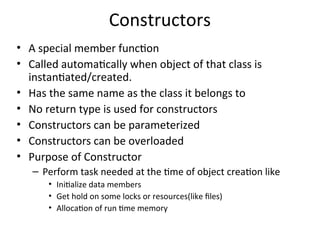
• A special member function
• Called automatically when object of that class is
instantiated/created.
• Has the same name as the class it belongs to
• No return type is used for constructors
• Constructors can be parameterized
• Constructors can be overloaded
• Purpose of Constructor
– Perform task needed at the time of object creation like
• Initialize data members
• Get hold on some locks or resources(like files)
• Allocation of run time memory
Types of constructors
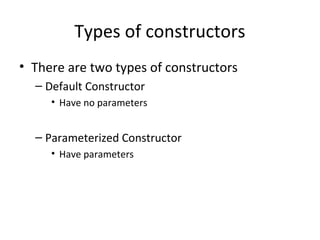
• There are two types of constructors
– Default Constructor
• Have no parameters
– Parameterized Constructor
• Have parameters
Types of constructors
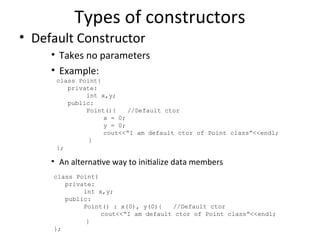
• Default Constructor
• Takes no parameters
• Example:
• An alternative way to initialize data members
class Point{
private:
int x,y;
public:
Point(){ //Default ctor
x = 0;
y = 0;
cout<<“I am default ctor of Point class”<<endl;
}
};
class Point{
private:
int x,y;
public:
Point() : x(0), y(0){ //Default ctor
cout<<“I am default ctor of Point class”<<endl;
}
};
Types of constructors
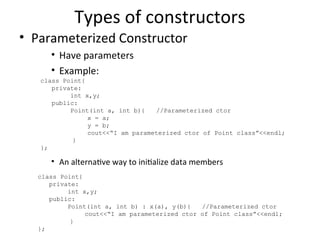
• Parameterized Constructor
• Have parameters
• Example:
• An alternative way to initialize data members
class Point{
private:
int x,y;
public:
Point(int a, int b){ //Parameterized ctor
x = a;
y = b;
cout<<“I am parameterized ctor of Point class”<<endl;
}
};
class Point{
private:
int x,y;
public:
Point(int a, int b) : x(a), y(b){ //Parameterized ctor
cout<<“I am parameterized ctor of Point class”<<endl;
}
};
Constructor Overloading
• Constructors can be overloaded
– It means we can have multiple constructors in a
class
– Objects can be instantiated in different ways
Constructor
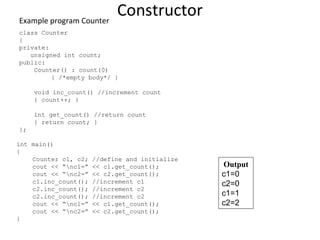
Example program Counter
class Counter
{
private:
unsigned int count;
public:
Counter() : count(0)
{ /*empty body*/ }
void inc_count() //increment count
{ count++; }
int get_count() //return count
{ return count; }
};
int main()
{
Counter c1, c2; //define and initialize
cout << “nc1=” << c1.get_count();
cout << “nc2=” << c2.get_count();
c1.inc_count(); //increment c1
c2.inc_count(); //increment c2
cout << “nc1=” << c1.get_count();
cout << “nc2=” << c2.get_count();
}
Output
c1=0
c2=0
c1=1
c2=2
Destructors
• A special member function
• Called automatically when object of that class is
destroyed.
• Has the same name as the class it belongs to
followed by a ~ sign
• No return type is used for destructors
• Destructors can not be parameterized
• Destructors can not be overloaded
• Purpose of Destructor
– Perform task needed at the time of object killing like
• Release resources acquired by an object
• De-allocation of run time memory
Destructors
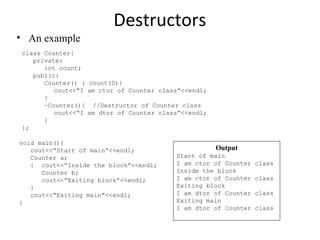
• An example
class Counter{
private:
int count;
public:
Counter() : count(0){
cout<<“I am ctor of Counter class”<<endl;
}
~Counter(){ //Destructor of Counter class
cout<<“I am dtor of Counter class”<<endl;
}
};
void main(){
cout<<“Start of main”<<endl;
Counter a;
{ cout<<“Inside the block”<<endl;
Counter b;
cout<<“Exiting block”<<endl;
}
cout<<“Exiting main”<<endl;
}
Output
Start of main
I am ctor of Counter class
Inside the block
I am ctor of Counter class
Exiting block
I am dtor of Counter class
Exiting main
I am dtor of Counter class

Constructors & Destructors in C++ Simplified

  • 1.
  • 2.
    Constructors • A specialmember function • Called automatically when object of that class is instantiated/created. • Has the same name as the class it belongs to • No return type is used for constructors • Constructors can be parameterized • Constructors can be overloaded • Purpose of Constructor – Perform task needed at the time of object creation like • Initialize data members • Get hold on some locks or resources(like files) • Allocation of run time memory
  • 3.
    Types of constructors •There are two types of constructors – Default Constructor • Have no parameters – Parameterized Constructor • Have parameters
  • 4.
    Types of constructors •Default Constructor • Takes no parameters • Example: • An alternative way to initialize data members class Point{ private: int x,y; public: Point(){ //Default ctor x = 0; y = 0; cout<<“I am default ctor of Point class”<<endl; } }; class Point{ private: int x,y; public: Point() : x(0), y(0){ //Default ctor cout<<“I am default ctor of Point class”<<endl; } };
  • 5.
    Types of constructors •Parameterized Constructor • Have parameters • Example: • An alternative way to initialize data members class Point{ private: int x,y; public: Point(int a, int b){ //Parameterized ctor x = a; y = b; cout<<“I am parameterized ctor of Point class”<<endl; } }; class Point{ private: int x,y; public: Point(int a, int b) : x(a), y(b){ //Parameterized ctor cout<<“I am parameterized ctor of Point class”<<endl; } };
  • 6.
    Constructor Overloading • Constructorscan be overloaded – It means we can have multiple constructors in a class – Objects can be instantiated in different ways
  • 7.
    Constructor Example program Counter classCounter { private: unsigned int count; public: Counter() : count(0) { /*empty body*/ } void inc_count() //increment count { count++; } int get_count() //return count { return count; } }; int main() { Counter c1, c2; //define and initialize cout << “nc1=” << c1.get_count(); cout << “nc2=” << c2.get_count(); c1.inc_count(); //increment c1 c2.inc_count(); //increment c2 c2.inc_count(); //increment c2 cout << “nc1=” << c1.get_count(); cout << “nc2=” << c2.get_count(); } Output c1=0 c2=0 c1=1 c2=2
  • 8.
    Destructors • A specialmember function • Called automatically when object of that class is destroyed. • Has the same name as the class it belongs to followed by a ~ sign • No return type is used for destructors • Destructors can not be parameterized • Destructors can not be overloaded • Purpose of Destructor – Perform task needed at the time of object killing like • Release resources acquired by an object • De-allocation of run time memory
  • 9.
    Destructors • An example classCounter{ private: int count; public: Counter() : count(0){ cout<<“I am ctor of Counter class”<<endl; } ~Counter(){ //Destructor of Counter class cout<<“I am dtor of Counter class”<<endl; } }; void main(){ cout<<“Start of main”<<endl; Counter a; { cout<<“Inside the block”<<endl; Counter b; cout<<“Exiting block”<<endl; } cout<<“Exiting main”<<endl; } Output Start of main I am ctor of Counter class Inside the block I am ctor of Counter class Exiting block I am dtor of Counter class Exiting main I am dtor of Counter class