Prachi Shahare
Assistant Professor
Computer Department
Durga Mahavidyalaya,Raipur
Topic: Constructors and Destructors
2.
Constructors
Constructors
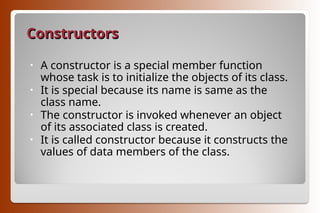
• A constructoris a special member function
whose task is to initialize the objects of its class.
• It is special because its name is same as the
class name.
• The constructor is invoked whenever an object
of its associated class is created.
• It is called constructor because it constructs the
values of data members of the class.
3.
Constructor - example
Constructor- example
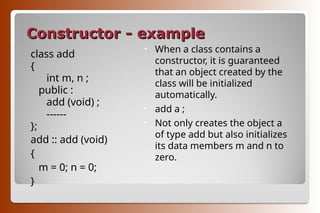
class add
{
int m, n ;
public :
add (void) ;
------
};
add :: add (void)
{
m = 0; n = 0;
}
• When a class contains a
constructor, it is guaranteed
that an object created by the
class will be initialized
automatically.
• add a ;
• Not only creates the object a
of type add but also initializes
its data members m and n to
zero.
4.
Constructors
Constructors
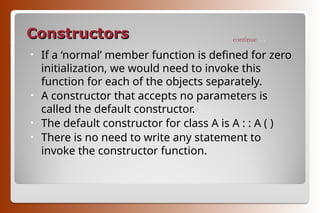
• If a‘normal’ member function is defined for zero
initialization, we would need to invoke this
function for each of the objects separately.
• A constructor that accepts no parameters is
called the default constructor.
• The default constructor for class A is A : : A ( )
• There is no need to write any statement to
invoke the constructor function.
continue …
5.
Characteristics of Constructors
Characteristicsof Constructors
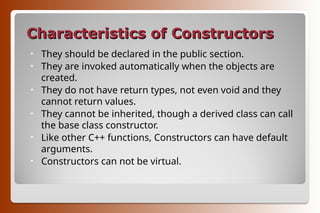
• They should be declared in the public section.
• They are invoked automatically when the objects are
created.
• They do not have return types, not even void and they
cannot return values.
• They cannot be inherited, though a derived class can call
the base class constructor.
• Like other C++ functions, Constructors can have default
arguments.
• Constructors can not be virtual.
6.
Characteristics of Constructors
Characteristicsof Constructors
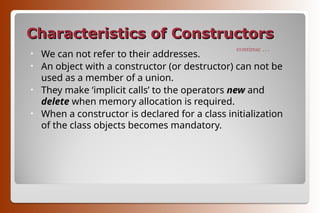
• We can not refer to their addresses.
• An object with a constructor (or destructor) can not be
used as a member of a union.
• They make ‘implicit calls’ to the operators new and
delete when memory allocation is required.
• When a constructor is declared for a class initialization
of the class objects becomes mandatory.
continue …
7.
Parameterized Constructors
Parameterized Constructors
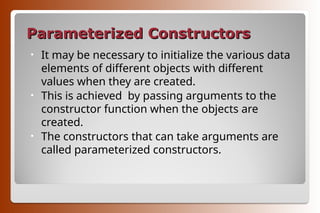
•It may be necessary to initialize the various data
elements of different objects with different
values when they are created.
• This is achieved by passing arguments to the
constructor function when the objects are
created.
• The constructors that can take arguments are
called parameterized constructors.
8.
Parameterized Constructors
Parameterized Constructors
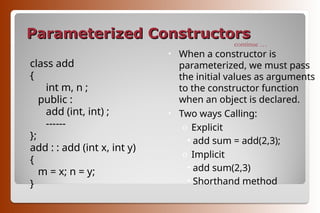
classadd
{
int m, n ;
public :
add (int, int) ;
------
};
add : : add (int x, int y)
{
m = x; n = y;
}
• When a constructor is
parameterized, we must pass
the initial values as arguments
to the constructor function
when an object is declared.
• Two ways Calling:
o Explicit
• add sum = add(2,3);
o Implicit
• add sum(2,3)
• Shorthand method
continue …
9.
Multiple Constructors ina Class
Multiple Constructors in a Class
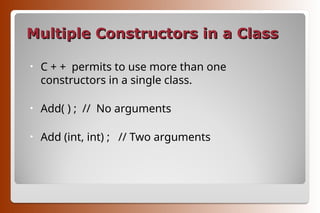
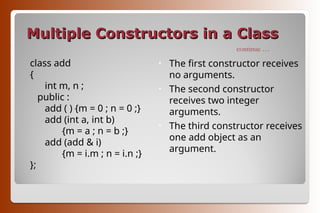
• C + + permits to use more than one
constructors in a single class.
• Add( ) ; // No arguments
• Add (int, int) ; // Two arguments
10.
Multiple Constructors ina Class
Multiple Constructors in a Class
class add
{
int m, n ;
public :
add ( ) {m = 0 ; n = 0 ;}
add (int a, int b)
{m = a ; n = b ;}
add (add & i)
{m = i.m ; n = i.n ;}
};
• The first constructor receives
no arguments.
• The second constructor
receives two integer
arguments.
• The third constructor receives
one add object as an
argument.
continue …
11.
Multiple Constructors ina Class
Multiple Constructors in a Class
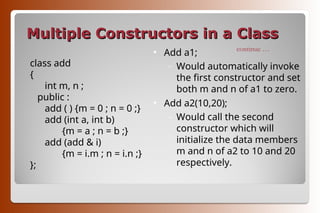
class add
{
int m, n ;
public :
add ( ) {m = 0 ; n = 0 ;}
add (int a, int b)
{m = a ; n = b ;}
add (add & i)
{m = i.m ; n = i.n ;}
};
• Add a1;
– Would automatically invoke
the first constructor and set
both m and n of a1 to zero.
• Add a2(10,20);
– Would call the second
constructor which will
initialize the data members
m and n of a2 to 10 and 20
respectively.
continue …
12.
Multiple Constructors ina Class
Multiple Constructors in a Class
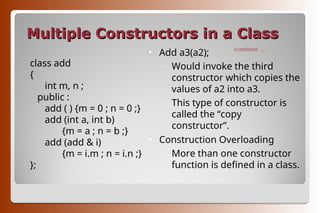
class add
{
int m, n ;
public :
add ( ) {m = 0 ; n = 0 ;}
add (int a, int b)
{m = a ; n = b ;}
add (add & i)
{m = i.m ; n = i.n ;}
};
• Add a3(a2);
– Would invoke the third
constructor which copies the
values of a2 into a3.
– This type of constructor is
called the “copy
constructor”.
• Construction Overloading
– More than one constructor
function is defined in a class.
continue …
13.
Multiple Constructors ina Class
Multiple Constructors in a Class
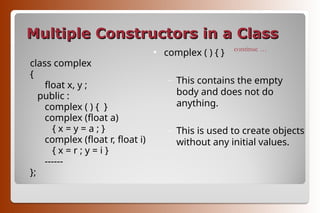
class complex
{
float x, y ;
public :
complex ( ) { }
complex (float a)
{ x = y = a ; }
complex (float r, float i)
{ x = r ; y = i }
------
};
• complex ( ) { }
– This contains the empty
body and does not do
anything.
– This is used to create objects
without any initial values.
continue …
14.
Multiple Constructors ina Class
Multiple Constructors in a Class
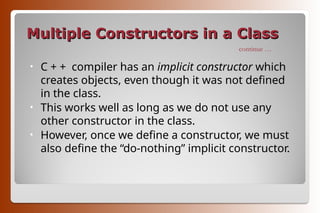
• C + + compiler has an implicit constructor which
creates objects, even though it was not defined
in the class.
• This works well as long as we do not use any
other constructor in the class.
• However, once we define a constructor, we must
also define the “do-nothing” implicit constructor.
continue …
15.
Constructors with Default
Constructorswith Default
Arguments
Arguments
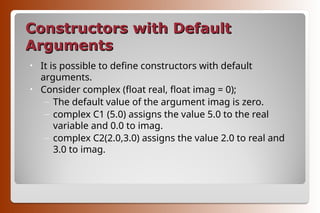
• It is possible to define constructors with default
arguments.
• Consider complex (float real, float imag = 0);
– The default value of the argument imag is zero.
– complex C1 (5.0) assigns the value 5.0 to the real
variable and 0.0 to imag.
– complex C2(2.0,3.0) assigns the value 2.0 to real and
3.0 to imag.
16.
Constructors with Default
Constructorswith Default
Arguments
Arguments
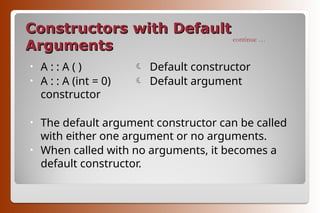
• A : : A ( ) Default constructor
• A : : A (int = 0) Default argument
constructor
• The default argument constructor can be called
with either one argument or no arguments.
• When called with no arguments, it becomes a
default constructor.
continue …
17.
Dynamic Initialization ofObjects
Dynamic Initialization of Objects
• Providing initial value to objects at run time.
• Advantage – We can provide various
initialization
formats, using overloaded constructors.
This provides the flexibility of using
different format of data at run time
depending upon the situation.
18.
Copy Constructor
Copy Constructor
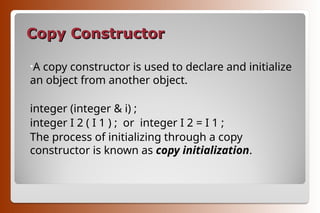
•Acopy constructor is used to declare and initialize
an object from another object.
integer (integer & i) ;
integer I 2 ( I 1 ) ; or integer I 2 = I 1 ;
The process of initializing through a copy
constructor is known as copy initialization.
19.
Copy Constructor
Copy Constructor
Thestatement
I 2 = I 1;
will not invoke the copy constructor.
If I 1 and I 2 are objects, this statement is legal and
assigns the values of I 1 to I 2, member-by-member.
continue …
20.
Copy Constructor
Copy Constructor
•A reference variable has been used as an argument to the
copy constructor.
• We cannot pass the argument by value to a copy
constructor.
continue …
21.
Dynamic Constructors
Dynamic Constructors
•The constructors can also be used to allocate memory
while creating objects.
• This will enable the system to allocate the right amount of
memory for each object when the objects are not of the
same size.
• Allocation of memory to objects at the time of their
construction is known as dynamic construction of objects.
• The memory is created with the help of the new operator.
22.
Destructors
Destructors
• A destructoris used to destroy the objects that have been
created by a constructor.
• Like constructor, the destructor is a member function
whose name is the same as the class name but is
preceded by a tilde.
eg: ~ integer ( ) { }
• A destructor never takes any argument nor does it return
any value.
23.
Destructors
Destructors
• It willbe invoked implicitly by the compiler upon exit from
the program – or block or function as the case may be – to
clean up storage that is no longer accessible.
• It is a good practice to declare destructors in a program
since it releases memory space for further use.
• Whenever new is used to allocate memory in the
constructor, we should use delete to free that memory.
continue …




![[OOP - Lec 13,14,15] Constructors / Destructor and its Types](https://cdn.slidesharecdn.com/ss_thumbnails/lecture-131415constructorsitstypes-160705094532-thumbnail.jpg?width=640&height=640&fit=bounds)


