Class 9
Civics
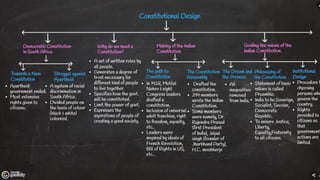
Constitutional Design
Notes
By Aman Kumar
Class & Sec:- IX ‘A1’
St. Mariam’s School
Session:- 2025-26
Q. Which of the following countries does not have a written constitution?
(a.) India
(b.) United States
(c.) United Kingdom
(d.) France
(Note: Do this question by yourself.)
I. INTRODUCTION
 In a democracy, rulers are not free to do what they like.
 Certain basic rules that the citizens and the government have to follow
constitution.
 As the supreme law of the country, the constitution provides,
 Rights of citizens
 Powers of the government
 How the government should function
II. DEMOCRATIC CONSTITUTION IN
SOUTH AFRICA
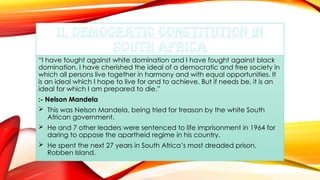
“I have fought against white domination and I have fought against black
domination. I have cherished the ideal of a democratic and free society in
which all persons live together in harmony and with equal opportunities. It
is an ideal which I hope to live for and to achieve. But if needs be, it is an
ideal for which I am prepared to die.”
:- Nelson Mandela
 This was Nelson Mandela, being tried for treason by the white South
African government.
 He and 7 other leaders were sentenced to life imprisonment in 1964 for
daring to oppose the apartheid regime in his country.
 He spent the next 27 years in South Africa’s most dreaded prison,
Robben Island.
2.1. What is a Constitution?
 A constitution is a set of fundamental rules that govern how a nation
operates.
 It defines the rights and responsibility of citizens, and powers of the
government, and how the government should function.
 As the highest law of the land, it ensures that all laws and policies align
with these core principles.
2.1 Struggle Against Apartheid
• Apartheid:- system of racial discrimination.
 The racial discrimination that was imposed in South Africa by the White Europeans is
termed as Apartheid.
 The White Europeans imposed this system on South Africa.
 The White Europeans with arms and forces started ruling South Africa in the 17th
and
18th
centuries.
 A large number of ‘whites’ had settled in South Africa and became the local rulers.
Q. The concepts of ‘check and balances’ in the Indian Constitution ensures:
(a.) Separation of powers among the 3 organs of the government.
(b.) Equal representation of states in the Rajya Sabha.
(c.) Protection of minority rights
(d.) Freedom of speech and expression
(Note: Do this question by yourself.)
 Non-whites are treated as inferiors.
 The non-whites did not have the voting rights.
 Forbidden from living in white areas.
 Trains, buses, taxis, hotels, hospitals, schools and colleges, libraries,
cinema halls, beaches, swimming pools, public toilets, were all separate
for the whites and blacks. This was called segregation.
OR
 Segregation refers to the separation of people or things from each other
based on certain characteristics, like race, religion, or other factors,
often resulting in unequal treatment or opportunities.
 They could not even visit the churches where the whites worshipped.
 Blacks could not form associations or protest against the terrible
treatment.
 African National Congress (ANC) was the umbrella organisation that led
the struggle against the policies of segregation.
 Nelson Mandela was one of the leaders amongst the eight who were
tried for treason by the White South African government. They were
sentenced to life imprisonment in 1964 for daring to oppose the
apartheid regime in the country.
2.2. Towards a new Constitution
 Protests and struggles against apartheid had increased.
 Government realises that they could no longer keep the blacks under their rule
through repression.
 The white regime changed its policies.
 Discriminatory laws were repealed.
 Ban on political parties and restrictions on the media were lifted.
 After 28 years of imprisonment, Nelson Mandela walked out of the jail as a free man.
 Finally, at the midnight of 26 April 1994, the new national flag of the Republic of
South Africa was unfurled marking the newly born democracy in the world.
 The apartheid government came to an end, paving way for the formation of a multi-racial
government.
 Black leaders appealed the fellow blacks to forgive the whites.
 New South Africa based on equality of all races and men and women, on democratic values,
social justice and human rights.
 Both sat together to draw up a common constitution.
 After two years of discussion and debate they came out with one of the finest constitutions the
world has ever had.
 This constitution gave to its citizens the most extensive rights available in any country.
 They agreed that everybody should become a part of the solution, whatever they might have
done or represented in the past.
 The preamble of the South African Constitution seems up this spirit.
Q. The Constitution of India guarantees the right to equality under______?
(a.) Article 25
(b.) Article 19
(c.) Article 21
(d.) Article 14
(NOTE: Do this question by yourself.)
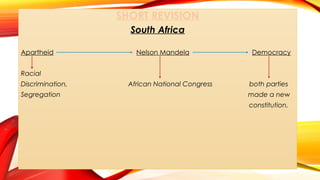
SHORT REVISION
South Africa
Apartheid Nelson Mandela Democracy
Racial
Discrimination, African National Congress both parties
Segregation made a new
constitution.
III. Why do we need a Constitution?
 Example of South Africa
 The oppressor and the oppressed in this new democracy were planning to live
together as equals.
 It was not going to be easy for them to trust each other. They had their fears.
 They wanted to safeguard their interests.
 The black majority was keen to ensure that the democratic principle of majority rule
was not compromised. They wanted substantial social and economic rights.
 The white minority was keen to protect its privileges and property.
 The whites agreed to the principle of majority rule and that of one person on vote
and also agreed to accept some basic rights for the poor and the workers.
 The blacks agreed to majority rule would not be absolute.
 Majority would not take away the property of the white minority.
 Compromise was not easy.
Q. Who appoints the Chief Justice and other judges of the supreme court of
India?
(a.) The Prime Minister
(b.) The Law Minister
(c.) The President
(d.) The Chief Justice of India
(NOTE: Do this question by yourself.)
3.1. What is a Constitution?
Rules of the game.
 Everyone would abide by
 How the rulers are to be chosen
 What the elected governments can and cannot do
 Rights of the citizens
 Winner cannot change them very easily
 The constitution of a country is a set of written rules are accepted by all people living
together in a country.
 Supreme law that determines the relationship among people living in a territory (called
citizens) and also the relationship between the people and government.
3.2. What does a Constitution Do?
 Generates a degree of trust and coordination that is necessary for different kind of
people to live together.
 Specifies how the government will be constituted, who will have power to take which
decision.
 Lays down limits on the government and tells us what rights of the citizens are.
 Expresses the aspirations of the people about creating a good society.
 All countries that have constitutions are not necessarily democratic. But all countries
that are democratic will have constitutions.
Q. School, colleges, public toilets were all separated for the white and black. This was
called _________.
(a.) White rule
(b.) Government system
(c.) System of White
(d.) Segregation policy
(NOTE: Do this question by yourself.)
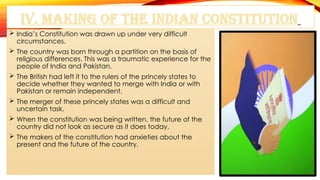
IV. MAKING OF THE INDIAN CONSTITUTION
 India’s Constitution was drawn up under very difficult
circumstances.
 The country was born through a partition on the basis of
religious differences. This was a traumatic experience for the
people of India and Pakistan.
 The British had left it to the rulers of the princely states to
decide whether they wanted to merge with India or with
Pakistan or remain independent.
 The merger of these princely states was a difficult and
uncertain task.
 When the constitution was being written, the future of the
country did not look as secure as it does today.
 The makers of the constitution had anxieties about the
present and the future of the country.
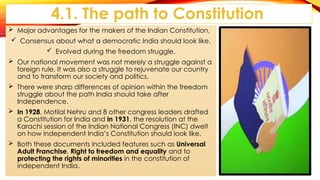
4.1. The path to Constitution
 Major advantages for the makers of the Indian Constitution,
 Consensus about what a democratic India should look like.
 Evolved during the freedom struggle.
 Our national movement was not merely a struggle against a
foreign rule. It was also a struggle to rejuvenate our country
and to transform our society and politics.
 There were sharp differences of opinion within the freedom
struggle about the path India should take after
Independence.
 In 1928, Motilal Nehru and 8 other congress leaders drafted
a Constitution for India and in 1931, the resolution at the
Karachi session of the Indian National Congress (INC) dwelt
on how independent India’s Constitution should look like.
 Both these documents included features such as Universal
Adult Franchise, Right to freedom and equality and to
protecting the rights of minorities in the constitution of
independent India.
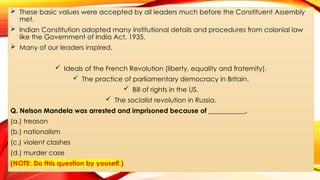
 These basic values were accepted by all leaders much before the Constituent Assembly
met.
 Indian Constitution adopted many institutional details and procedures from colonial law
like the Government of India Act, 1935.
 Many of our leaders inspired,
 Ideals of the French Revolution (liberty, equality and fraternity).
 The practice of parliamentary democracy in Britain.
 Bill of rights in the US.
 The socialist revolution in Russia.
Q. Nelson Mandela was arrested and imprisoned because of ___________.
(a.) treason
(b.) nationalism
(c.) violent clashes
(d.) murder case
(NOTE: Do this question by youself.)
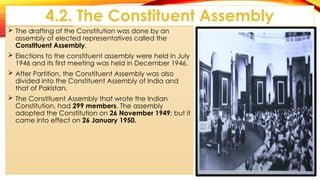
4.2. The Constituent Assembly
 The drafting of the Constitution was done by an
assembly of elected representatives called the
Constituent Assembly.
 Elections to the constituent assembly were held in July
1946 and its first meeting was held in December 1946.
 After Partition, the Constituent Assembly was also
divided into the Constituent Assembly of India and
that of Pakistan.
 The Constituent Assembly that wrote the Indian
Constitution, had 299 members. The assembly
adopted the Constitution on 26 November 1949; but it
came into effect on 26 January 1950.
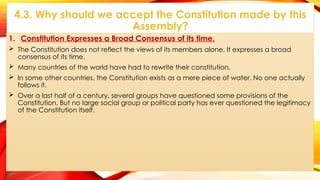
4.3. Why should we accept the Constitution made by this
Assembly?
1. Constitution Expresses a Broad Consensus of its time.
 The Constitution does not reflect the views of its members alone. It expresses a broad
consensus of its time.
 Many countries of the world have had to rewrite their constitution.
 In some other countries, the Constitution exists as a mere piece of water. No one actually
follows it.
 Over a last half of a century, several groups have questioned some provisions of the
Constitution. But no large social group or political party has ever questioned the legitimacy
of the Constitution itself.
2. Constituent Assembly representated the people of India.
 The Constituent Assembly could not have been chosen directly by all the people
of India was elected mainly by the members of the existing Provincial
Legislatures.
 Elected mainly by the members of the Provincial Legislatures.
 But the Congress itself included a variety of political groups and opinions.
 The assembly had many members who did not agree with the Congress.
 In social terms too, the assembly represented members which were diverse in
many ways.
3. Manner in which the Constituent Assembly Worked.
 Gives sanctity to the Constitution.
 Worked in a systematic, open and consensual manner.
 First some basic principles were decided and agreed upon.
 Then a drafting committee chaired by Dr. B.R. Ambedkar prepared a draft
constitution for discussion. Several rounds of thorough discussion took place on the
Draft Constitution, clause by clause.
 More than 2000 amendments were considered. The members deliberated for 114
days spread over 3 years.
Q. What was the name of the jail in which Nelson Mandela spent his imprisonment?
(a.) Ribbon Island
(b.) Robben Island
(c.) Rincon Island
(d.) None of the above
(NOTE: Do this question by yourself.)
V. GUIDING VALUES
OF THE INDIAN
CONSTITUTION
5.1. The Dream and the Promise
 There were many members who followed this vision.
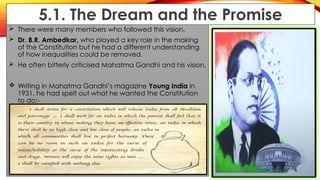
 Dr. B.R. Ambedkar, who played a key role in the making
of the Constitution but he had a different understanding
of how inequalities could be removed.
 He often bitterly criticised Mahatma Gandhi and his vision.
 Writing in Mahatma Gandhi’s magazine Young India in
1931, he had spelt out what he wanted the Constitution
to do:-
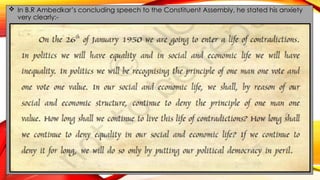
 In B.R Ambedkar’s concluding speech to the Constituent Assembly, he stated his anxiety
very clearly:-
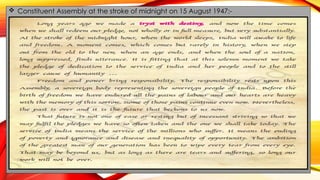
 Constituent Assembly at the stroke of midnight on 15 August 1947:-
5.2. Philosophy of the Constitution
 Values that inspired and guided the freedom struggle and were in turn nurtured by it,
formed the foundation for India’s Democracy.
 These values are embedded in the Preamble of the Indian Constitution.
 They guide all the articles of the Indian Constitution.
 The Constitution begins with a short statement of its basic values. This is called the
Preamble to the Constitution.
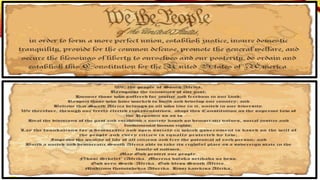
 Taking inspirations from American Model, most countries in the contemporary world
have chosen to begin their constitutions with a preamble.
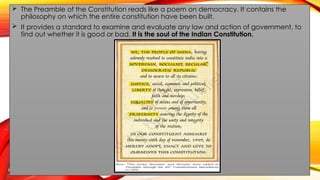
 The Preamble of the Constitution reads like a poem on democracy. It contains the
philosophy on which the entire constitution have been built.
 It provides a standard to examine and evaluate any law and action of government, to
find out whether it is good or bad. It is the soul of the Indian Constitution.
 WE, THE PEOPLE OF INDIA:- The constitution has been drawn up and enacted by the people
through their representatives, and not handed down to them by a king or any outside
powers.
 SOVEREIGN:- People have supreme right to make decisions on internal as well as external
matters. No external power can dictate the Government of India.
 SOCIALIST:- Wealth is generated socially and should be shared equally by society.
Government should regulate the ownership of land and industry to reduce socio-economic
inequalities.
 SECULAR:- Citizens have complete freedom to follow any religion. But there is no official
religion. Government treats all religious beliefs and practices with equal respect.
 DEMOCRATIC:- A form of government where people enjoy equal political rights, elect their
rulers and hold them accountable. The government is run according to some basic rules.
 REPUBLIC:- The head of the state is an elected person and not a hereditary position.
 JUSTICE:- Citizens cannot be discriminated on the grounds of caste, religion and gender.
Social inequalities have to be reduced. Government should work for the welfare of all,
especially of the disadvantaged groups.
 LIBERTY:- There are no unreasonable restriction on the citizen in what they think, how they
wish to express their thoughts and the way they wish to follow up their thoughts in action.
 EQUALITY:- All are equal before the law. The traditional social
inequalities have to be in ended. The government should
ensure equal opportunity for all.
 FRATERNITY:- All of us should behave as if we are members of
the same family. No one should treat a fellow citizen as
inferior.
5.3. Institutional Design
 Constitution of India is a very long and detailed document. Therefore,
it needs to be amended quite regularly to keep it updated.
 Those who crafted the Indian Constitution felt that it has to be in
accordance with people’s aspirations and changes in society.
 They did not see it as a scared, static an unalterable law.
 They made provisions to incorporate from time to time. These
Changes are called constitutional amendments.
 Indian Constitution lays down a procedure for choosing persons to
govern the country.
 It defines who will have how much power To take which decision, and
it puts limits to what the government can do by providing some rights
to the citizen that cannot be violated.
CHECK YOUR PROGRESS!
1. What is Apartheid?
2. “Indian Constitution adopted many institutional
details and procedures from different countries.”
Justify by giving examples.
3. “Indian Constitution is both rigid and flexible.”
Explain.
4. India is a “Sovereign, Socialist, Secular, Democratic
and Republic.” Explain.
COMPETITIVE CORNER
For competitive corner, please visit the following website:-
https://iasnext.com/salient-features-of-indian-constitution-gs-2-study-materi
al-upsc/
Copy this link and visit the site for know more about the Constitution.
There is not too much knowledge. You should know about this.
Thank You!
For all your Support.
Visit Again.

Constitutional Design Civics Class 9.pptx

  • 1.
    Class 9 Civics Constitutional Design Notes ByAman Kumar Class & Sec:- IX ‘A1’ St. Mariam’s School Session:- 2025-26
  • 2.
    Q. Which ofthe following countries does not have a written constitution? (a.) India (b.) United States (c.) United Kingdom (d.) France (Note: Do this question by yourself.)
  • 3.
    I. INTRODUCTION  Ina democracy, rulers are not free to do what they like.  Certain basic rules that the citizens and the government have to follow constitution.  As the supreme law of the country, the constitution provides,  Rights of citizens  Powers of the government  How the government should function
  • 4.
    II. DEMOCRATIC CONSTITUTIONIN SOUTH AFRICA “I have fought against white domination and I have fought against black domination. I have cherished the ideal of a democratic and free society in which all persons live together in harmony and with equal opportunities. It is an ideal which I hope to live for and to achieve. But if needs be, it is an ideal for which I am prepared to die.” :- Nelson Mandela  This was Nelson Mandela, being tried for treason by the white South African government.  He and 7 other leaders were sentenced to life imprisonment in 1964 for daring to oppose the apartheid regime in his country.  He spent the next 27 years in South Africa’s most dreaded prison, Robben Island.
  • 6.
    2.1. What isa Constitution?  A constitution is a set of fundamental rules that govern how a nation operates.  It defines the rights and responsibility of citizens, and powers of the government, and how the government should function.  As the highest law of the land, it ensures that all laws and policies align with these core principles.
  • 7.
    2.1 Struggle AgainstApartheid • Apartheid:- system of racial discrimination.  The racial discrimination that was imposed in South Africa by the White Europeans is termed as Apartheid.  The White Europeans imposed this system on South Africa.  The White Europeans with arms and forces started ruling South Africa in the 17th and 18th centuries.  A large number of ‘whites’ had settled in South Africa and became the local rulers. Q. The concepts of ‘check and balances’ in the Indian Constitution ensures: (a.) Separation of powers among the 3 organs of the government. (b.) Equal representation of states in the Rajya Sabha. (c.) Protection of minority rights (d.) Freedom of speech and expression (Note: Do this question by yourself.)
  • 8.
     Non-whites aretreated as inferiors.  The non-whites did not have the voting rights.  Forbidden from living in white areas.  Trains, buses, taxis, hotels, hospitals, schools and colleges, libraries, cinema halls, beaches, swimming pools, public toilets, were all separate for the whites and blacks. This was called segregation. OR  Segregation refers to the separation of people or things from each other based on certain characteristics, like race, religion, or other factors, often resulting in unequal treatment or opportunities.  They could not even visit the churches where the whites worshipped.  Blacks could not form associations or protest against the terrible treatment.
  • 10.
     African NationalCongress (ANC) was the umbrella organisation that led the struggle against the policies of segregation.  Nelson Mandela was one of the leaders amongst the eight who were tried for treason by the White South African government. They were sentenced to life imprisonment in 1964 for daring to oppose the apartheid regime in the country.
  • 11.
    2.2. Towards anew Constitution  Protests and struggles against apartheid had increased.  Government realises that they could no longer keep the blacks under their rule through repression.  The white regime changed its policies.  Discriminatory laws were repealed.  Ban on political parties and restrictions on the media were lifted.  After 28 years of imprisonment, Nelson Mandela walked out of the jail as a free man.  Finally, at the midnight of 26 April 1994, the new national flag of the Republic of South Africa was unfurled marking the newly born democracy in the world.
  • 12.
     The apartheidgovernment came to an end, paving way for the formation of a multi-racial government.  Black leaders appealed the fellow blacks to forgive the whites.  New South Africa based on equality of all races and men and women, on democratic values, social justice and human rights.  Both sat together to draw up a common constitution.  After two years of discussion and debate they came out with one of the finest constitutions the world has ever had.  This constitution gave to its citizens the most extensive rights available in any country.  They agreed that everybody should become a part of the solution, whatever they might have done or represented in the past.  The preamble of the South African Constitution seems up this spirit. Q. The Constitution of India guarantees the right to equality under______? (a.) Article 25 (b.) Article 19 (c.) Article 21 (d.) Article 14 (NOTE: Do this question by yourself.)
  • 14.
    SHORT REVISION South Africa ApartheidNelson Mandela Democracy Racial Discrimination, African National Congress both parties Segregation made a new constitution.
  • 15.
    III. Why dowe need a Constitution?  Example of South Africa  The oppressor and the oppressed in this new democracy were planning to live together as equals.  It was not going to be easy for them to trust each other. They had their fears.  They wanted to safeguard their interests.  The black majority was keen to ensure that the democratic principle of majority rule was not compromised. They wanted substantial social and economic rights.  The white minority was keen to protect its privileges and property.  The whites agreed to the principle of majority rule and that of one person on vote and also agreed to accept some basic rights for the poor and the workers.  The blacks agreed to majority rule would not be absolute.  Majority would not take away the property of the white minority.  Compromise was not easy.
  • 16.
    Q. Who appointsthe Chief Justice and other judges of the supreme court of India? (a.) The Prime Minister (b.) The Law Minister (c.) The President (d.) The Chief Justice of India (NOTE: Do this question by yourself.)
  • 17.
    3.1. What isa Constitution? Rules of the game.  Everyone would abide by  How the rulers are to be chosen  What the elected governments can and cannot do  Rights of the citizens  Winner cannot change them very easily  The constitution of a country is a set of written rules are accepted by all people living together in a country.  Supreme law that determines the relationship among people living in a territory (called citizens) and also the relationship between the people and government.
  • 18.
    3.2. What doesa Constitution Do?  Generates a degree of trust and coordination that is necessary for different kind of people to live together.  Specifies how the government will be constituted, who will have power to take which decision.  Lays down limits on the government and tells us what rights of the citizens are.  Expresses the aspirations of the people about creating a good society.  All countries that have constitutions are not necessarily democratic. But all countries that are democratic will have constitutions.
  • 19.
    Q. School, colleges,public toilets were all separated for the white and black. This was called _________. (a.) White rule (b.) Government system (c.) System of White (d.) Segregation policy (NOTE: Do this question by yourself.)
  • 20.
    IV. MAKING OFTHE INDIAN CONSTITUTION  India’s Constitution was drawn up under very difficult circumstances.  The country was born through a partition on the basis of religious differences. This was a traumatic experience for the people of India and Pakistan.  The British had left it to the rulers of the princely states to decide whether they wanted to merge with India or with Pakistan or remain independent.  The merger of these princely states was a difficult and uncertain task.  When the constitution was being written, the future of the country did not look as secure as it does today.  The makers of the constitution had anxieties about the present and the future of the country.
  • 21.
    4.1. The pathto Constitution  Major advantages for the makers of the Indian Constitution,  Consensus about what a democratic India should look like.  Evolved during the freedom struggle.  Our national movement was not merely a struggle against a foreign rule. It was also a struggle to rejuvenate our country and to transform our society and politics.  There were sharp differences of opinion within the freedom struggle about the path India should take after Independence.  In 1928, Motilal Nehru and 8 other congress leaders drafted a Constitution for India and in 1931, the resolution at the Karachi session of the Indian National Congress (INC) dwelt on how independent India’s Constitution should look like.  Both these documents included features such as Universal Adult Franchise, Right to freedom and equality and to protecting the rights of minorities in the constitution of independent India.
  • 22.
     These basicvalues were accepted by all leaders much before the Constituent Assembly met.  Indian Constitution adopted many institutional details and procedures from colonial law like the Government of India Act, 1935.  Many of our leaders inspired,  Ideals of the French Revolution (liberty, equality and fraternity).  The practice of parliamentary democracy in Britain.  Bill of rights in the US.  The socialist revolution in Russia. Q. Nelson Mandela was arrested and imprisoned because of ___________. (a.) treason (b.) nationalism (c.) violent clashes (d.) murder case (NOTE: Do this question by youself.)
  • 23.
    4.2. The ConstituentAssembly  The drafting of the Constitution was done by an assembly of elected representatives called the Constituent Assembly.  Elections to the constituent assembly were held in July 1946 and its first meeting was held in December 1946.  After Partition, the Constituent Assembly was also divided into the Constituent Assembly of India and that of Pakistan.  The Constituent Assembly that wrote the Indian Constitution, had 299 members. The assembly adopted the Constitution on 26 November 1949; but it came into effect on 26 January 1950.
  • 24.
    4.3. Why shouldwe accept the Constitution made by this Assembly? 1. Constitution Expresses a Broad Consensus of its time.  The Constitution does not reflect the views of its members alone. It expresses a broad consensus of its time.  Many countries of the world have had to rewrite their constitution.  In some other countries, the Constitution exists as a mere piece of water. No one actually follows it.  Over a last half of a century, several groups have questioned some provisions of the Constitution. But no large social group or political party has ever questioned the legitimacy of the Constitution itself.
  • 25.
    2. Constituent Assemblyrepresentated the people of India.  The Constituent Assembly could not have been chosen directly by all the people of India was elected mainly by the members of the existing Provincial Legislatures.  Elected mainly by the members of the Provincial Legislatures.  But the Congress itself included a variety of political groups and opinions.  The assembly had many members who did not agree with the Congress.  In social terms too, the assembly represented members which were diverse in many ways.
  • 26.
    3. Manner inwhich the Constituent Assembly Worked.  Gives sanctity to the Constitution.  Worked in a systematic, open and consensual manner.  First some basic principles were decided and agreed upon.  Then a drafting committee chaired by Dr. B.R. Ambedkar prepared a draft constitution for discussion. Several rounds of thorough discussion took place on the Draft Constitution, clause by clause.  More than 2000 amendments were considered. The members deliberated for 114 days spread over 3 years. Q. What was the name of the jail in which Nelson Mandela spent his imprisonment? (a.) Ribbon Island (b.) Robben Island (c.) Rincon Island (d.) None of the above (NOTE: Do this question by yourself.)
  • 27.
    V. GUIDING VALUES OFTHE INDIAN CONSTITUTION
  • 28.
    5.1. The Dreamand the Promise  There were many members who followed this vision.  Dr. B.R. Ambedkar, who played a key role in the making of the Constitution but he had a different understanding of how inequalities could be removed.  He often bitterly criticised Mahatma Gandhi and his vision.  Writing in Mahatma Gandhi’s magazine Young India in 1931, he had spelt out what he wanted the Constitution to do:-
  • 29.
     In B.RAmbedkar’s concluding speech to the Constituent Assembly, he stated his anxiety very clearly:-
  • 30.
     Constituent Assemblyat the stroke of midnight on 15 August 1947:-
  • 31.
    5.2. Philosophy ofthe Constitution  Values that inspired and guided the freedom struggle and were in turn nurtured by it, formed the foundation for India’s Democracy.  These values are embedded in the Preamble of the Indian Constitution.  They guide all the articles of the Indian Constitution.  The Constitution begins with a short statement of its basic values. This is called the Preamble to the Constitution.  Taking inspirations from American Model, most countries in the contemporary world have chosen to begin their constitutions with a preamble.
  • 33.
     The Preambleof the Constitution reads like a poem on democracy. It contains the philosophy on which the entire constitution have been built.  It provides a standard to examine and evaluate any law and action of government, to find out whether it is good or bad. It is the soul of the Indian Constitution.
  • 34.
     WE, THEPEOPLE OF INDIA:- The constitution has been drawn up and enacted by the people through their representatives, and not handed down to them by a king or any outside powers.  SOVEREIGN:- People have supreme right to make decisions on internal as well as external matters. No external power can dictate the Government of India.  SOCIALIST:- Wealth is generated socially and should be shared equally by society. Government should regulate the ownership of land and industry to reduce socio-economic inequalities.  SECULAR:- Citizens have complete freedom to follow any religion. But there is no official religion. Government treats all religious beliefs and practices with equal respect.  DEMOCRATIC:- A form of government where people enjoy equal political rights, elect their rulers and hold them accountable. The government is run according to some basic rules.  REPUBLIC:- The head of the state is an elected person and not a hereditary position.  JUSTICE:- Citizens cannot be discriminated on the grounds of caste, religion and gender. Social inequalities have to be reduced. Government should work for the welfare of all, especially of the disadvantaged groups.  LIBERTY:- There are no unreasonable restriction on the citizen in what they think, how they wish to express their thoughts and the way they wish to follow up their thoughts in action.
  • 35.
     EQUALITY:- Allare equal before the law. The traditional social inequalities have to be in ended. The government should ensure equal opportunity for all.  FRATERNITY:- All of us should behave as if we are members of the same family. No one should treat a fellow citizen as inferior.
  • 36.
    5.3. Institutional Design Constitution of India is a very long and detailed document. Therefore, it needs to be amended quite regularly to keep it updated.  Those who crafted the Indian Constitution felt that it has to be in accordance with people’s aspirations and changes in society.  They did not see it as a scared, static an unalterable law.  They made provisions to incorporate from time to time. These Changes are called constitutional amendments.  Indian Constitution lays down a procedure for choosing persons to govern the country.  It defines who will have how much power To take which decision, and it puts limits to what the government can do by providing some rights to the citizen that cannot be violated.
  • 37.
    CHECK YOUR PROGRESS! 1.What is Apartheid? 2. “Indian Constitution adopted many institutional details and procedures from different countries.” Justify by giving examples. 3. “Indian Constitution is both rigid and flexible.” Explain. 4. India is a “Sovereign, Socialist, Secular, Democratic and Republic.” Explain.
  • 39.
    COMPETITIVE CORNER For competitivecorner, please visit the following website:- https://iasnext.com/salient-features-of-indian-constitution-gs-2-study-materi al-upsc/ Copy this link and visit the site for know more about the Constitution. There is not too much knowledge. You should know about this.
  • 40.
    Thank You! For allyour Support. Visit Again.