



#3 WebSphere User Group Royal Society of Edinburgh 11 th  September 2007 Neil Burston, Solutions Technical Consultant Social Networking Using Lotus & WebSphere   Social Networking  using Lotus & WebSphere
Me + You = Us
IBM Lotus Connections Special Interest Group . . . I.L.C.S.I.G?
Why  ?
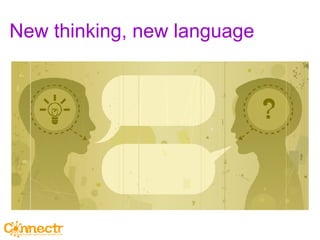
New thinking, new language
W.I.I.  F.M Why What How
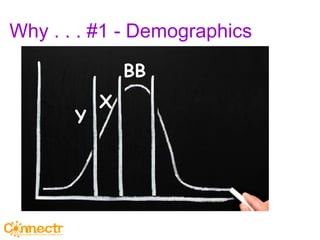
Why . . . #1 - Demographics BB X Y
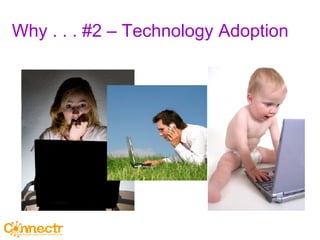
Why . . . #2 – Technology Adoption BB
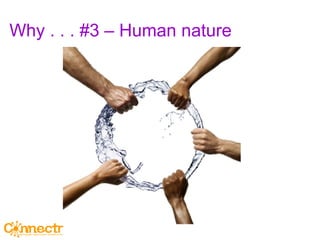
Why . . . #3 – Human nature
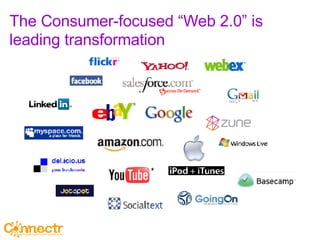
The Consumer-focused “Web 2.0” is leading transformation
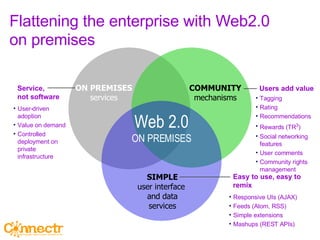
Flattening the enterprise with Web2.0 on premises Web 2.0 ON PREMISES User-driven adoption Value on demand Controlled deployment on private infrastructure ON PREMISES services Service,  not software COMMUNITY mechanisms Tagging  Rating Recommendations Rewards (TR 3 ) Social networking features User comments Community rights management Users add value SIMPLE user interface  and data services Responsive UIs (AJAX) Feeds (Atom, RSS) Simple extensions Mashups (REST APIs) Easy to use, easy to remix
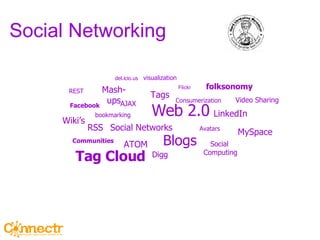
Social Networking visualization Wiki’s Blogs Social Networks AJAX RSS Mash-ups Social  Computing MySpace Tags Web 2.0 del.icio.us  Flickr  REST  ATOM LinkedIn folksonomy  Consumerization  Digg bookmarking  Communities   Video Sharing Avatars  Facebook   Tag Cloud
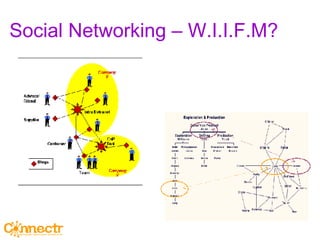
Social Networking – W.I.I.F.M?
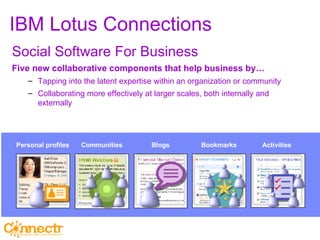
IBM Lotus Connections  Social Software For Business Five new collaborative components that help business by… Tapping into the latent expertise within an organization or community Collaborating more effectively at larger scales, both internally and externally Personal profiles Communities Blogs Bookmarks Activities
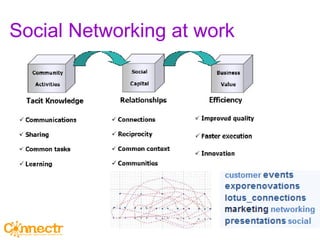
Social Networking at work
Ok, I want one, what do I do?
Is it a . . . ?
Is it a . . .
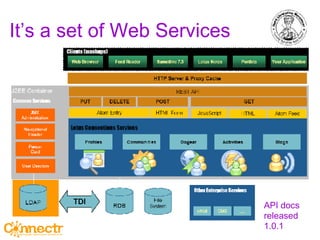
It’s a set of Web Services API docs released 1.0.1
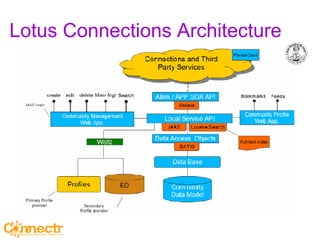
Lotus Connections Architecture
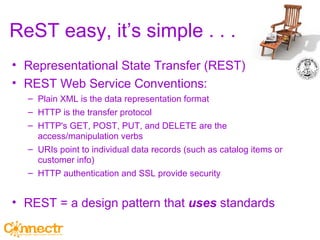
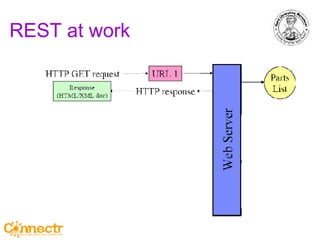
ReST easy, it’s simple . . .  Representational State Transfer (REST) REST Web Service Conventions: Plain XML is the data representation format HTTP is the transfer protocol HTTP's GET, POST, PUT, and DELETE are the access/manipulation verbs URIs point to individual data records (such as catalog items or customer info) HTTP authentication and SSL provide security REST = a design pattern that  uses  standards
REST at work
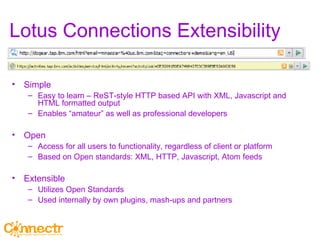
Lotus Connections Extensibility Simple Easy to learn – ReST-style HTTP based API with XML, Javascript and HTML formatted output Enables “amateur” as well as professional developers Open Access for all users to functionality, regardless of client or platform Based on Open standards: XML, HTTP, Javascript, Atom feeds Extensible Utilizes Open Standards  Used internally by own plugins, mash-ups and partners
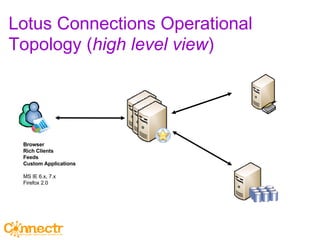
Lotus Connections Operational Topology ( high level view ) Browser Rich Clients Feeds Custom Applications MS IE 6.x, 7.x Firefox 2.0 Lotus Connections Services WAS 6.1.0.3 + IBM HTTP Server 6.1.0.3 on RedHat Enterprise Linux ES v4 or Windows 2003 Server One or more features… Activities Profiles Dogear Blogs Communities RDBMS DB2 9.1 Fix Pack 2 Oracle 10G 10.2.0.3 Corporate LDAP Directory IBM TDS v6 MSFT Active Directory 2003 Lotus Domino planned 2007
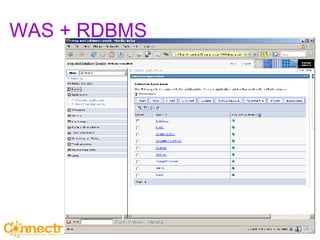
WAS + RDBMS
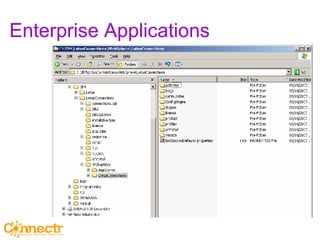
Enterprise Applications
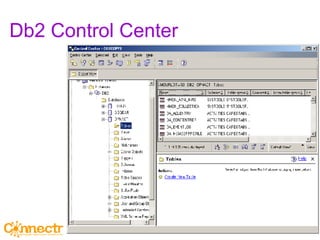
Db2 Control Center
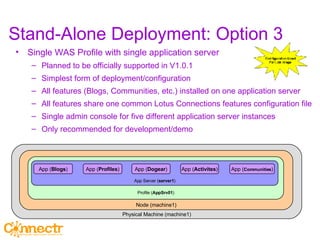
Stand-Alone Deployment: Option 3 Single WAS Profile with single application server  Planned to be officially supported in V1.0.1 Simplest form of deployment/configuration All features (Blogs, Communities, etc.) installed on one application server All features share one common Lotus Connections features configuration file Single admin console for five different application server instances Only recommended for development/demo Physical Machine (machine1) Node (machine1) Profile ( AppSrv01 ) App Server ( server1 ) App ( Blogs ) App ( Communities ) App ( Profiles ) App ( Dogear ) App ( Activites )
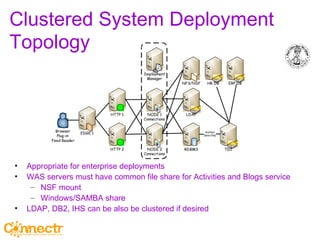
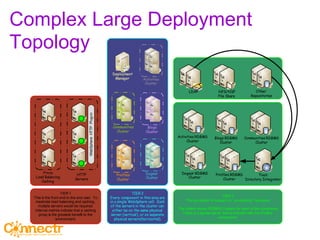
Clustered System Deployment Topology Appropriate for enterprise deployments WAS servers must have common file share for Activities and Blogs service NSF mount Windows/SAMBA share LDAP, DB2, IHS can be also be clustered if desired
Complex Large Deployment Topology
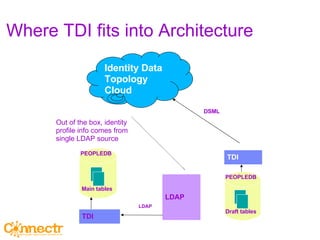
Where TDI fits into Architecture TDI LDAP LDAP PEOPLEDB Out of the box, identity profile info comes from single LDAP source PEOPLEDB TDI DSML Identity Data  Topology Cloud Main tables Draft tables
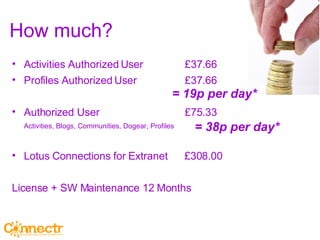
How much? Activities Authorized User  £37.66 Profiles Authorized User £37.66 Authorized User  £75.33 Activities, Blogs, Communities, Dogear, Profiles Lotus Connections for Extranet  £308.00 License + SW Maintenance 12 Months = 19p per day* = 38p per day*
How to get started?
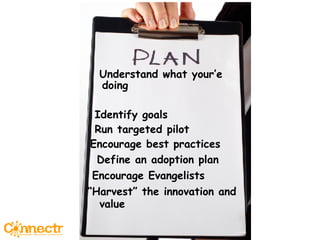
Understand what your’e doing Identify goals Run targeted pilot Encourage best practices Define an adoption plan Encourage Evangelists “ Harvest” the innovation and value
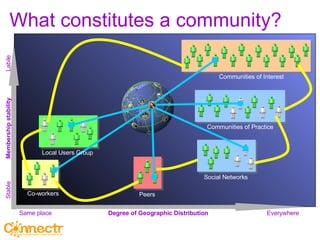
What constitutes a community? Membership stability Labile Stable Communities of Interest Local Users  Group Peers Co-workers Social Networks Communities of Practice Degree of Geographic Distribution Same place Everywhere
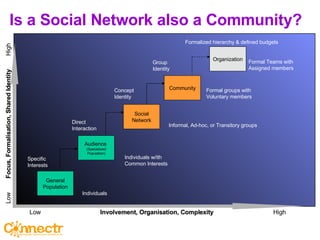
Is a Social Network also a Community? Focus, Formalisation, Shared Identity High Low Involvement, Organisation, Complexity Low High General Population Audience  (Specialized Population) Social Network Community Organization Specific  Interests Direct  Interaction Group  Identity Formalized hierarchy & defined budgets Individuals Individuals w/ith Common Interests Informal, Ad-hoc, or Transitory groups Formal groups with Voluntary members Formal Teams with Assigned  members Concept Identity
How do Communities & Social Networks differ? A social network involves transitory interactions between members,  communities involve longer-term or more well-defined relationships A social network may not have a group identity or name. When the individuals involved in the group decide to  formally name themselves, it is the first step to transitioning to a community Community members  have  formally “signed-on”  to be involved; social networks imply much looser associations and less commitment from their members.
How do Communities & Social Networks differ? A  more-established community  can continue to survive and  exist even if some members leave -  social networks may fall apart once members loose or break off contact permanently From an innovation, marketing or growth point of view, it is  more useful to work with communities  since it implies a longer-running entity, and possibly more open than the initial membership Sometimes it’s not that easy to tell them apart, but it is critical to do so, if you wish to successfully influence outcomes!
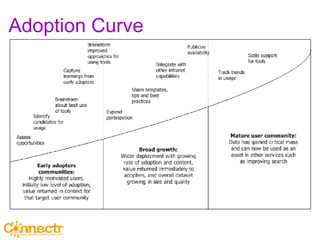
Adoption Curve
Need for Transformation Management Connections is a set of Social Networking tools No network without people Requires a solid community of committed volunteers to seed social networking in an organization Creating and maintaining content Commenting on entries Dogear content Etc Successful deployment requires internal Social Networking evangelists Social computing has a viral effect Once people start using it, the relationships and usage increase
 
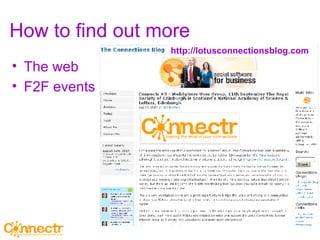
How to find out more The web F2F events http://lotusconnectionsblog.com
What next? UK Lotus User Group – Connectr http://www.uklug.info  ComputaCenta, Hatfield, England Wednesday 26 th  Sept
Questions?
Thank you
Without whom . . . With thanks to . . . Ian “Guru” McNairn, IBM Ian McIntyre, Morpheus Brendan Tutt, IBM Rob Thatcher, IBM Mac Guidera, IBM Jon Mell, Trovus WebSphere User Group
 

Connectr #3 1.3

  • 1.
    #3 WebSphere UserGroup Royal Society of Edinburgh 11 th September 2007 Neil Burston, Solutions Technical Consultant Social Networking Using Lotus & WebSphere Social Networking using Lotus & WebSphere
  • 2.
  • 3.
    IBM Lotus ConnectionsSpecial Interest Group . . . I.L.C.S.I.G?
  • 4.
  • 5.
  • 6.
    W.I.I. F.MWhy What How
  • 7.
    Why . .. #1 - Demographics BB X Y
  • 8.
    Why . .. #2 – Technology Adoption BB
  • 9.
    Why . .. #3 – Human nature
  • 10.
    The Consumer-focused “Web2.0” is leading transformation
  • 11.
    Flattening the enterprisewith Web2.0 on premises Web 2.0 ON PREMISES User-driven adoption Value on demand Controlled deployment on private infrastructure ON PREMISES services Service, not software COMMUNITY mechanisms Tagging Rating Recommendations Rewards (TR 3 ) Social networking features User comments Community rights management Users add value SIMPLE user interface and data services Responsive UIs (AJAX) Feeds (Atom, RSS) Simple extensions Mashups (REST APIs) Easy to use, easy to remix
  • 12.
    Social Networking visualizationWiki’s Blogs Social Networks AJAX RSS Mash-ups Social Computing MySpace Tags Web 2.0 del.icio.us Flickr REST ATOM LinkedIn folksonomy Consumerization Digg bookmarking Communities Video Sharing Avatars Facebook Tag Cloud
  • 13.
  • 14.
    IBM Lotus Connections Social Software For Business Five new collaborative components that help business by… Tapping into the latent expertise within an organization or community Collaborating more effectively at larger scales, both internally and externally Personal profiles Communities Blogs Bookmarks Activities
  • 15.
  • 16.
    Ok, I wantone, what do I do?
  • 17.
    Is it a. . . ?
  • 18.
    Is it a. . .
  • 19.
    It’s a setof Web Services API docs released 1.0.1
  • 20.
  • 21.
    ReST easy, it’ssimple . . . Representational State Transfer (REST) REST Web Service Conventions: Plain XML is the data representation format HTTP is the transfer protocol HTTP's GET, POST, PUT, and DELETE are the access/manipulation verbs URIs point to individual data records (such as catalog items or customer info) HTTP authentication and SSL provide security REST = a design pattern that uses standards
  • 22.
  • 23.
    Lotus Connections ExtensibilitySimple Easy to learn – ReST-style HTTP based API with XML, Javascript and HTML formatted output Enables “amateur” as well as professional developers Open Access for all users to functionality, regardless of client or platform Based on Open standards: XML, HTTP, Javascript, Atom feeds Extensible Utilizes Open Standards Used internally by own plugins, mash-ups and partners
  • 24.
    Lotus Connections OperationalTopology ( high level view ) Browser Rich Clients Feeds Custom Applications MS IE 6.x, 7.x Firefox 2.0 Lotus Connections Services WAS 6.1.0.3 + IBM HTTP Server 6.1.0.3 on RedHat Enterprise Linux ES v4 or Windows 2003 Server One or more features… Activities Profiles Dogear Blogs Communities RDBMS DB2 9.1 Fix Pack 2 Oracle 10G 10.2.0.3 Corporate LDAP Directory IBM TDS v6 MSFT Active Directory 2003 Lotus Domino planned 2007
  • 25.
  • 26.
  • 27.
  • 28.
    Stand-Alone Deployment: Option3 Single WAS Profile with single application server Planned to be officially supported in V1.0.1 Simplest form of deployment/configuration All features (Blogs, Communities, etc.) installed on one application server All features share one common Lotus Connections features configuration file Single admin console for five different application server instances Only recommended for development/demo Physical Machine (machine1) Node (machine1) Profile ( AppSrv01 ) App Server ( server1 ) App ( Blogs ) App ( Communities ) App ( Profiles ) App ( Dogear ) App ( Activites )
  • 29.
    Clustered System DeploymentTopology Appropriate for enterprise deployments WAS servers must have common file share for Activities and Blogs service NSF mount Windows/SAMBA share LDAP, DB2, IHS can be also be clustered if desired
  • 30.
  • 31.
    Where TDI fitsinto Architecture TDI LDAP LDAP PEOPLEDB Out of the box, identity profile info comes from single LDAP source PEOPLEDB TDI DSML Identity Data Topology Cloud Main tables Draft tables
  • 32.
    How much? ActivitiesAuthorized User £37.66 Profiles Authorized User £37.66 Authorized User £75.33 Activities, Blogs, Communities, Dogear, Profiles Lotus Connections for Extranet £308.00 License + SW Maintenance 12 Months = 19p per day* = 38p per day*
  • 33.
    How to getstarted?
  • 34.
    Understand what your’edoing Identify goals Run targeted pilot Encourage best practices Define an adoption plan Encourage Evangelists “ Harvest” the innovation and value
  • 35.
    What constitutes acommunity? Membership stability Labile Stable Communities of Interest Local Users Group Peers Co-workers Social Networks Communities of Practice Degree of Geographic Distribution Same place Everywhere
  • 36.
    Is a SocialNetwork also a Community? Focus, Formalisation, Shared Identity High Low Involvement, Organisation, Complexity Low High General Population Audience (Specialized Population) Social Network Community Organization Specific Interests Direct Interaction Group Identity Formalized hierarchy & defined budgets Individuals Individuals w/ith Common Interests Informal, Ad-hoc, or Transitory groups Formal groups with Voluntary members Formal Teams with Assigned members Concept Identity
  • 37.
    How do Communities& Social Networks differ? A social network involves transitory interactions between members, communities involve longer-term or more well-defined relationships A social network may not have a group identity or name. When the individuals involved in the group decide to formally name themselves, it is the first step to transitioning to a community Community members have formally “signed-on” to be involved; social networks imply much looser associations and less commitment from their members.
  • 38.
    How do Communities& Social Networks differ? A more-established community can continue to survive and exist even if some members leave - social networks may fall apart once members loose or break off contact permanently From an innovation, marketing or growth point of view, it is more useful to work with communities since it implies a longer-running entity, and possibly more open than the initial membership Sometimes it’s not that easy to tell them apart, but it is critical to do so, if you wish to successfully influence outcomes!
  • 39.
  • 40.
    Need for TransformationManagement Connections is a set of Social Networking tools No network without people Requires a solid community of committed volunteers to seed social networking in an organization Creating and maintaining content Commenting on entries Dogear content Etc Successful deployment requires internal Social Networking evangelists Social computing has a viral effect Once people start using it, the relationships and usage increase
  • 41.
  • 42.
    How to findout more The web F2F events http://lotusconnectionsblog.com
  • 43.
    What next? UKLotus User Group – Connectr http://www.uklug.info ComputaCenta, Hatfield, England Wednesday 26 th Sept
  • 44.
  • 45.
  • 46.
    Without whom .. . With thanks to . . . Ian “Guru” McNairn, IBM Ian McIntyre, Morpheus Brendan Tutt, IBM Rob Thatcher, IBM Mac Guidera, IBM Jon Mell, Trovus WebSphere User Group
  • 47.

Editor's Notes

  • #2 Buzzword Bingo Prize = Offer to come and discuss Lotus Connections and how it could benefit your organization.