Before we start with the list of connectors, make sure you are
familiar with the following terms:
 SENTENCE
 SUBORDINATE CLAUSE
 NOUN PHRASE
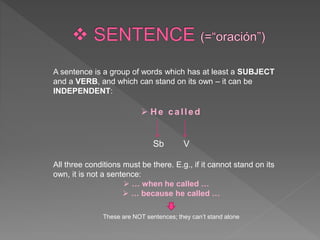
A sentence is a group of words which has at least a SUBJECT
and a VERB, and which can stand on its own – it can be
INDEPENDENT:
 H e called
Sb V
All three conditions must be there. E.g., if it cannot stand on its
own, it is not a sentence:
 … when he called …
 … because he called …
These are NOT sentences; they can’t stand alone
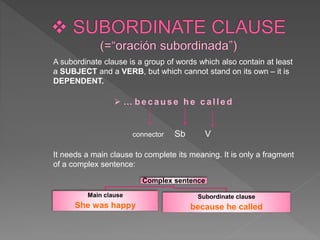
A subordinate clause is a group of words which also contain at least
a SUBJECT and a VERB, but which cannot stand on its own – it is
DEPENDENT.
 … because he called
connector Sb V
It needs a main clause to complete its meaning. It is only a fragment
of a complex sentence:
Complex sentence
Main clause
She was happy
Subordinate clause
because he called
A phrase (= a group of words) whose head is a NOUN, a
PRONOUN, or a GERUND acting as a noun. It can be
accompanied by determiners, adjectives or other modifiers, and it
always functions as the SUBJECT or the OBJECT of a sentence:
 these wonderful actors ….
determiner adjective noun (head)
Noun Phrase (NP)
1. CONNECTORS OF ADDITION
2. CONNECTORS OF CONTRAST
3. CONNECTORS OF CAUSE AND REASON
4. CONNECTORS OF RESULT
5. CONNECTORS OF PURPOSE
6. CONNECTORS OF TIME AND SEQUENCE
7. CONNECTORS OF SIMILARITY
8. CONNECTORS OF OPINION
9. CONNECTORS EXPRESSING GENERAL STATEMENTS
10. CONNECTORS EXPRESSING A REALITY
11. CONNECTORS TO GIVE EXAMPLES
12. CONNECTORS TO LIST POINTS
13. CONNECTORS EXPRESSING CONCLUSION
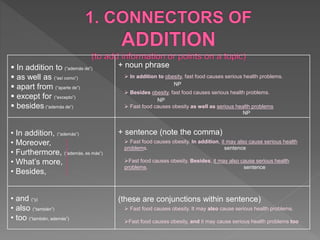
 In addition to (“además de”)
 as well as (“así como”)
 apart from (“aparte de”)
 except for (“excepto”)
 besides (“además de”)
+ noun phrase
 In addition to obesity, fast food causes serious health problems.
NP
 Besides obesity, fast food causes serious health problems.
NP
 Fast food causes obesity as well as serious health problems
NP
• In addition, (“además”)
• Moreover,
• Furthermore, (“además, es más”)
• What’s more,
• Besides,
+ sentence (note the comma)
 Fast food causes obesity. In addition, it may also cause serious health
problems. sentence
Fast food causes obesity. Besides, it may also cause serious health
problems. sentence
• and (“y)
• also (“también”)
• too (“también, además”)
(these are conjunctions within sentence)
 Fast food causes obesity. It may also cause serious health problems.
Fast food causes obesity, and it may cause serious health problems too
 In spite of
 Despite (“a pesar de”)
+ noun phrase
 In spite of the calories, I love burgers! / Despite the calories, I love
burgers! NP NP
•Although (“aunque”)
• Even though (“incluso aunque,”)
• Even if (“incluso si”)
• While
• Whereas (“mientras, mientras que”)
+ subordinate clause
 Although burgers contain a lot of fat, they’re delicious!
subordinate clause main clause
• However, (“sin embargo”)
• Nevertheless, (“de todas formas”)
• On the contrary, (“por el contrario”)
• On the one hand, (“por un lado”)
• On the other hand, (“por otro
lado”)
+ sentence (note the comma)
 Burgers are tasty. However, they contain a lot of fat.
sentence
I know fast food is not healthy. On the contrary, it may cause serious
health problems. sentence
 , but (“ pero”)
 Yet, (“a pesar de eso, aún así”)
 Still, (“a pesar de eso, aún así”)
+ sentence (note the comma)
 I know burgers are unhealthy. Yet, I eat a lot of them.
sentence
 because of (“debido a”)
 due to
 owing to (“debido a”)
 thanks to (“gracias a”)
 as a result of (“como consecuencia de”)
+ noun phrase
 My brother is on a diet due to his obesity problems.
NP
 He expects to lose 15 kilos as a result of the diet,.
NP
• because (“porque”)
• since
• as (“puesto que, ya que”)
• seeing that
+ subordinate clause
 Since he had serious health problems, he went on a diet.
subordinate clause main clause
 He went on a diet because he had serious health problems.
main clause subordinate clause
 As a result, (“por ello, como consecuencia,”)
 Consequently,
 As a consequence, ( “por ello, como
consecuencia, ”)
 Therefore,
 Thus, (“por lo tanto, así”)
 For this reason, (“por este motivo,”)
 That is why, (“es por ello que,”)
+ sentence (note the comma)
 The flood destroyed the village. As a result, many people lost their
homes sentence
 I think. Therefore, I am
sentence
 in order to
 so as to (“para, con el propósito de”)
 to
+ infinitive
 You must study in order to learn.
infinitive
 You must study so as not to be illiterate.
infinitive
• in order that
• so that (“para que”)
+ subordinate clause (with a MODAL VERB)
 You must study so that you can become educated.
main clause subordinate clause
 He lent me his notes in order that I could study for the exam.
main clause subordinate clause
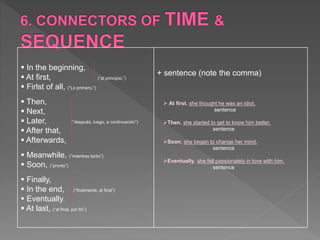
 In the beginning,
 At first, (“al principio,”)
 Firlst of all, (“Lo primero,”)
 Then,
 Next,
 Later, (“después, luego, a continuación”)
 After that,
 Afterwards,
 Meanwhile, (“mientras tanto”)
 Soon, (“pronto”)
 Finally,
 In the end, (“finalmente, al final”)
 Eventually,
 At last, (“al final, por fin”)
+ sentence (note the comma)
 At first, she thought he was an idiot.
sentence
Then, she started to get to know him better.
sentence
Soon, she began to change her mind.
sentence
Eventually, she fell passionately in love with him.
sentence
 when (“cuando”)
 while
 as (“mientras”)
 before (“antes de”)
 after (“después de”)
 until (“hasta que”)
 as soon as (“en cuanto que”)
 by the time (“para cuando”)
+ subordinate clause
 Cinderella danced and danced until her feet hurt.
main clause subordinate clause
 Before the clock stroke 12, she jumped into her coach.
subordinate clause main clause
 After she had left, she noticed she was missing a shoe.
subordinate clause main clause
 By the time she got home, her coach had turned into a pumpkin.
subordinate clause main clause
• before (“antes de”)
• after (“después de”)
• until (“hasta”)
• during (durante, a lo largo de)
+ noun phrase
 Cinderella had to arrive home before midnight.
NP
 The prince looked for Cinderella after the dance.
NP
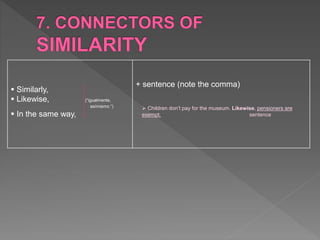
 Similarly,
 Likewise, (“igualmente,
asímismo “)
 In the same way,
+ sentence (note the comma)
 Children don’t pay for the museum. Likewise, pensioners are
exempt. sentence
 Personally, (“personalmente”)
 In my opinion, (“en mi opinión”)
 As I see it,
 In my view, (“desde mi punto de vista”)
+ sentence (note the comma)
 Personally, I prefer watching films in the original version.
sentence
 As I see it, subtitles are better than dubbing.
sentence
Other useful expressions:
• I (strongly) believe (that) (“creo que,
estoy convencido de”)
• I feel (that
• I think (that) (“creo que, pienso que”)
• It seems to me (that)(“me parece que”)
• It is clear that (“está claro que”)
 I strongly believe that foreign films should not be dubbed.
 It is clear that the original voices are absolutely unique.
 In general,
 On the whole, (“en general”)
 Generally,
 As a rule, (“como regla general,”)
+ sentence (note the comma)
 I passed my driving test yesterday and my sister lent me her car.
On the whole, it was a great day.
sentence
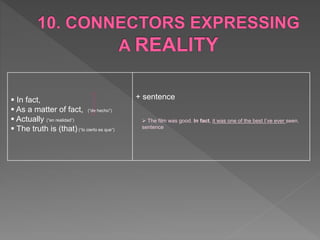
 In fact,
 As a matter of fact, (“de hecho”)
 Actually (“en realidad”)
 The truth is (that) (“lo cierto es que”)
+ sentence
 The film was good. In fact, it was one of the best I’ve ever seen.
sentence
 , such as
 , like (“como, como por ejemplo”)
 , particularly
 , in particular (“en especial, sobre todo”)
 , especially
 , specifically
+ noun phrase(s) – preceded by comma
 There are several common eating disorders, such as anorexia
and bulimia.
NP
 Anorexia affects many people, particularly teenagers.
NP
• for example,
• for instance, (“por ejemplo”)
+ noun phrase(s) or sentence
 Let us consider, for instance, the prpblem of anorexia.
NP
 Anorexia has many side effects. It can, for instance, affect your
personality. sentence
 To begin with,
 In the first place, (“en primer lugar,”)
 First of all,
 Firstly,
 Secondly, (“en segundo lugar”)
 Thirdly, (“en tercer lugar”)
 Finally, (“finalmente,”)
 Lastly, (“para acabar, en último lugar”)
+ sentence (note the comma)
 In the first place, we must be aware of the problem.
sentence
Secondly, we must discuss the problem in full.
sentence
Finally, we must try to reach an agreement.
sentence
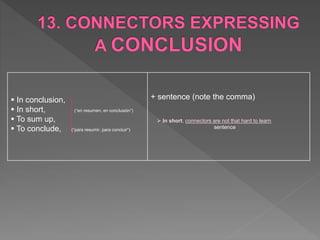
 In conclusion,
 In short, (“en resumen, en conclusión”)
 To sum up,
 To conclude, (“para resumir, para concluir”)
+ sentence (note the comma)
 In short, connectors are not that hard to learn.
sentence

CONNECTORS.pptx

  • 2.
    Before we startwith the list of connectors, make sure you are familiar with the following terms:  SENTENCE  SUBORDINATE CLAUSE  NOUN PHRASE
  • 3.
    A sentence isa group of words which has at least a SUBJECT and a VERB, and which can stand on its own – it can be INDEPENDENT:  H e called Sb V All three conditions must be there. E.g., if it cannot stand on its own, it is not a sentence:  … when he called …  … because he called … These are NOT sentences; they can’t stand alone
  • 4.
    A subordinate clauseis a group of words which also contain at least a SUBJECT and a VERB, but which cannot stand on its own – it is DEPENDENT.  … because he called connector Sb V It needs a main clause to complete its meaning. It is only a fragment of a complex sentence: Complex sentence Main clause She was happy Subordinate clause because he called
  • 5.
    A phrase (=a group of words) whose head is a NOUN, a PRONOUN, or a GERUND acting as a noun. It can be accompanied by determiners, adjectives or other modifiers, and it always functions as the SUBJECT or the OBJECT of a sentence:  these wonderful actors …. determiner adjective noun (head) Noun Phrase (NP)
  • 6.
    1. CONNECTORS OFADDITION 2. CONNECTORS OF CONTRAST 3. CONNECTORS OF CAUSE AND REASON 4. CONNECTORS OF RESULT 5. CONNECTORS OF PURPOSE 6. CONNECTORS OF TIME AND SEQUENCE 7. CONNECTORS OF SIMILARITY 8. CONNECTORS OF OPINION 9. CONNECTORS EXPRESSING GENERAL STATEMENTS 10. CONNECTORS EXPRESSING A REALITY 11. CONNECTORS TO GIVE EXAMPLES 12. CONNECTORS TO LIST POINTS 13. CONNECTORS EXPRESSING CONCLUSION
  • 7.
     In additionto (“además de”)  as well as (“así como”)  apart from (“aparte de”)  except for (“excepto”)  besides (“además de”) + noun phrase  In addition to obesity, fast food causes serious health problems. NP  Besides obesity, fast food causes serious health problems. NP  Fast food causes obesity as well as serious health problems NP • In addition, (“además”) • Moreover, • Furthermore, (“además, es más”) • What’s more, • Besides, + sentence (note the comma)  Fast food causes obesity. In addition, it may also cause serious health problems. sentence Fast food causes obesity. Besides, it may also cause serious health problems. sentence • and (“y) • also (“también”) • too (“también, además”) (these are conjunctions within sentence)  Fast food causes obesity. It may also cause serious health problems. Fast food causes obesity, and it may cause serious health problems too
  • 8.
     In spiteof  Despite (“a pesar de”) + noun phrase  In spite of the calories, I love burgers! / Despite the calories, I love burgers! NP NP •Although (“aunque”) • Even though (“incluso aunque,”) • Even if (“incluso si”) • While • Whereas (“mientras, mientras que”) + subordinate clause  Although burgers contain a lot of fat, they’re delicious! subordinate clause main clause • However, (“sin embargo”) • Nevertheless, (“de todas formas”) • On the contrary, (“por el contrario”) • On the one hand, (“por un lado”) • On the other hand, (“por otro lado”) + sentence (note the comma)  Burgers are tasty. However, they contain a lot of fat. sentence I know fast food is not healthy. On the contrary, it may cause serious health problems. sentence
  • 9.
     , but(“ pero”)  Yet, (“a pesar de eso, aún así”)  Still, (“a pesar de eso, aún así”) + sentence (note the comma)  I know burgers are unhealthy. Yet, I eat a lot of them. sentence
  • 10.
     because of(“debido a”)  due to  owing to (“debido a”)  thanks to (“gracias a”)  as a result of (“como consecuencia de”) + noun phrase  My brother is on a diet due to his obesity problems. NP  He expects to lose 15 kilos as a result of the diet,. NP • because (“porque”) • since • as (“puesto que, ya que”) • seeing that + subordinate clause  Since he had serious health problems, he went on a diet. subordinate clause main clause  He went on a diet because he had serious health problems. main clause subordinate clause
  • 11.
     As aresult, (“por ello, como consecuencia,”)  Consequently,  As a consequence, ( “por ello, como consecuencia, ”)  Therefore,  Thus, (“por lo tanto, así”)  For this reason, (“por este motivo,”)  That is why, (“es por ello que,”) + sentence (note the comma)  The flood destroyed the village. As a result, many people lost their homes sentence  I think. Therefore, I am sentence
  • 12.
     in orderto  so as to (“para, con el propósito de”)  to + infinitive  You must study in order to learn. infinitive  You must study so as not to be illiterate. infinitive • in order that • so that (“para que”) + subordinate clause (with a MODAL VERB)  You must study so that you can become educated. main clause subordinate clause  He lent me his notes in order that I could study for the exam. main clause subordinate clause
  • 13.
     In thebeginning,  At first, (“al principio,”)  Firlst of all, (“Lo primero,”)  Then,  Next,  Later, (“después, luego, a continuación”)  After that,  Afterwards,  Meanwhile, (“mientras tanto”)  Soon, (“pronto”)  Finally,  In the end, (“finalmente, al final”)  Eventually,  At last, (“al final, por fin”) + sentence (note the comma)  At first, she thought he was an idiot. sentence Then, she started to get to know him better. sentence Soon, she began to change her mind. sentence Eventually, she fell passionately in love with him. sentence
  • 14.
     when (“cuando”) while  as (“mientras”)  before (“antes de”)  after (“después de”)  until (“hasta que”)  as soon as (“en cuanto que”)  by the time (“para cuando”) + subordinate clause  Cinderella danced and danced until her feet hurt. main clause subordinate clause  Before the clock stroke 12, she jumped into her coach. subordinate clause main clause  After she had left, she noticed she was missing a shoe. subordinate clause main clause  By the time she got home, her coach had turned into a pumpkin. subordinate clause main clause • before (“antes de”) • after (“después de”) • until (“hasta”) • during (durante, a lo largo de) + noun phrase  Cinderella had to arrive home before midnight. NP  The prince looked for Cinderella after the dance. NP
  • 15.
     Similarly,  Likewise,(“igualmente, asímismo “)  In the same way, + sentence (note the comma)  Children don’t pay for the museum. Likewise, pensioners are exempt. sentence
  • 16.
     Personally, (“personalmente”) In my opinion, (“en mi opinión”)  As I see it,  In my view, (“desde mi punto de vista”) + sentence (note the comma)  Personally, I prefer watching films in the original version. sentence  As I see it, subtitles are better than dubbing. sentence Other useful expressions: • I (strongly) believe (that) (“creo que, estoy convencido de”) • I feel (that • I think (that) (“creo que, pienso que”) • It seems to me (that)(“me parece que”) • It is clear that (“está claro que”)  I strongly believe that foreign films should not be dubbed.  It is clear that the original voices are absolutely unique.
  • 17.
     In general, On the whole, (“en general”)  Generally,  As a rule, (“como regla general,”) + sentence (note the comma)  I passed my driving test yesterday and my sister lent me her car. On the whole, it was a great day. sentence
  • 18.
     In fact, As a matter of fact, (“de hecho”)  Actually (“en realidad”)  The truth is (that) (“lo cierto es que”) + sentence  The film was good. In fact, it was one of the best I’ve ever seen. sentence
  • 19.
     , suchas  , like (“como, como por ejemplo”)  , particularly  , in particular (“en especial, sobre todo”)  , especially  , specifically + noun phrase(s) – preceded by comma  There are several common eating disorders, such as anorexia and bulimia. NP  Anorexia affects many people, particularly teenagers. NP • for example, • for instance, (“por ejemplo”) + noun phrase(s) or sentence  Let us consider, for instance, the prpblem of anorexia. NP  Anorexia has many side effects. It can, for instance, affect your personality. sentence
  • 20.
     To beginwith,  In the first place, (“en primer lugar,”)  First of all,  Firstly,  Secondly, (“en segundo lugar”)  Thirdly, (“en tercer lugar”)  Finally, (“finalmente,”)  Lastly, (“para acabar, en último lugar”) + sentence (note the comma)  In the first place, we must be aware of the problem. sentence Secondly, we must discuss the problem in full. sentence Finally, we must try to reach an agreement. sentence
  • 21.
     In conclusion, In short, (“en resumen, en conclusión”)  To sum up,  To conclude, (“para resumir, para concluir”) + sentence (note the comma)  In short, connectors are not that hard to learn. sentence