Introduction to Syslog


      Octavio Alvarez
 alvarezp@alvarezp.ods.org

San Diego Cisco User Group
      July 19th, 2012
Overview
●   Problems to solve
●   The Syslog protocol
●   Technicalities
        –   Protocol content, RFCs, etc.
●   Example of topologies
        –   A simple one and one a bit more complex.
●   Simple demonstration

        Feel free to interrupt me at any time!
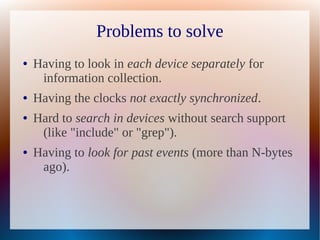
Problems to solve
●   Having to look in each device separately for
     information collection.
●   Having the clocks not exactly synchronized.
●   Hard to search in devices without search support
     (like "include" or "grep").
●   Having to look for past events (more than N-bytes
     ago).
Introducing Syslog
●   A protocol.
●   A de-facto standard...
●   ... a documented de-facto standard (RFC 3164)
●   ... and is being standardized (RFC 5424, obsoletes
    RFC 3164).
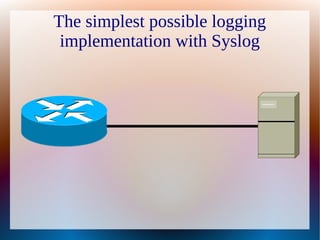
The simplest possible logging
 implementation with Syslog
Content (obsolete, RFC 3164)
●   Priority = 8 * Facility + Severity
        –   Severity (0-7)
        –   Facility (0-23)
●   Header
        –   Timestamp (RFC3339 with restrictions)
        –   Hostname (a.k.a. Cisco's "origin") (FQDN, IP,
             hostname)
●   Message
Content (new, RFC 5424)
●   Version
●   Application
●   Process ID
●   Message ID
●   Structured data (Element, ID, Param)
        –   Elements: timeQuality, origin, meta
Severities
●   0: Emergency: system is unusable
●   1: Alert: action must be taken immediately
●   2: Critical: critical conditions
●   3: Error: error conditions
●   4: Warning: warning conditions
●   5: Notice: normal but significant condition
●   6: Informational: informational messages
●   7: Debug: debug-level messages
Facilities (part 1)
●   0: kernel messages
●   1: user-level messages
●   2: mail system
●   3: system daemons
●   4: security/authorization messages
●   5: messages generated internally by syslogd
●   6: line printer subsystem
●   7: network news subsystem (maybe: RSS, Google
    group...)
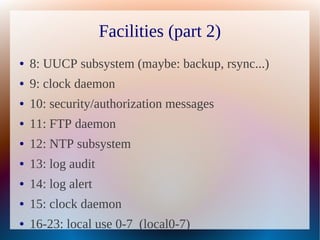
Facilities (part 2)
●   8: UUCP subsystem (maybe: backup, rsync...)
●   9: clock daemon
●   10: security/authorization messages
●   11: FTP daemon
●   12: NTP subsystem
●   13: log audit
●   14: log alert
●   15: clock daemon
●   16-23: local use 0-7 (local0-7)
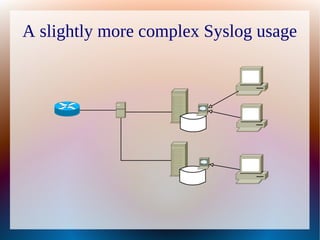
A slightly more complex Syslog usage
Syslog application-layer "components"
          (as per the RFC)
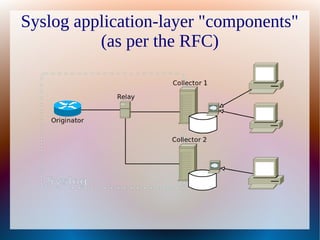
●   Originator (application-layer)
        –   Cisco router, Apache Server
●   Collector (application-layer)
        –   rsyslog, dsyslog, syslog-ng
        –   Solarwinds Kiwi Syslog Server
●   Relay (application-layer)
Syslog application-layer "components"
          (as per the RFC)
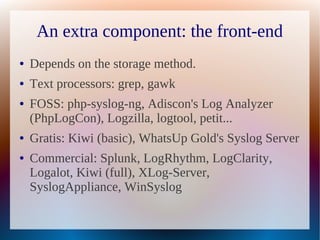
An extra component: the front-end
●   Depends on the storage method.
●   Text processors: grep, gawk
●   FOSS: php-syslog-ng, Adiscon's Log Analyzer
    (PhpLogCon), Logzilla, logtool, petit...
●   Gratis: Kiwi (basic), WhatsUp Gold's Syslog Server
●   Commercial: Splunk, LogRhythm, LogClarity,
    Logalot, Kiwi (full), XLog-Server,
    SyslogAppliance, WinSyslog
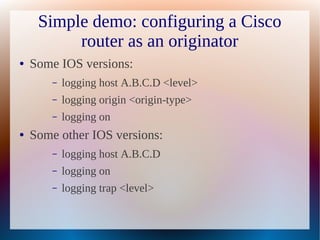
Simple demo: configuring a Cisco
          router as an originator
●   Some IOS versions:
        –   logging host A.B.C.D <level>
        –   logging origin <origin-type>
        –   logging on
●   Some other IOS versions:
        –   logging host A.B.C.D
        –   logging on
        –   logging trap <level>
Simple demo: configuring an Ubuntu
           box as a text collector
●   rsyslog already installed
●   Edition of /etc/rsyslog.conf
Thanks! Any questions?

          a              blog.alvarezp.org
                         /categorias/por-idioma/english

                         @alvarezp2000

                         alvarezp@alvarezp.com


   The only legal way
to burn a Windows disc     superkb.sf.net

Configuring Syslog by Octavio

  • 1.
    Introduction to Syslog Octavio Alvarez alvarezp@alvarezp.ods.org San Diego Cisco User Group July 19th, 2012
  • 2.
    Overview ● Problems to solve ● The Syslog protocol ● Technicalities – Protocol content, RFCs, etc. ● Example of topologies – A simple one and one a bit more complex. ● Simple demonstration Feel free to interrupt me at any time!
  • 3.
    Problems to solve ● Having to look in each device separately for information collection. ● Having the clocks not exactly synchronized. ● Hard to search in devices without search support (like "include" or "grep"). ● Having to look for past events (more than N-bytes ago).
  • 4.
    Introducing Syslog ● A protocol. ● A de-facto standard... ● ... a documented de-facto standard (RFC 3164) ● ... and is being standardized (RFC 5424, obsoletes RFC 3164).
  • 5.
    The simplest possiblelogging implementation with Syslog
  • 6.
    Content (obsolete, RFC3164) ● Priority = 8 * Facility + Severity – Severity (0-7) – Facility (0-23) ● Header – Timestamp (RFC3339 with restrictions) – Hostname (a.k.a. Cisco's "origin") (FQDN, IP, hostname) ● Message
  • 7.
    Content (new, RFC5424) ● Version ● Application ● Process ID ● Message ID ● Structured data (Element, ID, Param) – Elements: timeQuality, origin, meta
  • 8.
    Severities ● 0: Emergency: system is unusable ● 1: Alert: action must be taken immediately ● 2: Critical: critical conditions ● 3: Error: error conditions ● 4: Warning: warning conditions ● 5: Notice: normal but significant condition ● 6: Informational: informational messages ● 7: Debug: debug-level messages
  • 9.
    Facilities (part 1) ● 0: kernel messages ● 1: user-level messages ● 2: mail system ● 3: system daemons ● 4: security/authorization messages ● 5: messages generated internally by syslogd ● 6: line printer subsystem ● 7: network news subsystem (maybe: RSS, Google group...)
  • 10.
    Facilities (part 2) ● 8: UUCP subsystem (maybe: backup, rsync...) ● 9: clock daemon ● 10: security/authorization messages ● 11: FTP daemon ● 12: NTP subsystem ● 13: log audit ● 14: log alert ● 15: clock daemon ● 16-23: local use 0-7 (local0-7)
  • 11.
    A slightly morecomplex Syslog usage
  • 12.
    Syslog application-layer "components" (as per the RFC) ● Originator (application-layer) – Cisco router, Apache Server ● Collector (application-layer) – rsyslog, dsyslog, syslog-ng – Solarwinds Kiwi Syslog Server ● Relay (application-layer)
  • 13.
  • 14.
    An extra component:the front-end ● Depends on the storage method. ● Text processors: grep, gawk ● FOSS: php-syslog-ng, Adiscon's Log Analyzer (PhpLogCon), Logzilla, logtool, petit... ● Gratis: Kiwi (basic), WhatsUp Gold's Syslog Server ● Commercial: Splunk, LogRhythm, LogClarity, Logalot, Kiwi (full), XLog-Server, SyslogAppliance, WinSyslog
  • 15.
    Simple demo: configuringa Cisco router as an originator ● Some IOS versions: – logging host A.B.C.D <level> – logging origin <origin-type> – logging on ● Some other IOS versions: – logging host A.B.C.D – logging on – logging trap <level>
  • 16.
    Simple demo: configuringan Ubuntu box as a text collector ● rsyslog already installed ● Edition of /etc/rsyslog.conf
  • 17.
    Thanks! Any questions? a blog.alvarezp.org /categorias/por-idioma/english @alvarezp2000 alvarezp@alvarezp.com The only legal way to burn a Windows disc superkb.sf.net