Anatole Tresch
Trivadis AG
@atsticks
Apache Tamaya
Configure Everything...
Anatole Tresch
●
Principal Consultant, Trivadis AG (Switzerland)
●
Star Spec Lead JSR 354
●
Technical Architect, Lead Engineer
●
PPMC Member Apache Tamaya
●
Twitter/Google+: @atsticks
●
anatole@apache.org
●
anatole.tresch@trivadis.com
●
JUG Switzerland
3
Bio
Agenda
4
●
Introduction
●
What to configure?
●
Apache Tamaya
●
Core Concepts
●
Extensions
●
Demo & Outlook
5
Introduction
6
●
2012: Configuration was voted an important
aspect for Java EE 8
●
2013:
●
Setup of Java EE Configuration JSR failed
●
Standardization on SE Level did not have enough momentum
●
BUT:
●
Configuration is a crucial cross cutting concern
●
There is no (really NO!) defacto standard
●
Reinventing the wheel is daily business
History of Apache Tamaya
The People behind Tamaya
7
• John D. Ament (Mentor)
• David Blevins (Champion)
• Werner Keil
• Gerhard Petracek (Mentor)
• Mark Struberg (Mentor)
• Anatole Tresch
• Oliver B. Fischer
• ...
•
The Objectives of Apache Tamaya
8
●
Define a common API for accessing configuration
●
Minimalistic
●
Flexible, pluggable and extendible
●
Compatible with Java 7 and beyond
●
Provide a reference implementation
●
Provide Extension Modules for additional features
●
Build up a community
●
If possible, create a Standard!
•
What to configure?
What to configure?
10
●
Most complex question ever!
●
Divergent views
●
Servers, Containers, Machines, Clusters, ...
●
Parameters of a runtime (staging, localization etc.)
●
Deployments, Network, ...
●
Technology-specific components (beans, wirings etc.)
●
Resources (data sources, message queues, services etc.)
●
Descriptive or imperative style
●
Different granularities, varying levels of applicability,
different formats …
How to configure?
11
●
Format
●
Storage
●
Lifecycle and versioning
●
Security
●
Distribution
●
Consistency
...
12
Use Cases
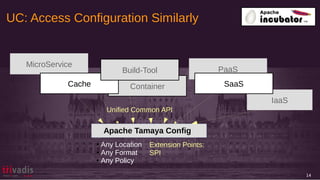
UC: Access Configuration Similarly
14
Apache Tamaya Config
Unified Common API
MicroService
Container
IaaS
PaaS
Cache SaaS
Build-Tool
● Any Location
● Any Format
● Any Policy
Extension Points:
SPI
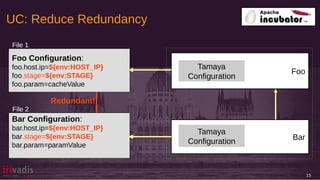
UC: Reduce Redundancy
15
Bar
Foo
Foo Configuration:
Service.host.ip=192.168.1.10
Service.stage=test
Service.param=paramValue
Redundant!
File 1
File 2
Tamaya
Configuration
Bar Configuration:
bar.host.ip=${env:HOST_IP}
bar.stage=${env:STAGE}
bar.param=paramValue
Cache Configuration:
Cache.host.ip=192.168.1.10
Cache.stage=test
Cache.param=cacheValue
Tamaya
Configuration
Foo Configuration:
foo.host.ip=${env:HOST_IP}
foo.stage=${env:STAGE}
foo.param=cacheValue
Tamaya
Configuration
Tamaya
Configuration
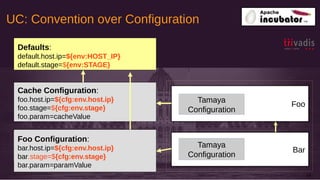
UC: Convention over Configuration
16
Foo Configuration:
bar.host.ip=${cfg:env.host.ip}
bar.stage=${cfg:env.stage}
bar.param=paramValue
Cache Configuration:
foo.host.ip=${cfg:env.host.ip}
foo.stage=${cfg:env.stage}
foo.param=cacheValue
Defaults:
default.host.ip=${env:HOST_IP}
default.stage=${env:STAGE}
Bar
Foo
Tamaya
Configuration
Tamaya
Configuration
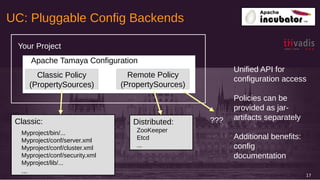
UC: Pluggable Config Backends
Classic:
Apache Tamaya Configuration
17
Distributed:
ZooKeeper
Etcd
...
Classic Policy
(PropertySources)
Myproject/bin/...
Myproject/conf/server.xml
Myproject/conf/cluster.xml
Myproject/conf/security.xml
Myproject/lib/...
...
Remote Policy
(PropertySources)
???
Unified API for
configuration access
Policies can be
provided as jar-
artifacts separately
Additional benefits:
config
documentation
Your Project
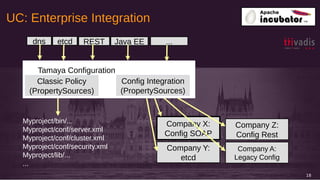
UC: Enterprise Integration
18
Company X:
Config SOAP
Myproject/bin/...
Myproject/conf/server.xml
Myproject/conf/cluster.xml
Myproject/conf/security.xml
Myproject/lib/...
...
Company Z:
Config Rest
Company Y:
etcd
Company A:
Legacy Config
Tamaya Configuration
Classic Policy
(PropertySources)
Config Integration
(PropertySources)
dns etcd REST Java EE ...
19
Bar
Foo
Tamaya
Configuration
Tamaya
Configuration
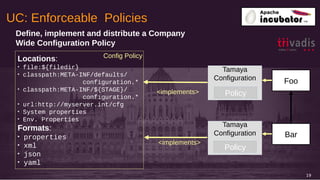
Locations:

file:${filedir}

classpath:META-INF/defaults/
configuration.*

classpath:META-INF/${STAGE}/
configuration.*

url:http://myserver.int/cfg

System properties

Env. Properties
Formats:

properties

xml

json

yaml
Config Policy
<implements>
Define, implement and distribute a Company
Wide Configuration Policy
Policy
Policy
<implements>
UC: Enforceable Policies
20
Configuration
[Group, size: 8:
>> Section: a.test.existing
>> Parameter: a.test.existing.aParam, required: true
>> Parameter: a.test.existing.optionalParam
>> Parameter: a.test.existing.aABCParam, expression: [ABC].*
>> Section: a.test.notexisting
>> Parameter: a.test.notexisting.aParam, required: true
>> Parameter: a.test.existing.aABCParam2, expression:
[ABC].*
>> Section: a.b.c.aRequiredSection.optional-subsection,
>> Parameter: MyNumber,
>> Section: a.b.c,
>> Section: a.b.c.aRequiredSection.nonempty-subsection,
>> Section: a.b.c.aRequiredSection

- Parameter:
a.b.c.aRequiredSection.subsection.param00,
Config Documentation
Tamaya allows to validate and document the configuration
hooks used throughout your system!
UC: Documentation
Config Validation
MISSING: a.test.notexisting.aParam (Parameter),
ERROR: a.test.existing.aABCParam2 (Parameter)
-> Config value not matching expression: [ABC].*,
was MMM
MISSING: a.params2 (Parameter),
MISSING:
a.b.c.aRequiredSection.subsection.param1
(Parameter),
UNDEFINED: JAVA_HOME (Parameter)
UNDEFINED: SESSION_MANAGER (Parameter)
[...]
21
●
Stop Reinventing the wheel
●
Stay Focused on what to configure, not how!
●
Reduce Redundancies and Inconsistencies
●
Document your configuration options
●
Integrate with Company Infrastructure („DevOps“)
●
Decouple your configuration backends
Summary: Why we need Tamaya?
●
ManageConfig likeAPIs !
The API
22
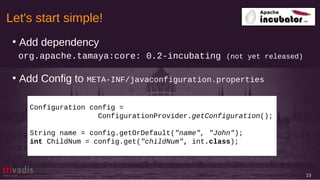
Let's start simple!
23
●
Add dependency
org.apache.tamaya:core: 0.2-incubating (not yet released)
●
Add Config to META-INF/javaconfiguration.properties
Configuration config =
ConfigurationProvider.getConfiguration();
String name = config.getOrDefault("name", "John");
int ChildNum = config.get("childNum", int.class);
24
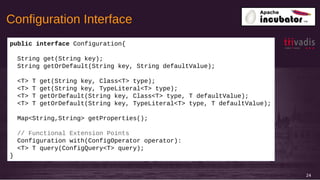
public interface Configuration{
String get(String key);
String getOrDefault(String key, String defaultValue);
<T> T get(String key, Class<T> type);
<T> T get(String key, TypeLiteral<T> type);
<T> T getOrDefault(String key, Class<T> type, T defaultValue);
<T> T getOrDefault(String key, TypeLiteral<T> type, T defaultValue);
Map<String,String> getProperties();
// Functional Extension Points
Configuration with(ConfigOperator operator):
<T> T query(ConfigQuery<T> query);
}
Configuration Interface
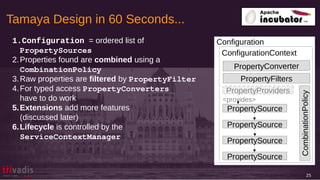
Tamaya Design in 60 Seconds...
25
1.Configuration = ordered list of
PropertySources
2.Properties found are combined using a
CombinationPolicy
3.Raw properties are filtered by PropertyFilter
4.For typed access PropertyConverters 
have to do work
5.Extensions add more features
(discussed later)
6.Lifecycle is controlled by the
ServiceContextManager
ConfigurationContext
PropertyFilters
PropertySource
PropertySource
PropertySource
PropertySource
Configuration
CombinationPolicy
PropertyProviders
<provides>
PropertyConverter
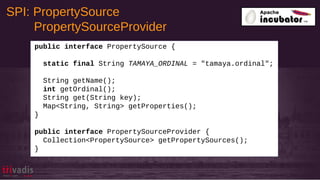
SPI: PropertySource
PropertySourceProvider
public interface PropertySource {
static final String TAMAYA_ORDINAL = "tamaya.ordinal";
String getName();
int getOrdinal();
String get(String key);
Map<String, String> getProperties();
}
public interface PropertySourceProvider {
Collection<PropertySource> getPropertySources();
}
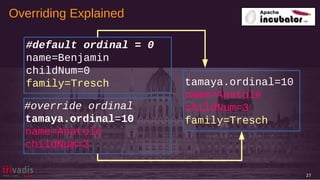
Overriding Explained
27
#default ordinal = 0
name=Benjamin
childNum=0
family=Tresch
#override ordinal
tamaya.ordinal=10
name=Anatole
childNum=3
tamaya.ordinal=10
name=Anatole
childNum=3
family=Tresch
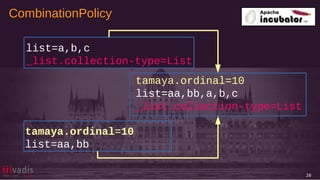
CombinationPolicy
28
list=a,b,c
_list.collection-type=List
tamaya.ordinal=10
list=aa,bb
tamaya.ordinal=10
list=aa,bb,a,b,c
_list.collection-type=List
There is more! - Extension Modules
29
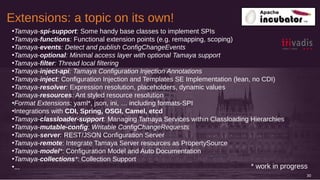
Extensions: a topic on its own!
30
•Tamaya-spi-support: Some handy base classes to implement SPIs
•Tamaya-functions: Functional extension points (e.g. remapping, scoping)
•Tamaya-events: Detect and publish ConfigChangeEvents
•Tamaya-optional: Minimal access layer with optional Tamaya support
•Tamaya-filter: Thread local filtering
•Tamaya-inject-api: Tamaya Configuration Injection Annotations
•Tamaya-inject: Configuration Injection and Templates SE Implementation (lean, no CDI)
•Tamaya-resolver: Expression resolution, placeholders, dynamic values
•Tamaya-resources: Ant styled resource resolution
•Format Extensions: yaml*, json, ini, … including formats-SPI
•Integrations with CDI, Spring, OSGI, Camel, etcd
•Tamaya-classloader-support: Managing Tamaya Services within Classloading Hierarchies
•Tamaya-mutable-config: Writable ConfigChangeRequests
•Tamaya-server: REST/JSON Configuration Server
•Tamaya-remote: Integrate Tamaya Server resources as PropertySource
•Tamaya-model*: Configuration Model and Auto Documentation
•Tamaya-collections*: Collection Support
•... * work in progress
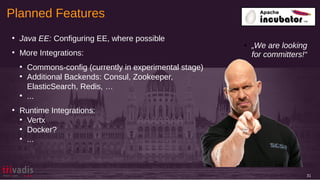
Planned Features
31
●
Java EE: Configuring EE, where possible
●
More Integrations:
●
Commons-config (currently in experimental stage)
●
Additional Backends: Consul, Zookeeper,
ElasticSearch, Redis, …
●
...
●
Runtime Integrations:
●
Vertx
●
Docker?
●
...
● „We are looking
for committers!“
Example: Configuration Injection
32
@ConfiguredType(defaultSections=”com.mycomp.tenantAdress”)
public final class MyTenant{
private String name;
@ConfiguredProperty(
defaultValue=”2000”)
private long customerId;
@ConfiguredProperty(keys={
”privateAddress”,”businessAdress”,
”[my.qualified.adress]”
})
private String address;
...
}
MyTenant t = new MyTenant();
ConfigurationInjection
.getConfigurationInjector()
.configure(t);
MyTenant t = new MyTenant();
ConfigurationInjection
.getConfigurationInjector()
.configure(t);
@RequestScoped
public class MyClass{
@Inject
private MyTenant t;
…
}
@RequestScoped
public class MyClass{
@Inject
private MyTenant t;
…
}
Configuration Template
33
@ConfiguredType(defaultSections=”com.mycomp.tenantAdress”)
public interface MyTenant{
public String getName();
@ConfiguredProperty(
defaultValue=”2000”)
public long getCustomerId();
@ConfiguredProperty(keys={
”privateAddress”,”businessAdress”,
”[my.qualified.adress]”
})
public String getAddress();
}
MyTenant t =
ConfigurationInjection
.getConfigurationInjector()
.createTemplate(MyTenant.class);
MyTenant t =
ConfigurationInjection
.getConfigurationInjector()
.createTemplate(MyTenant.class);
Demo
DEMO TIME
34
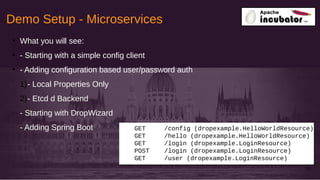
Demo Setup - Microservices
35
●
What you will see:
●
- Starting with a simple config client
●
- Adding configuration based user/password auth
1)- Local Properties Only
2)- Etcd d Backend
•
- Starting with DropWizard
•
- Adding Spring Boot GET /config (dropexample.HelloWorldResource)
GET /hello (dropexample.HelloWorldResource)
GET /login (dropexample.LoginResource)
POST /login (dropexample.LoginResource)
GET /user (dropexample.LoginResource)
GET /config (dropexample.HelloWorldResource)
GET /hello (dropexample.HelloWorldResource)
GET /login (dropexample.LoginResource)
POST /login (dropexample.LoginResource)
GET /user (dropexample.LoginResource)
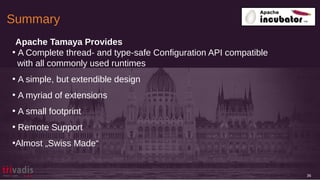
Summary
36
Apache Tamaya Provides
• A Complete thread- and type-safe Configuration API compatible
with all commonly used runtimes
• A simple, but extendible design
• A myriad of extensions
• A small footprint
• Remote Support
•Almost „Swiss Made“
Links
●
Project Page: http://tamaya.incubator.apache.org
●
Twitter: @tamayaconfig
●
Blog: http://javaeeconfig.blogspot.com
●
Presentation by Mike Keith on JavaOne 2013:
https://oracleus.activeevents.com/2013/connect/sessionDetail.ww?SESSION_ID=7755
●
Apache Deltaspike: http://deltaspike.apache.org
●
Java Config Builder: https://github.com/TNG/config-builder
●
Apache Commons Configuration: http://commons.apache.org/proper/commons-configuration/
●
Jfig: http://jfig.sourceforge.net/
●
Carbon Configuration: http://carbon.sourceforge.net/modules/core/docs/config/Usage.html
●
Comparison on Carbon and Others:
http://www.mail-archive.com/commons-dev@jakarta.apache.org/msg37597.html
●
Spring Framework: http://projects.spring.io/spring-framework/
●
Owner: http://owner.aeonbits.org/
37
Q&A
38
Thank you!
Anatole Tresch
Trivadis AG
Principal Consultant
Twitter/Google+: @atsticks
anatole@apache.org
anatole.tresch@trivadis.com
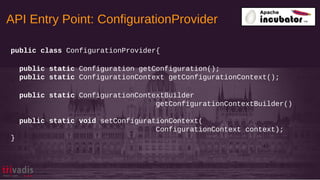
API Entry Point: ConfigurationProvider
42
public class ConfigurationProvider{
public static Configuration getConfiguration();
public static ConfigurationContext getConfigurationContext();
public static ConfigurationContextBuilder
getConfigurationContextBuilder()
public static void setConfigurationContext(
ConfigurationContext context);
}
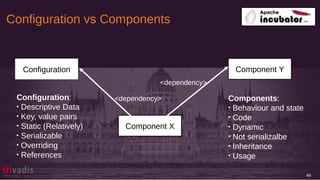
Configuration vs Components
46
Component X
Component Y
<dependency>
Configuration
<dependency> Components:

Behaviour and state

Code

Dynamic

Not serializalbe

Inheritance

Usage
Configuration:

Descriptive Data

Key, value pairs

Static (Relatively)

Serializable

Overriding

References

Configuration with Apache Tamaya

  • 1.
  • 2.
  • 3.
    Anatole Tresch ● Principal Consultant,Trivadis AG (Switzerland) ● Star Spec Lead JSR 354 ● Technical Architect, Lead Engineer ● PPMC Member Apache Tamaya ● Twitter/Google+: @atsticks ● anatole@apache.org ● anatole.tresch@trivadis.com ● JUG Switzerland 3 Bio
  • 4.
    Agenda 4 ● Introduction ● What to configure? ● ApacheTamaya ● Core Concepts ● Extensions ● Demo & Outlook
  • 5.
  • 6.
    6 ● 2012: Configuration wasvoted an important aspect for Java EE 8 ● 2013: ● Setup of Java EE Configuration JSR failed ● Standardization on SE Level did not have enough momentum ● BUT: ● Configuration is a crucial cross cutting concern ● There is no (really NO!) defacto standard ● Reinventing the wheel is daily business History of Apache Tamaya
  • 7.
    The People behindTamaya 7 • John D. Ament (Mentor) • David Blevins (Champion) • Werner Keil • Gerhard Petracek (Mentor) • Mark Struberg (Mentor) • Anatole Tresch • Oliver B. Fischer • ... •
  • 8.
    The Objectives ofApache Tamaya 8 ● Define a common API for accessing configuration ● Minimalistic ● Flexible, pluggable and extendible ● Compatible with Java 7 and beyond ● Provide a reference implementation ● Provide Extension Modules for additional features ● Build up a community ● If possible, create a Standard! •
  • 9.
  • 10.
    What to configure? 10 ● Mostcomplex question ever! ● Divergent views ● Servers, Containers, Machines, Clusters, ... ● Parameters of a runtime (staging, localization etc.) ● Deployments, Network, ... ● Technology-specific components (beans, wirings etc.) ● Resources (data sources, message queues, services etc.) ● Descriptive or imperative style ● Different granularities, varying levels of applicability, different formats …
  • 11.
    How to configure? 11 ● Format ● Storage ● Lifecycleand versioning ● Security ● Distribution ● Consistency
  • 12.
  • 13.
  • 14.
    UC: Access ConfigurationSimilarly 14 Apache Tamaya Config Unified Common API MicroService Container IaaS PaaS Cache SaaS Build-Tool ● Any Location ● Any Format ● Any Policy Extension Points: SPI
  • 15.
    UC: Reduce Redundancy 15 Bar Foo FooConfiguration: Service.host.ip=192.168.1.10 Service.stage=test Service.param=paramValue Redundant! File 1 File 2 Tamaya Configuration Bar Configuration: bar.host.ip=${env:HOST_IP} bar.stage=${env:STAGE} bar.param=paramValue Cache Configuration: Cache.host.ip=192.168.1.10 Cache.stage=test Cache.param=cacheValue Tamaya Configuration Foo Configuration: foo.host.ip=${env:HOST_IP} foo.stage=${env:STAGE} foo.param=cacheValue Tamaya Configuration Tamaya Configuration
  • 16.
    UC: Convention overConfiguration 16 Foo Configuration: bar.host.ip=${cfg:env.host.ip} bar.stage=${cfg:env.stage} bar.param=paramValue Cache Configuration: foo.host.ip=${cfg:env.host.ip} foo.stage=${cfg:env.stage} foo.param=cacheValue Defaults: default.host.ip=${env:HOST_IP} default.stage=${env:STAGE} Bar Foo Tamaya Configuration Tamaya Configuration
  • 17.
    UC: Pluggable ConfigBackends Classic: Apache Tamaya Configuration 17 Distributed: ZooKeeper Etcd ... Classic Policy (PropertySources) Myproject/bin/... Myproject/conf/server.xml Myproject/conf/cluster.xml Myproject/conf/security.xml Myproject/lib/... ... Remote Policy (PropertySources) ??? Unified API for configuration access Policies can be provided as jar- artifacts separately Additional benefits: config documentation Your Project
  • 18.
    UC: Enterprise Integration 18 CompanyX: Config SOAP Myproject/bin/... Myproject/conf/server.xml Myproject/conf/cluster.xml Myproject/conf/security.xml Myproject/lib/... ... Company Z: Config Rest Company Y: etcd Company A: Legacy Config Tamaya Configuration Classic Policy (PropertySources) Config Integration (PropertySources) dns etcd REST Java EE ...
  • 19.
  • 20.
    20 Configuration [Group, size: 8: >>Section: a.test.existing >> Parameter: a.test.existing.aParam, required: true >> Parameter: a.test.existing.optionalParam >> Parameter: a.test.existing.aABCParam, expression: [ABC].* >> Section: a.test.notexisting >> Parameter: a.test.notexisting.aParam, required: true >> Parameter: a.test.existing.aABCParam2, expression: [ABC].* >> Section: a.b.c.aRequiredSection.optional-subsection, >> Parameter: MyNumber, >> Section: a.b.c, >> Section: a.b.c.aRequiredSection.nonempty-subsection, >> Section: a.b.c.aRequiredSection  - Parameter: a.b.c.aRequiredSection.subsection.param00, Config Documentation Tamaya allows to validate and document the configuration hooks used throughout your system! UC: Documentation Config Validation MISSING: a.test.notexisting.aParam (Parameter), ERROR: a.test.existing.aABCParam2 (Parameter) -> Config value not matching expression: [ABC].*, was MMM MISSING: a.params2 (Parameter), MISSING: a.b.c.aRequiredSection.subsection.param1 (Parameter), UNDEFINED: JAVA_HOME (Parameter) UNDEFINED: SESSION_MANAGER (Parameter) [...]
  • 21.
    21 ● Stop Reinventing thewheel ● Stay Focused on what to configure, not how! ● Reduce Redundancies and Inconsistencies ● Document your configuration options ● Integrate with Company Infrastructure („DevOps“) ● Decouple your configuration backends Summary: Why we need Tamaya? ● ManageConfig likeAPIs !
  • 22.
  • 23.
    Let's start simple! 23 ● Adddependency org.apache.tamaya:core: 0.2-incubating (not yet released) ● Add Config to META-INF/javaconfiguration.properties Configuration config = ConfigurationProvider.getConfiguration(); String name = config.getOrDefault("name", "John"); int ChildNum = config.get("childNum", int.class);
  • 24.
    24 public interface Configuration{ Stringget(String key); String getOrDefault(String key, String defaultValue); <T> T get(String key, Class<T> type); <T> T get(String key, TypeLiteral<T> type); <T> T getOrDefault(String key, Class<T> type, T defaultValue); <T> T getOrDefault(String key, TypeLiteral<T> type, T defaultValue); Map<String,String> getProperties(); // Functional Extension Points Configuration with(ConfigOperator operator): <T> T query(ConfigQuery<T> query); } Configuration Interface
  • 25.
    Tamaya Design in60 Seconds... 25 1.Configuration = ordered list of PropertySources 2.Properties found are combined using a CombinationPolicy 3.Raw properties are filtered by PropertyFilter 4.For typed access PropertyConverters  have to do work 5.Extensions add more features (discussed later) 6.Lifecycle is controlled by the ServiceContextManager ConfigurationContext PropertyFilters PropertySource PropertySource PropertySource PropertySource Configuration CombinationPolicy PropertyProviders <provides> PropertyConverter
  • 26.
    SPI: PropertySource PropertySourceProvider public interfacePropertySource { static final String TAMAYA_ORDINAL = "tamaya.ordinal"; String getName(); int getOrdinal(); String get(String key); Map<String, String> getProperties(); } public interface PropertySourceProvider { Collection<PropertySource> getPropertySources(); }
  • 27.
    Overriding Explained 27 #default ordinal= 0 name=Benjamin childNum=0 family=Tresch #override ordinal tamaya.ordinal=10 name=Anatole childNum=3 tamaya.ordinal=10 name=Anatole childNum=3 family=Tresch
  • 28.
  • 29.
    There is more!- Extension Modules 29
  • 30.
    Extensions: a topicon its own! 30 •Tamaya-spi-support: Some handy base classes to implement SPIs •Tamaya-functions: Functional extension points (e.g. remapping, scoping) •Tamaya-events: Detect and publish ConfigChangeEvents •Tamaya-optional: Minimal access layer with optional Tamaya support •Tamaya-filter: Thread local filtering •Tamaya-inject-api: Tamaya Configuration Injection Annotations •Tamaya-inject: Configuration Injection and Templates SE Implementation (lean, no CDI) •Tamaya-resolver: Expression resolution, placeholders, dynamic values •Tamaya-resources: Ant styled resource resolution •Format Extensions: yaml*, json, ini, … including formats-SPI •Integrations with CDI, Spring, OSGI, Camel, etcd •Tamaya-classloader-support: Managing Tamaya Services within Classloading Hierarchies •Tamaya-mutable-config: Writable ConfigChangeRequests •Tamaya-server: REST/JSON Configuration Server •Tamaya-remote: Integrate Tamaya Server resources as PropertySource •Tamaya-model*: Configuration Model and Auto Documentation •Tamaya-collections*: Collection Support •... * work in progress
  • 31.
    Planned Features 31 ● Java EE:Configuring EE, where possible ● More Integrations: ● Commons-config (currently in experimental stage) ● Additional Backends: Consul, Zookeeper, ElasticSearch, Redis, … ● ... ● Runtime Integrations: ● Vertx ● Docker? ● ... ● „We are looking for committers!“
  • 32.
    Example: Configuration Injection 32 @ConfiguredType(defaultSections=”com.mycomp.tenantAdress”) publicfinal class MyTenant{ private String name; @ConfiguredProperty( defaultValue=”2000”) private long customerId; @ConfiguredProperty(keys={ ”privateAddress”,”businessAdress”, ”[my.qualified.adress]” }) private String address; ... } MyTenant t = new MyTenant(); ConfigurationInjection .getConfigurationInjector() .configure(t); MyTenant t = new MyTenant(); ConfigurationInjection .getConfigurationInjector() .configure(t); @RequestScoped public class MyClass{ @Inject private MyTenant t; … } @RequestScoped public class MyClass{ @Inject private MyTenant t; … }
  • 33.
    Configuration Template 33 @ConfiguredType(defaultSections=”com.mycomp.tenantAdress”) public interfaceMyTenant{ public String getName(); @ConfiguredProperty( defaultValue=”2000”) public long getCustomerId(); @ConfiguredProperty(keys={ ”privateAddress”,”businessAdress”, ”[my.qualified.adress]” }) public String getAddress(); } MyTenant t = ConfigurationInjection .getConfigurationInjector() .createTemplate(MyTenant.class); MyTenant t = ConfigurationInjection .getConfigurationInjector() .createTemplate(MyTenant.class);
  • 34.
  • 35.
    Demo Setup -Microservices 35 ● What you will see: ● - Starting with a simple config client ● - Adding configuration based user/password auth 1)- Local Properties Only 2)- Etcd d Backend • - Starting with DropWizard • - Adding Spring Boot GET /config (dropexample.HelloWorldResource) GET /hello (dropexample.HelloWorldResource) GET /login (dropexample.LoginResource) POST /login (dropexample.LoginResource) GET /user (dropexample.LoginResource) GET /config (dropexample.HelloWorldResource) GET /hello (dropexample.HelloWorldResource) GET /login (dropexample.LoginResource) POST /login (dropexample.LoginResource) GET /user (dropexample.LoginResource)
  • 36.
    Summary 36 Apache Tamaya Provides •A Complete thread- and type-safe Configuration API compatible with all commonly used runtimes • A simple, but extendible design • A myriad of extensions • A small footprint • Remote Support •Almost „Swiss Made“
  • 37.
    Links ● Project Page: http://tamaya.incubator.apache.org ● Twitter:@tamayaconfig ● Blog: http://javaeeconfig.blogspot.com ● Presentation by Mike Keith on JavaOne 2013: https://oracleus.activeevents.com/2013/connect/sessionDetail.ww?SESSION_ID=7755 ● Apache Deltaspike: http://deltaspike.apache.org ● Java Config Builder: https://github.com/TNG/config-builder ● Apache Commons Configuration: http://commons.apache.org/proper/commons-configuration/ ● Jfig: http://jfig.sourceforge.net/ ● Carbon Configuration: http://carbon.sourceforge.net/modules/core/docs/config/Usage.html ● Comparison on Carbon and Others: http://www.mail-archive.com/commons-dev@jakarta.apache.org/msg37597.html ● Spring Framework: http://projects.spring.io/spring-framework/ ● Owner: http://owner.aeonbits.org/ 37
  • 38.
    Q&A 38 Thank you! Anatole Tresch TrivadisAG Principal Consultant Twitter/Google+: @atsticks anatole@apache.org anatole.tresch@trivadis.com
  • 39.
    API Entry Point:ConfigurationProvider 42 public class ConfigurationProvider{ public static Configuration getConfiguration(); public static ConfigurationContext getConfigurationContext(); public static ConfigurationContextBuilder getConfigurationContextBuilder() public static void setConfigurationContext( ConfigurationContext context); }
  • 40.
    Configuration vs Components 46 ComponentX Component Y <dependency> Configuration <dependency> Components:  Behaviour and state  Code  Dynamic  Not serializalbe  Inheritance  Usage Configuration:  Descriptive Data  Key, value pairs  Static (Relatively)  Serializable  Overriding  References