CONDUCTING
SECONDARY
DATA ANALYSIS
A GUIDE FOR INFORMATION MANAGERS
WHAT IS SECONDARY
DATA ANALYSIS?
• Secondary data analysis is the analysis of
existing data to answer new research
questions.
• It is a cost-effective way to gain insights
without collecting primary data.
• Key steps include:
1. Defining the research question
2. Identifying relevant data sources
3. Gathering necessary data and
ensuring quality
4. Analysing the data
5. Interpreting findings and drawing
conclusions
2
IDENTIFYINGTHE DATA
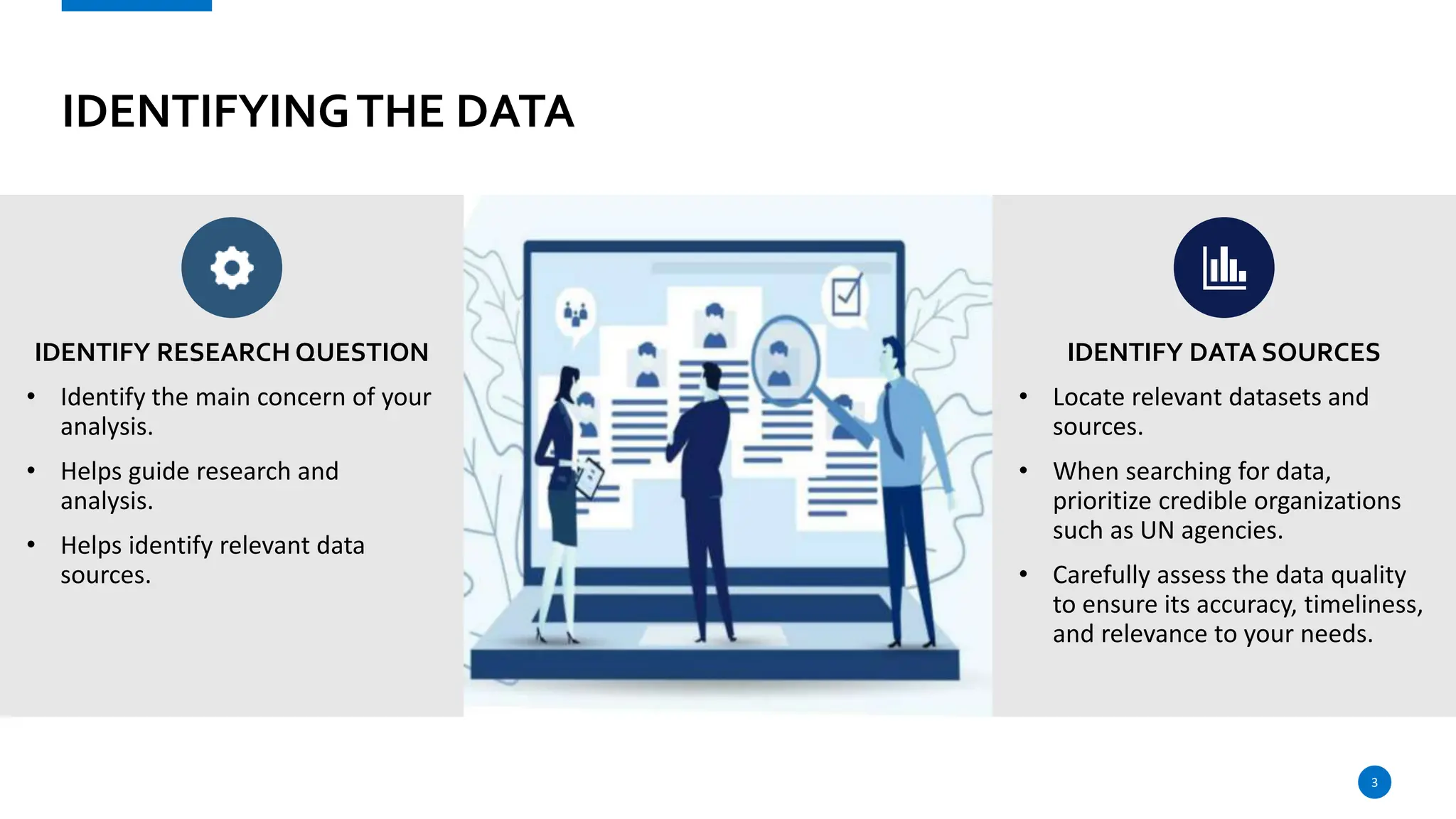
IDENTIFY RESEARCH QUESTION
• Identify the main concern of your
analysis.
• Helps guide research and
analysis.
• Helps identify relevant data
sources.
IDENTIFY DATA SOURCES
• Locate relevant datasets and
sources.
• When searching for data,
prioritize credible organizations
such as UN agencies.
• Carefully assess the data quality
to ensure its accuracy, timeliness,
and relevance to your needs.
3
GATHERINGTHE DATA
4
• Evaluate data sources: Check for
relevance, reliability, validity,
timeliness, and accessibility.
• Data collection: Gather the
necessary data and ensure
quality.
• Data cleaning and preparation:
Process data for analysis.
ANALYSINGTHE DATA
ANALYSETHE DATA
• Clean, standardise, and merge
datasets as needed.
• Analyse the data using appropriate
methods like statistical analysis or
visualisation tools.
• Identify key trends and patterns and
triangulate findings from multiple
data sources for a more complete
picture.
• Interpret results in light of the
research question and data
limitations.
• Identify key insights, trends, and
implications for humanitarian
relevance.
• Communicate findings clearly and
concisely through visualisations,
dashboards, reports, etc.
INTERPRETTHE DATA
5
CONCLUSION
6
Useful tools:
• Overview of commonly used tools
(e.g., SPSS, Tableau, Excel)
Useful resources:
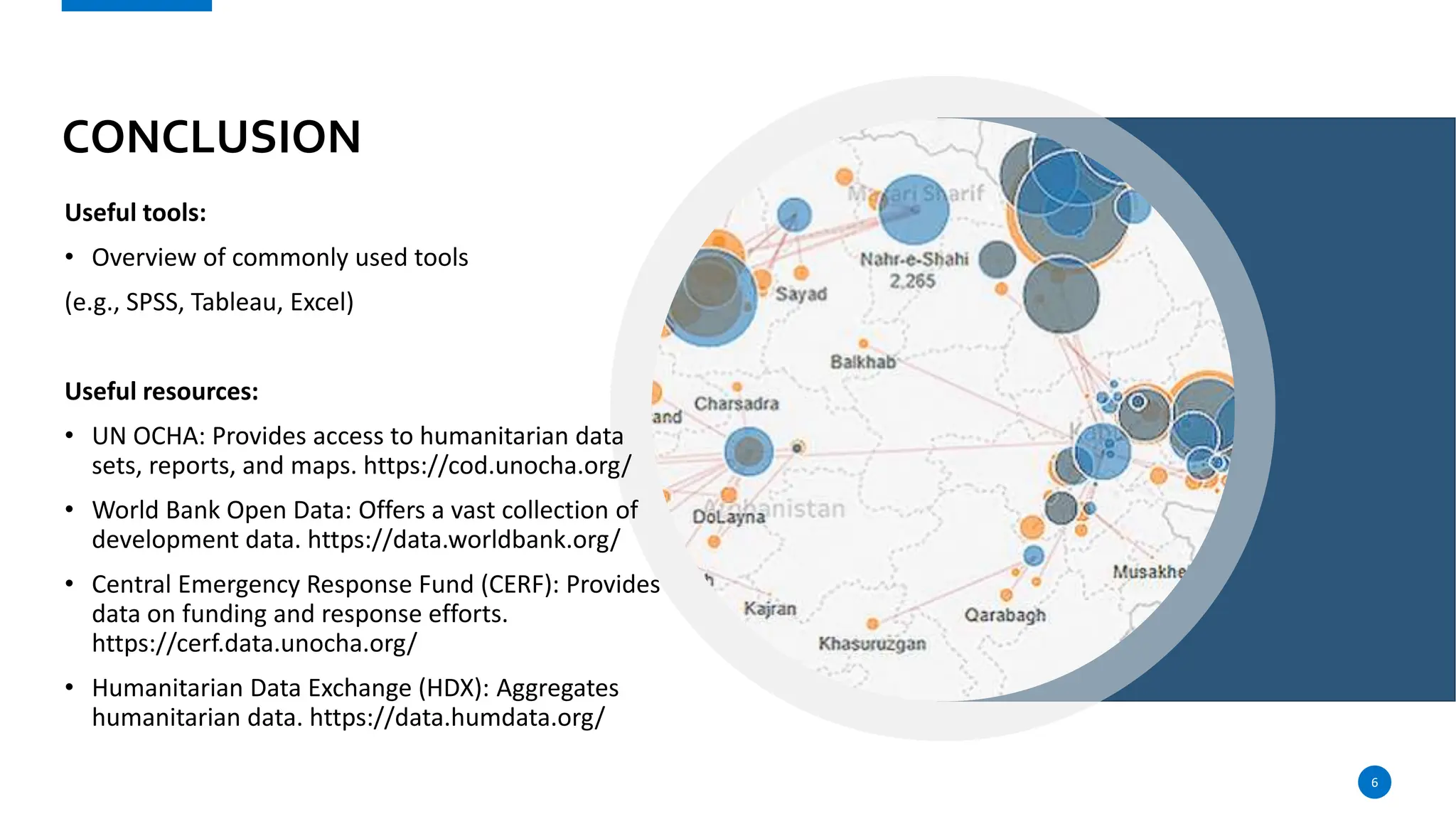
• UN OCHA: Provides access to humanitarian data
sets, reports, and maps. https://cod.unocha.org/
• World Bank Open Data: Offers a vast collection of
development data. https://data.worldbank.org/
• Central Emergency Response Fund (CERF): Provides
data on funding and response efforts.
https://cerf.data.unocha.org/
• Humanitarian Data Exchange (HDX): Aggregates
humanitarian data. https://data.humdata.org/
QUESTIONS

Conducting Secondary Data Analysis _ OSINT research

  • 1.
  • 2.
    WHAT IS SECONDARY DATAANALYSIS? • Secondary data analysis is the analysis of existing data to answer new research questions. • It is a cost-effective way to gain insights without collecting primary data. • Key steps include: 1. Defining the research question 2. Identifying relevant data sources 3. Gathering necessary data and ensuring quality 4. Analysing the data 5. Interpreting findings and drawing conclusions 2
  • 3.
    IDENTIFYINGTHE DATA IDENTIFY RESEARCHQUESTION • Identify the main concern of your analysis. • Helps guide research and analysis. • Helps identify relevant data sources. IDENTIFY DATA SOURCES • Locate relevant datasets and sources. • When searching for data, prioritize credible organizations such as UN agencies. • Carefully assess the data quality to ensure its accuracy, timeliness, and relevance to your needs. 3
  • 4.
    GATHERINGTHE DATA 4 • Evaluatedata sources: Check for relevance, reliability, validity, timeliness, and accessibility. • Data collection: Gather the necessary data and ensure quality. • Data cleaning and preparation: Process data for analysis.
  • 5.
    ANALYSINGTHE DATA ANALYSETHE DATA •Clean, standardise, and merge datasets as needed. • Analyse the data using appropriate methods like statistical analysis or visualisation tools. • Identify key trends and patterns and triangulate findings from multiple data sources for a more complete picture. • Interpret results in light of the research question and data limitations. • Identify key insights, trends, and implications for humanitarian relevance. • Communicate findings clearly and concisely through visualisations, dashboards, reports, etc. INTERPRETTHE DATA 5
  • 6.
    CONCLUSION 6 Useful tools: • Overviewof commonly used tools (e.g., SPSS, Tableau, Excel) Useful resources: • UN OCHA: Provides access to humanitarian data sets, reports, and maps. https://cod.unocha.org/ • World Bank Open Data: Offers a vast collection of development data. https://data.worldbank.org/ • Central Emergency Response Fund (CERF): Provides data on funding and response efforts. https://cerf.data.unocha.org/ • Humanitarian Data Exchange (HDX): Aggregates humanitarian data. https://data.humdata.org/
  • 7.

Editor's Notes

  • #2 Good morning/afternoon everyone. Today I will be taking you through secondary data analysis. Secondary data analysis is a powerful tool for information managers in humanitarian response. By effectively analysing secondary data, we can gain valuable insights into ongoing crises, affected populations and their needs, leading to more informed decision-making and improved humanitarian action. We’ll cover the steps involved, key considerations, useful analysis tools as well as resources to find relevant data sets.
  • #3 What is Secondary Data Analysis? To begin with, let us define Secondary Data. This is information collected by someone else for their own purposes. This contrasts to Primary Data which refers to data that is collected firsthand by a researcher or a team of researchers for a specific research project or purpose. Secondary data includes data from various sources such as government publications, academic journals, market research reports, and existing datasets. Researchers can access secondary data from published sources (such as books and journals) or online sources due to the growth of the internet. Due to the lack of costs towards resources and time, secondary data collection is more cost-efficient compared to primary data collection, allowing researchers to focus on analysis. With these definitions, we can understand that Secondary Data Analysis involves examining and interpreting existing data sets (secondary data) to understand a particular issue. By analysing this data, information managers can gain insights into demographics, health status, infrastructure damage, and other critical factors to inform humanitarian response efforts. Key steps in secondary data analysis include: Defining the research question Identifying relevant data sources Gathering necessary data and ensuring quality Analysing the data Interpreting findings and drawing conclusions
  • #4 We will begin with the first stages in the process which have been combined under data identification. Data Identification involves two steps: identifying the research question; and, identifying the relevant data sources. Identify research question: The first step is to clearly define the research question guiding your analysis. This step is integral to the entire analysis process as it will help you identify the required data and the most relevant data sources. For example, as an information manager, you might be required to provide a report on gender-based violence in Ethiopia in 2020. To formulate your research question, you would have to identify the forms of GBV issues you want to focus on (if not all). You will also need to identify the relevant timeframe (2020). For a comparative report, you might want to include data from the previous years (ideally between three and five years). Identify data sources: After settling on your research question, the next step will be to locate relevant datasets and sources. When searching for data, prioritise credible organisations such as UN agencies, NGOs, clusters and government sources. Carefully assess the data quality to ensure its accuracy, timeliness, and relevance to your needs. Other relevant humanitarian data sources include: Surveys, censuses, and administrative data from national statistical offices. Research reports, evaluations, and analyses from think tanks, universities, and other organisations. Media reports, social media data, satellite imagery, etc.
  • #5 After identifying both your research question and data sources, we move to the next step in the process which involves data gathering. There are several important considerations when gathering the data. First, ensure the data is relevant and accessible in a usable format. Some formats are more accessible, such as Excel/CSV documents while others might be tied to specific software. Second, critically assess data quality. Consider the source's credibility, timeliness, data collection methodology, any potential biases, as well as relevance to your needs. Data cleaning may involve addressing missing values, inconsistencies, and formatting issues. Third, interpret the data within its context. Consider the period, location, and any limitations mentioned by the data provider. Identify data gaps and limitations that may affect analysis and interpretation. These can be addressed by gathering additional data from other sources or providing disclaimers in your report. After these steps, you will move forward and conduct your analysis.
  • #6 The last steps in the process revolve around analysing the collected data. This is divided into two steps: Analysing the data. Interpreting the data. Analyse the Data Start by cleaning, standardising, and merging datasets as necessary. Next, employ appropriate methods like statistical analysis or visualisation tools to identify essential trends and patterns. Some of these trends and patterns might include a certain time of day, period of year or place with a higher frequency of an event under study. It might also include a cause and effect, e.g. a trend of an event under study occurring after, during or before another event over several times. Finally, you can also enhance your insights by triangulating findings from multiple data sources to create a more comprehensive picture.  Interpret the data The final step in the process will involve interpreting your findings and drawing conclusions and implications for stakeholders. When interpreting research results, first contextualise them in relation to the research question and any data limitations. Next, consider the implications of the identified insights and trends for your humanitarian needs. Finally, effectively communicate your findings by creating clear visualisations, dashboards, or reports that can be easily shared with relevant stakeholders to inform their decision-making process. That will mark the end of your secondary data analysis process.
  • #7 As I conclude, I would like to share some useful tips while undertaking this process. Useful tools: First, I want to highlight some useful tools that can help your analysis. There are various statistical analysis tools, some more complex than others. Of these, the Excel software - which comes bundled with the Microsoft Office suite – is among the easiest to get up and running. However, while it is suitable for most data analysis requirements, Excel can struggle with large datasets while also being too simplistic for complex tasks. For those who wish to carry out more complex analysis – or are more familiar with analytical tools – software such as SPSS and Tableau might be more suitable. These provide powerful features for data manipulation and presentation making them more preferred for specialised analysis. However, these also come with a steep learning curve, increased costs and more complex setup processes. In summary, choose Excel for simple data management, SPSS for advanced statistical analysis, and Tableau for powerful data visualisation. However, for most analysis, Excel (or any variant such as Google Sheets, Open Office Calc, WPS Spreadsheets, or Zoho Sheet) should suffice. Useful data sources: Lastly, I also want to highlight some useful resources where you can find relevant humanitarian data. These include: UN OCHA: Provides access to humanitarian data sets, reports, and maps. https://cod.unocha.org/ World Bank Open Data: Offers a vast collection of development data. https://data.worldbank.org/ Central Emergency Response Fund (CERF): Provides data on funding and response efforts. https://cerf.data.unocha.org/ Humanitarian Data Exchange (HDX): Aggregates all humanitarian data to ensure that aid organizations are able to access the same information and coordinate their efforts. https://data.humdata.org/ There are many other sources that you can find online and these are but a few key ones. I will encourage you to search widely, keeping your sources relevant to your research question. Remember, the key to effective secondary data analysis is to leverage existing and credible data sources and to analyse and interpret your findings to generate actionable insights for humanitarian response.
  • #8 That marks the end of my presentation and I welcome any question regarding the process at this point. Thank you.