Created By:- Jaya Mokawat
19EBKCS050
IVth year VII Sem
CS-1
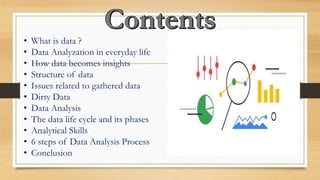
• What is data ?
• Data Analyzation in everyday life
• How data becomes insights
• Structure of data
• Issues related to gathered data
• Dirty Data
• Data Analysis
• The data life cycle and its phases
• Analytical Skills
• 6 steps of Data Analysis Process
• Conclusion
Data is the word used to describe information. This
could be facts, observations, numbers, graphs or
measurements - any kind of information that has been
collected and can be analyzed.
The structure of data
Data is everywhere and it can be stored in lots of ways. Two general
categories of data are:
Structured data: Organized in a certain format, such as rows and
columns.
Unstructured data: Not organized in any easy-to-identify way.
For example, when you rate your favorite restaurant online, you’re
creating structured data. But
when you use Google Earth to check out a satellite image of a
restaurant location, you’re using
unstructured data.
Here’s a refresher on the characteristics of structured and
unstructured data:
Structured data
As we described earlier, structured data is organized in a certain
format. This makes it easier to store and query for business needs. If
the data is exported, the structure goes along with the data.
Unstructured data
Unstructured data can’t be organized in any easily identifiable manner.
And there is much more unstructured than structured data in the
world. Video and audio files, text files, social media content, satellite
imagery, presentations, PDF files, open-ended survey responses, and
websites all qualify as types of unstructured data.
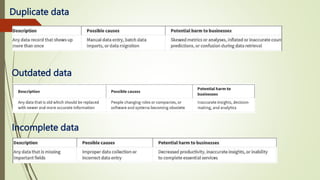
Duplicate data
Outdated data
Incomplete data
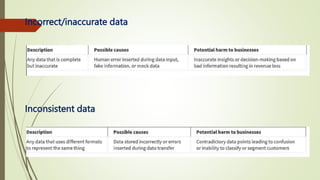
Incorrect/inaccurate data
Inconsistent data
Plan for the users who will work within a spreadsheet by developing organizational
standards. This can mean formatting your cells, the headings you choose to highlight, the
Color scheme, and the way you order your data points. When you take the time to set thes
standards, you will improve communication, ensure consistency, and help people be more
efficient with their time.
Capture data by the source by connecting spreadsheets to other data sources, such as an
online
survey application or a database. This data will automatically be updated in the
spreadsheet. That way, the information is always as current and accurate as
possible.
Manage different kinds of data with a spreadsheet. This can involve storing, organizing,
filtering, and updating information. Spreadsheets also let you decide who can
access the data, how the information is shared, and how to keep your data safe and
secure.
Archive any spreadsheet that you don’t use often, but might need to reference later
with
built-in tools. This is especially useful if you want to store historical data
before it gets
updated.
Destroy your spreadsheet when you are certain that you will never need it again,
if you have
better backup copies, or for legal or security reasons. Keep in mind,
lots of businesses are
required to follow certain rules or have measures in place to make sure
data is destroyed
properly.
• Virtualization:
The graphical representation of information.
• Strategy:
With so much data available having a strategic mindset is key to staying focused
and on
track. Strategizing helps data analysts see what they want to achieve with the data
and
how they can get there. Improve the quality and usefulness of data.
• Being Problem Oriented:
Approach to identify, describe and solve problems. Asking more and more
questions to
understand the problem.
• Correlation:
A correlation is like a relationship. That is not equal to causation.
If two data are heading in the same directions that does not mean they will be
related.
First up, the analysts needed to define what the project would look like and what would qualify as a successful
result. So, to determine these things, they asked effective questions and collaborated with leaders and
managers who were interested in the outcome of their people analysis. These were the kinds of questions they
asked:
• What do you think new employees need to learn to be successful in their first year on the job?
• Have you gathered data from new employees before? If so, may we have access to the historical data?
• Do you believe managers with higher retention rates offer new employees something extra or unique?
• What do you suspect is a leading cause of dissatisfaction among new employees?
• By what percentage would you like employee retention to increase in the next fiscal year?
It all started with solid preparation. The group built a timeline of three months and decided how they
wanted to relay their progress to interested parties. Also during this step, the analysts identified what data
they needed to achieve the successful result they identified in the previous step - in this case, the analysts
chose to gather the data from an online survey of new employees. These were the things they did to
prepare:
• They developed specific questions to ask about employee satisfaction with different business processes,
such as hiring and onboarding, and their overall compensation.
• They established rules for who would have access to the data collected - in this case, anyone outside the
group wouldn't have access to the raw data, but could view summarized or aggregated data. For example,
an individual's compensation wouldn't be available, but salary ranges for groups of individuals would be
viewable.
• They finalized what specific information would be gathered, and how best to present the data visually.
The analysts brainstormed possible project- and data-related issues and how to avoid them.
The group sent the survey out. Great analysts know how to respect both their data and the people who provide
it. Since employees provided the data, it was important to make sure all employees gave their consent to
participate. The data analysts also made sure employees understood how their data would be collected,
stored, managed, and protected. Collecting and using data ethically is one of the responsibilities of data
analysts. In order to maintain confidentiality and protect and store the data effectively, these were the steps
they took:
• They restricted access to the data to a limited number of analysts.
• They cleaned the data to make sure it was complete, correct, and relevant. Certain data was aggregated
and summarized without revealing individual responses.
• They uploaded raw data to an internal data warehouse for an additional layer of security.
Then, the analysts did what they do best: analyze! From the completed surveys, the data analysts
discovered that an employee’s experience with certain processes was a key indicator of overall job
satisfaction. These were their findings:
• Employees who experienced a long and complicated hiring process were most likely to leave the
company.
• Employees who experienced an efficient and transparent evaluation and feedback process were most
likely to remain with the company.
The group knew it was important to document exactly what they found in the analysis, no matter what
the results. To do otherwise would diminish trust in the survey process and reduce their ability to collect
truthful data from employees in the future.
Just as they made sure the data was carefully protected, the analysts were also careful sharing the report.
This is how they shared their findings:
• They shared the report with managers who met or exceeded the minimum number of direct reports with
submitted responses to the survey.
• They presented the results to the managers to make sure they had the full picture.
• They asked the managers to personally deliver the results to their teams.
This process gave managers an opportunity to communicate the results with the right context. As a result,
they could have productive team conversations about next steps to improve employee engagement.
The last stage of the process for the team of analysts was to work with leaders within their company and
decide how best to implement changes and take actions based on the findings. These were their
recommendations:
• Standardize the hiring and evaluation process for employees based on the most efficient and transparent
practices.
• Conduct the same survey annually and compare results with those from the previous year.
A year later, the same survey was distributed to employees. Analysts anticipated that a comparison between
the two sets of results would indicate that the action plan worked. Turns out, the changes improved the
retention rate for new employees and the actions taken by leaders were successful!
Data analysis is an important process of research or simply
discovering information related to any work. Data derived
from the observation, experiment, and other primary and
secondary data collection methods is large and cannot be
taken as it is. Not all data is relevant, neither can it directly
signify any trends, relations, facts, and associations within
the data. To find out those required trends and relations,
the data needs to be reconstructed in the relevant form
and modified. This process is called data analysis. Data
analysis and conclusion take forward the research.
Presentation final.pptx

Presentation final.pptx

  • 1.
    Created By:- JayaMokawat 19EBKCS050 IVth year VII Sem CS-1
  • 2.
    • What isdata ? • Data Analyzation in everyday life • How data becomes insights • Structure of data • Issues related to gathered data • Dirty Data • Data Analysis • The data life cycle and its phases • Analytical Skills • 6 steps of Data Analysis Process • Conclusion
  • 6.
    Data is theword used to describe information. This could be facts, observations, numbers, graphs or measurements - any kind of information that has been collected and can be analyzed.
  • 10.
    The structure ofdata Data is everywhere and it can be stored in lots of ways. Two general categories of data are: Structured data: Organized in a certain format, such as rows and columns. Unstructured data: Not organized in any easy-to-identify way. For example, when you rate your favorite restaurant online, you’re creating structured data. But when you use Google Earth to check out a satellite image of a restaurant location, you’re using unstructured data. Here’s a refresher on the characteristics of structured and unstructured data:
  • 12.
    Structured data As wedescribed earlier, structured data is organized in a certain format. This makes it easier to store and query for business needs. If the data is exported, the structure goes along with the data. Unstructured data Unstructured data can’t be organized in any easily identifiable manner. And there is much more unstructured than structured data in the world. Video and audio files, text files, social media content, satellite imagery, presentations, PDF files, open-ended survey responses, and websites all qualify as types of unstructured data.
  • 18.
  • 19.
  • 23.
    Plan for theusers who will work within a spreadsheet by developing organizational standards. This can mean formatting your cells, the headings you choose to highlight, the Color scheme, and the way you order your data points. When you take the time to set thes standards, you will improve communication, ensure consistency, and help people be more efficient with their time. Capture data by the source by connecting spreadsheets to other data sources, such as an online survey application or a database. This data will automatically be updated in the spreadsheet. That way, the information is always as current and accurate as possible. Manage different kinds of data with a spreadsheet. This can involve storing, organizing, filtering, and updating information. Spreadsheets also let you decide who can access the data, how the information is shared, and how to keep your data safe and secure.
  • 24.
    Archive any spreadsheetthat you don’t use often, but might need to reference later with built-in tools. This is especially useful if you want to store historical data before it gets updated. Destroy your spreadsheet when you are certain that you will never need it again, if you have better backup copies, or for legal or security reasons. Keep in mind, lots of businesses are required to follow certain rules or have measures in place to make sure data is destroyed properly.
  • 26.
    • Virtualization: The graphicalrepresentation of information. • Strategy: With so much data available having a strategic mindset is key to staying focused and on track. Strategizing helps data analysts see what they want to achieve with the data and how they can get there. Improve the quality and usefulness of data. • Being Problem Oriented: Approach to identify, describe and solve problems. Asking more and more questions to understand the problem. • Correlation: A correlation is like a relationship. That is not equal to causation. If two data are heading in the same directions that does not mean they will be related.
  • 29.
    First up, theanalysts needed to define what the project would look like and what would qualify as a successful result. So, to determine these things, they asked effective questions and collaborated with leaders and managers who were interested in the outcome of their people analysis. These were the kinds of questions they asked: • What do you think new employees need to learn to be successful in their first year on the job? • Have you gathered data from new employees before? If so, may we have access to the historical data? • Do you believe managers with higher retention rates offer new employees something extra or unique? • What do you suspect is a leading cause of dissatisfaction among new employees? • By what percentage would you like employee retention to increase in the next fiscal year?
  • 30.
    It all startedwith solid preparation. The group built a timeline of three months and decided how they wanted to relay their progress to interested parties. Also during this step, the analysts identified what data they needed to achieve the successful result they identified in the previous step - in this case, the analysts chose to gather the data from an online survey of new employees. These were the things they did to prepare: • They developed specific questions to ask about employee satisfaction with different business processes, such as hiring and onboarding, and their overall compensation. • They established rules for who would have access to the data collected - in this case, anyone outside the group wouldn't have access to the raw data, but could view summarized or aggregated data. For example, an individual's compensation wouldn't be available, but salary ranges for groups of individuals would be viewable. • They finalized what specific information would be gathered, and how best to present the data visually. The analysts brainstormed possible project- and data-related issues and how to avoid them.
  • 31.
    The group sentthe survey out. Great analysts know how to respect both their data and the people who provide it. Since employees provided the data, it was important to make sure all employees gave their consent to participate. The data analysts also made sure employees understood how their data would be collected, stored, managed, and protected. Collecting and using data ethically is one of the responsibilities of data analysts. In order to maintain confidentiality and protect and store the data effectively, these were the steps they took: • They restricted access to the data to a limited number of analysts. • They cleaned the data to make sure it was complete, correct, and relevant. Certain data was aggregated and summarized without revealing individual responses. • They uploaded raw data to an internal data warehouse for an additional layer of security.
  • 32.
    Then, the analystsdid what they do best: analyze! From the completed surveys, the data analysts discovered that an employee’s experience with certain processes was a key indicator of overall job satisfaction. These were their findings: • Employees who experienced a long and complicated hiring process were most likely to leave the company. • Employees who experienced an efficient and transparent evaluation and feedback process were most likely to remain with the company. The group knew it was important to document exactly what they found in the analysis, no matter what the results. To do otherwise would diminish trust in the survey process and reduce their ability to collect truthful data from employees in the future.
  • 33.
    Just as theymade sure the data was carefully protected, the analysts were also careful sharing the report. This is how they shared their findings: • They shared the report with managers who met or exceeded the minimum number of direct reports with submitted responses to the survey. • They presented the results to the managers to make sure they had the full picture. • They asked the managers to personally deliver the results to their teams. This process gave managers an opportunity to communicate the results with the right context. As a result, they could have productive team conversations about next steps to improve employee engagement.
  • 34.
    The last stageof the process for the team of analysts was to work with leaders within their company and decide how best to implement changes and take actions based on the findings. These were their recommendations: • Standardize the hiring and evaluation process for employees based on the most efficient and transparent practices. • Conduct the same survey annually and compare results with those from the previous year. A year later, the same survey was distributed to employees. Analysts anticipated that a comparison between the two sets of results would indicate that the action plan worked. Turns out, the changes improved the retention rate for new employees and the actions taken by leaders were successful!
  • 35.
    Data analysis isan important process of research or simply discovering information related to any work. Data derived from the observation, experiment, and other primary and secondary data collection methods is large and cannot be taken as it is. Not all data is relevant, neither can it directly signify any trends, relations, facts, and associations within the data. To find out those required trends and relations, the data needs to be reconstructed in the relevant form and modified. This process is called data analysis. Data analysis and conclusion take forward the research.