BASIC PROBABILITY CONCEPT
Definitionof Probability: Probability is a measure of the likelihood that an event will
occur. It is expressed as a number between 0 and 1, where 0 indicates impossibility and 1
indicates certainty.
• Sample Space: The sample space is the set of all possible outcomes of a random
experiment. It is denoted by �S.
• Event: An event is a subset of the sample space, representing a particular outcome
or a combination of outcomes.
• Outcome: An outcome is a specific result of an experiment. It is a single element of the sample sp
• Example: Rolling a Fair Six-Sided Die:
• Sample Space (�S): {1, 2, 3, 4, 5, 6}
• Event: Rolling an even number
• Possible Outcomes: {2, 4, 6}
3.
Introduction to Conditional
Probability
Conditionalprobability is a crucial concept in probability theory, particularly in the field of
computer science. It assesses the likelihood of an event occurring given that another
event has already occurred. Understanding conditional probability is vital for making
informed decisions and predictions based on available information.
This section will delve into the definition, calculation, and practical examples of
conditional probability, offering a comprehensive overview of its significance in computer
science.
4.
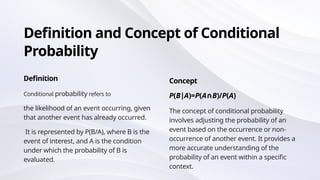
Definition and Conceptof Conditional
Probability
Definition
Conditional probability refers to
the likelihood of an event occurring, given
that another event has already occurred.
It is represented by P(B/A), where B is the
event of interest, and A is the condition
under which the probability of B is
evaluated.
Concept
P(B∣A)=P(A∩B)
/P(A)
The concept of conditional probability
involves adjusting the probability of an
event based on the occurrence or non-
occurrence of another event. It provides a
more accurate understanding of the
probability of an event within a specific
context.
5.
Application in Real-lifeScenarios:
• Weather Forecasting: Probability of rain given the presence of dark clouds
• Medical Diagnostics: Probability of a disease given the results of a diagnostic test
• Gaming: Probability of winning a game given the current state of play
6.
Examples of ConditionalProbability in
Computer Science
Data Analysis
Conditional probability is
extensively used in data
analysis for making
predictions and
identifying patterns
based on specific
conditions and variables.
Machine Learning
In machine learning,
conditional probability is
employed to estimate the
likelihood of an outcome
given various input
parameters, contributing to
the development of accurate
predictive models.
Network Security
Conditional probability
plays a pivotal role in
assessing the probability
of security breaches and
identifying potential
vulnerabilities within
complex network
infrastructures.
7.
Introduction to Independencein
Probability
Independence in probability signifies the absence of any relationship between two events.
Understanding independence is crucial for analyzing and interpreting the behavior of
events within a probabilistic framework.
This section will explore the definition, calculation, and practical examples of independent
events, emphasizing their significance in computer science.
8.
Definition and Conceptof Independence
Definition
Independence in probability implies
that the occurrence of one event does
not impact the occurrence of another
event.
Concept
The concept of independence fosters a
deeper understanding of the
probabilistic relationships between
events, providing insights into their
mutual exclusivity and statistical
behavior.
9.
MAJOR MISTAKE OFSECTION
"INDEPENDENCE"
considering the "Mutually Exclusive Event" the "independent" one…..
10.
Examples of Independencein Computer
Science
Parallel Processing
Independence plays a pivotal role in
parallel processing, where multiple tasks
are executed concurrently without
affecting each other's outcomes.
Algorithm Optimization
In algorithm optimization, the concept of
independence is utilized to streamline
computational processes and enhance
efficiency through distinct and non-
interfering operations.
11.
PRODUCT RULE
• Definitionof the Product Rule: The product rule is a fundamental concept in
probability theory used to calculate the probability of the intersection of two events.
• Formula:
• P(A∩B)=P(A)×P(B∣A)
• Where:
• P(A∩B): Probability of both events A andB occurring
• P(A): Probability of event A occurring
• P(B∣A): Conditional probability of event B given A
• Application: The product rule is useful when calculating joint probabilities or
understanding the combined occurrence of events in complex scenarios.
12.
Calculation of IndependenceUsing
the Product Rule
1
Formula Application
The product rule is directly applied to
assess the independence of events based
on their respective probabilities, enabling
a precise evaluation of their
interrelationship.
2
Statistical Analysis
Utilizing the product rule facilitates in-
depth statistical analysis, offering insights
into the independence or dependence of
events within diverse domains.
P(A B)=P(A)*P(B)
∩
13.
Conclusion and
Summary ofKey
Points
In summary, conditional probability, independence,
and the product rule offer invaluable insights into
probabilistic phenomena. Integrating these concepts
enhances our ability to analyze dependencies,
predict outcomes, and make informed decisions across
diverse domains. With broad applicability
and profound implications, these principles fuel
innovation and drive understanding in research and
industry.