Concrete Technology
Asst.Prof. Sushil Adhikari
Nepal Engineering college
Changunarayan, Bhaktapur
Chapter 1
Introduction
What is Concrete?
• Concrete is one of the most commonly used
building materials.
• Concrete is a composite material made from
several readily available constituents
(aggregates, sand, cement, water).
• Concrete is a versatile material that can easily
be mixed to meet a variety of special needs
and formed to virtually any shape.
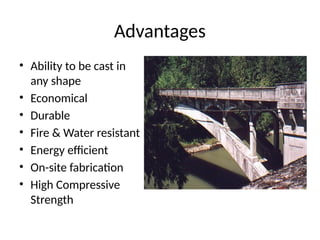
Advantages
• Ability to be cast in
any shape
• Economical
• Durable
• Fire & Water resistant
• Energy efficient
• On-site fabrication
• High Compressive
Strength
Disadvantages
• Low tensile strength
• Concrete is Quasi-brittle Material (exhibits a strain-
softening behavior )
• Concrete has Low Toughness
• Volume instability
• Low strength to weight ratio
• Formwork is required
• Long curing time
• Concrete may contains soluble salts. Soluble salts cause
efflorescence.
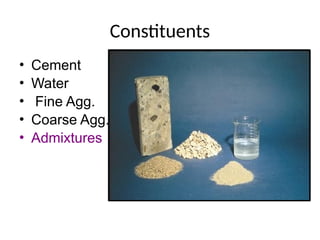
Constituents
• Cement
• Water
• Fine Agg.
• Coarse Agg.
• Admixtures
Cement
is one of the chemically active ingredient of concrete
which shows binding properties after reacting with
water.
Component materials required for cement making
• Calcareous material: Limestone and Chalk(CaCo3)
• Argillaceous material: Clay, Shale (~ 60%)
• Silica (~ 20%)
• Alumina (~ 10%)
• Others : Iron oxide, magnesium oxide, sulphur
trioxide, alkalies, carbon-di-oxide
Manufacturing process
• Wet and Dry methods
- In both methods raw materials are
homogenized by crushing, grinding and blending
- Approximately 80% of the ground materials
pass through #200 sieve
- Primary and Secondary crushers; wet and dry
grinding mills
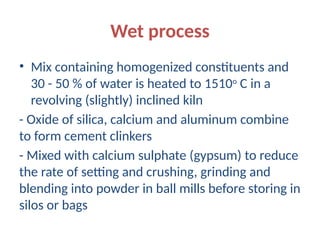
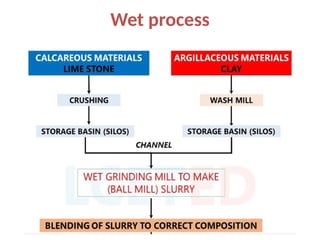
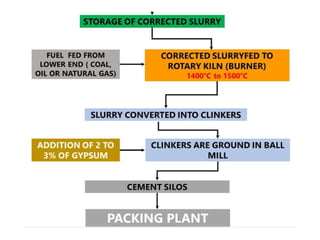
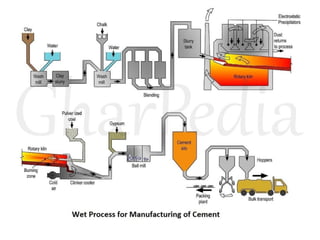
Wet process
• Mix containing homogenized constituents and
30 - 50 % of water is heated to 1510o
C in a
revolving (slightly) inclined kiln
- Oxide of silica, calcium and aluminum combine
to form cement clinkers
- Mixed with calcium sulphate (gypsum) to reduce
the rate of setting and crushing, grinding and
blending into powder in ball mills before storing in
silos or bags
Wet process
Dry process
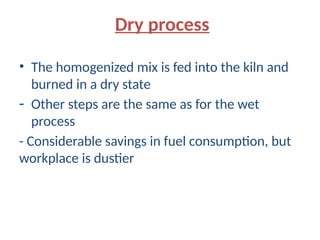
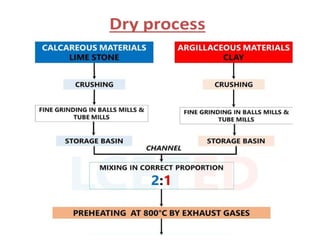
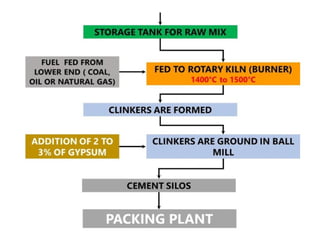
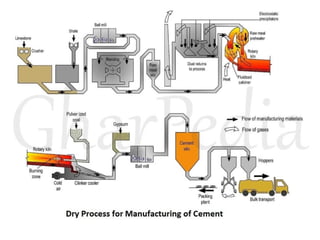
• The homogenized mix is fed into the kiln and
burned in a dry state
- Other steps are the same as for the wet
process
- Considerable savings in fuel consumption, but
workplace is dustier
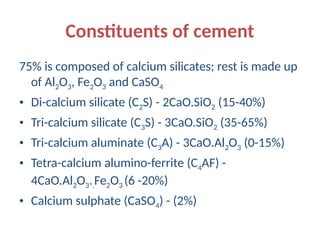
Constituents of cement
75% is composed of calcium silicates; rest is made up
of Al2O3, Fe2O3 and CaSO4
• Di-calcium silicate (C2S) - 2CaO.SiO2 (15-40%)
• Tri-calcium silicate (C3S) - 3CaO.SiO2 (35-65%)
• Tri-calcium aluminate (C3A) - 3CaO.Al2O3 (0-15%)
• Tetra-calcium alumino-ferrite (C4AF) -
4CaO.Al2O3..Fe2O3 (6 -20%)
• Calcium sulphate (CaSO4) - (2%)
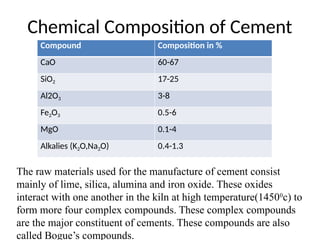
Chemical Composition of Cement
The raw materials used for the manufacture of cement consist
mainly of lime, silica, alumina and iron oxide. These oxides
interact with one another in the kiln at high temperature(14500
c) to
form more four complex compounds. These complex compounds
are the major constituent of cements. These compounds are also
called Bogue’s compounds.
Compound Composition in %
CaO 60-67
SiO2 17-25
Al2O3 3-8
Fe2O3 0.5-6
MgO 0.1-4
Alkalies (K2O,Na2O) 0.4-1.3
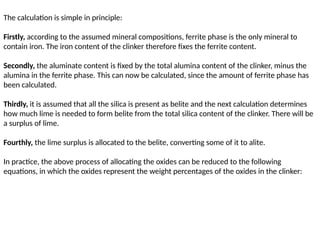
The calculation is simple in principle:
Firstly, according to the assumed mineral compositions, ferrite phase is the only mineral to
contain iron. The iron content of the clinker therefore fixes the ferrite content.
Secondly, the aluminate content is fixed by the total alumina content of the clinker, minus the
alumina in the ferrite phase. This can now be calculated, since the amount of ferrite phase has
been calculated.
Thirdly, it is assumed that all the silica is present as belite and the next calculation determines
how much lime is needed to form belite from the total silica content of the clinker. There will be
a surplus of lime.
Fourthly, the lime surplus is allocated to the belite, converting some of it to alite.
In practice, the above process of allocating the oxides can be reduced to the following
equations, in which the oxides represent the weight percentages of the oxides in the clinker:
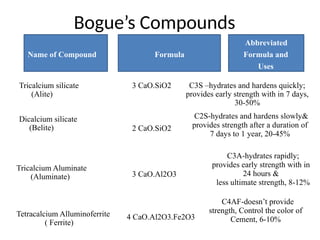
Bogue’s Compounds
Name of Compound Formula
Abbreviated
Formula and
Uses
Tricalcium silicate
(Alite)
Tetracalcium Alluminoferrite
( Ferrite)
Dicalcium silicate
(Belite)
Tricalcium Aluminate
(Aluminate)
3 CaO.SiO2
2 CaO.SiO2
3 CaO.Al2O3
4 CaO.Al2O3.Fe2O3
C3A-hydrates rapidly;
provides early strength with in
24 hours &
less ultimate strength, 8-12%
C2S-hydrates and hardens slowly&
provides strength after a duration of
7 days to 1 year, 20-45%
C4AF-doesn’t provide
strength, Control the color of
Cement, 6-10%
C3S –hydrates and hardens quickly;
provides early strength with in 7 days,
30-50%
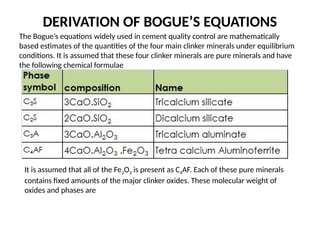
DERIVATION OF BOGUE’S EQUATIONS
The Bogue’s equations widely used in cement quality control are mathematically
based estimates of the quantities of the four main clinker minerals under equilibrium
conditions. It is assumed that these four clinker minerals are pure minerals and have
the following chemical formulae
It is assumed that all of the Fe2O3 is present as C4AF. Each of these pure minerals
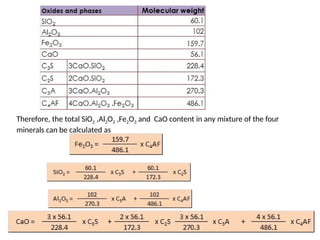
contains fixed amounts of the major clinker oxides. These molecular weight of
oxides and phases are
Therefore, the total SiO2 ,Al2O3 ,Fe2O3 and CaO content in any mixture of the four
minerals can be calculated as
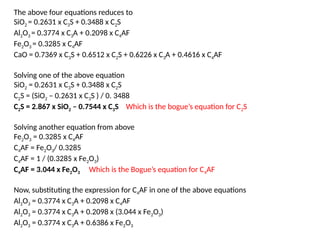
The above four equations reduces to
SiO2 = 0.2631 x C3S + 0.3488 x C2S
Al2O3 = 0.3774 x C3A + 0.2098 x C4AF
Fe2O3 = 0.3285 x C4AF
CaO = 0.7369 x C3S + 0.6512 x C2S + 0.6226 x C3A + 0.4616 x C4AF
Solving one of the above equation
SiO2 = 0.2631 x C3S + 0.3488 x C2S
C2S = (SiO2 – 0.2631 x C3S ) / 0. 3488
C2S = 2.867 x SiO2 – 0.7544 x C3S Which is the bogue’s equation for C2S
Solving another equation from above
Fe2O3 = 0.3285 x C4AF
C4AF = Fe2O3/ 0.3285
C4AF = 1 / (0.3285 x Fe2O3)
C4AF = 3.044 x Fe2O3 Which is the Bogue’s equation for C4AF
Now, substituting the expression for C4AF in one of the above equations
Al2O3 = 0.3774 x C3A + 0.2098 x C4AF
Al2O3 = 0.3774 x C3A + 0.2098 x (3.044 x Fe2O3)
Al2O3 = 0.3774 x C3A + 0.6386 x Fe2O3
Rearranging this equation we get;-
C3A = (Al2O3 – 0.6386 x Fe2O3) / 0.3774
C3A = 2.650 x Al2O3 – 1.692 x Fe2O3 Which is the Bogue equation for C3A
Substituting the values of C2S ,C3A and C4AF in CaO equation
CaO = (0.7369 x C3S) + (0.6512 x C2S) + (0.6226 x (2.650 x Al2O3 – 1.692 x Fe2O3)) + (0.4616
x 3.044 x Fe2O3 )
CaO = (0.7369 x C3S) + (0.6512 x C2S) + (1.650 x Al2O3 ) – (1.053 x Fe2O3) + (1.405 x Fe2O3)
CaO = (0.7369 x C3S) + (0.6512 x C2S) + (1.650 x Al2O3) + (0.3520 x Fe2O3)
C3S = [CaO – (0.6512 x C2S) – (1.650 x Al2O3) – (0.352 x Fe2O3 )] / 0.7369
C3S = (1.357 x CaO) – (0.8837 x C2S) – (2.239 x Al2O3) – (0.4777 x Fe2O3)
Putting the value of C2S = (2.867 x SiO2) – (0.754 x C3S)
C3S = (1.357 x CaO) – {0.8837 x (2.867 x SiO2) – (0.754 x C3S)} – (2.239 x Al2O3) – (0.4777 x
Fe2O3)
C3S – (0.8837 x 0.754 x C3S) = (1.357 x CaO) – {0.8837 x (2.867 x SiO2)} – (2.239 x Al2O3) –
(0.4777 x Fe2O3)
0.3337C3S = 1.357 x CaO – 2.53 x SiO2 – 2.239 x Al2O3 – 0.4777 x Fe2O3
C3S = [1.357 x CaO – 2.53 x SiO2 – 2.239 x Al2O3 – 0.4777 x Fe2O3]/0.3337
C3S = 4.07 x CaO – 7.6 x SiO2 – 6.70 x Al2O3 – 1.42 x Fe2O3 Which is the Bogue equation
for C3S
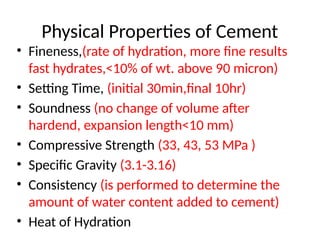
Physical Properties of Cement
• Fineness,(rate of hydration, more fine results
fast hydrates,<10% of wt. above 90 micron)
• Setting Time, (initial 30min,final 10hr)
• Soundness (no change of volume after
hardend, expansion length<10 mm)
• Compressive Strength (33, 43, 53 MPa )
• Specific Gravity (3.1-3.16)
• Consistency (is performed to determine the
amount of water content added to cement)
• Heat of Hydration
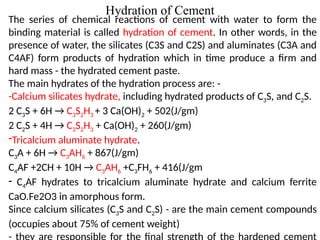
Hydration of Cement
The series of chemical reactions of cement with water to form the
binding material is called hydration of cement. In other words, in the
presence of water, the silicates (C3S and C2S) and aluminates (C3A and
C4AF) form products of hydration which in time produce a firm and
hard mass - the hydrated cement paste.
The main hydrates of the hydration process are: -
-Calcium silicates hydrate, including hydrated products of C3S, and C2S.
2 C3S + 6H → C3S2H3 + 3 Ca(OH)2 + 502(J/gm)
2 C2S + 4H → C3S2H3 + Ca(OH)2 + 260(J/gm)
-Tricalcium aluminate hydrate.
C3A + 6H → C3AH6 + 867(J/gm)
C4AF +2CH + 10H → C3AH6 +C3FH6 + 416(J/gm
- C4AF hydrates to tricalcium aluminate hydrate and calcium ferrite
CaO.Fe2O3 in amorphous form.
Since calcium silicates (C3S and C2S) - are the main cement compounds
(occupies about 75% of cement weight)
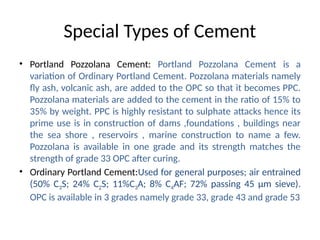
Special Types of Cement
• Portland Pozzolana Cement: Portland Pozzolana Cement is a
variation of Ordinary Portland Cement. Pozzolana materials namely
fly ash, volcanic ash, are added to the OPC so that it becomes PPC.
Pozzolana materials are added to the cement in the ratio of 15% to
35% by weight. PPC is highly resistant to sulphate attacks hence its
prime use is in construction of dams ,foundations , buildings near
the sea shore , reservoirs , marine construction to name a few.
Pozzolana is available in one grade and its strength matches the
strength of grade 33 OPC after curing.
• Ordinary Portland Cement:Used for general purposes; air entrained
(50% C3S; 24% C2S; 11%C3A; 8% C4AF; 72% passing 45 μm sieve).
OPC is available in 3 grades namely grade 33, grade 43 and grade 53
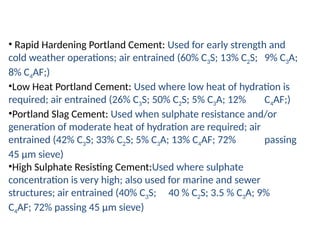
• Rapid Hardening Portland Cement: Used for early strength and
cold weather operations; air entrained (60% C3S; 13% C2S; 9% C3A;
8% C4AF;)
•Low Heat Portland Cement: Used where low heat of hydration is
required; air entrained (26% C3S; 50% C2S; 5% C3A; 12% C4AF;)
•Portland Slag Cement: Used when sulphate resistance and/or
generation of moderate heat of hydration are required; air
entrained (42% C3S; 33% C2S; 5% C3A; 13% C4AF; 72% passing
45 μm sieve)
•High Sulphate Resisting Cement:Used where sulphate
concentration is very high; also used for marine and sewer
structures; air entrained (40% C3S; 40 % C2S; 3.5 % C3A; 9%
C4AF; 72% passing 45 μm sieve)
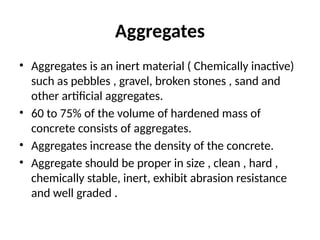
Aggregates
• Aggregates is an inert material ( Chemically inactive)
such as pebbles , gravel, broken stones , sand and
other artificial aggregates.
• 60 to 75% of the volume of hardened mass of
concrete consists of aggregates.
• Aggregates increase the density of the concrete.
• Aggregate should be proper in size , clean , hard ,
chemically stable, inert, exhibit abrasion resistance
and well graded .
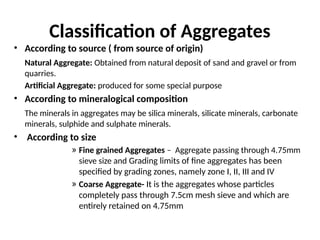
Classification of Aggregates
• According to source ( from source of origin)
Natural Aggregate: Obtained from natural deposit of sand and gravel or from
quarries.
Artificial Aggregate: produced for some special purpose
• According to mineralogical composition
The minerals in aggregates may be silica minerals, silicate minerals, carbonate
minerals, sulphide and sulphate minerals.
• According to size
» Fine grained Aggregates – Aggregate passing through 4.75mm
sieve size and Grading limits of fine aggregates has been
specified by grading zones, namely zone I, II, III and IV
» Coarse Aggregate- It is the aggregates whose particles
completely pass through 7.5cm mesh sieve and which are
entirely retained on 4.75mm
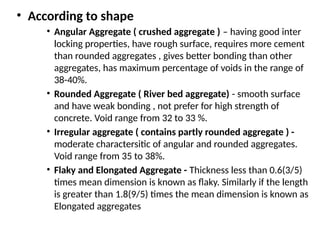
• According to shape
• Angular Aggregate ( crushed aggregate ) – having good inter
locking properties, have rough surface, requires more cement
than rounded aggregates , gives better bonding than other
aggregates, has maximum percentage of voids in the range of
38-40%.
• Rounded Aggregate ( River bed aggregate) - smooth surface
and have weak bonding , not prefer for high strength of
concrete. Void range from 32 to 33 %.
• Irregular aggregate ( contains partly rounded aggregate ) -
moderate charactersitic of angular and rounded aggregates.
Void range from 35 to 38%.
• Flaky and Elongated Aggregate - Thickness less than 0.6(3/5)
times mean dimension is known as flaky. Similarly if the length
is greater than 1.8(9/5) times the mean dimension is known as
Elongated aggregates
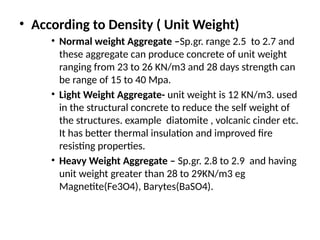
• According to Density ( Unit Weight)
• Normal weight Aggregate –Sp.gr. range 2.5 to 2.7 and
these aggregate can produce concrete of unit weight
ranging from 23 to 26 KN/m3 and 28 days strength can
be range of 15 to 40 Mpa.
• Light Weight Aggregate- unit weight is 12 KN/m3. used
in the structural concrete to reduce the self weight of
the structures. example diatomite , volcanic cinder etc.
It has better thermal insulation and improved fire
resisting properties.
• Heavy Weight Aggregate – Sp.gr. 2.8 to 2.9 and having
unit weight greater than 28 to 29KN/m3 eg
Magnetite(Fe3O4), Barytes(BaSO4).
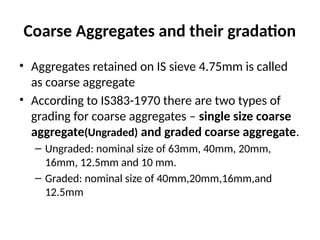
Coarse Aggregates and their gradation
• Aggregates retained on IS sieve 4.75mm is called
as coarse aggregate
• According to IS383-1970 there are two types of
grading for coarse aggregates – single size coarse
aggregate(Ungraded) and graded coarse aggregate.
– Ungraded: nominal size of 63mm, 40mm, 20mm,
16mm, 12.5mm and 10 mm.
– Graded: nominal size of 40mm,20mm,16mm,and
12.5mm
Sands and Their Gradation
• Sand and any other aggregate which pass
through IS Sieve 4.75mm is called fine
aggregate.
• According to IS383-1970 ,Nominal size of 10
mm,4.75 mm,2.36 mm,1.18 mm,600
micron,300 micron,150 micron are used.
Natural Characteristics Of Aggregate
• Chemical Characterstics :
• Alkali Aggregate reaction- Active silica in aggregate and the
alkalies of cement develop alkali aggregate reaction and form
alkali- silicate gel. This gel swell by absorbing water. As this gel
is confined internal pressure develops and eventually results
in expansion, cracking and disruption is hardened concrete.
• Physical Characterstic
• Shape of aggregate particles
• Texture of aggregate particles
• Size of particles
• Quantities of impurities in aggregates
• Grading of Aggregate
• Specific gravity of aggregate
• Voids
• Unit Weight
• Porosity and Water absorptions
• Bulking of sand: The moisture present in fine aggregates
causes increase in its volume, known as bulking of sand.
The moisture in the fine aggregate develops a film of
moisture around the particles of sand and due to surface
tension push the sand particles apart. This cause an
increase in volume of the sand.
• Thermal properties of aggregates
• Mechanical Properties
• Crushing Strength of Aggregate: mean the resistance of
compressive strength of aggregate.
• Abrasion Strength or hardness: the resistance wear, which
is expressed in percentage loss in weight on abrasion.
• Toughness of Aggregate: the resistance of aggregate to
impact.
• Bond Strength of Aggregate: the resistance developed to
split or shear the aggregates particles from the hardened
cement paste.
• Soundnes: Ability to resist excessive volume change as a
result in change in the physical condition like alternate
wetting and drying, freezing and thawing, thermal changes.
Admixtures
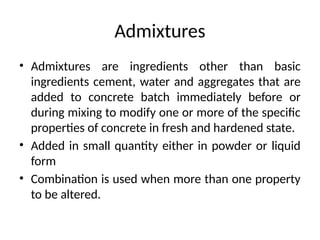
• Admixtures are ingredients other than basic
ingredients cement, water and aggregates that are
added to concrete batch immediately before or
during mixing to modify one or more of the specific
properties of concrete in fresh and hardened state.
• Added in small quantity either in powder or liquid
form
• Combination is used when more than one property
to be altered.
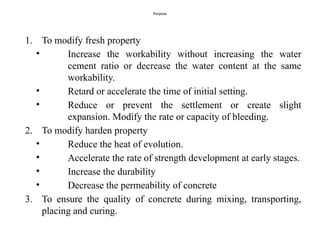
Purpose
1. To modify fresh property
• Increase the workability without increasing the water
cement ratio or decrease the water content at the same
workability.
• Retard or accelerate the time of initial setting.
• Reduce or prevent the settlement or create slight
expansion. Modify the rate or capacity of bleeding.
2. To modify harden property
• Reduce the heat of evolution.
• Accelerate the rate of strength development at early stages.
• Increase the durability
• Decrease the permeability of concrete
3. To ensure the quality of concrete during mixing, transporting,
placing and curing.
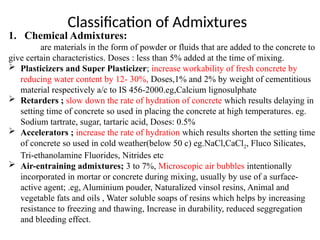
1. Chemical Admixtures:
are materials in the form of powder or fluids that are added to the concrete to
give certain characteristics. Doses : less than 5% added at the time of mixing.
 Plasticizers and Super Plasticizer; increase workability of fresh concrete by
reducing water content by 12- 30%, Doses,1% and 2% by weight of cementitious
material respectively a/c to IS 456-2000.eg,Calcium lignosulphate
 Retarders ; slow down the rate of hydration of concrete which results delaying in
setting time of concrete so used in placing the concrete at high temperatures. eg.
Sodium tartrate, sugar, tartaric acid, Doses: 0.5%
 Accelerators ; increase the rate of hydration which results shorten the setting time
of concrete so used in cold weather(below 50 c) eg.NaCl,CaCl2, Fluco Silicates,
Tri-ethanolamine Fluorides, Nitrides etc
 Air-entraining admixtures; 3 to 7%, Microscopic air bubbles intentionally
incorporated in mortar or concrete during mixing, usually by use of a surface-
active agent; .eg, Aluminium pouder, Naturalized vinsol resins, Animal and
vegetable fats and oils , Water soluble soaps of resins which helps by increasing
resistance to freezing and thawing, Increase in durability, reduced seggregation
and bleeding effect.
Classification of Admixtures
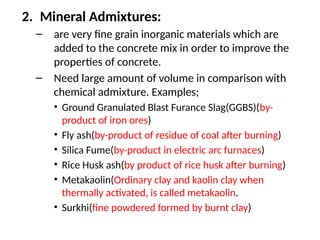
2. Mineral Admixtures:
– are very fine grain inorganic materials which are
added to the concrete mix in order to improve the
properties of concrete.
– Need large amount of volume in comparison with
chemical admixture. Examples;
• Ground Granulated Blast Furance Slag(GGBS)(by-
product of iron ores)
• Fly ash(by-product of residue of coal after burning)
• Silica Fume(by-product in electric arc furnaces)
• Rice Husk ash(by product of rice husk after burning)
• Metakaolin(Ordinary clay and kaolin clay when
thermally activated, is called metakaolin.
• Surkhi(fine powdered formed by burnt clay)
Uses of Mineral Admixture
• To increase the early strength development at concrete by using GBBS
and metakaolin.
• To increase the water tightness by using metakaolin.
• To retard the initial setting time by using fly ash.
• To increase the initial setting time by using GGBS.
• To increase workability by using fly ash.
• To improve the extensibility by using silica flumes and GBBS.
• To decrease heat evolution by using fly ash.
• To increase the resistance capacity of sulphate attack by using fly ash.
• To reduces the segregation and bleeding of concrete by using fly ash,
metakaolin and silica flumes.
• To increases the resistance capacity of corrosion and chemical attack
in marine by using GBBS and metakaolin .
• To increase compressive strength and flexural strength of concrete by
using silica flumes.
Thank you

Concrete Technology and Masonry StructureChapter 1.pptx

  • 1.
    Concrete Technology Asst.Prof. SushilAdhikari Nepal Engineering college Changunarayan, Bhaktapur
  • 2.
  • 3.
    What is Concrete? •Concrete is one of the most commonly used building materials. • Concrete is a composite material made from several readily available constituents (aggregates, sand, cement, water). • Concrete is a versatile material that can easily be mixed to meet a variety of special needs and formed to virtually any shape.
  • 4.
    Advantages • Ability tobe cast in any shape • Economical • Durable • Fire & Water resistant • Energy efficient • On-site fabrication • High Compressive Strength
  • 5.
    Disadvantages • Low tensilestrength • Concrete is Quasi-brittle Material (exhibits a strain- softening behavior ) • Concrete has Low Toughness • Volume instability • Low strength to weight ratio • Formwork is required • Long curing time • Concrete may contains soluble salts. Soluble salts cause efflorescence.
  • 6.
    Constituents • Cement • Water •Fine Agg. • Coarse Agg. • Admixtures
  • 7.
    Cement is one ofthe chemically active ingredient of concrete which shows binding properties after reacting with water. Component materials required for cement making • Calcareous material: Limestone and Chalk(CaCo3) • Argillaceous material: Clay, Shale (~ 60%) • Silica (~ 20%) • Alumina (~ 10%) • Others : Iron oxide, magnesium oxide, sulphur trioxide, alkalies, carbon-di-oxide
  • 8.
    Manufacturing process • Wetand Dry methods - In both methods raw materials are homogenized by crushing, grinding and blending - Approximately 80% of the ground materials pass through #200 sieve - Primary and Secondary crushers; wet and dry grinding mills
  • 9.
    Wet process • Mixcontaining homogenized constituents and 30 - 50 % of water is heated to 1510o C in a revolving (slightly) inclined kiln - Oxide of silica, calcium and aluminum combine to form cement clinkers - Mixed with calcium sulphate (gypsum) to reduce the rate of setting and crushing, grinding and blending into powder in ball mills before storing in silos or bags
  • 10.
  • 14.
    Dry process • Thehomogenized mix is fed into the kiln and burned in a dry state - Other steps are the same as for the wet process - Considerable savings in fuel consumption, but workplace is dustier
  • 19.
    Constituents of cement 75%is composed of calcium silicates; rest is made up of Al2O3, Fe2O3 and CaSO4 • Di-calcium silicate (C2S) - 2CaO.SiO2 (15-40%) • Tri-calcium silicate (C3S) - 3CaO.SiO2 (35-65%) • Tri-calcium aluminate (C3A) - 3CaO.Al2O3 (0-15%) • Tetra-calcium alumino-ferrite (C4AF) - 4CaO.Al2O3..Fe2O3 (6 -20%) • Calcium sulphate (CaSO4) - (2%)
  • 20.
    Chemical Composition ofCement The raw materials used for the manufacture of cement consist mainly of lime, silica, alumina and iron oxide. These oxides interact with one another in the kiln at high temperature(14500 c) to form more four complex compounds. These complex compounds are the major constituent of cements. These compounds are also called Bogue’s compounds. Compound Composition in % CaO 60-67 SiO2 17-25 Al2O3 3-8 Fe2O3 0.5-6 MgO 0.1-4 Alkalies (K2O,Na2O) 0.4-1.3
  • 21.
    The calculation issimple in principle: Firstly, according to the assumed mineral compositions, ferrite phase is the only mineral to contain iron. The iron content of the clinker therefore fixes the ferrite content. Secondly, the aluminate content is fixed by the total alumina content of the clinker, minus the alumina in the ferrite phase. This can now be calculated, since the amount of ferrite phase has been calculated. Thirdly, it is assumed that all the silica is present as belite and the next calculation determines how much lime is needed to form belite from the total silica content of the clinker. There will be a surplus of lime. Fourthly, the lime surplus is allocated to the belite, converting some of it to alite. In practice, the above process of allocating the oxides can be reduced to the following equations, in which the oxides represent the weight percentages of the oxides in the clinker:
  • 22.
    Bogue’s Compounds Name ofCompound Formula Abbreviated Formula and Uses Tricalcium silicate (Alite) Tetracalcium Alluminoferrite ( Ferrite) Dicalcium silicate (Belite) Tricalcium Aluminate (Aluminate) 3 CaO.SiO2 2 CaO.SiO2 3 CaO.Al2O3 4 CaO.Al2O3.Fe2O3 C3A-hydrates rapidly; provides early strength with in 24 hours & less ultimate strength, 8-12% C2S-hydrates and hardens slowly& provides strength after a duration of 7 days to 1 year, 20-45% C4AF-doesn’t provide strength, Control the color of Cement, 6-10% C3S –hydrates and hardens quickly; provides early strength with in 7 days, 30-50%
  • 23.
    DERIVATION OF BOGUE’SEQUATIONS The Bogue’s equations widely used in cement quality control are mathematically based estimates of the quantities of the four main clinker minerals under equilibrium conditions. It is assumed that these four clinker minerals are pure minerals and have the following chemical formulae It is assumed that all of the Fe2O3 is present as C4AF. Each of these pure minerals contains fixed amounts of the major clinker oxides. These molecular weight of oxides and phases are
  • 24.
    Therefore, the totalSiO2 ,Al2O3 ,Fe2O3 and CaO content in any mixture of the four minerals can be calculated as
  • 25.
    The above fourequations reduces to SiO2 = 0.2631 x C3S + 0.3488 x C2S Al2O3 = 0.3774 x C3A + 0.2098 x C4AF Fe2O3 = 0.3285 x C4AF CaO = 0.7369 x C3S + 0.6512 x C2S + 0.6226 x C3A + 0.4616 x C4AF Solving one of the above equation SiO2 = 0.2631 x C3S + 0.3488 x C2S C2S = (SiO2 – 0.2631 x C3S ) / 0. 3488 C2S = 2.867 x SiO2 – 0.7544 x C3S Which is the bogue’s equation for C2S Solving another equation from above Fe2O3 = 0.3285 x C4AF C4AF = Fe2O3/ 0.3285 C4AF = 1 / (0.3285 x Fe2O3) C4AF = 3.044 x Fe2O3 Which is the Bogue’s equation for C4AF Now, substituting the expression for C4AF in one of the above equations Al2O3 = 0.3774 x C3A + 0.2098 x C4AF Al2O3 = 0.3774 x C3A + 0.2098 x (3.044 x Fe2O3) Al2O3 = 0.3774 x C3A + 0.6386 x Fe2O3
  • 26.
    Rearranging this equationwe get;- C3A = (Al2O3 – 0.6386 x Fe2O3) / 0.3774 C3A = 2.650 x Al2O3 – 1.692 x Fe2O3 Which is the Bogue equation for C3A Substituting the values of C2S ,C3A and C4AF in CaO equation CaO = (0.7369 x C3S) + (0.6512 x C2S) + (0.6226 x (2.650 x Al2O3 – 1.692 x Fe2O3)) + (0.4616 x 3.044 x Fe2O3 ) CaO = (0.7369 x C3S) + (0.6512 x C2S) + (1.650 x Al2O3 ) – (1.053 x Fe2O3) + (1.405 x Fe2O3) CaO = (0.7369 x C3S) + (0.6512 x C2S) + (1.650 x Al2O3) + (0.3520 x Fe2O3) C3S = [CaO – (0.6512 x C2S) – (1.650 x Al2O3) – (0.352 x Fe2O3 )] / 0.7369 C3S = (1.357 x CaO) – (0.8837 x C2S) – (2.239 x Al2O3) – (0.4777 x Fe2O3) Putting the value of C2S = (2.867 x SiO2) – (0.754 x C3S) C3S = (1.357 x CaO) – {0.8837 x (2.867 x SiO2) – (0.754 x C3S)} – (2.239 x Al2O3) – (0.4777 x Fe2O3) C3S – (0.8837 x 0.754 x C3S) = (1.357 x CaO) – {0.8837 x (2.867 x SiO2)} – (2.239 x Al2O3) – (0.4777 x Fe2O3) 0.3337C3S = 1.357 x CaO – 2.53 x SiO2 – 2.239 x Al2O3 – 0.4777 x Fe2O3 C3S = [1.357 x CaO – 2.53 x SiO2 – 2.239 x Al2O3 – 0.4777 x Fe2O3]/0.3337 C3S = 4.07 x CaO – 7.6 x SiO2 – 6.70 x Al2O3 – 1.42 x Fe2O3 Which is the Bogue equation for C3S
  • 27.
    Physical Properties ofCement • Fineness,(rate of hydration, more fine results fast hydrates,<10% of wt. above 90 micron) • Setting Time, (initial 30min,final 10hr) • Soundness (no change of volume after hardend, expansion length<10 mm) • Compressive Strength (33, 43, 53 MPa ) • Specific Gravity (3.1-3.16) • Consistency (is performed to determine the amount of water content added to cement) • Heat of Hydration
  • 28.
    Hydration of Cement Theseries of chemical reactions of cement with water to form the binding material is called hydration of cement. In other words, in the presence of water, the silicates (C3S and C2S) and aluminates (C3A and C4AF) form products of hydration which in time produce a firm and hard mass - the hydrated cement paste. The main hydrates of the hydration process are: - -Calcium silicates hydrate, including hydrated products of C3S, and C2S. 2 C3S + 6H → C3S2H3 + 3 Ca(OH)2 + 502(J/gm) 2 C2S + 4H → C3S2H3 + Ca(OH)2 + 260(J/gm) -Tricalcium aluminate hydrate. C3A + 6H → C3AH6 + 867(J/gm) C4AF +2CH + 10H → C3AH6 +C3FH6 + 416(J/gm - C4AF hydrates to tricalcium aluminate hydrate and calcium ferrite CaO.Fe2O3 in amorphous form. Since calcium silicates (C3S and C2S) - are the main cement compounds (occupies about 75% of cement weight)
  • 29.
    Special Types ofCement • Portland Pozzolana Cement: Portland Pozzolana Cement is a variation of Ordinary Portland Cement. Pozzolana materials namely fly ash, volcanic ash, are added to the OPC so that it becomes PPC. Pozzolana materials are added to the cement in the ratio of 15% to 35% by weight. PPC is highly resistant to sulphate attacks hence its prime use is in construction of dams ,foundations , buildings near the sea shore , reservoirs , marine construction to name a few. Pozzolana is available in one grade and its strength matches the strength of grade 33 OPC after curing. • Ordinary Portland Cement:Used for general purposes; air entrained (50% C3S; 24% C2S; 11%C3A; 8% C4AF; 72% passing 45 μm sieve). OPC is available in 3 grades namely grade 33, grade 43 and grade 53
  • 30.
    • Rapid HardeningPortland Cement: Used for early strength and cold weather operations; air entrained (60% C3S; 13% C2S; 9% C3A; 8% C4AF;) •Low Heat Portland Cement: Used where low heat of hydration is required; air entrained (26% C3S; 50% C2S; 5% C3A; 12% C4AF;) •Portland Slag Cement: Used when sulphate resistance and/or generation of moderate heat of hydration are required; air entrained (42% C3S; 33% C2S; 5% C3A; 13% C4AF; 72% passing 45 μm sieve) •High Sulphate Resisting Cement:Used where sulphate concentration is very high; also used for marine and sewer structures; air entrained (40% C3S; 40 % C2S; 3.5 % C3A; 9% C4AF; 72% passing 45 μm sieve)
  • 31.
    Aggregates • Aggregates isan inert material ( Chemically inactive) such as pebbles , gravel, broken stones , sand and other artificial aggregates. • 60 to 75% of the volume of hardened mass of concrete consists of aggregates. • Aggregates increase the density of the concrete. • Aggregate should be proper in size , clean , hard , chemically stable, inert, exhibit abrasion resistance and well graded .
  • 32.
    Classification of Aggregates •According to source ( from source of origin) Natural Aggregate: Obtained from natural deposit of sand and gravel or from quarries. Artificial Aggregate: produced for some special purpose • According to mineralogical composition The minerals in aggregates may be silica minerals, silicate minerals, carbonate minerals, sulphide and sulphate minerals. • According to size » Fine grained Aggregates – Aggregate passing through 4.75mm sieve size and Grading limits of fine aggregates has been specified by grading zones, namely zone I, II, III and IV » Coarse Aggregate- It is the aggregates whose particles completely pass through 7.5cm mesh sieve and which are entirely retained on 4.75mm
  • 33.
    • According toshape • Angular Aggregate ( crushed aggregate ) – having good inter locking properties, have rough surface, requires more cement than rounded aggregates , gives better bonding than other aggregates, has maximum percentage of voids in the range of 38-40%. • Rounded Aggregate ( River bed aggregate) - smooth surface and have weak bonding , not prefer for high strength of concrete. Void range from 32 to 33 %. • Irregular aggregate ( contains partly rounded aggregate ) - moderate charactersitic of angular and rounded aggregates. Void range from 35 to 38%. • Flaky and Elongated Aggregate - Thickness less than 0.6(3/5) times mean dimension is known as flaky. Similarly if the length is greater than 1.8(9/5) times the mean dimension is known as Elongated aggregates
  • 34.
    • According toDensity ( Unit Weight) • Normal weight Aggregate –Sp.gr. range 2.5 to 2.7 and these aggregate can produce concrete of unit weight ranging from 23 to 26 KN/m3 and 28 days strength can be range of 15 to 40 Mpa. • Light Weight Aggregate- unit weight is 12 KN/m3. used in the structural concrete to reduce the self weight of the structures. example diatomite , volcanic cinder etc. It has better thermal insulation and improved fire resisting properties. • Heavy Weight Aggregate – Sp.gr. 2.8 to 2.9 and having unit weight greater than 28 to 29KN/m3 eg Magnetite(Fe3O4), Barytes(BaSO4).
  • 35.
    Coarse Aggregates andtheir gradation • Aggregates retained on IS sieve 4.75mm is called as coarse aggregate • According to IS383-1970 there are two types of grading for coarse aggregates – single size coarse aggregate(Ungraded) and graded coarse aggregate. – Ungraded: nominal size of 63mm, 40mm, 20mm, 16mm, 12.5mm and 10 mm. – Graded: nominal size of 40mm,20mm,16mm,and 12.5mm
  • 36.
    Sands and TheirGradation • Sand and any other aggregate which pass through IS Sieve 4.75mm is called fine aggregate. • According to IS383-1970 ,Nominal size of 10 mm,4.75 mm,2.36 mm,1.18 mm,600 micron,300 micron,150 micron are used.
  • 37.
    Natural Characteristics OfAggregate • Chemical Characterstics : • Alkali Aggregate reaction- Active silica in aggregate and the alkalies of cement develop alkali aggregate reaction and form alkali- silicate gel. This gel swell by absorbing water. As this gel is confined internal pressure develops and eventually results in expansion, cracking and disruption is hardened concrete. • Physical Characterstic • Shape of aggregate particles • Texture of aggregate particles • Size of particles • Quantities of impurities in aggregates
  • 38.
    • Grading ofAggregate • Specific gravity of aggregate • Voids • Unit Weight • Porosity and Water absorptions • Bulking of sand: The moisture present in fine aggregates causes increase in its volume, known as bulking of sand. The moisture in the fine aggregate develops a film of moisture around the particles of sand and due to surface tension push the sand particles apart. This cause an increase in volume of the sand. • Thermal properties of aggregates
  • 39.
    • Mechanical Properties •Crushing Strength of Aggregate: mean the resistance of compressive strength of aggregate. • Abrasion Strength or hardness: the resistance wear, which is expressed in percentage loss in weight on abrasion. • Toughness of Aggregate: the resistance of aggregate to impact. • Bond Strength of Aggregate: the resistance developed to split or shear the aggregates particles from the hardened cement paste. • Soundnes: Ability to resist excessive volume change as a result in change in the physical condition like alternate wetting and drying, freezing and thawing, thermal changes.
  • 40.
    Admixtures • Admixtures areingredients other than basic ingredients cement, water and aggregates that are added to concrete batch immediately before or during mixing to modify one or more of the specific properties of concrete in fresh and hardened state. • Added in small quantity either in powder or liquid form • Combination is used when more than one property to be altered.
  • 41.
    Purpose 1. To modifyfresh property • Increase the workability without increasing the water cement ratio or decrease the water content at the same workability. • Retard or accelerate the time of initial setting. • Reduce or prevent the settlement or create slight expansion. Modify the rate or capacity of bleeding. 2. To modify harden property • Reduce the heat of evolution. • Accelerate the rate of strength development at early stages. • Increase the durability • Decrease the permeability of concrete 3. To ensure the quality of concrete during mixing, transporting, placing and curing.
  • 42.
    1. Chemical Admixtures: arematerials in the form of powder or fluids that are added to the concrete to give certain characteristics. Doses : less than 5% added at the time of mixing.  Plasticizers and Super Plasticizer; increase workability of fresh concrete by reducing water content by 12- 30%, Doses,1% and 2% by weight of cementitious material respectively a/c to IS 456-2000.eg,Calcium lignosulphate  Retarders ; slow down the rate of hydration of concrete which results delaying in setting time of concrete so used in placing the concrete at high temperatures. eg. Sodium tartrate, sugar, tartaric acid, Doses: 0.5%  Accelerators ; increase the rate of hydration which results shorten the setting time of concrete so used in cold weather(below 50 c) eg.NaCl,CaCl2, Fluco Silicates, Tri-ethanolamine Fluorides, Nitrides etc  Air-entraining admixtures; 3 to 7%, Microscopic air bubbles intentionally incorporated in mortar or concrete during mixing, usually by use of a surface- active agent; .eg, Aluminium pouder, Naturalized vinsol resins, Animal and vegetable fats and oils , Water soluble soaps of resins which helps by increasing resistance to freezing and thawing, Increase in durability, reduced seggregation and bleeding effect. Classification of Admixtures
  • 43.
    2. Mineral Admixtures: –are very fine grain inorganic materials which are added to the concrete mix in order to improve the properties of concrete. – Need large amount of volume in comparison with chemical admixture. Examples; • Ground Granulated Blast Furance Slag(GGBS)(by- product of iron ores) • Fly ash(by-product of residue of coal after burning) • Silica Fume(by-product in electric arc furnaces) • Rice Husk ash(by product of rice husk after burning) • Metakaolin(Ordinary clay and kaolin clay when thermally activated, is called metakaolin. • Surkhi(fine powdered formed by burnt clay)
  • 44.
    Uses of MineralAdmixture • To increase the early strength development at concrete by using GBBS and metakaolin. • To increase the water tightness by using metakaolin. • To retard the initial setting time by using fly ash. • To increase the initial setting time by using GGBS. • To increase workability by using fly ash. • To improve the extensibility by using silica flumes and GBBS. • To decrease heat evolution by using fly ash. • To increase the resistance capacity of sulphate attack by using fly ash. • To reduces the segregation and bleeding of concrete by using fly ash, metakaolin and silica flumes. • To increases the resistance capacity of corrosion and chemical attack in marine by using GBBS and metakaolin . • To increase compressive strength and flexural strength of concrete by using silica flumes.
  • 45.