
Enterprise IOT
Architecture and
execution for
your IOT Strategy
Bridging the gap between Administrative and Operational IT
• Vision
• Architecure
• Project experience
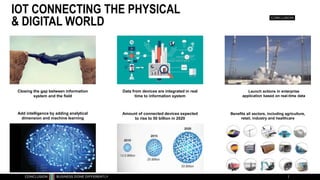
Data from devices are integrated in real
time to information system
Closing the gap between information
system and the field
Amount of connected devices expected
to rise to 50 billion in 2020
Benefits all sectors, including agriculture,
retail, industry and healthcare
Add intelligence by adding analytical
dimension and machine learning
Launch actions in enterprise
application based on real-time data
IOT CONNECTING THE PHYSICAL
& DIGITAL WORLD
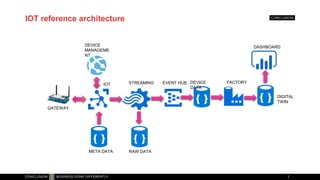
IOT reference architecture
DEVICE
MANAGEMENT
GATEWAY
META DATA RAW DATA
EVENT HUBSTREAMINGIOT
DEVICE
DATA FACTORY
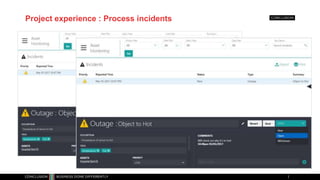
DIGITAL
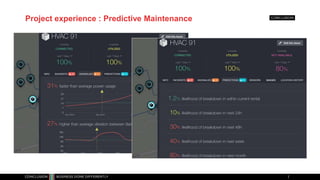
TWIN
DASHBOARD
IOT Solution Conclusion – Contact
robbrecht@conclusion.nl
Contact us
Robbrecht van Amerongen
Business Development
+31 6 410 10 286
robbrecht@conclusion.nl
Business drivers for IOT solutions
• Improve efficiency
• Real time remote monitoring, searching for parts with due maintenance, locate
objects / individuals, jut in time / predictive maintenance, locate bottle necks
• Reduce costs
• Reduce time for physical inspections, improve utilization of idle equipment,
balance of physical workload, reduce number of corrections (first time right),
decrease stock of spare parts
• Better decision making
• Full view of physical world in digital world, improve forecast models with real
data, improve algorithms and machine learning, cause and effect analysis
• Improve sustainability
• Measure status of sustainability goals in energy efficiency and CO2 reduction,
create energy efficient production processes, smart gird usage
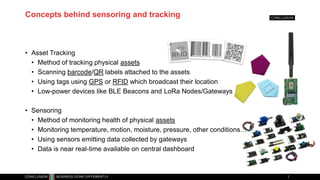
Concepts behind sensoring and tracking
• Asset Tracking
• Method of tracking physical assets
• Scanning barcode/QR labels attached to the assets
• Using tags using GPS or RFID which broadcast their location
• Low-power devices like BLE Beacons and LoRa Nodes/Gateways
• Sensoring
• Method of monitoring health of physical assets
• Monitoring temperature, motion, moisture, pressure, other conditions…
• Using sensors emitting data collected by gateways
• Data is near real-time available on central dashboard
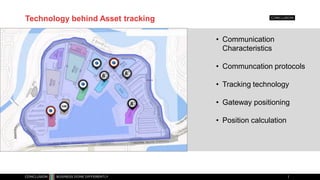
Technology behind Asset tracking
• Communication
Characteristics
• Communcation protocols
• Tracking technology
• Gateway positioning
• Position calculation
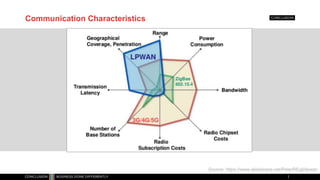
Communication Characteristics
Source: https://www.slideshare.net/PeterREgli/lpwan
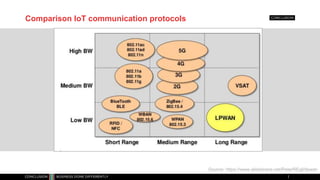
Comparison IoT communication protocols
Source: https://www.slideshare.net/PeterREgli/lpwan
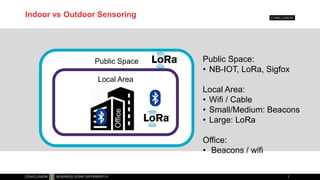
Public Space
Local Area
Indoor vs Outdoor Sensoring
Office
Public Space:
• NB-IOT, LoRa, Sigfox
Local Area:
• Wifi / Cable
• Small/Medium: Beacons
• Large: LoRa
Office:
• Beacons / wifi
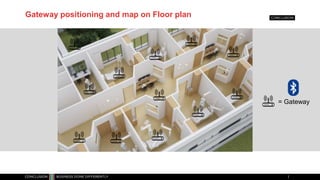
Gateway positioning and map on Floor plan
= Gateway
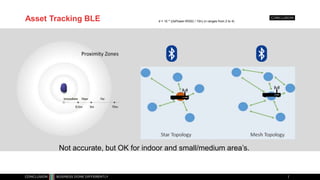
Asset Tracking BLE
Not accurate, but OK for indoor and small/medium area’s.
d = 10 ^ ((txPower-RSSI) / 10n) (n ranges from 2 to 4)
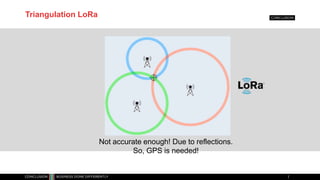
Triangulation LoRa
Not accurate enough! Due to reflections.
So, GPS is needed!
Logic
Coponent
Design
Enterprise IoT
Architecture
IOT Solution Conclusion – Contact
robbrecht@conclusion.nl
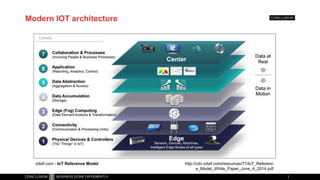
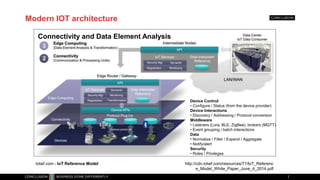
Modern IOT architecture
iotwf.com - IoT Reference Model http://cdn.iotwf.com/resources/71/IoT_Referenc
e_Model_White_Paper_June_4_2014.pdf
Modern IOT architecture
Connectivity and Data Element Analysis
Device Control
• Configure / Status (from the device provider)
Device Interactions
• Discovery / Addressing / Protocol conversion
Middleware
• Listeners (Lora, BLE, ZigBee), brokers (MQTT)
• Event grouping / batch interactions
Data
• Normalize / Filter / Expand / Aggregate
• Notify/alert
Security
• Roles / Privileges
iotwf.com - IoT Reference Model http://cdn.iotwf.com/resources/71/IoT_Referenc
e_Model_White_Paper_June_4_2014.pdf
Concepts
behind
Internet of
Things platform
IOT Solution Conclusion – Contact
robbrecht@conclusion.nl
Concepts behind
Internet of Things platform
• Cloud platform to connect the physical world to existing IT
• Connect all existing Devices & Sensors
• Each device/sensor identified by a device model in IoT Cloud
• Programmable devices can be directly connected using client libraries
• Sensors can be connected through programmable gateway
• Analyze streaming data in Real-Time
• Use raw-data streams as input for creating custom analytics
• Apply data analysis patterns e.g. Top/Bottom N, Up/Down Trend
• Route/Publish analyzed stream
• Integrate with enterprise applications or cloud services
Concepts – Device Models & Registration
• Device model first approach
• Device models define data and behaviors implemented by devices
• They are used to derive the analytics and integration strategy
• Data structure can contain more fields then sensor data
• Registration / Provisioning through Gateway device(s)
• Gateway device acts as central IoT hub
• Gateways are provisioned, indirectly connected devices are not
• Indirectly connected devices are registered by gateway on the fly
• IoT application attaches device models and monitor devices
Internet of
Things
Platform
Walkthrough
IOT Solution Conclusion – Contact
robbrecht@conclusion.nl
Advanced IOT reverence architecture
API platform /
ERP backend
IoT Edge
Customer Specific
Meta Data &
Reference Data
Raw Data
Event Hub
Streaming
IoT Hub
Device Data
Structured Data
Reports
3rd party
Manual Telemetry
Data Upload and
download
Unstructured
Data
Digital TwinSensor and Treshold
(green, yellow, red)
Data Factory
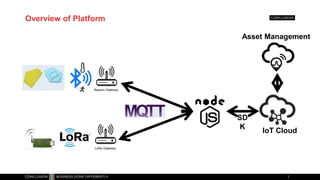
Overview of Platform
IoT Cloud
Beacon Gateway
LoRa Gateway
SD
K
Asset Management
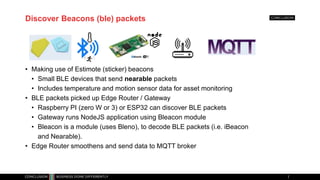
Discover Beacons (ble) packets
• Making use of Estimote (sticker) beacons
• Small BLE devices that send nearable packets
• Includes temperature and motion sensor data for asset monitoring
• BLE packets picked up Edge Router / Gateway
• Raspberry PI (zero W or 3) or ESP32 can discover BLE packets
• Gateway runs NodeJS application using Bleacon module
• Bleacon is a module (uses Bleno), to decode BLE packets (i.e. iBeacon
and Nearable).
• Edge Router smoothens and send data to MQTT broker
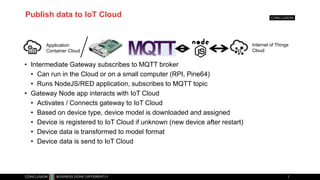
Publish data to IoT Cloud
• Intermediate Gateway subscribes to MQTT broker
• Can run in the Cloud or on a small computer (RPI, Pine64)
• Runs NodeJS/RED application, subscribes to MQTT topic
• Gateway Node app interacts with IoT Cloud
• Activates / Connects gateway to IoT Cloud
• Based on device type, device model is downloaded and assigned
• Device is registered to IoT Cloud if unknown (new device after restart)
• Device data is transformed to model format
• Device data is send to IoT Cloud
Application
Container Cloud
Internet of Things
Cloud
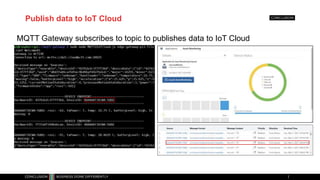
Publish data to IoT Cloud
MQTT Gateway subscribes to topic to publishes data to IoT Cloud
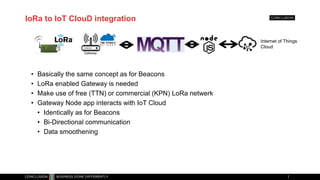
loRa to IoT ClouD integration
• Basically the same concept as for Beacons
• LoRa enabled Gateway is needed
• Make use of free (TTN) or commercial (KPN) LoRa netwerk
• Gateway Node app interacts with IoT Cloud
• Identically as for Beacons
• Bi-Directional communication
• Data smoothening
Internet of Things
Cloud
Gateway
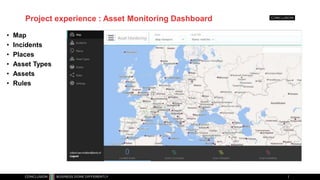
Project experience : Asset Monitoring Dashboard
• Map
• Incidents
• Places
• Asset Types
• Assets
• Rules
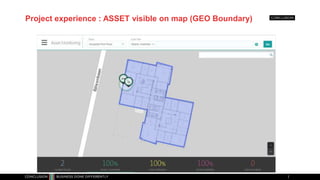
Project experience : ASSET visible on map (GEO Boundary)
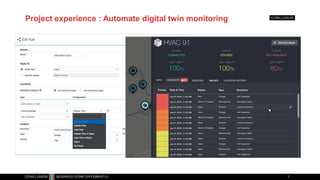
Project experience : Automate digital twin monitoring
Project experience : Process incidents
Project experience : Predictive Maintenance
Asset monitoring IoT Application
Contact us
Robbrecht van Amerongen
IOT Development
+31 6 410 10 286
robbrecht@conclusion.nl
IOT Solution Conclusion – Contact
robbrecht@conclusion.nl

Internet of Things propositie - Enterprise IOT - AMIS - Conclusion

  • 1.
    Enterprise IOT Architecture and executionfor your IOT Strategy Bridging the gap between Administrative and Operational IT • Vision • Architecure • Project experience
  • 2.
    Data from devicesare integrated in real time to information system Closing the gap between information system and the field Amount of connected devices expected to rise to 50 billion in 2020 Benefits all sectors, including agriculture, retail, industry and healthcare Add intelligence by adding analytical dimension and machine learning Launch actions in enterprise application based on real-time data IOT CONNECTING THE PHYSICAL & DIGITAL WORLD
  • 3.
    IOT reference architecture DEVICE MANAGEMENT GATEWAY METADATA RAW DATA EVENT HUBSTREAMINGIOT DEVICE DATA FACTORY DIGITAL TWIN DASHBOARD
  • 4.
    IOT Solution Conclusion– Contact robbrecht@conclusion.nl Contact us Robbrecht van Amerongen Business Development +31 6 410 10 286 robbrecht@conclusion.nl
  • 5.
    Business drivers forIOT solutions • Improve efficiency • Real time remote monitoring, searching for parts with due maintenance, locate objects / individuals, jut in time / predictive maintenance, locate bottle necks • Reduce costs • Reduce time for physical inspections, improve utilization of idle equipment, balance of physical workload, reduce number of corrections (first time right), decrease stock of spare parts • Better decision making • Full view of physical world in digital world, improve forecast models with real data, improve algorithms and machine learning, cause and effect analysis • Improve sustainability • Measure status of sustainability goals in energy efficiency and CO2 reduction, create energy efficient production processes, smart gird usage
  • 6.
    Concepts behind sensoringand tracking • Asset Tracking • Method of tracking physical assets • Scanning barcode/QR labels attached to the assets • Using tags using GPS or RFID which broadcast their location • Low-power devices like BLE Beacons and LoRa Nodes/Gateways • Sensoring • Method of monitoring health of physical assets • Monitoring temperature, motion, moisture, pressure, other conditions… • Using sensors emitting data collected by gateways • Data is near real-time available on central dashboard
  • 7.
    Technology behind Assettracking • Communication Characteristics • Communcation protocols • Tracking technology • Gateway positioning • Position calculation
  • 8.
  • 9.
    Comparison IoT communicationprotocols Source: https://www.slideshare.net/PeterREgli/lpwan
  • 10.
    Public Space Local Area Indoorvs Outdoor Sensoring Office Public Space: • NB-IOT, LoRa, Sigfox Local Area: • Wifi / Cable • Small/Medium: Beacons • Large: LoRa Office: • Beacons / wifi
  • 11.
    Gateway positioning andmap on Floor plan = Gateway
  • 12.
    Asset Tracking BLE Notaccurate, but OK for indoor and small/medium area’s. d = 10 ^ ((txPower-RSSI) / 10n) (n ranges from 2 to 4)
  • 13.
    Triangulation LoRa Not accurateenough! Due to reflections. So, GPS is needed!
  • 14.
    Logic Coponent Design Enterprise IoT Architecture IOT SolutionConclusion – Contact robbrecht@conclusion.nl
  • 15.
    Modern IOT architecture iotwf.com- IoT Reference Model http://cdn.iotwf.com/resources/71/IoT_Referenc e_Model_White_Paper_June_4_2014.pdf
  • 16.
    Modern IOT architecture Connectivityand Data Element Analysis Device Control • Configure / Status (from the device provider) Device Interactions • Discovery / Addressing / Protocol conversion Middleware • Listeners (Lora, BLE, ZigBee), brokers (MQTT) • Event grouping / batch interactions Data • Normalize / Filter / Expand / Aggregate • Notify/alert Security • Roles / Privileges iotwf.com - IoT Reference Model http://cdn.iotwf.com/resources/71/IoT_Referenc e_Model_White_Paper_June_4_2014.pdf
  • 17.
    Concepts behind Internet of Things platform IOTSolution Conclusion – Contact robbrecht@conclusion.nl
  • 18.
    Concepts behind Internet ofThings platform • Cloud platform to connect the physical world to existing IT • Connect all existing Devices & Sensors • Each device/sensor identified by a device model in IoT Cloud • Programmable devices can be directly connected using client libraries • Sensors can be connected through programmable gateway • Analyze streaming data in Real-Time • Use raw-data streams as input for creating custom analytics • Apply data analysis patterns e.g. Top/Bottom N, Up/Down Trend • Route/Publish analyzed stream • Integrate with enterprise applications or cloud services
  • 19.
    Concepts – DeviceModels & Registration • Device model first approach • Device models define data and behaviors implemented by devices • They are used to derive the analytics and integration strategy • Data structure can contain more fields then sensor data • Registration / Provisioning through Gateway device(s) • Gateway device acts as central IoT hub • Gateways are provisioned, indirectly connected devices are not • Indirectly connected devices are registered by gateway on the fly • IoT application attaches device models and monitor devices
  • 20.
    Internet of Things Platform Walkthrough IOT SolutionConclusion – Contact robbrecht@conclusion.nl
  • 21.
    Advanced IOT reverencearchitecture API platform / ERP backend IoT Edge Customer Specific Meta Data & Reference Data Raw Data Event Hub Streaming IoT Hub Device Data Structured Data Reports 3rd party Manual Telemetry Data Upload and download Unstructured Data Digital TwinSensor and Treshold (green, yellow, red) Data Factory
  • 22.
    Overview of Platform IoTCloud Beacon Gateway LoRa Gateway SD K Asset Management
  • 23.
    Discover Beacons (ble)packets • Making use of Estimote (sticker) beacons • Small BLE devices that send nearable packets • Includes temperature and motion sensor data for asset monitoring • BLE packets picked up Edge Router / Gateway • Raspberry PI (zero W or 3) or ESP32 can discover BLE packets • Gateway runs NodeJS application using Bleacon module • Bleacon is a module (uses Bleno), to decode BLE packets (i.e. iBeacon and Nearable). • Edge Router smoothens and send data to MQTT broker
  • 24.
    Publish data toIoT Cloud • Intermediate Gateway subscribes to MQTT broker • Can run in the Cloud or on a small computer (RPI, Pine64) • Runs NodeJS/RED application, subscribes to MQTT topic • Gateway Node app interacts with IoT Cloud • Activates / Connects gateway to IoT Cloud • Based on device type, device model is downloaded and assigned • Device is registered to IoT Cloud if unknown (new device after restart) • Device data is transformed to model format • Device data is send to IoT Cloud Application Container Cloud Internet of Things Cloud
  • 25.
    Publish data toIoT Cloud MQTT Gateway subscribes to topic to publishes data to IoT Cloud
  • 26.
    loRa to IoTClouD integration • Basically the same concept as for Beacons • LoRa enabled Gateway is needed • Make use of free (TTN) or commercial (KPN) LoRa netwerk • Gateway Node app interacts with IoT Cloud • Identically as for Beacons • Bi-Directional communication • Data smoothening Internet of Things Cloud Gateway
  • 27.
    Project experience :Asset Monitoring Dashboard • Map • Incidents • Places • Asset Types • Assets • Rules
  • 28.
    Project experience :ASSET visible on map (GEO Boundary)
  • 29.
    Project experience :Automate digital twin monitoring
  • 30.
    Project experience :Process incidents
  • 31.
    Project experience :Predictive Maintenance
  • 32.
    Asset monitoring IoTApplication Contact us Robbrecht van Amerongen IOT Development +31 6 410 10 286 robbrecht@conclusion.nl IOT Solution Conclusion – Contact robbrecht@conclusion.nl

Editor's Notes

  • #3 IoT closes the gap between information systems and the field. In the past field data was not integrated into the information system. Most often, field data were incorporated later, in “batch” mode or by manual entry, which made it impossible to use them in real time. With the Internet of Things, data are integrated in real time - connected objects are immediately linked, in a ready-to-use state, to the company’s information system - which offers a host of new opportunities for companies, especially in terms of creating new services. Incorporate new data sources with the existing enterprise data. Currently main weakness is a lack of integration between the various applications of the Internet of Things. By connecting data from the Internet of Things to enterprise applications actions can be launched in real time Add intelligence by integrating the analytical dimension and machine learning into devices. Technologies making it possible to analyze and manage data in streaming mode, that is, in real time, in order to draw useful knowledge for companies. Under five billion connected objects were registered in 2010, while more than 50 billion are expected in 2020 Benefits all sectors, including health, agriculture, retail and industry
  • #6 Improve efficiency - Reduce time spent searching for, delivering, maintaining, and cleaning equipment through real-time status and location of equipment. Reduce costs - Increase equipment utilization and trace assets to prevent theft and abusive usage Better decision making - Forecasts future asset maintenance, prevent unnecessary purchases of new assets Help prevent the spread of infection - Provide location history that pinpoints equipment associated with an infectious patient.
  • #16 Level 1: IoT “devices” – Analog to digital conversion, generating data, messages are queued (over-the-net). Level 2: Communicating with and between Level 1 devices, Reliable delivery, switching/routing, various protocols & protocol translation, network security Level 3: Data filtering, cleanup & aggregation, Packet inspection, data analytics, thresholding, event generation Level 4: Convert data-in-motion to data-at-rest, convert device data structure to storage data structure, reduce data through filtering Level 5: Create application schemas and views of data, combine multiple sources, filtering/selecting/projecting/reformatting data, reconciles differences (shape, format….) Level 6: Control Applications, Vertical and Mobile Applications, BI and Analytics Level 7: Involving end-user (people) and business processes
  • #17 Device Control - Configure (from the device provider) - Status (from the device provider) Device Interactions - Discovery - Addressing - Protocol conversion Middleware - Listeners (Zigbee), brokers (MQTT) - Event grouping / batch interactions Data - Normalize (standardize codes for the app) - Filter (against pre-set criteria from the app) - Expand (decode/expand cryptic codes) - Aggregate (generate statistics) - Notify/alert (to the app) Combine the functions above - Schedule (when to comm with the device) - BPM (when multiple steps are needed) Security - Roles - Privileges
  • #19 Cloud platform to connect the physical world to existing IT Connect all existing Devices & Sensors - Each device/sensor identified by a device model in IoT Cloud - Programmable devices can be directly connected using client libraries ---- Bidirectional messaging between smart devices and IoT Cloud ---- Handle full lifecycle of security (registration, activation and identity) - Sensors can be connected through programmable gateway ---- Using extensible protocol adapters gateways can communicate with sensors ---- Register sensors and handle secure, bidirectional communication
  • #28 Map: shows all assets on map including floorplans Incidents: shows incidents based on triggered rules Places: create geofence locations, based on GPS coordinates Asset Types: create asset types which you want to monitor Assets: assign devices to asset types. Can assign available to asset monitoring IoT application Rules: define rules to register incidents based on asset data. E.g. define a rule when asset leaves defined geofence Settings: application settings to change name and/or logo