Conceptual Framework of
Multivariate Statistics©
Anish K.R.,Ph D
Rajagiri College of Social Sciences
Moisés Próspero, Ph.D. ©
College of Social Work
University of Utah
Which Statistic to Use?
• The type of statistic will depend on
– The research question
– The level of measurement for the independent
variable (IV)
– The level of measurement for the dependent
variable (DV)
• Therefore, your measuring instrument will
determine what statistic to use.
4 Levels of Measurement
• Nominal measures: Categories without rank-
order, such as sex (female, male).
• Ordinal measures: Rank-ordered categories,
such as Likert-type scales (1=never 7=always).
• Interval measures: Continuous scales with
equal distance between intervals, such as
Celsius temperature (-30…0…+30)
• Ratio measures: Continuous scales with equal
distance between intervals and a true zero,
such as age (0, 1, 2, 3, 4, 5…).
Levels of Measurement
• Two Types
– Numerical/Continuous
– Categorical
Relationship Between 2 Variables
• Research question is, “Is there an association
between age & income?”
• If 2 nominal/categorical measures, use Chi-
square
– Ex: age (old & young) & income (poor & rich)
• If 2 numerical/ratio measures, use Correlation
– Ex: age (0-65) & income (0-$100,000)
Relationship Between 2 Variables
• If 1 nominal IV with 2 categories & 1 ratio
DV, use Independent t-test
– Ex: age (old & young) & income (0-$100,000)
• If 1 nominal IV with 3 categories & 1 ratio
DV, use ANOVA
– Ex: age (elderly, adult & adolescent) & income (0-
$100,000)
• Same research question, 4 different statistics!!
Part I
• Use the following statistics when the
Dependent Variable (DV) is continuous
(ordinal, interval, ratio)
• Correlation
• T-test
• ANOVA/ANCOVA
• MANOVA/MANCOVA
• Multiple Regression
Correlation
• 2 Continuous Variables
• Ex: age & income
• Age   income
Independent T-test
• DV: 1 Continuous
• IV: 1 Categorical (2 attributes/levels)
• Ex:
• DV-Income
• IV-gender (m/f)
• Income  gender
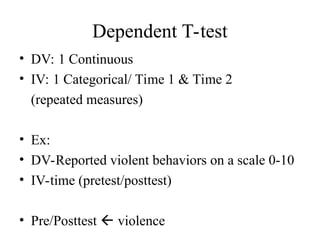
Dependent T-test
• DV: 1 Continuous
• IV: 1 Categorical/ Time 1 & Time 2
(repeated measures)
• Ex:
• DV-Reported violent behaviors on a scale 0-10
• IV-time (pretest/posttest)
• Pre/Posttest  violence
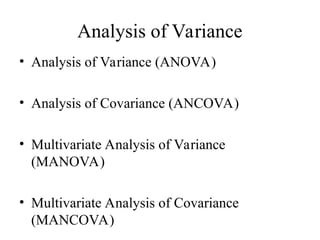
Analysis of Variance
• Analysis of Variance (ANOVA)
• Analysis of Covariance (ANCOVA)
• Multivariate Analysis of Variance
(MANOVA)
• Multivariate Analysis of Covariance
(MANCOVA)
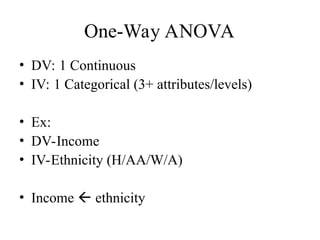
One-Way ANOVA
• DV: 1 Continuous
• IV: 1 Categorical (3+ attributes/levels)
• Ex:
• DV-Income
• IV-Ethnicity (H/AA/W/A)
• Income  ethnicity
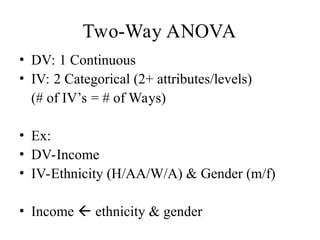
Two-Way ANOVA
• DV: 1 Continuous
• IV: 2 Categorical (2+ attributes/levels)
(# of IV’s = # of Ways)
• Ex:
• DV-Income
• IV-Ethnicity (H/AA/W/A) & Gender (m/f)
• Income  ethnicity & gender
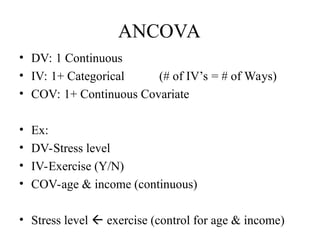
ANCOVA
• DV: 1 Continuous
• IV: 1+ Categorical (# of IV’s = # of Ways)
• COV: 1+ Continuous Covariate
• Ex:
• DV-Stress level
• IV-Exercise (Y/N)
• COV-age & income (continuous)
• Stress level  exercise (control for age & income)
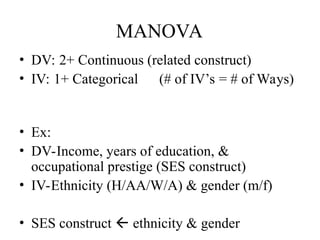
MANOVA
• DV: 2+ Continuous (related construct)
• IV: 1+ Categorical (# of IV’s = # of Ways)
• Ex:
• DV-Income, years of education, &
occupational prestige (SES construct)
• IV-Ethnicity (H/AA/W/A) & gender (m/f)
• SES construct  ethnicity & gender
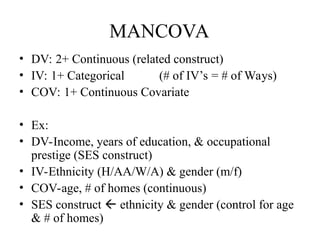
MANCOVA
• DV: 2+ Continuous (related construct)
• IV: 1+ Categorical (# of IV’s = # of Ways)
• COV: 1+ Continuous Covariate
• Ex:
• DV-Income, years of education, & occupational
prestige (SES construct)
• IV-Ethnicity (H/AA/W/A) & gender (m/f)
• COV-age, # of homes (continuous)
• SES construct  ethnicity & gender (control for age
& # of homes)
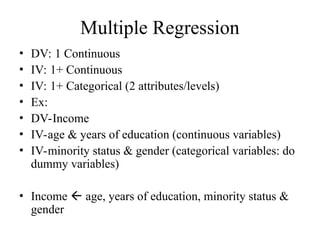
Multiple Regression
• DV: 1 Continuous
• IV: 1+ Continuous
• IV: 1+ Categorical (2 attributes/levels)
• Ex:
• DV-Income
• IV-age & years of education (continuous variables)
• IV-minority status & gender (categorical variables: do
dummy variables)
• Income  age, years of education, minority status &
gender
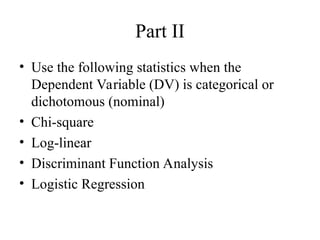
Part II
• Use the following statistics when the
Dependent Variable (DV) is categorical or
dichotomous (nominal)
• Chi-square
• Log-linear
• Discriminant Function Analysis
• Logistic Regression
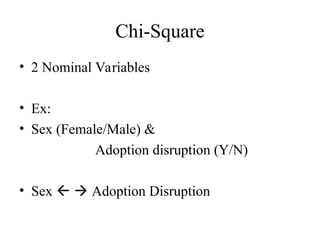
Chi-Square
• 2 Nominal Variables
• Ex:
• Sex (Female/Male) &
Adoption disruption (Y/N)
• Sex   Adoption Disruption
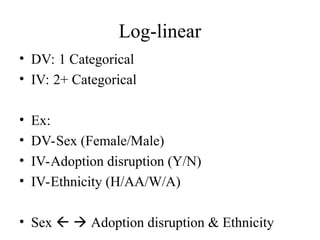
Log-linear
• DV: 1 Categorical
• IV: 2+ Categorical
• Ex:
• DV-Sex (Female/Male)
• IV-Adoption disruption (Y/N)
• IV-Ethnicity (H/AA/W/A)
• Sex   Adoption disruption & Ethnicity
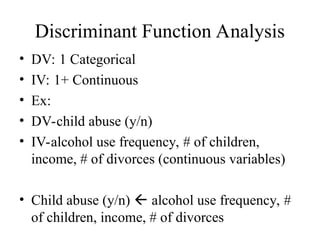
Discriminant Function Analysis
• DV: 1 Categorical
• IV: 1+ Continuous
• Ex:
• DV-child abuse (y/n)
• IV-alcohol use frequency, # of children,
income, # of divorces (continuous variables)
• Child abuse (y/n)  alcohol use frequency, #
of children, income, # of divorces
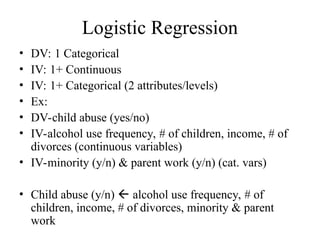
Logistic Regression
• DV: 1 Categorical
• IV: 1+ Continuous
• IV: 1+ Categorical (2 attributes/levels)
• Ex:
• DV-child abuse (yes/no)
• IV-alcohol use frequency, # of children, income, # of
divorces (continuous variables)
• IV-minority (y/n) & parent work (y/n) (cat. vars)
• Child abuse (y/n)  alcohol use frequency, # of
children, income, # of divorces, minority & parent
work
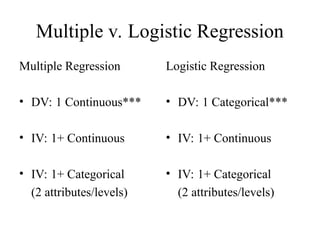
Multiple v. Logistic Regression
Multiple Regression
• DV: 1 Continuous***
• IV: 1+ Continuous
• IV: 1+ Categorical
(2 attributes/levels)
Logistic Regression
• DV: 1 Categorical***
• IV: 1+ Continuous
• IV: 1+ Categorical
(2 attributes/levels)
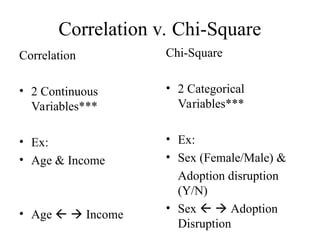
Correlation v. Chi-Square
Correlation
• 2 Continuous
Variables***
• Ex:
• Age & Income
• Age   Income
Chi-Square
• 2 Categorical
Variables***
• Ex:
• Sex (Female/Male) &
Adoption disruption
(Y/N)
• Sex   Adoption
Disruption
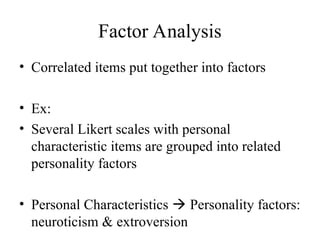
Factor Analysis
• Correlated items put together into factors
• Ex:
• Several Likert scales with personal
characteristic items are grouped into related
personality factors
• Personal Characteristics  Personality factors:
neuroticism & extroversion
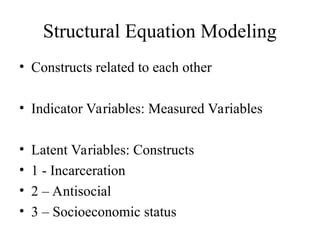
Structural Equation Modeling
• Constructs related to each other
• Indicator Variables: Measured Variables
• Latent Variables: Constructs
• 1 - Incarceration
• 2 – Antisocial
• 3 – Socioeconomic status
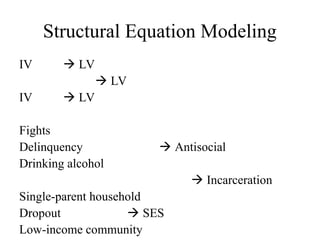
Structural Equation Modeling
IV  LV
 LV
IV  LV
Fights
Delinquency  Antisocial
Drinking alcohol
 Incarceration
Single-parent household
Dropout  SES
Low-income community

Conceptual Framework of Multivariate Statistics (1).ppt

  • 1.
    Conceptual Framework of MultivariateStatistics© Anish K.R.,Ph D Rajagiri College of Social Sciences Moisés Próspero, Ph.D. © College of Social Work University of Utah
  • 2.
    Which Statistic toUse? • The type of statistic will depend on – The research question – The level of measurement for the independent variable (IV) – The level of measurement for the dependent variable (DV) • Therefore, your measuring instrument will determine what statistic to use.
  • 3.
    4 Levels ofMeasurement • Nominal measures: Categories without rank- order, such as sex (female, male). • Ordinal measures: Rank-ordered categories, such as Likert-type scales (1=never 7=always). • Interval measures: Continuous scales with equal distance between intervals, such as Celsius temperature (-30…0…+30) • Ratio measures: Continuous scales with equal distance between intervals and a true zero, such as age (0, 1, 2, 3, 4, 5…).
  • 4.
    Levels of Measurement •Two Types – Numerical/Continuous – Categorical
  • 5.
    Relationship Between 2Variables • Research question is, “Is there an association between age & income?” • If 2 nominal/categorical measures, use Chi- square – Ex: age (old & young) & income (poor & rich) • If 2 numerical/ratio measures, use Correlation – Ex: age (0-65) & income (0-$100,000)
  • 6.
    Relationship Between 2Variables • If 1 nominal IV with 2 categories & 1 ratio DV, use Independent t-test – Ex: age (old & young) & income (0-$100,000) • If 1 nominal IV with 3 categories & 1 ratio DV, use ANOVA – Ex: age (elderly, adult & adolescent) & income (0- $100,000) • Same research question, 4 different statistics!!
  • 7.
    Part I • Usethe following statistics when the Dependent Variable (DV) is continuous (ordinal, interval, ratio) • Correlation • T-test • ANOVA/ANCOVA • MANOVA/MANCOVA • Multiple Regression
  • 8.
    Correlation • 2 ContinuousVariables • Ex: age & income • Age   income
  • 9.
    Independent T-test • DV:1 Continuous • IV: 1 Categorical (2 attributes/levels) • Ex: • DV-Income • IV-gender (m/f) • Income  gender
  • 10.
    Dependent T-test • DV:1 Continuous • IV: 1 Categorical/ Time 1 & Time 2 (repeated measures) • Ex: • DV-Reported violent behaviors on a scale 0-10 • IV-time (pretest/posttest) • Pre/Posttest  violence
  • 11.
    Analysis of Variance •Analysis of Variance (ANOVA) • Analysis of Covariance (ANCOVA) • Multivariate Analysis of Variance (MANOVA) • Multivariate Analysis of Covariance (MANCOVA)
  • 12.
    One-Way ANOVA • DV:1 Continuous • IV: 1 Categorical (3+ attributes/levels) • Ex: • DV-Income • IV-Ethnicity (H/AA/W/A) • Income  ethnicity
  • 13.
    Two-Way ANOVA • DV:1 Continuous • IV: 2 Categorical (2+ attributes/levels) (# of IV’s = # of Ways) • Ex: • DV-Income • IV-Ethnicity (H/AA/W/A) & Gender (m/f) • Income  ethnicity & gender
  • 14.
    ANCOVA • DV: 1Continuous • IV: 1+ Categorical (# of IV’s = # of Ways) • COV: 1+ Continuous Covariate • Ex: • DV-Stress level • IV-Exercise (Y/N) • COV-age & income (continuous) • Stress level  exercise (control for age & income)
  • 15.
    MANOVA • DV: 2+Continuous (related construct) • IV: 1+ Categorical (# of IV’s = # of Ways) • Ex: • DV-Income, years of education, & occupational prestige (SES construct) • IV-Ethnicity (H/AA/W/A) & gender (m/f) • SES construct  ethnicity & gender
  • 16.
    MANCOVA • DV: 2+Continuous (related construct) • IV: 1+ Categorical (# of IV’s = # of Ways) • COV: 1+ Continuous Covariate • Ex: • DV-Income, years of education, & occupational prestige (SES construct) • IV-Ethnicity (H/AA/W/A) & gender (m/f) • COV-age, # of homes (continuous) • SES construct  ethnicity & gender (control for age & # of homes)
  • 17.
    Multiple Regression • DV:1 Continuous • IV: 1+ Continuous • IV: 1+ Categorical (2 attributes/levels) • Ex: • DV-Income • IV-age & years of education (continuous variables) • IV-minority status & gender (categorical variables: do dummy variables) • Income  age, years of education, minority status & gender
  • 18.
    Part II • Usethe following statistics when the Dependent Variable (DV) is categorical or dichotomous (nominal) • Chi-square • Log-linear • Discriminant Function Analysis • Logistic Regression
  • 19.
    Chi-Square • 2 NominalVariables • Ex: • Sex (Female/Male) & Adoption disruption (Y/N) • Sex   Adoption Disruption
  • 20.
    Log-linear • DV: 1Categorical • IV: 2+ Categorical • Ex: • DV-Sex (Female/Male) • IV-Adoption disruption (Y/N) • IV-Ethnicity (H/AA/W/A) • Sex   Adoption disruption & Ethnicity
  • 21.
    Discriminant Function Analysis •DV: 1 Categorical • IV: 1+ Continuous • Ex: • DV-child abuse (y/n) • IV-alcohol use frequency, # of children, income, # of divorces (continuous variables) • Child abuse (y/n)  alcohol use frequency, # of children, income, # of divorces
  • 22.
    Logistic Regression • DV:1 Categorical • IV: 1+ Continuous • IV: 1+ Categorical (2 attributes/levels) • Ex: • DV-child abuse (yes/no) • IV-alcohol use frequency, # of children, income, # of divorces (continuous variables) • IV-minority (y/n) & parent work (y/n) (cat. vars) • Child abuse (y/n)  alcohol use frequency, # of children, income, # of divorces, minority & parent work
  • 23.
    Multiple v. LogisticRegression Multiple Regression • DV: 1 Continuous*** • IV: 1+ Continuous • IV: 1+ Categorical (2 attributes/levels) Logistic Regression • DV: 1 Categorical*** • IV: 1+ Continuous • IV: 1+ Categorical (2 attributes/levels)
  • 24.
    Correlation v. Chi-Square Correlation •2 Continuous Variables*** • Ex: • Age & Income • Age   Income Chi-Square • 2 Categorical Variables*** • Ex: • Sex (Female/Male) & Adoption disruption (Y/N) • Sex   Adoption Disruption
  • 25.
    Factor Analysis • Correlateditems put together into factors • Ex: • Several Likert scales with personal characteristic items are grouped into related personality factors • Personal Characteristics  Personality factors: neuroticism & extroversion
  • 26.
    Structural Equation Modeling •Constructs related to each other • Indicator Variables: Measured Variables • Latent Variables: Constructs • 1 - Incarceration • 2 – Antisocial • 3 – Socioeconomic status
  • 27.
    Structural Equation Modeling IV LV  LV IV  LV Fights Delinquency  Antisocial Drinking alcohol  Incarceration Single-parent household Dropout  SES Low-income community