Liquid-Cooled Lithium-Ion Battery
Pack
COMSOL
Introduction
 This example simulates a temperature profile in a number of cells and cooling fins in a
 liquid-cooled battery pack
 The model solves in 3D and for an operational point during a load cycle
 A full 1D electrochemical model for the lithium battery calculates the average heat source
 The model is based on two assumptions:
 The first one is that the material properties of the cooling fluid and battery material can be
calculated using an average temperature for the battery pack, and the second one is that the
variations in heat generation during the load cycle are significantly slower than the heat transport
within the battery pack
 The first assumption is valid if the temperature variations in the battery pack are small
 The second assumption implies that the thermal balance is quasistationary for the given battery
heat source and at a given operational point during the load cycle
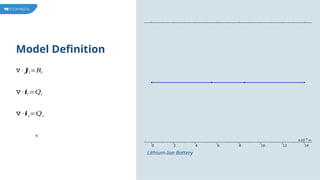
Model Definition
Lithium-Ion Battery
∇ ∙ 𝑱l =𝑅l
∇ ∙ 𝒊l =𝑄l
∇ ∙ 𝒊s=𝑄s
+
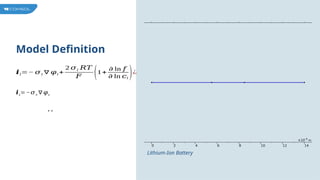
Model Definition
Lithium-Ion Battery
𝒊l=− 𝜎l ∇ 𝜑l +
2 𝜎l 𝑅𝑇
𝐹 (1+
𝜕 ln 𝑓
𝜕 ln 𝑐l
)¿
𝒊s=−𝜎s ∇ 𝜑s
, ,
Model Definition
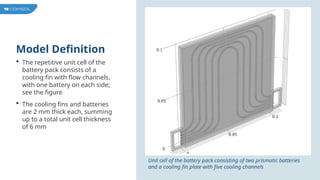
 The repetitive unit cell of the
battery pack consists of a
cooling fin with flow channels,
with one battery on each side;
see the figure
 The cooling fins and batteries
are 2 mm thick each, summing
up to a total unit cell thickness
of 6 mm
Unit cell of the battery pack consisting of two prismatic batteries
and a cooling fin plate with five cooling channels
Model Definition
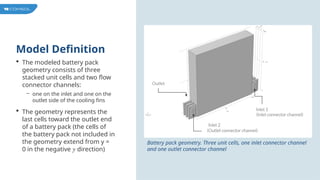
 The modeled battery pack
geometry consists of three
stacked unit cells and two flow
connector channels:
‒ one on the inlet and one on the
outlet side of the cooling fins
 The geometry represents the
last cells toward the outlet end
of a battery pack (the cells of
the battery pack not included in
the geometry extend from y =
0 in the negative y direction)
Battery pack geometry. Three unit cells, one inlet connector channel
and one outlet connector channel
Model Definition
Laminar Flow
𝜌 (𝛻∙ 𝒖)=0
𝜌 (∇ ∙𝒖) 𝒖=∇ ∙[−𝑝 𝑰+ 𝑲 ]+ 𝑭
Model Definition
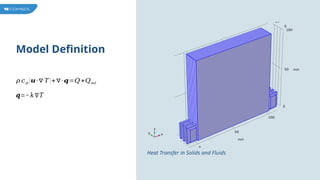
Heat Transfer in Solids and Fluids
𝜌 𝑐𝑝 (𝒖∙∇ 𝑇 )+∇∙𝒒=𝑄+𝑄ted
𝒒=−𝑘∇𝑇
Results
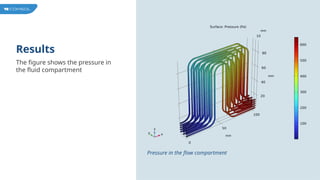
The figure shows the pressure in
the fluid compartment
Pressure in the flow compartment
Results
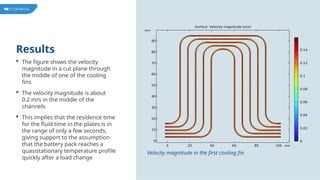
 The figure shows the velocity
magnitude in a cut plane through
the middle of one of the cooling
fins
 The velocity magnitude is about
0.2 m/s in the middle of the
channels
 This implies that the residence time
for the fluid time in the plates is in
the range of only a few seconds,
giving support to the assumption
that the battery pack reaches a
quasistationary temperature profile
quickly after a load change
Velocity magnitude in the first cooling fin
Results
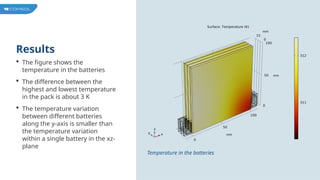
 The figure shows the
temperature in the batteries
 The difference between the
highest and lowest temperature
in the pack is about 3 K
 The temperature variation
between different batteries
along the y-axis is smaller than
the temperature variation
within a single battery in the xz-
plane
Temperature in the batteries
Results
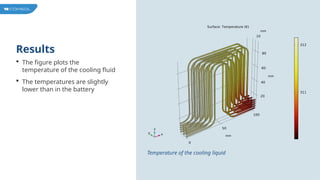
 The figure plots the
temperature of the cooling fluid
 The temperatures are slightly
lower than in the battery
Temperature of the cooling liquid
Results
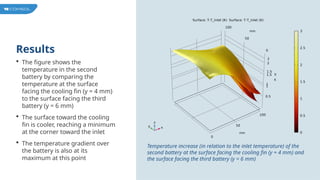
 The figure shows the
temperature in the second
battery by comparing the
temperature at the surface
facing the cooling fin (y = 4 mm)
to the surface facing the third
battery (y = 6 mm)
 The surface toward the cooling
fin is cooler, reaching a minimum
at the corner toward the inlet
 The temperature gradient over
the battery is also at its
maximum at this point
Temperature increase (in relation to the inlet temperature) of the
second battery at the surface facing the cooling fin (y = 4 mm) and
the surface facing the third battery (y = 6 mm)


comsol_lithium_ion__battery_pack_3d.pptx

  • 1.
  • 2.
    Introduction  This examplesimulates a temperature profile in a number of cells and cooling fins in a  liquid-cooled battery pack  The model solves in 3D and for an operational point during a load cycle  A full 1D electrochemical model for the lithium battery calculates the average heat source  The model is based on two assumptions:  The first one is that the material properties of the cooling fluid and battery material can be calculated using an average temperature for the battery pack, and the second one is that the variations in heat generation during the load cycle are significantly slower than the heat transport within the battery pack  The first assumption is valid if the temperature variations in the battery pack are small  The second assumption implies that the thermal balance is quasistationary for the given battery heat source and at a given operational point during the load cycle
  • 3.
    Model Definition Lithium-Ion Battery ∇∙ 𝑱l =𝑅l ∇ ∙ 𝒊l =𝑄l ∇ ∙ 𝒊s=𝑄s +
  • 4.
    Model Definition Lithium-Ion Battery 𝒊l=−𝜎l ∇ 𝜑l + 2 𝜎l 𝑅𝑇 𝐹 (1+ 𝜕 ln 𝑓 𝜕 ln 𝑐l )¿ 𝒊s=−𝜎s ∇ 𝜑s , ,
  • 5.
    Model Definition  Therepetitive unit cell of the battery pack consists of a cooling fin with flow channels, with one battery on each side; see the figure  The cooling fins and batteries are 2 mm thick each, summing up to a total unit cell thickness of 6 mm Unit cell of the battery pack consisting of two prismatic batteries and a cooling fin plate with five cooling channels
  • 6.
    Model Definition  Themodeled battery pack geometry consists of three stacked unit cells and two flow connector channels: ‒ one on the inlet and one on the outlet side of the cooling fins  The geometry represents the last cells toward the outlet end of a battery pack (the cells of the battery pack not included in the geometry extend from y = 0 in the negative y direction) Battery pack geometry. Three unit cells, one inlet connector channel and one outlet connector channel
  • 7.
    Model Definition Laminar Flow 𝜌(𝛻∙ 𝒖)=0 𝜌 (∇ ∙𝒖) 𝒖=∇ ∙[−𝑝 𝑰+ 𝑲 ]+ 𝑭
  • 8.
    Model Definition Heat Transferin Solids and Fluids 𝜌 𝑐𝑝 (𝒖∙∇ 𝑇 )+∇∙𝒒=𝑄+𝑄ted 𝒒=−𝑘∇𝑇
  • 9.
    Results The figure showsthe pressure in the fluid compartment Pressure in the flow compartment
  • 10.
    Results  The figureshows the velocity magnitude in a cut plane through the middle of one of the cooling fins  The velocity magnitude is about 0.2 m/s in the middle of the channels  This implies that the residence time for the fluid time in the plates is in the range of only a few seconds, giving support to the assumption that the battery pack reaches a quasistationary temperature profile quickly after a load change Velocity magnitude in the first cooling fin
  • 11.
    Results  The figureshows the temperature in the batteries  The difference between the highest and lowest temperature in the pack is about 3 K  The temperature variation between different batteries along the y-axis is smaller than the temperature variation within a single battery in the xz- plane Temperature in the batteries
  • 12.
    Results  The figureplots the temperature of the cooling fluid  The temperatures are slightly lower than in the battery Temperature of the cooling liquid
  • 13.
    Results  The figureshows the temperature in the second battery by comparing the temperature at the surface facing the cooling fin (y = 4 mm) to the surface facing the third battery (y = 6 mm)  The surface toward the cooling fin is cooler, reaching a minimum at the corner toward the inlet  The temperature gradient over the battery is also at its maximum at this point Temperature increase (in relation to the inlet temperature) of the second battery at the surface facing the cooling fin (y = 4 mm) and the surface facing the third battery (y = 6 mm)