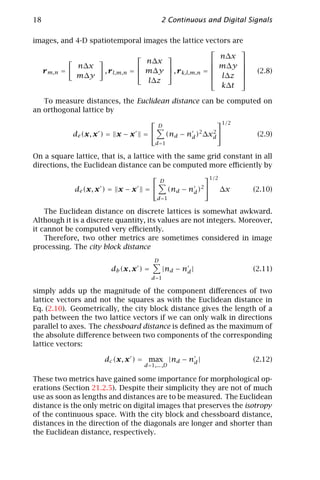
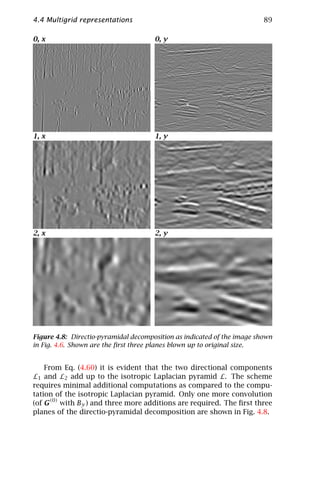
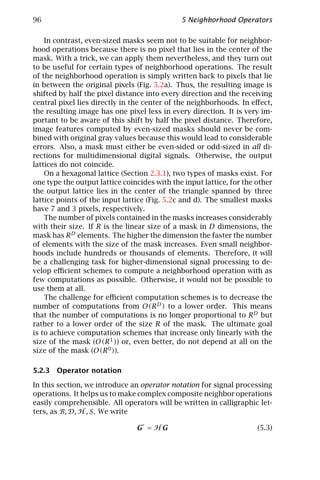
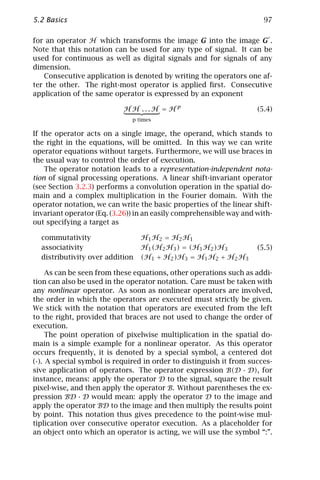
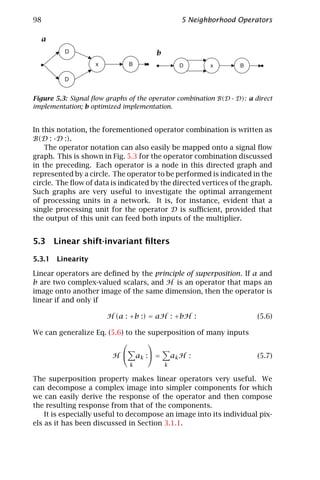
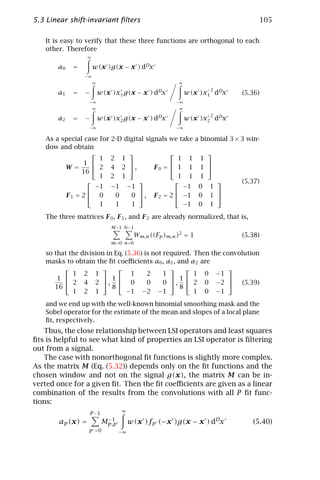
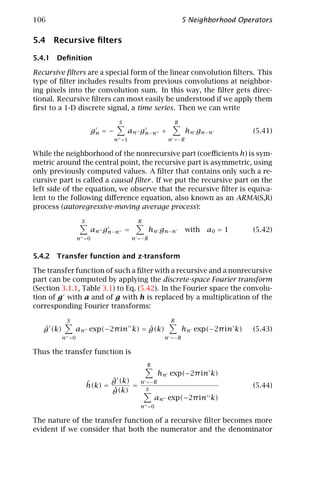
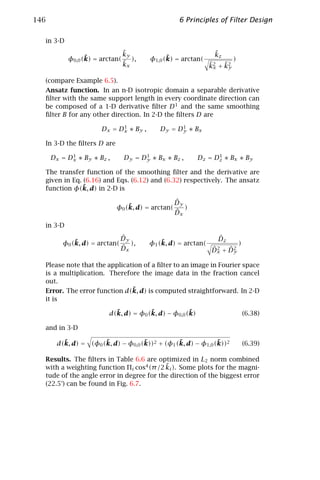
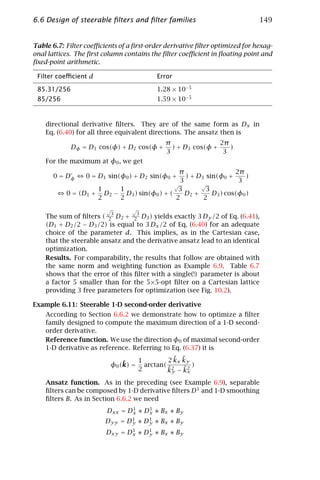
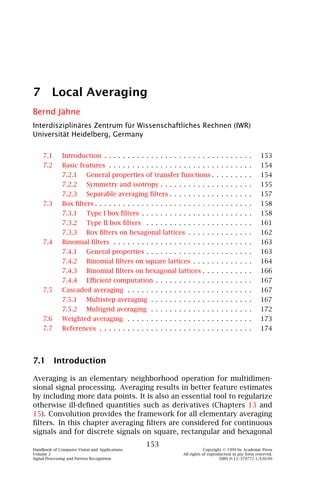
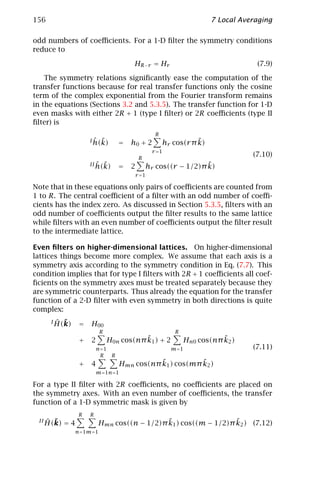
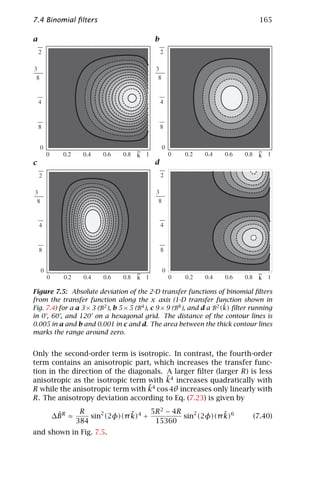
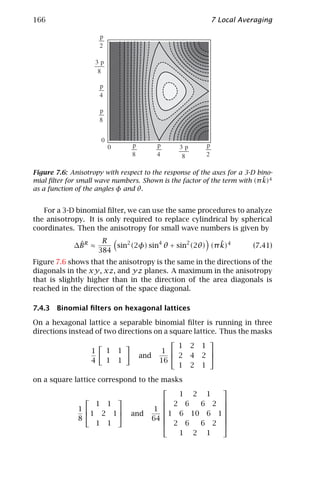
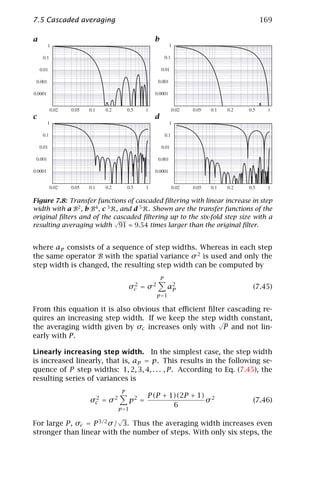
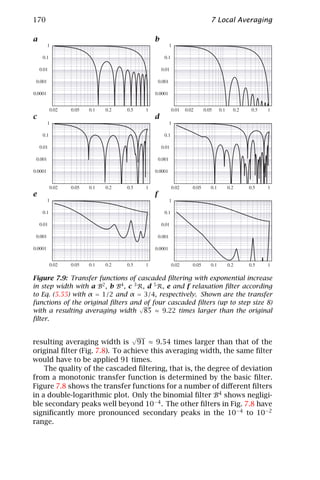
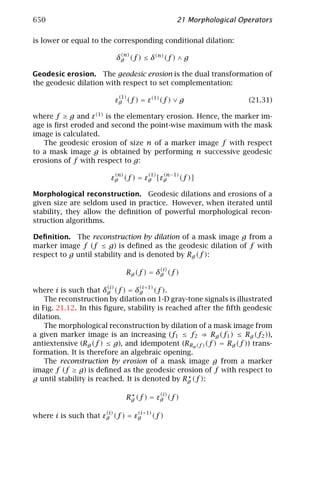
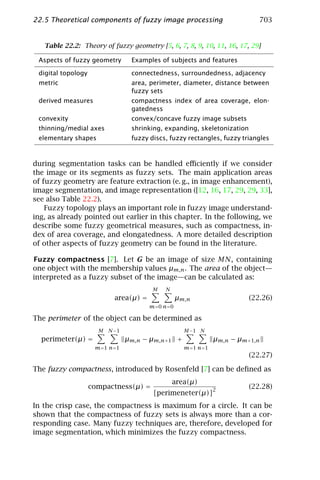
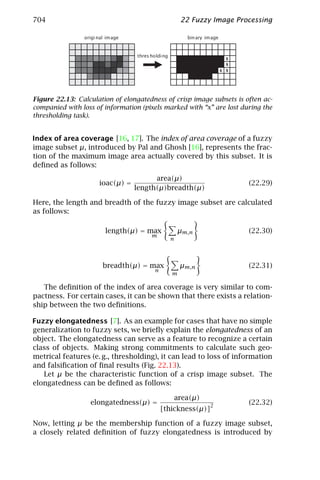
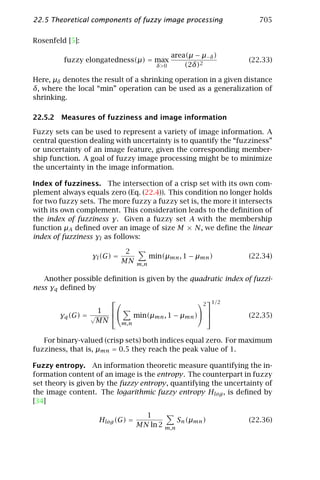
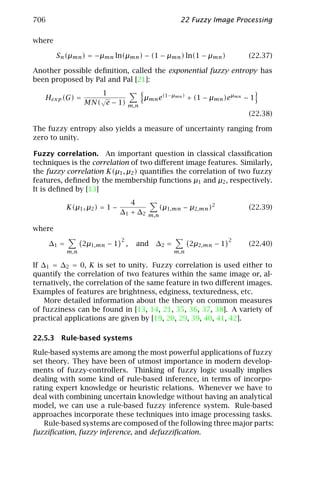
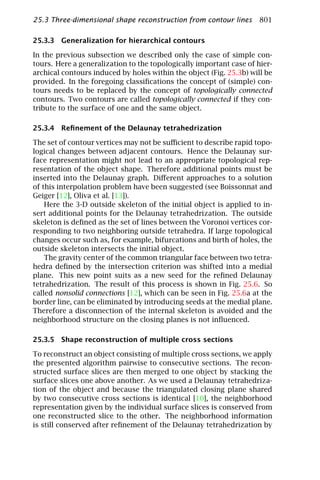
1   2   1
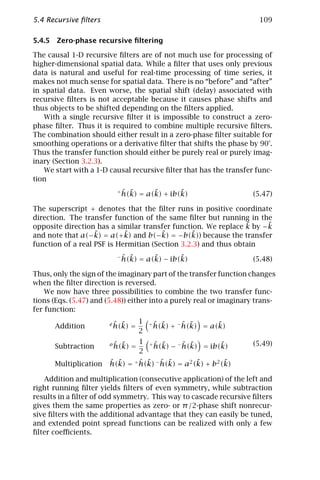
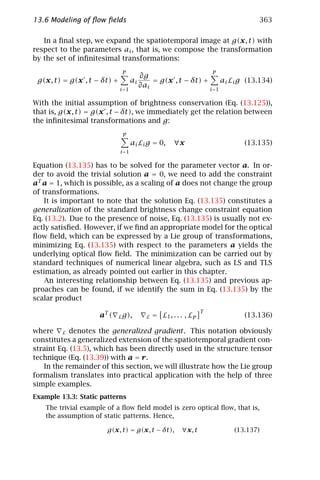
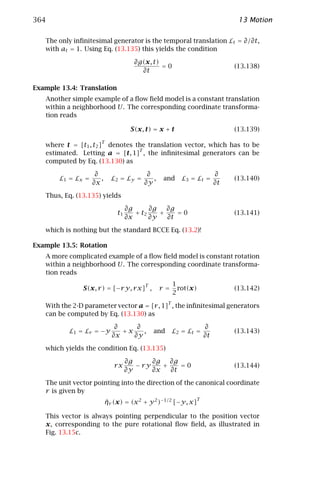
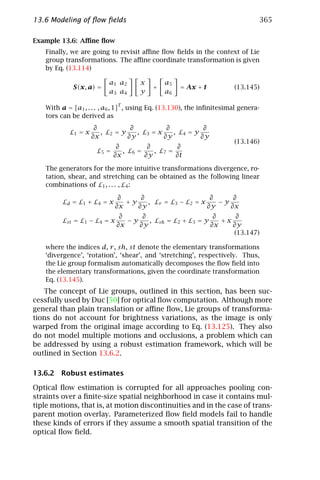
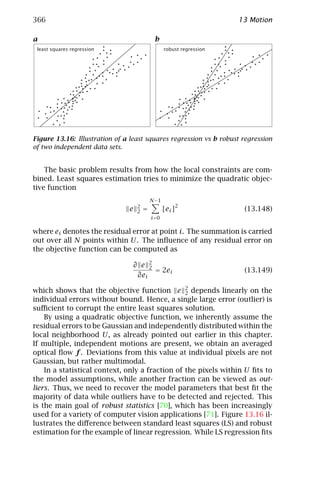
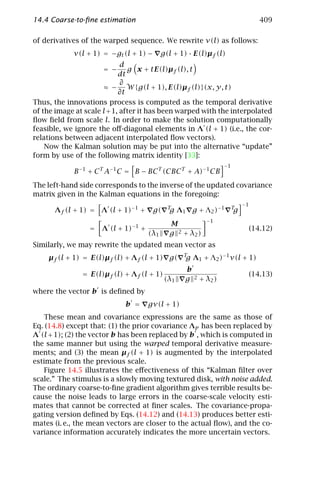
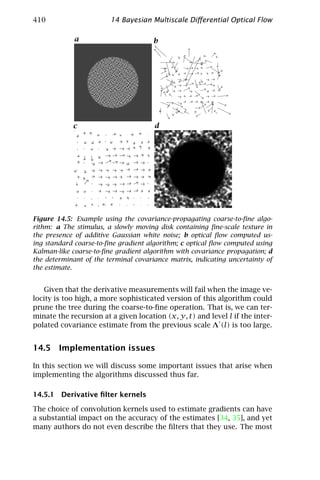
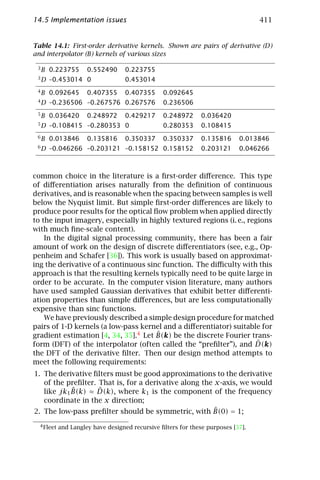
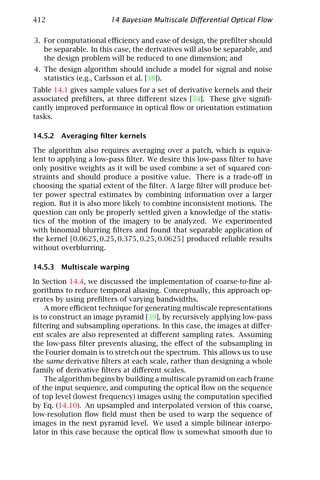
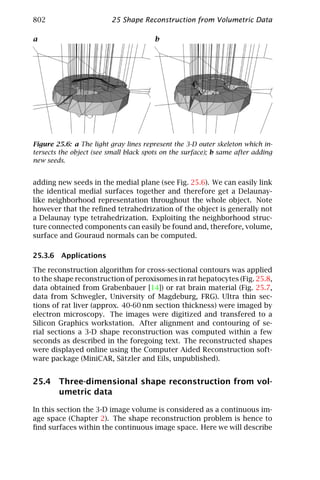
                  2   4   2
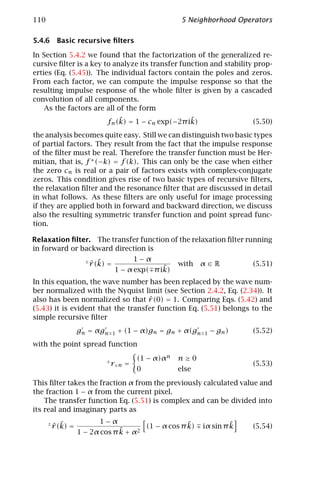
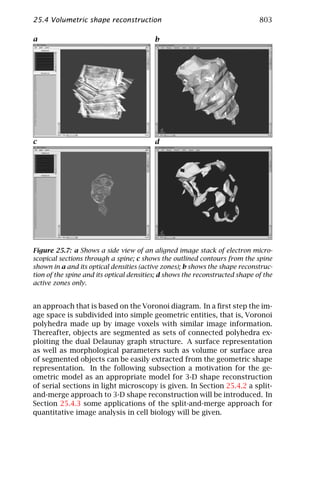
                  1   2   1


HANDBOOK OF
COMPUTER VISION AND
APPLICATIONS
Volume 2
Signal Processing and
Pattern Recognition

Bernd Jähne
Horst Haußecker
Peter Geißler


ACADEMIC
  PRESS
Handbook of
Computer Vision
and Applications
      Volume 2
Signal Processing and
 Pattern Recognition
Handbook of
Computer Vision
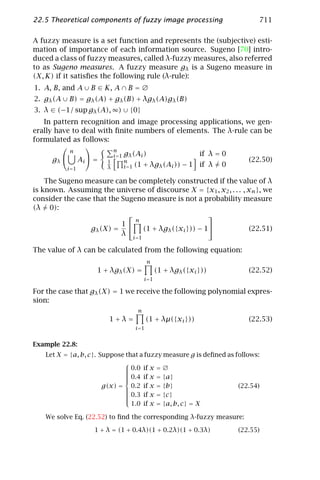
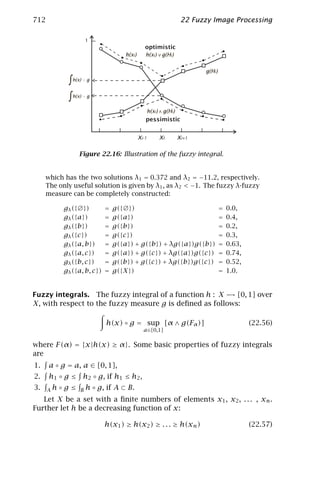
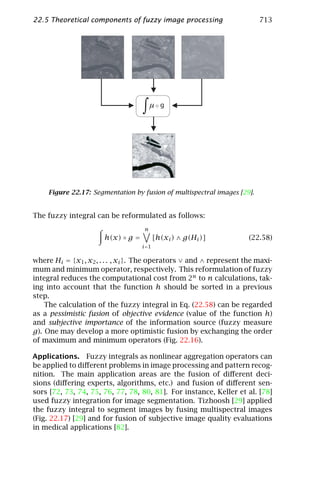
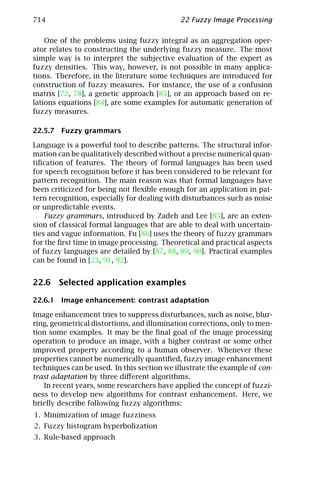
and Applications
      Volume 2
Signal Processing and
 Pattern Recognition
                  Editors
                Bernd Jähne
 Interdisciplinary Center for Scientific Computing
  University of Heidelberg, Heidelberg, Germany
                        and
       Scripps Institution of Oceanography
        University of California, San Diego

            Horst Haußecker
             Peter Geißler
 Interdisciplinary Center for Scientific Computing
  University of Heidelberg, Heidelberg, Germany


            ACADEMIC PRESS
         San Diego London Boston
      New York Sydney Tokyo Toronto
This book is printed on acid-free paper.
Copyright © 1999 by Academic Press.

All rights reserved.
No part of this publication may be reproduced or transmitted in any form or
by any means, electronic or mechanical, including photocopy, recording, or
any information storage and retrieval system, without permission in writing
from the publisher.

The appearance of code at the bottom of the first page of a chapter in this book
indicates the Publisher’s consent that copies of the chapter may be made for
personal or internal use of specific clients. This consent is given on the con-
dition, however, that the copier pay the stated per-copy fee through the Copy-
right Clearance Center, Inc. (222 Rosewood Drive, Danvers, Massachusetts
01923), for copying beyond that permitted by Sections 107 or 108 of the U.S.
Copyright Law. This consent does not extend to other kinds of copying, such
as copying for general distribution, for advertising or promotional purposes,
for creating new collective works, or for resale. Copy fees for pre-1999 chap-
ters are as shown on the title pages; if no fee code appears on the title page,
the copy fee is the same as for current chapters. ISBN 0-12-379770-5/$30.00


ACADEMIC PRESS
A Division of Harcourt Brace & Company
525 B Street, Suite 1900, San Diego, CA 92101-4495
http://www.apnet.com

ACADEMIC PRESS
24-28 Oval Road, London NW1 7DX, UK
http://www.hbuk.co.uk/ap/


Library of Congress Cataloging-In-Publication Data
Handbook of computer vision and applications / edited by Bernd Jähne,
Horst Haussecker, Peter Geissler.
    p. cm.
  Includes bibliographical references and indexes.
  Contents: v. 1. Sensors and imaging — v. 2. Signal processing and
  pattern recognition — v. 3. Systems and applications.
  ISBN 0–12–379770–5 (set). — ISBN 0–12–379771-3 (v. 1)
  ISBN 0–12–379772–1 (v. 2). — ISBN 0–12–379773-X (v. 3)
  1. Computer vision — Handbooks, manuals. etc. I. Jähne, Bernd
  1953– . II. Haussecker, Horst, 1968–     . III. Geissler, Peter, 1966– .
TA1634.H36 1999
006.3 7 — dc21                                                         98–42541
                                                                            CIP


Printed in the United States of America
99 00 01 02 03 DS 9 8 7 6 5 4 3 2 1
Contents


Preface                                                                                                                     xi

Contributors                                                                                                               xiii
1 Introduction                                                                                                               1
  B. Jähne
  1.1   Signal processing for computer vision . . . . . .                              .   .   .   .   .   .   .   .   .     2
  1.2   Pattern recognition for computer vision . . . . .                              .   .   .   .   .   .   .   .   .     3
  1.3   Computational complexity and fast algorithms                                   .   .   .   .   .   .   .   .   .     4
  1.4   Performance evaluation of algorithms . . . . . .                               .   .   .   .   .   .   .   .   .     5
  1.5   References . . . . . . . . . . . . . . . . . . . . . . . .                     .   .   .   .   .   .   .   .   .     6

                            I Signal Representation
2 Continuous and Digital Signals                                                                                             9
  B. Jähne
  2.1   Introduction . . . . . . . . . . . . . . . . . . . . . . . . .                         .   .   .   .   .   .   .   10
  2.2   Continuous signals . . . . . . . . . . . . . . . . . . . . .                           .   .   .   .   .   .   .   10
  2.3   Discrete signals . . . . . . . . . . . . . . . . . . . . . . .                         .   .   .   .   .   .   .   13
  2.4   Relation between continuous and discrete signals                                       .   .   .   .   .   .   .   23
  2.5   Quantization . . . . . . . . . . . . . . . . . . . . . . . . .                         .   .   .   .   .   .   .   30
  2.6   References . . . . . . . . . . . . . . . . . . . . . . . . . .                         .   .   .   .   .   .   .   34
3 Spatial and Fourier Domain                                                                                               35
  B. Jähne
  3.1   Vector spaces and unitary transforms .                     .   .   .   .   .   .   .   .   .   .   .   .   .   .   35
  3.2   Continuous Fourier transform (FT) . . .                    .   .   .   .   .   .   .   .   .   .   .   .   .   .   41
  3.3   The discrete Fourier transform (DFT) . .                   .   .   .   .   .   .   .   .   .   .   .   .   .   .   51
  3.4   Fast Fourier transform algorithms (FFT)                    .   .   .   .   .   .   .   .   .   .   .   .   .   .   57
  3.5   References . . . . . . . . . . . . . . . . . . .           .   .   .   .   .   .   .   .   .   .   .   .   .   .   66
4 Multiresolutional Signal Representation                                                                                  67
  B. Jähne
  4.1   Scale in signal processing . . . . . .         .   .   .   .   .   .   .   .   .   .   .   .   .   .   .   .   .   67
  4.2   Scale filters . . . . . . . . . . . . . . . .   .   .   .   .   .   .   .   .   .   .   .   .   .   .   .   .   .   70
  4.3   Scale space and diffusion . . . . . . .         .   .   .   .   .   .   .   .   .   .   .   .   .   .   .   .   .   76
  4.4   Multigrid representations . . . . . .          .   .   .   .   .   .   .   .   .   .   .   .   .   .   .   .   .   84
  4.5   References . . . . . . . . . . . . . . . .     .   .   .   .   .   .   .   .   .   .   .   .   .   .   .   .   .   90


                                            v
vi                                                                                                                                     Contents

                      II Elementary Spatial Processing
5 Neighborhood Operators                                                                                                                        93
  B. Jähne
  5.1   Introduction . . . . . . . . . . . . . .                       .   .   .   .   .   .   .   .   .   .   .   .   .   .   .   .   .   .    94
  5.2   Basics . . . . . . . . . . . . . . . . . .                     .   .   .   .   .   .   .   .   .   .   .   .   .   .   .   .   .   .    94
  5.3   Linear shift-invariant filters . . . .                          .   .   .   .   .   .   .   .   .   .   .   .   .   .   .   .   .   .    98
  5.4   Recursive filters . . . . . . . . . . . .                       .   .   .   .   .   .   .   .   .   .   .   .   .   .   .   .   .   .   106
  5.5   Classes of nonlinear filters . . . . .                          .   .   .   .   .   .   .   .   .   .   .   .   .   .   .   .   .   .   113
  5.6   Efficient neighborhood operations                                .   .   .   .   .   .   .   .   .   .   .   .   .   .   .   .   .   .   116
  5.7   References . . . . . . . . . . . . . . .                       .   .   .   .   .   .   .   .   .   .   .   .   .   .   .   .   .   .   124
6 Principles of Filter Design                                                                                                                  125
  B. Jähne, H. Scharr, and S. Körkel
  6.1   Introduction . . . . . . . . . . . . . . . . . . . . .                                     .   .   .   .   .   .   .   .   .   .   .   125
  6.2   Filter design criteria . . . . . . . . . . . . . . . .                                     .   .   .   .   .   .   .   .   .   .   .   126
  6.3   Windowing techniques . . . . . . . . . . . . . .                                           .   .   .   .   .   .   .   .   .   .   .   128
  6.4   Filter cascading . . . . . . . . . . . . . . . . . . .                                     .   .   .   .   .   .   .   .   .   .   .   132
  6.5   Filter design as an optimization problem . .                                               .   .   .   .   .   .   .   .   .   .   .   133
  6.6   Design of steerable filters and filter families                                              .   .   .   .   .   .   .   .   .   .   .   143
  6.7   References . . . . . . . . . . . . . . . . . . . . . .                                     .   .   .   .   .   .   .   .   .   .   .   151
7 Local Averaging                                                                                                                              153
  B. Jähne
  7.1   Introduction . . . . .     .   .   .   .   .   .   .   .   .   .   .   .   .   .   .   .   .   .   .   .   .   .   .   .   .   .   .   153
  7.2   Basic features . . . .     .   .   .   .   .   .   .   .   .   .   .   .   .   .   .   .   .   .   .   .   .   .   .   .   .   .   .   154
  7.3   Box filters . . . . . . .   .   .   .   .   .   .   .   .   .   .   .   .   .   .   .   .   .   .   .   .   .   .   .   .   .   .   .   158
  7.4   Binomial filters . . .      .   .   .   .   .   .   .   .   .   .   .   .   .   .   .   .   .   .   .   .   .   .   .   .   .   .   .   163
  7.5   Cascaded averaging         .   .   .   .   .   .   .   .   .   .   .   .   .   .   .   .   .   .   .   .   .   .   .   .   .   .   .   167
  7.6   Weighted averaging         .   .   .   .   .   .   .   .   .   .   .   .   .   .   .   .   .   .   .   .   .   .   .   .   .   .   .   173
  7.7   References . . . . . .     .   .   .   .   .   .   .   .   .   .   .   .   .   .   .   .   .   .   .   .   .   .   .   .   .   .   .   174
8 Interpolation                                                                                                                                175
  B. Jähne
  8.1   Introduction . . . . . . . . . . . .                   .   .   .   .   .   .   .   .   .   .   .   .   .   .   .   .   .   .   .   .   175
  8.2   Basics . . . . . . . . . . . . . . . .                 .   .   .   .   .   .   .   .   .   .   .   .   .   .   .   .   .   .   .   .   176
  8.3   Interpolation in Fourier space .                       .   .   .   .   .   .   .   .   .   .   .   .   .   .   .   .   .   .   .   .   180
  8.4   Polynomial interpolation . . . .                       .   .   .   .   .   .   .   .   .   .   .   .   .   .   .   .   .   .   .   .   182
  8.5   Spline-based interpolation . . .                       .   .   .   .   .   .   .   .   .   .   .   .   .   .   .   .   .   .   .   .   187
  8.6   Optimized interpolation . . . .                        .   .   .   .   .   .   .   .   .   .   .   .   .   .   .   .   .   .   .   .   190
  8.7   References . . . . . . . . . . . . .                   .   .   .   .   .   .   .   .   .   .   .   .   .   .   .   .   .   .   .   .   192
9 Image Warping                                                                                                                                193
  B. Jähne
  9.1   Introduction . . . . . . . . . . . . . . . . . . .                                 .   .   .   .   .   .   .   .   .   .   .   .   .   193
  9.2   Forward and inverse mapping . . . . . . .                                          .   .   .   .   .   .   .   .   .   .   .   .   .   194
  9.3   Basic geometric transforms . . . . . . . . .                                       .   .   .   .   .   .   .   .   .   .   .   .   .   195
  9.4   Fast algorithms for geometric transforms                                           .   .   .   .   .   .   .   .   .   .   .   .   .   199
  9.5   References . . . . . . . . . . . . . . . . . . . .                                 .   .   .   .   .   .   .   .   .   .   .   .   .   206
Contents                                                                                                                              vii

                             III   Feature Estimation
10 Local Structure                                                                                                                    209
   B. Jähne
   10.1 Introduction . . . . . . . . . . . . . . . . . .                      .   .   .   .   .   .   .   .   .   .   .   .   .   .   210
   10.2 Properties of simple neighborhoods . .                                .   .   .   .   .   .   .   .   .   .   .   .   .   .   210
   10.3 Edge detection by first-order derivatives                              .   .   .   .   .   .   .   .   .   .   .   .   .   .   213
   10.4 Edge detection by zero crossings . . . .                              .   .   .   .   .   .   .   .   .   .   .   .   .   .   223
   10.5 Edges in multichannel images . . . . . . .                            .   .   .   .   .   .   .   .   .   .   .   .   .   .   226
   10.6 First-order tensor representation . . . .                             .   .   .   .   .   .   .   .   .   .   .   .   .   .   227
   10.7 References . . . . . . . . . . . . . . . . . . .                      .   .   .   .   .   .   .   .   .   .   .   .   .   .   238
11 Principles for Automatic Scale Selection                                                                                           239
   T. Lindeberg
   11.1 Introduction . . . . . . . . . . . . . . . . . . . . . . . . .                                    .   .   .   .   .   .   .   240
   11.2 Multiscale differential image geometry . . . . . . . .                                             .   .   .   .   .   .   .   240
   11.3 A general scale-selection principle . . . . . . . . . . .                                         .   .   .   .   .   .   .   247
   11.4 Feature detection with automatic scale selection .                                                .   .   .   .   .   .   .   251
   11.5 Feature localization with automatic scale selection                                               .   .   .   .   .   .   .   262
   11.6 Stereo matching with automatic scale selection . .                                                .   .   .   .   .   .   .   265
   11.7 Summary and conclusions . . . . . . . . . . . . . . . .                                           .   .   .   .   .   .   .   269
   11.8 References . . . . . . . . . . . . . . . . . . . . . . . . . .                                    .   .   .   .   .   .   .   270
12 Texture Analysis                                                                                                                   275
   T. Wagner
   12.1 Importance of texture . . . . . . . . . . . . . . . .                                 .   .   .   .   .   .   .   .   .   .   276
   12.2 Feature sets for texture analysis . . . . . . . . .                                   .   .   .   .   .   .   .   .   .   .   278
   12.3 Assessment of textural features . . . . . . . . .                                     .   .   .   .   .   .   .   .   .   .   299
   12.4 Automatic design of texture analysis systems                                          .   .   .   .   .   .   .   .   .   .   306
   12.5 References . . . . . . . . . . . . . . . . . . . . . . .                              .   .   .   .   .   .   .   .   .   .   307
13 Motion                                                                                                                             309
   H. Haußecker and H. Spies
   13.1 Introduction . . . . . . . . . . . . . . . . . . . . .                            .   .   .   .   .   .   .   .   .   .   .   310
   13.2 Basics: flow and correspondence . . . . . . . .                                    .   .   .   .   .   .   .   .   .   .   .   312
   13.3 Optical flow-based motion estimation . . . .                                       .   .   .   .   .   .   .   .   .   .   .   321
   13.4 Quadrature filter techniques . . . . . . . . . .                                   .   .   .   .   .   .   .   .   .   .   .   345
   13.5 Correlation and matching . . . . . . . . . . . .                                  .   .   .   .   .   .   .   .   .   .   .   353
   13.6 Modeling of flow fields . . . . . . . . . . . . . .                                 .   .   .   .   .   .   .   .   .   .   .   356
   13.7 Confidence measures and error propagation                                          .   .   .   .   .   .   .   .   .   .   .   369
   13.8 Comparative analysis . . . . . . . . . . . . . . .                                .   .   .   .   .   .   .   .   .   .   .   373
   13.9 References . . . . . . . . . . . . . . . . . . . . . .                            .   .   .   .   .   .   .   .   .   .   .   392
14 Bayesian Multiscale Differential        Optical Flow                                                                                397
   E. P. Simoncelli
   14.1 Introduction . . . . . . . . .    .   .   .   .   .   .   .   .   .   .   .   .   .   .   .   .   .   .   .   .   .   .   .   397
   14.2 Differential formulation .         .   .   .   .   .   .   .   .   .   .   .   .   .   .   .   .   .   .   .   .   .   .   .   398
   14.3 Uncertainty model . . . . .       .   .   .   .   .   .   .   .   .   .   .   .   .   .   .   .   .   .   .   .   .   .   .   400
   14.4 Coarse-to-fine estimation .        .   .   .   .   .   .   .   .   .   .   .   .   .   .   .   .   .   .   .   .   .   .   .   404
   14.5 Implementation issues . .         .   .   .   .   .   .   .   .   .   .   .   .   .   .   .   .   .   .   .   .   .   .   .   410
   14.6 Examples . . . . . . . . . . .    .   .   .   .   .   .   .   .   .   .   .   .   .   .   .   .   .   .   .   .   .   .   .   414
   14.7 Conclusion . . . . . . . . . .    .   .   .   .   .   .   .   .   .   .   .   .   .   .   .   .   .   .   .   .   .   .   .   419
   14.8 References . . . . . . . . . .    .   .   .   .   .   .   .   .   .   .   .   .   .   .   .   .   .   .   .   .   .   .   .   420
viii                                                                                                                                      Contents

15 Nonlinear Diffusion Filtering                                                                                                                   423
   J. Weickert
   15.1 Introduction . . . . . . .            .   .   .   .   .   .   .   .   .   .   .   .   .   .   .   .   .   .   .   .   .   .   .   .   .   424
   15.2 Filter design . . . . . . .           .   .   .   .   .   .   .   .   .   .   .   .   .   .   .   .   .   .   .   .   .   .   .   .   .   425
   15.3 Continuous theory . . .               .   .   .   .   .   .   .   .   .   .   .   .   .   .   .   .   .   .   .   .   .   .   .   .   .   433
   15.4 Algorithmic details . . .             .   .   .   .   .   .   .   .   .   .   .   .   .   .   .   .   .   .   .   .   .   .   .   .   .   436
   15.5 Discrete theory . . . . .             .   .   .   .   .   .   .   .   .   .   .   .   .   .   .   .   .   .   .   .   .   .   .   .   .   439
   15.6 Parameter selection . .               .   .   .   .   .   .   .   .   .   .   .   .   .   .   .   .   .   .   .   .   .   .   .   .   .   441
   15.7 Generalizations . . . . .             .   .   .   .   .   .   .   .   .   .   .   .   .   .   .   .   .   .   .   .   .   .   .   .   .   444
   15.8 Summary . . . . . . . . .             .   .   .   .   .   .   .   .   .   .   .   .   .   .   .   .   .   .   .   .   .   .   .   .   .   446
   15.9 References . . . . . . . .            .   .   .   .   .   .   .   .   .   .   .   .   .   .   .   .   .   .   .   .   .   .   .   .   .   446
16 Variational Methods                                                                                                                            451
   C. Schnörr
   16.1 Introduction . . . . . . . . . . . . . . . . . . .                                    . . . . .           .   .   .   .   .   .   .   .   451
   16.2 Processing of two- and three-dimensional                                              images              .   .   .   .   .   .   .   .   455
   16.3 Processing of vector-valued images . . . .                                            . . . . .           .   .   .   .   .   .   .   .   471
   16.4 Processing of image sequences . . . . . . .                                           . . . . .           .   .   .   .   .   .   .   .   476
   16.5 References . . . . . . . . . . . . . . . . . . . .                                    . . . . .           .   .   .   .   .   .   .   .   481
17 Stereopsis - Geometrical       and Global Aspects                                                                                              485
   H. A. Mallot
   17.1 Introduction . . . .      .   .   .   .   .   .   .   .   .   .   .   .   .   .   .   .   .   .   .   .   .   .   .   .   .   .   .   .   485
   17.2 Stereo geometry .         .   .   .   .   .   .   .   .   .   .   .   .   .   .   .   .   .   .   .   .   .   .   .   .   .   .   .   .   487
   17.3 Global stereopsis .       .   .   .   .   .   .   .   .   .   .   .   .   .   .   .   .   .   .   .   .   .   .   .   .   .   .   .   .   499
   17.4 References . . . . .      .   .   .   .   .   .   .   .   .   .   .   .   .   .   .   .   .   .   .   .   .   .   .   .   .   .   .   .   502
18 Stereo Terrain Reconstruction by Dynamic Programming                                                                                           505
   G. Gimel’farb
   18.1 Introduction . . . . . . . . . . . . . . . . . . . . . . . . . . .                                                    .   .   .   .   .   505
   18.2 Statistical decisions in terrain reconstruction . . . . .                                                             .   .   .   .   .   509
   18.3 Probability models of epipolar profiles . . . . . . . . . .                                                            .   .   .   .   .   514
   18.4 Dynamic programming reconstruction . . . . . . . . . .                                                                .   .   .   .   .   520
   18.5 Experimental results . . . . . . . . . . . . . . . . . . . . . .                                                      .   .   .   .   .   524
   18.6 References . . . . . . . . . . . . . . . . . . . . . . . . . . . .                                                    .   .   .   .   .   528
19 Reflectance-Based Shape Recovery                                                                                                                531
   R. Klette, R. Kozera, and K. Schlüns
   19.1 Introduction . . . . . . . . . . . . . . . . .                                . . . . . .             .   .   .   .   .   .   .   .   .   532
   19.2 Reflection and gradients . . . . . . . . .                                     . . . . . .             .   .   .   .   .   .   .   .   .   539
   19.3 Three light sources . . . . . . . . . . . .                                   . . . . . .             .   .   .   .   .   .   .   .   .   552
   19.4 Two light sources . . . . . . . . . . . . . .                                 . . . . . .             .   .   .   .   .   .   .   .   .   559
   19.5 Theoretical framework for shape from                                          shading                 .   .   .   .   .   .   .   .   .   571
   19.6 Shape from shading . . . . . . . . . . . .                                    . . . . . .             .   .   .   .   .   .   .   .   .   574
   19.7 Concluding remarks . . . . . . . . . . . .                                    . . . . . .             .   .   .   .   .   .   .   .   .   586
   19.8 References . . . . . . . . . . . . . . . . . .                                . . . . . .             .   .   .   .   .   .   .   .   .   587
20 Depth-from-Focus                                                                                                                               591
   P. Geißler and T. Dierig
   20.1 Introduction . . . . . . . . . . . . . . . . . . . . . . . . . . . . . . . .                                                              592
   20.2 Basic concepts . . . . . . . . . . . . . . . . . . . . . . . . . . . . . . .                                                              593
   20.3 Principles of depth-from-focus algorithms . . . . . . . . . . . .                                                                         595
Contents                                                                                                                         ix

   20.4    Multiple-view depth-from-focus           .   .   .   .   .   .   .   .   .   .   .   .   .   .   .   .   .   .   .   596
   20.5    Dual-view depth-from-focus . . .         .   .   .   .   .   .   .   .   .   .   .   .   .   .   .   .   .   .   .   601
   20.6    Single-view depth-from-focus . .         .   .   .   .   .   .   .   .   .   .   .   .   .   .   .   .   .   .   .   608
   20.7    References . . . . . . . . . . . . . .   .   .   .   .   .   .   .   .   .   .   .   .   .   .   .   .   .   .   .   622

     IV    Object Analysis, Classification, Modeling, Visualization
21 Morphological Operators                                                                                                      627
   P. Soille
   21.1 Introduction . . . . . . . . . . . . . . . . . . . . . . . . .                              .   .   .   .   .   .   .   628
   21.2 Basics . . . . . . . . . . . . . . . . . . . . . . . . . . . . .                            .   .   .   .   .   .   .   629
   21.3 Morphological operators . . . . . . . . . . . . . . . . .                                   .   .   .   .   .   .   .   637
   21.4 Efficient computation of morphological operators                                              .   .   .   .   .   .   .   659
   21.5 Morphological image processing . . . . . . . . . . . .                                      .   .   .   .   .   .   .   664
   21.6 References . . . . . . . . . . . . . . . . . . . . . . . . . .                              .   .   .   .   .   .   .   678
22 Fuzzy Image Processing                                                                                                       683
   H. Haußecker and H. R. Tizhoosh
   22.1 Introduction . . . . . . . . . . . . . . . . . . . . . . . . . .                                .   .   .   .   .   .   684
   22.2 Why fuzzy image processing? . . . . . . . . . . . . . . .                                       .   .   .   .   .   .   691
   22.3 Fuzzy image understanding . . . . . . . . . . . . . . . .                                       .   .   .   .   .   .   692
   22.4 Fuzzy image processing systems . . . . . . . . . . . . .                                        .   .   .   .   .   .   699
   22.5 Theoretical components of fuzzy image processing                                                .   .   .   .   .   .   702
   22.6 Selected application examples . . . . . . . . . . . . . .                                       .   .   .   .   .   .   714
   22.7 Conclusions . . . . . . . . . . . . . . . . . . . . . . . . . .                                 .   .   .   .   .   .   721
   22.8 References . . . . . . . . . . . . . . . . . . . . . . . . . . .                                .   .   .   .   .   .   722
23 Neural Net Computing for Image Processing                                                                                    729
   A. Meyer-Bäse
   23.1 Introduction . . . . . . . . . . . . . . . . . . . . . . .                          .   .   .   .   .   .   .   .   .   729
   23.2 Multilayer perceptron (MLP) . . . . . . . . . . . . .                               .   .   .   .   .   .   .   .   .   730
   23.3 Self-organizing neural networks . . . . . . . . . .                                 .   .   .   .   .   .   .   .   .   736
   23.4 Radial-basis neural networks (RBNN) . . . . . . .                                   .   .   .   .   .   .   .   .   .   740
   23.5 Transformation radial-basis networks (TRBNN)                                        .   .   .   .   .   .   .   .   .   743
   23.6 Hopfield neural networks . . . . . . . . . . . . . .                                 .   .   .   .   .   .   .   .   .   747
   23.7 References . . . . . . . . . . . . . . . . . . . . . . . .                          .   .   .   .   .   .   .   .   .   751
24 Graph Theoretical Concepts for Computer Vision                                                                               753
   D. Willersinn et al.
   24.1 Introduction . . . . . . . . . . . . . . . . . . . . . . . . . . . . .                                      .   .   .   754
   24.2 Basic definitions . . . . . . . . . . . . . . . . . . . . . . . . . .                                        .   .   .   754
   24.3 Graph representation of two-dimensional digital images                                                      .   .   .   760
   24.4 Voronoi diagrams and Delaunay graphs . . . . . . . . . . .                                                  .   .   .   762
   24.5 Matching . . . . . . . . . . . . . . . . . . . . . . . . . . . . . . .                                      .   .   .   775
   24.6 Graph grammars . . . . . . . . . . . . . . . . . . . . . . . . . .                                          .   .   .   780
   24.7 References . . . . . . . . . . . . . . . . . . . . . . . . . . . . . .                                      .   .   .   786
25 Shape Reconstruction from Volumetric Data                                                                                    791
   R. Eils and K. Sätzler
   25.1 Introduction . . . . . . . . . . . . . . . . . . . . . . . . . . . . . . . .                                            791
   25.2 Incremental approach . . . . . . . . . . . . . . . . . . . . . . . . . .                                                794
x                                                                                                             Contents

    25.3   Three-dimensional shape reconstruction from                        contour lines                       .   797
    25.4   Volumetric shape reconstruction . . . . . . . .                    . . . . . . . . .                   .   802
    25.5   Summary . . . . . . . . . . . . . . . . . . . . . . . .            . . . . . . . . .                   .   811
    25.6   References . . . . . . . . . . . . . . . . . . . . . . .           . . . . . . . . .                   .   813
26 Probabilistic Modeling in Computer Vision                                                                          817
   J. Hornegger, D. Paulus, and H. Niemann
   26.1 Introduction . . . . . . . . . . . . . . . . . . . . . . . .                  .   .   .   .   .   .   .   .   817
   26.2 Why probabilistic models? . . . . . . . . . . . . . . .                       .   .   .   .   .   .   .   .   819
   26.3 Object recognition: classification and regression                              .   .   .   .   .   .   .   .   821
   26.4 Parametric families of model densities . . . . . . .                          .   .   .   .   .   .   .   .   826
   26.5 Automatic model generation . . . . . . . . . . . . .                          .   .   .   .   .   .   .   .   844
   26.6 Practical issues . . . . . . . . . . . . . . . . . . . . . .                  .   .   .   .   .   .   .   .   850
   26.7 Summary, conclusions, and discussion . . . . . . .                            .   .   .   .   .   .   .   .   852
   26.8 References . . . . . . . . . . . . . . . . . . . . . . . . .                  .   .   .   .   .   .   .   .   852
27 Knowledge-Based Interpretation of Images                                                                           855
   H. Niemann
   27.1 Introduction . . . . . . . . . . . . . . . . .    .   .   .   .   .   .   .   .   .   .   .   .   .   .   .   855
   27.2 Model of the task domain . . . . . . . .          .   .   .   .   .   .   .   .   .   .   .   .   .   .   .   859
   27.3 Interpretation by optimization . . . . .          .   .   .   .   .   .   .   .   .   .   .   .   .   .   .   864
   27.4 Control by graph search . . . . . . . . .         .   .   .   .   .   .   .   .   .   .   .   .   .   .   .   865
   27.5 Control by combinatorial optimization             .   .   .   .   .   .   .   .   .   .   .   .   .   .   .   868
   27.6 Judgment function . . . . . . . . . . . . .       .   .   .   .   .   .   .   .   .   .   .   .   .   .   .   870
   27.7 Extensions and remarks . . . . . . . . .          .   .   .   .   .   .   .   .   .   .   .   .   .   .   .   872
   27.8 References . . . . . . . . . . . . . . . . . .    .   .   .   .   .   .   .   .   .   .   .   .   .   .   .   872
28 Visualization of Volume Data                                                                                       875
   J. Hesser and C. Poliwoda
   28.1 Selected visualization techniques . . . . . . . .                     .   .   .   .   .   .   .   .   .   .   876
   28.2 Basic concepts and notation for visualization                         .   .   .   .   .   .   .   .   .   .   880
   28.3 Surface rendering algorithms and OpenGL . .                           .   .   .   .   .   .   .   .   .   .   881
   28.4 Volume rendering . . . . . . . . . . . . . . . . . .                  .   .   .   .   .   .   .   .   .   .   884
   28.5 The graphics library VGL . . . . . . . . . . . . . .                  .   .   .   .   .   .   .   .   .   .   890
   28.6 How to use volume rendering . . . . . . . . . . .                     .   .   .   .   .   .   .   .   .   .   898
   28.7 Volume rendering . . . . . . . . . . . . . . . . . .                  .   .   .   .   .   .   .   .   .   .   901
   28.8 Acknowledgments . . . . . . . . . . . . . . . . . .                   .   .   .   .   .   .   .   .   .   .   905
   28.9 References . . . . . . . . . . . . . . . . . . . . . . .              .   .   .   .   .   .   .   .   .   .   905
29 Databases for Microscopes and Microscopical Images                                                                 907
   N. Salmon, S. Lindek, and E. H. K. Stelzer
   29.1 Introduction . . . . . . . . . . . . . . . . . . . . . . . . . . . .                          .   .   .   .   908
   29.2 Towards a better system for information management                                            .   .   .   .   909
   29.3 From flat files to database systems . . . . . . . . . . . . .                                   .   .   .   .   911
   29.4 Database structure and content . . . . . . . . . . . . . . .                                  .   .   .   .   912
   29.5 Database system requirements . . . . . . . . . . . . . . . .                                  .   .   .   .   917
   29.6 Data flow—how it looks in practice . . . . . . . . . . . . .                                   .   .   .   .   918
   29.7 Future prospects . . . . . . . . . . . . . . . . . . . . . . . . .                            .   .   .   .   921
   29.8 References . . . . . . . . . . . . . . . . . . . . . . . . . . . . .                          .   .   .   .   925

Index                                                                                                                 927
Preface


What this handbook is about

This handbook offers a fresh approach to computer vision. The whole
vision process from image formation to measuring, recognition, or re-
acting is regarded as an integral process. Computer vision is under-
stood as the host of techniques to acquire, process, analyze, and un-
derstand complex higher-dimensional data from our environment for
scientific and technical exploration.
    In this sense the handbook takes into account the interdisciplinary
nature of computer vision with its links to virtually all natural sciences
and attempts to bridge two important gaps. The first is between mod-
ern physical sciences and the many novel techniques to acquire images.
The second is between basic research and applications. When a reader
with a background in one of the fields related to computer vision feels
he has learned something from one of the many other facets of com-
puter vision, the handbook will have fulfilled its purpose.
    The handbook comprises three volumes. The first volume, Sensors
and Imaging, covers image formation and acquisition. The second vol-
ume, Signal Processing and Pattern Recognition, focuses on processing
of the spatial and spatiotemporal signal acquired by imaging sensors.
The third volume, Systems and Applications, describes how computer
vision is integrated into systems and applications.


Prerequisites

It is assumed that the reader is familiar with elementary mathematical
concepts commonly used in computer vision and in many other areas
of natural sciences and technical disciplines. This includes the basics
of set theory, matrix algebra, differential and integral equations, com-
plex numbers, Fourier transform, probability, random variables, and
graphing. Wherever possible, mathematical topics are described intu-
itively. In this respect it is very helpful that complex mathematical
relations can often be visualized intuitively by images. For a more for-


                                    xi
xii                                                              Preface

mal treatment of the corresponding subject including proofs, suitable
references are given.


How to use this handbook

The handbook has been designed to cover the different needs of its
readership. First, it is suitable for sequential reading. In this way the
reader gets an up-to-date account of the state of computer vision. It is
presented in a way that makes it accessible for readers with different
backgrounds. Second, the reader can look up specific topics of inter-
est. The individual chapters are written in a self-consistent way with
extensive cross-referencing to other chapters of the handbook and ex-
ternal references. The CD that accompanies each volume of the hand-
book contains the complete text of the handbook in the Adobe Acrobat
portable document file format (PDF). This format can be read on all
major platforms. Free Acrobat reader version 3.01 for all major com-
puting platforms is included on the CDs. The texts are hyperlinked in
multiple ways. Thus the reader can collect the information of interest
with ease. Third, the reader can delve more deeply into a subject with
the material on the CDs. They contain additional reference material,
interactive software components, code examples, image material, and
references to sources on the Internet. For more details see the readme
file on the CDs.


Acknowledgments

Writing a handbook on computer vision with this breadth of topics is
a major undertaking that can succeed only in a coordinated effort that
involves many co-workers. Thus the editors would like to thank first
all contributors who were willing to participate in this effort. Their
cooperation with the constrained time schedule made it possible that
the three-volume handbook could be published in such a short period
following the call for contributions in December 1997. The editors are
deeply grateful for the dedicated and professional work of the staff at
AEON Verlag & Studio who did most of the editorial work. We also
express our sincere thanks to Academic Press for the opportunity to
write this handbook and for all professional advice.
    Last but not least, we encourage the reader to send us any hints
on errors, omissions, typing errors, or any other shortcomings of the
handbook. Actual information about the handbook can be found at the
editors homepage http://klimt.iwr.uni-heidelberg.de.

Heidelberg, Germany and La Jolla, California, December 1998
Bernd Jähne, Horst Haußecker, Peter Geißler
Contributors

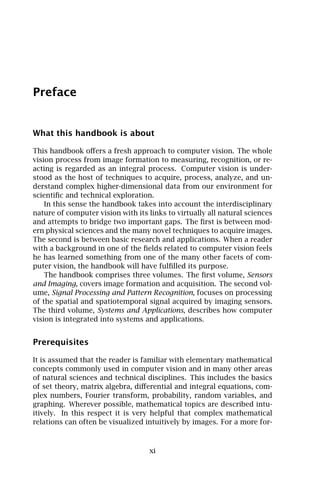
                   Etienne Bertin received the PhD degree in mathematics
                   from Université Joseph Fourier in 1994. From 1990 to
                   1995 he worked on various topics in image analysis and
                   computational geometry. Since 1995, he has been an as-
                   sistant professor at the Université Pierre Mendès France
                   in the Laboratoire de statistique et d’analyses de don-
                   nées; he works on stochastic geometry.
                   Dr. Etienne Bertin
                   Laboratoire de Statistique et d’analyse de donnés
                   Université Pierre Mendès, Grenoble, France
bertin@labsad.upmf-grenoble.fr
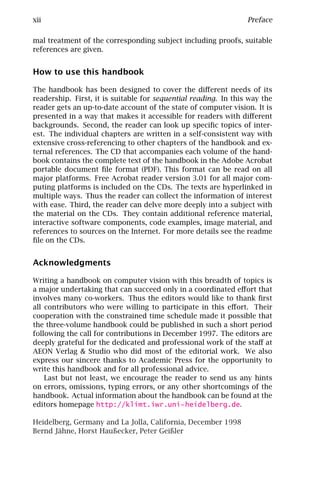
                    Anke Meyer-Bäse received her M. S. and the PhD in elec-
                    trical engineering from the Darmstadt Institute of Tech-
                    nology in 1990 and 1995, respectively. From 1995 to
                    1996 she was a postdoctoral fellow with the Federal Insti-
                    tute of Neurobiology, Magdeburg, Germany. Since 1996
                    she was a visiting assistant professor with the Dept. of
                    Electrical Engineering, University of Florida, Gainesville,
                    USA. She received the Max-Kade award in Neuroengineer-
                    ing in 1996 and the Lise-Meitner prize in 1997. Her re-
                    search interests include neural networks, image process-
                    ing, biomedicine, speech recognition, and theory of non-
linear systems.
Dr. Anke Meyer-Bäse, Dept. of Electrical Engineering and Computer Science,
University of Florida, 454 New Engineering Building 33, Center Drive
PO Box 116130, Gainesville, FL 32611-6130, U.S., anke@alpha.ee.ufl.edu
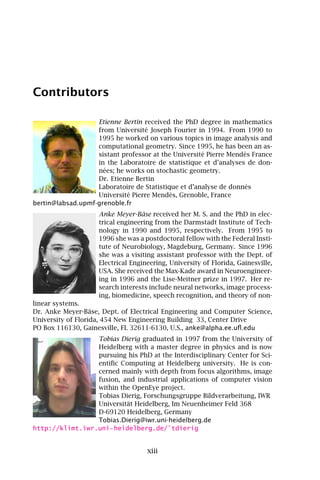
                 Tobias Dierig graduated in 1997 from the University of
                 Heidelberg with a master degree in physics and is now
                 pursuing his PhD at the Interdisciplinary Center for Sci-
                 entific Computing at Heidelberg university. He is con-
                 cerned mainly with depth from focus algorithms, image
                 fusion, and industrial applications of computer vision
                 within the OpenEye project.
                 Tobias Dierig, Forschungsgruppe Bildverarbeitung, IWR
                 Universität Heidelberg, Im Neuenheimer Feld 368
                 D-69120 Heidelberg, Germany
                 Tobias.Dierig@iwr.uni-heidelberg.de
http://klimt.iwr.uni-heidelberg.de/˜tdierig


                                    xiii
xiv                                                              Contributors

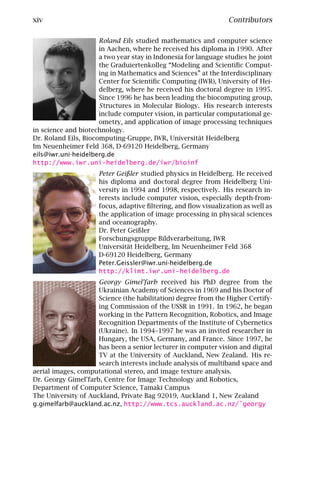
                      Roland Eils studied mathematics and computer science
                      in Aachen, where he received his diploma in 1990. After
                      a two year stay in Indonesia for language studies he joint
                      the Graduiertenkolleg “Modeling and Scientific Comput-
                      ing in Mathematics and Sciences” at the Interdisciplinary
                      Center for Scientific Computing (IWR), University of Hei-
                      delberg, where he received his doctoral degree in 1995.
                      Since 1996 he has been leading the biocomputing group,
                      S tructures in Molecular Biology. His research interests
                      include computer vision, in particular computational ge-
                      ometry, and application of image processing techniques
in science and biotechnology.
Dr. Roland Eils, Biocomputing-Gruppe, IWR, Universität Heidelberg
Im Neuenheimer Feld 368, D-69120 Heidelberg, Germany
eils@iwr.uni-heidelberg.de
http://www.iwr.uni-heidelberg.de/iwr/bioinf
                      Peter Geißler studied physics in Heidelberg. He received
                      his diploma and doctoral degree from Heidelberg Uni-
                      versity in 1994 and 1998, respectively. His research in-
                      terests include computer vision, especially depth-from-
                      focus, adaptive filtering, and flow visualization as well as
                      the application of image processing in physical sciences
                      and oceanography.
                      Dr. Peter Geißler
                      Forschungsgruppe Bildverarbeitung, IWR
                      Universität Heidelberg, Im Neuenheimer Feld 368
                      D-69120 Heidelberg, Germany
                      Peter.Geissler@iwr.uni-heidelberg.de
                      http://klimt.iwr.uni-heidelberg.de
                     Georgy Gimel’farb received his PhD degree from the
                     Ukrainian Academy of Sciences in 1969 and his Doctor of
                     Science (the habilitation) degree from the Higher Certify-
                     ing Commission of the USSR in 1991. In 1962, he began
                     working in the Pattern Recognition, Robotics, and Image
                     Recognition Departments of the Institute of Cybernetics
                     (Ukraine). In 1994–1997 he was an invited researcher in
                     Hungary, the USA, Germany, and France. Since 1997, he
                     has been a senior lecturer in computer vision and digital
                     TV at the University of Auckland, New Zealand. His re-
                     search interests include analysis of multiband space and
aerial images, computational stereo, and image texture analysis.
Dr. Georgy Gimel’farb, Centre for Image Technology and Robotics,
Department of Computer Science, Tamaki Campus
The University of Auckland, Private Bag 92019, Auckland 1, New Zealand
g.gimelfarb@auckland.ac.nz, http://www.tcs.auckland.ac.nz/˜georgy
Contributors                                                                  xv

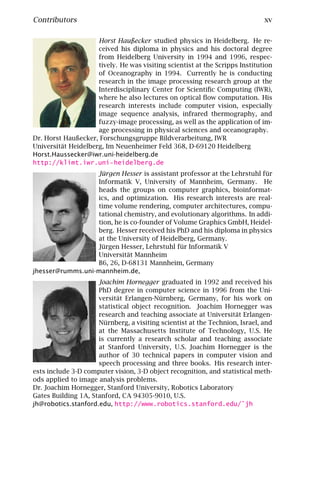
                     Horst Haußecker studied physics in Heidelberg. He re-
                     ceived his diploma in physics and his doctoral degree
                     from Heidelberg University in 1994 and 1996, respec-
                     tively. He was visiting scientist at the Scripps Institution
                     of Oceanography in 1994. Currently he is conducting
                     research in the image processing research group at the
                     Interdisciplinary Center for Scientific Computing (IWR),
                     where he also lectures on optical flow computation. His
                     research interests include computer vision, especially
                     image sequence analysis, infrared thermography, and
                     fuzzy-image processing, as well as the application of im-
                     age processing in physical sciences and oceanography.
Dr. Horst Haußecker, Forschungsgruppe Bildverarbeitung, IWR
Universität Heidelberg, Im Neuenheimer Feld 368, D-69120 Heidelberg
Horst.Haussecker@iwr.uni-heidelberg.de
http://klimt.iwr.uni-heidelberg.de
                  Jürgen Hesser is assistant professor at the Lehrstuhl für
                  Informatik V, University of Mannheim, Germany. He
                  heads the groups on computer graphics, bioinformat-
                  ics, and optimization. His research interests are real-
                  time volume rendering, computer architectures, compu-
                  tational chemistry, and evolutionary algorithms. In addi-
                  tion, he is co-founder of Volume Graphics GmbH, Heidel-
                  berg. Hesser received his PhD and his diploma in physics
                  at the University of Heidelberg, Germany.
                  Jürgen Hesser, Lehrstuhl für Informatik V
                  Universität Mannheim
                  B6, 26, D-68131 Mannheim, Germany
jhesser@rumms.uni-mannheim.de,
                     Joachim Hornegger graduated in 1992 and received his
                     PhD degree in computer science in 1996 from the Uni-
                     versität Erlangen-Nürnberg, Germany, for his work on
                     statistical object recognition. Joachim Hornegger was
                     research and teaching associate at Universität Erlangen-
                     Nürnberg, a visiting scientist at the Technion, Israel, and
                     at the Massachusetts Institute of Technology, U.S. He
                     is currently a research scholar and teaching associate
                     at Stanford University, U.S. Joachim Hornegger is the
                     author of 30 technical papers in computer vision and
                     speech processing and three books. His research inter-
ests include 3-D computer vision, 3-D object recognition, and statistical meth-
ods applied to image analysis problems.
Dr. Joachim Hornegger, Stanford University, Robotics Laboratory
Gates Building 1A, Stanford, CA 94305-9010, U.S.
jh@robotics.stanford.edu, http://www.robotics.stanford.edu/˜jh
xvi                                                             Contributors

                     Bernd Jähne studied physics in Saarbrücken and Hei-
                     delberg. He received his diploma, doctoral degree, and
                     habilitation degree from Heidelberg University in 1977,
                     1980, and 1985, respectively, and a habilitation de-
                     gree in applied computer science from the University of
                     Hamburg-Harburg in 1992. Since 1988 he has been a Ma-
                     rine Research Physicist at Scripps Institution of Oceanog-
                     raphy, University of California, and, since 1994, he has
                     been professor of physics at the Interdisciplinary Center
                     of Scientific Computing. He leads the research group on
                     image processing. His research interests include com-
                     puter vision, especially filter design and image sequence
                     analysis, the application of image processing techniques
in science and industry, and small-scale air-sea interaction processes.
Prof. Dr. Bernd Jähne, Forschungsgruppe Bildverarbeitung, IWR
Universität Heidelberg, Im Neuenheimer Feld 368, D-69120 Heidelberg
Bernd.Jaehne@iwr.uni-heidelberg.de
http://klimt.iwr.uni-heidelberg.de
                      Reinhard Klette studied mathematics at Halle University,
                      received his master degree and doctor of natural science
                      degree in mathematics at Jena University, became a do-
                      cent in computer science, and was a professor of com-
                      puter vision at Berlin Technical University. Since June
                      1996 he has been professor of information technology
                      in the Department of Computer Science at the University
                      of Auckland. His research interests include theoretical
                      and applied topics in image processing, pattern recogni-
                      tion, image analysis, and image understanding. He has
published books about image processing and shape reconstruction and was
chairman of several international conferences and workshops on computer
vision. Recently, his research interests have been directed at 3-D biomedical
image analysis with digital geometry and computational geometry as major
subjects.
Prof. Dr. Reinhard Klette, Centre for Image Technology and Robotics,
Computer Science Department, Tamaki Campus
The Auckland University, Private Bag 92019, Auckland, New Zealand
r.klette@auckland.ac.nz, http://citr.auckland.ac.nz/˜rklette
                     Christoph Klauck received his diploma in computer sci-
                     ence and mathematics from the University of Kaiser-
                     slautern, Germany, in 1990. From 1990 to 1994 he
                     worked as research scientist at the German Research
                     Center for Artificial Intelligence Inc. (DFKI GmbH) at
                     Kaiserslautern. In 1994 he finished his dissertation in
                     computer science. Since then he has been involved in
                     the IRIS project at the University of Bremen (Artificial
                     Intelligence Group). His primary research interests in-
                     clude graph grammars and rewriting systems in general,
                     knowledge representation, and ontologies.
Contributors                                                               xvii

Prof. Dr. Christoph Klauck, Dep. of Electrical Eng. and Computer Science
University of Hamburg (FH), Berliner Tor 3, D-20099 Hamburg, Germany
cklauck@t-online.de, http://fbi010.informatik.fh-hamburg.de/˜klauck


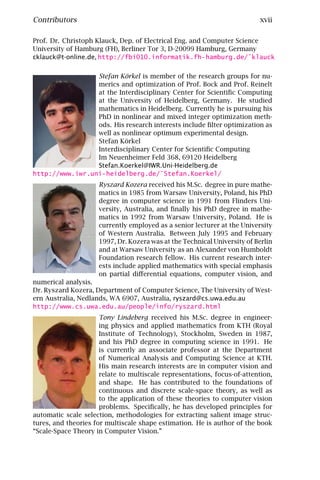
                 Stefan Körkel is member of the research groups for nu-
                 merics and optimization of Prof. Bock and Prof. Reinelt
                 at the Interdisciplinary Center for Scientific Computing
                 at the University of Heidelberg, Germany. He studied
                 mathematics in Heidelberg. Currently he is pursuing his
                 PhD in nonlinear and mixed integer optimization meth-
                 ods. His research interests include filter optimization as
                 well as nonlinear optimum experimental design.
                 Stefan Körkel
                 Interdisciplinary Center for Scientific Computing
                 Im Neuenheimer Feld 368, 69120 Heidelberg
                 Stefan.Koerkel@IWR.Uni-Heidelberg.de
http://www.iwr.uni-heidelberg.de/˜Stefan.Koerkel/
                     Ryszard Kozera received his M.Sc. degree in pure mathe-
                     matics in 1985 from Warsaw University, Poland, his PhD
                     degree in computer science in 1991 from Flinders Uni-
                     versity, Australia, and finally his PhD degree in mathe-
                     matics in 1992 from Warsaw University, Poland. He is
                     currently employed as a senior lecturer at the University
                     of Western Australia. Between July 1995 and February
                     1997, Dr. Kozera was at the Technical University of Berlin
                     and at Warsaw University as an Alexander von Humboldt
                     Foundation research fellow. His current research inter-
                     ests include applied mathematics with special emphasis
                     on partial differential equations, computer vision, and
numerical analysis.
Dr. Ryszard Kozera, Department of Computer Science, The University of West-
ern Australia, Nedlands, WA 6907, Australia, ryszard@cs.uwa.edu.au
http://www.cs.uwa.edu.au/people/info/ryszard.html
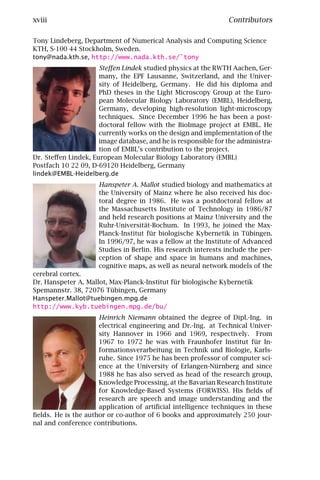
                      Tony Lindeberg received his M.Sc. degree in engineer-
                      ing physics and applied mathematics from KTH (Royal
                      Institute of Technology), Stockholm, Sweden in 1987,
                      and his PhD degree in computing science in 1991. He
                      is currently an associate professor at the Department
                      of Numerical Analysis and Computing Science at KTH.
                      His main research interests are in computer vision and
                      relate to multiscale representations, focus-of-attention,
                      and shape. He has contributed to the foundations of
                      continuous and discrete scale-space theory, as well as
                      to the application of these theories to computer vision
                      problems. Specifically, he has developed principles for
automatic scale selection, methodologies for extracting salient image struc-
tures, and theories for multiscale shape estimation. He is author of the book
“Scale-Space Theory in Computer Vision.”
xviii                                                           Contributors

Tony Lindeberg, Department of Numerical Analysis and Computing Science
KTH, S-100 44 Stockholm, Sweden.
tony@nada.kth.se, http://www.nada.kth.se/˜tony
                     Steffen Lindek studied physics at the RWTH Aachen, Ger-
                     many, the EPF Lausanne, Switzerland, and the Univer-
                     sity of Heidelberg, Germany. He did his diploma and
                     PhD theses in the Light Microscopy Group at the Euro-
                     pean Molecular Biology Laboratory (EMBL), Heidelberg,
                     Germany, developing high-resolution light-microscopy
                     techniques. Since December 1996 he has been a post-
                     doctoral fellow with the BioImage project at EMBL. He
                     currently works on the design and implementation of the
                     image database, and he is responsible for the administra-
                     tion of EMBL’s contribution to the project.
Dr. Steffen Lindek, European Molecular Biology Laboratory (EMBL)
Postfach 10 22 09, D-69120 Heidelberg, Germany
lindek@EMBL-Heidelberg.de
                     Hanspeter A. Mallot studied biology and mathematics at
                     the University of Mainz where he also received his doc-
                     toral degree in 1986. He was a postdoctoral fellow at
                     the Massachusetts Institute of Technology in 1986/87
                     and held research positions at Mainz University and the
                     Ruhr-Universität-Bochum. In 1993, he joined the Max-
                     Planck-Institut für biologische Kybernetik in Tübingen.
                     In 1996/97, he was a fellow at the Institute of Advanced
                     Studies in Berlin. His research interests include the per-
                     ception of shape and space in humans and machines,
                     cognitive maps, as well as neural network models of the
cerebral cortex.
Dr. Hanspeter A. Mallot, Max-Planck-Institut für biologische Kybernetik
Spemannstr. 38, 72076 Tübingen, Germany
Hanspeter.Mallot@tuebingen.mpg.de
http://www.kyb.tuebingen.mpg.de/bu/
                     Heinrich Niemann obtained the degree of Dipl.-Ing. in
                     electrical engineering and Dr.-Ing. at Technical Univer-
                     sity Hannover in 1966 and 1969, respectively. From
                     1967 to 1972 he was with Fraunhofer Institut für In-
                     formationsverarbeitung in Technik und Biologie, Karls-
                     ruhe. Since 1975 he has been professor of computer sci-
                     ence at the University of Erlangen-Nürnberg and since
                     1988 he has also served as head of the research group,
                     Knowledge Processing, at the Bavarian Research Institute
                     for Knowledge-Based Systems (FORWISS). His fields of
                     research are speech and image understanding and the
                     application of artificial intelligence techniques in these
fields. He is the author or co-author of 6 books and approximately 250 jour-
nal and conference contributions.
Contributors                                                                xix

Prof. Dr.-Ing. H. Niemann, Lehrstuhl für Mustererkennung (Informatik 5)
Universität Erlangen-Nürnberg, Martensstraße 3, 91058 Erlangen, Germany
niemann@informatik.uni-erlangen.de
http://www5.informatik.uni-erlangen.de
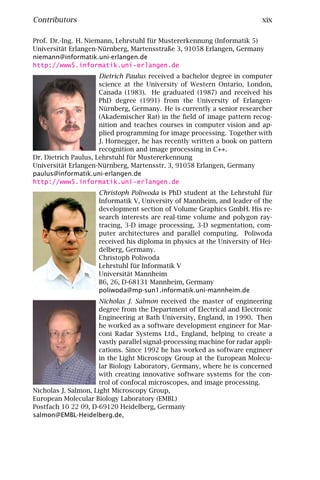
                      Dietrich Paulus received a bachelor degree in computer
                      science at the University of Western Ontario, London,
                      Canada (1983). He graduated (1987) and received his
                      PhD degree (1991) from the University of Erlangen-
                      Nürnberg, Germany. He is currently a senior researcher
                      (Akademischer Rat) in the field of image pattern recog-
                      nition and teaches courses in computer vision and ap-
                      plied programming for image processing. Together with
                      J. Hornegger, he has recently written a book on pattern
                      recognition and image processing in C++.
Dr. Dietrich Paulus, Lehrstuhl für Mustererkennung
Universität Erlangen-Nürnberg, Martensstr. 3, 91058 Erlangen, Germany
paulus@informatik.uni-erlangen.de
http://www5.informatik.uni-erlangen.de
                      Christoph Poliwoda is PhD student at the Lehrstuhl für
                      Informatik V, University of Mannheim, and leader of the
                      development section of Volume Graphics GmbH. His re-
                      search interests are real-time volume and polygon ray-
                      tracing, 3-D image processing, 3-D segmentation, com-
                      puter architectures and parallel computing. Poliwoda
                      received his diploma in physics at the University of Hei-
                      delberg, Germany.
                      Christoph Poliwoda
                      Lehrstuhl für Informatik V
                      Universität Mannheim
                      B6, 26, D-68131 Mannheim, Germany
                      poliwoda@mp-sun1.informatik.uni-mannheim.de
                      Nicholas J. Salmon received the master of engineering
                      degree from the Department of Electrical and Electronic
                      Engineering at Bath University, England, in 1990. Then
                      he worked as a software development engineer for Mar-
                      coni Radar Systems Ltd., England, helping to create a
                      vastly parallel signal-processing machine for radar appli-
                      cations. Since 1992 he has worked as software engineer
                      in the Light Microscopy Group at the European Molecu-
                      lar Biology Laboratory, Germany, where he is concerned
                      with creating innovative software systems for the con-
                      trol of confocal microscopes, and image processing.
Nicholas J. Salmon, Light Microscopy Group,
European Molecular Biology Laboratory (EMBL)
Postfach 10 22 09, D-69120 Heidelberg, Germany
salmon@EMBL-Heidelberg.de,
xx                                                              Contributors

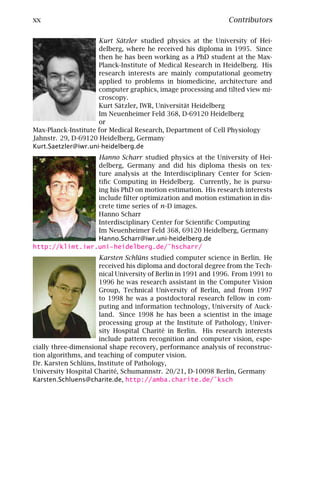
                     Kurt Sätzler studied physics at the University of Hei-
                     delberg, where he received his diploma in 1995. Since
                     then he has been working as a PhD student at the Max-
                     Planck-Institute of Medical Research in Heidelberg. His
                     research interests are mainly computational geometry
                     applied to problems in biomedicine, architecture and
                     computer graphics, image processing and tilted view mi-
                     croscopy.
                     Kurt Sätzler, IWR, Universität Heidelberg
                     Im Neuenheimer Feld 368, D-69120 Heidelberg
                     or
Max-Planck-Institute for Medical Research, Department of Cell Physiology
Jahnstr. 29, D-69120 Heidelberg, Germany
Kurt.Saetzler@iwr.uni-heidelberg.de
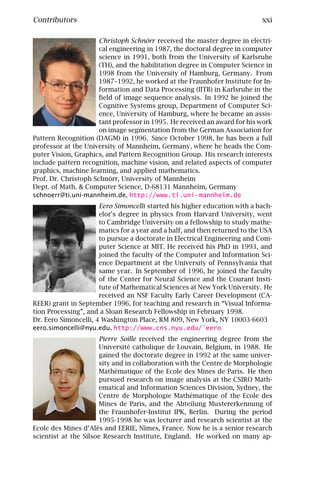
                 Hanno Scharr studied physics at the University of Hei-
                 delberg, Germany and did his diploma thesis on tex-
                 ture analysis at the Interdisciplinary Center for Scien-
                 tific Computing in Heidelberg. Currently, he is pursu-
                 ing his PhD on motion estimation. His research interests
                 include filter optimization and motion estimation in dis-
                 crete time series of n-D images.
                 Hanno Scharr
                 Interdisciplinary Center for Scientific Computing
                 Im Neuenheimer Feld 368, 69120 Heidelberg, Germany
                 Hanno.Scharr@iwr.uni-heidelberg.de
http://klimt.iwr.uni-heidelberg.de/˜hscharr/
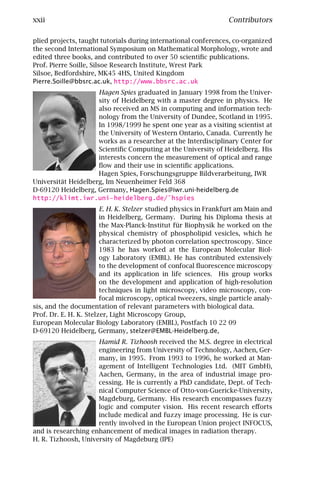
                      Karsten Schlüns studied computer science in Berlin. He
                      received his diploma and doctoral degree from the Tech-
                      nical University of Berlin in 1991 and 1996. From 1991 to
                      1996 he was research assistant in the Computer Vision
                      Group, Technical University of Berlin, and from 1997
                      to 1998 he was a postdoctoral research fellow in com-
                      puting and information technology, University of Auck-
                      land. Since 1998 he has been a scientist in the image
                      processing group at the Institute of Pathology, Univer-
                      sity Hospital Charité in Berlin. His research interests
                      include pattern recognition and computer vision, espe-
cially three-dimensional shape recovery, performance analysis of reconstruc-
tion algorithms, and teaching of computer vision.
Dr. Karsten Schlüns, Institute of Pathology,
University Hospital Charité, Schumannstr. 20/21, D-10098 Berlin, Germany
Karsten.Schluens@charite.de, http://amba.charite.de/˜ksch
Contributors                                                                xxi

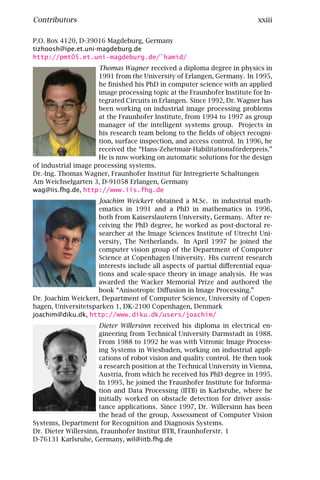
                      Christoph Schnörr received the master degree in electri-
                      cal engineering in 1987, the doctoral degree in computer
                      science in 1991, both from the University of Karlsruhe
                      (TH), and the habilitation degree in Computer Science in
                      1998 from the University of Hamburg, Germany. From
                      1987–1992, he worked at the Fraunhofer Institute for In-
                      formation and Data Processing (IITB) in Karlsruhe in the
                      field of image sequence analysis. In 1992 he joined the
                      Cognitive Systems group, Department of Computer Sci-
                      ence, University of Hamburg, where he became an assis-
                      tant professor in 1995. He received an award for his work
                      on image segmentation from the German Association for
Pattern Recognition (DAGM) in 1996. Since October 1998, he has been a full
professor at the University of Mannheim, Germany, where he heads the Com-
puter Vision, Graphics, and Pattern Recognition Group. His research interests
include pattern recognition, machine vision, and related aspects of computer
graphics, machine learning, and applied mathematics.
Prof. Dr. Christoph Schnörr, University of Mannheim
Dept. of Math. & Computer Science, D-68131 Mannheim, Germany
schnoerr@ti.uni-mannheim.de, http://www.ti.uni-mannheim.de
                      Eero Simoncelli started his higher education with a bach-
                      elor’s degree in physics from Harvard University, went
                      to Cambridge University on a fellowship to study mathe-
                      matics for a year and a half, and then returned to the USA
                      to pursue a doctorate in Electrical Engineering and Com-
                      puter Science at MIT. He received his PhD in 1993, and
                      joined the faculty of the Computer and Information Sci-
                      ence Department at the University of Pennsylvania that
                      same year. In September of 1996, he joined the faculty
                      of the Center for Neural Science and the Courant Insti-
                      tute of Mathematical Sciences at New York University. He
                      received an NSF Faculty Early Career Development (CA-
REER) grant in September 1996, for teaching and research in “Visual Informa-
tion Processing”, and a Sloan Research Fellowship in February 1998.
Dr. Eero Simoncelli, 4 Washington Place, RM 809, New York, NY 10003-6603
eero.simoncelli@nyu.edu, http://www.cns.nyu.edu/˜eero
                      Pierre Soille received the engineering degree from the
                      Université catholique de Louvain, Belgium, in 1988. He
                      gained the doctorate degree in 1992 at the same univer-
                      sity and in collaboration with the Centre de Morphologie
                      Mathématique of the Ecole des Mines de Paris. He then
                      pursued research on image analysis at the CSIRO Math-
                      ematical and Information Sciences Division, Sydney, the
                      Centre de Morphologie Mathématique of the Ecole des
                      Mines de Paris, and the Abteilung Mustererkennung of
                      the Fraunhofer-Institut IPK, Berlin. During the period
                      1995-1998 he was lecturer and research scientist at the
Ecole des Mines d’Alès and EERIE, Nîmes, France. Now he is a senior research
scientist at the Silsoe Research Institute, England. He worked on many ap-
xxii                                                              Contributors

plied projects, taught tutorials during international conferences, co-organized
the second International Symposium on Mathematical Morphology, wrote and
edited three books, and contributed to over 50 scientific publications.
Prof. Pierre Soille, Silsoe Research Institute, Wrest Park
Silsoe, Bedfordshire, MK45 4HS, United Kingdom
Pierre.Soille@bbsrc.ac.uk, http://www.bbsrc.ac.uk
                     Hagen Spies graduated in January 1998 from the Univer-
                     sity of Heidelberg with a master degree in physics. He
                     also received an MS in computing and information tech-
                     nology from the University of Dundee, Scotland in 1995.
                     In 1998/1999 he spent one year as a visiting scientist at
                     the University of Western Ontario, Canada. Currently he
                     works as a researcher at the Interdisciplinary Center for
                     Scientific Computing at the University of Heidelberg. His
                     interests concern the measurement of optical and range
                     flow and their use in scientific applications.
                     Hagen Spies, Forschungsgruppe Bildverarbeitung, IWR
Universität Heidelberg, Im Neuenheimer Feld 368
D-69120 Heidelberg, Germany, Hagen.Spies@iwr.uni-heidelberg.de
http://klimt.iwr.uni-heidelberg.de/˜hspies
                        E. H. K. Stelzer studied physics in Frankfurt am Main and
                        in Heidelberg, Germany. During his Diploma thesis at
                        the Max-Planck-Institut für Biophysik he worked on the
                        physical chemistry of phospholipid vesicles, which he
                        characterized by photon correlation spectroscopy. Since
                        1983 he has worked at the European Molecular Biol-
                        ogy Laboratory (EMBL). He has contributed extensively
                        to the development of confocal fluorescence microscopy
                        and its application in life sciences. His group works
                        on the development and application of high-resolution
                        techniques in light microscopy, video microscopy, con-
                        focal microscopy, optical tweezers, single particle analy-
sis, and the documentation of relevant parameters with biological data.
Prof. Dr. E. H. K. Stelzer, Light Microscopy Group,
European Molecular Biology Laboratory (EMBL), Postfach 10 22 09
D-69120 Heidelberg, Germany, stelzer@EMBL-Heidelberg.de,
                     Hamid R. Tizhoosh received the M.S. degree in electrical
                     engineering from University of Technology, Aachen, Ger-
                     many, in 1995. From 1993 to 1996, he worked at Man-
                     agement of Intelligent Technologies Ltd. (MIT GmbH),
                     Aachen, Germany, in the area of industrial image pro-
                     cessing. He is currently a PhD candidate, Dept. of Tech-
                     nical Computer Science of Otto-von-Guericke-University,
                     Magdeburg, Germany. His research encompasses fuzzy
                     logic and computer vision. His recent research efforts
                     include medical and fuzzy image processing. He is cur-
                     rently involved in the European Union project INFOCUS,
and is researching enhancement of medical images in radiation therapy.
H. R. Tizhoosh, University of Magdeburg (IPE)
Contributors                                                               xxiii

P.O. Box 4120, D-39016 Magdeburg, Germany
tizhoosh@ipe.et.uni-magdeburg.de
http://pmt05.et.uni-magdeburg.de/˜hamid/
                     Thomas Wagner received a diploma degree in physics in
                     1991 from the University of Erlangen, Germany. In 1995,
                     he finished his PhD in computer science with an applied
                     image processing topic at the Fraunhofer Institute for In-
                     tegrated Circuits in Erlangen. Since 1992, Dr. Wagner has
                     been working on industrial image processing problems
                     at the Fraunhofer Institute, from 1994 to 1997 as group
                     manager of the intelligent systems group. Projects in
                     his research team belong to the fields of object recogni-
                     tion, surface inspection, and access control. In 1996, he
                     received the “Hans-Zehetmair-Habilitationsförderpreis.”
                     He is now working on automatic solutions for the design
of industrial image processing systems.
Dr.-Ing. Thomas Wagner, Fraunhofer Institut für Intregrierte Schaltungen
Am Weichselgarten 3, D-91058 Erlangen, Germany
wag@iis.fhg.de, http://www.iis.fhg.de
                     Joachim Weickert obtained a M.Sc. in industrial math-
                     ematics in 1991 and a PhD in mathematics in 1996,
                     both from Kaiserslautern University, Germany. After re-
                     ceiving the PhD degree, he worked as post-doctoral re-
                     searcher at the Image Sciences Institute of Utrecht Uni-
                     versity, The Netherlands. In April 1997 he joined the
                     computer vision group of the Department of Computer
                     Science at Copenhagen University. His current research
                     interests include all aspects of partial differential equa-
                     tions and scale-space theory in image analysis. He was
                     awarded the Wacker Memorial Prize and authored the
                     book “Anisotropic Diffusion in Image Processing.”
Dr. Joachim Weickert, Department of Computer Science, University of Copen-
hagen, Universitetsparken 1, DK-2100 Copenhagen, Denmark
joachim@diku.dk, http://www.diku.dk/users/joachim/
                      Dieter Willersinn received his diploma in electrical en-
                      gineering from Technical University Darmstadt in 1988.
                      From 1988 to 1992 he was with Vitronic Image Process-
                      ing Systems in Wiesbaden, working on industrial appli-
                      cations of robot vision and quality control. He then took
                      a research position at the Technical University in Vienna,
                      Austria, from which he received his PhD degree in 1995.
                      In 1995, he joined the Fraunhofer Institute for Informa-
                      tion and Data Processing (IITB) in Karlsruhe, where he
                      initially worked on obstacle detection for driver assis-
                      tance applications. Since 1997, Dr. Willersinn has been
                      the head of the group, Assessment of Computer Vision
Systems, Department for Recognition and Diagnosis Systems.
Dr. Dieter Willersinn, Fraunhofer Institut IITB, Fraunhoferstr. 1
D-76131 Karlsruhe, Germany, wil@iitb.fhg.de
xxiv   Contributors
1 Introduction
Bernd Jähne
Interdisziplinäres Zentrum für Wissenschaftliches Rechnen (IWR)
Universität Heidelberg, Germany


    1.1       Signal processing for computer vision . . . . . . . . . . . . . . .                          2
    1.2       Pattern recognition for computer vision . . . . . . . . . . . . . .                          3
    1.3       Computational complexity and fast algorithms . . . . . . . . .                               4
    1.4       Performance evaluation of algorithms . . . . . . . . . . . . . . .                           5
    1.5       References . . . . . . . . . . . . . . . . . . . . . . . . . . . . . . . . .                 6

    The second volume of the Handbook on Computer Vision and Ap-
plications deals with signal processing and pattern recognition. The
signals processed in computer vision originate from the radiance of an
object that is collected by an optical system (Volume 1, Chapter 5). The
irradiance received by a single photosensor or a 2-D array of photosen-
sors through the optical system is converted into an electrical signal
and finally into arrays of digital numbers (Volume 2, Chapter 2). The
whole chain of image formation from the illumination and interaction
of radiation with the object of interest up to the arrays of digital num-
bers stored in the computer is the topic of Volume 1 of this handbook
(subtitled Sensors and Imaging).
    This volume deals with the processing of the signals generated by
imaging sensors and this introduction covers four general topics. Sec-
tion 1.1 discusses in which aspects the processing of higher-dimension-
al signals differs from the processing of 1-D time series. We also elab-
orate on the task of signal processing for computer vision. Pattern
recognition (Section 1.2) plays a central role in computer vision because
it uses the features extracted by lowlevel signal processing to classify
and recognize objects.
    Given the vast amount of data generated by imaging sensors the
question of the computational complexity and of efficient algorithms is
of utmost importance (Section 1.3). Finally, the performance evaluation
of computer vision algorithms (Section 1.4) is a subject that has been
neglected in the past. Consequently, a vast number of algorithms exist
for which the performance characteristics are not sufficiently known.

                                                 1
Handbook of Computer Vision and Applications                              Copyright © 1999 by Academic Press
Volume 2                                                      All rights of reproduction in any form reserved.
Signal Processing and Pattern Recognition                                         ISBN 0–12–379772-1/$30.00
2                                                          1 Introduction

This constitutes a major obstacle for progress of applications using
computer vision techniques.


1.1 Signal processing for computer vision

One-dimensional linear signal processing and system theory is a stan-
dard topic in electrical engineering and is covered by many standard
textbooks, for example, [1, 2]. There is a clear trend that the classical
signal processing community is moving into multidimensional signals,
as indicated, for example, by the new annual international IEEE confer-
ence on image processing (ICIP). This can also be seen from some re-
cently published handbooks on this subject. The digital signal process-
ing handbook by Madisetti and Williams [3] includes several chapters
that deal with image processing. Likewise the transforms and applica-
tions handbook by Poularikas [4] is not restricted to one-dimensional
transforms.
    There are, however, only a few monographs that treat signal pro-
cessing specifically for computer vision and image processing. The
monograph of Lim [5] deals with 2-D signal and image processing and
tries to transfer the classical techniques for the analysis of time series
to 2-D spatial data. Granlund and Knutsson [6] were the first to publish
a monograph on signal processing for computer vision and elaborate on
a number of novel ideas such as tensorial image processing and nor-
malized convolution that did not have their origin in classical signal
processing.
    Time series are 1-D, signals in computer vision are of higher di-
mension. They are not restricted to digital images, that is, 2-D spatial
signals (Chapter 2). Volumetric sampling, image sequences and hyper-
spectral imaging all result in 3-D signals, a combination of any of these
techniques in even higher-dimensional signals.
    How much more complex does signal processing become with in-
creasing dimension? First, there is the explosion in the number of data
points. Already a medium resolution volumetric image with 5123 vox-
els requires 128 MB if one voxel carries just one byte. Storage of even
higher-dimensional data at comparable resolution is thus beyond the
capabilities of today’s computers. Moreover, many applications require
the handling of a huge number of images. This is also why appropriate
databases including images are of importance. An example is discussed
in Chapter 29.
    Higher dimensional signals pose another problem. While we do not
have difficulty in grasping 2-D data, it is already significantly more de-
manding to visualize 3-D data because the human visual system is built
only to see surfaces in 3-D but not volumetric 3-D data. The more di-
mensions are processed, the more important it is that computer graph-
1.2 Pattern recognition for computer vision                                3

ics and computer vision come closer together. This is why this volume
includes a contribution on visualization of volume data (Chapter 28).
    The elementary framework for lowlevel signal processing for com-
puter vision is worked out in part II of this volume. Of central impor-
tance are neighborhood operations (Chapter 5). Chapter 6 focuses on
the design of filters optimized for a certain purpose. Other subjects of
elementary spatial processing include fast algorithms for local averag-
ing (Chapter 7), accurate and fast interpolation (Chapter 8), and image
warping (Chapter 9) for subpixel-accurate signal processing.
    The basic goal of signal processing in computer vision is the extrac-
tion of “suitable features” for subsequent processing to recognize and
classify objects. But what is a suitable feature? This is still less well de-
fined than in other applications of signal processing. Certainly a math-
ematically well-defined description of local structure as discussed in
Chapter 10 is an important basis. The selection of the proper scale for
image processing has recently come into the focus of attention (Chap-
ter 11). As signals processed in computer vision come from dynam-
ical 3-D scenes, important features also include motion (Chapters 13
and 14) and various techniques to infer the depth in scenes includ-
ing stereo (Chapters 17 and 18), shape from shading and photometric
stereo (Chapter 19), and depth from focus (Chapter 20).
    There is little doubt that nonlinear techniques are crucial for fea-
ture extraction in computer vision. However, compared to linear filter
techniques, these techniques are still in their infancy. There is also no
single nonlinear technique but there are a host of such techniques often
specifically adapted to a certain purpose [7]. In this volume, a rather
general class of nonlinear filters by combination of linear convolution
and nonlinear point operations (Chapter 10), and nonlinear diffusion
filtering (Chapter 15) are discussed.


1.2 Pattern recognition for computer vision

In principle, pattern classification is nothing complex. Take some ap-
propriate features and partition the feature space into classes. Why is
it then so difficult for a computer vision system to recognize objects?
The basic trouble is related to the fact that the dimensionality of the in-
put space is so large. In principle, it would be possible to use the image
itself as the input for a classification task, but no real-world classifi-
cation technique—be it statistical, neuronal, or fuzzy—would be able
to handle such high-dimensional feature spaces. Therefore, the need
arises to extract features and to use them for classification.
    Unfortunately, techniques for feature selection have widely been ne-
glected in computer vision. They have not been developed to the same
degree of sophistication as classification where it is meanwhile well un-
4                                                         1 Introduction

derstood that the different techniques, especially statistical and neural
techniques, can been considered under a unified view [8].
    Thus part IV of this volume focuses in part on some more advanced
feature-extraction techniques. An important role in this aspect is played
by morphological operators (Chapter 21) because they manipulate the
shape of objects in images. Fuzzy image processing (Chapter 22) con-
tributes a tool to handle vague data and information.
    The remainder of part IV focuses on another major area in com-
puter vision. Object recognition can be performed only if it is possible
to represent the knowledge in an appropriate way. In simple cases the
knowledge can just be rested in simple models. Probabilistic model-
ing in computer vision is discussed in Chapter 26. In more complex
cases this is not sufficient. The graph theoretical concepts presented
in Chapter 24 are one of the bases for knowledge-based interpretation
of images as presented in Chapter 27.


1.3 Computational complexity and fast algorithms

The processing of huge amounts of data in computer vision becomes a
serious challenge if the number of computations increases more than
linear with the number of data points, M = N D (D is the dimension
of the signal). Already an algorithm that is of order O(M 2 ) may be
prohibitively slow. Thus it is an important goal to achieve O(M) or at
least O(M ld M) performance of all pixel-based algorithms in computer
vision. Much effort has been devoted to the design of fast algorithms,
that is, performance of a given task with a given computer system in a
minimum amount of time. This does not mean merely minimizing the
number of computations. Often it is equally or even more important
to minimize the number of memory accesses.
    Point operations are of linear order and take cM operations. Thus
they do not pose a problem. Neighborhood operations are still of lin-
ear order in the number of pixels but the constant c may become quite
large, especially for signals with high dimensions. This is why there is
already a need to develop fast neighborhood operations. Brute force
implementations of global transforms such as the Fourier transform re-
quire cM 2 operations and can thus only be used at all if fast algorithms
are available. Such algorithms are discussed in Section 3.4. Many other
algorithms in computer vision, such as correlation, correspondence
analysis, and graph search algorithms are also of polynomial order,
some of them even of exponential order.
    A general breakthrough in the performance of more complex al-
gorithms in computer vision was the introduction of multiresolutional
data structures that are discussed in Chapters 4 and 14. All chapters
1.4 Performance evaluation of algorithms                                5

about elementary techniques for processing of spatial data (Chapters 5–
10) also deal with efficient algorithms.


1.4 Performance evaluation of algorithms

A systematic evaluation of the algorithms for computer vision has been
widely neglected. For a newcomer to computer vision with an engi-
neering background or a general education in natural sciences this is a
strange experience. It appears to him as if one would present results
of measurements without giving error bars or even thinking about pos-
sible statistical and systematic errors.
    What is the cause of this situation? On the one side, it is certainly
true that some problems in computer vision are very hard and that it
is even harder to perform a sophisticated error analysis. On the other
hand, the computer vision community has ignored the fact to a large
extent that any algorithm is only as good as its objective and solid
evaluation and verification.
    Fortunately, this misconception has been recognized in the mean-
time and there are serious efforts underway to establish generally ac-
cepted rules for the performance analysis of computer vision algorithms.
We give here just a brief summary and refer for details to Haralick et al.
[9] and for a practical example to Volume 3, Chapter 7. The three major
criteria for the performance of computer vision algorithms are:
 Successful solution of task. Any practitioner gives this a top priority.
   But also the designer of an algorithm should define precisely for
   which task it is suitable and what the limits are.
 Accuracy. This includes an analysis of the statistical and systematic
   errors under carefully defined conditions (such as given signal-to-
   noise ratio (SNR), etc.).
 Speed. Again this is an important criterion for the applicability of an
   algorithm.
There are different ways to evaluate algorithms according to the fore-
mentioned criteria. Ideally this should include three classes of studies:
 Analytical studies. This is the mathematically most rigorous way to
  verify algorithms, check error propagation, and predict catastrophic
  failures.
 Performance tests with computer generated images. These tests are
   useful as they can be carried out under carefully controlled condi-
   tions.
 Performance tests with real-world images. This is the final test for
   practical applications.
6                                                                    1 Introduction

   Much of the material presented in this volume is written in the spirit
of a careful and mathematically well-founded analysis of the methods
that are described although the performance evaluation techniques are
certainly more advanced in some areas than in others.


1.5 References
[1] Oppenheim, A. V. and Schafer, R. W., (1989). Discrete-time Signal Process-
    ing. Prentice-Hall Signal Processing Series. Englewood Cliffs, NJ: Prentice-
    Hall.
[2] Proakis, J. G. and Manolakis, D. G., (1992). Digital Signal Processing. Prin-
    ciples, Algorithms, and Applications. New York: McMillan.
[3] Madisetti, V. K. and Williams, D. B. (eds.), (1997). The Digital Signal Pro-
    cessing Handbook. Boca Raton, FL: CRC Press.
[4] Poularikas, A. D. (ed.), (1996). The Transforms and Applications Handbook.
    Boca Raton, FL: CRC Press.
[5] Lim, J. S., (1990). Two-dimensional Signal and Image Processing. Englewood
    Cliffs, NJ: Prentice-Hall.
[6] Granlund, G. H. and Knutsson, H., (1995). Signal Processing for Computer
    Vision. Norwell, MA: Kluwer Academic Publishers.
[7] Pitas, I. and Venetsanopoulos, A. N., (1990). Nonlinear Digital Filters. Prin-
    ciples and Applications. Norwell, MA: Kluwer Academic Publishers.
[8] Schürmann, J., (1996). Pattern Classification, a Unified View of Statistical
    and Neural Approaches. New York: John Wiley & Sons.
[9] Haralick, R. M., Klette, R., Stiehl, H.-S., and Viergever, M. (eds.), (1999). Eval-
    uation and Validation of Computer Vision Algorithms. Boston: Kluwer.
Part I

Signal Representation
2 Continuous and Digital Signals
Bernd Jähne
Interdisziplinäres Zentrum für Wissenschaftliches Rechnen (IWR)
Universität Heidelberg, Germany


    2.1       Introduction . . . . . . . . . . . . . . . . . . . . . . . . . . . . . . . .                  10
    2.2       Continuous signals . . . . . . . . . . . . . . . . . . . . . . . . . . . .                    10
              2.2.1       Types of signals . . . . . . . . . . . . . . . . . . . . . . . .                  10
              2.2.2       Unified description . . . . . . . . . . . . . . . . . . . . . .                    11
              2.2.3       Multichannel signals . . . . . . . . . . . . . . . . . . . . .                    12
    2.3       Discrete signals . . . . . . . . . . . . . . . . . . . . . . . . . . . . . .                  13
              2.3.1       Regular two-dimensional lattices . . . . . . . . . . . . .                        13
              2.3.2       Regular higher-dimensional lattices . . . . . . . . . . . .                       16
              2.3.3       Irregular lattices . . . . . . . . . . . . . . . . . . . . . . . .                17
              2.3.4       Metric in digital images . . . . . . . . . . . . . . . . . . . .                  17
              2.3.5       Neighborhood relations . . . . . . . . . . . . . . . . . . .                      19
              2.3.6       Errors in object position and geometry . . . . . . . . .                          20
    2.4       Relation between continuous and discrete signals . . . . . . .                                23
              2.4.1       Image formation . . . . . . . . . . . . . . . . . . . . . . . .                   24
              2.4.2       Sampling theorem . . . . . . . . . . . . . . . . . . . . . . .                    25
              2.4.3       Aliasing . . . . . . . . . . . . . . . . . . . . . . . . . . . . . .              28
              2.4.4       Reconstruction from samples . . . . . . . . . . . . . . .                         28
    2.5       Quantization . . . . . . . . . . . . . . . . . . . . . . . . . . . . . . . .                  30
              2.5.1       Equidistant quantization . . . . . . . . . . . . . . . . . . .                    30
              2.5.2       Unsigned or signed representation . . . . . . . . . . . .                         31
              2.5.3       Nonequidistant quantization . . . . . . . . . . . . . . . .                       32
    2.6       References . . . . . . . . . . . . . . . . . . . . . . . . . . . . . . . . .                  34


                                                    9
Handbook of Computer Vision and Applications                                 Copyright © 1999 by Academic Press
Volume 2                                                         All rights of reproduction in any form reserved.
Signal Processing and Pattern Recognition                                            ISBN 0–12–379772-1/$30.00
10                                    2 Continuous and Digital Signals

2.1 Introduction

Images are signals with two spatial dimensions. This chapter deals
with signals of arbitrary dimensions. This generalization is very useful
because computer vision is not restricted solely to 2-D signals. On the
one hand, higher-dimensional signals are encountered. Dynamic scenes
require the analysis of image sequences; the exploration of 3-D space
requires the acquisition of volumetric images. Scientific exploration of
complex phenomena is significantly enhanced if images not only of a
single parameter but of many parameters are acquired. On the other
hand, signals of lower dimensionality are also of importance when a
computer vision system is integrated into a larger system and image
data are fused with time series from point measuring sensors.
   Thus this chapter deals with continuous (Section 2.2) and discrete
(Section 2.3) representations of signals with arbitrary dimensions. While
the continuous representation is very useful for a solid mathematical
foundation of signal processing, real-world sensors deliver and digital
computers handle only discrete data. Given the two representations,
the relation between them is of major importance. Section 2.4 dis-
cusses the spatial and temporal sampling on signals while Section 2.5
treats quantization, the conversion of a continuous signal into digital
numbers.


2.2 Continuous signals

2.2.1 Types of signals

An important characteristic of a signal is its dimension. A zero-dimen-
sional signal results from the measurement of a single quantity at a
single point in space and time. Such a single value can also be averaged
over a certain time period and area. There are several ways to extend
a zero-dimensional signal into a 1-D signal (Table 2.1). A time series
records the temporal course of a signal in time, while a profile does the
same in a spatial direction or along a certain path.
    A 1-D signal is also obtained if certain experimental parameters of
the measurement are continuously changed and the measured parame-
ter is recorded as a function of some control parameters. With respect
to optics, the most obvious parameter is the wavelength of the electro-
magnetic radiation received by a radiation detector. When radiation is
recorded as a function of the wavelength, a spectrum is obtained. The
wavelength is only one of the many parameters that could be consid-
ered. Others could be temperature, pressure, humidity, concentration
of a chemical species, and any other properties that may influence the
measured quantity.
2.2 Continuous signals                                                                 11


      Table 2.1: Some types of signals g depending on D parameters

D Type of signal                                                    Function

0   Measurement at a single point in space and time                 g
1   Time series                                                     g(t)
1   Profile                                                          g(x)
1   Spectrum                                                        g(λ)
2   Image                                                           g(x, y)
2   Time series of profiles                                          g(x, t)
2   Time series of spectra                                          g(λ, t)
3   Volumetric image                                                g(x, y, z)
3   Image sequence                                                  g(x, y, t)
3   Hyperspectral image                                             g(x, y, λ)
4   Volumetric image sequence                                       g(x, y, z, t)
4   Hyperspectral image sequence                                    g(x, y, λ, t)
5   Hyperspectral volumetric image sequence                         g(x, y, z, λ, t)


    With this general approach to multidimensional signal processing,
it is obvious that an image is only one of the many possibilities of a
2-D signal. Other 2-D signals are, for example, time series of profiles or
spectra. With increasing dimension, more types of signals are possible
as summarized in Table 2.1. A 5-D signal is constituted by a hyperspec-
tral volumetric image sequence.

2.2.2 Unified description

Mathematically all these different types of multidimensional signals can
be described in a unified way as continuous scalar functions of multiple
parameters or generalized coordinates qd as

      g(q) = g(q1 , q2 , . . . , qD )   with   q = [q1 , q2 , . . . , qD ]T         (2.1)

that can be summarized in a D-dimensional parameter vector or gen-
eralized coordinate vector q. An element of the vector can be a spatial
direction, the time, or any other parameter.
   As the signal g represents physical quantities, we can generally as-
sume some properties that make the mathematical handling of the sig-
nals much easier.

Continuity. Real signals do not show any abrupt changes or discon-
tinuities. Mathematically this means that signals can generally be re-
garded as arbitrarily often differentiable.
12                                          2 Continuous and Digital Signals

Finite range. The physical nature of both the signal and the imaging
sensor ensures that a signal is limited to a finite range. Some signals
are restricted to positive values.

Finite energy. Normally a signal corresponds to the amplitude or the
energy of a physical process (see also Volume 1, Chapter 2). As the
energy of any physical system is limited, any signal must be square
integrable:
                            ∞
                                        2
                                 g(q)       dDq < ∞                    (2.2)
                            −∞

    With these general properties of physical signals, it is obvious that
the continuous representation provides a powerful mathematical ap-
proach. The properties imply, for example, that the Fourier transform
(Section 3.2) of the signals exist.
    Depending on the underlying physical process the observed signal
can be regarded as a stochastic signal. More often, however, a signal
is a mixture of a deterministic and a stochastic signal. In the simplest
case, the measured signal of a deterministic process gd is corrupted by
additive zero-mean homogeneous noise. This leads to the simple signal
model

                             g(q) = gd (q) + n                         (2.3)

where n has the variance σn = n2 . In most practical situations, the
                           2

noise is not homogeneous but rather depends on the level of the signal.
Thus in a more general way

     g(q) = gd (q) + n(g)    with       n(g) = 0, n2 (g) = σn (g)
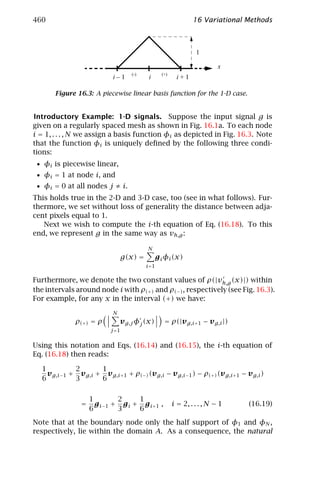
                                                            2
                                                                       (2.4)

A detailed treatment of noise in various types of imaging sensors can
be found in Volume 1, Sections 7.5, 9.3.1, and 10.2.3.

2.2.3 Multichannel signals

So far, only scalar signals have been considered. If more than one signal
is taken simultaneously, a multichannel signal is obtained. In some
cases, for example, taking time series at different spatial positions, the
multichannel signal can be considered as just a sampled version of a
higher-dimensional signal. In other cases, the individual signals cannot
be regarded as samples. This is the case when they are parameters with
different units and/or meaning.
    A multichannel signal provides a vector at each point and is there-
fore sometimes denoted as a vectorial signal and written as
                                                            T
                  g(q) = [q1 (q), q2 (q), . . . , qD (q)]              (2.5)
2.3 Discrete signals                                                              13

a                            b                       c


Figure 2.1: Representation of 2-D digital images by meshes of regular polygons:
a triangles; b squares; c hexagons.


Table 2.2: Properties of tessellations of the 2-D space with regular triangular,
square, and hexagonal meshes; Ne : number of neighbors with common edge;
Nc : number of neighbors with common edge and/or corner; l: basis length l of
regular polygon; d: distance d to nearest neighbor; and A: area of cell

          Triangular                  Square         Hexagonal

 Ne       3                           4              6
 Nc       12                          8              6
               √                               √          1√
 l        l=   3d =     16/3A         l=d=      A    l=   3 3d   =        4/27A
               1√
                                               √          √
 d        d=   3 3l =    16/27A       d=l=      A    d=    3l =          4/3A
               3√         √
                    2 = 1 3l2                             1√             3√ 2
 A        A=   4 3d     4
                                      A = d 2 = l2   A=   2 3d
                                                              2      =   2 3l


   A multichannel signal is not necessarily a vectorial signal. Depend-
ing on the mathematical relation between its components, it could also
be a higher-order signal, for example, a tensorial signal. Such types of
multichannel images are encountered when complex features are ex-
tracted from images. One example is the tensorial description of local
structure discussed in Chapter 10.


2.3 Discrete signals

2.3.1 Regular two-dimensional lattices

Computers cannot handle continuous signals but only arrays of digi-
tal numbers. Thus it is required to represent signals as D-dimensional
arrays of points. We first consider images as 2-D arrays of points. A
point on the 2-D grid is called a pixel or pel. Both words are abbre-
viations of picture element . A pixel represents the irradiance at the
corresponding grid position. There are two ways to derive 2-D lattices
from continuous signals.
14                                         2 Continuous and Digital Signals

a                             b                       c

b2                            b2                       b2


       b1                               b1                   b1

Figure 2.2: Elementary cells of regular grids for 2-D digital images: a triangle
grid, b square grid, c hexagonal grid.


    First, the continuous 2-D space can be partitioned into space-filling
cells. For symmetry reasons, only regular polygons are considered.
Then there are only three possible tesselations with regular polygons:
triangles, squares, and hexagons as illustrated in Fig. 2.1 (see also Ta-
ble 2.2). All other regular polygons do not lead to a space-filling ge-
ometrical arrangement. There are either overlaps or gaps. From the
mesh of regular polygons a 2-D array of points is then formed by the
symmetry centers of the polygons. In case of the square mesh, these
points lie again on a square grid. For the hexagonal mesh, the sym-
metry centers of the hexagons form a triangular grid. In contrast, the
symmetry centers of the triangular grid form a more complex pattern,
where two triangular meshes are interleaved. The second mesh is offset
by a third of the base length l of the triangular mesh.
    A second approach to regular lattices starts with a primitive cell. A
primitive cell in 2-D is spanned by two not necessarily orthogonal base
vectors b1 and b2 . Thus, the primitive cell is always a parallelogram ex-
cept for square and rectangular lattices (Fig. 2.2). Only in the latter case
are the base vectors b1 and b2 orthogonal. Translating the primitive
cell by multiples of the base vectors of the primitive cell then forms the
lattice. Such a translation vector or lattice vector r is therefore given
by

                       r = n1 b1 + n2 b2     n 1 , n2 ∈ Z                  (2.6)

   The primitive cells of the square and hexagonal lattices (Fig. 2.2b
and c) contains only one grid located at the origin of the primitive cell.
This is not possible for a triangular grid, as the lattice points are not
arranged in regular distances along two directions (Fig. 2.1a). Thus,
the construction of the triangular lattice requires a primitive cell with
two grid points. One grid point is located at the origin of the cell, the
other is offset by a third of the length of each base vector (Fig. 2.2a)
   The construction scheme to generate the elementary cells of regular
shape from the lattice points is illustrated in Fig. 2.3. From one lattice
point straight lines are drawn to all other lattice points starting with
2.3 Discrete signals                                                            15

a                             b
                                                            c


Figure 2.3: Construction of the cells of a regular lattice from the lattice points:
a triangle lattice; b square lattice; and c hexagonal lattice.

a
                   columns
                                            b
           0   1        n         N-1                           z
       0                                x

       1                                            l


    m
                                                                    x

                                            m
rows


M-1
                                                y
       y                                                n

Figure 2.4: Representation of digital images by orthogonal lattices: a square
lattice for a 2-D image; and b cubic lattice for a volumetric or 3-D image.


the nearest neighbors (dashed lines). Then the smallest cell formed
by the lines perpendicular to these lines and dividing them into two
halves results in the primitive cell. For all three lattices, only the nearest
neighbors must be considered for this construction scheme.
    The mathematics behind the formation of regular lattices in two
dimensions is the 2-D analog to 3-D lattices used to describe crystals
in solid state physics and mineralogy. The primitive cell constructed
from the lattice points is, for example, known in solid state physics as
the Wigner-Seitz cell.
    Although there is a choice of three lattices with regular polygons—
and many more if irregular polygons are considered—almost exclu-
sively square or rectangular lattices are used for 2-D digital images.
16                                       2 Continuous and Digital Signals

    The position of the pixel is given in the common notation for ma-
trices. The first index, m, denotes the position of the row, the second,
n, the position of the column (Fig. 2.4a). M gives the number of rows,
N the number of columns. In accordance with the matrix notation, the
vertical axis (y axis) runs from top to bottom and not vice versa as is
common in graphs. The horizontal axis (x axis) runs as usual from left
to right.

2.3.2 Regular higher-dimensional lattices

The considerations in the previous section can be extended to higher di-
mensions. In 3-D space, lattices are identical to those used in solid-state
physics to describe crystalline solids. In higher dimensions, we have
serious difficulty in grasping the structure of discrete lattices because
we can visualize only projections onto 2-D space. Given the fact that
already 2-D discrete images are almost exclusively represented by rect-
angular lattices (Section 2.3.1), we may ask what we lose if we consider
only hypercubic lattices in higher dimensions. Surprisingly, it turns
out that this lattice has such significant advantages that it is hardly
necessary to consider any other lattice.

Orthogonal lattice. The base vectors of the hypercubic primitive cell
are orthogonal to each other. As discussed in Chapter 6, this is a sig-
nificant advantage for the design of filters. If separable filters are used,
they can easily be extended to arbitrary dimensions.

Valid for all dimensions. The hypercubic lattice is the most general
solution for digital data as it is the only geometry that exists in arbitrary
dimensions. In practice this means that it is generally quite easy to
extend image processing algorithms to higher dimensions. We will see
this, for example, with the discrete Fourier transform in Section 3.3,
with multigrid data structures in Chapter 4, with averaging in Chapter 7,
and with the analysis of local structure in Chapter 10.

Only lattice with regular polyhedron. While in 2-D, three lattices with
regular polyhedrons exist (Section 2.3.1), the cubic lattice is the only
lattice with a regular polyhedron (the hexahedron) in 3-D. None of the
other four regular polyhedra (tetrahedron, octahedron, dodecahedron,
and icosahedron) is space filling.
    These significant advantages of the hypercubic lattice are not out-
weighed by the single disadvantage that the neighborhood relations,
discussed in Section 2.3.5, are more complex on these lattices than, for
example, the 2-D hexagonal lattice.
    In 3-D or volumetric images the elementary cell is known as a voxel,
an abbreviation of volume element . On a rectangular grid, each voxel
2.3 Discrete signals                                                     17

represents the mean gray value of a cuboid. The position of a voxel is
given by three indices. The first, l, denotes the depth, m the row, and
n the column (Fig. 2.4b). In higher dimensions, the elementary cell is
denoted as a hyperpixel.

2.3.3 Irregular lattices

Irregular lattices are attractive because they can be adapted to the con-
tents of images. Small cells are only required where the image contains
fine details and can be much larger in other regions. In this way, a
compact representation of an image seems to be feasable. It is also
not difficult to generate an irregular lattice. The general principle for
the construction of a mesh from an array of points (Section 2.3.1) can
easily be extended to irregularly spaced points. It is known as Delau-
nay triangulation and results in the dual Voronoi and Delaunay graphs
(Chapters 24 and 25).
    Processing of image data, however, becomes much more difficult on
irregular grids. Some types of operations, such as all classical filter op-
erations, do not even make much sense on irregular grids. In contrast,
it poses no difficulty to apply morphological operations to irregular
lattices (Chapter 21).
    Because of the difficulty in processing digital images on irregular
lattices, these data structure are hardly ever used to represent raw im-
ages. In order to adapt low-level image processing operations to dif-
ferent scales and to provide an efficient storage scheme for raw data
multigrid data structures, for example, pyramids have proved to be
much more effective (Chapter 4). In contrast, irregular lattices play
an important role in generating and representing segmented images
(Chapter 25).

2.3.4 Metric in digital images

Based on the discussion in the previous two sections, we will focus in
the following on hypercubic or orthogonal lattices and discuss in this
section the metric of discrete images. This constitutes the base for all
length, size, volume, and distance measurements in digital images. It
is useful to generalize the lattice vector introduced in Eq. (2.6) that rep-
resents all points of a D-dimensional digital image and can be written
as

                  r n = [n1 ∆x1 , n2 ∆x2 , . . . , nD ∆xD ]T           (2.7)

In the preceding equation, the lattice constants ∆xd need not be equal
in all directions. For the special cases of 2-D images, 3-D volumetric
18                                          2 Continuous and Digital Signals

images, and 4-D spatiotemporal images the lattice vectors are
                                                            
                                                      n∆x
                                  n∆x                       
             n∆x                                     m∆y 
  r m,n =           , r l,m,n =  m∆y  , r k,l,m,n = 
                                                       l∆z 
                                                                         (2.8)
            m∆y                                             
                                  l∆z
                                                        k∆t

   To measure distances, the Euclidean distance can be computed on
an orthogonal lattice by
                                                                 1/2
                                           D
            de (x, x ) = x − x    =            (nd − nd )2 ∆xd 
                                                              2
                                                                          (2.9)
                                        d =1

On a square lattice, that is, a lattice with the same grid constant in all
directions, the Euclidean distance can be computed more efficiently by
                                                            1/2
                                            D
            de (x, x ) = x − x    =            (nd − nd )   2
                                                                    ∆x   (2.10)
                                           d =1

    The Euclidean distance on discrete lattices is somewhat awkward.
Although it is a discrete quantity, its values are not integers. Moreover,
it cannot be computed very efficiently.
    Therefore, two other metrics are sometimes considered in image
processing. The city block distance
                                       D
                        db (x, x ) =        |nd − nd |                   (2.11)
                                       d=1

simply adds up the magnitude of the component differences of two
lattice vectors and not the squares as with the Euclidean distance in
Eq. (2.10). Geometrically, the city block distance gives the length of a
path between the two lattice vectors if we can only walk in directions
parallel to axes. The chessboard distance is defined as the maximum of
the absolute difference between two components of the corresponding
lattice vectors:

                      dc (x, x ) = max |nd − nd |                        (2.12)
                                  d=1,... ,D

These two metrics have gained some importance for morphological op-
erations (Section 21.2.5). Despite their simplicity they are not of much
use as soon as lengths and distances are to be measured. The Euclidean
distance is the only metric on digital images that preserves the isotropy
of the continuous space. With the city block and chessboard distance,
distances in the direction of the diagonals are longer and shorter than
the Euclidean distance, respectively.
2.3 Discrete signals                                                                                          19

     a
                                      b                       c
                      5               5       4   3   4   5                                           4
                                                                      4       3       2       3
              4       3       4
         5        2       2       5   4       2   1   2   4       4       2       1       1       2       4

          4       1       1       4   3       1       1   3           3       1               1       3
              2               2
              3       1       3       4       2   1   2   4       4       2       1       1       2       4
         5        2       2       5
                                          5   4   3   4   5           4       3       2       3       4
                  4 5 4


Figure 2.5: Classification of the cells according to the distance from a given
cell for the a triangular, b square, and c hexagonal lattices. The central cell is
shaded in light gray, the nearest neighbors in darker gray. The numbers give
the ranking in distance from the central cell.


2.3.5 Neighborhood relations

The term neighborhood has no meaning for a continuous signal. How
far two points are from each other is simply measured by an adequate
metric such as the Euclidean distance function and this distance can
take any value. With the cells of a discrete signal, however, a ranking
of the distance between cells is possible. The set of cells with the small-
est distance to a given cell are called the nearest neighbors. The trian-
gular, square, and hexagonal lattices have three, four, and six nearest
neighbors, respectively (Fig. 2.5). The figure indicates also the ranking
in distance from the central cell.
    Directly related to the question of neighbors is the term adjacency.
A digital object is defined as a connected region. This means that we
can reach any cell in the region from any other by walking from one
neighboring cell to the next. Such a walk is called a path.
    On a square lattice there are two possible ways to define neighboring
cells (Fig. 2.5b). We can regard pixels as neighbors either when they
have a joint edge or when they have at least one joint corner. Thus a
pixel has four or eight neighbors and we speak of a 4-neighborhood or
an 8-neighborhood. The definition of the 8-neighborhood is somewhat
awkward, as there are neighboring cells with different distances.
    The triangular lattice shows an equivalent ambivalence with the 3-
and 12-neighborhoods with cells that have either only a joint edge
or at least a joint corner with the central cell (Fig. 2.5a). In the 12-
neighborhood there are three different types of neighboring cells, each
with a different distance (Fig. 2.5a).
    Only the hexagonal lattice gives a unique definition of neighbors.
Each cell has six neighboring cells at the same distance joining one
edge and two corners with the central cell.
    A closer look shows that unfortunately both types of neighborhood
definitions are required on triangular and square grids for a proper
20                                        2 Continuous and Digital Signals


  a                          b                    c


Figure 2.6: Digital objects on a triangular, b square, and c hexagonal lattice.
a and b show either two objects or one object (connected regions) depending on
the neighborhood definition.


definition of connected regions. A region or an object is called con-
nected when we can reach any pixel in the region by walking from one
neighboring pixel to the next. The black object shown in Fig. 2.6b is
one object in the 8-neighborhood, but constitutes two objects in the 4-
neighborhood. The white background, however, shows the same prop-
erty. Thus we have either two connected regions in the 8-neighborhood
crossing each other or four separated regions in the 4-neighborhood.
This inconsistency between objects and background can be overcome
if we declare the objects as 4-neighboring and the background as 8-
neighboring, or vice versa.
    These complications occur also on a triangular lattice (Fig. 2.6b) but
not on a hexagonal lattice (Fig. 2.6c). The photosensors on the retina
in the human eye, however, have a more hexagonal shape, see Wandell
[1, Fig. 3.4, p. 49].

2.3.6 Errors in object position and geometry

The tessellation of space in discrete images limits the accuracy of the
estimation of the position of an object and thus all other geometri-
cal quantities such as distance, area, circumference, and orientation of
lines. It is obvious that the accuracy of the position of a single point
is only in the order of the lattice constant. The interesting question
is, however, how this error propagates into position errors for larger
objects and other relations. This question is of significant importance
because of the relatively low spatial resolution of images as compared
to other measuring instruments. Without much effort many physical
quantities such as frequency, voltage, and distance can be measured
with an accuracy better than 1 ppm, that is, 1 in 1,000,000, while im-
ages have a spatial resolution in the order of 1 in 1000 due to the limited
number of pixels. Thus only highly accurate position estimates in the
2.3 Discrete signals                                                    21

order of 1/100 of the pixel size result in an accuracy of about 1 in
100,000.
   The discussion of position errors in this section will be limited to or-
thogonal lattices. These lattices have the significant advantage that the
errors in the different directions can be discussed independently. Thus
the following discussion is not only valid for 2-D images but any type of
multidimensional signals and we must consider only one component.
   In order to estimate the accuracy of the position estimate of a sin-
gle point it is assumed that all positions are equally probable. This
means a constant probability density function in the interval ∆x. Then
                2
the variance σx introduced by the position discretization is given by
Papoulis [2, p. 106]
                            xn +∆x/2
                 2      1                                (∆x)2
                σx   =                 (x − xn )2 dx =               (2.13)
                       ∆x                                  12
                            xn −∆x/2
                                                  √
Thus the standard deviation σx is about 1/ 12 ≈ 0.3 times the lattice
constant ∆x. The maximum error is, of course, 0.5∆x.
    All other errors for geometrical measurements of segmented objects
can be related to this basic position error by statistical error propa-
gation. We will illustrate this with a simple example computing the
area and center of gravity of an object. For the sake of simplicity, we
start with the unrealistic assumption that any cell that contains even
the smallest fraction of the object is regarded as a cell of the object.
We further assume that this segmentation is exact, that is, the signal
itself does not contain noise and separates without errors from the
background. In this way we separate all other errors from the errors
introduced by the discrete lattice.
    The area of the object is simply given as the product of the number
N of cells and the area Ac of a cell. This simple estimate is, however,
biased towards a larger area because the cells at the border of the object
are only partly covered by the object. In the mean, half of the border
cells are covered. Hence an unbiased estimate of the area is given by

                             A = Ac (N − 0.5Nb )                     (2.14)

where Nb is the number of border cells. With this equation, the variance
of the estimate can be determined. Only the statistical error in the area
of the border cells must be considered. According to the laws of error
propagation with independent random variables, the variance of the
                2
area estimate σA is given by
                              2
                             σA = 0.25A2 Nb σx
                                       c
                                             2
                                                                     (2.15)

If we assume a compact object, for example, a square, with a length
of D pixels, it has D 2 pixels and 4D border pixels. Using σx ≈ 0.3
22                                        2 Continuous and Digital Signals

(Eq. (2.13)), the absolute and relative standard deviation of the area
estimate are given by
                                         σA   0.3
             σA ≈ 0.3Ac D       and         ≈ 3/2    if D   1       (2.16)
                                         A   D
Thus the standard deviation of the area error for an object with a length
of 10 pixels is just about the area of the pixel and the relative error
is about 1 %. Equations (2.14) and (2.15) are also valid for volumetric
images if the area of the elementary cell is replaced by the volume of
the cell. Only the number of border cells is now different. If we again
assume a compact object, for example, a cube, with a length of D, we
now have D 3 cells in the object and 6D 2 border cells. Then the absolute
and relative standard deviations are approximately given by
                                         σV   0.45
              σV ≈ 0.45Vc D     and         ≈        if D   1       (2.17)
                                         V     D2
Now the standard deviation of the volume for an object with a diameter
of 10 pixels is about 5 times the volume of the cells but the relative
error is about 0.5 %. Note that the absolute/relative error for volume
measurements in/decreases faster with the size of the object than for
area measurements.
   The computations for the error of the center of gravity are quite
similar. With the same assumptions about the segmentation process,
an unbiased estimate of the center of gravity is given by
                                                  
                              N − Nb         Nb
                          1              1
                     xg =            xn +       xn               (2.18)
                          N n =1          2 n =1

Again the border pixels are counted only half. As the first part of the
estimate with the nonborder pixels is exact, errors are caused only by
the variation in the area of the border pixels. Therefore the variance of
the estimate for each component of the center of gravity is given by

                               2       Nb 2
                              σg =         σ                        (2.19)
                                      4N 2
where σ is again the variance in the position of the fractional cells at
the border of the object. Thus the standard deviation of the center of
gravity for a compact object with the diameter of D pixels is
                                 0.3
                         σg ≈             if D   1                  (2.20)
                                 D 3/2
Thus the standard deviation for the center of gravity of an object with
10 pixel diameter is only about 0.01 pixel. For a volumetric object with
a diameter of D pixel, the standard deviation becomes
                                 0.45
                         σgv ≈            if D   1                  (2.21)
                                  D2
2.4 Relation between continuous and discrete signals                                      23

 Signal                 Radiance             Irradiance            Electric
            Object                                                  signal      ADC
                                   Imaging                Photo
           radiation                                                          sampling
                                    system                sensor
  s(x)    interaction     l(x)                 E(x)                 g(x)                 Gmn


             Figure 2.7: Steps from a continuous to a discrete signal.


This result clearly shows that the position of objects and all related
geometrical quantities such as the distances can be performed even
with binary images (segmented objects) well into the range of 1/100
pixel. It is interesting that the relative errors for the area and volume
estimates of Eqs. (2.16) and (2.17) are equal to the standard deviation of
the center of gravity Eqs. (2.20) and (2.21). Note that only the statistical
error has been discussed. A bias in the segmentation might easily result
in much higher systematic errors.


2.4 Relation between continuous and discrete signals

A continuous function g(q) is a useful mathematical description of a
signal as discussed in Section 2.2. Real-world signals, however, can only
be represented and processed as discrete or digital signals. Therefore
a detailed knowledge of the relation between these two types of signals
is required. It is not only necessary to understand the whole chain of
the image formation process from a continuous spatial radiance distri-
bution to a digital image but also to perform subpixel-accurate image
interpolation (Chapter 8) and warping of images (Chapter 9) as it is, for
example, required for multiscale image operations (Chapter 14).
    The chain of processes that lead from the “true” signal to the digital
signal include all the steps of the image formation process as illustrated
in Fig. 2.7. First the signal of interest, s(x), such as reflectivity, temper-
ature, etc. of an object is somehow related to the radiance L(x) emitted
by the object in a generally not linear function (Volume 1, Chapter 3).
In some cases this relation is linear (e. g., reflectivity), in others it is
highly nonlinear (e. g., temperature). Often other parameters that are
not controlled or not even known, influence the signal as well. As an
example, the radiance of an object is the product of its reflectivity and
the irradiance. Moreover, the radiance of the beam from the object to
the camera may be attenuated by absorption or scattering of radiation
(Volume 1, Section 3.4.1). Thus the radiance of the object may vary with
many other unknown parameters until it finally reaches the radiation
collecting system (optics).
    The optical system generates an irradiance E(x) at the image plane
that is proportional to the object radiance (Volume 1, Chapter 5). There
is, however, not a point-to-point correspondence. Because of the lim-
ited resolution of the optical systems due to physical limitation (e. g.,
24                                               2 Continuous and Digital Signals

diffraction) or imperfections of the optical systems (various aberra-
tions, Volume 1, Section 4.5). This blurring of the signal is known as
the point spread function (PSF ) of the optical system and described in
the Fourier domain by the optical transfer function. The nonzero area
of the individual sensor elements of the sensor array (or the scanning
mechanism) results in a further spatial and temporal blurring of the
irradiance at the image plane.
    The conversion to electrical signal U adds noise and possibly fur-
ther nonlinearities to the signal g(x, t) that is finally measured. In a
last step, the analog electrical signal is converted by an analog-to-digital
converter (ADC) into digital numbers. The basic relation between con-
tinuous and digital signals is established by the sampling theorem. It
describes the effects of spatial and temporal sampling on continuous
signals and thus also tells us how to reconstruct a continuous signal
from its samples. The discretization of the amplitudes of the signal
(quantization) is discussed in Section 2.5.
    The image formation process itself thus includes two essential steps.
First, the whole image formation process blurs the signal. Second, the
continuous signal at the image plane is sampled. Although both pro-
cesses often happen together, they can be separated for an easier math-
ematical treatment.

2.4.1 Image formation

If we denote the undistorted original signal projected onto the image
plane by g (x, t) then the signal g(x, t) modified by the image forma-
tion process is given by
                               ∞

                   g(x, t) =        g (x , t )h(x, x , t, t ) d2 x dt      (2.22)
                               −∞


The function h is the PSF. The signal g (x, t) can be considered as the
image that would be obtained by a perfect system, that is, an optical
system whose PSF is a δ-distribution. Equation (2.22) says that the sig-
nal at the point [x, t]T in space and time is composed of the radiance of
a whole range of points [x , t ]T nearby which linearly add up weighted
with the signal h at [x , t ]T . The integral can significantly be simpli-
fied if the point spread function is the same at all points (homogeneous
system or shift-invariant system). Then the point spread function h de-
pends only on the distance of [x , t ]T to [x, t]T and the integral in
Eq. (2.22) reduces to the convolution integral
              ∞

  g(x, t) =        g (x , t )h(x − x , t − t ) d2 x dt = (g ∗ h)(x, t) (2.23)
              −∞
2.4 Relation between continuous and discrete signals                        25

For most optical systems the PSF is not strictly shift-invariant because
the degree of blurring is increasing with the distance from the optical
axis (Volume 1, Chapter 4). However, as long as the variation is con-
tinuous and does not change significantly over the width of the PSF,
the convolution integral in Eq. (2.23) still describes the image forma-
tion correctly. The PSF and the system transfer function just become
weakly dependent on x.

2.4.2 Sampling theorem

Sampling means that all information is lost except at the grid points.
Mathematically, this constitutes a multiplication of the continuous func-
tion with a function that is zero everywhere except for the grid points.
This operation can be performed by multiplying the image function
g(x) with the sum of δ distributions located at all lattice vectors r m,n
Eq. (2.7). This function is called the two-dimensional δ comb, or “nail-
board function.” Then sampling can be expressed as
                                     m=∞     n=∞
                   gs (x) = g(x)                   δ(x − r m,n )         (2.24)
                                     m=−∞ n=−∞

This equation is only valid as long as the elementary cell of the lattice
contains only one point. This is the case for the square and hexagonal
grids (Fig. 2.2b and c). The elementary cell of the triangular grid, how-
ever, includes two points (Fig. 2.2a). Thus for general regular lattices,
p points per elementary cell must be considered. In this case, a sum
of P δ combs must be considered, each shifted by the offsets s p of the
points of the elementary cells:
                                P     ∞       ∞
              gs (x) = g(x)                        δ(x − r m,n − s p )   (2.25)
                               p =1 m=−∞ n=−∞

   It is easy to extent this equation for sampling into higher-dimensional
spaces and into the time domain:

                     gs (x) = g(x)           δ(x − r n − s p )           (2.26)
                                       p n

In this equation, the summation ranges have been omitted. One of the
coordinates of the D-dimensional space and thus the vector x and the
lattice vector r n
                                                   T
             r n = [n1 b1 , n2 b2 , . . . , nD bD ]     with   nd ∈ Z    (2.27)

is the time coordinate. The set of fundamental translation vectors
{b1 , b2 , . . . , bD } form a not necessarily orthogonal base spanning the
D-dimensional space.
26                                           2 Continuous and Digital Signals

    The sampling theorem directly results from the Fourier transform
of Eq. (2.26). In this equation the continuous signal g(x) is multiplied
by the sum of delta distributions. According to the convolution theo-
rem of the Fourier transform (Section 3.2), this results in a convolution
of the Fourier transforms of the signal and the sum of delta combs in
Fourier space. The Fourier transform of a delta comb is again a delta
comb (see Table 3.3). As the convolution of a signal with a delta dis-
tribution simply replicates the function value at the zero point of the
delta functions, the Fourier transform of the sampled signal is simply
a sum of shifted copies of the Fourier transform of the signal:

                                                           T
               ˆ
               gs (k, ν) =           ˆ     ˆ
                                     g(k − r v ) exp −2π ik s p        (2.28)
                             p v

                                 T
The phase factor exp(−2π ik s p ) results from the shift of the points in
the elementary cell by s p according to the shift theorem of the Fourier
                                        ˆ
transform (see Table 3.2). The vectors r v

             ˆ        ˆ        ˆ                 ˆ
             r v = v1 b 1 + v2 b 2 + . . . + v D b D   with   vd ∈ Z   (2.29)

are the points of the so-called reciprocal lattice. The fundamental trans-
lation vectors in the space and Fourier domain are related to each other
by
                                   ˆ
                               b d b d = δ d −d                     (2.30)

This basically means that the fundamental translation vector in the
Fourier domain is perpendicular to all translation vectors in the spatial
domain except for the corresponding one. Furthermore the distances
are reciprocally related to each other. In 3-D space, the fundamental
translations of the reciprocial lattice can therefore be computed by

                              ˆ    b     × b d +2
                              b d = d +1                               (2.31)
                                   b1 (b2 × b3 )
The indices in the preceding equation are computed modulo 3, b1 (b2 ×
b3 ) is the volume of the primitive elementary cell in the spatial domain.
All these equations are familiar to solid state physicists or cristallog-
raphers [3]. Mathematicians know the lattice in the Fourier domain as
the dual base or reciprocal base of a vector space spanned by a non-
orthogonal base. For an orthogonal base, all vectors of the dual base
show into the same direction as the corresponding vectors and the mag-
                      ˆ
nitude is given by bd = 1/ |bd |. Then often the length of the base
vectors is denoted by ∆xd , and the length of the reciprocal vectors by
∆kd = 1/∆xd . Thus an orthonormal base is dual to itself.
    For further illustration, Fig. 2.8 shows the lattices in both domains
for a triangular, square, and hexagonal grid. The figure also includes
the primitive cell known as the Wigner-Seitz cell (Section 2.3.1 and
2.4 Relation between continuous and discrete signals                                 27


                  b2                      b2                        b2


                        b1                          b1                       b1


             ^                            ^                    ^
             b2                            b2                  b2


                                                ^
                                                b1
                       ^                                                 ^
                       b1                                                b1


Figure 2.8: Lattices with the fundamental translation vectors and primitive cell
in the spatial and Fourier domain for a triangular (left), square (middle), and
hexagonal (right) 2-D lattice.


Fig. 2.3) and first Brillouin zone in the spatial and Fourier domain, re-
spectively.
    Now we can formulate the condition where we get no distortion of
the signal by sampling, known as the sampling theorem. If the image
           ˆ
spectrum g(k) contains such high wave numbers that parts of it overlap
with the periodically repeated copies, we cannot distinguish whether
the spectral amplitudes come from the original spectrum at the center
or from one of the copies. In other words, a low wave number can be
an alias of a high wave number and pretend an incorrect amplitude of
the corresponding wave number. In order to obtain no distortions, we
must avoid overlapping. A safe condition to avoid overlapping is as
follows: the spectrum must be zero outside of the primitive cell of the
reciprocal lattice, that is, the first Brillouin zone.
    On a rectangular grid, this results in the simple condition that the
maximum wave number (or frequency) at which the image spectrum is
not equal to zero must be restricted to less than half of the grid con-
stants of the reciprocal grid. Therefore the sampling theorem states:

                                               ˆ
Theorem 2.1 (Sampling Theorem) If the spectrum g(k) of a continu-
ous function g(x) is band-limited, that is,
                             ˆ
                             g(k) = 0 ∀ |kd | ≥ ∆kd /2                            (2.32)
then it can be reconstructed exactly from samples with a distance
                                  ∆xd = 1/∆kd                                     (2.33)
28                                          2 Continuous and Digital Signals

    In other words, we will obtain a periodic structure correctly only if
we take at least two samples per wavelength (or period). The maximum
wave number that can be sampled without errors is called the Nyquist
or limiting wave number (or frequency). In the following, we will often
use dimensionless wave numbers (frequencies), which are scaled to the
limiting wave number (frequency). We denote this scaling with a tilde:

         ˜       kd                                ν
         kd =          = 2kd ∆xd      and    ˜
                                             ν=        = 2ν∆T              (2.34)
                ∆kd /2                            ∆ν/2
                                                      ˜
In this scaling all the components of the wave number kd fall into the
interval ]−1, 1[.

2.4.3 Aliasing

If the conditions of the sampling theorem are not met, it is not only
impossible to reconstruct the original signal exactly but also distortions
are introduced into the signal. This effect is known in signal theory as
aliasing or in imaging as the Moiré effect .
    The basic problem with aliasing is that the band limitation intro-
duced by the blurring of the image formation and the nonzero area of
the sensor is generally not sufficient to avoid aliasing. This is illustrated
in the following example with an “ideal” sensor.
Example 2.1: Standard sampling
     An “ideal” imaging sensor will have a nonblurring optics (the PSF is the
     delta distribution) and a sensor array that has a 100 % fill factor, that
     is, the sensor elements show a constant sensitivity over the whole area
     without gaps in-between. The PSF of such an imaging sensor is a box
     function with the width ∆x of the sensor elements and the transfer
     function (TF) is a sinc function (see Table 3.4):
                             1               1
                     PSF        Π(x1 /∆x1 )     Π(x2 /∆x2 )
                            ∆x1             ∆x2
                                                                        (2.35)
                            sin(π k1 ∆x1 ) sin(π k2 ∆x2 )
                     TF
                               π k1 ∆x1       π k2 ∆x2
     The sinc function has its first zero crossings when the argument is
     ±π . This is when kd = ±∆xd or at twice the Nyquist wave number,
     see Eq. (2.34). At the Nyquist wave number the value of the transfer
                         √
     function is still 1/ 2. Thus standard sampling is not sufficient to
     avoid aliasing. The only safe way to avoid aliasing is to ensure that the
     imaged objects do not contain wave numbers and frequencies beyond
     the Nyquist limit.


2.4.4 Reconstruction from samples

The sampling theorem ensures the conditions under which we can re-
construct a continuous function from sampled points, but we still do
2.4 Relation between continuous and discrete signals                            29

not know how to perform the reconstruction of the continuous image
from its samples, that is, the inverse operation to sampling.
   Reconstruction is performed by a suitable interpolation of the sam-
pled points. Again we use the most general case: a nonorthogonal
primitive cell with P points. Generally, the interpolated points gr (x)
are calculated from the values sampled at r n +s p weighted with suitable
factors that depend on the distance from the interpolated point:

                gr (x) =         gs (r n + s p )h(x − r n − s p )            (2.36)
                           p n

Using the integral property of the δ distributions, we can substitute
the sampled points on the right side by the continuous values and then
interchange summation and integration:
                           ∞

       gr (x)   =              g(x )h(x − x )δ(r n + s p − x ) dD x
                     p n −∞
                     ∞

                =        h(x − x )             δ(r n + s p − x )g(x ) dD x
                    −∞
                                         p n

The latter integral is a convolution of the weighting function h with a
function that is the sum of the product of the image function g with
shifted δ combs. In Fourier space, convolution is replaced by complex
multiplication and vice versa. If we further consider the shift theorem
and that the Fourier transform of a δ comb is again a δ comb, we finally
obtain

             ˆ        ˆ
             gr (k) = h(k)           ˆ     ˆ               T
                                     g(k − r v ) exp −2π ik s p              (2.37)
                               p v

The interpolated function can only be equal to the original image if
the periodically repeated image spectra are not overlapping. This is
nothing new; it is exactly what the sampling theorem states. The inter-
polated image function is only equal to the original image function if
the weighting function is one within the first Brillouin zone and zero
outside, eliminating all replicated spectra and leaving the original band-
limited spectrum unchanged. On a D-dimensional orthogonal lattice
Eq. (2.37) becomes
                                            D
                         ˆ        ˆ
                         gr (k) = g(k)          Π(kd ∆xd )                   (2.38)
                                           d =1

and the ideal interpolation function h is the sinc function
                                     D
                                         sin(π xd /∆xd )
                         h(x) =                                              (2.39)
                                            π xd /∆xd
                                  d =1
30                                        2 Continuous and Digital Signals

   Unfortunately, this function decreases only with 1/x towards zero.
Therefore, a correct interpolation requires a large image area; mathe-
matically, it must be infinitely large. This condition can be weakened if
                                                          ˆ
we “overfill” the sampling theorem, that is, ensure that g(k) is already
zero before we reach the Nyquist limit. According to Eq. (2.37), we can
               ˆ                                     ˆ
then choose h(k) arbitrarily in the region where g vanishes. We can
use this freedom to construct an interpolation function that decreases
more quickly in the spatial domain, that is, has a minimum-length in-
terpolation mask. We can also start from a given interpolation formula.
Then the deviation of its Fourier transform from a box function tells
us to what extent structures will be distorted as a function of the wave
number. Suitable interpolation functions will be discussed in detail in
Chapter 8.


2.5 Quantization

After spatial and/or temporal sampling of a signal, the values of a sig-
nal are still continuous. As digital computers can only handle digital
numbers, the continuous range of the electrical signal of the sensors
must be mapped onto a limited number Q of discrete gray values:
                            Q
                    [0, ∞[ → {g0 , g1 , . . . , gQ−1 } = G          (2.40)

This process is called quantization. The number of quantization levels
can be chosen on the basis of two different criteria. The first criterion
is based on our visual system. It should not be possible to recognize
the quantization levels by our visual system. In this way, we perceive
the illusion of an image with a continuous luminance.
    The second criterion is application-oriented. The number of quan-
tization levels is chosen such that the required resolution in gray val-
ues is achieved. For some applications where only the object must
be distinguished from the background, for example, optical character
recognition, a binary image with only two quantization levels might be
sufficient. For other applications, where it is required to distinguish
faint changes in the image irradiance, an 8-bit digitalization is much
too coarse.

2.5.1 Equidistant quantization

Generally, image data are quantized in Q equidistant intervals ∆g.
Then all values between gq − ∆g/2 and gq + ∆g/2 are mapped onto
the quantization level q with the value gq :

                        g − g0 1
            q = floor          +           and    gq = g0 + q∆g      (2.41)
                         ∆g     2
2.5 Quantization                                                       31

If we assume a constant probability for all gray values, the quantization
error can be computed immediately in the same way as the position
error in Section 2.3.6, Eq. (2.13):

                           gq +∆g/2
                2      1                                1
               σq   =                 (g − gq )2 dg =      (∆g)2    (2.42)
                      ∆g                                12
                           gq −∆g/2


If g is below the lowest lower threshold, g0 − ∆g/2, or beyond the
highest upper threshold, gQ−1 + ∆g/2 as signal underflow or overflow
occurs.
    Normally, gray scale images are quantized into 256 gray values.
Then each pixel occupies 8 bits or one byte. This pixel size is well
adapted to the architecture of standard computers that can address
memory bytewise. Furthermore, the resolution is good enough to give
us the illusion of a continuous change in the gray values, because the
relative intensity resolution of our visual system is no better than about
2 %.
    For demanding tasks, 8-bit quantization is not sufficient. Nowadays,
high-end cameras achieve even at video rates resolutions of up to 12
bits. With so-called slow-scan cameras that read the charges out of the
CCD sensor significantly slower than video rates, quantization with up
to 16 bits is possible.

2.5.2 Unsigned or signed representation

Normally we think of image data as a positive quantity. Consequently,
it appears natural to represent it by unsigned numbers ranging in an
8-bit representation, for example, from 0 to 255. This representation
causes problems, however, as soon as we perform arithmetic opera-
tions with images. Subtracting two images is a simple example that
can produce negative numbers. As negative gray values cannot be rep-
resented, they wrap around and appear as large positive values. The
number −1, for example, results in the positive value 255 given that −1
modulo 256 = 255. Thus we are confronted with the problem of two
different representations of gray values, as unsigned and signed 8-bit
numbers. Correspondingly, we must have several versions of each algo-
rithm, one for unsigned gray values, one for signed values, and others
for mixed cases.
    One solution to this problem is to handle gray values always as
signed numbers. Unsigned numbers can be converted into signed num-
bers by subtracting the maximum positive number corresponding to
the most significant bit of the signed representation. In an 8-bit repre-
sentation, we can subtract 128 to get a signed representation. For an
32                                      2 Continuous and Digital Signals

n-bit representation we can write

                q = (q − 2n−1 ) mod 2n ,      0 ≤ q < 2n           (2.43)

Then the mean gray value intensity of 2(n−1) becomes the gray value
zero and gray values lower than this mean value become negative. Es-
sentially, in this representation we regard gray values as deviations
from a mean value.
   This operation converts unsigned gray values to signed gray values,
which can be stored and processed as such. Only for display must we
convert the gray values again to unsigned values by the inverse point
operation

             q = (q + 2n−1 ) mod 2n ,     −2 n − 1 ≤ q < 2 n − 1   (2.44)

which is the same operation as in Eq. (2.43) because all calculations are
performed modulo 2n .

2.5.3 Nonequidistant quantization

One of the significant disadvantages of linear quantization is the very
low dynamical range. This is the reason why the quality of a digitized
image, especially of a scene with high luminance contrast, appears in-
ferior compared to what we see directly. In a digital image taken from
such a scene with a linear image sensor, either the bright parts are
overexposed or the dark parts are underexposed.
    In contrast, the human visual system shows rather a logarithmic
than a linear response. This means that we perceive relative luminance
differences equally well. In a wide range of luminance values, we can
resolve relative differences of about 2 %. This threshold value depends
on a number of factors, especially the spatial frequency (wavelength)
of the pattern used for the experiment. At a certain wavelength the
luminance resolution is optimal.
    The characteristics of a machine vision sensor are quite different.
The relative resolution for a linear sensor is generally given by

                                    ∆E   ∆g
                             rE =      =                           (2.45)
                                    E    g

A dynamic range with respect to a minimum relative resolution rmin can
then be defined as the ratio of the maximum irradiance for the max-
imum gray value and the minimum irradiance at which the minimum
required resolution is obtained. Then for a linear sensor the dynamical
range is

                           Emax    Q∆g
                    dE =        =         = Qrmin                  (2.46)
                           Emin   ∆g/rmin
2.5 Quantization                                                        33

Although the relative resolution is far better than 2 % in the bright parts
of the image, it is poor in the dark parts. At a gray value of 10, the
luminance resolution is only 10 %. If we require a minimum resolution
of 5 %, the dynamical range of an 8-bit sensor is just about 13. This
means that the resolution is better than 5 % for a radiance range of
only a little more than one decade.
    As Eq. (2.46) shows, the relative resolution of a sensor can be in-
creased by increasing the number of quantization levels. A better way,
however, is to use a nonlinear relation between the irradiance E received
by the sensor element and the resulting signal g. Two types of nonlin-
ear relations are common, an exponential relation and a logarithmic
relation.
    The first relates the irradiance with an exponential law to the gray
value:

                                  g = cE γ                           (2.47)

The exponent γ is denoted the gamma value. Using ∆E = (1/γ)g∆g,
the relative irradiance resolution is given by
                                   ∆E   1 ∆g
                             r=       =                              (2.48)
                                    E   γ g
and the dynamical range is
                                        1/γ
                       Emax      gmax                    1/γ
                dE =        =                  = (γQrmin )           (2.49)
                       Emin      gmin
Typically, γ = 0.4 is used. While a low γ factor lowers the maximal
relative resolution (Eq. (2.48)), the dynamical range is considerably ex-
tended. With an 8-bit sensor the maximum relative resolution is now
about 1 % and the dynamical range with a minimum resolution of 5 % is
now 59.
    In contrast, a sensor with a logarithmic response

                                  g = c ln E                         (2.50)

shows a constant relative resolution:
                                   ∆E  1
                             r=       = ∆g                           (2.51)
                                    E  c
Consequently, the whole gray scale shows the same relative resolution:

                                dE = exp(Qr )                        (2.52)

This means that an 8-bit sensor with a constant relative resolution
r = 5 % covers a dynamical range of about 346,000 or 5.5 decades.
A detailed discussion on CMOS sensors with logarithmic response can
be found in Volume 1, Chapter 8.
34                                         2 Continuous and Digital Signals

2.6 References
[1] Wandell, B. A., (1995). Foundations of Vision. Sunderland, MA: Sinauer
    Associates.
[2] Papoulis, A., (1991). Probability, Random Variables, and Stochastic Pro-
    cesses. New York: McGraw-Hill.
[3] Kittel, C., (1971). Introduction to Solid State Physics. New York: Wiley.
3 Spatial and Fourier Domain
Bernd Jähne
Interdisziplinäres Zentrum für Wissenschaftliches Rechnen (IWR)
Universität Heidelberg, Germany


    3.1       Vector spaces and unitary transforms . . . . . . . . . . . . . . .                           35
              3.1.1       Introduction . . . . . . . . . . . . . . . . . . . . . . . . . . .               35
              3.1.2       Basic properties of unitary transforms . . . . . . . . . .                       37
              3.1.3       Significance of the Fourier transform (FT) . . . . . . . .                        37
              3.1.4       Dynamical range and resolution of the FT . . . . . . . .                         38
    3.2       Continuous Fourier transform (FT) . . . . . . . . . . . . . . . . .                          41
              3.2.1       One-dimensional FT . . . . . . . . . . . . . . . . . . . . . .                   41
              3.2.2       Multidimensional FT . . . . . . . . . . . . . . . . . . . . .                    43
              3.2.3       Basic properties . . . . . . . . . . . . . . . . . . . . . . . .                 43
              3.2.4       Important transform pairs . . . . . . . . . . . . . . . . . .                    49
    3.3       The discrete Fourier transform (DFT) . . . . . . . . . . . . . . . .                         51
              3.3.1       One-dimensional DFT . . . . . . . . . . . . . . . . . . . . .                    51
              3.3.2       Multidimensional DFT . . . . . . . . . . . . . . . . . . . .                     53
              3.3.3       Basic properties . . . . . . . . . . . . . . . . . . . . . . . .                 54
    3.4       Fast Fourier transform algorithms (FFT) . . . . . . . . . . . . . .                          57
              3.4.1       One-dimensional FFT algorithms . . . . . . . . . . . . .                         57
              3.4.2       Multidimensional FFT algorithms . . . . . . . . . . . . .                        63
              3.4.3       Fourier transform of real images . . . . . . . . . . . . .                       64
    3.5       References . . . . . . . . . . . . . . . . . . . . . . . . . . . . . . . . .                 66


3.1 Vector spaces and unitary transforms

3.1.1 Introduction

An N × M digital image has NM individual pixels that can take arbitrary
values. Thus it has NM degrees of freedom. Without mentioning it
explicitly, we thought of an image as being composed of individual


                                                  35
Handbook of Computer Vision and Applications                                Copyright © 1999 by Academic Press
Volume 2                                                        All rights of reproduction in any form reserved.
Signal Processing and Pattern Recognition                                           ISBN 0–12–379772-1/$30.00
36                                                      3 Spatial and Fourier Domain

pixels. Thus, we can compose each image of basis images m,n P where
just one pixel has a value of one while all other pixels are zero:

         m,n                                      1    if    m=m ∧n=n
               Pm ,n = δm−m δn−n =                                             (3.1)
                                                  0    otherwise

Any arbitrary image can then be composed of all basis images in Eq. (3.1)
by
                                     M −1 N −1
                              G=                  Gm,n m,n P                   (3.2)
                                     m = 0 n =0

where Gm,n denotes the gray value at the position [m, n]. The inner
product (also known as scalar product ) of two “vectors” in this space
can be defined similarly to the scalar product for vectors and is given
by
                                        M −1 N −1
                            (G, H) =                  Gm,n Hm,n                (3.3)
                                        m =0 n=0

where the parenthesis notation (·, ·) is used for the inner product in
order to distinguish it from matrix multiplication. The basis images
m,n P form an orthonormal base for an N × M-dimensional vector space.

From Eq. (3.3), we can immediately derive the orthonormality relation
for the basis images m,n P:
                M −1 N −1
                            m ,n
                                   Pm,n m   ,n
                                                 Pm,n = δm −m δn −n            (3.4)
                m =0 n=0

This says that the inner product between two base images is zero if
two different basis images are taken. The scalar product of a basis
image with itself is one. The MN basis images thus span an M × N-
dimensional vector space RN ×M over the set of real numbers.
    An M × N image represents a point in the M × N vector space. If
we change the coordinate system, the image remains the same but its
coordinates change. This means that we just observe the same piece of
information from a different point of view. All these representations
are equivalent to each other and each gives a complete representation
of the image. A coordinate transformation leads us from one represen-
tation to the other and back again. An important property of such a
transform is that the length or (magnitude) of a vector
                                                       1/2
                                    G   2   = (G, G)                           (3.5)

is not changed and that orthogonal vectors remain orthogonal. Both
requirements are met if the coordinate transform preserves the inner
3.1 Vector spaces and unitary transforms                                 37

product. A transform with this property is known as a unitary trans-
form.
    Physicists will be reminded of the theoretical foundations of quan-
tum mechanics, which are formulated in an inner product vector space
of infinite dimension, the Hilbert space.

3.1.2 Basic properties of unitary transforms

The two most important properties of a unitary transform are [1]:

Theorem 3.1 (Unitary transform) Let V be a finite-dimensional inner
product vector space. Let U be a one-one linear transformation of V
onto itself. Then
1. U preserves the inner product, that is, (G, H) = (UG, UH), ∀G, H ∈
   V.
                                             T            T
2. The inverse of U, U −1 , is the adjoin U ∗ of U : UU ∗ = I.

   Rotation in R2 or R3 is an example of a transform where the preser-
vation of the length of vectors is obvious.
   The product of two unitary transforms U 1 U 2 is unitary. Because
the identity operator I is unitary, as is the inverse of a unitary operator,
the set of all unitary transforms on an inner product space is a group
under the operation of composition. In practice, this means that we
can compose/decompose complex unitary transforms of/into simpler
or elementary transforms.

3.1.3 Significance of the Fourier transform (FT)

A number of unitary transforms have gained importance for digital
signal processing including the cosine, sine, Hartley, slant, Haar, and
Walsh transforms [2, 3, 4]. But none of these transforms matches in
importance with the Fourier transform.
    The uniqueness of the Fourier transform is related to a property
expressed by the shift theorem. If a signal is shifted in space, its Fourier
transform does not change in amplitude but only in phase, that is, it
is multiplied with a complex phase factor. Mathematically this means
that all base functions of the Fourier transform are eigenvectors of the
shift operator S(s):

            S(s) exp(−2π ikx) = exp(−2π iks) exp(−2π ikx)              (3.6)

The phase factor exp(−2π iks) is the eigenvalue and the complex ex-
ponentials exp(−2π ikx) are the base functions of the Fourier trans-
form spanning the infinite-dimensional vector space of the square in-
tegrable complex-valued functions over R. For all other transforms,
various base functions are mixed with each other if one base function
38                                          3 Spatial and Fourier Domain

is shifted. Therefore the base functions of all these transforms are not
an eigenvector of the shift operator.
    The base functions of the Fourier space are the eigenfunctions of all
linear shift-invariant operators or convolution operators. If an operator
is shift-invariant, the result is the same at whichever point in space it is
applied. Therefore a periodic function such as the complex exponential
is not changed in period and does not become an aperiodic function. If
a convolution operator is applied to a periodic signal, only its phase and
amplitude change, which can be expressed by a complex factor. This
complex factor is the (wave number dependent) eigenvalue or transfer
function of the convolution operator.
    At this point, it is also obvious why the Fourier transform is com-
plex valued. For a real periodic function, that is, a pure sine or co-
sine function, it is not possible to formulate a shift theorem, as both
functions are required to express a shift. The complex exponential
exp(ikx) = cos kx + i sin kx contains both functions and a shift by a dis-
tance s can simply be expressed by the complex phase factor exp(iks).
    Each base function and thus each point in the Fourier domain con-
tains two pieces of information: the amplitude and the phase, that is,
relative position, of a periodic structure. Given this composition, we
ask whether the phase or the amplitude contains the more significant
information on the structure in the image, or whether both are of equal
importance.
    In order to answer this question, we perform a simple experiment.
Figure 3.1 shows two images of a street close to Heidelberg University
taken at different times. Both images are Fourier transformed and then
the phase and amplitude are interchanged as illustrated in Fig. 3.1c, d.
The result of this interchange is surprising. It is the phase that deter-
mines the content of an image. Both images look somewhat patchy but
the significant information is preserved.
    From this experiment, we can conclude that the phase of the Fourier
transform carries essential information about the image structure. The
amplitude alone implies only that such a periodic structure is contained
in the image but not where.

3.1.4 Dynamical range and resolution of the FT

While in most cases it is sufficient to represent an image with rather few
quantization levels, for example, 256 values or one byte per pixel, the
Fourier transform of an image needs a much larger dynamical range.
Typically, we observe a strong decrease of the Fourier components with
the magnitude of the wave number, so that a dynamical range of at least
3–4 decades is required. Consequently, at least 16-bit integers or 32-
bit floating-point numbers are necessary to represent an image in the
Fourier domain without significant rounding errors.
3.1 Vector spaces and unitary transforms                                 39

a                                     b


c                                     d


Figure 3.1: Importance of phase and amplitude in Fourier space for the image
content: a, b two images of a traffic scene taken at different times; c compos-
ite image using the phase from image b and the amplitude from image a; d
composite image using the phase from image a and the amplitude from image
b.


   The reason for this behavior is not the insignificance of high wave
numbers in images. If we simply omitted them, we would blur the
image. The decrease is caused by the fact that the relative resolution is
increasing with the wave number. With the discrete Fourier transform
(see Section 3.3), the Fourier transform contains only wave numbers
that fit exactly integer times into the image:
                                        v
                                kvp =                                  (3.7)
                                        dp
40                                             3 Spatial and Fourier Domain

a
                    k2                  b
                                                          k2


                                                                    kd ϕ
                                                                       kdlnk


                                   k1
                                                                           k1


Figure 3.2: Tessellation of the 2-D Fourier domain into: a Cartesian; and b
logarithmic-polar lattices.


                         T
where d = [d1 , . . . , dD ] is the size of the D-dimensional signal. There-
fore the absolute wave number resolution ∆k = 1/∆x is constant,
equivalent to a Cartesian tessellation of the Fourier space (Fig. 3.2a).
Thus the smallest wave number (v = 1) has a wavelength of the size of
the image, the next coarse wave number a wavelength of half the size
of the image. This is a very low resolution for large wavelengths. The
smaller the wavelength, the better the resolution.
    This ever increasing relative resolution is not natural. We can, for
example, easily see the difference of 10 cm in 1 m, but not in 1 km. It
is more natural to think of relative resolutions, because we are better
able to distinguish relative distance differences than absolute ones. If
we apply this concept to the Fourier domain, it seems to be more natural
to tessellate the Fourier domain in intervals increasing with the wave
number, a log-polar coordinate system, as illustrated in Fig. 3.2b. Such a
lattice partitions the space into angular and lnk intervals. Thus, the cell
area is proportional to k2 . In order to preserve the norm, or—physically
spoken—the energy, of the signal in this representation, the increase
in the area of the cells proportional to k2 must be considered:
                ∞                       ∞
                         2
                     ˆ
                    |g(k)| dk1 dk2 =        k2 |g(k)|2 d ln k dϕ
                                                ˆ                      (3.8)
               −∞                      −∞


Thus, the power spectrum |g(k)|2 in the log-polar representation is
                             ˆ
multiplied by k2 and falls off much less steep than in the Cartesian
representation. The representation in a log-polar coordinate system al-
lows a much better evaluation of the directions of the spatial structures
3.2 Continuous Fourier transform (FT)                                      41

and of the smaller scales. Moreover a change in scale or orientation just
causes a shift of the signal in the log-polar representation. Therefore
it has gained importance in representation object for shape analysis
(Volume 3, Chapter 8).


3.2 Continuous Fourier transform (FT)

In this section, we give a brief survey of the continuous Fourier trans-
form and we point out the properties that are most important for signal
processing. Extensive and excellent reviews of the Fourier transform
are given by Bracewell [5], Poularikas [4, Chapter 2] or Madisetti and
Williams [6, Chapter 1]

3.2.1 One-dimensional FT

Definition 3.1 (1-D FT) If g(x) : R          C is a square integrable function,
that is,
                            ∞

                                    g(x) dx < ∞                          (3.9)
                            −∞


                                    ˆ
then the Fourier transform of g(x), g(k) is given by
                             ∞

                   ˆ
                   g(k) =        g(x) exp (−2π ikx) dx                  (3.10)
                            −∞


The Fourier transform maps the vector space of absolutely integrable
                                                        ˆ
functions onto itself. The inverse Fourier transform of g(k) results in
the original function g(x):
                                ∞

                    g(x) =          ˆ
                                    g(k) exp (2π ikx) dk                (3.11)
                             −∞


   It is convenient to use an operator notation for the Fourier trans-
form. With this notation, the Fourier transform and its inverse are
simply written as

                ˆ
                g(k) = F g(x)         and   g(x) = F −1 g(k)
                                                        ˆ               (3.12)

A function and its transform, a Fourier transform pair is simply de-
                  ⇒ ˆ
noted by g(x) ⇐ g(k).
   In Eqs. (3.10) and (3.11) a definition of the wave number without the
factor 2π is used, k = 1/λ, in contrast to the notation often used in
42                                                      3 Spatial and Fourier Domain


Table 3.1: Comparison of the continuous Fourier transform (FT), the Fourier
series (FS), the infinite discrete Fourier transform (IDFT), and the discrete Fourier
transform (DFT) in one dimension

 Type            Forward transform                           Backward transform
                  ∞                                          ∞

 FT: R ⇐ R
        ⇒             g(x) exp (−2π ikx) dx                       ˆ
                                                                  g(k) exp (2π ikx) dk
                 −∞                                          −∞
                       ∆x                                          ∞
 FS:              1                                vx                                   vx
                             g(x) exp −2π i             dx                ˆ
                                                                          gv exp 2π i
 [0, ∆x] ⇐ Z
          ⇒      ∆x                                ∆x             v =−∞
                                                                                        ∆x
                        0
                                                                  1/∆x
                       ∞
 IDFT:
                             gn exp (−2π in∆xk)              ∆x          ˆ
                                                                         g(k) exp (2π in∆xk) dk
 Z ⇐ [0, 1/∆x]
    ⇒                 n=−∞
                                                                   0
                      N −1                                        N −1
 DFT:            1                  vn                                                 vn
                       gn exp −2π i                                      ˆ
                                                                         gv exp 2π i
 N N ⇐ NN
      ⇒          N n=0              N                                                  N
                                                                  v =0


physics with k = 2π /λ. For signal processing, the first notion is more
useful, because k directly gives the number of periods per unit length.
   With the notation that includes the factor 2π in the wave number,
two forms of the Fourier transform are common, the asymmetric form
                                      ∞

                       ˆ
                       g(k )      =        g(x) exp(−ik x) dx
                                      −∞
                                               ∞                                             (3.13)
                                       1
                       g(x)       =                ˆ
                                                   g(k) exp(ik x) dk
                                      2π
                                           −∞

and the symmetric form
                                           ∞
                                 1
                       g(k ) = √
                       ˆ                       g(x) exp(−ik x) dx
                                2π
                                       −∞
                                       ∞                                                     (3.14)
                                1
                       g(x) = √             ˆ
                                            g(k ) exp(ik x) dk
                                2π
                                       −∞

   As the definition of the Fourier transform takes the simplest form
in Eqs. (3.10) and (3.11), most other relations and equations also be-
come simpler than with the definitions in Eqs. (3.13) and (3.14). In
addition, the relation of the continuous Fourier transform with the dis-
crete Fourier transform (Section 3.3) and the Fourier series (Table 3.1)
becomes more straightforward.
   Because all three versions of the Fourier transform are in common
use, it is likely to get wrong factors in Fourier transform pairs. The rules
3.2 Continuous Fourier transform (FT)                                         43

for conversion of Fourier transform pairs between the three versions
can directly be inferred from the definitions and are summarized here:

   k without 2π , Eq. (3.10)             g(x)       ⇐⇒   ˆ
                                                         g(k)
   k with 2π , Eq. (3.13)                g(x)       ⇐⇒   ˆ
                                                         g(k /2π )         (3.15)
   k with 2π , Eq. (3.14)          g(x/ (2π ))      ⇐⇒   ˆ
                                                         g(k / (2π ))

3.2.2 Multidimensional FT

The Fourier transform can easily be extended to multidimensional sig-
nals.

Definition 3.2 (Multidimensional FT) If g(x) : RD                C is a square in-
tegrable function, that is,
                            ∞

                                   g(x) dDx < ∞                            (3.16)
                           −∞


                                    ˆ
then the Fourier transform of g(x), g(k) is given by
                            ∞
                                                    T
                  ˆ
                  g(k) =        g(x) exp −2π ik x dDx                      (3.17)
                           −∞


and the inverse Fourier transform by
                               ∞
                                                 T
                   g(x) =          g(k) exp 2π ik x dDk
                                   ˆ                                       (3.18)
                            −∞


   The scalar product in the exponent of the kernel x T k makes the
kernel of the Fourier transform separable, that is, it can be written as
                                          D
                                    T
                  exp −2π ik x =                exp(−ikd xd )              (3.19)
                                         d =1


3.2.3 Basic properties

For reference, the basic properties of the Fourier transform are summa-
rized in Table 3.2. An excellent review of the Fourier transform and its
applications are given by [5]. Here we will point out some of the prop-
erties of the FT that are most significant for multidimensional signal
processing.
44                                                  3 Spatial and Fourier Domain


Table 3.2: Summary of the properties of the continuous D-dimensional Fourier
transform. g(x) and h(x) are complex-valued functions, the Fourier trans-
                ˆ        ˆ
forms of which, g(k) and h(k), do exist; s is a real and a and b are complex con-
stants; A and U are D × D matrices, U is unitary (U −1 = U T , see Section 3.1.2).

 Property               Spatial domain                          Fourier domain

 Linearity              ag(x) + bh(x)                             ˆ       ˆ
                                                                 ag(k) + bh(k)
 Similarity                       g(sx)                              ˆ
                                                                     g(k/s)/|s |
 Similarity                      g(Ax)                          g (A−1 )T k /|A|
                                                                ˆ
 Rotation                        g(Ux)                                 ˆ
                                                                       g (Uk)
                                 D                                     D
 Separability                        g(xd )                                 ˆ
                                                                            g(kd )
                             d=1                                      d=1
 Shift                       g(x − x 0 )                                   ˆ
                                                            exp(−2π ikx 0 )g(k)
 in x space
 Shift                 exp(2π ik0 x)g(x)                              ˆ
                                                                      g(k − k0 )
 in k space

                                 ∂g(x)
 Differentiation                                                             ˆ
                                                                     2π ikp g(k)
                                  ∂xp
 in x space

                                                                          ˆ
                                                                        ∂ g(k)
 Differentiation             −2π ixp g(x)
                                                                         ∂kp
 in k space
                            ∞

 Definite                         g(x ) dDx                              ˆ
                                                                        g(0)
 integral                   −∞
                       ∞
                                                                m+n
                                                     1                  ∂ m g(k) ∂ n g(k)
                                                                            ˆ        ˆ
 Moments                    xp xq g(x) dDx
                             m n
                                                    −2π i                 ∂kmp     ∂kn q    0
                       −∞
                   ∞

 Convolution           h(x )g(x − x ) dDx                             ˆ   ˆ
                                                                      h(k)g(k)
                  −∞
                                                            ∞

 Multiplication              h(x)g(x)                           ˆ
                                                                h(k )g(k − k ) dDk
                                                                     ˆ
                                                        −∞

 Finite differ- g(x + V x0 ) − g(x − V x0 )                       2i sin(2π x 0 k)
 ence
 Modulation            cos(2π k0 x)g(x)                ˆ            ˆ
                                                      (g(k − k0 ) + g(k + k0 )) 2
                   ∞

 Spatial               g(x )h(x + x) dDx                             ˆ   ˆ
                                                                     g(k)h∗ (k)
 correlation      −∞
                       ∞                                        ∞

 Inner                      g(x)h     ∗
                                          (x) dDx                    ˆ   ˆ
                                                                     g(k)h∗ (k) dDk
 product               −∞                                       −∞
3.2 Continuous Fourier transform (FT)                                           45

Symmetries. Four types of symmetries are important for the Fourier
transform:
                      even                   g(−x) = g(x),
                      odd                    g(−x) = −g(x),
                                                                             (3.20)
                      Hermitian              g(−x) = g ∗ (x),
                      anti-Hermitian         g(−x) = −g ∗ (x)
Any function g(x) can be split into its even and odd parts by
      e       g(x) + g(−x)                   g(x) − g(−x)
      g(x) =                   and og(x) =                       (3.21)
                      2                            2
With this partition, the Fourier transform can be parted into a cosine
and a sine transform:
             ∞                                   ∞
                 e                T                               T
  ˆ
  g(k) = 2       g(x) cos(2π k x) dDx + 2i            o
                                                      g(x) sin(2π k x) dDx   (3.22)
             0                                   0

It follows that if a function is even or odd, its transform is also even or
odd. The full symmetry results are:
          real                        ⇐⇒     Hermitian
          real and even               ⇐⇒     real and even
          real and odd                ⇐⇒     imaginary and odd
          imaginary                   ⇐⇒     anti-Hermitian
          imaginary and even          ⇐⇒     imaginary and even
                                                                             (3.23)
          imaginary and odd           ⇐⇒     real and odd
          Hermitian                   ⇐⇒     real
          anti-Hermitian              ⇐⇒     imaginary
          even                        ⇐⇒     even
          odd                         ⇐⇒     odd

Separability. As the kernel of the Fourier transform (Eq. (3.19)) is sep-
arable, the transform of a separable function is also separable:
                            D                   D
                                  g(xd ) ⇐⇒           ˆ
                                                      g(kd )                 (3.24)
                           d =1                d =1

This property is essential to compute transforms of multidimensional
functions efficiently from 1-D transforms because many of them are
separable.

Convolution. Convolution is one of the most important operations
for signal processing. It is defined by
                                      ∞

                     (h ∗ g)(x) =          g(x )h(x − x ) dDx                (3.25)
                                      −∞
46                                          3 Spatial and Fourier Domain

In signal processing, the function h(x) is normally zero except for a
small area around zero and is often denoted as the convolution mask.
Thus, the convolution with h(x) results in a new function g (x) whose
values are a kind of weighted average of g(x) in a small neighborhood
around x. It changes the signal in a defined way, that is, makes it
smoother etc. Therefore it is also called a filter operation. The convo-
lution theorem states:

                                                                 ˆ
Theorem 3.2 (Convolution) If g(x) has the Fourier transform g(k) and
                                      ˆ
h(x) has the Fourier transform h(k) and if the convolution integral
                                                       ˆ   ˆ
(Eq. (3.25)) exists, then it has the Fourier transform h(k)g(k).

   Thus, convolution of two functions means multiplication of their
transforms. Likewise convolution of two functions in the Fourier do-
main means multiplication in the space domain. The simplicity of con-
volution in the Fourier space stems from the fact that the base func-
                                                                  T
tions of the Fourier domain, the complex exponentials exp 2π ik x ,
are joint eigenfunctions of all convolution operators. This means that
these functions are not changed by a convolution operator except for
the multiplication by a factor.
   From the convolution theorem, the following properties are imme-
diately evident. Convolution is

     commutative                  h ∗ g = g ∗ h,
     associative                  h1 ∗ (h2 ∗ g) = (h1 ∗ h2 ) ∗ g,    (3.26)
     distributive over addition   (h1 + h2 ) ∗ g = h1 ∗ g + h2 ∗ g

   In order to grasp the importance of these properties of convolu-
tion, we note that two operations that do not look so at first glance,
are also convolution operations: the shift operation and all derivative
operators. This can immediately be seen from the shift and derivative
theorems (Table 3.2 and [5, Chapters 5 and 6]).
   In both cases the Fourier transform is just multiplied by a complex
factor. The convolution mask for a shift operation S is a shifted δ
distribution:

                       S(s)g(x) = δ(x − s) ∗ g(x)                    (3.27)

    The transform of the first derivative operator in x1 direction is
2π ik1 . The corresponding inverse Fourier transform of 2π ik1 , that
is, the convolution mask, is no longer an ordinary function (2π ik1 is
not absolutely integrable) but the derivative of the δ distribution:

                             dδ(x)        d     exp(−π x 2 /a2 )
     2π ik1   ⇐⇒   δ (x) =         = lim                             (3.28)
                              dx     a→0 dx          a
3.2 Continuous Fourier transform (FT)                                   47

Of course, the derivation of the δ distribution exists—as all properties
of distributions—only in the sense as a limit of a sequence of functions
as shown in the preceding equation.
    With the knowledge of derivative and shift operators being convo-
lution operators, we can use the properties summarized in Eq. (3.26) to
draw some important conclusions. As any convolution operator com-
mutes with the shift operator, convolution is a shiftinvariant operation.
Furthermore, we can first differentiate a signal and then perform a con-
volution operation or vice versa and obtain the same result.
    The properties in Eq. (3.26) are essential for an effective computa-
tion of convolution operations as discussed in Section 5.6. As we al-
ready discussed qualitatively in Section 3.1.3, the convolution operation
is a linear shiftinvariant operator. As the base functions of the Fourier
domain are the common eigenvectors of all linear and shiftinvariant op-
erators, the convolution simplifies to a complex multiplication of the
transforms.

Central-limit theorem. The central-limit theorem is mostly known for
its importance in the theory of probability [7]. It also plays, however, an
important role for signal processing as it is a rigorous statement of the
tendency that cascaded convolution tends to approach Gaussian form
(∝ exp(−ax 2 )). Because the Fourier transform of the Gaussian is also
a Gaussian (Table 3.3), this means that both the Fourier transform (the
transfer function) and the mask of a convolution approach Gaussian
shape. Thus the central-limit theorem is central to the unique role of
the Gaussian function for signal processing. The sufficient conditions
under which the central limit theorem is valid can be formulated in
different ways. We use here the conditions from [7] and express the
theorem with respect to convolution.

Theorem 3.3 (Central-limit theorem) Given N functions hn (x) with
              ∞                               ∞
zero mean −∞ hn (x) dx and the variance σn = −∞ x 2 hn (x) dx with
                                          2
                N
z = x/σ , σ 2 = n=1 σn then
                     2


                h = lim h1 ∗ h2 ∗ . . . ∗ hN ∝ exp(−z2 /2)           (3.29)
                    N →∞

provided that
                                      N
                                           2
                               lim        σn → ∞                     (3.30)
                               N →∞
                                      n=1

and there exists a number α > 2 and a finite constant c such that
                       ∞

                           x α hn (x) dx < c < ∞   ∀n                (3.31)
                      −∞
48                                                     3 Spatial and Fourier Domain

    The theorem is of much practical importance because—especially if
h is smooth—the Gaussian shape is approximated sufficiently accurate
already for values of n as low as 5.

Smoothness and compactness. The smoother a function is, the more
compact is its Fourier transform. This general rule can be formulated
more quantitatively if we express the smoothness by the number of
derivatives that are continuous and the compactness by the asymptotic
behavior for large values of k. Then we can state: If a function g(x) and
its first n−1 derivatives are continuous, its Fourier transform decreases
                           −(n+1)
at least as rapidly as k          for large k, that is, lim|k|→∞ |k|n g(k) = 0.
    As simple examples we can take the box and triangle functions (see
next section and Table 3.4). The box function is discontinuous (n = 0),
its Fourier transform, the sinc function decays with |k|−1 . In contrast,
the triangle function is continuous, but its first derivative is discontinu-
ous. Therefore its Fourier transform, the sinc2 function decays steeper
with |k|−2 . In order to include also impulsive functions (δ distributions)
in this relation, we note that the derivative of a discontinous function
becomes impulsive. Therefore, we can state: If the nth derivative of a
function becomes impulsive, the function’s Fourier transform decays
with |k|−n .
    The relation between smoothness and compactness is an extension
of reciprocity between the spatial and Fourier domain. What is strongly
localized in one domain is widely extended in the other and vice versa.

Uncertainty relation. This general law of reciprocity finds another
quantitative expression in the classical uncertainty relation or the band-
width-duration product . This theorem relates the mean square width
of a function and its Fourier transform. The mean square width (∆x)2
is defined as
                          ∞
                                                       ∞
                                                                   2
                              x2    g(x)
                                              2     x g(x)      2
                                                                  
                                                                  
                     2   −∞                         −∞            
               (∆x) =                             − ∞                      (3.32)
                           ∞                                      
                                          2                 2     
                                   g(x)                g(x)       
                          −∞                            −∞

                                                    2
It is essentially the variance of g(x) , a measure of the width of
the distribution of the “energy” of the signal. The uncertainty relation
states:

Theorem 3.4 (Uncertainty relation) The product of the variance of
      2                                     2
 g(x) , (∆x)2 , and of the variance of g(k) , (∆k)2 , cannot be smaller
                                       ˆ
3.2 Continuous Fourier transform (FT)                                              49


Table 3.3: Functions and distributions that are invariant under the Fourier
transform; the table contains 1-D and multidimensional functions with the di-
mension D

 Space domain                               Fourier domain
                      T                                         T
 Gauss, exp −π x x                          Gauss, exp −π k k
                            1                                         1
 sech(π x) =                                sech(π k) =
                  exp(π x) + exp(−π x)                      exp(π k) + exp(−π k)
 Pole, |x |−D/2                             Pole, |k|−D/2
                            ∞                                        ∞

 δ comb, III(x/∆x) =             δ(x − n∆x) δ comb, III(k∆x) =           δ(k − v/∆x)
                          n=−∞                                      v =−∞


than 1/4π :

                                                1
                                      ∆x∆k ≥                                   (3.33)
                                               4π
    The relations between compactness and smoothness and the uncer-
tainty relation give some basic guidance for the design of linear filter
(convolution) operators (Chapter 6).

3.2.4 Important transform pairs

In this section we summarize the most important Fourier transform
pairs for signal processing. These pairs together with the basic prop-
erties of the Fourier transform discussed in the previous section are
also very helpful to compute the Fourier transforms of even complex
functions.
    It is well known that the Fourier transform of a Gaussian function
is again a Gaussian function with reciprocal variance:

                                −π x 2                −π k2
                      exp                 ⇐⇒   exp                             (3.34)
                                 a2                    a− 2

But it is less well known that there are other functions that are invari-
ant under the Fourier transform (Table 3.3). Each of these functions
has a special meaning for the Fourier transform. The δ-comb function
III is the basis for the sampling theorem and establishes the relation
between the lattice in the spatial domain and the reciprocal lattice in
the Fourier domain. The functions with a pole at the origin, |x |D/2 in a
D-dimensional space, are the limiting signal form for which the integral
over the square of the function diverges (physically spoken, the total
energy of a signal just becomes infinite).
50                                                   3 Spatial and Fourier Domain


Table 3.4: Important transform pairs for the continuous Fourier transform; 2-
D and 3-D functions are marked by † and ‡, respectively; for pictorial of Fourier
transform pairs, see [4, 5]

 Space domain                              Fourier domain

 δ(x)                                      1
 Derivative of delta, δ (x)                2π ik
                                                       1
 cos(2π k0 x)                              II(k/k0 ) =   (δ(k − k0 ) + δ(k + k0 ))
                                                       2
                                                       i
 sin(2π k0 x)                              II(k/k0 ) = (δ(k − k0 ) − δ(k + k0 ))
                                                      2
             1 |x | < 1/2                            sin(π k)
 Box Π(x) =                                sinc(k) =
             0 |x | ≥ 1/2                               πk
                  
                  1 − |x | |x | < 1                     sin2 (π k)
 Triangle, Λ(x) =                          sinc2 (k) =
                  0        |x | ≥ 1                       π 2 k2

              |x |                                   J1 (2π k )
 Disk† , Π                                 Bessel,
               2                                          k
             |x |                          sin(2π k) − 2π k cos(2π k)
 Ball‡ , Π
              2                                      2π 2 k3
                         1/2       k                 J1 (2π x)
 Half circle, 1 − k2           Π   2       Bessel,
                                                         2x
                                                               2
 exp(−|x |)                                Lorentzian,
                                                          1 + (2π k)2
           
           1    x≥0                       −i
 sgn(x) =
           −1 x < 0                       πk
                   
                   1 x ≥ 0                1         i
 Unit step, U(x) =                           δ(k) −
                   0 x < 0                2        2π k
                                               1
 Relaxation, exp(−|x |)U (x)
                                           1 + 2π ik
                    exp(π x) − exp(−π x)                        −2i
 tanh(π x) =                               cosech,
                    exp(π x) + exp(−π x)              exp(2π k) − exp(−2π k)


    Table 3.4 summarizes the most important other Fourier transform
pairs. It includes a number of special functions that are often used in
signal processing. The table contains various impulse forms, among
others the Gaussian (in Table 3.3), the box function Π, the triangle func-
tion Λ, and the Lorentzian function. In the table important transition
functions such as the Heaviside unit step function, U , the sign function,
sgn, and the hyperbolic tangent , tanh, function are also defined.
3.3 The discrete Fourier transform (DFT)                                                 51

3.3 The discrete Fourier transform (DFT)

3.3.1 One-dimensional DFT

Definition 3.3 (1-D DFT) If g is an N-dimensional complex-valued vec-
tor,

                               g = [g0 , g1 , . . . , gN −1 ]T                        (3.35)

                                          ˆ
then the discrete Fourier transform of g, g is defined as
                           N −1
                   1                2π inv
             gv = √
             ˆ             gn exp −                             ,   0≤v <N            (3.36)
                    N n= 0            N

   The DFT maps the vector space of N-dimensional complex-valued
vectors onto itself. The index v denotes how often the wavelength
of the corresponding discrete exponential exp(−2π inv/N) with the
           ˆ
amplitude gv fits into the interval [0, N].
   The back transformation is given by
                               N −1
                    1              2π inv
              gn = √        ˆ
                            gv exp                          ,       0≤n<N             (3.37)
                     N v =0          N

We can consider the DFT as the inner product of the vector g with a set
of M orthonormal basis vectors, the kernel of the DFT:
        1      v    2v           (N −1)v          T                            2π i
  bv = √   1, WN , WN , . . . , WN                    with WN = exp                   (3.38)
         N                                                                      N
   Using the base vectors bv , the DFT reduces to
                                                                       ∗T
                                                                               
                                                                      b0
                                                                        ∗T    
                                                                     b1       
                                                            F =               
                     ∗T
            ˆ
            gv = b        g        ˆ
                                or g = Fg         with                              (3.39)
                                                                      ...     
                                                                        ∗T
                                                                      b N −1

                                ˆ
This means that the coefficient gv in the Fourier space is obtained by
projecting the vector g onto the basis vector bv . The N basis vectors
bv form an orthonormal base of the vector space:

                          ∗T                      1    if   v =v
                     b v b v = δ v −v =                                               (3.40)
                                                  0    otherwise

    The real and imaginary parts of the basis vectors are sampled sine
and cosine functions of different wavelengths (Fig. 3.3) with a charac-
teristic periodicity:
                     2π in + pN                       2π in
              exp                         = exp             ,        ∀p ∈ Z           (3.41)
                          N                            N
52                                             3 Spatial and Fourier Domain

                                                   2
         0
                              1


         3                    4                    5


Figure 3.3: The first six basis functions (cosine part) of the DFT for N = 32 in a
cyclic representation on the unit circle.


The basis vector b0 is a constant real vector.
   With this relation and Eqs. (3.36) and (3.37) the DFT and the in-
                               ˆ
verse DFT extend the vectors g and g, respectively, periodically over
the whole space:

                  Fourier domain      ˆ        ˆ
                                      gv +pN = gv ,    ∀p ∈ Z
                                                                          (3.42)
                  space domain        gn+pN = gn       ∀p ∈ Z

This periodicity of the DFT gives rise to an interesting geometric inter-
pretation. According to Eq. (3.42) the border points gM −1 and gM = g0
are neighboring points. Thus it is natural to draw the points of the
vector not on a finite line but on a unit circle, or Fourier ring (Fig. 3.3).
    With the double periodicity of the DFT, it does not matter which
range of N indices we chose. The most natural choice of wave numbers
is v ∈ [−N/2, N/2 − 1], N even. With this index range the 1-D DFT and
its inverse are defined as
                    N −1                          N/2−1
               1                       1
         gv = √
         ˆ            gn WN nv ⇐ gn = √
                          −
                                ⇒                 ˆ   nv
                                                  gv WN                   (3.43)
                N n=0                   N v =−N/2

Then the wave numbers are restricted to values that meet the sam-
pling theorem (Section 2.4.2), that is, are sampled at least two times
3.3 The discrete Fourier transform (DFT)                             53

                                                            ∗
per period. Note that the exponentials bN −v = b−v = bv according to
Eqs. (3.38) and (3.41).
   As in the continuous case further variants for the definition of the
DFT exist that differ by the factors applied to the forward and back-
ward transform. Here again a symmetric definition was chosen that
has the benefit that the base vectors become unit vectors. Other vari-
ants use the factor 1/N either with the forward or backward transform
                        √
and not, as we did 1/ N with both transforms. The definition with
the factor 1/N has the advantage that the zero coefficient of the DFT,
              N −1
ˆ
g0 = (1/N) n=0 gn , directly gives the mean value of the sequence. The
various definitions in use are problematic because they cause a lot of
confusion with factors in DFT pairs and DFT theorems.

3.3.2 Multidimensional DFT

As with the continuous FT (Section 3.2.2), it is easy to extend the DFT
to higher dimensions. In order to simplify the equations, we use the
abbreviation for the complex exponentials already used in Eq. (3.38)
                  2π i               n+pN
      WN = exp             with   WN         = WN , WN n = WN n
                                                n    −      ∗
                                                                  (3.44)
                   N
   In two dimensions the DFT operates on M × N matrices.
Definition 3.4 (2-D DFT) The 2-D DFT: CM ×N    CM ×N is defined as
                                             
                          M −1 N −1
                       1      
               ˆ
              Gu,v = √             Gm,n WN nv  WMmu
                                         −        −
                                                              (3.45)
                      MN m=0 n=0

and the inverse DFT as
                                  M −1N −1
                             1           ˆ     mu nv
                  Gmn = √                Gu,v WM WN               (3.46)
                             MN u=0 v =0

   As in the 1-D case, the DFT expands a matrix into a set of NM or-
thonormal basis matrices Bu,v , which span the N × M-dimensional vec-
tor space over the field of complex numbers:
                           1                1      T
                Bu,v = √     W −nv WMmu = √
                                    −
                                               bu bv              (3.47)
                           MN N             MN
In this equation, the basis matrices are expressed as an outer product
of the column and the row vector that form the basis vectors of the 1-D
DFT. Thus as in the continuous case, the kernel of the multidimensional
DFTs are separable.
    As in the 1-D case (Section 3.3.1), the definition of the 2-D DFT im-
plies a periodic extension in both domains beyond the original matrices
into the whole 2-D space.
54                                        3 Spatial and Fourier Domain

3.3.3 Basic properties

The theorems of the 2-D DFT are summarized in Table 3.5. They are
very similar to the corresponding theorems of the continuous Fourier
transform, which are listed in Table 3.2 for a D-dimensional FT. As in
Section 3.2.3, we discuss some properties that are of importance for
signal processing in more detail.

Symmetry. The DFT shows the same symmetries as the FT (Eq. (3.20)).
In the definition for even and odd functions g(−x) = ±g(x) only the
continuous functions must be replaced by the corresponding vectors
g−n = ±gn or matrices G−m,−n = ±Gm,n . Note that because of the
periodicity of the DFT, these symmetry relations can also be written as

                G−m,−n = ±Gm,n ≡ GM −m,N −n = ±Gm,n                 (3.48)

for even (+ sign) and odd (− sign) functions. This is equivalent to shift-
ing the symmetry center from the origin to the point [M/2, N/2]T .
    The study of symmetries is important for practical purposes. Care-
ful consideration of symmetry allows storage space to be saved and
algorithms to speed up. Such a case is real-valued images. Real-valued
images can be stored in half of the space as complex-valued images.
From the symmetry relations Eq. (3.23) we can conclude that real-valued
functions exhibit a Hermitian DFT:
                        ∗
                 Gmn = Gmn      ⇐⇒     ˆ            ˆ∗
                                       GM −u,N −v = Guv             (3.49)

The complex-valued DFT of real-valued matrices is, therefore, com-
pletely determined by the values in one half-space. The other half-space
is obtained by mirroring at the symmetry center (M/2, N/2). Conse-
quently, we need the same amount of storage space for the DFT of a
real image as for the image itself, as only half of the complex spectrum
needs to be stored.
    In two and higher dimensions, matters are slightly more complex.
The spectrum of a real-valued image is determined completely by the
values in one half-space, but there are many ways to select the half-
space. This means that all except for one component of the wave num-
ber can be negative, but that we cannot distinguish between k and −k,
that is, between wave numbers that differ only in sign. Therefore we
can again represent the Fourier transform of real-valued images in a
half-space where only one component of the wave number includes
negative values. For proper representation of the spectra with zero
values of this component in the middle of the image, it is necessary to
interchange the upper (positive) and lower (negative) parts of the image
as illustrated in Fig. 3.4.
    For real-valued image sequences, again we need only a half-space to
represent the spectrum. Physically, it makes the most sense to choose
3.3 The discrete Fourier transform (DFT)                                              55


Table 3.5: Summary of the properties of the 2-D DFT; G and H are complex-
                        ˆ      ˆ
valued M × N matrices, G and H their Fourier transforms, and a and b complex-
valued constants; for proofs see Poularikas [4], Cooley and Tukey [8]

  Property            Space domain                      Wave number domain
                            M −1 N −1
                       1                                       √
  Mean                           Gmn                    ˆ
                                                        G0,0 / MN
                      MN m=0 n=0

  Linearity           aG + bH                            ˆ     ˆ
                                                        aG + b H

  Shifting            Gm−m ,n−n                                −     ˆ
                                                        WMm u WN n v Guv
                                                         −


  Modulation          WM m WN n Gm,n
                       u    v                           ˆ
                                                        Gu−u ,v −v
                       (Gm+1,n − Gm−1,n )/2                           ˆ
                                                         i sin(2π u/M)Guv
  Finite differences
                       (Gm,n+1 − Gm,n−1 )/2                           ˆ
                                                         i sin(2π v/N)Guv

  Spatial             GP m,Qn                           ˆ
                                                        Guv /( P Q)
  stretching

  Frequency           Gm,n /( P Q)                      ˆ
                                                        GP u,Qv
  stretching
                                                                P −1Q−1
                                                            1           ˆ
  Spatial sampling    Gm/P ,n/Q                                         Gu+pM/P ,v +qN/Q
                                                            P Q p=0 q=0
                             P −1Q−1
                          1                             ˆ
  Frequency                           Gm+pM/P ,n+qN/Q   Gpu,qv
                          P Q p=0 q=0
  sampling
                      M −1 N −1
                                                        √
  Convolution                     Hm n Gm−m ,n−n            ˆ ˆ
                                                         MN Huv Guv
                      m =0n =0
                                                        M −1 N −1
                      √
  Multiplication        MNGmn Hmn                                   Hu v Gu−u ,v −v
                                                        u =0v =0
                      M −1 N −1
                                                        √
  Spatial                         Hm n Gm+m ,n+n           ˆ ˆ∗
                                                         N Huv Guv
  correlation         m =0n =0
                      M −1 N −1                         M −1N −1
  Inner product                   Gmn Hmn
                                       ∗                           ˆ ˆ∗
                                                                   Guv Huv
                      m=0 n=0                           u=0 v =0
                      M −1 N −1                         M −1N −1
  Norm                            |Gmn   |2                         ˆ
                                                                   |Guv |2
                      m=0 n=0                           u=0 v =0
56                                                        3 Spatial and Fourier Domain

a                                         b
          U                                    U
     -1 M-1                               M/2-1
     -2 M-2


                                               1
-M/2    M/2                                    0
       M/2-1                                  -1


          1
          0                                -M/2
                                      V                                              V
               0 12           N/2-1            -N/2                  -1 0 1      N/2-1


Figure 3.4: a Half-space as computed by an in-place Fourier transform algo-
rithm; the wave number zero is in the upper left corner. b FT with the missing
half appended and remapped so that the wave number zero is in the center.


the half-space that contains positive frequencies. In contrast to a single
image, we obtain the full wave number space. Now we can identify the
spatially identical wave numbers k and −k as structures propagating
in opposite directions.

Convolution.           One- and two-dimensional discrete convolution are de-
fined by

                N −1                               M −1 N −1
        gn =           hn gn−n ,   Gm,n =                      Hm n Gm−m ,n−n   (3.50)
                n =0                               m =0n =0

     The convolution theorem states:

Theorem 3.5 (Discrete convolution) If g (G) has the Fourier transform
ˆ ˆ                                       ˆ ˆ
g (G) and h (H) has the Fourier transform h (H), then h ∗ g (H ∗ G) has
                      √        √
the Fourier transform N h ˆ g ( MN H G).
                            ˆ       ˆˆ

   Thus, also in the discrete case convolution of two functions means
multiplication of their transforms. This is true because the shift theo-
rem is still valid, which ensures that the eigenfunctions of all convolu-
tion operators are the basis functions bv of the Fourier transform.
   Convolution for arbitrary dimensional signals is also

     commutative                          h ∗ g = g ∗ h,
     associative                          h1 ∗ (h2 ∗ g) = (h1 ∗ h2 ) ∗ g,       (3.51)
     distributive over addition           (h1 + h2 ) ∗ g = h1 ∗ g + h2 ∗ g

These equations show only the 1-D case.
3.4 Fast Fourier transform algorithms (FFT)                            57

3.4 Fast Fourier transform algorithms (FFT)

Without an effective algorithm to calculate the discrete Fourier trans-
form, it would not be possible to apply the FT to images and other
higher-dimensional signals. Computed directly after Eq. (3.45), the FT
is prohibitively expensive. Not counting the calculations of the cosine
and sine functions in the kernel, which can be precalculated and stored
in a lookup table, the FT of an N × N image needs in total N 4 complex
multiplications and N 2 (N 2 − 1) complex additions. Thus it is an op-
eration of O(N 4 ) and the urgent need arises to minimize the number
of computations by finding a suitable fast algorithm. Indeed, the fast
Fourier transform (FFT) algorithm first published by Cooley and Tukey
[8] is the classical example of a fast algorithm. The strategies discussed
in the following for various types of FFTs are also helpful for other fast
algorithms.

3.4.1 One-dimensional FFT algorithms

Divide-and-conquer strategy. First we consider fast algorithms for
the 1-D DFT, commonly abbreviated as FFT algorithms for fast Fourier
transform. We assume that the dimension of the vector is a power
of two, N = 2l . Because the direct solution according to Eq. (3.36) is
O(N 2 ), it seems useful to use the divide-and-conquer strategy. If we
can split the transformation into two parts with vectors the size of N/2,
we reduce the number of operations from N 2 to 2(N/2)2 = N 2 /2. This
procedure can be applied recursively ld N times, until we obtain a vector
of size 1, whose DFT is trivial because nothing at all has to be done. Of
course, this procedure works only if the partitioning is possible and the
number of additional operations to put the split transforms together
is not of a higher order than O(N).
    The result of the recursive partitioning is puzzling. We do not have
to perform a DFT at all. The whole algorithm to compute the DFT has
been shifted over to the recursive composition stages. If these com-
positions are of the order O(N), the computation of the DFT totals to
O(N ld N) because ld N compositions have to be performed. In com-
parison to the direct solution of the order O(N 2 ), this is a tremendous
saving in the number of operations. For N = 210 (1024), the number is
reduced by a factor of about 100. In the following we detail the radix-2
decimation in time FFT algorithm. The name of this algorithm comes
from the partition into two parts in the spatial (time) domain. We will
first show that the decomposition is possible, that it implies a reorder-
ing of the elements of the vector (bitreversal), and then discuss the
central operation of the composition stage, the butterfly operation.
58                                                          3 Spatial and Fourier Domain

            g0          g0     g0                                                ^
                                                                                 g0
            000         000    000                                              000
            g1          g2     g4                                                ^
                                                                                 g1
                                         1
            001         010    100                                              001
            g2          g4     g2                                                ^
                                                                                g2
                                                       1
            010         100    010                                              010
            g3          g6     g6                                                ^
                                                                                g3
                                         1             i
            011         110    110                                              011
            g4          g1     g1                                                ^
                                                                                g4
                                                                    W0
            100         001    001                                              100
            g5          g3     g5                                                ^
                                                                                g5
                                         1                          W-1
            101         011    101                                              101
            g6          g5     g3                                               ^
                                                                                g6
                                                       1            W-2
            110         101    011                                              110
            g7          g7     g7                                                ^
                                                                                g7
                                         1             i            W-3
            111         111    111                                              111
                                                1           2              3
          Decomposition = bit reversal               Composition stages


Figure 3.5: Signal flow diagram of the radix-2 decimation-in-time Fourier
transform algorithm for N = 8; for further explanation, see text.


Decomposition. We separate the vector into two vectors by choosing
the even and odd elements separately:

                 N −1                N/2−1                       N/2−1
                                                                                 −(2n+1)v
     ˆ
     gv   =            gn WN nv =
                           −
                                                g2n WN 2nv +
                                                     −
                                                                          g2n+1 WN
                 n=0                     n =0                      n =0
                 N/2−1                              N/2−1
          =              g2n WN/2 + WN v
                              −nv    −                            −nv
                                                           g2n+1 WN/2
                  n=0                               n=0
                                                                                        (3.52)

                                  2
where we used the identity WN = WN/2 (see Eq. (3.44)). Both sums
constitute a DFT with N = N/2. The second sum is multiplied by a
phase factor that depends only on the wave number v. This phase
factor results from the shift theorem, as the odd elements are shifted
one place to the left. The operations necessary to combine the partial
Fourier transforms are just one complex multiplication and addition,
that is, O(N 1 ). Thus a fast Fourier transform algorithm is possible with
the divide-and-conquer strategy.

Bitreversal. The left half of the diagram in Fig. 3.5 shows the decima-
tion steps. The first column contains the original vector, the second
the result of the first decomposition step into two vectors. The vectors
with the even and odd elements are put in the lower and upper halves,
respectively. This decomposition is continued until we obtain vectors
with one element.
    As a result of the recursive decomposition, the elements of the vec-
tors are arranged in a new order. Except for the rearrangement of the
3.4 Fast Fourier transform algorithms (FFT)                            59

vector elements, no computations are required. We can easily under-
stand the new ordering scheme if we represent the indices of the vec-
tor by dual numbers. In the first decomposition step we reorder the
elements according to the least significant bit, first the even elements
(least significant bit is zero), then the odd elements (least significant
bit is one). With each further decomposition step, the bit that governs
sorting is shifted one place to the left. In the end, we obtain a sort-
ing in which the ordering of the bits is reversed. The element with
the index 1 = 0012 , for example, will be at the position 4 = 1002 , and
vice versa. Consequently, the chain of decomposition steps can be per-
formed with one operation by interchanging the elements at the normal
and bit-reversed positions. This reordering is known as bit reversal.

Butterfly operation. In the second step of the FFT algorithm, we have
to compose the decomposed vectors again according to Eq. (3.52). In
order to see how the composition of the N values works, we study the
values for v from 0 to N/2 − 1 and N/2 to N − 1 separately. The partial
transformations over the even and odd sampling points are abbreviated
by egv and ogv , respectively. For the first part, we can just take the
    ˆ        ˆ
partitioning as expressed in Eq. (3.52). For the second part, v = v +
N/2, only the phase factor changes its sign:
                     −(v +N/2)              −(N/2)
                   WN            = WN v WN
                                    −
                                                     = −WN v
                                                         −


Making use of this symmetry we can write
                                                
                  ˆ
                  gv    =   eg
                             ˆv   + WN v ogv 
                                     −
                                          ˆ
                                                      0 ≤ v < N/2   (3.53)
                                                
              ˆ
              gv +N/2   =   eg
                             ˆv   − WN v ogv
                                     −
                                          ˆ

   The Fourier transforms for the indices v and v + N/2 differ only by
the sign of the second term. Thus for the composition of two terms we
need only one complex multiplication.
   In the first composition step, we compose vectors with just two ele-
ments. Thus we need only the phase factor for v = 0, which is equal to
one. Consequently, the first composition step has a very simple form:

                                   ˆ
                                   g0   =     eg + og
                                               ˆ0   ˆ0
                                              og − og               (3.54)
                        ˆ
                        g0+N/2     ˆ
                                 = g1   =      ˆ0   ˆ0

This is an inplace operation because g0 and g1 take the place of eg0
                                        ˆ       ˆ                       ˆ
and og0 , respectively. Further steps on the right side of the signal flow
      ˆ
diagram in Fig. 3.5 show the stepwise composition to vectors of dou-
ble the size. The composition to the 2-D vectors is given by Eq. (3.54).
The operations are pictured by vertices and nodes. The nodes repre-
sent storage stages or arithmetic units. Large open circles denote a
60                                                    3 Spatial and Fourier Domain

           g0        g0       g0                                         ^
                                                                         g0
           000       000      000                                        000
           g1        g2       g4
                                        1
           001       010      100
           g2        g4       g2
                                                 1
           010       100      010
           g3        g6       g6
                                        1
           011       110      110
           g4        g1       g1                                         ^
                                                                         g4
                                                               1
           100       001      001                                        100
           g5        g3       g5
                                        1
           101       011      101
           g6        g5       g3                 1
           110       101      011
           g7        g7       g7
                                        1
           111       111      111
                                            1          2             3
         Decomposition = bit reversal           Composition stages


Figure 3.6:                                             ˆ     ˆ
               Signal flow path for the calculation of g0 and g4 with the
decimation-in-time FFT algorithm for an 8-dimensional vector.


multiplication by the factor written into the circle. Small open circles
are adder stages. The figures from all incoming vertices are added up;
those with an open arrowhead are subtracted.
    The elementary operation of the FFT algorithm involves only two
nodes. The lower node is multiplied with a phase factor. The sum and
difference of the two values are then transferred to the upper and lower
node, respectively. Because of the crossover of the signal paths, this
operation is denoted as a butterfly operation.
    We gain further insight into the FFT algorithm if we trace back the
calculation of a single element. Figure 3.6 shows the signal paths for
ˆ        ˆ
g0 and g4 . For each level we go back the number of knots contributing
to the calculation doubles. In the last stage all elements are involved.
                     ˆ        ˆ
The signal path for g0 and g4 are identical but for the last stage, thus
nicely demonstrating the efficiency of the FFT algorithm.
                                             ˆ
    All phase factors in the signal path for g0 are one. As expected from
            ˆ
Eq. (3.36), g0 contains the sum of all the elements of the vector g,

         ˆ
         g0 = [(g0 + g4 ) + (g2 + g6 )] + [(g1 + g5 ) + (g3 + g7 )]

          ˆ
while for g4 the addition is replaced by a subtraction:

         ˆ
         g4 = [(g0 + g4 ) + (g2 + g6 )] − [(g1 + g5 ) + (g3 + g7 )]

Computational costs. After this detailed discussion of the algorithm,
we can now estimate the necessary number of operations. At each stage
of the composition, N/2 complex multiplications and N complex addi-
tions are carried out. In total we need N/2 ldN complex multiplications
and N ldN complex additions. A more extensive analysis shows that we
3.4 Fast Fourier transform algorithms (FFT)                                        61

can save even more multiplications. In the first two composition steps
only trivial multiplications by 1 or i occur (compare Fig. 3.6). For fur-
ther steps the number of trivial multiplications decreases by a factor
of two. If our algorithm could avoid all the trivial multiplications, the
number of multiplications would be reduced to (N/2)(ld N − 3).
    Using the FFT algorithm, the discrete Fourier transform can no longer
be regarded as a computationally expensive operation, as only a few op-
erations are necessary per element of the vector. For a vector with 512
elements, only 3 complex multiplications and 8 complex additions, cor-
responding to 12 real multiplications and 24 real additions, need to be
computed per pixel.

Radix-4 FFT. The radix-2 algorithm discussed in the preceding is only
one of the many divide-and-conquer strategies to speed up Fourier
transform. It belongs to the class of Cooley-Tukey algorithms [9]. In-
stead of parting the vector into two pieces, we could have chosen any
other partition, say P Q-dimensional vectors, if N = P Q.
   An often-used partition is the radix-4 FFT algorithm decomposing
the vector into four components:
                   N/4−1                        N/4−1
       ˆ
       gv     =             g4n WN 4nv + WN v
                                 −        −
                                                         g4n+1 WN 4nv
                                                                −

                      n=0                          n=0
                            N/4−1                           N/4−1
              +    WN 2v
                    −
                                    g4n+2 WN 4nv + WN 3v
                                           −        −
                                                                    g4n+3 WN 4nv
                                                                           −

                             n=0                             n =0

For simpler equations, we will use similar abbreviations as for the radix-
2 algorithm and denote the partial transformations by 0g, · · · ,3 g. Mak-
                                                         ˆ         ˆ
                                v
ing use of the symmetry of WN , the transformations into quarters of
each of the vectors is given by

              ˆ
              gv        =     0g
                               ˆv    + WN v 1gv + WN 2v 2gv + WN 3v 3gv
                                        −
                                             ˆ     −
                                                         ˆ     −
                                                                     ˆ
            ˆ
            gv +N/4     =     0g
                               ˆv   − iWN v 1gv − WN 2v 2gu + iWN 3v 3gv
                                        −
                                             ˆ     −
                                                         ˆ      −
                                                                      ˆ
            ˆ
            gv +N/2     =     0g
                               ˆv    − WN v 1gv + WN 2v 2gv − WN 3v 3gv
                                        −
                                             ˆ     −
                                                         ˆ     −
                                                                     ˆ
         ˆ
         gv +3N/4       =     0g
                               ˆv   + iWN v 1gv − WN 2v 2gv − iWN 3v 3gv
                                        −
                                             ˆ     −
                                                         ˆ      −
                                                                      ˆ

or, in matrix notation,
                                                                       
                ˆ
                gv                   1    1    1     1           0gˆv
                                                            −v 1       
           gv +N/4                                                     
           ˆ         =            1   −i   −1     i       WN gv  ˆ     
           g                                               −2v 2       
           ˆv +N/2                1   −1    1    −1       WN     ˆ
                                                                      gv    
             ˆ
             gv +3N/4                1    i   −1    −i         WN 3v 3gv
                                                                −
                                                                      ˆ

To compose 4-tuple elements of the vector, 12 complex additions and
3 complex multiplications are needed. We can reduce the number of
62                                               3 Spatial and Fourier Domain

additions further by decomposing the matrix into two simpler matrices:
                                                             
      ˆ
      gv           1 0    1   0      1 0      1    0        0gˆv
                                                             
 gv +N/4   0 1
 ˆ         =           0 − i   1 0 −1
                                                 0   WN v 1gv 
                                                     
                                                            −
                                                                 ˆ 
 g                         0  0 1             1   WN 2v 2gv 
                                                           −
 ˆv +N/2   1 0 −1                        0                ˆ 
   ˆ
  gv +3N/4         0 1    0    i     0 1      0 −1       WN 3v 3gv
                                                           −
                                                                 ˆ

The first matrix multiplication yields intermediate results that can be
used for several operations in the second stage. In this way, we save
four additions. We can apply this decomposition recursively log4 N
times. As for the radix-2 algorithm, only trivial multiplications in the
first composition step are needed. At all other stages, multiplications
occur for 3/4 of the points. In total, 3/4N(log4 N − 1) = 3/8N(ldN − 2)
complex multiplications and 2N log4 N = NldN complex additions are
necessary for the radix-4 algorithm. While the number of additions re-
mains equal, 25 % fewer multiplications are required than for the radix-
2 algorithm.

Decimation-in-frequency FFT. The decimation-in-frequency FFT ap-
plys a different partition strategy known as a Sande-Tukey algorithm.
This time, we break the N-dimensional input vector into N/2 first and
N/2 second components. This partition breaks the output vector into
its even and odd components:

                      N/2−1                        N −1
               ˆ
               gv =            gn WN nv + (−1)v
                                   −
                                                          gn WN nv
                                                              −
                                                                       (3.55)
                        n=0                       n=N/2

The two partial sums are not yet a DFT because the kernel is still wrong.
However, they become correct DFTs if we compute the even and odd
elements of the Fourier transform separately. Then

                                    N/2−1
                                                         −nv
                ˆ
                g2v      =                (gn + gn+N/2 )WN/2
                                   n =0
                                N/2−1                                  (3.56)
               ˆ
               g2v +1    =             WN n (gn − gn+N/2 )WN/2
                                        −                  −nv

                                 n=0

The basic composition step of the DIF algorithms therefore is slightly
different from Eq. (3.53):
                        eg      =       (gn + gn+N/2 )
                           n
                                                                       (3.57)
                        og
                           n    =      WN n (gn − gn+N/2 )
                                        −


yet the same number of operations are required as for the decimation-
in-time (DIT) butterfly.
3.4 Fast Fourier transform algorithms (FFT)                                    63

           g0                                       ^
                                                    g0
                                                            ^
                                                            g0
                                                                     ^
                                                                     g0
           000                                      000     000      000
           g1                                       ^
                                                    g4
                                                            ^
                                                            g2
                                                                     ^
                                                                     g1
                                               W0
           001                                      100     010      001
           g2                                       ^
                                                    g2
                                                            ^
                                                            g4
                                                                     ^
                                                                     g2
                                      W0
           010                                      010     100      010
           g3                                       ^
                                                    g6
                                                            ^
                                                            g6
                                                                     ^
                                                                     g3
                                     W-2       W0
           011                                      110     110      011
           g4                                       ^
                                                    g1
                                                            ^
                                                            g1
                                                                     ^
                                                                     g4
                        W0
           100                                      001     001      100
           g5                                       ^
                                                    g5
                                                            ^
                                                            g3
                                                                     ^
                                                                     g5
                        W-1                    W0
           101                                      101     011      101
           g6                                       ^
                                                    g3
                                                            ^
                                                            g5
                                                                     ^
                                                                     g6
                        W-2           W0
           110                                      011     101      110
           g7                                       ^
                                                    g7
                                                            ^
                                                            g7
                                                                     ^
                                                                     g7
                       W-3           W-2       W0
           111                                      111     111      111
                  1           2            3
                      Composition stages        Decomposition = bit reversal


Figure 3.7: Signal flow diagram of the radix-2 decimation-in-frequency FFT
algorithm for N = 8.


   A recursive application of this partition results in a bit reversal of the
elements in the output vector, but not the input vector. As an example,
the signal flow graph for N = 8 is shown in Fig. 3.7. A comparison with
the decimation-in-time flow graph (Fig. 3.5) shows that all steps are
performed in reverse order. Even the elementary butterfly operations of
the decimation-in-frequency algorithm are the inverse of the butterfly
operation in the decimation-in-time algorithm.

3.4.2 Multidimensional FFT algorithms

Generally, there are two possible ways to develop fast algorithms for
multidimensional discrete Fourier transforms. First, we can decompose
the multidimensional DFT into 1-D DFTs and use fast algorithms for
them. Second, we can generalize the approaches of the 1-D FFT for
higher dimensions. In this section, we show examples for both possible
ways.

Decomposition into 1-D transforms. A 2-D DFT can be broken up in
two 1-D DFTs because of the separability of the kernel. In the 2-D case
of Eq. (3.45), we obtain
                                               
                            M −1 N −1
                          1     
                  ˆ
                 Gu,v =              Gm,n WN nv  WMmu
                                           −       −
                                                                  (3.58)
                         MN m=0 n=0

The inner summation forms M 1-D DFTs of the rows, the outer N 1-D
DFTs of the columns, that is, the 2-D FFT is computed as M row trans-
64                                       3 Spatial and Fourier Domain

formations followed by N column transformations:
                                           N −1
                                 ˜      1
            Row transform        Gm,v =       Gm,n WN nv
                                                    −
                                        N n=0
                                           M −1
                                 ˆ      1      ˜
            Column transform     Gu,v =       Gm,v WMmu
                                                    −
                                        M m =0

In an analogous way, a D-dimensional DFT can be composed of D 1-D
DFTs.

Multidimensional decomposition. A decomposition is also directly
possible in multidimensional spaces. We will demonstrate such algo-
rithms with the simple case of a 2-D radix-2 decimation-in-time algo-
rithm.
    We decompose an M × N matrix into four submatrices by taking only
every second pixel in every second line. This decomposition yields
                                                              
           ˆ
           Gu,v            1   1     1    1              ˆu,v
                                                     0,0 G
                                                              
        ˆ
         Gu,v +N/2    1 −1         1 −1         −       ˆ
                                                  WN v 0,1 Gu,v    
                   =                                          
        ˆ
         Gu+M/2,v     1      1 − 1 −1       WM−u 1,0 ˆ
                                                           Gu,v    
                                                                
       ˆ
      Gu+M/2,v +N/2        1 −1 −1        1       −u
                                                WM WN   −v 1,1 ˆ
                                                              Gu,v

                             ˆ
The superscripts in front of G denote the corresponding partial trans-
formation. The 2-D radix-2 algorithm is very similar to the 1-D radix-4
algorithm. In a similar manner as for the 1-D radix-4 algorithm, we can
reduce the number of additions from 12 to 8 by factorizing the matrix:
                                                             
      1    1     1    1       1 0      1    0      1    1 0     0
                                                             
    1 −1        1 −1   0 1          0    1   1 −1 0        0 
                       =                                     
    1     1 −1 −1   1 0 − 1              0  0      0 1     1 
                                                             
      1 − 1 −1        1       0 1      0 −1        0    0 1 −1

The 2-D radix-2 algorithm for an N × N matrix requires (3/4N 2 ) ld N
complex multiplications, 25 % fewer than the separation into two 1-D
radix-2 FFTs. However, the multidimensional decomposition has the
disadvantage that the memory access pattern is more complex than for
the 1-D Fourier transform. With the partition into a 1-D transform, the
access to memory becomes local, yielding a higher cache hit rate than
with the distributed access of the multidimensional decomposition.

3.4.3 Fourier transform of real images

So far, we have discussed only the Fourier transform of complex-valued
signals. The same algorithms can also be used for real-valued signals.
3.4 Fast Fourier transform algorithms (FFT)                           65

Then they are less efficient, however, as the Fourier transform of a
real-valued signal is Hermitian (Section 3.2.3) and thus only half of the
Fourier coefficients are independent. This corresponds to the fact that
also half of the signal, namely the imaginary part, is zero.
    It is obvious that another factor two in computational speed can be
gained for the DFT of real data. Three common strategies [2] that are
used to map real vectors onto complex vectors are discussed in what
follows.

Mapping of two real vectors onto one complex vector. The easiest
way to do so is to compute two real 1-D sequences at once. This concept
can easily be applied to the DFT of images, as many 1-D DFTs must be
computed. Thus, we can put the first row x into the real part and the
second row y into the imaginary part and yield the complex vector
z = x + iy. From the symmetry properties discussed in Section 3.2.3,
we infer that the transforms of the real and imaginary parts map in
Fourier space to the Hermitian and anti-Hermitian parts, respectively.
Thus the Fourier transforms of the two real M-dimensional vectors are
given by

                        ˆ
                        xv    =              ˆ
                                    1/2(ˆv + zN −v )
                                        z
                                                                   (3.59)
                        ˆ
                        yv    =              ˆ
                                    1/2(ˆv − zN −v )
                                        z

Mapping of a 2N real vector onto an N complex vector. With this
mapping strategy we just map a real vector x of the length 2N onto a
complex vector z of length N in such a way that the even elements come
into the real part and the odd values into the imaginary part. Thus we
have the following DFT:
                             N −1
                      ˆ
                      Gv =                         nv
                                   (x2n + ix2n+1 )WN               (3.60)
                             n=0

The vector with the even and odd elements results in a Hermitian and
anti-Hermitian Fourier transform, respectively. Thus the first N coeffi-
cients of the partial DFTs are given according to Eq. (3.59) as
                       ex
                        ˆv    =         ˆ    ˆ
                                    1/2(gv + gN −v )
                       ox                                          (3.61)
                        ˆv    =         ˆ    ˆ
                                    1/2(gv − gN −v )

From the radix-2 decimation in time FFT algorithm Eq. (3.52), we know
how two such partial DFTs can be combined:

                          xv = exv + WN v oxv
                          ˆ     ˆ     −
                                           ˆ                       (3.62)

FFT via fast Hardley transform. It has often been argued [5] that
a real-valued variant of the Fourier transform, the Hardley transform,
66                                               3 Spatial and Fourier Domain

that uses the sum of a cosine and sine function as a kernel can compute
the Fourier transform of a real vector faster than the Fourier transform
itself. This is correct if the real vector is just put into the real part of
a complex-valued vector and an FFT algorithm is used. A fast Hardley
transform has, however, no performance advantage when one of the
preceding strategies is applied that doubles the speed of computing
the Fourier transform of a real-valued vector.


3.5 References
[1] Hoffman, K. and Kunze, R., (1971). Linear Algebra, 2nd edition. Englewood
    Cliffs, NJ: Prentice-Hall.
[2] Besslich, P. W. and Lu, T., (1990). Diskrete Orthogonaltransformation. Al-
    gorithmen und Flußgraphen für die Signalverarbeitung. Berlin: Springer.
[3] Jaroslavskij, J. P., (1985). Einführung in die digitale Bildverarbeitung. Berlin:
    VEB Deutscher Verlag der Wissenschaften.
[4] Poularikas, A. D. (ed.), (1995). The Transforms and Applications Handbook.
    Boca Raton, FL: CRC Press.
[5] Bracewell, R., (1986). The Fourier Transform and its Applications, 2nd edi-
    tion, revised. New York: McGraw-Hill.
[6] Madisetti, V. K. and Williams, D. B. (eds.), (1997). The Digital Signal Pro-
    cessing Handbook. Boca Raton, FL: CRC Press.
[7] Papoulis, A., (1991). Probability, Random Variables, and Stochastic Pro-
    cesses. New York: McGraw-Hill.
[8] Cooley, J. W. and Tukey, J. W., (1965). An algorithm for the machine calcu-
    lation of complex Fourier series. Math. Comp., 19:297–301.
[9] Blahut, R., (1985). Fast Algorithms for Digital Signal Processing. Reading,
    MA: Addison-Wesley.
4 Multiresolutional Signal
  Representation
Bernd Jähne
Interdisziplinäres Zentrum für Wissenschaftliches Rechnen (IWR)
Universität Heidelberg, Germany


    4.1       Scale in signal processing . . . . . . . . . . . . . . . . . . . . . . .                      67
    4.2       Scale filters . . . . . . . . . . . . . . . . . . . . . . . . . . . . . . . . .                70
              4.2.1       Windowed Fourier transform . . . . . . . . . . . . . . . .                        70
              4.2.2       Gabor filter . . . . . . . . . . . . . . . . . . . . . . . . . . .                 71
              4.2.3       Local wave number . . . . . . . . . . . . . . . . . . . . . .                     74
    4.3       Scale space and diffusion . . . . . . . . . . . . . . . . . . . . . . . .                      76
              4.3.1       General properties of a scale space . . . . . . . . . . . .                       77
              4.3.2       Linear scale spaces . . . . . . . . . . . . . . . . . . . . . .                   78
              4.3.3       Differential scale spaces . . . . . . . . . . . . . . . . . . .                    82
              4.3.4       Discrete scale spaces . . . . . . . . . . . . . . . . . . . . .                   83
    4.4       Multigrid representations . . . . . . . . . . . . . . . . . . . . . . .                       84
              4.4.1       Basics . . . . . . . . . . . . . . . . . . . . . . . . . . . . . . .              84
              4.4.2       Gaussian pyramid . . . . . . . . . . . . . . . . . . . . . . .                    84
              4.4.3       Laplacian pyramid . . . . . . . . . . . . . . . . . . . . . . .                   86
              4.4.4       Directio-pyramidal decomposition . . . . . . . . . . . .                          88
    4.5       References . . . . . . . . . . . . . . . . . . . . . . . . . . . . . . . . .                  90


4.1 Scale in signal processing

In Chapter 3 the representation of images in the spatial and wave-
number domain were discussed. If an image is represented in the spa-
tial domain, we do not have any information at all about the wave num-
bers contained at a point in the image. We know the position with an
accuracy of the lattice constant ∆x, but the local wave number at this
position may be anywhere in the range of the possible wave numbers
from −1/(2∆x) to 1/(2∆x) (Fig. 4.1).


                                                   67
Handbook of Computer Vision and Applications                                 Copyright © 1999 by Academic Press
Volume 2                                                         All rights of reproduction in any form reserved.
Signal Processing and Pattern Recognition                                            ISBN 0–12–379772-1/$30.00
68                                                4 Multiresolutional Signal Representation


              1/2∆x                                             ∆x
                                                                        Spatial
                                                                        representation
                                        Pyramid     2∆x


                wave number K
                                         4∆x                         1/∆x

                                0
                                                                            1/(Ν∆x)
                                                          Ν∆x
                                               Fourier
                                               representation
             -1/2∆x
                                    0                                 Ν∆x

Figure 4.1: Illustration of the interdependence of resolution in the spatial and
wave-number domain in one dimension. Representations in the space domain,
the wave-number domain, and the space/wave-number domain (2 planes of
pyramid with half and quarter resolution) are shown.


    In the wave-number domain we have the reverse case. Each pixel
in this domain represents one wave number with the highest wave-
number resolution possible for the given image size, which is −1/(N∆x)
for an image with N pixels in each coordinate. But any positional in-
formation is lost, as one point in the wave-number space represents a
periodic structure that is spread over the whole image (Fig. 4.1). Thus,
the position uncertainty is the linear dimension of the image N∆x.
    In this section we will revisit both representations under the per-
spective of how to generate a multiscale representation of an image.
    The foregoing discussion shows that the representations of an im-
age in either the spatial or wave-number domain constitute two oppo-
site extremes. Although the understanding of both domains is essential
for any type of signal processing, the representation in either of these
domains is inadequate to analyze objects in images.
    In the wave-number representation the spatial structures from var-
ious independent objects are mixed up because the extracted periodic
structures cover the whole image. In the spatial representation we have
no information about the spatial structures contained in an object, we
just know the local pixel gray values.
    What we thus really need is a type of joint representation that allows
for a separation into different wave-number ranges (scales) but still
preserves as much spatial resolution as possible. Such a representation
is called a multiscale or multiresolution representation.
    The limits of the joint spatial/wave-number resolution are given by
the uncertainty relation discussed in Section 3.2.3. It states that the
4.1 Scale in signal processing                                          69


Table 4.1: Wave number and spatial resolutions of representations of images
in various domains

 Domain / Resolution       Spatial          Wave number     Product
                           resolution       resolution

 Spatial domain            ∆x               1/∆x            1
 Wave-number domain        N∆x              1/(N∆x)         1
 Multiscale domain         p∆x              1/(p∆x)         1


product of the resolutions in the spatial and wave-number domain can-
not be beyond a certain threshold. This is exactly what we observed
already in the spatial and wave-number domains. However, besides
these two domains any other combination of resolutions that meets
the uncertainty relation can be chosen. Thus the resolution in wave
numbers, that is, the distinction of various scales in an image, can be
set to any value with a corresponding spatial resolution (Fig. 4.1, Ta-
ble 4.1). As the uncertainty relation gives only the lower limit of the
joint resolution, it is important to devise efficient data structures that
approach this limit.
    In the last two decades a number of various concepts have been
developed for multiresolution signal processing. Some trace back to
the early roots of signal processing. This includes various techniques
to filter signals for certain scale ranges such as the windowed Fourier
transform, Gabor filters, polar separable quadrature filters, and filters
steerable in scale (Section 4.2).
    Some of these techniques are directly suitable to compute a local
wave number that reflects the dominant scale in a local neighborhood.
Multigrid image structures in the form of pyramids are another early
and efficient multiresolution [1]. More recent developments are the
scale space (Section 4.2) and wavelets [2, 3].
    Although all of these techniques seem to be quite different at first
glance, this it not the case. They have much in common; they merely
look at the question of multiresolutional signal representation from a
different point of view. Thus an important issue in this chapter is to
work out the relations between the various approaches.
    An early account on multiresolution imaging was given by Rosenfeld
[4]. The standard work on linear scale space theory is by Lindeberg [5]
(see also Chapter 11) and nonlinear scale space theory is treated by
Weickert [6] (see also Chapter 15).
70                                4 Multiresolutional Signal Representation

4.2 Scale filters

4.2.1 Windowed Fourier transform

One way to a multiresolutional signal representation starts with the
Fourier transform. If the Fourier transform is applied only to a sec-
tion of the image and this section is moved around through the whole
image, then a joint spatial/wave-number resolution is achieved. The
spatial resolution is given by the size of the window and due to the un-
certainty relation (Section 3.2.3) the wave-number resolution is reduced
by the ratio of the image size to the window size. The window function
w(x) must not be a box function. Generally, a useful window func-
tion has a maximum at the origin, is even and isotropic, and decreases
monotonically with increasing distance from the origin. This approach
to a joint space/wave-number representation is the windowed Fourier
transform. It is defined by
                        ∞
                                                                    2
          ˆ
          g(x, k0 ) =        g(x )w(x − x) exp(−2π ik0 x ) dx           (4.1)
                        −∞

The integral in Eq. (4.1) almost looks like a convolution integral (Sec-
tion 3.2.3). To convert it into a convolution integral we make use of the
fact that the window function is even (w(−k) = w(k)) and rearrange
the second part of Eq. (4.1):

             w(x − x) exp(−2π ik0 x ) =
             w(x − x ) exp(2π ik0 (x − x )) exp(−2π ik0 x)

Then we can write Eq. (4.1) as a convolution:

     ˆ
     g(x, k0 ) = [g(x) ∗ w(x) exp(2π ik0 x)] exp(−2π ik0 x)             (4.2)

This means that the local Fourier transform corresponds to a convo-
lution with the complex convolution kernel w(x) exp(2π ik0 x) except
for a phase factor exp(−2π ik0 x). Using the shift theorem (Table 3.2),
the transfer function of the convolution kernel can be computed to be

                                       ⇒ ˆ
                   w(x) exp(2π ik0 x) ⇐ w(k − k0 )                      (4.3)

This means that the convolution kernel is a bandpass filter with a peak
wave number of k0 . The width of the bandpass is inversely proportional
to the width of the window function. In this way, the spatial and wave-
number resolutions are interrelated to each other. As an example, we
take a Gaussian window function
                                                                2
                1       |x |2                             |k|
      w(x) =      exp −π 2             ⇒ ˆ
                                      ⇐ w(k) = exp −π                   (4.4)
               σD        σ                                σ −2
4.2 Scale filters                                                       71

   The Gaussian window function reaches the theoretical limit set by
the uncertainty relation and is thus an optimal choice; a better wave-
number resolution cannot be achieved with a given spatial resolution.
   The windowed Fourier transform Eq. (4.1) delivers a complex filter
response. This has the advantage that both the phase and the ampli-
tude of a bandpass filtered signal are retrieved.

4.2.2 Gabor filter

Definition. A Gabor filter is a bandpass filter that selects a certain
wavelength range around the center wavelength k0 using the Gaussian
function. The Gabor filter is very similar to the windowed Fourier trans-
form if the latter is used with a Gaussian window function. The transfer
function of the Gabor filter is real but asymmetric and defined as

                     ˆ
                     G(k) = exp −π |k − k0 )|2 σx
                                                2
                                                                     (4.5)

From this equation it is obvious that a Gabor filter is only a useful
                                                                 ˆ
bandpass filter if it does not include the origin, that is, it is G(0) = 0.
This condition is met in good approximation if |k0 |σx > 3.
   The filter mask (point spread function) of these filters can be com-
puted easily with the shift theorem (Table 3.2):

                          1                      π |x |2
               G(x) =      D
                             exp(2π ik0 x) exp −     2
                                                                     (4.6)
                         σ                        σx

The complex filter mask can be split into an even real and an odd imag-
inary part:

                              1                 π |x |2
               G+ (x)    =      cos(k0 x) exp −     2
                             σD                  σx
                                                                     (4.7)
                              1                  π |x |2
               G− (x)    =     D
                                 sin(k0 x) exp −     2
                             σ                    σx

Quadrature filters and analytic signals. Gabor filters are examples
of quadrature filters. This general class of filters generates a special
type of signal known as the analytic signal from a real-valued signal.
   It is the easiest way to introduce the quadrature filter with the com-
plex form of its transfer function. Essentially, the transfer function
of a D-dimensional quadrature filter is zero for one-half space of the
                                             T
                                               ¯
Fourier domain parted by the hyperplane k n = 0:
                                          T
                                 2h(k)      ¯
                                         k n>0
                        ˆ
                        q(k) =                                       (4.8)
                                 0       otherwise
72                                                 4 Multiresolutional Signal Representation

                          a


                            1
                          0.8
                          0.6                                                                             1
                           0.4
                           0.2                                                                      0.5
                              0
                             -1                                                             0
                                      - 0.5
                                                       0                                - 0.5
                                                                    0.5
                                                                                   -1
                                                                               1
b                                                                     c


   1                                                                     1
 0.5                                                                   0.5
    0                                                           4         0                                                             4
- 0.5                                                       2         - 0.5                                                         2
   -1                                                                    -1
                                                        0                                                                       0
        -4                                                                    -4
             -2                                    -2                              -2                                      -2
                  0                                                                             0
                      2                       -4                                                              2       -4
                                  4                                                                               4

Figure 4.2: a Transfer function (Eq. (4.5)); b even; and c odd part of the filter
mask (Eq. (4.7)) of a Gabor filter.


where h(k) is a real-valued function. Equation (4.8) can be separated
into an even and odd function:
                              ˆ
                              q+ (k)               =                ˆ
                                                            (ˆ(k) + q(−k))/2
                                                             q
                                                                                                                                (4.9)
                              ˆ
                              q− (k)               =                ˆ
                                                            (ˆ(k) − q(−k))/2
                                                             q

The relation between the even and odd part of the signal response can
be described by the Hilbert transform:
                                                                                   ∞
                          T               i                                               q+ (x )
     ˆ                ¯ q
     q− (k) = i sgn(k n)ˆ+ (k) ⇐ q− (x) =
                                ⇒                                                                   dDx                    (4.10)
                                          π                                             (x − x)Tn ¯
                                                                                   −∞

   The even and odd part of a quadrature filter can be combined into
a complex-valued signal by

                                                   qA = q+ − iq−                                                           (4.11)

From Eq. (4.10) we can then see that this combination is consistent
with the definition of the transfer function of the quadrature filter in
Eq. (4.8).
4.2 Scale filters                                                              73

a                                           b
      1                                             1
    0.5                                      0.5
      0                                             0
- 0.5                                       - 0.5
    -1                                          -1

- 1.5                                       - 1.5
          - 10   -5   0      5        10            - 10      -5   0   5      10
c                                           d
                                                3
    1.5
                                                2
1.25
                                                1
      1
                                                0
0.75
    0.5                                     -1
0.25                                        -2
      0                                     -3
       - 10      -5   0      5        10      - 10           -5    0   5      10

Figure 4.3: Representation of a filtered 1-D signal as an analytic signal: Signal
filtered with a the even and b the odd part of a quadrature filter; c amplitude;
and d phase signal.


    The basic characteristic of the analytic filter is that its even and odd
part have the same magnitude of the transfer function but that one
is even and real and the other is odd and imaginary. Thus the filter
responses of the even and odd part are shifted in phase by 90°. Thus
the even part is cosine-like and the odd part is sine-like—as can be seen
from the Gabor filter (Fig. 4.2b and c)—and they are shifted in phase by
90° (Fig. 4.3).
    Although the transfer function of the analytic filter is real, it results
in a complex signal because it is asymmetric. For a real signal no in-
formation is lost by suppressing the negative wave numbers. They can
be reconstructed as the Fourier transform of a real signal is Hermitian
(Section 3.2.3).
    The analytic signal can be regarded as just another representation
of a real signal with two important properties. The magnitude of the
analytic signal gives the local amplitude (Fig. 4.3c)
                                      2      2    2
                                 qA       = q+ + q−                        (4.12)

and the argument the local phase (Fig. 4.3d)

                                                        −H
                          arg(A) = arctan                                  (4.13)
                                                         I
74                            4 Multiresolutional Signal Representation

   While the concept of the analytic signal works with any type of 1-D
signal, it must be used with much more care in higher-dimensional sig-
nals. These problems are related to the fact that an analytical signal
cannot be defined for all wave numbers that lie on the hyperplane de-
            T
              ¯
fined by k n = 0 partitioning the Fourier domain in two half spaces.
For these wave numbers the odd part of the quadrature filter is zero.
Thus it is not possible to compute the local amplitude nor the local
phase of the signal. This problem can only be avoided if the transfer
function of the quadrature filter is zero at the hyperplane. For a phase
definition in two-dimensions that does not show these restrictions, see
Volume 3, Chapter 10.

4.2.3 Local wave number

The key to determining the local wave number is the phase of the signal.
As an introduction we discuss a simple example and consider the 1-D
periodic signal g(x) = g0 cos(kx). The argument of the cosine function
is known as the phase φ(x) = kx of the periodic signal. This is a linear
function of the position and the wave number. Thus, we obtain the
wave number of the periodic signal by computing the first-order spatial
derivative of the phase signal

                               ∂φ(x)
                                     =k                            (4.14)
                                ∂x
   These simple considerations emphasize the significant role of the
phase in signal processing.

Local wave number from phase gradients. In order to determine the
local wave number, we need to compute just the first spatial derivative
of the phase signal. This derivative has to be applied in the same di-
rection as the Hilbert or quadrature filter has been applied. The phase
is given by

                                       −g+ (x)
                       φ(x) = arctan                               (4.15)
                                        g− (x)

    Direct computation of the partial derivatives from Eq. (4.15) is not
advisable, however, because of the inherent discontinuities in the phase
signal. A phase computed with the inverse tangent restricts the phase
to the main interval [−π , π [ and thus inevitably leads to a wrapping of
the phase signal from π to −π with the corresponding discontinuities.
4.2 Scale filters                                                                                                 75

a                                                         b
 1                                                         1
          1/8         1/4
                                1/2                                 0         π /4       π /2       3π / 4
0.8                                                       0.8

0.6                                                       0.6

0.4                                                       0.4

0.2                                                       0.2

 0                                                ~   1
                                                          0
                                                                0       0.5          1   1.5    2      2.5   φ   3
      0         0.2      0.4      0.6       0.8   k

Figure 4.4: a Radial and b angular part of quadrature filter according to
Eq. (4.17) with l = 2 and B = 2 in different directions and with different peak
wave numbers.


   As pointed out by Fleet [7], this problem can be avoided by comput-
ing the phase gradient directly from the gradients of q+ (x) and q− (x):

                      ∂φ(x)
          kp    =
                       ∂xp
                       ∂
                =         arctan(−q+ (x)/q− (x))                                                             (4.16)
                      ∂xp
                             1                    ∂q+ (x)          ∂q− (x)
                =      2        2
                                                          q− (x) −         q+ (x)
                      q+ (x) + q− (x)              ∂xp              ∂xp

This formulation of the phase gradient also eliminates the need for us-
ing trigonometric functions to compute the phase signal and is, there-
fore, significantly faster.

Local wave number from filter ratios. With polar separable quadra-
                 ˆ
ture filters (ˆ(k)d(φ)) as introduced by Knutsson [8] another scheme
             r
for computation of the local scale is possible. These classes of filters
are defined by

                                                      (ln k − ln k0 )2
                 ˆ
                 r (k)      =               exp −
                                                        (B/2)2 ln 2
                                                                                                             (4.17)
                                        cos2l (φ − φk )         |φ − φk | < π /2
                ˆ
                d(φ)        =
                                        0                       otherwise

In this equation, the complex notation for quadrature filters is used as
introduced at the beginning of this section. The filter is directed into
the angle φk .
    The filter is continuous, as the cosine function is zero in the partition
plane for the two half spaces (|φ − φk | = π /2). The constant k0 denotes
the peak wave number. The constant B determines the half-width of
76                                 4 Multiresolutional Signal Representation

the wave number in number of octaves and l the angular resolution of
the filter. In a logarithmic wave number scale, the filter has the shape of
a Gaussian function. Therefore the radial part has a lognormal shape.
Figure 4.4 shows the radial and angular part of the transfer function.
    The lognormal form of the radial part of the quadrature filter sets
is the key for a direct estimate of the local wave number of a narrow-
band signal. According to Eq. (4.17), we can write the radial part of the
transfer function as

                                            (ln k − ln kl )2
                        ˆ
                        rl (k) = exp −                                       (4.18)
                                               2σ 2 ln 2

   We examine the ratio of the output of two different radial center
frequencies k1 and k2 and obtain:

          ˆ
          r2                (ln k − ln k2 )2 − (ln k − ln k1 )2
               =   exp −
          ˆ
          r1                            2σ 2 ln 2
                                                        2         2
                          2(ln k2 − ln k1 ) ln k + ln k2 − ln k1
               =   exp
                                         2σ 2 ln 2
                          (ln k2 − ln k1 )[ln k − 1/2(ln k2 + ln k1 )]
               =   exp
                                             σ 2 ln 2
                          ln(k/ k2 k1 ) ln(k2 /k1 )
               =   exp
                                 σ 2 ln 2
                               ln(k2 /k1 )/(σ 2 ln 2)
                        k
               =
                       k1 k2

    Generally, the ratio of two different radial filters is directly related
to the local wave number. The relation becomes particularly simple if
the exponent in the last expression is one. This is the case, for example,
if the wave number ratio of the two filters is two (k2 /k1 = 2 and σ = 1).
Then
                                   ˆ
                                   r2          k
                                      =                                      (4.19)
                                   ˆ
                                   r1         k1 k2


4.3 Scale space and diffusion

As we have seen with the example of the windowed Fourier transform
in the previous section, the introduction of a characteristic scale adds a
new coordinate to the representation of image data. Besides the spatial
resolution, we have a new parameter that characterizes the current res-
olution level of the image data. The scale parameter is denoted by ξ 1 .
  1 In Chapter 11 t is used for the scale parameter. Here we are using ξ in order to
avoid confusion with the time coordinate t for scale spaces of image sequences.
4.3 Scale space and diffusion                                          77

A data structure that consists of a sequence of images with different
resolutions is known as a scale space; we write g(x, ξ) to indicate the
scale space of the image g(x). Such a sequence of images can be gen-
erated by repeated convolution with an appropriate smoothing filter
kernel.
   This section is thought as a brief introduction into scale spaces. For
an authoritative monograph on scale spaces, see Lindeberg [5].

4.3.1 General properties of a scale space

In this section, we discuss some general conditions that must be met
by a filter kernel generating a scale space. We will discuss two basic
requirements. First, new details must not be added with increasing
scale parameter. From the perspective of information theory, we may
say that the information content in the signal should continuously de-
crease with the scale parameter.
    The second property is related to the general principle of scale in-
variance. This basically means that we can start smoothing the signal
at any scale parameter in the scale space and still obtain the same scale
space.

Minimum-maximum principle. The information-decreasing property
of the scale space with ξ can be formulated mathematically in different
ways. We express it here with the minimum-maximum principle, which
states that local extrema must not be enhanced. This means that the
gray value at a local maximum or minimum must not increase or de-
crease, respectively. For the physical process of diffusion this is an
intuitive property. For example, in a heat transfer problem, a hot spot
must not become hotter or a cool spot cooler.

Semi-group property. The second important property of the scale
space is related to the scale invariance principle. We want to start the
generating process at any scale parameter and still obtain the same
scale space. More quantitatively, we can formulate this property as

                       B(ξ2 )B(ξ1 ) = B(ξ1 + ξ2 )                  (4.20)

This means that the smoothing of the scale space at the scale ξ1 by an
operator with the scale ξ2 is equivalent to the application of the scale
space operator with the scale ξ1 + ξ2 to the original image. Alterna-
tively, we can state that the representation at the coarser level ξ2 can
be computed from the representation at the finer level ξ1 by applying

               B(ξ2 ) = B(ξ2 − ξ1 )B(ξ1 )   with    ξ2 > ξ1        (4.21)

In mathematics the properties Eqs. (4.20) and (4.21) are referred to as
the semi-group property.
78                            4 Multiresolutional Signal Representation

    Conversely, we can ask what scale space generating kernels exist
that meet both the minimum-maximum principle and the semi-group
property. The answer to this question may be surprising. As shown by
Lindeberg [5, Chapter 2], the Gaussian kernel is the only convolution
kernel that meets both criteria and is in addition isotropic and homo-
geneous. From yet another perspective this feature puts the Gaussian
convolution kernel into a unique position for signal processing. With
respect to the Fourier transform we have already discussed that the
Gaussian function is one of the few functions with a shape that is invari-
ant under the Fourier transform (Section 3.2.4, Table 3.3) and optimal
in the sense of the uncertainty relation (Section 3.2.3). In Section 7.4
we will see in addition that the Gaussian function is the only function
that is separable and isotropic.

4.3.2 Linear scale spaces

Generation by a diffusion process. The generation of a scale space
requires a process that can blur images to a controllable degree. Dif-
fusion is a transport process that tends to level out concentration dif-
ferences. In physics, diffusion processes govern the transport of heat,
matter, and momentum [9] leading to an ever-increasing equalization
of spatial concentration differences. If we identify the time with the
scale parameter ξ, the diffusion process thus establishes a scale space.
    To apply a diffusion process to an image, we regard the gray value g
as the concentration of a scalar property. The elementary law of diffu-
sion states that the flux density j is directed against the concentration
gradient g and proportional to it:

                               j = −D g                             (4.22)

where the constant D is known as the diffusion coefficient . Using the
continuity equation

                              ∂g
                                 +    j=0                           (4.23)
                              ∂t
the diffusion equation is

                             ∂g
                                =    (D g)                          (4.24)
                             ∂t
For the case of a homogeneous diffusion process (D does not depend
on the position), the equation reduces to
                                               D
                    ∂g                              ∂2
                       = D∆g     where   ∆=           2
                                                                    (4.25)
                    ∂t                             ∂xd
                                              d =1
4.3 Scale space and diffusion                                               79

It is easy to show that the general solution to this equation is equivalent
to a convolution with a smoothing mask. To this end, we perform a
spatial Fourier transform that results in
                            ˆ
                          ∂ g(k)
                                 = −4π 2 D |k|2 g(k)
                                                ˆ                       (4.26)
                            ∂t
reducing the equation to a linear first-order differential equation with
the general solution

                    g(k, t) = exp(−4π 2 Dt |k|2 )g(k, 0)
                    ˆ                            ˆ                      (4.27)

        ˆ
where g(k, 0) is the Fourier transformed image at time zero.
   Multiplication of the image in Fourier space with the Gaussian func-
tion in Eq. (4.27) is equivalent to a convolution with the same function
but of reciprocal width. Using

                                 2           1              |x |2
                 exp −π a |k|          ⇐⇒          exp −                (4.28)
                                            ad/2            a/π

we obtain with a = 4π Dt for a d-dimensional space

                           1                       |x |2
        g(x, t) =                      exp −                ∗ g(x, 0)   (4.29)
                    (2π )d/2 σ d (t)             2σ 2 (t)

with

                                 σ (t) = 2Dt                            (4.30)

Now we can replace the physical time coordinate by the scale parameter
ξ with

                                ξ = 2Dt = σ 2                           (4.31)

and finally obtain

                               1            | x |2
              g(x, ξ) =           d/2
                                      exp −                 ∗ g(x, 0)   (4.32)
                           (2π ξ)             2ξ

    We have written all equations in such a way that they can be used
for signals of any dimension. Thus, Eqs. (4.27) and (4.29) can also be
applied to scale spaces of image sequences. The scale parameter is not
identical to the time although we used a physical diffusion process that
proceeds with time to derive it. If we compute a scale space represen-
tation of an image sequence, it is useful to scale the time coordinate
with a characteristic velocity u0 so that it has the same dimension as
the spatial coordinates: t = u0 t. For digital signals (Section 2.3), of
course, no such scaling is required. It is automatically fixed by the
spatial and temporal sampling intervals: u0 = ∆x/∆t.
80                              4 Multiresolutional Signal Representation

a                                      b


c                                      d


Figure 4.5: Scale space of a 2-D image: a original image; b, c, and d at scale
parameters σ 1, 2, and 4, respectively.


   As an illustration, Fig. 4.5 shows some individual images of the scale
space of a 2-D image at values of ξ as indicated. This example nicely
demonstrates a general property of scale spaces. With increasing scale
parameter ξ, the signals become increasingly blurred, more and more
details are lost. This feature can be most easily seen by the transfer
function of the scale space representation in Eq. (4.27). The transfer
function is always positive and monotonically decreasing with the in-
creasing scale parameter ξ for all wave numbers. This means that no
structure is amplified. All structures are attenuated with increasing ξ,
and smaller structures always faster than coarser structures. In the
limit of ξ → ∞ the scale space converges to a constant image with the
mean gray value. A certain feature exists only over a certain scale range.
We can observe that edges and lines disappear and two objects merge
into one.

Accelerated scale spaces. Despite the mathematical beauty of scale
space generation with a Gaussian convolution kernel, this approach has
one significant disadvantage. The standard deviation of the smooth-
ing increases only with the square root of the scale parameter ξ (see
4.3 Scale space and diffusion                                            81

Eq. (4.31)). While smoothing goes fast for fine scales, it becomes in-
creasingly slower for larger scales.
   There is a simple cure for this problem. We need a diffusion process
where the diffusion constant increases with time. We first discuss a
diffusion coefficient that increases linearly with time. This approach
results in the differential equation

                               ∂g
                                  = D0 t∆g                           (4.33)
                               ∂t
A spatial Fourier transform results in

                         ˆ
                       ∂ g(k)
                              = −4π 2 D0 t |k|2 g(k)
                                                ˆ                    (4.34)
                         ∂t
This equation has the general solution

                  g(k, t) = exp(−2π 2 D0 t 2 |k|2 )g(k, 0)
                  ˆ                                ˆ                 (4.35)

which is equivalent to a convolution in the spatial domain as in Eq. (4.31)
with ξ = σ 2 = D0 t 2 . Now the standard deviation for the smoothing is
proportional to time for a diffusion process with a diffusion coefficient
that increases linearly in time. As the scale parameter ξ is proportional
to the time squared, we denote this scale space as the quadratic scale
space. This modified scale space still meets the minimum-maximum
principle and the semi-group property.
    For even more accelerated smoothing, we can construct a logarith-
mic scale space, that is, a scale space where the scale parameter in-
creases logarithmically with time. We use a diffusion coefficient that
increases exponentially in time:

                          ∂g
                             = D0 exp(t/τ)∆g                         (4.36)
                          ∂t
A spatial Fourier transform results in

                    ˆ
                  ∂ g(k)
                         = −4π 2 D0 exp(t/τ)|k|2 g(k)
                                                 ˆ                   (4.37)
                    ∂t
The general solution of this equation in the Fourier domain is

            g(k, t) = exp(−4π 2 D0 (exp(t/τ)/τ)|k|2 )g(k, 0)
            ˆ                                        ˆ               (4.38)

Again,the transfer function and thus the convolution kernel have the
same form as in Eqs. (4.27) and (4.35), now with the scale parameter

                                     2D0
                        ξl = σ 2 =       exp(t/τ)                    (4.39)
                                      τ
82                             4 Multiresolutional Signal Representation

This means that the logarithm of the scale parameter ξ is now propor-
tional to the limiting scales still contained in the scale space. Essen-
tially, we can think of the quadratic and logarithmic scale spaces as
a coordinate transform of the scale parameter which efficiently com-
presses the scale space coordinate:

                         ξq ∝ ξ,       ξl ∝ ln(ξ)                   (4.40)

4.3.3 Differential scale spaces

The interest in a differential scale space stems from the fact that we
want to select optimum scales for processing of features in images. In
a differential scale space, the change of the image with scale is empha-
sized. We use the transfer function of the scale space kernel Eq. (4.27),
which is also valid for quadratic and logarithmic scale spaces. The gen-
eral solution for the scale space can be written in the Fourier space
as
                                           2
                    g(k, ξ) = exp(−2π 2 |k| ξ)g(k, 0)
                    ˆ                         ˆ                     (4.41)
Differentiating this signal with respect to the scale parameter ξ yields
          ˆ
        ∂ g(k, ξ)                2              2
                    =   −2π 2 |k| exp(−2π 2 |k| ξ)g(k, 0)
                                                  ˆ
            ∂ξ                                                      (4.42)
                                 2
                    =   −2π 2 |k| g(k, ξ)
                                  ˆ

The multiplication with −4π 2 |k|2 is equivalent to a second-order spa-
tial derivative (Table 3.2), the Laplacian operator . Thus we can write in
the spatial domain
                          ∂g(x, ξ)  1
                                   = ∆g(x, ξ)                       (4.43)
                            ∂ξ      2
    Equations (4.42) and (4.43) constitute a basic property of the dif-
ferential scale space. The differential scale space is equivalent to a
second-order spatial derivation with the Laplacian operator and thus
leads to an isotropic bandpass decomposition of the image. This is,
of course, not surprising as the diffusion equation in Eq. (4.25) relates
just the first-order temporal derivative with the second-order spatial
derivative. The transfer function at the scale ξ is
                                2                2
                        −2π 2 |k| exp(−2π 2 ξ |k| )                 (4.44)

For small wave numbers, the transfer function is proportional to −|k|2 .
It reaches a maximum at
                                        1
                              kmax =                                (4.45)
                                       2π 2 ξ

and then decays exponentially.
4.3 Scale space and diffusion                                          83

4.3.4 Discrete scale spaces

The construction of a discrete scale space requires a discretization of
the diffusion equation and not of the convolution kernel [5]. We start
with a discretization of the 1-D diffusion equation

                            ∂g(x, ξ)   ∂ 2 g(x, ξ)
                                     =                             (4.46)
                              ∂ξ           ∂x 2

The derivatives are replaced by discrete differences in the following
way:

     ∂g(x, ξ)                    g(x, ξ + ∆ξ) − g(x, ξ)
                    ≈
       ∂ξ                                  ∆ξ
                                                                   (4.47)
     ∂ 2 g(x, ξ)        g(x + ∆x, ξ) − 2g(x, ξ) + g(x − ∆x, ξ)
                    ≈
         ∂x 2                            ∆x 2
This leads to the following iteration scheme for computing a discrete
scale space:

 g(x, ξ + ∆ξ) = ∆ξg(x + ∆x, ξ) + (1 − 2∆ξ)g(x, ξ) + ∆ξg(x − ∆x, ξ)
                                                             (4.48)

or written with discrete coordinates

              gn,ξ +1 = ∆ξgn+1,ξ + (1 − 2∆ξ)gn,ξ + ∆ξgn−1,ξ        (4.49)

   Lindeberg [5] shows that this iteration results in a discrete scale
space that meets the minimum-maximum principle and the semi-group
property if and only if

                                          1
                                   ∆ξ ≤                            (4.50)
                                          4
The limit case of ∆ξ = 1/4 leads to the especially simple iteration

                   gn,ξ +1 = 1/4gn+1,ξ + 1/2gn,ξ + 1/4gn−1,ξ       (4.51)

Each step of the scale space computation is given by a spatial smoothing
of the signal with the binomial mask B2 = [1/4 1/2 1/4] (Section 7.4).
We can also formulate the general scale space generating operator in
Eq. (4.49) using the convolution operator B. Written in the operator
notation introduced in Section 5.2.3, the operator for one iteration step
to generate the discrete scale space is

                         (1 − )I + B2     with       ≤1            (4.52)

where I denotes the identy operator.
84                             4 Multiresolutional Signal Representation

    This expression is significant, as it can be extended directly to higher
dimensions by replacing B2 with a correspondingly higher-dimensional
smoothing operator. The convolution mask B2 is the simplest mask in
the class of smoothing binomial filters. These filters will be discussed
in Section 7.4. A detailed discussion of discrete linear scale spaces is
given by Lindeberg [5, Chapters 3 and 4].


4.4 Multigrid representations

4.4.1 Basics

The scale space discussed in Section 4.3 has one significant disadvan-
tage. The use of the additional scale parameter adds a new dimension
to the images and thus leads to an explosion of the data storage re-
quirements and, in turn, the computational overhead for generating
the scale space and for analyzing it. Thus, it is not surprising that be-
fore the evolution of the scale space more efficient multiscale storage
schemes, especially pyramids, found widespread application in image
processing. With data structures of this type, the resolution of the im-
ages decreases in such an extent as the scale increases. In this way
an optimum balance between spatial and wave number resolution is
achieved in the sense of the uncertainty relation (Section 3.2.3). Data
structures of this type are known as multiresolution representations [4].
    The basic idea is quite simple. While the representation of fine scales
requires the full resolution, coarser scales can be represented at lower
resolution. This leads to a scale space with smaller and smaller im-
ages as the scale parameter increases. In the following two sections
we will discuss the Gaussian pyramid (Section 4.4.2) and the Laplacian
pyramid (Section 4.4.3) as efficient discrete implementations of dis-
crete scale spaces. In addition, while the Gaussian pyramid constitutes
a standard scale space, the Laplacian pyramid is a discrete version of a
differential scale space (Section 4.3.3).

4.4.2 Gaussian pyramid

When subsampling an image, for example, by taking every second pixel
in every second line it is important to consider the sampling theorem
(Section 2.4.2). Before subsampling, the image must be smoothed to an
extent that no aliasing occurs in the subsampled image. Consequently,
for subsampling by a factor two, we must ensure that all structures,
which are sampled less than four times per wavelength, are suppressed
by an appropriate smoothing filter. This means that size reduction
must go hand-in-hand with appropriate smoothing.
4.4 Multigrid representations                                          85

    Generally, the requirement for the smoothing filter can be formu-
lated as

                          ˆ ˜       ˜    1
                          B(k) = 0 ∀kd ≥                            (4.53)
                                         rd

where rd is the subsampling rate in the direction of the dth coordinate.
   The combined smoothing and size reduction can be expressed in a
single operator by using the following notation to compute the q + 1th
level of the Gaussian pyramid from the qth level:

                            G(q+1) = B↓2 G(q)                       (4.54)

The number behind the | in the index denotes the subsampling rate.
Level 0 of the pyramid is the original image: G(0) = G.
    If we repeat the smoothing and subsampling operations iteratively,
we obtain a series of images, which is called the Gaussian pyramid.
From level to level, the resolution decreases by a factor of two; the size
of the images decreases correspondingly. Consequently, we can think
of the series of images as being arranged in the form of a pyramid.
    The pyramid does not require much storage space. Generally, if we
consider the formation of a pyramid from a D-dimensional image with
a subsampling factor of two and N pixels in each coordinate direction,
the total number of pixels is given by

                           1   1                    2D
                 ND 1 +    D
                             + 2D + . . .   < ND                    (4.55)
                          2   2                    2D   −1

For a 2-D image, the whole pyramid needs just 1/3 more space than
the original image, for a 3-D image only 1/7 more. Likewise, the com-
putation of the pyramid is equally effective. The same smoothing filter
is applied to each level of the pyramid. Thus the computation of the
whole pyramid needs only 4/3 and 8/7 times more operations than for
the first level of a 2-D and 3-D image, respectively.
    The pyramid brings large scales into the range of local neighbor-
hood operations with small kernels. Moreover, these operations are
performed efficiently. Once the pyramid has been computed, we can
perform neighborhood operations on large scales in the upper levels
of the pyramid—because of the smaller image sizes—much more effi-
ciently than for finer scales.
    The Gaussian pyramid constitutes a series of low-pass filtered im-
ages in which the cut-off wave numbers decrease by a factor of two
(an octave) from level to level. Thus the Gaussian pyramid resembles a
logarithmic scale space. Only a few levels of the pyramid are necessary
to span a wide range of wave numbers. If we stop the pyramid at an
8 × 8 image, we can usefully compute only a seven-level pyramid from
a 512 × 512 image.
86                             4 Multiresolutional Signal Representation


Figure 4.6: Construction of the Laplacian pyramid (right column) from the
Gaussian pyramid (left column) by subtracting two consecutive planes of the
Gaussian pyramid.


4.4.3 Laplacian pyramid

From the Gaussian pyramid, another pyramid type can be derived, the
Laplacian pyramid. This type of pyramid is the discrete counterpart
to the differential scale space discussed in Section 4.3.3 and leads to a
sequence of bandpass filtered images. In contrast to the Fourier trans-
form, the Laplacian pyramid leads only to a coarse wave number de-
composition without a directional decomposition. All wave numbers,
independently of their direction, within the range of about an octave
(factor of two) are contained in one level of the pyramid.
    Because of the coarse wave number resolution, we can preserve a
good spatial resolution. Each level of the pyramid contains only match-
ing scales, which are sampled a few times (two to six) per wavelength.
In this way, the Laplacian pyramid is an efficient data structure well
adapted to the limits of the product of wave number and spatial reso-
lution set by the uncertainty relation (Section 3.2.3).
4.4 Multigrid representations                                             87

    The differentiation in scale direction in the continuous scale space
is approximated by subtracting two levels of the Gaussian pyramid in
the discrete scale space. In order to do so, first the image at the coarser
level must be expanded. This operation is performed by an expansion
operator E↑2 . As with the reducing smoothing operator, the degree of
expansion is denoted by the figure after the ↑ in the index.
    The expansion is significantly more difficult than the size reduction
because the missing information must be interpolated. For a size in-
crease of two in all directions, first every second pixel in each row must
be interpolated and then every second row. Interpolation is discussed
in detail in Chapter 8. With the introduced notation, the generation of
the pth level of the Laplacian pyramid can be written as:
                                    (p)          (p +1)
                         L(p) = G         − E ↑2 G                    (4.56)

   The Laplacian pyramid is an effective scheme for a bandpass decom-
position of an image. The center wave number is halved from level to
level. The last image of the Laplacian pyramid is a low-pass-filtered
image containing only the coarsest structures.
   The Laplacian pyramid has the significant advantage that the origi-
nal image can be reconstructed quickly from the sequence of images in
the Laplacian pyramid by recursively expanding the images and sum-
ming them up. In a Laplacian pyramid with p + 1 levels, the level p
(counting starts with zero!) is the coarsest level of the Gaussian pyra-
mid. Then the level p − 1 of the Gaussian pyramid can be reconstructed
by

                         G(p−1) = L(p−1) + E↑2 Gp                     (4.57)

Note that this is just the inversion of the construction scheme for the
Laplacian pyramid. This means that even if the interpolation algo-
rithms required to expand the image contain errors, they affect only the
Laplacian pyramid and not the reconstruction of the Gaussian pyramid
from the Laplacian pyramid, because the same algorithm is used. The
recursion in Eq. (4.57) is repeated with lower levels until level 0, that is,
the original image, is reached again. As illustrated in Fig. 4.6, finer and
finer details become visible during the reconstruction process.
    The Gaussian and Laplacian pyramids are examples of multigrid
data structures, which were introduced into digital image processing
in the early 1980s and since then have led to a tremendous increase in
speed of image processing algorithms. A new research area, multireso-
lutional image processing, was established by Rosenfeld [4].
88                                                 4 Multiresolutional Signal Representation

a                                                                   b

0.6                                                                 0.6

                                                             0.4                                                                      0.4

                                                        ~
                                                         0.2                                                                        0.2
                                                                                                                                   ~
      0                                                 ky                0                                                        ky
       -0.4                                         0                      -0.4                                                0
              -0.2                                                                -0.2
                                                 -0.2                                                                      -0.2
                     0                                                                          0
                         0.2 ~             -0.4                                                          0.2 ~          -0.4
                             kx                                                                              kx
                                  0.4                                                                             0.4
                            c

                            0.6

                                                                                                        0.4

                                                                                                ~
                                                                                                 0.2
                                  0                                                             ky
                                   -0.4                                                     0
                                          -0.2
                                                                                         -0.2
                                                        0
                                                               0.2 ~                -0.4
                                                                   kx
                                                                          0.4

Figure 4.7: Pseudo 3-D plots of the directio-pyramidal decomposition according
to Eq. (4.60): a directional bandpass filter in x direction; b directional bandpass
filter in y direction; c isotropic bandpass filter, sum of a and b.


4.4.4 Directio-pyramidal decomposition

The Laplacian pyramid decomposes an image in logarithmic wave num-
ber intervals one octave (factor 2) distant. A useful extension is the ad-
ditional decomposition into different directions. Such a decomposition
is known as directio-pyramidal decomposition [10]. This decomposition
should have the same properties as the Laplacian pyramid: the addi-
tion of all partial images should give the original. This implies that
each level of the Laplacian pyramid must be decomposed into several
directional components. An efficient scheme for decomposition into
two directional components is as follows. The smoothing is performed
by separable smoothing filters followed by a subsampling operator R↓2 ,
taking only each second pixel in each second line,

                                          G(1) = R↓2 Bx By G(0)                                                                (4.58)

The first level of the Laplacian pyramid then is
                                                            (0)                   (1)
                                             L=G                   − E ↑2 G                                                    (4.59)

Then, the two directional components are given by
                                                                                           (0)
                                  L1      = 1/2(L − (Bx − By )G                                     )
                                                                                           (0)                                 (4.60)
                                  L2      = 1/2(L + (Bx − By )G                                     )
4.4 Multigrid representations                                            89

0, x                                  0, y


1, x                                  1, y


2, x                                  2, y


Figure 4.8: Directio-pyramidal decomposition as indicated of the image shown
in Fig. 4.6. Shown are the first three planes blown up to original size.


   From Eq. (4.60) it is evident that the two directional components
L1 and L2 add up to the isotropic Laplacian pyramid L. The scheme
requires minimal additional computations as compared to the compu-
tation of the isotropic Laplacian pyramid. Only one more convolution
(of G(0) with By ) and three more additions are required. The first three
planes of the directio-pyramidal decomposition are shown in Fig. 4.8.
90                               4 Multiresolutional Signal Representation

4.5 References
 [1] Burt, P. J., (1984). The pyramid as a structure for efficient computation. In
     Multiresolution Image Processing and Analysis, A. Rosenfeld, ed., Vol. 12
     of Springer Series in Information Sciences, pp. 6–35. New York: Springer.
 [2] Meyer, Y., (1993). Wavelets: Algorithms & Applications. Philadelphia:
     SIAM.
 [3] Kaiser, G., (1994). A Friendly Guide to Wavelets. Boston, MA: Birkhäuser.
 [4] Rosenfeld, A. (ed.), (1984). Multiresolution Image Processing and Analysis.
     New York: Springer.
 [5] Lindeberg, T., (1994). Scale-space Theory in Computer Vision. Boston:
     Kluwer Academic Publishers.
 [6] Weickert, J., (1998). Anisotropic Diffusion in Image Processing. Stuttgart:
     Teubner-Verlag.
 [7] Fleet, D. J., (1990). Measurement of Image Velocity. Diss., University of
     Toronto.
 [8] Knutsson, H., (1982). Filtering and Reconstruction in Image Processing.
     Diss., Linköping Univ.
 [9] Crank, J., (1975). The Mathematics of Diffusion. 2nd edition. New York:
     Oxford University Press.
[10] Jähne, B., (1987). Image sequence analysis of complex physical objects:
     nonlinear small scale water surface waves. In Proceedings ICCV’87, Lon-
     don, pp. 191–200, IEEE. Washington, DC: IEEE Computer Society Press.
Part II

Elementary Spatial
    Processing
5 Neighborhood Operators
Bernd Jähne
Interdisziplinäres Zentrum für Wissenschaftliches Rechnen (IWR)
Universität Heidelberg, Germany

    5.1       Introduction . . . . . . . . . . . . . . . . . . . . . . . . . . . . . . .          .      94
    5.2       Basics . . . . . . . . . . . . . . . . . . . . . . . . . . . . . . . . . . .        .      94
              5.2.1 Definition of neighborhood operators . . . . . . . . .                         .      94
              5.2.2 Shape and symmetry of neighborhoods . . . . . . . .                           .      95
              5.2.3 Operator notation . . . . . . . . . . . . . . . . . . . . . .                 .      96
    5.3       Linear shift-invariant filters . . . . . . . . . . . . . . . . . . . . .             .      98
              5.3.1 Linearity . . . . . . . . . . . . . . . . . . . . . . . . . . . .             .      98
              5.3.2 Shift invariance and convolution . . . . . . . . . . . . .                    .      99
              5.3.3 Point spread function . . . . . . . . . . . . . . . . . . . .                 .      99
              5.3.4 Transfer function . . . . . . . . . . . . . . . . . . . . . .                 .     101
              5.3.5 Symmetries . . . . . . . . . . . . . . . . . . . . . . . . . .                .     101
              5.3.6 LSI operators as least squares estimators . . . . . . .                       .     103
    5.4       Recursive filters . . . . . . . . . . . . . . . . . . . . . . . . . . . . .          .     106
              5.4.1 Definition . . . . . . . . . . . . . . . . . . . . . . . . . . .               .     106
              5.4.2 Transfer function and z-transform . . . . . . . . . . .                       .     106
              5.4.3 Infinite and unstable response . . . . . . . . . . . . . .                     .     108
              5.4.4 Relation between recursive and nonrecursive filters                            .     108
              5.4.5 Zero-phase recursive filtering . . . . . . . . . . . . . . .                   .     109
              5.4.6 Basic recursive filters . . . . . . . . . . . . . . . . . . . .                .     110
    5.5       Classes of nonlinear filters . . . . . . . . . . . . . . . . . . . . . .             .     113
              5.5.1 Limitations of linear filters . . . . . . . . . . . . . . . .                  .     113
              5.5.2 Rank-value filters . . . . . . . . . . . . . . . . . . . . . .                 .     114
              5.5.3 Pixels with certainty measures . . . . . . . . . . . . . .                    .     115
              5.5.4 Adaptive and steerable filters . . . . . . . . . . . . . . .                   .     115
              5.5.5 Nonlinear combinations of filters . . . . . . . . . . . .                      .     116
    5.6       Efficient neighborhood operations . . . . . . . . . . . . . . . . .                   .     116
              5.6.1 Minimizing computational effort . . . . . . . . . . . .                        .     117
              5.6.2 Efficient storage schemes . . . . . . . . . . . . . . . . .                     .     119
              5.6.3 Neighborhood operators at borders . . . . . . . . . . .                       .     122
    5.7       References . . . . . . . . . . . . . . . . . . . . . . . . . . . . . . . .          .     124


                                                 93
Handbook of Computer Vision and Applications                               Copyright © 1999 by Academic Press
Volume 2                                                       All rights of reproduction in any form reserved.
Signal Processing and Pattern Recognition                                          ISBN 0–12–379772-1/$30.00
94                                            5 Neighborhood Operators

5.1 Introduction

The extraction of features from multidimensional signals requires the
analysis of at least a local neighborhood. It is obvious that any process-
ing of individual pixels, so-called point operations, will be of no use for
this task. Such operations are just “cosmetics,” changing the visual im-
pression of the image but not extracting any useful information. By
analysis of the local neighborhood a rich set of features can already be
extracted. We can distinguish areas of constant gray values from those
that contain an edge, a texture, or just noise.
    Thus this chapter gives an important theoretical basis for lowlevel
signal processing. We first discuss some basics, provide a general def-
inition of neighborhood operators and introduce a useful operator no-
tation (Section 5.2.3). The main part of the chapter is devoted to a
detailed discussion of the various classes of neighborhood operators:
linear shift-invariant operators or convolution operators (Section 5.3),
and various classes of nonlinear operators (Section 5.5). In this respect
we will also discuss the principal limitations of linear operators in Sec-
tion 5.5.1. The last section of the chapter (Section 5.6) focuses on more
practical questions. Can we establish some general rules as to how
to compute neighborhood operators in an efficient way? How do we
handle neighborhood operators at the borders of images?


5.2 Basics

5.2.1 Definition of neighborhood operators

A neighborhood operator takes the gray values of the neighborhood
around a point, performs some operations with them, and writes the
result back on the pixel. This operation is repeated for all points of
the signal. Therefore, we can write a neighborhood operation with a
multidimensional continuous signal g(x) as

                  g (x) = N({g(x )}, ∀(x − x ) ∈ M)                   (5.1)

where M is an area, called mask, region of support , or structure element .
The size and shape of M determines the neighborhood operation by
specifying the input values of g in the area M shifted with its origin to
the point x. The neighborhood operation N itself is not specified here.
It can be of any type; its result determines the value of the output g
at x. For symmetry reasons the mask is often symmetric and has its
center of gravity in the origin.
    For digital signals a general neighborhood operation can be expressed
as

                Gm,n = N(Gm −m,n −n }, ∀ [m, n]T ∈ M)                 (5.2)
5.2 Basics                                                               95

             a                            b
                         M

                     x


Figure 5.1: Mask or structure element with a continuous; and b digital 2-D
signals on a square lattice. The point that receives the result is marked.

                         b                      d
                 a                    c


Figure 5.2: Various types of symmetric masks on 2-D lattices: a 2 × 2 mask;
and b 3 × 3 mask on a square lattice. c and d nearest-neighborhood mask on a
hexagonal lattice.


or by equivalent expressions for dimensions other than two.
   Although these equations do not specify in any way the type of
neighborhood operation that is performed, they still reveal the common
structure of all neighborhood operations. Thus very general strate-
gies can be developed to compute them efficiently as discussed in Sec-
tion 5.6.

5.2.2 Shape and symmetry of neighborhoods

As we have seen, any type of neighborhood operator is first determined
by the size of the mask. With continuous signals, the mask may take any
shape. With digital data on orthogonal lattices, the mask is normally of
rectangular shape. In any case, we must also specify the point relative
to the mask which receives the result of the operation (Fig. 5.1).
    With regard to symmetry, the most natural choice is to place the
result of the operation at the pixel in the center of the mask. While this
is straightforward for continuous masks, it requires more thought for
digital signals. Natural choices for masks on an orthogonal lattice are
rectangles. Basically there are two types of symmetric masks: masks
with an even or odd size of pixels in each direction. For odd-sized
masks, the symmetry center coincides with the central pixel and, thus,
seems to be a good choice (Fig. 5.2b). The smallest size of odd-sized
masks includes only the directly neighboring pixels. In one, two, and
three dimensions, the mask includes 3, 9, and 27 pixels, respectively.
96                                            5 Neighborhood Operators

    In contrast, even-sized masks seem not to be suitable for neighbor-
hood operations because there is no pixel that lies in the center of the
mask. With a trick, we can apply them nevertheless, and they turn out
to be useful for certain types of neighborhood operations. The result
of the neighborhood operation is simply written back to pixels that lie
in between the original pixels (Fig. 5.2a). Thus, the resulting image is
shifted by half the pixel distance into every direction and the receiving
central pixel lies directly in the center of the neighborhoods. In effect,
the resulting image has one pixel less in every direction. It is very im-
portant to be aware of this shift by half the pixel distance. Therefore,
image features computed by even-sized masks should never be com-
bined with original gray values because this would lead to considerable
errors. Also, a mask must either be even-sided or odd-sized in all di-
rections for multidimensional digital signals. Otherwise, the output
lattices do not coincide.
    On a hexagonal lattice (Section 2.3.1), two types of masks exist. For
one type the output lattice coincides with the input lattice, for the other
the output lattice lies in the center of the triangle spanned by three
lattice points of the input lattice (Fig. 5.2c and d). The smallest masks
have 7 and 3 pixels, respectively.
    The number of pixels contained in the masks increases considerably
with their size. If R is the linear size of a mask in D dimensions, the
mask has R D elements. The higher the dimension the faster the number
of elements with the size of the mask increases. Even small neighbor-
hoods include hundreds or thousands of elements. Therefore, it will
be a challenging task for higher-dimensional signal processing to de-
velop efficient schemes to compute a neighborhood operation with as
few computations as possible. Otherwise, it would not be possible to
use them at all.
    The challenge for efficient computation schemes is to decrease the
number of computations from O(R D ) to a lower order. This means
that the number of computations is no longer proportional to R D but
rather to a lower order of the size R of the mask. The ultimate goal
is to achieve computation schemes that increase only linearly with the
size of the mask (O(R 1 )) or, even better, do not depend at all on the
size of the mask (O(R 0 )).

5.2.3 Operator notation

In this section, we introduce an operator notation for signal processing
operations. It helps us to make complex composite neighbor operations
easily comprehensible. All operators will be written in calligraphic let-
ters, as B, D, H , S. We write

                                G = HG                                (5.3)
5.2 Basics                                                            97

for an operator H which transforms the image G into the image G .
Note that this notation can be used for any type of signal. It can be
used for continuous as well as digital signals and for signals of any
dimension.
   Consecutive application is denoted by writing the operators one af-
ter the other. The right-most operator is applied first. Consecutive
application of the same operator is expressed by an exponent

                           HH ...H = Hp                             (5.4)
                              p times

If the operator acts on a single image, the operand, which stands to
the right in the equations, will be omitted. In this way we can write
operator equations without targets. Furthermore, we will use braces in
the usual way to control the order of execution.
    The operator notation leads to a representation-independent nota-
tion of signal processing operations. A linear shift-invariant operator
(see Section 3.2.3) performs a convolution operation in the spatial do-
main and a complex multiplication in the Fourier domain. With the
operator notation, we can write the basic properties of the linear shift-
invariant operator (Eq. (3.26)) in an easily comprehensible way and with-
out specifying a target as

  commutativity                  H1 H2 = H2 H1
  associativity                  H 1 ( H2 H 3 ) = ( H 1 H 2 ) H 3   (5.5)
  distributivity over addition   (H1 + H2 )H3 = H1 H2 + H2 H3

     As can be seen from these equations, other operations such as addi-
tion can also be used in the operator notation. Care must be taken with
any nonlinear operator. As soon as nonlinear operators are involved,
the order in which the operators are executed must strictly be given.
We stick with the notation that operators are executed from the left
to the right, provided that braces are not used to change the order of
execution.
     The point operation of pixelwise multiplication in the spatial do-
main is a simple example for a nonlinear operator. As this operator
occurs frequently, it is denoted by a special symbol, a centered dot
(·). A special symbol is required in order to distinguish it from succes-
sive application of operators. The operator expression B(D · D), for
instance, means: apply the operator D to the signal, square the result
pixel-wise, and then apply the operator B. Without parentheses the ex-
pression BD · D would mean: apply the operator D to the image and
apply the operator BD to the image and then multiply the results point
by point. This notation thus gives precedence to the point-wise mul-
tiplication over consecutive operator execution. As a placeholder for
an object onto which an operator is acting, we will use the symbol “:”.
98                                                  5 Neighborhood Operators

  a
          D                             b
                   x          B                    D       x       B

          D


Figure 5.3: Signal flow graphs of the operator combination B(D · D): a direct
implementation; b optimized implementation.


In this notation, the forementioned operator combination is written as
B(D : ·D :).
    The operator notation can also easily be mapped onto a signal flow
graph. This is shown in Fig. 5.3 for the operator combination discussed
in the preceding. Each operator is a node in this directed graph and
represented by a circle. The operator to be performed is indicated in the
circle. The flow of data is indicated by the directed vertices of the graph.
Such graphs are very useful to investigate the optimal arrangement
of processing units in a network. It is, for instance, evident that a
single processing unit for the operator D is sufficient, provided that
the output of this unit can feed both inputs of the multiplier.


5.3 Linear shift-invariant filters

5.3.1 Linearity

Linear operators are defined by the principle of superposition. If a and
b are two complex-valued scalars, and H is an operator that maps an
image onto another image of the same dimension, then the operator is
linear if and only if

                       H (a : +b :) = aH : +bH :                        (5.6)

We can generalize Eq. (5.6) to the superposition of many inputs
                                  
                         H       a k : =       ak H :                 (5.7)
                              k              k

The superposition property makes linear operators very useful. We
can decompose a complex image into simpler components for which
we can easily derive the response of the operator and then compose
the resulting response from that of the components.
    It is especially useful to decompose an image into its individual pix-
els as it has been discussed in Section 3.1.1.
5.3 Linear shift-invariant filters                                       99

5.3.2 Shift invariance and convolution

Another important property of an operator is shift invariance or homo-
geneity. It means that the response of the operator does not explicitly
depend on the position. If we shift a signal, the output image is the
same but for the shift applied. We can formulate this property more
elegantly with a shift operator S. For 2-D images, for example, the shift
operator is defined as
                         mn
                              SGm n = Gm −m,n −n                      (5.8)

An operator is then shift-invariant if and only if it commutes with the
shift operator, that is,

                                 H S = SH                             (5.9)

Note that the shift operator S itself is a shift-invariant operator. An
operator that is both linear and shift invariant is known as a linear
shift-invariant operator or short LSI operator. This important class of
operators is also known as linear time-invariant or LTI operators for
time series.
    It can be proven [1] that a linear shift-invariant operator must nec-
essarily be a convolution operation in the space domain. There is no
other operator type that is both linear and shift invariant. Thus, linear
shift-invariant neighborhood operators share all the useful features of
convolution that were discussed in Section 3.2.3. They are commuta-
tive, associative, and distribute over addition (see also Eq. (5.5)). These
properties are very useful for an efficient design of filter operations
(Chapter 6).

5.3.3 Point spread function

As just discussed in the previous section, an LSI filter can be repre-
sented in the space domain as a convolution operation. In two dimen-
sions the image G is convolved with another image H that represents
the LSI operator:

                            M −1 N −1
                    Gmn =               Hm ,n Gm−m ,n−n              (5.10)
                            m =0 n =0

Since for a neighborhood operation H is zero except for a small neigh-
borhood this operation can also be written as
                            R       R
                 Gmn =                  H−m ,−n Gm+m ,n+n            (5.11)
                         m =−R n =−R
100                                                         5 Neighborhood Operators

In this equation it is assumed that coefficients of H are nonzero only
in a (2R+1) × (2R+1) window. Both representations are equivalent if we
consider the periodicity in the space domain (Section 3.3.1). The latter
representation is much more practical and gives a better comprehen-
sion of the operator. For example, the following M × N matrix and 3 × 3
filter mask are equivalent:
                                 
           0• −1 0 . . . 0 1
                                 
         1      0 0 ... 0 2                           
                                 
         0      0 0 ... 0 0                0 − 1 −2
                                                      
           .     . .     . . .  ≡  1 0 • −1                   (5.12)
           .     . .     . . . 
           .     . .     . . .  
                                            2   1    0
         0      0 0 ... 0 0 
                                 
          −1 − 2 0 . . . 0 0

    For a D dimensional signal, the convolution sum can be written with
a simplified vector indexing also used in Section 2.4.4:

                                           R
                              Gn =              H−n Gn+n                      (5.13)
                                       n =−R

with n = [n1 , n2 , . . . , nD ], R = [R1 , R2 , . . . , RD ], where Gn is an element
of a D-dimensional signal Gn1 ,n2 ,... ,nD . The notation for the sums in this
equation is an abbreviation for

                          R           R1         R2           RD
                                =                     ...                     (5.14)
                        n =−R       n1 =−R1 n2 =−R2         nD =−RD


The vectorial indexing introduced here allows writing most of the rela-
tions for arbitary dimensional signals in a simple way. Moreover, it can
also be used for skewed coordinate systems if n are regarded as the in-
dices of the corresponding lattice vectors (see Eq. (2.27), Section 2.4.2).
   The filter mask is identical to another quantity known as the point
spread function, which gives the response of the filter to a point image:

                                      R
                           Pn =                Hn Pn−n = Hn                   (5.15)
                                    n =−R

where

                                           1    n=0
                              Pn =                                            (5.16)
                                           0    otherwise

   The central importance of the point spread function is based on the
fact that the convolution operation is linear. If we know the response
5.3 Linear shift-invariant filters                                     101

to a point image, we can compute the response to any image, as any
image can be composed of point images as discussed in Section 3.1.1.
With respect to the analysis of time series, the point spread function is
known as the impulse response, with respect to the solution of partial
differential equations as the Green’s function [2].

5.3.4 Transfer function

The Fourier transform of the convolution mask is known as the trans-
fer function of a linear filter. The transfer function has an important
practical meaning. For each wave number, it gives the factor by which
a periodic structure is multiplied using the filter operation. This factor
is generally a complex number. Thus, a periodic structure experiences
not only a change in the amplitude but also a phase shift:

               ˆ    ˆ ˆ
               Gv = Hv Gv      =       rH exp(iϕH ) rG exp(iϕG )
                                                                     (5.17)
                               =       rH rG exp[i(ϕH + ϕG )]

where the complex numbers are represented by their magnitude and
phase as complex exponentials.
    Using the wave number normalized to the Nyquist limit (Eq. (2.34)
in Section 2.4.2), the transfer function is given by

                                   R
                      ˆ ˜
                      h(k) =                         ˜
                                        hn exp(−π in k)              (5.18)
                               n =−R

for a 1-D signal and by

                                   R
                     ˆ ˜
                     h(k) =                            ˜
                                        Hn exp(−π in T k)            (5.19)
                               n =−R

for a multidimensional signal. For a nonorthogonal, that is, skewed
lattice, the vectorial index n has to be replaced by the reciprocal lattice
vector (Eq. (2.29)), and Eq. (5.19) becomes

                                   R
                     ˆ
                     h(k) =                        rT
                                       Hr exp(−2π iˆv k)             (5.20)
                               v =−R


5.3.5 Symmetries

Symmetries play a central rule for linear shift-invariant filters in the
processing of higher-dimensional signal processing. This is because
of the simplified transfer function of symmetric masks. According to
Section 3.2.3, filters of even and odd symmetry have a real and purely
102                                                              5 Neighborhood Operators

imaginary transfer function, respectively. The symmetry of a filter is
most generally expressed by:

                                          HR−r = ±Hr                                          (5.21)

This is a necessary and sufficient condition for a real or imaginary trans-
fer function. Filters normally meet a stronger symmetry condition for
each direction d:

                           Hr1 ,... ,Rd −rd ,... ,rD = ±Hr1 ,... ,rd ,... ,rD                 (5.22)

   For separable symmetric filters, the symmetry conditions can be
expressed for each 1-D component separately:

                                        hRd −rd = ±hrd                                        (5.23)

As the transfer functions of the 1-D components of separable filters
are combined multiplicatively, an even and odd number of odd compo-
nents results in an even and odd filter according to Eq. (5.21) and thus
into a real and imaginary transfer function, respectively.
    Because of the significance of separable filters (Section 5.6.1), we
focus on the symmetry of 1-D filters. Besides odd and even symmetry,
it is necessary to distinguish filters with an even and odd number of
coefficients.
    The situation is straightforward for filters with an odd number of
coefficients. Then the central coefficient is the center of symmetry and
the result of a filter operation is written to the position of this central
coefficient. This symmetry is implicitly considered in Eqs. (5.13) and
(5.18) where the central coefficient has the index 0. With this indexing
of the filter coefficients, the convolution sum and transfer function of
even 1-D filters with 2R + 1 coefficients—also known as type I FIR filter
[3]—can be expressed as
                     R                                                           R
gn = h0 gn +             hn (gn+n + gn−n ),              ˆ ˜
                                                         h(k) = h0 +                             ˜
                                                                                     2hn cos(n π k)
                    n =1                                                        n =1
                                                                                              (5.24)

and for odd filters with 2R + 1 coefficients or type III FIR filters as
              R                                                  R
      gn =        hn (gn−n − gn+n ),              ˆ ˜
                                                  h(k) = i                       ˜
                                                                     2hn sin(n π k)           (5.25)
             n =1                                              n =1

   For filters with an even number of coefficients, there is no central
pixel. The symmetry center rather lies in-between two pixels. This
means that the results of a filter operation with such a filter are to be
placed on a grid that is shifted by half a pixel distance. Because of
5.3 Linear shift-invariant filters                                       103

this shift between the output pixel and the input pixels, the transfer
function of an even filter with 2R coefficients type II FIR filter is
                                          R
                 ˆ ˜
                 h(k) = h0 +                                     ˜
                                              2hn cos((n − 1/2)π k)    (5.26)
                                      n =1

The transfer function of an odd filter with 2R coefficients or type IV FIR
filter is
                                      R
                      ˆ ˜
                      h(k) = i                               ˜
                                          2hn sin((n − 1/2)π k)        (5.27)
                                 n =1

   The equations for symmetric filters for two and more dimensions
are significantly more complex and are discussed in Jähne [4].

5.3.6 LSI operators as least squares estimators

LSI operators compute a new value at each point in a signal from a linear
combination of neighboring points. Likewise, a least squares estimator
computes the estimate of a quantity from a linear combination of the
input values. Thus it appears that a close relationship should exist
between LSI operators and least squares estimators.
    We assume that we want to fit a certain function with linear param-
eters ap
                                               P −1
                                 f (x) =              ap fp (x)        (5.28)
                                               p =0

to the local spatial gray value variation g(x). For 2-D digital signals,
the continuous functions fp (x) have to be replaced by matrices F p .
All of the following equations are also valid for digital signals but it is
more convenient to stick with the continuous case. In the least squares
sense, the following error measure e2 (x) should be minimized:
                ∞                                    2
                               P −1
     e2 (x) =        w(x )           ap (x)fp (x ) − g(x + x ) dDx   (5.29)
                −∞          p =0

In this integral the window function w(x ) has been introduced to limit
the fit to a local neighborhood around the point x. Therefore, the
fit coefficients ap (x) depend on the position. Normally, the window
function is an isotropic even function with a maximum at the origin
monotonically decreasing with increasing distance from the origin. We
further assume that the window function is normalized, that is,
                                      ∞

                                          w(x ) dDx = 1                (5.30)
                                  −∞
104                                                   5 Neighborhood Operators

For the sake of simpler equations, the following abbreviations will be
used in this section:
                                   ∞

                  f p gx    =          w(x )fp (x )g(x + x ) dDx
                                  −∞
                                   ∞
                                                                               (5.31)
                  fp fq     =          w(x )fp (x )fq (x ) dDx
                                  −∞


Setting all derivatives of Eq. (5.29) with respect to the parameters ap (x)
zero, the following linear equation system is obtained as the standard
least squares solution of the minimization problem

                                  a(x) = M −1 d(x)                             (5.32)

with
                                                                T
      Mp,q = fp fq , a = [a0 (x), a1 (x), . . . , aP −1 (x)]        d p = fp g x

The solution of Eq. (5.32) becomes most simple if the functions fp (x)
                                                    2
are orthogonal to each other, that is, fp fq = fp δp−q . Then the
matrix M is diagonal and

                                                      2
                            ap (x) = fp gx           fp                        (5.33)

This expression can also be written as convolution integral by using
Eq. (5.31) and substituting x by −x :
                              ∞

                  ap (x) =        w(x )fp (−x )g(x − x ) dDx                   (5.34)
                             −∞


This means that the fit coefficient for each point is computed by con-
volving the windowed and mirrored orthonormal function with the sig-
nal.
Example 5.1: Plane fit
   As a simple example we discuss the local plane fit, that is, the local
   approximation of the gray scale variation by a plane. The fit function
   is

            f (x) = a0 + a1 x1 + a2 x2 ,    f0 = 1, f1 = x1 , f2 = x2       (5.35)
5.3 Linear shift-invariant filters                                                      105

   It is easy to verify that these three functions are orthogonal to each
   other. Therefore
                   ∞

       a0   =          w(x )g(x − x ) dDx
                −∞
                       ∞                                  ∞
                                                                        2
       a1   =   −          w(x )x1 g(x − x ) dDx              w(x )x1 dDx         (5.36)
                   −∞                                    −∞
                       ∞                                  ∞
                                                                        2
       a2   =   −          w(x )x2 g(x − x ) dDx              w(x )x2 dDx
                   −∞                                    −∞

   As a special case for 2-D digital signals we take               a binomial 3 × 3 win-
   dow and obtain
                                                                   
                     1 2 1                      1 1                 1
                1                                                  
         W=         2 4 2 ,           F0 =  1 1                  1 
               16
                     1 2 1                      1 1                 1
                                                                              (5.37)
                    −1 −1 −1                     −1                 0   1
                                                                       
         F1 = 2  0       0    0  , F 2 = 2  −1                   0   1 
                     1    1    1                 −1                 0   1
   The three matrices F 0 , F 1 , and F 2 are already normalized, that is,
                               M −1 N −1
                                           Wm,n ((Fp )m,n )2 = 1                  (5.38)
                               m=0 n=0

   so that the division in Eq. (5.36) is not required. Then the convolution
   masks to obtain the fit coefficients a0 , a1 , and a2 are
                                                             
            1 2 1                1     2     1         1 0 −1
       1               1                     1               
          2 4 2 ,  0                0     0  ,  2 0 −2  (5.39)
      16                  8                       8
            1 2 1              −1 −2 −1                1 0 −1
   and we end up with the well-known binomial smoothing mask and the
   Sobel operator for the estimate of the mean and slopes of a local plane
   fit, respectively.
   Thus, the close relationship between LSI operators and least squares
fits is helpful to see what kind of properties an LSI operator is filtering
out from a signal.
   The case with nonorthogonal fit functions is slightly more complex.
As the matrix M (Eq. (5.32)) depends only on the fit functions and the
chosen window and not on the signal g(x), the matrix M can be in-
verted once for a given fit. Then the fit coefficients are given as a linear
combination of the results from the convolutions with all P fit func-
tions:
                                   ∞
                   P −1
                              −1
        ap (x) =            Mp,p        w(x )fp (−x )g(x − x ) dDx                   (5.40)
                   p =0            −∞
106                                                       5 Neighborhood Operators

5.4 Recursive filters

5.4.1 Definition

Recursive filters are a special form of the linear convolution filters. This
type of filter includes results from previous convolutions at neighbor-
ing pixels into the convolution sum. In this way, the filter gets direc-
tional. Recursive filters can most easily be understood if we apply them
first to a 1-D discrete signal, a time series. Then we can write

                                  S                   R
                         gn = −       an gn−n +             hn g n − n        (5.41)
                              n =1                  n =−R

While the neighborhood of the nonrecursive part (coefficients h) is sym-
metric around the central point, the recursive part is asymmetric, using
only previously computed values. A filter that contains only such a re-
cursive part is called a causal filter . If we put the recursive part on the
left side of the equation, we observe that the recursive filter is equiva-
lent to the following difference equation, also known as an ARMA(S,R)
process (autoregressive-moving average process):

                   S                    R
                        an gn−n =             h n g n−n     with   a0 = 1     (5.42)
                  n =0                n =−R


5.4.2 Transfer function and z-transform

The transfer function of such a filter with a recursive and a nonrecursive
part can be computed by applying the discrete-space Fourier transform
(Section 3.1.1, Table 3.1) to Eq. (5.42). In the Fourier space the convolu-
tion of g with a and of g with h is replaced by a multiplication of the
corresponding Fourier transforms:

            S                                        R
   ˆ
   g (k)                           ˆ
                an exp(−2π in k) = g(k)                    hn exp(−2π in k)   (5.43)
           n =0                                    n =−R

Thus the transfer function is
                                            R
                                                hn exp(−2π in k)
                       ˆ      ˆ
                              g (k)     n =−R
                       h(k) =       =                                         (5.44)
                              ˆ
                              g(k)        S
                                                an exp(−2π in k)
                                        n =0

The nature of the transfer function of a recursive filter becomes more
evident if we consider that both the numerator and the denominator
5.4 Recursive filters                                                  107

can have zeros. Thus the nonrecursive part of the transfer function
may cause zeros and the recursive part poles.
    A deeper analysis of the zeros and thus the structure of the trans-
fer function is not possible in the form as Eq. (5.44) is written. It re-
quires an extension similar to the extension from real numbers to com-
plex numbers that was necessary to introduce the Fourier transform
(Section 3.1.3). We observe that the expressions for both the numer-
ator and the denominator are polynomials in the complex exponential
exp(2π ik). The complex exponential has a magnitude of one and thus
covers the unit circle in the complex plane. It covers the whole complex
plane if we add a radius r to the expression: z = r exp(2π ik).
    With this extension, the expressions become polynomials in z. As
such we can apply the fundamental law of algebra that any complex
polynomial of degree n can be factorized in n factors containing the
roots or zeros of the polynomial. Thus we can write a new expression
in z, which becomes the transfer function for z = exp(2π ik):
                                  R
                                         (1 − cn z−1 )
                        ˆ        n =−R
                        h(z) =     S
                                                                    (5.45)
                                      (1 − dn    z −1 )
                                 n =0

Each of the factors cn and dn is a zero of the according polynomial
(z = cn or z = dn ).
   The inclusion of the factor r in the extended transfer function re-
sults in an extension of the Fourier transform, the z-transform that is
defined as
                                        ∞
                           ˆ
                           g(z) =           gn z−n                  (5.46)
                                    n=−∞

The z-transform of the series gn can be regarded as the Fourier trans-
form of the series gn r −n [5]. The z-transform is the key mathemat-
ical tool to understand recursive filters. Detailed accounts of the z-
transform are given by Oppenheim and Schafer [3] and Poularikas [6];
the 2-D z-transform is discussed by Lim [5].
    The factorization of the z-transform of the filter in Eq. (5.45)—and in
turn of the transfer function—is an essential property. Multiplication
of the individual factors of the transfer function means that we can
decompose any filter into elementary filters containing only one factor
because multiplication of transfer functions is equivalent to cascaded
convolution in the spatial domain (Section 3.2.3). The basic filters that
are equivalent to a single factor in Eq. (5.45) will be discussed further
in Section 5.4.6.
108                                            5 Neighborhood Operators

    Recursive filters can also be defined in higher dimensions with the
same type of equations as in Eq. (5.42); also the transfer function and
z-transform of higher dimensional recursive filters can be written in
the very same way as in Eq. (5.44). However, it is generally not possi-
ble to factorize the z-transform as in Eq. (5.45) [5]. From Eq. (5.45) we
can immediately conclude that it will be possible to factorize a sepa-
rable recursive filter because then the higher dimensional polynomials
can be factorized into 1-D polynomials. Given these inherent difficul-
ties of higher-dimensional recursive filters we will restrict the further
discussion on 1-D recursive filters that can be extended by cascaded
convolution into higher-dimensional filters.

5.4.3 Infinite and unstable response

The impulse response or point spread function of a recursive filter is no
longer identical to the filter coefficients as for nonrecursive filters (Sec-
tion 5.3.3). It must rather be computed as the inverse Fourier transform
of the transfer function. The impulse response of nonrecursive filters
has only a finite number of nonzero samples. A filter with this prop-
erty is called a finite-duration impulse response or FIR filter. In contrast,
recursive filters have an infinite-duration impulse response (IIR).
    The stability of the filter response is not an issue for nonrecursive fil-
ters but of central importance for recursive filters. A filter is said to be
stable if and only if each bound input sequence generates a bound out-
put sequence. In terms of the impulse response this means that a filter
is stable if and only if the impulse response is absolutely summable [3].
For 1-D filters the analysis of the stability is straightforward because
the conditions are well established by same basic algebraic theorems.
A filter is stable and causal if and only if all poles and zeros of the
               ˆ
z-transform h(z) (Eq. (5.45)) are inside the unit circle [3].

5.4.4 Relation between recursive and nonrecursive filters

Any stable recursive filter can be replaced by a nonrecursive filter, in
general with an infinite-sized mask. Its mask is given by the point
spread function of the recursive filter. In practice, the masks cannot
be infinite and also need not be infinite. This is due to the fact that the
envelope of the impulse response of any recursive filter decays expo-
nentially (Section 5.4.6).
    Another observation is of importance. From Eq. (5.44) we see that
the transfer function of a recursive filter is the ratio of its nonrecursive
and recursive part. This means that a purely recursive and a nonrecur-
sive filter with the same coefficients are inverse filters to each other.
This general relation is a good base to construct inverse filters from
nonrecursive filters.
5.4 Recursive filters                                                  109

5.4.5 Zero-phase recursive filtering

The causal 1-D recursive filters are of not much use for processing of
higher-dimensional spatial data. While a filter that uses only previous
data is natural and useful for real-time processing of time series, it
makes not much sense for spatial data. There is no “before” and “after”
in spatial data. Even worse, the spatial shift (delay) associated with
recursive filters is not acceptable because it causes phase shifts and
thus objects to be shifted depending on the filters applied.
   With a single recursive filter it is impossible to construct a zero-
phase filter. Thus it is required to combine multiple recursive filters.
The combination should either result in a zero-phase filter suitable for
smoothing operations or a derivative filter that shifts the phase by 90°.
Thus the transfer function should either be purely real or purely imag-
inary (Section 3.2.3).
   We start with a 1-D causal recursive filter that has the transfer func-
tion
                          +ˆ ˜      ˜       ˜
                           h(k) = a(k) + ib(k)                      (5.47)

The superscript + denotes that the filter runs in positive coordinate
direction. The transfer function of the same filter but running in the
                                                                ˜    ˜
opposite direction has a similar transfer function. We replace k by −k
and note that a(−k)˜ = a(+k) and b(−k) = −b(k)) because the transfer
                            ˜          ˜        ˜
function of a real PSF is Hermitian (Section 3.2.3) and thus obtain
                          −ˆ ˜      ˜       ˜
                           h(k) = a(k) − ib(k)                      (5.48)

Thus, only the sign of the imaginary part of the transfer function changes
when the filter direction is reversed.
    We now have three possibilities to combine the two transfer func-
tions (Eqs. (5.47) and (5.48)) either into a purely real or imaginary trans-
fer function:

                          ˆ ˜
                        e h(k)       1   +ˆ˜      ˆ ˜      ˜
      Addition                   =       h(k) + − h(k) = a(k)
                                     2
                          ˆ ˜
                        o h(k)       1   +ˆ ˜      ˆ ˜       ˜      (5.49)
      Subtraction                =        h(k) − − h(k) = ib(k)
                                     2
      Multiplication    ˆ ˜      ˆ ˜ ˆ ˜           ˜        ˜
                        h(k) = + h(k) − h(k) = a2 (k) + b2 (k)

   Addition and multiplication (consecutive application) of the left and
right running filter yields filters of even symmetry, while subtraction
results in a filter of odd symmetry. This way to cascade recursive filters
gives them the same properties as zero- or π /2-phase shift nonrecur-
sive filters with the additional advantage that they can easily be tuned,
and extended point spread functions can be realized with only a few
filter coefficients.
110                                                       5 Neighborhood Operators

5.4.6 Basic recursive filters

In Section 5.4.2 we found that the factorization of the generalized re-
cursive filter is a key to analyze its transfer function and stability prop-
erties (Eq. (5.45)). The individual factors contain the poles and zeros.
From each factor, we can compute the impulse response so that the
resulting impulse response of the whole filter is given by a cascaded
convolution of all components.
    As the factors are all of the form
                                   ˜                    ˜
                               fn (k) = 1 − cn exp(−2π ik)                     (5.50)
the analysis becomes quite easy. Still we can distinguish two basic types
of partial factors. They result from the fact that the impulse response
of the filter must be real. Therefore the transfer function must be Her-
mitian, that is, f ∗ (−k) = f (k). This can only be the case when either
the zero cn is real or a pair of factors exists with complex-conjugate
zeros. This condition gives rise of two basic types of recursive filters,
the relaxation filter and the resonance filter that are discussed in detail
in what follows. As these filters are only useful for image processing
if they are applied both in forward and backward direction, we discuss
also the resulting symmetric transfer function and point spread func-
tion.

Relaxation filter. The transfer function of the relaxation filter running
in forward or backward direction is
                                            1−α
                      ±
                          ˆ ˜
                          r (k) =                        with   α∈R            (5.51)
                                                  ˜
                                    1 − α exp( π ik)
In this equation, the wave number has been replaced by the wave num-
ber normalized with the Nyquist limit (see Section 2.4.2, Eq. (2.34)). It
                                    ˆ
also has been normalized so that r (0) = 1. Comparing Eqs. (5.42) and
(5.43) it is evident that the transfer function Eq. (5.51) belongs to the
simple recursive filter
                    gn = αgn        1   + (1 − α)gn = gn + α(gn   1   − gn )   (5.52)
with the point spread function

                               ±
                                             (1 − α)αn   n≥0
                                   r±n =                                       (5.53)
                                             0           else
This filter takes the fraction α from the previously calculated value and
the fraction 1 − α from the current pixel.
    The transfer function Eq. (5.51) is complex and can be divided into
its real and imaginary parts as
                           1−α
      ±
          ˆ ˜
          r (k) =                                    ˜
                                        (1 − α cos π k)                    ˜
                                                                  iα sin π k   (5.54)
                                 ˜
                    1 − 2α cos π k + α2
5.4 Recursive filters                                                                              111

a                                                      b
                                  .1/2

                                 .3/4                                               -1/2
                           7/8
                        15/16                                                            -1/4
                                                                                                 -1/8
               31/32
                                                                                                -1/16


                                               ~                                                 ~
                                           log k                                                 k

Figure 5.4: Transfer function of the relaxation filter gn = αgn 1 + (1 − α)gn
applied first in forward and then in backward direction for a positive; and b
negative values of α as indicated.


From this transfer function, we can compute the multiplicative (ˆ) ap-
                                                                     r
plication of the filters by running it successively in positive and negative
direction, see Eq. (5.49):
                                  (1 − α)2                 1
                   ˆ ˜
                   r (k) =                       =                                              (5.55)
                                          ˜
                             1 − 2α cos π k + α2                   ˜
                                                   1 + β − β cos π k
with
                                2α                          1 + β − 1 + 2β
                     β=                   and      α=
                             (1 − α)2                              β
From Eq. (5.53) we can conclude that the relaxation filter is stable if
|α| < 1, which corresponds to β ∈] − 1/2, ∞[. As already noted, the
                                                                    ˜
transfer function is one for small wave numbers. A Taylor series in k
results in
                              α               α((1 + 10α + α2 )
       ˆ ˜
       r (k) ≈= 1 −                2
                                        ˜
                                     (π k)2 +                      ˜
                                                                (π k)4                          (5.56)
                           (1 − α)              12(1 − α2 )2
If α is positive, the filter is a low-pass filter (Fig. 5.4a). It can be tuned by
adjusting α. If α is approaching 1, the averaging distance becomes infi-
nite. For negative α, the filter enhances high wave numbers (Fig. 5.4b).
    This filter is the discrete analog to the first-order differential equa-
      ˙
tion y + τy = 0 describing a relaxation process with the relaxation time
τ = −∆t/ ln α [4].

Resonance filter. The transfer function of a filter with a pair of complex-
conjugate zeros running in forward or backward direction is
       ±
           ˆ ˜
           s (k)    =                ˜
                                      1
                                                  ˜    ·
                                                                       1
                                                                       ˜            ˜
                          1−r exp(iπ k0 ) exp( iπ k)       1−r exp(−iπ k0 ) exp( iπ k)
                                                                                                (5.57)
                                              1
                    =                ˜            ˜               ˜
                          1−2r cos(π k0 ) exp( iπ k)+r 2 exp( 2iπ k)
112                                                              5 Neighborhood Operators

a                                                 b

                                                           0.1         0.3      0.5      0.7   0.9
                                 .1/2


                               .3/4


                                 7/8
                       15/16
                                            ~                                                   ~
                                            k                                                   k

Figure 5.5: Transfer function of the zero-phase recursive resonance filter for
  ˜                                                                    ˜
a k0 = 1/2 and values of r as indicated; and b r = 7/8 and values of k0 as
indicated.


The second row of the equation shows that this is the transfer function
of the recursive filter

                                         ˜
                      gn = gn + 2r cos(π k0 )gn                      − r 2 gn                  (5.58)
                                                                 1              2

The impulse response of this filter is [3]
                             
                                      rn                ˜
                                           sin[(n + 1)π k0 ] n ≥ 0
                    h±n =            ˜
                               sin π k0                                                        (5.59)
                             
                             
                               0                                             n<0

    If we run the filter back and forth, the resulting transfer function is

                ˆ ˜
                s (k) =                 ˜ ˜
                                                      1
                                                                      ˜ ˜
                                                                                               (5.60)
                            1−2r cos[π (k−k0 )]+r 2       1−2r cos[π (k+k0 )]+r 2


From this equation, it is evident that this filter is a bandpass filter with
                           ˜
a center wave number of k0 . The parameter r is related to the width of
                                                                 ˜     ˜
the bandpass. If r = 1, the transfer function has two poles at k = ±k0 .
If r > 1, the filter is unstable; even the slightest excitement will cause
infinite amplitudes of the oscillation. The filter is only stable for r ≤ 1.
    The response of this filter can be normalized to obtain a bandpass
filter with a unit response at the center wave number. The transfer
function of this normalized filter is
                                                            ˜
                                          (1−r 2 )2 sin2 (π k0 )
    ˆ ˜
    s (k) =                          ˜                        ˜        ˜              ˜        (5.61)
              (1+r 2 )2 +2r 2 cos(2π k0 )−4r (1+r 2 ) cos(π k0 ) cos(π k)+2r 2 cos(2π k)

The denominator in Eq. (5.61) is still the same as in Eq. (5.60); it has only
                                        ˜
been expanded in terms with cos(nπ k0 ). The corresponding recursive
filter coefficients are:

                            ˜                 ˜
      gn = (1 − r 2 ) sin(π k0 )gn + 2r cos(π k0 )gn                          − r 2 gn         (5.62)
                                                                          1              2
5.5 Classes of nonlinear filters                                          113

                                                                   ˜
Figure 5.5 shows the transfer function of this filter for values of k0 and
r as indicated.
   For symmetry reasons, the factors become most simple for a reso-
                        ˜
nance wave number of k0 = 1/2. Then the recursive filter is

            gn = (1 − r 2 )gn − r 2 gn   2   = gn − r 2 (gn + gn   2)   (5.63)

with the transfer function
                                      (1 − r 2 )2
                     ˆ ˜
                     s (k) =                                            (5.64)
                                                     ˜
                               1 + r 4 + 2r 2 cos(2π k)
                                          ˜
The maximum response of this filter at k = 1/2 is one and the minimum
response at k˜ = 0 and k = 1 is ((1 − r 2 )/(1 + r 2 ))2 .
                        ˜
    This resonance filter is the discrete analog to a linear system gov-
erned by the second-order differential equation y + 2τ y + ω2 y = 0, the
                                                     ¨     ˙  0
damped harmonic oscillator. The circular eigenfrequency ω0 and the
time constant τ of a real-world oscillator are related to the parameters
                                  ˜
of the discrete oscillator, r and k0 by [4]

                r = exp(−∆t/τ)        and       ˜
                                                k0 = ω0 ∆t/π            (5.65)


5.5 Classes of nonlinear filters

5.5.1 Limitations of linear filters

In the previous sections, the theory of linear shift-invariant filters was
discussed in detail. Although the theory of these filters is well estab-
lished and they can be applied, they still have some severe limitations.
Basically, linear filters cannot distinguish between a useful feature and
noise. This property can be best demonstrated with a simple example.
We assume a simple signal model with additive noise:

                                  ⇒ ˆ      ˆ      ˆ
             g (x) = g(x) + n(x) ⇐ g (k) = g(k) + n(k)                  (5.66)

                                              ˆ       ˆ
The signal to noise ratio (SNR) is defined by g(k) / n(k) . If we now
                                                ˆ
apply a linear filter with the transfer function h(k) to this signal, the
filtered signal is
    ˆ   ˆ       ˆ    ˆ      ˆ       ˆ   ˆ      ˆ   ˆ
    h(k)g (k) = h(k)(g(k) + n(k)) = h(k)g(k) + h(k)n(k)                 (5.67)

It is immediately evident that the noise and the signal are damped by
the same factor. Consequently, the SNR does not increase at all by
linear filtering, it just stays the same.
    From the preceding considerations, it is obvious that more complex
approaches are required than linear filtering. Common to all these ap-
proaches is that in one or the other way the filters are made dependent
114                                           5 Neighborhood Operators

on the context or are tailored for specific types of signals. Often a con-
trol strategy is an important part of such filters that controls which
filter or in which way a filter has to be applied at a certain point in
the image. Here, we will outline only the general classes for nonlinear
filters. Pitas and Venetsanopoulos [7] give a detailed survey on this
topic.

5.5.2 Rank-value filters

Rank-value filters are based on a quite different concept than linear-
shift invariant operators. These operators consider all pixels in the
neighborhood. It is implicitly assumed that each pixel, distorted or
noisy, carries still useful and correct information. Thus, convolution
operators are not equipped to handle situations where the value at a
pixel carries incorrect information. This situation arises, for instance,
when an individual sensor element in a CCD array is defective or a
transmission error occurred.
    To handle such cases, operations are required that apply selection
mechanisms and do not use all pixels in the neighborhood to compute
the output of the operator. The simplest class of operators of this
type are rank-value filters. While the convolution operators may be
characterized by “weighting and accumulating,” rank-value filters may
be characterized by “comparing and selecting.”
    For this we take all the gray values of the pixels which lie within the
filter mask and sort them by ascending gray value. This sorting is com-
mon to all rank-value filters. They only differ by the position in the list
from which the gray value is picked out and written back to the center
pixel. The filter operation that selects the medium value is called the
median filter . The median filter is an excellent example for a filter that
is adapted to a certain type of signal. It is ideally suited for removing
a single pixel that has a completely incorrect gray value because of a
transmission or data error. It is less well suited, for example, to reduce
white noise.
    Other known rank-value filters are the minimum filter and the max-
imum filter . As the names say, these filters select out of a local neigh-
borhood, either the minimum or the maximum gray value forming the
base for gray scale morphological filters (Chapter 21).
    As rank-value filters do not perform arithmetic operations but select
pixels, we will never run into rounding problems. These filters map a
discrete set of gray values onto itself. The theory of rank-value filters
has still not been developed to the same extent as of convolution filters.
As they are nonlinear filters, it is much more difficult to understand
their general properties. Rank-value filters are discussed in detail by
Pitas and Venetsanopoulos [7].
5.5 Classes of nonlinear filters                                       115

5.5.3 Pixels with certainty measures

Linear filters as discussed in Section 5.3 treat each pixel equally. Im-
plicitly, it is assumed that the information they are carrying is of equal
significance. While this seems to be a reasonable first approximation,
it is certain that it cannot be generally true. During image acquisition,
the sensor area may contain bad sensor elements that lead to erroneous
gray values at certain positions in the image. Furthermore, the sensitiv-
ity and noise level may vary from sensor element to sensor element. In
addition, transmission errors may occur so that individual pixels may
carry wrong information. Thus we may attach in one way or the other
a certainty measurement to each picture element.
     Once a certainty measurement has been attached to a pixel, it is obvi-
ous that the normal convolution operators are no longer a good choice.
Instead, the certainty has to be considered when performing any kind of
operation with it. A pixel with suspicious information should only get
a low weighting factor in the convolution sum. This kind of approach
leads us to what is known as normalized convolution [8, 9].
     This approach seems to be very natural for a scientist or engineer.
He is used to qualifying any measurement with an error. A measure-
ment without a careful error estimate is of no value. The standard de-
viation of a measured value is required for the further analysis of any
quantity that is related to the measurement. Normalized convolution
applies this common principle to image processing.
     The power of this approach is related to the fact that we have quite
different possibilities to define the certainty measurement. It need not
only be related to a direct measurement error of a single pixel. If we
are, for example, interested in computing an estimate of the mean gray
value in an object, we can take the following approach. We devise a kind
of certainty measurement that analyzes neighborhoods and attaches
low weighting factors where we may suspect an edge so that these pixels
do not contribute much to the mean gray value or feature of the object.
     In a similar way, we can, for instance, also check how likely the gray
value of a certain pixel is if we suspect some distortion by transmission
errors or defective pixels. If the certainty measurement of a certain
pixel is below a critical threshold, we replace it by a value interpolated
from the surrounding pixels.

5.5.4 Adaptive and steerable filters

Adaptive filters can be regarded as a linear filter operation that is made
dependent on the neighborhood. Adaptive filtering can best be ex-
plained by a classical application, the suppression of noise without
significant blurring of image features.
116                                          5 Neighborhood Operators

    The basic idea of adaptive filtering is that in certain neighborhoods
we could very well apply a smoothing operation. If, for instance, the
neighborhood is flat, we can assume that we are within an object with
constant features and thus apply an isotropic smoothing operation to
this pixel to reduce the noise level. If an edge has been detected in
the neighborhood, we could still apply some smoothing, namely along
the edge. In this way, some noise is still removed but the edge is not
blurred. With this approach, we need a set of filters for various uni-
directional and directional smoothing operations and choose the most
appropriate smoothing filter for each pixel according to the local struc-
ture around it. Because of the many filters involved, adaptive filtering
may be a very computational-intensive approach. This is the case if
either the coefficients of the filter to be applied have to be computed
for every single pixel or if a large set of filters is used in parallel and
after all filters are computed it is decided at every pixel which filtered
image is chosen for the output image.
    With the discovery of steerable filters [10], however, adaptive filter-
ing techniques have become attractive and computationally much more
efficient.

5.5.5 Nonlinear combinations of filters

Normalized convolution and adaptive filtering have one strategy in
common. Both use combinations of linear filters and nonlinear point
operations such as point-wise multiplication and division of images.
The combination of linear filter operations with nonlinear point opera-
tions makes the whole operation nonlinear.
   The combination of these two kinds of elementary operations is a
very powerful instrument for image processing. Operators containing
combinations of linear filter operators and point operators are very at-
tractive as they can be composed of very simple and elementary opera-
tions that are very well understood and for which analytic expressions
are available. Thus, these operations in contrast to many others can be
the subject of a detailed mathematical analysis. Many advanced signal
and image processing techniques are of that type. This includes oper-
ators to compute local structure in images and various operations for
texture analysis.


5.6 Efficient neighborhood operations

The computational costs for neighborhood operations in higher-dimen-
sional signals can be very high. If we assume that the number of op-
erations is proportional to the size of the mask and size of the image,
a neighborhood operation is an operation of the order O((NR)D ) in
5.6 Efficient neighborhood operations                                    117

a D-dimensional image, where R and N are the linear dimension of
the mask and the image, respectively. With respect to a single point a
neighborhood operation is of the order O(R D ).
    This means that the number of operations for neighborhood oper-
ations is exploding with the dimension of a signal. A neighborhood
with R = 5 contains just 25 pixels in a 2-D image, while it has already
125 pixels in a 3-D image and 625 pixels in a 4-D image. For efficient
neighborhood operations it is thus of utmost importance to reduce the
order with efficient algorithms. The goal is to arrive at an algorithm of
linear order, O(R), or ultimately at an algorithm that does not depend
at all on the size of the mask, that is, O(R 0 ).
    In the rest of this chapter, we will discuss three classes of optimiza-
tion strategies:
 • general strategies that are valid for all classes of neighborhood op-
   erations;
 • operator class specific strategies; and
 • operator specific optimizations.
    The most preferable technique is, of course, the first one as it is
most generic and accelerates all classes of neighborhood operations.
Optimizing a specific operator is the least preferable strategy as it is
highly specific and does not benefit any other operators. It may still be a
valid choice for frequently used operators that have high computational
cost.
    In the following, we first discuss efficient algorithms for convolution
in higher dimensional signals (Section 5.6.1). Strategies for efficient
computation of morphological neighborhood operators are discussed
in Chapter 21. Then we focus on general strategies to speed up all
types of efficient neighborhood operators (Section 5.6.2). This is possi-
ble as the speed of an algorithm does not depend only on the number of
arithmetic operations but also on efficient memory access techniques.
This issue becomes increasingly important because the speed of mem-
ory access tends to lag more and more behind the computing power of
modern microcomputer architectures, especially with multimedia in-
struction sets (Volume 3, Chapter 3).

5.6.1 Minimizing computational effort

For the optimization of neighborhood operations for higher dimen-
sional signals, similar remarks are valid as for filter design (Section 6.2).
Many of the classical techniques [11, 12] that have been developed with
1-D filtering of time series are simply not optimally suited for higher-
dimensional signals. Thus the classical techniques are not reviewed
here. We rather focus on the aspects for higher-dimensional signals.
118                                            5 Neighborhood Operators

    Without doubt, a filter should have as few non-zero coefficients as
possible for fast processing. Thus the minimization of the computa-
tional effort is a design problem in the first place. How can I devise a
filter for a certain purpose that meets creation criteria concerning ac-
curacy etc. with as few coefficients as possible? This topic is treated
in Chapter 6. Here we will discuss the principles of general techniques
to speed up convolution operations. Examples of the usage of these
techniques are discussed in Chapters 6–8 and Chapter 10.

Symmetric masks. The effects of symmetries on the point spread
function and transfer function are discussed in Section 5.3.5. Symme-
tries in filter masks reduce the number of multiplications. For each
symmetry axis we can save one multiplication for a pair of pixels by
writing

      hr gn−r + h−r gn+r = hr (gn−r ± gn+r )    if h−r = ±hr      (5.68)

The number of additions/subtractions remains the same. If a D-dimen-
sional filter mask is symmetric in all directions, the number of multi-
plications is thus reduced by a factor of 2D . Although this constitutes
a significant reduction in the number of multiplications, the number of
additions still remains the same. Even if we saved all multiplications,
the number of arithmetic operations would be just halved. This also
means that the order of the convolution has not changed and is still
O(R D ) for a D-dimensional filter of the size R. While the reduction of
multiplications was significant for early computer architectures where
multiplication was significantly slower than addition (Volume 3, Sec-
tion 3.2) this is no longer of importance for standard microprocessors
because addition and multiplication operations are equally fast. It is
still, however, an important issue for configurable hardware such as
field-programmable gate arrays (FPGA, Volume 3, Chapter 2).

Equal coefficients. Without regard to symmetries, the number of mul-
tiplications can also be reduced by simply checking the filter masks for
equal coefficients and adding all those pixels before they are multiplied
with the common factor. We demonstrate this technique with two well-
known filter masks:
                                                         
                                      1 4     6    4 1
                                                       
               1 0 −1                4 16 24 16 4 
                                                       
       S X =  2 0 −2  , B4 =  6 24 36 24 6 
                                                               (5.69)
                                                         
               1 0 −1                4 16 24 16 4 
                                      1 4     6    4 1

In the first mask, one mask of the Sobel operator , there are only two
different multiplication factors (1 and 2) for 9 coefficients. The 5 × 5
5.6 Efficient neighborhood operations                                  119

binomial operator has only six different factors (1, 4, 6, 16, 24, and 36)
for 25 coefficients. In both cases substantial savings in the number of
multiplications are achieved. However, as with the technique to make
use of the symmetries of the filter mask, no additions/subtractions are
saved and the order of the operation does not change.

Separable filters. Separable filters are one of the most efficient strate-
gies to reduce the order of a D-dimensional convolution operation. A
D-dimensional filter of the length R with O(R D ) operations can be re-
placed by D 1-D convolution operations of order O(R). Thus separable
filters reduce the convolution operation from an order O(R D ) operation
to an operation of linear order O(DR). The savings in the number of
operations increase with the dimension of the signal. While for a 5 × 5
filter operation the number of operations can only be reduced from 25
multiplications and 24 additions to 10 multiplications and 8 additions,
for a 5 × 5 × 5 filter 125 multiplications and 124 additions are reduced
to 15 multiplications and 12 additions.
   Thus whenever possible, it is advisable to use separable neighbor-
hood operations. This approach has the significant additional advan-
tage that filters can be designed for arbitrary-dimensional signals.

Selection of optimal scale. Another simple but often not considered
technique is to use multigrid image presentations such as pyramids
(Section 4.4) and to select the right scale for the operation to be per-
formed. Imagine that an operation with a rather large filter kernel could
be performed on a representation of the image with only half the size.
Then the number of pixels is reduced by a factor of 2D and the number
of operations per pixel by another factor of two if we assume that the
filter operation is of linear order. In total the number of operations
is reduced by a factor of 2D+1 . For a 2-D image this means an 8-fold
speed-up and for a volumetric image a 16-fold speed-up.

5.6.2 Efficient storage schemes

In-place computation of nonrecursive neighborhood operations needs
intermediate storage because the operation requires the access to pixels
that are already overwritten with the result of previous neighborhood
operations. Of course, it would be the easiest way to store the whole im-
age with which a neighborhood operation should be performed. Some-
times this approach is useful, for instance when it is required to filter
an image with different filters or when the original image must be pre-
served anyway. Often, however, not enough storage area is available to
allow for such a simplistic approach. Thus we discuss in the following
two efficient storage schemes for neighborhood operations.
120                                               5 Neighborhood Operators

                                   Accumulation buffer


         row m


                                                …
        row m+R

                                      row m+R            *
                                      row m-R


                                                …
        row m+1


                                                …
                                      row m+R
        row m+R+1
                                      row m+R+1
                                                         *
                                      row m-R+1
                                                …

        Image                                                    Mask


Figure 5.6: In-place computation of the convolution with a (2R+1) × (2R+1) mask
using 2R + 1 line buffers and an accumulation buffer. a and b show the com-
putation of rows m and m + 1, respectively.


Cyclic buffers. Any neighborhood operation with a 2-D mask on a
2-D signal requires four loops in total. Two loops scan through the 2-D
mask accumulating the results for a single pixel. Two further loops are
required to move the mask through the image rows and image columns.
If the mask moves row by row through the image, it is obvious that an
intermediate storage area with a minimum number of lines correspond-
ing to the height of the mask is required. If the mask moves to the next
row, it is not required to rewrite all lines. The uppermost line in the
buffer can be discarded because it is no longer required and can be
overwritten by the lowest row required now.
    Figure 5.6 explains the details of how the buffers are arranged for
the example of a neighborhood operation with a mask that has 2R + 1
rows. To compute the convolution for row m, row m + R is read into
one of the line buffers. The five line buffers then contain the rows
m − R through m + R. Thus, all rows are available to compute the
neighborhood operation with a (2R+1) × (2R+1) mask for row m.
    When the computation proceeds to row m + 1, row m + R + 1 is
loaded into one of the line buffers replacing row m − R that is no longer
required. The 2R + 1 line buffers now contain the rows m − R + 1 through
5.6 Efficient neighborhood operations                                   121

m + R + 1. Generally, the line buffer number into which a row is written
is given by the row number R modulo the number of line buffers, that
is, m mod (2R + 1).
    As a whole row is available, further optimizations are possible. The
neighborhood operation can be vectorized. The accumulation of the
results can be performed with all pixels in a row for one coefficient of
the mask after the other in parallel.
    It is often advantageous to use an extra accumulation buffer to ac-
cumulate the intermediate results. This is, for instance, required when
the intermediate results of the convolution sum must be stored with
higher precision than the input data. For 8-bit, that is, 1-byte images, it
is required to perform the accumulation with at least 16-bit accuracy.
After the results with all filter coefficients are accumulated, the buffer
is copied back to row m in the image with appropriate scaling.
    The procedure described so far for neighborhood operations is also
very effective from the point of memory caching. Note that many com-
putations (for a 5 × 5 mask at least 25 operations per pixel) are per-
formed, fetching data from the 5 line buffers and storing data into one
accumulator buffer. These 6 buffers easily fit into the primary cache
of modern CPUs if the image rows are not too long. Proceeding to the
next row needs only the replacement of one of these buffers. Thus,
most of the data simply remains in the cache and for all computations
that are performed with one pixel it must be loaded only one time into
the primary cache.

Separable neighborhood operations. For separable masks, a simpler
approach could be devised as illustrated in Fig. 5.7. The convolution is
now a two-step approach. First, the horizontal convolution with a 1-D
mask takes place. Row m is read into a line buffer. Again, a vectorized
neighborhood operation is now possible with the whole line with the
1-D mask. If higher-precision arithmetic is required for the accumula-
tion of the results, an accumulation buffer is needed again. If not, the
accumulation could directly take place in row m of the image. After
the horizontal operation, the vertical operation takes place in the same
way. The only difference is that now column by column is read into the
buffer (Fig. 5.7).
    This procedure for separable neighborhood operations can easily
be extended to higher-dimensional images. For each dimension, a line
in the corresponding direction is copied to the buffer, where the con-
volution takes place and then copied back into the image at the same
place. This procedure has the significant advantage that the operations
in different directions require only different copy operations but that
the same 1-D neighborhood operation can be used for all directions. It
has the disadvantage, though, that more data copying is required. For
the processing of D-dimensional signals, each pixel is copied D times
122                                                5 Neighborhood Operators

                                        Accumulation buffer


               row m                                          *
                                            Line buffer           1-D mask


                column n                Accumulation buffer


                                                              *
                                          Column buffer           1-D mask


  Figure 5.7: In-place computation of a separable neighborhood operation.


                                                              R

                       2R+1
                                                              R


                                    image border

Figure 5.8: Neighborhood operations at the image border. A (2R+1) × (2R+1)
mask is shown in two positions: with the center at the edge of the image sticking
R pixel over the edge of the image and with the edge of the mask at the edge of
the image.


from the main memory. If the neighborhood operation is performed
in one step using cyclic row buffers and if all row buffers fit into the
primary cache of the processor, it must be copied only once from the
main memory.

5.6.3 Neighborhood operators at borders

If a neighborhood operation is performed with a (2R+1) × (2R+1) mask,
a band of R rows and columns is required around the image in order to
perform the convolution up to the pixels at the image edges (Fig. 5.8).
The figure also shows that a band with R pixels at the edge of the image
5.6 Efficient neighborhood operations                                  123

will be influenced by the way the off-image pixels are chosen. Three
different strategies are available to extend the image.

Periodic extension. This is the theoretically correct method, as the
Fourier transform expects that the image is periodically repeated
through the whole space (Section 3.3). If a filter operation is performed
in the Fourier domain by directly multiplying the Fourier transformed
image with the transfer function of the filter, this periodic extension is
automatically implied. This mode to perform the convolution is also
referred to as cyclic convolution.

Zero extension. As we do not know how the images continue outside
of the sector that is available, we do not know what kind of values we
can expect. Therefore, it seems to be wise to accept our lack of knowl-
edge and to extend the image just by zeros. This procedure, of course,
has the disadvantage that the image border is seen as a sharp edge,
which will be determined by any edge detector. Smoothing operators
behave more graciously with this extension technique. The image just
becomes darker at the borders and the mean gray value of the image is
preserved.

Extrapolating extension. This technique takes the pixels close to the
border of the image and tries to extrapolate the gray values beyond the
borders of the image in an appropriate way. The easiest technique is
just to set the required pixels outside of the image to the border pixel
in the corresponding row or column. A more sophisticated extrapola-
tion technique might use linear extrapolation. Extrapolation techniques
avoid that edge detectors detect an edge at the border of the image and
that the image gets darker due to smoothing operations at the edges.
The extrapolation technique is, however, also far from being perfect,
as we actually cannot know how the picture is extending beyond its
border. In effect, we give too much weight to the border pixels. This
also means that the mean gray value of the image is slightly altered.
    It is obvious that any of these techniques is a compromise, none
is ideal. Each of the techniques introduces errors into a band of a
width of R pixels when a convolution operation is performed with a
(2R+1) × (2R+1) mask. There is only one safe way to avoid errors. Make
sure that the objects of interest are not too close to the border of the
image, that is, within the R wide bands at the edges of the images. The
border becomes, of course, wider when several convolution operations
are cascaded.
124                                                5 Neighborhood Operators

5.7 References
 [1] Jähne, B., (1997). Digital Image Processing—Concepts, Algorithms, and
     Scientific Applications, 4th edition. New York: Springer.
 [2] Zachmanoglou, E. C. and Thoe, D. W., (1986). Introduction to Partial Dif-
     ferential Equations with Applications. New York: Dover Publications.
 [3] Oppenheim, A. V. and Schafer, R. W., (1989). Discrete-time Signal Process-
     ing. Prentice-Hall Signal Processing Series. Englewood Cliffs, NJ: Prentice-
     Hall.
 [4] Jähne, B., (1997). Handbook of Digital Image Processing for Scientific Ap-
     plications. Boca Raton, FL: CRC Press.
 [5] Lim, J. S., (1990). Two-dimensional Signal and Image Processing. Engle-
     wood Cliffs, NJ: Prentice-Hall.
 [6] Poularikas, A. D. (ed.), (1996). The Transforms and Applications Hand-
     book. Boca Raton, FL: CRC Press.
 [7] Pitas, I. and Venetsanopoulos, A. N., (1990). Nonlinear Digital Filters. Prin-
     ciples and Applications. Norwell, MA: Kluwer Academic Publishers.
 [8] Granlund, G. H. and Knutsson, H., (1995). Signal Processing for Computer
     Vision. Norwell, MA: Kluwer Academic Publishers.
 [9] Knutsson, H. and Westin, C.-F., (1993). Normalized and differential con-
     volution. In Proceedings CVPR’93, New York City, NY, pp. 515–523, IEEE.
     Washington, DC: IEEE Computer Society Press.
[10] Freeman, W. T. and Adelson, E. H., (1991). The design and use of steerable
     filters. IEEE Transactions on Pattern Analysis and Machine Intelligence, 13:
     891–906.
[11] Blahut, R., (1985). Fast Algorithms for Digital Signal Processing. Reading,
     MA: Addison-Wesley.
[12] Selesnick, I. W. and Burrus, C. S., (1997). Fast convolution and filtering. In
     The Digital Signal Processing Handbook, V. K. Madisetti and D. B. Williams,
     eds.,. Boca Raton, FL: CRC Press.
6 Principles of Filter Design
Bernd Jähne, Hanno Scharr, and Stefan Körkel
Interdisziplinäres Zentrum für Wissenschaftliches Rechnen (IWR)
Universität Heidelberg, Germany

    6.1       Introduction . . . . . . . . . . . . . . . . . . . . . . . . . . . . . . .         .     125
    6.2       Filter design criteria . . . . . . . . . . . . . . . . . . . . . . . . . .         .     126
              6.2.1 Classical design criteria in signal processing . . . . .                     .     126
              6.2.2 Filter design criteria for computer vision . . . . . . .                     .     127
    6.3       Windowing techniques . . . . . . . . . . . . . . . . . . . . . . . .               .     128
    6.4       Filter cascading . . . . . . . . . . . . . . . . . . . . . . . . . . . . .         .     132
    6.5       Filter design as an optimization problem . . . . . . . . . . . .                   .     133
              6.5.1 Parameterized ansatz . . . . . . . . . . . . . . . . . . . .                 .     134
              6.5.2 Reference function . . . . . . . . . . . . . . . . . . . . . .               .     136
              6.5.3 Error functional . . . . . . . . . . . . . . . . . . . . . . .               .     137
              6.5.4 Solution strategies . . . . . . . . . . . . . . . . . . . . . .              .     138
              6.5.5 Examples . . . . . . . . . . . . . . . . . . . . . . . . . . . .             .     139
    6.6       Design of steerable filters and filter families . . . . . . . . . .                  .     143
              6.6.1 Gradient computation . . . . . . . . . . . . . . . . . . .                   .     144
              6.6.2 Steerable one-dimensional higher-order derivatives                           .     145
              6.6.3 Optimization of filter families . . . . . . . . . . . . . .                   .     145
    6.7       References . . . . . . . . . . . . . . . . . . . . . . . . . . . . . . . .         .     151


6.1 Introduction

Filter design is a well-established area both in continuous-time and
discrete-time signal processing and subject of standard textbooks [1, 2].
This is not the case, however, for multidimensional signal processing
for three reasons:
 • Filter design of higher-dimensional signals poses difficult mathe-
     matical problems [3, Chapter 2].
 • While design criteria for the analysis of 1-D signals (time series)
     are quite clear, this is less certain for higher-dimensional signals
     including images.
                                               125
Handbook of Computer Vision and Applications                              Copyright © 1999 by Academic Press
Volume 2                                                      All rights of reproduction in any form reserved.
Signal Processing and Pattern Recognition                                         ISBN 0–12–379772-1/$30.00
126                                             6 Principles of Filter Design

                                       b
       a
                                           h
                                                   Passband
                                       1+δ1
                                          1
                                       1-δ1                              Transition
            Passband

                          Stopband      Stopband                     Stopband
                                                         ∆νp
                                           δ2
                                                   ∆νt         ∆νt

                                                         νp          ν

   Figure 6.1: Design criteria for 1-D filters: a low-pass; and b bandpass.


 • The higher the dimension of the signal, the more dominant becomes
   the question to design efficient filters, that is, filters that can be
   computed with a minimum number of operations.
Consequently, this chapter starts with a discussion of filter design cri-
teria in Section 6.2. Then two filter design techniques are discussed:
windowing (Section 6.3) and filter cascading (Section 6.4). In the final
sections, filter design is formulated as an optimization problem (Sec-
tion 6.5) and applied to the design of steerable filters and filter families
(Section 6.6).


6.2 Filter design criteria

6.2.1 Classical design criteria in signal processing

Filter design is a well-established area both in continuous-time and
discrete-time signal processing. Well-defined basic classes of filters can
be distinguished. A low-pass filter suppresses all frequencies above a
certain threshold. Conversely, a high-pass filter passes only frequen-
cies above a certain threshold. Finally, a bandpass filter transfers fre-
quencies only in a specified frequency range while a bandstop filter
suppresses all frequencies in a specified band.
    With these basic types of filters, the ideal transfer function takes
only the values one and zero. Thus the design is centered around the
idea of a passband and a stopband (Fig. 6.1). In the passband, the real
transfer function should be one within a tolerance δ1 . Additional con-
straints may specify the tolerable degree of ripples. In contrast, in the
stopband the frequencies should be suppressed as much as possible,
with a maximum amplitude of δ2 . Finally, the width of the transition
region νs − νp determines how fast the filter changes from the passband
to the stopband.
6.2 Filter design criteria                                               127


                 1
                0.8
                0.6
                0.4
                0.2
                 0
               -0.2
                    -20      -10       0          10   n    20

Figure 6.2: Disadvantage of classical 1-D filtering for computer vision: convo-
lution of a step edge with an ideal low-pass filter causes overshoots.


    An ideal filter, that is, a filter with a flat passband and stopband
and a zero width transition region, can only be realized by a mask with
an infinite number of coefficients. This general rule is caused by the
reciprocity between the Fourier and space domains (Section 3.2.3). A
discontinuity as shown for the ideal low-pass filter in Fig. 6.1a causes
the envelope of the filter coefficients to decrease not faster than with
1/x from the center coefficient. From the uncertainty relation (Sec-
tion 3.2.3), we can conclude that the narrower the selected wave-number
range of a filter is, the larger its filter mask is.
    Discrete-time signal processing is dominated by causal recursive
filters (Section 5.4). This type of filters is more efficient than finite
impulse response filters, that is, less filter coefficients are required to
meet the same design criteria.
    Filter design of 1-D filters according to the criteria discussed here
is treated extensively in standard textbooks of signal processing. Good
examples are, for example, [1, Chapter 7] and [2, Chapter 8].

6.2.2 Filter design criteria for computer vision

These design criteria for 1-D signals can, in principle, be applied for
higher-dimensional signals including images. Depending on the appli-
cation, the shape of the passband and/or stopband could be either cir-
cular (hyperspherical) for isotropic filters or rectangular (hypercubic)
for separable filters. However, it is not advisable to use filters designed
for the analysis of time series blindly in computer vision.
    We demonstrate the disadvantages of these criteria applied to im-
ages with an ideal low-pass filter. Figure 6.2 shows that filtering of a
step edge with an ideal low-pass filter leads to undesirable overshoot-
ing effects including negative gray values. A causal recursive filter—
commonly used for time series—causes the edge to shift by a distance
proportional to the relaxation length of the filter.
    Because both of these effects are undesirable for computer vision,
different design criteria have to be applied for filters to be used for
128                                            6 Principles of Filter Design

computer vision. It is essential to establish such criteria before any
design techniques are considered.
   The purpose of filtering for computer vision is feature extraction.
One of the most general features are gray value changes as they mark
the edges of objects. Thus the general design criteria for filters to be
used for image processing include the following rules:
No overshooting at step edges. This requirement implies monotonic
   transfer functions.
No shift of the center of gravity of an object or of edges of an object.
   This condition implies that filters have either an even or odd mask
   in all directions and leads to the four types of FIR filters discussed
   in Section 5.3.5.
Isotropy. In order not to bias any directions in images, smoothing fil-
   ters, edge detectors, and other filters should generally be isotropic.
Separability. Separable filters are preferable because they can gener-
   ally be computed much more efficiently than equivalent nonsepara-
   ble filters (Section 5.6.1). This requirement is even more important
   for higher-dimensional images.


6.3 Windowing techniques

Most ideal filters contain discontinuities in their transfer functions.
This includes not only the classical low-pass, high-pass, bandpass, and
bandstop filters (Fig. 6.1) but also most key filters for low-level higher-
dimensional signal processing. The ideal derivative filter iπ k has a ˜
                                            ˜
hidden discontinuity. It appears right at k = ±1 where the value jumps
from π to −π ; the periodic extension of the ideal derivative filter leads
to the sawtooth function. The transfer function of the ideal interpola-
tion filter mask, the sinc function, is a box function, which is also dis-
continuous (Section 2.4.4). Finally, the transfer function of the Hilbert
                                                  ˜
filter , the sgn function, has a discontinuity at k = 0 (Section 4.2.2).
    The direct consequence of these discontinuities is that the corre-
sponding nonrecursive filter masks, which are the inverse Fourier trans-
forms of the transfer functions, are infinite. Although recursive filters
have an infinite impulse response they do not help to solve this prob-
lem. The impulse response of IIR filters always decays exponentially,
while discontinuities in the value (C 0 ) or the slope (C 1 ) of the transfer
function cause the envelope of the filter coefficients only to decay with
x −1 or x −2 , respectively.
    The basic principle of filter design techniques by windowing is as
follows:
1. Start with ideal transfer functions and compute the corresponding
   filter coefficients.
6.3 Windowing techniques                                                  129

a                                       b


          Rectangle                               Cosine
            Triangle
                                                     Cosine squared


                                  ~                                       ~
                                  k                                       k
c                                       d


                                  ~                                       ~
                                  k                                       k

Figure 6.3: Transfer functions of some classical window functions (here 20 pix-
els wide): a rectangle and triangle (Barlett) window; b cosine (Hanning) and
cosine squared window; c and d show an expanded version of a and b, respec-
tively.


2. Apply a window function of finite size to the filter coefficients. The
   multiplication of the filter coefficients with the window function re-
   sults in a filter mask with a limited number of coefficients.
3. Check the resulting transfer function by convolving the transfer
   function of the window with the ideal transfer function and com-
   pute critical design parameters. Optimize the window function until
   the desired criteria are met.
    One of the big advantages of the windowing technique for filter de-
sign is that it is very easy to predict the deviations from the ideal behav-
ior. As we multiply the filter mask with the window function, the trans-
fer function—according to the convolution theory (Section 3.2.3)—is
convolved by the Fourier transform of the window function. Convolu-
tion in Fourier space will have no effects where the transfer function is
flat or linear-increasing and thus will only change the transfer functions
near the discontinuities. Essentially, the discontinuity is blurred by the
windowing of the filter mask. The scaling property of the Fourier trans-
form (Section 3.2.3) says that the larger the blurring is the smaller the
window is. The exact way in which the discontinuity changes depends
on the shape of the window.
130                                              6 Principles of Filter Design


Table 6.1: Some commonly used 1-D window functions with a width of R pixels
and their properties. The last column gives the width of the transition range.
(For a definition of the sinc function and other functions, see Table 3.4.)

Name          Form                     Transfer function                ˜
                                                                       ∆k

Rectangular Π(x/R)                              ˜
                                       R sinc(R k/2)                   1/R
Triangular    Λ(2x/R)                               ˜
                                       (R/2) sinc2 (k/4)               2/R
                                             √
Cosine        cos(2π x/R)Π(x/R)                      ˜
                                  (R/(π 2)(sinc(R k/2 + 1/2) +         π /(2R)
                                         ˜ − 1/2))
                                  sinc(R k/2
Cosine                                          ˜
              cos2 (2π x/R)Π(x/R) (1/R)(sinc(R k/2 + 1) +              2/R
squared                                    ˜             ˜
                                  2 sinc(R k/2) + sinc(R k/2 − 1))


    Figure 6.3 shows the transfer functions of several common win-
dow functions. All transfer functions show unwanted oscillations. The
rectangular window gives the sharpest transition but shows also the
strongest oscillations decaying only with k−1 . The oscillations are much
less for the cosine (Hanning) and cosine squared window (Fig. 6.3b) but
still not completely removed. The triangle window (Bartlett window)
has the advantage that its transfer function is nonnegative, resulting in
a monotonous low-pass filter.
    The Gaussian window is, in principle, infinite. However, it decays
very rapidly so that it is not a practical problem. Its big advantage is
that the shape of the window and its transfer functions are identical.
Moreover, as the Gaussian window is strictly positive in both domains,
there are no oscillations at all in the transition region of a transfer
function nor any overshooting at step edges in the space domain. For
discrete filters, the Gaussian function is well approximated by the bi-
nomial distribution.
    These are some general properties of window functions for filter
design:
 • The integral over the transfer function of the window function is
   one:
                          1

                              ˆ ˜ ˜
                              w(k) dk = 1 ⇐ w(0) = 1
                                           ⇒                             (6.1)
                         −1

 • The integral over the window function is equal to its transfer func-
           ˜
   tion at k = 0:
                                ∞

                                              ˆ
                                    w(x) dx = w(0)                       (6.2)
                               −∞

 • The steepness of the transition for a filter with a discontinuity is
            ˆ
   equal to w(0). This simple relation can be obtained by computing
6.3 Windowing techniques                                                                      131

a                                                 b
    ^                      3        4                   ^
    D                                       5           D
                    2
             1                                                                    4
                                                                                   3      5
                                                                              2
                                                                             1

                                        ~                                                  ~
                                        k                                                  k
                   c
                        ^
                        D


                                                                  4 5
                                                             2    3
                                                         1

                                                                      ~
                                                                      k

Figure 6.4: Window technique applied to the design of a 2R + 1 first-order
derivative filter for R = 1 to 5. Imaginary part of the transfer function for a
rectangle; b binomial; and c triangular window. The dashed line is the ideal
                      ˜
transfer function, iπ k.


    the derivative of the convolution between the transfer function of
    the filter and the window function and using a shifted unit step at
    ˜      ˆ
    k0 for h:
                                            ∞
           d ˆ                                    ˜   ˜           ˆ ˜    ˜
                                                                 dw(k0 − k ) ˜
                   ˆ ˜
              (h ∗ w)|k0       =        −       u(k − k0 )                  dk
            ˜
           dk                                                       dk˜
                                        −∞
                                            ∞                                              (6.3)
                                                 ˆ ˜    ˜
                                                dw(k0 − k ) ˜
                               =        −                       ˆ
                                                           dk = w(0)
                                                   dk˜
                                        ˜
                                        k0

                                          ˆ
    Thus the transition region is about 1/w(0) wide.

Example 6.1: First-order derivative filter


    The transfer function of an ideal derivative filter is purely imaginary
    and proportional to the wave number:
                                   ˆ      ˜
                                   D = iπ k,           ˜
                                                      |k| ≤ 1                          (6.4)
    An expansion of this transfer function into a Fourier series results in
                                         ˜         ˜
                                  sin(2π k) sin(3π k)
             ˆ ˜             ˜
             D(k) = 2i sin(π k) −          +          − ...                            (6.5)
                                      2         3
132                                              6 Principles of Filter Design

   corresponding to the following odd filter mask with the coefficients

                                     (−1)r
                       hr = −h−r =            r ∈ [1, R]                (6.6)
                                       r
   The usage of the rectangular window would be equivalent to keeping
   only a number of elements in the Fourier series. As Fig. 6.4a shows, the
   oscillations are still large and the slope of the transfer function at low
   wave numbers flips with the order of the series between 0 and twice
   the correct value. Thus, the resulting truncated filter is not useful at
   all.
   Much better results can be gained by using a binomial window func-
   tion.

          Window                     Resulting mask
          1/4[1 2 1]                 1/2[1 0 –1]
                                                                        (6.7)
          1/16[1 4 6 4 1]            1/12[–1 8 0 –8 1]
          1/64[1 6 15 20 15 6 1]     1/60[1 –9 45 0 –45 9 –1]

   These approximations show no oscillations; the deviation from the
   ideal response increases monotonically (Fig. 6.4b). The convergence,
   however, is quite slow. Even a filter with 11 coefficients (R = 5) shows
   significant deviations from the ideal transfer functions for wave num-
        ˜
   bers k > 0.6.
   A triangular window results in other deficits (Fig. 6.4c). Although
   the transfer function is close to the ideal transfer function for much
   higher wave numbers, the slope of the transfer function is generally
   too low.
   Example 6.1 indicates some general weaknesses of the windowing
technique for filter design. While it is quite useful for filters with flat
responses and discontinuities such as ideal low-pass filters in balancing
overshooting and ripples vs steepness of the transitions, it does not
obviously lead to optimal solutions. It is not clear in which way the
filters are improved by the different windows.


6.4 Filter cascading

Cascading of simple filters is a valuable approach to filter design, es-
pecially for higher-dimensional signals. Complex filters can be built
by applying simple 1-D filters repeatedly in all directions of the signal.
This approach has a number of significant advantages.
Known properties. The properties of the simple filters are well known.
  The transfer function can be expressed analytically in simple equa-
  tions. As cascading of filters simply means the multiplication of the
  transfer functions, the resulting transfer functions for even complex
  filters can be computed easily and analyzed analytically.
6.5 Filter design as an optimization problem                          133

Arbitrary signal dimension. If filters can be composed of 1-D filters,
   that is, they are separable, then filter cascading works not only in
   two dimensions but also in any higher dimension. This greatly sim-
   plifies and generalizes the filter design process.
Efficient computation. In most cases, filters designed in this way are
  computed efficiently. This means that the filter cascading approach
  not only leads to filters that can be analyzed analytically but that
  can simultaneously be computed very efficiently.
Inclusion of recursive 1-D filters. In Section 5.4.2 the inherent diffi-
   culty of the design of higher-dimensional recursive filters is pointed
   out. Thus it appears advantageous to combine the elementary re-
   cursive relaxation and resonance filters (Section 5.4.6) with nonre-
   cursive filters. Examples of such filter combinations are shown in
   Section 6.5.5.


6.5 Filter design as an optimization problem

The filter design techniques discussed in the previous sections provide
useful ways but it is not really known whether the solutions are optimal.
In other words, it is much better to treat filter design in a rigorous
way as an optimization problem. This means that we seek an optimal
solution in a sense that the filter deviates as little as possible from
an ideal filter under given constraints. In order to perform such an
approach, it is necessary to define a number of quantities carefully:
Parameterized ansatz. The number of coefficients and their values are
   the parameters to be varied for an optimal filter. This leads to a pa-
   rameterized ansatz function for a specific design criterion of the
   filter, for example, its transfer function. For optimal results it is,
   however, of importance to reduce the number of parameters by in-
   corporating given symmetries and other constraints into the ansatz
   function.
Reference function. The reference function describes the ideal design
   criterion of the filter, for example, the transfer function of the ideal
   filter (Section 6.5.2). Often better results can be gained, however,
   if functions related to the transfer function are used as a reference
   function.
Error functional. The deviation of the ansatz function from the ref-
   erence function is measured by a suitable error functional (Sec-
   tion 6.5.3). Into this error functional often a specific weighting of
   wave numbers is included. In this way it is possible to optimize a
   filter for a certain wave number range.
Optimization strategies. While the solution is trivial for a linear opti-
  mization problem with the Euclidean norm, it can be much harder
134                                                       6 Principles of Filter Design

   for nonlinear approaches, other error norms, and optimization for
   fixed-point filter coefficients. The strategies to solve the various
   types of optimization problems in filter design are summarized in
   Section 6.5.4.
   Some examples that illustrate these rigorous optimization tech-
niques for filter design are discussed in Section 6.5.5 in this chapter.

6.5.1 Parameterized ansatz

As discussed in Section 5.3.4 the transfer function of a filter can be
expressed directly as a function of the filter coefficients. The transfer
function of a 1-D filter with R + 1 coefficients can generally be written
as
                              R
                    ˆ ˜
                    h(k) =                            ˜
                                  hr exp(−π i(r − R/2)k)                          (6.8)
                             r =0

This equation corresponds to Eq. (5.18) except that the numbering of
the filter coefficients has been rearranged and the correct shift in the
exponential term has been considered when the output for filters with
even number of coefficients (R odd) is written to a lattice shifted by half
a pixel distance.
    As all filters that are used in image processing are of odd or even
symmetry, their transfer functions reduce to linear combinations of ei-
ther sine or cosine functions as expressed in Section 5.3.5 by Eqs. (5.24)
to (5.27).
    If there are additional constraints for a filter to be designed, it is
the best approach to include these directly into the ansatz function. In
this way it is ensured that the constraints are met. Furthermore, each
constraint reduces the number of parameters.
Example 6.2: First-order derivative filter
    A first-order derivative filter of odd symmetry has a purely imaginary
    transfer function. Therefore the transfer function for a filter with
    2R + 1 coefficients is
                                        R
                           ˆ ˜
                           D(k) = 2i                     ˜
                                              dr sin(π r k)                   (6.9)
                                       r =1

    Often it is useful for a derivative filter to force the transfer function
    for low wave numbers to the correct behavior. At the wave-number
                         ˆ ˜
    origin, the slope of D(k) has to be 1, so we obtain the constraint
                                             R
                                    1=2            dr r                      (6.10)
                                            r =1
6.5 Filter design as an optimization problem                                              135

    This constraint is used to set the value of the first coefficient d1 to
                                                        R
                                 d1 = 1/2 −                 dr r                    (6.11)
                                                    r =2

   If we introduce this equation into Eq. (6.9), we obtain a new con-
   strained ansatz function with only R − 1 parameters:
                                      R
           ˆ ˜            ˜
           D(k) = i sin(π k) + 2i                       ˜            ˜
                                            dr (sin(π r k) − r sin(π k))            (6.12)
                                     r =2

   If a recursive filter is included into the first-order derivative filter, the
   ansatz function becomes nonlinear in the filter coefficients for the
   recursive part of the filter. The simplest case is the inclusion of the
   relaxation filter running back and forth as discussed in Section 5.4.6,
   Eq. (5.55). This filter adds one more parameter d0 and the ansatz
   function becomes

                                                                                    
                                                    R
                                    ˜
                (1 − d0 )2 i sin(π k) + 2i                           ˜            ˜
                                                          dr (sin(π r k) − r sin(π k))
                                                   r =2
       ˆ ˜
       D(k) =
                                                        ˜
                                     1 + d2 − 2d0 cos(π k)
                                          0
                                                                                    (6.13)


Example 6.3: Smoothing filter
   A normalized even smoothing filter with a 2R + 1 mask

                           [bR , . . . , b1 , b0 , b1 , . . . , bR ]                (6.14)

   meets the constraint that the sum of all coefficients is equal to one.
   This can be forced by
                                                        R
                                   b0 = 1 − 2               br                      (6.15)
                                                     r =1

                                   ˆ
   The resulting transfer function B can then be written as
                                            R
                       ˆ ˜
                       B(k) = 1 + 2                          ˜
                                                 br (cos(r π k) − 1)                (6.16)
                                          r =1


Example 6.4: Hilbert filter
   A Hilbert filter (Section 4.2.2) is also of odd symmetry. Thus it has the
   same ansatz function as a first-order derivative filter in Eq. (6.9). The
   constraint applied in Eq. (6.12), however, makes no sense for a Hilbert
   filter. It may be useful to add the constraint that the Hilbert filter
                            ˜
   is symmetrical around k = 0.5. This additional symmetry constraint
136                                                             6 Principles of Filter Design

    forces all filter coefficients with even r in Eq. (6.9) to zero. Thus the
    ansatz function for such a symmetric Hilbert filter is
                                    R
                      ˆ ˜
                      D(k) = 2i                                ˜
                                          d2r −1 sin(π (2r − 1)k)                     (6.17)
                                   r =1

    As with the first-order derivative filter, a recursive part can be included
    into the design of a Hilbert filter. As the correction that is performed
                                                                ˜
    by such a recursive filter must also be symmetric around k = 0.5 (H(1−ˆ
    ˜ = H(k)) and enhance lower and higher wave numbers, the following
    k)    ˆ ˜
    ansatz function is useful:
                                                      R
       ˆ ˜            (1 + d0 )2                                                 ˜
       H(k) =                                   2i          d2r −1 sin(π (2r − 1)k)   (6.18)
                                    ˜
                1 + d2 − 2d0 cos(2π k)
                     0                               r =1

    The recursive filter is a mirrored relaxation filter (Section 5.4.6) with
    double step width.


6.5.2 Reference function

At first glance, it appears that not much has to be said about the ref-
erence function because often it is simply the ideal transfer function.
This is, however, not always the best choice. As an example, we discuss
the reference function for a first-order derivative filter in multidimen-
sional signals.
Example 6.5: First-order derivative filter
    The transfer function of an ideal first-order derivative filter in the
    direction d is
                                    ˆ ˜         ˜
                                    Dd (k) = iπ kd                                    (6.19)
    This is not always the best choice as a reference function as it is of-
    ten required that only the gradient direction, for example, for motion
    determination in spatiotemporal images (Chapter 13), must be cor-
    rect. The direction of the gradient can be expressed by the angles
    of polar coordinates in a natural way. The angles φi occurring in D-
    dimensional polar coordinates for the gradient direction are
       φ1   =           ˜ ˜
                arctan k2 /k1                                    ∈    ] − π, π]
                                                1/2 
                       ˜
                                          d
                                                                                     (6.20)
       φd   =   arctan kd+1                  ˜
                                               k2              ∈    [−π /2, π /2]
                                                d
                                        d =1

                                                        ˆ ˜         ˜
    as the ideal transfer function of the derivative is D0 (k) = iπ k. Fig-
    ure 6.5 explains the square root term in the denominator of the pre-
    ceding formula for higher dimensions. Thus this set of angles is now
    the reference function and has to be compared with the angles of the
    gradient computed by the filter.
6.5 Filter design as an optimization problem                                   137

a
                                        b

                k2                                       k3

                      φ1
                                                              k2
                             k1                                    φ2   r2
                                                                         k1


Figure 6.5: Definition of the angles in D-dimensional polar coordinates: a 2
dimensions, φ1 = arctan(k2 /k1 ); and b 3 dimensions, r2 = (k2 + k2 )1/2 and
                                                             1    2
φ2 = arctan(k3 /r2 ).


    This different reference function gives additional degrees of freedom
    in defining the ansatz function. As only the ratio of the transfer func-
    tions of the components of the gradient occurs in the angle computa-
    tion
                                ˜
                                kp    ˆ ˜
                                      Dp (k)
                                    =                                (6.21)
                                k˜q   ˆ ˜
                                      Dq (k)
                                                                      ˆ ˜
    the transfer functions can be multiplied by an arbitrary function B(k).
               ˆ ˜
    Choosing B(k) suitably we get a regularized version of a first-order
    derivative filter
                              ˆ ˜         ˆ ˜ ˜
                              Dd (k) = iπ B(k)kd                        (6.22)

   Approaches like the one just discussed do not fix the transfer func-
tion but rather a nonlinear functional of it. Thus the optimization prob-
lem becomes nonlinear even if the ansatz function is linear in the filter
coefficients.

6.5.3 Error functional
                                          ˜
In order to compare the ansatz function a(k, h), where h is the vector
                                                   ˜
with the parameters, and the reference function t(k), a suitable mea-
sure for the difference between these two functions is required. An
error functional e(h) computes the norm of the difference between the
two functions by
                         ˜    ˜      ˜
                e(h) = w(k) t(k) − a(k, h)               ˜
                                                       w(k)                   (6.23)
138                                                    6 Principles of Filter Design

In this error functional, the ansatz and reference functions are com-
                                            ˜
pared directly. A weighting function w(k) is introduced in order to
optimize the filter for a certain distribution of wave numbers. This is
the error given in all figures and tables (Tables 6.2–6.8) in this chapter.
Common norms are L1 (sum of absolute values), L2 (square root of the
sum of squares),
                    1                                          1
                                                  2
        2
       e (h) =           2 ˜    ˜      ˜
                        w (k) t(k) − a(k, h)           ˜
                                                      dk                ˜ ˜
                                                                   w 2 (k) dk   (6.24)
                   0                                           0

and L∞ (maximum absolute value):

                    ˜    ˜      ˜
       e(h) = max w(k) t(k) − a(k, h)                                ˜
                                                               max w(k)         (6.25)
                  ˜
                  k=0,... ,1                               ˜
                                                           k=0,... ,1

Minimizing one of the first two norms provides the lowest expected
mean error, the last one gives the best worst case estimation for an
unknown data set or image content.
    For multidimensional filters, the evaluation of Eq. (6.23) is extended
over the corresponding k space. Often an isotropic weighting function
is used. However, this is not required. As a multidimensional signal
may have a nonisotropic power spectrum, the weighting function does
not need to be isotropic as well.

6.5.4 Solution strategies

Generally, the optimization problem is of the form
                  ˜    ˜       ˜
            min w(k) t(k)) − a(k, h)                          ˜
                                                      = min d(k, h)             (6.26)
              h                                            h

This error functional is evaluated over the entire wave-number space.
To this end it is required to approximate the continuous k space by
discrete samples using a Cartesian lattice. We assume that space is
                             ˜
sampled at J wave numbers kj .
    In the following, we briefly describe which solution methods have
been chosen to solve the various types of optimization problems that
arise for different error norms and for real and fixed-point filter coeffi-
cients.

Euclidean norm. For the Euclidean norm (L2 ) the minimum of the
following expression has to be found:
                                        J
                                 min            ˜
                                            d2 (kj , h)                         (6.27)
                                  h
                                       j =1
6.5 Filter design as an optimization problem                                 139

This optimization problem is (generally) a nonlinear regression prob-
lem. Problems of this type can be solved by a generalized Gauss-
Newton-method, for example, [4, Section 6.1] .

Maximum norm. Using the maximum norm (L∞ ), the Eq. (6.26) is not
differentiable. Therefore we reformulate the problem using an addi-
tional variable δ
                        δ := max             ˜
                                           d(kj , h)                        (6.28)
                             j =1,... ,J

and write the maximum of the absolute value in Eq. (6.28) as inequality
constraints
                         ˜
                  −δ ≤ d(kj , h) ≤ δ          ∀ j = 1, . . . , J
We obtain the following inequality constrained (generally) nonlinear op-
timization problem
                               ˜
     min δ, subject to − δ ≤ d(kj , h) ≤ δ             ∀ j = 1, . . . , J   (6.29)
      δ,h

Such problems can be solved by a successive quadratic programming
(SQP) method, for example, [5, Chapter 6] or [4, Section 12.4].

Fixed-point optimization. Using the methods described here, we get
real numbers for the optimal filter coefficients. Because of recent hard-
ware developments (like Intel’s MMX or Sun’s VIS) that improve integer
arithmetic performance in computational calculations, it is also desir-
able to optimize filters with integer or rational filter coefficients.
    Therefore we formulate the forementioned optimization problems
as nonlinear integer problem, more precisely, we discretize the coeffi-
cient variable space
                  hr = αr /2M ,    r = 1, . . . , R, αr ∈ Z
with M chosen suitably. We optimize over the integer variables αr in-
stead of hr . Problems of this type are known to be NP-hard [6, Section
I.5]. In our case we use the branch and bound method [7, Chapter 5.3,
Section 6.2] combined with the methods as described here for the solu-
tion of relaxed problems and some rounding heuristics to find integer
feasible solutions.

6.5.5 Examples

In this section, some examples illustrate the various optimization tech-
niques discussed in the previous sections.
140                                               6 Principles of Filter Design

a                                         b


Figure 6.6: Error in transfer function of optimized 1-D first-order derivative
filters. Shown is the absolute deviation from the ideal transfer function iπ k  ˜
for a nonrecursive filter according to Eq. (6.12) with two free parameters (solid
line floating-point solution, narrow-dashed line [28 -9 2]/32 integer coefficients,
and wide-dashed line [108 -31 6]/128 integer coefficients); and b recursive filter
according to Eq. (6.33) with two free parameters.


Table 6.2: Filter coefficients of first-order derivative filters optimized according
to Eq. (6.12) with 2R + 1 coefficients. The second column contains the filter
coefficients d1 , . . . , dR and the lower part of the table the coefficients for fixed-
point arithmetic with varying computational accuracy. Boldface filters are an
optimal choice with minimal filter coefficients and still an acceptable error as
compared to the floating-point solution.

 R       Filter coefficients                                           Error

 1       0.5                                                         1.5 × 10⁻¹
 2       0.758, -0.129                                               3.6 × 10⁻²
 3       0.848, -0.246, 0.0480                                       1.3 × 10⁻²
 4       0.896, -0.315, 0.107, -0.0215                               5.6 × 10⁻³
 5       0.924, -0.360, 0.152, -0.0533, 0.0109                       2.8 × 10⁻³
 6       0.942, -0.391, 0.187, -0.0827, 0.0293, -0.00601             1.6 × 10⁻³

 2       [6, -1]/8                                                   3.60 × 10⁻²
 2       [12, -2]/16                                                 3.60 × 10⁻²
 2       [24, -4]/32                                                 3.60 × 10⁻²
 2       [48, -8]/64                                                 3.60 × 10⁻²
 2       [96, -16]/128                                               3.60 × 10⁻²
 2       [194, -33]/256                                              3.57 × 10⁻²

 3       [6, -1, 0]/8                                                3.6 × 10⁻²
 3       [12, -2, 0]/16                                              3.6 × 10⁻²
 3       [28, -9, 2]/32                                              1.6 × 10⁻²
 3       [55, -16, 3]/64                                             1.5 × 10⁻²
 3       [108, -31, 6]/128                                           1.3 × 10⁻²
 3       [216, -62, 12]/256                                          1.3 × 10⁻²
6.5 Filter design as an optimization problem                                               141

Example 6.6: Optimal 1-D first-order derivative filter
   The classical approaches to optimized 1-D derivative filters are well
   described in standard textbooks [8, 9]. For the optimization of a 1-D
   first-order derivative filter, the transfer function of the ideal derivative
   filter (Eq. (6.19)) is directly taken as the reference function.
   Finite impulse response ansatz function. In this case, we take the
   ansatz function Eq. (6.12) with the additional constraint that we force
   the slope of the transfer function for small wave numbers to be i π k.  ˜
   Equation (6.12) is valid for filters with an odd number of coefficients
   (2R + 1) with the mask

                        D = [dR , . . . , d1 , 0, −d1 , . . . , −dR ]                 (6.30)

   For even-length filters the mask is

                         D = [dR , . . . , d1 , −d1 , . . . , −dR ]                   (6.31)

   and the ansatz function is slightly different from Eq. (6.12):
                                 R
    ˆ ˜            ˜
    D(k) = i sin(π k/2) + 2i                              ˜                    ˜
                                       dr (sin(π (r − 1/2)k) − (r − 1/2) sin(π k))
                                r =2
                                                                                      (6.32)

   Infinite impulse response ansatz function. The ansatz function in
   Eq. (6.13) can be taken for optimization of filters with real filter coef-
   ficients for floating-point arithmetic. In integer arithmetic we directly
   include the coefficent α1 /2M of the recursive relaxation filter:

      ˆ ˜                       (1 − α1 /2M )2
      D(k)   =   i
                     1 + α2 /22M                        ˜
                                     − 2(α1 /2M ) cos(π k)
                          1
                                                                                    (6.33)
                                        R
                        ˜
                 sin(π k) + 2                αr                ˜
                                                   /2M (sin(π r k) − r         ˜
                                                                         sin(π k))
                                       r =2


   The filter coefficients shown in Tables 6.2 and 6.3 and the correspond-
   ing transfer functions depicted in Fig. 6.6 are computed using the L2
                                                     ˜         ˜
   norm combined with the weighting function w(k) = cos4 (π k/2).

Example 6.7: Optimal Hilbert filter
   As an example for the influence of the weighting function we use the
   1-D Hilbert filter. As it is separable in n-D, the solution is valid for
   higher dimensions, too.
                                                           ˆ
   Reference function. We choose the transfer function Hr of the ideal
   Hilbert filter as reference function:
                                     ˆ ˜
                                     Hr (k) = i sgn(k)

   Ansatz function. For weighting functions with a symmetry of around
   ˜
   k = 0.5 we use the ansatz function Eq. (6.17). If the weighting func-
   tion does not have this symmetry, the optimal filter will not have it
142                                                     6 Principles of Filter Design


Table 6.3: Filter coefficients of first-order derivative filters optimized accord-
ing to Eq. (6.33) with 2R + 1 coefficients; the second column contains the filter
coefficients d0 , d1 , . . . , dR , where d0 is the filter coefficient for the recursive re-
laxation filter part, and the lower part of the table the coefficients for fixed-point
arithmetic (note the loss of coefficients for small denominators shown for R = 5).

 R        Filter coefficients                                              Error

 1        -3.13, 0.5                                                     1.1 × 10⁻²
 2        -0.483, 0.442, 0.0292                                          2.1 × 10⁻³
 3        -0.583, 0.415, 0.0487, -0.00427                                6.4 × 10⁻⁴
 4        -0.650, 0.402, 0.0596, -0.00851, 0.00112                       2.4 × 10⁻⁴
 5        0.698, 0.394, 0.0662, -0.0115, 0.00249, -0.000400              1.1 × 10⁻⁴

 1        [801, 128]/256                                                 1.1 × 10⁻²
 2        [-120, 114, 7]/256                                             2.3 × 10⁻³
 3        [-146, 107, 12, -1]/256                                        6.8 × 10⁻⁴
 4        [-146, 107, 12, -1, 0]/256                                     6.8 × 10⁻⁴

 5        [-146, 107, 12, -1, 0, 0]/256                                  6.8 × 10⁻⁴
 5        [-651, 414, 59, -8, 1, 0]/1024                                 2.8 × 10⁻⁴
 5        [-1495, 799, 142, -26, 6, -1]/2048                             2.0 × 10⁻²


     either. In that case we choose a filter mask [hR · · · h1 0 −h1 · · · −hR ],
     as the 1-D Hilbert filter shall be imaginary and antisymmetric. The
                                        ˆ
     corresponding transfer function H is
                                            R
                           ˆ ˜
                           H(k, h) = 2 i                     ˜
                                                  hr sin(r π k)             (6.34)
                                           r =1

     The filter coefficients are computed in L2 norm combined with a weight-
                             ˜
     ing function cos4 (π /2 k) and given in Table 6.4. The slow convergence
     of the error indicates that the ansatz function with the weighting func-
                     ˜
     tion cos4 (π /2 k) was not chosen properly. It puts the most weight at
     the discontinuity of the Hilbert filter at ˜ = 0 (the discontinuities at
                                               (k)
     ˜ = ±1 are suppressed), which cannot be well approximated with a
     (k)
     series of sinusoidal functions.
                                       ˜
     The weighting function sin2 (π k), which emphasizes wave numbers
              ˜                                                      ˜
     around k = 0.5 and a Hilbert filter that is even with respect to k = 0.5,
     gives much better results (Table 6.5).
6.6 Design of steerable filters and filter families                               143


Table 6.4: Filter coefficients of Hilbert filters optimized according to Eq. (6.34)
                                                              ˜
with 2R + 1 coefficients and weighting function cos4 (π /2 k); the second column
contains the filter coefficients d1 , . . . , dR in floating point arithmetic.

 R       Filter coefficients                                             Error

 1       0.776                                                         5.31 × 10⁻¹
 2       0.274, 0.439                                                  4.53 × 10⁻¹
 3       0.922, –0.391, 0.467                                          3.89 × 10⁻¹
 4       0.228, 0.651, 0.426, 0.409                                    3.54 × 10⁻¹
 5       1.038, –0.671, 0.937, –0.560, 0.394                           3.26 × 10⁻¹


Table 6.5: Filter coefficients of Hilbert filters optimized according to Eq. (6.17)
                                                            ˜
with 4R − 1 coefficients and weighting function sin2 (π k); The corresponding
filter coefficients are given; the second column contains the filter coefficients
d1 , . . . , dR in floating point arithmetic and the lower part of the table the coef-
ficients for fixed-point arithmetic.

 R       Filter coefficients                                             Error

 1       0.543                                                         1.3 × 10⁻¹
 2       0.599, 0.111                                                  4.4 × 10⁻²
 3       0.616, 0.154, 0.0431                                          2.1 × 10⁻²
 4       0.624, 0.175, 0.0698, 0.0214                                  1.2 × 10⁻²
 5       0.627, 0.186, 0.0861, 0.0384, 0.0122                          7.5 × 10⁻³

 1       [139]/256                                                     1.3 × 10⁻¹
 2       [153, 28]/256                                                 4.4 × 10⁻²
 3       [158, 40, 11]/256                                             2.1 × 10⁻²
 4       [160, 46, 19, 6]/256                                          1.2 × 10⁻²
 5       [161, 48, 22, 10, 3]/256                                      8.0 × 10⁻³


6.6 Design of steerable filters and filter families

Steerable filters are well described in the literature [for example, 10, 11,
12, 13, 14, 15]. Because of existing detailed mathematical treatments
[see, for example, 16, 17], only a short introduction to steerability shall
be given here. As angular steerability is the most common case, it is
used as an explanatory example, but steerability in any other domain
works in the same way.
    Steerable filters are a special case of filter families, fulfilling the sam-
pling theorem (see Section 2.4) exactly in a specific domain. Therefore,
the interpolation of the filter responses to a continuous response is
exactly possible.
144                                            6 Principles of Filter Design

Example 6.8: Angular steerability
   The question to answer is: Wanting to compute the exact answer of
   an anisotropic filter at any angle α only by linear combination of its
   answers at n given angles, which shape must it have? Or: Which
   properties has a signal to fulfill to be reconstructable to a continu-
   ous periodic signal (the answer of the filter at α) only by knowing n
   samples of the signal?
   As we learned from Section 2.4 the signal has to be bandlimited. Fur-
   ther, the first Brillouin zone of the (discrete) Fourier domain of this
   signal must contain only n nonzero values. This implies that we have
   to smooth the signal by a suitable convolution first to obtain a signal
   we are able to reconstruct by n samples. Then we can sample the
   signal at least n points.
   Having this in mind, the shape of an angular steerable filter is clear.
   Its angular part is the kernel of the smoothing convolution, its radial
   part is arbitrary.


6.6.1 Gradient computation

The smallest nontrivial set of steerable filters contains two filters in a
1-D domain like the one given by the angle α in 2-D polar coordinates.
The signal s(α) we are able to reconstruct with only two samples is

                           s(α) = cos(α − α0 )

The smoothing kernel k(α) therefore is

                              k(α) = cos(α)

This gives us the most common pair of steerable filters D
            ˆ
            Dx (r , φ) =      f (r ) k(φ) =       f (r ) cos(φ)
            ˆ
            Dy (r , φ) =   f (r ) k(φ − π /2) =   f (r ) sin(φ) ,

where f (r ) is the arbitrary radial component of the transfer function
ˆ
D. These filters are derivative filters and α0 is the direction of the
gradient. With D denoting the result of a convolution of the image
with the operator D, the direction is computed by
                                           Dy
                            α0 = arctan(      )                        (6.35)
                                           Dx
as we can see by the reconstruction, that is, the interpolation of the
signal s(α)

                     s(α) = Dx cos(α) + Dy sin(α)                      (6.36)

Please note the difference between the angle α of the interpolating func-
tions and the parameters r and φ used in the integration to obtain the
6.6 Design of steerable filters and filter families                      145

filter values. The maximum of the signal is computed by building its
derivative and solving for its zero crossing:
                                                         !
               s (α0 )   =   −Dx sin(α0 ) + Dy cos(α0 ) = 0
                                       Dy
                   α0    =   arctan(      )
                                       Dx
Similar results can be received for higher dimensions (compare Sec-
tion 6.5.2).

6.6.2 Steerable one-dimensional higher-order derivatives

Using Eq. (6.36) for the exact computation of a steerable derivative, we
get steerable higher order 1-D derivatives Dn by
                                            α

                    Dn = (Dx cos(α) + Dy sin(α))n
                     α

for example, for the case n = 2 we obtain

     D2
      α    =   (Dx cos(α) + Dy sin(α))2
           =   D2 cos2 (α) + 2 Dx Dy cos(α) sin(α) + D2 sin2 (α)
                x                                     y

where the successive application of the derivative filters can be replaced
by the filter family Dxx := D2 , Dxy := Dx Dy , Dyy := D2 . As in
                                x                               y
                                             2
the preceding, the direction of maximal Dα can be found in the zero
crossing of its derivative. The angle α0 of this direction is

                                1           2 Dxy
                         α0 =     arctan(           )                (6.37)
                                2         Dyy − Dxx

6.6.3 Optimization of filter families

Having any property of a filter family formulated in Fourier space, we
can optimize the whole family with the method already described here
(see Section 6.5). Examples for these properties are Eqs. (6.35) and
(6.37). Given the spatial support and the symmetries of the filters, these
equations yield both a reference function and an ansatz function.
Example 6.9: Gradient—Cartesian lattice
   As we have already seen in Section 6.6.1, optimizing the direction
   of the gradient is equivalent to an optimization of a steerable filter
   pair. As before, the characteristic design criterion is formulated in
   the reference function.
   Reference function. We use the direction φ of the gradient as refer-
   ence. For the 2-D case it is
                                                  ˜
                                                  ky
                                   ˜
                             φ0,0 (k) = arctan(      )
                                                  ˜
                                                  kx
146                                                6 Principles of Filter Design

  in 3-D
                                ˜
                                ky                               ˜
                                                                 kz
                 ˜
           φ0,0 (k) = arctan(      ),           ˜
                                          φ1,0 (k) = arctan(              )
                                ˜
                                kx                              ˜x ˜y
                                                                k2 + k2

  (compare Example 6.5).
  Ansatz function. In an n-D isotropic domain a separable derivative
  filter with the same support length in every coordinate direction can
  be composed of a 1-D derivative filter D 1 and the same smoothing
  filter B for any other direction. In 2-D the filters D are
                              1                    1
                       D x = Dx ∗ B y ,      Dy = Dy ∗ Bx

  In 3-D the filters D are
            1                          1                        1
      Dx = Dx ∗ By ∗ Bz ,        Dy = Dy ∗ Bx ∗ Bz ,      Dz = Dz ∗ Bx ∗ By

  The transfer function of the smoothing filter and the derivative are
  given in Eq. (6.16) and Eqs. (6.12) and (6.32) respectively. The ansatz
               ˜
  function φ(k, d) in 2-D is

                                                  ˆ
                                                  Dy
                                ˜
                            φ0 (k, d) = arctan(      )
                                                  ˆ
                                                  Dx
  in 3-D
                                ˆ
                                Dy                                ˆ
                                                                  Dz
              ˜
          φ0 (k, d) = arctan(      ),         ˜
                                          φ1 (k, d) = arctan(                 )
                                ˆ
                                Dx                              ˆ2 ˆ2
                                                                Dx + Dy

  Please note that the application of a filter to an image in Fourier space
  is a multiplication. Therefore the image data in the fraction cancel
  out.
                               ˜
  Error. The error function d(k, d) is computed straightforward. In 2-D
  it is

                           ˜           ˜             ˜
                         d(k, d) = φ0 (k, d) − φ0,0 (k)                           (6.38)

  and in 3-D

         ˜            ˜             ˜           ˜             ˜
       d(k, d) = (φ0 (k, d) − φ0,0 (k))2 + (φ1 (k, d) − φ1,0 (k))2                (6.39)

  Results. The filters in Table 6.6 are optimized in L2 norm combined
                                          ˜
  with a weighting function Πi cos4 (π /2 ki ). Some plots for the magni-
  tude of the angle error in degree for the direction of the biggest error
  (22.5°) can be found in Fig. 6.7.
6.6 Design of steerable filters and filter families                              147


Table 6.6: Filter coefficients for derivative filters optimized according to either
Eq. (6.38) or Eq. (6.39). The first and second columns contain the filter parts. The
first part of the table lists well-known approaches, followed by optimal filters in
floating point and fixed-point arithmetic. The last part summarizes the results
of a study on varying the denominator for fixed-point arithmetic.

 Derivative                 Smoothing                    Error     Name
                                                              −4
 (odd mask)                 (even mask)                  [10 ]

 [1, 0]/2                   none                         400       3 tab
 [1, 2, 0]/6                none                         1700      5 tab.a
 [-1, 8, 0]/12              none                         150       5 tab.b
 [1]                        [1]/2                        180       2×2
 [1, 0]/2                   [1, 2]/4                     190       Sobel
 [-1, 8, 0]/12              [1, 4, 6]/16                 800       5×5 Gauß

 [-0.262, 1.525, 0 ]        none                         93        5-tab.opt
 [1, 0]/2                   [46.84 162.32]/256           22        3×3-opt
 [77.68, 139.48]/256        [16.44, 111.56]/256          3.4       4×4-opt
 [21.27, 85.46, 0]/256      [5.91, 61.77, 120.64]/256 0.67         5 ×5-opt
 [21.38, 85.24, 0]/256      [5.96, 61.81, 120.46]/256 1.1          5×5×5-opt

 [-67, 390 0]/256           none                         92        5-tab.int
 [1, 0]/2                   [47, 162]/256                22        3×3-int
 [76, 142]/256              [16, 112]/256                3.9       4×4-int
 [24, 80, 0]/256            [7, 63, 116]/256             1.9       5×5-int

 [1, 0]/2                   [1, 2]/4                     190       3×3-int
 [1, 0]/2                   [1, 6]/8                     150       3×3-int
 [1, 0]/2                   [3, 10]/16                   26        3×3-int
 [1, 0]/2                   [6, 20]/32                   26        3 ×3-int
 [1, 0]/2                   [12, 40]/64                  26        3×3-int
 [1, 0]/2                   [23, 82]/128                 25        3×3-int
 [1, 0]/2                   [47, 162]/256                23.16     3×3-int
 [1, 0]/2                   [46.84, 162.32]/256          23.11     3×3-opt


Example 6.10: Gradient filters on a hexagonal grid
       On a hexagonal grid only the ansatz function differs from the Carte-
       sian case; reference function and error are the same. As in the Carte-
       sian case there are two ways to get an ansatz function: a direct one
       simply using the fact that we want to compute the derivative; and a
       steerable one respecting the fact that we want to compute a direction.
148                                                                                6 Principles of Filter Design

a                                              b                                                 c
14                                             14                                                    3
12                                             12                                                2.5
10                                             10
                                                                                                     2
 8                                              8
                                                                                                 1.5
 6                                              6
                                                                                                     1
 4                                              4
 2                                              2                                                0.5

 0                                              0                                                    0
     0    0.1   0.2    0.3   0.4   0.5   0.6        0    0.1   0.2   0.3   0.4   0.5       0.6           0           0.1     0.2     0.3    0.4    0.5   0.6
d                                              e                                                 f
14
                                               18                                                0.0005
12                                             16
                                               14                                                0.0004
10
                                               12
8                                                                                                0.0003
                                               10
6                                               8
                                                                                                 0.0002
                                                6
4
                                                4                                                0.0001
2                                               2
                                                0                                                            0
0                                                   0    0.1   0.2   0.3   0.4   0.5       0.6                   0     0.1     0.2    0.3    0.4   0.5   0.6
     0   0.1    0.2    0.3   0.4   0.5   0.6


Figure 6.7: Magnitude of the angle error in degree for the direction of the
largest error (22.5°). Upper line: 3 × 3-filters (a symmetric difference, b Sobel,
c optimized). Lower line: 5 × 5-filters (d [-1 8 0 -8 1]/16, e derivative of Gauss,
f optimized; refer to results in Example 6.9 and Table 6.6). Please note the
different scales of the y axes.


         Direct ansatz. A direct ansatz for the derivative filters is

                                                                d           −d
                                               1
                                   Dx =          1−d                  0                −(1 − d)                                             (6.40)
                                               2
                                                                d           −d


                                                                     −1            −1
                                                         1
                                         Dy =            √     0             0                   0                                          (6.41)
                                                        2 3
                                                                     1                 1

         with the transfer functions
                                                                                       √
                      ˆ                          ˜               3π ˜        π˜
                      Dx     =     (1 − d) sin(π kx ) + 2 d cos(    ky ) sin( kx )
                                                                 2           2
                                            √
                      ˆ             2        3π ˜          π˜
                      Dy     =     √ sin(       ky ) cos( kx )
                                     3        2            2
         For this size of filters there are no more degrees of freedom, consid-
                                               ˆ ˜
         ering the symmetries and the claim D(k = 0) = i . With these filters
         the reference function and error can be computed in the same way as
         in the 2-D case on a Cartesian grid.
         Steerability ansatz. Gradient computation can be understood as com-
         putation of the maximum of the response Dφ of a set of steerable
6.6 Design of steerable filters and filter families                            149


Table 6.7: Filter coefficients of a first-order derivative filter optimized for hexag-
onal lattices. The first column contains the filter coefficient in floating point and
fixed-point arithmetic.

 Filter coefficient d                       Error

 85.31/256                                1.28 × 10⁻⁵
 85/256                                   1.59 × 10⁻⁵


    directional derivative filters. They are of the same form as Dx in
    Eq. (6.40) for all three equivalent directions. The ansatz then is
                                             π                2π
             Dφ = D1 cos(φ) + D2 cos(φ +       ) + D3 cos(φ +    )
                                             3                 3
    For the maximum at φ0 , we get
                                              π                  2π
      0 = Dφ      0 = D1 sin(φ0 ) + D2 sin(φ0 + ) + D3 sin(φ0 +      )
                                              3                   3
                                            √        √
                    1    1                   3         3
           0 = (D1 + D2 − D3 ) sin(φ0 ) + (     D2 +     D3 ) cos(φ0 )
                    2    2                  2         2
                         √       √
                          3          3
    The sum of filters ( 2 D2 + 2 D3 ) yields exactly 3 Dy /2 of Eq. (6.41),
    (D1 + D2 /2 − D3 /2) is equal to 3 Dx /2 of Eq. (6.40) for an adequate
    choice of the parameter d. This implies, as in the Cartesian case,
    that the steerable ansatz and the derivative ansatz lead to an identical
    optimization.
    Results. For comparability, the results that follow are obtained with
    the same norm and weighting function as Example 6.9. Table 6.7
    shows that the error of this filter with a single(!) parameter is about
    a factor 5 smaller than for the 5×5-opt filter on a Cartesian lattice
    providing 3 free parameters for optimization (see Fig. 10.2).

Example 6.11: Steerable 1-D second-order derivative
    According to Section 6.6.2 we demonstrate how to optimize a filter
    family designed to compute the maximum direction of a 1-D second-
    order derivative.
    Reference function. We use the direction φ0 of maximal second-order
    1-D derivative as reference. Referring to Eq. (6.37) it is
                                     1          ˜ ˜
                                              2 kx ky
                              ˜
                          φ0 (k) =     arctan( 2      )
                                     2        ˜    ˜x
                                              ky − k2
    Ansatz function. As in the preceding (see Example 6.9), separable
    filters can be composed by 1-D derivative filters D 1 and 1-D smoothing
    filters B. As in Section 6.6.2 we need
                                1    1
                         Dxx = Dx ∗ Dx ∗ Bx ∗ By
                               1    1
                        Dyy = Dy ∗ Dy ∗ Bx ∗ By
                                1    1
                         Dxy = Dx ∗ Dy ∗ Bx ∗ By
150                                                   6 Principles of Filter Design


Table 6.8: Filter coefficients di of the optimized second-order steerable deriva-
tive filter basis according to Eq. (6.42); the first column contains the filter coef-
ficients; the first part of the table lists well-known approaches, followed by the
optimal filters in floating point arithmetic.

 Filter coefficients                                                       Error

 1/12, 0, 0, -1/6                                                        4.69 × 10⁻²
 1/12, 4/16, 1/16, -1/6                                                  3.72 × 10⁻²

 0.208, 0.113, -0.137, 0.128                                             2.54 × 10⁻⁴


    where the symbols for the filters do not always denote the same filter
    but the same filter behavior. For example, a 5 × 5 filter family is
           Dxx      =    [1 − 1]x ∗ [1 − 1]x ∗ [d0 (1 − 2 d0 ) d0 ]x ∗
                         [d2 d1 (1 − 2(d1 + d2 )) d1 d2 ]y ,
           Dyy      =    [1 − 1]y ∗ [1 − 1]y ∗ [d0 (1 − 2 d0 ) d0 ]y ∗
                                                                           (6.42)
                         [d2 d1 (1 − 2(d1 + d2 )) d1 d2 ]x ,
                         1
           Dxy      =    4 [d3 (1 − 2d3 ) 0 − (1 − 2d3 ) − d3 ]x ∗
                         [d3 (1 − 2d3 ) 0 − (1 − 2d3 ) − d3 ]y
    For this filter family all symmetries and degrees of freedom d are
    already considered. Standard parameter choices are
                        d0 = 1/12,    d1 = d2 = 0,    d3 = −1/6
    and
               d0 = 1/12,      d1 = 4/16,     d2 = 1/16,    d3 = −1/6
                                                                  ˜
    where the occurring derivative filters are optimized for small k and
    there is either no or Gaussian smoothing in cross direction.
    The ansatz function φ is
                                      1              ˆ
                                                   2 Dxy
                            ˜
                          φ(k, d) =     arctan(            )
                                      2         ˆ yy − Dxx
                                                D      ˆ

    The transfer function of the smoothing filters B and the derivatives d
    are given in Eq. (6.16) and Eqs. (6.12) and (6.32), respectively.
    Results. For the example filter family of Eq. (6.42) the parameters d
    are given in Table 6.8. All results are computed in L2 norm combined
                                              ˜
    with the weighting function Πi cos(π /2 ki )4 .
6.7 References                                                               151

6.7 References
 [1] Oppenheim, (1975).      Digital signal processing.   Englewood Cliffs, NJ:
     Pentice-Hall.
 [2] Proakis, J. G. and Manolakis, D. G., (1992). Digital Signal Processing. Prin-
     ciples, Algorithms, and Applications. New York: McMillan.
 [3] Lim, J. S., (1990). Two-dimensional Signal and Image Processing. Engle-
     wood Cliffs, NJ: Prentice-Hall.
 [4] Fletcher, R., (1987). Practical Methods of Optimization, 2 edition. New
     York: Wiley.
 [5] Gill, P., Murray, W., and Wright, M., (1981). Practical Optimization. London:
     Academic Press.
 [6] Nemhauser, G. and Wolsey, L., (1988). Integer and Combinatorial Opti-
     mization. New York: J. Wiley.
 [7] Floudas, C., (1995). Nonlinear and Mixed-Integer Optimization. Oxford:
     Oxford University Press.
 [8] Oppenheim, A. V. and Schafer, R. W., (1989). Discrete-Time Signal Process-
     ing. Englewood Cliffs, NJ: Prentice Hall.
 [9] Proakis, J. G. and Manolakis, D. G., (1992). Digital Signal Processing, Prin-
     ciples, Algorithms, and Applications. New York: Macmillan.
[10] Karasaridis, A. and Simoncelli, E. P., (1996). A filter design technique for
     steerable pyramid image transforms. In ICASSP, Vol. IV, pp. 2389–2392.
     Atlanta, GA: IEEE Sig. Proc. Society.
[11] Manduchi, R. and Perona, P., (1995). Pyramidal implementation of de-
     formable kernels. In Proc. International Conference on Image Processing,
     pp. 378–381. Washington: IEEE.
[12] Perona, P., (1991). Deformable kernels for early vision. Technical Report
     MIT-LIDS-P-2039, California Institute of Technology 116-81, Pasadena. CA
     91126, USA.
[13] Perona, P., (1992). Steerable-scalable kernels for edge detection and junc-
     tion analysis. Image and Vision Comp., 10:663–672.
[14] Simoncelli, E. and Farid, H., (1996). Steerable Wedge Filters for Local Ori-
     entation Analysis. IEEE Trans Image Proc, 5(9):1377–1382.
[15] Simoncelli, E. P., Freeman, W. T., Adelson, E. H., and Heeger, D. J., (1992).
     Shiftable multiscale transforms. IEEE Trans. Information Theory, 38:587–
     607.
[16] Manduchi, R., Perona, P., and Shy, D., (1997). Efficient implementation
     of deformable filter banks. Technical Report CNS-TR-97-04, California
     Institute of Technology 116-81, Pasadena. CA 91126, USA.
[17] Freeman, W. T. and Adelson, E. H., (1991). The design and use of steerable
     filters. IEEE Trans. Patt. Anal. Mach. Intell., 13:891–906.
152   6 Principles of Filter Design
7 Local Averaging
Bernd Jähne
Interdisziplinäres Zentrum für Wissenschaftliches Rechnen (IWR)
Universität Heidelberg, Germany


    7.1       Introduction . . . . . . . . . . . . . . . . . . . . . . . . . . . . . . . .               153
    7.2       Basic features . . . . . . . . . . . . . . . . . . . . . . . . . . . . . . .               154
              7.2.1       General properties of transfer functions . . . . . . . . .                     154
              7.2.2       Symmetry and isotropy . . . . . . . . . . . . . . . . . . . .                  155
              7.2.3       Separable averaging filters . . . . . . . . . . . . . . . . . .                 157
    7.3       Box filters . . . . . . . . . . . . . . . . . . . . . . . . . . . . . . . . . .             158
              7.3.1       Type I box filters . . . . . . . . . . . . . . . . . . . . . . . .              158
              7.3.2       Type II box filters . . . . . . . . . . . . . . . . . . . . . . .               161
              7.3.3       Box filters on hexagonal lattices . . . . . . . . . . . . . .                   162
    7.4       Binomial filters . . . . . . . . . . . . . . . . . . . . . . . . . . . . . .                163
              7.4.1       General properties . . . . . . . . . . . . . . . . . . . . . . .               163
              7.4.2       Binomial filters on square lattices . . . . . . . . . . . . .                   164
              7.4.3       Binomial filters on hexagonal lattices . . . . . . . . . . .                    166
              7.4.4       Efficient computation . . . . . . . . . . . . . . . . . . . . .                  167
    7.5       Cascaded averaging . . . . . . . . . . . . . . . . . . . . . . . . . . .                   167
              7.5.1       Multistep averaging . . . . . . . . . . . . . . . . . . . . . .                167
              7.5.2       Multigrid averaging . . . . . . . . . . . . . . . . . . . . . .                172
    7.6       Weighted averaging . . . . . . . . . . . . . . . . . . . . . . . . . . .                   173
    7.7       References . . . . . . . . . . . . . . . . . . . . . . . . . . . . . . . . .               174


7.1 Introduction

Averaging is an elementary neighborhood operation for multidimen-
sional signal processing. Averaging results in better feature estimates
by including more data points. It is also an essential tool to regularize
otherwise ill-defined quantities such as derivatives (Chapters 13 and
15). Convolution provides the framework for all elementary averaging
filters. In this chapter averaging filters are considered for continuous
signals and for discrete signals on square, rectangular and hexagonal
                                                 153
Handbook of Computer Vision and Applications                                Copyright © 1999 by Academic Press
Volume 2                                                        All rights of reproduction in any form reserved.
Signal Processing and Pattern Recognition                                           ISBN 0–12–379772-1/$30.00
154                                                         7 Local Averaging

lattices. The discussion is not restricted to 2-D signals. Whenever it is
possible, the equations and filters are given for signals with arbitrary
dimension.
    The common properties and characteristics of all averaging filters
are discussed in Section 7.2. On lattices two types of averaging filters
are possible [1, Sect. 5.7.3]. Type I filters generate an output on the
same lattice. On a rectangular grid such filters are of odd length in
all directions. Type II filters generate an output on a grid with lattice
points in-between the original lattice points (intermediate lattice). On a
rectangular grid such filters are of even length in all directions. In this
chapter two elementary averaging filters for digital multidimensional
signals are discussed, box filters (Section 7.3) and binomial filters (Sec-
tion 7.4). Then we will deal with techniques to cascade these elemen-
tary filters to large-scale averaging filters in Section 7.5. Filters with
weighted signals (normalized convolution) in Section 7.6.


7.2 Basic features

7.2.1 General properties of transfer functions

Any averaging filter operator must preserve the mean value. This con-
dition says that the transfer function for zero wave number is 1 or,
equivalently, that the sum of all coefficients of the mask is 1:
                          ∞

           ˆ
           h(0) = 1 ⇐⇒        h(x) dDx = 1    or            Hn = 1      (7.1)
                         −∞                        n∈mask


    Intuitively, we expect that any smoothing operator attenuates small-
er scales more strongly than coarser scales. More specifically, a smooth-
ing operator should not completely annul a certain scale while smaller
scales still remain in the image. Mathematically speaking, this means
that the transfer function decreases monotonically with the wave num-
ber. Then for any direction, represented by a unit vector r¯

                     ˆ    ¯     ˆ    ¯
                     h(k2 r ) ≤ h(k1 r ) if    k2 > k1                  (7.2)

   We may impose the more stringent condition that the transfer func-
tion approaches zero in all directions,

                                   ˆ r
                               lim h(k¯) = 0                            (7.3)
                               k→∞

On a discrete lattice the wave numbers are limited by the Nyquist con-
dition, that is, the wave number must lay within the first Brillouin zone
(Section 2.4.2). Then it makes sense to demand that the transfer func-
tion of an averaging filter is zero at the border of the Brillouin zone.
7.2 Basic features                                                                      155

On a rectangular lattice this means

                             ˆ
                             h(k) = 0           if     ˆ     ˆ
                                                      kbd = |bd |/2                     (7.4)

        ˆ
where bd is any of the D-basis vectors of the reciprocal lattice (Sec-
tion 2.4.2). Together with the monotonicity condition and the preserva-
tion of the mean value, this means that the transfer function decreases
monotonically from one to zero for each averaging operator.
   For a 1-D filter we can easily use Eq. (5.24) to relate the condition in
Eq. (7.4) to a condition for the coefficients of type I filters:

                     ˆ
                     h(1) = 0 ⇐ h0 + 2
                               ⇒                               hr = 2             hr    (7.5)
                                                      r even              r odd

One-dimensional type II filters are, according to Eq. (5.24), always zero
    ˜
for k = 1.

7.2.2 Symmetry and isotropy

Even filters in continuous space. With respect to object detection,
the most important feature of an averaging operator is that it must not
shift the object position. Any shift introduced by a preprocessing op-
erator would cause errors in the estimates of the position and possibly
other geometric features of an object. In order not to cause a spatial
shift, a filter must not induce any phase shift in the Fourier space. A
filter with this property is known as a zero-phase filter . This implies
that the transfer function is real and this is equivalent with an even
symmetry of the filter mask (Section 3.2.3):

                                          ⇒ˆ
                            h(−x) = h(x) ⇐ h(k)                          real           (7.6)

Averaging filters normally meet a stronger symmetry condition in the
sense that each axis is a symmetry axis. Then Eq. (7.6) is valid for each
component of x:

      h([x1 , . . . , −xd , . . . , xD ]T ) = h([x1 , . . . , xd , . . . , xD ]T )      (7.7)

Even filters on 1-D lattices. For digital signals we distinguish fil-
ters with odd and even numbers of coefficients in all directions (Sec-
tion 5.3.5). For both cases, we can write the symmetry condition for a
filter with Rd + 1 coefficients in the direction d as

             Hr0 ,r1 ,... ,Rd −rd ,... ,rD = Hr0 ,r1 ,... ,rd ,... ,rD    ∀d ∈ [1, D]   (7.8)

when we count the coefficients in each direction from left to right from
0 to Rd . This is not the usual counting but it is convenient as only one
equation is required to express the evenness for filters with even and
156                                                                   7 Local Averaging

odd numbers of coefficients. For a 1-D filter the symmetry conditions
reduce to

                                       H R −r = H r                               (7.9)

    The symmetry relations significantly ease the computation of the
transfer functions because for real transfer functions only the cosine
term of the complex exponential from the Fourier transform remains
in the equations (Sections 3.2 and 5.3.5). The transfer function for 1-D
even masks with either 2R + 1 (type I filter) or 2R coefficients (type II
filter) is
                                                  R
                       ˆ ˜
                     I h(k)       =   h0 + 2                     ˜
                                                      hr cos(r π k)
                                                 r =1
                                           R
                                                                                 (7.10)
                        ˆ ˜
                     II h(k)      =   2                          ˜
                                               hr cos((r − 1/2)π k)
                                          r =1

Note that in these equations only pairs of coefficients are counted from
1 to R. The central coefficient of a filter with an odd number of coeffi-
cients has the index zero. As discussed in Section 5.3.5, filters with an
odd number of coefficients output the filter results to the same lattice
while filters with an even number of coefficients output the filter result
to the intermediate lattice.

Even filters on higher-dimensional lattices. On higher-dimensional
lattices things become more complex. We assume that each axis is a
symmetry axis according to the symmetry condition in Eq. (7.7). This
condition implies that for type I filters with 2R + 1 coefficients all coef-
ficients on the symmetry axes must be treated separately because they
are symmetric counterparts. Thus already the equation for the transfer
function of a 2-D filter with even symmetry in both directions is quite
complex:
         ˆ ˜
       I H(k)    =   H00
                          R                              R
                 +   2                   ˜
                              H0n cos(nπ k1 ) + 2                       ˜
                                                             Hn0 cos(nπ k2 )
                         n =1                           m =1                     (7.11)
                           R  R
                 +   4                       ˜           ˜
                                  Hmn cos(nπ k1 ) cos(mπ k2 )
                         m=1n=1

For a type II filter with 2R coefficients, no coefficients are placed on
the symmetry axes. With an even number of coefficients, the transfer
function of a 1-D symmetric mask is given by
                 R   R
 II   ˆ ˜
      H(k) = 4                              ˜                   ˜
                         Hmn cos((n − 1/2)π k1 ) cos((m − 1/2)π k2 ) (7.12)
                 n=1m=1
7.2 Basic features                                                                157

A further discussion of the properties of symmetric filters up to three
dimensions can be found in Jähne [2].

Isotropic filters. In most applications, the averaging should be the
same in all directions in order not to prefer any direction. Thus, both
the filter mask and the transfer function should be isotropic. Conse-
quently, the filter mask depends only on the magnitude of the distance
from the center pixel and the transfer function on the magnitude of the
wave number:

                                     ⇒ ˆ ˜   ˆ ˜
                     H(x) = H(|x |) ⇐ H(k) = H(|k|)                              (7.13)

This condition can also be met easily in discrete space. It means that
the coefficients at lattice points with an equal distance from the center
point are the same. However, the big difference now is that a filter
whose coefficients meet this condition has not necessarily an isotropic
transfer function. The deviations from the isotropy are stronger the
smaller the filter mask is. We will discuss the deviations from isotropy
in detail for specific filters.

7.2.3 Separable averaging filters

The importance of separable filters for higher-dimensional signals is
related to the fact that they can be computed much faster than non-
separable filters (Section 5.6.1). The symmetry conditions for separa-
ble averaging filters are also quite simple because only the symmetry
condition Eq. (7.9) must be considered. Likewise, the equations for the
transfer functions of separable filters are quite simple. If we apply the
same 1-D filter in all directions, the resulting transfer function of a
D-dimensional filter is given after Eq. (7.10) by
                                                     
                               D                    R
               ˆ ˜
             I h(k)      =           h0 + 2                         ˜
                                                          hr cos(r π kd )
                              d =1                r =1                      
                               D           R
                                                                                 (7.14)
                ˆ ˜
             II h(k)     =           2                          ˜
                                               hr cos((r − 1/2)π kd )
                              d =1        r =1

   With respect to isotropy, there exists only a single separable filter
that is also isotropic, the Gaussian function
                                                    D
       1                                     1                    2
         exp(−π x Tx/a2 )            =                    exp(−π xd /a2 ) ⇐⇒
      aD                                    aD
                                                   d =1
                                               D
                                                                                 (7.15)
                     T
                ˜
      exp(−π a2 k      ˜
                       k/4)          =                       ˜
                                                   exp(−π a2 k2 /4)
                                                              d
                                           d =1
158                                                         7 Local Averaging

a                                          b

                                                                     3
                                                       15     7
                     3
       15   7


                                     ~                                      ~
                                     k                                      k

Figure 7.1: Transfer functions of type I box filters with 3, 7, and 15 coefficients
in a a linear plot; and b a log-log plot of the absolute value.


This feature shows the central importance of the Gaussian function for
signal processing from yet another perspective.
   To a good approximation, the Gaussian function can be replaced
on orthogonal discrete lattices by the binomial distribution. The coef-
ficients of a 1-D binomal filter with R + 1 coefficients and its transfer
function are given by

       1                           R
BR =        b0 = 1, . . . , br =                         ⇒ˆ ˜               ˜
                                     , . . . , bR+1 = 1 ⇐ B R (k) = cosR (π k/2)
       2R                          r
                                                                          (7.16)

With the comments on the isotropy of discrete filters in mind (Sec-
tion 7.2.2), it is necessary to study the deviation of the transfer function
of binomial filters from an isotropic filter.


7.3 Box filters

The simplest method is to average pixels within the filter mask and to
divide the sum by the number of pixels. Such a simple filter is called
a box filter . It is also known under the name running mean. In this
section, type I (Section 7.3.1) and type II (Section 7.3.2) box filters and
box filters on hexagonal lattices (Section 7.3.3) are discussed.

7.3.1 Type I box filters

The simplest type I 1-D box filter is

                          1                     1 2
                 3
                     R=                ⇒ ˆ ˜             ˜
                            [1, 1, 1] ⇐ 3 R(k) = + cos(π k)              (7.17)
                          3                     3 3
The factor 1/3 scales the result of the convolution sum in order to
preserve the mean value (see Eq. (7.1) in Section 7.2.1). Generally, a
7.3 Box filters                                                                159

type I 1-D box filter with 2R + 1 coefficients has the transfer function
                                                  R
              ˆ ˜
            I R(k)           1      2                 ˜
                     =           +            cos(π r k)
                           2R + 1 2R + 1 r =1
                                                                             (7.18)
                             1            ˜                 ˜
                                  cos(π R k) − cos(π (R + 1)k)
                     =
                           2R + 1                   ˜
                                          1 − cos(π k)

For small wave numbers the transfer function can be approximated by

  I   ˆ ˜        R(R + 1)    ˜     R(R + 1)(3R 2 + 3R − 1)    ˜
      R(k) ≈ 1 −          (π k)2 +                         (π k)4            (7.19)
                    6                       360
Figure 7.1 shows that the box filter is a poor averaging filter. The trans-
fer function is not monotonical and the envelope of the transfer func-
tion is only decreasing with k−1 (compare Section 3.2.3). The high-
est wave number is not completely suppressed even with large filter
masks. The box filter also shows significant oscillations in the trans-
fer function. The filter 2R+1 R completely eliminates the wave numbers
˜
k = 2r /(2R + 1) for 1 ≤ r ≤ R. In certain wave-number ranges, the
transfer function becomes negative. This corresponds to a 180° phase
shift and thus a contrast inversion.
    Despite all their disadvantages, box filters have one significant ad-
vantage. They can be computed very fast with only one addition, sub-
traction, and multiplication independent of the size of the filter, that
is, O(R 0 ). Equation (7.18) indicates that the box filter can also be un-
derstood as a filter operation with a recursive part according to the
following relation:

                                            1
                     g n = g n−1 +               (gn+R − gn−R−1 )            (7.20)
                                          2R + 1
This recursion can easily be understood by comparing the computa-
tions for the convolution at neighboring pixels. When the box mask
is moved one position to the right, it contains the same weighting fac-
tor for all pixels except for the last and the first pixel. Thus, we can
simply take the result of the previous convolution, (gn−1 ), subtract the
first pixel that just moved out of the mask, (gn−R−1 ), and add the gray
value at the pixel that just came into the mask, (gn+R ). In this way, the
computation of a box filter does not depend on its size.
   Higher-dimensional box filters can simply be computed by cascad-
ing 1-D box filters running in all directions, as the box filter is separable.
Thus the resulting transfer function for a D-dimensional filter is

                                    D             ˜                   ˜
       2R +1 ˆ˜            1              cos(π R kd ) − cos(π (R + 1)kd )
            R(k) =                                                           (7.21)
                     (2R   + 1)D                             ˜d )
                                                   1 − cos(π k
                                   d =1
160                                                                                                                 7 Local Averaging

a                                                                          b
                                p                                                                   p

    f                                                                           f
                                    p                                                           p


                            p                                                                                   p


                        p                                                                                   p


                                                                      ~                                                          ~
                                                                      k                                                          k
c                                                                          d
                p                                                                       p

f                                                                           f
        p                                                                           p


            p                                                                               p


                    p                                                                                   p


                                                                      ~                                                          ~
                                                                      k                                                          k

Figure 7.2: Absolute deviation of the 2-D transfer functions of type I 2-D box
filters from the transfer function along the x axis (1-D transfer function shown
                                                        ˆ ˜
in Fig. 7.1) for a a 3 × 3, b 5 × 5, c 7 × 7, and d a 3 R(k) filter running in 0°, 60°,
and 120° on a hexagonal grid. The distance of the contour lines is 0.05 in a
- c and 0.01 in d. The area between the thick contour lines marks the range
around zero.


For a 2-D filter, we can approximate the transfer function for small
wave numbers and express the result in cylinder coordinates by using
k1 = k cos φ and k2 = k sin φ and obtain

                                          ˆ ˜
                                        I R(k)            R(R + 1)    ˜     R(R + 1)(14R 2 + 14R − 1)    ˜
                                                 ≈   1−            (π k)2 +                           (π k)4
                                                             6                        1440
                                                     R(R + 1)(2R 2 + 2R + 1)           ˜
                                                 −                           cos(4φ)(π k)4
                                                             1440
                                                                                                                               (7.22)
7.3 Box filters                                                              161

a                                          b
                                                                            2
                            2                                        6
                6                                           14
          14


                                      ~                                      ~
                                      k                                      k

Figure 7.3: Transfer functions of type II box filters with 2, 6, and 14 coefficients
in a a linear plot; and b a log-log plot of the absolute value.


                                                       ˜
This equation indicates that—although the term with k2 is isotropic—
              ˜4 is significantly anisotropic. The anisotropy does not
the term with k
improve for larger filter masks because the isotropic and anisotropic
         ˜
terms in k4 grow with the same power in R.
   A useful measure for the anisotropy is the deviation of the 2-D filter
response from the response in the direction of the x1 axis:

                                 ˆ ˜    ˆ ˜    ˆ ˜
                                ∆R(k) = R(k) − R(k1 )                     (7.23)

For an isotropic filter, this deviation is zero. Again in an approximation
for small wave numbers we obtain by Taylor expansion

           ˆ ˜              2R 4 + 4R 3 + 3R 2 + R             ˜
        ∆I R(k)         ≈                          sin2 (2φ)(π k)4        (7.24)
                                     720
The anisotropy for various box filters is shown in Fig. 7.2a–c. Clearly,
the anisotropy does not become weaker for larger box filters. The de-
viations are significant and easily reach 0.25. This figure means that
the attenuation for a certain wave number varies up to 0.25 with the
direction of the wave number.

7.3.2 Type II box filters

Type II box filters have an even number of coefficients in every direction.
Generally, a type II 1-D box filter with 2R coefficients has the transfer
function
                            R
         ˆ ˜
      II R(k)           1                     ˜
                    =          cos(π (r − 1/2)k)
                        R r =1
                                                                          (7.25)
                                           ˜                  ˜
                         1 cos(π (R − 1/2)k) − cos(π (R + 1/2)k)
                    =
                        2R                        ˜
                                        1 − cos(π k)
162                                                           7 Local Averaging

For small wave numbers the transfer function can be approximated by

       II   ˆ ˜        4R 2 − 1    ˜     48R 4 − 40R 2 + 7    ˜
            R(k) ≈ 1 −          (π k)2 +                   (π k)4           (7.26)
                         24                    5760
Figure 7.3 also shows that type II box filter are poor averaging filters.
Their only advantage over type I box filters is that as a result of the
even number of coefficients the transfer function at the highest wave
number is always zero.
    Higher-dimensional type II box filters are formed in the same way as
type I filters in Eq. (7.21). Thus we investigate here only the anisotropy
of type II filters in comparison to type I filters. The transfer function
of a 2-D filter can be approximated for small wave numbers in cylinder
coordinates by

     ˆ ˜
  II R(k)                 4R 2 − 1    ˜     (4R 2 − 1)(28R 2 − 13)    ˜
              ≈     1−             (π k)2 +                        (π k)4
                            24                      11520
                                                                            (7.27)
                    (4R 2 − 1)(4R 2 + 1)           ˜
              −                          cos(4φ)(π k)4
                           11520
and the anisotropy according to Eq. (7.23) is given by

                            ˆ ˜        16R 4 − 1             ˜
                        ∆II R(k)   ≈             sin2 (2φ)(π k)4            (7.28)
                                        5760
A comparison with Eq. (7.24) shows—not surprisingly—that the ani-
sotropy of type I and type II filters is essentially the same.

7.3.3 Box filters on hexagonal lattices

On a hexagonal lattice (Section 2.3.1) a separable filter is running not in
two but in three directions: 0°, 60°, and 120° with respect to the x axis.
Thus the transfer function of a separable filter is composed of three
factors:
                        1               ˜                   ˜
                                cos(π R k1 ) − cos(π (R + 1)k1 )
        ˆ ˜
      h R(k)    =             ·
                    (2R + 1)3                      ˜1 )
                                         1 − cos(π k
                    √                                 √
                ˜    ˜                         ˜    ˜
      cos(π R( 3k2 + k1 )/2) − cos(π (R + 1)( 3k2 + k1 )/2)
                               √                                            (7.29)
                   1 − cos(π ( 3k     ˜
                                 ˜2 + k1 )/2)
                    √                                 √
                ˜    ˜                         ˜    ˜
      cos(π R( 3k2 − k1 )/2) − cos(π (R + 1)( 3k2 − k1 )/2)
                               √
                   1 − cos(π ( 3k˜2 − k1 )/2)
                                      ˜
As for the box filters on a rectangular lattice (Eqs. (7.24) and (7.28)), we
compute the anisotropy of the filter using Eq. (7.23) in the approxima-
tion for small wave numbers. The result is

     ˆ ˜          3R + 15R 2 + 40R 3 + 60R 4 + 48R 5 + 16R 6             ˜
  ∆h R(k) ≈                                                  sin2 (3φ)(π k)6
                                  241920
                                                                        (7.30)
7.4 Binomial filters                                                             163

a                                        b


                                                                                2
                                                                  16       4
                                                             32        8
                            2
                        4
         32    16   8
                                   ~                                                ~
                                   k                                                k

Figure 7.4: Transfer functions of binomial filters BR in a a linear plot and b a
log-log plot of the absolute value with values of R as indicated.


This equation indicates that the effects of anisotropy are significantly
lower on hexagonal grids. In contrast to the box filters on a square grid,
                                       ˜                        ˜
there is only an anisotropic term with k6 and not already with k4 . From
Fig. 7.2a and d we can conclude that the anisotropy is about a factor of
5 lower for a 3 R filter on a hexagonal lattice than on a square lattice.


7.4 Binomial filters

7.4.1 General properties

In Section 7.2.3 we concluded that only the Gaussian function meets the
most desirable features of an averaging filter: separability and isotropy.
In this section we will investigate to which extent the binomial filter,
which is a discrete approximation to the Gaussian filter, still meets
these criteria. The coefficients of the one-dimensional binomial filter
can be generated by repeatedly convolving the simple 1/2 [1 1] mask:

                        BR = 1/2 [1 1] ∗ . . . ∗ 1/2 [1 1]                     (7.31)
                                        R times

This cascaded convolution is equivalent to the scheme in Pascal’s tri-
angle. The transfer function of the elementary B = 1/2 [1 1] filter is

                                 ˆ         ˜
                                 B = cos(π k/2)                                (7.32)

There is no need to distinguish type I and type II binomial filters in the
equations because they can be generated by cascaded convolution as
in Eq. (7.31). Therefore, the transfer function of the BR binomial filter
is
                                 R
                                ˆ           ˜
                                B = cosR (π k/2)                               (7.33)

    The most important features of binomial averaging filters are:
164                                                         7 Local Averaging

Monotonic transfer function. The transfer function decreases mono-
  tonically from 1 to 0 (Fig. 7.4).
Spatial variance. The coefficients of the binomial filter quickly ap-
   proach with increasing mask size a sampled normal distribution.
   The spatial variance is
                                     2
                                    σx = R/4                            (7.34)

   A binomial filter effectively averages over a width of 2σx . In contrast
   to the box filters, the effective averaging width increases only with
   the square root of the filter length.
Variance. Also the transfer function of the binomial filter quickly ap-
   proaches the Gaussian function with increasing mask size (Fig. 7.4a).
   It is instructive to compare the Taylor expansion of the Gaussian
   function for small wave numbers with those of the transfer func-
   tions of binomial filters:

            ˜      2                 1 ˜2                1 ˜4
       exp(−k2 /(2σk )) ≈ 1 −         2
                                        k +               4
                                                            k
                                    2σk                 8σk
                                                                        (7.35)
              R
            ˆ ˜                  Rπ 2 ˜2            R 2 π 4 Rπ 4   ˜
            B (k)        ≈ 1 −        k +                  −       k4
                                  8                  128     192

   For large R both expansions are the same with

                                               2
                                 σk = √                                 (7.36)
                                               Rπ

7.4.2 Binomial filters on square lattices

Higher-dimensional binomial filters can be composed from 1-D bino-
mial filters in all directions:
                                         D
                               BR =          BR
                                              d                         (7.37)
                                        d =1

Thus the transfer function of the multidimensional binomial filter BR
with (R + 1)D coefficients is given by
                                D
                        ˆ
                        BR =                  ˜
                                      cosR (π kd /2)                    (7.38)
                               d =1

The isotropy of binomial filters can be studied by expanding Eq. (7.38)
                                                 ˜    ˜
in a Taylor series using cylindrical coordinates k = [k, φ]T :

      ˆ        R   ˜     2R 2 − R    ˜     R cos 4φ    ˜
      B R ≈ 1 − (π k)2 +          (π k)4 −          (π k)4              (7.39)
               8           256                768
7.4 Binomial filters                                                                                              165

a                                                                       b
            p                                                                       p

    f                                                                       f
                    p                                                           p


        p                                                                                       p


                p                                                                           p


                                                                   ~                                             ~
                                                                   k                                             k
c                                                                       d
                                p                                                                           p

f                                                                       f
                            p                                                           p


                        p                                                                               p


                                    p                                                               p


                                                                   ~                                             ~
                                                                   k                                             k

Figure 7.5: Absolute deviation of the 2-D transfer functions of binomial filters
from the transfer function along the x axis (1-D transfer function shown in
                                                                         ˜
Fig. 7.4) for a a 3 × 3 (B2 ), b 5 × 5 (B4 ), c 9 × 9 (B8 ), and d a B2 (k) filter running
in 0°, 60°, and 120° on a hexagonal grid. The distance of the contour lines is
0.005 in a and b and 0.001 in c and d. The area between the thick contour lines
marks the range around zero.


Only the second-order term is isotropic. In contrast, the fourth-order
term contains an anisotropic part, which increases the transfer func-
tion in the direction of the diagonals. A larger filter (larger R) is less
                                        ˜
anisotropic as the isotropic term with k4 increases quadratically with
                                  ˜4 cos 4θ increases only linearly with
R while the anisotropic term with k
R. The anisotropy deviation according to Eq. (7.23) is given by
                                                  R              ˜     5R 2 − 4R             ˜
                                         ˆ
                                        ∆B R ≈       sin2 (2φ)(π k)4 +           sin2 (2φ)(π k)6                (7.40)
                                                 384                    15360
and shown in Fig. 7.5.
166                                                       7 Local Averaging


Figure 7.6: Anisotropy with respect to the response of the axes for a 3-D bino-
                                                                            ˜
mial filter for small wave numbers. Shown is the factor of the term with (π k)4
as a function of the angles φ and θ.


   For a 3-D binomial filter, we can use the same procedures to analyze
the anisotropy. It is only required to replace cylindrical by spherical
coordinates. Then the anisotropy for small wave numbers is given by
                       R                                  ˜
              ˆ
             ∆B R ≈       sin2 (2φ) sin4 θ + sin2 (2θ) (π k)4           (7.41)
                      384
Figure 7.6 shows that the anisotropy is the same in the directions of the
diagonals in the xy, xz, and yz planes. A maximum in the anisotropy
that is slightly higher than in the direction of the area diagonals is
reached in the direction of the space diagonal.

7.4.3 Binomial filters on hexagonal lattices

On a hexagonal lattice a separable binomial filter is running in three
directions instead of two directions on a square lattice. Thus the masks
                                                      
                                            1 2 1
                  1    1 1             1              
                                and        2 4 2 
                  4    1 1            16
                                            1 2 1

on a square lattice correspond to the masks
                                                  
                                          1 2 1
                                                
                   1 1                 2 6   6 2 
             1                    1             
                1 2 1  and           1 6 10 6 1 
             8                     64             
                                                  
                   1 1                 2 6   6 2 
                                          1 2 1
7.5 Cascaded averaging                                                167

on a hexagonal lattice.
   The anisotropy deviation according to Eq. (7.23) is given by
                                R               ˜
                       ˆ
                    ∆ hBR ≈         sin2 (3φ)(π k)6                 (7.42)
                              15360
for small wave numbers. Figure 7.5d shows that the anisotropy for B2
is already about 10 times lower than for the same filter on a square
grid. The maximum anisotropy is well below 0.01 even for this small
filter.

7.4.4 Efficient computation

We close our consideration of binomial filters with some remarks on
fast algorithms. A direct computation of a BR operator with (R + 1)D
filter coefficients requires (R + 1)D multiplications and (R + 1)D − 1 addi-
tions. If we decompose the binomial mask into elementary smoothing
masks B = 1/2 [1 1] and apply this mask in all directions R times each,
we only need DR additions. All multiplications can be handled much
more efficiently as shift operations. For example, the computation of a
9 × 9 (9 × 9 × 9) binomial filter requires only 16 (24) additions and some
shift operations compared to 81 (729) multiplications and 80 (728) ad-
ditions needed for the direct approach.


7.5 Cascaded averaging

The approaches discussed so far for local averaging are no solution if
the averaging should cover large neighborhoods for the following rea-
sons: First, binomial filters are not suitable for large-scale averaging—
despite their efficient implementation by cascaded convolution with
B—because the averaging distance increases only with the square root
of the mask size (see Eq. (7.34) in Section 7.4.1). Secondly, box filters
and recursive filters are, in principle, suitable for large-scale averaging
because the number of operations does not increase with the size of the
point spread function (operation of the order O(R 0 )). However, both
types of filters have a nonideal transfer function. The transfer function
of the box filter is not monotonically decreasing with the wave number
(Section 7.3) and both filters show too large deviations from an isotropic
response. In this section, two techniques are discussed for large-scale
averaging that overcome these deficits and limitations, multistep aver-
aging (Section 7.5.1) and multigrid averaging (Section 7.5.2).

7.5.1 Multistep averaging

The problem of slow large-scale averaging originates from the small
distance between the pixels averaged by small masks. In order to over-
come this problem, we may use the same elementary averaging process
168                                                             7 Local Averaging

a                                            b


Figure 7.7: Transfer functions of the binomial filter B4 (B = 1/16[1 4 6 4 1]) and
the same filter stretched by a a factor of two, B4 (B2 = 1/16[1 0 4 0 6 0 4 0 1]),
                                                2
and b a factor of four, B4 .
                         4


but with more distant pixels. As the box, binomial and recursive aver-
aging filters are separable and thus are applied as cascaded filter oper-
ations running one after the other in all coordinate directions through
a multidimensional signal, it is sufficient to discuss increasing the step
width for 1-D filter operations. A 1-D convolution with a mask that
operates only with every S-th pixel can be written as a stretched mask

                           hn     n = Sn
               (hS )n =                           ⇒ˆ ˜      ˆ ˜
                                                 ⇐ hS (k) = h(k/S)         (7.43)
                           0      else

Because of the reciprocity between the spatial and Fourier domains the
stretching of the filter mask by a factor S results in a corresponding
shrinking of the transfer function. This shrinking goes—because of the
periodicity of the transfer function of discrete samples—along with an
S-fold replication of the transfer function as illustrated in Fig. 7.7.
   An averaging filter that is used with a larger step width is no longer
a good averaging filter for the whole wave-number range but only for
                        ˜
wave numbers up to k = 1/S. Used individually, these filters are thus
not of much help. But we can use them in cascade in such a way that
previous smoothing has already removed all wave numbers beyond
˜
k = 1/S. This is the basic principle for the design of cascaded filters.
   For practical design there are two degrees of freedom. First, we can
select the basic filter that is used repeatedly with different step widths.
Here, box, binomial and relaxation filters are investigated. Second, we
can choose the way in which the step width is increased. We will con-
sider both a linear and an exponential increase in the step width. Gen-
erally, a cascaded filter operation consists of the following chain of P
operations with the filter operation B:

                            Ba P . . . Ba p . . . B a 2 B a 1              (7.44)
                                        P times
7.5 Cascaded averaging                                                       169

a                                           b


c                                           d


Figure 7.8: Transfer functions of cascaded filtering with linear increase in step
width with a B2 , b B4 , c 3 R, and d 5 R. Shown are the transfer functions of the
original filters and of the cascaded filtering up to the six-fold step size with a
                              √
resulting averaging width 91 ≈ 9.54 times larger than the original filter.


where ap consists of a sequence of step widths. Whereas in each step
the same operator B with the spatial variance σ 2 is used and only the
step width is changed, the resulting step width can be computed by
                                                P
                                   σc = σ 2
                                    2
                                                    a2
                                                     p                     (7.45)
                                              p =1

From this equation it is also obvious that efficient filter cascading re-
quires an increasing step width. If we keep the step √width constant,
the averaging width given by σc increases only with P and not lin-
early with P .

Linearly increasing step width. In the simplest case, the step width
is increased linearly, that is, ap = p. This results in the following se-
quence of P step widths: 1, 2, 3, 4, . . . , P . According to Eq. (7.45), the
resulting series of variances is
                               P
                                          P (P + 1)(2P + 1) 2
                   σc = σ 2
                    2
                                   p2 =                    σ               (7.46)
                              p =1
                                                  6
                            √
For large P , σc = P 3/2 σ / 3. Thus the averaging width increases even
stronger than linear with the number of steps. With only six steps, the
170                                                         7 Local Averaging

a                                        b


c                                        d


e                                        f


Figure 7.9: Transfer functions of cascaded filtering with exponential increase
in step width with a B2 , b B4 , c 3 R, d 5 R, e and f relaxation filter according
to Eq. (5.55) with α = 1/2 and α = 3/4, respectively. Shown are the transfer
functions of the original filters and of four cascaded filters (up to step size 8)
                                     √
with a resulting averaging width 85 ≈ 9.22 times larger than the original
filter.

                                 √
resulting averaging width is 91 ≈ 9.54 times larger than that of the
original filter (Fig. 7.8). To achieve this averaging width, the same filter
would have to be applied 91 times.
    The quality of the cascaded filtering, that is, the degree of deviation
from a monotonic transfer function is determined by the basic filter.
Figure 7.8 shows the transfer functions for a number of different filters
in a double-logarithmic plot. Only the binomial filter B4 shows negligi-
ble secondary peaks well beyond 10−4 . The other filters in Fig. 7.8 have
significantly more pronounced secondary peaks in the 10−4 to 10−2
range.
7.5 Cascaded averaging                                                    171

a                                        b


Figure 7.10: a Sequence of transfer functions of cascaded filtering with expo-
nential increase in step width using the B6 binomial filter. b Shows the same
sequence except that the first filter with step width 1 is B8 .


Exponentially increasing step width. A linear increase in the step
width is still too slow to achieve averaging over very large scales. It is
also disadvantageous that the increase in the averaging width is of the
odd order P 3/2 . This means that filtering does not increase the width
of the averaging linearly. The increase is slightly stronger.
    Both difficulties are overcome with an exponential increase in the
step width. The easiest way is to increase the step width by a factor
of two from filtering to filtering. The resulting mask has the standard
deviation
                                  P
                                                22P − 1 2
                      σc = σ 2
                       2
                                      22p−2 =          σ              (7.47)
                                 p =1
                                                   3
                                                                      √
    Thus the standard deviation grows exponentially to ≈ (2P / 3)σ
with only P filtering steps. In other words, the number of computations
increases only logarithmically with the averaging width.
    As for the linear increase of the step width, the basic filter deter-
mines the quality of the resulting transfer function of the cascaded
filtering. Figure 7.9 shows that only the binomial filter B4 results in an
acceptable transfer function of the cascaded filtering. All other filters
show too high secondary peaks.
    Figure 7.10a shows a sequence of transfer functions for the cascad-
ing of the binomial filter B6 . It can be observed that the filters are not
of exactly the same shape but that the secondary peak is higher for the
first steps and only gradually levels off to a constant value. This effect
is caused by the constant term in Eq. (7.47). It can be compensated if
the first filter (p = 1) does not have variance σ 2 but has variance 4/3σ 2 .
Indeed, if a B8 filter is used instead of the B6 filter in the first step, the
filters in the different steps of the filter cascade are much more similar
(Figure 7.10b).
172                                                         7 Local Averaging

a                                        b


Figure 7.11: Anisotropy of cascaded filtering with exponential increase of the
step width in a log-polar plot. Shown is the deviation from the transfer function
in the direction of the x axis for a B2 B2 B2 and b B4 B4 B4 .
                                      4 2 1           4 2 1


   For higher-dimensional signals the isotropy of the averaging is of
significance. As we already know that all filters except for the binomial
filters are significantly anisotropic, only binomial filters are discussed.
While the B2 filter still shows a pronounced anisotropy of several per-
cent (Fig. 7.11a), the anisotropy is already just slightly more than 0.01
for a B4 filter (Fig. 7.11b).

7.5.2 Multigrid averaging

Multistep cascaded averaging can be further enhanced by converting
it into a multiresolution technique. The idea of multigrid smoothing
is very simple. If a larger-step mask is involved, this operation can be
applied on a correspondingly coarser grid. This means that the last
operation before using the larger-step mask needs to compute the con-
volution only at the grid points used by the following coarser grid op-
erator. This sampling procedure is denoted by a special syntax in the
operator index. O↓2 means: Apply the operator in all directions and
advance the mask two pixels in all directions. Thus, the output of the
filter operator has only half as many pixels in every direction as the
input.
    Multigrid smoothing makes the number of computations essentially
independent of the standard deviation of the smoothing mask. We
again consider a sequence of 1-D averaging filters:

                                B↓2 · · · B↓2 B↓2
                                     P times

The standard deviation of the filter cascade is the same as for the mul-
tistep approach with exponential increase of the step width (Eq. (7.47)).
7.6 Weighted averaging                                             173

                                                           ˆ ˜
Also, as long as the sampling condition is met, that is, Bp (k) = 0
 ˜ ≥ 1/2, the transfer functions of the filters are the same as for the
∀k
multistep filters.
   If B↓2 takes q operations, the operator sequence takes
                        P
                              1              1
                   q               = 2q 1 − P −1       < 2q      (7.48)
                       p =1
                            2 p −1         2

Thus, smoothing to any degree takes no more than twice as many op-
erations as smoothing at the first step.


7.6 Weighted averaging

Image data, just like any other experimental data, may be characterized
by individual errors that have to be considered in any further process-
ing. As an introduction, we first discuss the averaging of a set of N
data gn with standard deviations σn . From elementary statistics, it is
known that appropriate averaging requires the weighting of each data
                                                    2
point gn with the inverse of the variance wn = 1/σn . Then, an estimate
of the mean value is given by
                               N                 N
                                        2               2
                        g =        gn /σn            1/σn        (7.49)
                              n=1               n=1

while the standard deviation of the mean is
                                            N
                            σ 2g = 1               2
                                                1/σn             (7.50)
                                        n=1

   The application of weighted averaging to image processing is known
as normalized convolution [3]. The averaging is now extended to a local
neighborhood. Each pixel enters the convolution sum with a weighting
factor associated with it. Thus, normalized convolution requires two
signals. One is the image G to be processed, the other an image W with
the weighting factors.
   By analogy to Eqs. (7.49) and (7.50), normalized convolution with
the mask H is defined as
                                    H ∗ (W · G)
                             G =                                 (7.51)
                                      H∗W
A normalized convolution with the mask H essentially transforms the
image G and the weighting image W into a new image G and a new
weighting image W = H ∗ W , which can undergo further processing.
   Normalized convolution is just adequate consideration of pixels
with spatially variable statistical errors. “Standard” convolution can
174                                                       7 Local Averaging

be regarded as a special case of normalized convolution. Then all pix-
els are assigned the same weighting factor and it is not required to use
a weighting image, because the factor remains a constant.
    The flexibility of normalized convolution is given by the choice of
the weighting image. The weighting image is not necessarily associ-
ated with an error. It can be used to select and/or amplify pixels with
certain features. In this way, normalized convolution becomes a versa-
tile nonlinear operator. The application of normalized convolution is
discussed in a number of contributions in Volume 3 of this handbook:
Sections 30.3.4, 32.4.4, 33.4.3, and 37.4.2.


7.7 References
[1] Oppenheim, A. V. and Schafer, R. W., (1989). Discrete-time Signal Process-
    ing. Prentice-Hall Signal Processing Series. Englewood Cliffs, NJ: Prentice-
    Hall.
[2] Jähne, B., (1997). Handbook of Digital Image Processing for Scientific Ap-
    plications. Boca Raton, FL: CRC Press.
[3] Granlund, G. H. and Knutsson, H., (1995). Signal Processing for Computer
    Vision. Norwell, MA: Kluwer Academic Publishers.
8 Interpolation
Bernd Jähne
Interdisziplinäres Zentrum für Wissenschaftliches Rechnen (IWR)
Universität Heidelberg, Germany


    8.1       Introduction . . . . . . . . . . . . . . . . . . . . . . . . . . . . . . . .              175
    8.2       Basics . . . . . . . . . . . . . . . . . . . . . . . . . . . . . . . . . . . .            176
              8.2.1       Interpolation as convolution . . . . . . . . . . . . . . . .                  176
              8.2.2       Interpolation on orthogonal lattices . . . . . . . . . . .                    177
              8.2.3       General properties of interpolation kernels . . . . . . .                     178
    8.3       Interpolation in Fourier space . . . . . . . . . . . . . . . . . . . . .                  180
    8.4       Polynomial interpolation . . . . . . . . . . . . . . . . . . . . . . . .                  182
              8.4.1       Linear interpolation . . . . . . . . . . . . . . . . . . . . . .              182
              8.4.2       Higher-order polynomial interpolation . . . . . . . . . .                     184
    8.5       Spline-based interpolation . . . . . . . . . . . . . . . . . . . . . . .                  187
    8.6       Optimized interpolation . . . . . . . . . . . . . . . . . . . . . . . .                   190
    8.7       References . . . . . . . . . . . . . . . . . . . . . . . . . . . . . . . . .              192


8.1 Introduction

Interpolation of digital signals is required for a wide range of signal
processing tasks whenever any operation shifts the digital points of the
output signal so that they no longer coincide with the grid points of the
input signal. This occurs, among others, with the following operations:
Geometric operations. For many applications, the geometrical distor-
  tions introduced by optical systems (Volume 1, Chapter 4) are not
  acceptable and must be corrected. For satellite images, it is often
  required to recompute the image data to a different projective map-
  ping.
Signal registration. If data are taken with different sensors, these sen-
   sors will almost never be in perfect spatial alignment. Thus it is
   required to map them onto common spatial coordinates for further
   joint processing.


                                                 175
Handbook of Computer Vision and Applications                               Copyright © 1999 by Academic Press
Volume 2                                                       All rights of reproduction in any form reserved.
Signal Processing and Pattern Recognition                                          ISBN 0–12–379772-1/$30.00
176                                                        8 Interpolation

Multiresolution signal processing. For multigrid data structures, such
  as pyramids (Section 4.4), signals are represented at different reso-
  lution levels. On such data structures it is necessary to interpolate
  missing points from coarser levels to be able to process them at a
  finer level.
Coarse-to-fine strategies. Coarse-to-fine strategies are an often used
  concept on multigrid data structures if the processing involves im-
  ages that are shifted to each other either because of a different sen-
  sor (image registration), a different perspective (stereo images) or
  motion of objects (Chapter 13). In all these cases it is required to
  warp the images with the determined displacement vector field be-
  fore processing at the next finer resolution (Chapter 14).
Test image generation. In order to evaluate algorithms, it is important
   to apply them to known signals. For image sequence processing,
   for example, it is useful to simulate displacement vector fields by
   warping images correspondingly.
    For a long time there was little effort put into interpolation algo-
rithms for computer vision. Thus most of the available procedures have
been invented for computer graphics in the framework of photorealistic
rendering. An excellent survey in this respect is provided by Wolberg
[1]. Only with increasing demand for subpixel-accurate computer vi-
sion algorithms have the researchers became aware of the importance
of accurate interpolation algorithms. The demands are quite high. As
a rule of thumb, interpolation should neither change the amplitude of
a signal by more than 1 % nor shift any signal by more than 0.01.


8.2 Basics

8.2.1 Interpolation as convolution

The basis of interpolation is the sampling theorem (Section 2.4.2). This
theorem states that the digital signal completely represents the contin-
uous signal provided the sampling conditions are met. This basic fact
suggests the following general framework for interpolation:
Reconstruction of continuous signal. From the sampled signal a con-
   tinuous or a higher-resolution representation is reconstructed.
Filtering. Before a resampling can be performed, it is necessary to
    check whether a prefiltering of the data is required. Whenever the
    data is to be resampled with a coarser resolution, aliasing could oc-
    cur because the sampling condition is no longer met (Section 2.4.3).
Resampling. This step finally forms the new digital signal.
   Of course, a certain procedure for interpolation can perform two or
even all of these steps in a single operation. However, it is still helpful
8.2 Basics                                                                177

for a better understanding of the procedure to separate it into these
steps.
   Although these procedures sound simple and straightforward, they
are not. The problem is related to the fact that the reconstruction of the
continuous signal from the sampled signal in practice is quite involved
and can be performed only approximately. Thus, we need to balance the
computational effort with the residual error for a given interpolation
task.
   Generally, a continuous multidimensional signal is interpolated from
values at all points of a lattice by (Section 2.4.4)
                           P
               gr (x) =            gs (r n + s p )h(x − (r n + s p ))     (8.1)
                          p =1 n


In this equation r n are the translation vectors of the lattice and s p the
offsets of the P points in the primitive cell of the lattice. If a continuous
signal is required but only the value at a shifted point p (Eq. (8.1))
reduces to
                           P
               gr (p) =            gs (r n + s p )h(p − (r n + s p ))     (8.2)
                          p =1 n


This equation reveals that interpolation is nothing else but a general-
ized convolution operation of the points on a discrete lattice with sam-
pled values from the interpolation kernel. The only difference is that
the result of the operation is not written back to the same lattice but to
a shifted lattice. Thus an interpolation operation can be described by
a transfer function. According to the discussion of the sampling theo-
rem in Sections 2.4.2 and 2.4.4, the ideal interpolation function has a
transfer function that is constantly one within the first Brillouin zone
and zero outside.

8.2.2 Interpolation on orthogonal lattices

For the rest of this chapter, we will restrict all considerations to orthog-
onal lattices because interpolation of multidimensional signals is much
easier to handle on these grids. On an orthogonal lattice with only one
point per primitive cell (P = 1), the interpolation in Eq. (8.1) reduces to

                              ˜
                          gr (x) =                 ˜
                                           gs (n)h(x − n)                 (8.3)
                                       n

In this equation all vectors in the spatial domain are expressed in units
                           ˜
of the lattice constants: xd = xd /∆xd . Thus, the components of the
translation vector r are integers and are replaced by n = [n1 , . . . , nD ]T ,
178                                                                         8 Interpolation

a                                            b


                  ∆x                                                   ∆x


      -1      0         .1            2           -2            -1     0        1         2
                             ∆x                                                     ∆x
                   ∆x                                                      ∆x
                    2                                                       2


Figure 8.1: Interpolation interval for interpolation masks with a an even and
b an odd number of coefficients .


the vectorial index that counts the translations vectors on a D-dimen-
sional lattice.
   The ideal transfer function for interpolation of a D-dimensional sig-
nal is then a D-dimensional box function
                                                  D
                             ˆ ˜      ˆ ˜
                             gr (k) = g(k)                ˜
                                                       Π(2k)                             (8.4)
                                                 d =1

       ˜
where k is the wave number normalized to the Nyquist limit according
to Eq. (2.34). It follows that the ideal interpolation function h is the
Fourier transform of the box function, the sinc function
                                  D                      D
                                             ˜
                                      sin(π xd )
                     ˜
                   h(x) =                        =                  ˜
                                                               sinc(xd )                 (8.5)
                                           ˜
                                         π xd
                              d=1                       d =1

This ideal interpolation mask cannot be used in practice as it is infi-
nite. Thus an optimal approximation must be found that minimizes
the deviations from the ideal transfer function.

8.2.3 General properties of interpolation kernels

In this section some general properties of interpolation are summarized
that are useful for the design of optimal interpolation masks.

Symmetries. An interpolation mask can have an even or odd number
of coefficients. Because of symmetry reasons, the interpolation inter-
val of these two types of interpolation masks is different. For a mask
with an even number of coefficients (Fig. 8.1a), the symmetry center
lies between the two central points of the interpolation mask. Because
any interpolation mask has an interpolation interval of one distance be-
tween two points of the mask, the interpolation interval is limited to the
8.2 Basics                                                            179

interval between the two central points of the mask. For points outside
of this range, the mask is shifted a corresponding number of points
on the lattice, so that the point to be interpolated lies again within this
central interval.
    For a mask with an odd number of coefficients (Fig. 8.1b), the sym-
metry center coincides with the central point. Thus the interpolation
interval is now half the distance between points on the lattice on both
sides of the central point. The symmetry conditions for these two types
of interpolation filters are analogous to type I and type II averaging fil-
ters discussed in Sections 5.3.5 and 7.3.

Interpolation condition. There are some general constraints that must
be met by any interpolation filter. They result from the simple fact that
the interpolated values in Eq. (8.3) at the lattice points n should repro-
duce the lattice points and not depend on any other lattice points. From
this condition, we can infer the interpolation condition:

                                       1       n=0
                            h(n) =                                    (8.6)
                                       0       otherwise

   Therefore any interpolation mask must have zero crossings at all
grid points except the zero point where it is one. The ideal interpolation
mask in Eq. (8.5) meets this interpolation condition.
   More generally, we can state that any discrete interpolation mask
sampled from the continuous interpolation kernel should meet the fol-
lowing condition:

                 ˜
                 x
                     Hn =             ˜
                                h(n + x) = 1      ⇐⇒   ˜
                                                       x    ˆ
                                                            H0 = 1    (8.7)
                            n

This generalized condition says nothing else but that a constant signal
 ˜
(k = 0) is not changed by an interpolation operation.

Separability. The ideal interpolation function in Eq. (8.5) is separa-
ble. Therefore, interpolation can as easily be formulated for higher-
dimensional images. We can expect that all solutions to the interpola-
tion problem will also be separable. Consequently, we need only dis-
cuss the 1-D interpolation problem
                                        R
                                ˜
                            gr (x) =               ˜
                                              gn h(x − n)             (8.8)
                                       n=−R

where n and R take half-integer values for interpolation masks with an
even number of coefficients and integer values for interpolation masks
with an odd number of coefficients; x is given here in units of the lattice
180                                                             8 Interpolation

a                                         b


                                      ~                                    ~
                                      x                                    k

Figure 8.2: a Ideal 1-D interpolation mask and b its transfer function. The
values for the coefficients of the discrete mask to interpolate intermediate lattice
        ˜
points (x = 1/2) are marked by dots.


          ˜                                                      ˜
constant x = x/∆x. The 1-D ideal interpolation mask sinc(x) and its
                      ˜
transfer function Π(2k) are illustrated in Fig. 8.2.
   Once a good interpolation mask is found for 1-D interpolation, we
also have a solution for the D-dimensional interpolation problem.
   An important special case is the interpolation to intermediate lattice
points halfway between the existing lattice points. This scheme doubles
the resolution and image size in all directions in which it is applied. The
coefficients of the corresponding interpolation mask are the values of
         ˜
the sinc(x) function sampled at all half-integer values:

              (–1)r −1 2        2 2 2   2      (–1)r −1 2
      h=                 ··· –        –   ···                               (8.9)
             (2r − 1)π         3π π π 3π      (2r − 1)π

The coefficients are of alternating sign.

Interpolation error analysis. The fact that interpolation is a convo-
lution operation and thus can be described by a transfer function in
Fourier space Eq. (8.5) gives us a tool to rate the errors associated with
an interpolation technique. The box-type transfer function for the ideal
interpolation function simply means that all wave numbers within the
range of possible wave numbers |kd | ≤ ∆xd /π experience neither a
phase shift nor amplitude damping. Also, no wave number beyond
the allowed interval is present in the interpolated signal, because the
transfer function is zero there.


8.3 Interpolation in Fourier space

Interpolation reduces to a simple operation in the Fourier domain. The
transfer function of an ideal interpolation kernel is a box function
that is zero outside the wave numbers that can be represented (see
8.3 Interpolation in Fourier space                                    181

Eq. (8.5)). This basic fact suggests the following interpolation proce-
dure in Fourier space:
1. Enlargement of the Fourier transform of the signal. If the discrete
   Fourier transform of an M D multidimensional signal is increased to
   an M D array, the array in the spatial domain is also increased to
   the same size. Because of the reciprocity of the Fourier transform,
   the image size remains unchanged. Only the spacing between pix-
   els in the spatial domain is decreased, resulting in a higher spatial
   resolution:
                                         2π          2π
        M∆kd → M ∆kd        ⇐⇒    ∆x =       → ∆x =                 (8.10)
                                         M∆k        M ∆k
   The padded area in the Fourier space is filled with zeroes.
2. Inverse Fourier transform. All that needs to be done is the compu-
   tation of an inverse Fourier transform to obtain a higher resolution
   signal.
   The Fourier transform can also be used to shift a signal by any dis-
tance without changing the signal resolution. Then the following three-
step procedure must be applied.
1. Forward Fourier transform.
2. Multiplication with a phase factor. According to the shift theorem
   (Table 3.5), a shift in the spatial domain by a distance xs corresponds
   to the multiplication of the Fourier transform by the following phase
   factor:

          g(x) → g(x − s)       ⇐⇒   ˆ                ˆ
                                     Gu → exp(−2π ius)Gu            (8.11)

   where the vectorial shift s is given in units of the lattice constants
   ∆xd .
3. Inverse Fourier transform.
    Theoretically, these simple procedures result in perfectly interpo-
lated signals. A closer look, however, reveals that these techniques
have some serious drawbacks.
    First, the Fourier transform of a finite image implies a cyclic repe-
tition of the image both in the spatial and Fourier domain. Thus, the
convolution performed by the Fourier transform is also cyclic. This
means that at the right or left edge of the image, convolution contin-
ues with the image at the opposite side. Because the real world is not
periodic and interpolation masks are large, this may lead to significant
distortions of the interpolation even at quite large distances from the
edges of the image.
    Second, the Fourier transform can be computed efficiently only for
a specified number of values for M . Best known are the fast radix-2
182                                                          8 Interpolation

a                                      b


                                ~                                       ~
                                x                                       k

Figure 8.3: a 1-D linear interpolation: a continuous interpolation mask and
b its transfer function. The values for the coefficients of the discrete mask to
                                         ˜
interpolate intermediate lattice points (x = 1/2) are marked by dots.


algorithms that can be applied only to images of the size M = 2N
(Section 3.4.1). Therefore, the Fourier transform-based interpolation is
limited to scaling factors of powers of two.
   Third, the Fourier transform is a global transform. Thus it can be
applied only to a global scaling of the signal by an integer factor.


8.4 Polynomial interpolation

8.4.1 Linear interpolation

Linear interpolation is the classic approach to interpolation. The in-
terpolated points lie on pieces of straight lines connecting neighboring
grid points. In order to simplify the expressions in the following, we
                                      ˜
use normalized spatial coordinates x = x/∆x. We locate the two grid
points at −1/2 and 1/2. This yields the interpolation equation
               g1/2 + g−1/2
        ˜
      g(x) =                               ˜
                            + g1/2 − g−1/2 x      for    ˜
                                                        |x | ≤ 1/2     (8.12)
                    2
By comparison of Eq. (8.12) with Eq. (8.8), we can conclude that the
continuous interpolation mask for linear interpolation is the triangle
function

                                           ˜     ˜
                                      1 − |x | | x | ≤ 1
                      ˜      ˜
                  h1 (x) = Λ(x) =                                      (8.13)
                                      0         otherwise

   The transfer function of the interpolation mask for linear interpola-
tion, the triangle function h1 (x) Eq. (8.13), is the squared sinc function
(Table 3.4)
                                     ˜
                             sin2 (π k/2)
                    ˆ ˜
                    h1 (k) =                       ˜
                                          = sinc2 (k/2).               (8.14)
                                  ˜
                               (π k/2)2
8.4 Polynomial interpolation                                                 183

A comparison with the ideal transfer function for interpolation Eq. (8.4),
see also Fig. 8.2b, shows that two distortions are introduced by linear
interpolation:
                                                              ˜
 1. While low wave numbers (and especially the mean value k = 0) are
   interpolated correctly, high wave numbers are reduced in ampli-
                                                      ˜
   tude, resulting in some degree of smoothing. At k = 1, the transfer
                                      ˆ 1 (1) = (2/π )2 ≈ 0.4.
   function is reduced to about 40 %: h
       ˆ ˜                                  ˜
2. As h1 (k) is not zero at wave numbers k > 1, some spurious high
   wave numbers are introduced. If the continuously interpolated im-
   age is resampled, this yields moderate aliasing. The first sidelobe
   has an amplitude of (2/3π )2 ≈ 0.045.
                                                              ˜
   If we interpolate only the intermediate grid points at x = 0, the
continuous interpolation function Eq. (8.13) reduces to a discrete con-
                                  ˜
volution mask with values at x = [. . . − 3/2 − 1/2 1/2 3/2 . . . ]. As
                        ˜
Eq. (8.13) is zero for |x | ≥ 1, we obtain the simple interpolation mask
H = 1/2[1 1] with the transfer function
                           ˆ ˜            ˜
                           H1 (k) = cos π k/2                              (8.15)

The transfer function is real, so no phase shifts occur. The signifi-
cant amplitude damping at higher wave numbers, however, shows that
structures with high wave numbers are not correctly interpolated.
   Phase shifts do occur at all other values except for the intermedi-
                    ˜
ate grid points at x = 0. We investigate the phase shift and amplitude
attenuation of linear interpolation at arbitrary fractional integer shifts
  ∈ [−1/2, 1/2]. This results in the following mask and transfer func-
tion for linear interpolation:

   [(1/2 − ) (1/2 + )]      ⇐⇒    ˆ      ˜          ˜              ˜
                                  h1 ( , k) = cos π k/2 + 2i sin π k/2
                                                                     (8.16)

The mask contains a symmetric part [1/2 1/2] and an antisymmetric
part [−    ]. In order to estimate the error in the phase shift, it is
                                                        ˜
useful to compensate for the linear phase shift ∆ϕ = π k caused by
the displacement . Then we obtain
        ˆ      ˜           ˜              ˜             ˜
        h1 ( , k) = (cos π k/2 + 2i sin π k/2) exp(−i π k)                 (8.17)
                      ˜
A Taylor expansion in k helps to reveal the amplitude response
                                                  1/2         1−4   2
    ˆ      ˜           ˜
    h1 ( , k) = cos2 π k/2 + 4   2          ˜
                                     sin2 π k/2         ≈1−                ˜
                                                                        (π k)2
                                                                8
                                                                           (8.18)

and phase error ∆ϕ
                                 (1 − 4   2)
                        ∆ϕ ≈                      ˜
                                               (π k)3                      (8.19)
                                    12
184                                                         8 Interpolation

a                                       b
    e                                       e


                                   ~                                     ~
                                   k                                     k

Figure 8.4: Error maps for linear interpolation: a amplitude error (distance
of contour lines 0.05); and b phase error expressed as a position shift ∆x
= ∆ϕλ/(2π ) (distance of contour lines 0.02; thick contour lines border the
range around zero).


of the transfer function.
    Figure 8.4 shows error maps of the amplitude and phase error of lin-
ear interpolation. The amplitude error is significant. While structures
      ˜
with k = 0.2 are attenuated by 5 %, structures with half the Nyquist
       ˜
limit (k = 0.5) are already attenuated by 30 %. Moreover, the phase er-
ror is significant (Fig. 8.4b). The transfer function is real only for = 0
and = 1/2. But at all other fractional shifts, a nonzero phase shift re-
mains. In Fig. 8.4b the phase shift ∆ϕ is expressed as the position shift
∆x of the corresponding periodic structure, that is, ∆x = ∆ϕλ/(2π ) =
         ˜                          ˜
∆ϕ/(π k). For wave numbers of k = 0.5, the maximum displacement
is about 0.05. This is a significant relative error of 20 % given the fact
that the displacement is only 0.25 for the maximum phase error.

8.4.2 Higher-order polynomial interpolation

Given the significant limitations of linear interpolation as discussed
in Section 8.4.1, we ask whether higher-order interpolation schemes
perform better. The basic principle of linear interpolation was that a
straight line was drawn to pass through two neighboring points. In the
same way, we can use a polynomial of degree P with P + 1 unknown
coefficients ap to pass through P + 1 points:

                                        P
                                ˜
                            gr (x) =            ap x p
                                                   ˜                 (8.20)
                                       p =0
8.4 Polynomial interpolation                                                                   185

      For symmetry reasons, the lattice points are placed at the positions

                                             ˜    2p − P
                                             kp =                                              (8.21)
                                                    2
 For an even number of points (P is odd), the lattice points are located
 at half-integer values.
                                                             ˜
     From the interpolation condition at the grid points gr (kp ) = gp , we
 obtain a linear equation system with P +1 equations and P +1 unknowns
 aP of the following form when P is odd:
                                                            
      g0           1 −P /2 P 2 /4 −P 3 /8 · · ·          a0
      .       .                                      .      
      .       .                                      .      
      .       .                                      .      
                                                            
 g            1 −1/2        1/4    −1/8 · · ·   (P −1)/2 
                                                    a
 (P −1)/2                                                     
            =                                                (8.22)
 g(P +1)/2   1        1/2   1/4      1/8 · · ·   a(P +1)/2 
                                                            
      .       .                                      .      
      .
       .       .                                      .      
              .                                      .      
      gP           1     P /2 P 2 /4  P 3 /8 · · ·       aP

 or written as a matrix equation:
                                                                 p
                                                       2q − P
                 g = Ma          with Mpq =                          , p, q ∈ [0, P ]          (8.23)
                                                         2
      For a cubic polynomial (P = 3), the solution of the equations system
 is
                                                                                 
                      a0                    −3     27       27       −3     g0
                                                                          
                     a1                                           −2   g1 
                          = 1  2               −54       54                              (8.24)
                     a2    48  12              −12      −12       12   g2 
                                                                          
                      a3          −8               24      −24        8     g3

    Using Eqs. (8.20) and (8.24) we can express the interpolated values
 for the position in the interval [−1/2, 1/2] as

                      9−4        2                          1−4       2
       g( )      =                   (g1 + g2 )        −                  (g0 + g3 )
                       16                                    16
                                                                                               (8.25)
                       (9 − 4        2)                      (1 − 4       2)
                 +                        (g2 − g1 )   −                       (g3 − g0 )
                          8                                     24
 Thus the interpolation mask is
      −α        α     8+α   (8 + α)               8+α   (8 + α)                  −α        α
           +      ,       +         ,                 −         ,                     −        (8.26)
      16       24      16     8                    16     8                      16       24

 with α = 1 − 4       2.   For       = 0 (α = 1), the mask reduces to
                                             1
                                               [−1 9 9 − 1]                                    (8.27)
                                            16
186                                                                           8 Interpolation

a                                             b
    e                                             e


                                          ~                                                ~
                                          k                                                k

Figure 8.5: Error maps for cubic interpolation: a amplitude error (distance
of contour lines 0.05); and b phase error expressed as a position shift ∆x
= ∆ϕλ/(2π ) (distance of contour lines 0.02; thick contour lines border the
range around zero), compare Fig. 8.4.


From Eq. (8.26), we can also infer the transfer function and obtain

          ˆ ˜          8+α        ˜                      (8 + α)       ˜
          h3 (k)   =        cos(π k/2)        +       i          sin(π k/2)
                         8                                 4
                                                                                       (8.28)
                       α        ˜                        α         ˜
                   −     cos(π 3k/2)          −       i    sin(π 3k/2)
                       8                                12
which reduces for small wave numbers to

        ˆ ˜          9 − 40 2 + 16   4
                                            ˜             9 − 40 2 + 16   4
                                                                                 ˜
        h3 (k) ≈ 1 −                     (π k)4 + i                           (π k)5   (8.29)
                           384                                  480
                                                    ˜
Thus the amplitude attenuation goes only with k4 and the error in the
                        ˜
phase shift only with k5 (compare Eqs. (8.18) and (8.19) for linear inter-
polation).
    Figure 8.5 shows that the errors in amplitude and phase shift are sig-
nificantly lower than for linear interpolation. However, for wave num-
bers higher than 0.5, the errors are still too high for many applications.
    It is not very helpful to go to higher-order polynomial interpolation.
With increasing degree P of the interpolating polynomial, the transfer
function approaches the ideal transfer function better but convergence
is too slow (Fig. 8.6). Less than 1 % amplitude error is given only for a
                               ˜
polynomial of degree 7 for k < 0.45. Thus the extra effort of higher-
order polynomial interpolation does not pay off.
8.5 Spline-based interpolation                                                187

a                                         b


                    1       3 5   7                                       7
                                                       1          3   5


                                      ~                                       ~
                                      k                                       k

Figure 8.6: Transfer function of polynomial interpolation filters to interpolate
the value between two grid points ( = 0). The degree of the polynomial (1
= linear, 3 = cubic, etc.) is marked in the graph. The dashed line marks the
transfer function for cubic B-spline interpolation (Section 8.5): a Full range; b
sector as marked in a.

a                                         b
                0   1
                        2
                        3

                                                              3


                                      ~                                       ~
                                                                              x
                                      x

Figure 8.7: a B-spline interpolation kernels of order 0 (nearest neighbor), 1 (lin-
ear interpolation), 2 (quadratic B-spline), and 3 (cubic B-spline); b corresponding
transfer functions.


8.5 Spline-based interpolation

Besides the still limited accuracy, polynomial interpolation has another
significant disadvantage. The interpolated curve is not continuous at
the grid points already in its first derivative. This is due to the fact
that for each interval between grid points another polynomial is taken.
Thus, only the interpolated function is continuous at the grid points
but not the derivatives.
    Splines avoid this disadvantage by additional constraints for the
continuity of derivatives at the grid points. From the many classes
of splines, we will here discuss only one class, B-splines, and introduce
cubic B-spline interpolation. From the background of signal processing,
the easiest access to B-splines is their convolution property. The kernel
of a P -order B-spline curve is generated by convolving the box function
188                                                                8 Interpolation

P times with itself (Fig. 8.7a):

                              ˜      ˜              ˜
                          βP (x) = Π(x) ∗ . . . ∗ Π(x)                      (8.30)
                                          (P +1) times

The transfer function of the box function is the sinc function (see
Table 3.4). Therefore, the transfer function of the P -order B-spline is
                                                       P +1
                                               ˜
                                         sin π k/2
                           ˆ ˆ
                           βP (k) =                                         (8.31)
                                             ˜
                                          (π k/2)
    Figure 8.7b shows that the B-spline function does not make a suit-
able interpolation function. The transfer function decreases too early,
indicating that B-spline interpolation performs too much averaging.
Moreover, the B-spline kernel does not meet the interpolation condition
Eq. (8.6) for P > 1. Thus, B-splines can be used only for interpolation if
the discrete grid points are first transformed in such a way that a fol-
lowing convolution with the B-spline kernel restores the original values
at the grid points.
    This transformation, known as the B-spline transformation, is con-
structed from the following condition:

        gp (x) =       cn βP (x − xn )    with    gp (xn ) = g(xn )         (8.32)
                   n

    If centered around a grid point, the cubic B-spline interpolation
kernel is unequal to zero for only three grid points. The coefficients
β3 (−1) = β−1 , β3 (0) = β0 , and β3 (1) = β1 are 1/6, 2/3, and 1/6. The
convolution of this kernel with the unknown B-spline transform values
cn should result in the original values gn at the grid points. Therefore,
                                                   1
                   g = c ∗ β3      or gn =               cn+n βn            (8.33)
                                                 n =−1

Equation (8.32) constitutes the sparse linear equation system
                                                  
                                     ..
                    4     1    0       . 0    1 
                                         ..       
                                            . 0 
                  1     4    1    0                    
                                                  
        g0                                    .. 
                  0     1    4    1    0          c0 
                                                 . 
     g1  1       .                                c1 
    
    
              
               =  ..                    ..   ..  
                                                          
                                                                           (8.34)
        .
         .     6                           .   .    .
                                                        .   
        .                                          .   
                    ..                            
       gN − 1       . ... 1         4    1    0   c
                                                      N −1
                          ..                      
                                                  
                    0        . 0    1    4    1 
                                                  
                                ..
                       1   0       . 0    1    4
8.5 Spline-based interpolation                                          189

using cyclic boundary conditions. The determination of the B-spline
transformation thus requires the solution of a linear equation system
with N unknowns. The special form of the equation system as a con-
volution operation, however, allows for a more efficient solution. In
Fourier space, Eq. (8.33) reduces to

                                  ˆ   ˆc
                                  g = β3 ˆ                            (8.35)

                               ˆ ˜                      ˜
The transfer function of β3 is β3 (k) = 2/3 + 1/3 cos(π k). As this func-
tion has no zeroes, we can compute c by inverse filtering, that is, con-
voluting g with a mask that has the transfer function

                  ˆ− ˜       ˆ ˜                1
                  β3 1 (k) = βT (k) =                                 (8.36)
                                                        ˜
                                        2/3 + 1/3 cos(π k)

This is the transfer function of a recursive relaxation filter (Section 5.4.6)
that is applied first in the forward and then in the backward direction
with the following recursion [2]:
                                         √
                    gn    =   gn − (2 − 3)(gn−1 − gn )
                                         √                            (8.37)
                    cn    =   gn − (2 − 3)(cn+1 − gn )

The entire operation takes only two multiplications and four additions.
   The B-spline interpolation is applied after the B-spline transforma-
tion. In the continuous cubic case this yields the effective transfer func-
tion using Eqs. (8.31) and (8.36),

                                       ˜       ˜
                               sin4 (π k/2)/(π k/2)4
                      ˆ ˜
                      βI (k) =                                        (8.38)
                                                 ˜
                               (2/3 + 1/3 cos(π k))

    Essentially, the B-spline transformation performs an amplification
                             ˜
of high wave numbers (at k = 1 by a factor 3), which compensates the
smoothing of the B-spline interpolation to a large extent.
    We investigate this compensation at both the grid points and the
intermediate points. From the equation of the cubic B-spline interpo-
lating kernel (Eq. (8.30); see also Fig. 8.7a) the interpolation coefficients
for the grid points and intermediate grid points are

                  1/6 [1 4 1]    and     1/48 [1 23 23 1]             (8.39)

respectively. Therefore, the transfer functions are

                 ˜
 2/3 + 1/3 cos(π k)                      ˜                  ˜
                         and 23/24 cos(π k/2) + 1/24 cos(3π k/2) (8.40)

respectively. At the grid points, the transfer functions compensate
exactly—as expected—the application of the B-spline transformation
Eq. (8.36). Thus, the interpolation curve goes through the values at the
190                                                            8 Interpolation

a                                        b
    e                                        e


                                     ~                                        ~
                                     k                                        k

Figure 8.8: Error maps for cubic B-spline interpolation: a amplitude error (dis-
tance of contour lines 0.01, five times more sensitive than in Figs. 8.4 and 8.5);
and b phase error expressed as a position shift ∆x = ∆ϕλ/(2π ) (distance of
contour lines 0.005, four times more sensitive than in Figs. 8.4 and 8.5; thick
contour lines border the range around zero).


grid points. At the intermediate points the effective transfer function
for the cubic B-spline interpolation is then
                                  ˜                  ˜
                      23/24 cos(π k/2) + 1/24 cos(3π k/2)
        ˆ        ˜
        βI (1/2, k) =                                                     (8.41)
                                               ˜
                               2/3 + 1/3 cos π k
    The amplitude attenuation and the phase shifts expressed as a po-
sition shift in pixel distances are shown in Fig. 8.8. The shift and ampli-
tude damping is zero at the grid points -1/2 and 1/2. While the ampli-
tude damping is maximal for the intermediate point, the position shift
is also zero at the intermediate point due to symmetry reasons. The
interpolation errors are still too high for algorithms that ought to be
accurate in the 1/100 pixel range. If no better interpolation technique
can be applied, this means that the maximum wave number should be
lower than 0.5. Then, the maximum shift is lower than 0.01 and the
amplitude damping is less than 3 %.


8.6 Optimized interpolation

Filter design for interpolation—like any filter design problem—can be
treated in a mathematically more rigorous way as an optimization prob-
lem, as discussed in Section 6.5. The general idea is to vary the filter
coefficients in such a way that the derivation from a target function
reaches a minimum. For a general discussion of this technique, we
refer to Section 6.5.
8.6 Optimized interpolation                                                   191

a                                           b

                                  5 6                                         3
                          2 3 4                                       1 2      4


                                   ~                                          ~
                                   k                                          k
c                                           d

                 2                                         1
                      3
                          4 56
                                                                  2   3   4


                                        ~                                         ~
                                        k                                         k

Figure 8.9: Transfer function of interpolation kernels optimized with the
weighted least squares technique of a Eq. (8.42) with R = 2 to 6 and b Eq. (8.43)
with R = 1 to 4 (solid line). c and d show a narrow sector of the plots in a and
b for a better estimation of small deviations from ideal values.


    The target function for an interpolation filter is the box function
Eq. (8.4) as depicted in Fig. 8.2b. The ansatz functions for an interpola-
tion filter include the following constraints. First, the transfer function
is real. Thus only cos terms must be considered. Secondly, the mean
value should be preserved by the interpolation function. This implies
               ˆ
the condition h(0) = 1. With these two conditions, the ansatz function
for a nonrecursive filter technique is
                            R
    ˆ ˜        1 ˜               2r − 3 ˜        1 ˜
    h(k) = cos   πk +     hr cos       π k − cos   πk                     (8.42)
               2      r =2
                                   2             2

   The filters (Fig. 8.9a, c) are significantly better than those obtained
by polynomial and cubic B-spline interpolation (Fig. 8.6). Even better
interpolation masks can be obtained by using a combination of non-
recursive and recursive filters, as with the cubic B-spline interpolation
192                                                           8 Interpolation

(compare also Example 6.2 in Section 6.5.1):
                            R
                    ˜
          cos 1/2 π k +                             ˜             ˜
                                hr cos (2r − 3)/2 π k − cos 1/2 π k
 ˆ ˜                       r =2
 h(k) =
                                                  ˜
                                  1 − α + α cos π k
                                                                        (8.43)

Figure 8.9b, d shows the transfer functions for R = 1 to 4. A more
detailed discussion of interpolation filters including tables with opti-
mized filters can be found in Jähne [3].


8.7 References
[1] Wolberg, G., (1990). Digital Image Warping. Los Alamitos, CA: IEEE Com-
    puter Society Press.
[2] Unser, M., Aldroubi, A., and Eden, M., (1991). Fast B-spline transforms for
    continuous image representation and interpolation. IEEE Trans. PAMI, 13:
    277–285.
[3] Jähne, B., (1997). Handbook of Digital Image Processing for Scientific Ap-
    plications. Boca Raton, FL: CRC Press.
9 Image Warping
Bernd Jähne
Interdisziplinäres Zentrum für Wissenschaftliches Rechnen (IWR)
Universität Heidelberg, Germany


    9.1       Introduction . . . . . . . . . . . . . . . . . . . . . . . . . . . . . . . .                193
    9.2       Forward and inverse mapping . . . . . . . . . . . . . . . . . . . .                         194
    9.3       Basic geometric transforms . . . . . . . . . . . . . . . . . . . . . .                      195
              9.3.1       Affine transform . . . . . . . . . . . . . . . . . . . . . . . .                  195
              9.3.2       Perspective transform . . . . . . . . . . . . . . . . . . . .                   196
              9.3.3       Transforms defined by point correspondences . . . .                              197
              9.3.4       Transforms defined by displacement vector fields . .                              198
    9.4       Fast algorithms for geometric transforms . . . . . . . . . . . . .                          199
              9.4.1       Scaling . . . . . . . . . . . . . . . . . . . . . . . . . . . . . .             200
              9.4.2       Translation . . . . . . . . . . . . . . . . . . . . . . . . . . .               202
              9.4.3       Rotation . . . . . . . . . . . . . . . . . . . . . . . . . . . . .              202
              9.4.4       Affine and perspective transforms . . . . . . . . . . . .                         205
    9.5       References . . . . . . . . . . . . . . . . . . . . . . . . . . . . . . . . .                206


9.1 Introduction

Generally, the need for image warping arises from the fact that we want
to relate the pixel coordinates to the world coordinates, to measure the
position, size, distance, and other geometric parameters of the imaged
objects, and to compare objects in different images. A perfect imaging
system performs a perspective transform of the world coordinates to
the pixel coordinates. Often it is possible to approximate the perspec-
tive transform by the simpler affine transform. Scaling and rotation of
images are required if objects of different size and orientation are to
be prepared for pixelwise comparison.
    For precise geometric measurements, it is required to correct for the
residual geometric distortion introduced by even well-corrected optical
systems. Modern imaging solid-state sensors are geometrically very
precise and stable. Therefore, a position accuracy of better than 1/100

                                                  193
Handbook of Computer Vision and Applications                                 Copyright © 1999 by Academic Press
Volume 2                                                         All rights of reproduction in any form reserved.
Signal Processing and Pattern Recognition                                            ISBN 0–12–379772-1/$30.00
194                                                           9 Image Warping

a                                           b


    input image          output image           input image       output image


Figure 9.1: Illustration of: a forward mapping; and b inverse mapping for spa-
tial transformation of images. With forward mapping, the value at an output
pixel must be accumulated from all input pixels that overlap it. With inverse
mapping, the value of the output pixel must be interpolated from a neighbor-
hood in the input image.


pixel distance is feasible. To maintain this accuracy, all geometric trans-
formations applied to digital images must preserve this high position
accuracy. This demand goes far beyond the fact that no distortions
are visible in the transformed images as it is required for computer
graphics applications.
    Image warping is a widely neglected subject in computer vision.
Thus it is not surprising that many of the available techniques have
been developed within the frame of computer graphics applications,
especially for the mapping of textures onto objects. Image warping
is treated in detail in a monograph by Wolberg [1] and also studied in
Gomes and Velho [2]. This chapter covers the basics of geometric trans-
forms (Section 9.3) and discusses fast algorithms for scaling, rotation
and affine transforms of images (Section 9.4). All of these algorithms
can be used with various techniques of subpixel accurate interpolation.
This subject is treated in Chapter 8.


9.2 Forward and inverse mapping

A geometric transform defines the relationship between the points in
two images. This relation can be expressed in two ways. Either the
coordinates of the output image x can be specified as a function of
the coordinates of the input image x or vice versa:

                  x    =   M(x)             forward mapping
                               −1
                                                                          (9.1)
                  x    =   M        (x ),   inverse mapping

where M specifies the mapping function and M −1 its inverse. The two
expressions in Eq. (9.1) give rise to two principal ways of spatial trans-
formations: forward mapping and inverse mapping.
9.3 Basic geometric transforms                                         195


translation      rotation             scaling       stretching   shearing


Figure 9.2: Elementary geometric transforms for a planar surface element:
translation; rotation; scaling; stretching; and shearing.


    With forward mapping, a pixel of the input image is mapped onto
the output image (Fig. 9.1a). Generally, the pixel of the input image lies
in between the pixels of the output image. With forward mapping, it is
not appropriate to write the value of the input pixel just to the near-
est pixel in the output image (point-to-point mapping). Then, it may
happen that a value is never written to some of the pixels of the out-
put image (holes) while others receive a value more than once (overlap).
Thus, an appropriate technique must be found to distribute the value
of the input pixel to several output pixels. The easiest procedure is
to regard pixels as squares and to take the fraction of the area of the
input pixel that covers the output pixel as the weighting factor. Each
output pixel accumulates the corresponding fractions of the input pix-
els, which—if the mapping is continuous—add up to cover the whole
output pixel.
    With inverse mapping, the output pixels are mapped back onto the
input image (Fig. 9.1b). It is obvious that this scheme avoids any holes
and overlaps in the output image because all pixels are scanned se-
quentially. The interpolation problem occurs now in the input image.
The coordinate of the output image does in general not hit a pixel in
the input image but lies in between the pixels. Thus, its correct value
must be interpolated from the surrounding pixels in the input image.


9.3 Basic geometric transforms

9.3.1 Affine transform

An affine transform is a linear coordinate transformation that includes
the elementary transformations translation, rotation, scaling, stretch-
ing, and shearing (Fig. 9.2) and can be expressed by vector addition and
matrix multiplication

                  x             a11    a12      x         tx
                            =                        +                (9.2)
                  y             a21    a22      y         ty
196                                                        9 Image Warping

   With homogeneous coordinates [3, 4], the affine transform is written
with a single matrix multiplication as
                                                  
                     x       a11        a12   tx     x
                                                  
                    y  =  a21        a22   ty   y                  (9.3)
                     1        0          0     1     1

     An affine transform has six degrees of freedom: two for translation
(tx , ty ) and one each for rotation, scaling, stretching, and shearing (a11 ,
a12 , a21 , and a22 ). The affine transform maps a triangle into a triangle
and a rectangle into a parallelogram. Therefore, it is also referred to
as three-point mapping. Thus, it is obvious that the use of the affine
transform is restricted. More general distortions such as the mapping
of a rectangle into an arbitrary quadrilateral are not affine transforms.

9.3.2 Perspective transform

Perspective projection is the basis of geometric optical imaging as dis-
cussed in Volume 1, Chapter 4. The affine transform corresponds to
parallel projection and can only be used as a model for optical imaging
in the limit of a small field of view. The general perspective transform
is most conveniently written with homogeneous coordinates as
                                          
        w x       a11       a12     a13     wx
                                          
       w y  =  a21       a22     a23   wy         or X = P X       (9.4)
         w        a31       a32      1      w

   The two additional coefficients a31 and a32 in comparison to the
affine transform Eq. (9.3) describe the perspective projection.
   Written in standard coordinates, the perspective transform accord-
ing to Eq. (9.4) reads as
                                  a11 x + a12 y + a13
                        x    =
                                   a31 x + a32 y + 1
                                                                         (9.5)
                               a21 x + a22 y + a23
                        y    =
                                a31 x + a32 y + 1

    In contrast to the affine transform, the perspective transform is non-
linear. However, it is reduced to a linear transform by using homoge-
neous coordinates. A perspective transform maps lines into lines but
only lines parallel to the projection plane remain parallel. A rectangle
is mapped into an arbitrary quadrilateral. Therefore, the perspective
transform is also referred to as four-point mapping.
9.3 Basic geometric transforms                                         197

9.3.3 Transforms defined by point correspondences

Generally, the coefficients of a transform, as described in the previous
section, are not known. Instead we have a set of corresponding points
between the object and image space and need to infer the coefficients
of a transform from this set. Thus point correspondences give a gen-
eral way to define a geometrical transform that need not necessarily
be an affine or perspective transform. Once point correspondences are
established, we have a list of corresponding points and need a suitable
interpolation scheme to define the correspondences between all points
in the two images by either a forward or backward mapping.
    The simplest way to do this is to generate a mesh of triangles from
the points and to perform a piecewise-affine transform triangle by tri-
angle. This approach is a kind of generalization of linear interpolation
(Section 8.4.1). In this section we thus discuss how the parameters for
affine and perspective transforms can be computed from point corre-
spondences.
    For an affine transform, we need three noncollinear points (to map
a triangle into a triangle). With these three points, Eq. (9.3) results in
the following linear equation system:
                                                         
        x1 x2 x3              a11 a12 tx        x 1 x2 x3
                                                         
       y1 y2 y3  =  a21 a22 ty   y1 y2 y3                      (9.6)
         1    1    1           0    0    1       1   1     1
or
                                 P = AP                                (9.7)
from which A can be computed as
                                A = P P −1                             (9.8)
    The inverse of the matrix P exists when the three points x 1 , x 2 , x 3
are linearly independent. This means geometrically that they must not
lie on one line.
    With more than three corresponding points, the parameters of the
affine transform can be solved by the following equation system in a
least squares sense:
               A        =        P P T (PP T )−1      with
                                                           
                                x n xn       xn yn       xn
                                                           
               P PT     =      yn xn        y n yn      yn 
                                 xn           yn         N             (9.9)
                                  2
                                                            
                                 xn          xn yn       xn
                    T                          2           
               PP       =      xn yn         yn         yn 
                                 xn           yn         N
198                                                   9 Image Warping

    The inverse of an affine transform is itself affine. The transforma-
tion matrix of the inverse transform is given by the inverse A−1 .
    The determination of the coefficients for the perspective projection
is slightly more complex. Given four or more corresponding points, the
coefficients of the perspective transform can be determined. To that
end, we rewrite Eq. (9.5) as

             x   = a11 x + a12 y + a13 − a31 xx − a32 yx
                                                                   (9.10)
             y   = a21 x + a22 y + a23 − a31 xy − a32 yy

   For N points, this leads to a linear equation system with 2N equa-
tions and 8 unknowns of the form
                                                           
   x1        x1 y1 1      0     0   0 −x1 x1     −y1 x1     a11
 y   0                                                     
                                                 −y1 y1   a12 
 1             0    0 x1 y1 1 −x1 y1
                                                       a13 
 x2   x2 y2 1 0              0   0 −x2 x2     −y2 x2       
                                                      a 
 y2   0        0    0 x2 y2 1 −x2 y2                   21 
                                                 −y2 y2       
      =
 .                           .                         a22 
 .                           .                             
 .                           .                         a23 
                                                           
 xN   xN xN 1 0              0   0 −xN xN −yN xN   a31 
                                                               
     yN      0    0   0   xN    yN   1   −xN yN   −yN yN     a32

or

                                 d = Ma.                           (9.11)

This can be solved as a least squares problem by

                          a = (M T M)−1 M T d                      (9.12)

9.3.4 Transforms defined by displacement vector fields

Classical tasks in computer vision such as motion analysis (Chapter 13),
stereo analysis (Chapter 18), and image registration give rise to the
definition of geometric transforms by a displacement vector field (DVF)
s. With this approach for each pixel a displacement vector is given that
establishes the spatial correspondence between two images.
    Basically, there are three ways to define a displacement vector field.
In the asymmetric formulation, the DVF is directly associated with the
first of the two images and gives the displacement of the corresponding
structure in the second image. Thus the location x in the second image
can be computed by

                               x = x + s(x)                        (9.13)

This definition allows for a forward mapping of the first image to the
second or for a backward mapping of the second image to the first
9.4 Fast algorithms for geometric transforms                         199

(compare Section 9.2). It is not possible, however, to perform a forward
mapping of the second image to the first or a backward mapping of the
first to the second image. Such an operation would require a DVF at all
locations in the second image of the form

                             x = x − s(x )                         (9.14)

that is different from Eq. (9.13) as soon as the DVF is sufficiently inho-
mogeneous.
   Finally, a symmetric definition of the DVF is possible. In this case
the DVF is given for a virtual reference image halfway between the two
images. The corresponding positions in the two images are then given
by the following pair of equations:

              x = x r + s(x r )/2   and   x = x r − s(x r )/2      (9.15)

This formulation allows for backward mappings of the two images to
the reference image. It is important to be aware of this difference in
the definition of DVFs. If a DVF is not used according to its definition
subtle errors occur where it is inhomogeneous and it is hard to distin-
guish these errors from those by imperfections in the algorithms that
compute stereo or motion displacements.
    The DVF approach to image warping makes it also easy to quan-
tify the quality of the displacement vectors (DV). By adding a suitable
weighting factor, the certainty of the DVs can be specified. The weight
can become negative for areas where no corresponding points exist,
that is, in regions with occlusions.


9.4 Fast algorithms for geometric transforms

With the extensive discussion on interpolation in Chapter 8 we are well
equipped to devise fast algorithms for the different geometric trans-
forms. Basically there are two common tricks to speed up the compu-
tation of geometric transforms.
    First, many computations are required to compute the interpolation
coefficients for fractional shifts. For each shift, different interpolation
coefficients are required. Thus we must devise the transforms in such
a way that we need only constant shifts for a certain pass of the trans-
form. If this is not possible, it might still be valid to compute the in-
terpolation coefficients for different fractional shifts in advance and to
reuse them later.
    Second, interpolation is a separable procedure (Section 8.2.3). Tak-
ing advantage of this basic fact considerably reduces the number of
operations. In most cases it is possible to devide the transforms in a
series of 1-D transforms that operate only in one coordinate direction.
200                                                    9 Image Warping

9.4.1 Scaling

Scaling is a common geometric transform that is mostly used for in-
teractive image inspection. Another important application is multigrid
image data structures such as pyramids.
    From the algorithmic point of view, magnification and diminishing
must be distinguished. In the case of magnification, we can directly
apply an appropriate interpolation algorithm. In the case of dimin-
ishing, however, it is required to presmooth to such an extent that no
aliasing occurs (Section 2.4.3). According to the sampling theorem (Sec-
tion 2.4.2), all fine structures must be removed that are sampled less
than two times at the resolution of the scaled image.
    The algorithms for scaling are rather simple because scaling in the
different directions can be performed one after the other. In the fol-
lowing, we discuss scaling of a 2-D image using inverse mapping. In the
first step, we scale the N points of a row to N points in the scaled im-
age. The coordinates of the scaled image mapped back to the original
image size are given by

                         N −1
                  xn =        n     with 0 ≤ n < N                 (9.16)
                         N −1
Note that the first and last points of the original image at 0 and N − 1
are mapped onto the first and last point of the scaled image: x0 = 0,
xN −1 = N − 1. All points in between in general do not meet a grid point
on the original grid and thus must be interpolated. The horizontal
scaling can significantly be sped up because the position of the points
and thus the interpolation coefficients are the same for all rows. Thus
we can compute all interpolation coefficients in advance, store them
in a list, and then use them to interpolate all rows. We illustrate the
approach with linear interpolation. In this case, we only need to use
two neighboring points for the interpolation. Thus, it is sufficient to
store the index of the point, given by n = floor(xn ) (where the function
floor computes the largest integer lower than or equal to xn ), and the
fractional shift fn = xn − floor(xn ). Then we can interpolate the gray
value at the n th point in the scaled row from

                       gn = gn + fn (gn+1 − gn )                   (9.17)

Thus 1-D linear interpolation is reduced to 3 arithmetic operations per
pixel. The computation of n and fn must be performed only once for
all rows.
    In a very similar way, we can proceed for the interpolation in the
other directions. The only difference is that we can now apply the same
interpolation factor to all pixels of a row. If we denote rows n and rows
n in the original and scaled image with g n and g n , respectively, we
9.4 Fast algorithms for geometric transforms                                           201

a                             c                               e


b                             d                              f


0   50 100 150 200 250 300 350 0   50 100 150 200 250 300 350 0   50 100 150 200 250 300 350


Figure 9.3: A 51 × 59 sector of an image with the letters “ei” scaled to a size of
306 × 354 using: a pixel replication; b linear interpolation; and c cubic interpo-
lation. The diagrams below each image show a row profile through the center
of the corresponding images at the position marked by a white line.


can rewrite Eq. (9.17) as the following vector equation:

                            g n = g n + fn (g n+1 − g n )                           (9.18)

    For higher-order interpolation nothing changes with the general com-
puting scheme. Instead of Eqs. (9.17) and (9.18), we just have to take
more complex equations to interpolate the gray value in the scaled im-
age from more than two pixels of the original image. This also implies
that more interpolation coefficients need to be precomputed before we
apply the horizontal scaling. It is also straightforward to extend this
approach to higher-dimensional signals.
    Figure 9.3 compares scaling with zero-order (pixel replication), lin-
ear and cubic interpolation. A small sector is blown up by a scale factor
of 6. Simple pixel replication leads to a pixelation of the image resulting
in jagged edges. Linear interpolation gives smooth edges but some vi-
sual disturbance remains. The piecewise-linear interpolation between
the pixels results in discontinuities in the slope as can be best seen
in the profile (Fig. 9.3d) through the center row of Fig. 9.3c. The best
results are obtained with cubic interpolation.
202                                                              9 Image Warping

9.4.2 Translation

Translation is the simplest of all geometric transformations and does
not require much consideration. The shift is the same for all pixels.
Thus, we need only one set of interpolation coefficients that is applied
to each pixel. As for scaling, we perform first the horizontal shift and
then the vertical shift. Note that interpolation algorithms applied in
this way have the same computational structure as a convolution oper-
ator. Therefore, we can use the same efficient storage scheme for the
horizontally shifted or scaled rows as in Section 5.6 for neighborhood
operators.

9.4.3 Rotation

With rotation it is less obvious how it can be decomposed into a se-
quence of one-dimensional geometrical transforms. Indeed, there are
several possibilities. Interestingly, these algorithms have not been in-
vented in the context of image processing but for computer graphics.
   Catmull and Smith [5] suggested the following 2-pass shear-scale
transform:

           cos θ sin θ                     1        0       cos θ sin θ
   R=                         =                                            (9.19)
          − sin θ cos θ               − tan θ 1/ cos θ          0     1

The first matrix performs a horizontal shear/scale operation, and the
second, a vertical shear/scale operation. Written in components, the
first transform is

                          x       =     x cos θ + y sin θ
                                                                           (9.20)
                          y       =     y

The image is shifted horizontally by the offset y sin θ and is diminished
by the factor of x cos θ. Thus Eq. (9.20) constitutes a combined shear-
scale transform in horizontal direction only (Fig. 9.4).
   Likewise, the second transform

                      x           =    x
                                                                           (9.21)
                      y           =    y / cos θ − x tan θ

performs a combined shear-scale transform in vertical direction only.
This time, the image is enlarged in vertical direction by the factor of
1/ cos θ.
    This usage of scaling operations for image rotation has two disad-
vantages. First, the scale operations require extra computations since
the image need not only be shifted but also scaled. Second, although
the size of an image does not change during a rotation, the first scaling
reduces the size of the image in horizontal direction and thus could
9.4 Fast algorithms for geometric transforms                              203


Figure 9.4: Fast image rotation by a two-step shearing/scaling first in horizon-
tal and then in vertical direction.


cause aliasing. If a smoothing is applied to avoid aliasing, resolution is
lost. Fortunately, the problem is not too serious because any rotation
algorithm must only be applied for angles |θ | < 45°. For larger rotation
angles, first a corresponding transposition and/or mirror operation can
be applied to obtain a rotation by a multiple of 90°. Then the residual
rotation angle is always smaller than 45°.
204                                                            9 Image Warping


Figure 9.5: Fast image rotation by decomposition into three 1-D shear trans-
forms only: first in horizontal, then in vertical, and again in horizontal direction.
9.4 Fast algorithms for geometric transforms                                              205

   With a 3-pass transform [6, 7], rotation can be decomposed into
three 1-D shear transforms avoiding scaling (Fig. 9.5):

               cos θ          sin θ
   R    =
              − sin θ         cos θ
                                                                                         (9.22)
              1       tan(θ/2)               1           0        1    tan(θ/2)
        =
              0           1               − sin θ        1        0        1

9.4.4 Affine and perspective transforms

A 2-D affine transform adds three more degrees of freedom to a simple
transform that includes only rotation and translation. These are two
degrees of freedom for scaling in x and y direction, and one degree of
freedom for shearing. Together with the degree of freedom for rota-
tion, we have (without the translation) four degrees of freedom that can
generally be described by a 2 × 2 matrix as discussed in Section 9.3.1:

                                           a11       a12
                                 A=                                                      (9.23)
                                           a21       a22

One way to perform an affine transform efficiently is to decompose it
into a rotation, shear, and scaling transform:

        a11   a12               sx     0         1       s            cos θ    sin θ
 A=                       =                                                              (9.24)
        a21   a22                0    sy         0       1        − sin θ      cos θ

The parameters sx , sy , s, and θ can be computed from the matrix co-
efficients by

                                                                        det(A)
              sx      =       a2 + a2
                               11   21                sy          =
                                                                           sx
                                                                                         (9.25)
                          a11 a12 + a21 a22                               a21
              s       =                               tan θ       =     −
                               det(A)                                     a11

where det(A) is the determinant of the matrix A. The shear transform
and the rotation can be computed simultaneously by the 3-pass shear
transform discussed in Section 9.4.3 with the following modification to
Eq. (9.22):

                  1   s          cos θ      sin θ
    R   =
                  0   1         − sin θ     cos θ

                  1   s + tan(θ/2)                   1        0         1     tan(θ/2)
        =
                  0         1                 − sin θ         1         0         1
                                                                                         (9.26)
206                                                          9 Image Warping

Thus the affine transform can be computed with a 3-pass shear trans-
form Eq. (9.26) followed by a scaling transform as discussed in Sec-
tion 9.4.1. Fast algorithms for perspective and more general transforms
are treated in detail in Wolberg [1].


9.5 References
[1] Wolberg, G., (1990). Digital image warping. Los Alamitos, CA: IEEE Com-
    puter Society Press.
[2] Gomes, J. and Velho, L., (1997). Image Processing for Computer Graphics.
    New York: Springer.
[3] Foley, J. D., van Dam, A., Feiner, S. K., and Hughes, J. F., (1990). Computer
    Graphics, Principles and Practice. Reading, MA: Addison Wesley.
[4] Watt, A., (1990). Fundamentals of three-dimensional computer graphics.
    Workingham, England: Addison-Wesley.
[5] Catmull, E. and Smith, A. R., (1980). 3-D transformations of images in
    scanline order. Computer Graphics (SIGGRAPH ’80 Proceedings), 14:279–
    285.
[6] Paeth, A. W., (1986). A fast algorithm for general raster rotation. In Graph-
    ics Interface ’86, pp. 77–81.
[7] Tanaka, A., Kameyama, M., Kazama, S., and Watanabe, O., (1986). A rotation
    method for raster image using skew transformation. In Proc. IEEE Conf.
    Computer Vision and Pattern Recognition (CVPR’86), pp. 272–277. IEE, IEEE
    Computer Society Press.
Part III

Feature Estimation
10          Local Structure
Bernd Jähne
Interdisziplinäres Zentrum für Wissenschaftliches Rechnen (IWR)
Universität Heidelberg, Germany


    10.1 Introduction . . . . . . . . . . . . . . . . . . . . . . . . . . . . . . . .                210
    10.2 Properties of simple neighborhoods . . . . . . . . . . . . . . . .                          210
              10.2.1 Representation in the spatial domain . . . . . . . . . . .                      210
              10.2.2 Representation in the Fourier domain . . . . . . . . . .                        211
              10.2.3 Direction versus orientation . . . . . . . . . . . . . . . .                    212
    10.3 Edge detection by first-order derivatives . . . . . . . . . . . . . .                        213
              10.3.1 General properties . . . . . . . . . . . . . . . . . . . . . . .                214
              10.3.2 First-order difference operators . . . . . . . . . . . . . .                     215
              10.3.3 Roberts operator . . . . . . . . . . . . . . . . . . . . . . . .                217
              10.3.4 Regularized difference operators . . . . . . . . . . . . .                       218
              10.3.5 Spline-based difference operators . . . . . . . . . . . . .                      220
              10.3.6 Least squares optimized gradient . . . . . . . . . . . . .                      221
    10.4 Edge detection by zero crossings . . . . . . . . . . . . . . . . . .                        223
              10.4.1 General properties . . . . . . . . . . . . . . . . . . . . . . .                223
              10.4.2 Laplace of Gaussian and difference of Gaussian filters                            224
    10.5 Edges in multichannel images . . . . . . . . . . . . . . . . . . . . .                      226
    10.6 First-order tensor representation . . . . . . . . . . . . . . . . . .                       227
              10.6.1 Introduction . . . . . . . . . . . . . . . . . . . . . . . . . . .              227
              10.6.2 The structure tensor . . . . . . . . . . . . . . . . . . . . .                  228
              10.6.3 Classification of local neighborhoods . . . . . . . . . .                        230
              10.6.4 The inertia tensor . . . . . . . . . . . . . . . . . . . . . . .                231
              10.6.5 Computation of the structure tensor . . . . . . . . . . .                       234
              10.6.6 Orientation vector . . . . . . . . . . . . . . . . . . . . . . .                235
              10.6.7 Coherency . . . . . . . . . . . . . . . . . . . . . . . . . . . .               236
              10.6.8 Color coding of the two-dimensional structure tensor                            237
    10.7 References . . . . . . . . . . . . . . . . . . . . . . . . . . . . . . . . .                238


                                               209
Handbook of Computer Vision and Applications                            Copyright © 1999 by Academic Press
Volume 2                                                    All rights of reproduction in any form reserved.
Signal Processing and Pattern Recognition                                       ISBN 0–12–379772-1/$30.00
210                                                    10 Local Structure


                                ko              xC

                                     xB


                                  xA


Figure 10.1: Illustration of a linear symmetric or simple neighborhood. The
                                                               ¯
gray values depend only on a coordinate given by a unit vector r .


10.1 Introduction

The analysis of the structure in small neighborhoods is a key element
in higher-dimensional signal processing. Changes in the gray values
reveal either the edge of an object or the type of texture.


10.2 Properties of simple neighborhoods

10.2.1 Representation in the spatial domain

The mathematical description of a local neighborhood by continuous
functions has two significant advantages. First, it is much easier to for-
mulate the concepts and to study their properties analytically. As long
as the corresponding discrete image satisfies the sampling theorem, all
the results derived from continuous functions remain valid because the
sampled image is an exact representation of the continuous gray-value
function. Second, we can now distinguish between errors inherent to
the chosen approach and those that are only introduced by the dis-
cretization.
    A simple local neighborhood is characterized by the fact that the
gray value only changes in one direction. In all other directions it is
constant. Because the gray values are constant along lines and form
oriented structures this property of a neighborhood is denoted as local
orientation [1] or linear symmetry [2]. Only more recently, the term
simple neighborhood has been coined by Granlund and Knutsson [3].
    If we orient the coordinate system along the principal directions,
the gray values become a 1-D function of only one coordinate. Gener-
ally, we will denote the direction of local orientation with a unit vector
10.2 Properties of simple neighborhoods                                 211

¯
r perpendicular to the lines of constant gray values. Then, a simple
neighborhood is mathematically represented by

                              g(x) = g(x T r )
                                           ¯                          (10.1)

Equation Eq. (10.1) is also valid for image data with more than two
                                                                     ¯
dimensions. The projection of the vector x onto the unit vector r makes
the gray values depend only on a scalar quantity, the coordinate in the
              ¯
direction of r (Fig. 10.1). The essential relation now is that the gradient
                               ¯
is parallel to the direction r into which the gray values change:
                                
                     ∂g(x T r )
                             ¯                     
                                    r g (x T r )
                                      ¯         ¯
                      ∂x1         1              
                                                 
      g(x T r ) = 
             ¯    
                        ...      =
                                         ...       = r g (x T r )
                                                        ¯        ¯     (10.2)
                                                  
                   ∂g(x ¯ T r) 
                                      rD g (x T r )
                                      ¯         ¯
                       ∂xW
The term g denotes the derivative of g with respect to the scalar vari-
able x T r . In the hyperplane perpendicular to the gradient, the values
         ¯
remain locally constant.

10.2.2 Representation in the Fourier domain

A simple neighborhood has a special form in Fourier space. Let us first
                                                                 ¯
assume that the whole image is described by Eq. (10.1), that is, r does
not depend on the position. Then, from the very fact that a simple
                                                  ¯
neighborhood is constant in all directions except r , we infer that the
Fourier transform must be confined to a line. The direction of the line
            ¯
is given by r :

                 g(x T r )
                       ¯      ⇐⇒       ˆ         ¯ T¯
                                       g(k)δ(k − r (k r ))            (10.3)

where k denotes the coordinate in the Fourier domain in the direction
   ¯
of r . The argument in the δ function is only zero when k is parallel to
¯
r.
    In a second step, a window function w(x − x 0 ) is used to restrict
the area to a local neighborhood around a point x 0 . Thus g(x T r ) in
                                                                     ¯
Eq. (10.3) is multiplied by the window function w(x − x 0 ) in the spatial
domain. The size and shape of the neighborhood is determined by the
window function. Multiplication in the space domain corresponds to a
convolution in the Fourier domain (Section 3.2.3). Thus,

    w(x − x 0 )g(x T r )
                     ¯       ⇐⇒      ˆ      ˆ         ¯ T¯
                                     w(k) ∗ g(k)δ(k − r (k r ))       (10.4)

       ˆ
where w(k) is the Fourier transform of the window function.
   The limitation to a local neighborhood thus blurs the line in Fourier
space to a “sausage-like” shape. Because of the reciprocity of scales
212                                                     10 Local Structure

between the two domains, its thickness is inversely proportional to
the size of the window. From this elementary relation, we can already
conclude qualitatively that the accuracy of the orientation estimate is
directly related to the ratio of the window size to the wavelength of the
smallest structures in the window.

10.2.3 Direction versus orientation

For an appropriate representation of simple neighborhoods, it is first
important to distinguish orientation from direction. The direction is
defined over the full angle range of 2π (360°). Two vectors that point
in opposite directions, that is, differ by 180°, are different. The gradient
vector, for example, always points into the direction into which the gray
values are increasing. With respect to a bright object on a dark back-
ground, this means that the gradient at the edge is pointing towards the
object. In contrast, to describe the direction of a local neighborhood,
an angle range of 360° makes no sense. We cannot distinguish between
patterns that are rotated by 180°. If a pattern is rotated by 180°, it still
has the same direction. Thus, the direction of a simple neighborhood
is different from the direction of a gradient. While for the edge of an
object gradients pointing in opposite directions are conflicting and in-
consistent, for the direction of a simple neighborhood this is consistent
information.
    In order to distinguish the two types of “directions,” we will speak
of orientation in all cases where an angle range of only 180° is required.
Orientation is still, of course, a cyclic quantity. Increasing the orienta-
tion beyond 180° flips it back to 0°. Therefore, an appropriate repre-
sentation of orientation requires an angle doubling.
    In his pioneering paper on a general picture processing operator
Granlund [1] introduced a vectorial representation of the local orien-
tation. The magnitude of the orientation vector is set to the certainty
with which the orientation could be determined and its direction to the
doubled orientation angle. This vector representation of orientation
has two significant advantages.
    First, it is more suitable for further processing than a separate rep-
resentation of the orientation by two scalar quantities. Take, for ex-
ample, averaging. Vectors are summed up by chaining them together,
and the resulting sum vector is the vector from the starting point of
the first vector to the end point of the last vector. The weight of an
individual vector in the vector sum is given by its length. In this way,
the certainty of the orientation measurement is adequately taken into
account. In a region with homogeneous orientation the vectors line up
to a large vector, that is, give a certain orientation estimate. However,
in a region with randomly distributed orientation the resulting vector
remains small, indicating that no significant local orientation is present.
10.3 Edge detection by first-order derivatives                         213

   Second, it is difficult to display orientation as a gray-scale image.
While orientation is a cyclic quantity, the gray-scale representation
shows an unnatural jump between the smallest angle and the largest
one. This jump dominates the appearance of the orientation images
and thus does not give a good impression of the orientation distribu-
tion. The orientation vector can be well represented, however, as a
color image. It appears natural to map the certainty measure onto the
luminance and the orientation angle as the hue of the color. Our at-
tention is then drawn to the bright parts in the images where we can
distinguish the colors well. The darker a color is, the more difficult it
becomes to distinguish the different colors visually. In this way, our
visual impression coincides with the orientation information in the im-
age.


10.3 Edge detection by first-order derivatives

Detection of edges is one of the most important tasks of low-level multi-
dimensional signal processing. An edge marks the border of an object
that is characterized by a different feature (gray value, color, or any
other property) than the background. In the context of simple neigh-
borhoods, an edge is a special type of simple neighborhood with a sharp
transition. Low-level edge detection thus means to detect the strength
of such a transition and the direction of the edge.
    First-order derivative filters are one way for low-level edge detec-
tion. A first-order derivative operator corresponds to a multiplication
by 2π ikd in the wave-number space (Section 3.2.3). Thus, a first-order
derivative operator in the direction d is represented by the following
operations in the space and wave-number domain:

                              ∂
                                 ⇐ 2π ikd
                                  ⇒                                 (10.5)
                             ∂xd

       ˜
where k is the dimensionless wave number normalized to the Nyquist
limit Eq. (2.34). One-dimensional first-order derivative operators are
not sufficient for edge detection in higher-dimensional signals because
they predominantly detect edges that are perpendicular to the direction
of the operator. As shown with Eq. (10.2) in Section 10.2.1, the gradient
vector
                                                   T
                              ∂g ∂g           ∂g
                        g=       ,    , ...,                        (10.6)
                              ∂x1 ∂x2        ∂xD

is parallel to the direction in which the gray-values change. Thus it is a
good low-level measure for edges. In the operator notation introduced
in Section 5.2.3, the gradient can be written as a vector operator. In 2-D
214                                                           10 Local Structure

and 3-D space this is
                                                         
                                                  Dx
                             Dx                     
                   D=                  or   D =  Dy                     (10.7)
                             Dy
                                                  Dz

   The magnitude of the gradient vector
                                                  1/2
                               D               2
                                    ∂g
                       g =                                              (10.8)
                                   ∂xd
                                   d =1

is rotation-invariant and a measure for the edge strength. Because of
the rotation invariance, this measure is isotropic. The computation of
the magnitude of the gradient can be expressed in operator notation as
                                          1/2
                                   D
                        |D| =         Dd · D d                          (10.9)
                                  d =1

    The principal problem with all types of edge detectors is that a
derivative operator can only be approximated on a discrete grid. This
is the basic reason why there is such a wide variety of solutions for
edge detectors available. After the discussion of the general properties
of first-order derivative operators in Section 10.3.1, a survey of various
common edge detectors will be given.

10.3.1 General properties

Zero shift. With respect to object detection, the most important fea-
ture of a derivative convolution operator is that it must not shift the
object position. For a first-order derivative filter, a real transfer func-
tion makes no sense, because extreme values should be mapped onto
zero crossings and the steepest slopes to extreme values. This map-
ping implies a 90° phase shift, a purely imaginary transfer function and
an antisymmetric or odd filter mask. According to the classification
of linear shift-invariant (LSI) filters established in Section 5.3.5, first-
order derivative filters are either type III or type IV filters. Thus the
simplified equations Eqs. (5.25) and (5.27) can be used to compute the
transfer function.

Suppression of mean value. A derivative filter of any order must
not show response to constant values or an offset in a signal. This
condition implies that the sum of the coefficients must be zero and
that the transfer function is zero for a zero wave number:

                                     ⇒ ˆ
                             Hn = 0 ⇐ H(0) = 0                           (10.10)
                         n
10.3 Edge detection by first-order derivatives                         215

Nonselective derivation. Intuitively, we expect that any derivative
operator amplifies smaller scales more strongly than coarser scales, as
the transfer function of a first-order derivative operator goes with k.
However, this condition is a too restrictive. Imagine that we first apply
a smoothing operator to an image before we apply a derivative oper-
ator. Then the resulting transfer function would not increase mono-
tonically with the wave number but decrease for higher wave numbers.
We would, however, still recognize the joint operation as a derivation
because the mean gray value is suppressed and the operator is only
sensitive to spatial gray-value changes.
   Thus a more general condition is required. Here we suggest


          ˆ ˜       ˜ ˆ ˜
          H(k) = iπ kd B(|k|)   with   ˆ
                                       B(0) = 1 and    ˆ
                                                       B=0         (10.11)

This condition ensures that the transfer function is still zero for the
                                                   ˜
wave number zero and increases in proportion to kd for small wave
numbers. One can regard Eq. (10.11) as a first-order derivative filter
regularized by an isotropic smoothing filter.

Isotropy. For good edge detection, it is important that the response of
the operator does not depend on the direction of the edge. If this is the
case, we speak of an isotropic edge detector. The isotropy of an edge
detector can best be analyzed by its transfer function. Equation (10.11),
which we derived from the condition of nonselective derivation, gives
a general form for an isotropic first-order derivative operator.

10.3.2 First-order difference operators

This is the simplest of all approaches to compute a gradient vector.
For the first partial derivative in the x direction, one of the following
approximations may be used:

    ∂g(x)                                ¯
                        g(x) − g(x − ∆xd e d )
               ≈                                       backward
     ∂xd                        ∆xd

                                  ¯
                        g(x + ∆xd e d ) − g(x)
               ≈                                        forward    (10.12)
                               ∆xd

                             ¯                 ¯
                   g(x + ∆xd e d ) − g(x − ∆xd e d )
               ≈                                       symmetric
                                2∆xd

       ¯
where e d is a unit vector in the direction d. These approximations
correspond to the filter masks
     −
         Dd = [1• − 1] , + Dd = [1 − 1• ] , D2d = 1/2 [1 0 − 1]    (10.13)
216                                                         10 Local Structure

The subscript • denotes the pixel of the asymmetric masks to which the
result is written. The symmetric difference operator results in a type III
operator (odd number of coefficients, odd symmetry, see Section 5.3.5).
The forward and backward difference operators are asymmetric and
thus not of much use in signal processing. They can be transformed in
a type IV LSI operator if the result is not stored at the position of the
right or left pixel but at a position halfway between the two pixels. This
corresponds to a shift of the grid by half a pixel distance. The transfer
function for the backward difference is then
      −   ˆ           ˜                  ˜              ˜
          Dd = exp(iπ kd /2) 1 − exp(−iπ kd ) = i sin(π kd /2)         (10.14)

where the first term results from the shift by half a lattice point.
   According to Eq. (5.25), the transfer function of the symmetric dif-
ference operator is given by

                               ˆ             ˜
                               D2d = i sin(π kd )                      (10.15)

This operator can also be computed from

            D2d = − Dd Bd = [1• − 1] ∗ 1/2 [1 1• ] = 1/2 [1 0 − 1]

   Unfortunately, these simple difference filters are only poor approx-
imations for an edge detector. From Eq. (10.15), we infer that the mag-
nitude and direction of the gradient φ are given by

                                                           1/2
                             ˜                  ˜
             | g | = sin2 (π k cos φ) + sin2 (π k sin φ)               (10.16)

and
                                             ˜
                                       sin(π k sin φ)
                          φ = arctan                                   (10.17)
                                             ˜
                                       sin(π k cos φ)

when the wave number is written in polar coordinates (k, φ). The mag-
nitude of the gradient decreases quickly from the correct value. A
                                   ˜
Taylor expansion of Eq. (10.16) in k yields for the anisotropy in the
magnitude

                                               ˜
                                            (π k)3
            ∆| g | = | g(φ)| − | g(0)| ≈           sin2 (2φ)           (10.18)
                                              12
    The resulting errors are shown in Fig. 10.2 as a function of the mag-
nitude of the wave number and the angle to the x axis. The decrease
is also anisotropic; it is slower in the diagonal direction. The errors
in the direction of the gradient are also large (Fig. 10.2b). While in the
direction of the axes and diagonals the error is zero, in the directions
10.3 Edge detection by first-order derivatives                                217

a                                        b


Figure 10.2: Anisotropy of the a magnitude and b error in the direction of
                                                                             T
the gradient based on the symmetrical gradient operator D2x , D2y . The
parameters are the magnitude of the wave number (0 to 0.9) and the angle to
the x axis (0 to π /2). Distance of contour lines: a 0.02 (thick lines 0.1); b 2°.


                                                       ˜
in-between it reaches values of about ± 10° already at k = 0.5. A Taylor
                            ˜ gives in the approximation of small k the
expansion of Eq. (10.17) in k                                      ˜
angle error

                                         ˜
                                      (π k)2
                               ∆φ ≈          sin 4φ                       (10.19)
                                        24
From this equation, we see that the angle error is zero for φ = nπ /4
with n ∈ Z, that is, for φ = 0°, 45° 90°, . . . .

10.3.3 Roberts operator

The Roberts operator uses the smallest possible difference filters to
compute the gradients that have a common center point

                      1   0                           0    1
          Dx −y =                 and Dx +y =                             (10.20)
                      0   –1                          –1   0

The filters Dx = [1 − 1] and Dy = [1 − 1]T are not suitable to form
a gradient operator because Dx and Dy shift the convolution result
by half a grid constant in the x and y directions, respectively. The
difference filters in diagonal direction result in a gradient vector that
is rotated by 45°. The errors in the magnitude and direction obtained
with the Roberts operator are shown in Fig. 10.3. The improvement is
only marginal as compared to the gradient computation based on the
simple difference operator D2 = 1/2 [1 0 − 1] (Fig. 10.2).
218                                                                 10 Local Structure

a                                              b


Figure 10.3: Anisotropy of the a magnitude and b error in the direction of the
gradient based on the Roberts edge detector Eq. (10.20). Distance of contour
lines as in Fig. 10.2.


10.3.4 Regularized difference operators

It is a common practice to regularize derivative operators by presmooth-
ing the signal (see, e. g., Chapter 15). We will investigate here to what
extent the direction and isotropy of the gradient is improved.
     One type of regularized derivative filter is the derivate of a Gaussian.
On a discrete lattice this operator is best approximated by the derivative
of a binomial mask (Section 7.4) as
                                   (B,R)
                                           Dd = D2d BR                         (10.21)

with the transfer function
                                                    D
                 (B,R)   ˆ ˜              ˜
                         Dd (k) = i sin(π kd )                    ˜
                                                          cosR (π kd /2)       (10.22)
                                                   d =1

for even R. This approach leads to nonsquare masks and results in
some improvement of the isotropy of the gradient magnitude. How-
ever, the error in the direction of the gradient is the same as for the
symmetric difference operator since the smoothing terms in Eq. (10.22)
cancel out in Eq. (10.17).
   Slightly better are Sobel-type difference operators

                              R
                                  Sd = D2d Bd −1
                                            R
                                                           BR
                                                            d                  (10.23)
                                                   d ≠d
10.3 Edge detection by first-order derivatives                               219

a                                             b


Figure 10.4: Anisotropy of the a magnitude and b error in the direction of the
gradient based on the Sobel operator Eq. (10.26). Distance of contour lines as
in Fig. 10.2.


with the transfer function
                                                    D
                     Rˆ ˜                ˜                      ˜
                      Sd (k)   = i tan(π kd /2)         cosR (π kd /2)   (10.24)
                                                  d=1

that lead to square masks by reducing the smoothing in the direction
of the derivation. The smallest operator of this type (R = 1) has in two
dimensions the masks

          1          1   1     −1        1          1      1     1
              Sx =                   ,       Sy =                        (10.25)
                     2   1     −1                   2     −1   −1

    The best-known example of this class of filters is the Sobel operator
                                                         
                          1 0 –1                  1 2 1
                      1                    1             
    2
      S x = Dx Bx B2 =  2 0 –2  , 2 S y =  0 0 0 
                   y                                              (10.26)
                      8                      8
                          1 0 –1                 –1 –2 –1

   The errors in the magnitude and direction of the gradient based on
Eq. (10.24) are given by
                                             ˜
                                          (π k)3
                             ∆| g | ≈ −          sin2 (2φ)               (10.27)
                                            24
and
                             ˜
                      tan(π (kd /2) sin φ)         ˜
                                                (π kd )2
      ∆φ = arctan                          −φ≈−          sin 4φ          (10.28)
                             ˜
                      tan(π (kd /2) cos φ)        48
220                                                           10 Local Structure

and shown in Fig. 10.4. The results are remarkable in two respects.
First, the error in the direction does not depend at all on the degree
of smoothing as for the derivatives of Gaussians and is only about two
times lower than for the simple symmetric difference operator. Sec-
ond, Fig. 10.4b shows that the anisotropy of the magnitude of the gra-
dient is surprisingly low as compared to the symmetric difference filter
in Fig. 10.2b. This could not be expected from the Taylor expansion
                         ˜
because the term with k2 is only a factor of two lower than for the
symmetric difference operator in Eq. (10.19). Thus the extrapolation of
the transfer functions from small wave numbers to high wave numbers
is not valid. The example of the Sobel operator shows that oscillat-
ing higher-order terms may cancel each other and lead to much better
results as could be expected from a Taylor expansion.

10.3.5 Spline-based difference operators

The cubic B-spline transform discussed in Section 8.5 for interpolation
yields a continuous representation of a discrete image that is continu-
ous in its first and second derivative

                        g3 (xd ) =        cn β3 (xd − n)                 (10.29)
                                      n

where β3 (xd ) is the cubic B-spline function. From such an analytical
continuous representation, the spatial derivative can be computed di-
rectly as

                      ∂g3 (xd )                ∂β3 (xd − n)
                                =         cn                             (10.30)
                        ∂xd           n
                                                    ∂xd

For a discrete derivative filter, we only need the derivatives at the grid
points. From Fig. 8.7a it can be seen that the cubic B-spline function
covers at most five grid points. The maximum of the spline function
occurs at the central grid point. Therefore, the derivative at this point
is zero. It is also zero at the two outer grid points. Thus, the derivative
is only unequal to zero at the direct left and right neighbors of the
central point. Consequently, the derivative at the grid point n reduces
to
                      ∂g3 (xd )
                                      = (cn+1 − cn−1 )/2                 (10.31)
                        ∂xd       n

It follows that the computation of the first-order derivative based on the
cubic B-spline transformation is indeed an efficient solution. We apply
first the cubic B-spline transform in the direction of the derivative to
be computed (Section 8.5) and then the D2x operator. The transfer
10.3 Edge detection by first-order derivatives                                221

a                                         b


Figure 10.5: Anisotropy of the a magnitude and b error in the direction of the
gradient based on the cubic B-spline derivative operator according to Eq. (10.32).
Distance of contour lines: a 0.02 (thick lines 0.1); b 0.5°.


function of this filter is given by

                                   ˜
                             sin(π kd )                          ˜
                                                             π 5 k5
        B-spline ˆ
               Dd = i                               ˜
                                               ≈ iπ kd − i        d
                                                                         (10.32)
                                        ˜
                        2/3 + 1/3 cos(π kd )                 180

    The errors in the magnitude and direction of a gradient vector based
on the B-spline derivative filter are shown in Fig. 10.5. They are consid-
erably less than for the simple difference filters (Fig. 10.2). This can be
seen more quantitatively from Taylor expansions for the relative error
in the magnitude of the gradient
                                         ˜
                                      (π kd )5
                         ∆| g | ≈ −            sin2 (2φ)                 (10.33)
                                       240
and for the angle error
                                       ˜
                                    (π kd )4
                             ∆φ ≈            sin 4φ                      (10.34)
                                     720
                                                     ˜      ˜
The error terms are now contained only in terms with k4 and k5 .

10.3.6 Least squares optimized gradient

The disadvantage of all approaches discussed in the previous sections
is that they give no clear indication whether the achieved solution is
good and whether any better exists. As discussed in detail in Section 6.5
the filter design problem can be treated in a rigorous mathematical way
as an optimization problem. While these techniques do not only allow
222                                                        10 Local Structure


a                                        b


c                                        d


e                                        f


Figure 10.6: Pseudo 3-D plot of the error map (in degree) in the gradient
direction based on: a the symmetric difference operator; b the Sobel operator; c
an optimized 1-D derivative filter with 7 coefficients; d an optimized 3 × 3 Sobel-
type derivative operator; e an optimized 1-D derivative filter with 5 coefficients
and a recursive relaxation filter for corrections; and f an optimized 5 × 5 Sobel-
                                                                            ˜
type derivative operator. All optimized filters were computed with a cos4 (π k/2)
weighting function. The filter coefficients and the mean square error for the
optimized filters are given in Table 10.1. Parameters are the magnitude of the
wave number (0 to 0.9) and the angle to the x axis (0 to π /2).
10.4 Edge detection by zero crossings                                     223


Table 10.1: Gradient operators optimized for minimum error in the direction
of the gradient. The mean square error is given in units of 10−4 rad. The
lst column gives the number of operations per pixel (M = multiplication, A =
addition/subtraction). For details see Chapter 6

 Name         Filter coefficients                              Error   No. Ops.

 D1           [1 0 –1]/2                                     400     1M, 1A
 Sobel        [1 0 –1] ∗ [1 2   1]T /8                       190     2M, 3A

 opt. 7-tap   [6 –31 108 0 –108 31 –6]/128                   160?    3M, 3A
 opt. 5-tap
              [7 114 0 –114 –7]/256, α = −15/32              23      4M, 6A
 + relax
 opt. Sobel   [1 0 –1] ∗ [3 10 3]T /32                       26      2M, 3A
 opt. 5 × 5   [3 10 0 –10 –3]/32 ∗ [7 63 116 63   7]T /256   1.9     4M, 5A


the design of optimal filters, it can also be decided precisely in respect
to which criterion the solution is optimal.
    Here, we will review some of the results obtained in Section 6.5 for
gradient operators that have been optimized for a minimum error in
the direction of the gradient. Figure 10.6 shows error maps of the gra-
dients angle error as a function of the wave number and direction for
six filters. Two of them, the difference operator and the Sobel operator ,
are standard solutions taken for comparison. The four other filters in-
clude two 1-D derivative operators and two Sobel-type filters with cross
smoothing. The coefficients of the filters are summarized in Table 10.1.
    All optimized filters are by far superior to the standard approaches.
The mean square error in the direction of the gradient is at least one
order of magnitude lower. The clear winner for a combination of ac-
curacy and computational efficiency is the optimized 3 × 3 Sobel-type
operator that requires per filter 2 multiplications and 3 additions only.
For ultimate accuracy, the 5 × 5 Sobel-type operator is the best choice.
This filter requires about two times more operations: 4 multiplications
and 5 additions.


10.4 Edge detection by zero crossings

10.4.1 General properties

First-order derivative operators detect edges by maxima in the magni-
tude of the gradient. Alternatively, edges can be detected as zero cross-
ings of second-order derivative operators. This technique is attractive
since only linear operators are required to perform an isotropic de-
tection of edges by zero crossings. In contrast, the magnitude of the
224                                                                10 Local Structure

gradient is only obtained after squaring and adding first-order deriva-
tive operators in all directions.
    For an isotropic zero-crossing detector, only all second-order par-
tial derivatives must be added up. The resulting operator is called the
Laplace operator and denoted by ∆
               D                          D
                    ∂2                                              2
         ∆=           2
                              ⇐⇒     −        4π 2 k2 = −4π 2 |k|
                                                    d                         (10.35)
              d =1
                   ∂xw                   d =1

From this equation it is immediately evident that the Laplace operator
is an isotropic operator.
    A second-order derivative filter detects curvature. Extremes in func-
tion values should thus coincide with extremes in curvature. Conse-
quently, a second-order derivative filter should be of even symmetry
similar to a smoothing filter and all the properties for filters of even
symmetry discussed in Sections 5.3.5 and 7.2 should also apply to
second-order derivative filters. In addition, the sum of the coefficients
must be zero as for first-order derivative filters:

                              Hn = 0       ⇐⇒      ˆ
                                                   H(0) = 0                   (10.36)
                          n

   Also, a second-order derivative filter should not respond to a con-
stant slope. This condition implies no further constraints as it is equiv-
alent to the conditions that the sum of the coefficients is zero and that
the filter is of even symmetry.

10.4.2 Laplace of Gaussian and difference of Gaussian filters

The standard implementations for the Laplace operator are well known
and described in many textbooks (see, e. g., [4]). Thus, we will discuss
here only the question of an optimal implementation of the Laplacian
                                                         ˜
operator. Because of a transfer function proportional to k2 (Eq. (10.35)),
Laplace filters tend to enhance the noise level in images considerably.
Thus, a better edge detector may be found by first smoothing the image
and then applying the Laplacian filter. This leads to a kind of regular-
ized edge detection and to two classes of filters known as Laplace of
Gaussian or LoG filters and difference of Gaussian or DoG filters. While
these filters reduce the noise level it is not clear to which extent they
improve or even optimize the isotropy of the Laplace operator.
   In the discrete case, a LoG filter is approximated by first smoothing
the image with a binomial mask and then applying the discrete Laplace
filter. Thus we have the operator combination LBR with the transfer
function
                              D                     D
        ˆ    ˆˆ
       LoG = LB R = −4                    ˜
                                  sin2 (π kd /2)                  ˜
                                                          cosR (π kd /2)      (10.37)
                          d =1                     d =1
10.4 Edge detection by zero crossings                                        225

For R = 0 this is the transfer function of the Laplace operator. In this
equation, we used the standard implementation of the Laplace opera-
tor, which has in two dimensions the mask
                                                
                                   0       1   0
                                                
                               L= 1      –4   1                         (10.38)
                                   0       1   0

and the transfer function

                                 ˜                ˜
                     L = sin2 (π k1 /2) + sin2 (π k2 /2)
                     ˆ                                                    (10.39)

   For small wave numbers, the 2-D transfer function in Eq. (10.37) can
be approximated in polar coordinates by

      ˆ ˜            ˜             1    R   1             ˜
     LoG(k, φ) ≈ −(π k)2 +            +   +    cos(4φ) (π k)4             (10.40)
                                   16   8   48

   The multidimensional difference of Gaussian type of Laplace filter,
or DoG filter, is defined as

                  DoG = 4(B2 − I )BR = 4(BR+2 − BR )                      (10.41)

and has the transfer function
                     D                             D
        ˆ ˜
       DoG(k) = 4                    ˜
                           cosR+2 (π kd /2) − 4                  ˜
                                                         cosR (π kd /2)   (10.42)
                    d =1                          d =1

For small wave numbers it can be approximated by

      ˆ ˜            ˜             3    R    1            ˜
     DoG(k, φ) ≈ −(π k)2 +            +   −    cos(4φ) (π k)4             (10.43)
                                   32   8   96

    The transfer function of the LoG and DoG filters are quite similar.
Both have a significant anisotropic term. Increased smoothing (larger
R) does not help to decrease the anisotropy. It is obvious that the DoG
filter is significantly more isotropic but neither of them is really optimal
with respect to a minimal anisotropy. That second-order derivative
operators with better isotropy are possible is immediately evident by
comparing Eqs. (10.40) and (10.43). The anisotropic cos 4φ terms have
different signs. Thus they can easily be compensated by a mix of LoG
and DoG operators of the form 2/3DoG + 1/3LoG, which corresponds
to the operator (8/3B2 − 8/3I − 1/3L)Bp .
    This ad hoc solution is certainly not the best. Examples of optimized
second-order differential operators are discussed in Section 6.6.
226                                                                    10 Local Structure

10.5 Edges in multichannel images

In multichannel images, it is significantly more difficult to analyze edges
than to perform averaging, which simply can be performed channel by
channel. The problem is that the different channels may contain con-
flicting information about edges. In channel A, the gradient can point
to a different direction than in channel B. Thus a simple addition of the
gradients in all channels

                                 P
                                        gp (x)                                    (10.44)
                                p =1


is of no use. It may happen that the sum of the gradients over all
channels is zero although the gradients themselves are not zero. Then
we would be unable to distinguish this case from constant areas in all
channels.
    A more suitable measure of the total edge strength is the sum of the
squared magnitudes of gradients in all channels


                       P                P   D                      2
                                 2                       ∂gp
                            | gp | =                                              (10.45)
                     p =1              p =1 d =1
                                                         ∂xd

While this expression gives a useful estimate of the overall edge strength,
it still does not solve the problem of conflicting edge directions. An
analysis of how edges are distributed in a D-dimensional multichannel
image with P channels is possible with the following symmetric D × D
matrix S (where D is the dimension of the image):

                                     S = JT J                                     (10.46)

where J is known as the Jacobian matrix. This P × D matrix is defined
as

                                                         ∂g1 
                        ∂g1           ∂g1
                       ∂x1                  ···
                                     ∂x2                 ∂xD 
                                                              
                                                             
                       ∂g2           ∂g2                 ∂g2 
                                            ···              
                       ∂x1           ∂x2                 ∂xD 
                                                             
                    J=                                                          (10.47)
                       .                       ..         .  
                       .                            .     .  
                       .                                  .  
                                                             
                                                             
                       ∂g            ∂gP                 ∂g 
                           P                                   P
                                             ···
                        ∂x1           ∂x2                 ∂xD
10.6 First-order tensor representation                                    227

Thus the elements of the matrix S are
                                       P
                                           ∂gp ∂gp
                            Skl =                                      (10.48)
                                      p =1
                                           ∂xk ∂xl

   Since S is a symmetric matrix, we can diagonalize it by a suitable
coordinate transform. Then, the diagonals contain terms of the form

                                 P                   2
                                           ∂gp
                                                                       (10.49)
                                p =1
                                           ∂xd

    In the case of an ideal edge, only one of the diagonal terms of the
matrix will be nonzero. This is the direction perpendicular to the dis-
continuity. In all other directions it will be zero. Thus, S is a matrix of
rank one in this case.
    By contrast, if the edges in the different channels point randomly in
all directions, all diagonal terms will be nonzero and equal. In this way,
it is possible to distinguish random changes by noise from coherent
edges. The trace of the matrix S

                                D                D       P         2
                                                             ∂gp
                  trace(S) =          Sdd =                            (10.50)
                                                             ∂xd
                               d =1           d =1 p =1

gives a measure of the edge strength which we have already defined in
Eq. (10.45). It is independent of the orientation of the edge since the
trace of a symmetric matrix is invariant to a rotation of the coordinate
system.
    In conclusion, the matrix S is the key for edge detection in multi-
channel signals. Note that an arbitrary number of channels can be pro-
cessed and that the number of computations increases only linearly
with the number of channels. The analysis is, however, of order O(D 2 )
in the dimension of the signal.


10.6 First-order tensor representation

10.6.1 Introduction

The vectorial representation discussed in Section 10.2.3 is incomplete.
Although it is suitable for representing the orientation of simple neigh-
borhoods, it cannot distinguish between neighborhoods with constant
values and isotropic orientation distribution (e. g., uncorrelated noise).
Both cases result in an orientation vector with zero magnitude.
   Therefore, it is obvious that an adequate representation of gray-
value changes in a local neighborhood must be more complex. Such a
228                                                      10 Local Structure

representation should be able to determine a unique orientation and to
distinguish constant neighborhoods from neighborhoods without local
orientation.
    In their paper on analyzing oriented patterns, Kass and Witkin [5]
started with the idea of using directional derivative filters by differen-
tiating a difference of Gaussian (DoG, Section 10.4.2) filter (written in
operator notation)

                             D x ( B1 − B 2 )                     Rx
   R(Θ) = [cos Θ sin Θ]                         = [cos Θ sin Θ]
                             D y ( B1 − B 2 )                     Ry

where B1 and B2 denote two Gaussian smoothing masks with different
variances. The direction in which this directional derivative is maximal
in a mean square sense gives the orientation normal to lines of constant
gray values. This approach results in the following expression for the
variance of the directional derivative:

                        V (Θ) = B(R(Θ) · R(Θ))                      (10.51)

The directional derivative is squared and then smoothed by a binomial
filter. This equation can also be interpreted as the inertia of an object
as a function of the angle. The corresponding inertia tensor has the
form

                       B(Ry · Ry )     −B(Rx · Ry )
                                                                    (10.52)
                      −B(Rx · Ry )      B( R x · R x )

Tensorial descriptions of local structure in images were also discussed
by Bigün and Granlund [2] and Knutsson [6]. Without being aware of
the work of these authors, Rao and Schunck [7] and Rao [8] proposed
a moment tensor for the description and classification of oriented tex-
tures.
   In the reminder of this chapter, several variants of tensorial descrip-
tion of local structure in multidimensional signals are discussed. The
treatment here is more general in the sense that it is not restricted to 2-
D single-channel images but that higher-dimensional and multichannel
signals are considered as well.

10.6.2 The structure tensor

A suitable representation can be introduced by a optimization strat-
egy to determine the orientation of a simple neighborhood in a slightly
more general way as performed by Kass and Witkin [5] (Section 10.6.1).
The optimum orientation is defined as the orientation that shows the
least deviations from the directions of the gradient. A suitable measure
for the deviation must treat gradients pointing in opposite directions
10.6 First-order tensor representation                                       229

equally. The squared scalar product between the gradient vector and
                                                   ¯
the unit vector representing the local orientation r meets this criterion

                          ( g T r )2 = | g |2 cos2 (∠( g, r ))
                                ¯                         ¯               (10.53)

This quantity is proportional to the cosine squared of the angle between
the gradient vector and the orientation vector and is thus maximal when
        ¯
  g and r are parallel or antiparallel, and zero if they are perpendicular
to each other. Therefore, the following integral is maximized in a D-
dimensional local neighborhood:
                                                         2
                               w(x − x )      g(x )T r
                                                     ¯       dDx          (10.54)

where the window function w determines the size and shape of the
neighborhood around a point x in which the orientation is averaged.
The maximization problem must be solved for each point x. Equation
Eq. (10.54) can be rewritten in the following way:

                                      r T J r → max
                                      ¯ ¯                                 (10.55)

with
                           ∞

                     J=        w(x − x )      g(x ) g(x )T         dDx
                          −∞

The components of this symmetric D × D tensor are
                          ∞
                                             ∂g(x ) ∂g(x )
           Jpq (x) =           w(x − x )                       dDx        (10.56)
                                              ∂xp    ∂xq
                          −∞

At this point it is easy to extend the tensor for multichannel signals.
It is only needed to sum the tensor components for all channels. The
weighting function might be different for each channel in order to con-
sider the significance and spatial resolution of a certain channel. With
all this, Eq. (10.56) extends to
                          ∞
                      P
                                             ∂gp (x ) ∂gp (x )
       Jr ,s (x) =             wp (x − x )                          dDx   (10.57)
                     p =1−∞
                                               ∂xr      ∂xs

   These equations indicate that a tensor is an adequate first-order rep-
resentation of a local neighborhood. The term first-order has a double
meaning. First, only first-order derivatives are involved. Second, only
simple neighborhoods can be described in the sense that we can analyze
in which direction(s) the gray values change. More complex structures
such as structures with multiple orientations cannot be distinguished.
230                                                   10 Local Structure

   The complexity of Eqs. (10.55) and (10.56) somewhat obscures their
simple meaning. The tensor is symmetric. By a rotation of the coordi-
nate system, it can be brought into a diagonal form. Then, Eq. (10.55)
reduces to
                                                         
                              J1 1   0    ...     0      ¯
                                                      r1 
                             0    J2 2 . . .     0  r 
                                                      ¯2 
        ¯ ¯              ¯
   J = r1 , r2 , . . . , rD  .       .   ..      .         → max
                             .       .       .   .   ... 
                                                            
                             .       .           .  
                               0    . . . . . . JD D     ¯
                                                         rD

or
                                 D
                           J=        Jd d (¯d )2
                                           r
                                d =1

   Without loss of generality, we assume that J1 1 ≥ Jd d ∀d ≠ 1.
Then, it is obvious that the unit vector r = [1 0 . . . 0]T maximizes the
                                         ¯
foregoing expression. The maximum value is J1 1 . In conclusion, this
approach not only yields a tensor representation for the local neighbor-
hood but also shows the way to determine the orientation. Essentially,
we have to solve an eigenvalue problem. The eigenvalues λd and eigen-
vectors kd of a D × D matrix are defined by

                              Jkd = λd kd                         (10.58)

   An eigenvector kd of J is thus a vector that is not turned in direc-
tion by multiplication with the matrix J, but is only multiplied by a
scalar factor, the eigenvalue λw . This implies that the structure tensor
becomes diagonal in a coordinate system that is spanned by the eigen-
vectors. For our further discussion it is important to keep in mind that
the eigenvalues are all real and nonnegative and form an orthogonal
basis [9, 10, 11].

10.6.3 Classification of local neighborhoods

The power of the tensor representation becomes apparent if we clas-
sify the eigenvalues of the structure tensor. The classifying criterion is
the number of eigenvalues that are zero. If an eigenvalue is zero, this
means that the gray values in the direction of the corresponding eigen-
vector do not change. The number of zero eigenvalues is also closely
related to the rank of a matrix. The rank of a matrix is defined as
the dimension of the subspace for which Jk ≠ 0. The space for which
Jk = 0 is denoted as the null space. The dimension of the null space
is the dimension of the matrix minus the rank of the matrix and equal
to the number of zero eigenvalues. We will perform an analysis of the
eigenvalues for two and three dimensions. In two dimensions, we can
distinguish the following cases:
10.6 First-order tensor representation                                 231

λ1 = λ2 = 0, rank 0 tensor. Both eigenvalues are zero. The mean square
   magnitude of the gradient (λ1 + λ2 ) is zero. The local neighborhood
   has constant values. It belongs to an object with a homogeneous
   feature;
λ1 > 0, λ2 = 0, rank 1 tensor. One eigenvalue is zero. The values do
   not change in the direction of the corresponding eigenvector. The
   local neighborhood is a simple neighborhood with ideal orientation.
   This could either be the edge of an object or an oriented texture;
λ1 > 0, λ2 > 0, rank 2 tensor. Both eigenvalues are unequal to zero.
   The gray values change in all directions as at the corner of an object
   or a texture with a distributed orientation. In the special case of λ1 =
   λ2 , we speak of an isotropic gray-value structure since it changes
   equally in all directions.
    The classification of the eigenvalues in three dimensions is similar
to the 2-D case:
λ1 = λ2 = λ3 = 0, rank 0 tensor. The gray values do not change in any
   direction; constant neighborhood.
λ1 > 0, λ2 = λ3 = 0, rank 1 tensor. The gray values change only in one
   direction. This direction is given by the eigenvector to the nonzero
   eigenvalue. The neighborhood includes a boundary between two
   objects (surface) or a layered texture. In a space-time image, this
   means a constant motion of a spatially oriented pattern (“planar
   wave”);
λ1 > 0, λ2 > 0, λ3 = 0, rank 2 tensor. The gray values change in two
   directions and are constant in a third. The eigenvector to the zero
   eigenvalue gives the direction of the constant gray values. This hap-
   pens at the edge of a three-dimensional object in a volumetric im-
   age, or if a pattern with distributed spatial orientation moves with
   constant speed; and
λ1 > 0, λ2 > 0, λ3 > 0, rank 3 tensor. The gray values change in all
   three directions as at the corner of an object or a region with iso-
   tropic noise.
   In practice, it will not be checked whether the eigenvalues are zero
but below a critical threshold that is determined by the noise level in
the image.

10.6.4 The inertia tensor

In this section, we discuss an alternative approach to describe the local
structure in images. As a starting point, we consider an ideally oriented
gray-value structure. As discussed in Section 10.2.2, the Fourier trans-
                                                                 ¯
form of such a structure reduces to a δ line in the direction of r . Thus it
seems promising to determine local orientation in the Fourier domain
232                                                     10 Local Structure

because all we have to compute is the orientation of the line on which
the spectral densities are nonzero. Bigün and Granlund [2] devised the
following procedure:
 • Use a window function to select a small local neighborhood from an
   image;
 • Fourier transform the windowed image. The smaller the selected
   window, the more blurred the spectrum will be (uncertainty rela-
   tion, see Section 3.2.3). This means that even with an ideal local
   orientation we will obtain a rather band-shaped distribution of the
   spectral energy; and
 • Determine local orientation by fitting a straight line to the spectral
   density distribution. This yields the angle of the local orientation
   from the slope of the line.
    The critical step of this procedure is fitting a straight line to the
spectral densities in the Fourier domain. We cannot solve this problem
exactly because it is generally overdetermined. When fitting a straight
line, we minimize the sum of the squares of the distances of the data
points to the line. This technique is known as the total least squares
approach
                      ∞

                          d2 (k, r )|g(k)|2 dDk → min
                                 ¯ ˆ                               (10.59)
                     −∞


                                                  ¯
The distance function is abbreviated using d(k, r ). The integral runs
over the whole wave number space; the wave numbers are weighted
with the spectral density |g(k)|2 . Equation (10.59) is not restricted to
                           ˆ
two dimensions, but is generally valid for local orientation or linear
symmetry in a D-dimensional space. The distance vector d is given by
                                        T
                                          ¯ r
                              d = k − (k r )¯                      (10.60)

The square of the distance is then given by
                                    T               T
                 |d|2 = |k − (k r )¯|2 = |k|2 − (k r )2
                                ¯ r                ¯               (10.61)

In order to express the distance more clearly as a function of the vector
¯
n, we rewrite it in the following manner
                                T       T       T
                      |d|2 = r (I(k k) − (kk ))¯
                             ¯                 r                   (10.62)

where I is the unit diagonal matrix. Substituting this expression into
Eq. (10.59) we obtain

                               r T J r → min
                               ¯     ¯                             (10.63)
10.6 First-order tensor representation                                233

where J is a symmetric tensor with the diagonal elements
                                      ∞

                       Jr ,r =             k2 |g(k)|2 dDk
                                            s ˆ                   (10.64)
                                  r ≠s−∞


and the off-diagonal elements
                              ∞

                  Jr ,s = −       kr ks |g(k)|2 dDk,
                                         ˆ              r ≠s      (10.65)
                          −∞


   The tensor J is analogous to a well-known physical quantity, the
inertia tensor . If we replace the wave number coordinates by space
coordinates and the spectral density |g(k)|2 by the specific density ρ,
                                        ˆ
Eqs. (10.59) and (10.63) constitute the equation to compute the inertia
                                       ¯
of a rotary body rotating around the r axis.
   With this analogy, we can reformulate the problem of determining
local orientation. We must find the axis about which the rotary body,
formed from the spectral density in Fourier space, rotates with mini-
mum inertia. This body might have different shapes. We can relate its
shape to the different solutions we get for the eigenvalues of the inertia
tensor and thus for the solution of the local orientation problem in 2-D:
 Ideal local orientation. The rotary body is a line. For a rotation around
   this line, the inertia vanishes. Consequently, the eigenvector to the
   eigenvalue zero coincides with the direction of the line. The other
   eigenvector is orthogonal to the line, and the corresponding eigen-
   value is unequal to zero and gives the rotation axis for maximum
   inertia;
 Isotropic gray value. In this case, the rotary body is a kind of flat
    isotropic disk. A preferred direction does not exist. Both eigenval-
    ues are equal and the inertia is the same for rotations around all
    axes. We cannot find a minimum; and
 Constant gray values. The rotary body degenerates to a point at the
   origin of the wave number space. The inertia is zero for rotation
   around any axis. Therefore both eigenvalues vanish.
   We derived the inertia tensor approach in the Fourier domain. Now
we will show how to compute the coefficients of the inertia tensor in
the spatial domain. The integrals in Eqs. (10.64) and (10.65) contain
terms of the form

                         k2 |g(k)|2 = |ikq g(k)|2
                          q ˆ              ˆ

and

                   kp kq |g(k)|2 = ikp g(k)[ikq g(k)]∗
                          ˆ            ˆ        ˆ
234                                                               10 Local Structure

Integrals over these terms are inner or scalar products of the functions
    ˆ
ikp g(k). Since the inner product is preserved under the Fourier trans-
form (Table 3.2), we can compute the corresponding integrals in the
                                             ˆ
spatial domain as well. Multiplication of g(k) with ikp in the wave
number domain corresponds to the first spatial derivative in the direc-
tion of xp in the space domain
                                   ∞                       2
                                                    ∂g
          Jpp (x)   =                  w(x − x )               dD x
                           q≠p −∞
                                                    ∂xq
                                                                             (10.66)
                                  ∞
                                                   ∂g ∂g D
          Jpq (x)   =       −         w(x − x )           d x
                                                  ∂xp ∂xq
                                −∞

In Eq. (10.66), we already included the weighting with the window func-
tion w to select a local neighborhood.
    The structure tensor discussed in Section 10.6.2, Eq. (10.56) and the
inertia tensor are closely related

                                  J = trace(J)I − J                          (10.67)

From this relationship it is evident that both matrices have the same
set of eigenvectors. The eigenvalues λp are related by
                            n                        n
                    λp =        λq − λp ,    λp =        λq − λp             (10.68)
                           q =1                     q =1

Consequently, we can perform the eigenvalue analysis with any of the
two matrices. For the inertia tensor, the direction of local orientation
is given by the minimum eigenvalue, but for the structure tensor it is
given by the maximum eigenvalue.

10.6.5 Computation of the structure tensor

The structure (Section 10.6.2) or inertia (Section 10.6.4) tensors can be
computed straightforwardly as a combination of linear convolution and
nonlinear point operations. The partial derivatives in Eqs. (10.56) and
(10.66) are approximated by discrete derivative operators. The integra-
tion weighted with the window function is replaced by a convolution
with a smoothing filter that has the shape of the window function. If
we denote the discrete partial derivative operator with respect to the
coordinate p by the operator Dp and the (isotropic) smoothing oper-
ator by B, the local structure of a gray-value image can be computed
with the structure tensor operator

                                  Jpq = B(Dp · Dq )                          (10.69)
10.6 First-order tensor representation                               235

The equation is written in the operator notation introduced in Sec-
tion 5.2.3. Pixelwise multiplication is denoted by a centered dot · to
distinguish it from successive application of convolution operators.
Equation (10.69) expresses in words that the Jpq component of the ten-
sor is computed by convolving the image independently with Dp and
Dq , multiplying the two images pixelwise, and smoothing the resulting
image with B. For the inertia tensor method, a similar tensor operator
can be formulated

              Jpp =         B(Dq · Dq ), Jpq = −B(Dp · Dq )      (10.70)
                      q≠p

    These operators are valid in images of any dimension D ≥ 2. In a
D-dimensional image, the structure tensor has D(D + 1)/2 independent
components, hence 3 in 2-D and 6 in 3-D images. These components
are best stored in a multichannel image with D(D + 1)/2 channels.
    The smoothing operations consume the largest number of opera-
tions. Therefore, a fast implementation must, in the first place, apply a
fast smoothing algorithm. A fast algorithm can be established based on
the general observation that higher-order features always show a lower
resolution than the features from which they are computed. This means
that the structure tensor can be stored on a coarser grid and thus in a
smaller image. It is convenient and appropriate to reduce the scale by
a factor of two by storing only every second pixel in every second row.
    These procedures lead us in a natural way to multigrid data struc-
tures that are discussed in detail in Chapter 4.4. Multistep averaging is
discussed in detail in Section 7.5.1.
    Storing higher-order features on coarser scales has another signif-
icant advantage. Any subsequent processing is sped up simply by the
fact that many fewer pixels have to be processed. A linear scale reduc-
tion by a factor of two results in a reduction in the number of pixels
and the number of computations by a factor of 4 in two and 8 in three
dimensions.
    The accuracy of the orientation angle strongly depends on the im-
plementation of the derivative filters. It is critical to use a derivative
filter that has been optimized for a minimum error in the direction of
the gradient. Such filters are discussed in Section 10.3.6.

10.6.6 Orientation vector

With the simple convolution and point operations discussed in the pre-
vious section, we computed the components of the structure tensor. In
this section, we solve the eigenvalue problem to determine the orien-
tation vector. In two dimensions, we can readily solve the eigenvalue
problem. The orientation angle can be determined by rotating the in-
ertia tensor into the principal axes coordinate system. As shown, for
236                                                   10 Local Structure

example, by Jähne [4], the orientation angle is given by
                                        2J12
                           tan 2φ =                               (10.71)
                                      J22 − J11
Without defining any prerequisites, we have obtained the anticipated
angle doubling for orientation as discussed in Section 10.2.3 at the be-
ginning of this chapter. Since tan 2φ is gained from a quotient, we can
regard the dividend as the y and the divisor as the x component of a
vector and can form the orientation vector o, as introduced by Granlund
[1]
                                  J22 − J11
                           o=                                     (10.72)
                                    2J12
The argument of this vector gives the orientation angle and the magni-
tude a certainty measure for local orientation.
    The result of Eq. (10.72) is remarkable in that the computation of
the components of the orientation vector from the components of the
orientation tensor requires just one subtraction and one multiplication
by two. As these components of the orientation vector are all we need
for further processing steps, we do not need the orientation angle or the
magnitude of the vector. Thus, the solution of the eigenvalue problem
in two dimensions is trivial.

10.6.7 Coherency

The orientation vector reduces local structure to local orientation. From
three independent components of the symmetric tensor still only two
are used. When we fail to observe an orientated structure in a neighbor-
hood, we do not know whether any gray-value variations or distributed
orientations are encountered. This information is included in the not
yet used component of the tensor J11 + J22 , which gives the mean square
magnitude of the gradient. Consequently, a well-equipped structure
operator needs to include also the third component. A suitable linear
combination is
                                            
                                 J11 + J22
                                            
                           s =  J11 − J22                        (10.73)
                                   2J12
This structure operator contains the two components of the orientation
vector and, as an additional component, the mean square magnitude of
the gradient, which is a rotation-invariant parameter. Comparing the
latter with the magnitude of the orientation vector, a constant gray-
value area and an isotropic gray-value structure without preferred ori-
entation can be distinguished. In the first case, both squared quantities
10.6 First-order tensor representation                                 237

are zero; in the second, only the magnitude of the orientation vector.
In the case of a perfectly oriented pattern, both quantities are equal.
Thus their ratio seems to be a good coherency measure cc for local
orientation
                                          2                 2
                        (J22 − J11 )2 + 4J12     λ 1 − λ2
                 cc =                   2
                                             =                      (10.74)
                           (J11 + J22 )          λ1 + λ2
The coherency cc ranges from 0 to 1. For ideal local orientation (λ2 =
0, λ1 > 0) it is one, for an isotropic gray-value structure (λ1 = λ2 > 0) it
is zero.

10.6.8 Color coding of the two-dimensional structure tensor

In Section 10.2.3 we discussed a color representation of the orienta-
tion vector. The question is whether it is also possible to represent
the structure tensor adequately as a color image. A symmetric 2-D ten-
sor has three independent pieces of information (Eq. (10.73)), which fit
well to the three degrees of freedom available to represent color, for
example, luminance, hue, and saturation.
    A color represention of the structure tensor requires only two slight
modifications as compared to the color representation for the orienta-
tion vector. First, instead of the length of the orientation vector, the
squared magnitude of the gradient is mapped onto the intensity. Sec-
ond, the coherency measure Eq. (10.74) is used as the saturation. In the
color representation for the orientation vector, the saturation is always
one. The angle of the orientation vector is still represented as the hue.
    In practice, a slight modification of this color representation is use-
ful. The squared magnitude of the gradient shows variations too large
to be displayed in the narrow dynamic range of a display screen with
only 256 luminance levels. Therefore, a suitable normalization is re-
quired. The basic idea of this normalization is to compare the squared
magnitude of the gradient with the noise level. Once the gradient is
well above the noise level it is regarded as a significant piece of infor-
mation. This train of thoughts suggests the following normalization
for the intensity I
                                     J11 + J22
                           I=                    2
                                                                    (10.75)
                                (J11 + J22 ) + γσn
where σn is an estimate of the standard deviation of the noise level.
This normalization provides a rapid transition of the luminance from
one, when the magnitude of the gradient is larger than σn , to zero when
the gradient is smaller than σn . The factor γ is used to optimize the
display.
   A demonstration of the structure tensor technique is given by the
heurisko image processing workspace orient.ws in /software/10.
238                                                          10 Local Structure

10.7 References
 [1] Granlund, G. H., (1978). In search of a general picture processing operator.
     Comp. Graph. Imag. Process., 8:155–173.
 [2] Bigün, J. and Granlund, G. H., (1987). Optimal orientation detection of
     linear symmetry. In Proceedings ICCV’87, London 1987, pp. 433–438,
     IEEE. Washington, DC: IEEE Computer Society Press.
 [3] Granlund, G. H. and Knutsson, H., (1995). Signal Processing for Computer
     Vision. Norwell, MA: Kluwer Academic Publishers.
 [4] Jähne, B., (1997). Digital Image Processing—Concepts, Algorithms, and
     Scientific Applications, 4th edition. New York: Springer.
 [5] Kass, M. and Witkin, A., (1987). Analysing oriented patterns. Comp. Vis.
     Graph. Im. Process., 37:362–385.
 [6] Knutsson, H., (1989). Representing local structure using tensors. In The
     6th Scandinavian Conference on Image Analysis, Oulu, Finland, June 19-
     22, 1989.
 [7] Rao, A. R. and Schunck, B. G., (1989). Computing oriented texture fields.
     In Proceedings CVPR ’89, San Diego, CA, pp. 61–68, IEEE. Washington, DC:
     IEEE Computer Society Press.
 [8] Rao, A. R., (1990). A Taxonomy for Texture Description and Identification.
     New York: Springer.
 [9] Golub, G. H. and van Loan, C. F., (1989). Matrix Computations. Johns Hop-
     kins Series in the Mathematical Sciences, No. 3. Baltimore: The Johns
     Hopkins University Press.
[10] Hoffman, K. and Kunze, R., (1971). Linear Algebra, 2nd edition. Engle-
     wood Cliffs, NJ: Prentice-Hall.
[11] Press, W. H., Flannery, B. P., Teukolsky, S. A., and Vetterling, W. T., (1992).
     Numeral Recipes in C: the Art of Scientific Computing. New York: Cam-
     bridge University Press.
11 Principles for Automatic Scale
   Selection
Tony Lindeberg
Computational Vision and Active Perception Laboratory (CVAP)
KTH (Royal Institute of Technology), Stockholm, Sweden

    11.1 Introduction . . . . . . . . . . . . . . . . . . . . . . . . . . . . . . . . 240
    11.2 Multiscale differential image geometry . . . . . . . . . . . . . . . 240
         11.2.1 Scale-space representation . . . . . . . . . . . . . . . . . 240
         11.2.2 Gaussian and directional derivative operators . . . . . 241
         11.2.3 Differential invariants . . . . . . . . . . . . . . . . . . . . . 242
         11.2.4 Windowed spectral moment descriptors . . . . . . . . . 244
         11.2.5 The scale-space framework for a visual front-end . . . 245
         11.2.6 The need for automatic scale selection . . . . . . . . . . 245
    11.3 A general scale-selection principle . . . . . . . . . . . . . . . . . . 247
         11.3.1 Normalized derivatives . . . . . . . . . . . . . . . . . . . . 247
         11.3.2 A general principle for automatic scale selection . . . 249
         11.3.3 Properties of the scale-selection principle . . . . . . . . 249
         11.3.4 Interpretation of normalized derivatives . . . . . . . . 250
    11.4 Feature detection with automatic scale selection . . . . . . . . 251
         11.4.1 Edge detection . . . . . . . . . . . . . . . . . . . . . . . . . 251
         11.4.2 Ridge detection . . . . . . . . . . . . . . . . . . . . . . . . . 255
         11.4.3 Blob detection . . . . . . . . . . . . . . . . . . . . . . . . . . 257
         11.4.4 Corner detection . . . . . . . . . . . . . . . . . . . . . . . . 259
         11.4.5 Local frequency estimation . . . . . . . . . . . . . . . . . 260
    11.5 Feature localization with automatic scale selection . . . . . . . 262
         11.5.1 Corner localization . . . . . . . . . . . . . . . . . . . . . . 262
         11.5.2 Scale-selection principle for feature localization . . . 263
    11.6 Stereo matching with automatic scale selection . . . . . . . . . 265
         11.6.1 Least squares differential stereo matching . . . . . . . 265
         11.6.2 Scale-selection principle for estimating image deformations 265
         11.6.3 Properties of matching with automatic scale selection 267
    11.7 Summary and conclusions . . . . . . . . . . . . . . . . . . . . . . . 269
    11.8 References . . . . . . . . . . . . . . . . . . . . . . . . . . . . . . . . . 270


                                               239
Handbook of Computer Vision and Applications                     Copyright © 1999 by Academic Press
Volume 2                                             All rights of reproduction in any form reserved.
Signal Processing and Pattern Recognition                                ISBN 0–12–379772-1/$30.00
240                             11 Principles for Automatic Scale Selection

11.1 Introduction

An inherent property of objects in the world is that they only exist
as meaningful entities over certain ranges of scale. If one aims at de-
scribing the structure of unknown real-world signals, then a multiscale
representation of data is of crucial importance. Whereas conventional
scale-space theory provides a well-founded framework for dealing with
image structures at different scales, this theory does not directly ad-
dress the problem of how to select appropriate scales for further anal-
ysis.
   This chapter outlines a systematic methodology for formulating
mechanisms for automatic scale selection in the domains of feature
detection and image matching.


11.2 Multiscale differential image geometry

A natural and powerful framework for representing image data at the
earliest stages of visual processing is by computing differential geomet-
ric image descriptors at multiple scales [1, 2]. This section summarizes
essential components of this scale-space theory [3], which also consti-
tutes the vocabulary for expressing the scale selection mechanisms.

11.2.1 Scale-space representation

Given any continuous signal g : RD → R, its linear scale-space represen-
tation L : RD × R+ → R is defined as the solution to the diffusion equation


                                                  D
                                1   2        1
                       ∂t L =           L=              ∂xd xd L      (11.1)
                                2            2
                                                 d =1

with initial condition L(x; 0) = g(x). Equivalently, this family can be
defined by convolution with Gaussian kernels h(x; t) of various width t

                           L(x; t) = h(x; t) ∗ g(x)                   (11.2)

where h : RD × R+ → R is given by

                               1          x 2 + . . . + xD
                                                         2
               h(x, t) =             exp − 1                          (11.3)
                           (2π t)D/2            2t

and x = [x1 , . . . , xD ]T . There are several results [3, 4, 5, 6, 7, 8, 9,
10, 11, 12, 13, 14, 15, 16, 17, 18, 19] stating that within the class
of linear transformations the Gaussian kernel is the unique kernel for
generating a scale-space. The conditions that specify the uniqueness
11.2 Multiscale differential image geometry                                241

are essentially linearity and shift invariance combined with different
ways of formalizing the notion that new structures should not be cre-
ated in the transformation from a finer to a coarser scale (see also
[18, 20, 21, 22, 23] for reviews).

11.2.2 Gaussian and directional derivative operators

From the scale-space representation, we can at any level of scale define
scale-space derivatives by
               Lx α (x; t) = (∂x α L)(x; t) = ∂x α (h(x; t) ∗ g(x))     (11.4)
                            T
where α = [α1 , . . . , αD ] and ∂x α L = Lx1 α1 ...xD αD constitute multiindex
notation for the derivative operator ∂x α . Because differentiation com-
mutes with convolution, the scale-space derivatives can be written
                       Lx α (x; t) = (∂x α h(·; t)) ∗ g(x)              (11.5)
and correspond to convolving the original image g with Gaussian deriva-
tive kernels ∂x α h. Figure 11.1 shows a few examples of such Gaussian
derivative operators.
     The Gaussian derivatives provide a compact way to characterize the
local image structure around a certain image point at any scale. With
access to Gaussian derivative responses of all orders at one image point
x 0 , we can for any x in a neighborhood of x 0 reconstruct the original
scale-space representation by a local Taylor expansion. With θα denot-
ing the Taylor coefficient of order α, this reconstruction can be written
                     L(x; t) =       θα Lx α (x 0 ; t) (x − x 0 )α      (11.6)
                                 α

Truncating this representation to derivatives up to order N, results in
a so-called N-jet representation [11].
    The Gaussian derivatives according to Eq. (11.4) correspond to par-
tial derivatives along the Cartesian coordinate directions. Using the
                                                                 n
well-known expression for the nth-order directional derivative ∂β of a
                                                                 ¯
function L in any direction β
                         n
                        ∂β L = (cos β ∂x + sin β ∂y )n L
                         ¯                                              (11.7)

we can express a directional derivative in any direction (cos β, sin β)
as a linear combination of the Cartesian Gaussian derivatives. (This
property is sometimes referred to as “steerability” [24, 25].) For orders
up to three, the explicit expressions are
        ∂β L
         ¯      =   Lx cos β + Ly sin β
         2
        ∂β L
         ¯      =   Lxx cos2 β + 2Lxy cos β sin β + Lyy sin2 β
         3
                                                                        (11.8)
        ∂β L
         ¯      =   Lxxx cos3 β + 3Lxxy cos2 β sin β
                +   3Lxyy cos β sin2 β + Lyyy sin3 β
242                           11 Principles for Automatic Scale Selection


 Figure 11.1: Gaussian derivative kernels up to order three in the 2-D case.


Figure 11.2 shows an example of computing first- and second-order
directional derivatives in this way, based on the Gaussian derivative
operators in Fig. 11.1.
   More generally, and with reference to Eq. (11.6), it is worth noting
that the Gaussian derivatives at any scale (including the zero-order
derivative) serve as a complete linear basis, implying that any linear
filter can be expressed as a (possibly infinite) linear combination of
Gaussian derivatives.

11.2.3 Differential invariants

A problem with image descriptors as defined from Eqs. (11.4) and (11.7)
is that they depend upon the orientation of the coordinate system. A
simple way to define image descriptors that are invariant to rotations in
11.2 Multiscale differential image geometry                              243

                   a                      b


Figure 11.2: a First- and b second-order directional derivative approximation
kernels in the 22.5 degree direction computed as a linear combination of the
Gaussian derivative operators.


the image plane is by considering directional derivatives in a preferred
coordinate system aligned to the local image structure.
   One such choice of preferred directions is to introduce a local or-
thonormal coordinate system (u, v) at any point P0 , with the v-axis
parallel to the gradient direction at P0 , and the u-axis perpendicular,
that is, ev = (cos ϕ, sin ϕ)T and eu = (sin ϕ, − cos ϕ)T , where

                             cos ϕ              1       Lx
               ev |P0 =               =                               (11.9)
                             sin ϕ            L2 + L2   Ly
                                               x    y          P0

In terms of Cartesian coordinates, the corresponding local directional
derivative operators can then be written

       ∂u = sin ϕ ∂x − cos ϕ ∂y ,     ∂v = cos ϕ ∂x + sin ϕ ∂y       (11.10)

and for the lowest orders of differentiation we have

        Lu = 0,    Lv = L2 + L2
                         x    y

         L2 Luu
          v        =      Lxx L2 − 2Lxy Lx Ly + Lyy L2
                               y                     x
         L2 Luv
          v        =      Lx Ly (Lxx − Lyy ) − (L2 − L2 )Lxy
                                                 x    y
         L2 Lvv
          v        =      L2 Lxx + 2Lx Ly Lxy + L2 Lyy
                           x                     y

         L3 Luuu
          v         =      Ly (L2 Lxxx + 3L2 Lxyy )
                                y          x                         (11.11)
                           −Lx (L2 Lyyy + 3L2 Lxxy )
                                 x          y

         L3 Luuv
          v         =      Lx (L2 Lxxx + (L2 − 2L2 )Lxyy )
                                y          x     y
                           +Ly (L2 Lyyy + (L2 − 2L2 )Lxxy )
                                 x          y     x

         L3 Luvv
          v         =      Ly (L2 Lxxx + (L2 − 2L2 )Lxyy )
                                x          y     x
                           +Lx ((2L2 − L2 )Lxxy − L2 Lyyy )
                                   y    x          y

By definition, these differential definition are invariant under rotations
of the image plane, and this (u, v)-coordinate system is characterized
by the first-order directional derivatives Lu being zero.
244                                    11 Principles for Automatic Scale Selection

    Another natural choice of a preferred coordinate system is to align
a local (p, q)-coordinate system to the eigenvectors of the Hessian ma-
trix. To express directional derivatives in such coordinates, character-
ized by the mixed second-order derivative Lpq being zero, we can rotate
the coordinate system by an angle ψ defined by

                            1                Lxx −Lyy
   cos ψ    (x0 ,y0 )   =       1+
                            2          (Lxx −Lyy )2 +4L2
                                                       xy
                                                                   (x0 ,y0 )
                                                                                           (11.12)
                                         1                  Lxx −Lyy
   sin ψ   (x0 ,y0 )    = (sgn Lxy )           1−
                                         2              (Lxx −Lyy )2 +4L2
                                                                        xy
                                                                               (x0 ,y0 )

and define unit vectors in the p- and q-directions by ep = (sin ψ, − cos ψ)
and eq = (cos ψ, sin ψ) with associated directional derivative operators

      ∂p = sin ψ ∂x − cos ψ ∂y ,                ∂q = cos ψ ∂x + sin ψ ∂y                   (11.13)

Then, it is straightforward to verify that this definition implies that

   Lpq = ∂p ∂q L = (cos ψ ∂x + sin ψ ∂y ) (sin ψ ∂x − cos ψ ∂y )L
                                                                                           (11.14)
       = cos ψ sin ψ (Lxx − Lyy ) − (cos2 ψ − sin2 ψ) Lxy = 0

A more general class of (nonlinear) differential invariants will be con-
sidered in Section 11.3.2.

11.2.4 Windowed spectral moment descriptors

The differential invariants defined so far depend upon the local differ-
ential geometry at any given image point. One way of defining regional
image descriptors, which reflect the intensity distribution over image
patches, is by considering windowed spectral moment descriptors (see
also [3, 26, 27]). Using Plancherel’s relation

              ˆ      ˆ∗
              f1 (ω) f2 (ω) dω = (2π )2                                  ∗
                                                                 f1 (x) f2 (x) dx          (11.15)
      ω∈R 2                                             x ∈R 2

       ˆ
where hi (ω) denotes the Fourier transform of hi (x) (with ω = 2π k as
variable in the frequency domain) and by letting f1 = Lx α and f2 = Lx β ,
we have

                       ˆ
          (iω)|α|+|β| |L|2 (ω) dω = (2π )2                        Lx α (x) Lx β (x) dx (11.16)
  ω∈R 2                                                  x ∈ R2

Let us next introduce a Gaussian window function h(·; s), depending
on an integration scale parameter s, in addition to the local scale pa-
rameter t of the ordinary scale-space representation. Then, we can
11.2 Multiscale differential image geometry                                245

define the following windowed spectral moments:

      µ20 (x; t, s) =            L2 (ξ; t) h(x − ξ; s) dξ,
                                  x
                        ξ ∈ R2

      µ11 (x; t, s) =            Lx (ξ; t) Ly (ξ; t) h(x − ξ; s) dξ,   (11.17)
                        ξ ∈ R2

      µ02 (x; t, s) =            L2 (ξ; t) h(x − ξ; s) dξ
                                  y
                        ξ ∈ R2

and higher-order spectral moment descriptors can be defined in an
analogous fashion.

11.2.5 The scale-space framework for a visual front-end

The image descriptors defined in Section 11.2.2 to Section 11.2.4 pro-
vide a useful basis for expressing a large number of early visual opera-
tions, including image representation, feature detection, stereo match-
ing, optic flow and shape estimation. There is also a close connection
to biological vision. Neurophysiological studies by Young [28, 29] have
shown that there are receptive fields in the mammalian retina and vi-
sual cortex, which can be well modeled by Gaussian derivatives up to
order four. In these respects, the scale-space representation with its
associated Gaussian derivative operators can be seen as a canonical
idealized model of a visual front-end.
    When computing these descriptors at multiple scales, however, as
is necessary to capture the complex multiscale nature of our world,
one can expect these descriptors to accurately reflect interesting image
structures at certain scales, while the responses may be less useful
at other scales. To simplify the interpretation tasks of later processing
stages, a key problem of a visual front-end (in addition to making image
structures more explicit by computing differential image descriptors
at multiple scales) is to provide hypothesis about how to select locally
appropriate scales for describing the data set.

11.2.6 The need for automatic scale selection

To illustrate the need for an explicit mechanism for automatic scale
selection, let us first consider the problem of detecting edges. The
left column in Fig. 11.3 shows the result of applying a standard edge
detector (described in Section 11.4.1) to an image, which have been
smoothed by convolution with Gaussian kernels of different widths.
    As can be seen, different types of edge structures give rise to edge
curves at different scales. For example, the shadow of the arm only
appears as a connected edge curve at coarse scales. If such coarse scales
are used at the finger tip, however, the shape distortions due to scale-
space smoothing will be substantial. Hence, to extract this edge with
246                             11 Principles for Automatic Scale Selection

Scale-space representation   Edges      Scale-space representation   Ridges


Figure 11.3: Edges and ridges computed at different scales in scale-space (scale
levels t = 1.0, 4.0, 16.0, 64.0 and 256.0 from top to bottom) using a differential
geometric edge detector and ridge detector, respectively. (Image size: 256 × 256
pixels.)
11.3 A general scale-selection principle                                   247

a reasonable trade-off between detection and localization properties,
the only reasonable choice is to allow the scale levels to vary along the
edge.
   The right column in Fig. 11.3 shows corresponding results for a
ridge detector (described in Section 11.4.2). Different types of ridge
structures give rise to qualitatively different types of ridge curves de-
pending on the scale level. The fingers respond at t ≈ 16, whereas the
arm as a whole is extracted as a long ridge curve at t ≈ 256.
   For these reasons, and because the choice of scale levels crucially
affects the performance of any feature detector, and different scale
levels will, in general, be required in different parts of the image, it is
essential to complement feature detectors by explicit mechanisms that
automatically adapt the scale levels to the local image structure.


11.3 A general scale-selection principle

A powerful approach to perform local and adaptive scale selection is by
detecting local extrema over scales of normalized differential entities.
This chapter presents a general theory by first introducing the notion
of normalized derivatives, and then showing how local extrema over
scales of normalized differential entities reflect the characteristic size
of corresponding image structures.

11.3.1 Normalized derivatives and intuitive idea for scale selec-
       tion

A well-known property of the scale-space representation is that the
amplitude of spatial derivatives

               Lx α (·; t) = ∂x α L(·; t) = ∂x α1 . . . ∂x αD L(·; t)
                                                1        D


in general decrease with scale, that is, if a signal is subject to scale-space
smoothing, then the numerical values of spatial derivatives computed
from the smoothed data can be expected to decrease. This is a direct
consequence of the nonenhancement property of local extrema, which
means that the value at a local maximum cannot increase, and the value
at a local minimum cannot decrease [3, 4]. In other words, the ampli-
tude of the variations in a signal will always decrease with scale.
    As a simple example of this, consider a sinusoidal input signal of
some given angular frequency ω0 = 2π k0 ; for simplicity, in one dimen-
sion

                                g(x) = sin ω0 x                         (11.18)
248                             11 Principles for Automatic Scale Selection

It is straightforward to show that the solution of the diffusion equation
is given by
                                          2
                       L(x; t) = e−ω0 t/2 sin ω0 x                  (11.19)

Thus, the amplitude of the scale-space representation Lmax as well as
the amplitude of the mth-order smoothed derivative Lx m ,max decrease
exponentially with scale
                            2                               2
            Lmax (t) = e−ω0 t/2 ,    Lx m ,max (t) = ωm e−ω0 t/2
                                                      0

Let us next introduce a γ-normalized derivative operator defined by

                           ∂ξ,γ −norm = t γ/2 ∂x                    (11.20)

that corresponds to the change of variables
                                           x
                                    ξ=                              (11.21)
                                         t γ/2
For the sinusoidal signal, the amplitude of an mth-order normalized
derivative as function of scale is given by
                                                      2
                    Lξ m ,max (t) = t mγ/2 ωm e−ω0 t/2
                                            0                       (11.22)

that is, it first increases and then decreases. Moreover, it assumes a
                                   γm
unique maximum at tmax,Lξm = ω2 . If we define a scale parameter
                                     √   0
σ of dimension length by σ = t and introduce the wavelength λ0
of the signal by λ0 = 2π /ω0 , we can see that the scale at which the
amplitude of the γ-normalized derivative assumes its maximum over
scales is proportional to the wavelength λ0 of the signal
                                              √
                                              γm
                          σmax,Lξm =             λ0                 (11.23)
                                              2π
The maximum value over scales is

                                             (γm)γm/2 (1−γ)m
               Lξ m ,max (tmax,Lξm ) =               ω0             (11.24)
                                               eγm/2
In the case when γ = 1, this maximum value is independent of the
frequency of the signal (see Fig. 11.4), and the situation is highly sym-
metric, that is, given any scale t0 , the maximally amplified frequency
is given by ωmax = m/t0 , and for any ω0 the scale with maximum
amplification is tmax = m/ω2 . In other words, for normalized deriva-
                               0
tives with γ = 1 it holds that sinusoidal signals are treated in a similar
(scale-invariant) way independent of their frequency (see Fig. 11.4).
11.3 A general scale-selection principle                                                249

                Lx   ;max      (t)
                     0.6


                     0.5                                         w       1   = 0.5

                     0.4


                     0.3


                     0.2


                     0.1
                                         w   3   = 2.0               w   2   = 1.0
                     0
                           0         2             4     6   8           10   scale t

Figure 11.4: The amplitude of first-order normalized derivatives as function
of scale for sinusoidal input signals of different frequency (ω1 = 0.5, ω2 = 1.0
and ω3 = 2.0).


11.3.2 A general principle for automatic scale selection

The example shows that the scale at which a normalized derivative as-
sumes its maximum over scales is for a sinusoidal signal proportional
to the wavelength of the signal. In this respect, maxima over scales of
normalized derivatives reflect the scales over which spatial variations
take place in the signal. This property is, however, not restricted to
sine wave patterns or to image measurements in terms of linear deriva-
tive operators of a certain order. On the contrary, it applies to a large
class of image descriptors that can be formulated as multiscale differ-
ential invariants expressed in terms of Gaussian derivatives. In [3], the
following scale selection principle was proposed:
   In the absence of other evidence, assume that a scale level, at
   which some (possibly nonlinear) combination of normalized deriva-
   tives assumes a local maximum over scales, can be treated as re-
   flecting a characteristic length of a corresponding structure in the
   data.

11.3.3 Properties of the scale-selection principle

A basic justification for the forementioned statement can be obtained
from the fact that for a large class of (possibly nonlinear) combinations
of normalized derivatives it holds that maxima over scales exhibit de-
sirable behavior under rescalings of the intensity pattern. If the input
image is rescaled by a constant scaling factor s, then the scale at which
the maximum is assumed will be multiplied by the same factor (if mea-
                      √
sured in units of σ = t). This is a fundamental requirement on a scale
selection mechanism, as it guarantees that image operations commute
with size variations.
250                                       11 Principles for Automatic Scale Selection

Scaling properties.         For two signals g and g related by

                                             g(x) = g (sx)                            (11.25)

the corresponding normalized derivatives defined from the scale-space
representations L and L on the two domains are related according to

                   ∂ξ m L(x; t) = s m(1−γ) ∂ξ m L (x ; t )                            (11.26)

and when γ = 1, the normalized derivatives are equal at corresponding
points (x; t) and (x ; t ) = (sx; s 2 t).
   When γ ≠ 1, a weaker scale-invariance properties holds. Let us
consider a homogeneous polynomial differential invariant DL of the
form
                            I            J                         J
               DL =             ci            Lx αij   with              |αij | = M   (11.27)
                        i=1          j =1                         j =1

The sum of the orders of differentiation in the last term does not de-
pend on the index i of that term. Then, normalized differential expres-
sions in the two domains are related by

                        Dγ −norm L = s M(1−γ) Dγ −norm L                              (11.28)

that is, magnitude measures scale according to a power law. Local max-
ima over scales are, however, still preserved

       ∂t Dγ −norm L = 0                                   ∂t   Dγ −norm L      =0    (11.29)

that gives sufficient scale invariance to support the scale selection meth-
odology. More generally, it can be shown that the notion of γ-normal-
ized derivatives arises by necessity, given natural requirements of a
scale-selection mechanism [30].

11.3.4 Interpretation of normalized derivatives

Lp -norms. For a D-dimensional signal, it can be shown that the varia-
tion over scales of the Lp -norm of an mth-order normalized Gaussian
derivative kernel is given by
                                         m(γ −1)+D(1/p −1)
          hξ m (·; t)   p   =        t                            hξ m (·; t)   p     (11.30)

In other words, the Lp -norm of the mth-order Gaussian derivative ker-
nel is constant over scales if and only if

                                                           1
                                     p=                m                              (11.31)
                                               1+      D   (1 − γ)
11.4 Feature detection with automatic scale selection                 251

Hence, the γ-normalized derivative concept be interpreted as an Lp -
normalization of the Gaussian derivative kernels over scales for a spe-
cific value of p, which depends upon γ, the dimension as well as the
order m of differentiation. The perfectly scale-invariant case γ = 1
gives p = 1 for all orders m and corresponds to L1 -normalization of
the Gaussian derivative kernels.

Power spectra. For a signal g : R2 → R having a power spectrum of
the form

                      ˆˆ
     Sg (ω1 , ω2 ) = (f f ∗ )(ω1 , ω2 ) = |ω|−2α = (ω2 + ω2 )−α   (11.32)
                                                     1    2

it can be shown that the variation over scales of the following energy
measure:

                     PL(·; t) =            | L(x; t)|2 dx         (11.33)
                                  x ∈ R2

is given by

                     Pnorm (·; t) = t γ PL(·; t) ∼ t α+γ −2       (11.34)

This expression is independent of scale if and only if α = 2 − γ. In other
words, in the 2-D case the normalized derivative model is neutral with
respect to power spectra of the form Sg (ω) = |ω|−2(2−γ) (and natural
images often have power spectra of this form [31]).


11.4 Feature detection with automatic scale selection

This section shows how the general principle for automatic scale selec-
tion described in Section 11.3.2 can be integrated with various types of
feature detectors.

11.4.1 Edge detection

At any scale in scale-space, let us define an edge point as a point at
which the second directional derivative Lvv in the v-direction is zero,
and the third directional derivative Lvvv is negative

                                   Lvv = 0,
                                                                  (11.35)
                                   Lvvv < 0

The edges in Fig. 11.3 have been computed according to this definition
[3, 32, 33, 34].
    In view of the scale-selection principle, a natural extension of this
notion of nonmaximum suppression is by defining a scale-space edge a
252                              11 Principles for Automatic Scale Selection

curve on this edge surface, such that some measure of edge strength
Eγ −norm L assumes locally maxima with respect to scale on this curve
                    
                     ∂t (Eγ −norm L(x, y; t)) = 0,
                    
                    
                    
                     ∂ (E
                        tt  γ −norm L(x, y; t)) < 0,
                                                                (11.36)
                    
                     Lvv (x, y; t) = 0,
                    
                    
                     L
                        vvv (x, y; t) < 0

Based on the γ-parameterized normalized derivative concept, we shall
here consider the following two edge strength measures:

       Gγ −norm L = t γ L2
                         v    and      Tγ −norm L = −t 3 γ L3 Lvvv
                                                            v         (11.37)

Qualitative properties. For a diffuse step edge, defined as the primi-
tive function of a 1-D Gaussian
                                        x
                        ft0 (x, y) =           h(x ; t0 ) dx
                                       x =−∞

each of these edge strength measures assumes a unique maximum over
scales at tGγ −norm = tTγ −norm = (γ/(1 − γ))t0 . Requiring this maximum to
occur at t0 gives γ = 1/2.
   For a local model of an edge bifurcation, expressed as

                L(x; t) = 1 x 4 + 3 x 2 (t − tb ) + 3 (t − tb )2
                          4       2                 4                 (11.38)

with edges at x1 (t) = (tb − t)1/2 when t ≤ tb , we have

                   (Gγ −norm L)(x1 (t); t) = 4 t γ (tb − t)3          (11.39)

and the selected scales are
                         γ                                  3γ
          tGγ −norm =       tb    and       tTγ −norm =          tb   (11.40)
                        3+γ                               5 + 3γ

In other words, the scale selection method has the qualitative property
of reflecting the degree of diffuseness of the edge. Moreover, as the edge
strength decreases rapidly at a bifurcation, the selected scales will tend
away from bifurcation scales.

Results of edge detection. Let us now apply the integrated edge de-
tection scheme to different real-world images. In brief, edges are ex-
tracted as follows [35]: The differential descriptors in the edge defini-
tion, (11.36) are rewritten in terms of partial derivatives in Cartesian
coordinates and are computed at a number of scales in scale-space.
Then, a polygon approximation is constructed of the intersections of
the two zero-crossing surfaces of Lvv and ∂t (Eγ −norm ) that satisfy the
sign conditions Lvvv < 0 and ∂t (Eγ −norm ) < 0. Finally, a significance
11.4 Feature detection with automatic scale selection                               253

  original grey-level image     all scale-space edges     the 100 strongest edge curves


Figure 11.5: The result of edge detection with automatic scale selection based
on local maxima over scales of the first-order edge strength measure Gγ −norm L
with γ = 1/2. The middle column shows all the scale-space edges, whereas the
right column shows the 100 edge curves having the highest significance values.
Image size: 256 × 256 pixels.


measure is computed for each edge by integrating the normalized edge
strength measure along the curve

                   H(Γ ) =                    (Gγ −norm L)(x; t) ds              (11.41)
                               (x; t)∈Γ

                                          4
                    T (Γ ) =                  (Tγ −norm L)(x; t) ds              (11.42)
                               (x; t)∈Γ

Figure 11.5 shows the result of applying this scheme to two real-world
images. As can be seen, the sharp edges due to object boundaries are
extracted as well as the diffuse edges due to illumination effects (the
occlusion shadows on the arm and the cylinder, the cast shadow on the
table, as well as the reflection on the table). (Recall from Fig. 11.3 that
for this image it is impossible to capture the entire shadow edge at one
scale without introducing severe shape distortions at the finger tip.)
    Figure 11.6 illustrates the ranking on significance obtained from the
integrated edge strength along the curve. Whereas there are inherent
limitations in using such an entity as the only measure of saliency, note
that this measure captures essential information.
    Figure 11.7 gives a 3-D illustration of how the selected scale levels
vary along the edges. The scale-space edges have been drawn as 3-D
curves in scale-space, overlaid on a low-contrast copy of the original
254                             11 Principles for Automatic Scale Selection

  50 most significant edges   20 most significant edges   10 most significant edges


Figure 11.6: Illustration of the ranking on saliency obtained from the integrated
γ-normalized gradient magnitude along the scale-space edges. Here, the 50, 20,
and 10 most significant edges, respectively, have been selected from the arm
image.


Figure 11.7: Three-dimensional view of the 10 most significant scale-space
edges extracted from the arm image. From the vertical dimension representing
                                                              √
the selected scale measured in dimension length (in units of t), it can be seen
how coarse scales are selected for the diffuse edge structures (due to illumina-
tion effects) and that finer scales are selected for the sharp edge structures (the
object boundaries).


gray-level image in such a way that the height over the image plane
represents the selected scale. Observe that coarse scales are selected
for the diffuse edge structures due to illumination effects and that finer
scales are selected for the sharp edge structures due to object bound-
aries.
    Figure 11.8 shows the result of applying edge detection with scale
selection based on local maxima over scales of Tγ −norm L to an image
containing a large amount of fine-scale information. At first glance,
11.4 Feature detection with automatic scale selection                               255

              original grey-level image   the 1000 most salient scale-space edges


Figure 11.8: The 1000 strongest scale-space edges extracted using scale selec-
tion based on local maxima over scales of Tγ −norm L (with γ = 1/2). (Image size:
256 × 256 pixels.)


these results may appear very similar to the result of traditional edge
detection at a fixed (very fine) scale. A more detailed study, however,
reveals that a number of shadow edges are extracted, which would be
impossible to detect at the same scale as the dominant fine-scale in-
formation. In this context, it should be noted that the fine-scale edge
detection in this case is not the result of any manual setting of tuning
parameters. It is a direct consequence of the scale-space edge concept,
and is the result of applying the same mechanism as extracts coarse
scale levels for diffuse image structures.

Summary. To conclude, for both these measures of edge strength, this
scale selection scheme has the desirable property of adapting the scale
levels to the local image structure such that the selected scales reflect
the degree of diffuseness of the edge.

11.4.2 Ridge detection

By a slight reformulation, ridge detection algorithms can be expressed
in a similar way. If we follow a differential geometric approach, and
define a bright (dark) ridge point as a point for which the brightness
assumes a maximum (minimum) in the main eigendirection of the Hes-
sian matrix [20, 36, 37, 38], then in the (p, q)-system this definition can
be stated as
                                     
         
              Lp = 0,                
                                           Lq = 0,
              Lpp < 0,           or        Lqq < 0,
         
                                     
                                      
            |Lpp | ≥ |Lqq |              |Lqq | ≥ |Lpp |
256                             11 Principles for Automatic Scale Selection

  original grey-level image 100 strongest bright ridges 10 strongest bright ridges


Figure 11.9: The 100 and 10 strongest bright ridges, respectively, extracted
using scale selection based on local maxima over scales of Aγ −norm (with γ =
3/4). Image size: 128 × 128 pixels in the top row, and 140 × 140 pixels in the
bottom row.


In the (u, v)-system, this condition can for nondegenerate L equiva-
lently be written

                       Luv = 0     and    L 2 − L2 > 0
                                            uu   vv                         (11.43)

where the sign of Luu determines the polarity; Luu < 0 corresponds to
bright ridges, and Luu > 0 to dark ridges. Figure 11.3 shows the results
of applying this ridge detector at different scales.
    In analogy with Section 11.4.1, let us next sweep out a ridge surface
in scale-space by applying this ridge definition at all scales. Then, given
a measure Rγ −norm L of normalized ridge strength, define a scale-space
ridge as a curve on this surface along which the ridge strength measure
assumes local maxima with respect to scale

      ∂t (Rnorm L(x, y; t)) = 0                  Lp (x, y; t) = 0
                                        and                                 (11.44)
      ∂tt (Rnorm L(x, y; t)) < 0                 Lpp (x, y; t) < 0

Here, we consider the following ridge strength measures:

      Nγ −norm L   =   t 4 γ (L2 − L2 )2
                               pp    qq
                                                                            (11.45)
                   =   t 4 γ (Lxx + Lyy )2 ((Lxx − Lyy )2 + 4 L2 )
                                                               xy
11.4 Feature detection with automatic scale selection                          257

                   backprojection of ridge 1 backprojection of ridges 2–5


Figure 11.10: Alternative illustration of the five strongest scale-space ridges
extracted from the image of the arm in Fig. 11.9. Each ridge is backprojected
onto a dark copy of the original image as the union of a set of circles centered on
the ridge curve with the radius proportional to the selected scale at that point.


Qualitative properties. For a Gaussian ridge defined by g(x, y) =
h(x; t0 ), it can be shown that the selected scale will then be tRγ −norm =
 2γ
3− 2 γ   t0 . Requiring this scale to be tRγ −norm = t0 , gives γ = 3 .
                                                                    4

Results of ridge detection. Figure 11.9 shows the result of apply-
ing such a ridge detector to two images and selecting the 100 and
10 strongest bright ridges, respectively, by integrating a measure of
normalized ridge strength along each curve. For the arm image, ob-
serve how a coarse-scale descriptor is extracted for the arm as a whole,
whereas the individual fingers give rise to ridge curves at finer scales
(see also Fig. 11.10).

11.4.3 Blob detection

The Laplacian operator 2 L = Lxx + Lyy is a commonly used entity for
blob detection, because it gives a strong response at the center of blob-
like image structures [39, 40, 41]. To formulate a blob detector with
automatic scale selection, we can consider the points in scale-space at
which the the square of the normalized Laplacian
                                 2
                                 norm L   = t(Lxx + Lyy )                   (11.46)

assumes maxima with respect to space and scale. Such points are re-
ferred to as scale-space extrema of ( 2      2
                                      norm L) .

Qualitative properties. For a Gaussian blob defined by

                                                   1        2  2
                   g(x, y) = h(x, y; t0 ) =             e−(x +y )/2t0       (11.47)
                                                  2π t0
258                           11 Principles for Automatic Scale Selection

      original image         scale-space maxima             overlay


Figure 11.11: Blob detection by detection of scale-space maxima of the nor-
malized Laplacian operator: a original image; b circles representing the 250
scale-space maxima of ( norm L)2 having the strongest normalized response; c
circles overlaid on image.


Figure 11.12: Three-dimensional view of the 150 strongest scale-space maxima
of the square of the normalized Laplacian of the Gaussian computed from the
sunflower image.


it can be shown that the selected scale at the center of the blob is given
by
               ∂t ( 2
                    norm L)(0, 0; t) = 0  ⇐ ⇒ t 2 L = t0 .         (11.48)

Hence, the selected scale directly reflects the width t0 of the Gaussian
blob.

Results of blob detection. Figures 11.11 and 11.12 show the result
of applying this blob detector to an image of a sunflower field. In
Fig. 11.11, each blob feature detected as a scale-space maximum is il-
lustrated by a circle, with its radius proportional to the selected scale.
11.4 Feature detection with automatic scale selection                  259

Figure 11.12 shows a 3-D illustration of the same data set, by mark-
ing the scale-space extrema by spheres in scale-space. Observe how
the size variations in the image are captured by this structurally very
simple operation.

11.4.4 Corner detection

A commonly used technique for detecting junction candidates in gray-
level images is to detect extrema in the curvature of level curves mul-
tiplied by the gradient magnitude raised to some power [42, 43]. A
special choice is to multiply the level curve curvature by the gradient
magnitude raised to the power of three. This leads to the differential
invariant κ = L2 Luu , with the corresponding normalized expression
          ˜    v

                            κnorm = t 2γ L2 Luu
                            ˜             v                         (11.49)

Qualitative properties. For a diffuse L-junction

                    g(x1 , x2 ) = Φ(x1 ; t0 ) Φ(x2 ; t0 )           (11.50)

modeled as the product of two diffuse step edges
                                    xi
                    Φ(xi ; t0 ) =           h(x ; t0 ) dx           (11.51)
                                    x =−∞

                                  ˜
it can be shown that variation of κnorm at the origin is given by

                                                  t 2γ
                     ˜
                    |κnorm (0, 0; t)| =                             (11.52)
                                            8π 2 (t0 + t)2

When γ = 1, this entity increases monotonically with scale, whereas
                ˜
for γ ∈]0, 1[, κnorm (0, 0; t) assumes a unique maximum over scales
            γ
at tκ = 1−γ t0 . On the other hand, for a nonuniform Gaussian blob
     ˜
L(x1 , x2 ; t) = h(x1 ; t1 + t) h(x2 ; t2 + t), the normalized response
always decreases with scale at sufficiently coarse scales.
                                                 ˜2
    This analysis indicates that when γ = 1, κnorm can be expected to
increase with scales when a single corner model of infinite extent con-
                                                    ˜2
stitutes a reasonable approximation, whereas κnorm can be expected
to decrease with scales when so much smoothing is applied that the
overall shape of the object is substantially distorted.
                                                               ˜2
    Hence, selecting scale levels (and spatial points) where κnorm as-
sumes maxima over scales can be expected to give rise to scale levels
in the intermediate scale range (where a finite extent junction model
constitutes a reasonable approximation) and the selected scale levels
thus reflect over how large a region a corner model is valid. In practice,
a slightly smaller value of γ = 7/8 is used.
260                          11 Principles for Automatic Scale Selection


                                                                ˜2
Figure 11.13: Three-dimensional view of scale-space maxima of κnorm com-
puted for a large scale corner with superimposed corner structures at finer
scales.


Results of corner detection. Figure 11.13 shows the result of detect-
ing scale-space extrema from an image with corner structures at mul-
tiple scales. Observe that a coarse scale response is obtained for the
large-scale corner structure as a whole, whereas the superimposed cor-
ner structures of smaller size give rise to scale-space maxima at finer
scales. (More results on real images will be shown in Section 11.5.)

11.4.5 Local frequency estimation

To extend the forementioned application of the scale selection method-
ology from the detection of sparse image features to the computation
of dense image descriptors, a natural starting point is to consider the
theory of quadrature filter pairs defined (from a Hilbert transform) in
such a way as to be phase-independent for any sine wave. To approxi-
mate such operators within the Gaussian derivative framework, we can
define a corresponding quasi-quadrature measure in the 1-D case by
[11, 44]
                   P L = L2 + CL2 = tL2 + Ct 2 L2
                          ξ      ξξ     x       xx              (11.53)

where a good choice of the parameter C is C = e/4. Note that, in order
to achieve scale invariance, it is necessary to use normalized deriva-
tives with γ = 1 in the (inhomogeneous) linear combination of Gaussian
derivatives of different order. The γ-normalized derivative concept,
however, leaves a degree of freedom, which can be parameterized by

                        P L = t −Γ (tL2 + Ct 2 L2 )
                                      x         xx                (11.54)
11.4 Feature detection with automatic scale selection                                                    261


                                        2000

                                        1000


                              PnormL
                                           0

                                       −1000

                                       −2000


                                          120
                                                100
                                                       80                                                    6
                                                            60                                     4
                                                                  40                     2
                                                                       20        0
                                                                            −2
                                                      space (y)                      effective scale (log_2 t)


Figure 11.14: Dense scale selection by maximizing the quasi-quadrature mea-
sure Eq. (11.55) over scales: (left) original gray-level image; (right) the variations
over scales of the quasi-quadrature measure P L computed along a vertical cross
section through the center of the image. The result is visualized as a surface
plot showing the variations over scale of the quasi-quadrature measure as well
as the position of the first local maximum over scales.


To extend this entity to 2-D signals, we can consider

       P L = t −Γ t(L2 + L2 ) + C t 2 (L2 + 2L2 + L2 )
                     x    y             xx    xy   yy                                             (11.55)

       RL = t −Γ t (L2 + L2 ) + C t 2 ((Lxx − Lyy )2 + 4 L2 )
                     x    y                               xy                                      (11.56)

Both these differential expressions are invariant under rotations and
reduce to the form of Eq. (11.54) for a 1-D signal. The second-order
differential expression in Eq. (11.55)

                     Sγ −nor m L = t 2 γ (L2 + 2L2 + L2 )
                                           xx    xy   yy                                          (11.57)

however, is a natural measure of the total amount of second-order infor-
mation in the signal, whereas the second-order differential expression
in (Eq. (11.56))

   Aγ −norm L = t 2 γ (Lpp − Lqq )2 = t 2 γ ((Lxx − Lyy )2 + 4 L2 )
                                                                xy                                (11.58)

is more specific to elongated structures (e.g., ridges). The specific choice
of Γ = 1/2 means that Eq. (11.56) and can be interpreted as a linear com-
bination of the edge strength measure Eq. (11.37) with γ = 1/2 and the
ridge strength measure (Eq. (11.58)) with γ = 3/4.

Qualitative properties. These differential expressions inherit simi-
lar scale selection properties for sine waves as those described in Sec-
tion 11.3.1; see [30, 44] for an analysis.
262                                   11 Principles for Automatic Scale Selection

Results of frequency estimation. Figure 11.14 shows an example re-
sult of estimating local frequencies in this way, by detecting local max-
ima over scale of P L along a vertical cross section in an image of a
periodic pattern. Observe how the selected scale levels capture the
variations in frequency caused by the perspective effects.


11.5 Feature localization with automatic scale selection

The scale-selection techniques presented so far are useful in the stage
of detecting image features. The role of the scale-selection mechanism
is to estimate the approximate size of the image structures to which the
feature detector responds. When computing features at coarse scales
in scale-space, however, the shape distortions can be significant, and
in many cases it is desirable to complement feature-detection modules
by an explicit feature-localization stage.
    The goal of this section is to show how the mechanism for auto-
matic scale selection can be formulated in this context by minimizing
measures of inconsistency over scales.

11.5.1 Corner localization

Given an approximate estimate x0 of the location and the size s of a
corner (computed according to Section 11.4.4), an improved estimate
of the corner position can be computed as follows [3, 45]: Consider at
every point x ∈ R2 in a neighborhood of x0 , the line lx perpendicular
to the gradient vector ( L)(x ) = (Lx1 , Lx2 )T (x ) at that point

                   Dx (x) = (( L)(x ))T (x − x ) = 0                      (11.59)

 Then, minimize the perpendicular distance to all lines lx in a neigh-
borhood of x0 , weighted by the gradient magnitude, that is, determine
the point x ∈ R2 that minimizes

                                               2
                  min                 (Dx (x)) wx0 (x ; s) dx             (11.60)
                  x ∈ R2   x   ∈R 2


for a Gaussian window function wx0 (·; s) : R2 → R with integration
scale s set from the detection scale ttildeκ of the corner and centered at
the candidate junction x0 . After expansion, this minimization problem
can be expressed as a standard least squares problem

                min x T A x − 2 x T b + c          ⇐⇒    Ax = b           (11.61)
                x ∈ R2

where x = (x1 , x2 )T , and A, b, and c are determined by the local statis-
tics of the gradient directions L(·; t) at scale t in a neighborhood of
11.5 Feature localization with automatic scale selection                                      263

              T -junction (t0 = 0.0)                           ˜
                                                     signature dmin            estimated position
                                               50


                                               40


                                               30

 noise 1.0
                                               20


                                               10


                                                0
                                                 0   1   2    3   4    5   6

                                              160

                                              140

                                              120

                                              100


noise 30.0                                     80

                                               60

                                               40

                                               20

                                                0
                                                 0   1   2    3   4    5   6


Figure 11.15: Corner localization by minimizing the normalized residuals over
scales for two corner structures. A basic property of the scale-selection mecha-
nism is that an increase in the noise level implies that the minimum over scales
is assumed at a coarser scale.


x0 (compare with Eq. (11.17))

  A(x; t, s) =                   ( L)(x ) ( L)T (x ) wx0 (x ; s) dx                       (11.62)
                        x ∈ R2

  b(x; t, s) =                   ( L)(x ) ( L)T (x ) x wx0 (x ; s) dx                     (11.63)
                        x ∈ R2
                                     T
  c(x; t, s) =                   x       ( L)(x ) ( L)T (x ) x wx0 (x ; s) dx             (11.64)
                        x ∈ R2


11.5.2 Scale-selection principle for feature localization

To express a scale-selection mechanism for this corner localizer, let us
extend the minimization problem (Eq. (11.61)) from a single scale to
optimization over multiple scales [46]
                       xT A x − 2 xT b + c                  c − b T A− 1 b
      min min                              = min min                                      (11.65)
      t ∈ R+ x ∈ R 2        norm(t)          t ∈ R+ x ∈ R 2   trace A
and introduce a normalization factor norm(t) to relate minimizations
at different scales. The particular choice of norm(t) = trace A implies
that the normalized residual
                                                                  2
                       x ∈ R2     (( L)(x ))T (x − x )                wx0 (x ; s) dx
     ˜
     r = min                                             2
                                                                                          (11.66)
          x ∈ R2
                                 x ∈ R2    ( L)(x )          wx0 (x ; s) dx
264                             11 Principles for Automatic Scale Selection

            original image                       100 strongest junctions


Figure 11.16: Results of composed two-stage junction detection followed by
junction localization. (left) Original gray-level image. (right) The 100 strongest
                                                                        ˜2
junction responses ranked according to the scale-space maxima of κnorm and
illustrated by circles with their radii proportional to the detection scales of the
junction responses.


has dimension [length]2 that can be interpreted as a weighted esti-
mate of the localization error. Specifically, scale selection according to
                                                     ˜
Eq. (11.65), by minimizing the normalized residual r of Eq. (11.66) over
scales, corresponds to selecting the scale that minimizes the estimated
inaccuracy in the localization estimate.

Qualitative effects. Figure 11.15 shows the result of performing cor-
ner localization in this way, by minimizing the normalized residual r  ˜
over scales for two corner structures. Observe how an increase in the
noise level implies that the minimum over scales is assumed at a coarser
scale.

Results of corner localization. Figure 11.16 shows the result of in-
tegrating this corner localization module with the corner detector in
Section 11.4.4. The resulting two-stage corner automatically adapts
its detection scales and localization scales to size variations and noise
variations in the image structures. In addition, the region of interest
associated with each corner is useful for purposes such as matching.

Edge localization. In Lindeberg [3, 30] it is outlined how minimization
over scales of a similar normalized residual applies to the problem of
edge localization.
11.6 Stereo matching with automatic scale selection                              265

11.6 Stereo matching with automatic scale selection

This section shows how a scale selection mechanism can be formu-
lated for a differential stereo matching scheme expressed within the
Gaussian derivative framework. With appropriate modifications, simi-
lar ideas apply to the problem of flow estimation.

11.6.1 Least squares differential stereo matching

Let us assume that the flow field between the scale-space representa-
tions L and R of two images can be approximated by a constant flow
field v over the support region of a window function w. Following
[47, 48, 49, 50, 51] and several others, consider the discrete form of
the motion constraint equation [52]
                    ( L)(ξ)T (∆ξ) + (L(ξ) − R(ξ)) = O(|∆ξ |2 )                (11.67)
and integrate the square of this relation using w as window function.
After expansion (and dropping the arguments) this gives the least-
squares problem
                        min v T Av + 2bT v + c                (11.68)
                              v ∈R 2

where A, b, and c are defined by

                        A=            ( L)( L)T w dξ
                             ξ ∈ R2
                                                                              (11.69)
      b=            (R − L) ( L) w dξ,      c=            (R   − L)2 w   dξ
           ξ ∈R 2                                ξ ∈ R2

If we interpret R − L as a discrete approximation to a temporal deriva-
tive, these image descriptors fall within the class of windowed spectral
moments in Eq. (11.17). Assuming that A according to Eq. (11.69) is
nondegenerate, the explicit solution of the flow estimate is
                                       v = −A−1 b                             (11.70)


11.6.2 Scale-selection principle for estimating image deformations

When implementing this scheme in practice, it is natural to express it
within a coarse-to-fine multiscale framework. When performing image
matching from coarse to fine scales, however, it is not obvious what
should be the finest scales. If we attempt to match image features be-
yond a certain resolution, we could expect the errors in the deformation
estimates to increase rather than to decrease.
   In analogy with Section 11.5.2, a natural way to formulate a scale-
selection mechanism for the differential stereo matching scheme is by
266                                      11 Principles for Automatic Scale Selection

                    first image                     second image                   ˜
                                                                     signature of r


 size: 4


size: 16


                                                                 ˜
Figure 11.17: Scale-space signatures of the normalized residual r for synthetic
expanding patterns with structures at different scales. Notice that with increas-
ing size of the texture elements, the minimum over scales in the normalized
residual is assumed at coarser scales.


extending the least squares estimation (Eq. (11.68)) to the two-parameter
least squares problem

                                                v T Av + 2bT v + c
                                min min                                         (11.71)
                                t ∈R + v ∈R 2        norm(t)

where the normalization factor norm(t) determines how the informa-
tion at different scales should be compared. Again, we choose norm(t) =
trace A, while one could also conceive other normalization approaches,
such as the minimum eigenvalue of A.
   The resulting normalized residual is of dimension [length]2 and
constitutes a first-order approximation of the following error measure:

                   ξ ∈R 2   |( L)T (v − ∆ξ)|2 w(ξ) dξ
       E   L   =
                             ξ ∈R 2   | L|2 w(ξ) dξ

                   ξ ∈R2 (v   − ∆ξ)T ( L)( L)T (v − ∆ξ) w(ξ) dξ
               =                                                                (11.72)
                                  ξ ∈R 2 (      L)T ( L) w(ξ) dξ

where v is the regional flow estimate and ∆ξ a pointwise flow estimate
that satisfies Eq. (11.67). In other words, E L can be seen as a measure
of the internal consistency of the estimated flow field, weighted by the
gradient magnitude.
11.6 Stereo matching with automatic scale selection                       267

                   first image          second image                   ˜
                                                            signature r


noise: 1 %


noise: 10 %


                                                                 ˜
Figure 11.18: Scale-space signatures of the normalized residual r for a syn-
thetic expanding pattern with different amounts of added white Gaussian noise.
Observe that with increasing noise level, the minimum over scales in the nor-
malized residual is assumed at coarser scales.


11.6.3 Properties of matching with automatic scale selection

Selection of coarser scales for larger-sized image structures. Fig-
ure 11.17 shows two synthetic image patterns that have been subject
to a uniform expansion. The underlying patterns are identical except
for the size of the texture elements that differs by a factor of four,
and 10 % white Gaussian noise added to each image independently af-
ter the deformation. Observe for the small-sized pattern in the first
                               ˜
row the minima over scales in r are assumed at the finest scales, while
when the size of the image structures is increased in the second row,
the minimum over scales is assumed at coarser scales. This behavior
agrees with the intuitive notion that coarser scales should be selected
for patterns containing larger-sized image structures.

Selection of coarser scales with increasing noise level. In Fig. 11.18
the image pattern is the same, whereas the noise level is varied. Observe
that with an increasing amount of interfering fine scale structures, the
              ˜
minimum in r over scales is assumed at coarser scales. This behavior
agrees with the intuitive notion that a larger amount of smoothing is
required for noisy data than otherwise similar data with less noise.

Selection of finer scales near discontinuities in the deformation
field. Figure 11.19 shows the behavior of the scale selection method
268                            11 Principles for Automatic Scale Selection

       left image                right image         windows on difference


in window at center          in middle window in window at boundary


Figure 11.19: The qualitative behavior of the scale selection method at a discon-
tinuity in the deformation field. The bottom row shows scale-space signatures of
the normalized residual computed in three windows at different distances to the
discontinuity (with their positions indicated in the upper right image by three
squares overlaid on the pointwise difference between the left and the right im-
age). Observe that with decreasing distance to the discontinuity, the minimum
over scales is assumed at finer scales.


in the neighborhood of a discontinuity in the flow field. For a “wedding-
cake type” random dot stereo pair to which 1% white Gaussian noise has
been added, the results are shown of accumulating the scale-space sig-
nature of the normalized residual in three windows with different dis-
tance to the discontinuity. These windows have been uniformly spaced
from the image center to one of the discontinuities in the disparity field
as shown in Fig. 11.19c.
    Observe that with decreasing distance to the discontinuity, the min-
imum over scales is assumed at finer scales. This qualitative behav-
ior agrees with the intuitive notion that smaller windows for matching
should be selected for image structures near a discontinuity in the dis-
parity field than when matching otherwise similar image structures in
a region where the disparity varies smoothly.
    Notably, this rapid decrease of the selected scale levels could also
provide a clue for detecting flow field discontinuities and signaling pos-
sible occlusions.
11.7 Summary and conclusions                                                  269

            Selected scale levels in horizontal cross-section
                      3


                     2.5


                      2


                     1.5


                      1


                     0.5


                      0
                       0    50    100    150   200    250   300


Figure 11.20: Selected scale levels along a central horizontal cross section
through the wedding-cake type random dot stereo pair in Fig. 11.19. Observe
that distinct minima are obtained at the two discontinuities in the disparity field.


11.7 Summary and conclusions

The scale-space framework provides a canonical way to model early vi-
sual operations in terms of linear and nonlinear combinations of Gaus-
sian derivatives of different order, orientation and scale. This chapter
has shown how scale-space descriptors can be complemented by mech-
anisms for automatic scale selection
   For feature detectors expressed in terms of Gaussian derivatives,
hypotheses about interesting scale levels can be generated from scales
at which normalized measures of feature strength assume local max-
ima with respect to scale. The notion of γ-normalized derivatives arises
by necessity given the requirement that the scale selection mechanism
should commute with rescalings of the image pattern. Specific exam-
ples have been shown of how feature detection algorithms with auto-
matic scale selection can be formulated for the problems of edge detec-
tion, blob detection, junction detection, ridge detection and frequency
estimation. A general property of this scheme is that the selected scale
levels reflect the size of the image structures.
   When estimating image deformations, such as in image matching
and optic flow computations, scale levels with associated deformation
estimates can be selected from the scales at which normalized mea-
sures of uncertainty assume local minima with respect to scales. It has
been illustrated how an integrated scale selection and flow estimation
algorithm has the qualitative properties of leading to the selection of
coarser scales for larger-sized image structures and increasing noise
level, whereas it leads to the selection of finer scales in the neighbor-
hood of flow-field discontinuities.
270                             11 Principles for Automatic Scale Selection

   The material in this chapter is based on [3, chapter 13], [30], [35]
and [50]; see also [53] for a complementary work. Applications of these
scale selection principles to various problems in computer vision have
been presented in [44, 54, 55, 56, 57, 58, 59]. For related works see
[33, 36, 60, 61, 62, 63, 64, 65, 66, 67, 68, 69, 70].


11.8 References
 [1] Koenderink, J. J., (1990). Solid Shape. Cambridge, Massachusetts: MIT
     Press.
 [2] Koenderink, J. J., Kaeppers, A., and van Doorn, A. J., (1992). Local Oper-
     ations: The Embodiment of Geometry. In Artificial and Biological Vision
     Systems, G. Orban and H.-H. Nagel, eds., pp. 1–23.
 [3] Lindeberg, T., (1994). Scale-Space Theory in Computer Vision. The Kluwer
     International Series in Engineering and Computer Science. Dordrecht,
     Netherlands: Kluwer Academic Publishers.
 [4] Babaud, J., Witkin, A. P., Baudin, M., and Duda, R. O., (1986). Uniqueness of
     the Gaussian Kernel for Scale-Space Filtering. IEEE Trans. Pattern Analysis
     and Machine Intell., 8(1):26–33.
 [5] Florack, L. M. J., (1993). The Syntactical Structure of Scalar Images. , Dept.
     Med. Phys. Physics, Univ. Utrecht, NL-3508 Utrecht, Netherlands.
 [6] Florack, L. M. J., (1997). Image Structure. Series in Mathematical Imaging
     and Vision. Dordrecht, Netherlands: Kluwer Academic Publishers.
 [7] Florack, L. M. J., ter Haar Romeny, B. M., Koenderink, J. J., and
     Viergever, M. A., (1992). Scale and the Differential Structure of Images.
     Image and Vision Computing, 10(6):376–388.
 [8] Florack, L. M. J., ter Haar Romeny, B. M., Koenderink, J. J., and
     Viergever, M. A., (1993). Cartesian Differential Invariants in Scale-Space.
     J. of Mathematical Imaging and Vision, 3(4):327–348.
 [9] Hummel, R. A. and Moniot, R., (1989). Reconstructions from zero-
     crossings in scale-space. IEEE Trans. Acoustics, Speech and Signal Pro-
     cessing, 37(12):2111–2130.
[10] Koenderink, J. J., (1984). The structure of images. Biological Cybernetics,
     50:363–370.
[11] Koenderink, J. J. and van Doorn, A. J., (1987). Representation of Local
     Geometry in the Visual System. Biological Cybernetics, 55:367–375.
[12] Koenderink, J. J. and van Doorn, A. J., (1990). Receptive Field Families.
     Biological Cybernetics, 63:291–298.
[13] Koenderink, J. J. and van Doorn, A. J., (1992). Generic neighborhood op-
     erators. IEEE Trans. Pattern Analysis and Machine Intell., 14(6):597–605.
[14] Lindeberg, T., (1990). Scale-Space for Discrete Signals. IEEE Trans. Pattern
     Analysis and Machine Intell., 12(3):234–254.
[15] Lindeberg, T., (1994). On the Axiomatic Foundations of Linear Scale-
     Space: Combining Semi-Group Structure with Causality vs. Scale Invari-
     ance. Technical Report ISRN KTH/NA/P--94/20--SE, Dept. of Numerical
11.8 References                                                               271

     Analysis and Computing Science, KTH, Stockholm, Sweden. Extended ver-
     sion to appear in J. Sporring and M. Nielsen and L. Florack and P. Johansen
     (eds.) Gaussian Scale-Space Theory: Proc. PhD School on Scale-Space The-
     ory, Copenhagen, Denmark, Kluwer Academic Publishers, May 1996.
[16] Lindeberg, T., (1997). Linear spatio-temporal scale-space. In Scale-Space
     Theory in Computer Vision: Proc. First Int. Conf. Scale-Space’97, B. M. ter
     Haar Romeny, L. M. J. Florack, J. J. Koenderink, and M. A. Viergever, eds.,
     Vol. 1252 of Lecture Notes in Computer Science, pp. 113–127. Utrecht, The
     Netherlands: Springer Verlag, New York.
[17] Pauwels, E. J., Fiddelaers, P., Moons, T., and van Gool, L. J., (1995). An
     extended class of scale-invariant and recursive scale-space filters. IEEE
     Trans. Pattern Analysis and Machine Intell., 17(7):691–701.
[18] Sporring, J., Nielsen, M., Florack, L., and Johansen, P. (eds.), (1996). Gaus-
     sian Scale-Space Theory: Proc. PhD School on Scale-Space Theory. Series
     in Mathematical Imaging and Vision. Copenhagen, Denmark: Kluwer Aca-
     demic Publishers.
[19] Yuille, A. L. and Poggio, T. A., (1986). Scaling Theorems for Zero-
     Crossings. IEEE Trans. Pattern Analysis and Machine Intell., 8:15–25.
[20] Lindeberg, T., (1994). Scale-Space Theory: A Basic Tool for Analysing
     Structures at Different Scales. Journal of Applied Statistics, 21(2):225–
     270. Supplement Advances in Applied Statistics: Statistics and Images:
     2.
[21] Lindeberg, T., (1996). Scale-space theory: A framework for handling im-
     age structures at multiple scales. In Proc. CERN School of Computing, pp.
     27–38. Egmond aan Zee, The Netherlands. Tech. Rep. CERN 96-08.
[22] Lindeberg, T. and ter Haar Romeny, B., (1994). Linear Scale-Space I:
     Basic Theory. In Geometry-Driven Diffusion in Computer Vision, B. ter
     Haar Romeny, ed., Series in Mathematical Imaging and Vision, pp. 1–41.
     Dordrecht, Netherlands: Kluwer Academic Publishers.
[23] Lindeberg, T. and ter Haar Romeny, B., (1994). Linear Scale-Space II: Early
     visual operations. In Geometry-Driven Diffusion in Computer Vision, B. ter
     Haar Romeny, ed., Series in Mathematical Imaging and Vision, pp. 43–77.
     Dordrecht, Netherlands: Kluwer Academic Publishers.
[24] Freeman, W. T. and Adelson, E. H., (1990). Steerable filters for early vision,
     image analysis and wavelet decomposition. In Proc. 3rd Int. Conf. on
     Computer Vision. Osaka, Japan: IEEE Computer Society Press.
[25] Perona, P., (1992). Steerable-Scalable Kernels for Edge Detection and Junc-
     tion Analysis. In Proc. 2nd European Conf. on Computer Vision, pp. 3–18.
     Santa Margherita Ligure, Italy.
[26] Bigün, J., Granlund, G. H., and Wiklund, J., (1991). Multidimensional ori-
     entation estimation with applications to texture analysis and optical flow.
     IEEE Trans. Pattern Analysis and Machine Intell., 13(8):775–790.
[27] Rao, A. R. and Schunk, B. G., (1991). Computing oriented texture fields.
     CVGIP: Graphical Models and Image Processing, 53(2):157–185.
[28] Young, R. A., (1985). The Gaussian Derivative Theory of Spatial Vision:
     Analysis of Cortical Cell Receptive Field Line-Weighting Profiles. Techni-
272                            11 Principles for Automatic Scale Selection

      cal Report GMR-4920, Computer Science Department, General Motors Re-
      search Lab., Warren, Michigan.
[29] Young, R. A., (1987). The Gaussian derivative model for spatial vision: I.
     Retinal mechanisms. Spatial Vision, 2:273–293.
[30] Lindeberg, T., (1996). Feature detection with automatic scale selection.
     Technical Report ISRN KTH/NA/P--96/18--SE, Dept. of Numerical Analysis
     and Computing Science, KTH, Stockholm, Sweden. Extended version in
     Int. J. of Computer Vision, vol 30, number 2, 1998. (In press).
[31] Field, D. J., (1987). Relations between the statistics of natural images
     and the response properties of cortical cells. J. of the Optical Society of
     America, 4:2379–2394.
[32] Canny, J., (1986). A Computational Approach to Edge Detection. IEEE
     Trans. Pattern Analysis and Machine Intell., 8(6):679–698.
[33] Korn, A. F., (1988). Toward a Symbolic Representation of Intensity
     Changes in Images. IEEE Trans. Pattern Analysis and Machine Intell., 10
     (5):610–625.
[34] Lindeberg, T., (1993). Discrete Derivative Approximations with Scale-
     Space Properties: A Basis for Low-Level Feature Extraction. J. of Math-
     ematical Imaging and Vision, 3(4):349–376.
[35] Lindeberg, T., (1996). Edge Detection and Ridge Detection with Automatic
     Scale Selection. Technical Report ISRN KTH/NA/P--96/06--SE, Dept. of Nu-
     merical Analysis and Computing Science, KTH, Stockholm, Sweden. Also
     in Proc. IEEE Comp. Soc. Conf. on Computer Vision and Pattern Recogni-
     tion, 1996. Extended version in Int. J. of Computer Vision, vol 30, number
     2, 1998. (In press).
[36] Eberly, D., Gardner, R., Morse, B., Pizer, S., and Scharlach, C., (1994).
     Ridges for Image Analysis. J. of Mathematical Imaging and Vision, 4(4):
     353–373.
[37] Haralick, R. M., (1983). Ridges and valleys in digital images. Computer
     Vision, Graphics, and Image Processing, 22:28–38.
[38] Koenderink, J. J. and van Doorn, A. J., (1994). Two-plus-one-dimensional
     differential geometry. Pattern Recognition Letters, 15(5):439–444.
[39] Blostein, D. and Ahuja, N., (1989). Shape from texture: integrating texture
     element extraction and surface estimation. IEEE Trans. Pattern Analysis
     and Machine Intell., 11(12):1233–1251.
[40] Marr, D., (1982). Vision. W.H. Freeman, New York.
[41] Voorhees, H. and Poggio, T., (1987). Detecting Textons and Texture
     Boundaries in Natural Images. In Proc. 1st Int. Conf. on Computer Vision.
     London, England.
[42] Kitchen, L. and Rosenfeld, A., (1982). Gray-Level Corner Detection. Pattern
     Recognition Letters, 1(2):95–102.
[43] Koenderink, J. J. and Richards, W., (1988). Two-Dimensional Curvature
     Operators. J. of the Optical Society of America, 5:7:1136–1141.
[44] Lindeberg, T., (1997). On Automatic Selection of Temporal Scales in
     Time-Casual Scale-Space. In Proc. AFPAC’97: Algebraic Frames for the
     Perception-Action Cycle, G. Sommer and J. J. Koenderink, eds., Vol. 1315
11.8 References                                                              273

     of Lecture Notes in Computer Science, pp. 94–113. Kiel, Germany: Springer
     Verlag, Berlin.
[45] Förstner, W. A. and Gülch, E., (1987). A Fast Operator for Detection and
     Precise Location of Distinct Points, Corners and Centers of Circular Fea-
     tures. In Proc. Intercommission Workshop of the Int. Soc. for Photogram-
     metry and Remote Sensing. Interlaken, Switzerland.
[46] Lindeberg, T., (1994). Junction detection with automatic selection of de-
     tection scales and localization scales. In Proc. 1st International Confer-
     ence on Image Processing, Vol. I, pp. 924–928. Austin, Texas: IEEE Com-
     puter Society Press.
[47] Bergen, J. R., Anandan, P., Hanna, K. J., and Hingorani, R., (1992). Hier-
     archical Model-Based Motion Estimation. In Proc. 2nd European Conf. on
     Computer Vision, G. Sandini, ed., Vol. 588 of Lecture Notes in Computer
     Science, pp. 237–252. Santa Margherita Ligure, Italy: Springer-Verlag.
[48] Förstner, W. A., (1993). Image Matching. In Computer and Robot Vision,
     R. M. Haralick and L. G. Shapiro, eds., Vol. II, pp. 289–378. Addison-Wesley.
[49] Lindeberg, T., (1995). Direct Estimation of Affine Deformations of Bright-
     ness Patterns Using Visual Front-End Operators with Automatic Scale Se-
     lection. In Proc. 5th International Conference on Computer Vision, pp.
     134–141. Cambridge, MA.
[50] Lindeberg, T., (1996). A Scale Selection Principle for Estimating Image
     Deformations. Technical Report ISRN KTH/NA/P--96/16--SE, Dept. of Nu-
     merical Analysis and Computing Science, KTH, Stockholm, Sweden. Image
     and Vision Computing (In press).
[51] Lukas, B. D. and Kanade, T., (1981). An iterative image registration tech-
     nique with an application to stereo vision. In Image Understanding Work-
     shop.
[52] Horn, B. K. P. and Schunck, B. G., (1981). Determining Optical Flow. J. of
     Artificial Intelligence, 17:185–204.
[53] Lindeberg, T., (1993). Detecting salient blob-like image structures and
     their scales with a scale-space primal sketch: A method for focus-of-
     attention. Int. J. of Computer Vision, 11(3):283–318.
[54] Lindeberg, T. and Gårding, J., (1997). Shape-adapted smoothing in esti-
     mation of 3-D depth cues from affine distortions of local 2-D structure.
     Image and Vision Computing, 15:415–434.
[55] Gårding, J. and Lindeberg, T., (1996). Direct computation of shape cues
     using scale-adapted spatial derivative operators. Int. J. of Computer Vi-
     sion, 17(2):163–191.
[56] Lindeberg, T. and Li, M., (1997). Segmentation and classification of edges
     using minimum description length approximation and complementary
     junction cues. Computer Vision and Image Understanding, 67(1):88–98.
[57] Bretzner, L. and Lindeberg, T., (1998). Feature tracking with automatic
     selection of spatial scales. Computer Vision and Image Understanding,
     71(3):385–392. (To appear).
274                              11 Principles for Automatic Scale Selection

[58] Almansa, A. and Lindeberg, T., (1996). Fingerprint enhancement by shape
     adaptation of scale-space operators with automatic scale selection. in
     preparation.
[59] Wiltschi, K., Pinz, A., and Lindeberg, T., (1997). Classification of Carbide
     Distributions using Scale Selection and Directional Distributions. In Proc.
     4th International Conference on Image Processing, Vol. II, pp. 122–125,
     IEEE. Santa Barbara, California.
[60] Mallat, S. G. and Zhong, S., (1992). Characterization of Signals from Multi-
     Scale Edges. IEEE Trans. Pattern Analysis and Machine Intell., 14(7):710–
     723.
[61] Mallat, S. G. and Hwang, W. L., (1992). Singularity Detection and Process-
     ing with Wavelets. IEEE Trans. Information Theory, 38(2):617–643.
[62] Zhang, W. and Bergholm, F., (1993). An Extension of Marr’s Signature
     Based Edge Classification and Other Methods for Determination of Dif-
     fuseness and Height of Edges, as Well as Line Width. In Proc. 4th Int.
     Conf. on Computer Vision, H.-H. N. et. al., ed., pp. 183–191. Berlin, Ger-
     many: IEEE Computer Society Press.
[63] Pizer, S. M., Burbeck, C. A., Coggins, J. M., Fritsch, D. S., and Morse, B. S.,
     (1994). Object shape before boundary shape: Scale-space medial axis. J.
     of Mathematical Imaging and Vision, 4:303–313.
[64] Koller, T. M., Gerig, G., Szèkely, G., and Dettwiler, D., (1995). Multiscale
     Detection of Curvilinear Structures in 2-D and 3-D Image Data. In Proc. 5th
     International Conference on Computer Vision, pp. 864–869. Cambridge,
     MA.
[65] Jägersand, M., (1995). Saliency Maps and Attention Selection in Scale and
     Spatial Coordinates: An Information Theoretic Approach. In Proc. 5th
     International Conference on Computer Vision, pp. 195–202. Cambridge,
     MA.
[66] Kanade, T. and Okutomi, M., (1994). A Stereo Matching Algorithm with an
     Adaptive Window: Theory and Experiment. IEEE Trans. Pattern Analysis
     and Machine Intell., 16(9):920–932.
[67] Battiti, R., Amaldi, E., and Koch, C., (1990). Computing Optical Flow Across
     Multiple Scales: An Adaptive Coarse-to-Fine Strategy. Int. J. of Computer
     Vision, 6(2):133–145.
[68] Niessen, W. and Maas, R., (1996). Optic Flow and Stereo. In Gaussian
     Scale-Space Theory: Proc. PhD School on Scale-Space Theory, J. Sporring,
     M. Nielsen, L. Florack, and P. Johansen, eds. Copenhagen, Denmark:
     Kluwer Academic Publishers.
[69] Elder, J. H. and Zucker, S. W., (1996). Local scale control for edge detec-
     tion and blur estimation. In Proc. 4th European Conference on Computer
     Vision, Vol. 1064 of Lecture Notes in Computer Science. Cambridge, UK:
     Springer Verlag, Berlin.
[70] Yacoob, Y. and Davis, L. S., (1997). Estimating Image Motion Using Tempo-
     ral Multi-Scale Models of Flow and Acceleration. In Motion-Based Recog-
     nition, M. Shah and R. Jain, eds. Kluwer Academic Publishers.
12 Texture Analysis
Thomas Wagner
Fraunhofer Institute for Integrated Circuits, Erlangen, Germany


    12.1 Importance of texture . . . . . . . . . . . . . . . . . . . . . . . . . .                    276
              12.1.1 Definition and background . . . . . . . . . . . . . . . . .                       276
              12.1.2 Texture analysis in machine vision . . . . . . . . . . . .                       276
    12.2 Feature sets for texture analysis . . . . . . . . . . . . . . . . . . .                      278
              12.2.1 Haralick’s gray-level co-occurrence features . . . . . .                         279
              12.2.2 Unser’s sum and difference histograms . . . . . . . . .                           282
              12.2.3 Galloway’s run-length-based features . . . . . . . . . . .                       283
              12.2.4 Chen’s geometric features . . . . . . . . . . . . . . . . . .                    284
              12.2.5 Laine’s textural energy from Daubechies wavelets . .                             286
              12.2.6 Local textural features . . . . . . . . . . . . . . . . . . . .                  287
              12.2.7 Fractal features . . . . . . . . . . . . . . . . . . . . . . . . .               289
              12.2.8 Laws filter masks for textural energy . . . . . . . . . . .                       291
              12.2.9 Fourier features . . . . . . . . . . . . . . . . . . . . . . . .                 292
              12.2.10 A modified gray-level co-occurrence approach . . . . .                           293
              12.2.11 Texture analysis from pyramid decomposition . . . .                             293
              12.2.12 Gabor wavelets . . . . . . . . . . . . . . . . . . . . . . . . .                294
              12.2.13 Markov random field approach . . . . . . . . . . . . . . .                       294
              12.2.14 Co-occurrence with average neighborhood . . . . . . .                           295
              12.2.15 Co-occurrence histogram . . . . . . . . . . . . . . . . . .                     295
              12.2.16 Autoregressive models . . . . . . . . . . . . . . . . . . . .                   295
              12.2.17 Statistical features . . . . . . . . . . . . . . . . . . . . . . .              298
    12.3 Assessment of textural features . . . . . . . . . . . . . . . . . . .                        299
              12.3.1 Setup and criteria . . . . . . . . . . . . . . . . . . . . . . .                 299
              12.3.2 Data sets for benchmarking . . . . . . . . . . . . . . . . .                     300
              12.3.3 Experiments and results . . . . . . . . . . . . . . . . . . .                    303
    12.4 Automatic design of texture analysis systems . . . . . . . . . .                             306
    12.5 References . . . . . . . . . . . . . . . . . . . . . . . . . . . . . . . . .                 307


                                               275
Handbook of Computer Vision and Applications                             Copyright © 1999 by Academic Press
Volume 2                                                     All rights of reproduction in any form reserved.
Signal Processing and Pattern Recognition                                        ISBN 0–12–379772-1/$30.00
276                                                  12 Texture Analysis

12.1 Importance of texture

12.1.1 Definition and background

Among other object properties such as color, shape, or motion, tex-
ture is one of the most prominent image attributes in both human and
automatic image analysis.
    There are a number of different definitions for texture [1]. What all
definitions have in common is the fact that they describe texture as an
attribute of an image window. This attribute represents both
 • spatially deterministic aspects of the gray levels (Fig. 12.1a);
 • spatially stochastic aspects of the gray levels (Fig. 12.1b); and
 • spatial aspects of color distribution.
    In automatic image analysis, those attributes are represented by tex-
tural features, which are real numbers calculated from the image win-
dows with the help of functions such as those described below. The
number of potential textural features is large. Because some of them
are to a certain extent invariant with respect to change in illumination,
distortions, or scaling, they can also make an important contribution
to both object segmentation and object recognition tasks.
    The human visual system can also distinguish between different
types of texture. From our daily experience, we know that we are capa-
ble of distinguishing between regular textures that differ in their ori-
entation, scale, phase, color, etc. For stochastic textures, differences in
the mean gray values or the variance will be noticed. Experiments on
the human visual perception of texture have already been performed
by Julesz [2]. A broad overview of this topic is given in Pratt [1].
    Nevertheless, the way the human brain analyzes texture has not
yet been fully understood. Though there are cell complexes that de-
tect color, shape, or orientations, similar representations of textural
attributes in the brain have not yet been found. Some artificial textural
features may be based on biological models, but no biological repre-
sentation of the large variety of complex artificial textural features is
known. In that sense, texture analysis is a very complex problem for the
human visual system, which might partially be performed on a higher
level in the brain.

12.1.2 Texture analysis in machine vision

Texture analysis is also a demanding task for artificial machine vision
systems. The computation of textural features such as those described
in the following requires significantly more time and memory than the
extraction of simple geometric or color-based features. A rough esti-
12.1 Importance of texture                                                 277

a                                       b


Figure 12.1: a Determinstic texture: a brick wall; b stochastic texture: a tiled
floor.


mate is an average of 100 to 1000 operations per pixel for any textural
feature.
    The demand for vast computing power can be either satisfied by
relying on special image processing hardware or by using clusters of
standard computer processing units (CPUs). A number of comparisons
between these hardware concepts suggests that for many practical ap-
plications of complex texture analysis the benefit of special hardware
is less than a factor of 2 in terms of speed [3] (see also Volume 3, Sec-
tion 3.2). At the same time, special hardware usually causes time delays
during the development process, and considerable costs when porting
solutions to a new (and quicker) hardware platform. For these reasons,
in the author’s opinion one can observe a clear shift towards standard
hardware solutions in industrial texture analysis applications. Never-
theless, this position is controversial (see also Volume 3, Chapters 2
and 3 and Chapter 11).
    In any case, a large variety of technical applications benefit from
texture analysis:
 • Surface inspection is essential for industrial quality control of wood,
    fabrics, or metal surfaces;
 • In object recognition, textural features can complement other object
    attributes such as color or shape; and
 • Finally, object segmentation profits from invariance properties of
    textural features with respect to rotation, illumination, or scaling.
   The literature reports a number of different methods for texture
analysis. In Section 12.2, some of the most prominent feature sets are
278                                                  12 Texture Analysis

introduced. This section will give the reader an idea of the basic concept
of each feature set. Furthermore, it will allow the reader to implement
those feature sets. For further reading, especially on details of the the-
oretical background, links to the corresponding original publications
are given.
    The list of textural feature sets given below is in no way complete,
but tries to give an overview of the variety of different models. The
author appreciates feedback on other important feature sets to be in-
cluded.
    Section 12.3 compares the performance of the different textural fea-
ture sets. For this task, benchmark sets from different fields of texture
analysis are defined. Some of the sets are included on the attached
CD rom (.) The performance comparison covers the aspects of speed
and error rate in the recognition mode. Though this comparison is in
no way exhaustive, it might indicate how to proceed in order to find
adequate textural feature sets for a given problem.
    Section 12.4 briefly shows that a quantitative evaluation of feature
performance can serve as a basis for automatic design of texture anal-
ysis systems. As a method of reducing both development costs and
time to market for image processing products, automatic design con-
cepts have recently attracted increasing attention.


12.2 Feature sets for texture analysis

There are numerous broader theoretical reviews on texture analysis
algorithms [4, 5]. Some papers compare the actual performance of fea-
ture sets, quite often on the basis of the Brodatz database (see [6] for
an electronic version) or the Vistex [7] image set. There are also web
sites containing benchmarks on some groups of textural features, such
as the Meastex benchmark [8].
    In this chapter, we compare the performance of 318 textural fea-
tures from 18 feature sets. Because a benchmark can only be done
on a common data basis, we define 7 data sets as a basis for bench-
marking experiments. The available data sets can be used for further
comparisons.
    Table 12.1 gives an overview of the different feature sets, which
are described in some more detail in this section. More details on the
implementation can be found in the given references. The intention of
the descriptions below is to provide the reader with a quick overview
of the methods and to describe the parameter configurations we have
used for our tests.
12.2 Feature sets for texture analysis                                      279


Table 12.1: Overview of feature sets for texture analysis, with number of
features per set and theoretical principle

                   No.       Principle

 Haralick          14        gray-level co-occurrence matrix
 Unser             32        sum and difference histograms
 Galloway          20        gray-level run lengths
 Laine             21        wavelet packet signatures
 Local             14        direct functions of gray values
 Fractal (1)       10        fractal box dimension
 Fractal (2)       47        fractal dimension from blankets
 Laws              14        Laws’ convolution matrices
 Fourier coeff.     33        energy in ring-shaped regions of Fourier space
 Chen              16        geometric properties from binary image planes
 Sun et al.        5         modified Haralick approach
 Pikaz et al.      31        pyramid decomposition
 Gabor             12        Gabor wavelets
 Markov            7         Markov random fields
 Dapeng            13        gray-level difference co-occurrence
 Amadasun          5         neighboring difference histogram
 Mao et al.        6         autoregressive models
 Amelung           18        histogram and gradient features

 Total:            318       No. of feature sets: 18


12.2.1 Haralick’s gray-level co-occurrence features

The feature set of Haralick et al. [10] is probably one of the most fa-
mous methods of texture analysis. It is based on the calculation of the
co-occurrence matrix, a second-order statistics of the gray levels in the
                                               Har
image window. The co-occurrence matrix Pd,α (g, g ) counts the num-
ber of pixel pairs (m, n) and (m , n ) in an image that have intensity
values of g and g and that are separated by a pixel distance d in a
relative direction α.
    In many cases, only eight neighbors and the corresponding four
directions α = 0°, 45°, 90° and 135° are taken into consideration. With
the definitions Lx = {1, 2, . . . , N } and Ly = {1, 2, . . . , M }, this leads to
280                                                                                 12 Texture Analysis


Table 12.2: Abbreviations for Haralick’s co-occurrence-based method for tex-
ture analysis (G is the number of gray levels in image)
                   G                                         G
 px (g) =              p(g, g )              py (g ) =             p(g, g )
               g =1                                         g =1
                        G       G
 px +y (g ) =                       p(g, g ),             g = 2, 3 . . . 2G
                       g =1g =1
                       g +g =g
                         G G
 px −y (g ) =                        p(g, g ),             g = 0, 1 . . . G − 1
                        g =1g =1
                       |g −g |=g
         G                                        G
 µx =          gpx (g),                 µy =            gpy (g)
        g =1                                     g =1
             G                                                      G
 σx =              px (g)(g − µx )2 ,                    σy =             py (g)(g − µy )2
          g =1                                                     g =1
                   G       G
 HXY = −                       p(g, g ) log{p(g, g )}
                 g =1g =1
                    G G
 HXY 1 = −                       p(g, g ) log{px (g)py (g )}
                    g =1g =1
                     G G
 HXY 2 = −                       px (g)py (g ) log{px (g)py (g )}
                    g =1g =1
               G
 HX = −             px (g) log px (g)
             g =1
              G
 HY = −             py (g) log py (g)
             g =1
                       G
                               p(g,g )p(g ,g )
 Q(g, g ) =                     px (g)py (g )
                    g =0
 G: number of gray levels in the image


the following definitions for the respective co-occurrence matrices:
    Har
   Pd,0° (g, g )               =    card ((m, n), (m , n )) ∈ (Ly × Lx ) × (Ly × Lx )|
                                    m − m = 0, |n − n | = d, Gm,n = g, Gm ,n = g
   Har
  Pd,45° (g, g )               =    card ((m, n), (m , n )) ∈ (Ly × Lx ) × (Ly × Lx )|
                                            (m − m = d, n − n = −d) or
                                            (m − m = −d, n − n = d),                             (12.1)
                                            Gm,n = g, Gm ,n = g
12.2 Feature sets for texture analysis                                                                281


Table 12.3:     Features in Haralick’s co-occurrence-based method for texture
analysis.

 Feature                                Definition
                                                     G      G
                                                                                   2
 Angular second momentum                F Har =
                                          ASM                (p(g, g ))
                                                    g =1g =1
                                                                                              
                                                    G−1              G       G            
                                                                                          
 Contrast                               F Har =            g2                    p(g , g )
                                          Con
                                                                                          
                                                    g =0           g =1g =1
                                                                 |g −g =g |                                 
                                                                  G       G
 Correlation                            F Har   =     1                      (gg )p(g, g ) − µx µy 
                                          Cor       σx σy
                                                                 g =1g =1
                                                     G      G
 Sum of squares: variance               F Har =
                                          SSV                   (g − µ)2 p(g, g )
                                                    g =1g =1
                                                      G G
                                                                     1
 Inverse difference moment               F Har =
                                          IDM                    1+(g −g )2
                                                                            p(g, g         )
                                                    g =1g =1
                                                    2G
 Sum average                            F Har =
                                          SAv              g px +y (g)
                                                    g =2
                                                    2G
 Sum variance1                          F Har =
                                          SVa            (g − F Har )2 px +y (g)
                                                                SAv
                                                    g =2
                                                       2G
 Sum entropy2                           F Har = −
                                          SEn             px +y (g) log{px +y (g)}
                                                     g =2
                                                      G G
 Entropy                                F Har = −
                                          Ent                     p(g, g ) log{p(g, g )}
                                                     g =1g =1
                                                    G−1                            G−1
 Difference variance                     F Har =
                                          DVa              (px −y (g)(g −                 g px −y (g ))2 )
                                                    g =0                           g =0
                                                      G−1
 Difference entropy                      F Har = −
                                          DEn                px −y (g) log{px −y (g)}
                                                      g =0
 Information measures of                            HXY −HXY 1
                                        F Har =
 correlation3                             IC1       max{HX,HY }

                                        F Har = (1 − exp[−2.0|HXY 2 − HXY |])1/2
                                          IC2
 Max. correlation coefficient4            F Har = (second largest eigenvalue of Q)1/2
                                          MCC

 1 In the original paper of Haralick, this feature depends on F Har instead of F Har , but
                                                                SEn              SAv
 we assume this to be a typographic error.
 2 Forall Haralick features, expressions containing a log(0) term are simply sup-
 pressed and do not contribute to the respective feature.
 3 In the original paper of Haralick, there are no absolute values. We have added them
 to avoid negative numbers in the argument of the square root function.
 4 If the second largest eigenvalue is negative, the feature is set to 0. The calculation
 of the eigenvalue has been performed with a routine from Press [9].
282                                                          12 Texture Analysis

  Har               Har
Pd,90° (g, g ) and Pd,135° (g, g ) have equivalent definitions. In the pre-
ceding equations, the card operator denotes the number of elements in
a set.
    For the actual evaluation, different methods of processing the co-
occurrence matrices are known. In our case, the four co-occurrence
matrices for the different directions and distance d = 1 are averaged:

                  Har     1
                 PΣ =       P Har + P1,45° + P1,90° + P1,135°
                                     Har      Har      Har
                                                                          (12.2)
                          4 1,0°
A normalized co-occurrence matrix is calculated from
                                            1       Har
                      p Har (g, g ) =              PΣ (g, g )             (12.3)
                                        Npixpair

with Npixpair as the total number of pixel pairs in the image
                                        G   G
                                                 Har
                         Npixpair =             PΣ (g, g )                (12.4)
                                      g =1g =1

In order to reduce the size of the co-occurrence matrices and to speed
up calculations, we have reduced the intensity resolution of the input
image down to 128 gray levels. The letter G represents the number of
distinct gray levels in the image after gray-level reduction. Additional
definitions are listed in Table 12.2.
    Fourteen features are calculated from the normalized co-occurrence
matrix p Har (g, g ) (see Table 12.3).

12.2.2 Unser’s sum and difference histograms

In order to reduce the computation time necessary to calculate the co-
occurrence matrix, Unser has suggested a method to estimate its co-
efficients using a first-order statistic on the image window [11]. He
suggests sum and difference histograms on the gray levels.
    Two image windows with centers at Gm,n and Gm ,n are displaced
by a distance d = (d1 , d2 )

                               Gm ,n = Gm+d1 ,n+d2                        (12.5)

With the definition for the sum sm,n and the difference dm,n of the
respective gray levels

   sm,n = Gm,n + Gm+d1 ,n+d2       and      dm,n = Gm,n − Gm+d1 ,n+d2     (12.6)

the sum and difference histograms hs and hd are defined as follows:

            hs (i; d1 , d2 )   =   hs (i) = card{Gm,n |sm,n = i}
            hd (j; d1 , d2 )   =   hd (j) = card{Gm,n |dm,n = j }         (12.7)
12.2 Feature sets for texture analysis                                      283


        Table 12.4: Unser’s sum and difference histogram features.

 Feature                              Definition
                                                G−1
 Mean                                 F Uns =
                                        Mea
                                                       ˆ
                                                      iP (i)
                                                i=0
                                                G−1
 Angular Second Momentum              F Uns =
                                        ASM
                                                       ˆ
                                                      (P (i))2
                                                i=0
                                                G−1
 Contrast                             F Uns =
                                        Con
                                                               ˆ
                                                      (i − µ)2 P (i)
                                                i=0
                                                G−1
 Entropy                              F Uns =
                                        Ent
                                                        ˆ        ˆ
                                                      − P (i)log P (i)
                                                i=0


The number of total counts is

                  Ntot = card{G} =            hs (i) =         hd (j)     (12.8)
                                          i                j

The histograms get normalized by

              ˆ            hs (i)
              Ps (i)   =          ,     (i = 2, . . . 2G),
                           Ntot
                                                                          (12.9)
              ˆ            hd (j)
              Pd (j)   =          ,     (j = −G + 1, . . . G − 1)
                           Ntot
with G being the number of gray levels in the image. Typically, a re-
duced gray-level resolution (e. g., 32) is used.
                          ˆ          ˆ
    For both histograms Ps (i) and Pd (j), global features can be calcu-
lated according to Table 12.4. Doing this for all of the four possible
nearest displacements in the directions 0°, 45°, 90° and 135°, this leads
to a total of 32 Unser features.

12.2.3 Galloway’s run-length-based features

Galloway has proposed a run-length-based technique, which calculates
characteristic textural features from gray-level run lengths in different
image directions [12].
   The basis of the calculation of the features is a run-length matrix
that is defined as
                            Gal
                           Pφ (g, r ) = (ag,r )                          (12.10)

where ag,r is the number of occurrences of a connected pixel interval
of run length r in the direction φ with all pixel values of the interval
being equal to the gray-level value g.
284                                                                                  12 Texture Analysis


Table 12.5: Definitions and features of Galloway’s run-length-based method
for texture analysis.

 Abbreviations

 Npix : number of pixels in image window
 G: number of gray levels in image
 R: maximal run length in image
       G    R
                   Gal
 N=               Pφ (g, r )
      g =1 r =1

 Feature                                Definition
                                                              G      R     Gal
                                                                          Pφ (g,r )
                                                      1
 Short run emphasis                     F Gal φ =
                                          SRE,        N                         l2
                                                          g =1 r =1
                                                           G R
                                                      1                        Gal
 Long run emphasis                      F Gal φ =
                                          LRE,        N                  l2 · Pφ (g, r )
                                                          g =1 r =1
                                                                                            2
                                                               G         R
                                                      1                         Gal
 Gray-level distribution                F Gal φ =
                                          GLD,        N                        Pφ (g, r )
                                                              g =1      r =1
                                                                                            2
                                                               R         G
                                                      1                         Gal
 Run-length distribution                F Gal φ =
                                          RLD,        N                        Pφ (g, r )
                                                          r =1          g =1
                                                                    G      R
                                                          1                       Gal
 Run percentage                         F Gal φ
                                          RPe,    =   Npix                     r Pφ (g, r )
                                                                   g =1 r =1


    Usually, four run-length matrices for the directions φ = 0°, 45°, 90°,
and 135° are calculated. In order to get sufficiently high run-length
values, a reduction of the gray values of an image is performed, in our
case down to 16 values.
    Table 12.5 shows the features derived from the four run-length ma-
trices. Because they are calculated for each of the four run-length ma-
trices, a total of 20 features is derived.

12.2.4 Chen’s geometric features from binary image sequences

Chen [13] decomposes a gray-level image into a sequence of binary
images and calculates a total of 16 features from geometric properties
of the resulting blob regions.
    From the original image, a series of binary images Gbin,t is con-
structed by help of thresholds t ∈ 1, . . . G − 1 as follows:

                                bin,t       1 for Gm,n ≥ t
                               Gm,n =                                                            (12.11)
                                            0 else

The features below are derived for each connected region I in the image,
with a 4-neighborhood relation as the basis of connectivity. With the
12.2 Feature sets for texture analysis                                                                 285


Table 12.6: Definitions and features of Chen’s binarization-based method for
texture analysis.

 Abbreviations

 Number of               NOC0 (t): Number of connected black areas in bi-
 connected areas         nary image generated with threshold t.
                         NOC1 (t): Number of connected white areas in bi-
                         nary image generated with threshold t.
                                                              [NOPb (t,I)IRGLb (t,I)]
                                                I ∈Gbin,t
 Average irregularity    IRGLb (t) =                                                    ; b ∈ {0, 1}
                                                                       NOPb (t,I)

                                                         I ∈Gbin,t

 Feature                 Definition

 For each g(t) ∈ {IRGL0 (t), IRGL1 (t), NOC0 (t), NOC1 (t)} calculate


 Maximum                 F Che = max1≤t ≤G−1 g(t)
                           Max
                                                 G−1
                                         1
 Average                 F Che =
                           Ave                         g(t)
                                       G − 1 t =1
                                       G−1                    G−1
 Mean                    F Che =
                           Mea                tg(t)                  g(t)
                                       t =1                   t =1
                                                       G−1
                                           1
 Standard deviation      F Che =
                           StD          G−1
                                                              (t − F Che )2 g(t)
                                                                     Mea
                                                       t =1
                                                g(t)
                                         t =1


definitions

                      x=          xi     |I |,     y=                  yi    |I |                (12.12)
                            i∈I                                 i ∈I

and |I | as the number of pixels in the area I, a center of gravity (x, y) is
calculated for each connected region I. The index i runs over all pixels
in a connected area I. For all connected areas I in ftbin , a measure of
irregularity is defined as
                        √
                     1 + π max i∈I (xi − x)2 + (yi − y)2
    IRGLb (t, I) =                                                                      −1       (12.13)
                                                   |I |

The parameter b denotes connected black areas b = 0 and white areas
for b = 1. The forementioned definitions serve, together with further
definitions of the parameters “number of connected areas” and “aver-
age irregularity,” as a basis of textural features derived from the se-
quence of binary images. Those features are listed in Table 12.6. In
286                                                      12 Texture Analysis

our experiments, binary images are calculated with the 15 thresholds
t = 16, 32, 48, . . . , 240.

12.2.5 Laine’s textural energy from Daubechies wavelets

Laine uses a wavelet decomposition with Daubechies wavelets and takes
the energies in the different filter bands as features [14]. Details on
implementation including a 2-D implementation and the Daubechies
coefficients DAUB4 used here can be found in [9, Chapter 13.10].
   Being interested in the application of wavelets it is sufficient to know
that, similar to a Fourier transformation, a wavelet transform repre-
sents a transformation to different orthogonal basis functions. While
for the Fourier Transform these basic functions are sine and cosine
functions, so called wavelets are used for the wavelet transform.
   For the wavelet transform of a 1-D signal the transformation can
be expressed by use of a transformation matrix acting on the column
vector of the signal.
   For the following discussion we concentrate on the transformation
coefficients of the DAUB4 wavelet transform used here, which is char-
acterized by the four coefficients c0 , . . . , c3 . The numerical values of the
DAUB4 coefficients are

   c0 = 0.4829629131445341,          c1 = 0.8365163037378079
                                                                      (12.14)
   c2 = 0.2241438680420134,          c3 = −0.1294095225512604

In the case of a DAUB4 wavelet transform the transformation matrix
for a onedimensional signal with 8 components is
                                                              
                 c0    c1    c2    c3    0     0    0     0
                c3   −c 2   c1   −c 0   0     0    0     0    
                                                              
                                                              
                0     0     c0    c1    c2   c3    0     0    
                                                              
                0     0     c3   −c 2   c1   −c0   0     0    
                                                              
        W =                                                         (12.15)
                0     0     0     0     c0   c1    c2   c3    
                                                              
                0     0     0     0     c3   −c2   c1   −c0   
                                                              
                                                              
                c2    c3    0     0     0     0    c0   c1    
                 c1   −c 0   0     0     0     0    c3   −c2

This transformation matrix can be interpreted as two different rota-
tions in the space of basic functions, which are interwoven. One rota-
tion operates on the even rows the other one on the odd rows. From
a practical point of view the filter coefficients in the odd rows can be
seen as a blurring filter while the coefficients in even rows perform a
sharpening.
   After applying the transformation matrix once a permutation of the
resulting vector entries has to take place in order to “separate” the
12.2 Feature sets for texture analysis                                287


Figure 12.2: Schematic figure of a wavelet transformation: An image is split
into four subimages of equal size.


two filter outputs from each other. As each rotation uses only half
the number of rows a rescaling of a factor of two takes place but two
outputs (in the vector below with 4 components each) are generated.
                                                 
            x1                  s1                 s1
          x                  d                s 
          2                  1                2 
                                                 
          x3                 s2               s3 
                                                 
          x                                      
          4  transformation  d2  permutation  s4 
                     →               →                   (12.16)
          x5                 s3               d1 
                                                 
          x                  d3               d2 
          6                                      
                                                 
          x7                 s4               d3 
            x8                  d4                 d4

In order to apply a wavelet transform to a 2-D image one has to trans-
form and reorder the rows and the columns of the image sequentially.
As in Fourier transforms the order of operation is not important. Each
transformation step generates four different subimages from one origi-
nal image (Fig. 12.2). The letters, for example, in the top right subimage
indicate the first transformation (e. g., on the rows) has been a sharp-
ening while the second one (on the columns) was a blurring.
    While many wavelet transforms do a multiresolution analysis by
successively transforming only the top left subimage of each decom-
position step, Laine has decided to do the decomposition for all four
subimages successively.
    For extracting textural features F Lai an energy value is calculated
for each subimage in a decomposition sequence by summing over the
squares of all pixel values in the subimage. With three resolution steps
in the wavelet decomposition 21 features can be calculated. One coeffi-
cient stems from the original image, four from the first decomposition
level, and further 16 from the second level.

12.2.6 Local textural features

Local texture features are calculated directly from the original image
window [15]. The feature set contains statistical features and gradient
features. In the case of the first feature (gray level of central pixel),
288                                                         12 Texture Analysis


Table 12.7: Local textural features. For definition of the Sobel and Kirsch
operators see Table 12.8 and Table 12.9

 Feature                             Definition

 Gray level of central pixel         F Loc = G
                                       GLP
 Average of gray levels in window    F Loc = meanU G
                                       Ave
 Median                              F Loc = medianG
                                       Med
                                                                      2
 Standard deviation of gray levels   F Loc = meanU Gm ,n − F Loc
                                       Std                   Ave
 Difference of maximum and
                                     F Loc = maxU G − minU G
                                       DMM
 minimum gray level
 Difference between average gray
                                     F Loc = meanUs G − mean G
                                       DSL
 level in small and large window
 Sobel feature                       F Loc = |Sx G| + |Sy G|
                                       Sob
 Kirsch feature                      F Loc = max (Ki G)
                                       Kir
                                             i∈{0,...,7}
 Derivative in x-direction           F Loc = meanUr G − meanUl G
                                       DXD
 Derivative in y-direction           F Loc = meanUt G − meanUb G
                                       DYD
 Diagonal derivatives                F Loc = meanUtr G − meanUbl G
                                       DD1
                                     F Loc = meanUtl G − meanUbr G
                                       DD2
 Combined features                   F Loc = |G − F Loc |
                                       CF1          Ave
                                     F Loc = |G − F Loc |
                                       CF2          Std


for a 64 × 64-image and indices running from 0 to 63, the gray level is
taken at positions (32,32). Some features code derivatives in x, y, and
diagonal directions by subtracting average gray levels in subwindows
next to the central pixel. For this purpose the following subwindows
are defined:
                         M         3M    N       3N
            Us = {Gm,n |    ≤m<        ∧    ≤n<      }
                         4          4    4        4
                           M         3M    N
              Ur = {Gm,n |    ≤m<        ∧   ≤ n < N}
                           4          4    2
                                       M           N
                 Utl = {Gm,n |0 ≤ m <    ∧0≤n< }                          (12.17)
                                       2           2
                                                                          (12.18)

Ul , Ut , and Ub are defined in a similar way as Ur while Utr , Ubl , and Ubr
are similar to Utl .
     Feature F Loc with the derivative in x direction, for example, sub-
               DXD
tracts mean gray levels in windows to the right and to the left of the
central pixel. Derivatives in y and in the diagonal directions are calcu-
lated in the same way.
12.2 Feature sets for texture analysis                                                 289


                 Table 12.8: Definitions of Kirsch matrices
                                                                                  
          5     5   5              5    5 −3               5               −3       −3
                                                                                  
 K 0 =  −3     0 −3  K 1 =  5        0 −3  K 2 =  5                    0       −3 
         −3    −3 −3             −3 −3 −3                  5               −3       −3

                                                                                      
          −3   −3   −3                −3   −3       −3                −3    −3       −3
                                                                                   
 K3 =     5    0   −3       K 4 =  −3       0    −3       K 5 =  −3        0     5 
           5    5   −3                 5       5     5                −3        5     5

                                                    
         −3    −3   5                 −3    5        5
                                                    
 K 6 =  −3     0   5        K 7 =  −3    0        5 
         −3    −3   5                 −3   −3       −3


                  Table 12.9: Definitions of Sobel operators
                                                         
        −1     −2 −1                            −1 0 1
                                                         
 Sx =  0       0   0                 S y =  −2 0 2 
        1       2   1                           −1 0 1


Local features of the input image are shown in Table 12.7. For an image
with G gray levels, median(G) is defined as

                                                                  MN
      median(G) = min{card{(m , n )|Gm ,n ≤ g } ≥                    }              (12.19)
                       g                                           2

    The Kirsch matrices used for feature F Loc are shown in Table 12.8,
                                             Kir
and the Sobel operators (essential for calculating feature F Loc ) are shown
                                                             Sob
in Table 12.9. The Sobel operator is discussed in detail in Section 10.3.4.

12.2.7 Fractal features

A number of different fractal features are in use. In Roß et al. [16],
fractal box dimensions are calculated on a set of binary images. These
images are generated from the original image with the help of thresh-
olds calculated from the maximal gradient value in the image.
   From the original image G, a gradient image G is generated with
the help of a Sobel operator (see Table 12.9):


                                  Gx               Sx G
                           D=              =                                        (12.20)
                                  Gy               Sy G
290                                                               12 Texture Analysis

An absolute value1 is calculated from the gradient image by

                             |D| =     Gx · Gx + Gy · Gy                              (12.21)

Binarization is accomplished with a threshold t such that

                                         1    if    Dm,n > t
                            Gbin,t =
                             m,n                                                      (12.22)
                                         0    else

A fractal box dimension is calculated by covering the binary image
with a lattice of grid size r and calculating the number of squares
Ng (Gbin,t , r ) containing pixels with value 1. From that, a fractal di-
mension D is calculated by means of linear regression2 from a double-
logarithmic plot of the equation

                                                        1
                                  Ng (Gbin,t , r ) =                                  (12.23)
                                                       rD
The authors of the original paper have spent some effort in adapting the
levels t for binarization to their data sample. Because our benchmark
tends to follow a more general approach, we have chosen the 10 values
ti = 25i, i ∈ 1, 2, . . . 10. The 10 resulting feature values are taken as
the feature set “Fractal (1).”
    Another fractal feature set named “Fractal (2)” is defined in Peleg
et al. [17]. Peleg’s basic idea was to determine a fractal surface area by
covering the surface with “blankets.”
    When covering a surface with a blanket of thickness 2 , the area of
the surface is calculated from dividing the blanket volume by 2 . The
covering blanket has an upper surface u and a lower surface b . With
the image gray levels Gm,n and initial conditions

                           u0 (m, n) = b0 (m, n) = Gm,n                               (12.24)

a sequence of blanket surfaces for different thicknesses                       is defined as
follows:

  u (m, n)       =    max u       −1 (m, n)   + 1,          max          u   −1 (m   ,n )
                                                     |(m,n)−(m ,n )|≤1


   b (m, n)      =    min b      −1 (m, n)   − 1,         min           b   −1 (m   ,n )
                                                    |(m,n)−(m ,n )|≤1

   1 In our implementation, the argument of the square root is clipped to 255, and the
result of the square root is converted to an integer value.
   2 In the regression all data points with N = 0 are suppressed; on a 64 × 64 pixel
                                              g
image, Ng is calculated for grid sizes r = 2i , i ∈ {1, 2, . . . , 5}. For the implementation
of the linear regression, see [9].
12.2 Feature sets for texture analysis                                                 291

For calculation of the blanket position in step , this recursive defini-
tion uses the gray values of the four neighbors in step − 1. With the
definitions

                        v =          (u (m, n) − b (m, n))                          (12.25)
                               m,n

for the volume v of the blanket and
                                           (v − v     −1 )
                                A( ) =                                              (12.26)
                                               2
for the surface area A( ) corresponding to a blanket radius , a fractal
dimension D is defined by
                                                  2− D
                                     A( ) = F                                       (12.27)
Slopes S are calculated from best fit lines through the three points
                           (log( − 1), log(A( − 1))),
                           (log( ), log(A( ))),                                     (12.28)
                           (log( + 1), log(A( + 1)))

In our experiments, we use the slopes S( ) as textural features. From
49 area values A( ), = 1, . . . 49, 47 slopes S( ) can be extracted.

12.2.8 Laws filter masks for textural energy

Laws has suggested a set convolution masks for feature extraction [18].
There are five 1-D filter masks with the labels “level,” “edge,” “spot,”
“wave,” and “ripple” (Table 12.10). From them, 25 2-D filter masks can
be constructed, for example,
                                                           
                      1                         − 1 −2 0 2 1
                                                           
                    4                        − 4 −8 0 8 4 
                                                           
    F le = l5 e 5 =  6  [−1, −2, 0, 2, 1] =  −6 −12 0 12 6 
                T
                                                            (12.29)
                                                           
                     4                       − 4 −8 0 8 4 
                      1                         − 1 −2 0 2 1

The 14 Laws features are calculated from
                                  gxy + gyx
                          F Law =
                            xy                                                      (12.30)
                                     gll
where

   gxy =         |(x 5 y T ) ∗ G|, with x 5 , y 5 ∈ {l5 , e 5 , s 5 , w 5 , r 5 }
                         5                                                          (12.31)
           m n

Ten features are calculated from nondiagonal elements (x = y), while
another four stem from diagonal elements, and the fifth diagonal ele-
ment gll is used for normalization.
292                                                                        12 Texture Analysis


                Table 12.10: Definitions of 1-D Laws matrices

 Laws matrices
                                                                                  
        1               −1                      −1                   −1                  1
                                                                                  
      4              −2                    0                  2                −4 
                                                                                  
 l5 =  6 
               e5 =  0 
                                       s5 =  2 
                                                            w5 =  0 
                                                                               r5 =  6 
                                                                                          
                                                                                  
      4              2                     0                  −2               −4 
        1                1                      −1                    1                  1


12.2.9 Fourier features

In [16], energy values calculated from different regions in the power
spectrum of the images Fourier transform are taken as textural fea-
tures. A total of thirty-three Fourier coefficients are extracted for the
description of textures.
                                     ˆ
    The discrete Fourier transform G of a two-dimensional real image
G is defined as
                 M −1 N −1
   ˆ           1                    2π imu       2π inv
   Gu,v =                Gm,n exp −        exp −                                       (12.32)
              MN m=0 n=0              M            N

                                  ˆ
The resulting power spectrum |G| is symmetrical (Section 3.3.3), there-
fore only the area {[u, v]|u ∈ {−M/2 + 1, . . . , M/2} ∧ v ∈ {0, . . . , N/2}
will be the basis of the calculations below.
    If the image is quadratic, that is, M = N, radial features can be
defined as
                             cr1 ,r2 =                      ˆ
                                                           |Gu,v |2                    (12.33)
                                          2            2
                                         r1 ≤u2 +v 2 ≤r2

The seven radial features F Fou . . . F Fou are calculated from
                            ra0         ra6

                                                                           iN
                  F Fou = cri ,ri+1 ,
                    rai                           i ∈ 0, . . . 6, ri =                 (12.34)
                                                                           72
An eighth radial feature F Fou is defined as the sum over the coefficients
                           ra7
in the “corners” of the Fourier domain, not included within the largest
circle. Summing over the coefficients in the respective circle segments
leads to energy values aθ1 ,θ2

                            aθ1 ,θ2 =                        ˆ
                                                            |Gu,v |2                   (12.35)
                                                   v
                                         θ1 ≤tan−1 u ≤θ2

They are the basis of the 10 directional features F Fou . . . F Fou defined by
                                                    di0         di9

                                                           iπ
                 F Fou = aθi ,θi+1 ,
                   dii                            θi =        (i = 0, . . . 9)         (12.36)
                                                           10
12.2 Feature sets for texture analysis                                                     293

Finally, 10 horizontal and 5 vertical features are defined as

                  (i−1) 10 M +(− M +1)
                        1
                                 2
                                              N
                                              2

      F Fou
        hoi   =                                    ˆ
                                                  |Gu,v |2 ,       i ∈ {0, . . . , 9}   (12.37)
                  u=i 10 M +(− M     +1) v =0
                      1
                               2


and
                         M
                         2      (i+1) 1
                                      5
                                          N
                                          2

        F Fou
          vei     =                            ˆ
                                              |Gu,v |2 ,         i ∈ {0, . . . , 4}     (12.38)
                      u=− M
                          2   +1   v =i 1 N
                                        5 2


12.2.10 A modified gray-level co-occurrence approach

Sun and Wee [19] define five features from a modified Haralick ap-
proach. They calculated statistics in an 8-neighborhood and are there-
fore less dependent on image rotations.
   The matrix PN (g, s, a, d) lists the number of pixels s in a neighbor-
hood N of an image point Gm,n , for which the gray-level difference
|Gm,n − Gm ,n | is lower or equal to a given threshold d. The neigh-
borhood is defined by a distance threshold ρ
                       Sun
                      PN,a,d (g, s) = card{(m, n)|Gm,n = g ∧
                      ∧ card[(m , n )|ρ((m, n), (m , n )) ≤ a                           (12.39)
                      ∧ |Gm,n − Gm ,n | ≤ d] = s }

In our implementation, the parameter values a = 0 and d = 1 are used.
                 Sun
From the matrix PN,a,d (g, s), five features are defined, which are shown
in Table 12.11.

12.2.11 Texture analysis from pyramid decomposition

Pikaz and Averbuch [20] calculate textural features from a sequence
of graphs {Ns (t)}, where Ns (t) denotes the number of 4-connected
structures of at least size s, and t denotes a threshold used to binarize
the image. They suggest an optimized implementation that computes
the sequence of graphs in almost linear time complexity in terms of
number of pixels in the image.
   In this paper, we follow the suggestion of the Pikaz and Averbuch
to use {N2 (t)} to characterize a texture. As thresholds t(i) we choose
                                   G−1
                      t(i) = i            ,             i ∈ {0, 1, . . . , Nt − 2}      (12.40)
                                   Nt − 1

with G as the number of gray levels, and Nt the number of thresholds
to be determined. In our implementation, Nt is defined as 32, which
leads to a total of 31 features.
294                                                                      12 Texture Analysis


Table 12.11: Features from the modified Haralick approach by Sun and Wee

 Abbreviations
                                      G       8
                                                   Sun
                              N=                  PN,1,d (g, s)
                                   g =1 s =0

 Feature                      Definition
                                                  G   8        Sun
                                                              PN,1,d (g,s)
                                          1
 Small number emphasis        F Sun =
                                SNE       N                       s2
                                              g =1 s =0
                                               G 8
                                          1
 Large number emphasis        F Sun =
                                LNE       N               s 2 · PN,1,d (g, s)
                                                                 Sun
                                              g =1 s =0
                                                                               2
                                                  8       G
                                          1
 Number distribution          F Sun =
                                NDi       N
                                                                Sun
                                                               PN,1,d (g, s)
                                              s =0 g =1
                                                 G 8
                                          1
 Angular second moment        F Sun
                                ASM   =   N2
                                                         PN,1,d (g, s)2
                                                            Sun
                                               g =1 s =0
                                                     G 8                         P Sun (g,s)
                                            −1
 Entropy                      F Sun =                         PN,1,d (g, s) · ld( N,1,d
                                                                Sun
                                                                                             )
                                Ent       ld( 81G )                                   N
                                               ·    g =1 s =0


12.2.12 Gabor wavelets

Fogel and Sagi [21] and many others suggest the use of so-called Gabor
wavelets or Gabor filters for feature extraction. Gabor wavelets are de-
fined in Section 4.2.2. They can be used to extract a certain wavelength
and orientation from an image with a specified bandwidth. Because the
Gabor filter is a quadrature filter (Section 4.2), the “energy” of the signal
in the filter band can be determined by computing the square magni-
tude of the complex filter response. Here values for the wavelength λ
and the orientation θ are λ ∈ {2, 4, 8} and θ ∈ {0°, 45°, 90°, 135°}, which
leads to a total of 12 features.

12.2.13 Markov random field approach

In Kashyap et al. [22], a Markov random field approach is chosen to
extract seven different textural features. Markov random fields model
a texture by expressing all gray values of an image as a function of the
gray values in a neighborhood η of each pixel. Each pixel Gm ,n in this
neighborhood is characterized by its distance d = (d1 , d2 ) from the
central pixel Gm,n :


                           Gm ,n = Gm+d1 ,n+d2                                       (12.41)

   For each image, one set of global model parameters {θd } is deter-
mined, which is characteristic of a special type of texture. This global
12.2 Feature sets for texture analysis                                295

set of parameters model the neighborhoods of all pixels in an image.
As the fit will not be perfect, there is a remaining error

                    Gm,n =                    θd Gm ,n +   m,n     (12.42)
                             all Gm   ,n ∈η


Figure 2.5b in Chapter 2 shows the neighboring pixels of a central pixel
x. They are ordered with respect to their distance. In our current im-
plementations, all neighbors 1, 2 and 3 are included in the model. How-
ever, one single model parameter represents a pair of point-symmetric
neighbors at a time, which are averaged. In our case, 12 neighboring
pixels help to fit six model parameters. The seventh parameter is the
standard deviation that describes the error in the least squares fit. The
fit is performed with a routine from Press [9].

12.2.14 Co-occurrence with average neighborhood

Dapeng and Zhongrong [23] construct a modified co-occurrence matrix
P Dap (g, d). It represents the co-occurrence between gray levels g in
the central pixel and a gray-level difference d. The gray-level difference
d is the difference between the central gray level g and the average gray
level of the eight neighboring pixels.
    From this modified co-occurrence matrix, Dapeng extracts the 13
features shown in Table 12.12.

12.2.15 Co-occurrence histogram

Amadasun and King [24] use an approach similar to that of Dapeng, but
do not construct a 2-D co-occurrence matrix. Instead, they average the
differences for each gray-level value of the central pixel and construct
features from this histogram distribution
                      Ama
                     PT   (i) =               |Gm,n − Am,n |       (12.43)
                                  m n
                                  Gm,n =i


where Am,n is the average of the gray levels of the eight neighboring
                                              Ama
pixels of pixel (m, n). From the histogram PT     (i) and the conven-
                             Ama
tional gray-tone histogram PH (i), Amadasun calculates the textural
features presented in Table 12.13.

12.2.16 Autoregressive models

Mao and Jain [25] use multiresolution simultaneous autoregressive mod-
els for texture classification. The basic idea of a simultaneous autore-
gressive (SAR) model is to express a gray level of a pixel as a function of
the gray levels in its neighborhood. The related model parameters for
296                                                                             12 Texture Analysis


              Table 12.12: Features from the Dapeng approach

 Abbreviations
                                        G   Dif
                               N=                   P Dap (g, d)
                                       g =1 d=1

 Feature                       Definition
                                                 G                 Dif
                                 Dap        1
 Gray-level average            F GLA =      N            g·              P Dap (g, d)
                                                g =1            d=1
                                                        G                          Dif
                                 Dap            1                         Dap
 Gray-level variance           F GLV =          N             (g − F GLA )2 ·               P Dap (g, d)
                                                    g =1                          d=1
                                                 Dif               G
                                 Dap        1
 Difference average             F DAv =      N            d·              P Dap (g, d)
                                                d=1             g =1
                                                        Dif                         G
                                 Dap            1                         Dap
 Difference variance            F DVa =          N             (d − F DAv )2 ·               P Dap (g, d)
                                                    d=1                           g =1
                                                 G        Dif
                                 Dap        1                   P Dap (g,d)
 Small difference emphasis      F SDE =      N                       d2
                                                g =1 d=1
                                                 G Dif
                                 Dap        1
 Large difference emphasis      F LDE =      N                   d2 · P Dap (g, d)
                                                g =1 d=1
                                                                                        2
                                                    G         Dif
                                 Dap        1
 Gray-level distribution       F GLD =      N                        P Dap (g, d)
                                                g =1          d=1
                                                                                        2
                                                Dif            G
                                 Dap        1
 Difference distribution        F DiD =      N                        P Dap (g, d)
                                                d=1           g =1
                                                  G           Dif
                                 Dap        1
 Angular second moment         F ASM   =    N2
                                                                    P Dap (g, d)2
                                             g =1 d=1
                                                     G Dif
                                 Dap       −1                                 P Dap (g,d)
 Entropy                       F Ent =                       P Dap (g, d) ld(             )
                                        ld( G 1 )
                                              Dif g =1 d=1
                                                                                  N

                                            G Dif
                                 Dap     1
 Contrast                      F Con = N             (g − d)2 P Dap (g, d)
                                           g =1 d=1
                                            G Dif
                                 Dap     1                 1
 Inverse difference moment      F IDM = N              1+(g −d)2
                                                                 P Dap (g, d)
                                           g =1 d=1
                                                               G Dif
                                               1
                               F Cov = N Dap1 Dap
                                 Dap                                           Dap
 Covariance                                                            (g − F GLA )(d −
                                                  F GLV F DVa g =1 d=1
                                 Dap
                               F DAv )P Dap (g, d)


one image are calculated using a least squares technique and are used
as textural features. This approach is similar to the Markov random
fields described in Section 12.2.13.
   However, a special neighborhood is used for rotation-invariant SAR
models. In a rotation-invariant SAR model (RISAR), each central pixel
value is a function of Nc average gray levels of Nc concentric circles.
12.2 Feature sets for texture analysis                                                                297


            Table 12.13: Features from the Amadasun approach.

 Abbreviations

 Npix : number of pixels in image window
 Nl : number of gray-level values actually occurring in image window
 with PH (i) = 0, PH (j) = 0.

 Feature               Definition
                                                                         −1
                                     Nl −1
 Coarseness            F Ama =
                         Coa
                                              Ama   Ama
                                             PT (l)PH (l)
                                       l=0
                                    Nl −1 Nl −1                                 Nl −1
                                                  (l−l )2 ·PH (l)·PH (l )
                                                            Ama    Ama                   Ama (l)
                                                                                        PT
 Contrast              F Ama =
                         Con
                                     l=0 l =0
                                                    Nl ·(Nl −1)
                                                                                l=0
                                                                                      Npix

                                                    Nl −1
                                                             Ama (g)P Ama (g)
                                                            PT       H
 Busyness              F Ama
                         Bus    =   Nl −1 Nl −1
                                                     l=0

                                                     Ama (l)P Ama (l)−P Ama (l )P Ama (l )|
                                                  |P T       H         T         H
                                     l=0 l =0
                                    Nl −1 Nl −1      Ama (l)P Ama (l)+P Ama (l )P Ama (l ))
                                             |l−l |(PT
 Complexity            F Ama =
                         Com                            2
                                                              H
                                                              Ama
                                                                       T
                                                                        Ama
                                                       Npix (PH (l)+PH (l ))
                                                                                 H

                                    l=0 l =0
                                    Nl −1 Nl −1
                                                  (l−l )2 ·(PH (l)+PH (l ))
                                                             Ama    Ama

 Texture strength      F Ama
                         Str    =    l=0 l =0
                                                    Nl −1
                                                             Ama (l)
                                                            PT
                                                     l=0


Figure 12.3: Neighborhoods in a RISAR approach: The central pixel is modeled
as a function of average gray levels on concentric circles.


In case the pixels are not exactly located on the circle, the gray values
are determined by a bilinear interpolation from the corresponding four
neighboring values (see Fig. 12.3). It is sensible to calculate and store
the weights only once with which each grid pixel contributes to the
average gray value of a circle.
    A model for all gray values Gm,n in an image is established using

                                              Nc
                                                             m,n
                        Gm,n = µ +                  θi x i         +   m,n                         (12.44)
                                             i=1
298                                                              12 Texture Analysis


            Table 12.14: Features from the Amelung approach

 Abbreviations
                                                      G
 Number of pixels in image window: Npix =             g =1   PH (g)

 Feature                      Definition
                                               Gw
                                         1
 Average                      F Ame =
                                Ave     Npix          PH (g) · g
                                               g =1
                                               Gw
                                         1
 Variance                     F Ame =
                                Var     Npix          PH (g) · (g − F Ame )2
                                                                      Ave
                                               g =1
                                               Gw
                                         1
 3rd moment                   F Ame =
                                3Mo     Npix          PH (g) · (g − F Ame )3
                                                                      Ave
                                               g =1
                                               Gw
                                         1
 4th moment                   F Ame =
                                4Mo     Npix          PH (g) · (g − F Ame )4
                                                                      Ave
                                               g =1
                                               Gw
                                         1
 Angular second moment        F Ame =
                                ASM      2
                                        Npix
                                                      PH (g)2
                                               g =1
                                                 Gw
                                          −1                              PH (g)
 Entropy                      F Ame =
                                End          1            PH (g) · log(   Npix )
                                        log( G )
                                                   g =1


to determine the parameters θ1 , . . . , θNc , µ, σ from the image, with σ
being the standard deviation of and Nc being the number of circles
used per pixel. In our implementation, we have used four circles, which
leads to a total of six features.
    A multiresolution SAR model calculates a sequence of image res-
olutions, for example, by means of a Gaussian pyramid, and deter-
mines model parameters for each image resolution. The collection of
all model parameters is used as a feature vector.

12.2.17 Statistical features

Amelung [26] has constructed a system called AST to evaluate a num-
ber of different statistical features from seven feature sets. The rest
of his features are already part of the foregoing discussion, therefore
only features extracted from gray level and gradient histograms are
combined in the features set discussed here.
    Amelung’s features are shown in Table 12.14. For the histogram
PH (g) i the formulas of Table 12.14, three different histograms (gray
level histogram, histogram of absolute value and of direction of gradi-
ent) are used. A Sobel filter generates the gradient image.
12.3 Assessment of textural features                                                 299


Figure 12.4: Typical setup of a texture classification experiment—features are
extracted from image windows and put into a classifier.


12.3 Assessment of textural features

12.3.1 Setup and criteria

Assessment of textural features compares different types of feature
sets on the basis of their performance in practical texture recognition
tasks. The need for basic ideas on performance characterization of
algorithms is discussed in Volume 3, Chapter 7.
    The basis of our experiments is a typical classification setup as
shown in Fig. 12.4. Textural features are extracted from an image win-
dow and forwarded to a classifier, which distinguishes between differ-
ent texture types in a sample set. Each image window in the sample
set contains only one texture type; therefore only one set of features
is calculated for each image window3 . Criteria for the assessment of
texture features were the recognition rate on a verification sample set
and the computation time of each feature set. We mention only that
there are further criteria for assessment such as suitability for hard-
ware implementation of a feature set, etc. All data samples are divided
into a training sample set for the teach-in process of the classifier and a
verification sample on which the recognition rate given in the following
is calculated. For each textural feature and each data set, the feature
values are normalized to zero average and a standard deviation of 1.
This guarantees that features with extreme values do not dominate the
classification result. A 1-nearest-neighborhood-algorithm with a L2 dis-
tance measure is used for classification.
   3 In many practical applications, it is necessary to distinguish between different types
of texture in one image. In that case, texture analysis is not primarily a means for tex-
ture classification, but for segmentation. In order to achieve sufficiently high segmen-
tation accuracy for segmentation problems, one will have to extract textural features
from overlapping instead of nonoverlapping image windows. As a consequence, pro-
cessing time will be considerably larger. Additionally, there is a trade-off between the
need of large windows sizes necessary for the computation of some textural features,
on the one hand, and a demand for small windows in order to avoid a loss in spatial
resolution during the segmentation process, on the other hand.
Nevertheless, texture segmentation problems are a very difficult basis for a benchmark,
because the exact location of the border lines between different types of texture within
one image is usually ambiguous.
300                                                         12 Texture Analysis


                  Table 12.15: Data sets for benchmarking

                                                Data sets
                      Brodatz Tumor     Tilda     Print     Slab   Vistex   Hon

 Abbreviation         BRO 64 TUM 64     TIL 64    PRI 64    SLA 64 VIS 64   HON 64
 Classes              13     2          6         26        11     15       6

 Patterns per class
           Training   64     72         1600      16        12     32       24
           Testing    64     72         1600      8         12     32       24
      Verification     128    71         1600      16        12     64       24

 Window size          64 × 64 368 × 280 64 × 64 64 × 64 64 × 64 64 × 64 64 × 64
 Bits per pixel       8      8          8         8         8      8        8


    The calculation time is defined as time for calculating the floating
point vector of textural features from a 64 × 64 pixel image window.
The actual implementation was done on a Pentium 200 MHz PC with-
out MMX under Linux, Kernel Version 2.0.22 using the GNU g++ com-
piler, version 2.7.2.1. The calculation time was measured by averaging
over a data set with Brodatz images containing 65 image windows. A
comparison with other platforms can be performed on the basis of CPU
benchmarks. A simple linpack benchmark that can be performed per
internet using a java applet [27] has given a performance of 11.4 MFlops
for our computer.

12.3.2 Data sets for benchmarking

An overview of the underlying data sets is given in Table 12.15. The
number of classes in each data set is given as well as the patterns avail-
able per class. Note that all the data set have been divided into three
subsets each for training, testing, and verification. All the recognition
results given below were determined on the verification samples.
   In order to allow the reader to benchmark his own textural feature
sets with the features given in this paper, we have included most of the
data sets in /images/12 on the CD-ROM. A general description of the
data sets is given in /images/12/readme.txt.
   The testing sets are not used for any experiments in this paper, but
are included to serve as intermediate performance check when auto-
matically determining optimal feature subsets. While this will be one
focus of our future work, we have decided immediately to keep one
division of our data sets fixed. This will allow us to directly compare
the performance of the feature sets from the literature given in this pa-
12.3 Assessment of textural features                                   301

a1                 a2                 a3                 a4


b1                 b2                 b3                 b4


c1                 c2                 c3                 c4


d1                 d2                 d3                 d4


Figure 12.5: Sample images from the different benchmark sets: BRO (a1-a4):
Brodatz set with natural textures; TUM (b1-b4): cell images with and without
tumors; TIL (c1-c4): fabrics from the TILDA database; PRI (d1-d4): prints of
artificial textures.


per with the performance of automatically generated feature subsets
in future experiments.
    Sample images from each data sets are shown in Figs. 12.5 and 12.6.
References for obtaining the images are given with the descriptions be-
low. Because the preparation of the data is critical for the actual recog-
nition results, we can provide detailed information on this aspect on
request. In a first step, the original images are cut into nonoverlapping
64 × 64 pixel image windows. In a second step, the subimages are sep-
arated into a training, a testing, and a verification sample. The actual
composition of the three samples is documented in descriptor files,
which list the subimage file names belonging to the different classes
and samples. The data sets cover different aspects from scientific and
302                                                       12 Texture Analysis

e1                  e2                   e3                   e4


f1                  f2                   f3                   f4


g1                  g2                   g3                   g4


Figure 12.6: Sample images from the different benchmark sets (II): SLA (e1-
e4): slabs of different type; VIS (f1-f4): natural images from the Vistex database;
HON (g1-g4): metal surfaces.


applied texture analysis. Some of them are established as benchmark
samples, others are quite new, but are both large and relevant.
    The Brodatz sample (/images/12/bro) is a widespread benchmark sample
for the comparison of textural features. It consists of a collection of natural
textures. Our experiments are based on the electronic version from Weber [6],
which consists of 13 different classes.
    In the tumor data sample (/images/12/tum), cell images from human spu-
tum are used for visual cancer diagnosis.This data set is the only one where
the textural features are calculated on the complete image without extracting
subimages. The reason for this is that each image contains regions of both
diseased and healthy cells, and the exact assignment is not known. For those
feature extraction methods which require quadratic input, the tumor images
have been stretched to a quadratic size of 256 × 256 pixel by means of bilin-
ear interpolation. Because the number of samples for the two classes was not
equal in this data set, the number of patterns per class given in Table 12.15 is
the minimum number for both classes.
12.3 Assessment of textural features                                          303


             Recognition rates in %


                                      Size of training and verification set


Figure 12.7: Recognition rates as a function of data set size for different data
sets. The error bars resemble the standard deviation calculated with randomly
chosen data sets.


    Images of different fabrics are collected in the TILDA sample (see Schulz-
Mirbach [28]) and /images/12/til). The data have been collected within the
German research program “Automatische Sichtprüfung” (automatic visual in-
spection) of the “Deutsche Forschungsgemeinschaft” (DFG).
    The print sample (/images/12/pri) consists of a collection of 26 different
textures from paper prints with imitations of natural wooden surfaces. Such
papers are used for coating chipboards, for example, for use in kitchens.
    The slab sample (/images/12/sla) gives a collection of 11 different sur-
face types of slabs.
    The Vistex benchmark sample ((/images/12/vis), see also [7]) contains a
collection of 15 different types of natural textures.
    The Hon sample (/images/12/hon) contains images of metal surfaces. It
also stems from the research program “Automatische Sichtprüfung” and is
described in [29].

12.3.3 Experiments and results

We first wanted to determine the sensitivity of the recognition rates
with respect to the actual composition of the data set. For this reason,
we have calculated standard deviations of the recognition rates for dif-
ferent data set sizes n using the Galloway feature set. The size n is the
total number of image samples in the training set; the verification set
is of the same size.
    The results are shown in Fig. 12.7. The error bars given resemble the
standard deviation σ , which was calculated on the basis of recognition
results from 120 randomly chosen data subset selections. As expected,
the recognition rates increase with growing training set sizes, while the
standard deviation decreases. For reliable results, a sample set size of
at least a few hundred images is a prerequisite. Table 12.16 gives the
details of the benchmarking experiments with the different textural fea-
ture sets on the seven data sets. The table lists the recognition results
and the feature extraction time on a 64 × 64 pixel image windows.
304                                                 12 Texture Analysis


Table 12.16: Benchmark results: Recognition rates and feature extraction
time. The maximum recognition rate in each column is printed in boldface

 Feature Sets      Time                   Recognition Rates
 vs Data sets      in s    Brodatz Tumor Tilda   Print Slabs Vistex Hon
 Haralick          0.536   82.9    71.3   98.9   83.4   81.8   79.5   47.2
 Unser             0.050   92.6    71.3   99.9   91.6   87.1   81.4   56.9
 Galloway          0.020   84.7    65.5   99.1   83.7   83.3   70.4   57.6
 Laine             0.045   92.4    78.4   97.9   82.9   79.5   75.6   50.7
 Local features    0.011   61.1    68.4   94.6   63.5   51.5   47.1   22.2
 Fractal (1)       0.041   62.6    70.8   97.8   54.8   64.4   54.5   37.5
 Fractal (2)       0.435   66.5    66.1   96.8   64.4   67.4   48.5   29.2
 Laws              0.423   89.7    67.3   99.6   89.9   84.1   79.8   44.4
 Fourier coeff.     0.024   92.7    78.4   98.9   86.8   83.3   80.1   49.3
 Chen              1.507   93.1    83.0   99.7   84.4   80.3   84.5   45.1
 Sun & Wee         0.061   63.9    57.9   92.3   74.3   71.2   58.4   40.3
 Pikaz & Averbuch 0.028    79.4    81.3   98.6   84.4   78.0   74.4   45.1
 Gabor             0.679   92.2    76.6   99.9   86.8   84.1   75.4   54.2
 Markov            0.087   83.1    77.8   88.8   78.6   62.9   69.6   54.2
 Dapeng            0.021   85.8    73.1   94.8   72.6   73.5   74.6   32.6
 Amadasun          0.036   83.4    69.0   98.9   79.6   79.5   65.6   52.8
 Mao & Jain        0.051   86.3    67.3   94.6   83.4   68.9   73.0   52.1
 Amelung           0.082   93.0    75.4   99.7   82.5   87.1   82.1   47.9


    Though the exact extraction time may vary depending on the ac-
tual implementation, it is nevertheless remarkable that the computa-
tion times vary over more than two orders of magnitude. The differ-
ences between the recognition results of feature sets are not that dras-
tic, though sufficiently high enough to justify a closer look at different
feature sets when actually implementing practical applications.
    Some feature sets such as the local features perform significantly
worse than average. This result could be expected, as the underlying
mathematics of those features is significantly less complex than the
rest. On the other hand, they are easy to compute and therefore are
potential candidates for applications with hard time restrictions. Ob-
viously the average recognition rates depend on the data set. The com-
monly used Brodatz set seems to be less challenging for classification
tasks than average textural data sets. It is necessary to condense the
data from the different experiments. Therefore, we have calculated a
performance rank for each data set. This rank was determined from
the relative performance of each feature set with respect to the others,
simply by ordering the feature sets with respect to their recognition
12.3 Assessment of textural features                                           305

ranking of recognition r te   16                                          10
                              14
                       a


                                                                                   recognition time in s
                              12
                              10                                           1
                              8
                              6
                                                                           0.1
                              4
                              2
                              0                                            0.01


                                           feature sets


Figure 12.8: Summary of texture benchmark results: Average performance
ranking of the recognition rates and feature extraction time for different feature
sets. In both cases, low numbers are the better results.

                                   1                                      10

                               0.5
performance deviation


                                                                                 recognition time in s
                 ate
  of recognition r


                                   0                                       1

                              -0.5

                                   1                                      0.1

                              -1.5


                                   -2                                     0.01
                                        feature sets


Figure 12.9: Summary of texture benchmark results: The performance devia-
tion expresses the deviation of the recognition rate of one feature set from the
average rate of all feature sets in multiples of the standard deviation. Positive
deviations resemble an above average performance. Again, feature extraction
times are given for better comparison.


rate on the respective data set. The best feature set gets rank 1, the
second best rank 2, etc. To combine the results of all data sets, average
ranks over the different data sets are calculated for each feature set.
   In Fig. 12.8, a condensed version of the results is presented. It shows
both the average performance rank and (on a logarithmic scale) the
feature extraction time. Though this is only a rough measure, it can
give a first clue for selecting an optimal feature set with respect to
both calculation efforts and recognition efficiency.
   A different and more quantitative way to extract relevant informa-
tion from Table 12.16 is the following: From the recognition results
306                                                    12 Texture Analysis

of all feature sets for one data set, a mean value and a standard devi-
ation of the performance are calculated. From that, the difference of
each recognition result from the mean is expressed as a multiple of
the standard deviation for that data sample, which gives a quantitative
ranking of the performance of the different feature sets on one data
sample. We call this measure “performance deviation.” Summing the
performance deviation over all different data sets, one gets a character-
istic that is more quantitative than the forementioned ranking method.
The results are shown in Fig. 12.9.
    It is obvious that the best results for a given data set will be obtained
by combining optimal features from all different data sets. While both
the methods for and the answers to this question lie beyond the scope
of this paper, we will briefly summarize the main aspects of this ap-
proach in the next section. Note that the application of the feature
selection technique to the area of object recognition has been demon-
strated in Volume 3, Chapter 13.


12.4 Automatic design of texture analysis systems

Further work will focus on the implications from benchmarking textural
features for the design of image processing systems. In order to lower
costs and efforts for the construction of image processing solutions,
it is, for a given problem or data set, desirable to have an automated
design process for the image processing solution.
    In the best case, an automatic optimization selects optimal subsets
of textural features on the basis of a given data set. First experiments
on that topic compare the performance of different selection strategies
for textural features [30]. On state of the art computer hardware plat-
forms, such selection processes can be performed within hours and are
therefore already capable of supporting the design process for practical
solutions by suggesting suboptimal feature subsets.
    In order to further extend the idea of an automatic image processing
system design, features themselves can be generated automatically, for
example, by means of genetic programming. Such experiments are still
in a more basic research stage. Unfortunately, huge amounts of com-
puting power are necessary to perform such experiments because the
evaluation of any newly created feature requires an evaluation on all
images of a data set as well as training and classification of this config-
uration. This takes at least several seconds. Further experiments will
extend the benchmarking approach in combination with automatic de-
sign considerations to other fields of application, such as object recog-
nition, especially for data sets with a large number of classes. For first
results on automatic feature selection for object recognition, the reader
is referred to Volume 3, Chapter 13.
12.5 References                                                             307

Acknowledgments

Nowadays, applied image processing is very much team-based. The
results described in this contribution have been collected over many
years. Thanks go to all members of the Intelligent System Group at the
Fraunhofer Institute for Integrated Circuits, especially to (in alphabetic
order) Christian Küblbeck, Peter Plankensteiner, Steffen Steinhoff, Peter
Stransky, and Roland Weigelt. This work was partially supported by the
Bavarian “Hans-Zehetmair-Habilitationsförderpreis.”

12.5 References
 [1] Pratt, W. K., (1991). Digital Image Processing. New York: John Wiley and
     Sons.
 [2] Julesz, B., (1962). Visual pattern discrimination. IRE Transactions on
     Information Theory, IT-8:84–92.
 [3] Schneider, B., (1995). Schnelle Merkmalsextraktion auf der Basis pyrami-
     daler Bilddatenstrukturen für die Oberflächeninspektion. München, Wien:
     Carl Hanser Verlag.
 [4] Haralick, R. M. and Shapiro, L. G., (1992). Computer and Robot Vision,
     chapter 9, pp. 453–507. Reading, MA: Addison-Wesley.
 [5] Reed, T. R. and Buf, J. M. H. D., (1993). A review of recent texture segmen-
     tation and feature extraction techniques. CVGIP: Image Understanding,
     57(3):359–372.
 [6] Weber, A., (1992). The USC-SIPI Image Database Vers. 3. Technical Report,
     University of Southern California.
 [7] MIT, (1997). VisTex Image database. Technical Report, MIT Media Lab at
     http://vismod.www.media.mit.edu/vismod/imagery/VisionTexture/.
 [8] Smith, G. and Burns, I., (1997).        MeasTex Image Texture
     Database.    Technical Report, Cooperative Research Center for
     Sensor Signal and Information Processing, Queensland, Australia
     http://www.cssip.elec.uq.edu.au/˜guy/meastex/meastex.html.
 [9] Press, W. H., (1992). Numerical recipes in C. Cambridge: Cambridge Uni-
     versity Press.
[10] Haralick, M., Shanmugam, K., and Dinstein, I., (1973). Textural features for
     image classification. IEEE Transactions on Systems, Man and Cybernetics,
     SMC-3(6):610–621.
[11] Unser, M., (1986). Sum and difference histograms for texture analysis.
     IEEE Trans. Pattern Analysis and Machine Intelligence, 8:118–125.
[12] Galloway, M. M., (1975). Texture analysis using gray level run lengths.
     Computer Graphics and Image Processing, 4:172–179.
[13] Chen, Y., Nixon, M., and Thomas, D., (1995). Statistical geometrical fea-
     tures for texture classification. Pattern Recognition, 28(4):537–552.
[14] Laine, A. and Fun, J., (1993). Texture classification by wavelet packet sig-
     natures. IEEE Ttransactions on Pattern Analysis and Machine Intelligence,
     15(11):1186–1191.
308                                                       12 Texture Analysis

[15] Schramm, U., (1994). Automatische Oberflächenprüfung mit neuronalen
     Netzen. Stuttgart: IRB-Verlag.
[16] Roß, T., Handels, H., Busche, H., Kreusch, J., Wolff, H. H., and Pöppl, S. J.,
     (1995). Automatische Klassifikation hochaufgelöster Oberflächenprofile
     von Hauttumoren mit neuronalen Netzen. In Mustererkennung 1995,
     G. Sagerer, S. Posch, and F. Kummert, eds. Berlin: Springer-Verlag.
[17] Peleg, S., Naor, J., Hartley, R., and Avnir, D., (1984). Multiple resolution
     texture analysis and classification. IEEE Transactions on Pattern Analysis
     and Machine Intelligence, PAMI-6(4):518–523.
[18] Laws, K. I., (1980). Textured Image Segmentation. PhD thesis, Faculty of
     the Graduate School, University of Southern California.
[19] Sun, C. and Wee, W. G., (1983). Neighboring gray level dependence matrix
     for texture classification. Computer Vision, Graphics, and Image Process-
     ing, 23:341–352.
[20] Pikaz, A. and Averbuch, A., (1997). An efficient topological character-
     ization of Gray-Level textures, using a multiresolution representation.
     Graphical Models and Image Processing, 59(1):1–17.
[21] Fogel, I. and Sagi, D., (1989). Gabor filters as texture discriminator. Bio-
     logical Cybernetics, 61:103–113.
[22] Kashyap, R. L., Chellappa, R., and Khotanzad, A., (1982). Texture classifi-
     cation using features derived from random field models. Pattern Recog-
     nition Letters, 1:43–50.
[23] Dapeng, Z. and Zhongrong, L., (1986). Digital image texture analysis us-
     ing gray level and energy cooccurrence. In Applications of Artificial Intel-
     ligence IV, Vol. 657, pp. 152–156. Bellingham, WA: SPIE. Vol. 657.
[24] Amadasun, M. and King, R., (1989). Textural features corresponding to
     textural properties. IEEE Trans. Systems, Man, and Cybernetics, 19(5):
     1264–1276.
[25] Mao, J. and Jain, A. K., (1992). Texture classification and segmentation us-
     ing multiresolution simultaneous autoregressive models. Pattern Recog-
     nition, 25(2):173–188.
[26] Amelung, J., (1995).     Automatische Bildverarbeitung für die Qual-
     itätssicherung. Dissertation, Technische Hochschule Darmstadt, Darm-
     städter Dissertationen D17.
[27] Dongarra, J., (1997). Linpack Benchmark in Java.         Technical Report,
     http://www.netlib.org/benchmark/linpackjava/.
[28] Schulz-Mirbach, H., (1996). Ein Referenzdatensatz zur Evaluierung von
     Sichtprüfungsverfahren für Textiloberflächen. Technical Report, TU
     Hamburg-Harburg, Technische Informatik I.
[29] Goetze GmbH, (1993). AE goetze honing guide - rating criteria for the
     honing of cylinder running surfaces. Technical report, AE Goetze GmbH,
     Burscheid, Germany.
[30] Küblbeck, C. and Wagner, T., (1996). Automatic configuration of systems
     for surface inspection. In Proceedings of Machine Vision Application in
     Industrial Inspection (SPIE), Vol. 3029, pp. 128–138. Bellingham, Washing-
     ton: SPIE.
13 Motion
Horst Haußecker and Hagen Spies
Interdisziplinäres Zentrum für Wissenschaftliches Rechnen (IWR)
Universität Heidelberg, Germany

    13.1 Introduction . . . . . . . . . . . . . . . . . . . . . . . . . . . .        .   .   .   .   310
    13.2 Basics: flow and correspondence . . . . . . . . . . . . . . .                .   .   .   .   312
         13.2.1 Optical flow . . . . . . . . . . . . . . . . . . . . . . .            .   .   .   .   312
         13.2.2 Physical and visual correspondence . . . . . . . .                   .   .   .   .   319
         13.2.3 Flow versus correspondence . . . . . . . . . . . .                   .   .   .   .   320
    13.3 Optical flow-based motion estimation . . . . . . . . . . .                   .   .   .   .   321
         13.3.1 Differential techniques . . . . . . . . . . . . . . . .               .   .   .   .   321
         13.3.2 Tensor-based techniques . . . . . . . . . . . . . . .                .   .   .   .   328
         13.3.3 Multifeature-based techniques . . . . . . . . . . .                  .   .   .   .   341
         13.3.4 Accurate and efficient implementation . . . . . .                      .   .   .   .   344
    13.4 Quadrature filter techniques . . . . . . . . . . . . . . . . .               .   .   .   .   345
         13.4.1 Spatiotemporal energy models . . . . . . . . . . .                   .   .   .   .   346
         13.4.2 Structure tensor from quadrature filter sets . .                      .   .   .   .   349
         13.4.3 Phase techniques . . . . . . . . . . . . . . . . . . . .             .   .   .   .   351
    13.5 Correlation and matching . . . . . . . . . . . . . . . . . . .              .   .   .   .   353
         13.5.1 Cross correlation . . . . . . . . . . . . . . . . . . . .            .   .   .   .   354
         13.5.2 Distance minimization matching . . . . . . . . .                     .   .   .   .   355
    13.6 Modeling of flow fields . . . . . . . . . . . . . . . . . . . . .             .   .   .   .   356
         13.6.1 Parameterization of flow fields . . . . . . . . . . .                  .   .   .   .   357
         13.6.2 Robust estimates . . . . . . . . . . . . . . . . . . . .             .   .   .   .   365
    13.7 Confidence measures and error propagation . . . . . . .                      .   .   .   .   369
         13.7.1 General properties . . . . . . . . . . . . . . . . . . .             .   .   .   .   369
         13.7.2 Interrelation of common confidence measures .                         .   .   .   .   371
    13.8 Comparative analysis . . . . . . . . . . . . . . . . . . . . . .            .   .   .   .   373
         13.8.1 Test data . . . . . . . . . . . . . . . . . . . . . . . . .          .   .   .   .   374
         13.8.2 Error measures . . . . . . . . . . . . . . . . . . . . .             .   .   .   .   377
         13.8.3 Comparison of methods and parameters . . . .                         .   .   .   .   380
         13.8.4 Results from generated synthetic data . . . . . .                    .   .   .   .   381
         13.8.5 Results from realistic textures . . . . . . . . . . .                .   .   .   .   385
         13.8.6 Summary . . . . . . . . . . . . . . . . . . . . . . . . .            .   .   .   .   391
    13.9 References . . . . . . . . . . . . . . . . . . . . . . . . . . . . .        .   .   .   .   392


                                               309
Handbook of Computer Vision and Applications                         Copyright © 1999 by Academic Press
Volume 2                                                 All rights of reproduction in any form reserved.
Signal Processing and Pattern Recognition                                    ISBN 0–12–379772-1/$30.00
310                                                           13 Motion

13.1 Introduction

Motion is a powerful feature of image sequences, revealing the dynam-
ics of scenes by relating spatial image features to temporal changes.
The task of motion analysis remains a challenging and fundamental
problem of computer vision. From sequences of 2-D images, the only
accessible motion parameter is the optical flow f , an approximation of
the 2-D motion field u, on the image sensor [1]. The motion field is
given as the projection of the 3-D motion of points in the scene onto
the image sensor. The estimated optical flow field can be used as input
for a variety of subsequent processing steps including motion detec-
tion, motion compensation, motion-based data compression, 3-D scene
reconstruction, autonomous navigation and the analysis of dynamical
processes in scientific applications.
    The difficulties in motion estimation are manifold and originate in
the inherent differences between the optical flow and the real motion
field. As only the apparent motion in the sequence can be extracted,
further a priori assumptions on brightness changes, object properties,
and the relation between relative 3-D scene motion and the projec-
tion onto the 2-D image sensor are necessary for quantitative scene
analysis. Horn [2] gives an optimistic view of the possibility of 3-D
reconstruction from motion fields. He shows that the motion field
can almost always be unambiguously related to translational and ro-
tational velocities of rigid surfaces. However, the motion field itself is
often inaccessible. This can be nicely demonstrated by a simple exam-
ple illustrated in Fig. 13.1. Consider a rigid sphere with homogeneous
surface reflectance, spinning around an axis through the center of the
sphere. If the surface is not textured and the illumination stays con-
stant, the apparent optical flow field would equal zero over the entire
sphere. If a directional light source moves around the same sphere the
apparent illumination changes would be falsely attributed to motion
of the sphere surface. This rather academic problem shows that even
very simple experimental setups under perfect conditions can render
motion estimation impossible. This and other examples are given by
Horn [3]. Problems frequently encountered in real-world sequences in-
clude transparent overlay of multiple motions, occlusions, illumination
changes, nonrigid motion, stop-and-shoot motion, low signal-to-noise
(SNR) levels, aperture problem and correspondence problem—to men-
tion only some of them. For this reason, Verri and Poggio [4] conclude
that the true motion field is hardly ever accessible and suggest that
only qualitative properties of the motion field should be computed [5].
    These problems, however, are not always present and are usually
not spread over the entire image area. Thus, there exist many appli-
cations where motion analysis becomes feasible. At the same time,
they pose a constraint on optical flow computation that is often disre-
13.1 Introduction                                                       311

      a                                b
                           3-D scene                        3-D scene
      optical flow field


                                       optical flow field
Figure 13.1: Physical vs visual correspondence: a a spinning sphere with fixed
illumination leads to zero optical flow; b a moving illumination source causes
an apparent optical flow field without motion of the sphere.


garded: errors have to be detected and quantified! This is especially
important for quantitative scientific measurement tasks. In contrast to
the more qualitative requirements of standard computer vision appli-
cations, such as motion detection or collision avoidance, quantitative
measurements of dynamic processes require precise and dense optical
flow fields in order to reduce the propagation of errors into subse-
quent processing steps. In addition to the optical flow field, measures
of confidence have to be provided to discard erroneous data points and
quantify measurement precision.
    Despite all of the problems, the importance of motion estimation
has continuously challenged investigations. There has been a recent
revival of interest in low-level motion estimation in the literature [6,
7, 8, 9]. An excellent overview of optical flow techniques by Barron
et al. [6] revisits existing techniques. Motion analysis seems to gain
increasing interest with a trend towards a quantitative performance
analysis of optical flow techniques. This trend might be accredited
to the rapidly increasing performance of computer hardware in both
speed and memory. More and more complicated and computationally
costly techniques have become applicable that were beyond the range
of feasibility only 10 yr ago. Rather than being restricted to only two
consecutive images, an extension of computer vision into the temporal
domain has led to new techniques with increasing performance.
    Quantitative motion estimation requires the entirety of quantitative
visualization, geometric and radiometric calibration, and a quantitative
error analysis of the entire chain of computer vision algorithms. The
final results are only as precise as the least precise part of the sys-
tem. Quantitative visualization of object properties is up to the special
312                                                            13 Motion

requirements of applications. An overview of illumination and visu-
alization techniques is given in Volume 1 of this handbook. Without
doubt, camera calibration is an important step towards quantitative im-
age analysis and has been extensively investigated by the photogram-
metric society. Volume 1, Chapter 17 gives a summary of existing tech-
niques for radiometric and geometric calibration.
    This chapter will focus on the algorithmic aspects of low-level mo-
tion estimation in terms of performance and error sensitivity of indi-
vidual parts, given a calibrated image, eventually corrupted by sensor
noise. We will start with a discussion on the principal differences be-
tween optical flow-based techniques and correlation approaches and
outline the appearance of motion in image sequences (Section 13.2).
In Section 13.3 optical flow-based techniques will be detailed includ-
ing differential and tensor based techniques. Sections 13.4 and 13.5
deal with quadrature filter-based and correlation-based techniques, re-
spectively. In Section 13.6 we try to introduce different attempts to
improve accuracy and overcome intrinsic problems of motion estima-
tion by an appropriate model of the underlying motion field. As already
mentioned, the detection and quantification of problems and errors is
a crucial factor for motion analysis. Section 13.7 will give a unified per-
spective of existing quality measures. We will conclude in Section 13.8
with a comparative analysis of the different techniques applied to a
variety of test sequences, both common examples as well as specially
developed sequences with and without ground truth information.


13.2 Basics: flow and correspondence

13.2.1 Optical flow

Moving patterns cause temporal variations of the image brightness.
The relationship between brightness changes and the optical flow field
f constitutes the basis for a variety of approaches, such as differen-
tial, spatiotemporal energy-based, tensor-based, and phase-based tech-
niques. Analyzing the relationship between the temporal variations
of image intensity or the spatiotemporal frequency distribution in the
Fourier domain serves as an attempt to estimate the optical flow field.
This section introduces the fundamental relation between motion and
brightness variations and its representation in image sequences and
Fourier domain. All optical flow-based, as well as quadrature filter-
based techniques rely inherently on the coherence of motion. There-
fore, a basic prerequisite relating the scale of patterns to the frame
rate of image acquisition is given by the temporal sampling theorem,
detailed at the end of this section.
13.2 Basics: flow and correspondence                                   313

Brightness change constraint. A common assumption on optical
flow is that the image brightness g(x, t) at a point x = [x, y]T at time t
should only change because of motion. Thus, the total time derivative,

                       dg   ∂g dx   ∂g dy   ∂g
                          =       +       +                          (13.1)
                       dt   ∂x dt   ∂y dt   ∂t

needs to equal zero. With the definitions f1 = dx/dt and f2 = dy/dt,
this directly yields the well-known motion constraint equation or bright-
ness change constraint equation, BCCE [10]:

                              ( g)T f + gt = 0                       (13.2)
                   T
where f = f1 , f2 is the optical flow, g defines the spatial gradient,
and gt denotes the partial time derivative ∂g/∂t.
    This relation poses a single local constraint on the optical flow at a
certain point in the image. It is, however, ill-posed as Eq. (13.2) consti-
tutes only one equation of two unknowns. This problem is commonly
referred to as the aperture problem of motion estimation, illustrated in
Fig. 13.2a. All vectors along the constraint line defined by Eq. (13.2) are
likely to be the real optical flow f . Without further assumptions only
the flow f ⊥ ,

                              gt (x, t)             g(x, t)
             f ⊥ (x, t) = −             n,   n=                      (13.3)
                               g(x, t)              g(x, t)
perpendicular to the constraint line can be estimated. This vector is
referred to as normal flow as it points normal to lines of constant image
brightness, parallel to the spatial gradient.
    Although Eq. (13.2) is formulated for a single point in the image,
any discrete realization of the spatial and temporal derivatives requires
some neighborhood of the image point to be considered. From this fact,
the question arises, should the search for f be extended to a neighbor-
hood of finite size instead of focusing on a single point? If the spatial
gradient changes within this region, additional constraints can be used
to find the 2-D optical flow f . This is the common representation of the
aperture problem as illustrated in Fig. 13.2b and c. If the spatial struc-
ture within an aperture of finite size shows directional variations, the
optical flow f can be estimated unambiguously (Fig. 13.2b). In this case
the constraint lines of several points within the neighborhood have a
joint intersection. If, on the other hand, all gradient vectors within the
aperture are pointing into the same direction, all constraint lines fall
together and the aperture problem persists (Fig. 13.2c). A variety of
approaches have been proposed that directly use Eq. (13.2) by trying to
minimize an objective function pooling constraints over a small finite
area. They can be subdivided into differential techniques, using both
local and global constraints and tensor-based techniques (Section 13.3).
314                                                                 13 Motion

a
    f2                                   b                  c
                                                    f
              co
                ns
                  tra                                                      f^
                     int
         f^                lin
                              e

                                    f1


Figure 13.2: Illustration of the aperture problem: a constraint line defined by
Eq. (13.2). The normal optical flow vector f ⊥ is pointing perpendicular to the
line and parallel to the local gradient g(x, t); b no aperture problem for local
neighborhoods with spatially distributed structures (moving corner); c within a
local neighborhood all gradients are parallel (moving edge). The optical flow
cannot be determined unambiguously.


   In order to overcome the aperture problem, the size of the region of
interest has to be enlarged, as with the growing size of the local neigh-
borhood the chances for distributed spatial structure increase. At the
same time it becomes more likely that the region extends over motion
boundaries. These two competing obstacles of optical flow computa-
tion are referred to as the generalized aperture problem [11]. Recent
approaches to overcome this problem use robust statistics to avoid av-
eraging independent optical flow fields [12] (Section 13.6.2).

Optical flow in spatiotemporal images. In the previous section we
derived the brightness change constraint equation Eq. (13.2), relating
temporal and spatial derivatives of the image brightness to the optical
flow. Another basic relation can be found if we do not restrict the
analysis to two consecutive images but rather assume the brightness
pattern g(x, t) to be extended in both space and time, forming a 3-D
spatiotemporal image.
    The displacement of brightness patterns within consecutive images
of a sequence yields inclined structures with respect to the temporal
axis of spatiotemporal images. Figure 13.3 shows examples of spa-
tiotemporal images for synthetic test patterns moving with constant
velocity.
                                             T
    Let r = [r1 , r2 , r3 ]T = a δx , δy , δt be the vector pointing into the
direction of constant brightness within the 3-D xt-domain. With δx
and δy we denote infinitesimal shifts of the brightness pattern within
the infinitesimal time step δt . The (arbitrary) scaling factor a will be
set to 1 in the remainder of this chapter, as only the fractions, r1 /r3
and r2 /r3 are relating r to the optical flow f . The relation between the
orientation angles, the spatiotemporal vector r, and the optical flow
13.2 Basics: flow and correspondence                                         315

a                                            b


Figure 13.3: Illustration of the spatiotemporal brightness distribution of moving
patterns: a moving sinusoidal plaid pattern (no aperture problem); b moving
planar wave pattern (aperture problem). The upper right portions of the 3-D xt-
cubes have been cut off, revealing the internal structure of the spatiotemporal
images.


can be derived from Fig. 13.3a to be
                                      T
                          r1 r2                                   T
                   f =      ,             = − tan φx , tan φy             (13.4)
                          r3 r3

where φx and φy denote the angles between the t-axis and the projec-
tion of the vector r onto the xt- and yt-plane, respectively. Thus, op-
tical flow computation reduces to an orientation analysis in spatiotem-
poral images, that is, an estimate of the 3-D vector r.
    The direction r of constant brightness at a certain point within a
spatiotemporal image is pointing perpendicular to the spatiotemporal
                                    T
gradient vector xt g = gx , gy , gt . Using the relation Eq. (13.4), the
brightness change constraint Eq. (13.2) can be formulated as:
                                      
                                    f1
                                      
                   gx , gy , gt    f2  = r 3 1 (
                                             −
                                                     xt g)
                                                             T
                                                                 r=0      (13.5)
                                    1

   As soon as an aperture persists within a local spatial neighborhood
the direction r of smallest brightness changes is no longer unambigu-
ous and the local spatiotemporal neighborhood consists of layered
structures instead of lines. This can be observed in Fig. 13.3b, which
shows the spatiotemporal structure of a moving planar wave pattern.
Without further constraints only the normal flow f ⊥ can be computed.
316                                                            13 Motion

   It is important to note that Eqs. (13.2) and (13.5) are mathematically
equivalent and no constraint is added by extending the formulation of
the brightness conservation into 3-D space.

Motion constraint in Fourier domain. The concept of image sequences
as spatiotemporal images allows one to analyze motion in the corre-
sponding spatiotemporal frequency domain (Fourier domain).
   Let g(x, t) be an image sequence of any pattern moving with con-
stant velocity, causing the optical flow f at any point in the image plane.
The resulting spatiotemporal structure can be described by

                          g(x, t) = g(x − f t)                      (13.6)

                                     ˆ
The spatiotemporal Fourier transform g(k, ω) of Eq. (13.6) is given by
[13]
                                       T
                    ˆ          ˆ
                    g(k, ω) = g(k)δ(k f − ω)                     (13.7)

        ˆ
where g(k) is the spatial Fourier transform of the pattern, and δ(·)
denotes Dirac’s delta distribution. Equation (13.7) states that the 3-D
Fourier spectrum of a pattern moving with constant velocity condenses
to a plane in Fourier space. The 2-D Fourier spectrum of the pattern is
being projected parallel to the temporal frequency ω onto the plane.
Figure 13.4a shows the spatiotemporal image of a 1-D random pattern
moving with 1 pixel/frame into positive x-direction. The corresponding
Fourier (power) spectrum is shown in Fig. 13.4b.
    The equation of the plane in Fourier domain is given by the argument
of the delta distribution in Eq. (13.7):
                                           T
                             ω(k, f ) = k f                         (13.8)

    The normal vector of the plane is pointing parallel to the 3-D vec-
                T
tor f1 , f2 , 1 . The plane constraint relation Eq. (13.8) is an equiv-
alent formulation of the brightness change constraint equation, BCCE
Eq. (13.2). It is the basis for all spatiotemporal energy-based techniques
(Section 13.4) that attempt to fit a plane to the Fourier spectrum of an
image sequence. From the inclination of the plane the optical flow can
be estimated. Taking the derivatives of ω(k, f ) Eq. (13.8) with respect
to kx and ky yields both components of the optical flow:

                              k ω(k, f )   =f                       (13.9)

    The Fourier transform does not necessarily have to be applied to
the whole image. For local estimates, multiplication with an appropri-
ate window function prior to transformation restricts the spectrum to
a local neighborhood (Fig. 13.4c). It is, however, not possible to per-
form a Fourier transformation for a single pixel. The smaller the win-
dow, the more blurred the spectrum becomes [14] (compare Fig. 13.4b
13.2 Basics: flow and correspondence                                    317

            a                           b

                                                  w


                                                           kx
                t


                       x
            c                           d

                                                  w


                                                           kx
                t


                       x

Figure 13.4: Translating 1-D random pattern moving at 1 pixel/frame: a 2-
D xt-image (256 × 256); b power spectrum of the xt-image, with kx and ω
ranging from −π to π . The star-shaped patterns are due to the finite size of
the image; c windowed 2-D xt-image; d power spectrum of the windowed xt-
image.


with Fig. 13.4d). With the spatiotemporal window function w(x, t), the
resulting Fourier spectrum is blurred by the Fourier transform of w,
according to

                              ˆ          ˆ
                g · w(k, ω) = w(k, ω) ∗ [g(k)δ(kf − ω)]             (13.10)

       ˆ
where w(k, ω) denotes the Fourier transform of the window function
w(x, t), and ∗ defines the convolution
                           ∞

   a(k, ω) ∗ b(k, ω) =          a(k − k , ω − ω )b(k , ω )dk dω     (13.11)
                           −∞

Without additional windowing, w(x, t) is given by the size of the im-
age and the number of frames, that is, a box function with the size of
the spatiotemporal image. Its Fourier transform corresponds to a 2-
D sinc function, which can be observed in the star-shaped patterns of
Fig. 13.4b.
    Hence, the Fourier domain formulation Eq. (13.8) intrinsically ex-
tends the motion constraint to a local neighborhood of a pixel. In case
318                                                                13 Motion


                                      l


Figure 13.5: Illustration of the temporal sampling theorem for a sinusoidal
pattern of wavelength λ. Without restrictions on the magnitude of the displace-
ment between two consecutive frames, both displacements indicated by arrows
and all multiples of λ are equally likely to be the real displacement.


of an aperture problem, the moving pattern shows spatial orientation
within the local neighborhood. This causes the 3-D Fourier spectrum to
reduce to a line instead of a plane. From the line, only one inclination
angle can be extracted, corresponding to the normal optical flow.

Temporal sampling theorem. In all cases in which spatial and tempo-
ral derivatives are directly related, it is inherently assumed that the shift
between two consecutive frames is small compared to the scale of the
pattern. In other words: the time derivative has to be unambiguously
related to the moving brightness pattern within a small spatiotemporal
neighborhood. This corresponds to the fact that derivatives are always
realized by finite differences in image sequence processing although
they are defined as infinitesimal quantities. For overly large displace-
ments, no coherent structures can be detected in the spatiotemporal
image. How fast are patterns of a certain size allowed to move? The
answer is given by the temporal sampling theorem.
    Consider a moving sinusoidal pattern of wavelength λ (Fig. 13.5). If
no restrictions on the magnitude of shifts within consecutive frames
apply, the real shift cannot be unambiguously determined. It is further
undetermined up to multiples of the wavelength λ. The displacement
stays unambiguous if it can be restricted to less than half the wave-
length λ. In this case the correct optical flow can be estimated by the
minimal motion, indicated by the solid arrow in Fig. 13.5.
    From the spatial sampling theorem we know that any periodic signal
has to be sampled at least twice per wavelength (Section 2.4.2). For
temporal periodic signals, the wavelength corresponds to the cycle T
with T = 2π /ω. Using Eq. (13.8) the temporal sampling theorem is
given by

                                   T   π   π
                            ∆t <     =   = T                           (13.12)
                                   2   ω  k f

where ∆t denotes the minimum frame rate necessary to estimate the
optical flow f of a periodical signal with wave number k. The smaller
13.2 Basics: flow and correspondence                                   319

the scale of a pattern, the more slowly it is allowed to move if the frame
rate cannot be increased. As all patterns can be decomposed into peri-
odic signals, Eq. (13.12) applies for any moving object. It is important
to note that it is not the size of the object, but rather the smallest wave
number contained in the Fourier spectrum of the object that is the limit-
ing factor. A large disk-shaped object can suffer from temporal aliasing
right at its edge, where high wave numbers are located.
    If the temporal sampling theorem is violated by too large displace-
ments, temporal aliasing appears. In spatiotemporal images it shows
up as patterns with false inclinations or as distributed structures with-
out any relation at all. A prominent example of temporal aliasing is one
in which the wheels of horse-drawn carriages in movies seem to spin
around in the wrong direction.
    An interesting analogy exists in the human visual system. From psy-
chophysical experiments with a random dot kinematogram [15] it was
found that human observers tend to estimate a coherent minimal mo-
tion, independent from the scale of clusters within the random pattern.
To explain these findings, Morgan [16] concludes that a coarse spatial
filter precedes motion detection in the human visual pathway [15].
    Performing a low-pass filtering to remove all small scale spatial fre-
quencies beyond the critical limit is the basic idea of multiscale optical
flow computation techniques (Chapter 14). Starting from coarse pat-
terns, large displacements can be computed, which can be iteratively
refined from smaller scales. Such an approach, however, assumes that
patterns at all scales are moving with the same velocity. This is not
true for physical processes showing dispersion, such as water surface
waves.
    It is important to note that the apparent motion, represented by the
optical flow field f , is the sampled motion, that is, the apparent mo-
tion after the spatiotemporal sampling process during image acquisi-
tion. If temporal aliasing persists, the real motion cannot be separated
from the apparently moving structures, unless other constraints apply.
Hence, optical flow computation or low level motion computation has to
be treated separately from higher level algorithms that attempt to solve
the problem of physical correspondence from visual correspondence.

13.2.2 Physical and visual correspondence

From the aperture problem we learned that only normal optical flow
can be computed in the case of linear symmetry of the brightness dis-
tribution within a local neighborhood. Translations parallel to lines of
constant gray values do not contribute to brightness variations and are
thus not detectable. The temporal sampling theorem states that large
displacements cannot be estimated from small-scale patterns. Both
problems of motion estimation can be considered as special cases of
320                                                              13 Motion

a more general problem, commonly referred to as the correspondence
problem. The motion of patterns does not always allow for relating cor-
responding features in consecutive frames in an unambiguous manner.
The physical correspondence of features can remain undetectable due
to an aperture problem, missing texture (recall the example of the spin-
ning sphere in Fig. 13.1) or overly large displacements. Conversely, the
apparent motion can lead to false correspondence. Variation in scene
intensity may not be due to motion but instead may be caused by vari-
ations in illumination.
    If local constraints are violated, correspondence-based techniques
try to estimate a best match of features within consecutive frames
(Chapter 13.5). Depending on the kind of features under considera-
tion, these techniques can be classified into correlation methods and
token tracking techniques [17]. Correlation techniques are computa-
tionally costly and therefore restricted to short-range displacements.
Token tracking methods extract features, such as corners, straight line
segments or blobs [18] and track them over time. The search can be
extended to the entire image area, which enables estimates of long-
range displacements. All correspondence-based techniques consider
only two single images. They do not use any information about the
continuous temporal domain.

13.2.3 Flow versus correspondence

There has been much discussion of the pros and cons of optical flow
based techniques in contrast to correspondence-based techniques. We
do not want to contribute to this dispute but rather recall which method
seems to be best suited under certain circumstances.
    In order to solve the aperture problem a variety of optical flow-based
approaches have been proposed that try to minimize an objective func-
tion pooling constraints over a small finite area. An excellent overview
of the current state of the art is given by Barron et al. [6]. They conclude
that differential techniques, such as the local weighted least squares
method proposed by Lucas and Kanade [19] (Section 13.3.1), perform
best in terms of efficiency and accuracy. Phase-based methods [20]
(Section 13.4.3) show slightly better accuracy but are less efficient in im-
plementation and lack a single useful confidence measure. Bainbridge-
Smith and Lane [9] come to the same conclusion in their comparison of
the performance of differential methods. Performing analytical studies
of various motion estimation techniques, Jähne [21] and [13] showed
that the 3-D structure tensor technique (Section 13.3.2) yields the best
results with respect to systematic errors and noise sensitivity. This
could be verified by Jähne et al. [22], in their analysis of a calibrated
image sequence with ground truth data provided by Otte and Nagel [8].
13.3 Optical flow-based motion estimation                              321

    On the other hand, correspondence-based techniques (Section 13.5)
are less sensitive to illumination changes. They are also capable of es-
timating long-range displacements of distinct features that violate the
temporal sampling theorem. In this case any optical flow-based tech-
nique will fail. However, correlation-based approaches are extremely
sensitive to periodic structures. With nearly periodic inputs (such as
textures or bandpass filtered signals) they tend to find multiple local
minima [6]. Comparative studies show that correlation-based tech-
niques produce unpredictable output for straight edges (aperture prob-
lem), while optical-flow based techniques correctly estimate normal
flow. Correlation techniques also perform less effectively in estimat-
ing subpixel displacements than do optical flow-based techniques [6,
23]. Especially at very small displacements in the order of less than
1/10 pixel/frame, optical flow-based techniques yield better results.
    Before we turn towards a detailed description of the various tech-
niques, we want to draw the conclusion that neither correlation nor
optical flow-based techniques are perfect choices in any case. If the
temporal sampling theorem can be assured to be fulfilled, optical flow-
based techniques are generally the better choice. In other cases, when
large displacements of small structures are expected, correlation-based
approaches usually perform better.
    For both kind of techniques, it is important to get confidence mea-
sures in addition to the optical flow. No technique is without errors in
any case. Only if errors can be detected and quantified can the result
be reliably interpreted. It also shows that differences in precision, at-
tributable to details of the initial formulation, are, in fact, a result of
different minimization procedures and a careful numerical discretiza-
tion of the used filters.


13.3 Optical flow-based motion estimation

In this section we want to focus on common optical flow-based tech-
niques. We can not detail all facets of the spectrum of existing tech-
niques, but rather try to give a concise overview of the basic principles.

13.3.1 Differential techniques

Local weighted least squares. Assuming the optical flow f to be
constant within a small neighborhood U Lucas and Kanade [19] propose
a local weighted least squares estimate of the constraint Equation (13.2)
on individual pixels within U. Similar approaches are reported by [24,
25, 26, 27]. The estimated optical flow is given by the solution of the
322                                                                     13 Motion

following minimization problem:
                                    ∞
                                                                   2
                 2          2
 f = arg min e   2,     e   2   =        w(x − x ) ( g)T f + gt        dx   (13.13)
                                    −∞

with a weighting function w(x) selecting the size of the neighborhood.
In practical implementations the weighting is realized by a Gaussian
smoothing kernel. Additionally, w could weight each pixel according
to some kind of confidence measure, for example, the magnitude of
the gradient. In that way, a priori known errors are not propagated into
the optical flow computation.
    In the initial formulation of [19], Eq. (13.13) was given by a discrete
sum of the squared residuals ( g)T f + gt , which have to be minimized.
The mathematically equivalent continuous least squares formulation
Eq. (13.13) replaces the weighted sum by a convolution integral [13, 21].
This formulation enables us to use linear filter theory, which allows, for
example, optimizing the convolution kernels independently from the
minimization procedure. In this way practical implementations of dif-
ferent approaches can be quantitatively compared without confusing
discretization errors with intrinsic errors of the algorithms.
    The minimization of Eq. (13.13) is carried out by standard least
squares estimation. Both partial derivatives of e 2 with respect to
                                                         2
the two components f1 and f2 of the optical flow f have to equal zero
at the minimum of e 2 :  2
                   ∞
       ∂ e 22                                                 !
              =2       w(x − x )gx ( g)T f + gt            dx = 0           (13.14)
        ∂f1
                  −∞


                   ∞
       ∂ e 22                                                 !
              =2       w(x − x )gy ( g)T f + gt            dx = 0           (13.15)
        ∂f2
                  −∞

If the optical flow f is assumed to be constant within the area of influ-
ence of w, it can be drawn out of the integral. Combining Eq. (13.14)
and Eq. (13.15) yields the following linear equation system

                 g x gx         gx gy         f1          g x gt
                                                   =−                       (13.16)
                 gx gy          gy gy         f2          gy gt
                            A                 f            b

with the abbreviation
                                     ∞

                            a =          w(x − x ) a dx                     (13.17)
                                    −∞
13.3 Optical flow-based motion estimation                             323

In operator notation, the components of Eq. (13.16) are given by

       gp gq = B(Dp · Dq ),      and     gp gt = B(Dp · Dt )     (13.18)

where B is a smoothing operator and Dp , Dq , and Dt are discrete first-
order derivative operators in the spatial directions p and q and in time
direction t, respectively. The solution of Eq. (13.16) is given by

                                 f = A−1 b                       (13.19)

provided the inverse of A exists. If all gradient vectors within U are
pointing into the same direction, A gets singular. Then, the brightness
distribution can be expressed locally as
                                          T
                              g(x) = g(d x)                      (13.20)
                   T
where d = [d1 , d2 ] is a vector pointing perpendicular to lines of con-
stant brightness. From Eq. (13.20) the first-order partial derivatives
can be computed as gx = d1 g and gy = d2 g , where the abbreviation
            T
g = ∂g/∂(d x) is used. The determinant
                                                          2
                 det (A) = gx gx       gy gy − gx gy             (13.21)

equals zero and A cannot be inverted. Thus, averaging Eq. (13.2) over
a small neighborhood does not yield more information than a single
point if the aperture problem persists within the neighborhood. In this
case, only the normal flow f ⊥ is computed according to Eq. (13.3).
    Instead of zero determinant, singularity of A can be identified by an-
alyzing the eigenvalues of the symmetric matrix A prior to inversion.
While Simoncelli [27] suggests using the sum of eigenvalues, Barron
et al. [6] conclude that the smallest eigenvalue constitutes a more reli-
able measure. In Section 13.7 we will compare common confidence and
type measures of different approaches and show how they are related.
    Jähne [13] shows that an extension of the integration in Eq. (13.13)
into the temporal domain yields a better local regularization, provided
that the optical flow is modeled constant within the spatiotemporal
neighborhood U. However, this does not change the minimization pro-
cedure and results in the same linear equation system Eq. (13.16). All
that needs to be changed are the components a
                         ∞

                   a =        w(x − x , t − t ) a dx dt          (13.22)
                         −∞

where both the integration as well as the window function w have been
extended into the temporal domain.
   While the presence of an aperture problem can be identified by the
singularity of the matrix A, the initial assumption of constant optical
324                                                            13 Motion

flow within U remains to be proved. In any case, an averaged optical
flow will be computed by the solution of Eq. (13.19). This leads to
over-smoothing of the optical flow field at motion discontinuities and
false estimation at the presence of transparent motion overlay. Such
cases lead to nonzero values of the expression ( g)T f + gt , which
is called the measurement innovation, or the residual. The residual
reflects the discrepancy between the predicted measurement ( g)T f
and the actual measurement gt . A residual of zero means that both are
in complete agreement. Thus, a nonconstant optical flow field can be
detected by analyzing the variance of the data σ 2 , given by the squared
magnitude of the residuals [13]
                                                      2
                              2
                    σ2 = e    2   =   ( g)T f + gt                (13.23)

where f is the estimated optical flow. In case of constant f within
U, the residuals in Eq. (13.23) vanish and σ 2 reduces to the variance
cause by noise in the image. Thus, a variance significantly larger than
the noise variance is a clear indicator for a violation of the assumption
of constant optical flow. In real applications, f will never be constant
over the whole image. If it varies smoothly over the image area, it can be
considered locally constant and the local least squares estimate can be
applied. Other models of the spatial distribution of f (x), such as linear
(affine) motion, can be incorporated into the least squares approach as
well. This will be the subject of Section 13.6.1.
   From a probabilistic point of view, the minimization of Eq. (13.13)
corresponds to a maximum likelihood estimation of the optical flow,
given Gaussian-distributed errors at individual pixels [28]. Black and
Anandan [12] show that the Gaussian assumption does not hold for
motion discontinuities and transparent motions. By replacing the least
squares estimation with robust statistics they come up with an iterative
estimation of multiple motions (Section 13.6.2).

Second-order techniques. Instead of grouping constraints over a lo-
cal neighborhood, it has been proposed to use second-order informa-
tion to solve for both components of f [29, 30, 31]. This can be moti-
vated by extending the brightness constancy assumption to an assump-
tion on the conservation of the gradient g under translation:
                                d( g)
                                       =0                        (13.24)
                                  dt
Evaluating Eq. (13.24) yields the following linear equation system for a
single point:
                      gxx gxy         f1        gtx
                                           =−                     (13.25)
                      gxy gyy         f2        gty
                          H           f         b
13.3 Optical flow-based motion estimation                              325

The matrix H is the Hessian of the image brightness function, con-
taining all second-order partial spatial derivatives gpq = ∂ 2 g/∂p∂q.
The second-order spatiotemporal derivatives in b are abbreviated by
gtp = ∂ 2 g/∂t∂p. The linear equation system Eq. (13.25) can be solved
by

                               f = H −1 b                         (13.26)

if the Hessian matrix is not singular. This happens if the determinant
vanishes,
                                            2
                       det (H) = gxx gyy − gxy = 0                (13.27)

The trivial solution of Eq. (13.27) is given for vanishing second-order
derivatives, gxx = gyy = gxy = 0, that is, local planar brightness distri-
bution. Equation (13.27) also holds, if the image brightness shows lin-
ear symmetry within the local area supporting the second-order deriva-
tive operators. In this case, the brightness distribution can be ex-
pressed locally as
                                           T
                             g(x) = g(d x)                        (13.28)
                   T
where d = [d1 , d2 ] is a vector pointing perpendicular to lines of con-
stant brightness. From Eq. (13.28) the second-order partial derivatives
can be computed as

       gxx = d2 g ,
              1        gyy = d2 g ,
                              2       and      gxy = d1 d2 g      (13.29)
                                       T
where the abbreviation g = ∂ 2 g/∂(d x)2 is used. With Eq. (13.29) the
condition Eq. (13.27) is satisfied and the Hessian H cannot be inverted.
    Thus, second-order techniques, just as first-order techniques, do
not allow for estimating the 2-D optical flow field f in case of an aper-
ture problem within a local neighborhood. Although no local averaging
has been performed to obtain the solution Eq. (13.25), a local neighbor-
hood is introduced by the region of support of the second-order deriva-
tive operators. In order to obtain second-order differential information,
first-order properties of the image area need to be related over an in-
creased area compared to first-order differentiation. From first-order
information the full 2-D optical flow can only be extracted if the spatial
orientation changes within the region of interest. Bainbridge-Smith and
Lane [9] conclude that first-order differential techniques, such as pro-
posed by Lucas and Kanade [19], are in fact generalized second-order
techniques, because they implicitly require variation of the gradient
within the region of support.
    The initial assumption (Eq. (13.24)) requests that first-order (affine)
motions, such as dilation, rotation or shear, are not allowed in the op-
tical flow field. This constraint is much stronger than the brightness
326                                                                                              13 Motion

conservation assumption of Eq. (13.2) and is fulfilled only rarely for
real motion fields. Hence, second-order techniques generally lead to
sparser optical flow fields than those of first-order techniques [6]. If
the assumption of conserved gradient is violated, the residual error

                                                   2                  2
                                           e       2   = [Hf − b]                                    (13.30)

will increase beyond the noise variance σ 2 (compare to Eq. (13.23)),
which allows one to identify erroneous estimates of f .

 Global constraints. Local least squares techniques minimize the
brightness change constraint equation Eq. (13.2) over a localized aper-
ture, defined by the size of the spatial window function w (Eq. (13.13)).
   Global constraint methods extend the integration to the entire image
area and combine the local gradient constraint Eq. (13.2) with a spatial
coherence assumption. The resulting objective function e t 2 to be
                                                                 2
minimized consists of two terms. The first one, e d 2 , contains the
                                                          2
local data (brightness) conservation constraint Eq. (13.2) at each pixel
and a second one, e s 2 , expresses the spatial relation between optical
                        2
flow vectors:
                                                                              2
       2                2              2                                                         2
  et   2    = ed        2   + λ2 e s   2   =           ( g)T f + gt               dx + λ2 e s    2   (13.31)
                                               D

The integration is carried out over the domain D, which can be extended
to the entire image. The parameter λ controls the influence of the spa-
tial coherence term. The optical flow f is estimated by minimizing
  et 2 ,
     2

                                                                      2
                                           f = arg min e t            2                              (13.32)

The introduction of a regularizing spatial coherence constraint e s 2  2
restricts the class of admissible solutions and makes the problem well-
posed [12]. A variety of approaches have been proposed in the liter-
ature, dealing with the choice of an appropriate spatial constraint. In
general, it should interpolate optical flow estimates at regions suffering
from the aperture problem or without sufficient brightness variations.
At the same time spatial oversmoothing of motion boundaries should
be prevented. Both are competing requirements.
   The most common formulation of e s 2 has been introduced by
                                              2
Horn and Schunk [10]. They propose a global smoothness constraint of
the form
                                   2                    2             2                 2
            2                ∂f1           ∂f1                  ∂f2               ∂f2
       es   2   =                      +                    +             +                 dx       (13.33)
                             ∂x            ∂y                   ∂x                ∂y
                    D
13.3 Optical flow-based motion estimation                                                                  327

Minimizing Eq. (13.32) by means of Gauss-Seidel iteration [32] yields an
                                         (k+1)
iterative solution for the optical flow f       at time step k + 1 given the
       (k)
flow f      at time k:
                                                                              (k)
                             (k+1)          (k)
                                                                 g f                + gt
                         f           = f                −   g                  2
                                                                                                       (13.34)
                                                                          g    2   + λ2
              (k)                                                     (k)                                  (0)
where f         denotes a local average of f . The initial estimate f
is usually set to zero for the entire image. It is important to note that
the gradient g apparently controls the influence of both terms in
Eq. (13.34). If the gradient vanishes, that is, at regions with low spatial
structure, the optical flow is interpolated from adjacent estimates. In
regions with high contrast the local brightness change constraint (nu-
merator of the right term in Eq. (13.34)) becomes dominant.
    The propagation of the flow field into regions with low contrast is
an important feature of Horn and Schunck’s smoothness constraint.
However, as no directional selectivity is included in Eq. (13.33) the re-
sulting flow field is blurred over motion discontinuities. It also has
the drawback that a localized error can have a far-reaching effect if the
surrounding gradients are small [9].
    In order to reduce smoothing across edges, Nagel [29, 33, 34] sug-
gests an oriented smoothness constraint:

                               2                    1
                          es   2   =                2           [E1 + δE2 ] dx                         (13.35)
                                                g   2   + 2δ
                                       D


                                                    2                                         2
                        ∂f1      ∂f1                        ∂f2      ∂f2
          E1 =              gy −     gx                 +       gy −     gx                            (13.36)
                        ∂x       ∂y                         ∂x       ∂y

                                2                   2                 2                   2
                         ∂f1               ∂f1              ∂f2                    ∂f2
              E2 =                   +                  +                 +                            (13.37)
                         ∂x                ∂y               ∂x                     ∂y
The additional parameter δ controls the relative influence of the ori-
ented smoothness term E1 compared to E2 , which constitutes Horn and
Schunck’s global smoothness constraint. Again, the solution is given by
an iterative Gauss-Seidel method. As an interesting feature, the rather
complicated solution equations implicitly contain second-order deriva-
tives.
    In a more restrictive way, Hildreth [35, 36] reduce all computations
to zero crossings of a Laplace-filtered image. Along these contour lines
C, an objective function is defined according to
                                                                          2                   2
          2
                                            2                   ∂f1                 ∂f2
     et   2   =         ( g)T f + gt             + λ2                         +                   ds   (13.38)
                                                                ∂s                  ∂s
                    C
328                                                             13 Motion

where the first term in the integral is given by the standard data conser-
vation constraint Eq. (13.31) and ∂fp /∂s, denotes the directional deriva-
tive of fp into the direction s along the contour C. In contrast to other
approaches, all integrations are carried out along contour lines instead
of by 2-D averaging. Thus, no information is smoothed across bright-
ness edges. However, the approach inherently assumes that all edges
belong to the same object. If contours of independently moving objects
merge, the resulting optical flow field is blurred along the contour line
as well.
    All approaches incorporating global constraints have in common
that they result in systems of differential equations relating spatial vari-
ations of the optical flow within the entire domain D. Such a system can
only be solved iteratively using numerical iteration methods, such as
Gauss-Seidel iteration or successive overrelaxation [28, 37]. Although
efficient iterative solutions have been developed in numerical mathe-
matics, they are still slower than closed solutions. Another problem of
iterative solutions is the question of convergence, which may depend on
image content. Further information on global constraints can be found
in Chapter 16, where a general toolbox for variational approaches is
proposed, together with an efficient numerical iteration scheme.

13.3.2 Tensor-based techniques

In Section 13.2.1 we have shown that optical flow computation can be
formulated as orientation analysis in spatiotemporal images. A prac-
tical example of such a spatiotemporal image and the corresponding
structures is shown in Fig. 13.6. This application example has been
chosen for illustration because it demonstrates nicely how any mov-
ing gray-value structure causes inclined patterns, regardless of certain
object properties.
    In order to determine local orientation Bigün and Granlund [38] pro-
posed a tensor representation of the local image brightness distribution.
Starting with a different idea, Kass and Witkin [39] came to a solution
that turned out to be equivalent to the tensor method. Searching for
a general description of local orientation in multidimensional images,
Knutsson [40, 41] concluded that local structure in an n-dimensional
domain can be represented by a symmetric n × n tensor of second-
order. In the analysis of data with a dimensionality higher than two it
turns out that using scalars and vectors is no longer always convenient
[42]. Tensors—a generalization of the vector concept—are perfectly
suited to describe symmetries within local neighborhoods in multidi-
mensional spatial and spatiotemporal signals.
    This section outlines the practical application of tensor representa-
tions to optical flow computation and its relation to other optical flow-
based techniques. We will show how a local least squares estimation
13.3 Optical flow-based motion estimation                                              329


Figure 13.6: Illustration of the spatiotemporal brightness distribution of moving
patterns. The sequence shows infrared images of the ocean surface moving
mainly in positive x-direction. The upper right portion of the 3-D xt- cube has
been cut off, revealing the internal structure of the spatiotemporal image.


of optical flow, such as the approach of Lucas and Kanade [19], can be
improved by using total least squares estimation instead of standard
least squares. This leads directly to the structure tensor technique for
optical flow computation [43, 44, 45, 46], which constitutes the most di-
rect approach to linear symmetry detection in spatiotemporal images.
Another tensor representation, based on combinations of quadrature
filters, will be outlined in Section 13.4.2.

The structure tensor approach. The optical flow f and the direction
r of constant brightness within a spatiotemporal image are related by
f = r3 1 [r1 , r2 ]T (Eq. (13.4)). Within a local neighborhood U, the vector
       −

r has to be as perpendicular as possible to the spatiotemporal gradient
                       T
  xt g = gx , gy , gt    . Thus, the scalar product ( xt g)T r has to vanish
at any point within U for the optimum estimate of r (Eq. (13.5)). In a
least squares sense, r can be found by minimizing
                                       ∞
                                                                          2
                      2        2                                  T
  r = arg min e       2,   e   2   =        w(x − x ) (   xt g)       r       dx   (13.39)
           r T r =1
                                       −∞

which is equivalent to Eq. (13.13). In order to avoid the trivial solution
r = 0, the constraint r T r = 1 has to be imposed on r. The information
within a local neighborhood U around the central point x = [x, y, t]T
is weighted by a window–function w(x − x ). In practical applications
the size of the local neighborhood U represents the area over which
the optical flow is averaged. Again, the spatial integration can be ex-
tended into the time domain for local regularization without changing
the results of the following minimization procedure [13].
330                                                                                      13 Motion

                                                                                             2
   Using the abbreviation Eq. (13.17), the objective function e                              2   can
be transformed into
                                           2
             2                     T
         e   2   =    (   xt g)        r        = rT (         xt g)(    xt g)
                                                                                 T
                                                                                     r     (13.40)

Under the assumption of constant r (that is, constant f ) within U,
Eq. (13.40) reduces to the following quadratic form:
                          2
                      e   2   = rT         (   xt g)(    xt g)
                                                                 T
                                                                      r = rT J r           (13.41)

with the 3-D symmetric structure                   tensor
                                                                           
                         g x gx                       gx gy          gx gt
                                                                           
                 J =  gx gy                          g y gy         g y gt               (13.42)
                         gx gt                        gy gt          gt gt

The components of J are given by
                                                  ∞

                     Jpq = gp gq =                    w(x − x ) gp gq dx                   (13.43)
                                                −∞

where gp , p ∈ {x, y, t }, denotes the partial derivative along the coordi-
nate p. The implementation of the tensor components can be carried
out very efficiently by standard image processing operators. Identi-
fying the convolution in Eq. (13.43) with a smoothing of the product
of partial derivatives, each component of the structure tensor can be
computed as

                                       Jpq = B (Dp · Dq )                                  (13.44)

with the smoothing operator B and the differential operator Dp in the
direction of the coordinate p.
   The minimization of Eq. (13.41) subject to the constraint r T r = 1
can be carried out by the method of Lagrange multiplier , minimizing
the combined objective function L(r, λ)

      f = arg min L(r, λ),                 L(r, λ) = r T J r + λ 1 − r T r                 (13.45)

The Lagrange parameter λ has to be chosen such that the partial deriva-
tives of L(r, λ) with respect to all three components of r equal zero:
          ∂L(r, λ)                               !
                   =2              Jik rk − 2λri = 0,                i ∈ {1, 2, 3}         (13.46)
            ∂ri
                               k

Combining the three equations in Eq. (13.46) yields the following linear
equation system

                                                Jr = λr                                    (13.47)
13.3 Optical flow-based motion estimation                              331

Thus, the minimization reduces to an eigenvalue problem of the sym-
metric matrix J. Once a minimizing r is found, Eq. (13.41) reduces
to
                             2
                         e   2   = r T J r = r T λr = λ           (13.48)

which shows that the minimum of Eq. (13.41) is reached if the vector r
is given by the eigenvector of the tensor J to the minimum eigenvalue
λ.

Total least squares versus standard least squares. Although the
local least squares technique (Eq. (13.13)) and the structure tensor tech-
nique (Eq. (13.39)) are based on the same initial formulation, the corre-
sponding solutions Eqs. (13.19) and (13.47) are quite different. Practical
implementations of both techniques also show that the structure tensor
technique is more accurate (Section 13.8). Performing analytical stud-
ies Jähne [13] showed that the local least squares technique is biased
towards lower values of f in the presence of noise, while the structure
tensor technique yields an unbiased estimate for isotropic noise. What
are the basic differences of both techniques and how are they related?
In order to answer this question we have to examine the minimization
procedure of Eqs. (13.13) and (13.39), respectively.
    In a discrete formulation, both problems of local optical flow esti-
mation constitute linear equation systems of the form
                                                         
                  gx (x 1 ) gy (x 1 )             gt (x 1 )
                                                         
                gx (x 2 ) gy (x 2 )  f         gt (x 2 ) 
                                       1                 
                     .         .          = −      .           (13.49)
                     .
                      .         .
                                .      f2           .
                                                      .     
                                                         
                 gx (x N ) gy (x N )              gt (x N )
                        X                  f              y


for N points within the local neighborhood U. The weighting coeffi-
cients w(x i ) have been set to unity in order to simplify the notation.
However, this does not affect the algebraic relations of the following
argumentation.
    The task of optical flow estimation can be formulated in the fol-
lowing way: given a set of explanatory variables g(x i ) (data matrix
X) and a set of response variables gt (x i ) (vector of observations y),
try to find a best estimate of the true but unknown model parameters
            T
f = f1 , f2 , which are assumed to be constant within U. If Eq. (13.49)
is overdetermined (N > 2), only approximate solutions can be found
using either a standard least squares (LS) or a total least squares (TLS)
approach. An excellent overview of the total least squares problem and
practical applications can be found in [47].
332                                                             13 Motion

Least squares The classical least squares (LS) approach assumes the
   explanatory variables of the data matrix X to be free of error, that
   is, measured with infinite precision. All errors are confined to the
   observation vector y. To find the model parameter f , the least
   squares estimate seeks to
                                           2
                         min y − y         2,   y = Xf             (13.50)

   by searching for a minimizing f . In minimizing Eq. (13.50) the gra-
   dients g(x i ) and the temporal derivatives gt (x i ) are treated sep-
   arately. A best estimate f is found by taking the derivatives of the
   quadratic objective function y − y 2 —which can be considered,
                                         2
   as squared magnitude of a 2-D residual error vector —with respect
   to the two components f1 and f2 .
Total least squares The total least squares (TLS) approach is motivated
   by the fact that errors due to sampling and noise may imply inaccu-
   racies of the data matrix X as well. In the case of motion estimation
   both spatial and temporal derivatives may be corrupted. This fact
   can be accounted for by combining X and y to the augmented data
   matrix C
                                                          
                             gx (x 1 ) gy (x 1 ) gt (x 1 )
                                                          
                            gx (x 2 ) gy (x 2 ) gt (x 2 ) 
                                                          
              C = [X; y] =      .         .         .           (13.51)
                                .
                                 .         .
                                           .         .
                                                     .     
                                                          
                             gx (x N ) gy (x N ) gt (x N )

   With Eq. (13.51) the linear equation system Eq. (13.49) reduces to

                                    T     T
                        [X; y] f ; 1          = r3 1 Cr = 0
                                                 −
                                                                   (13.52)

   where the 3-D vector r is defined in Eq. (13.4). In order to find a best
   estimate of r, we seek to
                               2
                     min Cr    2,       subject to r T r = 1       (13.53)

   where the quadratic constraint r T r = 1 is added to avoid the trivial
   solution r = 0. In minimizing Eq. (13.53), the gradients g(x i ) and
   the temporal derivatives gt (x i ) are treated on an equal basis. A best
   estimate for r is found by taking the derivatives of the quadratic ob-
   jective function Cr 2 —which can be considered as squared mag-
                          2
   nitude of a 3-D residual error vector —with respect to all three com-
   ponents r1 , r2 , and r3 . This method of obtaining a linear relation
   between the columns of a matrix C is known as linear orthogonal
   l2 approximation [48, 49], which is an alternative formulation of the
   total least squares estimation problem [47, 50].
13.3 Optical flow-based motion estimation                                                         333

a                                              b
     least squares (LS)                             total least squares (TLS)


yi                                             yi                                    2σx


                                         2σy                                               2σy
                          error                                             error
                          distribution                                      distribution
                    xi                                             xi


Figure 13.7: Illustration of the difference between a standard least squares (LS)
and b total least squares (TLS) estimation. Errors in the measured variables are
indicated by Gaussian distributions. While LS assumes errors to be confined to
the observables yi , TLS allows errors in the variables xi as well.


    The basic difference of least squares and total least squares can
be illustrated by a simple regression problem fitting a straight line to
measurements. Standard least squares minimizes the vertical deviation
of the response variables to the estimated line, while total least squares
minimizes the Euclidean distances of the points to the line (Fig. 13.7).
    In terms of optical flow computation, using TLS instead of LS esti-
mation implies two important differences on the results of either tech-
nique:
 • Instead of only the two parameters f1 and f2 , the total least squares
      technique varies all three parameters of the vector r. This leads to
      a robust estimate of the spatiotemporal orientation in contrast to a
      fixed temporal component using standard least squares.
 • Both techniques yield matrices with components of the form gp gq ,
      where gp denotes partial derivatives in x, y, and t. Comparing the
      structure tensor Eq. (13.42) to the least squares solution Eq. (13.16)
      shows that the purely temporal component gt gt of Eq. (13.42) is
      missing in Eq. (13.16). This component, however, allows to sepa-
      rate isotropic noise, occlusions, and fast accelerations from coher-
      ent motion as shown in the following section. Such regions violating
      the model assumption of constant f within U have to be detected
      by analyzing the residual errors in the standard least squares esti-
      mation.
   As a conclusion we note that the difference between the local least
squares method of Lucas and Kanade [19] and the structure tensor for-
mulation is neither imposed by the formulation of the minimization
problem nor by the extension into the temporal domain, but rather by
the minimization procedure.
334                                                           13 Motion

    Most recently, a number of authors have become aware of the sub-
tle difference between the two minimization procedures, which leads to
significant differences in the accuracy of a variety of optical flow tech-
niques [51, 52]. An interesting extension of the TLS technique, referred
to as extended least squares technique (ELS), was proposed by Srinivasan
and Chellappa [52]. They show that the TLS optical flow solution is un-
biased only if the error in estimating the temporal gradient is equal in
variance to the error in estimating the spatial gradient. This, however,
cannot always be satisfied, for example, if spatial and temporal deriva-
tive operators have different extensions. Using the ELS solution, this
bias can be avoided.
    All least squares techniques, however, intrinsically assume that the
errors are Gaussian and independent with constant variance for all
points within U [32]. This prerequisite leads directly to the quadratic
form of the error function of either technique. The assumption of Gaus-
sian error distributions is violated for multiple motions within U. In
this case, quadratic objective functions tend to over-weight outliers,
which can be reduced using robust error norms [12] (Section 13.6.2).

Eigenvalue analysis. In order to estimate optical flow from the struc-
ture tensor J we need to carry out an eigenvalue analysis of the sym-
metric 3×3 tensor (Eq. (13.47)). The symmetry of J implies that all three
eigenvalues are real and it further implies that there is an orthonormal
basis of eigenvectors [37]. These vectors are pointing into the direc-
tions of minimal and maximal brightness changes, respectively, span-
ning the principal-axes coordinate system of the local 3-D spatiotem-
poral neighborhood U. In the principal-axes system, the transformed
structure tensor J is diagonal and contains the eigenvalues of J as
diagonal elements:                         
                                   λ1 0 0
                                           
                            J =  0 λ2 0                         (13.54)
                                   0 0 λ3

Without restricting generality, the eigenvalues are sorted in descending
order:
                            λ1 ≥ λ2 ≥ λ3 ≥ 0                      (13.55)

and the corresponding eigenvectors are denoted by r 1 , r 2 , and r 3 .
    Eigenvalue analysis is a nontrivial but standard problem of numer-
ical linear algebra for which a number of efficient solutions have been
developed [28, 37]. A standard procedure in numerical eigenvalue anal-
ysis is the Jacobi method. It consists of a sequence of orthogonal simi-
larity transformations designed successively to annihilate off-diagonal
elements of the matrix. The Jacobi method is absolutely foolproof for
all real symmetric matrices, such as the structure tensor (regardless of
the image content).
13.3 Optical flow-based motion estimation                                      335


Table 13.1: Classification of motion types: rank (J), total coherency measure ct
and spatial coherency measure cs .

Motion type                                                     ct   cs   rank (J)

Constant brightness, no apparent motion                         0    0       0
Spatial orientation and constant motion (aperture problem)      1    1       1
Distributed spatial structure and constant motion               1    0       2
Distributed spatiotemporal structure (no coherent motion)       0    0       3


    The structure tensor contains the entire information on the first-
order structure of the brightness distribution within a local spatiotem-
poral neighborhood. Four different classes of 3-D spatiotemporal struc-
tures can be distinguished and identified by analyzing the rank of the
structure tensor (Table 13.1), which is given by the number of nonzero
eigenvalues. The eigenvalues of J constitute the squared partial deriva-
tives of the spatiotemporal brightness structure along the correspond-
ing principal axis (averaged over U). Thus, rank (J) can be identified
as the number of directions (principal axes) with non-zero brightness
derivatives, which is directly related to the optical flow.
Constant brightness. In the case rank (J) = 0, all eigenvalues are zero

                                λ 1 = λ2 = λ3 = 0                         (13.56)

   that is, all partial derivatives along the principal axes vanish. Thus,
   the brightness distribution remains constant within U , and no op-
   tical flow can be estimated. This case can be identified by the sum
   of all eigenvalues, which equals the trace of J (Eq. (13.54)). As the
   trace of a matrix stays constant under orthogonal similarity trans-
   formations,
                                                    3
                        trace (J ) = trace (J) =          Jpp             (13.57)
                                                   p =1

   these points can be detected by thresholding the trace of the struc-
   ture tensor
                              trace (J) < γ                     (13.58)

   prior to the eigenvalue analysis. For these points the eigenvalue
   analysis can be skipped completely. The threshold γ has to be cho-
   sen according to the noise level of the image sequence.
Normal optical flow. If rank (J) = 1, an image structure with spatial ori-
  entation moves with a constant velocity, that is, the aperture prob-
  lem remains within U. The spatiotemporal neighborhood consists
  of layered structures and only one eigenvalue λ1 is larger than zero

                             λ1 > 0,    λ 2 = λ3 = 0                      (13.59)
336                                                               13 Motion

                                                           T
   The corresponding eigenvector r 1 = r1,1 , r1,2 , r1,3 is pointing nor-
   mal to the planes of constant brightness and can be used to compute
   the normal optical flow f⊥ (Eq. (13.3)):

                                       r1,3         r1,1
                           f⊥ = −    2      2
                                                                      (13.60)
                                    r1,1+ r1,2      r1,2

Two-dimensional optical flow. For rank (J) = 2, a distributed spatial
  brightness structure moves at constant velocity. No aperture prob-
  lem is present within U. The spatiotemporal neighborhood consists
  of extruded structures and only one eigenvector has zero eigen-
  value:

                              λ1 , λ2 > 0,       λ3 = 0               (13.61)
                                             T
   The eigenvector r 3 = r3,1 , r3,2 , r3,3 to the smallest eigenvalue λ3 is
   pointing into the direction of constant brightness in the spatiotem-
   poral domain. This vector corresponds to the spatiotemporal ori-
   entation vector r (Eq. (13.4)) and can be used to compute the 2-D
   optical flow f according to:

                                       1     r3,1
                               f =                                    (13.62)
                                      r3,3   r3,2

Distributed spatiotemporal structure. The case rank (J) = 3 represents
   no apparent linear motion. The brightness structure shows varia-
   tions in all directions. Thus, all eigenvalues are larger than zero:

                                 λ1 , λ2 , λ3 > 0                     (13.63)

Confidence and type measures. Although the rank of the structure
tensor proves to contain all information necessary to distinguish dif-
ferent types of motion it can not be used for practical implementations
because it does not constitute a normalized measure of certainty. Addi-
tionally, it is only defined for integer values 0, . . . , 3. In real sequences
mixtures between the types of motion usually occur and the presence of
noise increases all eigenvalues simultaneously, increasing the isotropy
of the 3-D gray-value structure. In this section we will introduce nor-
malized measures to quantify the confidence and type of motion that
are suited for practical implementations. In contrast to the rank, they
yield real-valued numbers between zero and one.
Total coherency measure. In order to quantify the overall certainty of
   displacement estimation we define the normalized total coherency
   measure
                                                    2
                                       λ 1 − λ3
                               ct =                                   (13.64)
                                       λ1 + λ3
13.3 Optical flow-based motion estimation                               337

   with λ1 and λ3 denoting the largest and smallest eigenvalue of the
   structure tensor, respectively. Table 13.1 shows the values of ct
   for different cases of motion. For both types of apparent motion,
   that is, aperture problem and no aperture problem, ct equals one.
   If no displacement can be computed it is identical to zero. With
   increasing noise level ct approaches zero for all different types of
   motion.
Spatial coherency measure. While the total coherency ct gives a nor-
   malized estimate for the certainty of local spatiotemporal orienta-
   tion it does not allow identification of areas of apparent aperture
   problem. In order to quantify the presence of an aperture problem
   we define the spatial coherency measure (edge measure)
                                                2
                                     λ 1 − λ2
                              cs =                                  (13.65)
                                     λ1 + λ2
   where λ2 denotes the second largest eigenvalue of the structure ten-
   sor. Table 13.1 shows the values of cs for different cases of motion.
   Only if an aperture problem is present does cs reach its maximum
   value of ct . For all other types of motion it equals zero. The spatial
   coherency measure can be identified as the coherency measure of 2-
   D local orientation estimation (Volume 2, Section 10.6.7, Eq. (10.74)).
   Note that cs is normalized between zero and ct because it is not pos-
   sible to detect the presence of an aperture problem more reliably
   than the overall certainty.
Corner measure. From the two independent measures ct and cs , a third
   number, which can be referred to as corner measure cc , can be com-
   puted by cc = ct −cs . It constitutes the counterpart of cs , quantifying
   the absence of an aperture problem, that is, selecting points where
   both components f1 and f2 of the optical flow f can be reliably
   computed.
   Figure 13.8 illustrates the coherency and type measures for a mov-
ing calibration target on a linear positioning table. The coherency mea-
sure shows the entire grid without regions of homogeneous brightness.
These areas split up into the edges and crossing points of the grid for
the edge and corner measure, respectively.
   The importance of confidence and type measures for quantitative
image sequence analysis are illustrated in Fig. 13.9 for a moving ring
pattern with additive noise. The optical flow field shows random flow
vectors in regions with homogeneous brightness. With the total co-
herency measure these regions can be identified. Further knowledge
about the presence of an aperture problem allows reconstruction of
the 2-D flow field from normal flow, using the local regularization tech-
nique outlined in the following section [44]. It has to be pointed out
338                                                                  13 Motion

a                   b                   c                    d


Figure 13.8: Illustration of the confidence and type measures for a moving grid
on a linear positioning table: a one frame of the sequence; b total coherency
measure ct ; c spatial coherency (edge) measure cs ; d corner measure cc .

             a                          b


             c                          d


Figure 13.9: Illustration of the importance of confidence and type measures for
a ring pattern moving with (1,1) pixels/frame towards the upper left corner (with
additive noise σn = 1): a one frame of the moving ring pattern; b optical flow
computed for any image point without confidence and type measures; c optical
flow masked by the confidence measure ct ; d local regularization incorporating
confidence and knowledge about the presence of an aperture problem.


that the confidence and type measures introduced in this section have
to be used in conjunction with the trace of the structure tensor. Be-
cause they constitute normalized measures, high confidence may even
occur when all eigenvalues are close to zero.
13.3 Optical flow-based motion estimation                             339

Two-dimensional flow from normal flow. For all image points with
high values of the total coherency measure and simultaneously low
values of the spatial coherency measure, that is, (ct − cs ) ≈ ct ≈ 1,
the 2-D optical flow f can be computed according to Eq. (13.62). But
how do we treat points suffering from the aperture problem, that is,
cs ≈ ct ≈ 1?
     It is important to note that an aperture problem does not introduce
an erroneous optical flow field but only allows computation of partial
information, eventually with high precision. As another important fact,
more edge-like structures are statistically contained in images than iso-
lated points or corners. Hence, it would be too much of a restriction
to throw away all aperture problem pixels. On the other hand, long
and straight lines are also less likely than slightly curved structures.
Thus, it should be possible to reliably compute normal flow at edges
and group it over an enlarged neighborhood to estimate the 2-D optical
flow. The two measures cs and ct quantify the presence of an aperture
problem as well as a certainty of the corresponding normal flow vector
f ⊥ . Given this information and the previously computed normal flow
f ⊥ , we try to find a best estimate of the 2-D optical flow f .
     For any point suffering from the aperture problem, the normal flow
f ⊥ is related to the optical flow f by

                               T                   g
                                ˆ
                        f ⊥ = f n,      ˆ
                                        n=                       (13.66)
                                                   g

where n = [n1 , n2 ]T denotes a unit vector normal to lines of constant
       ˆ
brightness in the image, that is, perpendicular to edges. The normal
vector can be computed directly from the eigenvector of the structure
                                                          T
tensor to the largest eigenvalue, r 1 = r1,1 , r1,2 , r1,3 , by

                           2      2
                                        −1/2   r1,1
                      ˆ
                      n = r1,1 + r1,2                            (13.67)
                                               r1,2

using solely the spatial components of r 1 .
     Similar to the local least squares approach of Lucas and Kanade
[19], the search for a best estimate of f can be extended to a slightly
larger neighborhood, U > U, where U denotes the area of support of
the smoothing kernel w used for the initial estimate of normal flow in
Eq. (13.39) [44].
     A local least squares estimate of f can be found by minimizing the
following objective function with respect to both components f1 and
f2 :
                                               2
                           f = arg min e       2                 (13.68)

with
340                                                                                 13 Motion

                          ∞
                                                      T                    2
           2         −1
       e   2   = c                              ˆ
                               w(x − x )c(x ) f n(x ) − f⊥ (x )                dx     (13.69)
                          −∞

and
                                          ∞

                                    c =        w(x − x )c(x ) dx                      (13.70)
                                          −∞


The size of the local neighborhood is defined by a window function
w, which can be chosen independently from the one in Eq. (13.39).
The measure c incorporates any confidence measure, such as, for ex-
ample, binary masks obtained by thresholding ct and cs , or analytical
functions of ct and cs . Unequal weighting of individual pixels due to
distributed confidence within U formally requires a normalization of
the objective function, given by c −1 . This corresponds to a normal-
ized convolution, introduced by Granlund and Knutsson [42]. However,
 c −1 constitutes a constant within U that does not propagate into the
following minimization procedure and, therefore, can be omitted in the
practical implementation.
    Solving Eq. (13.68) by standard least squares technique yields the
linear equation system

                          cn1 n1         cn1 n2       f1       cn1 f⊥
                                                           =                          (13.71)
                          cn1 n2         cn2 n2       f2       cn2 f⊥
                                     A                f            b

with
                                ∞

               cnp nq =             w(x − x )c(x )np (x )nq (x ) dx                   (13.72)
                               −∞

and
                                ∞

               cnp f⊥ =             w(x − x )c(x )np (x )f⊥ (x ) dx                   (13.73)
                               −∞


    Equation (13.71) has a solution if the Matrix A can be inverted, which
is the case only if
                                                                       2
                     det (A) = cn1 n1             cn2 n2 − cn1 n2          ≠0         (13.74)

If all normal vectors within U are collinear, det (A) = 0. In this case the
aperture problem remains within U and Eq. (13.71) does not yield more
                                                        ˆ
information than a single value of f⊥ . As the vectors n are normalized
and 0 ≤ c ≤ 1, the determinant det (A) is also normalized between 0
                                                   ˆ
and 1. For orthogonal spatial distribution of n and high confidence
c = 1, it reaches the maximum value of 1. Thus, det (A) constitutes a
13.3 Optical flow-based motion estimation                              341

normalized measure incorporating both the confidence c as well as the
                                  ˆ
distribution of orientations of n within U .
    Practical implementations showed that small changes in the orien-
          ˆ
tation of n within U have already led to very precise estimates of f . If
the normal flow f ⊥ can be precisely computed using, for example, the
structure tensor technique, even the tangential components of f can
be estimated if slight curvatures of the edges are present (Fig. 13.9d).
    Finally, all integrations in the terms · can be extended into the
temporal domain for local regularization purpose.

13.3.3 Multifeature-based techniques

The basic problem of optical flow estimation is to solve the under-
constrained brightness change constrained equation Eq. (13.2) for both
components of f . Two basic approaches to this problem have been in-
troduced in this chapter. Second-order differential techniques extend
the continuity of optical flow to the spatial gradient Eq. (13.24) to obtain
two equations in two unknowns (Eq. (13.25)). Another approach was to
model the optical flow and to group constraints over a local neighbor-
hood (so far the model assumption was restricted to constant f , which
will be extended in Section 13.6). Both kinds of approaches fail, how-
ever, if the local neighborhood is subject to spatial orientation. In this
case the matrices in the resulting algebraic equations—which are ob-
tained by any technique—become singular. Thus, the aperture problem
corresponds to a linear dependence of the rows in the corresponding
solution matrix, that is, to linearly dependent constraint equations.
    Multifeature (or multiconstraint) techniques try to use two or more
features to obtain overconstrained equation systems at the same loca-
tion. These features have to be linearly independent in order to solve
for both components of f . Otherwise the aperture problem remains,
leading to singularities in the overconstrained system of equations.
Multiple features can be obtained by:
 • using multiple light sources and/or multispectral cameras;
 • visualizing independent physical properties of the same object; and
 • using results of (nonlinear) functions of the image brightness.
Of course, all features have to move with the same velocity. Otherwise
the estimated optical flow exhibits the motion of the combined feature
vector rather than the real object motion. This prerequisite can be vio-
lated for features showing different physical properties that are subject
to dispersion.
    Within the scope of this book, we can give only a concise overview of
the principal possibilities of multifeature-based techniques, illustrated
by two examples, which relate to the previous results of Section 13.3.
342                                                            13 Motion

Augmented second-order solution. The second-order approach of
Tretiak and Pastor [30] and Uras et al. [31] can be interpreted as a two-
feature method, applying the optical flow constraint to the horizontal
and vertical spatial derivative Eq. (13.24).
   Equation (13.25) can be extended by incorporating the first-order
BCCE Eq. (13.2) to form an overdetermined system of equations,
                                                
                      gx gy                    gt
                                  f1            
                     gxx gxy           = −  gxt               (13.75)
                                    f2
                      gxy gyy                  gyt

The relative influence of first- and second-order terms in Eq. (13.75) can
be changed by attaching weights to the corresponding equations. In a
least squares sense this entails multiplying each side of Eq. (13.75) with
                                T         
                         gx gy        w1 0 0
                                          
                   W =  gxx gxy   0 w2 0                      (13.76)
                         gxy gyy      0 0 w2

where the diagonal matrix contains the weights w1 and w2 of the first-
and second-order terms, respectively [9]. Using the fractional weight
w = w1 /w2 and carrying out the matrix multiplication yields the fol-
lowing system of equations
           2    2
       wgx + gxx + gxy2       wgx gy + gxx gxy + gyy gxy           f1
   wgx gy + gxx gxy + gyy gxy         2    2
                                  wgy + gyy + gxy2                 f2

                         wgy gt + gxx gxt + gxy gyt
                  =−
                         wgx gt + gxy gxt + gyy gyt
                                                                  (13.77)

This approach is referred to as augmented second-order technique by
Bainbridge-Smith and Lane [9]. They demonstrate that the first-order
weighted least squares approach of Lucas and Kanade [19] (Eq. (13.13))
becomes equivalent to Eq. (13.77) if the aperture is restricted to a size
where the brightness distribution can be adequately described by a
second-order Taylor series. For larger apertures, the effect of higher-
order derivatives leads to a more robust performance of the first-order
local weighted least squares technique.

Multifeature structure tensor technique. The effect of linearly de-
pendent constraint equations on the solubility of the corresponding
algebraic equations, can be demonstrated by a simple example using
the structure tensor technique.
13.3 Optical flow-based motion estimation                              343

                             T
    Let G(x) = [g(x), h(x)] be a vector-valued image (e. g., color im-
age) that contains only two components with 1-D horizontal and verti-
cal brightness changes
                                 g(x)        ax
                       G(x) =           =                         (13.78)
                                 h(x)        by

moving with the velocity u = [u1 , u2 ]T .
   The temporal derivatives of g and h are given by the brightness
change constraint equation Eq. (13.2), that is, gt = −( g)T u = −au1
                                                                  T
and ht = −( h)T u = −bu2 , with g = [a, 0]T and h = [0, b] . As all
partial derivatives are constant over the entire image area, the structure
tensor Eq. (13.42) of g and h computes directly to
                                                            
            a2     0 −a 2 u 1                 0   0        0
                                                            
  Jg =      0     0     0     , and J h =  0   b2    −b2 u2  (13.79)
          − a 2 u1 0 a 2 u21                  0 −b 2 u2 b 2 u2
                                                             2

respectively. As one row equals zero and the two remaining rows are
linearly dependent, rank (J g ) = rank (J h ) = 1. Thus, both components
are subject to the aperture problem over the entire image area due to
the linear brightness variation (Table 13.1). Estimating the optical flow
from g and h independently yields f g = [u1 , 0]T and f h = [0, u2 ]T .
Without further assumptions, the connection between f g and f h re-
mains unknown.
    The vector-valued image, G, however, allows one to extract the 2-D
optical flow in an unambiguous fashion. How can the information from
both components be adequately combined to accomplish this?
    Simply adding up both component images results in a third image
with linear spatial brightness distribution
                        g(x) + h(x) = ax + by                     (13.80)
which suffers from the aperture problem as well. This can be verified
by computing the structure tensor J g +h
                                                        
                 a2             ab        −a(au1 + bu2 )
                                                        
 J g +h =       ab             b2        −b(au1 + bu2 )  (13.81)
            −a(au1 + bu2 ) −b(au1 + bu2 ) (au1 + bu2 )2

where any two rows are collinear. Hence, rank (J g +h ) = 1, that is, the
sum of both components does not yield additional information.
   By adding up the structure tensors of both components (Eq. (13.79)),
we obtain
                                                     
                       a2       0        − a2 u 1
                                                     
         Jg + Jh =     0      b2        −b 2 u2                (13.82)
                        2 u −b 2 u −(a2 u2 + b 2 u2 )
                     −a 1         2        1      2
344                                                           13 Motion

In this matrix the third row can be expressed by a linear combination
of the two first rows, which reduces the rank by one. As no other linear
dependency exists, rank (J g + J h ) = 2, which allows for unambiguously
determining the 2-D optical flow f = u (Table 13.1).
    This example demonstrates the importance of the order in which
linear and nonlinear operations are carried out. Adding features with
linear brightness variations retains the linear relationship. Adding up
the structure tensors of individual components (which consists of non-
linear operations), regularizes the combined structure tensor of linearly
independent (uncorrelated) features. This technique can be easily ex-
tended to multiple features.

13.3.4 Accurate and efficient implementation

All optical flow-based techniques require combinations of partial deriva-
tives of first- or higher-order and local smoothing. Both types of oper-
ations can be optimized for both speed-up and accuracy. Hence, any of
the algorithms outlined in this section will benefit from a careful im-
plementation. Comparative studies of different approaches are likely
to be biased if different implementations of low-level operations have
been used.
    Using binomial operators, smoothing can be performed very effi-
ciently by cascading elementary binomial kernels, as detailed in Chap-
ter 7. If large kernels are required, the smoothing can be carried out
on a multigrid data structure (Sections 4.4 and 7.5).
    A more critical point is the choice of appropriate derivative oper-
ators. The numerical discretization of derivative filters is often taken
for granted with a restriction to the standard symmetric difference filter
0.5 [1 0 -1]. It can be shown, however, that derivative filters optimized
for a minimum deviation from the correct direction of the gradient
vector reduce the errors in the optical flow by more than one order of
magnitude.
    Figure 13.10 illustrates this fact by a simple numerical study using
the structure tensor technique. With the standard symmetric difference
filter, large deviations from the correct displacements of more than 0.1
pixels/frame occur. With an optimized 3×3 Sobel-type filter [53], the
error is well below 0.005 pixels/frame for displacements small enough
to fulfill the temporal sampling theorem. This kernel results from a
nonlinear approach for filter optimization, which will be detailed in
Chapter 6.
    Analyzing the impact of noise on differential least-squares tech-
niques, Bainbridge-Smith and Lane [9] reported the same errors as in
Fig. 13.10a and identified them as discretization errors of the derivative
operators. In order to reduce these errors they used a combination of
smoothing and derivative kernels for local regularization in only one
13.4 Quadrature filter techniques                                                         345

a                                             b
 0.2                                           0.03

 0.1                                           0.02

                                               0.01
    0
                                                  0
- 0.1
                                              - 0.01
- 0.2
                                              - 0.02


        0   0.2   0.4   0.6   0.8   1   1.2            0   0.2   0.4   0.6   0.8   1   1.2   1.4

Figure 13.10: Systematic error in the velocity estimate as a function of the
interframe displacement of a moving random pattern. Derivatives have been
computed with a the symmetric difference filter and b an optimized 3×3 Sobel
filter [53] (Chapter 6).


dimension. The error in the estimated optical flow decreases smoothly
as the width of the smoothing kernel increases. In order to obtain er-
rors in the same order of magnitude as those of the 2-D optimization
in Fig. 13.10b, the 1-D regularization requires kernel sizes of at least 9
pixels.


13.4 Quadrature filter techniques

This section deals with different approaches based on the motion con-
straint in Fourier domain, detailed in Section 13.2.1. As the Fourier
spectrum of moving patterns falls onto a plane (Eq. (13.7)), quadrature
filter techniques try to estimate the orientation of this plane by using
velocity-tuned filters in the Fourier domain. A variety of approaches
have been proposed that differ in both the design of frequency-selective
filters and the combination of the filter outputs. All approaches have
in common that the 3-D frequency distribution is interpolated from
the response of a finite number of smoothly varying window functions,
subsampling the 3-D spectrum.
    A certain wave number/frequency band can be extracted by mul-
tiplying the Fourier spectrum with an appropriate window function
 ˆ
w(k, ω). The result of this operation, however, would be an oscillat-
ing signal with the selected wave numbers and frequencies, rather than
quantification the “presence” of the selected frequency band. In order
to reduce these oscillations and to omit zero crossings, we need to find
a second signal with the same amplitude but a phase shift of ±π /2 for
every wave number and frequency. At zero crossings of the bandpass
filtered signal, the phase-shifted signal shows extremes. A filter that
performs such a phase shift is known as Hilbert filter . It has an imag-
346                                                             13 Motion

inary transfer function with odd symmetry, while the bandpass filter
has a real-valued transfer function with even symmetry.
    A frequency selective filter and its Hilbert transform is called a
quadrature filter (Section 4.2.2). The output q of the quadrature fil-
ter G is a complex valued number,

                            q = G ∗ g = q+ − i q−                  (13.83)

where g denotes the spatiotemporal image, q+ the bandpass filtered
signal and q− its Hilbert transform, with the indices ‘+’ and ‘-’ refer-
ring to the even and odd symmetry of the corresponding filters. The
magnitude
                                      2    2
                                 q = q+ + q−                       (13.84)

minimizes the sensitivity to phase changes in the signal and provides
an estimate of the spectral density or energy of the corresponding
periodic image structure. For this reason, quadrature-filter-based ap-
proaches are commonly referred to as spatiotemporal energy-based ap-
proaches in the literature. For the simple case of a sinusoidal signal
       T
a sin(k x + ωt) (corresponding to a delta peak in the Fourier spec-
trum), the magnitude of q will be completely phase invariant:
                        T                             T
       ˆ                          ˆ
   q = w(k, ω)a sin(k x + ωt) − i w(k, ω)a cos(k x + ωt)           (13.85)


                             T                  T
  q = w 2 (k, ω)a2 sin2 (k x + ωt) + cos2 (k x + ωt) = w 2 (k, ω)a2
      ˆ                                                ˆ

    The most common quadrature filter pair is the Gabor filter . It se-
lects a certain spatiotemporal frequency region with a Gaussian window
function centered at (k0 , ω0 ) (Fig. 4.2, Section 4.2.2). The correspond-
ing complex filter mask is given by

                                            x2     y2     t2
  G(x, t) = exp [i(k0 x + ω0 t)] exp −        2
                                                +    2
                                                       +           (13.86)
                                           2σx    2σy    2σt2

More detailed information about the basic concept of quadrature filters
can be found in [13, 42]. In the following sections we will outline how
these filters can be used for optical flow estimation.

13.4.1 Spatiotemporal energy models

One-dimensional optical flow. In order to estimate 1-D motion, Adel-
son and Bergen [54] proposed the use of three quadrature filters tuned
for leftward motion qL , rightward motion qR , and static patterns qS , re-
spectively. They noted that the output of quadrature filters is affected
13.4 Quadrature filter techniques                                        347

by the contrast of the signal (i. e., low signal contrast generates low re-
sponse and vice versa) and suggested using ratios of filter responses to
get a contrast-independent estimate of the 1-D optical flow [24, 54]:

                                    qR − qL
                             f1 =                                    (13.87)
                                       qS

This solution is closely related to the first-order local least squares
technique of Lucas and Kanade [19]. For gy = 0, the 1-D solution of
Eq. (13.16) reduces to

                             gx gt    Bxt (Dx · Dt )
                    f1 = −         =−                ,               (13.88)
                             gx gx    Bxt (Dx · Dx )

where Bxt denotes a 2-D spatiotemporal binomial operator and Dx and
Dt are first-order derivative operators along the indexed coordinate.
Jähne [13] shows that a presmoothing of the image with Bxt prior to the
computation of the derivatives yields a solution similar to Eq. (13.87).
Replacing Dx by Dx Bxt and Dt by Dt Bxt in Eq. (13.88), the 1-D least
squares solution is given by

                                Bxt (R · R − L · L)
                         f1 =                                        (13.89)
                                    Bxt (S · S)

where R, L, and S are combinations of derivatives of binomial filters:

                             R = (Dx + Dt ) Bxt
                             L = (Dx − Dt ) Bxt                      (13.90)
                             S = 2Dx Bxt

Instead of the magnitude of quadrature filter responses, the squared
output of derivative filters is used. The final smoothing of the squared
signal, however, reduces the phase dependency and zero crossings if
the scale of the local structure is smaller than the area of support of
the smoothing operator.

Two-dimensional optical flow. A quadrature filter technique for the
computation of 2-D optical flow was developed by Heeger [55, 56]. At
each of several spatial scales, he used twelve Gabor filters tuned to dif-
ferent spatial orientation at three different temporal frequencies. The
filters are arranged in three layers with cylindrical symmetry about the
temporal frequency axis (Fig. 13.11a). The expected response of a Ga-
bor filter (Eq. (13.86)) tuned to frequency (kx , ky , ω) for translating
white noise, as a function of the velocity f = [f1 , f2 ]T , is given by:
                                                                 
                             4π 2 σx σy σt2 (f1 kx + f2 ky + ω)
                                    2 2
   Rk,ω (f1 , f2 ) = exp −           2              2          2
                                                                     (13.91)
                            f 1 σx σt + f 2 σy σt + σ x σy
348                                                                 13 Motion

             a                          b


Figure 13.11: Illustration of 3-D spatiotemporal filters in Fourier domain.
Shown are level surfaces of the power spectra of the filters. Surfaces are ren-
dered assuming a fixed point light source and a Lambertian surface: a arrange-
ment of the twelve Gabor filters used in the approach of Heeger [55]. The ω axis
is pointing along the cylindrical axis of symmetry; b spatiotemporal frequency
spectra of the directional derivative filters used in the local least squares ap-
proach of Lucas and Kanade [19]. (Images courtesy of E. P. Simoncelli, New
York University, [27].)


In order to find the optical flow f that best fits the measured filter
energy responses, Heeger [55] performed a least squares plane fit of
the twelve different Rk,ω , using a numerical optimization procedure.
    The Gabor filters used in this approach are, however, not symmetri-
cally arranged about the origin. This leads to systematic errors in veloc-
ity estimates if the wave number of the moving pattern does not match
the center response of the filters [27]. The choice of Gabor filters has
been motivated by the fact that they minimize a joint space-frequency
localization criterion and have been suggested for use in biological vi-
sion modeling [27, 57, 58].
    Similar to the 1-D case, the 2-D first-order least squares solution can
be interpreted as a spatiotemporal energy-based approach. Simoncelli
[27] showed that the components of Eq. (13.16) can be reformulated as
local averages of squares of directional filters and differences of two
such squares. This corresponds to eight different spatiotemporally ori-
ented bandpass filters. Again, the local average of squared bandpass
filters approximates the magnitude of quadrature filters. Level con-
tours of the eight transfer functions are symmetrically arranged about
the origin (Fig. 13.11b), in contrast to the Gabor filters of Heeger [55]
(Fig. 13.11a). Thus, the velocity estimate computed with the first-order
least squares solution will be invariant to scaling of the spatial fre-
quency of the input signal.
    Another interesting similarity between the first-order least squares
solution and the plane constraint in Fourier domain can be found by
transforming the objective function e 2 into Fourier domain. If the
                                            2
13.4 Quadrature filter techniques                                               349

integration in Eq. (13.13) is extended to the entire image area, Parseval’s
rule allows us to find the corresponding formulation of the objective
function in Fourier domain:
              ∞
      2                                            2
  e   2   =        gx (x)f1 + gy (x)f2 + gt (x)        dx dt
              −∞
               ∞
                                                                 2
          =           ˆ              ˆ            ˆ
                   k1 g(k, ω)f1 + k2 g(k, ω)f2 + ωg(k, ω)             dk dω (13.92)
              −∞
               ∞
                    T        2
          =        k f +ω        ˆ
                                 g(k, ω)   2   dk dω
              −∞


which is exactly the form of a least squares planar regression error
function, weighted by the image power spectrum, g(k, ω) 2 [27]. The
                                                   ˆ
term in brackets is the squared ω-distance between the point (k, ω)
                           T
and the plane defined by k f = −ω. This solution shows that the local
least squares solution corresponds directly to a least squares plane
fit in Fourier domain without the need for scale-selective quadrature
filters. Using a local estimate by selecting a small image area with a
window function does not change this solution.

13.4.2 Structure tensor from quadrature filter sets

In Section 13.3.2 we pointed out that tensors are perfectly suited to
describe symmetries within local neighborhoods of spatiotemporal sig-
nals. In this section we discuss how to design optimal quadrature fil-
ters that detect both spatiotemporal orientation and wave number. We
further show, how these filters can be combined to compute the struc-
ture tensor introduced in Section 13.3.2. This section is based on the
work of Knutsson [40, 41], summarized in an excellent monograph by
Granlund and Knutsson [42] detailing the theory of tensors for local
structure analysis.

Spherically separable filters. In order to interpolate the spatiotem-
poral frequency distribution optimally from the frequency responses of
directionally selective filters, they are required to have particular inter-
polation properties. Directional filters having the necessary properties
were first suggested by Knutsson [40] for the 2-D case and further ex-
tended by Knutsson [41] for the 3-D case. He found that an optimal
filter should be polar separable, that is, the transfer function should
separate into a function of radius R and a function of direction D

                   ˆ            ¯                                    T
                   Q(k) = R(k)D(k)         with   k = [k1 , k2 , ω]         (13.93)
350                                                                                                 13 Motion

a                                                         b
 1                                                         1
          1/8         1/4
                              1/2                                   0         π /4       π /2       3π / 4
0.8                                                       0.8

0.6                                                       0.6

0.4                                                       0.4

0.2                                                       0.2

 0                                           ~       1
                                                           0
                                                                0       0.5          1   1.5    2      2.5   φ   3
      0         0.2     0.4     0.6    0.8   k

Figure 13.12: a Radial and b angular part of the 2-D polar separable quadra-
ture filter according to Eqs. (13.94) and (13.96) with l = 1 and B = 2 with
different peak wave numbers k0 and four directions (0°, 45°, 90°, and 125°)


Here k denotes the 3-D spatiotemporal frequency vector. The argu-
                    ¯
ments k = k and k = k/k are the magnitude of k and the unit direc-
tional vector, respectively.
   The radial function R(k) can be chosen arbitrarily without violating
the basic requirements. Typically, R(k) is a bandpass function with a
certain center frequency and bandwidth. Knutsson et al. [59] suggested
the following radial function:
                                                                                2
                                                         (ln k − ln k0 )
                                R(k) = exp −                   2
                                                                                                         (13.94)
                                                          (B/2) ln 2
which is a lognormal function, that is, a Gaussian function on a loga-
rithmic scale. The constant B is the relative bandwidth of the filter and
k0 the peak frequency.
                                          ¯
    The following directional function D(k) incorporating the necessary
interpolation properties was suggested by Knutsson [41]:

                                          ¯T ¯        ¯T ¯
                                         (k di )2l if k di > 0
                                ¯
                              D(k) =                                                                     (13.95)
                                         0         otherwise
       ¯
where di is the unit vector pointing into the direction of the filter. The
                                                            ¯
directional function has a maximum at the filter direction di and varies
as cos2l (φ), where φ is the difference in angle between an arbitrary
                 ¯
direction k and di .
   For the real even and the imaginary odd filter of the quadrature filter,
the radial part R is the same and only the directional part D differs:
                                                 T
                                    ¯      ¯ ¯
                                D+ (k) = (k di )2l
                                                                                                         (13.96)
                                    ¯       ¯T ¯          ¯T ¯
                                D− (k) = i (k di )2l sign(k di )

   Figure 13.12 illustrates the transfer function of this quadrature filter
with different peak wave number k0 and in four directions.
13.4 Quadrature filter techniques                                       351

Number and direction of filters. The filters used to compute local
spatiotemporal structure have to be symmetrically distributed in the
3-D Fourier domain. It is shown in [41] that the minimum number of
filters has to be greater than 4. However, as there is no way of distribut-
ing 5 filters symmetrically in 3-D space, the next possible number is 6.
The orientations of these filters are given by the following 6 normal
vectors:
                    ¯                T ¯               T
                   d1 = c [a, 0, b] d2 = c [−a, 0, b]
                    ¯                T ¯               T
                   d3 = c [b, a, 0] d4 = c [b, −a, 0]              (13.97)
                   d¯ 5 = c [0, b, a] d6 = c [0, b, −a]T
                                     T ¯


where
          a = 2, b = (1 + 5), and c = (10 + 2 5)−1/2                (13.98)

Tensor construction. From the responses of the 6 directional filters,
the structure tensor J (Section 13.3.2) can be computed. According to
Granlund and Knutsson [42], J can be obtained by linear summation of
the quadrature filter output magnitudes:

                           5
                                                     T
                 J(x) =        qi M i ,          ¯ ¯
                                          M i = αdi di − βI         (13.99)
                          i =0

where qi is the magnitude of the complex-valued output of the quadra-
                             ¯
ture filter in the direction di , M i is a tensor associated with the quadra-
ture filter i, and I is the identity tensor (matrix). The two constants are
given by α = 5/4 and β = 1/4. As the elements M i are constant tensors,
they can be precalculated. Thus, the structure tensor can be estimated
by a weighted summation of the tensors M i , where the weights are the
quadrature filter outputs qi .

Optical flow computation. Given the structure tensor J, the optical
flow can be computed analogously to that shown in Section 13.3.2. Af-
ter an eigenvalue analysis of the structure tensor, the corresponding
eigenvectors are pointing into the directions of minimal and maximal
brightness changes, respectively. They can be used to compute either
the normal flow f ⊥ or the 2-D optical flow f depending on the distri-
bution of the eigenvalues.

13.4.3 Phase techniques

Another class of techniques, based on the work of Fleet and Jepson [20],
uses quadrature filters to estimate the local phase of the spatiotempo-
ral image. The use of phase information is motivated by the fact that
the phase component of a bandpass filtered signal is less sensitive to il-
lumination changes than the amplitude component of the filter output
352                                                            13 Motion

[60]. This corresponds to the fact that the phase of the Fourier trans-
form carries the essential information: an image can still be recognized
when the amplitude information is lost, but not vice versa [61].
   Consider a planar spatiotemporal wave with a wave number k and a
temporal frequency ω, corresponding to a delta peak in the 3-D Fourier
domain:
                                                  T
      g(x, t) = g0 exp [−iφ(x, t)] = g0 exp −i(k x − ωt)         (13.100)

This spatiotemporal signal corresponds to a planar 2-D wave, traveling
                                T
with a phase speed u, with ω = k u (Eq. (13.8)). The phase of the signal
                              T            T          T
                   φ(x, t) = k x − ωt = k x − k ut               (13.101)

varies linearly in space and time. The projection fc of the 2-D velocity
u onto the wave number unit vector k,¯

                               ¯T    1 T
                          fc = k u =   k u                       (13.102)
                                     k

is called component velocity. It is the instantaneous motion normal to
level phase contours of a periodic structure (the output of a bandpass
filter), as opposed to normal velocity, which constitutes the velocity
component normal to the local intensity structure.
    The component velocity f c is pointing parallel to the phase gradient
and can be computed by

                              φt (x, t)    φ(x, t)
                     fc = −                                      (13.103)
                               φ(x, t)     φ(x, t)

which can be directly verified using Eq. (13.101). Comparing Eq. (13.103)
to Eq. (13.3) shows that, in fact, the phase-based technique is a differen-
tial technique applied to phase rather than intensity. The phase-based
technique, however, allows one to estimate multiple component veloc-
ities at a single image location, compared to only one normal velocity
in Eq. (13.3). If the wave-number vectors k of the different components
are linear independent, the full 2-D optical flow can be recovered. Fig-
ure 13.13 illustrates the phase and component velocity for a simple
pattern composed of two periodical signals.
    The phase φ can be computed using a quadrature filter. As with any
complex number, the argument arg(q) of the filter output represents
the local phase of the signal:

                                               q− (x, t)
                   φ(x, t) = arg(q) = arctan                     (13.104)
                                               q+ (x, t)

Unfortunately, a phase computed with the inverse tangent is restricted
to the main interval [−π , π [ and jumps at the transition from −π to π
13.5 Correlation and matching                                                          353

a                            b                                  c


                                                      fc2


                                   fc1

                                             f = fc + fc
                                                  1         2


Figure 13.13: Illustration of the phase technique: a sinusoidal plaid pattern
composed of two sinusoids moving with the optical flow f ; b the two individual
                                                                         1
components allow one to extract the corresponding component velocities f c and
  2
f c , respectively. The 2-D optical flow f is reconstructed from the component
velocities; c phase images of the two sinusoidal patterns.


(Fig. 13.13c). Computing the derivative of such a discontinuous signal
would inevitably lead to errors in the velocity estimate.
    Fleet and Jepson [20] found a solution to avoid this problem by di-
rectly computing the phase derivatives from the quadrature filter pair,
without prior computation of the phase. This can be performed using
the identity

                      q+ (x, t)   xt q− (x, t) − q− (x, t)          xt q+ (x, t)
     xt φ(x, t)   =                   2           2
                                                                                   (13.105)
                                    q+ (x, t) + q− (x, t)
                                                                                         T
where xt denotes the spatiotemporal gradient xt φ = φx , φy , φt .
Fleet and Jepson [20] propose to decompose the image into periodic
structures by a set of Gabor filters. From the output of these filters,
the component velocity of each bandpass filtered signal is computed
by Eq. (13.103) using Eq. (13.105) for the partial derivatives. The 2-D
optical flow is composed from these component velocities by a tech-
nique similar to the minimization procedure given in Eq. (13.68) (Sec-
tion 13.3.2). The 2-D optical flow is estimated locally by solving a lin-
ear system of equations relating the component velocities to an affine
model of optical flow (Section 13.6.1).


13.5 Correlation and matching

Differential and quadrature filter-based approaches are subject to er-
rors, if the temporal sampling theorem is violated, that is, for large
displacements of the moving pattern within two consecutive frames.
Additionally, differential approaches and most quadrature filter tech-
354                                                             13 Motion

niques yield biased optical flow estimates, if the illumination changes
within the temporal region of support.
   Correspondence-based approaches are less sensitive to these er-
ror sources. They try to find the best match of a characteristic image
feature and the corresponding feature in the consecutive frame. Cor-
respondence techniques can be classified into region-based matching
and feature-based matching techniques, respectively. Comprehensive
overviews of feature-based matching techniques are given by Faugeras
[62] and Murray [17]. These techniques—also referred to as token track-
ing techniques—are commonly extended into 3-D space to estimate dis-
parity, recover 3-D motion (object motion and ego-motion), and to track
objects. In this section we focus on region-based matching techniques,
such as cross correlation and distance minimization.
   Region-based matching techniques approximate the optical flow f
by
                                       s(x)
                              f (x) =                          (13.106)
                                      t2 − t1

where s = [s1 , s2 ]T is the displacement that yields the best match be-
tween two image regions in consecutive frames g(x, t1 ) and g(x − s, t2 ).
A best match is found by either minimizing a distance measure, or max-
imizing a similarity measure, with respect to the displacement s.

13.5.1 Cross correlation

A suitable similarity measure of two image regions is given by the cross-
correlation function

                           g(x , t1 )g(x − s, t2 )
          r (x, s) =                                      1/2
                                                                  (13.107)
                       g 2 (x , t1 )   g 2 (x − s, t2 )

which has to be maximized over s. The abbreviation Eq. (13.17) has
been used in Eq. (13.107) to simplify notation. The window function
w in the terms < · > determines the size of the region to be matched.
The cross-correlation function is independent of illumination changes.
It is zero for totally dissimilar patterns and reaches a maximum of one
for similar features.
     The cross-correlation function is a 4-D function, depending on both
the position x within the image as well as on the shift s. In order to
restrict the number of admissible matches and to minimize computa-
tional costs, the search range of s is restricted to a finite search window.
     To speed up computations, a fast maximum search strategy has
been proposed by Jähne [13]. Assuming the cross-correlation function
r (s) to be appropriately approximated by a second-order polynomial
in s, he shows that the s m maximizing r (s) can be estimated by the
13.5 Correlation and matching                                           355

following linear system of equations:
                                             m
                      rs1 s1 rs1 s2         s1            rs1
                                             m   =−                 (13.108)
                      rs1 s2 rs2 s2         s2            rs2

with

                            ∂r                            ∂2r
                    rsp =             and    r sp sq =              (13.109)
                            ∂sp                          ∂sp ∂sq

The first- and second-order partial derivatives of r with respect to the
components s1 and s2 are taken at s = 0. However, the fast maximum
search according to Eq. (13.108) will fail, if r cannot be approximated
by a second-order polynomial within the search region of s. In order
to overcome this problem, an iterative coarse-to-fine strategy can be
applied. Beginning at the coarsest level of a Laplacian pyramid (Sec-
tion 4.4.3), where displacements are assumed to be in the order of
1 pixel/frame or less, maxima of r can be located within a small search
space of only 1-3 pixels. Within this region the second-order approx-
imation of r is appropriate. Subpixel displacements are successively
computed from finer levels of the Laplacian pyramid, by a quadratic
approximation of r about s m from coarser levels.

13.5.2 Distance minimization matching

An alternative approach to maximizing the cross-correlation function is
to minimize a distance measure, quantifying the dissimilarity between
two image regions. A common distance measure is given by the sum-
of-squared difference (SSD):
                                                                2
           d1,2 (x, s) = [g(x , t1 ) − g(x − s, t2 )]               (13.110)

The indices 1 and 2 refer to the time t1 and t2 , respectively. Again
the abbreviation Eq. (13.17) has been used to simplify notation. Inter-
estingly, Eq. (13.110) is closely related to the approach of Lucas and
Kanade [19]. Approximating g(x − s, t2 ) in Eq. (13.110) by a truncated
Taylor expansion about s = 0 and skipping all terms above first-order
yields the gradient-based formulation Eq. (13.13).
    Approaches using SSD-based matching are reported by Anandan
[63] and Singh [64, 65]. The matching technique of Anandan [63] uses
a coarse-to-fine strategy based on a Laplacian pyramid. Similar to the
maximum search for the cross-correlation function described in the
preceding, the minimization of d is initially carried out on the coarsest
level of the pyramid and then successively refined to subpixel accuracy.
    An interesting extension of the two-frame matching techniques is
proposed by Singh [64, 65]. He averages the SSD of two consecutive
356                                                            13 Motion

pairs of bandpass filtered images, that is, three frames, to average spu-
rious SSD minima due to noise or periodic texture:

                   d2 (x, s) = d1,2 (x, −s) + d2,3 (x, s)        (13.111)

In a second stage, this error measure is converted into a probability
response distribution using

                                    ln(0.95)d2 (x, s)
                   R(x, s) = exp                                 (13.112)
                                     min(d2 (x, s))

   The choice for an exponential function for converting error distri-
bution into response distribution is motivated by the fact that the re-
sponse obtained with an exponential function varies continuously be-
tween zero and unity over the entire range of error. Hence, finding
a minimum of d2 corresponds to maximizing the response function
R(x, s) over s. In order to avoid local maxima, Singh [65] suggests find-
ing a best estimate s m of the displacement s by computing the center
of mass of R with respect to s:

                                   N −1
                                      R(x, s n )s n
                         m         n=0
                        s (x) =     N −1
                                                                 (13.113)
                                          R(x, s n )
                                    n=0

where the summation is carried out over all N integer values s n within
the search window. The center of mass only approximates the maxi-
mum peak value if R is symmetrically centered about the peak. Thus, a
coarse-to-fine strategy based on a Laplacian pyramid is used to ensure
the surface of R to be centered close to the true displacement [6].


13.6 Modeling of flow fields

In all optical flow techniques detailed in this chapter, tight restrictions
have been imposed on the optical flow field f (x). All techniques that
group constraints over a local neighborhood U intrinsically assumed f
to be constant within U . In order to fulfill this prerequisite, the local
neighborhood tends to be chosen as small as possible to get a local
estimate of f . The larger the neighborhood gets, the more likely it is
that f varies within U, or that U contains multiple motions. At the
same time, U has to be chosen sufficiently large as to contain enough
information to constrain the solution, that is, to overcome the aperture
problem. This competition of requirements is commonly referred to as
generalized aperture problem [66].
13.6 Modeling of flow fields                                                 357

    A variety of approaches use least-squares estimates (either LS or
TLS) to group Eq. (13.2) or some other relation over a local neighbor-
hood U. By using a quadratic objective function, they inherently as-
sume Gaussian residual errors, locally independent with equal variance
within U. The merit of this assumption is a fairly simple, closed solu-
tion. As soon as multiple motions (e. g., occlusion boundaries or trans-
parent motion) are present within U, the residuals can not longer be
considered Gaussian [12]. If these motions are independent, the error
distribution might even become bimodal.
    These considerations show that, in fact, we have already applied a
model to optical flow computation, namely the most simple model of
constant f and independent Gaussian errors within U. This section out-
lines two principal approaches to the forementioned problems. They
try to model more appropriately the flow field and can be incorporated
into techniques detailed so far. These approaches weaken the simple
model assumptions by modeling both smooth spatial variations in the
optical flow field as well as multiple motions.

13.6.1 Parameterization of flow fields

Parameterized flow field models assume the optical flow f (x) to be
modeled according to some parametric function in the image coordi-
nates. An appropriate optical flow technique has to estimate the model
parameters a, which include the mean optical flow, as well as spatial
derivatives of f . If the model appropriately describes the spatial varia-
tion of f within a certain area, the local neighborhood can be increased
up to this size without violating the model assumption. In fact, the local
region of support has to be increased (compared to constant f within
U) in order to compute the model parameters reliably. The more pa-
rameters have to be estimated, the larger the local neighborhood has
to be in order to regularize the solution. At the same time the compu-
tational complexity increases with the number of parameters.

Affine optical flow field. A more complicated model of the optical
flow field assumes a linear variation of f , that is, an affine transforma-
tion of local image regions:

                        a1 a2        x         a5
              f (x) =                    +          = Ax + t           (13.114)
                        a3 a4        y         a6

with
              ∂f1            ∂f1            ∂f2                  ∂f2
       a1 =       ,   a2 =       ,   a3 =       ,   and   a4 =         (13.115)
              ∂x             ∂y             ∂x                   ∂y
This model appropriately describes the underlying optical flow field
f (x), if it can be locally expressed by a first-order Taylor expansion,
358                                                            13 Motion

a                  b
                                       c                d


Figure 13.14: Elementary geometric transformations of a planar surface el-
ement undergoing affine transformation: a rotation; b dilation; c shear; d
stretching.


which is always possible for smoothly varying f (x). The size of the
local neighborhood U must be chosen such that it is small enough for
the first-order condition to hold, and simultaneously large enough to
constrain the solution.
   The vector t = [a5 , a6 ]T represents the translation of the center of
the local neighborhood and corresponds to the constant optical flow
vector f used so far. From the four components a1 , . . . , a4 the four
elementary geometric transformations of the local neighborhood can
be computed (see also Eq. (16.34) in Chapter 16):
 • If the optical flow field has nonzero vorticity, the local neighborhood
    is subject to rotation, as illustrated in Fig. 13.14a and Fig. 13.15c.
    Rotation (vorticity) can be computed from the nondiagonal elements
    of A by
                                   ∂f1 ∂f2
                       rot(f ) =      −    = a3 − a2             (13.116)
                                   ∂y   ∂x
 • If the optical flow field has nonzero divergence, the local neighbor-
    hood is subject to dilation (Fig. 13.14b and Fig. 13.15b). Dilation
    (divergence) can be computed by
                                   ∂f1 ∂f2
                       div(f ) =      +    = a 1 + a4            (13.117)
                                   ∂x   ∂y
    which corresponds to the trace of the matrix A.
 • The shear of the local neighborhood (Fig. 13.14c and Fig. 13.15d)
    can be computed by
                                   ∂f1 ∂f2
                       sh(f ) =       +    = a2 + a 3            (13.118)
                                   ∂y   ∂x
 • The stretching of the local neighborhood (Fig. 13.14d and Fig. 13.15e)
    can be computed by
                                   ∂f1 ∂f2
                       str(f ) =      −    = a1 − a4             (13.119)
                                   ∂x   ∂y
13.6 Modeling of flow fields                                                   359

a                          b                             c


d                          e                             f


                                                                               T
Figure 13.15: Elementary affine flow fields: a pure translation (t = [1, 2] );
b pure divergence (div(f ) = 1.0); c pure rotation (rot(f ) = 1.0); d pure shear
(sh(f ) = 1.0); e pure stretching (str(f ) = 1.0); and f example of a linear com-
                                                          T
bination of all elementary transformations (t = [1, 2] , div(f ) = -1.0, rot(f )
= 1.0, sh(f ) = 0.3, str(f ) = 0.8).


   In order to incorporate the affine model into optical flow estimation,
we need to replace the constant flow vector f in the objective functions
of any technique by the affine flow f (x, a) = Ax + t, as illustrated in
the two following examples:
Example 13.1: Local least squares estimate.
    The brightness change constraint equation Eq. (13.2) for affine flow at
    the point x is given by
                                 T
                        (Ax + t) ( g(x)) + gt (x) = 0               (13.120)

    Thus, a local least squares estimate corresponding to Eq. (13.13) can
    be obtained by the following minimization problem:
                                                                         2
                           2         2               T
       f (x) = arg min e   2,   e    2   =   (Ax + t) ( g(x)) + gt (x)
                                                                    (13.121)
                                                              T
    with respect to the model parameters a = [a1 , . . . , a6 ] .
    Minimizing Eq. (13.121) by standard least squares technique yields a
    linear system of six equations in the six unknown parameters of a [13].
360                                                                             13 Motion

   In order to reliably solve for all six parameters, the local neighborhood
   has to be sufficiently large to contain enough information about the
   spatial variation of f into all directions. For too small neighborhoods,
   only the translation vector t can be estimated. Fleet and Jepson [20]
   use least squares estimation together with an affine model of the op-
   tical flow field to estimate the 2-D flow from component velocities
   (Section 13.4.3).

Example 13.2: Region-based matching.
   An affine model for the displacement vector field s(x) can also be
   incorporated into region-based matching techniques. Replacing the
   displacement vector s by the affine displacement s(x, a),

                           as as
                            1  2        x            as
                                                      5        s       s
           s(x, as ) =                       +             =A x+t              (13.122)
                           as as
                            3  4        y            as
                                                      6


                                                 T
                          as = as , . . . , as
                                1            6       = as (t2 − t1 )           (13.123)

   yields the following modified sum-of-squared difference (SSD) mea-
   sure Eq. (13.110):
                                                                           2
        d1,2 (x, as ) =      g(x , t1 ) − g(x − As x − t s , t2 )
                                                                   2           (13.124)
                     =       g(x , t1 ) − g(Dx − t s , t2 )

   with D = I −As . Please note that the translation vector t and the matrix
   A have been replaced by the mean displacement t s and the matrix As ,
   which contains the spatial derivatives of the displacement s, instead
   of the optical flow f (Eq. (13.122)). Minimization of Eq. (13.124) yields
   a linear 6 × 6 system, which has to be solved for the 6 parameters as .
   An affine region matching approach based on SSD-minimization has
   been proposed by Shi and Tomasi [18]. They point out that the matrix
   As is hard to estimate for small image regions U because the varia-
   tions of s within U are small compared to the mean displacement t s .
   This, however, affects not only the parameters of As , but also causes
   errors in the estimation of t s , because both parameter sets interact
   in the minimization procedure. They conclude that a constant flow
   model gives more reliable estimates for the translation of small im-
   age regions and propose an iterative two-model approach. An initial
   estimate for t s is computed by assuming As to be zero. In a second
   step, the affine parameters As are estimated using the initial estimate
   ts .
   Other approaches based on SSD using linear deformation have been
   reported in [67, 68], to mention only a few sources.

Lie group transformations. Affine flow is only one possible model
of local image transformations. A mathematical generalization of the
theory of transformations can be found by using the formalism of Lie
algebra. In fact, the affine group is a subgroup of the Lie group of
13.6 Modeling of flow fields                                              361

continuous transformations. Without detailing all mathematical pre-
requisites of Lie group theory, we approach this concept in terms of
coordinate transformations from Cartesian image coordinates into gen-
eralized coordinates, and outline the practical application to optical
flow computation. A more detailed treatment of Lie algebra is found in
[50, 69].
   In the following, we assume the image brightness pattern to un-
dergo a spatial transformation within a time interval δt, which can be
expressed by

         g(x, t) = g(x , t − δt) = g(S −1 (x, a), t − δt)           (13.125)
                       T
where S = Sx , Sy   defines a 2-D invertible transformation acting on
the image coordinates x:

                     x = S(x , a),        and    x = S −1 (x, a)    (13.126)
                            T
With a = a1 , . . . , ap we denote the p-dimensional parameter vector
of the transformation, which is assumed to be constant within the time
interval δt. If S is chosen to form a Lie group of transformations it is
infinitely differentiable in x and analytic in a. Applied to the image
g(x, t) at a certain time instant t, it gives a transformed image g(x , t).
Thus, successive application of the transformation S(x, a(t)) defines
a trajectory through the sequence, along which the brightness of g re-
mains constant (although being treated as constant within δt, we allow
a to slowly vary over longer periods).
    As S is analytic with respect to the parameters ai , we can expand
the coordinate transformation in a first-order Taylor series about a = 0,
assuming the transformation to be infinitesimal within the time interval
δt:
                 p
                            ∂S(x , a)
      x=x +            ai             ,   with   x = S(x , a = 0)   (13.127)
                              ∂ai
                i =1

where a = 0 is taken as the identity element of the transformation.
   Using Eq. (13.127), we can determine how the spatiotemporal bright-
ness distribution g(x, t) depends on the individual parameters ai by
taking the partial derivative

       ∂g(x, t)   ∂g ∂x   ∂g ∂y   ∂g ∂Sx   ∂g ∂Sy
                =       +       =        +                          (13.128)
         ∂ai      ∂x ∂ai ∂y ∂ai   ∂x ∂ai   ∂y ∂ai

In operator notation, this expression can be reformulated for any g(x, t)
as
                                 ∂g(x, t)
                                          = Li g(x, t)              (13.129)
                                   ∂ai
362                                                                         13 Motion

                                                                                T
                  ∂Sx ∂    ∂Sy ∂     T                                 ∂Sx ∂Sy
   with    Li =          +        = ξi ,              and ξi =            ,
                  ∂ai ∂x   ∂ai ∂y                                      ∂ai ∂ai
                                                                             (13.130)

The operator Li , i ∈ {1, . . . , p }, is called an infinitesimal generator of
the Lie group of transformations in ai . As the explicit time dependency
of g in Eq. (13.125) is formulated as 1-D “translation in time” with the
fixed parameter at = 1, we can immediately infer the corresponding
infinitesimal generator to be Lt = ∂/∂t.
   An image sequence g(x, t) is called an invariant function under the
group of transformations in the parameter ai , if and only if

                                           ∂g(x, t)
                            Li g(x, t) =            =0                       (13.131)
                                             ∂ai

Thus, an invariant function remains constant if it is subject to a trans-
formation with respect to the parameter ai . Examples of such patterns
and the corresponding transformations are the translation of a pattern
with linear symmetry parallel to lines of constant brightness, or a pat-
tern containing concentric circles rotated about the center of circular
symmetry.
   The set of parameters ai , i ∈ {1, . . . , p }, can be regarded as general-
ized coordinates of the transformation, also referred to as canonical co-
                                                                   ¯
ordinates, spanning a p-dimensional space. The unit vector ηi pointing
along the direction of the canonical coordinate ai is given in Cartesian
(image) coordinates by
                                    −1                      −1
                              ∂x         ∂x    ∂S                ∂S
                     ¯
                     ηi =                    =                               (13.132)
                              ∂ai        ∂ai   ∂ai               ∂ai

     ¯
The ηi (x), however, are depending on the position x and are not nec-
essarily orthogonal in Cartesian coordinates (Example 13.5). For a one-
                                    ¯
parameter transformation (p = 1), η1 (x) is pointing into the direction
of constant image brightness. For p > 1, the direction r(x) of constant
                                                            ¯
brightness is given as linear combination of the directions ηi (x):
                                           p
                               r(x) =              ¯
                                                ai ηi (x)                    (13.133)
                                         i =1

This immediately shows an important property of any Lie group of
transformations: expressed in the canonical coordinates, the total trans-
formation defined by a appears as a translation. Hence, Lie groups
of transformations extend an arbitrary spatiotemporal transformation
into a p-dimensional translation in the p canonical coordinates includ-
ing the time t.
13.6 Modeling of flow fields                                                              363

   In a final step, we expand the spatiotemporal image at g(x, t) with
respect to the parameters ai , that is, we compose the transformation
by the set of infinitesimal transformations:
                             p                                        p
                                        ∂g
 g(x, t) = g(x , t − δt) +         ai       = g(x , t − δt) +               ai Li g (13.134)
                                        ∂ai
                             i=1                                      i=1

With the initial assumption of brightness conservation (Eq. (13.125)),
that is, g(x, t) = g(x , t − δt), we immediately get the relation between
the infinitesimal transformations and g:
                             p
                                   ai Li g = 0,       ∀x                           (13.135)
                             i=1

Equation (13.135) has to be solved for the parameter vector a. In or-
der to avoid the trivial solution a = 0, we need to add the constraint
aT a = 1, which is possible, as a scaling of a does not change the group
of transformations.
    It is important to note that the solution Eq. (13.135) constitutes a
generalization of the standard brightness change constraint equation
Eq. (13.2). Due to the presence of noise, Eq. (13.135) is usually not ex-
actly satisfied. However, if we find an appropriate model for the optical
flow field, which can be expressed by a Lie group of transformations,
minimizing Eq. (13.135) with respect to the parameters a yields the
underlying optical flow field. The minimization can be carried out by
standard techniques of numerical linear algebra, such as LS and TLS
estimation, as already pointed out earlier in this chapter.
    An interesting relationship between Eq. (13.135) and previous ap-
proaches can be found, if we identify the sum in Eq. (13.135) by the
scalar product
                                                                  T
                    aT (   L g),          L   = L1 , . . . , Lp                    (13.136)

where L denotes the generalized gradient . This notation obviously
constitutes a generalized extension of the spatiotemporal gradient con-
straint Eq. (13.5), which has been directly used in the structure tensor
technique (Eq. (13.39)) with a = r.
   In the remainder of this section, we will illustrate how the Lie group
formalism translates into practical application with the help of three
simple examples.
Example 13.3: Static
Computer vision   handbook of computer vision and applications volume 2 - signal processing and pattern recognition

Computer vision handbook of computer vision and applications volume 2 - signal processing and pattern recognition

  • 1.
    1 2 1 2 4 2 1 2 1 HANDBOOK OF COMPUTER VISION AND APPLICATIONS Volume 2 Signal Processing and Pattern Recognition Bernd Jähne Horst Haußecker Peter Geißler ACADEMIC PRESS
  • 2.
    Handbook of Computer Vision andApplications Volume 2 Signal Processing and Pattern Recognition
  • 4.
    Handbook of Computer Vision andApplications Volume 2 Signal Processing and Pattern Recognition Editors Bernd Jähne Interdisciplinary Center for Scientific Computing University of Heidelberg, Heidelberg, Germany and Scripps Institution of Oceanography University of California, San Diego Horst Haußecker Peter Geißler Interdisciplinary Center for Scientific Computing University of Heidelberg, Heidelberg, Germany ACADEMIC PRESS San Diego London Boston New York Sydney Tokyo Toronto
  • 5.
    This book isprinted on acid-free paper. Copyright © 1999 by Academic Press. All rights reserved. No part of this publication may be reproduced or transmitted in any form or by any means, electronic or mechanical, including photocopy, recording, or any information storage and retrieval system, without permission in writing from the publisher. The appearance of code at the bottom of the first page of a chapter in this book indicates the Publisher’s consent that copies of the chapter may be made for personal or internal use of specific clients. This consent is given on the con- dition, however, that the copier pay the stated per-copy fee through the Copy- right Clearance Center, Inc. (222 Rosewood Drive, Danvers, Massachusetts 01923), for copying beyond that permitted by Sections 107 or 108 of the U.S. Copyright Law. This consent does not extend to other kinds of copying, such as copying for general distribution, for advertising or promotional purposes, for creating new collective works, or for resale. Copy fees for pre-1999 chap- ters are as shown on the title pages; if no fee code appears on the title page, the copy fee is the same as for current chapters. ISBN 0-12-379770-5/$30.00 ACADEMIC PRESS A Division of Harcourt Brace & Company 525 B Street, Suite 1900, San Diego, CA 92101-4495 http://www.apnet.com ACADEMIC PRESS 24-28 Oval Road, London NW1 7DX, UK http://www.hbuk.co.uk/ap/ Library of Congress Cataloging-In-Publication Data Handbook of computer vision and applications / edited by Bernd Jähne, Horst Haussecker, Peter Geissler. p. cm. Includes bibliographical references and indexes. Contents: v. 1. Sensors and imaging — v. 2. Signal processing and pattern recognition — v. 3. Systems and applications. ISBN 0–12–379770–5 (set). — ISBN 0–12–379771-3 (v. 1) ISBN 0–12–379772–1 (v. 2). — ISBN 0–12–379773-X (v. 3) 1. Computer vision — Handbooks, manuals. etc. I. Jähne, Bernd 1953– . II. Haussecker, Horst, 1968– . III. Geissler, Peter, 1966– . TA1634.H36 1999 006.3 7 — dc21 98–42541 CIP Printed in the United States of America 99 00 01 02 03 DS 9 8 7 6 5 4 3 2 1
  • 6.
    Contents Preface xi Contributors xiii 1 Introduction 1 B. Jähne 1.1 Signal processing for computer vision . . . . . . . . . . . . . . . 2 1.2 Pattern recognition for computer vision . . . . . . . . . . . . . . 3 1.3 Computational complexity and fast algorithms . . . . . . . . . 4 1.4 Performance evaluation of algorithms . . . . . . . . . . . . . . . 5 1.5 References . . . . . . . . . . . . . . . . . . . . . . . . . . . . . . . . . 6 I Signal Representation 2 Continuous and Digital Signals 9 B. Jähne 2.1 Introduction . . . . . . . . . . . . . . . . . . . . . . . . . . . . . . . . 10 2.2 Continuous signals . . . . . . . . . . . . . . . . . . . . . . . . . . . . 10 2.3 Discrete signals . . . . . . . . . . . . . . . . . . . . . . . . . . . . . . 13 2.4 Relation between continuous and discrete signals . . . . . . . 23 2.5 Quantization . . . . . . . . . . . . . . . . . . . . . . . . . . . . . . . . 30 2.6 References . . . . . . . . . . . . . . . . . . . . . . . . . . . . . . . . . 34 3 Spatial and Fourier Domain 35 B. Jähne 3.1 Vector spaces and unitary transforms . . . . . . . . . . . . . . . 35 3.2 Continuous Fourier transform (FT) . . . . . . . . . . . . . . . . . 41 3.3 The discrete Fourier transform (DFT) . . . . . . . . . . . . . . . . 51 3.4 Fast Fourier transform algorithms (FFT) . . . . . . . . . . . . . . 57 3.5 References . . . . . . . . . . . . . . . . . . . . . . . . . . . . . . . . . 66 4 Multiresolutional Signal Representation 67 B. Jähne 4.1 Scale in signal processing . . . . . . . . . . . . . . . . . . . . . . . 67 4.2 Scale filters . . . . . . . . . . . . . . . . . . . . . . . . . . . . . . . . . 70 4.3 Scale space and diffusion . . . . . . . . . . . . . . . . . . . . . . . . 76 4.4 Multigrid representations . . . . . . . . . . . . . . . . . . . . . . . 84 4.5 References . . . . . . . . . . . . . . . . . . . . . . . . . . . . . . . . . 90 v
  • 7.
    vi Contents II Elementary Spatial Processing 5 Neighborhood Operators 93 B. Jähne 5.1 Introduction . . . . . . . . . . . . . . . . . . . . . . . . . . . . . . . . 94 5.2 Basics . . . . . . . . . . . . . . . . . . . . . . . . . . . . . . . . . . . . 94 5.3 Linear shift-invariant filters . . . . . . . . . . . . . . . . . . . . . . 98 5.4 Recursive filters . . . . . . . . . . . . . . . . . . . . . . . . . . . . . . 106 5.5 Classes of nonlinear filters . . . . . . . . . . . . . . . . . . . . . . . 113 5.6 Efficient neighborhood operations . . . . . . . . . . . . . . . . . . 116 5.7 References . . . . . . . . . . . . . . . . . . . . . . . . . . . . . . . . . 124 6 Principles of Filter Design 125 B. Jähne, H. Scharr, and S. Körkel 6.1 Introduction . . . . . . . . . . . . . . . . . . . . . . . . . . . . . . . . 125 6.2 Filter design criteria . . . . . . . . . . . . . . . . . . . . . . . . . . . 126 6.3 Windowing techniques . . . . . . . . . . . . . . . . . . . . . . . . . 128 6.4 Filter cascading . . . . . . . . . . . . . . . . . . . . . . . . . . . . . . 132 6.5 Filter design as an optimization problem . . . . . . . . . . . . . 133 6.6 Design of steerable filters and filter families . . . . . . . . . . . 143 6.7 References . . . . . . . . . . . . . . . . . . . . . . . . . . . . . . . . . 151 7 Local Averaging 153 B. Jähne 7.1 Introduction . . . . . . . . . . . . . . . . . . . . . . . . . . . . . . . . 153 7.2 Basic features . . . . . . . . . . . . . . . . . . . . . . . . . . . . . . . 154 7.3 Box filters . . . . . . . . . . . . . . . . . . . . . . . . . . . . . . . . . . 158 7.4 Binomial filters . . . . . . . . . . . . . . . . . . . . . . . . . . . . . . 163 7.5 Cascaded averaging . . . . . . . . . . . . . . . . . . . . . . . . . . . 167 7.6 Weighted averaging . . . . . . . . . . . . . . . . . . . . . . . . . . . 173 7.7 References . . . . . . . . . . . . . . . . . . . . . . . . . . . . . . . . . 174 8 Interpolation 175 B. Jähne 8.1 Introduction . . . . . . . . . . . . . . . . . . . . . . . . . . . . . . . . 175 8.2 Basics . . . . . . . . . . . . . . . . . . . . . . . . . . . . . . . . . . . . 176 8.3 Interpolation in Fourier space . . . . . . . . . . . . . . . . . . . . . 180 8.4 Polynomial interpolation . . . . . . . . . . . . . . . . . . . . . . . . 182 8.5 Spline-based interpolation . . . . . . . . . . . . . . . . . . . . . . . 187 8.6 Optimized interpolation . . . . . . . . . . . . . . . . . . . . . . . . 190 8.7 References . . . . . . . . . . . . . . . . . . . . . . . . . . . . . . . . . 192 9 Image Warping 193 B. Jähne 9.1 Introduction . . . . . . . . . . . . . . . . . . . . . . . . . . . . . . . . 193 9.2 Forward and inverse mapping . . . . . . . . . . . . . . . . . . . . 194 9.3 Basic geometric transforms . . . . . . . . . . . . . . . . . . . . . . 195 9.4 Fast algorithms for geometric transforms . . . . . . . . . . . . . 199 9.5 References . . . . . . . . . . . . . . . . . . . . . . . . . . . . . . . . . 206
  • 8.
    Contents vii III Feature Estimation 10 Local Structure 209 B. Jähne 10.1 Introduction . . . . . . . . . . . . . . . . . . . . . . . . . . . . . . . . 210 10.2 Properties of simple neighborhoods . . . . . . . . . . . . . . . . 210 10.3 Edge detection by first-order derivatives . . . . . . . . . . . . . . 213 10.4 Edge detection by zero crossings . . . . . . . . . . . . . . . . . . 223 10.5 Edges in multichannel images . . . . . . . . . . . . . . . . . . . . . 226 10.6 First-order tensor representation . . . . . . . . . . . . . . . . . . 227 10.7 References . . . . . . . . . . . . . . . . . . . . . . . . . . . . . . . . . 238 11 Principles for Automatic Scale Selection 239 T. Lindeberg 11.1 Introduction . . . . . . . . . . . . . . . . . . . . . . . . . . . . . . . . 240 11.2 Multiscale differential image geometry . . . . . . . . . . . . . . . 240 11.3 A general scale-selection principle . . . . . . . . . . . . . . . . . . 247 11.4 Feature detection with automatic scale selection . . . . . . . . 251 11.5 Feature localization with automatic scale selection . . . . . . . 262 11.6 Stereo matching with automatic scale selection . . . . . . . . . 265 11.7 Summary and conclusions . . . . . . . . . . . . . . . . . . . . . . . 269 11.8 References . . . . . . . . . . . . . . . . . . . . . . . . . . . . . . . . . 270 12 Texture Analysis 275 T. Wagner 12.1 Importance of texture . . . . . . . . . . . . . . . . . . . . . . . . . . 276 12.2 Feature sets for texture analysis . . . . . . . . . . . . . . . . . . . 278 12.3 Assessment of textural features . . . . . . . . . . . . . . . . . . . 299 12.4 Automatic design of texture analysis systems . . . . . . . . . . 306 12.5 References . . . . . . . . . . . . . . . . . . . . . . . . . . . . . . . . . 307 13 Motion 309 H. Haußecker and H. Spies 13.1 Introduction . . . . . . . . . . . . . . . . . . . . . . . . . . . . . . . . 310 13.2 Basics: flow and correspondence . . . . . . . . . . . . . . . . . . . 312 13.3 Optical flow-based motion estimation . . . . . . . . . . . . . . . 321 13.4 Quadrature filter techniques . . . . . . . . . . . . . . . . . . . . . 345 13.5 Correlation and matching . . . . . . . . . . . . . . . . . . . . . . . 353 13.6 Modeling of flow fields . . . . . . . . . . . . . . . . . . . . . . . . . 356 13.7 Confidence measures and error propagation . . . . . . . . . . . 369 13.8 Comparative analysis . . . . . . . . . . . . . . . . . . . . . . . . . . 373 13.9 References . . . . . . . . . . . . . . . . . . . . . . . . . . . . . . . . . 392 14 Bayesian Multiscale Differential Optical Flow 397 E. P. Simoncelli 14.1 Introduction . . . . . . . . . . . . . . . . . . . . . . . . . . . . . . . . 397 14.2 Differential formulation . . . . . . . . . . . . . . . . . . . . . . . . 398 14.3 Uncertainty model . . . . . . . . . . . . . . . . . . . . . . . . . . . . 400 14.4 Coarse-to-fine estimation . . . . . . . . . . . . . . . . . . . . . . . . 404 14.5 Implementation issues . . . . . . . . . . . . . . . . . . . . . . . . . 410 14.6 Examples . . . . . . . . . . . . . . . . . . . . . . . . . . . . . . . . . . 414 14.7 Conclusion . . . . . . . . . . . . . . . . . . . . . . . . . . . . . . . . . 419 14.8 References . . . . . . . . . . . . . . . . . . . . . . . . . . . . . . . . . 420
  • 9.
    viii Contents 15 Nonlinear Diffusion Filtering 423 J. Weickert 15.1 Introduction . . . . . . . . . . . . . . . . . . . . . . . . . . . . . . . . 424 15.2 Filter design . . . . . . . . . . . . . . . . . . . . . . . . . . . . . . . . 425 15.3 Continuous theory . . . . . . . . . . . . . . . . . . . . . . . . . . . . 433 15.4 Algorithmic details . . . . . . . . . . . . . . . . . . . . . . . . . . . . 436 15.5 Discrete theory . . . . . . . . . . . . . . . . . . . . . . . . . . . . . . 439 15.6 Parameter selection . . . . . . . . . . . . . . . . . . . . . . . . . . . 441 15.7 Generalizations . . . . . . . . . . . . . . . . . . . . . . . . . . . . . . 444 15.8 Summary . . . . . . . . . . . . . . . . . . . . . . . . . . . . . . . . . . 446 15.9 References . . . . . . . . . . . . . . . . . . . . . . . . . . . . . . . . . 446 16 Variational Methods 451 C. Schnörr 16.1 Introduction . . . . . . . . . . . . . . . . . . . . . . . . . . . . . . . . 451 16.2 Processing of two- and three-dimensional images . . . . . . . . 455 16.3 Processing of vector-valued images . . . . . . . . . . . . . . . . . 471 16.4 Processing of image sequences . . . . . . . . . . . . . . . . . . . . 476 16.5 References . . . . . . . . . . . . . . . . . . . . . . . . . . . . . . . . . 481 17 Stereopsis - Geometrical and Global Aspects 485 H. A. Mallot 17.1 Introduction . . . . . . . . . . . . . . . . . . . . . . . . . . . . . . . . 485 17.2 Stereo geometry . . . . . . . . . . . . . . . . . . . . . . . . . . . . . 487 17.3 Global stereopsis . . . . . . . . . . . . . . . . . . . . . . . . . . . . . 499 17.4 References . . . . . . . . . . . . . . . . . . . . . . . . . . . . . . . . . 502 18 Stereo Terrain Reconstruction by Dynamic Programming 505 G. Gimel’farb 18.1 Introduction . . . . . . . . . . . . . . . . . . . . . . . . . . . . . . . . 505 18.2 Statistical decisions in terrain reconstruction . . . . . . . . . . 509 18.3 Probability models of epipolar profiles . . . . . . . . . . . . . . . 514 18.4 Dynamic programming reconstruction . . . . . . . . . . . . . . . 520 18.5 Experimental results . . . . . . . . . . . . . . . . . . . . . . . . . . . 524 18.6 References . . . . . . . . . . . . . . . . . . . . . . . . . . . . . . . . . 528 19 Reflectance-Based Shape Recovery 531 R. Klette, R. Kozera, and K. Schlüns 19.1 Introduction . . . . . . . . . . . . . . . . . . . . . . . . . . . . . . . . 532 19.2 Reflection and gradients . . . . . . . . . . . . . . . . . . . . . . . . 539 19.3 Three light sources . . . . . . . . . . . . . . . . . . . . . . . . . . . 552 19.4 Two light sources . . . . . . . . . . . . . . . . . . . . . . . . . . . . . 559 19.5 Theoretical framework for shape from shading . . . . . . . . . 571 19.6 Shape from shading . . . . . . . . . . . . . . . . . . . . . . . . . . . 574 19.7 Concluding remarks . . . . . . . . . . . . . . . . . . . . . . . . . . . 586 19.8 References . . . . . . . . . . . . . . . . . . . . . . . . . . . . . . . . . 587 20 Depth-from-Focus 591 P. Geißler and T. Dierig 20.1 Introduction . . . . . . . . . . . . . . . . . . . . . . . . . . . . . . . . 592 20.2 Basic concepts . . . . . . . . . . . . . . . . . . . . . . . . . . . . . . . 593 20.3 Principles of depth-from-focus algorithms . . . . . . . . . . . . 595
  • 10.
    Contents ix 20.4 Multiple-view depth-from-focus . . . . . . . . . . . . . . . . . . . 596 20.5 Dual-view depth-from-focus . . . . . . . . . . . . . . . . . . . . . . 601 20.6 Single-view depth-from-focus . . . . . . . . . . . . . . . . . . . . . 608 20.7 References . . . . . . . . . . . . . . . . . . . . . . . . . . . . . . . . . 622 IV Object Analysis, Classification, Modeling, Visualization 21 Morphological Operators 627 P. Soille 21.1 Introduction . . . . . . . . . . . . . . . . . . . . . . . . . . . . . . . . 628 21.2 Basics . . . . . . . . . . . . . . . . . . . . . . . . . . . . . . . . . . . . 629 21.3 Morphological operators . . . . . . . . . . . . . . . . . . . . . . . . 637 21.4 Efficient computation of morphological operators . . . . . . . 659 21.5 Morphological image processing . . . . . . . . . . . . . . . . . . . 664 21.6 References . . . . . . . . . . . . . . . . . . . . . . . . . . . . . . . . . 678 22 Fuzzy Image Processing 683 H. Haußecker and H. R. Tizhoosh 22.1 Introduction . . . . . . . . . . . . . . . . . . . . . . . . . . . . . . . . 684 22.2 Why fuzzy image processing? . . . . . . . . . . . . . . . . . . . . . 691 22.3 Fuzzy image understanding . . . . . . . . . . . . . . . . . . . . . . 692 22.4 Fuzzy image processing systems . . . . . . . . . . . . . . . . . . . 699 22.5 Theoretical components of fuzzy image processing . . . . . . 702 22.6 Selected application examples . . . . . . . . . . . . . . . . . . . . 714 22.7 Conclusions . . . . . . . . . . . . . . . . . . . . . . . . . . . . . . . . 721 22.8 References . . . . . . . . . . . . . . . . . . . . . . . . . . . . . . . . . 722 23 Neural Net Computing for Image Processing 729 A. Meyer-Bäse 23.1 Introduction . . . . . . . . . . . . . . . . . . . . . . . . . . . . . . . . 729 23.2 Multilayer perceptron (MLP) . . . . . . . . . . . . . . . . . . . . . . 730 23.3 Self-organizing neural networks . . . . . . . . . . . . . . . . . . . 736 23.4 Radial-basis neural networks (RBNN) . . . . . . . . . . . . . . . . 740 23.5 Transformation radial-basis networks (TRBNN) . . . . . . . . . 743 23.6 Hopfield neural networks . . . . . . . . . . . . . . . . . . . . . . . 747 23.7 References . . . . . . . . . . . . . . . . . . . . . . . . . . . . . . . . . 751 24 Graph Theoretical Concepts for Computer Vision 753 D. Willersinn et al. 24.1 Introduction . . . . . . . . . . . . . . . . . . . . . . . . . . . . . . . . 754 24.2 Basic definitions . . . . . . . . . . . . . . . . . . . . . . . . . . . . . 754 24.3 Graph representation of two-dimensional digital images . . . 760 24.4 Voronoi diagrams and Delaunay graphs . . . . . . . . . . . . . . 762 24.5 Matching . . . . . . . . . . . . . . . . . . . . . . . . . . . . . . . . . . 775 24.6 Graph grammars . . . . . . . . . . . . . . . . . . . . . . . . . . . . . 780 24.7 References . . . . . . . . . . . . . . . . . . . . . . . . . . . . . . . . . 786 25 Shape Reconstruction from Volumetric Data 791 R. Eils and K. Sätzler 25.1 Introduction . . . . . . . . . . . . . . . . . . . . . . . . . . . . . . . . 791 25.2 Incremental approach . . . . . . . . . . . . . . . . . . . . . . . . . . 794
  • 11.
    x Contents 25.3 Three-dimensional shape reconstruction from contour lines . 797 25.4 Volumetric shape reconstruction . . . . . . . . . . . . . . . . . . 802 25.5 Summary . . . . . . . . . . . . . . . . . . . . . . . . . . . . . . . . . . 811 25.6 References . . . . . . . . . . . . . . . . . . . . . . . . . . . . . . . . . 813 26 Probabilistic Modeling in Computer Vision 817 J. Hornegger, D. Paulus, and H. Niemann 26.1 Introduction . . . . . . . . . . . . . . . . . . . . . . . . . . . . . . . . 817 26.2 Why probabilistic models? . . . . . . . . . . . . . . . . . . . . . . . 819 26.3 Object recognition: classification and regression . . . . . . . . 821 26.4 Parametric families of model densities . . . . . . . . . . . . . . . 826 26.5 Automatic model generation . . . . . . . . . . . . . . . . . . . . . 844 26.6 Practical issues . . . . . . . . . . . . . . . . . . . . . . . . . . . . . . 850 26.7 Summary, conclusions, and discussion . . . . . . . . . . . . . . . 852 26.8 References . . . . . . . . . . . . . . . . . . . . . . . . . . . . . . . . . 852 27 Knowledge-Based Interpretation of Images 855 H. Niemann 27.1 Introduction . . . . . . . . . . . . . . . . . . . . . . . . . . . . . . . . 855 27.2 Model of the task domain . . . . . . . . . . . . . . . . . . . . . . . 859 27.3 Interpretation by optimization . . . . . . . . . . . . . . . . . . . . 864 27.4 Control by graph search . . . . . . . . . . . . . . . . . . . . . . . . 865 27.5 Control by combinatorial optimization . . . . . . . . . . . . . . . 868 27.6 Judgment function . . . . . . . . . . . . . . . . . . . . . . . . . . . . 870 27.7 Extensions and remarks . . . . . . . . . . . . . . . . . . . . . . . . 872 27.8 References . . . . . . . . . . . . . . . . . . . . . . . . . . . . . . . . . 872 28 Visualization of Volume Data 875 J. Hesser and C. Poliwoda 28.1 Selected visualization techniques . . . . . . . . . . . . . . . . . . 876 28.2 Basic concepts and notation for visualization . . . . . . . . . . 880 28.3 Surface rendering algorithms and OpenGL . . . . . . . . . . . . 881 28.4 Volume rendering . . . . . . . . . . . . . . . . . . . . . . . . . . . . 884 28.5 The graphics library VGL . . . . . . . . . . . . . . . . . . . . . . . . 890 28.6 How to use volume rendering . . . . . . . . . . . . . . . . . . . . . 898 28.7 Volume rendering . . . . . . . . . . . . . . . . . . . . . . . . . . . . 901 28.8 Acknowledgments . . . . . . . . . . . . . . . . . . . . . . . . . . . . 905 28.9 References . . . . . . . . . . . . . . . . . . . . . . . . . . . . . . . . . 905 29 Databases for Microscopes and Microscopical Images 907 N. Salmon, S. Lindek, and E. H. K. Stelzer 29.1 Introduction . . . . . . . . . . . . . . . . . . . . . . . . . . . . . . . . 908 29.2 Towards a better system for information management . . . . 909 29.3 From flat files to database systems . . . . . . . . . . . . . . . . . 911 29.4 Database structure and content . . . . . . . . . . . . . . . . . . . 912 29.5 Database system requirements . . . . . . . . . . . . . . . . . . . . 917 29.6 Data flow—how it looks in practice . . . . . . . . . . . . . . . . . 918 29.7 Future prospects . . . . . . . . . . . . . . . . . . . . . . . . . . . . . 921 29.8 References . . . . . . . . . . . . . . . . . . . . . . . . . . . . . . . . . 925 Index 927
  • 12.
    Preface What this handbookis about This handbook offers a fresh approach to computer vision. The whole vision process from image formation to measuring, recognition, or re- acting is regarded as an integral process. Computer vision is under- stood as the host of techniques to acquire, process, analyze, and un- derstand complex higher-dimensional data from our environment for scientific and technical exploration. In this sense the handbook takes into account the interdisciplinary nature of computer vision with its links to virtually all natural sciences and attempts to bridge two important gaps. The first is between mod- ern physical sciences and the many novel techniques to acquire images. The second is between basic research and applications. When a reader with a background in one of the fields related to computer vision feels he has learned something from one of the many other facets of com- puter vision, the handbook will have fulfilled its purpose. The handbook comprises three volumes. The first volume, Sensors and Imaging, covers image formation and acquisition. The second vol- ume, Signal Processing and Pattern Recognition, focuses on processing of the spatial and spatiotemporal signal acquired by imaging sensors. The third volume, Systems and Applications, describes how computer vision is integrated into systems and applications. Prerequisites It is assumed that the reader is familiar with elementary mathematical concepts commonly used in computer vision and in many other areas of natural sciences and technical disciplines. This includes the basics of set theory, matrix algebra, differential and integral equations, com- plex numbers, Fourier transform, probability, random variables, and graphing. Wherever possible, mathematical topics are described intu- itively. In this respect it is very helpful that complex mathematical relations can often be visualized intuitively by images. For a more for- xi
  • 13.
    xii Preface mal treatment of the corresponding subject including proofs, suitable references are given. How to use this handbook The handbook has been designed to cover the different needs of its readership. First, it is suitable for sequential reading. In this way the reader gets an up-to-date account of the state of computer vision. It is presented in a way that makes it accessible for readers with different backgrounds. Second, the reader can look up specific topics of inter- est. The individual chapters are written in a self-consistent way with extensive cross-referencing to other chapters of the handbook and ex- ternal references. The CD that accompanies each volume of the hand- book contains the complete text of the handbook in the Adobe Acrobat portable document file format (PDF). This format can be read on all major platforms. Free Acrobat reader version 3.01 for all major com- puting platforms is included on the CDs. The texts are hyperlinked in multiple ways. Thus the reader can collect the information of interest with ease. Third, the reader can delve more deeply into a subject with the material on the CDs. They contain additional reference material, interactive software components, code examples, image material, and references to sources on the Internet. For more details see the readme file on the CDs. Acknowledgments Writing a handbook on computer vision with this breadth of topics is a major undertaking that can succeed only in a coordinated effort that involves many co-workers. Thus the editors would like to thank first all contributors who were willing to participate in this effort. Their cooperation with the constrained time schedule made it possible that the three-volume handbook could be published in such a short period following the call for contributions in December 1997. The editors are deeply grateful for the dedicated and professional work of the staff at AEON Verlag & Studio who did most of the editorial work. We also express our sincere thanks to Academic Press for the opportunity to write this handbook and for all professional advice. Last but not least, we encourage the reader to send us any hints on errors, omissions, typing errors, or any other shortcomings of the handbook. Actual information about the handbook can be found at the editors homepage http://klimt.iwr.uni-heidelberg.de. Heidelberg, Germany and La Jolla, California, December 1998 Bernd Jähne, Horst Haußecker, Peter Geißler
  • 14.
    Contributors Etienne Bertin received the PhD degree in mathematics from Université Joseph Fourier in 1994. From 1990 to 1995 he worked on various topics in image analysis and computational geometry. Since 1995, he has been an as- sistant professor at the Université Pierre Mendès France in the Laboratoire de statistique et d’analyses de don- nées; he works on stochastic geometry. Dr. Etienne Bertin Laboratoire de Statistique et d’analyse de donnés Université Pierre Mendès, Grenoble, France bertin@labsad.upmf-grenoble.fr Anke Meyer-Bäse received her M. S. and the PhD in elec- trical engineering from the Darmstadt Institute of Tech- nology in 1990 and 1995, respectively. From 1995 to 1996 she was a postdoctoral fellow with the Federal Insti- tute of Neurobiology, Magdeburg, Germany. Since 1996 she was a visiting assistant professor with the Dept. of Electrical Engineering, University of Florida, Gainesville, USA. She received the Max-Kade award in Neuroengineer- ing in 1996 and the Lise-Meitner prize in 1997. Her re- search interests include neural networks, image process- ing, biomedicine, speech recognition, and theory of non- linear systems. Dr. Anke Meyer-Bäse, Dept. of Electrical Engineering and Computer Science, University of Florida, 454 New Engineering Building 33, Center Drive PO Box 116130, Gainesville, FL 32611-6130, U.S., anke@alpha.ee.ufl.edu Tobias Dierig graduated in 1997 from the University of Heidelberg with a master degree in physics and is now pursuing his PhD at the Interdisciplinary Center for Sci- entific Computing at Heidelberg university. He is con- cerned mainly with depth from focus algorithms, image fusion, and industrial applications of computer vision within the OpenEye project. Tobias Dierig, Forschungsgruppe Bildverarbeitung, IWR Universität Heidelberg, Im Neuenheimer Feld 368 D-69120 Heidelberg, Germany Tobias.Dierig@iwr.uni-heidelberg.de http://klimt.iwr.uni-heidelberg.de/˜tdierig xiii
  • 15.
    xiv Contributors Roland Eils studied mathematics and computer science in Aachen, where he received his diploma in 1990. After a two year stay in Indonesia for language studies he joint the Graduiertenkolleg “Modeling and Scientific Comput- ing in Mathematics and Sciences” at the Interdisciplinary Center for Scientific Computing (IWR), University of Hei- delberg, where he received his doctoral degree in 1995. Since 1996 he has been leading the biocomputing group, S tructures in Molecular Biology. His research interests include computer vision, in particular computational ge- ometry, and application of image processing techniques in science and biotechnology. Dr. Roland Eils, Biocomputing-Gruppe, IWR, Universität Heidelberg Im Neuenheimer Feld 368, D-69120 Heidelberg, Germany eils@iwr.uni-heidelberg.de http://www.iwr.uni-heidelberg.de/iwr/bioinf Peter Geißler studied physics in Heidelberg. He received his diploma and doctoral degree from Heidelberg Uni- versity in 1994 and 1998, respectively. His research in- terests include computer vision, especially depth-from- focus, adaptive filtering, and flow visualization as well as the application of image processing in physical sciences and oceanography. Dr. Peter Geißler Forschungsgruppe Bildverarbeitung, IWR Universität Heidelberg, Im Neuenheimer Feld 368 D-69120 Heidelberg, Germany Peter.Geissler@iwr.uni-heidelberg.de http://klimt.iwr.uni-heidelberg.de Georgy Gimel’farb received his PhD degree from the Ukrainian Academy of Sciences in 1969 and his Doctor of Science (the habilitation) degree from the Higher Certify- ing Commission of the USSR in 1991. In 1962, he began working in the Pattern Recognition, Robotics, and Image Recognition Departments of the Institute of Cybernetics (Ukraine). In 1994–1997 he was an invited researcher in Hungary, the USA, Germany, and France. Since 1997, he has been a senior lecturer in computer vision and digital TV at the University of Auckland, New Zealand. His re- search interests include analysis of multiband space and aerial images, computational stereo, and image texture analysis. Dr. Georgy Gimel’farb, Centre for Image Technology and Robotics, Department of Computer Science, Tamaki Campus The University of Auckland, Private Bag 92019, Auckland 1, New Zealand g.gimelfarb@auckland.ac.nz, http://www.tcs.auckland.ac.nz/˜georgy
  • 16.
    Contributors xv Horst Haußecker studied physics in Heidelberg. He re- ceived his diploma in physics and his doctoral degree from Heidelberg University in 1994 and 1996, respec- tively. He was visiting scientist at the Scripps Institution of Oceanography in 1994. Currently he is conducting research in the image processing research group at the Interdisciplinary Center for Scientific Computing (IWR), where he also lectures on optical flow computation. His research interests include computer vision, especially image sequence analysis, infrared thermography, and fuzzy-image processing, as well as the application of im- age processing in physical sciences and oceanography. Dr. Horst Haußecker, Forschungsgruppe Bildverarbeitung, IWR Universität Heidelberg, Im Neuenheimer Feld 368, D-69120 Heidelberg Horst.Haussecker@iwr.uni-heidelberg.de http://klimt.iwr.uni-heidelberg.de Jürgen Hesser is assistant professor at the Lehrstuhl für Informatik V, University of Mannheim, Germany. He heads the groups on computer graphics, bioinformat- ics, and optimization. His research interests are real- time volume rendering, computer architectures, compu- tational chemistry, and evolutionary algorithms. In addi- tion, he is co-founder of Volume Graphics GmbH, Heidel- berg. Hesser received his PhD and his diploma in physics at the University of Heidelberg, Germany. Jürgen Hesser, Lehrstuhl für Informatik V Universität Mannheim B6, 26, D-68131 Mannheim, Germany jhesser@rumms.uni-mannheim.de, Joachim Hornegger graduated in 1992 and received his PhD degree in computer science in 1996 from the Uni- versität Erlangen-Nürnberg, Germany, for his work on statistical object recognition. Joachim Hornegger was research and teaching associate at Universität Erlangen- Nürnberg, a visiting scientist at the Technion, Israel, and at the Massachusetts Institute of Technology, U.S. He is currently a research scholar and teaching associate at Stanford University, U.S. Joachim Hornegger is the author of 30 technical papers in computer vision and speech processing and three books. His research inter- ests include 3-D computer vision, 3-D object recognition, and statistical meth- ods applied to image analysis problems. Dr. Joachim Hornegger, Stanford University, Robotics Laboratory Gates Building 1A, Stanford, CA 94305-9010, U.S. jh@robotics.stanford.edu, http://www.robotics.stanford.edu/˜jh
  • 17.
    xvi Contributors Bernd Jähne studied physics in Saarbrücken and Hei- delberg. He received his diploma, doctoral degree, and habilitation degree from Heidelberg University in 1977, 1980, and 1985, respectively, and a habilitation de- gree in applied computer science from the University of Hamburg-Harburg in 1992. Since 1988 he has been a Ma- rine Research Physicist at Scripps Institution of Oceanog- raphy, University of California, and, since 1994, he has been professor of physics at the Interdisciplinary Center of Scientific Computing. He leads the research group on image processing. His research interests include com- puter vision, especially filter design and image sequence analysis, the application of image processing techniques in science and industry, and small-scale air-sea interaction processes. Prof. Dr. Bernd Jähne, Forschungsgruppe Bildverarbeitung, IWR Universität Heidelberg, Im Neuenheimer Feld 368, D-69120 Heidelberg Bernd.Jaehne@iwr.uni-heidelberg.de http://klimt.iwr.uni-heidelberg.de Reinhard Klette studied mathematics at Halle University, received his master degree and doctor of natural science degree in mathematics at Jena University, became a do- cent in computer science, and was a professor of com- puter vision at Berlin Technical University. Since June 1996 he has been professor of information technology in the Department of Computer Science at the University of Auckland. His research interests include theoretical and applied topics in image processing, pattern recogni- tion, image analysis, and image understanding. He has published books about image processing and shape reconstruction and was chairman of several international conferences and workshops on computer vision. Recently, his research interests have been directed at 3-D biomedical image analysis with digital geometry and computational geometry as major subjects. Prof. Dr. Reinhard Klette, Centre for Image Technology and Robotics, Computer Science Department, Tamaki Campus The Auckland University, Private Bag 92019, Auckland, New Zealand r.klette@auckland.ac.nz, http://citr.auckland.ac.nz/˜rklette Christoph Klauck received his diploma in computer sci- ence and mathematics from the University of Kaiser- slautern, Germany, in 1990. From 1990 to 1994 he worked as research scientist at the German Research Center for Artificial Intelligence Inc. (DFKI GmbH) at Kaiserslautern. In 1994 he finished his dissertation in computer science. Since then he has been involved in the IRIS project at the University of Bremen (Artificial Intelligence Group). His primary research interests in- clude graph grammars and rewriting systems in general, knowledge representation, and ontologies.
  • 18.
    Contributors xvii Prof. Dr. Christoph Klauck, Dep. of Electrical Eng. and Computer Science University of Hamburg (FH), Berliner Tor 3, D-20099 Hamburg, Germany cklauck@t-online.de, http://fbi010.informatik.fh-hamburg.de/˜klauck Stefan Körkel is member of the research groups for nu- merics and optimization of Prof. Bock and Prof. Reinelt at the Interdisciplinary Center for Scientific Computing at the University of Heidelberg, Germany. He studied mathematics in Heidelberg. Currently he is pursuing his PhD in nonlinear and mixed integer optimization meth- ods. His research interests include filter optimization as well as nonlinear optimum experimental design. Stefan Körkel Interdisciplinary Center for Scientific Computing Im Neuenheimer Feld 368, 69120 Heidelberg Stefan.Koerkel@IWR.Uni-Heidelberg.de http://www.iwr.uni-heidelberg.de/˜Stefan.Koerkel/ Ryszard Kozera received his M.Sc. degree in pure mathe- matics in 1985 from Warsaw University, Poland, his PhD degree in computer science in 1991 from Flinders Uni- versity, Australia, and finally his PhD degree in mathe- matics in 1992 from Warsaw University, Poland. He is currently employed as a senior lecturer at the University of Western Australia. Between July 1995 and February 1997, Dr. Kozera was at the Technical University of Berlin and at Warsaw University as an Alexander von Humboldt Foundation research fellow. His current research inter- ests include applied mathematics with special emphasis on partial differential equations, computer vision, and numerical analysis. Dr. Ryszard Kozera, Department of Computer Science, The University of West- ern Australia, Nedlands, WA 6907, Australia, ryszard@cs.uwa.edu.au http://www.cs.uwa.edu.au/people/info/ryszard.html Tony Lindeberg received his M.Sc. degree in engineer- ing physics and applied mathematics from KTH (Royal Institute of Technology), Stockholm, Sweden in 1987, and his PhD degree in computing science in 1991. He is currently an associate professor at the Department of Numerical Analysis and Computing Science at KTH. His main research interests are in computer vision and relate to multiscale representations, focus-of-attention, and shape. He has contributed to the foundations of continuous and discrete scale-space theory, as well as to the application of these theories to computer vision problems. Specifically, he has developed principles for automatic scale selection, methodologies for extracting salient image struc- tures, and theories for multiscale shape estimation. He is author of the book “Scale-Space Theory in Computer Vision.”
  • 19.
    xviii Contributors Tony Lindeberg, Department of Numerical Analysis and Computing Science KTH, S-100 44 Stockholm, Sweden. tony@nada.kth.se, http://www.nada.kth.se/˜tony Steffen Lindek studied physics at the RWTH Aachen, Ger- many, the EPF Lausanne, Switzerland, and the Univer- sity of Heidelberg, Germany. He did his diploma and PhD theses in the Light Microscopy Group at the Euro- pean Molecular Biology Laboratory (EMBL), Heidelberg, Germany, developing high-resolution light-microscopy techniques. Since December 1996 he has been a post- doctoral fellow with the BioImage project at EMBL. He currently works on the design and implementation of the image database, and he is responsible for the administra- tion of EMBL’s contribution to the project. Dr. Steffen Lindek, European Molecular Biology Laboratory (EMBL) Postfach 10 22 09, D-69120 Heidelberg, Germany lindek@EMBL-Heidelberg.de Hanspeter A. Mallot studied biology and mathematics at the University of Mainz where he also received his doc- toral degree in 1986. He was a postdoctoral fellow at the Massachusetts Institute of Technology in 1986/87 and held research positions at Mainz University and the Ruhr-Universität-Bochum. In 1993, he joined the Max- Planck-Institut für biologische Kybernetik in Tübingen. In 1996/97, he was a fellow at the Institute of Advanced Studies in Berlin. His research interests include the per- ception of shape and space in humans and machines, cognitive maps, as well as neural network models of the cerebral cortex. Dr. Hanspeter A. Mallot, Max-Planck-Institut für biologische Kybernetik Spemannstr. 38, 72076 Tübingen, Germany Hanspeter.Mallot@tuebingen.mpg.de http://www.kyb.tuebingen.mpg.de/bu/ Heinrich Niemann obtained the degree of Dipl.-Ing. in electrical engineering and Dr.-Ing. at Technical Univer- sity Hannover in 1966 and 1969, respectively. From 1967 to 1972 he was with Fraunhofer Institut für In- formationsverarbeitung in Technik und Biologie, Karls- ruhe. Since 1975 he has been professor of computer sci- ence at the University of Erlangen-Nürnberg and since 1988 he has also served as head of the research group, Knowledge Processing, at the Bavarian Research Institute for Knowledge-Based Systems (FORWISS). His fields of research are speech and image understanding and the application of artificial intelligence techniques in these fields. He is the author or co-author of 6 books and approximately 250 jour- nal and conference contributions.
  • 20.
    Contributors xix Prof. Dr.-Ing. H. Niemann, Lehrstuhl für Mustererkennung (Informatik 5) Universität Erlangen-Nürnberg, Martensstraße 3, 91058 Erlangen, Germany niemann@informatik.uni-erlangen.de http://www5.informatik.uni-erlangen.de Dietrich Paulus received a bachelor degree in computer science at the University of Western Ontario, London, Canada (1983). He graduated (1987) and received his PhD degree (1991) from the University of Erlangen- Nürnberg, Germany. He is currently a senior researcher (Akademischer Rat) in the field of image pattern recog- nition and teaches courses in computer vision and ap- plied programming for image processing. Together with J. Hornegger, he has recently written a book on pattern recognition and image processing in C++. Dr. Dietrich Paulus, Lehrstuhl für Mustererkennung Universität Erlangen-Nürnberg, Martensstr. 3, 91058 Erlangen, Germany paulus@informatik.uni-erlangen.de http://www5.informatik.uni-erlangen.de Christoph Poliwoda is PhD student at the Lehrstuhl für Informatik V, University of Mannheim, and leader of the development section of Volume Graphics GmbH. His re- search interests are real-time volume and polygon ray- tracing, 3-D image processing, 3-D segmentation, com- puter architectures and parallel computing. Poliwoda received his diploma in physics at the University of Hei- delberg, Germany. Christoph Poliwoda Lehrstuhl für Informatik V Universität Mannheim B6, 26, D-68131 Mannheim, Germany poliwoda@mp-sun1.informatik.uni-mannheim.de Nicholas J. Salmon received the master of engineering degree from the Department of Electrical and Electronic Engineering at Bath University, England, in 1990. Then he worked as a software development engineer for Mar- coni Radar Systems Ltd., England, helping to create a vastly parallel signal-processing machine for radar appli- cations. Since 1992 he has worked as software engineer in the Light Microscopy Group at the European Molecu- lar Biology Laboratory, Germany, where he is concerned with creating innovative software systems for the con- trol of confocal microscopes, and image processing. Nicholas J. Salmon, Light Microscopy Group, European Molecular Biology Laboratory (EMBL) Postfach 10 22 09, D-69120 Heidelberg, Germany salmon@EMBL-Heidelberg.de,
  • 21.
    xx Contributors Kurt Sätzler studied physics at the University of Hei- delberg, where he received his diploma in 1995. Since then he has been working as a PhD student at the Max- Planck-Institute of Medical Research in Heidelberg. His research interests are mainly computational geometry applied to problems in biomedicine, architecture and computer graphics, image processing and tilted view mi- croscopy. Kurt Sätzler, IWR, Universität Heidelberg Im Neuenheimer Feld 368, D-69120 Heidelberg or Max-Planck-Institute for Medical Research, Department of Cell Physiology Jahnstr. 29, D-69120 Heidelberg, Germany Kurt.Saetzler@iwr.uni-heidelberg.de Hanno Scharr studied physics at the University of Hei- delberg, Germany and did his diploma thesis on tex- ture analysis at the Interdisciplinary Center for Scien- tific Computing in Heidelberg. Currently, he is pursu- ing his PhD on motion estimation. His research interests include filter optimization and motion estimation in dis- crete time series of n-D images. Hanno Scharr Interdisciplinary Center for Scientific Computing Im Neuenheimer Feld 368, 69120 Heidelberg, Germany Hanno.Scharr@iwr.uni-heidelberg.de http://klimt.iwr.uni-heidelberg.de/˜hscharr/ Karsten Schlüns studied computer science in Berlin. He received his diploma and doctoral degree from the Tech- nical University of Berlin in 1991 and 1996. From 1991 to 1996 he was research assistant in the Computer Vision Group, Technical University of Berlin, and from 1997 to 1998 he was a postdoctoral research fellow in com- puting and information technology, University of Auck- land. Since 1998 he has been a scientist in the image processing group at the Institute of Pathology, Univer- sity Hospital Charité in Berlin. His research interests include pattern recognition and computer vision, espe- cially three-dimensional shape recovery, performance analysis of reconstruc- tion algorithms, and teaching of computer vision. Dr. Karsten Schlüns, Institute of Pathology, University Hospital Charité, Schumannstr. 20/21, D-10098 Berlin, Germany Karsten.Schluens@charite.de, http://amba.charite.de/˜ksch
  • 22.
    Contributors xxi Christoph Schnörr received the master degree in electri- cal engineering in 1987, the doctoral degree in computer science in 1991, both from the University of Karlsruhe (TH), and the habilitation degree in Computer Science in 1998 from the University of Hamburg, Germany. From 1987–1992, he worked at the Fraunhofer Institute for In- formation and Data Processing (IITB) in Karlsruhe in the field of image sequence analysis. In 1992 he joined the Cognitive Systems group, Department of Computer Sci- ence, University of Hamburg, where he became an assis- tant professor in 1995. He received an award for his work on image segmentation from the German Association for Pattern Recognition (DAGM) in 1996. Since October 1998, he has been a full professor at the University of Mannheim, Germany, where he heads the Com- puter Vision, Graphics, and Pattern Recognition Group. His research interests include pattern recognition, machine vision, and related aspects of computer graphics, machine learning, and applied mathematics. Prof. Dr. Christoph Schnörr, University of Mannheim Dept. of Math. & Computer Science, D-68131 Mannheim, Germany schnoerr@ti.uni-mannheim.de, http://www.ti.uni-mannheim.de Eero Simoncelli started his higher education with a bach- elor’s degree in physics from Harvard University, went to Cambridge University on a fellowship to study mathe- matics for a year and a half, and then returned to the USA to pursue a doctorate in Electrical Engineering and Com- puter Science at MIT. He received his PhD in 1993, and joined the faculty of the Computer and Information Sci- ence Department at the University of Pennsylvania that same year. In September of 1996, he joined the faculty of the Center for Neural Science and the Courant Insti- tute of Mathematical Sciences at New York University. He received an NSF Faculty Early Career Development (CA- REER) grant in September 1996, for teaching and research in “Visual Informa- tion Processing”, and a Sloan Research Fellowship in February 1998. Dr. Eero Simoncelli, 4 Washington Place, RM 809, New York, NY 10003-6603 eero.simoncelli@nyu.edu, http://www.cns.nyu.edu/˜eero Pierre Soille received the engineering degree from the Université catholique de Louvain, Belgium, in 1988. He gained the doctorate degree in 1992 at the same univer- sity and in collaboration with the Centre de Morphologie Mathématique of the Ecole des Mines de Paris. He then pursued research on image analysis at the CSIRO Math- ematical and Information Sciences Division, Sydney, the Centre de Morphologie Mathématique of the Ecole des Mines de Paris, and the Abteilung Mustererkennung of the Fraunhofer-Institut IPK, Berlin. During the period 1995-1998 he was lecturer and research scientist at the Ecole des Mines d’Alès and EERIE, Nîmes, France. Now he is a senior research scientist at the Silsoe Research Institute, England. He worked on many ap-
  • 23.
    xxii Contributors plied projects, taught tutorials during international conferences, co-organized the second International Symposium on Mathematical Morphology, wrote and edited three books, and contributed to over 50 scientific publications. Prof. Pierre Soille, Silsoe Research Institute, Wrest Park Silsoe, Bedfordshire, MK45 4HS, United Kingdom Pierre.Soille@bbsrc.ac.uk, http://www.bbsrc.ac.uk Hagen Spies graduated in January 1998 from the Univer- sity of Heidelberg with a master degree in physics. He also received an MS in computing and information tech- nology from the University of Dundee, Scotland in 1995. In 1998/1999 he spent one year as a visiting scientist at the University of Western Ontario, Canada. Currently he works as a researcher at the Interdisciplinary Center for Scientific Computing at the University of Heidelberg. His interests concern the measurement of optical and range flow and their use in scientific applications. Hagen Spies, Forschungsgruppe Bildverarbeitung, IWR Universität Heidelberg, Im Neuenheimer Feld 368 D-69120 Heidelberg, Germany, Hagen.Spies@iwr.uni-heidelberg.de http://klimt.iwr.uni-heidelberg.de/˜hspies E. H. K. Stelzer studied physics in Frankfurt am Main and in Heidelberg, Germany. During his Diploma thesis at the Max-Planck-Institut für Biophysik he worked on the physical chemistry of phospholipid vesicles, which he characterized by photon correlation spectroscopy. Since 1983 he has worked at the European Molecular Biol- ogy Laboratory (EMBL). He has contributed extensively to the development of confocal fluorescence microscopy and its application in life sciences. His group works on the development and application of high-resolution techniques in light microscopy, video microscopy, con- focal microscopy, optical tweezers, single particle analy- sis, and the documentation of relevant parameters with biological data. Prof. Dr. E. H. K. Stelzer, Light Microscopy Group, European Molecular Biology Laboratory (EMBL), Postfach 10 22 09 D-69120 Heidelberg, Germany, stelzer@EMBL-Heidelberg.de, Hamid R. Tizhoosh received the M.S. degree in electrical engineering from University of Technology, Aachen, Ger- many, in 1995. From 1993 to 1996, he worked at Man- agement of Intelligent Technologies Ltd. (MIT GmbH), Aachen, Germany, in the area of industrial image pro- cessing. He is currently a PhD candidate, Dept. of Tech- nical Computer Science of Otto-von-Guericke-University, Magdeburg, Germany. His research encompasses fuzzy logic and computer vision. His recent research efforts include medical and fuzzy image processing. He is cur- rently involved in the European Union project INFOCUS, and is researching enhancement of medical images in radiation therapy. H. R. Tizhoosh, University of Magdeburg (IPE)
  • 24.
    Contributors xxiii P.O. Box 4120, D-39016 Magdeburg, Germany tizhoosh@ipe.et.uni-magdeburg.de http://pmt05.et.uni-magdeburg.de/˜hamid/ Thomas Wagner received a diploma degree in physics in 1991 from the University of Erlangen, Germany. In 1995, he finished his PhD in computer science with an applied image processing topic at the Fraunhofer Institute for In- tegrated Circuits in Erlangen. Since 1992, Dr. Wagner has been working on industrial image processing problems at the Fraunhofer Institute, from 1994 to 1997 as group manager of the intelligent systems group. Projects in his research team belong to the fields of object recogni- tion, surface inspection, and access control. In 1996, he received the “Hans-Zehetmair-Habilitationsförderpreis.” He is now working on automatic solutions for the design of industrial image processing systems. Dr.-Ing. Thomas Wagner, Fraunhofer Institut für Intregrierte Schaltungen Am Weichselgarten 3, D-91058 Erlangen, Germany wag@iis.fhg.de, http://www.iis.fhg.de Joachim Weickert obtained a M.Sc. in industrial math- ematics in 1991 and a PhD in mathematics in 1996, both from Kaiserslautern University, Germany. After re- ceiving the PhD degree, he worked as post-doctoral re- searcher at the Image Sciences Institute of Utrecht Uni- versity, The Netherlands. In April 1997 he joined the computer vision group of the Department of Computer Science at Copenhagen University. His current research interests include all aspects of partial differential equa- tions and scale-space theory in image analysis. He was awarded the Wacker Memorial Prize and authored the book “Anisotropic Diffusion in Image Processing.” Dr. Joachim Weickert, Department of Computer Science, University of Copen- hagen, Universitetsparken 1, DK-2100 Copenhagen, Denmark joachim@diku.dk, http://www.diku.dk/users/joachim/ Dieter Willersinn received his diploma in electrical en- gineering from Technical University Darmstadt in 1988. From 1988 to 1992 he was with Vitronic Image Process- ing Systems in Wiesbaden, working on industrial appli- cations of robot vision and quality control. He then took a research position at the Technical University in Vienna, Austria, from which he received his PhD degree in 1995. In 1995, he joined the Fraunhofer Institute for Informa- tion and Data Processing (IITB) in Karlsruhe, where he initially worked on obstacle detection for driver assis- tance applications. Since 1997, Dr. Willersinn has been the head of the group, Assessment of Computer Vision Systems, Department for Recognition and Diagnosis Systems. Dr. Dieter Willersinn, Fraunhofer Institut IITB, Fraunhoferstr. 1 D-76131 Karlsruhe, Germany, wil@iitb.fhg.de
  • 25.
    xxiv Contributors
  • 26.
    1 Introduction Bernd Jähne InterdisziplinäresZentrum für Wissenschaftliches Rechnen (IWR) Universität Heidelberg, Germany 1.1 Signal processing for computer vision . . . . . . . . . . . . . . . 2 1.2 Pattern recognition for computer vision . . . . . . . . . . . . . . 3 1.3 Computational complexity and fast algorithms . . . . . . . . . 4 1.4 Performance evaluation of algorithms . . . . . . . . . . . . . . . 5 1.5 References . . . . . . . . . . . . . . . . . . . . . . . . . . . . . . . . . 6 The second volume of the Handbook on Computer Vision and Ap- plications deals with signal processing and pattern recognition. The signals processed in computer vision originate from the radiance of an object that is collected by an optical system (Volume 1, Chapter 5). The irradiance received by a single photosensor or a 2-D array of photosen- sors through the optical system is converted into an electrical signal and finally into arrays of digital numbers (Volume 2, Chapter 2). The whole chain of image formation from the illumination and interaction of radiation with the object of interest up to the arrays of digital num- bers stored in the computer is the topic of Volume 1 of this handbook (subtitled Sensors and Imaging). This volume deals with the processing of the signals generated by imaging sensors and this introduction covers four general topics. Sec- tion 1.1 discusses in which aspects the processing of higher-dimension- al signals differs from the processing of 1-D time series. We also elab- orate on the task of signal processing for computer vision. Pattern recognition (Section 1.2) plays a central role in computer vision because it uses the features extracted by lowlevel signal processing to classify and recognize objects. Given the vast amount of data generated by imaging sensors the question of the computational complexity and of efficient algorithms is of utmost importance (Section 1.3). Finally, the performance evaluation of computer vision algorithms (Section 1.4) is a subject that has been neglected in the past. Consequently, a vast number of algorithms exist for which the performance characteristics are not sufficiently known. 1 Handbook of Computer Vision and Applications Copyright © 1999 by Academic Press Volume 2 All rights of reproduction in any form reserved. Signal Processing and Pattern Recognition ISBN 0–12–379772-1/$30.00
  • 27.
    2 1 Introduction This constitutes a major obstacle for progress of applications using computer vision techniques. 1.1 Signal processing for computer vision One-dimensional linear signal processing and system theory is a stan- dard topic in electrical engineering and is covered by many standard textbooks, for example, [1, 2]. There is a clear trend that the classical signal processing community is moving into multidimensional signals, as indicated, for example, by the new annual international IEEE confer- ence on image processing (ICIP). This can also be seen from some re- cently published handbooks on this subject. The digital signal process- ing handbook by Madisetti and Williams [3] includes several chapters that deal with image processing. Likewise the transforms and applica- tions handbook by Poularikas [4] is not restricted to one-dimensional transforms. There are, however, only a few monographs that treat signal pro- cessing specifically for computer vision and image processing. The monograph of Lim [5] deals with 2-D signal and image processing and tries to transfer the classical techniques for the analysis of time series to 2-D spatial data. Granlund and Knutsson [6] were the first to publish a monograph on signal processing for computer vision and elaborate on a number of novel ideas such as tensorial image processing and nor- malized convolution that did not have their origin in classical signal processing. Time series are 1-D, signals in computer vision are of higher di- mension. They are not restricted to digital images, that is, 2-D spatial signals (Chapter 2). Volumetric sampling, image sequences and hyper- spectral imaging all result in 3-D signals, a combination of any of these techniques in even higher-dimensional signals. How much more complex does signal processing become with in- creasing dimension? First, there is the explosion in the number of data points. Already a medium resolution volumetric image with 5123 vox- els requires 128 MB if one voxel carries just one byte. Storage of even higher-dimensional data at comparable resolution is thus beyond the capabilities of today’s computers. Moreover, many applications require the handling of a huge number of images. This is also why appropriate databases including images are of importance. An example is discussed in Chapter 29. Higher dimensional signals pose another problem. While we do not have difficulty in grasping 2-D data, it is already significantly more de- manding to visualize 3-D data because the human visual system is built only to see surfaces in 3-D but not volumetric 3-D data. The more di- mensions are processed, the more important it is that computer graph-
  • 28.
    1.2 Pattern recognitionfor computer vision 3 ics and computer vision come closer together. This is why this volume includes a contribution on visualization of volume data (Chapter 28). The elementary framework for lowlevel signal processing for com- puter vision is worked out in part II of this volume. Of central impor- tance are neighborhood operations (Chapter 5). Chapter 6 focuses on the design of filters optimized for a certain purpose. Other subjects of elementary spatial processing include fast algorithms for local averag- ing (Chapter 7), accurate and fast interpolation (Chapter 8), and image warping (Chapter 9) for subpixel-accurate signal processing. The basic goal of signal processing in computer vision is the extrac- tion of “suitable features” for subsequent processing to recognize and classify objects. But what is a suitable feature? This is still less well de- fined than in other applications of signal processing. Certainly a math- ematically well-defined description of local structure as discussed in Chapter 10 is an important basis. The selection of the proper scale for image processing has recently come into the focus of attention (Chap- ter 11). As signals processed in computer vision come from dynam- ical 3-D scenes, important features also include motion (Chapters 13 and 14) and various techniques to infer the depth in scenes includ- ing stereo (Chapters 17 and 18), shape from shading and photometric stereo (Chapter 19), and depth from focus (Chapter 20). There is little doubt that nonlinear techniques are crucial for fea- ture extraction in computer vision. However, compared to linear filter techniques, these techniques are still in their infancy. There is also no single nonlinear technique but there are a host of such techniques often specifically adapted to a certain purpose [7]. In this volume, a rather general class of nonlinear filters by combination of linear convolution and nonlinear point operations (Chapter 10), and nonlinear diffusion filtering (Chapter 15) are discussed. 1.2 Pattern recognition for computer vision In principle, pattern classification is nothing complex. Take some ap- propriate features and partition the feature space into classes. Why is it then so difficult for a computer vision system to recognize objects? The basic trouble is related to the fact that the dimensionality of the in- put space is so large. In principle, it would be possible to use the image itself as the input for a classification task, but no real-world classifi- cation technique—be it statistical, neuronal, or fuzzy—would be able to handle such high-dimensional feature spaces. Therefore, the need arises to extract features and to use them for classification. Unfortunately, techniques for feature selection have widely been ne- glected in computer vision. They have not been developed to the same degree of sophistication as classification where it is meanwhile well un-
  • 29.
    4 1 Introduction derstood that the different techniques, especially statistical and neural techniques, can been considered under a unified view [8]. Thus part IV of this volume focuses in part on some more advanced feature-extraction techniques. An important role in this aspect is played by morphological operators (Chapter 21) because they manipulate the shape of objects in images. Fuzzy image processing (Chapter 22) con- tributes a tool to handle vague data and information. The remainder of part IV focuses on another major area in com- puter vision. Object recognition can be performed only if it is possible to represent the knowledge in an appropriate way. In simple cases the knowledge can just be rested in simple models. Probabilistic model- ing in computer vision is discussed in Chapter 26. In more complex cases this is not sufficient. The graph theoretical concepts presented in Chapter 24 are one of the bases for knowledge-based interpretation of images as presented in Chapter 27. 1.3 Computational complexity and fast algorithms The processing of huge amounts of data in computer vision becomes a serious challenge if the number of computations increases more than linear with the number of data points, M = N D (D is the dimension of the signal). Already an algorithm that is of order O(M 2 ) may be prohibitively slow. Thus it is an important goal to achieve O(M) or at least O(M ld M) performance of all pixel-based algorithms in computer vision. Much effort has been devoted to the design of fast algorithms, that is, performance of a given task with a given computer system in a minimum amount of time. This does not mean merely minimizing the number of computations. Often it is equally or even more important to minimize the number of memory accesses. Point operations are of linear order and take cM operations. Thus they do not pose a problem. Neighborhood operations are still of lin- ear order in the number of pixels but the constant c may become quite large, especially for signals with high dimensions. This is why there is already a need to develop fast neighborhood operations. Brute force implementations of global transforms such as the Fourier transform re- quire cM 2 operations and can thus only be used at all if fast algorithms are available. Such algorithms are discussed in Section 3.4. Many other algorithms in computer vision, such as correlation, correspondence analysis, and graph search algorithms are also of polynomial order, some of them even of exponential order. A general breakthrough in the performance of more complex al- gorithms in computer vision was the introduction of multiresolutional data structures that are discussed in Chapters 4 and 14. All chapters
  • 30.
    1.4 Performance evaluationof algorithms 5 about elementary techniques for processing of spatial data (Chapters 5– 10) also deal with efficient algorithms. 1.4 Performance evaluation of algorithms A systematic evaluation of the algorithms for computer vision has been widely neglected. For a newcomer to computer vision with an engi- neering background or a general education in natural sciences this is a strange experience. It appears to him as if one would present results of measurements without giving error bars or even thinking about pos- sible statistical and systematic errors. What is the cause of this situation? On the one side, it is certainly true that some problems in computer vision are very hard and that it is even harder to perform a sophisticated error analysis. On the other hand, the computer vision community has ignored the fact to a large extent that any algorithm is only as good as its objective and solid evaluation and verification. Fortunately, this misconception has been recognized in the mean- time and there are serious efforts underway to establish generally ac- cepted rules for the performance analysis of computer vision algorithms. We give here just a brief summary and refer for details to Haralick et al. [9] and for a practical example to Volume 3, Chapter 7. The three major criteria for the performance of computer vision algorithms are: Successful solution of task. Any practitioner gives this a top priority. But also the designer of an algorithm should define precisely for which task it is suitable and what the limits are. Accuracy. This includes an analysis of the statistical and systematic errors under carefully defined conditions (such as given signal-to- noise ratio (SNR), etc.). Speed. Again this is an important criterion for the applicability of an algorithm. There are different ways to evaluate algorithms according to the fore- mentioned criteria. Ideally this should include three classes of studies: Analytical studies. This is the mathematically most rigorous way to verify algorithms, check error propagation, and predict catastrophic failures. Performance tests with computer generated images. These tests are useful as they can be carried out under carefully controlled condi- tions. Performance tests with real-world images. This is the final test for practical applications.
  • 31.
    6 1 Introduction Much of the material presented in this volume is written in the spirit of a careful and mathematically well-founded analysis of the methods that are described although the performance evaluation techniques are certainly more advanced in some areas than in others. 1.5 References [1] Oppenheim, A. V. and Schafer, R. W., (1989). Discrete-time Signal Process- ing. Prentice-Hall Signal Processing Series. Englewood Cliffs, NJ: Prentice- Hall. [2] Proakis, J. G. and Manolakis, D. G., (1992). Digital Signal Processing. Prin- ciples, Algorithms, and Applications. New York: McMillan. [3] Madisetti, V. K. and Williams, D. B. (eds.), (1997). The Digital Signal Pro- cessing Handbook. Boca Raton, FL: CRC Press. [4] Poularikas, A. D. (ed.), (1996). The Transforms and Applications Handbook. Boca Raton, FL: CRC Press. [5] Lim, J. S., (1990). Two-dimensional Signal and Image Processing. Englewood Cliffs, NJ: Prentice-Hall. [6] Granlund, G. H. and Knutsson, H., (1995). Signal Processing for Computer Vision. Norwell, MA: Kluwer Academic Publishers. [7] Pitas, I. and Venetsanopoulos, A. N., (1990). Nonlinear Digital Filters. Prin- ciples and Applications. Norwell, MA: Kluwer Academic Publishers. [8] Schürmann, J., (1996). Pattern Classification, a Unified View of Statistical and Neural Approaches. New York: John Wiley & Sons. [9] Haralick, R. M., Klette, R., Stiehl, H.-S., and Viergever, M. (eds.), (1999). Eval- uation and Validation of Computer Vision Algorithms. Boston: Kluwer.
  • 32.
  • 34.
    2 Continuous andDigital Signals Bernd Jähne Interdisziplinäres Zentrum für Wissenschaftliches Rechnen (IWR) Universität Heidelberg, Germany 2.1 Introduction . . . . . . . . . . . . . . . . . . . . . . . . . . . . . . . . 10 2.2 Continuous signals . . . . . . . . . . . . . . . . . . . . . . . . . . . . 10 2.2.1 Types of signals . . . . . . . . . . . . . . . . . . . . . . . . 10 2.2.2 Unified description . . . . . . . . . . . . . . . . . . . . . . 11 2.2.3 Multichannel signals . . . . . . . . . . . . . . . . . . . . . 12 2.3 Discrete signals . . . . . . . . . . . . . . . . . . . . . . . . . . . . . . 13 2.3.1 Regular two-dimensional lattices . . . . . . . . . . . . . 13 2.3.2 Regular higher-dimensional lattices . . . . . . . . . . . . 16 2.3.3 Irregular lattices . . . . . . . . . . . . . . . . . . . . . . . . 17 2.3.4 Metric in digital images . . . . . . . . . . . . . . . . . . . . 17 2.3.5 Neighborhood relations . . . . . . . . . . . . . . . . . . . 19 2.3.6 Errors in object position and geometry . . . . . . . . . 20 2.4 Relation between continuous and discrete signals . . . . . . . 23 2.4.1 Image formation . . . . . . . . . . . . . . . . . . . . . . . . 24 2.4.2 Sampling theorem . . . . . . . . . . . . . . . . . . . . . . . 25 2.4.3 Aliasing . . . . . . . . . . . . . . . . . . . . . . . . . . . . . . 28 2.4.4 Reconstruction from samples . . . . . . . . . . . . . . . 28 2.5 Quantization . . . . . . . . . . . . . . . . . . . . . . . . . . . . . . . . 30 2.5.1 Equidistant quantization . . . . . . . . . . . . . . . . . . . 30 2.5.2 Unsigned or signed representation . . . . . . . . . . . . 31 2.5.3 Nonequidistant quantization . . . . . . . . . . . . . . . . 32 2.6 References . . . . . . . . . . . . . . . . . . . . . . . . . . . . . . . . . 34 9 Handbook of Computer Vision and Applications Copyright © 1999 by Academic Press Volume 2 All rights of reproduction in any form reserved. Signal Processing and Pattern Recognition ISBN 0–12–379772-1/$30.00
  • 35.
    10 2 Continuous and Digital Signals 2.1 Introduction Images are signals with two spatial dimensions. This chapter deals with signals of arbitrary dimensions. This generalization is very useful because computer vision is not restricted solely to 2-D signals. On the one hand, higher-dimensional signals are encountered. Dynamic scenes require the analysis of image sequences; the exploration of 3-D space requires the acquisition of volumetric images. Scientific exploration of complex phenomena is significantly enhanced if images not only of a single parameter but of many parameters are acquired. On the other hand, signals of lower dimensionality are also of importance when a computer vision system is integrated into a larger system and image data are fused with time series from point measuring sensors. Thus this chapter deals with continuous (Section 2.2) and discrete (Section 2.3) representations of signals with arbitrary dimensions. While the continuous representation is very useful for a solid mathematical foundation of signal processing, real-world sensors deliver and digital computers handle only discrete data. Given the two representations, the relation between them is of major importance. Section 2.4 dis- cusses the spatial and temporal sampling on signals while Section 2.5 treats quantization, the conversion of a continuous signal into digital numbers. 2.2 Continuous signals 2.2.1 Types of signals An important characteristic of a signal is its dimension. A zero-dimen- sional signal results from the measurement of a single quantity at a single point in space and time. Such a single value can also be averaged over a certain time period and area. There are several ways to extend a zero-dimensional signal into a 1-D signal (Table 2.1). A time series records the temporal course of a signal in time, while a profile does the same in a spatial direction or along a certain path. A 1-D signal is also obtained if certain experimental parameters of the measurement are continuously changed and the measured parame- ter is recorded as a function of some control parameters. With respect to optics, the most obvious parameter is the wavelength of the electro- magnetic radiation received by a radiation detector. When radiation is recorded as a function of the wavelength, a spectrum is obtained. The wavelength is only one of the many parameters that could be consid- ered. Others could be temperature, pressure, humidity, concentration of a chemical species, and any other properties that may influence the measured quantity.
  • 36.
    2.2 Continuous signals 11 Table 2.1: Some types of signals g depending on D parameters D Type of signal Function 0 Measurement at a single point in space and time g 1 Time series g(t) 1 Profile g(x) 1 Spectrum g(λ) 2 Image g(x, y) 2 Time series of profiles g(x, t) 2 Time series of spectra g(λ, t) 3 Volumetric image g(x, y, z) 3 Image sequence g(x, y, t) 3 Hyperspectral image g(x, y, λ) 4 Volumetric image sequence g(x, y, z, t) 4 Hyperspectral image sequence g(x, y, λ, t) 5 Hyperspectral volumetric image sequence g(x, y, z, λ, t) With this general approach to multidimensional signal processing, it is obvious that an image is only one of the many possibilities of a 2-D signal. Other 2-D signals are, for example, time series of profiles or spectra. With increasing dimension, more types of signals are possible as summarized in Table 2.1. A 5-D signal is constituted by a hyperspec- tral volumetric image sequence. 2.2.2 Unified description Mathematically all these different types of multidimensional signals can be described in a unified way as continuous scalar functions of multiple parameters or generalized coordinates qd as g(q) = g(q1 , q2 , . . . , qD ) with q = [q1 , q2 , . . . , qD ]T (2.1) that can be summarized in a D-dimensional parameter vector or gen- eralized coordinate vector q. An element of the vector can be a spatial direction, the time, or any other parameter. As the signal g represents physical quantities, we can generally as- sume some properties that make the mathematical handling of the sig- nals much easier. Continuity. Real signals do not show any abrupt changes or discon- tinuities. Mathematically this means that signals can generally be re- garded as arbitrarily often differentiable.
  • 37.
    12 2 Continuous and Digital Signals Finite range. The physical nature of both the signal and the imaging sensor ensures that a signal is limited to a finite range. Some signals are restricted to positive values. Finite energy. Normally a signal corresponds to the amplitude or the energy of a physical process (see also Volume 1, Chapter 2). As the energy of any physical system is limited, any signal must be square integrable: ∞ 2 g(q) dDq < ∞ (2.2) −∞ With these general properties of physical signals, it is obvious that the continuous representation provides a powerful mathematical ap- proach. The properties imply, for example, that the Fourier transform (Section 3.2) of the signals exist. Depending on the underlying physical process the observed signal can be regarded as a stochastic signal. More often, however, a signal is a mixture of a deterministic and a stochastic signal. In the simplest case, the measured signal of a deterministic process gd is corrupted by additive zero-mean homogeneous noise. This leads to the simple signal model g(q) = gd (q) + n (2.3) where n has the variance σn = n2 . In most practical situations, the 2 noise is not homogeneous but rather depends on the level of the signal. Thus in a more general way g(q) = gd (q) + n(g) with n(g) = 0, n2 (g) = σn (g) 2 (2.4) A detailed treatment of noise in various types of imaging sensors can be found in Volume 1, Sections 7.5, 9.3.1, and 10.2.3. 2.2.3 Multichannel signals So far, only scalar signals have been considered. If more than one signal is taken simultaneously, a multichannel signal is obtained. In some cases, for example, taking time series at different spatial positions, the multichannel signal can be considered as just a sampled version of a higher-dimensional signal. In other cases, the individual signals cannot be regarded as samples. This is the case when they are parameters with different units and/or meaning. A multichannel signal provides a vector at each point and is there- fore sometimes denoted as a vectorial signal and written as T g(q) = [q1 (q), q2 (q), . . . , qD (q)] (2.5)
  • 38.
    2.3 Discrete signals 13 a b c Figure 2.1: Representation of 2-D digital images by meshes of regular polygons: a triangles; b squares; c hexagons. Table 2.2: Properties of tessellations of the 2-D space with regular triangular, square, and hexagonal meshes; Ne : number of neighbors with common edge; Nc : number of neighbors with common edge and/or corner; l: basis length l of regular polygon; d: distance d to nearest neighbor; and A: area of cell Triangular Square Hexagonal Ne 3 4 6 Nc 12 8 6 √ √ 1√ l l= 3d = 16/3A l=d= A l= 3 3d = 4/27A 1√ √ √ d d= 3 3l = 16/27A d=l= A d= 3l = 4/3A 3√ √ 2 = 1 3l2 1√ 3√ 2 A A= 4 3d 4 A = d 2 = l2 A= 2 3d 2 = 2 3l A multichannel signal is not necessarily a vectorial signal. Depend- ing on the mathematical relation between its components, it could also be a higher-order signal, for example, a tensorial signal. Such types of multichannel images are encountered when complex features are ex- tracted from images. One example is the tensorial description of local structure discussed in Chapter 10. 2.3 Discrete signals 2.3.1 Regular two-dimensional lattices Computers cannot handle continuous signals but only arrays of digi- tal numbers. Thus it is required to represent signals as D-dimensional arrays of points. We first consider images as 2-D arrays of points. A point on the 2-D grid is called a pixel or pel. Both words are abbre- viations of picture element . A pixel represents the irradiance at the corresponding grid position. There are two ways to derive 2-D lattices from continuous signals.
  • 39.
    14 2 Continuous and Digital Signals a b c b2 b2 b2 b1 b1 b1 Figure 2.2: Elementary cells of regular grids for 2-D digital images: a triangle grid, b square grid, c hexagonal grid. First, the continuous 2-D space can be partitioned into space-filling cells. For symmetry reasons, only regular polygons are considered. Then there are only three possible tesselations with regular polygons: triangles, squares, and hexagons as illustrated in Fig. 2.1 (see also Ta- ble 2.2). All other regular polygons do not lead to a space-filling ge- ometrical arrangement. There are either overlaps or gaps. From the mesh of regular polygons a 2-D array of points is then formed by the symmetry centers of the polygons. In case of the square mesh, these points lie again on a square grid. For the hexagonal mesh, the sym- metry centers of the hexagons form a triangular grid. In contrast, the symmetry centers of the triangular grid form a more complex pattern, where two triangular meshes are interleaved. The second mesh is offset by a third of the base length l of the triangular mesh. A second approach to regular lattices starts with a primitive cell. A primitive cell in 2-D is spanned by two not necessarily orthogonal base vectors b1 and b2 . Thus, the primitive cell is always a parallelogram ex- cept for square and rectangular lattices (Fig. 2.2). Only in the latter case are the base vectors b1 and b2 orthogonal. Translating the primitive cell by multiples of the base vectors of the primitive cell then forms the lattice. Such a translation vector or lattice vector r is therefore given by r = n1 b1 + n2 b2 n 1 , n2 ∈ Z (2.6) The primitive cells of the square and hexagonal lattices (Fig. 2.2b and c) contains only one grid located at the origin of the primitive cell. This is not possible for a triangular grid, as the lattice points are not arranged in regular distances along two directions (Fig. 2.1a). Thus, the construction of the triangular lattice requires a primitive cell with two grid points. One grid point is located at the origin of the cell, the other is offset by a third of the length of each base vector (Fig. 2.2a) The construction scheme to generate the elementary cells of regular shape from the lattice points is illustrated in Fig. 2.3. From one lattice point straight lines are drawn to all other lattice points starting with
  • 40.
    2.3 Discrete signals 15 a b c Figure 2.3: Construction of the cells of a regular lattice from the lattice points: a triangle lattice; b square lattice; and c hexagonal lattice. a columns b 0 1 n N-1 z 0 x 1 l m x m rows M-1 y y n Figure 2.4: Representation of digital images by orthogonal lattices: a square lattice for a 2-D image; and b cubic lattice for a volumetric or 3-D image. the nearest neighbors (dashed lines). Then the smallest cell formed by the lines perpendicular to these lines and dividing them into two halves results in the primitive cell. For all three lattices, only the nearest neighbors must be considered for this construction scheme. The mathematics behind the formation of regular lattices in two dimensions is the 2-D analog to 3-D lattices used to describe crystals in solid state physics and mineralogy. The primitive cell constructed from the lattice points is, for example, known in solid state physics as the Wigner-Seitz cell. Although there is a choice of three lattices with regular polygons— and many more if irregular polygons are considered—almost exclu- sively square or rectangular lattices are used for 2-D digital images.
  • 41.
    16 2 Continuous and Digital Signals The position of the pixel is given in the common notation for ma- trices. The first index, m, denotes the position of the row, the second, n, the position of the column (Fig. 2.4a). M gives the number of rows, N the number of columns. In accordance with the matrix notation, the vertical axis (y axis) runs from top to bottom and not vice versa as is common in graphs. The horizontal axis (x axis) runs as usual from left to right. 2.3.2 Regular higher-dimensional lattices The considerations in the previous section can be extended to higher di- mensions. In 3-D space, lattices are identical to those used in solid-state physics to describe crystalline solids. In higher dimensions, we have serious difficulty in grasping the structure of discrete lattices because we can visualize only projections onto 2-D space. Given the fact that already 2-D discrete images are almost exclusively represented by rect- angular lattices (Section 2.3.1), we may ask what we lose if we consider only hypercubic lattices in higher dimensions. Surprisingly, it turns out that this lattice has such significant advantages that it is hardly necessary to consider any other lattice. Orthogonal lattice. The base vectors of the hypercubic primitive cell are orthogonal to each other. As discussed in Chapter 6, this is a sig- nificant advantage for the design of filters. If separable filters are used, they can easily be extended to arbitrary dimensions. Valid for all dimensions. The hypercubic lattice is the most general solution for digital data as it is the only geometry that exists in arbitrary dimensions. In practice this means that it is generally quite easy to extend image processing algorithms to higher dimensions. We will see this, for example, with the discrete Fourier transform in Section 3.3, with multigrid data structures in Chapter 4, with averaging in Chapter 7, and with the analysis of local structure in Chapter 10. Only lattice with regular polyhedron. While in 2-D, three lattices with regular polyhedrons exist (Section 2.3.1), the cubic lattice is the only lattice with a regular polyhedron (the hexahedron) in 3-D. None of the other four regular polyhedra (tetrahedron, octahedron, dodecahedron, and icosahedron) is space filling. These significant advantages of the hypercubic lattice are not out- weighed by the single disadvantage that the neighborhood relations, discussed in Section 2.3.5, are more complex on these lattices than, for example, the 2-D hexagonal lattice. In 3-D or volumetric images the elementary cell is known as a voxel, an abbreviation of volume element . On a rectangular grid, each voxel
  • 42.
    2.3 Discrete signals 17 represents the mean gray value of a cuboid. The position of a voxel is given by three indices. The first, l, denotes the depth, m the row, and n the column (Fig. 2.4b). In higher dimensions, the elementary cell is denoted as a hyperpixel. 2.3.3 Irregular lattices Irregular lattices are attractive because they can be adapted to the con- tents of images. Small cells are only required where the image contains fine details and can be much larger in other regions. In this way, a compact representation of an image seems to be feasable. It is also not difficult to generate an irregular lattice. The general principle for the construction of a mesh from an array of points (Section 2.3.1) can easily be extended to irregularly spaced points. It is known as Delau- nay triangulation and results in the dual Voronoi and Delaunay graphs (Chapters 24 and 25). Processing of image data, however, becomes much more difficult on irregular grids. Some types of operations, such as all classical filter op- erations, do not even make much sense on irregular grids. In contrast, it poses no difficulty to apply morphological operations to irregular lattices (Chapter 21). Because of the difficulty in processing digital images on irregular lattices, these data structure are hardly ever used to represent raw im- ages. In order to adapt low-level image processing operations to dif- ferent scales and to provide an efficient storage scheme for raw data multigrid data structures, for example, pyramids have proved to be much more effective (Chapter 4). In contrast, irregular lattices play an important role in generating and representing segmented images (Chapter 25). 2.3.4 Metric in digital images Based on the discussion in the previous two sections, we will focus in the following on hypercubic or orthogonal lattices and discuss in this section the metric of discrete images. This constitutes the base for all length, size, volume, and distance measurements in digital images. It is useful to generalize the lattice vector introduced in Eq. (2.6) that rep- resents all points of a D-dimensional digital image and can be written as r n = [n1 ∆x1 , n2 ∆x2 , . . . , nD ∆xD ]T (2.7) In the preceding equation, the lattice constants ∆xd need not be equal in all directions. For the special cases of 2-D images, 3-D volumetric
  • 43.
    18 2 Continuous and Digital Signals images, and 4-D spatiotemporal images the lattice vectors are     n∆x n∆x   n∆x    m∆y  r m,n = , r l,m,n =  m∆y  , r k,l,m,n =   l∆z   (2.8) m∆y   l∆z k∆t To measure distances, the Euclidean distance can be computed on an orthogonal lattice by  1/2 D de (x, x ) = x − x = (nd − nd )2 ∆xd  2 (2.9) d =1 On a square lattice, that is, a lattice with the same grid constant in all directions, the Euclidean distance can be computed more efficiently by  1/2 D de (x, x ) = x − x = (nd − nd ) 2 ∆x (2.10) d =1 The Euclidean distance on discrete lattices is somewhat awkward. Although it is a discrete quantity, its values are not integers. Moreover, it cannot be computed very efficiently. Therefore, two other metrics are sometimes considered in image processing. The city block distance D db (x, x ) = |nd − nd | (2.11) d=1 simply adds up the magnitude of the component differences of two lattice vectors and not the squares as with the Euclidean distance in Eq. (2.10). Geometrically, the city block distance gives the length of a path between the two lattice vectors if we can only walk in directions parallel to axes. The chessboard distance is defined as the maximum of the absolute difference between two components of the corresponding lattice vectors: dc (x, x ) = max |nd − nd | (2.12) d=1,... ,D These two metrics have gained some importance for morphological op- erations (Section 21.2.5). Despite their simplicity they are not of much use as soon as lengths and distances are to be measured. The Euclidean distance is the only metric on digital images that preserves the isotropy of the continuous space. With the city block and chessboard distance, distances in the direction of the diagonals are longer and shorter than the Euclidean distance, respectively.
  • 44.
    2.3 Discrete signals 19 a b c 5 5 4 3 4 5 4 4 3 2 3 4 3 4 5 2 2 5 4 2 1 2 4 4 2 1 1 2 4 4 1 1 4 3 1 1 3 3 1 1 3 2 2 3 1 3 4 2 1 2 4 4 2 1 1 2 4 5 2 2 5 5 4 3 4 5 4 3 2 3 4 4 5 4 Figure 2.5: Classification of the cells according to the distance from a given cell for the a triangular, b square, and c hexagonal lattices. The central cell is shaded in light gray, the nearest neighbors in darker gray. The numbers give the ranking in distance from the central cell. 2.3.5 Neighborhood relations The term neighborhood has no meaning for a continuous signal. How far two points are from each other is simply measured by an adequate metric such as the Euclidean distance function and this distance can take any value. With the cells of a discrete signal, however, a ranking of the distance between cells is possible. The set of cells with the small- est distance to a given cell are called the nearest neighbors. The trian- gular, square, and hexagonal lattices have three, four, and six nearest neighbors, respectively (Fig. 2.5). The figure indicates also the ranking in distance from the central cell. Directly related to the question of neighbors is the term adjacency. A digital object is defined as a connected region. This means that we can reach any cell in the region from any other by walking from one neighboring cell to the next. Such a walk is called a path. On a square lattice there are two possible ways to define neighboring cells (Fig. 2.5b). We can regard pixels as neighbors either when they have a joint edge or when they have at least one joint corner. Thus a pixel has four or eight neighbors and we speak of a 4-neighborhood or an 8-neighborhood. The definition of the 8-neighborhood is somewhat awkward, as there are neighboring cells with different distances. The triangular lattice shows an equivalent ambivalence with the 3- and 12-neighborhoods with cells that have either only a joint edge or at least a joint corner with the central cell (Fig. 2.5a). In the 12- neighborhood there are three different types of neighboring cells, each with a different distance (Fig. 2.5a). Only the hexagonal lattice gives a unique definition of neighbors. Each cell has six neighboring cells at the same distance joining one edge and two corners with the central cell. A closer look shows that unfortunately both types of neighborhood definitions are required on triangular and square grids for a proper
  • 45.
    20 2 Continuous and Digital Signals a b c Figure 2.6: Digital objects on a triangular, b square, and c hexagonal lattice. a and b show either two objects or one object (connected regions) depending on the neighborhood definition. definition of connected regions. A region or an object is called con- nected when we can reach any pixel in the region by walking from one neighboring pixel to the next. The black object shown in Fig. 2.6b is one object in the 8-neighborhood, but constitutes two objects in the 4- neighborhood. The white background, however, shows the same prop- erty. Thus we have either two connected regions in the 8-neighborhood crossing each other or four separated regions in the 4-neighborhood. This inconsistency between objects and background can be overcome if we declare the objects as 4-neighboring and the background as 8- neighboring, or vice versa. These complications occur also on a triangular lattice (Fig. 2.6b) but not on a hexagonal lattice (Fig. 2.6c). The photosensors on the retina in the human eye, however, have a more hexagonal shape, see Wandell [1, Fig. 3.4, p. 49]. 2.3.6 Errors in object position and geometry The tessellation of space in discrete images limits the accuracy of the estimation of the position of an object and thus all other geometri- cal quantities such as distance, area, circumference, and orientation of lines. It is obvious that the accuracy of the position of a single point is only in the order of the lattice constant. The interesting question is, however, how this error propagates into position errors for larger objects and other relations. This question is of significant importance because of the relatively low spatial resolution of images as compared to other measuring instruments. Without much effort many physical quantities such as frequency, voltage, and distance can be measured with an accuracy better than 1 ppm, that is, 1 in 1,000,000, while im- ages have a spatial resolution in the order of 1 in 1000 due to the limited number of pixels. Thus only highly accurate position estimates in the
  • 46.
    2.3 Discrete signals 21 order of 1/100 of the pixel size result in an accuracy of about 1 in 100,000. The discussion of position errors in this section will be limited to or- thogonal lattices. These lattices have the significant advantage that the errors in the different directions can be discussed independently. Thus the following discussion is not only valid for 2-D images but any type of multidimensional signals and we must consider only one component. In order to estimate the accuracy of the position estimate of a sin- gle point it is assumed that all positions are equally probable. This means a constant probability density function in the interval ∆x. Then 2 the variance σx introduced by the position discretization is given by Papoulis [2, p. 106] xn +∆x/2 2 1 (∆x)2 σx = (x − xn )2 dx = (2.13) ∆x 12 xn −∆x/2 √ Thus the standard deviation σx is about 1/ 12 ≈ 0.3 times the lattice constant ∆x. The maximum error is, of course, 0.5∆x. All other errors for geometrical measurements of segmented objects can be related to this basic position error by statistical error propa- gation. We will illustrate this with a simple example computing the area and center of gravity of an object. For the sake of simplicity, we start with the unrealistic assumption that any cell that contains even the smallest fraction of the object is regarded as a cell of the object. We further assume that this segmentation is exact, that is, the signal itself does not contain noise and separates without errors from the background. In this way we separate all other errors from the errors introduced by the discrete lattice. The area of the object is simply given as the product of the number N of cells and the area Ac of a cell. This simple estimate is, however, biased towards a larger area because the cells at the border of the object are only partly covered by the object. In the mean, half of the border cells are covered. Hence an unbiased estimate of the area is given by A = Ac (N − 0.5Nb ) (2.14) where Nb is the number of border cells. With this equation, the variance of the estimate can be determined. Only the statistical error in the area of the border cells must be considered. According to the laws of error propagation with independent random variables, the variance of the 2 area estimate σA is given by 2 σA = 0.25A2 Nb σx c 2 (2.15) If we assume a compact object, for example, a square, with a length of D pixels, it has D 2 pixels and 4D border pixels. Using σx ≈ 0.3
  • 47.
    22 2 Continuous and Digital Signals (Eq. (2.13)), the absolute and relative standard deviation of the area estimate are given by σA 0.3 σA ≈ 0.3Ac D and ≈ 3/2 if D 1 (2.16) A D Thus the standard deviation of the area error for an object with a length of 10 pixels is just about the area of the pixel and the relative error is about 1 %. Equations (2.14) and (2.15) are also valid for volumetric images if the area of the elementary cell is replaced by the volume of the cell. Only the number of border cells is now different. If we again assume a compact object, for example, a cube, with a length of D, we now have D 3 cells in the object and 6D 2 border cells. Then the absolute and relative standard deviations are approximately given by σV 0.45 σV ≈ 0.45Vc D and ≈ if D 1 (2.17) V D2 Now the standard deviation of the volume for an object with a diameter of 10 pixels is about 5 times the volume of the cells but the relative error is about 0.5 %. Note that the absolute/relative error for volume measurements in/decreases faster with the size of the object than for area measurements. The computations for the error of the center of gravity are quite similar. With the same assumptions about the segmentation process, an unbiased estimate of the center of gravity is given by   N − Nb Nb 1  1 xg = xn + xn  (2.18) N n =1 2 n =1 Again the border pixels are counted only half. As the first part of the estimate with the nonborder pixels is exact, errors are caused only by the variation in the area of the border pixels. Therefore the variance of the estimate for each component of the center of gravity is given by 2 Nb 2 σg = σ (2.19) 4N 2 where σ is again the variance in the position of the fractional cells at the border of the object. Thus the standard deviation of the center of gravity for a compact object with the diameter of D pixels is 0.3 σg ≈ if D 1 (2.20) D 3/2 Thus the standard deviation for the center of gravity of an object with 10 pixel diameter is only about 0.01 pixel. For a volumetric object with a diameter of D pixel, the standard deviation becomes 0.45 σgv ≈ if D 1 (2.21) D2
  • 48.
    2.4 Relation betweencontinuous and discrete signals 23 Signal Radiance Irradiance Electric Object signal ADC Imaging Photo radiation sampling system sensor s(x) interaction l(x) E(x) g(x) Gmn Figure 2.7: Steps from a continuous to a discrete signal. This result clearly shows that the position of objects and all related geometrical quantities such as the distances can be performed even with binary images (segmented objects) well into the range of 1/100 pixel. It is interesting that the relative errors for the area and volume estimates of Eqs. (2.16) and (2.17) are equal to the standard deviation of the center of gravity Eqs. (2.20) and (2.21). Note that only the statistical error has been discussed. A bias in the segmentation might easily result in much higher systematic errors. 2.4 Relation between continuous and discrete signals A continuous function g(q) is a useful mathematical description of a signal as discussed in Section 2.2. Real-world signals, however, can only be represented and processed as discrete or digital signals. Therefore a detailed knowledge of the relation between these two types of signals is required. It is not only necessary to understand the whole chain of the image formation process from a continuous spatial radiance distri- bution to a digital image but also to perform subpixel-accurate image interpolation (Chapter 8) and warping of images (Chapter 9) as it is, for example, required for multiscale image operations (Chapter 14). The chain of processes that lead from the “true” signal to the digital signal include all the steps of the image formation process as illustrated in Fig. 2.7. First the signal of interest, s(x), such as reflectivity, temper- ature, etc. of an object is somehow related to the radiance L(x) emitted by the object in a generally not linear function (Volume 1, Chapter 3). In some cases this relation is linear (e. g., reflectivity), in others it is highly nonlinear (e. g., temperature). Often other parameters that are not controlled or not even known, influence the signal as well. As an example, the radiance of an object is the product of its reflectivity and the irradiance. Moreover, the radiance of the beam from the object to the camera may be attenuated by absorption or scattering of radiation (Volume 1, Section 3.4.1). Thus the radiance of the object may vary with many other unknown parameters until it finally reaches the radiation collecting system (optics). The optical system generates an irradiance E(x) at the image plane that is proportional to the object radiance (Volume 1, Chapter 5). There is, however, not a point-to-point correspondence. Because of the lim- ited resolution of the optical systems due to physical limitation (e. g.,
  • 49.
    24 2 Continuous and Digital Signals diffraction) or imperfections of the optical systems (various aberra- tions, Volume 1, Section 4.5). This blurring of the signal is known as the point spread function (PSF ) of the optical system and described in the Fourier domain by the optical transfer function. The nonzero area of the individual sensor elements of the sensor array (or the scanning mechanism) results in a further spatial and temporal blurring of the irradiance at the image plane. The conversion to electrical signal U adds noise and possibly fur- ther nonlinearities to the signal g(x, t) that is finally measured. In a last step, the analog electrical signal is converted by an analog-to-digital converter (ADC) into digital numbers. The basic relation between con- tinuous and digital signals is established by the sampling theorem. It describes the effects of spatial and temporal sampling on continuous signals and thus also tells us how to reconstruct a continuous signal from its samples. The discretization of the amplitudes of the signal (quantization) is discussed in Section 2.5. The image formation process itself thus includes two essential steps. First, the whole image formation process blurs the signal. Second, the continuous signal at the image plane is sampled. Although both pro- cesses often happen together, they can be separated for an easier math- ematical treatment. 2.4.1 Image formation If we denote the undistorted original signal projected onto the image plane by g (x, t) then the signal g(x, t) modified by the image forma- tion process is given by ∞ g(x, t) = g (x , t )h(x, x , t, t ) d2 x dt (2.22) −∞ The function h is the PSF. The signal g (x, t) can be considered as the image that would be obtained by a perfect system, that is, an optical system whose PSF is a δ-distribution. Equation (2.22) says that the sig- nal at the point [x, t]T in space and time is composed of the radiance of a whole range of points [x , t ]T nearby which linearly add up weighted with the signal h at [x , t ]T . The integral can significantly be simpli- fied if the point spread function is the same at all points (homogeneous system or shift-invariant system). Then the point spread function h de- pends only on the distance of [x , t ]T to [x, t]T and the integral in Eq. (2.22) reduces to the convolution integral ∞ g(x, t) = g (x , t )h(x − x , t − t ) d2 x dt = (g ∗ h)(x, t) (2.23) −∞
  • 50.
    2.4 Relation betweencontinuous and discrete signals 25 For most optical systems the PSF is not strictly shift-invariant because the degree of blurring is increasing with the distance from the optical axis (Volume 1, Chapter 4). However, as long as the variation is con- tinuous and does not change significantly over the width of the PSF, the convolution integral in Eq. (2.23) still describes the image forma- tion correctly. The PSF and the system transfer function just become weakly dependent on x. 2.4.2 Sampling theorem Sampling means that all information is lost except at the grid points. Mathematically, this constitutes a multiplication of the continuous func- tion with a function that is zero everywhere except for the grid points. This operation can be performed by multiplying the image function g(x) with the sum of δ distributions located at all lattice vectors r m,n Eq. (2.7). This function is called the two-dimensional δ comb, or “nail- board function.” Then sampling can be expressed as m=∞ n=∞ gs (x) = g(x) δ(x − r m,n ) (2.24) m=−∞ n=−∞ This equation is only valid as long as the elementary cell of the lattice contains only one point. This is the case for the square and hexagonal grids (Fig. 2.2b and c). The elementary cell of the triangular grid, how- ever, includes two points (Fig. 2.2a). Thus for general regular lattices, p points per elementary cell must be considered. In this case, a sum of P δ combs must be considered, each shifted by the offsets s p of the points of the elementary cells: P ∞ ∞ gs (x) = g(x) δ(x − r m,n − s p ) (2.25) p =1 m=−∞ n=−∞ It is easy to extent this equation for sampling into higher-dimensional spaces and into the time domain: gs (x) = g(x) δ(x − r n − s p ) (2.26) p n In this equation, the summation ranges have been omitted. One of the coordinates of the D-dimensional space and thus the vector x and the lattice vector r n T r n = [n1 b1 , n2 b2 , . . . , nD bD ] with nd ∈ Z (2.27) is the time coordinate. The set of fundamental translation vectors {b1 , b2 , . . . , bD } form a not necessarily orthogonal base spanning the D-dimensional space.
  • 51.
    26 2 Continuous and Digital Signals The sampling theorem directly results from the Fourier transform of Eq. (2.26). In this equation the continuous signal g(x) is multiplied by the sum of delta distributions. According to the convolution theo- rem of the Fourier transform (Section 3.2), this results in a convolution of the Fourier transforms of the signal and the sum of delta combs in Fourier space. The Fourier transform of a delta comb is again a delta comb (see Table 3.3). As the convolution of a signal with a delta dis- tribution simply replicates the function value at the zero point of the delta functions, the Fourier transform of the sampled signal is simply a sum of shifted copies of the Fourier transform of the signal: T ˆ gs (k, ν) = ˆ ˆ g(k − r v ) exp −2π ik s p (2.28) p v T The phase factor exp(−2π ik s p ) results from the shift of the points in the elementary cell by s p according to the shift theorem of the Fourier ˆ transform (see Table 3.2). The vectors r v ˆ ˆ ˆ ˆ r v = v1 b 1 + v2 b 2 + . . . + v D b D with vd ∈ Z (2.29) are the points of the so-called reciprocal lattice. The fundamental trans- lation vectors in the space and Fourier domain are related to each other by ˆ b d b d = δ d −d (2.30) This basically means that the fundamental translation vector in the Fourier domain is perpendicular to all translation vectors in the spatial domain except for the corresponding one. Furthermore the distances are reciprocally related to each other. In 3-D space, the fundamental translations of the reciprocial lattice can therefore be computed by ˆ b × b d +2 b d = d +1 (2.31) b1 (b2 × b3 ) The indices in the preceding equation are computed modulo 3, b1 (b2 × b3 ) is the volume of the primitive elementary cell in the spatial domain. All these equations are familiar to solid state physicists or cristallog- raphers [3]. Mathematicians know the lattice in the Fourier domain as the dual base or reciprocal base of a vector space spanned by a non- orthogonal base. For an orthogonal base, all vectors of the dual base show into the same direction as the corresponding vectors and the mag- ˆ nitude is given by bd = 1/ |bd |. Then often the length of the base vectors is denoted by ∆xd , and the length of the reciprocal vectors by ∆kd = 1/∆xd . Thus an orthonormal base is dual to itself. For further illustration, Fig. 2.8 shows the lattices in both domains for a triangular, square, and hexagonal grid. The figure also includes the primitive cell known as the Wigner-Seitz cell (Section 2.3.1 and
  • 52.
    2.4 Relation betweencontinuous and discrete signals 27 b2 b2 b2 b1 b1 b1 ^ ^ ^ b2 b2 b2 ^ b1 ^ ^ b1 b1 Figure 2.8: Lattices with the fundamental translation vectors and primitive cell in the spatial and Fourier domain for a triangular (left), square (middle), and hexagonal (right) 2-D lattice. Fig. 2.3) and first Brillouin zone in the spatial and Fourier domain, re- spectively. Now we can formulate the condition where we get no distortion of the signal by sampling, known as the sampling theorem. If the image ˆ spectrum g(k) contains such high wave numbers that parts of it overlap with the periodically repeated copies, we cannot distinguish whether the spectral amplitudes come from the original spectrum at the center or from one of the copies. In other words, a low wave number can be an alias of a high wave number and pretend an incorrect amplitude of the corresponding wave number. In order to obtain no distortions, we must avoid overlapping. A safe condition to avoid overlapping is as follows: the spectrum must be zero outside of the primitive cell of the reciprocal lattice, that is, the first Brillouin zone. On a rectangular grid, this results in the simple condition that the maximum wave number (or frequency) at which the image spectrum is not equal to zero must be restricted to less than half of the grid con- stants of the reciprocal grid. Therefore the sampling theorem states: ˆ Theorem 2.1 (Sampling Theorem) If the spectrum g(k) of a continu- ous function g(x) is band-limited, that is, ˆ g(k) = 0 ∀ |kd | ≥ ∆kd /2 (2.32) then it can be reconstructed exactly from samples with a distance ∆xd = 1/∆kd (2.33)
  • 53.
    28 2 Continuous and Digital Signals In other words, we will obtain a periodic structure correctly only if we take at least two samples per wavelength (or period). The maximum wave number that can be sampled without errors is called the Nyquist or limiting wave number (or frequency). In the following, we will often use dimensionless wave numbers (frequencies), which are scaled to the limiting wave number (frequency). We denote this scaling with a tilde: ˜ kd ν kd = = 2kd ∆xd and ˜ ν= = 2ν∆T (2.34) ∆kd /2 ∆ν/2 ˜ In this scaling all the components of the wave number kd fall into the interval ]−1, 1[. 2.4.3 Aliasing If the conditions of the sampling theorem are not met, it is not only impossible to reconstruct the original signal exactly but also distortions are introduced into the signal. This effect is known in signal theory as aliasing or in imaging as the Moiré effect . The basic problem with aliasing is that the band limitation intro- duced by the blurring of the image formation and the nonzero area of the sensor is generally not sufficient to avoid aliasing. This is illustrated in the following example with an “ideal” sensor. Example 2.1: Standard sampling An “ideal” imaging sensor will have a nonblurring optics (the PSF is the delta distribution) and a sensor array that has a 100 % fill factor, that is, the sensor elements show a constant sensitivity over the whole area without gaps in-between. The PSF of such an imaging sensor is a box function with the width ∆x of the sensor elements and the transfer function (TF) is a sinc function (see Table 3.4): 1 1 PSF Π(x1 /∆x1 ) Π(x2 /∆x2 ) ∆x1 ∆x2 (2.35) sin(π k1 ∆x1 ) sin(π k2 ∆x2 ) TF π k1 ∆x1 π k2 ∆x2 The sinc function has its first zero crossings when the argument is ±π . This is when kd = ±∆xd or at twice the Nyquist wave number, see Eq. (2.34). At the Nyquist wave number the value of the transfer √ function is still 1/ 2. Thus standard sampling is not sufficient to avoid aliasing. The only safe way to avoid aliasing is to ensure that the imaged objects do not contain wave numbers and frequencies beyond the Nyquist limit. 2.4.4 Reconstruction from samples The sampling theorem ensures the conditions under which we can re- construct a continuous function from sampled points, but we still do
  • 54.
    2.4 Relation betweencontinuous and discrete signals 29 not know how to perform the reconstruction of the continuous image from its samples, that is, the inverse operation to sampling. Reconstruction is performed by a suitable interpolation of the sam- pled points. Again we use the most general case: a nonorthogonal primitive cell with P points. Generally, the interpolated points gr (x) are calculated from the values sampled at r n +s p weighted with suitable factors that depend on the distance from the interpolated point: gr (x) = gs (r n + s p )h(x − r n − s p ) (2.36) p n Using the integral property of the δ distributions, we can substitute the sampled points on the right side by the continuous values and then interchange summation and integration: ∞ gr (x) = g(x )h(x − x )δ(r n + s p − x ) dD x p n −∞ ∞ = h(x − x ) δ(r n + s p − x )g(x ) dD x −∞ p n The latter integral is a convolution of the weighting function h with a function that is the sum of the product of the image function g with shifted δ combs. In Fourier space, convolution is replaced by complex multiplication and vice versa. If we further consider the shift theorem and that the Fourier transform of a δ comb is again a δ comb, we finally obtain ˆ ˆ gr (k) = h(k) ˆ ˆ T g(k − r v ) exp −2π ik s p (2.37) p v The interpolated function can only be equal to the original image if the periodically repeated image spectra are not overlapping. This is nothing new; it is exactly what the sampling theorem states. The inter- polated image function is only equal to the original image function if the weighting function is one within the first Brillouin zone and zero outside, eliminating all replicated spectra and leaving the original band- limited spectrum unchanged. On a D-dimensional orthogonal lattice Eq. (2.37) becomes D ˆ ˆ gr (k) = g(k) Π(kd ∆xd ) (2.38) d =1 and the ideal interpolation function h is the sinc function D sin(π xd /∆xd ) h(x) = (2.39) π xd /∆xd d =1
  • 55.
    30 2 Continuous and Digital Signals Unfortunately, this function decreases only with 1/x towards zero. Therefore, a correct interpolation requires a large image area; mathe- matically, it must be infinitely large. This condition can be weakened if ˆ we “overfill” the sampling theorem, that is, ensure that g(k) is already zero before we reach the Nyquist limit. According to Eq. (2.37), we can ˆ ˆ then choose h(k) arbitrarily in the region where g vanishes. We can use this freedom to construct an interpolation function that decreases more quickly in the spatial domain, that is, has a minimum-length in- terpolation mask. We can also start from a given interpolation formula. Then the deviation of its Fourier transform from a box function tells us to what extent structures will be distorted as a function of the wave number. Suitable interpolation functions will be discussed in detail in Chapter 8. 2.5 Quantization After spatial and/or temporal sampling of a signal, the values of a sig- nal are still continuous. As digital computers can only handle digital numbers, the continuous range of the electrical signal of the sensors must be mapped onto a limited number Q of discrete gray values: Q [0, ∞[ → {g0 , g1 , . . . , gQ−1 } = G (2.40) This process is called quantization. The number of quantization levels can be chosen on the basis of two different criteria. The first criterion is based on our visual system. It should not be possible to recognize the quantization levels by our visual system. In this way, we perceive the illusion of an image with a continuous luminance. The second criterion is application-oriented. The number of quan- tization levels is chosen such that the required resolution in gray val- ues is achieved. For some applications where only the object must be distinguished from the background, for example, optical character recognition, a binary image with only two quantization levels might be sufficient. For other applications, where it is required to distinguish faint changes in the image irradiance, an 8-bit digitalization is much too coarse. 2.5.1 Equidistant quantization Generally, image data are quantized in Q equidistant intervals ∆g. Then all values between gq − ∆g/2 and gq + ∆g/2 are mapped onto the quantization level q with the value gq : g − g0 1 q = floor + and gq = g0 + q∆g (2.41) ∆g 2
  • 56.
    2.5 Quantization 31 If we assume a constant probability for all gray values, the quantization error can be computed immediately in the same way as the position error in Section 2.3.6, Eq. (2.13): gq +∆g/2 2 1 1 σq = (g − gq )2 dg = (∆g)2 (2.42) ∆g 12 gq −∆g/2 If g is below the lowest lower threshold, g0 − ∆g/2, or beyond the highest upper threshold, gQ−1 + ∆g/2 as signal underflow or overflow occurs. Normally, gray scale images are quantized into 256 gray values. Then each pixel occupies 8 bits or one byte. This pixel size is well adapted to the architecture of standard computers that can address memory bytewise. Furthermore, the resolution is good enough to give us the illusion of a continuous change in the gray values, because the relative intensity resolution of our visual system is no better than about 2 %. For demanding tasks, 8-bit quantization is not sufficient. Nowadays, high-end cameras achieve even at video rates resolutions of up to 12 bits. With so-called slow-scan cameras that read the charges out of the CCD sensor significantly slower than video rates, quantization with up to 16 bits is possible. 2.5.2 Unsigned or signed representation Normally we think of image data as a positive quantity. Consequently, it appears natural to represent it by unsigned numbers ranging in an 8-bit representation, for example, from 0 to 255. This representation causes problems, however, as soon as we perform arithmetic opera- tions with images. Subtracting two images is a simple example that can produce negative numbers. As negative gray values cannot be rep- resented, they wrap around and appear as large positive values. The number −1, for example, results in the positive value 255 given that −1 modulo 256 = 255. Thus we are confronted with the problem of two different representations of gray values, as unsigned and signed 8-bit numbers. Correspondingly, we must have several versions of each algo- rithm, one for unsigned gray values, one for signed values, and others for mixed cases. One solution to this problem is to handle gray values always as signed numbers. Unsigned numbers can be converted into signed num- bers by subtracting the maximum positive number corresponding to the most significant bit of the signed representation. In an 8-bit repre- sentation, we can subtract 128 to get a signed representation. For an
  • 57.
    32 2 Continuous and Digital Signals n-bit representation we can write q = (q − 2n−1 ) mod 2n , 0 ≤ q < 2n (2.43) Then the mean gray value intensity of 2(n−1) becomes the gray value zero and gray values lower than this mean value become negative. Es- sentially, in this representation we regard gray values as deviations from a mean value. This operation converts unsigned gray values to signed gray values, which can be stored and processed as such. Only for display must we convert the gray values again to unsigned values by the inverse point operation q = (q + 2n−1 ) mod 2n , −2 n − 1 ≤ q < 2 n − 1 (2.44) which is the same operation as in Eq. (2.43) because all calculations are performed modulo 2n . 2.5.3 Nonequidistant quantization One of the significant disadvantages of linear quantization is the very low dynamical range. This is the reason why the quality of a digitized image, especially of a scene with high luminance contrast, appears in- ferior compared to what we see directly. In a digital image taken from such a scene with a linear image sensor, either the bright parts are overexposed or the dark parts are underexposed. In contrast, the human visual system shows rather a logarithmic than a linear response. This means that we perceive relative luminance differences equally well. In a wide range of luminance values, we can resolve relative differences of about 2 %. This threshold value depends on a number of factors, especially the spatial frequency (wavelength) of the pattern used for the experiment. At a certain wavelength the luminance resolution is optimal. The characteristics of a machine vision sensor are quite different. The relative resolution for a linear sensor is generally given by ∆E ∆g rE = = (2.45) E g A dynamic range with respect to a minimum relative resolution rmin can then be defined as the ratio of the maximum irradiance for the max- imum gray value and the minimum irradiance at which the minimum required resolution is obtained. Then for a linear sensor the dynamical range is Emax Q∆g dE = = = Qrmin (2.46) Emin ∆g/rmin
  • 58.
    2.5 Quantization 33 Although the relative resolution is far better than 2 % in the bright parts of the image, it is poor in the dark parts. At a gray value of 10, the luminance resolution is only 10 %. If we require a minimum resolution of 5 %, the dynamical range of an 8-bit sensor is just about 13. This means that the resolution is better than 5 % for a radiance range of only a little more than one decade. As Eq. (2.46) shows, the relative resolution of a sensor can be in- creased by increasing the number of quantization levels. A better way, however, is to use a nonlinear relation between the irradiance E received by the sensor element and the resulting signal g. Two types of nonlin- ear relations are common, an exponential relation and a logarithmic relation. The first relates the irradiance with an exponential law to the gray value: g = cE γ (2.47) The exponent γ is denoted the gamma value. Using ∆E = (1/γ)g∆g, the relative irradiance resolution is given by ∆E 1 ∆g r= = (2.48) E γ g and the dynamical range is 1/γ Emax gmax 1/γ dE = = = (γQrmin ) (2.49) Emin gmin Typically, γ = 0.4 is used. While a low γ factor lowers the maximal relative resolution (Eq. (2.48)), the dynamical range is considerably ex- tended. With an 8-bit sensor the maximum relative resolution is now about 1 % and the dynamical range with a minimum resolution of 5 % is now 59. In contrast, a sensor with a logarithmic response g = c ln E (2.50) shows a constant relative resolution: ∆E 1 r= = ∆g (2.51) E c Consequently, the whole gray scale shows the same relative resolution: dE = exp(Qr ) (2.52) This means that an 8-bit sensor with a constant relative resolution r = 5 % covers a dynamical range of about 346,000 or 5.5 decades. A detailed discussion on CMOS sensors with logarithmic response can be found in Volume 1, Chapter 8.
  • 59.
    34 2 Continuous and Digital Signals 2.6 References [1] Wandell, B. A., (1995). Foundations of Vision. Sunderland, MA: Sinauer Associates. [2] Papoulis, A., (1991). Probability, Random Variables, and Stochastic Pro- cesses. New York: McGraw-Hill. [3] Kittel, C., (1971). Introduction to Solid State Physics. New York: Wiley.
  • 60.
    3 Spatial andFourier Domain Bernd Jähne Interdisziplinäres Zentrum für Wissenschaftliches Rechnen (IWR) Universität Heidelberg, Germany 3.1 Vector spaces and unitary transforms . . . . . . . . . . . . . . . 35 3.1.1 Introduction . . . . . . . . . . . . . . . . . . . . . . . . . . . 35 3.1.2 Basic properties of unitary transforms . . . . . . . . . . 37 3.1.3 Significance of the Fourier transform (FT) . . . . . . . . 37 3.1.4 Dynamical range and resolution of the FT . . . . . . . . 38 3.2 Continuous Fourier transform (FT) . . . . . . . . . . . . . . . . . 41 3.2.1 One-dimensional FT . . . . . . . . . . . . . . . . . . . . . . 41 3.2.2 Multidimensional FT . . . . . . . . . . . . . . . . . . . . . 43 3.2.3 Basic properties . . . . . . . . . . . . . . . . . . . . . . . . 43 3.2.4 Important transform pairs . . . . . . . . . . . . . . . . . . 49 3.3 The discrete Fourier transform (DFT) . . . . . . . . . . . . . . . . 51 3.3.1 One-dimensional DFT . . . . . . . . . . . . . . . . . . . . . 51 3.3.2 Multidimensional DFT . . . . . . . . . . . . . . . . . . . . 53 3.3.3 Basic properties . . . . . . . . . . . . . . . . . . . . . . . . 54 3.4 Fast Fourier transform algorithms (FFT) . . . . . . . . . . . . . . 57 3.4.1 One-dimensional FFT algorithms . . . . . . . . . . . . . 57 3.4.2 Multidimensional FFT algorithms . . . . . . . . . . . . . 63 3.4.3 Fourier transform of real images . . . . . . . . . . . . . 64 3.5 References . . . . . . . . . . . . . . . . . . . . . . . . . . . . . . . . . 66 3.1 Vector spaces and unitary transforms 3.1.1 Introduction An N × M digital image has NM individual pixels that can take arbitrary values. Thus it has NM degrees of freedom. Without mentioning it explicitly, we thought of an image as being composed of individual 35 Handbook of Computer Vision and Applications Copyright © 1999 by Academic Press Volume 2 All rights of reproduction in any form reserved. Signal Processing and Pattern Recognition ISBN 0–12–379772-1/$30.00
  • 61.
    36 3 Spatial and Fourier Domain pixels. Thus, we can compose each image of basis images m,n P where just one pixel has a value of one while all other pixels are zero: m,n 1 if m=m ∧n=n Pm ,n = δm−m δn−n = (3.1) 0 otherwise Any arbitrary image can then be composed of all basis images in Eq. (3.1) by M −1 N −1 G= Gm,n m,n P (3.2) m = 0 n =0 where Gm,n denotes the gray value at the position [m, n]. The inner product (also known as scalar product ) of two “vectors” in this space can be defined similarly to the scalar product for vectors and is given by M −1 N −1 (G, H) = Gm,n Hm,n (3.3) m =0 n=0 where the parenthesis notation (·, ·) is used for the inner product in order to distinguish it from matrix multiplication. The basis images m,n P form an orthonormal base for an N × M-dimensional vector space. From Eq. (3.3), we can immediately derive the orthonormality relation for the basis images m,n P: M −1 N −1 m ,n Pm,n m ,n Pm,n = δm −m δn −n (3.4) m =0 n=0 This says that the inner product between two base images is zero if two different basis images are taken. The scalar product of a basis image with itself is one. The MN basis images thus span an M × N- dimensional vector space RN ×M over the set of real numbers. An M × N image represents a point in the M × N vector space. If we change the coordinate system, the image remains the same but its coordinates change. This means that we just observe the same piece of information from a different point of view. All these representations are equivalent to each other and each gives a complete representation of the image. A coordinate transformation leads us from one represen- tation to the other and back again. An important property of such a transform is that the length or (magnitude) of a vector 1/2 G 2 = (G, G) (3.5) is not changed and that orthogonal vectors remain orthogonal. Both requirements are met if the coordinate transform preserves the inner
  • 62.
    3.1 Vector spacesand unitary transforms 37 product. A transform with this property is known as a unitary trans- form. Physicists will be reminded of the theoretical foundations of quan- tum mechanics, which are formulated in an inner product vector space of infinite dimension, the Hilbert space. 3.1.2 Basic properties of unitary transforms The two most important properties of a unitary transform are [1]: Theorem 3.1 (Unitary transform) Let V be a finite-dimensional inner product vector space. Let U be a one-one linear transformation of V onto itself. Then 1. U preserves the inner product, that is, (G, H) = (UG, UH), ∀G, H ∈ V. T T 2. The inverse of U, U −1 , is the adjoin U ∗ of U : UU ∗ = I. Rotation in R2 or R3 is an example of a transform where the preser- vation of the length of vectors is obvious. The product of two unitary transforms U 1 U 2 is unitary. Because the identity operator I is unitary, as is the inverse of a unitary operator, the set of all unitary transforms on an inner product space is a group under the operation of composition. In practice, this means that we can compose/decompose complex unitary transforms of/into simpler or elementary transforms. 3.1.3 Significance of the Fourier transform (FT) A number of unitary transforms have gained importance for digital signal processing including the cosine, sine, Hartley, slant, Haar, and Walsh transforms [2, 3, 4]. But none of these transforms matches in importance with the Fourier transform. The uniqueness of the Fourier transform is related to a property expressed by the shift theorem. If a signal is shifted in space, its Fourier transform does not change in amplitude but only in phase, that is, it is multiplied with a complex phase factor. Mathematically this means that all base functions of the Fourier transform are eigenvectors of the shift operator S(s): S(s) exp(−2π ikx) = exp(−2π iks) exp(−2π ikx) (3.6) The phase factor exp(−2π iks) is the eigenvalue and the complex ex- ponentials exp(−2π ikx) are the base functions of the Fourier trans- form spanning the infinite-dimensional vector space of the square in- tegrable complex-valued functions over R. For all other transforms, various base functions are mixed with each other if one base function
  • 63.
    38 3 Spatial and Fourier Domain is shifted. Therefore the base functions of all these transforms are not an eigenvector of the shift operator. The base functions of the Fourier space are the eigenfunctions of all linear shift-invariant operators or convolution operators. If an operator is shift-invariant, the result is the same at whichever point in space it is applied. Therefore a periodic function such as the complex exponential is not changed in period and does not become an aperiodic function. If a convolution operator is applied to a periodic signal, only its phase and amplitude change, which can be expressed by a complex factor. This complex factor is the (wave number dependent) eigenvalue or transfer function of the convolution operator. At this point, it is also obvious why the Fourier transform is com- plex valued. For a real periodic function, that is, a pure sine or co- sine function, it is not possible to formulate a shift theorem, as both functions are required to express a shift. The complex exponential exp(ikx) = cos kx + i sin kx contains both functions and a shift by a dis- tance s can simply be expressed by the complex phase factor exp(iks). Each base function and thus each point in the Fourier domain con- tains two pieces of information: the amplitude and the phase, that is, relative position, of a periodic structure. Given this composition, we ask whether the phase or the amplitude contains the more significant information on the structure in the image, or whether both are of equal importance. In order to answer this question, we perform a simple experiment. Figure 3.1 shows two images of a street close to Heidelberg University taken at different times. Both images are Fourier transformed and then the phase and amplitude are interchanged as illustrated in Fig. 3.1c, d. The result of this interchange is surprising. It is the phase that deter- mines the content of an image. Both images look somewhat patchy but the significant information is preserved. From this experiment, we can conclude that the phase of the Fourier transform carries essential information about the image structure. The amplitude alone implies only that such a periodic structure is contained in the image but not where. 3.1.4 Dynamical range and resolution of the FT While in most cases it is sufficient to represent an image with rather few quantization levels, for example, 256 values or one byte per pixel, the Fourier transform of an image needs a much larger dynamical range. Typically, we observe a strong decrease of the Fourier components with the magnitude of the wave number, so that a dynamical range of at least 3–4 decades is required. Consequently, at least 16-bit integers or 32- bit floating-point numbers are necessary to represent an image in the Fourier domain without significant rounding errors.
  • 64.
    3.1 Vector spacesand unitary transforms 39 a b c d Figure 3.1: Importance of phase and amplitude in Fourier space for the image content: a, b two images of a traffic scene taken at different times; c compos- ite image using the phase from image b and the amplitude from image a; d composite image using the phase from image a and the amplitude from image b. The reason for this behavior is not the insignificance of high wave numbers in images. If we simply omitted them, we would blur the image. The decrease is caused by the fact that the relative resolution is increasing with the wave number. With the discrete Fourier transform (see Section 3.3), the Fourier transform contains only wave numbers that fit exactly integer times into the image: v kvp = (3.7) dp
  • 65.
    40 3 Spatial and Fourier Domain a k2 b k2 kd ϕ kdlnk k1 k1 Figure 3.2: Tessellation of the 2-D Fourier domain into: a Cartesian; and b logarithmic-polar lattices. T where d = [d1 , . . . , dD ] is the size of the D-dimensional signal. There- fore the absolute wave number resolution ∆k = 1/∆x is constant, equivalent to a Cartesian tessellation of the Fourier space (Fig. 3.2a). Thus the smallest wave number (v = 1) has a wavelength of the size of the image, the next coarse wave number a wavelength of half the size of the image. This is a very low resolution for large wavelengths. The smaller the wavelength, the better the resolution. This ever increasing relative resolution is not natural. We can, for example, easily see the difference of 10 cm in 1 m, but not in 1 km. It is more natural to think of relative resolutions, because we are better able to distinguish relative distance differences than absolute ones. If we apply this concept to the Fourier domain, it seems to be more natural to tessellate the Fourier domain in intervals increasing with the wave number, a log-polar coordinate system, as illustrated in Fig. 3.2b. Such a lattice partitions the space into angular and lnk intervals. Thus, the cell area is proportional to k2 . In order to preserve the norm, or—physically spoken—the energy, of the signal in this representation, the increase in the area of the cells proportional to k2 must be considered: ∞ ∞ 2 ˆ |g(k)| dk1 dk2 = k2 |g(k)|2 d ln k dϕ ˆ (3.8) −∞ −∞ Thus, the power spectrum |g(k)|2 in the log-polar representation is ˆ multiplied by k2 and falls off much less steep than in the Cartesian representation. The representation in a log-polar coordinate system al- lows a much better evaluation of the directions of the spatial structures
  • 66.
    3.2 Continuous Fouriertransform (FT) 41 and of the smaller scales. Moreover a change in scale or orientation just causes a shift of the signal in the log-polar representation. Therefore it has gained importance in representation object for shape analysis (Volume 3, Chapter 8). 3.2 Continuous Fourier transform (FT) In this section, we give a brief survey of the continuous Fourier trans- form and we point out the properties that are most important for signal processing. Extensive and excellent reviews of the Fourier transform are given by Bracewell [5], Poularikas [4, Chapter 2] or Madisetti and Williams [6, Chapter 1] 3.2.1 One-dimensional FT Definition 3.1 (1-D FT) If g(x) : R C is a square integrable function, that is, ∞ g(x) dx < ∞ (3.9) −∞ ˆ then the Fourier transform of g(x), g(k) is given by ∞ ˆ g(k) = g(x) exp (−2π ikx) dx (3.10) −∞ The Fourier transform maps the vector space of absolutely integrable ˆ functions onto itself. The inverse Fourier transform of g(k) results in the original function g(x): ∞ g(x) = ˆ g(k) exp (2π ikx) dk (3.11) −∞ It is convenient to use an operator notation for the Fourier trans- form. With this notation, the Fourier transform and its inverse are simply written as ˆ g(k) = F g(x) and g(x) = F −1 g(k) ˆ (3.12) A function and its transform, a Fourier transform pair is simply de- ⇒ ˆ noted by g(x) ⇐ g(k). In Eqs. (3.10) and (3.11) a definition of the wave number without the factor 2π is used, k = 1/λ, in contrast to the notation often used in
  • 67.
    42 3 Spatial and Fourier Domain Table 3.1: Comparison of the continuous Fourier transform (FT), the Fourier series (FS), the infinite discrete Fourier transform (IDFT), and the discrete Fourier transform (DFT) in one dimension Type Forward transform Backward transform ∞ ∞ FT: R ⇐ R ⇒ g(x) exp (−2π ikx) dx ˆ g(k) exp (2π ikx) dk −∞ −∞ ∆x ∞ FS: 1 vx vx g(x) exp −2π i dx ˆ gv exp 2π i [0, ∆x] ⇐ Z ⇒ ∆x ∆x v =−∞ ∆x 0 1/∆x ∞ IDFT: gn exp (−2π in∆xk) ∆x ˆ g(k) exp (2π in∆xk) dk Z ⇐ [0, 1/∆x] ⇒ n=−∞ 0 N −1 N −1 DFT: 1 vn vn gn exp −2π i ˆ gv exp 2π i N N ⇐ NN ⇒ N n=0 N N v =0 physics with k = 2π /λ. For signal processing, the first notion is more useful, because k directly gives the number of periods per unit length. With the notation that includes the factor 2π in the wave number, two forms of the Fourier transform are common, the asymmetric form ∞ ˆ g(k ) = g(x) exp(−ik x) dx −∞ ∞ (3.13) 1 g(x) = ˆ g(k) exp(ik x) dk 2π −∞ and the symmetric form ∞ 1 g(k ) = √ ˆ g(x) exp(−ik x) dx 2π −∞ ∞ (3.14) 1 g(x) = √ ˆ g(k ) exp(ik x) dk 2π −∞ As the definition of the Fourier transform takes the simplest form in Eqs. (3.10) and (3.11), most other relations and equations also be- come simpler than with the definitions in Eqs. (3.13) and (3.14). In addition, the relation of the continuous Fourier transform with the dis- crete Fourier transform (Section 3.3) and the Fourier series (Table 3.1) becomes more straightforward. Because all three versions of the Fourier transform are in common use, it is likely to get wrong factors in Fourier transform pairs. The rules
  • 68.
    3.2 Continuous Fouriertransform (FT) 43 for conversion of Fourier transform pairs between the three versions can directly be inferred from the definitions and are summarized here: k without 2π , Eq. (3.10) g(x) ⇐⇒ ˆ g(k) k with 2π , Eq. (3.13) g(x) ⇐⇒ ˆ g(k /2π ) (3.15) k with 2π , Eq. (3.14) g(x/ (2π )) ⇐⇒ ˆ g(k / (2π )) 3.2.2 Multidimensional FT The Fourier transform can easily be extended to multidimensional sig- nals. Definition 3.2 (Multidimensional FT) If g(x) : RD C is a square in- tegrable function, that is, ∞ g(x) dDx < ∞ (3.16) −∞ ˆ then the Fourier transform of g(x), g(k) is given by ∞ T ˆ g(k) = g(x) exp −2π ik x dDx (3.17) −∞ and the inverse Fourier transform by ∞ T g(x) = g(k) exp 2π ik x dDk ˆ (3.18) −∞ The scalar product in the exponent of the kernel x T k makes the kernel of the Fourier transform separable, that is, it can be written as D T exp −2π ik x = exp(−ikd xd ) (3.19) d =1 3.2.3 Basic properties For reference, the basic properties of the Fourier transform are summa- rized in Table 3.2. An excellent review of the Fourier transform and its applications are given by [5]. Here we will point out some of the prop- erties of the FT that are most significant for multidimensional signal processing.
  • 69.
    44 3 Spatial and Fourier Domain Table 3.2: Summary of the properties of the continuous D-dimensional Fourier transform. g(x) and h(x) are complex-valued functions, the Fourier trans- ˆ ˆ forms of which, g(k) and h(k), do exist; s is a real and a and b are complex con- stants; A and U are D × D matrices, U is unitary (U −1 = U T , see Section 3.1.2). Property Spatial domain Fourier domain Linearity ag(x) + bh(x) ˆ ˆ ag(k) + bh(k) Similarity g(sx) ˆ g(k/s)/|s | Similarity g(Ax) g (A−1 )T k /|A| ˆ Rotation g(Ux) ˆ g (Uk) D D Separability g(xd ) ˆ g(kd ) d=1 d=1 Shift g(x − x 0 ) ˆ exp(−2π ikx 0 )g(k) in x space Shift exp(2π ik0 x)g(x) ˆ g(k − k0 ) in k space ∂g(x) Differentiation ˆ 2π ikp g(k) ∂xp in x space ˆ ∂ g(k) Differentiation −2π ixp g(x) ∂kp in k space ∞ Definite g(x ) dDx ˆ g(0) integral −∞ ∞ m+n 1 ∂ m g(k) ∂ n g(k) ˆ ˆ Moments xp xq g(x) dDx m n −2π i ∂kmp ∂kn q 0 −∞ ∞ Convolution h(x )g(x − x ) dDx ˆ ˆ h(k)g(k) −∞ ∞ Multiplication h(x)g(x) ˆ h(k )g(k − k ) dDk ˆ −∞ Finite differ- g(x + V x0 ) − g(x − V x0 ) 2i sin(2π x 0 k) ence Modulation cos(2π k0 x)g(x) ˆ ˆ (g(k − k0 ) + g(k + k0 )) 2 ∞ Spatial g(x )h(x + x) dDx ˆ ˆ g(k)h∗ (k) correlation −∞ ∞ ∞ Inner g(x)h ∗ (x) dDx ˆ ˆ g(k)h∗ (k) dDk product −∞ −∞
  • 70.
    3.2 Continuous Fouriertransform (FT) 45 Symmetries. Four types of symmetries are important for the Fourier transform: even g(−x) = g(x), odd g(−x) = −g(x), (3.20) Hermitian g(−x) = g ∗ (x), anti-Hermitian g(−x) = −g ∗ (x) Any function g(x) can be split into its even and odd parts by e g(x) + g(−x) g(x) − g(−x) g(x) = and og(x) = (3.21) 2 2 With this partition, the Fourier transform can be parted into a cosine and a sine transform: ∞ ∞ e T T ˆ g(k) = 2 g(x) cos(2π k x) dDx + 2i o g(x) sin(2π k x) dDx (3.22) 0 0 It follows that if a function is even or odd, its transform is also even or odd. The full symmetry results are: real ⇐⇒ Hermitian real and even ⇐⇒ real and even real and odd ⇐⇒ imaginary and odd imaginary ⇐⇒ anti-Hermitian imaginary and even ⇐⇒ imaginary and even (3.23) imaginary and odd ⇐⇒ real and odd Hermitian ⇐⇒ real anti-Hermitian ⇐⇒ imaginary even ⇐⇒ even odd ⇐⇒ odd Separability. As the kernel of the Fourier transform (Eq. (3.19)) is sep- arable, the transform of a separable function is also separable: D D g(xd ) ⇐⇒ ˆ g(kd ) (3.24) d =1 d =1 This property is essential to compute transforms of multidimensional functions efficiently from 1-D transforms because many of them are separable. Convolution. Convolution is one of the most important operations for signal processing. It is defined by ∞ (h ∗ g)(x) = g(x )h(x − x ) dDx (3.25) −∞
  • 71.
    46 3 Spatial and Fourier Domain In signal processing, the function h(x) is normally zero except for a small area around zero and is often denoted as the convolution mask. Thus, the convolution with h(x) results in a new function g (x) whose values are a kind of weighted average of g(x) in a small neighborhood around x. It changes the signal in a defined way, that is, makes it smoother etc. Therefore it is also called a filter operation. The convo- lution theorem states: ˆ Theorem 3.2 (Convolution) If g(x) has the Fourier transform g(k) and ˆ h(x) has the Fourier transform h(k) and if the convolution integral ˆ ˆ (Eq. (3.25)) exists, then it has the Fourier transform h(k)g(k). Thus, convolution of two functions means multiplication of their transforms. Likewise convolution of two functions in the Fourier do- main means multiplication in the space domain. The simplicity of con- volution in the Fourier space stems from the fact that the base func- T tions of the Fourier domain, the complex exponentials exp 2π ik x , are joint eigenfunctions of all convolution operators. This means that these functions are not changed by a convolution operator except for the multiplication by a factor. From the convolution theorem, the following properties are imme- diately evident. Convolution is commutative h ∗ g = g ∗ h, associative h1 ∗ (h2 ∗ g) = (h1 ∗ h2 ) ∗ g, (3.26) distributive over addition (h1 + h2 ) ∗ g = h1 ∗ g + h2 ∗ g In order to grasp the importance of these properties of convolu- tion, we note that two operations that do not look so at first glance, are also convolution operations: the shift operation and all derivative operators. This can immediately be seen from the shift and derivative theorems (Table 3.2 and [5, Chapters 5 and 6]). In both cases the Fourier transform is just multiplied by a complex factor. The convolution mask for a shift operation S is a shifted δ distribution: S(s)g(x) = δ(x − s) ∗ g(x) (3.27) The transform of the first derivative operator in x1 direction is 2π ik1 . The corresponding inverse Fourier transform of 2π ik1 , that is, the convolution mask, is no longer an ordinary function (2π ik1 is not absolutely integrable) but the derivative of the δ distribution: dδ(x) d exp(−π x 2 /a2 ) 2π ik1 ⇐⇒ δ (x) = = lim (3.28) dx a→0 dx a
  • 72.
    3.2 Continuous Fouriertransform (FT) 47 Of course, the derivation of the δ distribution exists—as all properties of distributions—only in the sense as a limit of a sequence of functions as shown in the preceding equation. With the knowledge of derivative and shift operators being convo- lution operators, we can use the properties summarized in Eq. (3.26) to draw some important conclusions. As any convolution operator com- mutes with the shift operator, convolution is a shiftinvariant operation. Furthermore, we can first differentiate a signal and then perform a con- volution operation or vice versa and obtain the same result. The properties in Eq. (3.26) are essential for an effective computa- tion of convolution operations as discussed in Section 5.6. As we al- ready discussed qualitatively in Section 3.1.3, the convolution operation is a linear shiftinvariant operator. As the base functions of the Fourier domain are the common eigenvectors of all linear and shiftinvariant op- erators, the convolution simplifies to a complex multiplication of the transforms. Central-limit theorem. The central-limit theorem is mostly known for its importance in the theory of probability [7]. It also plays, however, an important role for signal processing as it is a rigorous statement of the tendency that cascaded convolution tends to approach Gaussian form (∝ exp(−ax 2 )). Because the Fourier transform of the Gaussian is also a Gaussian (Table 3.3), this means that both the Fourier transform (the transfer function) and the mask of a convolution approach Gaussian shape. Thus the central-limit theorem is central to the unique role of the Gaussian function for signal processing. The sufficient conditions under which the central limit theorem is valid can be formulated in different ways. We use here the conditions from [7] and express the theorem with respect to convolution. Theorem 3.3 (Central-limit theorem) Given N functions hn (x) with ∞ ∞ zero mean −∞ hn (x) dx and the variance σn = −∞ x 2 hn (x) dx with 2 N z = x/σ , σ 2 = n=1 σn then 2 h = lim h1 ∗ h2 ∗ . . . ∗ hN ∝ exp(−z2 /2) (3.29) N →∞ provided that N 2 lim σn → ∞ (3.30) N →∞ n=1 and there exists a number α > 2 and a finite constant c such that ∞ x α hn (x) dx < c < ∞ ∀n (3.31) −∞
  • 73.
    48 3 Spatial and Fourier Domain The theorem is of much practical importance because—especially if h is smooth—the Gaussian shape is approximated sufficiently accurate already for values of n as low as 5. Smoothness and compactness. The smoother a function is, the more compact is its Fourier transform. This general rule can be formulated more quantitatively if we express the smoothness by the number of derivatives that are continuous and the compactness by the asymptotic behavior for large values of k. Then we can state: If a function g(x) and its first n−1 derivatives are continuous, its Fourier transform decreases −(n+1) at least as rapidly as k for large k, that is, lim|k|→∞ |k|n g(k) = 0. As simple examples we can take the box and triangle functions (see next section and Table 3.4). The box function is discontinuous (n = 0), its Fourier transform, the sinc function decays with |k|−1 . In contrast, the triangle function is continuous, but its first derivative is discontinu- ous. Therefore its Fourier transform, the sinc2 function decays steeper with |k|−2 . In order to include also impulsive functions (δ distributions) in this relation, we note that the derivative of a discontinous function becomes impulsive. Therefore, we can state: If the nth derivative of a function becomes impulsive, the function’s Fourier transform decays with |k|−n . The relation between smoothness and compactness is an extension of reciprocity between the spatial and Fourier domain. What is strongly localized in one domain is widely extended in the other and vice versa. Uncertainty relation. This general law of reciprocity finds another quantitative expression in the classical uncertainty relation or the band- width-duration product . This theorem relates the mean square width of a function and its Fourier transform. The mean square width (∆x)2 is defined as ∞  ∞ 2 x2 g(x) 2  x g(x) 2     2 −∞  −∞  (∆x) = − ∞  (3.32) ∞   2  2  g(x)  g(x)  −∞ −∞ 2 It is essentially the variance of g(x) , a measure of the width of the distribution of the “energy” of the signal. The uncertainty relation states: Theorem 3.4 (Uncertainty relation) The product of the variance of 2 2 g(x) , (∆x)2 , and of the variance of g(k) , (∆k)2 , cannot be smaller ˆ
  • 74.
    3.2 Continuous Fouriertransform (FT) 49 Table 3.3: Functions and distributions that are invariant under the Fourier transform; the table contains 1-D and multidimensional functions with the di- mension D Space domain Fourier domain T T Gauss, exp −π x x Gauss, exp −π k k 1 1 sech(π x) = sech(π k) = exp(π x) + exp(−π x) exp(π k) + exp(−π k) Pole, |x |−D/2 Pole, |k|−D/2 ∞ ∞ δ comb, III(x/∆x) = δ(x − n∆x) δ comb, III(k∆x) = δ(k − v/∆x) n=−∞ v =−∞ than 1/4π : 1 ∆x∆k ≥ (3.33) 4π The relations between compactness and smoothness and the uncer- tainty relation give some basic guidance for the design of linear filter (convolution) operators (Chapter 6). 3.2.4 Important transform pairs In this section we summarize the most important Fourier transform pairs for signal processing. These pairs together with the basic prop- erties of the Fourier transform discussed in the previous section are also very helpful to compute the Fourier transforms of even complex functions. It is well known that the Fourier transform of a Gaussian function is again a Gaussian function with reciprocal variance: −π x 2 −π k2 exp ⇐⇒ exp (3.34) a2 a− 2 But it is less well known that there are other functions that are invari- ant under the Fourier transform (Table 3.3). Each of these functions has a special meaning for the Fourier transform. The δ-comb function III is the basis for the sampling theorem and establishes the relation between the lattice in the spatial domain and the reciprocal lattice in the Fourier domain. The functions with a pole at the origin, |x |D/2 in a D-dimensional space, are the limiting signal form for which the integral over the square of the function diverges (physically spoken, the total energy of a signal just becomes infinite).
  • 75.
    50 3 Spatial and Fourier Domain Table 3.4: Important transform pairs for the continuous Fourier transform; 2- D and 3-D functions are marked by † and ‡, respectively; for pictorial of Fourier transform pairs, see [4, 5] Space domain Fourier domain δ(x) 1 Derivative of delta, δ (x) 2π ik 1 cos(2π k0 x) II(k/k0 ) = (δ(k − k0 ) + δ(k + k0 )) 2 i sin(2π k0 x) II(k/k0 ) = (δ(k − k0 ) − δ(k + k0 ))  2 1 |x | < 1/2 sin(π k) Box Π(x) = sinc(k) = 0 |x | ≥ 1/2 πk  1 − |x | |x | < 1 sin2 (π k) Triangle, Λ(x) = sinc2 (k) = 0 |x | ≥ 1 π 2 k2 |x | J1 (2π k ) Disk† , Π Bessel, 2 k |x | sin(2π k) − 2π k cos(2π k) Ball‡ , Π 2 2π 2 k3 1/2 k J1 (2π x) Half circle, 1 − k2 Π 2 Bessel, 2x 2 exp(−|x |) Lorentzian, 1 + (2π k)2  1 x≥0 −i sgn(x) = −1 x < 0 πk  1 x ≥ 0 1 i Unit step, U(x) = δ(k) − 0 x < 0 2 2π k 1 Relaxation, exp(−|x |)U (x) 1 + 2π ik exp(π x) − exp(−π x) −2i tanh(π x) = cosech, exp(π x) + exp(−π x) exp(2π k) − exp(−2π k) Table 3.4 summarizes the most important other Fourier transform pairs. It includes a number of special functions that are often used in signal processing. The table contains various impulse forms, among others the Gaussian (in Table 3.3), the box function Π, the triangle func- tion Λ, and the Lorentzian function. In the table important transition functions such as the Heaviside unit step function, U , the sign function, sgn, and the hyperbolic tangent , tanh, function are also defined.
  • 76.
    3.3 The discreteFourier transform (DFT) 51 3.3 The discrete Fourier transform (DFT) 3.3.1 One-dimensional DFT Definition 3.3 (1-D DFT) If g is an N-dimensional complex-valued vec- tor, g = [g0 , g1 , . . . , gN −1 ]T (3.35) ˆ then the discrete Fourier transform of g, g is defined as N −1 1 2π inv gv = √ ˆ gn exp − , 0≤v <N (3.36) N n= 0 N The DFT maps the vector space of N-dimensional complex-valued vectors onto itself. The index v denotes how often the wavelength of the corresponding discrete exponential exp(−2π inv/N) with the ˆ amplitude gv fits into the interval [0, N]. The back transformation is given by N −1 1 2π inv gn = √ ˆ gv exp , 0≤n<N (3.37) N v =0 N We can consider the DFT as the inner product of the vector g with a set of M orthonormal basis vectors, the kernel of the DFT: 1 v 2v (N −1)v T 2π i bv = √ 1, WN , WN , . . . , WN with WN = exp (3.38) N N Using the base vectors bv , the DFT reduces to  ∗T  b0  ∗T   b1  F =  ∗T ˆ gv = b g ˆ or g = Fg with   (3.39)  ...  ∗T b N −1 ˆ This means that the coefficient gv in the Fourier space is obtained by projecting the vector g onto the basis vector bv . The N basis vectors bv form an orthonormal base of the vector space: ∗T 1 if v =v b v b v = δ v −v = (3.40) 0 otherwise The real and imaginary parts of the basis vectors are sampled sine and cosine functions of different wavelengths (Fig. 3.3) with a charac- teristic periodicity: 2π in + pN 2π in exp = exp , ∀p ∈ Z (3.41) N N
  • 77.
    52 3 Spatial and Fourier Domain 2 0 1 3 4 5 Figure 3.3: The first six basis functions (cosine part) of the DFT for N = 32 in a cyclic representation on the unit circle. The basis vector b0 is a constant real vector. With this relation and Eqs. (3.36) and (3.37) the DFT and the in- ˆ verse DFT extend the vectors g and g, respectively, periodically over the whole space: Fourier domain ˆ ˆ gv +pN = gv , ∀p ∈ Z (3.42) space domain gn+pN = gn ∀p ∈ Z This periodicity of the DFT gives rise to an interesting geometric inter- pretation. According to Eq. (3.42) the border points gM −1 and gM = g0 are neighboring points. Thus it is natural to draw the points of the vector not on a finite line but on a unit circle, or Fourier ring (Fig. 3.3). With the double periodicity of the DFT, it does not matter which range of N indices we chose. The most natural choice of wave numbers is v ∈ [−N/2, N/2 − 1], N even. With this index range the 1-D DFT and its inverse are defined as N −1 N/2−1 1 1 gv = √ ˆ gn WN nv ⇐ gn = √ − ⇒ ˆ nv gv WN (3.43) N n=0 N v =−N/2 Then the wave numbers are restricted to values that meet the sam- pling theorem (Section 2.4.2), that is, are sampled at least two times
  • 78.
    3.3 The discreteFourier transform (DFT) 53 ∗ per period. Note that the exponentials bN −v = b−v = bv according to Eqs. (3.38) and (3.41). As in the continuous case further variants for the definition of the DFT exist that differ by the factors applied to the forward and back- ward transform. Here again a symmetric definition was chosen that has the benefit that the base vectors become unit vectors. Other vari- ants use the factor 1/N either with the forward or backward transform √ and not, as we did 1/ N with both transforms. The definition with the factor 1/N has the advantage that the zero coefficient of the DFT, N −1 ˆ g0 = (1/N) n=0 gn , directly gives the mean value of the sequence. The various definitions in use are problematic because they cause a lot of confusion with factors in DFT pairs and DFT theorems. 3.3.2 Multidimensional DFT As with the continuous FT (Section 3.2.2), it is easy to extend the DFT to higher dimensions. In order to simplify the equations, we use the abbreviation for the complex exponentials already used in Eq. (3.38) 2π i n+pN WN = exp with WN = WN , WN n = WN n n − ∗ (3.44) N In two dimensions the DFT operates on M × N matrices. Definition 3.4 (2-D DFT) The 2-D DFT: CM ×N CM ×N is defined as   M −1 N −1 1  ˆ Gu,v = √ Gm,n WN nv  WMmu − − (3.45) MN m=0 n=0 and the inverse DFT as M −1N −1 1 ˆ mu nv Gmn = √ Gu,v WM WN (3.46) MN u=0 v =0 As in the 1-D case, the DFT expands a matrix into a set of NM or- thonormal basis matrices Bu,v , which span the N × M-dimensional vec- tor space over the field of complex numbers: 1 1 T Bu,v = √ W −nv WMmu = √ − bu bv (3.47) MN N MN In this equation, the basis matrices are expressed as an outer product of the column and the row vector that form the basis vectors of the 1-D DFT. Thus as in the continuous case, the kernel of the multidimensional DFTs are separable. As in the 1-D case (Section 3.3.1), the definition of the 2-D DFT im- plies a periodic extension in both domains beyond the original matrices into the whole 2-D space.
  • 79.
    54 3 Spatial and Fourier Domain 3.3.3 Basic properties The theorems of the 2-D DFT are summarized in Table 3.5. They are very similar to the corresponding theorems of the continuous Fourier transform, which are listed in Table 3.2 for a D-dimensional FT. As in Section 3.2.3, we discuss some properties that are of importance for signal processing in more detail. Symmetry. The DFT shows the same symmetries as the FT (Eq. (3.20)). In the definition for even and odd functions g(−x) = ±g(x) only the continuous functions must be replaced by the corresponding vectors g−n = ±gn or matrices G−m,−n = ±Gm,n . Note that because of the periodicity of the DFT, these symmetry relations can also be written as G−m,−n = ±Gm,n ≡ GM −m,N −n = ±Gm,n (3.48) for even (+ sign) and odd (− sign) functions. This is equivalent to shift- ing the symmetry center from the origin to the point [M/2, N/2]T . The study of symmetries is important for practical purposes. Care- ful consideration of symmetry allows storage space to be saved and algorithms to speed up. Such a case is real-valued images. Real-valued images can be stored in half of the space as complex-valued images. From the symmetry relations Eq. (3.23) we can conclude that real-valued functions exhibit a Hermitian DFT: ∗ Gmn = Gmn ⇐⇒ ˆ ˆ∗ GM −u,N −v = Guv (3.49) The complex-valued DFT of real-valued matrices is, therefore, com- pletely determined by the values in one half-space. The other half-space is obtained by mirroring at the symmetry center (M/2, N/2). Conse- quently, we need the same amount of storage space for the DFT of a real image as for the image itself, as only half of the complex spectrum needs to be stored. In two and higher dimensions, matters are slightly more complex. The spectrum of a real-valued image is determined completely by the values in one half-space, but there are many ways to select the half- space. This means that all except for one component of the wave num- ber can be negative, but that we cannot distinguish between k and −k, that is, between wave numbers that differ only in sign. Therefore we can again represent the Fourier transform of real-valued images in a half-space where only one component of the wave number includes negative values. For proper representation of the spectra with zero values of this component in the middle of the image, it is necessary to interchange the upper (positive) and lower (negative) parts of the image as illustrated in Fig. 3.4. For real-valued image sequences, again we need only a half-space to represent the spectrum. Physically, it makes the most sense to choose
  • 80.
    3.3 The discreteFourier transform (DFT) 55 Table 3.5: Summary of the properties of the 2-D DFT; G and H are complex- ˆ ˆ valued M × N matrices, G and H their Fourier transforms, and a and b complex- valued constants; for proofs see Poularikas [4], Cooley and Tukey [8] Property Space domain Wave number domain M −1 N −1 1 √ Mean Gmn ˆ G0,0 / MN MN m=0 n=0 Linearity aG + bH ˆ ˆ aG + b H Shifting Gm−m ,n−n − ˆ WMm u WN n v Guv − Modulation WM m WN n Gm,n u v ˆ Gu−u ,v −v (Gm+1,n − Gm−1,n )/2 ˆ i sin(2π u/M)Guv Finite differences (Gm,n+1 − Gm,n−1 )/2 ˆ i sin(2π v/N)Guv Spatial GP m,Qn ˆ Guv /( P Q) stretching Frequency Gm,n /( P Q) ˆ GP u,Qv stretching P −1Q−1 1 ˆ Spatial sampling Gm/P ,n/Q Gu+pM/P ,v +qN/Q P Q p=0 q=0 P −1Q−1 1 ˆ Frequency Gm+pM/P ,n+qN/Q Gpu,qv P Q p=0 q=0 sampling M −1 N −1 √ Convolution Hm n Gm−m ,n−n ˆ ˆ MN Huv Guv m =0n =0 M −1 N −1 √ Multiplication MNGmn Hmn Hu v Gu−u ,v −v u =0v =0 M −1 N −1 √ Spatial Hm n Gm+m ,n+n ˆ ˆ∗ N Huv Guv correlation m =0n =0 M −1 N −1 M −1N −1 Inner product Gmn Hmn ∗ ˆ ˆ∗ Guv Huv m=0 n=0 u=0 v =0 M −1 N −1 M −1N −1 Norm |Gmn |2 ˆ |Guv |2 m=0 n=0 u=0 v =0
  • 81.
    56 3 Spatial and Fourier Domain a b U U -1 M-1 M/2-1 -2 M-2 1 -M/2 M/2 0 M/2-1 -1 1 0 -M/2 V V 0 12 N/2-1 -N/2 -1 0 1 N/2-1 Figure 3.4: a Half-space as computed by an in-place Fourier transform algo- rithm; the wave number zero is in the upper left corner. b FT with the missing half appended and remapped so that the wave number zero is in the center. the half-space that contains positive frequencies. In contrast to a single image, we obtain the full wave number space. Now we can identify the spatially identical wave numbers k and −k as structures propagating in opposite directions. Convolution. One- and two-dimensional discrete convolution are de- fined by N −1 M −1 N −1 gn = hn gn−n , Gm,n = Hm n Gm−m ,n−n (3.50) n =0 m =0n =0 The convolution theorem states: Theorem 3.5 (Discrete convolution) If g (G) has the Fourier transform ˆ ˆ ˆ ˆ g (G) and h (H) has the Fourier transform h (H), then h ∗ g (H ∗ G) has √ √ the Fourier transform N h ˆ g ( MN H G). ˆ ˆˆ Thus, also in the discrete case convolution of two functions means multiplication of their transforms. This is true because the shift theo- rem is still valid, which ensures that the eigenfunctions of all convolu- tion operators are the basis functions bv of the Fourier transform. Convolution for arbitrary dimensional signals is also commutative h ∗ g = g ∗ h, associative h1 ∗ (h2 ∗ g) = (h1 ∗ h2 ) ∗ g, (3.51) distributive over addition (h1 + h2 ) ∗ g = h1 ∗ g + h2 ∗ g These equations show only the 1-D case.
  • 82.
    3.4 Fast Fouriertransform algorithms (FFT) 57 3.4 Fast Fourier transform algorithms (FFT) Without an effective algorithm to calculate the discrete Fourier trans- form, it would not be possible to apply the FT to images and other higher-dimensional signals. Computed directly after Eq. (3.45), the FT is prohibitively expensive. Not counting the calculations of the cosine and sine functions in the kernel, which can be precalculated and stored in a lookup table, the FT of an N × N image needs in total N 4 complex multiplications and N 2 (N 2 − 1) complex additions. Thus it is an op- eration of O(N 4 ) and the urgent need arises to minimize the number of computations by finding a suitable fast algorithm. Indeed, the fast Fourier transform (FFT) algorithm first published by Cooley and Tukey [8] is the classical example of a fast algorithm. The strategies discussed in the following for various types of FFTs are also helpful for other fast algorithms. 3.4.1 One-dimensional FFT algorithms Divide-and-conquer strategy. First we consider fast algorithms for the 1-D DFT, commonly abbreviated as FFT algorithms for fast Fourier transform. We assume that the dimension of the vector is a power of two, N = 2l . Because the direct solution according to Eq. (3.36) is O(N 2 ), it seems useful to use the divide-and-conquer strategy. If we can split the transformation into two parts with vectors the size of N/2, we reduce the number of operations from N 2 to 2(N/2)2 = N 2 /2. This procedure can be applied recursively ld N times, until we obtain a vector of size 1, whose DFT is trivial because nothing at all has to be done. Of course, this procedure works only if the partitioning is possible and the number of additional operations to put the split transforms together is not of a higher order than O(N). The result of the recursive partitioning is puzzling. We do not have to perform a DFT at all. The whole algorithm to compute the DFT has been shifted over to the recursive composition stages. If these com- positions are of the order O(N), the computation of the DFT totals to O(N ld N) because ld N compositions have to be performed. In com- parison to the direct solution of the order O(N 2 ), this is a tremendous saving in the number of operations. For N = 210 (1024), the number is reduced by a factor of about 100. In the following we detail the radix-2 decimation in time FFT algorithm. The name of this algorithm comes from the partition into two parts in the spatial (time) domain. We will first show that the decomposition is possible, that it implies a reorder- ing of the elements of the vector (bitreversal), and then discuss the central operation of the composition stage, the butterfly operation.
  • 83.
    58 3 Spatial and Fourier Domain g0 g0 g0 ^ g0 000 000 000 000 g1 g2 g4 ^ g1 1 001 010 100 001 g2 g4 g2 ^ g2 1 010 100 010 010 g3 g6 g6 ^ g3 1 i 011 110 110 011 g4 g1 g1 ^ g4 W0 100 001 001 100 g5 g3 g5 ^ g5 1 W-1 101 011 101 101 g6 g5 g3 ^ g6 1 W-2 110 101 011 110 g7 g7 g7 ^ g7 1 i W-3 111 111 111 111 1 2 3 Decomposition = bit reversal Composition stages Figure 3.5: Signal flow diagram of the radix-2 decimation-in-time Fourier transform algorithm for N = 8; for further explanation, see text. Decomposition. We separate the vector into two vectors by choosing the even and odd elements separately: N −1 N/2−1 N/2−1 −(2n+1)v ˆ gv = gn WN nv = − g2n WN 2nv + − g2n+1 WN n=0 n =0 n =0 N/2−1 N/2−1 = g2n WN/2 + WN v −nv − −nv g2n+1 WN/2 n=0 n=0 (3.52) 2 where we used the identity WN = WN/2 (see Eq. (3.44)). Both sums constitute a DFT with N = N/2. The second sum is multiplied by a phase factor that depends only on the wave number v. This phase factor results from the shift theorem, as the odd elements are shifted one place to the left. The operations necessary to combine the partial Fourier transforms are just one complex multiplication and addition, that is, O(N 1 ). Thus a fast Fourier transform algorithm is possible with the divide-and-conquer strategy. Bitreversal. The left half of the diagram in Fig. 3.5 shows the decima- tion steps. The first column contains the original vector, the second the result of the first decomposition step into two vectors. The vectors with the even and odd elements are put in the lower and upper halves, respectively. This decomposition is continued until we obtain vectors with one element. As a result of the recursive decomposition, the elements of the vec- tors are arranged in a new order. Except for the rearrangement of the
  • 84.
    3.4 Fast Fouriertransform algorithms (FFT) 59 vector elements, no computations are required. We can easily under- stand the new ordering scheme if we represent the indices of the vec- tor by dual numbers. In the first decomposition step we reorder the elements according to the least significant bit, first the even elements (least significant bit is zero), then the odd elements (least significant bit is one). With each further decomposition step, the bit that governs sorting is shifted one place to the left. In the end, we obtain a sort- ing in which the ordering of the bits is reversed. The element with the index 1 = 0012 , for example, will be at the position 4 = 1002 , and vice versa. Consequently, the chain of decomposition steps can be per- formed with one operation by interchanging the elements at the normal and bit-reversed positions. This reordering is known as bit reversal. Butterfly operation. In the second step of the FFT algorithm, we have to compose the decomposed vectors again according to Eq. (3.52). In order to see how the composition of the N values works, we study the values for v from 0 to N/2 − 1 and N/2 to N − 1 separately. The partial transformations over the even and odd sampling points are abbreviated by egv and ogv , respectively. For the first part, we can just take the ˆ ˆ partitioning as expressed in Eq. (3.52). For the second part, v = v + N/2, only the phase factor changes its sign: −(v +N/2) −(N/2) WN = WN v WN − = −WN v − Making use of this symmetry we can write  ˆ gv = eg ˆv + WN v ogv  − ˆ 0 ≤ v < N/2 (3.53)  ˆ gv +N/2 = eg ˆv − WN v ogv − ˆ The Fourier transforms for the indices v and v + N/2 differ only by the sign of the second term. Thus for the composition of two terms we need only one complex multiplication. In the first composition step, we compose vectors with just two ele- ments. Thus we need only the phase factor for v = 0, which is equal to one. Consequently, the first composition step has a very simple form: ˆ g0 = eg + og ˆ0 ˆ0 og − og (3.54) ˆ g0+N/2 ˆ = g1 = ˆ0 ˆ0 This is an inplace operation because g0 and g1 take the place of eg0 ˆ ˆ ˆ and og0 , respectively. Further steps on the right side of the signal flow ˆ diagram in Fig. 3.5 show the stepwise composition to vectors of dou- ble the size. The composition to the 2-D vectors is given by Eq. (3.54). The operations are pictured by vertices and nodes. The nodes repre- sent storage stages or arithmetic units. Large open circles denote a
  • 85.
    60 3 Spatial and Fourier Domain g0 g0 g0 ^ g0 000 000 000 000 g1 g2 g4 1 001 010 100 g2 g4 g2 1 010 100 010 g3 g6 g6 1 011 110 110 g4 g1 g1 ^ g4 1 100 001 001 100 g5 g3 g5 1 101 011 101 g6 g5 g3 1 110 101 011 g7 g7 g7 1 111 111 111 1 2 3 Decomposition = bit reversal Composition stages Figure 3.6: ˆ ˆ Signal flow path for the calculation of g0 and g4 with the decimation-in-time FFT algorithm for an 8-dimensional vector. multiplication by the factor written into the circle. Small open circles are adder stages. The figures from all incoming vertices are added up; those with an open arrowhead are subtracted. The elementary operation of the FFT algorithm involves only two nodes. The lower node is multiplied with a phase factor. The sum and difference of the two values are then transferred to the upper and lower node, respectively. Because of the crossover of the signal paths, this operation is denoted as a butterfly operation. We gain further insight into the FFT algorithm if we trace back the calculation of a single element. Figure 3.6 shows the signal paths for ˆ ˆ g0 and g4 . For each level we go back the number of knots contributing to the calculation doubles. In the last stage all elements are involved. ˆ ˆ The signal path for g0 and g4 are identical but for the last stage, thus nicely demonstrating the efficiency of the FFT algorithm. ˆ All phase factors in the signal path for g0 are one. As expected from ˆ Eq. (3.36), g0 contains the sum of all the elements of the vector g, ˆ g0 = [(g0 + g4 ) + (g2 + g6 )] + [(g1 + g5 ) + (g3 + g7 )] ˆ while for g4 the addition is replaced by a subtraction: ˆ g4 = [(g0 + g4 ) + (g2 + g6 )] − [(g1 + g5 ) + (g3 + g7 )] Computational costs. After this detailed discussion of the algorithm, we can now estimate the necessary number of operations. At each stage of the composition, N/2 complex multiplications and N complex addi- tions are carried out. In total we need N/2 ldN complex multiplications and N ldN complex additions. A more extensive analysis shows that we
  • 86.
    3.4 Fast Fouriertransform algorithms (FFT) 61 can save even more multiplications. In the first two composition steps only trivial multiplications by 1 or i occur (compare Fig. 3.6). For fur- ther steps the number of trivial multiplications decreases by a factor of two. If our algorithm could avoid all the trivial multiplications, the number of multiplications would be reduced to (N/2)(ld N − 3). Using the FFT algorithm, the discrete Fourier transform can no longer be regarded as a computationally expensive operation, as only a few op- erations are necessary per element of the vector. For a vector with 512 elements, only 3 complex multiplications and 8 complex additions, cor- responding to 12 real multiplications and 24 real additions, need to be computed per pixel. Radix-4 FFT. The radix-2 algorithm discussed in the preceding is only one of the many divide-and-conquer strategies to speed up Fourier transform. It belongs to the class of Cooley-Tukey algorithms [9]. In- stead of parting the vector into two pieces, we could have chosen any other partition, say P Q-dimensional vectors, if N = P Q. An often-used partition is the radix-4 FFT algorithm decomposing the vector into four components: N/4−1 N/4−1 ˆ gv = g4n WN 4nv + WN v − − g4n+1 WN 4nv − n=0 n=0 N/4−1 N/4−1 + WN 2v − g4n+2 WN 4nv + WN 3v − − g4n+3 WN 4nv − n=0 n =0 For simpler equations, we will use similar abbreviations as for the radix- 2 algorithm and denote the partial transformations by 0g, · · · ,3 g. Mak- ˆ ˆ v ing use of the symmetry of WN , the transformations into quarters of each of the vectors is given by ˆ gv = 0g ˆv + WN v 1gv + WN 2v 2gv + WN 3v 3gv − ˆ − ˆ − ˆ ˆ gv +N/4 = 0g ˆv − iWN v 1gv − WN 2v 2gu + iWN 3v 3gv − ˆ − ˆ − ˆ ˆ gv +N/2 = 0g ˆv − WN v 1gv + WN 2v 2gv − WN 3v 3gv − ˆ − ˆ − ˆ ˆ gv +3N/4 = 0g ˆv + iWN v 1gv − WN 2v 2gv − iWN 3v 3gv − ˆ − ˆ − ˆ or, in matrix notation,      ˆ gv 1 1 1 1 0gˆv     −v 1   gv +N/4      ˆ = 1 −i −1 i  WN gv ˆ   g    −2v 2   ˆv +N/2   1 −1 1 −1  WN ˆ gv  ˆ gv +3N/4 1 i −1 −i WN 3v 3gv − ˆ To compose 4-tuple elements of the vector, 12 complex additions and 3 complex multiplications are needed. We can reduce the number of
  • 87.
    62 3 Spatial and Fourier Domain additions further by decomposing the matrix into two simpler matrices:       ˆ gv 1 0 1 0 1 0 1 0 0gˆv        gv +N/4   0 1  ˆ = 0 − i   1 0 −1  0   WN v 1gv   − ˆ   g   0  0 1 1   WN 2v 2gv  −  ˆv +N/2   1 0 −1  0  ˆ  ˆ gv +3N/4 0 1 0 i 0 1 0 −1 WN 3v 3gv − ˆ The first matrix multiplication yields intermediate results that can be used for several operations in the second stage. In this way, we save four additions. We can apply this decomposition recursively log4 N times. As for the radix-2 algorithm, only trivial multiplications in the first composition step are needed. At all other stages, multiplications occur for 3/4 of the points. In total, 3/4N(log4 N − 1) = 3/8N(ldN − 2) complex multiplications and 2N log4 N = NldN complex additions are necessary for the radix-4 algorithm. While the number of additions re- mains equal, 25 % fewer multiplications are required than for the radix- 2 algorithm. Decimation-in-frequency FFT. The decimation-in-frequency FFT ap- plys a different partition strategy known as a Sande-Tukey algorithm. This time, we break the N-dimensional input vector into N/2 first and N/2 second components. This partition breaks the output vector into its even and odd components: N/2−1 N −1 ˆ gv = gn WN nv + (−1)v − gn WN nv − (3.55) n=0 n=N/2 The two partial sums are not yet a DFT because the kernel is still wrong. However, they become correct DFTs if we compute the even and odd elements of the Fourier transform separately. Then N/2−1 −nv ˆ g2v = (gn + gn+N/2 )WN/2 n =0 N/2−1 (3.56) ˆ g2v +1 = WN n (gn − gn+N/2 )WN/2 − −nv n=0 The basic composition step of the DIF algorithms therefore is slightly different from Eq. (3.53): eg = (gn + gn+N/2 ) n (3.57) og n = WN n (gn − gn+N/2 ) − yet the same number of operations are required as for the decimation- in-time (DIT) butterfly.
  • 88.
    3.4 Fast Fouriertransform algorithms (FFT) 63 g0 ^ g0 ^ g0 ^ g0 000 000 000 000 g1 ^ g4 ^ g2 ^ g1 W0 001 100 010 001 g2 ^ g2 ^ g4 ^ g2 W0 010 010 100 010 g3 ^ g6 ^ g6 ^ g3 W-2 W0 011 110 110 011 g4 ^ g1 ^ g1 ^ g4 W0 100 001 001 100 g5 ^ g5 ^ g3 ^ g5 W-1 W0 101 101 011 101 g6 ^ g3 ^ g5 ^ g6 W-2 W0 110 011 101 110 g7 ^ g7 ^ g7 ^ g7 W-3 W-2 W0 111 111 111 111 1 2 3 Composition stages Decomposition = bit reversal Figure 3.7: Signal flow diagram of the radix-2 decimation-in-frequency FFT algorithm for N = 8. A recursive application of this partition results in a bit reversal of the elements in the output vector, but not the input vector. As an example, the signal flow graph for N = 8 is shown in Fig. 3.7. A comparison with the decimation-in-time flow graph (Fig. 3.5) shows that all steps are performed in reverse order. Even the elementary butterfly operations of the decimation-in-frequency algorithm are the inverse of the butterfly operation in the decimation-in-time algorithm. 3.4.2 Multidimensional FFT algorithms Generally, there are two possible ways to develop fast algorithms for multidimensional discrete Fourier transforms. First, we can decompose the multidimensional DFT into 1-D DFTs and use fast algorithms for them. Second, we can generalize the approaches of the 1-D FFT for higher dimensions. In this section, we show examples for both possible ways. Decomposition into 1-D transforms. A 2-D DFT can be broken up in two 1-D DFTs because of the separability of the kernel. In the 2-D case of Eq. (3.45), we obtain   M −1 N −1 1  ˆ Gu,v = Gm,n WN nv  WMmu − − (3.58) MN m=0 n=0 The inner summation forms M 1-D DFTs of the rows, the outer N 1-D DFTs of the columns, that is, the 2-D FFT is computed as M row trans-
  • 89.
    64 3 Spatial and Fourier Domain formations followed by N column transformations: N −1 ˜ 1 Row transform Gm,v = Gm,n WN nv − N n=0 M −1 ˆ 1 ˜ Column transform Gu,v = Gm,v WMmu − M m =0 In an analogous way, a D-dimensional DFT can be composed of D 1-D DFTs. Multidimensional decomposition. A decomposition is also directly possible in multidimensional spaces. We will demonstrate such algo- rithms with the simple case of a 2-D radix-2 decimation-in-time algo- rithm. We decompose an M × N matrix into four submatrices by taking only every second pixel in every second line. This decomposition yields      ˆ Gu,v 1 1 1 1 ˆu,v 0,0 G       ˆ Gu,v +N/2   1 −1 1 −1   − ˆ WN v 0,1 Gu,v   =    ˆ Gu+M/2,v   1 1 − 1 −1    WM−u 1,0 ˆ Gu,v      ˆ Gu+M/2,v +N/2 1 −1 −1 1 −u WM WN −v 1,1 ˆ Gu,v ˆ The superscripts in front of G denote the corresponding partial trans- formation. The 2-D radix-2 algorithm is very similar to the 1-D radix-4 algorithm. In a similar manner as for the 1-D radix-4 algorithm, we can reduce the number of additions from 12 to 8 by factorizing the matrix:      1 1 1 1 1 0 1 0 1 1 0 0       1 −1 1 −1   0 1 0 1   1 −1 0 0   =    1 1 −1 −1   1 0 − 1 0  0 0 1 1       1 − 1 −1 1 0 1 0 −1 0 0 1 −1 The 2-D radix-2 algorithm for an N × N matrix requires (3/4N 2 ) ld N complex multiplications, 25 % fewer than the separation into two 1-D radix-2 FFTs. However, the multidimensional decomposition has the disadvantage that the memory access pattern is more complex than for the 1-D Fourier transform. With the partition into a 1-D transform, the access to memory becomes local, yielding a higher cache hit rate than with the distributed access of the multidimensional decomposition. 3.4.3 Fourier transform of real images So far, we have discussed only the Fourier transform of complex-valued signals. The same algorithms can also be used for real-valued signals.
  • 90.
    3.4 Fast Fouriertransform algorithms (FFT) 65 Then they are less efficient, however, as the Fourier transform of a real-valued signal is Hermitian (Section 3.2.3) and thus only half of the Fourier coefficients are independent. This corresponds to the fact that also half of the signal, namely the imaginary part, is zero. It is obvious that another factor two in computational speed can be gained for the DFT of real data. Three common strategies [2] that are used to map real vectors onto complex vectors are discussed in what follows. Mapping of two real vectors onto one complex vector. The easiest way to do so is to compute two real 1-D sequences at once. This concept can easily be applied to the DFT of images, as many 1-D DFTs must be computed. Thus, we can put the first row x into the real part and the second row y into the imaginary part and yield the complex vector z = x + iy. From the symmetry properties discussed in Section 3.2.3, we infer that the transforms of the real and imaginary parts map in Fourier space to the Hermitian and anti-Hermitian parts, respectively. Thus the Fourier transforms of the two real M-dimensional vectors are given by ˆ xv = ˆ 1/2(ˆv + zN −v ) z (3.59) ˆ yv = ˆ 1/2(ˆv − zN −v ) z Mapping of a 2N real vector onto an N complex vector. With this mapping strategy we just map a real vector x of the length 2N onto a complex vector z of length N in such a way that the even elements come into the real part and the odd values into the imaginary part. Thus we have the following DFT: N −1 ˆ Gv = nv (x2n + ix2n+1 )WN (3.60) n=0 The vector with the even and odd elements results in a Hermitian and anti-Hermitian Fourier transform, respectively. Thus the first N coeffi- cients of the partial DFTs are given according to Eq. (3.59) as ex ˆv = ˆ ˆ 1/2(gv + gN −v ) ox (3.61) ˆv = ˆ ˆ 1/2(gv − gN −v ) From the radix-2 decimation in time FFT algorithm Eq. (3.52), we know how two such partial DFTs can be combined: xv = exv + WN v oxv ˆ ˆ − ˆ (3.62) FFT via fast Hardley transform. It has often been argued [5] that a real-valued variant of the Fourier transform, the Hardley transform,
  • 91.
    66 3 Spatial and Fourier Domain that uses the sum of a cosine and sine function as a kernel can compute the Fourier transform of a real vector faster than the Fourier transform itself. This is correct if the real vector is just put into the real part of a complex-valued vector and an FFT algorithm is used. A fast Hardley transform has, however, no performance advantage when one of the preceding strategies is applied that doubles the speed of computing the Fourier transform of a real-valued vector. 3.5 References [1] Hoffman, K. and Kunze, R., (1971). Linear Algebra, 2nd edition. Englewood Cliffs, NJ: Prentice-Hall. [2] Besslich, P. W. and Lu, T., (1990). Diskrete Orthogonaltransformation. Al- gorithmen und Flußgraphen für die Signalverarbeitung. Berlin: Springer. [3] Jaroslavskij, J. P., (1985). Einführung in die digitale Bildverarbeitung. Berlin: VEB Deutscher Verlag der Wissenschaften. [4] Poularikas, A. D. (ed.), (1995). The Transforms and Applications Handbook. Boca Raton, FL: CRC Press. [5] Bracewell, R., (1986). The Fourier Transform and its Applications, 2nd edi- tion, revised. New York: McGraw-Hill. [6] Madisetti, V. K. and Williams, D. B. (eds.), (1997). The Digital Signal Pro- cessing Handbook. Boca Raton, FL: CRC Press. [7] Papoulis, A., (1991). Probability, Random Variables, and Stochastic Pro- cesses. New York: McGraw-Hill. [8] Cooley, J. W. and Tukey, J. W., (1965). An algorithm for the machine calcu- lation of complex Fourier series. Math. Comp., 19:297–301. [9] Blahut, R., (1985). Fast Algorithms for Digital Signal Processing. Reading, MA: Addison-Wesley.
  • 92.
    4 Multiresolutional Signal Representation Bernd Jähne Interdisziplinäres Zentrum für Wissenschaftliches Rechnen (IWR) Universität Heidelberg, Germany 4.1 Scale in signal processing . . . . . . . . . . . . . . . . . . . . . . . 67 4.2 Scale filters . . . . . . . . . . . . . . . . . . . . . . . . . . . . . . . . . 70 4.2.1 Windowed Fourier transform . . . . . . . . . . . . . . . . 70 4.2.2 Gabor filter . . . . . . . . . . . . . . . . . . . . . . . . . . . 71 4.2.3 Local wave number . . . . . . . . . . . . . . . . . . . . . . 74 4.3 Scale space and diffusion . . . . . . . . . . . . . . . . . . . . . . . . 76 4.3.1 General properties of a scale space . . . . . . . . . . . . 77 4.3.2 Linear scale spaces . . . . . . . . . . . . . . . . . . . . . . 78 4.3.3 Differential scale spaces . . . . . . . . . . . . . . . . . . . 82 4.3.4 Discrete scale spaces . . . . . . . . . . . . . . . . . . . . . 83 4.4 Multigrid representations . . . . . . . . . . . . . . . . . . . . . . . 84 4.4.1 Basics . . . . . . . . . . . . . . . . . . . . . . . . . . . . . . . 84 4.4.2 Gaussian pyramid . . . . . . . . . . . . . . . . . . . . . . . 84 4.4.3 Laplacian pyramid . . . . . . . . . . . . . . . . . . . . . . . 86 4.4.4 Directio-pyramidal decomposition . . . . . . . . . . . . 88 4.5 References . . . . . . . . . . . . . . . . . . . . . . . . . . . . . . . . . 90 4.1 Scale in signal processing In Chapter 3 the representation of images in the spatial and wave- number domain were discussed. If an image is represented in the spa- tial domain, we do not have any information at all about the wave num- bers contained at a point in the image. We know the position with an accuracy of the lattice constant ∆x, but the local wave number at this position may be anywhere in the range of the possible wave numbers from −1/(2∆x) to 1/(2∆x) (Fig. 4.1). 67 Handbook of Computer Vision and Applications Copyright © 1999 by Academic Press Volume 2 All rights of reproduction in any form reserved. Signal Processing and Pattern Recognition ISBN 0–12–379772-1/$30.00
  • 93.
    68 4 Multiresolutional Signal Representation 1/2∆x ∆x Spatial representation Pyramid 2∆x wave number K 4∆x 1/∆x 0 1/(Ν∆x) Ν∆x Fourier representation -1/2∆x 0 Ν∆x Figure 4.1: Illustration of the interdependence of resolution in the spatial and wave-number domain in one dimension. Representations in the space domain, the wave-number domain, and the space/wave-number domain (2 planes of pyramid with half and quarter resolution) are shown. In the wave-number domain we have the reverse case. Each pixel in this domain represents one wave number with the highest wave- number resolution possible for the given image size, which is −1/(N∆x) for an image with N pixels in each coordinate. But any positional in- formation is lost, as one point in the wave-number space represents a periodic structure that is spread over the whole image (Fig. 4.1). Thus, the position uncertainty is the linear dimension of the image N∆x. In this section we will revisit both representations under the per- spective of how to generate a multiscale representation of an image. The foregoing discussion shows that the representations of an im- age in either the spatial or wave-number domain constitute two oppo- site extremes. Although the understanding of both domains is essential for any type of signal processing, the representation in either of these domains is inadequate to analyze objects in images. In the wave-number representation the spatial structures from var- ious independent objects are mixed up because the extracted periodic structures cover the whole image. In the spatial representation we have no information about the spatial structures contained in an object, we just know the local pixel gray values. What we thus really need is a type of joint representation that allows for a separation into different wave-number ranges (scales) but still preserves as much spatial resolution as possible. Such a representation is called a multiscale or multiresolution representation. The limits of the joint spatial/wave-number resolution are given by the uncertainty relation discussed in Section 3.2.3. It states that the
  • 94.
    4.1 Scale insignal processing 69 Table 4.1: Wave number and spatial resolutions of representations of images in various domains Domain / Resolution Spatial Wave number Product resolution resolution Spatial domain ∆x 1/∆x 1 Wave-number domain N∆x 1/(N∆x) 1 Multiscale domain p∆x 1/(p∆x) 1 product of the resolutions in the spatial and wave-number domain can- not be beyond a certain threshold. This is exactly what we observed already in the spatial and wave-number domains. However, besides these two domains any other combination of resolutions that meets the uncertainty relation can be chosen. Thus the resolution in wave numbers, that is, the distinction of various scales in an image, can be set to any value with a corresponding spatial resolution (Fig. 4.1, Ta- ble 4.1). As the uncertainty relation gives only the lower limit of the joint resolution, it is important to devise efficient data structures that approach this limit. In the last two decades a number of various concepts have been developed for multiresolution signal processing. Some trace back to the early roots of signal processing. This includes various techniques to filter signals for certain scale ranges such as the windowed Fourier transform, Gabor filters, polar separable quadrature filters, and filters steerable in scale (Section 4.2). Some of these techniques are directly suitable to compute a local wave number that reflects the dominant scale in a local neighborhood. Multigrid image structures in the form of pyramids are another early and efficient multiresolution [1]. More recent developments are the scale space (Section 4.2) and wavelets [2, 3]. Although all of these techniques seem to be quite different at first glance, this it not the case. They have much in common; they merely look at the question of multiresolutional signal representation from a different point of view. Thus an important issue in this chapter is to work out the relations between the various approaches. An early account on multiresolution imaging was given by Rosenfeld [4]. The standard work on linear scale space theory is by Lindeberg [5] (see also Chapter 11) and nonlinear scale space theory is treated by Weickert [6] (see also Chapter 15).
  • 95.
    70 4 Multiresolutional Signal Representation 4.2 Scale filters 4.2.1 Windowed Fourier transform One way to a multiresolutional signal representation starts with the Fourier transform. If the Fourier transform is applied only to a sec- tion of the image and this section is moved around through the whole image, then a joint spatial/wave-number resolution is achieved. The spatial resolution is given by the size of the window and due to the un- certainty relation (Section 3.2.3) the wave-number resolution is reduced by the ratio of the image size to the window size. The window function w(x) must not be a box function. Generally, a useful window func- tion has a maximum at the origin, is even and isotropic, and decreases monotonically with increasing distance from the origin. This approach to a joint space/wave-number representation is the windowed Fourier transform. It is defined by ∞ 2 ˆ g(x, k0 ) = g(x )w(x − x) exp(−2π ik0 x ) dx (4.1) −∞ The integral in Eq. (4.1) almost looks like a convolution integral (Sec- tion 3.2.3). To convert it into a convolution integral we make use of the fact that the window function is even (w(−k) = w(k)) and rearrange the second part of Eq. (4.1): w(x − x) exp(−2π ik0 x ) = w(x − x ) exp(2π ik0 (x − x )) exp(−2π ik0 x) Then we can write Eq. (4.1) as a convolution: ˆ g(x, k0 ) = [g(x) ∗ w(x) exp(2π ik0 x)] exp(−2π ik0 x) (4.2) This means that the local Fourier transform corresponds to a convo- lution with the complex convolution kernel w(x) exp(2π ik0 x) except for a phase factor exp(−2π ik0 x). Using the shift theorem (Table 3.2), the transfer function of the convolution kernel can be computed to be ⇒ ˆ w(x) exp(2π ik0 x) ⇐ w(k − k0 ) (4.3) This means that the convolution kernel is a bandpass filter with a peak wave number of k0 . The width of the bandpass is inversely proportional to the width of the window function. In this way, the spatial and wave- number resolutions are interrelated to each other. As an example, we take a Gaussian window function 2 1 |x |2 |k| w(x) = exp −π 2 ⇒ ˆ ⇐ w(k) = exp −π (4.4) σD σ σ −2
  • 96.
    4.2 Scale filters 71 The Gaussian window function reaches the theoretical limit set by the uncertainty relation and is thus an optimal choice; a better wave- number resolution cannot be achieved with a given spatial resolution. The windowed Fourier transform Eq. (4.1) delivers a complex filter response. This has the advantage that both the phase and the ampli- tude of a bandpass filtered signal are retrieved. 4.2.2 Gabor filter Definition. A Gabor filter is a bandpass filter that selects a certain wavelength range around the center wavelength k0 using the Gaussian function. The Gabor filter is very similar to the windowed Fourier trans- form if the latter is used with a Gaussian window function. The transfer function of the Gabor filter is real but asymmetric and defined as ˆ G(k) = exp −π |k − k0 )|2 σx 2 (4.5) From this equation it is obvious that a Gabor filter is only a useful ˆ bandpass filter if it does not include the origin, that is, it is G(0) = 0. This condition is met in good approximation if |k0 |σx > 3. The filter mask (point spread function) of these filters can be com- puted easily with the shift theorem (Table 3.2): 1 π |x |2 G(x) = D exp(2π ik0 x) exp − 2 (4.6) σ σx The complex filter mask can be split into an even real and an odd imag- inary part: 1 π |x |2 G+ (x) = cos(k0 x) exp − 2 σD σx (4.7) 1 π |x |2 G− (x) = D sin(k0 x) exp − 2 σ σx Quadrature filters and analytic signals. Gabor filters are examples of quadrature filters. This general class of filters generates a special type of signal known as the analytic signal from a real-valued signal. It is the easiest way to introduce the quadrature filter with the com- plex form of its transfer function. Essentially, the transfer function of a D-dimensional quadrature filter is zero for one-half space of the T ¯ Fourier domain parted by the hyperplane k n = 0: T 2h(k) ¯ k n>0 ˆ q(k) = (4.8) 0 otherwise
  • 97.
    72 4 Multiresolutional Signal Representation a 1 0.8 0.6 1 0.4 0.2 0.5 0 -1 0 - 0.5 0 - 0.5 0.5 -1 1 b c 1 1 0.5 0.5 0 4 0 4 - 0.5 2 - 0.5 2 -1 -1 0 0 -4 -4 -2 -2 -2 -2 0 0 2 -4 2 -4 4 4 Figure 4.2: a Transfer function (Eq. (4.5)); b even; and c odd part of the filter mask (Eq. (4.7)) of a Gabor filter. where h(k) is a real-valued function. Equation (4.8) can be separated into an even and odd function: ˆ q+ (k) = ˆ (ˆ(k) + q(−k))/2 q (4.9) ˆ q− (k) = ˆ (ˆ(k) − q(−k))/2 q The relation between the even and odd part of the signal response can be described by the Hilbert transform: ∞ T i q+ (x ) ˆ ¯ q q− (k) = i sgn(k n)ˆ+ (k) ⇐ q− (x) = ⇒ dDx (4.10) π (x − x)Tn ¯ −∞ The even and odd part of a quadrature filter can be combined into a complex-valued signal by qA = q+ − iq− (4.11) From Eq. (4.10) we can then see that this combination is consistent with the definition of the transfer function of the quadrature filter in Eq. (4.8).
  • 98.
    4.2 Scale filters 73 a b 1 1 0.5 0.5 0 0 - 0.5 - 0.5 -1 -1 - 1.5 - 1.5 - 10 -5 0 5 10 - 10 -5 0 5 10 c d 3 1.5 2 1.25 1 1 0 0.75 0.5 -1 0.25 -2 0 -3 - 10 -5 0 5 10 - 10 -5 0 5 10 Figure 4.3: Representation of a filtered 1-D signal as an analytic signal: Signal filtered with a the even and b the odd part of a quadrature filter; c amplitude; and d phase signal. The basic characteristic of the analytic filter is that its even and odd part have the same magnitude of the transfer function but that one is even and real and the other is odd and imaginary. Thus the filter responses of the even and odd part are shifted in phase by 90°. Thus the even part is cosine-like and the odd part is sine-like—as can be seen from the Gabor filter (Fig. 4.2b and c)—and they are shifted in phase by 90° (Fig. 4.3). Although the transfer function of the analytic filter is real, it results in a complex signal because it is asymmetric. For a real signal no in- formation is lost by suppressing the negative wave numbers. They can be reconstructed as the Fourier transform of a real signal is Hermitian (Section 3.2.3). The analytic signal can be regarded as just another representation of a real signal with two important properties. The magnitude of the analytic signal gives the local amplitude (Fig. 4.3c) 2 2 2 qA = q+ + q− (4.12) and the argument the local phase (Fig. 4.3d) −H arg(A) = arctan (4.13) I
  • 99.
    74 4 Multiresolutional Signal Representation While the concept of the analytic signal works with any type of 1-D signal, it must be used with much more care in higher-dimensional sig- nals. These problems are related to the fact that an analytical signal cannot be defined for all wave numbers that lie on the hyperplane de- T ¯ fined by k n = 0 partitioning the Fourier domain in two half spaces. For these wave numbers the odd part of the quadrature filter is zero. Thus it is not possible to compute the local amplitude nor the local phase of the signal. This problem can only be avoided if the transfer function of the quadrature filter is zero at the hyperplane. For a phase definition in two-dimensions that does not show these restrictions, see Volume 3, Chapter 10. 4.2.3 Local wave number The key to determining the local wave number is the phase of the signal. As an introduction we discuss a simple example and consider the 1-D periodic signal g(x) = g0 cos(kx). The argument of the cosine function is known as the phase φ(x) = kx of the periodic signal. This is a linear function of the position and the wave number. Thus, we obtain the wave number of the periodic signal by computing the first-order spatial derivative of the phase signal ∂φ(x) =k (4.14) ∂x These simple considerations emphasize the significant role of the phase in signal processing. Local wave number from phase gradients. In order to determine the local wave number, we need to compute just the first spatial derivative of the phase signal. This derivative has to be applied in the same di- rection as the Hilbert or quadrature filter has been applied. The phase is given by −g+ (x) φ(x) = arctan (4.15) g− (x) Direct computation of the partial derivatives from Eq. (4.15) is not advisable, however, because of the inherent discontinuities in the phase signal. A phase computed with the inverse tangent restricts the phase to the main interval [−π , π [ and thus inevitably leads to a wrapping of the phase signal from π to −π with the corresponding discontinuities.
  • 100.
    4.2 Scale filters 75 a b 1 1 1/8 1/4 1/2 0 π /4 π /2 3π / 4 0.8 0.8 0.6 0.6 0.4 0.4 0.2 0.2 0 ~ 1 0 0 0.5 1 1.5 2 2.5 φ 3 0 0.2 0.4 0.6 0.8 k Figure 4.4: a Radial and b angular part of quadrature filter according to Eq. (4.17) with l = 2 and B = 2 in different directions and with different peak wave numbers. As pointed out by Fleet [7], this problem can be avoided by comput- ing the phase gradient directly from the gradients of q+ (x) and q− (x): ∂φ(x) kp = ∂xp ∂ = arctan(−q+ (x)/q− (x)) (4.16) ∂xp 1 ∂q+ (x) ∂q− (x) = 2 2 q− (x) − q+ (x) q+ (x) + q− (x) ∂xp ∂xp This formulation of the phase gradient also eliminates the need for us- ing trigonometric functions to compute the phase signal and is, there- fore, significantly faster. Local wave number from filter ratios. With polar separable quadra- ˆ ture filters (ˆ(k)d(φ)) as introduced by Knutsson [8] another scheme r for computation of the local scale is possible. These classes of filters are defined by (ln k − ln k0 )2 ˆ r (k) = exp − (B/2)2 ln 2 (4.17) cos2l (φ − φk ) |φ − φk | < π /2 ˆ d(φ) = 0 otherwise In this equation, the complex notation for quadrature filters is used as introduced at the beginning of this section. The filter is directed into the angle φk . The filter is continuous, as the cosine function is zero in the partition plane for the two half spaces (|φ − φk | = π /2). The constant k0 denotes the peak wave number. The constant B determines the half-width of
  • 101.
    76 4 Multiresolutional Signal Representation the wave number in number of octaves and l the angular resolution of the filter. In a logarithmic wave number scale, the filter has the shape of a Gaussian function. Therefore the radial part has a lognormal shape. Figure 4.4 shows the radial and angular part of the transfer function. The lognormal form of the radial part of the quadrature filter sets is the key for a direct estimate of the local wave number of a narrow- band signal. According to Eq. (4.17), we can write the radial part of the transfer function as (ln k − ln kl )2 ˆ rl (k) = exp − (4.18) 2σ 2 ln 2 We examine the ratio of the output of two different radial center frequencies k1 and k2 and obtain: ˆ r2 (ln k − ln k2 )2 − (ln k − ln k1 )2 = exp − ˆ r1 2σ 2 ln 2 2 2 2(ln k2 − ln k1 ) ln k + ln k2 − ln k1 = exp 2σ 2 ln 2 (ln k2 − ln k1 )[ln k − 1/2(ln k2 + ln k1 )] = exp σ 2 ln 2 ln(k/ k2 k1 ) ln(k2 /k1 ) = exp σ 2 ln 2 ln(k2 /k1 )/(σ 2 ln 2) k = k1 k2 Generally, the ratio of two different radial filters is directly related to the local wave number. The relation becomes particularly simple if the exponent in the last expression is one. This is the case, for example, if the wave number ratio of the two filters is two (k2 /k1 = 2 and σ = 1). Then ˆ r2 k = (4.19) ˆ r1 k1 k2 4.3 Scale space and diffusion As we have seen with the example of the windowed Fourier transform in the previous section, the introduction of a characteristic scale adds a new coordinate to the representation of image data. Besides the spatial resolution, we have a new parameter that characterizes the current res- olution level of the image data. The scale parameter is denoted by ξ 1 . 1 In Chapter 11 t is used for the scale parameter. Here we are using ξ in order to avoid confusion with the time coordinate t for scale spaces of image sequences.
  • 102.
    4.3 Scale spaceand diffusion 77 A data structure that consists of a sequence of images with different resolutions is known as a scale space; we write g(x, ξ) to indicate the scale space of the image g(x). Such a sequence of images can be gen- erated by repeated convolution with an appropriate smoothing filter kernel. This section is thought as a brief introduction into scale spaces. For an authoritative monograph on scale spaces, see Lindeberg [5]. 4.3.1 General properties of a scale space In this section, we discuss some general conditions that must be met by a filter kernel generating a scale space. We will discuss two basic requirements. First, new details must not be added with increasing scale parameter. From the perspective of information theory, we may say that the information content in the signal should continuously de- crease with the scale parameter. The second property is related to the general principle of scale in- variance. This basically means that we can start smoothing the signal at any scale parameter in the scale space and still obtain the same scale space. Minimum-maximum principle. The information-decreasing property of the scale space with ξ can be formulated mathematically in different ways. We express it here with the minimum-maximum principle, which states that local extrema must not be enhanced. This means that the gray value at a local maximum or minimum must not increase or de- crease, respectively. For the physical process of diffusion this is an intuitive property. For example, in a heat transfer problem, a hot spot must not become hotter or a cool spot cooler. Semi-group property. The second important property of the scale space is related to the scale invariance principle. We want to start the generating process at any scale parameter and still obtain the same scale space. More quantitatively, we can formulate this property as B(ξ2 )B(ξ1 ) = B(ξ1 + ξ2 ) (4.20) This means that the smoothing of the scale space at the scale ξ1 by an operator with the scale ξ2 is equivalent to the application of the scale space operator with the scale ξ1 + ξ2 to the original image. Alterna- tively, we can state that the representation at the coarser level ξ2 can be computed from the representation at the finer level ξ1 by applying B(ξ2 ) = B(ξ2 − ξ1 )B(ξ1 ) with ξ2 > ξ1 (4.21) In mathematics the properties Eqs. (4.20) and (4.21) are referred to as the semi-group property.
  • 103.
    78 4 Multiresolutional Signal Representation Conversely, we can ask what scale space generating kernels exist that meet both the minimum-maximum principle and the semi-group property. The answer to this question may be surprising. As shown by Lindeberg [5, Chapter 2], the Gaussian kernel is the only convolution kernel that meets both criteria and is in addition isotropic and homo- geneous. From yet another perspective this feature puts the Gaussian convolution kernel into a unique position for signal processing. With respect to the Fourier transform we have already discussed that the Gaussian function is one of the few functions with a shape that is invari- ant under the Fourier transform (Section 3.2.4, Table 3.3) and optimal in the sense of the uncertainty relation (Section 3.2.3). In Section 7.4 we will see in addition that the Gaussian function is the only function that is separable and isotropic. 4.3.2 Linear scale spaces Generation by a diffusion process. The generation of a scale space requires a process that can blur images to a controllable degree. Dif- fusion is a transport process that tends to level out concentration dif- ferences. In physics, diffusion processes govern the transport of heat, matter, and momentum [9] leading to an ever-increasing equalization of spatial concentration differences. If we identify the time with the scale parameter ξ, the diffusion process thus establishes a scale space. To apply a diffusion process to an image, we regard the gray value g as the concentration of a scalar property. The elementary law of diffu- sion states that the flux density j is directed against the concentration gradient g and proportional to it: j = −D g (4.22) where the constant D is known as the diffusion coefficient . Using the continuity equation ∂g + j=0 (4.23) ∂t the diffusion equation is ∂g = (D g) (4.24) ∂t For the case of a homogeneous diffusion process (D does not depend on the position), the equation reduces to D ∂g ∂2 = D∆g where ∆= 2 (4.25) ∂t ∂xd d =1
  • 104.
    4.3 Scale spaceand diffusion 79 It is easy to show that the general solution to this equation is equivalent to a convolution with a smoothing mask. To this end, we perform a spatial Fourier transform that results in ˆ ∂ g(k) = −4π 2 D |k|2 g(k) ˆ (4.26) ∂t reducing the equation to a linear first-order differential equation with the general solution g(k, t) = exp(−4π 2 Dt |k|2 )g(k, 0) ˆ ˆ (4.27) ˆ where g(k, 0) is the Fourier transformed image at time zero. Multiplication of the image in Fourier space with the Gaussian func- tion in Eq. (4.27) is equivalent to a convolution with the same function but of reciprocal width. Using 2 1 |x |2 exp −π a |k| ⇐⇒ exp − (4.28) ad/2 a/π we obtain with a = 4π Dt for a d-dimensional space 1 |x |2 g(x, t) = exp − ∗ g(x, 0) (4.29) (2π )d/2 σ d (t) 2σ 2 (t) with σ (t) = 2Dt (4.30) Now we can replace the physical time coordinate by the scale parameter ξ with ξ = 2Dt = σ 2 (4.31) and finally obtain 1 | x |2 g(x, ξ) = d/2 exp − ∗ g(x, 0) (4.32) (2π ξ) 2ξ We have written all equations in such a way that they can be used for signals of any dimension. Thus, Eqs. (4.27) and (4.29) can also be applied to scale spaces of image sequences. The scale parameter is not identical to the time although we used a physical diffusion process that proceeds with time to derive it. If we compute a scale space represen- tation of an image sequence, it is useful to scale the time coordinate with a characteristic velocity u0 so that it has the same dimension as the spatial coordinates: t = u0 t. For digital signals (Section 2.3), of course, no such scaling is required. It is automatically fixed by the spatial and temporal sampling intervals: u0 = ∆x/∆t.
  • 105.
    80 4 Multiresolutional Signal Representation a b c d Figure 4.5: Scale space of a 2-D image: a original image; b, c, and d at scale parameters σ 1, 2, and 4, respectively. As an illustration, Fig. 4.5 shows some individual images of the scale space of a 2-D image at values of ξ as indicated. This example nicely demonstrates a general property of scale spaces. With increasing scale parameter ξ, the signals become increasingly blurred, more and more details are lost. This feature can be most easily seen by the transfer function of the scale space representation in Eq. (4.27). The transfer function is always positive and monotonically decreasing with the in- creasing scale parameter ξ for all wave numbers. This means that no structure is amplified. All structures are attenuated with increasing ξ, and smaller structures always faster than coarser structures. In the limit of ξ → ∞ the scale space converges to a constant image with the mean gray value. A certain feature exists only over a certain scale range. We can observe that edges and lines disappear and two objects merge into one. Accelerated scale spaces. Despite the mathematical beauty of scale space generation with a Gaussian convolution kernel, this approach has one significant disadvantage. The standard deviation of the smooth- ing increases only with the square root of the scale parameter ξ (see
  • 106.
    4.3 Scale spaceand diffusion 81 Eq. (4.31)). While smoothing goes fast for fine scales, it becomes in- creasingly slower for larger scales. There is a simple cure for this problem. We need a diffusion process where the diffusion constant increases with time. We first discuss a diffusion coefficient that increases linearly with time. This approach results in the differential equation ∂g = D0 t∆g (4.33) ∂t A spatial Fourier transform results in ˆ ∂ g(k) = −4π 2 D0 t |k|2 g(k) ˆ (4.34) ∂t This equation has the general solution g(k, t) = exp(−2π 2 D0 t 2 |k|2 )g(k, 0) ˆ ˆ (4.35) which is equivalent to a convolution in the spatial domain as in Eq. (4.31) with ξ = σ 2 = D0 t 2 . Now the standard deviation for the smoothing is proportional to time for a diffusion process with a diffusion coefficient that increases linearly in time. As the scale parameter ξ is proportional to the time squared, we denote this scale space as the quadratic scale space. This modified scale space still meets the minimum-maximum principle and the semi-group property. For even more accelerated smoothing, we can construct a logarith- mic scale space, that is, a scale space where the scale parameter in- creases logarithmically with time. We use a diffusion coefficient that increases exponentially in time: ∂g = D0 exp(t/τ)∆g (4.36) ∂t A spatial Fourier transform results in ˆ ∂ g(k) = −4π 2 D0 exp(t/τ)|k|2 g(k) ˆ (4.37) ∂t The general solution of this equation in the Fourier domain is g(k, t) = exp(−4π 2 D0 (exp(t/τ)/τ)|k|2 )g(k, 0) ˆ ˆ (4.38) Again,the transfer function and thus the convolution kernel have the same form as in Eqs. (4.27) and (4.35), now with the scale parameter 2D0 ξl = σ 2 = exp(t/τ) (4.39) τ
  • 107.
    82 4 Multiresolutional Signal Representation This means that the logarithm of the scale parameter ξ is now propor- tional to the limiting scales still contained in the scale space. Essen- tially, we can think of the quadratic and logarithmic scale spaces as a coordinate transform of the scale parameter which efficiently com- presses the scale space coordinate: ξq ∝ ξ, ξl ∝ ln(ξ) (4.40) 4.3.3 Differential scale spaces The interest in a differential scale space stems from the fact that we want to select optimum scales for processing of features in images. In a differential scale space, the change of the image with scale is empha- sized. We use the transfer function of the scale space kernel Eq. (4.27), which is also valid for quadratic and logarithmic scale spaces. The gen- eral solution for the scale space can be written in the Fourier space as 2 g(k, ξ) = exp(−2π 2 |k| ξ)g(k, 0) ˆ ˆ (4.41) Differentiating this signal with respect to the scale parameter ξ yields ˆ ∂ g(k, ξ) 2 2 = −2π 2 |k| exp(−2π 2 |k| ξ)g(k, 0) ˆ ∂ξ (4.42) 2 = −2π 2 |k| g(k, ξ) ˆ The multiplication with −4π 2 |k|2 is equivalent to a second-order spa- tial derivative (Table 3.2), the Laplacian operator . Thus we can write in the spatial domain ∂g(x, ξ) 1 = ∆g(x, ξ) (4.43) ∂ξ 2 Equations (4.42) and (4.43) constitute a basic property of the dif- ferential scale space. The differential scale space is equivalent to a second-order spatial derivation with the Laplacian operator and thus leads to an isotropic bandpass decomposition of the image. This is, of course, not surprising as the diffusion equation in Eq. (4.25) relates just the first-order temporal derivative with the second-order spatial derivative. The transfer function at the scale ξ is 2 2 −2π 2 |k| exp(−2π 2 ξ |k| ) (4.44) For small wave numbers, the transfer function is proportional to −|k|2 . It reaches a maximum at 1 kmax = (4.45) 2π 2 ξ and then decays exponentially.
  • 108.
    4.3 Scale spaceand diffusion 83 4.3.4 Discrete scale spaces The construction of a discrete scale space requires a discretization of the diffusion equation and not of the convolution kernel [5]. We start with a discretization of the 1-D diffusion equation ∂g(x, ξ) ∂ 2 g(x, ξ) = (4.46) ∂ξ ∂x 2 The derivatives are replaced by discrete differences in the following way: ∂g(x, ξ) g(x, ξ + ∆ξ) − g(x, ξ) ≈ ∂ξ ∆ξ (4.47) ∂ 2 g(x, ξ) g(x + ∆x, ξ) − 2g(x, ξ) + g(x − ∆x, ξ) ≈ ∂x 2 ∆x 2 This leads to the following iteration scheme for computing a discrete scale space: g(x, ξ + ∆ξ) = ∆ξg(x + ∆x, ξ) + (1 − 2∆ξ)g(x, ξ) + ∆ξg(x − ∆x, ξ) (4.48) or written with discrete coordinates gn,ξ +1 = ∆ξgn+1,ξ + (1 − 2∆ξ)gn,ξ + ∆ξgn−1,ξ (4.49) Lindeberg [5] shows that this iteration results in a discrete scale space that meets the minimum-maximum principle and the semi-group property if and only if 1 ∆ξ ≤ (4.50) 4 The limit case of ∆ξ = 1/4 leads to the especially simple iteration gn,ξ +1 = 1/4gn+1,ξ + 1/2gn,ξ + 1/4gn−1,ξ (4.51) Each step of the scale space computation is given by a spatial smoothing of the signal with the binomial mask B2 = [1/4 1/2 1/4] (Section 7.4). We can also formulate the general scale space generating operator in Eq. (4.49) using the convolution operator B. Written in the operator notation introduced in Section 5.2.3, the operator for one iteration step to generate the discrete scale space is (1 − )I + B2 with ≤1 (4.52) where I denotes the identy operator.
  • 109.
    84 4 Multiresolutional Signal Representation This expression is significant, as it can be extended directly to higher dimensions by replacing B2 with a correspondingly higher-dimensional smoothing operator. The convolution mask B2 is the simplest mask in the class of smoothing binomial filters. These filters will be discussed in Section 7.4. A detailed discussion of discrete linear scale spaces is given by Lindeberg [5, Chapters 3 and 4]. 4.4 Multigrid representations 4.4.1 Basics The scale space discussed in Section 4.3 has one significant disadvan- tage. The use of the additional scale parameter adds a new dimension to the images and thus leads to an explosion of the data storage re- quirements and, in turn, the computational overhead for generating the scale space and for analyzing it. Thus, it is not surprising that be- fore the evolution of the scale space more efficient multiscale storage schemes, especially pyramids, found widespread application in image processing. With data structures of this type, the resolution of the im- ages decreases in such an extent as the scale increases. In this way an optimum balance between spatial and wave number resolution is achieved in the sense of the uncertainty relation (Section 3.2.3). Data structures of this type are known as multiresolution representations [4]. The basic idea is quite simple. While the representation of fine scales requires the full resolution, coarser scales can be represented at lower resolution. This leads to a scale space with smaller and smaller im- ages as the scale parameter increases. In the following two sections we will discuss the Gaussian pyramid (Section 4.4.2) and the Laplacian pyramid (Section 4.4.3) as efficient discrete implementations of dis- crete scale spaces. In addition, while the Gaussian pyramid constitutes a standard scale space, the Laplacian pyramid is a discrete version of a differential scale space (Section 4.3.3). 4.4.2 Gaussian pyramid When subsampling an image, for example, by taking every second pixel in every second line it is important to consider the sampling theorem (Section 2.4.2). Before subsampling, the image must be smoothed to an extent that no aliasing occurs in the subsampled image. Consequently, for subsampling by a factor two, we must ensure that all structures, which are sampled less than four times per wavelength, are suppressed by an appropriate smoothing filter. This means that size reduction must go hand-in-hand with appropriate smoothing.
  • 110.
    4.4 Multigrid representations 85 Generally, the requirement for the smoothing filter can be formu- lated as ˆ ˜ ˜ 1 B(k) = 0 ∀kd ≥ (4.53) rd where rd is the subsampling rate in the direction of the dth coordinate. The combined smoothing and size reduction can be expressed in a single operator by using the following notation to compute the q + 1th level of the Gaussian pyramid from the qth level: G(q+1) = B↓2 G(q) (4.54) The number behind the | in the index denotes the subsampling rate. Level 0 of the pyramid is the original image: G(0) = G. If we repeat the smoothing and subsampling operations iteratively, we obtain a series of images, which is called the Gaussian pyramid. From level to level, the resolution decreases by a factor of two; the size of the images decreases correspondingly. Consequently, we can think of the series of images as being arranged in the form of a pyramid. The pyramid does not require much storage space. Generally, if we consider the formation of a pyramid from a D-dimensional image with a subsampling factor of two and N pixels in each coordinate direction, the total number of pixels is given by 1 1 2D ND 1 + D + 2D + . . . < ND (4.55) 2 2 2D −1 For a 2-D image, the whole pyramid needs just 1/3 more space than the original image, for a 3-D image only 1/7 more. Likewise, the com- putation of the pyramid is equally effective. The same smoothing filter is applied to each level of the pyramid. Thus the computation of the whole pyramid needs only 4/3 and 8/7 times more operations than for the first level of a 2-D and 3-D image, respectively. The pyramid brings large scales into the range of local neighbor- hood operations with small kernels. Moreover, these operations are performed efficiently. Once the pyramid has been computed, we can perform neighborhood operations on large scales in the upper levels of the pyramid—because of the smaller image sizes—much more effi- ciently than for finer scales. The Gaussian pyramid constitutes a series of low-pass filtered im- ages in which the cut-off wave numbers decrease by a factor of two (an octave) from level to level. Thus the Gaussian pyramid resembles a logarithmic scale space. Only a few levels of the pyramid are necessary to span a wide range of wave numbers. If we stop the pyramid at an 8 × 8 image, we can usefully compute only a seven-level pyramid from a 512 × 512 image.
  • 111.
    86 4 Multiresolutional Signal Representation Figure 4.6: Construction of the Laplacian pyramid (right column) from the Gaussian pyramid (left column) by subtracting two consecutive planes of the Gaussian pyramid. 4.4.3 Laplacian pyramid From the Gaussian pyramid, another pyramid type can be derived, the Laplacian pyramid. This type of pyramid is the discrete counterpart to the differential scale space discussed in Section 4.3.3 and leads to a sequence of bandpass filtered images. In contrast to the Fourier trans- form, the Laplacian pyramid leads only to a coarse wave number de- composition without a directional decomposition. All wave numbers, independently of their direction, within the range of about an octave (factor of two) are contained in one level of the pyramid. Because of the coarse wave number resolution, we can preserve a good spatial resolution. Each level of the pyramid contains only match- ing scales, which are sampled a few times (two to six) per wavelength. In this way, the Laplacian pyramid is an efficient data structure well adapted to the limits of the product of wave number and spatial reso- lution set by the uncertainty relation (Section 3.2.3).
  • 112.
    4.4 Multigrid representations 87 The differentiation in scale direction in the continuous scale space is approximated by subtracting two levels of the Gaussian pyramid in the discrete scale space. In order to do so, first the image at the coarser level must be expanded. This operation is performed by an expansion operator E↑2 . As with the reducing smoothing operator, the degree of expansion is denoted by the figure after the ↑ in the index. The expansion is significantly more difficult than the size reduction because the missing information must be interpolated. For a size in- crease of two in all directions, first every second pixel in each row must be interpolated and then every second row. Interpolation is discussed in detail in Chapter 8. With the introduced notation, the generation of the pth level of the Laplacian pyramid can be written as: (p) (p +1) L(p) = G − E ↑2 G (4.56) The Laplacian pyramid is an effective scheme for a bandpass decom- position of an image. The center wave number is halved from level to level. The last image of the Laplacian pyramid is a low-pass-filtered image containing only the coarsest structures. The Laplacian pyramid has the significant advantage that the origi- nal image can be reconstructed quickly from the sequence of images in the Laplacian pyramid by recursively expanding the images and sum- ming them up. In a Laplacian pyramid with p + 1 levels, the level p (counting starts with zero!) is the coarsest level of the Gaussian pyra- mid. Then the level p − 1 of the Gaussian pyramid can be reconstructed by G(p−1) = L(p−1) + E↑2 Gp (4.57) Note that this is just the inversion of the construction scheme for the Laplacian pyramid. This means that even if the interpolation algo- rithms required to expand the image contain errors, they affect only the Laplacian pyramid and not the reconstruction of the Gaussian pyramid from the Laplacian pyramid, because the same algorithm is used. The recursion in Eq. (4.57) is repeated with lower levels until level 0, that is, the original image, is reached again. As illustrated in Fig. 4.6, finer and finer details become visible during the reconstruction process. The Gaussian and Laplacian pyramids are examples of multigrid data structures, which were introduced into digital image processing in the early 1980s and since then have led to a tremendous increase in speed of image processing algorithms. A new research area, multireso- lutional image processing, was established by Rosenfeld [4].
  • 113.
    88 4 Multiresolutional Signal Representation a b 0.6 0.6 0.4 0.4 ~ 0.2 0.2 ~ 0 ky 0 ky -0.4 0 -0.4 0 -0.2 -0.2 -0.2 -0.2 0 0 0.2 ~ -0.4 0.2 ~ -0.4 kx kx 0.4 0.4 c 0.6 0.4 ~ 0.2 0 ky -0.4 0 -0.2 -0.2 0 0.2 ~ -0.4 kx 0.4 Figure 4.7: Pseudo 3-D plots of the directio-pyramidal decomposition according to Eq. (4.60): a directional bandpass filter in x direction; b directional bandpass filter in y direction; c isotropic bandpass filter, sum of a and b. 4.4.4 Directio-pyramidal decomposition The Laplacian pyramid decomposes an image in logarithmic wave num- ber intervals one octave (factor 2) distant. A useful extension is the ad- ditional decomposition into different directions. Such a decomposition is known as directio-pyramidal decomposition [10]. This decomposition should have the same properties as the Laplacian pyramid: the addi- tion of all partial images should give the original. This implies that each level of the Laplacian pyramid must be decomposed into several directional components. An efficient scheme for decomposition into two directional components is as follows. The smoothing is performed by separable smoothing filters followed by a subsampling operator R↓2 , taking only each second pixel in each second line, G(1) = R↓2 Bx By G(0) (4.58) The first level of the Laplacian pyramid then is (0) (1) L=G − E ↑2 G (4.59) Then, the two directional components are given by (0) L1 = 1/2(L − (Bx − By )G ) (0) (4.60) L2 = 1/2(L + (Bx − By )G )
  • 114.
    4.4 Multigrid representations 89 0, x 0, y 1, x 1, y 2, x 2, y Figure 4.8: Directio-pyramidal decomposition as indicated of the image shown in Fig. 4.6. Shown are the first three planes blown up to original size. From Eq. (4.60) it is evident that the two directional components L1 and L2 add up to the isotropic Laplacian pyramid L. The scheme requires minimal additional computations as compared to the compu- tation of the isotropic Laplacian pyramid. Only one more convolution (of G(0) with By ) and three more additions are required. The first three planes of the directio-pyramidal decomposition are shown in Fig. 4.8.
  • 115.
    90 4 Multiresolutional Signal Representation 4.5 References [1] Burt, P. J., (1984). The pyramid as a structure for efficient computation. In Multiresolution Image Processing and Analysis, A. Rosenfeld, ed., Vol. 12 of Springer Series in Information Sciences, pp. 6–35. New York: Springer. [2] Meyer, Y., (1993). Wavelets: Algorithms & Applications. Philadelphia: SIAM. [3] Kaiser, G., (1994). A Friendly Guide to Wavelets. Boston, MA: Birkhäuser. [4] Rosenfeld, A. (ed.), (1984). Multiresolution Image Processing and Analysis. New York: Springer. [5] Lindeberg, T., (1994). Scale-space Theory in Computer Vision. Boston: Kluwer Academic Publishers. [6] Weickert, J., (1998). Anisotropic Diffusion in Image Processing. Stuttgart: Teubner-Verlag. [7] Fleet, D. J., (1990). Measurement of Image Velocity. Diss., University of Toronto. [8] Knutsson, H., (1982). Filtering and Reconstruction in Image Processing. Diss., Linköping Univ. [9] Crank, J., (1975). The Mathematics of Diffusion. 2nd edition. New York: Oxford University Press. [10] Jähne, B., (1987). Image sequence analysis of complex physical objects: nonlinear small scale water surface waves. In Proceedings ICCV’87, Lon- don, pp. 191–200, IEEE. Washington, DC: IEEE Computer Society Press.
  • 116.
  • 118.
    5 Neighborhood Operators BerndJähne Interdisziplinäres Zentrum für Wissenschaftliches Rechnen (IWR) Universität Heidelberg, Germany 5.1 Introduction . . . . . . . . . . . . . . . . . . . . . . . . . . . . . . . . 94 5.2 Basics . . . . . . . . . . . . . . . . . . . . . . . . . . . . . . . . . . . . 94 5.2.1 Definition of neighborhood operators . . . . . . . . . . 94 5.2.2 Shape and symmetry of neighborhoods . . . . . . . . . 95 5.2.3 Operator notation . . . . . . . . . . . . . . . . . . . . . . . 96 5.3 Linear shift-invariant filters . . . . . . . . . . . . . . . . . . . . . . 98 5.3.1 Linearity . . . . . . . . . . . . . . . . . . . . . . . . . . . . . 98 5.3.2 Shift invariance and convolution . . . . . . . . . . . . . . 99 5.3.3 Point spread function . . . . . . . . . . . . . . . . . . . . . 99 5.3.4 Transfer function . . . . . . . . . . . . . . . . . . . . . . . 101 5.3.5 Symmetries . . . . . . . . . . . . . . . . . . . . . . . . . . . 101 5.3.6 LSI operators as least squares estimators . . . . . . . . 103 5.4 Recursive filters . . . . . . . . . . . . . . . . . . . . . . . . . . . . . . 106 5.4.1 Definition . . . . . . . . . . . . . . . . . . . . . . . . . . . . 106 5.4.2 Transfer function and z-transform . . . . . . . . . . . . 106 5.4.3 Infinite and unstable response . . . . . . . . . . . . . . . 108 5.4.4 Relation between recursive and nonrecursive filters . 108 5.4.5 Zero-phase recursive filtering . . . . . . . . . . . . . . . . 109 5.4.6 Basic recursive filters . . . . . . . . . . . . . . . . . . . . . 110 5.5 Classes of nonlinear filters . . . . . . . . . . . . . . . . . . . . . . . 113 5.5.1 Limitations of linear filters . . . . . . . . . . . . . . . . . 113 5.5.2 Rank-value filters . . . . . . . . . . . . . . . . . . . . . . . 114 5.5.3 Pixels with certainty measures . . . . . . . . . . . . . . . 115 5.5.4 Adaptive and steerable filters . . . . . . . . . . . . . . . . 115 5.5.5 Nonlinear combinations of filters . . . . . . . . . . . . . 116 5.6 Efficient neighborhood operations . . . . . . . . . . . . . . . . . . 116 5.6.1 Minimizing computational effort . . . . . . . . . . . . . 117 5.6.2 Efficient storage schemes . . . . . . . . . . . . . . . . . . 119 5.6.3 Neighborhood operators at borders . . . . . . . . . . . . 122 5.7 References . . . . . . . . . . . . . . . . . . . . . . . . . . . . . . . . . 124 93 Handbook of Computer Vision and Applications Copyright © 1999 by Academic Press Volume 2 All rights of reproduction in any form reserved. Signal Processing and Pattern Recognition ISBN 0–12–379772-1/$30.00
  • 119.
    94 5 Neighborhood Operators 5.1 Introduction The extraction of features from multidimensional signals requires the analysis of at least a local neighborhood. It is obvious that any process- ing of individual pixels, so-called point operations, will be of no use for this task. Such operations are just “cosmetics,” changing the visual im- pression of the image but not extracting any useful information. By analysis of the local neighborhood a rich set of features can already be extracted. We can distinguish areas of constant gray values from those that contain an edge, a texture, or just noise. Thus this chapter gives an important theoretical basis for lowlevel signal processing. We first discuss some basics, provide a general def- inition of neighborhood operators and introduce a useful operator no- tation (Section 5.2.3). The main part of the chapter is devoted to a detailed discussion of the various classes of neighborhood operators: linear shift-invariant operators or convolution operators (Section 5.3), and various classes of nonlinear operators (Section 5.5). In this respect we will also discuss the principal limitations of linear operators in Sec- tion 5.5.1. The last section of the chapter (Section 5.6) focuses on more practical questions. Can we establish some general rules as to how to compute neighborhood operators in an efficient way? How do we handle neighborhood operators at the borders of images? 5.2 Basics 5.2.1 Definition of neighborhood operators A neighborhood operator takes the gray values of the neighborhood around a point, performs some operations with them, and writes the result back on the pixel. This operation is repeated for all points of the signal. Therefore, we can write a neighborhood operation with a multidimensional continuous signal g(x) as g (x) = N({g(x )}, ∀(x − x ) ∈ M) (5.1) where M is an area, called mask, region of support , or structure element . The size and shape of M determines the neighborhood operation by specifying the input values of g in the area M shifted with its origin to the point x. The neighborhood operation N itself is not specified here. It can be of any type; its result determines the value of the output g at x. For symmetry reasons the mask is often symmetric and has its center of gravity in the origin. For digital signals a general neighborhood operation can be expressed as Gm,n = N(Gm −m,n −n }, ∀ [m, n]T ∈ M) (5.2)
  • 120.
    5.2 Basics 95 a b M x Figure 5.1: Mask or structure element with a continuous; and b digital 2-D signals on a square lattice. The point that receives the result is marked. b d a c Figure 5.2: Various types of symmetric masks on 2-D lattices: a 2 × 2 mask; and b 3 × 3 mask on a square lattice. c and d nearest-neighborhood mask on a hexagonal lattice. or by equivalent expressions for dimensions other than two. Although these equations do not specify in any way the type of neighborhood operation that is performed, they still reveal the common structure of all neighborhood operations. Thus very general strate- gies can be developed to compute them efficiently as discussed in Sec- tion 5.6. 5.2.2 Shape and symmetry of neighborhoods As we have seen, any type of neighborhood operator is first determined by the size of the mask. With continuous signals, the mask may take any shape. With digital data on orthogonal lattices, the mask is normally of rectangular shape. In any case, we must also specify the point relative to the mask which receives the result of the operation (Fig. 5.1). With regard to symmetry, the most natural choice is to place the result of the operation at the pixel in the center of the mask. While this is straightforward for continuous masks, it requires more thought for digital signals. Natural choices for masks on an orthogonal lattice are rectangles. Basically there are two types of symmetric masks: masks with an even or odd size of pixels in each direction. For odd-sized masks, the symmetry center coincides with the central pixel and, thus, seems to be a good choice (Fig. 5.2b). The smallest size of odd-sized masks includes only the directly neighboring pixels. In one, two, and three dimensions, the mask includes 3, 9, and 27 pixels, respectively.
  • 121.
    96 5 Neighborhood Operators In contrast, even-sized masks seem not to be suitable for neighbor- hood operations because there is no pixel that lies in the center of the mask. With a trick, we can apply them nevertheless, and they turn out to be useful for certain types of neighborhood operations. The result of the neighborhood operation is simply written back to pixels that lie in between the original pixels (Fig. 5.2a). Thus, the resulting image is shifted by half the pixel distance into every direction and the receiving central pixel lies directly in the center of the neighborhoods. In effect, the resulting image has one pixel less in every direction. It is very im- portant to be aware of this shift by half the pixel distance. Therefore, image features computed by even-sized masks should never be com- bined with original gray values because this would lead to considerable errors. Also, a mask must either be even-sided or odd-sized in all di- rections for multidimensional digital signals. Otherwise, the output lattices do not coincide. On a hexagonal lattice (Section 2.3.1), two types of masks exist. For one type the output lattice coincides with the input lattice, for the other the output lattice lies in the center of the triangle spanned by three lattice points of the input lattice (Fig. 5.2c and d). The smallest masks have 7 and 3 pixels, respectively. The number of pixels contained in the masks increases considerably with their size. If R is the linear size of a mask in D dimensions, the mask has R D elements. The higher the dimension the faster the number of elements with the size of the mask increases. Even small neighbor- hoods include hundreds or thousands of elements. Therefore, it will be a challenging task for higher-dimensional signal processing to de- velop efficient schemes to compute a neighborhood operation with as few computations as possible. Otherwise, it would not be possible to use them at all. The challenge for efficient computation schemes is to decrease the number of computations from O(R D ) to a lower order. This means that the number of computations is no longer proportional to R D but rather to a lower order of the size R of the mask. The ultimate goal is to achieve computation schemes that increase only linearly with the size of the mask (O(R 1 )) or, even better, do not depend at all on the size of the mask (O(R 0 )). 5.2.3 Operator notation In this section, we introduce an operator notation for signal processing operations. It helps us to make complex composite neighbor operations easily comprehensible. All operators will be written in calligraphic let- ters, as B, D, H , S. We write G = HG (5.3)
  • 122.
    5.2 Basics 97 for an operator H which transforms the image G into the image G . Note that this notation can be used for any type of signal. It can be used for continuous as well as digital signals and for signals of any dimension. Consecutive application is denoted by writing the operators one af- ter the other. The right-most operator is applied first. Consecutive application of the same operator is expressed by an exponent HH ...H = Hp (5.4) p times If the operator acts on a single image, the operand, which stands to the right in the equations, will be omitted. In this way we can write operator equations without targets. Furthermore, we will use braces in the usual way to control the order of execution. The operator notation leads to a representation-independent nota- tion of signal processing operations. A linear shift-invariant operator (see Section 3.2.3) performs a convolution operation in the spatial do- main and a complex multiplication in the Fourier domain. With the operator notation, we can write the basic properties of the linear shift- invariant operator (Eq. (3.26)) in an easily comprehensible way and with- out specifying a target as commutativity H1 H2 = H2 H1 associativity H 1 ( H2 H 3 ) = ( H 1 H 2 ) H 3 (5.5) distributivity over addition (H1 + H2 )H3 = H1 H2 + H2 H3 As can be seen from these equations, other operations such as addi- tion can also be used in the operator notation. Care must be taken with any nonlinear operator. As soon as nonlinear operators are involved, the order in which the operators are executed must strictly be given. We stick with the notation that operators are executed from the left to the right, provided that braces are not used to change the order of execution. The point operation of pixelwise multiplication in the spatial do- main is a simple example for a nonlinear operator. As this operator occurs frequently, it is denoted by a special symbol, a centered dot (·). A special symbol is required in order to distinguish it from succes- sive application of operators. The operator expression B(D · D), for instance, means: apply the operator D to the signal, square the result pixel-wise, and then apply the operator B. Without parentheses the ex- pression BD · D would mean: apply the operator D to the image and apply the operator BD to the image and then multiply the results point by point. This notation thus gives precedence to the point-wise mul- tiplication over consecutive operator execution. As a placeholder for an object onto which an operator is acting, we will use the symbol “:”.
  • 123.
    98 5 Neighborhood Operators a D b x B D x B D Figure 5.3: Signal flow graphs of the operator combination B(D · D): a direct implementation; b optimized implementation. In this notation, the forementioned operator combination is written as B(D : ·D :). The operator notation can also easily be mapped onto a signal flow graph. This is shown in Fig. 5.3 for the operator combination discussed in the preceding. Each operator is a node in this directed graph and represented by a circle. The operator to be performed is indicated in the circle. The flow of data is indicated by the directed vertices of the graph. Such graphs are very useful to investigate the optimal arrangement of processing units in a network. It is, for instance, evident that a single processing unit for the operator D is sufficient, provided that the output of this unit can feed both inputs of the multiplier. 5.3 Linear shift-invariant filters 5.3.1 Linearity Linear operators are defined by the principle of superposition. If a and b are two complex-valued scalars, and H is an operator that maps an image onto another image of the same dimension, then the operator is linear if and only if H (a : +b :) = aH : +bH : (5.6) We can generalize Eq. (5.6) to the superposition of many inputs   H a k : = ak H : (5.7) k k The superposition property makes linear operators very useful. We can decompose a complex image into simpler components for which we can easily derive the response of the operator and then compose the resulting response from that of the components. It is especially useful to decompose an image into its individual pix- els as it has been discussed in Section 3.1.1.
  • 124.
    5.3 Linear shift-invariantfilters 99 5.3.2 Shift invariance and convolution Another important property of an operator is shift invariance or homo- geneity. It means that the response of the operator does not explicitly depend on the position. If we shift a signal, the output image is the same but for the shift applied. We can formulate this property more elegantly with a shift operator S. For 2-D images, for example, the shift operator is defined as mn SGm n = Gm −m,n −n (5.8) An operator is then shift-invariant if and only if it commutes with the shift operator, that is, H S = SH (5.9) Note that the shift operator S itself is a shift-invariant operator. An operator that is both linear and shift invariant is known as a linear shift-invariant operator or short LSI operator. This important class of operators is also known as linear time-invariant or LTI operators for time series. It can be proven [1] that a linear shift-invariant operator must nec- essarily be a convolution operation in the space domain. There is no other operator type that is both linear and shift invariant. Thus, linear shift-invariant neighborhood operators share all the useful features of convolution that were discussed in Section 3.2.3. They are commuta- tive, associative, and distribute over addition (see also Eq. (5.5)). These properties are very useful for an efficient design of filter operations (Chapter 6). 5.3.3 Point spread function As just discussed in the previous section, an LSI filter can be repre- sented in the space domain as a convolution operation. In two dimen- sions the image G is convolved with another image H that represents the LSI operator: M −1 N −1 Gmn = Hm ,n Gm−m ,n−n (5.10) m =0 n =0 Since for a neighborhood operation H is zero except for a small neigh- borhood this operation can also be written as R R Gmn = H−m ,−n Gm+m ,n+n (5.11) m =−R n =−R
  • 125.
    100 5 Neighborhood Operators In this equation it is assumed that coefficients of H are nonzero only in a (2R+1) × (2R+1) window. Both representations are equivalent if we consider the periodicity in the space domain (Section 3.3.1). The latter representation is much more practical and gives a better comprehen- sion of the operator. For example, the following M × N matrix and 3 × 3 filter mask are equivalent:   0• −1 0 . . . 0 1    1 0 0 ... 0 2       0 0 0 ... 0 0  0 − 1 −2      . . . . . .  ≡  1 0 • −1  (5.12)  . . . . . .   . . . . . .    2 1 0  0 0 0 ... 0 0    −1 − 2 0 . . . 0 0 For a D dimensional signal, the convolution sum can be written with a simplified vector indexing also used in Section 2.4.4: R Gn = H−n Gn+n (5.13) n =−R with n = [n1 , n2 , . . . , nD ], R = [R1 , R2 , . . . , RD ], where Gn is an element of a D-dimensional signal Gn1 ,n2 ,... ,nD . The notation for the sums in this equation is an abbreviation for R R1 R2 RD = ... (5.14) n =−R n1 =−R1 n2 =−R2 nD =−RD The vectorial indexing introduced here allows writing most of the rela- tions for arbitary dimensional signals in a simple way. Moreover, it can also be used for skewed coordinate systems if n are regarded as the in- dices of the corresponding lattice vectors (see Eq. (2.27), Section 2.4.2). The filter mask is identical to another quantity known as the point spread function, which gives the response of the filter to a point image: R Pn = Hn Pn−n = Hn (5.15) n =−R where 1 n=0 Pn = (5.16) 0 otherwise The central importance of the point spread function is based on the fact that the convolution operation is linear. If we know the response
  • 126.
    5.3 Linear shift-invariantfilters 101 to a point image, we can compute the response to any image, as any image can be composed of point images as discussed in Section 3.1.1. With respect to the analysis of time series, the point spread function is known as the impulse response, with respect to the solution of partial differential equations as the Green’s function [2]. 5.3.4 Transfer function The Fourier transform of the convolution mask is known as the trans- fer function of a linear filter. The transfer function has an important practical meaning. For each wave number, it gives the factor by which a periodic structure is multiplied using the filter operation. This factor is generally a complex number. Thus, a periodic structure experiences not only a change in the amplitude but also a phase shift: ˆ ˆ ˆ Gv = Hv Gv = rH exp(iϕH ) rG exp(iϕG ) (5.17) = rH rG exp[i(ϕH + ϕG )] where the complex numbers are represented by their magnitude and phase as complex exponentials. Using the wave number normalized to the Nyquist limit (Eq. (2.34) in Section 2.4.2), the transfer function is given by R ˆ ˜ h(k) = ˜ hn exp(−π in k) (5.18) n =−R for a 1-D signal and by R ˆ ˜ h(k) = ˜ Hn exp(−π in T k) (5.19) n =−R for a multidimensional signal. For a nonorthogonal, that is, skewed lattice, the vectorial index n has to be replaced by the reciprocal lattice vector (Eq. (2.29)), and Eq. (5.19) becomes R ˆ h(k) = rT Hr exp(−2π iˆv k) (5.20) v =−R 5.3.5 Symmetries Symmetries play a central rule for linear shift-invariant filters in the processing of higher-dimensional signal processing. This is because of the simplified transfer function of symmetric masks. According to Section 3.2.3, filters of even and odd symmetry have a real and purely
  • 127.
    102 5 Neighborhood Operators imaginary transfer function, respectively. The symmetry of a filter is most generally expressed by: HR−r = ±Hr (5.21) This is a necessary and sufficient condition for a real or imaginary trans- fer function. Filters normally meet a stronger symmetry condition for each direction d: Hr1 ,... ,Rd −rd ,... ,rD = ±Hr1 ,... ,rd ,... ,rD (5.22) For separable symmetric filters, the symmetry conditions can be expressed for each 1-D component separately: hRd −rd = ±hrd (5.23) As the transfer functions of the 1-D components of separable filters are combined multiplicatively, an even and odd number of odd compo- nents results in an even and odd filter according to Eq. (5.21) and thus into a real and imaginary transfer function, respectively. Because of the significance of separable filters (Section 5.6.1), we focus on the symmetry of 1-D filters. Besides odd and even symmetry, it is necessary to distinguish filters with an even and odd number of coefficients. The situation is straightforward for filters with an odd number of coefficients. Then the central coefficient is the center of symmetry and the result of a filter operation is written to the position of this central coefficient. This symmetry is implicitly considered in Eqs. (5.13) and (5.18) where the central coefficient has the index 0. With this indexing of the filter coefficients, the convolution sum and transfer function of even 1-D filters with 2R + 1 coefficients—also known as type I FIR filter [3]—can be expressed as R R gn = h0 gn + hn (gn+n + gn−n ), ˆ ˜ h(k) = h0 + ˜ 2hn cos(n π k) n =1 n =1 (5.24) and for odd filters with 2R + 1 coefficients or type III FIR filters as R R gn = hn (gn−n − gn+n ), ˆ ˜ h(k) = i ˜ 2hn sin(n π k) (5.25) n =1 n =1 For filters with an even number of coefficients, there is no central pixel. The symmetry center rather lies in-between two pixels. This means that the results of a filter operation with such a filter are to be placed on a grid that is shifted by half a pixel distance. Because of
  • 128.
    5.3 Linear shift-invariantfilters 103 this shift between the output pixel and the input pixels, the transfer function of an even filter with 2R coefficients type II FIR filter is R ˆ ˜ h(k) = h0 + ˜ 2hn cos((n − 1/2)π k) (5.26) n =1 The transfer function of an odd filter with 2R coefficients or type IV FIR filter is R ˆ ˜ h(k) = i ˜ 2hn sin((n − 1/2)π k) (5.27) n =1 The equations for symmetric filters for two and more dimensions are significantly more complex and are discussed in Jähne [4]. 5.3.6 LSI operators as least squares estimators LSI operators compute a new value at each point in a signal from a linear combination of neighboring points. Likewise, a least squares estimator computes the estimate of a quantity from a linear combination of the input values. Thus it appears that a close relationship should exist between LSI operators and least squares estimators. We assume that we want to fit a certain function with linear param- eters ap P −1 f (x) = ap fp (x) (5.28) p =0 to the local spatial gray value variation g(x). For 2-D digital signals, the continuous functions fp (x) have to be replaced by matrices F p . All of the following equations are also valid for digital signals but it is more convenient to stick with the continuous case. In the least squares sense, the following error measure e2 (x) should be minimized: ∞  2 P −1 e2 (x) = w(x )  ap (x)fp (x ) − g(x + x ) dDx (5.29) −∞ p =0 In this integral the window function w(x ) has been introduced to limit the fit to a local neighborhood around the point x. Therefore, the fit coefficients ap (x) depend on the position. Normally, the window function is an isotropic even function with a maximum at the origin monotonically decreasing with increasing distance from the origin. We further assume that the window function is normalized, that is, ∞ w(x ) dDx = 1 (5.30) −∞
  • 129.
    104 5 Neighborhood Operators For the sake of simpler equations, the following abbreviations will be used in this section: ∞ f p gx = w(x )fp (x )g(x + x ) dDx −∞ ∞ (5.31) fp fq = w(x )fp (x )fq (x ) dDx −∞ Setting all derivatives of Eq. (5.29) with respect to the parameters ap (x) zero, the following linear equation system is obtained as the standard least squares solution of the minimization problem a(x) = M −1 d(x) (5.32) with T Mp,q = fp fq , a = [a0 (x), a1 (x), . . . , aP −1 (x)] d p = fp g x The solution of Eq. (5.32) becomes most simple if the functions fp (x) 2 are orthogonal to each other, that is, fp fq = fp δp−q . Then the matrix M is diagonal and 2 ap (x) = fp gx fp (5.33) This expression can also be written as convolution integral by using Eq. (5.31) and substituting x by −x : ∞ ap (x) = w(x )fp (−x )g(x − x ) dDx (5.34) −∞ This means that the fit coefficient for each point is computed by con- volving the windowed and mirrored orthonormal function with the sig- nal. Example 5.1: Plane fit As a simple example we discuss the local plane fit, that is, the local approximation of the gray scale variation by a plane. The fit function is f (x) = a0 + a1 x1 + a2 x2 , f0 = 1, f1 = x1 , f2 = x2 (5.35)
  • 130.
    5.3 Linear shift-invariantfilters 105 It is easy to verify that these three functions are orthogonal to each other. Therefore ∞ a0 = w(x )g(x − x ) dDx −∞ ∞ ∞ 2 a1 = − w(x )x1 g(x − x ) dDx w(x )x1 dDx (5.36) −∞ −∞ ∞ ∞ 2 a2 = − w(x )x2 g(x − x ) dDx w(x )x2 dDx −∞ −∞ As a special case for 2-D digital signals we take a binomial 3 × 3 win- dow and obtain     1 2 1 1 1 1 1     W=  2 4 2 , F0 =  1 1 1  16 1 2 1 1 1 1     (5.37) −1 −1 −1 −1 0 1     F1 = 2  0 0 0  , F 2 = 2  −1 0 1  1 1 1 −1 0 1 The three matrices F 0 , F 1 , and F 2 are already normalized, that is, M −1 N −1 Wm,n ((Fp )m,n )2 = 1 (5.38) m=0 n=0 so that the division in Eq. (5.36) is not required. Then the convolution masks to obtain the fit coefficients a0 , a1 , and a2 are       1 2 1 1 2 1 1 0 −1 1   1  1   2 4 2 ,  0 0 0  ,  2 0 −2  (5.39) 16 8 8 1 2 1 −1 −2 −1 1 0 −1 and we end up with the well-known binomial smoothing mask and the Sobel operator for the estimate of the mean and slopes of a local plane fit, respectively. Thus, the close relationship between LSI operators and least squares fits is helpful to see what kind of properties an LSI operator is filtering out from a signal. The case with nonorthogonal fit functions is slightly more complex. As the matrix M (Eq. (5.32)) depends only on the fit functions and the chosen window and not on the signal g(x), the matrix M can be in- verted once for a given fit. Then the fit coefficients are given as a linear combination of the results from the convolutions with all P fit func- tions: ∞ P −1 −1 ap (x) = Mp,p w(x )fp (−x )g(x − x ) dDx (5.40) p =0 −∞
  • 131.
    106 5 Neighborhood Operators 5.4 Recursive filters 5.4.1 Definition Recursive filters are a special form of the linear convolution filters. This type of filter includes results from previous convolutions at neighbor- ing pixels into the convolution sum. In this way, the filter gets direc- tional. Recursive filters can most easily be understood if we apply them first to a 1-D discrete signal, a time series. Then we can write S R gn = − an gn−n + hn g n − n (5.41) n =1 n =−R While the neighborhood of the nonrecursive part (coefficients h) is sym- metric around the central point, the recursive part is asymmetric, using only previously computed values. A filter that contains only such a re- cursive part is called a causal filter . If we put the recursive part on the left side of the equation, we observe that the recursive filter is equiva- lent to the following difference equation, also known as an ARMA(S,R) process (autoregressive-moving average process): S R an gn−n = h n g n−n with a0 = 1 (5.42) n =0 n =−R 5.4.2 Transfer function and z-transform The transfer function of such a filter with a recursive and a nonrecursive part can be computed by applying the discrete-space Fourier transform (Section 3.1.1, Table 3.1) to Eq. (5.42). In the Fourier space the convolu- tion of g with a and of g with h is replaced by a multiplication of the corresponding Fourier transforms: S R ˆ g (k) ˆ an exp(−2π in k) = g(k) hn exp(−2π in k) (5.43) n =0 n =−R Thus the transfer function is R hn exp(−2π in k) ˆ ˆ g (k) n =−R h(k) = = (5.44) ˆ g(k) S an exp(−2π in k) n =0 The nature of the transfer function of a recursive filter becomes more evident if we consider that both the numerator and the denominator
  • 132.
    5.4 Recursive filters 107 can have zeros. Thus the nonrecursive part of the transfer function may cause zeros and the recursive part poles. A deeper analysis of the zeros and thus the structure of the trans- fer function is not possible in the form as Eq. (5.44) is written. It re- quires an extension similar to the extension from real numbers to com- plex numbers that was necessary to introduce the Fourier transform (Section 3.1.3). We observe that the expressions for both the numer- ator and the denominator are polynomials in the complex exponential exp(2π ik). The complex exponential has a magnitude of one and thus covers the unit circle in the complex plane. It covers the whole complex plane if we add a radius r to the expression: z = r exp(2π ik). With this extension, the expressions become polynomials in z. As such we can apply the fundamental law of algebra that any complex polynomial of degree n can be factorized in n factors containing the roots or zeros of the polynomial. Thus we can write a new expression in z, which becomes the transfer function for z = exp(2π ik): R (1 − cn z−1 ) ˆ n =−R h(z) = S (5.45) (1 − dn z −1 ) n =0 Each of the factors cn and dn is a zero of the according polynomial (z = cn or z = dn ). The inclusion of the factor r in the extended transfer function re- sults in an extension of the Fourier transform, the z-transform that is defined as ∞ ˆ g(z) = gn z−n (5.46) n=−∞ The z-transform of the series gn can be regarded as the Fourier trans- form of the series gn r −n [5]. The z-transform is the key mathemat- ical tool to understand recursive filters. Detailed accounts of the z- transform are given by Oppenheim and Schafer [3] and Poularikas [6]; the 2-D z-transform is discussed by Lim [5]. The factorization of the z-transform of the filter in Eq. (5.45)—and in turn of the transfer function—is an essential property. Multiplication of the individual factors of the transfer function means that we can decompose any filter into elementary filters containing only one factor because multiplication of transfer functions is equivalent to cascaded convolution in the spatial domain (Section 3.2.3). The basic filters that are equivalent to a single factor in Eq. (5.45) will be discussed further in Section 5.4.6.
  • 133.
    108 5 Neighborhood Operators Recursive filters can also be defined in higher dimensions with the same type of equations as in Eq. (5.42); also the transfer function and z-transform of higher dimensional recursive filters can be written in the very same way as in Eq. (5.44). However, it is generally not possi- ble to factorize the z-transform as in Eq. (5.45) [5]. From Eq. (5.45) we can immediately conclude that it will be possible to factorize a sepa- rable recursive filter because then the higher dimensional polynomials can be factorized into 1-D polynomials. Given these inherent difficul- ties of higher-dimensional recursive filters we will restrict the further discussion on 1-D recursive filters that can be extended by cascaded convolution into higher-dimensional filters. 5.4.3 Infinite and unstable response The impulse response or point spread function of a recursive filter is no longer identical to the filter coefficients as for nonrecursive filters (Sec- tion 5.3.3). It must rather be computed as the inverse Fourier transform of the transfer function. The impulse response of nonrecursive filters has only a finite number of nonzero samples. A filter with this prop- erty is called a finite-duration impulse response or FIR filter. In contrast, recursive filters have an infinite-duration impulse response (IIR). The stability of the filter response is not an issue for nonrecursive fil- ters but of central importance for recursive filters. A filter is said to be stable if and only if each bound input sequence generates a bound out- put sequence. In terms of the impulse response this means that a filter is stable if and only if the impulse response is absolutely summable [3]. For 1-D filters the analysis of the stability is straightforward because the conditions are well established by same basic algebraic theorems. A filter is stable and causal if and only if all poles and zeros of the ˆ z-transform h(z) (Eq. (5.45)) are inside the unit circle [3]. 5.4.4 Relation between recursive and nonrecursive filters Any stable recursive filter can be replaced by a nonrecursive filter, in general with an infinite-sized mask. Its mask is given by the point spread function of the recursive filter. In practice, the masks cannot be infinite and also need not be infinite. This is due to the fact that the envelope of the impulse response of any recursive filter decays expo- nentially (Section 5.4.6). Another observation is of importance. From Eq. (5.44) we see that the transfer function of a recursive filter is the ratio of its nonrecursive and recursive part. This means that a purely recursive and a nonrecur- sive filter with the same coefficients are inverse filters to each other. This general relation is a good base to construct inverse filters from nonrecursive filters.
  • 134.
    5.4 Recursive filters 109 5.4.5 Zero-phase recursive filtering The causal 1-D recursive filters are of not much use for processing of higher-dimensional spatial data. While a filter that uses only previous data is natural and useful for real-time processing of time series, it makes not much sense for spatial data. There is no “before” and “after” in spatial data. Even worse, the spatial shift (delay) associated with recursive filters is not acceptable because it causes phase shifts and thus objects to be shifted depending on the filters applied. With a single recursive filter it is impossible to construct a zero- phase filter. Thus it is required to combine multiple recursive filters. The combination should either result in a zero-phase filter suitable for smoothing operations or a derivative filter that shifts the phase by 90°. Thus the transfer function should either be purely real or purely imag- inary (Section 3.2.3). We start with a 1-D causal recursive filter that has the transfer func- tion +ˆ ˜ ˜ ˜ h(k) = a(k) + ib(k) (5.47) The superscript + denotes that the filter runs in positive coordinate direction. The transfer function of the same filter but running in the ˜ ˜ opposite direction has a similar transfer function. We replace k by −k and note that a(−k)˜ = a(+k) and b(−k) = −b(k)) because the transfer ˜ ˜ ˜ function of a real PSF is Hermitian (Section 3.2.3) and thus obtain −ˆ ˜ ˜ ˜ h(k) = a(k) − ib(k) (5.48) Thus, only the sign of the imaginary part of the transfer function changes when the filter direction is reversed. We now have three possibilities to combine the two transfer func- tions (Eqs. (5.47) and (5.48)) either into a purely real or imaginary trans- fer function: ˆ ˜ e h(k) 1 +ˆ˜ ˆ ˜ ˜ Addition = h(k) + − h(k) = a(k) 2 ˆ ˜ o h(k) 1 +ˆ ˜ ˆ ˜ ˜ (5.49) Subtraction = h(k) − − h(k) = ib(k) 2 Multiplication ˆ ˜ ˆ ˜ ˆ ˜ ˜ ˜ h(k) = + h(k) − h(k) = a2 (k) + b2 (k) Addition and multiplication (consecutive application) of the left and right running filter yields filters of even symmetry, while subtraction results in a filter of odd symmetry. This way to cascade recursive filters gives them the same properties as zero- or π /2-phase shift nonrecur- sive filters with the additional advantage that they can easily be tuned, and extended point spread functions can be realized with only a few filter coefficients.
  • 135.
    110 5 Neighborhood Operators 5.4.6 Basic recursive filters In Section 5.4.2 we found that the factorization of the generalized re- cursive filter is a key to analyze its transfer function and stability prop- erties (Eq. (5.45)). The individual factors contain the poles and zeros. From each factor, we can compute the impulse response so that the resulting impulse response of the whole filter is given by a cascaded convolution of all components. As the factors are all of the form ˜ ˜ fn (k) = 1 − cn exp(−2π ik) (5.50) the analysis becomes quite easy. Still we can distinguish two basic types of partial factors. They result from the fact that the impulse response of the filter must be real. Therefore the transfer function must be Her- mitian, that is, f ∗ (−k) = f (k). This can only be the case when either the zero cn is real or a pair of factors exists with complex-conjugate zeros. This condition gives rise of two basic types of recursive filters, the relaxation filter and the resonance filter that are discussed in detail in what follows. As these filters are only useful for image processing if they are applied both in forward and backward direction, we discuss also the resulting symmetric transfer function and point spread func- tion. Relaxation filter. The transfer function of the relaxation filter running in forward or backward direction is 1−α ± ˆ ˜ r (k) = with α∈R (5.51) ˜ 1 − α exp( π ik) In this equation, the wave number has been replaced by the wave num- ber normalized with the Nyquist limit (see Section 2.4.2, Eq. (2.34)). It ˆ also has been normalized so that r (0) = 1. Comparing Eqs. (5.42) and (5.43) it is evident that the transfer function Eq. (5.51) belongs to the simple recursive filter gn = αgn 1 + (1 − α)gn = gn + α(gn 1 − gn ) (5.52) with the point spread function ± (1 − α)αn n≥0 r±n = (5.53) 0 else This filter takes the fraction α from the previously calculated value and the fraction 1 − α from the current pixel. The transfer function Eq. (5.51) is complex and can be divided into its real and imaginary parts as 1−α ± ˆ ˜ r (k) = ˜ (1 − α cos π k) ˜ iα sin π k (5.54) ˜ 1 − 2α cos π k + α2
  • 136.
    5.4 Recursive filters 111 a b .1/2 .3/4 -1/2 7/8 15/16 -1/4 -1/8 31/32 -1/16 ~ ~ log k k Figure 5.4: Transfer function of the relaxation filter gn = αgn 1 + (1 − α)gn applied first in forward and then in backward direction for a positive; and b negative values of α as indicated. From this transfer function, we can compute the multiplicative (ˆ) ap- r plication of the filters by running it successively in positive and negative direction, see Eq. (5.49): (1 − α)2 1 ˆ ˜ r (k) = = (5.55) ˜ 1 − 2α cos π k + α2 ˜ 1 + β − β cos π k with 2α 1 + β − 1 + 2β β= and α= (1 − α)2 β From Eq. (5.53) we can conclude that the relaxation filter is stable if |α| < 1, which corresponds to β ∈] − 1/2, ∞[. As already noted, the ˜ transfer function is one for small wave numbers. A Taylor series in k results in α α((1 + 10α + α2 ) ˆ ˜ r (k) ≈= 1 − 2 ˜ (π k)2 + ˜ (π k)4 (5.56) (1 − α) 12(1 − α2 )2 If α is positive, the filter is a low-pass filter (Fig. 5.4a). It can be tuned by adjusting α. If α is approaching 1, the averaging distance becomes infi- nite. For negative α, the filter enhances high wave numbers (Fig. 5.4b). This filter is the discrete analog to the first-order differential equa- ˙ tion y + τy = 0 describing a relaxation process with the relaxation time τ = −∆t/ ln α [4]. Resonance filter. The transfer function of a filter with a pair of complex- conjugate zeros running in forward or backward direction is ± ˆ ˜ s (k) = ˜ 1 ˜ · 1 ˜ ˜ 1−r exp(iπ k0 ) exp( iπ k) 1−r exp(−iπ k0 ) exp( iπ k) (5.57) 1 = ˜ ˜ ˜ 1−2r cos(π k0 ) exp( iπ k)+r 2 exp( 2iπ k)
  • 137.
    112 5 Neighborhood Operators a b 0.1 0.3 0.5 0.7 0.9 .1/2 .3/4 7/8 15/16 ~ ~ k k Figure 5.5: Transfer function of the zero-phase recursive resonance filter for ˜ ˜ a k0 = 1/2 and values of r as indicated; and b r = 7/8 and values of k0 as indicated. The second row of the equation shows that this is the transfer function of the recursive filter ˜ gn = gn + 2r cos(π k0 )gn − r 2 gn (5.58) 1 2 The impulse response of this filter is [3]   rn ˜  sin[(n + 1)π k0 ] n ≥ 0 h±n = ˜ sin π k0 (5.59)   0 n<0 If we run the filter back and forth, the resulting transfer function is ˆ ˜ s (k) = ˜ ˜ 1 ˜ ˜ (5.60) 1−2r cos[π (k−k0 )]+r 2 1−2r cos[π (k+k0 )]+r 2 From this equation, it is evident that this filter is a bandpass filter with ˜ a center wave number of k0 . The parameter r is related to the width of ˜ ˜ the bandpass. If r = 1, the transfer function has two poles at k = ±k0 . If r > 1, the filter is unstable; even the slightest excitement will cause infinite amplitudes of the oscillation. The filter is only stable for r ≤ 1. The response of this filter can be normalized to obtain a bandpass filter with a unit response at the center wave number. The transfer function of this normalized filter is ˜ (1−r 2 )2 sin2 (π k0 ) ˆ ˜ s (k) = ˜ ˜ ˜ ˜ (5.61) (1+r 2 )2 +2r 2 cos(2π k0 )−4r (1+r 2 ) cos(π k0 ) cos(π k)+2r 2 cos(2π k) The denominator in Eq. (5.61) is still the same as in Eq. (5.60); it has only ˜ been expanded in terms with cos(nπ k0 ). The corresponding recursive filter coefficients are: ˜ ˜ gn = (1 − r 2 ) sin(π k0 )gn + 2r cos(π k0 )gn − r 2 gn (5.62) 1 2
  • 138.
    5.5 Classes ofnonlinear filters 113 ˜ Figure 5.5 shows the transfer function of this filter for values of k0 and r as indicated. For symmetry reasons, the factors become most simple for a reso- ˜ nance wave number of k0 = 1/2. Then the recursive filter is gn = (1 − r 2 )gn − r 2 gn 2 = gn − r 2 (gn + gn 2) (5.63) with the transfer function (1 − r 2 )2 ˆ ˜ s (k) = (5.64) ˜ 1 + r 4 + 2r 2 cos(2π k) ˜ The maximum response of this filter at k = 1/2 is one and the minimum response at k˜ = 0 and k = 1 is ((1 − r 2 )/(1 + r 2 ))2 . ˜ This resonance filter is the discrete analog to a linear system gov- erned by the second-order differential equation y + 2τ y + ω2 y = 0, the ¨ ˙ 0 damped harmonic oscillator. The circular eigenfrequency ω0 and the time constant τ of a real-world oscillator are related to the parameters ˜ of the discrete oscillator, r and k0 by [4] r = exp(−∆t/τ) and ˜ k0 = ω0 ∆t/π (5.65) 5.5 Classes of nonlinear filters 5.5.1 Limitations of linear filters In the previous sections, the theory of linear shift-invariant filters was discussed in detail. Although the theory of these filters is well estab- lished and they can be applied, they still have some severe limitations. Basically, linear filters cannot distinguish between a useful feature and noise. This property can be best demonstrated with a simple example. We assume a simple signal model with additive noise: ⇒ ˆ ˆ ˆ g (x) = g(x) + n(x) ⇐ g (k) = g(k) + n(k) (5.66) ˆ ˆ The signal to noise ratio (SNR) is defined by g(k) / n(k) . If we now ˆ apply a linear filter with the transfer function h(k) to this signal, the filtered signal is ˆ ˆ ˆ ˆ ˆ ˆ ˆ ˆ ˆ h(k)g (k) = h(k)(g(k) + n(k)) = h(k)g(k) + h(k)n(k) (5.67) It is immediately evident that the noise and the signal are damped by the same factor. Consequently, the SNR does not increase at all by linear filtering, it just stays the same. From the preceding considerations, it is obvious that more complex approaches are required than linear filtering. Common to all these ap- proaches is that in one or the other way the filters are made dependent
  • 139.
    114 5 Neighborhood Operators on the context or are tailored for specific types of signals. Often a con- trol strategy is an important part of such filters that controls which filter or in which way a filter has to be applied at a certain point in the image. Here, we will outline only the general classes for nonlinear filters. Pitas and Venetsanopoulos [7] give a detailed survey on this topic. 5.5.2 Rank-value filters Rank-value filters are based on a quite different concept than linear- shift invariant operators. These operators consider all pixels in the neighborhood. It is implicitly assumed that each pixel, distorted or noisy, carries still useful and correct information. Thus, convolution operators are not equipped to handle situations where the value at a pixel carries incorrect information. This situation arises, for instance, when an individual sensor element in a CCD array is defective or a transmission error occurred. To handle such cases, operations are required that apply selection mechanisms and do not use all pixels in the neighborhood to compute the output of the operator. The simplest class of operators of this type are rank-value filters. While the convolution operators may be characterized by “weighting and accumulating,” rank-value filters may be characterized by “comparing and selecting.” For this we take all the gray values of the pixels which lie within the filter mask and sort them by ascending gray value. This sorting is com- mon to all rank-value filters. They only differ by the position in the list from which the gray value is picked out and written back to the center pixel. The filter operation that selects the medium value is called the median filter . The median filter is an excellent example for a filter that is adapted to a certain type of signal. It is ideally suited for removing a single pixel that has a completely incorrect gray value because of a transmission or data error. It is less well suited, for example, to reduce white noise. Other known rank-value filters are the minimum filter and the max- imum filter . As the names say, these filters select out of a local neigh- borhood, either the minimum or the maximum gray value forming the base for gray scale morphological filters (Chapter 21). As rank-value filters do not perform arithmetic operations but select pixels, we will never run into rounding problems. These filters map a discrete set of gray values onto itself. The theory of rank-value filters has still not been developed to the same extent as of convolution filters. As they are nonlinear filters, it is much more difficult to understand their general properties. Rank-value filters are discussed in detail by Pitas and Venetsanopoulos [7].
  • 140.
    5.5 Classes ofnonlinear filters 115 5.5.3 Pixels with certainty measures Linear filters as discussed in Section 5.3 treat each pixel equally. Im- plicitly, it is assumed that the information they are carrying is of equal significance. While this seems to be a reasonable first approximation, it is certain that it cannot be generally true. During image acquisition, the sensor area may contain bad sensor elements that lead to erroneous gray values at certain positions in the image. Furthermore, the sensitiv- ity and noise level may vary from sensor element to sensor element. In addition, transmission errors may occur so that individual pixels may carry wrong information. Thus we may attach in one way or the other a certainty measurement to each picture element. Once a certainty measurement has been attached to a pixel, it is obvi- ous that the normal convolution operators are no longer a good choice. Instead, the certainty has to be considered when performing any kind of operation with it. A pixel with suspicious information should only get a low weighting factor in the convolution sum. This kind of approach leads us to what is known as normalized convolution [8, 9]. This approach seems to be very natural for a scientist or engineer. He is used to qualifying any measurement with an error. A measure- ment without a careful error estimate is of no value. The standard de- viation of a measured value is required for the further analysis of any quantity that is related to the measurement. Normalized convolution applies this common principle to image processing. The power of this approach is related to the fact that we have quite different possibilities to define the certainty measurement. It need not only be related to a direct measurement error of a single pixel. If we are, for example, interested in computing an estimate of the mean gray value in an object, we can take the following approach. We devise a kind of certainty measurement that analyzes neighborhoods and attaches low weighting factors where we may suspect an edge so that these pixels do not contribute much to the mean gray value or feature of the object. In a similar way, we can, for instance, also check how likely the gray value of a certain pixel is if we suspect some distortion by transmission errors or defective pixels. If the certainty measurement of a certain pixel is below a critical threshold, we replace it by a value interpolated from the surrounding pixels. 5.5.4 Adaptive and steerable filters Adaptive filters can be regarded as a linear filter operation that is made dependent on the neighborhood. Adaptive filtering can best be ex- plained by a classical application, the suppression of noise without significant blurring of image features.
  • 141.
    116 5 Neighborhood Operators The basic idea of adaptive filtering is that in certain neighborhoods we could very well apply a smoothing operation. If, for instance, the neighborhood is flat, we can assume that we are within an object with constant features and thus apply an isotropic smoothing operation to this pixel to reduce the noise level. If an edge has been detected in the neighborhood, we could still apply some smoothing, namely along the edge. In this way, some noise is still removed but the edge is not blurred. With this approach, we need a set of filters for various uni- directional and directional smoothing operations and choose the most appropriate smoothing filter for each pixel according to the local struc- ture around it. Because of the many filters involved, adaptive filtering may be a very computational-intensive approach. This is the case if either the coefficients of the filter to be applied have to be computed for every single pixel or if a large set of filters is used in parallel and after all filters are computed it is decided at every pixel which filtered image is chosen for the output image. With the discovery of steerable filters [10], however, adaptive filter- ing techniques have become attractive and computationally much more efficient. 5.5.5 Nonlinear combinations of filters Normalized convolution and adaptive filtering have one strategy in common. Both use combinations of linear filters and nonlinear point operations such as point-wise multiplication and division of images. The combination of linear filter operations with nonlinear point opera- tions makes the whole operation nonlinear. The combination of these two kinds of elementary operations is a very powerful instrument for image processing. Operators containing combinations of linear filter operators and point operators are very at- tractive as they can be composed of very simple and elementary opera- tions that are very well understood and for which analytic expressions are available. Thus, these operations in contrast to many others can be the subject of a detailed mathematical analysis. Many advanced signal and image processing techniques are of that type. This includes oper- ators to compute local structure in images and various operations for texture analysis. 5.6 Efficient neighborhood operations The computational costs for neighborhood operations in higher-dimen- sional signals can be very high. If we assume that the number of op- erations is proportional to the size of the mask and size of the image, a neighborhood operation is an operation of the order O((NR)D ) in
  • 142.
    5.6 Efficient neighborhoodoperations 117 a D-dimensional image, where R and N are the linear dimension of the mask and the image, respectively. With respect to a single point a neighborhood operation is of the order O(R D ). This means that the number of operations for neighborhood oper- ations is exploding with the dimension of a signal. A neighborhood with R = 5 contains just 25 pixels in a 2-D image, while it has already 125 pixels in a 3-D image and 625 pixels in a 4-D image. For efficient neighborhood operations it is thus of utmost importance to reduce the order with efficient algorithms. The goal is to arrive at an algorithm of linear order, O(R), or ultimately at an algorithm that does not depend at all on the size of the mask, that is, O(R 0 ). In the rest of this chapter, we will discuss three classes of optimiza- tion strategies: • general strategies that are valid for all classes of neighborhood op- erations; • operator class specific strategies; and • operator specific optimizations. The most preferable technique is, of course, the first one as it is most generic and accelerates all classes of neighborhood operations. Optimizing a specific operator is the least preferable strategy as it is highly specific and does not benefit any other operators. It may still be a valid choice for frequently used operators that have high computational cost. In the following, we first discuss efficient algorithms for convolution in higher dimensional signals (Section 5.6.1). Strategies for efficient computation of morphological neighborhood operators are discussed in Chapter 21. Then we focus on general strategies to speed up all types of efficient neighborhood operators (Section 5.6.2). This is possi- ble as the speed of an algorithm does not depend only on the number of arithmetic operations but also on efficient memory access techniques. This issue becomes increasingly important because the speed of mem- ory access tends to lag more and more behind the computing power of modern microcomputer architectures, especially with multimedia in- struction sets (Volume 3, Chapter 3). 5.6.1 Minimizing computational effort For the optimization of neighborhood operations for higher dimen- sional signals, similar remarks are valid as for filter design (Section 6.2). Many of the classical techniques [11, 12] that have been developed with 1-D filtering of time series are simply not optimally suited for higher- dimensional signals. Thus the classical techniques are not reviewed here. We rather focus on the aspects for higher-dimensional signals.
  • 143.
    118 5 Neighborhood Operators Without doubt, a filter should have as few non-zero coefficients as possible for fast processing. Thus the minimization of the computa- tional effort is a design problem in the first place. How can I devise a filter for a certain purpose that meets creation criteria concerning ac- curacy etc. with as few coefficients as possible? This topic is treated in Chapter 6. Here we will discuss the principles of general techniques to speed up convolution operations. Examples of the usage of these techniques are discussed in Chapters 6–8 and Chapter 10. Symmetric masks. The effects of symmetries on the point spread function and transfer function are discussed in Section 5.3.5. Symme- tries in filter masks reduce the number of multiplications. For each symmetry axis we can save one multiplication for a pair of pixels by writing hr gn−r + h−r gn+r = hr (gn−r ± gn+r ) if h−r = ±hr (5.68) The number of additions/subtractions remains the same. If a D-dimen- sional filter mask is symmetric in all directions, the number of multi- plications is thus reduced by a factor of 2D . Although this constitutes a significant reduction in the number of multiplications, the number of additions still remains the same. Even if we saved all multiplications, the number of arithmetic operations would be just halved. This also means that the order of the convolution has not changed and is still O(R D ) for a D-dimensional filter of the size R. While the reduction of multiplications was significant for early computer architectures where multiplication was significantly slower than addition (Volume 3, Sec- tion 3.2) this is no longer of importance for standard microprocessors because addition and multiplication operations are equally fast. It is still, however, an important issue for configurable hardware such as field-programmable gate arrays (FPGA, Volume 3, Chapter 2). Equal coefficients. Without regard to symmetries, the number of mul- tiplications can also be reduced by simply checking the filter masks for equal coefficients and adding all those pixels before they are multiplied with the common factor. We demonstrate this technique with two well- known filter masks:   1 4 6 4 1     1 0 −1  4 16 24 16 4      S X =  2 0 −2  , B4 =  6 24 36 24 6    (5.69)   1 0 −1  4 16 24 16 4  1 4 6 4 1 In the first mask, one mask of the Sobel operator , there are only two different multiplication factors (1 and 2) for 9 coefficients. The 5 × 5
  • 144.
    5.6 Efficient neighborhoodoperations 119 binomial operator has only six different factors (1, 4, 6, 16, 24, and 36) for 25 coefficients. In both cases substantial savings in the number of multiplications are achieved. However, as with the technique to make use of the symmetries of the filter mask, no additions/subtractions are saved and the order of the operation does not change. Separable filters. Separable filters are one of the most efficient strate- gies to reduce the order of a D-dimensional convolution operation. A D-dimensional filter of the length R with O(R D ) operations can be re- placed by D 1-D convolution operations of order O(R). Thus separable filters reduce the convolution operation from an order O(R D ) operation to an operation of linear order O(DR). The savings in the number of operations increase with the dimension of the signal. While for a 5 × 5 filter operation the number of operations can only be reduced from 25 multiplications and 24 additions to 10 multiplications and 8 additions, for a 5 × 5 × 5 filter 125 multiplications and 124 additions are reduced to 15 multiplications and 12 additions. Thus whenever possible, it is advisable to use separable neighbor- hood operations. This approach has the significant additional advan- tage that filters can be designed for arbitrary-dimensional signals. Selection of optimal scale. Another simple but often not considered technique is to use multigrid image presentations such as pyramids (Section 4.4) and to select the right scale for the operation to be per- formed. Imagine that an operation with a rather large filter kernel could be performed on a representation of the image with only half the size. Then the number of pixels is reduced by a factor of 2D and the number of operations per pixel by another factor of two if we assume that the filter operation is of linear order. In total the number of operations is reduced by a factor of 2D+1 . For a 2-D image this means an 8-fold speed-up and for a volumetric image a 16-fold speed-up. 5.6.2 Efficient storage schemes In-place computation of nonrecursive neighborhood operations needs intermediate storage because the operation requires the access to pixels that are already overwritten with the result of previous neighborhood operations. Of course, it would be the easiest way to store the whole im- age with which a neighborhood operation should be performed. Some- times this approach is useful, for instance when it is required to filter an image with different filters or when the original image must be pre- served anyway. Often, however, not enough storage area is available to allow for such a simplistic approach. Thus we discuss in the following two efficient storage schemes for neighborhood operations.
  • 145.
    120 5 Neighborhood Operators Accumulation buffer row m … row m+R row m+R * row m-R … row m+1 … row m+R row m+R+1 row m+R+1 * row m-R+1 … Image Mask Figure 5.6: In-place computation of the convolution with a (2R+1) × (2R+1) mask using 2R + 1 line buffers and an accumulation buffer. a and b show the com- putation of rows m and m + 1, respectively. Cyclic buffers. Any neighborhood operation with a 2-D mask on a 2-D signal requires four loops in total. Two loops scan through the 2-D mask accumulating the results for a single pixel. Two further loops are required to move the mask through the image rows and image columns. If the mask moves row by row through the image, it is obvious that an intermediate storage area with a minimum number of lines correspond- ing to the height of the mask is required. If the mask moves to the next row, it is not required to rewrite all lines. The uppermost line in the buffer can be discarded because it is no longer required and can be overwritten by the lowest row required now. Figure 5.6 explains the details of how the buffers are arranged for the example of a neighborhood operation with a mask that has 2R + 1 rows. To compute the convolution for row m, row m + R is read into one of the line buffers. The five line buffers then contain the rows m − R through m + R. Thus, all rows are available to compute the neighborhood operation with a (2R+1) × (2R+1) mask for row m. When the computation proceeds to row m + 1, row m + R + 1 is loaded into one of the line buffers replacing row m − R that is no longer required. The 2R + 1 line buffers now contain the rows m − R + 1 through
  • 146.
    5.6 Efficient neighborhoodoperations 121 m + R + 1. Generally, the line buffer number into which a row is written is given by the row number R modulo the number of line buffers, that is, m mod (2R + 1). As a whole row is available, further optimizations are possible. The neighborhood operation can be vectorized. The accumulation of the results can be performed with all pixels in a row for one coefficient of the mask after the other in parallel. It is often advantageous to use an extra accumulation buffer to ac- cumulate the intermediate results. This is, for instance, required when the intermediate results of the convolution sum must be stored with higher precision than the input data. For 8-bit, that is, 1-byte images, it is required to perform the accumulation with at least 16-bit accuracy. After the results with all filter coefficients are accumulated, the buffer is copied back to row m in the image with appropriate scaling. The procedure described so far for neighborhood operations is also very effective from the point of memory caching. Note that many com- putations (for a 5 × 5 mask at least 25 operations per pixel) are per- formed, fetching data from the 5 line buffers and storing data into one accumulator buffer. These 6 buffers easily fit into the primary cache of modern CPUs if the image rows are not too long. Proceeding to the next row needs only the replacement of one of these buffers. Thus, most of the data simply remains in the cache and for all computations that are performed with one pixel it must be loaded only one time into the primary cache. Separable neighborhood operations. For separable masks, a simpler approach could be devised as illustrated in Fig. 5.7. The convolution is now a two-step approach. First, the horizontal convolution with a 1-D mask takes place. Row m is read into a line buffer. Again, a vectorized neighborhood operation is now possible with the whole line with the 1-D mask. If higher-precision arithmetic is required for the accumula- tion of the results, an accumulation buffer is needed again. If not, the accumulation could directly take place in row m of the image. After the horizontal operation, the vertical operation takes place in the same way. The only difference is that now column by column is read into the buffer (Fig. 5.7). This procedure for separable neighborhood operations can easily be extended to higher-dimensional images. For each dimension, a line in the corresponding direction is copied to the buffer, where the con- volution takes place and then copied back into the image at the same place. This procedure has the significant advantage that the operations in different directions require only different copy operations but that the same 1-D neighborhood operation can be used for all directions. It has the disadvantage, though, that more data copying is required. For the processing of D-dimensional signals, each pixel is copied D times
  • 147.
    122 5 Neighborhood Operators Accumulation buffer row m * Line buffer 1-D mask column n Accumulation buffer * Column buffer 1-D mask Figure 5.7: In-place computation of a separable neighborhood operation. R 2R+1 R image border Figure 5.8: Neighborhood operations at the image border. A (2R+1) × (2R+1) mask is shown in two positions: with the center at the edge of the image sticking R pixel over the edge of the image and with the edge of the mask at the edge of the image. from the main memory. If the neighborhood operation is performed in one step using cyclic row buffers and if all row buffers fit into the primary cache of the processor, it must be copied only once from the main memory. 5.6.3 Neighborhood operators at borders If a neighborhood operation is performed with a (2R+1) × (2R+1) mask, a band of R rows and columns is required around the image in order to perform the convolution up to the pixels at the image edges (Fig. 5.8). The figure also shows that a band with R pixels at the edge of the image
  • 148.
    5.6 Efficient neighborhoodoperations 123 will be influenced by the way the off-image pixels are chosen. Three different strategies are available to extend the image. Periodic extension. This is the theoretically correct method, as the Fourier transform expects that the image is periodically repeated through the whole space (Section 3.3). If a filter operation is performed in the Fourier domain by directly multiplying the Fourier transformed image with the transfer function of the filter, this periodic extension is automatically implied. This mode to perform the convolution is also referred to as cyclic convolution. Zero extension. As we do not know how the images continue outside of the sector that is available, we do not know what kind of values we can expect. Therefore, it seems to be wise to accept our lack of knowl- edge and to extend the image just by zeros. This procedure, of course, has the disadvantage that the image border is seen as a sharp edge, which will be determined by any edge detector. Smoothing operators behave more graciously with this extension technique. The image just becomes darker at the borders and the mean gray value of the image is preserved. Extrapolating extension. This technique takes the pixels close to the border of the image and tries to extrapolate the gray values beyond the borders of the image in an appropriate way. The easiest technique is just to set the required pixels outside of the image to the border pixel in the corresponding row or column. A more sophisticated extrapola- tion technique might use linear extrapolation. Extrapolation techniques avoid that edge detectors detect an edge at the border of the image and that the image gets darker due to smoothing operations at the edges. The extrapolation technique is, however, also far from being perfect, as we actually cannot know how the picture is extending beyond its border. In effect, we give too much weight to the border pixels. This also means that the mean gray value of the image is slightly altered. It is obvious that any of these techniques is a compromise, none is ideal. Each of the techniques introduces errors into a band of a width of R pixels when a convolution operation is performed with a (2R+1) × (2R+1) mask. There is only one safe way to avoid errors. Make sure that the objects of interest are not too close to the border of the image, that is, within the R wide bands at the edges of the images. The border becomes, of course, wider when several convolution operations are cascaded.
  • 149.
    124 5 Neighborhood Operators 5.7 References [1] Jähne, B., (1997). Digital Image Processing—Concepts, Algorithms, and Scientific Applications, 4th edition. New York: Springer. [2] Zachmanoglou, E. C. and Thoe, D. W., (1986). Introduction to Partial Dif- ferential Equations with Applications. New York: Dover Publications. [3] Oppenheim, A. V. and Schafer, R. W., (1989). Discrete-time Signal Process- ing. Prentice-Hall Signal Processing Series. Englewood Cliffs, NJ: Prentice- Hall. [4] Jähne, B., (1997). Handbook of Digital Image Processing for Scientific Ap- plications. Boca Raton, FL: CRC Press. [5] Lim, J. S., (1990). Two-dimensional Signal and Image Processing. Engle- wood Cliffs, NJ: Prentice-Hall. [6] Poularikas, A. D. (ed.), (1996). The Transforms and Applications Hand- book. Boca Raton, FL: CRC Press. [7] Pitas, I. and Venetsanopoulos, A. N., (1990). Nonlinear Digital Filters. Prin- ciples and Applications. Norwell, MA: Kluwer Academic Publishers. [8] Granlund, G. H. and Knutsson, H., (1995). Signal Processing for Computer Vision. Norwell, MA: Kluwer Academic Publishers. [9] Knutsson, H. and Westin, C.-F., (1993). Normalized and differential con- volution. In Proceedings CVPR’93, New York City, NY, pp. 515–523, IEEE. Washington, DC: IEEE Computer Society Press. [10] Freeman, W. T. and Adelson, E. H., (1991). The design and use of steerable filters. IEEE Transactions on Pattern Analysis and Machine Intelligence, 13: 891–906. [11] Blahut, R., (1985). Fast Algorithms for Digital Signal Processing. Reading, MA: Addison-Wesley. [12] Selesnick, I. W. and Burrus, C. S., (1997). Fast convolution and filtering. In The Digital Signal Processing Handbook, V. K. Madisetti and D. B. Williams, eds.,. Boca Raton, FL: CRC Press.
  • 150.
    6 Principles ofFilter Design Bernd Jähne, Hanno Scharr, and Stefan Körkel Interdisziplinäres Zentrum für Wissenschaftliches Rechnen (IWR) Universität Heidelberg, Germany 6.1 Introduction . . . . . . . . . . . . . . . . . . . . . . . . . . . . . . . . 125 6.2 Filter design criteria . . . . . . . . . . . . . . . . . . . . . . . . . . . 126 6.2.1 Classical design criteria in signal processing . . . . . . 126 6.2.2 Filter design criteria for computer vision . . . . . . . . 127 6.3 Windowing techniques . . . . . . . . . . . . . . . . . . . . . . . . . 128 6.4 Filter cascading . . . . . . . . . . . . . . . . . . . . . . . . . . . . . . 132 6.5 Filter design as an optimization problem . . . . . . . . . . . . . 133 6.5.1 Parameterized ansatz . . . . . . . . . . . . . . . . . . . . . 134 6.5.2 Reference function . . . . . . . . . . . . . . . . . . . . . . . 136 6.5.3 Error functional . . . . . . . . . . . . . . . . . . . . . . . . 137 6.5.4 Solution strategies . . . . . . . . . . . . . . . . . . . . . . . 138 6.5.5 Examples . . . . . . . . . . . . . . . . . . . . . . . . . . . . . 139 6.6 Design of steerable filters and filter families . . . . . . . . . . . 143 6.6.1 Gradient computation . . . . . . . . . . . . . . . . . . . . 144 6.6.2 Steerable one-dimensional higher-order derivatives . 145 6.6.3 Optimization of filter families . . . . . . . . . . . . . . . 145 6.7 References . . . . . . . . . . . . . . . . . . . . . . . . . . . . . . . . . 151 6.1 Introduction Filter design is a well-established area both in continuous-time and discrete-time signal processing and subject of standard textbooks [1, 2]. This is not the case, however, for multidimensional signal processing for three reasons: • Filter design of higher-dimensional signals poses difficult mathe- matical problems [3, Chapter 2]. • While design criteria for the analysis of 1-D signals (time series) are quite clear, this is less certain for higher-dimensional signals including images. 125 Handbook of Computer Vision and Applications Copyright © 1999 by Academic Press Volume 2 All rights of reproduction in any form reserved. Signal Processing and Pattern Recognition ISBN 0–12–379772-1/$30.00
  • 151.
    126 6 Principles of Filter Design b a h Passband 1+δ1 1 1-δ1 Transition Passband Stopband Stopband Stopband ∆νp δ2 ∆νt ∆νt νp ν Figure 6.1: Design criteria for 1-D filters: a low-pass; and b bandpass. • The higher the dimension of the signal, the more dominant becomes the question to design efficient filters, that is, filters that can be computed with a minimum number of operations. Consequently, this chapter starts with a discussion of filter design cri- teria in Section 6.2. Then two filter design techniques are discussed: windowing (Section 6.3) and filter cascading (Section 6.4). In the final sections, filter design is formulated as an optimization problem (Sec- tion 6.5) and applied to the design of steerable filters and filter families (Section 6.6). 6.2 Filter design criteria 6.2.1 Classical design criteria in signal processing Filter design is a well-established area both in continuous-time and discrete-time signal processing. Well-defined basic classes of filters can be distinguished. A low-pass filter suppresses all frequencies above a certain threshold. Conversely, a high-pass filter passes only frequen- cies above a certain threshold. Finally, a bandpass filter transfers fre- quencies only in a specified frequency range while a bandstop filter suppresses all frequencies in a specified band. With these basic types of filters, the ideal transfer function takes only the values one and zero. Thus the design is centered around the idea of a passband and a stopband (Fig. 6.1). In the passband, the real transfer function should be one within a tolerance δ1 . Additional con- straints may specify the tolerable degree of ripples. In contrast, in the stopband the frequencies should be suppressed as much as possible, with a maximum amplitude of δ2 . Finally, the width of the transition region νs − νp determines how fast the filter changes from the passband to the stopband.
  • 152.
    6.2 Filter designcriteria 127 1 0.8 0.6 0.4 0.2 0 -0.2 -20 -10 0 10 n 20 Figure 6.2: Disadvantage of classical 1-D filtering for computer vision: convo- lution of a step edge with an ideal low-pass filter causes overshoots. An ideal filter, that is, a filter with a flat passband and stopband and a zero width transition region, can only be realized by a mask with an infinite number of coefficients. This general rule is caused by the reciprocity between the Fourier and space domains (Section 3.2.3). A discontinuity as shown for the ideal low-pass filter in Fig. 6.1a causes the envelope of the filter coefficients to decrease not faster than with 1/x from the center coefficient. From the uncertainty relation (Sec- tion 3.2.3), we can conclude that the narrower the selected wave-number range of a filter is, the larger its filter mask is. Discrete-time signal processing is dominated by causal recursive filters (Section 5.4). This type of filters is more efficient than finite impulse response filters, that is, less filter coefficients are required to meet the same design criteria. Filter design of 1-D filters according to the criteria discussed here is treated extensively in standard textbooks of signal processing. Good examples are, for example, [1, Chapter 7] and [2, Chapter 8]. 6.2.2 Filter design criteria for computer vision These design criteria for 1-D signals can, in principle, be applied for higher-dimensional signals including images. Depending on the appli- cation, the shape of the passband and/or stopband could be either cir- cular (hyperspherical) for isotropic filters or rectangular (hypercubic) for separable filters. However, it is not advisable to use filters designed for the analysis of time series blindly in computer vision. We demonstrate the disadvantages of these criteria applied to im- ages with an ideal low-pass filter. Figure 6.2 shows that filtering of a step edge with an ideal low-pass filter leads to undesirable overshoot- ing effects including negative gray values. A causal recursive filter— commonly used for time series—causes the edge to shift by a distance proportional to the relaxation length of the filter. Because both of these effects are undesirable for computer vision, different design criteria have to be applied for filters to be used for
  • 153.
    128 6 Principles of Filter Design computer vision. It is essential to establish such criteria before any design techniques are considered. The purpose of filtering for computer vision is feature extraction. One of the most general features are gray value changes as they mark the edges of objects. Thus the general design criteria for filters to be used for image processing include the following rules: No overshooting at step edges. This requirement implies monotonic transfer functions. No shift of the center of gravity of an object or of edges of an object. This condition implies that filters have either an even or odd mask in all directions and leads to the four types of FIR filters discussed in Section 5.3.5. Isotropy. In order not to bias any directions in images, smoothing fil- ters, edge detectors, and other filters should generally be isotropic. Separability. Separable filters are preferable because they can gener- ally be computed much more efficiently than equivalent nonsepara- ble filters (Section 5.6.1). This requirement is even more important for higher-dimensional images. 6.3 Windowing techniques Most ideal filters contain discontinuities in their transfer functions. This includes not only the classical low-pass, high-pass, bandpass, and bandstop filters (Fig. 6.1) but also most key filters for low-level higher- dimensional signal processing. The ideal derivative filter iπ k has a ˜ ˜ hidden discontinuity. It appears right at k = ±1 where the value jumps from π to −π ; the periodic extension of the ideal derivative filter leads to the sawtooth function. The transfer function of the ideal interpola- tion filter mask, the sinc function, is a box function, which is also dis- continuous (Section 2.4.4). Finally, the transfer function of the Hilbert ˜ filter , the sgn function, has a discontinuity at k = 0 (Section 4.2.2). The direct consequence of these discontinuities is that the corre- sponding nonrecursive filter masks, which are the inverse Fourier trans- forms of the transfer functions, are infinite. Although recursive filters have an infinite impulse response they do not help to solve this prob- lem. The impulse response of IIR filters always decays exponentially, while discontinuities in the value (C 0 ) or the slope (C 1 ) of the transfer function cause the envelope of the filter coefficients only to decay with x −1 or x −2 , respectively. The basic principle of filter design techniques by windowing is as follows: 1. Start with ideal transfer functions and compute the corresponding filter coefficients.
  • 154.
    6.3 Windowing techniques 129 a b Rectangle Cosine Triangle Cosine squared ~ ~ k k c d ~ ~ k k Figure 6.3: Transfer functions of some classical window functions (here 20 pix- els wide): a rectangle and triangle (Barlett) window; b cosine (Hanning) and cosine squared window; c and d show an expanded version of a and b, respec- tively. 2. Apply a window function of finite size to the filter coefficients. The multiplication of the filter coefficients with the window function re- sults in a filter mask with a limited number of coefficients. 3. Check the resulting transfer function by convolving the transfer function of the window with the ideal transfer function and com- pute critical design parameters. Optimize the window function until the desired criteria are met. One of the big advantages of the windowing technique for filter de- sign is that it is very easy to predict the deviations from the ideal behav- ior. As we multiply the filter mask with the window function, the trans- fer function—according to the convolution theory (Section 3.2.3)—is convolved by the Fourier transform of the window function. Convolu- tion in Fourier space will have no effects where the transfer function is flat or linear-increasing and thus will only change the transfer functions near the discontinuities. Essentially, the discontinuity is blurred by the windowing of the filter mask. The scaling property of the Fourier trans- form (Section 3.2.3) says that the larger the blurring is the smaller the window is. The exact way in which the discontinuity changes depends on the shape of the window.
  • 155.
    130 6 Principles of Filter Design Table 6.1: Some commonly used 1-D window functions with a width of R pixels and their properties. The last column gives the width of the transition range. (For a definition of the sinc function and other functions, see Table 3.4.) Name Form Transfer function ˜ ∆k Rectangular Π(x/R) ˜ R sinc(R k/2) 1/R Triangular Λ(2x/R) ˜ (R/2) sinc2 (k/4) 2/R √ Cosine cos(2π x/R)Π(x/R) ˜ (R/(π 2)(sinc(R k/2 + 1/2) + π /(2R) ˜ − 1/2)) sinc(R k/2 Cosine ˜ cos2 (2π x/R)Π(x/R) (1/R)(sinc(R k/2 + 1) + 2/R squared ˜ ˜ 2 sinc(R k/2) + sinc(R k/2 − 1)) Figure 6.3 shows the transfer functions of several common win- dow functions. All transfer functions show unwanted oscillations. The rectangular window gives the sharpest transition but shows also the strongest oscillations decaying only with k−1 . The oscillations are much less for the cosine (Hanning) and cosine squared window (Fig. 6.3b) but still not completely removed. The triangle window (Bartlett window) has the advantage that its transfer function is nonnegative, resulting in a monotonous low-pass filter. The Gaussian window is, in principle, infinite. However, it decays very rapidly so that it is not a practical problem. Its big advantage is that the shape of the window and its transfer functions are identical. Moreover, as the Gaussian window is strictly positive in both domains, there are no oscillations at all in the transition region of a transfer function nor any overshooting at step edges in the space domain. For discrete filters, the Gaussian function is well approximated by the bi- nomial distribution. These are some general properties of window functions for filter design: • The integral over the transfer function of the window function is one: 1 ˆ ˜ ˜ w(k) dk = 1 ⇐ w(0) = 1 ⇒ (6.1) −1 • The integral over the window function is equal to its transfer func- ˜ tion at k = 0: ∞ ˆ w(x) dx = w(0) (6.2) −∞ • The steepness of the transition for a filter with a discontinuity is ˆ equal to w(0). This simple relation can be obtained by computing
  • 156.
    6.3 Windowing techniques 131 a b ^ 3 4 ^ D 5 D 2 1 4 3 5 2 1 ~ ~ k k c ^ D 4 5 2 3 1 ~ k Figure 6.4: Window technique applied to the design of a 2R + 1 first-order derivative filter for R = 1 to 5. Imaginary part of the transfer function for a rectangle; b binomial; and c triangular window. The dashed line is the ideal ˜ transfer function, iπ k. the derivative of the convolution between the transfer function of the filter and the window function and using a shifted unit step at ˜ ˆ k0 for h: ∞ d ˆ ˜ ˜ ˆ ˜ ˜ dw(k0 − k ) ˜ ˆ ˜ (h ∗ w)|k0 = − u(k − k0 ) dk ˜ dk dk˜ −∞ ∞ (6.3) ˆ ˜ ˜ dw(k0 − k ) ˜ = − ˆ dk = w(0) dk˜ ˜ k0 ˆ Thus the transition region is about 1/w(0) wide. Example 6.1: First-order derivative filter The transfer function of an ideal derivative filter is purely imaginary and proportional to the wave number: ˆ ˜ D = iπ k, ˜ |k| ≤ 1 (6.4) An expansion of this transfer function into a Fourier series results in ˜ ˜ sin(2π k) sin(3π k) ˆ ˜ ˜ D(k) = 2i sin(π k) − + − ... (6.5) 2 3
  • 157.
    132 6 Principles of Filter Design corresponding to the following odd filter mask with the coefficients (−1)r hr = −h−r = r ∈ [1, R] (6.6) r The usage of the rectangular window would be equivalent to keeping only a number of elements in the Fourier series. As Fig. 6.4a shows, the oscillations are still large and the slope of the transfer function at low wave numbers flips with the order of the series between 0 and twice the correct value. Thus, the resulting truncated filter is not useful at all. Much better results can be gained by using a binomial window func- tion. Window Resulting mask 1/4[1 2 1] 1/2[1 0 –1] (6.7) 1/16[1 4 6 4 1] 1/12[–1 8 0 –8 1] 1/64[1 6 15 20 15 6 1] 1/60[1 –9 45 0 –45 9 –1] These approximations show no oscillations; the deviation from the ideal response increases monotonically (Fig. 6.4b). The convergence, however, is quite slow. Even a filter with 11 coefficients (R = 5) shows significant deviations from the ideal transfer functions for wave num- ˜ bers k > 0.6. A triangular window results in other deficits (Fig. 6.4c). Although the transfer function is close to the ideal transfer function for much higher wave numbers, the slope of the transfer function is generally too low. Example 6.1 indicates some general weaknesses of the windowing technique for filter design. While it is quite useful for filters with flat responses and discontinuities such as ideal low-pass filters in balancing overshooting and ripples vs steepness of the transitions, it does not obviously lead to optimal solutions. It is not clear in which way the filters are improved by the different windows. 6.4 Filter cascading Cascading of simple filters is a valuable approach to filter design, es- pecially for higher-dimensional signals. Complex filters can be built by applying simple 1-D filters repeatedly in all directions of the signal. This approach has a number of significant advantages. Known properties. The properties of the simple filters are well known. The transfer function can be expressed analytically in simple equa- tions. As cascading of filters simply means the multiplication of the transfer functions, the resulting transfer functions for even complex filters can be computed easily and analyzed analytically.
  • 158.
    6.5 Filter designas an optimization problem 133 Arbitrary signal dimension. If filters can be composed of 1-D filters, that is, they are separable, then filter cascading works not only in two dimensions but also in any higher dimension. This greatly sim- plifies and generalizes the filter design process. Efficient computation. In most cases, filters designed in this way are computed efficiently. This means that the filter cascading approach not only leads to filters that can be analyzed analytically but that can simultaneously be computed very efficiently. Inclusion of recursive 1-D filters. In Section 5.4.2 the inherent diffi- culty of the design of higher-dimensional recursive filters is pointed out. Thus it appears advantageous to combine the elementary re- cursive relaxation and resonance filters (Section 5.4.6) with nonre- cursive filters. Examples of such filter combinations are shown in Section 6.5.5. 6.5 Filter design as an optimization problem The filter design techniques discussed in the previous sections provide useful ways but it is not really known whether the solutions are optimal. In other words, it is much better to treat filter design in a rigorous way as an optimization problem. This means that we seek an optimal solution in a sense that the filter deviates as little as possible from an ideal filter under given constraints. In order to perform such an approach, it is necessary to define a number of quantities carefully: Parameterized ansatz. The number of coefficients and their values are the parameters to be varied for an optimal filter. This leads to a pa- rameterized ansatz function for a specific design criterion of the filter, for example, its transfer function. For optimal results it is, however, of importance to reduce the number of parameters by in- corporating given symmetries and other constraints into the ansatz function. Reference function. The reference function describes the ideal design criterion of the filter, for example, the transfer function of the ideal filter (Section 6.5.2). Often better results can be gained, however, if functions related to the transfer function are used as a reference function. Error functional. The deviation of the ansatz function from the ref- erence function is measured by a suitable error functional (Sec- tion 6.5.3). Into this error functional often a specific weighting of wave numbers is included. In this way it is possible to optimize a filter for a certain wave number range. Optimization strategies. While the solution is trivial for a linear opti- mization problem with the Euclidean norm, it can be much harder
  • 159.
    134 6 Principles of Filter Design for nonlinear approaches, other error norms, and optimization for fixed-point filter coefficients. The strategies to solve the various types of optimization problems in filter design are summarized in Section 6.5.4. Some examples that illustrate these rigorous optimization tech- niques for filter design are discussed in Section 6.5.5 in this chapter. 6.5.1 Parameterized ansatz As discussed in Section 5.3.4 the transfer function of a filter can be expressed directly as a function of the filter coefficients. The transfer function of a 1-D filter with R + 1 coefficients can generally be written as R ˆ ˜ h(k) = ˜ hr exp(−π i(r − R/2)k) (6.8) r =0 This equation corresponds to Eq. (5.18) except that the numbering of the filter coefficients has been rearranged and the correct shift in the exponential term has been considered when the output for filters with even number of coefficients (R odd) is written to a lattice shifted by half a pixel distance. As all filters that are used in image processing are of odd or even symmetry, their transfer functions reduce to linear combinations of ei- ther sine or cosine functions as expressed in Section 5.3.5 by Eqs. (5.24) to (5.27). If there are additional constraints for a filter to be designed, it is the best approach to include these directly into the ansatz function. In this way it is ensured that the constraints are met. Furthermore, each constraint reduces the number of parameters. Example 6.2: First-order derivative filter A first-order derivative filter of odd symmetry has a purely imaginary transfer function. Therefore the transfer function for a filter with 2R + 1 coefficients is R ˆ ˜ D(k) = 2i ˜ dr sin(π r k) (6.9) r =1 Often it is useful for a derivative filter to force the transfer function for low wave numbers to the correct behavior. At the wave-number ˆ ˜ origin, the slope of D(k) has to be 1, so we obtain the constraint R 1=2 dr r (6.10) r =1
  • 160.
    6.5 Filter designas an optimization problem 135 This constraint is used to set the value of the first coefficient d1 to R d1 = 1/2 − dr r (6.11) r =2 If we introduce this equation into Eq. (6.9), we obtain a new con- strained ansatz function with only R − 1 parameters: R ˆ ˜ ˜ D(k) = i sin(π k) + 2i ˜ ˜ dr (sin(π r k) − r sin(π k)) (6.12) r =2 If a recursive filter is included into the first-order derivative filter, the ansatz function becomes nonlinear in the filter coefficients for the recursive part of the filter. The simplest case is the inclusion of the relaxation filter running back and forth as discussed in Section 5.4.6, Eq. (5.55). This filter adds one more parameter d0 and the ansatz function becomes   R ˜ (1 − d0 )2 i sin(π k) + 2i ˜ ˜ dr (sin(π r k) − r sin(π k)) r =2 ˆ ˜ D(k) = ˜ 1 + d2 − 2d0 cos(π k) 0 (6.13) Example 6.3: Smoothing filter A normalized even smoothing filter with a 2R + 1 mask [bR , . . . , b1 , b0 , b1 , . . . , bR ] (6.14) meets the constraint that the sum of all coefficients is equal to one. This can be forced by R b0 = 1 − 2 br (6.15) r =1 ˆ The resulting transfer function B can then be written as R ˆ ˜ B(k) = 1 + 2 ˜ br (cos(r π k) − 1) (6.16) r =1 Example 6.4: Hilbert filter A Hilbert filter (Section 4.2.2) is also of odd symmetry. Thus it has the same ansatz function as a first-order derivative filter in Eq. (6.9). The constraint applied in Eq. (6.12), however, makes no sense for a Hilbert filter. It may be useful to add the constraint that the Hilbert filter ˜ is symmetrical around k = 0.5. This additional symmetry constraint
  • 161.
    136 6 Principles of Filter Design forces all filter coefficients with even r in Eq. (6.9) to zero. Thus the ansatz function for such a symmetric Hilbert filter is R ˆ ˜ D(k) = 2i ˜ d2r −1 sin(π (2r − 1)k) (6.17) r =1 As with the first-order derivative filter, a recursive part can be included into the design of a Hilbert filter. As the correction that is performed ˜ by such a recursive filter must also be symmetric around k = 0.5 (H(1−ˆ ˜ = H(k)) and enhance lower and higher wave numbers, the following k) ˆ ˜ ansatz function is useful: R ˆ ˜ (1 + d0 )2 ˜ H(k) = 2i d2r −1 sin(π (2r − 1)k) (6.18) ˜ 1 + d2 − 2d0 cos(2π k) 0 r =1 The recursive filter is a mirrored relaxation filter (Section 5.4.6) with double step width. 6.5.2 Reference function At first glance, it appears that not much has to be said about the ref- erence function because often it is simply the ideal transfer function. This is, however, not always the best choice. As an example, we discuss the reference function for a first-order derivative filter in multidimen- sional signals. Example 6.5: First-order derivative filter The transfer function of an ideal first-order derivative filter in the direction d is ˆ ˜ ˜ Dd (k) = iπ kd (6.19) This is not always the best choice as a reference function as it is of- ten required that only the gradient direction, for example, for motion determination in spatiotemporal images (Chapter 13), must be cor- rect. The direction of the gradient can be expressed by the angles of polar coordinates in a natural way. The angles φi occurring in D- dimensional polar coordinates for the gradient direction are φ1 = ˜ ˜ arctan k2 /k1 ∈ ] − π, π]   1/2  ˜ d  (6.20) φd = arctan kd+1  ˜ k2   ∈ [−π /2, π /2] d d =1 ˆ ˜ ˜ as the ideal transfer function of the derivative is D0 (k) = iπ k. Fig- ure 6.5 explains the square root term in the denominator of the pre- ceding formula for higher dimensions. Thus this set of angles is now the reference function and has to be compared with the angles of the gradient computed by the filter.
  • 162.
    6.5 Filter designas an optimization problem 137 a b k2 k3 φ1 k2 k1 φ2 r2 k1 Figure 6.5: Definition of the angles in D-dimensional polar coordinates: a 2 dimensions, φ1 = arctan(k2 /k1 ); and b 3 dimensions, r2 = (k2 + k2 )1/2 and 1 2 φ2 = arctan(k3 /r2 ). This different reference function gives additional degrees of freedom in defining the ansatz function. As only the ratio of the transfer func- tions of the components of the gradient occurs in the angle computa- tion ˜ kp ˆ ˜ Dp (k) = (6.21) k˜q ˆ ˜ Dq (k) ˆ ˜ the transfer functions can be multiplied by an arbitrary function B(k). ˆ ˜ Choosing B(k) suitably we get a regularized version of a first-order derivative filter ˆ ˜ ˆ ˜ ˜ Dd (k) = iπ B(k)kd (6.22) Approaches like the one just discussed do not fix the transfer func- tion but rather a nonlinear functional of it. Thus the optimization prob- lem becomes nonlinear even if the ansatz function is linear in the filter coefficients. 6.5.3 Error functional ˜ In order to compare the ansatz function a(k, h), where h is the vector ˜ with the parameters, and the reference function t(k), a suitable mea- sure for the difference between these two functions is required. An error functional e(h) computes the norm of the difference between the two functions by ˜ ˜ ˜ e(h) = w(k) t(k) − a(k, h) ˜ w(k) (6.23)
  • 163.
    138 6 Principles of Filter Design In this error functional, the ansatz and reference functions are com- ˜ pared directly. A weighting function w(k) is introduced in order to optimize the filter for a certain distribution of wave numbers. This is the error given in all figures and tables (Tables 6.2–6.8) in this chapter. Common norms are L1 (sum of absolute values), L2 (square root of the sum of squares), 1 1 2 2 e (h) = 2 ˜ ˜ ˜ w (k) t(k) − a(k, h) ˜ dk ˜ ˜ w 2 (k) dk (6.24) 0 0 and L∞ (maximum absolute value): ˜ ˜ ˜ e(h) = max w(k) t(k) − a(k, h) ˜ max w(k) (6.25) ˜ k=0,... ,1 ˜ k=0,... ,1 Minimizing one of the first two norms provides the lowest expected mean error, the last one gives the best worst case estimation for an unknown data set or image content. For multidimensional filters, the evaluation of Eq. (6.23) is extended over the corresponding k space. Often an isotropic weighting function is used. However, this is not required. As a multidimensional signal may have a nonisotropic power spectrum, the weighting function does not need to be isotropic as well. 6.5.4 Solution strategies Generally, the optimization problem is of the form ˜ ˜ ˜ min w(k) t(k)) − a(k, h) ˜ = min d(k, h) (6.26) h h This error functional is evaluated over the entire wave-number space. To this end it is required to approximate the continuous k space by discrete samples using a Cartesian lattice. We assume that space is ˜ sampled at J wave numbers kj . In the following, we briefly describe which solution methods have been chosen to solve the various types of optimization problems that arise for different error norms and for real and fixed-point filter coeffi- cients. Euclidean norm. For the Euclidean norm (L2 ) the minimum of the following expression has to be found: J min ˜ d2 (kj , h) (6.27) h j =1
  • 164.
    6.5 Filter designas an optimization problem 139 This optimization problem is (generally) a nonlinear regression prob- lem. Problems of this type can be solved by a generalized Gauss- Newton-method, for example, [4, Section 6.1] . Maximum norm. Using the maximum norm (L∞ ), the Eq. (6.26) is not differentiable. Therefore we reformulate the problem using an addi- tional variable δ δ := max ˜ d(kj , h) (6.28) j =1,... ,J and write the maximum of the absolute value in Eq. (6.28) as inequality constraints ˜ −δ ≤ d(kj , h) ≤ δ ∀ j = 1, . . . , J We obtain the following inequality constrained (generally) nonlinear op- timization problem ˜ min δ, subject to − δ ≤ d(kj , h) ≤ δ ∀ j = 1, . . . , J (6.29) δ,h Such problems can be solved by a successive quadratic programming (SQP) method, for example, [5, Chapter 6] or [4, Section 12.4]. Fixed-point optimization. Using the methods described here, we get real numbers for the optimal filter coefficients. Because of recent hard- ware developments (like Intel’s MMX or Sun’s VIS) that improve integer arithmetic performance in computational calculations, it is also desir- able to optimize filters with integer or rational filter coefficients. Therefore we formulate the forementioned optimization problems as nonlinear integer problem, more precisely, we discretize the coeffi- cient variable space hr = αr /2M , r = 1, . . . , R, αr ∈ Z with M chosen suitably. We optimize over the integer variables αr in- stead of hr . Problems of this type are known to be NP-hard [6, Section I.5]. In our case we use the branch and bound method [7, Chapter 5.3, Section 6.2] combined with the methods as described here for the solu- tion of relaxed problems and some rounding heuristics to find integer feasible solutions. 6.5.5 Examples In this section, some examples illustrate the various optimization tech- niques discussed in the previous sections.
  • 165.
    140 6 Principles of Filter Design a b Figure 6.6: Error in transfer function of optimized 1-D first-order derivative filters. Shown is the absolute deviation from the ideal transfer function iπ k ˜ for a nonrecursive filter according to Eq. (6.12) with two free parameters (solid line floating-point solution, narrow-dashed line [28 -9 2]/32 integer coefficients, and wide-dashed line [108 -31 6]/128 integer coefficients); and b recursive filter according to Eq. (6.33) with two free parameters. Table 6.2: Filter coefficients of first-order derivative filters optimized according to Eq. (6.12) with 2R + 1 coefficients. The second column contains the filter coefficients d1 , . . . , dR and the lower part of the table the coefficients for fixed- point arithmetic with varying computational accuracy. Boldface filters are an optimal choice with minimal filter coefficients and still an acceptable error as compared to the floating-point solution. R Filter coefficients Error 1 0.5 1.5 × 10⁻¹ 2 0.758, -0.129 3.6 × 10⁻² 3 0.848, -0.246, 0.0480 1.3 × 10⁻² 4 0.896, -0.315, 0.107, -0.0215 5.6 × 10⁻³ 5 0.924, -0.360, 0.152, -0.0533, 0.0109 2.8 × 10⁻³ 6 0.942, -0.391, 0.187, -0.0827, 0.0293, -0.00601 1.6 × 10⁻³ 2 [6, -1]/8 3.60 × 10⁻² 2 [12, -2]/16 3.60 × 10⁻² 2 [24, -4]/32 3.60 × 10⁻² 2 [48, -8]/64 3.60 × 10⁻² 2 [96, -16]/128 3.60 × 10⁻² 2 [194, -33]/256 3.57 × 10⁻² 3 [6, -1, 0]/8 3.6 × 10⁻² 3 [12, -2, 0]/16 3.6 × 10⁻² 3 [28, -9, 2]/32 1.6 × 10⁻² 3 [55, -16, 3]/64 1.5 × 10⁻² 3 [108, -31, 6]/128 1.3 × 10⁻² 3 [216, -62, 12]/256 1.3 × 10⁻²
  • 166.
    6.5 Filter designas an optimization problem 141 Example 6.6: Optimal 1-D first-order derivative filter The classical approaches to optimized 1-D derivative filters are well described in standard textbooks [8, 9]. For the optimization of a 1-D first-order derivative filter, the transfer function of the ideal derivative filter (Eq. (6.19)) is directly taken as the reference function. Finite impulse response ansatz function. In this case, we take the ansatz function Eq. (6.12) with the additional constraint that we force the slope of the transfer function for small wave numbers to be i π k. ˜ Equation (6.12) is valid for filters with an odd number of coefficients (2R + 1) with the mask D = [dR , . . . , d1 , 0, −d1 , . . . , −dR ] (6.30) For even-length filters the mask is D = [dR , . . . , d1 , −d1 , . . . , −dR ] (6.31) and the ansatz function is slightly different from Eq. (6.12): R ˆ ˜ ˜ D(k) = i sin(π k/2) + 2i ˜ ˜ dr (sin(π (r − 1/2)k) − (r − 1/2) sin(π k)) r =2 (6.32) Infinite impulse response ansatz function. The ansatz function in Eq. (6.13) can be taken for optimization of filters with real filter coef- ficients for floating-point arithmetic. In integer arithmetic we directly include the coefficent α1 /2M of the recursive relaxation filter: ˆ ˜ (1 − α1 /2M )2 D(k) = i 1 + α2 /22M ˜ − 2(α1 /2M ) cos(π k) 1   (6.33) R ˜ sin(π k) + 2 αr ˜ /2M (sin(π r k) − r ˜ sin(π k)) r =2 The filter coefficients shown in Tables 6.2 and 6.3 and the correspond- ing transfer functions depicted in Fig. 6.6 are computed using the L2 ˜ ˜ norm combined with the weighting function w(k) = cos4 (π k/2). Example 6.7: Optimal Hilbert filter As an example for the influence of the weighting function we use the 1-D Hilbert filter. As it is separable in n-D, the solution is valid for higher dimensions, too. ˆ Reference function. We choose the transfer function Hr of the ideal Hilbert filter as reference function: ˆ ˜ Hr (k) = i sgn(k) Ansatz function. For weighting functions with a symmetry of around ˜ k = 0.5 we use the ansatz function Eq. (6.17). If the weighting func- tion does not have this symmetry, the optimal filter will not have it
  • 167.
    142 6 Principles of Filter Design Table 6.3: Filter coefficients of first-order derivative filters optimized accord- ing to Eq. (6.33) with 2R + 1 coefficients; the second column contains the filter coefficients d0 , d1 , . . . , dR , where d0 is the filter coefficient for the recursive re- laxation filter part, and the lower part of the table the coefficients for fixed-point arithmetic (note the loss of coefficients for small denominators shown for R = 5). R Filter coefficients Error 1 -3.13, 0.5 1.1 × 10⁻² 2 -0.483, 0.442, 0.0292 2.1 × 10⁻³ 3 -0.583, 0.415, 0.0487, -0.00427 6.4 × 10⁻⁴ 4 -0.650, 0.402, 0.0596, -0.00851, 0.00112 2.4 × 10⁻⁴ 5 0.698, 0.394, 0.0662, -0.0115, 0.00249, -0.000400 1.1 × 10⁻⁴ 1 [801, 128]/256 1.1 × 10⁻² 2 [-120, 114, 7]/256 2.3 × 10⁻³ 3 [-146, 107, 12, -1]/256 6.8 × 10⁻⁴ 4 [-146, 107, 12, -1, 0]/256 6.8 × 10⁻⁴ 5 [-146, 107, 12, -1, 0, 0]/256 6.8 × 10⁻⁴ 5 [-651, 414, 59, -8, 1, 0]/1024 2.8 × 10⁻⁴ 5 [-1495, 799, 142, -26, 6, -1]/2048 2.0 × 10⁻² either. In that case we choose a filter mask [hR · · · h1 0 −h1 · · · −hR ], as the 1-D Hilbert filter shall be imaginary and antisymmetric. The ˆ corresponding transfer function H is R ˆ ˜ H(k, h) = 2 i ˜ hr sin(r π k) (6.34) r =1 The filter coefficients are computed in L2 norm combined with a weight- ˜ ing function cos4 (π /2 k) and given in Table 6.4. The slow convergence of the error indicates that the ansatz function with the weighting func- ˜ tion cos4 (π /2 k) was not chosen properly. It puts the most weight at the discontinuity of the Hilbert filter at ˜ = 0 (the discontinuities at (k) ˜ = ±1 are suppressed), which cannot be well approximated with a (k) series of sinusoidal functions. ˜ The weighting function sin2 (π k), which emphasizes wave numbers ˜ ˜ around k = 0.5 and a Hilbert filter that is even with respect to k = 0.5, gives much better results (Table 6.5).
  • 168.
    6.6 Design ofsteerable filters and filter families 143 Table 6.4: Filter coefficients of Hilbert filters optimized according to Eq. (6.34) ˜ with 2R + 1 coefficients and weighting function cos4 (π /2 k); the second column contains the filter coefficients d1 , . . . , dR in floating point arithmetic. R Filter coefficients Error 1 0.776 5.31 × 10⁻¹ 2 0.274, 0.439 4.53 × 10⁻¹ 3 0.922, –0.391, 0.467 3.89 × 10⁻¹ 4 0.228, 0.651, 0.426, 0.409 3.54 × 10⁻¹ 5 1.038, –0.671, 0.937, –0.560, 0.394 3.26 × 10⁻¹ Table 6.5: Filter coefficients of Hilbert filters optimized according to Eq. (6.17) ˜ with 4R − 1 coefficients and weighting function sin2 (π k); The corresponding filter coefficients are given; the second column contains the filter coefficients d1 , . . . , dR in floating point arithmetic and the lower part of the table the coef- ficients for fixed-point arithmetic. R Filter coefficients Error 1 0.543 1.3 × 10⁻¹ 2 0.599, 0.111 4.4 × 10⁻² 3 0.616, 0.154, 0.0431 2.1 × 10⁻² 4 0.624, 0.175, 0.0698, 0.0214 1.2 × 10⁻² 5 0.627, 0.186, 0.0861, 0.0384, 0.0122 7.5 × 10⁻³ 1 [139]/256 1.3 × 10⁻¹ 2 [153, 28]/256 4.4 × 10⁻² 3 [158, 40, 11]/256 2.1 × 10⁻² 4 [160, 46, 19, 6]/256 1.2 × 10⁻² 5 [161, 48, 22, 10, 3]/256 8.0 × 10⁻³ 6.6 Design of steerable filters and filter families Steerable filters are well described in the literature [for example, 10, 11, 12, 13, 14, 15]. Because of existing detailed mathematical treatments [see, for example, 16, 17], only a short introduction to steerability shall be given here. As angular steerability is the most common case, it is used as an explanatory example, but steerability in any other domain works in the same way. Steerable filters are a special case of filter families, fulfilling the sam- pling theorem (see Section 2.4) exactly in a specific domain. Therefore, the interpolation of the filter responses to a continuous response is exactly possible.
  • 169.
    144 6 Principles of Filter Design Example 6.8: Angular steerability The question to answer is: Wanting to compute the exact answer of an anisotropic filter at any angle α only by linear combination of its answers at n given angles, which shape must it have? Or: Which properties has a signal to fulfill to be reconstructable to a continu- ous periodic signal (the answer of the filter at α) only by knowing n samples of the signal? As we learned from Section 2.4 the signal has to be bandlimited. Fur- ther, the first Brillouin zone of the (discrete) Fourier domain of this signal must contain only n nonzero values. This implies that we have to smooth the signal by a suitable convolution first to obtain a signal we are able to reconstruct by n samples. Then we can sample the signal at least n points. Having this in mind, the shape of an angular steerable filter is clear. Its angular part is the kernel of the smoothing convolution, its radial part is arbitrary. 6.6.1 Gradient computation The smallest nontrivial set of steerable filters contains two filters in a 1-D domain like the one given by the angle α in 2-D polar coordinates. The signal s(α) we are able to reconstruct with only two samples is s(α) = cos(α − α0 ) The smoothing kernel k(α) therefore is k(α) = cos(α) This gives us the most common pair of steerable filters D ˆ Dx (r , φ) = f (r ) k(φ) = f (r ) cos(φ) ˆ Dy (r , φ) = f (r ) k(φ − π /2) = f (r ) sin(φ) , where f (r ) is the arbitrary radial component of the transfer function ˆ D. These filters are derivative filters and α0 is the direction of the gradient. With D denoting the result of a convolution of the image with the operator D, the direction is computed by Dy α0 = arctan( ) (6.35) Dx as we can see by the reconstruction, that is, the interpolation of the signal s(α) s(α) = Dx cos(α) + Dy sin(α) (6.36) Please note the difference between the angle α of the interpolating func- tions and the parameters r and φ used in the integration to obtain the
  • 170.
    6.6 Design ofsteerable filters and filter families 145 filter values. The maximum of the signal is computed by building its derivative and solving for its zero crossing: ! s (α0 ) = −Dx sin(α0 ) + Dy cos(α0 ) = 0 Dy α0 = arctan( ) Dx Similar results can be received for higher dimensions (compare Sec- tion 6.5.2). 6.6.2 Steerable one-dimensional higher-order derivatives Using Eq. (6.36) for the exact computation of a steerable derivative, we get steerable higher order 1-D derivatives Dn by α Dn = (Dx cos(α) + Dy sin(α))n α for example, for the case n = 2 we obtain D2 α = (Dx cos(α) + Dy sin(α))2 = D2 cos2 (α) + 2 Dx Dy cos(α) sin(α) + D2 sin2 (α) x y where the successive application of the derivative filters can be replaced by the filter family Dxx := D2 , Dxy := Dx Dy , Dyy := D2 . As in x y 2 the preceding, the direction of maximal Dα can be found in the zero crossing of its derivative. The angle α0 of this direction is 1 2 Dxy α0 = arctan( ) (6.37) 2 Dyy − Dxx 6.6.3 Optimization of filter families Having any property of a filter family formulated in Fourier space, we can optimize the whole family with the method already described here (see Section 6.5). Examples for these properties are Eqs. (6.35) and (6.37). Given the spatial support and the symmetries of the filters, these equations yield both a reference function and an ansatz function. Example 6.9: Gradient—Cartesian lattice As we have already seen in Section 6.6.1, optimizing the direction of the gradient is equivalent to an optimization of a steerable filter pair. As before, the characteristic design criterion is formulated in the reference function. Reference function. We use the direction φ of the gradient as refer- ence. For the 2-D case it is ˜ ky ˜ φ0,0 (k) = arctan( ) ˜ kx
  • 171.
    146 6 Principles of Filter Design in 3-D ˜ ky ˜ kz ˜ φ0,0 (k) = arctan( ), ˜ φ1,0 (k) = arctan( ) ˜ kx ˜x ˜y k2 + k2 (compare Example 6.5). Ansatz function. In an n-D isotropic domain a separable derivative filter with the same support length in every coordinate direction can be composed of a 1-D derivative filter D 1 and the same smoothing filter B for any other direction. In 2-D the filters D are 1 1 D x = Dx ∗ B y , Dy = Dy ∗ Bx In 3-D the filters D are 1 1 1 Dx = Dx ∗ By ∗ Bz , Dy = Dy ∗ Bx ∗ Bz , Dz = Dz ∗ Bx ∗ By The transfer function of the smoothing filter and the derivative are given in Eq. (6.16) and Eqs. (6.12) and (6.32) respectively. The ansatz ˜ function φ(k, d) in 2-D is ˆ Dy ˜ φ0 (k, d) = arctan( ) ˆ Dx in 3-D ˆ Dy ˆ Dz ˜ φ0 (k, d) = arctan( ), ˜ φ1 (k, d) = arctan( ) ˆ Dx ˆ2 ˆ2 Dx + Dy Please note that the application of a filter to an image in Fourier space is a multiplication. Therefore the image data in the fraction cancel out. ˜ Error. The error function d(k, d) is computed straightforward. In 2-D it is ˜ ˜ ˜ d(k, d) = φ0 (k, d) − φ0,0 (k) (6.38) and in 3-D ˜ ˜ ˜ ˜ ˜ d(k, d) = (φ0 (k, d) − φ0,0 (k))2 + (φ1 (k, d) − φ1,0 (k))2 (6.39) Results. The filters in Table 6.6 are optimized in L2 norm combined ˜ with a weighting function Πi cos4 (π /2 ki ). Some plots for the magni- tude of the angle error in degree for the direction of the biggest error (22.5°) can be found in Fig. 6.7.
  • 172.
    6.6 Design ofsteerable filters and filter families 147 Table 6.6: Filter coefficients for derivative filters optimized according to either Eq. (6.38) or Eq. (6.39). The first and second columns contain the filter parts. The first part of the table lists well-known approaches, followed by optimal filters in floating point and fixed-point arithmetic. The last part summarizes the results of a study on varying the denominator for fixed-point arithmetic. Derivative Smoothing Error Name −4 (odd mask) (even mask) [10 ] [1, 0]/2 none 400 3 tab [1, 2, 0]/6 none 1700 5 tab.a [-1, 8, 0]/12 none 150 5 tab.b [1] [1]/2 180 2×2 [1, 0]/2 [1, 2]/4 190 Sobel [-1, 8, 0]/12 [1, 4, 6]/16 800 5×5 Gauß [-0.262, 1.525, 0 ] none 93 5-tab.opt [1, 0]/2 [46.84 162.32]/256 22 3×3-opt [77.68, 139.48]/256 [16.44, 111.56]/256 3.4 4×4-opt [21.27, 85.46, 0]/256 [5.91, 61.77, 120.64]/256 0.67 5 ×5-opt [21.38, 85.24, 0]/256 [5.96, 61.81, 120.46]/256 1.1 5×5×5-opt [-67, 390 0]/256 none 92 5-tab.int [1, 0]/2 [47, 162]/256 22 3×3-int [76, 142]/256 [16, 112]/256 3.9 4×4-int [24, 80, 0]/256 [7, 63, 116]/256 1.9 5×5-int [1, 0]/2 [1, 2]/4 190 3×3-int [1, 0]/2 [1, 6]/8 150 3×3-int [1, 0]/2 [3, 10]/16 26 3×3-int [1, 0]/2 [6, 20]/32 26 3 ×3-int [1, 0]/2 [12, 40]/64 26 3×3-int [1, 0]/2 [23, 82]/128 25 3×3-int [1, 0]/2 [47, 162]/256 23.16 3×3-int [1, 0]/2 [46.84, 162.32]/256 23.11 3×3-opt Example 6.10: Gradient filters on a hexagonal grid On a hexagonal grid only the ansatz function differs from the Carte- sian case; reference function and error are the same. As in the Carte- sian case there are two ways to get an ansatz function: a direct one simply using the fact that we want to compute the derivative; and a steerable one respecting the fact that we want to compute a direction.
  • 173.
    148 6 Principles of Filter Design a b c 14 14 3 12 12 2.5 10 10 2 8 8 1.5 6 6 1 4 4 2 2 0.5 0 0 0 0 0.1 0.2 0.3 0.4 0.5 0.6 0 0.1 0.2 0.3 0.4 0.5 0.6 0 0.1 0.2 0.3 0.4 0.5 0.6 d e f 14 18 0.0005 12 16 14 0.0004 10 12 8 0.0003 10 6 8 0.0002 6 4 4 0.0001 2 2 0 0 0 0 0.1 0.2 0.3 0.4 0.5 0.6 0 0.1 0.2 0.3 0.4 0.5 0.6 0 0.1 0.2 0.3 0.4 0.5 0.6 Figure 6.7: Magnitude of the angle error in degree for the direction of the largest error (22.5°). Upper line: 3 × 3-filters (a symmetric difference, b Sobel, c optimized). Lower line: 5 × 5-filters (d [-1 8 0 -8 1]/16, e derivative of Gauss, f optimized; refer to results in Example 6.9 and Table 6.6). Please note the different scales of the y axes. Direct ansatz. A direct ansatz for the derivative filters is d −d 1 Dx = 1−d 0 −(1 − d) (6.40) 2 d −d −1 −1 1 Dy = √ 0 0 0 (6.41) 2 3 1 1 with the transfer functions √ ˆ ˜ 3π ˜ π˜ Dx = (1 − d) sin(π kx ) + 2 d cos( ky ) sin( kx ) 2 2 √ ˆ 2 3π ˜ π˜ Dy = √ sin( ky ) cos( kx ) 3 2 2 For this size of filters there are no more degrees of freedom, consid- ˆ ˜ ering the symmetries and the claim D(k = 0) = i . With these filters the reference function and error can be computed in the same way as in the 2-D case on a Cartesian grid. Steerability ansatz. Gradient computation can be understood as com- putation of the maximum of the response Dφ of a set of steerable
  • 174.
    6.6 Design ofsteerable filters and filter families 149 Table 6.7: Filter coefficients of a first-order derivative filter optimized for hexag- onal lattices. The first column contains the filter coefficient in floating point and fixed-point arithmetic. Filter coefficient d Error 85.31/256 1.28 × 10⁻⁵ 85/256 1.59 × 10⁻⁵ directional derivative filters. They are of the same form as Dx in Eq. (6.40) for all three equivalent directions. The ansatz then is π 2π Dφ = D1 cos(φ) + D2 cos(φ + ) + D3 cos(φ + ) 3 3 For the maximum at φ0 , we get π 2π 0 = Dφ 0 = D1 sin(φ0 ) + D2 sin(φ0 + ) + D3 sin(φ0 + ) 3 3 √ √ 1 1 3 3 0 = (D1 + D2 − D3 ) sin(φ0 ) + ( D2 + D3 ) cos(φ0 ) 2 2 2 2 √ √ 3 3 The sum of filters ( 2 D2 + 2 D3 ) yields exactly 3 Dy /2 of Eq. (6.41), (D1 + D2 /2 − D3 /2) is equal to 3 Dx /2 of Eq. (6.40) for an adequate choice of the parameter d. This implies, as in the Cartesian case, that the steerable ansatz and the derivative ansatz lead to an identical optimization. Results. For comparability, the results that follow are obtained with the same norm and weighting function as Example 6.9. Table 6.7 shows that the error of this filter with a single(!) parameter is about a factor 5 smaller than for the 5×5-opt filter on a Cartesian lattice providing 3 free parameters for optimization (see Fig. 10.2). Example 6.11: Steerable 1-D second-order derivative According to Section 6.6.2 we demonstrate how to optimize a filter family designed to compute the maximum direction of a 1-D second- order derivative. Reference function. We use the direction φ0 of maximal second-order 1-D derivative as reference. Referring to Eq. (6.37) it is 1 ˜ ˜ 2 kx ky ˜ φ0 (k) = arctan( 2 ) 2 ˜ ˜x ky − k2 Ansatz function. As in the preceding (see Example 6.9), separable filters can be composed by 1-D derivative filters D 1 and 1-D smoothing filters B. As in Section 6.6.2 we need 1 1 Dxx = Dx ∗ Dx ∗ Bx ∗ By 1 1 Dyy = Dy ∗ Dy ∗ Bx ∗ By 1 1 Dxy = Dx ∗ Dy ∗ Bx ∗ By
  • 175.
    150 6 Principles of Filter Design Table 6.8: Filter coefficients di of the optimized second-order steerable deriva- tive filter basis according to Eq. (6.42); the first column contains the filter coef- ficients; the first part of the table lists well-known approaches, followed by the optimal filters in floating point arithmetic. Filter coefficients Error 1/12, 0, 0, -1/6 4.69 × 10⁻² 1/12, 4/16, 1/16, -1/6 3.72 × 10⁻² 0.208, 0.113, -0.137, 0.128 2.54 × 10⁻⁴ where the symbols for the filters do not always denote the same filter but the same filter behavior. For example, a 5 × 5 filter family is Dxx = [1 − 1]x ∗ [1 − 1]x ∗ [d0 (1 − 2 d0 ) d0 ]x ∗ [d2 d1 (1 − 2(d1 + d2 )) d1 d2 ]y , Dyy = [1 − 1]y ∗ [1 − 1]y ∗ [d0 (1 − 2 d0 ) d0 ]y ∗ (6.42) [d2 d1 (1 − 2(d1 + d2 )) d1 d2 ]x , 1 Dxy = 4 [d3 (1 − 2d3 ) 0 − (1 − 2d3 ) − d3 ]x ∗ [d3 (1 − 2d3 ) 0 − (1 − 2d3 ) − d3 ]y For this filter family all symmetries and degrees of freedom d are already considered. Standard parameter choices are d0 = 1/12, d1 = d2 = 0, d3 = −1/6 and d0 = 1/12, d1 = 4/16, d2 = 1/16, d3 = −1/6 ˜ where the occurring derivative filters are optimized for small k and there is either no or Gaussian smoothing in cross direction. The ansatz function φ is 1 ˆ 2 Dxy ˜ φ(k, d) = arctan( ) 2 ˆ yy − Dxx D ˆ The transfer function of the smoothing filters B and the derivatives d are given in Eq. (6.16) and Eqs. (6.12) and (6.32), respectively. Results. For the example filter family of Eq. (6.42) the parameters d are given in Table 6.8. All results are computed in L2 norm combined ˜ with the weighting function Πi cos(π /2 ki )4 .
  • 176.
    6.7 References 151 6.7 References [1] Oppenheim, (1975). Digital signal processing. Englewood Cliffs, NJ: Pentice-Hall. [2] Proakis, J. G. and Manolakis, D. G., (1992). Digital Signal Processing. Prin- ciples, Algorithms, and Applications. New York: McMillan. [3] Lim, J. S., (1990). Two-dimensional Signal and Image Processing. Engle- wood Cliffs, NJ: Prentice-Hall. [4] Fletcher, R., (1987). Practical Methods of Optimization, 2 edition. New York: Wiley. [5] Gill, P., Murray, W., and Wright, M., (1981). Practical Optimization. London: Academic Press. [6] Nemhauser, G. and Wolsey, L., (1988). Integer and Combinatorial Opti- mization. New York: J. Wiley. [7] Floudas, C., (1995). Nonlinear and Mixed-Integer Optimization. Oxford: Oxford University Press. [8] Oppenheim, A. V. and Schafer, R. W., (1989). Discrete-Time Signal Process- ing. Englewood Cliffs, NJ: Prentice Hall. [9] Proakis, J. G. and Manolakis, D. G., (1992). Digital Signal Processing, Prin- ciples, Algorithms, and Applications. New York: Macmillan. [10] Karasaridis, A. and Simoncelli, E. P., (1996). A filter design technique for steerable pyramid image transforms. In ICASSP, Vol. IV, pp. 2389–2392. Atlanta, GA: IEEE Sig. Proc. Society. [11] Manduchi, R. and Perona, P., (1995). Pyramidal implementation of de- formable kernels. In Proc. International Conference on Image Processing, pp. 378–381. Washington: IEEE. [12] Perona, P., (1991). Deformable kernels for early vision. Technical Report MIT-LIDS-P-2039, California Institute of Technology 116-81, Pasadena. CA 91126, USA. [13] Perona, P., (1992). Steerable-scalable kernels for edge detection and junc- tion analysis. Image and Vision Comp., 10:663–672. [14] Simoncelli, E. and Farid, H., (1996). Steerable Wedge Filters for Local Ori- entation Analysis. IEEE Trans Image Proc, 5(9):1377–1382. [15] Simoncelli, E. P., Freeman, W. T., Adelson, E. H., and Heeger, D. J., (1992). Shiftable multiscale transforms. IEEE Trans. Information Theory, 38:587– 607. [16] Manduchi, R., Perona, P., and Shy, D., (1997). Efficient implementation of deformable filter banks. Technical Report CNS-TR-97-04, California Institute of Technology 116-81, Pasadena. CA 91126, USA. [17] Freeman, W. T. and Adelson, E. H., (1991). The design and use of steerable filters. IEEE Trans. Patt. Anal. Mach. Intell., 13:891–906.
  • 177.
    152 6 Principles of Filter Design
  • 178.
    7 Local Averaging BerndJähne Interdisziplinäres Zentrum für Wissenschaftliches Rechnen (IWR) Universität Heidelberg, Germany 7.1 Introduction . . . . . . . . . . . . . . . . . . . . . . . . . . . . . . . . 153 7.2 Basic features . . . . . . . . . . . . . . . . . . . . . . . . . . . . . . . 154 7.2.1 General properties of transfer functions . . . . . . . . . 154 7.2.2 Symmetry and isotropy . . . . . . . . . . . . . . . . . . . . 155 7.2.3 Separable averaging filters . . . . . . . . . . . . . . . . . . 157 7.3 Box filters . . . . . . . . . . . . . . . . . . . . . . . . . . . . . . . . . . 158 7.3.1 Type I box filters . . . . . . . . . . . . . . . . . . . . . . . . 158 7.3.2 Type II box filters . . . . . . . . . . . . . . . . . . . . . . . 161 7.3.3 Box filters on hexagonal lattices . . . . . . . . . . . . . . 162 7.4 Binomial filters . . . . . . . . . . . . . . . . . . . . . . . . . . . . . . 163 7.4.1 General properties . . . . . . . . . . . . . . . . . . . . . . . 163 7.4.2 Binomial filters on square lattices . . . . . . . . . . . . . 164 7.4.3 Binomial filters on hexagonal lattices . . . . . . . . . . . 166 7.4.4 Efficient computation . . . . . . . . . . . . . . . . . . . . . 167 7.5 Cascaded averaging . . . . . . . . . . . . . . . . . . . . . . . . . . . 167 7.5.1 Multistep averaging . . . . . . . . . . . . . . . . . . . . . . 167 7.5.2 Multigrid averaging . . . . . . . . . . . . . . . . . . . . . . 172 7.6 Weighted averaging . . . . . . . . . . . . . . . . . . . . . . . . . . . 173 7.7 References . . . . . . . . . . . . . . . . . . . . . . . . . . . . . . . . . 174 7.1 Introduction Averaging is an elementary neighborhood operation for multidimen- sional signal processing. Averaging results in better feature estimates by including more data points. It is also an essential tool to regularize otherwise ill-defined quantities such as derivatives (Chapters 13 and 15). Convolution provides the framework for all elementary averaging filters. In this chapter averaging filters are considered for continuous signals and for discrete signals on square, rectangular and hexagonal 153 Handbook of Computer Vision and Applications Copyright © 1999 by Academic Press Volume 2 All rights of reproduction in any form reserved. Signal Processing and Pattern Recognition ISBN 0–12–379772-1/$30.00
  • 179.
    154 7 Local Averaging lattices. The discussion is not restricted to 2-D signals. Whenever it is possible, the equations and filters are given for signals with arbitrary dimension. The common properties and characteristics of all averaging filters are discussed in Section 7.2. On lattices two types of averaging filters are possible [1, Sect. 5.7.3]. Type I filters generate an output on the same lattice. On a rectangular grid such filters are of odd length in all directions. Type II filters generate an output on a grid with lattice points in-between the original lattice points (intermediate lattice). On a rectangular grid such filters are of even length in all directions. In this chapter two elementary averaging filters for digital multidimensional signals are discussed, box filters (Section 7.3) and binomial filters (Sec- tion 7.4). Then we will deal with techniques to cascade these elemen- tary filters to large-scale averaging filters in Section 7.5. Filters with weighted signals (normalized convolution) in Section 7.6. 7.2 Basic features 7.2.1 General properties of transfer functions Any averaging filter operator must preserve the mean value. This con- dition says that the transfer function for zero wave number is 1 or, equivalently, that the sum of all coefficients of the mask is 1: ∞ ˆ h(0) = 1 ⇐⇒ h(x) dDx = 1 or Hn = 1 (7.1) −∞ n∈mask Intuitively, we expect that any smoothing operator attenuates small- er scales more strongly than coarser scales. More specifically, a smooth- ing operator should not completely annul a certain scale while smaller scales still remain in the image. Mathematically speaking, this means that the transfer function decreases monotonically with the wave num- ber. Then for any direction, represented by a unit vector r¯ ˆ ¯ ˆ ¯ h(k2 r ) ≤ h(k1 r ) if k2 > k1 (7.2) We may impose the more stringent condition that the transfer func- tion approaches zero in all directions, ˆ r lim h(k¯) = 0 (7.3) k→∞ On a discrete lattice the wave numbers are limited by the Nyquist con- dition, that is, the wave number must lay within the first Brillouin zone (Section 2.4.2). Then it makes sense to demand that the transfer func- tion of an averaging filter is zero at the border of the Brillouin zone.
  • 180.
    7.2 Basic features 155 On a rectangular lattice this means ˆ h(k) = 0 if ˆ ˆ kbd = |bd |/2 (7.4) ˆ where bd is any of the D-basis vectors of the reciprocal lattice (Sec- tion 2.4.2). Together with the monotonicity condition and the preserva- tion of the mean value, this means that the transfer function decreases monotonically from one to zero for each averaging operator. For a 1-D filter we can easily use Eq. (5.24) to relate the condition in Eq. (7.4) to a condition for the coefficients of type I filters: ˆ h(1) = 0 ⇐ h0 + 2 ⇒ hr = 2 hr (7.5) r even r odd One-dimensional type II filters are, according to Eq. (5.24), always zero ˜ for k = 1. 7.2.2 Symmetry and isotropy Even filters in continuous space. With respect to object detection, the most important feature of an averaging operator is that it must not shift the object position. Any shift introduced by a preprocessing op- erator would cause errors in the estimates of the position and possibly other geometric features of an object. In order not to cause a spatial shift, a filter must not induce any phase shift in the Fourier space. A filter with this property is known as a zero-phase filter . This implies that the transfer function is real and this is equivalent with an even symmetry of the filter mask (Section 3.2.3): ⇒ˆ h(−x) = h(x) ⇐ h(k) real (7.6) Averaging filters normally meet a stronger symmetry condition in the sense that each axis is a symmetry axis. Then Eq. (7.6) is valid for each component of x: h([x1 , . . . , −xd , . . . , xD ]T ) = h([x1 , . . . , xd , . . . , xD ]T ) (7.7) Even filters on 1-D lattices. For digital signals we distinguish fil- ters with odd and even numbers of coefficients in all directions (Sec- tion 5.3.5). For both cases, we can write the symmetry condition for a filter with Rd + 1 coefficients in the direction d as Hr0 ,r1 ,... ,Rd −rd ,... ,rD = Hr0 ,r1 ,... ,rd ,... ,rD ∀d ∈ [1, D] (7.8) when we count the coefficients in each direction from left to right from 0 to Rd . This is not the usual counting but it is convenient as only one equation is required to express the evenness for filters with even and
  • 181.
    156 7 Local Averaging odd numbers of coefficients. For a 1-D filter the symmetry conditions reduce to H R −r = H r (7.9) The symmetry relations significantly ease the computation of the transfer functions because for real transfer functions only the cosine term of the complex exponential from the Fourier transform remains in the equations (Sections 3.2 and 5.3.5). The transfer function for 1-D even masks with either 2R + 1 (type I filter) or 2R coefficients (type II filter) is R ˆ ˜ I h(k) = h0 + 2 ˜ hr cos(r π k) r =1 R (7.10) ˆ ˜ II h(k) = 2 ˜ hr cos((r − 1/2)π k) r =1 Note that in these equations only pairs of coefficients are counted from 1 to R. The central coefficient of a filter with an odd number of coeffi- cients has the index zero. As discussed in Section 5.3.5, filters with an odd number of coefficients output the filter results to the same lattice while filters with an even number of coefficients output the filter result to the intermediate lattice. Even filters on higher-dimensional lattices. On higher-dimensional lattices things become more complex. We assume that each axis is a symmetry axis according to the symmetry condition in Eq. (7.7). This condition implies that for type I filters with 2R + 1 coefficients all coef- ficients on the symmetry axes must be treated separately because they are symmetric counterparts. Thus already the equation for the transfer function of a 2-D filter with even symmetry in both directions is quite complex: ˆ ˜ I H(k) = H00 R R + 2 ˜ H0n cos(nπ k1 ) + 2 ˜ Hn0 cos(nπ k2 ) n =1 m =1 (7.11) R R + 4 ˜ ˜ Hmn cos(nπ k1 ) cos(mπ k2 ) m=1n=1 For a type II filter with 2R coefficients, no coefficients are placed on the symmetry axes. With an even number of coefficients, the transfer function of a 1-D symmetric mask is given by R R II ˆ ˜ H(k) = 4 ˜ ˜ Hmn cos((n − 1/2)π k1 ) cos((m − 1/2)π k2 ) (7.12) n=1m=1
  • 182.
    7.2 Basic features 157 A further discussion of the properties of symmetric filters up to three dimensions can be found in Jähne [2]. Isotropic filters. In most applications, the averaging should be the same in all directions in order not to prefer any direction. Thus, both the filter mask and the transfer function should be isotropic. Conse- quently, the filter mask depends only on the magnitude of the distance from the center pixel and the transfer function on the magnitude of the wave number: ⇒ ˆ ˜ ˆ ˜ H(x) = H(|x |) ⇐ H(k) = H(|k|) (7.13) This condition can also be met easily in discrete space. It means that the coefficients at lattice points with an equal distance from the center point are the same. However, the big difference now is that a filter whose coefficients meet this condition has not necessarily an isotropic transfer function. The deviations from the isotropy are stronger the smaller the filter mask is. We will discuss the deviations from isotropy in detail for specific filters. 7.2.3 Separable averaging filters The importance of separable filters for higher-dimensional signals is related to the fact that they can be computed much faster than non- separable filters (Section 5.6.1). The symmetry conditions for separa- ble averaging filters are also quite simple because only the symmetry condition Eq. (7.9) must be considered. Likewise, the equations for the transfer functions of separable filters are quite simple. If we apply the same 1-D filter in all directions, the resulting transfer function of a D-dimensional filter is given after Eq. (7.10) by   D R ˆ ˜ I h(k) = h0 + 2 ˜ hr cos(r π kd ) d =1  r =1  D R (7.14) ˆ ˜ II h(k) = 2 ˜ hr cos((r − 1/2)π kd ) d =1 r =1 With respect to isotropy, there exists only a single separable filter that is also isotropic, the Gaussian function D 1 1 2 exp(−π x Tx/a2 ) = exp(−π xd /a2 ) ⇐⇒ aD aD d =1 D (7.15) T ˜ exp(−π a2 k ˜ k/4) = ˜ exp(−π a2 k2 /4) d d =1
  • 183.
    158 7 Local Averaging a b 3 15 7 3 15 7 ~ ~ k k Figure 7.1: Transfer functions of type I box filters with 3, 7, and 15 coefficients in a a linear plot; and b a log-log plot of the absolute value. This feature shows the central importance of the Gaussian function for signal processing from yet another perspective. To a good approximation, the Gaussian function can be replaced on orthogonal discrete lattices by the binomial distribution. The coef- ficients of a 1-D binomal filter with R + 1 coefficients and its transfer function are given by 1 R BR = b0 = 1, . . . , br = ⇒ˆ ˜ ˜ , . . . , bR+1 = 1 ⇐ B R (k) = cosR (π k/2) 2R r (7.16) With the comments on the isotropy of discrete filters in mind (Sec- tion 7.2.2), it is necessary to study the deviation of the transfer function of binomial filters from an isotropic filter. 7.3 Box filters The simplest method is to average pixels within the filter mask and to divide the sum by the number of pixels. Such a simple filter is called a box filter . It is also known under the name running mean. In this section, type I (Section 7.3.1) and type II (Section 7.3.2) box filters and box filters on hexagonal lattices (Section 7.3.3) are discussed. 7.3.1 Type I box filters The simplest type I 1-D box filter is 1 1 2 3 R= ⇒ ˆ ˜ ˜ [1, 1, 1] ⇐ 3 R(k) = + cos(π k) (7.17) 3 3 3 The factor 1/3 scales the result of the convolution sum in order to preserve the mean value (see Eq. (7.1) in Section 7.2.1). Generally, a
  • 184.
    7.3 Box filters 159 type I 1-D box filter with 2R + 1 coefficients has the transfer function R ˆ ˜ I R(k) 1 2 ˜ = + cos(π r k) 2R + 1 2R + 1 r =1 (7.18) 1 ˜ ˜ cos(π R k) − cos(π (R + 1)k) = 2R + 1 ˜ 1 − cos(π k) For small wave numbers the transfer function can be approximated by I ˆ ˜ R(R + 1) ˜ R(R + 1)(3R 2 + 3R − 1) ˜ R(k) ≈ 1 − (π k)2 + (π k)4 (7.19) 6 360 Figure 7.1 shows that the box filter is a poor averaging filter. The trans- fer function is not monotonical and the envelope of the transfer func- tion is only decreasing with k−1 (compare Section 3.2.3). The high- est wave number is not completely suppressed even with large filter masks. The box filter also shows significant oscillations in the trans- fer function. The filter 2R+1 R completely eliminates the wave numbers ˜ k = 2r /(2R + 1) for 1 ≤ r ≤ R. In certain wave-number ranges, the transfer function becomes negative. This corresponds to a 180° phase shift and thus a contrast inversion. Despite all their disadvantages, box filters have one significant ad- vantage. They can be computed very fast with only one addition, sub- traction, and multiplication independent of the size of the filter, that is, O(R 0 ). Equation (7.18) indicates that the box filter can also be un- derstood as a filter operation with a recursive part according to the following relation: 1 g n = g n−1 + (gn+R − gn−R−1 ) (7.20) 2R + 1 This recursion can easily be understood by comparing the computa- tions for the convolution at neighboring pixels. When the box mask is moved one position to the right, it contains the same weighting fac- tor for all pixels except for the last and the first pixel. Thus, we can simply take the result of the previous convolution, (gn−1 ), subtract the first pixel that just moved out of the mask, (gn−R−1 ), and add the gray value at the pixel that just came into the mask, (gn+R ). In this way, the computation of a box filter does not depend on its size. Higher-dimensional box filters can simply be computed by cascad- ing 1-D box filters running in all directions, as the box filter is separable. Thus the resulting transfer function for a D-dimensional filter is D ˜ ˜ 2R +1 ˆ˜ 1 cos(π R kd ) − cos(π (R + 1)kd ) R(k) = (7.21) (2R + 1)D ˜d ) 1 − cos(π k d =1
  • 185.
    160 7 Local Averaging a b p p f f p p p p p p ~ ~ k k c d p p f f p p p p p p ~ ~ k k Figure 7.2: Absolute deviation of the 2-D transfer functions of type I 2-D box filters from the transfer function along the x axis (1-D transfer function shown ˆ ˜ in Fig. 7.1) for a a 3 × 3, b 5 × 5, c 7 × 7, and d a 3 R(k) filter running in 0°, 60°, and 120° on a hexagonal grid. The distance of the contour lines is 0.05 in a - c and 0.01 in d. The area between the thick contour lines marks the range around zero. For a 2-D filter, we can approximate the transfer function for small wave numbers and express the result in cylinder coordinates by using k1 = k cos φ and k2 = k sin φ and obtain ˆ ˜ I R(k) R(R + 1) ˜ R(R + 1)(14R 2 + 14R − 1) ˜ ≈ 1− (π k)2 + (π k)4 6 1440 R(R + 1)(2R 2 + 2R + 1) ˜ − cos(4φ)(π k)4 1440 (7.22)
  • 186.
    7.3 Box filters 161 a b 2 2 6 6 14 14 ~ ~ k k Figure 7.3: Transfer functions of type II box filters with 2, 6, and 14 coefficients in a a linear plot; and b a log-log plot of the absolute value. ˜ This equation indicates that—although the term with k2 is isotropic— ˜4 is significantly anisotropic. The anisotropy does not the term with k improve for larger filter masks because the isotropic and anisotropic ˜ terms in k4 grow with the same power in R. A useful measure for the anisotropy is the deviation of the 2-D filter response from the response in the direction of the x1 axis: ˆ ˜ ˆ ˜ ˆ ˜ ∆R(k) = R(k) − R(k1 ) (7.23) For an isotropic filter, this deviation is zero. Again in an approximation for small wave numbers we obtain by Taylor expansion ˆ ˜ 2R 4 + 4R 3 + 3R 2 + R ˜ ∆I R(k) ≈ sin2 (2φ)(π k)4 (7.24) 720 The anisotropy for various box filters is shown in Fig. 7.2a–c. Clearly, the anisotropy does not become weaker for larger box filters. The de- viations are significant and easily reach 0.25. This figure means that the attenuation for a certain wave number varies up to 0.25 with the direction of the wave number. 7.3.2 Type II box filters Type II box filters have an even number of coefficients in every direction. Generally, a type II 1-D box filter with 2R coefficients has the transfer function R ˆ ˜ II R(k) 1 ˜ = cos(π (r − 1/2)k) R r =1 (7.25) ˜ ˜ 1 cos(π (R − 1/2)k) − cos(π (R + 1/2)k) = 2R ˜ 1 − cos(π k)
  • 187.
    162 7 Local Averaging For small wave numbers the transfer function can be approximated by II ˆ ˜ 4R 2 − 1 ˜ 48R 4 − 40R 2 + 7 ˜ R(k) ≈ 1 − (π k)2 + (π k)4 (7.26) 24 5760 Figure 7.3 also shows that type II box filter are poor averaging filters. Their only advantage over type I box filters is that as a result of the even number of coefficients the transfer function at the highest wave number is always zero. Higher-dimensional type II box filters are formed in the same way as type I filters in Eq. (7.21). Thus we investigate here only the anisotropy of type II filters in comparison to type I filters. The transfer function of a 2-D filter can be approximated for small wave numbers in cylinder coordinates by ˆ ˜ II R(k) 4R 2 − 1 ˜ (4R 2 − 1)(28R 2 − 13) ˜ ≈ 1− (π k)2 + (π k)4 24 11520 (7.27) (4R 2 − 1)(4R 2 + 1) ˜ − cos(4φ)(π k)4 11520 and the anisotropy according to Eq. (7.23) is given by ˆ ˜ 16R 4 − 1 ˜ ∆II R(k) ≈ sin2 (2φ)(π k)4 (7.28) 5760 A comparison with Eq. (7.24) shows—not surprisingly—that the ani- sotropy of type I and type II filters is essentially the same. 7.3.3 Box filters on hexagonal lattices On a hexagonal lattice (Section 2.3.1) a separable filter is running not in two but in three directions: 0°, 60°, and 120° with respect to the x axis. Thus the transfer function of a separable filter is composed of three factors: 1 ˜ ˜ cos(π R k1 ) − cos(π (R + 1)k1 ) ˆ ˜ h R(k) = · (2R + 1)3 ˜1 ) 1 − cos(π k √ √ ˜ ˜ ˜ ˜ cos(π R( 3k2 + k1 )/2) − cos(π (R + 1)( 3k2 + k1 )/2) √ (7.29) 1 − cos(π ( 3k ˜ ˜2 + k1 )/2) √ √ ˜ ˜ ˜ ˜ cos(π R( 3k2 − k1 )/2) − cos(π (R + 1)( 3k2 − k1 )/2) √ 1 − cos(π ( 3k˜2 − k1 )/2) ˜ As for the box filters on a rectangular lattice (Eqs. (7.24) and (7.28)), we compute the anisotropy of the filter using Eq. (7.23) in the approxima- tion for small wave numbers. The result is ˆ ˜ 3R + 15R 2 + 40R 3 + 60R 4 + 48R 5 + 16R 6 ˜ ∆h R(k) ≈ sin2 (3φ)(π k)6 241920 (7.30)
  • 188.
    7.4 Binomial filters 163 a b 2 16 4 32 8 2 4 32 16 8 ~ ~ k k Figure 7.4: Transfer functions of binomial filters BR in a a linear plot and b a log-log plot of the absolute value with values of R as indicated. This equation indicates that the effects of anisotropy are significantly lower on hexagonal grids. In contrast to the box filters on a square grid, ˜ ˜ there is only an anisotropic term with k6 and not already with k4 . From Fig. 7.2a and d we can conclude that the anisotropy is about a factor of 5 lower for a 3 R filter on a hexagonal lattice than on a square lattice. 7.4 Binomial filters 7.4.1 General properties In Section 7.2.3 we concluded that only the Gaussian function meets the most desirable features of an averaging filter: separability and isotropy. In this section we will investigate to which extent the binomial filter, which is a discrete approximation to the Gaussian filter, still meets these criteria. The coefficients of the one-dimensional binomial filter can be generated by repeatedly convolving the simple 1/2 [1 1] mask: BR = 1/2 [1 1] ∗ . . . ∗ 1/2 [1 1] (7.31) R times This cascaded convolution is equivalent to the scheme in Pascal’s tri- angle. The transfer function of the elementary B = 1/2 [1 1] filter is ˆ ˜ B = cos(π k/2) (7.32) There is no need to distinguish type I and type II binomial filters in the equations because they can be generated by cascaded convolution as in Eq. (7.31). Therefore, the transfer function of the BR binomial filter is R ˆ ˜ B = cosR (π k/2) (7.33) The most important features of binomial averaging filters are:
  • 189.
    164 7 Local Averaging Monotonic transfer function. The transfer function decreases mono- tonically from 1 to 0 (Fig. 7.4). Spatial variance. The coefficients of the binomial filter quickly ap- proach with increasing mask size a sampled normal distribution. The spatial variance is 2 σx = R/4 (7.34) A binomial filter effectively averages over a width of 2σx . In contrast to the box filters, the effective averaging width increases only with the square root of the filter length. Variance. Also the transfer function of the binomial filter quickly ap- proaches the Gaussian function with increasing mask size (Fig. 7.4a). It is instructive to compare the Taylor expansion of the Gaussian function for small wave numbers with those of the transfer func- tions of binomial filters: ˜ 2 1 ˜2 1 ˜4 exp(−k2 /(2σk )) ≈ 1 − 2 k + 4 k 2σk 8σk (7.35) R ˆ ˜ Rπ 2 ˜2 R 2 π 4 Rπ 4 ˜ B (k) ≈ 1 − k + − k4 8 128 192 For large R both expansions are the same with 2 σk = √ (7.36) Rπ 7.4.2 Binomial filters on square lattices Higher-dimensional binomial filters can be composed from 1-D bino- mial filters in all directions: D BR = BR d (7.37) d =1 Thus the transfer function of the multidimensional binomial filter BR with (R + 1)D coefficients is given by D ˆ BR = ˜ cosR (π kd /2) (7.38) d =1 The isotropy of binomial filters can be studied by expanding Eq. (7.38) ˜ ˜ in a Taylor series using cylindrical coordinates k = [k, φ]T : ˆ R ˜ 2R 2 − R ˜ R cos 4φ ˜ B R ≈ 1 − (π k)2 + (π k)4 − (π k)4 (7.39) 8 256 768
  • 190.
    7.4 Binomial filters 165 a b p p f f p p p p p p ~ ~ k k c d p p f f p p p p p p ~ ~ k k Figure 7.5: Absolute deviation of the 2-D transfer functions of binomial filters from the transfer function along the x axis (1-D transfer function shown in ˜ Fig. 7.4) for a a 3 × 3 (B2 ), b 5 × 5 (B4 ), c 9 × 9 (B8 ), and d a B2 (k) filter running in 0°, 60°, and 120° on a hexagonal grid. The distance of the contour lines is 0.005 in a and b and 0.001 in c and d. The area between the thick contour lines marks the range around zero. Only the second-order term is isotropic. In contrast, the fourth-order term contains an anisotropic part, which increases the transfer func- tion in the direction of the diagonals. A larger filter (larger R) is less ˜ anisotropic as the isotropic term with k4 increases quadratically with ˜4 cos 4θ increases only linearly with R while the anisotropic term with k R. The anisotropy deviation according to Eq. (7.23) is given by R ˜ 5R 2 − 4R ˜ ˆ ∆B R ≈ sin2 (2φ)(π k)4 + sin2 (2φ)(π k)6 (7.40) 384 15360 and shown in Fig. 7.5.
  • 191.
    166 7 Local Averaging Figure 7.6: Anisotropy with respect to the response of the axes for a 3-D bino- ˜ mial filter for small wave numbers. Shown is the factor of the term with (π k)4 as a function of the angles φ and θ. For a 3-D binomial filter, we can use the same procedures to analyze the anisotropy. It is only required to replace cylindrical by spherical coordinates. Then the anisotropy for small wave numbers is given by R ˜ ˆ ∆B R ≈ sin2 (2φ) sin4 θ + sin2 (2θ) (π k)4 (7.41) 384 Figure 7.6 shows that the anisotropy is the same in the directions of the diagonals in the xy, xz, and yz planes. A maximum in the anisotropy that is slightly higher than in the direction of the area diagonals is reached in the direction of the space diagonal. 7.4.3 Binomial filters on hexagonal lattices On a hexagonal lattice a separable binomial filter is running in three directions instead of two directions on a square lattice. Thus the masks   1 2 1 1 1 1 1   and  2 4 2  4 1 1 16 1 2 1 on a square lattice correspond to the masks   1 2 1     1 1  2 6 6 2  1  1    1 2 1  and  1 6 10 6 1  8 64     1 1  2 6 6 2  1 2 1
  • 192.
    7.5 Cascaded averaging 167 on a hexagonal lattice. The anisotropy deviation according to Eq. (7.23) is given by R ˜ ˆ ∆ hBR ≈ sin2 (3φ)(π k)6 (7.42) 15360 for small wave numbers. Figure 7.5d shows that the anisotropy for B2 is already about 10 times lower than for the same filter on a square grid. The maximum anisotropy is well below 0.01 even for this small filter. 7.4.4 Efficient computation We close our consideration of binomial filters with some remarks on fast algorithms. A direct computation of a BR operator with (R + 1)D filter coefficients requires (R + 1)D multiplications and (R + 1)D − 1 addi- tions. If we decompose the binomial mask into elementary smoothing masks B = 1/2 [1 1] and apply this mask in all directions R times each, we only need DR additions. All multiplications can be handled much more efficiently as shift operations. For example, the computation of a 9 × 9 (9 × 9 × 9) binomial filter requires only 16 (24) additions and some shift operations compared to 81 (729) multiplications and 80 (728) ad- ditions needed for the direct approach. 7.5 Cascaded averaging The approaches discussed so far for local averaging are no solution if the averaging should cover large neighborhoods for the following rea- sons: First, binomial filters are not suitable for large-scale averaging— despite their efficient implementation by cascaded convolution with B—because the averaging distance increases only with the square root of the mask size (see Eq. (7.34) in Section 7.4.1). Secondly, box filters and recursive filters are, in principle, suitable for large-scale averaging because the number of operations does not increase with the size of the point spread function (operation of the order O(R 0 )). However, both types of filters have a nonideal transfer function. The transfer function of the box filter is not monotonically decreasing with the wave number (Section 7.3) and both filters show too large deviations from an isotropic response. In this section, two techniques are discussed for large-scale averaging that overcome these deficits and limitations, multistep aver- aging (Section 7.5.1) and multigrid averaging (Section 7.5.2). 7.5.1 Multistep averaging The problem of slow large-scale averaging originates from the small distance between the pixels averaged by small masks. In order to over- come this problem, we may use the same elementary averaging process
  • 193.
    168 7 Local Averaging a b Figure 7.7: Transfer functions of the binomial filter B4 (B = 1/16[1 4 6 4 1]) and the same filter stretched by a a factor of two, B4 (B2 = 1/16[1 0 4 0 6 0 4 0 1]), 2 and b a factor of four, B4 . 4 but with more distant pixels. As the box, binomial and recursive aver- aging filters are separable and thus are applied as cascaded filter oper- ations running one after the other in all coordinate directions through a multidimensional signal, it is sufficient to discuss increasing the step width for 1-D filter operations. A 1-D convolution with a mask that operates only with every S-th pixel can be written as a stretched mask hn n = Sn (hS )n = ⇒ˆ ˜ ˆ ˜ ⇐ hS (k) = h(k/S) (7.43) 0 else Because of the reciprocity between the spatial and Fourier domains the stretching of the filter mask by a factor S results in a corresponding shrinking of the transfer function. This shrinking goes—because of the periodicity of the transfer function of discrete samples—along with an S-fold replication of the transfer function as illustrated in Fig. 7.7. An averaging filter that is used with a larger step width is no longer a good averaging filter for the whole wave-number range but only for ˜ wave numbers up to k = 1/S. Used individually, these filters are thus not of much help. But we can use them in cascade in such a way that previous smoothing has already removed all wave numbers beyond ˜ k = 1/S. This is the basic principle for the design of cascaded filters. For practical design there are two degrees of freedom. First, we can select the basic filter that is used repeatedly with different step widths. Here, box, binomial and relaxation filters are investigated. Second, we can choose the way in which the step width is increased. We will con- sider both a linear and an exponential increase in the step width. Gen- erally, a cascaded filter operation consists of the following chain of P operations with the filter operation B: Ba P . . . Ba p . . . B a 2 B a 1 (7.44) P times
  • 194.
    7.5 Cascaded averaging 169 a b c d Figure 7.8: Transfer functions of cascaded filtering with linear increase in step width with a B2 , b B4 , c 3 R, and d 5 R. Shown are the transfer functions of the original filters and of the cascaded filtering up to the six-fold step size with a √ resulting averaging width 91 ≈ 9.54 times larger than the original filter. where ap consists of a sequence of step widths. Whereas in each step the same operator B with the spatial variance σ 2 is used and only the step width is changed, the resulting step width can be computed by P σc = σ 2 2 a2 p (7.45) p =1 From this equation it is also obvious that efficient filter cascading re- quires an increasing step width. If we keep the step √width constant, the averaging width given by σc increases only with P and not lin- early with P . Linearly increasing step width. In the simplest case, the step width is increased linearly, that is, ap = p. This results in the following se- quence of P step widths: 1, 2, 3, 4, . . . , P . According to Eq. (7.45), the resulting series of variances is P P (P + 1)(2P + 1) 2 σc = σ 2 2 p2 = σ (7.46) p =1 6 √ For large P , σc = P 3/2 σ / 3. Thus the averaging width increases even stronger than linear with the number of steps. With only six steps, the
  • 195.
    170 7 Local Averaging a b c d e f Figure 7.9: Transfer functions of cascaded filtering with exponential increase in step width with a B2 , b B4 , c 3 R, d 5 R, e and f relaxation filter according to Eq. (5.55) with α = 1/2 and α = 3/4, respectively. Shown are the transfer functions of the original filters and of four cascaded filters (up to step size 8) √ with a resulting averaging width 85 ≈ 9.22 times larger than the original filter. √ resulting averaging width is 91 ≈ 9.54 times larger than that of the original filter (Fig. 7.8). To achieve this averaging width, the same filter would have to be applied 91 times. The quality of the cascaded filtering, that is, the degree of deviation from a monotonic transfer function is determined by the basic filter. Figure 7.8 shows the transfer functions for a number of different filters in a double-logarithmic plot. Only the binomial filter B4 shows negligi- ble secondary peaks well beyond 10−4 . The other filters in Fig. 7.8 have significantly more pronounced secondary peaks in the 10−4 to 10−2 range.
  • 196.
    7.5 Cascaded averaging 171 a b Figure 7.10: a Sequence of transfer functions of cascaded filtering with expo- nential increase in step width using the B6 binomial filter. b Shows the same sequence except that the first filter with step width 1 is B8 . Exponentially increasing step width. A linear increase in the step width is still too slow to achieve averaging over very large scales. It is also disadvantageous that the increase in the averaging width is of the odd order P 3/2 . This means that filtering does not increase the width of the averaging linearly. The increase is slightly stronger. Both difficulties are overcome with an exponential increase in the step width. The easiest way is to increase the step width by a factor of two from filtering to filtering. The resulting mask has the standard deviation P 22P − 1 2 σc = σ 2 2 22p−2 = σ (7.47) p =1 3 √ Thus the standard deviation grows exponentially to ≈ (2P / 3)σ with only P filtering steps. In other words, the number of computations increases only logarithmically with the averaging width. As for the linear increase of the step width, the basic filter deter- mines the quality of the resulting transfer function of the cascaded filtering. Figure 7.9 shows that only the binomial filter B4 results in an acceptable transfer function of the cascaded filtering. All other filters show too high secondary peaks. Figure 7.10a shows a sequence of transfer functions for the cascad- ing of the binomial filter B6 . It can be observed that the filters are not of exactly the same shape but that the secondary peak is higher for the first steps and only gradually levels off to a constant value. This effect is caused by the constant term in Eq. (7.47). It can be compensated if the first filter (p = 1) does not have variance σ 2 but has variance 4/3σ 2 . Indeed, if a B8 filter is used instead of the B6 filter in the first step, the filters in the different steps of the filter cascade are much more similar (Figure 7.10b).
  • 197.
    172 7 Local Averaging a b Figure 7.11: Anisotropy of cascaded filtering with exponential increase of the step width in a log-polar plot. Shown is the deviation from the transfer function in the direction of the x axis for a B2 B2 B2 and b B4 B4 B4 . 4 2 1 4 2 1 For higher-dimensional signals the isotropy of the averaging is of significance. As we already know that all filters except for the binomial filters are significantly anisotropic, only binomial filters are discussed. While the B2 filter still shows a pronounced anisotropy of several per- cent (Fig. 7.11a), the anisotropy is already just slightly more than 0.01 for a B4 filter (Fig. 7.11b). 7.5.2 Multigrid averaging Multistep cascaded averaging can be further enhanced by converting it into a multiresolution technique. The idea of multigrid smoothing is very simple. If a larger-step mask is involved, this operation can be applied on a correspondingly coarser grid. This means that the last operation before using the larger-step mask needs to compute the con- volution only at the grid points used by the following coarser grid op- erator. This sampling procedure is denoted by a special syntax in the operator index. O↓2 means: Apply the operator in all directions and advance the mask two pixels in all directions. Thus, the output of the filter operator has only half as many pixels in every direction as the input. Multigrid smoothing makes the number of computations essentially independent of the standard deviation of the smoothing mask. We again consider a sequence of 1-D averaging filters: B↓2 · · · B↓2 B↓2 P times The standard deviation of the filter cascade is the same as for the mul- tistep approach with exponential increase of the step width (Eq. (7.47)).
  • 198.
    7.6 Weighted averaging 173 ˆ ˜ Also, as long as the sampling condition is met, that is, Bp (k) = 0 ˜ ≥ 1/2, the transfer functions of the filters are the same as for the ∀k multistep filters. If B↓2 takes q operations, the operator sequence takes P 1 1 q = 2q 1 − P −1 < 2q (7.48) p =1 2 p −1 2 Thus, smoothing to any degree takes no more than twice as many op- erations as smoothing at the first step. 7.6 Weighted averaging Image data, just like any other experimental data, may be characterized by individual errors that have to be considered in any further process- ing. As an introduction, we first discuss the averaging of a set of N data gn with standard deviations σn . From elementary statistics, it is known that appropriate averaging requires the weighting of each data 2 point gn with the inverse of the variance wn = 1/σn . Then, an estimate of the mean value is given by N N 2 2 g = gn /σn 1/σn (7.49) n=1 n=1 while the standard deviation of the mean is N σ 2g = 1 2 1/σn (7.50) n=1 The application of weighted averaging to image processing is known as normalized convolution [3]. The averaging is now extended to a local neighborhood. Each pixel enters the convolution sum with a weighting factor associated with it. Thus, normalized convolution requires two signals. One is the image G to be processed, the other an image W with the weighting factors. By analogy to Eqs. (7.49) and (7.50), normalized convolution with the mask H is defined as H ∗ (W · G) G = (7.51) H∗W A normalized convolution with the mask H essentially transforms the image G and the weighting image W into a new image G and a new weighting image W = H ∗ W , which can undergo further processing. Normalized convolution is just adequate consideration of pixels with spatially variable statistical errors. “Standard” convolution can
  • 199.
    174 7 Local Averaging be regarded as a special case of normalized convolution. Then all pix- els are assigned the same weighting factor and it is not required to use a weighting image, because the factor remains a constant. The flexibility of normalized convolution is given by the choice of the weighting image. The weighting image is not necessarily associ- ated with an error. It can be used to select and/or amplify pixels with certain features. In this way, normalized convolution becomes a versa- tile nonlinear operator. The application of normalized convolution is discussed in a number of contributions in Volume 3 of this handbook: Sections 30.3.4, 32.4.4, 33.4.3, and 37.4.2. 7.7 References [1] Oppenheim, A. V. and Schafer, R. W., (1989). Discrete-time Signal Process- ing. Prentice-Hall Signal Processing Series. Englewood Cliffs, NJ: Prentice- Hall. [2] Jähne, B., (1997). Handbook of Digital Image Processing for Scientific Ap- plications. Boca Raton, FL: CRC Press. [3] Granlund, G. H. and Knutsson, H., (1995). Signal Processing for Computer Vision. Norwell, MA: Kluwer Academic Publishers.
  • 200.
    8 Interpolation Bernd Jähne InterdisziplinäresZentrum für Wissenschaftliches Rechnen (IWR) Universität Heidelberg, Germany 8.1 Introduction . . . . . . . . . . . . . . . . . . . . . . . . . . . . . . . . 175 8.2 Basics . . . . . . . . . . . . . . . . . . . . . . . . . . . . . . . . . . . . 176 8.2.1 Interpolation as convolution . . . . . . . . . . . . . . . . 176 8.2.2 Interpolation on orthogonal lattices . . . . . . . . . . . 177 8.2.3 General properties of interpolation kernels . . . . . . . 178 8.3 Interpolation in Fourier space . . . . . . . . . . . . . . . . . . . . . 180 8.4 Polynomial interpolation . . . . . . . . . . . . . . . . . . . . . . . . 182 8.4.1 Linear interpolation . . . . . . . . . . . . . . . . . . . . . . 182 8.4.2 Higher-order polynomial interpolation . . . . . . . . . . 184 8.5 Spline-based interpolation . . . . . . . . . . . . . . . . . . . . . . . 187 8.6 Optimized interpolation . . . . . . . . . . . . . . . . . . . . . . . . 190 8.7 References . . . . . . . . . . . . . . . . . . . . . . . . . . . . . . . . . 192 8.1 Introduction Interpolation of digital signals is required for a wide range of signal processing tasks whenever any operation shifts the digital points of the output signal so that they no longer coincide with the grid points of the input signal. This occurs, among others, with the following operations: Geometric operations. For many applications, the geometrical distor- tions introduced by optical systems (Volume 1, Chapter 4) are not acceptable and must be corrected. For satellite images, it is often required to recompute the image data to a different projective map- ping. Signal registration. If data are taken with different sensors, these sen- sors will almost never be in perfect spatial alignment. Thus it is required to map them onto common spatial coordinates for further joint processing. 175 Handbook of Computer Vision and Applications Copyright © 1999 by Academic Press Volume 2 All rights of reproduction in any form reserved. Signal Processing and Pattern Recognition ISBN 0–12–379772-1/$30.00
  • 201.
    176 8 Interpolation Multiresolution signal processing. For multigrid data structures, such as pyramids (Section 4.4), signals are represented at different reso- lution levels. On such data structures it is necessary to interpolate missing points from coarser levels to be able to process them at a finer level. Coarse-to-fine strategies. Coarse-to-fine strategies are an often used concept on multigrid data structures if the processing involves im- ages that are shifted to each other either because of a different sen- sor (image registration), a different perspective (stereo images) or motion of objects (Chapter 13). In all these cases it is required to warp the images with the determined displacement vector field be- fore processing at the next finer resolution (Chapter 14). Test image generation. In order to evaluate algorithms, it is important to apply them to known signals. For image sequence processing, for example, it is useful to simulate displacement vector fields by warping images correspondingly. For a long time there was little effort put into interpolation algo- rithms for computer vision. Thus most of the available procedures have been invented for computer graphics in the framework of photorealistic rendering. An excellent survey in this respect is provided by Wolberg [1]. Only with increasing demand for subpixel-accurate computer vi- sion algorithms have the researchers became aware of the importance of accurate interpolation algorithms. The demands are quite high. As a rule of thumb, interpolation should neither change the amplitude of a signal by more than 1 % nor shift any signal by more than 0.01. 8.2 Basics 8.2.1 Interpolation as convolution The basis of interpolation is the sampling theorem (Section 2.4.2). This theorem states that the digital signal completely represents the contin- uous signal provided the sampling conditions are met. This basic fact suggests the following general framework for interpolation: Reconstruction of continuous signal. From the sampled signal a con- tinuous or a higher-resolution representation is reconstructed. Filtering. Before a resampling can be performed, it is necessary to check whether a prefiltering of the data is required. Whenever the data is to be resampled with a coarser resolution, aliasing could oc- cur because the sampling condition is no longer met (Section 2.4.3). Resampling. This step finally forms the new digital signal. Of course, a certain procedure for interpolation can perform two or even all of these steps in a single operation. However, it is still helpful
  • 202.
    8.2 Basics 177 for a better understanding of the procedure to separate it into these steps. Although these procedures sound simple and straightforward, they are not. The problem is related to the fact that the reconstruction of the continuous signal from the sampled signal in practice is quite involved and can be performed only approximately. Thus, we need to balance the computational effort with the residual error for a given interpolation task. Generally, a continuous multidimensional signal is interpolated from values at all points of a lattice by (Section 2.4.4) P gr (x) = gs (r n + s p )h(x − (r n + s p )) (8.1) p =1 n In this equation r n are the translation vectors of the lattice and s p the offsets of the P points in the primitive cell of the lattice. If a continuous signal is required but only the value at a shifted point p (Eq. (8.1)) reduces to P gr (p) = gs (r n + s p )h(p − (r n + s p )) (8.2) p =1 n This equation reveals that interpolation is nothing else but a general- ized convolution operation of the points on a discrete lattice with sam- pled values from the interpolation kernel. The only difference is that the result of the operation is not written back to the same lattice but to a shifted lattice. Thus an interpolation operation can be described by a transfer function. According to the discussion of the sampling theo- rem in Sections 2.4.2 and 2.4.4, the ideal interpolation function has a transfer function that is constantly one within the first Brillouin zone and zero outside. 8.2.2 Interpolation on orthogonal lattices For the rest of this chapter, we will restrict all considerations to orthog- onal lattices because interpolation of multidimensional signals is much easier to handle on these grids. On an orthogonal lattice with only one point per primitive cell (P = 1), the interpolation in Eq. (8.1) reduces to ˜ gr (x) = ˜ gs (n)h(x − n) (8.3) n In this equation all vectors in the spatial domain are expressed in units ˜ of the lattice constants: xd = xd /∆xd . Thus, the components of the translation vector r are integers and are replaced by n = [n1 , . . . , nD ]T ,
  • 203.
    178 8 Interpolation a b ∆x ∆x -1 0 .1 2 -2 -1 0 1 2 ∆x ∆x ∆x ∆x 2 2 Figure 8.1: Interpolation interval for interpolation masks with a an even and b an odd number of coefficients . the vectorial index that counts the translations vectors on a D-dimen- sional lattice. The ideal transfer function for interpolation of a D-dimensional sig- nal is then a D-dimensional box function D ˆ ˜ ˆ ˜ gr (k) = g(k) ˜ Π(2k) (8.4) d =1 ˜ where k is the wave number normalized to the Nyquist limit according to Eq. (2.34). It follows that the ideal interpolation function h is the Fourier transform of the box function, the sinc function D D ˜ sin(π xd ) ˜ h(x) = = ˜ sinc(xd ) (8.5) ˜ π xd d=1 d =1 This ideal interpolation mask cannot be used in practice as it is infi- nite. Thus an optimal approximation must be found that minimizes the deviations from the ideal transfer function. 8.2.3 General properties of interpolation kernels In this section some general properties of interpolation are summarized that are useful for the design of optimal interpolation masks. Symmetries. An interpolation mask can have an even or odd number of coefficients. Because of symmetry reasons, the interpolation inter- val of these two types of interpolation masks is different. For a mask with an even number of coefficients (Fig. 8.1a), the symmetry center lies between the two central points of the interpolation mask. Because any interpolation mask has an interpolation interval of one distance be- tween two points of the mask, the interpolation interval is limited to the
  • 204.
    8.2 Basics 179 interval between the two central points of the mask. For points outside of this range, the mask is shifted a corresponding number of points on the lattice, so that the point to be interpolated lies again within this central interval. For a mask with an odd number of coefficients (Fig. 8.1b), the sym- metry center coincides with the central point. Thus the interpolation interval is now half the distance between points on the lattice on both sides of the central point. The symmetry conditions for these two types of interpolation filters are analogous to type I and type II averaging fil- ters discussed in Sections 5.3.5 and 7.3. Interpolation condition. There are some general constraints that must be met by any interpolation filter. They result from the simple fact that the interpolated values in Eq. (8.3) at the lattice points n should repro- duce the lattice points and not depend on any other lattice points. From this condition, we can infer the interpolation condition: 1 n=0 h(n) = (8.6) 0 otherwise Therefore any interpolation mask must have zero crossings at all grid points except the zero point where it is one. The ideal interpolation mask in Eq. (8.5) meets this interpolation condition. More generally, we can state that any discrete interpolation mask sampled from the continuous interpolation kernel should meet the fol- lowing condition: ˜ x Hn = ˜ h(n + x) = 1 ⇐⇒ ˜ x ˆ H0 = 1 (8.7) n This generalized condition says nothing else but that a constant signal ˜ (k = 0) is not changed by an interpolation operation. Separability. The ideal interpolation function in Eq. (8.5) is separa- ble. Therefore, interpolation can as easily be formulated for higher- dimensional images. We can expect that all solutions to the interpola- tion problem will also be separable. Consequently, we need only dis- cuss the 1-D interpolation problem R ˜ gr (x) = ˜ gn h(x − n) (8.8) n=−R where n and R take half-integer values for interpolation masks with an even number of coefficients and integer values for interpolation masks with an odd number of coefficients; x is given here in units of the lattice
  • 205.
    180 8 Interpolation a b ~ ~ x k Figure 8.2: a Ideal 1-D interpolation mask and b its transfer function. The values for the coefficients of the discrete mask to interpolate intermediate lattice ˜ points (x = 1/2) are marked by dots. ˜ ˜ constant x = x/∆x. The 1-D ideal interpolation mask sinc(x) and its ˜ transfer function Π(2k) are illustrated in Fig. 8.2. Once a good interpolation mask is found for 1-D interpolation, we also have a solution for the D-dimensional interpolation problem. An important special case is the interpolation to intermediate lattice points halfway between the existing lattice points. This scheme doubles the resolution and image size in all directions in which it is applied. The coefficients of the corresponding interpolation mask are the values of ˜ the sinc(x) function sampled at all half-integer values: (–1)r −1 2 2 2 2 2 (–1)r −1 2 h= ··· – – ··· (8.9) (2r − 1)π 3π π π 3π (2r − 1)π The coefficients are of alternating sign. Interpolation error analysis. The fact that interpolation is a convo- lution operation and thus can be described by a transfer function in Fourier space Eq. (8.5) gives us a tool to rate the errors associated with an interpolation technique. The box-type transfer function for the ideal interpolation function simply means that all wave numbers within the range of possible wave numbers |kd | ≤ ∆xd /π experience neither a phase shift nor amplitude damping. Also, no wave number beyond the allowed interval is present in the interpolated signal, because the transfer function is zero there. 8.3 Interpolation in Fourier space Interpolation reduces to a simple operation in the Fourier domain. The transfer function of an ideal interpolation kernel is a box function that is zero outside the wave numbers that can be represented (see
  • 206.
    8.3 Interpolation inFourier space 181 Eq. (8.5)). This basic fact suggests the following interpolation proce- dure in Fourier space: 1. Enlargement of the Fourier transform of the signal. If the discrete Fourier transform of an M D multidimensional signal is increased to an M D array, the array in the spatial domain is also increased to the same size. Because of the reciprocity of the Fourier transform, the image size remains unchanged. Only the spacing between pix- els in the spatial domain is decreased, resulting in a higher spatial resolution: 2π 2π M∆kd → M ∆kd ⇐⇒ ∆x = → ∆x = (8.10) M∆k M ∆k The padded area in the Fourier space is filled with zeroes. 2. Inverse Fourier transform. All that needs to be done is the compu- tation of an inverse Fourier transform to obtain a higher resolution signal. The Fourier transform can also be used to shift a signal by any dis- tance without changing the signal resolution. Then the following three- step procedure must be applied. 1. Forward Fourier transform. 2. Multiplication with a phase factor. According to the shift theorem (Table 3.5), a shift in the spatial domain by a distance xs corresponds to the multiplication of the Fourier transform by the following phase factor: g(x) → g(x − s) ⇐⇒ ˆ ˆ Gu → exp(−2π ius)Gu (8.11) where the vectorial shift s is given in units of the lattice constants ∆xd . 3. Inverse Fourier transform. Theoretically, these simple procedures result in perfectly interpo- lated signals. A closer look, however, reveals that these techniques have some serious drawbacks. First, the Fourier transform of a finite image implies a cyclic repe- tition of the image both in the spatial and Fourier domain. Thus, the convolution performed by the Fourier transform is also cyclic. This means that at the right or left edge of the image, convolution contin- ues with the image at the opposite side. Because the real world is not periodic and interpolation masks are large, this may lead to significant distortions of the interpolation even at quite large distances from the edges of the image. Second, the Fourier transform can be computed efficiently only for a specified number of values for M . Best known are the fast radix-2
  • 207.
    182 8 Interpolation a b ~ ~ x k Figure 8.3: a 1-D linear interpolation: a continuous interpolation mask and b its transfer function. The values for the coefficients of the discrete mask to ˜ interpolate intermediate lattice points (x = 1/2) are marked by dots. algorithms that can be applied only to images of the size M = 2N (Section 3.4.1). Therefore, the Fourier transform-based interpolation is limited to scaling factors of powers of two. Third, the Fourier transform is a global transform. Thus it can be applied only to a global scaling of the signal by an integer factor. 8.4 Polynomial interpolation 8.4.1 Linear interpolation Linear interpolation is the classic approach to interpolation. The in- terpolated points lie on pieces of straight lines connecting neighboring grid points. In order to simplify the expressions in the following, we ˜ use normalized spatial coordinates x = x/∆x. We locate the two grid points at −1/2 and 1/2. This yields the interpolation equation g1/2 + g−1/2 ˜ g(x) = ˜ + g1/2 − g−1/2 x for ˜ |x | ≤ 1/2 (8.12) 2 By comparison of Eq. (8.12) with Eq. (8.8), we can conclude that the continuous interpolation mask for linear interpolation is the triangle function ˜ ˜ 1 − |x | | x | ≤ 1 ˜ ˜ h1 (x) = Λ(x) = (8.13) 0 otherwise The transfer function of the interpolation mask for linear interpola- tion, the triangle function h1 (x) Eq. (8.13), is the squared sinc function (Table 3.4) ˜ sin2 (π k/2) ˆ ˜ h1 (k) = ˜ = sinc2 (k/2). (8.14) ˜ (π k/2)2
  • 208.
    8.4 Polynomial interpolation 183 A comparison with the ideal transfer function for interpolation Eq. (8.4), see also Fig. 8.2b, shows that two distortions are introduced by linear interpolation: ˜ 1. While low wave numbers (and especially the mean value k = 0) are interpolated correctly, high wave numbers are reduced in ampli- ˜ tude, resulting in some degree of smoothing. At k = 1, the transfer ˆ 1 (1) = (2/π )2 ≈ 0.4. function is reduced to about 40 %: h ˆ ˜ ˜ 2. As h1 (k) is not zero at wave numbers k > 1, some spurious high wave numbers are introduced. If the continuously interpolated im- age is resampled, this yields moderate aliasing. The first sidelobe has an amplitude of (2/3π )2 ≈ 0.045. ˜ If we interpolate only the intermediate grid points at x = 0, the continuous interpolation function Eq. (8.13) reduces to a discrete con- ˜ volution mask with values at x = [. . . − 3/2 − 1/2 1/2 3/2 . . . ]. As ˜ Eq. (8.13) is zero for |x | ≥ 1, we obtain the simple interpolation mask H = 1/2[1 1] with the transfer function ˆ ˜ ˜ H1 (k) = cos π k/2 (8.15) The transfer function is real, so no phase shifts occur. The signifi- cant amplitude damping at higher wave numbers, however, shows that structures with high wave numbers are not correctly interpolated. Phase shifts do occur at all other values except for the intermedi- ˜ ate grid points at x = 0. We investigate the phase shift and amplitude attenuation of linear interpolation at arbitrary fractional integer shifts ∈ [−1/2, 1/2]. This results in the following mask and transfer func- tion for linear interpolation: [(1/2 − ) (1/2 + )] ⇐⇒ ˆ ˜ ˜ ˜ h1 ( , k) = cos π k/2 + 2i sin π k/2 (8.16) The mask contains a symmetric part [1/2 1/2] and an antisymmetric part [− ]. In order to estimate the error in the phase shift, it is ˜ useful to compensate for the linear phase shift ∆ϕ = π k caused by the displacement . Then we obtain ˆ ˜ ˜ ˜ ˜ h1 ( , k) = (cos π k/2 + 2i sin π k/2) exp(−i π k) (8.17) ˜ A Taylor expansion in k helps to reveal the amplitude response 1/2 1−4 2 ˆ ˜ ˜ h1 ( , k) = cos2 π k/2 + 4 2 ˜ sin2 π k/2 ≈1− ˜ (π k)2 8 (8.18) and phase error ∆ϕ (1 − 4 2) ∆ϕ ≈ ˜ (π k)3 (8.19) 12
  • 209.
    184 8 Interpolation a b e e ~ ~ k k Figure 8.4: Error maps for linear interpolation: a amplitude error (distance of contour lines 0.05); and b phase error expressed as a position shift ∆x = ∆ϕλ/(2π ) (distance of contour lines 0.02; thick contour lines border the range around zero). of the transfer function. Figure 8.4 shows error maps of the amplitude and phase error of lin- ear interpolation. The amplitude error is significant. While structures ˜ with k = 0.2 are attenuated by 5 %, structures with half the Nyquist ˜ limit (k = 0.5) are already attenuated by 30 %. Moreover, the phase er- ror is significant (Fig. 8.4b). The transfer function is real only for = 0 and = 1/2. But at all other fractional shifts, a nonzero phase shift re- mains. In Fig. 8.4b the phase shift ∆ϕ is expressed as the position shift ∆x of the corresponding periodic structure, that is, ∆x = ∆ϕλ/(2π ) = ˜ ˜ ∆ϕ/(π k). For wave numbers of k = 0.5, the maximum displacement is about 0.05. This is a significant relative error of 20 % given the fact that the displacement is only 0.25 for the maximum phase error. 8.4.2 Higher-order polynomial interpolation Given the significant limitations of linear interpolation as discussed in Section 8.4.1, we ask whether higher-order interpolation schemes perform better. The basic principle of linear interpolation was that a straight line was drawn to pass through two neighboring points. In the same way, we can use a polynomial of degree P with P + 1 unknown coefficients ap to pass through P + 1 points: P ˜ gr (x) = ap x p ˜ (8.20) p =0
  • 210.
    8.4 Polynomial interpolation 185 For symmetry reasons, the lattice points are placed at the positions ˜ 2p − P kp = (8.21) 2 For an even number of points (P is odd), the lattice points are located at half-integer values. ˜ From the interpolation condition at the grid points gr (kp ) = gp , we obtain a linear equation system with P +1 equations and P +1 unknowns aP of the following form when P is odd:      g0 1 −P /2 P 2 /4 −P 3 /8 · · · a0  .   .  .   .   .  .   .   .  .        g   1 −1/2 1/4 −1/8 · · ·   (P −1)/2   a  (P −1)/2     =   (8.22)  g(P +1)/2   1 1/2 1/4 1/8 · · ·   a(P +1)/2        .   .  .   . .   .  .     .  .  gP 1 P /2 P 2 /4 P 3 /8 · · · aP or written as a matrix equation: p 2q − P g = Ma with Mpq = , p, q ∈ [0, P ] (8.23) 2 For a cubic polynomial (P = 3), the solution of the equations system is      a0 −3 27 27 −3 g0       a1   −2   g1   = 1  2 −54 54   (8.24)  a2  48  12 −12 −12 12   g2       a3 −8 24 −24 8 g3 Using Eqs. (8.20) and (8.24) we can express the interpolated values for the position in the interval [−1/2, 1/2] as 9−4 2 1−4 2 g( ) = (g1 + g2 ) − (g0 + g3 ) 16 16 (8.25) (9 − 4 2) (1 − 4 2) + (g2 − g1 ) − (g3 − g0 ) 8 24 Thus the interpolation mask is −α α 8+α (8 + α) 8+α (8 + α) −α α + , + , − , − (8.26) 16 24 16 8 16 8 16 24 with α = 1 − 4 2. For = 0 (α = 1), the mask reduces to 1 [−1 9 9 − 1] (8.27) 16
  • 211.
    186 8 Interpolation a b e e ~ ~ k k Figure 8.5: Error maps for cubic interpolation: a amplitude error (distance of contour lines 0.05); and b phase error expressed as a position shift ∆x = ∆ϕλ/(2π ) (distance of contour lines 0.02; thick contour lines border the range around zero), compare Fig. 8.4. From Eq. (8.26), we can also infer the transfer function and obtain ˆ ˜ 8+α ˜ (8 + α) ˜ h3 (k) = cos(π k/2) + i sin(π k/2) 8 4 (8.28) α ˜ α ˜ − cos(π 3k/2) − i sin(π 3k/2) 8 12 which reduces for small wave numbers to ˆ ˜ 9 − 40 2 + 16 4 ˜ 9 − 40 2 + 16 4 ˜ h3 (k) ≈ 1 − (π k)4 + i (π k)5 (8.29) 384 480 ˜ Thus the amplitude attenuation goes only with k4 and the error in the ˜ phase shift only with k5 (compare Eqs. (8.18) and (8.19) for linear inter- polation). Figure 8.5 shows that the errors in amplitude and phase shift are sig- nificantly lower than for linear interpolation. However, for wave num- bers higher than 0.5, the errors are still too high for many applications. It is not very helpful to go to higher-order polynomial interpolation. With increasing degree P of the interpolating polynomial, the transfer function approaches the ideal transfer function better but convergence is too slow (Fig. 8.6). Less than 1 % amplitude error is given only for a ˜ polynomial of degree 7 for k < 0.45. Thus the extra effort of higher- order polynomial interpolation does not pay off.
  • 212.
    8.5 Spline-based interpolation 187 a b 1 3 5 7 7 1 3 5 ~ ~ k k Figure 8.6: Transfer function of polynomial interpolation filters to interpolate the value between two grid points ( = 0). The degree of the polynomial (1 = linear, 3 = cubic, etc.) is marked in the graph. The dashed line marks the transfer function for cubic B-spline interpolation (Section 8.5): a Full range; b sector as marked in a. a b 0 1 2 3 3 ~ ~ x x Figure 8.7: a B-spline interpolation kernels of order 0 (nearest neighbor), 1 (lin- ear interpolation), 2 (quadratic B-spline), and 3 (cubic B-spline); b corresponding transfer functions. 8.5 Spline-based interpolation Besides the still limited accuracy, polynomial interpolation has another significant disadvantage. The interpolated curve is not continuous at the grid points already in its first derivative. This is due to the fact that for each interval between grid points another polynomial is taken. Thus, only the interpolated function is continuous at the grid points but not the derivatives. Splines avoid this disadvantage by additional constraints for the continuity of derivatives at the grid points. From the many classes of splines, we will here discuss only one class, B-splines, and introduce cubic B-spline interpolation. From the background of signal processing, the easiest access to B-splines is their convolution property. The kernel of a P -order B-spline curve is generated by convolving the box function
  • 213.
    188 8 Interpolation P times with itself (Fig. 8.7a): ˜ ˜ ˜ βP (x) = Π(x) ∗ . . . ∗ Π(x) (8.30) (P +1) times The transfer function of the box function is the sinc function (see Table 3.4). Therefore, the transfer function of the P -order B-spline is P +1 ˜ sin π k/2 ˆ ˆ βP (k) = (8.31) ˜ (π k/2) Figure 8.7b shows that the B-spline function does not make a suit- able interpolation function. The transfer function decreases too early, indicating that B-spline interpolation performs too much averaging. Moreover, the B-spline kernel does not meet the interpolation condition Eq. (8.6) for P > 1. Thus, B-splines can be used only for interpolation if the discrete grid points are first transformed in such a way that a fol- lowing convolution with the B-spline kernel restores the original values at the grid points. This transformation, known as the B-spline transformation, is con- structed from the following condition: gp (x) = cn βP (x − xn ) with gp (xn ) = g(xn ) (8.32) n If centered around a grid point, the cubic B-spline interpolation kernel is unequal to zero for only three grid points. The coefficients β3 (−1) = β−1 , β3 (0) = β0 , and β3 (1) = β1 are 1/6, 2/3, and 1/6. The convolution of this kernel with the unknown B-spline transform values cn should result in the original values gn at the grid points. Therefore, 1 g = c ∗ β3 or gn = cn+n βn (8.33) n =−1 Equation (8.32) constitutes the sparse linear equation system   ..  4 1 0 . 0 1   ..   . 0     1 4 1 0     g0  ..     0 1 4 1 0   c0  .   g1  1   .  c1      =  .. .. ..      (8.34)  . .  6 . .  . .   .    .   ..  gN − 1  . ... 1 4 1 0   c  N −1  ..     0 . 0 1 4 1    .. 1 0 . 0 1 4
  • 214.
    8.5 Spline-based interpolation 189 using cyclic boundary conditions. The determination of the B-spline transformation thus requires the solution of a linear equation system with N unknowns. The special form of the equation system as a con- volution operation, however, allows for a more efficient solution. In Fourier space, Eq. (8.33) reduces to ˆ ˆc g = β3 ˆ (8.35) ˆ ˜ ˜ The transfer function of β3 is β3 (k) = 2/3 + 1/3 cos(π k). As this func- tion has no zeroes, we can compute c by inverse filtering, that is, con- voluting g with a mask that has the transfer function ˆ− ˜ ˆ ˜ 1 β3 1 (k) = βT (k) = (8.36) ˜ 2/3 + 1/3 cos(π k) This is the transfer function of a recursive relaxation filter (Section 5.4.6) that is applied first in the forward and then in the backward direction with the following recursion [2]: √ gn = gn − (2 − 3)(gn−1 − gn ) √ (8.37) cn = gn − (2 − 3)(cn+1 − gn ) The entire operation takes only two multiplications and four additions. The B-spline interpolation is applied after the B-spline transforma- tion. In the continuous cubic case this yields the effective transfer func- tion using Eqs. (8.31) and (8.36), ˜ ˜ sin4 (π k/2)/(π k/2)4 ˆ ˜ βI (k) = (8.38) ˜ (2/3 + 1/3 cos(π k)) Essentially, the B-spline transformation performs an amplification ˜ of high wave numbers (at k = 1 by a factor 3), which compensates the smoothing of the B-spline interpolation to a large extent. We investigate this compensation at both the grid points and the intermediate points. From the equation of the cubic B-spline interpo- lating kernel (Eq. (8.30); see also Fig. 8.7a) the interpolation coefficients for the grid points and intermediate grid points are 1/6 [1 4 1] and 1/48 [1 23 23 1] (8.39) respectively. Therefore, the transfer functions are ˜ 2/3 + 1/3 cos(π k) ˜ ˜ and 23/24 cos(π k/2) + 1/24 cos(3π k/2) (8.40) respectively. At the grid points, the transfer functions compensate exactly—as expected—the application of the B-spline transformation Eq. (8.36). Thus, the interpolation curve goes through the values at the
  • 215.
    190 8 Interpolation a b e e ~ ~ k k Figure 8.8: Error maps for cubic B-spline interpolation: a amplitude error (dis- tance of contour lines 0.01, five times more sensitive than in Figs. 8.4 and 8.5); and b phase error expressed as a position shift ∆x = ∆ϕλ/(2π ) (distance of contour lines 0.005, four times more sensitive than in Figs. 8.4 and 8.5; thick contour lines border the range around zero). grid points. At the intermediate points the effective transfer function for the cubic B-spline interpolation is then ˜ ˜ 23/24 cos(π k/2) + 1/24 cos(3π k/2) ˆ ˜ βI (1/2, k) = (8.41) ˜ 2/3 + 1/3 cos π k The amplitude attenuation and the phase shifts expressed as a po- sition shift in pixel distances are shown in Fig. 8.8. The shift and ampli- tude damping is zero at the grid points -1/2 and 1/2. While the ampli- tude damping is maximal for the intermediate point, the position shift is also zero at the intermediate point due to symmetry reasons. The interpolation errors are still too high for algorithms that ought to be accurate in the 1/100 pixel range. If no better interpolation technique can be applied, this means that the maximum wave number should be lower than 0.5. Then, the maximum shift is lower than 0.01 and the amplitude damping is less than 3 %. 8.6 Optimized interpolation Filter design for interpolation—like any filter design problem—can be treated in a mathematically more rigorous way as an optimization prob- lem, as discussed in Section 6.5. The general idea is to vary the filter coefficients in such a way that the derivation from a target function reaches a minimum. For a general discussion of this technique, we refer to Section 6.5.
  • 216.
    8.6 Optimized interpolation 191 a b 5 6 3 2 3 4 1 2 4 ~ ~ k k c d 2 1 3 4 56 2 3 4 ~ ~ k k Figure 8.9: Transfer function of interpolation kernels optimized with the weighted least squares technique of a Eq. (8.42) with R = 2 to 6 and b Eq. (8.43) with R = 1 to 4 (solid line). c and d show a narrow sector of the plots in a and b for a better estimation of small deviations from ideal values. The target function for an interpolation filter is the box function Eq. (8.4) as depicted in Fig. 8.2b. The ansatz functions for an interpola- tion filter include the following constraints. First, the transfer function is real. Thus only cos terms must be considered. Secondly, the mean value should be preserved by the interpolation function. This implies ˆ the condition h(0) = 1. With these two conditions, the ansatz function for a nonrecursive filter technique is R ˆ ˜ 1 ˜ 2r − 3 ˜ 1 ˜ h(k) = cos πk + hr cos π k − cos πk (8.42) 2 r =2 2 2 The filters (Fig. 8.9a, c) are significantly better than those obtained by polynomial and cubic B-spline interpolation (Fig. 8.6). Even better interpolation masks can be obtained by using a combination of non- recursive and recursive filters, as with the cubic B-spline interpolation
  • 217.
    192 8 Interpolation (compare also Example 6.2 in Section 6.5.1): R ˜ cos 1/2 π k + ˜ ˜ hr cos (2r − 3)/2 π k − cos 1/2 π k ˆ ˜ r =2 h(k) = ˜ 1 − α + α cos π k (8.43) Figure 8.9b, d shows the transfer functions for R = 1 to 4. A more detailed discussion of interpolation filters including tables with opti- mized filters can be found in Jähne [3]. 8.7 References [1] Wolberg, G., (1990). Digital Image Warping. Los Alamitos, CA: IEEE Com- puter Society Press. [2] Unser, M., Aldroubi, A., and Eden, M., (1991). Fast B-spline transforms for continuous image representation and interpolation. IEEE Trans. PAMI, 13: 277–285. [3] Jähne, B., (1997). Handbook of Digital Image Processing for Scientific Ap- plications. Boca Raton, FL: CRC Press.
  • 218.
    9 Image Warping BerndJähne Interdisziplinäres Zentrum für Wissenschaftliches Rechnen (IWR) Universität Heidelberg, Germany 9.1 Introduction . . . . . . . . . . . . . . . . . . . . . . . . . . . . . . . . 193 9.2 Forward and inverse mapping . . . . . . . . . . . . . . . . . . . . 194 9.3 Basic geometric transforms . . . . . . . . . . . . . . . . . . . . . . 195 9.3.1 Affine transform . . . . . . . . . . . . . . . . . . . . . . . . 195 9.3.2 Perspective transform . . . . . . . . . . . . . . . . . . . . 196 9.3.3 Transforms defined by point correspondences . . . . 197 9.3.4 Transforms defined by displacement vector fields . . 198 9.4 Fast algorithms for geometric transforms . . . . . . . . . . . . . 199 9.4.1 Scaling . . . . . . . . . . . . . . . . . . . . . . . . . . . . . . 200 9.4.2 Translation . . . . . . . . . . . . . . . . . . . . . . . . . . . 202 9.4.3 Rotation . . . . . . . . . . . . . . . . . . . . . . . . . . . . . 202 9.4.4 Affine and perspective transforms . . . . . . . . . . . . 205 9.5 References . . . . . . . . . . . . . . . . . . . . . . . . . . . . . . . . . 206 9.1 Introduction Generally, the need for image warping arises from the fact that we want to relate the pixel coordinates to the world coordinates, to measure the position, size, distance, and other geometric parameters of the imaged objects, and to compare objects in different images. A perfect imaging system performs a perspective transform of the world coordinates to the pixel coordinates. Often it is possible to approximate the perspec- tive transform by the simpler affine transform. Scaling and rotation of images are required if objects of different size and orientation are to be prepared for pixelwise comparison. For precise geometric measurements, it is required to correct for the residual geometric distortion introduced by even well-corrected optical systems. Modern imaging solid-state sensors are geometrically very precise and stable. Therefore, a position accuracy of better than 1/100 193 Handbook of Computer Vision and Applications Copyright © 1999 by Academic Press Volume 2 All rights of reproduction in any form reserved. Signal Processing and Pattern Recognition ISBN 0–12–379772-1/$30.00
  • 219.
    194 9 Image Warping a b input image output image input image output image Figure 9.1: Illustration of: a forward mapping; and b inverse mapping for spa- tial transformation of images. With forward mapping, the value at an output pixel must be accumulated from all input pixels that overlap it. With inverse mapping, the value of the output pixel must be interpolated from a neighbor- hood in the input image. pixel distance is feasible. To maintain this accuracy, all geometric trans- formations applied to digital images must preserve this high position accuracy. This demand goes far beyond the fact that no distortions are visible in the transformed images as it is required for computer graphics applications. Image warping is a widely neglected subject in computer vision. Thus it is not surprising that many of the available techniques have been developed within the frame of computer graphics applications, especially for the mapping of textures onto objects. Image warping is treated in detail in a monograph by Wolberg [1] and also studied in Gomes and Velho [2]. This chapter covers the basics of geometric trans- forms (Section 9.3) and discusses fast algorithms for scaling, rotation and affine transforms of images (Section 9.4). All of these algorithms can be used with various techniques of subpixel accurate interpolation. This subject is treated in Chapter 8. 9.2 Forward and inverse mapping A geometric transform defines the relationship between the points in two images. This relation can be expressed in two ways. Either the coordinates of the output image x can be specified as a function of the coordinates of the input image x or vice versa: x = M(x) forward mapping −1 (9.1) x = M (x ), inverse mapping where M specifies the mapping function and M −1 its inverse. The two expressions in Eq. (9.1) give rise to two principal ways of spatial trans- formations: forward mapping and inverse mapping.
  • 220.
    9.3 Basic geometrictransforms 195 translation rotation scaling stretching shearing Figure 9.2: Elementary geometric transforms for a planar surface element: translation; rotation; scaling; stretching; and shearing. With forward mapping, a pixel of the input image is mapped onto the output image (Fig. 9.1a). Generally, the pixel of the input image lies in between the pixels of the output image. With forward mapping, it is not appropriate to write the value of the input pixel just to the near- est pixel in the output image (point-to-point mapping). Then, it may happen that a value is never written to some of the pixels of the out- put image (holes) while others receive a value more than once (overlap). Thus, an appropriate technique must be found to distribute the value of the input pixel to several output pixels. The easiest procedure is to regard pixels as squares and to take the fraction of the area of the input pixel that covers the output pixel as the weighting factor. Each output pixel accumulates the corresponding fractions of the input pix- els, which—if the mapping is continuous—add up to cover the whole output pixel. With inverse mapping, the output pixels are mapped back onto the input image (Fig. 9.1b). It is obvious that this scheme avoids any holes and overlaps in the output image because all pixels are scanned se- quentially. The interpolation problem occurs now in the input image. The coordinate of the output image does in general not hit a pixel in the input image but lies in between the pixels. Thus, its correct value must be interpolated from the surrounding pixels in the input image. 9.3 Basic geometric transforms 9.3.1 Affine transform An affine transform is a linear coordinate transformation that includes the elementary transformations translation, rotation, scaling, stretch- ing, and shearing (Fig. 9.2) and can be expressed by vector addition and matrix multiplication x a11 a12 x tx = + (9.2) y a21 a22 y ty
  • 221.
    196 9 Image Warping With homogeneous coordinates [3, 4], the affine transform is written with a single matrix multiplication as      x a11 a12 tx x       y  =  a21 a22 ty   y  (9.3) 1 0 0 1 1 An affine transform has six degrees of freedom: two for translation (tx , ty ) and one each for rotation, scaling, stretching, and shearing (a11 , a12 , a21 , and a22 ). The affine transform maps a triangle into a triangle and a rectangle into a parallelogram. Therefore, it is also referred to as three-point mapping. Thus, it is obvious that the use of the affine transform is restricted. More general distortions such as the mapping of a rectangle into an arbitrary quadrilateral are not affine transforms. 9.3.2 Perspective transform Perspective projection is the basis of geometric optical imaging as dis- cussed in Volume 1, Chapter 4. The affine transform corresponds to parallel projection and can only be used as a model for optical imaging in the limit of a small field of view. The general perspective transform is most conveniently written with homogeneous coordinates as      w x a11 a12 a13 wx       w y  =  a21 a22 a23   wy  or X = P X (9.4) w a31 a32 1 w The two additional coefficients a31 and a32 in comparison to the affine transform Eq. (9.3) describe the perspective projection. Written in standard coordinates, the perspective transform accord- ing to Eq. (9.4) reads as a11 x + a12 y + a13 x = a31 x + a32 y + 1 (9.5) a21 x + a22 y + a23 y = a31 x + a32 y + 1 In contrast to the affine transform, the perspective transform is non- linear. However, it is reduced to a linear transform by using homoge- neous coordinates. A perspective transform maps lines into lines but only lines parallel to the projection plane remain parallel. A rectangle is mapped into an arbitrary quadrilateral. Therefore, the perspective transform is also referred to as four-point mapping.
  • 222.
    9.3 Basic geometrictransforms 197 9.3.3 Transforms defined by point correspondences Generally, the coefficients of a transform, as described in the previous section, are not known. Instead we have a set of corresponding points between the object and image space and need to infer the coefficients of a transform from this set. Thus point correspondences give a gen- eral way to define a geometrical transform that need not necessarily be an affine or perspective transform. Once point correspondences are established, we have a list of corresponding points and need a suitable interpolation scheme to define the correspondences between all points in the two images by either a forward or backward mapping. The simplest way to do this is to generate a mesh of triangles from the points and to perform a piecewise-affine transform triangle by tri- angle. This approach is a kind of generalization of linear interpolation (Section 8.4.1). In this section we thus discuss how the parameters for affine and perspective transforms can be computed from point corre- spondences. For an affine transform, we need three noncollinear points (to map a triangle into a triangle). With these three points, Eq. (9.3) results in the following linear equation system:      x1 x2 x3 a11 a12 tx x 1 x2 x3       y1 y2 y3  =  a21 a22 ty   y1 y2 y3  (9.6) 1 1 1 0 0 1 1 1 1 or P = AP (9.7) from which A can be computed as A = P P −1 (9.8) The inverse of the matrix P exists when the three points x 1 , x 2 , x 3 are linearly independent. This means geometrically that they must not lie on one line. With more than three corresponding points, the parameters of the affine transform can be solved by the following equation system in a least squares sense: A = P P T (PP T )−1 with   x n xn xn yn xn   P PT =  yn xn y n yn yn  xn yn N (9.9)  2  xn xn yn xn T  2  PP =  xn yn yn yn  xn yn N
  • 223.
    198 9 Image Warping The inverse of an affine transform is itself affine. The transforma- tion matrix of the inverse transform is given by the inverse A−1 . The determination of the coefficients for the perspective projection is slightly more complex. Given four or more corresponding points, the coefficients of the perspective transform can be determined. To that end, we rewrite Eq. (9.5) as x = a11 x + a12 y + a13 − a31 xx − a32 yx (9.10) y = a21 x + a22 y + a23 − a31 xy − a32 yy For N points, this leads to a linear equation system with 2N equa- tions and 8 unknowns of the form      x1 x1 y1 1 0 0 0 −x1 x1 −y1 x1 a11  y   0   −y1 y1   a12   1   0 0 x1 y1 1 −x1 y1      a13   x2   x2 y2 1 0 0 0 −x2 x2 −y2 x2        a   y2   0 0 0 x2 y2 1 −x2 y2   21  −y2 y2     =  .   .   a22   .   .    .   .   a23        xN   xN xN 1 0 0 0 −xN xN −yN xN   a31    yN 0 0 0 xN yN 1 −xN yN −yN yN a32 or d = Ma. (9.11) This can be solved as a least squares problem by a = (M T M)−1 M T d (9.12) 9.3.4 Transforms defined by displacement vector fields Classical tasks in computer vision such as motion analysis (Chapter 13), stereo analysis (Chapter 18), and image registration give rise to the definition of geometric transforms by a displacement vector field (DVF) s. With this approach for each pixel a displacement vector is given that establishes the spatial correspondence between two images. Basically, there are three ways to define a displacement vector field. In the asymmetric formulation, the DVF is directly associated with the first of the two images and gives the displacement of the corresponding structure in the second image. Thus the location x in the second image can be computed by x = x + s(x) (9.13) This definition allows for a forward mapping of the first image to the second or for a backward mapping of the second image to the first
  • 224.
    9.4 Fast algorithmsfor geometric transforms 199 (compare Section 9.2). It is not possible, however, to perform a forward mapping of the second image to the first or a backward mapping of the first to the second image. Such an operation would require a DVF at all locations in the second image of the form x = x − s(x ) (9.14) that is different from Eq. (9.13) as soon as the DVF is sufficiently inho- mogeneous. Finally, a symmetric definition of the DVF is possible. In this case the DVF is given for a virtual reference image halfway between the two images. The corresponding positions in the two images are then given by the following pair of equations: x = x r + s(x r )/2 and x = x r − s(x r )/2 (9.15) This formulation allows for backward mappings of the two images to the reference image. It is important to be aware of this difference in the definition of DVFs. If a DVF is not used according to its definition subtle errors occur where it is inhomogeneous and it is hard to distin- guish these errors from those by imperfections in the algorithms that compute stereo or motion displacements. The DVF approach to image warping makes it also easy to quan- tify the quality of the displacement vectors (DV). By adding a suitable weighting factor, the certainty of the DVs can be specified. The weight can become negative for areas where no corresponding points exist, that is, in regions with occlusions. 9.4 Fast algorithms for geometric transforms With the extensive discussion on interpolation in Chapter 8 we are well equipped to devise fast algorithms for the different geometric trans- forms. Basically there are two common tricks to speed up the compu- tation of geometric transforms. First, many computations are required to compute the interpolation coefficients for fractional shifts. For each shift, different interpolation coefficients are required. Thus we must devise the transforms in such a way that we need only constant shifts for a certain pass of the trans- form. If this is not possible, it might still be valid to compute the in- terpolation coefficients for different fractional shifts in advance and to reuse them later. Second, interpolation is a separable procedure (Section 8.2.3). Tak- ing advantage of this basic fact considerably reduces the number of operations. In most cases it is possible to devide the transforms in a series of 1-D transforms that operate only in one coordinate direction.
  • 225.
    200 9 Image Warping 9.4.1 Scaling Scaling is a common geometric transform that is mostly used for in- teractive image inspection. Another important application is multigrid image data structures such as pyramids. From the algorithmic point of view, magnification and diminishing must be distinguished. In the case of magnification, we can directly apply an appropriate interpolation algorithm. In the case of dimin- ishing, however, it is required to presmooth to such an extent that no aliasing occurs (Section 2.4.3). According to the sampling theorem (Sec- tion 2.4.2), all fine structures must be removed that are sampled less than two times at the resolution of the scaled image. The algorithms for scaling are rather simple because scaling in the different directions can be performed one after the other. In the fol- lowing, we discuss scaling of a 2-D image using inverse mapping. In the first step, we scale the N points of a row to N points in the scaled im- age. The coordinates of the scaled image mapped back to the original image size are given by N −1 xn = n with 0 ≤ n < N (9.16) N −1 Note that the first and last points of the original image at 0 and N − 1 are mapped onto the first and last point of the scaled image: x0 = 0, xN −1 = N − 1. All points in between in general do not meet a grid point on the original grid and thus must be interpolated. The horizontal scaling can significantly be sped up because the position of the points and thus the interpolation coefficients are the same for all rows. Thus we can compute all interpolation coefficients in advance, store them in a list, and then use them to interpolate all rows. We illustrate the approach with linear interpolation. In this case, we only need to use two neighboring points for the interpolation. Thus, it is sufficient to store the index of the point, given by n = floor(xn ) (where the function floor computes the largest integer lower than or equal to xn ), and the fractional shift fn = xn − floor(xn ). Then we can interpolate the gray value at the n th point in the scaled row from gn = gn + fn (gn+1 − gn ) (9.17) Thus 1-D linear interpolation is reduced to 3 arithmetic operations per pixel. The computation of n and fn must be performed only once for all rows. In a very similar way, we can proceed for the interpolation in the other directions. The only difference is that we can now apply the same interpolation factor to all pixels of a row. If we denote rows n and rows n in the original and scaled image with g n and g n , respectively, we
  • 226.
    9.4 Fast algorithmsfor geometric transforms 201 a c e b d f 0 50 100 150 200 250 300 350 0 50 100 150 200 250 300 350 0 50 100 150 200 250 300 350 Figure 9.3: A 51 × 59 sector of an image with the letters “ei” scaled to a size of 306 × 354 using: a pixel replication; b linear interpolation; and c cubic interpo- lation. The diagrams below each image show a row profile through the center of the corresponding images at the position marked by a white line. can rewrite Eq. (9.17) as the following vector equation: g n = g n + fn (g n+1 − g n ) (9.18) For higher-order interpolation nothing changes with the general com- puting scheme. Instead of Eqs. (9.17) and (9.18), we just have to take more complex equations to interpolate the gray value in the scaled im- age from more than two pixels of the original image. This also implies that more interpolation coefficients need to be precomputed before we apply the horizontal scaling. It is also straightforward to extend this approach to higher-dimensional signals. Figure 9.3 compares scaling with zero-order (pixel replication), lin- ear and cubic interpolation. A small sector is blown up by a scale factor of 6. Simple pixel replication leads to a pixelation of the image resulting in jagged edges. Linear interpolation gives smooth edges but some vi- sual disturbance remains. The piecewise-linear interpolation between the pixels results in discontinuities in the slope as can be best seen in the profile (Fig. 9.3d) through the center row of Fig. 9.3c. The best results are obtained with cubic interpolation.
  • 227.
    202 9 Image Warping 9.4.2 Translation Translation is the simplest of all geometric transformations and does not require much consideration. The shift is the same for all pixels. Thus, we need only one set of interpolation coefficients that is applied to each pixel. As for scaling, we perform first the horizontal shift and then the vertical shift. Note that interpolation algorithms applied in this way have the same computational structure as a convolution oper- ator. Therefore, we can use the same efficient storage scheme for the horizontally shifted or scaled rows as in Section 5.6 for neighborhood operators. 9.4.3 Rotation With rotation it is less obvious how it can be decomposed into a se- quence of one-dimensional geometrical transforms. Indeed, there are several possibilities. Interestingly, these algorithms have not been in- vented in the context of image processing but for computer graphics. Catmull and Smith [5] suggested the following 2-pass shear-scale transform: cos θ sin θ 1 0 cos θ sin θ R= = (9.19) − sin θ cos θ − tan θ 1/ cos θ 0 1 The first matrix performs a horizontal shear/scale operation, and the second, a vertical shear/scale operation. Written in components, the first transform is x = x cos θ + y sin θ (9.20) y = y The image is shifted horizontally by the offset y sin θ and is diminished by the factor of x cos θ. Thus Eq. (9.20) constitutes a combined shear- scale transform in horizontal direction only (Fig. 9.4). Likewise, the second transform x = x (9.21) y = y / cos θ − x tan θ performs a combined shear-scale transform in vertical direction only. This time, the image is enlarged in vertical direction by the factor of 1/ cos θ. This usage of scaling operations for image rotation has two disad- vantages. First, the scale operations require extra computations since the image need not only be shifted but also scaled. Second, although the size of an image does not change during a rotation, the first scaling reduces the size of the image in horizontal direction and thus could
  • 228.
    9.4 Fast algorithmsfor geometric transforms 203 Figure 9.4: Fast image rotation by a two-step shearing/scaling first in horizon- tal and then in vertical direction. cause aliasing. If a smoothing is applied to avoid aliasing, resolution is lost. Fortunately, the problem is not too serious because any rotation algorithm must only be applied for angles |θ | < 45°. For larger rotation angles, first a corresponding transposition and/or mirror operation can be applied to obtain a rotation by a multiple of 90°. Then the residual rotation angle is always smaller than 45°.
  • 229.
    204 9 Image Warping Figure 9.5: Fast image rotation by decomposition into three 1-D shear trans- forms only: first in horizontal, then in vertical, and again in horizontal direction.
  • 230.
    9.4 Fast algorithmsfor geometric transforms 205 With a 3-pass transform [6, 7], rotation can be decomposed into three 1-D shear transforms avoiding scaling (Fig. 9.5): cos θ sin θ R = − sin θ cos θ (9.22) 1 tan(θ/2) 1 0 1 tan(θ/2) = 0 1 − sin θ 1 0 1 9.4.4 Affine and perspective transforms A 2-D affine transform adds three more degrees of freedom to a simple transform that includes only rotation and translation. These are two degrees of freedom for scaling in x and y direction, and one degree of freedom for shearing. Together with the degree of freedom for rota- tion, we have (without the translation) four degrees of freedom that can generally be described by a 2 × 2 matrix as discussed in Section 9.3.1: a11 a12 A= (9.23) a21 a22 One way to perform an affine transform efficiently is to decompose it into a rotation, shear, and scaling transform: a11 a12 sx 0 1 s cos θ sin θ A= = (9.24) a21 a22 0 sy 0 1 − sin θ cos θ The parameters sx , sy , s, and θ can be computed from the matrix co- efficients by det(A) sx = a2 + a2 11 21 sy = sx (9.25) a11 a12 + a21 a22 a21 s = tan θ = − det(A) a11 where det(A) is the determinant of the matrix A. The shear transform and the rotation can be computed simultaneously by the 3-pass shear transform discussed in Section 9.4.3 with the following modification to Eq. (9.22): 1 s cos θ sin θ R = 0 1 − sin θ cos θ 1 s + tan(θ/2) 1 0 1 tan(θ/2) = 0 1 − sin θ 1 0 1 (9.26)
  • 231.
    206 9 Image Warping Thus the affine transform can be computed with a 3-pass shear trans- form Eq. (9.26) followed by a scaling transform as discussed in Sec- tion 9.4.1. Fast algorithms for perspective and more general transforms are treated in detail in Wolberg [1]. 9.5 References [1] Wolberg, G., (1990). Digital image warping. Los Alamitos, CA: IEEE Com- puter Society Press. [2] Gomes, J. and Velho, L., (1997). Image Processing for Computer Graphics. New York: Springer. [3] Foley, J. D., van Dam, A., Feiner, S. K., and Hughes, J. F., (1990). Computer Graphics, Principles and Practice. Reading, MA: Addison Wesley. [4] Watt, A., (1990). Fundamentals of three-dimensional computer graphics. Workingham, England: Addison-Wesley. [5] Catmull, E. and Smith, A. R., (1980). 3-D transformations of images in scanline order. Computer Graphics (SIGGRAPH ’80 Proceedings), 14:279– 285. [6] Paeth, A. W., (1986). A fast algorithm for general raster rotation. In Graph- ics Interface ’86, pp. 77–81. [7] Tanaka, A., Kameyama, M., Kazama, S., and Watanabe, O., (1986). A rotation method for raster image using skew transformation. In Proc. IEEE Conf. Computer Vision and Pattern Recognition (CVPR’86), pp. 272–277. IEE, IEEE Computer Society Press.
  • 232.
  • 234.
    10 Local Structure Bernd Jähne Interdisziplinäres Zentrum für Wissenschaftliches Rechnen (IWR) Universität Heidelberg, Germany 10.1 Introduction . . . . . . . . . . . . . . . . . . . . . . . . . . . . . . . . 210 10.2 Properties of simple neighborhoods . . . . . . . . . . . . . . . . 210 10.2.1 Representation in the spatial domain . . . . . . . . . . . 210 10.2.2 Representation in the Fourier domain . . . . . . . . . . 211 10.2.3 Direction versus orientation . . . . . . . . . . . . . . . . 212 10.3 Edge detection by first-order derivatives . . . . . . . . . . . . . . 213 10.3.1 General properties . . . . . . . . . . . . . . . . . . . . . . . 214 10.3.2 First-order difference operators . . . . . . . . . . . . . . 215 10.3.3 Roberts operator . . . . . . . . . . . . . . . . . . . . . . . . 217 10.3.4 Regularized difference operators . . . . . . . . . . . . . 218 10.3.5 Spline-based difference operators . . . . . . . . . . . . . 220 10.3.6 Least squares optimized gradient . . . . . . . . . . . . . 221 10.4 Edge detection by zero crossings . . . . . . . . . . . . . . . . . . 223 10.4.1 General properties . . . . . . . . . . . . . . . . . . . . . . . 223 10.4.2 Laplace of Gaussian and difference of Gaussian filters 224 10.5 Edges in multichannel images . . . . . . . . . . . . . . . . . . . . . 226 10.6 First-order tensor representation . . . . . . . . . . . . . . . . . . 227 10.6.1 Introduction . . . . . . . . . . . . . . . . . . . . . . . . . . . 227 10.6.2 The structure tensor . . . . . . . . . . . . . . . . . . . . . 228 10.6.3 Classification of local neighborhoods . . . . . . . . . . 230 10.6.4 The inertia tensor . . . . . . . . . . . . . . . . . . . . . . . 231 10.6.5 Computation of the structure tensor . . . . . . . . . . . 234 10.6.6 Orientation vector . . . . . . . . . . . . . . . . . . . . . . . 235 10.6.7 Coherency . . . . . . . . . . . . . . . . . . . . . . . . . . . . 236 10.6.8 Color coding of the two-dimensional structure tensor 237 10.7 References . . . . . . . . . . . . . . . . . . . . . . . . . . . . . . . . . 238 209 Handbook of Computer Vision and Applications Copyright © 1999 by Academic Press Volume 2 All rights of reproduction in any form reserved. Signal Processing and Pattern Recognition ISBN 0–12–379772-1/$30.00
  • 235.
    210 10 Local Structure ko xC xB xA Figure 10.1: Illustration of a linear symmetric or simple neighborhood. The ¯ gray values depend only on a coordinate given by a unit vector r . 10.1 Introduction The analysis of the structure in small neighborhoods is a key element in higher-dimensional signal processing. Changes in the gray values reveal either the edge of an object or the type of texture. 10.2 Properties of simple neighborhoods 10.2.1 Representation in the spatial domain The mathematical description of a local neighborhood by continuous functions has two significant advantages. First, it is much easier to for- mulate the concepts and to study their properties analytically. As long as the corresponding discrete image satisfies the sampling theorem, all the results derived from continuous functions remain valid because the sampled image is an exact representation of the continuous gray-value function. Second, we can now distinguish between errors inherent to the chosen approach and those that are only introduced by the dis- cretization. A simple local neighborhood is characterized by the fact that the gray value only changes in one direction. In all other directions it is constant. Because the gray values are constant along lines and form oriented structures this property of a neighborhood is denoted as local orientation [1] or linear symmetry [2]. Only more recently, the term simple neighborhood has been coined by Granlund and Knutsson [3]. If we orient the coordinate system along the principal directions, the gray values become a 1-D function of only one coordinate. Gener- ally, we will denote the direction of local orientation with a unit vector
  • 236.
    10.2 Properties ofsimple neighborhoods 211 ¯ r perpendicular to the lines of constant gray values. Then, a simple neighborhood is mathematically represented by g(x) = g(x T r ) ¯ (10.1) Equation Eq. (10.1) is also valid for image data with more than two ¯ dimensions. The projection of the vector x onto the unit vector r makes the gray values depend only on a scalar quantity, the coordinate in the ¯ direction of r (Fig. 10.1). The essential relation now is that the gradient ¯ is parallel to the direction r into which the gray values change:   ∂g(x T r ) ¯     r g (x T r ) ¯ ¯  ∂x1   1      g(x T r ) =  ¯  ... =   ...  = r g (x T r ) ¯ ¯ (10.2)     ∂g(x ¯ T r)  rD g (x T r ) ¯ ¯ ∂xW The term g denotes the derivative of g with respect to the scalar vari- able x T r . In the hyperplane perpendicular to the gradient, the values ¯ remain locally constant. 10.2.2 Representation in the Fourier domain A simple neighborhood has a special form in Fourier space. Let us first ¯ assume that the whole image is described by Eq. (10.1), that is, r does not depend on the position. Then, from the very fact that a simple ¯ neighborhood is constant in all directions except r , we infer that the Fourier transform must be confined to a line. The direction of the line ¯ is given by r : g(x T r ) ¯ ⇐⇒ ˆ ¯ T¯ g(k)δ(k − r (k r )) (10.3) where k denotes the coordinate in the Fourier domain in the direction ¯ of r . The argument in the δ function is only zero when k is parallel to ¯ r. In a second step, a window function w(x − x 0 ) is used to restrict the area to a local neighborhood around a point x 0 . Thus g(x T r ) in ¯ Eq. (10.3) is multiplied by the window function w(x − x 0 ) in the spatial domain. The size and shape of the neighborhood is determined by the window function. Multiplication in the space domain corresponds to a convolution in the Fourier domain (Section 3.2.3). Thus, w(x − x 0 )g(x T r ) ¯ ⇐⇒ ˆ ˆ ¯ T¯ w(k) ∗ g(k)δ(k − r (k r )) (10.4) ˆ where w(k) is the Fourier transform of the window function. The limitation to a local neighborhood thus blurs the line in Fourier space to a “sausage-like” shape. Because of the reciprocity of scales
  • 237.
    212 10 Local Structure between the two domains, its thickness is inversely proportional to the size of the window. From this elementary relation, we can already conclude qualitatively that the accuracy of the orientation estimate is directly related to the ratio of the window size to the wavelength of the smallest structures in the window. 10.2.3 Direction versus orientation For an appropriate representation of simple neighborhoods, it is first important to distinguish orientation from direction. The direction is defined over the full angle range of 2π (360°). Two vectors that point in opposite directions, that is, differ by 180°, are different. The gradient vector, for example, always points into the direction into which the gray values are increasing. With respect to a bright object on a dark back- ground, this means that the gradient at the edge is pointing towards the object. In contrast, to describe the direction of a local neighborhood, an angle range of 360° makes no sense. We cannot distinguish between patterns that are rotated by 180°. If a pattern is rotated by 180°, it still has the same direction. Thus, the direction of a simple neighborhood is different from the direction of a gradient. While for the edge of an object gradients pointing in opposite directions are conflicting and in- consistent, for the direction of a simple neighborhood this is consistent information. In order to distinguish the two types of “directions,” we will speak of orientation in all cases where an angle range of only 180° is required. Orientation is still, of course, a cyclic quantity. Increasing the orienta- tion beyond 180° flips it back to 0°. Therefore, an appropriate repre- sentation of orientation requires an angle doubling. In his pioneering paper on a general picture processing operator Granlund [1] introduced a vectorial representation of the local orien- tation. The magnitude of the orientation vector is set to the certainty with which the orientation could be determined and its direction to the doubled orientation angle. This vector representation of orientation has two significant advantages. First, it is more suitable for further processing than a separate rep- resentation of the orientation by two scalar quantities. Take, for ex- ample, averaging. Vectors are summed up by chaining them together, and the resulting sum vector is the vector from the starting point of the first vector to the end point of the last vector. The weight of an individual vector in the vector sum is given by its length. In this way, the certainty of the orientation measurement is adequately taken into account. In a region with homogeneous orientation the vectors line up to a large vector, that is, give a certain orientation estimate. However, in a region with randomly distributed orientation the resulting vector remains small, indicating that no significant local orientation is present.
  • 238.
    10.3 Edge detectionby first-order derivatives 213 Second, it is difficult to display orientation as a gray-scale image. While orientation is a cyclic quantity, the gray-scale representation shows an unnatural jump between the smallest angle and the largest one. This jump dominates the appearance of the orientation images and thus does not give a good impression of the orientation distribu- tion. The orientation vector can be well represented, however, as a color image. It appears natural to map the certainty measure onto the luminance and the orientation angle as the hue of the color. Our at- tention is then drawn to the bright parts in the images where we can distinguish the colors well. The darker a color is, the more difficult it becomes to distinguish the different colors visually. In this way, our visual impression coincides with the orientation information in the im- age. 10.3 Edge detection by first-order derivatives Detection of edges is one of the most important tasks of low-level multi- dimensional signal processing. An edge marks the border of an object that is characterized by a different feature (gray value, color, or any other property) than the background. In the context of simple neigh- borhoods, an edge is a special type of simple neighborhood with a sharp transition. Low-level edge detection thus means to detect the strength of such a transition and the direction of the edge. First-order derivative filters are one way for low-level edge detec- tion. A first-order derivative operator corresponds to a multiplication by 2π ikd in the wave-number space (Section 3.2.3). Thus, a first-order derivative operator in the direction d is represented by the following operations in the space and wave-number domain: ∂ ⇐ 2π ikd ⇒ (10.5) ∂xd ˜ where k is the dimensionless wave number normalized to the Nyquist limit Eq. (2.34). One-dimensional first-order derivative operators are not sufficient for edge detection in higher-dimensional signals because they predominantly detect edges that are perpendicular to the direction of the operator. As shown with Eq. (10.2) in Section 10.2.1, the gradient vector T ∂g ∂g ∂g g= , , ..., (10.6) ∂x1 ∂x2 ∂xD is parallel to the direction in which the gray-values change. Thus it is a good low-level measure for edges. In the operator notation introduced in Section 5.2.3, the gradient can be written as a vector operator. In 2-D
  • 239.
    214 10 Local Structure and 3-D space this is   Dx Dx   D= or D =  Dy  (10.7) Dy Dz The magnitude of the gradient vector  1/2 D 2 ∂g g =  (10.8) ∂xd d =1 is rotation-invariant and a measure for the edge strength. Because of the rotation invariance, this measure is isotropic. The computation of the magnitude of the gradient can be expressed in operator notation as  1/2 D |D| =  Dd · D d  (10.9) d =1 The principal problem with all types of edge detectors is that a derivative operator can only be approximated on a discrete grid. This is the basic reason why there is such a wide variety of solutions for edge detectors available. After the discussion of the general properties of first-order derivative operators in Section 10.3.1, a survey of various common edge detectors will be given. 10.3.1 General properties Zero shift. With respect to object detection, the most important fea- ture of a derivative convolution operator is that it must not shift the object position. For a first-order derivative filter, a real transfer func- tion makes no sense, because extreme values should be mapped onto zero crossings and the steepest slopes to extreme values. This map- ping implies a 90° phase shift, a purely imaginary transfer function and an antisymmetric or odd filter mask. According to the classification of linear shift-invariant (LSI) filters established in Section 5.3.5, first- order derivative filters are either type III or type IV filters. Thus the simplified equations Eqs. (5.25) and (5.27) can be used to compute the transfer function. Suppression of mean value. A derivative filter of any order must not show response to constant values or an offset in a signal. This condition implies that the sum of the coefficients must be zero and that the transfer function is zero for a zero wave number: ⇒ ˆ Hn = 0 ⇐ H(0) = 0 (10.10) n
  • 240.
    10.3 Edge detectionby first-order derivatives 215 Nonselective derivation. Intuitively, we expect that any derivative operator amplifies smaller scales more strongly than coarser scales, as the transfer function of a first-order derivative operator goes with k. However, this condition is a too restrictive. Imagine that we first apply a smoothing operator to an image before we apply a derivative oper- ator. Then the resulting transfer function would not increase mono- tonically with the wave number but decrease for higher wave numbers. We would, however, still recognize the joint operation as a derivation because the mean gray value is suppressed and the operator is only sensitive to spatial gray-value changes. Thus a more general condition is required. Here we suggest ˆ ˜ ˜ ˆ ˜ H(k) = iπ kd B(|k|) with ˆ B(0) = 1 and ˆ B=0 (10.11) This condition ensures that the transfer function is still zero for the ˜ wave number zero and increases in proportion to kd for small wave numbers. One can regard Eq. (10.11) as a first-order derivative filter regularized by an isotropic smoothing filter. Isotropy. For good edge detection, it is important that the response of the operator does not depend on the direction of the edge. If this is the case, we speak of an isotropic edge detector. The isotropy of an edge detector can best be analyzed by its transfer function. Equation (10.11), which we derived from the condition of nonselective derivation, gives a general form for an isotropic first-order derivative operator. 10.3.2 First-order difference operators This is the simplest of all approaches to compute a gradient vector. For the first partial derivative in the x direction, one of the following approximations may be used: ∂g(x) ¯ g(x) − g(x − ∆xd e d ) ≈ backward ∂xd ∆xd ¯ g(x + ∆xd e d ) − g(x) ≈ forward (10.12) ∆xd ¯ ¯ g(x + ∆xd e d ) − g(x − ∆xd e d ) ≈ symmetric 2∆xd ¯ where e d is a unit vector in the direction d. These approximations correspond to the filter masks − Dd = [1• − 1] , + Dd = [1 − 1• ] , D2d = 1/2 [1 0 − 1] (10.13)
  • 241.
    216 10 Local Structure The subscript • denotes the pixel of the asymmetric masks to which the result is written. The symmetric difference operator results in a type III operator (odd number of coefficients, odd symmetry, see Section 5.3.5). The forward and backward difference operators are asymmetric and thus not of much use in signal processing. They can be transformed in a type IV LSI operator if the result is not stored at the position of the right or left pixel but at a position halfway between the two pixels. This corresponds to a shift of the grid by half a pixel distance. The transfer function for the backward difference is then − ˆ ˜ ˜ ˜ Dd = exp(iπ kd /2) 1 − exp(−iπ kd ) = i sin(π kd /2) (10.14) where the first term results from the shift by half a lattice point. According to Eq. (5.25), the transfer function of the symmetric dif- ference operator is given by ˆ ˜ D2d = i sin(π kd ) (10.15) This operator can also be computed from D2d = − Dd Bd = [1• − 1] ∗ 1/2 [1 1• ] = 1/2 [1 0 − 1] Unfortunately, these simple difference filters are only poor approx- imations for an edge detector. From Eq. (10.15), we infer that the mag- nitude and direction of the gradient φ are given by 1/2 ˜ ˜ | g | = sin2 (π k cos φ) + sin2 (π k sin φ) (10.16) and ˜ sin(π k sin φ) φ = arctan (10.17) ˜ sin(π k cos φ) when the wave number is written in polar coordinates (k, φ). The mag- nitude of the gradient decreases quickly from the correct value. A ˜ Taylor expansion of Eq. (10.16) in k yields for the anisotropy in the magnitude ˜ (π k)3 ∆| g | = | g(φ)| − | g(0)| ≈ sin2 (2φ) (10.18) 12 The resulting errors are shown in Fig. 10.2 as a function of the mag- nitude of the wave number and the angle to the x axis. The decrease is also anisotropic; it is slower in the diagonal direction. The errors in the direction of the gradient are also large (Fig. 10.2b). While in the direction of the axes and diagonals the error is zero, in the directions
  • 242.
    10.3 Edge detectionby first-order derivatives 217 a b Figure 10.2: Anisotropy of the a magnitude and b error in the direction of T the gradient based on the symmetrical gradient operator D2x , D2y . The parameters are the magnitude of the wave number (0 to 0.9) and the angle to the x axis (0 to π /2). Distance of contour lines: a 0.02 (thick lines 0.1); b 2°. ˜ in-between it reaches values of about ± 10° already at k = 0.5. A Taylor ˜ gives in the approximation of small k the expansion of Eq. (10.17) in k ˜ angle error ˜ (π k)2 ∆φ ≈ sin 4φ (10.19) 24 From this equation, we see that the angle error is zero for φ = nπ /4 with n ∈ Z, that is, for φ = 0°, 45° 90°, . . . . 10.3.3 Roberts operator The Roberts operator uses the smallest possible difference filters to compute the gradients that have a common center point 1 0 0 1 Dx −y = and Dx +y = (10.20) 0 –1 –1 0 The filters Dx = [1 − 1] and Dy = [1 − 1]T are not suitable to form a gradient operator because Dx and Dy shift the convolution result by half a grid constant in the x and y directions, respectively. The difference filters in diagonal direction result in a gradient vector that is rotated by 45°. The errors in the magnitude and direction obtained with the Roberts operator are shown in Fig. 10.3. The improvement is only marginal as compared to the gradient computation based on the simple difference operator D2 = 1/2 [1 0 − 1] (Fig. 10.2).
  • 243.
    218 10 Local Structure a b Figure 10.3: Anisotropy of the a magnitude and b error in the direction of the gradient based on the Roberts edge detector Eq. (10.20). Distance of contour lines as in Fig. 10.2. 10.3.4 Regularized difference operators It is a common practice to regularize derivative operators by presmooth- ing the signal (see, e. g., Chapter 15). We will investigate here to what extent the direction and isotropy of the gradient is improved. One type of regularized derivative filter is the derivate of a Gaussian. On a discrete lattice this operator is best approximated by the derivative of a binomial mask (Section 7.4) as (B,R) Dd = D2d BR (10.21) with the transfer function D (B,R) ˆ ˜ ˜ Dd (k) = i sin(π kd ) ˜ cosR (π kd /2) (10.22) d =1 for even R. This approach leads to nonsquare masks and results in some improvement of the isotropy of the gradient magnitude. How- ever, the error in the direction of the gradient is the same as for the symmetric difference operator since the smoothing terms in Eq. (10.22) cancel out in Eq. (10.17). Slightly better are Sobel-type difference operators R Sd = D2d Bd −1 R BR d (10.23) d ≠d
  • 244.
    10.3 Edge detectionby first-order derivatives 219 a b Figure 10.4: Anisotropy of the a magnitude and b error in the direction of the gradient based on the Sobel operator Eq. (10.26). Distance of contour lines as in Fig. 10.2. with the transfer function D Rˆ ˜ ˜ ˜ Sd (k) = i tan(π kd /2) cosR (π kd /2) (10.24) d=1 that lead to square masks by reducing the smoothing in the direction of the derivation. The smallest operator of this type (R = 1) has in two dimensions the masks 1 1 1 −1 1 1 1 1 Sx = , Sy = (10.25) 2 1 −1 2 −1 −1 The best-known example of this class of filters is the Sobel operator     1 0 –1 1 2 1 1  1  2 S x = Dx Bx B2 =  2 0 –2  , 2 S y =  0 0 0  y (10.26) 8 8 1 0 –1 –1 –2 –1 The errors in the magnitude and direction of the gradient based on Eq. (10.24) are given by ˜ (π k)3 ∆| g | ≈ − sin2 (2φ) (10.27) 24 and ˜ tan(π (kd /2) sin φ) ˜ (π kd )2 ∆φ = arctan −φ≈− sin 4φ (10.28) ˜ tan(π (kd /2) cos φ) 48
  • 245.
    220 10 Local Structure and shown in Fig. 10.4. The results are remarkable in two respects. First, the error in the direction does not depend at all on the degree of smoothing as for the derivatives of Gaussians and is only about two times lower than for the simple symmetric difference operator. Sec- ond, Fig. 10.4b shows that the anisotropy of the magnitude of the gra- dient is surprisingly low as compared to the symmetric difference filter in Fig. 10.2b. This could not be expected from the Taylor expansion ˜ because the term with k2 is only a factor of two lower than for the symmetric difference operator in Eq. (10.19). Thus the extrapolation of the transfer functions from small wave numbers to high wave numbers is not valid. The example of the Sobel operator shows that oscillat- ing higher-order terms may cancel each other and lead to much better results as could be expected from a Taylor expansion. 10.3.5 Spline-based difference operators The cubic B-spline transform discussed in Section 8.5 for interpolation yields a continuous representation of a discrete image that is continu- ous in its first and second derivative g3 (xd ) = cn β3 (xd − n) (10.29) n where β3 (xd ) is the cubic B-spline function. From such an analytical continuous representation, the spatial derivative can be computed di- rectly as ∂g3 (xd ) ∂β3 (xd − n) = cn (10.30) ∂xd n ∂xd For a discrete derivative filter, we only need the derivatives at the grid points. From Fig. 8.7a it can be seen that the cubic B-spline function covers at most five grid points. The maximum of the spline function occurs at the central grid point. Therefore, the derivative at this point is zero. It is also zero at the two outer grid points. Thus, the derivative is only unequal to zero at the direct left and right neighbors of the central point. Consequently, the derivative at the grid point n reduces to ∂g3 (xd ) = (cn+1 − cn−1 )/2 (10.31) ∂xd n It follows that the computation of the first-order derivative based on the cubic B-spline transformation is indeed an efficient solution. We apply first the cubic B-spline transform in the direction of the derivative to be computed (Section 8.5) and then the D2x operator. The transfer
  • 246.
    10.3 Edge detectionby first-order derivatives 221 a b Figure 10.5: Anisotropy of the a magnitude and b error in the direction of the gradient based on the cubic B-spline derivative operator according to Eq. (10.32). Distance of contour lines: a 0.02 (thick lines 0.1); b 0.5°. function of this filter is given by ˜ sin(π kd ) ˜ π 5 k5 B-spline ˆ Dd = i ˜ ≈ iπ kd − i d (10.32) ˜ 2/3 + 1/3 cos(π kd ) 180 The errors in the magnitude and direction of a gradient vector based on the B-spline derivative filter are shown in Fig. 10.5. They are consid- erably less than for the simple difference filters (Fig. 10.2). This can be seen more quantitatively from Taylor expansions for the relative error in the magnitude of the gradient ˜ (π kd )5 ∆| g | ≈ − sin2 (2φ) (10.33) 240 and for the angle error ˜ (π kd )4 ∆φ ≈ sin 4φ (10.34) 720 ˜ ˜ The error terms are now contained only in terms with k4 and k5 . 10.3.6 Least squares optimized gradient The disadvantage of all approaches discussed in the previous sections is that they give no clear indication whether the achieved solution is good and whether any better exists. As discussed in detail in Section 6.5 the filter design problem can be treated in a rigorous mathematical way as an optimization problem. While these techniques do not only allow
  • 247.
    222 10 Local Structure a b c d e f Figure 10.6: Pseudo 3-D plot of the error map (in degree) in the gradient direction based on: a the symmetric difference operator; b the Sobel operator; c an optimized 1-D derivative filter with 7 coefficients; d an optimized 3 × 3 Sobel- type derivative operator; e an optimized 1-D derivative filter with 5 coefficients and a recursive relaxation filter for corrections; and f an optimized 5 × 5 Sobel- ˜ type derivative operator. All optimized filters were computed with a cos4 (π k/2) weighting function. The filter coefficients and the mean square error for the optimized filters are given in Table 10.1. Parameters are the magnitude of the wave number (0 to 0.9) and the angle to the x axis (0 to π /2).
  • 248.
    10.4 Edge detectionby zero crossings 223 Table 10.1: Gradient operators optimized for minimum error in the direction of the gradient. The mean square error is given in units of 10−4 rad. The lst column gives the number of operations per pixel (M = multiplication, A = addition/subtraction). For details see Chapter 6 Name Filter coefficients Error No. Ops. D1 [1 0 –1]/2 400 1M, 1A Sobel [1 0 –1] ∗ [1 2 1]T /8 190 2M, 3A opt. 7-tap [6 –31 108 0 –108 31 –6]/128 160? 3M, 3A opt. 5-tap [7 114 0 –114 –7]/256, α = −15/32 23 4M, 6A + relax opt. Sobel [1 0 –1] ∗ [3 10 3]T /32 26 2M, 3A opt. 5 × 5 [3 10 0 –10 –3]/32 ∗ [7 63 116 63 7]T /256 1.9 4M, 5A the design of optimal filters, it can also be decided precisely in respect to which criterion the solution is optimal. Here, we will review some of the results obtained in Section 6.5 for gradient operators that have been optimized for a minimum error in the direction of the gradient. Figure 10.6 shows error maps of the gra- dients angle error as a function of the wave number and direction for six filters. Two of them, the difference operator and the Sobel operator , are standard solutions taken for comparison. The four other filters in- clude two 1-D derivative operators and two Sobel-type filters with cross smoothing. The coefficients of the filters are summarized in Table 10.1. All optimized filters are by far superior to the standard approaches. The mean square error in the direction of the gradient is at least one order of magnitude lower. The clear winner for a combination of ac- curacy and computational efficiency is the optimized 3 × 3 Sobel-type operator that requires per filter 2 multiplications and 3 additions only. For ultimate accuracy, the 5 × 5 Sobel-type operator is the best choice. This filter requires about two times more operations: 4 multiplications and 5 additions. 10.4 Edge detection by zero crossings 10.4.1 General properties First-order derivative operators detect edges by maxima in the magni- tude of the gradient. Alternatively, edges can be detected as zero cross- ings of second-order derivative operators. This technique is attractive since only linear operators are required to perform an isotropic de- tection of edges by zero crossings. In contrast, the magnitude of the
  • 249.
    224 10 Local Structure gradient is only obtained after squaring and adding first-order deriva- tive operators in all directions. For an isotropic zero-crossing detector, only all second-order par- tial derivatives must be added up. The resulting operator is called the Laplace operator and denoted by ∆ D D ∂2 2 ∆= 2 ⇐⇒ − 4π 2 k2 = −4π 2 |k| d (10.35) d =1 ∂xw d =1 From this equation it is immediately evident that the Laplace operator is an isotropic operator. A second-order derivative filter detects curvature. Extremes in func- tion values should thus coincide with extremes in curvature. Conse- quently, a second-order derivative filter should be of even symmetry similar to a smoothing filter and all the properties for filters of even symmetry discussed in Sections 5.3.5 and 7.2 should also apply to second-order derivative filters. In addition, the sum of the coefficients must be zero as for first-order derivative filters: Hn = 0 ⇐⇒ ˆ H(0) = 0 (10.36) n Also, a second-order derivative filter should not respond to a con- stant slope. This condition implies no further constraints as it is equiv- alent to the conditions that the sum of the coefficients is zero and that the filter is of even symmetry. 10.4.2 Laplace of Gaussian and difference of Gaussian filters The standard implementations for the Laplace operator are well known and described in many textbooks (see, e. g., [4]). Thus, we will discuss here only the question of an optimal implementation of the Laplacian ˜ operator. Because of a transfer function proportional to k2 (Eq. (10.35)), Laplace filters tend to enhance the noise level in images considerably. Thus, a better edge detector may be found by first smoothing the image and then applying the Laplacian filter. This leads to a kind of regular- ized edge detection and to two classes of filters known as Laplace of Gaussian or LoG filters and difference of Gaussian or DoG filters. While these filters reduce the noise level it is not clear to which extent they improve or even optimize the isotropy of the Laplace operator. In the discrete case, a LoG filter is approximated by first smoothing the image with a binomial mask and then applying the discrete Laplace filter. Thus we have the operator combination LBR with the transfer function D D ˆ ˆˆ LoG = LB R = −4 ˜ sin2 (π kd /2) ˜ cosR (π kd /2) (10.37) d =1 d =1
  • 250.
    10.4 Edge detectionby zero crossings 225 For R = 0 this is the transfer function of the Laplace operator. In this equation, we used the standard implementation of the Laplace opera- tor, which has in two dimensions the mask   0 1 0   L= 1 –4 1  (10.38) 0 1 0 and the transfer function ˜ ˜ L = sin2 (π k1 /2) + sin2 (π k2 /2) ˆ (10.39) For small wave numbers, the 2-D transfer function in Eq. (10.37) can be approximated in polar coordinates by ˆ ˜ ˜ 1 R 1 ˜ LoG(k, φ) ≈ −(π k)2 + + + cos(4φ) (π k)4 (10.40) 16 8 48 The multidimensional difference of Gaussian type of Laplace filter, or DoG filter, is defined as DoG = 4(B2 − I )BR = 4(BR+2 − BR ) (10.41) and has the transfer function D D ˆ ˜ DoG(k) = 4 ˜ cosR+2 (π kd /2) − 4 ˜ cosR (π kd /2) (10.42) d =1 d =1 For small wave numbers it can be approximated by ˆ ˜ ˜ 3 R 1 ˜ DoG(k, φ) ≈ −(π k)2 + + − cos(4φ) (π k)4 (10.43) 32 8 96 The transfer function of the LoG and DoG filters are quite similar. Both have a significant anisotropic term. Increased smoothing (larger R) does not help to decrease the anisotropy. It is obvious that the DoG filter is significantly more isotropic but neither of them is really optimal with respect to a minimal anisotropy. That second-order derivative operators with better isotropy are possible is immediately evident by comparing Eqs. (10.40) and (10.43). The anisotropic cos 4φ terms have different signs. Thus they can easily be compensated by a mix of LoG and DoG operators of the form 2/3DoG + 1/3LoG, which corresponds to the operator (8/3B2 − 8/3I − 1/3L)Bp . This ad hoc solution is certainly not the best. Examples of optimized second-order differential operators are discussed in Section 6.6.
  • 251.
    226 10 Local Structure 10.5 Edges in multichannel images In multichannel images, it is significantly more difficult to analyze edges than to perform averaging, which simply can be performed channel by channel. The problem is that the different channels may contain con- flicting information about edges. In channel A, the gradient can point to a different direction than in channel B. Thus a simple addition of the gradients in all channels P gp (x) (10.44) p =1 is of no use. It may happen that the sum of the gradients over all channels is zero although the gradients themselves are not zero. Then we would be unable to distinguish this case from constant areas in all channels. A more suitable measure of the total edge strength is the sum of the squared magnitudes of gradients in all channels P P D 2 2 ∂gp | gp | = (10.45) p =1 p =1 d =1 ∂xd While this expression gives a useful estimate of the overall edge strength, it still does not solve the problem of conflicting edge directions. An analysis of how edges are distributed in a D-dimensional multichannel image with P channels is possible with the following symmetric D × D matrix S (where D is the dimension of the image): S = JT J (10.46) where J is known as the Jacobian matrix. This P × D matrix is defined as  ∂g1  ∂g1 ∂g1  ∂x1 ···  ∂x2 ∂xD      ∂g2 ∂g2 ∂g2   ···   ∂x1 ∂x2 ∂xD    J=  (10.47)  . .. .   . . .   . .       ∂g ∂gP ∂g  P P ··· ∂x1 ∂x2 ∂xD
  • 252.
    10.6 First-order tensorrepresentation 227 Thus the elements of the matrix S are P ∂gp ∂gp Skl = (10.48) p =1 ∂xk ∂xl Since S is a symmetric matrix, we can diagonalize it by a suitable coordinate transform. Then, the diagonals contain terms of the form P 2 ∂gp (10.49) p =1 ∂xd In the case of an ideal edge, only one of the diagonal terms of the matrix will be nonzero. This is the direction perpendicular to the dis- continuity. In all other directions it will be zero. Thus, S is a matrix of rank one in this case. By contrast, if the edges in the different channels point randomly in all directions, all diagonal terms will be nonzero and equal. In this way, it is possible to distinguish random changes by noise from coherent edges. The trace of the matrix S D D P 2 ∂gp trace(S) = Sdd = (10.50) ∂xd d =1 d =1 p =1 gives a measure of the edge strength which we have already defined in Eq. (10.45). It is independent of the orientation of the edge since the trace of a symmetric matrix is invariant to a rotation of the coordinate system. In conclusion, the matrix S is the key for edge detection in multi- channel signals. Note that an arbitrary number of channels can be pro- cessed and that the number of computations increases only linearly with the number of channels. The analysis is, however, of order O(D 2 ) in the dimension of the signal. 10.6 First-order tensor representation 10.6.1 Introduction The vectorial representation discussed in Section 10.2.3 is incomplete. Although it is suitable for representing the orientation of simple neigh- borhoods, it cannot distinguish between neighborhoods with constant values and isotropic orientation distribution (e. g., uncorrelated noise). Both cases result in an orientation vector with zero magnitude. Therefore, it is obvious that an adequate representation of gray- value changes in a local neighborhood must be more complex. Such a
  • 253.
    228 10 Local Structure representation should be able to determine a unique orientation and to distinguish constant neighborhoods from neighborhoods without local orientation. In their paper on analyzing oriented patterns, Kass and Witkin [5] started with the idea of using directional derivative filters by differen- tiating a difference of Gaussian (DoG, Section 10.4.2) filter (written in operator notation) D x ( B1 − B 2 ) Rx R(Θ) = [cos Θ sin Θ] = [cos Θ sin Θ] D y ( B1 − B 2 ) Ry where B1 and B2 denote two Gaussian smoothing masks with different variances. The direction in which this directional derivative is maximal in a mean square sense gives the orientation normal to lines of constant gray values. This approach results in the following expression for the variance of the directional derivative: V (Θ) = B(R(Θ) · R(Θ)) (10.51) The directional derivative is squared and then smoothed by a binomial filter. This equation can also be interpreted as the inertia of an object as a function of the angle. The corresponding inertia tensor has the form B(Ry · Ry ) −B(Rx · Ry ) (10.52) −B(Rx · Ry ) B( R x · R x ) Tensorial descriptions of local structure in images were also discussed by Bigün and Granlund [2] and Knutsson [6]. Without being aware of the work of these authors, Rao and Schunck [7] and Rao [8] proposed a moment tensor for the description and classification of oriented tex- tures. In the reminder of this chapter, several variants of tensorial descrip- tion of local structure in multidimensional signals are discussed. The treatment here is more general in the sense that it is not restricted to 2- D single-channel images but that higher-dimensional and multichannel signals are considered as well. 10.6.2 The structure tensor A suitable representation can be introduced by a optimization strat- egy to determine the orientation of a simple neighborhood in a slightly more general way as performed by Kass and Witkin [5] (Section 10.6.1). The optimum orientation is defined as the orientation that shows the least deviations from the directions of the gradient. A suitable measure for the deviation must treat gradients pointing in opposite directions
  • 254.
    10.6 First-order tensorrepresentation 229 equally. The squared scalar product between the gradient vector and ¯ the unit vector representing the local orientation r meets this criterion ( g T r )2 = | g |2 cos2 (∠( g, r )) ¯ ¯ (10.53) This quantity is proportional to the cosine squared of the angle between the gradient vector and the orientation vector and is thus maximal when ¯ g and r are parallel or antiparallel, and zero if they are perpendicular to each other. Therefore, the following integral is maximized in a D- dimensional local neighborhood: 2 w(x − x ) g(x )T r ¯ dDx (10.54) where the window function w determines the size and shape of the neighborhood around a point x in which the orientation is averaged. The maximization problem must be solved for each point x. Equation Eq. (10.54) can be rewritten in the following way: r T J r → max ¯ ¯ (10.55) with ∞ J= w(x − x ) g(x ) g(x )T dDx −∞ The components of this symmetric D × D tensor are ∞ ∂g(x ) ∂g(x ) Jpq (x) = w(x − x ) dDx (10.56) ∂xp ∂xq −∞ At this point it is easy to extend the tensor for multichannel signals. It is only needed to sum the tensor components for all channels. The weighting function might be different for each channel in order to con- sider the significance and spatial resolution of a certain channel. With all this, Eq. (10.56) extends to ∞ P ∂gp (x ) ∂gp (x ) Jr ,s (x) = wp (x − x ) dDx (10.57) p =1−∞ ∂xr ∂xs These equations indicate that a tensor is an adequate first-order rep- resentation of a local neighborhood. The term first-order has a double meaning. First, only first-order derivatives are involved. Second, only simple neighborhoods can be described in the sense that we can analyze in which direction(s) the gray values change. More complex structures such as structures with multiple orientations cannot be distinguished.
  • 255.
    230 10 Local Structure The complexity of Eqs. (10.55) and (10.56) somewhat obscures their simple meaning. The tensor is symmetric. By a rotation of the coordi- nate system, it can be brought into a diagonal form. Then, Eq. (10.55) reduces to    J1 1 0 ... 0 ¯    r1   0 J2 2 . . . 0  r     ¯2  ¯ ¯ ¯ J = r1 , r2 , . . . , rD  . . .. .  → max  . . . .  ...    . . .  0 . . . . . . JD D ¯ rD or D J= Jd d (¯d )2 r d =1 Without loss of generality, we assume that J1 1 ≥ Jd d ∀d ≠ 1. Then, it is obvious that the unit vector r = [1 0 . . . 0]T maximizes the ¯ foregoing expression. The maximum value is J1 1 . In conclusion, this approach not only yields a tensor representation for the local neighbor- hood but also shows the way to determine the orientation. Essentially, we have to solve an eigenvalue problem. The eigenvalues λd and eigen- vectors kd of a D × D matrix are defined by Jkd = λd kd (10.58) An eigenvector kd of J is thus a vector that is not turned in direc- tion by multiplication with the matrix J, but is only multiplied by a scalar factor, the eigenvalue λw . This implies that the structure tensor becomes diagonal in a coordinate system that is spanned by the eigen- vectors. For our further discussion it is important to keep in mind that the eigenvalues are all real and nonnegative and form an orthogonal basis [9, 10, 11]. 10.6.3 Classification of local neighborhoods The power of the tensor representation becomes apparent if we clas- sify the eigenvalues of the structure tensor. The classifying criterion is the number of eigenvalues that are zero. If an eigenvalue is zero, this means that the gray values in the direction of the corresponding eigen- vector do not change. The number of zero eigenvalues is also closely related to the rank of a matrix. The rank of a matrix is defined as the dimension of the subspace for which Jk ≠ 0. The space for which Jk = 0 is denoted as the null space. The dimension of the null space is the dimension of the matrix minus the rank of the matrix and equal to the number of zero eigenvalues. We will perform an analysis of the eigenvalues for two and three dimensions. In two dimensions, we can distinguish the following cases:
  • 256.
    10.6 First-order tensorrepresentation 231 λ1 = λ2 = 0, rank 0 tensor. Both eigenvalues are zero. The mean square magnitude of the gradient (λ1 + λ2 ) is zero. The local neighborhood has constant values. It belongs to an object with a homogeneous feature; λ1 > 0, λ2 = 0, rank 1 tensor. One eigenvalue is zero. The values do not change in the direction of the corresponding eigenvector. The local neighborhood is a simple neighborhood with ideal orientation. This could either be the edge of an object or an oriented texture; λ1 > 0, λ2 > 0, rank 2 tensor. Both eigenvalues are unequal to zero. The gray values change in all directions as at the corner of an object or a texture with a distributed orientation. In the special case of λ1 = λ2 , we speak of an isotropic gray-value structure since it changes equally in all directions. The classification of the eigenvalues in three dimensions is similar to the 2-D case: λ1 = λ2 = λ3 = 0, rank 0 tensor. The gray values do not change in any direction; constant neighborhood. λ1 > 0, λ2 = λ3 = 0, rank 1 tensor. The gray values change only in one direction. This direction is given by the eigenvector to the nonzero eigenvalue. The neighborhood includes a boundary between two objects (surface) or a layered texture. In a space-time image, this means a constant motion of a spatially oriented pattern (“planar wave”); λ1 > 0, λ2 > 0, λ3 = 0, rank 2 tensor. The gray values change in two directions and are constant in a third. The eigenvector to the zero eigenvalue gives the direction of the constant gray values. This hap- pens at the edge of a three-dimensional object in a volumetric im- age, or if a pattern with distributed spatial orientation moves with constant speed; and λ1 > 0, λ2 > 0, λ3 > 0, rank 3 tensor. The gray values change in all three directions as at the corner of an object or a region with iso- tropic noise. In practice, it will not be checked whether the eigenvalues are zero but below a critical threshold that is determined by the noise level in the image. 10.6.4 The inertia tensor In this section, we discuss an alternative approach to describe the local structure in images. As a starting point, we consider an ideally oriented gray-value structure. As discussed in Section 10.2.2, the Fourier trans- ¯ form of such a structure reduces to a δ line in the direction of r . Thus it seems promising to determine local orientation in the Fourier domain
  • 257.
    232 10 Local Structure because all we have to compute is the orientation of the line on which the spectral densities are nonzero. Bigün and Granlund [2] devised the following procedure: • Use a window function to select a small local neighborhood from an image; • Fourier transform the windowed image. The smaller the selected window, the more blurred the spectrum will be (uncertainty rela- tion, see Section 3.2.3). This means that even with an ideal local orientation we will obtain a rather band-shaped distribution of the spectral energy; and • Determine local orientation by fitting a straight line to the spectral density distribution. This yields the angle of the local orientation from the slope of the line. The critical step of this procedure is fitting a straight line to the spectral densities in the Fourier domain. We cannot solve this problem exactly because it is generally overdetermined. When fitting a straight line, we minimize the sum of the squares of the distances of the data points to the line. This technique is known as the total least squares approach ∞ d2 (k, r )|g(k)|2 dDk → min ¯ ˆ (10.59) −∞ ¯ The distance function is abbreviated using d(k, r ). The integral runs over the whole wave number space; the wave numbers are weighted with the spectral density |g(k)|2 . Equation (10.59) is not restricted to ˆ two dimensions, but is generally valid for local orientation or linear symmetry in a D-dimensional space. The distance vector d is given by T ¯ r d = k − (k r )¯ (10.60) The square of the distance is then given by T T |d|2 = |k − (k r )¯|2 = |k|2 − (k r )2 ¯ r ¯ (10.61) In order to express the distance more clearly as a function of the vector ¯ n, we rewrite it in the following manner T T T |d|2 = r (I(k k) − (kk ))¯ ¯ r (10.62) where I is the unit diagonal matrix. Substituting this expression into Eq. (10.59) we obtain r T J r → min ¯ ¯ (10.63)
  • 258.
    10.6 First-order tensorrepresentation 233 where J is a symmetric tensor with the diagonal elements ∞ Jr ,r = k2 |g(k)|2 dDk s ˆ (10.64) r ≠s−∞ and the off-diagonal elements ∞ Jr ,s = − kr ks |g(k)|2 dDk, ˆ r ≠s (10.65) −∞ The tensor J is analogous to a well-known physical quantity, the inertia tensor . If we replace the wave number coordinates by space coordinates and the spectral density |g(k)|2 by the specific density ρ, ˆ Eqs. (10.59) and (10.63) constitute the equation to compute the inertia ¯ of a rotary body rotating around the r axis. With this analogy, we can reformulate the problem of determining local orientation. We must find the axis about which the rotary body, formed from the spectral density in Fourier space, rotates with mini- mum inertia. This body might have different shapes. We can relate its shape to the different solutions we get for the eigenvalues of the inertia tensor and thus for the solution of the local orientation problem in 2-D: Ideal local orientation. The rotary body is a line. For a rotation around this line, the inertia vanishes. Consequently, the eigenvector to the eigenvalue zero coincides with the direction of the line. The other eigenvector is orthogonal to the line, and the corresponding eigen- value is unequal to zero and gives the rotation axis for maximum inertia; Isotropic gray value. In this case, the rotary body is a kind of flat isotropic disk. A preferred direction does not exist. Both eigenval- ues are equal and the inertia is the same for rotations around all axes. We cannot find a minimum; and Constant gray values. The rotary body degenerates to a point at the origin of the wave number space. The inertia is zero for rotation around any axis. Therefore both eigenvalues vanish. We derived the inertia tensor approach in the Fourier domain. Now we will show how to compute the coefficients of the inertia tensor in the spatial domain. The integrals in Eqs. (10.64) and (10.65) contain terms of the form k2 |g(k)|2 = |ikq g(k)|2 q ˆ ˆ and kp kq |g(k)|2 = ikp g(k)[ikq g(k)]∗ ˆ ˆ ˆ
  • 259.
    234 10 Local Structure Integrals over these terms are inner or scalar products of the functions ˆ ikp g(k). Since the inner product is preserved under the Fourier trans- form (Table 3.2), we can compute the corresponding integrals in the ˆ spatial domain as well. Multiplication of g(k) with ikp in the wave number domain corresponds to the first spatial derivative in the direc- tion of xp in the space domain ∞ 2 ∂g Jpp (x) = w(x − x ) dD x q≠p −∞ ∂xq (10.66) ∞ ∂g ∂g D Jpq (x) = − w(x − x ) d x ∂xp ∂xq −∞ In Eq. (10.66), we already included the weighting with the window func- tion w to select a local neighborhood. The structure tensor discussed in Section 10.6.2, Eq. (10.56) and the inertia tensor are closely related J = trace(J)I − J (10.67) From this relationship it is evident that both matrices have the same set of eigenvectors. The eigenvalues λp are related by n n λp = λq − λp , λp = λq − λp (10.68) q =1 q =1 Consequently, we can perform the eigenvalue analysis with any of the two matrices. For the inertia tensor, the direction of local orientation is given by the minimum eigenvalue, but for the structure tensor it is given by the maximum eigenvalue. 10.6.5 Computation of the structure tensor The structure (Section 10.6.2) or inertia (Section 10.6.4) tensors can be computed straightforwardly as a combination of linear convolution and nonlinear point operations. The partial derivatives in Eqs. (10.56) and (10.66) are approximated by discrete derivative operators. The integra- tion weighted with the window function is replaced by a convolution with a smoothing filter that has the shape of the window function. If we denote the discrete partial derivative operator with respect to the coordinate p by the operator Dp and the (isotropic) smoothing oper- ator by B, the local structure of a gray-value image can be computed with the structure tensor operator Jpq = B(Dp · Dq ) (10.69)
  • 260.
    10.6 First-order tensorrepresentation 235 The equation is written in the operator notation introduced in Sec- tion 5.2.3. Pixelwise multiplication is denoted by a centered dot · to distinguish it from successive application of convolution operators. Equation (10.69) expresses in words that the Jpq component of the ten- sor is computed by convolving the image independently with Dp and Dq , multiplying the two images pixelwise, and smoothing the resulting image with B. For the inertia tensor method, a similar tensor operator can be formulated Jpp = B(Dq · Dq ), Jpq = −B(Dp · Dq ) (10.70) q≠p These operators are valid in images of any dimension D ≥ 2. In a D-dimensional image, the structure tensor has D(D + 1)/2 independent components, hence 3 in 2-D and 6 in 3-D images. These components are best stored in a multichannel image with D(D + 1)/2 channels. The smoothing operations consume the largest number of opera- tions. Therefore, a fast implementation must, in the first place, apply a fast smoothing algorithm. A fast algorithm can be established based on the general observation that higher-order features always show a lower resolution than the features from which they are computed. This means that the structure tensor can be stored on a coarser grid and thus in a smaller image. It is convenient and appropriate to reduce the scale by a factor of two by storing only every second pixel in every second row. These procedures lead us in a natural way to multigrid data struc- tures that are discussed in detail in Chapter 4.4. Multistep averaging is discussed in detail in Section 7.5.1. Storing higher-order features on coarser scales has another signif- icant advantage. Any subsequent processing is sped up simply by the fact that many fewer pixels have to be processed. A linear scale reduc- tion by a factor of two results in a reduction in the number of pixels and the number of computations by a factor of 4 in two and 8 in three dimensions. The accuracy of the orientation angle strongly depends on the im- plementation of the derivative filters. It is critical to use a derivative filter that has been optimized for a minimum error in the direction of the gradient. Such filters are discussed in Section 10.3.6. 10.6.6 Orientation vector With the simple convolution and point operations discussed in the pre- vious section, we computed the components of the structure tensor. In this section, we solve the eigenvalue problem to determine the orien- tation vector. In two dimensions, we can readily solve the eigenvalue problem. The orientation angle can be determined by rotating the in- ertia tensor into the principal axes coordinate system. As shown, for
  • 261.
    236 10 Local Structure example, by Jähne [4], the orientation angle is given by 2J12 tan 2φ = (10.71) J22 − J11 Without defining any prerequisites, we have obtained the anticipated angle doubling for orientation as discussed in Section 10.2.3 at the be- ginning of this chapter. Since tan 2φ is gained from a quotient, we can regard the dividend as the y and the divisor as the x component of a vector and can form the orientation vector o, as introduced by Granlund [1] J22 − J11 o= (10.72) 2J12 The argument of this vector gives the orientation angle and the magni- tude a certainty measure for local orientation. The result of Eq. (10.72) is remarkable in that the computation of the components of the orientation vector from the components of the orientation tensor requires just one subtraction and one multiplication by two. As these components of the orientation vector are all we need for further processing steps, we do not need the orientation angle or the magnitude of the vector. Thus, the solution of the eigenvalue problem in two dimensions is trivial. 10.6.7 Coherency The orientation vector reduces local structure to local orientation. From three independent components of the symmetric tensor still only two are used. When we fail to observe an orientated structure in a neighbor- hood, we do not know whether any gray-value variations or distributed orientations are encountered. This information is included in the not yet used component of the tensor J11 + J22 , which gives the mean square magnitude of the gradient. Consequently, a well-equipped structure operator needs to include also the third component. A suitable linear combination is   J11 + J22   s =  J11 − J22  (10.73) 2J12 This structure operator contains the two components of the orientation vector and, as an additional component, the mean square magnitude of the gradient, which is a rotation-invariant parameter. Comparing the latter with the magnitude of the orientation vector, a constant gray- value area and an isotropic gray-value structure without preferred ori- entation can be distinguished. In the first case, both squared quantities
  • 262.
    10.6 First-order tensorrepresentation 237 are zero; in the second, only the magnitude of the orientation vector. In the case of a perfectly oriented pattern, both quantities are equal. Thus their ratio seems to be a good coherency measure cc for local orientation 2 2 (J22 − J11 )2 + 4J12 λ 1 − λ2 cc = 2 = (10.74) (J11 + J22 ) λ1 + λ2 The coherency cc ranges from 0 to 1. For ideal local orientation (λ2 = 0, λ1 > 0) it is one, for an isotropic gray-value structure (λ1 = λ2 > 0) it is zero. 10.6.8 Color coding of the two-dimensional structure tensor In Section 10.2.3 we discussed a color representation of the orienta- tion vector. The question is whether it is also possible to represent the structure tensor adequately as a color image. A symmetric 2-D ten- sor has three independent pieces of information (Eq. (10.73)), which fit well to the three degrees of freedom available to represent color, for example, luminance, hue, and saturation. A color represention of the structure tensor requires only two slight modifications as compared to the color representation for the orienta- tion vector. First, instead of the length of the orientation vector, the squared magnitude of the gradient is mapped onto the intensity. Sec- ond, the coherency measure Eq. (10.74) is used as the saturation. In the color representation for the orientation vector, the saturation is always one. The angle of the orientation vector is still represented as the hue. In practice, a slight modification of this color representation is use- ful. The squared magnitude of the gradient shows variations too large to be displayed in the narrow dynamic range of a display screen with only 256 luminance levels. Therefore, a suitable normalization is re- quired. The basic idea of this normalization is to compare the squared magnitude of the gradient with the noise level. Once the gradient is well above the noise level it is regarded as a significant piece of infor- mation. This train of thoughts suggests the following normalization for the intensity I J11 + J22 I= 2 (10.75) (J11 + J22 ) + γσn where σn is an estimate of the standard deviation of the noise level. This normalization provides a rapid transition of the luminance from one, when the magnitude of the gradient is larger than σn , to zero when the gradient is smaller than σn . The factor γ is used to optimize the display. A demonstration of the structure tensor technique is given by the heurisko image processing workspace orient.ws in /software/10.
  • 263.
    238 10 Local Structure 10.7 References [1] Granlund, G. H., (1978). In search of a general picture processing operator. Comp. Graph. Imag. Process., 8:155–173. [2] Bigün, J. and Granlund, G. H., (1987). Optimal orientation detection of linear symmetry. In Proceedings ICCV’87, London 1987, pp. 433–438, IEEE. Washington, DC: IEEE Computer Society Press. [3] Granlund, G. H. and Knutsson, H., (1995). Signal Processing for Computer Vision. Norwell, MA: Kluwer Academic Publishers. [4] Jähne, B., (1997). Digital Image Processing—Concepts, Algorithms, and Scientific Applications, 4th edition. New York: Springer. [5] Kass, M. and Witkin, A., (1987). Analysing oriented patterns. Comp. Vis. Graph. Im. Process., 37:362–385. [6] Knutsson, H., (1989). Representing local structure using tensors. In The 6th Scandinavian Conference on Image Analysis, Oulu, Finland, June 19- 22, 1989. [7] Rao, A. R. and Schunck, B. G., (1989). Computing oriented texture fields. In Proceedings CVPR ’89, San Diego, CA, pp. 61–68, IEEE. Washington, DC: IEEE Computer Society Press. [8] Rao, A. R., (1990). A Taxonomy for Texture Description and Identification. New York: Springer. [9] Golub, G. H. and van Loan, C. F., (1989). Matrix Computations. Johns Hop- kins Series in the Mathematical Sciences, No. 3. Baltimore: The Johns Hopkins University Press. [10] Hoffman, K. and Kunze, R., (1971). Linear Algebra, 2nd edition. Engle- wood Cliffs, NJ: Prentice-Hall. [11] Press, W. H., Flannery, B. P., Teukolsky, S. A., and Vetterling, W. T., (1992). Numeral Recipes in C: the Art of Scientific Computing. New York: Cam- bridge University Press.
  • 264.
    11 Principles forAutomatic Scale Selection Tony Lindeberg Computational Vision and Active Perception Laboratory (CVAP) KTH (Royal Institute of Technology), Stockholm, Sweden 11.1 Introduction . . . . . . . . . . . . . . . . . . . . . . . . . . . . . . . . 240 11.2 Multiscale differential image geometry . . . . . . . . . . . . . . . 240 11.2.1 Scale-space representation . . . . . . . . . . . . . . . . . 240 11.2.2 Gaussian and directional derivative operators . . . . . 241 11.2.3 Differential invariants . . . . . . . . . . . . . . . . . . . . . 242 11.2.4 Windowed spectral moment descriptors . . . . . . . . . 244 11.2.5 The scale-space framework for a visual front-end . . . 245 11.2.6 The need for automatic scale selection . . . . . . . . . . 245 11.3 A general scale-selection principle . . . . . . . . . . . . . . . . . . 247 11.3.1 Normalized derivatives . . . . . . . . . . . . . . . . . . . . 247 11.3.2 A general principle for automatic scale selection . . . 249 11.3.3 Properties of the scale-selection principle . . . . . . . . 249 11.3.4 Interpretation of normalized derivatives . . . . . . . . 250 11.4 Feature detection with automatic scale selection . . . . . . . . 251 11.4.1 Edge detection . . . . . . . . . . . . . . . . . . . . . . . . . 251 11.4.2 Ridge detection . . . . . . . . . . . . . . . . . . . . . . . . . 255 11.4.3 Blob detection . . . . . . . . . . . . . . . . . . . . . . . . . . 257 11.4.4 Corner detection . . . . . . . . . . . . . . . . . . . . . . . . 259 11.4.5 Local frequency estimation . . . . . . . . . . . . . . . . . 260 11.5 Feature localization with automatic scale selection . . . . . . . 262 11.5.1 Corner localization . . . . . . . . . . . . . . . . . . . . . . 262 11.5.2 Scale-selection principle for feature localization . . . 263 11.6 Stereo matching with automatic scale selection . . . . . . . . . 265 11.6.1 Least squares differential stereo matching . . . . . . . 265 11.6.2 Scale-selection principle for estimating image deformations 265 11.6.3 Properties of matching with automatic scale selection 267 11.7 Summary and conclusions . . . . . . . . . . . . . . . . . . . . . . . 269 11.8 References . . . . . . . . . . . . . . . . . . . . . . . . . . . . . . . . . 270 239 Handbook of Computer Vision and Applications Copyright © 1999 by Academic Press Volume 2 All rights of reproduction in any form reserved. Signal Processing and Pattern Recognition ISBN 0–12–379772-1/$30.00
  • 265.
    240 11 Principles for Automatic Scale Selection 11.1 Introduction An inherent property of objects in the world is that they only exist as meaningful entities over certain ranges of scale. If one aims at de- scribing the structure of unknown real-world signals, then a multiscale representation of data is of crucial importance. Whereas conventional scale-space theory provides a well-founded framework for dealing with image structures at different scales, this theory does not directly ad- dress the problem of how to select appropriate scales for further anal- ysis. This chapter outlines a systematic methodology for formulating mechanisms for automatic scale selection in the domains of feature detection and image matching. 11.2 Multiscale differential image geometry A natural and powerful framework for representing image data at the earliest stages of visual processing is by computing differential geomet- ric image descriptors at multiple scales [1, 2]. This section summarizes essential components of this scale-space theory [3], which also consti- tutes the vocabulary for expressing the scale selection mechanisms. 11.2.1 Scale-space representation Given any continuous signal g : RD → R, its linear scale-space represen- tation L : RD × R+ → R is defined as the solution to the diffusion equation D 1 2 1 ∂t L = L= ∂xd xd L (11.1) 2 2 d =1 with initial condition L(x; 0) = g(x). Equivalently, this family can be defined by convolution with Gaussian kernels h(x; t) of various width t L(x; t) = h(x; t) ∗ g(x) (11.2) where h : RD × R+ → R is given by 1 x 2 + . . . + xD 2 h(x, t) = exp − 1 (11.3) (2π t)D/2 2t and x = [x1 , . . . , xD ]T . There are several results [3, 4, 5, 6, 7, 8, 9, 10, 11, 12, 13, 14, 15, 16, 17, 18, 19] stating that within the class of linear transformations the Gaussian kernel is the unique kernel for generating a scale-space. The conditions that specify the uniqueness
  • 266.
    11.2 Multiscale differentialimage geometry 241 are essentially linearity and shift invariance combined with different ways of formalizing the notion that new structures should not be cre- ated in the transformation from a finer to a coarser scale (see also [18, 20, 21, 22, 23] for reviews). 11.2.2 Gaussian and directional derivative operators From the scale-space representation, we can at any level of scale define scale-space derivatives by Lx α (x; t) = (∂x α L)(x; t) = ∂x α (h(x; t) ∗ g(x)) (11.4) T where α = [α1 , . . . , αD ] and ∂x α L = Lx1 α1 ...xD αD constitute multiindex notation for the derivative operator ∂x α . Because differentiation com- mutes with convolution, the scale-space derivatives can be written Lx α (x; t) = (∂x α h(·; t)) ∗ g(x) (11.5) and correspond to convolving the original image g with Gaussian deriva- tive kernels ∂x α h. Figure 11.1 shows a few examples of such Gaussian derivative operators. The Gaussian derivatives provide a compact way to characterize the local image structure around a certain image point at any scale. With access to Gaussian derivative responses of all orders at one image point x 0 , we can for any x in a neighborhood of x 0 reconstruct the original scale-space representation by a local Taylor expansion. With θα denot- ing the Taylor coefficient of order α, this reconstruction can be written L(x; t) = θα Lx α (x 0 ; t) (x − x 0 )α (11.6) α Truncating this representation to derivatives up to order N, results in a so-called N-jet representation [11]. The Gaussian derivatives according to Eq. (11.4) correspond to par- tial derivatives along the Cartesian coordinate directions. Using the n well-known expression for the nth-order directional derivative ∂β of a ¯ function L in any direction β n ∂β L = (cos β ∂x + sin β ∂y )n L ¯ (11.7) we can express a directional derivative in any direction (cos β, sin β) as a linear combination of the Cartesian Gaussian derivatives. (This property is sometimes referred to as “steerability” [24, 25].) For orders up to three, the explicit expressions are ∂β L ¯ = Lx cos β + Ly sin β 2 ∂β L ¯ = Lxx cos2 β + 2Lxy cos β sin β + Lyy sin2 β 3 (11.8) ∂β L ¯ = Lxxx cos3 β + 3Lxxy cos2 β sin β + 3Lxyy cos β sin2 β + Lyyy sin3 β
  • 267.
    242 11 Principles for Automatic Scale Selection Figure 11.1: Gaussian derivative kernels up to order three in the 2-D case. Figure 11.2 shows an example of computing first- and second-order directional derivatives in this way, based on the Gaussian derivative operators in Fig. 11.1. More generally, and with reference to Eq. (11.6), it is worth noting that the Gaussian derivatives at any scale (including the zero-order derivative) serve as a complete linear basis, implying that any linear filter can be expressed as a (possibly infinite) linear combination of Gaussian derivatives. 11.2.3 Differential invariants A problem with image descriptors as defined from Eqs. (11.4) and (11.7) is that they depend upon the orientation of the coordinate system. A simple way to define image descriptors that are invariant to rotations in
  • 268.
    11.2 Multiscale differentialimage geometry 243 a b Figure 11.2: a First- and b second-order directional derivative approximation kernels in the 22.5 degree direction computed as a linear combination of the Gaussian derivative operators. the image plane is by considering directional derivatives in a preferred coordinate system aligned to the local image structure. One such choice of preferred directions is to introduce a local or- thonormal coordinate system (u, v) at any point P0 , with the v-axis parallel to the gradient direction at P0 , and the u-axis perpendicular, that is, ev = (cos ϕ, sin ϕ)T and eu = (sin ϕ, − cos ϕ)T , where cos ϕ 1 Lx ev |P0 = = (11.9) sin ϕ L2 + L2 Ly x y P0 In terms of Cartesian coordinates, the corresponding local directional derivative operators can then be written ∂u = sin ϕ ∂x − cos ϕ ∂y , ∂v = cos ϕ ∂x + sin ϕ ∂y (11.10) and for the lowest orders of differentiation we have Lu = 0, Lv = L2 + L2 x y L2 Luu v = Lxx L2 − 2Lxy Lx Ly + Lyy L2 y x L2 Luv v = Lx Ly (Lxx − Lyy ) − (L2 − L2 )Lxy x y L2 Lvv v = L2 Lxx + 2Lx Ly Lxy + L2 Lyy x y L3 Luuu v = Ly (L2 Lxxx + 3L2 Lxyy ) y x (11.11) −Lx (L2 Lyyy + 3L2 Lxxy ) x y L3 Luuv v = Lx (L2 Lxxx + (L2 − 2L2 )Lxyy ) y x y +Ly (L2 Lyyy + (L2 − 2L2 )Lxxy ) x y x L3 Luvv v = Ly (L2 Lxxx + (L2 − 2L2 )Lxyy ) x y x +Lx ((2L2 − L2 )Lxxy − L2 Lyyy ) y x y By definition, these differential definition are invariant under rotations of the image plane, and this (u, v)-coordinate system is characterized by the first-order directional derivatives Lu being zero.
  • 269.
    244 11 Principles for Automatic Scale Selection Another natural choice of a preferred coordinate system is to align a local (p, q)-coordinate system to the eigenvectors of the Hessian ma- trix. To express directional derivatives in such coordinates, character- ized by the mixed second-order derivative Lpq being zero, we can rotate the coordinate system by an angle ψ defined by 1 Lxx −Lyy cos ψ (x0 ,y0 ) = 1+ 2 (Lxx −Lyy )2 +4L2 xy (x0 ,y0 ) (11.12) 1 Lxx −Lyy sin ψ (x0 ,y0 ) = (sgn Lxy ) 1− 2 (Lxx −Lyy )2 +4L2 xy (x0 ,y0 ) and define unit vectors in the p- and q-directions by ep = (sin ψ, − cos ψ) and eq = (cos ψ, sin ψ) with associated directional derivative operators ∂p = sin ψ ∂x − cos ψ ∂y , ∂q = cos ψ ∂x + sin ψ ∂y (11.13) Then, it is straightforward to verify that this definition implies that Lpq = ∂p ∂q L = (cos ψ ∂x + sin ψ ∂y ) (sin ψ ∂x − cos ψ ∂y )L (11.14) = cos ψ sin ψ (Lxx − Lyy ) − (cos2 ψ − sin2 ψ) Lxy = 0 A more general class of (nonlinear) differential invariants will be con- sidered in Section 11.3.2. 11.2.4 Windowed spectral moment descriptors The differential invariants defined so far depend upon the local differ- ential geometry at any given image point. One way of defining regional image descriptors, which reflect the intensity distribution over image patches, is by considering windowed spectral moment descriptors (see also [3, 26, 27]). Using Plancherel’s relation ˆ ˆ∗ f1 (ω) f2 (ω) dω = (2π )2 ∗ f1 (x) f2 (x) dx (11.15) ω∈R 2 x ∈R 2 ˆ where hi (ω) denotes the Fourier transform of hi (x) (with ω = 2π k as variable in the frequency domain) and by letting f1 = Lx α and f2 = Lx β , we have ˆ (iω)|α|+|β| |L|2 (ω) dω = (2π )2 Lx α (x) Lx β (x) dx (11.16) ω∈R 2 x ∈ R2 Let us next introduce a Gaussian window function h(·; s), depending on an integration scale parameter s, in addition to the local scale pa- rameter t of the ordinary scale-space representation. Then, we can
  • 270.
    11.2 Multiscale differentialimage geometry 245 define the following windowed spectral moments: µ20 (x; t, s) = L2 (ξ; t) h(x − ξ; s) dξ, x ξ ∈ R2 µ11 (x; t, s) = Lx (ξ; t) Ly (ξ; t) h(x − ξ; s) dξ, (11.17) ξ ∈ R2 µ02 (x; t, s) = L2 (ξ; t) h(x − ξ; s) dξ y ξ ∈ R2 and higher-order spectral moment descriptors can be defined in an analogous fashion. 11.2.5 The scale-space framework for a visual front-end The image descriptors defined in Section 11.2.2 to Section 11.2.4 pro- vide a useful basis for expressing a large number of early visual opera- tions, including image representation, feature detection, stereo match- ing, optic flow and shape estimation. There is also a close connection to biological vision. Neurophysiological studies by Young [28, 29] have shown that there are receptive fields in the mammalian retina and vi- sual cortex, which can be well modeled by Gaussian derivatives up to order four. In these respects, the scale-space representation with its associated Gaussian derivative operators can be seen as a canonical idealized model of a visual front-end. When computing these descriptors at multiple scales, however, as is necessary to capture the complex multiscale nature of our world, one can expect these descriptors to accurately reflect interesting image structures at certain scales, while the responses may be less useful at other scales. To simplify the interpretation tasks of later processing stages, a key problem of a visual front-end (in addition to making image structures more explicit by computing differential image descriptors at multiple scales) is to provide hypothesis about how to select locally appropriate scales for describing the data set. 11.2.6 The need for automatic scale selection To illustrate the need for an explicit mechanism for automatic scale selection, let us first consider the problem of detecting edges. The left column in Fig. 11.3 shows the result of applying a standard edge detector (described in Section 11.4.1) to an image, which have been smoothed by convolution with Gaussian kernels of different widths. As can be seen, different types of edge structures give rise to edge curves at different scales. For example, the shadow of the arm only appears as a connected edge curve at coarse scales. If such coarse scales are used at the finger tip, however, the shape distortions due to scale- space smoothing will be substantial. Hence, to extract this edge with
  • 271.
    246 11 Principles for Automatic Scale Selection Scale-space representation Edges Scale-space representation Ridges Figure 11.3: Edges and ridges computed at different scales in scale-space (scale levels t = 1.0, 4.0, 16.0, 64.0 and 256.0 from top to bottom) using a differential geometric edge detector and ridge detector, respectively. (Image size: 256 × 256 pixels.)
  • 272.
    11.3 A generalscale-selection principle 247 a reasonable trade-off between detection and localization properties, the only reasonable choice is to allow the scale levels to vary along the edge. The right column in Fig. 11.3 shows corresponding results for a ridge detector (described in Section 11.4.2). Different types of ridge structures give rise to qualitatively different types of ridge curves de- pending on the scale level. The fingers respond at t ≈ 16, whereas the arm as a whole is extracted as a long ridge curve at t ≈ 256. For these reasons, and because the choice of scale levels crucially affects the performance of any feature detector, and different scale levels will, in general, be required in different parts of the image, it is essential to complement feature detectors by explicit mechanisms that automatically adapt the scale levels to the local image structure. 11.3 A general scale-selection principle A powerful approach to perform local and adaptive scale selection is by detecting local extrema over scales of normalized differential entities. This chapter presents a general theory by first introducing the notion of normalized derivatives, and then showing how local extrema over scales of normalized differential entities reflect the characteristic size of corresponding image structures. 11.3.1 Normalized derivatives and intuitive idea for scale selec- tion A well-known property of the scale-space representation is that the amplitude of spatial derivatives Lx α (·; t) = ∂x α L(·; t) = ∂x α1 . . . ∂x αD L(·; t) 1 D in general decrease with scale, that is, if a signal is subject to scale-space smoothing, then the numerical values of spatial derivatives computed from the smoothed data can be expected to decrease. This is a direct consequence of the nonenhancement property of local extrema, which means that the value at a local maximum cannot increase, and the value at a local minimum cannot decrease [3, 4]. In other words, the ampli- tude of the variations in a signal will always decrease with scale. As a simple example of this, consider a sinusoidal input signal of some given angular frequency ω0 = 2π k0 ; for simplicity, in one dimen- sion g(x) = sin ω0 x (11.18)
  • 273.
    248 11 Principles for Automatic Scale Selection It is straightforward to show that the solution of the diffusion equation is given by 2 L(x; t) = e−ω0 t/2 sin ω0 x (11.19) Thus, the amplitude of the scale-space representation Lmax as well as the amplitude of the mth-order smoothed derivative Lx m ,max decrease exponentially with scale 2 2 Lmax (t) = e−ω0 t/2 , Lx m ,max (t) = ωm e−ω0 t/2 0 Let us next introduce a γ-normalized derivative operator defined by ∂ξ,γ −norm = t γ/2 ∂x (11.20) that corresponds to the change of variables x ξ= (11.21) t γ/2 For the sinusoidal signal, the amplitude of an mth-order normalized derivative as function of scale is given by 2 Lξ m ,max (t) = t mγ/2 ωm e−ω0 t/2 0 (11.22) that is, it first increases and then decreases. Moreover, it assumes a γm unique maximum at tmax,Lξm = ω2 . If we define a scale parameter √ 0 σ of dimension length by σ = t and introduce the wavelength λ0 of the signal by λ0 = 2π /ω0 , we can see that the scale at which the amplitude of the γ-normalized derivative assumes its maximum over scales is proportional to the wavelength λ0 of the signal √ γm σmax,Lξm = λ0 (11.23) 2π The maximum value over scales is (γm)γm/2 (1−γ)m Lξ m ,max (tmax,Lξm ) = ω0 (11.24) eγm/2 In the case when γ = 1, this maximum value is independent of the frequency of the signal (see Fig. 11.4), and the situation is highly sym- metric, that is, given any scale t0 , the maximally amplified frequency is given by ωmax = m/t0 , and for any ω0 the scale with maximum amplification is tmax = m/ω2 . In other words, for normalized deriva- 0 tives with γ = 1 it holds that sinusoidal signals are treated in a similar (scale-invariant) way independent of their frequency (see Fig. 11.4).
  • 274.
    11.3 A generalscale-selection principle 249 Lx ;max (t) 0.6 0.5 w 1 = 0.5 0.4 0.3 0.2 0.1 w 3 = 2.0 w 2 = 1.0 0 0 2 4 6 8 10 scale t Figure 11.4: The amplitude of first-order normalized derivatives as function of scale for sinusoidal input signals of different frequency (ω1 = 0.5, ω2 = 1.0 and ω3 = 2.0). 11.3.2 A general principle for automatic scale selection The example shows that the scale at which a normalized derivative as- sumes its maximum over scales is for a sinusoidal signal proportional to the wavelength of the signal. In this respect, maxima over scales of normalized derivatives reflect the scales over which spatial variations take place in the signal. This property is, however, not restricted to sine wave patterns or to image measurements in terms of linear deriva- tive operators of a certain order. On the contrary, it applies to a large class of image descriptors that can be formulated as multiscale differ- ential invariants expressed in terms of Gaussian derivatives. In [3], the following scale selection principle was proposed: In the absence of other evidence, assume that a scale level, at which some (possibly nonlinear) combination of normalized deriva- tives assumes a local maximum over scales, can be treated as re- flecting a characteristic length of a corresponding structure in the data. 11.3.3 Properties of the scale-selection principle A basic justification for the forementioned statement can be obtained from the fact that for a large class of (possibly nonlinear) combinations of normalized derivatives it holds that maxima over scales exhibit de- sirable behavior under rescalings of the intensity pattern. If the input image is rescaled by a constant scaling factor s, then the scale at which the maximum is assumed will be multiplied by the same factor (if mea- √ sured in units of σ = t). This is a fundamental requirement on a scale selection mechanism, as it guarantees that image operations commute with size variations.
  • 275.
    250 11 Principles for Automatic Scale Selection Scaling properties. For two signals g and g related by g(x) = g (sx) (11.25) the corresponding normalized derivatives defined from the scale-space representations L and L on the two domains are related according to ∂ξ m L(x; t) = s m(1−γ) ∂ξ m L (x ; t ) (11.26) and when γ = 1, the normalized derivatives are equal at corresponding points (x; t) and (x ; t ) = (sx; s 2 t). When γ ≠ 1, a weaker scale-invariance properties holds. Let us consider a homogeneous polynomial differential invariant DL of the form I J J DL = ci Lx αij with |αij | = M (11.27) i=1 j =1 j =1 The sum of the orders of differentiation in the last term does not de- pend on the index i of that term. Then, normalized differential expres- sions in the two domains are related by Dγ −norm L = s M(1−γ) Dγ −norm L (11.28) that is, magnitude measures scale according to a power law. Local max- ima over scales are, however, still preserved ∂t Dγ −norm L = 0 ∂t Dγ −norm L =0 (11.29) that gives sufficient scale invariance to support the scale selection meth- odology. More generally, it can be shown that the notion of γ-normal- ized derivatives arises by necessity, given natural requirements of a scale-selection mechanism [30]. 11.3.4 Interpretation of normalized derivatives Lp -norms. For a D-dimensional signal, it can be shown that the varia- tion over scales of the Lp -norm of an mth-order normalized Gaussian derivative kernel is given by m(γ −1)+D(1/p −1) hξ m (·; t) p = t hξ m (·; t) p (11.30) In other words, the Lp -norm of the mth-order Gaussian derivative ker- nel is constant over scales if and only if 1 p= m (11.31) 1+ D (1 − γ)
  • 276.
    11.4 Feature detectionwith automatic scale selection 251 Hence, the γ-normalized derivative concept be interpreted as an Lp - normalization of the Gaussian derivative kernels over scales for a spe- cific value of p, which depends upon γ, the dimension as well as the order m of differentiation. The perfectly scale-invariant case γ = 1 gives p = 1 for all orders m and corresponds to L1 -normalization of the Gaussian derivative kernels. Power spectra. For a signal g : R2 → R having a power spectrum of the form ˆˆ Sg (ω1 , ω2 ) = (f f ∗ )(ω1 , ω2 ) = |ω|−2α = (ω2 + ω2 )−α (11.32) 1 2 it can be shown that the variation over scales of the following energy measure: PL(·; t) = | L(x; t)|2 dx (11.33) x ∈ R2 is given by Pnorm (·; t) = t γ PL(·; t) ∼ t α+γ −2 (11.34) This expression is independent of scale if and only if α = 2 − γ. In other words, in the 2-D case the normalized derivative model is neutral with respect to power spectra of the form Sg (ω) = |ω|−2(2−γ) (and natural images often have power spectra of this form [31]). 11.4 Feature detection with automatic scale selection This section shows how the general principle for automatic scale selec- tion described in Section 11.3.2 can be integrated with various types of feature detectors. 11.4.1 Edge detection At any scale in scale-space, let us define an edge point as a point at which the second directional derivative Lvv in the v-direction is zero, and the third directional derivative Lvvv is negative Lvv = 0, (11.35) Lvvv < 0 The edges in Fig. 11.3 have been computed according to this definition [3, 32, 33, 34]. In view of the scale-selection principle, a natural extension of this notion of nonmaximum suppression is by defining a scale-space edge a
  • 277.
    252 11 Principles for Automatic Scale Selection curve on this edge surface, such that some measure of edge strength Eγ −norm L assumes locally maxima with respect to scale on this curve   ∂t (Eγ −norm L(x, y; t)) = 0,     ∂ (E tt γ −norm L(x, y; t)) < 0, (11.36)   Lvv (x, y; t) = 0,    L vvv (x, y; t) < 0 Based on the γ-parameterized normalized derivative concept, we shall here consider the following two edge strength measures: Gγ −norm L = t γ L2 v and Tγ −norm L = −t 3 γ L3 Lvvv v (11.37) Qualitative properties. For a diffuse step edge, defined as the primi- tive function of a 1-D Gaussian x ft0 (x, y) = h(x ; t0 ) dx x =−∞ each of these edge strength measures assumes a unique maximum over scales at tGγ −norm = tTγ −norm = (γ/(1 − γ))t0 . Requiring this maximum to occur at t0 gives γ = 1/2. For a local model of an edge bifurcation, expressed as L(x; t) = 1 x 4 + 3 x 2 (t − tb ) + 3 (t − tb )2 4 2 4 (11.38) with edges at x1 (t) = (tb − t)1/2 when t ≤ tb , we have (Gγ −norm L)(x1 (t); t) = 4 t γ (tb − t)3 (11.39) and the selected scales are γ 3γ tGγ −norm = tb and tTγ −norm = tb (11.40) 3+γ 5 + 3γ In other words, the scale selection method has the qualitative property of reflecting the degree of diffuseness of the edge. Moreover, as the edge strength decreases rapidly at a bifurcation, the selected scales will tend away from bifurcation scales. Results of edge detection. Let us now apply the integrated edge de- tection scheme to different real-world images. In brief, edges are ex- tracted as follows [35]: The differential descriptors in the edge defini- tion, (11.36) are rewritten in terms of partial derivatives in Cartesian coordinates and are computed at a number of scales in scale-space. Then, a polygon approximation is constructed of the intersections of the two zero-crossing surfaces of Lvv and ∂t (Eγ −norm ) that satisfy the sign conditions Lvvv < 0 and ∂t (Eγ −norm ) < 0. Finally, a significance
  • 278.
    11.4 Feature detectionwith automatic scale selection 253 original grey-level image all scale-space edges the 100 strongest edge curves Figure 11.5: The result of edge detection with automatic scale selection based on local maxima over scales of the first-order edge strength measure Gγ −norm L with γ = 1/2. The middle column shows all the scale-space edges, whereas the right column shows the 100 edge curves having the highest significance values. Image size: 256 × 256 pixels. measure is computed for each edge by integrating the normalized edge strength measure along the curve H(Γ ) = (Gγ −norm L)(x; t) ds (11.41) (x; t)∈Γ 4 T (Γ ) = (Tγ −norm L)(x; t) ds (11.42) (x; t)∈Γ Figure 11.5 shows the result of applying this scheme to two real-world images. As can be seen, the sharp edges due to object boundaries are extracted as well as the diffuse edges due to illumination effects (the occlusion shadows on the arm and the cylinder, the cast shadow on the table, as well as the reflection on the table). (Recall from Fig. 11.3 that for this image it is impossible to capture the entire shadow edge at one scale without introducing severe shape distortions at the finger tip.) Figure 11.6 illustrates the ranking on significance obtained from the integrated edge strength along the curve. Whereas there are inherent limitations in using such an entity as the only measure of saliency, note that this measure captures essential information. Figure 11.7 gives a 3-D illustration of how the selected scale levels vary along the edges. The scale-space edges have been drawn as 3-D curves in scale-space, overlaid on a low-contrast copy of the original
  • 279.
    254 11 Principles for Automatic Scale Selection 50 most significant edges 20 most significant edges 10 most significant edges Figure 11.6: Illustration of the ranking on saliency obtained from the integrated γ-normalized gradient magnitude along the scale-space edges. Here, the 50, 20, and 10 most significant edges, respectively, have been selected from the arm image. Figure 11.7: Three-dimensional view of the 10 most significant scale-space edges extracted from the arm image. From the vertical dimension representing √ the selected scale measured in dimension length (in units of t), it can be seen how coarse scales are selected for the diffuse edge structures (due to illumina- tion effects) and that finer scales are selected for the sharp edge structures (the object boundaries). gray-level image in such a way that the height over the image plane represents the selected scale. Observe that coarse scales are selected for the diffuse edge structures due to illumination effects and that finer scales are selected for the sharp edge structures due to object bound- aries. Figure 11.8 shows the result of applying edge detection with scale selection based on local maxima over scales of Tγ −norm L to an image containing a large amount of fine-scale information. At first glance,
  • 280.
    11.4 Feature detectionwith automatic scale selection 255 original grey-level image the 1000 most salient scale-space edges Figure 11.8: The 1000 strongest scale-space edges extracted using scale selec- tion based on local maxima over scales of Tγ −norm L (with γ = 1/2). (Image size: 256 × 256 pixels.) these results may appear very similar to the result of traditional edge detection at a fixed (very fine) scale. A more detailed study, however, reveals that a number of shadow edges are extracted, which would be impossible to detect at the same scale as the dominant fine-scale in- formation. In this context, it should be noted that the fine-scale edge detection in this case is not the result of any manual setting of tuning parameters. It is a direct consequence of the scale-space edge concept, and is the result of applying the same mechanism as extracts coarse scale levels for diffuse image structures. Summary. To conclude, for both these measures of edge strength, this scale selection scheme has the desirable property of adapting the scale levels to the local image structure such that the selected scales reflect the degree of diffuseness of the edge. 11.4.2 Ridge detection By a slight reformulation, ridge detection algorithms can be expressed in a similar way. If we follow a differential geometric approach, and define a bright (dark) ridge point as a point for which the brightness assumes a maximum (minimum) in the main eigendirection of the Hes- sian matrix [20, 36, 37, 38], then in the (p, q)-system this definition can be stated as     Lp = 0,   Lq = 0, Lpp < 0, or Lqq < 0,     |Lpp | ≥ |Lqq | |Lqq | ≥ |Lpp |
  • 281.
    256 11 Principles for Automatic Scale Selection original grey-level image 100 strongest bright ridges 10 strongest bright ridges Figure 11.9: The 100 and 10 strongest bright ridges, respectively, extracted using scale selection based on local maxima over scales of Aγ −norm (with γ = 3/4). Image size: 128 × 128 pixels in the top row, and 140 × 140 pixels in the bottom row. In the (u, v)-system, this condition can for nondegenerate L equiva- lently be written Luv = 0 and L 2 − L2 > 0 uu vv (11.43) where the sign of Luu determines the polarity; Luu < 0 corresponds to bright ridges, and Luu > 0 to dark ridges. Figure 11.3 shows the results of applying this ridge detector at different scales. In analogy with Section 11.4.1, let us next sweep out a ridge surface in scale-space by applying this ridge definition at all scales. Then, given a measure Rγ −norm L of normalized ridge strength, define a scale-space ridge as a curve on this surface along which the ridge strength measure assumes local maxima with respect to scale ∂t (Rnorm L(x, y; t)) = 0 Lp (x, y; t) = 0 and (11.44) ∂tt (Rnorm L(x, y; t)) < 0 Lpp (x, y; t) < 0 Here, we consider the following ridge strength measures: Nγ −norm L = t 4 γ (L2 − L2 )2 pp qq (11.45) = t 4 γ (Lxx + Lyy )2 ((Lxx − Lyy )2 + 4 L2 ) xy
  • 282.
    11.4 Feature detectionwith automatic scale selection 257 backprojection of ridge 1 backprojection of ridges 2–5 Figure 11.10: Alternative illustration of the five strongest scale-space ridges extracted from the image of the arm in Fig. 11.9. Each ridge is backprojected onto a dark copy of the original image as the union of a set of circles centered on the ridge curve with the radius proportional to the selected scale at that point. Qualitative properties. For a Gaussian ridge defined by g(x, y) = h(x; t0 ), it can be shown that the selected scale will then be tRγ −norm = 2γ 3− 2 γ t0 . Requiring this scale to be tRγ −norm = t0 , gives γ = 3 . 4 Results of ridge detection. Figure 11.9 shows the result of apply- ing such a ridge detector to two images and selecting the 100 and 10 strongest bright ridges, respectively, by integrating a measure of normalized ridge strength along each curve. For the arm image, ob- serve how a coarse-scale descriptor is extracted for the arm as a whole, whereas the individual fingers give rise to ridge curves at finer scales (see also Fig. 11.10). 11.4.3 Blob detection The Laplacian operator 2 L = Lxx + Lyy is a commonly used entity for blob detection, because it gives a strong response at the center of blob- like image structures [39, 40, 41]. To formulate a blob detector with automatic scale selection, we can consider the points in scale-space at which the the square of the normalized Laplacian 2 norm L = t(Lxx + Lyy ) (11.46) assumes maxima with respect to space and scale. Such points are re- ferred to as scale-space extrema of ( 2 2 norm L) . Qualitative properties. For a Gaussian blob defined by 1 2 2 g(x, y) = h(x, y; t0 ) = e−(x +y )/2t0 (11.47) 2π t0
  • 283.
    258 11 Principles for Automatic Scale Selection original image scale-space maxima overlay Figure 11.11: Blob detection by detection of scale-space maxima of the nor- malized Laplacian operator: a original image; b circles representing the 250 scale-space maxima of ( norm L)2 having the strongest normalized response; c circles overlaid on image. Figure 11.12: Three-dimensional view of the 150 strongest scale-space maxima of the square of the normalized Laplacian of the Gaussian computed from the sunflower image. it can be shown that the selected scale at the center of the blob is given by ∂t ( 2 norm L)(0, 0; t) = 0 ⇐ ⇒ t 2 L = t0 . (11.48) Hence, the selected scale directly reflects the width t0 of the Gaussian blob. Results of blob detection. Figures 11.11 and 11.12 show the result of applying this blob detector to an image of a sunflower field. In Fig. 11.11, each blob feature detected as a scale-space maximum is il- lustrated by a circle, with its radius proportional to the selected scale.
  • 284.
    11.4 Feature detectionwith automatic scale selection 259 Figure 11.12 shows a 3-D illustration of the same data set, by mark- ing the scale-space extrema by spheres in scale-space. Observe how the size variations in the image are captured by this structurally very simple operation. 11.4.4 Corner detection A commonly used technique for detecting junction candidates in gray- level images is to detect extrema in the curvature of level curves mul- tiplied by the gradient magnitude raised to some power [42, 43]. A special choice is to multiply the level curve curvature by the gradient magnitude raised to the power of three. This leads to the differential invariant κ = L2 Luu , with the corresponding normalized expression ˜ v κnorm = t 2γ L2 Luu ˜ v (11.49) Qualitative properties. For a diffuse L-junction g(x1 , x2 ) = Φ(x1 ; t0 ) Φ(x2 ; t0 ) (11.50) modeled as the product of two diffuse step edges xi Φ(xi ; t0 ) = h(x ; t0 ) dx (11.51) x =−∞ ˜ it can be shown that variation of κnorm at the origin is given by t 2γ ˜ |κnorm (0, 0; t)| = (11.52) 8π 2 (t0 + t)2 When γ = 1, this entity increases monotonically with scale, whereas ˜ for γ ∈]0, 1[, κnorm (0, 0; t) assumes a unique maximum over scales γ at tκ = 1−γ t0 . On the other hand, for a nonuniform Gaussian blob ˜ L(x1 , x2 ; t) = h(x1 ; t1 + t) h(x2 ; t2 + t), the normalized response always decreases with scale at sufficiently coarse scales. ˜2 This analysis indicates that when γ = 1, κnorm can be expected to increase with scales when a single corner model of infinite extent con- ˜2 stitutes a reasonable approximation, whereas κnorm can be expected to decrease with scales when so much smoothing is applied that the overall shape of the object is substantially distorted. ˜2 Hence, selecting scale levels (and spatial points) where κnorm as- sumes maxima over scales can be expected to give rise to scale levels in the intermediate scale range (where a finite extent junction model constitutes a reasonable approximation) and the selected scale levels thus reflect over how large a region a corner model is valid. In practice, a slightly smaller value of γ = 7/8 is used.
  • 285.
    260 11 Principles for Automatic Scale Selection ˜2 Figure 11.13: Three-dimensional view of scale-space maxima of κnorm com- puted for a large scale corner with superimposed corner structures at finer scales. Results of corner detection. Figure 11.13 shows the result of detect- ing scale-space extrema from an image with corner structures at mul- tiple scales. Observe that a coarse scale response is obtained for the large-scale corner structure as a whole, whereas the superimposed cor- ner structures of smaller size give rise to scale-space maxima at finer scales. (More results on real images will be shown in Section 11.5.) 11.4.5 Local frequency estimation To extend the forementioned application of the scale selection method- ology from the detection of sparse image features to the computation of dense image descriptors, a natural starting point is to consider the theory of quadrature filter pairs defined (from a Hilbert transform) in such a way as to be phase-independent for any sine wave. To approxi- mate such operators within the Gaussian derivative framework, we can define a corresponding quasi-quadrature measure in the 1-D case by [11, 44] P L = L2 + CL2 = tL2 + Ct 2 L2 ξ ξξ x xx (11.53) where a good choice of the parameter C is C = e/4. Note that, in order to achieve scale invariance, it is necessary to use normalized deriva- tives with γ = 1 in the (inhomogeneous) linear combination of Gaussian derivatives of different order. The γ-normalized derivative concept, however, leaves a degree of freedom, which can be parameterized by P L = t −Γ (tL2 + Ct 2 L2 ) x xx (11.54)
  • 286.
    11.4 Feature detectionwith automatic scale selection 261 2000 1000 PnormL 0 −1000 −2000 120 100 80 6 60 4 40 2 20 0 −2 space (y) effective scale (log_2 t) Figure 11.14: Dense scale selection by maximizing the quasi-quadrature mea- sure Eq. (11.55) over scales: (left) original gray-level image; (right) the variations over scales of the quasi-quadrature measure P L computed along a vertical cross section through the center of the image. The result is visualized as a surface plot showing the variations over scale of the quasi-quadrature measure as well as the position of the first local maximum over scales. To extend this entity to 2-D signals, we can consider P L = t −Γ t(L2 + L2 ) + C t 2 (L2 + 2L2 + L2 ) x y xx xy yy (11.55) RL = t −Γ t (L2 + L2 ) + C t 2 ((Lxx − Lyy )2 + 4 L2 ) x y xy (11.56) Both these differential expressions are invariant under rotations and reduce to the form of Eq. (11.54) for a 1-D signal. The second-order differential expression in Eq. (11.55) Sγ −nor m L = t 2 γ (L2 + 2L2 + L2 ) xx xy yy (11.57) however, is a natural measure of the total amount of second-order infor- mation in the signal, whereas the second-order differential expression in (Eq. (11.56)) Aγ −norm L = t 2 γ (Lpp − Lqq )2 = t 2 γ ((Lxx − Lyy )2 + 4 L2 ) xy (11.58) is more specific to elongated structures (e.g., ridges). The specific choice of Γ = 1/2 means that Eq. (11.56) and can be interpreted as a linear com- bination of the edge strength measure Eq. (11.37) with γ = 1/2 and the ridge strength measure (Eq. (11.58)) with γ = 3/4. Qualitative properties. These differential expressions inherit simi- lar scale selection properties for sine waves as those described in Sec- tion 11.3.1; see [30, 44] for an analysis.
  • 287.
    262 11 Principles for Automatic Scale Selection Results of frequency estimation. Figure 11.14 shows an example re- sult of estimating local frequencies in this way, by detecting local max- ima over scale of P L along a vertical cross section in an image of a periodic pattern. Observe how the selected scale levels capture the variations in frequency caused by the perspective effects. 11.5 Feature localization with automatic scale selection The scale-selection techniques presented so far are useful in the stage of detecting image features. The role of the scale-selection mechanism is to estimate the approximate size of the image structures to which the feature detector responds. When computing features at coarse scales in scale-space, however, the shape distortions can be significant, and in many cases it is desirable to complement feature-detection modules by an explicit feature-localization stage. The goal of this section is to show how the mechanism for auto- matic scale selection can be formulated in this context by minimizing measures of inconsistency over scales. 11.5.1 Corner localization Given an approximate estimate x0 of the location and the size s of a corner (computed according to Section 11.4.4), an improved estimate of the corner position can be computed as follows [3, 45]: Consider at every point x ∈ R2 in a neighborhood of x0 , the line lx perpendicular to the gradient vector ( L)(x ) = (Lx1 , Lx2 )T (x ) at that point Dx (x) = (( L)(x ))T (x − x ) = 0 (11.59) Then, minimize the perpendicular distance to all lines lx in a neigh- borhood of x0 , weighted by the gradient magnitude, that is, determine the point x ∈ R2 that minimizes 2 min (Dx (x)) wx0 (x ; s) dx (11.60) x ∈ R2 x ∈R 2 for a Gaussian window function wx0 (·; s) : R2 → R with integration scale s set from the detection scale ttildeκ of the corner and centered at the candidate junction x0 . After expansion, this minimization problem can be expressed as a standard least squares problem min x T A x − 2 x T b + c ⇐⇒ Ax = b (11.61) x ∈ R2 where x = (x1 , x2 )T , and A, b, and c are determined by the local statis- tics of the gradient directions L(·; t) at scale t in a neighborhood of
  • 288.
    11.5 Feature localizationwith automatic scale selection 263 T -junction (t0 = 0.0) ˜ signature dmin estimated position 50 40 30 noise 1.0 20 10 0 0 1 2 3 4 5 6 160 140 120 100 noise 30.0 80 60 40 20 0 0 1 2 3 4 5 6 Figure 11.15: Corner localization by minimizing the normalized residuals over scales for two corner structures. A basic property of the scale-selection mecha- nism is that an increase in the noise level implies that the minimum over scales is assumed at a coarser scale. x0 (compare with Eq. (11.17)) A(x; t, s) = ( L)(x ) ( L)T (x ) wx0 (x ; s) dx (11.62) x ∈ R2 b(x; t, s) = ( L)(x ) ( L)T (x ) x wx0 (x ; s) dx (11.63) x ∈ R2 T c(x; t, s) = x ( L)(x ) ( L)T (x ) x wx0 (x ; s) dx (11.64) x ∈ R2 11.5.2 Scale-selection principle for feature localization To express a scale-selection mechanism for this corner localizer, let us extend the minimization problem (Eq. (11.61)) from a single scale to optimization over multiple scales [46] xT A x − 2 xT b + c c − b T A− 1 b min min = min min (11.65) t ∈ R+ x ∈ R 2 norm(t) t ∈ R+ x ∈ R 2 trace A and introduce a normalization factor norm(t) to relate minimizations at different scales. The particular choice of norm(t) = trace A implies that the normalized residual 2 x ∈ R2 (( L)(x ))T (x − x ) wx0 (x ; s) dx ˜ r = min 2 (11.66) x ∈ R2 x ∈ R2 ( L)(x ) wx0 (x ; s) dx
  • 289.
    264 11 Principles for Automatic Scale Selection original image 100 strongest junctions Figure 11.16: Results of composed two-stage junction detection followed by junction localization. (left) Original gray-level image. (right) The 100 strongest ˜2 junction responses ranked according to the scale-space maxima of κnorm and illustrated by circles with their radii proportional to the detection scales of the junction responses. has dimension [length]2 that can be interpreted as a weighted esti- mate of the localization error. Specifically, scale selection according to ˜ Eq. (11.65), by minimizing the normalized residual r of Eq. (11.66) over scales, corresponds to selecting the scale that minimizes the estimated inaccuracy in the localization estimate. Qualitative effects. Figure 11.15 shows the result of performing cor- ner localization in this way, by minimizing the normalized residual r ˜ over scales for two corner structures. Observe how an increase in the noise level implies that the minimum over scales is assumed at a coarser scale. Results of corner localization. Figure 11.16 shows the result of in- tegrating this corner localization module with the corner detector in Section 11.4.4. The resulting two-stage corner automatically adapts its detection scales and localization scales to size variations and noise variations in the image structures. In addition, the region of interest associated with each corner is useful for purposes such as matching. Edge localization. In Lindeberg [3, 30] it is outlined how minimization over scales of a similar normalized residual applies to the problem of edge localization.
  • 290.
    11.6 Stereo matchingwith automatic scale selection 265 11.6 Stereo matching with automatic scale selection This section shows how a scale selection mechanism can be formu- lated for a differential stereo matching scheme expressed within the Gaussian derivative framework. With appropriate modifications, simi- lar ideas apply to the problem of flow estimation. 11.6.1 Least squares differential stereo matching Let us assume that the flow field between the scale-space representa- tions L and R of two images can be approximated by a constant flow field v over the support region of a window function w. Following [47, 48, 49, 50, 51] and several others, consider the discrete form of the motion constraint equation [52] ( L)(ξ)T (∆ξ) + (L(ξ) − R(ξ)) = O(|∆ξ |2 ) (11.67) and integrate the square of this relation using w as window function. After expansion (and dropping the arguments) this gives the least- squares problem min v T Av + 2bT v + c (11.68) v ∈R 2 where A, b, and c are defined by A= ( L)( L)T w dξ ξ ∈ R2 (11.69) b= (R − L) ( L) w dξ, c= (R − L)2 w dξ ξ ∈R 2 ξ ∈ R2 If we interpret R − L as a discrete approximation to a temporal deriva- tive, these image descriptors fall within the class of windowed spectral moments in Eq. (11.17). Assuming that A according to Eq. (11.69) is nondegenerate, the explicit solution of the flow estimate is v = −A−1 b (11.70) 11.6.2 Scale-selection principle for estimating image deformations When implementing this scheme in practice, it is natural to express it within a coarse-to-fine multiscale framework. When performing image matching from coarse to fine scales, however, it is not obvious what should be the finest scales. If we attempt to match image features be- yond a certain resolution, we could expect the errors in the deformation estimates to increase rather than to decrease. In analogy with Section 11.5.2, a natural way to formulate a scale- selection mechanism for the differential stereo matching scheme is by
  • 291.
    266 11 Principles for Automatic Scale Selection first image second image ˜ signature of r size: 4 size: 16 ˜ Figure 11.17: Scale-space signatures of the normalized residual r for synthetic expanding patterns with structures at different scales. Notice that with increas- ing size of the texture elements, the minimum over scales in the normalized residual is assumed at coarser scales. extending the least squares estimation (Eq. (11.68)) to the two-parameter least squares problem v T Av + 2bT v + c min min (11.71) t ∈R + v ∈R 2 norm(t) where the normalization factor norm(t) determines how the informa- tion at different scales should be compared. Again, we choose norm(t) = trace A, while one could also conceive other normalization approaches, such as the minimum eigenvalue of A. The resulting normalized residual is of dimension [length]2 and constitutes a first-order approximation of the following error measure: ξ ∈R 2 |( L)T (v − ∆ξ)|2 w(ξ) dξ E L = ξ ∈R 2 | L|2 w(ξ) dξ ξ ∈R2 (v − ∆ξ)T ( L)( L)T (v − ∆ξ) w(ξ) dξ = (11.72) ξ ∈R 2 ( L)T ( L) w(ξ) dξ where v is the regional flow estimate and ∆ξ a pointwise flow estimate that satisfies Eq. (11.67). In other words, E L can be seen as a measure of the internal consistency of the estimated flow field, weighted by the gradient magnitude.
  • 292.
    11.6 Stereo matchingwith automatic scale selection 267 first image second image ˜ signature r noise: 1 % noise: 10 % ˜ Figure 11.18: Scale-space signatures of the normalized residual r for a syn- thetic expanding pattern with different amounts of added white Gaussian noise. Observe that with increasing noise level, the minimum over scales in the nor- malized residual is assumed at coarser scales. 11.6.3 Properties of matching with automatic scale selection Selection of coarser scales for larger-sized image structures. Fig- ure 11.17 shows two synthetic image patterns that have been subject to a uniform expansion. The underlying patterns are identical except for the size of the texture elements that differs by a factor of four, and 10 % white Gaussian noise added to each image independently af- ter the deformation. Observe for the small-sized pattern in the first ˜ row the minima over scales in r are assumed at the finest scales, while when the size of the image structures is increased in the second row, the minimum over scales is assumed at coarser scales. This behavior agrees with the intuitive notion that coarser scales should be selected for patterns containing larger-sized image structures. Selection of coarser scales with increasing noise level. In Fig. 11.18 the image pattern is the same, whereas the noise level is varied. Observe that with an increasing amount of interfering fine scale structures, the ˜ minimum in r over scales is assumed at coarser scales. This behavior agrees with the intuitive notion that a larger amount of smoothing is required for noisy data than otherwise similar data with less noise. Selection of finer scales near discontinuities in the deformation field. Figure 11.19 shows the behavior of the scale selection method
  • 293.
    268 11 Principles for Automatic Scale Selection left image right image windows on difference in window at center in middle window in window at boundary Figure 11.19: The qualitative behavior of the scale selection method at a discon- tinuity in the deformation field. The bottom row shows scale-space signatures of the normalized residual computed in three windows at different distances to the discontinuity (with their positions indicated in the upper right image by three squares overlaid on the pointwise difference between the left and the right im- age). Observe that with decreasing distance to the discontinuity, the minimum over scales is assumed at finer scales. in the neighborhood of a discontinuity in the flow field. For a “wedding- cake type” random dot stereo pair to which 1% white Gaussian noise has been added, the results are shown of accumulating the scale-space sig- nature of the normalized residual in three windows with different dis- tance to the discontinuity. These windows have been uniformly spaced from the image center to one of the discontinuities in the disparity field as shown in Fig. 11.19c. Observe that with decreasing distance to the discontinuity, the min- imum over scales is assumed at finer scales. This qualitative behav- ior agrees with the intuitive notion that smaller windows for matching should be selected for image structures near a discontinuity in the dis- parity field than when matching otherwise similar image structures in a region where the disparity varies smoothly. Notably, this rapid decrease of the selected scale levels could also provide a clue for detecting flow field discontinuities and signaling pos- sible occlusions.
  • 294.
    11.7 Summary andconclusions 269 Selected scale levels in horizontal cross-section 3 2.5 2 1.5 1 0.5 0 0 50 100 150 200 250 300 Figure 11.20: Selected scale levels along a central horizontal cross section through the wedding-cake type random dot stereo pair in Fig. 11.19. Observe that distinct minima are obtained at the two discontinuities in the disparity field. 11.7 Summary and conclusions The scale-space framework provides a canonical way to model early vi- sual operations in terms of linear and nonlinear combinations of Gaus- sian derivatives of different order, orientation and scale. This chapter has shown how scale-space descriptors can be complemented by mech- anisms for automatic scale selection For feature detectors expressed in terms of Gaussian derivatives, hypotheses about interesting scale levels can be generated from scales at which normalized measures of feature strength assume local max- ima with respect to scale. The notion of γ-normalized derivatives arises by necessity given the requirement that the scale selection mechanism should commute with rescalings of the image pattern. Specific exam- ples have been shown of how feature detection algorithms with auto- matic scale selection can be formulated for the problems of edge detec- tion, blob detection, junction detection, ridge detection and frequency estimation. A general property of this scheme is that the selected scale levels reflect the size of the image structures. When estimating image deformations, such as in image matching and optic flow computations, scale levels with associated deformation estimates can be selected from the scales at which normalized mea- sures of uncertainty assume local minima with respect to scales. It has been illustrated how an integrated scale selection and flow estimation algorithm has the qualitative properties of leading to the selection of coarser scales for larger-sized image structures and increasing noise level, whereas it leads to the selection of finer scales in the neighbor- hood of flow-field discontinuities.
  • 295.
    270 11 Principles for Automatic Scale Selection The material in this chapter is based on [3, chapter 13], [30], [35] and [50]; see also [53] for a complementary work. Applications of these scale selection principles to various problems in computer vision have been presented in [44, 54, 55, 56, 57, 58, 59]. For related works see [33, 36, 60, 61, 62, 63, 64, 65, 66, 67, 68, 69, 70]. 11.8 References [1] Koenderink, J. J., (1990). Solid Shape. Cambridge, Massachusetts: MIT Press. [2] Koenderink, J. J., Kaeppers, A., and van Doorn, A. J., (1992). Local Oper- ations: The Embodiment of Geometry. In Artificial and Biological Vision Systems, G. Orban and H.-H. Nagel, eds., pp. 1–23. [3] Lindeberg, T., (1994). Scale-Space Theory in Computer Vision. The Kluwer International Series in Engineering and Computer Science. Dordrecht, Netherlands: Kluwer Academic Publishers. [4] Babaud, J., Witkin, A. P., Baudin, M., and Duda, R. O., (1986). Uniqueness of the Gaussian Kernel for Scale-Space Filtering. IEEE Trans. Pattern Analysis and Machine Intell., 8(1):26–33. [5] Florack, L. M. J., (1993). The Syntactical Structure of Scalar Images. , Dept. Med. Phys. Physics, Univ. Utrecht, NL-3508 Utrecht, Netherlands. [6] Florack, L. M. J., (1997). Image Structure. Series in Mathematical Imaging and Vision. Dordrecht, Netherlands: Kluwer Academic Publishers. [7] Florack, L. M. J., ter Haar Romeny, B. M., Koenderink, J. J., and Viergever, M. A., (1992). Scale and the Differential Structure of Images. Image and Vision Computing, 10(6):376–388. [8] Florack, L. M. J., ter Haar Romeny, B. M., Koenderink, J. J., and Viergever, M. A., (1993). Cartesian Differential Invariants in Scale-Space. J. of Mathematical Imaging and Vision, 3(4):327–348. [9] Hummel, R. A. and Moniot, R., (1989). Reconstructions from zero- crossings in scale-space. IEEE Trans. Acoustics, Speech and Signal Pro- cessing, 37(12):2111–2130. [10] Koenderink, J. J., (1984). The structure of images. Biological Cybernetics, 50:363–370. [11] Koenderink, J. J. and van Doorn, A. J., (1987). Representation of Local Geometry in the Visual System. Biological Cybernetics, 55:367–375. [12] Koenderink, J. J. and van Doorn, A. J., (1990). Receptive Field Families. Biological Cybernetics, 63:291–298. [13] Koenderink, J. J. and van Doorn, A. J., (1992). Generic neighborhood op- erators. IEEE Trans. Pattern Analysis and Machine Intell., 14(6):597–605. [14] Lindeberg, T., (1990). Scale-Space for Discrete Signals. IEEE Trans. Pattern Analysis and Machine Intell., 12(3):234–254. [15] Lindeberg, T., (1994). On the Axiomatic Foundations of Linear Scale- Space: Combining Semi-Group Structure with Causality vs. Scale Invari- ance. Technical Report ISRN KTH/NA/P--94/20--SE, Dept. of Numerical
  • 296.
    11.8 References 271 Analysis and Computing Science, KTH, Stockholm, Sweden. Extended ver- sion to appear in J. Sporring and M. Nielsen and L. Florack and P. Johansen (eds.) Gaussian Scale-Space Theory: Proc. PhD School on Scale-Space The- ory, Copenhagen, Denmark, Kluwer Academic Publishers, May 1996. [16] Lindeberg, T., (1997). Linear spatio-temporal scale-space. In Scale-Space Theory in Computer Vision: Proc. First Int. Conf. Scale-Space’97, B. M. ter Haar Romeny, L. M. J. Florack, J. J. Koenderink, and M. A. Viergever, eds., Vol. 1252 of Lecture Notes in Computer Science, pp. 113–127. Utrecht, The Netherlands: Springer Verlag, New York. [17] Pauwels, E. J., Fiddelaers, P., Moons, T., and van Gool, L. J., (1995). An extended class of scale-invariant and recursive scale-space filters. IEEE Trans. Pattern Analysis and Machine Intell., 17(7):691–701. [18] Sporring, J., Nielsen, M., Florack, L., and Johansen, P. (eds.), (1996). Gaus- sian Scale-Space Theory: Proc. PhD School on Scale-Space Theory. Series in Mathematical Imaging and Vision. Copenhagen, Denmark: Kluwer Aca- demic Publishers. [19] Yuille, A. L. and Poggio, T. A., (1986). Scaling Theorems for Zero- Crossings. IEEE Trans. Pattern Analysis and Machine Intell., 8:15–25. [20] Lindeberg, T., (1994). Scale-Space Theory: A Basic Tool for Analysing Structures at Different Scales. Journal of Applied Statistics, 21(2):225– 270. Supplement Advances in Applied Statistics: Statistics and Images: 2. [21] Lindeberg, T., (1996). Scale-space theory: A framework for handling im- age structures at multiple scales. In Proc. CERN School of Computing, pp. 27–38. Egmond aan Zee, The Netherlands. Tech. Rep. CERN 96-08. [22] Lindeberg, T. and ter Haar Romeny, B., (1994). Linear Scale-Space I: Basic Theory. In Geometry-Driven Diffusion in Computer Vision, B. ter Haar Romeny, ed., Series in Mathematical Imaging and Vision, pp. 1–41. Dordrecht, Netherlands: Kluwer Academic Publishers. [23] Lindeberg, T. and ter Haar Romeny, B., (1994). Linear Scale-Space II: Early visual operations. In Geometry-Driven Diffusion in Computer Vision, B. ter Haar Romeny, ed., Series in Mathematical Imaging and Vision, pp. 43–77. Dordrecht, Netherlands: Kluwer Academic Publishers. [24] Freeman, W. T. and Adelson, E. H., (1990). Steerable filters for early vision, image analysis and wavelet decomposition. In Proc. 3rd Int. Conf. on Computer Vision. Osaka, Japan: IEEE Computer Society Press. [25] Perona, P., (1992). Steerable-Scalable Kernels for Edge Detection and Junc- tion Analysis. In Proc. 2nd European Conf. on Computer Vision, pp. 3–18. Santa Margherita Ligure, Italy. [26] Bigün, J., Granlund, G. H., and Wiklund, J., (1991). Multidimensional ori- entation estimation with applications to texture analysis and optical flow. IEEE Trans. Pattern Analysis and Machine Intell., 13(8):775–790. [27] Rao, A. R. and Schunk, B. G., (1991). Computing oriented texture fields. CVGIP: Graphical Models and Image Processing, 53(2):157–185. [28] Young, R. A., (1985). The Gaussian Derivative Theory of Spatial Vision: Analysis of Cortical Cell Receptive Field Line-Weighting Profiles. Techni-
  • 297.
    272 11 Principles for Automatic Scale Selection cal Report GMR-4920, Computer Science Department, General Motors Re- search Lab., Warren, Michigan. [29] Young, R. A., (1987). The Gaussian derivative model for spatial vision: I. Retinal mechanisms. Spatial Vision, 2:273–293. [30] Lindeberg, T., (1996). Feature detection with automatic scale selection. Technical Report ISRN KTH/NA/P--96/18--SE, Dept. of Numerical Analysis and Computing Science, KTH, Stockholm, Sweden. Extended version in Int. J. of Computer Vision, vol 30, number 2, 1998. (In press). [31] Field, D. J., (1987). Relations between the statistics of natural images and the response properties of cortical cells. J. of the Optical Society of America, 4:2379–2394. [32] Canny, J., (1986). A Computational Approach to Edge Detection. IEEE Trans. Pattern Analysis and Machine Intell., 8(6):679–698. [33] Korn, A. F., (1988). Toward a Symbolic Representation of Intensity Changes in Images. IEEE Trans. Pattern Analysis and Machine Intell., 10 (5):610–625. [34] Lindeberg, T., (1993). Discrete Derivative Approximations with Scale- Space Properties: A Basis for Low-Level Feature Extraction. J. of Math- ematical Imaging and Vision, 3(4):349–376. [35] Lindeberg, T., (1996). Edge Detection and Ridge Detection with Automatic Scale Selection. Technical Report ISRN KTH/NA/P--96/06--SE, Dept. of Nu- merical Analysis and Computing Science, KTH, Stockholm, Sweden. Also in Proc. IEEE Comp. Soc. Conf. on Computer Vision and Pattern Recogni- tion, 1996. Extended version in Int. J. of Computer Vision, vol 30, number 2, 1998. (In press). [36] Eberly, D., Gardner, R., Morse, B., Pizer, S., and Scharlach, C., (1994). Ridges for Image Analysis. J. of Mathematical Imaging and Vision, 4(4): 353–373. [37] Haralick, R. M., (1983). Ridges and valleys in digital images. Computer Vision, Graphics, and Image Processing, 22:28–38. [38] Koenderink, J. J. and van Doorn, A. J., (1994). Two-plus-one-dimensional differential geometry. Pattern Recognition Letters, 15(5):439–444. [39] Blostein, D. and Ahuja, N., (1989). Shape from texture: integrating texture element extraction and surface estimation. IEEE Trans. Pattern Analysis and Machine Intell., 11(12):1233–1251. [40] Marr, D., (1982). Vision. W.H. Freeman, New York. [41] Voorhees, H. and Poggio, T., (1987). Detecting Textons and Texture Boundaries in Natural Images. In Proc. 1st Int. Conf. on Computer Vision. London, England. [42] Kitchen, L. and Rosenfeld, A., (1982). Gray-Level Corner Detection. Pattern Recognition Letters, 1(2):95–102. [43] Koenderink, J. J. and Richards, W., (1988). Two-Dimensional Curvature Operators. J. of the Optical Society of America, 5:7:1136–1141. [44] Lindeberg, T., (1997). On Automatic Selection of Temporal Scales in Time-Casual Scale-Space. In Proc. AFPAC’97: Algebraic Frames for the Perception-Action Cycle, G. Sommer and J. J. Koenderink, eds., Vol. 1315
  • 298.
    11.8 References 273 of Lecture Notes in Computer Science, pp. 94–113. Kiel, Germany: Springer Verlag, Berlin. [45] Förstner, W. A. and Gülch, E., (1987). A Fast Operator for Detection and Precise Location of Distinct Points, Corners and Centers of Circular Fea- tures. In Proc. Intercommission Workshop of the Int. Soc. for Photogram- metry and Remote Sensing. Interlaken, Switzerland. [46] Lindeberg, T., (1994). Junction detection with automatic selection of de- tection scales and localization scales. In Proc. 1st International Confer- ence on Image Processing, Vol. I, pp. 924–928. Austin, Texas: IEEE Com- puter Society Press. [47] Bergen, J. R., Anandan, P., Hanna, K. J., and Hingorani, R., (1992). Hier- archical Model-Based Motion Estimation. In Proc. 2nd European Conf. on Computer Vision, G. Sandini, ed., Vol. 588 of Lecture Notes in Computer Science, pp. 237–252. Santa Margherita Ligure, Italy: Springer-Verlag. [48] Förstner, W. A., (1993). Image Matching. In Computer and Robot Vision, R. M. Haralick and L. G. Shapiro, eds., Vol. II, pp. 289–378. Addison-Wesley. [49] Lindeberg, T., (1995). Direct Estimation of Affine Deformations of Bright- ness Patterns Using Visual Front-End Operators with Automatic Scale Se- lection. In Proc. 5th International Conference on Computer Vision, pp. 134–141. Cambridge, MA. [50] Lindeberg, T., (1996). A Scale Selection Principle for Estimating Image Deformations. Technical Report ISRN KTH/NA/P--96/16--SE, Dept. of Nu- merical Analysis and Computing Science, KTH, Stockholm, Sweden. Image and Vision Computing (In press). [51] Lukas, B. D. and Kanade, T., (1981). An iterative image registration tech- nique with an application to stereo vision. In Image Understanding Work- shop. [52] Horn, B. K. P. and Schunck, B. G., (1981). Determining Optical Flow. J. of Artificial Intelligence, 17:185–204. [53] Lindeberg, T., (1993). Detecting salient blob-like image structures and their scales with a scale-space primal sketch: A method for focus-of- attention. Int. J. of Computer Vision, 11(3):283–318. [54] Lindeberg, T. and Gårding, J., (1997). Shape-adapted smoothing in esti- mation of 3-D depth cues from affine distortions of local 2-D structure. Image and Vision Computing, 15:415–434. [55] Gårding, J. and Lindeberg, T., (1996). Direct computation of shape cues using scale-adapted spatial derivative operators. Int. J. of Computer Vi- sion, 17(2):163–191. [56] Lindeberg, T. and Li, M., (1997). Segmentation and classification of edges using minimum description length approximation and complementary junction cues. Computer Vision and Image Understanding, 67(1):88–98. [57] Bretzner, L. and Lindeberg, T., (1998). Feature tracking with automatic selection of spatial scales. Computer Vision and Image Understanding, 71(3):385–392. (To appear).
  • 299.
    274 11 Principles for Automatic Scale Selection [58] Almansa, A. and Lindeberg, T., (1996). Fingerprint enhancement by shape adaptation of scale-space operators with automatic scale selection. in preparation. [59] Wiltschi, K., Pinz, A., and Lindeberg, T., (1997). Classification of Carbide Distributions using Scale Selection and Directional Distributions. In Proc. 4th International Conference on Image Processing, Vol. II, pp. 122–125, IEEE. Santa Barbara, California. [60] Mallat, S. G. and Zhong, S., (1992). Characterization of Signals from Multi- Scale Edges. IEEE Trans. Pattern Analysis and Machine Intell., 14(7):710– 723. [61] Mallat, S. G. and Hwang, W. L., (1992). Singularity Detection and Process- ing with Wavelets. IEEE Trans. Information Theory, 38(2):617–643. [62] Zhang, W. and Bergholm, F., (1993). An Extension of Marr’s Signature Based Edge Classification and Other Methods for Determination of Dif- fuseness and Height of Edges, as Well as Line Width. In Proc. 4th Int. Conf. on Computer Vision, H.-H. N. et. al., ed., pp. 183–191. Berlin, Ger- many: IEEE Computer Society Press. [63] Pizer, S. M., Burbeck, C. A., Coggins, J. M., Fritsch, D. S., and Morse, B. S., (1994). Object shape before boundary shape: Scale-space medial axis. J. of Mathematical Imaging and Vision, 4:303–313. [64] Koller, T. M., Gerig, G., Szèkely, G., and Dettwiler, D., (1995). Multiscale Detection of Curvilinear Structures in 2-D and 3-D Image Data. In Proc. 5th International Conference on Computer Vision, pp. 864–869. Cambridge, MA. [65] Jägersand, M., (1995). Saliency Maps and Attention Selection in Scale and Spatial Coordinates: An Information Theoretic Approach. In Proc. 5th International Conference on Computer Vision, pp. 195–202. Cambridge, MA. [66] Kanade, T. and Okutomi, M., (1994). A Stereo Matching Algorithm with an Adaptive Window: Theory and Experiment. IEEE Trans. Pattern Analysis and Machine Intell., 16(9):920–932. [67] Battiti, R., Amaldi, E., and Koch, C., (1990). Computing Optical Flow Across Multiple Scales: An Adaptive Coarse-to-Fine Strategy. Int. J. of Computer Vision, 6(2):133–145. [68] Niessen, W. and Maas, R., (1996). Optic Flow and Stereo. In Gaussian Scale-Space Theory: Proc. PhD School on Scale-Space Theory, J. Sporring, M. Nielsen, L. Florack, and P. Johansen, eds. Copenhagen, Denmark: Kluwer Academic Publishers. [69] Elder, J. H. and Zucker, S. W., (1996). Local scale control for edge detec- tion and blur estimation. In Proc. 4th European Conference on Computer Vision, Vol. 1064 of Lecture Notes in Computer Science. Cambridge, UK: Springer Verlag, Berlin. [70] Yacoob, Y. and Davis, L. S., (1997). Estimating Image Motion Using Tempo- ral Multi-Scale Models of Flow and Acceleration. In Motion-Based Recog- nition, M. Shah and R. Jain, eds. Kluwer Academic Publishers.
  • 300.
    12 Texture Analysis ThomasWagner Fraunhofer Institute for Integrated Circuits, Erlangen, Germany 12.1 Importance of texture . . . . . . . . . . . . . . . . . . . . . . . . . . 276 12.1.1 Definition and background . . . . . . . . . . . . . . . . . 276 12.1.2 Texture analysis in machine vision . . . . . . . . . . . . 276 12.2 Feature sets for texture analysis . . . . . . . . . . . . . . . . . . . 278 12.2.1 Haralick’s gray-level co-occurrence features . . . . . . 279 12.2.2 Unser’s sum and difference histograms . . . . . . . . . 282 12.2.3 Galloway’s run-length-based features . . . . . . . . . . . 283 12.2.4 Chen’s geometric features . . . . . . . . . . . . . . . . . . 284 12.2.5 Laine’s textural energy from Daubechies wavelets . . 286 12.2.6 Local textural features . . . . . . . . . . . . . . . . . . . . 287 12.2.7 Fractal features . . . . . . . . . . . . . . . . . . . . . . . . . 289 12.2.8 Laws filter masks for textural energy . . . . . . . . . . . 291 12.2.9 Fourier features . . . . . . . . . . . . . . . . . . . . . . . . 292 12.2.10 A modified gray-level co-occurrence approach . . . . . 293 12.2.11 Texture analysis from pyramid decomposition . . . . 293 12.2.12 Gabor wavelets . . . . . . . . . . . . . . . . . . . . . . . . . 294 12.2.13 Markov random field approach . . . . . . . . . . . . . . . 294 12.2.14 Co-occurrence with average neighborhood . . . . . . . 295 12.2.15 Co-occurrence histogram . . . . . . . . . . . . . . . . . . 295 12.2.16 Autoregressive models . . . . . . . . . . . . . . . . . . . . 295 12.2.17 Statistical features . . . . . . . . . . . . . . . . . . . . . . . 298 12.3 Assessment of textural features . . . . . . . . . . . . . . . . . . . 299 12.3.1 Setup and criteria . . . . . . . . . . . . . . . . . . . . . . . 299 12.3.2 Data sets for benchmarking . . . . . . . . . . . . . . . . . 300 12.3.3 Experiments and results . . . . . . . . . . . . . . . . . . . 303 12.4 Automatic design of texture analysis systems . . . . . . . . . . 306 12.5 References . . . . . . . . . . . . . . . . . . . . . . . . . . . . . . . . . 307 275 Handbook of Computer Vision and Applications Copyright © 1999 by Academic Press Volume 2 All rights of reproduction in any form reserved. Signal Processing and Pattern Recognition ISBN 0–12–379772-1/$30.00
  • 301.
    276 12 Texture Analysis 12.1 Importance of texture 12.1.1 Definition and background Among other object properties such as color, shape, or motion, tex- ture is one of the most prominent image attributes in both human and automatic image analysis. There are a number of different definitions for texture [1]. What all definitions have in common is the fact that they describe texture as an attribute of an image window. This attribute represents both • spatially deterministic aspects of the gray levels (Fig. 12.1a); • spatially stochastic aspects of the gray levels (Fig. 12.1b); and • spatial aspects of color distribution. In automatic image analysis, those attributes are represented by tex- tural features, which are real numbers calculated from the image win- dows with the help of functions such as those described below. The number of potential textural features is large. Because some of them are to a certain extent invariant with respect to change in illumination, distortions, or scaling, they can also make an important contribution to both object segmentation and object recognition tasks. The human visual system can also distinguish between different types of texture. From our daily experience, we know that we are capa- ble of distinguishing between regular textures that differ in their ori- entation, scale, phase, color, etc. For stochastic textures, differences in the mean gray values or the variance will be noticed. Experiments on the human visual perception of texture have already been performed by Julesz [2]. A broad overview of this topic is given in Pratt [1]. Nevertheless, the way the human brain analyzes texture has not yet been fully understood. Though there are cell complexes that de- tect color, shape, or orientations, similar representations of textural attributes in the brain have not yet been found. Some artificial textural features may be based on biological models, but no biological repre- sentation of the large variety of complex artificial textural features is known. In that sense, texture analysis is a very complex problem for the human visual system, which might partially be performed on a higher level in the brain. 12.1.2 Texture analysis in machine vision Texture analysis is also a demanding task for artificial machine vision systems. The computation of textural features such as those described in the following requires significantly more time and memory than the extraction of simple geometric or color-based features. A rough esti-
  • 302.
    12.1 Importance oftexture 277 a b Figure 12.1: a Determinstic texture: a brick wall; b stochastic texture: a tiled floor. mate is an average of 100 to 1000 operations per pixel for any textural feature. The demand for vast computing power can be either satisfied by relying on special image processing hardware or by using clusters of standard computer processing units (CPUs). A number of comparisons between these hardware concepts suggests that for many practical ap- plications of complex texture analysis the benefit of special hardware is less than a factor of 2 in terms of speed [3] (see also Volume 3, Sec- tion 3.2). At the same time, special hardware usually causes time delays during the development process, and considerable costs when porting solutions to a new (and quicker) hardware platform. For these reasons, in the author’s opinion one can observe a clear shift towards standard hardware solutions in industrial texture analysis applications. Never- theless, this position is controversial (see also Volume 3, Chapters 2 and 3 and Chapter 11). In any case, a large variety of technical applications benefit from texture analysis: • Surface inspection is essential for industrial quality control of wood, fabrics, or metal surfaces; • In object recognition, textural features can complement other object attributes such as color or shape; and • Finally, object segmentation profits from invariance properties of textural features with respect to rotation, illumination, or scaling. The literature reports a number of different methods for texture analysis. In Section 12.2, some of the most prominent feature sets are
  • 303.
    278 12 Texture Analysis introduced. This section will give the reader an idea of the basic concept of each feature set. Furthermore, it will allow the reader to implement those feature sets. For further reading, especially on details of the the- oretical background, links to the corresponding original publications are given. The list of textural feature sets given below is in no way complete, but tries to give an overview of the variety of different models. The author appreciates feedback on other important feature sets to be in- cluded. Section 12.3 compares the performance of the different textural fea- ture sets. For this task, benchmark sets from different fields of texture analysis are defined. Some of the sets are included on the attached CD rom (.) The performance comparison covers the aspects of speed and error rate in the recognition mode. Though this comparison is in no way exhaustive, it might indicate how to proceed in order to find adequate textural feature sets for a given problem. Section 12.4 briefly shows that a quantitative evaluation of feature performance can serve as a basis for automatic design of texture anal- ysis systems. As a method of reducing both development costs and time to market for image processing products, automatic design con- cepts have recently attracted increasing attention. 12.2 Feature sets for texture analysis There are numerous broader theoretical reviews on texture analysis algorithms [4, 5]. Some papers compare the actual performance of fea- ture sets, quite often on the basis of the Brodatz database (see [6] for an electronic version) or the Vistex [7] image set. There are also web sites containing benchmarks on some groups of textural features, such as the Meastex benchmark [8]. In this chapter, we compare the performance of 318 textural fea- tures from 18 feature sets. Because a benchmark can only be done on a common data basis, we define 7 data sets as a basis for bench- marking experiments. The available data sets can be used for further comparisons. Table 12.1 gives an overview of the different feature sets, which are described in some more detail in this section. More details on the implementation can be found in the given references. The intention of the descriptions below is to provide the reader with a quick overview of the methods and to describe the parameter configurations we have used for our tests.
  • 304.
    12.2 Feature setsfor texture analysis 279 Table 12.1: Overview of feature sets for texture analysis, with number of features per set and theoretical principle No. Principle Haralick 14 gray-level co-occurrence matrix Unser 32 sum and difference histograms Galloway 20 gray-level run lengths Laine 21 wavelet packet signatures Local 14 direct functions of gray values Fractal (1) 10 fractal box dimension Fractal (2) 47 fractal dimension from blankets Laws 14 Laws’ convolution matrices Fourier coeff. 33 energy in ring-shaped regions of Fourier space Chen 16 geometric properties from binary image planes Sun et al. 5 modified Haralick approach Pikaz et al. 31 pyramid decomposition Gabor 12 Gabor wavelets Markov 7 Markov random fields Dapeng 13 gray-level difference co-occurrence Amadasun 5 neighboring difference histogram Mao et al. 6 autoregressive models Amelung 18 histogram and gradient features Total: 318 No. of feature sets: 18 12.2.1 Haralick’s gray-level co-occurrence features The feature set of Haralick et al. [10] is probably one of the most fa- mous methods of texture analysis. It is based on the calculation of the co-occurrence matrix, a second-order statistics of the gray levels in the Har image window. The co-occurrence matrix Pd,α (g, g ) counts the num- ber of pixel pairs (m, n) and (m , n ) in an image that have intensity values of g and g and that are separated by a pixel distance d in a relative direction α. In many cases, only eight neighbors and the corresponding four directions α = 0°, 45°, 90° and 135° are taken into consideration. With the definitions Lx = {1, 2, . . . , N } and Ly = {1, 2, . . . , M }, this leads to
  • 305.
    280 12 Texture Analysis Table 12.2: Abbreviations for Haralick’s co-occurrence-based method for tex- ture analysis (G is the number of gray levels in image) G G px (g) = p(g, g ) py (g ) = p(g, g ) g =1 g =1 G G px +y (g ) = p(g, g ), g = 2, 3 . . . 2G g =1g =1 g +g =g G G px −y (g ) = p(g, g ), g = 0, 1 . . . G − 1 g =1g =1 |g −g |=g G G µx = gpx (g), µy = gpy (g) g =1 g =1 G G σx = px (g)(g − µx )2 , σy = py (g)(g − µy )2 g =1 g =1 G G HXY = − p(g, g ) log{p(g, g )} g =1g =1 G G HXY 1 = − p(g, g ) log{px (g)py (g )} g =1g =1 G G HXY 2 = − px (g)py (g ) log{px (g)py (g )} g =1g =1 G HX = − px (g) log px (g) g =1 G HY = − py (g) log py (g) g =1 G p(g,g )p(g ,g ) Q(g, g ) = px (g)py (g ) g =0 G: number of gray levels in the image the following definitions for the respective co-occurrence matrices: Har Pd,0° (g, g ) = card ((m, n), (m , n )) ∈ (Ly × Lx ) × (Ly × Lx )| m − m = 0, |n − n | = d, Gm,n = g, Gm ,n = g Har Pd,45° (g, g ) = card ((m, n), (m , n )) ∈ (Ly × Lx ) × (Ly × Lx )| (m − m = d, n − n = −d) or (m − m = −d, n − n = d), (12.1) Gm,n = g, Gm ,n = g
  • 306.
    12.2 Feature setsfor texture analysis 281 Table 12.3: Features in Haralick’s co-occurrence-based method for texture analysis. Feature Definition G G 2 Angular second momentum F Har = ASM (p(g, g )) g =1g =1   G−1  G G    Contrast F Har = g2  p(g , g ) Con   g =0 g =1g =1  |g −g =g |  G G Correlation F Har = 1  (gg )p(g, g ) − µx µy  Cor σx σy g =1g =1 G G Sum of squares: variance F Har = SSV (g − µ)2 p(g, g ) g =1g =1 G G 1 Inverse difference moment F Har = IDM 1+(g −g )2 p(g, g ) g =1g =1 2G Sum average F Har = SAv g px +y (g) g =2 2G Sum variance1 F Har = SVa (g − F Har )2 px +y (g) SAv g =2 2G Sum entropy2 F Har = − SEn px +y (g) log{px +y (g)} g =2 G G Entropy F Har = − Ent p(g, g ) log{p(g, g )} g =1g =1 G−1 G−1 Difference variance F Har = DVa (px −y (g)(g − g px −y (g ))2 ) g =0 g =0 G−1 Difference entropy F Har = − DEn px −y (g) log{px −y (g)} g =0 Information measures of HXY −HXY 1 F Har = correlation3 IC1 max{HX,HY } F Har = (1 − exp[−2.0|HXY 2 − HXY |])1/2 IC2 Max. correlation coefficient4 F Har = (second largest eigenvalue of Q)1/2 MCC 1 In the original paper of Haralick, this feature depends on F Har instead of F Har , but SEn SAv we assume this to be a typographic error. 2 Forall Haralick features, expressions containing a log(0) term are simply sup- pressed and do not contribute to the respective feature. 3 In the original paper of Haralick, there are no absolute values. We have added them to avoid negative numbers in the argument of the square root function. 4 If the second largest eigenvalue is negative, the feature is set to 0. The calculation of the eigenvalue has been performed with a routine from Press [9].
  • 307.
    282 12 Texture Analysis Har Har Pd,90° (g, g ) and Pd,135° (g, g ) have equivalent definitions. In the pre- ceding equations, the card operator denotes the number of elements in a set. For the actual evaluation, different methods of processing the co- occurrence matrices are known. In our case, the four co-occurrence matrices for the different directions and distance d = 1 are averaged: Har 1 PΣ = P Har + P1,45° + P1,90° + P1,135° Har Har Har (12.2) 4 1,0° A normalized co-occurrence matrix is calculated from 1 Har p Har (g, g ) = PΣ (g, g ) (12.3) Npixpair with Npixpair as the total number of pixel pairs in the image G G Har Npixpair = PΣ (g, g ) (12.4) g =1g =1 In order to reduce the size of the co-occurrence matrices and to speed up calculations, we have reduced the intensity resolution of the input image down to 128 gray levels. The letter G represents the number of distinct gray levels in the image after gray-level reduction. Additional definitions are listed in Table 12.2. Fourteen features are calculated from the normalized co-occurrence matrix p Har (g, g ) (see Table 12.3). 12.2.2 Unser’s sum and difference histograms In order to reduce the computation time necessary to calculate the co- occurrence matrix, Unser has suggested a method to estimate its co- efficients using a first-order statistic on the image window [11]. He suggests sum and difference histograms on the gray levels. Two image windows with centers at Gm,n and Gm ,n are displaced by a distance d = (d1 , d2 ) Gm ,n = Gm+d1 ,n+d2 (12.5) With the definition for the sum sm,n and the difference dm,n of the respective gray levels sm,n = Gm,n + Gm+d1 ,n+d2 and dm,n = Gm,n − Gm+d1 ,n+d2 (12.6) the sum and difference histograms hs and hd are defined as follows: hs (i; d1 , d2 ) = hs (i) = card{Gm,n |sm,n = i} hd (j; d1 , d2 ) = hd (j) = card{Gm,n |dm,n = j } (12.7)
  • 308.
    12.2 Feature setsfor texture analysis 283 Table 12.4: Unser’s sum and difference histogram features. Feature Definition G−1 Mean F Uns = Mea ˆ iP (i) i=0 G−1 Angular Second Momentum F Uns = ASM ˆ (P (i))2 i=0 G−1 Contrast F Uns = Con ˆ (i − µ)2 P (i) i=0 G−1 Entropy F Uns = Ent ˆ ˆ − P (i)log P (i) i=0 The number of total counts is Ntot = card{G} = hs (i) = hd (j) (12.8) i j The histograms get normalized by ˆ hs (i) Ps (i) = , (i = 2, . . . 2G), Ntot (12.9) ˆ hd (j) Pd (j) = , (j = −G + 1, . . . G − 1) Ntot with G being the number of gray levels in the image. Typically, a re- duced gray-level resolution (e. g., 32) is used. ˆ ˆ For both histograms Ps (i) and Pd (j), global features can be calcu- lated according to Table 12.4. Doing this for all of the four possible nearest displacements in the directions 0°, 45°, 90° and 135°, this leads to a total of 32 Unser features. 12.2.3 Galloway’s run-length-based features Galloway has proposed a run-length-based technique, which calculates characteristic textural features from gray-level run lengths in different image directions [12]. The basis of the calculation of the features is a run-length matrix that is defined as Gal Pφ (g, r ) = (ag,r ) (12.10) where ag,r is the number of occurrences of a connected pixel interval of run length r in the direction φ with all pixel values of the interval being equal to the gray-level value g.
  • 309.
    284 12 Texture Analysis Table 12.5: Definitions and features of Galloway’s run-length-based method for texture analysis. Abbreviations Npix : number of pixels in image window G: number of gray levels in image R: maximal run length in image G R Gal N= Pφ (g, r ) g =1 r =1 Feature Definition G R Gal Pφ (g,r ) 1 Short run emphasis F Gal φ = SRE, N l2 g =1 r =1 G R 1 Gal Long run emphasis F Gal φ = LRE, N l2 · Pφ (g, r ) g =1 r =1 2 G R 1 Gal Gray-level distribution F Gal φ = GLD, N Pφ (g, r ) g =1 r =1 2 R G 1 Gal Run-length distribution F Gal φ = RLD, N Pφ (g, r ) r =1 g =1 G R 1 Gal Run percentage F Gal φ RPe, = Npix r Pφ (g, r ) g =1 r =1 Usually, four run-length matrices for the directions φ = 0°, 45°, 90°, and 135° are calculated. In order to get sufficiently high run-length values, a reduction of the gray values of an image is performed, in our case down to 16 values. Table 12.5 shows the features derived from the four run-length ma- trices. Because they are calculated for each of the four run-length ma- trices, a total of 20 features is derived. 12.2.4 Chen’s geometric features from binary image sequences Chen [13] decomposes a gray-level image into a sequence of binary images and calculates a total of 16 features from geometric properties of the resulting blob regions. From the original image, a series of binary images Gbin,t is con- structed by help of thresholds t ∈ 1, . . . G − 1 as follows: bin,t 1 for Gm,n ≥ t Gm,n = (12.11) 0 else The features below are derived for each connected region I in the image, with a 4-neighborhood relation as the basis of connectivity. With the
  • 310.
    12.2 Feature setsfor texture analysis 285 Table 12.6: Definitions and features of Chen’s binarization-based method for texture analysis. Abbreviations Number of NOC0 (t): Number of connected black areas in bi- connected areas nary image generated with threshold t. NOC1 (t): Number of connected white areas in bi- nary image generated with threshold t. [NOPb (t,I)IRGLb (t,I)] I ∈Gbin,t Average irregularity IRGLb (t) = ; b ∈ {0, 1} NOPb (t,I) I ∈Gbin,t Feature Definition For each g(t) ∈ {IRGL0 (t), IRGL1 (t), NOC0 (t), NOC1 (t)} calculate Maximum F Che = max1≤t ≤G−1 g(t) Max G−1 1 Average F Che = Ave g(t) G − 1 t =1 G−1 G−1 Mean F Che = Mea tg(t) g(t) t =1 t =1 G−1 1 Standard deviation F Che = StD G−1 (t − F Che )2 g(t) Mea t =1 g(t) t =1 definitions x= xi |I |, y= yi |I | (12.12) i∈I i ∈I and |I | as the number of pixels in the area I, a center of gravity (x, y) is calculated for each connected region I. The index i runs over all pixels in a connected area I. For all connected areas I in ftbin , a measure of irregularity is defined as √ 1 + π max i∈I (xi − x)2 + (yi − y)2 IRGLb (t, I) = −1 (12.13) |I | The parameter b denotes connected black areas b = 0 and white areas for b = 1. The forementioned definitions serve, together with further definitions of the parameters “number of connected areas” and “aver- age irregularity,” as a basis of textural features derived from the se- quence of binary images. Those features are listed in Table 12.6. In
  • 311.
    286 12 Texture Analysis our experiments, binary images are calculated with the 15 thresholds t = 16, 32, 48, . . . , 240. 12.2.5 Laine’s textural energy from Daubechies wavelets Laine uses a wavelet decomposition with Daubechies wavelets and takes the energies in the different filter bands as features [14]. Details on implementation including a 2-D implementation and the Daubechies coefficients DAUB4 used here can be found in [9, Chapter 13.10]. Being interested in the application of wavelets it is sufficient to know that, similar to a Fourier transformation, a wavelet transform repre- sents a transformation to different orthogonal basis functions. While for the Fourier Transform these basic functions are sine and cosine functions, so called wavelets are used for the wavelet transform. For the wavelet transform of a 1-D signal the transformation can be expressed by use of a transformation matrix acting on the column vector of the signal. For the following discussion we concentrate on the transformation coefficients of the DAUB4 wavelet transform used here, which is char- acterized by the four coefficients c0 , . . . , c3 . The numerical values of the DAUB4 coefficients are c0 = 0.4829629131445341, c1 = 0.8365163037378079 (12.14) c2 = 0.2241438680420134, c3 = −0.1294095225512604 In the case of a DAUB4 wavelet transform the transformation matrix for a onedimensional signal with 8 components is   c0 c1 c2 c3 0 0 0 0  c3 −c 2 c1 −c 0 0 0 0 0       0 0 c0 c1 c2 c3 0 0     0 0 c3 −c 2 c1 −c0 0 0    W =  (12.15)  0 0 0 0 c0 c1 c2 c3     0 0 0 0 c3 −c2 c1 −c0       c2 c3 0 0 0 0 c0 c1  c1 −c 0 0 0 0 0 c3 −c2 This transformation matrix can be interpreted as two different rota- tions in the space of basic functions, which are interwoven. One rota- tion operates on the even rows the other one on the odd rows. From a practical point of view the filter coefficients in the odd rows can be seen as a blurring filter while the coefficients in even rows perform a sharpening. After applying the transformation matrix once a permutation of the resulting vector entries has to take place in order to “separate” the
  • 312.
    12.2 Feature setsfor texture analysis 287 Figure 12.2: Schematic figure of a wavelet transformation: An image is split into four subimages of equal size. two filter outputs from each other. As each rotation uses only half the number of rows a rescaling of a factor of two takes place but two outputs (in the vector below with 4 components each) are generated.       x1 s1 s1  x   d   s   2   1   2         x3   s2   s3         x       4  transformation  d2  permutation  s4    →   →   (12.16)  x5   s3   d1         x   d3   d2   6             x7   s4   d3  x8 d4 d4 In order to apply a wavelet transform to a 2-D image one has to trans- form and reorder the rows and the columns of the image sequentially. As in Fourier transforms the order of operation is not important. Each transformation step generates four different subimages from one origi- nal image (Fig. 12.2). The letters, for example, in the top right subimage indicate the first transformation (e. g., on the rows) has been a sharp- ening while the second one (on the columns) was a blurring. While many wavelet transforms do a multiresolution analysis by successively transforming only the top left subimage of each decom- position step, Laine has decided to do the decomposition for all four subimages successively. For extracting textural features F Lai an energy value is calculated for each subimage in a decomposition sequence by summing over the squares of all pixel values in the subimage. With three resolution steps in the wavelet decomposition 21 features can be calculated. One coeffi- cient stems from the original image, four from the first decomposition level, and further 16 from the second level. 12.2.6 Local textural features Local texture features are calculated directly from the original image window [15]. The feature set contains statistical features and gradient features. In the case of the first feature (gray level of central pixel),
  • 313.
    288 12 Texture Analysis Table 12.7: Local textural features. For definition of the Sobel and Kirsch operators see Table 12.8 and Table 12.9 Feature Definition Gray level of central pixel F Loc = G GLP Average of gray levels in window F Loc = meanU G Ave Median F Loc = medianG Med 2 Standard deviation of gray levels F Loc = meanU Gm ,n − F Loc Std Ave Difference of maximum and F Loc = maxU G − minU G DMM minimum gray level Difference between average gray F Loc = meanUs G − mean G DSL level in small and large window Sobel feature F Loc = |Sx G| + |Sy G| Sob Kirsch feature F Loc = max (Ki G) Kir i∈{0,...,7} Derivative in x-direction F Loc = meanUr G − meanUl G DXD Derivative in y-direction F Loc = meanUt G − meanUb G DYD Diagonal derivatives F Loc = meanUtr G − meanUbl G DD1 F Loc = meanUtl G − meanUbr G DD2 Combined features F Loc = |G − F Loc | CF1 Ave F Loc = |G − F Loc | CF2 Std for a 64 × 64-image and indices running from 0 to 63, the gray level is taken at positions (32,32). Some features code derivatives in x, y, and diagonal directions by subtracting average gray levels in subwindows next to the central pixel. For this purpose the following subwindows are defined: M 3M N 3N Us = {Gm,n | ≤m< ∧ ≤n< } 4 4 4 4 M 3M N Ur = {Gm,n | ≤m< ∧ ≤ n < N} 4 4 2 M N Utl = {Gm,n |0 ≤ m < ∧0≤n< } (12.17) 2 2 (12.18) Ul , Ut , and Ub are defined in a similar way as Ur while Utr , Ubl , and Ubr are similar to Utl . Feature F Loc with the derivative in x direction, for example, sub- DXD tracts mean gray levels in windows to the right and to the left of the central pixel. Derivatives in y and in the diagonal directions are calcu- lated in the same way.
  • 314.
    12.2 Feature setsfor texture analysis 289 Table 12.8: Definitions of Kirsch matrices       5 5 5 5 5 −3 5 −3 −3       K 0 =  −3 0 −3  K 1 =  5 0 −3  K 2 =  5 0 −3  −3 −3 −3 −3 −3 −3 5 −3 −3       −3 −3 −3 −3 −3 −3 −3 −3 −3       K3 =  5 0 −3  K 4 =  −3 0 −3  K 5 =  −3 0 5  5 5 −3 5 5 5 −3 5 5     −3 −3 5 −3 5 5     K 6 =  −3 0 5  K 7 =  −3 0 5  −3 −3 5 −3 −3 −3 Table 12.9: Definitions of Sobel operators     −1 −2 −1 −1 0 1     Sx =  0 0 0  S y =  −2 0 2  1 2 1 −1 0 1 Local features of the input image are shown in Table 12.7. For an image with G gray levels, median(G) is defined as MN median(G) = min{card{(m , n )|Gm ,n ≤ g } ≥ } (12.19) g 2 The Kirsch matrices used for feature F Loc are shown in Table 12.8, Kir and the Sobel operators (essential for calculating feature F Loc ) are shown Sob in Table 12.9. The Sobel operator is discussed in detail in Section 10.3.4. 12.2.7 Fractal features A number of different fractal features are in use. In Roß et al. [16], fractal box dimensions are calculated on a set of binary images. These images are generated from the original image with the help of thresh- olds calculated from the maximal gradient value in the image. From the original image G, a gradient image G is generated with the help of a Sobel operator (see Table 12.9): Gx Sx G D= = (12.20) Gy Sy G
  • 315.
    290 12 Texture Analysis An absolute value1 is calculated from the gradient image by |D| = Gx · Gx + Gy · Gy (12.21) Binarization is accomplished with a threshold t such that 1 if Dm,n > t Gbin,t = m,n (12.22) 0 else A fractal box dimension is calculated by covering the binary image with a lattice of grid size r and calculating the number of squares Ng (Gbin,t , r ) containing pixels with value 1. From that, a fractal di- mension D is calculated by means of linear regression2 from a double- logarithmic plot of the equation 1 Ng (Gbin,t , r ) = (12.23) rD The authors of the original paper have spent some effort in adapting the levels t for binarization to their data sample. Because our benchmark tends to follow a more general approach, we have chosen the 10 values ti = 25i, i ∈ 1, 2, . . . 10. The 10 resulting feature values are taken as the feature set “Fractal (1).” Another fractal feature set named “Fractal (2)” is defined in Peleg et al. [17]. Peleg’s basic idea was to determine a fractal surface area by covering the surface with “blankets.” When covering a surface with a blanket of thickness 2 , the area of the surface is calculated from dividing the blanket volume by 2 . The covering blanket has an upper surface u and a lower surface b . With the image gray levels Gm,n and initial conditions u0 (m, n) = b0 (m, n) = Gm,n (12.24) a sequence of blanket surfaces for different thicknesses is defined as follows: u (m, n) = max u −1 (m, n) + 1, max u −1 (m ,n ) |(m,n)−(m ,n )|≤1 b (m, n) = min b −1 (m, n) − 1, min b −1 (m ,n ) |(m,n)−(m ,n )|≤1 1 In our implementation, the argument of the square root is clipped to 255, and the result of the square root is converted to an integer value. 2 In the regression all data points with N = 0 are suppressed; on a 64 × 64 pixel g image, Ng is calculated for grid sizes r = 2i , i ∈ {1, 2, . . . , 5}. For the implementation of the linear regression, see [9].
  • 316.
    12.2 Feature setsfor texture analysis 291 For calculation of the blanket position in step , this recursive defini- tion uses the gray values of the four neighbors in step − 1. With the definitions v = (u (m, n) − b (m, n)) (12.25) m,n for the volume v of the blanket and (v − v −1 ) A( ) = (12.26) 2 for the surface area A( ) corresponding to a blanket radius , a fractal dimension D is defined by 2− D A( ) = F (12.27) Slopes S are calculated from best fit lines through the three points (log( − 1), log(A( − 1))), (log( ), log(A( ))), (12.28) (log( + 1), log(A( + 1))) In our experiments, we use the slopes S( ) as textural features. From 49 area values A( ), = 1, . . . 49, 47 slopes S( ) can be extracted. 12.2.8 Laws filter masks for textural energy Laws has suggested a set convolution masks for feature extraction [18]. There are five 1-D filter masks with the labels “level,” “edge,” “spot,” “wave,” and “ripple” (Table 12.10). From them, 25 2-D filter masks can be constructed, for example,     1 − 1 −2 0 2 1     4  − 4 −8 0 8 4      F le = l5 e 5 =  6  [−1, −2, 0, 2, 1] =  −6 −12 0 12 6  T     (12.29)      4  − 4 −8 0 8 4  1 − 1 −2 0 2 1 The 14 Laws features are calculated from gxy + gyx F Law = xy (12.30) gll where gxy = |(x 5 y T ) ∗ G|, with x 5 , y 5 ∈ {l5 , e 5 , s 5 , w 5 , r 5 } 5 (12.31) m n Ten features are calculated from nondiagonal elements (x = y), while another four stem from diagonal elements, and the fifth diagonal ele- ment gll is used for normalization.
  • 317.
    292 12 Texture Analysis Table 12.10: Definitions of 1-D Laws matrices Laws matrices          1 −1 −1 −1 1           4  −2   0  2  −4            l5 =  6    e5 =  0    s5 =  2    w5 =  0    r5 =  6              4  2  0  −2   −4  1 1 −1 1 1 12.2.9 Fourier features In [16], energy values calculated from different regions in the power spectrum of the images Fourier transform are taken as textural fea- tures. A total of thirty-three Fourier coefficients are extracted for the description of textures. ˆ The discrete Fourier transform G of a two-dimensional real image G is defined as M −1 N −1 ˆ 1 2π imu 2π inv Gu,v = Gm,n exp − exp − (12.32) MN m=0 n=0 M N ˆ The resulting power spectrum |G| is symmetrical (Section 3.3.3), there- fore only the area {[u, v]|u ∈ {−M/2 + 1, . . . , M/2} ∧ v ∈ {0, . . . , N/2} will be the basis of the calculations below. If the image is quadratic, that is, M = N, radial features can be defined as cr1 ,r2 = ˆ |Gu,v |2 (12.33) 2 2 r1 ≤u2 +v 2 ≤r2 The seven radial features F Fou . . . F Fou are calculated from ra0 ra6 iN F Fou = cri ,ri+1 , rai i ∈ 0, . . . 6, ri = (12.34) 72 An eighth radial feature F Fou is defined as the sum over the coefficients ra7 in the “corners” of the Fourier domain, not included within the largest circle. Summing over the coefficients in the respective circle segments leads to energy values aθ1 ,θ2 aθ1 ,θ2 = ˆ |Gu,v |2 (12.35) v θ1 ≤tan−1 u ≤θ2 They are the basis of the 10 directional features F Fou . . . F Fou defined by di0 di9 iπ F Fou = aθi ,θi+1 , dii θi = (i = 0, . . . 9) (12.36) 10
  • 318.
    12.2 Feature setsfor texture analysis 293 Finally, 10 horizontal and 5 vertical features are defined as (i−1) 10 M +(− M +1) 1 2 N 2 F Fou hoi = ˆ |Gu,v |2 , i ∈ {0, . . . , 9} (12.37) u=i 10 M +(− M +1) v =0 1 2 and M 2 (i+1) 1 5 N 2 F Fou vei = ˆ |Gu,v |2 , i ∈ {0, . . . , 4} (12.38) u=− M 2 +1 v =i 1 N 5 2 12.2.10 A modified gray-level co-occurrence approach Sun and Wee [19] define five features from a modified Haralick ap- proach. They calculated statistics in an 8-neighborhood and are there- fore less dependent on image rotations. The matrix PN (g, s, a, d) lists the number of pixels s in a neighbor- hood N of an image point Gm,n , for which the gray-level difference |Gm,n − Gm ,n | is lower or equal to a given threshold d. The neigh- borhood is defined by a distance threshold ρ Sun PN,a,d (g, s) = card{(m, n)|Gm,n = g ∧ ∧ card[(m , n )|ρ((m, n), (m , n )) ≤ a (12.39) ∧ |Gm,n − Gm ,n | ≤ d] = s } In our implementation, the parameter values a = 0 and d = 1 are used. Sun From the matrix PN,a,d (g, s), five features are defined, which are shown in Table 12.11. 12.2.11 Texture analysis from pyramid decomposition Pikaz and Averbuch [20] calculate textural features from a sequence of graphs {Ns (t)}, where Ns (t) denotes the number of 4-connected structures of at least size s, and t denotes a threshold used to binarize the image. They suggest an optimized implementation that computes the sequence of graphs in almost linear time complexity in terms of number of pixels in the image. In this paper, we follow the suggestion of the Pikaz and Averbuch to use {N2 (t)} to characterize a texture. As thresholds t(i) we choose G−1 t(i) = i , i ∈ {0, 1, . . . , Nt − 2} (12.40) Nt − 1 with G as the number of gray levels, and Nt the number of thresholds to be determined. In our implementation, Nt is defined as 32, which leads to a total of 31 features.
  • 319.
    294 12 Texture Analysis Table 12.11: Features from the modified Haralick approach by Sun and Wee Abbreviations G 8 Sun N= PN,1,d (g, s) g =1 s =0 Feature Definition G 8 Sun PN,1,d (g,s) 1 Small number emphasis F Sun = SNE N s2 g =1 s =0 G 8 1 Large number emphasis F Sun = LNE N s 2 · PN,1,d (g, s) Sun g =1 s =0 2 8 G 1 Number distribution F Sun = NDi N Sun PN,1,d (g, s) s =0 g =1 G 8 1 Angular second moment F Sun ASM = N2 PN,1,d (g, s)2 Sun g =1 s =0 G 8 P Sun (g,s) −1 Entropy F Sun = PN,1,d (g, s) · ld( N,1,d Sun ) Ent ld( 81G ) N · g =1 s =0 12.2.12 Gabor wavelets Fogel and Sagi [21] and many others suggest the use of so-called Gabor wavelets or Gabor filters for feature extraction. Gabor wavelets are de- fined in Section 4.2.2. They can be used to extract a certain wavelength and orientation from an image with a specified bandwidth. Because the Gabor filter is a quadrature filter (Section 4.2), the “energy” of the signal in the filter band can be determined by computing the square magni- tude of the complex filter response. Here values for the wavelength λ and the orientation θ are λ ∈ {2, 4, 8} and θ ∈ {0°, 45°, 90°, 135°}, which leads to a total of 12 features. 12.2.13 Markov random field approach In Kashyap et al. [22], a Markov random field approach is chosen to extract seven different textural features. Markov random fields model a texture by expressing all gray values of an image as a function of the gray values in a neighborhood η of each pixel. Each pixel Gm ,n in this neighborhood is characterized by its distance d = (d1 , d2 ) from the central pixel Gm,n : Gm ,n = Gm+d1 ,n+d2 (12.41) For each image, one set of global model parameters {θd } is deter- mined, which is characteristic of a special type of texture. This global
  • 320.
    12.2 Feature setsfor texture analysis 295 set of parameters model the neighborhoods of all pixels in an image. As the fit will not be perfect, there is a remaining error Gm,n = θd Gm ,n + m,n (12.42) all Gm ,n ∈η Figure 2.5b in Chapter 2 shows the neighboring pixels of a central pixel x. They are ordered with respect to their distance. In our current im- plementations, all neighbors 1, 2 and 3 are included in the model. How- ever, one single model parameter represents a pair of point-symmetric neighbors at a time, which are averaged. In our case, 12 neighboring pixels help to fit six model parameters. The seventh parameter is the standard deviation that describes the error in the least squares fit. The fit is performed with a routine from Press [9]. 12.2.14 Co-occurrence with average neighborhood Dapeng and Zhongrong [23] construct a modified co-occurrence matrix P Dap (g, d). It represents the co-occurrence between gray levels g in the central pixel and a gray-level difference d. The gray-level difference d is the difference between the central gray level g and the average gray level of the eight neighboring pixels. From this modified co-occurrence matrix, Dapeng extracts the 13 features shown in Table 12.12. 12.2.15 Co-occurrence histogram Amadasun and King [24] use an approach similar to that of Dapeng, but do not construct a 2-D co-occurrence matrix. Instead, they average the differences for each gray-level value of the central pixel and construct features from this histogram distribution Ama PT (i) = |Gm,n − Am,n | (12.43) m n Gm,n =i where Am,n is the average of the gray levels of the eight neighboring Ama pixels of pixel (m, n). From the histogram PT (i) and the conven- Ama tional gray-tone histogram PH (i), Amadasun calculates the textural features presented in Table 12.13. 12.2.16 Autoregressive models Mao and Jain [25] use multiresolution simultaneous autoregressive mod- els for texture classification. The basic idea of a simultaneous autore- gressive (SAR) model is to express a gray level of a pixel as a function of the gray levels in its neighborhood. The related model parameters for
  • 321.
    296 12 Texture Analysis Table 12.12: Features from the Dapeng approach Abbreviations G Dif N= P Dap (g, d) g =1 d=1 Feature Definition G Dif Dap 1 Gray-level average F GLA = N g· P Dap (g, d) g =1 d=1 G Dif Dap 1 Dap Gray-level variance F GLV = N (g − F GLA )2 · P Dap (g, d) g =1 d=1 Dif G Dap 1 Difference average F DAv = N d· P Dap (g, d) d=1 g =1 Dif G Dap 1 Dap Difference variance F DVa = N (d − F DAv )2 · P Dap (g, d) d=1 g =1 G Dif Dap 1 P Dap (g,d) Small difference emphasis F SDE = N d2 g =1 d=1 G Dif Dap 1 Large difference emphasis F LDE = N d2 · P Dap (g, d) g =1 d=1 2 G Dif Dap 1 Gray-level distribution F GLD = N P Dap (g, d) g =1 d=1 2 Dif G Dap 1 Difference distribution F DiD = N P Dap (g, d) d=1 g =1 G Dif Dap 1 Angular second moment F ASM = N2 P Dap (g, d)2 g =1 d=1 G Dif Dap −1 P Dap (g,d) Entropy F Ent = P Dap (g, d) ld( ) ld( G 1 ) Dif g =1 d=1 N G Dif Dap 1 Contrast F Con = N (g − d)2 P Dap (g, d) g =1 d=1 G Dif Dap 1 1 Inverse difference moment F IDM = N 1+(g −d)2 P Dap (g, d) g =1 d=1 G Dif 1 F Cov = N Dap1 Dap Dap Dap Covariance (g − F GLA )(d − F GLV F DVa g =1 d=1 Dap F DAv )P Dap (g, d) one image are calculated using a least squares technique and are used as textural features. This approach is similar to the Markov random fields described in Section 12.2.13. However, a special neighborhood is used for rotation-invariant SAR models. In a rotation-invariant SAR model (RISAR), each central pixel value is a function of Nc average gray levels of Nc concentric circles.
  • 322.
    12.2 Feature setsfor texture analysis 297 Table 12.13: Features from the Amadasun approach. Abbreviations Npix : number of pixels in image window Nl : number of gray-level values actually occurring in image window with PH (i) = 0, PH (j) = 0. Feature Definition −1 Nl −1 Coarseness F Ama = Coa Ama Ama PT (l)PH (l) l=0 Nl −1 Nl −1 Nl −1 (l−l )2 ·PH (l)·PH (l ) Ama Ama Ama (l) PT Contrast F Ama = Con l=0 l =0 Nl ·(Nl −1) l=0 Npix Nl −1 Ama (g)P Ama (g) PT H Busyness F Ama Bus = Nl −1 Nl −1 l=0 Ama (l)P Ama (l)−P Ama (l )P Ama (l )| |P T H T H l=0 l =0 Nl −1 Nl −1 Ama (l)P Ama (l)+P Ama (l )P Ama (l )) |l−l |(PT Complexity F Ama = Com 2 H Ama T Ama Npix (PH (l)+PH (l )) H l=0 l =0 Nl −1 Nl −1 (l−l )2 ·(PH (l)+PH (l )) Ama Ama Texture strength F Ama Str = l=0 l =0 Nl −1 Ama (l) PT l=0 Figure 12.3: Neighborhoods in a RISAR approach: The central pixel is modeled as a function of average gray levels on concentric circles. In case the pixels are not exactly located on the circle, the gray values are determined by a bilinear interpolation from the corresponding four neighboring values (see Fig. 12.3). It is sensible to calculate and store the weights only once with which each grid pixel contributes to the average gray value of a circle. A model for all gray values Gm,n in an image is established using Nc m,n Gm,n = µ + θi x i + m,n (12.44) i=1
  • 323.
    298 12 Texture Analysis Table 12.14: Features from the Amelung approach Abbreviations G Number of pixels in image window: Npix = g =1 PH (g) Feature Definition Gw 1 Average F Ame = Ave Npix PH (g) · g g =1 Gw 1 Variance F Ame = Var Npix PH (g) · (g − F Ame )2 Ave g =1 Gw 1 3rd moment F Ame = 3Mo Npix PH (g) · (g − F Ame )3 Ave g =1 Gw 1 4th moment F Ame = 4Mo Npix PH (g) · (g − F Ame )4 Ave g =1 Gw 1 Angular second moment F Ame = ASM 2 Npix PH (g)2 g =1 Gw −1 PH (g) Entropy F Ame = End 1 PH (g) · log( Npix ) log( G ) g =1 to determine the parameters θ1 , . . . , θNc , µ, σ from the image, with σ being the standard deviation of and Nc being the number of circles used per pixel. In our implementation, we have used four circles, which leads to a total of six features. A multiresolution SAR model calculates a sequence of image res- olutions, for example, by means of a Gaussian pyramid, and deter- mines model parameters for each image resolution. The collection of all model parameters is used as a feature vector. 12.2.17 Statistical features Amelung [26] has constructed a system called AST to evaluate a num- ber of different statistical features from seven feature sets. The rest of his features are already part of the foregoing discussion, therefore only features extracted from gray level and gradient histograms are combined in the features set discussed here. Amelung’s features are shown in Table 12.14. For the histogram PH (g) i the formulas of Table 12.14, three different histograms (gray level histogram, histogram of absolute value and of direction of gradi- ent) are used. A Sobel filter generates the gradient image.
  • 324.
    12.3 Assessment oftextural features 299 Figure 12.4: Typical setup of a texture classification experiment—features are extracted from image windows and put into a classifier. 12.3 Assessment of textural features 12.3.1 Setup and criteria Assessment of textural features compares different types of feature sets on the basis of their performance in practical texture recognition tasks. The need for basic ideas on performance characterization of algorithms is discussed in Volume 3, Chapter 7. The basis of our experiments is a typical classification setup as shown in Fig. 12.4. Textural features are extracted from an image win- dow and forwarded to a classifier, which distinguishes between differ- ent texture types in a sample set. Each image window in the sample set contains only one texture type; therefore only one set of features is calculated for each image window3 . Criteria for the assessment of texture features were the recognition rate on a verification sample set and the computation time of each feature set. We mention only that there are further criteria for assessment such as suitability for hard- ware implementation of a feature set, etc. All data samples are divided into a training sample set for the teach-in process of the classifier and a verification sample on which the recognition rate given in the following is calculated. For each textural feature and each data set, the feature values are normalized to zero average and a standard deviation of 1. This guarantees that features with extreme values do not dominate the classification result. A 1-nearest-neighborhood-algorithm with a L2 dis- tance measure is used for classification. 3 In many practical applications, it is necessary to distinguish between different types of texture in one image. In that case, texture analysis is not primarily a means for tex- ture classification, but for segmentation. In order to achieve sufficiently high segmen- tation accuracy for segmentation problems, one will have to extract textural features from overlapping instead of nonoverlapping image windows. As a consequence, pro- cessing time will be considerably larger. Additionally, there is a trade-off between the need of large windows sizes necessary for the computation of some textural features, on the one hand, and a demand for small windows in order to avoid a loss in spatial resolution during the segmentation process, on the other hand. Nevertheless, texture segmentation problems are a very difficult basis for a benchmark, because the exact location of the border lines between different types of texture within one image is usually ambiguous.
  • 325.
    300 12 Texture Analysis Table 12.15: Data sets for benchmarking Data sets Brodatz Tumor Tilda Print Slab Vistex Hon Abbreviation BRO 64 TUM 64 TIL 64 PRI 64 SLA 64 VIS 64 HON 64 Classes 13 2 6 26 11 15 6 Patterns per class Training 64 72 1600 16 12 32 24 Testing 64 72 1600 8 12 32 24 Verification 128 71 1600 16 12 64 24 Window size 64 × 64 368 × 280 64 × 64 64 × 64 64 × 64 64 × 64 64 × 64 Bits per pixel 8 8 8 8 8 8 8 The calculation time is defined as time for calculating the floating point vector of textural features from a 64 × 64 pixel image window. The actual implementation was done on a Pentium 200 MHz PC with- out MMX under Linux, Kernel Version 2.0.22 using the GNU g++ com- piler, version 2.7.2.1. The calculation time was measured by averaging over a data set with Brodatz images containing 65 image windows. A comparison with other platforms can be performed on the basis of CPU benchmarks. A simple linpack benchmark that can be performed per internet using a java applet [27] has given a performance of 11.4 MFlops for our computer. 12.3.2 Data sets for benchmarking An overview of the underlying data sets is given in Table 12.15. The number of classes in each data set is given as well as the patterns avail- able per class. Note that all the data set have been divided into three subsets each for training, testing, and verification. All the recognition results given below were determined on the verification samples. In order to allow the reader to benchmark his own textural feature sets with the features given in this paper, we have included most of the data sets in /images/12 on the CD-ROM. A general description of the data sets is given in /images/12/readme.txt. The testing sets are not used for any experiments in this paper, but are included to serve as intermediate performance check when auto- matically determining optimal feature subsets. While this will be one focus of our future work, we have decided immediately to keep one division of our data sets fixed. This will allow us to directly compare the performance of the feature sets from the literature given in this pa-
  • 326.
    12.3 Assessment oftextural features 301 a1 a2 a3 a4 b1 b2 b3 b4 c1 c2 c3 c4 d1 d2 d3 d4 Figure 12.5: Sample images from the different benchmark sets: BRO (a1-a4): Brodatz set with natural textures; TUM (b1-b4): cell images with and without tumors; TIL (c1-c4): fabrics from the TILDA database; PRI (d1-d4): prints of artificial textures. per with the performance of automatically generated feature subsets in future experiments. Sample images from each data sets are shown in Figs. 12.5 and 12.6. References for obtaining the images are given with the descriptions be- low. Because the preparation of the data is critical for the actual recog- nition results, we can provide detailed information on this aspect on request. In a first step, the original images are cut into nonoverlapping 64 × 64 pixel image windows. In a second step, the subimages are sep- arated into a training, a testing, and a verification sample. The actual composition of the three samples is documented in descriptor files, which list the subimage file names belonging to the different classes and samples. The data sets cover different aspects from scientific and
  • 327.
    302 12 Texture Analysis e1 e2 e3 e4 f1 f2 f3 f4 g1 g2 g3 g4 Figure 12.6: Sample images from the different benchmark sets (II): SLA (e1- e4): slabs of different type; VIS (f1-f4): natural images from the Vistex database; HON (g1-g4): metal surfaces. applied texture analysis. Some of them are established as benchmark samples, others are quite new, but are both large and relevant. The Brodatz sample (/images/12/bro) is a widespread benchmark sample for the comparison of textural features. It consists of a collection of natural textures. Our experiments are based on the electronic version from Weber [6], which consists of 13 different classes. In the tumor data sample (/images/12/tum), cell images from human spu- tum are used for visual cancer diagnosis.This data set is the only one where the textural features are calculated on the complete image without extracting subimages. The reason for this is that each image contains regions of both diseased and healthy cells, and the exact assignment is not known. For those feature extraction methods which require quadratic input, the tumor images have been stretched to a quadratic size of 256 × 256 pixel by means of bilin- ear interpolation. Because the number of samples for the two classes was not equal in this data set, the number of patterns per class given in Table 12.15 is the minimum number for both classes.
  • 328.
    12.3 Assessment oftextural features 303 Recognition rates in % Size of training and verification set Figure 12.7: Recognition rates as a function of data set size for different data sets. The error bars resemble the standard deviation calculated with randomly chosen data sets. Images of different fabrics are collected in the TILDA sample (see Schulz- Mirbach [28]) and /images/12/til). The data have been collected within the German research program “Automatische Sichtprüfung” (automatic visual in- spection) of the “Deutsche Forschungsgemeinschaft” (DFG). The print sample (/images/12/pri) consists of a collection of 26 different textures from paper prints with imitations of natural wooden surfaces. Such papers are used for coating chipboards, for example, for use in kitchens. The slab sample (/images/12/sla) gives a collection of 11 different sur- face types of slabs. The Vistex benchmark sample ((/images/12/vis), see also [7]) contains a collection of 15 different types of natural textures. The Hon sample (/images/12/hon) contains images of metal surfaces. It also stems from the research program “Automatische Sichtprüfung” and is described in [29]. 12.3.3 Experiments and results We first wanted to determine the sensitivity of the recognition rates with respect to the actual composition of the data set. For this reason, we have calculated standard deviations of the recognition rates for dif- ferent data set sizes n using the Galloway feature set. The size n is the total number of image samples in the training set; the verification set is of the same size. The results are shown in Fig. 12.7. The error bars given resemble the standard deviation σ , which was calculated on the basis of recognition results from 120 randomly chosen data subset selections. As expected, the recognition rates increase with growing training set sizes, while the standard deviation decreases. For reliable results, a sample set size of at least a few hundred images is a prerequisite. Table 12.16 gives the details of the benchmarking experiments with the different textural fea- ture sets on the seven data sets. The table lists the recognition results and the feature extraction time on a 64 × 64 pixel image windows.
  • 329.
    304 12 Texture Analysis Table 12.16: Benchmark results: Recognition rates and feature extraction time. The maximum recognition rate in each column is printed in boldface Feature Sets Time Recognition Rates vs Data sets in s Brodatz Tumor Tilda Print Slabs Vistex Hon Haralick 0.536 82.9 71.3 98.9 83.4 81.8 79.5 47.2 Unser 0.050 92.6 71.3 99.9 91.6 87.1 81.4 56.9 Galloway 0.020 84.7 65.5 99.1 83.7 83.3 70.4 57.6 Laine 0.045 92.4 78.4 97.9 82.9 79.5 75.6 50.7 Local features 0.011 61.1 68.4 94.6 63.5 51.5 47.1 22.2 Fractal (1) 0.041 62.6 70.8 97.8 54.8 64.4 54.5 37.5 Fractal (2) 0.435 66.5 66.1 96.8 64.4 67.4 48.5 29.2 Laws 0.423 89.7 67.3 99.6 89.9 84.1 79.8 44.4 Fourier coeff. 0.024 92.7 78.4 98.9 86.8 83.3 80.1 49.3 Chen 1.507 93.1 83.0 99.7 84.4 80.3 84.5 45.1 Sun & Wee 0.061 63.9 57.9 92.3 74.3 71.2 58.4 40.3 Pikaz & Averbuch 0.028 79.4 81.3 98.6 84.4 78.0 74.4 45.1 Gabor 0.679 92.2 76.6 99.9 86.8 84.1 75.4 54.2 Markov 0.087 83.1 77.8 88.8 78.6 62.9 69.6 54.2 Dapeng 0.021 85.8 73.1 94.8 72.6 73.5 74.6 32.6 Amadasun 0.036 83.4 69.0 98.9 79.6 79.5 65.6 52.8 Mao & Jain 0.051 86.3 67.3 94.6 83.4 68.9 73.0 52.1 Amelung 0.082 93.0 75.4 99.7 82.5 87.1 82.1 47.9 Though the exact extraction time may vary depending on the ac- tual implementation, it is nevertheless remarkable that the computa- tion times vary over more than two orders of magnitude. The differ- ences between the recognition results of feature sets are not that dras- tic, though sufficiently high enough to justify a closer look at different feature sets when actually implementing practical applications. Some feature sets such as the local features perform significantly worse than average. This result could be expected, as the underlying mathematics of those features is significantly less complex than the rest. On the other hand, they are easy to compute and therefore are potential candidates for applications with hard time restrictions. Ob- viously the average recognition rates depend on the data set. The com- monly used Brodatz set seems to be less challenging for classification tasks than average textural data sets. It is necessary to condense the data from the different experiments. Therefore, we have calculated a performance rank for each data set. This rank was determined from the relative performance of each feature set with respect to the others, simply by ordering the feature sets with respect to their recognition
  • 330.
    12.3 Assessment oftextural features 305 ranking of recognition r te 16 10 14 a recognition time in s 12 10 1 8 6 0.1 4 2 0 0.01 feature sets Figure 12.8: Summary of texture benchmark results: Average performance ranking of the recognition rates and feature extraction time for different feature sets. In both cases, low numbers are the better results. 1 10 0.5 performance deviation recognition time in s ate of recognition r 0 1 -0.5 1 0.1 -1.5 -2 0.01 feature sets Figure 12.9: Summary of texture benchmark results: The performance devia- tion expresses the deviation of the recognition rate of one feature set from the average rate of all feature sets in multiples of the standard deviation. Positive deviations resemble an above average performance. Again, feature extraction times are given for better comparison. rate on the respective data set. The best feature set gets rank 1, the second best rank 2, etc. To combine the results of all data sets, average ranks over the different data sets are calculated for each feature set. In Fig. 12.8, a condensed version of the results is presented. It shows both the average performance rank and (on a logarithmic scale) the feature extraction time. Though this is only a rough measure, it can give a first clue for selecting an optimal feature set with respect to both calculation efforts and recognition efficiency. A different and more quantitative way to extract relevant informa- tion from Table 12.16 is the following: From the recognition results
  • 331.
    306 12 Texture Analysis of all feature sets for one data set, a mean value and a standard devi- ation of the performance are calculated. From that, the difference of each recognition result from the mean is expressed as a multiple of the standard deviation for that data sample, which gives a quantitative ranking of the performance of the different feature sets on one data sample. We call this measure “performance deviation.” Summing the performance deviation over all different data sets, one gets a character- istic that is more quantitative than the forementioned ranking method. The results are shown in Fig. 12.9. It is obvious that the best results for a given data set will be obtained by combining optimal features from all different data sets. While both the methods for and the answers to this question lie beyond the scope of this paper, we will briefly summarize the main aspects of this ap- proach in the next section. Note that the application of the feature selection technique to the area of object recognition has been demon- strated in Volume 3, Chapter 13. 12.4 Automatic design of texture analysis systems Further work will focus on the implications from benchmarking textural features for the design of image processing systems. In order to lower costs and efforts for the construction of image processing solutions, it is, for a given problem or data set, desirable to have an automated design process for the image processing solution. In the best case, an automatic optimization selects optimal subsets of textural features on the basis of a given data set. First experiments on that topic compare the performance of different selection strategies for textural features [30]. On state of the art computer hardware plat- forms, such selection processes can be performed within hours and are therefore already capable of supporting the design process for practical solutions by suggesting suboptimal feature subsets. In order to further extend the idea of an automatic image processing system design, features themselves can be generated automatically, for example, by means of genetic programming. Such experiments are still in a more basic research stage. Unfortunately, huge amounts of com- puting power are necessary to perform such experiments because the evaluation of any newly created feature requires an evaluation on all images of a data set as well as training and classification of this config- uration. This takes at least several seconds. Further experiments will extend the benchmarking approach in combination with automatic de- sign considerations to other fields of application, such as object recog- nition, especially for data sets with a large number of classes. For first results on automatic feature selection for object recognition, the reader is referred to Volume 3, Chapter 13.
  • 332.
    12.5 References 307 Acknowledgments Nowadays, applied image processing is very much team-based. The results described in this contribution have been collected over many years. Thanks go to all members of the Intelligent System Group at the Fraunhofer Institute for Integrated Circuits, especially to (in alphabetic order) Christian Küblbeck, Peter Plankensteiner, Steffen Steinhoff, Peter Stransky, and Roland Weigelt. This work was partially supported by the Bavarian “Hans-Zehetmair-Habilitationsförderpreis.” 12.5 References [1] Pratt, W. K., (1991). Digital Image Processing. New York: John Wiley and Sons. [2] Julesz, B., (1962). Visual pattern discrimination. IRE Transactions on Information Theory, IT-8:84–92. [3] Schneider, B., (1995). Schnelle Merkmalsextraktion auf der Basis pyrami- daler Bilddatenstrukturen für die Oberflächeninspektion. München, Wien: Carl Hanser Verlag. [4] Haralick, R. M. and Shapiro, L. G., (1992). Computer and Robot Vision, chapter 9, pp. 453–507. Reading, MA: Addison-Wesley. [5] Reed, T. R. and Buf, J. M. H. D., (1993). A review of recent texture segmen- tation and feature extraction techniques. CVGIP: Image Understanding, 57(3):359–372. [6] Weber, A., (1992). The USC-SIPI Image Database Vers. 3. Technical Report, University of Southern California. [7] MIT, (1997). VisTex Image database. Technical Report, MIT Media Lab at http://vismod.www.media.mit.edu/vismod/imagery/VisionTexture/. [8] Smith, G. and Burns, I., (1997). MeasTex Image Texture Database. Technical Report, Cooperative Research Center for Sensor Signal and Information Processing, Queensland, Australia http://www.cssip.elec.uq.edu.au/˜guy/meastex/meastex.html. [9] Press, W. H., (1992). Numerical recipes in C. Cambridge: Cambridge Uni- versity Press. [10] Haralick, M., Shanmugam, K., and Dinstein, I., (1973). Textural features for image classification. IEEE Transactions on Systems, Man and Cybernetics, SMC-3(6):610–621. [11] Unser, M., (1986). Sum and difference histograms for texture analysis. IEEE Trans. Pattern Analysis and Machine Intelligence, 8:118–125. [12] Galloway, M. M., (1975). Texture analysis using gray level run lengths. Computer Graphics and Image Processing, 4:172–179. [13] Chen, Y., Nixon, M., and Thomas, D., (1995). Statistical geometrical fea- tures for texture classification. Pattern Recognition, 28(4):537–552. [14] Laine, A. and Fun, J., (1993). Texture classification by wavelet packet sig- natures. IEEE Ttransactions on Pattern Analysis and Machine Intelligence, 15(11):1186–1191.
  • 333.
    308 12 Texture Analysis [15] Schramm, U., (1994). Automatische Oberflächenprüfung mit neuronalen Netzen. Stuttgart: IRB-Verlag. [16] Roß, T., Handels, H., Busche, H., Kreusch, J., Wolff, H. H., and Pöppl, S. J., (1995). Automatische Klassifikation hochaufgelöster Oberflächenprofile von Hauttumoren mit neuronalen Netzen. In Mustererkennung 1995, G. Sagerer, S. Posch, and F. Kummert, eds. Berlin: Springer-Verlag. [17] Peleg, S., Naor, J., Hartley, R., and Avnir, D., (1984). Multiple resolution texture analysis and classification. IEEE Transactions on Pattern Analysis and Machine Intelligence, PAMI-6(4):518–523. [18] Laws, K. I., (1980). Textured Image Segmentation. PhD thesis, Faculty of the Graduate School, University of Southern California. [19] Sun, C. and Wee, W. G., (1983). Neighboring gray level dependence matrix for texture classification. Computer Vision, Graphics, and Image Process- ing, 23:341–352. [20] Pikaz, A. and Averbuch, A., (1997). An efficient topological character- ization of Gray-Level textures, using a multiresolution representation. Graphical Models and Image Processing, 59(1):1–17. [21] Fogel, I. and Sagi, D., (1989). Gabor filters as texture discriminator. Bio- logical Cybernetics, 61:103–113. [22] Kashyap, R. L., Chellappa, R., and Khotanzad, A., (1982). Texture classifi- cation using features derived from random field models. Pattern Recog- nition Letters, 1:43–50. [23] Dapeng, Z. and Zhongrong, L., (1986). Digital image texture analysis us- ing gray level and energy cooccurrence. In Applications of Artificial Intel- ligence IV, Vol. 657, pp. 152–156. Bellingham, WA: SPIE. Vol. 657. [24] Amadasun, M. and King, R., (1989). Textural features corresponding to textural properties. IEEE Trans. Systems, Man, and Cybernetics, 19(5): 1264–1276. [25] Mao, J. and Jain, A. K., (1992). Texture classification and segmentation us- ing multiresolution simultaneous autoregressive models. Pattern Recog- nition, 25(2):173–188. [26] Amelung, J., (1995). Automatische Bildverarbeitung für die Qual- itätssicherung. Dissertation, Technische Hochschule Darmstadt, Darm- städter Dissertationen D17. [27] Dongarra, J., (1997). Linpack Benchmark in Java. Technical Report, http://www.netlib.org/benchmark/linpackjava/. [28] Schulz-Mirbach, H., (1996). Ein Referenzdatensatz zur Evaluierung von Sichtprüfungsverfahren für Textiloberflächen. Technical Report, TU Hamburg-Harburg, Technische Informatik I. [29] Goetze GmbH, (1993). AE goetze honing guide - rating criteria for the honing of cylinder running surfaces. Technical report, AE Goetze GmbH, Burscheid, Germany. [30] Küblbeck, C. and Wagner, T., (1996). Automatic configuration of systems for surface inspection. In Proceedings of Machine Vision Application in Industrial Inspection (SPIE), Vol. 3029, pp. 128–138. Bellingham, Washing- ton: SPIE.
  • 334.
    13 Motion Horst Haußeckerand Hagen Spies Interdisziplinäres Zentrum für Wissenschaftliches Rechnen (IWR) Universität Heidelberg, Germany 13.1 Introduction . . . . . . . . . . . . . . . . . . . . . . . . . . . . . . . . 310 13.2 Basics: flow and correspondence . . . . . . . . . . . . . . . . . . . 312 13.2.1 Optical flow . . . . . . . . . . . . . . . . . . . . . . . . . . . 312 13.2.2 Physical and visual correspondence . . . . . . . . . . . . 319 13.2.3 Flow versus correspondence . . . . . . . . . . . . . . . . 320 13.3 Optical flow-based motion estimation . . . . . . . . . . . . . . . 321 13.3.1 Differential techniques . . . . . . . . . . . . . . . . . . . . 321 13.3.2 Tensor-based techniques . . . . . . . . . . . . . . . . . . . 328 13.3.3 Multifeature-based techniques . . . . . . . . . . . . . . . 341 13.3.4 Accurate and efficient implementation . . . . . . . . . . 344 13.4 Quadrature filter techniques . . . . . . . . . . . . . . . . . . . . . 345 13.4.1 Spatiotemporal energy models . . . . . . . . . . . . . . . 346 13.4.2 Structure tensor from quadrature filter sets . . . . . . 349 13.4.3 Phase techniques . . . . . . . . . . . . . . . . . . . . . . . . 351 13.5 Correlation and matching . . . . . . . . . . . . . . . . . . . . . . . 353 13.5.1 Cross correlation . . . . . . . . . . . . . . . . . . . . . . . . 354 13.5.2 Distance minimization matching . . . . . . . . . . . . . 355 13.6 Modeling of flow fields . . . . . . . . . . . . . . . . . . . . . . . . . 356 13.6.1 Parameterization of flow fields . . . . . . . . . . . . . . . 357 13.6.2 Robust estimates . . . . . . . . . . . . . . . . . . . . . . . . 365 13.7 Confidence measures and error propagation . . . . . . . . . . . 369 13.7.1 General properties . . . . . . . . . . . . . . . . . . . . . . . 369 13.7.2 Interrelation of common confidence measures . . . . . 371 13.8 Comparative analysis . . . . . . . . . . . . . . . . . . . . . . . . . . 373 13.8.1 Test data . . . . . . . . . . . . . . . . . . . . . . . . . . . . . 374 13.8.2 Error measures . . . . . . . . . . . . . . . . . . . . . . . . . 377 13.8.3 Comparison of methods and parameters . . . . . . . . 380 13.8.4 Results from generated synthetic data . . . . . . . . . . 381 13.8.5 Results from realistic textures . . . . . . . . . . . . . . . 385 13.8.6 Summary . . . . . . . . . . . . . . . . . . . . . . . . . . . . . 391 13.9 References . . . . . . . . . . . . . . . . . . . . . . . . . . . . . . . . . 392 309 Handbook of Computer Vision and Applications Copyright © 1999 by Academic Press Volume 2 All rights of reproduction in any form reserved. Signal Processing and Pattern Recognition ISBN 0–12–379772-1/$30.00
  • 335.
    310 13 Motion 13.1 Introduction Motion is a powerful feature of image sequences, revealing the dynam- ics of scenes by relating spatial image features to temporal changes. The task of motion analysis remains a challenging and fundamental problem of computer vision. From sequences of 2-D images, the only accessible motion parameter is the optical flow f , an approximation of the 2-D motion field u, on the image sensor [1]. The motion field is given as the projection of the 3-D motion of points in the scene onto the image sensor. The estimated optical flow field can be used as input for a variety of subsequent processing steps including motion detec- tion, motion compensation, motion-based data compression, 3-D scene reconstruction, autonomous navigation and the analysis of dynamical processes in scientific applications. The difficulties in motion estimation are manifold and originate in the inherent differences between the optical flow and the real motion field. As only the apparent motion in the sequence can be extracted, further a priori assumptions on brightness changes, object properties, and the relation between relative 3-D scene motion and the projec- tion onto the 2-D image sensor are necessary for quantitative scene analysis. Horn [2] gives an optimistic view of the possibility of 3-D reconstruction from motion fields. He shows that the motion field can almost always be unambiguously related to translational and ro- tational velocities of rigid surfaces. However, the motion field itself is often inaccessible. This can be nicely demonstrated by a simple exam- ple illustrated in Fig. 13.1. Consider a rigid sphere with homogeneous surface reflectance, spinning around an axis through the center of the sphere. If the surface is not textured and the illumination stays con- stant, the apparent optical flow field would equal zero over the entire sphere. If a directional light source moves around the same sphere the apparent illumination changes would be falsely attributed to motion of the sphere surface. This rather academic problem shows that even very simple experimental setups under perfect conditions can render motion estimation impossible. This and other examples are given by Horn [3]. Problems frequently encountered in real-world sequences in- clude transparent overlay of multiple motions, occlusions, illumination changes, nonrigid motion, stop-and-shoot motion, low signal-to-noise (SNR) levels, aperture problem and correspondence problem—to men- tion only some of them. For this reason, Verri and Poggio [4] conclude that the true motion field is hardly ever accessible and suggest that only qualitative properties of the motion field should be computed [5]. These problems, however, are not always present and are usually not spread over the entire image area. Thus, there exist many appli- cations where motion analysis becomes feasible. At the same time, they pose a constraint on optical flow computation that is often disre-
  • 336.
    13.1 Introduction 311 a b 3-D scene 3-D scene optical flow field optical flow field Figure 13.1: Physical vs visual correspondence: a a spinning sphere with fixed illumination leads to zero optical flow; b a moving illumination source causes an apparent optical flow field without motion of the sphere. garded: errors have to be detected and quantified! This is especially important for quantitative scientific measurement tasks. In contrast to the more qualitative requirements of standard computer vision appli- cations, such as motion detection or collision avoidance, quantitative measurements of dynamic processes require precise and dense optical flow fields in order to reduce the propagation of errors into subse- quent processing steps. In addition to the optical flow field, measures of confidence have to be provided to discard erroneous data points and quantify measurement precision. Despite all of the problems, the importance of motion estimation has continuously challenged investigations. There has been a recent revival of interest in low-level motion estimation in the literature [6, 7, 8, 9]. An excellent overview of optical flow techniques by Barron et al. [6] revisits existing techniques. Motion analysis seems to gain increasing interest with a trend towards a quantitative performance analysis of optical flow techniques. This trend might be accredited to the rapidly increasing performance of computer hardware in both speed and memory. More and more complicated and computationally costly techniques have become applicable that were beyond the range of feasibility only 10 yr ago. Rather than being restricted to only two consecutive images, an extension of computer vision into the temporal domain has led to new techniques with increasing performance. Quantitative motion estimation requires the entirety of quantitative visualization, geometric and radiometric calibration, and a quantitative error analysis of the entire chain of computer vision algorithms. The final results are only as precise as the least precise part of the sys- tem. Quantitative visualization of object properties is up to the special
  • 337.
    312 13 Motion requirements of applications. An overview of illumination and visu- alization techniques is given in Volume 1 of this handbook. Without doubt, camera calibration is an important step towards quantitative im- age analysis and has been extensively investigated by the photogram- metric society. Volume 1, Chapter 17 gives a summary of existing tech- niques for radiometric and geometric calibration. This chapter will focus on the algorithmic aspects of low-level mo- tion estimation in terms of performance and error sensitivity of indi- vidual parts, given a calibrated image, eventually corrupted by sensor noise. We will start with a discussion on the principal differences be- tween optical flow-based techniques and correlation approaches and outline the appearance of motion in image sequences (Section 13.2). In Section 13.3 optical flow-based techniques will be detailed includ- ing differential and tensor based techniques. Sections 13.4 and 13.5 deal with quadrature filter-based and correlation-based techniques, re- spectively. In Section 13.6 we try to introduce different attempts to improve accuracy and overcome intrinsic problems of motion estima- tion by an appropriate model of the underlying motion field. As already mentioned, the detection and quantification of problems and errors is a crucial factor for motion analysis. Section 13.7 will give a unified per- spective of existing quality measures. We will conclude in Section 13.8 with a comparative analysis of the different techniques applied to a variety of test sequences, both common examples as well as specially developed sequences with and without ground truth information. 13.2 Basics: flow and correspondence 13.2.1 Optical flow Moving patterns cause temporal variations of the image brightness. The relationship between brightness changes and the optical flow field f constitutes the basis for a variety of approaches, such as differen- tial, spatiotemporal energy-based, tensor-based, and phase-based tech- niques. Analyzing the relationship between the temporal variations of image intensity or the spatiotemporal frequency distribution in the Fourier domain serves as an attempt to estimate the optical flow field. This section introduces the fundamental relation between motion and brightness variations and its representation in image sequences and Fourier domain. All optical flow-based, as well as quadrature filter- based techniques rely inherently on the coherence of motion. There- fore, a basic prerequisite relating the scale of patterns to the frame rate of image acquisition is given by the temporal sampling theorem, detailed at the end of this section.
  • 338.
    13.2 Basics: flowand correspondence 313 Brightness change constraint. A common assumption on optical flow is that the image brightness g(x, t) at a point x = [x, y]T at time t should only change because of motion. Thus, the total time derivative, dg ∂g dx ∂g dy ∂g = + + (13.1) dt ∂x dt ∂y dt ∂t needs to equal zero. With the definitions f1 = dx/dt and f2 = dy/dt, this directly yields the well-known motion constraint equation or bright- ness change constraint equation, BCCE [10]: ( g)T f + gt = 0 (13.2) T where f = f1 , f2 is the optical flow, g defines the spatial gradient, and gt denotes the partial time derivative ∂g/∂t. This relation poses a single local constraint on the optical flow at a certain point in the image. It is, however, ill-posed as Eq. (13.2) consti- tutes only one equation of two unknowns. This problem is commonly referred to as the aperture problem of motion estimation, illustrated in Fig. 13.2a. All vectors along the constraint line defined by Eq. (13.2) are likely to be the real optical flow f . Without further assumptions only the flow f ⊥ , gt (x, t) g(x, t) f ⊥ (x, t) = − n, n= (13.3) g(x, t) g(x, t) perpendicular to the constraint line can be estimated. This vector is referred to as normal flow as it points normal to lines of constant image brightness, parallel to the spatial gradient. Although Eq. (13.2) is formulated for a single point in the image, any discrete realization of the spatial and temporal derivatives requires some neighborhood of the image point to be considered. From this fact, the question arises, should the search for f be extended to a neighbor- hood of finite size instead of focusing on a single point? If the spatial gradient changes within this region, additional constraints can be used to find the 2-D optical flow f . This is the common representation of the aperture problem as illustrated in Fig. 13.2b and c. If the spatial struc- ture within an aperture of finite size shows directional variations, the optical flow f can be estimated unambiguously (Fig. 13.2b). In this case the constraint lines of several points within the neighborhood have a joint intersection. If, on the other hand, all gradient vectors within the aperture are pointing into the same direction, all constraint lines fall together and the aperture problem persists (Fig. 13.2c). A variety of approaches have been proposed that directly use Eq. (13.2) by trying to minimize an objective function pooling constraints over a small finite area. They can be subdivided into differential techniques, using both local and global constraints and tensor-based techniques (Section 13.3).
  • 339.
    314 13 Motion a f2 b c f co ns tra f^ int f^ lin e f1 Figure 13.2: Illustration of the aperture problem: a constraint line defined by Eq. (13.2). The normal optical flow vector f ⊥ is pointing perpendicular to the line and parallel to the local gradient g(x, t); b no aperture problem for local neighborhoods with spatially distributed structures (moving corner); c within a local neighborhood all gradients are parallel (moving edge). The optical flow cannot be determined unambiguously. In order to overcome the aperture problem, the size of the region of interest has to be enlarged, as with the growing size of the local neigh- borhood the chances for distributed spatial structure increase. At the same time it becomes more likely that the region extends over motion boundaries. These two competing obstacles of optical flow computa- tion are referred to as the generalized aperture problem [11]. Recent approaches to overcome this problem use robust statistics to avoid av- eraging independent optical flow fields [12] (Section 13.6.2). Optical flow in spatiotemporal images. In the previous section we derived the brightness change constraint equation Eq. (13.2), relating temporal and spatial derivatives of the image brightness to the optical flow. Another basic relation can be found if we do not restrict the analysis to two consecutive images but rather assume the brightness pattern g(x, t) to be extended in both space and time, forming a 3-D spatiotemporal image. The displacement of brightness patterns within consecutive images of a sequence yields inclined structures with respect to the temporal axis of spatiotemporal images. Figure 13.3 shows examples of spa- tiotemporal images for synthetic test patterns moving with constant velocity. T Let r = [r1 , r2 , r3 ]T = a δx , δy , δt be the vector pointing into the direction of constant brightness within the 3-D xt-domain. With δx and δy we denote infinitesimal shifts of the brightness pattern within the infinitesimal time step δt . The (arbitrary) scaling factor a will be set to 1 in the remainder of this chapter, as only the fractions, r1 /r3 and r2 /r3 are relating r to the optical flow f . The relation between the orientation angles, the spatiotemporal vector r, and the optical flow
  • 340.
    13.2 Basics: flowand correspondence 315 a b Figure 13.3: Illustration of the spatiotemporal brightness distribution of moving patterns: a moving sinusoidal plaid pattern (no aperture problem); b moving planar wave pattern (aperture problem). The upper right portions of the 3-D xt- cubes have been cut off, revealing the internal structure of the spatiotemporal images. can be derived from Fig. 13.3a to be T r1 r2 T f = , = − tan φx , tan φy (13.4) r3 r3 where φx and φy denote the angles between the t-axis and the projec- tion of the vector r onto the xt- and yt-plane, respectively. Thus, op- tical flow computation reduces to an orientation analysis in spatiotem- poral images, that is, an estimate of the 3-D vector r. The direction r of constant brightness at a certain point within a spatiotemporal image is pointing perpendicular to the spatiotemporal T gradient vector xt g = gx , gy , gt . Using the relation Eq. (13.4), the brightness change constraint Eq. (13.2) can be formulated as:   f1   gx , gy , gt  f2  = r 3 1 ( − xt g) T r=0 (13.5) 1 As soon as an aperture persists within a local spatial neighborhood the direction r of smallest brightness changes is no longer unambigu- ous and the local spatiotemporal neighborhood consists of layered structures instead of lines. This can be observed in Fig. 13.3b, which shows the spatiotemporal structure of a moving planar wave pattern. Without further constraints only the normal flow f ⊥ can be computed.
  • 341.
    316 13 Motion It is important to note that Eqs. (13.2) and (13.5) are mathematically equivalent and no constraint is added by extending the formulation of the brightness conservation into 3-D space. Motion constraint in Fourier domain. The concept of image sequences as spatiotemporal images allows one to analyze motion in the corre- sponding spatiotemporal frequency domain (Fourier domain). Let g(x, t) be an image sequence of any pattern moving with con- stant velocity, causing the optical flow f at any point in the image plane. The resulting spatiotemporal structure can be described by g(x, t) = g(x − f t) (13.6) ˆ The spatiotemporal Fourier transform g(k, ω) of Eq. (13.6) is given by [13] T ˆ ˆ g(k, ω) = g(k)δ(k f − ω) (13.7) ˆ where g(k) is the spatial Fourier transform of the pattern, and δ(·) denotes Dirac’s delta distribution. Equation (13.7) states that the 3-D Fourier spectrum of a pattern moving with constant velocity condenses to a plane in Fourier space. The 2-D Fourier spectrum of the pattern is being projected parallel to the temporal frequency ω onto the plane. Figure 13.4a shows the spatiotemporal image of a 1-D random pattern moving with 1 pixel/frame into positive x-direction. The corresponding Fourier (power) spectrum is shown in Fig. 13.4b. The equation of the plane in Fourier domain is given by the argument of the delta distribution in Eq. (13.7): T ω(k, f ) = k f (13.8) The normal vector of the plane is pointing parallel to the 3-D vec- T tor f1 , f2 , 1 . The plane constraint relation Eq. (13.8) is an equiv- alent formulation of the brightness change constraint equation, BCCE Eq. (13.2). It is the basis for all spatiotemporal energy-based techniques (Section 13.4) that attempt to fit a plane to the Fourier spectrum of an image sequence. From the inclination of the plane the optical flow can be estimated. Taking the derivatives of ω(k, f ) Eq. (13.8) with respect to kx and ky yields both components of the optical flow: k ω(k, f ) =f (13.9) The Fourier transform does not necessarily have to be applied to the whole image. For local estimates, multiplication with an appropri- ate window function prior to transformation restricts the spectrum to a local neighborhood (Fig. 13.4c). It is, however, not possible to per- form a Fourier transformation for a single pixel. The smaller the win- dow, the more blurred the spectrum becomes [14] (compare Fig. 13.4b
  • 342.
    13.2 Basics: flowand correspondence 317 a b w kx t x c d w kx t x Figure 13.4: Translating 1-D random pattern moving at 1 pixel/frame: a 2- D xt-image (256 × 256); b power spectrum of the xt-image, with kx and ω ranging from −π to π . The star-shaped patterns are due to the finite size of the image; c windowed 2-D xt-image; d power spectrum of the windowed xt- image. with Fig. 13.4d). With the spatiotemporal window function w(x, t), the resulting Fourier spectrum is blurred by the Fourier transform of w, according to ˆ ˆ g · w(k, ω) = w(k, ω) ∗ [g(k)δ(kf − ω)] (13.10) ˆ where w(k, ω) denotes the Fourier transform of the window function w(x, t), and ∗ defines the convolution ∞ a(k, ω) ∗ b(k, ω) = a(k − k , ω − ω )b(k , ω )dk dω (13.11) −∞ Without additional windowing, w(x, t) is given by the size of the im- age and the number of frames, that is, a box function with the size of the spatiotemporal image. Its Fourier transform corresponds to a 2- D sinc function, which can be observed in the star-shaped patterns of Fig. 13.4b. Hence, the Fourier domain formulation Eq. (13.8) intrinsically ex- tends the motion constraint to a local neighborhood of a pixel. In case
  • 343.
    318 13 Motion l Figure 13.5: Illustration of the temporal sampling theorem for a sinusoidal pattern of wavelength λ. Without restrictions on the magnitude of the displace- ment between two consecutive frames, both displacements indicated by arrows and all multiples of λ are equally likely to be the real displacement. of an aperture problem, the moving pattern shows spatial orientation within the local neighborhood. This causes the 3-D Fourier spectrum to reduce to a line instead of a plane. From the line, only one inclination angle can be extracted, corresponding to the normal optical flow. Temporal sampling theorem. In all cases in which spatial and tempo- ral derivatives are directly related, it is inherently assumed that the shift between two consecutive frames is small compared to the scale of the pattern. In other words: the time derivative has to be unambiguously related to the moving brightness pattern within a small spatiotemporal neighborhood. This corresponds to the fact that derivatives are always realized by finite differences in image sequence processing although they are defined as infinitesimal quantities. For overly large displace- ments, no coherent structures can be detected in the spatiotemporal image. How fast are patterns of a certain size allowed to move? The answer is given by the temporal sampling theorem. Consider a moving sinusoidal pattern of wavelength λ (Fig. 13.5). If no restrictions on the magnitude of shifts within consecutive frames apply, the real shift cannot be unambiguously determined. It is further undetermined up to multiples of the wavelength λ. The displacement stays unambiguous if it can be restricted to less than half the wave- length λ. In this case the correct optical flow can be estimated by the minimal motion, indicated by the solid arrow in Fig. 13.5. From the spatial sampling theorem we know that any periodic signal has to be sampled at least twice per wavelength (Section 2.4.2). For temporal periodic signals, the wavelength corresponds to the cycle T with T = 2π /ω. Using Eq. (13.8) the temporal sampling theorem is given by T π π ∆t < = = T (13.12) 2 ω k f where ∆t denotes the minimum frame rate necessary to estimate the optical flow f of a periodical signal with wave number k. The smaller
  • 344.
    13.2 Basics: flowand correspondence 319 the scale of a pattern, the more slowly it is allowed to move if the frame rate cannot be increased. As all patterns can be decomposed into peri- odic signals, Eq. (13.12) applies for any moving object. It is important to note that it is not the size of the object, but rather the smallest wave number contained in the Fourier spectrum of the object that is the limit- ing factor. A large disk-shaped object can suffer from temporal aliasing right at its edge, where high wave numbers are located. If the temporal sampling theorem is violated by too large displace- ments, temporal aliasing appears. In spatiotemporal images it shows up as patterns with false inclinations or as distributed structures with- out any relation at all. A prominent example of temporal aliasing is one in which the wheels of horse-drawn carriages in movies seem to spin around in the wrong direction. An interesting analogy exists in the human visual system. From psy- chophysical experiments with a random dot kinematogram [15] it was found that human observers tend to estimate a coherent minimal mo- tion, independent from the scale of clusters within the random pattern. To explain these findings, Morgan [16] concludes that a coarse spatial filter precedes motion detection in the human visual pathway [15]. Performing a low-pass filtering to remove all small scale spatial fre- quencies beyond the critical limit is the basic idea of multiscale optical flow computation techniques (Chapter 14). Starting from coarse pat- terns, large displacements can be computed, which can be iteratively refined from smaller scales. Such an approach, however, assumes that patterns at all scales are moving with the same velocity. This is not true for physical processes showing dispersion, such as water surface waves. It is important to note that the apparent motion, represented by the optical flow field f , is the sampled motion, that is, the apparent mo- tion after the spatiotemporal sampling process during image acquisi- tion. If temporal aliasing persists, the real motion cannot be separated from the apparently moving structures, unless other constraints apply. Hence, optical flow computation or low level motion computation has to be treated separately from higher level algorithms that attempt to solve the problem of physical correspondence from visual correspondence. 13.2.2 Physical and visual correspondence From the aperture problem we learned that only normal optical flow can be computed in the case of linear symmetry of the brightness dis- tribution within a local neighborhood. Translations parallel to lines of constant gray values do not contribute to brightness variations and are thus not detectable. The temporal sampling theorem states that large displacements cannot be estimated from small-scale patterns. Both problems of motion estimation can be considered as special cases of
  • 345.
    320 13 Motion a more general problem, commonly referred to as the correspondence problem. The motion of patterns does not always allow for relating cor- responding features in consecutive frames in an unambiguous manner. The physical correspondence of features can remain undetectable due to an aperture problem, missing texture (recall the example of the spin- ning sphere in Fig. 13.1) or overly large displacements. Conversely, the apparent motion can lead to false correspondence. Variation in scene intensity may not be due to motion but instead may be caused by vari- ations in illumination. If local constraints are violated, correspondence-based techniques try to estimate a best match of features within consecutive frames (Chapter 13.5). Depending on the kind of features under considera- tion, these techniques can be classified into correlation methods and token tracking techniques [17]. Correlation techniques are computa- tionally costly and therefore restricted to short-range displacements. Token tracking methods extract features, such as corners, straight line segments or blobs [18] and track them over time. The search can be extended to the entire image area, which enables estimates of long- range displacements. All correspondence-based techniques consider only two single images. They do not use any information about the continuous temporal domain. 13.2.3 Flow versus correspondence There has been much discussion of the pros and cons of optical flow based techniques in contrast to correspondence-based techniques. We do not want to contribute to this dispute but rather recall which method seems to be best suited under certain circumstances. In order to solve the aperture problem a variety of optical flow-based approaches have been proposed that try to minimize an objective func- tion pooling constraints over a small finite area. An excellent overview of the current state of the art is given by Barron et al. [6]. They conclude that differential techniques, such as the local weighted least squares method proposed by Lucas and Kanade [19] (Section 13.3.1), perform best in terms of efficiency and accuracy. Phase-based methods [20] (Section 13.4.3) show slightly better accuracy but are less efficient in im- plementation and lack a single useful confidence measure. Bainbridge- Smith and Lane [9] come to the same conclusion in their comparison of the performance of differential methods. Performing analytical studies of various motion estimation techniques, Jähne [21] and [13] showed that the 3-D structure tensor technique (Section 13.3.2) yields the best results with respect to systematic errors and noise sensitivity. This could be verified by Jähne et al. [22], in their analysis of a calibrated image sequence with ground truth data provided by Otte and Nagel [8].
  • 346.
    13.3 Optical flow-basedmotion estimation 321 On the other hand, correspondence-based techniques (Section 13.5) are less sensitive to illumination changes. They are also capable of es- timating long-range displacements of distinct features that violate the temporal sampling theorem. In this case any optical flow-based tech- nique will fail. However, correlation-based approaches are extremely sensitive to periodic structures. With nearly periodic inputs (such as textures or bandpass filtered signals) they tend to find multiple local minima [6]. Comparative studies show that correlation-based tech- niques produce unpredictable output for straight edges (aperture prob- lem), while optical-flow based techniques correctly estimate normal flow. Correlation techniques also perform less effectively in estimat- ing subpixel displacements than do optical flow-based techniques [6, 23]. Especially at very small displacements in the order of less than 1/10 pixel/frame, optical flow-based techniques yield better results. Before we turn towards a detailed description of the various tech- niques, we want to draw the conclusion that neither correlation nor optical flow-based techniques are perfect choices in any case. If the temporal sampling theorem can be assured to be fulfilled, optical flow- based techniques are generally the better choice. In other cases, when large displacements of small structures are expected, correlation-based approaches usually perform better. For both kind of techniques, it is important to get confidence mea- sures in addition to the optical flow. No technique is without errors in any case. Only if errors can be detected and quantified can the result be reliably interpreted. It also shows that differences in precision, at- tributable to details of the initial formulation, are, in fact, a result of different minimization procedures and a careful numerical discretiza- tion of the used filters. 13.3 Optical flow-based motion estimation In this section we want to focus on common optical flow-based tech- niques. We can not detail all facets of the spectrum of existing tech- niques, but rather try to give a concise overview of the basic principles. 13.3.1 Differential techniques Local weighted least squares. Assuming the optical flow f to be constant within a small neighborhood U Lucas and Kanade [19] propose a local weighted least squares estimate of the constraint Equation (13.2) on individual pixels within U. Similar approaches are reported by [24, 25, 26, 27]. The estimated optical flow is given by the solution of the
  • 347.
    322 13 Motion following minimization problem: ∞ 2 2 2 f = arg min e 2, e 2 = w(x − x ) ( g)T f + gt dx (13.13) −∞ with a weighting function w(x) selecting the size of the neighborhood. In practical implementations the weighting is realized by a Gaussian smoothing kernel. Additionally, w could weight each pixel according to some kind of confidence measure, for example, the magnitude of the gradient. In that way, a priori known errors are not propagated into the optical flow computation. In the initial formulation of [19], Eq. (13.13) was given by a discrete sum of the squared residuals ( g)T f + gt , which have to be minimized. The mathematically equivalent continuous least squares formulation Eq. (13.13) replaces the weighted sum by a convolution integral [13, 21]. This formulation enables us to use linear filter theory, which allows, for example, optimizing the convolution kernels independently from the minimization procedure. In this way practical implementations of dif- ferent approaches can be quantitatively compared without confusing discretization errors with intrinsic errors of the algorithms. The minimization of Eq. (13.13) is carried out by standard least squares estimation. Both partial derivatives of e 2 with respect to 2 the two components f1 and f2 of the optical flow f have to equal zero at the minimum of e 2 : 2 ∞ ∂ e 22 ! =2 w(x − x )gx ( g)T f + gt dx = 0 (13.14) ∂f1 −∞ ∞ ∂ e 22 ! =2 w(x − x )gy ( g)T f + gt dx = 0 (13.15) ∂f2 −∞ If the optical flow f is assumed to be constant within the area of influ- ence of w, it can be drawn out of the integral. Combining Eq. (13.14) and Eq. (13.15) yields the following linear equation system g x gx gx gy f1 g x gt =− (13.16) gx gy gy gy f2 gy gt A f b with the abbreviation ∞ a = w(x − x ) a dx (13.17) −∞
  • 348.
    13.3 Optical flow-basedmotion estimation 323 In operator notation, the components of Eq. (13.16) are given by gp gq = B(Dp · Dq ), and gp gt = B(Dp · Dt ) (13.18) where B is a smoothing operator and Dp , Dq , and Dt are discrete first- order derivative operators in the spatial directions p and q and in time direction t, respectively. The solution of Eq. (13.16) is given by f = A−1 b (13.19) provided the inverse of A exists. If all gradient vectors within U are pointing into the same direction, A gets singular. Then, the brightness distribution can be expressed locally as T g(x) = g(d x) (13.20) T where d = [d1 , d2 ] is a vector pointing perpendicular to lines of con- stant brightness. From Eq. (13.20) the first-order partial derivatives can be computed as gx = d1 g and gy = d2 g , where the abbreviation T g = ∂g/∂(d x) is used. The determinant 2 det (A) = gx gx gy gy − gx gy (13.21) equals zero and A cannot be inverted. Thus, averaging Eq. (13.2) over a small neighborhood does not yield more information than a single point if the aperture problem persists within the neighborhood. In this case, only the normal flow f ⊥ is computed according to Eq. (13.3). Instead of zero determinant, singularity of A can be identified by an- alyzing the eigenvalues of the symmetric matrix A prior to inversion. While Simoncelli [27] suggests using the sum of eigenvalues, Barron et al. [6] conclude that the smallest eigenvalue constitutes a more reli- able measure. In Section 13.7 we will compare common confidence and type measures of different approaches and show how they are related. Jähne [13] shows that an extension of the integration in Eq. (13.13) into the temporal domain yields a better local regularization, provided that the optical flow is modeled constant within the spatiotemporal neighborhood U. However, this does not change the minimization pro- cedure and results in the same linear equation system Eq. (13.16). All that needs to be changed are the components a ∞ a = w(x − x , t − t ) a dx dt (13.22) −∞ where both the integration as well as the window function w have been extended into the temporal domain. While the presence of an aperture problem can be identified by the singularity of the matrix A, the initial assumption of constant optical
  • 349.
    324 13 Motion flow within U remains to be proved. In any case, an averaged optical flow will be computed by the solution of Eq. (13.19). This leads to over-smoothing of the optical flow field at motion discontinuities and false estimation at the presence of transparent motion overlay. Such cases lead to nonzero values of the expression ( g)T f + gt , which is called the measurement innovation, or the residual. The residual reflects the discrepancy between the predicted measurement ( g)T f and the actual measurement gt . A residual of zero means that both are in complete agreement. Thus, a nonconstant optical flow field can be detected by analyzing the variance of the data σ 2 , given by the squared magnitude of the residuals [13] 2 2 σ2 = e 2 = ( g)T f + gt (13.23) where f is the estimated optical flow. In case of constant f within U, the residuals in Eq. (13.23) vanish and σ 2 reduces to the variance cause by noise in the image. Thus, a variance significantly larger than the noise variance is a clear indicator for a violation of the assumption of constant optical flow. In real applications, f will never be constant over the whole image. If it varies smoothly over the image area, it can be considered locally constant and the local least squares estimate can be applied. Other models of the spatial distribution of f (x), such as linear (affine) motion, can be incorporated into the least squares approach as well. This will be the subject of Section 13.6.1. From a probabilistic point of view, the minimization of Eq. (13.13) corresponds to a maximum likelihood estimation of the optical flow, given Gaussian-distributed errors at individual pixels [28]. Black and Anandan [12] show that the Gaussian assumption does not hold for motion discontinuities and transparent motions. By replacing the least squares estimation with robust statistics they come up with an iterative estimation of multiple motions (Section 13.6.2). Second-order techniques. Instead of grouping constraints over a lo- cal neighborhood, it has been proposed to use second-order informa- tion to solve for both components of f [29, 30, 31]. This can be moti- vated by extending the brightness constancy assumption to an assump- tion on the conservation of the gradient g under translation: d( g) =0 (13.24) dt Evaluating Eq. (13.24) yields the following linear equation system for a single point: gxx gxy f1 gtx =− (13.25) gxy gyy f2 gty H f b
  • 350.
    13.3 Optical flow-basedmotion estimation 325 The matrix H is the Hessian of the image brightness function, con- taining all second-order partial spatial derivatives gpq = ∂ 2 g/∂p∂q. The second-order spatiotemporal derivatives in b are abbreviated by gtp = ∂ 2 g/∂t∂p. The linear equation system Eq. (13.25) can be solved by f = H −1 b (13.26) if the Hessian matrix is not singular. This happens if the determinant vanishes, 2 det (H) = gxx gyy − gxy = 0 (13.27) The trivial solution of Eq. (13.27) is given for vanishing second-order derivatives, gxx = gyy = gxy = 0, that is, local planar brightness distri- bution. Equation (13.27) also holds, if the image brightness shows lin- ear symmetry within the local area supporting the second-order deriva- tive operators. In this case, the brightness distribution can be ex- pressed locally as T g(x) = g(d x) (13.28) T where d = [d1 , d2 ] is a vector pointing perpendicular to lines of con- stant brightness. From Eq. (13.28) the second-order partial derivatives can be computed as gxx = d2 g , 1 gyy = d2 g , 2 and gxy = d1 d2 g (13.29) T where the abbreviation g = ∂ 2 g/∂(d x)2 is used. With Eq. (13.29) the condition Eq. (13.27) is satisfied and the Hessian H cannot be inverted. Thus, second-order techniques, just as first-order techniques, do not allow for estimating the 2-D optical flow field f in case of an aper- ture problem within a local neighborhood. Although no local averaging has been performed to obtain the solution Eq. (13.25), a local neighbor- hood is introduced by the region of support of the second-order deriva- tive operators. In order to obtain second-order differential information, first-order properties of the image area need to be related over an in- creased area compared to first-order differentiation. From first-order information the full 2-D optical flow can only be extracted if the spatial orientation changes within the region of interest. Bainbridge-Smith and Lane [9] conclude that first-order differential techniques, such as pro- posed by Lucas and Kanade [19], are in fact generalized second-order techniques, because they implicitly require variation of the gradient within the region of support. The initial assumption (Eq. (13.24)) requests that first-order (affine) motions, such as dilation, rotation or shear, are not allowed in the op- tical flow field. This constraint is much stronger than the brightness
  • 351.
    326 13 Motion conservation assumption of Eq. (13.2) and is fulfilled only rarely for real motion fields. Hence, second-order techniques generally lead to sparser optical flow fields than those of first-order techniques [6]. If the assumption of conserved gradient is violated, the residual error 2 2 e 2 = [Hf − b] (13.30) will increase beyond the noise variance σ 2 (compare to Eq. (13.23)), which allows one to identify erroneous estimates of f . Global constraints. Local least squares techniques minimize the brightness change constraint equation Eq. (13.2) over a localized aper- ture, defined by the size of the spatial window function w (Eq. (13.13)). Global constraint methods extend the integration to the entire image area and combine the local gradient constraint Eq. (13.2) with a spatial coherence assumption. The resulting objective function e t 2 to be 2 minimized consists of two terms. The first one, e d 2 , contains the 2 local data (brightness) conservation constraint Eq. (13.2) at each pixel and a second one, e s 2 , expresses the spatial relation between optical 2 flow vectors: 2 2 2 2 2 et 2 = ed 2 + λ2 e s 2 = ( g)T f + gt dx + λ2 e s 2 (13.31) D The integration is carried out over the domain D, which can be extended to the entire image. The parameter λ controls the influence of the spa- tial coherence term. The optical flow f is estimated by minimizing et 2 , 2 2 f = arg min e t 2 (13.32) The introduction of a regularizing spatial coherence constraint e s 2 2 restricts the class of admissible solutions and makes the problem well- posed [12]. A variety of approaches have been proposed in the liter- ature, dealing with the choice of an appropriate spatial constraint. In general, it should interpolate optical flow estimates at regions suffering from the aperture problem or without sufficient brightness variations. At the same time spatial oversmoothing of motion boundaries should be prevented. Both are competing requirements. The most common formulation of e s 2 has been introduced by 2 Horn and Schunk [10]. They propose a global smoothness constraint of the form 2 2 2 2 2 ∂f1 ∂f1 ∂f2 ∂f2 es 2 = + + + dx (13.33) ∂x ∂y ∂x ∂y D
  • 352.
    13.3 Optical flow-basedmotion estimation 327 Minimizing Eq. (13.32) by means of Gauss-Seidel iteration [32] yields an (k+1) iterative solution for the optical flow f at time step k + 1 given the (k) flow f at time k: (k) (k+1) (k) g f + gt f = f − g 2 (13.34) g 2 + λ2 (k) (k) (0) where f denotes a local average of f . The initial estimate f is usually set to zero for the entire image. It is important to note that the gradient g apparently controls the influence of both terms in Eq. (13.34). If the gradient vanishes, that is, at regions with low spatial structure, the optical flow is interpolated from adjacent estimates. In regions with high contrast the local brightness change constraint (nu- merator of the right term in Eq. (13.34)) becomes dominant. The propagation of the flow field into regions with low contrast is an important feature of Horn and Schunck’s smoothness constraint. However, as no directional selectivity is included in Eq. (13.33) the re- sulting flow field is blurred over motion discontinuities. It also has the drawback that a localized error can have a far-reaching effect if the surrounding gradients are small [9]. In order to reduce smoothing across edges, Nagel [29, 33, 34] sug- gests an oriented smoothness constraint: 2 1 es 2 = 2 [E1 + δE2 ] dx (13.35) g 2 + 2δ D 2 2 ∂f1 ∂f1 ∂f2 ∂f2 E1 = gy − gx + gy − gx (13.36) ∂x ∂y ∂x ∂y 2 2 2 2 ∂f1 ∂f1 ∂f2 ∂f2 E2 = + + + (13.37) ∂x ∂y ∂x ∂y The additional parameter δ controls the relative influence of the ori- ented smoothness term E1 compared to E2 , which constitutes Horn and Schunck’s global smoothness constraint. Again, the solution is given by an iterative Gauss-Seidel method. As an interesting feature, the rather complicated solution equations implicitly contain second-order deriva- tives. In a more restrictive way, Hildreth [35, 36] reduce all computations to zero crossings of a Laplace-filtered image. Along these contour lines C, an objective function is defined according to 2 2 2 2 ∂f1 ∂f2 et 2 = ( g)T f + gt + λ2 + ds (13.38) ∂s ∂s C
  • 353.
    328 13 Motion where the first term in the integral is given by the standard data conser- vation constraint Eq. (13.31) and ∂fp /∂s, denotes the directional deriva- tive of fp into the direction s along the contour C. In contrast to other approaches, all integrations are carried out along contour lines instead of by 2-D averaging. Thus, no information is smoothed across bright- ness edges. However, the approach inherently assumes that all edges belong to the same object. If contours of independently moving objects merge, the resulting optical flow field is blurred along the contour line as well. All approaches incorporating global constraints have in common that they result in systems of differential equations relating spatial vari- ations of the optical flow within the entire domain D. Such a system can only be solved iteratively using numerical iteration methods, such as Gauss-Seidel iteration or successive overrelaxation [28, 37]. Although efficient iterative solutions have been developed in numerical mathe- matics, they are still slower than closed solutions. Another problem of iterative solutions is the question of convergence, which may depend on image content. Further information on global constraints can be found in Chapter 16, where a general toolbox for variational approaches is proposed, together with an efficient numerical iteration scheme. 13.3.2 Tensor-based techniques In Section 13.2.1 we have shown that optical flow computation can be formulated as orientation analysis in spatiotemporal images. A prac- tical example of such a spatiotemporal image and the corresponding structures is shown in Fig. 13.6. This application example has been chosen for illustration because it demonstrates nicely how any mov- ing gray-value structure causes inclined patterns, regardless of certain object properties. In order to determine local orientation Bigün and Granlund [38] pro- posed a tensor representation of the local image brightness distribution. Starting with a different idea, Kass and Witkin [39] came to a solution that turned out to be equivalent to the tensor method. Searching for a general description of local orientation in multidimensional images, Knutsson [40, 41] concluded that local structure in an n-dimensional domain can be represented by a symmetric n × n tensor of second- order. In the analysis of data with a dimensionality higher than two it turns out that using scalars and vectors is no longer always convenient [42]. Tensors—a generalization of the vector concept—are perfectly suited to describe symmetries within local neighborhoods in multidi- mensional spatial and spatiotemporal signals. This section outlines the practical application of tensor representa- tions to optical flow computation and its relation to other optical flow- based techniques. We will show how a local least squares estimation
  • 354.
    13.3 Optical flow-basedmotion estimation 329 Figure 13.6: Illustration of the spatiotemporal brightness distribution of moving patterns. The sequence shows infrared images of the ocean surface moving mainly in positive x-direction. The upper right portion of the 3-D xt- cube has been cut off, revealing the internal structure of the spatiotemporal image. of optical flow, such as the approach of Lucas and Kanade [19], can be improved by using total least squares estimation instead of standard least squares. This leads directly to the structure tensor technique for optical flow computation [43, 44, 45, 46], which constitutes the most di- rect approach to linear symmetry detection in spatiotemporal images. Another tensor representation, based on combinations of quadrature filters, will be outlined in Section 13.4.2. The structure tensor approach. The optical flow f and the direction r of constant brightness within a spatiotemporal image are related by f = r3 1 [r1 , r2 ]T (Eq. (13.4)). Within a local neighborhood U, the vector − r has to be as perpendicular as possible to the spatiotemporal gradient T xt g = gx , gy , gt . Thus, the scalar product ( xt g)T r has to vanish at any point within U for the optimum estimate of r (Eq. (13.5)). In a least squares sense, r can be found by minimizing ∞ 2 2 2 T r = arg min e 2, e 2 = w(x − x ) ( xt g) r dx (13.39) r T r =1 −∞ which is equivalent to Eq. (13.13). In order to avoid the trivial solution r = 0, the constraint r T r = 1 has to be imposed on r. The information within a local neighborhood U around the central point x = [x, y, t]T is weighted by a window–function w(x − x ). In practical applications the size of the local neighborhood U represents the area over which the optical flow is averaged. Again, the spatial integration can be ex- tended into the time domain for local regularization without changing the results of the following minimization procedure [13].
  • 355.
    330 13 Motion 2 Using the abbreviation Eq. (13.17), the objective function e 2 can be transformed into 2 2 T e 2 = ( xt g) r = rT ( xt g)( xt g) T r (13.40) Under the assumption of constant r (that is, constant f ) within U, Eq. (13.40) reduces to the following quadratic form: 2 e 2 = rT ( xt g)( xt g) T r = rT J r (13.41) with the 3-D symmetric structure tensor   g x gx gx gy gx gt   J =  gx gy g y gy g y gt  (13.42) gx gt gy gt gt gt The components of J are given by ∞ Jpq = gp gq = w(x − x ) gp gq dx (13.43) −∞ where gp , p ∈ {x, y, t }, denotes the partial derivative along the coordi- nate p. The implementation of the tensor components can be carried out very efficiently by standard image processing operators. Identi- fying the convolution in Eq. (13.43) with a smoothing of the product of partial derivatives, each component of the structure tensor can be computed as Jpq = B (Dp · Dq ) (13.44) with the smoothing operator B and the differential operator Dp in the direction of the coordinate p. The minimization of Eq. (13.41) subject to the constraint r T r = 1 can be carried out by the method of Lagrange multiplier , minimizing the combined objective function L(r, λ) f = arg min L(r, λ), L(r, λ) = r T J r + λ 1 − r T r (13.45) The Lagrange parameter λ has to be chosen such that the partial deriva- tives of L(r, λ) with respect to all three components of r equal zero: ∂L(r, λ) ! =2 Jik rk − 2λri = 0, i ∈ {1, 2, 3} (13.46) ∂ri k Combining the three equations in Eq. (13.46) yields the following linear equation system Jr = λr (13.47)
  • 356.
    13.3 Optical flow-basedmotion estimation 331 Thus, the minimization reduces to an eigenvalue problem of the sym- metric matrix J. Once a minimizing r is found, Eq. (13.41) reduces to 2 e 2 = r T J r = r T λr = λ (13.48) which shows that the minimum of Eq. (13.41) is reached if the vector r is given by the eigenvector of the tensor J to the minimum eigenvalue λ. Total least squares versus standard least squares. Although the local least squares technique (Eq. (13.13)) and the structure tensor tech- nique (Eq. (13.39)) are based on the same initial formulation, the corre- sponding solutions Eqs. (13.19) and (13.47) are quite different. Practical implementations of both techniques also show that the structure tensor technique is more accurate (Section 13.8). Performing analytical stud- ies Jähne [13] showed that the local least squares technique is biased towards lower values of f in the presence of noise, while the structure tensor technique yields an unbiased estimate for isotropic noise. What are the basic differences of both techniques and how are they related? In order to answer this question we have to examine the minimization procedure of Eqs. (13.13) and (13.39), respectively. In a discrete formulation, both problems of local optical flow esti- mation constitute linear equation systems of the form     gx (x 1 ) gy (x 1 ) gt (x 1 )      gx (x 2 ) gy (x 2 )  f  gt (x 2 )    1    . .  = − .  (13.49)  . . . .  f2  . .      gx (x N ) gy (x N ) gt (x N ) X f y for N points within the local neighborhood U. The weighting coeffi- cients w(x i ) have been set to unity in order to simplify the notation. However, this does not affect the algebraic relations of the following argumentation. The task of optical flow estimation can be formulated in the fol- lowing way: given a set of explanatory variables g(x i ) (data matrix X) and a set of response variables gt (x i ) (vector of observations y), try to find a best estimate of the true but unknown model parameters T f = f1 , f2 , which are assumed to be constant within U. If Eq. (13.49) is overdetermined (N > 2), only approximate solutions can be found using either a standard least squares (LS) or a total least squares (TLS) approach. An excellent overview of the total least squares problem and practical applications can be found in [47].
  • 357.
    332 13 Motion Least squares The classical least squares (LS) approach assumes the explanatory variables of the data matrix X to be free of error, that is, measured with infinite precision. All errors are confined to the observation vector y. To find the model parameter f , the least squares estimate seeks to 2 min y − y 2, y = Xf (13.50) by searching for a minimizing f . In minimizing Eq. (13.50) the gra- dients g(x i ) and the temporal derivatives gt (x i ) are treated sep- arately. A best estimate f is found by taking the derivatives of the quadratic objective function y − y 2 —which can be considered, 2 as squared magnitude of a 2-D residual error vector —with respect to the two components f1 and f2 . Total least squares The total least squares (TLS) approach is motivated by the fact that errors due to sampling and noise may imply inaccu- racies of the data matrix X as well. In the case of motion estimation both spatial and temporal derivatives may be corrupted. This fact can be accounted for by combining X and y to the augmented data matrix C   gx (x 1 ) gy (x 1 ) gt (x 1 )    gx (x 2 ) gy (x 2 ) gt (x 2 )    C = [X; y] =  . . .  (13.51)  . . . . . .    gx (x N ) gy (x N ) gt (x N ) With Eq. (13.51) the linear equation system Eq. (13.49) reduces to T T [X; y] f ; 1 = r3 1 Cr = 0 − (13.52) where the 3-D vector r is defined in Eq. (13.4). In order to find a best estimate of r, we seek to 2 min Cr 2, subject to r T r = 1 (13.53) where the quadratic constraint r T r = 1 is added to avoid the trivial solution r = 0. In minimizing Eq. (13.53), the gradients g(x i ) and the temporal derivatives gt (x i ) are treated on an equal basis. A best estimate for r is found by taking the derivatives of the quadratic ob- jective function Cr 2 —which can be considered as squared mag- 2 nitude of a 3-D residual error vector —with respect to all three com- ponents r1 , r2 , and r3 . This method of obtaining a linear relation between the columns of a matrix C is known as linear orthogonal l2 approximation [48, 49], which is an alternative formulation of the total least squares estimation problem [47, 50].
  • 358.
    13.3 Optical flow-basedmotion estimation 333 a b least squares (LS) total least squares (TLS) yi yi 2σx 2σy 2σy error error distribution distribution xi xi Figure 13.7: Illustration of the difference between a standard least squares (LS) and b total least squares (TLS) estimation. Errors in the measured variables are indicated by Gaussian distributions. While LS assumes errors to be confined to the observables yi , TLS allows errors in the variables xi as well. The basic difference of least squares and total least squares can be illustrated by a simple regression problem fitting a straight line to measurements. Standard least squares minimizes the vertical deviation of the response variables to the estimated line, while total least squares minimizes the Euclidean distances of the points to the line (Fig. 13.7). In terms of optical flow computation, using TLS instead of LS esti- mation implies two important differences on the results of either tech- nique: • Instead of only the two parameters f1 and f2 , the total least squares technique varies all three parameters of the vector r. This leads to a robust estimate of the spatiotemporal orientation in contrast to a fixed temporal component using standard least squares. • Both techniques yield matrices with components of the form gp gq , where gp denotes partial derivatives in x, y, and t. Comparing the structure tensor Eq. (13.42) to the least squares solution Eq. (13.16) shows that the purely temporal component gt gt of Eq. (13.42) is missing in Eq. (13.16). This component, however, allows to sepa- rate isotropic noise, occlusions, and fast accelerations from coher- ent motion as shown in the following section. Such regions violating the model assumption of constant f within U have to be detected by analyzing the residual errors in the standard least squares esti- mation. As a conclusion we note that the difference between the local least squares method of Lucas and Kanade [19] and the structure tensor for- mulation is neither imposed by the formulation of the minimization problem nor by the extension into the temporal domain, but rather by the minimization procedure.
  • 359.
    334 13 Motion Most recently, a number of authors have become aware of the sub- tle difference between the two minimization procedures, which leads to significant differences in the accuracy of a variety of optical flow tech- niques [51, 52]. An interesting extension of the TLS technique, referred to as extended least squares technique (ELS), was proposed by Srinivasan and Chellappa [52]. They show that the TLS optical flow solution is un- biased only if the error in estimating the temporal gradient is equal in variance to the error in estimating the spatial gradient. This, however, cannot always be satisfied, for example, if spatial and temporal deriva- tive operators have different extensions. Using the ELS solution, this bias can be avoided. All least squares techniques, however, intrinsically assume that the errors are Gaussian and independent with constant variance for all points within U [32]. This prerequisite leads directly to the quadratic form of the error function of either technique. The assumption of Gaus- sian error distributions is violated for multiple motions within U. In this case, quadratic objective functions tend to over-weight outliers, which can be reduced using robust error norms [12] (Section 13.6.2). Eigenvalue analysis. In order to estimate optical flow from the struc- ture tensor J we need to carry out an eigenvalue analysis of the sym- metric 3×3 tensor (Eq. (13.47)). The symmetry of J implies that all three eigenvalues are real and it further implies that there is an orthonormal basis of eigenvectors [37]. These vectors are pointing into the direc- tions of minimal and maximal brightness changes, respectively, span- ning the principal-axes coordinate system of the local 3-D spatiotem- poral neighborhood U. In the principal-axes system, the transformed structure tensor J is diagonal and contains the eigenvalues of J as diagonal elements:   λ1 0 0   J =  0 λ2 0  (13.54) 0 0 λ3 Without restricting generality, the eigenvalues are sorted in descending order: λ1 ≥ λ2 ≥ λ3 ≥ 0 (13.55) and the corresponding eigenvectors are denoted by r 1 , r 2 , and r 3 . Eigenvalue analysis is a nontrivial but standard problem of numer- ical linear algebra for which a number of efficient solutions have been developed [28, 37]. A standard procedure in numerical eigenvalue anal- ysis is the Jacobi method. It consists of a sequence of orthogonal simi- larity transformations designed successively to annihilate off-diagonal elements of the matrix. The Jacobi method is absolutely foolproof for all real symmetric matrices, such as the structure tensor (regardless of the image content).
  • 360.
    13.3 Optical flow-basedmotion estimation 335 Table 13.1: Classification of motion types: rank (J), total coherency measure ct and spatial coherency measure cs . Motion type ct cs rank (J) Constant brightness, no apparent motion 0 0 0 Spatial orientation and constant motion (aperture problem) 1 1 1 Distributed spatial structure and constant motion 1 0 2 Distributed spatiotemporal structure (no coherent motion) 0 0 3 The structure tensor contains the entire information on the first- order structure of the brightness distribution within a local spatiotem- poral neighborhood. Four different classes of 3-D spatiotemporal struc- tures can be distinguished and identified by analyzing the rank of the structure tensor (Table 13.1), which is given by the number of nonzero eigenvalues. The eigenvalues of J constitute the squared partial deriva- tives of the spatiotemporal brightness structure along the correspond- ing principal axis (averaged over U). Thus, rank (J) can be identified as the number of directions (principal axes) with non-zero brightness derivatives, which is directly related to the optical flow. Constant brightness. In the case rank (J) = 0, all eigenvalues are zero λ 1 = λ2 = λ3 = 0 (13.56) that is, all partial derivatives along the principal axes vanish. Thus, the brightness distribution remains constant within U , and no op- tical flow can be estimated. This case can be identified by the sum of all eigenvalues, which equals the trace of J (Eq. (13.54)). As the trace of a matrix stays constant under orthogonal similarity trans- formations, 3 trace (J ) = trace (J) = Jpp (13.57) p =1 these points can be detected by thresholding the trace of the struc- ture tensor trace (J) < γ (13.58) prior to the eigenvalue analysis. For these points the eigenvalue analysis can be skipped completely. The threshold γ has to be cho- sen according to the noise level of the image sequence. Normal optical flow. If rank (J) = 1, an image structure with spatial ori- entation moves with a constant velocity, that is, the aperture prob- lem remains within U. The spatiotemporal neighborhood consists of layered structures and only one eigenvalue λ1 is larger than zero λ1 > 0, λ 2 = λ3 = 0 (13.59)
  • 361.
    336 13 Motion T The corresponding eigenvector r 1 = r1,1 , r1,2 , r1,3 is pointing nor- mal to the planes of constant brightness and can be used to compute the normal optical flow f⊥ (Eq. (13.3)): r1,3 r1,1 f⊥ = − 2 2 (13.60) r1,1+ r1,2 r1,2 Two-dimensional optical flow. For rank (J) = 2, a distributed spatial brightness structure moves at constant velocity. No aperture prob- lem is present within U. The spatiotemporal neighborhood consists of extruded structures and only one eigenvector has zero eigen- value: λ1 , λ2 > 0, λ3 = 0 (13.61) T The eigenvector r 3 = r3,1 , r3,2 , r3,3 to the smallest eigenvalue λ3 is pointing into the direction of constant brightness in the spatiotem- poral domain. This vector corresponds to the spatiotemporal ori- entation vector r (Eq. (13.4)) and can be used to compute the 2-D optical flow f according to: 1 r3,1 f = (13.62) r3,3 r3,2 Distributed spatiotemporal structure. The case rank (J) = 3 represents no apparent linear motion. The brightness structure shows varia- tions in all directions. Thus, all eigenvalues are larger than zero: λ1 , λ2 , λ3 > 0 (13.63) Confidence and type measures. Although the rank of the structure tensor proves to contain all information necessary to distinguish dif- ferent types of motion it can not be used for practical implementations because it does not constitute a normalized measure of certainty. Addi- tionally, it is only defined for integer values 0, . . . , 3. In real sequences mixtures between the types of motion usually occur and the presence of noise increases all eigenvalues simultaneously, increasing the isotropy of the 3-D gray-value structure. In this section we will introduce nor- malized measures to quantify the confidence and type of motion that are suited for practical implementations. In contrast to the rank, they yield real-valued numbers between zero and one. Total coherency measure. In order to quantify the overall certainty of displacement estimation we define the normalized total coherency measure 2 λ 1 − λ3 ct = (13.64) λ1 + λ3
  • 362.
    13.3 Optical flow-basedmotion estimation 337 with λ1 and λ3 denoting the largest and smallest eigenvalue of the structure tensor, respectively. Table 13.1 shows the values of ct for different cases of motion. For both types of apparent motion, that is, aperture problem and no aperture problem, ct equals one. If no displacement can be computed it is identical to zero. With increasing noise level ct approaches zero for all different types of motion. Spatial coherency measure. While the total coherency ct gives a nor- malized estimate for the certainty of local spatiotemporal orienta- tion it does not allow identification of areas of apparent aperture problem. In order to quantify the presence of an aperture problem we define the spatial coherency measure (edge measure) 2 λ 1 − λ2 cs = (13.65) λ1 + λ2 where λ2 denotes the second largest eigenvalue of the structure ten- sor. Table 13.1 shows the values of cs for different cases of motion. Only if an aperture problem is present does cs reach its maximum value of ct . For all other types of motion it equals zero. The spatial coherency measure can be identified as the coherency measure of 2- D local orientation estimation (Volume 2, Section 10.6.7, Eq. (10.74)). Note that cs is normalized between zero and ct because it is not pos- sible to detect the presence of an aperture problem more reliably than the overall certainty. Corner measure. From the two independent measures ct and cs , a third number, which can be referred to as corner measure cc , can be com- puted by cc = ct −cs . It constitutes the counterpart of cs , quantifying the absence of an aperture problem, that is, selecting points where both components f1 and f2 of the optical flow f can be reliably computed. Figure 13.8 illustrates the coherency and type measures for a mov- ing calibration target on a linear positioning table. The coherency mea- sure shows the entire grid without regions of homogeneous brightness. These areas split up into the edges and crossing points of the grid for the edge and corner measure, respectively. The importance of confidence and type measures for quantitative image sequence analysis are illustrated in Fig. 13.9 for a moving ring pattern with additive noise. The optical flow field shows random flow vectors in regions with homogeneous brightness. With the total co- herency measure these regions can be identified. Further knowledge about the presence of an aperture problem allows reconstruction of the 2-D flow field from normal flow, using the local regularization tech- nique outlined in the following section [44]. It has to be pointed out
  • 363.
    338 13 Motion a b c d Figure 13.8: Illustration of the confidence and type measures for a moving grid on a linear positioning table: a one frame of the sequence; b total coherency measure ct ; c spatial coherency (edge) measure cs ; d corner measure cc . a b c d Figure 13.9: Illustration of the importance of confidence and type measures for a ring pattern moving with (1,1) pixels/frame towards the upper left corner (with additive noise σn = 1): a one frame of the moving ring pattern; b optical flow computed for any image point without confidence and type measures; c optical flow masked by the confidence measure ct ; d local regularization incorporating confidence and knowledge about the presence of an aperture problem. that the confidence and type measures introduced in this section have to be used in conjunction with the trace of the structure tensor. Be- cause they constitute normalized measures, high confidence may even occur when all eigenvalues are close to zero.
  • 364.
    13.3 Optical flow-basedmotion estimation 339 Two-dimensional flow from normal flow. For all image points with high values of the total coherency measure and simultaneously low values of the spatial coherency measure, that is, (ct − cs ) ≈ ct ≈ 1, the 2-D optical flow f can be computed according to Eq. (13.62). But how do we treat points suffering from the aperture problem, that is, cs ≈ ct ≈ 1? It is important to note that an aperture problem does not introduce an erroneous optical flow field but only allows computation of partial information, eventually with high precision. As another important fact, more edge-like structures are statistically contained in images than iso- lated points or corners. Hence, it would be too much of a restriction to throw away all aperture problem pixels. On the other hand, long and straight lines are also less likely than slightly curved structures. Thus, it should be possible to reliably compute normal flow at edges and group it over an enlarged neighborhood to estimate the 2-D optical flow. The two measures cs and ct quantify the presence of an aperture problem as well as a certainty of the corresponding normal flow vector f ⊥ . Given this information and the previously computed normal flow f ⊥ , we try to find a best estimate of the 2-D optical flow f . For any point suffering from the aperture problem, the normal flow f ⊥ is related to the optical flow f by T g ˆ f ⊥ = f n, ˆ n= (13.66) g where n = [n1 , n2 ]T denotes a unit vector normal to lines of constant ˆ brightness in the image, that is, perpendicular to edges. The normal vector can be computed directly from the eigenvector of the structure T tensor to the largest eigenvalue, r 1 = r1,1 , r1,2 , r1,3 , by 2 2 −1/2 r1,1 ˆ n = r1,1 + r1,2 (13.67) r1,2 using solely the spatial components of r 1 . Similar to the local least squares approach of Lucas and Kanade [19], the search for a best estimate of f can be extended to a slightly larger neighborhood, U > U, where U denotes the area of support of the smoothing kernel w used for the initial estimate of normal flow in Eq. (13.39) [44]. A local least squares estimate of f can be found by minimizing the following objective function with respect to both components f1 and f2 : 2 f = arg min e 2 (13.68) with
  • 365.
    340 13 Motion ∞ T 2 2 −1 e 2 = c ˆ w(x − x )c(x ) f n(x ) − f⊥ (x ) dx (13.69) −∞ and ∞ c = w(x − x )c(x ) dx (13.70) −∞ The size of the local neighborhood is defined by a window function w, which can be chosen independently from the one in Eq. (13.39). The measure c incorporates any confidence measure, such as, for ex- ample, binary masks obtained by thresholding ct and cs , or analytical functions of ct and cs . Unequal weighting of individual pixels due to distributed confidence within U formally requires a normalization of the objective function, given by c −1 . This corresponds to a normal- ized convolution, introduced by Granlund and Knutsson [42]. However, c −1 constitutes a constant within U that does not propagate into the following minimization procedure and, therefore, can be omitted in the practical implementation. Solving Eq. (13.68) by standard least squares technique yields the linear equation system cn1 n1 cn1 n2 f1 cn1 f⊥ = (13.71) cn1 n2 cn2 n2 f2 cn2 f⊥ A f b with ∞ cnp nq = w(x − x )c(x )np (x )nq (x ) dx (13.72) −∞ and ∞ cnp f⊥ = w(x − x )c(x )np (x )f⊥ (x ) dx (13.73) −∞ Equation (13.71) has a solution if the Matrix A can be inverted, which is the case only if 2 det (A) = cn1 n1 cn2 n2 − cn1 n2 ≠0 (13.74) If all normal vectors within U are collinear, det (A) = 0. In this case the aperture problem remains within U and Eq. (13.71) does not yield more ˆ information than a single value of f⊥ . As the vectors n are normalized and 0 ≤ c ≤ 1, the determinant det (A) is also normalized between 0 ˆ and 1. For orthogonal spatial distribution of n and high confidence c = 1, it reaches the maximum value of 1. Thus, det (A) constitutes a
  • 366.
    13.3 Optical flow-basedmotion estimation 341 normalized measure incorporating both the confidence c as well as the ˆ distribution of orientations of n within U . Practical implementations showed that small changes in the orien- ˆ tation of n within U have already led to very precise estimates of f . If the normal flow f ⊥ can be precisely computed using, for example, the structure tensor technique, even the tangential components of f can be estimated if slight curvatures of the edges are present (Fig. 13.9d). Finally, all integrations in the terms · can be extended into the temporal domain for local regularization purpose. 13.3.3 Multifeature-based techniques The basic problem of optical flow estimation is to solve the under- constrained brightness change constrained equation Eq. (13.2) for both components of f . Two basic approaches to this problem have been in- troduced in this chapter. Second-order differential techniques extend the continuity of optical flow to the spatial gradient Eq. (13.24) to obtain two equations in two unknowns (Eq. (13.25)). Another approach was to model the optical flow and to group constraints over a local neighbor- hood (so far the model assumption was restricted to constant f , which will be extended in Section 13.6). Both kinds of approaches fail, how- ever, if the local neighborhood is subject to spatial orientation. In this case the matrices in the resulting algebraic equations—which are ob- tained by any technique—become singular. Thus, the aperture problem corresponds to a linear dependence of the rows in the corresponding solution matrix, that is, to linearly dependent constraint equations. Multifeature (or multiconstraint) techniques try to use two or more features to obtain overconstrained equation systems at the same loca- tion. These features have to be linearly independent in order to solve for both components of f . Otherwise the aperture problem remains, leading to singularities in the overconstrained system of equations. Multiple features can be obtained by: • using multiple light sources and/or multispectral cameras; • visualizing independent physical properties of the same object; and • using results of (nonlinear) functions of the image brightness. Of course, all features have to move with the same velocity. Otherwise the estimated optical flow exhibits the motion of the combined feature vector rather than the real object motion. This prerequisite can be vio- lated for features showing different physical properties that are subject to dispersion. Within the scope of this book, we can give only a concise overview of the principal possibilities of multifeature-based techniques, illustrated by two examples, which relate to the previous results of Section 13.3.
  • 367.
    342 13 Motion Augmented second-order solution. The second-order approach of Tretiak and Pastor [30] and Uras et al. [31] can be interpreted as a two- feature method, applying the optical flow constraint to the horizontal and vertical spatial derivative Eq. (13.24). Equation (13.25) can be extended by incorporating the first-order BCCE Eq. (13.2) to form an overdetermined system of equations,     gx gy gt   f1    gxx gxy  = −  gxt  (13.75) f2 gxy gyy gyt The relative influence of first- and second-order terms in Eq. (13.75) can be changed by attaching weights to the corresponding equations. In a least squares sense this entails multiplying each side of Eq. (13.75) with  T   gx gy w1 0 0     W =  gxx gxy   0 w2 0  (13.76) gxy gyy 0 0 w2 where the diagonal matrix contains the weights w1 and w2 of the first- and second-order terms, respectively [9]. Using the fractional weight w = w1 /w2 and carrying out the matrix multiplication yields the fol- lowing system of equations 2 2 wgx + gxx + gxy2 wgx gy + gxx gxy + gyy gxy f1 wgx gy + gxx gxy + gyy gxy 2 2 wgy + gyy + gxy2 f2 wgy gt + gxx gxt + gxy gyt =− wgx gt + gxy gxt + gyy gyt (13.77) This approach is referred to as augmented second-order technique by Bainbridge-Smith and Lane [9]. They demonstrate that the first-order weighted least squares approach of Lucas and Kanade [19] (Eq. (13.13)) becomes equivalent to Eq. (13.77) if the aperture is restricted to a size where the brightness distribution can be adequately described by a second-order Taylor series. For larger apertures, the effect of higher- order derivatives leads to a more robust performance of the first-order local weighted least squares technique. Multifeature structure tensor technique. The effect of linearly de- pendent constraint equations on the solubility of the corresponding algebraic equations, can be demonstrated by a simple example using the structure tensor technique.
  • 368.
    13.3 Optical flow-basedmotion estimation 343 T Let G(x) = [g(x), h(x)] be a vector-valued image (e. g., color im- age) that contains only two components with 1-D horizontal and verti- cal brightness changes g(x) ax G(x) = = (13.78) h(x) by moving with the velocity u = [u1 , u2 ]T . The temporal derivatives of g and h are given by the brightness change constraint equation Eq. (13.2), that is, gt = −( g)T u = −au1 T and ht = −( h)T u = −bu2 , with g = [a, 0]T and h = [0, b] . As all partial derivatives are constant over the entire image area, the structure tensor Eq. (13.42) of g and h computes directly to     a2 0 −a 2 u 1 0 0 0     Jg =  0 0 0  , and J h =  0 b2 −b2 u2  (13.79) − a 2 u1 0 a 2 u21 0 −b 2 u2 b 2 u2 2 respectively. As one row equals zero and the two remaining rows are linearly dependent, rank (J g ) = rank (J h ) = 1. Thus, both components are subject to the aperture problem over the entire image area due to the linear brightness variation (Table 13.1). Estimating the optical flow from g and h independently yields f g = [u1 , 0]T and f h = [0, u2 ]T . Without further assumptions, the connection between f g and f h re- mains unknown. The vector-valued image, G, however, allows one to extract the 2-D optical flow in an unambiguous fashion. How can the information from both components be adequately combined to accomplish this? Simply adding up both component images results in a third image with linear spatial brightness distribution g(x) + h(x) = ax + by (13.80) which suffers from the aperture problem as well. This can be verified by computing the structure tensor J g +h   a2 ab −a(au1 + bu2 )   J g +h =  ab b2 −b(au1 + bu2 )  (13.81) −a(au1 + bu2 ) −b(au1 + bu2 ) (au1 + bu2 )2 where any two rows are collinear. Hence, rank (J g +h ) = 1, that is, the sum of both components does not yield additional information. By adding up the structure tensors of both components (Eq. (13.79)), we obtain   a2 0 − a2 u 1   Jg + Jh =  0 b2 −b 2 u2  (13.82) 2 u −b 2 u −(a2 u2 + b 2 u2 ) −a 1 2 1 2
  • 369.
    344 13 Motion In this matrix the third row can be expressed by a linear combination of the two first rows, which reduces the rank by one. As no other linear dependency exists, rank (J g + J h ) = 2, which allows for unambiguously determining the 2-D optical flow f = u (Table 13.1). This example demonstrates the importance of the order in which linear and nonlinear operations are carried out. Adding features with linear brightness variations retains the linear relationship. Adding up the structure tensors of individual components (which consists of non- linear operations), regularizes the combined structure tensor of linearly independent (uncorrelated) features. This technique can be easily ex- tended to multiple features. 13.3.4 Accurate and efficient implementation All optical flow-based techniques require combinations of partial deriva- tives of first- or higher-order and local smoothing. Both types of oper- ations can be optimized for both speed-up and accuracy. Hence, any of the algorithms outlined in this section will benefit from a careful im- plementation. Comparative studies of different approaches are likely to be biased if different implementations of low-level operations have been used. Using binomial operators, smoothing can be performed very effi- ciently by cascading elementary binomial kernels, as detailed in Chap- ter 7. If large kernels are required, the smoothing can be carried out on a multigrid data structure (Sections 4.4 and 7.5). A more critical point is the choice of appropriate derivative oper- ators. The numerical discretization of derivative filters is often taken for granted with a restriction to the standard symmetric difference filter 0.5 [1 0 -1]. It can be shown, however, that derivative filters optimized for a minimum deviation from the correct direction of the gradient vector reduce the errors in the optical flow by more than one order of magnitude. Figure 13.10 illustrates this fact by a simple numerical study using the structure tensor technique. With the standard symmetric difference filter, large deviations from the correct displacements of more than 0.1 pixels/frame occur. With an optimized 3×3 Sobel-type filter [53], the error is well below 0.005 pixels/frame for displacements small enough to fulfill the temporal sampling theorem. This kernel results from a nonlinear approach for filter optimization, which will be detailed in Chapter 6. Analyzing the impact of noise on differential least-squares tech- niques, Bainbridge-Smith and Lane [9] reported the same errors as in Fig. 13.10a and identified them as discretization errors of the derivative operators. In order to reduce these errors they used a combination of smoothing and derivative kernels for local regularization in only one
  • 370.
    13.4 Quadrature filtertechniques 345 a b 0.2 0.03 0.1 0.02 0.01 0 0 - 0.1 - 0.01 - 0.2 - 0.02 0 0.2 0.4 0.6 0.8 1 1.2 0 0.2 0.4 0.6 0.8 1 1.2 1.4 Figure 13.10: Systematic error in the velocity estimate as a function of the interframe displacement of a moving random pattern. Derivatives have been computed with a the symmetric difference filter and b an optimized 3×3 Sobel filter [53] (Chapter 6). dimension. The error in the estimated optical flow decreases smoothly as the width of the smoothing kernel increases. In order to obtain er- rors in the same order of magnitude as those of the 2-D optimization in Fig. 13.10b, the 1-D regularization requires kernel sizes of at least 9 pixels. 13.4 Quadrature filter techniques This section deals with different approaches based on the motion con- straint in Fourier domain, detailed in Section 13.2.1. As the Fourier spectrum of moving patterns falls onto a plane (Eq. (13.7)), quadrature filter techniques try to estimate the orientation of this plane by using velocity-tuned filters in the Fourier domain. A variety of approaches have been proposed that differ in both the design of frequency-selective filters and the combination of the filter outputs. All approaches have in common that the 3-D frequency distribution is interpolated from the response of a finite number of smoothly varying window functions, subsampling the 3-D spectrum. A certain wave number/frequency band can be extracted by mul- tiplying the Fourier spectrum with an appropriate window function ˆ w(k, ω). The result of this operation, however, would be an oscillat- ing signal with the selected wave numbers and frequencies, rather than quantification the “presence” of the selected frequency band. In order to reduce these oscillations and to omit zero crossings, we need to find a second signal with the same amplitude but a phase shift of ±π /2 for every wave number and frequency. At zero crossings of the bandpass filtered signal, the phase-shifted signal shows extremes. A filter that performs such a phase shift is known as Hilbert filter . It has an imag-
  • 371.
    346 13 Motion inary transfer function with odd symmetry, while the bandpass filter has a real-valued transfer function with even symmetry. A frequency selective filter and its Hilbert transform is called a quadrature filter (Section 4.2.2). The output q of the quadrature fil- ter G is a complex valued number, q = G ∗ g = q+ − i q− (13.83) where g denotes the spatiotemporal image, q+ the bandpass filtered signal and q− its Hilbert transform, with the indices ‘+’ and ‘-’ refer- ring to the even and odd symmetry of the corresponding filters. The magnitude 2 2 q = q+ + q− (13.84) minimizes the sensitivity to phase changes in the signal and provides an estimate of the spectral density or energy of the corresponding periodic image structure. For this reason, quadrature-filter-based ap- proaches are commonly referred to as spatiotemporal energy-based ap- proaches in the literature. For the simple case of a sinusoidal signal T a sin(k x + ωt) (corresponding to a delta peak in the Fourier spec- trum), the magnitude of q will be completely phase invariant: T T ˆ ˆ q = w(k, ω)a sin(k x + ωt) − i w(k, ω)a cos(k x + ωt) (13.85) T T q = w 2 (k, ω)a2 sin2 (k x + ωt) + cos2 (k x + ωt) = w 2 (k, ω)a2 ˆ ˆ The most common quadrature filter pair is the Gabor filter . It se- lects a certain spatiotemporal frequency region with a Gaussian window function centered at (k0 , ω0 ) (Fig. 4.2, Section 4.2.2). The correspond- ing complex filter mask is given by x2 y2 t2 G(x, t) = exp [i(k0 x + ω0 t)] exp − 2 + 2 + (13.86) 2σx 2σy 2σt2 More detailed information about the basic concept of quadrature filters can be found in [13, 42]. In the following sections we will outline how these filters can be used for optical flow estimation. 13.4.1 Spatiotemporal energy models One-dimensional optical flow. In order to estimate 1-D motion, Adel- son and Bergen [54] proposed the use of three quadrature filters tuned for leftward motion qL , rightward motion qR , and static patterns qS , re- spectively. They noted that the output of quadrature filters is affected
  • 372.
    13.4 Quadrature filtertechniques 347 by the contrast of the signal (i. e., low signal contrast generates low re- sponse and vice versa) and suggested using ratios of filter responses to get a contrast-independent estimate of the 1-D optical flow [24, 54]: qR − qL f1 = (13.87) qS This solution is closely related to the first-order local least squares technique of Lucas and Kanade [19]. For gy = 0, the 1-D solution of Eq. (13.16) reduces to gx gt Bxt (Dx · Dt ) f1 = − =− , (13.88) gx gx Bxt (Dx · Dx ) where Bxt denotes a 2-D spatiotemporal binomial operator and Dx and Dt are first-order derivative operators along the indexed coordinate. Jähne [13] shows that a presmoothing of the image with Bxt prior to the computation of the derivatives yields a solution similar to Eq. (13.87). Replacing Dx by Dx Bxt and Dt by Dt Bxt in Eq. (13.88), the 1-D least squares solution is given by Bxt (R · R − L · L) f1 = (13.89) Bxt (S · S) where R, L, and S are combinations of derivatives of binomial filters: R = (Dx + Dt ) Bxt L = (Dx − Dt ) Bxt (13.90) S = 2Dx Bxt Instead of the magnitude of quadrature filter responses, the squared output of derivative filters is used. The final smoothing of the squared signal, however, reduces the phase dependency and zero crossings if the scale of the local structure is smaller than the area of support of the smoothing operator. Two-dimensional optical flow. A quadrature filter technique for the computation of 2-D optical flow was developed by Heeger [55, 56]. At each of several spatial scales, he used twelve Gabor filters tuned to dif- ferent spatial orientation at three different temporal frequencies. The filters are arranged in three layers with cylindrical symmetry about the temporal frequency axis (Fig. 13.11a). The expected response of a Ga- bor filter (Eq. (13.86)) tuned to frequency (kx , ky , ω) for translating white noise, as a function of the velocity f = [f1 , f2 ]T , is given by:   4π 2 σx σy σt2 (f1 kx + f2 ky + ω) 2 2 Rk,ω (f1 , f2 ) = exp − 2 2 2  (13.91) f 1 σx σt + f 2 σy σt + σ x σy
  • 373.
    348 13 Motion a b Figure 13.11: Illustration of 3-D spatiotemporal filters in Fourier domain. Shown are level surfaces of the power spectra of the filters. Surfaces are ren- dered assuming a fixed point light source and a Lambertian surface: a arrange- ment of the twelve Gabor filters used in the approach of Heeger [55]. The ω axis is pointing along the cylindrical axis of symmetry; b spatiotemporal frequency spectra of the directional derivative filters used in the local least squares ap- proach of Lucas and Kanade [19]. (Images courtesy of E. P. Simoncelli, New York University, [27].) In order to find the optical flow f that best fits the measured filter energy responses, Heeger [55] performed a least squares plane fit of the twelve different Rk,ω , using a numerical optimization procedure. The Gabor filters used in this approach are, however, not symmetri- cally arranged about the origin. This leads to systematic errors in veloc- ity estimates if the wave number of the moving pattern does not match the center response of the filters [27]. The choice of Gabor filters has been motivated by the fact that they minimize a joint space-frequency localization criterion and have been suggested for use in biological vi- sion modeling [27, 57, 58]. Similar to the 1-D case, the 2-D first-order least squares solution can be interpreted as a spatiotemporal energy-based approach. Simoncelli [27] showed that the components of Eq. (13.16) can be reformulated as local averages of squares of directional filters and differences of two such squares. This corresponds to eight different spatiotemporally ori- ented bandpass filters. Again, the local average of squared bandpass filters approximates the magnitude of quadrature filters. Level con- tours of the eight transfer functions are symmetrically arranged about the origin (Fig. 13.11b), in contrast to the Gabor filters of Heeger [55] (Fig. 13.11a). Thus, the velocity estimate computed with the first-order least squares solution will be invariant to scaling of the spatial fre- quency of the input signal. Another interesting similarity between the first-order least squares solution and the plane constraint in Fourier domain can be found by transforming the objective function e 2 into Fourier domain. If the 2
  • 374.
    13.4 Quadrature filtertechniques 349 integration in Eq. (13.13) is extended to the entire image area, Parseval’s rule allows us to find the corresponding formulation of the objective function in Fourier domain: ∞ 2 2 e 2 = gx (x)f1 + gy (x)f2 + gt (x) dx dt −∞ ∞ 2 = ˆ ˆ ˆ k1 g(k, ω)f1 + k2 g(k, ω)f2 + ωg(k, ω) dk dω (13.92) −∞ ∞ T 2 = k f +ω ˆ g(k, ω) 2 dk dω −∞ which is exactly the form of a least squares planar regression error function, weighted by the image power spectrum, g(k, ω) 2 [27]. The ˆ term in brackets is the squared ω-distance between the point (k, ω) T and the plane defined by k f = −ω. This solution shows that the local least squares solution corresponds directly to a least squares plane fit in Fourier domain without the need for scale-selective quadrature filters. Using a local estimate by selecting a small image area with a window function does not change this solution. 13.4.2 Structure tensor from quadrature filter sets In Section 13.3.2 we pointed out that tensors are perfectly suited to describe symmetries within local neighborhoods of spatiotemporal sig- nals. In this section we discuss how to design optimal quadrature fil- ters that detect both spatiotemporal orientation and wave number. We further show, how these filters can be combined to compute the struc- ture tensor introduced in Section 13.3.2. This section is based on the work of Knutsson [40, 41], summarized in an excellent monograph by Granlund and Knutsson [42] detailing the theory of tensors for local structure analysis. Spherically separable filters. In order to interpolate the spatiotem- poral frequency distribution optimally from the frequency responses of directionally selective filters, they are required to have particular inter- polation properties. Directional filters having the necessary properties were first suggested by Knutsson [40] for the 2-D case and further ex- tended by Knutsson [41] for the 3-D case. He found that an optimal filter should be polar separable, that is, the transfer function should separate into a function of radius R and a function of direction D ˆ ¯ T Q(k) = R(k)D(k) with k = [k1 , k2 , ω] (13.93)
  • 375.
    350 13 Motion a b 1 1 1/8 1/4 1/2 0 π /4 π /2 3π / 4 0.8 0.8 0.6 0.6 0.4 0.4 0.2 0.2 0 ~ 1 0 0 0.5 1 1.5 2 2.5 φ 3 0 0.2 0.4 0.6 0.8 k Figure 13.12: a Radial and b angular part of the 2-D polar separable quadra- ture filter according to Eqs. (13.94) and (13.96) with l = 1 and B = 2 with different peak wave numbers k0 and four directions (0°, 45°, 90°, and 125°) Here k denotes the 3-D spatiotemporal frequency vector. The argu- ¯ ments k = k and k = k/k are the magnitude of k and the unit direc- tional vector, respectively. The radial function R(k) can be chosen arbitrarily without violating the basic requirements. Typically, R(k) is a bandpass function with a certain center frequency and bandwidth. Knutsson et al. [59] suggested the following radial function: 2 (ln k − ln k0 ) R(k) = exp − 2 (13.94) (B/2) ln 2 which is a lognormal function, that is, a Gaussian function on a loga- rithmic scale. The constant B is the relative bandwidth of the filter and k0 the peak frequency. ¯ The following directional function D(k) incorporating the necessary interpolation properties was suggested by Knutsson [41]: ¯T ¯ ¯T ¯ (k di )2l if k di > 0 ¯ D(k) = (13.95) 0 otherwise ¯ where di is the unit vector pointing into the direction of the filter. The ¯ directional function has a maximum at the filter direction di and varies as cos2l (φ), where φ is the difference in angle between an arbitrary ¯ direction k and di . For the real even and the imaginary odd filter of the quadrature filter, the radial part R is the same and only the directional part D differs: T ¯ ¯ ¯ D+ (k) = (k di )2l (13.96) ¯ ¯T ¯ ¯T ¯ D− (k) = i (k di )2l sign(k di ) Figure 13.12 illustrates the transfer function of this quadrature filter with different peak wave number k0 and in four directions.
  • 376.
    13.4 Quadrature filtertechniques 351 Number and direction of filters. The filters used to compute local spatiotemporal structure have to be symmetrically distributed in the 3-D Fourier domain. It is shown in [41] that the minimum number of filters has to be greater than 4. However, as there is no way of distribut- ing 5 filters symmetrically in 3-D space, the next possible number is 6. The orientations of these filters are given by the following 6 normal vectors: ¯ T ¯ T d1 = c [a, 0, b] d2 = c [−a, 0, b] ¯ T ¯ T d3 = c [b, a, 0] d4 = c [b, −a, 0] (13.97) d¯ 5 = c [0, b, a] d6 = c [0, b, −a]T T ¯ where a = 2, b = (1 + 5), and c = (10 + 2 5)−1/2 (13.98) Tensor construction. From the responses of the 6 directional filters, the structure tensor J (Section 13.3.2) can be computed. According to Granlund and Knutsson [42], J can be obtained by linear summation of the quadrature filter output magnitudes: 5 T J(x) = qi M i , ¯ ¯ M i = αdi di − βI (13.99) i =0 where qi is the magnitude of the complex-valued output of the quadra- ¯ ture filter in the direction di , M i is a tensor associated with the quadra- ture filter i, and I is the identity tensor (matrix). The two constants are given by α = 5/4 and β = 1/4. As the elements M i are constant tensors, they can be precalculated. Thus, the structure tensor can be estimated by a weighted summation of the tensors M i , where the weights are the quadrature filter outputs qi . Optical flow computation. Given the structure tensor J, the optical flow can be computed analogously to that shown in Section 13.3.2. Af- ter an eigenvalue analysis of the structure tensor, the corresponding eigenvectors are pointing into the directions of minimal and maximal brightness changes, respectively. They can be used to compute either the normal flow f ⊥ or the 2-D optical flow f depending on the distri- bution of the eigenvalues. 13.4.3 Phase techniques Another class of techniques, based on the work of Fleet and Jepson [20], uses quadrature filters to estimate the local phase of the spatiotempo- ral image. The use of phase information is motivated by the fact that the phase component of a bandpass filtered signal is less sensitive to il- lumination changes than the amplitude component of the filter output
  • 377.
    352 13 Motion [60]. This corresponds to the fact that the phase of the Fourier trans- form carries the essential information: an image can still be recognized when the amplitude information is lost, but not vice versa [61]. Consider a planar spatiotemporal wave with a wave number k and a temporal frequency ω, corresponding to a delta peak in the 3-D Fourier domain: T g(x, t) = g0 exp [−iφ(x, t)] = g0 exp −i(k x − ωt) (13.100) This spatiotemporal signal corresponds to a planar 2-D wave, traveling T with a phase speed u, with ω = k u (Eq. (13.8)). The phase of the signal T T T φ(x, t) = k x − ωt = k x − k ut (13.101) varies linearly in space and time. The projection fc of the 2-D velocity u onto the wave number unit vector k,¯ ¯T 1 T fc = k u = k u (13.102) k is called component velocity. It is the instantaneous motion normal to level phase contours of a periodic structure (the output of a bandpass filter), as opposed to normal velocity, which constitutes the velocity component normal to the local intensity structure. The component velocity f c is pointing parallel to the phase gradient and can be computed by φt (x, t) φ(x, t) fc = − (13.103) φ(x, t) φ(x, t) which can be directly verified using Eq. (13.101). Comparing Eq. (13.103) to Eq. (13.3) shows that, in fact, the phase-based technique is a differen- tial technique applied to phase rather than intensity. The phase-based technique, however, allows one to estimate multiple component veloc- ities at a single image location, compared to only one normal velocity in Eq. (13.3). If the wave-number vectors k of the different components are linear independent, the full 2-D optical flow can be recovered. Fig- ure 13.13 illustrates the phase and component velocity for a simple pattern composed of two periodical signals. The phase φ can be computed using a quadrature filter. As with any complex number, the argument arg(q) of the filter output represents the local phase of the signal: q− (x, t) φ(x, t) = arg(q) = arctan (13.104) q+ (x, t) Unfortunately, a phase computed with the inverse tangent is restricted to the main interval [−π , π [ and jumps at the transition from −π to π
  • 378.
    13.5 Correlation andmatching 353 a b c fc2 fc1 f = fc + fc 1 2 Figure 13.13: Illustration of the phase technique: a sinusoidal plaid pattern composed of two sinusoids moving with the optical flow f ; b the two individual 1 components allow one to extract the corresponding component velocities f c and 2 f c , respectively. The 2-D optical flow f is reconstructed from the component velocities; c phase images of the two sinusoidal patterns. (Fig. 13.13c). Computing the derivative of such a discontinuous signal would inevitably lead to errors in the velocity estimate. Fleet and Jepson [20] found a solution to avoid this problem by di- rectly computing the phase derivatives from the quadrature filter pair, without prior computation of the phase. This can be performed using the identity q+ (x, t) xt q− (x, t) − q− (x, t) xt q+ (x, t) xt φ(x, t) = 2 2 (13.105) q+ (x, t) + q− (x, t) T where xt denotes the spatiotemporal gradient xt φ = φx , φy , φt . Fleet and Jepson [20] propose to decompose the image into periodic structures by a set of Gabor filters. From the output of these filters, the component velocity of each bandpass filtered signal is computed by Eq. (13.103) using Eq. (13.105) for the partial derivatives. The 2-D optical flow is composed from these component velocities by a tech- nique similar to the minimization procedure given in Eq. (13.68) (Sec- tion 13.3.2). The 2-D optical flow is estimated locally by solving a lin- ear system of equations relating the component velocities to an affine model of optical flow (Section 13.6.1). 13.5 Correlation and matching Differential and quadrature filter-based approaches are subject to er- rors, if the temporal sampling theorem is violated, that is, for large displacements of the moving pattern within two consecutive frames. Additionally, differential approaches and most quadrature filter tech-
  • 379.
    354 13 Motion niques yield biased optical flow estimates, if the illumination changes within the temporal region of support. Correspondence-based approaches are less sensitive to these er- ror sources. They try to find the best match of a characteristic image feature and the corresponding feature in the consecutive frame. Cor- respondence techniques can be classified into region-based matching and feature-based matching techniques, respectively. Comprehensive overviews of feature-based matching techniques are given by Faugeras [62] and Murray [17]. These techniques—also referred to as token track- ing techniques—are commonly extended into 3-D space to estimate dis- parity, recover 3-D motion (object motion and ego-motion), and to track objects. In this section we focus on region-based matching techniques, such as cross correlation and distance minimization. Region-based matching techniques approximate the optical flow f by s(x) f (x) = (13.106) t2 − t1 where s = [s1 , s2 ]T is the displacement that yields the best match be- tween two image regions in consecutive frames g(x, t1 ) and g(x − s, t2 ). A best match is found by either minimizing a distance measure, or max- imizing a similarity measure, with respect to the displacement s. 13.5.1 Cross correlation A suitable similarity measure of two image regions is given by the cross- correlation function g(x , t1 )g(x − s, t2 ) r (x, s) = 1/2 (13.107) g 2 (x , t1 ) g 2 (x − s, t2 ) which has to be maximized over s. The abbreviation Eq. (13.17) has been used in Eq. (13.107) to simplify notation. The window function w in the terms < · > determines the size of the region to be matched. The cross-correlation function is independent of illumination changes. It is zero for totally dissimilar patterns and reaches a maximum of one for similar features. The cross-correlation function is a 4-D function, depending on both the position x within the image as well as on the shift s. In order to restrict the number of admissible matches and to minimize computa- tional costs, the search range of s is restricted to a finite search window. To speed up computations, a fast maximum search strategy has been proposed by Jähne [13]. Assuming the cross-correlation function r (s) to be appropriately approximated by a second-order polynomial in s, he shows that the s m maximizing r (s) can be estimated by the
  • 380.
    13.5 Correlation andmatching 355 following linear system of equations: m rs1 s1 rs1 s2 s1 rs1 m =− (13.108) rs1 s2 rs2 s2 s2 rs2 with ∂r ∂2r rsp = and r sp sq = (13.109) ∂sp ∂sp ∂sq The first- and second-order partial derivatives of r with respect to the components s1 and s2 are taken at s = 0. However, the fast maximum search according to Eq. (13.108) will fail, if r cannot be approximated by a second-order polynomial within the search region of s. In order to overcome this problem, an iterative coarse-to-fine strategy can be applied. Beginning at the coarsest level of a Laplacian pyramid (Sec- tion 4.4.3), where displacements are assumed to be in the order of 1 pixel/frame or less, maxima of r can be located within a small search space of only 1-3 pixels. Within this region the second-order approx- imation of r is appropriate. Subpixel displacements are successively computed from finer levels of the Laplacian pyramid, by a quadratic approximation of r about s m from coarser levels. 13.5.2 Distance minimization matching An alternative approach to maximizing the cross-correlation function is to minimize a distance measure, quantifying the dissimilarity between two image regions. A common distance measure is given by the sum- of-squared difference (SSD): 2 d1,2 (x, s) = [g(x , t1 ) − g(x − s, t2 )] (13.110) The indices 1 and 2 refer to the time t1 and t2 , respectively. Again the abbreviation Eq. (13.17) has been used to simplify notation. Inter- estingly, Eq. (13.110) is closely related to the approach of Lucas and Kanade [19]. Approximating g(x − s, t2 ) in Eq. (13.110) by a truncated Taylor expansion about s = 0 and skipping all terms above first-order yields the gradient-based formulation Eq. (13.13). Approaches using SSD-based matching are reported by Anandan [63] and Singh [64, 65]. The matching technique of Anandan [63] uses a coarse-to-fine strategy based on a Laplacian pyramid. Similar to the maximum search for the cross-correlation function described in the preceding, the minimization of d is initially carried out on the coarsest level of the pyramid and then successively refined to subpixel accuracy. An interesting extension of the two-frame matching techniques is proposed by Singh [64, 65]. He averages the SSD of two consecutive
  • 381.
    356 13 Motion pairs of bandpass filtered images, that is, three frames, to average spu- rious SSD minima due to noise or periodic texture: d2 (x, s) = d1,2 (x, −s) + d2,3 (x, s) (13.111) In a second stage, this error measure is converted into a probability response distribution using ln(0.95)d2 (x, s) R(x, s) = exp (13.112) min(d2 (x, s)) The choice for an exponential function for converting error distri- bution into response distribution is motivated by the fact that the re- sponse obtained with an exponential function varies continuously be- tween zero and unity over the entire range of error. Hence, finding a minimum of d2 corresponds to maximizing the response function R(x, s) over s. In order to avoid local maxima, Singh [65] suggests find- ing a best estimate s m of the displacement s by computing the center of mass of R with respect to s: N −1 R(x, s n )s n m n=0 s (x) = N −1 (13.113) R(x, s n ) n=0 where the summation is carried out over all N integer values s n within the search window. The center of mass only approximates the maxi- mum peak value if R is symmetrically centered about the peak. Thus, a coarse-to-fine strategy based on a Laplacian pyramid is used to ensure the surface of R to be centered close to the true displacement [6]. 13.6 Modeling of flow fields In all optical flow techniques detailed in this chapter, tight restrictions have been imposed on the optical flow field f (x). All techniques that group constraints over a local neighborhood U intrinsically assumed f to be constant within U . In order to fulfill this prerequisite, the local neighborhood tends to be chosen as small as possible to get a local estimate of f . The larger the neighborhood gets, the more likely it is that f varies within U, or that U contains multiple motions. At the same time, U has to be chosen sufficiently large as to contain enough information to constrain the solution, that is, to overcome the aperture problem. This competition of requirements is commonly referred to as generalized aperture problem [66].
  • 382.
    13.6 Modeling offlow fields 357 A variety of approaches use least-squares estimates (either LS or TLS) to group Eq. (13.2) or some other relation over a local neighbor- hood U. By using a quadratic objective function, they inherently as- sume Gaussian residual errors, locally independent with equal variance within U. The merit of this assumption is a fairly simple, closed solu- tion. As soon as multiple motions (e. g., occlusion boundaries or trans- parent motion) are present within U, the residuals can not longer be considered Gaussian [12]. If these motions are independent, the error distribution might even become bimodal. These considerations show that, in fact, we have already applied a model to optical flow computation, namely the most simple model of constant f and independent Gaussian errors within U. This section out- lines two principal approaches to the forementioned problems. They try to model more appropriately the flow field and can be incorporated into techniques detailed so far. These approaches weaken the simple model assumptions by modeling both smooth spatial variations in the optical flow field as well as multiple motions. 13.6.1 Parameterization of flow fields Parameterized flow field models assume the optical flow f (x) to be modeled according to some parametric function in the image coordi- nates. An appropriate optical flow technique has to estimate the model parameters a, which include the mean optical flow, as well as spatial derivatives of f . If the model appropriately describes the spatial varia- tion of f within a certain area, the local neighborhood can be increased up to this size without violating the model assumption. In fact, the local region of support has to be increased (compared to constant f within U) in order to compute the model parameters reliably. The more pa- rameters have to be estimated, the larger the local neighborhood has to be in order to regularize the solution. At the same time the compu- tational complexity increases with the number of parameters. Affine optical flow field. A more complicated model of the optical flow field assumes a linear variation of f , that is, an affine transforma- tion of local image regions: a1 a2 x a5 f (x) = + = Ax + t (13.114) a3 a4 y a6 with ∂f1 ∂f1 ∂f2 ∂f2 a1 = , a2 = , a3 = , and a4 = (13.115) ∂x ∂y ∂x ∂y This model appropriately describes the underlying optical flow field f (x), if it can be locally expressed by a first-order Taylor expansion,
  • 383.
    358 13 Motion a b c d Figure 13.14: Elementary geometric transformations of a planar surface el- ement undergoing affine transformation: a rotation; b dilation; c shear; d stretching. which is always possible for smoothly varying f (x). The size of the local neighborhood U must be chosen such that it is small enough for the first-order condition to hold, and simultaneously large enough to constrain the solution. The vector t = [a5 , a6 ]T represents the translation of the center of the local neighborhood and corresponds to the constant optical flow vector f used so far. From the four components a1 , . . . , a4 the four elementary geometric transformations of the local neighborhood can be computed (see also Eq. (16.34) in Chapter 16): • If the optical flow field has nonzero vorticity, the local neighborhood is subject to rotation, as illustrated in Fig. 13.14a and Fig. 13.15c. Rotation (vorticity) can be computed from the nondiagonal elements of A by ∂f1 ∂f2 rot(f ) = − = a3 − a2 (13.116) ∂y ∂x • If the optical flow field has nonzero divergence, the local neighbor- hood is subject to dilation (Fig. 13.14b and Fig. 13.15b). Dilation (divergence) can be computed by ∂f1 ∂f2 div(f ) = + = a 1 + a4 (13.117) ∂x ∂y which corresponds to the trace of the matrix A. • The shear of the local neighborhood (Fig. 13.14c and Fig. 13.15d) can be computed by ∂f1 ∂f2 sh(f ) = + = a2 + a 3 (13.118) ∂y ∂x • The stretching of the local neighborhood (Fig. 13.14d and Fig. 13.15e) can be computed by ∂f1 ∂f2 str(f ) = − = a1 − a4 (13.119) ∂x ∂y
  • 384.
    13.6 Modeling offlow fields 359 a b c d e f T Figure 13.15: Elementary affine flow fields: a pure translation (t = [1, 2] ); b pure divergence (div(f ) = 1.0); c pure rotation (rot(f ) = 1.0); d pure shear (sh(f ) = 1.0); e pure stretching (str(f ) = 1.0); and f example of a linear com- T bination of all elementary transformations (t = [1, 2] , div(f ) = -1.0, rot(f ) = 1.0, sh(f ) = 0.3, str(f ) = 0.8). In order to incorporate the affine model into optical flow estimation, we need to replace the constant flow vector f in the objective functions of any technique by the affine flow f (x, a) = Ax + t, as illustrated in the two following examples: Example 13.1: Local least squares estimate. The brightness change constraint equation Eq. (13.2) for affine flow at the point x is given by T (Ax + t) ( g(x)) + gt (x) = 0 (13.120) Thus, a local least squares estimate corresponding to Eq. (13.13) can be obtained by the following minimization problem: 2 2 2 T f (x) = arg min e 2, e 2 = (Ax + t) ( g(x)) + gt (x) (13.121) T with respect to the model parameters a = [a1 , . . . , a6 ] . Minimizing Eq. (13.121) by standard least squares technique yields a linear system of six equations in the six unknown parameters of a [13].
  • 385.
    360 13 Motion In order to reliably solve for all six parameters, the local neighborhood has to be sufficiently large to contain enough information about the spatial variation of f into all directions. For too small neighborhoods, only the translation vector t can be estimated. Fleet and Jepson [20] use least squares estimation together with an affine model of the op- tical flow field to estimate the 2-D flow from component velocities (Section 13.4.3). Example 13.2: Region-based matching. An affine model for the displacement vector field s(x) can also be incorporated into region-based matching techniques. Replacing the displacement vector s by the affine displacement s(x, a), as as 1 2 x as 5 s s s(x, as ) = + =A x+t (13.122) as as 3 4 y as 6 T as = as , . . . , as 1 6 = as (t2 − t1 ) (13.123) yields the following modified sum-of-squared difference (SSD) mea- sure Eq. (13.110): 2 d1,2 (x, as ) = g(x , t1 ) − g(x − As x − t s , t2 ) 2 (13.124) = g(x , t1 ) − g(Dx − t s , t2 ) with D = I −As . Please note that the translation vector t and the matrix A have been replaced by the mean displacement t s and the matrix As , which contains the spatial derivatives of the displacement s, instead of the optical flow f (Eq. (13.122)). Minimization of Eq. (13.124) yields a linear 6 × 6 system, which has to be solved for the 6 parameters as . An affine region matching approach based on SSD-minimization has been proposed by Shi and Tomasi [18]. They point out that the matrix As is hard to estimate for small image regions U because the varia- tions of s within U are small compared to the mean displacement t s . This, however, affects not only the parameters of As , but also causes errors in the estimation of t s , because both parameter sets interact in the minimization procedure. They conclude that a constant flow model gives more reliable estimates for the translation of small im- age regions and propose an iterative two-model approach. An initial estimate for t s is computed by assuming As to be zero. In a second step, the affine parameters As are estimated using the initial estimate ts . Other approaches based on SSD using linear deformation have been reported in [67, 68], to mention only a few sources. Lie group transformations. Affine flow is only one possible model of local image transformations. A mathematical generalization of the theory of transformations can be found by using the formalism of Lie algebra. In fact, the affine group is a subgroup of the Lie group of
  • 386.
    13.6 Modeling offlow fields 361 continuous transformations. Without detailing all mathematical pre- requisites of Lie group theory, we approach this concept in terms of coordinate transformations from Cartesian image coordinates into gen- eralized coordinates, and outline the practical application to optical flow computation. A more detailed treatment of Lie algebra is found in [50, 69]. In the following, we assume the image brightness pattern to un- dergo a spatial transformation within a time interval δt, which can be expressed by g(x, t) = g(x , t − δt) = g(S −1 (x, a), t − δt) (13.125) T where S = Sx , Sy defines a 2-D invertible transformation acting on the image coordinates x: x = S(x , a), and x = S −1 (x, a) (13.126) T With a = a1 , . . . , ap we denote the p-dimensional parameter vector of the transformation, which is assumed to be constant within the time interval δt. If S is chosen to form a Lie group of transformations it is infinitely differentiable in x and analytic in a. Applied to the image g(x, t) at a certain time instant t, it gives a transformed image g(x , t). Thus, successive application of the transformation S(x, a(t)) defines a trajectory through the sequence, along which the brightness of g re- mains constant (although being treated as constant within δt, we allow a to slowly vary over longer periods). As S is analytic with respect to the parameters ai , we can expand the coordinate transformation in a first-order Taylor series about a = 0, assuming the transformation to be infinitesimal within the time interval δt: p ∂S(x , a) x=x + ai , with x = S(x , a = 0) (13.127) ∂ai i =1 where a = 0 is taken as the identity element of the transformation. Using Eq. (13.127), we can determine how the spatiotemporal bright- ness distribution g(x, t) depends on the individual parameters ai by taking the partial derivative ∂g(x, t) ∂g ∂x ∂g ∂y ∂g ∂Sx ∂g ∂Sy = + = + (13.128) ∂ai ∂x ∂ai ∂y ∂ai ∂x ∂ai ∂y ∂ai In operator notation, this expression can be reformulated for any g(x, t) as ∂g(x, t) = Li g(x, t) (13.129) ∂ai
  • 387.
    362 13 Motion T ∂Sx ∂ ∂Sy ∂ T ∂Sx ∂Sy with Li = + = ξi , and ξi = , ∂ai ∂x ∂ai ∂y ∂ai ∂ai (13.130) The operator Li , i ∈ {1, . . . , p }, is called an infinitesimal generator of the Lie group of transformations in ai . As the explicit time dependency of g in Eq. (13.125) is formulated as 1-D “translation in time” with the fixed parameter at = 1, we can immediately infer the corresponding infinitesimal generator to be Lt = ∂/∂t. An image sequence g(x, t) is called an invariant function under the group of transformations in the parameter ai , if and only if ∂g(x, t) Li g(x, t) = =0 (13.131) ∂ai Thus, an invariant function remains constant if it is subject to a trans- formation with respect to the parameter ai . Examples of such patterns and the corresponding transformations are the translation of a pattern with linear symmetry parallel to lines of constant brightness, or a pat- tern containing concentric circles rotated about the center of circular symmetry. The set of parameters ai , i ∈ {1, . . . , p }, can be regarded as general- ized coordinates of the transformation, also referred to as canonical co- ¯ ordinates, spanning a p-dimensional space. The unit vector ηi pointing along the direction of the canonical coordinate ai is given in Cartesian (image) coordinates by −1 −1 ∂x ∂x ∂S ∂S ¯ ηi = = (13.132) ∂ai ∂ai ∂ai ∂ai ¯ The ηi (x), however, are depending on the position x and are not nec- essarily orthogonal in Cartesian coordinates (Example 13.5). For a one- ¯ parameter transformation (p = 1), η1 (x) is pointing into the direction of constant image brightness. For p > 1, the direction r(x) of constant ¯ brightness is given as linear combination of the directions ηi (x): p r(x) = ¯ ai ηi (x) (13.133) i =1 This immediately shows an important property of any Lie group of transformations: expressed in the canonical coordinates, the total trans- formation defined by a appears as a translation. Hence, Lie groups of transformations extend an arbitrary spatiotemporal transformation into a p-dimensional translation in the p canonical coordinates includ- ing the time t.
  • 388.
    13.6 Modeling offlow fields 363 In a final step, we expand the spatiotemporal image at g(x, t) with respect to the parameters ai , that is, we compose the transformation by the set of infinitesimal transformations: p p ∂g g(x, t) = g(x , t − δt) + ai = g(x , t − δt) + ai Li g (13.134) ∂ai i=1 i=1 With the initial assumption of brightness conservation (Eq. (13.125)), that is, g(x, t) = g(x , t − δt), we immediately get the relation between the infinitesimal transformations and g: p ai Li g = 0, ∀x (13.135) i=1 Equation (13.135) has to be solved for the parameter vector a. In or- der to avoid the trivial solution a = 0, we need to add the constraint aT a = 1, which is possible, as a scaling of a does not change the group of transformations. It is important to note that the solution Eq. (13.135) constitutes a generalization of the standard brightness change constraint equation Eq. (13.2). Due to the presence of noise, Eq. (13.135) is usually not ex- actly satisfied. However, if we find an appropriate model for the optical flow field, which can be expressed by a Lie group of transformations, minimizing Eq. (13.135) with respect to the parameters a yields the underlying optical flow field. The minimization can be carried out by standard techniques of numerical linear algebra, such as LS and TLS estimation, as already pointed out earlier in this chapter. An interesting relationship between Eq. (13.135) and previous ap- proaches can be found, if we identify the sum in Eq. (13.135) by the scalar product T aT ( L g), L = L1 , . . . , Lp (13.136) where L denotes the generalized gradient . This notation obviously constitutes a generalized extension of the spatiotemporal gradient con- straint Eq. (13.5), which has been directly used in the structure tensor technique (Eq. (13.39)) with a = r. In the remainder of this section, we will illustrate how the Lie group formalism translates into practical application with the help of three simple examples. Example 13.3: Static