Introduction
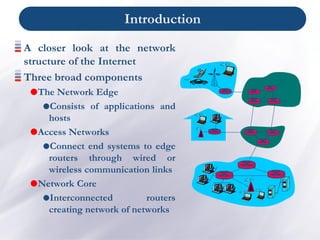
A closer lookat the network
structure of the Internet
Three broad components
The Network Edge
Consists of applications and
hosts
Access Networks
Connect end systems to edge
routers through wired or
wireless communication links
Network Core
Interconnected routers
creating network of networks
3.
Internet View ofNetworking
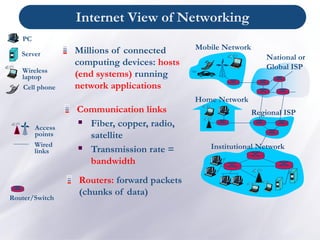
Millions of connected
computing devices: hosts
(end systems) running
network applications
Home Network
Institutional Network
Mobile Network
National or
Global ISP
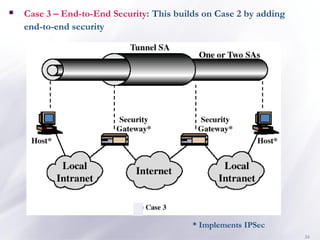
Regional ISP
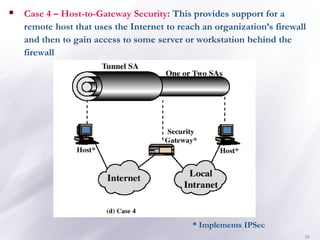
Router/Switch
PC
Server
Wireless
laptop
Cell phone
Wired
links
Access
points
Communication links
▪ Fiber, copper, radio,
satellite
▪ Transmission rate =
bandwidth
Routers: forward packets
(chunks of data)
4.
4
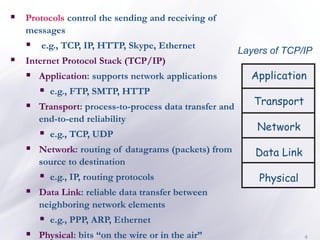
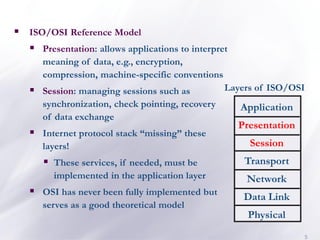
▪ Protocols controlthe sending and receiving of
messages
▪ e.g., TCP, IP, HTTP, Skype, Ethernet
▪ Internet Protocol Stack (TCP/IP)
▪ Application: supports network applications
▪ e.g., FTP, SMTP, HTTP
▪ Transport: process-to-process data transfer and
end-to-end reliability
▪ e.g., TCP, UDP
▪ Network: routing of datagrams (packets) from
source to destination
▪ e.g., IP, routing protocols
▪ Data Link: reliable data transfer between
neighboring network elements
▪ e.g., PPP, ARP, Ethernet
▪ Physical: bits “on the wire or in the air”
Application
Transport
Network
Data Link
Physical
Layers of TCP/IP
5.
5
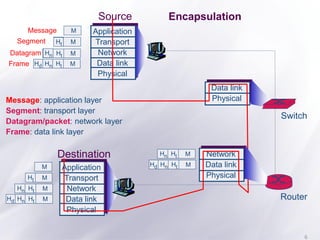
▪ ISO/OSI ReferenceModel
▪ Presentation: allows applications to interpret
meaning of data, e.g., encryption,
compression, machine-specific conventions
▪ Session: managing sessions such as
synchronization, check pointing, recovery
of data exchange
▪ Internet protocol stack “missing” these
layers!
▪ These services, if needed, must be
implemented in the application layer
▪ OSI has never been fully implemented but
serves as a good theoretical model
Application
Presentation
Session
Transport
Network
Data Link
Physical
Layers of ISO/OSI
6.
6
Source
Application
Transport
Network
Data link
Physical
Ht
Hn M
SegmentHt
Datagram
Destination
Ht
Hn
Hd M
Ht
Hn M
Ht M
M
Network
Data link
Physical
Data link
Physical
Ht
Hn
Hd M
Ht
Hn M
Ht
Hn
Hd M
Router
Switch
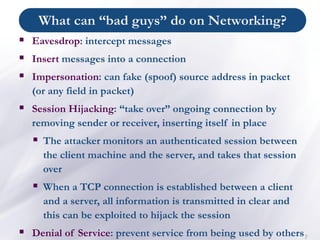
Encapsulation
Message M
Ht M
Hn
Frame
Message: application layer
Segment: transport layer
Datagram/packet: network layer
Frame: data link layer
Application
Transport
Network
Data link
Physical
7.
What can “badguys” do on Networking?
7
▪ Eavesdrop: intercept messages
▪ Insert messages into a connection
▪ Impersonation: can fake (spoof) source address in packet
(or any field in packet)
▪ Session Hijacking: “take over” ongoing connection by
removing sender or receiver, inserting itself in place
▪ The attacker monitors an authenticated session between
the client machine and the server, and takes that session
over
▪ When a TCP connection is established between a client
and a server, all information is transmitted in clear and
this can be exploited to hijack the session
▪ Denial of Service: prevent service from being used by others
8.
What is NetworkSecurity?
8
▪ Confidentiality: only sender and intended receiver should
“understand” message contents
▪ sender encrypts message
▪ receiver decrypts message
▪ Authentication: sender and receiver want to confirm
identity of each other
▪ Message integrity: sender or receiver wants to ensure
message is not altered (in transit, or afterwards) without
detection
▪ Access and availability: services must be accessible and
available to users
9.
Network Security: Example
9
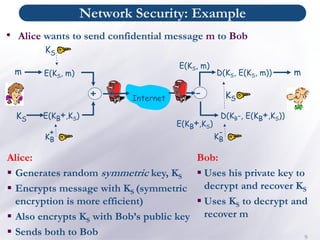
•Alice wants to send confidential message m to Bob
Alice:
▪ Generates random symmetric key, KS
▪ Encrypts message with KS (symmetric
encryption is more efficient)
▪ Also encrypts KS with Bob’s public key
▪ Sends both to Bob
Bob:
▪ Uses his private key to
decrypt and recover KS
▪ Uses KS to decrypt and
recover m
+ -
E(KS, m)
E(KB+,KS)
m
KS
KS
KB
+
Internet
KB
-
KS
m
D(KS, E(KS, m))
D(KB-, E(KB+,KS))
E(KS, m)
E(KB+,KS)
10.
Cont.…
10
▪ In today’shighly networked world, we can’t talk of
computer security without talking of network security
▪ Although there are many types of networks, the focus is
this course is on
▪ Internet and intranet security (TCP/IP based
networks)
▪ Attacks that use security holes of the network
protocols and their defences
▪ We do not discuss attacks that use networks to perform
some crime based on human weaknesses (such as scams)
11.
11
Security Features inthe TCP/IP Protocol Stack
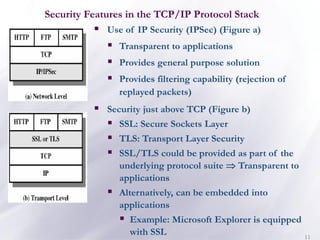
▪ Use of IP Security (IPSec) (Figure a)
▪ Transparent to applications
▪ Provides general purpose solution
▪ Provides filtering capability (rejection of
replayed packets)
▪ Security just above TCP (Figure b)
▪ SSL: Secure Sockets Layer
▪ TLS: Transport Layer Security
▪ SSL/TLS could be provided as part of the
underlying protocol suite Transparent to
applications
▪ Alternatively, can be embedded into
applications
▪ Example: Microsoft Explorer is equipped
with SSL
12.
12
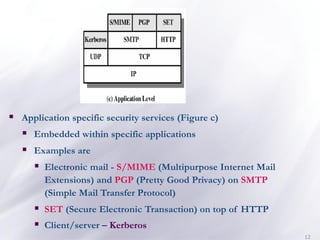
▪ Application specificsecurity services (Figure c)
▪ Embedded within specific applications
▪ Examples are
▪ Electronic mail - S/MIME (Multipurpose Internet Mail
Extensions) and PGP (Pretty Good Privacy) on SMTP
(Simple Mail Transfer Protocol)
▪ SET (Secure Electronic Transaction) on top of HTTP
▪ Client/server – Kerberos
13.
Network Protocols andVulnerabilities
13
▪ Attacks on TCP/IP Networks
▪ The Internet was not originally designed with (much)
security in mind
▪ It was designed to be used by a trusted group of users
▪ Original vision: “a group of mutually trusting users
attached to a transparent network” ☺, i.e., there is no
need for security
▪ The protocols are not designed to withstand attacks
▪ Internet is now used by all sorts of people
▪ Attackers exploit vulnerabilities of every protocol to
achieve their goals
▪ Hence, security consideration in all layers is important!
14.
Link Layer: ARPSpoofing
14
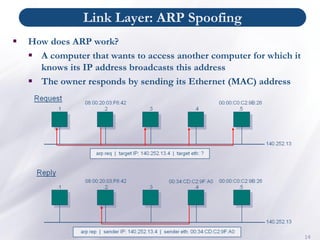
▪ How does ARP work?
▪ A computer that wants to access another computer for which it
knows its IP address broadcasts this address
▪ The owner responds by sending its Ethernet (MAC) address
15.
Cont.…
15
▪ ARP Spoofing(also called ARP cache poisoning or ARP
poison routing) is a link layer attack
▪ It is a technique by which an attacker sends (spoofed) Address
Resolution Protocol (ARP) messages onto a local area network
▪ The aim is to associate the attacker's MAC address with the IP
address of another host, such as the default gateway, causing
any traffic meant for that IP address to be sent to the attacker
instead
▪ ARP spoofing may allow an attacker to intercept data frames
on a network, modify the traffic, or stop all traffic
▪ Often the attack is used as an opening for other attacks, such
as denial of service, man in the middle, or session hijacking
attacks
16.
….
16
▪ How doesit happen?
▪ Because ARP is a stateless protocol
▪ Hosts will automatically cache any ARP replies they
receive, regardless of whether they requested them. Even
ARP entries which have not yet expired will be
overwritten when a new ARP reply packet is received
▪ There is no method in the ARP protocol by which a host
can authenticate the peer from which the packet
originated
▪ This behavior is the vulnerability which allows ARP
spoofing to occur
17.
Network Layer Security:IPSec
17
▪ IP is vulnerable
▪ IP packets can be intercepted
▪ In the LAN broadcast
▪ In the router, switch
▪ Since the packets are not protected they can be easily read
▪ Since IP packets are not authenticated they can be easily
modified
▪ Even if the user encrypts his/her data it will still be vulnerable
to traffic analysis attack
▪ Information exchanged between routers to maintain their
routing tables is not authenticated
▪ All sorts of problems can happen if a router is compromised
18.
IP Security (IPSec)Overview
18
▪ There are application-specific security mechanisms for a number
of application areas (slide 12)
▪ However, security concerns cut across protocol layers
▪ By implementing security at the IP (network) layer, an
organization can ensure secure networking not only for
applications that have security mechanisms but also for the many
security-ignorant applications
▪ IPSec provides
▪ Origin authentication (to overcome IP Spoofing)
▪ Confidentiality
▪ Message integrity
▪ Replay detection
▪ Key management
all at the level of IP packets
19.
19
▪ Origin authentication(assures that a received packet was, in fact,
transmitted by the party identified as the source in the packet header
and the packet has not been altered in transit - message integrity); IP-
level authentication is provided by inserting an Authentication
Header (AH) into the packets
▪ AH also provides anti-replay services
▪ Confidentiality (encrypts messages to prevent eavesdropping by third
parties); IP-level confidentiality is provided by inserting an
Encapsulated Security Payload (ESP) header into the packets. An
ESP header can also do the job of the AH header in addition to
confidentiality – ESP is more complicated and requires more
processing time
▪ Key management (concerned with the secure exchange of keys);
Before ESP can be used, it is necessary for the two ends of a
communication link to exchange the secret key that will be used for
encryption. Similarly, AH needs an authentication key; Keys are
exchanged with a protocol called Internet Key Exchange (IKE)
▪ Note: the use of encryption always means the need for key
management
20.
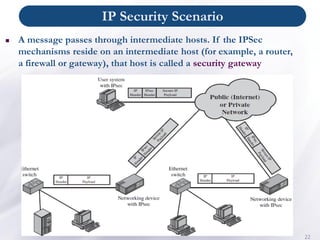
IP Security Scenario
22
◼A message passes through intermediate hosts. If the IPSec
mechanisms reside on an intermediate host (for example, a router,
a firewall or gateway), that host is called a security gateway
21.
….
23
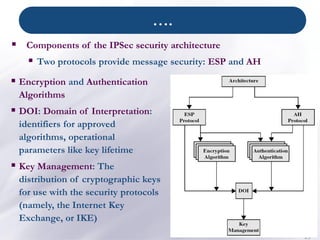
▪ Encryption andAuthentication
Algorithms
▪ DOI: Domain of Interpretation:
identifiers for approved
algorithms, operational
parameters like key lifetime
▪ Key Management: The
distribution of cryptographic keys
for use with the security protocols
(namely, the Internet Key
Exchange, or IKE)
▪ Components of the IPSec security architecture
▪ Two protocols provide message security: ESP and AH
22.
IPSec Policy
31
▪ Fundamentalto the operation of IPSec is the concept of a security
policy applied to each IP packet that transits from a source to a
destination
▪ IPSec policy is determined primarily by the interaction of two
databases:
▪ SPD (Security Policy Database)
▪ Policies by which all inbound and outbound traffic is categorized
on a host or a security gateway
▪ The SPD is used to determine how to handle messages such as
discarding the message, applying security services to the
message, and forwarding the message with no change. The
action taken depends on information in the IP and transport
layer headers
▪ SAD (Security Association Database)
▪ A container for all active SAs, and related parameters
23.
32
* Implements IPSec
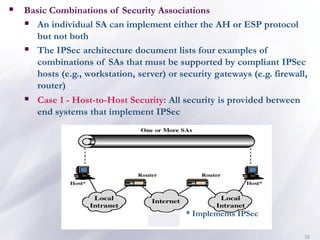
▪Basic Combinations of Security Associations
▪ An individual SA can implement either the AH or ESP protocol
but not both
▪ The IPSec architecture document lists four examples of
combinations of SAs that must be supported by compliant IPSec
hosts (e.g., workstation, server) or security gateways (e.g. firewall,
router)
▪ Case 1 - Host-to-Host Security: All security is provided between
end systems that implement IPSec
24.
33
* Implements IPSec
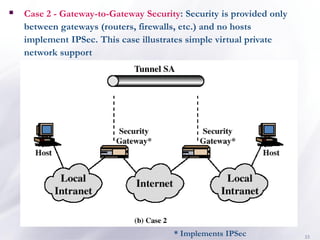
▪Case 2 - Gateway-to-Gateway Security: Security is provided only
between gateways (routers, firewalls, etc.) and no hosts
implement IPSec. This case illustrates simple virtual private
network support
25.
34
* Implements IPSec
▪Case 3 – End-to-End Security: This builds on Case 2 by adding
end-to-end security
26.
35
* Implements IPSec
▪Case 4 – Host-to-Gateway Security: This provides support for a
remote host that uses the Internet to reach an organization’s firewall
and then to gain access to some server or workstation behind the
firewall
27.
Transport Layer Security
36
▪TCP SYN flood (or CYN flood or Synflood) is a type of DDoS attack
that exploits part of the normal TCP three-way handshake to
consume resources on the targeted server and render it unresponsive
▪ When a client and server establish a normal TCP three-way
handshake, the exchange looks like the following
▪ Client requests connection by sending SYN (synchronize)
message to the server
▪ Server acknowledges by sending SYN-ACK (synchronize-
acknowledge) message back to the client
▪ Client responds with an ACK (acknowledge) message, and the
connection is established
TCP SYN Flood Attacks
28.
….
37
▪ In aSYN flood attack, the attacker sends repeated SYN packets to
every port on the targeted server, often using a fake IP address, faster
than the targeted machine can process them, causing network
saturation
▪ The server, unaware of the attack, receives multiple, apparently
legitimate requests to establish communication
▪ It responds to each attempt with a SYN-ACK packet from each open
port
▪ The attacker either does not send the expected ACK, or - if the IP
address is spoofed - never receives the SYN-ACK in the first place.
Either way, the server under attack will wait for acknowledgement of
its SYN-ACK packet
29.
…
38
Securing TCP Connections:SSL
▪ SSL – Secure Sockets Layer
▪ Widely deployed, “real-world” security protocol
▪ Considered as the de-facto standard for Internet security
▪ First designed by Netscape in 1994
▪ Evolved through versions 1.0, 2.0 and 3.0
▪ Version 3.0 is renamed to TLS (Transport Layer Service) by IETF
(Sometimes called SSL 3.1)
▪ SSL enhances TCP with confidentiality, data integrity, server
authentication, and client authentication
30.
39
▪ SSL, likemost modern security protocols, is based on
cryptography
▪ When an SSL session is established, the server begins by
announcing a public key to the client, no encryption is in use
initially
▪ Both parties (and any eavesdropper) can read this key
▪ The client then transmits information to the server using the
server's public key; no one else (other than the server) could
decode it
▪ Session key is then negotiated and established between the
server and the client to encrypt the rest of the session (see
Symmetric Key Distribution Using Asymmetric Encryption in
Chapter 3)
▪ SSL is used extensively by Web browsers, Web servers, and
Internet commerce sites (Amazon, eBay, Yahoo!, MSN, etc.) to
provide secure connections for transferring sensitive data
31.
….
40
▪ SSL-protected HTTPtransfer uses port 443 (instead of port 80),
and is identified with a special URL method - https
▪ For example: https://www.abc.com/ would cause an SSL-
enabled browser to open a secure SSL session to port 443 at
www.abc.com
▪ When HTTPS is used, the following elements of the
communication are encrypted
▪ URL of the requested document
▪ Contents of the document
▪ Contents of browser forms (filled in by browser user)
▪ Cookies sent from browser to server and from server to
browser
▪ Contents of HTTP header
32.
▪ The Web(WWW) as a client/server application running over the
Internet or TCP/IP intranet presents new challenges not well
appreciated in the context of the main stream of computer and
network security
▪ It is a very visible outlet for corporate and business transactions
that may lead to damages and loses; reputations can be damaged
and money can be lost if the Web servers are subverted
▪ Web servers are easy to configure and web content is easy to
develop and manage, but the underlying software is getting
extraordinarily complex that may hide many potential security
flaws
▪ Web servers can be exploited as a launching pad to attack
corporate data systems as users are usually not aware of the risks
Web Security
33.
….
42
▪ Types ofWeb threats and countermeasures
▪ Integrity
▪ Data, memory and/or message modification
▪ Trojan horse browser
Cryptographic checksums
▪ Confidentiality
▪ Eavesdropping
▪ Theft of data from client & information from server
▪ Access to information about network configuration
▪ Access to information about which client is communicating
Encryption
34.
….
43
▪ Denial ofService
▪ Killing of user thread
▪ Machine flooding with bogus requests
▪ Filling up disk/memory
▪ Isolating machine by DNS attacks
Detection (of suspicious pattern) and action
▪ Authentication
▪ Impersonation of legitimate users
▪ Data forgery
Cryptographic techniques
35.
….
44
▪ Types ofthreats faced in using the Web can also be classified in
terms of the location of the threat
▪ Web server (computer system security)
▪ Web browser (computer system security)
▪ Network traffic security between browser and server (network
security)
▪ Web security (Web traffic security) mainly falls into the category of
Network traffic security
▪ Different Web security approaches provide similar services but differ
with respect to their scope of applicability and their relative location
in the TCP/IP protocol stack
36.
▪ There arethree standardized schemes that are becoming
increasingly important as part of Web commerce and that focus on
security at the transport layer: SSL/TLS, HTTPS, and SSH
▪ SSL/TLS
▪ Provides security services between TCP and applications that use
TCP
▪ Provides confidentiality using symmetric encryption and
message integrity using a message authentication code
▪ It includes protocol mechanisms to enable two TCP users to
determine the security mechanisms and services they will use
▪ HTTPS (HTTP over SSL) refers to the combination of HTTP and
SSL to implement secure communication between a Web browser
and a Web server
▪ Secure Shell (SSH) provides secure remote login and other secure
client/server facilities such as FTP
….
37.
▪ DNS Spoofing
▪If the attacker has access to a name server it can modify it so
that it gives false information
▪ e.g., redirecting www.ebay.com to map to own
(attacker’s) IP address
▪ The cache of a DNS name server can be poisoned with false
information using some simple techniques
▪ Web Browsers as Threats
▪ We obtain most of our browsers on-line
▪ Potential problems that can come from malicious code
within the browser
▪ Inform the attacker of the activities of the user
▪ Inform the attacker of passwords typed in by the user
▪ Downgrade browser security (e.g., reduce key length
used in SSL)
Application Layer Security
38.
▪ Helper applicationsare used by browsers
▪ A helper application is an external viewer program to display
content retrieved using a web browser. Some examples include
JPEGview, Windows Media Player, QuickTime Player, Real Player
and Adobe Reader
▪ The helpers can have Trojan horse code
▪ Downloaded data can exploit vulnerabilities of helpers
▪ Mobile Code: Java Applets (getting outdated) & ActiveX controls
▪ Migrating code is an interesting feature
▪ However, there is a risk of malicious use of resources of the
machine that is running the code
▪ Normally run within a controlled environment (sandbox) and
access to local resources is strictly controlled by a security manager
▪ However, an Applet may escape from the sandbox due to some
bugs in the implementation of the Java Virtual Machine
….
39.
▪ Cookies
▪ Cookiesare set by web servers and stored by web browsers
▪ A cookie set by a server is sent back to the server when the
browser visits the server again
▪ Cookies can be used to track what sites the user visits (can
lead to serious privacy violation!)
▪ Server Side Risks
▪ Interactive web sites are based on forms and scripts
▪ By writing malicious scripts, the client can
▪ Crash the server (e.g., buffer overflow)
▪ Gain control over the server
40.
▪ E-mails transitthrough various servers before reaching their
destinations
▪ By default, they are visible by anybody who has access to the servers
▪ SMTP protocol has security holes and operational limitations
▪ E-mail security can be improved using tools and protocols like PGP
and S/MIME
▪ PGP: Pretty Good Privacy
▪ S/MIME: Secure Multi-Purpose Internet Mail Extension
E-mail Security
41.
▪ Confidentiality: Trudyshouldn’t read Alice’s e-mail to Bob
▪ Sender Authentication: “I don’t Love you anymore. I never want
to see you again. Formerly yours, Alice”; Bob would like to make
sure that the message came from Alice and not from Trudy
▪ Message Integrity: Trudy shouldn’t change Alice’s e-mail to Bob
▪ Receiver Authentication: Alice wants to make sure that she is
indeed sending the letter to Bob and not to Trudy who is
impersonating Bob
Required security features for e-mail
42.
▪ Philip R.Zimmerman is the creator of PGP
▪ PGP is an open-source, freely available software package for e-
mail security
▪ There are several software implementations available as
freeware for most desktop operating systems
▪ PGP provides confidentiality and authentication services that
can be used for e-mail and file storage applications
▪ It provides authentication through the use of digital signature,
confidentiality through the use of symmetric encryption,
compression using the ZIP algorithm, and e-mail compatibility
using the radix-64 (Base 64) encoding scheme
▪ PGP incorporates tools for developing a public-key trust model
and public-key certificate management
PGP
43.
▪ SMTP Limitations- Can not transmit, or has a problem with
▪ Executable files, or other binary files (e.g., JPEG image)
▪ “national language” characters (non-ASCII)
▪ Messages over a certain size
▪ ASCII to EBCDIC translation problems
▪ Lines longer than a certain length (72 to 254 characters)
▪ Multipurpose Internet Mail Extension (MIME) is intended to
address some of the problems and limitations of the use of
SMTP
SMTP
44.
▪ S/MIME isan Internet standard approach to e-mail security that
incorporates the same functionality as PGP
▪ Enveloped Data: Encrypted content and encrypted session keys for
recipients
▪ Signed Data: Message Digest encrypted with private key of “signer”
▪ Clear-Signed Data: Signed but not encrypted
▪ Signed and Enveloped Data: Various orderings for encrypting and
signing
Read about
▪ DomainKeys Identified Mail (DKIM) - a specification for
cryptographically signing e-mail messages which is a proposed
Internet Standard
▪ WEP (Wired Equivalent Privacy) and IEEE 802.11i for securing
Wireless LANs
S/MIME Functions