1
B.J.P.S Samiti’s
M.V.HERWADKAR ENGLISH MEDIUM HIGH
SCHOOL
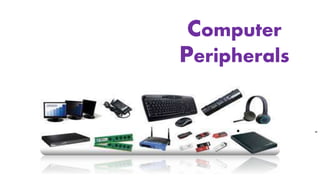
COMPUTER PERIPHERALS
Shivani Karekar
Staff Name
Computer
Peripherals
• -
•Computer is a versatile machine that can
process data and provides us with important
information.
• Computer Peripherals:-Computer is made
up of several input and output devices that
work together are known as computer
peripherals.
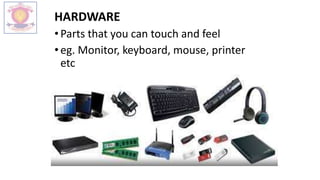
HARDWARE
•Parts that you can touch and feel
•eg. Monitor, keyboard, mouse, printer
etc
SOFTWARE
 Parts that you can not touch and feel
 A set of instructions
 eg. Paint, MS-Word, powerpoint, VLC
media, games etc
IPO CYCLE
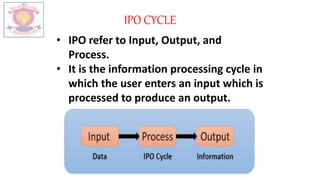
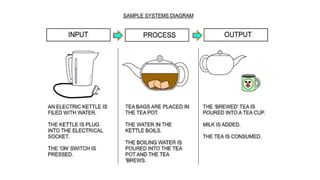
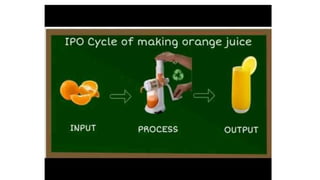
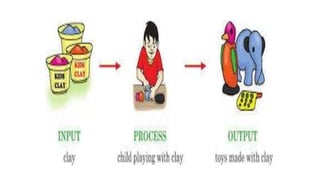
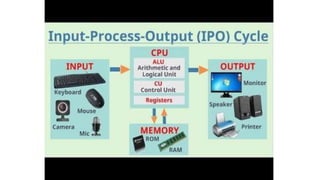
• IPO refer to Input, Output, and
Process.
• It is the information processing cycle in
which the user enters an input which is
processed to produce an output.
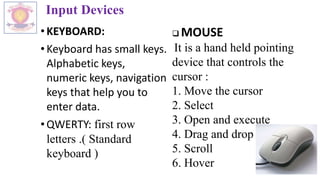
Input Devices
•KEYBOARD:
•Keyboard has small keys.
Alphabetic keys,
numeric keys, navigation
keys that help you to
enter data.
•QWERTY: first row
letters .( Standard
keyboard )
 MOUSE
It is a hand held pointing
device that controls the
cursor :
1. Move the cursor
2. Select
3. Open and execute
4. Drag and drop
5. Scroll
6. Hover
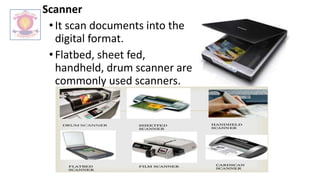
Scanner
•It scan documents into the
digital format.
•Flatbed, sheet fed,
handheld, drum scanner are
commonly used scanners.
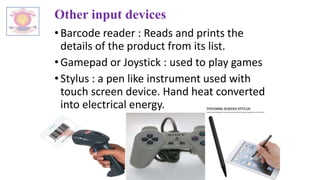
Other input devices
•Barcode reader : Reads and prints the
details of the product from its list.
•Gamepad or Joystick : used to play games
•Stylus : a pen like instrument used with
touch screen device. Hand heat converted
into electrical energy.
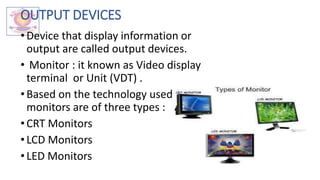
OUTPUT DEVICES
•Device that display information or
output are called output devices.
• Monitor : it known as Video display
terminal or Unit (VDT) .
• Based on the technology used
monitors are of three types :
•CRT Monitors
• LCD Monitors
•LED Monitors
Printer
•Printer gives a printed output of what you
see on the monitor.
•It generate hard copy of the electronic
data.
•World’s largest printer is known as
Infinitus which is used to printing
backdrops that are used by TV, theatre.
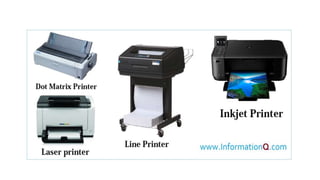
•Printer types :
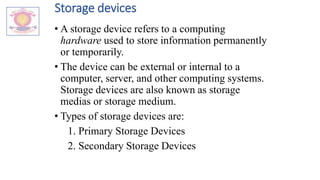
SPEAKERS
• It convert electronic data into sound. Speakers are
usually available in pairs.
• Other output devices :
Storage devices
• A storage device refers to a computing
hardware used to store information permanently
or temporarily.
• The device can be external or internal to a
computer, server, and other computing systems.
Storage devices are also known as storage
medias or storage medium.
• Types of storage devices are:
1. Primary Storage Devices
2. Secondary Storage Devices
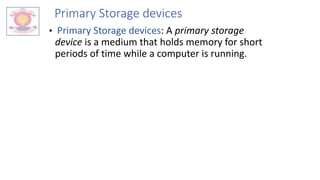
Primary Storage devices
• Primary Storage devices: A primary storage
device is a medium that holds memory for short
periods of time while a computer is running.
Non volatile memory is permanent memory
in which nothing data erase when system is
turn off.
RAM – Random access memory (volatile
memory)
ROM – Read Only Memory ( non volatile
memory)
Secondary Memory/Storage Devices
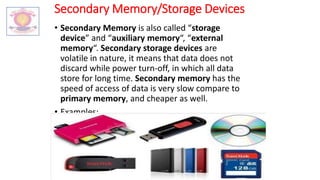
• Secondary Memory is also called “storage
device” and “auxiliary memory“, “external
memory“. Secondary storage devices are
volatile in nature, it means that data does not
discard while power turn-off, in which all data
store for long time. Secondary memory has the
speed of access of data is very slow compare to
primary memory, and cheaper as well.
• Examples:
Difference Between Primary and
Secondary Memory
Primary Memory
• Primary Memory can be volatile
and non volatile.
• Primary memory is also known as
internal memory.
• Primary memory has two
categories like as RAM and ROM.
• Primary memory is more costly to
secondary memory.
• All data goes to loss while power is
turn off.
• Primary memory is faster than to
secondary memory.
Secondary Memory
• Secondary Memory only has non
volatile in nature.
• Secondary memory is called also
Backup or Auxiliary memory.
• Secondary memory has four categories
like as Magnetic Storage, Optical
Storage, Flash storage, and Online
Cloud System.
• Secondary memory is cheaper to primary
memory.
• All data can be access anytime either
power is on or not.
• Secondary memory is slow compare to
primary memory
Communication Devices
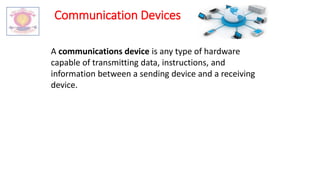
A communications device is any type of hardware
capable of transmitting data, instructions, and
information between a sending device and a receiving
device.
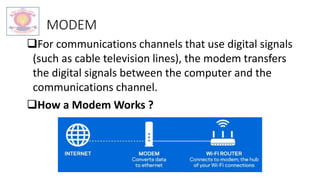
MODEM
For communications channels that use digital signals
(such as cable television lines), the modem transfers
the digital signals between the computer and the
communications channel.
How a Modem Works ?
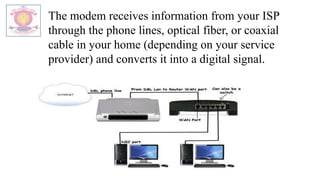
The modem receives information from your ISP
through the phone lines, optical fiber, or coaxial
cable in your home (depending on your service
provider) and converts it into a digital signal.
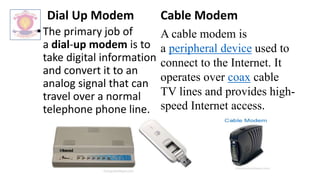
Dial Up Modem
•The primary job of
a dial-up modem is to
take digital information
and convert it to an
analog signal that can
travel over a normal
telephone phone line.
Cable Modem
A cable modem is
a peripheral device used to
connect to the Internet. It
operates over coax cable
TV lines and provides high-
speed Internet access.
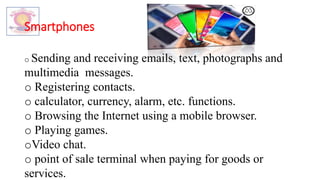
Smartphones
o Sending and receiving emails, text, photographs and
multimedia messages.
o Registering contacts.
o calculator, currency, alarm, etc. functions.
o Browsing the Internet using a mobile browser.
o Playing games.
oVideo chat.
o point of sale terminal when paying for goods or
services.
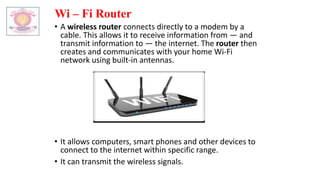
• A wireless router connects directly to a modem by a
cable. This allows it to receive information from — and
transmit information to — the internet. The router then
creates and communicates with your home Wi-Fi
network using built-in antennas.
• It allows computers, smart phones and other devices to
connect to the internet within specific range.
• It can transmit the wireless signals.
Wi – Fi Router
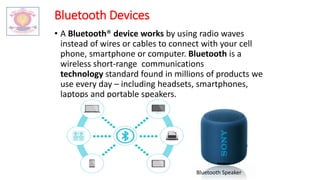
Bluetooth Devices
• A Bluetooth® device works by using radio waves
instead of wires or cables to connect with your cell
phone, smartphone or computer. Bluetooth is a
wireless short-range communications
technology standard found in millions of products we
use every day – including headsets, smartphones,
laptops and portable speakers.
Bluetooth Speaker
 Hardware and software
 Input , Output, Storage Devices
 Communication Devices
 Modem
 Router
 Smartphone
 Bluetooth Devices
computer peripherals 9th ls 1.pptx

computer peripherals 9th ls 1.pptx

  • 1.
    1 B.J.P.S Samiti’s M.V.HERWADKAR ENGLISHMEDIUM HIGH SCHOOL COMPUTER PERIPHERALS Shivani Karekar Staff Name
  • 2.
  • 3.
    •Computer is aversatile machine that can process data and provides us with important information. • Computer Peripherals:-Computer is made up of several input and output devices that work together are known as computer peripherals.
  • 4.
    HARDWARE •Parts that youcan touch and feel •eg. Monitor, keyboard, mouse, printer etc
  • 5.
    SOFTWARE  Parts thatyou can not touch and feel  A set of instructions  eg. Paint, MS-Word, powerpoint, VLC media, games etc
  • 7.
    IPO CYCLE • IPOrefer to Input, Output, and Process. • It is the information processing cycle in which the user enters an input which is processed to produce an output.
  • 12.
    Input Devices •KEYBOARD: •Keyboard hassmall keys. Alphabetic keys, numeric keys, navigation keys that help you to enter data. •QWERTY: first row letters .( Standard keyboard )  MOUSE It is a hand held pointing device that controls the cursor : 1. Move the cursor 2. Select 3. Open and execute 4. Drag and drop 5. Scroll 6. Hover
  • 13.
    Scanner •It scan documentsinto the digital format. •Flatbed, sheet fed, handheld, drum scanner are commonly used scanners.
  • 14.
    Other input devices •Barcodereader : Reads and prints the details of the product from its list. •Gamepad or Joystick : used to play games •Stylus : a pen like instrument used with touch screen device. Hand heat converted into electrical energy.
  • 15.
    OUTPUT DEVICES •Device thatdisplay information or output are called output devices. • Monitor : it known as Video display terminal or Unit (VDT) . • Based on the technology used monitors are of three types : •CRT Monitors • LCD Monitors •LED Monitors
  • 16.
    Printer •Printer gives aprinted output of what you see on the monitor. •It generate hard copy of the electronic data. •World’s largest printer is known as Infinitus which is used to printing backdrops that are used by TV, theatre. •Printer types :
  • 18.
    SPEAKERS • It convertelectronic data into sound. Speakers are usually available in pairs. • Other output devices :
  • 19.
    Storage devices • Astorage device refers to a computing hardware used to store information permanently or temporarily. • The device can be external or internal to a computer, server, and other computing systems. Storage devices are also known as storage medias or storage medium. • Types of storage devices are: 1. Primary Storage Devices 2. Secondary Storage Devices
  • 20.
    Primary Storage devices •Primary Storage devices: A primary storage device is a medium that holds memory for short periods of time while a computer is running.
  • 21.
    Non volatile memoryis permanent memory in which nothing data erase when system is turn off. RAM – Random access memory (volatile memory) ROM – Read Only Memory ( non volatile memory)
  • 22.
    Secondary Memory/Storage Devices •Secondary Memory is also called “storage device” and “auxiliary memory“, “external memory“. Secondary storage devices are volatile in nature, it means that data does not discard while power turn-off, in which all data store for long time. Secondary memory has the speed of access of data is very slow compare to primary memory, and cheaper as well. • Examples:
  • 23.
    Difference Between Primaryand Secondary Memory Primary Memory • Primary Memory can be volatile and non volatile. • Primary memory is also known as internal memory. • Primary memory has two categories like as RAM and ROM. • Primary memory is more costly to secondary memory. • All data goes to loss while power is turn off. • Primary memory is faster than to secondary memory. Secondary Memory • Secondary Memory only has non volatile in nature. • Secondary memory is called also Backup or Auxiliary memory. • Secondary memory has four categories like as Magnetic Storage, Optical Storage, Flash storage, and Online Cloud System. • Secondary memory is cheaper to primary memory. • All data can be access anytime either power is on or not. • Secondary memory is slow compare to primary memory
  • 24.
    Communication Devices A communicationsdevice is any type of hardware capable of transmitting data, instructions, and information between a sending device and a receiving device.
  • 26.
    MODEM For communications channelsthat use digital signals (such as cable television lines), the modem transfers the digital signals between the computer and the communications channel. How a Modem Works ?
  • 27.
    The modem receivesinformation from your ISP through the phone lines, optical fiber, or coaxial cable in your home (depending on your service provider) and converts it into a digital signal.
  • 28.
    Dial Up Modem •Theprimary job of a dial-up modem is to take digital information and convert it to an analog signal that can travel over a normal telephone phone line. Cable Modem A cable modem is a peripheral device used to connect to the Internet. It operates over coax cable TV lines and provides high- speed Internet access.
  • 29.
    Smartphones o Sending andreceiving emails, text, photographs and multimedia messages. o Registering contacts. o calculator, currency, alarm, etc. functions. o Browsing the Internet using a mobile browser. o Playing games. oVideo chat. o point of sale terminal when paying for goods or services.
  • 30.
    • A wirelessrouter connects directly to a modem by a cable. This allows it to receive information from — and transmit information to — the internet. The router then creates and communicates with your home Wi-Fi network using built-in antennas. • It allows computers, smart phones and other devices to connect to the internet within specific range. • It can transmit the wireless signals. Wi – Fi Router
  • 31.
    Bluetooth Devices • ABluetooth® device works by using radio waves instead of wires or cables to connect with your cell phone, smartphone or computer. Bluetooth is a wireless short-range communications technology standard found in millions of products we use every day – including headsets, smartphones, laptops and portable speakers. Bluetooth Speaker
  • 32.
     Hardware andsoftware  Input , Output, Storage Devices  Communication Devices  Modem  Router  Smartphone  Bluetooth Devices