Visit https://ebookultra.com to download the full version and
explore more ebooks
Computational Methods in Biomedical Research 1st
Edition Ravindra Khattree (Editor)

_____ Click the link below to download _____
https://ebookultra.com/download/computational-methods-
in-biomedical-research-1st-edition-ravindra-khattree-
editor/
Explore and download more ebooks at ebookultra.com
Here are some suggested products you might be interested in.
Click the link to download
Computational Methods in Biomedical Research 1st Edition
Ravindra Khattree (Editor)

https://ebookultra.com/download/computational-methods-in-biomedical-
research-1st-edition-ravindra-khattree-editor/
Ethics Research Methods and Standards in Biomedical
Engineering 1st Edition Monique Frize
https://ebookultra.com/download/ethics-research-methods-and-standards-
in-biomedical-engineering-1st-edition-monique-frize/
Computational Methods in Plasma Physics Chapman Hall CRC
Computational Science 1st Edition Stephen Jardin
https://ebookultra.com/download/computational-methods-in-plasma-
physics-chapman-hall-crc-computational-science-1st-edition-stephen-
jardin/
Fraud and Misconduct in Biomedical Research 3rd edition
Frank Wells
https://ebookultra.com/download/fraud-and-misconduct-in-biomedical-
research-3rd-edition-frank-wells/
Methods in Biomedical Informatics A Pragmatic Approach 1st
Edition Neil Sarkar (Eds.)
https://ebookultra.com/download/methods-in-biomedical-informatics-a-
pragmatic-approach-1st-edition-neil-sarkar-eds/
Computational Methods in Multiphase Flow IV 1st Edition A.
A. Mammoli
https://ebookultra.com/download/computational-methods-in-multiphase-
flow-iv-1st-edition-a-a-mammoli/
Handbook of Research Methods in Developmental Science
Blackwell Handbooks of Research Methods in Psychology 1st
Edition Douglas Teti
https://ebookultra.com/download/handbook-of-research-methods-in-
developmental-science-blackwell-handbooks-of-research-methods-in-
psychology-1st-edition-douglas-teti/
Computational Methods for Pde in Mechani With CDROM
Berardino D'Acunto
https://ebookultra.com/download/computational-methods-for-pde-in-
mechani-with-cdrom-berardino-dacunto/
Biomedical Image Understanding Methods and Applications
1st Edition Joo-Hwee Lim
https://ebookultra.com/download/biomedical-image-understanding-
methods-and-applications-1st-edition-joo-hwee-lim/
Computational Methods in Biomedical Research 1st
Edition Ravindra Khattree (Editor) Digital Instant

Download
Author(s): Ravindra Khattree (Editor); Dayanand Naik (Editor)
ISBN(s): 9781584885771, 1420010921
Edition: 1
File Details: PDF, 4.67 MB
Year: 2007
Language: english
C5777: “c5777_c000” — 2007/10/31 — 15:03 — page i — #1
i
C5777: “c5777_c000” — 2007/10/31 — 15:03 — page ii — #2
ii Computational Methods in Biomedical Research
Editor-in-Chief
Shein-Chung Chow, Ph.D.
Professor
Department of Biostatistics and Bioinformatics
Duke University School of Medicine
Durham, North Carolina, U.S.A.
Byron Jones
Senior Director
Statistical Research and Consulting Centre
(IPC 193)
Pfizer Global Research and Development
Sandwich, Kent, UK
Jen-pei Liu
Professor
Division of Biometry
Department of Agronomy
National Taiwan University
Taipei, Taiwan
Karl E. Peace
Director,Karl E. Peace Center for Biostatistics
Professor of Biostatistics
Georgia Cancer Coalition Distinguished Cancer Scholar
Georgia Southern University, Statesboro, GA
Series Editors
C5777: “c5777_c000” — 2007/10/31 — 15:03 — page iii — #3
iii
1. Design and Analysis of Animal Studies in Pharmaceutical Development,
Shein-Chung Chow and Jen-pei Liu
2. Basic Statistics and Pharmaceutical Statistical Applications,
James E. De Muth
3. Design and Analysis of Bioavailability and Bioequivalence Studies,
Second Edition, Revised and Expanded, Shein-Chung Chow and Jen-pei Liu
4. Meta-Analysis in Medicine and Health Policy, Dalene K. Stangl and
Donald A. Berry
5. Generalized Linear Models: A Bayesian Perspective, Dipak K. Dey,
Sujit K. Ghosh, and Bani K. Mallick
6. Difference Equations with Public Health Applications, Lemuel A. Moyé
and Asha Seth Kapadia
7. Medical Biostatistics, Abhaya Indrayan and Sanjeev B. Sarmukaddam
8. Statistical Methods for Clinical Trials, Mark X. Norleans
9. Causal Analysis in Biomedicine and Epidemiology: Based on Minimal
Sufficient Causation, Mikel Aickin
10. Statistics in Drug Research: Methodologies and Recent Developments,
Shein-Chung Chow and Jun Shao
11. Sample Size Calculations in Clinical Research, Shein-Chung Chow, Jun Shao, and
Hansheng Wang
12. Applied Statistical Design for the Researcher,Daryl S. Paulson
13. Advances in Clinical Trial Biostatistics, Nancy L. Geller
14. Statistics in the Pharmaceutical Industry, Third Edition, Ralph Buncher
and Jia-Yeong Tsay
15. DNA Microarrays and Related Genomics Techniques: Design, Analysis, and Interpretation
of Experiments, David B. Allsion, Grier P.Page, T. Mark Beasley, and Jode W. Edwards
16. Basic Statistics and Pharmaceutical Statistical Applications, Second Edition, James E.
De Muth
17. Adaptive Design Methods in Clinical Trials, Shein-Chung Chow and
Mark Chang
18. Handbook of Regression and Modeling: Applications for the Clinical and Pharmaceutical
Industries, Daryl S. Paulson
19. Statistical Design and Analysis of Stability Studies, Shein-Chung Chow
20. Sample Size Calculations in Clinical Research, Second Edition, Shein-Chung Chow,
Jun Shao, and Hansheng Wang
21. Elementary Bayesian Biostatistics, Lemuel A. Moyé
22. Adaptive Design Theory and Implementation Using SAS and R, Mark Chang
23. Computational Pharmacokinetics, Anders Kallen
Published Titles
C5777: “c5777_c000” — 2007/10/31 — 15:03 — page iv — #4
C5777: “c5777_c000” — 2007/10/31 — 15:03 — page v — #5
v
C5777: “c5777_c000” — 2007/10/31 — 15:03 — page vi — #6
C5777: “c5777_c000” — 2007/10/31 — 15:03 — page vii — #7
Contents
Series Introduction ................................................................ vii
Preface............................................................................... ix
Editors............................................................................... xi
Contributors........................................................................ xiii
1 Microarray Data Analysis.................................................. 1
Susmita Datta, Somnath Datta, Rudolph S. Parrish, and
Caryn M. Thompson
2 Machine Learning Techniques for Bioinformatics:
Fundamentals and Applications.......................................... 45
Jarosław Meller and Michael Wagner
3 Machine Learning Methods for Cancer Diagnosis and
Prognostication .............................................................. 77
Anne-Michelle Noone and Mousumi Banerjee
4 Protein Profiling for Disease Proteomics with Mass
Spectrometry: Computational Challenges.............................. 103
Dayanand N. Naik and Michael Wagner
5 Predicting US Cancer Mortality Counts Using State
Space Models ................................................................ 131
Kaushik Ghosh, Ram C. Tiwari, Eric J. Feuer, Kathleen A. Cronin,
and Ahmedin Jemal
6 Analyzing Multiple Failure Time Data Using SAS® Software ..... 153
Joseph C. Gardiner, Lin Liu, and Zhehui Luo
7 Mixed-Effects Models for Longitudinal Virologic and
Immunologic HIV Data .................................................... 189
Florin Vaida, Pulak Ghosh, and Lin Liu
C5777: “c5777_c000” — 2007/10/31 — 15:03 — page viii — #8
viii Contents
8 Bayesian Computational Methods in Biomedical Research......... 211
Hedibert F. Lopes, Peter Müller, and Nalini Ravishanker
9 Sequential Monitoring of Randomization Tests ...................... 261
Yanqiong Zhang and William F. Rosenberger
10 Proportional Hazards Mixed-Effects Models and Applications .... 297
Ronghui Xu and Michael Donohue
11 Classification Rules for Repeated Measures Data from
Biomedical Research........................................................ 323
Anuradha Roy and Ravindra Khattree
12 Estimation Methods for Analyzing Longitudinal Data
Occurring in Biomedical Research ....................................... 371
N. Rao Chaganty and Deepak Mav
Index................................................................................. 401
C5777: “c5777_c000” — 2007/10/31 — 15:03 — page ix — #9
Series Introduction
The primary objectives of the Biostatistics Book Series are to provide useful
reference books for researchers and scientists in academia, industry, and gov-
ernment, and also to offer textbooks for undergraduate and graduate courses
in the area of biostatistics. This book series will provide comprehensive and
unified presentations of statistical designs and analyses of important applic-
ations in biostatistics, such as those in biopharmaceuticals. A well-balanced
summary will be given of current and recently developed statistical meth-
ods and interpretations for both statisticians and researchers or scientists
with minimal statistical knowledge who are engaged in the field of applied
biostatistics. The series is committed to providing easy-to-understand, state-
of-the-art references and textbooks. In each volume, statistical concepts and
methodologies will be illustrated through real-world examples.
In the last decade, it was recognized that increased spending on biomed-
ical research does not reflect an increase in the success rate of pharmaceutical
development. On March 16, 2004, the FDA released a report addressing
the recent slowdown in innovative medical therapies submitted to the FDA
for approval, “Innovation/Stagnation: Challenge and Opportunity on the
Critical Path to New Medical Products.” The report describes the urgent need
tomodernizethemedicalproductdevelopmentprocess—thecriticalpath—to
make product development more predictable and less costly. Two years later,
the FDA released a Critical Path Opportunities List that outlines 76 initial pro-
jects (under six broad topic areas) to bridge the gap between the quick pace of
new biomedical discoveries and the slower pace at which those discoveries
are currently developed into therapies. Among the six broad topic areas, bet-
ter evaluation tool (development of biomarker), streamlining clinical trial (the
use of adaptive design methods), and harnessing bioinformatics (the use of
computational biology) are considered the top three challenges for increasing
the probability of success in pharmaceutical research and development.
This volume provides useful approaches for implementation of target
clinical trials in pharmaceutical research and development. It covers stat-
istical methods for various computational topics such as biomarker devel-
opment, sequential monitoring, proportional hazard mixed-effects models,
and Bayesian approach in pharmaceutical research and development. It
would be beneficial to biostatisticians, medical researchers, pharmaceutical
C5777: “c5777_c000” — 2007/10/31 — 15:03 — page x — #10
x Series Introduction
scientists, and reviewers in regulatory agencies who are engaged in the areas
of pharmaceutical research and development.
Shein-Chung Chow
C5777: “c5777_c000” — 2007/10/31 — 15:03 — page xi — #11
Preface
This edited volume is a collection of chapters covering some of the important
computational topics with special reference to biomedical applications. Rapid
advancesinever-changingbiomedicalresearchandmethodologicalstatistical
developments that must support these advances make it imperative that from
time to time a cohesive account of new computational schemes is made avail-
able for users to implement these methodologies in the particular biomedical
context or problem. The present volume is an attempt to fill this need.
Realizing the vastness of the area itself, there is no pretension to be exhaust-
ive in terms of the general field or even in terms of a topic represented by a
chapter within this field; such a task, while also requiring hundreds of collab-
orators, would require a collection of several volumes of similar size. Hence
the selection made here represents our personal view of what the most import-
ant topics are, in terms of their applicability and potential in the near future.
With this in mind, the chapters are arranged accordingly, with the works of
immediate applicability appearing first. These are followed by more theor-
etical advances and computational schemes that are yet to be developed in
satisfactory forms for general applications.
Work of this magnitude could not have been accomplished without the
help of many people. We wish to thank our referees for painstakingly
going through the chapters as a gesture of academic goodwill. Theresa Del
Forn of Taylor & Francis Group, was most helpful and patient with our
repeatedly broken promises of meeting the next deadline. Our families have
provided their sincere support during this project and we appreciate their
understanding as well.
Ravindra Khattree, Rochester, Michigan
Dayanand N. Naik, Norfolk, Virginia
C5777: “c5777_c000” — 2007/10/31 — 15:03 — page xii — #12
C5777: “c5777_c000” — 2007/10/31 — 15:03 — page xiii — #13
Editors
Ravindra Khattree, professor of statistics at Oakland University, Rochester,
Michigan, received his initial graduate training at the Indian Statistical
Institute. He received his PhD from the University of Pittsburgh in 1985.
He is the author or coauthor of numerous research articles on theoretical
and applied statistics in various national and international journals. His
researchinterestsincludemultivariateanalysis, experimentaldesigns, quality
control, repeated measures, and statistical inference. In addition to teaching
graduate and undergraduate courses, Dr. Khattree regularly consults with
industry, hospitals, and academic researchers on various applied statistics
problems. He is a chief editor of the Journal of Statistics and Applications, editor
of InterStat, an online statistics journal, and an associate editor of the Journal
of Statistical Theory and Practice. For many years, he also served as an associate
editor for the Communications in Statistics. He is a Fellow of the American
Statistical Association, an elected member of the International Statistical
Institute, and a winner of the Young Statistician Award from International
Indian Statistical Association. Dr. Khattree is a coauthor of two books, both
with Dr. D. N. Naik, titled Applied Multivariate Statistics with SAS Software
(Second Edition) and Multivariate Data Reduction and Discrimination with SAS
Software, both copublished by SAS Press/Wiley. He has also coedited, with
Dr. C. R. Rao, the Handbook of Statistics 22: Statistics in Industry, published by
North Holland.
Dayanand N. Naik is professor of statistics at Old Dominion University,
Norfolk, Virginia. He received his MS degree in statistics from Karnatak
University, Dharwad, India, and PhD in statistics from the University of
Pittsburgh in 1985. He has published extensively in several well-respected
journals and advised numerous students for their PhD in statistics. His
research interests include multivariate analysis, linear models, quality con-
trol, regression diagnostics, repeated measures, and growth curve models.
Dr. Naik is an editor of InterStat, a statistics journal on the Internet, and
an associate editor of Communications in Statistics. Dr. Naik is also actively
involved in statistical consulting and collaborative research. He is an elected
member of International Statistical Institute and is very active in American
Statistical Association activities. Dr. Naik is coauthor of two books, both with
Dr. Khattree, titled Applied Multivariate Statistics with SAS Software (Second
Edition) and Multivariate Data Reduction and Discrimination with SAS Software,
both copublished by SAS Press/Wiley.
C5777: “c5777_c000” — 2007/10/31 — 15:03 — page xiv — #14
C5777: “c5777_c000” — 2007/10/31 — 15:03 — page xv — #15
Contributors
Mousumi Banerjee Department of Biostatistics, School of Public Health,
University of Michigan, Ann Arbor, Michigan
N. Rao Chaganty Department of Mathematics and Statistics, Old Dominion
University, Norfolk, Virginia
Kathleen A. Cronin Statistical Research and Applications Branch, National
Cancer Institute, Bethesda, Maryland
Somnath Datta Department of Bioinformatics and Biostatistics, School
of Public Health and Information Sciences, University of Louisville,
Louisville, Kentucky
Susmita Datta Department of Bioinformatics and Biostatistics, School of
Public Health and Information Sciences, University of Louisville, Louis-
ville, Kentucky
Michael Donohue Division of Biostatistics and Bioinformatics, Department
of Family and Preventive Medicine, University of California at San Diego,
La Jolla, California
Eric J. Feuer Statistical Research and Applications Branch, National Cancer
Institute, Bethesda, Maryland
Joseph C. Gardiner Division of Biostatistics, Department of Epidemiology,
Michigan State University, East Lansing, Michigan
Kaushik Ghosh Department of Mathematical Sciences, University of
Nevada at Las Vegas, Las Vegas, Nevada
Pulak Ghosh Department of Mathematics and Statistics, Georgia State
University, Atlanta, Georgia
Ahmedin Jemal Department of Epidemiology and Surveillance Research,
American Cancer Society, Atlanta, Georgia
C5777: “c5777_c000” — 2007/10/31 — 15:03 — page xvi — #16
xvi Contributors
Ravindra Khattree Department of Mathematics and Statistics, Oakland
University, Rochester, Michigan
Lin Liu Division of Biostatistics, Department of Epidemiology, Michigan
State University, East Lansing, Michigan
Lin Liu Department of Family and Preventive Medicine, University of
California at San Diego, La Jolla, California
Hedibert F. Lopes Graduate School of Business, University of Chicago,
Chicago, Illinois
Zhehui Luo Division of Biostatistics, Department of Epidemiology,
Michigan State University, East Lansing, Michigan
Deepak Mav Constella Group, Inc., Durham, North Carolina
Jarosław Meller Division of Biomedical Informatics, Cincinnati Children’s
Hospital Research Foundation, Cincinnati, Ohio; Department of Inform-
atics, Nicholas Copernicus University, Torun, Poland; and Department of
Environmental Health, University of Cincinnati, Ohio
Peter Müller Department of Biostatistics, The University of Texas,
M. D. Anderson Cancer Center, Houston, Texas
Dayanand N. Naik Department of Mathematics and Statistics, Old Domin-
ion University, Norfolk, Virginia
Anne-Michelle Noone Department of Biostatistics, School of Public
Health, University of Michigan, Ann Arbor, Michigan
Rudolph S. Parrish Department of Bioinformatics and Biostatistics, School
of Public Health and Information Sciences, University of Louisville,
Louisville, Kentucky
Nalini Ravishanker Department of Statistics, University of Connecticut,
Storrs, Connecticut
William F. Rosenberger Department of Statistics, The Volgenau School
of Information Technology and Engineering, George Mason University,
Fairfax, Virginia
Anuradha Roy Department of Management Science and Statistics, The
University of Texas at San Antonio, San Antonio, Texas
C5777: “c5777_c000” — 2007/10/31 — 15:03 — page xvii — #17
Contributors xvii
Caryn M. Thompson Department of Bioinformatics and Biostatistics,
School of Public Health and Information Sciences, University of Louisville,
Louisville, Kentucky
Ram C. Tiwari Statistical Research and Applications Branch, National
Cancer Institute, Bethesda, Maryland
Florin Vaida Division of Biostatistics and Bioinformatics, Department of
Family and Preventive Medicine, University of California at San Diego,
La Jolla, California
Michael Wagner Division of Biomedical Informatics, Cincinnati Children’s
Hospital Research Foundation, Cincinnati, Ohio
Ronghui Xu Division of Biostatistics and Bioinformatics, Department
of Family and Preventive Medicine, and Department of Mathematics,
University of California at San Diego, La Jolla, California
Yanqiong Zhang Merck & Company, Rahway, New Jersey
C5777: “c5777_c000” — 2007/10/31 — 15:03 — page xviii — #18
C5777: “c5777_c001” — 2007/10/27 — 13:02 — page 1 — #1
1
Microarray Data Analysis
Susmita Datta, Somnath Datta, Rudolph S. Parrish, and
Caryn M. Thompson
CONTENTS
1.1 Introduction ................................................................. 2
1.2 Experimental Design ....................................................... 3
1.2.1 Data from Microarray Experiments ............................. 4
1.2.2 Sources of Variation ............................................... 4
1.2.3 Principles of Experimental Design .............................. 5
1.2.4 Common Designs for Oligonucleotide Arrays ................ 6
1.2.5 Power/Sample Size Considerations ............................ 8
1.2.6 Pooling .............................................................. 9
1.2.7 Designs for Dual-Channel Arrays ............................... 10
1.3 Normalization of Microarray Data ...................................... 11
1.3.1 Normalization and Its Implications for Estimation of
Variance Components ............................................. 14
1.3.2 Normalization Methods .......................................... 15
1.3.2.1 Method Based on Selected Invariant Genes ........ 15
1.3.2.2 Methods Based on Global or Local Values .......... 15
1.3.2.3 Local Regression Methods ............................. 17
1.3.2.4 Quantile-Based Methods .............................. 17
1.3.2.5 Methods Based on Linear Models .................... 18
1.3.2.6 Probe Intensity Models ................................ 18
1.4 Clustering and Classification ............................................. 19
1.4.1 Clustering ........................................................... 19
1.4.2 Classification ....................................................... 23
1.4.2.1 Dimensionality Reduction ............................. 24
1.4.2.2 Classification Algorithms .............................. 25
1.4.2.3 Accuracy of Classification ............................. 26
1.5 Detection of Differential Gene Expressions ............................ 27
1.5.1 Fold Change ........................................................ 27
1.5.2 The Two Sample t-Test and its Variants ........................ 28
1.5.3 Adjustments for Multiple Testing ............................... 29
1.5.4 False Discovery Rate .............................................. 30
1
C5777: “c5777_c001” — 2007/10/27 — 13:02 — page 2 — #2
2 Computational Methods in Biomedical Research
1.5.5 Procedures-Based on p Values ................................... 32
1.5.6 Empirical Bayes Methods ........................................ 34
1.6 Networks and Pathways .................................................. 34
1.7 Concluding Remarks ...................................................... 36
References ......................................................................... 36
1.1 Introduction
Microarray technology has quickly become one of the most commonly used
high throughput systems in modern biological and medical experiments over
the past 8 years. For most parts, a single microarray records the expression
levels of several genes in a tissue sample—this number often runs in tens of
thousands. At the end, a huge multivariate data set is obtained containing
the gene expression profiles. A microarray experiment typically compares
the expression data with two or more treatments (e.g., cell lines, experi-
mental conditions, etc.); additionally, there is often a time component in the
experiment. Owing to the relatively high production cost of microarrays,
oftentimes very few replicates are available for a given set of experimental
conditions that pose new challenges for the statisticians in analyzing these
data sets.
Most of the early microarray experiments involved the so-called two-
channel cDNA microarrays where small amounts of genetic materials (cRNA)
are printed on a small glass slide with robotic print heads. The mRNA samples
corresponding to two different treatments are tinted with two different fluor-
escent dyes (generally red and green) and allowed to hybridize (a technical
term for a biological process by which an mRNA strand attaches to the com-
plementary cDNA strand) on the same slide. At the end, the expression values
of the sample under comparison are evaluated with certain specialized laser
scanners. In more recent studies, the oligonucleotide arrays, also known as
the Affymetrix GeneChips®, are becoming increasingly popular. These are
factory-prepared arrays targeted for a particular genome (e.g., rat, humans,
etc.) that contain oligonucleotide materials placed in multiple pairs—called a
probe set (http://www.affymetrix.com/products/system.affx). One of each
pair contains the complementary base sequences for the targeted gene; how-
ever, the other one has an incorrect base in the middle created to measure
nonspecific bindings during hybridization that can be used for background
correction. Expression values are computed by the relative amounts of
bindings (perfect match versus perfect mismatch).
Besides the above two microarray platforms, there exist many additional
choices at present including many custom arrays offered by various man-
ufactures; in addition, serial analysis of gene expression (SAGE), which is
technically not a microarray-based technique, produces gene expression data
as well. Unlike microarrays, SAGE is a sequencing-based gene expression
C5777: “c5777_c001” — 2007/10/27 — 13:02 — page 3 — #3
Microarray Data Analysis 3
profiling technique that does not require prior knowledge of the sequences
to be considered. Another important difference between the two is that, with
SAGE, one does not need a normalization procedure (see Section 1.3) since it
measures abundance or expression in an absolute sense.
Calculating expression itself is an issue with most, if not all, microarray
platforms; in addition, there are issues of normalizations and correction for
systematic biases and artifacts, some of which are discussed in Section 1.3.
In addition, there have been recent studies comparing multiple microarray
platforms and the amount of agreement between them. The very latest set
of results (see, e.g., Irizarry et al., 2005) contradict earlier beliefs about non-
reproducibility of microarray gene expression calculations and concludes that
the laboratories running the experiments have more effect on the final conclu-
sions than the platforms. In other words, two laboratories following similar
strict guidelines would get similar results (that are driven by biology) even if
they use different technologies. On the other hand, the “best” and the “worst”
laboratories in this study used the same microarray platform but got very
different answers.
In this review, we present a brief overview of various broad topics of
microarray data analysis. We are particularly interested in statistical aspects
of microarray-based bioinformatics. The selection of topics is, by no means,
comprehensive partly because new statistical problems are emerging every
day in this fast growing field. A number of monographs have come out in
recent years (e.g., Causton et al., 2003; Speed, 2003; Lee, 2004; McLachlan
et al., 2004; Wit and McClure, 2004), which can help an interested reader gain
further familiarity and knowledge in this area.
The rest of the chapter is organized as follows. Some commonly employed
statistical designs in microarray experiments are discussed in Section 1.2.
Aspects of preprocessing of microarray data that are necessary for further
statistical analysis are discussed in Section 1.3. Elements of statistical machine
learning techniques that are useful for gaining insights into microarray data
sets are discussed in Section 1.4. Hypothesis testing with microarray data is
covered in Section 1.5. The chapter ends with a brief discussion of pathway
analysis using microarrays as a data generation tool.
1.2 Experimental Design
In planning biological experiments, including microarray experiments, the
researcher should be aware of and follow sound statistical principles. Each of
these principles, as outlined below, serves a particular purpose in ensuring a
valid experiment. Properties of a “good” experiment include the absence of
systematic error (or bias), precision, and simplicity (Cox, 1958). The experi-
ment should also permit calculation of uncertainty (error) and ideally have a
wide range of validity.
C5777: “c5777_c001” — 2007/10/27 — 13:02 — page 4 — #4
4 Computational Methods in Biomedical Research
Microarray experiments have realistic limitations that must be taken into
account at the design stage. These include the cost of arrays, restrictions on
the number of arrays that can be processed at one time, and the amount of
material necessary to hybridize an array. In addition, there may be little or no
prior information on variability available at the planning stage of a microarray
experiment.
In the discussion that follows, we describe experimental design principles,
primarily as applied to oligonucleotide arrays. Dual-channel arrays require
specialized designs, which are discussed briefly in Section 1.2.7. While the
principles described here are general, in this section we focus mainly on
experiments to detect differential gene expression.
1.2.1 Data from Microarray Experiments
For most purposes, data from a microarray experiment can be described as
multidimensional array of expression values Y. Usually, the first dimen-
sion (row) corresponds to genes or probe sets or ORFs. Depending on the
experiment, the other dimensions may represent replicates (biological and
technical), tissue types, time, and so on.
Usually, a preprocessing or normalization step is applied to the microarray
readouts to calculate an accurate and “unbiased” measure of gene expression
before additional statistical analyses are carried out. We describe various nor-
malization methods in Section 1.3. In addition, certain statistical analysis may
have an implicit normalization step.
1.2.2 Sources of Variation
When designing a microarray experiment, it is essential to be aware of the
many sources of variation, both biological and technical, which may affect
experimental outcomes. Biological variation is essentially that among sub-
jects (i.e., natural subject-to-subject variability). Different subjects from which
samples are obtained are not identical in a multitude of characteristics and
thereby have gene expressions that vary as well. This type of variation occurs
normally and is used as a benchmark when testing for differential expression.
Biological variation is reflected in experimental error.
Technical variation includes errors or effects due to instrumentation, meas-
urement, hybridization, sample preparation, operator, and other factors that
serve to add unwanted variation to the data (Churchill, 2002; Parmigiani et al.,
2003). These factors generally are uncontrolled, meaning that their presence is
not only unintended but also often unavoidable. Technical variation includes
systematic variation among or within arrays. It is described generally as an
array effect. There may also be variation that is the result of how the experi-
ment is designed or carried out; that is, variation that is due to controlled or
identifiable factors. An example is variation due to batch where arrays within
certain groups all share a common effect. Variation of this type usually can
be accounted for through statistical analysis. This type of variation often is
C5777: “c5777_c001” — 2007/10/27 — 13:02 — page 5 — #5
Microarray Data Analysis 5
considered part of technical variation, and attempts can be made to eliminate
it before data analysis.
Several authors, including Spruill et al. (2002), Kendziorski et al. (2005),
and Zakharkin et al. (2005), have attempted to assess relative sizes of several
typical sources of variation in microarray studies through experimentation.
As a word of caution, it should be noted that each of these studies was con-
ducted under a particular set of experimental conditions, and it is unclear to
what extent these results may be generalized.
1.2.3 Principles of Experimental Design
The three primary principles of experimental design, namely randomiza-
tion, replication, and blocking, each have a particular purpose, and are often
attributed to R. A. Fisher. In discussing these principles, it is important to note
that an experimental unit is defined to be the smallest division of experimental
material such that any two units may receive different treatments in the actual
experiment.
Randomization requires that experimental units be randomly allocated to
treatment conditions. The random allocation may be restricted in some way,
for instance, through blocking, depending on the design of the experiment.
Randomization is intended to protect against bias or systematic error. As
emphasized by Kerr (2003), randomization should be applied to minimize
bias induced by technical artifacts, such as systematic variation in arrays
within a batch according to the order in which they were printed. Also,
randomization must take into account processing constraints. For example,
suppose an experiment involving three treatments is run using four arrays
per treatment, and it is possible to process only eight arrays per day. If the
arrays from the first two treatments were processed on Day 1, and the arrays
from the third treatment were processed on Day 2, it may be impossible to
separate a treatment effect (whereby certain genes are differentially expressed
across treatments) from a day effect (whereby expression levels for all genes
tend to be higher on a particular day). That is, the treatment and day effects
would be confounded.
Replication implies having at least one experimental unit per treatment
condition, and is necessary in order to permit estimation of experimental
error or variance. The microarray literature distinguishes between biolo-
gical and technical replication. Biological replication refers to the number
of independent biological (experimental) units assigned to each treatment
condition, whereas technical replicates arise from repeated sampling of the
same experimental unit and will therefore be correlated (Cui and Churchill,
2003). Increasing replication, in particular biological replication, also provides
a means of increasing power and precision for comparison of treatment
means. In this context, biological replicates are considered “true” replicates,
whereas the technical replicates are subsamples and might be considered
“pseudoreplicates.” Issues related to pseudoreplication have been debated
at length in the ecological literature for more than 20 years (Hurlbert,
C5777: “c5777_c001” — 2007/10/27 — 13:02 — page 6 — #6
6 Computational Methods in Biomedical Research
1984, 2004; Oksanen, 2001). In particular, treating technical replicates as
biological replicates in a microarray experiment tends to underestimate true
experimental error, thus inflating type I error and overstating statistical
significance.
Blocking involves grouping similar units together before assignment to
treatment conditions, with the goal of reducing experimental error. In com-
plete block designs, each treatment is randomly applied at least once within
each block. Blocking accounts for one (or more) major source of extraneous
variability, in addition to the one due to the treatments. If blocking is part of
the experimental design, it should also be incorporated in the analysis.
1.2.4 Common Designs for Oligonucleotide Arrays
The simplest design is one in which two or more treatment groups are to
be compared with respect to differential gene expression, at a particular
time point. The design in which experimental units are assigned to treat-
ments in an unrestricted random fashion is known as a completely randomized
design.
Several authors, including Kerr and Churchill (2001 a,b) and Kendziorski
et al. (2003) have recommended analysis of data arising from microarray
experiments through linear models, provided necessary assumptions, includ-
ing normality and homoscedasticity of model errors are satisfied. Data from
a completely randomized design may be analyzed using a simple one-way
analysis of variance (ANOVA) model for a single gene, with
Yij = µ + Ti + εij
where Yij is the background-corrected and normalized intensity (usually
expressed on the log2 scale) of a particular gene for the jth experimental unit
assigned to the ith treatment, µ is an average intensity level, Ti is the effect
of the ith treatment, and the εij’s are the model error terms, usually assumed
to be independently and identically distributed with mean 0 and common
variance σ2 (i.e., εiid
ij ∼ N(0, σ2)).
A natural extension to mixed linear models for oligonucleotide microarray
data was proposed Chu et al. (2002a), whereby analyses may be conducted on
a gene-by-gene basis at the probe level, accounting for variation among exper-
imental units within treatments, among arrays within experimental unit, and
among probes for a particular gene within arrays. Following Chu et al. (2002a)
a mixed linear model corresponding to a completely randomized design with
one treatment factor is given by
Yijk = Ti + Pj + TPij + Ak(i) + εijk
where Yijk is the background corrected and normalized measurement at the
jth probe in the kth replicate for the ith treatment, Ti is the fixed effect of the
C5777: “c5777_c001” — 2007/10/27 — 13:02 — page 7 — #7
Microarray Data Analysis 7
ith treatment, Pj is the fixed effect of the jth probe, and Ak(i) is the random
effect for the kth array (assuming arrays represent biological replicates) of
the ith treatment. The usual model assumptions are that Aiid
k(i) ∼ N(0, σ2
a ) and
εiid
ijk ∼ N(0, σ2) with Ak(i) + εijk ∼ N(0, σ2
a + σ2) and
Cov(Ak(i) + εijk, Ak(i) + εi,j,k ) =





σ2
a + σ2 if (i, j, k) = (i, j, k),
σ2
a if i = i, k = k, j = j
0 otherwise,
where σ2
a is the variance component associated with variation among arrays
(biological replicates) within treatments.
A design in which blocks account for one extraneous source of variation,
and in which experimental units are randomly applied to treatments with the
restriction that each treatment appears once within each block, is known as
a randomized complete block design. A fixed or random blocking factor may be
easily incorporated into the mixed model above, through the addition of a
main effect and appropriate interaction terms involving the blocks. The mixed
models described here analyze each gene separately. Alternative approaches,
in which all genes are included in a single large mixed linear model, have been
proposedbyKerrandChurchill(2001a,b), Wolfingeretal. (2001), andKendzi-
orski et al. (2003). Examples of these models are discussed in Sections 1.3.2.5
and 1.5.2.
More complex designs permit accounting for additional sources of vari-
ation. Recently, Tsai and Lee (2005) describe the use of split plot designs in
the context of two-channel microarray experiments. Designs of this type may
also find application in analysis of data arising from oligonucleotide arrays,
as discussed by Chu et al. (2002a) and Li et al. (2004). For example, consider
an experiment involving rat embryos with two factors: genotype (with three
levels) and developmental stage (with two levels). A practical restriction of
the experiment is that it will be possible to harvest material to hybridize
only one array of each genotype (using pooled samples, discussed below)
for a particular developmental stage at a time. Each of these sets of three
arrays is replicated four times per developmental stage, using a total of 24
arrays. This is an example of a completely randomized design with a split
plot arrangement, which is characterized by the two factors being applied to
different experimental units. Here, the experimental unit for developmental
stage (the whole plot factor) is a set of three arrays, although the experi-
mental unit for genotype (the sub plot factor) is a single array. The model is
given by
Yijk = Di + Rk(i) + Gj + DGij + εijk
where Yijk is the background corrected and normalized measurement for jth
probe in the kth replicate for the ith developmental stage, Di is the fixed effect
of the ith developmental stage, Gj is the fixed effect of the jth genotype, and
C5777: “c5777_c001” — 2007/10/27 — 13:02 — page 8 — #8
8 Computational Methods in Biomedical Research
Rk(i) is the random effect for the kth replicate set of three arrays of the ith
genotype. Model assumptions are similar to those for corresponding terms
in the probe level mixed model presented above.
1.2.5 Power/Sample Size Considerations
An important planning issue is the question of how many biological and
technical replicates to include in a microarray experiment. The number of
replicates required to detect a particular size of effect with a pre-specified level
of power depends not only on the several sources contributing to variation
in expression levels, but also on the statistical methods used to determine
differential expression, including the choice of normalization procedure. In
general, biological replicates should be favored over technical replicates when
the objective is to detect differentially expressed genes.
A number of authors, including Lee and Whitmore (2002), Yang et al. (2003),
Gadbury et al. (2004), Jung (2005), Zhang and Gant (2005), and Tibshirani
(2006) have addressed this issue. Desired minimum detectable effect sizes are
often expressed in terms of fold-changes. For example, the objective may be to
identify genes that are up or down regulated to the extent that they exhibit
a twofold increase or decrease in expression levels. To answer the sample
size question, prior knowledge is required with respect to the variance com-
ponents associated with the various levels of the experimental structure for
each gene. Estimates of these variance components may come from previ-
ously conducted similar experiments, or pilot studies. Variance components
are discussed in Section 1.3.1.
In the context of an ANOVA model, Lee and Whitmore (2002) present
several approaches for calculation of power and sample size, and outline
applications of their methods to some standard experimental designs. Their
methods account for control of the false discovery rate (FDR) due to mul-
tiple testing. Multiple testing issues are discussed in detail in Section 1.5.
Gadbury et al. (2004) introduce the concept of expected discovery rate (EDR),
and propose corresponding methods for power and sample size calculations
adjusting for EDR. The web-based resource Power Atlas (Page et al., 2006),
available at www.poweratlas.org, implements this methodology, currently
for experiments involving just two groups, but with anticipated expansion.
This resource is designed to provide researchers with access to power and
sample size calculations on the basis of a number of available data sets,
which may be used in lieu of conducting a pilot study to generate variance
component estimates.
Recently, Tibshirani (2006) has proposed a sample size determination pro-
cedure requiring less stringent assumptions than other currently available
methods. This method does not assume, for instance, equal variances or
independence among genes. This approach may be implemented using the
significance analysis of microarrays (SAM) software (Chu et al., 2002a) to
obtain estimates of both the FDR and false negative rate (FNR) as a function
of total sample size through a permutation-based analysis of pilot data.
C5777: “c5777_c001” — 2007/10/27 — 13:02 — page 9 — #9
Microarray Data Analysis 9
1.2.6 Pooling
The primary motivation for pooling is to reduce the effect of biological variab-
ility and improve cost effectiveness. It is important to stress, as do Kendiorski
et al. (2005) and Zhang and Gant (2005), that pooling may artificially reduce
the effects of biological variability, so that statistical significance is overstated.
Disadvantages of pooling include difficulty in estimating appropriate vari-
ance components, and loss of information on individuals. However, in many
experiments, such as developmental studies involving extraction of tissues
from mouse embryos, the amount of available RNA per individual is limit-
ing. Therefore, an approach involving either pooling of embryo tissue or RNA
amplification is necessary. A potential problem with amplification is that it
tends to introduce noise, and may be nonlinear, in that all genes may not be
amplified at the same rate.
One of the issues associated with the design and analysis of microarray
experiments is the question of whether, and under what conditions, the pool-
ingofRNAsamplesbeforehybridizationofarrayscanbebeneficial. Although
originally controversial (Affymetrix, 2004), it is now generally acknowledged
that pooling can be useful in certain circumstances (Allison et al., 2006).
Various authors, including Kendziorski et al. (2003, 2005), Peng et al. (2003)
and Zhang and Gant (2005) have discussed effects of pooling from a statistical
perspective. Kendziorski et al. (2005) considered “M on np” pooling schemes,
in which mRNA from M = np × n subjects was used to hybridize np arrays
(n subjects per pool). On the basis of an experiment involving 30 female rats
to compare the effects of a number of pooling schemes empirically, they con-
cluded that there is little benefit to pooling when variability among subjects is
relatively small, but suggest that pooling can improve accuracy when fewer
than three arrays are available per treatment condition. In experiments with
three or more arrays available per treatment condition, pooling is only likely
to be beneficial if a large number of subjects contribute to each pool.
Pooling relies on the assumption of biological averaging, that is, that the
response for each individual contributes equally to the average calculated
for the pool. For example, if each array is hybridized with mRNA from n
individuals, and the concentration of mRNA transcripts from kth individual
for the ith gene in the jth pool is Yijk, the concentration of the ith gene’s
transcripts in the jth pool will be
1
n
n

k=1
Yijk
if biological averaging holds. There has been some debate as to whether this
assumption is realistic. However, Kendziorski et al. (2005) observed that bio-
logical averaging occurred for most, but not all, genes involved in their exper-
iment and argue that there is some support for the validity of this assumption.
Kendziorski et al. (2005) also introduce the notion of equivalent designs, and
illustrate this concept through comparison of the various pooling schemes
C5777: “c5777_c001” — 2007/10/27 — 13:02 — page 10 — #10
10 Computational Methods in Biomedical Research
considered in their experiment. Two designs are considered to be equivalent
if they lead to the same average estimation efficiency. This is an important
cost-related consideration, in that it may be possible to reduce the number of
arrays required to achieve a desired level of precision. However, two designs
equivalent in average efficiency do not necessarily provide similar precision
for individual genes.
1.2.7 Designs for Dual-Channel Arrays
Dual-channel, or spotted cDNA arrays, requires the use of specialized
designs, which are discussed only briefly here. Interested readers may con-
sult Rosa et al. (2005) for further details. The two most common classes of
these designs are the reference designs and the loop designs (Kerr and Churchill,
2001a,b; Churchill, 2002; Kerr, 2003).
Despite reported advantages of loop designs, reference designs are still
commonly used in practice. The term reference design refers to the fact that
at least one sample is included in the experiment, to which all other samples
are compared with respect to hybridization. There are several variants of this
type of design. Steibel and Rosa (2005) describe three of these, and assign
each a distinct name. The first of these, the classical reference design (Kerr and
Churchill, 2001a) employs replicates of the reference sample. In contrast, the
common reference design uses only a single reference sample as the basis for
comparison. Yet another variant is the replicated reference design, where the
reference is biologically relevant, and is considered to be a control treatment
with replicates.
The basic loop design was proposed by Kerr and Churchill (2001a,b) and is
essentially a balanced incomplete block design. In such designs, the number
of treatments is greater than the block size. It is used when three or more treat-
ments are to be compared using two-channel microarrays. In the microarray
context, each two-channel microarray is viewed as a block of size two. Treat-
ments are then compared with each other in a multiple pairwise fashion laid
out in a daisy chain (e.g., 1 vs. 2, 2 vs. 3, 3 vs. 1). Variants of the loop design
include connected loop design (Dobbin et al., 2003), where the same biological
sample is used in two arrays connected in a daisy chain but with different dye
(channel) and interwoven loop design. In the later, the efficiency of comparison
is improved by creating additional (multiple) links amongst the treatments to
be compared (e.g., 1 vs. 2, 2 vs. 3, 3 vs. 4, 4 vs. 1, 1 vs. 3, 2 vs. 4, 3 vs. 1, 4 vs. 2).
Among the reference designs, the classical reference design is generally
considered to have lower statistical efficiency than other forms of reference
designs. Templeman (2005) compared several design alternatives for two-
channel arrays with respect to precision, power, and robustness, assuming
a mixed model analysis and a single treatment factor. He found that except
for cases with minimum replication (two replicates per treatment) the loop
designs were superior to the reference designs in terms of smaller stand-
ard errors for treatment comparisons, higher power, and greater robustness.
Although the loop designs were found to be more sensitive to missing arrays,
C5777: “c5777_c001” — 2007/10/27 — 13:02 — page 11 — #11
Microarray Data Analysis 11
the interwoven loop design is reported to be more robust to missing arrays
than the classical loop design, and yet more statistically efficient than the
common reference design. Vinciotti et al. (2005) also performed an experi-
mental comparison of the common reference vs. the classical loop design,
and found that loop designs generally have much higher precision. On the
basis of further simulation studies they concluded that, for a given sample
size, the classical loop design will have higher power than the common refer-
ence design to detect differentially expressed genes, while minimizing type I
error.
Advances are continually being made in the area of improved designs
for multichannel arrays. Recently, Wit et al. (2005) describe a procedure to
find near-optimal interwoven loop designs, using the A-optimality criterion.
Steibel and Rosa (2005) propose a blocked reference design, which tends to be
more efficient and less expensive than common reference designs. Woo et al.
(2005) present preliminary guidelines for efficient loop designs for three- and
four-color microarrays.
1.3 Normalization of Microarray Data
There are different factors that contribute to variation in the observed data
from microarray experiments. Typically, this variability is characterized as
being of two types: biological and technical, as discussed in the previous
section.
Normalization is broadly defined as any technique meant to remove or
account for technical variation in the data before statistical testing or ana-
lysis. Less noise in the data, as reflected in the estimate of experimental error,
translates into a stronger capability to detect differential expression (i.e., treat-
ment effects) of smaller magnitudes (see also Parrish and Spencer, 2004). If
technical variation can be removed, substantially reduced, or adjusted out,
the power of statistical tests will be enhanced.
Normalization procedures mainly involve revising the observed data
before statistical analysis in an effort to remove the technical variability. This
relies on the assumptions that most genes should not be affected by the treat-
ment or condition under study and that the other factors affect all or most
genes in the same or similar manner. The particular assumptions depend on
the method used for normalization. In the simplest case, revision of the data
based on these assumptions may be the only alternative for reducing technical
variation. In essence, normalization is a mechanism to “borrow” information
from other variables in order to correct identifiable deficiencies in the data.
The objectives of normalization also may be achieved in part by incorporating
into statistical models used to analyze the data adjustment terms correspond-
ingtoknowneffects. Thisdoesnotrequireassumptionsabouthowmostgenes
are affected by various factors and the analysis typically is conducted on a
gene-by-gene basis.
C5777: “c5777_c001” — 2007/10/27 — 13:02 — page 12 — #12
12 Computational Methods in Biomedical Research
log
(Expression)
Array:
After_Normalization
Before_Normalization
4
3
2
1
4
3
2
1
18
16
14
12
10
8
6
4
2
0
FIGURE 1.1
Panel (left) showing sample data as box plots with one of four being stochastically lower; Panel
(right) showing similar box plots after normalization.
To illustrate, consider an experiment involving eight subjects, each corres-
ponding to a unique array, who are allocated to two treatments, with four
arrays per treatment. No other experimental conditions are controlled. The
experimental error is based on the variation observed among arrays treated
alike. The objective is to test for differential expression for all genes indi-
vidually using a t-test. This can be done without normalization. If there is
no systematic variation, this approach is valid and correct. Now suppose the
conduct of the experiment was such that some of the arrays were affected in a
manner that caused all expression readings on an affected array to be under-
estimated. This could be detected by comparing the collective distribution of
gene expression values for each array. If one array had a distribution differing
in location or dispersion characteristics compared to the majority of arrays,
it might be possible to adjust all the values on the affected array so that the
resulting distribution was consistent with the other arrays. Failure to make
such an adjustment would result in excessive variability making its way into
the error term used for testing (i.e., the denominator of the t statistic would
be inflated) (see Figure 1.1).
Continuingwiththisexample, supposethearrayswereprocessedingroups
of two, each group being on a different day; therefore, on each day, one
array from the first treatment and one from the second treatment were
used. The design now has an identifiable controlled factor, DAY, which is
C5777: “c5777_c001” — 2007/10/27 — 13:02 — page 13 — #13
Microarray Data Analysis 13
log
(Expression)
Array
Overall_Normalization
Within-Block_Normalization
Before_Normalization
Block4
Block3
Block2
Block1
2
1
2
1
2
1
2
1
2
1
2
1
2
1
2
1
2
1
2
1
2
1
2
1
18
16
14
12
10
8
6
4
2
0
*
*
*
*
* *
Block4
Block3
Block2
Block1
Block4
Block3
Block2
Block1
*
*
*
*
FIGURE 1.2
Panel (left) showing four groups of two box plots with some variability before normaliza-
tion; Panel (middle) showing after within-group normalization; Panel (right) showing overall
normalization.
a “block” effect. The experimental error now corresponds to variation due to
interaction of DAY and TREATMENT (denoted DAY × TREATMENT), and
the appropriate test in the ANOVA setting is an F-test. The effect of DAY
can be adjusted out through the linear model used for analysis; however, any
other systematic variation that impacts arrays will not be adjusted unless nor-
malization is done. In this situation, normalization could be accomplished by
comparing distributions and adjusting all expression values, as above, but
doing so within each DAY grouping, followed by an ANOVA that accounts
for the effect of DAY. An alternative approach is to apply a normalization
method on all arrays simultaneously so as to achieve similar distributions
within each array. In this case, the effect of DAY is presumably removed, and
a t-test is then applied (see Figure 1.2).
Background effects may or may not be addressed by a given normalization
procedure. Such techniques are directed primarily toward the objective of
removing local bias, but they may also serve to reduce variability in certain
situations, including those where spatial variability exists. In general, back-
ground effects may be relatively large for low expression values, and thus
smaller expression values may be more significantly impacted by background
correction methods. Methods such as robust multiarray average (RMA) (Bol-
stad et al., 2003) attempt to estimate the conditional expectation of the true
gene expression level given the observed measurement.
C5777: “c5777_c001” — 2007/10/27 — 13:02 — page 14 — #14
14 Computational Methods in Biomedical Research
1.3.1 Normalization and Its Implications for Estimation of Variance
Components
The experimental design that is employed determines how treatment effects
are tested. There are a few simple designs that are commonly used with
microarray experiments, but others may be more complex. Consider the fol-
lowing example where there are two treatments (k = 2), three biological
(i.e., experimental) units per treatment group (n = 3), and two arrays per
experimental unit (r = 2).
It is helpful to consider the expected mean squares and the associated vari-
ance components in relation to how normalization impacts on them. These
are considered for single-channel arrays.
In this design, there are two variance components: one due to variation
among biological units treated alike within treatment groups (which gives rise
to an estimate of “experimental error”) and one due to variation among arrays
within biological units. Using multiple arrays for each biological unit allows
for better precision when estimating the biological unit response. Variation
among arrays within units gives rise to what would normally be termed
“measurement error.” The correct test to use for assessing the differential
effect of treatments is to form an F ratio of the mean squares for “Treatments”
and “Among units (Trt).”
Strictly, from an analysis standpoint, there is no requirement to normal-
ize the data. If many arrays could be used for each biological unit, variation
among arrays would be merely a nuisance and would not impact signific-
antly on the test for treatment effect. On the other hand, normalization could
be used to try to eliminate or decrease the measurement error and thereby
improve the power of the test.
As shown in Table 1.1, in the case where there is only one array per exper-
imental unit (r = 1), the variance component for measurement error σ2
a still
exists, however it is not distinguishable mathematically from the unit-to-
unit variance component σ2
u . Normalization attempts to remove unwanted
variation by adjusting (typically) all the values for some arrays so that their
characteristics are more similar to those of the other arrays. The net desired
impact is to decrease measurement error substantially, but it may also lower
the estimate of the among units variance (i.e., among biological units treated
alike). When normalization is applied, it modifies an observation on an array,
and hopefully this modification corrects measurement error. The correction
TABLE 1.1
Expected Mean Squares for Nested Design
Source DF Expected Mean Square
Treatments k − 1 = 1 QTrt + rσ2
u + σ2
a
Among Units (Trt) k(n − 1) = 4 rσ2
u + σ2
a
Arrays (Units Trt) kn(r − 1) = 6 σ2
a
C5777: “c5777_c001” — 2007/10/27 — 13:02 — page 15 — #15
Microarray Data Analysis 15
will also impact on the mean of the arrays within biological units, and if it is
such that the variation among the means of arrays within biological units is
also reduced, then the impact shows up as a reduction in the estimate of the
among units variance component, a smaller experimental error term, a larger
F (or t) statistic, and a smaller p value. This is considered appropriate so long
as the normalization procedure does not improperly deflate the true variance
component associated with biological units treated alike. Current methods
do not ensure that such super-deflation does not occur. Each particular
normalization method carries with it explicit or implied assumptions.
1.3.2 Normalization Methods
Several methods for performing normalization have appeared in the microar-
ray literature. In this section, some but not all of these are discussed. Some
methods use a baseline array to establish a reference point to which other
arrays are adjusted, whereas other methods use the “complete data” from all
arrays simultaneously. Each method has characteristics that may be advant-
ageous in different circumstances, but there is no agreement on which method
is best for most situations. Some of the important and more relevant methods
are presented here.
1.3.2.1 Method Based on Selected Invariant Genes
If it can be assumed that genes in a known set are unaffected by the treatment,
subjects, or other factors present in the experiment, they can be used to make
adjustments to other gene expression values (Gieser et al., 2001; Hamalainen
et al., 2001). Such a list is generally specified before the experiment is conduc-
ted (Vandesompele et al., 2002) and, in fact, some microarrays are designed
with so-called “housekeeping,” “control,” or “reference” genes. Usually, the
values of all gene expression values on a given array are corrected so that
the means of the reference genes for each array are all equal. This method
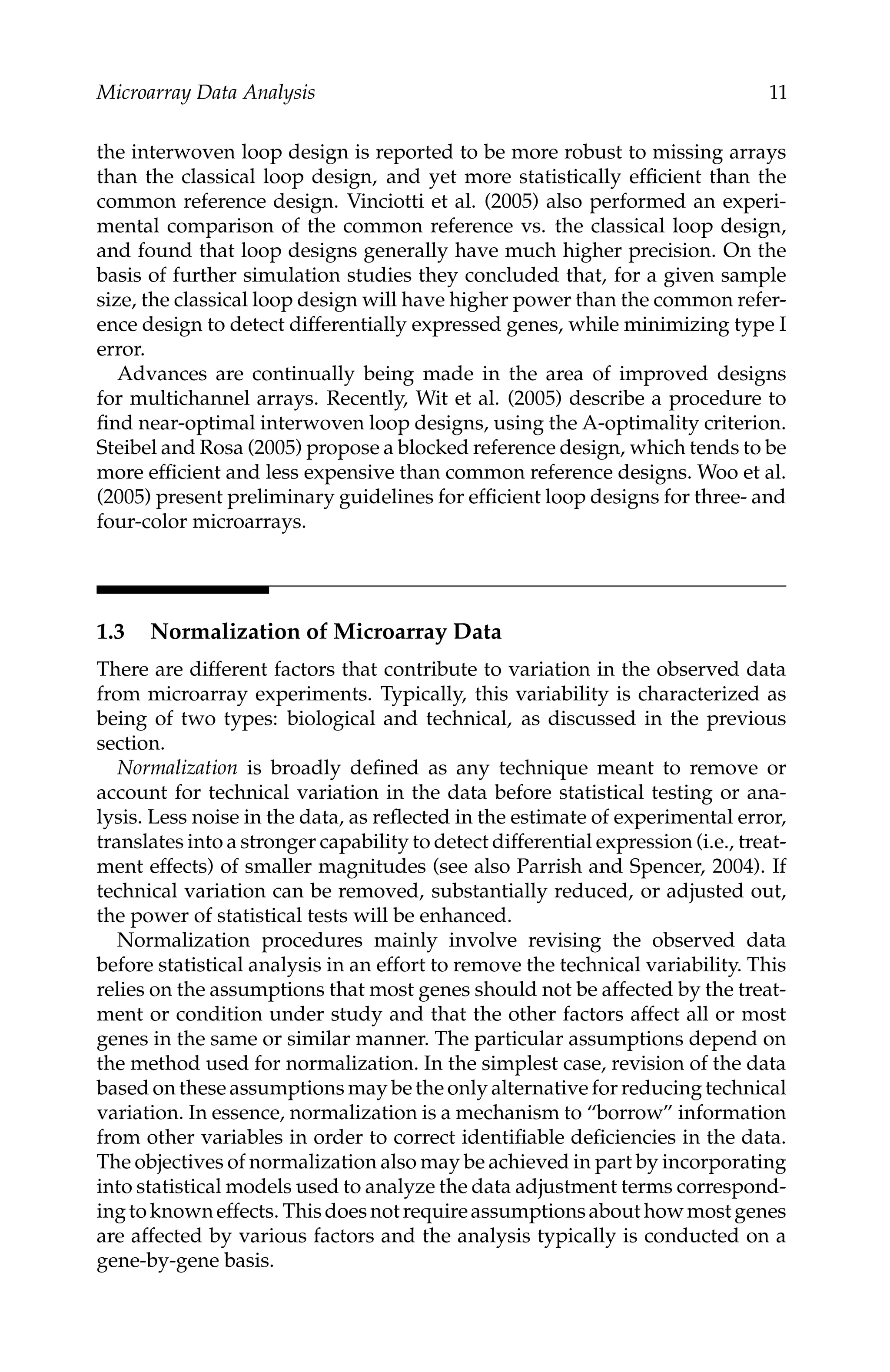
can be simply defined as follows. Let mi = mean of the expression values
of the housekeeping genes on array i. Adjust the values from array i (i  1)
according to
y∗
ij = yij − (mi − m1).
The result is that all arrays then will have the same mean for the
housekeeping genes.
1.3.2.2 Methods Based on Global or Local Values
Expression values can be adjusted so that every array will have the same
mean or, equivalently, average signal intensity. In one approach, an array is
chosen arbitrarily as a baseline reference array and the following adjustments
are made:
y∗
ij = yij ×

y
(m)
baseline
y
(m)
i
C5777: “c5777_c001” — 2007/10/27 — 13:02 — page 16 — #16
16 Computational Methods in Biomedical Research
where y
(m)
i is the mean of all the expression values for the ith array and y
(m)
baseline
is the mean of all the expression values for the selected baseline array (Affy-
metrix, 2002). The means can be ordinary or robust (e.g., trimmed means).
GeneChip uses a scaling factor (SF) similar to above except that the numerator
can be an arbitrary value (e.g., 500) and the means are 2% trimmed means.
This approach is termed linear scaling and is based on an assumption of a
linear relationship between corresponding values from the two arrays.
Nonlinear scaling approaches modify the linearity assumption to allow
nonlinear relationships. In a method proposed by Schadt et al. (2001), a set
of invariant genes is identified on the basis of rank order of the expression
values from each array compared to the baseline array. They use a generalized
cross-validation smoothing spline algorithm (Wahba, 1990) and produce a
transformation of the form
y∗
ij = fi(yij).
where fi represents the nonlinear scaling function. This algorithm was imple-
mented in dChip software (Schadt et al., 2001). As alternatives, a piecewise
running median regression can be used (Li and Wong, 2001) and locally-
weighted regression (loess) can be used on probe intensities (Bolstad et al.,
2003).
A third approach involves adjusting expression values so that all arrays
have the same mean. Array-specific values can be added to all expression
values within the arrays that will make the array means or medians all equal.
In this method, one array may be selected as a reference array and the intensity
values on the other arrays are adjusted so that their means equal the mean of
the reference array. This approach also can be implemented by using the mean
of the array means (or the median of the array medians) as a target value and
then making adjustments to values on all arrays. This process is represented as
y∗
ij = yij + (y(m)
. − y
(m)
i )
where yij is the expression value (or its logarithm) for array i and gene j, y
(m)
i
is the mean (or median) for array i, and y(m)
. is the mean of the array means
(or median of array medians) computed over all arrays.
Further adjustments can be made so that all arrays have the same variabil-
ity. The expression data can be scaled so that all arrays have the same or nearly
the same variance, range, or other similar measure. From a distribution per-
spective, this method is meant to obtain the same dispersion characteristics
in the data from the different arrays. This is implemented simply by apply-
ing a scaling adjustment for each array, in the form of a multiplication factor.
In addition, a location adjustment can be incorporated as above. As is com-
monplace, the scaling constants can be based on the interquartile range (IQR)
and a location adjustment can be based on the median, thereby giving the
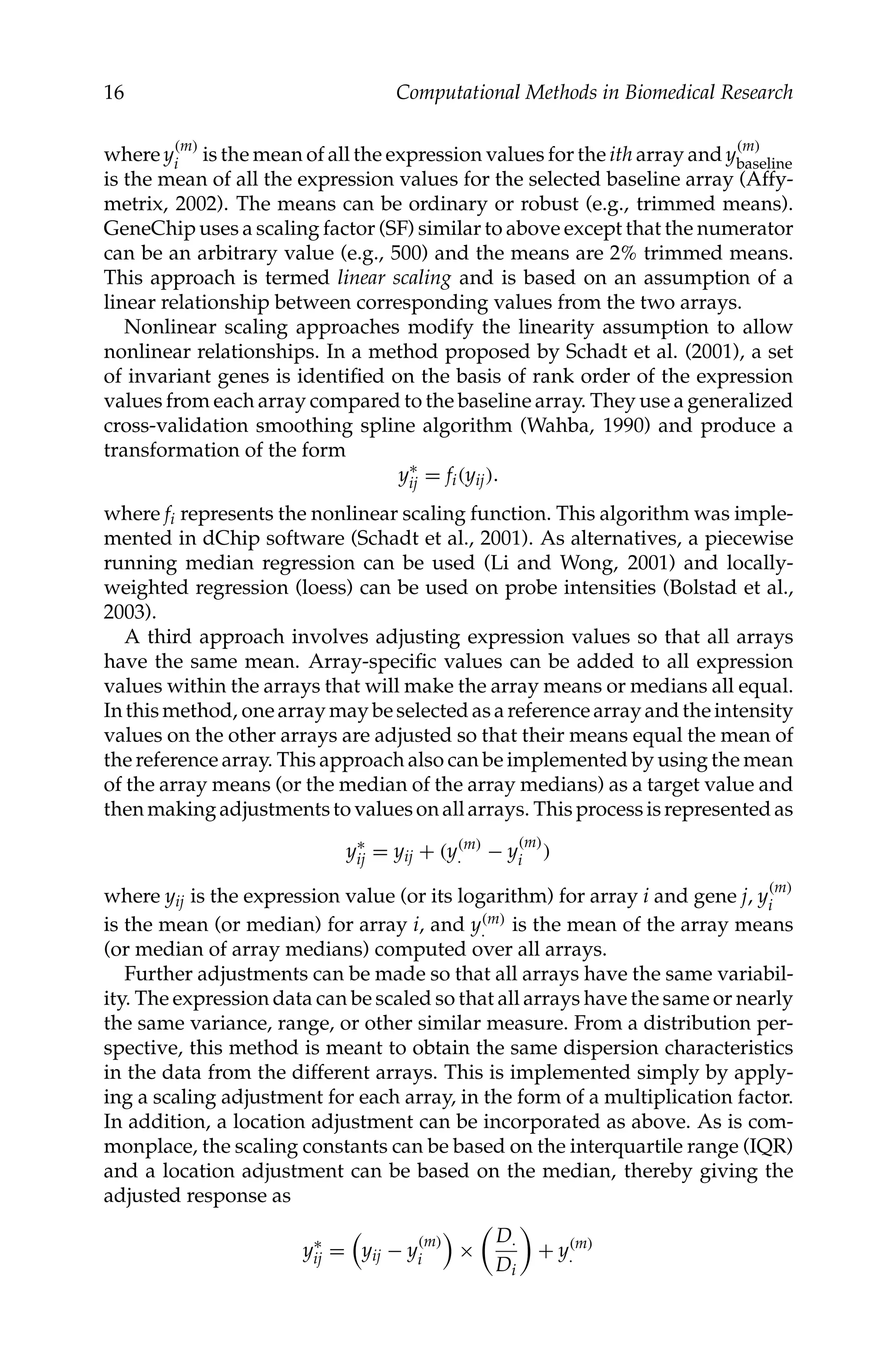
adjusted response as
y∗
ij =

yij − y
(m)
i ×
D.
Di
+ y(m)
.
C5777: “c5777_c001” — 2007/10/27 — 13:02 — page 17 — #17
Microarray Data Analysis 17
where Di represents the selected measure of dispersion for the ith array and
D. is the mean, median, or maximum of the Di values over all arrays. If the
IQR is used, all arrays will have approximately the same IQR after adjust-
ment. Quasi-ranges other than the IQR (which is based on the 25th and 75th
percentiles) could be used. For example, the normal range is based on the
2.5th and 97.5th percentiles.
1.3.2.3 Local Regression Methods
The M vs. A (MvA) plot (Dudoit et al., 2002) is a graphic tool to visualize
variability as a function of average intensity. This plots values of M (differ-
ence of logs) vs. A (average of logs) for paired values. These are defined
mathematically as
Mj = log2(y
(1)
ij ) − log2(y
(2)
ij ) and Aj =
[log2(y
(1)
ij ) + log2(y
(2)
ij )]
2
for array i and gene (or probe) j. With two-channel arrays, the pairing is based
on the data from the same spot corresponding to the red and green dyes.
A loess smoothing function is fitted to the resulting data. Normalization is
accomplished by adjusting each expression value on the basis of deviations,
as follows:
log2(y
(1)∗
ij ) = Aj + 0.5 M
j and log2(y
(2)∗
ij ) = Aj − 0.5 M
j
where M
j represents the deviation of the jth gene from the fitted line. This is
a within-array normalization.
The MvA plot can be used in single-channel arrays by forming all pairs of
arrays to generate MvA plots; this method is known as cyclic loess (Bolstad
et al., 2003). The proposed algorithm produces normalized values through
an iterative algorithm. This approach is not computationally attractive for
experiments involving a large number of arrays.
1.3.2.4 Quantile-Based Methods
Quantile normalization forces identical distributions of probe intensities for
all arrays (Bolstad et al., 2003; Irizarry et al., 2003a; Irizarry et al., 2003c;
Irizarry et al., 2003b). The following steps may be used to implement this
method: (1) All the probe values from the n arrays are formed into a p × n
matrix (p = total number of probes on each array and n = number of arrays),
(2) Each column of values is sorted from lowest to highest value, (3) The values
in each row are replaced by the mean of the values in that row, (4) The elements
of each column are placed back into the original ordering. The modified probe
values are used to calculate normalized expression values.
C5777: “c5777_c001” — 2007/10/27 — 13:02 — page 18 — #18
18 Computational Methods in Biomedical Research
1.3.2.5 Methods Based on Linear Models
Analysis of variance models have been used to accomplish normalization as
an intrinsic part of the statistical analysis in two-channel arrays (Kerr et al.,
2000). These can incorporate effect terms for array, dye, treatment, and gene,
as in:
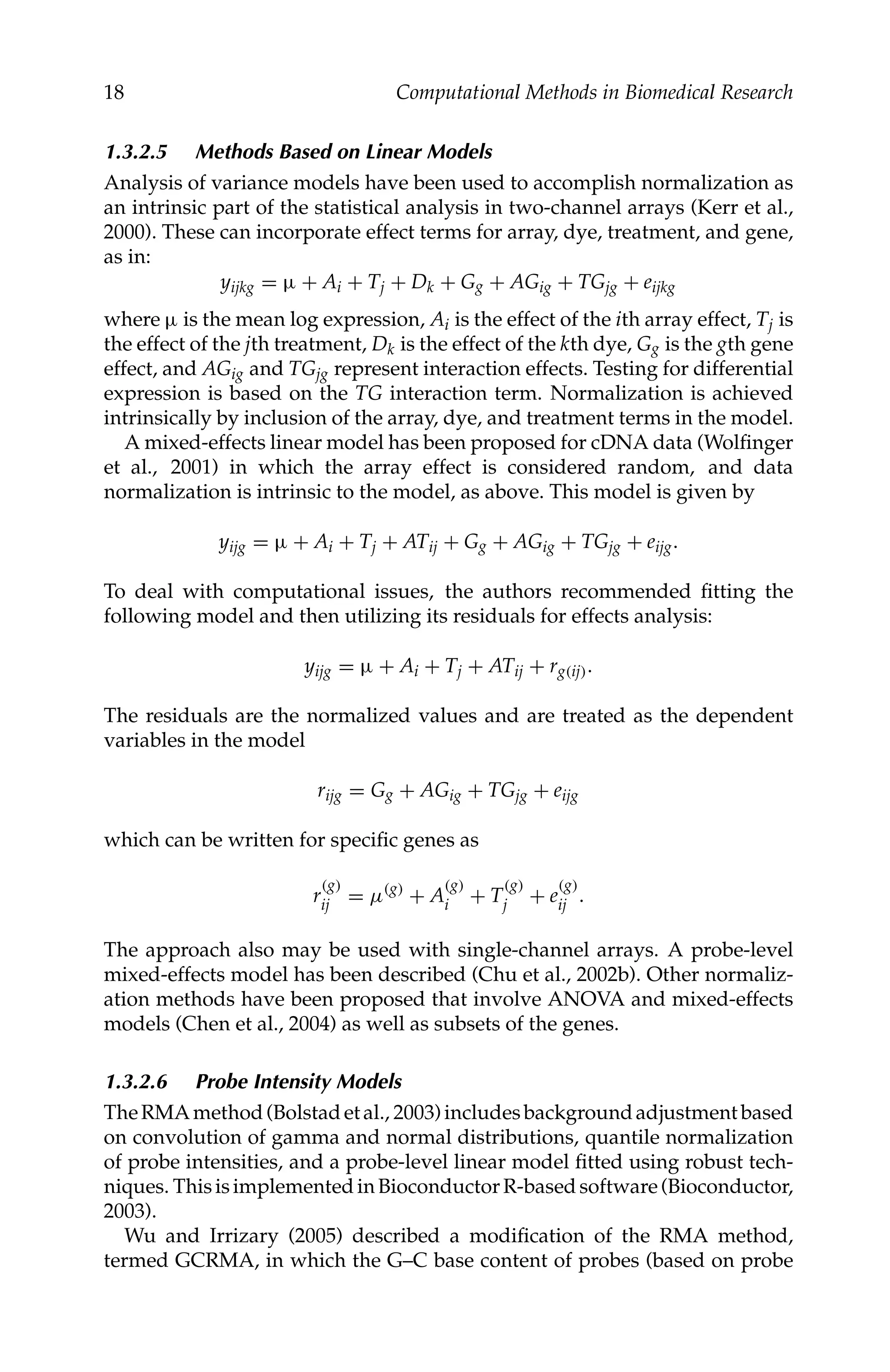
yijkg = µ + Ai + Tj + Dk + Gg + AGig + TGjg + eijkg
where µ is the mean log expression, Ai is the effect of the ith array effect, Tj is
the effect of the jth treatment, Dk is the effect of the kth dye, Gg is the gth gene
effect, and AGig and TGjg represent interaction effects. Testing for differential
expression is based on the TG interaction term. Normalization is achieved
intrinsically by inclusion of the array, dye, and treatment terms in the model.
A mixed-effects linear model has been proposed for cDNA data (Wolfinger
et al., 2001) in which the array effect is considered random, and data
normalization is intrinsic to the model, as above. This model is given by
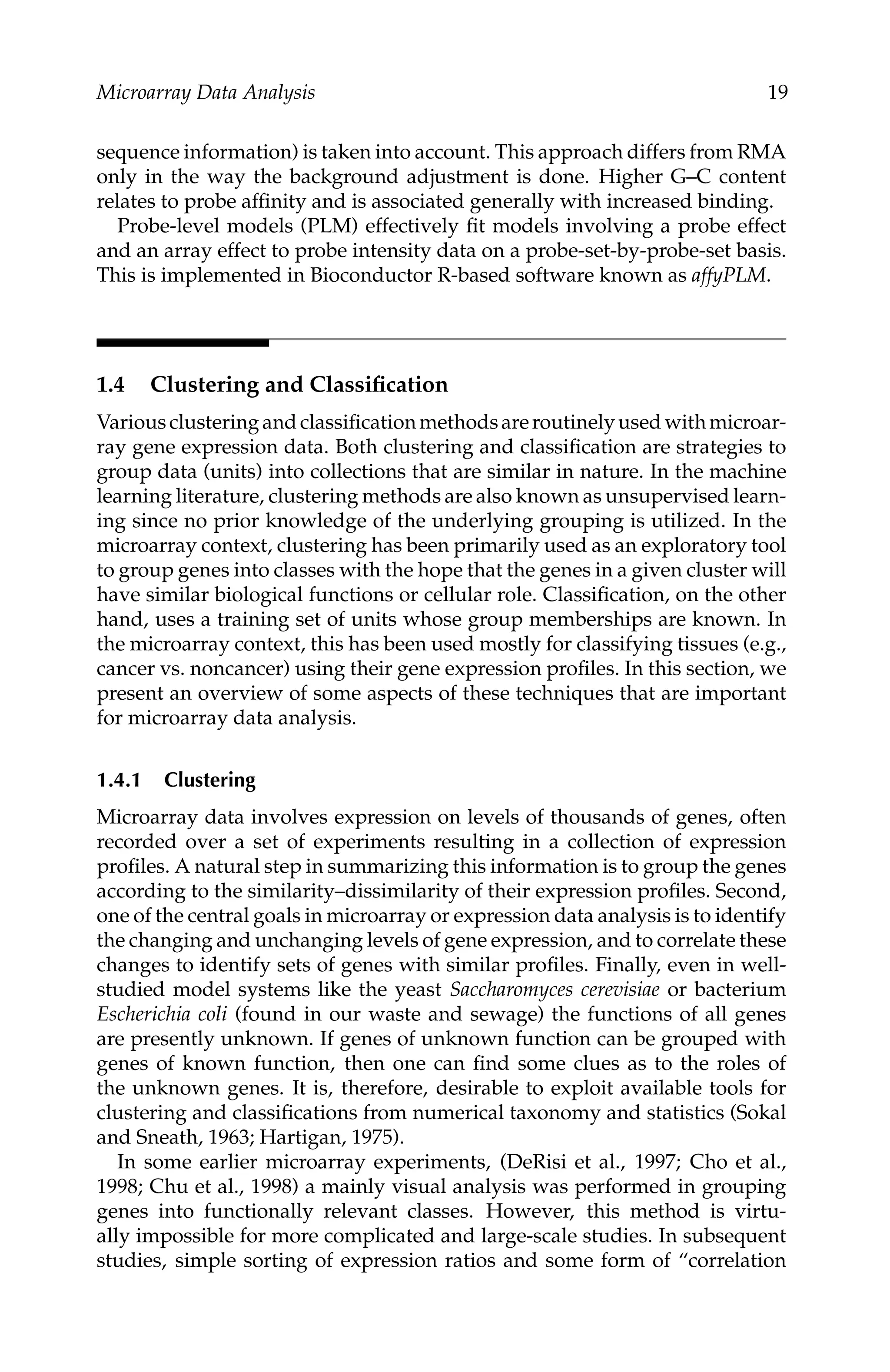
yijg = µ + Ai + Tj + ATij + Gg + AGig + TGjg + eijg.
To deal with computational issues, the authors recommended fitting the
following model and then utilizing its residuals for effects analysis:
yijg = µ + Ai + Tj + ATij + rg(ij).
The residuals are the normalized values and are treated as the dependent
variables in the model
rijg = Gg + AGig + TGjg + eijg
which can be written for specific genes as
r
(g)
ij = µ(g)
+ A
(g)
i + T
(g)
j + e
(g)
ij .
The approach also may be used with single-channel arrays. A probe-level
mixed-effects model has been described (Chu et al., 2002b). Other normaliz-
ation methods have been proposed that involve ANOVA and mixed-effects
models (Chen et al., 2004) as well as subsets of the genes.
1.3.2.6 Probe Intensity Models
TheRMAmethod(Bolstadetal., 2003)includesbackgroundadjustmentbased
on convolution of gamma and normal distributions, quantile normalization
of probe intensities, and a probe-level linear model fitted using robust tech-
niques. ThisisimplementedinBioconductorR-basedsoftware(Bioconductor,
2003).
Wu and Irrizary (2005) described a modification of the RMA method,
termed GCRMA, in which the G–C base content of probes (based on probe
C5777: “c5777_c001” — 2007/10/27 — 13:02 — page 19 — #19
Microarray Data Analysis 19
sequence information) is taken into account. This approach differs from RMA
only in the way the background adjustment is done. Higher G–C content
relates to probe affinity and is associated generally with increased binding.
Probe-level models (PLM) effectively fit models involving a probe effect
and an array effect to probe intensity data on a probe-set-by-probe-set basis.
This is implemented in Bioconductor R-based software known as affyPLM.
1.4 Clustering and Classification
Variousclusteringandclassificationmethodsareroutinelyusedwithmicroar-
ray gene expression data. Both clustering and classification are strategies to
group data (units) into collections that are similar in nature. In the machine
learning literature, clustering methods are also known as unsupervised learn-
ing since no prior knowledge of the underlying grouping is utilized. In the
microarray context, clustering has been primarily used as an exploratory tool
to group genes into classes with the hope that the genes in a given cluster will
have similar biological functions or cellular role. Classification, on the other
hand, uses a training set of units whose group memberships are known. In
the microarray context, this has been used mostly for classifying tissues (e.g.,
cancer vs. noncancer) using their gene expression profiles. In this section, we
present an overview of some aspects of these techniques that are important
for microarray data analysis.
1.4.1 Clustering
Microarray data involves expression on levels of thousands of genes, often
recorded over a set of experiments resulting in a collection of expression
profiles. A natural step in summarizing this information is to group the genes
according to the similarity–dissimilarity of their expression profiles. Second,
one of the central goals in microarray or expression data analysis is to identify
the changing and unchanging levels of gene expression, and to correlate these
changes to identify sets of genes with similar profiles. Finally, even in well-
studied model systems like the yeast Saccharomyces cerevisiae or bacterium
Escherichia coli (found in our waste and sewage) the functions of all genes
are presently unknown. If genes of unknown function can be grouped with
genes of known function, then one can find some clues as to the roles of
the unknown genes. It is, therefore, desirable to exploit available tools for
clustering and classifications from numerical taxonomy and statistics (Sokal
and Sneath, 1963; Hartigan, 1975).
In some earlier microarray experiments, (DeRisi et al., 1997; Cho et al.,
1998; Chu et al., 1998) a mainly visual analysis was performed in grouping
genes into functionally relevant classes. However, this method is virtu-
ally impossible for more complicated and large-scale studies. In subsequent
studies, simple sorting of expression ratios and some form of “correlation
C5777: “c5777_c001” — 2007/10/27 — 13:02 — page 20 — #20
20 Computational Methods in Biomedical Research
distance” were used to identify genes (Eisen et al., 1998; Roth et al., 1998; Spell-
man et al., 1998). Hierarchical clustering Unweighted Pair Group Method
with Arithmetic mean (UPGMA) with correlation “distance” (or dissimilar-
ity) is most often used in microarray studies after it was popularized by the
influential paper by Eisen et al. (1998). One nice feature of a hierarchical clus-
tering is that it produces a tree of clusters, also known as a dendrogram, which
can be cut at various heights to see the resulting clusters. Datta (2001) intro-
duced a novel dissimilarity measure between a pair of genes, in the presence
of the remaining genes, on the basis of partial least squares (PLS) modeling
gene expressions. Model-based clustering is another well-known technique
that has been used for grouping microarray data (McLachlan et al., 2002).
This technique is based on modeling the expression profiles by mixtures
of multivariate normal distributions. The Gene Shaving algorithm (Hastie
et al., 2000) allowed genes to be in more than one cluster at the same time.
Sharan and Shamir (2000) introduced a novel clustering algorithm on the
basis of a graph-theoretic concept. Also, there exists another noteworthy, but
more complex algorithm (based on a self-organizing neural network) called
SOM (self-organizing maps, Kohonen, 1997) which seems to have gained
popularity in clustering microarray data.
Besides the clustering techniques mentioned above, there exist numerous
clustering algorithms in statistics and machine learning literature dating back
to premicroarray days. Many of them are available in statistical packages such
as S-Plus and R. Thus, a microarray data analyst has many choices of cluster-
ingmethodswhenitcomestogroupinggenes; forexample, partitionmethods
such as K-means (Hartigan and Wong, 1979), divisive clustering method Diana
(Kaufman and Rousseeuw, 1990) and fuzzy logic–based method Fanny (Kauf-
man and Rousseeuw, 1990) are all applicable. All these clustering algorithms
have their own merits and demerits. Their results might appear to be substan-
tially different as well even when applied to the same data set of expression
profiles. We take the following illustration from Datta and Arnold (2002)
where a yeast data set (Chu et al., 1998) is clustered using five different clus-
tering techniques (Figure 1.3). Thus, there is a need for careful evaluation of
clustering algorithm given a particular data set. There exist a few approaches
regarding the selection of a clustering algorithm and validation of the results
for microarray data.
Kerr and Churchill (2001c) used a linear model (ANOVA) and residual-
based resampling to access the reliability of clustering algorithms. Chen et al.
(2002) compared the performances of a number of clustering algorithms by
physical characteristics of the resulting clusters such as the homogeneity
and separation. Yeung et al. (2001) introduced the concept of Figure of Merit
(FOM) in selecting between competing clustering algorithms. FOM resembles
the error sum of squares (ESS) criterion of model selection. Datta and Datta
(2003) selected six clustering algorithms of various types and evaluated their
performances (stability) on a well-known publicly available microarray data-
set on sporulation of budding yeast, as well as on two simulated data sets.
Here we provide a brief description of the stability measures introduced in
C5777: “c5777_c001” — 2007/10/27 — 13:02 — page 21 — #21
Microarray Data Analysis 21
Hierarchical clustering with
correlation dissimilarity
First principal component
Second
principal
component
−5 0 5 10
Clustering by K-means
First principal component
Second
principal
component
Model based clustering
First principal component
Second
principal
component
Clustering by FANNY
with L_1 distance
First principal component
Second
principal
component
Divisive clustering by diana
First principal component
Second
principal
component
6
4
2
0
−2
−4
−6
6
4
2
0
−2
−4
−6
6
4
2
0
−2
−4
−6
6
4
2
0
−2
−4
−6
6
4
2
0
−2
−4
−6
−5 0 5 10 −5 0 5 10
−5 0 5 10 −5 0 5 10
FIGURE 1.3
(See color insert following page 207.) The genes were clustered into seven groups using their
expression profiles during sporulation of yeast; five different clustering algorithms were attemp-
ted (Adapted from Datta, S. and Arnold, J. (2002). In Advances in Statistics, Combinatorics and
Related Areas, C. Gulati, Y.-X. Lin, S. Mishra, and J. Rayner, (Eds.), World Scientific, 63–74.)
Datta and Datta (2003) in order to select an algorithm that produces the most
consistent results. The evaluation measures were general enough so that they
can be used with any clustering algorithm.
Let K be the number of desired clusters. Datta and Datta (2003) suggested
that the performance of an algorithm be investigated over an entire range of
“suitable” K values. The basic idea behind their validation approach was that
a clustering algorithm should be rewarded for stability (i.e., consistency of
clusters it produces). Suppose expression (ratio) data are collected over all
the genes under study at various experimental conditions such as time points
T1, T2, . . . , Tl. An example of such temporal data is the sporulation of yeast
data of Chu et al. (1998). In that case K was around 7 (Chu et al. used K = 7)
and number of time points l = 7. Thus, consider a setup where the data values
are points in the l dimensional Euclidean space R. For each i = 1, 2, . . . , l, one
repeats the clustering algorithms for each of the l data set in Rl−1 obtained by
deleting the observations at experimental condition (e.g., time) Ti. For each
gene g, let Cg,i denote the cluster containing gene g in the clustering on the
basis of data set with time Ti observations deleted. Let Cg,0 be the cluster in
C5777: “c5777_c001” — 2007/10/27 — 13:02 — page 22 — #22
22 Computational Methods in Biomedical Research
the original data containing gene g. Each of the following validation measures
could be used to measure the stability of the results produced by the clustering
algorithm in question. For a good clustering algorithm, one would expect
these stability measures to be small.
1. The average proportion of nonoverlap measure is given by
V1(K) =
1
Ml
M

g=1
l

i=1

1 −
n(Cg,i ∩ Cg,0)
n(Cg,0)

.
This measure computes the (average) proportion of genes that are
not put in the same cluster by the clustering method under consid-
eration on the basis of the full data and the data obtained by deleting
the expression levels at one experimental condition at a time.
2. The average distance between means measure is defined as
V2(K) =
1
Ml
M

g=1
l

i=1
d(xCg,i , xCg,0 )
where xCg,0 denotes the average expression profile for genes across
cluster Cg,0 and xCg,i denotes the average expression profile for
genes across cluster Cg,i. This measure computes the (average) dis-
tance between the mean expression values (usually, log transformed
expression ratios in case of cDNA microarrays) of all genes that are
put in the same cluster by the clustering method under considera-
tion on the basis of the full data and the data obtained by deleting
the expression levels at one time point at a time.
3. The average distance measure is defined as
V3(K) =
1
Ml
M

g=1
l

i=1
1
n(Cg,0)n(Cg,i)
×

g∈Cg,0, g∈Cg,i
d(xg, xg )
where, d(xg, xg ) is a distance (e.g., Euclidean, Manhattan etc.)
between the expression profiles of genes g and g. This measure com-
putes the average distance between the expression levels of all genes
that are put in the same cluster by the clustering method under con-
sideration on the basis of the full data and the data obtained by delet-
ing the expression levels at one experimental condition at a time.
Figure 1.5 illustrates the average proportion of nonoverlap measures for
a number of existing clustering algorithms applied to two sets of simu-
lated data. The simulated data sets were generated by adding varying
degrees of random noise to a set of expression profiles (shown in Figure 1.4).
C5777: “c5777_c001” — 2007/10/27 — 13:02 — page 23 — #23
Microarray Data Analysis 23
Model temporat profiles
–4
–2
0
2
4
–4
–2
0
2
4
–4
–2
0
2
4
0 2 4 6
Time (hours)
Simulated dataset 1
8 10 12
0 2 4 6
Time (hours)
Simulated dataset 2
8 10 12
0 2 4 6
Time (hours)
8 10 12
log_2(expression
ratio)
log_2(expression
ratio)
log_2(expression
ratio)
FIGURE 1.4
(See color insert following page 207.) The average proportion of nonoverlap measure for various
clustering algorithms applied to simulated data sets.
S-Plus codes used to compute the above measures are available in the
supplementary website of the Datta and Datta (2003) paper http://www.
louisville.edu/∼s0datt02/WebSupp/Clustering/SUPP/SUPP.HTM. In each
plot, a profile closer to the horizontal axis indicates better performance over
the usable range of Kvalues.
Another approach of validating clustering results is to check whether the
statistical clusters produced correspond to biologically meaningful functional
classes. To this end, Datta and Datta (2003) compared the expression profiles
of different statistical clustering algorithms with the model profiles of some
functionally known genes. For the details, readers are referred to Datta and
Datta (2003). A novel validation measure combining statistical stability and
biological functional relevance was proposed in Datta and Datta (2006a). In
yet another attempt (Datta and Datta, 2006b), results were validated through
the gene ontology (GO) databases.
1.4.2 Classification
Unlike clustering, a classification algorithm is generally used to group tis-
sue samples (e.g., cancer and noncancer) using their gene expression profiles
C5777: “c5777_c001” — 2007/10/27 — 13:02 — page 24 — #24
24 Computational Methods in Biomedical Research
Simulated dataset 1
Hierarchical
K- Means
Diana
Fanny
Model-based
Partial least squares
Simulated dataset 2
0.0
0.2
0.4
0.6
0.8
1.0
0
2 4 6
Number of classes
8 10 12
Proportion
of
nonoverlap
Hierarchical
K- Means
Diana
Fanny
Model-based
Partial least squares
0.0
0.2
0.4
0.6
0.8
1.0
0
2 4 6
Number of classes
8 10 12
Proportion
of
nonoverlap
FIGURE 1.5
(See color insert following page 207.) Two simulated datasets of gene expressions were created
by adding random noise to a model profile.
when partial knowledge is available about this grouping. In general, the goal
of a classification technique is to predict class membership for new samples
(test samples) with the knowledge of the training set (set of samples for which
the classes are known).
1.4.2.1 Dimensionality Reduction
The vast amount of raw gene expression data leads to statistical and ana-
lytical challenges for using a classification algorithm to group samples into
correct classes. The central difficulty in classification of microarray data is
the availability of a very small number of samples in comparison with the
number of genes in the sample. This violates the operating assumption of the
classical statistical discriminant analysis procedures such as the linear dis-
criminant analysis (LDA) and the quadratic discriminant analysis (QDA) or
the nonparametric regression-based Neural Network procedure.
One might first attempt to reduce the number of “features” to be used in a
classification algorithm from the raw gene expression profiles. For example,
one might calculate the first few principal components (PCA) of the covari-
ates (gene expressions) and then discriminate the samples on the basis of the
C5777: “c5777_c001” — 2007/10/27 — 13:02 — page 25 — #25
Microarray Data Analysis 25
principal components (Dudoit et al., 2000; Su et al., 2003; Datta and Delap-
idilla, 2006). PLS is another useful tool in constructing latent variables that
can then be used for classification (Nguyen and Rocke, 2002a,b). Datta and de
Padilla (2006) used PLS for feature selection, together with traditional classi-
ficationalgorithmssuchaslineardiscriminationandquadraticdiscrimination
to classify multiple tumor types from proteomic data. van’t Veer et al. (2002)
applied a binary classification algorithm to cDNA array data with repeated
measurements and classified breast cancer patients into good and poor pro-
gnosis groups. Their classification algorithm consists of the following steps.
The first step is filtering, in which only genes with both small error estim-
ates and significant regulation relative to a reference pool of samples from
all patients are chosen. The second step consists of identifying a set of genes
whose behavior is highly correlated with the two sample types (e.g., up-
regulated in one sample type but down-regulated in the other). These genes
are rank-ordered so that genes with the highest magnitudes of correlation
with the sample types have top ranks. In the third step, the set of relevant
genes is optimized by sequentially adding genes with top-ranked correlation
from the second step. However, this method involves an ad hoc filtering step
and does not generalize to more than two classes. Another feature reduction
technique is to consider only the genes that are deemed to be differentially
expressed genes under different experimental conditions. Zhu et al. (2003),
Wagner et al. (2004), Izmirlian (2004), and Datta and de Padilla (2006) used a
similar approach to select the important features (mass to charge ratios) for
mass spectrometry data before a classification algorithm is used.
1.4.2.2 Classification Algorithms
The literature of classification algorithms is vast. In the previous section we
have mentioned about LDA (Fisher, 1936) and QDA. In addition to these two,
logistic regression for two classes and log-linear models for more than two
groups are also widely used. There are many more relatively modern classifi-
ers some of which are discussed very briefly in the remainder of this section.
The R-libraries (http://www.r-project.org) “class” and “MASS” contain a
number of popular classifiers.
The neural network is a two-stage regression/classification model and is
represented by a network diagram. Loosely speaking, it is modeled after the
concept of neurons in the brain. It consists of at least three layers of nodes:
the input layer, the hidden layer, and the output layer. For technical details,
please refer to Hastie et al. (2001). The R function nnet (available in the library
by the same name) fits a single hidden layer neural network.
k-nearest neighbor classification(k−NN) method is a nonparametric clas-
sifier (Devijver and Kittler, 1982; Ripley, 1996) on the basis of nonparametric
estimates of the class densities or of the log posterior. The k-NN classifier
finds k nearest samples in the training set and takes a majority vote among
the classes of these k samples. We end this subsection by discussing three
relatively new classification algorithms one of which (the Shrunken Centroid
classifier) is developed primarily for classifying microarray datasets.
C5777: “c5777_c001” — 2007/10/27 — 13:02 — page 26 — #26
26 Computational Methods in Biomedical Research
Support vector machine (SVM) (Vapnik, 1995; Burges, 1998; Vapnik, 1998;
Cristianini and Shawe-Taylor, 2000; Hastie et al., 2001 §4.5, 12.2, 12.3) is a new
generation classifier that has been reported to be very successful in a wide
variety of applications. For two classes, a binary classifier constructs a hyper-
plane separating the two classes (e.g., cancer from noncancer samples). The
basic idea of SVM is to map the data into a higher dimensional space and then
findanoptimalseparatinghyperplane. SVMsarelarge-marginclassifiers; that
is, they solve an optimization problem that finds the separating hyperplane
that optimizes a weighted combination of the misclassification rate and the
distance of the decision boundary to any sample vector. For further details,
the reader may consult the tutorial paper by Burges (1998) or the book by Cris-
tianini and Shawe-Taylor (2000). Brown et al. (2000) used SVM for classifying
microarray data of budding yeast S. cerevisiae and compared the performance
by other standard classification algorithms (e.g., Fisher’s LDA). SVM was
performed better than all the non-SVM methods compared in the paper.
Random Forest (Breiman, 2001) classification is an extension of classifica-
tion trees (Breiman et al., 1984) by integrating the idea of bagging. Random
Forest constructs many classification trees using different bootstrap samples
of a fixed size m from the original data. To classify a new object from an input
vector (collection of variables) it runs the input vector to each and every tree in
the forest. Each tree gives a classification. The forest chooses the classification
having the most votes (over all the trees in the forest). About one-third of the
cases are left out of the bootstrap sample and not used in the construction of a
particular tree. The samples left out of the k-th tree are run through the kth tree
to get a classification. In this way, a test set classification is obtained for each
case in about one-third of the trees that can be used to assess the accuracy of
the classifier. Note that the Random Forest algorithm automatically finds the
most important features/variables in order to classify the data by computing
an estimate of the increase in error rate of the classifier had that variable not
been used.
Finally, the nearest shrunken centroid classification introduced by Tibshir-
ani et al. (2002) first computes a shrunken centroid for each class where each
standardized centroid is shrunk towards the overall centroid. A test sample
is classified into the class whose shrunken centroid is closest to, in squared
distance, the gene expression profile of that sample. The shrinkage can reduce
the effect of noisy genes resulting in higher accuracy of the resulting classi-
fier. It is available under the PAM (Prediction Analysis for Microarrays, not
to be confused with the clustering algorithm of the same acronym) package
(http://www-stat.stanford.edu/∼tibs/PAM/).
1.4.2.3 Accuracy of Classification
There are several methods for calculating the error rate of a classifica-
tion algorithm (e.g., resubstitution, leave-one-out cross validation, k-fold
cross validation, repeated cross validation and .632 bootstrap/bias corrected
bootstrap, etc.). In microarray studies, use of a proper method of estimation
of classification error is particularly important since typically one has a small
Another Random Scribd Document
with Unrelated Content
on lähellä. Luen sen naisen silmistä. Hän katsoo minuun
joskus niin ihmeellisesti!
Oh, sellainen häpeä! Kuka olisi voinut uskoa hänen
kykenevän sellaiseen?
Rakas ystäväni, olen hyvin onneton ihminen.'
Ja tämän on allekirjoittanut Hippolyte Fauville, jatkoi Mazeroux,
ja minä vakuutan, että se on todellakin hänen käsialaansa,
kirjoitettu neljäntenä päivänä tammikuuta tänä vuonna eräälle
ystävälle, jonka nimeä emme tiedä, vaikkakin nuuskimme sen jostain
selville, sen vannon. Ja tämä ystävä on antava meille tarvitsemamme
todistukset.
Mazeroux kiihottui.
Todistus! Sitähän emme tarvitse! Sehän meillä on. Herra Fauville
itse antaa sen meille! 'Loppu on lähellä, luen sen hänen silmistään!'
'Hänen' tarkoittaa Marie Fauvilleä ja miehen todistus vahvistaa
kaiken mitä me tiedämme rouvasta. Mitä te sanotte?
Olette oikeassa, vastasi Perenna tuumivasti, te olette oikeassa,
kirje on ratkaiseva. Mutta…
Mutta… mitä?
Kuka peijakas on tuonut sen tänne? Jonkun on täytynyt olla yöllä
huoneessa meidän täällä ollessamme. Onko se mahdollista?
Olisimmehan sen kuulleet. Se se on, joka tekee minut
hölmistyneeksi.
Niin, näyttää siltä…
Neljätoista päivää sitten oli kyllin ihmeellistä. Mutta silloin olimme
eteisessä, ulkopuolella, heidän askaroidessaan sisällä. Tällä kertaa
olimme molemmat täällä, aivan lähellä pöytää. Ja tältä pöydältä,
jossa ei illalla ollut pienintäkään paperilappua, löydämme aamulla
kirjeen.
Emme tutki kauempaa, jatkoi Perenna, se ei hyödytä mitään.
Menkää kirjeen kanssa poliisiprefektin luo, kertokaa hänelle kuinka
olemme viettäneet yön ja pyytäkää häneltä lupa meille molemmille
tulla tänne yöllä 25 päivänä huhtikuuta. Sinä yönä tulee uusi yllätys
ja minä kuolen kärsimättömyydestä saada tietää, saammeko silloin
uuden kirjeen jonkun 'hengen' kautta.
He sulkivat ovet ja lähtivät talosta.
Heidän mennessään oikealle, La Muettelle saadakseen auton,
sattui don Luis kääntämään päätään kun he tulivat Suchet bulevardin
päähän. Eräs mies ajoi ohi polkupyörällä. Don Luis ehti ainoastaan
hämärästi nähdä sileäksi ajetut kasvot ja säihkyvät silmät, jotka
olivat suunnatut häneen.
Varo! huusi hän ja tyrkkäsi Mazerouxia niin nopeasti, että tämä
kadotti tasapainonsa.
Mies oli ojentanut revolverin. Pamahti laukaus. Kuula vinkui ohi
don
Luisin korvien.
Ottakaa hänet kiinni, hän huusi. Ette kai ole haavoittunut,
Mazeroux?
En.
Molemmat kiiruhtivat miehen jälkeen ja huusivat apua. Mutta näin
aikaisin aamulla ei ole milloinkaan tämän kaupunginosan leveillä
kaduilla ihmisiä. Mies kääntyi rue Octave-Feuilletille ja katosi.
Kas niin, lopuksi saan sinut kuitenkin kiinni, roisto! sähisi don
Luis luopuen tuloksettomasta takaa-ajosta.
Mutta tiedättekö kuka hän oli?
Kyllä tiedän; se oli hän.
Kuka?
Ebenholtsikeppinen mies. Hän on ajanut pois partansa, mutta
tunsin hänet kuitenkin. Se oli sama mies, joka seisoi väijymässä ja
ampui miehen Richard-Wallace bulevardin portailta, hän, joka tappoi
Ancenisen. Se roisto! Kuinka hän tiesi että minä olin viettänyt yön
Fauvillen talossa? Vakoillaanko minua kaikkialla. Mutta kuka
vakoilee? Ja minkä vuoksi? Ja kuinka?
Mazeroux tuumi ja sanoi:
Muistakaa, että te soititte minulle iltapäivällä ja sovitte
kohtauksesta. Vaikka te puhuitte hiljaa, on joku saattanut kotonanne
kuunnella.
Don Luis ei vastannut. Hän ajatteli Florencea.
Sinä aamuna ei neiti Levasseur tullut sisään kirjeineen, eikä
Perenna lähettänyt häntä hakemaan. Hän näki tytön useita kertoja
antavan määräyksiä uusille palvelijoille. Iltapäivällä käski Perenna
ajaa esiin auto ja ajoi bulevardi Suchetille prefektin määräyksen
mukaisesti tekemään Mazerouxin kanssa tutkimuksia, jotka eivät
kuitenkaan johtaneet mihinkään tuloksiin.
Kello oli kymmenen hänen palatessaan takaisin. Etsiväkomissario
ja hän söivät yhdessä päivällistä. Sitten hän tahtoi tarkastaa taloa,
jossa ebenholtsikeppinen mies oli asunut, nousi jälleen autoon, yhä
Mazerouxin seuraamana, ja käski ohjaajan ajaa bulevardi Richard-
Wallacelle.
Auto kulki yli Seinen ja seurasi sen oikeata rantaa.
Nopeammin, sanoi hän puhetorveen uudelle ohjaajalle. Olen
tottunut kulkemaan hyvällä vauhdilla.
Eräänä kauniina päivänä ajatte kumoon, sanoi Mazeroux.
Älkää pelätkö, vastasi don Luis. Auto-onnettomuudet ovat vain
tyhmyreitä varten. He tulivat place de l'Almalle. Auto kääntyi
vasemmalle.
Suoraan eteenpäin, huusi don Luis. Ajakaa ohi Trocadéron.
Äkkiä alkoi auto horjua sinne tänne, lensi erästä puuta vasten ja
kääntyi kyljelleen.
Muutamassa hetkessä syntyi väentungos. Ihmiset löivät rikki
ikkunan ja avasivat oven. Don Luis oli ensimmäinen.
Kiitos, tämä ei ole mitään, sanoi hän. Minä olen
vahingoittumaton.
Entä te, Alexandre?
He auttoivat ulos komissarion. Hänellä oli joitakin naarmuja ja
mustelmia, mutta muuten oli hän vahingoittumaton.
Ohjaaja sitävastoin oli lentänyt istuimeltaan ja makasi
vertavuotavin päin liikkumattomana kadulla. Hänet kannettiin
erääseen apteekkiin, jossa hän kymmenen minuutin kuluttua kuoli.
Perenna oli ottanut vuokra-auton ja ajanut kotiin niin nopeasti kuin
saattoi. Hän tuli torille, ajoi sisään portista, meni yli pihan käytävään,
joka johti neiti Levasseurin asuntoon. Hän juoksi ylös portaita,
koputti ja astui vastausta odottamatta sisään.
Ovi huoneeseen, joka muodosti salongin, avautui ja Florence
näyttäytyi. Perenna syöksyi hänen luokseen ja sanoi raivoisalla
äänellä:
Nyt se on tehty. Onnettomuus on tapahtunut. Eikä kuitenkaan
kukaan vanhoista palvelijoista ole pannut sitä toimeen, sillä he eivät
ole täällä ja minä olin ulkona autolla koko iltapäivän. Senvuoksi on
jonkun täytynyt myöhään päivällä, kuuden ja kymmenen välillä
mennä autovajaan ja viilata ohjaustanko melkein poikki.
En ymmärrä, sanoi tyttö pelästynein ilmein.
Te ymmärrätte varsin hyvin, että roistojen rikostoveri ei voi olla
kukaan uusista palvelijoista, ja te ymmärrätte sangen hyvin, että
teon täytyi onnistua ja se onnistui yli odotuksien. Eräs uhri sai kärsiä
minun puolestani.
Mutta sanokaa toki mitä on tapahtunut! Te pelotatte minut! Mikä
onnettomuustapaus? Mitä on tapahtunut?
Auto ajoi kumoon. Ohjaaja kuoli.
Oh, hirveätä! sanoi tyttö. Ja te luulette, että minä voin…
Kuollut, hirveätä! Miesraukka!
Hänen äänensä hiljeni. Hän seisoi aivan lähellä Perennaa. Hän oli
kalpea, silmät olivat suljetut ja hän horjui. Perenna otti hänet
käsivarsilleen kun hän kaatui. Tyttö koetti vapautua, mutta hänellä ei
ollut siihen voimia. Perenna laski hänet lepotuoliin hänen
lakkaamatta toistaessaan:
Ihmisraukka! Ihmisraukka!
Tyttö oli kadottanut tajuntansa kokonaan, sillä hän jättäytyi ilman
vähintäkään vastustusta Perennan hoidettavaksi. Perenna ei
liikkunut, hän alkoi innokkaasti tutkia edessään olevaa suuta,
tavallisesti niin punaista, mutta nyt veretöntä ja kalpeahuulista.
Kahdella sormellaan erotti hän huulet toisistaan ja näki nyt
molemmat hammasrivit.
Ne olivat ihastuttavat, valkoiset ja kaunismuotoiset, ehkä hiukan
pienemmät kuin rouva Fauvillen, ehkäpä järjestyneet myöskin
kaarevammin. Kuka saattoi sanoa ettei näiden purema jättäisi
samanlaista merkkiä? Se oli epätodennäköinen otaksuma, sen hän
tiesi, mahdoton ihmetyö. Ja kuitenkin olivat asianhaarat tyttöä
vastaan ja viittasivat häneen kuten häikäilemättömimpään,
hirveimpään ja pelottavimpaan rikolliseen.
Hän nousi ja lähti.
VIII LUKU
Pirullinen viesti
Kaikista näistä tapahtumista yleisö tunsi ainoastaan rouva
Fauvillen itsemurhayrityksen, tarkastaja Ancenisin murhan ja
Hippolyte Fauvillen kirjeen löytymisen. Mutta tämä oli riittävää
herättääkseen kaikkien uteliaisuuden, kun he olivat jo ennestään
innokkaasti seuranneet Mornington-juttua ja odottivat jännittyneinä
salaperäisen don Luis Perennan pienimpiäkin liikkeitä, sekoittaen
hänet itsepäisesti Arsène Lupiniin.
Kuinka monimutkainen ja hämmästyttävä olikaan se arvoitus, joka
koski Perennaa itseään? Neljänkymmenenkahdeksan tunnin kuluessa
oli tehty neljä yritystä tappaa hänet: rautaesiripulla, myrkyllä,
revolverilla ja auto-onnettomuudella. Florencen osaa näissä
murhayrityksissä ei voitu kieltää. Ja nyt oli tytön yhteys Fauvillen
murhaajien kanssa asianmukaisesti todettu sen pienen paperin
löydöllä, joka oli ollut Shakespearen kahdeksannen osan välissä,
samalla kun kaamea luettelo oli lisääntynyt kahdella kuolemalla,
poliisitarkastaja Ancenisin ja ohjaajan. Kuinka voitaisiin selittää se
osa, jota tämä arvoituksellinen tyttö oli näytellyt näissä
tapahtumissa?
Millä kuumeentapaisella innolla don Luis tutkikaan hiljaisuudessa
tyttöä!
Kuka te olette? Kuka te olette? tunsi hän halua huudahtaa. Eikö
teitä tyydytä vähempi, te pirullinen nainen, kuin kuoleman ja murhan
levittäminen ympärillenne? Ja tahdotteko te tappaa minutkin
saavuttaaksenne tarkoituksenne? Mistä te tulette ja mihin käy teidän
tienne?
Tarkemmin ajatellessaan hän tuli vakuutetuksi eräästä seikasta,
joka ratkaisi arvoituksen, jota hän oli kauan miettinyt, nimittäin
salaperäisestä yhteydestä häntä vihaavan naisen ja place du Palais-
Bourbonille muuttonsa välillä. Hän ymmärsi nyt että hän ei ollut
ostanut taloa sattumalta. Kun hän teki kaupan, oli häneen
vaikuttanut eräs nimetön tarjous, joka oli joutunut hänen käsiinsä
koneella kirjoitetun kiertokirjeen muodossa. Mistä tuli tämä tarjous,
jollei Florencelta, joka tahtoi saada hänet läheisyyteensä voidakseen
vakoilla ja käydä sotaa häntä vastaan.
Niin, ajatteli hän, siinä on totuus. Cosmo Morningtonin
mahdollisena perillisenä ja etevänä näyttelijänä murhenäytelmässä
minä olen vihollinen ja he koettavat raivata minut pois tieltään
niinkuin tekivät toisillekin. Ja se on Florence, joka hoitaa peliä minua
vastaan. Ja hän se on, joka on tehnyt murhat.
Kun Florence jätti hänet tunsi hän tavallisesti helpotuksen tunteen
ja hengitti keveämmin, kuten hänet olisi vapautettu raskaasta
taakasta, mutta hän juoksi kuitenkin ikkunaan ja katsoi tytön
jälkeen, ja hän odotti aina saadakseen nähdä tämän salaperäisen
vihollisen, jonka tuoksuvan hengityksen hän oli tuntenut kasvoillaan,
tulevan ja menevän.
Eräänä aamuna sanoi tyttö hänelle:
Sanomalehdet kertovat, että tänä yönä tapahtuu jotain.
Tänä yönä?
Niin, sanoi tyttö näyttäen hänelle kirjoitusta lehdestä. Tänään
on kahdeskymmenesviides päivä, ja poliisin ilmoituksen mukaan
jätetään bulevardi Suchetin taloon kirje joka kymmenes päivä ja talo
räjäytetään sinä päivänä, jolloin viides ja viimeinen kirje tulee.
Uhmasiko tyttö häntä? Tahtoiko hän tehdä selväksi, että
tapahtuipa mitä hyvänsä, asetettakoon tielle mitä esteitä tahansa,
niin tulee kirje kuitenkin, tämä salaperäinen kirje, josta oli mainittu
Shakespearen kahdeksannesta osasta löydetyssä paperissa?
Hän tarkasteli tyttöä terävästi. Tämä ei muuttanut ilmettäkään.
Hän vastasi:
Niin, se on tänä yönä. Minä olen siellä. Ei mikään maailmassa voi
estää minua.
Tyttö aikoi vastata, mutta hillitsi jälleen tunteensa.
Sinä päivänä oli don Luis varuillaan. Hän söi aamiaisen ja
päivällisen muualla ja sopi Mazerouxin kanssa siitä, että place du
Palais-Bourbonia vahdittaisiin.
Neiti Levasseur ei poistunut talosta iltapäivällä. Illalla käski don
Luis Mazerouxin väkeä vakoilemaan jokaista, joka tulisi talosta ulos.
Kello kymmenen tapasivat etsiväkomisario ja don Luis toisensa
Hippolyte Fauvillen työhuoneessa.
Mazerouxilla oli mukanaan varasalapoliisipäällikkö Weber ja kaksi
siviilipukuista miestä.
Don Luis vei Mazerouxin syrjään.
He epäilevät minua. Tunnustakaa se.
Ei. Niin kauan kuin herra Desmalions on, eivät he voi tehdä teille
mitään. Mutta herra Weber väittää — ja hän ei ole ainoa — että te
suoritatte kaikki nämä teot itse.
Missä tarkoituksessa?
Tarkoituksessa saada todistuksia Marie Fauvillea vastaan. Olen
sen vuoksi pyytänyt saada mukaani kaksi salapoliisia. Silloin on
meitä neljä, jotka voivat todistaa rehellisyytenne.
Kaikki asettuivat paikoilleen. Kaksi salapoliisia valvoisi kerrallaan.
Tutkittuaan huolellisesti sen pienen huoneen, jossa Fauvillen poika
oli nukkunut, sulkivat ja lukitsivat he kaikki ovet ja ikkunat. Kello
yksitoista he kiersivät sähkön sammuksiin.
Don Luis ja Weber saivat tuskin unen rahtuakaan silmiinsä.
Yö kului ilman että mitään tapahtui.
Mutta kello seitsemän, kun ikkunaluukut avattiin, nähtiin taas, että
pöydällä oli kirje. Aivan niinkuin edelliselläkin kerralla.
Kun ensimmäinen hämmästys oli asettunut, otti Weber kirjeen.
Hänellä oli määräys olla sitä lukematta eikä antaa kenenkään
muunkaan lukea.
Tässä on kirje sellaisena kuin se julkaistiin sanomalehdissä, jotka
samalla julkaisivat asiantuntijan todistuksen, että käsiala oli
Hippolyte Fauvillen:
Olen nähnyt hänet! Sinä ymmärrät, rakas ystävä, eikö niin? Minä
olen hänet nähnyt. Hän kulki Boulognen metsän tietä, takinkaulus
ylös käännettynä ja hattu korviin painettuna. En luule hänen
nähneen minua. Oli melkein pimeä. Mutta minä tunsin hänet heti.
Minä tunsin jälleen hänen hopeakoukkuisen ebenholtsikeppinsä. Se
oli aivan varmaan hän, tuo roisto!
Hän on siis lupauksestaan huolimatta Pariisissa. Gaston
Sauveraud on Pariisissa. Ymmärrätkö, mikä hirveä merkitys sillä on?
Jos hän on Pariisissa, niin se merkitsee, että hän aikoo toimia. Oh,
kuinka paljon pahaa se mies on minulle tehnyt! Hän on jo ryöstänyt
minulta onneni ja nyt aikoo hän ottaa elämäni. Olen kauhun
lamauttama.
Fauville tiesi siis, että ebenholtsikeppisen miehen, Gaston
Sauveraudin tarkoitus oli tappaa hänet. Sen selitti Fauville aivan
selvästi tässä omakätisessä kirjeessään, ja kirje vahvisti ne Gaston
Sauveraudin, vangitsemistilaisuudessa epähuomiossa lausumat
sanat, että molemmat miehet olivat olleet tuttavia, mutta
riitautuneet, ja että Gaston Sauveraud oli luvannut olla milloinkaan
tulematta Pariisiin.
Tämä levitti myöskin hiukan valoa Mornington-juttuun. Mutta
toiselta puolen, kuinka käsittämätöntä olikaan, että tämä kirje oli
löydetty työhuoneen pöydältä! Viisi henkilöä oli vartioinut, viisi mitä
kelvollisinta miestä, ja kuitenkin oli tuntematon käsi tänä yönä, kuten
viidennentoista päivän yönäkin, salaa pistänyt kirjeen huoneeseen
suljettujen ovien ja ikkunoiden läpi, heidän kuulematta ääntäkään
tahi näkemättä merkkiäkään siitä, että joku olisi liikuttanut ikkunoita
tahi ovia.
On mahdotonta sanoa mitään yleisön hämmingistä. Kirjeen
ilmestyminen sai silmänkääntötempun luonteen.
Don Luis Perennan terävänäköisyys oli siis osunut oikeaan joka
suhteessa, sillä odotetut tapahtumat olivat sattuneet viidentenätoista
ja kahdentenakymmenentenäviidentenä päivänä huhtikuuta.
Jatkuisiko sarja viides toukokuuta? Ei kukaan epäillyt sitä, sillä olihan
don Luis sen sanonut ja kaikki uskoivat, ettei don Luis voinut
erehtyä. Koko viidennen päivän yön seisoi väkijoukko Suchet
bulevardilla; uutistenhankkijat ja kaikenlaiset yökulkijat tulivat sinne
laumoina saadakseen tietää oliko jotain tapahtunut.
Poliisiprefekti, johon molemmat edelliset ihmetyöt olivat tehneet
vaikutuksen, oli päättänyt itse olla läsnä kolmantena yönä. Hän tuli
seurassaan useita tarkastajia, jotka hän asetti puutarhaan, eteiseen
ja yläkertaan. Itse hän asettui vartioon yhdessä Weberin, Mazerouxin
ja don Luis Perennan kanssa.
He pettyivät odotuksessaan ja se oli herra Desmalionsin syy.
Välittämättä don Luisin lausumasta käsityksestä oli prefekti päättänyt
olla kiertämättä sähkövaloa sammuksiin, nähdäkseen estäisikö valo
ihmetyön. Sellaisissa olosuhteissa ei kirje saattanut tulla eikä se
tullutkaan. Oliko se sitten silmänkääntäjän kuje tahi rikollisten
temppu, tarvitsi ihmetyö pimeyden apua.
* * * * *
Toukokuun viidettätoista odotettiin ja sama väkijoukko oli
kokoontunut talon ympärille, levoton, jännittynyt väkijoukko, joka
hätkähti pienimmästäkin äänestä ja noudatti täydellistä hiljaisuutta
silmät Fauvillen taloon suunnattuina.
Tällä kertaa sammutettiin valo, mutta poliisiprefekti piti kättään
sähkönappulan päällä. Kymmenen kertaa, kaksikymmentä kertaa
sytytti hän äkkiarvaamatta tulen. Pöydällä ei ollut mitään. Se, mikä
oli herättänyt hänen huomiotaan, oli ainoastaan huonekalujen natina
tahi hänen miestensä tekemä liike.
Äkkiä päästivät kaikki huudahduksen. Joku epätavallinen, kahiseva
ääni oli rikkonut hiljaisuuden.
Herra Desmalions kiersi sähkön heti palamaan. Hän huudahti. Kirje
ei ollut pöydällä, mutta sen vieressä lattialla, maton päällä.
Mazeroux teki ristinmerkin. Salapoliisit olivat kalpeat kuin kuolema.
Herra Desmalions katsoi don Luisiin, joka nyökkäsi lausumatta
sanaakaan.
He tutkivat lukot. Mitään ei oltu koskettu.
Myöskin tänä päivänä korvasi kirjeen sisällys tyytymättömyyden
siitä, ettei oltu keksitty millä tavoin se oli pujautettu sisään. Se
hälvensi kaikki epäilyt, jotka vielä ympäröivät Suchet bulevardin
murhaa.
Se oli insinöörin allekirjoittama, kauttaaltaan hänen käsialallaan
kirjoitettu kahdeksas päivä helmikuuta ja ilman näkyvää osoitetta. Se
kuului näin:
'Ei, rakas ystävä, en aio antaa tappaa itseäni niinkuin
lammas, joka viedään teurastuspenkkiin. Minä puolustan
itseäni, taistelen viimeiseen hetkeen saakka. Viime aikana on
sattunut muutoksia. Minulla on nyt todistus,
vastaansanomaton todistus. Minulla on heidän välillään
vaihdettuja kirjeitä. Ja minä tiedän heidän vielä rakastavan
toisiaan niinkuin alussa ja että he aikovat mennä naimisiin
eivätkä salli minkään seisoa tiellään. Marie — ota huomioon
mitä sanon — Marie on itse sanonut kirjeellisesti: 'Ole
kärsivällinen, oma Gastonini. Rohkeuteni kasvaa päivä
päivältä. Sitä pahempi hänelle, joka seisoo välillämme. Hänen
on poistuttava.'
Rakas ystävä, jos minä kaatuisin taistelussa, löydät sinä
nämä kirjeet sekä kaikki todistukset, jotka olen koonnut tuota
halveksittavaa roistoa vastaan, kaapista, joka on
lasisuojustimen peittämä. Kosta minut silloin. Au revoir. Tahi
ehkä hyvästi ainaiseksi.'
Niin kuului kolmas kirje. Haudastaan ilmiantoi ja syytti Hippolyte
Fauville rikollista vaimoaan. Haudastaan antoi hän ratkaisun
arvoitukseen ja selitti syyn, miksi rikos oli tehty: Marie Fauville ja
Gaston Sauveraud rakastivat toisiaan.
He tunsivat varmasti Cosmo Morningtonin testamentin, sillä he
olivat ensiksi raivanneet tieltä Cosmo Morningtonin ja heidän
kiihkonsa anastaa suunnaton omaisuus oli kiiruhtanut tapahtumia.
Mutta murhan ensimmäinen syy polveutui syvälle juurtuneesta
intohimosta: Marie Fauville ja Gaston Sauveraud rakastivat toisiaan.
Yksi arvoitus oli vielä ratkaisematta: kuka oli tuo tuntematon
kirjeenvaihtaja, jolle Hippolyte Fauville oli jättänyt tehtäväksi kostaa
hänen murhansa ja joka, sensijaan että olisi yksinkertaisesti
luovuttanut kirjeet poliisille, harjoitti terävänäköisyyttään antamalla
niiden tulla päivänvaloon mitä kummallisimpien temppujen kautta.
Oliko hänen etujensa mukaista pysyä näkymättömänä?
Kaikkiin näihin kysymyksiin vastasi Marie Fauville odottamattomalla
tavalla, vaikkakin tavalla, joka täydelleen sopi yhteen hänen
uhkauksiensa kanssa. Viikkoa myöhemmin, pitkän kuulustelun
jälkeen, jonka aikana häneltä koetettiin saada tietää miehensä
vanhan ystävän nimi, oli hänen onnistunut piilottaa lasipala, jolla hän
koetti avata suonensa.
Don Luis sai kuulla asiasta Mazerouxilta, joka tuli hänelle siitä
seuraavana aamuna kello kahdeksan kertomaan. Komisariolla oli
kädessään matkalaukku ja hän oli matkalla asemalle.
Onko hän kuollut? huudahti don Luis.
Ei, hän näyttää välttäneen sen vielä tämän kerran. Mutta mitä se
auttaa?
Mitä sillä tarkoitatte?
Hän tietysti tekee sen. Se on hänen päähänpistonsa. Ja eräänä
päivänä…
Eikö hän nytkään tehnyt tunnustusta ennen itsemurhayritystään?
Ei. Hän kirjoitti muutamia sanoja paperille, että kun hän nyt
tarkemmin ajatteli asiaa, saattoi hän neuvoa kysymään salaperäisistä
kirjeistä eräältä herra Langernault'a. Tämä oli, mikäli rouva tiesi,
ainoa ystävä, joka hänen miehellään oli ollut ja joka tapauksessa
ainoa, jota tämä saattoi kutsua 'rakkaaksi vanhaksi ystäväkseen'.
Tämä herra Langernault ei voisi muuta kuin selittää hänen
viattomuutensa ja valaista sitä kauheata erehdystä, jonka uhriksi hän
oli joutunut.
Mutta, sanoi don Luis, jos on joku, joka saattaa todistaa hänen
viattomuutensa, mistä syystä avaa hän sitten valtasuonensa?
Hänen elämänsä on arvoton, sanoo hän, ja ainoa, mitä hän
haluaa, on lepo ja kuolema.
Lepo? Lepo? Onhan muitakin tapoja saada lepoa kuin kuolema.
Jos totuuden paljastaminen johtaa hänen vapautukseensa, niin ei
totuus ehkä ole aivan mahdoton saavuttaa.
Mitä sanotte? Oletteko arvanneet jotain? Alatteko ymmärtää?
Hyvin hämärästi, mutta juuri näiden kirjeiden yliluonnollisen
täsmällinen saapuminen näyttää minusta hyvältä merkiltä.
Hän mietti hetkisen ja jatkoi:
Onko noiden kolmen kirjeen poisraavitut osoitteet huolellisesti
tutkittu?
Ovat, ja onnistuttiin saamaan esiin nimi Langernault.
Missä asuu tämä Langernault?
Rouva Fauvillen sanojen mukaan Ornen departementissa
Damignin kylässä.
Mikä on lähin kaupunki?
Alençon.
Matkustatteko te nyt sinne?
Kyllä, poliisiprefekti on käskenyt minun matkustaa heti. Astun
junaan Les Invalides'illä.
Ei, minä kyyditsen teidät autollani.
Mitä varten?
Matkustamme molemmat. Minun on ryhdyttävä johonkin. Ilma
täällä talossa on minulle hengenvaarallista.
Mitä tarkoitatte?
En mitään. Tiedän sen.
Puoli tuntia tämän jälkeen kiisivät he pitkin Versaillesin tietä.
Perenna ajoi itse avonaista autoa ja he kiisivät eteenpäin niin
raivoisasti, että Mazerouxilta miltei salpautui hengitys ja hän
huudahti tuontuostakin:
Herra Jumala, minkälainen vauhti!… Millä tavoin te ajatte!…
Ettekö pelkää, että ajamme kumoon? Muistakaa mitä tapahtui
äskettäin…
He tulivat Alençoniin juuri aamiaiseksi. Kun he olivat sen
lopettaneet, menivät he postitoimistoon. Siellä ei kukaan tuntenut
nimeä Langernault. Damignilla oli oma postikonttorinsa, mutta oli
otaksuttu, että herra Lagernault jätti kirjeensä Alençon poste
restante.
Don Luis ja Mazeroux ajoivat edelleen Damignin kylään. Ei
täälläkään tuntenut postinhoitaja Langernaultia, vaikka Damignissa
oli vain tuhat asukasta.
Menkäämme määrin luo, sanoi Perenna.
Määrille sanoi Mazeroux kuka hän oli ja kertoi hänelle käyntinsä
syyn.
Vanha Langernault? Tietysti. Erinomainen mies, hänellä oli liike
kaupungissa.
Ja hänellä oli tapana arvattavastikin jättää kirjeensä Alençonin
postitoimistoon?
Niin, joka päivä, saadakseen vähän liikuntoa.
Ja hänen talonsa?
On kylän laidassa. Te ajoitte tullessanne sen ohi.
Voiko sen nähdä?
Tietysti, mutta…
Ehkä hän ei ole kotona?
Ei, se miesraukka ei ole pannut jalkaansa talon sisäpuolelle
jätettyään sen neljä vuotta sitten.
Mistä se johtuu?
Hänhän on ollut neljä vuotta kuolleena.
Don Luis ja Mazeroux vaihtoivat hämmästyneen katseen.
Hän on siis kuollut? sanoi don Luis.
Niin, ammuttu.
Kuinka niin? huudahti Perenna. Murhattiinko hänet?
Ei, ei. Ensin luulimme niin, kun löysimme hänet lattialta omasta
huoneestaan, mutta tutkimus osoitti, että se oli tapaturma. Hän oli
puhdistamassa pyssyään kun se laukesi satuttaen häntä vatsaan.
Meistä kaikista se oli sangen merkillistä. Langernault, joka oli taitava
metsämies, ei ollut niitä, jotka käyttäytyivät varomattomasti.
Oliko hänellä rahoja?
Oli, ja se oli juuri merkillisintä: ei löydetty soutakaan.
Don Luis tuumi hetkisen ja kysyi sitten:
Jättikö hän jälkeensä samannimisiä sukulaisia?
Ei ketään, ei edes serkkuja. Ja siitä seurasi, että hänen
maatilansa — sitä kutsuttiin Vanhaksi linnaksi sen raunioiden
mukaan — jäi kaupungille. Viranomaiset ovat sinetöineet ovet ja
sulkeneet portit puistoon. He odottavat, että lain määräämä aika
kuluisi umpeen ottaakseen sen haltuunsa.
Mutta eikö satu, että uteliaat ihmiset kiipeävät yli muurin
puistoon?
Ei. Ensiksikin ovat muurit hyvin korkeat. Ja sitten… ja sitten on
vanhalla linnalla ollut huono maine täällä ympäristössä niin kauan
kuin voin muistaa. On puhuttu aina kummituksista… tyhmiä juttuja
tietystikin, mutta kuitenkin…
Perenna ja hänen toverinsa eivät voineet toipua
kummastuksestaan.
Se oli kummallinen juttu, huudahti don Luis heidän erottuaan
määristä. Fauville kirjoittaa kirjeitä kuolleelle miehelle… kuolleelle
miehelle, joka kaiken todennäköisyyden mukaan on tullut
murhatuksi.
Jonkun on täytynyt siepata kirjeet.
Nähtävästi. Mutta se ei kumoa sitä tosiasiaa, että hän on
kirjoittanut ne kuolleelle miehelle ja tehnyt kuolleen miehen
uskotukseen kertoen tälle vaimonsa rikollisista aikeista.
Mazeroux vaikeni. Hänkin näytti täydellisesti hölmistyneeltä.
Heidän aikoessaan lähteä kello kuusi huomasi don Luis auton
kuluttaneen kaiken polttoaineen ja lähetti Mazerouxin sitä
Alençonista hakemaan. Hän itse käytti tilaisuutta mennäkseen
tarkastamaan Vanhaa linnaa.
Hän kulki pensasaitojen reunustamaa tietä, joka vei
sitruunapuiden koristamalle avoimelle paikalle; muurin keskellä oli
raskas suljettu puuportti. Don Luis kulki pitkin muurin vierustaa, joka
todellakin oli hyvin korkea. Hänen onnistui kuitenkin, puunoksia
apunaan käyttäen, kiivetä sen yli.
Puistossa oli villejä kukkia kasvava hoitamaton ruohokenttä ja
lapioimattomia käytäviä, joista oikeanpuoleinen johti raunioiden
täyttämälle maavallille ja vasemmanpuoleinen pienelle ränsistyneelle
talolle, jonka ikkunaluukut riippuivat vinosti. Hän meni tähän
suuntaan, kun hän hämmästyksekseen huomasi tuoreita jalanjälkiä
sateen liottamassa maassa. Ja hän näki, että nämä jäljet olivat
pienten, hienojen naistenkenkien jättämät.
Kuka peijakas käy täällä kävelemässä? ajatteli hän.
Hän keksi useita pieniä jälkiä hiukan kauempana tiellä, josta
kenkien omistajatar oli käynyt ylitse ja ne johtivat talosta puuryhmän
luo, jossa hän näki ne vielä kaksi kertaa. Sitten kadotti hän jäljet.
Hän seisoi suuren, puoleksi sortuneen, korkealla maaperustalla
rakennetun vajan vieressä. Sen lahonneet ovet näyttivät töin tuskin
riippuvan rautasaranoissaan. Hän kulki lähemmäksi ja katsoi eräästä
raosta sisään. Ikkunaton vaja oli puolipimeä, lukuunottamatta
sälöjen välitse virtaavaa valoa. Hän erotti tyhjiä tynnyreitä,
särkyneitä viinipuristimia, vanhoja auroja ja kaikenlaista rautaromua.
Tänne ei se kaunotar ole askeleitaan ohjannut, ajatteli Don Luis.
Katsokaamme toiselta taholta.
Hän ei kuitenkaan liikkunut paikaltaan. Hän oli kuullut sisältä
jotain ääntä.
Hän kuunteli, mutta ei kuullut mitään. Haluten kuitenkin päästä
asiasta täysin perille, painoi hän olkapäällään erään laudan sisään ja
astui vajaan.
Silmät tottuivat vähitellen pimeyteen. Huomaamattaan hän löi
päänsä johonkin, jota ei ollut nähnyt, johonkin kovaan, joka riippui
ylhäältä ja alkoi heilua edestakaisin päästäen kummallisen kalisevan
äänen.
Welcome to our website – the ideal destination for book lovers and
knowledge seekers. With a mission to inspire endlessly, we offer a
vast collection of books, ranging from classic literary works to
specialized publications, self-development books, and children's
literature. Each book is a new journey of discovery, expanding
knowledge and enriching the soul of the reade
Our website is not just a platform for buying books, but a bridge
connecting readers to the timeless values of culture and wisdom. With
an elegant, user-friendly interface and an intelligent search system,
we are committed to providing a quick and convenient shopping
experience. Additionally, our special promotions and home delivery
services ensure that you save time and fully enjoy the joy of reading.
Let us accompany you on the journey of exploring knowledge and
personal growth!
ebookultra.com

Computational Methods in Biomedical Research 1st Edition Ravindra Khattree (Editor)

  • 1.
    Visit https://ebookultra.com todownload the full version and explore more ebooks Computational Methods in Biomedical Research 1st Edition Ravindra Khattree (Editor) _____ Click the link below to download _____ https://ebookultra.com/download/computational-methods- in-biomedical-research-1st-edition-ravindra-khattree- editor/ Explore and download more ebooks at ebookultra.com

  • 2.
    Here are somesuggested products you might be interested in. Click the link to download Computational Methods in Biomedical Research 1st Edition Ravindra Khattree (Editor) https://ebookultra.com/download/computational-methods-in-biomedical- research-1st-edition-ravindra-khattree-editor/ Ethics Research Methods and Standards in Biomedical Engineering 1st Edition Monique Frize https://ebookultra.com/download/ethics-research-methods-and-standards- in-biomedical-engineering-1st-edition-monique-frize/ Computational Methods in Plasma Physics Chapman Hall CRC Computational Science 1st Edition Stephen Jardin https://ebookultra.com/download/computational-methods-in-plasma- physics-chapman-hall-crc-computational-science-1st-edition-stephen- jardin/ Fraud and Misconduct in Biomedical Research 3rd edition Frank Wells https://ebookultra.com/download/fraud-and-misconduct-in-biomedical- research-3rd-edition-frank-wells/

  • 3.
    Methods in BiomedicalInformatics A Pragmatic Approach 1st Edition Neil Sarkar (Eds.) https://ebookultra.com/download/methods-in-biomedical-informatics-a- pragmatic-approach-1st-edition-neil-sarkar-eds/ Computational Methods in Multiphase Flow IV 1st Edition A. A. Mammoli https://ebookultra.com/download/computational-methods-in-multiphase- flow-iv-1st-edition-a-a-mammoli/ Handbook of Research Methods in Developmental Science Blackwell Handbooks of Research Methods in Psychology 1st Edition Douglas Teti https://ebookultra.com/download/handbook-of-research-methods-in- developmental-science-blackwell-handbooks-of-research-methods-in- psychology-1st-edition-douglas-teti/ Computational Methods for Pde in Mechani With CDROM Berardino D'Acunto https://ebookultra.com/download/computational-methods-for-pde-in- mechani-with-cdrom-berardino-dacunto/ Biomedical Image Understanding Methods and Applications 1st Edition Joo-Hwee Lim https://ebookultra.com/download/biomedical-image-understanding- methods-and-applications-1st-edition-joo-hwee-lim/
  • 5.
    Computational Methods inBiomedical Research 1st Edition Ravindra Khattree (Editor) Digital Instant Download Author(s): Ravindra Khattree (Editor); Dayanand Naik (Editor) ISBN(s): 9781584885771, 1420010921 Edition: 1 File Details: PDF, 4.67 MB Year: 2007 Language: english

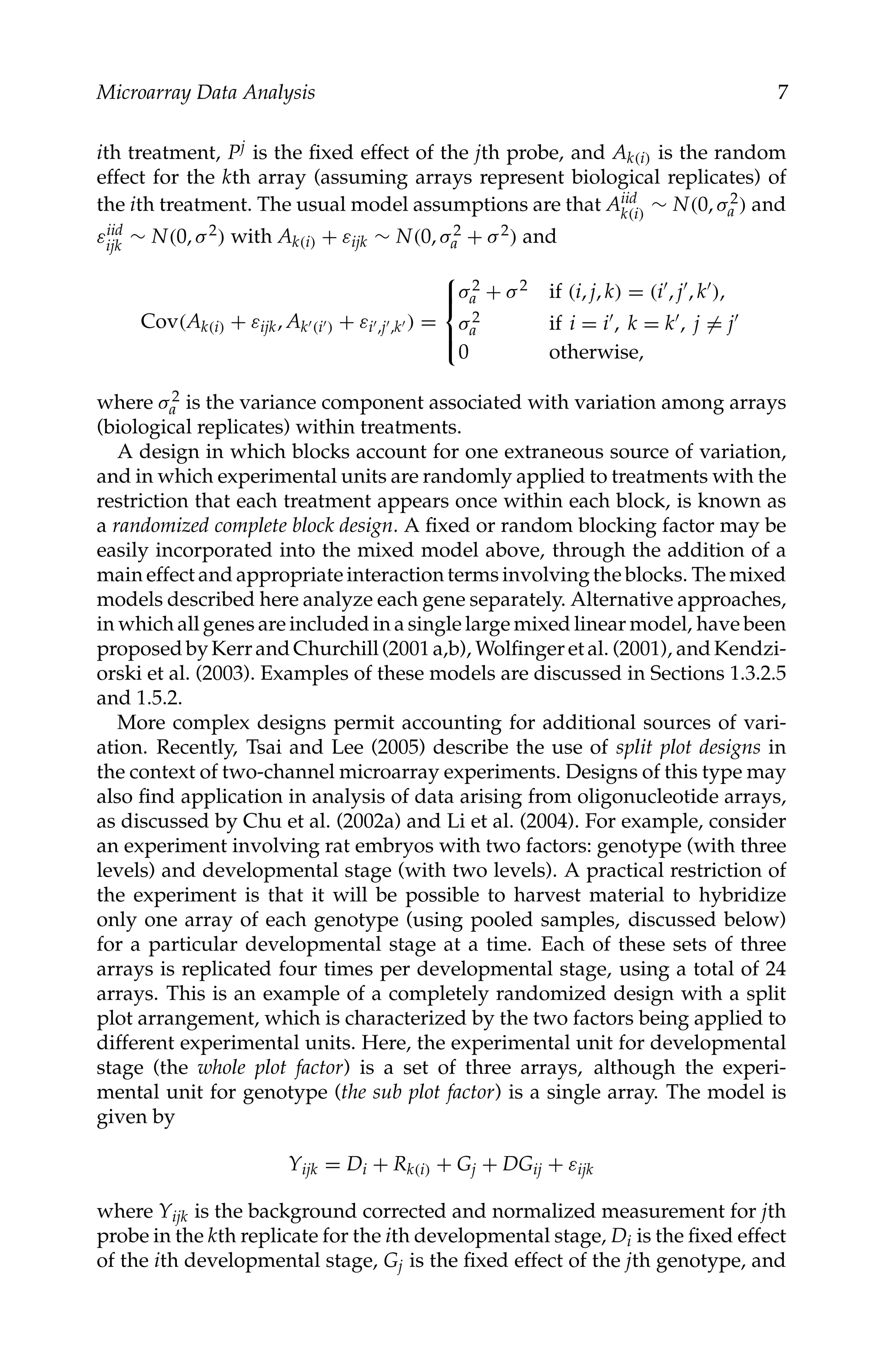
  • 7.
    C5777: “c5777_c000” —2007/10/31 — 15:03 — page i — #1 i
  • 8.
    C5777: “c5777_c000” —2007/10/31 — 15:03 — page ii — #2 ii Computational Methods in Biomedical Research Editor-in-Chief Shein-Chung Chow, Ph.D. Professor Department of Biostatistics and Bioinformatics Duke University School of Medicine Durham, North Carolina, U.S.A. Byron Jones Senior Director Statistical Research and Consulting Centre (IPC 193) Pfizer Global Research and Development Sandwich, Kent, UK Jen-pei Liu Professor Division of Biometry Department of Agronomy National Taiwan University Taipei, Taiwan Karl E. Peace Director,Karl E. Peace Center for Biostatistics Professor of Biostatistics Georgia Cancer Coalition Distinguished Cancer Scholar Georgia Southern University, Statesboro, GA Series Editors
  • 9.
    C5777: “c5777_c000” —2007/10/31 — 15:03 — page iii — #3 iii 1. Design and Analysis of Animal Studies in Pharmaceutical Development, Shein-Chung Chow and Jen-pei Liu 2. Basic Statistics and Pharmaceutical Statistical Applications, James E. De Muth 3. Design and Analysis of Bioavailability and Bioequivalence Studies, Second Edition, Revised and Expanded, Shein-Chung Chow and Jen-pei Liu 4. Meta-Analysis in Medicine and Health Policy, Dalene K. Stangl and Donald A. Berry 5. Generalized Linear Models: A Bayesian Perspective, Dipak K. Dey, Sujit K. Ghosh, and Bani K. Mallick 6. Difference Equations with Public Health Applications, Lemuel A. Moyé and Asha Seth Kapadia 7. Medical Biostatistics, Abhaya Indrayan and Sanjeev B. Sarmukaddam 8. Statistical Methods for Clinical Trials, Mark X. Norleans 9. Causal Analysis in Biomedicine and Epidemiology: Based on Minimal Sufficient Causation, Mikel Aickin 10. Statistics in Drug Research: Methodologies and Recent Developments, Shein-Chung Chow and Jun Shao 11. Sample Size Calculations in Clinical Research, Shein-Chung Chow, Jun Shao, and Hansheng Wang 12. Applied Statistical Design for the Researcher,Daryl S. Paulson 13. Advances in Clinical Trial Biostatistics, Nancy L. Geller 14. Statistics in the Pharmaceutical Industry, Third Edition, Ralph Buncher and Jia-Yeong Tsay 15. DNA Microarrays and Related Genomics Techniques: Design, Analysis, and Interpretation of Experiments, David B. Allsion, Grier P.Page, T. Mark Beasley, and Jode W. Edwards 16. Basic Statistics and Pharmaceutical Statistical Applications, Second Edition, James E. De Muth 17. Adaptive Design Methods in Clinical Trials, Shein-Chung Chow and Mark Chang 18. Handbook of Regression and Modeling: Applications for the Clinical and Pharmaceutical Industries, Daryl S. Paulson 19. Statistical Design and Analysis of Stability Studies, Shein-Chung Chow 20. Sample Size Calculations in Clinical Research, Second Edition, Shein-Chung Chow, Jun Shao, and Hansheng Wang 21. Elementary Bayesian Biostatistics, Lemuel A. Moyé 22. Adaptive Design Theory and Implementation Using SAS and R, Mark Chang 23. Computational Pharmacokinetics, Anders Kallen Published Titles
  • 10.
    C5777: “c5777_c000” —2007/10/31 — 15:03 — page iv — #4
  • 11.
    C5777: “c5777_c000” —2007/10/31 — 15:03 — page v — #5 v
  • 12.
    C5777: “c5777_c000” —2007/10/31 — 15:03 — page vi — #6
  • 13.
    C5777: “c5777_c000” —2007/10/31 — 15:03 — page vii — #7 Contents Series Introduction ................................................................ vii Preface............................................................................... ix Editors............................................................................... xi Contributors........................................................................ xiii 1 Microarray Data Analysis.................................................. 1 Susmita Datta, Somnath Datta, Rudolph S. Parrish, and Caryn M. Thompson 2 Machine Learning Techniques for Bioinformatics: Fundamentals and Applications.......................................... 45 Jarosław Meller and Michael Wagner 3 Machine Learning Methods for Cancer Diagnosis and Prognostication .............................................................. 77 Anne-Michelle Noone and Mousumi Banerjee 4 Protein Profiling for Disease Proteomics with Mass Spectrometry: Computational Challenges.............................. 103 Dayanand N. Naik and Michael Wagner 5 Predicting US Cancer Mortality Counts Using State Space Models ................................................................ 131 Kaushik Ghosh, Ram C. Tiwari, Eric J. Feuer, Kathleen A. Cronin, and Ahmedin Jemal 6 Analyzing Multiple Failure Time Data Using SAS® Software ..... 153 Joseph C. Gardiner, Lin Liu, and Zhehui Luo 7 Mixed-Effects Models for Longitudinal Virologic and Immunologic HIV Data .................................................... 189 Florin Vaida, Pulak Ghosh, and Lin Liu
  • 14.
    C5777: “c5777_c000” —2007/10/31 — 15:03 — page viii — #8 viii Contents 8 Bayesian Computational Methods in Biomedical Research......... 211 Hedibert F. Lopes, Peter Müller, and Nalini Ravishanker 9 Sequential Monitoring of Randomization Tests ...................... 261 Yanqiong Zhang and William F. Rosenberger 10 Proportional Hazards Mixed-Effects Models and Applications .... 297 Ronghui Xu and Michael Donohue 11 Classification Rules for Repeated Measures Data from Biomedical Research........................................................ 323 Anuradha Roy and Ravindra Khattree 12 Estimation Methods for Analyzing Longitudinal Data Occurring in Biomedical Research ....................................... 371 N. Rao Chaganty and Deepak Mav Index................................................................................. 401
  • 15.
    C5777: “c5777_c000” —2007/10/31 — 15:03 — page ix — #9 Series Introduction The primary objectives of the Biostatistics Book Series are to provide useful reference books for researchers and scientists in academia, industry, and gov- ernment, and also to offer textbooks for undergraduate and graduate courses in the area of biostatistics. This book series will provide comprehensive and unified presentations of statistical designs and analyses of important applic- ations in biostatistics, such as those in biopharmaceuticals. A well-balanced summary will be given of current and recently developed statistical meth- ods and interpretations for both statisticians and researchers or scientists with minimal statistical knowledge who are engaged in the field of applied biostatistics. The series is committed to providing easy-to-understand, state- of-the-art references and textbooks. In each volume, statistical concepts and methodologies will be illustrated through real-world examples. In the last decade, it was recognized that increased spending on biomed- ical research does not reflect an increase in the success rate of pharmaceutical development. On March 16, 2004, the FDA released a report addressing the recent slowdown in innovative medical therapies submitted to the FDA for approval, “Innovation/Stagnation: Challenge and Opportunity on the Critical Path to New Medical Products.” The report describes the urgent need tomodernizethemedicalproductdevelopmentprocess—thecriticalpath—to make product development more predictable and less costly. Two years later, the FDA released a Critical Path Opportunities List that outlines 76 initial pro- jects (under six broad topic areas) to bridge the gap between the quick pace of new biomedical discoveries and the slower pace at which those discoveries are currently developed into therapies. Among the six broad topic areas, bet- ter evaluation tool (development of biomarker), streamlining clinical trial (the use of adaptive design methods), and harnessing bioinformatics (the use of computational biology) are considered the top three challenges for increasing the probability of success in pharmaceutical research and development. This volume provides useful approaches for implementation of target clinical trials in pharmaceutical research and development. It covers stat- istical methods for various computational topics such as biomarker devel- opment, sequential monitoring, proportional hazard mixed-effects models, and Bayesian approach in pharmaceutical research and development. It would be beneficial to biostatisticians, medical researchers, pharmaceutical
  • 16.
    C5777: “c5777_c000” —2007/10/31 — 15:03 — page x — #10 x Series Introduction scientists, and reviewers in regulatory agencies who are engaged in the areas of pharmaceutical research and development. Shein-Chung Chow
  • 17.
    C5777: “c5777_c000” —2007/10/31 — 15:03 — page xi — #11 Preface This edited volume is a collection of chapters covering some of the important computational topics with special reference to biomedical applications. Rapid advancesinever-changingbiomedicalresearchandmethodologicalstatistical developments that must support these advances make it imperative that from time to time a cohesive account of new computational schemes is made avail- able for users to implement these methodologies in the particular biomedical context or problem. The present volume is an attempt to fill this need. Realizing the vastness of the area itself, there is no pretension to be exhaust- ive in terms of the general field or even in terms of a topic represented by a chapter within this field; such a task, while also requiring hundreds of collab- orators, would require a collection of several volumes of similar size. Hence the selection made here represents our personal view of what the most import- ant topics are, in terms of their applicability and potential in the near future. With this in mind, the chapters are arranged accordingly, with the works of immediate applicability appearing first. These are followed by more theor- etical advances and computational schemes that are yet to be developed in satisfactory forms for general applications. Work of this magnitude could not have been accomplished without the help of many people. We wish to thank our referees for painstakingly going through the chapters as a gesture of academic goodwill. Theresa Del Forn of Taylor & Francis Group, was most helpful and patient with our repeatedly broken promises of meeting the next deadline. Our families have provided their sincere support during this project and we appreciate their understanding as well. Ravindra Khattree, Rochester, Michigan Dayanand N. Naik, Norfolk, Virginia
  • 18.
    C5777: “c5777_c000” —2007/10/31 — 15:03 — page xii — #12
  • 19.
    C5777: “c5777_c000” —2007/10/31 — 15:03 — page xiii — #13 Editors Ravindra Khattree, professor of statistics at Oakland University, Rochester, Michigan, received his initial graduate training at the Indian Statistical Institute. He received his PhD from the University of Pittsburgh in 1985. He is the author or coauthor of numerous research articles on theoretical and applied statistics in various national and international journals. His researchinterestsincludemultivariateanalysis, experimentaldesigns, quality control, repeated measures, and statistical inference. In addition to teaching graduate and undergraduate courses, Dr. Khattree regularly consults with industry, hospitals, and academic researchers on various applied statistics problems. He is a chief editor of the Journal of Statistics and Applications, editor of InterStat, an online statistics journal, and an associate editor of the Journal of Statistical Theory and Practice. For many years, he also served as an associate editor for the Communications in Statistics. He is a Fellow of the American Statistical Association, an elected member of the International Statistical Institute, and a winner of the Young Statistician Award from International Indian Statistical Association. Dr. Khattree is a coauthor of two books, both with Dr. D. N. Naik, titled Applied Multivariate Statistics with SAS Software (Second Edition) and Multivariate Data Reduction and Discrimination with SAS Software, both copublished by SAS Press/Wiley. He has also coedited, with Dr. C. R. Rao, the Handbook of Statistics 22: Statistics in Industry, published by North Holland. Dayanand N. Naik is professor of statistics at Old Dominion University, Norfolk, Virginia. He received his MS degree in statistics from Karnatak University, Dharwad, India, and PhD in statistics from the University of Pittsburgh in 1985. He has published extensively in several well-respected journals and advised numerous students for their PhD in statistics. His research interests include multivariate analysis, linear models, quality con- trol, regression diagnostics, repeated measures, and growth curve models. Dr. Naik is an editor of InterStat, a statistics journal on the Internet, and an associate editor of Communications in Statistics. Dr. Naik is also actively involved in statistical consulting and collaborative research. He is an elected member of International Statistical Institute and is very active in American Statistical Association activities. Dr. Naik is coauthor of two books, both with Dr. Khattree, titled Applied Multivariate Statistics with SAS Software (Second Edition) and Multivariate Data Reduction and Discrimination with SAS Software, both copublished by SAS Press/Wiley.
  • 20.
    C5777: “c5777_c000” —2007/10/31 — 15:03 — page xiv — #14
  • 21.
    C5777: “c5777_c000” —2007/10/31 — 15:03 — page xv — #15 Contributors Mousumi Banerjee Department of Biostatistics, School of Public Health, University of Michigan, Ann Arbor, Michigan N. Rao Chaganty Department of Mathematics and Statistics, Old Dominion University, Norfolk, Virginia Kathleen A. Cronin Statistical Research and Applications Branch, National Cancer Institute, Bethesda, Maryland Somnath Datta Department of Bioinformatics and Biostatistics, School of Public Health and Information Sciences, University of Louisville, Louisville, Kentucky Susmita Datta Department of Bioinformatics and Biostatistics, School of Public Health and Information Sciences, University of Louisville, Louis- ville, Kentucky Michael Donohue Division of Biostatistics and Bioinformatics, Department of Family and Preventive Medicine, University of California at San Diego, La Jolla, California Eric J. Feuer Statistical Research and Applications Branch, National Cancer Institute, Bethesda, Maryland Joseph C. Gardiner Division of Biostatistics, Department of Epidemiology, Michigan State University, East Lansing, Michigan Kaushik Ghosh Department of Mathematical Sciences, University of Nevada at Las Vegas, Las Vegas, Nevada Pulak Ghosh Department of Mathematics and Statistics, Georgia State University, Atlanta, Georgia Ahmedin Jemal Department of Epidemiology and Surveillance Research, American Cancer Society, Atlanta, Georgia
  • 22.
    C5777: “c5777_c000” —2007/10/31 — 15:03 — page xvi — #16 xvi Contributors Ravindra Khattree Department of Mathematics and Statistics, Oakland University, Rochester, Michigan Lin Liu Division of Biostatistics, Department of Epidemiology, Michigan State University, East Lansing, Michigan Lin Liu Department of Family and Preventive Medicine, University of California at San Diego, La Jolla, California Hedibert F. Lopes Graduate School of Business, University of Chicago, Chicago, Illinois Zhehui Luo Division of Biostatistics, Department of Epidemiology, Michigan State University, East Lansing, Michigan Deepak Mav Constella Group, Inc., Durham, North Carolina Jarosław Meller Division of Biomedical Informatics, Cincinnati Children’s Hospital Research Foundation, Cincinnati, Ohio; Department of Inform- atics, Nicholas Copernicus University, Torun, Poland; and Department of Environmental Health, University of Cincinnati, Ohio Peter Müller Department of Biostatistics, The University of Texas, M. D. Anderson Cancer Center, Houston, Texas Dayanand N. Naik Department of Mathematics and Statistics, Old Domin- ion University, Norfolk, Virginia Anne-Michelle Noone Department of Biostatistics, School of Public Health, University of Michigan, Ann Arbor, Michigan Rudolph S. Parrish Department of Bioinformatics and Biostatistics, School of Public Health and Information Sciences, University of Louisville, Louisville, Kentucky Nalini Ravishanker Department of Statistics, University of Connecticut, Storrs, Connecticut William F. Rosenberger Department of Statistics, The Volgenau School of Information Technology and Engineering, George Mason University, Fairfax, Virginia Anuradha Roy Department of Management Science and Statistics, The University of Texas at San Antonio, San Antonio, Texas
  • 23.
    C5777: “c5777_c000” —2007/10/31 — 15:03 — page xvii — #17 Contributors xvii Caryn M. Thompson Department of Bioinformatics and Biostatistics, School of Public Health and Information Sciences, University of Louisville, Louisville, Kentucky Ram C. Tiwari Statistical Research and Applications Branch, National Cancer Institute, Bethesda, Maryland Florin Vaida Division of Biostatistics and Bioinformatics, Department of Family and Preventive Medicine, University of California at San Diego, La Jolla, California Michael Wagner Division of Biomedical Informatics, Cincinnati Children’s Hospital Research Foundation, Cincinnati, Ohio Ronghui Xu Division of Biostatistics and Bioinformatics, Department of Family and Preventive Medicine, and Department of Mathematics, University of California at San Diego, La Jolla, California Yanqiong Zhang Merck & Company, Rahway, New Jersey
  • 24.
    C5777: “c5777_c000” —2007/10/31 — 15:03 — page xviii — #18
  • 25.
    C5777: “c5777_c001” —2007/10/27 — 13:02 — page 1 — #1 1 Microarray Data Analysis Susmita Datta, Somnath Datta, Rudolph S. Parrish, and Caryn M. Thompson CONTENTS 1.1 Introduction ................................................................. 2 1.2 Experimental Design ....................................................... 3 1.2.1 Data from Microarray Experiments ............................. 4 1.2.2 Sources of Variation ............................................... 4 1.2.3 Principles of Experimental Design .............................. 5 1.2.4 Common Designs for Oligonucleotide Arrays ................ 6 1.2.5 Power/Sample Size Considerations ............................ 8 1.2.6 Pooling .............................................................. 9 1.2.7 Designs for Dual-Channel Arrays ............................... 10 1.3 Normalization of Microarray Data ...................................... 11 1.3.1 Normalization and Its Implications for Estimation of Variance Components ............................................. 14 1.3.2 Normalization Methods .......................................... 15 1.3.2.1 Method Based on Selected Invariant Genes ........ 15 1.3.2.2 Methods Based on Global or Local Values .......... 15 1.3.2.3 Local Regression Methods ............................. 17 1.3.2.4 Quantile-Based Methods .............................. 17 1.3.2.5 Methods Based on Linear Models .................... 18 1.3.2.6 Probe Intensity Models ................................ 18 1.4 Clustering and Classification ............................................. 19 1.4.1 Clustering ........................................................... 19 1.4.2 Classification ....................................................... 23 1.4.2.1 Dimensionality Reduction ............................. 24 1.4.2.2 Classification Algorithms .............................. 25 1.4.2.3 Accuracy of Classification ............................. 26 1.5 Detection of Differential Gene Expressions ............................ 27 1.5.1 Fold Change ........................................................ 27 1.5.2 The Two Sample t-Test and its Variants ........................ 28 1.5.3 Adjustments for Multiple Testing ............................... 29 1.5.4 False Discovery Rate .............................................. 30 1
  • 26.
    C5777: “c5777_c001” —2007/10/27 — 13:02 — page 2 — #2 2 Computational Methods in Biomedical Research 1.5.5 Procedures-Based on p Values ................................... 32 1.5.6 Empirical Bayes Methods ........................................ 34 1.6 Networks and Pathways .................................................. 34 1.7 Concluding Remarks ...................................................... 36 References ......................................................................... 36 1.1 Introduction Microarray technology has quickly become one of the most commonly used high throughput systems in modern biological and medical experiments over the past 8 years. For most parts, a single microarray records the expression levels of several genes in a tissue sample—this number often runs in tens of thousands. At the end, a huge multivariate data set is obtained containing the gene expression profiles. A microarray experiment typically compares the expression data with two or more treatments (e.g., cell lines, experi- mental conditions, etc.); additionally, there is often a time component in the experiment. Owing to the relatively high production cost of microarrays, oftentimes very few replicates are available for a given set of experimental conditions that pose new challenges for the statisticians in analyzing these data sets. Most of the early microarray experiments involved the so-called two- channel cDNA microarrays where small amounts of genetic materials (cRNA) are printed on a small glass slide with robotic print heads. The mRNA samples corresponding to two different treatments are tinted with two different fluor- escent dyes (generally red and green) and allowed to hybridize (a technical term for a biological process by which an mRNA strand attaches to the com- plementary cDNA strand) on the same slide. At the end, the expression values of the sample under comparison are evaluated with certain specialized laser scanners. In more recent studies, the oligonucleotide arrays, also known as the Affymetrix GeneChips®, are becoming increasingly popular. These are factory-prepared arrays targeted for a particular genome (e.g., rat, humans, etc.) that contain oligonucleotide materials placed in multiple pairs—called a probe set (http://www.affymetrix.com/products/system.affx). One of each pair contains the complementary base sequences for the targeted gene; how- ever, the other one has an incorrect base in the middle created to measure nonspecific bindings during hybridization that can be used for background correction. Expression values are computed by the relative amounts of bindings (perfect match versus perfect mismatch). Besides the above two microarray platforms, there exist many additional choices at present including many custom arrays offered by various man- ufactures; in addition, serial analysis of gene expression (SAGE), which is technically not a microarray-based technique, produces gene expression data as well. Unlike microarrays, SAGE is a sequencing-based gene expression
  • 27.
    C5777: “c5777_c001” —2007/10/27 — 13:02 — page 3 — #3 Microarray Data Analysis 3 profiling technique that does not require prior knowledge of the sequences to be considered. Another important difference between the two is that, with SAGE, one does not need a normalization procedure (see Section 1.3) since it measures abundance or expression in an absolute sense. Calculating expression itself is an issue with most, if not all, microarray platforms; in addition, there are issues of normalizations and correction for systematic biases and artifacts, some of which are discussed in Section 1.3. In addition, there have been recent studies comparing multiple microarray platforms and the amount of agreement between them. The very latest set of results (see, e.g., Irizarry et al., 2005) contradict earlier beliefs about non- reproducibility of microarray gene expression calculations and concludes that the laboratories running the experiments have more effect on the final conclu- sions than the platforms. In other words, two laboratories following similar strict guidelines would get similar results (that are driven by biology) even if they use different technologies. On the other hand, the “best” and the “worst” laboratories in this study used the same microarray platform but got very different answers. In this review, we present a brief overview of various broad topics of microarray data analysis. We are particularly interested in statistical aspects of microarray-based bioinformatics. The selection of topics is, by no means, comprehensive partly because new statistical problems are emerging every day in this fast growing field. A number of monographs have come out in recent years (e.g., Causton et al., 2003; Speed, 2003; Lee, 2004; McLachlan et al., 2004; Wit and McClure, 2004), which can help an interested reader gain further familiarity and knowledge in this area. The rest of the chapter is organized as follows. Some commonly employed statistical designs in microarray experiments are discussed in Section 1.2. Aspects of preprocessing of microarray data that are necessary for further statistical analysis are discussed in Section 1.3. Elements of statistical machine learning techniques that are useful for gaining insights into microarray data sets are discussed in Section 1.4. Hypothesis testing with microarray data is covered in Section 1.5. The chapter ends with a brief discussion of pathway analysis using microarrays as a data generation tool. 1.2 Experimental Design In planning biological experiments, including microarray experiments, the researcher should be aware of and follow sound statistical principles. Each of these principles, as outlined below, serves a particular purpose in ensuring a valid experiment. Properties of a “good” experiment include the absence of systematic error (or bias), precision, and simplicity (Cox, 1958). The experi- ment should also permit calculation of uncertainty (error) and ideally have a wide range of validity.
  • 28.
    C5777: “c5777_c001” —2007/10/27 — 13:02 — page 4 — #4 4 Computational Methods in Biomedical Research Microarray experiments have realistic limitations that must be taken into account at the design stage. These include the cost of arrays, restrictions on the number of arrays that can be processed at one time, and the amount of material necessary to hybridize an array. In addition, there may be little or no prior information on variability available at the planning stage of a microarray experiment. In the discussion that follows, we describe experimental design principles, primarily as applied to oligonucleotide arrays. Dual-channel arrays require specialized designs, which are discussed briefly in Section 1.2.7. While the principles described here are general, in this section we focus mainly on experiments to detect differential gene expression. 1.2.1 Data from Microarray Experiments For most purposes, data from a microarray experiment can be described as multidimensional array of expression values Y. Usually, the first dimen- sion (row) corresponds to genes or probe sets or ORFs. Depending on the experiment, the other dimensions may represent replicates (biological and technical), tissue types, time, and so on. Usually, a preprocessing or normalization step is applied to the microarray readouts to calculate an accurate and “unbiased” measure of gene expression before additional statistical analyses are carried out. We describe various nor- malization methods in Section 1.3. In addition, certain statistical analysis may have an implicit normalization step. 1.2.2 Sources of Variation When designing a microarray experiment, it is essential to be aware of the many sources of variation, both biological and technical, which may affect experimental outcomes. Biological variation is essentially that among sub- jects (i.e., natural subject-to-subject variability). Different subjects from which samples are obtained are not identical in a multitude of characteristics and thereby have gene expressions that vary as well. This type of variation occurs normally and is used as a benchmark when testing for differential expression. Biological variation is reflected in experimental error. Technical variation includes errors or effects due to instrumentation, meas- urement, hybridization, sample preparation, operator, and other factors that serve to add unwanted variation to the data (Churchill, 2002; Parmigiani et al., 2003). These factors generally are uncontrolled, meaning that their presence is not only unintended but also often unavoidable. Technical variation includes systematic variation among or within arrays. It is described generally as an array effect. There may also be variation that is the result of how the experi- ment is designed or carried out; that is, variation that is due to controlled or identifiable factors. An example is variation due to batch where arrays within certain groups all share a common effect. Variation of this type usually can be accounted for through statistical analysis. This type of variation often is
  • 29.
    C5777: “c5777_c001” —2007/10/27 — 13:02 — page 5 — #5 Microarray Data Analysis 5 considered part of technical variation, and attempts can be made to eliminate it before data analysis. Several authors, including Spruill et al. (2002), Kendziorski et al. (2005), and Zakharkin et al. (2005), have attempted to assess relative sizes of several typical sources of variation in microarray studies through experimentation. As a word of caution, it should be noted that each of these studies was con- ducted under a particular set of experimental conditions, and it is unclear to what extent these results may be generalized. 1.2.3 Principles of Experimental Design The three primary principles of experimental design, namely randomiza- tion, replication, and blocking, each have a particular purpose, and are often attributed to R. A. Fisher. In discussing these principles, it is important to note that an experimental unit is defined to be the smallest division of experimental material such that any two units may receive different treatments in the actual experiment. Randomization requires that experimental units be randomly allocated to treatment conditions. The random allocation may be restricted in some way, for instance, through blocking, depending on the design of the experiment. Randomization is intended to protect against bias or systematic error. As emphasized by Kerr (2003), randomization should be applied to minimize bias induced by technical artifacts, such as systematic variation in arrays within a batch according to the order in which they were printed. Also, randomization must take into account processing constraints. For example, suppose an experiment involving three treatments is run using four arrays per treatment, and it is possible to process only eight arrays per day. If the arrays from the first two treatments were processed on Day 1, and the arrays from the third treatment were processed on Day 2, it may be impossible to separate a treatment effect (whereby certain genes are differentially expressed across treatments) from a day effect (whereby expression levels for all genes tend to be higher on a particular day). That is, the treatment and day effects would be confounded. Replication implies having at least one experimental unit per treatment condition, and is necessary in order to permit estimation of experimental error or variance. The microarray literature distinguishes between biolo- gical and technical replication. Biological replication refers to the number of independent biological (experimental) units assigned to each treatment condition, whereas technical replicates arise from repeated sampling of the same experimental unit and will therefore be correlated (Cui and Churchill, 2003). Increasing replication, in particular biological replication, also provides a means of increasing power and precision for comparison of treatment means. In this context, biological replicates are considered “true” replicates, whereas the technical replicates are subsamples and might be considered “pseudoreplicates.” Issues related to pseudoreplication have been debated at length in the ecological literature for more than 20 years (Hurlbert,
  • 30.
    C5777: “c5777_c001” —2007/10/27 — 13:02 — page 6 — #6 6 Computational Methods in Biomedical Research 1984, 2004; Oksanen, 2001). In particular, treating technical replicates as biological replicates in a microarray experiment tends to underestimate true experimental error, thus inflating type I error and overstating statistical significance. Blocking involves grouping similar units together before assignment to treatment conditions, with the goal of reducing experimental error. In com- plete block designs, each treatment is randomly applied at least once within each block. Blocking accounts for one (or more) major source of extraneous variability, in addition to the one due to the treatments. If blocking is part of the experimental design, it should also be incorporated in the analysis. 1.2.4 Common Designs for Oligonucleotide Arrays The simplest design is one in which two or more treatment groups are to be compared with respect to differential gene expression, at a particular time point. The design in which experimental units are assigned to treat- ments in an unrestricted random fashion is known as a completely randomized design. Several authors, including Kerr and Churchill (2001 a,b) and Kendziorski et al. (2003) have recommended analysis of data arising from microarray experiments through linear models, provided necessary assumptions, includ- ing normality and homoscedasticity of model errors are satisfied. Data from a completely randomized design may be analyzed using a simple one-way analysis of variance (ANOVA) model for a single gene, with Yij = µ + Ti + εij where Yij is the background-corrected and normalized intensity (usually expressed on the log2 scale) of a particular gene for the jth experimental unit assigned to the ith treatment, µ is an average intensity level, Ti is the effect of the ith treatment, and the εij’s are the model error terms, usually assumed to be independently and identically distributed with mean 0 and common variance σ2 (i.e., εiid ij ∼ N(0, σ2)). A natural extension to mixed linear models for oligonucleotide microarray data was proposed Chu et al. (2002a), whereby analyses may be conducted on a gene-by-gene basis at the probe level, accounting for variation among exper- imental units within treatments, among arrays within experimental unit, and among probes for a particular gene within arrays. Following Chu et al. (2002a) a mixed linear model corresponding to a completely randomized design with one treatment factor is given by Yijk = Ti + Pj + TPij + Ak(i) + εijk where Yijk is the background corrected and normalized measurement at the jth probe in the kth replicate for the ith treatment, Ti is the fixed effect of the
  • 31.
    C5777: “c5777_c001” —2007/10/27 — 13:02 — page 7 — #7 Microarray Data Analysis 7 ith treatment, Pj is the fixed effect of the jth probe, and Ak(i) is the random effect for the kth array (assuming arrays represent biological replicates) of the ith treatment. The usual model assumptions are that Aiid k(i) ∼ N(0, σ2 a ) and εiid ijk ∼ N(0, σ2) with Ak(i) + εijk ∼ N(0, σ2 a + σ2) and Cov(Ak(i) + εijk, Ak(i) + εi,j,k ) =      σ2 a + σ2 if (i, j, k) = (i, j, k), σ2 a if i = i, k = k, j = j 0 otherwise, where σ2 a is the variance component associated with variation among arrays (biological replicates) within treatments. A design in which blocks account for one extraneous source of variation, and in which experimental units are randomly applied to treatments with the restriction that each treatment appears once within each block, is known as a randomized complete block design. A fixed or random blocking factor may be easily incorporated into the mixed model above, through the addition of a main effect and appropriate interaction terms involving the blocks. The mixed models described here analyze each gene separately. Alternative approaches, in which all genes are included in a single large mixed linear model, have been proposedbyKerrandChurchill(2001a,b), Wolfingeretal. (2001), andKendzi- orski et al. (2003). Examples of these models are discussed in Sections 1.3.2.5 and 1.5.2. More complex designs permit accounting for additional sources of vari- ation. Recently, Tsai and Lee (2005) describe the use of split plot designs in the context of two-channel microarray experiments. Designs of this type may also find application in analysis of data arising from oligonucleotide arrays, as discussed by Chu et al. (2002a) and Li et al. (2004). For example, consider an experiment involving rat embryos with two factors: genotype (with three levels) and developmental stage (with two levels). A practical restriction of the experiment is that it will be possible to harvest material to hybridize only one array of each genotype (using pooled samples, discussed below) for a particular developmental stage at a time. Each of these sets of three arrays is replicated four times per developmental stage, using a total of 24 arrays. This is an example of a completely randomized design with a split plot arrangement, which is characterized by the two factors being applied to different experimental units. Here, the experimental unit for developmental stage (the whole plot factor) is a set of three arrays, although the experi- mental unit for genotype (the sub plot factor) is a single array. The model is given by Yijk = Di + Rk(i) + Gj + DGij + εijk where Yijk is the background corrected and normalized measurement for jth probe in the kth replicate for the ith developmental stage, Di is the fixed effect of the ith developmental stage, Gj is the fixed effect of the jth genotype, and
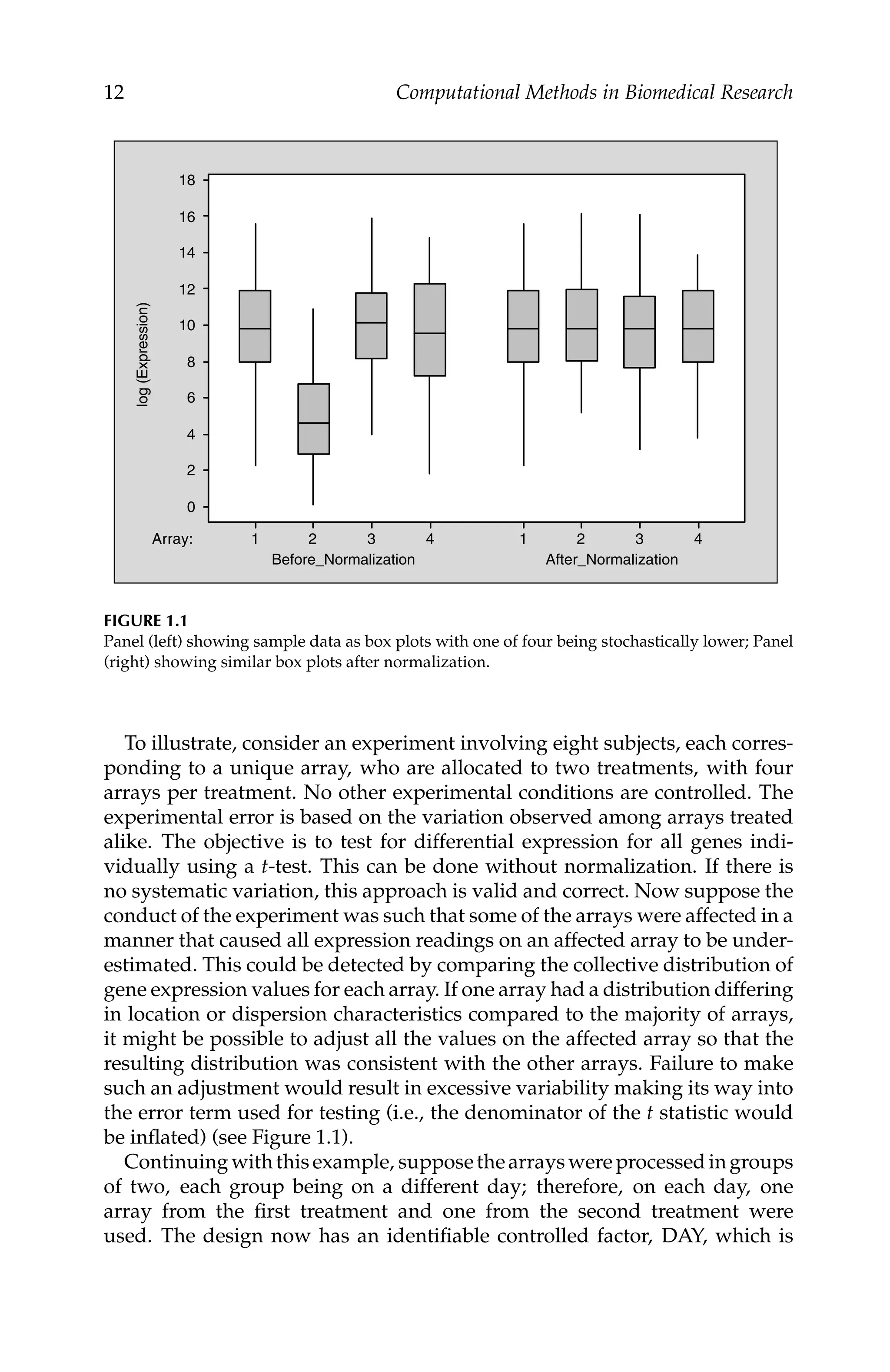
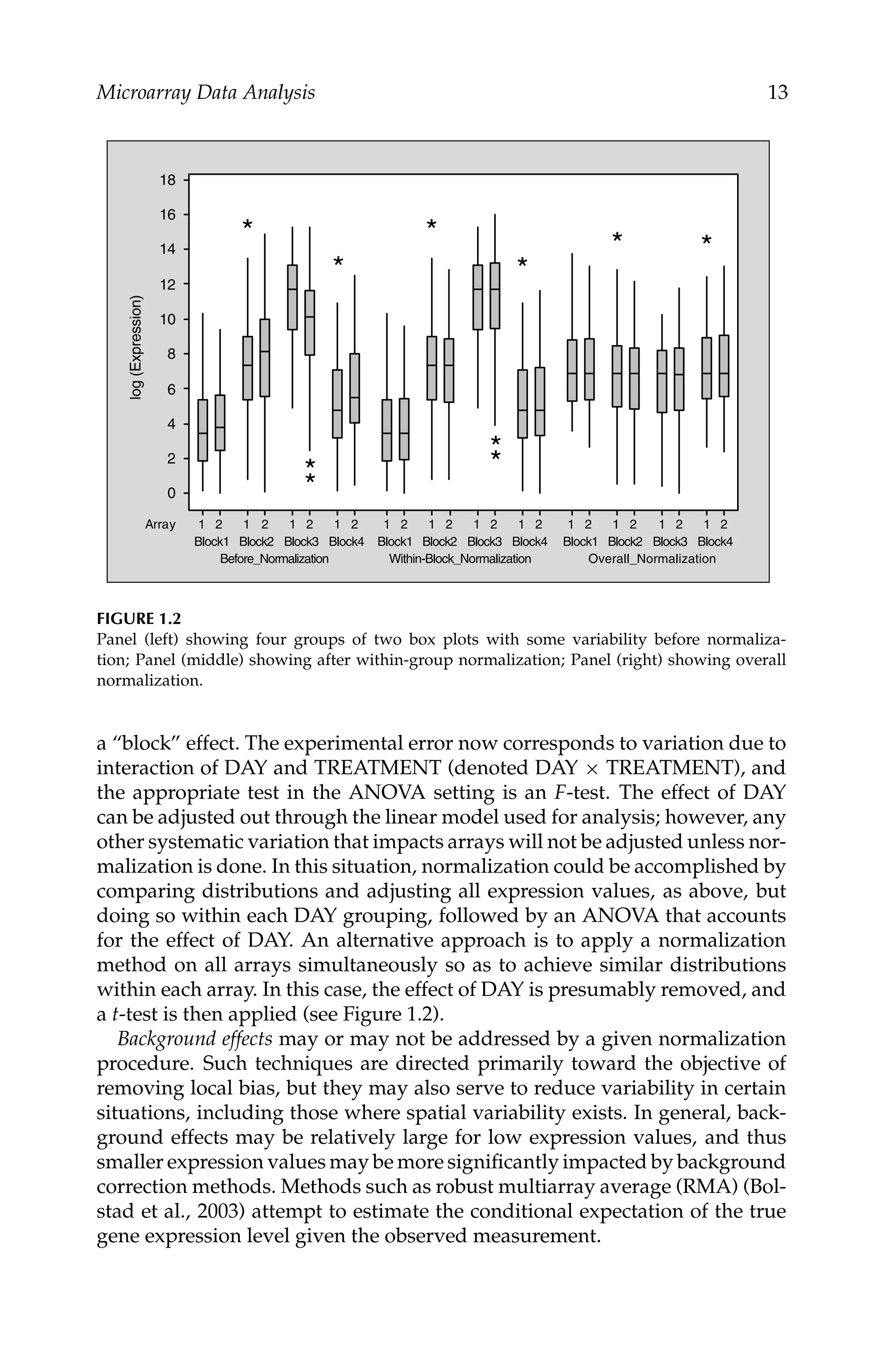
  • 32.
    C5777: “c5777_c001” —2007/10/27 — 13:02 — page 8 — #8 8 Computational Methods in Biomedical Research Rk(i) is the random effect for the kth replicate set of three arrays of the ith genotype. Model assumptions are similar to those for corresponding terms in the probe level mixed model presented above. 1.2.5 Power/Sample Size Considerations An important planning issue is the question of how many biological and technical replicates to include in a microarray experiment. The number of replicates required to detect a particular size of effect with a pre-specified level of power depends not only on the several sources contributing to variation in expression levels, but also on the statistical methods used to determine differential expression, including the choice of normalization procedure. In general, biological replicates should be favored over technical replicates when the objective is to detect differentially expressed genes. A number of authors, including Lee and Whitmore (2002), Yang et al. (2003), Gadbury et al. (2004), Jung (2005), Zhang and Gant (2005), and Tibshirani (2006) have addressed this issue. Desired minimum detectable effect sizes are often expressed in terms of fold-changes. For example, the objective may be to identify genes that are up or down regulated to the extent that they exhibit a twofold increase or decrease in expression levels. To answer the sample size question, prior knowledge is required with respect to the variance com- ponents associated with the various levels of the experimental structure for each gene. Estimates of these variance components may come from previ- ously conducted similar experiments, or pilot studies. Variance components are discussed in Section 1.3.1. In the context of an ANOVA model, Lee and Whitmore (2002) present several approaches for calculation of power and sample size, and outline applications of their methods to some standard experimental designs. Their methods account for control of the false discovery rate (FDR) due to mul- tiple testing. Multiple testing issues are discussed in detail in Section 1.5. Gadbury et al. (2004) introduce the concept of expected discovery rate (EDR), and propose corresponding methods for power and sample size calculations adjusting for EDR. The web-based resource Power Atlas (Page et al., 2006), available at www.poweratlas.org, implements this methodology, currently for experiments involving just two groups, but with anticipated expansion. This resource is designed to provide researchers with access to power and sample size calculations on the basis of a number of available data sets, which may be used in lieu of conducting a pilot study to generate variance component estimates. Recently, Tibshirani (2006) has proposed a sample size determination pro- cedure requiring less stringent assumptions than other currently available methods. This method does not assume, for instance, equal variances or independence among genes. This approach may be implemented using the significance analysis of microarrays (SAM) software (Chu et al., 2002a) to obtain estimates of both the FDR and false negative rate (FNR) as a function of total sample size through a permutation-based analysis of pilot data.
  • 33.
    C5777: “c5777_c001” —2007/10/27 — 13:02 — page 9 — #9 Microarray Data Analysis 9 1.2.6 Pooling The primary motivation for pooling is to reduce the effect of biological variab- ility and improve cost effectiveness. It is important to stress, as do Kendiorski et al. (2005) and Zhang and Gant (2005), that pooling may artificially reduce the effects of biological variability, so that statistical significance is overstated. Disadvantages of pooling include difficulty in estimating appropriate vari- ance components, and loss of information on individuals. However, in many experiments, such as developmental studies involving extraction of tissues from mouse embryos, the amount of available RNA per individual is limit- ing. Therefore, an approach involving either pooling of embryo tissue or RNA amplification is necessary. A potential problem with amplification is that it tends to introduce noise, and may be nonlinear, in that all genes may not be amplified at the same rate. One of the issues associated with the design and analysis of microarray experiments is the question of whether, and under what conditions, the pool- ingofRNAsamplesbeforehybridizationofarrayscanbebeneficial. Although originally controversial (Affymetrix, 2004), it is now generally acknowledged that pooling can be useful in certain circumstances (Allison et al., 2006). Various authors, including Kendziorski et al. (2003, 2005), Peng et al. (2003) and Zhang and Gant (2005) have discussed effects of pooling from a statistical perspective. Kendziorski et al. (2005) considered “M on np” pooling schemes, in which mRNA from M = np × n subjects was used to hybridize np arrays (n subjects per pool). On the basis of an experiment involving 30 female rats to compare the effects of a number of pooling schemes empirically, they con- cluded that there is little benefit to pooling when variability among subjects is relatively small, but suggest that pooling can improve accuracy when fewer than three arrays are available per treatment condition. In experiments with three or more arrays available per treatment condition, pooling is only likely to be beneficial if a large number of subjects contribute to each pool. Pooling relies on the assumption of biological averaging, that is, that the response for each individual contributes equally to the average calculated for the pool. For example, if each array is hybridized with mRNA from n individuals, and the concentration of mRNA transcripts from kth individual for the ith gene in the jth pool is Yijk, the concentration of the ith gene’s transcripts in the jth pool will be 1 n n k=1 Yijk if biological averaging holds. There has been some debate as to whether this assumption is realistic. However, Kendziorski et al. (2005) observed that bio- logical averaging occurred for most, but not all, genes involved in their exper- iment and argue that there is some support for the validity of this assumption. Kendziorski et al. (2005) also introduce the notion of equivalent designs, and illustrate this concept through comparison of the various pooling schemes
  • 34.
    C5777: “c5777_c001” —2007/10/27 — 13:02 — page 10 — #10 10 Computational Methods in Biomedical Research considered in their experiment. Two designs are considered to be equivalent if they lead to the same average estimation efficiency. This is an important cost-related consideration, in that it may be possible to reduce the number of arrays required to achieve a desired level of precision. However, two designs equivalent in average efficiency do not necessarily provide similar precision for individual genes. 1.2.7 Designs for Dual-Channel Arrays Dual-channel, or spotted cDNA arrays, requires the use of specialized designs, which are discussed only briefly here. Interested readers may con- sult Rosa et al. (2005) for further details. The two most common classes of these designs are the reference designs and the loop designs (Kerr and Churchill, 2001a,b; Churchill, 2002; Kerr, 2003). Despite reported advantages of loop designs, reference designs are still commonly used in practice. The term reference design refers to the fact that at least one sample is included in the experiment, to which all other samples are compared with respect to hybridization. There are several variants of this type of design. Steibel and Rosa (2005) describe three of these, and assign each a distinct name. The first of these, the classical reference design (Kerr and Churchill, 2001a) employs replicates of the reference sample. In contrast, the common reference design uses only a single reference sample as the basis for comparison. Yet another variant is the replicated reference design, where the reference is biologically relevant, and is considered to be a control treatment with replicates. The basic loop design was proposed by Kerr and Churchill (2001a,b) and is essentially a balanced incomplete block design. In such designs, the number of treatments is greater than the block size. It is used when three or more treat- ments are to be compared using two-channel microarrays. In the microarray context, each two-channel microarray is viewed as a block of size two. Treat- ments are then compared with each other in a multiple pairwise fashion laid out in a daisy chain (e.g., 1 vs. 2, 2 vs. 3, 3 vs. 1). Variants of the loop design include connected loop design (Dobbin et al., 2003), where the same biological sample is used in two arrays connected in a daisy chain but with different dye (channel) and interwoven loop design. In the later, the efficiency of comparison is improved by creating additional (multiple) links amongst the treatments to be compared (e.g., 1 vs. 2, 2 vs. 3, 3 vs. 4, 4 vs. 1, 1 vs. 3, 2 vs. 4, 3 vs. 1, 4 vs. 2). Among the reference designs, the classical reference design is generally considered to have lower statistical efficiency than other forms of reference designs. Templeman (2005) compared several design alternatives for two- channel arrays with respect to precision, power, and robustness, assuming a mixed model analysis and a single treatment factor. He found that except for cases with minimum replication (two replicates per treatment) the loop designs were superior to the reference designs in terms of smaller stand- ard errors for treatment comparisons, higher power, and greater robustness. Although the loop designs were found to be more sensitive to missing arrays,
  • 35.
    C5777: “c5777_c001” —2007/10/27 — 13:02 — page 11 — #11 Microarray Data Analysis 11 the interwoven loop design is reported to be more robust to missing arrays than the classical loop design, and yet more statistically efficient than the common reference design. Vinciotti et al. (2005) also performed an experi- mental comparison of the common reference vs. the classical loop design, and found that loop designs generally have much higher precision. On the basis of further simulation studies they concluded that, for a given sample size, the classical loop design will have higher power than the common refer- ence design to detect differentially expressed genes, while minimizing type I error. Advances are continually being made in the area of improved designs for multichannel arrays. Recently, Wit et al. (2005) describe a procedure to find near-optimal interwoven loop designs, using the A-optimality criterion. Steibel and Rosa (2005) propose a blocked reference design, which tends to be more efficient and less expensive than common reference designs. Woo et al. (2005) present preliminary guidelines for efficient loop designs for three- and four-color microarrays. 1.3 Normalization of Microarray Data There are different factors that contribute to variation in the observed data from microarray experiments. Typically, this variability is characterized as being of two types: biological and technical, as discussed in the previous section. Normalization is broadly defined as any technique meant to remove or account for technical variation in the data before statistical testing or ana- lysis. Less noise in the data, as reflected in the estimate of experimental error, translates into a stronger capability to detect differential expression (i.e., treat- ment effects) of smaller magnitudes (see also Parrish and Spencer, 2004). If technical variation can be removed, substantially reduced, or adjusted out, the power of statistical tests will be enhanced. Normalization procedures mainly involve revising the observed data before statistical analysis in an effort to remove the technical variability. This relies on the assumptions that most genes should not be affected by the treat- ment or condition under study and that the other factors affect all or most genes in the same or similar manner. The particular assumptions depend on the method used for normalization. In the simplest case, revision of the data based on these assumptions may be the only alternative for reducing technical variation. In essence, normalization is a mechanism to “borrow” information from other variables in order to correct identifiable deficiencies in the data. The objectives of normalization also may be achieved in part by incorporating into statistical models used to analyze the data adjustment terms correspond- ingtoknowneffects. Thisdoesnotrequireassumptionsabouthowmostgenes are affected by various factors and the analysis typically is conducted on a gene-by-gene basis.
  • 36.
    C5777: “c5777_c001” —2007/10/27 — 13:02 — page 12 — #12 12 Computational Methods in Biomedical Research log (Expression) Array: After_Normalization Before_Normalization 4 3 2 1 4 3 2 1 18 16 14 12 10 8 6 4 2 0 FIGURE 1.1 Panel (left) showing sample data as box plots with one of four being stochastically lower; Panel (right) showing similar box plots after normalization. To illustrate, consider an experiment involving eight subjects, each corres- ponding to a unique array, who are allocated to two treatments, with four arrays per treatment. No other experimental conditions are controlled. The experimental error is based on the variation observed among arrays treated alike. The objective is to test for differential expression for all genes indi- vidually using a t-test. This can be done without normalization. If there is no systematic variation, this approach is valid and correct. Now suppose the conduct of the experiment was such that some of the arrays were affected in a manner that caused all expression readings on an affected array to be under- estimated. This could be detected by comparing the collective distribution of gene expression values for each array. If one array had a distribution differing in location or dispersion characteristics compared to the majority of arrays, it might be possible to adjust all the values on the affected array so that the resulting distribution was consistent with the other arrays. Failure to make such an adjustment would result in excessive variability making its way into the error term used for testing (i.e., the denominator of the t statistic would be inflated) (see Figure 1.1). Continuingwiththisexample, supposethearrayswereprocessedingroups of two, each group being on a different day; therefore, on each day, one array from the first treatment and one from the second treatment were used. The design now has an identifiable controlled factor, DAY, which is
  • 37.
    C5777: “c5777_c001” —2007/10/27 — 13:02 — page 13 — #13 Microarray Data Analysis 13 log (Expression) Array Overall_Normalization Within-Block_Normalization Before_Normalization Block4 Block3 Block2 Block1 2 1 2 1 2 1 2 1 2 1 2 1 2 1 2 1 2 1 2 1 2 1 2 1 18 16 14 12 10 8 6 4 2 0 * * * * * * Block4 Block3 Block2 Block1 Block4 Block3 Block2 Block1 * * * * FIGURE 1.2 Panel (left) showing four groups of two box plots with some variability before normaliza- tion; Panel (middle) showing after within-group normalization; Panel (right) showing overall normalization. a “block” effect. The experimental error now corresponds to variation due to interaction of DAY and TREATMENT (denoted DAY × TREATMENT), and the appropriate test in the ANOVA setting is an F-test. The effect of DAY can be adjusted out through the linear model used for analysis; however, any other systematic variation that impacts arrays will not be adjusted unless nor- malization is done. In this situation, normalization could be accomplished by comparing distributions and adjusting all expression values, as above, but doing so within each DAY grouping, followed by an ANOVA that accounts for the effect of DAY. An alternative approach is to apply a normalization method on all arrays simultaneously so as to achieve similar distributions within each array. In this case, the effect of DAY is presumably removed, and a t-test is then applied (see Figure 1.2). Background effects may or may not be addressed by a given normalization procedure. Such techniques are directed primarily toward the objective of removing local bias, but they may also serve to reduce variability in certain situations, including those where spatial variability exists. In general, back- ground effects may be relatively large for low expression values, and thus smaller expression values may be more significantly impacted by background correction methods. Methods such as robust multiarray average (RMA) (Bol- stad et al., 2003) attempt to estimate the conditional expectation of the true gene expression level given the observed measurement.
  • 38.
    C5777: “c5777_c001” —2007/10/27 — 13:02 — page 14 — #14 14 Computational Methods in Biomedical Research 1.3.1 Normalization and Its Implications for Estimation of Variance Components The experimental design that is employed determines how treatment effects are tested. There are a few simple designs that are commonly used with microarray experiments, but others may be more complex. Consider the fol- lowing example where there are two treatments (k = 2), three biological (i.e., experimental) units per treatment group (n = 3), and two arrays per experimental unit (r = 2). It is helpful to consider the expected mean squares and the associated vari- ance components in relation to how normalization impacts on them. These are considered for single-channel arrays. In this design, there are two variance components: one due to variation among biological units treated alike within treatment groups (which gives rise to an estimate of “experimental error”) and one due to variation among arrays within biological units. Using multiple arrays for each biological unit allows for better precision when estimating the biological unit response. Variation among arrays within units gives rise to what would normally be termed “measurement error.” The correct test to use for assessing the differential effect of treatments is to form an F ratio of the mean squares for “Treatments” and “Among units (Trt).” Strictly, from an analysis standpoint, there is no requirement to normal- ize the data. If many arrays could be used for each biological unit, variation among arrays would be merely a nuisance and would not impact signific- antly on the test for treatment effect. On the other hand, normalization could be used to try to eliminate or decrease the measurement error and thereby improve the power of the test. As shown in Table 1.1, in the case where there is only one array per exper- imental unit (r = 1), the variance component for measurement error σ2 a still exists, however it is not distinguishable mathematically from the unit-to- unit variance component σ2 u . Normalization attempts to remove unwanted variation by adjusting (typically) all the values for some arrays so that their characteristics are more similar to those of the other arrays. The net desired impact is to decrease measurement error substantially, but it may also lower the estimate of the among units variance (i.e., among biological units treated alike). When normalization is applied, it modifies an observation on an array, and hopefully this modification corrects measurement error. The correction TABLE 1.1 Expected Mean Squares for Nested Design Source DF Expected Mean Square Treatments k − 1 = 1 QTrt + rσ2 u + σ2 a Among Units (Trt) k(n − 1) = 4 rσ2 u + σ2 a Arrays (Units Trt) kn(r − 1) = 6 σ2 a
  • 39.
    C5777: “c5777_c001” —2007/10/27 — 13:02 — page 15 — #15 Microarray Data Analysis 15 will also impact on the mean of the arrays within biological units, and if it is such that the variation among the means of arrays within biological units is also reduced, then the impact shows up as a reduction in the estimate of the among units variance component, a smaller experimental error term, a larger F (or t) statistic, and a smaller p value. This is considered appropriate so long as the normalization procedure does not improperly deflate the true variance component associated with biological units treated alike. Current methods do not ensure that such super-deflation does not occur. Each particular normalization method carries with it explicit or implied assumptions. 1.3.2 Normalization Methods Several methods for performing normalization have appeared in the microar- ray literature. In this section, some but not all of these are discussed. Some methods use a baseline array to establish a reference point to which other arrays are adjusted, whereas other methods use the “complete data” from all arrays simultaneously. Each method has characteristics that may be advant- ageous in different circumstances, but there is no agreement on which method is best for most situations. Some of the important and more relevant methods are presented here. 1.3.2.1 Method Based on Selected Invariant Genes If it can be assumed that genes in a known set are unaffected by the treatment, subjects, or other factors present in the experiment, they can be used to make adjustments to other gene expression values (Gieser et al., 2001; Hamalainen et al., 2001). Such a list is generally specified before the experiment is conduc- ted (Vandesompele et al., 2002) and, in fact, some microarrays are designed with so-called “housekeeping,” “control,” or “reference” genes. Usually, the values of all gene expression values on a given array are corrected so that the means of the reference genes for each array are all equal. This method can be simply defined as follows. Let mi = mean of the expression values of the housekeeping genes on array i. Adjust the values from array i (i 1) according to y∗ ij = yij − (mi − m1). The result is that all arrays then will have the same mean for the housekeeping genes. 1.3.2.2 Methods Based on Global or Local Values Expression values can be adjusted so that every array will have the same mean or, equivalently, average signal intensity. In one approach, an array is chosen arbitrarily as a baseline reference array and the following adjustments are made: y∗ ij = yij × y (m) baseline y (m) i
  • 40.
    C5777: “c5777_c001” —2007/10/27 — 13:02 — page 16 — #16 16 Computational Methods in Biomedical Research where y (m) i is the mean of all the expression values for the ith array and y (m) baseline is the mean of all the expression values for the selected baseline array (Affy- metrix, 2002). The means can be ordinary or robust (e.g., trimmed means). GeneChip uses a scaling factor (SF) similar to above except that the numerator can be an arbitrary value (e.g., 500) and the means are 2% trimmed means. This approach is termed linear scaling and is based on an assumption of a linear relationship between corresponding values from the two arrays. Nonlinear scaling approaches modify the linearity assumption to allow nonlinear relationships. In a method proposed by Schadt et al. (2001), a set of invariant genes is identified on the basis of rank order of the expression values from each array compared to the baseline array. They use a generalized cross-validation smoothing spline algorithm (Wahba, 1990) and produce a transformation of the form y∗ ij = fi(yij). where fi represents the nonlinear scaling function. This algorithm was imple- mented in dChip software (Schadt et al., 2001). As alternatives, a piecewise running median regression can be used (Li and Wong, 2001) and locally- weighted regression (loess) can be used on probe intensities (Bolstad et al., 2003). A third approach involves adjusting expression values so that all arrays have the same mean. Array-specific values can be added to all expression values within the arrays that will make the array means or medians all equal. In this method, one array may be selected as a reference array and the intensity values on the other arrays are adjusted so that their means equal the mean of the reference array. This approach also can be implemented by using the mean of the array means (or the median of the array medians) as a target value and then making adjustments to values on all arrays. This process is represented as y∗ ij = yij + (y(m) . − y (m) i ) where yij is the expression value (or its logarithm) for array i and gene j, y (m) i is the mean (or median) for array i, and y(m) . is the mean of the array means (or median of array medians) computed over all arrays. Further adjustments can be made so that all arrays have the same variabil- ity. The expression data can be scaled so that all arrays have the same or nearly the same variance, range, or other similar measure. From a distribution per- spective, this method is meant to obtain the same dispersion characteristics in the data from the different arrays. This is implemented simply by apply- ing a scaling adjustment for each array, in the form of a multiplication factor. In addition, a location adjustment can be incorporated as above. As is com- monplace, the scaling constants can be based on the interquartile range (IQR) and a location adjustment can be based on the median, thereby giving the adjusted response as y∗ ij = yij − y (m) i × D. Di + y(m) .
  • 41.
    C5777: “c5777_c001” —2007/10/27 — 13:02 — page 17 — #17 Microarray Data Analysis 17 where Di represents the selected measure of dispersion for the ith array and D. is the mean, median, or maximum of the Di values over all arrays. If the IQR is used, all arrays will have approximately the same IQR after adjust- ment. Quasi-ranges other than the IQR (which is based on the 25th and 75th percentiles) could be used. For example, the normal range is based on the 2.5th and 97.5th percentiles. 1.3.2.3 Local Regression Methods The M vs. A (MvA) plot (Dudoit et al., 2002) is a graphic tool to visualize variability as a function of average intensity. This plots values of M (differ- ence of logs) vs. A (average of logs) for paired values. These are defined mathematically as Mj = log2(y (1) ij ) − log2(y (2) ij ) and Aj = [log2(y (1) ij ) + log2(y (2) ij )] 2 for array i and gene (or probe) j. With two-channel arrays, the pairing is based on the data from the same spot corresponding to the red and green dyes. A loess smoothing function is fitted to the resulting data. Normalization is accomplished by adjusting each expression value on the basis of deviations, as follows: log2(y (1)∗ ij ) = Aj + 0.5 M j and log2(y (2)∗ ij ) = Aj − 0.5 M j where M j represents the deviation of the jth gene from the fitted line. This is a within-array normalization. The MvA plot can be used in single-channel arrays by forming all pairs of arrays to generate MvA plots; this method is known as cyclic loess (Bolstad et al., 2003). The proposed algorithm produces normalized values through an iterative algorithm. This approach is not computationally attractive for experiments involving a large number of arrays. 1.3.2.4 Quantile-Based Methods Quantile normalization forces identical distributions of probe intensities for all arrays (Bolstad et al., 2003; Irizarry et al., 2003a; Irizarry et al., 2003c; Irizarry et al., 2003b). The following steps may be used to implement this method: (1) All the probe values from the n arrays are formed into a p × n matrix (p = total number of probes on each array and n = number of arrays), (2) Each column of values is sorted from lowest to highest value, (3) The values in each row are replaced by the mean of the values in that row, (4) The elements of each column are placed back into the original ordering. The modified probe values are used to calculate normalized expression values.
  • 42.
    C5777: “c5777_c001” —2007/10/27 — 13:02 — page 18 — #18 18 Computational Methods in Biomedical Research 1.3.2.5 Methods Based on Linear Models Analysis of variance models have been used to accomplish normalization as an intrinsic part of the statistical analysis in two-channel arrays (Kerr et al., 2000). These can incorporate effect terms for array, dye, treatment, and gene, as in: yijkg = µ + Ai + Tj + Dk + Gg + AGig + TGjg + eijkg where µ is the mean log expression, Ai is the effect of the ith array effect, Tj is the effect of the jth treatment, Dk is the effect of the kth dye, Gg is the gth gene effect, and AGig and TGjg represent interaction effects. Testing for differential expression is based on the TG interaction term. Normalization is achieved intrinsically by inclusion of the array, dye, and treatment terms in the model. A mixed-effects linear model has been proposed for cDNA data (Wolfinger et al., 2001) in which the array effect is considered random, and data normalization is intrinsic to the model, as above. This model is given by yijg = µ + Ai + Tj + ATij + Gg + AGig + TGjg + eijg. To deal with computational issues, the authors recommended fitting the following model and then utilizing its residuals for effects analysis: yijg = µ + Ai + Tj + ATij + rg(ij). The residuals are the normalized values and are treated as the dependent variables in the model rijg = Gg + AGig + TGjg + eijg which can be written for specific genes as r (g) ij = µ(g) + A (g) i + T (g) j + e (g) ij . The approach also may be used with single-channel arrays. A probe-level mixed-effects model has been described (Chu et al., 2002b). Other normaliz- ation methods have been proposed that involve ANOVA and mixed-effects models (Chen et al., 2004) as well as subsets of the genes. 1.3.2.6 Probe Intensity Models TheRMAmethod(Bolstadetal., 2003)includesbackgroundadjustmentbased on convolution of gamma and normal distributions, quantile normalization of probe intensities, and a probe-level linear model fitted using robust tech- niques. ThisisimplementedinBioconductorR-basedsoftware(Bioconductor, 2003). Wu and Irrizary (2005) described a modification of the RMA method, termed GCRMA, in which the G–C base content of probes (based on probe
  • 43.
    C5777: “c5777_c001” —2007/10/27 — 13:02 — page 19 — #19 Microarray Data Analysis 19 sequence information) is taken into account. This approach differs from RMA only in the way the background adjustment is done. Higher G–C content relates to probe affinity and is associated generally with increased binding. Probe-level models (PLM) effectively fit models involving a probe effect and an array effect to probe intensity data on a probe-set-by-probe-set basis. This is implemented in Bioconductor R-based software known as affyPLM. 1.4 Clustering and Classification Variousclusteringandclassificationmethodsareroutinelyusedwithmicroar- ray gene expression data. Both clustering and classification are strategies to group data (units) into collections that are similar in nature. In the machine learning literature, clustering methods are also known as unsupervised learn- ing since no prior knowledge of the underlying grouping is utilized. In the microarray context, clustering has been primarily used as an exploratory tool to group genes into classes with the hope that the genes in a given cluster will have similar biological functions or cellular role. Classification, on the other hand, uses a training set of units whose group memberships are known. In the microarray context, this has been used mostly for classifying tissues (e.g., cancer vs. noncancer) using their gene expression profiles. In this section, we present an overview of some aspects of these techniques that are important for microarray data analysis. 1.4.1 Clustering Microarray data involves expression on levels of thousands of genes, often recorded over a set of experiments resulting in a collection of expression profiles. A natural step in summarizing this information is to group the genes according to the similarity–dissimilarity of their expression profiles. Second, one of the central goals in microarray or expression data analysis is to identify the changing and unchanging levels of gene expression, and to correlate these changes to identify sets of genes with similar profiles. Finally, even in well- studied model systems like the yeast Saccharomyces cerevisiae or bacterium Escherichia coli (found in our waste and sewage) the functions of all genes are presently unknown. If genes of unknown function can be grouped with genes of known function, then one can find some clues as to the roles of the unknown genes. It is, therefore, desirable to exploit available tools for clustering and classifications from numerical taxonomy and statistics (Sokal and Sneath, 1963; Hartigan, 1975). In some earlier microarray experiments, (DeRisi et al., 1997; Cho et al., 1998; Chu et al., 1998) a mainly visual analysis was performed in grouping genes into functionally relevant classes. However, this method is virtu- ally impossible for more complicated and large-scale studies. In subsequent studies, simple sorting of expression ratios and some form of “correlation
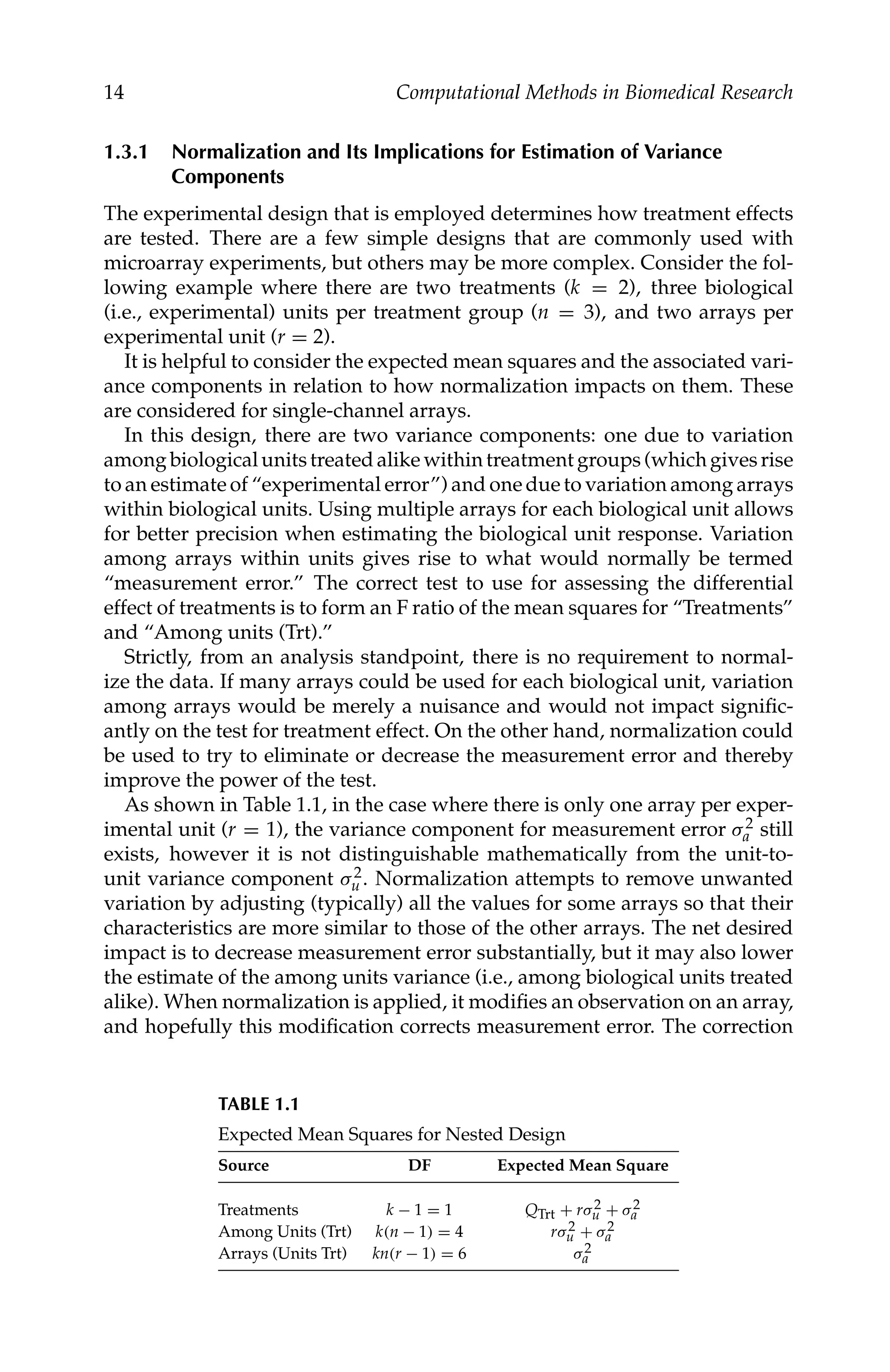
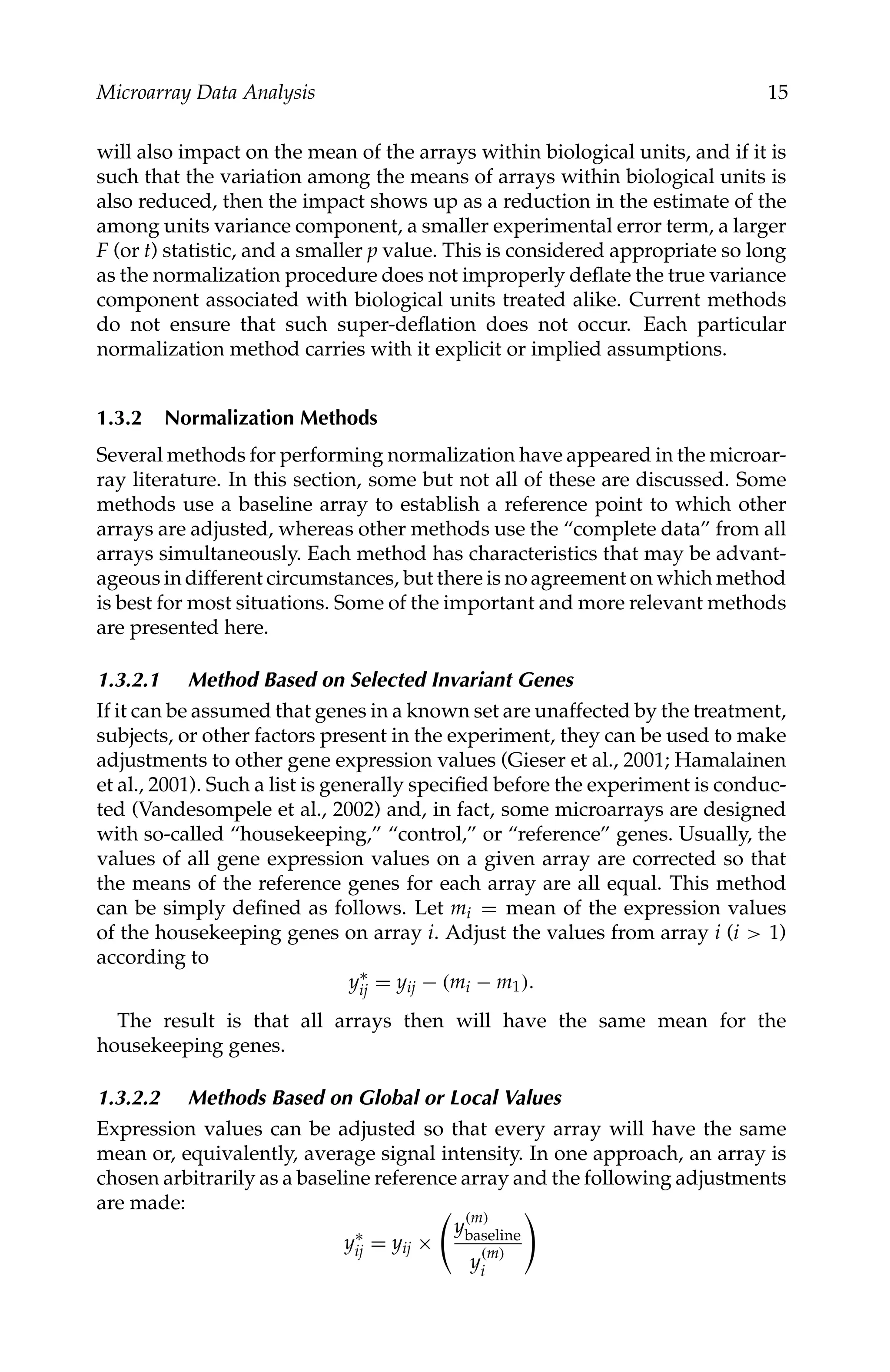
  • 44.
    C5777: “c5777_c001” —2007/10/27 — 13:02 — page 20 — #20 20 Computational Methods in Biomedical Research distance” were used to identify genes (Eisen et al., 1998; Roth et al., 1998; Spell- man et al., 1998). Hierarchical clustering Unweighted Pair Group Method with Arithmetic mean (UPGMA) with correlation “distance” (or dissimilar- ity) is most often used in microarray studies after it was popularized by the influential paper by Eisen et al. (1998). One nice feature of a hierarchical clus- tering is that it produces a tree of clusters, also known as a dendrogram, which can be cut at various heights to see the resulting clusters. Datta (2001) intro- duced a novel dissimilarity measure between a pair of genes, in the presence of the remaining genes, on the basis of partial least squares (PLS) modeling gene expressions. Model-based clustering is another well-known technique that has been used for grouping microarray data (McLachlan et al., 2002). This technique is based on modeling the expression profiles by mixtures of multivariate normal distributions. The Gene Shaving algorithm (Hastie et al., 2000) allowed genes to be in more than one cluster at the same time. Sharan and Shamir (2000) introduced a novel clustering algorithm on the basis of a graph-theoretic concept. Also, there exists another noteworthy, but more complex algorithm (based on a self-organizing neural network) called SOM (self-organizing maps, Kohonen, 1997) which seems to have gained popularity in clustering microarray data. Besides the clustering techniques mentioned above, there exist numerous clustering algorithms in statistics and machine learning literature dating back to premicroarray days. Many of them are available in statistical packages such as S-Plus and R. Thus, a microarray data analyst has many choices of cluster- ingmethodswhenitcomestogroupinggenes; forexample, partitionmethods such as K-means (Hartigan and Wong, 1979), divisive clustering method Diana (Kaufman and Rousseeuw, 1990) and fuzzy logic–based method Fanny (Kauf- man and Rousseeuw, 1990) are all applicable. All these clustering algorithms have their own merits and demerits. Their results might appear to be substan- tially different as well even when applied to the same data set of expression profiles. We take the following illustration from Datta and Arnold (2002) where a yeast data set (Chu et al., 1998) is clustered using five different clus- tering techniques (Figure 1.3). Thus, there is a need for careful evaluation of clustering algorithm given a particular data set. There exist a few approaches regarding the selection of a clustering algorithm and validation of the results for microarray data. Kerr and Churchill (2001c) used a linear model (ANOVA) and residual- based resampling to access the reliability of clustering algorithms. Chen et al. (2002) compared the performances of a number of clustering algorithms by physical characteristics of the resulting clusters such as the homogeneity and separation. Yeung et al. (2001) introduced the concept of Figure of Merit (FOM) in selecting between competing clustering algorithms. FOM resembles the error sum of squares (ESS) criterion of model selection. Datta and Datta (2003) selected six clustering algorithms of various types and evaluated their performances (stability) on a well-known publicly available microarray data- set on sporulation of budding yeast, as well as on two simulated data sets. Here we provide a brief description of the stability measures introduced in
  • 45.
    C5777: “c5777_c001” —2007/10/27 — 13:02 — page 21 — #21 Microarray Data Analysis 21 Hierarchical clustering with correlation dissimilarity First principal component Second principal component −5 0 5 10 Clustering by K-means First principal component Second principal component Model based clustering First principal component Second principal component Clustering by FANNY with L_1 distance First principal component Second principal component Divisive clustering by diana First principal component Second principal component 6 4 2 0 −2 −4 −6 6 4 2 0 −2 −4 −6 6 4 2 0 −2 −4 −6 6 4 2 0 −2 −4 −6 6 4 2 0 −2 −4 −6 −5 0 5 10 −5 0 5 10 −5 0 5 10 −5 0 5 10 FIGURE 1.3 (See color insert following page 207.) The genes were clustered into seven groups using their expression profiles during sporulation of yeast; five different clustering algorithms were attemp- ted (Adapted from Datta, S. and Arnold, J. (2002). In Advances in Statistics, Combinatorics and Related Areas, C. Gulati, Y.-X. Lin, S. Mishra, and J. Rayner, (Eds.), World Scientific, 63–74.) Datta and Datta (2003) in order to select an algorithm that produces the most consistent results. The evaluation measures were general enough so that they can be used with any clustering algorithm. Let K be the number of desired clusters. Datta and Datta (2003) suggested that the performance of an algorithm be investigated over an entire range of “suitable” K values. The basic idea behind their validation approach was that a clustering algorithm should be rewarded for stability (i.e., consistency of clusters it produces). Suppose expression (ratio) data are collected over all the genes under study at various experimental conditions such as time points T1, T2, . . . , Tl. An example of such temporal data is the sporulation of yeast data of Chu et al. (1998). In that case K was around 7 (Chu et al. used K = 7) and number of time points l = 7. Thus, consider a setup where the data values are points in the l dimensional Euclidean space R. For each i = 1, 2, . . . , l, one repeats the clustering algorithms for each of the l data set in Rl−1 obtained by deleting the observations at experimental condition (e.g., time) Ti. For each gene g, let Cg,i denote the cluster containing gene g in the clustering on the basis of data set with time Ti observations deleted. Let Cg,0 be the cluster in
  • 46.
    C5777: “c5777_c001” —2007/10/27 — 13:02 — page 22 — #22 22 Computational Methods in Biomedical Research the original data containing gene g. Each of the following validation measures could be used to measure the stability of the results produced by the clustering algorithm in question. For a good clustering algorithm, one would expect these stability measures to be small. 1. The average proportion of nonoverlap measure is given by V1(K) = 1 Ml M g=1 l i=1 1 − n(Cg,i ∩ Cg,0) n(Cg,0) . This measure computes the (average) proportion of genes that are not put in the same cluster by the clustering method under consid- eration on the basis of the full data and the data obtained by deleting the expression levels at one experimental condition at a time. 2. The average distance between means measure is defined as V2(K) = 1 Ml M g=1 l i=1 d(xCg,i , xCg,0 ) where xCg,0 denotes the average expression profile for genes across cluster Cg,0 and xCg,i denotes the average expression profile for genes across cluster Cg,i. This measure computes the (average) dis- tance between the mean expression values (usually, log transformed expression ratios in case of cDNA microarrays) of all genes that are put in the same cluster by the clustering method under considera- tion on the basis of the full data and the data obtained by deleting the expression levels at one time point at a time. 3. The average distance measure is defined as V3(K) = 1 Ml M g=1 l i=1 1 n(Cg,0)n(Cg,i) × g∈Cg,0, g∈Cg,i d(xg, xg ) where, d(xg, xg ) is a distance (e.g., Euclidean, Manhattan etc.) between the expression profiles of genes g and g. This measure com- putes the average distance between the expression levels of all genes that are put in the same cluster by the clustering method under con- sideration on the basis of the full data and the data obtained by delet- ing the expression levels at one experimental condition at a time. Figure 1.5 illustrates the average proportion of nonoverlap measures for a number of existing clustering algorithms applied to two sets of simu- lated data. The simulated data sets were generated by adding varying degrees of random noise to a set of expression profiles (shown in Figure 1.4).
  • 47.
    C5777: “c5777_c001” —2007/10/27 — 13:02 — page 23 — #23 Microarray Data Analysis 23 Model temporat profiles –4 –2 0 2 4 –4 –2 0 2 4 –4 –2 0 2 4 0 2 4 6 Time (hours) Simulated dataset 1 8 10 12 0 2 4 6 Time (hours) Simulated dataset 2 8 10 12 0 2 4 6 Time (hours) 8 10 12 log_2(expression ratio) log_2(expression ratio) log_2(expression ratio) FIGURE 1.4 (See color insert following page 207.) The average proportion of nonoverlap measure for various clustering algorithms applied to simulated data sets. S-Plus codes used to compute the above measures are available in the supplementary website of the Datta and Datta (2003) paper http://www. louisville.edu/∼s0datt02/WebSupp/Clustering/SUPP/SUPP.HTM. In each plot, a profile closer to the horizontal axis indicates better performance over the usable range of Kvalues. Another approach of validating clustering results is to check whether the statistical clusters produced correspond to biologically meaningful functional classes. To this end, Datta and Datta (2003) compared the expression profiles of different statistical clustering algorithms with the model profiles of some functionally known genes. For the details, readers are referred to Datta and Datta (2003). A novel validation measure combining statistical stability and biological functional relevance was proposed in Datta and Datta (2006a). In yet another attempt (Datta and Datta, 2006b), results were validated through the gene ontology (GO) databases. 1.4.2 Classification Unlike clustering, a classification algorithm is generally used to group tis- sue samples (e.g., cancer and noncancer) using their gene expression profiles
  • 48.
    C5777: “c5777_c001” —2007/10/27 — 13:02 — page 24 — #24 24 Computational Methods in Biomedical Research Simulated dataset 1 Hierarchical K- Means Diana Fanny Model-based Partial least squares Simulated dataset 2 0.0 0.2 0.4 0.6 0.8 1.0 0 2 4 6 Number of classes 8 10 12 Proportion of nonoverlap Hierarchical K- Means Diana Fanny Model-based Partial least squares 0.0 0.2 0.4 0.6 0.8 1.0 0 2 4 6 Number of classes 8 10 12 Proportion of nonoverlap FIGURE 1.5 (See color insert following page 207.) Two simulated datasets of gene expressions were created by adding random noise to a model profile. when partial knowledge is available about this grouping. In general, the goal of a classification technique is to predict class membership for new samples (test samples) with the knowledge of the training set (set of samples for which the classes are known). 1.4.2.1 Dimensionality Reduction The vast amount of raw gene expression data leads to statistical and ana- lytical challenges for using a classification algorithm to group samples into correct classes. The central difficulty in classification of microarray data is the availability of a very small number of samples in comparison with the number of genes in the sample. This violates the operating assumption of the classical statistical discriminant analysis procedures such as the linear dis- criminant analysis (LDA) and the quadratic discriminant analysis (QDA) or the nonparametric regression-based Neural Network procedure. One might first attempt to reduce the number of “features” to be used in a classification algorithm from the raw gene expression profiles. For example, one might calculate the first few principal components (PCA) of the covari- ates (gene expressions) and then discriminate the samples on the basis of the
  • 49.
    C5777: “c5777_c001” —2007/10/27 — 13:02 — page 25 — #25 Microarray Data Analysis 25 principal components (Dudoit et al., 2000; Su et al., 2003; Datta and Delap- idilla, 2006). PLS is another useful tool in constructing latent variables that can then be used for classification (Nguyen and Rocke, 2002a,b). Datta and de Padilla (2006) used PLS for feature selection, together with traditional classi- ficationalgorithmssuchaslineardiscriminationandquadraticdiscrimination to classify multiple tumor types from proteomic data. van’t Veer et al. (2002) applied a binary classification algorithm to cDNA array data with repeated measurements and classified breast cancer patients into good and poor pro- gnosis groups. Their classification algorithm consists of the following steps. The first step is filtering, in which only genes with both small error estim- ates and significant regulation relative to a reference pool of samples from all patients are chosen. The second step consists of identifying a set of genes whose behavior is highly correlated with the two sample types (e.g., up- regulated in one sample type but down-regulated in the other). These genes are rank-ordered so that genes with the highest magnitudes of correlation with the sample types have top ranks. In the third step, the set of relevant genes is optimized by sequentially adding genes with top-ranked correlation from the second step. However, this method involves an ad hoc filtering step and does not generalize to more than two classes. Another feature reduction technique is to consider only the genes that are deemed to be differentially expressed genes under different experimental conditions. Zhu et al. (2003), Wagner et al. (2004), Izmirlian (2004), and Datta and de Padilla (2006) used a similar approach to select the important features (mass to charge ratios) for mass spectrometry data before a classification algorithm is used. 1.4.2.2 Classification Algorithms The literature of classification algorithms is vast. In the previous section we have mentioned about LDA (Fisher, 1936) and QDA. In addition to these two, logistic regression for two classes and log-linear models for more than two groups are also widely used. There are many more relatively modern classifi- ers some of which are discussed very briefly in the remainder of this section. The R-libraries (http://www.r-project.org) “class” and “MASS” contain a number of popular classifiers. The neural network is a two-stage regression/classification model and is represented by a network diagram. Loosely speaking, it is modeled after the concept of neurons in the brain. It consists of at least three layers of nodes: the input layer, the hidden layer, and the output layer. For technical details, please refer to Hastie et al. (2001). The R function nnet (available in the library by the same name) fits a single hidden layer neural network. k-nearest neighbor classification(k−NN) method is a nonparametric clas- sifier (Devijver and Kittler, 1982; Ripley, 1996) on the basis of nonparametric estimates of the class densities or of the log posterior. The k-NN classifier finds k nearest samples in the training set and takes a majority vote among the classes of these k samples. We end this subsection by discussing three relatively new classification algorithms one of which (the Shrunken Centroid classifier) is developed primarily for classifying microarray datasets.
  • 50.
    C5777: “c5777_c001” —2007/10/27 — 13:02 — page 26 — #26 26 Computational Methods in Biomedical Research Support vector machine (SVM) (Vapnik, 1995; Burges, 1998; Vapnik, 1998; Cristianini and Shawe-Taylor, 2000; Hastie et al., 2001 §4.5, 12.2, 12.3) is a new generation classifier that has been reported to be very successful in a wide variety of applications. For two classes, a binary classifier constructs a hyper- plane separating the two classes (e.g., cancer from noncancer samples). The basic idea of SVM is to map the data into a higher dimensional space and then findanoptimalseparatinghyperplane. SVMsarelarge-marginclassifiers; that is, they solve an optimization problem that finds the separating hyperplane that optimizes a weighted combination of the misclassification rate and the distance of the decision boundary to any sample vector. For further details, the reader may consult the tutorial paper by Burges (1998) or the book by Cris- tianini and Shawe-Taylor (2000). Brown et al. (2000) used SVM for classifying microarray data of budding yeast S. cerevisiae and compared the performance by other standard classification algorithms (e.g., Fisher’s LDA). SVM was performed better than all the non-SVM methods compared in the paper. Random Forest (Breiman, 2001) classification is an extension of classifica- tion trees (Breiman et al., 1984) by integrating the idea of bagging. Random Forest constructs many classification trees using different bootstrap samples of a fixed size m from the original data. To classify a new object from an input vector (collection of variables) it runs the input vector to each and every tree in the forest. Each tree gives a classification. The forest chooses the classification having the most votes (over all the trees in the forest). About one-third of the cases are left out of the bootstrap sample and not used in the construction of a particular tree. The samples left out of the k-th tree are run through the kth tree to get a classification. In this way, a test set classification is obtained for each case in about one-third of the trees that can be used to assess the accuracy of the classifier. Note that the Random Forest algorithm automatically finds the most important features/variables in order to classify the data by computing an estimate of the increase in error rate of the classifier had that variable not been used. Finally, the nearest shrunken centroid classification introduced by Tibshir- ani et al. (2002) first computes a shrunken centroid for each class where each standardized centroid is shrunk towards the overall centroid. A test sample is classified into the class whose shrunken centroid is closest to, in squared distance, the gene expression profile of that sample. The shrinkage can reduce the effect of noisy genes resulting in higher accuracy of the resulting classi- fier. It is available under the PAM (Prediction Analysis for Microarrays, not to be confused with the clustering algorithm of the same acronym) package (http://www-stat.stanford.edu/∼tibs/PAM/). 1.4.2.3 Accuracy of Classification There are several methods for calculating the error rate of a classifica- tion algorithm (e.g., resubstitution, leave-one-out cross validation, k-fold cross validation, repeated cross validation and .632 bootstrap/bias corrected bootstrap, etc.). In microarray studies, use of a proper method of estimation of classification error is particularly important since typically one has a small
  • 51.
    Another Random ScribdDocument with Unrelated Content
  • 52.
    on lähellä. Luensen naisen silmistä. Hän katsoo minuun joskus niin ihmeellisesti! Oh, sellainen häpeä! Kuka olisi voinut uskoa hänen kykenevän sellaiseen? Rakas ystäväni, olen hyvin onneton ihminen.' Ja tämän on allekirjoittanut Hippolyte Fauville, jatkoi Mazeroux, ja minä vakuutan, että se on todellakin hänen käsialaansa, kirjoitettu neljäntenä päivänä tammikuuta tänä vuonna eräälle ystävälle, jonka nimeä emme tiedä, vaikkakin nuuskimme sen jostain selville, sen vannon. Ja tämä ystävä on antava meille tarvitsemamme todistukset. Mazeroux kiihottui. Todistus! Sitähän emme tarvitse! Sehän meillä on. Herra Fauville itse antaa sen meille! 'Loppu on lähellä, luen sen hänen silmistään!' 'Hänen' tarkoittaa Marie Fauvilleä ja miehen todistus vahvistaa kaiken mitä me tiedämme rouvasta. Mitä te sanotte? Olette oikeassa, vastasi Perenna tuumivasti, te olette oikeassa, kirje on ratkaiseva. Mutta… Mutta… mitä? Kuka peijakas on tuonut sen tänne? Jonkun on täytynyt olla yöllä huoneessa meidän täällä ollessamme. Onko se mahdollista? Olisimmehan sen kuulleet. Se se on, joka tekee minut hölmistyneeksi. Niin, näyttää siltä…
  • 53.
    Neljätoista päivää sittenoli kyllin ihmeellistä. Mutta silloin olimme eteisessä, ulkopuolella, heidän askaroidessaan sisällä. Tällä kertaa olimme molemmat täällä, aivan lähellä pöytää. Ja tältä pöydältä, jossa ei illalla ollut pienintäkään paperilappua, löydämme aamulla kirjeen. Emme tutki kauempaa, jatkoi Perenna, se ei hyödytä mitään. Menkää kirjeen kanssa poliisiprefektin luo, kertokaa hänelle kuinka olemme viettäneet yön ja pyytäkää häneltä lupa meille molemmille tulla tänne yöllä 25 päivänä huhtikuuta. Sinä yönä tulee uusi yllätys ja minä kuolen kärsimättömyydestä saada tietää, saammeko silloin uuden kirjeen jonkun 'hengen' kautta. He sulkivat ovet ja lähtivät talosta. Heidän mennessään oikealle, La Muettelle saadakseen auton, sattui don Luis kääntämään päätään kun he tulivat Suchet bulevardin päähän. Eräs mies ajoi ohi polkupyörällä. Don Luis ehti ainoastaan hämärästi nähdä sileäksi ajetut kasvot ja säihkyvät silmät, jotka olivat suunnatut häneen. Varo! huusi hän ja tyrkkäsi Mazerouxia niin nopeasti, että tämä kadotti tasapainonsa. Mies oli ojentanut revolverin. Pamahti laukaus. Kuula vinkui ohi don Luisin korvien. Ottakaa hänet kiinni, hän huusi. Ette kai ole haavoittunut, Mazeroux? En.
  • 54.
    Molemmat kiiruhtivat miehenjälkeen ja huusivat apua. Mutta näin aikaisin aamulla ei ole milloinkaan tämän kaupunginosan leveillä kaduilla ihmisiä. Mies kääntyi rue Octave-Feuilletille ja katosi. Kas niin, lopuksi saan sinut kuitenkin kiinni, roisto! sähisi don Luis luopuen tuloksettomasta takaa-ajosta. Mutta tiedättekö kuka hän oli? Kyllä tiedän; se oli hän. Kuka? Ebenholtsikeppinen mies. Hän on ajanut pois partansa, mutta tunsin hänet kuitenkin. Se oli sama mies, joka seisoi väijymässä ja ampui miehen Richard-Wallace bulevardin portailta, hän, joka tappoi Ancenisen. Se roisto! Kuinka hän tiesi että minä olin viettänyt yön Fauvillen talossa? Vakoillaanko minua kaikkialla. Mutta kuka vakoilee? Ja minkä vuoksi? Ja kuinka? Mazeroux tuumi ja sanoi: Muistakaa, että te soititte minulle iltapäivällä ja sovitte kohtauksesta. Vaikka te puhuitte hiljaa, on joku saattanut kotonanne kuunnella. Don Luis ei vastannut. Hän ajatteli Florencea. Sinä aamuna ei neiti Levasseur tullut sisään kirjeineen, eikä Perenna lähettänyt häntä hakemaan. Hän näki tytön useita kertoja antavan määräyksiä uusille palvelijoille. Iltapäivällä käski Perenna ajaa esiin auto ja ajoi bulevardi Suchetille prefektin määräyksen
  • 55.
    mukaisesti tekemään Mazerouxinkanssa tutkimuksia, jotka eivät kuitenkaan johtaneet mihinkään tuloksiin. Kello oli kymmenen hänen palatessaan takaisin. Etsiväkomissario ja hän söivät yhdessä päivällistä. Sitten hän tahtoi tarkastaa taloa, jossa ebenholtsikeppinen mies oli asunut, nousi jälleen autoon, yhä Mazerouxin seuraamana, ja käski ohjaajan ajaa bulevardi Richard- Wallacelle. Auto kulki yli Seinen ja seurasi sen oikeata rantaa. Nopeammin, sanoi hän puhetorveen uudelle ohjaajalle. Olen tottunut kulkemaan hyvällä vauhdilla. Eräänä kauniina päivänä ajatte kumoon, sanoi Mazeroux. Älkää pelätkö, vastasi don Luis. Auto-onnettomuudet ovat vain tyhmyreitä varten. He tulivat place de l'Almalle. Auto kääntyi vasemmalle. Suoraan eteenpäin, huusi don Luis. Ajakaa ohi Trocadéron. Äkkiä alkoi auto horjua sinne tänne, lensi erästä puuta vasten ja kääntyi kyljelleen. Muutamassa hetkessä syntyi väentungos. Ihmiset löivät rikki ikkunan ja avasivat oven. Don Luis oli ensimmäinen. Kiitos, tämä ei ole mitään, sanoi hän. Minä olen vahingoittumaton. Entä te, Alexandre?
  • 56.
    He auttoivat uloskomissarion. Hänellä oli joitakin naarmuja ja mustelmia, mutta muuten oli hän vahingoittumaton. Ohjaaja sitävastoin oli lentänyt istuimeltaan ja makasi vertavuotavin päin liikkumattomana kadulla. Hänet kannettiin erääseen apteekkiin, jossa hän kymmenen minuutin kuluttua kuoli. Perenna oli ottanut vuokra-auton ja ajanut kotiin niin nopeasti kuin saattoi. Hän tuli torille, ajoi sisään portista, meni yli pihan käytävään, joka johti neiti Levasseurin asuntoon. Hän juoksi ylös portaita, koputti ja astui vastausta odottamatta sisään. Ovi huoneeseen, joka muodosti salongin, avautui ja Florence näyttäytyi. Perenna syöksyi hänen luokseen ja sanoi raivoisalla äänellä: Nyt se on tehty. Onnettomuus on tapahtunut. Eikä kuitenkaan kukaan vanhoista palvelijoista ole pannut sitä toimeen, sillä he eivät ole täällä ja minä olin ulkona autolla koko iltapäivän. Senvuoksi on jonkun täytynyt myöhään päivällä, kuuden ja kymmenen välillä mennä autovajaan ja viilata ohjaustanko melkein poikki. En ymmärrä, sanoi tyttö pelästynein ilmein. Te ymmärrätte varsin hyvin, että roistojen rikostoveri ei voi olla kukaan uusista palvelijoista, ja te ymmärrätte sangen hyvin, että teon täytyi onnistua ja se onnistui yli odotuksien. Eräs uhri sai kärsiä minun puolestani. Mutta sanokaa toki mitä on tapahtunut! Te pelotatte minut! Mikä onnettomuustapaus? Mitä on tapahtunut? Auto ajoi kumoon. Ohjaaja kuoli.
  • 57.
    Oh, hirveätä! sanoityttö. Ja te luulette, että minä voin… Kuollut, hirveätä! Miesraukka! Hänen äänensä hiljeni. Hän seisoi aivan lähellä Perennaa. Hän oli kalpea, silmät olivat suljetut ja hän horjui. Perenna otti hänet käsivarsilleen kun hän kaatui. Tyttö koetti vapautua, mutta hänellä ei ollut siihen voimia. Perenna laski hänet lepotuoliin hänen lakkaamatta toistaessaan: Ihmisraukka! Ihmisraukka! Tyttö oli kadottanut tajuntansa kokonaan, sillä hän jättäytyi ilman vähintäkään vastustusta Perennan hoidettavaksi. Perenna ei liikkunut, hän alkoi innokkaasti tutkia edessään olevaa suuta, tavallisesti niin punaista, mutta nyt veretöntä ja kalpeahuulista. Kahdella sormellaan erotti hän huulet toisistaan ja näki nyt molemmat hammasrivit. Ne olivat ihastuttavat, valkoiset ja kaunismuotoiset, ehkä hiukan pienemmät kuin rouva Fauvillen, ehkäpä järjestyneet myöskin kaarevammin. Kuka saattoi sanoa ettei näiden purema jättäisi samanlaista merkkiä? Se oli epätodennäköinen otaksuma, sen hän tiesi, mahdoton ihmetyö. Ja kuitenkin olivat asianhaarat tyttöä vastaan ja viittasivat häneen kuten häikäilemättömimpään, hirveimpään ja pelottavimpaan rikolliseen. Hän nousi ja lähti.
  • 58.
    VIII LUKU Pirullinen viesti Kaikistanäistä tapahtumista yleisö tunsi ainoastaan rouva Fauvillen itsemurhayrityksen, tarkastaja Ancenisin murhan ja Hippolyte Fauvillen kirjeen löytymisen. Mutta tämä oli riittävää herättääkseen kaikkien uteliaisuuden, kun he olivat jo ennestään innokkaasti seuranneet Mornington-juttua ja odottivat jännittyneinä salaperäisen don Luis Perennan pienimpiäkin liikkeitä, sekoittaen hänet itsepäisesti Arsène Lupiniin. Kuinka monimutkainen ja hämmästyttävä olikaan se arvoitus, joka koski Perennaa itseään? Neljänkymmenenkahdeksan tunnin kuluessa oli tehty neljä yritystä tappaa hänet: rautaesiripulla, myrkyllä, revolverilla ja auto-onnettomuudella. Florencen osaa näissä murhayrityksissä ei voitu kieltää. Ja nyt oli tytön yhteys Fauvillen murhaajien kanssa asianmukaisesti todettu sen pienen paperin löydöllä, joka oli ollut Shakespearen kahdeksannen osan välissä, samalla kun kaamea luettelo oli lisääntynyt kahdella kuolemalla, poliisitarkastaja Ancenisin ja ohjaajan. Kuinka voitaisiin selittää se
  • 59.
    osa, jota tämäarvoituksellinen tyttö oli näytellyt näissä tapahtumissa? Millä kuumeentapaisella innolla don Luis tutkikaan hiljaisuudessa tyttöä! Kuka te olette? Kuka te olette? tunsi hän halua huudahtaa. Eikö teitä tyydytä vähempi, te pirullinen nainen, kuin kuoleman ja murhan levittäminen ympärillenne? Ja tahdotteko te tappaa minutkin saavuttaaksenne tarkoituksenne? Mistä te tulette ja mihin käy teidän tienne? Tarkemmin ajatellessaan hän tuli vakuutetuksi eräästä seikasta, joka ratkaisi arvoituksen, jota hän oli kauan miettinyt, nimittäin salaperäisestä yhteydestä häntä vihaavan naisen ja place du Palais- Bourbonille muuttonsa välillä. Hän ymmärsi nyt että hän ei ollut ostanut taloa sattumalta. Kun hän teki kaupan, oli häneen vaikuttanut eräs nimetön tarjous, joka oli joutunut hänen käsiinsä koneella kirjoitetun kiertokirjeen muodossa. Mistä tuli tämä tarjous, jollei Florencelta, joka tahtoi saada hänet läheisyyteensä voidakseen vakoilla ja käydä sotaa häntä vastaan. Niin, ajatteli hän, siinä on totuus. Cosmo Morningtonin mahdollisena perillisenä ja etevänä näyttelijänä murhenäytelmässä minä olen vihollinen ja he koettavat raivata minut pois tieltään niinkuin tekivät toisillekin. Ja se on Florence, joka hoitaa peliä minua vastaan. Ja hän se on, joka on tehnyt murhat. Kun Florence jätti hänet tunsi hän tavallisesti helpotuksen tunteen ja hengitti keveämmin, kuten hänet olisi vapautettu raskaasta taakasta, mutta hän juoksi kuitenkin ikkunaan ja katsoi tytön jälkeen, ja hän odotti aina saadakseen nähdä tämän salaperäisen
  • 60.
    vihollisen, jonka tuoksuvanhengityksen hän oli tuntenut kasvoillaan, tulevan ja menevän. Eräänä aamuna sanoi tyttö hänelle: Sanomalehdet kertovat, että tänä yönä tapahtuu jotain. Tänä yönä? Niin, sanoi tyttö näyttäen hänelle kirjoitusta lehdestä. Tänään on kahdeskymmenesviides päivä, ja poliisin ilmoituksen mukaan jätetään bulevardi Suchetin taloon kirje joka kymmenes päivä ja talo räjäytetään sinä päivänä, jolloin viides ja viimeinen kirje tulee. Uhmasiko tyttö häntä? Tahtoiko hän tehdä selväksi, että tapahtuipa mitä hyvänsä, asetettakoon tielle mitä esteitä tahansa, niin tulee kirje kuitenkin, tämä salaperäinen kirje, josta oli mainittu Shakespearen kahdeksannesta osasta löydetyssä paperissa? Hän tarkasteli tyttöä terävästi. Tämä ei muuttanut ilmettäkään. Hän vastasi: Niin, se on tänä yönä. Minä olen siellä. Ei mikään maailmassa voi estää minua. Tyttö aikoi vastata, mutta hillitsi jälleen tunteensa. Sinä päivänä oli don Luis varuillaan. Hän söi aamiaisen ja päivällisen muualla ja sopi Mazerouxin kanssa siitä, että place du Palais-Bourbonia vahdittaisiin. Neiti Levasseur ei poistunut talosta iltapäivällä. Illalla käski don Luis Mazerouxin väkeä vakoilemaan jokaista, joka tulisi talosta ulos.
  • 61.
    Kello kymmenen tapasivatetsiväkomisario ja don Luis toisensa Hippolyte Fauvillen työhuoneessa. Mazerouxilla oli mukanaan varasalapoliisipäällikkö Weber ja kaksi siviilipukuista miestä. Don Luis vei Mazerouxin syrjään. He epäilevät minua. Tunnustakaa se. Ei. Niin kauan kuin herra Desmalions on, eivät he voi tehdä teille mitään. Mutta herra Weber väittää — ja hän ei ole ainoa — että te suoritatte kaikki nämä teot itse. Missä tarkoituksessa? Tarkoituksessa saada todistuksia Marie Fauvillea vastaan. Olen sen vuoksi pyytänyt saada mukaani kaksi salapoliisia. Silloin on meitä neljä, jotka voivat todistaa rehellisyytenne. Kaikki asettuivat paikoilleen. Kaksi salapoliisia valvoisi kerrallaan. Tutkittuaan huolellisesti sen pienen huoneen, jossa Fauvillen poika oli nukkunut, sulkivat ja lukitsivat he kaikki ovet ja ikkunat. Kello yksitoista he kiersivät sähkön sammuksiin. Don Luis ja Weber saivat tuskin unen rahtuakaan silmiinsä. Yö kului ilman että mitään tapahtui. Mutta kello seitsemän, kun ikkunaluukut avattiin, nähtiin taas, että pöydällä oli kirje. Aivan niinkuin edelliselläkin kerralla.
  • 62.
    Kun ensimmäinen hämmästysoli asettunut, otti Weber kirjeen. Hänellä oli määräys olla sitä lukematta eikä antaa kenenkään muunkaan lukea. Tässä on kirje sellaisena kuin se julkaistiin sanomalehdissä, jotka samalla julkaisivat asiantuntijan todistuksen, että käsiala oli Hippolyte Fauvillen: Olen nähnyt hänet! Sinä ymmärrät, rakas ystävä, eikö niin? Minä olen hänet nähnyt. Hän kulki Boulognen metsän tietä, takinkaulus ylös käännettynä ja hattu korviin painettuna. En luule hänen nähneen minua. Oli melkein pimeä. Mutta minä tunsin hänet heti. Minä tunsin jälleen hänen hopeakoukkuisen ebenholtsikeppinsä. Se oli aivan varmaan hän, tuo roisto! Hän on siis lupauksestaan huolimatta Pariisissa. Gaston Sauveraud on Pariisissa. Ymmärrätkö, mikä hirveä merkitys sillä on? Jos hän on Pariisissa, niin se merkitsee, että hän aikoo toimia. Oh, kuinka paljon pahaa se mies on minulle tehnyt! Hän on jo ryöstänyt minulta onneni ja nyt aikoo hän ottaa elämäni. Olen kauhun lamauttama. Fauville tiesi siis, että ebenholtsikeppisen miehen, Gaston Sauveraudin tarkoitus oli tappaa hänet. Sen selitti Fauville aivan selvästi tässä omakätisessä kirjeessään, ja kirje vahvisti ne Gaston Sauveraudin, vangitsemistilaisuudessa epähuomiossa lausumat sanat, että molemmat miehet olivat olleet tuttavia, mutta riitautuneet, ja että Gaston Sauveraud oli luvannut olla milloinkaan tulematta Pariisiin. Tämä levitti myöskin hiukan valoa Mornington-juttuun. Mutta toiselta puolen, kuinka käsittämätöntä olikaan, että tämä kirje oli
  • 63.
    löydetty työhuoneen pöydältä!Viisi henkilöä oli vartioinut, viisi mitä kelvollisinta miestä, ja kuitenkin oli tuntematon käsi tänä yönä, kuten viidennentoista päivän yönäkin, salaa pistänyt kirjeen huoneeseen suljettujen ovien ja ikkunoiden läpi, heidän kuulematta ääntäkään tahi näkemättä merkkiäkään siitä, että joku olisi liikuttanut ikkunoita tahi ovia. On mahdotonta sanoa mitään yleisön hämmingistä. Kirjeen ilmestyminen sai silmänkääntötempun luonteen. Don Luis Perennan terävänäköisyys oli siis osunut oikeaan joka suhteessa, sillä odotetut tapahtumat olivat sattuneet viidentenätoista ja kahdentenakymmenentenäviidentenä päivänä huhtikuuta. Jatkuisiko sarja viides toukokuuta? Ei kukaan epäillyt sitä, sillä olihan don Luis sen sanonut ja kaikki uskoivat, ettei don Luis voinut erehtyä. Koko viidennen päivän yön seisoi väkijoukko Suchet bulevardilla; uutistenhankkijat ja kaikenlaiset yökulkijat tulivat sinne laumoina saadakseen tietää oliko jotain tapahtunut. Poliisiprefekti, johon molemmat edelliset ihmetyöt olivat tehneet vaikutuksen, oli päättänyt itse olla läsnä kolmantena yönä. Hän tuli seurassaan useita tarkastajia, jotka hän asetti puutarhaan, eteiseen ja yläkertaan. Itse hän asettui vartioon yhdessä Weberin, Mazerouxin ja don Luis Perennan kanssa. He pettyivät odotuksessaan ja se oli herra Desmalionsin syy. Välittämättä don Luisin lausumasta käsityksestä oli prefekti päättänyt olla kiertämättä sähkövaloa sammuksiin, nähdäkseen estäisikö valo ihmetyön. Sellaisissa olosuhteissa ei kirje saattanut tulla eikä se tullutkaan. Oliko se sitten silmänkääntäjän kuje tahi rikollisten temppu, tarvitsi ihmetyö pimeyden apua.
  • 64.
    * * ** * Toukokuun viidettätoista odotettiin ja sama väkijoukko oli kokoontunut talon ympärille, levoton, jännittynyt väkijoukko, joka hätkähti pienimmästäkin äänestä ja noudatti täydellistä hiljaisuutta silmät Fauvillen taloon suunnattuina. Tällä kertaa sammutettiin valo, mutta poliisiprefekti piti kättään sähkönappulan päällä. Kymmenen kertaa, kaksikymmentä kertaa sytytti hän äkkiarvaamatta tulen. Pöydällä ei ollut mitään. Se, mikä oli herättänyt hänen huomiotaan, oli ainoastaan huonekalujen natina tahi hänen miestensä tekemä liike. Äkkiä päästivät kaikki huudahduksen. Joku epätavallinen, kahiseva ääni oli rikkonut hiljaisuuden. Herra Desmalions kiersi sähkön heti palamaan. Hän huudahti. Kirje ei ollut pöydällä, mutta sen vieressä lattialla, maton päällä. Mazeroux teki ristinmerkin. Salapoliisit olivat kalpeat kuin kuolema. Herra Desmalions katsoi don Luisiin, joka nyökkäsi lausumatta sanaakaan. He tutkivat lukot. Mitään ei oltu koskettu. Myöskin tänä päivänä korvasi kirjeen sisällys tyytymättömyyden siitä, ettei oltu keksitty millä tavoin se oli pujautettu sisään. Se hälvensi kaikki epäilyt, jotka vielä ympäröivät Suchet bulevardin murhaa. Se oli insinöörin allekirjoittama, kauttaaltaan hänen käsialallaan kirjoitettu kahdeksas päivä helmikuuta ja ilman näkyvää osoitetta. Se
  • 65.
    kuului näin: 'Ei, rakasystävä, en aio antaa tappaa itseäni niinkuin lammas, joka viedään teurastuspenkkiin. Minä puolustan itseäni, taistelen viimeiseen hetkeen saakka. Viime aikana on sattunut muutoksia. Minulla on nyt todistus, vastaansanomaton todistus. Minulla on heidän välillään vaihdettuja kirjeitä. Ja minä tiedän heidän vielä rakastavan toisiaan niinkuin alussa ja että he aikovat mennä naimisiin eivätkä salli minkään seisoa tiellään. Marie — ota huomioon mitä sanon — Marie on itse sanonut kirjeellisesti: 'Ole kärsivällinen, oma Gastonini. Rohkeuteni kasvaa päivä päivältä. Sitä pahempi hänelle, joka seisoo välillämme. Hänen on poistuttava.' Rakas ystävä, jos minä kaatuisin taistelussa, löydät sinä nämä kirjeet sekä kaikki todistukset, jotka olen koonnut tuota halveksittavaa roistoa vastaan, kaapista, joka on lasisuojustimen peittämä. Kosta minut silloin. Au revoir. Tahi ehkä hyvästi ainaiseksi.' Niin kuului kolmas kirje. Haudastaan ilmiantoi ja syytti Hippolyte Fauville rikollista vaimoaan. Haudastaan antoi hän ratkaisun arvoitukseen ja selitti syyn, miksi rikos oli tehty: Marie Fauville ja Gaston Sauveraud rakastivat toisiaan. He tunsivat varmasti Cosmo Morningtonin testamentin, sillä he olivat ensiksi raivanneet tieltä Cosmo Morningtonin ja heidän kiihkonsa anastaa suunnaton omaisuus oli kiiruhtanut tapahtumia. Mutta murhan ensimmäinen syy polveutui syvälle juurtuneesta intohimosta: Marie Fauville ja Gaston Sauveraud rakastivat toisiaan.
  • 66.
    Yksi arvoitus olivielä ratkaisematta: kuka oli tuo tuntematon kirjeenvaihtaja, jolle Hippolyte Fauville oli jättänyt tehtäväksi kostaa hänen murhansa ja joka, sensijaan että olisi yksinkertaisesti luovuttanut kirjeet poliisille, harjoitti terävänäköisyyttään antamalla niiden tulla päivänvaloon mitä kummallisimpien temppujen kautta. Oliko hänen etujensa mukaista pysyä näkymättömänä? Kaikkiin näihin kysymyksiin vastasi Marie Fauville odottamattomalla tavalla, vaikkakin tavalla, joka täydelleen sopi yhteen hänen uhkauksiensa kanssa. Viikkoa myöhemmin, pitkän kuulustelun jälkeen, jonka aikana häneltä koetettiin saada tietää miehensä vanhan ystävän nimi, oli hänen onnistunut piilottaa lasipala, jolla hän koetti avata suonensa. Don Luis sai kuulla asiasta Mazerouxilta, joka tuli hänelle siitä seuraavana aamuna kello kahdeksan kertomaan. Komisariolla oli kädessään matkalaukku ja hän oli matkalla asemalle. Onko hän kuollut? huudahti don Luis. Ei, hän näyttää välttäneen sen vielä tämän kerran. Mutta mitä se auttaa? Mitä sillä tarkoitatte? Hän tietysti tekee sen. Se on hänen päähänpistonsa. Ja eräänä päivänä… Eikö hän nytkään tehnyt tunnustusta ennen itsemurhayritystään? Ei. Hän kirjoitti muutamia sanoja paperille, että kun hän nyt tarkemmin ajatteli asiaa, saattoi hän neuvoa kysymään salaperäisistä kirjeistä eräältä herra Langernault'a. Tämä oli, mikäli rouva tiesi,
  • 67.
    ainoa ystävä, jokahänen miehellään oli ollut ja joka tapauksessa ainoa, jota tämä saattoi kutsua 'rakkaaksi vanhaksi ystäväkseen'. Tämä herra Langernault ei voisi muuta kuin selittää hänen viattomuutensa ja valaista sitä kauheata erehdystä, jonka uhriksi hän oli joutunut. Mutta, sanoi don Luis, jos on joku, joka saattaa todistaa hänen viattomuutensa, mistä syystä avaa hän sitten valtasuonensa? Hänen elämänsä on arvoton, sanoo hän, ja ainoa, mitä hän haluaa, on lepo ja kuolema. Lepo? Lepo? Onhan muitakin tapoja saada lepoa kuin kuolema. Jos totuuden paljastaminen johtaa hänen vapautukseensa, niin ei totuus ehkä ole aivan mahdoton saavuttaa. Mitä sanotte? Oletteko arvanneet jotain? Alatteko ymmärtää? Hyvin hämärästi, mutta juuri näiden kirjeiden yliluonnollisen täsmällinen saapuminen näyttää minusta hyvältä merkiltä. Hän mietti hetkisen ja jatkoi: Onko noiden kolmen kirjeen poisraavitut osoitteet huolellisesti tutkittu? Ovat, ja onnistuttiin saamaan esiin nimi Langernault. Missä asuu tämä Langernault? Rouva Fauvillen sanojen mukaan Ornen departementissa Damignin kylässä. Mikä on lähin kaupunki?
  • 68.
    Alençon. Matkustatteko te nytsinne? Kyllä, poliisiprefekti on käskenyt minun matkustaa heti. Astun junaan Les Invalides'illä. Ei, minä kyyditsen teidät autollani. Mitä varten? Matkustamme molemmat. Minun on ryhdyttävä johonkin. Ilma täällä talossa on minulle hengenvaarallista. Mitä tarkoitatte? En mitään. Tiedän sen. Puoli tuntia tämän jälkeen kiisivät he pitkin Versaillesin tietä. Perenna ajoi itse avonaista autoa ja he kiisivät eteenpäin niin raivoisasti, että Mazerouxilta miltei salpautui hengitys ja hän huudahti tuontuostakin: Herra Jumala, minkälainen vauhti!… Millä tavoin te ajatte!… Ettekö pelkää, että ajamme kumoon? Muistakaa mitä tapahtui äskettäin… He tulivat Alençoniin juuri aamiaiseksi. Kun he olivat sen lopettaneet, menivät he postitoimistoon. Siellä ei kukaan tuntenut nimeä Langernault. Damignilla oli oma postikonttorinsa, mutta oli otaksuttu, että herra Lagernault jätti kirjeensä Alençon poste restante.
  • 69.
    Don Luis jaMazeroux ajoivat edelleen Damignin kylään. Ei täälläkään tuntenut postinhoitaja Langernaultia, vaikka Damignissa oli vain tuhat asukasta. Menkäämme määrin luo, sanoi Perenna. Määrille sanoi Mazeroux kuka hän oli ja kertoi hänelle käyntinsä syyn. Vanha Langernault? Tietysti. Erinomainen mies, hänellä oli liike kaupungissa. Ja hänellä oli tapana arvattavastikin jättää kirjeensä Alençonin postitoimistoon? Niin, joka päivä, saadakseen vähän liikuntoa. Ja hänen talonsa? On kylän laidassa. Te ajoitte tullessanne sen ohi. Voiko sen nähdä? Tietysti, mutta… Ehkä hän ei ole kotona? Ei, se miesraukka ei ole pannut jalkaansa talon sisäpuolelle jätettyään sen neljä vuotta sitten. Mistä se johtuu? Hänhän on ollut neljä vuotta kuolleena.
  • 70.
    Don Luis jaMazeroux vaihtoivat hämmästyneen katseen. Hän on siis kuollut? sanoi don Luis. Niin, ammuttu. Kuinka niin? huudahti Perenna. Murhattiinko hänet? Ei, ei. Ensin luulimme niin, kun löysimme hänet lattialta omasta huoneestaan, mutta tutkimus osoitti, että se oli tapaturma. Hän oli puhdistamassa pyssyään kun se laukesi satuttaen häntä vatsaan. Meistä kaikista se oli sangen merkillistä. Langernault, joka oli taitava metsämies, ei ollut niitä, jotka käyttäytyivät varomattomasti. Oliko hänellä rahoja? Oli, ja se oli juuri merkillisintä: ei löydetty soutakaan. Don Luis tuumi hetkisen ja kysyi sitten: Jättikö hän jälkeensä samannimisiä sukulaisia? Ei ketään, ei edes serkkuja. Ja siitä seurasi, että hänen maatilansa — sitä kutsuttiin Vanhaksi linnaksi sen raunioiden mukaan — jäi kaupungille. Viranomaiset ovat sinetöineet ovet ja sulkeneet portit puistoon. He odottavat, että lain määräämä aika kuluisi umpeen ottaakseen sen haltuunsa. Mutta eikö satu, että uteliaat ihmiset kiipeävät yli muurin puistoon? Ei. Ensiksikin ovat muurit hyvin korkeat. Ja sitten… ja sitten on vanhalla linnalla ollut huono maine täällä ympäristössä niin kauan
  • 71.
    kuin voin muistaa.On puhuttu aina kummituksista… tyhmiä juttuja tietystikin, mutta kuitenkin… Perenna ja hänen toverinsa eivät voineet toipua kummastuksestaan. Se oli kummallinen juttu, huudahti don Luis heidän erottuaan määristä. Fauville kirjoittaa kirjeitä kuolleelle miehelle… kuolleelle miehelle, joka kaiken todennäköisyyden mukaan on tullut murhatuksi. Jonkun on täytynyt siepata kirjeet. Nähtävästi. Mutta se ei kumoa sitä tosiasiaa, että hän on kirjoittanut ne kuolleelle miehelle ja tehnyt kuolleen miehen uskotukseen kertoen tälle vaimonsa rikollisista aikeista. Mazeroux vaikeni. Hänkin näytti täydellisesti hölmistyneeltä. Heidän aikoessaan lähteä kello kuusi huomasi don Luis auton kuluttaneen kaiken polttoaineen ja lähetti Mazerouxin sitä Alençonista hakemaan. Hän itse käytti tilaisuutta mennäkseen tarkastamaan Vanhaa linnaa. Hän kulki pensasaitojen reunustamaa tietä, joka vei sitruunapuiden koristamalle avoimelle paikalle; muurin keskellä oli raskas suljettu puuportti. Don Luis kulki pitkin muurin vierustaa, joka todellakin oli hyvin korkea. Hänen onnistui kuitenkin, puunoksia apunaan käyttäen, kiivetä sen yli. Puistossa oli villejä kukkia kasvava hoitamaton ruohokenttä ja lapioimattomia käytäviä, joista oikeanpuoleinen johti raunioiden täyttämälle maavallille ja vasemmanpuoleinen pienelle ränsistyneelle
  • 72.
    talolle, jonka ikkunaluukutriippuivat vinosti. Hän meni tähän suuntaan, kun hän hämmästyksekseen huomasi tuoreita jalanjälkiä sateen liottamassa maassa. Ja hän näki, että nämä jäljet olivat pienten, hienojen naistenkenkien jättämät. Kuka peijakas käy täällä kävelemässä? ajatteli hän. Hän keksi useita pieniä jälkiä hiukan kauempana tiellä, josta kenkien omistajatar oli käynyt ylitse ja ne johtivat talosta puuryhmän luo, jossa hän näki ne vielä kaksi kertaa. Sitten kadotti hän jäljet. Hän seisoi suuren, puoleksi sortuneen, korkealla maaperustalla rakennetun vajan vieressä. Sen lahonneet ovet näyttivät töin tuskin riippuvan rautasaranoissaan. Hän kulki lähemmäksi ja katsoi eräästä raosta sisään. Ikkunaton vaja oli puolipimeä, lukuunottamatta sälöjen välitse virtaavaa valoa. Hän erotti tyhjiä tynnyreitä, särkyneitä viinipuristimia, vanhoja auroja ja kaikenlaista rautaromua. Tänne ei se kaunotar ole askeleitaan ohjannut, ajatteli Don Luis. Katsokaamme toiselta taholta. Hän ei kuitenkaan liikkunut paikaltaan. Hän oli kuullut sisältä jotain ääntä. Hän kuunteli, mutta ei kuullut mitään. Haluten kuitenkin päästä asiasta täysin perille, painoi hän olkapäällään erään laudan sisään ja astui vajaan. Silmät tottuivat vähitellen pimeyteen. Huomaamattaan hän löi päänsä johonkin, jota ei ollut nähnyt, johonkin kovaan, joka riippui ylhäältä ja alkoi heilua edestakaisin päästäen kummallisen kalisevan äänen.
  • 73.
    Welcome to ourwebsite – the ideal destination for book lovers and knowledge seekers. With a mission to inspire endlessly, we offer a vast collection of books, ranging from classic literary works to specialized publications, self-development books, and children's literature. Each book is a new journey of discovery, expanding knowledge and enriching the soul of the reade Our website is not just a platform for buying books, but a bridge connecting readers to the timeless values of culture and wisdom. With an elegant, user-friendly interface and an intelligent search system, we are committed to providing a quick and convenient shopping experience. Additionally, our special promotions and home delivery services ensure that you save time and fully enjoy the joy of reading. Let us accompany you on the journey of exploring knowledge and personal growth! ebookultra.com