www.3hti.com
Many people think PLM and PDM are the
same thing, but that is not at all the case.
To help you understand which solution is
right for your needs.
www.3hti.com
PLM, or Product Lifecycle Management,
encompasses all facets of a product's
journey, starting from the design phase
and extending through production, sales,
service needs, and eventual retirement. It
serves as a unified tool and central
repository that integrates business
processes, software systems, people,
data, and corporate policies, acting as the
foundational information hub for a
company and its extensive supply chain
network.
www.3hti.com
PLM manages every aspect of the product
from inception all the way to disposal.
PDM, or Product Data Management, focuses on
data management. PDM tools primarily handle
version control and technical specifications,
guaranteeing that engineers and relevant parties
have access to the correct versions and
specifications.
PDM manages all of the data associated with
a product.
Virtually every widely recognized definition of
these two solutions categorizes PDM as a
component within the broader scope of PLM.
Consequently, investing in a standalone PDM
system could potentially deprive your company.
www.3hti.com
PDM serves as an engineering-focused tool,
whereas PLM is an enterprise-wide system,
comparable in significance to a company's
ERP, CRM, or MES solutions.
PLM encompasses and collaborates with each
of these enterprise solutions, functioning
optimally when integrated as the central
repository for shared data. In simpler terms,
PLM represents a strategic business approach
aimed at optimizing product profitability
throughout its lifecycle by providing a
structured framework for innovation, product
introduction, and end-of-life planning.
In summary, PDM serves as an engineering-
specific tool, while PLM operates as a holistic
enterprise management system.
www.3hti.com
We’ve already established that PDM is an
engineering tool, while PLM is useful for every
stakeholder in the extended enterprise. In fact,
PLM can be shared and used by
manufacturing, procurement, supply chain,
tooling, prototyping, service and support
personnel. By looking deeper into the stages of
a product lifecycle, we can see the truth in this
statement.
• ECN Process
• Initial Design
• Prototyping
• Release to Manufacturing
www.3hti.com
Initial Design: Engineering does the design,
and no other departments have access to the
information or the ability to use it in
accomplishing their own tasks. In most
cases, even most design review processing
and approvals will have to be done outside of
the PDM solution.
Prototyping: With PDM, prototyping is done
on an ad hoc basis, with either no formal
process or an offline process.
Release to Manufacturing: Release is
accomplished through sharing CAD files or
prints. Manufacturing enters items and BOM
information into ERP or another enterprise
solution, although sometimes this can be
done using a custom interface.
www.3hti.com
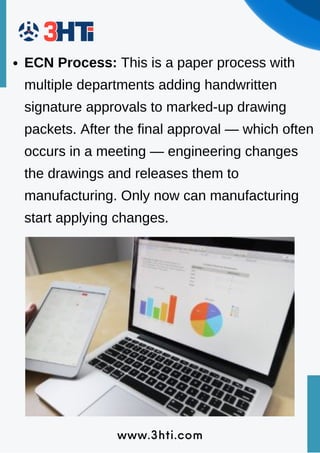
ECN Process: This is a paper process with
multiple departments adding handwritten
signature approvals to marked-up drawing
packets. After the final approval — which often
occurs in a meeting — engineering changes
the drawings and releases them to
manufacturing. Only now can manufacturing
start applying changes.
Initial Design: The engineer designs and
manages the product in the PLM package.
Prototyping: Users promote the item to the
prototype state. The electronic signatures on
the promotion request are the approval to
begin the prototyping process, and the
testing lab has visibility into the design and
specifications.
Release to Manufacturing: The design goes
through a promotion request similar to that in
the prototype phase. Once approved,
manufacturing can directly view the product
structure in either a 2D or 3D representation.
If the PLM and manufacturing systems are
integrated, the items and BOMs are created
automatically.
ECN Process: Anyone who recognizes a
problem can create a problem report. The
problem report becomes the basis of an ECN
request with assigned tasks for everything
that will require updating because of the
change. This may include part information,
CAD documents, user manuals and sales
brochures.
Clearly, PLM is a more comprehensive solution.
PLM offers more streamlined initial design
and ECN processes, helping to reduce time
to market.
Designs are visible throughout the
organization, and the increased visibility
helps to increase the probability of reusing
designs.
Reusing designs helps reduce the required
inventory investment and improves
manufacturing productivity and efficiency.
PLM helps prevent costly manufacturing
mistakes by ensuring that manufacturing
documentation is always up to date.
We find that many organizations enjoy the
extra functionality that PLM provides their
organization once they understand how they
would deploy it.
PDM is cheaper and faster to deploy.
PDM is very easy to maintain.
PDM requires very little training
As a more limited solution, PDM has the
advantages of simplicity.
If you have questions about
whether you need a PLM or PDM
solution, you should talk to an
expert about the advantages of
each choice in your specific
situation. 3HTi has a full team of
PLM and PDM experts on staff, and
we sell and support most of the
major software applications in the
space. Contact us today to learn
how you can benefit from an
investment in PLM.
www.3hti.com
Let's Socialize
3000 ATRIUM WAY #296
MT. LAUREL, NJ 08054
866-624-3484
Company and Contact Information
DO YOU HAVE QUESTIONS OR
COMMENTS? LET US KNOW
WHAT'S ON YOUR MIND AND
HOW WE CAN HELP.

Comprehending the Difference Between PLM and PDM

  • 1.
  • 2.
    Many people thinkPLM and PDM are the same thing, but that is not at all the case. To help you understand which solution is right for your needs. www.3hti.com PLM, or Product Lifecycle Management, encompasses all facets of a product's journey, starting from the design phase and extending through production, sales, service needs, and eventual retirement. It serves as a unified tool and central repository that integrates business processes, software systems, people, data, and corporate policies, acting as the foundational information hub for a company and its extensive supply chain network.
  • 3.
    www.3hti.com PLM manages everyaspect of the product from inception all the way to disposal. PDM, or Product Data Management, focuses on data management. PDM tools primarily handle version control and technical specifications, guaranteeing that engineers and relevant parties have access to the correct versions and specifications. PDM manages all of the data associated with a product. Virtually every widely recognized definition of these two solutions categorizes PDM as a component within the broader scope of PLM. Consequently, investing in a standalone PDM system could potentially deprive your company.
  • 4.
    www.3hti.com PDM serves asan engineering-focused tool, whereas PLM is an enterprise-wide system, comparable in significance to a company's ERP, CRM, or MES solutions. PLM encompasses and collaborates with each of these enterprise solutions, functioning optimally when integrated as the central repository for shared data. In simpler terms, PLM represents a strategic business approach aimed at optimizing product profitability throughout its lifecycle by providing a structured framework for innovation, product introduction, and end-of-life planning. In summary, PDM serves as an engineering- specific tool, while PLM operates as a holistic enterprise management system.
  • 5.
    www.3hti.com We’ve already establishedthat PDM is an engineering tool, while PLM is useful for every stakeholder in the extended enterprise. In fact, PLM can be shared and used by manufacturing, procurement, supply chain, tooling, prototyping, service and support personnel. By looking deeper into the stages of a product lifecycle, we can see the truth in this statement. • ECN Process • Initial Design • Prototyping • Release to Manufacturing
  • 6.
    www.3hti.com Initial Design: Engineeringdoes the design, and no other departments have access to the information or the ability to use it in accomplishing their own tasks. In most cases, even most design review processing and approvals will have to be done outside of the PDM solution. Prototyping: With PDM, prototyping is done on an ad hoc basis, with either no formal process or an offline process. Release to Manufacturing: Release is accomplished through sharing CAD files or prints. Manufacturing enters items and BOM information into ERP or another enterprise solution, although sometimes this can be done using a custom interface.
  • 7.
    www.3hti.com ECN Process: Thisis a paper process with multiple departments adding handwritten signature approvals to marked-up drawing packets. After the final approval — which often occurs in a meeting — engineering changes the drawings and releases them to manufacturing. Only now can manufacturing start applying changes.
  • 8.
    Initial Design: Theengineer designs and manages the product in the PLM package. Prototyping: Users promote the item to the prototype state. The electronic signatures on the promotion request are the approval to begin the prototyping process, and the testing lab has visibility into the design and specifications. Release to Manufacturing: The design goes through a promotion request similar to that in the prototype phase. Once approved, manufacturing can directly view the product structure in either a 2D or 3D representation. If the PLM and manufacturing systems are integrated, the items and BOMs are created automatically.
  • 9.
    ECN Process: Anyonewho recognizes a problem can create a problem report. The problem report becomes the basis of an ECN request with assigned tasks for everything that will require updating because of the change. This may include part information, CAD documents, user manuals and sales brochures. Clearly, PLM is a more comprehensive solution. PLM offers more streamlined initial design and ECN processes, helping to reduce time to market. Designs are visible throughout the organization, and the increased visibility helps to increase the probability of reusing designs.
  • 10.
    Reusing designs helpsreduce the required inventory investment and improves manufacturing productivity and efficiency. PLM helps prevent costly manufacturing mistakes by ensuring that manufacturing documentation is always up to date. We find that many organizations enjoy the extra functionality that PLM provides their organization once they understand how they would deploy it. PDM is cheaper and faster to deploy. PDM is very easy to maintain. PDM requires very little training As a more limited solution, PDM has the advantages of simplicity.
  • 11.
    If you havequestions about whether you need a PLM or PDM solution, you should talk to an expert about the advantages of each choice in your specific situation. 3HTi has a full team of PLM and PDM experts on staff, and we sell and support most of the major software applications in the space. Contact us today to learn how you can benefit from an investment in PLM.
  • 12.
    www.3hti.com Let's Socialize 3000 ATRIUMWAY #296 MT. LAUREL, NJ 08054 866-624-3484 Company and Contact Information DO YOU HAVE QUESTIONS OR COMMENTS? LET US KNOW WHAT'S ON YOUR MIND AND HOW WE CAN HELP.