COMPOSITION WRITING:
A STEP-BY-STEP GUIDE
As a student, you’ve likely done composition
writing, even if the assignments weren’t
specifically labeled as compositions.
The truth is, it can be challenging to answer
the question, What is composition writing?
Here is the concise definition of
“composition”:
The way a writer crafts words, sentences,
and paragraphs to create a coherent work.
More broadly, composition writing covers all
the kinds of writing you’ll encounter as a
student and the strategies you use to write
each type capably.
WHAT IS COMPOSITION WRITING?
Composition can mean two things. It can mean a piece of
writing, or it can mean the art and process of writing.
Composition isn’t a specific type of writing like an essay
or a blog post. Instead, it’s a broad term that can refer to
any (usually nonfiction) work and how a piece is written.
Under the first definition, you might be asked to write a composition for class. Using
the second definition, somebody might refer to “the essay’s composition” to discuss
the format and word choice its author used.
A composition is not the same as an essay. Here’s one area where the definition of
composition writing can be confusing—an essay is a kind of composition, but the
terms aren’t interchangeable. Every essay is a composition, but not every
composition is an essay.
A composition can also be a book report, a presentation, a short response to a
reading assignment, or a research paper.
THE FOUR MODES OF
COMPOSITION
There are four types of
composition:
 Description
 Exposition
 Narration
 Argumentation
Do these sound familiar?
They’re the four types of writing. Essentially, the definition of “composition writing”
is the tone and structure a writer uses to express their position. When a composition
is a work of fiction, its author typically chooses the composition mode that best
expresses the work’s theme. Think of each of these as a composition writing format.
You might use more than one of these composition modes in a single piece of
writing.
A description is a piece of writing that makes a clear statement about its subject.
Here is an example of a description:
Water, chemical symbol H2O, is a clear,
colorless liquid that has a freezing point of 0
degrees Celsius and a boiling point of 100
degrees Celsius. Water is the most abundant
atom in our atmosphere. All life-forms on Earth
need water.
A description doesn’t speculate or offer up opinions or interpretations. It simply
states the facts.
Exposition is an interpretation of the facts. It expands on a description by
introducing additional facts that shed light on how the subject fits into a larger
discussion. It might explore related facts and what they imply and/or pivot to related
topics through thoughtful transition sentences and extrapolation. It’s still grounded
in fact; an exposition doesn’t include its author’s opinions on the subject. Take a
look at this example:
Although water is the most abundant atom in
our atmosphere, entire regions are devastated
by yearly droughts. These droughts can lead to
mass starvation due to crop loss. Switching to
more sustainable agricultural practices can
reduce the impact of droughts, and doing this
successfully requires cooperation between
governments and corporations.
Narration is the mode of writing that presents the author’s point of view. The writing
is still about its subject rather than its author, but it discusses and explores the
subject through the author’s description of their experience. Here is an example of
narrative writing:
I’ve always had a healthy respect for water, and
I’d say that comes from an experience with it I
had as a small child. It was a delightful summer
day and my family decided to take the boat out.
But then the sky suddenly turned gray, and our
delightful summer day became a terrifying
summer thunderstorm, with forceful winds
pushing the boat as my brother and I tried to
bail the pooling rainwater out with buckets.
See how this example is about the author’s thoughts and feelings about water,
whereas description and exposition stick to objective facts? Personal essays are
perhaps the most common type of narration composition.
The last type, argumentation, isn’t really argumentative. Rather, it’s similar to
a persuasive essay. In an argumentation composition, the writer presents two or
more positions on an issue and, through a logical exploration of each, demonstrates
why one position is the best choice. Take a look at this example:
Researchers have identified multiple strategies
we can use to prevent droughts. These include
rainwater harvesting, desalination, switching to
renewable energy sources, and combating
deforestation. These strategies have different
success rates . . .
In this example, the writer would go on to compare these different drought
prevention strategies and their recorded success rates.
WHEN DO YOU WRITE A COMPOSITION?
You might be asked to write a
composition as part of a composition
writing course. It’s not uncommon for
students to be required to take courses
that focus solely on composition writing,
often early on in their college careers, to
prepare them for the writing they’ll do in
other courses later.
Your instructor might also assign you to
write a composition when the
assignment doesn’t quite fit the
parameters of an essay or other
established academic writing format.
This might be because the assignment is primarily to give your opinion or
perspective rather than support a specific position with evidence. You might also be
asked to write a composition as a way to practice writing in one of the compositional
modes we discussed above.
HOW TO WRITE A COMPOSITION IN 5 STEPS
As we mentioned above,
composition writing is a broad
subject. There is no specific
composition writing format, nor are
you limited to any specific
composition writing topics.
If your composition is an essay—
and often, this is the case—follow
the standard essay format unless
your instructor tells you to follow a
different format.
Composition writing follows the
same writing process as every
other kind of writing. Here are the
steps:
1. Brainstorm
Before you can start writing, you need to figure
out what you’re going to write about! When you
brainstorm, that’s exactly what you do. Take
some time to think about your subject, the
compositional mode you’re writing in, and the
sources you’re using (if your assignment
requires sources) to support your position.
Jot down every idea, relevant fact, and
connection you come across. You can also give
freewriting a try as you brainstorm to see how
your mind wanders through your subject and
sources. Take your time with brainstorming
because this is the stage where you might come
across the perfect topic sentence and make
connections among sources you might not have
realized before.
2. Outline
The next step in the writing process is creating
an outline. This is a basic framework for your
composition.
An outline helps you organize your composition by
giving you a visual overview of its flow. Depending
on your assignment and instructor, you might be
required to submit your outline and have it approved
before moving forward with your composition. Even
if you aren’t, it can be very helpful to create an
outline so you have something to follow and refer to
when writing and editing.
3. First draft
Finally, it’s time to do some composition writing!
Using your brainstorming notes and outline, write
your composition. Keep in mind that you don’t have to
write it in order—in fact, it can be helpful to start with
whichever part you find easiest to write, like the
conclusion or one of the supporting paragraphs, and
build it out from there.
Don’t worry too much about making grammatical
mistakes at this stage. You’ll fix those when you edit your draft. Similarly, if a
sentence or paragraph feels awkward, out of place, or otherwise not quite right, don’t
dwell on it now. That, too, is something you’ll smooth out when you edit. When
you’re writing your first draft, just focus on getting the words out of your brain and
into your composition.
If you didn’t come up with a title when you brainstormed or outlined, you might be
able to write a clever one once you have a finished draft.
4. Edit
With the first draft down, give yourself a
break. You’re a better editor when you
come back to your work with fresh eyes,
so take a few hours. Once your break is
over, read your draft again. Take note of all
the grammatical mistakes and which
words, sentences, and paragraphs feel off.
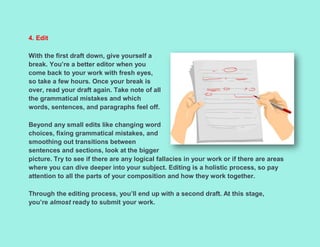
Beyond any small edits like changing word
choices, fixing grammatical mistakes, and
smoothing out transitions between
sentences and sections, look at the bigger
picture. Try to see if there are any logical fallacies in your work or if there are areas
where you can dive deeper into your subject. Editing is a holistic process, so pay
attention to all the parts of your composition and how they work together.
Through the editing process, you’ll end up with a second draft. At this stage,
you’re almost ready to submit your work.
5. Proofread
After editing your work, proofread it! This is
the last look-over before you submit your
composition to your instructor.
At this stage, you’re primarily focused on
catching any grammar, syntax,
or spelling mistakes that can be fixed easily.
When you edited your work, you did the
heavy lifting of transforming a first draft into
a second draft. Through that stage, you
might have added new sentences or reworked existing ones. At this stage, check and
see if you made any mistakes in those new sentences or if you overlooked any
mistakes in lines you kept from the first draft.
After proofreading your work and fixing any mistakes, you’ve got a finished, ready-
to-submit second draft! The only thing left to do is turn it in to your instructor and
wait for their feedback.
COMPOSITION WRITING FAQS
What is composition writing? Composition writing is the organization and process of
creating a piece of writing. It broadly refers to all the kinds of writing a student may
be assigned, which are typically types of writing like essays and reports.
What are the different kinds of composition? The four kinds of composition
are: Description, Exposition, Narration & Argumentation
How is composition writing structured? There is no specific composition writing
format. However, compositions typically follow a similar format as essays. Most
compositions begin with an introduction that includes the work’s thesis, which is
then followed by supporting paragraphs containing evidence from the sources the
writer used in their research. After these supporting paragraphs, most compositions
end with a conclusion that reiterates each point made and offers a new, final thought
on the subject.

Composition Writing - A Step by Step Guide.pdf

  • 1.
  • 2.
    As a student,you’ve likely done composition writing, even if the assignments weren’t specifically labeled as compositions. The truth is, it can be challenging to answer the question, What is composition writing? Here is the concise definition of “composition”: The way a writer crafts words, sentences, and paragraphs to create a coherent work. More broadly, composition writing covers all the kinds of writing you’ll encounter as a student and the strategies you use to write each type capably.
  • 3.
    WHAT IS COMPOSITIONWRITING? Composition can mean two things. It can mean a piece of writing, or it can mean the art and process of writing. Composition isn’t a specific type of writing like an essay or a blog post. Instead, it’s a broad term that can refer to any (usually nonfiction) work and how a piece is written. Under the first definition, you might be asked to write a composition for class. Using the second definition, somebody might refer to “the essay’s composition” to discuss the format and word choice its author used. A composition is not the same as an essay. Here’s one area where the definition of composition writing can be confusing—an essay is a kind of composition, but the terms aren’t interchangeable. Every essay is a composition, but not every composition is an essay. A composition can also be a book report, a presentation, a short response to a reading assignment, or a research paper.
  • 4.
    THE FOUR MODESOF COMPOSITION There are four types of composition:  Description  Exposition  Narration  Argumentation Do these sound familiar?
  • 5.
    They’re the fourtypes of writing. Essentially, the definition of “composition writing” is the tone and structure a writer uses to express their position. When a composition is a work of fiction, its author typically chooses the composition mode that best expresses the work’s theme. Think of each of these as a composition writing format. You might use more than one of these composition modes in a single piece of writing.
  • 6.
    A description isa piece of writing that makes a clear statement about its subject. Here is an example of a description: Water, chemical symbol H2O, is a clear, colorless liquid that has a freezing point of 0 degrees Celsius and a boiling point of 100 degrees Celsius. Water is the most abundant atom in our atmosphere. All life-forms on Earth need water. A description doesn’t speculate or offer up opinions or interpretations. It simply states the facts.
  • 7.
    Exposition is aninterpretation of the facts. It expands on a description by introducing additional facts that shed light on how the subject fits into a larger discussion. It might explore related facts and what they imply and/or pivot to related topics through thoughtful transition sentences and extrapolation. It’s still grounded in fact; an exposition doesn’t include its author’s opinions on the subject. Take a look at this example: Although water is the most abundant atom in our atmosphere, entire regions are devastated by yearly droughts. These droughts can lead to mass starvation due to crop loss. Switching to more sustainable agricultural practices can reduce the impact of droughts, and doing this successfully requires cooperation between governments and corporations.
  • 8.
    Narration is themode of writing that presents the author’s point of view. The writing is still about its subject rather than its author, but it discusses and explores the subject through the author’s description of their experience. Here is an example of narrative writing: I’ve always had a healthy respect for water, and I’d say that comes from an experience with it I had as a small child. It was a delightful summer day and my family decided to take the boat out. But then the sky suddenly turned gray, and our delightful summer day became a terrifying summer thunderstorm, with forceful winds pushing the boat as my brother and I tried to bail the pooling rainwater out with buckets. See how this example is about the author’s thoughts and feelings about water, whereas description and exposition stick to objective facts? Personal essays are perhaps the most common type of narration composition.
  • 9.
    The last type,argumentation, isn’t really argumentative. Rather, it’s similar to a persuasive essay. In an argumentation composition, the writer presents two or more positions on an issue and, through a logical exploration of each, demonstrates why one position is the best choice. Take a look at this example: Researchers have identified multiple strategies we can use to prevent droughts. These include rainwater harvesting, desalination, switching to renewable energy sources, and combating deforestation. These strategies have different success rates . . . In this example, the writer would go on to compare these different drought prevention strategies and their recorded success rates.
  • 10.
    WHEN DO YOUWRITE A COMPOSITION? You might be asked to write a composition as part of a composition writing course. It’s not uncommon for students to be required to take courses that focus solely on composition writing, often early on in their college careers, to prepare them for the writing they’ll do in other courses later. Your instructor might also assign you to write a composition when the assignment doesn’t quite fit the parameters of an essay or other established academic writing format. This might be because the assignment is primarily to give your opinion or perspective rather than support a specific position with evidence. You might also be asked to write a composition as a way to practice writing in one of the compositional modes we discussed above.
  • 11.
    HOW TO WRITEA COMPOSITION IN 5 STEPS As we mentioned above, composition writing is a broad subject. There is no specific composition writing format, nor are you limited to any specific composition writing topics. If your composition is an essay— and often, this is the case—follow the standard essay format unless your instructor tells you to follow a different format. Composition writing follows the same writing process as every other kind of writing. Here are the steps:
  • 12.
    1. Brainstorm Before youcan start writing, you need to figure out what you’re going to write about! When you brainstorm, that’s exactly what you do. Take some time to think about your subject, the compositional mode you’re writing in, and the sources you’re using (if your assignment requires sources) to support your position. Jot down every idea, relevant fact, and connection you come across. You can also give freewriting a try as you brainstorm to see how your mind wanders through your subject and sources. Take your time with brainstorming because this is the stage where you might come across the perfect topic sentence and make connections among sources you might not have realized before.
  • 13.
    2. Outline The nextstep in the writing process is creating an outline. This is a basic framework for your composition. An outline helps you organize your composition by giving you a visual overview of its flow. Depending on your assignment and instructor, you might be required to submit your outline and have it approved before moving forward with your composition. Even if you aren’t, it can be very helpful to create an outline so you have something to follow and refer to when writing and editing.
  • 14.
    3. First draft Finally,it’s time to do some composition writing! Using your brainstorming notes and outline, write your composition. Keep in mind that you don’t have to write it in order—in fact, it can be helpful to start with whichever part you find easiest to write, like the conclusion or one of the supporting paragraphs, and build it out from there. Don’t worry too much about making grammatical mistakes at this stage. You’ll fix those when you edit your draft. Similarly, if a sentence or paragraph feels awkward, out of place, or otherwise not quite right, don’t dwell on it now. That, too, is something you’ll smooth out when you edit. When you’re writing your first draft, just focus on getting the words out of your brain and into your composition. If you didn’t come up with a title when you brainstormed or outlined, you might be able to write a clever one once you have a finished draft.
  • 15.
    4. Edit With thefirst draft down, give yourself a break. You’re a better editor when you come back to your work with fresh eyes, so take a few hours. Once your break is over, read your draft again. Take note of all the grammatical mistakes and which words, sentences, and paragraphs feel off. Beyond any small edits like changing word choices, fixing grammatical mistakes, and smoothing out transitions between sentences and sections, look at the bigger picture. Try to see if there are any logical fallacies in your work or if there are areas where you can dive deeper into your subject. Editing is a holistic process, so pay attention to all the parts of your composition and how they work together. Through the editing process, you’ll end up with a second draft. At this stage, you’re almost ready to submit your work.
  • 16.
    5. Proofread After editingyour work, proofread it! This is the last look-over before you submit your composition to your instructor. At this stage, you’re primarily focused on catching any grammar, syntax, or spelling mistakes that can be fixed easily. When you edited your work, you did the heavy lifting of transforming a first draft into a second draft. Through that stage, you might have added new sentences or reworked existing ones. At this stage, check and see if you made any mistakes in those new sentences or if you overlooked any mistakes in lines you kept from the first draft. After proofreading your work and fixing any mistakes, you’ve got a finished, ready- to-submit second draft! The only thing left to do is turn it in to your instructor and wait for their feedback.
  • 17.
    COMPOSITION WRITING FAQS Whatis composition writing? Composition writing is the organization and process of creating a piece of writing. It broadly refers to all the kinds of writing a student may be assigned, which are typically types of writing like essays and reports. What are the different kinds of composition? The four kinds of composition are: Description, Exposition, Narration & Argumentation How is composition writing structured? There is no specific composition writing format. However, compositions typically follow a similar format as essays. Most compositions begin with an introduction that includes the work’s thesis, which is then followed by supporting paragraphs containing evidence from the sources the writer used in their research. After these supporting paragraphs, most compositions end with a conclusion that reiterates each point made and offers a new, final thought on the subject.