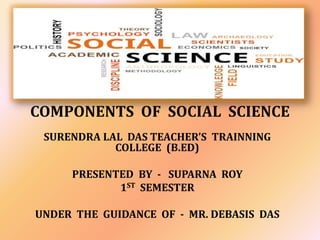
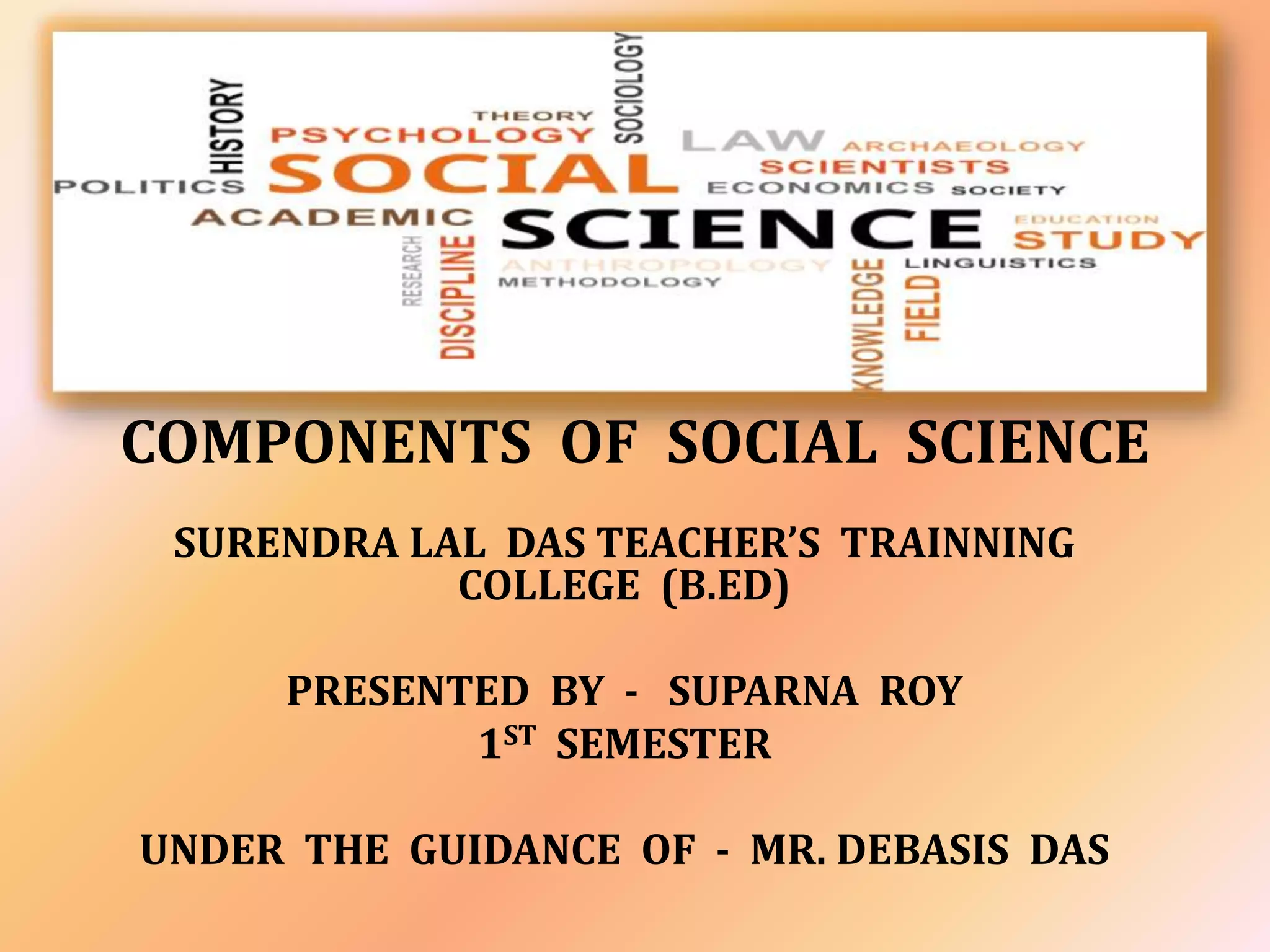
COMPONENTS OF SOCIAL SCIENCE
SURENDRA LAL DAS TEACHER’S TRAINNING
COLLEGE (B.ED)
PRESENTED BY - SUPARNA ROY
1ST SEMESTER
UNDER THE GUIDANCE OF - MR. DEBASIS DAS
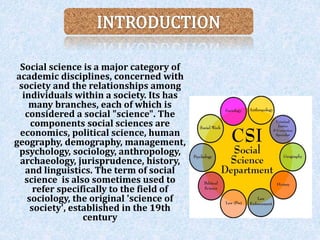
Social science is a major category of
academic disciplines, concerned with
society and the relationships among
individuals within a society. Its has
many branches, each of which is
considered a social "science". The
components social sciences are
economics, political science, human
geography, demography, management,
psychology, sociology, anthropology,
archaeology, jurisprudence, history,
and linguistics. The term of social
science is also sometimes used to
refer specifically to the field of
sociology, the original 'science of
society', established in the 19th
century
The importance of the social science.
In general, social science focus on the
study of society and the relationship
among individuals within
society. Social science covers a wide
spectrum of subjects, including
economics, political science,
sociology, history, archaeology,
anthropology, and law .It helps us to
developed our education system and
society . It has a large and vast
knowledge which is created by all
their components .
history is increasingly classified
as a social science. History is
traditionally refers to the study
and interpretation of the written
record of past human activity,
people, societies, and civilizations
leading up to the present day. It is
the continuous, systematic
narrative and research of past
events as relating to the human
species; as well as the study of all
events in time, in relation to
humanity.
The study of all the
physical features of
the Earth's surface,
including its climate
and the distribution
of plant, animal,
and human life.
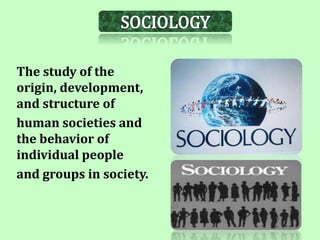
The study of the
origin, development,
and structure of
human societies and
the behavior of
individual people
and groups in society.
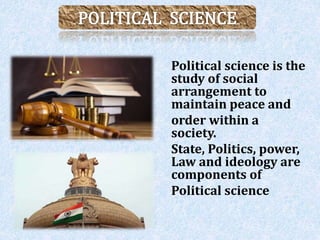
Political science is the
study of social
arrangement to
maintain peace and
order within a
society.
State, Politics, power,
Law and ideology are
components of
Political science
Economics
is the social science
that analyzes the
production,
distribution, and
consumption of
goods and services.
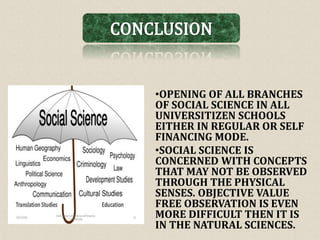
•OPENING OF ALL BRANCHES
OF SOCIAL SCIENCE IN ALL
UNIVERSITIZEN SCHOOLS
EITHER IN REGULAR OR SELF
FINANCING MODE.
•SOCIAL SCIENCE IS
CONCERNED WITH CONCEPTS
THAT MAY NOT BE OBSERVED
THROUGH THE PHYSICAL
SENSES. OBJECTIVE VALUE
FREE OBSERVATION IS EVEN
MORE DIFFICULT THEN IT IS
IN THE NATURAL SCIENCES.
• https://brainly.in › Secondary School › Social
science
• www.newworldencyclopedia.org/entry/Social
_sciences
• https://www.edx.org/course/subject/social-
sciences
• https://www.merriam-
webster.com/dictionary/social%20science
Components  of  Social  Science

Components of Social Science

  • 1.
    COMPONENTS OF SOCIALSCIENCE SURENDRA LAL DAS TEACHER’S TRAINNING COLLEGE (B.ED) PRESENTED BY - SUPARNA ROY 1ST SEMESTER UNDER THE GUIDANCE OF - MR. DEBASIS DAS
  • 2.
    Social science isa major category of academic disciplines, concerned with society and the relationships among individuals within a society. Its has many branches, each of which is considered a social "science". The components social sciences are economics, political science, human geography, demography, management, psychology, sociology, anthropology, archaeology, jurisprudence, history, and linguistics. The term of social science is also sometimes used to refer specifically to the field of sociology, the original 'science of society', established in the 19th century
  • 3.
    The importance ofthe social science. In general, social science focus on the study of society and the relationship among individuals within society. Social science covers a wide spectrum of subjects, including economics, political science, sociology, history, archaeology, anthropology, and law .It helps us to developed our education system and society . It has a large and vast knowledge which is created by all their components .
  • 4.
    history is increasinglyclassified as a social science. History is traditionally refers to the study and interpretation of the written record of past human activity, people, societies, and civilizations leading up to the present day. It is the continuous, systematic narrative and research of past events as relating to the human species; as well as the study of all events in time, in relation to humanity.
  • 5.
    The study ofall the physical features of the Earth's surface, including its climate and the distribution of plant, animal, and human life.
  • 6.
    The study ofthe origin, development, and structure of human societies and the behavior of individual people and groups in society.
  • 7.
    Political science isthe study of social arrangement to maintain peace and order within a society. State, Politics, power, Law and ideology are components of Political science
  • 8.
    Economics is the socialscience that analyzes the production, distribution, and consumption of goods and services.
  • 9.
    •OPENING OF ALLBRANCHES OF SOCIAL SCIENCE IN ALL UNIVERSITIZEN SCHOOLS EITHER IN REGULAR OR SELF FINANCING MODE. •SOCIAL SCIENCE IS CONCERNED WITH CONCEPTS THAT MAY NOT BE OBSERVED THROUGH THE PHYSICAL SENSES. OBJECTIVE VALUE FREE OBSERVATION IS EVEN MORE DIFFICULT THEN IT IS IN THE NATURAL SCIENCES.
  • 10.
    • https://brainly.in ›Secondary School › Social science • www.newworldencyclopedia.org/entry/Social _sciences • https://www.edx.org/course/subject/social- sciences • https://www.merriam- webster.com/dictionary/social%20science