EMOTIONAL
INTELLIGENCE
Dr. Sonika G. Mishra
Assistant Professor, Prerna College of
Commerce
RTM Nagpur University
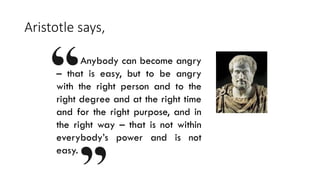
Aristotle says,
Anybody can become angry
– that is easy, but to be angry
with the right person and to the
right degree and at the right time
and for the right purpose, and in
the right way – that is not within
everybody’s power and is not
easy.
Emotional intelligence is the ability to perceive,
express, understand and regulate emotions.
Salovey and Mayer (1997) defined emotional
intelligence as “the ability to perceive emotions,
integrate emotions to facilitate thought, understand
emotions and to regulate emotions to promote
personal growth.”
Goleman (1998) defined Emotional intelligence as ‘the
capacity for recognizing our own feelings and those of
others, for motivating ourselves, and for managing
emotions well in ourselves and in our relationships.”
Reuven Bar-on (1997) described EQ as “an array of
personal, emotional and social abilities and skills that
influence one’s ability to succeed in coping with
environmental demands and pressures”.
Introduction
Components of emotional intelligence
Daniel Goleman (1995) suggests that emotional
intelligence consists of five major components:
1.Knowing our own emotions.
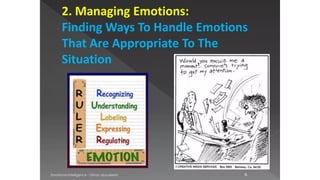
2. Managing one’s emotions.
3. Motivating our emotions.
4.Recognizing the emotions of others and
5.Handling relationships.
ely the person starts self-assessment of the job that is being executed, as a result, the person feels confident and never hesitates to change the direction in mid-journey. Thi
ghts and feelings. Basically humans get distressed and disgusted when things are not going our way. But in such conditions are we still able to hold our nerves and remain
display the self-management skills, a person who holds the ground and retain the equilibrium is a well-defined leader. Managing fear, anxiety, anger, distrust, and disappoin
to communicate and interact with each other.
al skills is always an inspiration for the workforce and can easily motivate the team during tough times.
nizations. It maintains a personal friendship amongst colleagues/work associates.
hed much accurately. How a leader makes the employees feel plays a vital role in the level of their work execution and commitment.
rstand very well sometimes one should get into someone else’s shoes. It makes us be aware of someone’s feelings and act accordingly. Empathy is a critical skill required to
mployees, always help them in critical situations, and always stand, come forward courageously during failures.
e employees to show disagreement wherever it’s being felt. Disagreements and asking questions always made an organization strong and resilient. A mature leader tries to
targets indirectly.
ation makes you much enthusiastic towards the work and duties. It describes truly what we want and ultimately creates a focus to reach the destination.
kes a person strong and works magically to turn a failure into learning. As soon as a person understands the purpose and sense of meaning, work is providing; the person g
wards his team members. That’s the reason motivation plays a key role in becoming a perfect leader.
1.It would strengthen teamwork.
2.It helps to deal with the conflicts within the organization.
3.It enhances the effective execution of the duties assigned.
4.It gives a competitive edge and makes people work for you.
5.It provides you a distilled wisdom of theory and practical approaches.
6.It ultimately makes a person much productive and successful.
Aristotle says,
Anybody can become angry
– that is easy, but to be angry
with the right person and to the
right degree and at the right time
and for the right purpose, and in
the right way – that is not within
everybody’s power and is not
easy.

COMPONENTS OF EMOTIONAL INTELLIGENCE .pptx

  • 1.
    EMOTIONAL INTELLIGENCE Dr. Sonika G.Mishra Assistant Professor, Prerna College of Commerce RTM Nagpur University
  • 2.
    Aristotle says, Anybody canbecome angry – that is easy, but to be angry with the right person and to the right degree and at the right time and for the right purpose, and in the right way – that is not within everybody’s power and is not easy.
  • 3.
    Emotional intelligence isthe ability to perceive, express, understand and regulate emotions. Salovey and Mayer (1997) defined emotional intelligence as “the ability to perceive emotions, integrate emotions to facilitate thought, understand emotions and to regulate emotions to promote personal growth.” Goleman (1998) defined Emotional intelligence as ‘the capacity for recognizing our own feelings and those of others, for motivating ourselves, and for managing emotions well in ourselves and in our relationships.” Reuven Bar-on (1997) described EQ as “an array of personal, emotional and social abilities and skills that influence one’s ability to succeed in coping with environmental demands and pressures”.
  • 4.
    Introduction Components of emotionalintelligence Daniel Goleman (1995) suggests that emotional intelligence consists of five major components: 1.Knowing our own emotions. 2. Managing one’s emotions. 3. Motivating our emotions. 4.Recognizing the emotions of others and 5.Handling relationships.
  • 5.
    ely the personstarts self-assessment of the job that is being executed, as a result, the person feels confident and never hesitates to change the direction in mid-journey. Thi ghts and feelings. Basically humans get distressed and disgusted when things are not going our way. But in such conditions are we still able to hold our nerves and remain display the self-management skills, a person who holds the ground and retain the equilibrium is a well-defined leader. Managing fear, anxiety, anger, distrust, and disappoin to communicate and interact with each other. al skills is always an inspiration for the workforce and can easily motivate the team during tough times. nizations. It maintains a personal friendship amongst colleagues/work associates. hed much accurately. How a leader makes the employees feel plays a vital role in the level of their work execution and commitment. rstand very well sometimes one should get into someone else’s shoes. It makes us be aware of someone’s feelings and act accordingly. Empathy is a critical skill required to mployees, always help them in critical situations, and always stand, come forward courageously during failures. e employees to show disagreement wherever it’s being felt. Disagreements and asking questions always made an organization strong and resilient. A mature leader tries to targets indirectly. ation makes you much enthusiastic towards the work and duties. It describes truly what we want and ultimately creates a focus to reach the destination. kes a person strong and works magically to turn a failure into learning. As soon as a person understands the purpose and sense of meaning, work is providing; the person g wards his team members. That’s the reason motivation plays a key role in becoming a perfect leader. 1.It would strengthen teamwork. 2.It helps to deal with the conflicts within the organization. 3.It enhances the effective execution of the duties assigned. 4.It gives a competitive edge and makes people work for you. 5.It provides you a distilled wisdom of theory and practical approaches. 6.It ultimately makes a person much productive and successful.
  • 8.
    Aristotle says, Anybody canbecome angry – that is easy, but to be angry with the right person and to the right degree and at the right time and for the right purpose, and in the right way – that is not within everybody’s power and is not easy.