Sanjivani Rural Education Society’s
Sanjivani College of Engineering, Kopargaon-423603
(An Autonomous Institute Affiliated to Savitribai Phule Pune University, Pune)
NAAC ‘A’ Grade Accredited, ISO 9001:2015 Certified
Department of Mechanical Engineering
Subject : Foundations of AI and ML
Class : T.Y. Mechanical
Subject Code : PEME 312D
Unit 1 : Introduction to Artificial Intelligence (AI)
By
V. P. Bhaurkar
Department of Mechanical Engineering
2025 – 26 (sem – 6)
V. P. Bhaurkar AI ML (T. Y. Mechanical)
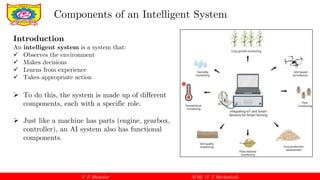
Introduction
An intelligent system is a system that:
 Observes the environment
 Makes decisions
 Learns from experience
 Takes appropriate action
Components of an Intelligent System
 To do this, the system is made up of different
components, each with a specific role.
 Just like a machine has parts (engine, gearbox,
controller), an AI system also has functional
components.
V. P. Bhaurkar AI ML (T. Y. Mechanical)
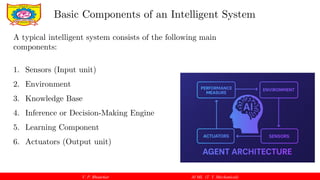
A typical intelligent system consists of the following main
components:
1. Sensors (Input unit)
2. Environment
3. Knowledge Base
4. Inference or Decision-Making Engine
5. Learning Component
6. Actuators (Output unit)
Basic Components of an Intelligent System
V. P. Bhaurkar AI ML (T. Y. Mechanical)
Basic Components of an Intelligent System
A] Sensors (Input Component)
Meaning:
Sensors are used to collect information from the environment.
They act as the eyes and ears of the intelligent system.
Examples:
 Images from cameras
 Temperature, pressure, vibration data
 Sound and signals
Mechanical Engineering Examples:
 Vibration sensor on a motor
 Camera for surface inspection
 Temperature sensor in heat treatment
Without sensors, the system cannot sense anything.
V. P. Bhaurkar AI ML (T. Y. Mechanical)
Basic Components of an Intelligent System
B] Environment
Meaning:
The environment is the surrounding system
where the AI operates.
Examples:
 Manufacturing shop floor
 Robotic work cell
 Power plant
 Vehicle system
The environment provides continuous data to the
system.
V. P. Bhaurkar AI ML (T. Y. Mechanical)
Basic Components of an Intelligent System
C] Knowledge Base
Meaning:
The knowledge base stores information
required for decision making.
It contains:
1. Facts
2. Rules
3. Past experiences
4. Data patterns
Example:
 Normal and abnormal vibration levels
 Rules like:
IF temperature is high → reduce load
It is the memory of the intelligent system.
V. P. Bhaurkar AI ML (T. Y. Mechanical)
Basic Components of an Intelligent System
D] Inference Engine (Decision-Making Unit)
Meaning:
The inference engine analyzes the data and draws
conclusions.
It applies:
 Rules
 Logic
 Stored knowledge
Mechanical Engineering Example:
1. Identifying fault type based on sensor data
2. Deciding whether a machine should continue
running
This component is the brain of the system.
V. P. Bhaurkar AI ML (T. Y. Mechanical)
Basic Components of an Intelligent System
E] Learning Component
Meaning:
The learning component helps the system to
improve its performance over time.
What it does:
1. Updates the knowledge base
2. Learns from new data
3. Improves accuracy
Mechanical Engineering Example:
 Improving fault prediction accuracy
 Learning new defect patterns in products
This makes the system adaptive, not fixed.
V. P. Bhaurkar AI ML (T. Y. Mechanical)
Basic Components of an Intelligent System
F] Actuators (Output Component)
Meaning:
Actuators convert decisions into physical or control
actions.
Examples:
 Motors
 Valves
 Robotic arms
 Control signals
Mechanical Engineering Example:
 Stopping a machine
 Rejecting a defective part
 Adjusting speed or feed rate
This is where the system acts on its decision.
V. P. Bhaurkar AI ML (T. Y. Mechanical)
Case studies on Basic Components of an Intelligent System
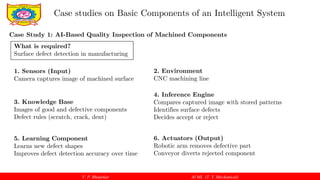
Case Study 1: AI-Based Quality Inspection of Machined Components
What is required?
Surface defect detection in manufacturing
1. Sensors (Input)
Camera captures image of machined surface
2. Environment
CNC machining line
3. Knowledge Base
Images of good and defective components
Defect rules (scratch, crack, dent)
4. Inference Engine
Compares captured image with stored patterns
Identifies surface defects
Decides accept or reject
5. Learning Component
Learns new defect shapes
Improves defect detection accuracy over time
6. Actuators (Output)
Robotic arm removes defective part
Conveyor diverts rejected component
V. P. Bhaurkar AI ML (T. Y. Mechanical)
Case studies on Basic Components of an Intelligent System
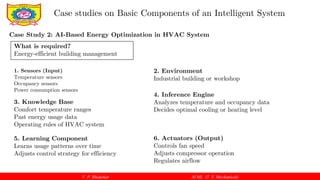
Case Study 2: AI-Based Energy Optimization in HVAC System
What is required?
Energy-efficient building management
1. Sensors (Input)
Temperature sensors
Occupancy sensors
Power consumption sensors
2. Environment
Industrial building or workshop
3. Knowledge Base
Comfort temperature ranges
Past energy usage data
Operating rules of HVAC system
4. Inference Engine
Analyzes temperature and occupancy data
Decides optimal cooling or heating level
5. Learning Component
Learns usage patterns over time
Adjusts control strategy for efficiency
6. Actuators (Output)
Controls fan speed
Adjusts compressor operation
Regulates airflow
V. P. Bhaurkar AI and ML (T. Y. Mechanical)
Thank You !

Components of an artificial intelligent system.pdf

  • 1.
    Sanjivani Rural EducationSociety’s Sanjivani College of Engineering, Kopargaon-423603 (An Autonomous Institute Affiliated to Savitribai Phule Pune University, Pune) NAAC ‘A’ Grade Accredited, ISO 9001:2015 Certified Department of Mechanical Engineering Subject : Foundations of AI and ML Class : T.Y. Mechanical Subject Code : PEME 312D Unit 1 : Introduction to Artificial Intelligence (AI) By V. P. Bhaurkar Department of Mechanical Engineering 2025 – 26 (sem – 6)
  • 2.
    V. P. BhaurkarAI ML (T. Y. Mechanical) Introduction An intelligent system is a system that:  Observes the environment  Makes decisions  Learns from experience  Takes appropriate action Components of an Intelligent System  To do this, the system is made up of different components, each with a specific role.  Just like a machine has parts (engine, gearbox, controller), an AI system also has functional components.
  • 3.
    V. P. BhaurkarAI ML (T. Y. Mechanical) A typical intelligent system consists of the following main components: 1. Sensors (Input unit) 2. Environment 3. Knowledge Base 4. Inference or Decision-Making Engine 5. Learning Component 6. Actuators (Output unit) Basic Components of an Intelligent System
  • 4.
    V. P. BhaurkarAI ML (T. Y. Mechanical) Basic Components of an Intelligent System A] Sensors (Input Component) Meaning: Sensors are used to collect information from the environment. They act as the eyes and ears of the intelligent system. Examples:  Images from cameras  Temperature, pressure, vibration data  Sound and signals Mechanical Engineering Examples:  Vibration sensor on a motor  Camera for surface inspection  Temperature sensor in heat treatment Without sensors, the system cannot sense anything.
  • 5.
    V. P. BhaurkarAI ML (T. Y. Mechanical) Basic Components of an Intelligent System B] Environment Meaning: The environment is the surrounding system where the AI operates. Examples:  Manufacturing shop floor  Robotic work cell  Power plant  Vehicle system The environment provides continuous data to the system.
  • 6.
    V. P. BhaurkarAI ML (T. Y. Mechanical) Basic Components of an Intelligent System C] Knowledge Base Meaning: The knowledge base stores information required for decision making. It contains: 1. Facts 2. Rules 3. Past experiences 4. Data patterns Example:  Normal and abnormal vibration levels  Rules like: IF temperature is high → reduce load It is the memory of the intelligent system.
  • 7.
    V. P. BhaurkarAI ML (T. Y. Mechanical) Basic Components of an Intelligent System D] Inference Engine (Decision-Making Unit) Meaning: The inference engine analyzes the data and draws conclusions. It applies:  Rules  Logic  Stored knowledge Mechanical Engineering Example: 1. Identifying fault type based on sensor data 2. Deciding whether a machine should continue running This component is the brain of the system.
  • 8.
    V. P. BhaurkarAI ML (T. Y. Mechanical) Basic Components of an Intelligent System E] Learning Component Meaning: The learning component helps the system to improve its performance over time. What it does: 1. Updates the knowledge base 2. Learns from new data 3. Improves accuracy Mechanical Engineering Example:  Improving fault prediction accuracy  Learning new defect patterns in products This makes the system adaptive, not fixed.
  • 9.
    V. P. BhaurkarAI ML (T. Y. Mechanical) Basic Components of an Intelligent System F] Actuators (Output Component) Meaning: Actuators convert decisions into physical or control actions. Examples:  Motors  Valves  Robotic arms  Control signals Mechanical Engineering Example:  Stopping a machine  Rejecting a defective part  Adjusting speed or feed rate This is where the system acts on its decision.
  • 10.
    V. P. BhaurkarAI ML (T. Y. Mechanical) Case studies on Basic Components of an Intelligent System Case Study 1: AI-Based Quality Inspection of Machined Components What is required? Surface defect detection in manufacturing 1. Sensors (Input) Camera captures image of machined surface 2. Environment CNC machining line 3. Knowledge Base Images of good and defective components Defect rules (scratch, crack, dent) 4. Inference Engine Compares captured image with stored patterns Identifies surface defects Decides accept or reject 5. Learning Component Learns new defect shapes Improves defect detection accuracy over time 6. Actuators (Output) Robotic arm removes defective part Conveyor diverts rejected component
  • 11.
    V. P. BhaurkarAI ML (T. Y. Mechanical) Case studies on Basic Components of an Intelligent System Case Study 2: AI-Based Energy Optimization in HVAC System What is required? Energy-efficient building management 1. Sensors (Input) Temperature sensors Occupancy sensors Power consumption sensors 2. Environment Industrial building or workshop 3. Knowledge Base Comfort temperature ranges Past energy usage data Operating rules of HVAC system 4. Inference Engine Analyzes temperature and occupancy data Decides optimal cooling or heating level 5. Learning Component Learns usage patterns over time Adjusts control strategy for efficiency 6. Actuators (Output) Controls fan speed Adjusts compressor operation Regulates airflow
  • 12.
    V. P. BhaurkarAI and ML (T. Y. Mechanical) Thank You !