INTELLIGENT
MANUFACTURING
AND
SERVICES
INTRODUCTION
• Manufacturing technology will play an important role in future human
developments.
• Any organization must make full advantage of the knowledge at its disposal.
• The organization must be liberated and directed synergistically to support
integrated systems for engineering.
• Intelligent system vendors can help the situation by improving their shells to fit
defined requirements for successful manufacturing applications.
• Manufacturing strategies have currently to face global competitiveness, big
number of new products etc.
• CONCEPT OF MANUFACTURING
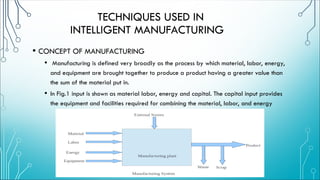
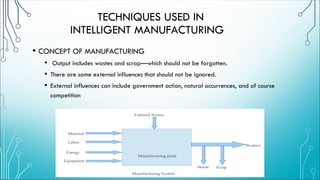
• Manufacturing is defined very broadly as the process by which material, labor, energy,
and equipment are brought together to produce a product having a greater value than
the sum of the material put in.
• In Fig.1 input is shown as material labor, energy and capital. The capital input provides
the equipment and facilities required for combining the material, labor, and energy
TECHNIQUES USED IN
INTELLIGENT MANUFACTURING
TECHNIQUES USED IN
INTELLIGENT MANUFACTURING
• CONCEPT OF MANUFACTURING
• Output includes wastes and scrap—which should not be forgotten.
• There are some external influences that should not be ignored.
• External influences can include government action, natural occurrences, and of course
competition
DEVLOPING AREAS OF MANUFACTURING SYSTEM
• The focus of the technologies appropriate for
manufacturing is on mechanical products and their
components. However, a great deal of overlap is
expected with all manufacturing industries.
• In medium sized manufacturing companies, the focus point
of manufacturing technology can be the production, sales
engineering, quality control, development, research, or
other functions where as Large industries are more likely
to have an organized plan to innovate manufacturing
processes.
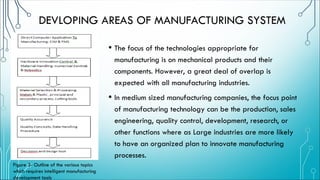
Figure 2- Outline of the various topics
which requires intelligent manufacturing
development tools
ARTIFICIAL INTELLIGENCE
• Artificial intelligence (AI) is the intelligence exhibited by machines or software,
and the branch of computer science that develops machines and software with
human-like intelligence.
• The inventions of automation and artificial intelligence have brought about a
technological revolution in the Operator-Machine System Relationship.
• These technologies have made it possible to reduce safety risks and to
implement cognitive capabilities, such as speech understanding, logic
deduction, picture understanding, reasoning about expert knowledge,
problem solving, and decision making in machines
INTELLIGENT MANUFACTURING SYSTEM
• An intelligent Manufacturing process has the ability to self regulate and/or
self control to manufacture the product within the design specifications.
• Existing manufacturing processes can become intelligent by monitoring and
controlling the state of the manufacturing machine.
• Existing processes can be made intelligent by adding sensors to monitor and
control the state of product being processed.
• New processes can be intelligently designed to produce parts of desired
quality without the need of sensing and control of the process.
INTELLIGENT MANUFACTURING SYSTEM
• Intelligent Manufacturing system uses :
1. Technology which can minimize the use of human Brain
2. Regulation for product mix and priority production means self regulated.
3. Self controlled operations with automatic feed back mechanism.
4. Monitoring and control of the manufacturing machine.
5. Monitoring and controlling the state of product being processed.
6. New processes with intelligence can be made to produce parts of desired
quality with out the need of sensing and control of process.
STEPS FOR IMPLEMENTING AN
INTELLIGENT SYSTEM SOLUTION
• Steps for implementing an intelligent system solution in manufacturing are as follows :
• Select an existing software that will first augment an expert system and then integrate with task
solution software.
• Collect trade standards, heuristic rules, past experiences and recommendation from books, experts
and standard codes.
• Organize a complete set of rules governing this task, and describe them in a formal way
acceptable to a list processing software.
• Generate a list of features and other part attributes called the rule sets.
• Generate relevant data by extracting the features and other necessary part attributes from the
model data of an object.
• Organize the rules governing this task into a knowledge base.
• Implement an inference engine as a reasoning mechanism to find a solution on the knowledge base
and the external data.
• Incorporate the results into the model and its representation to obtain a final solution.
REFERENCES
• [1] G. Tecuci, Building Intelligent Agents: An Apprenticeship Multistrategy Learning., Theory,
Methodology, Tool and Case Studiem, Academic Press, 1998.
• [2] N. Jennings, M. Wooldridge, Applications of Intelligent Agents, in: N. Jennings, M.
Wooldridge (Eds.), Agent Technology. Foundations, Applications, and Markets, Springer-
Verlag 1998, pp. 3-28.
• [3] T. Smithers, On Quantitative Performance Measures of Robot Behaviour, in: Ed. L. Steels,
The Biology and Technology of Inteligent Autonomous Agents, NATO ASI Series, Series F:
Computer and Systems Sciences, Springer- Verlag 1995, Vol 144, pp. 21-52.
• [4]. Deb S.R and Chattopadhayaya,” Proc. 3rd SERC school on ‘Advanced Mfg.Tech.’ ”,
Jadavpur Calcutta, 1997.
• [5]. Kumar Surender,” Industrial Robots and CIM”, Oxford and IBH Publication Co,New Delhi.
• [6]. Kumar Surender and Jha, A.K, ”Computer Aided Design and Manufacturing”, Dhanpat
Rai and Co. Ltd., New Delhi.
11.Intelligent_Manufacturing_And_Services.ppt

11.Intelligent_Manufacturing_And_Services.ppt

  • 1.
  • 2.
    INTRODUCTION • Manufacturing technologywill play an important role in future human developments. • Any organization must make full advantage of the knowledge at its disposal. • The organization must be liberated and directed synergistically to support integrated systems for engineering. • Intelligent system vendors can help the situation by improving their shells to fit defined requirements for successful manufacturing applications. • Manufacturing strategies have currently to face global competitiveness, big number of new products etc.
  • 4.
    • CONCEPT OFMANUFACTURING • Manufacturing is defined very broadly as the process by which material, labor, energy, and equipment are brought together to produce a product having a greater value than the sum of the material put in. • In Fig.1 input is shown as material labor, energy and capital. The capital input provides the equipment and facilities required for combining the material, labor, and energy TECHNIQUES USED IN INTELLIGENT MANUFACTURING
  • 5.
    TECHNIQUES USED IN INTELLIGENTMANUFACTURING • CONCEPT OF MANUFACTURING • Output includes wastes and scrap—which should not be forgotten. • There are some external influences that should not be ignored. • External influences can include government action, natural occurrences, and of course competition
  • 6.
    DEVLOPING AREAS OFMANUFACTURING SYSTEM • The focus of the technologies appropriate for manufacturing is on mechanical products and their components. However, a great deal of overlap is expected with all manufacturing industries. • In medium sized manufacturing companies, the focus point of manufacturing technology can be the production, sales engineering, quality control, development, research, or other functions where as Large industries are more likely to have an organized plan to innovate manufacturing processes. Figure 2- Outline of the various topics which requires intelligent manufacturing development tools
  • 9.
    ARTIFICIAL INTELLIGENCE • Artificialintelligence (AI) is the intelligence exhibited by machines or software, and the branch of computer science that develops machines and software with human-like intelligence. • The inventions of automation and artificial intelligence have brought about a technological revolution in the Operator-Machine System Relationship. • These technologies have made it possible to reduce safety risks and to implement cognitive capabilities, such as speech understanding, logic deduction, picture understanding, reasoning about expert knowledge, problem solving, and decision making in machines
  • 10.
    INTELLIGENT MANUFACTURING SYSTEM •An intelligent Manufacturing process has the ability to self regulate and/or self control to manufacture the product within the design specifications. • Existing manufacturing processes can become intelligent by monitoring and controlling the state of the manufacturing machine. • Existing processes can be made intelligent by adding sensors to monitor and control the state of product being processed. • New processes can be intelligently designed to produce parts of desired quality without the need of sensing and control of the process.
  • 11.
    INTELLIGENT MANUFACTURING SYSTEM •Intelligent Manufacturing system uses : 1. Technology which can minimize the use of human Brain 2. Regulation for product mix and priority production means self regulated. 3. Self controlled operations with automatic feed back mechanism. 4. Monitoring and control of the manufacturing machine. 5. Monitoring and controlling the state of product being processed. 6. New processes with intelligence can be made to produce parts of desired quality with out the need of sensing and control of process.
  • 12.
    STEPS FOR IMPLEMENTINGAN INTELLIGENT SYSTEM SOLUTION • Steps for implementing an intelligent system solution in manufacturing are as follows : • Select an existing software that will first augment an expert system and then integrate with task solution software. • Collect trade standards, heuristic rules, past experiences and recommendation from books, experts and standard codes. • Organize a complete set of rules governing this task, and describe them in a formal way acceptable to a list processing software. • Generate a list of features and other part attributes called the rule sets. • Generate relevant data by extracting the features and other necessary part attributes from the model data of an object. • Organize the rules governing this task into a knowledge base. • Implement an inference engine as a reasoning mechanism to find a solution on the knowledge base and the external data. • Incorporate the results into the model and its representation to obtain a final solution.
  • 13.
    REFERENCES • [1] G.Tecuci, Building Intelligent Agents: An Apprenticeship Multistrategy Learning., Theory, Methodology, Tool and Case Studiem, Academic Press, 1998. • [2] N. Jennings, M. Wooldridge, Applications of Intelligent Agents, in: N. Jennings, M. Wooldridge (Eds.), Agent Technology. Foundations, Applications, and Markets, Springer- Verlag 1998, pp. 3-28. • [3] T. Smithers, On Quantitative Performance Measures of Robot Behaviour, in: Ed. L. Steels, The Biology and Technology of Inteligent Autonomous Agents, NATO ASI Series, Series F: Computer and Systems Sciences, Springer- Verlag 1995, Vol 144, pp. 21-52. • [4]. Deb S.R and Chattopadhayaya,” Proc. 3rd SERC school on ‘Advanced Mfg.Tech.’ ”, Jadavpur Calcutta, 1997. • [5]. Kumar Surender,” Industrial Robots and CIM”, Oxford and IBH Publication Co,New Delhi. • [6]. Kumar Surender and Jha, A.K, ”Computer Aided Design and Manufacturing”, Dhanpat Rai and Co. Ltd., New Delhi.