www.complianceonlie.com
©2010 Copyright
© 2015 ComplianceOnline
This training session is sponsored by
1
The SEC’s New Whistleblower Rules:
Implications for your Company’s
Compliance and Fraud Program
This Training is Brought to you by ComplianceOnline.
Presenter: Craig M. Taggart
www.complianceonline.com
©2015 Copyright
 Learning objectives:
 Evaluate the elements necessary for an effective
whistleblower program and recognize the legal
protections that might apply during a fraud
examination. Become able to assess the precautions
necessary for organizations to mitigate and avoid
retaliation claims. To learn, recognize and evaluate the
best strategy for developing useful information from
whistleblowers. Finally to identify the options and risks
that a potential whistleblower should consider
2
www.complianceonline.com
©2015 Copyright
 Areas Covered in the Session:
 • Fraud Examiners’ Roles in Whistleblowing
 • Fraud-Related Whistleblower Protections
 • Qui Tam Suits and Rewards Programs
 • Whistleblower Programs
 • Handling Whistleblowers in Fraud Examinations
 • Guidance for Potential Whistleblowers
3
www.complianceonline.com
©2015 Copyright
 • Establishing an effective compliance and training
program under the SEC’s revised whistleblower
program
 • Key changes to the whistleblower rules
 • Evaluating the elements for an effective training
program during Fraud Examination
 • Recognizing the red flags of retaliation and how to
mitigate and avoid retaliation claims
4
www.complianceonline.com
©2015 Copyright
 Background of SEC’s New Whistleblower Rules
 The Dodd Frank Act's whistleblower provisions make it
possible for an individual with "original information"
regarding violations of the securities laws to submit it
to the SEC and receive up to 30% of the monetary
penalties in the event the SEC or certain other
government enforcement agencies bring a successful
case based on that information and the penalties
exceed one million dollars.
5
www.complianceonline.com
©2015 Copyright
 Instructor Profile:
 Craig Taggart has almost a decade of experience in the fields of mergers and acquisitions and
business financing. Mr. Taggart works strategically with his clients to achieve the highest value
for their business within the capital markets. His experience with BCC Capital Partners in the
M&A industry has greatly contributed to his understanding of transaction structure, strategic
 placement of buyers, and the attainment of maximum market value for his clients. He has
represented and sold many businesses in a number of different industries and has significant
experience working with companies in: continuing education, transportation, software and
professional services. Mr. Taggart is currently working in the clean energy sector that covers
multiple initiatives within M&A and corporate development.
 He is a certified merger and acquisition advisor, accredited valuation analyst as well as an active
member of Alliance of Mergers and Acquisition, and The National Association of Certified
Valuators and Analysts (NACVA). His knowledge and expertise also extends to systems such as:
Software as a Service (SaaS), and ERP and CRM systems (Netsuite, Salesforce, Sage 100, 500, X3
ERP). Mr. Taggart has been a certified fraud examiner since 2011 and has previously worked at
Deloitte with their quality risk management team.
 He earned his MBA from the San Diego State University specializing in financial management.
Mr. Taggart graduated from the California State University Northridge with a bachelor’s degree
majoring in organizational psychology.
6
www.complianceonline.com
©2015 Copyright
Agenda
7
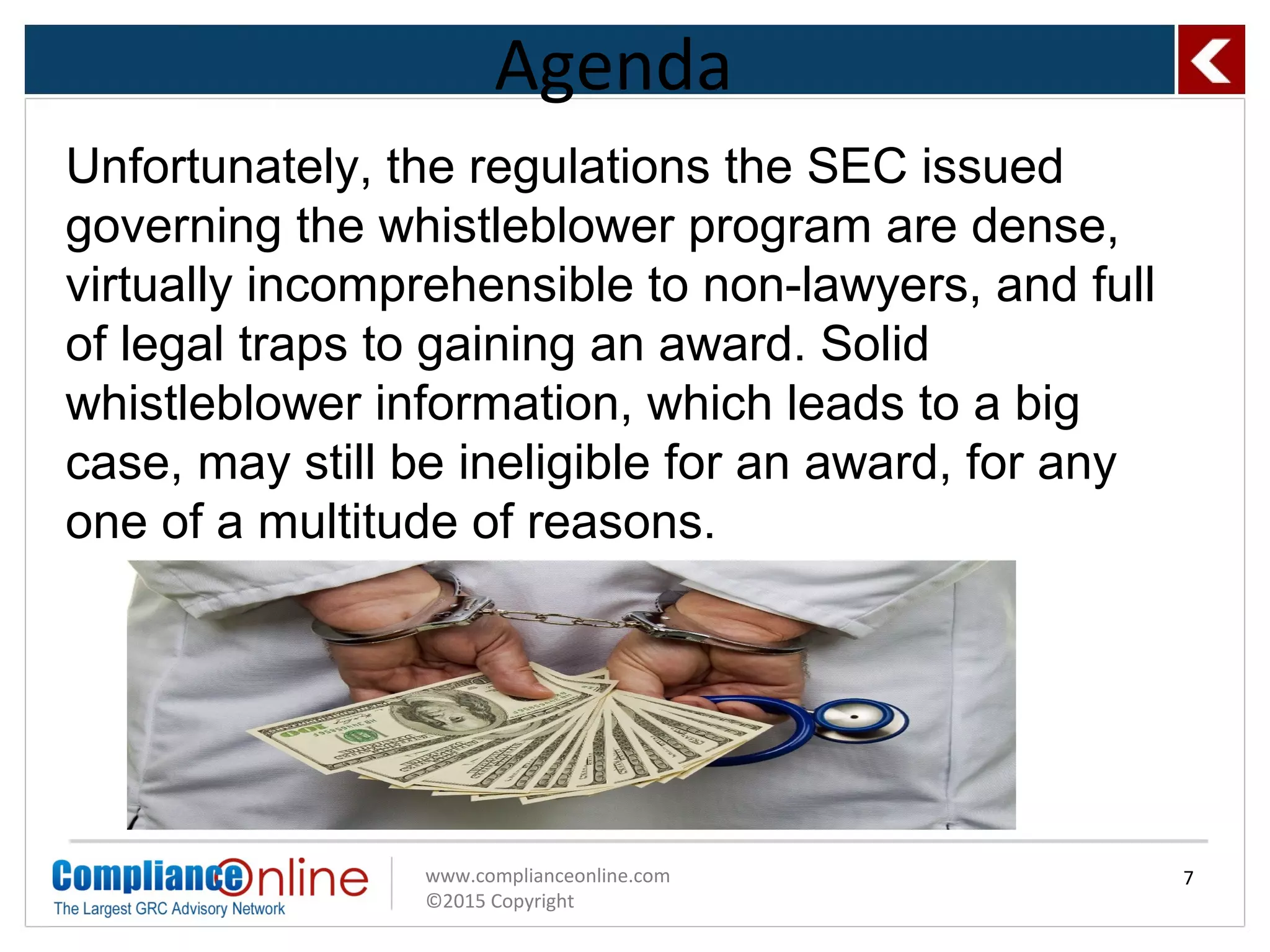
Unfortunately, the regulations the SEC issued
governing the whistleblower program are dense,
virtually incomprehensible to non-lawyers, and full
of legal traps to gaining an award. Solid
whistleblower information, which leads to a big
case, may still be ineligible for an award, for any
one of a multitude of reasons.
www.complianceonline.com
©2015 Copyright
 We will review the following stated here and the
significance to your business or organization:
 Make Sure You Really Want to Be A Whistleblower
 You Must Have Original Information which Qualifies
for An Award
 Be Creative, and Do a Bit of Your Own Investigating, If
At All Possible, Report Your Information First Internally
In a Well Documented Submission to the Responsible
Corporate Officials, After You Report Internally
8
www.complianceonline.com
©2015 Copyright
 Promptly Report to the SEC
 Make Your Submission Short and to the Point;
Consider Carefully which Documents To Include
 Before Making A Submission, Consider Your Position in
or Relation to the Company, If You Had Any
Involvement in the Illegal Activity
 Consult An Attorney Before Making Any Approach to
the SEC, Formulate Your Submission, and cooperate
with the SEC, with an Eye to Getting the Maximum
Award After the Case is Brought, and Consider Hiring A
Lawyer to Assist You In Reporting to the SEC.
9
www.complianceonline.com
©2015 Copyright
 Qui Tam definition and Incentives on Top of Protections wikipedia
 In common law, a writ of qui tam is a writ whereby a private individual who assists a
prosecution can receive all or part of any penalty imposed. Its name is an
abbreviation of the Latin phrase, meaning "[he] who sues in this matter for the king
as well as for himself.“ A qui tam suit is a legal action brought by a private party
(often called the relator) on behalf of the government or society. The government
typically has a right to join the lawsuit and work with the relator or take over
entirely. The incentive of bringing the suit is that the relator gets a portion of the
recovery against the defendant, if applicable
 Besides the disadvantages of whistleblowing, some jurisdictions, particularly the U.S.,
have provided incentives for reporting misconduct in certain situations. Through
various types of administrative and judicial processes, a person who is a qualified
whistleblower under one of several incentive or bounty statutes might be entitles to
a financial reward
 The reward can be related to damages suffered from retaliation against the
whistleblower or the reward is based on the significance of the misconduct and how
much help the whistleblower contributed to law enforcement.
10
www.complianceonline.com
©2015 Copyright
 Damages and Punitive Recoveries
 Most damages remedies seek to put the plaintiff in the same position as
before the defendant wronged him or her. Some whistleblower laws allow
the whistleblower to seek damages in excess of the actual damages. For
instance, suppose a whistleblower was fired from his job in retaliation and
went two years without finding a similar job, resulting in $300,000 in lost
income. The law might allow treble damages, meaning the defendant must
pay $900,000 for the loss. This is a form of punishment to deter future
offenses.
 Qui Tam actions are actually brought under the False claims Act, which
states that anyone who commits the following acts against the federal
government is liable for three times the amount of damages it sustains, plus
a civil penalty of $5,000 to $10,000 per false claim
 (Presenting fraudulent claim for payment, makes false record to get false
claim paid, conspires to defraud the government by getting false claim paid)
11
www.complianceonline.com
©2015 Copyright
 Internal Revenue Service Program
 It provides for up to 10 percent of the collected proceeds for less substantial
information. Congress also eliminated any cap on the potential amount of
recovery by the informant. To manage this revised reward program
Congress established the IRS Whistleblower Office (WBO). Potential
whistleblowers should note that the 15 to 30 percent recoveries do not
apply to reports against individuals who make less than $200,000 and whose
tax liability is less than $2 million. The rules do to all other individuals and
entities. Beyond the statutory right to whistleblower rewards, the IRS also
maintains the discretion to reward whistleblowers who do not meet the
above requirements.
 This reward was famously exhibited in the case where Bradley Birkenfeld, a
former banker at UBS, provided the IRS with key information about how U.S.
citizens were using the Swiss bank to evade taxes. UBS paid a $790 million
fine and Mr. Birkenfeld received $104 million before taxes.
12
www.complianceonline.com
©2015 Copyright
 Whistleblower Programs & Protections
 Your Call, A truly independent whistleblower service giving your
employees an opportunity to report fraud, theft, corruption
and misconduct early.
 http://www.whistleblowing.com.au/
 The Whistleblower Protection Programs in accordance with the
United States Department of Labor & OSHA
 http://www.whistleblowers.gov/
 WhistleBlowers Against Fraud (WAF)
 http://whistleblowersagainstfraud.com/
 Whistleblower Hotline
 https://www.tnwinc.com/tag/whistleblower-hotline/
13
www.complianceonline.com
©2015 Copyright
 A new study in the Journal of Finance offers a friendly reminder of the key role whistleblowers
play in rooting out fraud, waste and abuse, finding that corporate fraud is more likely to be
detected by an employee from within a firm, rather than external auditors, government
regulators, self-regulatory organizations, or the media.
 The study examined a total of 216 cases of alleged corporate fraud. Employees, i.e.
whistleblowers, were responsible for revealing the fraud in 17 percent of cases — more than
any other type of source — in which the fraud was not first brought to light by a firm's
management.
 For its part, the Securities and Exchange Commission (SEC) revealed the wrongdoing in only 6.6
percent of such cases.
 These findings might not be a huge surprise to those following recent news that the SEC hasn't
exactly been on the ball with its investigation and enforcement of suspicious firms, and they
certainly won't come as a surprise. In addition the Certified Fraud Examiners which found that
54.1 percent of fraud cases against public companies were initiated by a whistleblower tip.
14
www.complianceonline.com
©2015 Copyright
15
 Despite the crucial role that whistleblowers often play in uncovering
corporate wrongdoing, they rarely receive help when they face retaliation
from their employers. A study conducted a few years ago found that only
3.6 percent of Sarbanes-Oxley whistleblowers win relief through the initial
administrative process, and that only 6.5 percent win on appeals. The study
also found that administrative judges have often strictly construed or even
misapplied the SOX provisions on whistleblower protections:
 In addition to improving the SEC's whistleblower reward program, Congress
should also incorporate provisions from Sen. Dodd's financial regulatory
reform bill that would strengthen protections for whistleblowers who assist
the SEC with any of its investigations or administrative/judicial actions.
 http://papers.ssrn.com/sol3/papers.cfm?abstract_id=977802
www.complianceonline.com
©2015 Copyright
16
 Recent statistics indicate a rise in foreign whistleblower tips, but why the
increase?
 11.5 Percent of U.S. Fraud Tips Come from International Whistleblowers
 The U.K. Financial Conduct Authority and the Bank of England recently
advised against implementing U.S.-inspired whistleblower bounties and
programs in the United Kingdom. However, it is still likely that the United
States will continue receiving whistleblower tips from the United Kingdom
and other countries. According to the U.S. Securities and Exchange
Commission's annual report for 2014:
 Foreign tips came from 60 countries.
 Of all tips received in 2014, 11.5 percent originated from non-U.S. sources.
 U.K. citizens reported the most leads at 70 tips, with 69 reports from India
and 58 tips from Canada.
 The SEC awarded its highest bounty ever to a foreign whistleblower, who
received $30 million in 2014.
www.complianceonline.com
©2015 Copyright
 These statistics illustrate the SEC's powerful reach into the global arena, and
they also highlight a need for worldwide organizations to incorporate solid
whistleblower compliance programs of their own. While the risk of
employees turning to the U.S. government to report fraud and collect
compensation remains high, international companies risk massive exposure
on a global scale.
 Whistleblower hotlines, internal report forms and an active platform for
incident management help companies capture reports consistently and
provide them with the means to create a consistent workflow for resolving
any incidents in a timely manner. As important, companies empower their
employees to report misconduct internally, through extensive periodic
training and an easy availability and distribution of company whistleblowing
procedures and policies.
 With more than 21 years of experience developing whistleblower actions,
WAF has successfully recovered billions of dollars on behalf of the U.S.
federal government and numerous states. Partnering with WAF can help
maximize any whistleblower reward one ultimately receives 17
www.complianceonline.com
©2015 Copyright
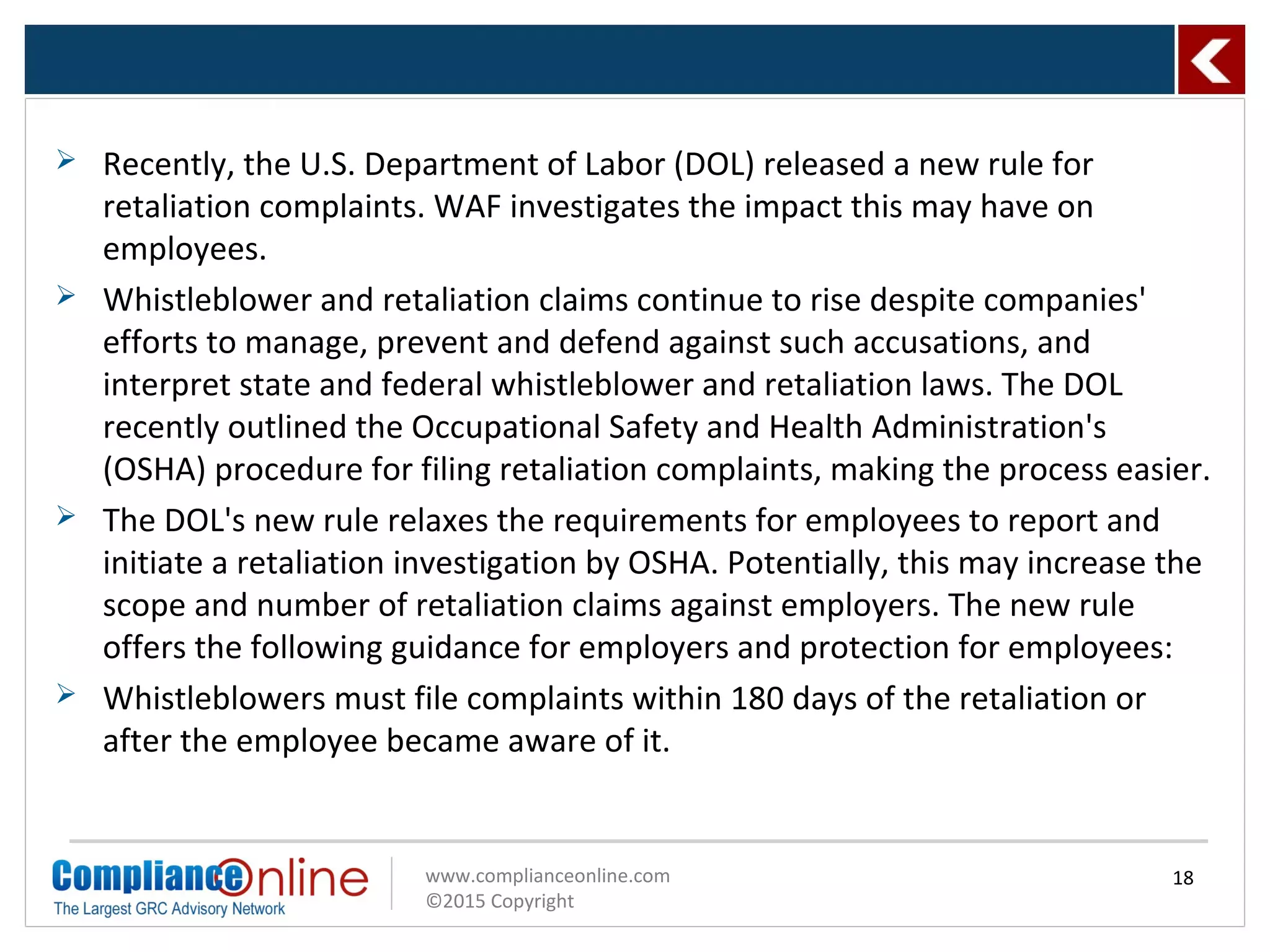
 Recently, the U.S. Department of Labor (DOL) released a new rule for
retaliation complaints. WAF investigates the impact this may have on
employees.
 Whistleblower and retaliation claims continue to rise despite companies'
efforts to manage, prevent and defend against such accusations, and
interpret state and federal whistleblower and retaliation laws. The DOL
recently outlined the Occupational Safety and Health Administration's
(OSHA) procedure for filing retaliation complaints, making the process easier.
 The DOL's new rule relaxes the requirements for employees to report and
initiate a retaliation investigation by OSHA. Potentially, this may increase the
scope and number of retaliation claims against employers. The new rule
offers the following guidance for employers and protection for employees:
 Whistleblowers must file complaints within 180 days of the retaliation or
after the employee became aware of it.
18
www.complianceonline.com
©2015 Copyright
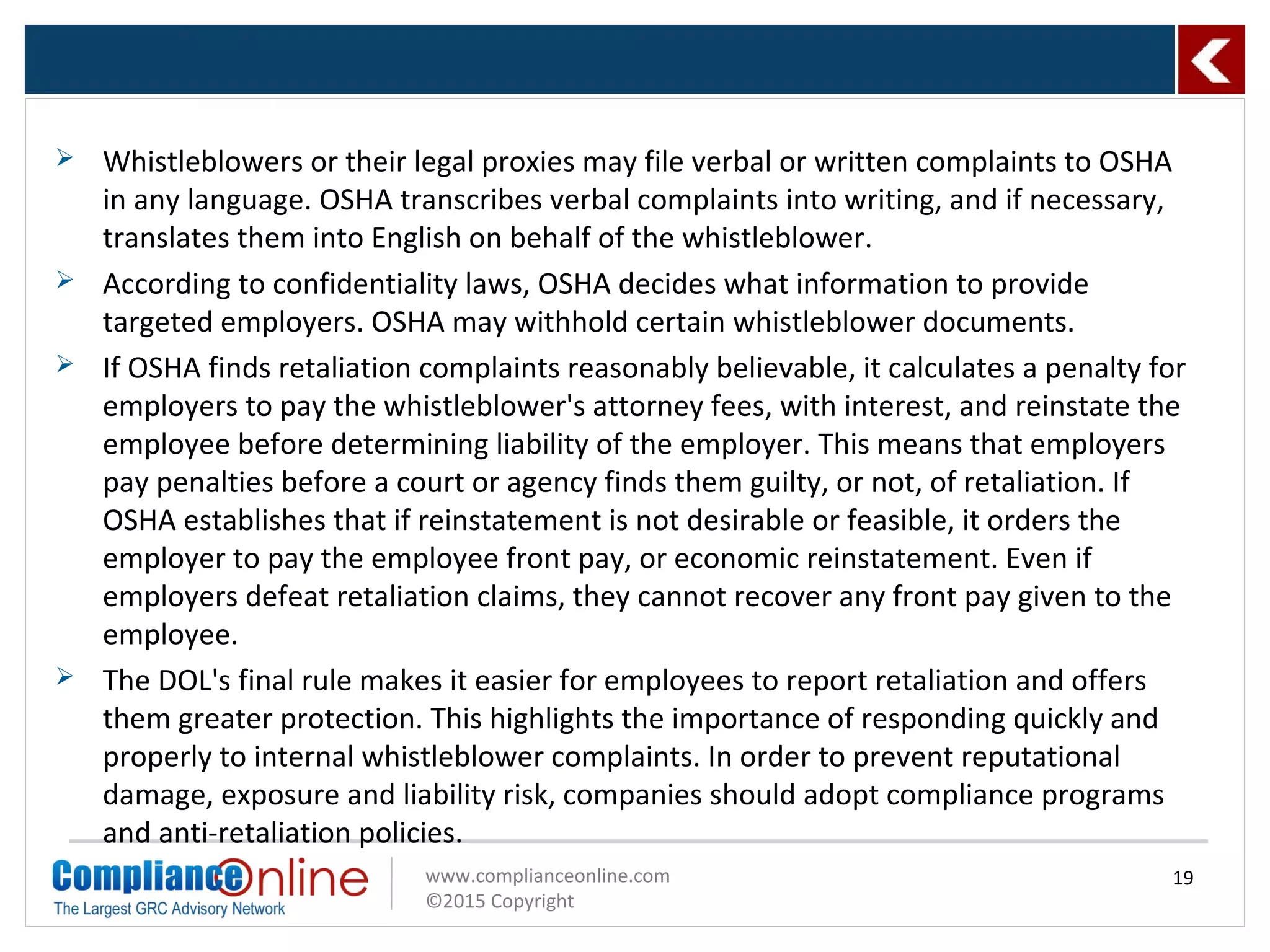
 Whistleblowers or their legal proxies may file verbal or written complaints to OSHA
in any language. OSHA transcribes verbal complaints into writing, and if necessary,
translates them into English on behalf of the whistleblower.
 According to confidentiality laws, OSHA decides what information to provide
targeted employers. OSHA may withhold certain whistleblower documents.
 If OSHA finds retaliation complaints reasonably believable, it calculates a penalty for
employers to pay the whistleblower's attorney fees, with interest, and reinstate the
employee before determining liability of the employer. This means that employers
pay penalties before a court or agency finds them guilty, or not, of retaliation. If
OSHA establishes that if reinstatement is not desirable or feasible, it orders the
employer to pay the employee front pay, or economic reinstatement. Even if
employers defeat retaliation claims, they cannot recover any front pay given to the
employee.
 The DOL's final rule makes it easier for employees to report retaliation and offers
them greater protection. This highlights the importance of responding quickly and
properly to internal whistleblower complaints. In order to prevent reputational
damage, exposure and liability risk, companies should adopt compliance programs
and anti-retaliation policies.
19
www.complianceonline.com
©2015 Copyright
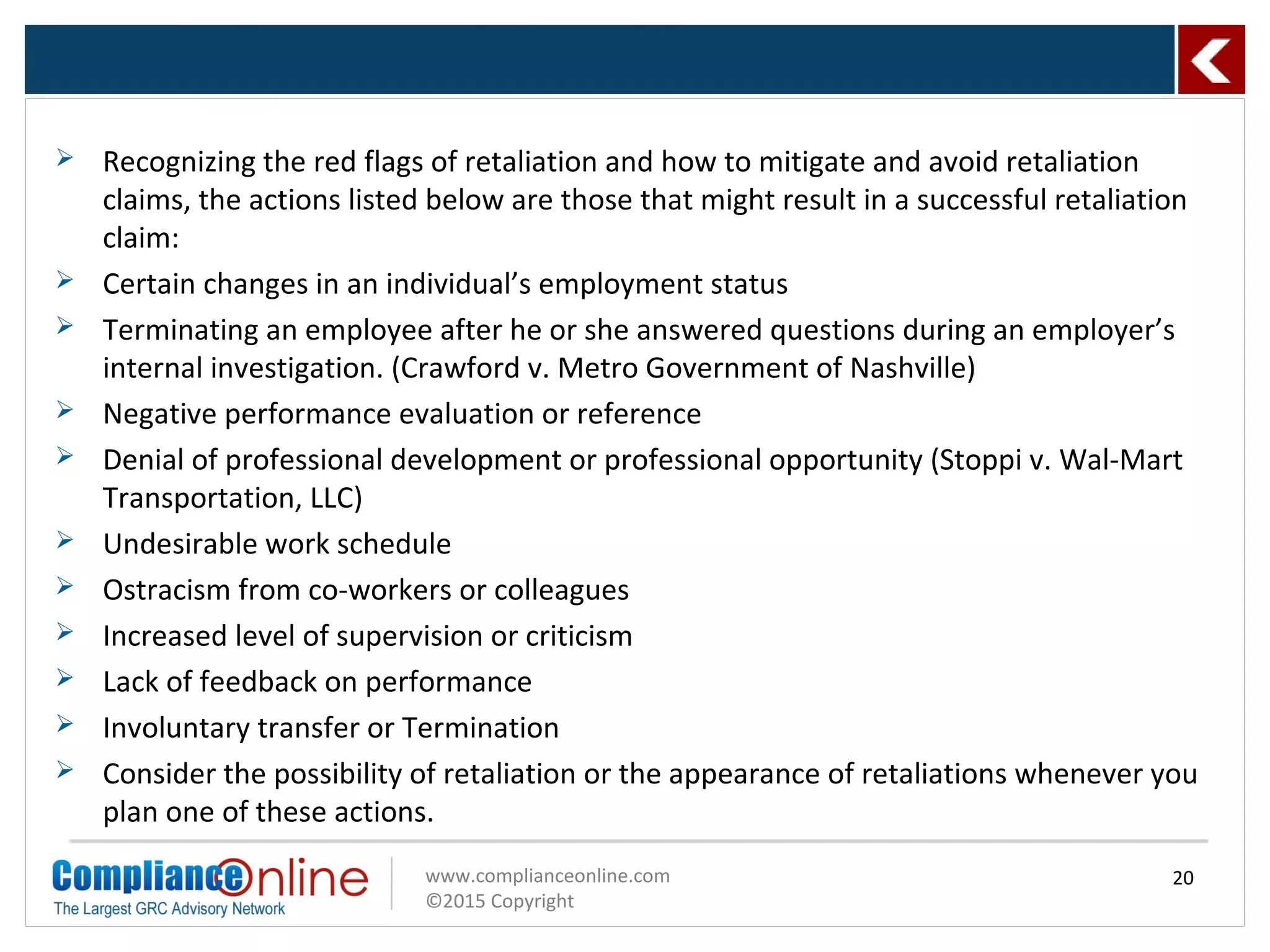
 Recognizing the red flags of retaliation and how to mitigate and avoid retaliation
claims, the actions listed below are those that might result in a successful retaliation
claim:
 Certain changes in an individual’s employment status
 Terminating an employee after he or she answered questions during an employer’s
internal investigation. (Crawford v. Metro Government of Nashville)
 Negative performance evaluation or reference
 Denial of professional development or professional opportunity (Stoppi v. Wal-Mart
Transportation, LLC)
 Undesirable work schedule
 Ostracism from co-workers or colleagues
 Increased level of supervision or criticism
 Lack of feedback on performance
 Involuntary transfer or Termination
 Consider the possibility of retaliation or the appearance of retaliations whenever you
plan one of these actions.
20
www.complianceonline.com
©2015 Copyright
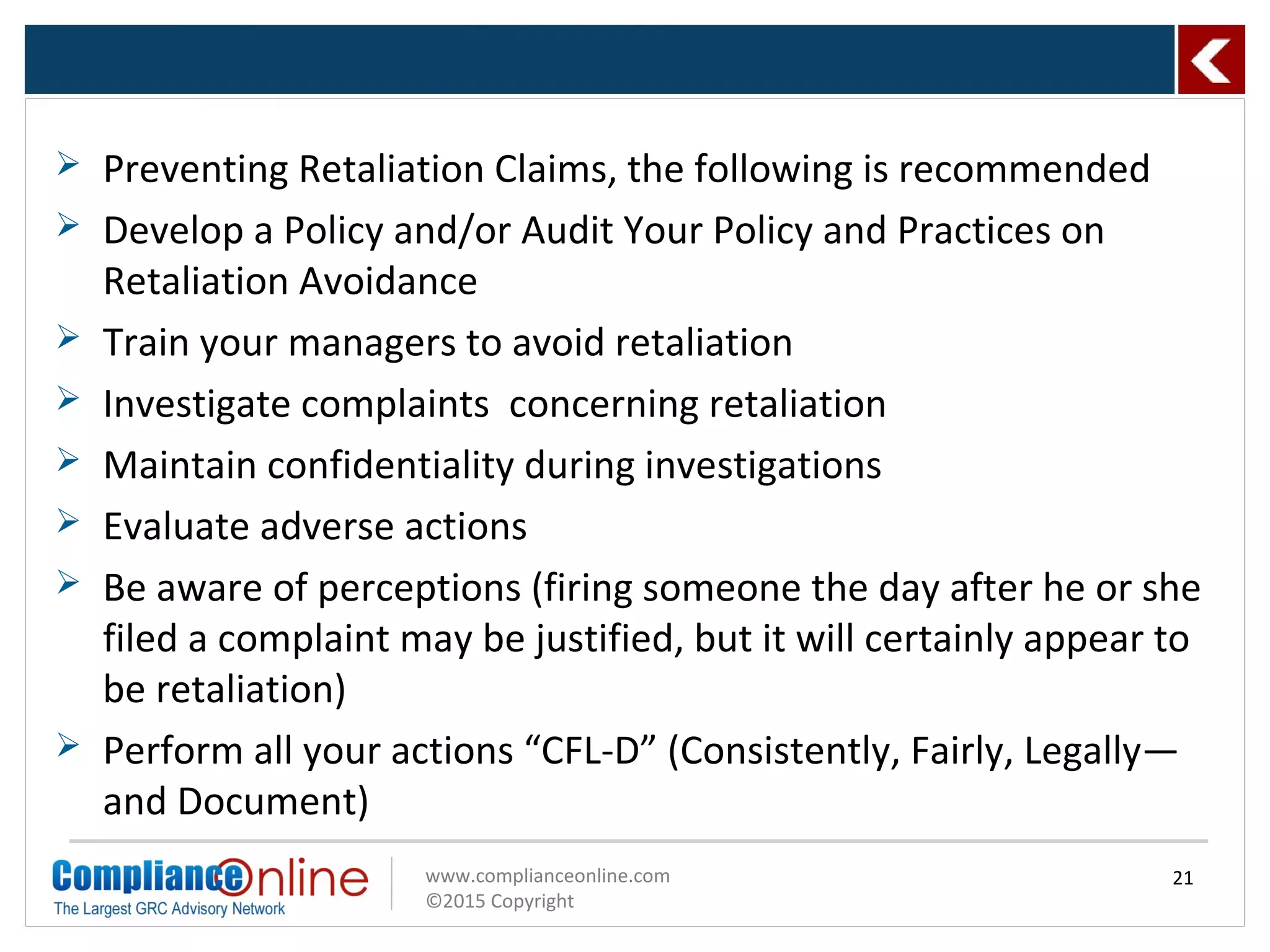
 Preventing Retaliation Claims, the following is recommended
 Develop a Policy and/or Audit Your Policy and Practices on
Retaliation Avoidance
 Train your managers to avoid retaliation
 Investigate complaints concerning retaliation
 Maintain confidentiality during investigations
 Evaluate adverse actions
 Be aware of perceptions (firing someone the day after he or she
filed a complaint may be justified, but it will certainly appear to
be retaliation)
 Perform all your actions “CFL-D” (Consistently, Fairly, Legally—
and Document)
21
www.complianceonline.com
©2015 Copyright
THANK YOU FOR YOUR ATTENTION
22
For more information on Live Webinars and any Other Training Requirements please email us
webinarassist@complianceonline.com or Call us at this Toll Free Number: 1- 888-717-2436
www.complianceonline.com
©2015 Copyright
23
www.complianceonline.com
©2015 Copyright
24

ComplianceOnline PPT Format 2015 SEC’s New Whistleblower Rules 5.12.2015

  • 1.
    www.complianceonlie.com ©2010 Copyright © 2015ComplianceOnline This training session is sponsored by 1 The SEC’s New Whistleblower Rules: Implications for your Company’s Compliance and Fraud Program This Training is Brought to you by ComplianceOnline. Presenter: Craig M. Taggart
  • 2.
    www.complianceonline.com ©2015 Copyright  Learningobjectives:  Evaluate the elements necessary for an effective whistleblower program and recognize the legal protections that might apply during a fraud examination. Become able to assess the precautions necessary for organizations to mitigate and avoid retaliation claims. To learn, recognize and evaluate the best strategy for developing useful information from whistleblowers. Finally to identify the options and risks that a potential whistleblower should consider 2
  • 3.
    www.complianceonline.com ©2015 Copyright  AreasCovered in the Session:  • Fraud Examiners’ Roles in Whistleblowing  • Fraud-Related Whistleblower Protections  • Qui Tam Suits and Rewards Programs  • Whistleblower Programs  • Handling Whistleblowers in Fraud Examinations  • Guidance for Potential Whistleblowers 3
  • 4.
    www.complianceonline.com ©2015 Copyright  •Establishing an effective compliance and training program under the SEC’s revised whistleblower program  • Key changes to the whistleblower rules  • Evaluating the elements for an effective training program during Fraud Examination  • Recognizing the red flags of retaliation and how to mitigate and avoid retaliation claims 4
  • 5.
    www.complianceonline.com ©2015 Copyright  Backgroundof SEC’s New Whistleblower Rules  The Dodd Frank Act's whistleblower provisions make it possible for an individual with "original information" regarding violations of the securities laws to submit it to the SEC and receive up to 30% of the monetary penalties in the event the SEC or certain other government enforcement agencies bring a successful case based on that information and the penalties exceed one million dollars. 5
  • 6.
    www.complianceonline.com ©2015 Copyright  InstructorProfile:  Craig Taggart has almost a decade of experience in the fields of mergers and acquisitions and business financing. Mr. Taggart works strategically with his clients to achieve the highest value for their business within the capital markets. His experience with BCC Capital Partners in the M&A industry has greatly contributed to his understanding of transaction structure, strategic  placement of buyers, and the attainment of maximum market value for his clients. He has represented and sold many businesses in a number of different industries and has significant experience working with companies in: continuing education, transportation, software and professional services. Mr. Taggart is currently working in the clean energy sector that covers multiple initiatives within M&A and corporate development.  He is a certified merger and acquisition advisor, accredited valuation analyst as well as an active member of Alliance of Mergers and Acquisition, and The National Association of Certified Valuators and Analysts (NACVA). His knowledge and expertise also extends to systems such as: Software as a Service (SaaS), and ERP and CRM systems (Netsuite, Salesforce, Sage 100, 500, X3 ERP). Mr. Taggart has been a certified fraud examiner since 2011 and has previously worked at Deloitte with their quality risk management team.  He earned his MBA from the San Diego State University specializing in financial management. Mr. Taggart graduated from the California State University Northridge with a bachelor’s degree majoring in organizational psychology. 6
  • 7.
    www.complianceonline.com ©2015 Copyright Agenda 7 Unfortunately, theregulations the SEC issued governing the whistleblower program are dense, virtually incomprehensible to non-lawyers, and full of legal traps to gaining an award. Solid whistleblower information, which leads to a big case, may still be ineligible for an award, for any one of a multitude of reasons.
  • 8.
    www.complianceonline.com ©2015 Copyright  Wewill review the following stated here and the significance to your business or organization:  Make Sure You Really Want to Be A Whistleblower  You Must Have Original Information which Qualifies for An Award  Be Creative, and Do a Bit of Your Own Investigating, If At All Possible, Report Your Information First Internally In a Well Documented Submission to the Responsible Corporate Officials, After You Report Internally 8
  • 9.
    www.complianceonline.com ©2015 Copyright  PromptlyReport to the SEC  Make Your Submission Short and to the Point; Consider Carefully which Documents To Include  Before Making A Submission, Consider Your Position in or Relation to the Company, If You Had Any Involvement in the Illegal Activity  Consult An Attorney Before Making Any Approach to the SEC, Formulate Your Submission, and cooperate with the SEC, with an Eye to Getting the Maximum Award After the Case is Brought, and Consider Hiring A Lawyer to Assist You In Reporting to the SEC. 9
  • 10.
    www.complianceonline.com ©2015 Copyright  QuiTam definition and Incentives on Top of Protections wikipedia  In common law, a writ of qui tam is a writ whereby a private individual who assists a prosecution can receive all or part of any penalty imposed. Its name is an abbreviation of the Latin phrase, meaning "[he] who sues in this matter for the king as well as for himself.“ A qui tam suit is a legal action brought by a private party (often called the relator) on behalf of the government or society. The government typically has a right to join the lawsuit and work with the relator or take over entirely. The incentive of bringing the suit is that the relator gets a portion of the recovery against the defendant, if applicable  Besides the disadvantages of whistleblowing, some jurisdictions, particularly the U.S., have provided incentives for reporting misconduct in certain situations. Through various types of administrative and judicial processes, a person who is a qualified whistleblower under one of several incentive or bounty statutes might be entitles to a financial reward  The reward can be related to damages suffered from retaliation against the whistleblower or the reward is based on the significance of the misconduct and how much help the whistleblower contributed to law enforcement. 10
  • 11.
    www.complianceonline.com ©2015 Copyright  Damagesand Punitive Recoveries  Most damages remedies seek to put the plaintiff in the same position as before the defendant wronged him or her. Some whistleblower laws allow the whistleblower to seek damages in excess of the actual damages. For instance, suppose a whistleblower was fired from his job in retaliation and went two years without finding a similar job, resulting in $300,000 in lost income. The law might allow treble damages, meaning the defendant must pay $900,000 for the loss. This is a form of punishment to deter future offenses.  Qui Tam actions are actually brought under the False claims Act, which states that anyone who commits the following acts against the federal government is liable for three times the amount of damages it sustains, plus a civil penalty of $5,000 to $10,000 per false claim  (Presenting fraudulent claim for payment, makes false record to get false claim paid, conspires to defraud the government by getting false claim paid) 11
  • 12.
    www.complianceonline.com ©2015 Copyright  InternalRevenue Service Program  It provides for up to 10 percent of the collected proceeds for less substantial information. Congress also eliminated any cap on the potential amount of recovery by the informant. To manage this revised reward program Congress established the IRS Whistleblower Office (WBO). Potential whistleblowers should note that the 15 to 30 percent recoveries do not apply to reports against individuals who make less than $200,000 and whose tax liability is less than $2 million. The rules do to all other individuals and entities. Beyond the statutory right to whistleblower rewards, the IRS also maintains the discretion to reward whistleblowers who do not meet the above requirements.  This reward was famously exhibited in the case where Bradley Birkenfeld, a former banker at UBS, provided the IRS with key information about how U.S. citizens were using the Swiss bank to evade taxes. UBS paid a $790 million fine and Mr. Birkenfeld received $104 million before taxes. 12
  • 13.
    www.complianceonline.com ©2015 Copyright  WhistleblowerPrograms & Protections  Your Call, A truly independent whistleblower service giving your employees an opportunity to report fraud, theft, corruption and misconduct early.  http://www.whistleblowing.com.au/  The Whistleblower Protection Programs in accordance with the United States Department of Labor & OSHA  http://www.whistleblowers.gov/  WhistleBlowers Against Fraud (WAF)  http://whistleblowersagainstfraud.com/  Whistleblower Hotline  https://www.tnwinc.com/tag/whistleblower-hotline/ 13
  • 14.
    www.complianceonline.com ©2015 Copyright  Anew study in the Journal of Finance offers a friendly reminder of the key role whistleblowers play in rooting out fraud, waste and abuse, finding that corporate fraud is more likely to be detected by an employee from within a firm, rather than external auditors, government regulators, self-regulatory organizations, or the media.  The study examined a total of 216 cases of alleged corporate fraud. Employees, i.e. whistleblowers, were responsible for revealing the fraud in 17 percent of cases — more than any other type of source — in which the fraud was not first brought to light by a firm's management.  For its part, the Securities and Exchange Commission (SEC) revealed the wrongdoing in only 6.6 percent of such cases.  These findings might not be a huge surprise to those following recent news that the SEC hasn't exactly been on the ball with its investigation and enforcement of suspicious firms, and they certainly won't come as a surprise. In addition the Certified Fraud Examiners which found that 54.1 percent of fraud cases against public companies were initiated by a whistleblower tip. 14
  • 15.
    www.complianceonline.com ©2015 Copyright 15  Despitethe crucial role that whistleblowers often play in uncovering corporate wrongdoing, they rarely receive help when they face retaliation from their employers. A study conducted a few years ago found that only 3.6 percent of Sarbanes-Oxley whistleblowers win relief through the initial administrative process, and that only 6.5 percent win on appeals. The study also found that administrative judges have often strictly construed or even misapplied the SOX provisions on whistleblower protections:  In addition to improving the SEC's whistleblower reward program, Congress should also incorporate provisions from Sen. Dodd's financial regulatory reform bill that would strengthen protections for whistleblowers who assist the SEC with any of its investigations or administrative/judicial actions.  http://papers.ssrn.com/sol3/papers.cfm?abstract_id=977802
  • 16.
    www.complianceonline.com ©2015 Copyright 16  Recentstatistics indicate a rise in foreign whistleblower tips, but why the increase?  11.5 Percent of U.S. Fraud Tips Come from International Whistleblowers  The U.K. Financial Conduct Authority and the Bank of England recently advised against implementing U.S.-inspired whistleblower bounties and programs in the United Kingdom. However, it is still likely that the United States will continue receiving whistleblower tips from the United Kingdom and other countries. According to the U.S. Securities and Exchange Commission's annual report for 2014:  Foreign tips came from 60 countries.  Of all tips received in 2014, 11.5 percent originated from non-U.S. sources.  U.K. citizens reported the most leads at 70 tips, with 69 reports from India and 58 tips from Canada.  The SEC awarded its highest bounty ever to a foreign whistleblower, who received $30 million in 2014.
  • 17.
    www.complianceonline.com ©2015 Copyright  Thesestatistics illustrate the SEC's powerful reach into the global arena, and they also highlight a need for worldwide organizations to incorporate solid whistleblower compliance programs of their own. While the risk of employees turning to the U.S. government to report fraud and collect compensation remains high, international companies risk massive exposure on a global scale.  Whistleblower hotlines, internal report forms and an active platform for incident management help companies capture reports consistently and provide them with the means to create a consistent workflow for resolving any incidents in a timely manner. As important, companies empower their employees to report misconduct internally, through extensive periodic training and an easy availability and distribution of company whistleblowing procedures and policies.  With more than 21 years of experience developing whistleblower actions, WAF has successfully recovered billions of dollars on behalf of the U.S. federal government and numerous states. Partnering with WAF can help maximize any whistleblower reward one ultimately receives 17
  • 18.
    www.complianceonline.com ©2015 Copyright  Recently,the U.S. Department of Labor (DOL) released a new rule for retaliation complaints. WAF investigates the impact this may have on employees.  Whistleblower and retaliation claims continue to rise despite companies' efforts to manage, prevent and defend against such accusations, and interpret state and federal whistleblower and retaliation laws. The DOL recently outlined the Occupational Safety and Health Administration's (OSHA) procedure for filing retaliation complaints, making the process easier.  The DOL's new rule relaxes the requirements for employees to report and initiate a retaliation investigation by OSHA. Potentially, this may increase the scope and number of retaliation claims against employers. The new rule offers the following guidance for employers and protection for employees:  Whistleblowers must file complaints within 180 days of the retaliation or after the employee became aware of it. 18
  • 19.
    www.complianceonline.com ©2015 Copyright  Whistleblowersor their legal proxies may file verbal or written complaints to OSHA in any language. OSHA transcribes verbal complaints into writing, and if necessary, translates them into English on behalf of the whistleblower.  According to confidentiality laws, OSHA decides what information to provide targeted employers. OSHA may withhold certain whistleblower documents.  If OSHA finds retaliation complaints reasonably believable, it calculates a penalty for employers to pay the whistleblower's attorney fees, with interest, and reinstate the employee before determining liability of the employer. This means that employers pay penalties before a court or agency finds them guilty, or not, of retaliation. If OSHA establishes that if reinstatement is not desirable or feasible, it orders the employer to pay the employee front pay, or economic reinstatement. Even if employers defeat retaliation claims, they cannot recover any front pay given to the employee.  The DOL's final rule makes it easier for employees to report retaliation and offers them greater protection. This highlights the importance of responding quickly and properly to internal whistleblower complaints. In order to prevent reputational damage, exposure and liability risk, companies should adopt compliance programs and anti-retaliation policies. 19
  • 20.
    www.complianceonline.com ©2015 Copyright  Recognizingthe red flags of retaliation and how to mitigate and avoid retaliation claims, the actions listed below are those that might result in a successful retaliation claim:  Certain changes in an individual’s employment status  Terminating an employee after he or she answered questions during an employer’s internal investigation. (Crawford v. Metro Government of Nashville)  Negative performance evaluation or reference  Denial of professional development or professional opportunity (Stoppi v. Wal-Mart Transportation, LLC)  Undesirable work schedule  Ostracism from co-workers or colleagues  Increased level of supervision or criticism  Lack of feedback on performance  Involuntary transfer or Termination  Consider the possibility of retaliation or the appearance of retaliations whenever you plan one of these actions. 20
  • 21.
    www.complianceonline.com ©2015 Copyright  PreventingRetaliation Claims, the following is recommended  Develop a Policy and/or Audit Your Policy and Practices on Retaliation Avoidance  Train your managers to avoid retaliation  Investigate complaints concerning retaliation  Maintain confidentiality during investigations  Evaluate adverse actions  Be aware of perceptions (firing someone the day after he or she filed a complaint may be justified, but it will certainly appear to be retaliation)  Perform all your actions “CFL-D” (Consistently, Fairly, Legally— and Document) 21
  • 22.
    www.complianceonline.com ©2015 Copyright THANK YOUFOR YOUR ATTENTION 22 For more information on Live Webinars and any Other Training Requirements please email us webinarassist@complianceonline.com or Call us at this Toll Free Number: 1- 888-717-2436
  • 23.
  • 24.