COMPLEX REGIONAL
PAIN SYNDROME
Presenter : Dr. Sindhu, 1st year pg.
Moderator : Dr. Neeraja mam, Assistant professor.
HISTORY
 During the civil war in 1872, Weir Mitchell encountered soldiers
who were injured by gun-shot wounds exhibiting "bizarre"
symptoms.
 Symptoms included constant pain and significant trophic
changes - which spread beyond the innervation territory of the
injured peripheral nerve. He described this syndrome and
coined the term Causalgia.
 He concluded that "in addition to disease of the nerve, some
process in the skin or other peripheral tissue was responsible for
the pain”.
 In early 20th century Peter Sudeck described features of
pain, swelling, atrophy following minor injury to limbs hence
this phenomenon was called "Sudeck's atrophy”.
 A few years later, on its association with the sympathetic
nervous system was recognized and hence the term "reflex
sympathetic dystrophy" was increasingly used.
EPIDEMIOLOGY
 Several population studies show that
 Incidence of 26 in 1,00,000.
 Female and Male ratio of 3.5:1, highest among post-menopausal
women.
 Peak incidence in the age group of 55-70 years.
 Upper limb more commonly affected than the lower limb.
 Fracture was the most common precipitating factor, followed by
blunt trauma.
 The incidence rate of CRPS I is more than CRPS II.
 Risk factors for this condition include menopause, individuals
with a history of migraine, osteoporosis, asthma and
angiotensin converting enzyme (ACE) inhibitor therapy and
individuals with an elevated intra-cast pressure due to a tight
case or extreme positions.
 Furthermore, the prognosis of CRPS is poorer in smokers
compared to non-smokers.
INTRODUCTION
 Complex regional pain syndrome is a neuropathic pain disorder with
significant autonomic features that is usually subdivided into two
variants.
 CRPS type 1 , formerly known as reflex sympathetic dystrophy.
 CRPS type 2 , formerly known as causalgia.
 The major difference between the two is the absence or presence,
respectively of a documented nerve injury in addition to a spectrum
of sensory, motor, autonomic, and trophic changes.
 Signs, symptoms, pathophysiology and response to treatment are
quite similar.
CLINICAL SYMPTOMS AND SIGNS
1. SENSORY DISTURBANCES : Persistent pain following injury, which is
present long after the injury has apparently healed, is one of the hallmark
signs of CRPS.
 The reported pain is disproportionate in duration, severity, and
distribution to what would be expected from the original injurious event.
 The pain is spontaneous, constant, diffuse, burning, and deep.
 It can be exacerbated by gentle touch, cold, heat, passive and active
motion and emotion.
 Sensory findings can include allodynia, dysesthesia, and hyperalgesia.
2. MOTOR DISTURBANCES : The assessment of muscle strength may
not be possible due to the patient discomfort encountered in examining
the affected area.
 The patient's reluctance to engage the area in active movement
ultimately leads to muscle atrophy and weakness.
 Tremors of the affected area may also be present.
 Decrease in strength and range of motion in the affected extremity
may be present.
3. AUTONOMIC DISTURBANCES : Generalized swelling,
hyperhidrosis, color changes, and temperature differences between
the affected side and the normal side are commonly evident in the
early stages of the disease.
 The affected limb may be episodically warmer or colder than the
contralateral limb, with associated changes in skin color.
 This is due to abnormal vasomotor and sudomotor regulation of
the affected limb by the autonomic nervous system.
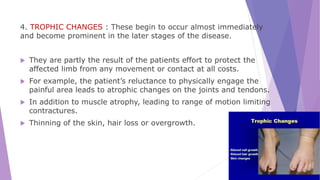
4. TROPHIC CHANGES : These begin to occur almost immediately
and become prominent in the later stages of the disease.
 They are partly the result of the patients effort to protect the
affected limb from any movement or contact at all costs.
 For example, the patient’s reluctance to physically engage the
painful area leads to atrophic changes on the joints and tendons.
 In addition to muscle atrophy, leading to range of motion limiting
contractures.
 Thinning of the skin, hair loss or overgrowth.
 CRPS in adults commonly involves upper limbs.
 Involvement of both upper and lower limbs in the same patient is
unusual.
 Symptoms may spread overtime to adjacent areas of the affected
limb or the ipsilateral/contralateral limb.
 The syndrome has a variable duration that can range from days to
months or may be permanent.
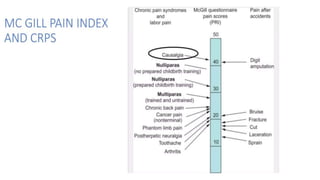
 Causalgia commonly affects the brachial plexus, particularly the
median nerve and the tibial division of the sciatic nerve of the lower
extremity.
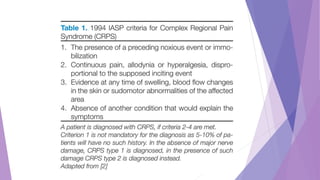
IASP revised criteria - “Budapest criteria”
 Continuing pain that is disproportionate to any inciting event.
At least 1 symptom reported in at least 3 of the following categories
or atleast 1 sign at the time of evaluation in atleast 2 of categories.
 Sensory: Hyperesthesia or allodynia.
 Vasomotor : Temperature asymmetry, skin colour changes, skin colour
asymmetry.
 Sudomotor : Edema, sweating changes.
 Motor/Trophic : Decreased range of motion, motor dysfunction (E.g.
weakness, tremor, dystonia) or trophic changes (e.g. hair, skin, nails)
PATHOPHYSIOLOGY
 The exact pathophysiology of CRPS is still unknown.
 Both the peripheral and central mechanisms are thought to play a
role in the initiation and maintenance of CRPS.
 There may be changes in the cutaneous innervation after a nerve
injury, along with changes in central and peripheral sensitization.
 Genetic, inflammatory, and psychological factors may all play
roles.
1. INFLAMMATION
 Inciting event - Trivial injury to the limb or injury to a peripheral
nerve.
 The 5 cardinal signs of inflammation such as pain, edema,
erythema, increased temperature and impaired function are often
present.
 Tissue trauma triggers the release of pro-inflammatory cytokines
such as IL-2, IL-6 and TNF-alpha along with neuropeptides
including CGRP, bradykinin and substance-P.
 These substances increase plasma extravasation and vasodilation,
producing the characteristic features of acute CRPS.
2. CENTRAL AND PERIPHERAL SENSITIZATION
 Within the central nervous system (CNS), persistent and intense
noxious stimulation of peripheral nociceptive neurons results in
central sensitisation.
 Accordingly, there is alteration in nociceptive processing in the
CNS and increased excitability of secondary central nociceptive
neurons in the spinal cord.
 This is mediated by the release of neuropeptides such as
substance P, bradykinin and glutamate by peripheral nerves,
which sensitise and increase the activity of local peripheral and
secondary central nociceptive neurons resulting in increased pain
from noxious stimuli (hyperalgesia) and pain in response to non-
noxious stimuli (allodynia).
3. ALTERED SYMPATHETIC NERVOUS SYSTEM
FUNCTION
 In the chronic (cold) phase of the clinical course of CRPS, the
CRPS-affected limb is cyanosed and clammy as a result of
vasoconstriction and sweating.
 This suggests that excessive sympathetic nervous system
outflow is a driving factor in progression of the condition and
maintenance of the pain.
 In patients with sympathetically mediated CRPS pain - where
high sympathetic nervous system activity increases
spontaneous pain by 22%.
4. CIRCULATING CATECHOLAMINES
 Variation in the clinical features of CRPS as the condition
progresses from the acute (warm) phase to the chronic (cold)
phase may be attributed to alterations in catecholaminergic
mechanisms.
 During the acute phase, the CRPS-affected limb demonstrates a
reduction in the levels of circulating plasma norepinephrine
compared to the unaffected limb.
 As a result, there is compensatory upregulation of peripheral
adrenergic receptors causing supersensitivity to circulating
catecholamines.
 Consequently, excessive vasoconstriction and sweating occurs
following exposure to catecholamines, giving rise to the
characteristic cold and blue extremity seen during the chronic
phase.
5. AUTOIMMUNITY
 The presence of immunoglobulin G (IgG) autoantibodies against
surface antigens on autonomic neurons in the serum of patients
with CRPS suggests that autoimmunity may play a role in the
development of this condition.
6. PSYCHOLOGICAL FACTORS
 Due to the prevalence of anxiety and depression in patients with
CRPS and the unusual nature of symptoms, psychological factors
have been hypothesised to play a role in the development or
propagation of CRPS.
STAGES
Clinical Features :
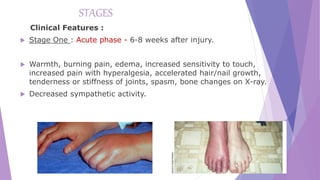
 Stage One : Acute phase - 6-8 weeks after injury.
 Warmth, burning pain, edema, increased sensitivity to touch,
increased pain with hyperalgesia, accelerated hair/nail growth,
tenderness or stiffness of joints, spasm, bone changes on X-ray.
 Decreased sympathetic activity.
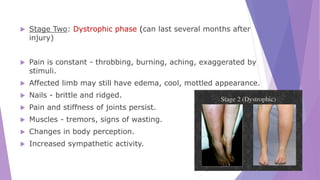
 Stage Two: Dystrophic phase (can last several months after
injury)
 Pain is constant - throbbing, burning, aching, exaggerated by
stimuli.
 Affected limb may still have edema, cool, mottled appearance.
 Nails - brittle and ridged.
 Pain and stiffness of joints persist.
 Muscles - tremors, signs of wasting.
 Changes in body perception.
 Increased sympathetic activity.
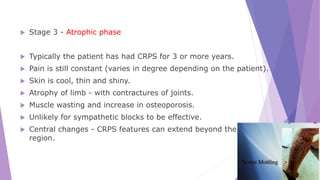
 Stage 3 - Atrophic phase
 Typically the patient has had CRPS for 3 or more years.
 Pain is still constant (varies in degree depending on the patient).
 Skin is cool, thin and shiny.
 Atrophy of limb - with contractures of joints.
 Muscle wasting and increase in osteoporosis.
 Unlikely for sympathetic blocks to be effective.
 Central changes - CRPS features can extend beyond the original
region.
INVESTIGATIONS
 There is no specific diagnostic test available for CRPS. Only the
main purpose is to exclude other diagnoses.
 Lab investigations such as CBP, ESR, CRP to exclude
infection/rheumatologic causes.
 Duplex Ultrasound: To exclude peripheral vascular disease.
 NCV studies : To exclude peripheral neuropathic disease.
 Imaging- may demonstrate osteoporosis in affected limb (but no
diagnostic value)
DIFFERENTIAL DIAGNOSIS
 Neuropathic pain syndrome
 Vascular diseases
 Inflammatory disorders
 Myofascial pain syndromes
 Psychiatric problems
PREVENTION
 As treatment options for CRPS are limited, prevention of the
disease would be the best medicine.
 Studies have shown supplementation with Vitamin. C
[>500mg/day] initiated immediately after injury or surgery and
continued for 45-50 days helped to reduce the risk of CRPS.
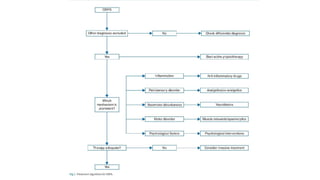
MANAGEMENT
 The focal point of management of CRPS is aggressive and frequent
physical therapy, designed to remobilize the affected extremity,
restore flexibility and strength, and to desensitize the skin.
 The mainstay of treatment has become tricyclic antidepressants,
gabapentin, and mexiletine, either singly or in combination.
 Cases refractory to oral pharmacologic therapy need more invasive
techniques designed to impart a sympathetic block.
Physical and occupational therapy
 It is the key component of the rehabilitation process in patients
with CRPS and is recommended as the first-line treatment.
 The aim of therapy is to overcome this fear of pain and enable the
patient to gain the best functional use of the limb.
 This includes elevation, massage, contrast baths, gentle range of
motion, isometric strengthening exercise and stress loading of the
affected limb along with provision of adequate analgesia.
 Occupational therapy encourages use of the affected limb in
activities of daily living.
Psychological therapy
 Chronic pain affects the health-related quality of life and places a
huge emotional and psychological burden on patients.
 Thus, it is essential for newly diagnosed patients with CRPS to
have a discussion regarding its progression as well as the need for
active self-management and participation.
 This can be followed up with cognitive behavioural therapy,
learning relaxation skills, facilitate rehabilitation, reduce pain
intensity.
 It is important to assess and treat patients for disorders such as
major depression, generalised anxiety disorder and post-traumatic
stress disorder.
Medical management
 Corticosteroids and non-steroidal anti-inflammatory drugs
(NSAIDs) reduce inflammation and have been used in the
treatment of CRPS.
 The use of anti-oxidants in the treatment of CRPS has been based
on that oxygen free radicals generated by the inflammatory
process may be a key component of the propagation of the disease
process.
 Topical preparations of anti-oxidants such as dimethyl sulfoxide
(DMSO) and N-acetylcysteine have shown success in providing
pain relief.
 Anti-convulsant drugs such as gabapentin have demonstrated
evidence of effectiveness in providing pain relief in acute and
chronic neuropathic are commonly used as part of the
pharmacological management of CRPS.
 The upregulation of inflammatory pathways in CRPS sensitises
excitatory nociceptive pathways that use Nmethyl-D-aspartic acid
(NMDA) as a neurotransmitter.
 The central sensitisation that occurs could potentially be
reversed with the use of the NMDA receptor antagonist ketamine,
which can be administered topically or intravenously.
 Placebo-controlled studies have shown both topical and
intravenous administration of ketamine to be effective. However,
side effects such as nausea, vomiting, headaches and
psychomimetic effects are highly prevalent, so these have
hindered the use of ketamine in CRPS.
 Clonidine, which is an alpha-2 adrenergic agonist, has been
reported to relieve localised hyperalgesia and provide extensive
analgesia in patients with sympathetically mediated pain.
 Calcium-channel blockade with nifedipine has been reported to be
effective in managing the vasoconstriction occurring in this phase of
CRPS.
 Additionally, the use of gamma aminobutyric acid-β (GABA) agonist
such as baclofen has also been effective in reducing dystonia and
pain while improving functionality and quality of life in patients with
chronic CRPS.
 As CRPS progresses, there is localised bone resorption and
remodelling, which can lead to nociceptive bone pain, osteopenia
and osteoporosis.
 Calcitonin preserves bone mass, has effects on microvasculature
and has anti-nociceptive effects, which have been found to be
effective in treating acute and chronic pain.
 Bisphosphonates inhibit osteoclasts, slowing down bone resorption
and increasing bone mineral density and are well-established to be
effective at providing pain relief.
ANAESTHESIA THERAPY
 An alternative approach studied involves the use of sympathetic
blockade, which has diagnostic and therapeutic benefits.
 Sympathetic blocks aim to alleviate the sympathetically
mediated pain and can be used in combination with botulinum
toxin to prolong the duration of analgesia.
 Recent evidence has shown sympathetic blockade to provide
substantial pain reduction as well as longer analgesic duration,
which enable patients to improve participation in functional
therapies.
 However, there remains a lack of definitive evidence regarding
the efficacy of sympathetic blockade overall, and this approach
has yet to be shown to be curative.
 Sympathetic blocks and intravenous regional sympatholytic
blockade are equally effective; these blocks should be continued
until either a cure is achieved or the therapeutic response
plateaus.
 The blocks facilitate physical therapy, which plays a central role
and typically consists of active movement without weights and
desensitization therapy.
 Many patients require a series of three to seven blocks.
 The likelihood of a cure is greater (>90%) if treatment is initiated
within 1 month of symptom onset and appears to decrease over
time with therapeutic delay.
 Some patients benefit from transcutaneous electrical nerve
stimulation (TENS) therapy.
 Spinal cord stimulation can be particularly effective in both acute and
chronic settings.
 In the acute phase of treatment, there is increasing interest in placing
tunneled epidural catheters for infusion therapy, or percutaneous
electrodes for extended trials of spinal cord stimulation, in order to
help patients tolerate physical therapy.
 Many patients benefit from surgical implantation of peripheral nerve
stimulators placed directly on larger injured nerves.
REFERENCES
 Paul Barash, 9th edition.
 British journal of Anaesthesia, 87(1).
 Morgan and Mikhail, 7th edition.
THANK YOU

COMPLEX REGIONAL PAIN SYNDROME [Autosaved].pptx

  • 1.
    COMPLEX REGIONAL PAIN SYNDROME Presenter: Dr. Sindhu, 1st year pg. Moderator : Dr. Neeraja mam, Assistant professor.
  • 2.
    HISTORY  During thecivil war in 1872, Weir Mitchell encountered soldiers who were injured by gun-shot wounds exhibiting "bizarre" symptoms.  Symptoms included constant pain and significant trophic changes - which spread beyond the innervation territory of the injured peripheral nerve. He described this syndrome and coined the term Causalgia.  He concluded that "in addition to disease of the nerve, some process in the skin or other peripheral tissue was responsible for the pain”.
  • 3.
     In early20th century Peter Sudeck described features of pain, swelling, atrophy following minor injury to limbs hence this phenomenon was called "Sudeck's atrophy”.  A few years later, on its association with the sympathetic nervous system was recognized and hence the term "reflex sympathetic dystrophy" was increasingly used.
  • 4.
    EPIDEMIOLOGY  Several populationstudies show that  Incidence of 26 in 1,00,000.  Female and Male ratio of 3.5:1, highest among post-menopausal women.  Peak incidence in the age group of 55-70 years.  Upper limb more commonly affected than the lower limb.  Fracture was the most common precipitating factor, followed by blunt trauma.  The incidence rate of CRPS I is more than CRPS II.
  • 5.
     Risk factorsfor this condition include menopause, individuals with a history of migraine, osteoporosis, asthma and angiotensin converting enzyme (ACE) inhibitor therapy and individuals with an elevated intra-cast pressure due to a tight case or extreme positions.  Furthermore, the prognosis of CRPS is poorer in smokers compared to non-smokers.
  • 6.
    INTRODUCTION  Complex regionalpain syndrome is a neuropathic pain disorder with significant autonomic features that is usually subdivided into two variants.  CRPS type 1 , formerly known as reflex sympathetic dystrophy.  CRPS type 2 , formerly known as causalgia.  The major difference between the two is the absence or presence, respectively of a documented nerve injury in addition to a spectrum of sensory, motor, autonomic, and trophic changes.  Signs, symptoms, pathophysiology and response to treatment are quite similar.
  • 7.
    CLINICAL SYMPTOMS ANDSIGNS 1. SENSORY DISTURBANCES : Persistent pain following injury, which is present long after the injury has apparently healed, is one of the hallmark signs of CRPS.  The reported pain is disproportionate in duration, severity, and distribution to what would be expected from the original injurious event.  The pain is spontaneous, constant, diffuse, burning, and deep.  It can be exacerbated by gentle touch, cold, heat, passive and active motion and emotion.  Sensory findings can include allodynia, dysesthesia, and hyperalgesia.
  • 8.
    2. MOTOR DISTURBANCES: The assessment of muscle strength may not be possible due to the patient discomfort encountered in examining the affected area.  The patient's reluctance to engage the area in active movement ultimately leads to muscle atrophy and weakness.  Tremors of the affected area may also be present.  Decrease in strength and range of motion in the affected extremity may be present.
  • 9.
    3. AUTONOMIC DISTURBANCES: Generalized swelling, hyperhidrosis, color changes, and temperature differences between the affected side and the normal side are commonly evident in the early stages of the disease.  The affected limb may be episodically warmer or colder than the contralateral limb, with associated changes in skin color.  This is due to abnormal vasomotor and sudomotor regulation of the affected limb by the autonomic nervous system.
  • 10.
    4. TROPHIC CHANGES: These begin to occur almost immediately and become prominent in the later stages of the disease.  They are partly the result of the patients effort to protect the affected limb from any movement or contact at all costs.  For example, the patient’s reluctance to physically engage the painful area leads to atrophic changes on the joints and tendons.  In addition to muscle atrophy, leading to range of motion limiting contractures.  Thinning of the skin, hair loss or overgrowth.
  • 11.
     CRPS inadults commonly involves upper limbs.  Involvement of both upper and lower limbs in the same patient is unusual.  Symptoms may spread overtime to adjacent areas of the affected limb or the ipsilateral/contralateral limb.
  • 12.
     The syndromehas a variable duration that can range from days to months or may be permanent.  Causalgia commonly affects the brachial plexus, particularly the median nerve and the tibial division of the sciatic nerve of the lower extremity.
  • 14.
    IASP revised criteria- “Budapest criteria”  Continuing pain that is disproportionate to any inciting event. At least 1 symptom reported in at least 3 of the following categories or atleast 1 sign at the time of evaluation in atleast 2 of categories.  Sensory: Hyperesthesia or allodynia.  Vasomotor : Temperature asymmetry, skin colour changes, skin colour asymmetry.  Sudomotor : Edema, sweating changes.  Motor/Trophic : Decreased range of motion, motor dysfunction (E.g. weakness, tremor, dystonia) or trophic changes (e.g. hair, skin, nails)
  • 16.
    PATHOPHYSIOLOGY  The exactpathophysiology of CRPS is still unknown.  Both the peripheral and central mechanisms are thought to play a role in the initiation and maintenance of CRPS.  There may be changes in the cutaneous innervation after a nerve injury, along with changes in central and peripheral sensitization.  Genetic, inflammatory, and psychological factors may all play roles.
  • 17.
    1. INFLAMMATION  Incitingevent - Trivial injury to the limb or injury to a peripheral nerve.  The 5 cardinal signs of inflammation such as pain, edema, erythema, increased temperature and impaired function are often present.  Tissue trauma triggers the release of pro-inflammatory cytokines such as IL-2, IL-6 and TNF-alpha along with neuropeptides including CGRP, bradykinin and substance-P.  These substances increase plasma extravasation and vasodilation, producing the characteristic features of acute CRPS.
  • 18.
    2. CENTRAL ANDPERIPHERAL SENSITIZATION  Within the central nervous system (CNS), persistent and intense noxious stimulation of peripheral nociceptive neurons results in central sensitisation.  Accordingly, there is alteration in nociceptive processing in the CNS and increased excitability of secondary central nociceptive neurons in the spinal cord.  This is mediated by the release of neuropeptides such as substance P, bradykinin and glutamate by peripheral nerves, which sensitise and increase the activity of local peripheral and secondary central nociceptive neurons resulting in increased pain from noxious stimuli (hyperalgesia) and pain in response to non- noxious stimuli (allodynia).
  • 19.
    3. ALTERED SYMPATHETICNERVOUS SYSTEM FUNCTION  In the chronic (cold) phase of the clinical course of CRPS, the CRPS-affected limb is cyanosed and clammy as a result of vasoconstriction and sweating.  This suggests that excessive sympathetic nervous system outflow is a driving factor in progression of the condition and maintenance of the pain.  In patients with sympathetically mediated CRPS pain - where high sympathetic nervous system activity increases spontaneous pain by 22%.
  • 20.
    4. CIRCULATING CATECHOLAMINES Variation in the clinical features of CRPS as the condition progresses from the acute (warm) phase to the chronic (cold) phase may be attributed to alterations in catecholaminergic mechanisms.  During the acute phase, the CRPS-affected limb demonstrates a reduction in the levels of circulating plasma norepinephrine compared to the unaffected limb.  As a result, there is compensatory upregulation of peripheral adrenergic receptors causing supersensitivity to circulating catecholamines.  Consequently, excessive vasoconstriction and sweating occurs following exposure to catecholamines, giving rise to the characteristic cold and blue extremity seen during the chronic phase.
  • 21.
    5. AUTOIMMUNITY  Thepresence of immunoglobulin G (IgG) autoantibodies against surface antigens on autonomic neurons in the serum of patients with CRPS suggests that autoimmunity may play a role in the development of this condition.
  • 22.
    6. PSYCHOLOGICAL FACTORS Due to the prevalence of anxiety and depression in patients with CRPS and the unusual nature of symptoms, psychological factors have been hypothesised to play a role in the development or propagation of CRPS.
  • 23.
    STAGES Clinical Features : Stage One : Acute phase - 6-8 weeks after injury.  Warmth, burning pain, edema, increased sensitivity to touch, increased pain with hyperalgesia, accelerated hair/nail growth, tenderness or stiffness of joints, spasm, bone changes on X-ray.  Decreased sympathetic activity.
  • 24.
     Stage Two:Dystrophic phase (can last several months after injury)  Pain is constant - throbbing, burning, aching, exaggerated by stimuli.  Affected limb may still have edema, cool, mottled appearance.  Nails - brittle and ridged.  Pain and stiffness of joints persist.  Muscles - tremors, signs of wasting.  Changes in body perception.  Increased sympathetic activity.
  • 25.
     Stage 3- Atrophic phase  Typically the patient has had CRPS for 3 or more years.  Pain is still constant (varies in degree depending on the patient).  Skin is cool, thin and shiny.  Atrophy of limb - with contractures of joints.  Muscle wasting and increase in osteoporosis.  Unlikely for sympathetic blocks to be effective.  Central changes - CRPS features can extend beyond the original region.
  • 26.
    INVESTIGATIONS  There isno specific diagnostic test available for CRPS. Only the main purpose is to exclude other diagnoses.  Lab investigations such as CBP, ESR, CRP to exclude infection/rheumatologic causes.  Duplex Ultrasound: To exclude peripheral vascular disease.  NCV studies : To exclude peripheral neuropathic disease.  Imaging- may demonstrate osteoporosis in affected limb (but no diagnostic value)
  • 27.
    DIFFERENTIAL DIAGNOSIS  Neuropathicpain syndrome  Vascular diseases  Inflammatory disorders  Myofascial pain syndromes  Psychiatric problems
  • 28.
    PREVENTION  As treatmentoptions for CRPS are limited, prevention of the disease would be the best medicine.  Studies have shown supplementation with Vitamin. C [>500mg/day] initiated immediately after injury or surgery and continued for 45-50 days helped to reduce the risk of CRPS.
  • 29.
    MANAGEMENT  The focalpoint of management of CRPS is aggressive and frequent physical therapy, designed to remobilize the affected extremity, restore flexibility and strength, and to desensitize the skin.  The mainstay of treatment has become tricyclic antidepressants, gabapentin, and mexiletine, either singly or in combination.  Cases refractory to oral pharmacologic therapy need more invasive techniques designed to impart a sympathetic block.
  • 31.
    Physical and occupationaltherapy  It is the key component of the rehabilitation process in patients with CRPS and is recommended as the first-line treatment.  The aim of therapy is to overcome this fear of pain and enable the patient to gain the best functional use of the limb.  This includes elevation, massage, contrast baths, gentle range of motion, isometric strengthening exercise and stress loading of the affected limb along with provision of adequate analgesia.  Occupational therapy encourages use of the affected limb in activities of daily living.
  • 32.
    Psychological therapy  Chronicpain affects the health-related quality of life and places a huge emotional and psychological burden on patients.  Thus, it is essential for newly diagnosed patients with CRPS to have a discussion regarding its progression as well as the need for active self-management and participation.  This can be followed up with cognitive behavioural therapy, learning relaxation skills, facilitate rehabilitation, reduce pain intensity.  It is important to assess and treat patients for disorders such as major depression, generalised anxiety disorder and post-traumatic stress disorder.
  • 33.
    Medical management  Corticosteroidsand non-steroidal anti-inflammatory drugs (NSAIDs) reduce inflammation and have been used in the treatment of CRPS.  The use of anti-oxidants in the treatment of CRPS has been based on that oxygen free radicals generated by the inflammatory process may be a key component of the propagation of the disease process.  Topical preparations of anti-oxidants such as dimethyl sulfoxide (DMSO) and N-acetylcysteine have shown success in providing pain relief.  Anti-convulsant drugs such as gabapentin have demonstrated evidence of effectiveness in providing pain relief in acute and chronic neuropathic are commonly used as part of the pharmacological management of CRPS.
  • 34.
     The upregulationof inflammatory pathways in CRPS sensitises excitatory nociceptive pathways that use Nmethyl-D-aspartic acid (NMDA) as a neurotransmitter.  The central sensitisation that occurs could potentially be reversed with the use of the NMDA receptor antagonist ketamine, which can be administered topically or intravenously.  Placebo-controlled studies have shown both topical and intravenous administration of ketamine to be effective. However, side effects such as nausea, vomiting, headaches and psychomimetic effects are highly prevalent, so these have hindered the use of ketamine in CRPS.
  • 35.
     Clonidine, whichis an alpha-2 adrenergic agonist, has been reported to relieve localised hyperalgesia and provide extensive analgesia in patients with sympathetically mediated pain.  Calcium-channel blockade with nifedipine has been reported to be effective in managing the vasoconstriction occurring in this phase of CRPS.  Additionally, the use of gamma aminobutyric acid-β (GABA) agonist such as baclofen has also been effective in reducing dystonia and pain while improving functionality and quality of life in patients with chronic CRPS.
  • 36.
     As CRPSprogresses, there is localised bone resorption and remodelling, which can lead to nociceptive bone pain, osteopenia and osteoporosis.  Calcitonin preserves bone mass, has effects on microvasculature and has anti-nociceptive effects, which have been found to be effective in treating acute and chronic pain.  Bisphosphonates inhibit osteoclasts, slowing down bone resorption and increasing bone mineral density and are well-established to be effective at providing pain relief.
  • 37.
    ANAESTHESIA THERAPY  Analternative approach studied involves the use of sympathetic blockade, which has diagnostic and therapeutic benefits.  Sympathetic blocks aim to alleviate the sympathetically mediated pain and can be used in combination with botulinum toxin to prolong the duration of analgesia.  Recent evidence has shown sympathetic blockade to provide substantial pain reduction as well as longer analgesic duration, which enable patients to improve participation in functional therapies.  However, there remains a lack of definitive evidence regarding the efficacy of sympathetic blockade overall, and this approach has yet to be shown to be curative.
  • 38.
     Sympathetic blocksand intravenous regional sympatholytic blockade are equally effective; these blocks should be continued until either a cure is achieved or the therapeutic response plateaus.  The blocks facilitate physical therapy, which plays a central role and typically consists of active movement without weights and desensitization therapy.  Many patients require a series of three to seven blocks.  The likelihood of a cure is greater (>90%) if treatment is initiated within 1 month of symptom onset and appears to decrease over time with therapeutic delay.
  • 39.
     Some patientsbenefit from transcutaneous electrical nerve stimulation (TENS) therapy.  Spinal cord stimulation can be particularly effective in both acute and chronic settings.  In the acute phase of treatment, there is increasing interest in placing tunneled epidural catheters for infusion therapy, or percutaneous electrodes for extended trials of spinal cord stimulation, in order to help patients tolerate physical therapy.  Many patients benefit from surgical implantation of peripheral nerve stimulators placed directly on larger injured nerves.
  • 40.
    REFERENCES  Paul Barash,9th edition.  British journal of Anaesthesia, 87(1).  Morgan and Mikhail, 7th edition.
  • 41.