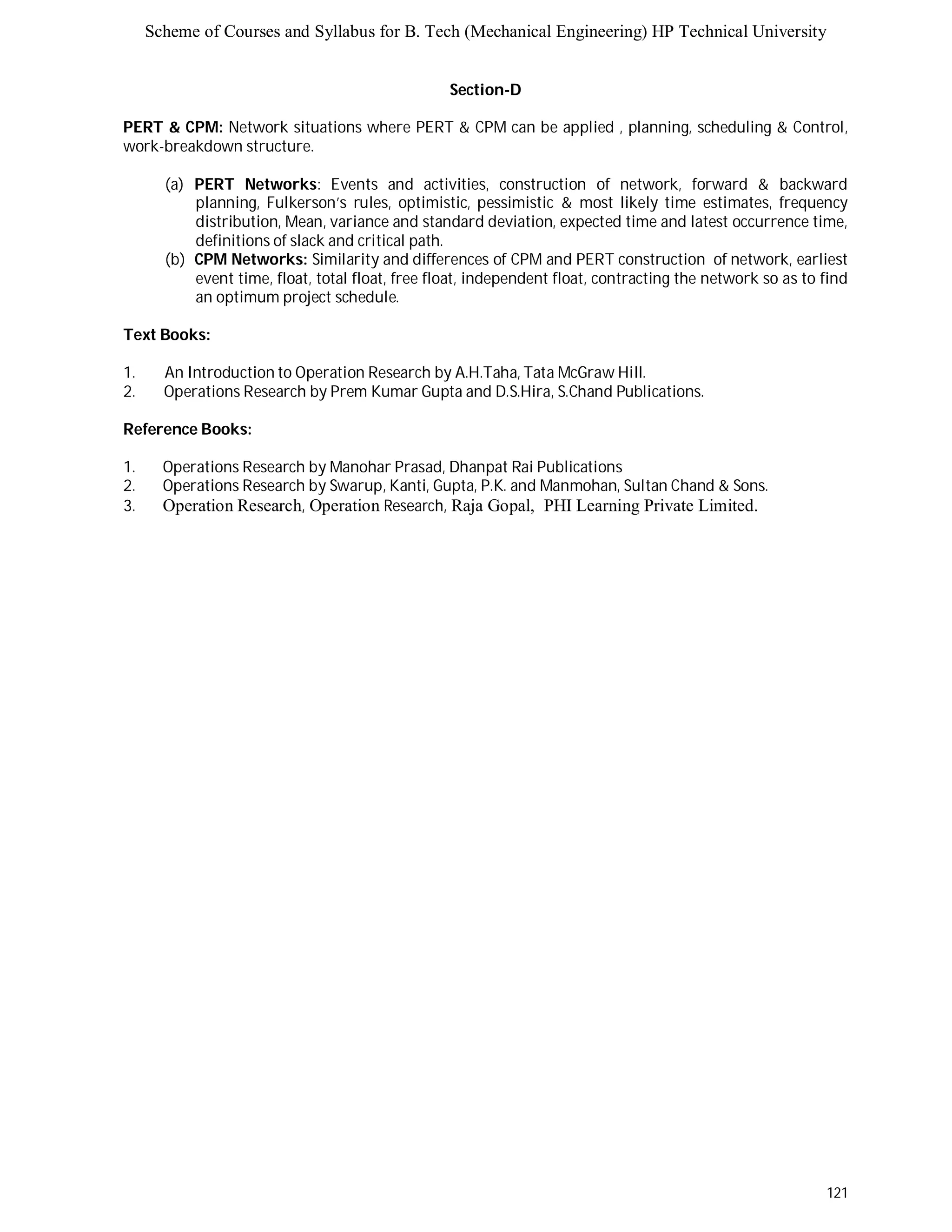
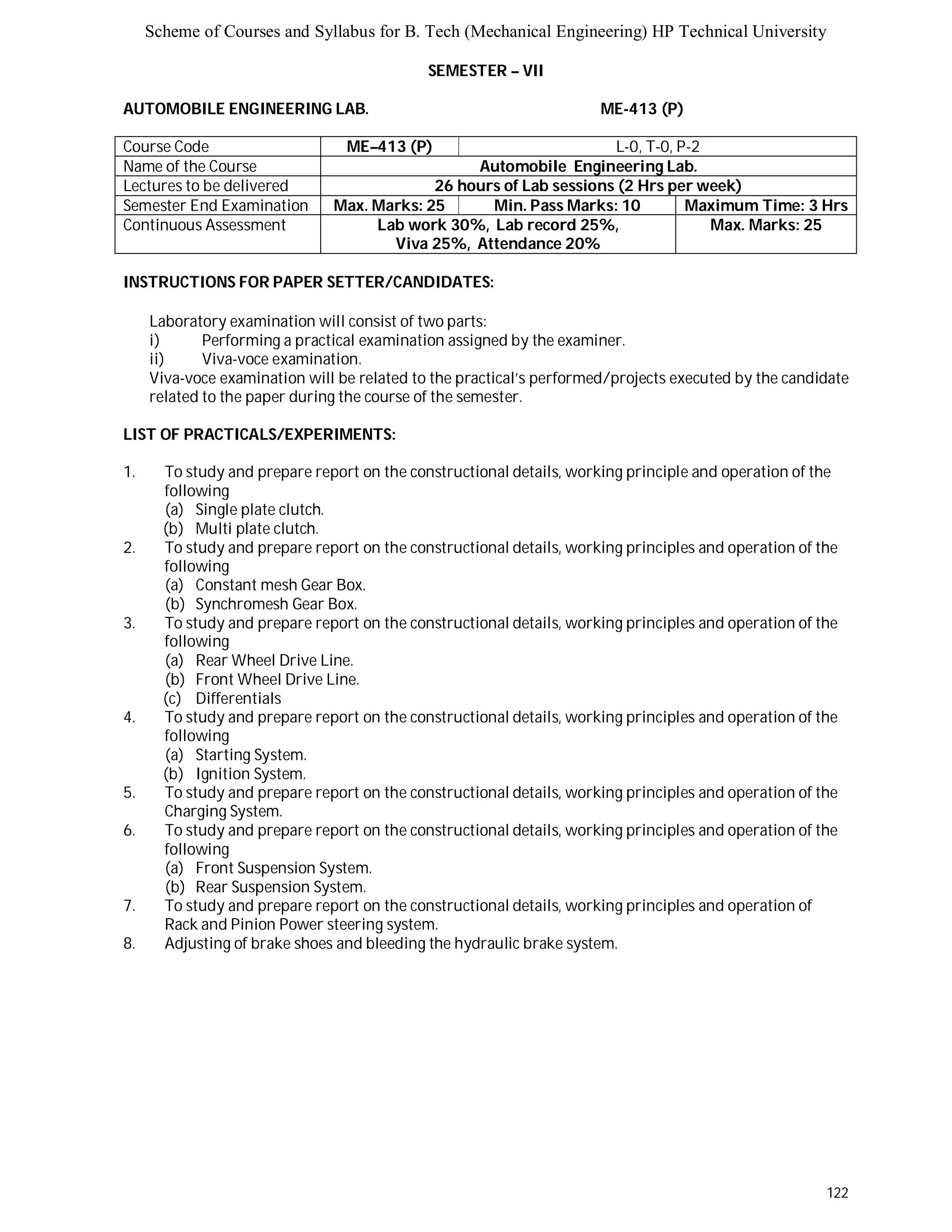
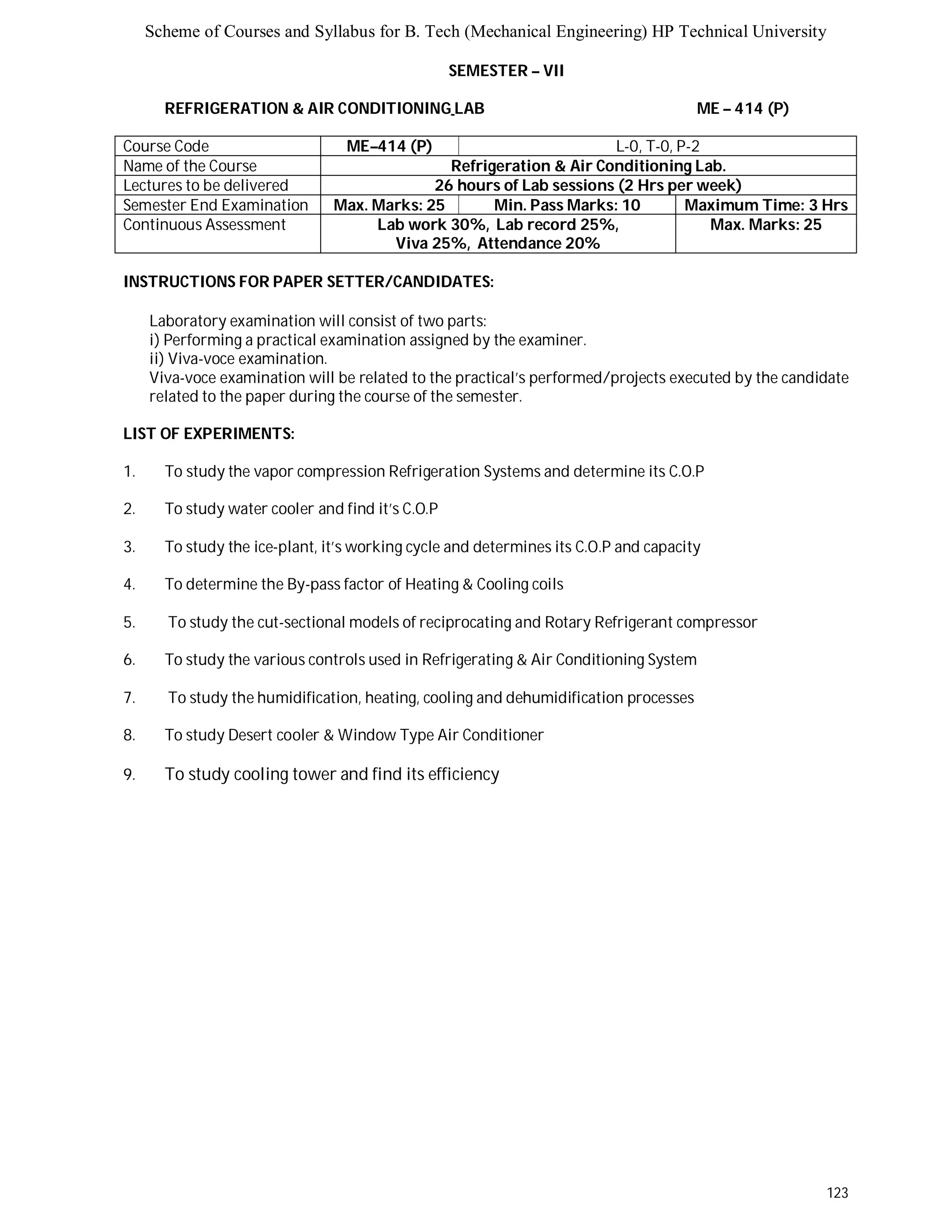
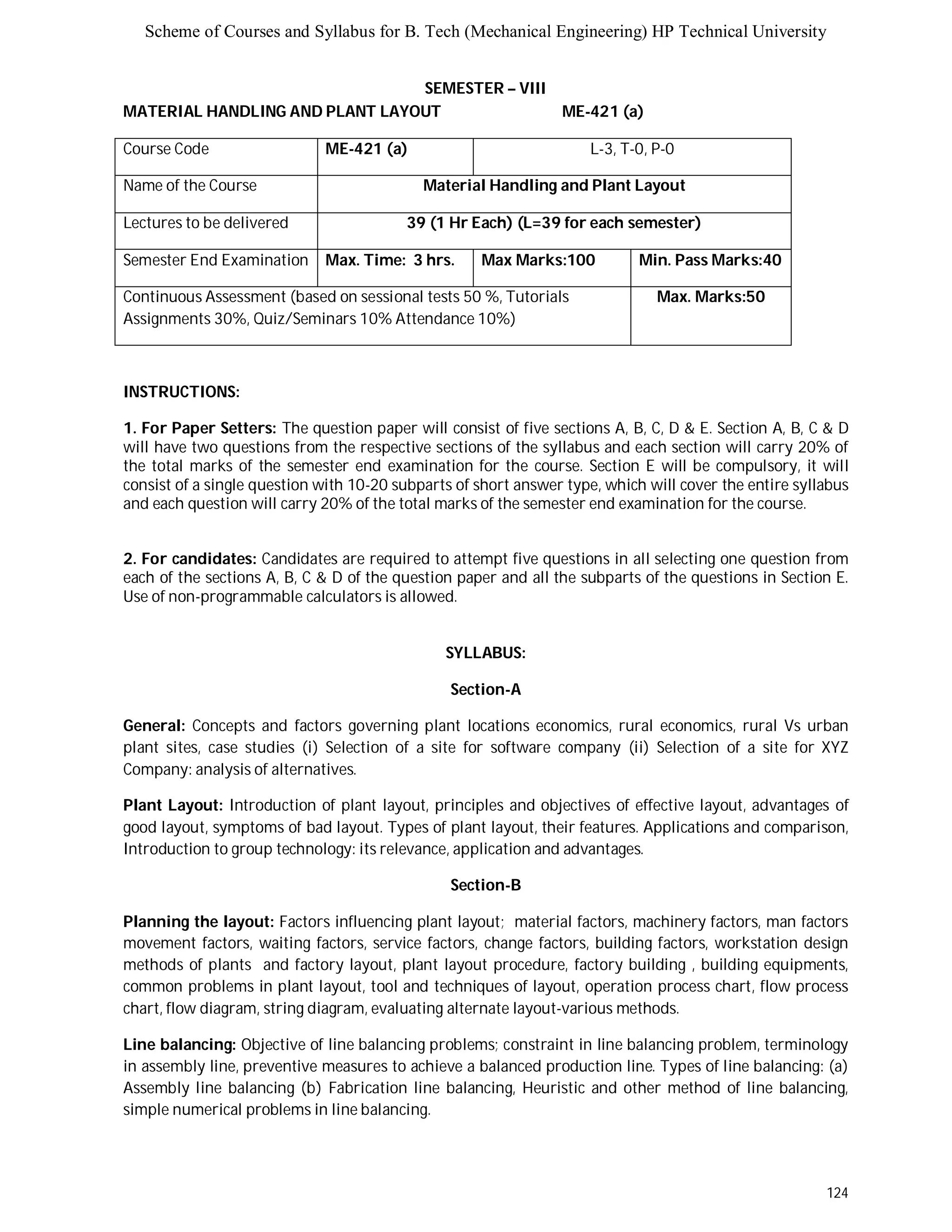
H.P. TECHNICAL UNIVERSITY 
HAMIRPUR (H.P.) 
Syllabus 
[Effective from the Session: 2012-13] 
B. Tech. (Mechanical Engineering)
Scheme of Courses and Syllabus for B. Tech (Mechanical Engineering) HP Technical University 
1 
B. Tech. (Mechanical Engineering) 
Group B 
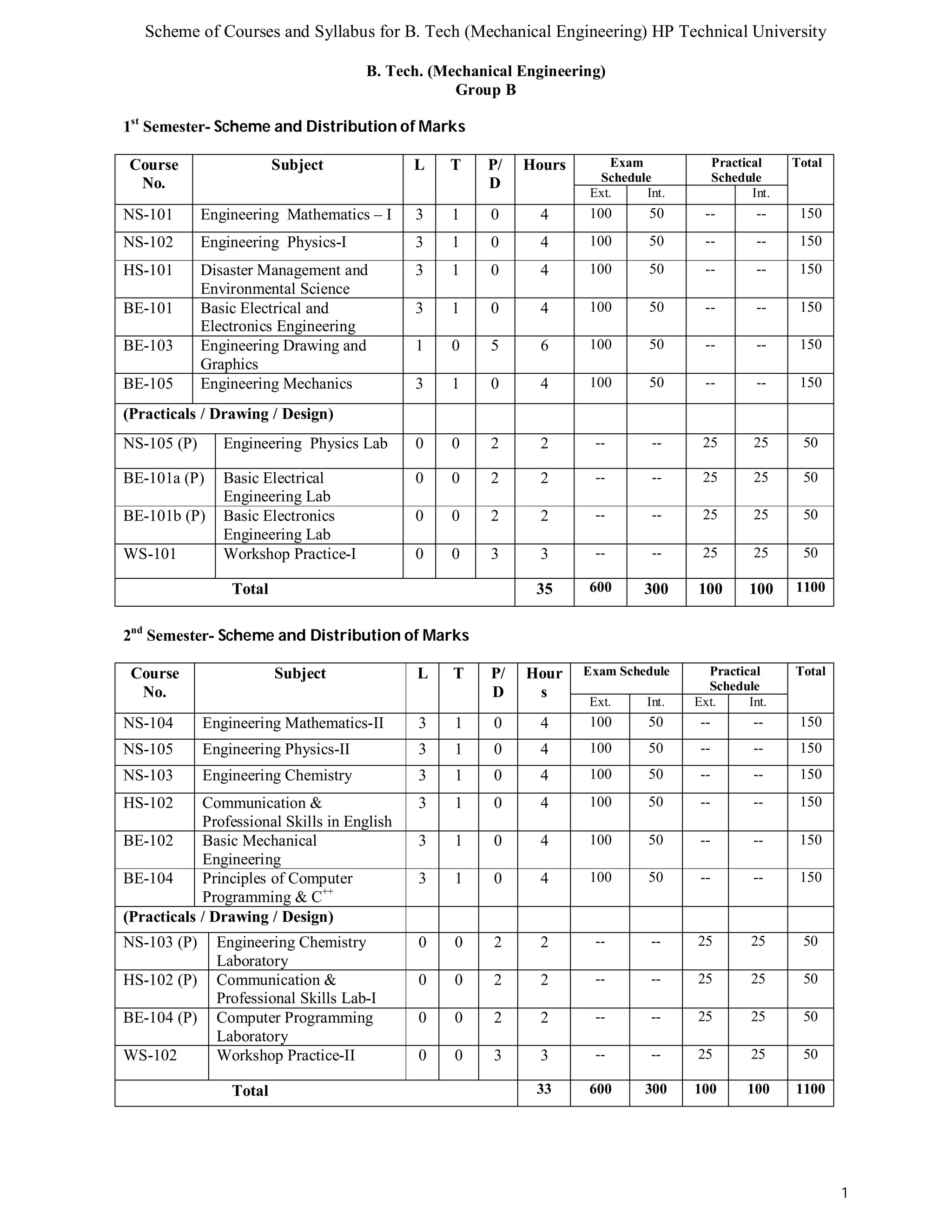
1st Semester- Scheme and Distribution of Marks 
Course 
No. 
Subject L T P/ 
D 
Hours Exam 
Schedule 
Practical 
Schedule 
Total 
Ext. Int. Int. 
NS-101 Engineering Mathematics – I 3 1 0 4 100 50 -- -- 150 
NS-102 Engineering Physics-I 3 1 0 4 100 50 -- -- 150 
HS-101 Disaster Management and 
Environmental Science 
3 1 0 4 100 50 -- -- 150 
BE-101 Basic Electrical and 
Electronics Engineering 
3 1 0 4 100 50 -- -- 150 
BE-103 Engineering Drawing and 
Graphics 
1 0 5 6 100 50 -- -- 150 
BE-105 Engineering Mechanics 3 1 0 4 100 50 -- -- 150 
(Practicals / Drawing / Design) 
NS-105 (P) Engineering Physics Lab 0 0 2 2 -- -- 25 25 50 
BE-101a (P) Basic Electrical 
Engineering Lab 
0 0 2 2 -- -- 25 25 50 
BE-101b (P) Basic Electronics 
Engineering Lab 
0 0 2 2 -- -- 25 25 50 
WS-101 Workshop Practice-I 0 0 3 3 -- -- 25 25 50 
Total 35 600 300 100 100 1100 
2nd Semester- Scheme and Distribution of Marks 
Course 
No. 
Subject L T P/ 
D 
Hour 
s 
Exam Schedule Practical 
Schedule 
Total 
Ext. Int. Ext. Int. 
NS-104 Engineering Mathematics-II 3 1 0 4 100 50 -- -- 150 
NS-105 Engineering Physics-II 3 1 0 4 100 50 -- -- 150 
NS-103 Engineering Chemistry 3 1 0 4 100 50 -- -- 150 
HS-102 Communication & 
Professional Skills in English 
3 1 0 4 100 50 -- -- 150 
BE-102 Basic Mechanical 
Engineering 
3 1 0 4 100 50 -- -- 150 
BE-104 Principles of Computer 
Programming & C++ 
3 1 0 4 100 50 -- -- 150 
(Practicals / Drawing / Design) 
NS-103 (P) Engineering Chemistry 
Laboratory 
0 0 2 2 -- -- 25 25 50 
HS-102 (P) Communication & 
Professional Skills Lab-I 
0 0 2 2 -- -- 25 25 50 
BE-104 (P) Computer Programming 
Laboratory 
0 0 2 2 -- -- 25 25 50 
WS-102 Workshop Practice-II 0 0 3 3 -- -- 25 25 50 
Total 33 600 300 100 100 1100
Scheme of Courses and Syllabus for B. Tech (Mechanical Engineering) HP Technical University 
2 
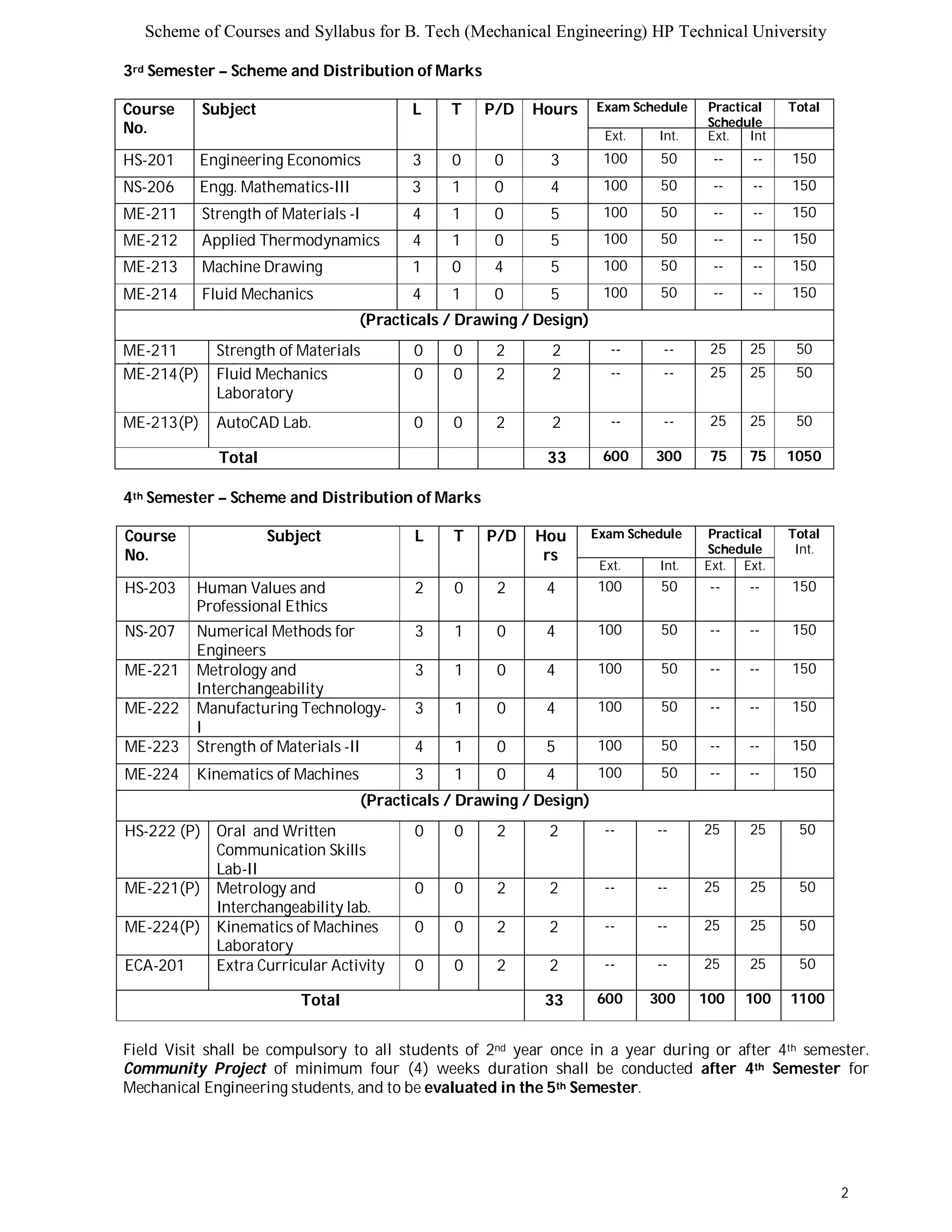
3rd Semester – Scheme and Distribution of Marks 
Course 
No. 
Subject L T P/D Hours Exam Schedule Practical 
Schedule 
Total 
Ext. Int. Ext. Int 
. 
HS-201 Engineering Economics 3 0 0 3 100 50 -- -- 150 
NS-206 Engg. Mathematics-III 3 1 0 4 100 50 -- -- 150 
ME-211 Strength of Materials -I 4 1 0 5 100 50 -- -- 150 
ME-212 Applied Thermodynamics 4 1 0 5 100 50 -- -- 150 
ME-213 Machine Drawing 1 0 4 5 100 50 -- -- 150 
ME-214 Fluid Mechanics 4 1 0 5 100 50 -- -- 150 
(Practicals / Drawing / Design) 
ME-211 
(P) 
Strength of Materials 
Laboratory 
0 0 2 2 -- -- 25 25 50 
ME-214(P) Fluid Mechanics 
Laboratory 
0 0 2 2 -- -- 25 25 50 
ME-213(P) AutoCAD Lab. 0 0 2 2 -- -- 25 25 50 
Total 33 600 300 75 75 1050 
4th Semester – Scheme and Distribution of Marks 
Course 
No. 
Subject L T P/D Hou 
rs 
Exam Schedule Practical 
Schedule 
Total 
Int. 
Ext. Int. Ext. Ext. 
HS-203 Human Values and 
Professional Ethics 
2 0 2 4 100 50 -- -- 150 
NS-207 Numerical Methods for 
Engineers 
3 1 0 4 100 50 -- -- 150 
ME-221 Metrology and 
Interchangeability 
3 1 0 4 100 50 -- -- 150 
ME-222 Manufacturing Technology- 
I 
3 1 0 4 100 50 -- -- 150 
ME-223 Strength of Materials -II 4 1 0 5 100 50 -- -- 150 
ME-224 Kinematics of Machines 3 1 0 4 100 50 -- -- 150 
(Practicals / Drawing / Design) 
HS-222 (P) Oral and Written 
Communication Skills 
Lab-II 
0 0 2 2 -- -- 25 25 50 
ME-221(P) Metrology and 
Interchangeability lab. 
0 0 2 2 -- -- 25 25 50 
ME-224(P) Kinematics of Machines 
Laboratory 
0 0 2 2 -- -- 25 25 50 
ECA-201 Extra Curricular Activity 0 0 2 2 -- -- 25 25 50 
Total 33 600 300 100 100 1100 
Field Visit shall be compulsory to all students of 2nd year once in a year during or after 4th semester. 
Community Project of minimum four (4) weeks duration shall be conducted after 4th Semester for 
Mechanical Engineering students, and to be evaluated in the 5th Semester.
Scheme of Courses and Syllabus for B. Tech (Mechanical Engineering) HP Technical University 
3 
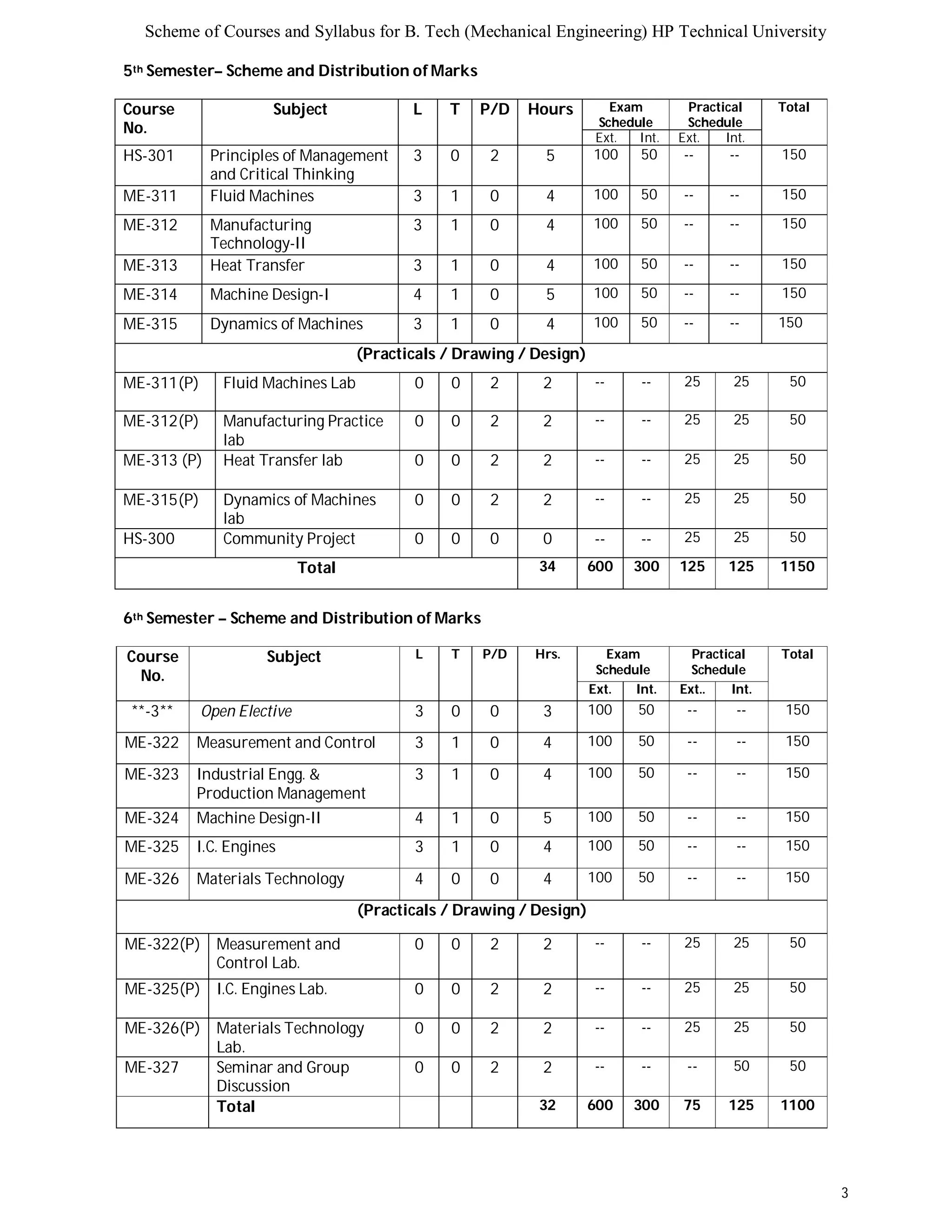
5th Semester– Scheme and Distribution of Marks 
Course 
No. 
Subject L T P/D Hours Exam 
Schedule 
Practical 
Schedule 
Total 
Ext. Int. Ext. Int. 
HS-301 Principles of Management 
and Critical Thinking 
3 0 2 5 100 50 -- -- 150 
ME-311 Fluid Machines 3 1 0 4 100 50 -- -- 150 
ME-312 Manufacturing 
Technology-II 
3 1 0 4 100 50 -- -- 150 
ME-313 Heat Transfer 3 1 0 4 100 50 -- -- 150 
ME-314 Machine Design-I 4 1 0 5 100 50 -- -- 150 
ME-315 Dynamics of Machines 3 1 0 4 100 50 -- -- 150 
(Practicals / Drawing / Design) 
ME-311(P) Fluid Machines Lab 0 0 2 2 -- -- 25 25 50 
ME-312(P) Manufacturing Practice 
lab 
0 0 2 2 -- -- 25 25 50 
ME-313 (P) Heat Transfer lab 0 0 2 2 -- -- 25 25 50 
ME-315(P) Dynamics of Machines 
lab 
0 0 2 2 -- -- 25 25 50 
HS-300 Community Project 0 0 0 0 -- -- 25 25 50 
Total 34 600 300 125 125 1150 
6th Semester – Scheme and Distribution of Marks 
Course 
No. 
Subject L T P/D Hrs. Exam 
Schedule 
Practical 
Schedule 
Total 
Ext. 
Int. Ext.. Int. 
**-3** Open Elective 3 0 0 3 100 50 -- -- 150 
ME-322 Measurement and Control 3 1 0 4 100 50 -- -- 150 
ME-323 Industrial Engg. & 
Production Management 
3 1 0 4 100 50 -- -- 150 
ME-324 Machine Design-II 4 1 0 5 100 50 -- -- 150 
ME-325 I.C. Engines 3 1 0 4 100 50 -- -- 150 
ME-326 Materials Technology 4 0 0 4 100 50 -- -- 150 
(Practicals / Drawing / Design) 
ME-322(P) Measurement and 
Control Lab. 
0 0 2 2 -- -- 25 25 50 
ME-325(P) I.C. Engines Lab. 0 0 2 2 -- -- 25 25 50 
ME-326(P) Materials Technology 
Lab. 
0 0 2 2 -- -- 25 25 50 
ME-327 Seminar and Group 
Discussion 
0 0 2 2 -- -- -- 50 50 
Total 32 600 300 75 125 1100
Scheme of Courses and Syllabus for B. Tech (Mechanical Engineering) HP Technical University 
4 
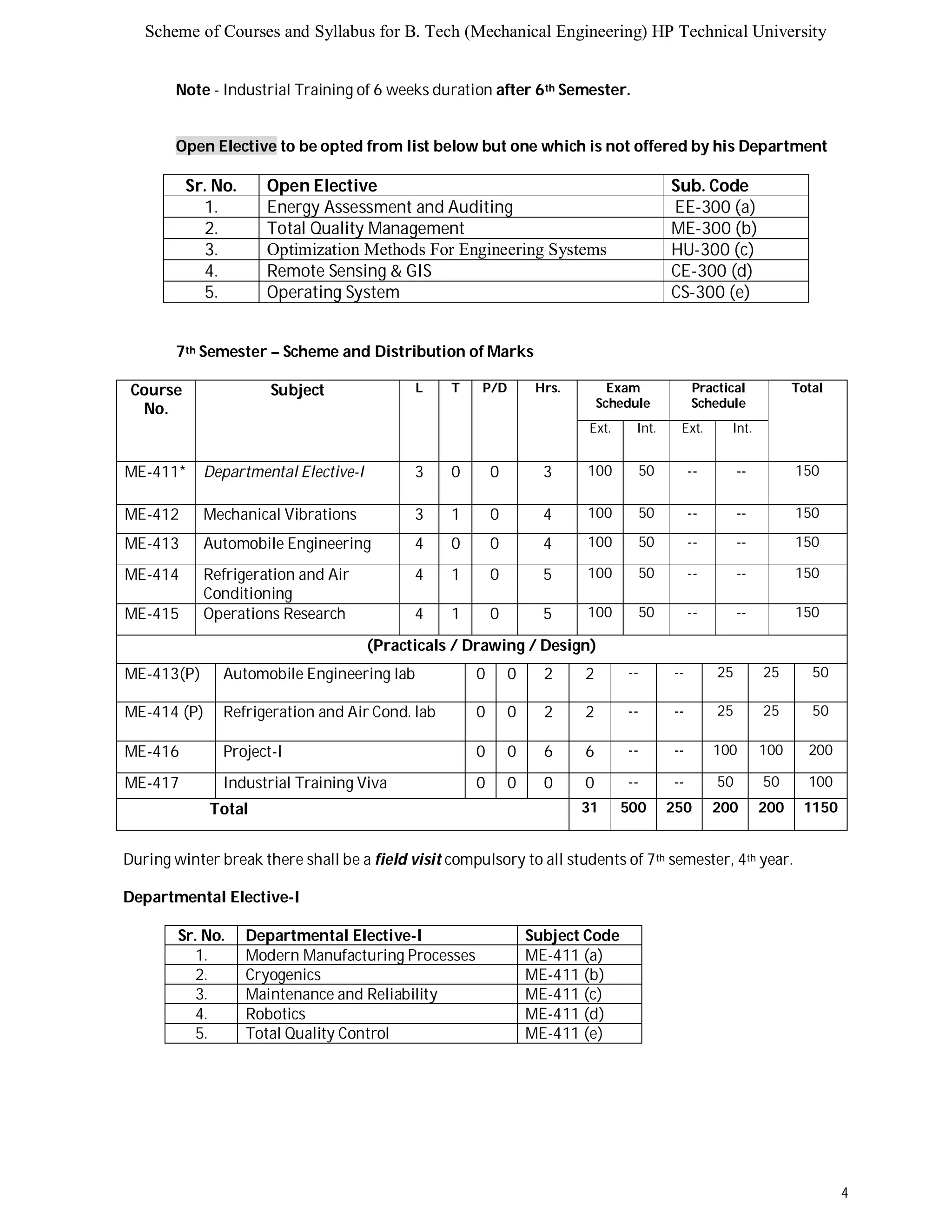
Note - Industrial Training of 6 weeks duration after 6th Semester. 
Open Elective to be opted from list below but one which is not offered by his Department 
Sr. No. Open Elective Sub. Code 
1. Energy Assessment and Auditing EE-300 (a) 
2. Total Quality Management ME-300 (b) 
3. Optimization Methods For Engineering Systems HU-300 (c) 
4. Remote Sensing & GIS CE-300 (d) 
5. Operating System CS-300 (e) 
7th Semester – Scheme and Distribution of Marks 
Course 
No. 
Subject L T P/D Hrs. 
Exam 
Schedule 
Practical 
Schedule 
Total 
Ext. Int. Ext. Int. 
ME-411* Departmental Elective-I 3 0 0 3 100 50 -- -- 150 
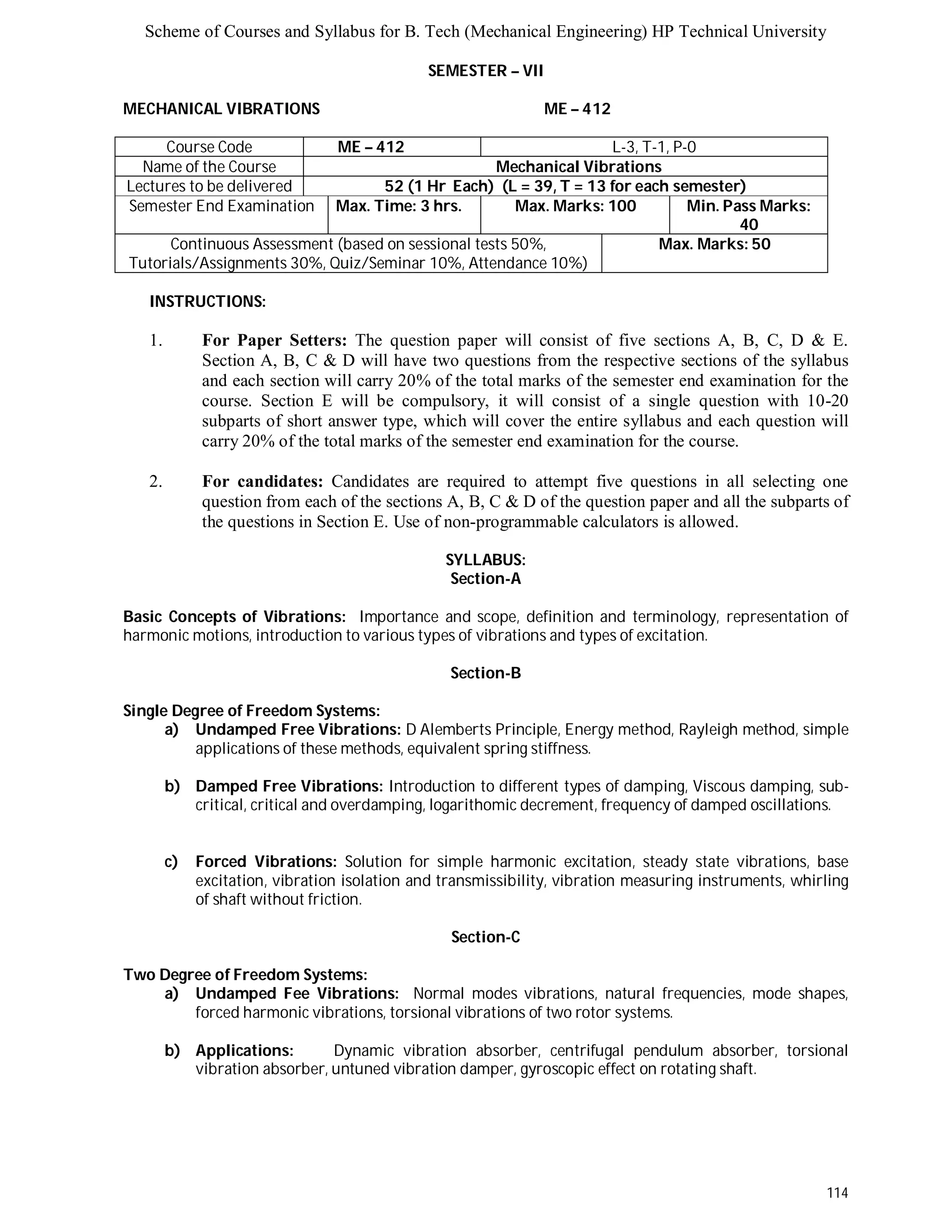
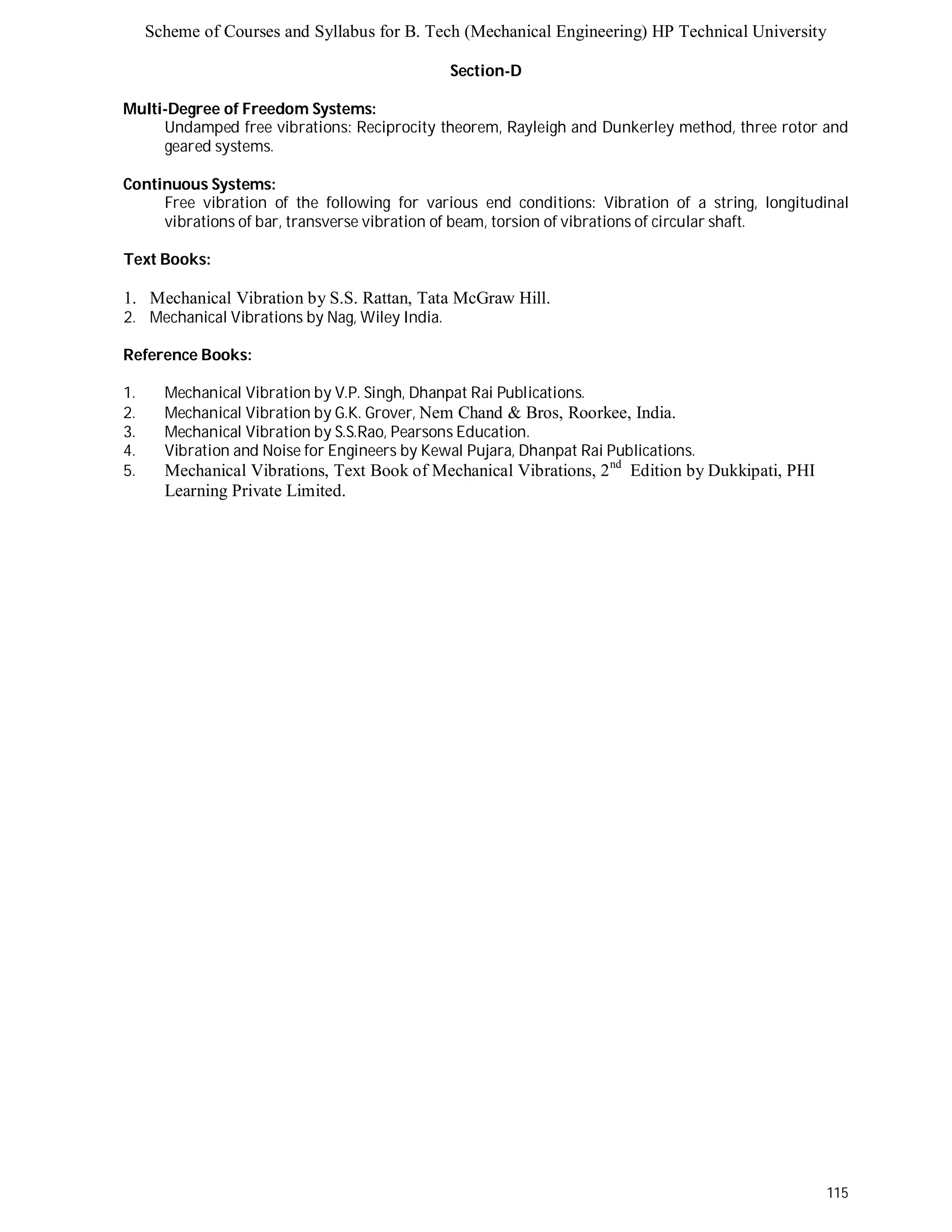
ME-412 Mechanical Vibrations 3 1 0 4 100 50 -- -- 150 
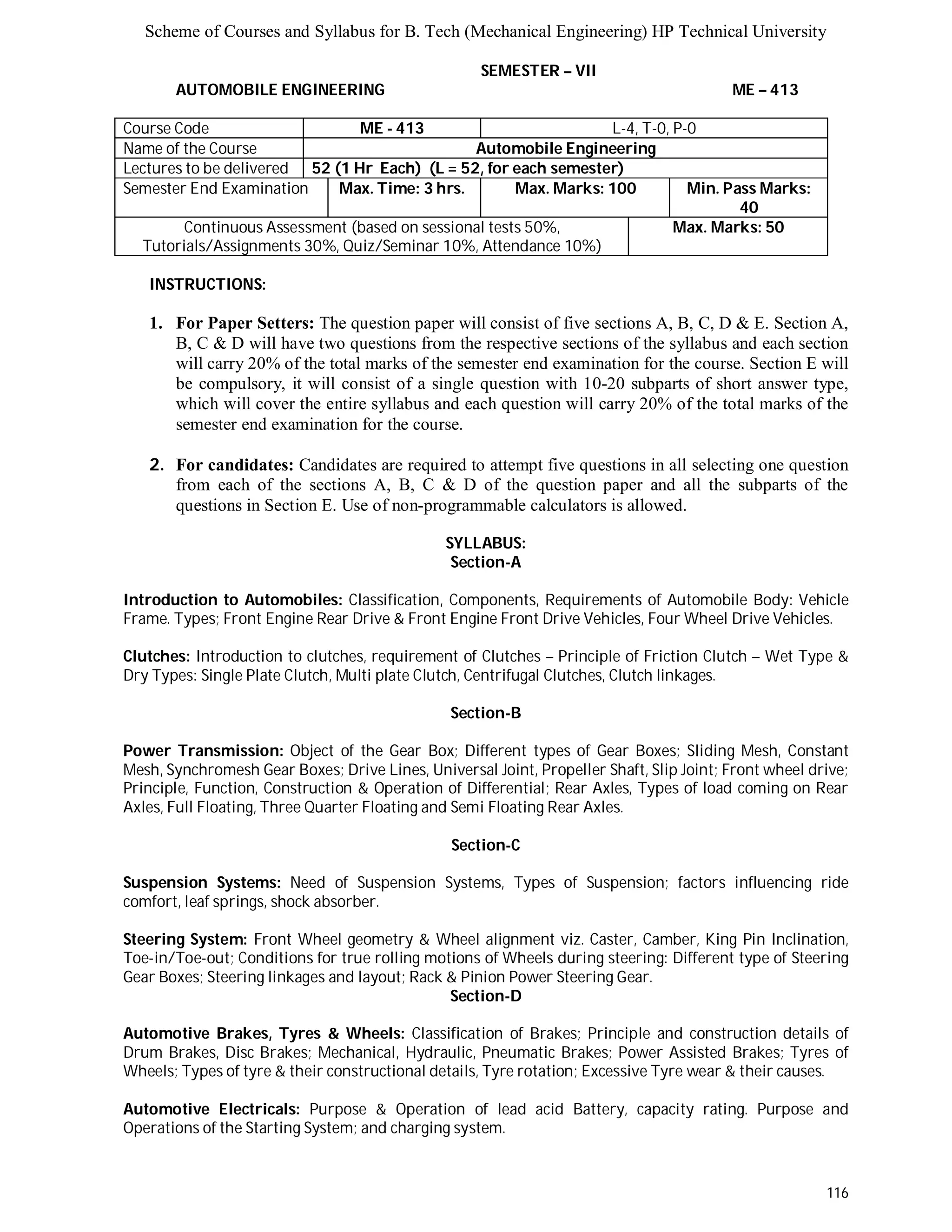
ME-413 Automobile Engineering 4 0 0 4 100 50 -- -- 150 
ME-414 Refrigeration and Air 
Conditioning 
4 1 0 5 100 50 -- -- 150 
ME-415 Operations Research 4 1 0 5 100 50 -- -- 150 
(Practicals / Drawing / Design) 
ME-413(P) Automobile Engineering lab 0 0 2 2 -- -- 25 25 50 
ME-414 (P) Refrigeration and Air Cond. lab 0 0 2 2 -- -- 25 25 50 
ME-416 Project-I 0 0 6 6 -- -- 100 100 200 
ME-417 Industrial Training Viva 0 0 0 0 -- -- 50 50 100 
Total 31 500 250 200 200 1150 
During winter break there shall be a field visit compulsory to all students of 7th semester, 4th year. 
Departmental Elective-I 
Sr. No. Departmental Elective-I Subject Code 
1. Modern Manufacturing Processes ME-411 (a) 
2. Cryogenics ME-411 (b) 
3. Maintenance and Reliability ME-411 (c) 
4. Robotics ME-411 (d) 
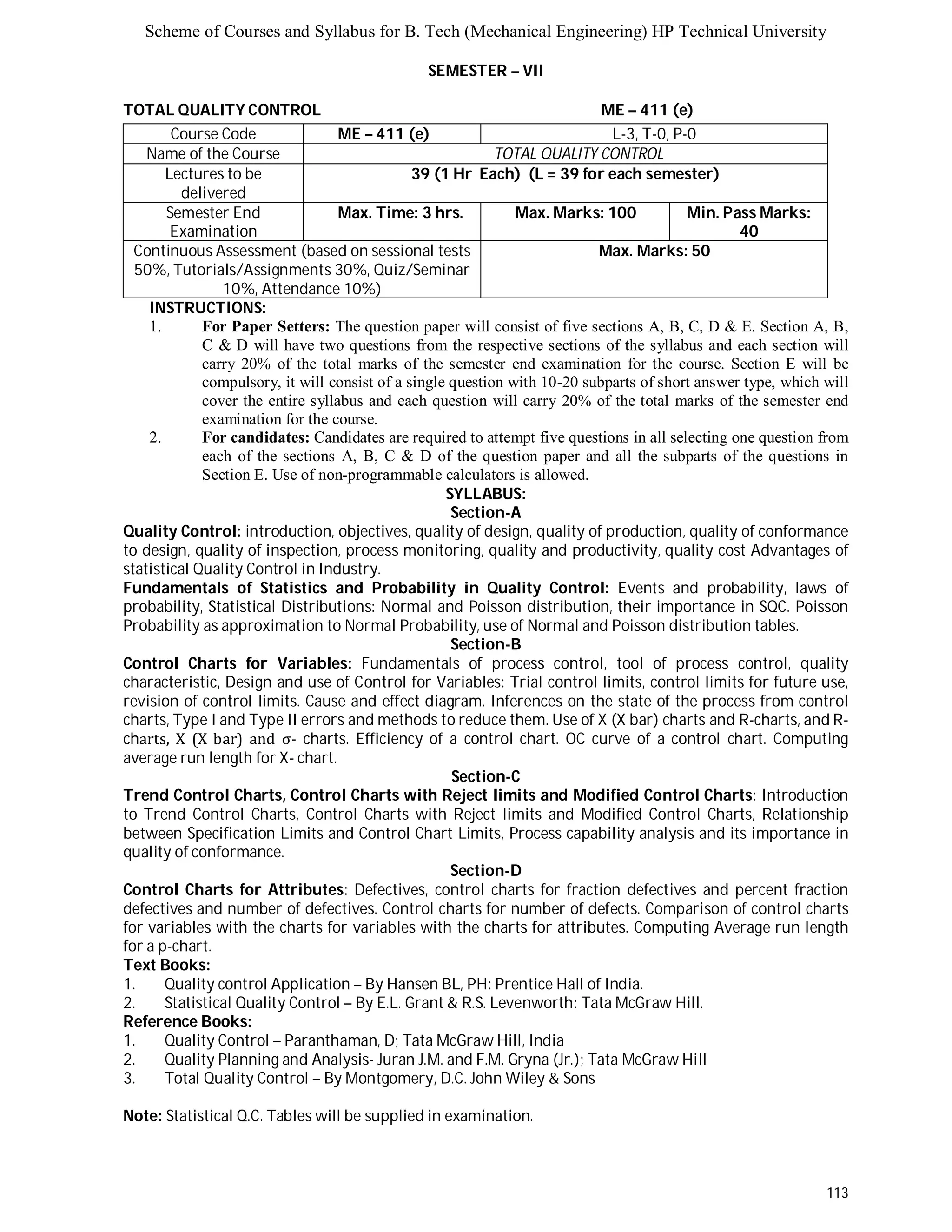
5. Total Quality Control ME-411 (e)
Scheme of Courses and Syllabus for B. Tech (Mechanical Engineering) HP Technical University 
5 
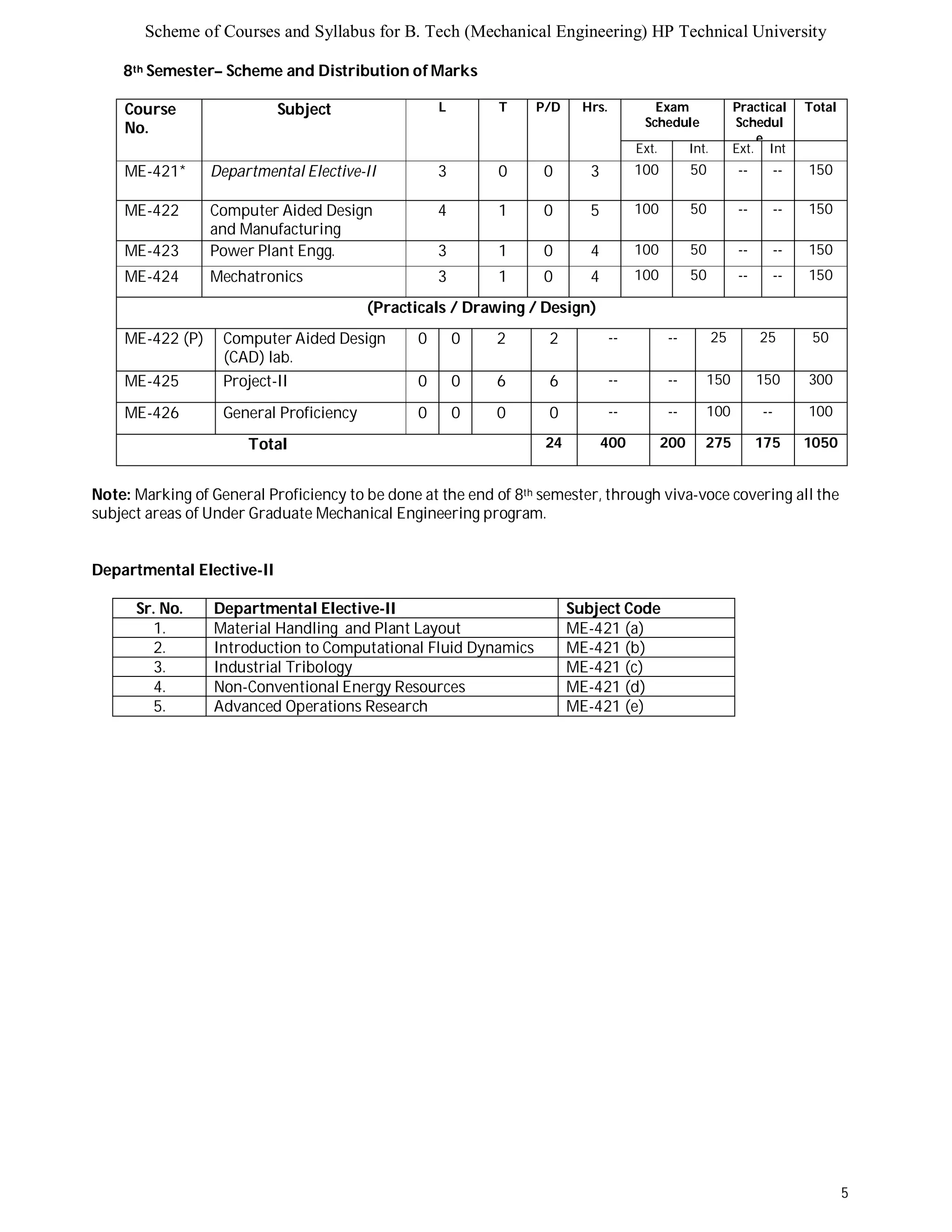
8th Semester– Scheme and Distribution of Marks 
Course 
No. 
Subject L T P/D Hrs. 
Exam 
Schedule 
Practical 
Schedul 
e 
Total 
Ext. Int. Ext. Int 
. 
ME-421* Departmental Elective-II 3 0 0 3 100 50 -- -- 150 
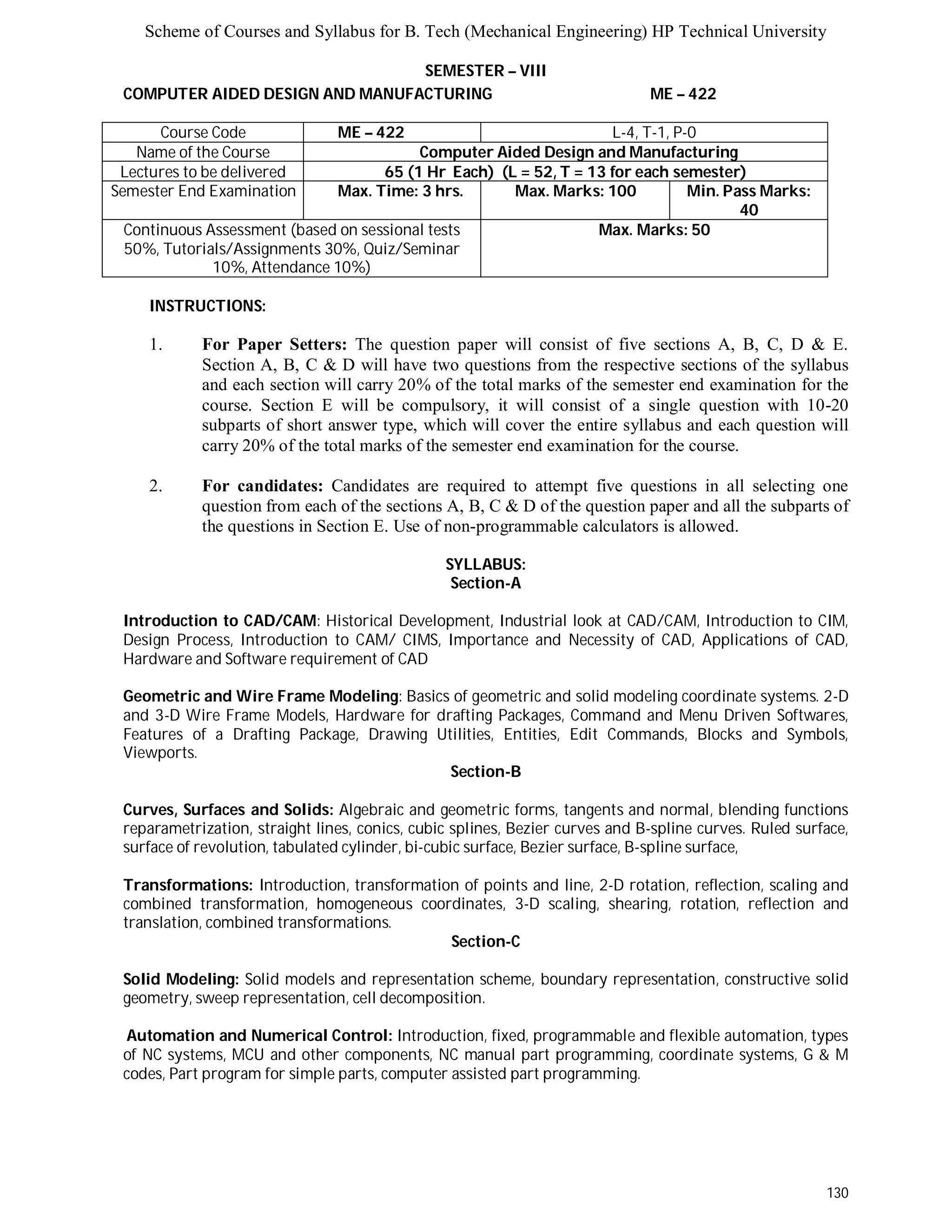
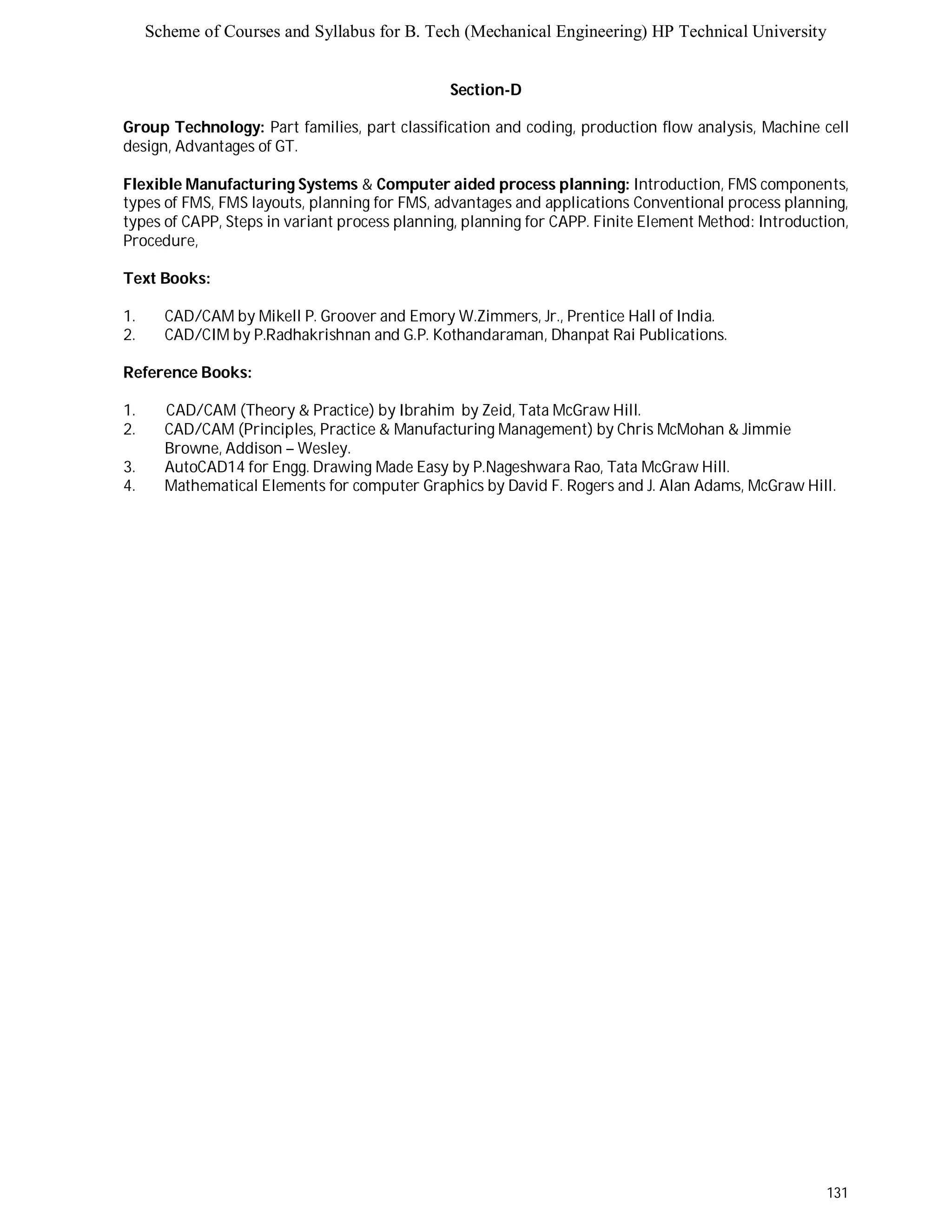
ME-422 Computer Aided Design 
and Manufacturing 
(CAD/CAM) 
4 1 0 5 100 50 -- -- 150 
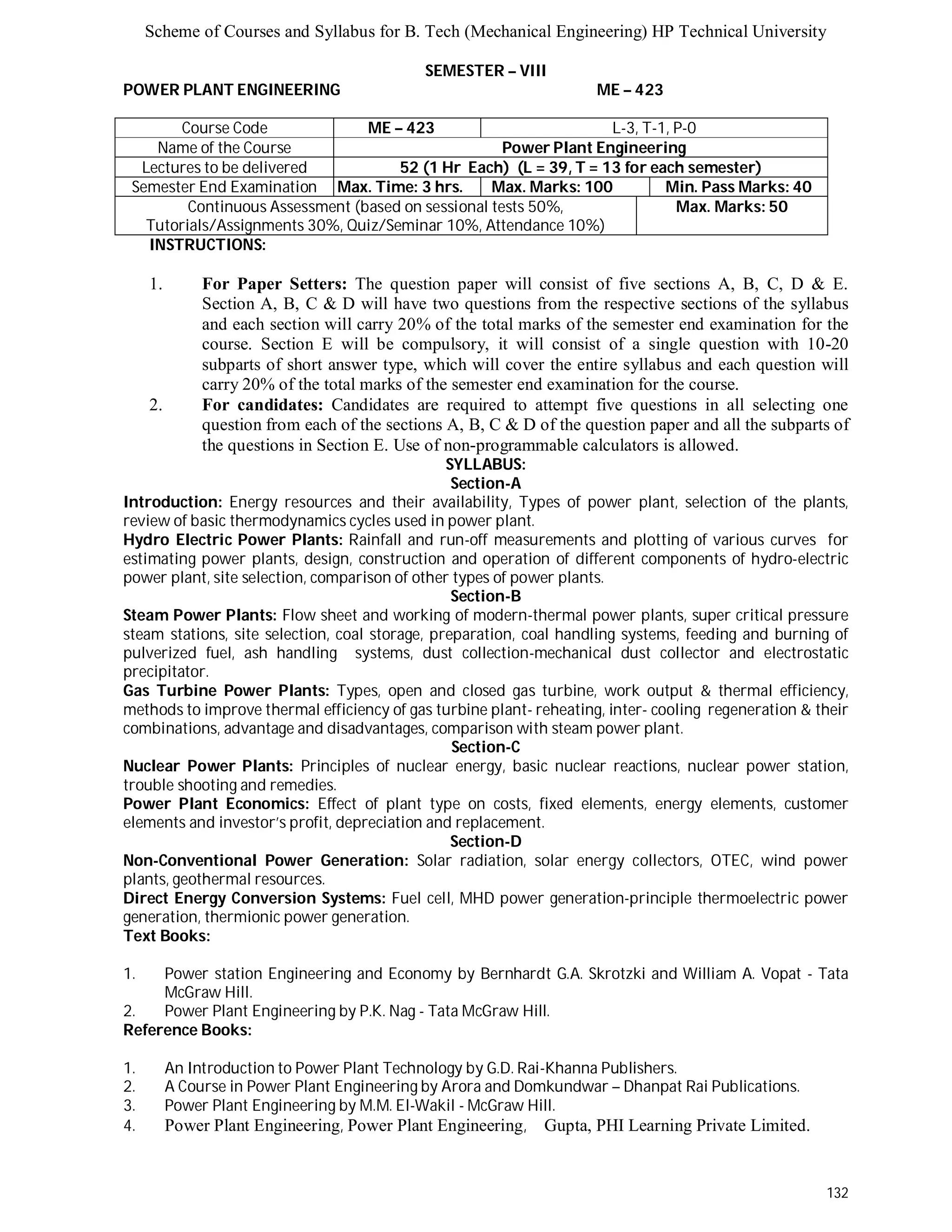
ME-423 Power Plant Engg. 3 1 0 4 100 50 -- -- 150 
ME-424 Mechatronics 3 1 0 4 100 50 -- -- 150 
(Practicals / Drawing / Design) 
ME-422 (P) Computer Aided Design 
(CAD) lab. 
0 0 2 2 -- -- 25 25 50 
ME-425 Project-II 0 0 6 6 -- -- 150 150 300 
ME-426 General Proficiency 0 0 0 0 -- -- 100 -- 100 
Total 24 400 200 275 175 1050 
Note: Marking of General Proficiency to be done at the end of 8th semester, through viva-voce covering all the 
subject areas of Under Graduate Mechanical Engineering program. 
Departmental Elective-II 
Sr. No. Departmental Elective-II Subject Code 
1. Material Handling and Plant Layout ME-421 (a) 
2. Introduction to Computational Fluid Dynamics ME-421 (b) 
3. Industrial Tribology ME-421 (c) 
4. Non-Conventional Energy Resources ME-421 (d) 
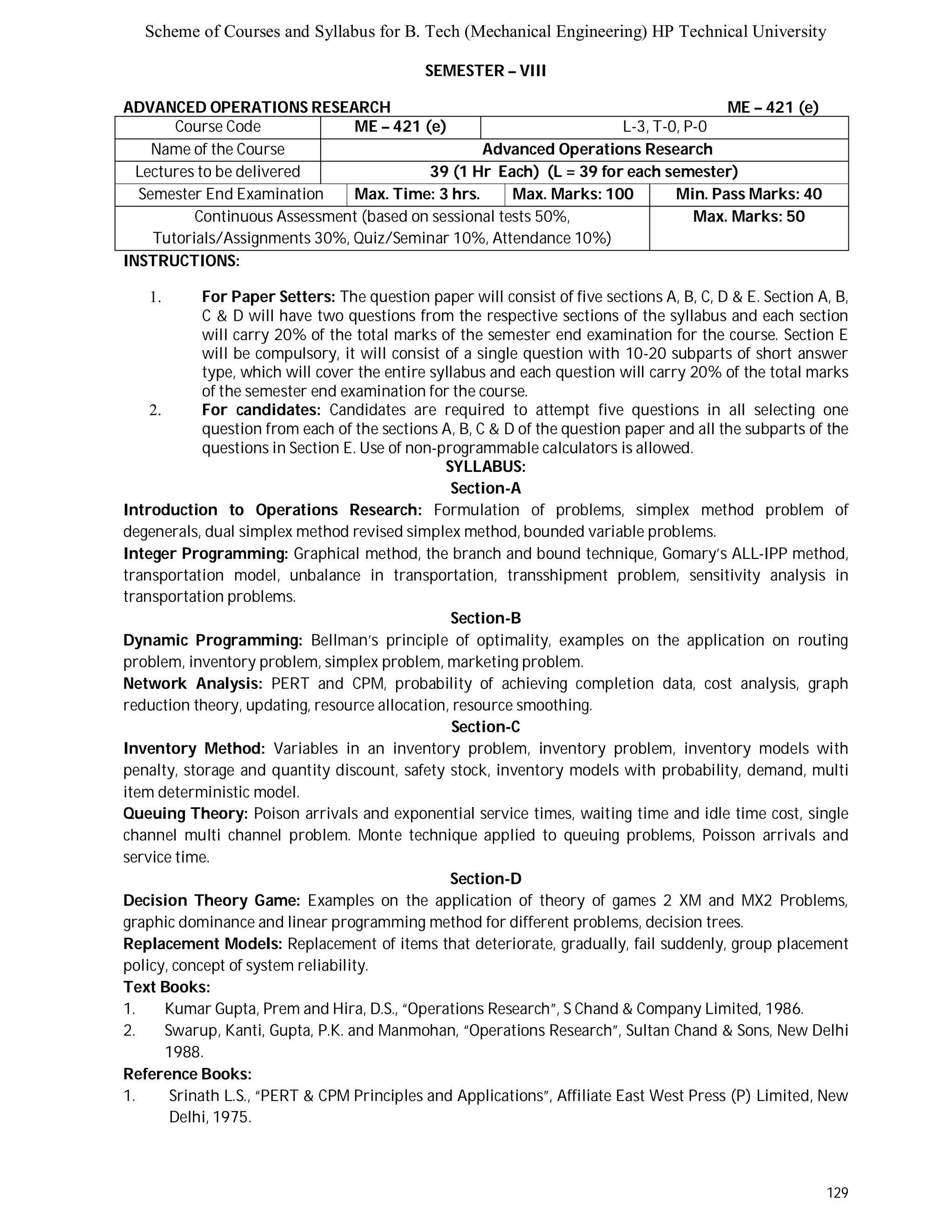
5. Advanced Operations Research ME-421 (e)
Scheme of Courses and Syllabus for B. Tech (Mechanical Engineering) HP Technical University 
6 
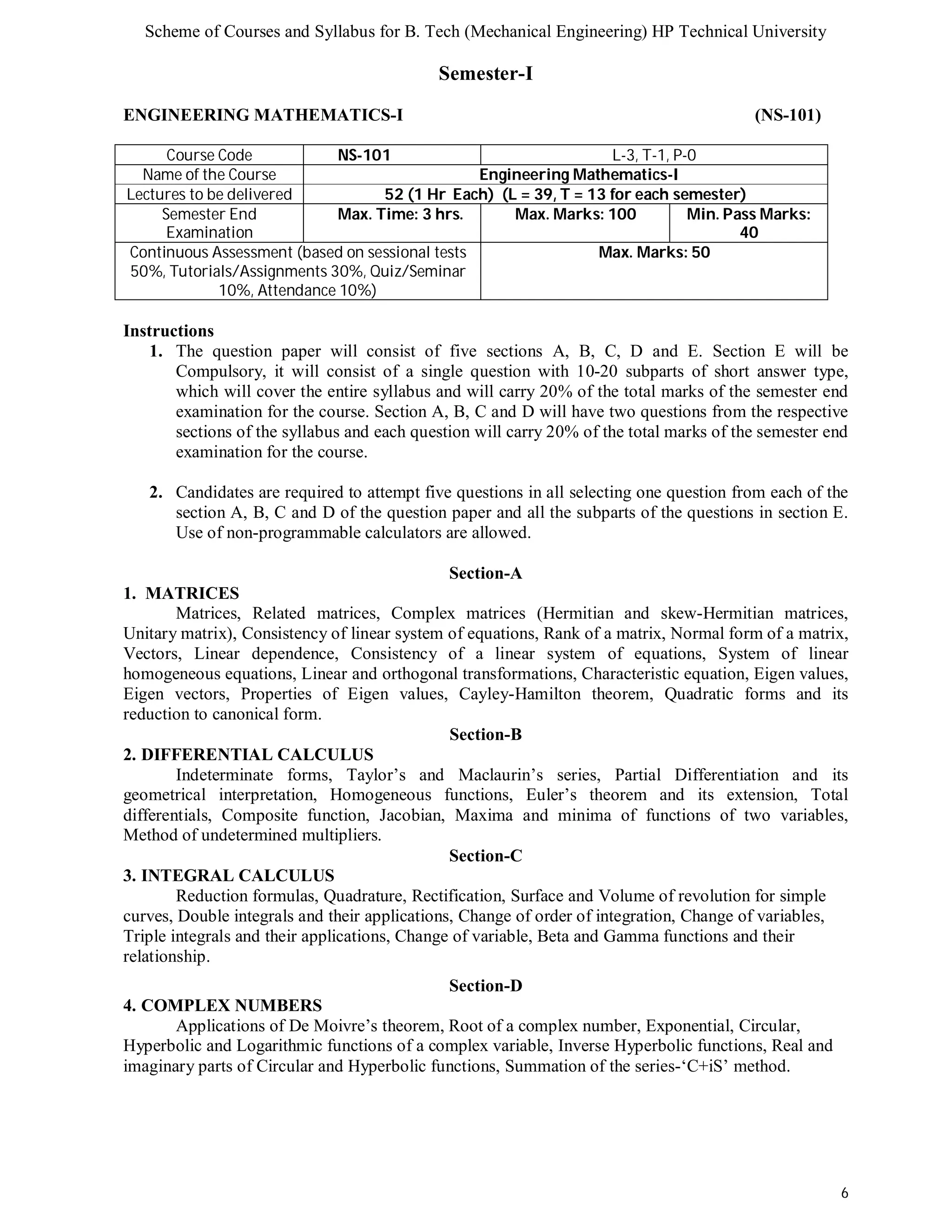
Semester-I 
ENGINEERING MATHEMATICS-I (NS-101) 
Course Code NS-101 L-3, T-1, P-0 
Name of the Course Engineering Mathematics-I 
Lectures to be delivered 52 (1 Hr Each) (L = 39, T = 13 for each semester) 
Semester End 
Examination 
Max. Time: 3 hrs. Max. Marks: 100 Min. Pass Marks: 
40 
Continuous Assessment (based on sessional tests 
50%, Tutorials/Assignments 30%, Quiz/Seminar 
10%, Attendance 10%) 
Max. Marks: 50 
Instructions 
1. The question paper will consist of five sections A, B, C, D and E. Section E will be 
Compulsory, it will consist of a single question with 10-20 subparts of short answer type, 
which will cover the entire syllabus and will carry 20% of the total marks of the semester end 
examination for the course. Section A, B, C and D will have two questions from the respective 
sections of the syllabus and each question will carry 20% of the total marks of the semester end 
examination for the course. 
2. Candidates are required to attempt five questions in all selecting one question from each of the 
section A, B, C and D of the question paper and all the subparts of the questions in section E. 
Use of non-programmable calculators are allowed. 
Section-A 
1. MATRICES 
Matrices, Related matrices, Complex matrices (Hermitian and skew-Hermitian matrices, 
Unitary matrix), Consistency of linear system of equations, Rank of a matrix, Normal form of a matrix, 
Vectors, Linear dependence, Consistency of a linear system of equations, System of linear 
homogeneous equations, Linear and orthogonal transformations, Characteristic equation, Eigen values, 
Eigen vectors, Properties of Eigen values, Cayley-Hamilton theorem, Quadratic forms and its 
reduction to canonical form. 
Section-B 
2. DIFFERENTIAL CALCULUS 
Indeterminate forms, Taylor’s and Maclaurin’s series, Partial Differentiation and its 
geometrical interpretation, Homogeneous functions, Euler’s theorem and its extension, Total 
differentials, Composite function, Jacobian, Maxima and minima of functions of two variables, 
Method of undetermined multipliers. 
Section-C 
3. INTEGRAL CALCULUS 
Reduction formulas, Quadrature, Rectification, Surface and Volume of revolution for simple 
curves, Double integrals and their applications, Change of order of integration, Change of variables, 
Triple integrals and their applications, Change of variable, Beta and Gamma functions and their 
relationship. 
Section-D 
4. COMPLEX NUMBERS 
Applications of De Moivre’s theorem, Root of a complex number, Exponential, Circular, 
Hyperbolic and Logarithmic functions of a complex variable, Inverse Hyperbolic functions, Real and 
imaginary parts of Circular and Hyperbolic functions, Summation of the series-‘C+iS’ method.
Scheme of Courses and Syllabus for B. Tech (Mechanical Engineering) HP Technical University 
7 
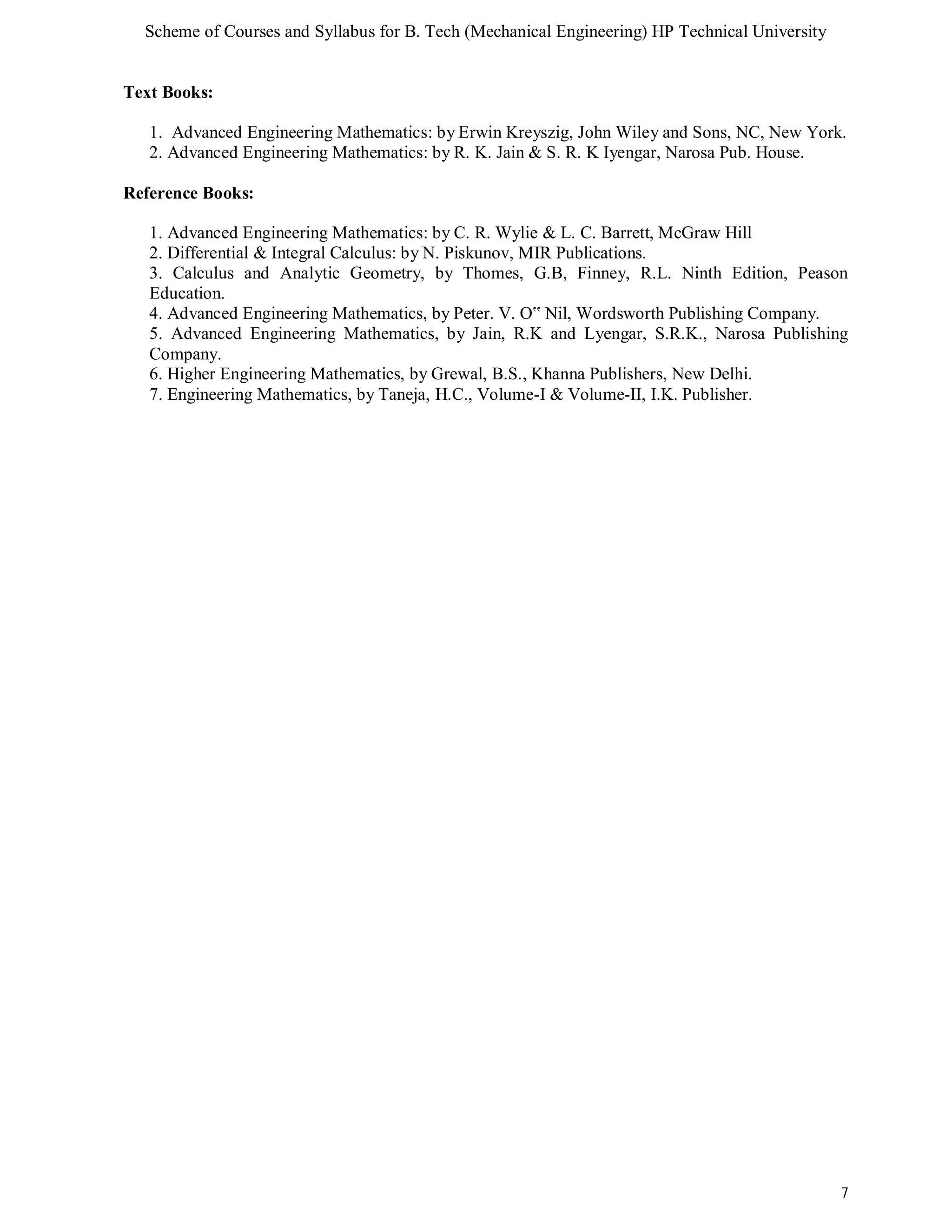
Text Books: 
1. Advanced Engineering Mathematics: by Erwin Kreyszig, John Wiley and Sons, NC, New York. 
2. Advanced Engineering Mathematics: by R. K. Jain & S. R. K Iyengar, Narosa Pub. House. 
Reference Books: 
1. Advanced Engineering Mathematics: by C. R. Wylie & L. C. Barrett, McGraw Hill 
2. Differential & Integral Calculus: by N. Piskunov, MIR Publications. 
3. Calculus and Analytic Geometry, by Thomes, G.B, Finney, R.L. Ninth Edition, Peason 
Education. 
4. Advanced Engineering Mathematics, by Peter. V. O‟ Nil, Wordsworth Publishing Company. 
5. Advanced Engineering Mathematics, by Jain, R.K and Lyengar, S.R.K., Narosa Publishing 
Company. 
6. Higher Engineering Mathematics, by Grewal, B.S., Khanna Publishers, New Delhi. 
7. Engineering Mathematics, by Taneja, H.C., Volume-I & Volume-II, I.K. Publisher.
Scheme of Courses and Syllabus for B. Tech (Mechanical Engineering) HP Technical University 
8 
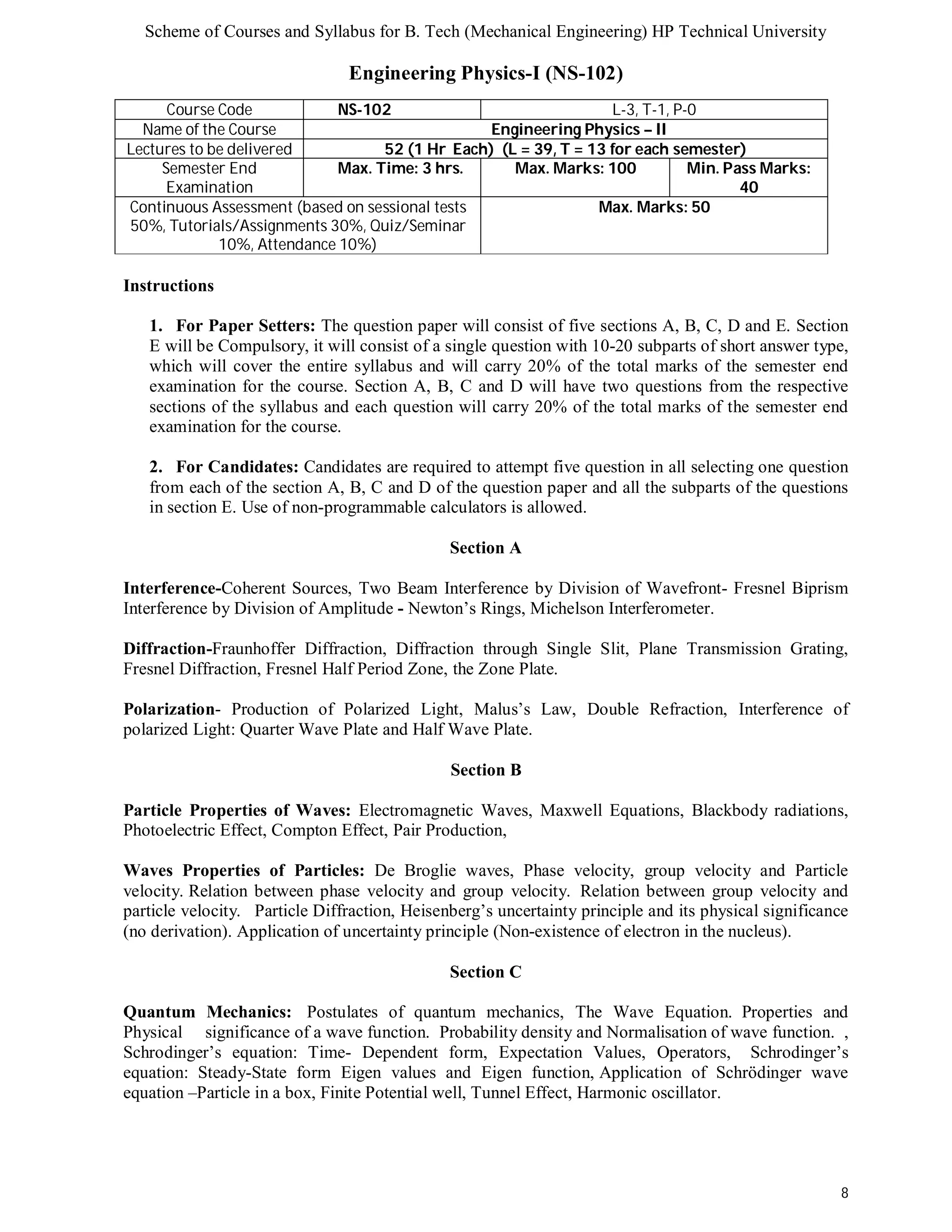
Engineering Physics-I (NS-102) 
Course Code NS-102 L-3, T-1, P-0 
Name of the Course Engineering Physics – II 
Lectures to be delivered 52 (1 Hr Each) (L = 39, T = 13 for each semester) 
Semester End 
Examination 
Max. Time: 3 hrs. Max. Marks: 100 Min. Pass Marks: 
40 
Continuous Assessment (based on sessional tests 
50%, Tutorials/Assignments 30%, Quiz/Seminar 
10%, Attendance 10%) 
Max. Marks: 50 
Instructions 
1. For Paper Setters: The question paper will consist of five sections A, B, C, D and E. Section 
E will be Compulsory, it will consist of a single question with 10-20 subparts of short answer type, 
which will cover the entire syllabus and will carry 20% of the total marks of the semester end 
examination for the course. Section A, B, C and D will have two questions from the respective 
sections of the syllabus and each question will carry 20% of the total marks of the semester end 
examination for the course. 
2. For Candidates: Candidates are required to attempt five question in all selecting one question 
from each of the section A, B, C and D of the question paper and all the subparts of the questions 
in section E. Use of non-programmable calculators is allowed. 
Section A 
Interference-Coherent Sources, Two Beam Interference by Division of Wavefront- Fresnel Biprism 
Interference by Division of Amplitude - Newton’s Rings, Michelson Interferometer. 
Diffraction-Fraunhoffer Diffraction, Diffraction through Single Slit, Plane Transmission Grating, 
Fresnel Diffraction, Fresnel Half Period Zone, the Zone Plate. 
Polarization- Production of Polarized Light, Malus’s Law, Double Refraction, Interference of 
polarized Light: Quarter Wave Plate and Half Wave Plate. 
Section B 
Particle Properties of Waves: Electromagnetic Waves, Maxwell Equations, Blackbody radiations, 
Photoelectric Effect, Compton Effect, Pair Production, 
Waves Properties of Particles: De Broglie waves, Phase velocity, group velocity and Particle 
velocity. Relation between phase velocity and group velocity. Relation between group velocity and 
particle velocity. Particle Diffraction, Heisenberg’s uncertainty principle and its physical significance 
(no derivation). Application of uncertainty principle (Non-existence of electron in the nucleus). 
Section C 
Quantum Mechanics: Postulates of quantum mechanics, The Wave Equation. Properties and 
Physical significance of a wave function. Probability density and Normalisation of wave function. , 
Schrodinger’s equation: Time- Dependent form, Expectation Values, Operators, Schrodinger’s 
equation: Steady-State form Eigen values and Eigen function, Application of Schrödinger wave 
equation –Particle in a box, Finite Potential well, Tunnel Effect, Harmonic oscillator.
Scheme of Courses and Syllabus for B. Tech (Mechanical Engineering) HP Technical University 
9 
Section D 
Nuclear Structure: Composition of nucleus, Nuclear Properties, Stable Nuclei, binding energy, 
Liquid Drop Model, Nuclear Forces. 
Nuclear Reactions: Cross-section, Nuclear fission, moderators, nuclear reactors, nuclear fusion in 
Stars, Fusion Reactors 
Elementary Particles: Leptons, Hadrons, Elementary particle quantum numbers, Quarks, Field 
Bosons, 
Cosmology: The Big Bang Theory, Evolution of Stars. 
Text Books: 
1. A.Ghatak: Optics,Tata Mcgraw Hill, 3rd Edition. 
2. Arthur Beiser, Concepts of Modern Physics ,6th Edition, Tata Mcgraw Hill. 
Reference Books: 
1. David J Griffith, Introduction to Electrodynamics, Pearson Prentice Hall. 
2. Halliday, Resnick and Walker- Principles of Physics, Wiley India 9th Edition-2012
Scheme of Courses and Syllabus for B. Tech (Mechanical Engineering) HP Technical University 
10 
DISASTER MANAGEMENT AND ENVIRONMENTAL SCIENCE (HS-101) 
Course Code HS-101 L-3, T-1, P-0 
Name of the Course Disaster Management and Environmental Science 
Lectures to be delivered 52 (1 Hr Each) (L = 39, T = 13 for each semester) 
Semester End 
Examination 
Max. Time: 3 hrs. Max. Marks: 100 Min. Pass Marks: 
40 
Continuous Assessment (based on sessional tests 
50%, Tutorials/Assignments 30%, Quiz/Seminar 
10%, Attendance 10%) 
Max. Marks: 50 
INSTRUCTIONS: 
1. For Paper Setters: The question paper will consist of five sections A, B, C, D & E. Section E will 
be compulsory, it will consist of a single question with 10-20 subparts of short answer type, which 
will cover the entire syllabus and will carry 20% of the total marks of the semester end 
examination for the course. Section A, B, C & D will have two questions from the respective 
sections of the syllabus and each question will carry 20% of the total marks of the semester end 
examination for the course. 
2. For candidates: Candidates are required to attempt five questions in all selecting one question 
from each of the sections A, B, C & D of the question paper and all the subparts of the questions in 
Section E. Use of non-programmable calculators is allowed. 
Section-A 
Principles of Disaster Management. Natural Disasters such as Earthquake, Floods, Fire, Landslides, 
Tornedo, Cyclones, Tsunamis, Nuclear, Chemical, Terrorism, Extra Terrestrial and other natural 
calamities. Hazards, Risks and Vulnerabilities. Assessment of Disaster Vulnerability of a location and 
vulnerable groups, National policy on disaster Management, 
Section-B 
Prevention, Preparedness and Mitigation measures for various Disasters, Post Disaster Relief & 
Logistics Management, Emergency Support Functions and their coordination mechanism, Resource & 
Material Management, Management of Relief Camp, Information systems & decision making tools, 
Voluntary Agencies & Community Participation at various stages of disaster, management, Integration 
of Rural Development Programmes with disaster reduction and mitigation activities. 
Section-C 
Renewable and non-renewable resources, Role of individual in conservation of natural resources for 
sustainable life styles.Use and over exploitation of Forest resources, Deforestation, Timber extraction, 
Mining, Dams and their effects on forest and tribal people. Use and over exploitation of surface and 
ground water resources, Floods, Drought, Conflicts over water, Dams- benefits and problems. Causes, 
effects and control measures of Air pollution, Water pollution, soil pollution, Noise pollution, Thermal 
pollution, Nuclear hazards. 
Section-D 
Global Environmental crisis, Current global environment issues,Global Warming, Greenhouse Effect, 
role of Carbon Dioxide and Methane, Ozone Problem, CFC’s and Alternatives, Causes of Climate 
Change Energy Use:past, present and future, Role of Engineers. 
Text Books: 
1. Disaster Management By G.K. Ghosh A.P.H. Publishing Corporation 
2. Environmental Studies, R Rajgopalan, Oxford University Press 
Reference Books: 
1. Modern Encyclopaedia of Disaster and Hazard Management By B C Bose Rajat publications. 
2. Disaster Management By R.B. Singh Rawat Publications. 
3. Disaster Management By B Narayan A.P.H. Publishing Corporation. 
4. Environmental Studies, Daniels, Wiley Publication 
5. Environmental Studies, Basak, Pearson Publication
Scheme of Courses and Syllabus for B. Tech (Mechanical Engineering) HP Technical University 
11 
Basic Electrical & Electronics Engineering (BE-101) 
Course Code BE-101 L-3, T-1, P-0 
Name of the Course Basic Electrical & Electronics Engineering 
Lectures to be delivered 52 (1 Hr Each) (L = 39, P = 13 for each semester) 
Semester End Examination Max. Time = 3 hrs. Max. Marks: 100 Min. Pass Marks: 40 
Continuous Assessment (based on sessional tests (2) 50%, 
Max. Marks: 50 
Tutorials/Assignments 30%, Quiz/Seminar 10%, Attendance 10%) 
Instructions 
1. For Paper Setters: The question paper will consist of five sections A, B, C, D & E. Section E will 
be compulsory, it will consist of a single question with 10-20 subparts of short answer type, which 
willcover the entire syllabus and will carry 20% of the total marks of the semester end examination for 
the course. Section A, B, C & D will have two questions from the respective sections of the syllabus 
andeach question will carry 20% of the total marks of the semester end examination for the course. 
2. For candidates: Candidates are required to attempt five questions in all selecting one question from 
each of the sections A, B, C & D of the question paper and all the subparts of the questions in Section 
E. Use of non-programmable calculators is allowed. 
SECTION A 
DC circuits: Ohm’s law, resistance, receptivity, series & parallel connections, star delta 
transformation, power dissipation in resistance, effect of temperature on resistance. Kirchhoff’s laws 
Mesh laws; Mesh & Nodal analysis. 
AC circuits: Generation of alternating voltage &currents, Sinusoidal signals, instantaneous and peak 
values, R.M.S. &Average value, phase angle, polar and rectangular, exponential and trigonometric 
representations of RL and C components, 
ElectricalInstruments and Devices: Voltmeter, Ammeter, Wattmeter, Energy meter, Inverters. 
Introduction to Domestic Electric Wiring 
SECTION – B 
Series and Parallel Circuits: A.C.Through resistance; inductance & capacitance. R-L; R-C & R-L-C 
series & parallel circuits, phasor diagrams. Power & power factor, series & parallel resonance. 
Problems by analytical as well as physical methods. 
Three phase circuits: Three phase voltage & current generation, star & delta connections (balanced 
load), relationship between phase &line currents and voltages, phasor diagrams, measurement of 
power by two wattmeter methods. 
A.C. And D.C. Machines: Principle, construction and working of transformer. Introduction to D.C 
and A.C. machines. 
SECTION – C 
Semiconductor Devices & Circuit: Classification of material; Energy band structure of conductors, 
insulators & semiconductor ;Classification of Semiconductor Mobility and conductivity, Intrinsic and 
extrinsic semiconductors and charge densities in semiconductors, current components 
insemiconductors, continuity equation. ; PN junction Characteristics& Analysis ;diode rating ; Types
Scheme of Courses and Syllabus for B. Tech (Mechanical Engineering) HP Technical University 
of diodes – Zener diodes, Photodiodes, Light emitting diodes (LED’s), Varactor diodes and tunnel 
diodes. Rectifiers and filter circuit: Half wave, full wave and Bridge rectifier circuits and their 
analysis, L, C and Pi filters, Basic regulator supply using zener diode. 
Transistors: Construction and characteristics of bipolar junction, transistors (BJT’s)-Comm. Base, 
Comm. emitter, Comm. Collector configuration. 
12 
SECTION – D 
Field Effect Transistor: Construction and characteristics of JFET.MOSFET construction and 
characteristics. 
Integrated Circuits: Classification of ICs; Monolithic ICs; OP Amp: Characterstics of Ideal 
OPAmp& application 
Electronic Instruments: Role and importance of general purpose test Instruments, Electronic 
Millimeter, Cathode Ray Oscilloscope, Measurement of amplitude, Frequency and phase using CRO. 
Text Books: 
1. Basic Electrical & Electronics Engineering – V Jegathesan , K Vinoth Kumar & R Saravanakumar 
2. Basic Electrical & Electronics Engineering- B.L.Thereja 
Reference Books: 
1. Electronics devices and circuit theory by Robert Boylestad. 
2. Electronics Devices and circuits by Millman&Halkias, TMH. 
3. Basic Electronics by Debashis De, Pearson Education, 2010. 
4. Electronics devices and circuit by Bhargava and Kulshtreshta, TTTI Series
Scheme of Courses and Syllabus for B. Tech (Mechanical Engineering) HP Technical University 
13 
ENGINEERING DRAWING AND GRAPHICS (BE-103) 
Course Code BE-103 L-1, T-0, P-5 
Name of the Course Engineering Drawing and Graphics 
Lectures to be delivered 78 (1 Hr Each) (L = 13, P = 65 for each semester) 
Semester End Examination Max. Time = 3 hrs. Max.Marks: 100 Min. Pass Marks: 40 
Continuous Assessment (based on sessional tests (2) 50%, 
Max. Marks: 50 
Tutorials/Assignments 30%, Quiz/Seminar 10%, Attendance 10%) 
INSTRUCTIONS: 
1. For Institutes: There will be two sessions per week. 1st session will consist of one lecture and two 
hours of practice session. 2nd session will consist of three hours of practice session. 
2. For Paper Setters: The question paper will consist of five sections A, B, C, D & E. Section E will 
be compulsory, it will consist of a single question with 10-20 subparts of short answer type, which 
will cover the entire syllabus and will carry 20% of the total marks of the semester end 
examination for the course. Section A, B, C & D will have two questions from the respective 
sections of the syllabus and each question will carry 20% of the total marks of the semester end 
examination for the course. 
3. For candidates: Candidates are required to attempt five questions in all selecting one question 
from each of the sections A, B, C & D of the question paper and all the subparts of the questions in 
Section E. Use of non-programmable calculators is allowed. 
Section-A 
Drawing Techniques and Scales: Various type of lines, principal of dimensioning, size and location 
as per IS code of practice (SP-46) for general Engg. Drawing. Practice of drawing, various types of 
lines and dimensioning exercises. Drawing exercises pertaining to symbols.Conventions and Exercise 
of lettering techniques.Free hand printing of letters and numerals in 3, 5, 8 and 12 mm sizes, vertical 
and inclined at 75 degree.Instrumental lettering in single stroke.Linear scale, Diagonal scale &vernier 
scale. 
Points, Lines and Planes: Projection of Points, Lines and Planes: Concept of horizontal and vertical 
planes. First and third angle projections: projections of point and lines, true length of lines and their 
horizontal and vertical traces, projection of planes and their traces. Auxiliary planes. 
Section-B 
Projections of Solids: Right regular solids of revolution and polyhedrons etc. and their auxiliary 
views. 
Sectioning of Solids: Principal of sanctioning, types of sanctioning and their practice on projection of 
solids, sectioning by auxiliary planes. 
Section-C 
Development of Surfaces: Development of surfaces of cylinders, cones, pyramid, prism etc. exercises 
involving development of unique surfaces like Y-piece, hopper, tray, truncated pieces etc. 
Intersection of Surfaces: Intersection of cylinders, cones and prisms with their axes being vertical, 
horizontal or inclines. Exercise on intersection of solids-cylinder and cylinder, cylinder and cone, 
prism and prism. 
Section-D 
Isometric Projection: Concept of isometric views: isometric scale and exercise on isometric views. 
Practice of Orthographic projections. 
Simple Trusses: Graphical Method. 
Text Books: 
1. Engineering Drawing &Engg. Graphics byP. S. Gill, Kataria and Sons Millennium Edition. 
2. Engineering Drawing Plane and Solid Geometry byN.D. Bhatt and V. M. Panchal, 44th Edition, 
2002, Charotar Publishing House. 
Reference Books: 
1. Engineering Drawingby Dhananjay A. Jolhe, Tata McGraw Hill.
Scheme of Courses and Syllabus for B. Tech (Mechanical Engineering) HP Technical University 
14 
ENGINEERING MECHANICS (BE-105) 
Course Code BE – 105 L-3, T-1, P-0 
Name of the Course Engineering Mechanics 
Lectures to be delivered 52 (1 Hr Each) (L = 39, T = 13, P=0 for each semester) 
Semester End Examination Max. Time = 3 hrs. Max. Marks: 100 Min. Pass Marks: 40 
Continuous Assessment (based on sessional tests (2) 50%, 
Max. Marks: 50 
Tutorials/Assignments 30%, Quiz/Seminar 10%, Attendance 10%) 
INSTRUCTIONS: 
1. For Paper Setters: The question paper will consist of five sections A, B, C, D & E. Section E will 
be compulsory, it will consist of a single question with 10-20 subparts of short answer type, which 
will cover the entire syllabus and will carry 20% of the total marks of the semester end 
examination for the course. Section A, B, C & D will have two questions from the respective 
sections of the syllabus, and each question will carry 20% of the total marks of the semester end 
examination for the course. 
2. For candidates: Candidates are required to attempt five questions in all selecting one question 
from each of the sections A, B, C & D of the question paper and all the subparts of the questions in 
Section E. Use of non-programmable calculators is allowed. 
Section-A 
Force, Moment, Center of gravity & Moment of Inertia: Idealization of Mechanics, Concept of 
Rigid Body and Elastic Body, Laws of Mechanics, Forces & System of Forces, Composition, 
Resolution & resultant of Forces, Laws of Forces, Lami’s Theorem, Moment & Couples, Varignon’s 
Theorem, Free Body Diagram, Centre of Gravity of a Lamina, Centroids of various Geometric Shapes, 
Moment of Inertia, Radius of Gyration, Parallel and Perpendicular Axis Theorem. 
Frames and Trusses: Introduction, Perfect Frame, Redundant Frame, Reactions of Supports, Plane 
Trusses, Space Trusses, Method of Joints, Method of Section, Graphical Method- Maxwell Diagram. 
Section-B 
Simple Stresses and Strains: Stress & strain; Types of stresses and strains Elastic limit; Hooks law; 
Stress – strain diagram for ductile and brittle material, Factor of safety; Poisson’s ratio; Elastic 
constants; Young’s modulus, Shear modulus & Bulk modulus. Relationship between elastic constants. 
Thermal Stress & Strain. 
Shear Force and Bending Moment: Introduction, concept of shear force and bending moment, Sign 
conventions, Types of load – concentrated, uniformly distributed, uniformly varying, Types of beams: 
Cantilever beam, simply supported beam, overhanging beam; Shear force and bending moment 
diagrams for the above beams subjected to different loadings and couples. Point of contra flexure, 
Relationship between load, Shear force and bending moment. 
Section-C 
Bending Stresses in Beams: Bending Stresses in Beams with derivation of Bending equation and its 
application to beams of circular, rectangular I & T Section, Composite beams. 
Shearing Stresses in Beams: Shearing stress at a section in a loaded beam, Shear stress distribution 
over different sections.
Scheme of Courses and Syllabus for B. Tech (Mechanical Engineering) HP Technical University 
15 
Section-D 
Torsion of Circular Shaft: Pure Torsion, Theory of Pure torsion, Derivation of Torsion equation for a 
circular shaft subject to torsion, assumptions, Maximum torque transmitted by a Solid shaft and hollow 
shaft derivations, Polar modulus, torsion rigidity, Comparison of hollow and solid shaft, Power 
transmitted by a shaft, Close coiled helical spring subjected to axial load and torque. 
Introduction to Friction: Definition, Principles of friction, Friction between solid bodies, Coefficient 
of friction, Kinetic friction force, Definition & Determination of angle of friction, Laws of friction , 
Procedure for friction analysis, Equilibrium of rigid bodies subjected to frictional force of resistance, 
Friction at the ends of ladder, Wedge friction, Remedial measures in overcoming friction. 
Text Books: 
1. Engineering Mechanics: Nelson, McGraw Hill 
2. Engineering Mechanics: Statics, Meriam, JohnWiley 
Reference Books: 
1. Mechanics of Materials-E.J. Hearn, Elsevier 
2. Engineering Mechanics-Bhavikatti, New Age International 
3. Engineering Mechanics- JagatBabu, Pearson 
4. Engineering Mechanics, P.N. Chandramouli, PHI Learning Private Limited. 
5. Engineering Mechanics, V. Jayakumar & M. Kumar, PHI Learning Private Limited.
Scheme of Courses and Syllabus for B. Tech (Mechanical Engineering) HP Technical University 
16 
Engineering Physics Lab (NS-105(P)) 
Course Code NS-105(P) L-0, T-0, P-2 
Name of the Course Engineering Physics Lab 
Lectures to be Delivered 26 hours of Lab. work (2 hrs. per week) 
Semester End 
Examination 
Max Marks: 25 Min Pass Marks: 10 Maximum Time: 3 hrs 
Continuous Assessment Lab work 30%, Lab Record 25% 
Viva/ Hands on 25%, Attendance 20% 
Max Marks: 
25 
Instructions for paper setter / candidates 
Laboratory examination will consist of two parts: 
Performing a practical exercises assigned by the examiner. 
Viva-voce examination 
Viva-voce examination will be related to the practicals performed / project executed by the candidate 
related to the paper during the course of the semester. 
List of Experiments 
1. To find the refractive index of a prism by using spectrometer. 
2. To find the wavelength of sodium light by Newton’s rings experiment. 
3. To find the wavelength of sodium light by Michelson interferometer. 
4. To study the laser beam characteristics like, wavelength using diffraction grating aperture & 
divergence. 
5. To study the variation of magnetic field with distance and to find the radius of coil by Stewart and 
Gee’s apparatus. 
6. To find the value of e/m for electrons by helical method. 
7. To compare the capacitances of two capacitors by De’sauty Bridge. 
8. To find the value of Planck’s constant by using a photoelectric cell. 
9. To calculate the hysteresis loss by tracing a B-H curve for a given sample 
10. To determine the Hall co-efficient 
11. To determine the band gap of an intrinsic semiconductor by four probe method. 
12. To find the velocity of ultrasound in liquid. 
13. To find out polarizability of a dielectric substance. 
14. To determine the numerical Aperture of an optical fibre. 
15. To determine the attenuation & propagation losses in optical fibres. 
Note: Each student is required to perform at least ten experiments. 
Books: 
1. Practical Physics-S.L.Gupta&V.Kumar. 
2. Advanced Practical Physics Vol. I & II – S.P. Singh
Scheme of Courses and Syllabus for B. Tech (Mechanical Engineering) HP Technical University 
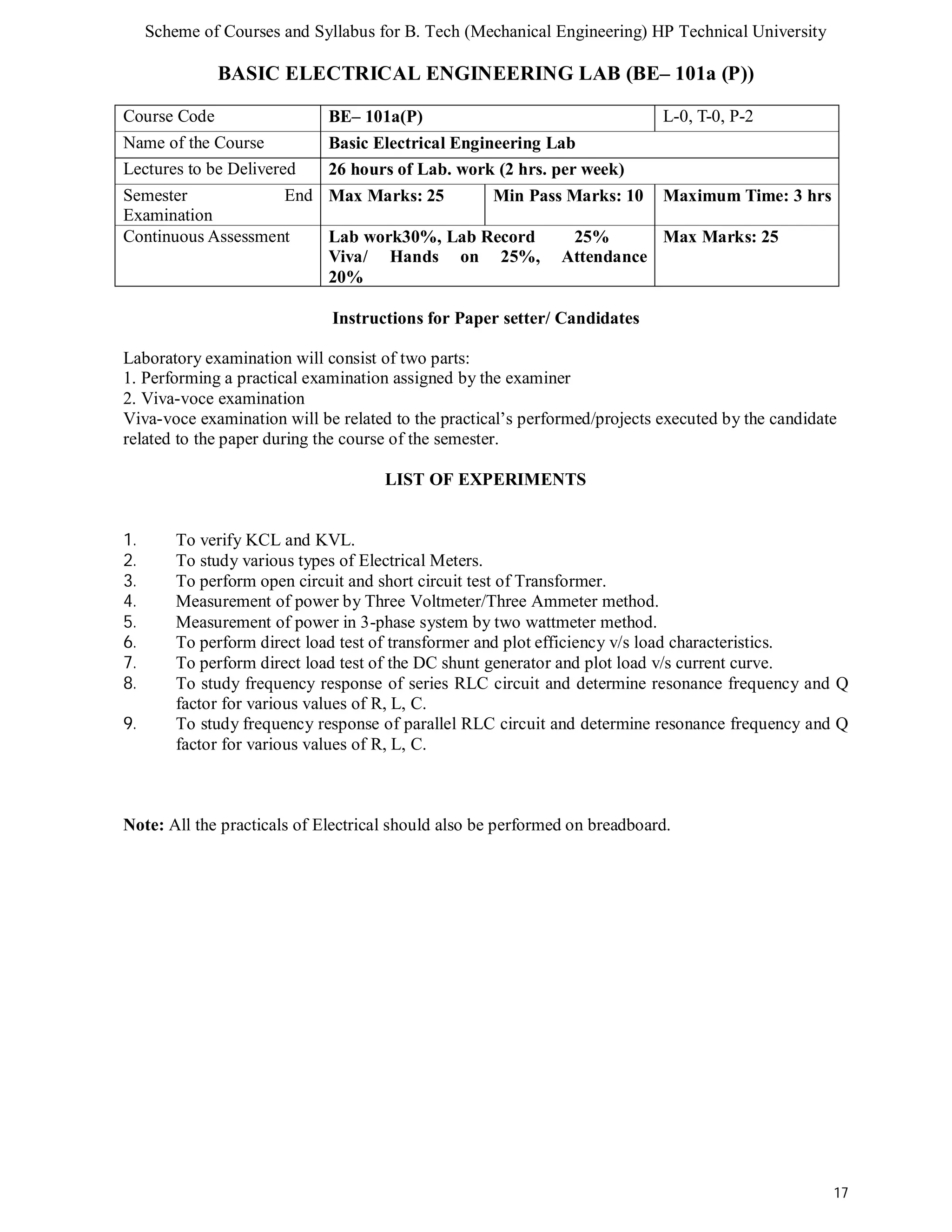
17 
BASIC ELECTRICAL ENGINEERING LAB (BE– 101a (P)) 
Course Code BE– 101a(P) L-0, T-0, P-2 
Name of the Course Basic Electrical Engineering Lab 
Lectures to be Delivered 26 hours of Lab. work (2 hrs. per week) 
Semester End 
Examination 
Max Marks: 25 Min Pass Marks: 10 Maximum Time: 3 hrs 
Continuous Assessment Lab work30%, Lab Record 25% 
Viva/ Hands on 25%, Attendance 
20% 
Max Marks: 25 
Instructions for Paper setter/ Candidates 
Laboratory examination will consist of two parts: 
1. Performing a practical examination assigned by the examiner 
2. Viva-voce examination 
Viva-voce examination will be related to the practical’s performed/projects executed by the candidate 
related to the paper during the course of the semester. 
LIST OF EXPERIMENTS 
1. To verify KCL and KVL. 
2. To study various types of Electrical Meters. 
3. To perform open circuit and short circuit test of Transformer. 
4. Measurement of power by Three Voltmeter/Three Ammeter method. 
5. Measurement of power in 3-phase system by two wattmeter method. 
6. To perform direct load test of transformer and plot efficiency v/s load characteristics. 
7. To perform direct load test of the DC shunt generator and plot load v/s current curve. 
8. To study frequency response of series RLC circuit and determine resonance frequency and Q 
factor for various values of R, L, C. 
9. To study frequency response of parallel RLC circuit and determine resonance frequency and Q 
factor for various values of R, L, C. 
Note: All the practicals of Electrical should also be performed on breadboard.
Scheme of Courses and Syllabus for B. Tech (Mechanical Engineering) HP Technical University 
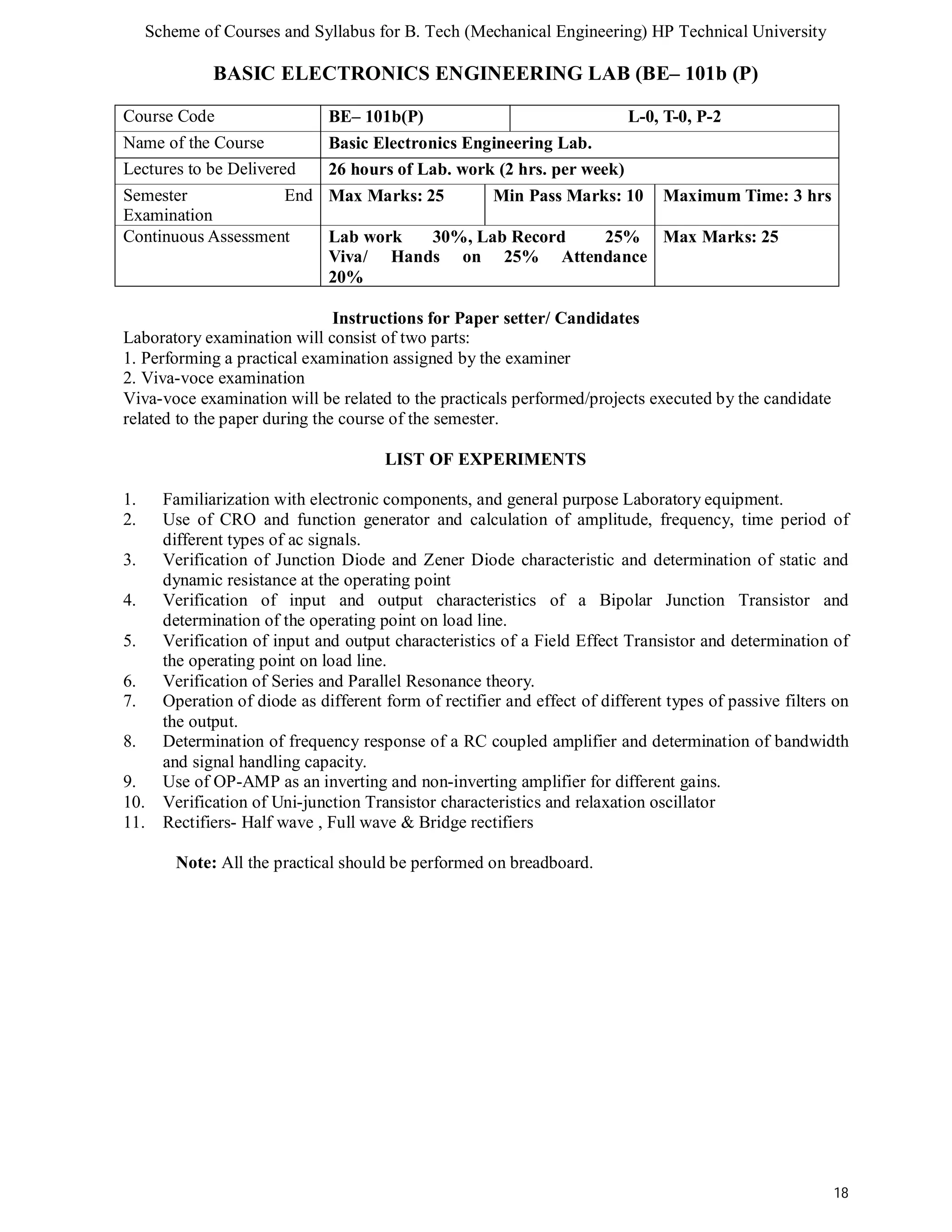
18 
BASIC ELECTRONICS ENGINEERING LAB (BE– 101b (P) 
Course Code BE– 101b(P) L-0, T-0, P-2 
Name of the Course Basic Electronics Engineering Lab. 
Lectures to be Delivered 26 hours of Lab. work (2 hrs. per week) 
Semester End 
Examination 
Max Marks: 25 Min Pass Marks: 10 Maximum Time: 3 hrs 
Continuous Assessment Lab work 30%, Lab Record 25% 
Viva/ Hands on 25% Attendance 
20% 
Max Marks: 25 
Instructions for Paper setter/ Candidates 
Laboratory examination will consist of two parts: 
1. Performing a practical examination assigned by the examiner 
2. Viva-voce examination 
Viva-voce examination will be related to the practicals performed/projects executed by the candidate 
related to the paper during the course of the semester. 
LIST OF EXPERIMENTS 
1. Familiarization with electronic components, and general purpose Laboratory equipment. 
2. Use of CRO and function generator and calculation of amplitude, frequency, time period of 
different types of ac signals. 
3. Verification of Junction Diode and Zener Diode characteristic and determination of static and 
dynamic resistance at the operating point 
4. Verification of input and output characteristics of a Bipolar Junction Transistor and 
determination of the operating point on load line. 
5. Verification of input and output characteristics of a Field Effect Transistor and determination of 
the operating point on load line. 
6. Verification of Series and Parallel Resonance theory. 
7. Operation of diode as different form of rectifier and effect of different types of passive filters on 
the output. 
8. Determination of frequency response of a RC coupled amplifier and determination of bandwidth 
and signal handling capacity. 
9. Use of OP-AMP as an inverting and non-inverting amplifier for different gains. 
10. Verification of Uni-junction Transistor characteristics and relaxation oscillator 
11. Rectifiers- Half wave , Full wave & Bridge rectifiers 
Note: All the practical should be performed on breadboard.
Scheme of Courses and Syllabus for B. Tech (Mechanical Engineering) HP Technical University 
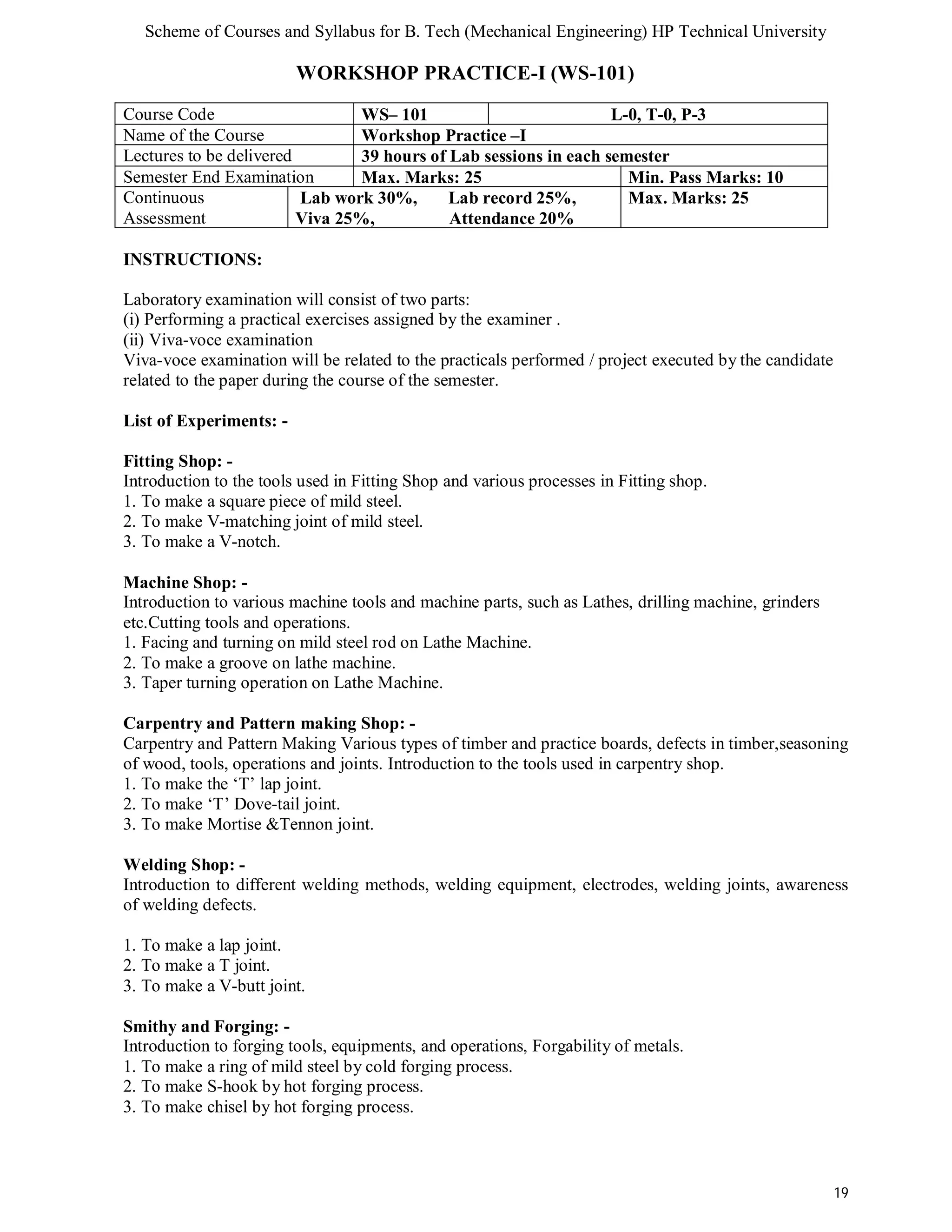
19 
WORKSHOP PRACTICE-I (WS-101) 
Course Code WS– 101 L-0, T-0, P-3 
Name of the Course Workshop Practice –I 
Lectures to be delivered 39 hours of Lab sessions in each semester 
Semester End Examination Max. Marks: 25 Min. Pass Marks: 10 
Continuous 
Assessment 
Lab work 30%, Lab record 25%, 
Viva 25%, Attendance 20% 
Max. Marks: 25 
INSTRUCTIONS: 
Laboratory examination will consist of two parts: 
(i) Performing a practical exercises assigned by the examiner . 
(ii) Viva-voce examination 
Viva-voce examination will be related to the practicals performed / project executed by the candidate 
related to the paper during the course of the semester. 
List of Experiments: - 
Fitting Shop: - 
Introduction to the tools used in Fitting Shop and various processes in Fitting shop. 
1. To make a square piece of mild steel. 
2. To make V-matching joint of mild steel. 
3. To make a V-notch. 
Machine Shop: - 
Introduction to various machine tools and machine parts, such as Lathes, drilling machine, grinders 
etc.Cutting tools and operations. 
1. Facing and turning on mild steel rod on Lathe Machine. 
2. To make a groove on lathe machine. 
3. Taper turning operation on Lathe Machine. 
Carpentry and Pattern making Shop: - 
Carpentry and Pattern Making Various types of timber and practice boards, defects in timber,seasoning 
of wood, tools, operations and joints. Introduction to the tools used in carpentry shop. 
1. To make the ‘T’ lap joint. 
2. To make ‘T’ Dove-tail joint. 
3. To make Mortise &Tennon joint. 
Welding Shop: - 
Introduction to different welding methods, welding equipment, electrodes, welding joints, awareness 
of welding defects. 
1. To make a lap joint. 
2. To make a T joint. 
3. To make a V-butt joint. 
Smithy and Forging: - 
Introduction to forging tools, equipments, and operations, Forgability of metals. 
1. To make a ring of mild steel by cold forging process. 
2. To make S-hook by hot forging process. 
3. To make chisel by hot forging process.
Scheme of Courses and Syllabus for B. Tech (Mechanical Engineering) HP Technical University 
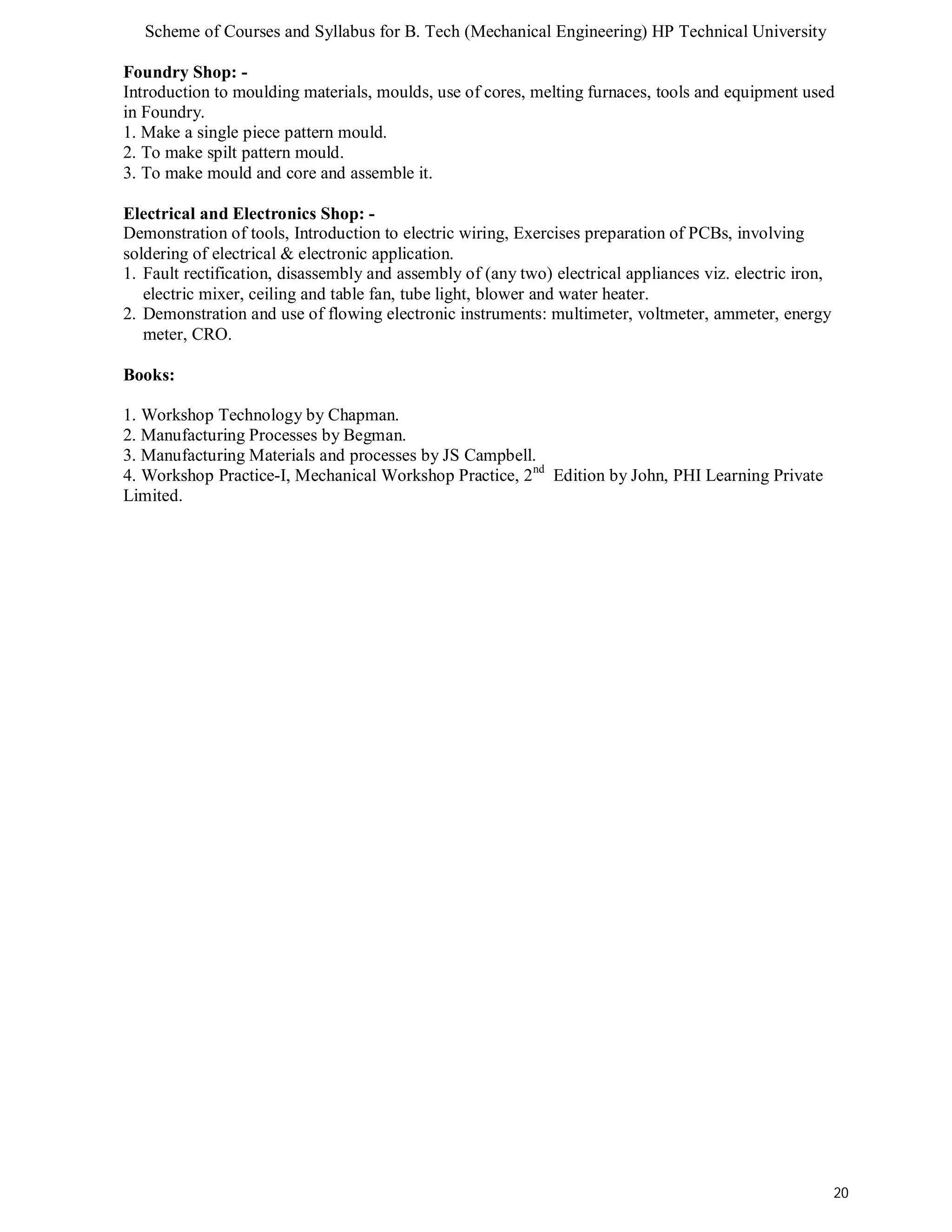
Foundry Shop: - 
Introduction to moulding materials, moulds, use of cores, melting furnaces, tools and equipment used 
in Foundry. 
1. Make a single piece pattern mould. 
2. To make spilt pattern mould. 
3. To make mould and core and assemble it. 
Electrical and Electronics Shop: - 
Demonstration of tools, Introduction to electric wiring, Exercises preparation of PCBs, involving 
soldering of electrical & electronic application. 
1. Fault rectification, disassembly and assembly of (any two) electrical appliances viz. electric iron, 
electric mixer, ceiling and table fan, tube light, blower and water heater. 
2. Demonstration and use of flowing electronic instruments: multimeter, voltmeter, ammeter, energy 
meter, CRO. 
Books: 
1. Workshop Technology by Chapman. 
2. Manufacturing Processes by Begman. 
3. Manufacturing Materials and processes by JS Campbell. 
4. Workshop Practice-I, Mechanical Workshop Practice, 2nd Edition by John, PHI Learning Private 
Limited. 
20
Scheme of Courses and Syllabus for B. Tech (Mechanical Engineering) HP Technical University 
21 
Semester- II 
Engineering Mathematics-II (NS-104) 
Course Code NS-104 L-3, T-1, P-0 
Name of the Course Engineering Mathematics – II 
Lectures to be delivered 52 (1 Hr Each) (L = 39, T = 13 for each semester) 
Semester End 
Examination 
Max. Time: 3 hrs. Max. Marks: 100 Min. Pass Marks: 
40 
Continuous Assessment (based on sessional tests 
50%, Tutorials/Assignments 30%, Quiz/Seminar 
10%, Attendance 10%) 
Max. Marks: 50 
Instructions 
1. The question paper will consist of five sections A, B, C, D and E. Section E will be 
Compulsory, it will consist of a single question with 10-20 subparts of short answer type, 
which will cover the entire syllabus and will carry 20% of the total marks of the semester end 
examination for the course. Section A, B, C and D will have two questions from the respective 
sections of the syllabus and each question will carry 20% of the total marks of the semester end 
examination for the course. 
2. Candidates are required to attempt five questions in all selecting one question from each of the 
section A, B, C and D of the question paper and all the subparts of the questions in section E. 
Use of non-programmable calculators are allowed. 
Section-A 
INFINITE SERIES: Convergence and divergence of infinite series, Geometric series test, Positive 
term series, p-series test, [Comparison test, D’Alembert’s ratio test, Cauchy’s root test (Radical test), 
Integral test, Raabe’s test, Logarithmic test, Gauss’s test (without proofs), Alternating series and 
Leibnitz’s rule, Power series, Radius and interval of convergence, absolute convergence and 
Conditional convergence. 
Section-B 
FOURIER SERIES: Euler’s formula, Conditions for a Fourier expansion, Dirichlet’s conditions, 
Functions having points of discontinuity, Change of interval, Odd and even periodic functions, 
Expansion of odd and even periodic functions, Half-range series, Typical wave-forms, Parseval’s 
formula. 
Section-C 
LINEAR DIFFERENTIAL EQUATIONS: Brief review of first order ordinary differential 
equations, Exact equations, Equations reducible to exact equations, Equations of the first order and 
higher degree, Clairaut’s equation, Linear differential equations with constant co-efficients, 
Complimentary functions and particular integral, Method of variation of parameters, Equations 
reducible to linear equations with constant co-efficients (Cauchy’s and Legendre’s linear equations). 
Section-D 
VECTOR CALCULUS: Curves in space, curvature and torsion, Scalar and vector point functions, 
Differentiation of vectors, Vector operator Del, gradient, divergence and curl with their physical 
interpretations, Formulae involving gradient, divergence and curl, Line, surface and volume integrals, 
Green’s Theorems, Stokes and Gauss Theorems and their verifications and applications. Scalar 
potential, solenoidal and irrotational fields.
Scheme of Courses and Syllabus for B. Tech (Mechanical Engineering) HP Technical University 
22 
Text Books: 
1. Advanced Engineering Mathematics by Erwin Kreyszig, John Wiley and Sons, N.C., New 
York. 
2. Advanced Engineering Mathematics by R. K. Jain & S. R. K Iyengar, Narosa Publishing 
House. 
Reference Books: 
1. Advanced Engineering Mathematics: by C. R. Wylie & L. C. Barrett, McGraw Hill 
2. Higher Engineering Mathematics byB S Grewal,Khanna Publishers, New Delhi. 
3. Differential & Integral Calculus: by N. Piskunov, MIR Publications. 
4. Calculus and Analytic Geometry by Thomes, G.B, Finney, R.L. Ninth Edition, Pearson 
Education. 
5. Advanced Engineering Mathematics byPeter. V. ONil, Wordsworth Publishing Company. 
6. Vector Calculus by C. E. Weatherburn. John Wiley and Sons, NC, New York. 
7. Differential Equations by Shepley L. Ross, John Wiley & Sons, New York.
Scheme of Courses and Syllabus for B. Tech (Mechanical Engineering) HP Technical University 
23 
Engineering Physics– II (NS – 105) 
Course Code NS-105 L-3, T-1, P-0 
Name of the Course Engineering Physics – II 
Lectures to be delivered 52 (1 Hr Each) (L = 39, T = 13 for each semester) 
Semester End 
Examination 
Max. Time: 3 hrs. Max. Marks: 100 Min. Pass Marks: 
40 
Continuous Assessment (based on sessional tests 
50%, Tutorials/Assignments 30%, Quiz/Seminar 
10%, Attendance 10%) 
Max. Marks: 50 
Instructions 
1. For Paper Setters: The question paper will consist of five sections A, B, C, D & E. 
Section E will be compulsory, it will consist of a single question with 10-20 subparts of 
short answer type, which will cover the entire syllabus and will carry 20% of the total 
marks of the semester end examination for the course. Section A, B, C & D will have two 
questions from the respective sections of the syllabus and each question will carry 20% of 
the total marks of the semester end examination for the course. 
2. For candidates: Candidates are required to attempt five questions in all selecting one 
question from each of the sections A, B, C & D of the question paper and all the subparts of 
the questions in Section E. Use of non-programmable calculators is allowed. 
SECTION – A 
Crystal Structure: Space lattice, Bravais lattice - unit cell, primitive cell. Lattice parameters. Crystal 
systems. Direction and planes in a crystal.Miller indices. Expression for inter-planar spacing.Co-ordination 
number. Atomic packing factor. Bragg’s Law.Determination of crystal structure by Bragg’s 
x-ray spectrometer. Crystal structures of NaCl, and diamond. 
Free electron theory: Elements of classical free electron theory and its limitations. Quantum theory of 
free electrons, Fermi level, density of states, fermidirac distribution function, Thermionic emission, 
Richardson’s equation. 
(10 Lectures) & (Text Book-1) 
SECTION – B 
Band Theory of Solids: Origin of energy bands, Periodic Potential in a crystal, Wave function in a 
periodic potential, kronig, Penney Model (qualitative), E-K diagrams, Brillouin Zones, Effective mass 
of electron, Concept of negative effective mass and holes, Classification into metals, semiconductors 
and insulators, fermi energy and its variation with temperature. 
(9 Lectures) & (Text Book-1) 
SECTION – C 
Dielectric and Magnetic Properties of Materials: Dielectric polarization, dielectric constant, types 
of polarization, electric field, electric displacement and dielectric polarization vector & relation 
between them, Gauss;s law in the presence of dielectric, Behavior of dielectric in alternating field-simple 
concepts, Atomic Magnetic Moments, Classification of magnetic materials, Dia, para, and 
ferromagnetic materials, domains, B-H graph in ferromagnetic materials Anti-ferromagnetism 
&ferrimagnetisms, . Soft and Hard magnetic materials. Ferrite and their applications.
Scheme of Courses and Syllabus for B. Tech (Mechanical Engineering) HP Technical University 
Superconductivity: Temperature dependence of resistivity in superconducting materials. Effect of 
magnetic field (Meissner effect). Type I and Type II superconductors. BCS theory (qualitative), High 
temperature superconductors, Applications of superconductivity. 
24 
(12 Lectures) & (Text Book-1) 
SECTION – D 
Lasers: Spontaneous and stimulated emission, Einstein’s Coefficients, Characteristics of Laser beam, 
Population inversion, Pumping Techniques, Components of a laser system, Ruby Laser and He-Ne 
Lasers 
Fiber Optics: Basics of fiber optics, Total Internal Reflection, Acceptance angle, Numerical aperture, 
Single mode & Multimode fibres, Step index and Graded index fiber, pulse Dispersion in optical 
fibres, Attenuation in Optical Fibres, applications of optical fibres. 
(8 Lectures) & (Text Book-2) 
Text Books: 
1. Rajnikant: Applied Solid State Physics, Wiley India Pvt. Ltd. 
2. A.Ghatak: Optics,Tata Mcgraw Hill, 3rd edition. 
Reference Books: 
1. Charles Kittel: Introduction to Solid State Physics, John Wiley & sons Inc. 
2. S.O.Kasap, Principle of Electronic materials and Devices.
Scheme of Courses and Syllabus for B. Tech (Mechanical Engineering) HP Technical University 
25 
ENGINEERING CHEMISTRY (NS – 103) 
Course Code NS-103 L-3, T-1, P-0 
Name of the Course Engineering Chemistry 
Lectures to be delivered 52 (1 Hr Each) (L = 39, T = 13 for each semester) 
Semester End 
Examination 
Max. Time: 3 hrs. Max. Marks: 100 Min. Pass Marks: 
40 
Continuous Assessment (based on sessional tests 
50%, Tutorials/Assignments 30%, Quiz/Seminar 
10%, Attendance 10%) 
Max. Marks: 50 
Instructions 
1. For Paper Setters: The question paper will consist of five sections A, B, C, D & E. Section E will 
be compulsory, it will consist of a single question with 10-20 subparts of short answer type, which 
will cover the entire syllabus and will carry 20% of the total marks of the semester end 
examination for the course. Section A, B, C & D will have two questions from the respective 
sections of the syllabus and each question will carry 20% of the total marks of the semester end 
examination for the course. 
2. For candidates: Candidates are required to attempt five questions in all selecting one question 
from each of the sections A, B, C & D of the question paper and all the subparts of the questions 
in Section E. 
SECTION –A 
Electrochemistry: Electrical Conductance, Types of Electrolyte, Specific Conductance, Equivalent 
Conductance, Molar Conductance, Ionic Conductance (Kohlrausch Law), Factors Affecting 
Conductance, Transport Number, Interionic Attraction Theory of Conductance, Hydration of ions, 
Electrochemical Cell ,Electrode Potential, Standard Electrode Potential, Galvanic Cells, EMF of the 
Cell & Free Energy Change, Nernst Equation, Reference Electrodes (S.H.E,Calomel Electrode, Silver- 
Silver Electrode, Single, Eletrochemical Series, Glass Electrode, Concentration Cell, types & 
applications of Concentration Cell, Batteries(primary cell , Secondary storage cell, Metal- Air 
Batteries), Fuel cell, hydrogen-oxygen fuel cell. 
Phase Rule: Introduction, One Component System (water system, sulpher system) Two components 
System (lead-silver & Zinc- magnesium system), thermal Analysis, (13 Lect) 
SECTION – B 
Water Treatment: Introduction, Sources of water, Impurities, Hardness Analysis, Oxidations, (BOD 
& COD), Boiler Corrosion Sewage & Treatment. 
Corrosion and its Controls: Introduction, Types of corrosions, Electrochemical Theory, Pitting, 
Water Line, Differential Aerations corrosions, Stress Corrosions, Factors affecting Corrosions, 
Preventive measures. (10Lect) 
SECTION – C 
Instrumental Methods of Analysis 
Introduction to spectroscopy; UV-Visible spectroscopy- Absorption laws ,Instrumentation, formation 
of absorption bands, Theory of electronic spectroscopy, Chromophore and auxochrome concept, 
fluorescence & phosphorescence, application of UV-Visible spectroscopy ; IR spectroscopy- 
Principle, theory of molecular vibrations, important features of IR spectroscopy and applications;
Scheme of Courses and Syllabus for B. Tech (Mechanical Engineering) HP Technical University 
NMR-Principle, relaxation processes, Instrumentation, shielding-desheilding effects, spin coupling, 
coupling constant, applications of NMR; 
Fuel and Combustion: Introduction, class of fuels ( Solid, Liquid and Gases) Coal and its origin, 
Analysis of Coals, Petroleum fuels, Cracking, Octane no, Cetane no, Gaseseous fuel, Water Gas, 
producer gas ( 9 Lect) 
26 
SECTION – D 
Polymers Classification of polymers, types of polymerizations, plastics, some important commercial 
thermoplastics (polythene, polypropylene, polystyrene, polyvinylchloride, Teflon, plexiglass, 
polyurethanes), thermosetting (Bakelite, epoxy resin, Urea formaldehyde) Elastomers, synthetic 
rubbers, fiber. 
Composite Materials 
Introduction, Classification, constituents of composites, Fiber reinforced composites, unidirectional 
fibre reinforced composites, short fibre reinforced composites, particle reinforced composites, 
important types and failures of fiber reinforced composites, Advantages and applications of 
composites. (10Lect) 
Text Books: 
1. Engineering Chemistry by Dr Ramesh Thakur and Dr.Subba Ramesh, Wiley India publisher 
2. A Text Book of Engineering Chemistry by ShashiChawla, DhanpatRai& Sons. 
Reference Books: 
1. Engineering Chemistry by P C Jain & Monika Jain 
2. Fundamental of organic spectroscopy by Y. R. Sharma 
3. Spectroscopic methods by Williams and Fleming
Scheme of Courses and Syllabus for B. Tech (Mechanical Engineering) HP Technical University 
27 
Communication & Professional Skills in English (HS-102) 
Course Code HS-102 L-3, T-1, P-0 
Name of the Course Communication & Professional Skills in English 
Lectures to be delivered 52 (1 Hr Each) (L = 39, T = 13 for each semester) 
Semester End 
Examination 
Max. Time: 3 hrs. Max. Marks: 100 Min. Pass Marks: 40 
Continuous Assessment (based on sessional tests 
50%, Tutorials/Assignments 30%, Quiz/Seminar 
10%, Attendance 10%) 
Max. Marks: 50 
Instructions 
1. For Paper Setters: The question paper will consist of five sections A, B, C, D and E. Section E 
will be Compulsory, it will consist of a single question with 10-20 subparts of short answer type, 
which will cover the entire syllabus and will carry 20% of the total marks of the semester end 
examination for the course. Section A, B, C and D will have two questions from the respective 
sections of the syllabus and each question will carry 20% of the total marks of the semester end 
examination for the course. 
2. For Candidates: Candidates are required to attempt five question in all selecting one question 
from each of the section A, B, C and D of the question paper and all the subparts of the questions 
in section E. 
Section A 
Essentials of communication: 
The process of communication: communication competence, types and channels of communication, 
Importance of listening skills in communication: types of listening, barriers to listening, Barriers to 
communication and removal of these barriers, personal SWOT Analysis, Analyzing audience, role of 
emotions and body language in communication, non-verbal communication. 
Section B 
Written communication: 
Enriching vocabulary, using vocabulary in different context, Essentials of strong writing skills, language 
and style of writing, characteristics of a good technical style, logical reasoning, Paragraph writing, 
Developing perspective: goals, objectives and principles of critical thinking. 
Section C 
Reading Comprehension: 
Importance of reading: Eye movement, fixations, regression, visual wandering, right approach to 
reading, SQ3R method of reading, Precis writing, Comprehension, Essay writing. 
Section D 
Technical Communication: 
Report writing: Importance, structure, drafting of reports, Business Writing: Sales letters, claim and 
adjustment letters, inviting/sending quotations, Tenders, Memorandum, Job Application letter, Preparing 
a personal resume, notices, agenda and minutes of meeting.
Scheme of Courses and Syllabus for B. Tech (Mechanical Engineering) HP Technical University 
Text Books: 
1. An Introduction to Professional English and Soft Skills: by Bikram K. Das, Kalyani Samantray, 
28 
Cambridge Press. 
2. Business correspondence and Report Writing: by R. C. Sharma & Krishna Mohan 
Reference Books: 
1. Communication Skills, Sanjay Kumar and PushpLata, Oxford University Press. 
2. Chrissie Wright (Ed.); Handbook of Practical Communication Skills; JAICO Books 
3. Effective Communication and soft Skills, Nitin Bhatnagar and Mamta Bhatnagar, Pearson 
Publication. 
4. Communicative English for Engineers and professionals, Nitin Bhatnagar and Mamta Bhatnagar, 
Pearson Publication. 
5. Communication Skills and soft skills- An integrated approach, Kumar, Pearson Publication 
6. Communication Skills for Engineers, Mishra, Pearson Publication 
7. K.K.Sinha, Business Communication, Galgotia Publishing Company, New Delhi, 1999. 
8. R.K.Bansal& J.B. Harrison, spoken English for India, Orient Longman. 
Recommended Readings: 
1. Business @ The Speed of thought, Bill Gates. 
2. My Experiments with Truth, M.K.Ghandhi 
3. Wings of Fire, A.P.J. Kalam 
4. An Autobiography, JwaharLal Nehru.
Scheme of Courses and Syllabus for B. Tech (Mechanical Engineering) HP Technical University 
29 
BASIC MECHANICAL ENGINEERING (BE-102) 
Course Code BE-102 L-3, T-1, P-0 
Name of the Course Basic Mechanical Engineering 
Lectures to be delivered 52 (1 Hr Each) (L = 39, T = 13 for each semester) 
Semester End Examination Max. Time = 3 hrs. Max. Marks: 100 Min. Pass Marks: 40 
Continuous Assessment (based on sessional tests (2) 50%, 
Max. Marks: 50 
Tutorials/Assignments 30%, Quiz/Seminar 10%, Attendance 10%) 
INSTRUCTIONS 
1. For Paper Setters: The question paper will consist of five sections A, B, C, D & E. Section E will 
be compulsory, it will consist of a single question with 10-20 subparts of short answer type, which 
will cover the entire syllabus and will carry 20% of the total marks of the semester end 
examination for the course. Section A, B, C & D will have two questions from the respective 
sections of the syllabus, and each question will carry 20% of the total marks of the semester end 
examination for the course. 
Note: The paper setter will be required to mention a note in the question paper that use of steam 
table, graphical plots are permitted. 
2. For candidates: Candidates are required to attempt five questions in all selecting one question 
from each of the sections A, B, C & D of the question paper and all the subparts of the questions in 
Section E. Use of non-programmable calculators is allowed. 
Section-A 
Basic concept: Dimensions and units, thermodynamic systems, thermodynamic properties and 
process, thermodynamic equilibrium, energy-kinetic, potential and internal, heat and work, zeroth law, 
concept of temperature, definition of ideal gas, laws and properties of ideal gas. 
First law of Thermodynamics: First law for control mass (closed system), internal energy as a 
property, enthalpy, specific heats, non-flow processes of ideal gases, cyclic process, first law for 
control volume (open system), applications of steady flow energy equation to engineering devices. 
Section-B 
Second law of Thermodynamics: Limitations of first law of thermodynamics, Kelvin- Planck and 
Clausius statements, their equivalence, application of statements of second law to heat engine, heat 
pump and refrigerator, reversible processes, reversible cycles, and carnot cycle, corollaries of the 
second law, thermodynamics temperature scale, Clausius inequality, entropy, principle of increase of 
entropy, availability and irreversibility. 
Properties of Steam: Phase transformation, phase diagram, condition of steam- saturated steam, dry-saturated 
steam, wet steam, superheated steam, dryness fraction, property of steam, steam tables, use 
of Mollier charts , process of vapors and various process. 
Section-C 
Gas Power Cycles: Carnot, Diesel, Otto, Dual combustion, working of 2-stroke and 4-stroke engine, 
Air standard thermal efficiency, Concepts of mean effective pressure, indicated power and brake 
powerfor reciprocating engines. 
Section-D 
Introduction of Psychometry: The Gibbs Dalton law, Psychometric terms, Introduction of 
Psychometry Chart. 
Introduction to Heat Transfer: Mechanisms – Conduction, Convection and Radiation, Introduction 
to Fourier’s Law of heat conduction, Newton’s law of cooling, Stefan-Boltzmann law.
Scheme of Courses and Syllabus for B. Tech (Mechanical Engineering) HP Technical University 
Introduction to Fluid Mechanics: Fluid, properties of fluid, viscosity, Newton’s law of viscosity, 
surface tension, types of fluid, buoyancy. 
TEXT BOOKS: 
1. Basic Mechanical Engineering by Basant Aggarwal and CM Aggarwal Wiley India. 
2. Fundamentals of Mechanical Sciences: Engineering Thermodynamics and Fluid Mechanics by 
30 
Mukherjee and Paul, PHI Learning. 
REFERENCE BOOKS: 
1. Thermodynamics – An Engineering Approach (SI Units) – Yunus. A. Cengel, Michael A. 
Boles, TMH New Delhi 
2. Fundamentals of Thermodynamics –Sonntag, Borgnakke Van Wylen – Wiley India. 
3. Engineering Thermodynamics by P.K. Nag, TMH, New Delhi 
4. Thermodynamics by C.P. Arora, TMH, New Delhi 
5. Fundamentals of Mechanical Engineering, 2nd Edition by G.S. Sawhney, PHI Learning Private 
Limited.
Scheme of Courses and Syllabus for B. Tech (Mechanical Engineering) HP Technical University 
31 
Principle of Computer Programming & C++ (BE-104) 
Course Code BE-104 L-3, T-1, P-0 
Name of the Course Principle of Computer Programming & C++ 
Lectures to be delivered 52 (1 Hr Each) (L = 39, T = 13 for each semester) 
Semester End Examination Max. Time = 3 hrs. Max. Marks: 100 Min. Pass Marks: 40 
Continuous Assessment (based on sessional tests (2) 50%, 
Max. Marks: 50 
Tutorials/Assignments 30%, Quiz/Seminar 10%, Attendance 10%) 
INSTRUCTIONS 
1. For Paper Setters: The question paper will consist of five sections A, B, C, D & E. Section E 
will be compulsory, it will consist of a single question with 10-20 subparts of short answer 
type, which will cover the entire syllabus and will carry 20% of the total marks of the semester 
end examination for the course. Section A, B, C & D will have two questions from the 
respective sections of the syllabus, and each question will carry 20% of the total marks of the 
semester end examination for the course. 
2. For candidates: Candidates are required to attempt five questions in all selecting one question 
from each of the sections A, B, C & D of the question paper and all the subparts of the 
questions in Section E. Use of non-programmable calculators is allowed. 
SECTION-A 
Introduction to Computer:-Definition, Characteristics, Generation of Computers, Capabilities and 
Limitations. Introduction to Operating System. Basic Components of a Computer System-Control 
Unit, ALU, Input/output functions and characteristics. Memory Introduction, Classifications- Volatile 
Memory and Non- Volatile, Memory, ROM, RAM. 
Input, Output and storage Units:-Computer Keyboard, Pointing Devices: Mouse, Trackball, Touch 
Panel, and Joystick, Light Pen, Scanners, Various types of Monitors. 
Hard Copy Devices: - Impact and Non- Impact Printers- Daisy Wheel, Dot Matrix, Line Printer, 
Chain Printer. Non Impact Printers- DeskJet, Laser Printer, Virus: General introduction of virus and 
anti-virus. 
SECTION-B 
High Level Language and Low Level Language, Software and its different types- System Software, 
Application software. Compiler, Interpreter and Assembler. Introduction to algorithm and Flow chart: 
- Representation of an algorithm, flowchart symbols and flow chart, rules, advantage and limitations of 
flowchart and pseudo code. Testing and Debugging:-Definition of testing and debugging , types of 
program errors. 
DOS : Internal and External Commands , Difference between External and Internal Commands. 
SECTION-C 
Introduction to C++ : Starting with C++, Features of C++ Procedure-oriented programming OOP vs. 
procedure-oriented programming Compiling, linking and running a C++ program. 
Object-Oriented Programming Concepts: Abstraction , Inheritance, Polymorphism, Data Binding , 
Encapsulation., Classes and Objects Concept of a class ,Defining a class, Creating an object , Object 
Scope.
Scheme of Courses and Syllabus for B. Tech (Mechanical Engineering) HP Technical University 
The Basics of C++ :Basic Data Types, User-defined Data Types, Variable Declarations, Variable 
Names Constants and its types , Character Constants , String Constants, Standard input and standard 
output Formatted input –cin and Formatted output – cout. 
Working with Operators and Expressions: Operators, Arithmetic Operators, Relational Operators, 
Assignment Operator, Logical Operators, Increment and Decrement Operators (++ and --), 'Operate- 
Assign' Operators (+=, =, ...). 
32 
SECTION-D 
Controlling the Program Flow 
Decision control: if, if – else, if - else if. Loop Control: while, do – while, for, break, continue Case 
Control switch, goto. 
Functions/Procedures: function, Returning values from functions, Arguments Passed by Value 
Passing Addresses of Arguments, Concept of variable scope and scope rules, Global variables 
Pointers and Arrays: Pointers, Pointer Initialization, Pointer Operators, The & (and) Operator 
Understanding Arrays, Initializing Arrays. 
Files: reading, writing text and binary files, pointers, character pointers, pointers to arrays, arrays of 
pointer to structures. 
Text Books: 
1. Fundamentals of Computers by Rajaraman, V., PHI Publication 
2. Object oriented programming in C++ by Rajesh K. Shukla, Wiley India. 
Reference Books: 
1. The C++ programming language, BjarneStroustrup, Addison Wesley, 2000. 
2. Basic Computer Engineering, Kogent learning solution Inc. Dreamtech Press. 
3. Object oriented programming Principles and Fundamental, Gim Keogh and MarioGiannini, 
John Wiley. 
4. Object oriented programming in turbo C++ ,RobbetLofre, 4 Ed Pearson Publication. 
5. Programming with C++, D. Ravichandern, TataMcgraw Hill 1996. 
6. Object oriented programming in C++, Nicolai M Josuetis, John Wiley.
Scheme of Courses and Syllabus for B. Tech (Mechanical Engineering) HP Technical University 
33 
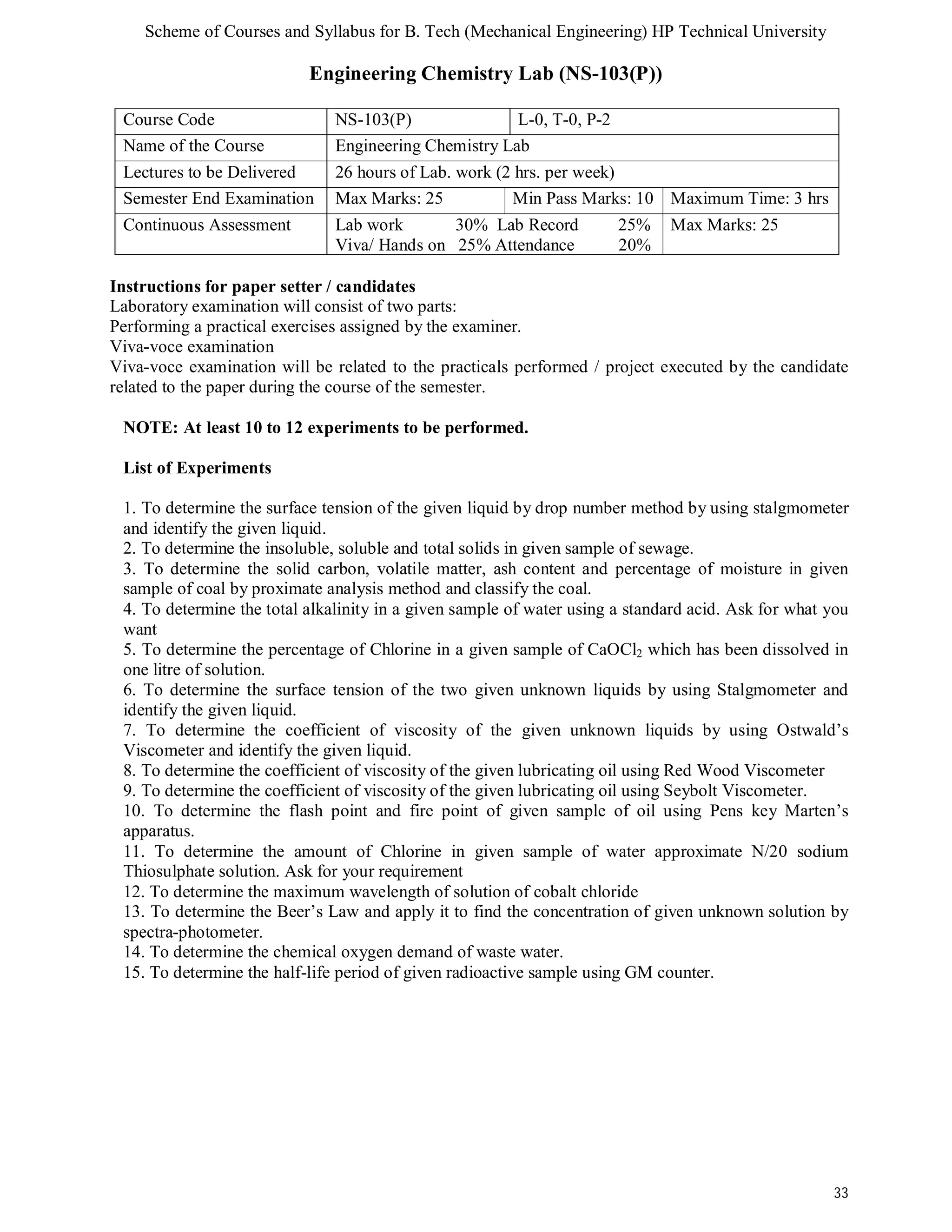
Engineering Chemistry Lab (NS-103(P)) 
Course Code NS-103(P) L-0, T-0, P-2 
Name of the Course Engineering Chemistry Lab 
Lectures to be Delivered 26 hours of Lab. work (2 hrs. per week) 
Semester End Examination Max Marks: 25 Min Pass Marks: 10 Maximum Time: 3 hrs 
Continuous Assessment Lab work 30% Lab Record 25% 
Viva/ Hands on 25% Attendance 20% 
Max Marks: 25 
Instructions for paper setter / candidates 
Laboratory examination will consist of two parts: 
Performing a practical exercises assigned by the examiner. 
Viva-voce examination 
Viva-voce examination will be related to the practicals performed / project executed by the candidate 
related to the paper during the course of the semester. 
NOTE: At least 10 to 12 experiments to be performed. 
List of Experiments 
1. To determine the surface tension of the given liquid by drop number method by using stalgmometer 
and identify the given liquid. 
2. To determine the insoluble, soluble and total solids in given sample of sewage. 
3. To determine the solid carbon, volatile matter, ash content and percentage of moisture in given 
sample of coal by proximate analysis method and classify the coal. 
4. To determine the total alkalinity in a given sample of water using a standard acid. Ask for what you 
want 
5. To determine the percentage of Chlorine in a given sample of CaOCl2 which has been dissolved in 
one litre of solution. 
6. To determine the surface tension of the two given unknown liquids by using Stalgmometer and 
identify the given liquid. 
7. To determine the coefficient of viscosity of the given unknown liquids by using Ostwald’s 
Viscometer and identify the given liquid. 
8. To determine the coefficient of viscosity of the given lubricating oil using Red Wood Viscometer 
9. To determine the coefficient of viscosity of the given lubricating oil using Seybolt Viscometer. 
10. To determine the flash point and fire point of given sample of oil using Pens key Marten’s 
apparatus. 
11. To determine the amount of Chlorine in given sample of water approximate N/20 sodium 
Thiosulphate solution. Ask for your requirement 
12. To determine the maximum wavelength of solution of cobalt chloride 
13. To determine the Beer’s Law and apply it to find the concentration of given unknown solution by 
spectra-photometer. 
14. To determine the chemical oxygen demand of waste water. 
15. To determine the half-life period of given radioactive sample using GM counter.
Scheme of Courses and Syllabus for B. Tech (Mechanical Engineering) HP Technical University 
34 
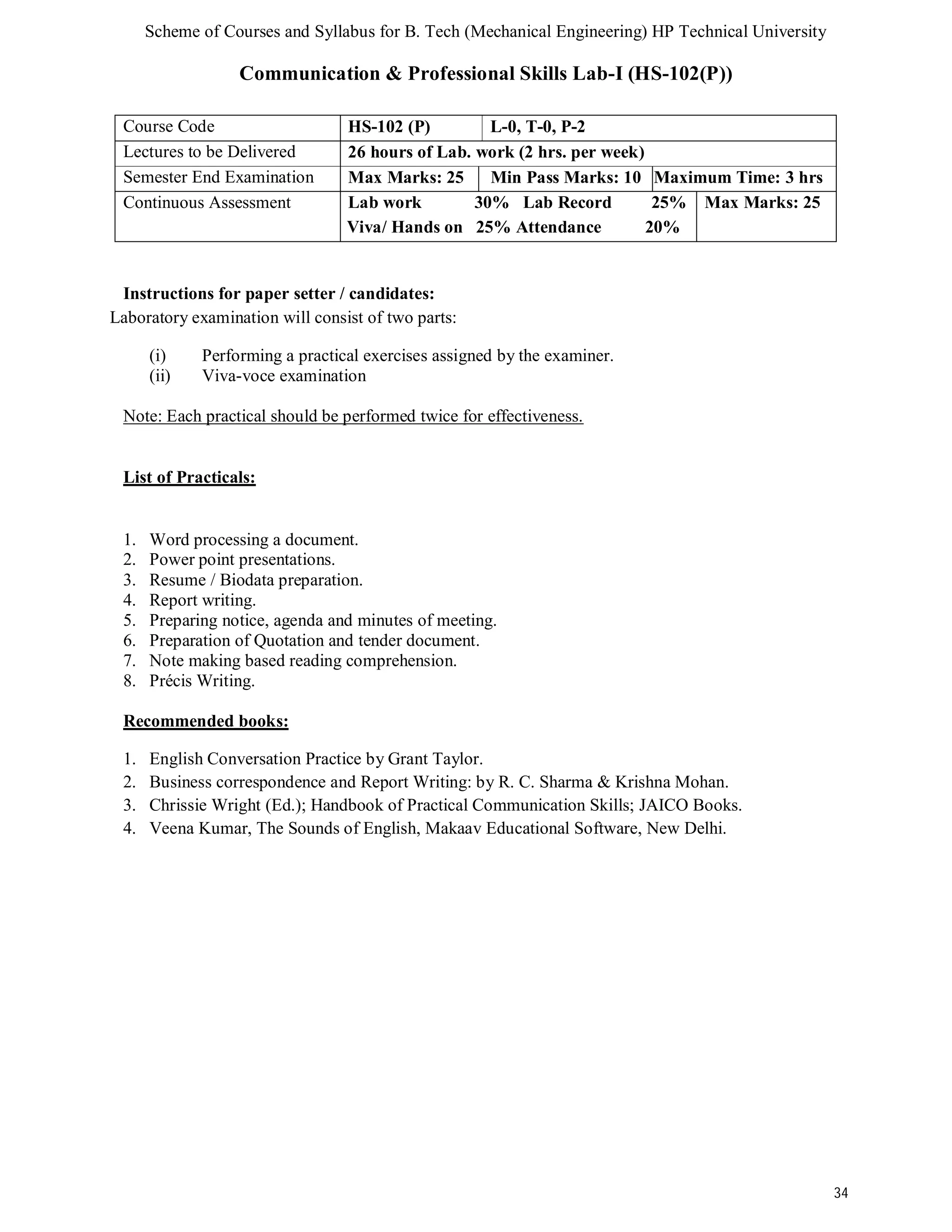
Communication & Professional Skills Lab-I (HS-102(P)) 
Course Code HS-102 (P) L-0, T-0, P-2 
Lectures to be Delivered 26 hours of Lab. work (2 hrs. per week) 
Semester End Examination Max Marks: 25 Min Pass Marks: 10 Maximum Time: 3 hrs 
Continuous Assessment Lab work 30% Lab Record 25% 
Viva/ Hands on 25% Attendance 20% 
Max Marks: 25 
Instructions for paper setter / candidates: 
Laboratory examination will consist of two parts: 
(i) Performing a practical exercises assigned by the examiner. 
(ii) Viva-voce examination 
Note: Each practical should be performed twice for effectiveness. 
List of Practicals: 
1. Word processing a document. 
2. Power point presentations. 
3. Resume / Biodata preparation. 
4. Report writing. 
5. Preparing notice, agenda and minutes of meeting. 
6. Preparation of Quotation and tender document. 
7. Note making based reading comprehension. 
8. Précis Writing. 
Recommended books: 
1. English Conversation Practice by Grant Taylor. 
2. Business correspondence and Report Writing: by R. C. Sharma & Krishna Mohan. 
3. Chrissie Wright (Ed.); Handbook of Practical Communication Skills; JAICO Books. 
4. Veena Kumar, The Sounds of English, Makaav Educational Software, New Delhi.
Scheme of Courses and Syllabus for B. Tech (Mechanical Engineering) HP Technical University 
35 
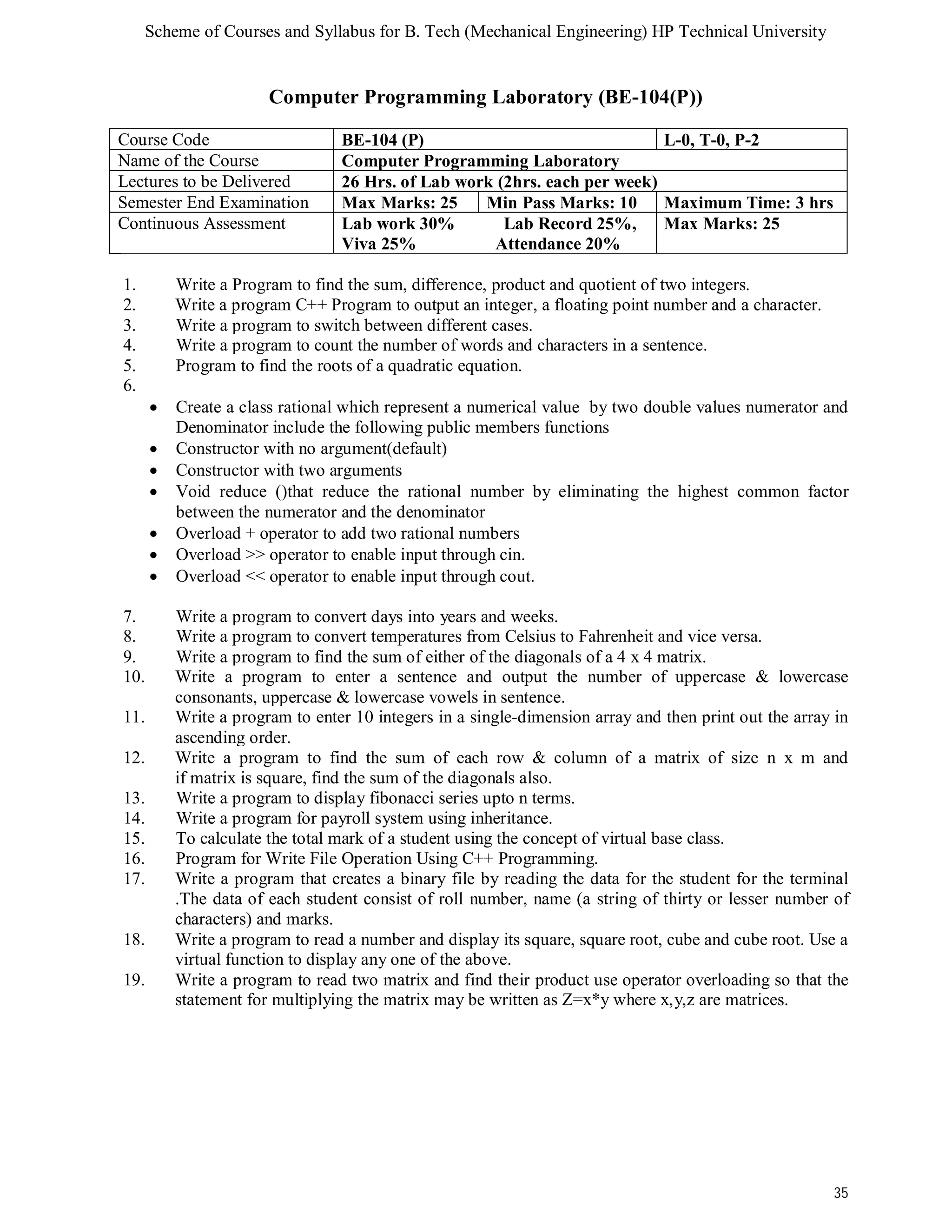
Computer Programming Laboratory (BE-104(P)) 
Course Code BE-104 (P) L-0, T-0, P-2 
Name of the Course Computer Programming Laboratory 
Lectures to be Delivered 26 Hrs. of Lab work (2hrs. each per week) 
Semester End Examination Max Marks: 25 Min Pass Marks: 10 Maximum Time: 3 hrs 
Continuous Assessment Lab work 30% Lab Record 25%, 
Viva 25% Attendance 20% 
Max Marks: 25 
1. Write a Program to find the sum, difference, product and quotient of two integers. 
2. Write a program C++ Program to output an integer, a floating point number and a character. 
3. Write a program to switch between different cases. 
4. Write a program to count the number of words and characters in a sentence. 
5. Program to find the roots of a quadratic equation. 
6. 
 Create a class rational which represent a numerical value by two double values numerator and 
Denominator include the following public members functions 
 Constructor with no argument(default) 
 Constructor with two arguments 
 Void reduce ()that reduce the rational number by eliminating the highest common factor 
between the numerator and the denominator 
 Overload + operator to add two rational numbers 
 Overload >> operator to enable input through cin. 
 Overload << operator to enable input through cout. 
7. Write a program to convert days into years and weeks. 
8. Write a program to convert temperatures from Celsius to Fahrenheit and vice versa. 
9. Write a program to find the sum of either of the diagonals of a 4 x 4 matrix. 
10. Write a program to enter a sentence and output the number of uppercase & lowercase 
consonants, uppercase & lowercase vowels in sentence. 
11. Write a program to enter 10 integers in a single-dimension array and then print out the array in 
ascending order. 
12. Write a program to find the sum of each row & column of a matrix of size n x m and 
if matrix is square, find the sum of the diagonals also. 
13. Write a program to display fibonacci series upto n terms. 
14. Write a program for payroll system using inheritance. 
15. To calculate the total mark of a student using the concept of virtual base class. 
16. Program for Write File Operation Using C++ Programming. 
17. Write a program that creates a binary file by reading the data for the student for the terminal 
.The data of each student consist of roll number, name (a string of thirty or lesser number of 
characters) and marks. 
18. Write a program to read a number and display its square, square root, cube and cube root. Use a 
virtual function to display any one of the above. 
19. Write a program to read two matrix and find their product use operator overloading so that the 
statement for multiplying the matrix may be written as Z=x*y where x,y,z are matrices.
Scheme of Courses and Syllabus for B. Tech (Mechanical Engineering) HP Technical University 
36 
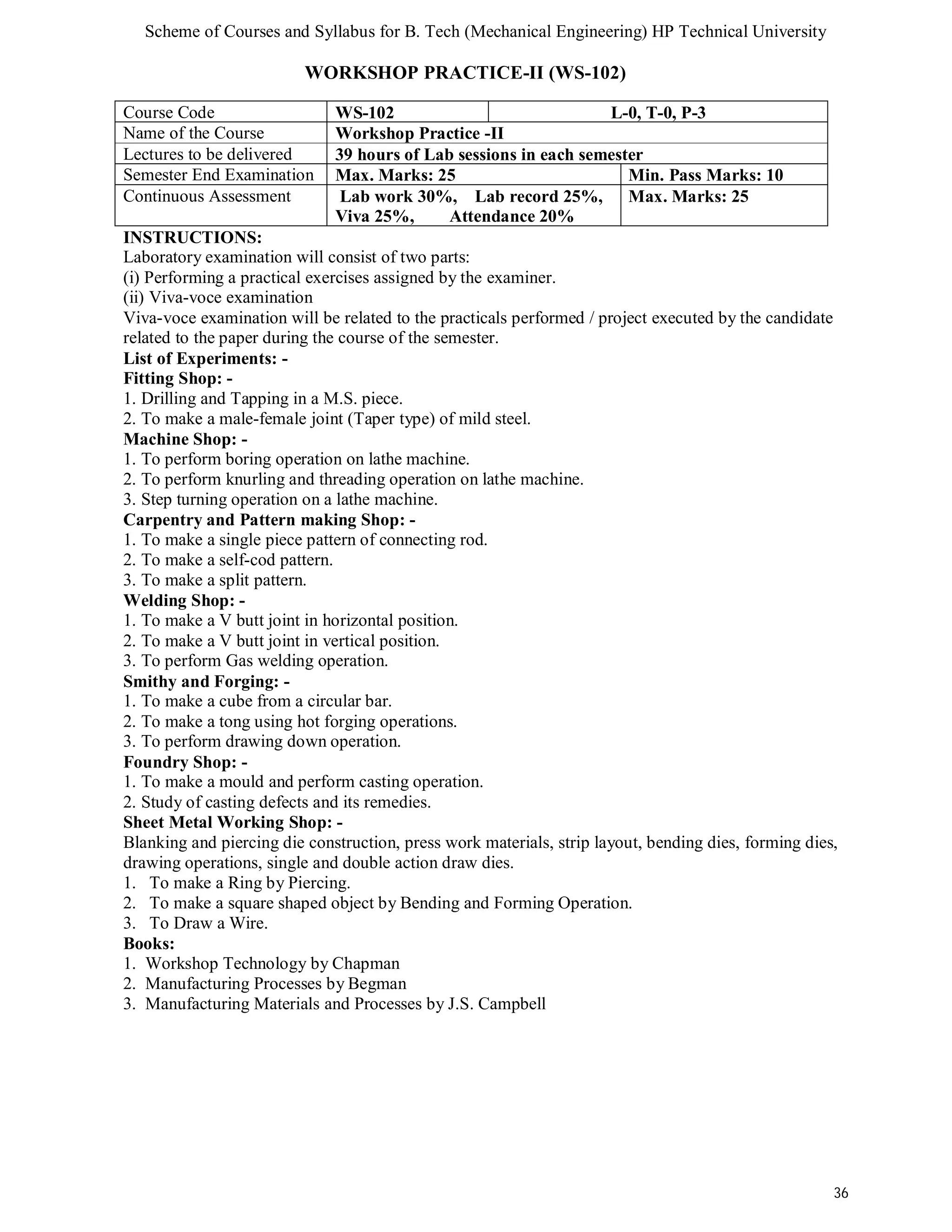
WORKSHOP PRACTICE-II (WS-102) 
Course Code WS-102 L-0, T-0, P-3 
Name of the Course Workshop Practice -II 
Lectures to be delivered 39 hours of Lab sessions in each semester 
Semester End Examination Max. Marks: 25 Min. Pass Marks: 10 
Continuous Assessment Lab work 30%, Lab record 25%, 
Viva 25%, Attendance 20% 
Max. Marks: 25 
INSTRUCTIONS: 
Laboratory examination will consist of two parts: 
(i) Performing a practical exercises assigned by the examiner. 
(ii) Viva-voce examination 
Viva-voce examination will be related to the practicals performed / project executed by the candidate 
related to the paper during the course of the semester. 
List of Experiments: - 
Fitting Shop: - 
1. Drilling and Tapping in a M.S. piece. 
2. To make a male-female joint (Taper type) of mild steel. 
Machine Shop: - 
1. To perform boring operation on lathe machine. 
2. To perform knurling and threading operation on lathe machine. 
3. Step turning operation on a lathe machine. 
Carpentry and Pattern making Shop: - 
1. To make a single piece pattern of connecting rod. 
2. To make a self-cod pattern. 
3. To make a split pattern. 
Welding Shop: - 
1. To make a V butt joint in horizontal position. 
2. To make a V butt joint in vertical position. 
3. To perform Gas welding operation. 
Smithy and Forging: - 
1. To make a cube from a circular bar. 
2. To make a tong using hot forging operations. 
3. To perform drawing down operation. 
Foundry Shop: - 
1. To make a mould and perform casting operation. 
2. Study of casting defects and its remedies. 
Sheet Metal Working Shop: - 
Blanking and piercing die construction, press work materials, strip layout, bending dies, forming dies, 
drawing operations, single and double action draw dies. 
1. To make a Ring by Piercing. 
2. To make a square shaped object by Bending and Forming Operation. 
3. To Draw a Wire. 
Books: 
1. Workshop Technology by Chapman 
2. Manufacturing Processes by Begman 
3. Manufacturing Materials and Processes by J.S. Campbell
Scheme of Courses and Syllabus for B. Tech (Mechanical Engineering) HP Technical University 
37 
SEMESTER-III 
ENGINEERING ECONOMICS HS-201 
Course Code HS-201 L-3, T-0, P-0 
Name of the Course Engineering Economics 
Lectures to be delivered 39 (1 Hr Each) (L = 39, for each semester) 
Semester End 
Examination 
Max. Time = 3 hrs. Max. Marks: 100 Min. Pass Marks: 40 
Continuous Assessment (based on sessional tests (2) 
50%, Tutorials/Assignments 30%, Quiz/Seminar 
10%, Attendance 10%) 
Max. Marks: 50 
INSTRUCTIONS: 
1. For Paper Setters: The question paper will consist of five sections A, B, C, D & E. Section A, 
B, C & D will have two questions from the respective sections of the syllabus and each section 
will carry 20% of the total marks of the semester end examination for the course. Section E will 
be compulsory, it will consist of a single question with 10-20 subparts of short answer type, 
which will cover the entire syllabus and each question will carry 20% of the total marks of the 
semester end examination for the course. 
2. For candidates: Candidates are required to attempt five questions in all selecting one question 
from each of the sections A, B, C & D of the question paper and all the subparts of the 
questions in Section E. Use of non-programmable calculators is allowed. 
Section-A 
Economics: Definition, nature and scope of economics, need &significance of economics in 
Engineering, Economic Systems-Meaning of capitalism, socialism and mixed economy. 
Demand: Meaning, determinants of demand, demand curve, law of demand, exception to the law of 
demand, increase &decrease in demand, contraction &extension of demand, Elasticity of demand, 
Methods of measuring Elasticity of demand. 
Supply: Law of supply, extension & contraction of supply, increase & decrease in Supply, Elasticity 
of supply. 
Section-B 
Cost of Production: Concept, types, Relation between average & marginal cost. 
Theory of Production: Laws of returns- Law of variable proportions and law of returns to Scale, 
Break Even Analysis. 
Price & Output Determination: Price determination under perfect competition, monopoly, 
monopolistic competition & oligopoly. 
Section-C 
Monetary policy- Meaning, objectives, methods, Fiscal policy- Meaning &Objectives of fiscal policy 
In a developing country like India, Functions of Reserve Bank of India and commercial banks.
Scheme of Courses and Syllabus for B. Tech (Mechanical Engineering) HP Technical University 
38 
Economics & Business Environment- Business/Trade Cycles- Meaning, Characteristics & 
classification, Inflation Effect, Foreign capital &economic development, Engineering Economics 
Analysis, Economics Analysis in the public and regulated sectors. 
Section D 
Indian Economy: - Characteristics of Indian economy, Planning in India, Development &Growth in 
India. Overall Economic policy since independence, Input & output analysis, Problem of 
unemployment in India. Concept of sustainable development & inclusive growth in India. Policy of 
globalizations, liberisation & privatization. Analysis of state & union budgets. 
TEXT BOOKS: 
1. Modern Micro Economics by Koutsoyannisa, MC Millen. 
2. Principles of Engineering Economics Analysis by John A. White, Kenneth E. Case and 
David B. Pratt Wiley India. 
REFERENCE BOOKS: 
1. Business Economics by K. P. M. Sundharam, Sultan Chand & Sons. 
2. Elementary Economics Theory by K.K Dewett & J. D. Verma, S.Chand Publication.
Scheme of Courses and Syllabus for B. Tech (Mechanical Engineering) HP Technical University 
39 
SEMESTER – III 
ENGINEERING MATHEMATICS-III NS-206 
Course Code NS-206 L-3, T-1, P-0 
Name of the Course Engineering Mathematics-III 
Lectures to be delivered 52 (1 Hr Each) (L = 39, T = 13 for each semester) 
Semester End 
Examination 
Max. Time = 3 hrs. Max. Marks: 100 Min. Pass Marks: 40 
Continuous Assessment (based on sessional tests 
(2) 50%, Tutorials/Assignments 30%, 
Quiz/Seminar 10%, Attendance 10%) 
Max. Marks: 50 
INSTRUCTIONS: 
1. For Paper Setters: The question paper will consist of five sections A, B, C, D & E. 
Section A, B, C & D will have two questions from the respective sections of the syllabus 
and each section will carry 20% of the total marks of the semester end examination for the 
course. Section E will be compulsory, it will consist of a single question with 10-20 
subparts of short answer type, which will cover the entire syllabus and each question will 
carry 20% of the total marks of the semester end examination for the course. 
2. For candidates: Candidates are required to attempt five questions in all selecting one 
question from each of the sections A, B, C & D of the question paper and all the subparts of 
the questions in Section E. Use of non-programmable calculators is allowed. 
Section-A 
PARTIAL DIFFERENTIAL EQUATIONS 
Formation and solutions of partial differential equations, Lagrange’s linear equation of the first order, 
non linear equations of first order, charpit method, Homogenous linear partial differential equation 
with constant coefficients, rules for complementary function and particular integral, non-homogenous 
linear partial differential equations, Method of separation of variables, Solution of wave equations, 
Heat flow equations, Laplace’s equations and their applications to engineering problems. 
Section-B 
SPECIAL FUNCTIONS 
Power series solution of differential equations, Frobenius method, Bessel's equation, Bessel functions 
of the first and second kind, Recurrence relations of Bessel functions, Generating functions, 
Orthogonality of Bessel functions, Legendre's equation, Legendre polynomial, Recurrence relations of 
Legendre's functions, Rodrigue’s formula, Orthogonality of Legendre polynomials, Error function and 
its properties. 
Section-C 
INTEGRAL TRANSFORMS 
Laplace Transforms of standard functions and their properties, Inverse Laplace Transforms, General 
Properties of inverse Laplace transforms and Convolution Theorem, Laplace Transforms of periodic 
functions, Laplace transform of Bessel functions and Error function, Dirac-delta Function, Heaviside’s 
Unit Function, Applications to linear simultaneous differential equations. Fourier Integral, Fourier
Scheme of Courses and Syllabus for B. Tech (Mechanical Engineering) HP Technical University 
40 
Transform, Fourier sine and cosine transforms, finite Fourier transform, Convolution theorem for 
Fourier Transform and Parseval’s Identity for Fourier Transform. 
Section-D 
FUNCTIONS OF COMPLEX VARIABLE 
Limit and derivative of complex functions, Cauchy-Riemann equations, Analytic functions, Entire 
functions and its applications, Conformal mapping and standard transformations, Complex integration, 
Cauchy’s theorem and Cauchy’s integral formula (without proof), Series of complex terms, Taylor’s 
series and Laurent’s series (without proof), Zeros of analytic functions, isolated singularity, removable 
singularity, Poles, essential singularity, Residue, Residue theorem and their applications 
TEXT BOOKS 
1. Advanced Engineering Mathematics: by Erwin Kreyszig . John Wiley and Sons, NC, New 
York. 
2. Partial Differential Equation for Engineers and Scientists: by J.N. Sharma and Kehar Singh 
Narosa Publishing House, New Delhi/ Alpha Science Int. Ltd, UK. 
3. Advanced Engineering Mathematics: by R. K. Jain & S. R. K Iyengar, Narosa Pub. House. 
4. Complex Variables Theory and Applications: by HS Kasana, PHI Learning Private Limited 
New Delhi, (2008). 
REFERENCE BOOKS 
1. Advanced Engineering Mathematics: by C. R. Wylie & L. C. Barrett, McGraw Hill. 
2. Elements of Partial Differential Equations: by Ian N. Sneddon, McGraw-Hill, Singapore. 
3. Differential & Integral Calculus: by N. Piskunov, MIR Publications. 
4. Calculus and Analytic Geometry, by Thomes, G.B, Finney, R.L. Ninth Edition, Peason 
Education. 
5. Advanced Engineering Mathematics,by Peter. V. O. Nil, Wordsworth Publishing Company. 
6. Advanced Engineering Mathematics, by Jain, R.K and Lyengar, S.R.K., Narosa Publishing 
Company. 
7. Higher Engineering Mathematics, by Grewal, B.S., Khanna Publishers, New Delhi. 
8. Engineering Mathematics, by Taneja, H.C., Volume-I & Volume-II, I.K. Publisher. 
9. Differential Equations: by Shepley L. Ross, John Wiley & Sons, New York.
Scheme of Courses and Syllabus for B. Tech (Mechanical Engineering) HP Technical University 
41 
SEMESTER – III 
STRENGTH OF MATERIALS-I ME-211 
Course Code ME-211 L-4, T-1, P-0 
Name of the Course Strength of Materials-I 
Lectures to be 
delivered 
65 (1 Hr Each) (L = 52, T = 13 for each semester) 
Semester End 
Examination 
Max. Time = 3 hrs. Max. Marks: 100 Min. Pass Marks: 40 
Continuous Assessment (based on sessional 
tests (2) 50%, Tutorials/Assignments 30%, 
Quiz/Seminar 10%, Attendance 10%) 
Max. Marks: 50 
INSTRUCTIONS: 
1. For Paper Setters: The question paper will consist of five sections A, B, C, D & E. 
Section A, B, C & D will have two questions from the respective sections of the syllabus 
and each section will carry 20% of the total marks of the semester end examination for the 
course. Section E will be compulsory, it will consist of a single question with 10-20 
subparts of short answer type, which will cover the entire syllabus and each question will 
carry 20% of the total marks of the semester end examination for the course. 
2. For candidates: Candidates are required to attempt five questions in all selecting one 
question from each of the sections A, B, C & D of the question paper and all the subparts of 
the questions in Section E. Use of non-programmable calculators is allowed. 
SYLLABUS: 
Section-A 
Compound stresses & strains: Concept of surface and volumetric strains, two -dimensional 
stress system, complementary shear stresses at a point on a plane. Principal stresses & strains 
and principal planes. Mohr’s circle of stresses, Numerical problems. 
Theories of Elastic Failure: Various theories of elastic failure with derivations and graphical 
representations, applications to problems of two-dimensional stress systems with (i) Combined 
direct loading and bending and (ii) combined torsional and direct loading. Numerical problems. 
Section-B 
Strain Energy & Impact Loading: Definitions, expressions for strain energy stored in a body 
when load is applied (i) gradually, (ii) suddenly and (iii) with impact. Strain energy of beams in 
bending, beam deflections. Strain energy of shafts in twisting. Energy methods in determining 
spring deflection, Castigliano’s & Maxwell’s theorems, Numerical problems. 
Section-C 
Shear and combined stresses in beams: Shear stresses in beams with derivation of shear 
stress in rectangular I, T, circular and hollow circular sections. Combined bending, torsion & 
axial loading of beams. Numerical problems. 
Columns & Struts: Columns under axial load, concept of instability and buckling, slenderness 
ratio. Derivation of Euler’s formulae for the elastic buckling load. Euler’s, Rankine Gordon’s 
formulae ,Johnson’s empirical formula for axial loading of columns and their applications, 
eccentric compression of a short strut of rectangular & circular sections, Numerical problems.
Scheme of Courses and Syllabus for B. Tech (Mechanical Engineering) HP Technical University 
42 
Section-D 
Slope & Deflection: Relationship between bending moment, slope & deflection, Mohr’s theorem, 
moment area method, method of integration, Macaulay’s method. Calculations for slope 
&deflection of (1) cantilevers and (2) simply supported beams with or without overhang, under 
concentrated loads, uniformly distributed loads or combination of concentrated and uniformly 
distributed loads. Numerical problems. 
Fixed Beams: Deflections, reactions and fixing moments. Calculations of deflection and S.F. & 
B.M. diagrams for fixed beams under (1) concentrated loads, (2) uniformly Distributed loads and 
(3) a combination of concentrated loads and uniformly distributed load. 
Text Books: 
1. Mechanics of Materials-E.J. Hearn, Elsevier Publications. 
2. Mechanics of Materials-R.C.Hibbeler, Pearson India (9th Edition). 
Reference Books: 
1. Strengths of Materials-Popov , PHI, New Delhi. 
2. Strength of Materials-G.H. Ryder- Third Edition in S.I. units 1969 Macmillan India. 
3. Strengths of Materials-Sadhu Singh, Khanna Publications. 
4. Strengths of Materials – R.K. Rajput, S.Chand & Sons. 
5. Fundamentals of Strength of Materials – Nag & Chanda, Wiley India. 
6. Mechanics of Materials- Dr. Kirpal Singh, Standard Publishers Distributors, New Delhi.
Scheme of Courses and Syllabus for B. Tech (Mechanical Engineering) HP Technical University 
43 
SEMESTER – III 
APPLIED THERMODYNAMICS ME - 212 
Course Code ME - 212 L-4, T-1, P-0 
Name of the Course Applied Thermodynamics 
Lectures to be 
delivered 
65 (1 Hr Each) (L = 52, T = 13 for each semester) 
Semester End 
Examination 
Max. Time = 3 hrs. Max. Marks: 100 Min. Pass Marks: 
40 
Continuous Assessment (based on sessional 
tests (2) 50%, Tutorials/Assignments 30%, 
Quiz/Seminar 10%, Attendance 10%) 
Max. Marks: 50 
INSTRUCTIONS: 
1. For Paper Setters: The question paper will consist of five sections A, B, C, D & E. 
Section A, B, C & D will have two questions from the respective sections of the syllabus 
and each section will carry 20% of the total marks of the semester end examination for the 
course. Section E will be compulsory, it will consist of a single question with 10-20 
subparts of short answer type, which will cover the entire syllabus and each question will 
carry 20% of the total marks of the semester end examination for the course. 
Note: The Paper setter will be required to mention a note in the question paper that the use 
of steam table, charts, graphical plots are permitted. 
2. For candidates: Candidates are required to attempt five questions in all selecting one 
question from each of the sections A, B, C & D of the question paper and all the subparts of 
the questions in Section E. Use of non-programmable calculators is allowed. 
SYLLABUS: 
Section-A 
Steam Boiler: Boilers and their classification, comparison between fire tube and water tube 
boilers, essentials of a good boiler. Constructional and operational details of Locomotive, 
Babcock-Wilcox, and Lamont boilers. Boiler mountings and accessories. Natural draft from 
chimney, height of chimney, maximum draft and chimney efficiency, forced draft and induced 
draft, Boiler Heat Balance Sheet. 
Section-B 
Vapour Power Cycles: Carnot and Rankine vapour cycles, effect of operating conditions on 
thermal efficiency of Rankine cycle, Rankine cycle with superheat, reheat cycle and regenerative 
feed heating cycle, Binary vapour cycle. 
Flow Through Nozzles: Velocity and heat drop, mass discharge through a nozzle, critical 
pressure ratio and its significance, effect of friction and nozzle efficiency, supersaturated flow, 
nozzles off the design pressure ratio. 
Section-C 
Steam Turbines: Classification, flow through impulse blades, velocity diagram, calculation of 
power output and efficiency, maximum blade efficiency of single stage impulse turbine, blade 
friction, compounding of impulse turbine. Flow through impulse reaction blades, degree of
Scheme of Courses and Syllabus for B. Tech (Mechanical Engineering) HP Technical University 
reaction, velocity diagram, calculations for power output, efficiency and blade height, 
comparison of impulse and impulse reaction turbines. 
Efficiency and Governing in Steam Turbines: Losses in steam turbines, stage efficiency overall 
efficiency and reheat factor. Governing of steam turbines, throttle governing, nozzle control 
governing and by pass governing. Steam for heating and process work, back pressure turbines 
and pass out turbines. 
44 
Section-D 
Steam Condensers: Elements of a condensing plant, types of condensers, comparison of jet and 
surface condensers. Condenser vacuum, air leakage and loss of vacuum, vacuum efficiency and 
condenser efficiency, Dalton’s law and air vapour mixture, air pumps. 
Thermodynamic (pvt) Relations of Working Fluids: Equation of state for ideal gas, Behaviour 
of real gases and compressibility factor, Generalized, empirical and theoretical equations of state 
for real gases. Helmoltz and Gibbs functions, Maxwell’s relations, Enthalpy, entropy, internal 
energy, and specific heat relations, Clausius- Clapeyron’s equation. Joule Thompson coefficient. 
Text Books: 
1. R. Yadav, “Thermodynamics and Heat Engines, Vol-II”, Central Publishing House. 
2. R.S.Khurmi, “A textbook of Thermal Engineering, S.Chand & Sons. 
Reference Books: 
1. Bellany, P.L., “Thermal Engineering”, Khanna Publishers. 
2. T.D. Eastop & A McConkey, “Applied Thermodynamics for Engineering Technologists”, 
Pearson Education. 
3. V.P. Vasandani & D.S. Kumar, “Heat Engineering”, Metropolitan Book Co. Pvt. Ltd. 
4. Cengel, Y.A., & Boles, M.A.., “Thermodynamics – An Engineering Approach”, McGraw – Hill Inc. 
5. Rajput, R.K., “Thermal Engineering”, Laxmi Publications.
Scheme of Courses and Syllabus for B. Tech (Mechanical Engineering) HP Technical University 
45 
SEMESTER – III 
MACHINE –DRAWING ME-213 
Course Code ME – 213 L-1, T-0, P-4 
Name of the Course Machine –Drawing 
Lectures to be 
delivered 
65 (1 Hr Each, L = 13, T = 0, P=52 for each semester) 
Semester End 
Examination 
Max. Time = 4 hrs. Max. Marks: 100 Min. Pass Marks: 40 
Continuous Assessment (based on sessional 
tests (2) 50%, Tutorials/Assignments 30%, 
Quiz/Seminar 10%, Attendance 10%) 
Max. Marks: 50 
INSTRUCTIONS: 
1. In the semester examination, the examiner will set two questions from each section. The students 
have to attempt three questions taking one from each section. 
2. The questions from Section-A and Section-B will carry 20 Marks each. Questions from Section-C 
will carry 60 Marks. 
SYLLABUS: 
Section-A 
Introduction to BIS Specification sp: 46- 1988 Code of engineering drawing – Limits. Fits and 
Tolerance (dimensional and Geometrical tolerance), Surface finish representation. Gear: Gear 
terminology. I.S convention of assembly of spur gears, helical gear, bevel gears, worm and worm 
wheel. 
Section-B 
Orthographic view from isometric views of machine parts / components. Dimensioning- 
Sectioning. Exercises on coupling, crankshaft, pulley, piston and connecting rod, cotter and 
knuckle joints. Riveted joints and Welded joints. 
Section-C 
Assembly drawing with sectioning and bill of materials from given detail drawings of 
assemblies : Lathe tail stock , machine vice , pedestal bearing , Steam stop valve , drill jigs and 
milling fixture. 
Text Books: 
1. Machine Drawing: N D Bhat and V M Panchal, Pub: Charotar Publishing House. 
2. A text book of machine drawing: PS Gill, Pub: S.K.Kataria & Sons. 
Reference Books: 
1. A text books of machine Drawing: Laxmi narayana and Mathur, Pub: 
M/S Jain Brother. New Delhi. 
2. Machine Drawing: N Sidheshwar, P Kannaieh, V V S Sastry, Pub: Tata McGraw Hill.
Scheme of Courses and Syllabus for B. Tech (Mechanical Engineering) HP Technical University 
46 
SEMESTER – III 
FLUID MECHANICS ME – 214 
Course Code ME – 214 L-4, T-1, P-0 
Name of the Course Fluid Mechanics 
Lectures to be 
delivered 
65 (1 Hr Each) (L = 52, T = 13 for each semester) 
Semester End 
Examination 
Max. Time = 3 hrs. Max. Marks: 100 Min. Pass Marks: 40 
Continuous Assessment (based on sessional 
tests (2) 50%, Tutorials/Assignments 30%, 
Quiz/Seminar 10%, Attendance 10%) 
Max. Marks: 50 
INSTRUCTIONS: 
1. For Paper Setters: The question paper will consist of five sections A, B, C, D & E. 
Section A, B, C & D will have two questions from the respective sections of the syllabus 
and each section will carry 20% of the total marks of the semester end examination for the 
course. Section E will be compulsory, it will consist of a single question with 10-20 
subparts of short answer type, which will cover the entire syllabus and each question will 
carry 20% of the total marks of the semester end examination for the course. 
2. For candidates: Candidates are required to attempt five questions in all selecting one 
question from each of the sections A, B, C & D of the question paper and all the subparts of 
the questions in Section E. Use of non-programmable calculators is allowed. 
SYLLABUS: 
Section-A 
Introduction: Fluid and flow-definition and types, properties of ideal and real fluids, continuum 
concept, Lagrangian & Eulerian approach. 
Fluid Statics: General differential equation, manometry, Force on plane and curved surfaces, 
stability of floating and submerged bodies, Relative equilibrium. 
Section-B 
Kinematics of fluid: Steady flow, uniform flow, stream, streak and path lines, continuity 
equation, stream function, irrotational flow, velocity potential, flow nets, circulation, simple 
flows, flow around circular cylinder with and without rotation, lift and drag. 
Dynamics of fluids: Concept of system and control volume, Reynold’s transportation theorem, 
Euler’s equation, Bernoulli’s equation, Navier Stoke’s equation and their application to nozzle, 
venturimeter, orifices and mouth pieces, time taken in emptying a vessel. Pitot - Prandtl tube. 
Section-C 
Laminar flow of viscous fluids: Boundary layer concept, boundary layer thickness, 
displacement, momentum and energy thickness, integral method, drag on flat plate, flow around 
an airfoil, boundary layer separation. 
Turbulent flow: Fluid friction and Reynolds number, Prandtl mixing length hypothesis velocity 
distribution in pipes, Cole brook formula.
Scheme of Courses and Syllabus for B. Tech (Mechanical Engineering) HP Technical University 
47 
Section-D 
Flow in pipes: Laminar flow through pipe, total and hydraulic gradient lines, series and parallel 
connection of pipes, transmission of power through pipes. 
Dimensional analysis: Buckingham’s Pi theorem, Non – dimensional numbers and their 
application, Similitude. 
Text Books: 
1. Modi and Seth, Fluid Mechanics and Hydraulic Machines, CBS Publishers. 
2. Munson, Young, Okiishi and Huebsch, Fundamentals of Fluid Mechanics, Wiley India (6th 
Edition). 
Reference Books: 
1. White F.M., Fluid Mechanics, Tata McGraw Hill. 
2. Douglas, Gasiorek, Swaffield and Jack, Fluid Mechanics, Pearsons (5th Edition). 
3. Som, S.K. and Biswas, G., Introduction to Fluid Mechanics and Fluid Machines, Tata Mc- 
Graw Hill. 
4. Bansal, R.K., Text Book of Fluid Mechanics and Hydraulic Machines, Laxmi Publications 
(P) Ltd. 
5. Agarwal, Fluid Mechanics and Machinery, Tata McGraw Hill. 
6. Rajput, R.K., A Text Book of Hydraulics, S. Chand and Sons, New Delhi.
Scheme of Courses and Syllabus for B. Tech (Mechanical Engineering) HP Technical University 
48 
SEMESTER – III 
STRENGTH OF MATERIALS – LAB. ME – 211 (P) 
Course Code ME – 211 (P) L-0, T-0, P-2 
Name of the Course Strength of Materials Lab. 
Lectures to be delivered 26 hours of Lab sessions (2 Hrs per week) 
Semester End Examination Max. Marks: 25 Min. Pass Marks: 10 Maximum Time: 3 Hrs 
Continuous Assessment Lab work 30%, Lab record 25%, 
Viva 25%, Attendance 20% 
Max. Marks: 25 
INSTRUCTIONS FOR PAPER SETTER/CANDIDATES: 
Laboratory examination will consist of two parts: 
i) Performing a practical examination assigned by the examiner. 
ii) Viva-voce examination. 
Viva-voce examination will be related to the practicals performed/projects executed by the 
candidate related to the paper during the course of the semester. 
LIST OF EXPERIMENTS: 
1. To study the Brinell hardness testing machine & perform Brinell hardness test 
2. To study the Rockwell hardness testing machine & perform the Rockwell hardness test. 
3. To study the Vickers hardness testing machine & perform Vickers hardness test 
4. To study Erichsen sheet metal testing machine & perform the Erichsen sheet metal test 
5. To study the Impact machine and perform the Impact tests ( Izod & Charpy) 
6. To study the Universal testing machine and perform the tensile test. 
7. To perform compression test on UTM. 
8. To perform bending test on UTM. 
9. To perform the shear test on UTM. 
10. To study the torsion testing machine and perform the torsion test.
Scheme of Courses and Syllabus for B. Tech (Mechanical Engineering) HP Technical University 
49 
SEMESTER – III 
FLUID MECHANICS LAB. ME – 214 (P) 
Course Code ME – 214 (P) L-0, T-0, P-2 
Name of the Course Fluid Mechanics Lab. 
Lectures to be delivered 26 hours of Lab sessions (2 Hrs per week) 
Semester End Examination Max. Marks: 25 Min. Pass Marks: 10 Maximum Time: 3 Hrs 
Continuous Assessment Lab work 30%, Lab record 25%, 
Viva 25%, Attendance 20% 
Max. Marks: 25 
INSTRUCTIONS FOR PAPER SETTER/CANDIDATES: 
Laboratory examination will consist of two parts: 
i) Performing a practical examination assigned by the examiner. 
ii) Viva-voce examination. 
Viva-voce examination will be related to the practicals performed/projects executed by the 
candidate related to the paper during the course of the semester. 
LIST OF EXPERIMENTS: 
1. To determine the coefficient of impact for vanes. 
2. To determine the coefficient of discharge of Notch (V and Rectangular types) 
3. To determine the friction factor for the pipes. 
4. To determine the coefficient of discharge of venturimeter. 
5. To determine the coefficient of discharge, contraction & velocity of an orifice. 
6. To find critical Reynolds number for a pipe flow. 
7. To determine the meta-centric height of a floating body. 
8. To determine the minor losses due to sudden enlargement, sudden contraction and bends.
Scheme of Courses and Syllabus for B. Tech (Mechanical Engineering) HP Technical University 
50 
SEMESTER – III 
AutoCAD LABORATORY ME – 213 (P) 
Course Code ME – 213 (P) L-0, T-0, P-2 
Name of the Course AutoCAD Lab. 
Lectures to be delivered 26 hours of Lab sessions (2 Hrs per week) 
Semester End Examination Max. Marks: 25 Min. Pass Marks: 10 Maximum Time: 3 Hrs 
Continuous Assessment Lab work 30%, Lab record 25%, 
Viva 25%, Attendance 20% 
Max. Marks: 25 
INSTRUCTIONS FOR PAPER SETTER/CANDIDATES: 
Laboratory examination will consist of two parts: 
i) Performing a practical examination assigned by the examiner. 
ii) Viva-voce examination. 
Viva-voce examination will be related to the practical’s performed/projects executed by the 
candidate related to the paper during the course of the semester. 
LIST OF EXPERIMENTS: 
1. Setting up of drawing environment by setting drawing limits, drawing units, naming the drawing 
naming layers, setting line types for different layers using various type of lines in Engineering 
drawing, saving the file with dwg. extension. 
2. Layout drawing of a building using different layer and line colors indicating all Building details 
name the details using text commands, Make a title Block. 
3. To Draw Orthographic projection drawings (Front, Top and side) of boiler safety valve giving name 
the components of the valve. 
4. Make an Isometric dimensioned drawing of a connecting Rod using Isometric grid and snap. 
5. Draw quarter sectional isometric view of a cotter joint. 
6. Draw different types of bolts and nuts with internal and external threading in Acme and square 
threading standards. Save the bolts and nuts as blocks suitable for insertion. 
7. Draw a 3D model of a machine component using 3D primitives and using commands like Union. 
Subtraction, Revolve, Slice, Rotate 3D etc. Calculate surface Area, Mass, Centre of Gravity and Mass 
moment of inertia using inquiry commands render the figure made and attach a material to the 
figure. 
8. Draw 3D model of protected type flange coupling. 
9. Draw a spiral by extruding a circle. 
10. Draw an assembly of Jigs & Fixture in 3D.
Scheme of Courses and Syllabus for B. Tech (Mechanical Engineering) HP Technical University 
51 
SEMESTER – IV 
HUMAN VALUES AND PROFESSIONAL ETHICS HS-203 
Course Code HS-203 L-2, T-0, P-2 
Name of the Course Human Values and Professional Ethics 
Lectures to be delivered 52 (1 Hr Each) (L = 26, P = 26 for each semester) 
Semester End 
Examination 
Max. Time = 3 hrs. Max. Marks: 100 Min. Pass Marks: 40 
Continuous Assessment (based on sessional tests 
(2) 50%, Tutorials/Assignments 30%, 
Quiz/Seminar 10%, Attendance 10%) 
Max. Marks: 50 
INSTRUCTIONS: 
1. For Paper Setters: The question paper will consist of five sections A, B, C, D & E. Section A, B, 
C & D will have two questions from the respective sections of the syllabus and each section will 
carry 20% of the total marks of the semester end examination for the course. Section E will be 
compulsory, it will consist of a single question with 10-20 subparts of short answer type, which 
will cover the entire syllabus and each question will carry 20% of the total marks of the semester 
end examination for the course. 
2. For candidates: Candidates are required to attempt five questions in all selecting one question 
from each of the sections A, B, C & D of the question paper and all the subparts of the questions in 
Section E. Use of non-programmable calculators is allowed. 
OBJECTIVES: 
a. To help the students appreciate the essential complementarily between ‘VALUES’ and 
‘SKILLS’ to ensure sustained happiness and prosperity which are the core aspirations of all 
human beings. 
b. To facilitate the development of a Holistic perspective among students towards life, 
profession and happiness, based on a correct understanding of the Human reality and the rest 
of Existence. Such a holistic perspective forms the basis of Value based living in a natural 
way. 
c. To highlight plausible implications of such a Holistic understanding in terms of ethical 
human conduct, trustful and mutually satisfying human behavior and mutually enriching 
interaction with Nature. 
Thus, this course is intended to provide a much needed orientation input in Value Education to the 
young enquiring minds. 
COURSE METHODOLOGY: 
 The methodology of this course is universally adaptable, involving a systematic and rational study 
of the human being vis-à-vis the rest of existence. 
 It is free from any dogma or value prescriptions. 
 It is a process of self-investigation and self-exploration, and not of giving sermons. 
 Whatever is found as truth or reality is stated as proposal and the students are facilitated to verify it 
in their own right based on their Natural Acceptance and Experiential Validation. 
 This process of self-exploration takes the form of a dialogue between the teacher and the students 
to begin with, and within the student himself/herself finally.
Scheme of Courses and Syllabus for B. Tech (Mechanical Engineering) HP Technical University 
52 
 This self-exploration also enables them to evaluate their pre-conditionings and present beliefs. 
Content 
SECTION A: Course Introduction - Need, Basic Guidelines, Content and Process for Value 
Education 
1. Understanding the need, basic guidelines, content and process for Value Education 
2. Self Exploration–what is it? - Its content and process; ‘Natural Acceptance’ and Experiential 
Validation- as the mechanism for self exploration 
3. Continuous Happiness and Prosperity- A look at basic Human Aspirations 
4. Right understanding, Relationship and Physical Facilities- the basic requirements for 
fulfillment of aspirations of every human being with their correct priority 
5. Understanding Happiness and Prosperity correctly-A critical appraisal of the current scenario 
6. Method to fulfill the above human aspirations: understanding and living in harmony at various 
levels 
SECTION B: Understanding Harmony in the Human Being - Harmony in Myself! 
7. Understanding human being as a co-existence of the sentient ‘I’ and the material ‘Body’ 
8. Understanding the needs of Self (‘I’) and ‘Body’ - Sukh and Suvidha 
9. Understanding the Body as an instrument of ‘I’ (I being the doer, seer and enjoyer) 
10. Understanding the characteristics and activities of ‘I’ and harmony in ‘I’ 
11. Understanding the harmony of I with the Body: Sanyam and Swasthya; correct appraisal of 
Physical needs, meaning of Prosperity in detail 
12. Programs to ensure Sanyam and Swasthya 
- Practice Exercises and Case Studies will be taken up in Practice Sessions. 
SECTION C: Understanding Harmony in the Family and Society- Harmony in Human- Human 
Relationship 
13. Understanding harmony in the Family- the basic unit of human interaction 
14. Understanding values in human-human relationship; meaning of Nyaya and program for its 
fulfillment to ensure Ubhay-tripti; 
Trust (Vishwas) and Respect (Samman) as the foundational values of relationship 
15. Understanding the meaning of Vishwas; Difference between intention and competence 
16. Understanding the meaning of Samman, Difference between respect and differentiation; the 
other salient values in relationship 
17. Understanding the harmony in the society (society being an extension of family): Samadhan, 
Samridhi, Abhay, Sah-astitva as comprehensive Human Goals 
18. Visualizing a universal harmonious order in society- Undivided Society (Akhand Samaj), 
Universal Order (Sarvabhaum Vyawastha )- from family to world family! 
- Practice Exercises and Case Studies will be taken up in Practice Sessions. 
SECTION D: Understanding Harmony in the Nature and Existence - Whole existence as Co-existence 
19. Understanding the harmony in the Nature 
20. Interconnectedness and mutual fulfillment among the four orders of nature-recyclability and 
self-regulation in nature 
21. Understanding Existence as Co-existence (Sah-astitva) of mutually interacting units in all-pervasive 
space 
22. Holistic perception of harmony at all levels of existence 
- Practice Exercises and Case Studies will be taken up in Practice Sessions.
Scheme of Courses and Syllabus for B. Tech (Mechanical Engineering) HP Technical University 
53 
SECTION E: Implications of the above Holistic Understanding of Harmony on Professional 
Ethics 
23. Natural acceptance of human values 
24. Definitiveness of Ethical Human Conduct 
25. Basis for Humanistic Education, Humanistic Constitution and Humanistic Universal Order 
26. Competence in professional ethics: 
a) Ability to utilize the professional competence for augmenting universal human order, 
b) Ability to identify the scope and characteristics of people-friendly and ecofriendly production 
systems, 
c) Ability to identify and develop appropriate technologies and management patterns for above 
production systems. 
27. Case studies of typical holistic technologies, management models and production systems 
28. Strategy for transition from the present state to Universal Human Order: 
a) At the level of individual: as socially and ecologically responsible engineers, technologists and 
managers 
b) At the level of society: as mutually enriching institutions and organizations 
TEXT BOOK: 
1. R R Gaur, R Sangal, G P Bhagaria, 2009, A Foundation Course in Value Education. 
REFERENCE BOOKS: 
1. Ivan Illich, 1974, Energy & Equity, The Trinity Press, Worcester, and HarperCollins, USA 
2. E.F. Schumacher, 1973, Small is Beautiful: a study of economics as if people mattered, Blond 
& Briggs, Britain. 
3. A Nagraj, 1998, Jeevan Vidya ek Parichay, Divya Path Sansthan, Amarkantak. 
4. Sussan George, 1976, How the Other Half Dies, Penguin Press. Reprinted 1986, 1991 
5. PL Dhar, RR Gaur, 1990, Science and Humanism, Commonwealth Purblishers. 
6. A.N. Tripathy, 2003, Human Values, New Age International Publishers. 
7. Subhas Palekar, 2000, How to practice Natural Farming, Pracheen (Vaidik) Krishi Tantra 
Shodh, Amravati. 
8. Donella H. Meadows, Dennis L. Meadows, Jorgen Randers, William W. Behrens III, 1972, 
Limits to Growth – Club of Rome’s report, Universe Books. 
9. E G Seebauer & Robert L. Berry, 2000, Fundamentals of Ethics for Scientists & Engineers , 
Oxford University Press 
10. M Govindrajran, S Natrajan & V.S. Senthil Kumar, Engineering Ethics (including Human 
Values), Eastern Economy Edition, Prentice Hall of India Ltd. 
RELEVANT CDS, MOVIES, DOCUMENTARIES & OTHER LITERATURE: 
1. Value Education website, http://www.uptu.ac.in 
2. Story of Stuff, http://www.storyofstuff.com 
3. Al Gore, An Inconvenient Truth, Paramount Classics, USA 
4. Charlie Chaplin, Modern Times, United Artists, USA 
5. IIT Delhi, Modern Technology – the Untold Story
Scheme of Courses and Syllabus for B. Tech (Mechanical Engineering) HP Technical University 
54 
SEMESTER – IV 
NUMERICAL METHODS FOR ENGINEERS NS-207 
Course Code NS-207 L-3, T-1, P-0 
Name of the Course Numerical Methods for Engineers 
Lectures to be delivered 52 (1 Hr Each) (L = 39, T = 13 for each semester) 
Semester End 
Examination 
Max. Time = 3 hrs. Max. Marks: 100 Min. Pass Marks: 40 
Continuous Assessment (based on sessional tests 
(2) 50%, Tutorials/Assignments 30%, 
Quiz/Seminar 10%, Attendance 10%) 
Max. Marks: 50 
INSTRUCTIONS: 
1. For Paper Setters: The question paper will consist of five sections A, B, C, D & E. Section A, B, 
C & D will have two questions from the respective sections of the syllabus and each section will 
carry 20% of the total marks of the semester end examination for the course. Section E will be 
compulsory, it will consist of a single question with 10-20 subparts of short answer type, which 
will cover the entire syllabus and each question will carry 20% of the total marks of the semester 
end examination for the course. 
2. For candidates: Candidates are required to attempt five questions in all selecting one question 
from each of the sections A, B, C & D of the question paper and all the subparts of the questions in 
Section E. Use of non-programmable calculators is allowed. 
SECTION –A 
SOLUTION OF ALGEBRAIC AND TRANSCENDENTAL EQUATIONS: Bisection method, 
Method of false position, secant method, Iteration method, Newton-Raphson method and Generalized 
Newton-Raphson method, Rate of convergence and condition of convergence, solution of 
simultaneous equations by Iteration method and Newton-Raphson method. 
SOLUTION OF SIMULTANEOUS ALGEBRAIC EQUATIONS: Partial and Complete Pivoting, 
Gauss Elimination method, Gauss Jordan method, Jacobi’s method, Gauss-Seidal method, Relaxation 
method and LU-decomposition method. 
SECTION-B 
FINITE DIFFERENCE AND INTERPOLATION: Errors and approximation analysis, 
Interpolation, Various difference operators and relation between them, Newton’s forward and 
backward interpolation formulae, Central difference Interpolation formula, Gauss’s forward and 
backward interpolation formulae, Stirling formula, Bessel formula, Lagrange’s interpolation formula 
of unequal intervals, Newton’s divided difference formulae. 
SECTION-C 
NUMERICAL DIFFERENTIATION AND INTEGRATION: Numerical differentiation: 
Derivatives using Newton forward, backward and central difference formulas, Derivatives using Gauss 
forward and backward formulas, Derivatives using Bessel formula, Derivatives using Newton divided 
difference formulas, Maxima and minima of tabulated functions. 
NUMERICAL INTEGRATION: Newton-Cotes Quadrature formula, Trapezoidal rule, Simpson’s 
1/3rd and 3/8th rules, Boole’s and Weddle’s rules, Errors and accuracy of these formulae (Trapezoidal 
rule, Simpson’s 1/3rd rule) Romberg’s integration.
Scheme of Courses and Syllabus for B. Tech (Mechanical Engineering) HP Technical University 
55 
SECTION-D 
NUMERICAL SOLUTIONS OF ORDINARY EQUATIONS: Picard method, Taylor’s series 
method, Euler’s method, Runge’s method, Runge-Kutta method, Predictor- Corrector Methods: 
Milne’s method and Adams-Bashforth method. 
NUMERICAL SOLUTIONS OF PARTIAL DIFFERENTIAL: Finite difference approximations of 
partial derivatives, solution of Laplace equation (Standard five-point formula and Diagonal five-point 
formula), Solution of Poisson equation. 
TEXT BOOKS: 
1. Numerical methods for Scientific & Engg. Computations: M. K. Jain, S. R. K. Iyengar & R. K. 
Jain; Wiley Eastern Ltd. 
2. Introductory Methods of Numerical Analysis Engineers & Sciences: S. S. Sastry, PHI Learning 
Private Limited New Delhi, (2009). 
REFERENCE BOOKS: 
1. Numerical Methods in Engineers & Sciences: J.N Sharma: Narosa Publishers. 
2. Numerical Methods in Engg. & Sciences: B.S.Grewal : Khanna Publishers. 
3. Computer Oriented Numerical methods: U. Rajaraman Orebtuce; Hall of India. 
4. Introduction to Numerical Analysis: C. E. Froberg; Addison Wesley.
Scheme of Courses and Syllabus for B. Tech (Mechanical Engineering) HP Technical University 
56 
SEMESTER – IV 
METROLOGY AND INTERCHANGEABILITY ME - 221 
Course Code ME - 221 L-3, T-1, P-0 
Name of the Course Metrology and Interchangeability 
Lectures to be delivered 52 (1 Hr Each) (L = 39, T = 13 for each semester) 
Semester End 
Examination 
Max. Time = 3 hrs. Max. Marks: 100 Min. Pass Marks: 40 
Continuous Assessment (based on sessional 
tests (2) 50%, Tutorials/Assignments 30%, 
Quiz/Seminar 10%, Attendance 10%) 
Max. Marks: 50 
INSTRUCTIONS: 
1. For Paper Setters: The question paper will consist of five sections A, B, C, D & E. 
Section A, B, C & D will have two questions from the respective sections of the syllabus 
and each section will carry 20% of the total marks of the semester end examination for the 
course. Section E will be compulsory, it will consist of a single question with 10-20 
subparts of short answer type, which will cover the entire syllabus and each question will 
carry 20% of the total marks of the semester end examination for the course. 
2. For candidates: Candidates are required to attempt five questions in all selecting one 
question from each of the sections A, B, C & D of the question paper and all the subparts of 
the questions in Section E. Use of non-programmable calculators is allowed. 
SYLLABUS: 
Section-A 
Standards of Measurements: Line standards, imperial standard yard, standard meter, sub-standards 
and standards, end bars, slip gauges, angular slip gauges, wave length standard. 
Measuring Principles: Principle for mechanical measuring instruments – Lever method, vernier 
method, screw & screw nut method. Compound gearing method, helical strip method. Principles of 
optical measuring instruments. Reflection, refraction interference, optical prism, lenses, optical 
systems. Principle of electrical measuring instruments. Transformation of energy, variation of electric 
parameters,- Principles of pneumatic measuring instruments. Construction details of measuring 
instruments. Abbe principle, graduation lines and scale division, pivot & bearings. Measuring accuracy 
– dimensional & geometrical accuracy. Types of error, systematic error, compound error, random 
error. 
Section-B 
Interchangeability: Concept and need of interchangeability. Tolerances & fits & their numerical 
problems, Limit gauges, Standardisation. Design standardisation. Manufacturing standardisation. 
Linear and Angular Measurement: Use of slip gauges, dial indicators. Mechanical, optical and 
electrical comparators, pneumatic gauges, measuring machines, sinebars & angle, gauges, levels, 
clinometer, auto-collimator, tapper gauges. 
Section-C 
Straightness, Flatness and Squareness testing: Auto-Collimator Method & its application. 
Screw Thread Measurement: Errors in threads, screw thread gauges, measurement of element of the 
external and internal threads, thread caliper gauges.
Scheme of Courses and Syllabus for B. Tech (Mechanical Engineering) HP Technical University 
57 
Section-D 
Spur Gear Measurement: Geometry of spur gear, measurement of spur gear parameters, ram out, 
pitch, profile, lead, backlash, tooth thickness, composite elements. 
Surface Finish Measurement: Definition measurement of surface, finishtaly surf, profilometer, 
tomilson recorder, compariscope, microscope interference methods. 
Miscellaneous: Acceptance tests for a lathe. Alignment of bearings. 
Text Books: 
1. Bewoor , Anand K. and Kulkarni, Vinay A., “Metrology & Measurement”, TMH New Delhi. 
2. Gupta, I.C., “Engineering Metrology”, Dhanpat Rai & Sons, New Delhi. 
References Books: 
1. Hume, K.J., “Engineering Metrology”, Mac Donald & Co. 
2. Kumar, D.S., “Mechanical Measurements and Control”, Metropolitan, New Delhi. 
3. Doeblein, E.O., “Measurement Systems, Application Design”, Mc Graw Hill, 1990. 
4. Beckwith Thomas G., “Mechanical Measurements”, Narosa Publishing House, N.Delhi.
Scheme of Courses and Syllabus for B. Tech (Mechanical Engineering) HP Technical University 
58 
SEMESTER – IV 
MANUFACTURING TECHNOLOGY – I ME - 222 
Course Code ME - 222 L-3, T-1, P-0 
Name of the Course Manufacturing Technology – I 
Lectures to be delivered 52 (1 Hr Each) (L = 39, T = 13 for each semester) 
Semester End 
Examination 
Max. Time = 3 hrs. Max. Marks: 100 Min. Pass Marks: 40 
Continuous Assessment (based on sessional 
tests (2) 50%, Tutorials/Assignments 30%, 
Quiz/Seminar 10%, Attendance 10%) 
Max. Marks: 50 
INSTRUCTIONS: 
1. For Paper Setters: The question paper will consist of five sections A, B, C, D & E. 
Section A, B, C & D will have two questions from the respective sections of the syllabus 
and each section will carry 20% of the total marks of the semester end examination for the 
course. Section E will be compulsory, it will consist of a single question with 10-20 
subparts of short answer type, which will cover the entire syllabus and each question will 
carry 20% of the total marks of the semester end examination for the course. 
2. For candidates: Candidates are required to attempt five questions in all selecting one 
question from each of the sections A, B, C & D of the question paper and all the subparts of 
the questions in Section E. Use of non-programmable calculators is allowed. 
SYLLABUS: 
Section-A 
Metal Casting Processes: Introduction, Basic steps in Casting Processes, Advantage and limitations, 
sand mold making procedure, Patterns and Cores. Pattern materials, pattern allowances, types of 
pattern, colour coding, Molding material, Molding sand composition, and preparation, sand properties 
and testing type of sand molds. Types of cores, core prints, chaplets, chills. 
Gating systems and Casting Defects, Gates and gaiting systems risers, Melting practice, Cupola, 
charge calculations. Casting cleaning and casting defects Fettling, defects in castings and their 
remedies, methods of testing of castings for their soundness. 
Section-B 
Special Casting Processes: Shell molding, precision investment casting, permanent mold casting, die 
casting, centrifugal casting, and continuous casting. 
Metal forming Processes: Introduction to Forming, Nature of plastic deformation, hot working and 
cold working. Principles of rolling roll passes roll pass sequences. Forging: Forging operations, smith 
forging, drop forging, press forging, forging defects. 
Section-C 
Extrusion and other processes : Extrusion principle, hot extrusion, cold extrusion, wire drawing, 
swaging, tube making, Sheet metal operation, Press tool operations, shearing action, drawing dies, 
spinning, punching, piercing, bending, stretch forming, embossing and coining.
Scheme of Courses and Syllabus for B. Tech (Mechanical Engineering) HP Technical University 
Welding and Welding Defects: Introduction to Welding, Gas and Arc Welding, Classification: Oxy-acetylene 
welding equipment and techniques. Electric arc welding: Electrodes, Tungsten inert gas 
welding (TIG), metal inert gas welding (MIG), submerged arc welding (SAW), Resistance Welding: 
Principle & types, Welding Defects and Remedies. 
59 
Section-D 
Other Welding Processes: Introduction: Thermit welding, electro slag welding, electron beam 
welding, forge welding, friction welding, diffusion welding, brazing and soldering. 
Machine Tools: Introduction, constructional features, specialization, operations and devices of basic 
machine tools such as lathe, shaper, planner, drilling machining, and milling machine. Indexing in 
Lathe, Indexing in milling and other operations. Working principles of capstan and turret lathes. 
Text Books: 
1. Principles of Manufacturing Materials & Processes – Campbell J.S., Mc Graw Hill. 
2. Manufacturing Science – Ghosh A., Malik A.K. Affiliated East-West Press Pvt. Ltd., New Delhi. 
Reference Books: 
1. Production Technology: R.K.Jain, Khanna Publishers. 
2. Manufacturing Technology: Vol I & Vol II, P.N.Rao, Tata McGraw Hill. 
3. Manufacturing Technology: R.K. Rajput, Laxmi Publications. 
4. Welding and Welding Technology: Richard L.Little, Tata McGraw Hill. 
5. Principle of Metal casting- Rosenthal, Tata McGraw Hill. 
6. Manufacturing Processes and Systems: Ostwald Phillip F., Munoz Jairo, John Wiley & Sons 
(Asia) Pvt. Ltd.
Scheme of Courses and Syllabus for B. Tech (Mechanical Engineering) HP Technical University 
60 
SEMESTER – IV 
STRENGTH OF MATERIALS – II ME - 223 
Course Code ME - 223 L-4, T-1, P-0 
Name of the Course Strength of Materials – II 
Lectures to be delivered 65 (1 Hr Each) (L = 52, T = 13 for each semester) 
Semester End 
Examination 
Max. Time = 3 hrs. Max. Marks: 100 Min. Pass Marks: 40 
Continuous Assessment (based on sessional tests 
(2) 50%, Tutorials/Assignments 30%, 
Quiz/Seminar 10%, Attendance 10%) 
Max. Marks: 50 
INSTRUCTIONS: 
1. For Paper Setters: The question paper will consist of five sections A, B, C, D & E. 
Section A, B, C & D will have two questions from the respective sections of the syllabus 
and each section will carry 20% of the total marks of the semester end examination for the 
course. Section E will be compulsory, it will consist of a single question with 10-20 
subparts of short answer type, which will cover the entire syllabus and each question will 
carry 20% of the total marks of the semester end examination for the course. 
2. For candidates: Candidates are required to attempt five questions in all selecting one 
question from each of the sections A, B, C & D of the question paper and all the subparts of 
the questions in Section E. Use of non-programmable calculators is allowed. 
SYLLABUS: 
Section-A 
Thin Walled Vessels: Derivation of Hoop & Longitudinal stresses & strains in cylindrical & spherical 
vessels under internal pressure. Change in volume of vessel under pressure, Numerical problems. 
Thick Cylinders & Spheres: Derivation of equations for radial & hoop stresses and strains in thick 
cylinders and spherical shells. Compound cylinders and spherical shells subjected to internal fluid 
pressure only, hub shrunk on solid shaft. Wire-wound cylinders. Numerical problems. 
Section-B 
Rotating Rims, Discs & Cylinders: Stresses and strains in (i) rotating rims, neglecting the effect of 
spokes, (ii) rotating discs, including disc of uniform strength and disc shrunk on hub (iii) rotating 
cylinders (solid & hollow). Numerical problems. 
Section-C 
Bending of Curved Bars: Stresses in bars of initial large radius of curvature, bars of initial small 
radius of curvature. Stresses in crane hooks, rings and chain links of circular & trapezoidal sections. 
Numerical Problems. 
Springs: Stresses in closed and open coiled helical springs subjected to axial loads and twisting 
couples. Leaf springs, flat spiral springs. Numerical Problems. 
Section-D 
Unsymmetrical Bending: Properties of beam cross section, product of inertia, ellipse of inertia, slope 
of the neutral axis, stresses & deflections, shear center and the flexural axis, Numerical problems.
Scheme of Courses and Syllabus for B. Tech (Mechanical Engineering) HP Technical University 
Continuous Beams: Clapeyrons Theorem, Wilson’s method, Numerical problems 
Text Books: 
1. Mechanics of Materials-E.J. Hearn, Elsevier Publications. 
2. Mechanics of Materials-R.C.Hibbeler, Pearsons India (9th Edition). 
Reference Books: 
1. Strengths of Materials-R.K. Rajput, S.Chand & Sons. 
2. Strengths of Materials-Sadhu Singh, Khanna Publishers. 
3. Mechanics of Materials-Dr. Kirpal Singh, Standard Publishers Distributors, New Delhi. 
4. Strengths of Materials-Popov , PHI, New Delhi 
5. G.H. Ryder-Third Edition in S.I. units 1969 Macmillan India. 
6. Strength of material-II, Strength of materials, 2nd Edition by Srivastava, PHI Learning Private 
61 
Limited.
Scheme of Courses and Syllabus for B. Tech (Mechanical Engineering) HP Technical University 
62 
SEMESTER – IV 
KINEMATICS OF MACHINES ME – 224 
Course Code ME – 224 L-3, T-1, P-0 
Name of the Course Kinematics of Machines 
Lectures to be delivered 52 (1 Hr Each) (L = 39, T = 13 for each semester) 
Semester End Examination Max. Time: 3 hrs. Max. Marks: 100 Min. Pass Marks: 
40 
Continuous Assessment (based on sessional tests 50%, 
Tutorials/Assignments 30%, Quiz/Seminar 10%, Attendance 10%) 
Max. Marks: 50 
INSTRUCTIONS: 
1. For Paper Setters: The question paper will consist of five sections A, B, C, D & E. Section A, 
B, C & D will have two questions from the respective sections of the syllabus and each section 
will carry 20% of the total marks of the semester end examination for the course. Section E 
will be compulsory, it will consist of a single question with 10-20 subparts of short answer 
type, which will cover the entire syllabus and each question will carry 20% of the total marks 
of the semester end examination for the course. 
2. For candidates: Candidates are required to attempt five questions in all selecting one question 
from each of the sections A, B, C & D of the question paper and all the subparts of the 
questions in Section E. Use of non-programmable calculators is allowed. 
SYLLABUS: 
Section-A 
Introduction: Mechanism and machines, kinematics links, kinematic pairs, kinematic chains, plane 
and space mechanism, kinematic inversion, equivalent linkages, four link planar mechanisms, straight 
line mechanisms, steering mechanisms, pantograph. 
Kinematic Analysis of Plane Mechanisms: Displacement analysis, general plane motion, 
instantaneous center of velocity, graphical and analytical methods of velocity and acceleration analysis. 
Section-B 
Cams: Classification of cams and followers, disc cam nomenclature, construction of displacement, 
velocity and acceleration diagrams for different types of follower motions, analysis of follower 
motions, determination of basic dimension, synthesis of cam profile by graphical approach, cams with 
specified contours, tangent and circular arc cams. 
Belt, Rope and Chain drives: Design of belt drives, Flat & V-belt drives, Conditions for 
Transmission of max. Power, Selection of belt, design of rope drives, and design of chain drives with 
sprockets. 
Section-C 
Gears: fundamental law of gearing, involute spur gears, characteristics of involute action, Interference 
and undercutting, center distance variation, non standard gear teeth, helical, spiral bevel and worm 
gears. 
Gear Trains: Synthesis of simple, compound and reverted gear trains, analysis of epicyclic gear trains.
Scheme of Courses and Syllabus for B. Tech (Mechanical Engineering) HP Technical University 
63 
Section-D 
Kinematic synthesis of Mechanisms: Type, number and dimensional synthesis, function generation, 
path generation and body guidance two and three position synthesis of four bar and slider crank by 
graphical and analytical methods, Freudenstein’s equation precision position, structural error; 
Chebychev spacing, transmission angle. 
Text Books: 
1. Theory of Mechanisms and Machines: Amitabha Ghosh and Ashok Kumar Mallik, Third Edition 
Affiliated East West Press. 
2. Theory of Machines: S.S.Rattan, Tata McGraw Hill. 
Reference Books: 
1. Mechanism and Machine Theory: J.S.Rao and R.V.Dukkipati, Second Edition, New age 
International. 
2. Theory of Machines and Mechanisms: Joseph Edward Shigley and john Joseph Uicker, Jr. 
Second Edition McGraw Hill, Inc. 
3. Theory of Machines: V.P.Singh, Dhanpat Rai Publications.
Scheme of Courses and Syllabus for B. Tech (Mechanical Engineering) HP Technical University 
64 
SEMESTER – IV 
ORAL AND WRITTEN COMMUNICATION SKILLS LAB. -II HS – 222 (P) 
Course Code HS– 222 (P) L-0, T-0, P-2 
Name of the Course Oral and Written Communication Skills Lab. -II 
Lectures to be delivered 26 hours of Lab sessions (2 Hrs per week) 
Semester End Examination Max. Marks: 25 Min. Pass Marks: 10 Maximum Time: 3 Hrs 
Continuous Assessment Lab work 30%, Lab record 25%, 
Viva 25%, Attendance 20% 
Max. Marks: 25 
INSTRUCTIONS FOR PAPER SETTER/CANDIDATES: 
Laboratory examination will consist of two parts: 
i) Performing a practical examination assigned by the examiner. 
ii) Viva-voce examination. 
Viva-voce examination will be related to the practical’s performed/projects executed by the candidate 
related to the paper during the course of the semester. 
Note: Each practical should be performed twice for effectiveness. 
List of Practicals: 
1. Phonetics: Organs of speech, speech sounds, symbols, articulation of speech sounds-stress and 
intonation. 
2. SWOT analysis (Personal / Organisation) 
3. Group discussion 
4. Debate 
5. Vocabulary improvement programs 
6. Technical write up based on critical thinking (On subject allocated by coordinator) 
7. Telephonic etiquettes: Preparing, Controlling and Follow up. 
RECOMMENDED BOOKS: 
1. Developing Communication Skills: by Krishan Mohan & Meera Bannerji 
2. Group Discussions: by Sudha Publications And Ramesh Publishing House, New Delhi 
3. Vocabulary Improvement: Words Made Easy: by Diana Bonet 
4. Word Power Made Easy: by Norman Lewis
Scheme of Courses and Syllabus for B. Tech (Mechanical Engineering) HP Technical University 
65 
SEMESTER – IV 
METEROLOGY AND INTERCHANGEABILITY LAB. ME – 221 (P) 
Course Code ME– 221 (P) L-0, T-0, P-2 
Name of the Course Meterology and Interchangeability Lab. 
Lectures to be delivered 26 hours of Lab sessions (2 Hrs per week) 
Semester End 
Max. Marks: 25 Min. Pass Marks: 10 Maximum Time: 3 
Examination 
Hrs 
Continuous Assessment Lab work 30%, Lab record 25%, 
Viva 25%, Attendance 20% 
Max. Marks: 25 
INSTRUCTIONS FOR PAPER SETTER/CANDIDATES: 
Laboratory examination will consist of two parts: 
iii) Performing a practical examination assigned by the examiner. 
iv) Viva-voce examination. 
Viva-voce examination will be related to the practical’s performed/projects executed by the 
candidate related to the paper during the course of the semester. 
LIST OF EXPERIMENTS: 
1. To measure a gap with slip gauges. 
2. To measure the height of a circular spigot. 
3. To calibrate a micrometer. 
4. To measure a plug screw gauge. 
5. To check a straight edge. 
6. To check a engineer square. 
7. To measure the angle of taper plug with sine bar. 
8. To check a form gauge by projections including the construction of the projections drawing. 
9. To check a sine bar. 
10. To measure the pitch error of a screw gauge (plug or Ring). 
11. To measure the form and angle of a plug screw gauge by optical methods. 
12. To calibrate dial gauge. 
13. To compare the two slip gauges using an optical flat. 
14. To test the flatness of a surface plate using a block level.
Scheme of Courses and Syllabus for B. Tech (Mechanical Engineering) HP Technical University 
66 
SEMESTER – IV 
KINEMATICS OF MACHINES LAB. ME – 224 (P) 
Course Code ME– 224 (P) L-0, T-0, P-2 
Name of the Course Kinematics of Machines Lab. 
Lectures to be delivered 26 hours of Lab sessions (2 Hrs per week) 
Semester End Examination Max. Marks: 25 Min. Pass Marks: 10 Maximum Time: 3 Hrs 
Continuous Assessment Lab work 30%, Lab record 25%, 
Viva 25%, Attendance 20% 
Max. Marks: 25 
INSTRUCTIONS FOR PAPER SETTER/CANDIDATES: 
Laboratory examination will consist of two parts: 
i) Performing a practical examination assigned by the examiner. 
ii) Viva-voce examination. 
Viva-voce examination will be related to the practical’s performed/projects executed by the 
candidate related to the paper during the course of the semester. 
LIST OF EXPERIMENTS: 
1. To study various types of kinematic links, Pairs, Chains and Mechanisms. 
2. To study inversions of 4 Bar Mechanisms, Single and Double slider crank mechanisms. 
3. To plot slider displacement, velocity and acceleration against crank rotation for Single Slider Crank 
mechanism. 
4. To find Coefficient of friction between Belt and Pulley. 
5. To study various type of Cam and Follower arrangements. 
6. To plot follower displacement vs cam rotations for various Cam Follower systems. 
7. To generate spur gear involute tooth profile using simulated gear shaping process. 
8. To study various types of gears – Helical, worm & bevel gears. 
9. To study various types of gear trains – simple, compound, reverted, epicyclic and differential.
Scheme of Courses and Syllabus for B. Tech (Mechanical Engineering) HP Technical University 
67 
SEMESTER – V 
PRINCIPLES OF MANAGEMENT AND CRITICAL THINKING HS-301 
Course Code HS-301 L-3, T-0, P-2 
Name of the Course Principles of Management and Critical Thinking 
Lectures to be delivered 65 (1 Hr Each) (L = 39, P = 26 for each semester) 
Semester End 
Examination 
Max. Time = 3 hrs. Max. Marks: 100 Min. Pass Marks: 40 
Continuous Assessment (based on sessional tests 
(2) 50%, Tutorials/Assignments 30%, 
Quiz/Seminar 10%, Attendance 10%) 
Max. Marks: 50 
INSTRUCTIONS: 
1. For Paper Setters: The question paper will consist of five sections A, B, C, D & E. 
Section A, B, C & D will have two questions from the respective sections of the syllabus 
and each section will carry 20% of the total marks of the semester end examination for the 
course. Section E will be compulsory, it will consist of a single question with 10-20 
subparts of short answer type, which will cover the entire syllabus and each question will 
carry 20% of the total marks of the semester end examination for the course. 
2. For candidates: Candidates are required to attempt five questions in all selecting one 
question from each of the sections A, B, C & D of the question paper and all the subparts of 
the questions in Section E. Use of non-programmable calculators is allowed. 
Course Objectives: 
 To understand the roles and functions of managers at various (entry, middle and the top) levels 
 To explain the relationships between organizational mission, goals, and objectives 
 To comprehend the significance and necessity of managing stakeholders 
 To conceptualize how internal and external environment shape organizations and their responses 
 To demonstrate empirical understanding of various organizational processes and behaviours and 
the theories associated with them 
 To demonstrate critical thinking skills in identifying ethical, global, and diversity issues in 
planning, organizing, controlling and leading functions of management 
 To understand organizational design and structural issues 
Learning Outcomes: On completion of this course the students should be able to: 
 Describe the functions of management. 
 Outline the historical theories relating to modern management. 
 Explain the role of management within a business setting. 
 Describe human resource planning and staffing processes needed to achieve optimal performance 
 Prepare a business forecast and budget. 
 Illustrate how business ethics and social responsibility apply to organizations. 
 Describe formal and informal organizational communication processes and how to influence 
employees
Scheme of Courses and Syllabus for B. Tech (Mechanical Engineering) HP Technical University 
68 
SECTION A 
Historical Perspectives of Management: (6 Hours) 
 The behavioural approach to management 
 The management science approach 
 The contingency approach 
 The system approach 
Principles of Planning (5 Hours) 
 Defining planning, Purposes of planning, 
 Advantages and potential disadvantages of planning, 
 Management by objectives, Planning tools, 
 Strategic planning, Forecasting and budgeting 
SECTION B 
The Management Task (4 Hours) 
 The Role of management, 
 Defining management, 
 The management process, management functions, 
 Management goal attainment, 
 Management and organizational resources 
Fundamentals of Organizing (5 Hours) 
 The definition of organizing 
 The organizing process 
 The organizing subsystem 
 Classical organizing theory 
SECTION C 
Leadership and Effective Communication (3 Hours) 
 Defining leadership; leader vs. manager, 
 Leadership behaviours, Transformational Leadership, 
 Coaching, Entrepreneurial leadership 
Controlling for Productivity (4 Hours) 
• Defining production and productivity, 
• Quality and productivity, Operations management, 
• Operations control, Using control tools to control organizations
Scheme of Courses and Syllabus for B. Tech (Mechanical Engineering) HP Technical University 
69 
SECTION D 
Managerial Ethics and Social Responsibility (6 Hours) 
• Fundamentals of social responsibility, 
• Areas of corporate social responsibility, 
• Social responsiveness and decision making, 
• Influencing individuals performing social responsibility activities, 
• A definition of ethics, Creating an ethical workplace 
Making Good Business Decision (6 Hours) 
• Types of decisions, Elements of the decision situation, 
• The decision making process, Decision making conditions, 
• Decision making tools, Processes for making group decisions 
TEXT BOOKS: 
1. Charles W. L. Hill and Steven McShane (2006) Principles of Management. McGraw- 
Hill/Irwin; 1st Edition. ISBN-10: 0073530123, ISBN-13: 978-0073530123 
2. Moore & Parker, Critical Thinking, 9th ed. (McGraw-Hill, 2008) ISBN-13: 9780073386676 
REFERENCE BOOKS: 
1. Gary Dessler (2003). Management: Principles and Practices for Tomorrow's Leaders, Prentice 
Hall; 3rd Edition. ISBN-10: 0131009923, ISBN-13: 978-0131009929 
2. Ellen A. Benowitz (2001). Principles of Management. Cliffs Notes. ISBN-10: 076456384X, 
ISBN-13: 978-0764563843 
3. Griffin, Ricky W., Management seventh edition, Houghton Mifflin Company 
4. Fisher, Alec. The Logic of Real Arguments (Second Edition). Cambridge: Cambridge 
University Press, 2004. 
PRACTICAL CLASS DISCUSSION TOPICS 
Some Basics: Issues, Claims, Arguments-Types & Structures, Clarity- Vagueness, Ambiguity, 
Credibility, Rhetoric, & Fallacies, Formal Deductive Logic, Deductive Arguments: Truth-Functional 
Logic 
(a) Symbolization; (b) Truth Tables; (c) Long Truth Table Test; (d) Short Truth Table Test; 
(e) Deductions w/Inference Rules; (f) Deductions w/Equivalence Rules 
Left brain /right brain exercise, Truth and Knowledge, Good and Bad Reasoning, Inductive and 
Deductive Reasoning, Fallacious Reasoning, Psychological Impediments to Cogent Reasoning 
Truth, Belief, and the Leader/Follower Relationship.
Scheme of Courses and Syllabus for B. Tech (Mechanical Engineering) HP Technical University 
70 
SEMESTER – V 
FLUID MACHINES ME – 311 
Course Code ME – 311 L-3, T-1, P-0 
Name of the Course Fluid Machines 
Lectures to be delivered 52 (1 Hr Each) (L = 39, T = 13 for each semester) 
Semester End 
Examination 
Max. Time: 3 hrs. Max. Marks: 100 Min. Pass Marks: 
40 
Continuous Assessment (based on sessional tests 
50%, Tutorials/Assignments 30%, Quiz/Seminar 
10%, Attendance 10%) 
Max. Marks: 50 
INSTRUCTIONS: 
1. For Paper Setters: The question paper will consist of five sections A, B, C, D & E. 
Section A, B, C & D will have two questions from the respective sections of the syllabus 
and each section will carry 20% of the total marks of the semester end examination for the 
course. Section E will be compulsory, it will consist of a single question with 10-20 
subparts of short answer type, which will cover the entire syllabus and each question will 
carry 20% of the total marks of the semester end examination for the course. 
2. For candidates: Candidates are required to attempt five questions in all selecting one 
question from each of the sections A, B, C & D of the question paper and all the subparts of 
the questions in Section E. Use of non-programmable calculators is allowed. 
SYLLABUS: 
Section-A 
Impact of free jets: Impulse – momentum principle, jet impingement – on a stationary flat plate and on a 
hinged plate – on a moving flat plate – at the centre of a stationery vane, a moving vane and a series of 
vanes Jet striking tangentially at the tip of a stationery vane and a moving vane, jet propulsion of ships. 
Impulse Turbines: Classification – impulse and reaction turbines, water wheels, component parts, 
construction, operation and governing mechanism of a Pelton wheel, work done, effective head available 
head and efficiency of a pelton wheel, design aspects, speed ratio, flow ratio, jet ratio number of jets, 
number of buckets and working proportions, Performance Characteristics. 
Section-B 
Francis Turbines: Component parts, construction and operation of a Francis turbine, governing 
mechanism, work done by the turbine runner, Euler’s Equation, working proportions and design 
parameters, slow, medium and fast runners, degree of reaction and energy transfer inward/outward 
radial flow reaction turbines, Performance Characteristics. 
Propeller and Kaplan turbines: Component parts, construction and operation of a Kaplan turbine, 
differences between the Francis and Kaplan turbines, draft tube – its functions and different forms, 
Performance Characteristics. 
Section-C 
Dimensional Analysis and Model Similitude: Dimensional homogeneity, Rayleigh’s method and 
Buckingham’s Pi-theorem, model studies and similitude, dimensionless numbers and their significance. 
Unit quantities, specific speed and model relationships for turbines, scale effect, cavitation – its causes, 
harmful effects and prevention, Thomas’s cavitation number.
Scheme of Courses and Syllabus for B. Tech (Mechanical Engineering) HP Technical University 
Hydraulic systems: Function, construction and operation of: Hydraulic accumulator, hydraulic 
intensifier, hydraulic crane, hydraulic lift and hydraulic press, Hydraulic ram. 
71 
Section-D 
Centrifugal Pumps: Classification, velocity vector diagrams and work done, hydraulic and manometric 
efficiency, vane shape, head capacity relationship and pump losses, pressure rise in impeller, minimum 
starting speed, multi-stage pumps, Similarity relations and specific speed, net positive suction head, 
cavitation and maximum suctions lift, performance characteristics. 
Reciprocating Pumps: Construction and operational details, discharge coefficient, volumetric efficiency 
and slip, work and power input, effect of acceleration and friction on indicator diagram (pressure – stroke 
length plot) air vessels and their utility. Centrifugal vs. reciprocating pumps. 
Text Books: 
1. Modi and Seth, Fluid Mechanics and Hydraulic Machines, CBS Publishers. 
2. R.K. Bansal, A Text Book of Fluid Mechanics and Hydraulic Machines, Laxmi Publications 
(P) Ltd., New Delhi. 
Reference Books: 
1. Hydraulic Machines: Jagdish Lal, Metropolitan Book Company, New Delhi. 
2. Introduction to Fluid Mechanics and Fluid Machines: S.K.Som and G.Biswas, Tata McGraw Hill. 
3. Fluid Mechanics and Fluid Power Engineering: D.S.Kumar, S.K.Kataria and Sons. 
4. Hydraulic Machines: V.P.Vasandani. 
5. Fluid Mechanics and Machinery: Agarwal, Tata McGraw Hill.
Scheme of Courses and Syllabus for B. Tech (Mechanical Engineering) HP Technical University 
72 
SEMESTER – V 
MANUFACTURING TECHNOLOGY – II ME – 312 
Course Code ME – 312 L-3, T-1, P-0 
Name of the Course Manufacturing Technology – II 
Lectures to be delivered 52 (1 Hr Each) (L = 39, T = 13 for each semester) 
Semester End 
Examination 
Max. Time: 3 hrs. Max. Marks: 100 Min. Pass Marks: 
40 
Continuous Assessment (based on sessional tests 
50%, Tutorials/Assignments 30%, Quiz/Seminar 
10%, Attendance 10%) 
Max. Marks: 50 
INSTRUCTIONS: 
1. For Paper Setters: The question paper will consist of five sections A, B, C, D & E. Section A, 
B, C & D will have two questions from the respective sections of the syllabus and each section 
will carry 20% of the total marks of the semester end examination for the course. Section E will 
be compulsory, it will consist of a single question with 10-20 subparts of short answer type, 
which will cover the entire syllabus and each question will carry 20% of the total marks of the 
semester end examination for the course. 
2. For candidates: Candidates are required to attempt five questions in all selecting one question 
from each of the sections A, B, C & D of the question paper and all the subparts of the 
questions in Section E. Use of non-programmable calculators is allowed. 
SYLLABUS: 
Section-A 
Metal Cutting & Tool Forces, Introduction, Basic Tool Geometry, Single point tool nomenclature, 
Mechanism of Metal Cutting: Deformation of metal during machining, mechanics of chip formation, built-up 
edges, mechanics of orthogonal and oblique cutting, Merchant cutting force circle and shear angle 
relationship in orthogonal cutting, surface finish, factors affecting tool forces. 
Relationships and Economics of Machining, Relationship of velocity, forces, and power consumption, 
cutting speed, feed, and depth of cut. Temperature distribution at tool chip interface. Economics of Metal 
Machining, Introduction, Elements of machining cost, tooling economics, machining, optimization. 
Numericals. 
Section-B 
Cutting Tool Materials & Tool Life: Characteristics of tool materials, various types of cutting tool 
materials, coated tools, cutting tool selection, Tool life relationship-Tailor equation. Types of tool wear, 
tool life, factors governing tool life, Purpose and types of cutting fluids, basic actions of cutting fluids, 
selections of cutting fluid, effect of cutting fluid on tool life, Machinability: Definition and evaluation, 
Economics of machining, Numericals. 
Gear Manufacturing: Introduction, methods of manufacture, Gear generation and forming: Gear cutting 
by milling, single point form tool, gear hobbing and shaping, Gear finishing operations: Gear shaving, gear 
burnishing, gear grinding, lapping.
Scheme of Courses and Syllabus for B. Tech (Mechanical Engineering) HP Technical University 
73 
Section-C 
Jigs & Fixtures: Principles of Locations, Locating and Clamping devices, Jigs, Bushes, Drilling Jigs, Milling 
fixtures, turning fixtures, boring and broaching fixtures, welding fixtures, different materials for jigs and 
fixtures, economics of jigs and fixtures. 
Press Working Tools & Dynamometry: Introduction, classifications of presses and dies, shear action in 
die cutting operations, center of pressure, mathematical calculation of center of pressure, clearances, 
cutting forces, punch dimensioning. Need for measuring forces, basic requirements of measuring 
techniques, design requirements of dynamometers, 3-divisional turning dynamometer and its calibration, 
drill dynamometers. 
Section-D 
Abrasive Processes: Introduction, grinding wheel-designation and selection, types of grinding machines, 
grinding processes, grinding processes parameters, creep feed grinding, honing, lapping, other finishing 
processes. Other machine tools: Sawing, Broaching. 
Unconventional Machining Processes: Need for Unconventional processes, Types of Unconventional 
Machining Processes, USM: Ultrasonic Machining, ECM: Electrochemical Machining, ECG: Electrochemical 
Grinding, LBM: Laser Beam Machining their process parameters, Principle of Metal Removal, 
Applications, Advantages, and Limitations. 
Text Books: 
1. Manufacturing Science: Ghosh and Malik, E.W. Press. 
2. Manufacturing Technology, Vol.-II: P.N. Rao, Tata McGraw Hill. 
REFERENCE BOOKS: 
1. Manufacturing Technology: RK. Rajput, Laxmi Publications. 
2. Metal cutting principles: Shaw, MIT Press Cambridge. 
3. Principles of Machine Tools: F.C.Sen & A.Bhattacharya, Tata McGraw Hill. 
4. Modern machining processes: Pandey and Shan, Tata McGraw Hill. 
5. Principles of metal cutting: Sen and Bhattacharya, New Central Book. 
6. Introduction to Jig and Tool Design: Kempster M.H.A., Hodder & Stoughton.
Scheme of Courses and Syllabus for B. Tech (Mechanical Engineering) HP Technical University 
74 
SEMESTER – V 
HEAT TRANSFER ME – 313 
Course Code ME – 313 L-3, T-1, P-0 
Name of the Course Heat Transfer 
Lectures to be delivered 52 (1 Hr Each) (L = 39, T = 13 for each semester) 
Semester End 
Examination 
Max. Time: 3 hrs. Max. Marks: 100 Min. Pass Marks: 
40 
Continuous Assessment (based on sessional tests 
50%, Tutorials/Assignments 30%, Quiz/Seminar 
10%, Attendance 10%) 
Max. Marks: 50 
INSTRUCTIONS: 
1. For Paper Setters: The question paper will consist of five sections A, B, C, D & E. Section A, 
B, C & D will have two questions from the respective sections of the syllabus and each section 
will carry 20% of the total marks of the semester end examination for the course. Section E will 
be compulsory, it will consist of a single question with 10-20 subparts of short answer type, 
which will cover the entire syllabus and each question will carry 20% of the total marks of the 
semester end examination for the course. 
Note: The paper setter will be required to mention a note in the question paper that the use of 
steam table, graphical plots and data book is permitted. 
2. For candidates: Candidates are required to attempt five questions in all selecting one question 
from each of the sections A, B, C & D of the question paper and all the subparts of the 
questions in Section E. Use of non-programmable calculators is allowed. 
SYLLABUS: 
Section-A 
Steady State Heat Conduction: Introduction, I-D heat conduction through a plane wall, long hollow 
cylinder, hollow sphere, Conduction equation in Cartesian, polar and spherical co-ordinate systems. 
Steady State Conduction with Heat Generation: Introduction, 1 – D heat conduction with heat sources, 
Extended surfaces (fins), Fin effectiveness 2-D heat conduction. 
Section-B 
Transient Heat Conduction: Systems with negligible internal resistance, Transient heat conduction in 
plane wall, cylinders, spheres with convective boundary conditions, Chart solution, Relaxation Method. 
Convection: Forced convection – Thermal and hydro-dynamic boundary layers, Equation of continuity, 
Momentum and energy equations, some results for flow over a flat plate and flow through tube, Fluid 
friction and heat transfer (Colburn analogy), Free convection from a vertical flat plate, Empirical relations 
for free convection from vertical and horizontal of planes and cylinders. 
Section-C 
Thermal Radiation: The Stephen – Boltzmann law, The black body radiation, Shape factors and their 
relationships, Heat exchange between non black bodies, Electrical network for radiative exchange in an 
enclosure of two or three gray bodies, Radiation shields.
Scheme of Courses and Syllabus for B. Tech (Mechanical Engineering) HP Technical University 
75 
Section-D 
Heat Exchangers: Classification, Performance variables, Analysis of a parallel/counter flow heat 
exchanger, Heat exchanger effectiveness. 
Heat Transfer with change of Phase: Laminar film Condensation on a vertical plate, Drop-wise 
condensation, Boiling regimes, Free convective, Nucleate and film boiling. 
Text Books: 
1. Fundamentals of Heat and Mass Transfer: Incropera, F.P. & Dewitt, D.P., John Wiley & Sons. 
2. Heat and Mass Transfer: Yunus A. Cengel, Tata McGraw Hill. 
Reference Books: 
1. Heat Transfer: Holman, J.P., John Wiley & Sons, New York. 
2. Heat Transfer: Kumar, D.S., Kataria & Sons, Delhi. 
3. Heat Mass Transfer: Domkundwar. 
4. Conduction Heat Transfer: Arpasi, V.S., Addison-Wesley. 
5. Thermal Radiation Heat Transfer: Siegel, R. and J.R.Howell, McGaw Hill. 
6. Heat Transmission: W.M., Mc. Adams, McGraw Hill. 
7. Heat Transfer, Introduction to Heat Transfer, Som, PHI Learning Private Limited.
Scheme of Courses and Syllabus for B. Tech (Mechanical Engineering) HP Technical University 
76 
SEMESTER – V 
MACHINE DESIGN – I ME – 314 
Course Code ME – 314 L-4, T-1, P-0 
Name of the Course Machine Design – I 
Lectures to be 
delivered 
65 (1 Hr Each) (L = 52, T = 13 for each semester) 
Semester End 
Examination 
Max. Time: 3 
hrs. 
Max. Marks: 100 Min. Pass Marks: 
40 
Continuous Assessment (based on sessional 
tests 50%, Tutorials/Assignments 30%, 
Quiz/Seminar 10%, Attendance 10%) 
Max. Marks: 50 
INSTRUCTIONS: 
1. For Paper Setters: The question paper will consist of five sections A, B, C, D & E. 
Section A, B, C & D will have two questions from the respective sections of the syllabus 
and each section will carry 20% of the total marks of the semester end examination for the 
course. Section E will be compulsory, it will consist of a single question with 10-20 
subparts of short answer type, which will cover the entire syllabus and each question will 
carry 20% of the total marks of the semester end examination for the course. 
Note: The paper setter will be required to mention in the note in the question paper that the 
use of Design Data book is permitted. 
2. For candidates: Candidates are required to attempt five questions in all selecting one 
question from each of the sections A, B, C & D of the question paper and all the subparts of 
the questions in Section E. Use of non-programmable calculators is allowed. 
SYLLABUS: 
Section-A 
Introduction: To machine design, Design process and Design creativity, types of design, Design 
Synthesis, principles of design in aesthetics and ergonomics, standards in design, concurrent 
engineering, Mechanical properties of the commonly used Engg. Materials, Basic criteria of 
selection of materials, factor of safety under different loading conditions, Concept of tearing, 
shearing, crushing, bending etc. 
Principles of design: B.I.S. system of designation of steel, B.I.S System of designation of C.I. B.I.S 
system of Fits &Tolerances, standardization and interchangeability, Design considerations of 
casting, forging and machining, Different types of fluctuating / variable stresses, study of Stress 
concentration, concept of fatigue and endurance strength, fatigue design for finite and infinite 
life against combined variable stress using Goodman and Soderberg’s Criterion,Design for static 
loading, design for manufacture and assembly (DFMA). 
Section-B 
Shafts and Keys : Design of shafts subjected to twisting moment, bending moment and 
combined bending and twisting, shafts subjected to fluctuating loads, design of shafts on basis of 
rigidity , design of hollow shafts, flexible shafts, critical speed of shafts, design of different types 
of Keys, splines.
Scheme of Courses and Syllabus for B. Tech (Mechanical Engineering) HP Technical University 
77 
Section-C 
Screwed joints: Types of power screws, comparison of square and trapezoidal threads, 
efficiency of screws, stresses in screwed fastenings, bolted joints in tension, eccentrically loaded 
bolted joints in shear and under combined stresses. 
Riveted and welded joints: Methods of riveting, rivet materials, caulking and fullering, design 
of rivets for boiler joints, eccentrically loaded riveted joints, WELDS: Design for various loading 
conditions in torsion, shear or direct load, eccentrically loaded welded joints. 
Section-D 
Cotter and knuckle joints: Comparison between keys and cotters, design of socket and spigot 
cotter joint, gib and its use, gib and cotter joint, design procedure for knuckle joint. 
Pipe joints: Introduction, Stresses in pipes, designing of pipes, hydraulic pipe joint for high 
pressures, steam pipes, steam pipe fittings, oil piping. 
Text Books: 
1. Design of Machine Elements - V.B.Bhandari - Tata McGraw Hill, New Delhi. 
2. Machine Design - R.S.Khurmi, J.K. Gupta, S. Chand & Sons. 
Reference Books: 
1. Machine design - Sharma and Aggrawal, kataria publications. 
2. Mechanical Engg. Design - First Metric Editions: Joseph Edward Shigley - McGraw Hill Book 
Co. 
3. Fundamentals of machine elements - Bernard J. Hamrock, Steven R. Schmid, Bo Jacobson, 
McGraw Hill. 
4. Design Data Book Compiled by PSG College of Engineering &Technology, Coimbatore. 
5. Design Data Book Compiled by Mahadevan.
Scheme of Courses and Syllabus for B. Tech (Mechanical Engineering) HP Technical University 
78 
SEMESTER – V 
DYNAMICS OF MACHINES ME - 315 
Course Code ME - 315 L-3, T-1, P-0 
Name of the Course Dynamics Of Machines 
Lectures to be delivered 52 (1 Hr Each) (L = 39, T = 13 for each semester) 
Semester End 
Examination 
Max. Time = 3 hrs. Max. Marks: 100 Min. Pass Marks: 40 
Continuous Assessment (based on sessional 
tests (2) 50%, Tutorials/Assignments 30%, 
Quiz/Seminar 10%, Attendance 10%) 
Max. Marks: 50 
INSTRUCTIONS: 
1. For Paper Setters: The question paper will consist of five sections A, B, C, D & E. 
Section A, B, C & D will have two questions from the respective sections of the syllabus 
and each section will carry 20% of the total marks of the semester end examination for the 
course. Section E will be compulsory, it will consist of a single question with 10-20 
subparts of short answer type, which will cover the entire syllabus and each question will 
carry 20% of the total marks of the semester end examination for the course. 
2. For candidates: Candidates are required to attempt five questions in all selecting one 
question from each of the sections A, B, C & D of the question paper and all the subparts of 
the questions in Section E. Use of non-programmable calculators is allowed. 
SYLLABUS: 
Section-A 
Static and Dynamic Force Analysis: Static force analysis of planar mechanisms, dynamic force analysis 
including inertia and frictional forces of planar mechanisms. 
Balancing of Rotating Components: Static balance, dynamic balance, balancing of rotating masses, two 
plane balancing, graphical and analytical methods, balancing machines. 
Section-B 
Dynamics of Reciprocating Engines: Engine types, indicator diagrams, gas forces, equivalent masses, 
inertia forces, bearing loads in a single cylinder engine, crankshaft torque, engine shaking forces. 
Balancing of Reciprocating Parts: Balancing of single cylinder engine, balancing of multi cylinder; 
inline, radial and V type engines. 
Section-C 
Governors: Introduction, types of governors, characteristics of centrifugal governors, gravity controlled 
and spring controlled centrifugal governors, hunting of centrifugal governors. 
Flywheel: Introduction, Coefficient of fluctuation of energy and speed, design of flywheel – solid disk and 
rimmed flywheels. 
Section-D 
Dynamometers: types of dynamometers, prony brake, rope brake and band brake dynamometers, belt 
transmission dynamometer, torsion dynamometer, hydraulic dynamometer.
Scheme of Courses and Syllabus for B. Tech (Mechanical Engineering) HP Technical University 
Gyroscope: precession angular motion and gyroscopic couple and their effects on aeroplane, ship during 
steering, rolling and pitching. Stability of four wheel vehicles moving on curved paths. 
79 
Text Books: 
1. Theory of Mechanisms and Machines: Amitabha Ghosh and Ashok Kumar Mallik, Third 
Edition, Affiliated East West Press. 
2. Theory of Machines: S.S.Rattan, Tata McGraw Hill. 
Reference Books: 
1. Theory of Machines and Mechanisms: Joseph Edward Sigley and John Joseph Uicker, Jr. Second 
Edition, McGraw Hill. 
2. Mechanism and Machine Theory: J.S.Rao and R.V.Dukkipati, Second Edition, New age 
International. 
3. Theory of Machines: Thomas Beven. 
4. Theory of Machines: V.P.Singh, Dhanpat Rai Publications.
Scheme of Courses and Syllabus for B. Tech (Mechanical Engineering) HP Technical University 
80 
SEMESTER – V 
FLUID MACHINES LAB. ME – 311 (P) 
Course Code ME– 311 (P) L-0, T-0, P-2 
Name of the Course Fluid Mechanics Lab 
Lectures to be delivered 26 hours of Lab sessions (2 Hrs per week) 
Semester End Examination Max. Marks: 25 Min. Pass Marks: 10 Maximum Time: 3 Hrs 
Continuous Assessment Lab work 30%, Lab record 25%, 
Viva 25%, Attendance 20% 
Max. Marks: 25 
INSTRUCTIONS FOR PAPER SETTER/CANDIDATES: 
Laboratory examination will consist of two parts: 
i) Performing a practical examination assigned by the examiner. 
ii) Viva-voce examination. 
Viva-voce examination will be related to the practical’s performed/projects executed by the 
candidate related to the paper during the course of the semester. 
LIST OF EXPERIMENTS: 
1. To study the constructional details of a Pelton turbine and draw its fluid flow circuit. 
2. To draw the performance characteristics of Pelton turbine constant head, constant speed and 
constant efficiency. 
3. To study the constructional details of a Francis turbine and draw its fluid flow circuit. 
4. To draw the constant head, constant speed and constant efficiency performance characteristics of 
Francis turbine. 
5. To study the constructional details of a Kaplan turbine and draw its fluid flow circuit. 
6. To draw the constant head, speed and efficiency curves for a Kaplan turbine. 
7. To study the constructional details of a Centrifugal Pump and draw its characteristic curves. 
8. To study the constructional details of a Reciprocating Pump and draw its characteristic curves. 
9. To study the constructional details of a Hydraulic Ram and determine its various efficiencies.
Scheme of Courses and Syllabus for B. Tech (Mechanical Engineering) HP Technical University 
81 
SEMESTER – V 
MANUFACTURING PRACTICE LAB. ME – 312 (P) 
Course Code ME– 312 (P) L-0, T-0, P-2 
Name of the Course Manufacturing Practice Lab 
Lectures to be delivered 26 hours of Lab sessions (2 Hrs per week) 
Semester End Examination Max. Marks: 25 Min. Pass Marks: 10 Maximum Time: 3 Hrs 
Continuous Assessment Lab work 30%, Lab record 25%, 
Viva 25%, Attendance 20% 
Max. Marks: 25 
INSTRUCTIONS FOR PAPER SETTER/CANDIDATES: 
Laboratory examination will consist of two parts: 
i) Performing a practical examination assigned by the examiner. 
ii) Viva-voce examination. 
Viva-voce examination will be related to the practical’s performed/projects executed by the 
candidate related to the paper during the course of the semester. 
LIST OF EXPERIMENTS: 
1. To make a pattern for a given casting with all the necessary allowances, parting line, running 
system details. Prepare the mould and make the casting. Investigate the casting defects and 
suggest the remedial measures. 
2. To make a component involving horizontal and vertical welding and study the welding defect and 
suggests their remedies. 
3. To prepare a job on surface grinder/cylindrical grinder and measure the various parameters of the 
finished piece. 
4. To cut external threads on a lathe. 
5. Manufacture and assembly of a unit consisting of 2 to 3 components to have the concept of 
tolerances and fits (shaft and bush assembly or shaft, key and bush assembly or any suitable 
assembly). 
6. Leveling of machine tools and testing their accuracy. 
7. Disassembly and assembly of small assemblies such as tail stock, bench vice, screw jack etc. 
8. Development and manufacture of complex sheet metal components such as funnel etc. 
9. Multi slot cutting on milling machine by indexing. 
10. Drilling and boring of a bush.
Scheme of Courses and Syllabus for B. Tech (Mechanical Engineering) HP Technical University 
82 
SEMESTER – V 
HEAT TRANSFER LAB. ME – 313 (P) 
Course Code ME– 313 (P) L-0, T-0, P-2 
Name of the Course Heat Transfer Lab 
Lectures to be delivered 26 hours of Lab sessions (2 Hrs per week) 
Semester End Examination Max. Marks: 25 Min. Pass Marks: 10 Maximum Time: 3 Hrs 
Continuous Assessment Lab work 30%, Lab record 25%, 
Viva 25%, Attendance 20% 
Max. Marks: 25 
INSTRUCTIONS FOR PAPER SETTER/CANDIDATES: 
Laboratory examination will consist of two parts: 
i) Performing a practical examination assigned by the examiner. 
ii) Viva-voce examination. 
Viva-voce examination will be related to the practical’s performed/projects executed by the 
candidate related to the paper during the course of the semester. 
LIST OF EXPERIMENTS: 
1. To determine the thermal conductivity of a metallic rod. 
2. To determine the thermal conductivity of an insulating powder. 
3. To determine the thermal conductivity of a solid by the guarded hot plate method. 
4. To find the effectiveness of a pin fin in a rectangular duct natural convective condition and 
plot temperature distribution along its length. 
5. To find the effectiveness of a pin fin in a rectangular duct under forced convective 
conditions and plot temperature distribution along its length. 
6. To determine the surface heat transfer coefficient for a heated vertical tube under 
natural convection and plot the variation of local heat transfer coefficient along the 
length of the tube. Also compare the results with those of the correlations. 
7. To determine the average heat transfer coefficient for a externally heated horizontal pipe 
under forced convection and plot Reynolds and Nusselt numbers along the length of pipe. 
Also compare the results with those of the correlations. 
8. To measure the emmisivity of the gray body (plate) at different temperature and plot the 
variation of emmisivity with surface temperature. 
9. To find overall heat transfer coefficient and effectiveness of a heat exchange under 
parallel and counter flow conditions. Also plot the temperature distribution in both the 
cases along the length of heat of heat exchanger. 
10. To verify the Stefen Boltzman constant for thermal radiation.
Scheme of Courses and Syllabus for B. Tech (Mechanical Engineering) HP Technical University 
83 
SEMESTER – V 
DYNAMICS OF MACHINES LAB. ME – 315 (P) 
Course Code ME– 315 (P) L-0, T-0, P-2 
Name of the Course Dynamics of Machines Lab 
Lectures to be delivered 26 hours of Lab sessions (2 Hrs per week) 
Semester End Examination Max. Marks: 25 Min. Pass Marks: 10 Maximum Time: 3 Hrs 
Continuous Assessment Lab work 30%, Lab record 25%, 
Viva 25%, Attendance 20% 
Max. Marks: 25 
INSTRUCTIONS FOR PAPER SETTER/CANDIDATES: 
Laboratory examination will consist of two parts: 
i) Performing a practical examination assigned by the examiner. 
ii) Viva-voce examination. 
Viva-voce examination will be related to the practical’s performed/projects executed by 
the candidate related to the paper during the course of the semester. 
LIST OF EXPERIMENTS: 
1. To perform experiment on Watt and Porter Governors to prepare performance characteristic 
curves and to find stability and sensitivity. 
2. To perform experiment on Proell Governor to prepare performance characteristic curves and to 
find stability and sensitivity. 
3. To perform experiment on Hartnell Governor to prepare performance characteristic curves and to 
find stability and sensitivity. 
4. To study gyroscopic effects through models. 
5. To determine gyroscopic couple on motorized gryoscope. 
6. To perform the experiment for static balancing on static balancing machine. 
7. To perform the experiment for dynamic balancing on dynamic balancing machine. 
8. Determine the moment of inertial of connecting rod by compound pendulum method.
Scheme of Courses and Syllabus for B. Tech (Mechanical Engineering) HP Technical University 
84 
SEMESTER - VI 
ENERGY ASSESSMENT AND AUDITING EE-300(a) 
Course Code EE-300(a) L - 3, T- 0, P – 0 
Name of Course Energy Assessment and Auditing 
Lectures to be delivered 39 (L-39 for each semester) 
Semester End 
Examination 
MM: 100 Min. Marks: 40 Time Allowed: 3 Hrs. 
Continuous Assessment (based on sessional tests 50%) Tutorial/ 
Assignment: 30%, Quiz/ Seminar: 10 %, Attendance: 10 %. 
MM: 50. 
INSTRUCTIONS: 
1. For Paper Setters: The question paper will consist of five sections A, B, C, D & E. Section E 
will be compulsory, it will consist of a single question with 10-20 subparts of short answer type, 
which will cover the entire syllabus. Section A, B, C & D will have two questions from the 
respective sections of the syllabus. Each section will have a weightage of 20% of the total marks 
of the semester end examination for the course. 
2. For candidates: Candidates are required to attempt five questions in all selecting one 
question from each of the sections A, B, C & D of the question paper and all the subparts of the 
questions in Section E. 
SYLLABUS: 
Section A 
Energy Scenario: Commercial and Non-commercial energy, primary energy resources, 
commercial energy production, final energy consumption, energy needs of growing economy, 
long term energy scenario, energy pricing, energy sector reforms, energy and environment, 
energy security, energy conservation and its importance, re-structuring of the energy supply 
sector, energy strategy for the future, air pollution, climate change. Energy Conservation Act- 
2001 and its features. 
Basics of Energy and its various forms: Electricity basics- DC & AC currents, electricity tariff, 
load management and maximum demand control, power factor improvement, selection & 
location of capacitors, Thermal Basics-fuels, thermal energy contents of fuel, temperature & 
pressure, heat capacity, sensible and latent heat, evaporation, condensation, steam, moist air and 
humidity & heat transfer, units and conversion. 
Section B 
Energy Management & Audit: Definition, energy audit, need, types of energy audit. Energy 
management (audit) approach-understanding energy costs, bench marking, energy performance, 
matching energy use to requirement, maximizing system efficiencies, optimizing the input 
energy requirements, fuel & energy substitution, energy audit instruments.
Scheme of Courses and Syllabus for B. Tech (Mechanical Engineering) HP Technical University 
Material and Energy balance: Facility as an energy system, methods for preparing process 
flow, material and energy balance diagrams. 
85 
Section C 
Energy Action Planning: Key elements, force field analysis, Energy policy purpose, perspective, 
contents, formulation, ratification, Organizing - location of energy management, top management 
support, managerial function, roles and responsibilities of energy manager, accountability. 
Motivating-motivation of employees: Information system-designing barriers, strategies; 
Marketing and communicating-training and planning. 
Financial Management: Investment-need, appraisal and criteria, financial analysis techniques-simple 
pay back period, return on investment, net present value, internal rate of return, cash 
flows, risk and sensitivity analysis; financing options, energy performance contracts and role of 
ESCOs. 
Section D 
Project Management: Definition and scope of project, technical design, financing, contracting, 
implementation and performance monitoring. Implementation plan for top management, 
Planning Budget, Procurement Procedures, Construction, Measurement & Verification. 
Energy Monitoring, Targeting and Global environmental concerns: Defining monitoring & 
targeting, elements of monitoring & targeting, data and information-analysis, techniques -energy 
consumption, production, cumulative sum of differences (CUSUM). United Nations Framework 
Convention on Climate Change (UNFCC), sustainable development, Kyoto Protocol, Conference of 
Parties (COP), Clean Development Mechanism (CDM), Prototype Carbon fund (PCF). 
TEXT BOOKS: 
1. L.C. Witte, P.S. Schmidt, D.R. Brown, “Industrial Energy Management and Utilisation” 
Hemisphere Publ, Washington, 1988. 
2. O. Callaghn, P.W. “Design and Management for Energy Conservation”, Pergamon Press, Oxford. 
REFERENCE BOOKS: 
1. I.G.C. Dryden, “The Efficient Use of Energy” Butterworths, London. 
2. W.C. turner, “Energy Management Hand book” Wiley, New York. 
3. W.R. Murphy and G. Mc KAY “Energy Management” Butterworths, London. 
4. Handbook of Energy Audits by Albert Thuman – Fairman Press Inc. 
5. Energy basis for man and nature by Howard T.Odum & Elisbeth. C. Odum.
Scheme of Courses and Syllabus for B. Tech (Mechanical Engineering) HP Technical University 
86 
SEMESTER - VI 
TOTAL QUALITY MANAGEMENT ME-300(b) 
Course Code ME-300(b) L - 3, T- 0, P - 0 
Name of Course Total Quality Management 
Lectures to be delivered 39 (L-39 for each semester) 
Semester End 
Examination 
MM: 100 Min. Marks: 40 Time Allowed: 3 Hrs. 
Continuous Assessment (based on sessional tests 50%) Tutorial/ 
Assignment: 30%, Quiz/ Seminar: 10 %, Attendance: 10 %. 
MM: 50. 
INSTRUCTIONS: 
1. For Paper Setters: The question paper will consist of five sections A, B, C, D & E. 
Section E will be compulsory, it will consist of a single question with 10-20 subparts of 
short answer type, which will cover the entire syllabus. Section A, B, C & D will have two 
questions from the respective sections of the syllabus. Each section will have a weightage 
of 20% of the total marks of the semester end examination for the course. 
2. For candidates: Candidates are required to attempt five questions in all selecting one 
question from each of the sections A, B, C & D of the question paper and all the subparts 
of the questions in Section E. 
SYLLABUS: 
SECTION A 
Introduction - Need for quality - Evolution of quality - Definition of quality - Dimensions of 
manufacturing and service quality - Basic concepts of TQM - Definition of TQM – TQM 
Framework - Contributions of Deming, Juran and Crosby – Barriers to TQM. 
Quality Control and Improvement Tools: Check Sheet, Histogram, Pareto Chart, Cause and 
Effect diagram, Scatter diagram, Control chart, Graph, Affinity diagram, Tree diagram, Matrix 
diagram, Process decision program chart, Arrow diagram, Acceptance Sampling, Process 
capability studies, Zero defect program (POKA-YOKE). 
SECTION B 
TQM PRINCIPLES: Leadership – Strategic quality planning, Quality statements - Customer focus 
– Customer orientation, Customer satisfaction, Customer complaints, Customer retention - 
Employee involvement – Motivation, Empowerment, Team and Teamwork, Recognition and 
Reward, Performance appraisal – Continuous process improvement – PDSA cycle, 5s, Kaizen - 
Supplier partnership – Partnering, Supplier selection, Supplier Rating. 
SECTION C 
TQM TOOLS & TECHNIQUES: The seven traditional tools of quality – New management tools – 
Six-sigma: Concepts, methodology, applications to manufacturing, service sector including IT – 
Bench marking – Reason to bench mark, Bench marking process – FMEA – Stages, Types. Quality
Scheme of Courses and Syllabus for B. Tech (Mechanical Engineering) HP Technical University 
circles – Quality Function Deployment (QFD) – Taguchi quality loss function – TPM – Concepts, 
improvement needs – Cost of Quality – Performance measures. 
87 
SECTION D 
Quality Management System & Quality Audit: Quality Systems, Quality management 
principles, ISO-9000:2000, ISO 9001 : 2000, ISO 14000, Future of quality system audit, Audit 
objectives, types of quality audit, Quality Auditor, Audit performance. Case studies of TQM 
implementation in manufacturing and service sectors including IT. 
TEXT BOOKS: 
1. Dale H. Besterfiled, et at., “Total Quality Management”, Pearson Education Asia, 3rd Edition, 
Indian Reprint. 
2. Ross, J.E.: Total Quality Management, Vanity Books International. 
REFERENCE BOOKS: 
1. James R. Evans and William M. Lindsay, “The Management and Control of Quality”, South- 
Western (Thomson Learning). 
2. Oakland, J.S., “TQM – Text with Cases”, Butterworth – Heinemann Ltd., Oxford. 
3. Suganthi,L and Anand Samuel, “Total Quality Management”, Prentice Hall (India)Pvt. Ltd. 
4. Janakiraman, B and Gopal, R.K, “Total Quality Management – Text and Cases”, Prentice Hall 
(India) Pvt. Ltd. 
5. Goetsch, D.L. & Davis,S. : Introduction to Total Quality, Prentice Hall. 
6. Juran, J.M. & Gryna, F.M. : Quality Planning and Analysis, Tata McGraw Hill Publishing Co. Ltd., 
New Delhi 
7. Charantimath, P.M. : Total Quality Management, Pearson Education.
Scheme of Courses and Syllabus for B. Tech (Mechanical Engineering) HP Technical University 
88 
SEMESTER – VI 
OPTIMIZATION METHODS FOR ENGINEERING SYSTEMS HU-300(c) 
Course Code HU-300(c) L - 3, T- 0, P – 0 
Name of Course Optimization Methods For Engineering Systems 
Lectures to be delivered 39 (L-39 for each semester) 
Semester End 
MM: 100 Min. Marks: 40 Time Allowed: 3 Hrs. 
Examination 
Continuous Assessment (based on sessional tests 50%) Tutorial/ 
Assignment: 30%, Quiz/ Seminar: 10 %, Attendance: 10 %. 
MM: 50. 
INSTRUCTIONS: 
1. For Paper Setters: The question paper will consist of five sections A, B, C, D & E. 
Section E will be compulsory, it will consist of a single question with 10-20 subparts of 
short answer type, which will cover the entire syllabus. Section A, B, C & D will have two 
questions from the respective sections of the syllabus. Each section will have a weightage 
of 20% of the total marks of the semester end examination for the course. 
2. For candidates: Candidates are required to attempt five questions in all selecting one 
question from each of the sections A, B, C & D of the question paper and all the subparts 
of the questions in Section E. 
SYLLABUS: 
Section A 
Introduction: Engineering Application; Statement of the Optimal Problem; Classification; 
Optimization Techniques; 
Classical Method: Single Variable Optimization; Multivariable Optimization Without any 
Constraints with Equality and Inequality Constraints. 
Section B 
One-Dimensional Minimization Method: Unimodal Function; Elimination Method – 
Dichotomous Search, Fibonocci and Golden Method; Interpolation Method – Quadratic and Cubic 
Interpolation Method. 
Unconstrained Minimization Method: Univariate, Conjugate Directions, Gradient And Variable 
Metric Method. 
Section C 
Constrained Minimization Method: Characteristics of a constrained problem; Direct Method of 
feasible directions; Indirect Method of interior and exterior penalty functions. 
Geometric Programming: Formulation and Solutions of Unconstrained and Constrained 
geometric programming problem.
Scheme of Courses and Syllabus for B. Tech (Mechanical Engineering) HP Technical University 
89 
Section D 
Dynamic Programming: Concept of Sub-optimization and the principal of optimality: Calculus, 
Tabular and Computational Method in Dynamic Programming: An Introduction to Continuous 
Dynamic Programming. 
Integer Programming: Gomory’s Cutting Plane Method for Integer Linear Programming; 
Formulation & Solution of Integer Polynomial and Non- Linear problems. 
TEXT BOOKS: 
1. Optimization (Theory & Application) - S.S. Rao, Wiley Eastern Ltd, New Delhi. 
2. Optimization Concepts and Applications in Engineering – Ashok D.Belegundu and Tirupathi R 
Chandrupatla – Pearson Education 1999, First India Reprint 2002. 
REFERENCE BOOKS: 
1. Optimization: Theory and Practice, C.S.G. Beveridge and R.S. Schechter, McGraw Hill, New York. 
2. Kalyanamoy Deb, “Optimization for Engineering design algorithms and Examples”, Prentice 
Hall of India Pvt. Ltd. 2006. 
3. Rao, Singaresu, S., “Engineering Optimization – Theory & Practice”, New Age International (P) 
Limited, New Delhi, 2000. 
4. Johnson Ray, C., “Optimum design of mechanical elements”, Wiley, John & Sons, 1990. 
5. Goldberg, D.E., “Genetic algorithms in search, optimization and machine”, Barnen, Addison- 
Wesley, New York, 1989.
Scheme of Courses and Syllabus for B. Tech (Mechanical Engineering) HP Technical University 
90 
SEMESTER - VI 
REMOTE SENSING AND GIS CE-300(d) 
Course Code CE-300(d) L - 3, T- 0, P – 0 
Name of Course Remote Sensing and GIS 
Lectures to be delivered 39 (L-39 for each semester) 
Semester End 
Examination 
MM: 100 Min. Marks: 40 Time Allowed: 3 Hrs. 
Continuous Assessment (based on sessional tests 50%) Tutorial/ 
Assignment: 30%, Quiz/ Seminar: 10 %, Attendance: 10 %. 
MM: 50. 
INSTRUCTIONS: 
1. For Paper Setters: The question paper will consist of five sections A, B, C, D & E. 
Section E will be compulsory, it will consist of a single question with 10-20 subparts of 
short answer type, which will cover the entire syllabus. Section A, B, C & D will have two 
questions from the respective sections of the syllabus. Each section will have a weightage 
of 20% of the total marks of the semester end examination for the course. 
2. For candidates: Candidates are required to attempt five questions in all selecting one 
question from each of the sections A, B, C & D of the question paper and all the subparts 
of the questions in Section E. 
SYLLABUS: 
Section A 
EMR AND ITS INTERACTION WITH ATMOSPHERE & EARTH MATERIAL: Definition of remote 
sensing and its components – Electromagnetic spectrum – wavelength regions important to 
remote sensing – Wave theory, Particle theory, Stefan-Boltzman and Wein’s Displacement Law – 
Atmospheric scattering, absorption – Atmospheric windows – spectral signature concepts – 
typical spectral reflective characteristics of water, vegetation and soil. 
PLATFORMS AND SENSORS: Types of platforms – orbit types, Sun-synchronous and 
Geosynchronous – Passive and Active sensors – resolution concept – Pay load description of 
important Earth Resources and Meteorological satellites – Airborne and spaceborne TIR and 
microwave sensors. 
Section B 
IMAGE INTERPRETATION AND ANALYSIS: Types of Data Products – types of image 
interpretation – basic elements of image interpretation - visual interpretation keys – Digital 
Image Processing – Pre-processing – image enhancement techniques – multispectral image 
Classification – Supervised and unsupervised. 
Section C 
GEOGRAPHIC INFORMATION SYSTEM: Introduction – Maps – Definitions – Map Projections – 
types of map projections – map analysis – GIS definition – basic components of GIS – standard 
GIS softwares – Data type – Spatial and non-spatial (attribute) data – measurement scales – Data 
Base Management Systems (DBMS).
Scheme of Courses and Syllabus for B. Tech (Mechanical Engineering) HP Technical University 
91 
Section D 
DATA ENTRY, STORAGE AND ANALYSIS: Data models – vector and raster data – data 
compression – data input by digitization and scanning – attribute data analysis – integrated data 
Analysis – Modeling in GIS Highway alignment studies – Land Information System. 
TEXT BOOKS: 
1. Lillesand, T.M., Kiefer, R.W. and J.W. Chipman. (2004). Remote Sensing and Image 
Interpretation. V Edn. John Willey and Sons (Asia) Pvt. Ltd., New Delhi. 
2. Anji Reddy, M. (2001). Textbook of Remote Sensing and Geographical Information System. 
Second edn. BS Publications, Hyderabad. 
REFERENCE BOOKS: 
1. Lo. C.P. and A.K.W. Yeung (2002). Concepts and Techniques of Geographic Information 
Systems. Prentice-Hall of India Pvt. Ltd., New Delhi. 
2. Peter A. Burrough, Rachael A. McDonnell (2000), Principles of GIS. Oxford University Press. 
3. Ian Heywood (2000), An Introduction to GIS, Pearson Education Asia.
Scheme of Courses and Syllabus for B. Tech (Mechanical Engineering) HP Technical University 
92 
SEMESTER - VI 
OPERATING SYSTEMS CS-300(e) 
Course Code CS-300(e) L - 3, T- 0, P – 0 
Name of Course Operating Systems 
Lectures to be delivered 39 (L-39 for each semester) 
Semester End 
MM: 100 Min. Marks: 40 Time Allowed: 3 Hrs. 
Examination 
Continuous Assessment (based on sessional tests 50%) Tutorial/ 
Assignment: 30%, Quiz/ Seminar: 10 %, Attendance: 10 %. 
MM: 50. 
INSTRUCTIONS: 
1. For Paper Setters: The question paper will consist of five sections A, B, C, D & E. 
Section E will be compulsory, it will consist of a single question with 10-20 subparts of 
short answer type, which will cover the entire syllabus. Section A, B, C & D will have two 
questions from the respective sections of the syllabus. Each section will have a weightage 
of 20% of the total marks of the semester end examination for the course. 
2. For candidates: Candidates are required to attempt five questions in all selecting one 
question from each of the sections A, B, C & D of the question paper and all the subparts 
of the questions in Section E. 
SYLLABUS: 
Section A 
Introduction to System Software: Overview of all system software’s: Compiler, Assembler, 
Linker, Loader, Operating system, I/O manager. 
Fundamentals of Operating System: OS services and Components, Multitasking, 
Multiprogramming, Multiprocessing, Time Sharing, Buffering, Spooling, Distributed OS 
Section B 
Process and Thread Management: Concept of process and threads, Process states, Process 
management, Context switching, Interaction between processes and OS Multithreading 
Example OS : Linux 
Concurrency Control: Concurrency and Race Conditions, Mutual exclusion requirements, 
Software and hardware solutions, Semaphores, Monitors, Classical IPC problems and solutions, 
Deadlock, Characterization, Detection, Recovery, Avoidance and Prevention 
Section C 
Memory Management: Memory partitioning, Swapping, Paging, Segmentation, Virtual, memory, 
Overlays, Demand paging, Performance of Demand paging, Virtual memory concepts, Page 
replacement algorithms, Allocation algorithms, Example OS : Linux
Scheme of Courses and Syllabus for B. Tech (Mechanical Engineering) HP Technical University 
I/O Systems: Secondary-Storage Structure, Disk structure, Disk scheduling, Disk management, 
Swap-space management, Disk reliability, Stable storage implementation, Introduction to clock, 
Clock hardware, Clock software 
93 
Section D 
File systems: File concept, File support, Access methods, Allocation methods, Directory Systems, 
File protection, Free space management, Example OS : Linux 
Protection & Security: Protection, Goals of protection, Domain of protection, Access matrix, 
Implementation of access matrix, Revocation of access rights, Security, The security problem, 
Authentication, One-Time passwords, Threats, Example OS: Linux Case Study: Android OS 
TEXT BOOKS: 
1. Operating System Concepts by Silberschatz and Galvin, Wiley. 
2. Operating Systems Achyut S. Godbole Tata McGraw Hill. 
REFERENCE BOOKS: 
1. Operating Systems – Internals and Design Principles, by William Stallings, Prentice Hall. 
2. Modern Operating Systems by Andrew S Tanenbaum, Prentice Hall India. 
3. Operating Systems by Gary Nutt, Nabendu Chaki, Sarmishtha Neogy, Pearsons. 
4. Operating Systems Design & Implementation Andrew S. Tanenbam, Albert S. Woodhull 
Pearsons. 
5. Operating Systems D. M. Dhardhere Tata McGraw Hill.
Scheme of Courses and Syllabus for B. Tech (Mechanical Engineering) HP Technical University 
94 
SEMESTER - VI 
MEASUREMENT AND CONTROL ME – 322 
Course Code ME – 322 L-3, T-1, P-0 
Name of the Course Measurement and Control 
Lectures to be delivered 52 (1 Hr Each) (L = 39, T = 13 for each semester) 
Semester End 
Examination 
Max. Time: 3 hrs. Max. Marks: 100 Min. Pass Marks: 
40 
Continuous Assessment (based on sessional tests 
50%, Tutorials/Assignments 30%, Quiz/Seminar 
10%, Attendance 10%) 
Max. Marks: 50 
INSTRUCTIONS: 
1. For Paper Setters: The question paper will consist of five sections A, B, C, D & E. 
Section A, B, C & D will have two questions from the respective sections of the syllabus 
and each section will carry 20% of the total marks of the semester end examination for the 
course. Section E will be compulsory, it will consist of a single question with 10-20 
subparts of short answer type, which will cover the entire syllabus and each question will 
carry 20% of the total marks of the semester end examination for the course. 
2. For candidates: Candidates are required to attempt five questions in all selecting one 
question from each of the sections A, B, C & D of the question paper and all the subparts of 
the questions in Section E. Use of non-programmable calculators is allowed. 
SYLLABUS: 
Section-A 
General Concept: Need and classification of measurements and instruments, basic and auxiliary 
functional elements of a measurement system, Mechanical versus electrical/electronic instruments, 
primary, secondary and working standards. 
Static and Dynamic characteristics of Instruments: Range and span, accuracy and precision, 
calibration, hysteresis and dead zone, sensitivity and linearity, threshold and resolution: speed of 
response, lag, fidelity and dynamic error, dead time and dead zone. Zero, first and second order systems 
and their response to step, ramp and sinusoidal input signals. Error in Measurement: Sources of errors, 
systematic and random errors: Statistical analysis of test data. 
Section-B 
Functional Elements: Review of Electro-mechanical sensors and transducers – variable resistance, 
inductance and capacitive pickups, photo cells and piezo-electric transducers, and application of these 
elements for measurement of position/displacement, speed/velocity/acceleration, force and liquid level 
etc. 
Resistances strain gauges, gauge factor, bonded and unbonded gauges, surface preparation and bonding 
technique, signal conditioning and bridge circuits, temperature compensation, Application of strain 
gauges for direct, bending and torsional loads. 
Section-C 
Pressure and Flow Measurement: Bourdon tube, diaphragm and bellows, vacuum measurement – 
Mecleod gauge, thermal conductivity gauge and ionisation gauge, Dead weight gauge tester. 
Electromagnetic flux meters, ultra-sonic flow meters and hot wire anemometer: Flow visualisation 
technique. 
Temperature Measurement: Thermal expansion methods – bimetallic thermometers, liquid-in-glass 
thermometer and filled-in-system thermometers, thermo-electric sensors-common thermo couples,
Scheme of Courses and Syllabus for B. Tech (Mechanical Engineering) HP Technical University 
reference junction considerations, special materials and configurations: metal resistance thermometers 
and thermistors; optical and radiation pyrometers, calibration, standards. 
95 
Section-D 
Speed, Force, Torque and Shaft Lower Measurement: Mechanical tachometers, vibration and 
tachometer and stroboscope; proving ring, hydraulic a pneumatic load cells, torque on rotating shafts, 
absorption, transmission and driving dynamometers. 
Controls: Control system-open and closed loop system; elements of a control system; servo mechanism 
process control and regulators, transfer function; block diagram and overall transfer function of a multi 
loop control system, signal flow graph and Mason’s Rule system stability – Routh and Harwitz criteria 
stability; Time and frequency domain Nyquist plot for stability study. 
Text Books: 
1. Measurement system: Application and Design by Doebelin E.O., McGraw Hill. 
2. Mechanical Measurement and Control by Kumar D.S., Metropolitan Book Co. Pvt. Ltd., New Delhi. 
Reference Books: 
1. Experimental Method for Engineers by Holman J.P., McGraw Hill Publication Company. 
2. Automatic Control System by Kuo B.C., Prentice Hall of India.
Scheme of Courses and Syllabus for B. Tech (Mechanical Engineering) HP Technical University 
96 
SEMESTER – VI 
INDUSTRIAL ENGINEERING AND PRODUCTION MANAGEMENT ME – 323 
Course Code ME – 323 L-3, T-1, P-0 
Name of the Course Industrial Engineering and Production Management 
Lectures to be delivered 52 (1 Hr Each) (L = 39, T = 13 for each semester) 
Semester End 
Examination 
Max. Time: 3 hrs. Max. Marks: 100 Min. Pass Marks: 
40 
Continuous Assessment (based on sessional tests 
50%, Tutorials/Assignments 30%, Quiz/Seminar 
10%, Attendance 10%) 
Max. Marks: 50 
INSTRUCTIONS: 
1. For Paper Setters: The question paper will consist of five sections A, B, C, D & E. 
Section A, B, C & D will have two questions from the respective sections of the syllabus 
and each section will carry 20% of the total marks of the semester end examination for the 
course. Section E will be compulsory, it will consist of a single question with 10-20 
subparts of short answer type, which will cover the entire syllabus and each question will 
carry 20% of the total marks of the semester end examination for the course. 
2. For candidates: Candidates are required to attempt five questions in all selecting one 
question from each of the sections A, B, C & D of the question paper and all the subparts of 
the questions in Section E. Use of non-programmable calculators is allowed. 
SYLLABUS: 
Section-A 
Basic Concepts of Industrial Engineering: Definition, Objectives, Method study, Principle of 
motion economy, Techniques of method study - Various charts, THERBLIGS, Work measurement 
- various methods, Time Study - PMTS, determining time, Work sampling, Numerical Problems. 
Productivity and Workforce: Productivity - Definition, Various methods of measurement, 
Factors effecting productivity, Strategies for improving productivity, Various methods of Job 
evaluation & merit rating, Various incentive payment schemes, Behavioral aspects, Financial 
incentives. 
Section-B 
Information Management: MIS, Importance of MIS, Organizational & information system 
structure, Role of MIS in decision making. 
Manufacturing Cost Analysis: Fixed & variable costs, Direct, indirect & overhead costs, & Job 
costing, Recovery of overheads, Standard costing, Cost control, Cost variance Analysis - Labour, 
material, overhead in volume, rate & efficiency, Break even Analysis, Marginal costing & 
contribution, Numerical Problems. 
Section-C 
Materials Management: Strategic importance of materials in manufacturing industries, 
Relevant costs, Inventory control models - Economic order quantity (EOQ), Economic batch 
quantity (EBQ) with & without shortage, Purchase discounts, Sensitivity analysis, Inventory 
control systems - P,Q,Ss Systems, Service level, Stock out risk, determination of order point & 
safety stock, Selective inventory control - ABC, FSN, SDE, VED and three dimensional, Numerical 
Problems.
Scheme of Courses and Syllabus for B. Tech (Mechanical Engineering) HP Technical University 
97 
Section-D 
Sales Forecasting: Importance, Objectives, Forecasting and Prediction, Types, Classification of 
Forecasting Methods, Forecast Errors, Costs and Accuracy of Forecasts, Numerical Problems. 
Production Planning & Control (PPC): Objectives & variables of PPC, Aggregate planning - 
Basic Concept, its relations with other decision areas, Decision options - Basic & mixed 
strategies, Master production schedule (MPS), Scheduling Operations Various methods for line & 
intermittent production systems, Gantt chart, Sequencing - Johnson algorithm for n-Jobs-2 
machines, n- Jobs-3 machines, 2 Jobs n-machines, n-Jobs m-machines Various means of 
measuring effectiveness of PPC, Introduction to JIT, Numerical Problems. 
Text Books: 
1. Production & Operations Management - Chary, Tata McGraw Hill, New Delhi. 
2. Management Information Systems - Sadagopan, Prentice Hall of India, New Delhi. 
Reference Books: 
1. Modern Production Management - S.S. Buffa, John Wiley. 
2. Operations Management - Schroeder, McGraw Hill. 
3. Operation Management - Monks, McGraw Hill. 
4. Production & Operations Management - Martinich, John Wiley. 
5. Industrial & Systems Engineering - Turner, Mize, Chase, Prentice Hall of India. 
6. Industrial Engineering & Operations Management - S.K. Sharma, S.K. Kataria & Sons. 
7. Industrial Engineering - Ravi Shankar, Galgotia Publications.
Scheme of Courses and Syllabus for B. Tech (Mechanical Engineering) HP Technical University 
98 
SEMESTER – VI 
MACHINE DESIGN-II ME – 324 
Course Code ME – 324 L-4, T-1, P-0 
Name of the Course Machine Design-II 
Lectures to be delivered 65 (1 Hr Each) (L = 52, T = 13 for each semester) 
Semester End 
Examination 
Max. Time: 3 hrs. Max. Marks: 100 Min. Pass Marks: 
40 
Continuous Assessment (based on sessional tests 
50%, Tutorials/Assignments 30%, Quiz/Seminar 
10%, Attendance 10%) 
Max. Marks: 50 
INSTRUCTIONS: 
1. For Paper Setters: The question paper will consist of five sections A, B, C, D & E. Section A, 
B, C & D will have two questions from the respective sections of the syllabus and each section 
will carry 20% of the total marks of the semester end examination for the course. Section E will 
be compulsory, it will consist of a single question with 10-20 subparts of short answer type, 
which will cover the entire syllabus and each question will carry 20% of the total marks of the 
semester end examination for the course. 
Note: The paper setter will be required to mention in the note in the question paper that the use 
of Design Data book is permitted. 
2. For candidates: Candidates are required to attempt five questions in all selecting one question 
from each of the sections A, B, C & D of the question paper and all the subparts of the 
questions in Section E. Use of non-programmable calculators is allowed. 
SYLLABUS: 
Section-A 
Sliding contact Bearings: Functions, classification, Selection of bearing type, types of 
lubrication – Boundary, mixed and hydrodynamic lubrication, properties of lubricants, oil 
grooves, hydrostatic bearings, gas bearings, bearing characteristic number, critical pressure and 
heat generation in journal bearing, design procedure of journal bearing, Reynolds’s equation, 
design of pivot and collar bearing. 
Rolling contact bearings: Classification, basic static load rating, basic dynamic load rating, 
static equivalent load, dynamic equivalent load, load life relationship, reliability, material and 
manufacture of ball and roller bearings, selection of bearing from manufacturer’s catalogue, 
bearing failure, lubrication of rolling bearings. 
Section-B 
Drives: Design of belt, rope and chain drives. 
Gears: Classification, Selection of gears, terminology of gears, selection of material for gears, law 
of gearing, forms of gear teeth, interference and undercutting, beam and wear strength of gear 
tooth- Lewis equation, form or Lewis factor for gear tooth, causes of gear tooth failures, Dynamic 
load on gear- Buckingham equation, force analysis and design of spur, helical, bevel & worm 
gears including the consideration for maximum power transmitting capacity, Gear Lubrication.
Scheme of Courses and Syllabus for B. Tech (Mechanical Engineering) HP Technical University 
99 
Section-C 
Springs: Types of springs, Design for helical springs against tension, compression and 
fluctuating loads, Design of leaf springs, nipping, Surging phenomenon in springs. 
Friction clutches: Torque transmitting capacity, multi-disc clutches friction materials, cone 
clutches, centrifugal clutches, thermal considerations. 
Section-D 
Design of IC engines parts: Design of cylinder, piston, connecting rod and crankshaft. 
Design of Crane Hook. 
Text Books: 
1. Design of Machine Elements: V.B.Bhandari , Tata McGraw Hill, New Delhi. 
2. Machine Design: R.S.Khurmi, J.K. Gupta, S. Chand & Sons. 
Reference Books: 
1. Machine design: Sharma and Aggrawal, kataria publications. 
2. Mechanical Engg. Design: First Metric Editions: Joseph Edward Shigley, McGraw Hill Book 
Co. 
3. Fundamentals of Machine Elements: Bernard J. Hamrock, Steven R. Schmid, Bo Jacobson, 
McGraw Hill. 
4. Design Data Book Compiled by PSG College of Engineering &Technology, Coimbatore. 
5. Design Data Book Compiled by Mahadevan.
Scheme of Courses and Syllabus for B. Tech (Mechanical Engineering) HP Technical University 
100 
SEMESTER – VI 
INTERNAL COMBUSTION ENGINES ME – 325 
Course Code ME – 325 L-3, T-1, P-0 
Name of the Course Internal Combustion Engines 
Lectures to be delivered 52 (1 Hr Each) (L = 39, T = 13 for each semester) 
Semester End 
Examination 
Max. Time: 3 hrs. Max. Marks: 100 Min. Pass Marks: 
40 
Continuous Assessment (based on sessional tests 
50%, Tutorials/Assignments 30%, Quiz/Seminar 
10%, Attendance 10%) 
Max. Marks: 50 
INSTRUCTIONS: 
1. For Paper Setters: The question paper will consist of five sections A, B, C, D & E. Section A, 
B, C & D will have two questions from the respective sections of the syllabus and each section 
will carry 20% of the total marks of the semester end examination for the course. Section E will 
be compulsory, it will consist of a single question with 10-20 subparts of short answer type, 
which will cover the entire syllabus and each question will carry 20% of the total marks of the 
semester end examination for the course. 
2. For candidates: Candidates are required to attempt five questions in all selecting one question 
from each of the sections A, B, C & D of the question paper and all the subparts of the 
questions in Section E. Use of non-programmable calculators is allowed. 
SYLLABUS: 
Section-A 
Introduction: I.C.Engines and their classification, Piston – Cylinder Arrangement and Related Terms, 
parts and their functions, Cycle of operation of four stroke and two stroke Engines, Applications. Analysis 
of Air Standard Otto, Diesel and Dual Cycles, Air Standard Efficiency and Mean Effective Pressure, 
Deviation of Actual Engine Cycle from Ideal Cycle, Valve Timing Diagrams for I.C.Engines. 
Two Stroke Engines: Principle of working, Scavenging and Scavenging Methods, Port Timing Diagram, 
Merits and Demerits, Applications, Comparison with Four Stroke Engines. 
Section-B 
Carburetion and Fuel Ignition Systems: Purpose, Main Requirements and Principle of a Carburetor, 
Constructional and Operational Details of a Single jet Carburetor, Compensating Devices, Salient Features 
and Comparative Merits/Demerits of Battery Ignition system and Magneto Ignition System, Timings and 
Spark Advance, Introduction to Basic Electronic Petrol Injection System, and Multipoint Fuel Injection 
System. 
Fuel Injection in CI Engines: Requirements of Diesel Fuel Injection System, Air Injection and Airless 
Injection systems, constructional and Operational Details of Fuel Pump and Fuel Atomizer. 
Section-C 
Combustion Process: Stages of combustion in S.I.Engines, Flame Ignition and Propagation, Effect of 
Engine Variables on Flame Speed, Pre-Ignition and Detonation, Engine Variables Affecting Detonation, 
Theories of Detonation, Highest Useful Compression Ratio and Octane Rating of Fuels. Combustion in CI 
Engines, Effect of Operating Variables on Delay Period and Diesel Knock, Comparison between Knocking 
in SI and CI Engines, Rating of Diesel Fuel – Cetane Number and Diesel Index.
Scheme of Courses and Syllabus for B. Tech (Mechanical Engineering) HP Technical University 
Cooling and Lubrication Systems: Need for Cooling, Classification of Cooling Systems – Thermo System, 
Radiator and Air-Cooling Systems. Function of a Lubricating System, Splash and Pressure Lubrication 
System, Wet and Dry Sump Lubrications, Lubrication of different Engine Parts, S.A.E. Rating of Lubricants. 
101 
Section-D 
Engine Testing and Performance: Purpose of Testing, Performance Parameters: Brake Power, Indicated 
Power, Mechanical Efficiency, Fuel and Air Consumption. Thermal Efficiency and Specific Fuel 
consumption. Heat balance Calculations and Performance Maps. Supercharging: Objective, Effects and its 
limits in SI and CI Engines, Numerical Problems. 
Engine Pollution and Alternative Fuels: Pollutants from SI and CI Engines, Methods of Emission 
Control, Alternate Fuels – Alcohol, LPG, Hydrogen, CNG, Biogas, Relative Merits and Demerits of these 
Fuels. 
Text Books: 
1. Internal Combustion Engines Fundamentals - John Heywood, McGraw Hill. 
2. Internal Combustion Engines - V.Ganeshan, Tata McGraw Hill. 
Reference Books: 
1. Internal Combustion Engines - Mathur and Sharma, Dhanpat Rai and Sons. 
2. Internal Combustion Engines - Romalingum, Scitech Publication. 
3. IC Engines - Maleev, McGraw Hill. 
4. Mechanics of Automotive Engines - Srockan. 
5. Internal Combustion Engines, Engineering Fundamentals of the Internal Combustion Engine, 
2nd Edition by Pulkrabek, PHI Learning Private Limited.
Scheme of Courses and Syllabus for B. Tech (Mechanical Engineering) HP Technical University 
102 
SEMESTER – VI 
MATERIALS TECHNOLOGY ME – 326 
Course Code ME – 326 L-4, T-0, P-0 
Name of the Course Materials Technology 
Lectures to be delivered 52(1 Hr Each) (L = 52 for each semester) 
Semester End 
Examination 
Max. Time: 3 hrs. Max. Marks: 100 Min. Pass Marks: 
40 
Continuous Assessment (based on sessional tests 50%, 
Tutorials/Assignments 30%, Quiz/Seminar 10%, 
Attendance 10%) 
Max. Marks: 50 
INSTRUCTIONS: 
1. For Paper Setters: The question paper will consist of five sections A, B, C, D & E. 
Section A, B, C & D will have two questions from the respective sections of the syllabus 
and each section will carry 20% of the total marks of the semester end examination for the 
course. Section E will be compulsory, it will consist of a single question with 10-20 
subparts of short answer type, which will cover the entire syllabus and each question will 
carry 20% of the total marks of the semester end examination for the course. 
2. For candidates: Candidates are required to attempt five questions in all selecting one 
question from each of the sections A, B, C & D of the question paper and all the subparts of 
the questions in Section E. Use of non-programmable calculators is allowed. 
SYLLABUS: 
Section-A 
Materials: Resources and Their Implications, Materials and Engineering, Engineering Materials and 
Selected Applications 
Solid Solutions and Phase diagram: Introduction to single and multiphase solid solutions and types of 
solid solutions,Importance and objectives of phase diagram, systems, phase and structural constituents, 
cooling curves, unitary & binary phase diagrams, Gibb’s phase rule, Lever rule, eutectic and eutectoid 
systems, peritectic and peritectoid systems, iron carbon equilibrium diagram and TTT diagram. 
Section-B 
Heat Treatment: Principles, purpose, classification of heat treatment processes, annealing normalizing, 
stress relieving, hardening, tempering, carburizing, nitriding, cyaniding, flame and induction hardening. 
Allotropic transformation of iron and steel, properties of austenite, ferrite, pearlite, martensite. 
Deformation of Metals: Elastic and plastic deformation, mechanism of plastic deformation, twining; 
conventional and true stress strain curves for polycrystalline materials, yield point phenomena, strain 
hardening, age hardening work hardening, Bauschinger effect, season cracking. Recovery, re-crystallization 
and grain growth. Mechanical 
Section-C 
Mechanical Behavior of Materials: Types of Polymers, Ceramics, Composites, and Glasses, Mechanical 
Behavior of Polymers, Ceramics, Composites, and Glasses, Mechanical Testing of Materials. 
Alloys and alloying elements: Effect of various alloying elements on the mechanical properties. 
Properties of important alloys used in mechanical engineering practice.
Scheme of Courses and Syllabus for B. Tech (Mechanical Engineering) HP Technical University 
103 
Section-D 
Failures of metals: Failure analysis, fracture- process & its types and their characteristics, Brittle 
fracture theories, Cleavage fracture, Methods to improve fracture strength, fatigue, characteristics of 
fatigue, S-N curve, fatigue limit, mechanism of fatigue, factor affecting fatigue, Miner’s law, simple 
numerical problems on fatigue. 
Creep & Corrosion: Definition and concept, creep curve, mechanism of creep, impact of time and 
temperature on creep, creep fracture, creep testing and prevention against creep. Corrosion: Mechanism 
and effect of corrosion, prevention of corrosion. 
Text Books: 
1. Elements of Material Science and Engineering: VanVlack, Pearsons Education. 
2. Material Science & Engineering: V. Raghvan, Prentice Hall of India Pvt. Ltd, New Delhi. 
Reference Books: 
1. Material Science and Engineering-An Introduction: Callister W.D., John Wiley & Sons. Delhi. 
2. A Text Book of Material Science & Metallurgy: O.P. Khanna, Dhanpat Rai & Sons. 
3. Engineering Materials: Kenneth G. Budinski, Prentice Hall of India, New Delhi.
Scheme of Courses and Syllabus for B. Tech (Mechanical Engineering) HP Technical University 
104 
SEMESTER – VI 
MEASUREMENT AND CONTROL LAB. ME – 322 (P) 
Course Code ME–322 (P) L-0, T-0, P-2 
Name of the Course Measurement and Control lab. 
Lectures to be delivered 26 hours of Lab sessions (2 Hrs per week) 
Semester End Examination Max. Marks: 25 Min. Pass Marks: 10 Maximum Time: 3 Hrs 
Continuous Assessment Lab work 30%, Lab record 25%, 
Viva 25%, Attendance 20% 
Max. Marks: 25 
INSTRUCTIONS FOR PAPER SETTER/CANDIDATES: 
Laboratory examination will consist of two parts: 
i) Performing a practical examination assigned by the examiner. 
ii) Viva-voce examination . 
Viva-voce examination will be related to the practical’s performed/projects executed by the 
candidate related to the paper during the course of the semester. 
LIST OF EXPERIMENTS: 
1. Calibration of pressure-gauge with the help of a dead weight gauge tester. 
2. Use of the engine indicator for recording the cylinder pressure against cylinder volume. 
3. Preparation of a thermocouple for measurement of temperature and a study of the use of 
potentiometer in temperature measurement with the help of a thermocouple. 
4. Use of a tachometer and stroboscope for measurement of speed of a shaft. 
5. Measurement of torque with the help of an absorption dynamometer. 
6. Study of the use of a strain gauge for displacement measurement. 
7. Measurement of flow with the help of obstruction meters. 
8. Use of Pitot tube to plot the velocity profile of a fluid flow through a duct.
Scheme of Courses and Syllabus for B. Tech (Mechanical Engineering) HP Technical University 
105 
SEMESTER –VI 
I.C.ENGINES LAB. ME – 325 (P) 
Course Code ME–325 (P) L-0, T-0, P-2 
Name of the Course I.C.Engines lab. 
Lectures to be delivered 26 hours of Lab sessions (2 Hrs per week) 
Semester End Examination Max. Marks: 25 Min. Pass Marks: 10 Maximum Time: 3 Hrs 
Continuous Assessment Lab work 30%, Lab record 25%, 
Viva 25%, Attendance 20% 
Max. Marks: 25 
INSTRUCTIONS FOR PAPER SETTER/CANDIDATES: 
Laboratory examination will consist of two parts: 
i) Performing a practical examination assigned by the examiner. 
ii) Viva-voce examination. 
Viva-voce examination will be related to the practical’s performed/projects executed by the 
candidate related to the paper during the course of the semester. 
LIST OF EXPERIMENTS: 
1. To study the constructional details and working principles of two-stroke/four stroke petrol engine. 
2. To study the constructional details and working of two-stroke/four stroke diesel engine. 
3. To prepare heat balance sheet on multi-cylinder diesel engine/petrol engine. 
4. To find the Indicated Power (IP) on multi-cylinder petrol engine/diesel engine by Morse Test. 
5. To find FP of a multi-cylinder diesel engine/petrol engine by Willian’s line method and by motoring 
method. 
6. To prepare variable speed performance test of a multi-cylinder/single cylinder petrol engine/diesel 
engine and prepare the curves (i) BP, IP, FP, vs speed. (ii) Volumetric Efficiency and Indicated 
Specific Fuel Consumption vs speed. 
7. To perform constant speed performance test on a single cylinder/multi cylinder diesel engine and 
draw curves of (i) BP vs fuels rate, air rate and A/F and (ii) BP vs. mech efficiency and bsfc. 
8. To measure CO & Hydrocarbons in the exhaust of 2 stroke / 4 stroke petrol engine. 
9. To find intensity of smoke from a single cylinder / multicylinder diesel engine.
Scheme of Courses and Syllabus for B. Tech (Mechanical Engineering) HP Technical University 
106 
SEMESTER –VI 
MATERIALS TECHNOLOGY LAB. ME – 326 (P) 
Course Code ME–326 (P) L-0, T-0, P-2 
Name of the Course Materials Technology Lab. 
Lectures to be delivered 26 hours of Lab sessions (2 Hrs per week) 
Semester End Examination Max. Marks: 25 Min. Pass Marks: 10 Maximum Time: 3 Hrs 
Continuous Assessment Lab work 30%, Lab record 25%, 
Viva 25%, Attendance 20% 
Max. Marks: 25 
INSTRUCTIONS FOR PAPER SETTER/CANDIDATES: 
Laboratory examination will consist of two parts: 
i) Performing a practical examination assigned by the examiner. 
ii) Viva-voce examination. 
Viva-voce examination will be related to the practical’s performed/projects executed by the 
candidate related to the paper during the course of the semester. 
LIST OF EXPERIMENTS: 
1. To study microstructures of metals/ alloys. 
2. To study the properties of various types of plastics. 
3. To study thermo-setting of plastics. 
4. To study Bravais lattices with the help of models. 
5. To study crystal structures and crystals imperfections using ball models. 
6. To prepare solidification curve for a given specimen. 
7. To perform and study heat treatment processes (annealing, normalising, hardening and tempering) 
of steel specimen and measure the difference in hardness. 
8. To observe and study microstructure of heat-treated steel. 
9. To perform creep testing and observe the creep behaviour of a given specimen. 
10. To observe and study the mechanism of chemical corrosion and its protection.
Scheme of Courses and Syllabus for B. Tech (Mechanical Engineering) HP Technical University 
107 
SEMESTER – VII 
MODERN MANUFACTURING PROCESSES ME – 411 (a) 
Course Code ME – 411 (a) L - 3 , T - 0 , P - 0 
Name of the Course Modern Manufacturing Processes 
Lectures to be 
delivered 
39 (1 Hr Each) (L = 39 for each semester) 
Semester End 
Examination 
Max. Time: 3 hrs. Max. Marks: 100 Min. Pass Marks: 
40 
Continuous Assessment (based on sessional tests 
50%, Tutorials/Assignments 30%, Quiz/Seminar 
10%, Attendance 10%) 
Max. Marks: 50 
INSTRUCTIONS: 
1. For Paper Setters: The question paper will consist of five sections A, B, C, D & E. Section A, B, C & D 
will have two questions from the respective sections of the syllabus and each section will carry 20% of the 
total marks of the semester end examination for the course. Section E will be compulsory, it will consist of a 
single question with 10-20 subparts of short answer type, which will cover the entire syllabus and each 
question will carry 20% of the total marks of the semester end examination for the course. 
2. For candidates: Candidates are required to attempt five questions in all selecting one question from each 
of the sections A, B, C & D of the question paper and all the subparts of the questions in Section E. Use of 
non-programmable calculators is allowed. 
SYLLABUS: 
Section-A 
Introduction: Definition, Classification of Modern Manufacturing Processes, Need of modern 
manufacturing processes vs. Conventional manufacturing processes. 
Ultrasonic Machining – Elements of process, cutting tool system design, effect of parameters, economic 
considerations, applications, limitation of the process, advantages and disadvantages. 
Section-B 
Abrasive Jet Machining – Variables in AJM, metal removal rate in AJM. Water Jet Machining – Jet cutting 
equipments, process details, advantages and applications. 
Electrochemical and Chemical Metal Removal Processes: Electrochemical Machining – Elements of 
ECM process, tool work gap, chemistry of the process, metal removal rate, accuracy, surface finish and 
other work material characteristics, economics, advantages, applications, limitations. Electrochemical 
grinding – Material removal, surface finish, accuracy, advantages, applications. 
Section-C 
Electric Discharge Machining (EDM): EDM of spark erosion machining processes, mechanism of metal 
removal, spark erosion generators, electrode feed control, dielectric fluids, flushing, electrodes for spark 
erosion, selection of electrode material, tool electrode design, surface finish, machining accuracy, machine 
tool selection, applications. Wire cut EDM. 
Laser beam machining (LBM) – Apparatus, material removal, cutting speed and accuracy of cut, 
metallurgical effects, advantages and limitations. 
Section-D 
Plasma arc Machining (PAM): Plasma, non thermal generation of plasma, mechanism of metal removal, 
PAM parameters ,equipments for D.C.plasma torch unit, safety precautions, economics, other applications 
of plasma jets. 
Electron beam Machining (EBM): Generations and control electron beam, theory of electronic beam 
machining, process capabilities and limitations. 
Text Books: 
1. Modern Machining Processes – P.C.Pandey, H.S.Shan, Tata McGraw Hill. 
2. Machining Manufacturing Science – Ghosh and Malik, Affiliated East – West Press. 
Reference Books: 
1. Non Traditional Manufacturing Processes – Benedict G.F.Macel Dekker. 
2. Advanced Methods of Machining – Mc Geongh J.A., Chapman and Hall.
Scheme of Courses and Syllabus for B. Tech (Mechanical Engineering) HP Technical University 
108 
SEMESTER – VII 
CRYOGENIC ENGINEERING ME-411 (b) 
Course Code ME – 411 (b) L - 3 , T - 0 , P - 0 
Name of the Course Cryogenic Engineering 
Lectures to be 
delivered 
39 (1 Hr Each) (L = 39 for each semester) 
Semester End 
Examination 
Max. Time: 3 hrs. Max. Marks: 100 Min. Pass Marks: 
40 
Continuous Assessment (based on sessional tests 
50%, Tutorials/Assignments 30%, Quiz/Seminar 
10%, Attendance 10%) 
Max. Marks: 50 
INSTRUCTIONS: 
1. For Paper Setters: The question paper will consist of five sections A, B, C, D & E. Section A, B, 
C & D will have two questions from the respective sections of the syllabus and each section will 
carry 20% of the total marks of the semester end examination for the course. Section E will be 
compulsory, it will consist of a single question with 10-20 subparts of short answer type, which will 
cover the entire syllabus and each question will carry 20% of the total marks of the semester end 
examination for the course. 
2. For candidates: Candidates are required to attempt five questions in all selecting one question from 
each of the sections A, B, C & D of the question paper and all the subparts of the questions in 
Section E. Use of non-programmable calculators is allowed. 
SYLLABUS: 
Section-A 
Introduction: Limitations of vapor compression systems for production of low temperature, multistage 
systems, cascade system, production of solid carbon dioxide, magnetic cooling. 
Low Temperature Thermometry: temperature scales gas-vapor pressure thermometry, adiabatic 
demagnetization. 
Section-B 
Cryogenic Gases: Properties of cryogenic fluids-oxygen, nitrogen, air, hydrogen and helium Joule- 
Thomson effect and liquification of gases, liquification of air, hydrogen and helium, critical components of 
liquefiers, reftifier columns, separation of air, separation of helium from natural gas, distillation of liquid 
hydrogen & purification. 
Section-C 
Insulation: Vacuum insulation, gas filled powders and fibrous materials, solid forms, comparison of 
various insulating materials. 
Storage: Types of insulated storage containers, various design considerations, safety aspects-flammability 
hazards and high pressure gas hazards. 
Section-D 
Transportation: Two phases flow, transfer thorough insulated and uninsulated lines, liquid line 
indicators, pumps and valves for cryogenic liquids. 
Applications: Industrial applications, research and development; Mechanical, thermal and 
thermoelectric properties of structural material at cryogenic temperatures. 
Text Books: 
1. Cryogenics and Refrigeration by Coldin. 
2. Experimental techniques in low temperature physics by G.K.White, Clayrendon Press, Oxford. 
Reference Books: 
1. Crygenic Research and Applications-Marshall Sitting and Stephen and Kid, D.Van Nostrand 
Company.Inc.USA. 
2. Cryogenics-Bailey C.A 
3. Refrigeration and Air Conditioners-Spark and Dillo. 
4. Cryogenic Engineering, Fundamentals of Cryogenic Engineering, Mukhopadhya, PHI Learning 
Private Limited.
Scheme of Courses and Syllabus for B. Tech (Mechanical Engineering) HP Technical University 
109 
SEMESTER - VII 
MAINTENANCE & Reliability ME-411 (c) 
Course Code ME – 411 (c) L - 3 , T - 0 , P - 0 
Name of the Course Maintenance & Reliability 
Lectures to be 
delivered 
39 (1 Hr Each) (L = 39 for each semester) 
Semester End 
Examination 
Max. Time: 3 hrs. Max. Marks: 100 Min. Pass Marks: 
40 
Continuous Assessment (based on sessional tests 
50%, Tutorials/Assignments 30%, Quiz/Seminar 
10%, Attendance 10%) 
Max. Marks: 50 
INSTRUCTIONS: 
1. For Paper Setters: The question paper will consist of five sections A, B, C, D & E. Section A, B, 
C & D will have two questions from the respective sections of the syllabus and each section will 
carry 20% of the total marks of the semester end examination for the course. Section E will be 
compulsory, it will consist of a single question with 10-20 subparts of short answer type, which will 
cover the entire syllabus and each question will carry 20% of the total marks of the semester end 
examination for the course. 
2. For candidates: Candidates are required to attempt five questions in all selecting one question from 
each of the sections A, B, C & D of the question paper and all the subparts of the questions in 
Section E. Use of non-programmable calculators is allowed. 
SYLLABUS: 
Section-A 
Introduction: Evolution of maintenance, objective of maintenance, maintenance and philosophies, 
maintenance concept maintenance management & technology, relationship with other functional areas, 
importance of maintenance, elements of good maintenance economics of maintenance, training and 
safety aspects in maintenance. 
Maintenance strategies: classification of maintenance programs. Corrective, preventive and predictive 
maintenance, comparison of maintenance programs, preventive maintenance concept, functions, benefits, 
limitations. 
Section-B 
Condition based maintenance (CBM): Objectives, what to monitor, when to monitor, principal of CBM, 
condition based maintenance techniques, manual inspections, performance monitoring, vibration 
monitoring, oil debris. Spectroscopy, thermography and corrosion, monitoring steps in implementation of 
CBM, benefits of CBM. 
Reliability Centered maintenance (RCM): RCM logic, maintenance and RCM, benefits of RCM, total 
productive maintenance (TPM), introduction, key supporting elements of TPM methodology, evaluation 
and benefits. 
Section-C 
Non-destructive Testing (NDT): Purpose and challenges; techniques, visual aids, boroscopes, 
endoscopes, fiber optics scanner, magnetic particles inspection, liquid penetrants. Ultrasonic radiography, 
selection of NTD techniques, merits/demerits and application of various techniques. 
Maintenance Planning and Control: Basic ingredients, basic steps in maintenance management, 
maintenance planning and control system, documentation, maintenance productivity areas for 
improvement.
Scheme of Courses and Syllabus for B. Tech (Mechanical Engineering) HP Technical University 
110 
Section-D 
Reliability, maintenance & availability techniques: Techniques for improvement of operation 
reliability, safety and availability of machines and production system, maintainability criteria, checklist to 
assess the maintainability improvement program, fault diagnosis, pareto principle, ishikawa diagram. 
Text Books: 
1. Maintenance planning and control – Higgin L.R.; McGraw Hill. 
2. Maintenance planning and control – Kelley Anthony; East-West Press Pvt. Ltd. 
Reference Books: 
1. Maintainability principal and practices - Blanchard B.S., Lowey E.E., Mc Graw Hill. 
2. Practical NDT – Raj B, Jayakumar T, Thavasimutyi K, Narosa Publishing House. 
3. Engineering Maintenance Management – Nieble Benjamin W, Marcel Dekher.
Scheme of Courses and Syllabus for B. Tech (Mechanical Engineering) HP Technical University 
111 
SEMESTER – VII 
ROBOTICS ME -411 (d) 
Course Code ME – 411 (d) L - 3 , T - 0 , P - 0 
Name of the Course Robotics 
Lectures to be 
delivered 
39 (1 Hr Each) (L = 39 for each semester) 
Semester End 
Examination 
Max. Time: 3 hrs. Max. Marks: 100 Min. Pass Marks: 
40 
Continuous Assessment (based on sessional tests 
50%, Tutorials/Assignments 30%, Quiz/Seminar 
10%, Attendance 10%) 
Max. Marks: 50 
INSTRUCTIONS: 
1. For Paper Setters: The question paper will consist of five sections A, B, C, D & E. Section A, B, 
C & D will have two questions from the respective sections of the syllabus and each section will 
carry 20% of the total marks of the semester end examination for the course. Section E will be 
compulsory, it will consist of a single question with 10-20 subparts of short answer type, which will 
cover the entire syllabus and each question will carry 20% of the total marks of the semester end 
examination for the course. 
2. For candidates: Candidates are required to attempt five questions in all selecting one question from 
each of the sections A, B, C & D of the question paper and all the subparts of the questions in 
Section E. Use of non-programmable calculators is allowed. 
SYLLABUS: 
Section-A 
Robotic manipulation: Automation and Robots Classification – Drive technologies Work-Envelope 
Geometries, Motion Control Method, Application: Robot Specifications – No. of Axes, Capacity and Speed, 
Reach and Stroke, Tool Orientation, Repeatability, Precision, Accuracy, Operating Environment. 
Section-B 
Direct kinematics: the arm equation homogenous Co-ordinates – frames, translation and rotations, 
composite homogenous transformations, screw transformations, link Co-ordinates; the arm equation; a 
five-axis articulated robot; a four-axis scara robot; a six-axis articulated robot. 
Inverse kinematics: Solving the arm equation: the inverse kinematics problem general properties of 
solutions; tool configuration; inverse kinematics of a five-axis articulated robot, four-axis scara robot, six-axis 
articulated robot and three-axis planer articulated robot. 
Section-C 
Work space analysis and trajectory planning: work space analysis; work envelope of a five axis 
articulated robot, work envelope of a four axis scara robot, work space fixtures, The pick and place 
Operation, Continuous path motion, Interpolated motion, straight line motion. 
Differential motion and statics: the tool configuration jacobian matrix; joint space singularties; 
generalised inverses; resolved motion rate control; n>6; rate control of reuntant rebots: n>6: rate control 
using (1)–inverse, the manipulator jacobian.
Scheme of Courses and Syllabus for B. Tech (Mechanical Engineering) HP Technical University 
112 
Section-D 
Manipulator dynamics: Lagranges equation; kinetic & potential energy; generalized force; laqranges 
euler dynamic model; dynamic model of a two axis planer articulated robot and a three axis scara robot; 
direct & inverse dynamic recursive Newton – euler formulation; dynamic model of a one axis robot. 
Robot control: the control problem; state equations; constant solutions; linear feedback system; single 
axis PID control; PD gravity control; computer – torque control; variable structure control; impedance 
control. 
Text Books: 
1. Fundamental of Robotics (analysis & control) by Robot J. Schilling Published by PHI, Pvt. Ltd., New 
Delhi. 
2. Introduction to Robotics (Mechanics & control) by John J.Craig Published by Pearsons. 
Reference Books: 
1. Analysis Robotics & Mechatronics by Wolfram Stadler Published by McGraw Hill. 
2. Industrial Robotics – Technology programmer & application by Mikell P Grover, Weiss Nagel and 
Ordef Published by McGraw Hill. 
3. Foundations of Robotics (analysis and control) by Tsuneo Yashikawa Published by MIT Press. 
4. Robots and control – R.K. Mittal and Nagrath – Tata McGraw Hill New Delhi.
Scheme of Courses and Syllabus for B. Tech (Mechanical Engineering) HP Technical University 
113 
SEMESTER – VII 
TOTAL QUALITY CONTROL ME – 411 (e) 
Course Code ME – 411 (e) L - 3 , T - 0 , P - 0 
Name of the Course TOTAL QUALITY CONTROL 
Lectures to be 
delivered 
39 (1 Hr Each) (L = 39 for each semester) 
Semester End 
Examination 
Max. Time: 3 hrs. Max. Marks: 100 Min. Pass Marks: 
40 
Continuous Assessment (based on sessional tests 
50%, Tutorials/Assignments 30%, Quiz/Seminar 
10%, Attendance 10%) 
Max. Marks: 50 
INSTRUCTIONS: 
1. For Paper Setters: The question paper will consist of five sections A, B, C, D & E. Section A, B, 
C & D will have two questions from the respective sections of the syllabus and each section will 
carry 20% of the total marks of the semester end examination for the course. Section E will be 
compulsory, it will consist of a single question with 10-20 subparts of short answer type, which will 
cover the entire syllabus and each question will carry 20% of the total marks of the semester end 
examination for the course. 
2. For candidates: Candidates are required to attempt five questions in all selecting one question from 
each of the sections A, B, C & D of the question paper and all the subparts of the questions in 
Section E. Use of non-programmable calculators is allowed. 
SYLLABUS: 
Section-A 
Quality Control: introduction, objectives, quality of design, quality of production, quality of conformance 
to design, quality of inspection, process monitoring, quality and productivity, quality cost Advantages of 
statistical Quality Control in Industry. 
Fundamentals of Statistics and Probability in Quality Control: Events and probability, laws of 
probability, Statistical Distributions: Normal and Poisson distribution, their importance in SQC. Poisson 
Probability as approximation to Normal Probability, use of Normal and Poisson distribution tables. 
Section-B 
Control Charts for Variables: Fundamentals of process control, tool of process control, quality 
characteristic, Design and use of Control for Variables: Trial control limits, control limits for future use, 
revision of control limits. Cause and effect diagram. Inferences on the state of the process from control 
charts, Type I and Type II errors and methods to reduce them. Use of X (X bar) charts and R-charts, and R-charts, 
X (X bar) and σ- charts. Efficiency of a control chart. OC curve of a control chart. Computing 
average run length for X- chart. 
Section-C 
Trend Control Charts, Control Charts with Reject limits and Modified Control Charts: Introduction 
to Trend Control Charts, Control Charts with Reject limits and Modified Control Charts, Relationship 
between Specification Limits and Control Chart Limits, Process capability analysis and its importance in 
quality of conformance. 
Section-D 
Control Charts for Attributes: Defectives, control charts for fraction defectives and percent fraction 
defectives and number of defectives. Control charts for number of defects. Comparison of control charts 
for variables with the charts for variables with the charts for attributes. Computing Average run length 
for a p-chart. 
Text Books: 
1. Quality control Application – By Hansen BL, PH: Prentice Hall of India. 
2. Statistical Quality Control – By E.L. Grant & R.S. Levenworth: Tata McGraw Hill. 
Reference Books: 
1. Quality Control – Paranthaman, D; Tata McGraw Hill, India 
2. Quality Planning and Analysis- Juran J.M. and F.M. Gryna (Jr.); Tata McGraw Hill 
3. Total Quality Control – By Montgomery, D.C. John Wiley & Sons 
Note: Statistical Q.C. Tables will be supplied in examination.
Scheme of Courses and Syllabus for B. Tech (Mechanical Engineering) HP Technical University 
114 
SEMESTER – VII 
MECHANICAL VIBRATIONS ME – 412 
Course Code ME – 412 L-3, T-1, P-0 
Name of the Course Mechanical Vibrations 
Lectures to be delivered 52 (1 Hr Each) (L = 39, T = 13 for each semester) 
Semester End Examination Max. Time: 3 hrs. Max. Marks: 100 Min. Pass Marks: 
40 
Continuous Assessment (based on sessional tests 50%, 
Tutorials/Assignments 30%, Quiz/Seminar 10%, Attendance 10%) 
Max. Marks: 50 
INSTRUCTIONS: 
1. For Paper Setters: The question paper will consist of five sections A, B, C, D & E. 
Section A, B, C & D will have two questions from the respective sections of the syllabus 
and each section will carry 20% of the total marks of the semester end examination for the 
course. Section E will be compulsory, it will consist of a single question with 10-20 
subparts of short answer type, which will cover the entire syllabus and each question will 
carry 20% of the total marks of the semester end examination for the course. 
2. For candidates: Candidates are required to attempt five questions in all selecting one 
question from each of the sections A, B, C & D of the question paper and all the subparts of 
the questions in Section E. Use of non-programmable calculators is allowed. 
SYLLABUS: 
Section-A 
Basic Concepts of Vibrations: Importance and scope, definition and terminology, representation of 
harmonic motions, introduction to various types of vibrations and types of excitation. 
Section-B 
Single Degree of Freedom Systems: 
a) Undamped Free Vibrations: D Alemberts Principle, Energy method, Rayleigh method, simple 
applications of these methods, equivalent spring stiffness. 
b) Damped Free Vibrations: Introduction to different types of damping, Viscous damping, sub-critical, 
critical and overdamping, logarithomic decrement, frequency of damped oscillations. 
c) Forced Vibrations: Solution for simple harmonic excitation, steady state vibrations, base 
excitation, vibration isolation and transmissibility, vibration measuring instruments, whirling 
of shaft without friction. 
Section-C 
Two Degree of Freedom Systems: 
a) Undamped Fee Vibrations: Normal modes vibrations, natural frequencies, mode shapes, 
forced harmonic vibrations, torsional vibrations of two rotor systems. 
b) Applications: Dynamic vibration absorber, centrifugal pendulum absorber, torsional 
vibration absorber, untuned vibration damper, gyroscopic effect on rotating shaft.
Scheme of Courses and Syllabus for B. Tech (Mechanical Engineering) HP Technical University 
115 
Section-D 
Multi-Degree of Freedom Systems: 
Undamped free vibrations: Reciprocity theorem, Rayleigh and Dunkerley method, three rotor and 
geared systems. 
Continuous Systems: 
Free vibration of the following for various end conditions: Vibration of a string, longitudinal 
vibrations of bar, transverse vibration of beam, torsion of vibrations of circular shaft. 
Text Books: 
1. Mechanical Vibration by S.S. Rattan, Tata McGraw Hill. 
2. Mechanical Vibrations by Nag, Wiley India. 
Reference Books: 
1. Mechanical Vibration by V.P. Singh, Dhanpat Rai Publications. 
2. Mechanical Vibration by G.K. Grover, Nem Chand & Bros, Roorkee, India. 
3. Mechanical Vibration by S.S.Rao, Pearsons Education. 
4. Vibration and Noise for Engineers by Kewal Pujara, Dhanpat Rai Publications. 
5. Mechanical Vibrations, Text Book of Mechanical Vibrations, 2nd Edition by Dukkipati, PHI 
Learning Private Limited.
Scheme of Courses and Syllabus for B. Tech (Mechanical Engineering) HP Technical University 
116 
SEMESTER – VII 
AUTOMOBILE ENGINEERING ME – 413 
Course Code ME - 413 L-4, T-0, P-0 
Name of the Course Automobile Engineering 
Lectures to be delivered 52 (1 Hr Each) (L = 52, for each semester) 
Semester End Examination Max. Time: 3 hrs. Max. Marks: 100 Min. Pass Marks: 
40 
Continuous Assessment (based on sessional tests 50%, 
Tutorials/Assignments 30%, Quiz/Seminar 10%, Attendance 10%) 
Max. Marks: 50 
INSTRUCTIONS: 
1. For Paper Setters: The question paper will consist of five sections A, B, C, D & E. Section A, 
B, C & D will have two questions from the respective sections of the syllabus and each section 
will carry 20% of the total marks of the semester end examination for the course. Section E will 
be compulsory, it will consist of a single question with 10-20 subparts of short answer type, 
which will cover the entire syllabus and each question will carry 20% of the total marks of the 
semester end examination for the course. 
2. For candidates: Candidates are required to attempt five questions in all selecting one question 
from each of the sections A, B, C & D of the question paper and all the subparts of the 
questions in Section E. Use of non-programmable calculators is allowed. 
SYLLABUS: 
Section-A 
Introduction to Automobiles: Classification, Components, Requirements of Automobile Body: Vehicle 
Frame. Types; Front Engine Rear Drive & Front Engine Front Drive Vehicles, Four Wheel Drive Vehicles. 
Clutches: Introduction to clutches, requirement of Clutches – Principle of Friction Clutch – Wet Type & 
Dry Types: Single Plate Clutch, Multi plate Clutch, Centrifugal Clutches, Clutch linkages. 
Section-B 
Power Transmission: Object of the Gear Box; Different types of Gear Boxes; Sliding Mesh, Constant 
Mesh, Synchromesh Gear Boxes; Drive Lines, Universal Joint, Propeller Shaft, Slip Joint; Front wheel drive; 
Principle, Function, Construction & Operation of Differential; Rear Axles, Types of load coming on Rear 
Axles, Full Floating, Three Quarter Floating and Semi Floating Rear Axles. 
Section-C 
Suspension Systems: Need of Suspension Systems, Types of Suspension; factors influencing ride 
comfort, leaf springs, shock absorber. 
Steering System: Front Wheel geometry & Wheel alignment viz. Caster, Camber, King Pin Inclination, 
Toe-in/Toe-out; Conditions for true rolling motions of Wheels during steering: Different type of Steering 
Gear Boxes; Steering linkages and layout; Rack & Pinion Power Steering Gear. 
Section-D 
Automotive Brakes, Tyres & Wheels: Classification of Brakes; Principle and construction details of 
Drum Brakes, Disc Brakes; Mechanical, Hydraulic, Pneumatic Brakes; Power Assisted Brakes; Tyres of 
Wheels; Types of tyre & their constructional details, Tyre rotation; Excessive Tyre wear & their causes. 
Automotive Electricals: Purpose & Operation of lead acid Battery, capacity rating. Purpose and 
Operations of the Starting System; and charging system.
Scheme of Courses and Syllabus for B. Tech (Mechanical Engineering) HP Technical University 
117 
Text Books: 
1. Automobile Engineering (Vol. 1 & Vol. 2) by Dr. Kirpal Singh, Standard Publishers Distributors. 
2. Automobile Engineering by Anil Chhikara, Satya Prakashan, New Delhi. 
Reference Books: 
1. Automotive Mechanics – Crouse & Anglin, Tata McGraw Hill. 
2. Automotive Technology – H.M.Sethi, Tata McGraw Hill. 
3. Automotive Mechanics – S.Srinivasan, Tata McGraw Hill. 
4. Automotive Mechanics – Joseph Heitner, EWP. 
5. Motor Automotive Technology by Anthony E. Schwaller – Delmer Publishers. Inc. 
6. The Motor Vehicle – Newton steeds Garrett, Butterworth. 
7. Automobile Engineering, Automobile Engineering, Ramakrishana, PHI Learning Private 
Limited.
Scheme of Courses and Syllabus for B. Tech (Mechanical Engineering) HP Technical University 
118 
SEMESTER – VII 
REFRIGERATION AND AIR CONDITIONING ME- 414 
Course Code ME- 414 L-4, T-1, P-0 
Name of the Course Refrigeration and Air Conditioning 
Lectures to be delivered 65 (1 Hr Each) (L = 52, T = 13 for each semester) 
Semester End 
Examination 
Max. Time: 3 hrs. Max. Marks: 100 Min. Pass Marks: 
40 
Continuous Assessment (based on sessional tests 
50%, Tutorials/Assignments 30%, Quiz/Seminar 
10%, Attendance 10%) 
Max. Marks: 50 
INSTRUCTIONS: 
1. For Paper Setters: The question paper will consist of five sections A, B, C, D & E. Section A, 
B, C & D will have two questions from the respective sections of the syllabus and each section 
will carry 20% of the total marks of the semester end examination for the course. Section E will 
be compulsory, it will consist of a single question with 10-20 subparts of short answer type, 
which will cover the entire syllabus and each question will carry 20% of the total marks of the 
semester end examination for the course. 
2. For candidates: Candidates are required to attempt five questions in all selecting one question 
from each of the sections A, B, C & D of the question paper and all the subparts of the 
questions in Section E. Use of non-programmable calculators is allowed. 
SYLLABUS: 
Section-A 
Introduction: Definition of refrigeration & air conditioning; Necessity; Methods of refrigeration; Unit of 
refrigeration; Coefficient of performance (COP), Fundamentals of air-conditioning system; Refrigerants- 
Definition, Classification, Nomenclature, Desirable properties, Comparative study, secondary refrigerants, 
Introduction to eco-friendly Refrigerants; Introduction to Cryogenics. 
Air Refrigeration Systems: Carnot refrigeration cycle. Temperature Limitations; Brayton refrigeration 
or the Bell Coleman air refrigeration cycle; Necessity of cooling the aeroplane; Air craft refrigeration 
systems, Simple cooling and Simple evaporative types, Boot strap and Boot strap evaporative types, 
Regenerative type and Reduced Ambient type system, Comparison of different systems. 
Section-B 
Vapour Compression (VC) Refrigeration Systems: 
(a) Simple Vapour Compression (VC) Refrigeration systems- Limitations of Reversed Carnot cycle 
with vapour as the refrigerant; Analysis of VC cycle considering degrees of sub cooling and superheating; 
VC cycle on p-v, t-s and p-h diagrams; Effects of operating conditions on COP; Comparison of VC cycle with 
Air Refrigeration cycle. 
(b) Multistage Refrigeration Systems- Necessity of compound compression, Compound VC cycle , Inter-cooling 
with liquid sub –cooling and / or water inter cooler: Multistage compression with flash inter-cooling 
and / or water inter-cooling; systems with individual or multiple expansion valves; Individual 
compression system with individual or multiple expansion valves; Individual compression systems with 
individual or multiple expansion valves but with and without intercoolers. 
Section-C 
Other Refrigeration Systems: 
(a) Vapour Absorption Refrigeration Systems – Basic Systems, Actual COP of the System, 
Performance, Relative merits and demerits; Properties of aqua ammonia; Electrolux 
Refrigeration.
Scheme of Courses and Syllabus for B. Tech (Mechanical Engineering) HP Technical University 
119 
(b) Steam Jet Refrigerating System- Introduction, Analysis, Relative merits and demerits, 
Performance Applications. 
(c) Cascade Refrigerating Systems- Necessity Selection of Pairs of refrigerants for the system, 
Concept of cascade temperature, Analysis, Multistaging, Comparison with V.C. systems, 
Applications. 
Psychrometry of Air & Air Conditioning Processes: Properties of moist Air-Gibbs Dalton law, Specific 
humidity, Dew point temperature, Degree of saturation, Relative humidity, Enthalpy, Humid specific heat, 
Wet bulb temp., Thermodynamics wet bulb temp., Psychrometric chart; Psychrometry of air-conditioning 
processes, Mixing Process, Basic processes in conditioning of air. 
Section-D 
Air- Conditioning Load Calculations: Outside and inside design conditions; Sources of heating load; 
Sources of cooling load; Heat transfer through structure, Solar radiation, Electrical applications, 
Infiltration and ventilation, Heat generation inside conditioned space; Apparatus selection. 
Air Conditioning Systems with Controls & Accessories: Classifications, Layout of plants; Equipment 
selection; Air distribution system; Duct systems Design; Filters; Refrigerant piping; Design of summer air-conditioning 
and Winter air conditioning systems; Temperature sensors, Pressure sensors, Humidity 
sensors, Actuators, Safety controls; Accessories. 
Refrigeration and Air Conditioning Equipments: Type of compressors and their performance curves; 
Types of Condensers, Heat transfer in condensers; Types of expansion devices; types of evaporators, 
Cooling and Dehumidifying coils. 
Text Books: 
1. Refrigeration & Air Conditioning- R.C. Jordan and G.B. Priester, Prentice Hall of India. 
2. Refrigeration & Air Conditioning-C.P.Arora, Tata-McGraw Hill, New Delhi. 
Reference Books: 
1. A course in Refrigeration & Air Conditioning – Arora & Domukundwar, Dhanpat Rai Publications. 
2. Refrigeration & Air Conditioning- W.F. Stockerand, J.W. Jones, Tata-McGraw Hill. 
3. Refrigeration & Air Conditioning- Manohar Prasad, Wiley Eastern limited.
Scheme of Courses and Syllabus for B. Tech (Mechanical Engineering) HP Technical University 
120 
SEMESTER – VII 
OPERATIONS RESEARCH ME – 415 
Course Code ME – 415 L-4, T-1, P-0 
Name of the Course Operations Research 
Lectures to be delivered 65 (1 Hr Each) (L = 52, T = 13 for each semester) 
Semester End 
Examination 
Max. Time: 3 hrs. Max. Marks: 100 Min. Pass Marks: 
40 
Continuous Assessment (based on sessional tests 
50%, Tutorials/Assignments 30%, Quiz/Seminar 
10%, Attendance 10%) 
Max. Marks: 50 
INSTRUCTIONS: 
1. For Paper Setters: The question paper will consist of five sections A, B, C, D & E. 
Section A, B, C & D will have two questions from the respective sections of the 
syllabus and each section will carry 20% of the total marks of the semester end 
examination for the course. Section E will be compulsory, it will consist of a single 
question with 10-20 subparts of short answer type, which will cover the entire syllabus 
and each question will carry 20% of the total marks of the semester end examination 
for the course. 
2. For candidates: Candidates are required to attempt five questions in all selecting one 
question from each of the sections A, B, C & D of the question paper and all the 
subparts of the questions in Section E. Use of non-programmable calculators is 
allowed. 
SYLLABUS: 
Section-A 
Definition and characteristics of O.R.; Decision making, Scientific decision making, Approach for 
scientific decision making in O.R.; Need and Limitations of O.R. Definition of models: Classification of 
models, construction of models, approximations of O.R. models. 
Section-B 
Allocation Model: Analysis of Industrial situations to find characteristics like key decision objective, 
possible alternatives & restrictions – Three categories of allocation type situation to be considered 
General Mathematical formulation for linear programming feasible and optimal solutions. 
Graphical and simplex techniques to solve linear models, modifications of minimization situation so as 
to be solvable by simplex method. Duality and degeneracy in simplex method. Applications and 
limitations of linear optimization models 
Section-C 
Net-work Models: Transportation models, methods of finding starting solution Vogel’s approximation 
method to find feasible solution in transportation models, methods for finding optimal solution. 
Assignment model, Hungarian method to find optimal solution in assignment models. 
Cyclic shortest route models, traveling salesman’s problem and Branch and Bound method to solve it. A 
cyclic shortest route models and their solution by graphical methods. Queuing theory, various types of 
queuing situations and their solutions.
Scheme of Courses and Syllabus for B. Tech (Mechanical Engineering) HP Technical University 
121 
Section-D 
PERT & CPM: Network situations where PERT & CPM can be applied , planning, scheduling & Control, 
work-breakdown structure. 
(a) PERT Networks: Events and activities, construction of network, forward & backward 
planning, Fulkerson’s rules, optimistic, pessimistic & most likely time estimates, frequency 
distribution, Mean, variance and standard deviation, expected time and latest occurrence time, 
definitions of slack and critical path. 
(b) CPM Networks: Similarity and differences of CPM and PERT construction of network, earliest 
event time, float, total float, free float, independent float, contracting the network so as to find 
an optimum project schedule. 
Text Books: 
1. An Introduction to Operation Research by A.H.Taha, Tata McGraw Hill. 
2. Operations Research by Prem Kumar Gupta and D.S.Hira, S.Chand Publications. 
Reference Books: 
1. Operations Research by Manohar Prasad, Dhanpat Rai Publications 
2. Operations Research by Swarup, Kanti, Gupta, P.K. and Manmohan, Sultan Chand & Sons. 
3. Operation Research, Operation Research, Raja Gopal, PHI Learning Private Limited.
Scheme of Courses and Syllabus for B. Tech (Mechanical Engineering) HP Technical University 
122 
SEMESTER – VII 
AUTOMOBILE ENGINEERING LAB. ME-413 (P) 
Course Code ME–413 (P) L-0, T-0, P-2 
Name of the Course Automobile Engineering Lab. 
Lectures to be delivered 26 hours of Lab sessions (2 Hrs per week) 
Semester End Examination Max. Marks: 25 Min. Pass Marks: 10 Maximum Time: 3 Hrs 
Continuous Assessment Lab work 30%, Lab record 25%, 
Viva 25%, Attendance 20% 
Max. Marks: 25 
INSTRUCTIONS FOR PAPER SETTER/CANDIDATES: 
Laboratory examination will consist of two parts: 
i) Performing a practical examination assigned by the examiner. 
ii) Viva-voce examination. 
Viva-voce examination will be related to the practical’s performed/projects executed by the candidate 
related to the paper during the course of the semester. 
LIST OF PRACTICALS/EXPERIMENTS: 
1. To study and prepare report on the constructional details, working principle and operation of the 
following 
(a) Single plate clutch. 
(b) Multi plate clutch. 
2. To study and prepare report on the constructional details, working principles and operation of the 
following 
(a) Constant mesh Gear Box. 
(b) Synchromesh Gear Box. 
3. To study and prepare report on the constructional details, working principles and operation of the 
following 
(a) Rear Wheel Drive Line. 
(b) Front Wheel Drive Line. 
(c) Differentials 
4. To study and prepare report on the constructional details, working principles and operation of the 
following 
(a) Starting System. 
(b) Ignition System. 
5. To study and prepare report on the constructional details, working principles and operation of the 
Charging System. 
6. To study and prepare report on the constructional details, working principles and operation of the 
following 
(a) Front Suspension System. 
(b) Rear Suspension System. 
7. To study and prepare report on the constructional details, working principles and operation of 
Rack and Pinion Power steering system. 
8. Adjusting of brake shoes and bleeding the hydraulic brake system.
Scheme of Courses and Syllabus for B. Tech (Mechanical Engineering) HP Technical University 
123 
SEMESTER – VII 
REFRIGERATION & AIR CONDITIONING LAB ME – 414 (P) 
Course Code ME–414 (P) L-0, T-0, P-2 
Name of the Course Refrigeration & Air Conditioning Lab. 
Lectures to be delivered 26 hours of Lab sessions (2 Hrs per week) 
Semester End Examination Max. Marks: 25 Min. Pass Marks: 10 Maximum Time: 3 Hrs 
Continuous Assessment Lab work 30%, Lab record 25%, 
Viva 25%, Attendance 20% 
Max. Marks: 25 
INSTRUCTIONS FOR PAPER SETTER/CANDIDATES: 
Laboratory examination will consist of two parts: 
i) Performing a practical examination assigned by the examiner. 
ii) Viva-voce examination. 
Viva-voce examination will be related to the practical’s performed/projects executed by the candidate 
related to the paper during the course of the semester. 
LIST OF EXPERIMENTS: 
1. To study the vapor compression Refrigeration Systems and determine its C.O.P 
2. To study water cooler and find it’s C.O.P 
3. To study the ice-plant, it’s working cycle and determines its C.O.P and capacity 
4. To determine the By-pass factor of Heating & Cooling coils 
5. To study the cut-sectional models of reciprocating and Rotary Refrigerant compressor 
6. To study the various controls used in Refrigerating & Air Conditioning System 
7. To study the humidification, heating, cooling and dehumidification processes 
8. To study Desert cooler & Window Type Air Conditioner 
9. To study cooling tower and find its efficiency
Scheme of Courses and Syllabus for B. Tech (Mechanical Engineering) HP Technical University 
124 
SEMESTER – VIII 
MATERIAL HANDLING AND PLANT LAYOUT ME-421 (a) 
Course Code ME-421 (a) L-3, T-0, P-0 
Name of the Course Material Handling and Plant Layout 
Lectures to be delivered 39 (1 Hr Each) (L=39 for each semester) 
Semester End Examination Max. Time: 3 hrs. Max Marks:100 Min. Pass Marks:40 
Continuous Assessment (based on sessional tests 50 %, Tutorials 
Max. Marks:50 
Assignments 30%, Quiz/Seminars 10% Attendance 10%) 
INSTRUCTIONS: 
1. For Paper Setters: The question paper will consist of five sections A, B, C, D & E. Section A, B, C & D 
will have two questions from the respective sections of the syllabus and each section will carry 20% of 
the total marks of the semester end examination for the course. Section E will be compulsory, it will 
consist of a single question with 10-20 subparts of short answer type, which will cover the entire syllabus 
and each question will carry 20% of the total marks of the semester end examination for the course. 
2. For candidates: Candidates are required to attempt five questions in all selecting one question from 
each of the sections A, B, C & D of the question paper and all the subparts of the questions in Section E. 
Use of non-programmable calculators is allowed. 
SYLLABUS: 
Section-A 
General: Concepts and factors governing plant locations economics, rural economics, rural Vs urban 
plant sites, case studies (i) Selection of a site for software company (ii) Selection of a site for XYZ 
Company: analysis of alternatives. 
Plant Layout: Introduction of plant layout, principles and objectives of effective layout, advantages of 
good layout, symptoms of bad layout. Types of plant layout, their features. Applications and comparison, 
Introduction to group technology: its relevance, application and advantages. 
Section-B 
Planning the layout: Factors influencing plant layout; material factors, machinery factors, man factors 
movement factors, waiting factors, service factors, change factors, building factors, workstation design 
methods of plants and factory layout, plant layout procedure, factory building , building equipments, 
common problems in plant layout, tool and techniques of layout, operation process chart, flow process 
chart, flow diagram, string diagram, evaluating alternate layout-various methods. 
Line balancing: Objective of line balancing problems; constraint in line balancing problem, terminology 
in assembly line, preventive measures to achieve a balanced production line. Types of line balancing: (a) 
Assembly line balancing (b) Fabrication line balancing, Heuristic and other method of line balancing, 
simple numerical problems in line balancing.
Scheme of Courses and Syllabus for B. Tech (Mechanical Engineering) HP Technical University 
125 
Section-C 
Materials handing : Objectives of material handling systems, material handling engineering survey, basic 
features of handling, types of material handling systems, material handling engineering survey, basic 
features of handling, various materials handling, considerations including combined handling, space for 
movements, analysis of handling methods, economical and technical considerations of handling 
equipment, cost analysis of material handling systems. 
Section-D 
Material handling equipments: Introduction, types of material handling equipment; selection and 
maintenance of material handling equipments, characteristics of material handling equipments such as 
conveyers, cranes, hoist, Amount of equipments required and predicting in process inventory by 
graphical technique. 
Travel Chart: Procedure for travel charting, numerical problem on optimum arrangement of various 
departments of shops under given constraints and to check their effectiveness. 
Text Books: 
1. Plant Layout and design – By Moore. 
2. Plant Layout and material handling – By Apple. 
Reference Books: 
1. Plant Layout – By Shubhin. 
2. Construction Management - Mahesh Verma.
Scheme of Courses and Syllabus for B. Tech (Mechanical Engineering) HP Technical University 
126 
SEMESTER-VIII 
INTRODUCTION TO COMPUTATIONAL FLUID DYNAMICS ME-421 (b) 
Course Code ME-421 (b) L-3, T-0, P-0 
Name of the Course Introduction to Computational Fluid Dynamics 
Lectures to be delivered 39 (1 Hr Each) (L=39 for each semester) 
Semester End Examination Max. Time: 3 hrs. Max Marks:100 Min. Pass Marks:40 
Continuous Assessment (based on sessional tests 50 %, Tutorials 
Max. Marks:50 
Assignments 30%, Quiz/Seminars 10% Attendance 10%) 
INSTRUCTIONS: 
1. For Paper Setters: The question paper will consist of five sections A, B, C, D & E. Section A, B, 
C & D will have two questions from the respective sections of the syllabus and each section 
will carry 20% of the total marks of the semester end examination for the course. Section E 
will be compulsory, it will consist of a single question with 10-20 subparts of short answer 
type, which will cover the entire syllabus and each question will carry 20% of the total marks 
of the semester end examination for the course. 
2. For candidates: Candidates are required to attempt five questions in all selecting one 
question from each of the sections A, B, C & D of the question paper and all the subparts of the 
questions in Section E. Use of non-programmable calculators is allowed. 
SYLLABUS: 
Section-A 
Introduction: Introduction to computational fluid dynamics, Review of governing equations of fluid 
flow (Continuity Equation, Momentum Equation, Energy Equation). 
Section-B 
Discretization: Introduction to finite differences, difference equations, explicit and implicit 
approaches: definition and contrasts, errors and analysis of stability. 
Classification of partial differential equations: Explicit and Implicit methods, solution of select 
model equations; Laplace heat and wave equation, laminar boundary layer solution. 
Section-C 
CFD techniques: The lax-wendroff technique, MacCormack's technique, Relaxation technique and its 
use with low speed inviscid flows, aspects of numerical dissipation and dispersion; artificial viscosity. 
Section-D 
Alternating Direction Implicit (ADI) technique, pressure correction technique with application to 
incompressible viscous flow. 
Text Books: 
1. Computational Fluid Dynamics - John D. Anderson Jr., McGraw Hill. 
2. Computational fluid flow and heat transfer - D.A. Anderson et .al 
Reference Books: 
1. Introduction to Computational fluid Mechanics – Chuen - Yen Chow. 
2. Computational Fluid Flow and Heat Transfer - K.Muralidhar and T.Sunderrajan, Narosa 
Publishing House.
Scheme of Courses and Syllabus for B. Tech (Mechanical Engineering) HP Technical University 
127 
SEMESTER-VIII 
INDUSTRIAL TRIBOLOGY ME-421 (c) 
Course Code ME-421 (c) L-3, T-0, P-0 
Name of the Course Industrial Tribology 
Lectures to be delivered 39 (1 Hr Each) (L=39 for each semester) 
Semester End Examination Max. Time: 3 hrs. Max Marks:100 Min. Pass Marks:40 
Continuous Assessment (based on sessional tests 50 %, Tutorials 
Max. Marks:50 
Assignments 30%, Quiz/Seminars 10% Attendance 10%) 
INSTRUCTIONS: 
1. For Paper Setters: The question paper will consist of five sections A, B, C, D & E. Section A, B, 
C & D will have two questions from the respective sections of the syllabus and each section 
will carry 20% of the total marks of the semester end examination for the course. Section E 
will be compulsory, it will consist of a single question with 10-20 subparts of short answer 
type, which will cover the entire syllabus and each question will carry 20% of the total marks 
of the semester end examination for the course. 
2. For candidates: Candidates are required to attempt five questions in all selecting one 
question from each of the sections A, B, C & D of the question paper and all the subparts of the 
questions in Section E. Use of non-programmable calculators is allowed. 
SYLLABUS: 
Section-A 
Introduction: Tribology, Contact of solids, nature of surfaces, surface topography, surface interactions 
and characterization, micro and nanotribology, surface roughness measurement techniques. 
Section-B 
Friction: Types, laws, modern theories, dry sliding friction, temperature of sliding surfaces, mechanism of 
rolling friction, friction instabilities. 
Wear: Classification, theories of adhesive, abrasive, surface fatigue and corrosive wear, erosive wear, 
cavitation and fretting wear, wear models, wear of various machine components such as gears, plain 
bearings and rolling element bearing, ASTM standards for wear measurement, wear resistant materials, 
wear resistant components. 
Section-C 
Viscosity: Basic definition, conversion, dynamic viscosity, measurement, variation with temperature, 
ASTM charts, viscosity index, grade of oil. 
Lubricants: Types of lubricants, Selection of Lubricants, Properties and tests on Lubricants, Analysis of 
used oils/lubricants, Particle counter, spectroscopic oil analysis, Ferrography. 
Section-D 
Lubrication theories: Lubrication regimes, viscous flow and viscometry, Reynold’s equation, Energy 
Equation, solution of Reynolds equation, Meachanism of pressure development in fluid film bearing, 
hydrodynamic lubrication, hydrostatic lubrication, Elastohydrodynamic lubrication, Lubrication between 
two contact bodies, Hertzian and non-hertzian contacts, phenomenon of starvation, boundary lubrication, 
squeeze films, turbulent lubrication. 
Text Books: 
1. Fundamentals of Tribology -Bharat Bhushan 
2. Fundamentals of Tribology-Basu, Sengupta & Ahuja 
Reference Books: 
1. Fundamentals of Machine elements-Hamrock, Schmid & Jacobson 
2. Basic Lubrication Theory - A Comeron 
3. Friction Wear & Lubrication-Kenneth C.Ludema 
4. Applied Tribology -Khonsari
Scheme of Courses and Syllabus for B. Tech (Mechanical Engineering) HP Technical University 
128 
SEMESTER – VIII 
NON-CONVENTIONAL ENERGY RESOURCES ME -421 (d) 
Course Code ME – 421 (d) L - 3 , T - 0 , P - 0 
Name of the Course Non-conventional energy resources 
Lectures to be delivered 39 (1 Hr Each) (L = 39 for each semester) 
Semester End 
Examination 
Max. Time: 3 hrs. Max. Marks: 100 Min. Pass Marks: 40 
Continuous Assessment (based on sessional tests 
50%, Tutorials/Assignments 30%, Quiz/Seminar 
10%, Attendance 10%) 
Max. Marks: 50 
INSTRUCTIONS: 
1. For Paper Setters: The question paper will consist of five sections A, B, C, D & E. Section A, B, 
C & D will have two questions from the respective sections of the syllabus and each section 
will carry 20% of the total marks of the semester end examination for the course. Section E 
will be compulsory, it will consist of a single question with 10-20 subparts of short answer 
type, which will cover the entire syllabus and each question will carry 20% of the total marks 
of the semester end examination for the course. 
2. For candidates: Candidates are required to attempt five questions in all selecting one 
question from each of the sections A, B, C & D of the question paper and all the subparts of the 
questions in Section E. Use of non-programmable calculators is allowed. 
SYLLABUS: 
Section-A 
Introduction: Trends of energy consumption sources of energy conventional and renewable, fossil fuel – 
availability and limitations, need develop new energy sources. 
Solar Energy: Solar radiation characteristic, Solar Collectors, Flat Plate and concentrating types, Their 
comparative study, design and material selection. Efficiency, Selective paints and surfaces. Heating of air 
and water for building and other uses. Thermal storages, Solar Ponds, Solar pumps, solar Cookers etc. 
Direct Conversion of Solar energy to electricity and its various uses, materials, limitations and costs. 
Section-B 
Bio-conversion: Generation of bio gas, digesters and then design, selection of material, feed to digester, 
paralytic gasification, production of hydrogen, Algae production and the their uses. 
Wind Energy: Types of rotors, horizontal axis and vertical axis system, system design and site selection. 
Section-C 
Geo-thermal Energy: Sites, potentiality and limitation, study of different conversion system. 
Tidal Energy: Sites potentiality and possibility of harnessing from site, limitations. 
Section-D 
Occan thermal energy: Principal of utilization and its limitation, description of various systems. 
Other non-conventional energy sources: Fluidized bed combustions. Heat from waste and other 
sources. 
Text Books: 
1. Solar Energy Utilization - G.D. Rai. 
2. Solar Heating and Cooling – Duffie and Bakemann, McGraw Hill. 
Reference Books: 
1. Power Plant Technology – M.M. EL -Wakil, McGraw Hill Book Co. 
2. Power Plant Engineering – P.C. Sharma, S.K. Kataria and Sons.
Scheme of Courses and Syllabus for B. Tech (Mechanical Engineering) HP Technical University 
129 
SEMESTER – VIII 
ADVANCED OPERATIONS RESEARCH ME – 421 (e) 
Course Code ME – 421 (e) L-3, T-0, P-0 
Name of the Course Advanced Operations Research 
Lectures to be delivered 39 (1 Hr Each) (L = 39 for each semester) 
Semester End Examination Max. Time: 3 hrs. Max. Marks: 100 Min. Pass Marks: 40 
Continuous Assessment (based on sessional tests 50%, 
Tutorials/Assignments 30%, Quiz/Seminar 10%, Attendance 10%) 
Max. Marks: 50 
INSTRUCTIONS: 
1. For Paper Setters: The question paper will consist of five sections A, B, C, D & E. Section A, B, 
C & D will have two questions from the respective sections of the syllabus and each section 
will carry 20% of the total marks of the semester end examination for the course. Section E 
will be compulsory, it will consist of a single question with 10-20 subparts of short answer 
type, which will cover the entire syllabus and each question will carry 20% of the total marks 
of the semester end examination for the course. 
2. For candidates: Candidates are required to attempt five questions in all selecting one 
question from each of the sections A, B, C & D of the question paper and all the subparts of the 
questions in Section E. Use of non-programmable calculators is allowed. 
SYLLABUS: 
Section-A 
Introduction to Operations Research: Formulation of problems, simplex method problem of 
degenerals, dual simplex method revised simplex method, bounded variable problems. 
Integer Programming: Graphical method, the branch and bound technique, Gomary’s ALL-IPP method, 
transportation model, unbalance in transportation, transshipment problem, sensitivity analysis in 
transportation problems. 
Section-B 
Dynamic Programming: Bellman’s principle of optimality, examples on the application on routing 
problem, inventory problem, simplex problem, marketing problem. 
Network Analysis: PERT and CPM, probability of achieving completion data, cost analysis, graph 
reduction theory, updating, resource allocation, resource smoothing. 
Section-C 
Inventory Method: Variables in an inventory problem, inventory problem, inventory models with 
penalty, storage and quantity discount, safety stock, inventory models with probability, demand, multi 
item deterministic model. 
Queuing Theory: Poison arrivals and exponential service times, waiting time and idle time cost, single 
channel multi channel problem. Monte technique applied to queuing problems, Poisson arrivals and 
service time. 
Section-D 
Decision Theory Game: Examples on the application of theory of games 2 XM and MX2 Problems, 
graphic dominance and linear programming method for different problems, decision trees. 
Replacement Models: Replacement of items that deteriorate, gradually, fail suddenly, group placement 
policy, concept of system reliability. 
Text Books: 
1. Kumar Gupta, Prem and Hira, D.S., “Operations Research”, S Chand & Company Limited, 1986. 
2. Swarup, Kanti, Gupta, P.K. and Manmohan, “Operations Research”, Sultan Chand & Sons, New Delhi 
1988. 
Reference Books: 
1. Srinath L.S., “PERT & CPM Principles and Applications”, Affiliate East West Press (P) Limited, New 
Delhi, 1975.
Scheme of Courses and Syllabus for B. Tech (Mechanical Engineering) HP Technical University 
130 
SEMESTER – VIII 
COMPUTER AIDED DESIGN AND MANUFACTURING ME – 422 
Course Code ME – 422 L - 4 , T - 1 , P - 0 
Name of the Course Computer Aided Design and Manufacturing 
Lectures to be delivered 65 (1 Hr Each) (L = 52, T = 13 for each semester) 
Semester End Examination Max. Time: 3 hrs. Max. Marks: 100 Min. Pass Marks: 
40 
Continuous Assessment (based on sessional tests 
50%, Tutorials/Assignments 30%, Quiz/Seminar 
10%, Attendance 10%) 
Max. Marks: 50 
INSTRUCTIONS: 
1. For Paper Setters: The question paper will consist of five sections A, B, C, D & E. 
Section A, B, C & D will have two questions from the respective sections of the syllabus 
and each section will carry 20% of the total marks of the semester end examination for the 
course. Section E will be compulsory, it will consist of a single question with 10-20 
subparts of short answer type, which will cover the entire syllabus and each question will 
carry 20% of the total marks of the semester end examination for the course. 
2. For candidates: Candidates are required to attempt five questions in all selecting one 
question from each of the sections A, B, C & D of the question paper and all the subparts of 
the questions in Section E. Use of non-programmable calculators is allowed. 
SYLLABUS: 
Section-A 
Introduction to CAD/CAM: Historical Development, Industrial look at CAD/CAM, Introduction to CIM, 
Design Process, Introduction to CAM/ CIMS, Importance and Necessity of CAD, Applications of CAD, 
Hardware and Software requirement of CAD 
Geometric and Wire Frame Modeling: Basics of geometric and solid modeling coordinate systems. 2-D 
and 3-D Wire Frame Models, Hardware for drafting Packages, Command and Menu Driven Softwares, 
Features of a Drafting Package, Drawing Utilities, Entities, Edit Commands, Blocks and Symbols, 
Viewports. 
Section-B 
Curves, Surfaces and Solids: Algebraic and geometric forms, tangents and normal, blending functions 
reparametrization, straight lines, conics, cubic splines, Bezier curves and B-spline curves. Ruled surface, 
surface of revolution, tabulated cylinder, bi-cubic surface, Bezier surface, B-spline surface, 
Transformations: Introduction, transformation of points and line, 2-D rotation, reflection, scaling and 
combined transformation, homogeneous coordinates, 3-D scaling, shearing, rotation, reflection and 
translation, combined transformations. 
Section-C 
Solid Modeling: Solid models and representation scheme, boundary representation, constructive solid 
geometry, sweep representation, cell decomposition. 
Automation and Numerical Control: Introduction, fixed, programmable and flexible automation, types 
of NC systems, MCU and other components, NC manual part programming, coordinate systems, G & M 
codes, Part program for simple parts, computer assisted part programming.
Scheme of Courses and Syllabus for B. Tech (Mechanical Engineering) HP Technical University 
131 
Section-D 
Group Technology: Part families, part classification and coding, production flow analysis, Machine cell 
design, Advantages of GT. 
Flexible Manufacturing Systems & Computer aided process planning: Introduction, FMS components, 
types of FMS, FMS layouts, planning for FMS, advantages and applications Conventional process planning, 
types of CAPP, Steps in variant process planning, planning for CAPP. Finite Element Method: Introduction, 
Procedure, 
Text Books: 
1. CAD/CAM by Mikell P. Groover and Emory W.Zimmers, Jr., Prentice Hall of India. 
2. CAD/CIM by P.Radhakrishnan and G.P. Kothandaraman, Dhanpat Rai Publications. 
Reference Books: 
1. CAD/CAM (Theory & Practice) by Ibrahim by Zeid, Tata McGraw Hill. 
2. CAD/CAM (Principles, Practice & Manufacturing Management) by Chris McMohan & Jimmie 
Browne, Addison – Wesley. 
3. AutoCAD14 for Engg. Drawing Made Easy by P.Nageshwara Rao, Tata McGraw Hill. 
4. Mathematical Elements for computer Graphics by David F. Rogers and J. Alan Adams, McGraw Hill.
Scheme of Courses and Syllabus for B. Tech (Mechanical Engineering) HP Technical University 
132 
SEMESTER – VIII 
POWER PLANT ENGINEERING ME – 423 
Course Code ME – 423 L - 3 , T - 1 , P - 0 
Name of the Course Power Plant Engineering 
Lectures to be delivered 52 (1 Hr Each) (L = 39, T = 13 for each semester) 
Semester End Examination Max. Time: 3 hrs. Max. Marks: 100 Min. Pass Marks: 40 
Continuous Assessment (based on sessional tests 50%, 
Tutorials/Assignments 30%, Quiz/Seminar 10%, Attendance 10%) 
Max. Marks: 50 
INSTRUCTIONS: 
1. For Paper Setters: The question paper will consist of five sections A, B, C, D & E. 
Section A, B, C & D will have two questions from the respective sections of the syllabus 
and each section will carry 20% of the total marks of the semester end examination for the 
course. Section E will be compulsory, it will consist of a single question with 10-20 
subparts of short answer type, which will cover the entire syllabus and each question will 
carry 20% of the total marks of the semester end examination for the course. 
2. For candidates: Candidates are required to attempt five questions in all selecting one 
question from each of the sections A, B, C & D of the question paper and all the subparts of 
the questions in Section E. Use of non-programmable calculators is allowed. 
SYLLABUS: 
Section-A 
Introduction: Energy resources and their availability, Types of power plant, selection of the plants, 
review of basic thermodynamics cycles used in power plant. 
Hydro Electric Power Plants: Rainfall and run-off measurements and plotting of various curves for 
estimating power plants, design, construction and operation of different components of hydro-electric 
power plant, site selection, comparison of other types of power plants. 
Section-B 
Steam Power Plants: Flow sheet and working of modern-thermal power plants, super critical pressure 
steam stations, site selection, coal storage, preparation, coal handling systems, feeding and burning of 
pulverized fuel, ash handling systems, dust collection-mechanical dust collector and electrostatic 
precipitator. 
Gas Turbine Power Plants: Types, open and closed gas turbine, work output & thermal efficiency, 
methods to improve thermal efficiency of gas turbine plant- reheating, inter- cooling regeneration & their 
combinations, advantage and disadvantages, comparison with steam power plant. 
Section-C 
Nuclear Power Plants: Principles of nuclear energy, basic nuclear reactions, nuclear power station, 
trouble shooting and remedies. 
Power Plant Economics: Effect of plant type on costs, fixed elements, energy elements, customer 
elements and investor’s profit, depreciation and replacement. 
Section-D 
Non-Conventional Power Generation: Solar radiation, solar energy collectors, OTEC, wind power 
plants, geothermal resources. 
Direct Energy Conversion Systems: Fuel cell, MHD power generation-principle thermoelectric power 
generation, thermionic power generation. 
Text Books: 
1. Power station Engineering and Economy by Bernhardt G.A. Skrotzki and William A. Vopat - Tata 
McGraw Hill. 
2. Power Plant Engineering by P.K. Nag - Tata McGraw Hill. 
Reference Books: 
1. An Introduction to Power Plant Technology by G.D. Rai-Khanna Publishers. 
2. A Course in Power Plant Engineering by Arora and Domkundwar – Dhanpat Rai Publications. 
3. Power Plant Engineering by M.M. El-Wakil - McGraw Hill. 
4. Power Plant Engineering, Power Plant Engineering, Gupta, PHI Learning Private Limited.
Scheme of Courses and Syllabus for B. Tech (Mechanical Engineering) HP Technical University 
133 
SEMESTER – VIII 
MECHATRONICS ME-424 
Course Code ME – 424 L - 3 , T - 1 , P - 0 
Name of the Course Mechatronics 
Lectures to be 
delivered 
52 (1 Hr Each) (L = 39, T = 13 for each semester) 
Semester End 
Examination 
Max. Time: 3 hrs. Max. Marks: 100 Min. Pass Marks: 
40 
Continuous Assessment (based on sessional tests 
50%, Tutorials/Assignments 30%, Quiz/Seminar 
10%, Attendance 10%) 
Max. Marks: 50 
INSTRUCTIONS: 
1. For Paper Setters: The question paper will consist of five sections A, B, C, D & E. Section A, B, 
C & D will have two questions from the respective sections of the syllabus and each section will 
carry 20% of the total marks of the semester end examination for the course. Section E will be 
compulsory, it will consist of a single question with 10-20 subparts of short answer type, which will 
cover the entire syllabus and each question will carry 20% of the total marks of the semester end 
examination for the course. 
2. For candidates: Candidates are required to attempt five questions in all selecting one question from 
each of the sections A, B, C & D of the question paper and all the subparts of the questions in 
Section E. Use of non-programmable calculators is allowed. 
SYLLABUS: 
Section-A 
Introduction and Basics: What is Mechatronics?; A Measurement System with its constituent 
elements; Open and Closed Loop System; Sequential Controllers; Micro-processor Based 
Controller; The Mechatronic Approach 
Section-B 
Hardware of Measurement Systems: Force Fluid Pressure, Liquid Flow, Liquid Level, 
Temperature, Light Sensors along with Performance terminology 
Data Presentation Elements: Magnetic Recording; Data Acquisition System; Testing & 
Calibration. 
Pneumatic, Hydraulic, Mechanical and Electrical actuation System: Pneumatic and hydraulic 
System; Mechanical Systems, Types of Motion, Kinematic Chains, Cams, Gear, Trains, Ratehet & 
Pawl. Belt & Chain Drivers, Bearings. Mechanical aspect of Motor Selection; Electrical Systems; 
Mechanical & Solid State Switches; Solenoids; D.C. & A.C. Motors; Stepper Motors. 
Section-C 
Digital Logic and Programmable Logic Controller: A review of Number System & Logic Gates; 
Boolean Algebra; Kanaugh Maps; Sequential Logic; Basic Structure of Programmable Logic 
Controller; Input/ Output Processing; Programming; Timers, Internal Relays and Counters; 
Master & Jump Controls; Data Handling; Analogue Input/Output; Selection of a PLC. 
Section-D 
Microprocessor and Input/Output System: Control, Microcomputer Structure: 
Microcontroller; Applications; Programming Languages; Instruction Sets; Assembly Language 
Program; Subroutines; 
Design and Mechatronics: Design Process; Traditional and Mechatronics Design: Possible 
Mechatronics design solutions for Timed Switch, Wind Screen Wiper Motion, Bath Room Scale, A 
Pick & Place Robot, Automatic Camera, Engine Management System & Bar Code Recorder. 
Text Books: 
1. Mechatronics by W. Bolton – Pearsons Education. 
2. Mechatronics- Ramachandran, Vijaraghavan – Wiley India. 
Reference Book: 
1. Introduction to Mechatronics and Measuring System - David G. Alciation and Michal B. Hist 
Tata McGraw Hill.
Scheme of Courses and Syllabus for B. Tech (Mechanical Engineering) HP Technical University 
134 
SEMESTER – VIII 
COMPUTER AIDED DESIGN LAB. ME – 422 (P) 
Course Code ME–422 (P) L-0, T-0, P-2 
Name of the Course Computer Aided Design Lab. 
Lectures to be delivered 26 hours of Lab sessions (2 Hrs per week) 
Semester End Examination Max. Marks: 25 Min. Pass Marks: 10 Maximum Time: 3 Hrs 
Continuous Assessment Lab work 30%, Lab record 25%, 
Viva 25%, Attendance 20% 
Max. Marks: 25 
INSTRUCTIONS FOR PAPER SETTER/CANDIDATES: 
Laboratory examination will consist of two parts: 
i) Performing a practical examination assigned by the examiner. 
ii) Viva-voce examination. 
Viva-voce examination will be related to the practical’s performed/projects executed by the 
candidate related to the paper during the course of the semester. 
LIST OF EXPERIMENTS: 
1. Setting up of drawing environment by setting drawing limits, drawing units, naming the drawing, 
naming layers, setting line types for different layers using various type of lines in engineering 
drawing, saving the file with .dwg extension. 
2. Layout drawing of a building using different layer and line colors indicating all Building details. 
Name the details using text commands, Make a title Block. 
3. To Draw Orthographic projection Drawings (Front, Top and side) of boiler safety valve giving name 
the various components of the valve. 
4. Make an Isometric dimensioned drawing of a connecting Rod using isometric grid and snap. 
5. Draw different types of bolts and nuts with internal and external threading in Acme and square 
threading standards. Save the bolts and nuts as blocks suitable for insertion. 
6. Draw 3D model of Plummer Block. 
7. Draw 3D model of Universal Joint. 
8. Any project on 3d modelling with animation. 
Notes: Any 2-D and 3-D software may be used to get the desired output. At Least Six Experiments should 
be preformed from the above list. Remaining TWO Experiments may be designed and set by the 
concerned Institution as per the scope of the syllabus.

Complete syllabus mechanical

  • 1.
    H.P. TECHNICAL UNIVERSITY HAMIRPUR (H.P.) Syllabus [Effective from the Session: 2012-13] B. Tech. (Mechanical Engineering)
  • 2.
    Scheme of Coursesand Syllabus for B. Tech (Mechanical Engineering) HP Technical University 1 B. Tech. (Mechanical Engineering) Group B 1st Semester- Scheme and Distribution of Marks Course No. Subject L T P/ D Hours Exam Schedule Practical Schedule Total Ext. Int. Int. NS-101 Engineering Mathematics – I 3 1 0 4 100 50 -- -- 150 NS-102 Engineering Physics-I 3 1 0 4 100 50 -- -- 150 HS-101 Disaster Management and Environmental Science 3 1 0 4 100 50 -- -- 150 BE-101 Basic Electrical and Electronics Engineering 3 1 0 4 100 50 -- -- 150 BE-103 Engineering Drawing and Graphics 1 0 5 6 100 50 -- -- 150 BE-105 Engineering Mechanics 3 1 0 4 100 50 -- -- 150 (Practicals / Drawing / Design) NS-105 (P) Engineering Physics Lab 0 0 2 2 -- -- 25 25 50 BE-101a (P) Basic Electrical Engineering Lab 0 0 2 2 -- -- 25 25 50 BE-101b (P) Basic Electronics Engineering Lab 0 0 2 2 -- -- 25 25 50 WS-101 Workshop Practice-I 0 0 3 3 -- -- 25 25 50 Total 35 600 300 100 100 1100 2nd Semester- Scheme and Distribution of Marks Course No. Subject L T P/ D Hour s Exam Schedule Practical Schedule Total Ext. Int. Ext. Int. NS-104 Engineering Mathematics-II 3 1 0 4 100 50 -- -- 150 NS-105 Engineering Physics-II 3 1 0 4 100 50 -- -- 150 NS-103 Engineering Chemistry 3 1 0 4 100 50 -- -- 150 HS-102 Communication & Professional Skills in English 3 1 0 4 100 50 -- -- 150 BE-102 Basic Mechanical Engineering 3 1 0 4 100 50 -- -- 150 BE-104 Principles of Computer Programming & C++ 3 1 0 4 100 50 -- -- 150 (Practicals / Drawing / Design) NS-103 (P) Engineering Chemistry Laboratory 0 0 2 2 -- -- 25 25 50 HS-102 (P) Communication & Professional Skills Lab-I 0 0 2 2 -- -- 25 25 50 BE-104 (P) Computer Programming Laboratory 0 0 2 2 -- -- 25 25 50 WS-102 Workshop Practice-II 0 0 3 3 -- -- 25 25 50 Total 33 600 300 100 100 1100
  • 3.
    Scheme of Coursesand Syllabus for B. Tech (Mechanical Engineering) HP Technical University 2 3rd Semester – Scheme and Distribution of Marks Course No. Subject L T P/D Hours Exam Schedule Practical Schedule Total Ext. Int. Ext. Int . HS-201 Engineering Economics 3 0 0 3 100 50 -- -- 150 NS-206 Engg. Mathematics-III 3 1 0 4 100 50 -- -- 150 ME-211 Strength of Materials -I 4 1 0 5 100 50 -- -- 150 ME-212 Applied Thermodynamics 4 1 0 5 100 50 -- -- 150 ME-213 Machine Drawing 1 0 4 5 100 50 -- -- 150 ME-214 Fluid Mechanics 4 1 0 5 100 50 -- -- 150 (Practicals / Drawing / Design) ME-211 (P) Strength of Materials Laboratory 0 0 2 2 -- -- 25 25 50 ME-214(P) Fluid Mechanics Laboratory 0 0 2 2 -- -- 25 25 50 ME-213(P) AutoCAD Lab. 0 0 2 2 -- -- 25 25 50 Total 33 600 300 75 75 1050 4th Semester – Scheme and Distribution of Marks Course No. Subject L T P/D Hou rs Exam Schedule Practical Schedule Total Int. Ext. Int. Ext. Ext. HS-203 Human Values and Professional Ethics 2 0 2 4 100 50 -- -- 150 NS-207 Numerical Methods for Engineers 3 1 0 4 100 50 -- -- 150 ME-221 Metrology and Interchangeability 3 1 0 4 100 50 -- -- 150 ME-222 Manufacturing Technology- I 3 1 0 4 100 50 -- -- 150 ME-223 Strength of Materials -II 4 1 0 5 100 50 -- -- 150 ME-224 Kinematics of Machines 3 1 0 4 100 50 -- -- 150 (Practicals / Drawing / Design) HS-222 (P) Oral and Written Communication Skills Lab-II 0 0 2 2 -- -- 25 25 50 ME-221(P) Metrology and Interchangeability lab. 0 0 2 2 -- -- 25 25 50 ME-224(P) Kinematics of Machines Laboratory 0 0 2 2 -- -- 25 25 50 ECA-201 Extra Curricular Activity 0 0 2 2 -- -- 25 25 50 Total 33 600 300 100 100 1100 Field Visit shall be compulsory to all students of 2nd year once in a year during or after 4th semester. Community Project of minimum four (4) weeks duration shall be conducted after 4th Semester for Mechanical Engineering students, and to be evaluated in the 5th Semester.
  • 4.
    Scheme of Coursesand Syllabus for B. Tech (Mechanical Engineering) HP Technical University 3 5th Semester– Scheme and Distribution of Marks Course No. Subject L T P/D Hours Exam Schedule Practical Schedule Total Ext. Int. Ext. Int. HS-301 Principles of Management and Critical Thinking 3 0 2 5 100 50 -- -- 150 ME-311 Fluid Machines 3 1 0 4 100 50 -- -- 150 ME-312 Manufacturing Technology-II 3 1 0 4 100 50 -- -- 150 ME-313 Heat Transfer 3 1 0 4 100 50 -- -- 150 ME-314 Machine Design-I 4 1 0 5 100 50 -- -- 150 ME-315 Dynamics of Machines 3 1 0 4 100 50 -- -- 150 (Practicals / Drawing / Design) ME-311(P) Fluid Machines Lab 0 0 2 2 -- -- 25 25 50 ME-312(P) Manufacturing Practice lab 0 0 2 2 -- -- 25 25 50 ME-313 (P) Heat Transfer lab 0 0 2 2 -- -- 25 25 50 ME-315(P) Dynamics of Machines lab 0 0 2 2 -- -- 25 25 50 HS-300 Community Project 0 0 0 0 -- -- 25 25 50 Total 34 600 300 125 125 1150 6th Semester – Scheme and Distribution of Marks Course No. Subject L T P/D Hrs. Exam Schedule Practical Schedule Total Ext. Int. Ext.. Int. **-3** Open Elective 3 0 0 3 100 50 -- -- 150 ME-322 Measurement and Control 3 1 0 4 100 50 -- -- 150 ME-323 Industrial Engg. & Production Management 3 1 0 4 100 50 -- -- 150 ME-324 Machine Design-II 4 1 0 5 100 50 -- -- 150 ME-325 I.C. Engines 3 1 0 4 100 50 -- -- 150 ME-326 Materials Technology 4 0 0 4 100 50 -- -- 150 (Practicals / Drawing / Design) ME-322(P) Measurement and Control Lab. 0 0 2 2 -- -- 25 25 50 ME-325(P) I.C. Engines Lab. 0 0 2 2 -- -- 25 25 50 ME-326(P) Materials Technology Lab. 0 0 2 2 -- -- 25 25 50 ME-327 Seminar and Group Discussion 0 0 2 2 -- -- -- 50 50 Total 32 600 300 75 125 1100
  • 5.
    Scheme of Coursesand Syllabus for B. Tech (Mechanical Engineering) HP Technical University 4 Note - Industrial Training of 6 weeks duration after 6th Semester. Open Elective to be opted from list below but one which is not offered by his Department Sr. No. Open Elective Sub. Code 1. Energy Assessment and Auditing EE-300 (a) 2. Total Quality Management ME-300 (b) 3. Optimization Methods For Engineering Systems HU-300 (c) 4. Remote Sensing & GIS CE-300 (d) 5. Operating System CS-300 (e) 7th Semester – Scheme and Distribution of Marks Course No. Subject L T P/D Hrs. Exam Schedule Practical Schedule Total Ext. Int. Ext. Int. ME-411* Departmental Elective-I 3 0 0 3 100 50 -- -- 150 ME-412 Mechanical Vibrations 3 1 0 4 100 50 -- -- 150 ME-413 Automobile Engineering 4 0 0 4 100 50 -- -- 150 ME-414 Refrigeration and Air Conditioning 4 1 0 5 100 50 -- -- 150 ME-415 Operations Research 4 1 0 5 100 50 -- -- 150 (Practicals / Drawing / Design) ME-413(P) Automobile Engineering lab 0 0 2 2 -- -- 25 25 50 ME-414 (P) Refrigeration and Air Cond. lab 0 0 2 2 -- -- 25 25 50 ME-416 Project-I 0 0 6 6 -- -- 100 100 200 ME-417 Industrial Training Viva 0 0 0 0 -- -- 50 50 100 Total 31 500 250 200 200 1150 During winter break there shall be a field visit compulsory to all students of 7th semester, 4th year. Departmental Elective-I Sr. No. Departmental Elective-I Subject Code 1. Modern Manufacturing Processes ME-411 (a) 2. Cryogenics ME-411 (b) 3. Maintenance and Reliability ME-411 (c) 4. Robotics ME-411 (d) 5. Total Quality Control ME-411 (e)
  • 6.
    Scheme of Coursesand Syllabus for B. Tech (Mechanical Engineering) HP Technical University 5 8th Semester– Scheme and Distribution of Marks Course No. Subject L T P/D Hrs. Exam Schedule Practical Schedul e Total Ext. Int. Ext. Int . ME-421* Departmental Elective-II 3 0 0 3 100 50 -- -- 150 ME-422 Computer Aided Design and Manufacturing (CAD/CAM) 4 1 0 5 100 50 -- -- 150 ME-423 Power Plant Engg. 3 1 0 4 100 50 -- -- 150 ME-424 Mechatronics 3 1 0 4 100 50 -- -- 150 (Practicals / Drawing / Design) ME-422 (P) Computer Aided Design (CAD) lab. 0 0 2 2 -- -- 25 25 50 ME-425 Project-II 0 0 6 6 -- -- 150 150 300 ME-426 General Proficiency 0 0 0 0 -- -- 100 -- 100 Total 24 400 200 275 175 1050 Note: Marking of General Proficiency to be done at the end of 8th semester, through viva-voce covering all the subject areas of Under Graduate Mechanical Engineering program. Departmental Elective-II Sr. No. Departmental Elective-II Subject Code 1. Material Handling and Plant Layout ME-421 (a) 2. Introduction to Computational Fluid Dynamics ME-421 (b) 3. Industrial Tribology ME-421 (c) 4. Non-Conventional Energy Resources ME-421 (d) 5. Advanced Operations Research ME-421 (e)
  • 7.
    Scheme of Coursesand Syllabus for B. Tech (Mechanical Engineering) HP Technical University 6 Semester-I ENGINEERING MATHEMATICS-I (NS-101) Course Code NS-101 L-3, T-1, P-0 Name of the Course Engineering Mathematics-I Lectures to be delivered 52 (1 Hr Each) (L = 39, T = 13 for each semester) Semester End Examination Max. Time: 3 hrs. Max. Marks: 100 Min. Pass Marks: 40 Continuous Assessment (based on sessional tests 50%, Tutorials/Assignments 30%, Quiz/Seminar 10%, Attendance 10%) Max. Marks: 50 Instructions 1. The question paper will consist of five sections A, B, C, D and E. Section E will be Compulsory, it will consist of a single question with 10-20 subparts of short answer type, which will cover the entire syllabus and will carry 20% of the total marks of the semester end examination for the course. Section A, B, C and D will have two questions from the respective sections of the syllabus and each question will carry 20% of the total marks of the semester end examination for the course. 2. Candidates are required to attempt five questions in all selecting one question from each of the section A, B, C and D of the question paper and all the subparts of the questions in section E. Use of non-programmable calculators are allowed. Section-A 1. MATRICES Matrices, Related matrices, Complex matrices (Hermitian and skew-Hermitian matrices, Unitary matrix), Consistency of linear system of equations, Rank of a matrix, Normal form of a matrix, Vectors, Linear dependence, Consistency of a linear system of equations, System of linear homogeneous equations, Linear and orthogonal transformations, Characteristic equation, Eigen values, Eigen vectors, Properties of Eigen values, Cayley-Hamilton theorem, Quadratic forms and its reduction to canonical form. Section-B 2. DIFFERENTIAL CALCULUS Indeterminate forms, Taylor’s and Maclaurin’s series, Partial Differentiation and its geometrical interpretation, Homogeneous functions, Euler’s theorem and its extension, Total differentials, Composite function, Jacobian, Maxima and minima of functions of two variables, Method of undetermined multipliers. Section-C 3. INTEGRAL CALCULUS Reduction formulas, Quadrature, Rectification, Surface and Volume of revolution for simple curves, Double integrals and their applications, Change of order of integration, Change of variables, Triple integrals and their applications, Change of variable, Beta and Gamma functions and their relationship. Section-D 4. COMPLEX NUMBERS Applications of De Moivre’s theorem, Root of a complex number, Exponential, Circular, Hyperbolic and Logarithmic functions of a complex variable, Inverse Hyperbolic functions, Real and imaginary parts of Circular and Hyperbolic functions, Summation of the series-‘C+iS’ method.
  • 8.
    Scheme of Coursesand Syllabus for B. Tech (Mechanical Engineering) HP Technical University 7 Text Books: 1. Advanced Engineering Mathematics: by Erwin Kreyszig, John Wiley and Sons, NC, New York. 2. Advanced Engineering Mathematics: by R. K. Jain & S. R. K Iyengar, Narosa Pub. House. Reference Books: 1. Advanced Engineering Mathematics: by C. R. Wylie & L. C. Barrett, McGraw Hill 2. Differential & Integral Calculus: by N. Piskunov, MIR Publications. 3. Calculus and Analytic Geometry, by Thomes, G.B, Finney, R.L. Ninth Edition, Peason Education. 4. Advanced Engineering Mathematics, by Peter. V. O‟ Nil, Wordsworth Publishing Company. 5. Advanced Engineering Mathematics, by Jain, R.K and Lyengar, S.R.K., Narosa Publishing Company. 6. Higher Engineering Mathematics, by Grewal, B.S., Khanna Publishers, New Delhi. 7. Engineering Mathematics, by Taneja, H.C., Volume-I & Volume-II, I.K. Publisher.
  • 9.
    Scheme of Coursesand Syllabus for B. Tech (Mechanical Engineering) HP Technical University 8 Engineering Physics-I (NS-102) Course Code NS-102 L-3, T-1, P-0 Name of the Course Engineering Physics – II Lectures to be delivered 52 (1 Hr Each) (L = 39, T = 13 for each semester) Semester End Examination Max. Time: 3 hrs. Max. Marks: 100 Min. Pass Marks: 40 Continuous Assessment (based on sessional tests 50%, Tutorials/Assignments 30%, Quiz/Seminar 10%, Attendance 10%) Max. Marks: 50 Instructions 1. For Paper Setters: The question paper will consist of five sections A, B, C, D and E. Section E will be Compulsory, it will consist of a single question with 10-20 subparts of short answer type, which will cover the entire syllabus and will carry 20% of the total marks of the semester end examination for the course. Section A, B, C and D will have two questions from the respective sections of the syllabus and each question will carry 20% of the total marks of the semester end examination for the course. 2. For Candidates: Candidates are required to attempt five question in all selecting one question from each of the section A, B, C and D of the question paper and all the subparts of the questions in section E. Use of non-programmable calculators is allowed. Section A Interference-Coherent Sources, Two Beam Interference by Division of Wavefront- Fresnel Biprism Interference by Division of Amplitude - Newton’s Rings, Michelson Interferometer. Diffraction-Fraunhoffer Diffraction, Diffraction through Single Slit, Plane Transmission Grating, Fresnel Diffraction, Fresnel Half Period Zone, the Zone Plate. Polarization- Production of Polarized Light, Malus’s Law, Double Refraction, Interference of polarized Light: Quarter Wave Plate and Half Wave Plate. Section B Particle Properties of Waves: Electromagnetic Waves, Maxwell Equations, Blackbody radiations, Photoelectric Effect, Compton Effect, Pair Production, Waves Properties of Particles: De Broglie waves, Phase velocity, group velocity and Particle velocity. Relation between phase velocity and group velocity. Relation between group velocity and particle velocity. Particle Diffraction, Heisenberg’s uncertainty principle and its physical significance (no derivation). Application of uncertainty principle (Non-existence of electron in the nucleus). Section C Quantum Mechanics: Postulates of quantum mechanics, The Wave Equation. Properties and Physical significance of a wave function. Probability density and Normalisation of wave function. , Schrodinger’s equation: Time- Dependent form, Expectation Values, Operators, Schrodinger’s equation: Steady-State form Eigen values and Eigen function, Application of Schrödinger wave equation –Particle in a box, Finite Potential well, Tunnel Effect, Harmonic oscillator.
  • 10.
    Scheme of Coursesand Syllabus for B. Tech (Mechanical Engineering) HP Technical University 9 Section D Nuclear Structure: Composition of nucleus, Nuclear Properties, Stable Nuclei, binding energy, Liquid Drop Model, Nuclear Forces. Nuclear Reactions: Cross-section, Nuclear fission, moderators, nuclear reactors, nuclear fusion in Stars, Fusion Reactors Elementary Particles: Leptons, Hadrons, Elementary particle quantum numbers, Quarks, Field Bosons, Cosmology: The Big Bang Theory, Evolution of Stars. Text Books: 1. A.Ghatak: Optics,Tata Mcgraw Hill, 3rd Edition. 2. Arthur Beiser, Concepts of Modern Physics ,6th Edition, Tata Mcgraw Hill. Reference Books: 1. David J Griffith, Introduction to Electrodynamics, Pearson Prentice Hall. 2. Halliday, Resnick and Walker- Principles of Physics, Wiley India 9th Edition-2012
  • 11.
    Scheme of Coursesand Syllabus for B. Tech (Mechanical Engineering) HP Technical University 10 DISASTER MANAGEMENT AND ENVIRONMENTAL SCIENCE (HS-101) Course Code HS-101 L-3, T-1, P-0 Name of the Course Disaster Management and Environmental Science Lectures to be delivered 52 (1 Hr Each) (L = 39, T = 13 for each semester) Semester End Examination Max. Time: 3 hrs. Max. Marks: 100 Min. Pass Marks: 40 Continuous Assessment (based on sessional tests 50%, Tutorials/Assignments 30%, Quiz/Seminar 10%, Attendance 10%) Max. Marks: 50 INSTRUCTIONS: 1. For Paper Setters: The question paper will consist of five sections A, B, C, D & E. Section E will be compulsory, it will consist of a single question with 10-20 subparts of short answer type, which will cover the entire syllabus and will carry 20% of the total marks of the semester end examination for the course. Section A, B, C & D will have two questions from the respective sections of the syllabus and each question will carry 20% of the total marks of the semester end examination for the course. 2. For candidates: Candidates are required to attempt five questions in all selecting one question from each of the sections A, B, C & D of the question paper and all the subparts of the questions in Section E. Use of non-programmable calculators is allowed. Section-A Principles of Disaster Management. Natural Disasters such as Earthquake, Floods, Fire, Landslides, Tornedo, Cyclones, Tsunamis, Nuclear, Chemical, Terrorism, Extra Terrestrial and other natural calamities. Hazards, Risks and Vulnerabilities. Assessment of Disaster Vulnerability of a location and vulnerable groups, National policy on disaster Management, Section-B Prevention, Preparedness and Mitigation measures for various Disasters, Post Disaster Relief & Logistics Management, Emergency Support Functions and their coordination mechanism, Resource & Material Management, Management of Relief Camp, Information systems & decision making tools, Voluntary Agencies & Community Participation at various stages of disaster, management, Integration of Rural Development Programmes with disaster reduction and mitigation activities. Section-C Renewable and non-renewable resources, Role of individual in conservation of natural resources for sustainable life styles.Use and over exploitation of Forest resources, Deforestation, Timber extraction, Mining, Dams and their effects on forest and tribal people. Use and over exploitation of surface and ground water resources, Floods, Drought, Conflicts over water, Dams- benefits and problems. Causes, effects and control measures of Air pollution, Water pollution, soil pollution, Noise pollution, Thermal pollution, Nuclear hazards. Section-D Global Environmental crisis, Current global environment issues,Global Warming, Greenhouse Effect, role of Carbon Dioxide and Methane, Ozone Problem, CFC’s and Alternatives, Causes of Climate Change Energy Use:past, present and future, Role of Engineers. Text Books: 1. Disaster Management By G.K. Ghosh A.P.H. Publishing Corporation 2. Environmental Studies, R Rajgopalan, Oxford University Press Reference Books: 1. Modern Encyclopaedia of Disaster and Hazard Management By B C Bose Rajat publications. 2. Disaster Management By R.B. Singh Rawat Publications. 3. Disaster Management By B Narayan A.P.H. Publishing Corporation. 4. Environmental Studies, Daniels, Wiley Publication 5. Environmental Studies, Basak, Pearson Publication
  • 12.
    Scheme of Coursesand Syllabus for B. Tech (Mechanical Engineering) HP Technical University 11 Basic Electrical & Electronics Engineering (BE-101) Course Code BE-101 L-3, T-1, P-0 Name of the Course Basic Electrical & Electronics Engineering Lectures to be delivered 52 (1 Hr Each) (L = 39, P = 13 for each semester) Semester End Examination Max. Time = 3 hrs. Max. Marks: 100 Min. Pass Marks: 40 Continuous Assessment (based on sessional tests (2) 50%, Max. Marks: 50 Tutorials/Assignments 30%, Quiz/Seminar 10%, Attendance 10%) Instructions 1. For Paper Setters: The question paper will consist of five sections A, B, C, D & E. Section E will be compulsory, it will consist of a single question with 10-20 subparts of short answer type, which willcover the entire syllabus and will carry 20% of the total marks of the semester end examination for the course. Section A, B, C & D will have two questions from the respective sections of the syllabus andeach question will carry 20% of the total marks of the semester end examination for the course. 2. For candidates: Candidates are required to attempt five questions in all selecting one question from each of the sections A, B, C & D of the question paper and all the subparts of the questions in Section E. Use of non-programmable calculators is allowed. SECTION A DC circuits: Ohm’s law, resistance, receptivity, series & parallel connections, star delta transformation, power dissipation in resistance, effect of temperature on resistance. Kirchhoff’s laws Mesh laws; Mesh & Nodal analysis. AC circuits: Generation of alternating voltage &currents, Sinusoidal signals, instantaneous and peak values, R.M.S. &Average value, phase angle, polar and rectangular, exponential and trigonometric representations of RL and C components, ElectricalInstruments and Devices: Voltmeter, Ammeter, Wattmeter, Energy meter, Inverters. Introduction to Domestic Electric Wiring SECTION – B Series and Parallel Circuits: A.C.Through resistance; inductance & capacitance. R-L; R-C & R-L-C series & parallel circuits, phasor diagrams. Power & power factor, series & parallel resonance. Problems by analytical as well as physical methods. Three phase circuits: Three phase voltage & current generation, star & delta connections (balanced load), relationship between phase &line currents and voltages, phasor diagrams, measurement of power by two wattmeter methods. A.C. And D.C. Machines: Principle, construction and working of transformer. Introduction to D.C and A.C. machines. SECTION – C Semiconductor Devices & Circuit: Classification of material; Energy band structure of conductors, insulators & semiconductor ;Classification of Semiconductor Mobility and conductivity, Intrinsic and extrinsic semiconductors and charge densities in semiconductors, current components insemiconductors, continuity equation. ; PN junction Characteristics& Analysis ;diode rating ; Types
  • 13.
    Scheme of Coursesand Syllabus for B. Tech (Mechanical Engineering) HP Technical University of diodes – Zener diodes, Photodiodes, Light emitting diodes (LED’s), Varactor diodes and tunnel diodes. Rectifiers and filter circuit: Half wave, full wave and Bridge rectifier circuits and their analysis, L, C and Pi filters, Basic regulator supply using zener diode. Transistors: Construction and characteristics of bipolar junction, transistors (BJT’s)-Comm. Base, Comm. emitter, Comm. Collector configuration. 12 SECTION – D Field Effect Transistor: Construction and characteristics of JFET.MOSFET construction and characteristics. Integrated Circuits: Classification of ICs; Monolithic ICs; OP Amp: Characterstics of Ideal OPAmp& application Electronic Instruments: Role and importance of general purpose test Instruments, Electronic Millimeter, Cathode Ray Oscilloscope, Measurement of amplitude, Frequency and phase using CRO. Text Books: 1. Basic Electrical & Electronics Engineering – V Jegathesan , K Vinoth Kumar & R Saravanakumar 2. Basic Electrical & Electronics Engineering- B.L.Thereja Reference Books: 1. Electronics devices and circuit theory by Robert Boylestad. 2. Electronics Devices and circuits by Millman&Halkias, TMH. 3. Basic Electronics by Debashis De, Pearson Education, 2010. 4. Electronics devices and circuit by Bhargava and Kulshtreshta, TTTI Series
  • 14.
    Scheme of Coursesand Syllabus for B. Tech (Mechanical Engineering) HP Technical University 13 ENGINEERING DRAWING AND GRAPHICS (BE-103) Course Code BE-103 L-1, T-0, P-5 Name of the Course Engineering Drawing and Graphics Lectures to be delivered 78 (1 Hr Each) (L = 13, P = 65 for each semester) Semester End Examination Max. Time = 3 hrs. Max.Marks: 100 Min. Pass Marks: 40 Continuous Assessment (based on sessional tests (2) 50%, Max. Marks: 50 Tutorials/Assignments 30%, Quiz/Seminar 10%, Attendance 10%) INSTRUCTIONS: 1. For Institutes: There will be two sessions per week. 1st session will consist of one lecture and two hours of practice session. 2nd session will consist of three hours of practice session. 2. For Paper Setters: The question paper will consist of five sections A, B, C, D & E. Section E will be compulsory, it will consist of a single question with 10-20 subparts of short answer type, which will cover the entire syllabus and will carry 20% of the total marks of the semester end examination for the course. Section A, B, C & D will have two questions from the respective sections of the syllabus and each question will carry 20% of the total marks of the semester end examination for the course. 3. For candidates: Candidates are required to attempt five questions in all selecting one question from each of the sections A, B, C & D of the question paper and all the subparts of the questions in Section E. Use of non-programmable calculators is allowed. Section-A Drawing Techniques and Scales: Various type of lines, principal of dimensioning, size and location as per IS code of practice (SP-46) for general Engg. Drawing. Practice of drawing, various types of lines and dimensioning exercises. Drawing exercises pertaining to symbols.Conventions and Exercise of lettering techniques.Free hand printing of letters and numerals in 3, 5, 8 and 12 mm sizes, vertical and inclined at 75 degree.Instrumental lettering in single stroke.Linear scale, Diagonal scale &vernier scale. Points, Lines and Planes: Projection of Points, Lines and Planes: Concept of horizontal and vertical planes. First and third angle projections: projections of point and lines, true length of lines and their horizontal and vertical traces, projection of planes and their traces. Auxiliary planes. Section-B Projections of Solids: Right regular solids of revolution and polyhedrons etc. and their auxiliary views. Sectioning of Solids: Principal of sanctioning, types of sanctioning and their practice on projection of solids, sectioning by auxiliary planes. Section-C Development of Surfaces: Development of surfaces of cylinders, cones, pyramid, prism etc. exercises involving development of unique surfaces like Y-piece, hopper, tray, truncated pieces etc. Intersection of Surfaces: Intersection of cylinders, cones and prisms with their axes being vertical, horizontal or inclines. Exercise on intersection of solids-cylinder and cylinder, cylinder and cone, prism and prism. Section-D Isometric Projection: Concept of isometric views: isometric scale and exercise on isometric views. Practice of Orthographic projections. Simple Trusses: Graphical Method. Text Books: 1. Engineering Drawing &Engg. Graphics byP. S. Gill, Kataria and Sons Millennium Edition. 2. Engineering Drawing Plane and Solid Geometry byN.D. Bhatt and V. M. Panchal, 44th Edition, 2002, Charotar Publishing House. Reference Books: 1. Engineering Drawingby Dhananjay A. Jolhe, Tata McGraw Hill.
  • 15.
    Scheme of Coursesand Syllabus for B. Tech (Mechanical Engineering) HP Technical University 14 ENGINEERING MECHANICS (BE-105) Course Code BE – 105 L-3, T-1, P-0 Name of the Course Engineering Mechanics Lectures to be delivered 52 (1 Hr Each) (L = 39, T = 13, P=0 for each semester) Semester End Examination Max. Time = 3 hrs. Max. Marks: 100 Min. Pass Marks: 40 Continuous Assessment (based on sessional tests (2) 50%, Max. Marks: 50 Tutorials/Assignments 30%, Quiz/Seminar 10%, Attendance 10%) INSTRUCTIONS: 1. For Paper Setters: The question paper will consist of five sections A, B, C, D & E. Section E will be compulsory, it will consist of a single question with 10-20 subparts of short answer type, which will cover the entire syllabus and will carry 20% of the total marks of the semester end examination for the course. Section A, B, C & D will have two questions from the respective sections of the syllabus, and each question will carry 20% of the total marks of the semester end examination for the course. 2. For candidates: Candidates are required to attempt five questions in all selecting one question from each of the sections A, B, C & D of the question paper and all the subparts of the questions in Section E. Use of non-programmable calculators is allowed. Section-A Force, Moment, Center of gravity & Moment of Inertia: Idealization of Mechanics, Concept of Rigid Body and Elastic Body, Laws of Mechanics, Forces & System of Forces, Composition, Resolution & resultant of Forces, Laws of Forces, Lami’s Theorem, Moment & Couples, Varignon’s Theorem, Free Body Diagram, Centre of Gravity of a Lamina, Centroids of various Geometric Shapes, Moment of Inertia, Radius of Gyration, Parallel and Perpendicular Axis Theorem. Frames and Trusses: Introduction, Perfect Frame, Redundant Frame, Reactions of Supports, Plane Trusses, Space Trusses, Method of Joints, Method of Section, Graphical Method- Maxwell Diagram. Section-B Simple Stresses and Strains: Stress & strain; Types of stresses and strains Elastic limit; Hooks law; Stress – strain diagram for ductile and brittle material, Factor of safety; Poisson’s ratio; Elastic constants; Young’s modulus, Shear modulus & Bulk modulus. Relationship between elastic constants. Thermal Stress & Strain. Shear Force and Bending Moment: Introduction, concept of shear force and bending moment, Sign conventions, Types of load – concentrated, uniformly distributed, uniformly varying, Types of beams: Cantilever beam, simply supported beam, overhanging beam; Shear force and bending moment diagrams for the above beams subjected to different loadings and couples. Point of contra flexure, Relationship between load, Shear force and bending moment. Section-C Bending Stresses in Beams: Bending Stresses in Beams with derivation of Bending equation and its application to beams of circular, rectangular I & T Section, Composite beams. Shearing Stresses in Beams: Shearing stress at a section in a loaded beam, Shear stress distribution over different sections.
  • 16.
    Scheme of Coursesand Syllabus for B. Tech (Mechanical Engineering) HP Technical University 15 Section-D Torsion of Circular Shaft: Pure Torsion, Theory of Pure torsion, Derivation of Torsion equation for a circular shaft subject to torsion, assumptions, Maximum torque transmitted by a Solid shaft and hollow shaft derivations, Polar modulus, torsion rigidity, Comparison of hollow and solid shaft, Power transmitted by a shaft, Close coiled helical spring subjected to axial load and torque. Introduction to Friction: Definition, Principles of friction, Friction between solid bodies, Coefficient of friction, Kinetic friction force, Definition & Determination of angle of friction, Laws of friction , Procedure for friction analysis, Equilibrium of rigid bodies subjected to frictional force of resistance, Friction at the ends of ladder, Wedge friction, Remedial measures in overcoming friction. Text Books: 1. Engineering Mechanics: Nelson, McGraw Hill 2. Engineering Mechanics: Statics, Meriam, JohnWiley Reference Books: 1. Mechanics of Materials-E.J. Hearn, Elsevier 2. Engineering Mechanics-Bhavikatti, New Age International 3. Engineering Mechanics- JagatBabu, Pearson 4. Engineering Mechanics, P.N. Chandramouli, PHI Learning Private Limited. 5. Engineering Mechanics, V. Jayakumar & M. Kumar, PHI Learning Private Limited.
  • 17.
    Scheme of Coursesand Syllabus for B. Tech (Mechanical Engineering) HP Technical University 16 Engineering Physics Lab (NS-105(P)) Course Code NS-105(P) L-0, T-0, P-2 Name of the Course Engineering Physics Lab Lectures to be Delivered 26 hours of Lab. work (2 hrs. per week) Semester End Examination Max Marks: 25 Min Pass Marks: 10 Maximum Time: 3 hrs Continuous Assessment Lab work 30%, Lab Record 25% Viva/ Hands on 25%, Attendance 20% Max Marks: 25 Instructions for paper setter / candidates Laboratory examination will consist of two parts: Performing a practical exercises assigned by the examiner. Viva-voce examination Viva-voce examination will be related to the practicals performed / project executed by the candidate related to the paper during the course of the semester. List of Experiments 1. To find the refractive index of a prism by using spectrometer. 2. To find the wavelength of sodium light by Newton’s rings experiment. 3. To find the wavelength of sodium light by Michelson interferometer. 4. To study the laser beam characteristics like, wavelength using diffraction grating aperture & divergence. 5. To study the variation of magnetic field with distance and to find the radius of coil by Stewart and Gee’s apparatus. 6. To find the value of e/m for electrons by helical method. 7. To compare the capacitances of two capacitors by De’sauty Bridge. 8. To find the value of Planck’s constant by using a photoelectric cell. 9. To calculate the hysteresis loss by tracing a B-H curve for a given sample 10. To determine the Hall co-efficient 11. To determine the band gap of an intrinsic semiconductor by four probe method. 12. To find the velocity of ultrasound in liquid. 13. To find out polarizability of a dielectric substance. 14. To determine the numerical Aperture of an optical fibre. 15. To determine the attenuation & propagation losses in optical fibres. Note: Each student is required to perform at least ten experiments. Books: 1. Practical Physics-S.L.Gupta&V.Kumar. 2. Advanced Practical Physics Vol. I & II – S.P. Singh
  • 18.
    Scheme of Coursesand Syllabus for B. Tech (Mechanical Engineering) HP Technical University 17 BASIC ELECTRICAL ENGINEERING LAB (BE– 101a (P)) Course Code BE– 101a(P) L-0, T-0, P-2 Name of the Course Basic Electrical Engineering Lab Lectures to be Delivered 26 hours of Lab. work (2 hrs. per week) Semester End Examination Max Marks: 25 Min Pass Marks: 10 Maximum Time: 3 hrs Continuous Assessment Lab work30%, Lab Record 25% Viva/ Hands on 25%, Attendance 20% Max Marks: 25 Instructions for Paper setter/ Candidates Laboratory examination will consist of two parts: 1. Performing a practical examination assigned by the examiner 2. Viva-voce examination Viva-voce examination will be related to the practical’s performed/projects executed by the candidate related to the paper during the course of the semester. LIST OF EXPERIMENTS 1. To verify KCL and KVL. 2. To study various types of Electrical Meters. 3. To perform open circuit and short circuit test of Transformer. 4. Measurement of power by Three Voltmeter/Three Ammeter method. 5. Measurement of power in 3-phase system by two wattmeter method. 6. To perform direct load test of transformer and plot efficiency v/s load characteristics. 7. To perform direct load test of the DC shunt generator and plot load v/s current curve. 8. To study frequency response of series RLC circuit and determine resonance frequency and Q factor for various values of R, L, C. 9. To study frequency response of parallel RLC circuit and determine resonance frequency and Q factor for various values of R, L, C. Note: All the practicals of Electrical should also be performed on breadboard.
  • 19.
    Scheme of Coursesand Syllabus for B. Tech (Mechanical Engineering) HP Technical University 18 BASIC ELECTRONICS ENGINEERING LAB (BE– 101b (P) Course Code BE– 101b(P) L-0, T-0, P-2 Name of the Course Basic Electronics Engineering Lab. Lectures to be Delivered 26 hours of Lab. work (2 hrs. per week) Semester End Examination Max Marks: 25 Min Pass Marks: 10 Maximum Time: 3 hrs Continuous Assessment Lab work 30%, Lab Record 25% Viva/ Hands on 25% Attendance 20% Max Marks: 25 Instructions for Paper setter/ Candidates Laboratory examination will consist of two parts: 1. Performing a practical examination assigned by the examiner 2. Viva-voce examination Viva-voce examination will be related to the practicals performed/projects executed by the candidate related to the paper during the course of the semester. LIST OF EXPERIMENTS 1. Familiarization with electronic components, and general purpose Laboratory equipment. 2. Use of CRO and function generator and calculation of amplitude, frequency, time period of different types of ac signals. 3. Verification of Junction Diode and Zener Diode characteristic and determination of static and dynamic resistance at the operating point 4. Verification of input and output characteristics of a Bipolar Junction Transistor and determination of the operating point on load line. 5. Verification of input and output characteristics of a Field Effect Transistor and determination of the operating point on load line. 6. Verification of Series and Parallel Resonance theory. 7. Operation of diode as different form of rectifier and effect of different types of passive filters on the output. 8. Determination of frequency response of a RC coupled amplifier and determination of bandwidth and signal handling capacity. 9. Use of OP-AMP as an inverting and non-inverting amplifier for different gains. 10. Verification of Uni-junction Transistor characteristics and relaxation oscillator 11. Rectifiers- Half wave , Full wave & Bridge rectifiers Note: All the practical should be performed on breadboard.
  • 20.
    Scheme of Coursesand Syllabus for B. Tech (Mechanical Engineering) HP Technical University 19 WORKSHOP PRACTICE-I (WS-101) Course Code WS– 101 L-0, T-0, P-3 Name of the Course Workshop Practice –I Lectures to be delivered 39 hours of Lab sessions in each semester Semester End Examination Max. Marks: 25 Min. Pass Marks: 10 Continuous Assessment Lab work 30%, Lab record 25%, Viva 25%, Attendance 20% Max. Marks: 25 INSTRUCTIONS: Laboratory examination will consist of two parts: (i) Performing a practical exercises assigned by the examiner . (ii) Viva-voce examination Viva-voce examination will be related to the practicals performed / project executed by the candidate related to the paper during the course of the semester. List of Experiments: - Fitting Shop: - Introduction to the tools used in Fitting Shop and various processes in Fitting shop. 1. To make a square piece of mild steel. 2. To make V-matching joint of mild steel. 3. To make a V-notch. Machine Shop: - Introduction to various machine tools and machine parts, such as Lathes, drilling machine, grinders etc.Cutting tools and operations. 1. Facing and turning on mild steel rod on Lathe Machine. 2. To make a groove on lathe machine. 3. Taper turning operation on Lathe Machine. Carpentry and Pattern making Shop: - Carpentry and Pattern Making Various types of timber and practice boards, defects in timber,seasoning of wood, tools, operations and joints. Introduction to the tools used in carpentry shop. 1. To make the ‘T’ lap joint. 2. To make ‘T’ Dove-tail joint. 3. To make Mortise &Tennon joint. Welding Shop: - Introduction to different welding methods, welding equipment, electrodes, welding joints, awareness of welding defects. 1. To make a lap joint. 2. To make a T joint. 3. To make a V-butt joint. Smithy and Forging: - Introduction to forging tools, equipments, and operations, Forgability of metals. 1. To make a ring of mild steel by cold forging process. 2. To make S-hook by hot forging process. 3. To make chisel by hot forging process.
  • 21.
    Scheme of Coursesand Syllabus for B. Tech (Mechanical Engineering) HP Technical University Foundry Shop: - Introduction to moulding materials, moulds, use of cores, melting furnaces, tools and equipment used in Foundry. 1. Make a single piece pattern mould. 2. To make spilt pattern mould. 3. To make mould and core and assemble it. Electrical and Electronics Shop: - Demonstration of tools, Introduction to electric wiring, Exercises preparation of PCBs, involving soldering of electrical & electronic application. 1. Fault rectification, disassembly and assembly of (any two) electrical appliances viz. electric iron, electric mixer, ceiling and table fan, tube light, blower and water heater. 2. Demonstration and use of flowing electronic instruments: multimeter, voltmeter, ammeter, energy meter, CRO. Books: 1. Workshop Technology by Chapman. 2. Manufacturing Processes by Begman. 3. Manufacturing Materials and processes by JS Campbell. 4. Workshop Practice-I, Mechanical Workshop Practice, 2nd Edition by John, PHI Learning Private Limited. 20
  • 22.
    Scheme of Coursesand Syllabus for B. Tech (Mechanical Engineering) HP Technical University 21 Semester- II Engineering Mathematics-II (NS-104) Course Code NS-104 L-3, T-1, P-0 Name of the Course Engineering Mathematics – II Lectures to be delivered 52 (1 Hr Each) (L = 39, T = 13 for each semester) Semester End Examination Max. Time: 3 hrs. Max. Marks: 100 Min. Pass Marks: 40 Continuous Assessment (based on sessional tests 50%, Tutorials/Assignments 30%, Quiz/Seminar 10%, Attendance 10%) Max. Marks: 50 Instructions 1. The question paper will consist of five sections A, B, C, D and E. Section E will be Compulsory, it will consist of a single question with 10-20 subparts of short answer type, which will cover the entire syllabus and will carry 20% of the total marks of the semester end examination for the course. Section A, B, C and D will have two questions from the respective sections of the syllabus and each question will carry 20% of the total marks of the semester end examination for the course. 2. Candidates are required to attempt five questions in all selecting one question from each of the section A, B, C and D of the question paper and all the subparts of the questions in section E. Use of non-programmable calculators are allowed. Section-A INFINITE SERIES: Convergence and divergence of infinite series, Geometric series test, Positive term series, p-series test, [Comparison test, D’Alembert’s ratio test, Cauchy’s root test (Radical test), Integral test, Raabe’s test, Logarithmic test, Gauss’s test (without proofs), Alternating series and Leibnitz’s rule, Power series, Radius and interval of convergence, absolute convergence and Conditional convergence. Section-B FOURIER SERIES: Euler’s formula, Conditions for a Fourier expansion, Dirichlet’s conditions, Functions having points of discontinuity, Change of interval, Odd and even periodic functions, Expansion of odd and even periodic functions, Half-range series, Typical wave-forms, Parseval’s formula. Section-C LINEAR DIFFERENTIAL EQUATIONS: Brief review of first order ordinary differential equations, Exact equations, Equations reducible to exact equations, Equations of the first order and higher degree, Clairaut’s equation, Linear differential equations with constant co-efficients, Complimentary functions and particular integral, Method of variation of parameters, Equations reducible to linear equations with constant co-efficients (Cauchy’s and Legendre’s linear equations). Section-D VECTOR CALCULUS: Curves in space, curvature and torsion, Scalar and vector point functions, Differentiation of vectors, Vector operator Del, gradient, divergence and curl with their physical interpretations, Formulae involving gradient, divergence and curl, Line, surface and volume integrals, Green’s Theorems, Stokes and Gauss Theorems and their verifications and applications. Scalar potential, solenoidal and irrotational fields.
  • 23.
    Scheme of Coursesand Syllabus for B. Tech (Mechanical Engineering) HP Technical University 22 Text Books: 1. Advanced Engineering Mathematics by Erwin Kreyszig, John Wiley and Sons, N.C., New York. 2. Advanced Engineering Mathematics by R. K. Jain & S. R. K Iyengar, Narosa Publishing House. Reference Books: 1. Advanced Engineering Mathematics: by C. R. Wylie & L. C. Barrett, McGraw Hill 2. Higher Engineering Mathematics byB S Grewal,Khanna Publishers, New Delhi. 3. Differential & Integral Calculus: by N. Piskunov, MIR Publications. 4. Calculus and Analytic Geometry by Thomes, G.B, Finney, R.L. Ninth Edition, Pearson Education. 5. Advanced Engineering Mathematics byPeter. V. ONil, Wordsworth Publishing Company. 6. Vector Calculus by C. E. Weatherburn. John Wiley and Sons, NC, New York. 7. Differential Equations by Shepley L. Ross, John Wiley & Sons, New York.
  • 24.
    Scheme of Coursesand Syllabus for B. Tech (Mechanical Engineering) HP Technical University 23 Engineering Physics– II (NS – 105) Course Code NS-105 L-3, T-1, P-0 Name of the Course Engineering Physics – II Lectures to be delivered 52 (1 Hr Each) (L = 39, T = 13 for each semester) Semester End Examination Max. Time: 3 hrs. Max. Marks: 100 Min. Pass Marks: 40 Continuous Assessment (based on sessional tests 50%, Tutorials/Assignments 30%, Quiz/Seminar 10%, Attendance 10%) Max. Marks: 50 Instructions 1. For Paper Setters: The question paper will consist of five sections A, B, C, D & E. Section E will be compulsory, it will consist of a single question with 10-20 subparts of short answer type, which will cover the entire syllabus and will carry 20% of the total marks of the semester end examination for the course. Section A, B, C & D will have two questions from the respective sections of the syllabus and each question will carry 20% of the total marks of the semester end examination for the course. 2. For candidates: Candidates are required to attempt five questions in all selecting one question from each of the sections A, B, C & D of the question paper and all the subparts of the questions in Section E. Use of non-programmable calculators is allowed. SECTION – A Crystal Structure: Space lattice, Bravais lattice - unit cell, primitive cell. Lattice parameters. Crystal systems. Direction and planes in a crystal.Miller indices. Expression for inter-planar spacing.Co-ordination number. Atomic packing factor. Bragg’s Law.Determination of crystal structure by Bragg’s x-ray spectrometer. Crystal structures of NaCl, and diamond. Free electron theory: Elements of classical free electron theory and its limitations. Quantum theory of free electrons, Fermi level, density of states, fermidirac distribution function, Thermionic emission, Richardson’s equation. (10 Lectures) & (Text Book-1) SECTION – B Band Theory of Solids: Origin of energy bands, Periodic Potential in a crystal, Wave function in a periodic potential, kronig, Penney Model (qualitative), E-K diagrams, Brillouin Zones, Effective mass of electron, Concept of negative effective mass and holes, Classification into metals, semiconductors and insulators, fermi energy and its variation with temperature. (9 Lectures) & (Text Book-1) SECTION – C Dielectric and Magnetic Properties of Materials: Dielectric polarization, dielectric constant, types of polarization, electric field, electric displacement and dielectric polarization vector & relation between them, Gauss;s law in the presence of dielectric, Behavior of dielectric in alternating field-simple concepts, Atomic Magnetic Moments, Classification of magnetic materials, Dia, para, and ferromagnetic materials, domains, B-H graph in ferromagnetic materials Anti-ferromagnetism &ferrimagnetisms, . Soft and Hard magnetic materials. Ferrite and their applications.
  • 25.
    Scheme of Coursesand Syllabus for B. Tech (Mechanical Engineering) HP Technical University Superconductivity: Temperature dependence of resistivity in superconducting materials. Effect of magnetic field (Meissner effect). Type I and Type II superconductors. BCS theory (qualitative), High temperature superconductors, Applications of superconductivity. 24 (12 Lectures) & (Text Book-1) SECTION – D Lasers: Spontaneous and stimulated emission, Einstein’s Coefficients, Characteristics of Laser beam, Population inversion, Pumping Techniques, Components of a laser system, Ruby Laser and He-Ne Lasers Fiber Optics: Basics of fiber optics, Total Internal Reflection, Acceptance angle, Numerical aperture, Single mode & Multimode fibres, Step index and Graded index fiber, pulse Dispersion in optical fibres, Attenuation in Optical Fibres, applications of optical fibres. (8 Lectures) & (Text Book-2) Text Books: 1. Rajnikant: Applied Solid State Physics, Wiley India Pvt. Ltd. 2. A.Ghatak: Optics,Tata Mcgraw Hill, 3rd edition. Reference Books: 1. Charles Kittel: Introduction to Solid State Physics, John Wiley & sons Inc. 2. S.O.Kasap, Principle of Electronic materials and Devices.
  • 26.
    Scheme of Coursesand Syllabus for B. Tech (Mechanical Engineering) HP Technical University 25 ENGINEERING CHEMISTRY (NS – 103) Course Code NS-103 L-3, T-1, P-0 Name of the Course Engineering Chemistry Lectures to be delivered 52 (1 Hr Each) (L = 39, T = 13 for each semester) Semester End Examination Max. Time: 3 hrs. Max. Marks: 100 Min. Pass Marks: 40 Continuous Assessment (based on sessional tests 50%, Tutorials/Assignments 30%, Quiz/Seminar 10%, Attendance 10%) Max. Marks: 50 Instructions 1. For Paper Setters: The question paper will consist of five sections A, B, C, D & E. Section E will be compulsory, it will consist of a single question with 10-20 subparts of short answer type, which will cover the entire syllabus and will carry 20% of the total marks of the semester end examination for the course. Section A, B, C & D will have two questions from the respective sections of the syllabus and each question will carry 20% of the total marks of the semester end examination for the course. 2. For candidates: Candidates are required to attempt five questions in all selecting one question from each of the sections A, B, C & D of the question paper and all the subparts of the questions in Section E. SECTION –A Electrochemistry: Electrical Conductance, Types of Electrolyte, Specific Conductance, Equivalent Conductance, Molar Conductance, Ionic Conductance (Kohlrausch Law), Factors Affecting Conductance, Transport Number, Interionic Attraction Theory of Conductance, Hydration of ions, Electrochemical Cell ,Electrode Potential, Standard Electrode Potential, Galvanic Cells, EMF of the Cell & Free Energy Change, Nernst Equation, Reference Electrodes (S.H.E,Calomel Electrode, Silver- Silver Electrode, Single, Eletrochemical Series, Glass Electrode, Concentration Cell, types & applications of Concentration Cell, Batteries(primary cell , Secondary storage cell, Metal- Air Batteries), Fuel cell, hydrogen-oxygen fuel cell. Phase Rule: Introduction, One Component System (water system, sulpher system) Two components System (lead-silver & Zinc- magnesium system), thermal Analysis, (13 Lect) SECTION – B Water Treatment: Introduction, Sources of water, Impurities, Hardness Analysis, Oxidations, (BOD & COD), Boiler Corrosion Sewage & Treatment. Corrosion and its Controls: Introduction, Types of corrosions, Electrochemical Theory, Pitting, Water Line, Differential Aerations corrosions, Stress Corrosions, Factors affecting Corrosions, Preventive measures. (10Lect) SECTION – C Instrumental Methods of Analysis Introduction to spectroscopy; UV-Visible spectroscopy- Absorption laws ,Instrumentation, formation of absorption bands, Theory of electronic spectroscopy, Chromophore and auxochrome concept, fluorescence & phosphorescence, application of UV-Visible spectroscopy ; IR spectroscopy- Principle, theory of molecular vibrations, important features of IR spectroscopy and applications;
  • 27.
    Scheme of Coursesand Syllabus for B. Tech (Mechanical Engineering) HP Technical University NMR-Principle, relaxation processes, Instrumentation, shielding-desheilding effects, spin coupling, coupling constant, applications of NMR; Fuel and Combustion: Introduction, class of fuels ( Solid, Liquid and Gases) Coal and its origin, Analysis of Coals, Petroleum fuels, Cracking, Octane no, Cetane no, Gaseseous fuel, Water Gas, producer gas ( 9 Lect) 26 SECTION – D Polymers Classification of polymers, types of polymerizations, plastics, some important commercial thermoplastics (polythene, polypropylene, polystyrene, polyvinylchloride, Teflon, plexiglass, polyurethanes), thermosetting (Bakelite, epoxy resin, Urea formaldehyde) Elastomers, synthetic rubbers, fiber. Composite Materials Introduction, Classification, constituents of composites, Fiber reinforced composites, unidirectional fibre reinforced composites, short fibre reinforced composites, particle reinforced composites, important types and failures of fiber reinforced composites, Advantages and applications of composites. (10Lect) Text Books: 1. Engineering Chemistry by Dr Ramesh Thakur and Dr.Subba Ramesh, Wiley India publisher 2. A Text Book of Engineering Chemistry by ShashiChawla, DhanpatRai& Sons. Reference Books: 1. Engineering Chemistry by P C Jain & Monika Jain 2. Fundamental of organic spectroscopy by Y. R. Sharma 3. Spectroscopic methods by Williams and Fleming
  • 28.
    Scheme of Coursesand Syllabus for B. Tech (Mechanical Engineering) HP Technical University 27 Communication & Professional Skills in English (HS-102) Course Code HS-102 L-3, T-1, P-0 Name of the Course Communication & Professional Skills in English Lectures to be delivered 52 (1 Hr Each) (L = 39, T = 13 for each semester) Semester End Examination Max. Time: 3 hrs. Max. Marks: 100 Min. Pass Marks: 40 Continuous Assessment (based on sessional tests 50%, Tutorials/Assignments 30%, Quiz/Seminar 10%, Attendance 10%) Max. Marks: 50 Instructions 1. For Paper Setters: The question paper will consist of five sections A, B, C, D and E. Section E will be Compulsory, it will consist of a single question with 10-20 subparts of short answer type, which will cover the entire syllabus and will carry 20% of the total marks of the semester end examination for the course. Section A, B, C and D will have two questions from the respective sections of the syllabus and each question will carry 20% of the total marks of the semester end examination for the course. 2. For Candidates: Candidates are required to attempt five question in all selecting one question from each of the section A, B, C and D of the question paper and all the subparts of the questions in section E. Section A Essentials of communication: The process of communication: communication competence, types and channels of communication, Importance of listening skills in communication: types of listening, barriers to listening, Barriers to communication and removal of these barriers, personal SWOT Analysis, Analyzing audience, role of emotions and body language in communication, non-verbal communication. Section B Written communication: Enriching vocabulary, using vocabulary in different context, Essentials of strong writing skills, language and style of writing, characteristics of a good technical style, logical reasoning, Paragraph writing, Developing perspective: goals, objectives and principles of critical thinking. Section C Reading Comprehension: Importance of reading: Eye movement, fixations, regression, visual wandering, right approach to reading, SQ3R method of reading, Precis writing, Comprehension, Essay writing. Section D Technical Communication: Report writing: Importance, structure, drafting of reports, Business Writing: Sales letters, claim and adjustment letters, inviting/sending quotations, Tenders, Memorandum, Job Application letter, Preparing a personal resume, notices, agenda and minutes of meeting.
  • 29.
    Scheme of Coursesand Syllabus for B. Tech (Mechanical Engineering) HP Technical University Text Books: 1. An Introduction to Professional English and Soft Skills: by Bikram K. Das, Kalyani Samantray, 28 Cambridge Press. 2. Business correspondence and Report Writing: by R. C. Sharma & Krishna Mohan Reference Books: 1. Communication Skills, Sanjay Kumar and PushpLata, Oxford University Press. 2. Chrissie Wright (Ed.); Handbook of Practical Communication Skills; JAICO Books 3. Effective Communication and soft Skills, Nitin Bhatnagar and Mamta Bhatnagar, Pearson Publication. 4. Communicative English for Engineers and professionals, Nitin Bhatnagar and Mamta Bhatnagar, Pearson Publication. 5. Communication Skills and soft skills- An integrated approach, Kumar, Pearson Publication 6. Communication Skills for Engineers, Mishra, Pearson Publication 7. K.K.Sinha, Business Communication, Galgotia Publishing Company, New Delhi, 1999. 8. R.K.Bansal& J.B. Harrison, spoken English for India, Orient Longman. Recommended Readings: 1. Business @ The Speed of thought, Bill Gates. 2. My Experiments with Truth, M.K.Ghandhi 3. Wings of Fire, A.P.J. Kalam 4. An Autobiography, JwaharLal Nehru.
  • 30.
    Scheme of Coursesand Syllabus for B. Tech (Mechanical Engineering) HP Technical University 29 BASIC MECHANICAL ENGINEERING (BE-102) Course Code BE-102 L-3, T-1, P-0 Name of the Course Basic Mechanical Engineering Lectures to be delivered 52 (1 Hr Each) (L = 39, T = 13 for each semester) Semester End Examination Max. Time = 3 hrs. Max. Marks: 100 Min. Pass Marks: 40 Continuous Assessment (based on sessional tests (2) 50%, Max. Marks: 50 Tutorials/Assignments 30%, Quiz/Seminar 10%, Attendance 10%) INSTRUCTIONS 1. For Paper Setters: The question paper will consist of five sections A, B, C, D & E. Section E will be compulsory, it will consist of a single question with 10-20 subparts of short answer type, which will cover the entire syllabus and will carry 20% of the total marks of the semester end examination for the course. Section A, B, C & D will have two questions from the respective sections of the syllabus, and each question will carry 20% of the total marks of the semester end examination for the course. Note: The paper setter will be required to mention a note in the question paper that use of steam table, graphical plots are permitted. 2. For candidates: Candidates are required to attempt five questions in all selecting one question from each of the sections A, B, C & D of the question paper and all the subparts of the questions in Section E. Use of non-programmable calculators is allowed. Section-A Basic concept: Dimensions and units, thermodynamic systems, thermodynamic properties and process, thermodynamic equilibrium, energy-kinetic, potential and internal, heat and work, zeroth law, concept of temperature, definition of ideal gas, laws and properties of ideal gas. First law of Thermodynamics: First law for control mass (closed system), internal energy as a property, enthalpy, specific heats, non-flow processes of ideal gases, cyclic process, first law for control volume (open system), applications of steady flow energy equation to engineering devices. Section-B Second law of Thermodynamics: Limitations of first law of thermodynamics, Kelvin- Planck and Clausius statements, their equivalence, application of statements of second law to heat engine, heat pump and refrigerator, reversible processes, reversible cycles, and carnot cycle, corollaries of the second law, thermodynamics temperature scale, Clausius inequality, entropy, principle of increase of entropy, availability and irreversibility. Properties of Steam: Phase transformation, phase diagram, condition of steam- saturated steam, dry-saturated steam, wet steam, superheated steam, dryness fraction, property of steam, steam tables, use of Mollier charts , process of vapors and various process. Section-C Gas Power Cycles: Carnot, Diesel, Otto, Dual combustion, working of 2-stroke and 4-stroke engine, Air standard thermal efficiency, Concepts of mean effective pressure, indicated power and brake powerfor reciprocating engines. Section-D Introduction of Psychometry: The Gibbs Dalton law, Psychometric terms, Introduction of Psychometry Chart. Introduction to Heat Transfer: Mechanisms – Conduction, Convection and Radiation, Introduction to Fourier’s Law of heat conduction, Newton’s law of cooling, Stefan-Boltzmann law.
  • 31.
    Scheme of Coursesand Syllabus for B. Tech (Mechanical Engineering) HP Technical University Introduction to Fluid Mechanics: Fluid, properties of fluid, viscosity, Newton’s law of viscosity, surface tension, types of fluid, buoyancy. TEXT BOOKS: 1. Basic Mechanical Engineering by Basant Aggarwal and CM Aggarwal Wiley India. 2. Fundamentals of Mechanical Sciences: Engineering Thermodynamics and Fluid Mechanics by 30 Mukherjee and Paul, PHI Learning. REFERENCE BOOKS: 1. Thermodynamics – An Engineering Approach (SI Units) – Yunus. A. Cengel, Michael A. Boles, TMH New Delhi 2. Fundamentals of Thermodynamics –Sonntag, Borgnakke Van Wylen – Wiley India. 3. Engineering Thermodynamics by P.K. Nag, TMH, New Delhi 4. Thermodynamics by C.P. Arora, TMH, New Delhi 5. Fundamentals of Mechanical Engineering, 2nd Edition by G.S. Sawhney, PHI Learning Private Limited.
  • 32.
    Scheme of Coursesand Syllabus for B. Tech (Mechanical Engineering) HP Technical University 31 Principle of Computer Programming & C++ (BE-104) Course Code BE-104 L-3, T-1, P-0 Name of the Course Principle of Computer Programming & C++ Lectures to be delivered 52 (1 Hr Each) (L = 39, T = 13 for each semester) Semester End Examination Max. Time = 3 hrs. Max. Marks: 100 Min. Pass Marks: 40 Continuous Assessment (based on sessional tests (2) 50%, Max. Marks: 50 Tutorials/Assignments 30%, Quiz/Seminar 10%, Attendance 10%) INSTRUCTIONS 1. For Paper Setters: The question paper will consist of five sections A, B, C, D & E. Section E will be compulsory, it will consist of a single question with 10-20 subparts of short answer type, which will cover the entire syllabus and will carry 20% of the total marks of the semester end examination for the course. Section A, B, C & D will have two questions from the respective sections of the syllabus, and each question will carry 20% of the total marks of the semester end examination for the course. 2. For candidates: Candidates are required to attempt five questions in all selecting one question from each of the sections A, B, C & D of the question paper and all the subparts of the questions in Section E. Use of non-programmable calculators is allowed. SECTION-A Introduction to Computer:-Definition, Characteristics, Generation of Computers, Capabilities and Limitations. Introduction to Operating System. Basic Components of a Computer System-Control Unit, ALU, Input/output functions and characteristics. Memory Introduction, Classifications- Volatile Memory and Non- Volatile, Memory, ROM, RAM. Input, Output and storage Units:-Computer Keyboard, Pointing Devices: Mouse, Trackball, Touch Panel, and Joystick, Light Pen, Scanners, Various types of Monitors. Hard Copy Devices: - Impact and Non- Impact Printers- Daisy Wheel, Dot Matrix, Line Printer, Chain Printer. Non Impact Printers- DeskJet, Laser Printer, Virus: General introduction of virus and anti-virus. SECTION-B High Level Language and Low Level Language, Software and its different types- System Software, Application software. Compiler, Interpreter and Assembler. Introduction to algorithm and Flow chart: - Representation of an algorithm, flowchart symbols and flow chart, rules, advantage and limitations of flowchart and pseudo code. Testing and Debugging:-Definition of testing and debugging , types of program errors. DOS : Internal and External Commands , Difference between External and Internal Commands. SECTION-C Introduction to C++ : Starting with C++, Features of C++ Procedure-oriented programming OOP vs. procedure-oriented programming Compiling, linking and running a C++ program. Object-Oriented Programming Concepts: Abstraction , Inheritance, Polymorphism, Data Binding , Encapsulation., Classes and Objects Concept of a class ,Defining a class, Creating an object , Object Scope.
  • 33.
    Scheme of Coursesand Syllabus for B. Tech (Mechanical Engineering) HP Technical University The Basics of C++ :Basic Data Types, User-defined Data Types, Variable Declarations, Variable Names Constants and its types , Character Constants , String Constants, Standard input and standard output Formatted input –cin and Formatted output – cout. Working with Operators and Expressions: Operators, Arithmetic Operators, Relational Operators, Assignment Operator, Logical Operators, Increment and Decrement Operators (++ and --), 'Operate- Assign' Operators (+=, =, ...). 32 SECTION-D Controlling the Program Flow Decision control: if, if – else, if - else if. Loop Control: while, do – while, for, break, continue Case Control switch, goto. Functions/Procedures: function, Returning values from functions, Arguments Passed by Value Passing Addresses of Arguments, Concept of variable scope and scope rules, Global variables Pointers and Arrays: Pointers, Pointer Initialization, Pointer Operators, The & (and) Operator Understanding Arrays, Initializing Arrays. Files: reading, writing text and binary files, pointers, character pointers, pointers to arrays, arrays of pointer to structures. Text Books: 1. Fundamentals of Computers by Rajaraman, V., PHI Publication 2. Object oriented programming in C++ by Rajesh K. Shukla, Wiley India. Reference Books: 1. The C++ programming language, BjarneStroustrup, Addison Wesley, 2000. 2. Basic Computer Engineering, Kogent learning solution Inc. Dreamtech Press. 3. Object oriented programming Principles and Fundamental, Gim Keogh and MarioGiannini, John Wiley. 4. Object oriented programming in turbo C++ ,RobbetLofre, 4 Ed Pearson Publication. 5. Programming with C++, D. Ravichandern, TataMcgraw Hill 1996. 6. Object oriented programming in C++, Nicolai M Josuetis, John Wiley.
  • 34.
    Scheme of Coursesand Syllabus for B. Tech (Mechanical Engineering) HP Technical University 33 Engineering Chemistry Lab (NS-103(P)) Course Code NS-103(P) L-0, T-0, P-2 Name of the Course Engineering Chemistry Lab Lectures to be Delivered 26 hours of Lab. work (2 hrs. per week) Semester End Examination Max Marks: 25 Min Pass Marks: 10 Maximum Time: 3 hrs Continuous Assessment Lab work 30% Lab Record 25% Viva/ Hands on 25% Attendance 20% Max Marks: 25 Instructions for paper setter / candidates Laboratory examination will consist of two parts: Performing a practical exercises assigned by the examiner. Viva-voce examination Viva-voce examination will be related to the practicals performed / project executed by the candidate related to the paper during the course of the semester. NOTE: At least 10 to 12 experiments to be performed. List of Experiments 1. To determine the surface tension of the given liquid by drop number method by using stalgmometer and identify the given liquid. 2. To determine the insoluble, soluble and total solids in given sample of sewage. 3. To determine the solid carbon, volatile matter, ash content and percentage of moisture in given sample of coal by proximate analysis method and classify the coal. 4. To determine the total alkalinity in a given sample of water using a standard acid. Ask for what you want 5. To determine the percentage of Chlorine in a given sample of CaOCl2 which has been dissolved in one litre of solution. 6. To determine the surface tension of the two given unknown liquids by using Stalgmometer and identify the given liquid. 7. To determine the coefficient of viscosity of the given unknown liquids by using Ostwald’s Viscometer and identify the given liquid. 8. To determine the coefficient of viscosity of the given lubricating oil using Red Wood Viscometer 9. To determine the coefficient of viscosity of the given lubricating oil using Seybolt Viscometer. 10. To determine the flash point and fire point of given sample of oil using Pens key Marten’s apparatus. 11. To determine the amount of Chlorine in given sample of water approximate N/20 sodium Thiosulphate solution. Ask for your requirement 12. To determine the maximum wavelength of solution of cobalt chloride 13. To determine the Beer’s Law and apply it to find the concentration of given unknown solution by spectra-photometer. 14. To determine the chemical oxygen demand of waste water. 15. To determine the half-life period of given radioactive sample using GM counter.
  • 35.
    Scheme of Coursesand Syllabus for B. Tech (Mechanical Engineering) HP Technical University 34 Communication & Professional Skills Lab-I (HS-102(P)) Course Code HS-102 (P) L-0, T-0, P-2 Lectures to be Delivered 26 hours of Lab. work (2 hrs. per week) Semester End Examination Max Marks: 25 Min Pass Marks: 10 Maximum Time: 3 hrs Continuous Assessment Lab work 30% Lab Record 25% Viva/ Hands on 25% Attendance 20% Max Marks: 25 Instructions for paper setter / candidates: Laboratory examination will consist of two parts: (i) Performing a practical exercises assigned by the examiner. (ii) Viva-voce examination Note: Each practical should be performed twice for effectiveness. List of Practicals: 1. Word processing a document. 2. Power point presentations. 3. Resume / Biodata preparation. 4. Report writing. 5. Preparing notice, agenda and minutes of meeting. 6. Preparation of Quotation and tender document. 7. Note making based reading comprehension. 8. Précis Writing. Recommended books: 1. English Conversation Practice by Grant Taylor. 2. Business correspondence and Report Writing: by R. C. Sharma & Krishna Mohan. 3. Chrissie Wright (Ed.); Handbook of Practical Communication Skills; JAICO Books. 4. Veena Kumar, The Sounds of English, Makaav Educational Software, New Delhi.
  • 36.
    Scheme of Coursesand Syllabus for B. Tech (Mechanical Engineering) HP Technical University 35 Computer Programming Laboratory (BE-104(P)) Course Code BE-104 (P) L-0, T-0, P-2 Name of the Course Computer Programming Laboratory Lectures to be Delivered 26 Hrs. of Lab work (2hrs. each per week) Semester End Examination Max Marks: 25 Min Pass Marks: 10 Maximum Time: 3 hrs Continuous Assessment Lab work 30% Lab Record 25%, Viva 25% Attendance 20% Max Marks: 25 1. Write a Program to find the sum, difference, product and quotient of two integers. 2. Write a program C++ Program to output an integer, a floating point number and a character. 3. Write a program to switch between different cases. 4. Write a program to count the number of words and characters in a sentence. 5. Program to find the roots of a quadratic equation. 6.  Create a class rational which represent a numerical value by two double values numerator and Denominator include the following public members functions  Constructor with no argument(default)  Constructor with two arguments  Void reduce ()that reduce the rational number by eliminating the highest common factor between the numerator and the denominator  Overload + operator to add two rational numbers  Overload >> operator to enable input through cin.  Overload << operator to enable input through cout. 7. Write a program to convert days into years and weeks. 8. Write a program to convert temperatures from Celsius to Fahrenheit and vice versa. 9. Write a program to find the sum of either of the diagonals of a 4 x 4 matrix. 10. Write a program to enter a sentence and output the number of uppercase & lowercase consonants, uppercase & lowercase vowels in sentence. 11. Write a program to enter 10 integers in a single-dimension array and then print out the array in ascending order. 12. Write a program to find the sum of each row & column of a matrix of size n x m and if matrix is square, find the sum of the diagonals also. 13. Write a program to display fibonacci series upto n terms. 14. Write a program for payroll system using inheritance. 15. To calculate the total mark of a student using the concept of virtual base class. 16. Program for Write File Operation Using C++ Programming. 17. Write a program that creates a binary file by reading the data for the student for the terminal .The data of each student consist of roll number, name (a string of thirty or lesser number of characters) and marks. 18. Write a program to read a number and display its square, square root, cube and cube root. Use a virtual function to display any one of the above. 19. Write a program to read two matrix and find their product use operator overloading so that the statement for multiplying the matrix may be written as Z=x*y where x,y,z are matrices.
  • 37.
    Scheme of Coursesand Syllabus for B. Tech (Mechanical Engineering) HP Technical University 36 WORKSHOP PRACTICE-II (WS-102) Course Code WS-102 L-0, T-0, P-3 Name of the Course Workshop Practice -II Lectures to be delivered 39 hours of Lab sessions in each semester Semester End Examination Max. Marks: 25 Min. Pass Marks: 10 Continuous Assessment Lab work 30%, Lab record 25%, Viva 25%, Attendance 20% Max. Marks: 25 INSTRUCTIONS: Laboratory examination will consist of two parts: (i) Performing a practical exercises assigned by the examiner. (ii) Viva-voce examination Viva-voce examination will be related to the practicals performed / project executed by the candidate related to the paper during the course of the semester. List of Experiments: - Fitting Shop: - 1. Drilling and Tapping in a M.S. piece. 2. To make a male-female joint (Taper type) of mild steel. Machine Shop: - 1. To perform boring operation on lathe machine. 2. To perform knurling and threading operation on lathe machine. 3. Step turning operation on a lathe machine. Carpentry and Pattern making Shop: - 1. To make a single piece pattern of connecting rod. 2. To make a self-cod pattern. 3. To make a split pattern. Welding Shop: - 1. To make a V butt joint in horizontal position. 2. To make a V butt joint in vertical position. 3. To perform Gas welding operation. Smithy and Forging: - 1. To make a cube from a circular bar. 2. To make a tong using hot forging operations. 3. To perform drawing down operation. Foundry Shop: - 1. To make a mould and perform casting operation. 2. Study of casting defects and its remedies. Sheet Metal Working Shop: - Blanking and piercing die construction, press work materials, strip layout, bending dies, forming dies, drawing operations, single and double action draw dies. 1. To make a Ring by Piercing. 2. To make a square shaped object by Bending and Forming Operation. 3. To Draw a Wire. Books: 1. Workshop Technology by Chapman 2. Manufacturing Processes by Begman 3. Manufacturing Materials and Processes by J.S. Campbell
  • 38.
    Scheme of Coursesand Syllabus for B. Tech (Mechanical Engineering) HP Technical University 37 SEMESTER-III ENGINEERING ECONOMICS HS-201 Course Code HS-201 L-3, T-0, P-0 Name of the Course Engineering Economics Lectures to be delivered 39 (1 Hr Each) (L = 39, for each semester) Semester End Examination Max. Time = 3 hrs. Max. Marks: 100 Min. Pass Marks: 40 Continuous Assessment (based on sessional tests (2) 50%, Tutorials/Assignments 30%, Quiz/Seminar 10%, Attendance 10%) Max. Marks: 50 INSTRUCTIONS: 1. For Paper Setters: The question paper will consist of five sections A, B, C, D & E. Section A, B, C & D will have two questions from the respective sections of the syllabus and each section will carry 20% of the total marks of the semester end examination for the course. Section E will be compulsory, it will consist of a single question with 10-20 subparts of short answer type, which will cover the entire syllabus and each question will carry 20% of the total marks of the semester end examination for the course. 2. For candidates: Candidates are required to attempt five questions in all selecting one question from each of the sections A, B, C & D of the question paper and all the subparts of the questions in Section E. Use of non-programmable calculators is allowed. Section-A Economics: Definition, nature and scope of economics, need &significance of economics in Engineering, Economic Systems-Meaning of capitalism, socialism and mixed economy. Demand: Meaning, determinants of demand, demand curve, law of demand, exception to the law of demand, increase &decrease in demand, contraction &extension of demand, Elasticity of demand, Methods of measuring Elasticity of demand. Supply: Law of supply, extension & contraction of supply, increase & decrease in Supply, Elasticity of supply. Section-B Cost of Production: Concept, types, Relation between average & marginal cost. Theory of Production: Laws of returns- Law of variable proportions and law of returns to Scale, Break Even Analysis. Price & Output Determination: Price determination under perfect competition, monopoly, monopolistic competition & oligopoly. Section-C Monetary policy- Meaning, objectives, methods, Fiscal policy- Meaning &Objectives of fiscal policy In a developing country like India, Functions of Reserve Bank of India and commercial banks.
  • 39.
    Scheme of Coursesand Syllabus for B. Tech (Mechanical Engineering) HP Technical University 38 Economics & Business Environment- Business/Trade Cycles- Meaning, Characteristics & classification, Inflation Effect, Foreign capital &economic development, Engineering Economics Analysis, Economics Analysis in the public and regulated sectors. Section D Indian Economy: - Characteristics of Indian economy, Planning in India, Development &Growth in India. Overall Economic policy since independence, Input & output analysis, Problem of unemployment in India. Concept of sustainable development & inclusive growth in India. Policy of globalizations, liberisation & privatization. Analysis of state & union budgets. TEXT BOOKS: 1. Modern Micro Economics by Koutsoyannisa, MC Millen. 2. Principles of Engineering Economics Analysis by John A. White, Kenneth E. Case and David B. Pratt Wiley India. REFERENCE BOOKS: 1. Business Economics by K. P. M. Sundharam, Sultan Chand & Sons. 2. Elementary Economics Theory by K.K Dewett & J. D. Verma, S.Chand Publication.
  • 40.
    Scheme of Coursesand Syllabus for B. Tech (Mechanical Engineering) HP Technical University 39 SEMESTER – III ENGINEERING MATHEMATICS-III NS-206 Course Code NS-206 L-3, T-1, P-0 Name of the Course Engineering Mathematics-III Lectures to be delivered 52 (1 Hr Each) (L = 39, T = 13 for each semester) Semester End Examination Max. Time = 3 hrs. Max. Marks: 100 Min. Pass Marks: 40 Continuous Assessment (based on sessional tests (2) 50%, Tutorials/Assignments 30%, Quiz/Seminar 10%, Attendance 10%) Max. Marks: 50 INSTRUCTIONS: 1. For Paper Setters: The question paper will consist of five sections A, B, C, D & E. Section A, B, C & D will have two questions from the respective sections of the syllabus and each section will carry 20% of the total marks of the semester end examination for the course. Section E will be compulsory, it will consist of a single question with 10-20 subparts of short answer type, which will cover the entire syllabus and each question will carry 20% of the total marks of the semester end examination for the course. 2. For candidates: Candidates are required to attempt five questions in all selecting one question from each of the sections A, B, C & D of the question paper and all the subparts of the questions in Section E. Use of non-programmable calculators is allowed. Section-A PARTIAL DIFFERENTIAL EQUATIONS Formation and solutions of partial differential equations, Lagrange’s linear equation of the first order, non linear equations of first order, charpit method, Homogenous linear partial differential equation with constant coefficients, rules for complementary function and particular integral, non-homogenous linear partial differential equations, Method of separation of variables, Solution of wave equations, Heat flow equations, Laplace’s equations and their applications to engineering problems. Section-B SPECIAL FUNCTIONS Power series solution of differential equations, Frobenius method, Bessel's equation, Bessel functions of the first and second kind, Recurrence relations of Bessel functions, Generating functions, Orthogonality of Bessel functions, Legendre's equation, Legendre polynomial, Recurrence relations of Legendre's functions, Rodrigue’s formula, Orthogonality of Legendre polynomials, Error function and its properties. Section-C INTEGRAL TRANSFORMS Laplace Transforms of standard functions and their properties, Inverse Laplace Transforms, General Properties of inverse Laplace transforms and Convolution Theorem, Laplace Transforms of periodic functions, Laplace transform of Bessel functions and Error function, Dirac-delta Function, Heaviside’s Unit Function, Applications to linear simultaneous differential equations. Fourier Integral, Fourier
  • 41.
    Scheme of Coursesand Syllabus for B. Tech (Mechanical Engineering) HP Technical University 40 Transform, Fourier sine and cosine transforms, finite Fourier transform, Convolution theorem for Fourier Transform and Parseval’s Identity for Fourier Transform. Section-D FUNCTIONS OF COMPLEX VARIABLE Limit and derivative of complex functions, Cauchy-Riemann equations, Analytic functions, Entire functions and its applications, Conformal mapping and standard transformations, Complex integration, Cauchy’s theorem and Cauchy’s integral formula (without proof), Series of complex terms, Taylor’s series and Laurent’s series (without proof), Zeros of analytic functions, isolated singularity, removable singularity, Poles, essential singularity, Residue, Residue theorem and their applications TEXT BOOKS 1. Advanced Engineering Mathematics: by Erwin Kreyszig . John Wiley and Sons, NC, New York. 2. Partial Differential Equation for Engineers and Scientists: by J.N. Sharma and Kehar Singh Narosa Publishing House, New Delhi/ Alpha Science Int. Ltd, UK. 3. Advanced Engineering Mathematics: by R. K. Jain & S. R. K Iyengar, Narosa Pub. House. 4. Complex Variables Theory and Applications: by HS Kasana, PHI Learning Private Limited New Delhi, (2008). REFERENCE BOOKS 1. Advanced Engineering Mathematics: by C. R. Wylie & L. C. Barrett, McGraw Hill. 2. Elements of Partial Differential Equations: by Ian N. Sneddon, McGraw-Hill, Singapore. 3. Differential & Integral Calculus: by N. Piskunov, MIR Publications. 4. Calculus and Analytic Geometry, by Thomes, G.B, Finney, R.L. Ninth Edition, Peason Education. 5. Advanced Engineering Mathematics,by Peter. V. O. Nil, Wordsworth Publishing Company. 6. Advanced Engineering Mathematics, by Jain, R.K and Lyengar, S.R.K., Narosa Publishing Company. 7. Higher Engineering Mathematics, by Grewal, B.S., Khanna Publishers, New Delhi. 8. Engineering Mathematics, by Taneja, H.C., Volume-I & Volume-II, I.K. Publisher. 9. Differential Equations: by Shepley L. Ross, John Wiley & Sons, New York.
  • 42.
    Scheme of Coursesand Syllabus for B. Tech (Mechanical Engineering) HP Technical University 41 SEMESTER – III STRENGTH OF MATERIALS-I ME-211 Course Code ME-211 L-4, T-1, P-0 Name of the Course Strength of Materials-I Lectures to be delivered 65 (1 Hr Each) (L = 52, T = 13 for each semester) Semester End Examination Max. Time = 3 hrs. Max. Marks: 100 Min. Pass Marks: 40 Continuous Assessment (based on sessional tests (2) 50%, Tutorials/Assignments 30%, Quiz/Seminar 10%, Attendance 10%) Max. Marks: 50 INSTRUCTIONS: 1. For Paper Setters: The question paper will consist of five sections A, B, C, D & E. Section A, B, C & D will have two questions from the respective sections of the syllabus and each section will carry 20% of the total marks of the semester end examination for the course. Section E will be compulsory, it will consist of a single question with 10-20 subparts of short answer type, which will cover the entire syllabus and each question will carry 20% of the total marks of the semester end examination for the course. 2. For candidates: Candidates are required to attempt five questions in all selecting one question from each of the sections A, B, C & D of the question paper and all the subparts of the questions in Section E. Use of non-programmable calculators is allowed. SYLLABUS: Section-A Compound stresses & strains: Concept of surface and volumetric strains, two -dimensional stress system, complementary shear stresses at a point on a plane. Principal stresses & strains and principal planes. Mohr’s circle of stresses, Numerical problems. Theories of Elastic Failure: Various theories of elastic failure with derivations and graphical representations, applications to problems of two-dimensional stress systems with (i) Combined direct loading and bending and (ii) combined torsional and direct loading. Numerical problems. Section-B Strain Energy & Impact Loading: Definitions, expressions for strain energy stored in a body when load is applied (i) gradually, (ii) suddenly and (iii) with impact. Strain energy of beams in bending, beam deflections. Strain energy of shafts in twisting. Energy methods in determining spring deflection, Castigliano’s & Maxwell’s theorems, Numerical problems. Section-C Shear and combined stresses in beams: Shear stresses in beams with derivation of shear stress in rectangular I, T, circular and hollow circular sections. Combined bending, torsion & axial loading of beams. Numerical problems. Columns & Struts: Columns under axial load, concept of instability and buckling, slenderness ratio. Derivation of Euler’s formulae for the elastic buckling load. Euler’s, Rankine Gordon’s formulae ,Johnson’s empirical formula for axial loading of columns and their applications, eccentric compression of a short strut of rectangular & circular sections, Numerical problems.
  • 43.
    Scheme of Coursesand Syllabus for B. Tech (Mechanical Engineering) HP Technical University 42 Section-D Slope & Deflection: Relationship between bending moment, slope & deflection, Mohr’s theorem, moment area method, method of integration, Macaulay’s method. Calculations for slope &deflection of (1) cantilevers and (2) simply supported beams with or without overhang, under concentrated loads, uniformly distributed loads or combination of concentrated and uniformly distributed loads. Numerical problems. Fixed Beams: Deflections, reactions and fixing moments. Calculations of deflection and S.F. & B.M. diagrams for fixed beams under (1) concentrated loads, (2) uniformly Distributed loads and (3) a combination of concentrated loads and uniformly distributed load. Text Books: 1. Mechanics of Materials-E.J. Hearn, Elsevier Publications. 2. Mechanics of Materials-R.C.Hibbeler, Pearson India (9th Edition). Reference Books: 1. Strengths of Materials-Popov , PHI, New Delhi. 2. Strength of Materials-G.H. Ryder- Third Edition in S.I. units 1969 Macmillan India. 3. Strengths of Materials-Sadhu Singh, Khanna Publications. 4. Strengths of Materials – R.K. Rajput, S.Chand & Sons. 5. Fundamentals of Strength of Materials – Nag & Chanda, Wiley India. 6. Mechanics of Materials- Dr. Kirpal Singh, Standard Publishers Distributors, New Delhi.
  • 44.
    Scheme of Coursesand Syllabus for B. Tech (Mechanical Engineering) HP Technical University 43 SEMESTER – III APPLIED THERMODYNAMICS ME - 212 Course Code ME - 212 L-4, T-1, P-0 Name of the Course Applied Thermodynamics Lectures to be delivered 65 (1 Hr Each) (L = 52, T = 13 for each semester) Semester End Examination Max. Time = 3 hrs. Max. Marks: 100 Min. Pass Marks: 40 Continuous Assessment (based on sessional tests (2) 50%, Tutorials/Assignments 30%, Quiz/Seminar 10%, Attendance 10%) Max. Marks: 50 INSTRUCTIONS: 1. For Paper Setters: The question paper will consist of five sections A, B, C, D & E. Section A, B, C & D will have two questions from the respective sections of the syllabus and each section will carry 20% of the total marks of the semester end examination for the course. Section E will be compulsory, it will consist of a single question with 10-20 subparts of short answer type, which will cover the entire syllabus and each question will carry 20% of the total marks of the semester end examination for the course. Note: The Paper setter will be required to mention a note in the question paper that the use of steam table, charts, graphical plots are permitted. 2. For candidates: Candidates are required to attempt five questions in all selecting one question from each of the sections A, B, C & D of the question paper and all the subparts of the questions in Section E. Use of non-programmable calculators is allowed. SYLLABUS: Section-A Steam Boiler: Boilers and their classification, comparison between fire tube and water tube boilers, essentials of a good boiler. Constructional and operational details of Locomotive, Babcock-Wilcox, and Lamont boilers. Boiler mountings and accessories. Natural draft from chimney, height of chimney, maximum draft and chimney efficiency, forced draft and induced draft, Boiler Heat Balance Sheet. Section-B Vapour Power Cycles: Carnot and Rankine vapour cycles, effect of operating conditions on thermal efficiency of Rankine cycle, Rankine cycle with superheat, reheat cycle and regenerative feed heating cycle, Binary vapour cycle. Flow Through Nozzles: Velocity and heat drop, mass discharge through a nozzle, critical pressure ratio and its significance, effect of friction and nozzle efficiency, supersaturated flow, nozzles off the design pressure ratio. Section-C Steam Turbines: Classification, flow through impulse blades, velocity diagram, calculation of power output and efficiency, maximum blade efficiency of single stage impulse turbine, blade friction, compounding of impulse turbine. Flow through impulse reaction blades, degree of
  • 45.
    Scheme of Coursesand Syllabus for B. Tech (Mechanical Engineering) HP Technical University reaction, velocity diagram, calculations for power output, efficiency and blade height, comparison of impulse and impulse reaction turbines. Efficiency and Governing in Steam Turbines: Losses in steam turbines, stage efficiency overall efficiency and reheat factor. Governing of steam turbines, throttle governing, nozzle control governing and by pass governing. Steam for heating and process work, back pressure turbines and pass out turbines. 44 Section-D Steam Condensers: Elements of a condensing plant, types of condensers, comparison of jet and surface condensers. Condenser vacuum, air leakage and loss of vacuum, vacuum efficiency and condenser efficiency, Dalton’s law and air vapour mixture, air pumps. Thermodynamic (pvt) Relations of Working Fluids: Equation of state for ideal gas, Behaviour of real gases and compressibility factor, Generalized, empirical and theoretical equations of state for real gases. Helmoltz and Gibbs functions, Maxwell’s relations, Enthalpy, entropy, internal energy, and specific heat relations, Clausius- Clapeyron’s equation. Joule Thompson coefficient. Text Books: 1. R. Yadav, “Thermodynamics and Heat Engines, Vol-II”, Central Publishing House. 2. R.S.Khurmi, “A textbook of Thermal Engineering, S.Chand & Sons. Reference Books: 1. Bellany, P.L., “Thermal Engineering”, Khanna Publishers. 2. T.D. Eastop & A McConkey, “Applied Thermodynamics for Engineering Technologists”, Pearson Education. 3. V.P. Vasandani & D.S. Kumar, “Heat Engineering”, Metropolitan Book Co. Pvt. Ltd. 4. Cengel, Y.A., & Boles, M.A.., “Thermodynamics – An Engineering Approach”, McGraw – Hill Inc. 5. Rajput, R.K., “Thermal Engineering”, Laxmi Publications.
  • 46.
    Scheme of Coursesand Syllabus for B. Tech (Mechanical Engineering) HP Technical University 45 SEMESTER – III MACHINE –DRAWING ME-213 Course Code ME – 213 L-1, T-0, P-4 Name of the Course Machine –Drawing Lectures to be delivered 65 (1 Hr Each, L = 13, T = 0, P=52 for each semester) Semester End Examination Max. Time = 4 hrs. Max. Marks: 100 Min. Pass Marks: 40 Continuous Assessment (based on sessional tests (2) 50%, Tutorials/Assignments 30%, Quiz/Seminar 10%, Attendance 10%) Max. Marks: 50 INSTRUCTIONS: 1. In the semester examination, the examiner will set two questions from each section. The students have to attempt three questions taking one from each section. 2. The questions from Section-A and Section-B will carry 20 Marks each. Questions from Section-C will carry 60 Marks. SYLLABUS: Section-A Introduction to BIS Specification sp: 46- 1988 Code of engineering drawing – Limits. Fits and Tolerance (dimensional and Geometrical tolerance), Surface finish representation. Gear: Gear terminology. I.S convention of assembly of spur gears, helical gear, bevel gears, worm and worm wheel. Section-B Orthographic view from isometric views of machine parts / components. Dimensioning- Sectioning. Exercises on coupling, crankshaft, pulley, piston and connecting rod, cotter and knuckle joints. Riveted joints and Welded joints. Section-C Assembly drawing with sectioning and bill of materials from given detail drawings of assemblies : Lathe tail stock , machine vice , pedestal bearing , Steam stop valve , drill jigs and milling fixture. Text Books: 1. Machine Drawing: N D Bhat and V M Panchal, Pub: Charotar Publishing House. 2. A text book of machine drawing: PS Gill, Pub: S.K.Kataria & Sons. Reference Books: 1. A text books of machine Drawing: Laxmi narayana and Mathur, Pub: M/S Jain Brother. New Delhi. 2. Machine Drawing: N Sidheshwar, P Kannaieh, V V S Sastry, Pub: Tata McGraw Hill.
  • 47.
    Scheme of Coursesand Syllabus for B. Tech (Mechanical Engineering) HP Technical University 46 SEMESTER – III FLUID MECHANICS ME – 214 Course Code ME – 214 L-4, T-1, P-0 Name of the Course Fluid Mechanics Lectures to be delivered 65 (1 Hr Each) (L = 52, T = 13 for each semester) Semester End Examination Max. Time = 3 hrs. Max. Marks: 100 Min. Pass Marks: 40 Continuous Assessment (based on sessional tests (2) 50%, Tutorials/Assignments 30%, Quiz/Seminar 10%, Attendance 10%) Max. Marks: 50 INSTRUCTIONS: 1. For Paper Setters: The question paper will consist of five sections A, B, C, D & E. Section A, B, C & D will have two questions from the respective sections of the syllabus and each section will carry 20% of the total marks of the semester end examination for the course. Section E will be compulsory, it will consist of a single question with 10-20 subparts of short answer type, which will cover the entire syllabus and each question will carry 20% of the total marks of the semester end examination for the course. 2. For candidates: Candidates are required to attempt five questions in all selecting one question from each of the sections A, B, C & D of the question paper and all the subparts of the questions in Section E. Use of non-programmable calculators is allowed. SYLLABUS: Section-A Introduction: Fluid and flow-definition and types, properties of ideal and real fluids, continuum concept, Lagrangian & Eulerian approach. Fluid Statics: General differential equation, manometry, Force on plane and curved surfaces, stability of floating and submerged bodies, Relative equilibrium. Section-B Kinematics of fluid: Steady flow, uniform flow, stream, streak and path lines, continuity equation, stream function, irrotational flow, velocity potential, flow nets, circulation, simple flows, flow around circular cylinder with and without rotation, lift and drag. Dynamics of fluids: Concept of system and control volume, Reynold’s transportation theorem, Euler’s equation, Bernoulli’s equation, Navier Stoke’s equation and their application to nozzle, venturimeter, orifices and mouth pieces, time taken in emptying a vessel. Pitot - Prandtl tube. Section-C Laminar flow of viscous fluids: Boundary layer concept, boundary layer thickness, displacement, momentum and energy thickness, integral method, drag on flat plate, flow around an airfoil, boundary layer separation. Turbulent flow: Fluid friction and Reynolds number, Prandtl mixing length hypothesis velocity distribution in pipes, Cole brook formula.
  • 48.
    Scheme of Coursesand Syllabus for B. Tech (Mechanical Engineering) HP Technical University 47 Section-D Flow in pipes: Laminar flow through pipe, total and hydraulic gradient lines, series and parallel connection of pipes, transmission of power through pipes. Dimensional analysis: Buckingham’s Pi theorem, Non – dimensional numbers and their application, Similitude. Text Books: 1. Modi and Seth, Fluid Mechanics and Hydraulic Machines, CBS Publishers. 2. Munson, Young, Okiishi and Huebsch, Fundamentals of Fluid Mechanics, Wiley India (6th Edition). Reference Books: 1. White F.M., Fluid Mechanics, Tata McGraw Hill. 2. Douglas, Gasiorek, Swaffield and Jack, Fluid Mechanics, Pearsons (5th Edition). 3. Som, S.K. and Biswas, G., Introduction to Fluid Mechanics and Fluid Machines, Tata Mc- Graw Hill. 4. Bansal, R.K., Text Book of Fluid Mechanics and Hydraulic Machines, Laxmi Publications (P) Ltd. 5. Agarwal, Fluid Mechanics and Machinery, Tata McGraw Hill. 6. Rajput, R.K., A Text Book of Hydraulics, S. Chand and Sons, New Delhi.
  • 49.
    Scheme of Coursesand Syllabus for B. Tech (Mechanical Engineering) HP Technical University 48 SEMESTER – III STRENGTH OF MATERIALS – LAB. ME – 211 (P) Course Code ME – 211 (P) L-0, T-0, P-2 Name of the Course Strength of Materials Lab. Lectures to be delivered 26 hours of Lab sessions (2 Hrs per week) Semester End Examination Max. Marks: 25 Min. Pass Marks: 10 Maximum Time: 3 Hrs Continuous Assessment Lab work 30%, Lab record 25%, Viva 25%, Attendance 20% Max. Marks: 25 INSTRUCTIONS FOR PAPER SETTER/CANDIDATES: Laboratory examination will consist of two parts: i) Performing a practical examination assigned by the examiner. ii) Viva-voce examination. Viva-voce examination will be related to the practicals performed/projects executed by the candidate related to the paper during the course of the semester. LIST OF EXPERIMENTS: 1. To study the Brinell hardness testing machine & perform Brinell hardness test 2. To study the Rockwell hardness testing machine & perform the Rockwell hardness test. 3. To study the Vickers hardness testing machine & perform Vickers hardness test 4. To study Erichsen sheet metal testing machine & perform the Erichsen sheet metal test 5. To study the Impact machine and perform the Impact tests ( Izod & Charpy) 6. To study the Universal testing machine and perform the tensile test. 7. To perform compression test on UTM. 8. To perform bending test on UTM. 9. To perform the shear test on UTM. 10. To study the torsion testing machine and perform the torsion test.
  • 50.
    Scheme of Coursesand Syllabus for B. Tech (Mechanical Engineering) HP Technical University 49 SEMESTER – III FLUID MECHANICS LAB. ME – 214 (P) Course Code ME – 214 (P) L-0, T-0, P-2 Name of the Course Fluid Mechanics Lab. Lectures to be delivered 26 hours of Lab sessions (2 Hrs per week) Semester End Examination Max. Marks: 25 Min. Pass Marks: 10 Maximum Time: 3 Hrs Continuous Assessment Lab work 30%, Lab record 25%, Viva 25%, Attendance 20% Max. Marks: 25 INSTRUCTIONS FOR PAPER SETTER/CANDIDATES: Laboratory examination will consist of two parts: i) Performing a practical examination assigned by the examiner. ii) Viva-voce examination. Viva-voce examination will be related to the practicals performed/projects executed by the candidate related to the paper during the course of the semester. LIST OF EXPERIMENTS: 1. To determine the coefficient of impact for vanes. 2. To determine the coefficient of discharge of Notch (V and Rectangular types) 3. To determine the friction factor for the pipes. 4. To determine the coefficient of discharge of venturimeter. 5. To determine the coefficient of discharge, contraction & velocity of an orifice. 6. To find critical Reynolds number for a pipe flow. 7. To determine the meta-centric height of a floating body. 8. To determine the minor losses due to sudden enlargement, sudden contraction and bends.
  • 51.
    Scheme of Coursesand Syllabus for B. Tech (Mechanical Engineering) HP Technical University 50 SEMESTER – III AutoCAD LABORATORY ME – 213 (P) Course Code ME – 213 (P) L-0, T-0, P-2 Name of the Course AutoCAD Lab. Lectures to be delivered 26 hours of Lab sessions (2 Hrs per week) Semester End Examination Max. Marks: 25 Min. Pass Marks: 10 Maximum Time: 3 Hrs Continuous Assessment Lab work 30%, Lab record 25%, Viva 25%, Attendance 20% Max. Marks: 25 INSTRUCTIONS FOR PAPER SETTER/CANDIDATES: Laboratory examination will consist of two parts: i) Performing a practical examination assigned by the examiner. ii) Viva-voce examination. Viva-voce examination will be related to the practical’s performed/projects executed by the candidate related to the paper during the course of the semester. LIST OF EXPERIMENTS: 1. Setting up of drawing environment by setting drawing limits, drawing units, naming the drawing naming layers, setting line types for different layers using various type of lines in Engineering drawing, saving the file with dwg. extension. 2. Layout drawing of a building using different layer and line colors indicating all Building details name the details using text commands, Make a title Block. 3. To Draw Orthographic projection drawings (Front, Top and side) of boiler safety valve giving name the components of the valve. 4. Make an Isometric dimensioned drawing of a connecting Rod using Isometric grid and snap. 5. Draw quarter sectional isometric view of a cotter joint. 6. Draw different types of bolts and nuts with internal and external threading in Acme and square threading standards. Save the bolts and nuts as blocks suitable for insertion. 7. Draw a 3D model of a machine component using 3D primitives and using commands like Union. Subtraction, Revolve, Slice, Rotate 3D etc. Calculate surface Area, Mass, Centre of Gravity and Mass moment of inertia using inquiry commands render the figure made and attach a material to the figure. 8. Draw 3D model of protected type flange coupling. 9. Draw a spiral by extruding a circle. 10. Draw an assembly of Jigs & Fixture in 3D.
  • 52.
    Scheme of Coursesand Syllabus for B. Tech (Mechanical Engineering) HP Technical University 51 SEMESTER – IV HUMAN VALUES AND PROFESSIONAL ETHICS HS-203 Course Code HS-203 L-2, T-0, P-2 Name of the Course Human Values and Professional Ethics Lectures to be delivered 52 (1 Hr Each) (L = 26, P = 26 for each semester) Semester End Examination Max. Time = 3 hrs. Max. Marks: 100 Min. Pass Marks: 40 Continuous Assessment (based on sessional tests (2) 50%, Tutorials/Assignments 30%, Quiz/Seminar 10%, Attendance 10%) Max. Marks: 50 INSTRUCTIONS: 1. For Paper Setters: The question paper will consist of five sections A, B, C, D & E. Section A, B, C & D will have two questions from the respective sections of the syllabus and each section will carry 20% of the total marks of the semester end examination for the course. Section E will be compulsory, it will consist of a single question with 10-20 subparts of short answer type, which will cover the entire syllabus and each question will carry 20% of the total marks of the semester end examination for the course. 2. For candidates: Candidates are required to attempt five questions in all selecting one question from each of the sections A, B, C & D of the question paper and all the subparts of the questions in Section E. Use of non-programmable calculators is allowed. OBJECTIVES: a. To help the students appreciate the essential complementarily between ‘VALUES’ and ‘SKILLS’ to ensure sustained happiness and prosperity which are the core aspirations of all human beings. b. To facilitate the development of a Holistic perspective among students towards life, profession and happiness, based on a correct understanding of the Human reality and the rest of Existence. Such a holistic perspective forms the basis of Value based living in a natural way. c. To highlight plausible implications of such a Holistic understanding in terms of ethical human conduct, trustful and mutually satisfying human behavior and mutually enriching interaction with Nature. Thus, this course is intended to provide a much needed orientation input in Value Education to the young enquiring minds. COURSE METHODOLOGY:  The methodology of this course is universally adaptable, involving a systematic and rational study of the human being vis-à-vis the rest of existence.  It is free from any dogma or value prescriptions.  It is a process of self-investigation and self-exploration, and not of giving sermons.  Whatever is found as truth or reality is stated as proposal and the students are facilitated to verify it in their own right based on their Natural Acceptance and Experiential Validation.  This process of self-exploration takes the form of a dialogue between the teacher and the students to begin with, and within the student himself/herself finally.
  • 53.
    Scheme of Coursesand Syllabus for B. Tech (Mechanical Engineering) HP Technical University 52  This self-exploration also enables them to evaluate their pre-conditionings and present beliefs. Content SECTION A: Course Introduction - Need, Basic Guidelines, Content and Process for Value Education 1. Understanding the need, basic guidelines, content and process for Value Education 2. Self Exploration–what is it? - Its content and process; ‘Natural Acceptance’ and Experiential Validation- as the mechanism for self exploration 3. Continuous Happiness and Prosperity- A look at basic Human Aspirations 4. Right understanding, Relationship and Physical Facilities- the basic requirements for fulfillment of aspirations of every human being with their correct priority 5. Understanding Happiness and Prosperity correctly-A critical appraisal of the current scenario 6. Method to fulfill the above human aspirations: understanding and living in harmony at various levels SECTION B: Understanding Harmony in the Human Being - Harmony in Myself! 7. Understanding human being as a co-existence of the sentient ‘I’ and the material ‘Body’ 8. Understanding the needs of Self (‘I’) and ‘Body’ - Sukh and Suvidha 9. Understanding the Body as an instrument of ‘I’ (I being the doer, seer and enjoyer) 10. Understanding the characteristics and activities of ‘I’ and harmony in ‘I’ 11. Understanding the harmony of I with the Body: Sanyam and Swasthya; correct appraisal of Physical needs, meaning of Prosperity in detail 12. Programs to ensure Sanyam and Swasthya - Practice Exercises and Case Studies will be taken up in Practice Sessions. SECTION C: Understanding Harmony in the Family and Society- Harmony in Human- Human Relationship 13. Understanding harmony in the Family- the basic unit of human interaction 14. Understanding values in human-human relationship; meaning of Nyaya and program for its fulfillment to ensure Ubhay-tripti; Trust (Vishwas) and Respect (Samman) as the foundational values of relationship 15. Understanding the meaning of Vishwas; Difference between intention and competence 16. Understanding the meaning of Samman, Difference between respect and differentiation; the other salient values in relationship 17. Understanding the harmony in the society (society being an extension of family): Samadhan, Samridhi, Abhay, Sah-astitva as comprehensive Human Goals 18. Visualizing a universal harmonious order in society- Undivided Society (Akhand Samaj), Universal Order (Sarvabhaum Vyawastha )- from family to world family! - Practice Exercises and Case Studies will be taken up in Practice Sessions. SECTION D: Understanding Harmony in the Nature and Existence - Whole existence as Co-existence 19. Understanding the harmony in the Nature 20. Interconnectedness and mutual fulfillment among the four orders of nature-recyclability and self-regulation in nature 21. Understanding Existence as Co-existence (Sah-astitva) of mutually interacting units in all-pervasive space 22. Holistic perception of harmony at all levels of existence - Practice Exercises and Case Studies will be taken up in Practice Sessions.
  • 54.
    Scheme of Coursesand Syllabus for B. Tech (Mechanical Engineering) HP Technical University 53 SECTION E: Implications of the above Holistic Understanding of Harmony on Professional Ethics 23. Natural acceptance of human values 24. Definitiveness of Ethical Human Conduct 25. Basis for Humanistic Education, Humanistic Constitution and Humanistic Universal Order 26. Competence in professional ethics: a) Ability to utilize the professional competence for augmenting universal human order, b) Ability to identify the scope and characteristics of people-friendly and ecofriendly production systems, c) Ability to identify and develop appropriate technologies and management patterns for above production systems. 27. Case studies of typical holistic technologies, management models and production systems 28. Strategy for transition from the present state to Universal Human Order: a) At the level of individual: as socially and ecologically responsible engineers, technologists and managers b) At the level of society: as mutually enriching institutions and organizations TEXT BOOK: 1. R R Gaur, R Sangal, G P Bhagaria, 2009, A Foundation Course in Value Education. REFERENCE BOOKS: 1. Ivan Illich, 1974, Energy & Equity, The Trinity Press, Worcester, and HarperCollins, USA 2. E.F. Schumacher, 1973, Small is Beautiful: a study of economics as if people mattered, Blond & Briggs, Britain. 3. A Nagraj, 1998, Jeevan Vidya ek Parichay, Divya Path Sansthan, Amarkantak. 4. Sussan George, 1976, How the Other Half Dies, Penguin Press. Reprinted 1986, 1991 5. PL Dhar, RR Gaur, 1990, Science and Humanism, Commonwealth Purblishers. 6. A.N. Tripathy, 2003, Human Values, New Age International Publishers. 7. Subhas Palekar, 2000, How to practice Natural Farming, Pracheen (Vaidik) Krishi Tantra Shodh, Amravati. 8. Donella H. Meadows, Dennis L. Meadows, Jorgen Randers, William W. Behrens III, 1972, Limits to Growth – Club of Rome’s report, Universe Books. 9. E G Seebauer & Robert L. Berry, 2000, Fundamentals of Ethics for Scientists & Engineers , Oxford University Press 10. M Govindrajran, S Natrajan & V.S. Senthil Kumar, Engineering Ethics (including Human Values), Eastern Economy Edition, Prentice Hall of India Ltd. RELEVANT CDS, MOVIES, DOCUMENTARIES & OTHER LITERATURE: 1. Value Education website, http://www.uptu.ac.in 2. Story of Stuff, http://www.storyofstuff.com 3. Al Gore, An Inconvenient Truth, Paramount Classics, USA 4. Charlie Chaplin, Modern Times, United Artists, USA 5. IIT Delhi, Modern Technology – the Untold Story
  • 55.
    Scheme of Coursesand Syllabus for B. Tech (Mechanical Engineering) HP Technical University 54 SEMESTER – IV NUMERICAL METHODS FOR ENGINEERS NS-207 Course Code NS-207 L-3, T-1, P-0 Name of the Course Numerical Methods for Engineers Lectures to be delivered 52 (1 Hr Each) (L = 39, T = 13 for each semester) Semester End Examination Max. Time = 3 hrs. Max. Marks: 100 Min. Pass Marks: 40 Continuous Assessment (based on sessional tests (2) 50%, Tutorials/Assignments 30%, Quiz/Seminar 10%, Attendance 10%) Max. Marks: 50 INSTRUCTIONS: 1. For Paper Setters: The question paper will consist of five sections A, B, C, D & E. Section A, B, C & D will have two questions from the respective sections of the syllabus and each section will carry 20% of the total marks of the semester end examination for the course. Section E will be compulsory, it will consist of a single question with 10-20 subparts of short answer type, which will cover the entire syllabus and each question will carry 20% of the total marks of the semester end examination for the course. 2. For candidates: Candidates are required to attempt five questions in all selecting one question from each of the sections A, B, C & D of the question paper and all the subparts of the questions in Section E. Use of non-programmable calculators is allowed. SECTION –A SOLUTION OF ALGEBRAIC AND TRANSCENDENTAL EQUATIONS: Bisection method, Method of false position, secant method, Iteration method, Newton-Raphson method and Generalized Newton-Raphson method, Rate of convergence and condition of convergence, solution of simultaneous equations by Iteration method and Newton-Raphson method. SOLUTION OF SIMULTANEOUS ALGEBRAIC EQUATIONS: Partial and Complete Pivoting, Gauss Elimination method, Gauss Jordan method, Jacobi’s method, Gauss-Seidal method, Relaxation method and LU-decomposition method. SECTION-B FINITE DIFFERENCE AND INTERPOLATION: Errors and approximation analysis, Interpolation, Various difference operators and relation between them, Newton’s forward and backward interpolation formulae, Central difference Interpolation formula, Gauss’s forward and backward interpolation formulae, Stirling formula, Bessel formula, Lagrange’s interpolation formula of unequal intervals, Newton’s divided difference formulae. SECTION-C NUMERICAL DIFFERENTIATION AND INTEGRATION: Numerical differentiation: Derivatives using Newton forward, backward and central difference formulas, Derivatives using Gauss forward and backward formulas, Derivatives using Bessel formula, Derivatives using Newton divided difference formulas, Maxima and minima of tabulated functions. NUMERICAL INTEGRATION: Newton-Cotes Quadrature formula, Trapezoidal rule, Simpson’s 1/3rd and 3/8th rules, Boole’s and Weddle’s rules, Errors and accuracy of these formulae (Trapezoidal rule, Simpson’s 1/3rd rule) Romberg’s integration.
  • 56.
    Scheme of Coursesand Syllabus for B. Tech (Mechanical Engineering) HP Technical University 55 SECTION-D NUMERICAL SOLUTIONS OF ORDINARY EQUATIONS: Picard method, Taylor’s series method, Euler’s method, Runge’s method, Runge-Kutta method, Predictor- Corrector Methods: Milne’s method and Adams-Bashforth method. NUMERICAL SOLUTIONS OF PARTIAL DIFFERENTIAL: Finite difference approximations of partial derivatives, solution of Laplace equation (Standard five-point formula and Diagonal five-point formula), Solution of Poisson equation. TEXT BOOKS: 1. Numerical methods for Scientific & Engg. Computations: M. K. Jain, S. R. K. Iyengar & R. K. Jain; Wiley Eastern Ltd. 2. Introductory Methods of Numerical Analysis Engineers & Sciences: S. S. Sastry, PHI Learning Private Limited New Delhi, (2009). REFERENCE BOOKS: 1. Numerical Methods in Engineers & Sciences: J.N Sharma: Narosa Publishers. 2. Numerical Methods in Engg. & Sciences: B.S.Grewal : Khanna Publishers. 3. Computer Oriented Numerical methods: U. Rajaraman Orebtuce; Hall of India. 4. Introduction to Numerical Analysis: C. E. Froberg; Addison Wesley.
  • 57.
    Scheme of Coursesand Syllabus for B. Tech (Mechanical Engineering) HP Technical University 56 SEMESTER – IV METROLOGY AND INTERCHANGEABILITY ME - 221 Course Code ME - 221 L-3, T-1, P-0 Name of the Course Metrology and Interchangeability Lectures to be delivered 52 (1 Hr Each) (L = 39, T = 13 for each semester) Semester End Examination Max. Time = 3 hrs. Max. Marks: 100 Min. Pass Marks: 40 Continuous Assessment (based on sessional tests (2) 50%, Tutorials/Assignments 30%, Quiz/Seminar 10%, Attendance 10%) Max. Marks: 50 INSTRUCTIONS: 1. For Paper Setters: The question paper will consist of five sections A, B, C, D & E. Section A, B, C & D will have two questions from the respective sections of the syllabus and each section will carry 20% of the total marks of the semester end examination for the course. Section E will be compulsory, it will consist of a single question with 10-20 subparts of short answer type, which will cover the entire syllabus and each question will carry 20% of the total marks of the semester end examination for the course. 2. For candidates: Candidates are required to attempt five questions in all selecting one question from each of the sections A, B, C & D of the question paper and all the subparts of the questions in Section E. Use of non-programmable calculators is allowed. SYLLABUS: Section-A Standards of Measurements: Line standards, imperial standard yard, standard meter, sub-standards and standards, end bars, slip gauges, angular slip gauges, wave length standard. Measuring Principles: Principle for mechanical measuring instruments – Lever method, vernier method, screw & screw nut method. Compound gearing method, helical strip method. Principles of optical measuring instruments. Reflection, refraction interference, optical prism, lenses, optical systems. Principle of electrical measuring instruments. Transformation of energy, variation of electric parameters,- Principles of pneumatic measuring instruments. Construction details of measuring instruments. Abbe principle, graduation lines and scale division, pivot & bearings. Measuring accuracy – dimensional & geometrical accuracy. Types of error, systematic error, compound error, random error. Section-B Interchangeability: Concept and need of interchangeability. Tolerances & fits & their numerical problems, Limit gauges, Standardisation. Design standardisation. Manufacturing standardisation. Linear and Angular Measurement: Use of slip gauges, dial indicators. Mechanical, optical and electrical comparators, pneumatic gauges, measuring machines, sinebars & angle, gauges, levels, clinometer, auto-collimator, tapper gauges. Section-C Straightness, Flatness and Squareness testing: Auto-Collimator Method & its application. Screw Thread Measurement: Errors in threads, screw thread gauges, measurement of element of the external and internal threads, thread caliper gauges.
  • 58.
    Scheme of Coursesand Syllabus for B. Tech (Mechanical Engineering) HP Technical University 57 Section-D Spur Gear Measurement: Geometry of spur gear, measurement of spur gear parameters, ram out, pitch, profile, lead, backlash, tooth thickness, composite elements. Surface Finish Measurement: Definition measurement of surface, finishtaly surf, profilometer, tomilson recorder, compariscope, microscope interference methods. Miscellaneous: Acceptance tests for a lathe. Alignment of bearings. Text Books: 1. Bewoor , Anand K. and Kulkarni, Vinay A., “Metrology & Measurement”, TMH New Delhi. 2. Gupta, I.C., “Engineering Metrology”, Dhanpat Rai & Sons, New Delhi. References Books: 1. Hume, K.J., “Engineering Metrology”, Mac Donald & Co. 2. Kumar, D.S., “Mechanical Measurements and Control”, Metropolitan, New Delhi. 3. Doeblein, E.O., “Measurement Systems, Application Design”, Mc Graw Hill, 1990. 4. Beckwith Thomas G., “Mechanical Measurements”, Narosa Publishing House, N.Delhi.
  • 59.
    Scheme of Coursesand Syllabus for B. Tech (Mechanical Engineering) HP Technical University 58 SEMESTER – IV MANUFACTURING TECHNOLOGY – I ME - 222 Course Code ME - 222 L-3, T-1, P-0 Name of the Course Manufacturing Technology – I Lectures to be delivered 52 (1 Hr Each) (L = 39, T = 13 for each semester) Semester End Examination Max. Time = 3 hrs. Max. Marks: 100 Min. Pass Marks: 40 Continuous Assessment (based on sessional tests (2) 50%, Tutorials/Assignments 30%, Quiz/Seminar 10%, Attendance 10%) Max. Marks: 50 INSTRUCTIONS: 1. For Paper Setters: The question paper will consist of five sections A, B, C, D & E. Section A, B, C & D will have two questions from the respective sections of the syllabus and each section will carry 20% of the total marks of the semester end examination for the course. Section E will be compulsory, it will consist of a single question with 10-20 subparts of short answer type, which will cover the entire syllabus and each question will carry 20% of the total marks of the semester end examination for the course. 2. For candidates: Candidates are required to attempt five questions in all selecting one question from each of the sections A, B, C & D of the question paper and all the subparts of the questions in Section E. Use of non-programmable calculators is allowed. SYLLABUS: Section-A Metal Casting Processes: Introduction, Basic steps in Casting Processes, Advantage and limitations, sand mold making procedure, Patterns and Cores. Pattern materials, pattern allowances, types of pattern, colour coding, Molding material, Molding sand composition, and preparation, sand properties and testing type of sand molds. Types of cores, core prints, chaplets, chills. Gating systems and Casting Defects, Gates and gaiting systems risers, Melting practice, Cupola, charge calculations. Casting cleaning and casting defects Fettling, defects in castings and their remedies, methods of testing of castings for their soundness. Section-B Special Casting Processes: Shell molding, precision investment casting, permanent mold casting, die casting, centrifugal casting, and continuous casting. Metal forming Processes: Introduction to Forming, Nature of plastic deformation, hot working and cold working. Principles of rolling roll passes roll pass sequences. Forging: Forging operations, smith forging, drop forging, press forging, forging defects. Section-C Extrusion and other processes : Extrusion principle, hot extrusion, cold extrusion, wire drawing, swaging, tube making, Sheet metal operation, Press tool operations, shearing action, drawing dies, spinning, punching, piercing, bending, stretch forming, embossing and coining.
  • 60.
    Scheme of Coursesand Syllabus for B. Tech (Mechanical Engineering) HP Technical University Welding and Welding Defects: Introduction to Welding, Gas and Arc Welding, Classification: Oxy-acetylene welding equipment and techniques. Electric arc welding: Electrodes, Tungsten inert gas welding (TIG), metal inert gas welding (MIG), submerged arc welding (SAW), Resistance Welding: Principle & types, Welding Defects and Remedies. 59 Section-D Other Welding Processes: Introduction: Thermit welding, electro slag welding, electron beam welding, forge welding, friction welding, diffusion welding, brazing and soldering. Machine Tools: Introduction, constructional features, specialization, operations and devices of basic machine tools such as lathe, shaper, planner, drilling machining, and milling machine. Indexing in Lathe, Indexing in milling and other operations. Working principles of capstan and turret lathes. Text Books: 1. Principles of Manufacturing Materials & Processes – Campbell J.S., Mc Graw Hill. 2. Manufacturing Science – Ghosh A., Malik A.K. Affiliated East-West Press Pvt. Ltd., New Delhi. Reference Books: 1. Production Technology: R.K.Jain, Khanna Publishers. 2. Manufacturing Technology: Vol I & Vol II, P.N.Rao, Tata McGraw Hill. 3. Manufacturing Technology: R.K. Rajput, Laxmi Publications. 4. Welding and Welding Technology: Richard L.Little, Tata McGraw Hill. 5. Principle of Metal casting- Rosenthal, Tata McGraw Hill. 6. Manufacturing Processes and Systems: Ostwald Phillip F., Munoz Jairo, John Wiley & Sons (Asia) Pvt. Ltd.
  • 61.
    Scheme of Coursesand Syllabus for B. Tech (Mechanical Engineering) HP Technical University 60 SEMESTER – IV STRENGTH OF MATERIALS – II ME - 223 Course Code ME - 223 L-4, T-1, P-0 Name of the Course Strength of Materials – II Lectures to be delivered 65 (1 Hr Each) (L = 52, T = 13 for each semester) Semester End Examination Max. Time = 3 hrs. Max. Marks: 100 Min. Pass Marks: 40 Continuous Assessment (based on sessional tests (2) 50%, Tutorials/Assignments 30%, Quiz/Seminar 10%, Attendance 10%) Max. Marks: 50 INSTRUCTIONS: 1. For Paper Setters: The question paper will consist of five sections A, B, C, D & E. Section A, B, C & D will have two questions from the respective sections of the syllabus and each section will carry 20% of the total marks of the semester end examination for the course. Section E will be compulsory, it will consist of a single question with 10-20 subparts of short answer type, which will cover the entire syllabus and each question will carry 20% of the total marks of the semester end examination for the course. 2. For candidates: Candidates are required to attempt five questions in all selecting one question from each of the sections A, B, C & D of the question paper and all the subparts of the questions in Section E. Use of non-programmable calculators is allowed. SYLLABUS: Section-A Thin Walled Vessels: Derivation of Hoop & Longitudinal stresses & strains in cylindrical & spherical vessels under internal pressure. Change in volume of vessel under pressure, Numerical problems. Thick Cylinders & Spheres: Derivation of equations for radial & hoop stresses and strains in thick cylinders and spherical shells. Compound cylinders and spherical shells subjected to internal fluid pressure only, hub shrunk on solid shaft. Wire-wound cylinders. Numerical problems. Section-B Rotating Rims, Discs & Cylinders: Stresses and strains in (i) rotating rims, neglecting the effect of spokes, (ii) rotating discs, including disc of uniform strength and disc shrunk on hub (iii) rotating cylinders (solid & hollow). Numerical problems. Section-C Bending of Curved Bars: Stresses in bars of initial large radius of curvature, bars of initial small radius of curvature. Stresses in crane hooks, rings and chain links of circular & trapezoidal sections. Numerical Problems. Springs: Stresses in closed and open coiled helical springs subjected to axial loads and twisting couples. Leaf springs, flat spiral springs. Numerical Problems. Section-D Unsymmetrical Bending: Properties of beam cross section, product of inertia, ellipse of inertia, slope of the neutral axis, stresses & deflections, shear center and the flexural axis, Numerical problems.
  • 62.
    Scheme of Coursesand Syllabus for B. Tech (Mechanical Engineering) HP Technical University Continuous Beams: Clapeyrons Theorem, Wilson’s method, Numerical problems Text Books: 1. Mechanics of Materials-E.J. Hearn, Elsevier Publications. 2. Mechanics of Materials-R.C.Hibbeler, Pearsons India (9th Edition). Reference Books: 1. Strengths of Materials-R.K. Rajput, S.Chand & Sons. 2. Strengths of Materials-Sadhu Singh, Khanna Publishers. 3. Mechanics of Materials-Dr. Kirpal Singh, Standard Publishers Distributors, New Delhi. 4. Strengths of Materials-Popov , PHI, New Delhi 5. G.H. Ryder-Third Edition in S.I. units 1969 Macmillan India. 6. Strength of material-II, Strength of materials, 2nd Edition by Srivastava, PHI Learning Private 61 Limited.
  • 63.
    Scheme of Coursesand Syllabus for B. Tech (Mechanical Engineering) HP Technical University 62 SEMESTER – IV KINEMATICS OF MACHINES ME – 224 Course Code ME – 224 L-3, T-1, P-0 Name of the Course Kinematics of Machines Lectures to be delivered 52 (1 Hr Each) (L = 39, T = 13 for each semester) Semester End Examination Max. Time: 3 hrs. Max. Marks: 100 Min. Pass Marks: 40 Continuous Assessment (based on sessional tests 50%, Tutorials/Assignments 30%, Quiz/Seminar 10%, Attendance 10%) Max. Marks: 50 INSTRUCTIONS: 1. For Paper Setters: The question paper will consist of five sections A, B, C, D & E. Section A, B, C & D will have two questions from the respective sections of the syllabus and each section will carry 20% of the total marks of the semester end examination for the course. Section E will be compulsory, it will consist of a single question with 10-20 subparts of short answer type, which will cover the entire syllabus and each question will carry 20% of the total marks of the semester end examination for the course. 2. For candidates: Candidates are required to attempt five questions in all selecting one question from each of the sections A, B, C & D of the question paper and all the subparts of the questions in Section E. Use of non-programmable calculators is allowed. SYLLABUS: Section-A Introduction: Mechanism and machines, kinematics links, kinematic pairs, kinematic chains, plane and space mechanism, kinematic inversion, equivalent linkages, four link planar mechanisms, straight line mechanisms, steering mechanisms, pantograph. Kinematic Analysis of Plane Mechanisms: Displacement analysis, general plane motion, instantaneous center of velocity, graphical and analytical methods of velocity and acceleration analysis. Section-B Cams: Classification of cams and followers, disc cam nomenclature, construction of displacement, velocity and acceleration diagrams for different types of follower motions, analysis of follower motions, determination of basic dimension, synthesis of cam profile by graphical approach, cams with specified contours, tangent and circular arc cams. Belt, Rope and Chain drives: Design of belt drives, Flat & V-belt drives, Conditions for Transmission of max. Power, Selection of belt, design of rope drives, and design of chain drives with sprockets. Section-C Gears: fundamental law of gearing, involute spur gears, characteristics of involute action, Interference and undercutting, center distance variation, non standard gear teeth, helical, spiral bevel and worm gears. Gear Trains: Synthesis of simple, compound and reverted gear trains, analysis of epicyclic gear trains.
  • 64.
    Scheme of Coursesand Syllabus for B. Tech (Mechanical Engineering) HP Technical University 63 Section-D Kinematic synthesis of Mechanisms: Type, number and dimensional synthesis, function generation, path generation and body guidance two and three position synthesis of four bar and slider crank by graphical and analytical methods, Freudenstein’s equation precision position, structural error; Chebychev spacing, transmission angle. Text Books: 1. Theory of Mechanisms and Machines: Amitabha Ghosh and Ashok Kumar Mallik, Third Edition Affiliated East West Press. 2. Theory of Machines: S.S.Rattan, Tata McGraw Hill. Reference Books: 1. Mechanism and Machine Theory: J.S.Rao and R.V.Dukkipati, Second Edition, New age International. 2. Theory of Machines and Mechanisms: Joseph Edward Shigley and john Joseph Uicker, Jr. Second Edition McGraw Hill, Inc. 3. Theory of Machines: V.P.Singh, Dhanpat Rai Publications.
  • 65.
    Scheme of Coursesand Syllabus for B. Tech (Mechanical Engineering) HP Technical University 64 SEMESTER – IV ORAL AND WRITTEN COMMUNICATION SKILLS LAB. -II HS – 222 (P) Course Code HS– 222 (P) L-0, T-0, P-2 Name of the Course Oral and Written Communication Skills Lab. -II Lectures to be delivered 26 hours of Lab sessions (2 Hrs per week) Semester End Examination Max. Marks: 25 Min. Pass Marks: 10 Maximum Time: 3 Hrs Continuous Assessment Lab work 30%, Lab record 25%, Viva 25%, Attendance 20% Max. Marks: 25 INSTRUCTIONS FOR PAPER SETTER/CANDIDATES: Laboratory examination will consist of two parts: i) Performing a practical examination assigned by the examiner. ii) Viva-voce examination. Viva-voce examination will be related to the practical’s performed/projects executed by the candidate related to the paper during the course of the semester. Note: Each practical should be performed twice for effectiveness. List of Practicals: 1. Phonetics: Organs of speech, speech sounds, symbols, articulation of speech sounds-stress and intonation. 2. SWOT analysis (Personal / Organisation) 3. Group discussion 4. Debate 5. Vocabulary improvement programs 6. Technical write up based on critical thinking (On subject allocated by coordinator) 7. Telephonic etiquettes: Preparing, Controlling and Follow up. RECOMMENDED BOOKS: 1. Developing Communication Skills: by Krishan Mohan & Meera Bannerji 2. Group Discussions: by Sudha Publications And Ramesh Publishing House, New Delhi 3. Vocabulary Improvement: Words Made Easy: by Diana Bonet 4. Word Power Made Easy: by Norman Lewis
  • 66.
    Scheme of Coursesand Syllabus for B. Tech (Mechanical Engineering) HP Technical University 65 SEMESTER – IV METEROLOGY AND INTERCHANGEABILITY LAB. ME – 221 (P) Course Code ME– 221 (P) L-0, T-0, P-2 Name of the Course Meterology and Interchangeability Lab. Lectures to be delivered 26 hours of Lab sessions (2 Hrs per week) Semester End Max. Marks: 25 Min. Pass Marks: 10 Maximum Time: 3 Examination Hrs Continuous Assessment Lab work 30%, Lab record 25%, Viva 25%, Attendance 20% Max. Marks: 25 INSTRUCTIONS FOR PAPER SETTER/CANDIDATES: Laboratory examination will consist of two parts: iii) Performing a practical examination assigned by the examiner. iv) Viva-voce examination. Viva-voce examination will be related to the practical’s performed/projects executed by the candidate related to the paper during the course of the semester. LIST OF EXPERIMENTS: 1. To measure a gap with slip gauges. 2. To measure the height of a circular spigot. 3. To calibrate a micrometer. 4. To measure a plug screw gauge. 5. To check a straight edge. 6. To check a engineer square. 7. To measure the angle of taper plug with sine bar. 8. To check a form gauge by projections including the construction of the projections drawing. 9. To check a sine bar. 10. To measure the pitch error of a screw gauge (plug or Ring). 11. To measure the form and angle of a plug screw gauge by optical methods. 12. To calibrate dial gauge. 13. To compare the two slip gauges using an optical flat. 14. To test the flatness of a surface plate using a block level.
  • 67.
    Scheme of Coursesand Syllabus for B. Tech (Mechanical Engineering) HP Technical University 66 SEMESTER – IV KINEMATICS OF MACHINES LAB. ME – 224 (P) Course Code ME– 224 (P) L-0, T-0, P-2 Name of the Course Kinematics of Machines Lab. Lectures to be delivered 26 hours of Lab sessions (2 Hrs per week) Semester End Examination Max. Marks: 25 Min. Pass Marks: 10 Maximum Time: 3 Hrs Continuous Assessment Lab work 30%, Lab record 25%, Viva 25%, Attendance 20% Max. Marks: 25 INSTRUCTIONS FOR PAPER SETTER/CANDIDATES: Laboratory examination will consist of two parts: i) Performing a practical examination assigned by the examiner. ii) Viva-voce examination. Viva-voce examination will be related to the practical’s performed/projects executed by the candidate related to the paper during the course of the semester. LIST OF EXPERIMENTS: 1. To study various types of kinematic links, Pairs, Chains and Mechanisms. 2. To study inversions of 4 Bar Mechanisms, Single and Double slider crank mechanisms. 3. To plot slider displacement, velocity and acceleration against crank rotation for Single Slider Crank mechanism. 4. To find Coefficient of friction between Belt and Pulley. 5. To study various type of Cam and Follower arrangements. 6. To plot follower displacement vs cam rotations for various Cam Follower systems. 7. To generate spur gear involute tooth profile using simulated gear shaping process. 8. To study various types of gears – Helical, worm & bevel gears. 9. To study various types of gear trains – simple, compound, reverted, epicyclic and differential.
  • 68.
    Scheme of Coursesand Syllabus for B. Tech (Mechanical Engineering) HP Technical University 67 SEMESTER – V PRINCIPLES OF MANAGEMENT AND CRITICAL THINKING HS-301 Course Code HS-301 L-3, T-0, P-2 Name of the Course Principles of Management and Critical Thinking Lectures to be delivered 65 (1 Hr Each) (L = 39, P = 26 for each semester) Semester End Examination Max. Time = 3 hrs. Max. Marks: 100 Min. Pass Marks: 40 Continuous Assessment (based on sessional tests (2) 50%, Tutorials/Assignments 30%, Quiz/Seminar 10%, Attendance 10%) Max. Marks: 50 INSTRUCTIONS: 1. For Paper Setters: The question paper will consist of five sections A, B, C, D & E. Section A, B, C & D will have two questions from the respective sections of the syllabus and each section will carry 20% of the total marks of the semester end examination for the course. Section E will be compulsory, it will consist of a single question with 10-20 subparts of short answer type, which will cover the entire syllabus and each question will carry 20% of the total marks of the semester end examination for the course. 2. For candidates: Candidates are required to attempt five questions in all selecting one question from each of the sections A, B, C & D of the question paper and all the subparts of the questions in Section E. Use of non-programmable calculators is allowed. Course Objectives:  To understand the roles and functions of managers at various (entry, middle and the top) levels  To explain the relationships between organizational mission, goals, and objectives  To comprehend the significance and necessity of managing stakeholders  To conceptualize how internal and external environment shape organizations and their responses  To demonstrate empirical understanding of various organizational processes and behaviours and the theories associated with them  To demonstrate critical thinking skills in identifying ethical, global, and diversity issues in planning, organizing, controlling and leading functions of management  To understand organizational design and structural issues Learning Outcomes: On completion of this course the students should be able to:  Describe the functions of management.  Outline the historical theories relating to modern management.  Explain the role of management within a business setting.  Describe human resource planning and staffing processes needed to achieve optimal performance  Prepare a business forecast and budget.  Illustrate how business ethics and social responsibility apply to organizations.  Describe formal and informal organizational communication processes and how to influence employees
  • 69.
    Scheme of Coursesand Syllabus for B. Tech (Mechanical Engineering) HP Technical University 68 SECTION A Historical Perspectives of Management: (6 Hours)  The behavioural approach to management  The management science approach  The contingency approach  The system approach Principles of Planning (5 Hours)  Defining planning, Purposes of planning,  Advantages and potential disadvantages of planning,  Management by objectives, Planning tools,  Strategic planning, Forecasting and budgeting SECTION B The Management Task (4 Hours)  The Role of management,  Defining management,  The management process, management functions,  Management goal attainment,  Management and organizational resources Fundamentals of Organizing (5 Hours)  The definition of organizing  The organizing process  The organizing subsystem  Classical organizing theory SECTION C Leadership and Effective Communication (3 Hours)  Defining leadership; leader vs. manager,  Leadership behaviours, Transformational Leadership,  Coaching, Entrepreneurial leadership Controlling for Productivity (4 Hours) • Defining production and productivity, • Quality and productivity, Operations management, • Operations control, Using control tools to control organizations
  • 70.
    Scheme of Coursesand Syllabus for B. Tech (Mechanical Engineering) HP Technical University 69 SECTION D Managerial Ethics and Social Responsibility (6 Hours) • Fundamentals of social responsibility, • Areas of corporate social responsibility, • Social responsiveness and decision making, • Influencing individuals performing social responsibility activities, • A definition of ethics, Creating an ethical workplace Making Good Business Decision (6 Hours) • Types of decisions, Elements of the decision situation, • The decision making process, Decision making conditions, • Decision making tools, Processes for making group decisions TEXT BOOKS: 1. Charles W. L. Hill and Steven McShane (2006) Principles of Management. McGraw- Hill/Irwin; 1st Edition. ISBN-10: 0073530123, ISBN-13: 978-0073530123 2. Moore & Parker, Critical Thinking, 9th ed. (McGraw-Hill, 2008) ISBN-13: 9780073386676 REFERENCE BOOKS: 1. Gary Dessler (2003). Management: Principles and Practices for Tomorrow's Leaders, Prentice Hall; 3rd Edition. ISBN-10: 0131009923, ISBN-13: 978-0131009929 2. Ellen A. Benowitz (2001). Principles of Management. Cliffs Notes. ISBN-10: 076456384X, ISBN-13: 978-0764563843 3. Griffin, Ricky W., Management seventh edition, Houghton Mifflin Company 4. Fisher, Alec. The Logic of Real Arguments (Second Edition). Cambridge: Cambridge University Press, 2004. PRACTICAL CLASS DISCUSSION TOPICS Some Basics: Issues, Claims, Arguments-Types & Structures, Clarity- Vagueness, Ambiguity, Credibility, Rhetoric, & Fallacies, Formal Deductive Logic, Deductive Arguments: Truth-Functional Logic (a) Symbolization; (b) Truth Tables; (c) Long Truth Table Test; (d) Short Truth Table Test; (e) Deductions w/Inference Rules; (f) Deductions w/Equivalence Rules Left brain /right brain exercise, Truth and Knowledge, Good and Bad Reasoning, Inductive and Deductive Reasoning, Fallacious Reasoning, Psychological Impediments to Cogent Reasoning Truth, Belief, and the Leader/Follower Relationship.
  • 71.
    Scheme of Coursesand Syllabus for B. Tech (Mechanical Engineering) HP Technical University 70 SEMESTER – V FLUID MACHINES ME – 311 Course Code ME – 311 L-3, T-1, P-0 Name of the Course Fluid Machines Lectures to be delivered 52 (1 Hr Each) (L = 39, T = 13 for each semester) Semester End Examination Max. Time: 3 hrs. Max. Marks: 100 Min. Pass Marks: 40 Continuous Assessment (based on sessional tests 50%, Tutorials/Assignments 30%, Quiz/Seminar 10%, Attendance 10%) Max. Marks: 50 INSTRUCTIONS: 1. For Paper Setters: The question paper will consist of five sections A, B, C, D & E. Section A, B, C & D will have two questions from the respective sections of the syllabus and each section will carry 20% of the total marks of the semester end examination for the course. Section E will be compulsory, it will consist of a single question with 10-20 subparts of short answer type, which will cover the entire syllabus and each question will carry 20% of the total marks of the semester end examination for the course. 2. For candidates: Candidates are required to attempt five questions in all selecting one question from each of the sections A, B, C & D of the question paper and all the subparts of the questions in Section E. Use of non-programmable calculators is allowed. SYLLABUS: Section-A Impact of free jets: Impulse – momentum principle, jet impingement – on a stationary flat plate and on a hinged plate – on a moving flat plate – at the centre of a stationery vane, a moving vane and a series of vanes Jet striking tangentially at the tip of a stationery vane and a moving vane, jet propulsion of ships. Impulse Turbines: Classification – impulse and reaction turbines, water wheels, component parts, construction, operation and governing mechanism of a Pelton wheel, work done, effective head available head and efficiency of a pelton wheel, design aspects, speed ratio, flow ratio, jet ratio number of jets, number of buckets and working proportions, Performance Characteristics. Section-B Francis Turbines: Component parts, construction and operation of a Francis turbine, governing mechanism, work done by the turbine runner, Euler’s Equation, working proportions and design parameters, slow, medium and fast runners, degree of reaction and energy transfer inward/outward radial flow reaction turbines, Performance Characteristics. Propeller and Kaplan turbines: Component parts, construction and operation of a Kaplan turbine, differences between the Francis and Kaplan turbines, draft tube – its functions and different forms, Performance Characteristics. Section-C Dimensional Analysis and Model Similitude: Dimensional homogeneity, Rayleigh’s method and Buckingham’s Pi-theorem, model studies and similitude, dimensionless numbers and their significance. Unit quantities, specific speed and model relationships for turbines, scale effect, cavitation – its causes, harmful effects and prevention, Thomas’s cavitation number.
  • 72.
    Scheme of Coursesand Syllabus for B. Tech (Mechanical Engineering) HP Technical University Hydraulic systems: Function, construction and operation of: Hydraulic accumulator, hydraulic intensifier, hydraulic crane, hydraulic lift and hydraulic press, Hydraulic ram. 71 Section-D Centrifugal Pumps: Classification, velocity vector diagrams and work done, hydraulic and manometric efficiency, vane shape, head capacity relationship and pump losses, pressure rise in impeller, minimum starting speed, multi-stage pumps, Similarity relations and specific speed, net positive suction head, cavitation and maximum suctions lift, performance characteristics. Reciprocating Pumps: Construction and operational details, discharge coefficient, volumetric efficiency and slip, work and power input, effect of acceleration and friction on indicator diagram (pressure – stroke length plot) air vessels and their utility. Centrifugal vs. reciprocating pumps. Text Books: 1. Modi and Seth, Fluid Mechanics and Hydraulic Machines, CBS Publishers. 2. R.K. Bansal, A Text Book of Fluid Mechanics and Hydraulic Machines, Laxmi Publications (P) Ltd., New Delhi. Reference Books: 1. Hydraulic Machines: Jagdish Lal, Metropolitan Book Company, New Delhi. 2. Introduction to Fluid Mechanics and Fluid Machines: S.K.Som and G.Biswas, Tata McGraw Hill. 3. Fluid Mechanics and Fluid Power Engineering: D.S.Kumar, S.K.Kataria and Sons. 4. Hydraulic Machines: V.P.Vasandani. 5. Fluid Mechanics and Machinery: Agarwal, Tata McGraw Hill.
  • 73.
    Scheme of Coursesand Syllabus for B. Tech (Mechanical Engineering) HP Technical University 72 SEMESTER – V MANUFACTURING TECHNOLOGY – II ME – 312 Course Code ME – 312 L-3, T-1, P-0 Name of the Course Manufacturing Technology – II Lectures to be delivered 52 (1 Hr Each) (L = 39, T = 13 for each semester) Semester End Examination Max. Time: 3 hrs. Max. Marks: 100 Min. Pass Marks: 40 Continuous Assessment (based on sessional tests 50%, Tutorials/Assignments 30%, Quiz/Seminar 10%, Attendance 10%) Max. Marks: 50 INSTRUCTIONS: 1. For Paper Setters: The question paper will consist of five sections A, B, C, D & E. Section A, B, C & D will have two questions from the respective sections of the syllabus and each section will carry 20% of the total marks of the semester end examination for the course. Section E will be compulsory, it will consist of a single question with 10-20 subparts of short answer type, which will cover the entire syllabus and each question will carry 20% of the total marks of the semester end examination for the course. 2. For candidates: Candidates are required to attempt five questions in all selecting one question from each of the sections A, B, C & D of the question paper and all the subparts of the questions in Section E. Use of non-programmable calculators is allowed. SYLLABUS: Section-A Metal Cutting & Tool Forces, Introduction, Basic Tool Geometry, Single point tool nomenclature, Mechanism of Metal Cutting: Deformation of metal during machining, mechanics of chip formation, built-up edges, mechanics of orthogonal and oblique cutting, Merchant cutting force circle and shear angle relationship in orthogonal cutting, surface finish, factors affecting tool forces. Relationships and Economics of Machining, Relationship of velocity, forces, and power consumption, cutting speed, feed, and depth of cut. Temperature distribution at tool chip interface. Economics of Metal Machining, Introduction, Elements of machining cost, tooling economics, machining, optimization. Numericals. Section-B Cutting Tool Materials & Tool Life: Characteristics of tool materials, various types of cutting tool materials, coated tools, cutting tool selection, Tool life relationship-Tailor equation. Types of tool wear, tool life, factors governing tool life, Purpose and types of cutting fluids, basic actions of cutting fluids, selections of cutting fluid, effect of cutting fluid on tool life, Machinability: Definition and evaluation, Economics of machining, Numericals. Gear Manufacturing: Introduction, methods of manufacture, Gear generation and forming: Gear cutting by milling, single point form tool, gear hobbing and shaping, Gear finishing operations: Gear shaving, gear burnishing, gear grinding, lapping.
  • 74.
    Scheme of Coursesand Syllabus for B. Tech (Mechanical Engineering) HP Technical University 73 Section-C Jigs & Fixtures: Principles of Locations, Locating and Clamping devices, Jigs, Bushes, Drilling Jigs, Milling fixtures, turning fixtures, boring and broaching fixtures, welding fixtures, different materials for jigs and fixtures, economics of jigs and fixtures. Press Working Tools & Dynamometry: Introduction, classifications of presses and dies, shear action in die cutting operations, center of pressure, mathematical calculation of center of pressure, clearances, cutting forces, punch dimensioning. Need for measuring forces, basic requirements of measuring techniques, design requirements of dynamometers, 3-divisional turning dynamometer and its calibration, drill dynamometers. Section-D Abrasive Processes: Introduction, grinding wheel-designation and selection, types of grinding machines, grinding processes, grinding processes parameters, creep feed grinding, honing, lapping, other finishing processes. Other machine tools: Sawing, Broaching. Unconventional Machining Processes: Need for Unconventional processes, Types of Unconventional Machining Processes, USM: Ultrasonic Machining, ECM: Electrochemical Machining, ECG: Electrochemical Grinding, LBM: Laser Beam Machining their process parameters, Principle of Metal Removal, Applications, Advantages, and Limitations. Text Books: 1. Manufacturing Science: Ghosh and Malik, E.W. Press. 2. Manufacturing Technology, Vol.-II: P.N. Rao, Tata McGraw Hill. REFERENCE BOOKS: 1. Manufacturing Technology: RK. Rajput, Laxmi Publications. 2. Metal cutting principles: Shaw, MIT Press Cambridge. 3. Principles of Machine Tools: F.C.Sen & A.Bhattacharya, Tata McGraw Hill. 4. Modern machining processes: Pandey and Shan, Tata McGraw Hill. 5. Principles of metal cutting: Sen and Bhattacharya, New Central Book. 6. Introduction to Jig and Tool Design: Kempster M.H.A., Hodder & Stoughton.
  • 75.
    Scheme of Coursesand Syllabus for B. Tech (Mechanical Engineering) HP Technical University 74 SEMESTER – V HEAT TRANSFER ME – 313 Course Code ME – 313 L-3, T-1, P-0 Name of the Course Heat Transfer Lectures to be delivered 52 (1 Hr Each) (L = 39, T = 13 for each semester) Semester End Examination Max. Time: 3 hrs. Max. Marks: 100 Min. Pass Marks: 40 Continuous Assessment (based on sessional tests 50%, Tutorials/Assignments 30%, Quiz/Seminar 10%, Attendance 10%) Max. Marks: 50 INSTRUCTIONS: 1. For Paper Setters: The question paper will consist of five sections A, B, C, D & E. Section A, B, C & D will have two questions from the respective sections of the syllabus and each section will carry 20% of the total marks of the semester end examination for the course. Section E will be compulsory, it will consist of a single question with 10-20 subparts of short answer type, which will cover the entire syllabus and each question will carry 20% of the total marks of the semester end examination for the course. Note: The paper setter will be required to mention a note in the question paper that the use of steam table, graphical plots and data book is permitted. 2. For candidates: Candidates are required to attempt five questions in all selecting one question from each of the sections A, B, C & D of the question paper and all the subparts of the questions in Section E. Use of non-programmable calculators is allowed. SYLLABUS: Section-A Steady State Heat Conduction: Introduction, I-D heat conduction through a plane wall, long hollow cylinder, hollow sphere, Conduction equation in Cartesian, polar and spherical co-ordinate systems. Steady State Conduction with Heat Generation: Introduction, 1 – D heat conduction with heat sources, Extended surfaces (fins), Fin effectiveness 2-D heat conduction. Section-B Transient Heat Conduction: Systems with negligible internal resistance, Transient heat conduction in plane wall, cylinders, spheres with convective boundary conditions, Chart solution, Relaxation Method. Convection: Forced convection – Thermal and hydro-dynamic boundary layers, Equation of continuity, Momentum and energy equations, some results for flow over a flat plate and flow through tube, Fluid friction and heat transfer (Colburn analogy), Free convection from a vertical flat plate, Empirical relations for free convection from vertical and horizontal of planes and cylinders. Section-C Thermal Radiation: The Stephen – Boltzmann law, The black body radiation, Shape factors and their relationships, Heat exchange between non black bodies, Electrical network for radiative exchange in an enclosure of two or three gray bodies, Radiation shields.
  • 76.
    Scheme of Coursesand Syllabus for B. Tech (Mechanical Engineering) HP Technical University 75 Section-D Heat Exchangers: Classification, Performance variables, Analysis of a parallel/counter flow heat exchanger, Heat exchanger effectiveness. Heat Transfer with change of Phase: Laminar film Condensation on a vertical plate, Drop-wise condensation, Boiling regimes, Free convective, Nucleate and film boiling. Text Books: 1. Fundamentals of Heat and Mass Transfer: Incropera, F.P. & Dewitt, D.P., John Wiley & Sons. 2. Heat and Mass Transfer: Yunus A. Cengel, Tata McGraw Hill. Reference Books: 1. Heat Transfer: Holman, J.P., John Wiley & Sons, New York. 2. Heat Transfer: Kumar, D.S., Kataria & Sons, Delhi. 3. Heat Mass Transfer: Domkundwar. 4. Conduction Heat Transfer: Arpasi, V.S., Addison-Wesley. 5. Thermal Radiation Heat Transfer: Siegel, R. and J.R.Howell, McGaw Hill. 6. Heat Transmission: W.M., Mc. Adams, McGraw Hill. 7. Heat Transfer, Introduction to Heat Transfer, Som, PHI Learning Private Limited.
  • 77.
    Scheme of Coursesand Syllabus for B. Tech (Mechanical Engineering) HP Technical University 76 SEMESTER – V MACHINE DESIGN – I ME – 314 Course Code ME – 314 L-4, T-1, P-0 Name of the Course Machine Design – I Lectures to be delivered 65 (1 Hr Each) (L = 52, T = 13 for each semester) Semester End Examination Max. Time: 3 hrs. Max. Marks: 100 Min. Pass Marks: 40 Continuous Assessment (based on sessional tests 50%, Tutorials/Assignments 30%, Quiz/Seminar 10%, Attendance 10%) Max. Marks: 50 INSTRUCTIONS: 1. For Paper Setters: The question paper will consist of five sections A, B, C, D & E. Section A, B, C & D will have two questions from the respective sections of the syllabus and each section will carry 20% of the total marks of the semester end examination for the course. Section E will be compulsory, it will consist of a single question with 10-20 subparts of short answer type, which will cover the entire syllabus and each question will carry 20% of the total marks of the semester end examination for the course. Note: The paper setter will be required to mention in the note in the question paper that the use of Design Data book is permitted. 2. For candidates: Candidates are required to attempt five questions in all selecting one question from each of the sections A, B, C & D of the question paper and all the subparts of the questions in Section E. Use of non-programmable calculators is allowed. SYLLABUS: Section-A Introduction: To machine design, Design process and Design creativity, types of design, Design Synthesis, principles of design in aesthetics and ergonomics, standards in design, concurrent engineering, Mechanical properties of the commonly used Engg. Materials, Basic criteria of selection of materials, factor of safety under different loading conditions, Concept of tearing, shearing, crushing, bending etc. Principles of design: B.I.S. system of designation of steel, B.I.S System of designation of C.I. B.I.S system of Fits &Tolerances, standardization and interchangeability, Design considerations of casting, forging and machining, Different types of fluctuating / variable stresses, study of Stress concentration, concept of fatigue and endurance strength, fatigue design for finite and infinite life against combined variable stress using Goodman and Soderberg’s Criterion,Design for static loading, design for manufacture and assembly (DFMA). Section-B Shafts and Keys : Design of shafts subjected to twisting moment, bending moment and combined bending and twisting, shafts subjected to fluctuating loads, design of shafts on basis of rigidity , design of hollow shafts, flexible shafts, critical speed of shafts, design of different types of Keys, splines.
  • 78.
    Scheme of Coursesand Syllabus for B. Tech (Mechanical Engineering) HP Technical University 77 Section-C Screwed joints: Types of power screws, comparison of square and trapezoidal threads, efficiency of screws, stresses in screwed fastenings, bolted joints in tension, eccentrically loaded bolted joints in shear and under combined stresses. Riveted and welded joints: Methods of riveting, rivet materials, caulking and fullering, design of rivets for boiler joints, eccentrically loaded riveted joints, WELDS: Design for various loading conditions in torsion, shear or direct load, eccentrically loaded welded joints. Section-D Cotter and knuckle joints: Comparison between keys and cotters, design of socket and spigot cotter joint, gib and its use, gib and cotter joint, design procedure for knuckle joint. Pipe joints: Introduction, Stresses in pipes, designing of pipes, hydraulic pipe joint for high pressures, steam pipes, steam pipe fittings, oil piping. Text Books: 1. Design of Machine Elements - V.B.Bhandari - Tata McGraw Hill, New Delhi. 2. Machine Design - R.S.Khurmi, J.K. Gupta, S. Chand & Sons. Reference Books: 1. Machine design - Sharma and Aggrawal, kataria publications. 2. Mechanical Engg. Design - First Metric Editions: Joseph Edward Shigley - McGraw Hill Book Co. 3. Fundamentals of machine elements - Bernard J. Hamrock, Steven R. Schmid, Bo Jacobson, McGraw Hill. 4. Design Data Book Compiled by PSG College of Engineering &Technology, Coimbatore. 5. Design Data Book Compiled by Mahadevan.
  • 79.
    Scheme of Coursesand Syllabus for B. Tech (Mechanical Engineering) HP Technical University 78 SEMESTER – V DYNAMICS OF MACHINES ME - 315 Course Code ME - 315 L-3, T-1, P-0 Name of the Course Dynamics Of Machines Lectures to be delivered 52 (1 Hr Each) (L = 39, T = 13 for each semester) Semester End Examination Max. Time = 3 hrs. Max. Marks: 100 Min. Pass Marks: 40 Continuous Assessment (based on sessional tests (2) 50%, Tutorials/Assignments 30%, Quiz/Seminar 10%, Attendance 10%) Max. Marks: 50 INSTRUCTIONS: 1. For Paper Setters: The question paper will consist of five sections A, B, C, D & E. Section A, B, C & D will have two questions from the respective sections of the syllabus and each section will carry 20% of the total marks of the semester end examination for the course. Section E will be compulsory, it will consist of a single question with 10-20 subparts of short answer type, which will cover the entire syllabus and each question will carry 20% of the total marks of the semester end examination for the course. 2. For candidates: Candidates are required to attempt five questions in all selecting one question from each of the sections A, B, C & D of the question paper and all the subparts of the questions in Section E. Use of non-programmable calculators is allowed. SYLLABUS: Section-A Static and Dynamic Force Analysis: Static force analysis of planar mechanisms, dynamic force analysis including inertia and frictional forces of planar mechanisms. Balancing of Rotating Components: Static balance, dynamic balance, balancing of rotating masses, two plane balancing, graphical and analytical methods, balancing machines. Section-B Dynamics of Reciprocating Engines: Engine types, indicator diagrams, gas forces, equivalent masses, inertia forces, bearing loads in a single cylinder engine, crankshaft torque, engine shaking forces. Balancing of Reciprocating Parts: Balancing of single cylinder engine, balancing of multi cylinder; inline, radial and V type engines. Section-C Governors: Introduction, types of governors, characteristics of centrifugal governors, gravity controlled and spring controlled centrifugal governors, hunting of centrifugal governors. Flywheel: Introduction, Coefficient of fluctuation of energy and speed, design of flywheel – solid disk and rimmed flywheels. Section-D Dynamometers: types of dynamometers, prony brake, rope brake and band brake dynamometers, belt transmission dynamometer, torsion dynamometer, hydraulic dynamometer.
  • 80.
    Scheme of Coursesand Syllabus for B. Tech (Mechanical Engineering) HP Technical University Gyroscope: precession angular motion and gyroscopic couple and their effects on aeroplane, ship during steering, rolling and pitching. Stability of four wheel vehicles moving on curved paths. 79 Text Books: 1. Theory of Mechanisms and Machines: Amitabha Ghosh and Ashok Kumar Mallik, Third Edition, Affiliated East West Press. 2. Theory of Machines: S.S.Rattan, Tata McGraw Hill. Reference Books: 1. Theory of Machines and Mechanisms: Joseph Edward Sigley and John Joseph Uicker, Jr. Second Edition, McGraw Hill. 2. Mechanism and Machine Theory: J.S.Rao and R.V.Dukkipati, Second Edition, New age International. 3. Theory of Machines: Thomas Beven. 4. Theory of Machines: V.P.Singh, Dhanpat Rai Publications.
  • 81.
    Scheme of Coursesand Syllabus for B. Tech (Mechanical Engineering) HP Technical University 80 SEMESTER – V FLUID MACHINES LAB. ME – 311 (P) Course Code ME– 311 (P) L-0, T-0, P-2 Name of the Course Fluid Mechanics Lab Lectures to be delivered 26 hours of Lab sessions (2 Hrs per week) Semester End Examination Max. Marks: 25 Min. Pass Marks: 10 Maximum Time: 3 Hrs Continuous Assessment Lab work 30%, Lab record 25%, Viva 25%, Attendance 20% Max. Marks: 25 INSTRUCTIONS FOR PAPER SETTER/CANDIDATES: Laboratory examination will consist of two parts: i) Performing a practical examination assigned by the examiner. ii) Viva-voce examination. Viva-voce examination will be related to the practical’s performed/projects executed by the candidate related to the paper during the course of the semester. LIST OF EXPERIMENTS: 1. To study the constructional details of a Pelton turbine and draw its fluid flow circuit. 2. To draw the performance characteristics of Pelton turbine constant head, constant speed and constant efficiency. 3. To study the constructional details of a Francis turbine and draw its fluid flow circuit. 4. To draw the constant head, constant speed and constant efficiency performance characteristics of Francis turbine. 5. To study the constructional details of a Kaplan turbine and draw its fluid flow circuit. 6. To draw the constant head, speed and efficiency curves for a Kaplan turbine. 7. To study the constructional details of a Centrifugal Pump and draw its characteristic curves. 8. To study the constructional details of a Reciprocating Pump and draw its characteristic curves. 9. To study the constructional details of a Hydraulic Ram and determine its various efficiencies.
  • 82.
    Scheme of Coursesand Syllabus for B. Tech (Mechanical Engineering) HP Technical University 81 SEMESTER – V MANUFACTURING PRACTICE LAB. ME – 312 (P) Course Code ME– 312 (P) L-0, T-0, P-2 Name of the Course Manufacturing Practice Lab Lectures to be delivered 26 hours of Lab sessions (2 Hrs per week) Semester End Examination Max. Marks: 25 Min. Pass Marks: 10 Maximum Time: 3 Hrs Continuous Assessment Lab work 30%, Lab record 25%, Viva 25%, Attendance 20% Max. Marks: 25 INSTRUCTIONS FOR PAPER SETTER/CANDIDATES: Laboratory examination will consist of two parts: i) Performing a practical examination assigned by the examiner. ii) Viva-voce examination. Viva-voce examination will be related to the practical’s performed/projects executed by the candidate related to the paper during the course of the semester. LIST OF EXPERIMENTS: 1. To make a pattern for a given casting with all the necessary allowances, parting line, running system details. Prepare the mould and make the casting. Investigate the casting defects and suggest the remedial measures. 2. To make a component involving horizontal and vertical welding and study the welding defect and suggests their remedies. 3. To prepare a job on surface grinder/cylindrical grinder and measure the various parameters of the finished piece. 4. To cut external threads on a lathe. 5. Manufacture and assembly of a unit consisting of 2 to 3 components to have the concept of tolerances and fits (shaft and bush assembly or shaft, key and bush assembly or any suitable assembly). 6. Leveling of machine tools and testing their accuracy. 7. Disassembly and assembly of small assemblies such as tail stock, bench vice, screw jack etc. 8. Development and manufacture of complex sheet metal components such as funnel etc. 9. Multi slot cutting on milling machine by indexing. 10. Drilling and boring of a bush.
  • 83.
    Scheme of Coursesand Syllabus for B. Tech (Mechanical Engineering) HP Technical University 82 SEMESTER – V HEAT TRANSFER LAB. ME – 313 (P) Course Code ME– 313 (P) L-0, T-0, P-2 Name of the Course Heat Transfer Lab Lectures to be delivered 26 hours of Lab sessions (2 Hrs per week) Semester End Examination Max. Marks: 25 Min. Pass Marks: 10 Maximum Time: 3 Hrs Continuous Assessment Lab work 30%, Lab record 25%, Viva 25%, Attendance 20% Max. Marks: 25 INSTRUCTIONS FOR PAPER SETTER/CANDIDATES: Laboratory examination will consist of two parts: i) Performing a practical examination assigned by the examiner. ii) Viva-voce examination. Viva-voce examination will be related to the practical’s performed/projects executed by the candidate related to the paper during the course of the semester. LIST OF EXPERIMENTS: 1. To determine the thermal conductivity of a metallic rod. 2. To determine the thermal conductivity of an insulating powder. 3. To determine the thermal conductivity of a solid by the guarded hot plate method. 4. To find the effectiveness of a pin fin in a rectangular duct natural convective condition and plot temperature distribution along its length. 5. To find the effectiveness of a pin fin in a rectangular duct under forced convective conditions and plot temperature distribution along its length. 6. To determine the surface heat transfer coefficient for a heated vertical tube under natural convection and plot the variation of local heat transfer coefficient along the length of the tube. Also compare the results with those of the correlations. 7. To determine the average heat transfer coefficient for a externally heated horizontal pipe under forced convection and plot Reynolds and Nusselt numbers along the length of pipe. Also compare the results with those of the correlations. 8. To measure the emmisivity of the gray body (plate) at different temperature and plot the variation of emmisivity with surface temperature. 9. To find overall heat transfer coefficient and effectiveness of a heat exchange under parallel and counter flow conditions. Also plot the temperature distribution in both the cases along the length of heat of heat exchanger. 10. To verify the Stefen Boltzman constant for thermal radiation.
  • 84.
    Scheme of Coursesand Syllabus for B. Tech (Mechanical Engineering) HP Technical University 83 SEMESTER – V DYNAMICS OF MACHINES LAB. ME – 315 (P) Course Code ME– 315 (P) L-0, T-0, P-2 Name of the Course Dynamics of Machines Lab Lectures to be delivered 26 hours of Lab sessions (2 Hrs per week) Semester End Examination Max. Marks: 25 Min. Pass Marks: 10 Maximum Time: 3 Hrs Continuous Assessment Lab work 30%, Lab record 25%, Viva 25%, Attendance 20% Max. Marks: 25 INSTRUCTIONS FOR PAPER SETTER/CANDIDATES: Laboratory examination will consist of two parts: i) Performing a practical examination assigned by the examiner. ii) Viva-voce examination. Viva-voce examination will be related to the practical’s performed/projects executed by the candidate related to the paper during the course of the semester. LIST OF EXPERIMENTS: 1. To perform experiment on Watt and Porter Governors to prepare performance characteristic curves and to find stability and sensitivity. 2. To perform experiment on Proell Governor to prepare performance characteristic curves and to find stability and sensitivity. 3. To perform experiment on Hartnell Governor to prepare performance characteristic curves and to find stability and sensitivity. 4. To study gyroscopic effects through models. 5. To determine gyroscopic couple on motorized gryoscope. 6. To perform the experiment for static balancing on static balancing machine. 7. To perform the experiment for dynamic balancing on dynamic balancing machine. 8. Determine the moment of inertial of connecting rod by compound pendulum method.
  • 85.
    Scheme of Coursesand Syllabus for B. Tech (Mechanical Engineering) HP Technical University 84 SEMESTER - VI ENERGY ASSESSMENT AND AUDITING EE-300(a) Course Code EE-300(a) L - 3, T- 0, P – 0 Name of Course Energy Assessment and Auditing Lectures to be delivered 39 (L-39 for each semester) Semester End Examination MM: 100 Min. Marks: 40 Time Allowed: 3 Hrs. Continuous Assessment (based on sessional tests 50%) Tutorial/ Assignment: 30%, Quiz/ Seminar: 10 %, Attendance: 10 %. MM: 50. INSTRUCTIONS: 1. For Paper Setters: The question paper will consist of five sections A, B, C, D & E. Section E will be compulsory, it will consist of a single question with 10-20 subparts of short answer type, which will cover the entire syllabus. Section A, B, C & D will have two questions from the respective sections of the syllabus. Each section will have a weightage of 20% of the total marks of the semester end examination for the course. 2. For candidates: Candidates are required to attempt five questions in all selecting one question from each of the sections A, B, C & D of the question paper and all the subparts of the questions in Section E. SYLLABUS: Section A Energy Scenario: Commercial and Non-commercial energy, primary energy resources, commercial energy production, final energy consumption, energy needs of growing economy, long term energy scenario, energy pricing, energy sector reforms, energy and environment, energy security, energy conservation and its importance, re-structuring of the energy supply sector, energy strategy for the future, air pollution, climate change. Energy Conservation Act- 2001 and its features. Basics of Energy and its various forms: Electricity basics- DC & AC currents, electricity tariff, load management and maximum demand control, power factor improvement, selection & location of capacitors, Thermal Basics-fuels, thermal energy contents of fuel, temperature & pressure, heat capacity, sensible and latent heat, evaporation, condensation, steam, moist air and humidity & heat transfer, units and conversion. Section B Energy Management & Audit: Definition, energy audit, need, types of energy audit. Energy management (audit) approach-understanding energy costs, bench marking, energy performance, matching energy use to requirement, maximizing system efficiencies, optimizing the input energy requirements, fuel & energy substitution, energy audit instruments.
  • 86.
    Scheme of Coursesand Syllabus for B. Tech (Mechanical Engineering) HP Technical University Material and Energy balance: Facility as an energy system, methods for preparing process flow, material and energy balance diagrams. 85 Section C Energy Action Planning: Key elements, force field analysis, Energy policy purpose, perspective, contents, formulation, ratification, Organizing - location of energy management, top management support, managerial function, roles and responsibilities of energy manager, accountability. Motivating-motivation of employees: Information system-designing barriers, strategies; Marketing and communicating-training and planning. Financial Management: Investment-need, appraisal and criteria, financial analysis techniques-simple pay back period, return on investment, net present value, internal rate of return, cash flows, risk and sensitivity analysis; financing options, energy performance contracts and role of ESCOs. Section D Project Management: Definition and scope of project, technical design, financing, contracting, implementation and performance monitoring. Implementation plan for top management, Planning Budget, Procurement Procedures, Construction, Measurement & Verification. Energy Monitoring, Targeting and Global environmental concerns: Defining monitoring & targeting, elements of monitoring & targeting, data and information-analysis, techniques -energy consumption, production, cumulative sum of differences (CUSUM). United Nations Framework Convention on Climate Change (UNFCC), sustainable development, Kyoto Protocol, Conference of Parties (COP), Clean Development Mechanism (CDM), Prototype Carbon fund (PCF). TEXT BOOKS: 1. L.C. Witte, P.S. Schmidt, D.R. Brown, “Industrial Energy Management and Utilisation” Hemisphere Publ, Washington, 1988. 2. O. Callaghn, P.W. “Design and Management for Energy Conservation”, Pergamon Press, Oxford. REFERENCE BOOKS: 1. I.G.C. Dryden, “The Efficient Use of Energy” Butterworths, London. 2. W.C. turner, “Energy Management Hand book” Wiley, New York. 3. W.R. Murphy and G. Mc KAY “Energy Management” Butterworths, London. 4. Handbook of Energy Audits by Albert Thuman – Fairman Press Inc. 5. Energy basis for man and nature by Howard T.Odum & Elisbeth. C. Odum.
  • 87.
    Scheme of Coursesand Syllabus for B. Tech (Mechanical Engineering) HP Technical University 86 SEMESTER - VI TOTAL QUALITY MANAGEMENT ME-300(b) Course Code ME-300(b) L - 3, T- 0, P - 0 Name of Course Total Quality Management Lectures to be delivered 39 (L-39 for each semester) Semester End Examination MM: 100 Min. Marks: 40 Time Allowed: 3 Hrs. Continuous Assessment (based on sessional tests 50%) Tutorial/ Assignment: 30%, Quiz/ Seminar: 10 %, Attendance: 10 %. MM: 50. INSTRUCTIONS: 1. For Paper Setters: The question paper will consist of five sections A, B, C, D & E. Section E will be compulsory, it will consist of a single question with 10-20 subparts of short answer type, which will cover the entire syllabus. Section A, B, C & D will have two questions from the respective sections of the syllabus. Each section will have a weightage of 20% of the total marks of the semester end examination for the course. 2. For candidates: Candidates are required to attempt five questions in all selecting one question from each of the sections A, B, C & D of the question paper and all the subparts of the questions in Section E. SYLLABUS: SECTION A Introduction - Need for quality - Evolution of quality - Definition of quality - Dimensions of manufacturing and service quality - Basic concepts of TQM - Definition of TQM – TQM Framework - Contributions of Deming, Juran and Crosby – Barriers to TQM. Quality Control and Improvement Tools: Check Sheet, Histogram, Pareto Chart, Cause and Effect diagram, Scatter diagram, Control chart, Graph, Affinity diagram, Tree diagram, Matrix diagram, Process decision program chart, Arrow diagram, Acceptance Sampling, Process capability studies, Zero defect program (POKA-YOKE). SECTION B TQM PRINCIPLES: Leadership – Strategic quality planning, Quality statements - Customer focus – Customer orientation, Customer satisfaction, Customer complaints, Customer retention - Employee involvement – Motivation, Empowerment, Team and Teamwork, Recognition and Reward, Performance appraisal – Continuous process improvement – PDSA cycle, 5s, Kaizen - Supplier partnership – Partnering, Supplier selection, Supplier Rating. SECTION C TQM TOOLS & TECHNIQUES: The seven traditional tools of quality – New management tools – Six-sigma: Concepts, methodology, applications to manufacturing, service sector including IT – Bench marking – Reason to bench mark, Bench marking process – FMEA – Stages, Types. Quality
  • 88.
    Scheme of Coursesand Syllabus for B. Tech (Mechanical Engineering) HP Technical University circles – Quality Function Deployment (QFD) – Taguchi quality loss function – TPM – Concepts, improvement needs – Cost of Quality – Performance measures. 87 SECTION D Quality Management System & Quality Audit: Quality Systems, Quality management principles, ISO-9000:2000, ISO 9001 : 2000, ISO 14000, Future of quality system audit, Audit objectives, types of quality audit, Quality Auditor, Audit performance. Case studies of TQM implementation in manufacturing and service sectors including IT. TEXT BOOKS: 1. Dale H. Besterfiled, et at., “Total Quality Management”, Pearson Education Asia, 3rd Edition, Indian Reprint. 2. Ross, J.E.: Total Quality Management, Vanity Books International. REFERENCE BOOKS: 1. James R. Evans and William M. Lindsay, “The Management and Control of Quality”, South- Western (Thomson Learning). 2. Oakland, J.S., “TQM – Text with Cases”, Butterworth – Heinemann Ltd., Oxford. 3. Suganthi,L and Anand Samuel, “Total Quality Management”, Prentice Hall (India)Pvt. Ltd. 4. Janakiraman, B and Gopal, R.K, “Total Quality Management – Text and Cases”, Prentice Hall (India) Pvt. Ltd. 5. Goetsch, D.L. & Davis,S. : Introduction to Total Quality, Prentice Hall. 6. Juran, J.M. & Gryna, F.M. : Quality Planning and Analysis, Tata McGraw Hill Publishing Co. Ltd., New Delhi 7. Charantimath, P.M. : Total Quality Management, Pearson Education.
  • 89.
    Scheme of Coursesand Syllabus for B. Tech (Mechanical Engineering) HP Technical University 88 SEMESTER – VI OPTIMIZATION METHODS FOR ENGINEERING SYSTEMS HU-300(c) Course Code HU-300(c) L - 3, T- 0, P – 0 Name of Course Optimization Methods For Engineering Systems Lectures to be delivered 39 (L-39 for each semester) Semester End MM: 100 Min. Marks: 40 Time Allowed: 3 Hrs. Examination Continuous Assessment (based on sessional tests 50%) Tutorial/ Assignment: 30%, Quiz/ Seminar: 10 %, Attendance: 10 %. MM: 50. INSTRUCTIONS: 1. For Paper Setters: The question paper will consist of five sections A, B, C, D & E. Section E will be compulsory, it will consist of a single question with 10-20 subparts of short answer type, which will cover the entire syllabus. Section A, B, C & D will have two questions from the respective sections of the syllabus. Each section will have a weightage of 20% of the total marks of the semester end examination for the course. 2. For candidates: Candidates are required to attempt five questions in all selecting one question from each of the sections A, B, C & D of the question paper and all the subparts of the questions in Section E. SYLLABUS: Section A Introduction: Engineering Application; Statement of the Optimal Problem; Classification; Optimization Techniques; Classical Method: Single Variable Optimization; Multivariable Optimization Without any Constraints with Equality and Inequality Constraints. Section B One-Dimensional Minimization Method: Unimodal Function; Elimination Method – Dichotomous Search, Fibonocci and Golden Method; Interpolation Method – Quadratic and Cubic Interpolation Method. Unconstrained Minimization Method: Univariate, Conjugate Directions, Gradient And Variable Metric Method. Section C Constrained Minimization Method: Characteristics of a constrained problem; Direct Method of feasible directions; Indirect Method of interior and exterior penalty functions. Geometric Programming: Formulation and Solutions of Unconstrained and Constrained geometric programming problem.
  • 90.
    Scheme of Coursesand Syllabus for B. Tech (Mechanical Engineering) HP Technical University 89 Section D Dynamic Programming: Concept of Sub-optimization and the principal of optimality: Calculus, Tabular and Computational Method in Dynamic Programming: An Introduction to Continuous Dynamic Programming. Integer Programming: Gomory’s Cutting Plane Method for Integer Linear Programming; Formulation & Solution of Integer Polynomial and Non- Linear problems. TEXT BOOKS: 1. Optimization (Theory & Application) - S.S. Rao, Wiley Eastern Ltd, New Delhi. 2. Optimization Concepts and Applications in Engineering – Ashok D.Belegundu and Tirupathi R Chandrupatla – Pearson Education 1999, First India Reprint 2002. REFERENCE BOOKS: 1. Optimization: Theory and Practice, C.S.G. Beveridge and R.S. Schechter, McGraw Hill, New York. 2. Kalyanamoy Deb, “Optimization for Engineering design algorithms and Examples”, Prentice Hall of India Pvt. Ltd. 2006. 3. Rao, Singaresu, S., “Engineering Optimization – Theory & Practice”, New Age International (P) Limited, New Delhi, 2000. 4. Johnson Ray, C., “Optimum design of mechanical elements”, Wiley, John & Sons, 1990. 5. Goldberg, D.E., “Genetic algorithms in search, optimization and machine”, Barnen, Addison- Wesley, New York, 1989.
  • 91.
    Scheme of Coursesand Syllabus for B. Tech (Mechanical Engineering) HP Technical University 90 SEMESTER - VI REMOTE SENSING AND GIS CE-300(d) Course Code CE-300(d) L - 3, T- 0, P – 0 Name of Course Remote Sensing and GIS Lectures to be delivered 39 (L-39 for each semester) Semester End Examination MM: 100 Min. Marks: 40 Time Allowed: 3 Hrs. Continuous Assessment (based on sessional tests 50%) Tutorial/ Assignment: 30%, Quiz/ Seminar: 10 %, Attendance: 10 %. MM: 50. INSTRUCTIONS: 1. For Paper Setters: The question paper will consist of five sections A, B, C, D & E. Section E will be compulsory, it will consist of a single question with 10-20 subparts of short answer type, which will cover the entire syllabus. Section A, B, C & D will have two questions from the respective sections of the syllabus. Each section will have a weightage of 20% of the total marks of the semester end examination for the course. 2. For candidates: Candidates are required to attempt five questions in all selecting one question from each of the sections A, B, C & D of the question paper and all the subparts of the questions in Section E. SYLLABUS: Section A EMR AND ITS INTERACTION WITH ATMOSPHERE & EARTH MATERIAL: Definition of remote sensing and its components – Electromagnetic spectrum – wavelength regions important to remote sensing – Wave theory, Particle theory, Stefan-Boltzman and Wein’s Displacement Law – Atmospheric scattering, absorption – Atmospheric windows – spectral signature concepts – typical spectral reflective characteristics of water, vegetation and soil. PLATFORMS AND SENSORS: Types of platforms – orbit types, Sun-synchronous and Geosynchronous – Passive and Active sensors – resolution concept – Pay load description of important Earth Resources and Meteorological satellites – Airborne and spaceborne TIR and microwave sensors. Section B IMAGE INTERPRETATION AND ANALYSIS: Types of Data Products – types of image interpretation – basic elements of image interpretation - visual interpretation keys – Digital Image Processing – Pre-processing – image enhancement techniques – multispectral image Classification – Supervised and unsupervised. Section C GEOGRAPHIC INFORMATION SYSTEM: Introduction – Maps – Definitions – Map Projections – types of map projections – map analysis – GIS definition – basic components of GIS – standard GIS softwares – Data type – Spatial and non-spatial (attribute) data – measurement scales – Data Base Management Systems (DBMS).
  • 92.
    Scheme of Coursesand Syllabus for B. Tech (Mechanical Engineering) HP Technical University 91 Section D DATA ENTRY, STORAGE AND ANALYSIS: Data models – vector and raster data – data compression – data input by digitization and scanning – attribute data analysis – integrated data Analysis – Modeling in GIS Highway alignment studies – Land Information System. TEXT BOOKS: 1. Lillesand, T.M., Kiefer, R.W. and J.W. Chipman. (2004). Remote Sensing and Image Interpretation. V Edn. John Willey and Sons (Asia) Pvt. Ltd., New Delhi. 2. Anji Reddy, M. (2001). Textbook of Remote Sensing and Geographical Information System. Second edn. BS Publications, Hyderabad. REFERENCE BOOKS: 1. Lo. C.P. and A.K.W. Yeung (2002). Concepts and Techniques of Geographic Information Systems. Prentice-Hall of India Pvt. Ltd., New Delhi. 2. Peter A. Burrough, Rachael A. McDonnell (2000), Principles of GIS. Oxford University Press. 3. Ian Heywood (2000), An Introduction to GIS, Pearson Education Asia.
  • 93.
    Scheme of Coursesand Syllabus for B. Tech (Mechanical Engineering) HP Technical University 92 SEMESTER - VI OPERATING SYSTEMS CS-300(e) Course Code CS-300(e) L - 3, T- 0, P – 0 Name of Course Operating Systems Lectures to be delivered 39 (L-39 for each semester) Semester End MM: 100 Min. Marks: 40 Time Allowed: 3 Hrs. Examination Continuous Assessment (based on sessional tests 50%) Tutorial/ Assignment: 30%, Quiz/ Seminar: 10 %, Attendance: 10 %. MM: 50. INSTRUCTIONS: 1. For Paper Setters: The question paper will consist of five sections A, B, C, D & E. Section E will be compulsory, it will consist of a single question with 10-20 subparts of short answer type, which will cover the entire syllabus. Section A, B, C & D will have two questions from the respective sections of the syllabus. Each section will have a weightage of 20% of the total marks of the semester end examination for the course. 2. For candidates: Candidates are required to attempt five questions in all selecting one question from each of the sections A, B, C & D of the question paper and all the subparts of the questions in Section E. SYLLABUS: Section A Introduction to System Software: Overview of all system software’s: Compiler, Assembler, Linker, Loader, Operating system, I/O manager. Fundamentals of Operating System: OS services and Components, Multitasking, Multiprogramming, Multiprocessing, Time Sharing, Buffering, Spooling, Distributed OS Section B Process and Thread Management: Concept of process and threads, Process states, Process management, Context switching, Interaction between processes and OS Multithreading Example OS : Linux Concurrency Control: Concurrency and Race Conditions, Mutual exclusion requirements, Software and hardware solutions, Semaphores, Monitors, Classical IPC problems and solutions, Deadlock, Characterization, Detection, Recovery, Avoidance and Prevention Section C Memory Management: Memory partitioning, Swapping, Paging, Segmentation, Virtual, memory, Overlays, Demand paging, Performance of Demand paging, Virtual memory concepts, Page replacement algorithms, Allocation algorithms, Example OS : Linux
  • 94.
    Scheme of Coursesand Syllabus for B. Tech (Mechanical Engineering) HP Technical University I/O Systems: Secondary-Storage Structure, Disk structure, Disk scheduling, Disk management, Swap-space management, Disk reliability, Stable storage implementation, Introduction to clock, Clock hardware, Clock software 93 Section D File systems: File concept, File support, Access methods, Allocation methods, Directory Systems, File protection, Free space management, Example OS : Linux Protection & Security: Protection, Goals of protection, Domain of protection, Access matrix, Implementation of access matrix, Revocation of access rights, Security, The security problem, Authentication, One-Time passwords, Threats, Example OS: Linux Case Study: Android OS TEXT BOOKS: 1. Operating System Concepts by Silberschatz and Galvin, Wiley. 2. Operating Systems Achyut S. Godbole Tata McGraw Hill. REFERENCE BOOKS: 1. Operating Systems – Internals and Design Principles, by William Stallings, Prentice Hall. 2. Modern Operating Systems by Andrew S Tanenbaum, Prentice Hall India. 3. Operating Systems by Gary Nutt, Nabendu Chaki, Sarmishtha Neogy, Pearsons. 4. Operating Systems Design & Implementation Andrew S. Tanenbam, Albert S. Woodhull Pearsons. 5. Operating Systems D. M. Dhardhere Tata McGraw Hill.
  • 95.
    Scheme of Coursesand Syllabus for B. Tech (Mechanical Engineering) HP Technical University 94 SEMESTER - VI MEASUREMENT AND CONTROL ME – 322 Course Code ME – 322 L-3, T-1, P-0 Name of the Course Measurement and Control Lectures to be delivered 52 (1 Hr Each) (L = 39, T = 13 for each semester) Semester End Examination Max. Time: 3 hrs. Max. Marks: 100 Min. Pass Marks: 40 Continuous Assessment (based on sessional tests 50%, Tutorials/Assignments 30%, Quiz/Seminar 10%, Attendance 10%) Max. Marks: 50 INSTRUCTIONS: 1. For Paper Setters: The question paper will consist of five sections A, B, C, D & E. Section A, B, C & D will have two questions from the respective sections of the syllabus and each section will carry 20% of the total marks of the semester end examination for the course. Section E will be compulsory, it will consist of a single question with 10-20 subparts of short answer type, which will cover the entire syllabus and each question will carry 20% of the total marks of the semester end examination for the course. 2. For candidates: Candidates are required to attempt five questions in all selecting one question from each of the sections A, B, C & D of the question paper and all the subparts of the questions in Section E. Use of non-programmable calculators is allowed. SYLLABUS: Section-A General Concept: Need and classification of measurements and instruments, basic and auxiliary functional elements of a measurement system, Mechanical versus electrical/electronic instruments, primary, secondary and working standards. Static and Dynamic characteristics of Instruments: Range and span, accuracy and precision, calibration, hysteresis and dead zone, sensitivity and linearity, threshold and resolution: speed of response, lag, fidelity and dynamic error, dead time and dead zone. Zero, first and second order systems and their response to step, ramp and sinusoidal input signals. Error in Measurement: Sources of errors, systematic and random errors: Statistical analysis of test data. Section-B Functional Elements: Review of Electro-mechanical sensors and transducers – variable resistance, inductance and capacitive pickups, photo cells and piezo-electric transducers, and application of these elements for measurement of position/displacement, speed/velocity/acceleration, force and liquid level etc. Resistances strain gauges, gauge factor, bonded and unbonded gauges, surface preparation and bonding technique, signal conditioning and bridge circuits, temperature compensation, Application of strain gauges for direct, bending and torsional loads. Section-C Pressure and Flow Measurement: Bourdon tube, diaphragm and bellows, vacuum measurement – Mecleod gauge, thermal conductivity gauge and ionisation gauge, Dead weight gauge tester. Electromagnetic flux meters, ultra-sonic flow meters and hot wire anemometer: Flow visualisation technique. Temperature Measurement: Thermal expansion methods – bimetallic thermometers, liquid-in-glass thermometer and filled-in-system thermometers, thermo-electric sensors-common thermo couples,
  • 96.
    Scheme of Coursesand Syllabus for B. Tech (Mechanical Engineering) HP Technical University reference junction considerations, special materials and configurations: metal resistance thermometers and thermistors; optical and radiation pyrometers, calibration, standards. 95 Section-D Speed, Force, Torque and Shaft Lower Measurement: Mechanical tachometers, vibration and tachometer and stroboscope; proving ring, hydraulic a pneumatic load cells, torque on rotating shafts, absorption, transmission and driving dynamometers. Controls: Control system-open and closed loop system; elements of a control system; servo mechanism process control and regulators, transfer function; block diagram and overall transfer function of a multi loop control system, signal flow graph and Mason’s Rule system stability – Routh and Harwitz criteria stability; Time and frequency domain Nyquist plot for stability study. Text Books: 1. Measurement system: Application and Design by Doebelin E.O., McGraw Hill. 2. Mechanical Measurement and Control by Kumar D.S., Metropolitan Book Co. Pvt. Ltd., New Delhi. Reference Books: 1. Experimental Method for Engineers by Holman J.P., McGraw Hill Publication Company. 2. Automatic Control System by Kuo B.C., Prentice Hall of India.
  • 97.
    Scheme of Coursesand Syllabus for B. Tech (Mechanical Engineering) HP Technical University 96 SEMESTER – VI INDUSTRIAL ENGINEERING AND PRODUCTION MANAGEMENT ME – 323 Course Code ME – 323 L-3, T-1, P-0 Name of the Course Industrial Engineering and Production Management Lectures to be delivered 52 (1 Hr Each) (L = 39, T = 13 for each semester) Semester End Examination Max. Time: 3 hrs. Max. Marks: 100 Min. Pass Marks: 40 Continuous Assessment (based on sessional tests 50%, Tutorials/Assignments 30%, Quiz/Seminar 10%, Attendance 10%) Max. Marks: 50 INSTRUCTIONS: 1. For Paper Setters: The question paper will consist of five sections A, B, C, D & E. Section A, B, C & D will have two questions from the respective sections of the syllabus and each section will carry 20% of the total marks of the semester end examination for the course. Section E will be compulsory, it will consist of a single question with 10-20 subparts of short answer type, which will cover the entire syllabus and each question will carry 20% of the total marks of the semester end examination for the course. 2. For candidates: Candidates are required to attempt five questions in all selecting one question from each of the sections A, B, C & D of the question paper and all the subparts of the questions in Section E. Use of non-programmable calculators is allowed. SYLLABUS: Section-A Basic Concepts of Industrial Engineering: Definition, Objectives, Method study, Principle of motion economy, Techniques of method study - Various charts, THERBLIGS, Work measurement - various methods, Time Study - PMTS, determining time, Work sampling, Numerical Problems. Productivity and Workforce: Productivity - Definition, Various methods of measurement, Factors effecting productivity, Strategies for improving productivity, Various methods of Job evaluation & merit rating, Various incentive payment schemes, Behavioral aspects, Financial incentives. Section-B Information Management: MIS, Importance of MIS, Organizational & information system structure, Role of MIS in decision making. Manufacturing Cost Analysis: Fixed & variable costs, Direct, indirect & overhead costs, & Job costing, Recovery of overheads, Standard costing, Cost control, Cost variance Analysis - Labour, material, overhead in volume, rate & efficiency, Break even Analysis, Marginal costing & contribution, Numerical Problems. Section-C Materials Management: Strategic importance of materials in manufacturing industries, Relevant costs, Inventory control models - Economic order quantity (EOQ), Economic batch quantity (EBQ) with & without shortage, Purchase discounts, Sensitivity analysis, Inventory control systems - P,Q,Ss Systems, Service level, Stock out risk, determination of order point & safety stock, Selective inventory control - ABC, FSN, SDE, VED and three dimensional, Numerical Problems.
  • 98.
    Scheme of Coursesand Syllabus for B. Tech (Mechanical Engineering) HP Technical University 97 Section-D Sales Forecasting: Importance, Objectives, Forecasting and Prediction, Types, Classification of Forecasting Methods, Forecast Errors, Costs and Accuracy of Forecasts, Numerical Problems. Production Planning & Control (PPC): Objectives & variables of PPC, Aggregate planning - Basic Concept, its relations with other decision areas, Decision options - Basic & mixed strategies, Master production schedule (MPS), Scheduling Operations Various methods for line & intermittent production systems, Gantt chart, Sequencing - Johnson algorithm for n-Jobs-2 machines, n- Jobs-3 machines, 2 Jobs n-machines, n-Jobs m-machines Various means of measuring effectiveness of PPC, Introduction to JIT, Numerical Problems. Text Books: 1. Production & Operations Management - Chary, Tata McGraw Hill, New Delhi. 2. Management Information Systems - Sadagopan, Prentice Hall of India, New Delhi. Reference Books: 1. Modern Production Management - S.S. Buffa, John Wiley. 2. Operations Management - Schroeder, McGraw Hill. 3. Operation Management - Monks, McGraw Hill. 4. Production & Operations Management - Martinich, John Wiley. 5. Industrial & Systems Engineering - Turner, Mize, Chase, Prentice Hall of India. 6. Industrial Engineering & Operations Management - S.K. Sharma, S.K. Kataria & Sons. 7. Industrial Engineering - Ravi Shankar, Galgotia Publications.
  • 99.
    Scheme of Coursesand Syllabus for B. Tech (Mechanical Engineering) HP Technical University 98 SEMESTER – VI MACHINE DESIGN-II ME – 324 Course Code ME – 324 L-4, T-1, P-0 Name of the Course Machine Design-II Lectures to be delivered 65 (1 Hr Each) (L = 52, T = 13 for each semester) Semester End Examination Max. Time: 3 hrs. Max. Marks: 100 Min. Pass Marks: 40 Continuous Assessment (based on sessional tests 50%, Tutorials/Assignments 30%, Quiz/Seminar 10%, Attendance 10%) Max. Marks: 50 INSTRUCTIONS: 1. For Paper Setters: The question paper will consist of five sections A, B, C, D & E. Section A, B, C & D will have two questions from the respective sections of the syllabus and each section will carry 20% of the total marks of the semester end examination for the course. Section E will be compulsory, it will consist of a single question with 10-20 subparts of short answer type, which will cover the entire syllabus and each question will carry 20% of the total marks of the semester end examination for the course. Note: The paper setter will be required to mention in the note in the question paper that the use of Design Data book is permitted. 2. For candidates: Candidates are required to attempt five questions in all selecting one question from each of the sections A, B, C & D of the question paper and all the subparts of the questions in Section E. Use of non-programmable calculators is allowed. SYLLABUS: Section-A Sliding contact Bearings: Functions, classification, Selection of bearing type, types of lubrication – Boundary, mixed and hydrodynamic lubrication, properties of lubricants, oil grooves, hydrostatic bearings, gas bearings, bearing characteristic number, critical pressure and heat generation in journal bearing, design procedure of journal bearing, Reynolds’s equation, design of pivot and collar bearing. Rolling contact bearings: Classification, basic static load rating, basic dynamic load rating, static equivalent load, dynamic equivalent load, load life relationship, reliability, material and manufacture of ball and roller bearings, selection of bearing from manufacturer’s catalogue, bearing failure, lubrication of rolling bearings. Section-B Drives: Design of belt, rope and chain drives. Gears: Classification, Selection of gears, terminology of gears, selection of material for gears, law of gearing, forms of gear teeth, interference and undercutting, beam and wear strength of gear tooth- Lewis equation, form or Lewis factor for gear tooth, causes of gear tooth failures, Dynamic load on gear- Buckingham equation, force analysis and design of spur, helical, bevel & worm gears including the consideration for maximum power transmitting capacity, Gear Lubrication.
  • 100.
    Scheme of Coursesand Syllabus for B. Tech (Mechanical Engineering) HP Technical University 99 Section-C Springs: Types of springs, Design for helical springs against tension, compression and fluctuating loads, Design of leaf springs, nipping, Surging phenomenon in springs. Friction clutches: Torque transmitting capacity, multi-disc clutches friction materials, cone clutches, centrifugal clutches, thermal considerations. Section-D Design of IC engines parts: Design of cylinder, piston, connecting rod and crankshaft. Design of Crane Hook. Text Books: 1. Design of Machine Elements: V.B.Bhandari , Tata McGraw Hill, New Delhi. 2. Machine Design: R.S.Khurmi, J.K. Gupta, S. Chand & Sons. Reference Books: 1. Machine design: Sharma and Aggrawal, kataria publications. 2. Mechanical Engg. Design: First Metric Editions: Joseph Edward Shigley, McGraw Hill Book Co. 3. Fundamentals of Machine Elements: Bernard J. Hamrock, Steven R. Schmid, Bo Jacobson, McGraw Hill. 4. Design Data Book Compiled by PSG College of Engineering &Technology, Coimbatore. 5. Design Data Book Compiled by Mahadevan.
  • 101.
    Scheme of Coursesand Syllabus for B. Tech (Mechanical Engineering) HP Technical University 100 SEMESTER – VI INTERNAL COMBUSTION ENGINES ME – 325 Course Code ME – 325 L-3, T-1, P-0 Name of the Course Internal Combustion Engines Lectures to be delivered 52 (1 Hr Each) (L = 39, T = 13 for each semester) Semester End Examination Max. Time: 3 hrs. Max. Marks: 100 Min. Pass Marks: 40 Continuous Assessment (based on sessional tests 50%, Tutorials/Assignments 30%, Quiz/Seminar 10%, Attendance 10%) Max. Marks: 50 INSTRUCTIONS: 1. For Paper Setters: The question paper will consist of five sections A, B, C, D & E. Section A, B, C & D will have two questions from the respective sections of the syllabus and each section will carry 20% of the total marks of the semester end examination for the course. Section E will be compulsory, it will consist of a single question with 10-20 subparts of short answer type, which will cover the entire syllabus and each question will carry 20% of the total marks of the semester end examination for the course. 2. For candidates: Candidates are required to attempt five questions in all selecting one question from each of the sections A, B, C & D of the question paper and all the subparts of the questions in Section E. Use of non-programmable calculators is allowed. SYLLABUS: Section-A Introduction: I.C.Engines and their classification, Piston – Cylinder Arrangement and Related Terms, parts and their functions, Cycle of operation of four stroke and two stroke Engines, Applications. Analysis of Air Standard Otto, Diesel and Dual Cycles, Air Standard Efficiency and Mean Effective Pressure, Deviation of Actual Engine Cycle from Ideal Cycle, Valve Timing Diagrams for I.C.Engines. Two Stroke Engines: Principle of working, Scavenging and Scavenging Methods, Port Timing Diagram, Merits and Demerits, Applications, Comparison with Four Stroke Engines. Section-B Carburetion and Fuel Ignition Systems: Purpose, Main Requirements and Principle of a Carburetor, Constructional and Operational Details of a Single jet Carburetor, Compensating Devices, Salient Features and Comparative Merits/Demerits of Battery Ignition system and Magneto Ignition System, Timings and Spark Advance, Introduction to Basic Electronic Petrol Injection System, and Multipoint Fuel Injection System. Fuel Injection in CI Engines: Requirements of Diesel Fuel Injection System, Air Injection and Airless Injection systems, constructional and Operational Details of Fuel Pump and Fuel Atomizer. Section-C Combustion Process: Stages of combustion in S.I.Engines, Flame Ignition and Propagation, Effect of Engine Variables on Flame Speed, Pre-Ignition and Detonation, Engine Variables Affecting Detonation, Theories of Detonation, Highest Useful Compression Ratio and Octane Rating of Fuels. Combustion in CI Engines, Effect of Operating Variables on Delay Period and Diesel Knock, Comparison between Knocking in SI and CI Engines, Rating of Diesel Fuel – Cetane Number and Diesel Index.
  • 102.
    Scheme of Coursesand Syllabus for B. Tech (Mechanical Engineering) HP Technical University Cooling and Lubrication Systems: Need for Cooling, Classification of Cooling Systems – Thermo System, Radiator and Air-Cooling Systems. Function of a Lubricating System, Splash and Pressure Lubrication System, Wet and Dry Sump Lubrications, Lubrication of different Engine Parts, S.A.E. Rating of Lubricants. 101 Section-D Engine Testing and Performance: Purpose of Testing, Performance Parameters: Brake Power, Indicated Power, Mechanical Efficiency, Fuel and Air Consumption. Thermal Efficiency and Specific Fuel consumption. Heat balance Calculations and Performance Maps. Supercharging: Objective, Effects and its limits in SI and CI Engines, Numerical Problems. Engine Pollution and Alternative Fuels: Pollutants from SI and CI Engines, Methods of Emission Control, Alternate Fuels – Alcohol, LPG, Hydrogen, CNG, Biogas, Relative Merits and Demerits of these Fuels. Text Books: 1. Internal Combustion Engines Fundamentals - John Heywood, McGraw Hill. 2. Internal Combustion Engines - V.Ganeshan, Tata McGraw Hill. Reference Books: 1. Internal Combustion Engines - Mathur and Sharma, Dhanpat Rai and Sons. 2. Internal Combustion Engines - Romalingum, Scitech Publication. 3. IC Engines - Maleev, McGraw Hill. 4. Mechanics of Automotive Engines - Srockan. 5. Internal Combustion Engines, Engineering Fundamentals of the Internal Combustion Engine, 2nd Edition by Pulkrabek, PHI Learning Private Limited.
  • 103.
    Scheme of Coursesand Syllabus for B. Tech (Mechanical Engineering) HP Technical University 102 SEMESTER – VI MATERIALS TECHNOLOGY ME – 326 Course Code ME – 326 L-4, T-0, P-0 Name of the Course Materials Technology Lectures to be delivered 52(1 Hr Each) (L = 52 for each semester) Semester End Examination Max. Time: 3 hrs. Max. Marks: 100 Min. Pass Marks: 40 Continuous Assessment (based on sessional tests 50%, Tutorials/Assignments 30%, Quiz/Seminar 10%, Attendance 10%) Max. Marks: 50 INSTRUCTIONS: 1. For Paper Setters: The question paper will consist of five sections A, B, C, D & E. Section A, B, C & D will have two questions from the respective sections of the syllabus and each section will carry 20% of the total marks of the semester end examination for the course. Section E will be compulsory, it will consist of a single question with 10-20 subparts of short answer type, which will cover the entire syllabus and each question will carry 20% of the total marks of the semester end examination for the course. 2. For candidates: Candidates are required to attempt five questions in all selecting one question from each of the sections A, B, C & D of the question paper and all the subparts of the questions in Section E. Use of non-programmable calculators is allowed. SYLLABUS: Section-A Materials: Resources and Their Implications, Materials and Engineering, Engineering Materials and Selected Applications Solid Solutions and Phase diagram: Introduction to single and multiphase solid solutions and types of solid solutions,Importance and objectives of phase diagram, systems, phase and structural constituents, cooling curves, unitary & binary phase diagrams, Gibb’s phase rule, Lever rule, eutectic and eutectoid systems, peritectic and peritectoid systems, iron carbon equilibrium diagram and TTT diagram. Section-B Heat Treatment: Principles, purpose, classification of heat treatment processes, annealing normalizing, stress relieving, hardening, tempering, carburizing, nitriding, cyaniding, flame and induction hardening. Allotropic transformation of iron and steel, properties of austenite, ferrite, pearlite, martensite. Deformation of Metals: Elastic and plastic deformation, mechanism of plastic deformation, twining; conventional and true stress strain curves for polycrystalline materials, yield point phenomena, strain hardening, age hardening work hardening, Bauschinger effect, season cracking. Recovery, re-crystallization and grain growth. Mechanical Section-C Mechanical Behavior of Materials: Types of Polymers, Ceramics, Composites, and Glasses, Mechanical Behavior of Polymers, Ceramics, Composites, and Glasses, Mechanical Testing of Materials. Alloys and alloying elements: Effect of various alloying elements on the mechanical properties. Properties of important alloys used in mechanical engineering practice.
  • 104.
    Scheme of Coursesand Syllabus for B. Tech (Mechanical Engineering) HP Technical University 103 Section-D Failures of metals: Failure analysis, fracture- process & its types and their characteristics, Brittle fracture theories, Cleavage fracture, Methods to improve fracture strength, fatigue, characteristics of fatigue, S-N curve, fatigue limit, mechanism of fatigue, factor affecting fatigue, Miner’s law, simple numerical problems on fatigue. Creep & Corrosion: Definition and concept, creep curve, mechanism of creep, impact of time and temperature on creep, creep fracture, creep testing and prevention against creep. Corrosion: Mechanism and effect of corrosion, prevention of corrosion. Text Books: 1. Elements of Material Science and Engineering: VanVlack, Pearsons Education. 2. Material Science & Engineering: V. Raghvan, Prentice Hall of India Pvt. Ltd, New Delhi. Reference Books: 1. Material Science and Engineering-An Introduction: Callister W.D., John Wiley & Sons. Delhi. 2. A Text Book of Material Science & Metallurgy: O.P. Khanna, Dhanpat Rai & Sons. 3. Engineering Materials: Kenneth G. Budinski, Prentice Hall of India, New Delhi.
  • 105.
    Scheme of Coursesand Syllabus for B. Tech (Mechanical Engineering) HP Technical University 104 SEMESTER – VI MEASUREMENT AND CONTROL LAB. ME – 322 (P) Course Code ME–322 (P) L-0, T-0, P-2 Name of the Course Measurement and Control lab. Lectures to be delivered 26 hours of Lab sessions (2 Hrs per week) Semester End Examination Max. Marks: 25 Min. Pass Marks: 10 Maximum Time: 3 Hrs Continuous Assessment Lab work 30%, Lab record 25%, Viva 25%, Attendance 20% Max. Marks: 25 INSTRUCTIONS FOR PAPER SETTER/CANDIDATES: Laboratory examination will consist of two parts: i) Performing a practical examination assigned by the examiner. ii) Viva-voce examination . Viva-voce examination will be related to the practical’s performed/projects executed by the candidate related to the paper during the course of the semester. LIST OF EXPERIMENTS: 1. Calibration of pressure-gauge with the help of a dead weight gauge tester. 2. Use of the engine indicator for recording the cylinder pressure against cylinder volume. 3. Preparation of a thermocouple for measurement of temperature and a study of the use of potentiometer in temperature measurement with the help of a thermocouple. 4. Use of a tachometer and stroboscope for measurement of speed of a shaft. 5. Measurement of torque with the help of an absorption dynamometer. 6. Study of the use of a strain gauge for displacement measurement. 7. Measurement of flow with the help of obstruction meters. 8. Use of Pitot tube to plot the velocity profile of a fluid flow through a duct.
  • 106.
    Scheme of Coursesand Syllabus for B. Tech (Mechanical Engineering) HP Technical University 105 SEMESTER –VI I.C.ENGINES LAB. ME – 325 (P) Course Code ME–325 (P) L-0, T-0, P-2 Name of the Course I.C.Engines lab. Lectures to be delivered 26 hours of Lab sessions (2 Hrs per week) Semester End Examination Max. Marks: 25 Min. Pass Marks: 10 Maximum Time: 3 Hrs Continuous Assessment Lab work 30%, Lab record 25%, Viva 25%, Attendance 20% Max. Marks: 25 INSTRUCTIONS FOR PAPER SETTER/CANDIDATES: Laboratory examination will consist of two parts: i) Performing a practical examination assigned by the examiner. ii) Viva-voce examination. Viva-voce examination will be related to the practical’s performed/projects executed by the candidate related to the paper during the course of the semester. LIST OF EXPERIMENTS: 1. To study the constructional details and working principles of two-stroke/four stroke petrol engine. 2. To study the constructional details and working of two-stroke/four stroke diesel engine. 3. To prepare heat balance sheet on multi-cylinder diesel engine/petrol engine. 4. To find the Indicated Power (IP) on multi-cylinder petrol engine/diesel engine by Morse Test. 5. To find FP of a multi-cylinder diesel engine/petrol engine by Willian’s line method and by motoring method. 6. To prepare variable speed performance test of a multi-cylinder/single cylinder petrol engine/diesel engine and prepare the curves (i) BP, IP, FP, vs speed. (ii) Volumetric Efficiency and Indicated Specific Fuel Consumption vs speed. 7. To perform constant speed performance test on a single cylinder/multi cylinder diesel engine and draw curves of (i) BP vs fuels rate, air rate and A/F and (ii) BP vs. mech efficiency and bsfc. 8. To measure CO & Hydrocarbons in the exhaust of 2 stroke / 4 stroke petrol engine. 9. To find intensity of smoke from a single cylinder / multicylinder diesel engine.
  • 107.
    Scheme of Coursesand Syllabus for B. Tech (Mechanical Engineering) HP Technical University 106 SEMESTER –VI MATERIALS TECHNOLOGY LAB. ME – 326 (P) Course Code ME–326 (P) L-0, T-0, P-2 Name of the Course Materials Technology Lab. Lectures to be delivered 26 hours of Lab sessions (2 Hrs per week) Semester End Examination Max. Marks: 25 Min. Pass Marks: 10 Maximum Time: 3 Hrs Continuous Assessment Lab work 30%, Lab record 25%, Viva 25%, Attendance 20% Max. Marks: 25 INSTRUCTIONS FOR PAPER SETTER/CANDIDATES: Laboratory examination will consist of two parts: i) Performing a practical examination assigned by the examiner. ii) Viva-voce examination. Viva-voce examination will be related to the practical’s performed/projects executed by the candidate related to the paper during the course of the semester. LIST OF EXPERIMENTS: 1. To study microstructures of metals/ alloys. 2. To study the properties of various types of plastics. 3. To study thermo-setting of plastics. 4. To study Bravais lattices with the help of models. 5. To study crystal structures and crystals imperfections using ball models. 6. To prepare solidification curve for a given specimen. 7. To perform and study heat treatment processes (annealing, normalising, hardening and tempering) of steel specimen and measure the difference in hardness. 8. To observe and study microstructure of heat-treated steel. 9. To perform creep testing and observe the creep behaviour of a given specimen. 10. To observe and study the mechanism of chemical corrosion and its protection.
  • 108.
    Scheme of Coursesand Syllabus for B. Tech (Mechanical Engineering) HP Technical University 107 SEMESTER – VII MODERN MANUFACTURING PROCESSES ME – 411 (a) Course Code ME – 411 (a) L - 3 , T - 0 , P - 0 Name of the Course Modern Manufacturing Processes Lectures to be delivered 39 (1 Hr Each) (L = 39 for each semester) Semester End Examination Max. Time: 3 hrs. Max. Marks: 100 Min. Pass Marks: 40 Continuous Assessment (based on sessional tests 50%, Tutorials/Assignments 30%, Quiz/Seminar 10%, Attendance 10%) Max. Marks: 50 INSTRUCTIONS: 1. For Paper Setters: The question paper will consist of five sections A, B, C, D & E. Section A, B, C & D will have two questions from the respective sections of the syllabus and each section will carry 20% of the total marks of the semester end examination for the course. Section E will be compulsory, it will consist of a single question with 10-20 subparts of short answer type, which will cover the entire syllabus and each question will carry 20% of the total marks of the semester end examination for the course. 2. For candidates: Candidates are required to attempt five questions in all selecting one question from each of the sections A, B, C & D of the question paper and all the subparts of the questions in Section E. Use of non-programmable calculators is allowed. SYLLABUS: Section-A Introduction: Definition, Classification of Modern Manufacturing Processes, Need of modern manufacturing processes vs. Conventional manufacturing processes. Ultrasonic Machining – Elements of process, cutting tool system design, effect of parameters, economic considerations, applications, limitation of the process, advantages and disadvantages. Section-B Abrasive Jet Machining – Variables in AJM, metal removal rate in AJM. Water Jet Machining – Jet cutting equipments, process details, advantages and applications. Electrochemical and Chemical Metal Removal Processes: Electrochemical Machining – Elements of ECM process, tool work gap, chemistry of the process, metal removal rate, accuracy, surface finish and other work material characteristics, economics, advantages, applications, limitations. Electrochemical grinding – Material removal, surface finish, accuracy, advantages, applications. Section-C Electric Discharge Machining (EDM): EDM of spark erosion machining processes, mechanism of metal removal, spark erosion generators, electrode feed control, dielectric fluids, flushing, electrodes for spark erosion, selection of electrode material, tool electrode design, surface finish, machining accuracy, machine tool selection, applications. Wire cut EDM. Laser beam machining (LBM) – Apparatus, material removal, cutting speed and accuracy of cut, metallurgical effects, advantages and limitations. Section-D Plasma arc Machining (PAM): Plasma, non thermal generation of plasma, mechanism of metal removal, PAM parameters ,equipments for D.C.plasma torch unit, safety precautions, economics, other applications of plasma jets. Electron beam Machining (EBM): Generations and control electron beam, theory of electronic beam machining, process capabilities and limitations. Text Books: 1. Modern Machining Processes – P.C.Pandey, H.S.Shan, Tata McGraw Hill. 2. Machining Manufacturing Science – Ghosh and Malik, Affiliated East – West Press. Reference Books: 1. Non Traditional Manufacturing Processes – Benedict G.F.Macel Dekker. 2. Advanced Methods of Machining – Mc Geongh J.A., Chapman and Hall.
  • 109.
    Scheme of Coursesand Syllabus for B. Tech (Mechanical Engineering) HP Technical University 108 SEMESTER – VII CRYOGENIC ENGINEERING ME-411 (b) Course Code ME – 411 (b) L - 3 , T - 0 , P - 0 Name of the Course Cryogenic Engineering Lectures to be delivered 39 (1 Hr Each) (L = 39 for each semester) Semester End Examination Max. Time: 3 hrs. Max. Marks: 100 Min. Pass Marks: 40 Continuous Assessment (based on sessional tests 50%, Tutorials/Assignments 30%, Quiz/Seminar 10%, Attendance 10%) Max. Marks: 50 INSTRUCTIONS: 1. For Paper Setters: The question paper will consist of five sections A, B, C, D & E. Section A, B, C & D will have two questions from the respective sections of the syllabus and each section will carry 20% of the total marks of the semester end examination for the course. Section E will be compulsory, it will consist of a single question with 10-20 subparts of short answer type, which will cover the entire syllabus and each question will carry 20% of the total marks of the semester end examination for the course. 2. For candidates: Candidates are required to attempt five questions in all selecting one question from each of the sections A, B, C & D of the question paper and all the subparts of the questions in Section E. Use of non-programmable calculators is allowed. SYLLABUS: Section-A Introduction: Limitations of vapor compression systems for production of low temperature, multistage systems, cascade system, production of solid carbon dioxide, magnetic cooling. Low Temperature Thermometry: temperature scales gas-vapor pressure thermometry, adiabatic demagnetization. Section-B Cryogenic Gases: Properties of cryogenic fluids-oxygen, nitrogen, air, hydrogen and helium Joule- Thomson effect and liquification of gases, liquification of air, hydrogen and helium, critical components of liquefiers, reftifier columns, separation of air, separation of helium from natural gas, distillation of liquid hydrogen & purification. Section-C Insulation: Vacuum insulation, gas filled powders and fibrous materials, solid forms, comparison of various insulating materials. Storage: Types of insulated storage containers, various design considerations, safety aspects-flammability hazards and high pressure gas hazards. Section-D Transportation: Two phases flow, transfer thorough insulated and uninsulated lines, liquid line indicators, pumps and valves for cryogenic liquids. Applications: Industrial applications, research and development; Mechanical, thermal and thermoelectric properties of structural material at cryogenic temperatures. Text Books: 1. Cryogenics and Refrigeration by Coldin. 2. Experimental techniques in low temperature physics by G.K.White, Clayrendon Press, Oxford. Reference Books: 1. Crygenic Research and Applications-Marshall Sitting and Stephen and Kid, D.Van Nostrand Company.Inc.USA. 2. Cryogenics-Bailey C.A 3. Refrigeration and Air Conditioners-Spark and Dillo. 4. Cryogenic Engineering, Fundamentals of Cryogenic Engineering, Mukhopadhya, PHI Learning Private Limited.
  • 110.
    Scheme of Coursesand Syllabus for B. Tech (Mechanical Engineering) HP Technical University 109 SEMESTER - VII MAINTENANCE & Reliability ME-411 (c) Course Code ME – 411 (c) L - 3 , T - 0 , P - 0 Name of the Course Maintenance & Reliability Lectures to be delivered 39 (1 Hr Each) (L = 39 for each semester) Semester End Examination Max. Time: 3 hrs. Max. Marks: 100 Min. Pass Marks: 40 Continuous Assessment (based on sessional tests 50%, Tutorials/Assignments 30%, Quiz/Seminar 10%, Attendance 10%) Max. Marks: 50 INSTRUCTIONS: 1. For Paper Setters: The question paper will consist of five sections A, B, C, D & E. Section A, B, C & D will have two questions from the respective sections of the syllabus and each section will carry 20% of the total marks of the semester end examination for the course. Section E will be compulsory, it will consist of a single question with 10-20 subparts of short answer type, which will cover the entire syllabus and each question will carry 20% of the total marks of the semester end examination for the course. 2. For candidates: Candidates are required to attempt five questions in all selecting one question from each of the sections A, B, C & D of the question paper and all the subparts of the questions in Section E. Use of non-programmable calculators is allowed. SYLLABUS: Section-A Introduction: Evolution of maintenance, objective of maintenance, maintenance and philosophies, maintenance concept maintenance management & technology, relationship with other functional areas, importance of maintenance, elements of good maintenance economics of maintenance, training and safety aspects in maintenance. Maintenance strategies: classification of maintenance programs. Corrective, preventive and predictive maintenance, comparison of maintenance programs, preventive maintenance concept, functions, benefits, limitations. Section-B Condition based maintenance (CBM): Objectives, what to monitor, when to monitor, principal of CBM, condition based maintenance techniques, manual inspections, performance monitoring, vibration monitoring, oil debris. Spectroscopy, thermography and corrosion, monitoring steps in implementation of CBM, benefits of CBM. Reliability Centered maintenance (RCM): RCM logic, maintenance and RCM, benefits of RCM, total productive maintenance (TPM), introduction, key supporting elements of TPM methodology, evaluation and benefits. Section-C Non-destructive Testing (NDT): Purpose and challenges; techniques, visual aids, boroscopes, endoscopes, fiber optics scanner, magnetic particles inspection, liquid penetrants. Ultrasonic radiography, selection of NTD techniques, merits/demerits and application of various techniques. Maintenance Planning and Control: Basic ingredients, basic steps in maintenance management, maintenance planning and control system, documentation, maintenance productivity areas for improvement.
  • 111.
    Scheme of Coursesand Syllabus for B. Tech (Mechanical Engineering) HP Technical University 110 Section-D Reliability, maintenance & availability techniques: Techniques for improvement of operation reliability, safety and availability of machines and production system, maintainability criteria, checklist to assess the maintainability improvement program, fault diagnosis, pareto principle, ishikawa diagram. Text Books: 1. Maintenance planning and control – Higgin L.R.; McGraw Hill. 2. Maintenance planning and control – Kelley Anthony; East-West Press Pvt. Ltd. Reference Books: 1. Maintainability principal and practices - Blanchard B.S., Lowey E.E., Mc Graw Hill. 2. Practical NDT – Raj B, Jayakumar T, Thavasimutyi K, Narosa Publishing House. 3. Engineering Maintenance Management – Nieble Benjamin W, Marcel Dekher.
  • 112.
    Scheme of Coursesand Syllabus for B. Tech (Mechanical Engineering) HP Technical University 111 SEMESTER – VII ROBOTICS ME -411 (d) Course Code ME – 411 (d) L - 3 , T - 0 , P - 0 Name of the Course Robotics Lectures to be delivered 39 (1 Hr Each) (L = 39 for each semester) Semester End Examination Max. Time: 3 hrs. Max. Marks: 100 Min. Pass Marks: 40 Continuous Assessment (based on sessional tests 50%, Tutorials/Assignments 30%, Quiz/Seminar 10%, Attendance 10%) Max. Marks: 50 INSTRUCTIONS: 1. For Paper Setters: The question paper will consist of five sections A, B, C, D & E. Section A, B, C & D will have two questions from the respective sections of the syllabus and each section will carry 20% of the total marks of the semester end examination for the course. Section E will be compulsory, it will consist of a single question with 10-20 subparts of short answer type, which will cover the entire syllabus and each question will carry 20% of the total marks of the semester end examination for the course. 2. For candidates: Candidates are required to attempt five questions in all selecting one question from each of the sections A, B, C & D of the question paper and all the subparts of the questions in Section E. Use of non-programmable calculators is allowed. SYLLABUS: Section-A Robotic manipulation: Automation and Robots Classification – Drive technologies Work-Envelope Geometries, Motion Control Method, Application: Robot Specifications – No. of Axes, Capacity and Speed, Reach and Stroke, Tool Orientation, Repeatability, Precision, Accuracy, Operating Environment. Section-B Direct kinematics: the arm equation homogenous Co-ordinates – frames, translation and rotations, composite homogenous transformations, screw transformations, link Co-ordinates; the arm equation; a five-axis articulated robot; a four-axis scara robot; a six-axis articulated robot. Inverse kinematics: Solving the arm equation: the inverse kinematics problem general properties of solutions; tool configuration; inverse kinematics of a five-axis articulated robot, four-axis scara robot, six-axis articulated robot and three-axis planer articulated robot. Section-C Work space analysis and trajectory planning: work space analysis; work envelope of a five axis articulated robot, work envelope of a four axis scara robot, work space fixtures, The pick and place Operation, Continuous path motion, Interpolated motion, straight line motion. Differential motion and statics: the tool configuration jacobian matrix; joint space singularties; generalised inverses; resolved motion rate control; n>6; rate control of reuntant rebots: n>6: rate control using (1)–inverse, the manipulator jacobian.
  • 113.
    Scheme of Coursesand Syllabus for B. Tech (Mechanical Engineering) HP Technical University 112 Section-D Manipulator dynamics: Lagranges equation; kinetic & potential energy; generalized force; laqranges euler dynamic model; dynamic model of a two axis planer articulated robot and a three axis scara robot; direct & inverse dynamic recursive Newton – euler formulation; dynamic model of a one axis robot. Robot control: the control problem; state equations; constant solutions; linear feedback system; single axis PID control; PD gravity control; computer – torque control; variable structure control; impedance control. Text Books: 1. Fundamental of Robotics (analysis & control) by Robot J. Schilling Published by PHI, Pvt. Ltd., New Delhi. 2. Introduction to Robotics (Mechanics & control) by John J.Craig Published by Pearsons. Reference Books: 1. Analysis Robotics & Mechatronics by Wolfram Stadler Published by McGraw Hill. 2. Industrial Robotics – Technology programmer & application by Mikell P Grover, Weiss Nagel and Ordef Published by McGraw Hill. 3. Foundations of Robotics (analysis and control) by Tsuneo Yashikawa Published by MIT Press. 4. Robots and control – R.K. Mittal and Nagrath – Tata McGraw Hill New Delhi.
  • 114.
    Scheme of Coursesand Syllabus for B. Tech (Mechanical Engineering) HP Technical University 113 SEMESTER – VII TOTAL QUALITY CONTROL ME – 411 (e) Course Code ME – 411 (e) L - 3 , T - 0 , P - 0 Name of the Course TOTAL QUALITY CONTROL Lectures to be delivered 39 (1 Hr Each) (L = 39 for each semester) Semester End Examination Max. Time: 3 hrs. Max. Marks: 100 Min. Pass Marks: 40 Continuous Assessment (based on sessional tests 50%, Tutorials/Assignments 30%, Quiz/Seminar 10%, Attendance 10%) Max. Marks: 50 INSTRUCTIONS: 1. For Paper Setters: The question paper will consist of five sections A, B, C, D & E. Section A, B, C & D will have two questions from the respective sections of the syllabus and each section will carry 20% of the total marks of the semester end examination for the course. Section E will be compulsory, it will consist of a single question with 10-20 subparts of short answer type, which will cover the entire syllabus and each question will carry 20% of the total marks of the semester end examination for the course. 2. For candidates: Candidates are required to attempt five questions in all selecting one question from each of the sections A, B, C & D of the question paper and all the subparts of the questions in Section E. Use of non-programmable calculators is allowed. SYLLABUS: Section-A Quality Control: introduction, objectives, quality of design, quality of production, quality of conformance to design, quality of inspection, process monitoring, quality and productivity, quality cost Advantages of statistical Quality Control in Industry. Fundamentals of Statistics and Probability in Quality Control: Events and probability, laws of probability, Statistical Distributions: Normal and Poisson distribution, their importance in SQC. Poisson Probability as approximation to Normal Probability, use of Normal and Poisson distribution tables. Section-B Control Charts for Variables: Fundamentals of process control, tool of process control, quality characteristic, Design and use of Control for Variables: Trial control limits, control limits for future use, revision of control limits. Cause and effect diagram. Inferences on the state of the process from control charts, Type I and Type II errors and methods to reduce them. Use of X (X bar) charts and R-charts, and R-charts, X (X bar) and σ- charts. Efficiency of a control chart. OC curve of a control chart. Computing average run length for X- chart. Section-C Trend Control Charts, Control Charts with Reject limits and Modified Control Charts: Introduction to Trend Control Charts, Control Charts with Reject limits and Modified Control Charts, Relationship between Specification Limits and Control Chart Limits, Process capability analysis and its importance in quality of conformance. Section-D Control Charts for Attributes: Defectives, control charts for fraction defectives and percent fraction defectives and number of defectives. Control charts for number of defects. Comparison of control charts for variables with the charts for variables with the charts for attributes. Computing Average run length for a p-chart. Text Books: 1. Quality control Application – By Hansen BL, PH: Prentice Hall of India. 2. Statistical Quality Control – By E.L. Grant & R.S. Levenworth: Tata McGraw Hill. Reference Books: 1. Quality Control – Paranthaman, D; Tata McGraw Hill, India 2. Quality Planning and Analysis- Juran J.M. and F.M. Gryna (Jr.); Tata McGraw Hill 3. Total Quality Control – By Montgomery, D.C. John Wiley & Sons Note: Statistical Q.C. Tables will be supplied in examination.
  • 115.
    Scheme of Coursesand Syllabus for B. Tech (Mechanical Engineering) HP Technical University 114 SEMESTER – VII MECHANICAL VIBRATIONS ME – 412 Course Code ME – 412 L-3, T-1, P-0 Name of the Course Mechanical Vibrations Lectures to be delivered 52 (1 Hr Each) (L = 39, T = 13 for each semester) Semester End Examination Max. Time: 3 hrs. Max. Marks: 100 Min. Pass Marks: 40 Continuous Assessment (based on sessional tests 50%, Tutorials/Assignments 30%, Quiz/Seminar 10%, Attendance 10%) Max. Marks: 50 INSTRUCTIONS: 1. For Paper Setters: The question paper will consist of five sections A, B, C, D & E. Section A, B, C & D will have two questions from the respective sections of the syllabus and each section will carry 20% of the total marks of the semester end examination for the course. Section E will be compulsory, it will consist of a single question with 10-20 subparts of short answer type, which will cover the entire syllabus and each question will carry 20% of the total marks of the semester end examination for the course. 2. For candidates: Candidates are required to attempt five questions in all selecting one question from each of the sections A, B, C & D of the question paper and all the subparts of the questions in Section E. Use of non-programmable calculators is allowed. SYLLABUS: Section-A Basic Concepts of Vibrations: Importance and scope, definition and terminology, representation of harmonic motions, introduction to various types of vibrations and types of excitation. Section-B Single Degree of Freedom Systems: a) Undamped Free Vibrations: D Alemberts Principle, Energy method, Rayleigh method, simple applications of these methods, equivalent spring stiffness. b) Damped Free Vibrations: Introduction to different types of damping, Viscous damping, sub-critical, critical and overdamping, logarithomic decrement, frequency of damped oscillations. c) Forced Vibrations: Solution for simple harmonic excitation, steady state vibrations, base excitation, vibration isolation and transmissibility, vibration measuring instruments, whirling of shaft without friction. Section-C Two Degree of Freedom Systems: a) Undamped Fee Vibrations: Normal modes vibrations, natural frequencies, mode shapes, forced harmonic vibrations, torsional vibrations of two rotor systems. b) Applications: Dynamic vibration absorber, centrifugal pendulum absorber, torsional vibration absorber, untuned vibration damper, gyroscopic effect on rotating shaft.
  • 116.
    Scheme of Coursesand Syllabus for B. Tech (Mechanical Engineering) HP Technical University 115 Section-D Multi-Degree of Freedom Systems: Undamped free vibrations: Reciprocity theorem, Rayleigh and Dunkerley method, three rotor and geared systems. Continuous Systems: Free vibration of the following for various end conditions: Vibration of a string, longitudinal vibrations of bar, transverse vibration of beam, torsion of vibrations of circular shaft. Text Books: 1. Mechanical Vibration by S.S. Rattan, Tata McGraw Hill. 2. Mechanical Vibrations by Nag, Wiley India. Reference Books: 1. Mechanical Vibration by V.P. Singh, Dhanpat Rai Publications. 2. Mechanical Vibration by G.K. Grover, Nem Chand & Bros, Roorkee, India. 3. Mechanical Vibration by S.S.Rao, Pearsons Education. 4. Vibration and Noise for Engineers by Kewal Pujara, Dhanpat Rai Publications. 5. Mechanical Vibrations, Text Book of Mechanical Vibrations, 2nd Edition by Dukkipati, PHI Learning Private Limited.
  • 117.
    Scheme of Coursesand Syllabus for B. Tech (Mechanical Engineering) HP Technical University 116 SEMESTER – VII AUTOMOBILE ENGINEERING ME – 413 Course Code ME - 413 L-4, T-0, P-0 Name of the Course Automobile Engineering Lectures to be delivered 52 (1 Hr Each) (L = 52, for each semester) Semester End Examination Max. Time: 3 hrs. Max. Marks: 100 Min. Pass Marks: 40 Continuous Assessment (based on sessional tests 50%, Tutorials/Assignments 30%, Quiz/Seminar 10%, Attendance 10%) Max. Marks: 50 INSTRUCTIONS: 1. For Paper Setters: The question paper will consist of five sections A, B, C, D & E. Section A, B, C & D will have two questions from the respective sections of the syllabus and each section will carry 20% of the total marks of the semester end examination for the course. Section E will be compulsory, it will consist of a single question with 10-20 subparts of short answer type, which will cover the entire syllabus and each question will carry 20% of the total marks of the semester end examination for the course. 2. For candidates: Candidates are required to attempt five questions in all selecting one question from each of the sections A, B, C & D of the question paper and all the subparts of the questions in Section E. Use of non-programmable calculators is allowed. SYLLABUS: Section-A Introduction to Automobiles: Classification, Components, Requirements of Automobile Body: Vehicle Frame. Types; Front Engine Rear Drive & Front Engine Front Drive Vehicles, Four Wheel Drive Vehicles. Clutches: Introduction to clutches, requirement of Clutches – Principle of Friction Clutch – Wet Type & Dry Types: Single Plate Clutch, Multi plate Clutch, Centrifugal Clutches, Clutch linkages. Section-B Power Transmission: Object of the Gear Box; Different types of Gear Boxes; Sliding Mesh, Constant Mesh, Synchromesh Gear Boxes; Drive Lines, Universal Joint, Propeller Shaft, Slip Joint; Front wheel drive; Principle, Function, Construction & Operation of Differential; Rear Axles, Types of load coming on Rear Axles, Full Floating, Three Quarter Floating and Semi Floating Rear Axles. Section-C Suspension Systems: Need of Suspension Systems, Types of Suspension; factors influencing ride comfort, leaf springs, shock absorber. Steering System: Front Wheel geometry & Wheel alignment viz. Caster, Camber, King Pin Inclination, Toe-in/Toe-out; Conditions for true rolling motions of Wheels during steering: Different type of Steering Gear Boxes; Steering linkages and layout; Rack & Pinion Power Steering Gear. Section-D Automotive Brakes, Tyres & Wheels: Classification of Brakes; Principle and construction details of Drum Brakes, Disc Brakes; Mechanical, Hydraulic, Pneumatic Brakes; Power Assisted Brakes; Tyres of Wheels; Types of tyre & their constructional details, Tyre rotation; Excessive Tyre wear & their causes. Automotive Electricals: Purpose & Operation of lead acid Battery, capacity rating. Purpose and Operations of the Starting System; and charging system.
  • 118.
    Scheme of Coursesand Syllabus for B. Tech (Mechanical Engineering) HP Technical University 117 Text Books: 1. Automobile Engineering (Vol. 1 & Vol. 2) by Dr. Kirpal Singh, Standard Publishers Distributors. 2. Automobile Engineering by Anil Chhikara, Satya Prakashan, New Delhi. Reference Books: 1. Automotive Mechanics – Crouse & Anglin, Tata McGraw Hill. 2. Automotive Technology – H.M.Sethi, Tata McGraw Hill. 3. Automotive Mechanics – S.Srinivasan, Tata McGraw Hill. 4. Automotive Mechanics – Joseph Heitner, EWP. 5. Motor Automotive Technology by Anthony E. Schwaller – Delmer Publishers. Inc. 6. The Motor Vehicle – Newton steeds Garrett, Butterworth. 7. Automobile Engineering, Automobile Engineering, Ramakrishana, PHI Learning Private Limited.
  • 119.
    Scheme of Coursesand Syllabus for B. Tech (Mechanical Engineering) HP Technical University 118 SEMESTER – VII REFRIGERATION AND AIR CONDITIONING ME- 414 Course Code ME- 414 L-4, T-1, P-0 Name of the Course Refrigeration and Air Conditioning Lectures to be delivered 65 (1 Hr Each) (L = 52, T = 13 for each semester) Semester End Examination Max. Time: 3 hrs. Max. Marks: 100 Min. Pass Marks: 40 Continuous Assessment (based on sessional tests 50%, Tutorials/Assignments 30%, Quiz/Seminar 10%, Attendance 10%) Max. Marks: 50 INSTRUCTIONS: 1. For Paper Setters: The question paper will consist of five sections A, B, C, D & E. Section A, B, C & D will have two questions from the respective sections of the syllabus and each section will carry 20% of the total marks of the semester end examination for the course. Section E will be compulsory, it will consist of a single question with 10-20 subparts of short answer type, which will cover the entire syllabus and each question will carry 20% of the total marks of the semester end examination for the course. 2. For candidates: Candidates are required to attempt five questions in all selecting one question from each of the sections A, B, C & D of the question paper and all the subparts of the questions in Section E. Use of non-programmable calculators is allowed. SYLLABUS: Section-A Introduction: Definition of refrigeration & air conditioning; Necessity; Methods of refrigeration; Unit of refrigeration; Coefficient of performance (COP), Fundamentals of air-conditioning system; Refrigerants- Definition, Classification, Nomenclature, Desirable properties, Comparative study, secondary refrigerants, Introduction to eco-friendly Refrigerants; Introduction to Cryogenics. Air Refrigeration Systems: Carnot refrigeration cycle. Temperature Limitations; Brayton refrigeration or the Bell Coleman air refrigeration cycle; Necessity of cooling the aeroplane; Air craft refrigeration systems, Simple cooling and Simple evaporative types, Boot strap and Boot strap evaporative types, Regenerative type and Reduced Ambient type system, Comparison of different systems. Section-B Vapour Compression (VC) Refrigeration Systems: (a) Simple Vapour Compression (VC) Refrigeration systems- Limitations of Reversed Carnot cycle with vapour as the refrigerant; Analysis of VC cycle considering degrees of sub cooling and superheating; VC cycle on p-v, t-s and p-h diagrams; Effects of operating conditions on COP; Comparison of VC cycle with Air Refrigeration cycle. (b) Multistage Refrigeration Systems- Necessity of compound compression, Compound VC cycle , Inter-cooling with liquid sub –cooling and / or water inter cooler: Multistage compression with flash inter-cooling and / or water inter-cooling; systems with individual or multiple expansion valves; Individual compression system with individual or multiple expansion valves; Individual compression systems with individual or multiple expansion valves but with and without intercoolers. Section-C Other Refrigeration Systems: (a) Vapour Absorption Refrigeration Systems – Basic Systems, Actual COP of the System, Performance, Relative merits and demerits; Properties of aqua ammonia; Electrolux Refrigeration.
  • 120.
    Scheme of Coursesand Syllabus for B. Tech (Mechanical Engineering) HP Technical University 119 (b) Steam Jet Refrigerating System- Introduction, Analysis, Relative merits and demerits, Performance Applications. (c) Cascade Refrigerating Systems- Necessity Selection of Pairs of refrigerants for the system, Concept of cascade temperature, Analysis, Multistaging, Comparison with V.C. systems, Applications. Psychrometry of Air & Air Conditioning Processes: Properties of moist Air-Gibbs Dalton law, Specific humidity, Dew point temperature, Degree of saturation, Relative humidity, Enthalpy, Humid specific heat, Wet bulb temp., Thermodynamics wet bulb temp., Psychrometric chart; Psychrometry of air-conditioning processes, Mixing Process, Basic processes in conditioning of air. Section-D Air- Conditioning Load Calculations: Outside and inside design conditions; Sources of heating load; Sources of cooling load; Heat transfer through structure, Solar radiation, Electrical applications, Infiltration and ventilation, Heat generation inside conditioned space; Apparatus selection. Air Conditioning Systems with Controls & Accessories: Classifications, Layout of plants; Equipment selection; Air distribution system; Duct systems Design; Filters; Refrigerant piping; Design of summer air-conditioning and Winter air conditioning systems; Temperature sensors, Pressure sensors, Humidity sensors, Actuators, Safety controls; Accessories. Refrigeration and Air Conditioning Equipments: Type of compressors and their performance curves; Types of Condensers, Heat transfer in condensers; Types of expansion devices; types of evaporators, Cooling and Dehumidifying coils. Text Books: 1. Refrigeration & Air Conditioning- R.C. Jordan and G.B. Priester, Prentice Hall of India. 2. Refrigeration & Air Conditioning-C.P.Arora, Tata-McGraw Hill, New Delhi. Reference Books: 1. A course in Refrigeration & Air Conditioning – Arora & Domukundwar, Dhanpat Rai Publications. 2. Refrigeration & Air Conditioning- W.F. Stockerand, J.W. Jones, Tata-McGraw Hill. 3. Refrigeration & Air Conditioning- Manohar Prasad, Wiley Eastern limited.
  • 121.
    Scheme of Coursesand Syllabus for B. Tech (Mechanical Engineering) HP Technical University 120 SEMESTER – VII OPERATIONS RESEARCH ME – 415 Course Code ME – 415 L-4, T-1, P-0 Name of the Course Operations Research Lectures to be delivered 65 (1 Hr Each) (L = 52, T = 13 for each semester) Semester End Examination Max. Time: 3 hrs. Max. Marks: 100 Min. Pass Marks: 40 Continuous Assessment (based on sessional tests 50%, Tutorials/Assignments 30%, Quiz/Seminar 10%, Attendance 10%) Max. Marks: 50 INSTRUCTIONS: 1. For Paper Setters: The question paper will consist of five sections A, B, C, D & E. Section A, B, C & D will have two questions from the respective sections of the syllabus and each section will carry 20% of the total marks of the semester end examination for the course. Section E will be compulsory, it will consist of a single question with 10-20 subparts of short answer type, which will cover the entire syllabus and each question will carry 20% of the total marks of the semester end examination for the course. 2. For candidates: Candidates are required to attempt five questions in all selecting one question from each of the sections A, B, C & D of the question paper and all the subparts of the questions in Section E. Use of non-programmable calculators is allowed. SYLLABUS: Section-A Definition and characteristics of O.R.; Decision making, Scientific decision making, Approach for scientific decision making in O.R.; Need and Limitations of O.R. Definition of models: Classification of models, construction of models, approximations of O.R. models. Section-B Allocation Model: Analysis of Industrial situations to find characteristics like key decision objective, possible alternatives & restrictions – Three categories of allocation type situation to be considered General Mathematical formulation for linear programming feasible and optimal solutions. Graphical and simplex techniques to solve linear models, modifications of minimization situation so as to be solvable by simplex method. Duality and degeneracy in simplex method. Applications and limitations of linear optimization models Section-C Net-work Models: Transportation models, methods of finding starting solution Vogel’s approximation method to find feasible solution in transportation models, methods for finding optimal solution. Assignment model, Hungarian method to find optimal solution in assignment models. Cyclic shortest route models, traveling salesman’s problem and Branch and Bound method to solve it. A cyclic shortest route models and their solution by graphical methods. Queuing theory, various types of queuing situations and their solutions.
  • 122.
    Scheme of Coursesand Syllabus for B. Tech (Mechanical Engineering) HP Technical University 121 Section-D PERT & CPM: Network situations where PERT & CPM can be applied , planning, scheduling & Control, work-breakdown structure. (a) PERT Networks: Events and activities, construction of network, forward & backward planning, Fulkerson’s rules, optimistic, pessimistic & most likely time estimates, frequency distribution, Mean, variance and standard deviation, expected time and latest occurrence time, definitions of slack and critical path. (b) CPM Networks: Similarity and differences of CPM and PERT construction of network, earliest event time, float, total float, free float, independent float, contracting the network so as to find an optimum project schedule. Text Books: 1. An Introduction to Operation Research by A.H.Taha, Tata McGraw Hill. 2. Operations Research by Prem Kumar Gupta and D.S.Hira, S.Chand Publications. Reference Books: 1. Operations Research by Manohar Prasad, Dhanpat Rai Publications 2. Operations Research by Swarup, Kanti, Gupta, P.K. and Manmohan, Sultan Chand & Sons. 3. Operation Research, Operation Research, Raja Gopal, PHI Learning Private Limited.
  • 123.
    Scheme of Coursesand Syllabus for B. Tech (Mechanical Engineering) HP Technical University 122 SEMESTER – VII AUTOMOBILE ENGINEERING LAB. ME-413 (P) Course Code ME–413 (P) L-0, T-0, P-2 Name of the Course Automobile Engineering Lab. Lectures to be delivered 26 hours of Lab sessions (2 Hrs per week) Semester End Examination Max. Marks: 25 Min. Pass Marks: 10 Maximum Time: 3 Hrs Continuous Assessment Lab work 30%, Lab record 25%, Viva 25%, Attendance 20% Max. Marks: 25 INSTRUCTIONS FOR PAPER SETTER/CANDIDATES: Laboratory examination will consist of two parts: i) Performing a practical examination assigned by the examiner. ii) Viva-voce examination. Viva-voce examination will be related to the practical’s performed/projects executed by the candidate related to the paper during the course of the semester. LIST OF PRACTICALS/EXPERIMENTS: 1. To study and prepare report on the constructional details, working principle and operation of the following (a) Single plate clutch. (b) Multi plate clutch. 2. To study and prepare report on the constructional details, working principles and operation of the following (a) Constant mesh Gear Box. (b) Synchromesh Gear Box. 3. To study and prepare report on the constructional details, working principles and operation of the following (a) Rear Wheel Drive Line. (b) Front Wheel Drive Line. (c) Differentials 4. To study and prepare report on the constructional details, working principles and operation of the following (a) Starting System. (b) Ignition System. 5. To study and prepare report on the constructional details, working principles and operation of the Charging System. 6. To study and prepare report on the constructional details, working principles and operation of the following (a) Front Suspension System. (b) Rear Suspension System. 7. To study and prepare report on the constructional details, working principles and operation of Rack and Pinion Power steering system. 8. Adjusting of brake shoes and bleeding the hydraulic brake system.
  • 124.
    Scheme of Coursesand Syllabus for B. Tech (Mechanical Engineering) HP Technical University 123 SEMESTER – VII REFRIGERATION & AIR CONDITIONING LAB ME – 414 (P) Course Code ME–414 (P) L-0, T-0, P-2 Name of the Course Refrigeration & Air Conditioning Lab. Lectures to be delivered 26 hours of Lab sessions (2 Hrs per week) Semester End Examination Max. Marks: 25 Min. Pass Marks: 10 Maximum Time: 3 Hrs Continuous Assessment Lab work 30%, Lab record 25%, Viva 25%, Attendance 20% Max. Marks: 25 INSTRUCTIONS FOR PAPER SETTER/CANDIDATES: Laboratory examination will consist of two parts: i) Performing a practical examination assigned by the examiner. ii) Viva-voce examination. Viva-voce examination will be related to the practical’s performed/projects executed by the candidate related to the paper during the course of the semester. LIST OF EXPERIMENTS: 1. To study the vapor compression Refrigeration Systems and determine its C.O.P 2. To study water cooler and find it’s C.O.P 3. To study the ice-plant, it’s working cycle and determines its C.O.P and capacity 4. To determine the By-pass factor of Heating & Cooling coils 5. To study the cut-sectional models of reciprocating and Rotary Refrigerant compressor 6. To study the various controls used in Refrigerating & Air Conditioning System 7. To study the humidification, heating, cooling and dehumidification processes 8. To study Desert cooler & Window Type Air Conditioner 9. To study cooling tower and find its efficiency
  • 125.
    Scheme of Coursesand Syllabus for B. Tech (Mechanical Engineering) HP Technical University 124 SEMESTER – VIII MATERIAL HANDLING AND PLANT LAYOUT ME-421 (a) Course Code ME-421 (a) L-3, T-0, P-0 Name of the Course Material Handling and Plant Layout Lectures to be delivered 39 (1 Hr Each) (L=39 for each semester) Semester End Examination Max. Time: 3 hrs. Max Marks:100 Min. Pass Marks:40 Continuous Assessment (based on sessional tests 50 %, Tutorials Max. Marks:50 Assignments 30%, Quiz/Seminars 10% Attendance 10%) INSTRUCTIONS: 1. For Paper Setters: The question paper will consist of five sections A, B, C, D & E. Section A, B, C & D will have two questions from the respective sections of the syllabus and each section will carry 20% of the total marks of the semester end examination for the course. Section E will be compulsory, it will consist of a single question with 10-20 subparts of short answer type, which will cover the entire syllabus and each question will carry 20% of the total marks of the semester end examination for the course. 2. For candidates: Candidates are required to attempt five questions in all selecting one question from each of the sections A, B, C & D of the question paper and all the subparts of the questions in Section E. Use of non-programmable calculators is allowed. SYLLABUS: Section-A General: Concepts and factors governing plant locations economics, rural economics, rural Vs urban plant sites, case studies (i) Selection of a site for software company (ii) Selection of a site for XYZ Company: analysis of alternatives. Plant Layout: Introduction of plant layout, principles and objectives of effective layout, advantages of good layout, symptoms of bad layout. Types of plant layout, their features. Applications and comparison, Introduction to group technology: its relevance, application and advantages. Section-B Planning the layout: Factors influencing plant layout; material factors, machinery factors, man factors movement factors, waiting factors, service factors, change factors, building factors, workstation design methods of plants and factory layout, plant layout procedure, factory building , building equipments, common problems in plant layout, tool and techniques of layout, operation process chart, flow process chart, flow diagram, string diagram, evaluating alternate layout-various methods. Line balancing: Objective of line balancing problems; constraint in line balancing problem, terminology in assembly line, preventive measures to achieve a balanced production line. Types of line balancing: (a) Assembly line balancing (b) Fabrication line balancing, Heuristic and other method of line balancing, simple numerical problems in line balancing.
  • 126.
    Scheme of Coursesand Syllabus for B. Tech (Mechanical Engineering) HP Technical University 125 Section-C Materials handing : Objectives of material handling systems, material handling engineering survey, basic features of handling, types of material handling systems, material handling engineering survey, basic features of handling, various materials handling, considerations including combined handling, space for movements, analysis of handling methods, economical and technical considerations of handling equipment, cost analysis of material handling systems. Section-D Material handling equipments: Introduction, types of material handling equipment; selection and maintenance of material handling equipments, characteristics of material handling equipments such as conveyers, cranes, hoist, Amount of equipments required and predicting in process inventory by graphical technique. Travel Chart: Procedure for travel charting, numerical problem on optimum arrangement of various departments of shops under given constraints and to check their effectiveness. Text Books: 1. Plant Layout and design – By Moore. 2. Plant Layout and material handling – By Apple. Reference Books: 1. Plant Layout – By Shubhin. 2. Construction Management - Mahesh Verma.
  • 127.
    Scheme of Coursesand Syllabus for B. Tech (Mechanical Engineering) HP Technical University 126 SEMESTER-VIII INTRODUCTION TO COMPUTATIONAL FLUID DYNAMICS ME-421 (b) Course Code ME-421 (b) L-3, T-0, P-0 Name of the Course Introduction to Computational Fluid Dynamics Lectures to be delivered 39 (1 Hr Each) (L=39 for each semester) Semester End Examination Max. Time: 3 hrs. Max Marks:100 Min. Pass Marks:40 Continuous Assessment (based on sessional tests 50 %, Tutorials Max. Marks:50 Assignments 30%, Quiz/Seminars 10% Attendance 10%) INSTRUCTIONS: 1. For Paper Setters: The question paper will consist of five sections A, B, C, D & E. Section A, B, C & D will have two questions from the respective sections of the syllabus and each section will carry 20% of the total marks of the semester end examination for the course. Section E will be compulsory, it will consist of a single question with 10-20 subparts of short answer type, which will cover the entire syllabus and each question will carry 20% of the total marks of the semester end examination for the course. 2. For candidates: Candidates are required to attempt five questions in all selecting one question from each of the sections A, B, C & D of the question paper and all the subparts of the questions in Section E. Use of non-programmable calculators is allowed. SYLLABUS: Section-A Introduction: Introduction to computational fluid dynamics, Review of governing equations of fluid flow (Continuity Equation, Momentum Equation, Energy Equation). Section-B Discretization: Introduction to finite differences, difference equations, explicit and implicit approaches: definition and contrasts, errors and analysis of stability. Classification of partial differential equations: Explicit and Implicit methods, solution of select model equations; Laplace heat and wave equation, laminar boundary layer solution. Section-C CFD techniques: The lax-wendroff technique, MacCormack's technique, Relaxation technique and its use with low speed inviscid flows, aspects of numerical dissipation and dispersion; artificial viscosity. Section-D Alternating Direction Implicit (ADI) technique, pressure correction technique with application to incompressible viscous flow. Text Books: 1. Computational Fluid Dynamics - John D. Anderson Jr., McGraw Hill. 2. Computational fluid flow and heat transfer - D.A. Anderson et .al Reference Books: 1. Introduction to Computational fluid Mechanics – Chuen - Yen Chow. 2. Computational Fluid Flow and Heat Transfer - K.Muralidhar and T.Sunderrajan, Narosa Publishing House.
  • 128.
    Scheme of Coursesand Syllabus for B. Tech (Mechanical Engineering) HP Technical University 127 SEMESTER-VIII INDUSTRIAL TRIBOLOGY ME-421 (c) Course Code ME-421 (c) L-3, T-0, P-0 Name of the Course Industrial Tribology Lectures to be delivered 39 (1 Hr Each) (L=39 for each semester) Semester End Examination Max. Time: 3 hrs. Max Marks:100 Min. Pass Marks:40 Continuous Assessment (based on sessional tests 50 %, Tutorials Max. Marks:50 Assignments 30%, Quiz/Seminars 10% Attendance 10%) INSTRUCTIONS: 1. For Paper Setters: The question paper will consist of five sections A, B, C, D & E. Section A, B, C & D will have two questions from the respective sections of the syllabus and each section will carry 20% of the total marks of the semester end examination for the course. Section E will be compulsory, it will consist of a single question with 10-20 subparts of short answer type, which will cover the entire syllabus and each question will carry 20% of the total marks of the semester end examination for the course. 2. For candidates: Candidates are required to attempt five questions in all selecting one question from each of the sections A, B, C & D of the question paper and all the subparts of the questions in Section E. Use of non-programmable calculators is allowed. SYLLABUS: Section-A Introduction: Tribology, Contact of solids, nature of surfaces, surface topography, surface interactions and characterization, micro and nanotribology, surface roughness measurement techniques. Section-B Friction: Types, laws, modern theories, dry sliding friction, temperature of sliding surfaces, mechanism of rolling friction, friction instabilities. Wear: Classification, theories of adhesive, abrasive, surface fatigue and corrosive wear, erosive wear, cavitation and fretting wear, wear models, wear of various machine components such as gears, plain bearings and rolling element bearing, ASTM standards for wear measurement, wear resistant materials, wear resistant components. Section-C Viscosity: Basic definition, conversion, dynamic viscosity, measurement, variation with temperature, ASTM charts, viscosity index, grade of oil. Lubricants: Types of lubricants, Selection of Lubricants, Properties and tests on Lubricants, Analysis of used oils/lubricants, Particle counter, spectroscopic oil analysis, Ferrography. Section-D Lubrication theories: Lubrication regimes, viscous flow and viscometry, Reynold’s equation, Energy Equation, solution of Reynolds equation, Meachanism of pressure development in fluid film bearing, hydrodynamic lubrication, hydrostatic lubrication, Elastohydrodynamic lubrication, Lubrication between two contact bodies, Hertzian and non-hertzian contacts, phenomenon of starvation, boundary lubrication, squeeze films, turbulent lubrication. Text Books: 1. Fundamentals of Tribology -Bharat Bhushan 2. Fundamentals of Tribology-Basu, Sengupta & Ahuja Reference Books: 1. Fundamentals of Machine elements-Hamrock, Schmid & Jacobson 2. Basic Lubrication Theory - A Comeron 3. Friction Wear & Lubrication-Kenneth C.Ludema 4. Applied Tribology -Khonsari
  • 129.
    Scheme of Coursesand Syllabus for B. Tech (Mechanical Engineering) HP Technical University 128 SEMESTER – VIII NON-CONVENTIONAL ENERGY RESOURCES ME -421 (d) Course Code ME – 421 (d) L - 3 , T - 0 , P - 0 Name of the Course Non-conventional energy resources Lectures to be delivered 39 (1 Hr Each) (L = 39 for each semester) Semester End Examination Max. Time: 3 hrs. Max. Marks: 100 Min. Pass Marks: 40 Continuous Assessment (based on sessional tests 50%, Tutorials/Assignments 30%, Quiz/Seminar 10%, Attendance 10%) Max. Marks: 50 INSTRUCTIONS: 1. For Paper Setters: The question paper will consist of five sections A, B, C, D & E. Section A, B, C & D will have two questions from the respective sections of the syllabus and each section will carry 20% of the total marks of the semester end examination for the course. Section E will be compulsory, it will consist of a single question with 10-20 subparts of short answer type, which will cover the entire syllabus and each question will carry 20% of the total marks of the semester end examination for the course. 2. For candidates: Candidates are required to attempt five questions in all selecting one question from each of the sections A, B, C & D of the question paper and all the subparts of the questions in Section E. Use of non-programmable calculators is allowed. SYLLABUS: Section-A Introduction: Trends of energy consumption sources of energy conventional and renewable, fossil fuel – availability and limitations, need develop new energy sources. Solar Energy: Solar radiation characteristic, Solar Collectors, Flat Plate and concentrating types, Their comparative study, design and material selection. Efficiency, Selective paints and surfaces. Heating of air and water for building and other uses. Thermal storages, Solar Ponds, Solar pumps, solar Cookers etc. Direct Conversion of Solar energy to electricity and its various uses, materials, limitations and costs. Section-B Bio-conversion: Generation of bio gas, digesters and then design, selection of material, feed to digester, paralytic gasification, production of hydrogen, Algae production and the their uses. Wind Energy: Types of rotors, horizontal axis and vertical axis system, system design and site selection. Section-C Geo-thermal Energy: Sites, potentiality and limitation, study of different conversion system. Tidal Energy: Sites potentiality and possibility of harnessing from site, limitations. Section-D Occan thermal energy: Principal of utilization and its limitation, description of various systems. Other non-conventional energy sources: Fluidized bed combustions. Heat from waste and other sources. Text Books: 1. Solar Energy Utilization - G.D. Rai. 2. Solar Heating and Cooling – Duffie and Bakemann, McGraw Hill. Reference Books: 1. Power Plant Technology – M.M. EL -Wakil, McGraw Hill Book Co. 2. Power Plant Engineering – P.C. Sharma, S.K. Kataria and Sons.
  • 130.
    Scheme of Coursesand Syllabus for B. Tech (Mechanical Engineering) HP Technical University 129 SEMESTER – VIII ADVANCED OPERATIONS RESEARCH ME – 421 (e) Course Code ME – 421 (e) L-3, T-0, P-0 Name of the Course Advanced Operations Research Lectures to be delivered 39 (1 Hr Each) (L = 39 for each semester) Semester End Examination Max. Time: 3 hrs. Max. Marks: 100 Min. Pass Marks: 40 Continuous Assessment (based on sessional tests 50%, Tutorials/Assignments 30%, Quiz/Seminar 10%, Attendance 10%) Max. Marks: 50 INSTRUCTIONS: 1. For Paper Setters: The question paper will consist of five sections A, B, C, D & E. Section A, B, C & D will have two questions from the respective sections of the syllabus and each section will carry 20% of the total marks of the semester end examination for the course. Section E will be compulsory, it will consist of a single question with 10-20 subparts of short answer type, which will cover the entire syllabus and each question will carry 20% of the total marks of the semester end examination for the course. 2. For candidates: Candidates are required to attempt five questions in all selecting one question from each of the sections A, B, C & D of the question paper and all the subparts of the questions in Section E. Use of non-programmable calculators is allowed. SYLLABUS: Section-A Introduction to Operations Research: Formulation of problems, simplex method problem of degenerals, dual simplex method revised simplex method, bounded variable problems. Integer Programming: Graphical method, the branch and bound technique, Gomary’s ALL-IPP method, transportation model, unbalance in transportation, transshipment problem, sensitivity analysis in transportation problems. Section-B Dynamic Programming: Bellman’s principle of optimality, examples on the application on routing problem, inventory problem, simplex problem, marketing problem. Network Analysis: PERT and CPM, probability of achieving completion data, cost analysis, graph reduction theory, updating, resource allocation, resource smoothing. Section-C Inventory Method: Variables in an inventory problem, inventory problem, inventory models with penalty, storage and quantity discount, safety stock, inventory models with probability, demand, multi item deterministic model. Queuing Theory: Poison arrivals and exponential service times, waiting time and idle time cost, single channel multi channel problem. Monte technique applied to queuing problems, Poisson arrivals and service time. Section-D Decision Theory Game: Examples on the application of theory of games 2 XM and MX2 Problems, graphic dominance and linear programming method for different problems, decision trees. Replacement Models: Replacement of items that deteriorate, gradually, fail suddenly, group placement policy, concept of system reliability. Text Books: 1. Kumar Gupta, Prem and Hira, D.S., “Operations Research”, S Chand & Company Limited, 1986. 2. Swarup, Kanti, Gupta, P.K. and Manmohan, “Operations Research”, Sultan Chand & Sons, New Delhi 1988. Reference Books: 1. Srinath L.S., “PERT & CPM Principles and Applications”, Affiliate East West Press (P) Limited, New Delhi, 1975.
  • 131.
    Scheme of Coursesand Syllabus for B. Tech (Mechanical Engineering) HP Technical University 130 SEMESTER – VIII COMPUTER AIDED DESIGN AND MANUFACTURING ME – 422 Course Code ME – 422 L - 4 , T - 1 , P - 0 Name of the Course Computer Aided Design and Manufacturing Lectures to be delivered 65 (1 Hr Each) (L = 52, T = 13 for each semester) Semester End Examination Max. Time: 3 hrs. Max. Marks: 100 Min. Pass Marks: 40 Continuous Assessment (based on sessional tests 50%, Tutorials/Assignments 30%, Quiz/Seminar 10%, Attendance 10%) Max. Marks: 50 INSTRUCTIONS: 1. For Paper Setters: The question paper will consist of five sections A, B, C, D & E. Section A, B, C & D will have two questions from the respective sections of the syllabus and each section will carry 20% of the total marks of the semester end examination for the course. Section E will be compulsory, it will consist of a single question with 10-20 subparts of short answer type, which will cover the entire syllabus and each question will carry 20% of the total marks of the semester end examination for the course. 2. For candidates: Candidates are required to attempt five questions in all selecting one question from each of the sections A, B, C & D of the question paper and all the subparts of the questions in Section E. Use of non-programmable calculators is allowed. SYLLABUS: Section-A Introduction to CAD/CAM: Historical Development, Industrial look at CAD/CAM, Introduction to CIM, Design Process, Introduction to CAM/ CIMS, Importance and Necessity of CAD, Applications of CAD, Hardware and Software requirement of CAD Geometric and Wire Frame Modeling: Basics of geometric and solid modeling coordinate systems. 2-D and 3-D Wire Frame Models, Hardware for drafting Packages, Command and Menu Driven Softwares, Features of a Drafting Package, Drawing Utilities, Entities, Edit Commands, Blocks and Symbols, Viewports. Section-B Curves, Surfaces and Solids: Algebraic and geometric forms, tangents and normal, blending functions reparametrization, straight lines, conics, cubic splines, Bezier curves and B-spline curves. Ruled surface, surface of revolution, tabulated cylinder, bi-cubic surface, Bezier surface, B-spline surface, Transformations: Introduction, transformation of points and line, 2-D rotation, reflection, scaling and combined transformation, homogeneous coordinates, 3-D scaling, shearing, rotation, reflection and translation, combined transformations. Section-C Solid Modeling: Solid models and representation scheme, boundary representation, constructive solid geometry, sweep representation, cell decomposition. Automation and Numerical Control: Introduction, fixed, programmable and flexible automation, types of NC systems, MCU and other components, NC manual part programming, coordinate systems, G & M codes, Part program for simple parts, computer assisted part programming.
  • 132.
    Scheme of Coursesand Syllabus for B. Tech (Mechanical Engineering) HP Technical University 131 Section-D Group Technology: Part families, part classification and coding, production flow analysis, Machine cell design, Advantages of GT. Flexible Manufacturing Systems & Computer aided process planning: Introduction, FMS components, types of FMS, FMS layouts, planning for FMS, advantages and applications Conventional process planning, types of CAPP, Steps in variant process planning, planning for CAPP. Finite Element Method: Introduction, Procedure, Text Books: 1. CAD/CAM by Mikell P. Groover and Emory W.Zimmers, Jr., Prentice Hall of India. 2. CAD/CIM by P.Radhakrishnan and G.P. Kothandaraman, Dhanpat Rai Publications. Reference Books: 1. CAD/CAM (Theory & Practice) by Ibrahim by Zeid, Tata McGraw Hill. 2. CAD/CAM (Principles, Practice & Manufacturing Management) by Chris McMohan & Jimmie Browne, Addison – Wesley. 3. AutoCAD14 for Engg. Drawing Made Easy by P.Nageshwara Rao, Tata McGraw Hill. 4. Mathematical Elements for computer Graphics by David F. Rogers and J. Alan Adams, McGraw Hill.
  • 133.
    Scheme of Coursesand Syllabus for B. Tech (Mechanical Engineering) HP Technical University 132 SEMESTER – VIII POWER PLANT ENGINEERING ME – 423 Course Code ME – 423 L - 3 , T - 1 , P - 0 Name of the Course Power Plant Engineering Lectures to be delivered 52 (1 Hr Each) (L = 39, T = 13 for each semester) Semester End Examination Max. Time: 3 hrs. Max. Marks: 100 Min. Pass Marks: 40 Continuous Assessment (based on sessional tests 50%, Tutorials/Assignments 30%, Quiz/Seminar 10%, Attendance 10%) Max. Marks: 50 INSTRUCTIONS: 1. For Paper Setters: The question paper will consist of five sections A, B, C, D & E. Section A, B, C & D will have two questions from the respective sections of the syllabus and each section will carry 20% of the total marks of the semester end examination for the course. Section E will be compulsory, it will consist of a single question with 10-20 subparts of short answer type, which will cover the entire syllabus and each question will carry 20% of the total marks of the semester end examination for the course. 2. For candidates: Candidates are required to attempt five questions in all selecting one question from each of the sections A, B, C & D of the question paper and all the subparts of the questions in Section E. Use of non-programmable calculators is allowed. SYLLABUS: Section-A Introduction: Energy resources and their availability, Types of power plant, selection of the plants, review of basic thermodynamics cycles used in power plant. Hydro Electric Power Plants: Rainfall and run-off measurements and plotting of various curves for estimating power plants, design, construction and operation of different components of hydro-electric power plant, site selection, comparison of other types of power plants. Section-B Steam Power Plants: Flow sheet and working of modern-thermal power plants, super critical pressure steam stations, site selection, coal storage, preparation, coal handling systems, feeding and burning of pulverized fuel, ash handling systems, dust collection-mechanical dust collector and electrostatic precipitator. Gas Turbine Power Plants: Types, open and closed gas turbine, work output & thermal efficiency, methods to improve thermal efficiency of gas turbine plant- reheating, inter- cooling regeneration & their combinations, advantage and disadvantages, comparison with steam power plant. Section-C Nuclear Power Plants: Principles of nuclear energy, basic nuclear reactions, nuclear power station, trouble shooting and remedies. Power Plant Economics: Effect of plant type on costs, fixed elements, energy elements, customer elements and investor’s profit, depreciation and replacement. Section-D Non-Conventional Power Generation: Solar radiation, solar energy collectors, OTEC, wind power plants, geothermal resources. Direct Energy Conversion Systems: Fuel cell, MHD power generation-principle thermoelectric power generation, thermionic power generation. Text Books: 1. Power station Engineering and Economy by Bernhardt G.A. Skrotzki and William A. Vopat - Tata McGraw Hill. 2. Power Plant Engineering by P.K. Nag - Tata McGraw Hill. Reference Books: 1. An Introduction to Power Plant Technology by G.D. Rai-Khanna Publishers. 2. A Course in Power Plant Engineering by Arora and Domkundwar – Dhanpat Rai Publications. 3. Power Plant Engineering by M.M. El-Wakil - McGraw Hill. 4. Power Plant Engineering, Power Plant Engineering, Gupta, PHI Learning Private Limited.
  • 134.
    Scheme of Coursesand Syllabus for B. Tech (Mechanical Engineering) HP Technical University 133 SEMESTER – VIII MECHATRONICS ME-424 Course Code ME – 424 L - 3 , T - 1 , P - 0 Name of the Course Mechatronics Lectures to be delivered 52 (1 Hr Each) (L = 39, T = 13 for each semester) Semester End Examination Max. Time: 3 hrs. Max. Marks: 100 Min. Pass Marks: 40 Continuous Assessment (based on sessional tests 50%, Tutorials/Assignments 30%, Quiz/Seminar 10%, Attendance 10%) Max. Marks: 50 INSTRUCTIONS: 1. For Paper Setters: The question paper will consist of five sections A, B, C, D & E. Section A, B, C & D will have two questions from the respective sections of the syllabus and each section will carry 20% of the total marks of the semester end examination for the course. Section E will be compulsory, it will consist of a single question with 10-20 subparts of short answer type, which will cover the entire syllabus and each question will carry 20% of the total marks of the semester end examination for the course. 2. For candidates: Candidates are required to attempt five questions in all selecting one question from each of the sections A, B, C & D of the question paper and all the subparts of the questions in Section E. Use of non-programmable calculators is allowed. SYLLABUS: Section-A Introduction and Basics: What is Mechatronics?; A Measurement System with its constituent elements; Open and Closed Loop System; Sequential Controllers; Micro-processor Based Controller; The Mechatronic Approach Section-B Hardware of Measurement Systems: Force Fluid Pressure, Liquid Flow, Liquid Level, Temperature, Light Sensors along with Performance terminology Data Presentation Elements: Magnetic Recording; Data Acquisition System; Testing & Calibration. Pneumatic, Hydraulic, Mechanical and Electrical actuation System: Pneumatic and hydraulic System; Mechanical Systems, Types of Motion, Kinematic Chains, Cams, Gear, Trains, Ratehet & Pawl. Belt & Chain Drivers, Bearings. Mechanical aspect of Motor Selection; Electrical Systems; Mechanical & Solid State Switches; Solenoids; D.C. & A.C. Motors; Stepper Motors. Section-C Digital Logic and Programmable Logic Controller: A review of Number System & Logic Gates; Boolean Algebra; Kanaugh Maps; Sequential Logic; Basic Structure of Programmable Logic Controller; Input/ Output Processing; Programming; Timers, Internal Relays and Counters; Master & Jump Controls; Data Handling; Analogue Input/Output; Selection of a PLC. Section-D Microprocessor and Input/Output System: Control, Microcomputer Structure: Microcontroller; Applications; Programming Languages; Instruction Sets; Assembly Language Program; Subroutines; Design and Mechatronics: Design Process; Traditional and Mechatronics Design: Possible Mechatronics design solutions for Timed Switch, Wind Screen Wiper Motion, Bath Room Scale, A Pick & Place Robot, Automatic Camera, Engine Management System & Bar Code Recorder. Text Books: 1. Mechatronics by W. Bolton – Pearsons Education. 2. Mechatronics- Ramachandran, Vijaraghavan – Wiley India. Reference Book: 1. Introduction to Mechatronics and Measuring System - David G. Alciation and Michal B. Hist Tata McGraw Hill.
  • 135.
    Scheme of Coursesand Syllabus for B. Tech (Mechanical Engineering) HP Technical University 134 SEMESTER – VIII COMPUTER AIDED DESIGN LAB. ME – 422 (P) Course Code ME–422 (P) L-0, T-0, P-2 Name of the Course Computer Aided Design Lab. Lectures to be delivered 26 hours of Lab sessions (2 Hrs per week) Semester End Examination Max. Marks: 25 Min. Pass Marks: 10 Maximum Time: 3 Hrs Continuous Assessment Lab work 30%, Lab record 25%, Viva 25%, Attendance 20% Max. Marks: 25 INSTRUCTIONS FOR PAPER SETTER/CANDIDATES: Laboratory examination will consist of two parts: i) Performing a practical examination assigned by the examiner. ii) Viva-voce examination. Viva-voce examination will be related to the practical’s performed/projects executed by the candidate related to the paper during the course of the semester. LIST OF EXPERIMENTS: 1. Setting up of drawing environment by setting drawing limits, drawing units, naming the drawing, naming layers, setting line types for different layers using various type of lines in engineering drawing, saving the file with .dwg extension. 2. Layout drawing of a building using different layer and line colors indicating all Building details. Name the details using text commands, Make a title Block. 3. To Draw Orthographic projection Drawings (Front, Top and side) of boiler safety valve giving name the various components of the valve. 4. Make an Isometric dimensioned drawing of a connecting Rod using isometric grid and snap. 5. Draw different types of bolts and nuts with internal and external threading in Acme and square threading standards. Save the bolts and nuts as blocks suitable for insertion. 6. Draw 3D model of Plummer Block. 7. Draw 3D model of Universal Joint. 8. Any project on 3d modelling with animation. Notes: Any 2-D and 3-D software may be used to get the desired output. At Least Six Experiments should be preformed from the above list. Remaining TWO Experiments may be designed and set by the concerned Institution as per the scope of the syllabus.