Competition Demystefied Bruce Greenwald & Judd Kahn
Tactical versus Strategic Planning IBM in 1980s.  Chose to license operating system instead of building one itself  Same with microprocessor Microsoft and Intel became two of the most successful companies of computing era Strategic decisions of enormous consequence
Strategic Decisions Made by top management Long-term perspective Company’s future at risk Questions? What business to be in What competencies must be developed How do we deal with competitors
Tactical Decisions Mid-level, functional, local Yearly, monthly, daily Questions? How do we improve delivery times? How big a promotional discount to offer? What is the best career path for sales reps?
Other examples Decision  to enter SUV market is strategic Everything after is tactical  If a market is highly competitive, almost all decisions are tactical….focus on efficiency
Barriers to Entry Means that incumbent firm is able to do what potential rivals cannot Ironically, in an increasingly global market place, competitive advantages grounded in “local” circumstances Examples Wal-mart (geographic) Microsoft (product)—contrast with Apple
Three types of Competitive Advantages Supply –cost advantages that allow a company to produce and deliver its product or service more cheaply than its competitors Source of resource (aluminum ore); Proprietary technology (patents) Know how
Demand Access to markets that competitors can’t reach Customer captivity based on habit, cost of switching or cost of search for alternatives
Economies of Scale If ATC falls as volume increases, because fixed costs make up a large share  of total costs, then even with the same technology and incumbent firm will enjoy an advantage over its rivals
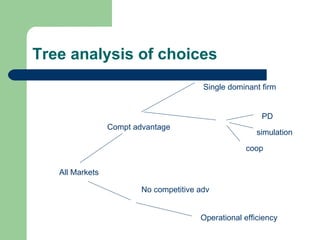
Tree analysis of choices All Markets Compt advantage No competitive adv Operational efficiency Single dominant firm PD coop simulation
Chapter 2-Competitive Advantages I Commodity business What is it?  How would we explain it in our models? Why does every business executive dread it?
Myth of Product Differentiation Mercedes-Benz and Cadillac Both had incredible brand recognition “the Cadillac of PCs”  Not worth a hoot; luxury market has no barriers to entry or customer captivity Efficiency becomes key
Market Dynamics Prices didn’t fall when European and Japanese luxury cars entered market Market share fell. Fixed costs unchanged. Profits shrunk Mercedes has had normal returns since
Quote from page 22 If no forces interfere with the process of entry by competitors, profitability will be driven to levels at which efficient firms earn no more than a “normal” return on their invested capital.  It is barriers to entry, not differentiation by itself, that creates strategic opportunities.”
Supply advantages Xerox in copiers, Kodak and Polaroid in film, pharmaceuticals have had technology advantages. What has happened to film with digital cameras? Hard to sustain over the long run
Notion of easy capital as advantage Page 30. “ History is full of companies driven out of business by more efficient competitors—steel producers, appliance manufacturers, small-scale retailers and nationwide chain stores. But only a small number of companies have been forced to the wall by competitors whose sole advantage was their deep pockets.”
Demand advantages Feels branding is over-rated as a competitive advantage—others can enter and challenge your brand You strive for customer captivity New entrants cannot attract customers on the same terms as the incumbent firm.
Examples of Customer Captivity Habit –cigarettes, soda drinks; tied to product and not a company (Crest toothpaste and not Proctor and Gamble); soda vs. beer Switching costs –when it takes time, money and effort to replace one supplier with another (software in the computer era is excellent example; banks, credit card companies, cell phones) Network effects reinforce switching costs
Customer captivity Search costs…finding a new doctor, health insurance company— The more specialized and customized the product, the higher the search costs to replace it. Professional services, that may involve intense personal contact, as do complicated manufacturing or warehousing systems. Easier to upgrade than switch (Microsoft)
Competitive Advantages II Economies of Scale and Strategy Page 37 “…If average costs per unit decline as a firm produces more, then smaller competitors will not be able to match the costs of the large firm even though they have equal access to technology and resources so long as they cannot reach the same scale of operation.”
Economies of Scale and Strategy Economics of scale in combination with customer captivity provide more durable competitive advantages It is not simply size difference, but market share that are key. In addition, equal access to customers and technology tend to level the playing field
Economics of Scale cont.  There needs to be some degree of customer captivity for the economies of scale to persist as an advantage. Take Microsoft….it clearly has economies of scale but costs of switching can be substantial Opposite examples are Japanese penetration of car market; Bic razors and Gillette—without captivity, new entrants can catch up
Take the textbook market Large economics of scale.  Why? Try to line up a star academic. Mankiw. But there are many star academics who can write a textbook.  Technology of online services are easy to copy. Some but not a lot of switching costs
Small markets are easier to dominate One hospital in a town of 50,000 One Wal-mart One car dealership Competitors can try and split the market but both incumbent and entrant might lose
Defending Economies of Scale Best strategy is to match all rival moves Goal, keep the entrants average costs high Example; Intel and Advance Micro Devices Intel has 90%; AMD 10%  if they both spend 10% of revenue on R&D Intel will way outspend AMD New products must be responded to
Aetna vs. Oxford; Local advantages Aetna is national and Oxford is New York centered.  Oxford has 60% of MDs; Aetna has 20% Network economies become key because you want a good choice of local MDs.  The national network for Aetna confers limited advantages.
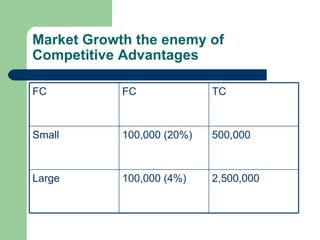
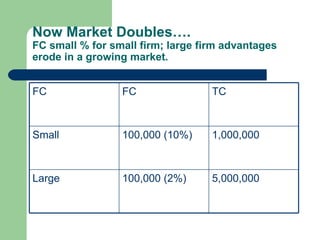
Market Growth the enemy of Competitive Advantages 2,500,000 100,000 (4%) Large 500,000 100,000 (20%) Small TC FC FC
Now Market Doubles…. FC small % for small firm; large firm advantages erode in a growing market. 5,000,000 100,000 (2%) Large 1,000,000 100,000 (10%) Small TC FC FC
International markets are disadvantage to incumbent firms Small car companies used to need large domestic market to gain economies of scale No longer; large international markets mean that more companies can get sufficient sales to create manufacturing economies In short, most competitive advantages of economics of scale are found in local niche markets
Defending advantages If source of advantage is key technology, invest in upgrading If customer captivity increase switching and search costs Ex: frequent flyer miles that are non-transferable;  sell razors cheap, blades expensive; all kinds of computer add-on’s are costly, even if the machine is cheap (e.g. ipod add ons such as cases, more memory..
Defending advantages Windows adds more features so that getting all these features may require several new software Accelerate product development cycles to make it expensive to compete Expensive ad campaigns can make it harder for smaller companies to compete. Never growth for its own sake; Kmart, RCA, CBS were spread thin in other product lines “ Stick to your knitting”
Chapter  8:Games Companies Play Situation in which two or more companies have competitive advantages but must compete internally with each other.  Very hard to strategize in this context but often critical. Examples include Home Depot and Lowe’s Pharmaceutical companies, hospital other examples
Aggressive or Not? One must always try to anticipate the response to one’s move One goal should be to avoid crippling competition (from the firm’s perspective) but not appear weak.
Fundamental Tensions Potential benefits from lowering price encourage firms to forego tacit cooperation and large benefits. Can you trust the others to follow the “tacit “ agreement.  Is  cheating more likely in weak or strong markets?  Why (see Krugman and Wells;p. 170 Greenwald) Argue 80-90% of competitive situations.
Adjustments to the tension Structural and tactical Structural: prior arrangements that  directly limit the consequences of deviant behavior Tactical adjustments are prior commitments to respond to deviations
Structural adjustments Keep it local and find niches.  Stay out of each other’s way. Great example of Pan Am and Eastern on NY shuttle… Concentration in different parts of the market: Sotheby vs. Christies. Rule 1: get out of the PD and avoid direct competition.
Customer Loyalty  Frequent flier miles Awards tied to cumulative not current purchases Accumulation should increase in an accelerated manner FF alliances hurt them.  Cell phones numbers transferred.  Key Loyalty programs reduce price competition.
Capacity limitations Zoning laws, limits on advertising Must have barriers to entry, however.
Most Favor Nation provision If you offer one price to one customer you must offer the same price to all customers. Keeps firms form poaching selective customers
Tactical Decisions Need an immediate and automatic response to a competitor’s price reduction A firm that cuts price never benefits “Best industry price contracts”  “ we will match any other price…” “Meet or release” contracts
Example of Banking Bank A offer low interest loans Bank B responds by offering low interest loans to customers with good credit, thus letting go the more risky customers.
Attack where competitor is strongest! A competitor cuts price were you are dominant. Don’t follow. Go to their stronghold and do the same.
Getting back to higher prices Signal by taking public stands on the industry welfare. Maybe work for uniform pricing and clarity making it easy to match cutters. This could be bad for harvesting customers (price discrimination)

Competition Demystified Economics

  • 1.
    Competition Demystefied BruceGreenwald & Judd Kahn
  • 2.
    Tactical versus StrategicPlanning IBM in 1980s. Chose to license operating system instead of building one itself Same with microprocessor Microsoft and Intel became two of the most successful companies of computing era Strategic decisions of enormous consequence
  • 3.
    Strategic Decisions Madeby top management Long-term perspective Company’s future at risk Questions? What business to be in What competencies must be developed How do we deal with competitors
  • 4.
    Tactical Decisions Mid-level,functional, local Yearly, monthly, daily Questions? How do we improve delivery times? How big a promotional discount to offer? What is the best career path for sales reps?
  • 5.
    Other examples Decision to enter SUV market is strategic Everything after is tactical If a market is highly competitive, almost all decisions are tactical….focus on efficiency
  • 6.
    Barriers to EntryMeans that incumbent firm is able to do what potential rivals cannot Ironically, in an increasingly global market place, competitive advantages grounded in “local” circumstances Examples Wal-mart (geographic) Microsoft (product)—contrast with Apple
  • 7.
    Three types ofCompetitive Advantages Supply –cost advantages that allow a company to produce and deliver its product or service more cheaply than its competitors Source of resource (aluminum ore); Proprietary technology (patents) Know how
  • 8.
    Demand Access tomarkets that competitors can’t reach Customer captivity based on habit, cost of switching or cost of search for alternatives
  • 9.
    Economies of ScaleIf ATC falls as volume increases, because fixed costs make up a large share of total costs, then even with the same technology and incumbent firm will enjoy an advantage over its rivals
  • 10.
    Tree analysis ofchoices All Markets Compt advantage No competitive adv Operational efficiency Single dominant firm PD coop simulation
  • 11.
    Chapter 2-Competitive AdvantagesI Commodity business What is it? How would we explain it in our models? Why does every business executive dread it?
  • 12.
    Myth of ProductDifferentiation Mercedes-Benz and Cadillac Both had incredible brand recognition “the Cadillac of PCs” Not worth a hoot; luxury market has no barriers to entry or customer captivity Efficiency becomes key
  • 13.
    Market Dynamics Pricesdidn’t fall when European and Japanese luxury cars entered market Market share fell. Fixed costs unchanged. Profits shrunk Mercedes has had normal returns since
  • 14.
    Quote from page22 If no forces interfere with the process of entry by competitors, profitability will be driven to levels at which efficient firms earn no more than a “normal” return on their invested capital. It is barriers to entry, not differentiation by itself, that creates strategic opportunities.”
  • 15.
    Supply advantages Xeroxin copiers, Kodak and Polaroid in film, pharmaceuticals have had technology advantages. What has happened to film with digital cameras? Hard to sustain over the long run
  • 16.
    Notion of easycapital as advantage Page 30. “ History is full of companies driven out of business by more efficient competitors—steel producers, appliance manufacturers, small-scale retailers and nationwide chain stores. But only a small number of companies have been forced to the wall by competitors whose sole advantage was their deep pockets.”
  • 17.
    Demand advantages Feelsbranding is over-rated as a competitive advantage—others can enter and challenge your brand You strive for customer captivity New entrants cannot attract customers on the same terms as the incumbent firm.
  • 18.
    Examples of CustomerCaptivity Habit –cigarettes, soda drinks; tied to product and not a company (Crest toothpaste and not Proctor and Gamble); soda vs. beer Switching costs –when it takes time, money and effort to replace one supplier with another (software in the computer era is excellent example; banks, credit card companies, cell phones) Network effects reinforce switching costs
  • 19.
    Customer captivity Searchcosts…finding a new doctor, health insurance company— The more specialized and customized the product, the higher the search costs to replace it. Professional services, that may involve intense personal contact, as do complicated manufacturing or warehousing systems. Easier to upgrade than switch (Microsoft)
  • 20.
    Competitive Advantages IIEconomies of Scale and Strategy Page 37 “…If average costs per unit decline as a firm produces more, then smaller competitors will not be able to match the costs of the large firm even though they have equal access to technology and resources so long as they cannot reach the same scale of operation.”
  • 21.
    Economies of Scaleand Strategy Economics of scale in combination with customer captivity provide more durable competitive advantages It is not simply size difference, but market share that are key. In addition, equal access to customers and technology tend to level the playing field
  • 22.
    Economics of Scalecont. There needs to be some degree of customer captivity for the economies of scale to persist as an advantage. Take Microsoft….it clearly has economies of scale but costs of switching can be substantial Opposite examples are Japanese penetration of car market; Bic razors and Gillette—without captivity, new entrants can catch up
  • 23.
    Take the textbookmarket Large economics of scale. Why? Try to line up a star academic. Mankiw. But there are many star academics who can write a textbook. Technology of online services are easy to copy. Some but not a lot of switching costs
  • 24.
    Small markets areeasier to dominate One hospital in a town of 50,000 One Wal-mart One car dealership Competitors can try and split the market but both incumbent and entrant might lose
  • 25.
    Defending Economies ofScale Best strategy is to match all rival moves Goal, keep the entrants average costs high Example; Intel and Advance Micro Devices Intel has 90%; AMD 10% if they both spend 10% of revenue on R&D Intel will way outspend AMD New products must be responded to
  • 26.
    Aetna vs. Oxford;Local advantages Aetna is national and Oxford is New York centered. Oxford has 60% of MDs; Aetna has 20% Network economies become key because you want a good choice of local MDs. The national network for Aetna confers limited advantages.
  • 27.
    Market Growth theenemy of Competitive Advantages 2,500,000 100,000 (4%) Large 500,000 100,000 (20%) Small TC FC FC
  • 28.
    Now Market Doubles….FC small % for small firm; large firm advantages erode in a growing market. 5,000,000 100,000 (2%) Large 1,000,000 100,000 (10%) Small TC FC FC
  • 29.
    International markets aredisadvantage to incumbent firms Small car companies used to need large domestic market to gain economies of scale No longer; large international markets mean that more companies can get sufficient sales to create manufacturing economies In short, most competitive advantages of economics of scale are found in local niche markets
  • 30.
    Defending advantages Ifsource of advantage is key technology, invest in upgrading If customer captivity increase switching and search costs Ex: frequent flyer miles that are non-transferable; sell razors cheap, blades expensive; all kinds of computer add-on’s are costly, even if the machine is cheap (e.g. ipod add ons such as cases, more memory..
  • 31.
    Defending advantages Windowsadds more features so that getting all these features may require several new software Accelerate product development cycles to make it expensive to compete Expensive ad campaigns can make it harder for smaller companies to compete. Never growth for its own sake; Kmart, RCA, CBS were spread thin in other product lines “ Stick to your knitting”
  • 32.
    Chapter 8:GamesCompanies Play Situation in which two or more companies have competitive advantages but must compete internally with each other. Very hard to strategize in this context but often critical. Examples include Home Depot and Lowe’s Pharmaceutical companies, hospital other examples
  • 33.
    Aggressive or Not?One must always try to anticipate the response to one’s move One goal should be to avoid crippling competition (from the firm’s perspective) but not appear weak.
  • 34.
    Fundamental Tensions Potentialbenefits from lowering price encourage firms to forego tacit cooperation and large benefits. Can you trust the others to follow the “tacit “ agreement. Is cheating more likely in weak or strong markets? Why (see Krugman and Wells;p. 170 Greenwald) Argue 80-90% of competitive situations.
  • 35.
    Adjustments to thetension Structural and tactical Structural: prior arrangements that directly limit the consequences of deviant behavior Tactical adjustments are prior commitments to respond to deviations
  • 36.
    Structural adjustments Keepit local and find niches. Stay out of each other’s way. Great example of Pan Am and Eastern on NY shuttle… Concentration in different parts of the market: Sotheby vs. Christies. Rule 1: get out of the PD and avoid direct competition.
  • 37.
    Customer Loyalty Frequent flier miles Awards tied to cumulative not current purchases Accumulation should increase in an accelerated manner FF alliances hurt them. Cell phones numbers transferred. Key Loyalty programs reduce price competition.
  • 38.
    Capacity limitations Zoninglaws, limits on advertising Must have barriers to entry, however.
  • 39.
    Most Favor Nationprovision If you offer one price to one customer you must offer the same price to all customers. Keeps firms form poaching selective customers
  • 40.
    Tactical Decisions Needan immediate and automatic response to a competitor’s price reduction A firm that cuts price never benefits “Best industry price contracts” “ we will match any other price…” “Meet or release” contracts
  • 41.
    Example of BankingBank A offer low interest loans Bank B responds by offering low interest loans to customers with good credit, thus letting go the more risky customers.
  • 42.
    Attack where competitoris strongest! A competitor cuts price were you are dominant. Don’t follow. Go to their stronghold and do the same.
  • 43.
    Getting back tohigher prices Signal by taking public stands on the industry welfare. Maybe work for uniform pricing and clarity making it easy to match cutters. This could be bad for harvesting customers (price discrimination)