COMPETENT PEOPLECOMPETENT PEOPLE
MAKE SAFER SHIPSMAKE SAFER SHIPS
By Nikos GousopoulosBy Nikos Gousopoulos
Head of Dept. of Maritime Studies-New YorkHead of Dept. of Maritime Studies-New York
CollegeCollege
Director Marine Programs – University ofDirector Marine Programs – University of
Greenwich – London (UK)Greenwich – London (UK)
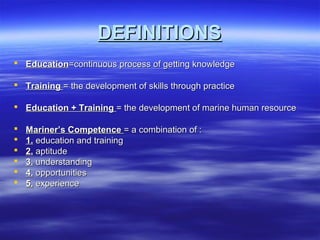
DEFINITIONSDEFINITIONS
 EducationEducation=continuous process of getting knowledge=continuous process of getting knowledge
 TrainingTraining = the development of skills through practice= the development of skills through practice
 Education + TrainingEducation + Training = the development of marine human resource= the development of marine human resource
 Mariner’s CompetenceMariner’s Competence = a combination of := a combination of :
 1.1. education and trainingeducation and training
 2.2. aptitudeaptitude
 3.3. understandingunderstanding
 4.4. opportunitiesopportunities
 5.5. experienceexperience
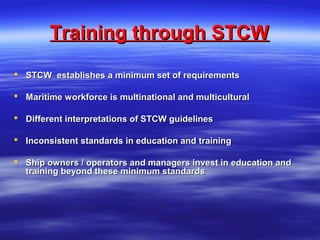
Training through STCWTraining through STCW
 STCW establishes a minimum set of requirementsSTCW establishes a minimum set of requirements
 Maritime workforce is multinational and multiculturalMaritime workforce is multinational and multicultural
 Different interpretations of STCW guidelinesDifferent interpretations of STCW guidelines
 Inconsistent standards in education and trainingInconsistent standards in education and training
 Ship owners / operators and managers invest in education andShip owners / operators and managers invest in education and
training beyond these minimum standardstraining beyond these minimum standards
Marine Training as anMarine Training as an
investmentinvestment
 IMO re sponsible for stcwIMO re sponsible for stcw
 Governments=responsible for trainingGovernments=responsible for training
according to STCWaccording to STCW
 Ship owners exceed these standardsShip owners exceed these standards
 Training=a process with mariner’s activeTraining=a process with mariner’s active
participationparticipation
 Reasoning: employment continuationReasoning: employment continuation
 safetysafety
 promotionpromotion
Continuous ProfessionalContinuous Professional
DevelopmentDevelopment
 Definition=the systematic maintenance ofDefinition=the systematic maintenance of
knowledge, skills and competence.knowledge, skills and competence.
 Heavy involvement of professional bodiesHeavy involvement of professional bodies
[i.e IMarEST, RINA, etc.][i.e IMarEST, RINA, etc.]
 Use of various means, [i.e lectgures,Use of various means, [i.e lectgures,
sefminar, CBT, IBT, distance learning, etcsefminar, CBT, IBT, distance learning, etc
Crew Multi Nationality and theCrew Multi Nationality and the
Training issueTraining issue
 On board CBT methods to overcomeOn board CBT methods to overcome
multinational crew training problemsmultinational crew training problems
 General education standards versus cultureGeneral education standards versus culture
 Common sense of seamanshipCommon sense of seamanship
Train the TrainersTrain the Trainers
 Currently marine training is made by thoseCurrently marine training is made by those
having experience and skillshaving experience and skills
 Training fails to produce competentTraining fails to produce competent
seafarersseafarers
 Current assessment systems confuseCurrent assessment systems confuse
knowledge with competenceknowledge with competence
On Board Training
 Gap between existing skill levels and
company requirements
 Company’s responsibility for further training
 On job training programs
 Application of various training modules
 The use of training ship
 Mentoring process
 Pre-promotion training
Treat them as family members
 1.The problem=multinational and
multicultural crews
 2. The need=to absorb company’s culture,
policies, SMS
 3. Retention=the key issue
 4. The Action=treat them as family
members
Continuous Professional
Development
1. Maintenance and improvement of
knowledge and skills
2. The development of personal qualities
3. It is a lifelong learning process
4. It leads from de-motivation
5. It helps to set new goals
Shipmaster’s Leadership
 The ability to build and lead a team
 The ability to assertive with the crew
 Being fair and consistent
 Understanding human nature
 Understanding human limitations
 To be supportive
 To support crew’s professional development
 To give clear and concise orders
Seafarers’ Competence
 Competence has to be measured
 Competence has to be audited
 Competence as a part of company’s goals
 Competence’s assessment procedures
 Evaluation of Training Outcome

COMPETENT PEOPLE MAKE SAFER SHIPS

  • 1.
    COMPETENT PEOPLECOMPETENT PEOPLE MAKESAFER SHIPSMAKE SAFER SHIPS By Nikos GousopoulosBy Nikos Gousopoulos Head of Dept. of Maritime Studies-New YorkHead of Dept. of Maritime Studies-New York CollegeCollege Director Marine Programs – University ofDirector Marine Programs – University of Greenwich – London (UK)Greenwich – London (UK)
  • 2.
    DEFINITIONSDEFINITIONS  EducationEducation=continuous processof getting knowledge=continuous process of getting knowledge  TrainingTraining = the development of skills through practice= the development of skills through practice  Education + TrainingEducation + Training = the development of marine human resource= the development of marine human resource  Mariner’s CompetenceMariner’s Competence = a combination of := a combination of :  1.1. education and trainingeducation and training  2.2. aptitudeaptitude  3.3. understandingunderstanding  4.4. opportunitiesopportunities  5.5. experienceexperience
  • 3.
    Training through STCWTrainingthrough STCW  STCW establishes a minimum set of requirementsSTCW establishes a minimum set of requirements  Maritime workforce is multinational and multiculturalMaritime workforce is multinational and multicultural  Different interpretations of STCW guidelinesDifferent interpretations of STCW guidelines  Inconsistent standards in education and trainingInconsistent standards in education and training  Ship owners / operators and managers invest in education andShip owners / operators and managers invest in education and training beyond these minimum standardstraining beyond these minimum standards
  • 4.
    Marine Training asanMarine Training as an investmentinvestment  IMO re sponsible for stcwIMO re sponsible for stcw  Governments=responsible for trainingGovernments=responsible for training according to STCWaccording to STCW  Ship owners exceed these standardsShip owners exceed these standards  Training=a process with mariner’s activeTraining=a process with mariner’s active participationparticipation  Reasoning: employment continuationReasoning: employment continuation  safetysafety  promotionpromotion
  • 5.
    Continuous ProfessionalContinuous Professional DevelopmentDevelopment Definition=the systematic maintenance ofDefinition=the systematic maintenance of knowledge, skills and competence.knowledge, skills and competence.  Heavy involvement of professional bodiesHeavy involvement of professional bodies [i.e IMarEST, RINA, etc.][i.e IMarEST, RINA, etc.]  Use of various means, [i.e lectgures,Use of various means, [i.e lectgures, sefminar, CBT, IBT, distance learning, etcsefminar, CBT, IBT, distance learning, etc
  • 6.
    Crew Multi Nationalityand theCrew Multi Nationality and the Training issueTraining issue  On board CBT methods to overcomeOn board CBT methods to overcome multinational crew training problemsmultinational crew training problems  General education standards versus cultureGeneral education standards versus culture  Common sense of seamanshipCommon sense of seamanship
  • 7.
    Train the TrainersTrainthe Trainers  Currently marine training is made by thoseCurrently marine training is made by those having experience and skillshaving experience and skills  Training fails to produce competentTraining fails to produce competent seafarersseafarers  Current assessment systems confuseCurrent assessment systems confuse knowledge with competenceknowledge with competence
  • 8.
    On Board Training Gap between existing skill levels and company requirements  Company’s responsibility for further training  On job training programs  Application of various training modules  The use of training ship  Mentoring process  Pre-promotion training
  • 9.
    Treat them asfamily members  1.The problem=multinational and multicultural crews  2. The need=to absorb company’s culture, policies, SMS  3. Retention=the key issue  4. The Action=treat them as family members
  • 10.
    Continuous Professional Development 1. Maintenanceand improvement of knowledge and skills 2. The development of personal qualities 3. It is a lifelong learning process 4. It leads from de-motivation 5. It helps to set new goals
  • 11.
    Shipmaster’s Leadership  Theability to build and lead a team  The ability to assertive with the crew  Being fair and consistent  Understanding human nature  Understanding human limitations  To be supportive  To support crew’s professional development  To give clear and concise orders
  • 12.
    Seafarers’ Competence  Competencehas to be measured  Competence has to be audited  Competence as a part of company’s goals  Competence’s assessment procedures  Evaluation of Training Outcome