SESSION LEARNING OUTCOMES
Identify and manage OSH issues in a learning
environment
Complete a learning environment risk assessment form
Hazard controlling
Prepare Hazard checklist
3.
WHO IS RESPONSIBLEFOR OSH?
As a Assessor you have a responsibility to your
Candidate for the assessment environment within
which you are assessing; including ensuring the
assessment environment is safe and healthy .
4.
WHAT IS DUTYOF CARE?
Responsibility to take reasonable care of the
safety and health of all those candidate under
your assessment of supervision.
5.
DUTY OF CARE/ RESPONSIBILITIES
Provide:
A safe assessment environment
Safe systems of demonstration
Safe use of tools and equipment
Communication about safety requirements
Use safety symbol
Information about hazards
6.
WHAT IS AHAZARD?
Anything or anyone that can harm or cause ill health
to a person,
Anything or anyone that can damage property or the
environment,
A combination of these things.
A source of potential harm to loss the plant, property
or equipment.
7.
TYPES OF HAZARDS
Physical Hazards
Biological Hazards
Chemical Hazards
Agronomical Hazards
OSH-Page 21
RISK
Risk is thechance of something occurring
that will result in injury or damage . It is
measured in terms of the consequences and the
likelihood of occurrence.
What is CompetencyBased assessment?
CB Assessment is the process of
collecting evidence and
making judgments about whether competency has been
achieved
to confirm that an individual can perform to the
standard expected in the workplace as expressed in
the
relevant industry-endorsed competency standards, or
the learning outcomes of an accredited course.
15.
DEFINATION OF ASSESSMENT
Assessmentis the process of collecting evidence
and making judgements about whether a
person can perform in the workplace to the
minimum acceptable standard or is able to
demonstrate that they meet the learning
outcomes of an accredited course
S. M Mahfuzur Rahman (DPO-TE)
(Competency Based Assessment -Page 7)
TYPES OF ASSESSMENT
Formative
Summative
S.M Mahfuzur Rahman (DPO-TE)
(Competency Based Assessment -Page 14)
Identify progress or
improvement of the
Student with in
training or course
session.
18.
TYPES OF ASSESSMENT
Formative
Summative
S.M Mahfuzur Rahman (DPO-TE)
(Competency Based Assessment -Page 14)
To Certified the
candidate after
completing the
training or course
session.
PRINCIPLES OF ASSESSMENT
S.M Mahfuzur Rahman (DPO-TE)
(Competency Based Assessment -Page 10)
Fair Valid
Flexible
Reliable
21.
PRINCIPLES OF ASSESSMENT
S.M Mahfuzur Rahman (DPO-TE)
(Competency Based Assessment -Page 10)
Fair Valid
Flexible
Reliable
Impartial and
equitable
regardless of
age, gender,
Religion,
22.
PRINCIPLES OF ASSESSMENT
S.M Mahfuzur Rahman (DPO-TE)
(Competency Based Assessment -Page 10)
Fair Valid
Flexible
Reliable
Focuses on
the elements
and the
performance
criteria
23.
PRINCIPLES OF ASSESSMENT
S.M Mahfuzur Rahman (DPO-TE)
(Competency Based Assessment -Page 10)
Fair Valid
Flexible
Reliable
Consistency of
assessment
results in all
time
24.
PRINCIPLES OF ASSESSMENT
S.M Mahfuzur Rahman (DPO-TE)
(Competency Based Assessment -Page 10)
Fair Valid
Flexible
Reliable
Flexibility in
delivery and
assessment
strategies
appropriate to
the range of
KSAs
encompassed
by
competency
standards
Only done once
Relieson single assessor
Limited number of repeats of important skills
No night Driving
Artificial conditions (assessor in the car)
No evidence of transfer from one car to another
No allowance of important special circumstances
R
R
R
V
V
V
V
Drivers Licence
27.
The context ofassessment is the environment or setting
in which the assessment activity takes place
The Context of Assessment
Tools, Equipment andFacilities
• Prepare a Checklist of Tools, Equipment and
Facilities (Resources List)
• Ready and Available before the assessment
start
Context of Assessment Con…..
30.
Materials
• Identify Perishablesand Consumables
needed
• Documents (Assessment Package)
pertinent to assessment should be ready
Context of Assessment Con…..
31.
Purpose of Assessment
•Clarify the purpose of the assessment to the
assesse
Context of Assessment Con…..
32.
ASSESSMENT METHODS
WrittenTest
Oral Questioning
Demonstration
On the Job Observation
Trainee Portfolio
Group work assessment (Formative)
Learning Diary (Formative)
S. M Mahfuzur Rahman (DPO-TE)
(Design Competency Based Assessment -Page 31)
33.
ASSESSOR ROLE
Collecttools for assessment
Prepared the candidate for assessment
Describe the assessment process to candidate
Take self assessment
Take decision to assessment
Apply assessment method
Give feedback to the candidate
Result published
All process recheck and submit evidence to BTEB
34.
CANDIDATE NEED TOKNOW BEFORE
ASSESSMENT
Purpose of assessment
Unit of competency (task)
Evidence requirement
Evidence gathering process (Assessment Method)
Assessment condition
Role of the assessor
35.
REASONABLE ADJUSTMENT
Reasonable adjustmentis designed to ensure
that all the people are treated equally in the
assessment process
(Organize and conduct CB Assessment -Page 14)
36.
Appeal Process
• Itis essential that trainees have access to a
process for appealing against an assessment
decision. You must make the trainee aware of
this right and how to access it if necessary.
(Organize and conduct CB Assessment -Page 15)
37.
Supportive environment forAssessment
• Making sure that the environment is suitable
for assessment.
• Ensuring that the candidates are relaxed and
not too apprehensive
• Greeting, welcoming and establishing rapport
with the candidate.
• Allowing the candidates time to settle in and
feel comfortable
• Inviting the candidate to ask questions
38.
When to stopan assessment
• There is any breach of safety
• Equipment breaks down
• The trainee becomes stressed or requests to stop
• There is clear evidence of non competence.
• There is a chance of damage to property or
equipment.
• The assessment is having an effect on Workplace
production.
(Organize and conduct CB Assessment -Page 15)
39.
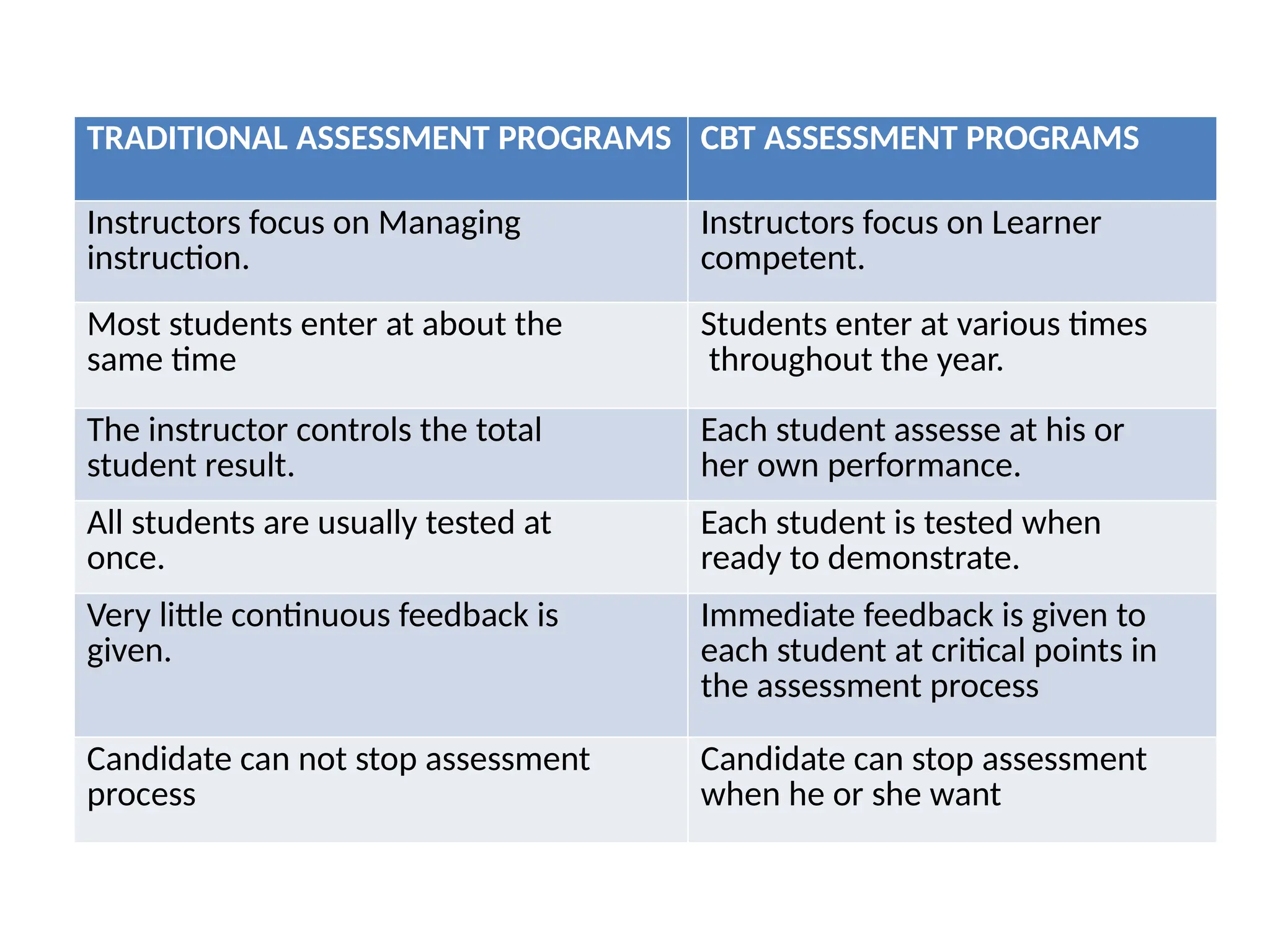
TRADITIONAL ASSESSMENT PROGRAMSCBT ASSESSMENT PROGRAMS
Instructors focus on Managing
instruction.
Instructors focus on Learner
competent.
Most students enter at about the
same time
Students enter at various times
throughout the year.
The instructor controls the total
student result.
Each student assesse at his or
her own performance.
All students are usually tested at
once.
Each student is tested when
ready to demonstrate.
Very little continuous feedback is
given.
Immediate feedback is given to
each student at critical points in
the assessment process
Candidate can not stop assessment
process
Candidate can stop assessment
when he or she want