Compatibility Prediction of
Eclipse Third-party Plug-ins in
new Eclipse Releases
John Businge, Alexander Serebrenik,
Mark van den Brand
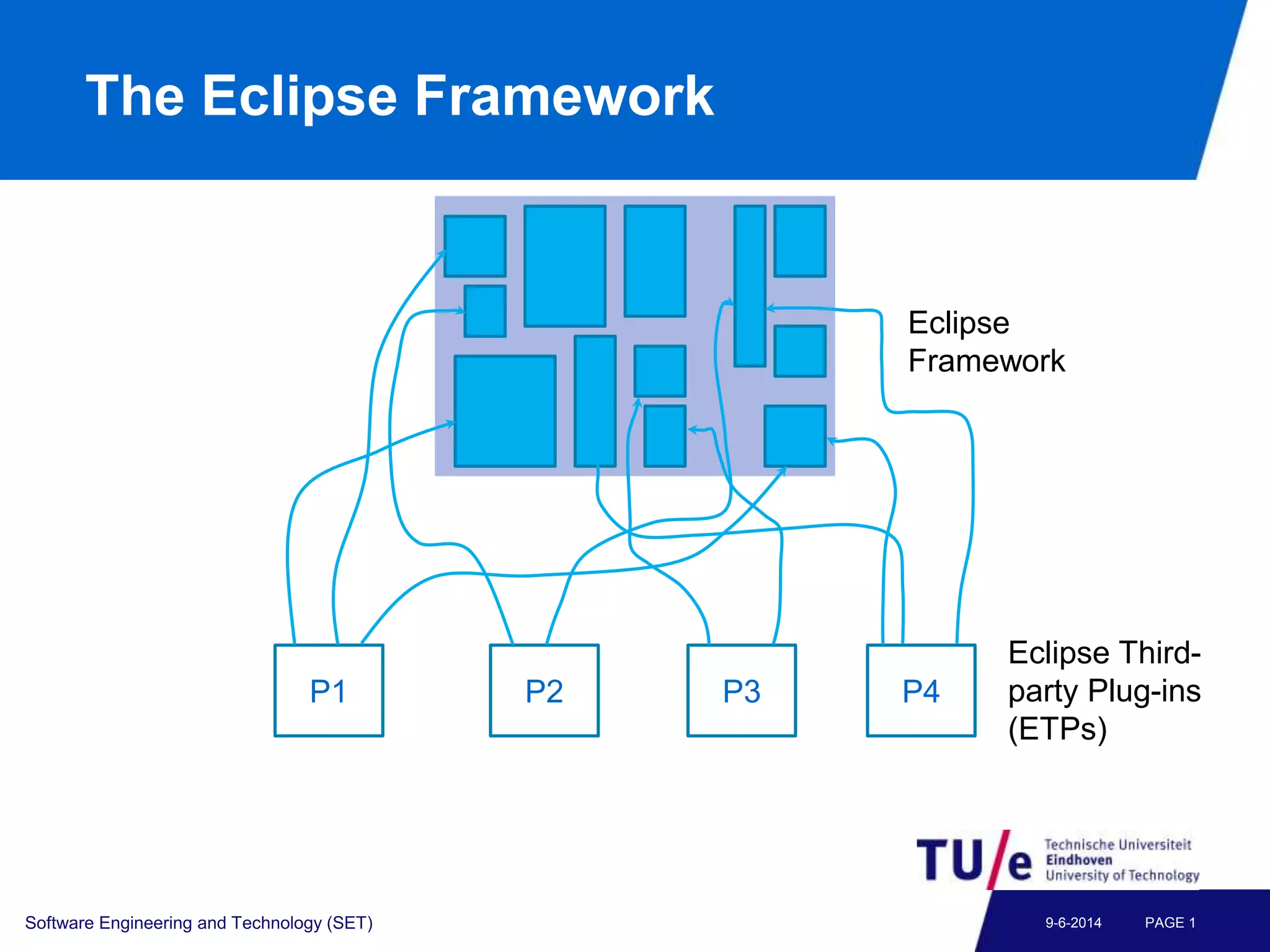
The Eclipse Framework
Software Engineering and Technology (SET) PAGE 19-6-2014
P1 P4P3P2
Eclipse
Framework
Eclipse Third-
party Plug-ins
(ETPs)
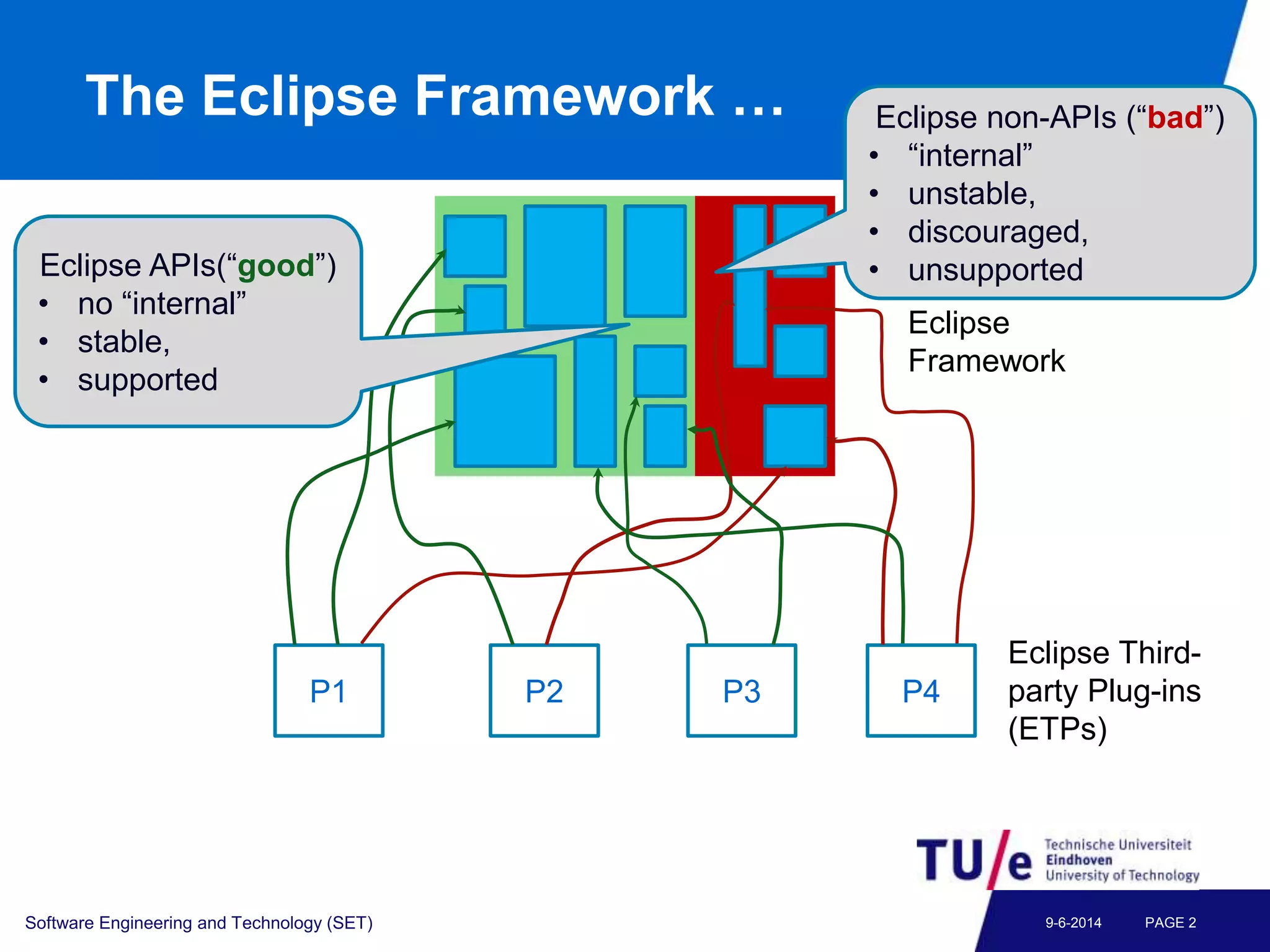
The Eclipse Framework …
Software Engineering and Technology (SET) PAGE 29-6-2014
P1 P4P3P2
Eclipse
Framework
Eclipse Third-
party Plug-ins
(ETPs)
Eclipse APIs(“good”)
• no “internal”
• stable,
• supported
Eclipse non-APIs (“bad”)
• “internal”
• unstable,
• discouraged,
• unsupported
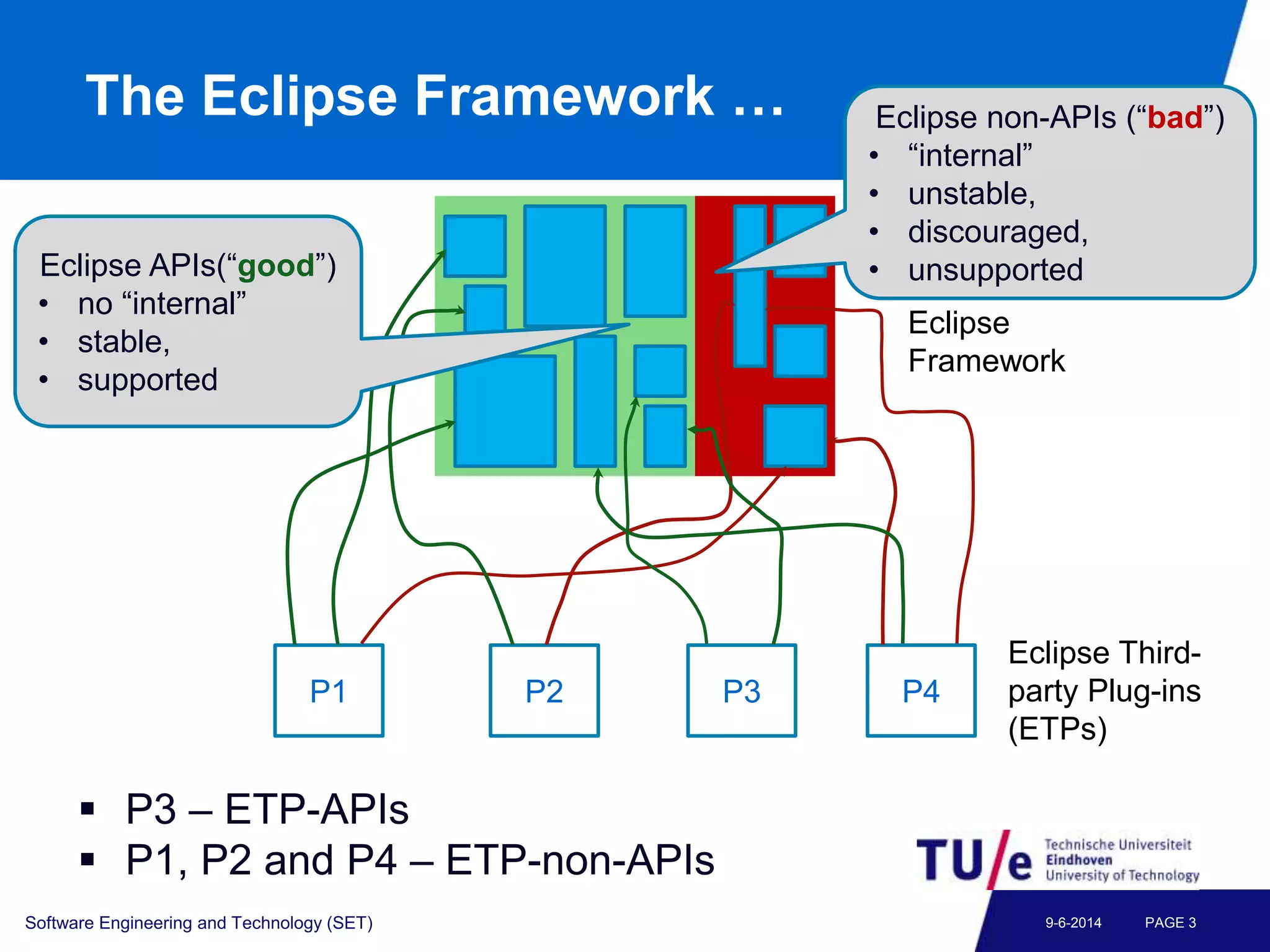
The Eclipse Framework …
Software Engineering and Technology (SET) PAGE 39-6-2014
P1 P4P3P2
Eclipse
Framework
Eclipse Third-
party Plug-ins
(ETPs)
Eclipse APIs(“good”)
• no “internal”
• stable,
• supported
Eclipse non-APIs (“bad”)
• “internal”
• unstable,
• discouraged,
• unsupported
 P3 – ETP-APIs
 P1, P2 and P4 – ETP-non-APIs
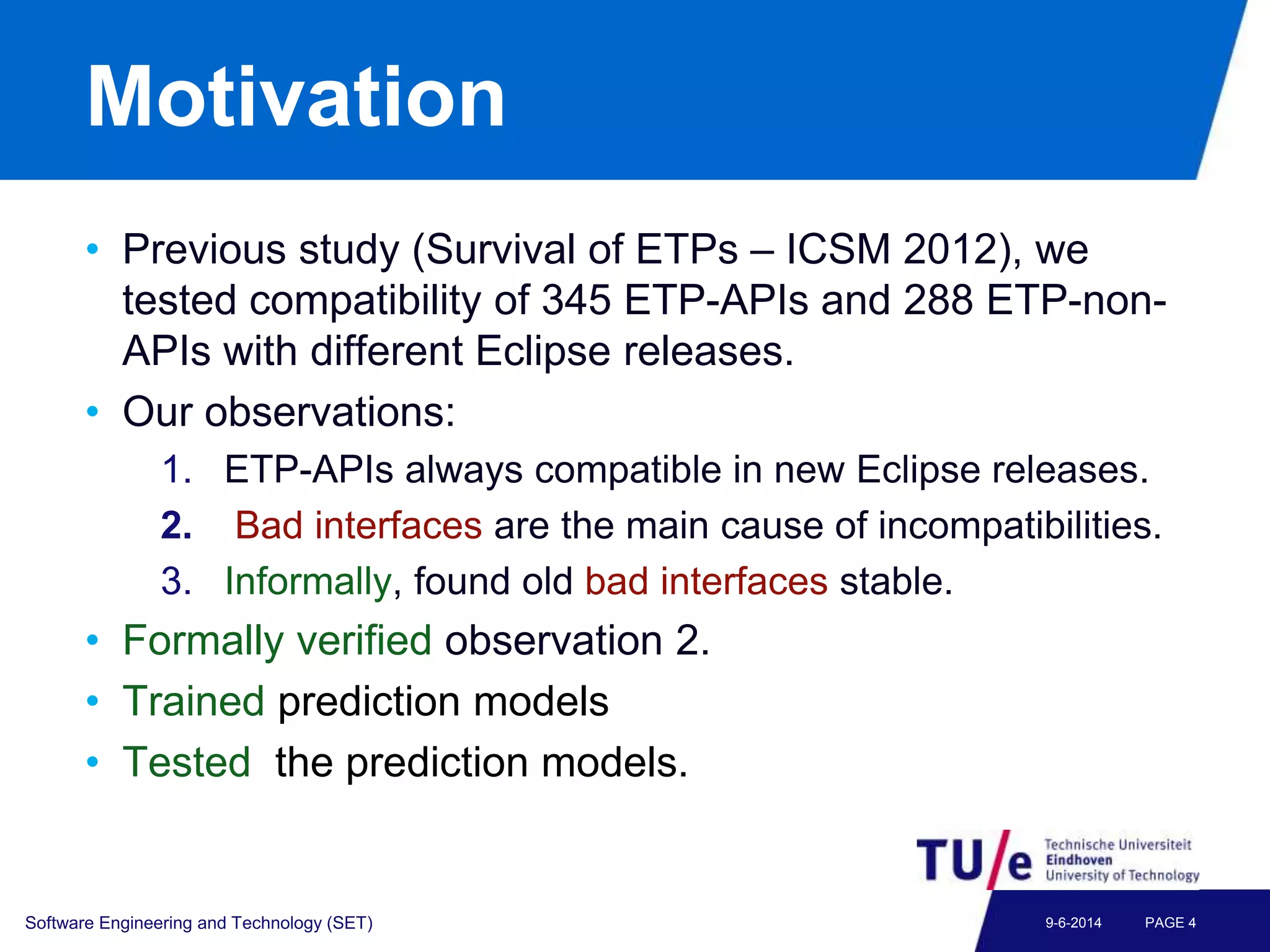
Motivation
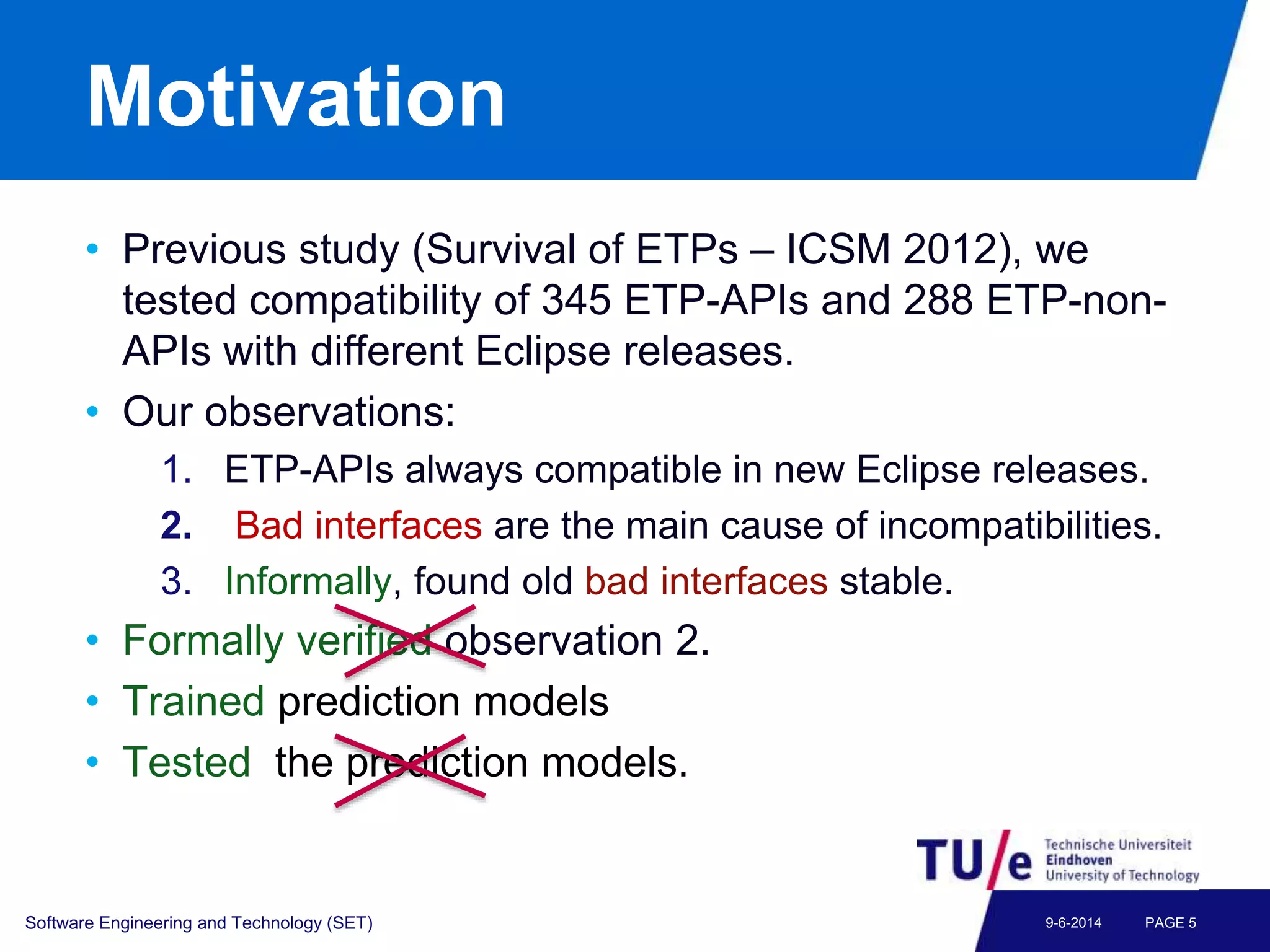
• Previous study (Survival of ETPs – ICSM 2012), we
tested compatibility of 345 ETP-APIs and 288 ETP-non-
APIs with different Eclipse releases.
• Our observations:
1. ETP-APIs always compatible in new Eclipse releases.
2. Bad interfaces are the main cause of incompatibilities.
3. Informally, found old bad interfaces stable.
• Formally verified observation 2.
• Trained prediction models
• Tested the prediction models.
Software Engineering and Technology (SET) PAGE 49-6-2014
Motivation
• Previous study (Survival of ETPs – ICSM 2012), we
tested compatibility of 345 ETP-APIs and 288 ETP-non-
APIs with different Eclipse releases.
• Our observations:
1. ETP-APIs always compatible in new Eclipse releases.
2. Bad interfaces are the main cause of incompatibilities.
3. Informally, found old bad interfaces stable.
• Formally verified observation 2.
• Trained prediction models
• Tested the prediction models.
Software Engineering and Technology (SET) PAGE 59-6-2014
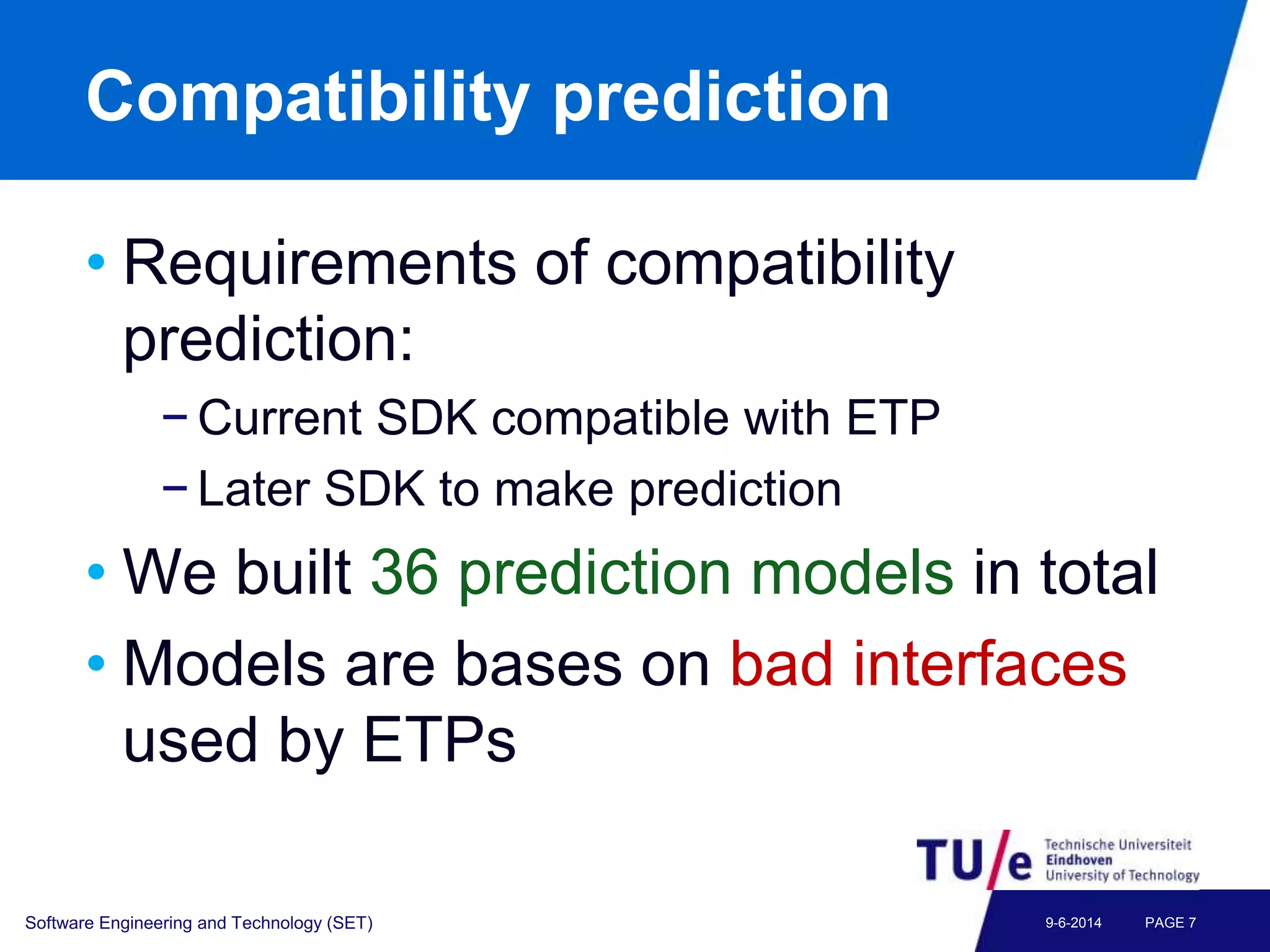
Compatibility prediction
• Requirements of compatibility
prediction:
− Current SDK compatible with ETP
− Later SDK to make prediction
• We built 36 prediction models in total
• Models are bases on bad interfaces
used by ETPs
Software Engineering and Technology (SET) PAGE 79-6-2014
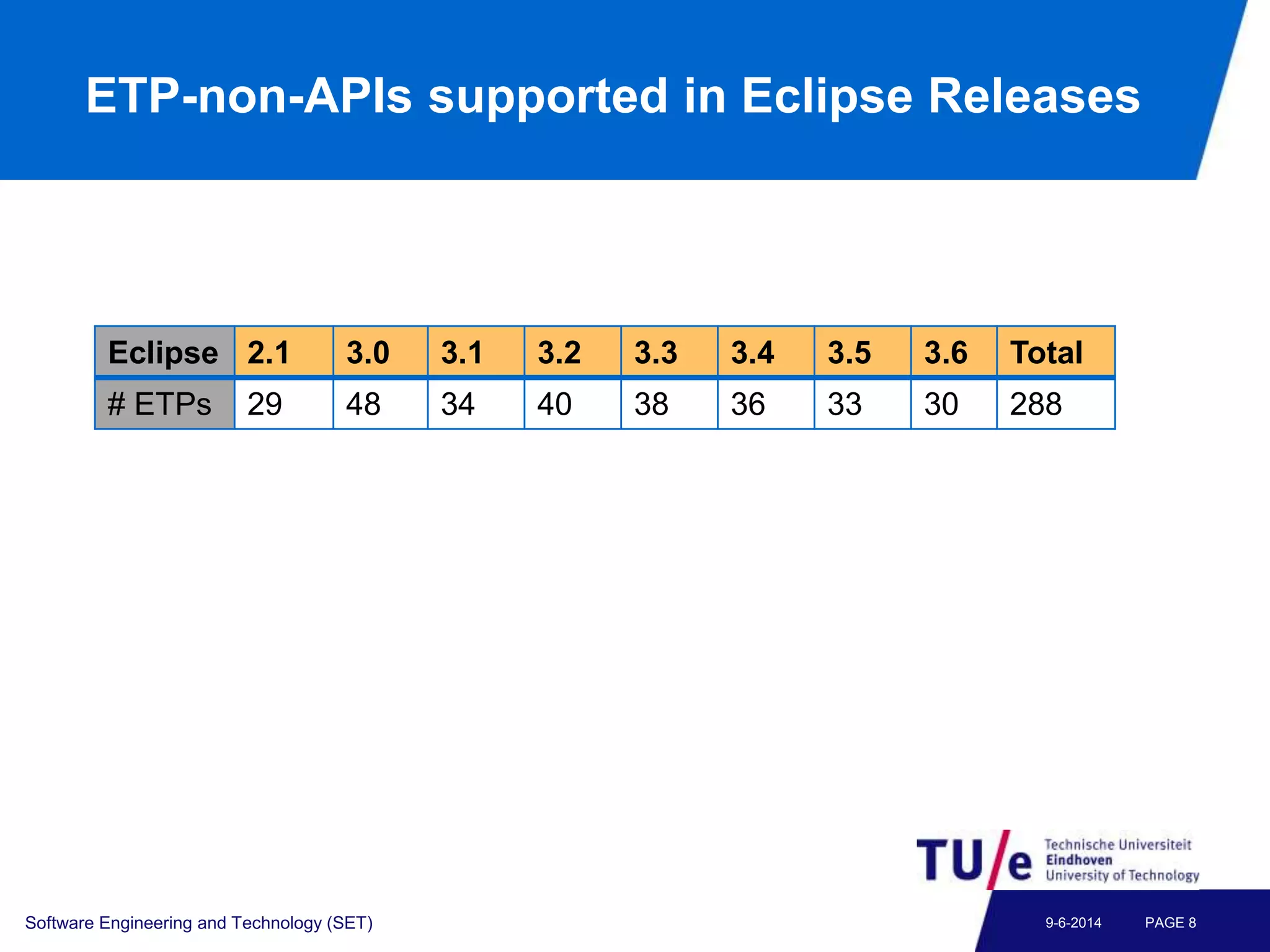
ETP-non-APIs supported in Eclipse Releases
Software Engineering and Technology (SET) PAGE 89-6-2014
Eclipse 2.1 3.0 3.1 3.2 3.3 3.4 3.5 3.6 Total
# ETPs 29 48 34 40 38 36 33 30 288
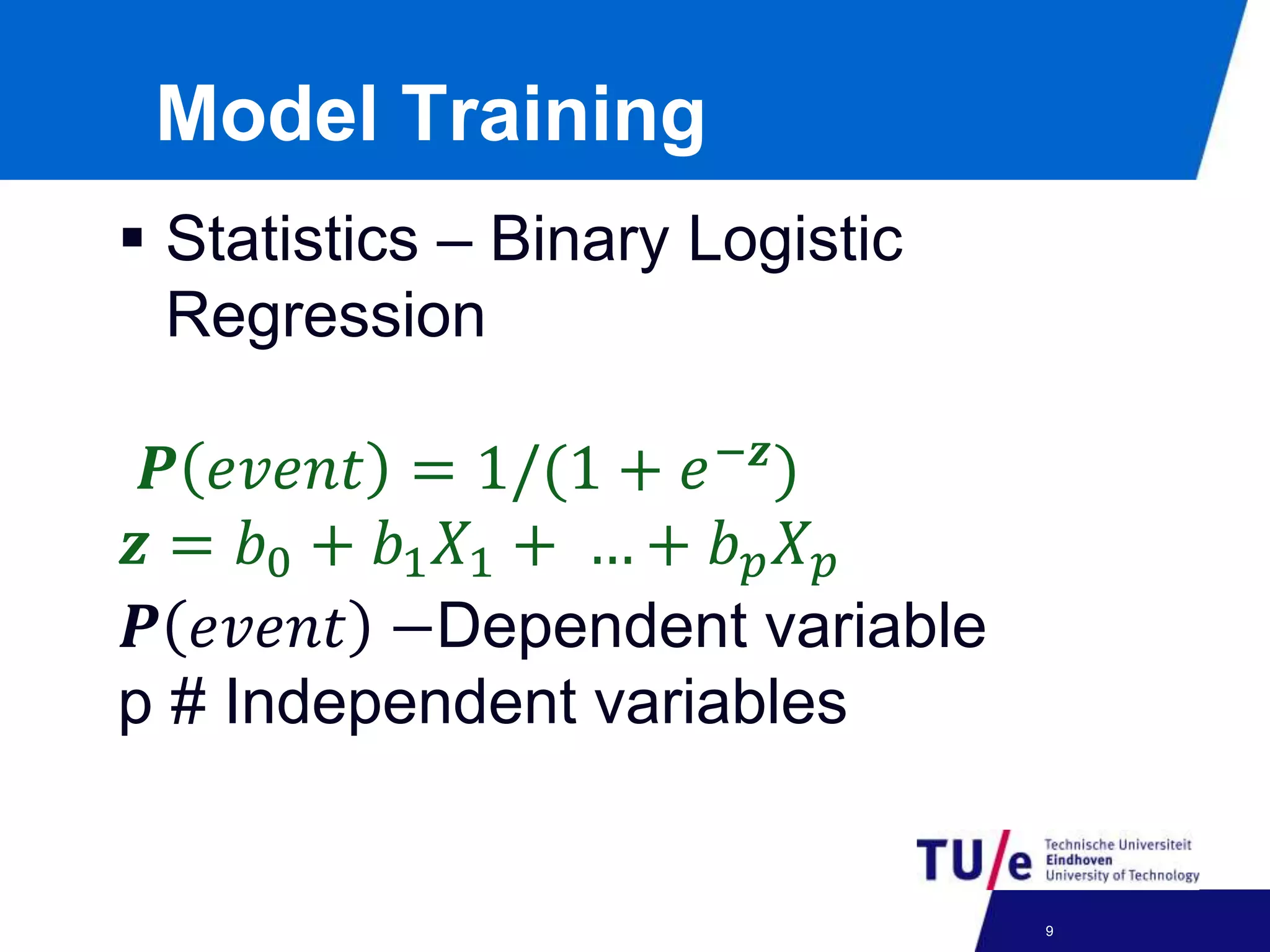
Model Training
 Statistics – Binary Logistic
Regression
𝑷 𝑒𝑣𝑒𝑛𝑡 = 1/(1 + 𝑒−𝒛
)
𝒛 = 𝑏0 + 𝑏1 𝑋1 + … + 𝑏 𝑝 𝑋 𝑝
𝑷 𝑒𝑣𝑒𝑛𝑡 −Dependent variable
p # Independent variables
24-09-2012
9
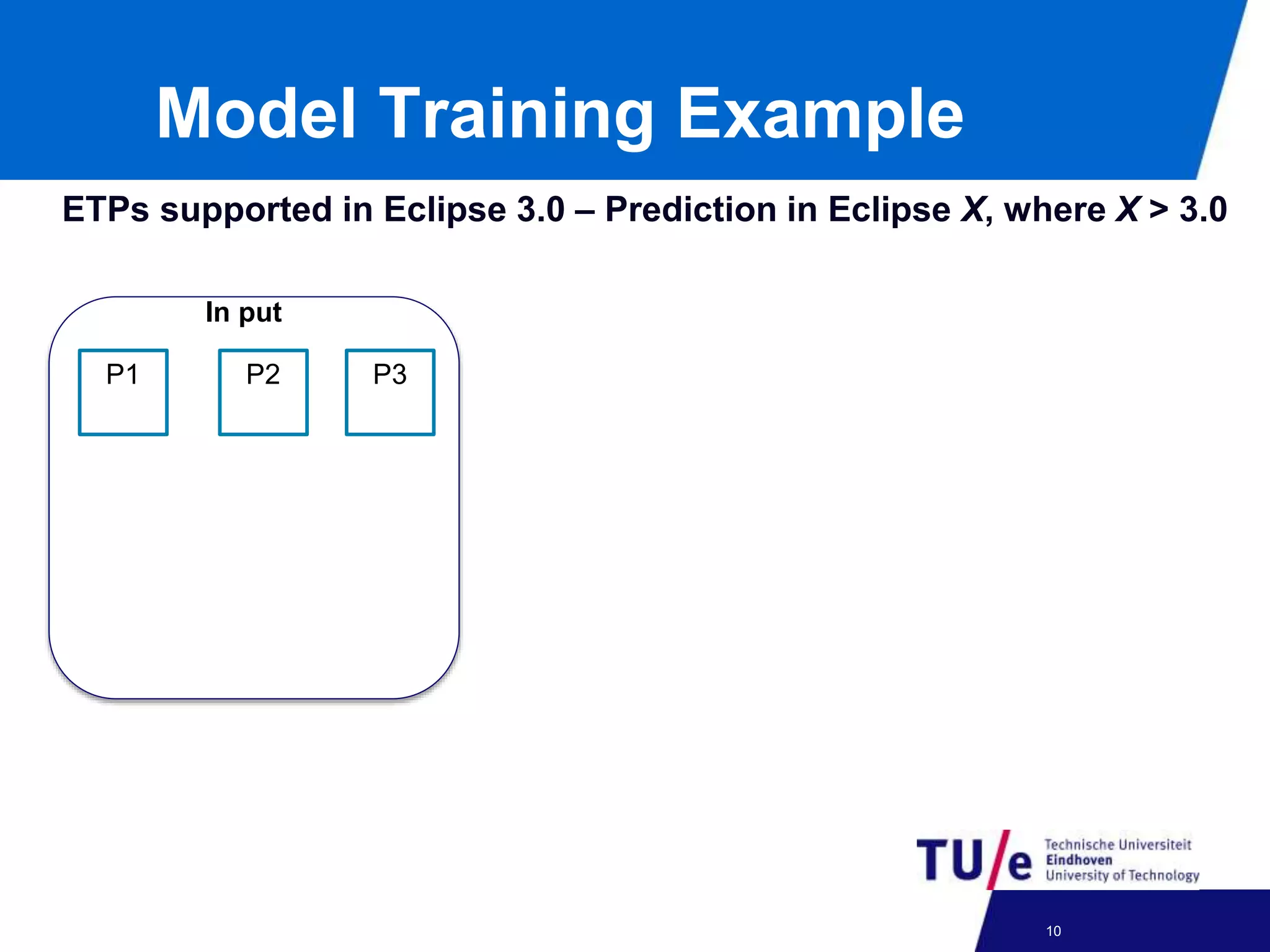
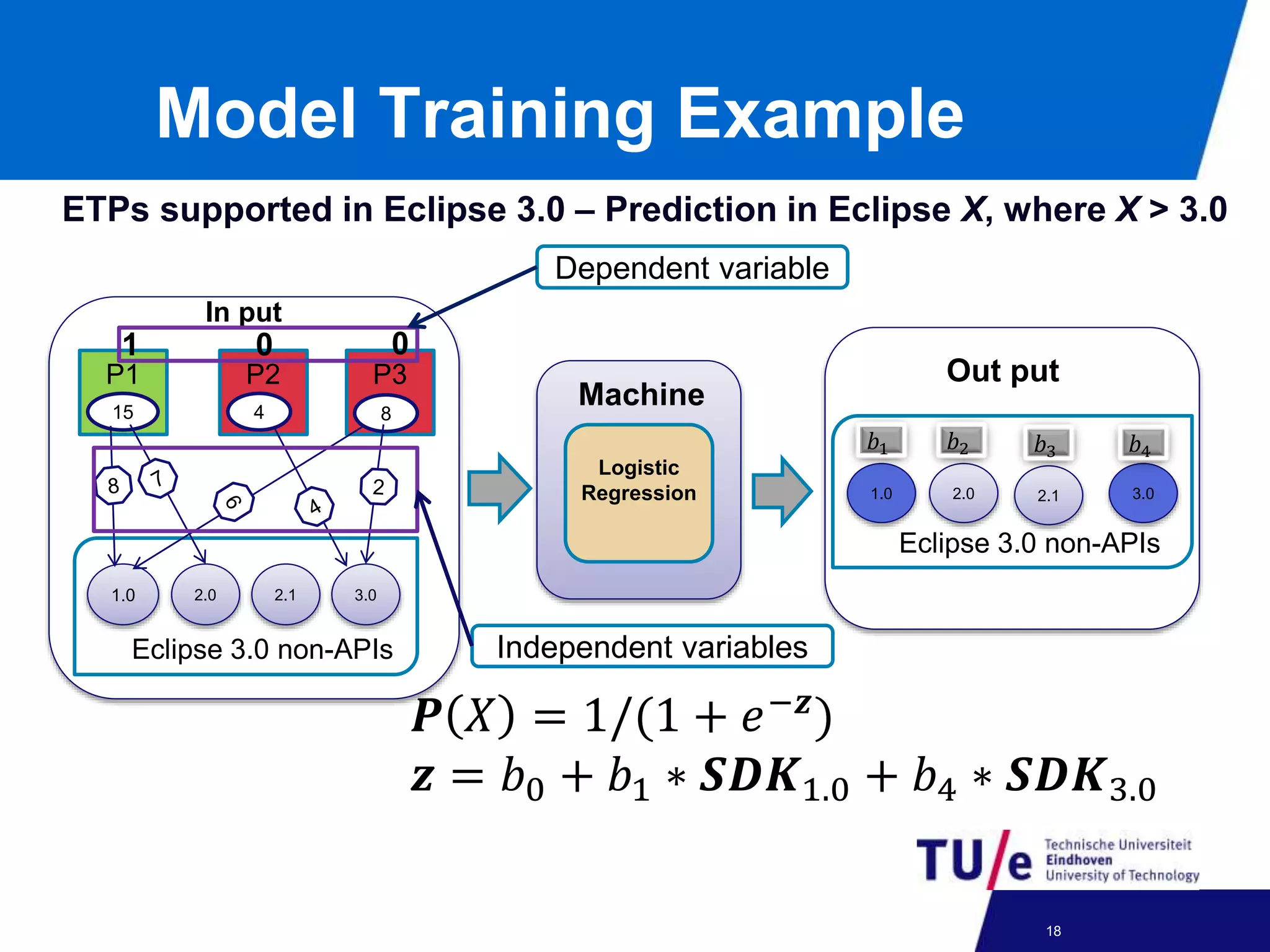
Model Training Example
In put
P1 P2 P3
ETPs supported in Eclipse 3.0 – Prediction in Eclipse X, where X > 3.0
24-09-2012 10
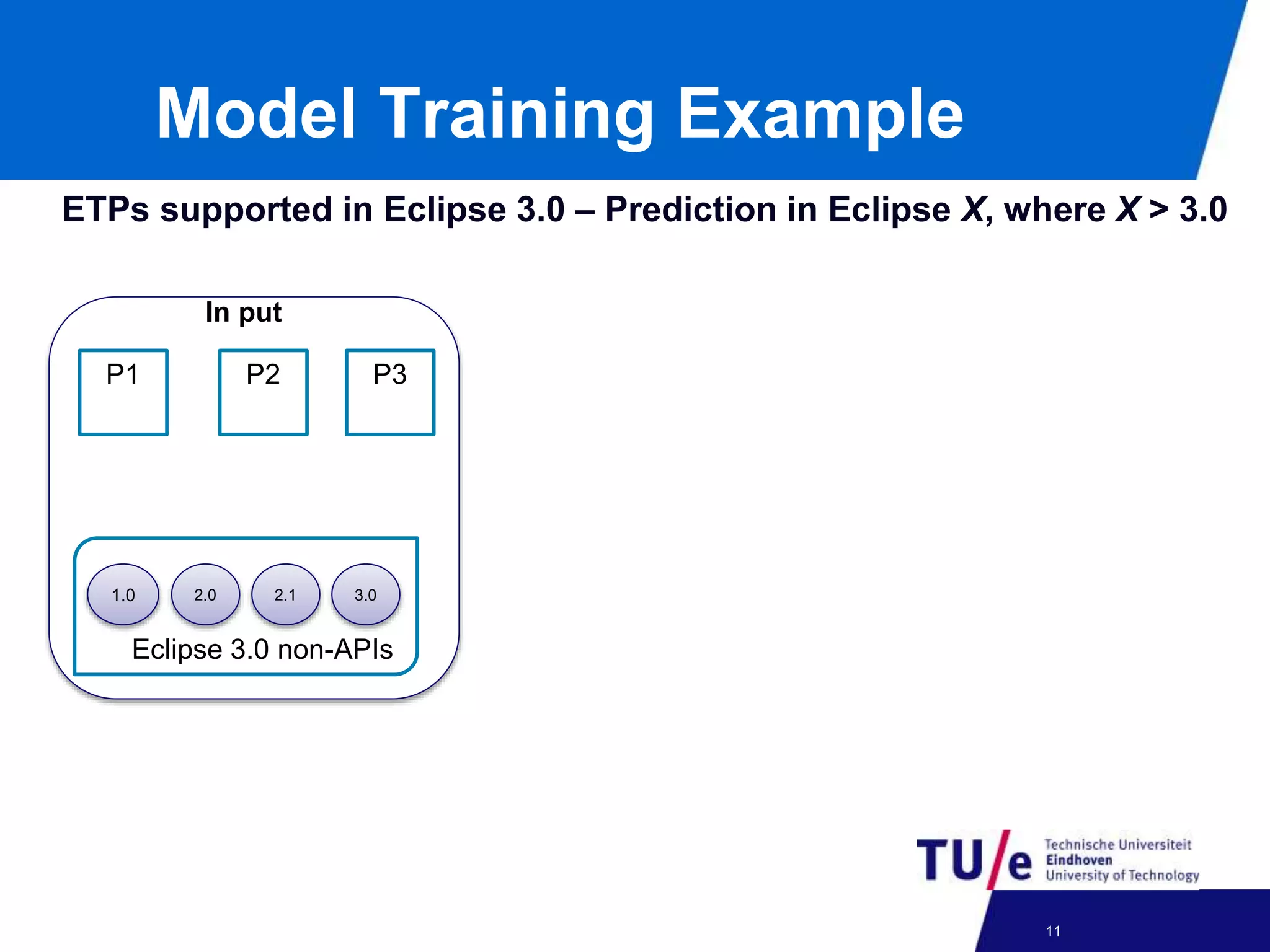
Model Training Example
In put
1.
0
1.0 2.0 2.1 3.0
Eclipse 3.0 non-APIs
P1 P2 P3
ETPs supported in Eclipse 3.0 – Prediction in Eclipse X, where X > 3.0
24-09-2012 11
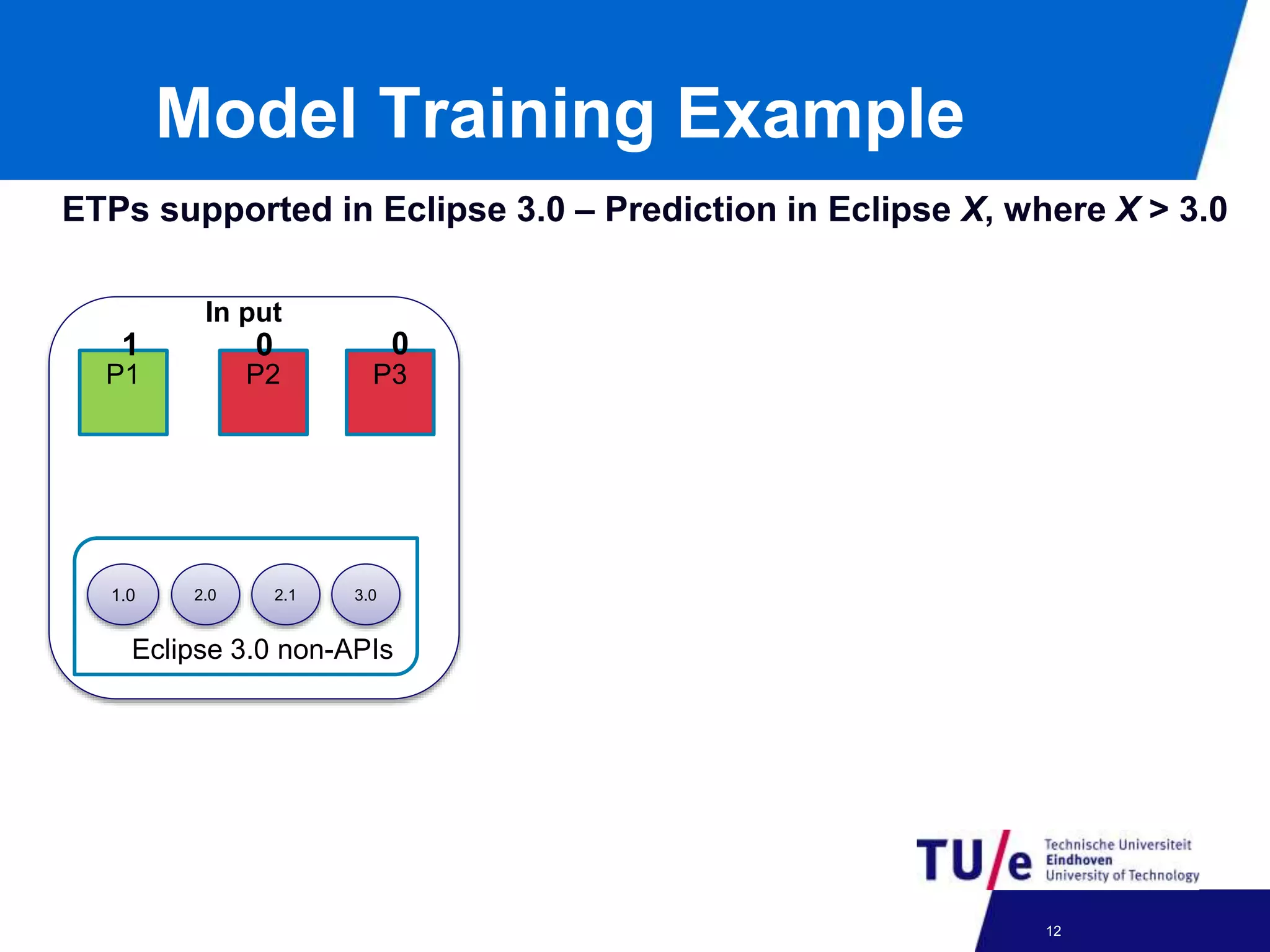
Model Training Example
In put
1.
0
1.0 2.0 2.1 3.0
Eclipse 3.0 non-APIs
P1 P2 P3
ETPs supported in Eclipse 3.0 – Prediction in Eclipse X, where X > 3.0
1 0 0
24-09-2012 12
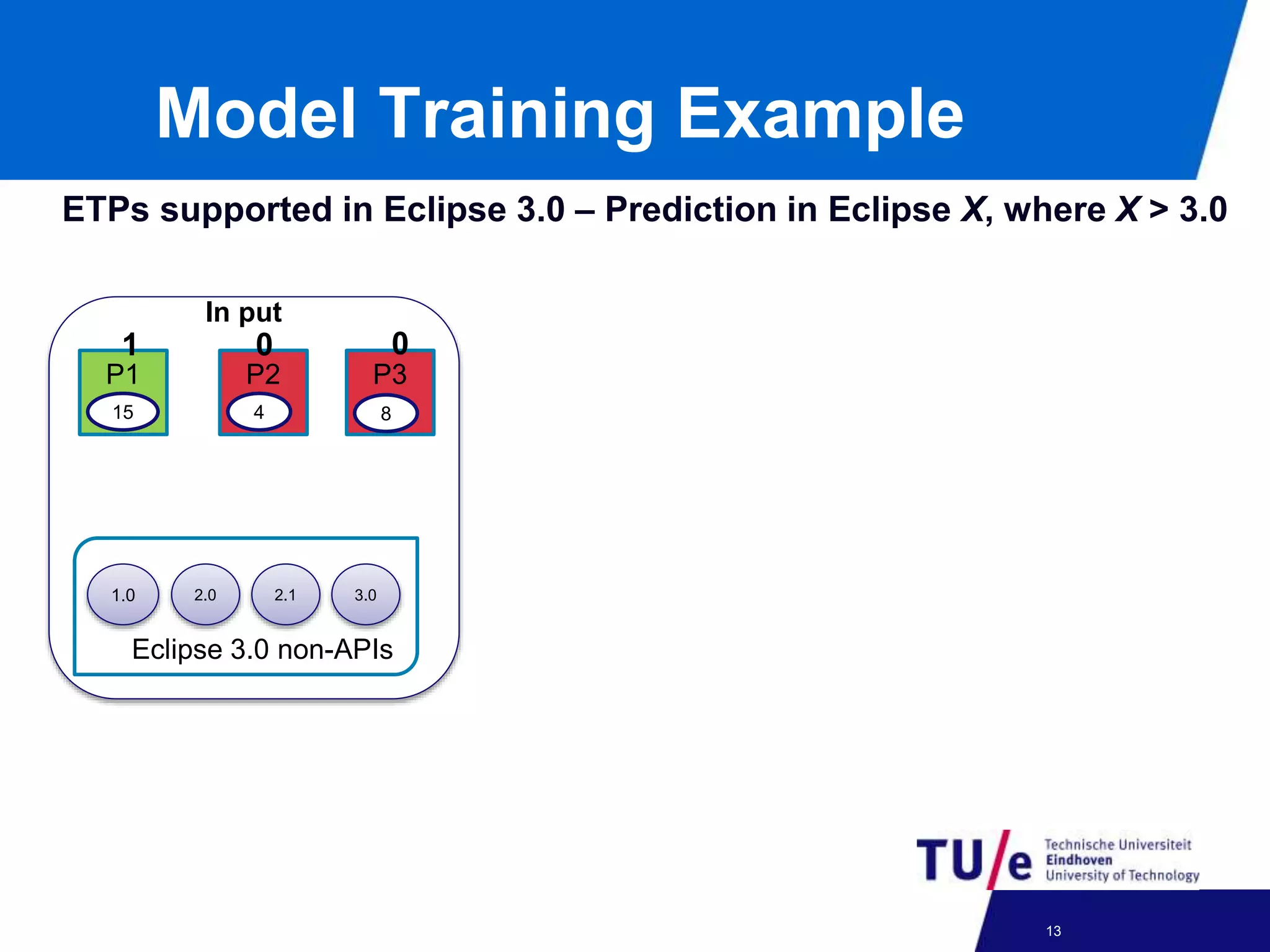
Model Training Example
In put
1.
0
1.0 2.0 2.1 3.0
Eclipse 3.0 non-APIs
P1
15
P2
4
P3
8
ETPs supported in Eclipse 3.0 – Prediction in Eclipse X, where X > 3.0
1 0 0
24-09-2012 13
Model Training Example
In put
1.
0
1.0 2.0 2.1 3.0
Eclipse 3.0 non-APIs
P1
15
P2
4
P3
8
ETPs supported in Eclipse 3.0 – Prediction in Eclipse X, where X > 3.0
1 0 0
24-09-2012 14
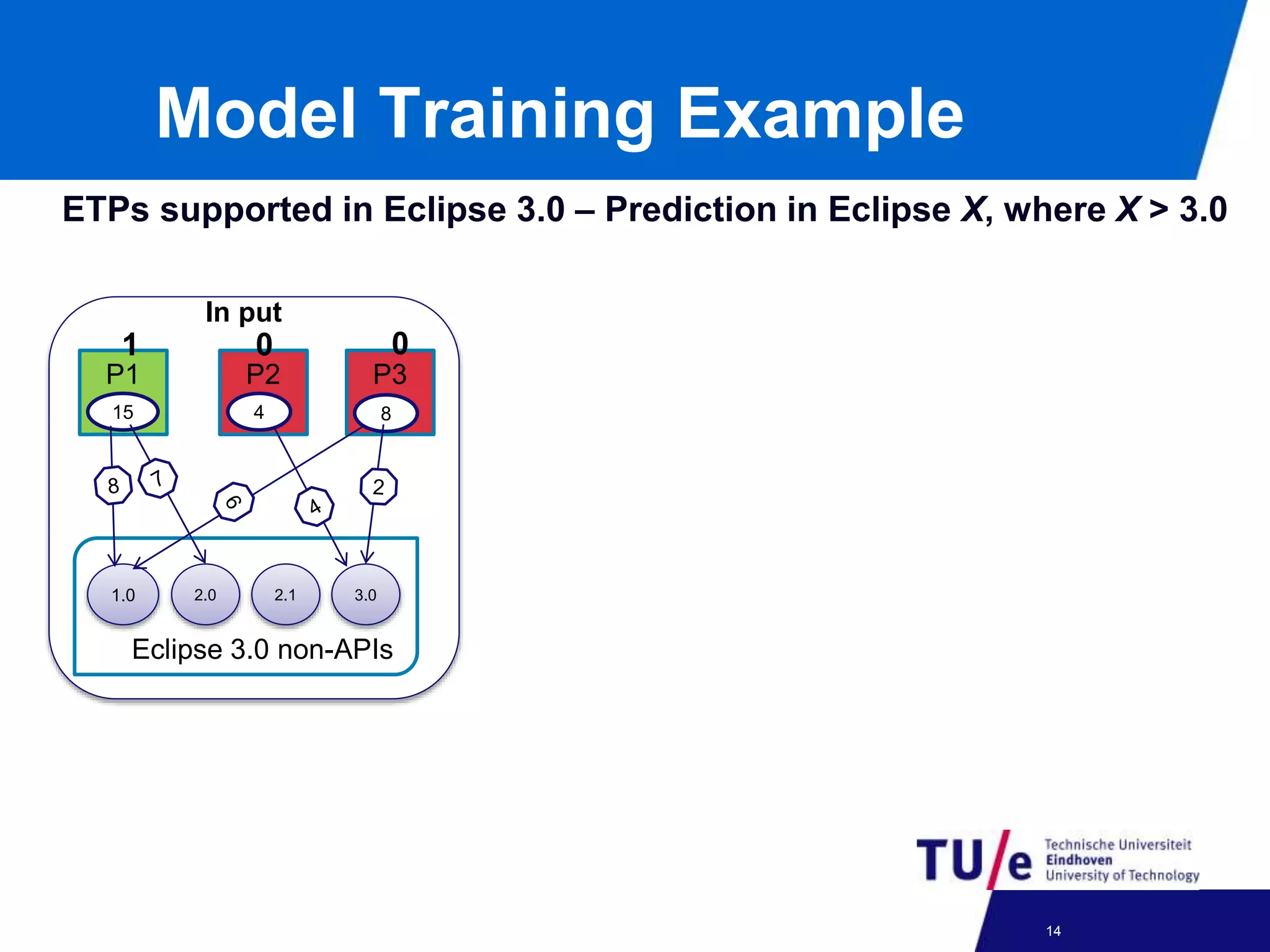
Model Training Example
In put
1.
0
1.0 2.0 2.1 3.0
Eclipse 3.0 non-APIs
P1
15
P2
4
P3
8
ETPs supported in Eclipse 3.0 – Prediction in Eclipse X, where X > 3.0
1 0 0
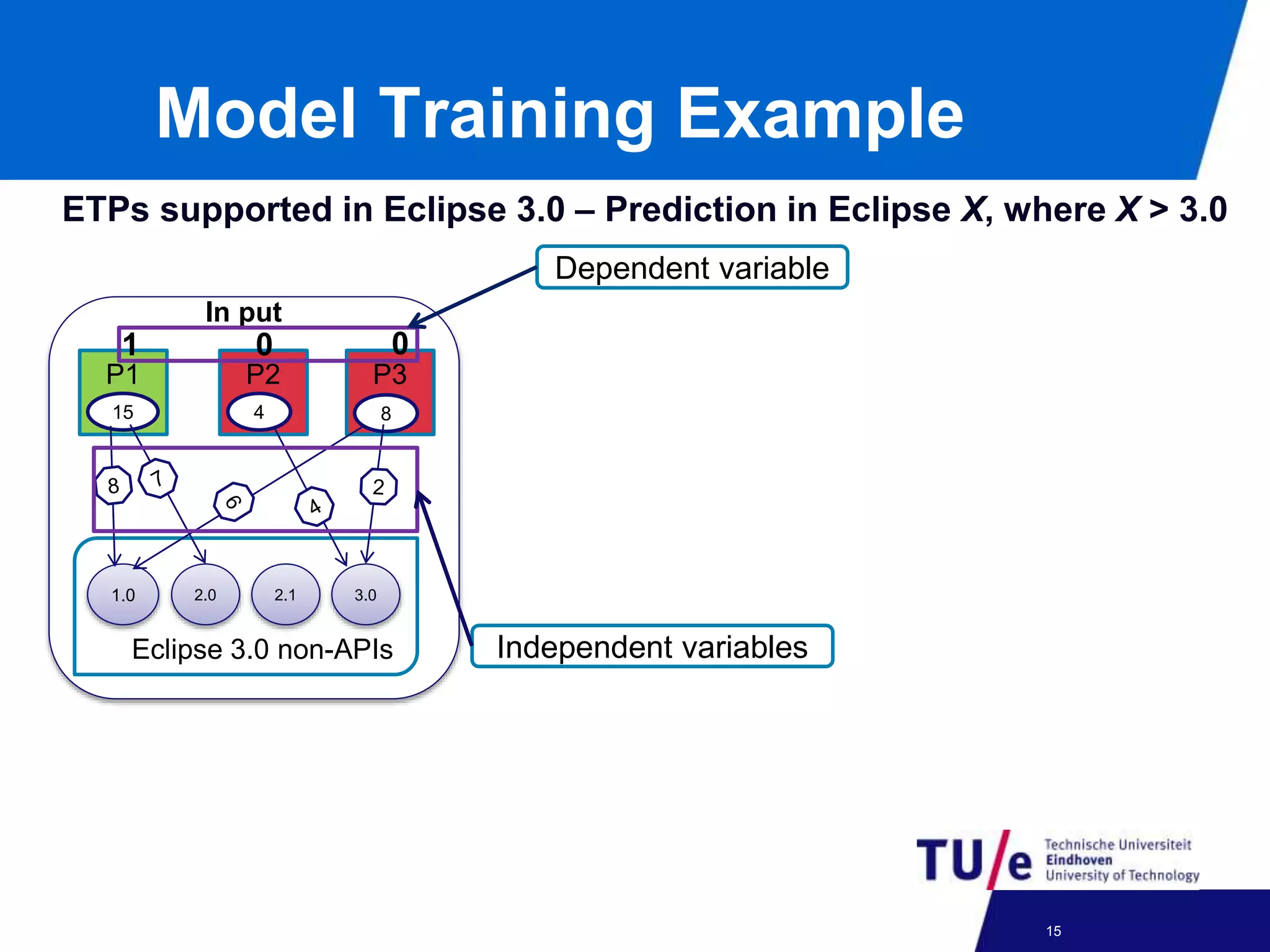
24-09-2012 15
Dependent variable
Independent variables
Model Training Example
In put
1.
0
1.0 2.0 2.1 3.0
Eclipse 3.0 non-APIs
P1
15
P2
4
P3
8
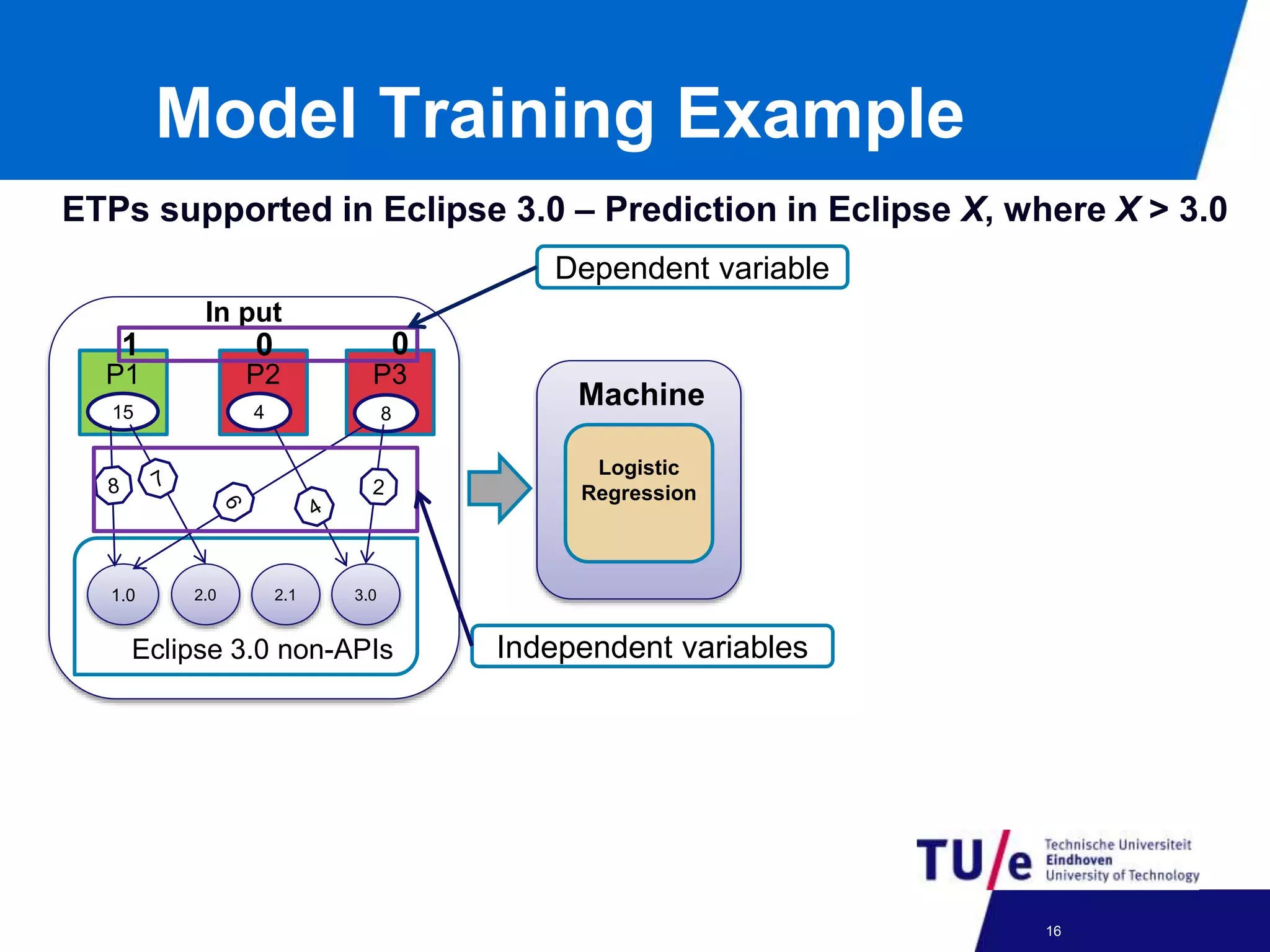
Logistic
Regression
Machine
ETPs supported in Eclipse 3.0 – Prediction in Eclipse X, where X > 3.0
1 0 0
24-09-2012 16
Dependent variable
Independent variables
Model Training Example
In put
1.
0
1.0 2.0 2.1 3.0
Eclipse 3.0 non-APIs
P1
15
P2
4
P3
8
Logistic
Regression
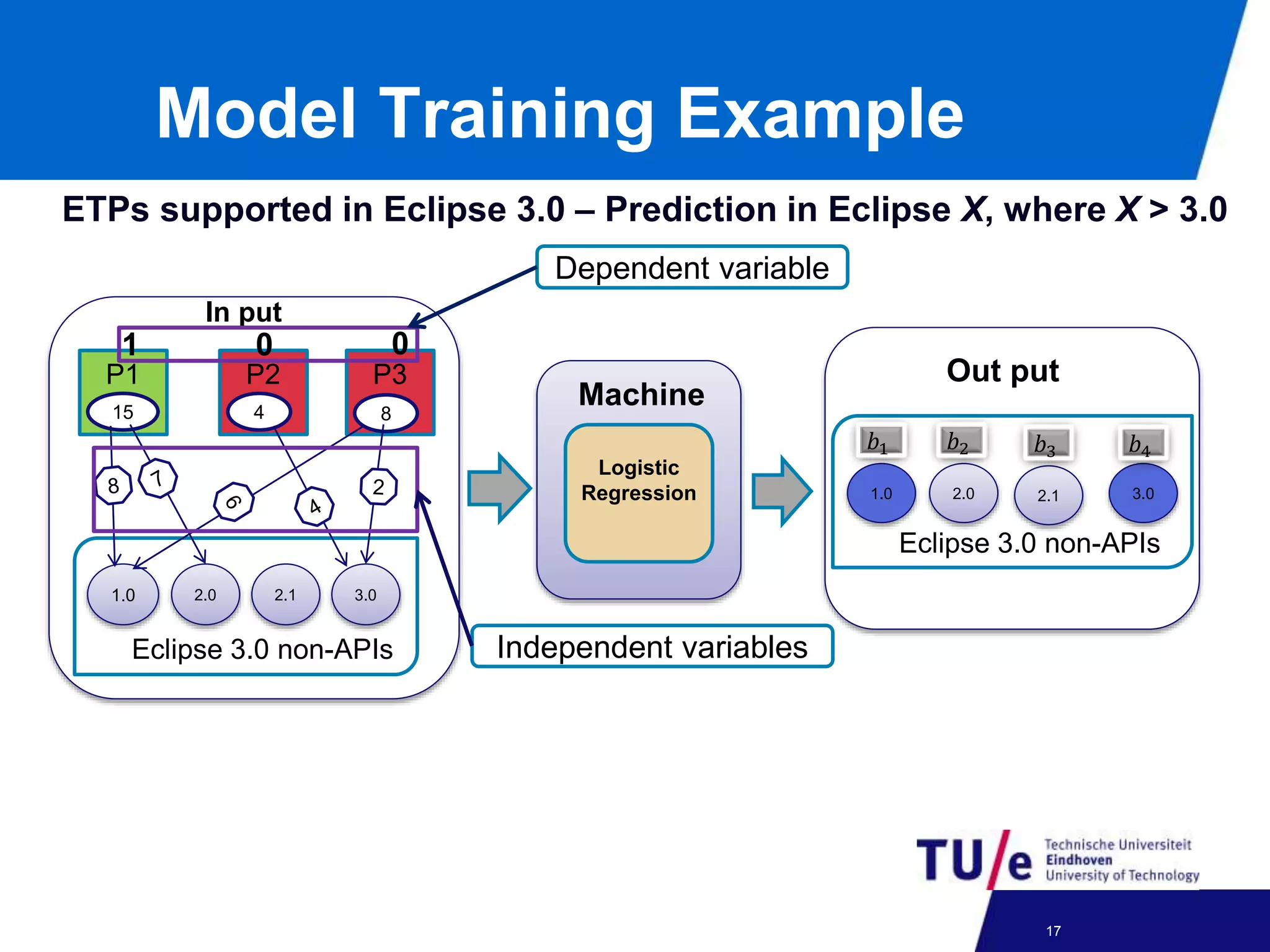
Out put
1.
0
1.0 2.0 2.1 3.0
Eclipse 3.0 non-APIs
𝑏2𝑏1 𝑏3 𝑏4
Machine
ETPs supported in Eclipse 3.0 – Prediction in Eclipse X, where X > 3.0
1 0 0
24-09-2012 17
Dependent variable
Independent variables
Model Training Example
In put
1.
0
1.0 2.0 2.1 3.0
Eclipse 3.0 non-APIs
P1
15
P2
4
P3
8
Logistic
Regression
Out put
1.
0
1.0 2.0 2.1 3.0
Eclipse 3.0 non-APIs
𝑏2𝑏1 𝑏3 𝑏4
Machine
𝑷 𝑋 = 1/(1 + 𝑒−𝒛
)
𝒛 = 𝑏0 + 𝑏1 ∗ 𝑺𝑫𝑲1.0 + 𝑏4 ∗ 𝑺𝑫𝑲3.0
ETPs supported in Eclipse 3.0 – Prediction in Eclipse X, where X > 3.0
1 0 0
24-09-2012 18
Dependent variable
Independent variables
Model Training Example
1.
0
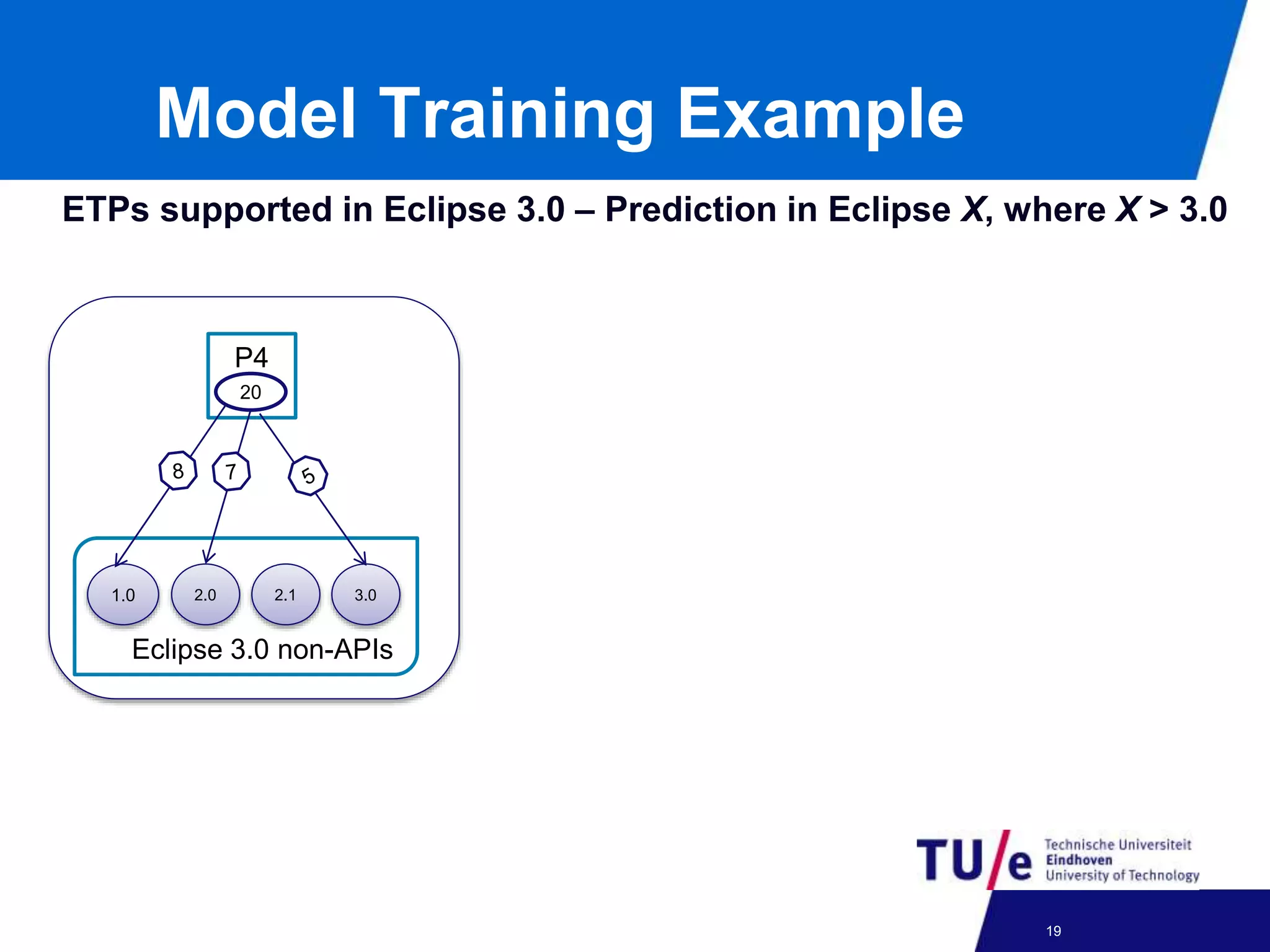
1.0 2.0 2.1 3.0
Eclipse 3.0 non-APIs
P4
20
ETPs supported in Eclipse 3.0 – Prediction in Eclipse X, where X > 3.0
24-09-2012 19
Model Training Example
1.
0
1.0 2.0 2.1 3.0
Eclipse 3.0 non-APIs
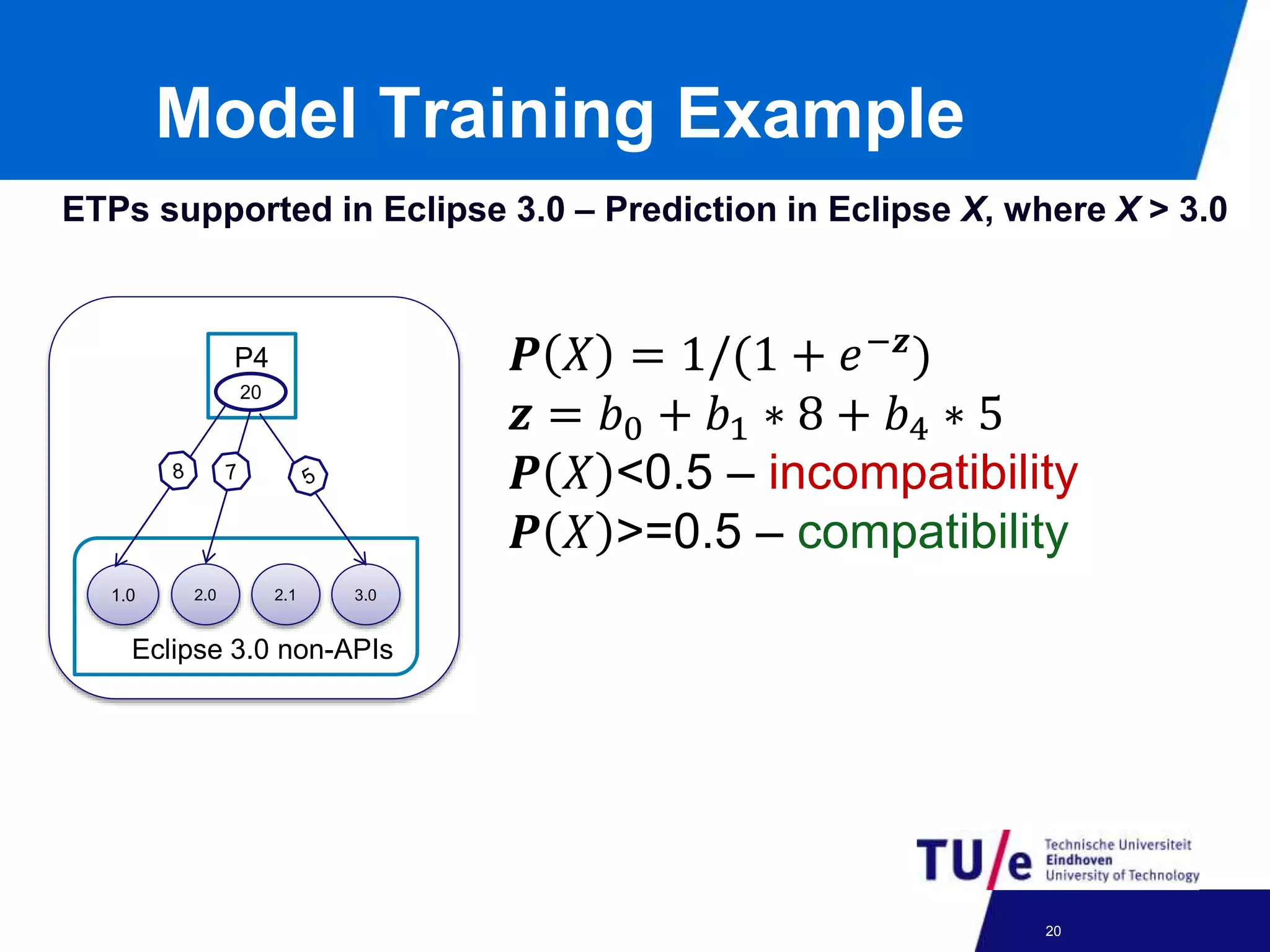
P4
20
ETPs supported in Eclipse 3.0 – Prediction in Eclipse X, where X > 3.0
24-09-2012 20
𝑷 𝑋 = 1/(1 + 𝑒−𝒛)
𝒛 = 𝑏0 + 𝑏1 ∗ 8 + 𝑏4 ∗ 5
𝑷 𝑋 <0.5 – incompatibility
𝑷 𝑋 >=0.5 – compatibility
Results
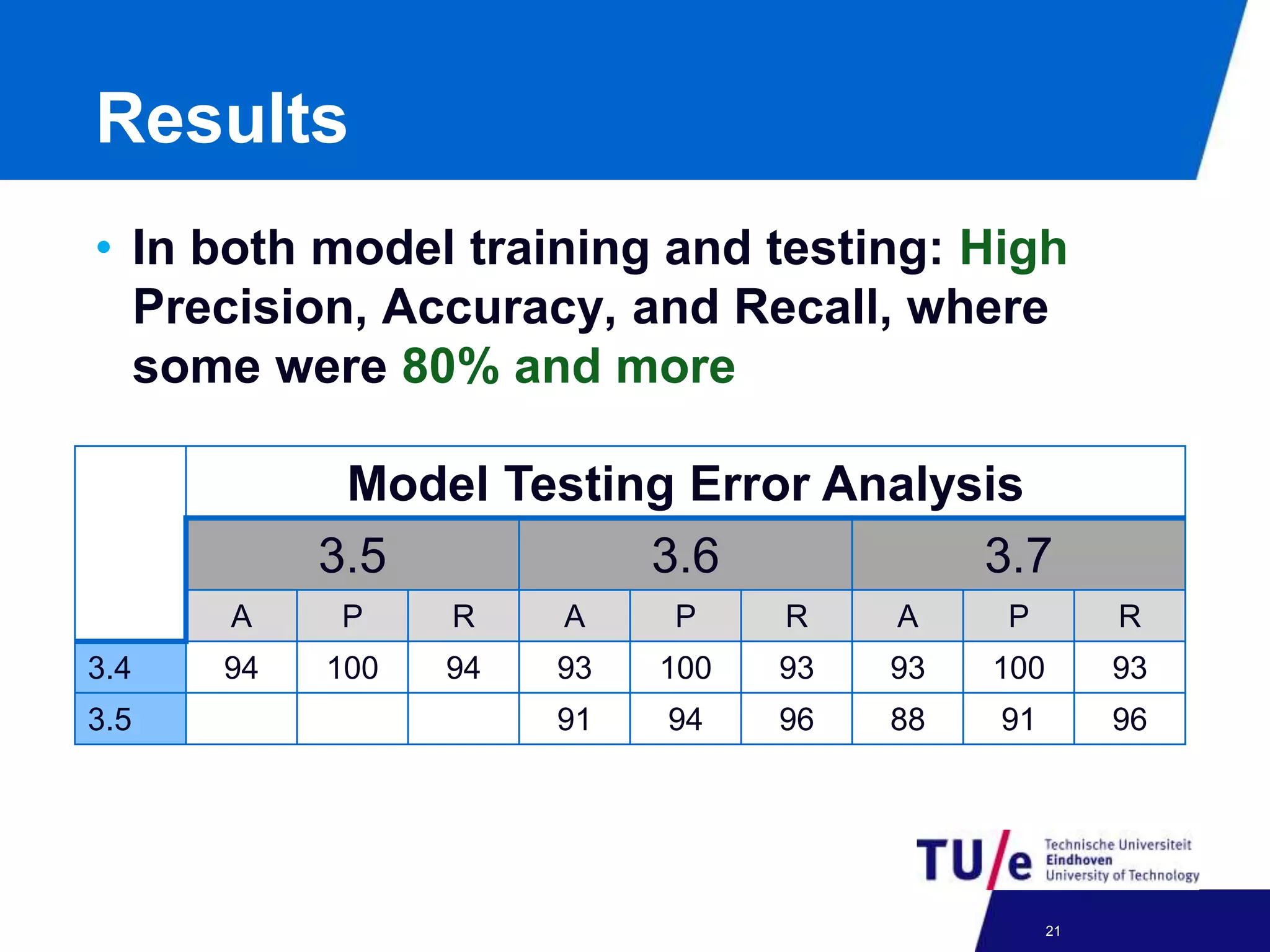
• In both model training and testing: High
Precision, Accuracy, and Recall, where
some were 80% and more
24-09-2012 21
Model Testing Error Analysis
3.5 3.6 3.7
A P R A P R A P R
3.4 94 100 94 93 100 93 93 100 93
3.5 91 94 96 88 91 96
Conclusion and Future Work
• Mining interface usage from ETPs
to detect or predict compatibility
shows good results.
• Next, develop a domain specific
tool to make predictions.
• Who can use the tool? users and
developers of ETPs
•
Software Engineering and Technology (SET) PAGE 229-6-2014
Thank you for listening
Software Engineering and Technology (SET) PAGE 239-6-2014

Compatibility Prediction of Eclipse Third-Party Plug-ins in New Eclipse Releases

  • 1.
    Compatibility Prediction of EclipseThird-party Plug-ins in new Eclipse Releases John Businge, Alexander Serebrenik, Mark van den Brand
  • 2.
    The Eclipse Framework SoftwareEngineering and Technology (SET) PAGE 19-6-2014 P1 P4P3P2 Eclipse Framework Eclipse Third- party Plug-ins (ETPs)
  • 3.
    The Eclipse Framework… Software Engineering and Technology (SET) PAGE 29-6-2014 P1 P4P3P2 Eclipse Framework Eclipse Third- party Plug-ins (ETPs) Eclipse APIs(“good”) • no “internal” • stable, • supported Eclipse non-APIs (“bad”) • “internal” • unstable, • discouraged, • unsupported
  • 4.
    The Eclipse Framework… Software Engineering and Technology (SET) PAGE 39-6-2014 P1 P4P3P2 Eclipse Framework Eclipse Third- party Plug-ins (ETPs) Eclipse APIs(“good”) • no “internal” • stable, • supported Eclipse non-APIs (“bad”) • “internal” • unstable, • discouraged, • unsupported  P3 – ETP-APIs  P1, P2 and P4 – ETP-non-APIs
  • 5.
    Motivation • Previous study(Survival of ETPs – ICSM 2012), we tested compatibility of 345 ETP-APIs and 288 ETP-non- APIs with different Eclipse releases. • Our observations: 1. ETP-APIs always compatible in new Eclipse releases. 2. Bad interfaces are the main cause of incompatibilities. 3. Informally, found old bad interfaces stable. • Formally verified observation 2. • Trained prediction models • Tested the prediction models. Software Engineering and Technology (SET) PAGE 49-6-2014
  • 6.
    Motivation • Previous study(Survival of ETPs – ICSM 2012), we tested compatibility of 345 ETP-APIs and 288 ETP-non- APIs with different Eclipse releases. • Our observations: 1. ETP-APIs always compatible in new Eclipse releases. 2. Bad interfaces are the main cause of incompatibilities. 3. Informally, found old bad interfaces stable. • Formally verified observation 2. • Trained prediction models • Tested the prediction models. Software Engineering and Technology (SET) PAGE 59-6-2014
  • 7.
    Compatibility prediction • Requirementsof compatibility prediction: − Current SDK compatible with ETP − Later SDK to make prediction • We built 36 prediction models in total • Models are bases on bad interfaces used by ETPs Software Engineering and Technology (SET) PAGE 79-6-2014
  • 8.
    ETP-non-APIs supported inEclipse Releases Software Engineering and Technology (SET) PAGE 89-6-2014 Eclipse 2.1 3.0 3.1 3.2 3.3 3.4 3.5 3.6 Total # ETPs 29 48 34 40 38 36 33 30 288
  • 9.
    Model Training  Statistics– Binary Logistic Regression 𝑷 𝑒𝑣𝑒𝑛𝑡 = 1/(1 + 𝑒−𝒛 ) 𝒛 = 𝑏0 + 𝑏1 𝑋1 + … + 𝑏 𝑝 𝑋 𝑝 𝑷 𝑒𝑣𝑒𝑛𝑡 −Dependent variable p # Independent variables 24-09-2012 9
  • 10.
    Model Training Example Input P1 P2 P3 ETPs supported in Eclipse 3.0 – Prediction in Eclipse X, where X > 3.0 24-09-2012 10
  • 11.
    Model Training Example Input 1. 0 1.0 2.0 2.1 3.0 Eclipse 3.0 non-APIs P1 P2 P3 ETPs supported in Eclipse 3.0 – Prediction in Eclipse X, where X > 3.0 24-09-2012 11
  • 12.
    Model Training Example Input 1. 0 1.0 2.0 2.1 3.0 Eclipse 3.0 non-APIs P1 P2 P3 ETPs supported in Eclipse 3.0 – Prediction in Eclipse X, where X > 3.0 1 0 0 24-09-2012 12
  • 13.
    Model Training Example Input 1. 0 1.0 2.0 2.1 3.0 Eclipse 3.0 non-APIs P1 15 P2 4 P3 8 ETPs supported in Eclipse 3.0 – Prediction in Eclipse X, where X > 3.0 1 0 0 24-09-2012 13
  • 14.
    Model Training Example Input 1. 0 1.0 2.0 2.1 3.0 Eclipse 3.0 non-APIs P1 15 P2 4 P3 8 ETPs supported in Eclipse 3.0 – Prediction in Eclipse X, where X > 3.0 1 0 0 24-09-2012 14
  • 15.
    Model Training Example Input 1. 0 1.0 2.0 2.1 3.0 Eclipse 3.0 non-APIs P1 15 P2 4 P3 8 ETPs supported in Eclipse 3.0 – Prediction in Eclipse X, where X > 3.0 1 0 0 24-09-2012 15 Dependent variable Independent variables
  • 16.
    Model Training Example Input 1. 0 1.0 2.0 2.1 3.0 Eclipse 3.0 non-APIs P1 15 P2 4 P3 8 Logistic Regression Machine ETPs supported in Eclipse 3.0 – Prediction in Eclipse X, where X > 3.0 1 0 0 24-09-2012 16 Dependent variable Independent variables
  • 17.
    Model Training Example Input 1. 0 1.0 2.0 2.1 3.0 Eclipse 3.0 non-APIs P1 15 P2 4 P3 8 Logistic Regression Out put 1. 0 1.0 2.0 2.1 3.0 Eclipse 3.0 non-APIs 𝑏2𝑏1 𝑏3 𝑏4 Machine ETPs supported in Eclipse 3.0 – Prediction in Eclipse X, where X > 3.0 1 0 0 24-09-2012 17 Dependent variable Independent variables
  • 18.
    Model Training Example Input 1. 0 1.0 2.0 2.1 3.0 Eclipse 3.0 non-APIs P1 15 P2 4 P3 8 Logistic Regression Out put 1. 0 1.0 2.0 2.1 3.0 Eclipse 3.0 non-APIs 𝑏2𝑏1 𝑏3 𝑏4 Machine 𝑷 𝑋 = 1/(1 + 𝑒−𝒛 ) 𝒛 = 𝑏0 + 𝑏1 ∗ 𝑺𝑫𝑲1.0 + 𝑏4 ∗ 𝑺𝑫𝑲3.0 ETPs supported in Eclipse 3.0 – Prediction in Eclipse X, where X > 3.0 1 0 0 24-09-2012 18 Dependent variable Independent variables
  • 19.
    Model Training Example 1. 0 1.02.0 2.1 3.0 Eclipse 3.0 non-APIs P4 20 ETPs supported in Eclipse 3.0 – Prediction in Eclipse X, where X > 3.0 24-09-2012 19
  • 20.
    Model Training Example 1. 0 1.02.0 2.1 3.0 Eclipse 3.0 non-APIs P4 20 ETPs supported in Eclipse 3.0 – Prediction in Eclipse X, where X > 3.0 24-09-2012 20 𝑷 𝑋 = 1/(1 + 𝑒−𝒛) 𝒛 = 𝑏0 + 𝑏1 ∗ 8 + 𝑏4 ∗ 5 𝑷 𝑋 <0.5 – incompatibility 𝑷 𝑋 >=0.5 – compatibility
  • 21.
    Results • In bothmodel training and testing: High Precision, Accuracy, and Recall, where some were 80% and more 24-09-2012 21 Model Testing Error Analysis 3.5 3.6 3.7 A P R A P R A P R 3.4 94 100 94 93 100 93 93 100 93 3.5 91 94 96 88 91 96
  • 22.
    Conclusion and FutureWork • Mining interface usage from ETPs to detect or predict compatibility shows good results. • Next, develop a domain specific tool to make predictions. • Who can use the tool? users and developers of ETPs • Software Engineering and Technology (SET) PAGE 229-6-2014
  • 23.
    Thank you forlistening Software Engineering and Technology (SET) PAGE 239-6-2014

Editor's Notes

  • #3 Technical support from framework developers, ease of maintenance, and