Presented by: Nishita Choudhary
234340
ANATOMY
COMPARITIV
E
Fishes
SYSTEM - CIRCULATORY SYSTEM
Mammals
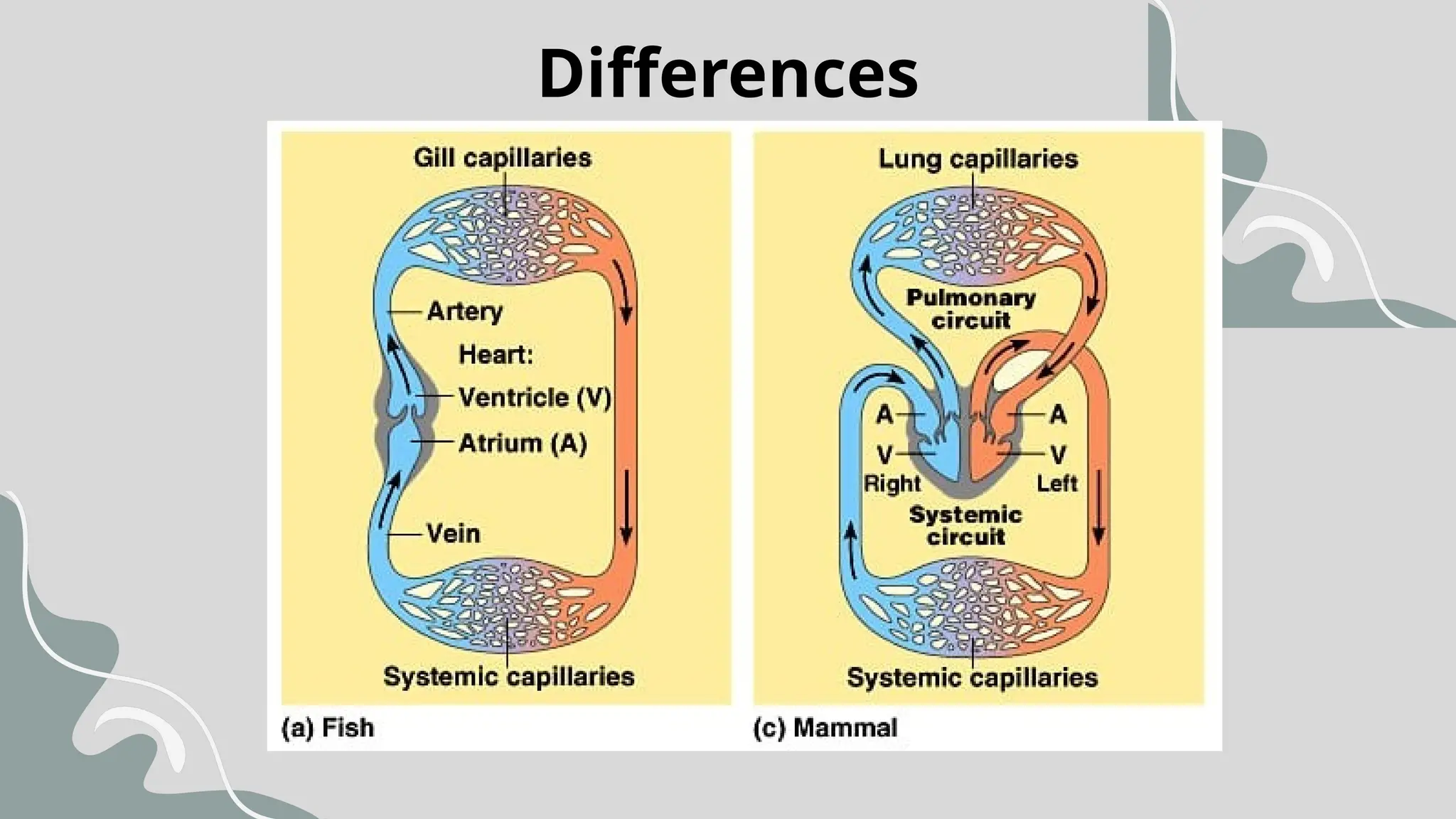
FISHES
Fish have
a closed, single circulation system
Blood flows from the heart to gills for oxygenation, then
to the rest of the body, and back to the heart.
Heart Structure
Fish hearts have four parts: sinus venosus, atrium,
ventricle, bulbus arteriosus.
Functionally, it’s considered two-chambered (atrium +
ventricle).
Located behind gills and encased in the pericardium.
Circulation Process:
1. Deoxygenated blood from the body enters the
atrium.
2. Blood flows into the ventricle, which pumps it
to the gills.
3. In the gills, gas exchange occurs — oxygen is
absorbed and carbon dioxide is released.
4. Oxygenated blood flows from the gills to the
rest of the body tissues.
5. After delivering oxygen, the blood returns to
the heart as deoxygenated blood. Flow Path: Heart Gills Body
→ → →
Back to Heart
Mammals have
a closed, double circulation system.
Blood flows through two loops:
pulmonary circulation (heart to lungs)
and systemic circulation (heart to body).
Heart Structure
The heart has four chambers: two atria
and two ventricles.
MAMMALS
Circulation Path
Differences
References
Kardong , K.V. ( 2005) Vertebrate’s Comparative
Anatomy
Comparative Anatomy of Vertebrates - R.k. Saxena
, Sumitra Saxena
websites
https://www.du.ac.in
https://basu.org.in
https:davuniversity.org
THANK
YOU

Comparitive Anatomy[1] Fiedjeeeenal.pptx

  • 1.
    Presented by: NishitaChoudhary 234340 ANATOMY COMPARITIV E
  • 2.
  • 3.
    FISHES Fish have a closed,single circulation system Blood flows from the heart to gills for oxygenation, then to the rest of the body, and back to the heart. Heart Structure Fish hearts have four parts: sinus venosus, atrium, ventricle, bulbus arteriosus. Functionally, it’s considered two-chambered (atrium + ventricle). Located behind gills and encased in the pericardium.
  • 4.
    Circulation Process: 1. Deoxygenatedblood from the body enters the atrium. 2. Blood flows into the ventricle, which pumps it to the gills. 3. In the gills, gas exchange occurs — oxygen is absorbed and carbon dioxide is released. 4. Oxygenated blood flows from the gills to the rest of the body tissues. 5. After delivering oxygen, the blood returns to the heart as deoxygenated blood. Flow Path: Heart Gills Body → → → Back to Heart
  • 5.
    Mammals have a closed,double circulation system. Blood flows through two loops: pulmonary circulation (heart to lungs) and systemic circulation (heart to body). Heart Structure The heart has four chambers: two atria and two ventricles. MAMMALS
  • 6.
  • 7.
  • 9.
    References Kardong , K.V.( 2005) Vertebrate’s Comparative Anatomy Comparative Anatomy of Vertebrates - R.k. Saxena , Sumitra Saxena websites https://www.du.ac.in https://basu.org.in https:davuniversity.org
  • 10.