Comparing Wikipedia
and Encyclopedia
Britannica
Wikipedia and Encyclopedia Britannica are two of the most well-known
reference sources, but they differ significantly in their organizational
structure, management, and approach to information. This presentation
will explore these key differences and their implications.
by Ooi ban juan
Wikipedia's Open and Collaborative Model
Open Editing
Wikipedia's articles are
collaboratively edited by a
global community of volunteer
contributors, allowing for rapid
updates and a diverse range
of perspectives.
Decentralized Structure
There is no central editorial
control, enabling a
decentralized and agile
decision-making process that
allows the encyclopedia to
evolve quickly.
Volunteer-Driven
The platform is sustained by
the voluntary efforts of its
contributors, fostering a
sense of ownership and
community among its users.
Encyclopedia Britannica's Traditional
Approach
Expert-Curated
Britannica's content is written
and edited by a team of
credentialed experts,
ensuring a high level of
accuracy and reliability.
Centralized Control
The editorial process is tightly
controlled, with a hierarchical
management structure that
ensures consistency and
quality control.
Subscription-Based
Britannica operates on a
subscription model, providing
access to its content through
paid memberships and
institutional licenses.
Organizational Structure: Centralized
vs. Decentralized
1 Centralized (Britannica)
A top-down, hierarchical structure with a small team of editors making
decisions.
2 Decentralized (Wikipedia)
A distributed, collaborative network of contributors with a shared decision-
making process.
Management and Decision-Making
Processes
1 Britannica's Approach
Controlled and deliberate, with a
focus on maintaining quality and
consistency.
2 Wikipedia's Approach
Organic and iterative, leveraging the
collective wisdom and input of its
diverse contributor base.
3 Implications
Britannica's approach prioritizes authority, while Wikipedia's promotes agility and
adaptability.
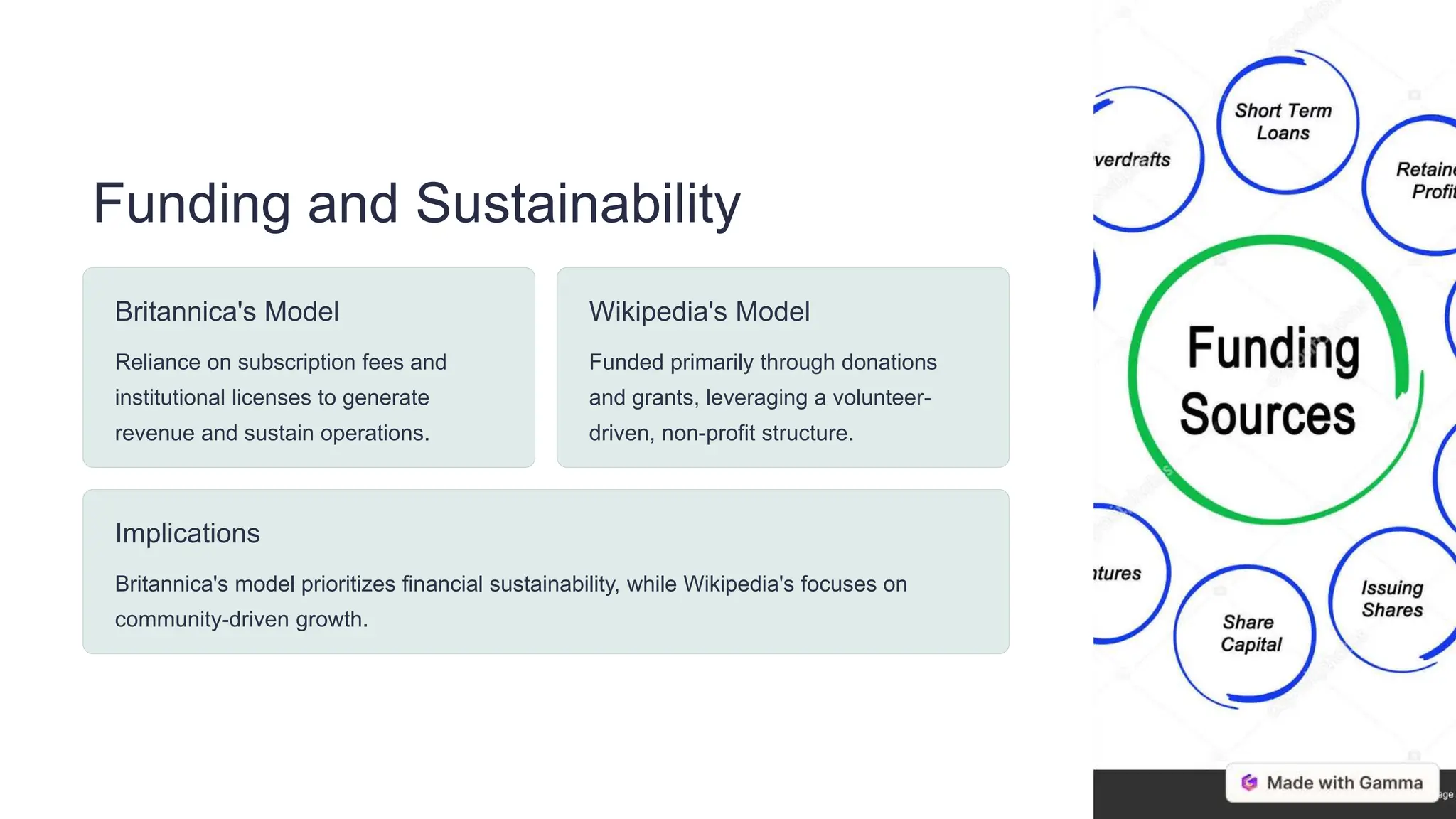
Funding and Sustainability
Britannica's Model
Reliance on subscription fees and
institutional licenses to generate
revenue and sustain operations.
Wikipedia's Model
Funded primarily through donations
and grants, leveraging a volunteer-
driven, non-profit structure.
Implications
Britannica's model prioritizes financial sustainability, while Wikipedia's focuses on
community-driven growth.
Innovation and Adaptability
Britannica's Approach
Incremental changes and
updates, with a focus on
maintaining its established
brand and reputation.
Wikipedia's Approach
Rapid, iterative
improvements driven by
community feedback and
emerging trends.
Implications
Britannica's approach
emphasizes stability, while
Wikipedia embraces a more
agile, responsive model.
Conclusion: Lessons Learned and Future
Implications
Community-Driven
Wikipedia's collaborative model
has demonstrated the power of
harnessing the collective
knowledge and contributions of
a global community.
Adaptability
The decentralized, iterative
approach of Wikipedia has
enabled it to adapt quickly to
changing user needs and
emerging trends.
Quality and Credibility
Britannica's expert-curated
content continues to be valued
for its reliability and authority,
providing a counterpoint to
Wikipedia's open model.
As the digital landscape evolves, both Wikipedia and Encyclopedia Britannica offer valuable lessons in
balancing innovation, community, and credibility. The future of knowledge dissemination will likely involve
a thoughtful integration of these diverse approaches.

Comparing-Wikipedia-and-Encyclopedia-Britannica.pptx

  • 1.
    Comparing Wikipedia and Encyclopedia Britannica Wikipediaand Encyclopedia Britannica are two of the most well-known reference sources, but they differ significantly in their organizational structure, management, and approach to information. This presentation will explore these key differences and their implications. by Ooi ban juan
  • 2.
    Wikipedia's Open andCollaborative Model Open Editing Wikipedia's articles are collaboratively edited by a global community of volunteer contributors, allowing for rapid updates and a diverse range of perspectives. Decentralized Structure There is no central editorial control, enabling a decentralized and agile decision-making process that allows the encyclopedia to evolve quickly. Volunteer-Driven The platform is sustained by the voluntary efforts of its contributors, fostering a sense of ownership and community among its users.
  • 3.
    Encyclopedia Britannica's Traditional Approach Expert-Curated Britannica'scontent is written and edited by a team of credentialed experts, ensuring a high level of accuracy and reliability. Centralized Control The editorial process is tightly controlled, with a hierarchical management structure that ensures consistency and quality control. Subscription-Based Britannica operates on a subscription model, providing access to its content through paid memberships and institutional licenses.
  • 4.
    Organizational Structure: Centralized vs.Decentralized 1 Centralized (Britannica) A top-down, hierarchical structure with a small team of editors making decisions. 2 Decentralized (Wikipedia) A distributed, collaborative network of contributors with a shared decision- making process.
  • 5.
    Management and Decision-Making Processes 1Britannica's Approach Controlled and deliberate, with a focus on maintaining quality and consistency. 2 Wikipedia's Approach Organic and iterative, leveraging the collective wisdom and input of its diverse contributor base. 3 Implications Britannica's approach prioritizes authority, while Wikipedia's promotes agility and adaptability.
  • 6.
    Funding and Sustainability Britannica'sModel Reliance on subscription fees and institutional licenses to generate revenue and sustain operations. Wikipedia's Model Funded primarily through donations and grants, leveraging a volunteer- driven, non-profit structure. Implications Britannica's model prioritizes financial sustainability, while Wikipedia's focuses on community-driven growth.
  • 7.
    Innovation and Adaptability Britannica'sApproach Incremental changes and updates, with a focus on maintaining its established brand and reputation. Wikipedia's Approach Rapid, iterative improvements driven by community feedback and emerging trends. Implications Britannica's approach emphasizes stability, while Wikipedia embraces a more agile, responsive model.
  • 8.
    Conclusion: Lessons Learnedand Future Implications Community-Driven Wikipedia's collaborative model has demonstrated the power of harnessing the collective knowledge and contributions of a global community. Adaptability The decentralized, iterative approach of Wikipedia has enabled it to adapt quickly to changing user needs and emerging trends. Quality and Credibility Britannica's expert-curated content continues to be valued for its reliability and authority, providing a counterpoint to Wikipedia's open model. As the digital landscape evolves, both Wikipedia and Encyclopedia Britannica offer valuable lessons in balancing innovation, community, and credibility. The future of knowledge dissemination will likely involve a thoughtful integration of these diverse approaches.