 Abdul Ghafoor Langah (Group Leader) 08CH26
 Waseem Ahmed Wassan (A.G.L) 08CH49
 Faheem Akhtar Shaikh 08CH86
 Muhammad Ibrahim Menik 08CH06
 Sohail Ahmed Kunbher 08CH69
 Mohammad Yousuf 08CH91
Project Supervisor
EGNR. ASHFAQUE HUSSAIN PIRZADA
Assistant Professor
Project Co Supervisor
ENGR. IMRAN NAZIR UNAR
Lecturer
 Abstract
 Introduction
 Temperature Control
 Different Types of Control Mechanisms
 Experimental Work
 Dynamic Simulation of the system
 Comparative Study of Different Controllers
 There are four common Types of Control Algorithms
which are widely used;
1. On / Off Control
2. Proportional Control
3. Proportional + Integral Control
4. Proportional + Derivative Control
5. Proportional + Integral + Derivative Control
Temperature Control
Accessory (PCT-13) Electrical Console
1. To Study the Effectiveness of On/Off Controller for Controlling the
Outlet Temperature of Process Fluid
2. To Study the Effectiveness of Proportional Controller for
Controlling the Outlet Temperature of Process Fluid
3. To Study the Effectiveness of Proportional and Integral (P+I)
Controller for Controlling the Outlet Temperature of Process Fluid
4. To Study the Effectiveness of Proportional and Derivative (P+D)
Controller for Controlling the Outlet Temperature of Process Fluid
5. To Study the Effectiveness of Proportional, Integral and Derivative
(PID) Controller for Controlling the Outlet Temperature of Process
Fluid
1. Response of controller on Disturbances given by changing
the;
 Set Point
2. Effect on system by changing Hysteresis
3. Effect on system by changing Proportional Band
4. Effect on system by changing IAT
5. Effect on system by changing DAT
Response of On/Off Controller On Changing Set Points
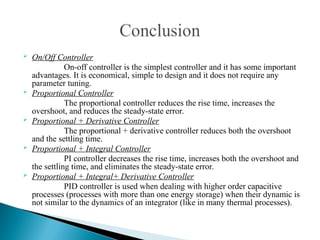
 On/Off Controller
On-off controller is the simplest controller and it has some important
advantages. It is economical, simple to design and it does not require any
parameter tuning.
 Proportional Controller
The proportional controller reduces the rise time, increases the
overshoot, and reduces the steady-state error.
 Proportional + Derivative Controller
The proportional + derivative controller reduces both the overshoot
and the settling time.
 Proportional + Integral Controller
PI controller decreases the rise time, increases both the overshoot and
the settling time, and eliminates the steady-state error.
 Proportional + Integral+ Derivative Controller
PID controller is used when dealing with higher order capacitive
processes (processes with more than one energy storage) when their dynamic is
not similar to the dynamics of an integrator (like in many thermal processes).
Comparative Study of Controllers in Process Control.ppt

Comparative Study of Controllers in Process Control.ppt

  • 2.
     Abdul GhafoorLangah (Group Leader) 08CH26  Waseem Ahmed Wassan (A.G.L) 08CH49  Faheem Akhtar Shaikh 08CH86  Muhammad Ibrahim Menik 08CH06  Sohail Ahmed Kunbher 08CH69  Mohammad Yousuf 08CH91
  • 3.
    Project Supervisor EGNR. ASHFAQUEHUSSAIN PIRZADA Assistant Professor Project Co Supervisor ENGR. IMRAN NAZIR UNAR Lecturer
  • 4.
     Abstract  Introduction Temperature Control  Different Types of Control Mechanisms  Experimental Work  Dynamic Simulation of the system  Comparative Study of Different Controllers
  • 5.
     There arefour common Types of Control Algorithms which are widely used; 1. On / Off Control 2. Proportional Control 3. Proportional + Integral Control 4. Proportional + Derivative Control 5. Proportional + Integral + Derivative Control
  • 7.
  • 8.
    1. To Studythe Effectiveness of On/Off Controller for Controlling the Outlet Temperature of Process Fluid 2. To Study the Effectiveness of Proportional Controller for Controlling the Outlet Temperature of Process Fluid 3. To Study the Effectiveness of Proportional and Integral (P+I) Controller for Controlling the Outlet Temperature of Process Fluid 4. To Study the Effectiveness of Proportional and Derivative (P+D) Controller for Controlling the Outlet Temperature of Process Fluid 5. To Study the Effectiveness of Proportional, Integral and Derivative (PID) Controller for Controlling the Outlet Temperature of Process Fluid
  • 9.
    1. Response ofcontroller on Disturbances given by changing the;  Set Point 2. Effect on system by changing Hysteresis 3. Effect on system by changing Proportional Band 4. Effect on system by changing IAT 5. Effect on system by changing DAT
  • 14.
    Response of On/OffController On Changing Set Points
  • 28.
     On/Off Controller On-offcontroller is the simplest controller and it has some important advantages. It is economical, simple to design and it does not require any parameter tuning.  Proportional Controller The proportional controller reduces the rise time, increases the overshoot, and reduces the steady-state error.  Proportional + Derivative Controller The proportional + derivative controller reduces both the overshoot and the settling time.  Proportional + Integral Controller PI controller decreases the rise time, increases both the overshoot and the settling time, and eliminates the steady-state error.  Proportional + Integral+ Derivative Controller PID controller is used when dealing with higher order capacitive processes (processes with more than one energy storage) when their dynamic is not similar to the dynamics of an integrator (like in many thermal processes).