







1. INDUSTRY PROFILE
There are various trade associations throughout the world which represent the industry in
lobbying, facilitate industry standards, and publish statistics. The International Council of
Securities Associations (ICSA) is a global group of trade associations.
In India, the Securities and Exchange Board of India (SEBI) guides the system to work
efficiently along with Reserve Bank of India (RBI). Indian Stock Markets have come a long way
in past two decades in terms of governance, simplicity, security and participation. Now investors
from all over the world are participating in Indian equities like never before. The participation of
retail investors (though relatively low when compared to developed worlds) have also gone up
significantly since past 20 years, thanks to the increasing income of urban India. Experts believe
that equity investments in India should go up substantially higher from the current levels in next
10 years. This opportunity has given birth to thousands of stock brokers in India. Many domestic
and international banks in India have started offering stock broking and DEMAT services via
separate subsidiaries. While one can choose any authorized stock broker for buying and selling
equities in India depending upon the location convenience, charges and other factors but its
worth to stay with large broking houses as they provide multiple branch facility and professional
service.
In United States, the Securities Industry and Financial Markets Association (SIFMA) is likely the
most significant; however, several of the large investment banks are members of the American
Bankers Association Securities Association (ABASA) while small investment banks are
members of the National Investment Banking Association (NIBA).
In Europe, the European Forum of Securities Associations was formed in 2007 by various
European trade associations. Several European trade associations (principally the London
Investment Banking Association and the European SIFMA affiliate) combined in 2009 to
form Association for Financial Markets in Europe (AFME).
In the securities industry in China (particularly mainland China), the Securities Association of
China is a self-regulatory organization whose members are largely investment banks.
1.1 Global size and revenue mix
Global investment banking revenue increased for the fifth year running in 2007, to a record
US$84.3 billion, which was up 22% on the previous year and more than double the level in 2003.
Subsequent to their exposure to United States sub-prime securities investments, many investment
banks have experienced losses. As of late 2012, global revenues for investment banks were
estimated at $240 billion, down about a third from 2009, as companies pursued less deals and
traded less. Differences in total revenue are likely due to different ways of classifying investment
banking revenue, such as subtracting proprietary trading revenue.
In terms of total revenue, SEC filings of the major independent investment banks in the United
States show that investment banking (defined as M&A advisory services and security
underwriting) only made up about 15-20% of total revenue for these banks from 1996 to 2006,
with the majority of revenue (60+% in some years) brought in by "trading" which includes

1
brokerage commissions and proprietary trading; the proprietary trading is estimated to provide a
significant portion of this revenue.
The United States generated 46% of global revenue in 2009, down from 56% in 1999. Europe
(with Middle East and Africa) generated about a third while Asian countries generated the
remaining 21%. The industry is heavily concentrated in a small number of major financial
centers, including City of London, New York City, Hong Kong and Tokyo.
According to estimates published by the International Financial Services London, for the decade
prior to the financial crisis in 2008, M&A was a primary source of investment banking revenue,
often accounting for 40% of such revenue, but dropped during and after the financial
crisis. Equity underwriting revenue ranged from 30% to 38% and fixed-income underwriting
accounted for the remaining revenue.
Revenues have been affected by the introduction of new products with higher margins; however,
these innovations are often copied quickly by competing banks, pushing down trading margins.
For example, brokerages commissions for bond and equity trading is a commodity business but
structuring and trading derivatives has higher margins because each over-the-counter contract
has to be uniquely structured and could involve complex pay-off and risk profiles. One growth
area is private investment in public equity (PIPEs, otherwise known as Regulation D or
Regulation S). Such transactions are privately negotiated between companies and accredited
investors.
Banks also earned revenue by securitizing debt, particularly mortgage debt prior to the financial
crisis. Investment banks have become concerned that lenders are securitizing in-house, driving
the investment banks to pursue vertical integration by becoming lenders, which is allowed in the
United States since the repeal of the Glass-Steagall act in 1999.
1.2 Investment banks
World's biggest banks are ranked for M&A advisory, syndicated
markets and debt capital markets. Some banks are:

loans, equity capital

JP Morgan Chase
Bank of America
Morgan Stanley
Goldman Sachs
Credit Suisse
Deutsche Bank
Citi Group
Barclays
UBS
Wells Fargo
Following is a list of top ten stock brokers in India in terms of size, popularity and scale of
operation.
ICICI Securities Ltd.

2
Religare Securities Ltd.
India Infoline Ltd
Angel Broking
Edelweiss
Axis Direct
HDFC Securities
Motilal Oswal
Geojit BNP Paribas
Sharekhan
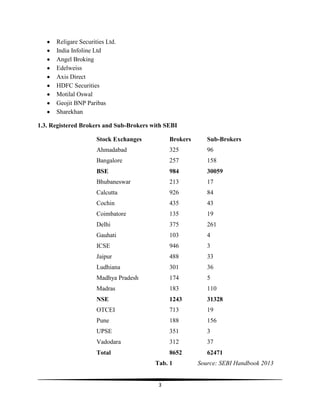
1.3. Registered Brokers and Sub-Brokers with SEBI
Stock Exchanges

Brokers

Sub-Brokers

Ahmadabad

325

96

Bangalore

257

158

BSE

984

30059

Bhubaneswar

213

17

Calcutta

926

84

Cochin

435

43

Coimbatore

135

19

Delhi

375

261

Gauhati

103

4

ICSE

946

3

Jaipur

488

33

Ludhiana

301

36

Madhya Pradesh

174

5

Madras

183

110

NSE

1243

31328

OTCEI

713

19

Pune

188

156

UPSE

351

3

Vadodara

312

37

Total

8652

62471

Tab. 1

3

Source: SEBI Handbook 2013
2. FINANCIAL CRISIS OF 2008
The 2008 financial credit crisis led to the notable collapse of several banks, notably including the
bankruptcy of large investment bank Lehman Brothers and the hurried sale of Merrill Lynch and
the much smaller Bear Stearns to banks which effectively rescued them from bankruptcy. The
entire financial services industry, including numerous investment banks, was rescued by
government loans through the Troubled Asset Relief Program (TARP). Surviving U.S.
investment banks such as Goldman Sachs and Morgan Stanley converted to traditional bank
holding companies to accept TARP relief. Similar situations occurred across the globe with
countries rescuing their banking industry. Initially, banks received part of a $700
billion Troubled Asset Relief Program (TARP) intended to stabilize the economy and thaw the
frozen credit markets. Eventually, taxpayer assistance to banks reached nearly $13 trillion
dollars, most without much scrutiny, lending did not increase and credit markets remained
frozen.
The crisis led to questioning of the business model of the investment bank without the regulation
imposed on it by Glass-Steagall. Once Robert Rubin, a former co-chairman of Goldman Sachs,
became part of the Clinton administration and deregulated banks, the previous conservatism of
underwriting established companies and seeking long-term gains was replaced by lower
standards and short-term profit. Formerly, the guidelines said that in order to take a company
public, it had to be in business for a minimum of five years and it had to show profitability for
three consecutive years. After deregulation, those standards were gone, but small investors did
not grasp the full impact of the change.
A number of former Goldman-Sachs top executives, such as Henry Paulson and Ed Liddy were
in high-level positions in government and oversaw the controversial taxpayer-funded bank
bailout. The TARP Oversight Report released by the Congressional Oversight Panel found that
the bailout tended to encourage risky behavior and "corrupted the fundamental tenets of a market
economy".
Under threat of a subpoena, Goldman Sachs revealed that it received $12.9 billion in taxpayer
aid, $4.3 billion of which was then paid out to 32 entities, including many overseas banks, hedge
funds and pensions. The same year it received $10 billion in aid from the government, it also
paid out multi-million dollar bonuses; the total paid in bonuses was $4.82 billion. Similarly,
Morgan Stanley received $10 billion in TARP funds and paid out $4.475 billion in bonuses.

4
3. EDELWEISS
Edelweiss overview
3.1. Introduction
Edelweiss was incorporated as an investment bank in 1995. Today, it is one of India's leading
Financial Services Groups, with operations that span more than forty different lines of business
and subsidiaries. Their core philosophy of ‗Ideas create, values protect‘ is translated into an
approach that is led by entrepreneurship and creativity, and protected by intellectual rigour,
research and analysis.
Edelweiss is one of India's leading Financial Services Groups, with operations that span more
than forty different lines of business. Their operations straddle the entire spectrum of financial
services in the wholesale and retail market segments including Credit (Including Retail Finance),
Capital Markets & Asset Management, Commodities and Life Insurance.
India‘s growth story is driven by a savings rate of about 32%, one of the youngest populations in
the world and strong domestic consumption. With a net worth of over INR 30 billion, Edelweiss
is adequately capitalized to exploit the opportunities emerging from this robust economic
growth. Edelweiss employs over 3600 professionals across 224 offices and branches spread
across 109 cities of India and overseas.
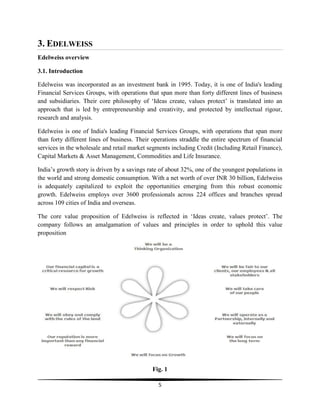
The core value proposition of Edelweiss is reflected in ‗Ideas create, values protect‘. The
company follows an amalgamation of values and principles in order to uphold this value
proposition

Fig. 1
5
•We will be a Thinking Organization. We will constantly bring ‗thought‘ to everything we do.
Our clients‘ and our own success depends on our ability to use greater ideation and more
imagination in our approach.
•We will be Fair to our clients, our employees and all stake holders. We want our clients and
our employees to be ‗richer‘ for their relationship with us.
•We will take care of our People seriously. Our policies - in spirit and in letter - will ensure
transparency and equal opportunity for all. We will go beyond the normal goals of attracting,
recruiting, retaining and rewarding fine talent. We will ensure that every individual in Edelweiss
has an opportunity to achieve their fullest potential.
•We will operate as a Partnership, internally and externally. Though individuals are very
often brilliant, we believe teamwork and collaboration will always ensure a better and more
balanced organization. We will also treat our clients as partners and show them the same respect
and consideration that we would our internal team members.
•We will focus on the Long Term. Though the world will change a lot in the coming years and
our assumptions for the future may not hold up, we will reflect on the long-term implications of
our actions. Even when making short-term decisions we will be aware of the long-term
implications.
•We will focus on Growth for our clients, employees and shareholders.
•Our Reputation and Image is more important than any financial reward. Reputation is
hard to build and even harder to rebuild. Our reputation will be impacted by our ability to think
for our clients, maintain confidentiality and by our adherence to our value system.
•We will Obey and Comply with the rules of the land. We will maintain the highest standard
of integrity and honesty. When we are unclear we will seek clarifications.
•We will respect Risk. Our business is going to be a constant challenge of balancing risk and
reward. Our ability to constantly keep one eye on risk will guide us through this fine balance.
•Our Financial Capital is a critical resource for growth. We will endeavor to grow, protect,
and use our financial capital wisely.

6
3.2. Vision Statement
To be the largest retail capital market player in India outside of banks in terms of profit.
To be recognized as the most reliable and trusted advisor.
To be one of the most exciting places to work in the country.
3.3. Mission Statement
We will significantly enhance the number of people participating in markets and help them
achieve their financial goals and dreams by providing smart and need based investment
solutions
3.4. Directors
 Mr. Rashesh Shah, Chairman & CEO
 Mr. Venkat Ramaswamy, Executive Director
 Mr. Himanshu Kaji, Executive Director
 Mr. Narendra Jhaveri, Independent Director
 Mr. Kunnasagaran Chinniah, Non-Executive Director
 Mr. P N Venkatachalam, Independent Director
 Mr. Berjis Desai, Independent Director
 Mr. Sanjiv Misra, Independent Director
 Mr. Sunil Mitra, Independent Director

7
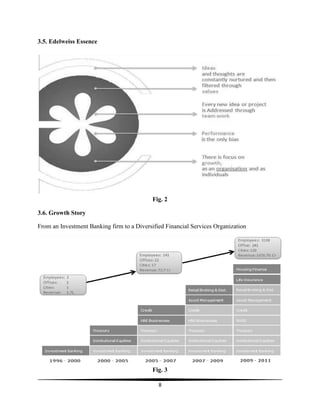
3.5. Edelweiss Essence

Fig. 2
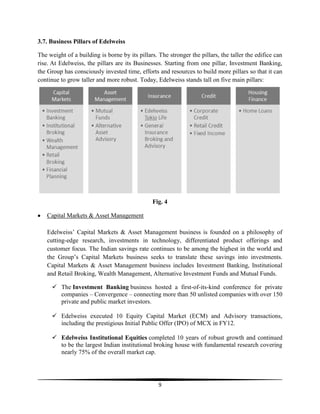
3.6. Growth Story
From an Investment Banking firm to a Diversified Financial Services Organization

Fig. 3
8
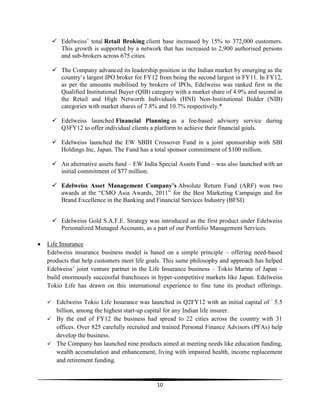
3.7. Business Pillars of Edelweiss
The weight of a building is borne by its pillars. The stronger the pillars, the taller the edifice can
rise. At Edelweiss, the pillars are its Businesses. Starting from one pillar, Investment Banking,
the Group has consciously invested time, efforts and resources to build more pillars so that it can
continue to grow taller and more robust. Today, Edelweiss stands tall on five main pillars:

Fig. 4
Capital Markets & Asset Management
Edelweiss‘ Capital Markets & Asset Management business is founded on a philosophy of
cutting-edge research, investments in technology, differentiated product offerings and
customer focus. The Indian savings rate continues to be among the highest in the world and
the Group‘s Capital Markets business seeks to translate these savings into investments.
Capital Markets & Asset Management business includes Investment Banking, Institutional
and Retail Broking, Wealth Management, Alternative Investment Funds and Mutual Funds.
 The Investment Banking business hosted a first-of-its-kind conference for private
companies – Convergence – connecting more than 50 unlisted companies with over 150
private and public market investors.
 Edelweiss executed 10 Equity Capital Market (ECM) and Advisory transactions,
including the prestigious Initial Public Offer (IPO) of MCX in FY12.
 Edelweiss Institutional Equities completed 10 years of robust growth and continued
to be the largest Indian institutional broking house with fundamental research covering
nearly 75% of the overall market cap.

9
 Edelweiss‘ total Retail Broking client base increased by 15% to 372,000 customers.
This growth is supported by a network that has increased to 2,900 authorised persons
and sub-brokers across 675 cities.
 The Company advanced its leadership position in the Indian market by emerging as the
country‘s largest IPO broker for FY12 from being the second largest in FY11. In FY12,
as per the amounts mobilised by brokers of IPOs, Edelweiss was ranked first in the
Qualified Institutional Buyer (QIB) category with a market share of 4.9% and second in
the Retail and High Networth Individuals (HNI) Non-Institutional Bidder (NIB)
categories with market shares of 7.8% and 10.7% respectively.*
 Edelweiss launched Financial Planning as a fee-based advisory service during
Q3FY12 to offer individual clients a platform to achieve their financial goals.
 Edelweiss launched the EW SBIH Crossover Fund in a joint sponsorship with SBI
Holdings Inc, Japan. The Fund has a total sponsor commitment of $100 million.
 An alternative assets fund – EW India Special Assets Fund – was also launched with an
initial commitment of $77 million.
 Edelweiss Asset Management Company’s Absolute Return Fund (ARF) won two
awards at the ―CMO Asia Awards, 2011‖ for the Best Marketing Campaign and for
Brand Excellence in the Banking and Financial Services Industry (BFSI).
 Edelweiss Gold S.A.F.E. Strategy was introduced as the first product under Edelweiss
Personalized Managed Accounts, as a part of our Portfolio Management Services.
Life Insurance
Edelweiss insurance business model is based on a simple principle – offering need-based
products that help customers meet life goals. This same philosophy and approach has helped
Edelweiss‘ joint venture partner in the Life Insurance business – Tokio Marine of Japan –
build enormously successful franchisees in hyper-competitive markets like Japan. Edelweiss
Tokio Life has drawn on this international experience to fine tune its product offerings.


Edelweiss Tokio Life Insurance was launched in Q2FY12 with an initial capital of ` 5.5
billion, among the highest start-up capital for any Indian life insurer.
 By the end of FY12 the business had spread to 22 cities across the country with 31
offices. Over 825 carefully recruited and trained Personal Finance Advisors (PFAs) help
develop the business.
 The Company has launched nine products aimed at meeting needs like education funding,
wealth accumulation and enhancement, living with impaired health, income replacement
and retirement funding.

10


The Company has written about 6,600 policies with its New Business Premium for FY12
being ` 107 million.

Credit
Growing a successful credit business entails efficient management of resources, a strong
understanding of interest rate cycles and an unrelenting focus on risk management and
mitigation. The Credit business seeks to leverage the huge consumption opportunity being
generated by the growth of the Indian economy while keeping a keen eye on asset quality.
Launched in 2007, in a short span of five years, the Credit business now contributes around
one third of Edelweiss revenues.
The Credit business comprises of three major units – Corporate Loans, Housing Finance and
Debt Capital Markets.


Outstanding loans for the Company stood at ` 39.6 billion as on March 31, 2012,
indicating a growth of 49% from last year. Of these, corporate loans were valued at ` 28
billion.



Edelweiss’ Housing Finance business launched in Mumbai in Q3FY11 has expanded
to eight major cities across the country over the last year and aims to enter another 10
metros soon. At the end of FY12, this segment had built a book of ` 7.8 billion,
compared to ` 1.2 billion at the start of the year.



In Debt Capital Markets (DCM), in FY12, Edelweiss was ranked as the sixth largest
private Debt Arranger (overall) in India and fifth in Commercial Paper (CP) issuance
with a market share of 10.4%*. The business did 30 DCM transactions in FY12,
compared to 22 in FY11.



Long-term bonds issuance included large clients like PFC, NHPC, SIDBI, REC and
Tata Motor Finance.



In keeping with the constant attempt to diversify and address new client segments, the
Group launched the SME Lending business in FY12.

Commodities
Commodities represent one of the Group‘s most strategic diversifications in recent times.
The global boom in commodities as an alternative asset class coupled with the increased
financialisation of the space in the country has opened up large business opportunities for
Edelweiss. Edelweiss Commodities business spans the bullion and agri commodities sectors.
Edelweiss‘ culture of research, flexibility in decision making, balance-sheet strength and risk
management gives it an enormous edge in the business.
11


During the year, Edelweiss emerged as one of the largest sourcing agents and distributors
of bullion in India in the non-bank, non-canalizing agency category. Further, the
Company distributes precious metals at over 10 centers and across 400 active dealers.
 Edelweiss‘ Bullion business also facilitates booking orders in smaller lots for clients
through its online portal www.edelbullion.com , giving them the convenience of lower
denominations.
Treasury
Treasury performs a vital function of providing liquidity to various businesses and managing
the balance sheet while at the same time mitigating risk and optimizing return on capital.
Edelweiss‘ Treasury Management strategy of diversification has enabled it to emerge as one
of the few multi-asset-class operations in India. It enhances capital efficiency of assets as
well as liabilities while maintaining a liquidity cushion.

3.8. Performance at a Glance

Year Ended March 31
Total Income
Total Expenditure
Profit Before Tax
Tax Expenses
Net Profit (after Tax and
Minority Interest)
Paid Up Equity Share Capital
Net worth
Diluted Earning Per Share (FV
`1) (in `)
Book Value Per Share (FV `1)
(in `)
(In ` million except per share data)

2011
14,911
11,411
3,500
1,031
2,330

2010
9,778
6,450
3,328
879
2,292

2009
9,005
5,715
3,290
1,199
1,864

752
23,005
3.00

375
22,574
2.94

375
21,154
2.43

30.56

30.04

28.21

Tab. 2

12
3.9. SWOT Analysis
Strength
Innovative range of financial products
Known for transparent functioning
Innovative I. T solutions for customers
Emphasis on building stronger bond with customers
Services offered include Equity Trading, Commodities, Portfolio Management Services,
Mutual Funds, Life Insurance, IPO, Depository Services, Investment Advisory
Weakness
Less penetration in rural areas
Indians are mostly conservative and prefer investing in gold and property
Opportunity
High purchasing power and people looking to more investment opportunities
Growing rural market
Earning Urban Youth
Threats
Stringent Economic measures by Government and SEBI
Entry of foreign finance firms in Indian Market

3.10. PESTEL Analysis
Political factors: Political factors are basically to what degree the government intervenes in the
economy. Specifically, political factors include areas such as tax policy, labor, environmental
law, trade restrictions, tariffs, and political stability. Political factors may also include goods and
services which the government wants to provide or be provided (merit goods) and those that the
government does not want to be provided (demerit goods or merit bad). Furthermore,
governments have great influence on the health, education, and infrastructure of a nation. Within
Indian political ambitions and rise of communalism, fissiparous tendencies are on the rise and
may well continue for quite some time. Based on this the broking firms might introduce political
risk coverage in their policies. In India the only area where customers consider to a take
insurance cover is on customs duty change but also on certain conditions.
Economic factors: Economic factors include economic growth, interest rates, exchange rates and
the inflation rate. These factors have major impacts on how businesses operate and make
13
decisions. For example, interest rates affect a firm's cost of capital and therefore to what extent a
business grows and expands. Exchange rates affect the costs of exporting goods and the supply
and price of imported goods in an economy. One of the main reasons for the economic factor is
the inflation rate in today‘s market. High inflation rate will tend to reduce the insurances‘
business as the money paid to the policy holder during the time of maturity will be less and it
would be less attractive for the investor.
Social-cultural factors: Social factors include the cultural aspects and include health
consciousness, population growth rate, age distribution, career attitudes and emphasis on safety.
Trends in social factors affect the demand for a company's products and how that company
operates. For example, an aging population may imply a smaller and less-willing workforce (thus
increasing the cost of labor). Furthermore, companies may change various management
strategies to adapt to these social trends (such as recruiting older workers). Population is one of
the major factors affecting the industry as the growth in population will indirectly help the
companies to capture more market with more people. The level of education is one of the
important factor, as India is still developing country with more than 50% of the population is
illiterate and rest are not sure about the concept of trading, investing, creating the awareness for
the product is a big challenge and one of the more contributing factors that affect the life
insurance industry.
Technological:
Technological factors
include
technological
aspects
such
as R&D activity, automation, technology incentives and the rate of technological change. They
can
determine barriers
to
entry,
minimum
efficient
production
level
and
influence outsourcing decisions. Furthermore, technological shifts can affect costs, quality, and
lead to innovation. Internet is becoming a fast house hold name in India where every house in the
urban area has a connection. The broking industry has taken advantage of this with having many
products which can be flexible to the customer. The customer can check the flexibility sitting at
home and select the best investment, pay the monthly installments and everything would be done
within minutes. One more factor is the debit and credit card facilities where the customer can pay
the installments easily. Industries are taking a huge advantage of the technology advancement in
the world and making it their competitive advantage.
Environmental: Environmental factors include ecological and environmental aspects such as
weather, climate, and climate change, which may especially affect industries such as tourism,
farming, and insurance. Furthermore, growing awareness of the potential impacts of climate
change is affecting how companies operate and the products they offer, both creating new
markets and diminishing or destroying existing ones. The interest rates at bank and also the
provident fund variation affect the industry as people are always attracted by a higher return. So
compared to this the lower return products are not attractive to the customers. Another factor
which affects the life insurance industry is Unemployment, as unemployed people would not

14
have any earnings, savings would be comparatively less which would mean less sales in-turn
affecting the GDP of the country and also the industry.
Legal: Legal factors include discrimination law, consumer law, antitrust law, employment law,
and health and safety law. These factors can affect how a company operates, its costs, and the
demand for its products. This sectors growth is more than 3 times the growth of its economy in
India. So many businesses or the domestic firms will aim to invest in this sector. Moreover, the
growth of insurance in India is 13 times more than the growth of this industry in the developed
countries. Foreign broking companies will be fostering an immense desire to invest in the Indian
market.
3.11. Michael Porter’s Five Force Model
Threat of New Entrants: The average entrepreneur can‘t come along and start a large broking
company. The threat of new entrants lies with the broking industry itself. These companies are
fearful of being squeezed out by the big players. Another threat for many broking companies is
other financial services companies entering the market.
Power of Suppliers: The suppliers of capital might not pose a big threat, but the threat of
suppliers luring away human capital does. If a talented employee is working for a smaller
broking firm (or one in a niche industry), there is the chance that person will be enticed away by
larger companies looking to move into a particular market.
Power of Buyers: The individual doesn't pose much of a threat to the broking firms. Large
corporate clients have a lot more bargaining power with broking industry. Broking companies try
extremely hard to get high-margin corporate clients.
Availability of Substitutes: For there are plenty of substitutes in the broking firms. Most large
broking firms offer similar suites of services. Chances of offering similar services are very high.
Companies focusing on niche areas usually have a competitive advantage, but this advantage
depends entirely on the size of the niche and on whether there are any barriers preventing other
firms from entering.
Competitive Rivalry: The broking industry is becoming highly competitive. The difference
between one broking firm and another is usually not that great. As a result, it has become more
like a commodity - an area in which the companies with the low cost structure, greater efficiency
and better customer service will beat out competitors. Companies also use higher investment
returns and a variety of investment products to try to lure in customers. In the long run, we're
likely to see more consolidation in this industry. Larger companies prefer to take over or merge
with other companies rather than spend the money to market and advertise to people.

15
4. BASICS OF CAPITAL MARKETS
Stock - It is a share in the ownership of a company. It represents a claim on the company's assets
and earnings. Total equity capital of a company is divided into equal units of small
denominations, each called a share.
For example, in a company the total equity capital of Rs 2,00,00,000 is divided into 20,00,000
units of Rs 10 each. Each such unit of Rs 10 is called a Share. Thus, the company then is said to
have 20,00,000 equity shares of Rs 10 each.
Stock market - A market is a public place where things are bought and sold. The term "stock
market" refers to the business of buying and selling stock.
Two major Stock markets in India:
The Bombay Stock Exchange (BSE)
National Stock Exchange of India Ltd (NSE)
Market Segments
Primary market
Channel for sale of new securities
Provides opportunity to issuers of securities; Government as well as corporate, to
raise resources to meet their requirements of investment and/or discharge some
obligation.
Secondary market
The new securities issued in the primary market are traded
The secondary market provides liquidity to the investors in the primary market.
Types of shares
Equity Share - Represents proportionate ownership in a company. For e.g. if the company
has 100 shares and you own 1 then you own 1% of that company.
Preference shares - Gives preference over the equity shareholders with regards to two
things
Receipt of dividend
Receipt of residual funds after liquidation
Trading Platforms:

16
National Exchange for Automated Trading (NEAT) - provided by NSE
Bombay Online Trading (BOLT) - provided by BSE
Major indices in India:
S&P CNX Nifty - created by NSE and has 50 stock from various sectors
Sensex - created by BSE and comprises of 30 stocks
Frequently Used Terms:
Margin Money is the deposit that customer maintains with the broker to avail of trading/exposure
limits. Margin can be taken in the form of a cheque payment or in the form of liquid stocks.
Bull and Bear
Bulls are those who are optimistic about the market. A bull always feels that the
market will go up
Bears on the other hand are pessimistic about the market.
Settlement Cycle: Our Settlement Cycle is T+2 working days.
Squared transaction is an intraday trade that is when a customer buys and sells the shares the
same day it is called intraday trading. When you buy share, to square up you have to sell and
when you sell, to square up you need to buy
Delivery Transaction is when the customer either buys or sells a particular stock and does not
square up the trade the same day.
Positions - ‘+’ (buy) & ‘ - ’(sell): ‗+‘ would mean a buy and ‗-‘ would mean a sell.
Prices
Last traded price is the price at which the last trade took place at the exchange.
This not means that LTP is the price at 3.30. It simply means that when we look at
the screen, the price at which the last trade took place is called last traded price. If
I am looking at Satyam at 1.00 p.m. then the last traded price would be the price
of the last trade that took place in Satyam before 1 p.m.
Closing price is the weighted average of the last half an hour‘s trades, which is
the weighted average of the trades from 3.00 p.m. to 3.30 p.m.
Opening price is the price at which the first trade took place after the market
opens.
Average price is the average of the day‘s trades.

17
Pay-in & pay-out
Pay-in for a buyer is money and for the seller is shares.
Pay-out for the buyer would be shares and for the seller will be the money.
Bid and offer
Bid is the rate at which the best buyer is available
Offer is the rate at which the best seller is available
Short selling: Selling shares without delivery is called short selling. Are you allowed to short
sell? If a customer short sells with the intention of intraday trading then it is his responsibility to
square up the transaction and not the brokers.
Long position: When you buy shares it is said that you are long in the shares and you have a long
position

18
5. SHORT TERM TRADING STRATEGIES IN EQUITY MARKET
Buying or selling stocks is not an easy task if one wants to make money doing it. Millions of
investors have lost money in the past trying to guess stock price movements.
In order to consistently make money in the stock market, investors have to be right over 70% of
the time. This success ratio is extremely difficult without the guidance of a successful, reliable
and robust stock selection method or algorithm that has been tested and has worked over many
years.
5.1. Investment policy and its Importance
An investment policy statement serves as a governing document for future investment decisions.
It should incorporate the investor‘s objectives for risk and return, as well as specific constraints.
The role of an investment policy statement is to ensure that all future investment decisions are
consistent with the objectives and constraints.
5.2. Objectives
The two main investment objectives - risk and return - are intertwined.
Although it may seem strange to consider risk an objective, investors do have an objective of
minimizing the risk taken to achieve a given level of return. Risk can be measured in several
ways - volatility, tracking error relative to a benchmark, or the risk of loss. Investor objectives
must incorporate the investor‘s appetite for risk, as well as the ability to tolerate risk. Risk
tolerance is constrained by expected spending needs, targets for ending wealth, potential future
obligations and the ability to increase savings if returns fall below those required. Both the
willingness and the ability to accept risk influence the final risk objective. Finally, the accepted
level of risk must be allocated to specific investment opportunities.
Similarly, the return objective must also be measured. Usually it is expressed in terms of total
return, but this could be a nominal or a real return, pre-tax or after-tax. Any return objective
should be realistic, and consistent with the stated risk objectives. If there are specific needs, these
can result in specific return requirements. All of these must be incorporated into a measurable
(either absolute or relative) return objective.
5.3. Constraints
Major constraints include liquidity, time horizon, tax concerns, legal and regulatory concerns and
unique circumstances.
Liquidity refers to the need for cash in excess of any savings or new contributions available at a
specific point in the future. Liquidity needs may be planned (child‘s college funding in 10 years)
or unplanned (a medical emergency) but both require ready ability to convert investments into
19
cash. Some assets, such as real estate, may take considerable time to sell. Others, such as
certificates of deposit, may impose early withdrawal penalties.
Time horizon typically refers to the time at which an investment objective must be met. Some
objectives such as saving for a house may have a short time horizon, while retirement or
endowment planning can have long horizons. Investors must often plan for several time horizons
at once. The time horizon influences the ability to accept risk and could modify asset allocation
strategy. Investors with little tolerance for temporary return fluctuations may need a different
plan than would be suggested by time horizon alone, and multiple time horizons can further
constrain allocation decisions.
Tax concerns include differences between the tax rates for different types of investment return
(interest versus capital gains or dividends), estate taxes, differences between current income and
retirement income tax rates, and the potential for tax legislation to change.
Legal and regulatory factors may include limits on the allocation to specific assets, the ability to
access certain funds and even prohibitions on certain investments.
Unique circumstances may include social concerns and specific family needs.
So before trading one should have a very clear trading policy, which defines maximum
loss/profit to be booked. After making an investment policy one should strictly adhere to it. Any
ignorance in adhering to investment policy can cause severe losses.

20
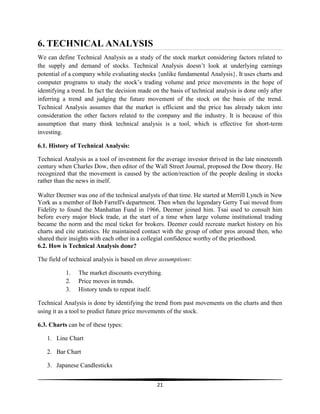
6. TECHNICAL ANALYSIS
We can define Technical Analysis as a study of the stock market considering factors related to
the supply and demand of stocks. Technical Analysis doesn‘t look at underlying earnings
potential of a company while evaluating stocks {unlike fundamental Analysis}. It uses charts and
computer programs to study the stock‘s trading volume and price movements in the hope of
identifying a trend. In fact the decision made on the basis of technical analysis is done only after
inferring a trend and judging the future movement of the stock on the basis of the trend.
Technical Analysis assumes that the market is efficient and the price has already taken into
consideration the other factors related to the company and the industry. It is because of this
assumption that many think technical analysis is a tool, which is effective for short-term
investing.
6.1. History of Technical Analysis:
Technical Analysis as a tool of investment for the average investor thrived in the late nineteenth
century when Charles Dow, then editor of the Wall Street Journal, proposed the Dow theory. He
recognized that the movement is caused by the action/reaction of the people dealing in stocks
rather than the news in itself.
Walter Deemer was one of the technical analysts of that time. He started at Merrill Lynch in New
York as a member of Bob Farrell's department. Then when the legendary Gerry Tsai moved from
Fidelity to found the Manhattan Fund in 1966, Deemer joined him. Tsai used to consult him
before every major block trade, at the start of a time when large volume institutional trading
became the norm and the meal ticket for brokers. Deemer could recreate market history on his
charts and cite statistics. He maintained contact with the group of other pros around then, who
shared their insights with each other in a collegial confidence worthy of the priesthood.
6.2. How is Technical Analysis done?
The field of technical analysis is based on three assumptions:
1.
2.
3.

The market discounts everything.
Price moves in trends.
History tends to repeat itself.

Technical Analysis is done by identifying the trend from past movements on the charts and then
using it as a tool to predict future price movements of the stock.
6.3. Charts can be of these types:
1. Line Chart
2. Bar Chart
3. Japanese Candlesticks
21
1. LINE CHART
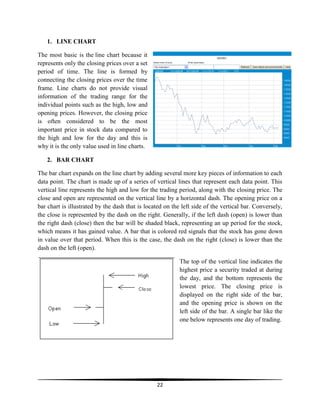
The most basic is the line chart because it
represents only the closing prices over a set
period of time. The line is formed by
connecting the closing prices over the time
frame. Line charts do not provide visual
information of the trading range for the
individual points such as the high, low and
opening prices. However, the closing price
is often considered to be the most
important price in stock data compared to
the high and low for the day and this is
why it is the only value used in line charts.
2. BAR CHART
The bar chart expands on the line chart by adding several more key pieces of information to each
data point. The chart is made up of a series of vertical lines that represent each data point. This
vertical line represents the high and low for the trading period, along with the closing price. The
close and open are represented on the vertical line by a horizontal dash. The opening price on a
bar chart is illustrated by the dash that is located on the left side of the vertical bar. Conversely,
the close is represented by the dash on the right. Generally, if the left dash (open) is lower than
the right dash (close) then the bar will be shaded black, representing an up period for the stock,
which means it has gained value. A bar that is colored red signals that the stock has gone down
in value over that period. When this is the case, the dash on the right (close) is lower than the
dash on the left (open).
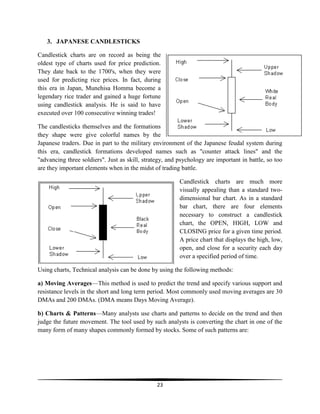
The top of the vertical line indicates the
highest price a security traded at during
the day, and the bottom represents the
lowest price. The closing price is
displayed on the right side of the bar,
and the opening price is shown on the
left side of the bar. A single bar like the
one below represents one day of trading.

22
3. JAPANESE CANDLESTICKS
Candlestick charts are on record as being the
oldest type of charts used for price prediction.
They date back to the 1700's, when they were
used for predicting rice prices. In fact, during
this era in Japan, Munehisa Homma become a
legendary rice trader and gained a huge fortune
using candlestick analysis. He is said to have
executed over 100 consecutive winning trades!
The candlesticks themselves and the formations
they shape were give colorful names by the
Japanese traders. Due in part to the military environment of the Japanese feudal system during
this era, candlestick formations developed names such as "counter attack lines" and the
"advancing three soldiers". Just as skill, strategy, and psychology are important in battle, so too
are they important elements when in the midst of trading battle.
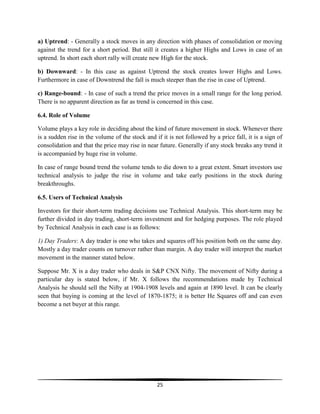
Candlestick charts are much more
visually appealing than a standard twodimensional bar chart. As in a standard
bar chart, there are four elements
necessary to construct a candlestick
chart, the OPEN, HIGH, LOW and
CLOSING price for a given time period.
A price chart that displays the high, low,
open, and close for a security each day
over a specified period of time.
Using charts, Technical analysis can be done by using the following methods:
a) Moving Averages—This method is used to predict the trend and specify various support and
resistance levels in the short and long term period. Most commonly used moving averages are 30
DMAs and 200 DMAs. (DMA means Days Moving Average).
b) Charts & Patterns—Many analysts use charts and patterns to decide on the trend and then
judge the future movement. The tool used by such analysts is converting the chart in one of the
many form of many shapes commonly formed by stocks. Some of such patterns are:

23
Reversal Patterns

Continuation Patterns

1

Bump and Run

Cup with Handle

2

Double Top

Flag Pennant

3

Double Top

Symmetric Triangle

4

Double Bottom

Ascending Triangle

5

Head And Shoulders Top

Descending Triangle

6

Head And Shoulders Bottom

Price Channel

7

Falling Wedge

Rectangle

8

Rising Wedge

Measured {Bear} Move

9

Rounding Bottom

10

Triple Top

11

Triple Bottom

c) Trend and Trading range
Traders try to profit from changes in prices: Buy low and sell high or sell short high and cover
low. Even a quick look at a chart reveals that markets spend most of their time in trading ranges.
They spend less time in trends.
A trend exits when prices keep rising or falling over time. In an uptrend, each rally reaches a
higher high than the preceding rally and each decline stops at a higher level than the preceding
decline. In a downtrend each decline falls to a lower low than the preceding decline and each
rally stops at a lower level than the preceding decline and each rally stops at a lower level than
the preceding rally. In trading range most rallies stop at about the same high and declines peter
out at about the low.
A trader needs to identify trends and trading ranges. It is easier to trade during trends than in
trading ranges.
Trends can be classified broadly in 3 types. They are:

24
a) Uptrend: - Generally a stock moves in any direction with phases of consolidation or moving
against the trend for a short period. But still it creates a higher Highs and Lows in case of an
uptrend. In short each short rally will create new High for the stock.
b) Downward: - In this case as against Uptrend the stock creates lower Highs and Lows.
Furthermore in case of Downtrend the fall is much steeper than the rise in case of Uptrend.
c) Range-bound: - In case of such a trend the price moves in a small range for the long period.
There is no apparent direction as far as trend is concerned in this case.
6.4. Role of Volume
Volume plays a key role in deciding about the kind of future movement in stock. Whenever there
is a sudden rise in the volume of the stock and if it is not followed by a price fall, it is a sign of
consolidation and that the price may rise in near future. Generally if any stock breaks any trend it
is accompanied by huge rise in volume.
In case of range bound trend the volume tends to die down to a great extent. Smart investors use
technical analysis to judge the rise in volume and take early positions in the stock during
breakthroughs.
6.5. Users of Technical Analysis
Investors for their short-term trading decisions use Technical Analysis. This short-term may be
further divided in day trading, short-term investment and for hedging purposes. The role played
by Technical Analysis in each case is as follows:
1) Day Traders: A day trader is one who takes and squares off his position both on the same day.
Mostly a day trader counts on turnover rather than margin. A day trader will interpret the market
movement in the manner stated below.
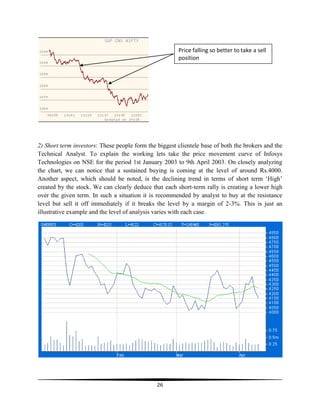
Suppose Mr. X is a day trader who deals in S&P CNX Nifty. The movement of Nifty during a
particular day is stated below, if Mr. X follows the recommendations made by Technical
Analysis he should sell the Nifty at 1904-1908 levels and again at 1890 level. It can be clearly
seen that buying is coming at the level of 1870-1875; it is better He Squares off and can even
become a net buyer at this range.

25
Price falling so better to take a sell
position

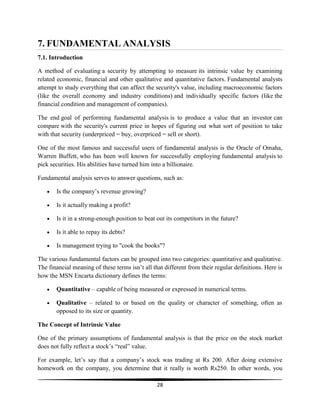
2) Short term investors: These people form the biggest clientele base of both the brokers and the
Technical Analyst. To explain the working lets take the price movement curve of Infosys
Technologies on NSE for the period 1st January 2003 to 9th April 2003. On closely analyzing
the chart, we can notice that a sustained buying is coming at the level of around Rs.4000.
Another aspect, which should be noted, is the declining trend in terms of short term ‗High‘
created by the stock. We can clearly deduce that each short-term rally is creating a lower high
over the given term. In such a situation it is recommended by analyst to buy at the resistance
level but sell it off immediately if it breaks the level by a margin of 2-3%. This is just an
illustrative example and the level of analysis varies with each case.

26
3) Hedgers: These are generally big investors, who have lot of money at stake and hence they
look to have some hedging of their risk. The strategy followed by this section of investors is that
they compare the stock in consideration with the index and on the basis of the result of this
comparison they take their position in the stock. This can be explained by comparing the
movement of nifty on the graph with Infosys movement as we have done in the figure given
below.
If we look at both the charts of nifty movement with Infosys movement we find that although
both have fallen over the period but Infosys has witnessed some rallies and hence we can clearly
say that a hedger will benefit by using technical Analysis and getting out at the periods when
Infosys has given an upward rally.

27
7. FUNDAMENTAL ANALYSIS
7.1. Introduction
A method of evaluating a security by attempting to measure its intrinsic value by examining
related economic, financial and other qualitative and quantitative factors. Fundamental analysts
attempt to study everything that can affect the security's value, including macroeconomic factors
(like the overall economy and industry conditions) and individually specific factors (like the
financial condition and management of companies).
The end goal of performing fundamental analysis is to produce a value that an investor can
compare with the security's current price in hopes of figuring out what sort of position to take
with that security (underpriced = buy, overpriced = sell or short).
One of the most famous and successful users of fundamental analysis is the Oracle of Omaha,
Warren Buffett, who has been well known for successfully employing fundamental analysis to
pick securities. His abilities have turned him into a billionaire.
Fundamental analysis serves to answer questions, such as:
Is the company‘s revenue growing?
Is it actually making a profit?
Is it in a strong-enough position to beat out its competitors in the future?
Is it able to repay its debts?
Is management trying to "cook the books"?
The various fundamental factors can be grouped into two categories: quantitative and qualitative.
The financial meaning of these terms isn‘t all that different from their regular definitions. Here is
how the MSN Encarta dictionary defines the terms:
Quantitative – capable of being measured or expressed in numerical terms.
Qualitative – related to or based on the quality or character of something, often as
opposed to its size or quantity.
The Concept of Intrinsic Value
One of the primary assumptions of fundamental analysis is that the price on the stock market
does not fully reflect a stock‘s ―real‖ value.
For example, let‘s say that a company‘s stock was trading at Rs 200. After doing extensive
homework on the company, you determine that it really is worth Rs250. In other words, you
28
determine the intrinsic value of the firm to be Rs 250. This is clearly relevant because an investor
wants to buy stocks that are trading at prices significantly below their estimated intrinsic value.
The second major assumptions of fundamental analysis: in the long run, the stock market will
reflect the fundamentals. There is no point in buying a stock based on intrinsic value if the price
never reflected that value. Nobody knows how long ―the long run‖ really is. It could be days or
years.
This is what fundamental analysis is all about. By focusing on a particular business, an investor
can estimate the intrinsic value of a firm and thus find opportunities where he or she can buy at a
discount. If all goes well, the investment will pay off over time as the market catches up to the
fundamentals.
7.2. Qualitative Factors
Some of the company-specific qualitative factors are:
Business Model
Competitive Advantage
Management
Corporate Governance
Some of the industry-specific qualitative factors are:
Customer
Market Share
Industry Growth
Competition
Regulation
7.3. Quantitative Factors
Quantitative factors include performing various ratio analyses and comparing it with industry
standards and with competitive companies. For performing quantitative analysis, financial
statements of the companies are used.
Financial statements are a gold mine of information. Financial statements are the medium by
which a company discloses information concerning its financial performance.

29
Major Financial Statements are:
The Balance Sheet
The Income Statement
Statement of Cash Flows

7.4. Role of Fundamental Analysis in Trading
The expediency of applying fundamental analysis to trading depends on several criteria. The first
factor that should be taken into consideration is the potential profit sources you are targeting. A
stock exchange is no factory and it does not produce any kind of material value. If you are really
after a profit you need to know whose loss can be turned into your profit. Moreover, to trade
profitably, you need to know the reasons for which somebody else's money can become yours.
There are two profit sources:
1. Fellow traders, specifically those who are less knowledgeable, less experienced or simply
too slow on the draw, can be a source of profit. Of course, the traders are out to make
money, but many of them will also lose money. Here profit can be made by applying
better trading skills and better quality trading systems.
2. Initial public offerings and companies issuing additional stock can provide with an
opportunity to cash in on the discrepancy between the IPO price of the stocks and the
prices at which they will eventually settle. As a trader, earnings will be well-deserved
compensation for the risk taken, but this level of risk can be reduced by using technical
analysis.

30
8. TECHNICAL ANALYSIS VS FUNDAMENTAL ANALYSIS
As far as short-term trading is concerned, fundamental analysis cannot be used as a "tactical",
short-term decision-making method. Technical analysis enables traders to gain a vision of the
market and make the right move at the right time, while fundamental analysis should be applied
strategically, over longer periods of time. It helps an investor obtain information about the
overall state of the market, attractiveness and state of a specific security as compared to other
securities. However, when and how to react to the information, derived through fundamental
analysis, is determined using technical analysis.

31
9. DAY TRADING STRATEGY
9.1. Introduction
Day Trading strategy is one of the commonly used trading strategies. When people use the term
"day trading", they mean the act of buying and selling a stock within the same day. Day trading
means not holding on to stock positions beyond the current trading day; in other words, not
holding any position overnight. This is really the greatest advantage of day trading because one
are not exposed to the potential losses that can occur when the stock market is closed due to
news that can affect the prices of stocks. Day Trading can be extremely rewarding and fulfilling
provided one is willing to strictly follow the rules and live by it.
Day traders seek to make profits by leveraging large amounts of capital to take advantage of
small price movements in highly liquid stocks or indexes. Support and resistant zones for a
particular script are the most important part to formulate day‘s strategy. This combined with our
trend analysis and stop loss levels can help any day trader extract maximum profits from the
markets with great regularity.
Here are some common day trading strategies that can be used by retail traders.
9.2. Entry Strategies
Certain stocks are ideal candidates for day trading. A typical day trader looks for two things in a
stock: liquidity and volatility. Liquidity allows one to enter and exit a stock at a good price.
Volatility is simply a measure of the expected daily price range - the range in which a day trader
operates. More volatility means greater profit or loss.
One day trader favorite are RPL (NSE: RPL) and RNRL (NSE: RNRL).
Parameters

RPL

RNRL

Current Price (Dec 23, 2008)

Rs 86

Rs 53

Volatility

40 %

42 %

Average Volume

Rs 29425 Lakhs

Rs 36832 Lakhs

These stocks are cheap, liquid and very volatile. This type of stock is ideal for the retail day
trader.
Once we know what kind of stocks we are looking for, we need to learn how to identify possible
entry points. There are the tools which can be used to do this:
Intraday Candlestick Charts - Candles provide a raw analysis of price action.

32
Real-Time News Service - News moves stocks. This tells us when news comes out.
We will look at the intraday candlestick charts and focus on the following three factors:
Candlestick Patterns - Engulfing and doji
Technical Analysis - Trendlines and triangles
Volume - Increasing or decreasing volume
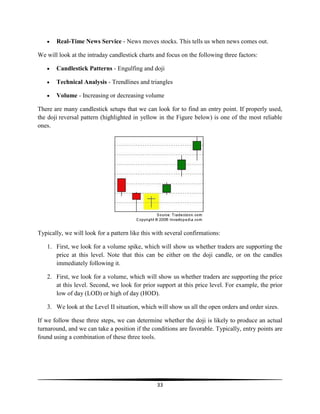
There are many candlestick setups that we can look for to find an entry point. If properly used,
the doji reversal pattern (highlighted in yellow in the Figure below) is one of the most reliable
ones.

Typically, we will look for a pattern like this with several confirmations:
1. First, we look for a volume spike, which will show us whether traders are supporting the
price at this level. Note that this can be either on the doji candle, or on the candles
immediately following it.
2. First, we look for a volume, which will show us whether traders are supporting the price
at this level. Second, we look for prior support at this price level. For example, the prior
low of day (LOD) or high of day (HOD).
3. We look at the Level II situation, which will show us all the open orders and order sizes.
If we follow these three steps, we can determine whether the doji is likely to produce an actual
turnaround, and we can take a position if the conditions are favorable. Typically, entry points are
found using a combination of these three tools.

33
9.3. Finding a Target
Identifying a price target will depend largely on trading style. Here is a brief overview of some
common day trading strategies:
Strategy

Description

Scalping

Scalping is one of the most popular strategies, and it involves selling almost
immediately after a trade becomes profitable. Here the price target is obviously
just after profitability is attained.

Fading

Fading involves shorting stocks after rapid moves upwards. This is based on the
assumption that (1) they are overbought, (2) early buyers are ready to begin taking
profits and (3) existing buyers may be scared out. Although risky, this strategy can
be extremely rewarding. Here the price target is when buyers begin stepping in
again.

Daily Pivots This strategy involves profiting from a stock's daily volatility. This is done by
attempting to buy at the low of the day (LOD) and sell at the high of the day
(HOD). Here the price target is simply at the next sign of a reversal, using the
same patterns as above.
Momentum This strategy usually involves trading on news releases or finding strong trending
moves supported by high volume. One type of momentum trader will buy on news
releases and ride a trend until it exhibits signs of reversal. The other type will fade
the price surge. Here the price target is when volume begins to decrease and
bearish candles start appearing.

We can see that, although the entries in day trading strategies typically rely on the same tools
used in normal trading, the exits are where the differences occur. In most cases, however, we will
be looking to exit when there is decreased interest in the stock (indicated by the volume).
9.4. Determining a Stop-Loss
When we trade on margin, we are far more vulnerable to sharp price movements than regular
traders. Therefore, using stop-losses is crucial when day trading. One strategy is to set two stop
losses:
1. A physical stop-loss order placed at a certain price level that suits our risk tolerance.
Essentially, this is the most we want to lose.
2. A mental stop-loss set at the point where our entry criteria are violated. This means that if
the trade makes an unexpected turn, we'll immediately exit our position.
34
Retail day traders usually also have another rule: set a maximum loss per day that one can afford
(both financially and mentally) to withstand. Whenever one hit this point, take the rest of the day
off. Inexperienced traders often feel the need to make up losses before the day is over and end up
taking unnecessary risks as a result.
9.5. Evaluating and Tweaking Performance
Many people get into day trading expecting to make triple digit returns every year with minimal
effort. In reality, around 80% of day traders lose money. A recent (January 2005) behavioral
finance study of the Taiwanese stock market conducted by professors at the University of Taipei
and the University of California suggests that "less than 20% of day traders earn profits net of
transaction costs". Most of these people would be better off putting their money on the roulette
table than using it for day trading! However, by using a well-defined strategy that we are
comfortable trading, we can improve our chances of beating the odds.
How to evaluate performance? Most day traders evaluate performance not so much by a
percentage of gain or loss, but rather by how closely they adhere to their individual strategies. In
fact, it is far more important to follow our strategy closely than to try to chase profits. By
keeping this mindset, we make it easier to identify where problems exist and how to solve them.

35
10. CRITICISMS
If we use only technical analysis in itself and do not consider other aspects it is very unlikely that
we will have much success in the long run, particularly in case of short-term investments. But if
we use Technical analysis along with fundamental analysis or discount the industry and company
related news while considering the valuation, our chances of minimizing the risk brightens.
One thing that we must realize is that technical analysis provides us only with the trend and
judge future on that basis, it can be far from actual in few cases, one of them was when Satyam
crashed by 25% on a single day. By no imagination and no analysis one could have guessed the
same or rather have come closer to it. Therefore the best use of technical analysis is to realize the
trend and levels at which it will break the trend so that one is prepared to take positions when
such trend breaks. It is because of this disadvantage that Technical analysis more useful only for
short-term investing
As for as day trading is concerned, Day trading is a difficult skill to master - well over 50% of
those who try it fail. But the techniques described above can help to create a profitable strategy
and, with enough practice and consistent performance evaluation, one can greatly improve
his/her chances of beating the statistics.
Limitations
As the short term trading also involves intra-day trading, for this we need some special software
for live market data and live charts like that of Bloomberg software, or Newswire TV18
software. In professional world these software are primarily used for trading purposes. Due to
inaccessibility of these software during this project, scope of this project is limited. But this
report can be further extended if more data is available. More analysis can be performed on day
trading strategy especially.
Learnings:
Short term trading is a very difficult task as well as it requires a very active presence in the
market but we can produce excess returns if we follow the discipline and keep the following
things in mind:
Trade in Direction of intermediate trend.
In uptrend, buy the dips, and in downtrend, sell bounces.
Let profit run, cut loses short.
Use protective stops to limit losses.
Don‘t trade impulsively; have a plan.
Plan your work and work your plan.
Use money management principles.
Diversify, but don‘t overdo it.
Never meet a margin call; don‘t throw good money after bad.

36

Comparative Analysis Of Mutual Funds

  • 1.
    1. INDUSTRY PROFILE Thereare various trade associations throughout the world which represent the industry in lobbying, facilitate industry standards, and publish statistics. The International Council of Securities Associations (ICSA) is a global group of trade associations. In India, the Securities and Exchange Board of India (SEBI) guides the system to work efficiently along with Reserve Bank of India (RBI). Indian Stock Markets have come a long way in past two decades in terms of governance, simplicity, security and participation. Now investors from all over the world are participating in Indian equities like never before. The participation of retail investors (though relatively low when compared to developed worlds) have also gone up significantly since past 20 years, thanks to the increasing income of urban India. Experts believe that equity investments in India should go up substantially higher from the current levels in next 10 years. This opportunity has given birth to thousands of stock brokers in India. Many domestic and international banks in India have started offering stock broking and DEMAT services via separate subsidiaries. While one can choose any authorized stock broker for buying and selling equities in India depending upon the location convenience, charges and other factors but its worth to stay with large broking houses as they provide multiple branch facility and professional service. In United States, the Securities Industry and Financial Markets Association (SIFMA) is likely the most significant; however, several of the large investment banks are members of the American Bankers Association Securities Association (ABASA) while small investment banks are members of the National Investment Banking Association (NIBA). In Europe, the European Forum of Securities Associations was formed in 2007 by various European trade associations. Several European trade associations (principally the London Investment Banking Association and the European SIFMA affiliate) combined in 2009 to form Association for Financial Markets in Europe (AFME). In the securities industry in China (particularly mainland China), the Securities Association of China is a self-regulatory organization whose members are largely investment banks. 1.1 Global size and revenue mix Global investment banking revenue increased for the fifth year running in 2007, to a record US$84.3 billion, which was up 22% on the previous year and more than double the level in 2003. Subsequent to their exposure to United States sub-prime securities investments, many investment banks have experienced losses. As of late 2012, global revenues for investment banks were estimated at $240 billion, down about a third from 2009, as companies pursued less deals and traded less. Differences in total revenue are likely due to different ways of classifying investment banking revenue, such as subtracting proprietary trading revenue. In terms of total revenue, SEC filings of the major independent investment banks in the United States show that investment banking (defined as M&A advisory services and security underwriting) only made up about 15-20% of total revenue for these banks from 1996 to 2006, with the majority of revenue (60+% in some years) brought in by "trading" which includes 1
  • 2.
    brokerage commissions andproprietary trading; the proprietary trading is estimated to provide a significant portion of this revenue. The United States generated 46% of global revenue in 2009, down from 56% in 1999. Europe (with Middle East and Africa) generated about a third while Asian countries generated the remaining 21%. The industry is heavily concentrated in a small number of major financial centers, including City of London, New York City, Hong Kong and Tokyo. According to estimates published by the International Financial Services London, for the decade prior to the financial crisis in 2008, M&A was a primary source of investment banking revenue, often accounting for 40% of such revenue, but dropped during and after the financial crisis. Equity underwriting revenue ranged from 30% to 38% and fixed-income underwriting accounted for the remaining revenue. Revenues have been affected by the introduction of new products with higher margins; however, these innovations are often copied quickly by competing banks, pushing down trading margins. For example, brokerages commissions for bond and equity trading is a commodity business but structuring and trading derivatives has higher margins because each over-the-counter contract has to be uniquely structured and could involve complex pay-off and risk profiles. One growth area is private investment in public equity (PIPEs, otherwise known as Regulation D or Regulation S). Such transactions are privately negotiated between companies and accredited investors. Banks also earned revenue by securitizing debt, particularly mortgage debt prior to the financial crisis. Investment banks have become concerned that lenders are securitizing in-house, driving the investment banks to pursue vertical integration by becoming lenders, which is allowed in the United States since the repeal of the Glass-Steagall act in 1999. 1.2 Investment banks World's biggest banks are ranked for M&A advisory, syndicated markets and debt capital markets. Some banks are: loans, equity capital JP Morgan Chase Bank of America Morgan Stanley Goldman Sachs Credit Suisse Deutsche Bank Citi Group Barclays UBS Wells Fargo Following is a list of top ten stock brokers in India in terms of size, popularity and scale of operation. ICICI Securities Ltd. 2
  • 3.
    Religare Securities Ltd. IndiaInfoline Ltd Angel Broking Edelweiss Axis Direct HDFC Securities Motilal Oswal Geojit BNP Paribas Sharekhan 1.3. Registered Brokers and Sub-Brokers with SEBI Stock Exchanges Brokers Sub-Brokers Ahmadabad 325 96 Bangalore 257 158 BSE 984 30059 Bhubaneswar 213 17 Calcutta 926 84 Cochin 435 43 Coimbatore 135 19 Delhi 375 261 Gauhati 103 4 ICSE 946 3 Jaipur 488 33 Ludhiana 301 36 Madhya Pradesh 174 5 Madras 183 110 NSE 1243 31328 OTCEI 713 19 Pune 188 156 UPSE 351 3 Vadodara 312 37 Total 8652 62471 Tab. 1 3 Source: SEBI Handbook 2013
  • 4.
    2. FINANCIAL CRISISOF 2008 The 2008 financial credit crisis led to the notable collapse of several banks, notably including the bankruptcy of large investment bank Lehman Brothers and the hurried sale of Merrill Lynch and the much smaller Bear Stearns to banks which effectively rescued them from bankruptcy. The entire financial services industry, including numerous investment banks, was rescued by government loans through the Troubled Asset Relief Program (TARP). Surviving U.S. investment banks such as Goldman Sachs and Morgan Stanley converted to traditional bank holding companies to accept TARP relief. Similar situations occurred across the globe with countries rescuing their banking industry. Initially, banks received part of a $700 billion Troubled Asset Relief Program (TARP) intended to stabilize the economy and thaw the frozen credit markets. Eventually, taxpayer assistance to banks reached nearly $13 trillion dollars, most without much scrutiny, lending did not increase and credit markets remained frozen. The crisis led to questioning of the business model of the investment bank without the regulation imposed on it by Glass-Steagall. Once Robert Rubin, a former co-chairman of Goldman Sachs, became part of the Clinton administration and deregulated banks, the previous conservatism of underwriting established companies and seeking long-term gains was replaced by lower standards and short-term profit. Formerly, the guidelines said that in order to take a company public, it had to be in business for a minimum of five years and it had to show profitability for three consecutive years. After deregulation, those standards were gone, but small investors did not grasp the full impact of the change. A number of former Goldman-Sachs top executives, such as Henry Paulson and Ed Liddy were in high-level positions in government and oversaw the controversial taxpayer-funded bank bailout. The TARP Oversight Report released by the Congressional Oversight Panel found that the bailout tended to encourage risky behavior and "corrupted the fundamental tenets of a market economy". Under threat of a subpoena, Goldman Sachs revealed that it received $12.9 billion in taxpayer aid, $4.3 billion of which was then paid out to 32 entities, including many overseas banks, hedge funds and pensions. The same year it received $10 billion in aid from the government, it also paid out multi-million dollar bonuses; the total paid in bonuses was $4.82 billion. Similarly, Morgan Stanley received $10 billion in TARP funds and paid out $4.475 billion in bonuses. 4
  • 5.
    3. EDELWEISS Edelweiss overview 3.1.Introduction Edelweiss was incorporated as an investment bank in 1995. Today, it is one of India's leading Financial Services Groups, with operations that span more than forty different lines of business and subsidiaries. Their core philosophy of ‗Ideas create, values protect‘ is translated into an approach that is led by entrepreneurship and creativity, and protected by intellectual rigour, research and analysis. Edelweiss is one of India's leading Financial Services Groups, with operations that span more than forty different lines of business. Their operations straddle the entire spectrum of financial services in the wholesale and retail market segments including Credit (Including Retail Finance), Capital Markets & Asset Management, Commodities and Life Insurance. India‘s growth story is driven by a savings rate of about 32%, one of the youngest populations in the world and strong domestic consumption. With a net worth of over INR 30 billion, Edelweiss is adequately capitalized to exploit the opportunities emerging from this robust economic growth. Edelweiss employs over 3600 professionals across 224 offices and branches spread across 109 cities of India and overseas. The core value proposition of Edelweiss is reflected in ‗Ideas create, values protect‘. The company follows an amalgamation of values and principles in order to uphold this value proposition Fig. 1 5
  • 6.
    •We will bea Thinking Organization. We will constantly bring ‗thought‘ to everything we do. Our clients‘ and our own success depends on our ability to use greater ideation and more imagination in our approach. •We will be Fair to our clients, our employees and all stake holders. We want our clients and our employees to be ‗richer‘ for their relationship with us. •We will take care of our People seriously. Our policies - in spirit and in letter - will ensure transparency and equal opportunity for all. We will go beyond the normal goals of attracting, recruiting, retaining and rewarding fine talent. We will ensure that every individual in Edelweiss has an opportunity to achieve their fullest potential. •We will operate as a Partnership, internally and externally. Though individuals are very often brilliant, we believe teamwork and collaboration will always ensure a better and more balanced organization. We will also treat our clients as partners and show them the same respect and consideration that we would our internal team members. •We will focus on the Long Term. Though the world will change a lot in the coming years and our assumptions for the future may not hold up, we will reflect on the long-term implications of our actions. Even when making short-term decisions we will be aware of the long-term implications. •We will focus on Growth for our clients, employees and shareholders. •Our Reputation and Image is more important than any financial reward. Reputation is hard to build and even harder to rebuild. Our reputation will be impacted by our ability to think for our clients, maintain confidentiality and by our adherence to our value system. •We will Obey and Comply with the rules of the land. We will maintain the highest standard of integrity and honesty. When we are unclear we will seek clarifications. •We will respect Risk. Our business is going to be a constant challenge of balancing risk and reward. Our ability to constantly keep one eye on risk will guide us through this fine balance. •Our Financial Capital is a critical resource for growth. We will endeavor to grow, protect, and use our financial capital wisely. 6
  • 7.
    3.2. Vision Statement Tobe the largest retail capital market player in India outside of banks in terms of profit. To be recognized as the most reliable and trusted advisor. To be one of the most exciting places to work in the country. 3.3. Mission Statement We will significantly enhance the number of people participating in markets and help them achieve their financial goals and dreams by providing smart and need based investment solutions 3.4. Directors  Mr. Rashesh Shah, Chairman & CEO  Mr. Venkat Ramaswamy, Executive Director  Mr. Himanshu Kaji, Executive Director  Mr. Narendra Jhaveri, Independent Director  Mr. Kunnasagaran Chinniah, Non-Executive Director  Mr. P N Venkatachalam, Independent Director  Mr. Berjis Desai, Independent Director  Mr. Sanjiv Misra, Independent Director  Mr. Sunil Mitra, Independent Director 7
  • 8.
    3.5. Edelweiss Essence Fig.2 3.6. Growth Story From an Investment Banking firm to a Diversified Financial Services Organization Fig. 3 8
  • 9.
    3.7. Business Pillarsof Edelweiss The weight of a building is borne by its pillars. The stronger the pillars, the taller the edifice can rise. At Edelweiss, the pillars are its Businesses. Starting from one pillar, Investment Banking, the Group has consciously invested time, efforts and resources to build more pillars so that it can continue to grow taller and more robust. Today, Edelweiss stands tall on five main pillars: Fig. 4 Capital Markets & Asset Management Edelweiss‘ Capital Markets & Asset Management business is founded on a philosophy of cutting-edge research, investments in technology, differentiated product offerings and customer focus. The Indian savings rate continues to be among the highest in the world and the Group‘s Capital Markets business seeks to translate these savings into investments. Capital Markets & Asset Management business includes Investment Banking, Institutional and Retail Broking, Wealth Management, Alternative Investment Funds and Mutual Funds.  The Investment Banking business hosted a first-of-its-kind conference for private companies – Convergence – connecting more than 50 unlisted companies with over 150 private and public market investors.  Edelweiss executed 10 Equity Capital Market (ECM) and Advisory transactions, including the prestigious Initial Public Offer (IPO) of MCX in FY12.  Edelweiss Institutional Equities completed 10 years of robust growth and continued to be the largest Indian institutional broking house with fundamental research covering nearly 75% of the overall market cap. 9
  • 10.
     Edelweiss‘ totalRetail Broking client base increased by 15% to 372,000 customers. This growth is supported by a network that has increased to 2,900 authorised persons and sub-brokers across 675 cities.  The Company advanced its leadership position in the Indian market by emerging as the country‘s largest IPO broker for FY12 from being the second largest in FY11. In FY12, as per the amounts mobilised by brokers of IPOs, Edelweiss was ranked first in the Qualified Institutional Buyer (QIB) category with a market share of 4.9% and second in the Retail and High Networth Individuals (HNI) Non-Institutional Bidder (NIB) categories with market shares of 7.8% and 10.7% respectively.*  Edelweiss launched Financial Planning as a fee-based advisory service during Q3FY12 to offer individual clients a platform to achieve their financial goals.  Edelweiss launched the EW SBIH Crossover Fund in a joint sponsorship with SBI Holdings Inc, Japan. The Fund has a total sponsor commitment of $100 million.  An alternative assets fund – EW India Special Assets Fund – was also launched with an initial commitment of $77 million.  Edelweiss Asset Management Company’s Absolute Return Fund (ARF) won two awards at the ―CMO Asia Awards, 2011‖ for the Best Marketing Campaign and for Brand Excellence in the Banking and Financial Services Industry (BFSI).  Edelweiss Gold S.A.F.E. Strategy was introduced as the first product under Edelweiss Personalized Managed Accounts, as a part of our Portfolio Management Services. Life Insurance Edelweiss insurance business model is based on a simple principle – offering need-based products that help customers meet life goals. This same philosophy and approach has helped Edelweiss‘ joint venture partner in the Life Insurance business – Tokio Marine of Japan – build enormously successful franchisees in hyper-competitive markets like Japan. Edelweiss Tokio Life has drawn on this international experience to fine tune its product offerings.  Edelweiss Tokio Life Insurance was launched in Q2FY12 with an initial capital of ` 5.5 billion, among the highest start-up capital for any Indian life insurer.  By the end of FY12 the business had spread to 22 cities across the country with 31 offices. Over 825 carefully recruited and trained Personal Finance Advisors (PFAs) help develop the business.  The Company has launched nine products aimed at meeting needs like education funding, wealth accumulation and enhancement, living with impaired health, income replacement and retirement funding. 10
  • 11.
     The Company haswritten about 6,600 policies with its New Business Premium for FY12 being ` 107 million. Credit Growing a successful credit business entails efficient management of resources, a strong understanding of interest rate cycles and an unrelenting focus on risk management and mitigation. The Credit business seeks to leverage the huge consumption opportunity being generated by the growth of the Indian economy while keeping a keen eye on asset quality. Launched in 2007, in a short span of five years, the Credit business now contributes around one third of Edelweiss revenues. The Credit business comprises of three major units – Corporate Loans, Housing Finance and Debt Capital Markets.  Outstanding loans for the Company stood at ` 39.6 billion as on March 31, 2012, indicating a growth of 49% from last year. Of these, corporate loans were valued at ` 28 billion.  Edelweiss’ Housing Finance business launched in Mumbai in Q3FY11 has expanded to eight major cities across the country over the last year and aims to enter another 10 metros soon. At the end of FY12, this segment had built a book of ` 7.8 billion, compared to ` 1.2 billion at the start of the year.  In Debt Capital Markets (DCM), in FY12, Edelweiss was ranked as the sixth largest private Debt Arranger (overall) in India and fifth in Commercial Paper (CP) issuance with a market share of 10.4%*. The business did 30 DCM transactions in FY12, compared to 22 in FY11.  Long-term bonds issuance included large clients like PFC, NHPC, SIDBI, REC and Tata Motor Finance.  In keeping with the constant attempt to diversify and address new client segments, the Group launched the SME Lending business in FY12. Commodities Commodities represent one of the Group‘s most strategic diversifications in recent times. The global boom in commodities as an alternative asset class coupled with the increased financialisation of the space in the country has opened up large business opportunities for Edelweiss. Edelweiss Commodities business spans the bullion and agri commodities sectors. Edelweiss‘ culture of research, flexibility in decision making, balance-sheet strength and risk management gives it an enormous edge in the business. 11
  • 12.
     During the year,Edelweiss emerged as one of the largest sourcing agents and distributors of bullion in India in the non-bank, non-canalizing agency category. Further, the Company distributes precious metals at over 10 centers and across 400 active dealers.  Edelweiss‘ Bullion business also facilitates booking orders in smaller lots for clients through its online portal www.edelbullion.com , giving them the convenience of lower denominations. Treasury Treasury performs a vital function of providing liquidity to various businesses and managing the balance sheet while at the same time mitigating risk and optimizing return on capital. Edelweiss‘ Treasury Management strategy of diversification has enabled it to emerge as one of the few multi-asset-class operations in India. It enhances capital efficiency of assets as well as liabilities while maintaining a liquidity cushion. 3.8. Performance at a Glance Year Ended March 31 Total Income Total Expenditure Profit Before Tax Tax Expenses Net Profit (after Tax and Minority Interest) Paid Up Equity Share Capital Net worth Diluted Earning Per Share (FV `1) (in `) Book Value Per Share (FV `1) (in `) (In ` million except per share data) 2011 14,911 11,411 3,500 1,031 2,330 2010 9,778 6,450 3,328 879 2,292 2009 9,005 5,715 3,290 1,199 1,864 752 23,005 3.00 375 22,574 2.94 375 21,154 2.43 30.56 30.04 28.21 Tab. 2 12
  • 13.
    3.9. SWOT Analysis Strength Innovativerange of financial products Known for transparent functioning Innovative I. T solutions for customers Emphasis on building stronger bond with customers Services offered include Equity Trading, Commodities, Portfolio Management Services, Mutual Funds, Life Insurance, IPO, Depository Services, Investment Advisory Weakness Less penetration in rural areas Indians are mostly conservative and prefer investing in gold and property Opportunity High purchasing power and people looking to more investment opportunities Growing rural market Earning Urban Youth Threats Stringent Economic measures by Government and SEBI Entry of foreign finance firms in Indian Market 3.10. PESTEL Analysis Political factors: Political factors are basically to what degree the government intervenes in the economy. Specifically, political factors include areas such as tax policy, labor, environmental law, trade restrictions, tariffs, and political stability. Political factors may also include goods and services which the government wants to provide or be provided (merit goods) and those that the government does not want to be provided (demerit goods or merit bad). Furthermore, governments have great influence on the health, education, and infrastructure of a nation. Within Indian political ambitions and rise of communalism, fissiparous tendencies are on the rise and may well continue for quite some time. Based on this the broking firms might introduce political risk coverage in their policies. In India the only area where customers consider to a take insurance cover is on customs duty change but also on certain conditions. Economic factors: Economic factors include economic growth, interest rates, exchange rates and the inflation rate. These factors have major impacts on how businesses operate and make 13
  • 14.
    decisions. For example,interest rates affect a firm's cost of capital and therefore to what extent a business grows and expands. Exchange rates affect the costs of exporting goods and the supply and price of imported goods in an economy. One of the main reasons for the economic factor is the inflation rate in today‘s market. High inflation rate will tend to reduce the insurances‘ business as the money paid to the policy holder during the time of maturity will be less and it would be less attractive for the investor. Social-cultural factors: Social factors include the cultural aspects and include health consciousness, population growth rate, age distribution, career attitudes and emphasis on safety. Trends in social factors affect the demand for a company's products and how that company operates. For example, an aging population may imply a smaller and less-willing workforce (thus increasing the cost of labor). Furthermore, companies may change various management strategies to adapt to these social trends (such as recruiting older workers). Population is one of the major factors affecting the industry as the growth in population will indirectly help the companies to capture more market with more people. The level of education is one of the important factor, as India is still developing country with more than 50% of the population is illiterate and rest are not sure about the concept of trading, investing, creating the awareness for the product is a big challenge and one of the more contributing factors that affect the life insurance industry. Technological: Technological factors include technological aspects such as R&D activity, automation, technology incentives and the rate of technological change. They can determine barriers to entry, minimum efficient production level and influence outsourcing decisions. Furthermore, technological shifts can affect costs, quality, and lead to innovation. Internet is becoming a fast house hold name in India where every house in the urban area has a connection. The broking industry has taken advantage of this with having many products which can be flexible to the customer. The customer can check the flexibility sitting at home and select the best investment, pay the monthly installments and everything would be done within minutes. One more factor is the debit and credit card facilities where the customer can pay the installments easily. Industries are taking a huge advantage of the technology advancement in the world and making it their competitive advantage. Environmental: Environmental factors include ecological and environmental aspects such as weather, climate, and climate change, which may especially affect industries such as tourism, farming, and insurance. Furthermore, growing awareness of the potential impacts of climate change is affecting how companies operate and the products they offer, both creating new markets and diminishing or destroying existing ones. The interest rates at bank and also the provident fund variation affect the industry as people are always attracted by a higher return. So compared to this the lower return products are not attractive to the customers. Another factor which affects the life insurance industry is Unemployment, as unemployed people would not 14
  • 15.
    have any earnings,savings would be comparatively less which would mean less sales in-turn affecting the GDP of the country and also the industry. Legal: Legal factors include discrimination law, consumer law, antitrust law, employment law, and health and safety law. These factors can affect how a company operates, its costs, and the demand for its products. This sectors growth is more than 3 times the growth of its economy in India. So many businesses or the domestic firms will aim to invest in this sector. Moreover, the growth of insurance in India is 13 times more than the growth of this industry in the developed countries. Foreign broking companies will be fostering an immense desire to invest in the Indian market. 3.11. Michael Porter’s Five Force Model Threat of New Entrants: The average entrepreneur can‘t come along and start a large broking company. The threat of new entrants lies with the broking industry itself. These companies are fearful of being squeezed out by the big players. Another threat for many broking companies is other financial services companies entering the market. Power of Suppliers: The suppliers of capital might not pose a big threat, but the threat of suppliers luring away human capital does. If a talented employee is working for a smaller broking firm (or one in a niche industry), there is the chance that person will be enticed away by larger companies looking to move into a particular market. Power of Buyers: The individual doesn't pose much of a threat to the broking firms. Large corporate clients have a lot more bargaining power with broking industry. Broking companies try extremely hard to get high-margin corporate clients. Availability of Substitutes: For there are plenty of substitutes in the broking firms. Most large broking firms offer similar suites of services. Chances of offering similar services are very high. Companies focusing on niche areas usually have a competitive advantage, but this advantage depends entirely on the size of the niche and on whether there are any barriers preventing other firms from entering. Competitive Rivalry: The broking industry is becoming highly competitive. The difference between one broking firm and another is usually not that great. As a result, it has become more like a commodity - an area in which the companies with the low cost structure, greater efficiency and better customer service will beat out competitors. Companies also use higher investment returns and a variety of investment products to try to lure in customers. In the long run, we're likely to see more consolidation in this industry. Larger companies prefer to take over or merge with other companies rather than spend the money to market and advertise to people. 15
  • 16.
    4. BASICS OFCAPITAL MARKETS Stock - It is a share in the ownership of a company. It represents a claim on the company's assets and earnings. Total equity capital of a company is divided into equal units of small denominations, each called a share. For example, in a company the total equity capital of Rs 2,00,00,000 is divided into 20,00,000 units of Rs 10 each. Each such unit of Rs 10 is called a Share. Thus, the company then is said to have 20,00,000 equity shares of Rs 10 each. Stock market - A market is a public place where things are bought and sold. The term "stock market" refers to the business of buying and selling stock. Two major Stock markets in India: The Bombay Stock Exchange (BSE) National Stock Exchange of India Ltd (NSE) Market Segments Primary market Channel for sale of new securities Provides opportunity to issuers of securities; Government as well as corporate, to raise resources to meet their requirements of investment and/or discharge some obligation. Secondary market The new securities issued in the primary market are traded The secondary market provides liquidity to the investors in the primary market. Types of shares Equity Share - Represents proportionate ownership in a company. For e.g. if the company has 100 shares and you own 1 then you own 1% of that company. Preference shares - Gives preference over the equity shareholders with regards to two things Receipt of dividend Receipt of residual funds after liquidation Trading Platforms: 16
  • 17.
    National Exchange forAutomated Trading (NEAT) - provided by NSE Bombay Online Trading (BOLT) - provided by BSE Major indices in India: S&P CNX Nifty - created by NSE and has 50 stock from various sectors Sensex - created by BSE and comprises of 30 stocks Frequently Used Terms: Margin Money is the deposit that customer maintains with the broker to avail of trading/exposure limits. Margin can be taken in the form of a cheque payment or in the form of liquid stocks. Bull and Bear Bulls are those who are optimistic about the market. A bull always feels that the market will go up Bears on the other hand are pessimistic about the market. Settlement Cycle: Our Settlement Cycle is T+2 working days. Squared transaction is an intraday trade that is when a customer buys and sells the shares the same day it is called intraday trading. When you buy share, to square up you have to sell and when you sell, to square up you need to buy Delivery Transaction is when the customer either buys or sells a particular stock and does not square up the trade the same day. Positions - ‘+’ (buy) & ‘ - ’(sell): ‗+‘ would mean a buy and ‗-‘ would mean a sell. Prices Last traded price is the price at which the last trade took place at the exchange. This not means that LTP is the price at 3.30. It simply means that when we look at the screen, the price at which the last trade took place is called last traded price. If I am looking at Satyam at 1.00 p.m. then the last traded price would be the price of the last trade that took place in Satyam before 1 p.m. Closing price is the weighted average of the last half an hour‘s trades, which is the weighted average of the trades from 3.00 p.m. to 3.30 p.m. Opening price is the price at which the first trade took place after the market opens. Average price is the average of the day‘s trades. 17
  • 18.
    Pay-in & pay-out Pay-infor a buyer is money and for the seller is shares. Pay-out for the buyer would be shares and for the seller will be the money. Bid and offer Bid is the rate at which the best buyer is available Offer is the rate at which the best seller is available Short selling: Selling shares without delivery is called short selling. Are you allowed to short sell? If a customer short sells with the intention of intraday trading then it is his responsibility to square up the transaction and not the brokers. Long position: When you buy shares it is said that you are long in the shares and you have a long position 18
  • 19.
    5. SHORT TERMTRADING STRATEGIES IN EQUITY MARKET Buying or selling stocks is not an easy task if one wants to make money doing it. Millions of investors have lost money in the past trying to guess stock price movements. In order to consistently make money in the stock market, investors have to be right over 70% of the time. This success ratio is extremely difficult without the guidance of a successful, reliable and robust stock selection method or algorithm that has been tested and has worked over many years. 5.1. Investment policy and its Importance An investment policy statement serves as a governing document for future investment decisions. It should incorporate the investor‘s objectives for risk and return, as well as specific constraints. The role of an investment policy statement is to ensure that all future investment decisions are consistent with the objectives and constraints. 5.2. Objectives The two main investment objectives - risk and return - are intertwined. Although it may seem strange to consider risk an objective, investors do have an objective of minimizing the risk taken to achieve a given level of return. Risk can be measured in several ways - volatility, tracking error relative to a benchmark, or the risk of loss. Investor objectives must incorporate the investor‘s appetite for risk, as well as the ability to tolerate risk. Risk tolerance is constrained by expected spending needs, targets for ending wealth, potential future obligations and the ability to increase savings if returns fall below those required. Both the willingness and the ability to accept risk influence the final risk objective. Finally, the accepted level of risk must be allocated to specific investment opportunities. Similarly, the return objective must also be measured. Usually it is expressed in terms of total return, but this could be a nominal or a real return, pre-tax or after-tax. Any return objective should be realistic, and consistent with the stated risk objectives. If there are specific needs, these can result in specific return requirements. All of these must be incorporated into a measurable (either absolute or relative) return objective. 5.3. Constraints Major constraints include liquidity, time horizon, tax concerns, legal and regulatory concerns and unique circumstances. Liquidity refers to the need for cash in excess of any savings or new contributions available at a specific point in the future. Liquidity needs may be planned (child‘s college funding in 10 years) or unplanned (a medical emergency) but both require ready ability to convert investments into 19
  • 20.
    cash. Some assets,such as real estate, may take considerable time to sell. Others, such as certificates of deposit, may impose early withdrawal penalties. Time horizon typically refers to the time at which an investment objective must be met. Some objectives such as saving for a house may have a short time horizon, while retirement or endowment planning can have long horizons. Investors must often plan for several time horizons at once. The time horizon influences the ability to accept risk and could modify asset allocation strategy. Investors with little tolerance for temporary return fluctuations may need a different plan than would be suggested by time horizon alone, and multiple time horizons can further constrain allocation decisions. Tax concerns include differences between the tax rates for different types of investment return (interest versus capital gains or dividends), estate taxes, differences between current income and retirement income tax rates, and the potential for tax legislation to change. Legal and regulatory factors may include limits on the allocation to specific assets, the ability to access certain funds and even prohibitions on certain investments. Unique circumstances may include social concerns and specific family needs. So before trading one should have a very clear trading policy, which defines maximum loss/profit to be booked. After making an investment policy one should strictly adhere to it. Any ignorance in adhering to investment policy can cause severe losses. 20
  • 21.
    6. TECHNICAL ANALYSIS Wecan define Technical Analysis as a study of the stock market considering factors related to the supply and demand of stocks. Technical Analysis doesn‘t look at underlying earnings potential of a company while evaluating stocks {unlike fundamental Analysis}. It uses charts and computer programs to study the stock‘s trading volume and price movements in the hope of identifying a trend. In fact the decision made on the basis of technical analysis is done only after inferring a trend and judging the future movement of the stock on the basis of the trend. Technical Analysis assumes that the market is efficient and the price has already taken into consideration the other factors related to the company and the industry. It is because of this assumption that many think technical analysis is a tool, which is effective for short-term investing. 6.1. History of Technical Analysis: Technical Analysis as a tool of investment for the average investor thrived in the late nineteenth century when Charles Dow, then editor of the Wall Street Journal, proposed the Dow theory. He recognized that the movement is caused by the action/reaction of the people dealing in stocks rather than the news in itself. Walter Deemer was one of the technical analysts of that time. He started at Merrill Lynch in New York as a member of Bob Farrell's department. Then when the legendary Gerry Tsai moved from Fidelity to found the Manhattan Fund in 1966, Deemer joined him. Tsai used to consult him before every major block trade, at the start of a time when large volume institutional trading became the norm and the meal ticket for brokers. Deemer could recreate market history on his charts and cite statistics. He maintained contact with the group of other pros around then, who shared their insights with each other in a collegial confidence worthy of the priesthood. 6.2. How is Technical Analysis done? The field of technical analysis is based on three assumptions: 1. 2. 3. The market discounts everything. Price moves in trends. History tends to repeat itself. Technical Analysis is done by identifying the trend from past movements on the charts and then using it as a tool to predict future price movements of the stock. 6.3. Charts can be of these types: 1. Line Chart 2. Bar Chart 3. Japanese Candlesticks 21
  • 22.
    1. LINE CHART Themost basic is the line chart because it represents only the closing prices over a set period of time. The line is formed by connecting the closing prices over the time frame. Line charts do not provide visual information of the trading range for the individual points such as the high, low and opening prices. However, the closing price is often considered to be the most important price in stock data compared to the high and low for the day and this is why it is the only value used in line charts. 2. BAR CHART The bar chart expands on the line chart by adding several more key pieces of information to each data point. The chart is made up of a series of vertical lines that represent each data point. This vertical line represents the high and low for the trading period, along with the closing price. The close and open are represented on the vertical line by a horizontal dash. The opening price on a bar chart is illustrated by the dash that is located on the left side of the vertical bar. Conversely, the close is represented by the dash on the right. Generally, if the left dash (open) is lower than the right dash (close) then the bar will be shaded black, representing an up period for the stock, which means it has gained value. A bar that is colored red signals that the stock has gone down in value over that period. When this is the case, the dash on the right (close) is lower than the dash on the left (open). The top of the vertical line indicates the highest price a security traded at during the day, and the bottom represents the lowest price. The closing price is displayed on the right side of the bar, and the opening price is shown on the left side of the bar. A single bar like the one below represents one day of trading. 22
  • 23.
    3. JAPANESE CANDLESTICKS Candlestickcharts are on record as being the oldest type of charts used for price prediction. They date back to the 1700's, when they were used for predicting rice prices. In fact, during this era in Japan, Munehisa Homma become a legendary rice trader and gained a huge fortune using candlestick analysis. He is said to have executed over 100 consecutive winning trades! The candlesticks themselves and the formations they shape were give colorful names by the Japanese traders. Due in part to the military environment of the Japanese feudal system during this era, candlestick formations developed names such as "counter attack lines" and the "advancing three soldiers". Just as skill, strategy, and psychology are important in battle, so too are they important elements when in the midst of trading battle. Candlestick charts are much more visually appealing than a standard twodimensional bar chart. As in a standard bar chart, there are four elements necessary to construct a candlestick chart, the OPEN, HIGH, LOW and CLOSING price for a given time period. A price chart that displays the high, low, open, and close for a security each day over a specified period of time. Using charts, Technical analysis can be done by using the following methods: a) Moving Averages—This method is used to predict the trend and specify various support and resistance levels in the short and long term period. Most commonly used moving averages are 30 DMAs and 200 DMAs. (DMA means Days Moving Average). b) Charts & Patterns—Many analysts use charts and patterns to decide on the trend and then judge the future movement. The tool used by such analysts is converting the chart in one of the many form of many shapes commonly formed by stocks. Some of such patterns are: 23
  • 24.
    Reversal Patterns Continuation Patterns 1 Bumpand Run Cup with Handle 2 Double Top Flag Pennant 3 Double Top Symmetric Triangle 4 Double Bottom Ascending Triangle 5 Head And Shoulders Top Descending Triangle 6 Head And Shoulders Bottom Price Channel 7 Falling Wedge Rectangle 8 Rising Wedge Measured {Bear} Move 9 Rounding Bottom 10 Triple Top 11 Triple Bottom c) Trend and Trading range Traders try to profit from changes in prices: Buy low and sell high or sell short high and cover low. Even a quick look at a chart reveals that markets spend most of their time in trading ranges. They spend less time in trends. A trend exits when prices keep rising or falling over time. In an uptrend, each rally reaches a higher high than the preceding rally and each decline stops at a higher level than the preceding decline. In a downtrend each decline falls to a lower low than the preceding decline and each rally stops at a lower level than the preceding decline and each rally stops at a lower level than the preceding rally. In trading range most rallies stop at about the same high and declines peter out at about the low. A trader needs to identify trends and trading ranges. It is easier to trade during trends than in trading ranges. Trends can be classified broadly in 3 types. They are: 24
  • 25.
    a) Uptrend: -Generally a stock moves in any direction with phases of consolidation or moving against the trend for a short period. But still it creates a higher Highs and Lows in case of an uptrend. In short each short rally will create new High for the stock. b) Downward: - In this case as against Uptrend the stock creates lower Highs and Lows. Furthermore in case of Downtrend the fall is much steeper than the rise in case of Uptrend. c) Range-bound: - In case of such a trend the price moves in a small range for the long period. There is no apparent direction as far as trend is concerned in this case. 6.4. Role of Volume Volume plays a key role in deciding about the kind of future movement in stock. Whenever there is a sudden rise in the volume of the stock and if it is not followed by a price fall, it is a sign of consolidation and that the price may rise in near future. Generally if any stock breaks any trend it is accompanied by huge rise in volume. In case of range bound trend the volume tends to die down to a great extent. Smart investors use technical analysis to judge the rise in volume and take early positions in the stock during breakthroughs. 6.5. Users of Technical Analysis Investors for their short-term trading decisions use Technical Analysis. This short-term may be further divided in day trading, short-term investment and for hedging purposes. The role played by Technical Analysis in each case is as follows: 1) Day Traders: A day trader is one who takes and squares off his position both on the same day. Mostly a day trader counts on turnover rather than margin. A day trader will interpret the market movement in the manner stated below. Suppose Mr. X is a day trader who deals in S&P CNX Nifty. The movement of Nifty during a particular day is stated below, if Mr. X follows the recommendations made by Technical Analysis he should sell the Nifty at 1904-1908 levels and again at 1890 level. It can be clearly seen that buying is coming at the level of 1870-1875; it is better He Squares off and can even become a net buyer at this range. 25
  • 26.
    Price falling sobetter to take a sell position 2) Short term investors: These people form the biggest clientele base of both the brokers and the Technical Analyst. To explain the working lets take the price movement curve of Infosys Technologies on NSE for the period 1st January 2003 to 9th April 2003. On closely analyzing the chart, we can notice that a sustained buying is coming at the level of around Rs.4000. Another aspect, which should be noted, is the declining trend in terms of short term ‗High‘ created by the stock. We can clearly deduce that each short-term rally is creating a lower high over the given term. In such a situation it is recommended by analyst to buy at the resistance level but sell it off immediately if it breaks the level by a margin of 2-3%. This is just an illustrative example and the level of analysis varies with each case. 26
  • 27.
    3) Hedgers: Theseare generally big investors, who have lot of money at stake and hence they look to have some hedging of their risk. The strategy followed by this section of investors is that they compare the stock in consideration with the index and on the basis of the result of this comparison they take their position in the stock. This can be explained by comparing the movement of nifty on the graph with Infosys movement as we have done in the figure given below. If we look at both the charts of nifty movement with Infosys movement we find that although both have fallen over the period but Infosys has witnessed some rallies and hence we can clearly say that a hedger will benefit by using technical Analysis and getting out at the periods when Infosys has given an upward rally. 27
  • 28.
    7. FUNDAMENTAL ANALYSIS 7.1.Introduction A method of evaluating a security by attempting to measure its intrinsic value by examining related economic, financial and other qualitative and quantitative factors. Fundamental analysts attempt to study everything that can affect the security's value, including macroeconomic factors (like the overall economy and industry conditions) and individually specific factors (like the financial condition and management of companies). The end goal of performing fundamental analysis is to produce a value that an investor can compare with the security's current price in hopes of figuring out what sort of position to take with that security (underpriced = buy, overpriced = sell or short). One of the most famous and successful users of fundamental analysis is the Oracle of Omaha, Warren Buffett, who has been well known for successfully employing fundamental analysis to pick securities. His abilities have turned him into a billionaire. Fundamental analysis serves to answer questions, such as: Is the company‘s revenue growing? Is it actually making a profit? Is it in a strong-enough position to beat out its competitors in the future? Is it able to repay its debts? Is management trying to "cook the books"? The various fundamental factors can be grouped into two categories: quantitative and qualitative. The financial meaning of these terms isn‘t all that different from their regular definitions. Here is how the MSN Encarta dictionary defines the terms: Quantitative – capable of being measured or expressed in numerical terms. Qualitative – related to or based on the quality or character of something, often as opposed to its size or quantity. The Concept of Intrinsic Value One of the primary assumptions of fundamental analysis is that the price on the stock market does not fully reflect a stock‘s ―real‖ value. For example, let‘s say that a company‘s stock was trading at Rs 200. After doing extensive homework on the company, you determine that it really is worth Rs250. In other words, you 28
  • 29.
    determine the intrinsicvalue of the firm to be Rs 250. This is clearly relevant because an investor wants to buy stocks that are trading at prices significantly below their estimated intrinsic value. The second major assumptions of fundamental analysis: in the long run, the stock market will reflect the fundamentals. There is no point in buying a stock based on intrinsic value if the price never reflected that value. Nobody knows how long ―the long run‖ really is. It could be days or years. This is what fundamental analysis is all about. By focusing on a particular business, an investor can estimate the intrinsic value of a firm and thus find opportunities where he or she can buy at a discount. If all goes well, the investment will pay off over time as the market catches up to the fundamentals. 7.2. Qualitative Factors Some of the company-specific qualitative factors are: Business Model Competitive Advantage Management Corporate Governance Some of the industry-specific qualitative factors are: Customer Market Share Industry Growth Competition Regulation 7.3. Quantitative Factors Quantitative factors include performing various ratio analyses and comparing it with industry standards and with competitive companies. For performing quantitative analysis, financial statements of the companies are used. Financial statements are a gold mine of information. Financial statements are the medium by which a company discloses information concerning its financial performance. 29
  • 30.
    Major Financial Statementsare: The Balance Sheet The Income Statement Statement of Cash Flows 7.4. Role of Fundamental Analysis in Trading The expediency of applying fundamental analysis to trading depends on several criteria. The first factor that should be taken into consideration is the potential profit sources you are targeting. A stock exchange is no factory and it does not produce any kind of material value. If you are really after a profit you need to know whose loss can be turned into your profit. Moreover, to trade profitably, you need to know the reasons for which somebody else's money can become yours. There are two profit sources: 1. Fellow traders, specifically those who are less knowledgeable, less experienced or simply too slow on the draw, can be a source of profit. Of course, the traders are out to make money, but many of them will also lose money. Here profit can be made by applying better trading skills and better quality trading systems. 2. Initial public offerings and companies issuing additional stock can provide with an opportunity to cash in on the discrepancy between the IPO price of the stocks and the prices at which they will eventually settle. As a trader, earnings will be well-deserved compensation for the risk taken, but this level of risk can be reduced by using technical analysis. 30
  • 31.
    8. TECHNICAL ANALYSISVS FUNDAMENTAL ANALYSIS As far as short-term trading is concerned, fundamental analysis cannot be used as a "tactical", short-term decision-making method. Technical analysis enables traders to gain a vision of the market and make the right move at the right time, while fundamental analysis should be applied strategically, over longer periods of time. It helps an investor obtain information about the overall state of the market, attractiveness and state of a specific security as compared to other securities. However, when and how to react to the information, derived through fundamental analysis, is determined using technical analysis. 31
  • 32.
    9. DAY TRADINGSTRATEGY 9.1. Introduction Day Trading strategy is one of the commonly used trading strategies. When people use the term "day trading", they mean the act of buying and selling a stock within the same day. Day trading means not holding on to stock positions beyond the current trading day; in other words, not holding any position overnight. This is really the greatest advantage of day trading because one are not exposed to the potential losses that can occur when the stock market is closed due to news that can affect the prices of stocks. Day Trading can be extremely rewarding and fulfilling provided one is willing to strictly follow the rules and live by it. Day traders seek to make profits by leveraging large amounts of capital to take advantage of small price movements in highly liquid stocks or indexes. Support and resistant zones for a particular script are the most important part to formulate day‘s strategy. This combined with our trend analysis and stop loss levels can help any day trader extract maximum profits from the markets with great regularity. Here are some common day trading strategies that can be used by retail traders. 9.2. Entry Strategies Certain stocks are ideal candidates for day trading. A typical day trader looks for two things in a stock: liquidity and volatility. Liquidity allows one to enter and exit a stock at a good price. Volatility is simply a measure of the expected daily price range - the range in which a day trader operates. More volatility means greater profit or loss. One day trader favorite are RPL (NSE: RPL) and RNRL (NSE: RNRL). Parameters RPL RNRL Current Price (Dec 23, 2008) Rs 86 Rs 53 Volatility 40 % 42 % Average Volume Rs 29425 Lakhs Rs 36832 Lakhs These stocks are cheap, liquid and very volatile. This type of stock is ideal for the retail day trader. Once we know what kind of stocks we are looking for, we need to learn how to identify possible entry points. There are the tools which can be used to do this: Intraday Candlestick Charts - Candles provide a raw analysis of price action. 32
  • 33.
    Real-Time News Service- News moves stocks. This tells us when news comes out. We will look at the intraday candlestick charts and focus on the following three factors: Candlestick Patterns - Engulfing and doji Technical Analysis - Trendlines and triangles Volume - Increasing or decreasing volume There are many candlestick setups that we can look for to find an entry point. If properly used, the doji reversal pattern (highlighted in yellow in the Figure below) is one of the most reliable ones. Typically, we will look for a pattern like this with several confirmations: 1. First, we look for a volume spike, which will show us whether traders are supporting the price at this level. Note that this can be either on the doji candle, or on the candles immediately following it. 2. First, we look for a volume, which will show us whether traders are supporting the price at this level. Second, we look for prior support at this price level. For example, the prior low of day (LOD) or high of day (HOD). 3. We look at the Level II situation, which will show us all the open orders and order sizes. If we follow these three steps, we can determine whether the doji is likely to produce an actual turnaround, and we can take a position if the conditions are favorable. Typically, entry points are found using a combination of these three tools. 33
  • 34.
    9.3. Finding aTarget Identifying a price target will depend largely on trading style. Here is a brief overview of some common day trading strategies: Strategy Description Scalping Scalping is one of the most popular strategies, and it involves selling almost immediately after a trade becomes profitable. Here the price target is obviously just after profitability is attained. Fading Fading involves shorting stocks after rapid moves upwards. This is based on the assumption that (1) they are overbought, (2) early buyers are ready to begin taking profits and (3) existing buyers may be scared out. Although risky, this strategy can be extremely rewarding. Here the price target is when buyers begin stepping in again. Daily Pivots This strategy involves profiting from a stock's daily volatility. This is done by attempting to buy at the low of the day (LOD) and sell at the high of the day (HOD). Here the price target is simply at the next sign of a reversal, using the same patterns as above. Momentum This strategy usually involves trading on news releases or finding strong trending moves supported by high volume. One type of momentum trader will buy on news releases and ride a trend until it exhibits signs of reversal. The other type will fade the price surge. Here the price target is when volume begins to decrease and bearish candles start appearing. We can see that, although the entries in day trading strategies typically rely on the same tools used in normal trading, the exits are where the differences occur. In most cases, however, we will be looking to exit when there is decreased interest in the stock (indicated by the volume). 9.4. Determining a Stop-Loss When we trade on margin, we are far more vulnerable to sharp price movements than regular traders. Therefore, using stop-losses is crucial when day trading. One strategy is to set two stop losses: 1. A physical stop-loss order placed at a certain price level that suits our risk tolerance. Essentially, this is the most we want to lose. 2. A mental stop-loss set at the point where our entry criteria are violated. This means that if the trade makes an unexpected turn, we'll immediately exit our position. 34
  • 35.
    Retail day tradersusually also have another rule: set a maximum loss per day that one can afford (both financially and mentally) to withstand. Whenever one hit this point, take the rest of the day off. Inexperienced traders often feel the need to make up losses before the day is over and end up taking unnecessary risks as a result. 9.5. Evaluating and Tweaking Performance Many people get into day trading expecting to make triple digit returns every year with minimal effort. In reality, around 80% of day traders lose money. A recent (January 2005) behavioral finance study of the Taiwanese stock market conducted by professors at the University of Taipei and the University of California suggests that "less than 20% of day traders earn profits net of transaction costs". Most of these people would be better off putting their money on the roulette table than using it for day trading! However, by using a well-defined strategy that we are comfortable trading, we can improve our chances of beating the odds. How to evaluate performance? Most day traders evaluate performance not so much by a percentage of gain or loss, but rather by how closely they adhere to their individual strategies. In fact, it is far more important to follow our strategy closely than to try to chase profits. By keeping this mindset, we make it easier to identify where problems exist and how to solve them. 35
  • 36.
    10. CRITICISMS If weuse only technical analysis in itself and do not consider other aspects it is very unlikely that we will have much success in the long run, particularly in case of short-term investments. But if we use Technical analysis along with fundamental analysis or discount the industry and company related news while considering the valuation, our chances of minimizing the risk brightens. One thing that we must realize is that technical analysis provides us only with the trend and judge future on that basis, it can be far from actual in few cases, one of them was when Satyam crashed by 25% on a single day. By no imagination and no analysis one could have guessed the same or rather have come closer to it. Therefore the best use of technical analysis is to realize the trend and levels at which it will break the trend so that one is prepared to take positions when such trend breaks. It is because of this disadvantage that Technical analysis more useful only for short-term investing As for as day trading is concerned, Day trading is a difficult skill to master - well over 50% of those who try it fail. But the techniques described above can help to create a profitable strategy and, with enough practice and consistent performance evaluation, one can greatly improve his/her chances of beating the statistics. Limitations As the short term trading also involves intra-day trading, for this we need some special software for live market data and live charts like that of Bloomberg software, or Newswire TV18 software. In professional world these software are primarily used for trading purposes. Due to inaccessibility of these software during this project, scope of this project is limited. But this report can be further extended if more data is available. More analysis can be performed on day trading strategy especially. Learnings: Short term trading is a very difficult task as well as it requires a very active presence in the market but we can produce excess returns if we follow the discipline and keep the following things in mind: Trade in Direction of intermediate trend. In uptrend, buy the dips, and in downtrend, sell bounces. Let profit run, cut loses short. Use protective stops to limit losses. Don‘t trade impulsively; have a plan. Plan your work and work your plan. Use money management principles. Diversify, but don‘t overdo it. Never meet a margin call; don‘t throw good money after bad. 36