WHAT IS
COMMUNITY
STRUCTURE?
ELEMENTS OF
COMMUNITY
STRUCTURES
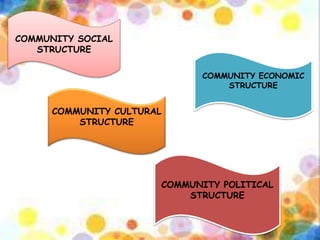
COMMUNITY SOCIAL
STRUCTURE
COMMUNITY CULTURAL
STRUCTURE
COMMUNITY POLITICAL
STRUCTURE
COMMUNITY ECONOMIC
STRUCTURE
1. Community
Social
Structure
 It refers to the rules and
expectation that develop
in the community over time
to help regulate and
manage their interaction
with one another.
• A. Social Institutions –
interrelated system of social
norms and social roles that are
organized and provide patterns
of behavior that contribute in
meeting that basic social needs
of the society.
• family, religion, economy,
education, government and
health care.
• B. Social Groups – consists of
two or more people in the
community who regularly
interacts with one another and
consider themselves a distinct
social unit. Social groups in the
community may be classified as
primary group, secondary group
and reference group.
• C. Statuses – refers to the position or
rank a person holds, in relation to
other members of the community. A
status can be classified as ascribed or
achieved.
• An Ascribed status is that which
is assigned at birth or is
involuntarily acquired in the
course of one’s life. On the other
hand, an Achieved status is that
which is acquired on the basis of
merit or accomplishment in
one’s course of life.
• D. Roles – refers to the
obligations or behaviors
expected from an individual on
the basis of one’s status in life
COMMUNITY
CULTURAL
STRUCTURE
dxz
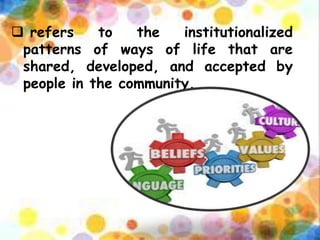
 refers to the institutionalized
patterns of ways of life that are
shared, developed, and accepted by
people in the community.
ELEMENTS
OF
CULTURAL
STRUCTURE
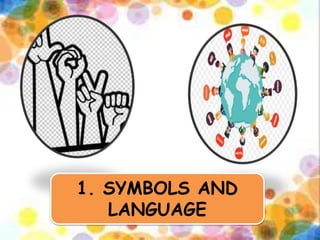
1. SYMBOLS AND
LANGUAGE
SYMBOLS
Are the shared words, gestures, objects or
signals which people in a community use to
convey and develop recognizable meaning.
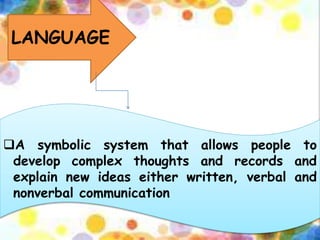
LANGUAGE
A symbolic system that allows people to
develop complex thoughts and records and
explain new ideas either written, verbal and
nonverbal communication
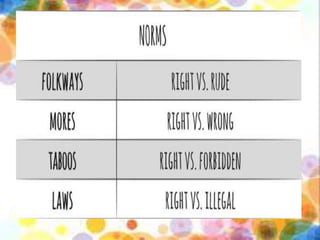
2. NORMS
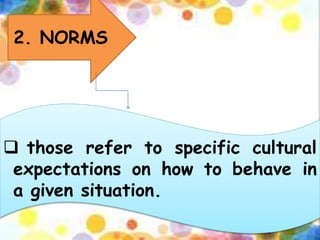
2. NORMS
 those refer to specific cultural
expectations on how to behave in
a given situation.
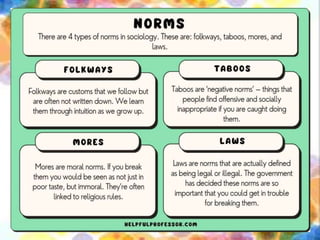
Folkways
Mores
Laws
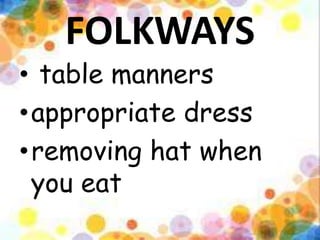
FOLKWAYS
• table manners
•appropriate dress
•removing hat when
you eat
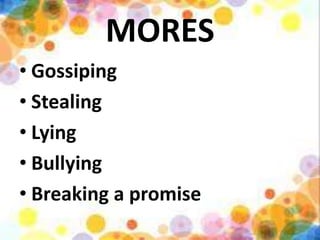
MORES
• Gossiping
• Stealing
• Lying
• Bullying
• Breaking a promise
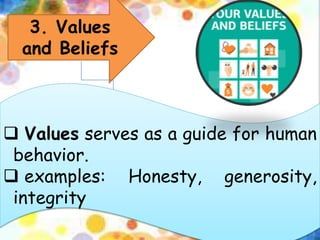
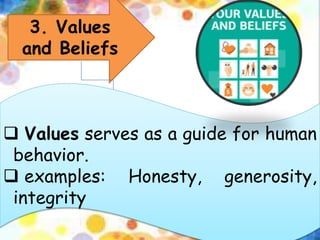
3. Values
and Beliefs
 Values serves as a guide for human
behavior.
 examples: Honesty, generosity,
integrity
3. Values
and Beliefs
 Values serves as a guide for human
behavior.
 examples: Honesty, generosity,
integrity
Beliefs
 assumption to
the world.
 If there’s a will, there’s a
way.
 Bayanihan system.
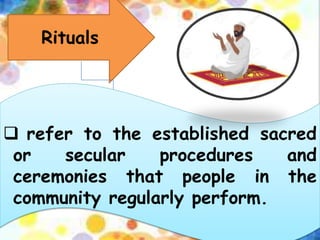
Rituals
 refer to the established sacred
or secular procedures and
ceremonies that people in the
community regularly perform.
EXAMPLES
1.Practice of Fasting
during Ramadan
2.Practice of Christians
during Holy Week
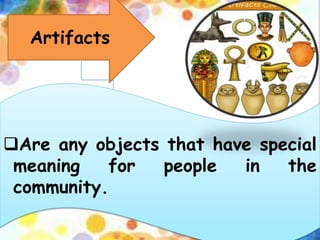
Artifacts
Are any objects that have special
meaning for people in the
community.
COMMUNITY
OF
POLITICAL
STRUCTURE
COMMUNITY
OF
POLITICAL
STRUCTURE
 it refers to institutions or even
groups and their relations to each
other
ELEMENTS
OF
POLITICAL
STRUCTURE
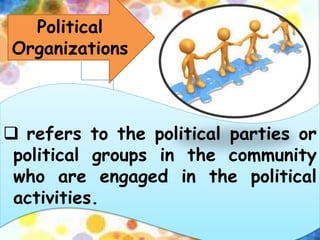
Political
Organizations
 refers to the political parties or
political groups in the community
who are engaged in the political
activities.
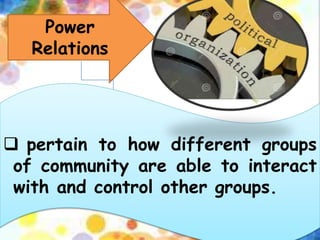
Power
Relations
 pertain to how different groups
of community are able to interact
with and control other groups.
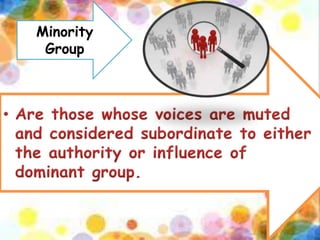
Minority
Group
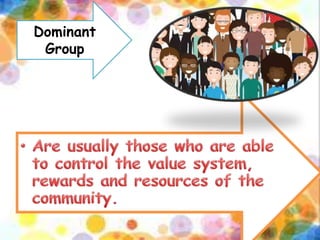
Dominant
Group
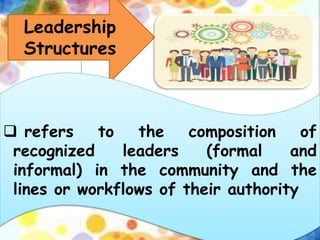
Leadership
Structures
 refers to the composition of
recognized leaders (formal and
informal) in the community and the
lines or workflows of their authority
COMMUNITY
OF
ECONOMIC
STRUCTURE
COMMUNITY
OF
ECONOMIC
STRUCTURE
 refers various organized ways and
means through which the people in the
community produce goods and services,
allocated limited resources and generate
wealth in order to satisfy needs and
wants.
ELEMENTS
OF
ECONOMIC
STRUCTURE
 Capital Assets
 Vulnerability Context
 Business Climate
 Trade
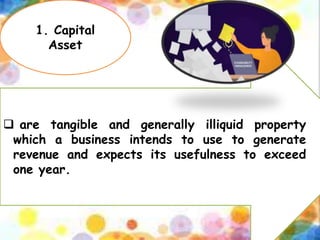
1. Capital
Asset
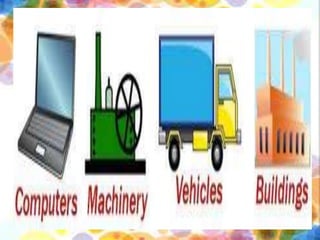
 are tangible and generally illiquid property
which a business intends to use to generate
revenue and expects its usefulness to exceed
one year.
5 Types of
Capital
Assets
 Human Capital
 Social Capital
 Natural Capital
 Physical Capital
 Financial Capital
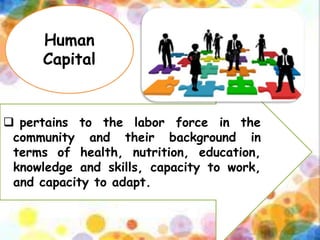
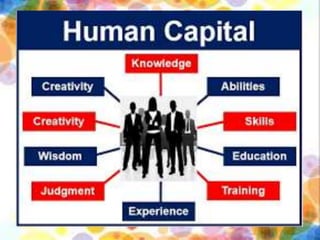
Human
Capital
 pertains to the labor force in the
community and their background in
terms of health, nutrition, education,
knowledge and skills, capacity to work,
and capacity to adapt.
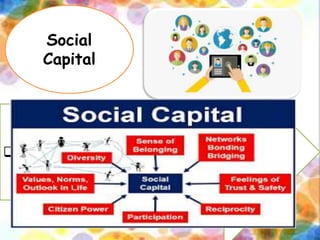
Social
Capital

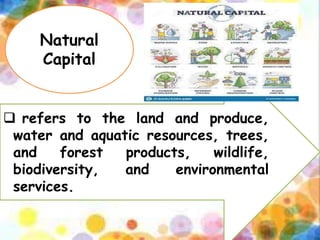
Natural
Capital
 refers to the land and produce,
water and aquatic resources, trees,
and forest products, wildlife,
biodiversity, and environmental
services.
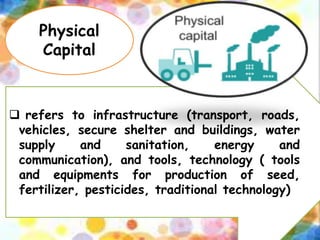
Physical
Capital
 refers to infrastructure (transport, roads,
vehicles, secure shelter and buildings, water
supply and sanitation, energy and
communication), and tools, technology ( tools
and equipments for production of seed,
fertilizer, pesticides, traditional technology)
Financial
Capital
 refers to the savings, credit, and debt
(formal and informal), remittances, pensions
and wages.
2. Vulnerability
Context
 pertains to the insecurity in the well being of
the individuals and households in the
community, which may be in the form of the
sudden shocks (conflict, illnesses, floods,
storms , droughts, pest, diseases)
3.
Business
Climate
 refers to the attitudes, laws , regulations,
and policies of the government and lending
institutions towards business, enterprises,
and business activities.
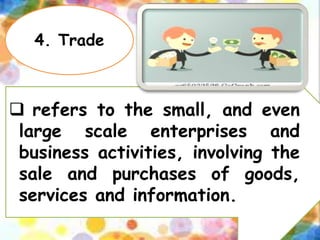
4. Trade
 refers to the small, and even
large scale enterprises and
business activities, involving the
sale and purchases of goods,
services and information.

community structures and economic entity-Copy-1.pptx