Where the focus is hope
"The power of mentorship holds great promise to help us better connect our
communities with our schools, and lift up our educators and our kids. We
can show them why learning matters, we can teach them about workplace
culture and professional etiquette. We can help them appreciate how
important good character is to success in life as well as values like hard
work, discipline and personal responsibility—all of which can help motivate
and inspire them to find their purpose and to reach for the stars." —
Governor John R. Kasich
 In 2014, Governor John R. Kasich and the Ohio Legislature
designed the Community Connectors program to bring
together students, their families, schools, communities,
faith-based groups, and businesses in mentoring
programs.
 This program seeks to strengthen communities, encourage
mentoring opportunities, create new pathways for civic
engagement that will result in higher educational
achievement, higher levels of well-being and health, and
workforce readiness for our state. Also, this approach to
social connectedness will impact school performance and
economic productivity while also creating new ways for
schools to promote a positive, goal-oriented, and hopeful
atmosphere for success.
 Improves social-emotional, cognitive, and
identity development (Rhodes, 2005)
 Challenges negative views (Hayes, Castonguay, & Goldfried, 1996)
 Refines new thinking skills (Radziszewska & Rogoff, 1991)
 Improves student perception of relationships
with parents and peers (Karcher 2005)
 Improves academic and vocational outcomes
(Dubois & Silverthorn, 2005a)
 More receptive to adults (Karcher 2005)
 Improves regulation of complicated emotions
(Diamond & Aspinwall, 2003)
 Creates significant and enduring value for youth
(Rhodes, 2005)
 This program has $10 million to award
 The maximum award is $500,000 which will
be awarded over a three year period.
 Year one the state will match up to $3 for
every $1 local cash/in-kind investment, year
two the state will match $2 for every $1 local
cash/in-kind investment, and year three will
be up to $1 state match for every $1 local
cash/in-kind investment.
 First Year: $25,000 local in-kind, $75,000
state cash
 Second Year: $25,000 local in-kind, $50,000
state cash
 Third Year: $25,000 local in-kind, $25,000
state cash
 In-kind Investment--consists of goods or
services used in support of the project for which
no reimbursement is made using grant funds.
 In-kind Contribution--limited to personnel time.
Any allowable salary or wages paid to a current
employee whose time will be redirected or
dedicated to the Community Connectors program
can be used to draw down state matching funds.
 Cash
 Looking for sustainability
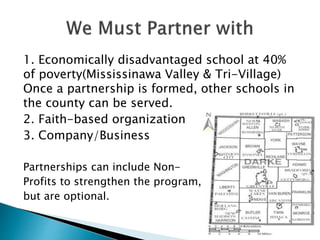
1. Economically disadvantaged school at 40%
of poverty(Mississinawa Valley & Tri-Village)
Once a partnership is formed, other schools in
the county can be served.
2. Faith-based organization
3. Company/Business
Partnerships can include Non-
Profits to strengthen the program,
but are optional.
 Time contribution
 Personnel contribution
 Monetary contribution
 Shared responsibilities
 Additional roles and responsibilities
Community Non-Profit—Recovery and Wellness
 Time Contribution: Provide 5-10 hours per week
of drug and alcohol free programming via group
or rec activities
 Personnel Contribution: $8,580 in-kind match
 Monetary Contribution: $0
 Shared Responsibilities: Facilitating prevention
programming and completing educational
assemblies as needed
 Additional: 1:1 family consultation, information
on resources, We Are the Majority
 Will serve students grades 5th -12th
 Must be built upon the core principles which is
central to long-term student, personal and
academic success.
 Hope is the center of this program because high
levels of hopefulness are strong predictors of
one’s belief that one can accomplish one’s goals.
Which would reflect higher graduation rates,
establishment of life purpose and improved work
readiness skills, civic engagement, a
strengthened community, and encourage mentor
opportunities.
1. Setting goals for 21st Century Careers
2. Building character
3. Decision making/critical thinking skills
4. Resiliency
5. Belief in positive future
Mentoring Program
Mentoring Components
Serve students in grades 5-12 and carry out
the 5 core principles.
1. Youth Advocate placed within the schools
2. Adult One on One mentoring
3. Business Partnerships
 Gateway Youth Programs (GYP) will employ a
Youth Advocate for designated schools
 29 hours a week stationed at the school
 Will have a Human Services or Social Work
background for non-therapeutic counseling
 Will facilitate groups and provide one on one
mentoring.
 Keep in communication with businesses and
churches to set up additional mentoring
 Assist with problems when they arise
 Churches and/or Businesses recruit potential
mentors
 Mentors will be trained by GYP
 Commitment one hour a week for a year
 Background check will be conducted
 Any partner can provide individual mentors
for students
 Work readiness and career exploration
opportunities
 HR departments speaking to students
 Information on skill sets needed in the company
 Business trends experiencing
 Provide tours of facilities
 Provide job shadowing and internship
opportunities
 One on one mentoring opportunities (can be
virtual)
 Strengthen the workforce
 ACES = 52 students
 Mississinawa Valley = 412 students
 Tri-Village = 450 students
 Ansonia = 411 students
 Arcanum= 698 students
 Bradford= 341students
 Franklin Monroe= 462 students
 Greenville= 1632 students
 Versailles= 891students
 Total = 5,349 potential students
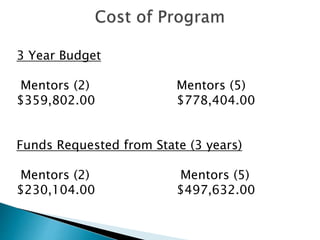
3 Year Budget
Mentors (2) Mentors (5)
$359,802.00 $778,404.00
Funds Requested from State (3 years)
Mentors (2) Mentors (5)
$230,104.00 $497,632.00
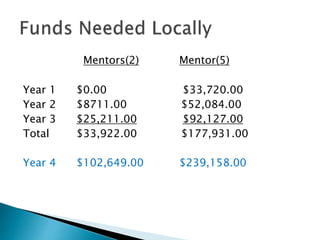
Mentors(2) Mentor(5)
Year 1 $0.00 $33,720.00
Year 2 $8711.00 $52,084.00
Year 3 $25,211.00 $92,127.00
Total $33,922.00 $177,931.00
Year 4 $102,649.00 $239,158.00
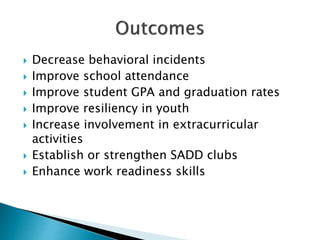
 Decrease behavioral incidents
 Improve school attendance
 Improve student GPA and graduation rates
 Improve resiliency in youth
 Increase involvement in extracurricular
activities
 Establish or strengthen SADD clubs
 Enhance work readiness skills
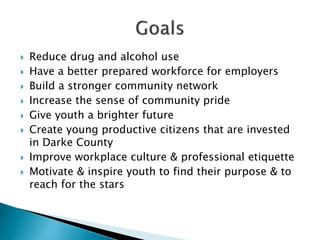
 Reduce drug and alcohol use
 Have a better prepared workforce for employers
 Build a stronger community network
 Increase the sense of community pride
 Give youth a brighter future
 Create young productive citizens that are invested
in Darke County
 Improve workplace culture & professional etiquette
 Motivate & inspire youth to find their purpose & to
reach for the stars
 Must prove the program can be sustained
 Maximize the state match opportunity
 Eventually generate cash match that will
sustain the program.
 If enough revenue is generated, the program
could grow to include every school district.
 Feb. 23, 2015- To established an advisory council and
have meeting at 1:00 pm
 Feb. 27, 2014- Have a commitment from partners
 March 6, 2015- The grant is due
 April 2015- The grant will be awarded
 Sept. 7, 2015- Planning, implementation and training
must be completed by September 7, 2015
 Sept. 7, 2015- Program will be implemented

Community connectors presentation revised

  • 1.
    Where the focusis hope "The power of mentorship holds great promise to help us better connect our communities with our schools, and lift up our educators and our kids. We can show them why learning matters, we can teach them about workplace culture and professional etiquette. We can help them appreciate how important good character is to success in life as well as values like hard work, discipline and personal responsibility—all of which can help motivate and inspire them to find their purpose and to reach for the stars." — Governor John R. Kasich
  • 2.
     In 2014,Governor John R. Kasich and the Ohio Legislature designed the Community Connectors program to bring together students, their families, schools, communities, faith-based groups, and businesses in mentoring programs.  This program seeks to strengthen communities, encourage mentoring opportunities, create new pathways for civic engagement that will result in higher educational achievement, higher levels of well-being and health, and workforce readiness for our state. Also, this approach to social connectedness will impact school performance and economic productivity while also creating new ways for schools to promote a positive, goal-oriented, and hopeful atmosphere for success.
  • 3.
     Improves social-emotional,cognitive, and identity development (Rhodes, 2005)  Challenges negative views (Hayes, Castonguay, & Goldfried, 1996)  Refines new thinking skills (Radziszewska & Rogoff, 1991)  Improves student perception of relationships with parents and peers (Karcher 2005)  Improves academic and vocational outcomes (Dubois & Silverthorn, 2005a)  More receptive to adults (Karcher 2005)  Improves regulation of complicated emotions (Diamond & Aspinwall, 2003)  Creates significant and enduring value for youth (Rhodes, 2005)
  • 4.
     This programhas $10 million to award  The maximum award is $500,000 which will be awarded over a three year period.  Year one the state will match up to $3 for every $1 local cash/in-kind investment, year two the state will match $2 for every $1 local cash/in-kind investment, and year three will be up to $1 state match for every $1 local cash/in-kind investment.
  • 5.
     First Year:$25,000 local in-kind, $75,000 state cash  Second Year: $25,000 local in-kind, $50,000 state cash  Third Year: $25,000 local in-kind, $25,000 state cash
  • 6.
     In-kind Investment--consistsof goods or services used in support of the project for which no reimbursement is made using grant funds.  In-kind Contribution--limited to personnel time. Any allowable salary or wages paid to a current employee whose time will be redirected or dedicated to the Community Connectors program can be used to draw down state matching funds.  Cash  Looking for sustainability
  • 7.
    1. Economically disadvantagedschool at 40% of poverty(Mississinawa Valley & Tri-Village) Once a partnership is formed, other schools in the county can be served. 2. Faith-based organization 3. Company/Business Partnerships can include Non- Profits to strengthen the program, but are optional.
  • 8.
     Time contribution Personnel contribution  Monetary contribution  Shared responsibilities  Additional roles and responsibilities
  • 9.
    Community Non-Profit—Recovery andWellness  Time Contribution: Provide 5-10 hours per week of drug and alcohol free programming via group or rec activities  Personnel Contribution: $8,580 in-kind match  Monetary Contribution: $0  Shared Responsibilities: Facilitating prevention programming and completing educational assemblies as needed  Additional: 1:1 family consultation, information on resources, We Are the Majority
  • 10.
     Will servestudents grades 5th -12th  Must be built upon the core principles which is central to long-term student, personal and academic success.  Hope is the center of this program because high levels of hopefulness are strong predictors of one’s belief that one can accomplish one’s goals. Which would reflect higher graduation rates, establishment of life purpose and improved work readiness skills, civic engagement, a strengthened community, and encourage mentor opportunities.
  • 11.
    1. Setting goalsfor 21st Century Careers 2. Building character 3. Decision making/critical thinking skills 4. Resiliency 5. Belief in positive future
  • 12.
    Mentoring Program Mentoring Components Servestudents in grades 5-12 and carry out the 5 core principles. 1. Youth Advocate placed within the schools 2. Adult One on One mentoring 3. Business Partnerships
  • 13.
     Gateway YouthPrograms (GYP) will employ a Youth Advocate for designated schools  29 hours a week stationed at the school  Will have a Human Services or Social Work background for non-therapeutic counseling  Will facilitate groups and provide one on one mentoring.  Keep in communication with businesses and churches to set up additional mentoring  Assist with problems when they arise
  • 14.
     Churches and/orBusinesses recruit potential mentors  Mentors will be trained by GYP  Commitment one hour a week for a year  Background check will be conducted  Any partner can provide individual mentors for students
  • 15.
     Work readinessand career exploration opportunities  HR departments speaking to students  Information on skill sets needed in the company  Business trends experiencing  Provide tours of facilities  Provide job shadowing and internship opportunities  One on one mentoring opportunities (can be virtual)  Strengthen the workforce
  • 16.
     ACES =52 students  Mississinawa Valley = 412 students  Tri-Village = 450 students  Ansonia = 411 students  Arcanum= 698 students  Bradford= 341students  Franklin Monroe= 462 students  Greenville= 1632 students  Versailles= 891students  Total = 5,349 potential students
  • 17.
    3 Year Budget Mentors(2) Mentors (5) $359,802.00 $778,404.00 Funds Requested from State (3 years) Mentors (2) Mentors (5) $230,104.00 $497,632.00
  • 18.
    Mentors(2) Mentor(5) Year 1$0.00 $33,720.00 Year 2 $8711.00 $52,084.00 Year 3 $25,211.00 $92,127.00 Total $33,922.00 $177,931.00 Year 4 $102,649.00 $239,158.00
  • 19.
     Decrease behavioralincidents  Improve school attendance  Improve student GPA and graduation rates  Improve resiliency in youth  Increase involvement in extracurricular activities  Establish or strengthen SADD clubs  Enhance work readiness skills
  • 20.
     Reduce drugand alcohol use  Have a better prepared workforce for employers  Build a stronger community network  Increase the sense of community pride  Give youth a brighter future  Create young productive citizens that are invested in Darke County  Improve workplace culture & professional etiquette  Motivate & inspire youth to find their purpose & to reach for the stars
  • 21.
     Must provethe program can be sustained  Maximize the state match opportunity  Eventually generate cash match that will sustain the program.  If enough revenue is generated, the program could grow to include every school district.
  • 22.
     Feb. 23,2015- To established an advisory council and have meeting at 1:00 pm  Feb. 27, 2014- Have a commitment from partners  March 6, 2015- The grant is due  April 2015- The grant will be awarded  Sept. 7, 2015- Planning, implementation and training must be completed by September 7, 2015  Sept. 7, 2015- Program will be implemented