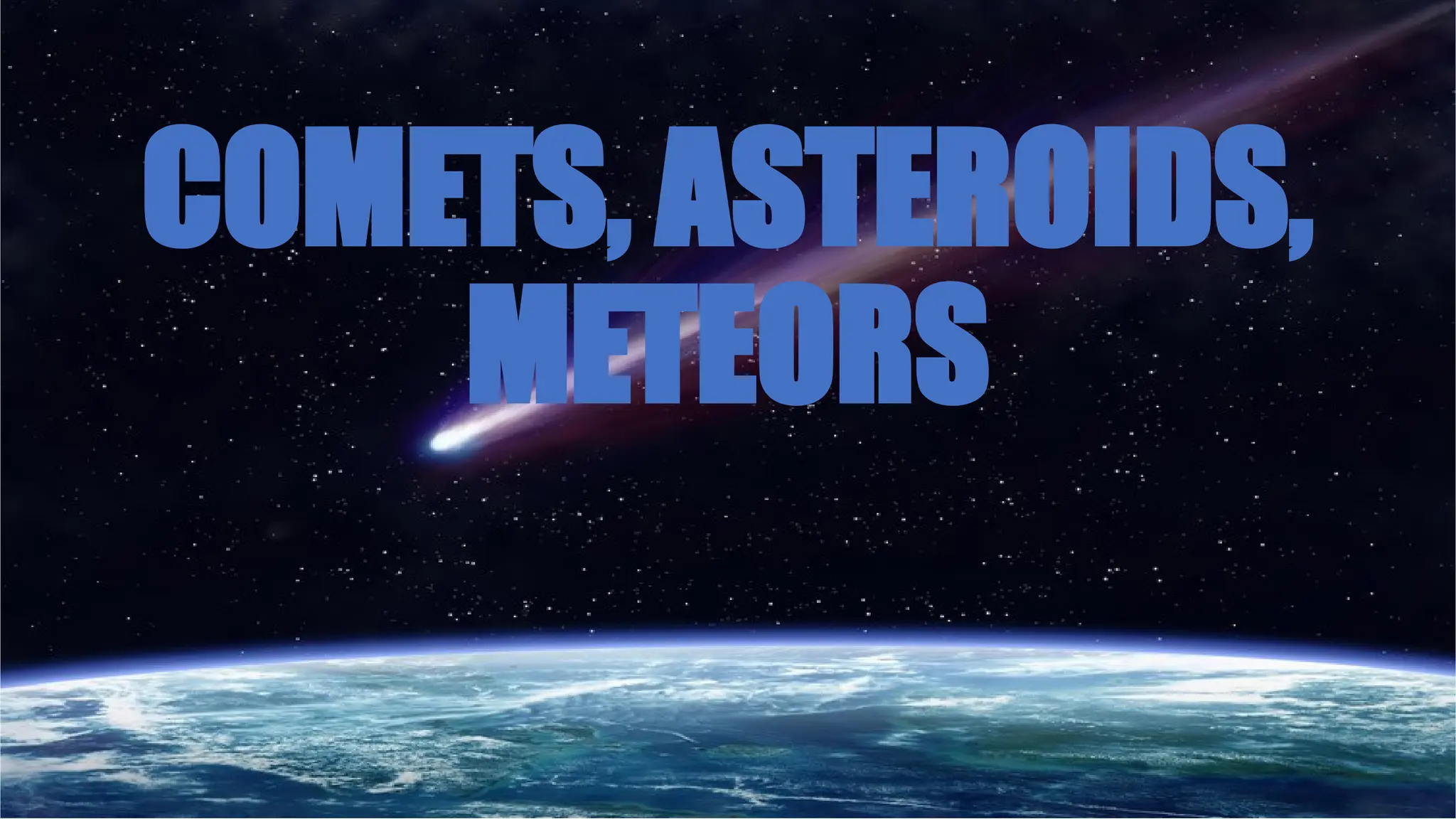
COMETS, ASTEROIDS,
METEORS
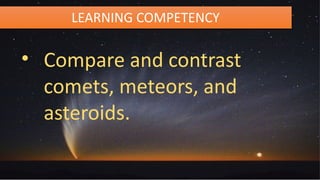
LEARNING COMPETENCY
• Compare and contrast
comets, meteors, and
asteroids.
IMPORTANCE
• It is important to compare and
contrast comets, meteors, and
asteroids in order to identify and
understand these celestial objects
in the outer space.
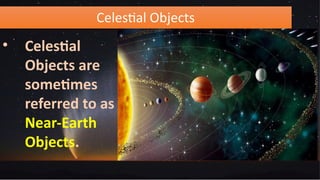
Celestial Objects
• Celestial
Objects are
sometimes
referred to as
Near-Earth
Objects.
Celestial Objects
• Celestial Objects are
sometimes referred to
as Near-Earth Objects.
• COMETS, ASTEROIDS,
and METEORS are
examples.
LEARNING COMPETENCY
• Compare and contrast
comets, meteors, and
asteroids.
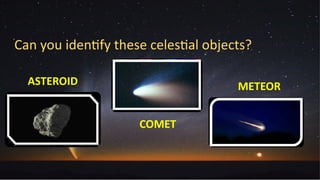
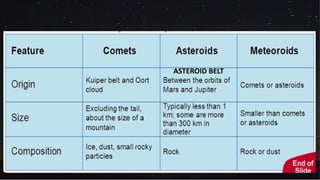
Can you identify these celestial objects?
COMET
ASTEROID METEOR
ASTEROID BELT
COMET
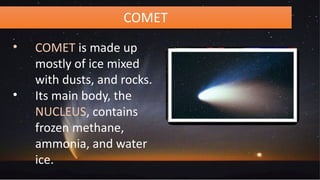
• COMET is made up
mostly of ice mixed
with dusts, and rocks.
• Its main body, the
NUCLEUS, contains
frozen methane,
ammonia, and water
ice.
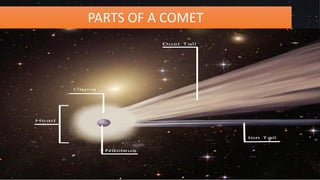
PARTS OF A COMET
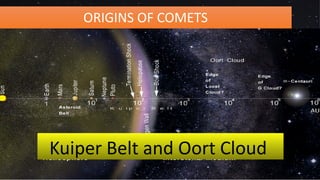
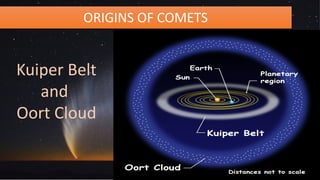
ORIGINS OF COMETS
Kuiper Belt and Oort Cloud
ORIGINS OF COMETS
Kuiper Belt
and
Oort Cloud
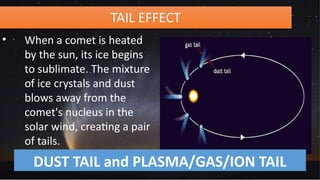
TAIL EFFECT
• When a comet is heated
by the sun, its ice begins
to sublimate. The mixture
of ice crystals and dust
blows away from the
comet's nucleus in the
solar wind, creating a pair
of tails.
DUST TAIL and PLASMA/GAS/ION TAIL
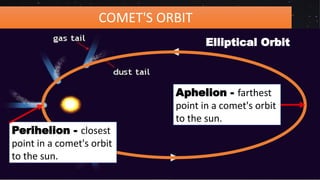
COMET'S ORBIT
Elliptical Orbit
Perihelion - closest
point in a comet's orbit
to the sun.
Aphelion - farthest
point in a comet's orbit
to the sun.
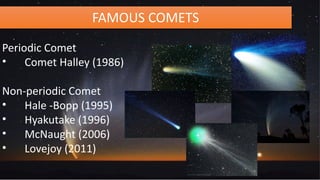
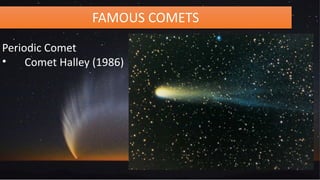
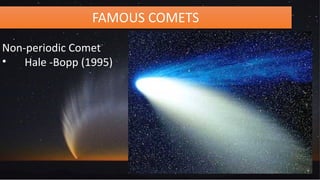
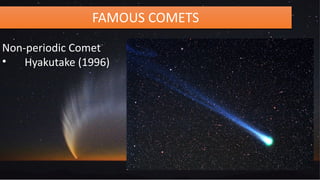
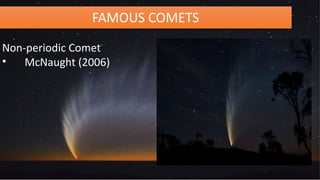
FAMOUS COMETS
Periodic Comet
• Comet Halley (1986)
Non-periodic Comet
• Hale -Bopp (1995)
• Hyakutake (1996)
• McNaught (2006)
• Lovejoy (2011)
FAMOUS COMETS
Periodic Comet
• Comet Halley (1986)
FAMOUS COMETS
Non-periodic Comet
• Hale -Bopp (1995)
FAMOUS COMETS
Non-periodic Comet
• Hyakutake (1996)
FAMOUS COMETS
Non-periodic Comet
• McNaught (2006)
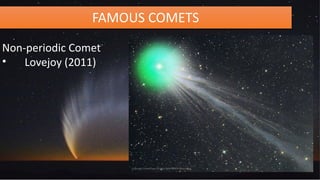
FAMOUS COMETS
Non-periodic Comet
• Lovejoy (2011)
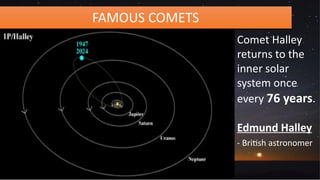
FAMOUS COMETS
Comet Halley
returns to the
inner solar
system once
every 76 years.
Edmund Halley
- British astronomer
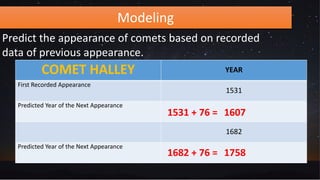
Modeling
Predict the appearance of comets based on recorded
data of previous appearance.
COMET HALLEY YEAR
First Recorded Appearance
1531
Predicted Year of the Next Appearance
1682
Predicted Year of the Next Appearance
1607
1758
1531 + 76 =
1682 + 76 =
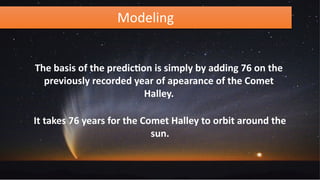
Modeling
The basis of the prediction is simply by adding 76 on the
previously recorded year of apearance of the Comet
Halley.
It takes 76 years for the Comet Halley to orbit around the
sun.
GUIDED PRACTICE
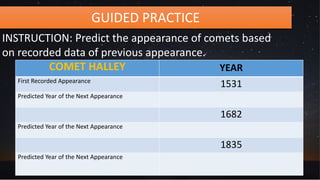
INSTRUCTION: Predict the appearance of comets based
on recorded data of previous appearance.
COMET HALLEY YEAR
First Recorded Appearance
1531
Predicted Year of the Next Appearance
1682
Predicted Year of the Next Appearance
1835
Predicted Year of the Next Appearance
GUIDED PRACTICE
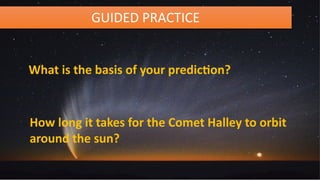
What is the basis of your prediction?
How long it takes for the Comet Halley to orbit
around the sun?
GUIDED PRACTICE
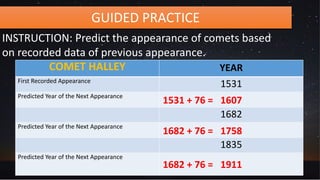
INSTRUCTION: Predict the appearance of comets based
on recorded data of previous appearance.
COMET HALLEY YEAR
First Recorded Appearance
1531
Predicted Year of the Next Appearance
1682
Predicted Year of the Next Appearance
1835
Predicted Year of the Next Appearance
1531 + 76 =
1682 + 76 =
1607
1758
1682 + 76 = 1911
GUIDED PRACTICE
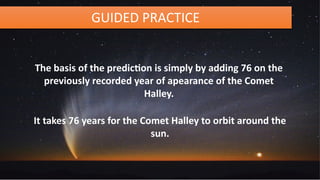
The basis of the prediction is simply by adding 76 on the
previously recorded year of apearance of the Comet
Halley.
It takes 76 years for the Comet Halley to orbit around the
sun.
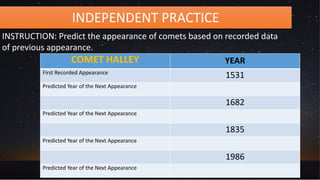
INDEPENDENT PRACTICE
INSTRUCTION: Predict the appearance of comets based on recorded data
of previous appearance.
COMET HALLEY YEAR
First Recorded Appearance
1531
Predicted Year of the Next Appearance
1682
Predicted Year of the Next Appearance
1835
Predicted Year of the Next Appearance
1986
Predicted Year of the Next Appearance
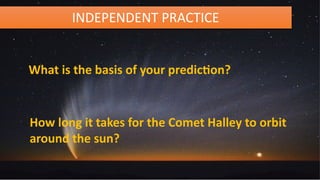
INDEPENDENT PRACTICE
What is the basis of your prediction?
How long it takes for the Comet Halley to orbit
around the sun?
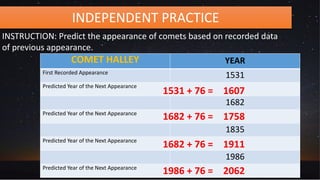
INDEPENDENT PRACTICE
INSTRUCTION: Predict the appearance of comets based on recorded data
of previous appearance.
COMET HALLEY YEAR
First Recorded Appearance
1531
Predicted Year of the Next Appearance
1682
Predicted Year of the Next Appearance
1835
Predicted Year of the Next Appearance
1986
Predicted Year of the Next Appearance
1531 + 76 =
1682 + 76 =
1607
1758
1682 + 76 = 1911
2062
1986 + 76 =
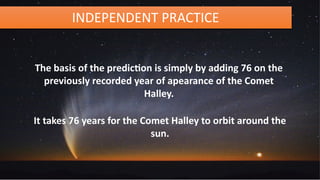
INDEPENDENT PRACTICE
The basis of the prediction is simply by adding 76 on the
previously recorded year of apearance of the Comet
Halley.
It takes 76 years for the Comet Halley to orbit around the
sun.
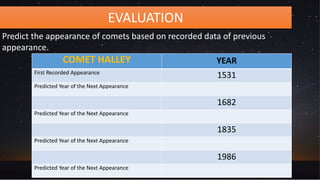
EVALUATION
Predict the appearance of comets based on recorded data of previous
appearance.
COMET HALLEY YEAR
First Recorded Appearance
1531
Predicted Year of the Next Appearance
1682
Predicted Year of the Next Appearance
1835
Predicted Year of the Next Appearance
1986
Predicted Year of the Next Appearance
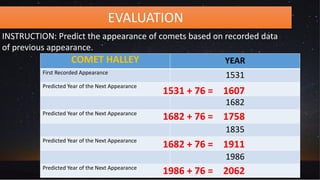
EVALUATION
INSTRUCTION: Predict the appearance of comets based on recorded data
of previous appearance.
COMET HALLEY YEAR
First Recorded Appearance
1531
Predicted Year of the Next Appearance
1682
Predicted Year of the Next Appearance
1835
Predicted Year of the Next Appearance
1986
Predicted Year of the Next Appearance
1531 + 76 =
1682 + 76 =
1607
1758
1682 + 76 = 1911
2062
1986 + 76 =
-END-

comets, asteroid, meteoroid in the solar system pptx

  • 1.
  • 2.
    LEARNING COMPETENCY • Compareand contrast comets, meteors, and asteroids.
  • 3.
    IMPORTANCE • It isimportant to compare and contrast comets, meteors, and asteroids in order to identify and understand these celestial objects in the outer space.
  • 4.
    Celestial Objects • Celestial Objectsare sometimes referred to as Near-Earth Objects.
  • 5.
    Celestial Objects • CelestialObjects are sometimes referred to as Near-Earth Objects. • COMETS, ASTEROIDS, and METEORS are examples.
  • 6.
    LEARNING COMPETENCY • Compareand contrast comets, meteors, and asteroids.
  • 7.
    Can you identifythese celestial objects? COMET ASTEROID METEOR
  • 8.
  • 10.
    COMET • COMET ismade up mostly of ice mixed with dusts, and rocks. • Its main body, the NUCLEUS, contains frozen methane, ammonia, and water ice.
  • 11.
  • 12.
    ORIGINS OF COMETS KuiperBelt and Oort Cloud
  • 13.
    ORIGINS OF COMETS KuiperBelt and Oort Cloud
  • 14.
    TAIL EFFECT • Whena comet is heated by the sun, its ice begins to sublimate. The mixture of ice crystals and dust blows away from the comet's nucleus in the solar wind, creating a pair of tails. DUST TAIL and PLASMA/GAS/ION TAIL
  • 15.
    COMET'S ORBIT Elliptical Orbit Perihelion- closest point in a comet's orbit to the sun. Aphelion - farthest point in a comet's orbit to the sun.
  • 16.
    FAMOUS COMETS Periodic Comet •Comet Halley (1986) Non-periodic Comet • Hale -Bopp (1995) • Hyakutake (1996) • McNaught (2006) • Lovejoy (2011)
  • 17.
  • 18.
  • 19.
  • 20.
  • 21.
  • 22.
    FAMOUS COMETS Comet Halley returnsto the inner solar system once every 76 years. Edmund Halley - British astronomer
  • 23.
    Modeling Predict the appearanceof comets based on recorded data of previous appearance. COMET HALLEY YEAR First Recorded Appearance 1531 Predicted Year of the Next Appearance 1682 Predicted Year of the Next Appearance 1607 1758 1531 + 76 = 1682 + 76 =
  • 24.
    Modeling The basis ofthe prediction is simply by adding 76 on the previously recorded year of apearance of the Comet Halley. It takes 76 years for the Comet Halley to orbit around the sun.
  • 25.
    GUIDED PRACTICE INSTRUCTION: Predictthe appearance of comets based on recorded data of previous appearance. COMET HALLEY YEAR First Recorded Appearance 1531 Predicted Year of the Next Appearance 1682 Predicted Year of the Next Appearance 1835 Predicted Year of the Next Appearance
  • 26.
    GUIDED PRACTICE What isthe basis of your prediction? How long it takes for the Comet Halley to orbit around the sun?
  • 27.
    GUIDED PRACTICE INSTRUCTION: Predictthe appearance of comets based on recorded data of previous appearance. COMET HALLEY YEAR First Recorded Appearance 1531 Predicted Year of the Next Appearance 1682 Predicted Year of the Next Appearance 1835 Predicted Year of the Next Appearance 1531 + 76 = 1682 + 76 = 1607 1758 1682 + 76 = 1911
  • 28.
    GUIDED PRACTICE The basisof the prediction is simply by adding 76 on the previously recorded year of apearance of the Comet Halley. It takes 76 years for the Comet Halley to orbit around the sun.
  • 29.
    INDEPENDENT PRACTICE INSTRUCTION: Predictthe appearance of comets based on recorded data of previous appearance. COMET HALLEY YEAR First Recorded Appearance 1531 Predicted Year of the Next Appearance 1682 Predicted Year of the Next Appearance 1835 Predicted Year of the Next Appearance 1986 Predicted Year of the Next Appearance
  • 30.
    INDEPENDENT PRACTICE What isthe basis of your prediction? How long it takes for the Comet Halley to orbit around the sun?
  • 31.
    INDEPENDENT PRACTICE INSTRUCTION: Predictthe appearance of comets based on recorded data of previous appearance. COMET HALLEY YEAR First Recorded Appearance 1531 Predicted Year of the Next Appearance 1682 Predicted Year of the Next Appearance 1835 Predicted Year of the Next Appearance 1986 Predicted Year of the Next Appearance 1531 + 76 = 1682 + 76 = 1607 1758 1682 + 76 = 1911 2062 1986 + 76 =
  • 32.
    INDEPENDENT PRACTICE The basisof the prediction is simply by adding 76 on the previously recorded year of apearance of the Comet Halley. It takes 76 years for the Comet Halley to orbit around the sun.
  • 33.
    EVALUATION Predict the appearanceof comets based on recorded data of previous appearance. COMET HALLEY YEAR First Recorded Appearance 1531 Predicted Year of the Next Appearance 1682 Predicted Year of the Next Appearance 1835 Predicted Year of the Next Appearance 1986 Predicted Year of the Next Appearance
  • 34.
    EVALUATION INSTRUCTION: Predict theappearance of comets based on recorded data of previous appearance. COMET HALLEY YEAR First Recorded Appearance 1531 Predicted Year of the Next Appearance 1682 Predicted Year of the Next Appearance 1835 Predicted Year of the Next Appearance 1986 Predicted Year of the Next Appearance 1531 + 76 = 1682 + 76 = 1607 1758 1682 + 76 = 1911 2062 1986 + 76 =
  • 35.