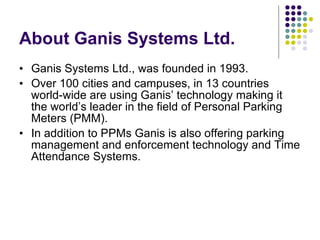
COMET  The ultimate system for paying “On street” parking fees
About Ganis Systems Ltd. Ganis Systems Ltd., was founded in 1993. Over 100 cities and campuses, in 13 countries world-wide are using Ganis’ technology making it the world’s leader in the field of Personal Parking Meters (PMM).  In addition to PPMs Ganis is also offering parking management and enforcement technology and Time Attendance Systems.
Partial List of Ganis  Customers  Norway  – 24 cities including  Baerum , Harstad, Alesund, Kritiandsand, Hammer, Rana, Arendal, Bergen, Lillehammer, Narvik, Voss, Hammerfast. Gjovick, Alta and Bodo.  Belgium  – 19 cities including  Anwerp, Gent, Liege, Namur, Geel, Zottegem, Boom, Sint Truiden, Torhout, Deinze, Aarschot and several others.  Holland  - Amsterdam, Dordrecht, and Rosendal.  Italy  – Desio and Codroipo. Spain  - Lorca, Totana, Segovia and Santnader.  Austria  - Innsbruck, Hall and  Braunau.  Sweden  – Stockholm and Goteborg. New Zealand  – Wellington, Hamilton and  Hutt. Australia  – Shepparton.  Canada  – The town of Whistler.  US  – Buffalo, Fort Lauderdale, University of California Santa Barbara , UC Davis, University of Binghamton, UMASS,  University of Wisconsin Madison, New Brunswick, University of Wisconsin Milwaukee, Grand Rapids and Washington State University..  Argentina  – Cordoba.   Finland  – Helsinki.
The challenge of collecting  “On Street” parking fees Collection of parking fees is essential both as a tool for managing scares parking resources as well as a source of income for the Municipalities. All available parking fee collection systems suffer from some major drawbacks : Curbside parking meters  – Vandalism, maintenance, cash collection, inflexible, unfair to the user, visual pollution. P&D  – High investment, vandalism, maintenance, inconvenient for the user, difficult enforcement, cash collection, not friendly to the user. Cellular  – Expensive for the user, difficult to operate, high transaction cost, difficult and expensive enforcement and subject to the big brother effect.
What is a Personal meter ? A Personal (in-car) meter is a small electronic device used to pay the “on street“ parking fees and to regulate parking time.  Contains all parking rates and regulations. The customer pays for the device and the parking fees, the city can assist providing a discount on parking fees or meters.  Various models are available offering a variety of technical features.
Motorist Benefits   User Friendly, Easy to operate No need for cash Charges only for actual time parked Proof for revoking unjustified summons Fully anonymous Provide receipt for parking fees Meeting the needs of special groups: disabled, senior citizens, doctors etc.  Same device can be used in various cities.
City Operational Benefits No cash collection and management.  Easy and efficient enforcement.  Flexible, easily modified to accommodate new regulations.  Environmentally friendly.  Improve service to the customer, make city residents happier !!
City financial benefits  Reduce operational costs. Maintenance free. No investment in infrastructure.  Improved cash flow (pre- paid). Increased net revenues. Encourage short-period parking payment.  Benefits the non-used pre-paid fees.
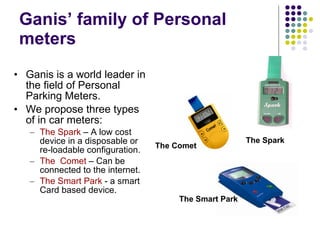
Ganis’ family of Personal  meters  Ganis is a world leader in the field of Personal Parking Meters.  We propose three types of in car meters: The Spark  – A low cost device in a disposable or re-loadable configuration.  The  Comet  – Can be connected to the internet.  The Smart Park  - a smart Card based device.  The Comet  The Smart Park The Spark
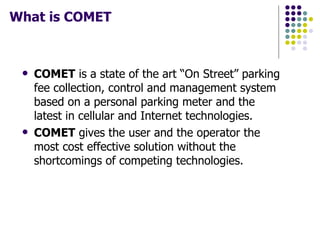
What is COMET   COMET  is a state of the art “On Street” parking fee collection, control and management system based on a personal parking meter and the latest in cellular and Internet technologies. COMET  gives the user and the operator the most cost effective solution without the shortcomings of competing technologies.
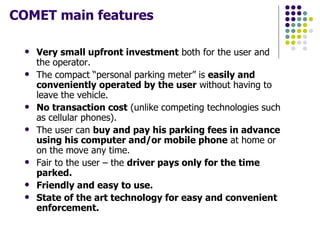
COMET main features Very small upfront investment  both for the user and the operator. The compact “personal parking meter” is  easily and conveniently operated by the user  without having to leave the vehicle. No transaction cost  (unlike competing technologies such as cellular phones). The user can  buy and pay his parking fees in advance using his computer and/or mobile phone  at home or on the move any time.  Fair to the user – the  driver pays only for the time parked.  Friendly and easy to use.   State of the art technology for easy and convenient enforcement.
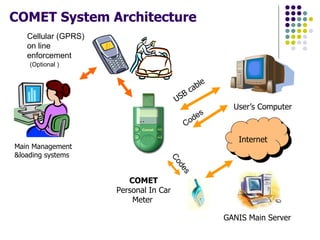
COMET System Architecture   COMET  Personal In Car Meter   User’s Computer  USB cable Codes GANIS Main Server  Internet  Main Management &loading systems  Codes Cellular (GPRS) on line enforcement (Optional )
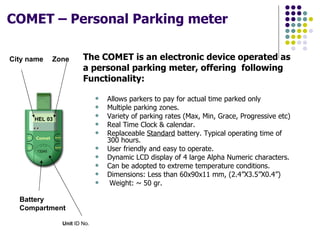
COMET – Personal Parking meter   The COMET is an electronic device operated as a personal parking meter, offering  following Functionality: Allows parkers to pay for actual time parked only Multiple parking zones. Variety of parking rates (Max, Min, Grace, Progressive etc) Real Time Clock & calendar. Replaceable  Standard  battery. Typical operating time of 300 hours. User friendly and easy to operate. Dynamic LCD display of 4 large Alpha Numeric characters. Can be adopted to extreme temperature conditions. Dimensions: Less than 60x90x11 mm, (2.4”X3.5”X0.4”) Weight: ~ 50 gr.  Battery Compartment  City name Zone HEL 03 13245 Unit  ID No.
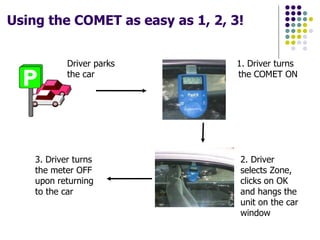
Using the COMET as easy as 1, 2, 3! Driver parks the car 1. Driver turns   the COMET ON 2. Driver selects Zone, clicks on OK and hangs the unit on the car window  3. Driver turns the meter OFF  upon returning to the car
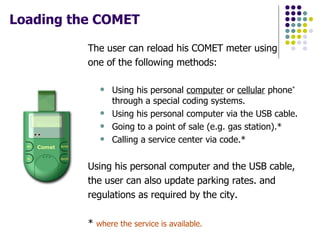
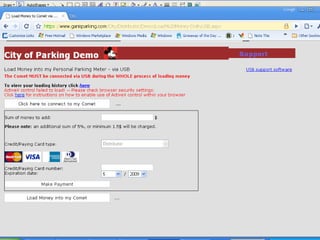
Loading the COMET   The user can reload his COMET meter using one of the following methods: Using his personal  computer  or  cellular  phone *  through a special coding systems. Using his personal computer via the USB cable.  Going to a point of sale (e.g. gas station).*  Calling a service center via code.*  Using his personal computer and the USB cable, the user can also update parking rates. and regulations as required by the city. *  where the service is available.
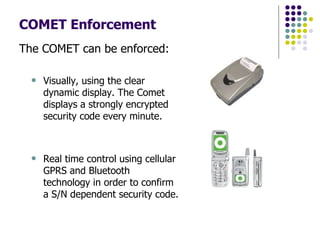
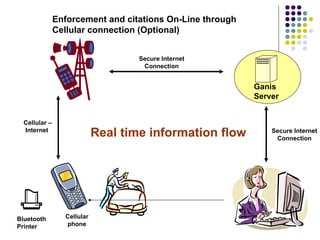
COMET Enforcement   The COMET can be enforced: Visually, using the clear dynamic display. The Comet displays a strongly encrypted security code every minute.  Real time control using cellular GPRS and Bluetooth technology in order to confirm a S/N dependent security code.
Cellular phone Bluetooth Printer  Cellular – Internet  Secure Internet Connection Real time information flow   Secure Internet Connection Enforcement and citations On-Line through Cellular connection (Optional) Ganis Server
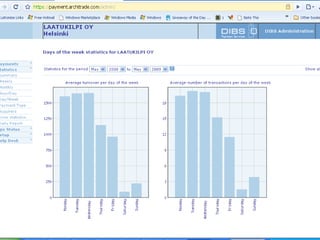
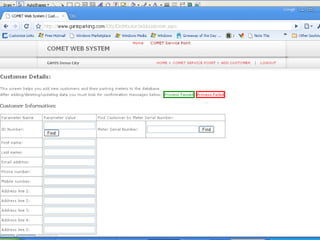
Back End System (BES)  The Web  based Back End System is responsible for: Controlling the loading providing good visibility to the municipality over the complete process. Update of the parking parameters.  Update of the Comet’s S/W.  Generation of management reports including parking records and loading information.
Examples-actual BES
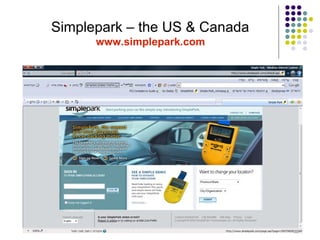
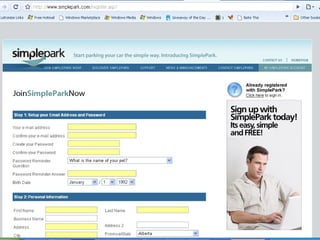
Simplepark – the US & Canada www.simplepark.com
 
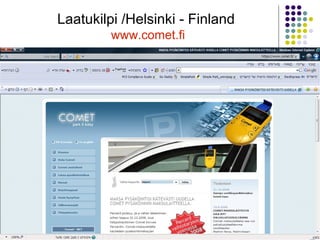
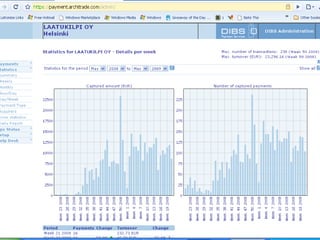
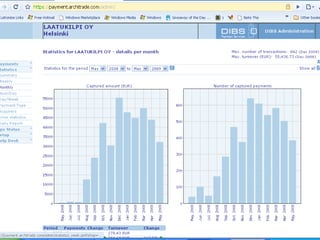
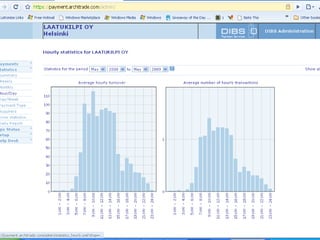
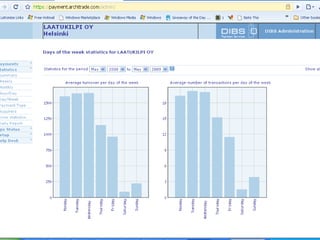
Laatukilpi /Helsinki - Finland  www.comet.fi
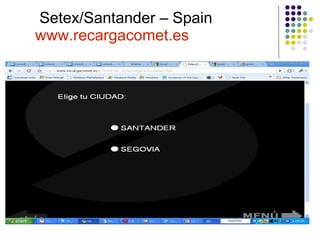
  Setex/Santander – Spain  www.recargacomet.es
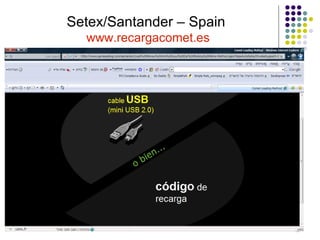
Setex/Santander – Spain  www.recargacomet.es
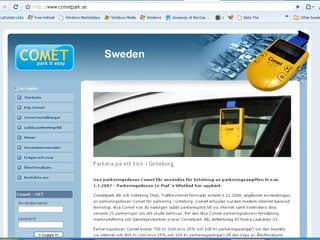
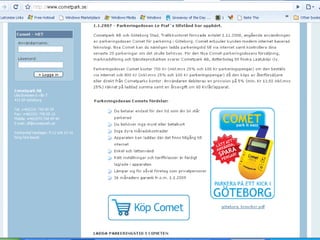
Sweden
 
Back End System  Financial Controls
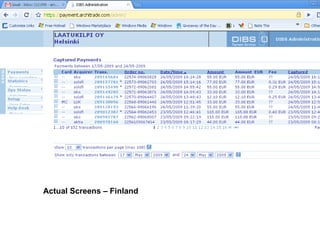
Actual   Screens – Finland


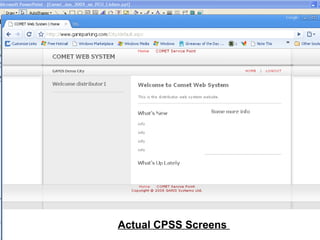
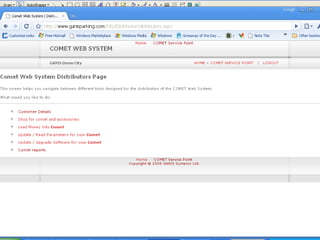
The CPSS  The CPSS is a special BES allowing enterprises and Point of Sale to provide the following services to customers unable or unwilling to use their own computer: Loading pre paid parking fees  Change of parameters and S/W  Clock change (if needed) Reading data  The CPSS uses codes instead of a credit card  The CPSS enables the enterprise to generate its own management reports.
Actual CPSS Screens


The Distribution process   The COMET distribution process  can be designed as to allow an “Hands Free” operation from the Municipality stand point. The user can order the device over the Internet or at a point of sales (POS) The unit is shipped to the user (by regular mail or a fast courier) unloaded or containing a minimal (parking) fee. The user charges the device to the required amount at his computer or mobile phone.

Comet_General

  • 1.
    COMET Theultimate system for paying “On street” parking fees
  • 2.
    About Ganis SystemsLtd. Ganis Systems Ltd., was founded in 1993. Over 100 cities and campuses, in 13 countries world-wide are using Ganis’ technology making it the world’s leader in the field of Personal Parking Meters (PMM). In addition to PPMs Ganis is also offering parking management and enforcement technology and Time Attendance Systems.
  • 3.
    Partial List ofGanis Customers Norway – 24 cities including Baerum , Harstad, Alesund, Kritiandsand, Hammer, Rana, Arendal, Bergen, Lillehammer, Narvik, Voss, Hammerfast. Gjovick, Alta and Bodo. Belgium – 19 cities including Anwerp, Gent, Liege, Namur, Geel, Zottegem, Boom, Sint Truiden, Torhout, Deinze, Aarschot and several others. Holland - Amsterdam, Dordrecht, and Rosendal. Italy – Desio and Codroipo. Spain - Lorca, Totana, Segovia and Santnader. Austria - Innsbruck, Hall and Braunau. Sweden – Stockholm and Goteborg. New Zealand – Wellington, Hamilton and Hutt. Australia – Shepparton. Canada – The town of Whistler. US – Buffalo, Fort Lauderdale, University of California Santa Barbara , UC Davis, University of Binghamton, UMASS, University of Wisconsin Madison, New Brunswick, University of Wisconsin Milwaukee, Grand Rapids and Washington State University.. Argentina – Cordoba.   Finland – Helsinki.
  • 4.
    The challenge ofcollecting “On Street” parking fees Collection of parking fees is essential both as a tool for managing scares parking resources as well as a source of income for the Municipalities. All available parking fee collection systems suffer from some major drawbacks : Curbside parking meters – Vandalism, maintenance, cash collection, inflexible, unfair to the user, visual pollution. P&D – High investment, vandalism, maintenance, inconvenient for the user, difficult enforcement, cash collection, not friendly to the user. Cellular – Expensive for the user, difficult to operate, high transaction cost, difficult and expensive enforcement and subject to the big brother effect.
  • 5.
    What is aPersonal meter ? A Personal (in-car) meter is a small electronic device used to pay the “on street“ parking fees and to regulate parking time. Contains all parking rates and regulations. The customer pays for the device and the parking fees, the city can assist providing a discount on parking fees or meters. Various models are available offering a variety of technical features.
  • 6.
    Motorist Benefits User Friendly, Easy to operate No need for cash Charges only for actual time parked Proof for revoking unjustified summons Fully anonymous Provide receipt for parking fees Meeting the needs of special groups: disabled, senior citizens, doctors etc. Same device can be used in various cities.
  • 7.
    City Operational BenefitsNo cash collection and management. Easy and efficient enforcement. Flexible, easily modified to accommodate new regulations. Environmentally friendly. Improve service to the customer, make city residents happier !!
  • 8.
    City financial benefits Reduce operational costs. Maintenance free. No investment in infrastructure. Improved cash flow (pre- paid). Increased net revenues. Encourage short-period parking payment. Benefits the non-used pre-paid fees.
  • 9.
    Ganis’ family ofPersonal meters Ganis is a world leader in the field of Personal Parking Meters. We propose three types of in car meters: The Spark – A low cost device in a disposable or re-loadable configuration. The Comet – Can be connected to the internet. The Smart Park - a smart Card based device. The Comet The Smart Park The Spark
  • 10.
    What is COMET COMET is a state of the art “On Street” parking fee collection, control and management system based on a personal parking meter and the latest in cellular and Internet technologies. COMET gives the user and the operator the most cost effective solution without the shortcomings of competing technologies.
  • 11.
    COMET main featuresVery small upfront investment both for the user and the operator. The compact “personal parking meter” is easily and conveniently operated by the user without having to leave the vehicle. No transaction cost (unlike competing technologies such as cellular phones). The user can buy and pay his parking fees in advance using his computer and/or mobile phone at home or on the move any time. Fair to the user – the driver pays only for the time parked. Friendly and easy to use. State of the art technology for easy and convenient enforcement.
  • 12.
    COMET System Architecture COMET Personal In Car Meter User’s Computer USB cable Codes GANIS Main Server Internet Main Management &loading systems Codes Cellular (GPRS) on line enforcement (Optional )
  • 13.
    COMET – PersonalParking meter The COMET is an electronic device operated as a personal parking meter, offering following Functionality: Allows parkers to pay for actual time parked only Multiple parking zones. Variety of parking rates (Max, Min, Grace, Progressive etc) Real Time Clock & calendar. Replaceable Standard battery. Typical operating time of 300 hours. User friendly and easy to operate. Dynamic LCD display of 4 large Alpha Numeric characters. Can be adopted to extreme temperature conditions. Dimensions: Less than 60x90x11 mm, (2.4”X3.5”X0.4”) Weight: ~ 50 gr. Battery Compartment City name Zone HEL 03 13245 Unit ID No.
  • 14.
    Using the COMETas easy as 1, 2, 3! Driver parks the car 1. Driver turns the COMET ON 2. Driver selects Zone, clicks on OK and hangs the unit on the car window 3. Driver turns the meter OFF upon returning to the car
  • 15.
    Loading the COMET The user can reload his COMET meter using one of the following methods: Using his personal computer or cellular phone * through a special coding systems. Using his personal computer via the USB cable. Going to a point of sale (e.g. gas station).* Calling a service center via code.* Using his personal computer and the USB cable, the user can also update parking rates. and regulations as required by the city. * where the service is available.
  • 16.
    COMET Enforcement The COMET can be enforced: Visually, using the clear dynamic display. The Comet displays a strongly encrypted security code every minute. Real time control using cellular GPRS and Bluetooth technology in order to confirm a S/N dependent security code.
  • 17.
    Cellular phone BluetoothPrinter Cellular – Internet Secure Internet Connection Real time information flow Secure Internet Connection Enforcement and citations On-Line through Cellular connection (Optional) Ganis Server
  • 18.
    Back End System(BES) The Web based Back End System is responsible for: Controlling the loading providing good visibility to the municipality over the complete process. Update of the parking parameters. Update of the Comet’s S/W. Generation of management reports including parking records and loading information.
  • 19.
  • 20.
    Simplepark – theUS & Canada www.simplepark.com
  • 21.
  • 22.
    Laatukilpi /Helsinki -Finland www.comet.fi
  • 23.
    Setex/Santander– Spain www.recargacomet.es
  • 24.
    Setex/Santander – Spain www.recargacomet.es
  • 25.
  • 26.
  • 27.
    Back End System Financial Controls
  • 28.
    Actual Screens – Finland
  • 29.
  • 30.
  • 31.
  • 32.
  • 33.
  • 34.
    The CPSS The CPSS is a special BES allowing enterprises and Point of Sale to provide the following services to customers unable or unwilling to use their own computer: Loading pre paid parking fees Change of parameters and S/W Clock change (if needed) Reading data The CPSS uses codes instead of a credit card The CPSS enables the enterprise to generate its own management reports.
  • 35.
  • 36.
  • 37.
  • 38.
  • 39.
    The Distribution process The COMET distribution process can be designed as to allow an “Hands Free” operation from the Municipality stand point. The user can order the device over the Internet or at a point of sales (POS) The unit is shipped to the user (by regular mail or a fast courier) unloaded or containing a minimal (parking) fee. The user charges the device to the required amount at his computer or mobile phone.

Editor's Notes

  • #15 An in-car parking meter is a small portable electronic device that is used in conjunction with a prepaid parking smart card. The parker activates the device prior to leaving the car by using the card and selecting the parking zone (if more than one zone exist). Upon return, the parker turns off the device. The device remains in the vehicle, on the rear-view mirror or by the driver’s window, while the card can be kept separately. The value is stored on the smart cards, which can be disposable or rechargeable.